HOME SWEET HOME!

           By:
 Veronica,Putri,Archi,Kevin
CONTENT

•   Underground house
•   Tree house
•   Apartment
•   Terraced House
•   Picture
•   Group’s opinion
UNDERGROUND HOUSE
• Underground house or earth-sheltered dwellings lie
  mostly beneath the Earth's surface. These houses
  are in expensive to heat and cool since the
  surrounding soil acts as natural insulation.
• Underground buildings (at least some) depend entirely
  upon the insulation provided by the soil surrounding
  walls and floors. Others, however, have tubes
  channeled through them to bring in fresh air.
• Most underground dwellings are made of concrete.
  Some other advantages of building underground are
  lower insurance premiums, natural sound insulation,
  less susceptibility to fire, high winds, hailstorms and
  tornadoes to name a few.
TREE HOUSE
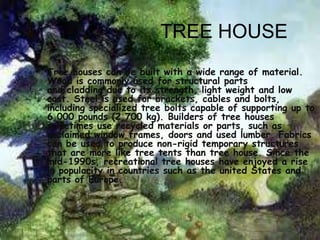
• Tree houses can be built with a wide range of material.
  Wood is commonly used for structural parts
  and cladding due to its strength, light weight and low
  cost. Steel is used for brackets, cables and bolts,
  including specialized tree bolts capable of supporting up to
  6,000 pounds (2,700 kg). Builders of tree houses
  sometimes use recycled materials or parts, such as
  reclaimed window frames, doors and used lumber. Fabrics
  can be used to produce non-rigid temporary structures
  that are more like tree tents than tree house. Since the
  mid-1990s, recreational tree houses have enjoyed a rise
  in popularity in countries such as the united States and
  parts of Europe.
APARTMENT


• By 1900, more than 75 percent of urban
  Americans were living in apartments.
  Apartments served as a second residence
  for many wealthy Americans and offered a
  convenient, respectable, and safe
  residence near work for urban singles and
  middle-class families. San Francisco's
  Tenderloin district, then a middle-class
  neighborhood with residential hotels and
  apartment houses, was popularly known as
  "the apartment house district."
TERRACED HOUSE
• In architecture and city planning, a terraced
  house, terrace, row house, linked
  house or townhouse (though the last term can
  also refer to patio houses) is a style of medium-
  density housing that originated in Europe in the
  16th century, where a row of identical or
  mirror-image houses share side walls. The Place
  des Vosges in Paris (1605–1612) is one of the
  early examples of the style. The first and last
  of these houses is called an end terrace, and is
  often larger than the houses in the middle.
PICTURES!
UNDERGROUND HOUSE
TREE HOUSE!
APARTMENT
TERRACED HOUSE
Group’s Opinion
 There are a lot of different types of
houses in this world and each one of
   them is really unique. Different
  people live in each type of house.
   And those houses are placed in
           different places.
Esl homes

Esl homes

  • 1.
    HOME SWEET HOME! By: Veronica,Putri,Archi,Kevin
  • 2.
    CONTENT • Underground house • Tree house • Apartment • Terraced House • Picture • Group’s opinion
  • 3.
    UNDERGROUND HOUSE • Undergroundhouse or earth-sheltered dwellings lie mostly beneath the Earth's surface. These houses are in expensive to heat and cool since the surrounding soil acts as natural insulation. • Underground buildings (at least some) depend entirely upon the insulation provided by the soil surrounding walls and floors. Others, however, have tubes channeled through them to bring in fresh air. • Most underground dwellings are made of concrete. Some other advantages of building underground are lower insurance premiums, natural sound insulation, less susceptibility to fire, high winds, hailstorms and tornadoes to name a few.
  • 4.
    TREE HOUSE • Treehouses can be built with a wide range of material. Wood is commonly used for structural parts and cladding due to its strength, light weight and low cost. Steel is used for brackets, cables and bolts, including specialized tree bolts capable of supporting up to 6,000 pounds (2,700 kg). Builders of tree houses sometimes use recycled materials or parts, such as reclaimed window frames, doors and used lumber. Fabrics can be used to produce non-rigid temporary structures that are more like tree tents than tree house. Since the mid-1990s, recreational tree houses have enjoyed a rise in popularity in countries such as the united States and parts of Europe.
  • 5.
    APARTMENT • By 1900,more than 75 percent of urban Americans were living in apartments. Apartments served as a second residence for many wealthy Americans and offered a convenient, respectable, and safe residence near work for urban singles and middle-class families. San Francisco's Tenderloin district, then a middle-class neighborhood with residential hotels and apartment houses, was popularly known as "the apartment house district."
  • 6.
    TERRACED HOUSE • Inarchitecture and city planning, a terraced house, terrace, row house, linked house or townhouse (though the last term can also refer to patio houses) is a style of medium- density housing that originated in Europe in the 16th century, where a row of identical or mirror-image houses share side walls. The Place des Vosges in Paris (1605–1612) is one of the early examples of the style. The first and last of these houses is called an end terrace, and is often larger than the houses in the middle.
  • 7.
  • 8.
  • 9.
  • 10.
  • 11.
  • 12.
    Group’s Opinion Thereare a lot of different types of houses in this world and each one of them is really unique. Different people live in each type of house. And those houses are placed in different places.