The European
Social Fund in
Sweden 20072013
The Swedish ESF Council

•   The Swedish ESF Council is the Managing
    and the Certifying Authority for the
    European Social Fund and for the
    European Integration Fund.

•   The Swedish ESF Council has 120
    employees in eight regional units all over
    the country, and the Head Office in
    Stockholm.
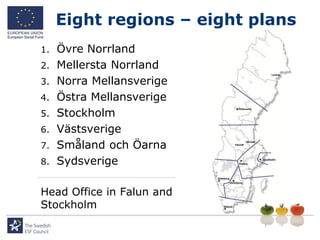
Eight regions – eight plans
1.   Övre Norrland
2.   Mellersta Norrland
3.   Norra Mellansverige
4.   Östra Mellansverige
5.   Stockholm
6.   Västsverige
7.   Småland och Öarna
8.   Sydsverige

Head Office in Falun and
Stockholm
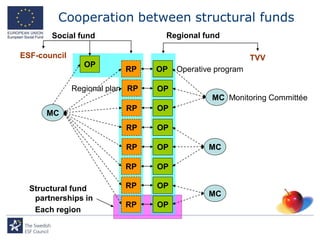
Cooperation between structural funds
       Social fund                Regional fund

ESF-council                                               TVV
                 OP
                          RP     OP   Operative program

              Regional plan RP   OP
                                               MC Monitoring Committée
                           RP    OP
      MC
                           RP    OP

                           RP    OP           MC

                          RP     OP

  Structural fund         RP     OP
                                              MC
   partnerships in
                          RP     OP
   Each region
The Monitoring Committee

•   Oversees the implementation and
    guarantees quality and efficiency.

•   Consist of representatives from
    authorities, non-profit organisations,
    labour organisations and universities and
    colleges.
Structural Fund Partnerships
•   Each of the eight regions has a joint Structural
    Fund partnership for the European Social fund and
    the Regional Development Fund.
•   It consist of elected representatives from
    municipalities and county councils, and
    representatives from labour organisations, county
    administrative boards, the Swedish Employment
    Service, other stakeholders and associations. The
    Sami Parliament (Sametinget) is also represented
    in the two northernmost regions.
•   These partnerships are tasked with prioritizing
    the projects deemed eligible by the managing
    authorities.
ESF in Sweden 2007 - 2013
•   SEK 6.2 billion, excluding national co-financing
•   Approximately 2000 projects


• 30 per cent, Skills provision (Priority axis 1)
• 70 per cent, Increased labour supply (Priority axis 2)
____________________________________
• ESF is only a small part of all resources for employment
  policy/social measures in Sweden
                                =
•   Opportunity for innovativ actions and development of new
    methods
Added value in the social fund is created by
making it possible to influence and improve:


1.   Individuals, the situation of vulnerable
     groups in working life
2.   Corporate strategies, productivity,
     growth
3.   Workplaces' formal and informal
     procedures
4.   Policy and development of new
     concepts in policies, structures,
     institutions
Priority 1: Skills supply
•   Activities focus on employees and
    entrepreneurs in the public and private
    sectors and the social economy.
•   Support is offered to develop relevant skills,
    comprising a careful analysis of needs
    followed by appropriate training. This
    improves the adaptability and employability
    of workers and allow them to meet new
    challenges and a changing environment.
•   Other projects aim at preventing long-term
    sickness leave and combating discrimination
    in getting and advancing in a job.
Priority 2: Increased labour
supply
•   Focus on people outside of the labour
    market, especially on young, immigrants and
    those on long-term sickness leave.
•   The aim is to get them into work or, through
    education schemes or other measures, to
    bring them closer to getting a job.
•   For example, by encouraging early school
    leavers to return to education or training or
    to participate in activities designed to prepare
    them for working life.
Gender mainstreaming
and accessibility
•   Gender mainstreaming and accessibility for
    people with disabilities are priorities across
    the whole OP.
•   This includes funding projects
       that helps to improve skills to eliminate
        gender-based segregation on the labour
        market
       that helps to improve skills to remove
        obstacles which people with disabilities are
        encountering on the labour market
National Selection Criteria
1.   Mapping and analysis of the needs and
     problems at hand
2.   Project activities and objectives
3.   Target groups
4.   Gender mainstreaming
5.   Accessibility for persons with disabilities
6.   Programme criteria (varies from call to call:
     learning environments, innovation, cooperation
     and strategic impact)
7.   Monitoring, evaluation and learning (only
     monitoring in phase 1: feasibility study)
8.   Project organization and competence
9.   Risk management (only phase 2:
     implementation)
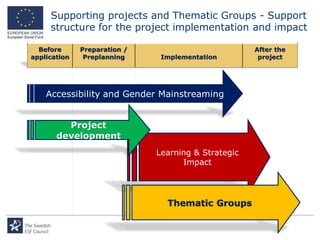
Supporting projects and Thematic Groups - Support
     structure for the project implementation and impact

  Before      Preparation /                          After the
application    Preplanning     Implementation         project


    Accessibility and Gender Mainstreaming


         Project
       development
                              Learning & Strategic
                                    Impact


                                Thematic Groups
Support project
•   Accessibility for persons with disabilities
       Agreement with the Swedish Agency for Disability
        Policy Coordination in cooperation with The Swedish
        Disability Federation, the united voice of the
        Swedish disability movment before government, the
        parliament and national authorities.


•   Gender mainstreaming
       Agreement with County Administrative Boards
Supporting projects
versus Thematic Groups
•   Regional project development support aid
    should primarily support the projects before
    the application and pre-planning phase
•   ”SPeL” should mainly support projects in the
    implementation phase, with a focus on
    learning and strategic impact
•   ... while the Thematic Groups in particular
    will work on the projects 'outputs'
Thematic Groups in ESF 2007-2013
•   Integration into Workinglife (Linköping University)
    The main focus is (re-) entry and integration into working life for people with foreign
    backgrounds, people with disabilities, and people who are long-term sick.
•   Theme Group Youth (Ungdomsstyrelsen)
    The main focus is on methods to counteract unemployment among young and strategies for
    the development of the transition between school & work.
•   Workplace Learning & conversion (Luleå University of Technology)
    The main focus is the efforts of employees to meet future demands in the workforce through
    training, including work as a tool for learning, increased ability to cope with changes and
    validation of skills.
•   Business and entrepreneurship (Tillväxtverket)
    The main focus is how entrepreneurship and business can contribute to reducing exclusion in
    the workplace. This thematic group included social economy and entrepreneurship as a tool
    of empowerment and to counteract exclusion.
•   Equality & discrimination into Workinglife (Arbetsmiljöforum)
    This thematic group focuses on all forms of discrimination. This includes new methods to
    promote equal treatment/opportunities in employment and skills enhancement initiatives to
    improve skills in working life.
From the proposal of call of
the Thematic Groups :


"The role for the Thematic Groups' will be
  to develop, analyze and discuss the
  project results in order to affect more
  long term than the individual projects can
  do for themselves. The Thematic Groups
  will achieve the impact and influence
  audiences under the thematic area. "
Action Support Accessibility - Activities
-12 000 participants from working life in our activities

-600 trainings/educations for different funded ESF-projects

-1000 individual counselings

-Participation in 350 information meetings

-Many seminars including breakfast seminars

-7333 visits at our website www.tillgangligtprojekt.se
 in 2011
Activities (2)
•   -Several hundreds of viewers watched
    our 6 webcasted training programs 2011.
    Either the original version or the sign
    interpreted
    -7 network meetings in our consultant
    network
    -Customer satisfaction index was 82% in
    the evaluation made by
    Sweco (evaluation consultant company)
    2010
    -More than 10 times presentation on
    Action Support Accessibility in
    an international context
www.esf.se/english
    More information in English about the Swedish
    ESF Council, our programes and with
    presentations of current projects

European Social Funds in Sweden

  • 1.
    The European Social Fundin Sweden 20072013
  • 2.
    The Swedish ESFCouncil • The Swedish ESF Council is the Managing and the Certifying Authority for the European Social Fund and for the European Integration Fund. • The Swedish ESF Council has 120 employees in eight regional units all over the country, and the Head Office in Stockholm.
  • 3.
    Eight regions –eight plans 1. Övre Norrland 2. Mellersta Norrland 3. Norra Mellansverige 4. Östra Mellansverige 5. Stockholm 6. Västsverige 7. Småland och Öarna 8. Sydsverige Head Office in Falun and Stockholm
  • 4.
    Cooperation between structuralfunds Social fund Regional fund ESF-council TVV OP RP OP Operative program Regional plan RP OP MC Monitoring Committée RP OP MC RP OP RP OP MC RP OP Structural fund RP OP MC partnerships in RP OP Each region
  • 5.
    The Monitoring Committee • Oversees the implementation and guarantees quality and efficiency. • Consist of representatives from authorities, non-profit organisations, labour organisations and universities and colleges.
  • 6.
    Structural Fund Partnerships • Each of the eight regions has a joint Structural Fund partnership for the European Social fund and the Regional Development Fund. • It consist of elected representatives from municipalities and county councils, and representatives from labour organisations, county administrative boards, the Swedish Employment Service, other stakeholders and associations. The Sami Parliament (Sametinget) is also represented in the two northernmost regions. • These partnerships are tasked with prioritizing the projects deemed eligible by the managing authorities.
  • 7.
    ESF in Sweden2007 - 2013 • SEK 6.2 billion, excluding national co-financing • Approximately 2000 projects • 30 per cent, Skills provision (Priority axis 1) • 70 per cent, Increased labour supply (Priority axis 2) ____________________________________ • ESF is only a small part of all resources for employment policy/social measures in Sweden = • Opportunity for innovativ actions and development of new methods
  • 8.
    Added value inthe social fund is created by making it possible to influence and improve: 1. Individuals, the situation of vulnerable groups in working life 2. Corporate strategies, productivity, growth 3. Workplaces' formal and informal procedures 4. Policy and development of new concepts in policies, structures, institutions
  • 9.
    Priority 1: Skillssupply • Activities focus on employees and entrepreneurs in the public and private sectors and the social economy. • Support is offered to develop relevant skills, comprising a careful analysis of needs followed by appropriate training. This improves the adaptability and employability of workers and allow them to meet new challenges and a changing environment. • Other projects aim at preventing long-term sickness leave and combating discrimination in getting and advancing in a job.
  • 10.
    Priority 2: Increasedlabour supply • Focus on people outside of the labour market, especially on young, immigrants and those on long-term sickness leave. • The aim is to get them into work or, through education schemes or other measures, to bring them closer to getting a job. • For example, by encouraging early school leavers to return to education or training or to participate in activities designed to prepare them for working life.
  • 11.
    Gender mainstreaming and accessibility • Gender mainstreaming and accessibility for people with disabilities are priorities across the whole OP. • This includes funding projects  that helps to improve skills to eliminate gender-based segregation on the labour market  that helps to improve skills to remove obstacles which people with disabilities are encountering on the labour market
  • 12.
    National Selection Criteria 1. Mapping and analysis of the needs and problems at hand 2. Project activities and objectives 3. Target groups 4. Gender mainstreaming 5. Accessibility for persons with disabilities 6. Programme criteria (varies from call to call: learning environments, innovation, cooperation and strategic impact) 7. Monitoring, evaluation and learning (only monitoring in phase 1: feasibility study) 8. Project organization and competence 9. Risk management (only phase 2: implementation)
  • 13.
    Supporting projects andThematic Groups - Support structure for the project implementation and impact Before Preparation / After the application Preplanning Implementation project Accessibility and Gender Mainstreaming Project development Learning & Strategic Impact Thematic Groups
  • 14.
    Support project • Accessibility for persons with disabilities  Agreement with the Swedish Agency for Disability Policy Coordination in cooperation with The Swedish Disability Federation, the united voice of the Swedish disability movment before government, the parliament and national authorities. • Gender mainstreaming  Agreement with County Administrative Boards
  • 15.
    Supporting projects versus ThematicGroups • Regional project development support aid should primarily support the projects before the application and pre-planning phase • ”SPeL” should mainly support projects in the implementation phase, with a focus on learning and strategic impact • ... while the Thematic Groups in particular will work on the projects 'outputs'
  • 16.
    Thematic Groups inESF 2007-2013 • Integration into Workinglife (Linköping University) The main focus is (re-) entry and integration into working life for people with foreign backgrounds, people with disabilities, and people who are long-term sick. • Theme Group Youth (Ungdomsstyrelsen) The main focus is on methods to counteract unemployment among young and strategies for the development of the transition between school & work. • Workplace Learning & conversion (Luleå University of Technology) The main focus is the efforts of employees to meet future demands in the workforce through training, including work as a tool for learning, increased ability to cope with changes and validation of skills. • Business and entrepreneurship (Tillväxtverket) The main focus is how entrepreneurship and business can contribute to reducing exclusion in the workplace. This thematic group included social economy and entrepreneurship as a tool of empowerment and to counteract exclusion. • Equality & discrimination into Workinglife (Arbetsmiljöforum) This thematic group focuses on all forms of discrimination. This includes new methods to promote equal treatment/opportunities in employment and skills enhancement initiatives to improve skills in working life.
  • 17.
    From the proposalof call of the Thematic Groups : "The role for the Thematic Groups' will be to develop, analyze and discuss the project results in order to affect more long term than the individual projects can do for themselves. The Thematic Groups will achieve the impact and influence audiences under the thematic area. "
  • 18.
    Action Support Accessibility- Activities -12 000 participants from working life in our activities -600 trainings/educations for different funded ESF-projects -1000 individual counselings -Participation in 350 information meetings -Many seminars including breakfast seminars -7333 visits at our website www.tillgangligtprojekt.se in 2011
  • 19.
    Activities (2) • -Several hundreds of viewers watched our 6 webcasted training programs 2011. Either the original version or the sign interpreted -7 network meetings in our consultant network -Customer satisfaction index was 82% in the evaluation made by Sweco (evaluation consultant company) 2010 -More than 10 times presentation on Action Support Accessibility in an international context
  • 20.
    www.esf.se/english More information in English about the Swedish ESF Council, our programes and with presentations of current projects