ENERGY SYSTEM
ANALYSIS
LEC. 01
They are thermal because they often
involve the transfer of heat.
typically use working fluids to transport
energy
Thermal Energy Systems Design and
Analysis
• A heating and cooling system for a
commercial or residential building
• A network of pipes and pumps used to
transport a fluid to and from various processes
within an industrial facility
• A vapor power cycle used to deliver electrical
power
• A vapor compression refrigeration cycle used
for cooling or heating
examples of thermal energy systems
For the engineer to analyze or design thermal
energy systems,
it is important to understand the
fundamental concepts expressed in terms of
various conservation laws and balances.
 Before Computers:
the solution of the mathematical model was
done by constructing many graphs
representing the equations and looking for
intersection points.
 Modern equation-solving software makes
this task quite easy
 The National Institute of Standards and
Technology (NIST) maintains the most
current fluid property calculation software
known as REFPROP.
 Engineering Equation Solver
 Matlab
Software
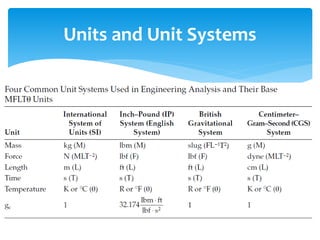
Units and Unit Systems
static forms of energy – can be stored
 gravitational potential energy
 kinetic energy
 internal energy
dynamic forms of energy –not stored but
transferred
 Work
 Heat
Concept and laws of energy
types of mechanical energy
 Quantity
 Quality - its capacity to produce a change
fundamental aspect of energy
The more disordered an energy (heat, internal
energy) is, the lower its quality is, which means, its
capacity to produce useful effects is low, while
ordered energies (electrical, all forms of mechanical
energy) have the highest quality and are convertible
into other forms of energy.
in any transformation of energy that is
considered, in any process that takes
place in a unit or an installation,
although the energy is conserved, the
quality of that energy decreases.
Energy sources. Fossil and
renewable energies
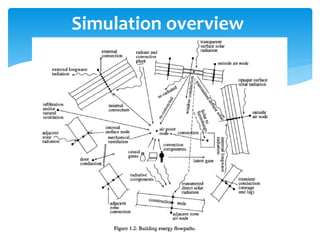
Simulation overview
Simulation allows users to understand the
interrelation between design and
performance parameters, to identify
potential problem areas, and so implement
and test appropriate design modifications.
The design to result is more energy conscious
with better levels and quality attained
throughout.

ESA - lecture 1 part 1 energy system analysis

  • 1.
  • 2.
    They are thermalbecause they often involve the transfer of heat. typically use working fluids to transport energy Thermal Energy Systems Design and Analysis
  • 3.
    • A heatingand cooling system for a commercial or residential building • A network of pipes and pumps used to transport a fluid to and from various processes within an industrial facility • A vapor power cycle used to deliver electrical power • A vapor compression refrigeration cycle used for cooling or heating examples of thermal energy systems
  • 4.
    For the engineerto analyze or design thermal energy systems, it is important to understand the fundamental concepts expressed in terms of various conservation laws and balances.
  • 5.
     Before Computers: thesolution of the mathematical model was done by constructing many graphs representing the equations and looking for intersection points.  Modern equation-solving software makes this task quite easy
  • 6.
     The NationalInstitute of Standards and Technology (NIST) maintains the most current fluid property calculation software known as REFPROP.  Engineering Equation Solver  Matlab Software
  • 7.
  • 8.
    static forms ofenergy – can be stored  gravitational potential energy  kinetic energy  internal energy dynamic forms of energy –not stored but transferred  Work  Heat Concept and laws of energy types of mechanical energy
  • 9.
     Quantity  Quality- its capacity to produce a change fundamental aspect of energy The more disordered an energy (heat, internal energy) is, the lower its quality is, which means, its capacity to produce useful effects is low, while ordered energies (electrical, all forms of mechanical energy) have the highest quality and are convertible into other forms of energy.
  • 10.
    in any transformationof energy that is considered, in any process that takes place in a unit or an installation, although the energy is conserved, the quality of that energy decreases.
  • 11.
    Energy sources. Fossiland renewable energies
  • 12.
  • 13.
    Simulation allows usersto understand the interrelation between design and performance parameters, to identify potential problem areas, and so implement and test appropriate design modifications. The design to result is more energy conscious with better levels and quality attained throughout.