EQUILIBRIUM OUTPUT
AND TRADE BALANCE
Arvind Surwase (014)
CONTENTS
Equilibrium Output
Trade balance
Relation between equilibrium output and trade balance
EUROPE, LAST 5 YEARS
Balance of payments
20XX PRESENTATION TITLE 2
EQUILIBRIUM OUTPUT
Equilibrium output refers to the level of production in an economy
where the total quantity of goods and services supplied is equal to the
total quantity of goods and services demanded. In other words, it is
the level of output at which the aggregate demand for goods and
services in the economy is equal to the aggregate supply of goods
and services.
At this level of output, there is no excess supply or excess demand in
the market, and the economy is said to be in a state of equilibrium.
Economists use the concept of equilibrium output to analyze the
performance of an economy and to understand the factors that can
affect the level of production. By understanding the concept of
equilibrium output, policymakers and analysts can better assess the
economic situation of an economy and develop strategies to promote
economic growth and stability.
20XX PRESENTATION TITLE 3
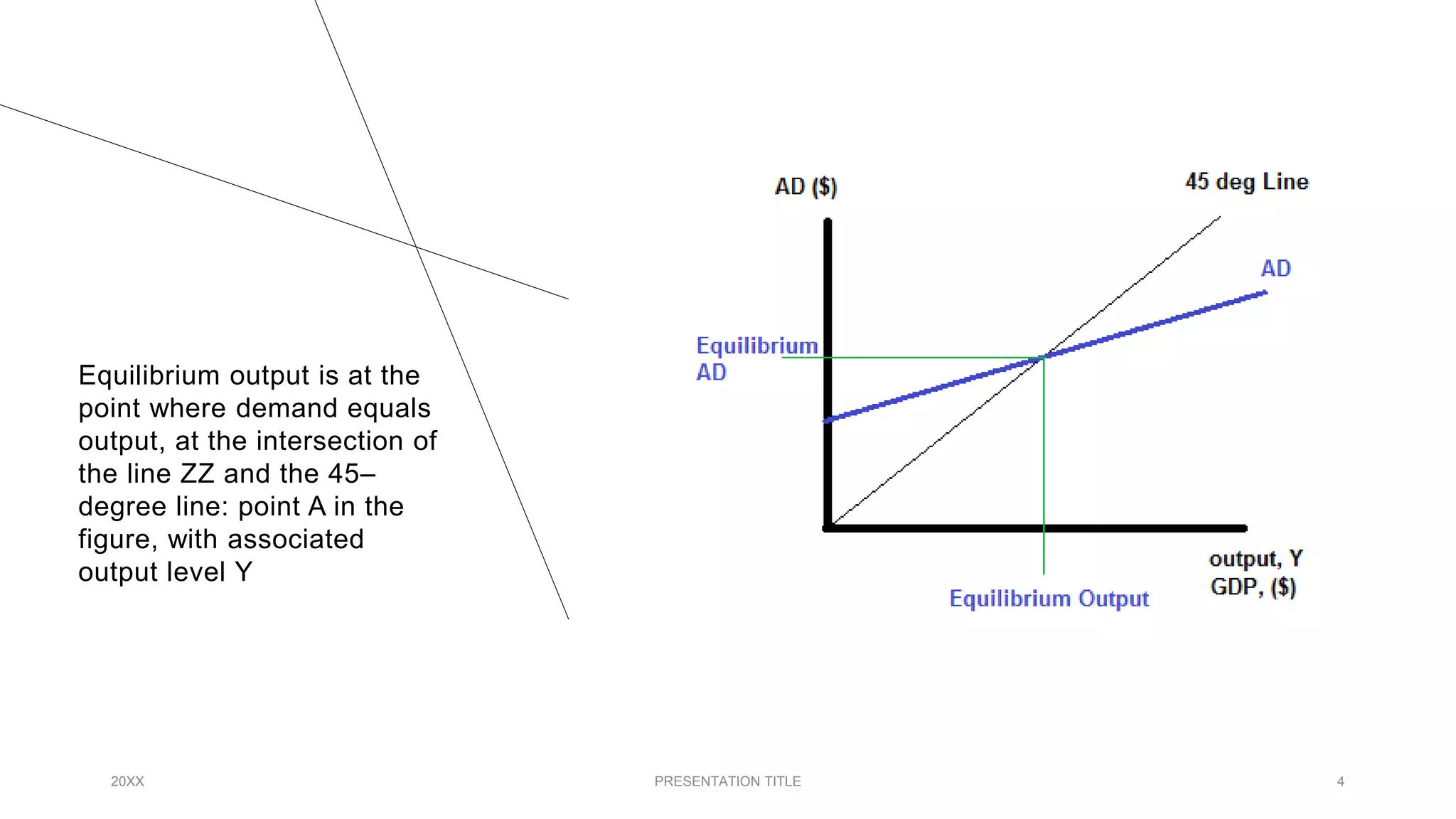
Equilibrium output is at the
point where demand equals
output, at the intersection of
the line ZZ and the 45–
degree line: point A in the
figure, with associated
output level Y
20XX PRESENTATION TITLE 4
TRADE BALANCE
Trade balance refers to the difference between the value of a country's exports and imports of goods and
services.An equilibrium trade balance occurs when the value of a country's exports equals the value of its
imports, resulting in neither a surplus nor a deficit.
The trade balance is an important indicator of a country's economic performance, as it reflects the
competitiveness of its industries and the overall balance of payments. A country with a trade surplus is
typically seen as having a more competitive economy and may be able to accumulate foreign assets, while
a country with a trade deficit may need to borrow from other countries to finance its imports.
A positive trade balance can also contribute to economic growth, as the revenues generated from exports
can be used to invest in domestic industries and infrastructure. However, a persistent trade deficit can be a
cause for concern, as it may indicate that the country is becoming increasingly reliant on foreign borrowing
Balance of trade = Exports - Imports
20XX PRESENTATION TITLE 5
20XX PRESENTATION TITLE 6
RELATION BETWEEN EQUILIBRIUM OUTPUT AND
TRADE BALANCE
There is a relationship between equilibrium output and trade balance. Specifically, when an economy
is producing at its equilibrium output, the trade balance will also be in equilibrium. This is because at
the equilibrium output level, the quantity of goods and services produced is equal to the quantity
demanded, including the quantity demanded by foreign buyers. As a result, the value of exports will be
equal to the value of imports, resulting in an equilibrium trade balance.
However, if an economy is producing at a level of output that is higher than its equilibrium level, it may
be exporting more than it is importing, resulting in a trade surplus. Conversely, if an economy is
producing at a level of output that is lower than its equilibrium level, it may be importing more than it is
exporting, resulting in a trade deficit. Therefore, to achieve a balanced trade, an economy must
produce at its equilibrium output level.
EUROPE, LAST 5
YEARS
Some Key Economic Factors
OUTPUT AND CONSUMPTION
YEAR
2017
2018
2019
2020
2021
GROSS DOMESTIC
PRODUCT (GDP)
€15.3 trillion
€15.9 trillion
€16.5 trillion
€15.1 trillion
€17.1 trillion
CONSUMPTION
€12.5 trillion
€13.0 trillion
€13.5 trillion
€12.3 trillion
€12.8 trillion
OUTPUT
€14.2 trillion
€14.8 trillion
€15.3 trillion
€13.9 trillion
€14.4 trillion
20XX PRESENTATION TITLE 8
BALANCE OF PAYMENTS
YEAR​ Current Account Balance Goods Balance Services Balance
2017 €252 billion €154 billion €213 billion
2018 €362 billion €166 billion €257 billion
2019 €391 billion €163 billion €284 billion
2020 €306 billion €155 billion €218 billion
2021 €322 billion €163 billion €244 billion
20XX PRESENTATION TITLE 9
In terms of equilibrium output, the EU experienced moderate
growth, with an average annual GDP growth rate of around 1.5%
from 2017 to 2021. However, the COVID-19 pandemic caused a
sharp decline in output in 2020, with a contraction of 6.6%. The
EU has since shown a moderate recovery, with a growth rate of
4.2%.
The equilibrium output of the EU would depend on several factors,
including the level of aggregate demand, the productivity of the
economy, and the available resources. It is also worth noting that
the equilibrium output can change over time as these factors shift.
In the last five years, the EU has faced various economic
challenges, including the COVID-19 pandemic, which has had a
significant impact on the level of output and the trade balance of
the member states. The EU has implemented various policies and
initiatives to mitigate the negative effects of the pandemic and
support the recovery of the economy.
It is important to note that calculating the precise equilibrium
output of the EU is a complex task that requires detailed economic
analysis and modeling.
20XX PRESENTATION TITLE 10
20XX PRESENTATION TITLE 11
€ 0
€ 50
€ 100
€ 150
€ 200
€ 250
€ 300
€ 350
€ 400
€ 450
2017 2018 2019 2020 2021
Trade Balance
Current Account Balance Goods Balance Services Balance
0
2
4
6
8
10
12
14
16
18
2017 2018 2019 2020 2021
Consumption Output
Equilibrium
Output
CONCLUSION
20XX PRESENTATION TITLE 12
Over the last 5 years, the European Union's equilibrium output and trade balance have been impacted by
various factors, including global pandemic, war, etc.
In terms of equilibrium output, the EU experienced moderate growth, with an average annual GDP growth rate
of around 1.5% from 2017 to 2021. However, the COVID-19 pandemic caused a sharp decline in output in
2020, with a contraction of 6.6%. The EU has since shown a moderate recovery, with a growth rate of 4.2% in
2021.
Regarding the trade balance, the EU has consistently maintained a surplus in trade in goods and services over
the last 5 years, with an average surplus of around €200 billion annually. This surplus has been mainly driven
by a strong export performance, particularly in sectors such as machinery and transport equipment, and
chemicals.
However, the trade surplus has been partly offset by a deficit in trade in energy, as the EU remains heavily
dependent on energy imports from Russia. Moreover, the COVID-19 pandemic has disrupted global trade,
leading to a decline in exports and imports.
Overall, the EU's equilibrium output and trade balance have been subject to various external and internal
factors over the last 5 years, but the EU has maintained a relatively stable economic performance and a
consistent trade surplus.
REFERENCES
Eurostat (the statistical office of the European
Union)
European Central Bank
World Trade Organization (WTO)
International Monetary Fund (IMF)
European Commission
20XX PRESENTATION TITLE 13
• Q2
• Q3
• Q4
THANK
YOU
Arvind Surwase
surwase@duck.com
20XX PRESENTATION TITLE 14

equilibrium%20output%20and%20trade%20balance.pptx

  • 1.
    EQUILIBRIUM OUTPUT AND TRADEBALANCE Arvind Surwase (014)
  • 2.
    CONTENTS Equilibrium Output Trade balance Relationbetween equilibrium output and trade balance EUROPE, LAST 5 YEARS Balance of payments 20XX PRESENTATION TITLE 2
  • 3.
    EQUILIBRIUM OUTPUT Equilibrium outputrefers to the level of production in an economy where the total quantity of goods and services supplied is equal to the total quantity of goods and services demanded. In other words, it is the level of output at which the aggregate demand for goods and services in the economy is equal to the aggregate supply of goods and services. At this level of output, there is no excess supply or excess demand in the market, and the economy is said to be in a state of equilibrium. Economists use the concept of equilibrium output to analyze the performance of an economy and to understand the factors that can affect the level of production. By understanding the concept of equilibrium output, policymakers and analysts can better assess the economic situation of an economy and develop strategies to promote economic growth and stability. 20XX PRESENTATION TITLE 3
  • 4.
    Equilibrium output isat the point where demand equals output, at the intersection of the line ZZ and the 45– degree line: point A in the figure, with associated output level Y 20XX PRESENTATION TITLE 4
  • 5.
    TRADE BALANCE Trade balancerefers to the difference between the value of a country's exports and imports of goods and services.An equilibrium trade balance occurs when the value of a country's exports equals the value of its imports, resulting in neither a surplus nor a deficit. The trade balance is an important indicator of a country's economic performance, as it reflects the competitiveness of its industries and the overall balance of payments. A country with a trade surplus is typically seen as having a more competitive economy and may be able to accumulate foreign assets, while a country with a trade deficit may need to borrow from other countries to finance its imports. A positive trade balance can also contribute to economic growth, as the revenues generated from exports can be used to invest in domestic industries and infrastructure. However, a persistent trade deficit can be a cause for concern, as it may indicate that the country is becoming increasingly reliant on foreign borrowing Balance of trade = Exports - Imports 20XX PRESENTATION TITLE 5
  • 6.
    20XX PRESENTATION TITLE6 RELATION BETWEEN EQUILIBRIUM OUTPUT AND TRADE BALANCE There is a relationship between equilibrium output and trade balance. Specifically, when an economy is producing at its equilibrium output, the trade balance will also be in equilibrium. This is because at the equilibrium output level, the quantity of goods and services produced is equal to the quantity demanded, including the quantity demanded by foreign buyers. As a result, the value of exports will be equal to the value of imports, resulting in an equilibrium trade balance. However, if an economy is producing at a level of output that is higher than its equilibrium level, it may be exporting more than it is importing, resulting in a trade surplus. Conversely, if an economy is producing at a level of output that is lower than its equilibrium level, it may be importing more than it is exporting, resulting in a trade deficit. Therefore, to achieve a balanced trade, an economy must produce at its equilibrium output level.
  • 7.
    EUROPE, LAST 5 YEARS SomeKey Economic Factors
  • 8.
    OUTPUT AND CONSUMPTION YEAR 2017 2018 2019 2020 2021 GROSSDOMESTIC PRODUCT (GDP) €15.3 trillion €15.9 trillion €16.5 trillion €15.1 trillion €17.1 trillion CONSUMPTION €12.5 trillion €13.0 trillion €13.5 trillion €12.3 trillion €12.8 trillion OUTPUT €14.2 trillion €14.8 trillion €15.3 trillion €13.9 trillion €14.4 trillion 20XX PRESENTATION TITLE 8
  • 9.
    BALANCE OF PAYMENTS YEAR​Current Account Balance Goods Balance Services Balance 2017 €252 billion €154 billion €213 billion 2018 €362 billion €166 billion €257 billion 2019 €391 billion €163 billion €284 billion 2020 €306 billion €155 billion €218 billion 2021 €322 billion €163 billion €244 billion 20XX PRESENTATION TITLE 9
  • 10.
    In terms ofequilibrium output, the EU experienced moderate growth, with an average annual GDP growth rate of around 1.5% from 2017 to 2021. However, the COVID-19 pandemic caused a sharp decline in output in 2020, with a contraction of 6.6%. The EU has since shown a moderate recovery, with a growth rate of 4.2%. The equilibrium output of the EU would depend on several factors, including the level of aggregate demand, the productivity of the economy, and the available resources. It is also worth noting that the equilibrium output can change over time as these factors shift. In the last five years, the EU has faced various economic challenges, including the COVID-19 pandemic, which has had a significant impact on the level of output and the trade balance of the member states. The EU has implemented various policies and initiatives to mitigate the negative effects of the pandemic and support the recovery of the economy. It is important to note that calculating the precise equilibrium output of the EU is a complex task that requires detailed economic analysis and modeling. 20XX PRESENTATION TITLE 10
  • 11.
    20XX PRESENTATION TITLE11 € 0 € 50 € 100 € 150 € 200 € 250 € 300 € 350 € 400 € 450 2017 2018 2019 2020 2021 Trade Balance Current Account Balance Goods Balance Services Balance 0 2 4 6 8 10 12 14 16 18 2017 2018 2019 2020 2021 Consumption Output Equilibrium Output
  • 12.
    CONCLUSION 20XX PRESENTATION TITLE12 Over the last 5 years, the European Union's equilibrium output and trade balance have been impacted by various factors, including global pandemic, war, etc. In terms of equilibrium output, the EU experienced moderate growth, with an average annual GDP growth rate of around 1.5% from 2017 to 2021. However, the COVID-19 pandemic caused a sharp decline in output in 2020, with a contraction of 6.6%. The EU has since shown a moderate recovery, with a growth rate of 4.2% in 2021. Regarding the trade balance, the EU has consistently maintained a surplus in trade in goods and services over the last 5 years, with an average surplus of around €200 billion annually. This surplus has been mainly driven by a strong export performance, particularly in sectors such as machinery and transport equipment, and chemicals. However, the trade surplus has been partly offset by a deficit in trade in energy, as the EU remains heavily dependent on energy imports from Russia. Moreover, the COVID-19 pandemic has disrupted global trade, leading to a decline in exports and imports. Overall, the EU's equilibrium output and trade balance have been subject to various external and internal factors over the last 5 years, but the EU has maintained a relatively stable economic performance and a consistent trade surplus.
  • 13.
    REFERENCES Eurostat (the statisticaloffice of the European Union) European Central Bank World Trade Organization (WTO) International Monetary Fund (IMF) European Commission 20XX PRESENTATION TITLE 13 • Q2 • Q3 • Q4
  • 14.