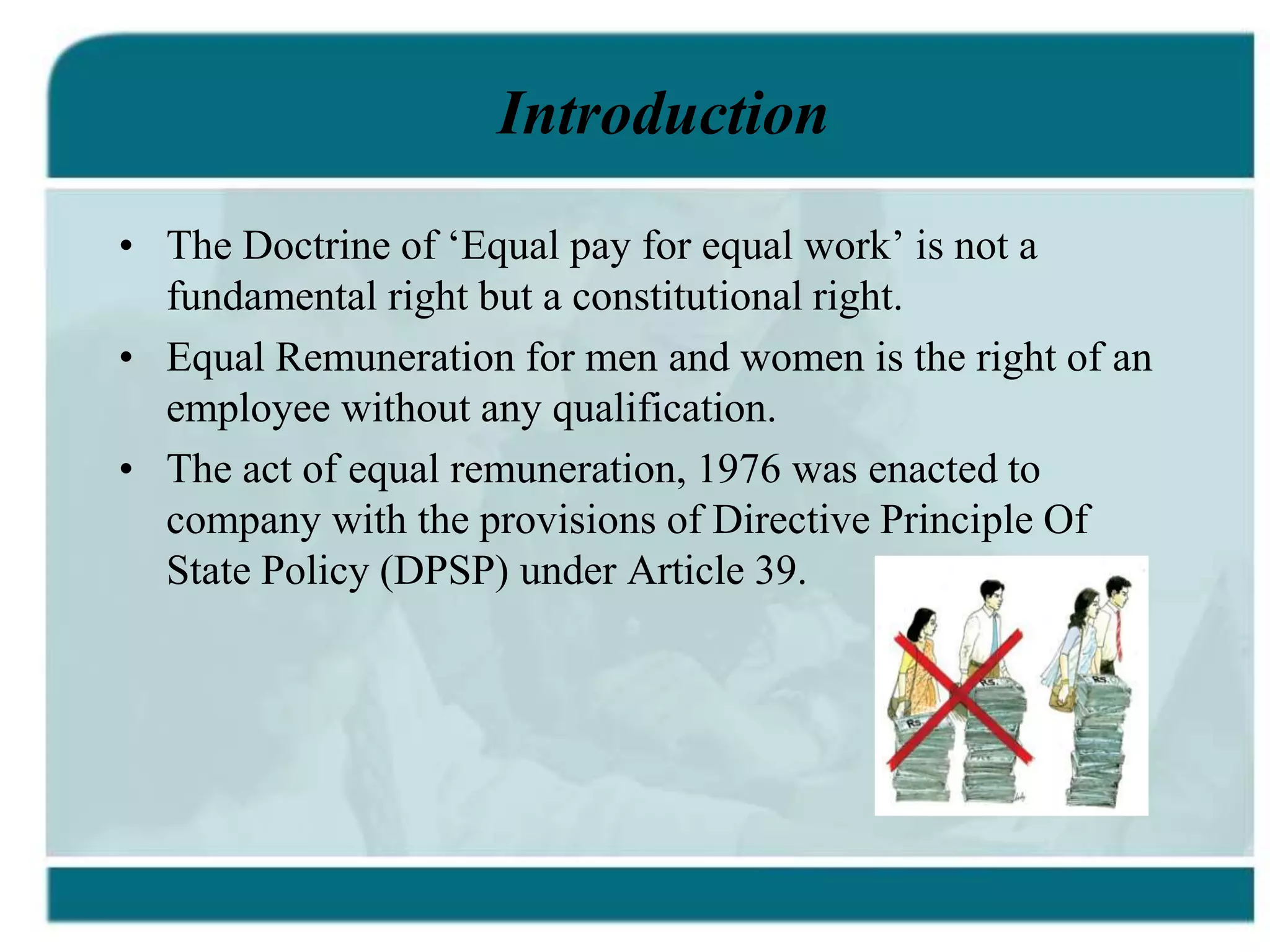
The Equal Remuneration Act of 1976 aims to provide equal pay for equal work between men and women. Key objectives include preventing discrimination against women in employment and increasing opportunities for women. The Act applies to all employers across India and mandates equal remuneration for men and women performing the same or similar work. It also prohibits discrimination in recruitment, training, or promotions based on sex. Advisory committees provide recommendations to increase women's employment. Authorities appointed by the government hear complaints and claims regarding violations and direct appropriate actions such as payment of unequal wages.


![Short title, extend and commencement. [Sec.-1]
1. This Act may be called the Equal Remuneration
Act, 1976.
2. It extends to the whole of India.
3. It shall come into force on such date, not being
later than three years from the passing of this
Act, as the Central Government may, by
notification, appoint and different dates may be
appointed for different establishments or
employments](https://image.slidesharecdn.com/equalremunerationact1976-181010085643/75/Equal-remuneration-act-1976-4-2048.jpg)
![Definitions
1. appropriate Government”[Sec-2(1)(a)] means –
(i) in relation to any employment carried on by or
under the authority of the Central Government or a
railway administration, or in relation to a banking
company, a mine, oilfield or major port or any
corporation established by or under a Central Act,
the Central Government, and
(ii) in relation to any other employment, the State
Government.](https://image.slidesharecdn.com/equalremunerationact1976-181010085643/75/Equal-remuneration-act-1976-5-2048.jpg)
![Definitions
2. “Remuneration”[Section 2 (1)(g)] means
the basic wage or salary, and any additional
emoluments whatsoever payable, either in
cash or in kind to a person employed in
respect of employment or work done in
such employment, if the terms of the
contract of employment, express or implied,
were fulfilled.](https://image.slidesharecdn.com/equalremunerationact1976-181010085643/75/Equal-remuneration-act-1976-6-2048.jpg)
![Definitions
3. “Same work or work of a similar nature” [Sec.- 2(1)(h)]
means work in respect of which the skill, effort and
responsibility required are the same, when performed
under similar working conditions, by a man or a woman
and the differences, if any, between the skill, effort and
responsibility required of a man and those required of a
woman are not of practical importance in relation to the
terms and conditions of employment.
4. “Worker”[Sec. 2 (i)] means a worker in any
establishment or employment in respect of which this Act
has come into force;](https://image.slidesharecdn.com/equalremunerationact1976-181010085643/75/Equal-remuneration-act-1976-7-2048.jpg)
![Act to have overriding effect[Section 3]
• The provisions of this Act shall have effect
notwithstanding, anything inconsistent
therewith contained in any other law or in
the terms of any award, agreement or
contract of service, whether made before or
after the commencement of this Act, or in
any instrument having effect under any law
for the time being in force.](https://image.slidesharecdn.com/equalremunerationact1976-181010085643/75/Equal-remuneration-act-1976-8-2048.jpg)

![Continue...
b. No discrimination to be made while recruiting men and
women workers [Section 5]
On and from the commencement of this Act, no employer shall, while
making recruitment for the same work or work of a similar nature,[or
in any condition of service subsequent to recruitment such as
promotions, training or transfer], make any discrimination against
women except where the employment of women in such work is
prohibited or restricted by or under any law for the time being in force:
Provided that the provisions of this section shall not affect any priority
or reservation for scheduled castes or scheduled tribes, ex-servicemen,
retrenched employees of any other class or category of persons in the
matter of recruitment to the posts in an establishment or employment.](https://image.slidesharecdn.com/equalremunerationact1976-181010085643/75/Equal-remuneration-act-1976-11-2048.jpg)
![Advisory Committee. [Section 6]
1. For the purpose of providing increasing employment
opportunities for women, the appropriate Government
shall constitute one or more Advisory Committees to
advise it with regard to the extend to which women may
be employed in such establishments or employments as
the Central Government may, by notification, specify in
this behalf.
2. Every Advisory Committee shall consist of not less than
ten persons, to be nominated by the appropriate
Government, of which one-half shall be women.
3. The Advisory Committee shall regulate its own
procedure.](https://image.slidesharecdn.com/equalremunerationact1976-181010085643/75/Equal-remuneration-act-1976-12-2048.jpg)
![Advisory Committee. [Section 6]
4. In tendering its advice, the Advisory Committee shall have regard to the
number of women employed in the concerned establishment or
employment, the nature of work, hours of work, suitability of women
for employment, as the case may be, the need for providing increasing
employment opportunities for women, including part-time
employment, and such other relevant factors as the Committee may
think fit.
5. The appropriate Government may, after considering the advice tendered
to it by the Advisory Committee and after giving to the persons
concerned in the establishment or employment an opportunity to make
representations, issue such directions in respect of employment of
women workers, as the appropriate Government may think fit.](https://image.slidesharecdn.com/equalremunerationact1976-181010085643/75/Equal-remuneration-act-1976-13-2048.jpg)
![Authorities For Hearing And Deciding Claims And
Complaints.[Section 7]
1. The appropriate Government may, by notification, appoint such
officers, not below the rank of a Labour Officer, as it thinks fit to be
the authorities for the purpose of hearing and deciding. –
(a) Complaints with regard to the contravention of any provision of this
Act;
(b) Claims arising out of non-payment of wages at equal rates to men and
women workers for the same work or work of a similar nature, and
may, by the same or subsequent notification, define the local limits
within which each such authority shall exercise its jurisdiction](https://image.slidesharecdn.com/equalremunerationact1976-181010085643/75/Equal-remuneration-act-1976-14-2048.jpg)
![Authorities For Hearing And Deciding
Claims And Complaints.[Section 7]
2. Every complaint or claim referred to in sub-section (1) shall be made in
such manner as may be prescribed.
3. If any question arises as to whether two or more works are of the same
nature or of a similar nature, it shall be decided by the authority
appointed under sub-section (1).
4. Every authority appointed under sub-section (1) shall have all the
powers of a civil court under the Code of Civil Procedure, 1978 (5 of
1908), for the purpose of taking evidence and of enforcing the
attendance of witnesses and compelling the production of documents,
and every such authority shall be deemed to be a civil court for all the
purposes of Sec. 195 and Chapter XXVI of the Code of. Criminal
Procedure, 1973.](https://image.slidesharecdn.com/equalremunerationact1976-181010085643/75/Equal-remuneration-act-1976-15-2048.jpg)
![Authorities For Hearing And Deciding
Claims And Complaints.[Section 7]
5. Where a complaint or claim is made to the authority appointed under
sub-section (1), it may, after giving the applicant and the employer an
opportunity, of being heard, and after and such inquiry as it may
consider necessary, direct, -
(i) In the case of a claim arising out of non- payment of wages at equal
rates to men and women workers for the same work or work of a
similar nature, that payment be made to the worker of the amount by
which the wages payable to him exceed the amount actually paid;
(ii) In the case of complaint, the adequate steps are taken by the
employer so as to ensure that there is no contravention of any
provision of this Act.](https://image.slidesharecdn.com/equalremunerationact1976-181010085643/75/Equal-remuneration-act-1976-16-2048.jpg)
![Authorities For Hearing And Deciding
Claims And Complaints.[Section 7]
6. Any employer or worker aggrieved by any order made by
an authority appointed under sub-section (1), on a
complaint or claim may within thirty days from the date of
the order, prefer an appeal to such authority as the
appropriate Government may, by notification, specify in
this behalf, and that authority may, after hearing the
appeal, confirm, modify or reverse the order appealed
against and no further appeal, shall lie against the order
made by such authority.](https://image.slidesharecdn.com/equalremunerationact1976-181010085643/75/Equal-remuneration-act-1976-17-2048.jpg)
![Authorities For Hearing And Deciding
Claims And Complaints.[Section 7]
7. The authority referred to in sub-section (6) may, if it
is satisfied that the appellant was prevented by
sufficient cause from preferring the appeal within
the period specified in sub-section (6), allow the
appeal to be preferred within a further period of
thirty days but not thereafter.
8. The provisions of sub-section (1) of Sec. 33-C of the
Industrial Disputes Act, 1947 shall apply for the
recovery of monies due from an employer arising
out of the decision of an authority appointed under
this section.](https://image.slidesharecdn.com/equalremunerationact1976-181010085643/75/Equal-remuneration-act-1976-18-2048.jpg)


