What Are Office Suites?
Existing Business Model: Software as a Service
● Core Functionality
○ Create Documents
○ Share Files
○ Cloud Collaboration
Add-on and Plugin Galleries and Marketplaces
● Core Components
○ Word Processor
○ Spreadsheet
○ Presentation System
Understanding the role of commitments:
● Rather than storing the data itself, you can store a commitment for that data.
○ Commitments are, in essence, a probabilistic guarantee that the data you’re looking for is stored somewhere
on the network.
○ There are a number of ways to generate a commitment (e.g. a signature or checksum).
○ Algorithms like MD5 or SHA256 take an arbitrarily large amount of data and compress it down to into
something very small. Unlike ZIP files, the data that makes up a commitment cannot later be extracted.
○ This “one-way” compression generates a unique value (or “commitment”) by which the data can be identified.
○ Then, instead of storing that arbitrarily large quantity of data on each node, you’re only asked to store the
commitment.
○ The commitment is used in retrieval to identify the original files.
Building it on Blockchain
Handling decentralized file storage:
● You could implement something similar to Napster such that, when trying to retrieve your data, you search
through different nodes on your network until you find one that has what you’re looking for.
● You could tie this to the blockchain and let users pay to replicate their data by paying coins in the token of the
blockchain.
● However, this strays too far from the typical conceptualization of “blockchain storage”. The happy medium would
be to store hashes on a public chain like Algorand or Ethereum and pairing it with networks like Siacoin or
Arweave which are specifically built for decentralized data and file storage.
Existing Solutions
1. IPFS: Website / Twitter / Intro Video / Documentation
2. Siacoin: Website / Twitter / Intro Video / White Paper / GitLab
3. Arweave.io: Website / Twitter / White Paper / One-Pager
Building it on Blockchain
● You could implement something similar to Napster such that, when trying to retrieve your data, you search
through different nodes on your network until you find one that has what you’re looking for.
● You could tie this to the blockchain and let users pay to replicate their data by paying coins in the token of the
blockchain.
● However, this strays too far from the typical conceptualization of “blockchain storage”. The happy medium would
be to store hashes on a public chain like Algorand or Ethereum and pairing it with networks like Siacoin or
Arweave which are specifically built for decentralized data and file storage.
Existing Solutions
1. IPFS: Website / Twitter / Intro Video / Documentation
2. Siacoin: Website / Twitter / Intro Video / White Paper / GitLab
3. Arweave.io: Website / Twitter / White Paper / One-Pager
Building it on Blockchain
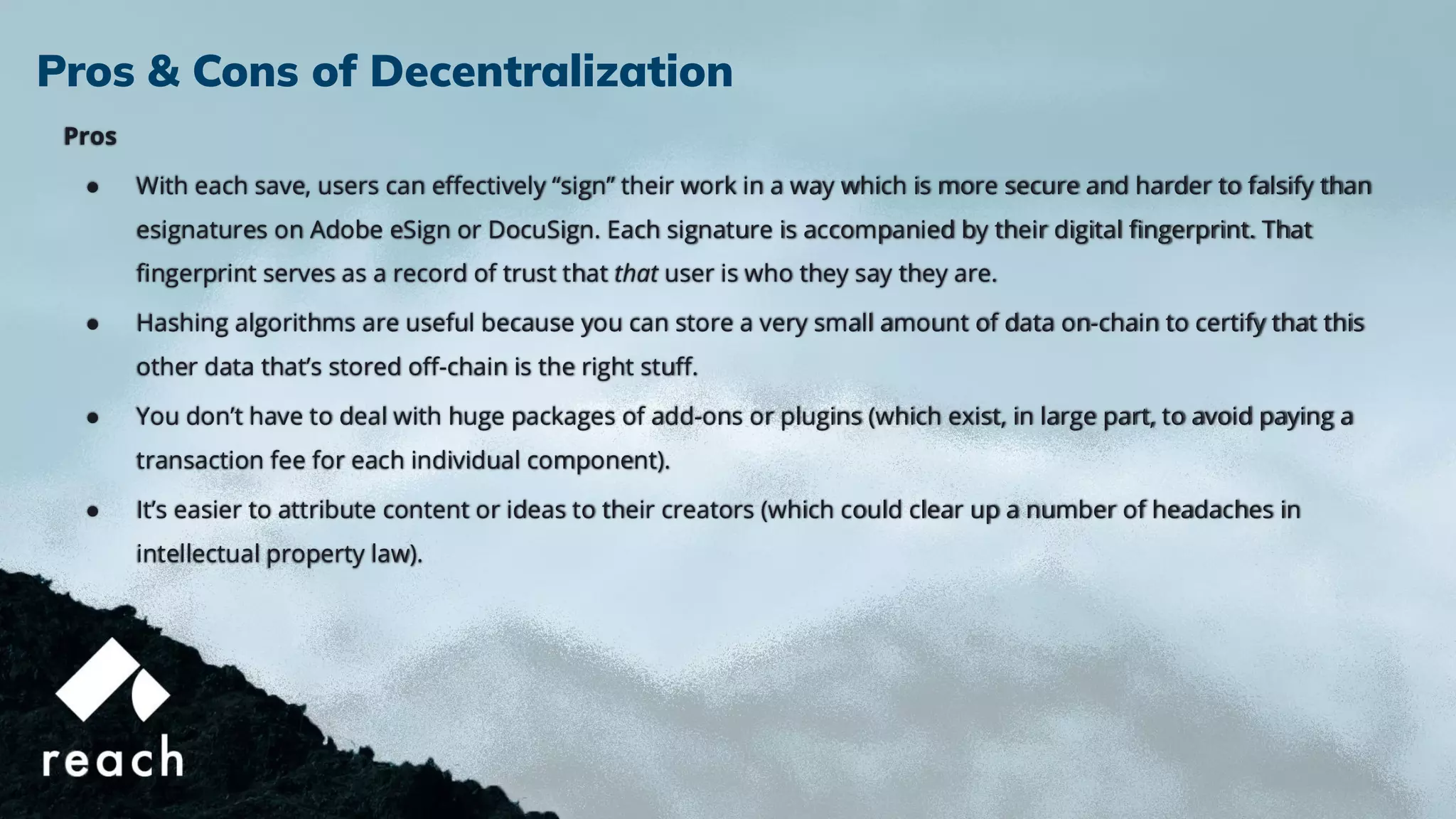
Pros
● With each save, users can effectively “sign” their work in a way which is more secure and harder to falsify than
esignatures on Adobe eSign or DocuSign. Each signature is accompanied by their digital fingerprint. That
fingerprint serves as a record of trust that that user is who they say they are.
● Hashing algorithms are useful because you can store a very small amount of data on-chain to certify that this
other data that’s stored off-chain is the right stuff.
● You don’t have to deal with huge packages of add-ons or plugins (which exist, in large part, to avoid paying a
transaction fee for each individual component).
● It’s easier to attribute content or ideas to their creators (which could clear up a number of headaches in
intellectual property law).
Pros & Cons of Decentralization
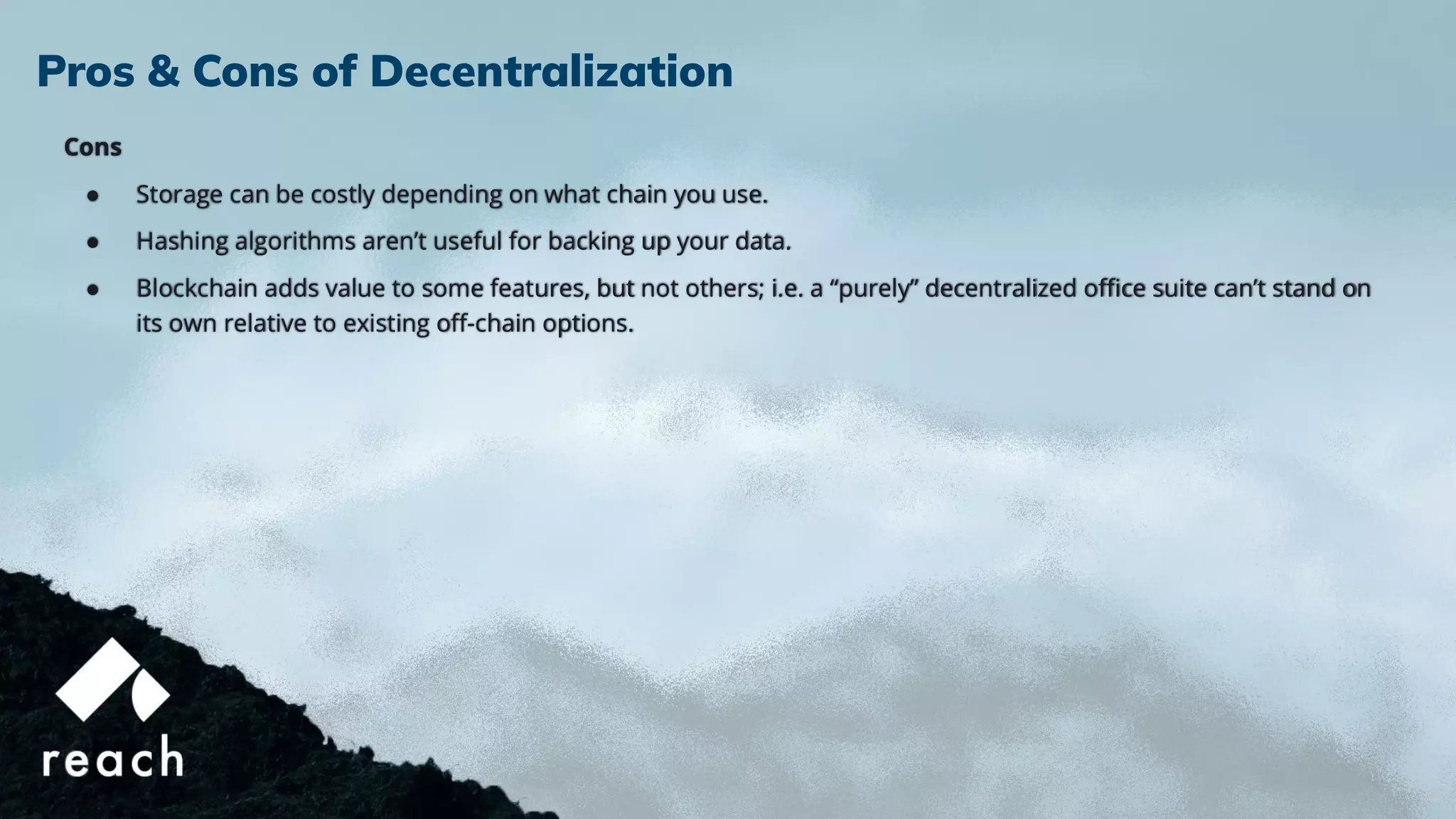
Cons
● Storage can be costly depending on what chain you use.
● Hashing algorithms aren’t useful for backing up your data.
● Blockchain adds value to some features, but not others; i.e. a “purely” decentralized office suite can’t stand on
its own relative to existing off-chain options.
Pros & Cons of Decentralization
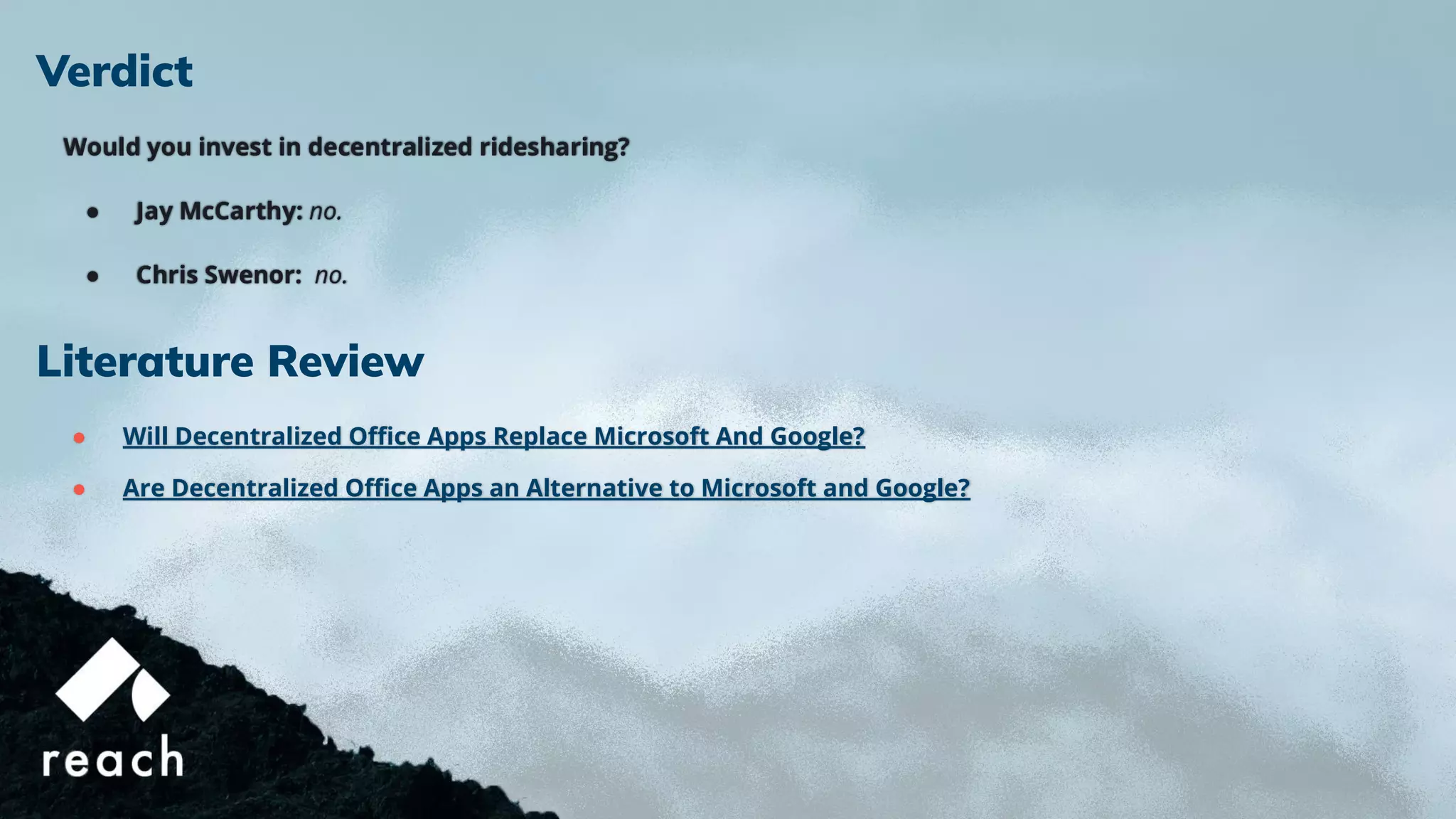
Verdict
Would you invest in decentralized ridesharing?
● Jay McCarthy: no.
● Chris Swenor: no.
Literature Review
● Will Decentralized Office Apps Replace Microsoft And Google?
● Are Decentralized Office Apps an Alternative to Microsoft and Google?
Watch on YouTube Read on Medium
Follow Reach

Episode 3: Better on Blockchain | Office Suite

  • 3.
    What Are OfficeSuites? Existing Business Model: Software as a Service ● Core Functionality ○ Create Documents ○ Share Files ○ Cloud Collaboration Add-on and Plugin Galleries and Marketplaces ● Core Components ○ Word Processor ○ Spreadsheet ○ Presentation System
  • 4.
    Understanding the roleof commitments: ● Rather than storing the data itself, you can store a commitment for that data. ○ Commitments are, in essence, a probabilistic guarantee that the data you’re looking for is stored somewhere on the network. ○ There are a number of ways to generate a commitment (e.g. a signature or checksum). ○ Algorithms like MD5 or SHA256 take an arbitrarily large amount of data and compress it down to into something very small. Unlike ZIP files, the data that makes up a commitment cannot later be extracted. ○ This “one-way” compression generates a unique value (or “commitment”) by which the data can be identified. ○ Then, instead of storing that arbitrarily large quantity of data on each node, you’re only asked to store the commitment. ○ The commitment is used in retrieval to identify the original files. Building it on Blockchain
  • 5.
    Handling decentralized filestorage: ● You could implement something similar to Napster such that, when trying to retrieve your data, you search through different nodes on your network until you find one that has what you’re looking for. ● You could tie this to the blockchain and let users pay to replicate their data by paying coins in the token of the blockchain. ● However, this strays too far from the typical conceptualization of “blockchain storage”. The happy medium would be to store hashes on a public chain like Algorand or Ethereum and pairing it with networks like Siacoin or Arweave which are specifically built for decentralized data and file storage. Existing Solutions 1. IPFS: Website / Twitter / Intro Video / Documentation 2. Siacoin: Website / Twitter / Intro Video / White Paper / GitLab 3. Arweave.io: Website / Twitter / White Paper / One-Pager Building it on Blockchain
  • 6.
    ● You couldimplement something similar to Napster such that, when trying to retrieve your data, you search through different nodes on your network until you find one that has what you’re looking for. ● You could tie this to the blockchain and let users pay to replicate their data by paying coins in the token of the blockchain. ● However, this strays too far from the typical conceptualization of “blockchain storage”. The happy medium would be to store hashes on a public chain like Algorand or Ethereum and pairing it with networks like Siacoin or Arweave which are specifically built for decentralized data and file storage. Existing Solutions 1. IPFS: Website / Twitter / Intro Video / Documentation 2. Siacoin: Website / Twitter / Intro Video / White Paper / GitLab 3. Arweave.io: Website / Twitter / White Paper / One-Pager Building it on Blockchain
  • 7.
    Pros ● With eachsave, users can effectively “sign” their work in a way which is more secure and harder to falsify than esignatures on Adobe eSign or DocuSign. Each signature is accompanied by their digital fingerprint. That fingerprint serves as a record of trust that that user is who they say they are. ● Hashing algorithms are useful because you can store a very small amount of data on-chain to certify that this other data that’s stored off-chain is the right stuff. ● You don’t have to deal with huge packages of add-ons or plugins (which exist, in large part, to avoid paying a transaction fee for each individual component). ● It’s easier to attribute content or ideas to their creators (which could clear up a number of headaches in intellectual property law). Pros & Cons of Decentralization
  • 8.
    Cons ● Storage canbe costly depending on what chain you use. ● Hashing algorithms aren’t useful for backing up your data. ● Blockchain adds value to some features, but not others; i.e. a “purely” decentralized office suite can’t stand on its own relative to existing off-chain options. Pros & Cons of Decentralization
  • 9.
    Verdict Would you investin decentralized ridesharing? ● Jay McCarthy: no. ● Chris Swenor: no. Literature Review ● Will Decentralized Office Apps Replace Microsoft And Google? ● Are Decentralized Office Apps an Alternative to Microsoft and Google?
  • 10.
    Watch on YouTubeRead on Medium Follow Reach