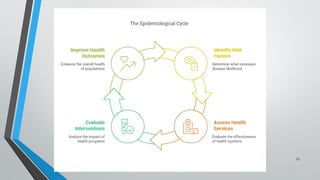
Epidemiology is the study of the distribution and determinants of health-related events in populations. It provides essential data for public health decision-making, disease prevention, and healthcare planning.
Epidemiology in Health:
LearningObjectives for
MBBS
Understanding Disease Patterns, Prevention & Public
Health Applications
Prof Dr Nosheen Zaidi
MBBS DHPM MPH ACMED FCPS
2.
2
Core Learning Objectives
•Understand fundamental epidemiological concepts
• Identify disease determinants and risk factors
• Apply epidemiological methods in clinical practice
• Develop skills for outbreak investigation and surveillance
3.
3
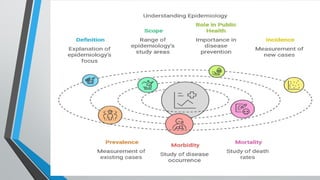
Introduction to Epidemiology
•Definition and scope of epidemiology
• Role in public health and disease prevention
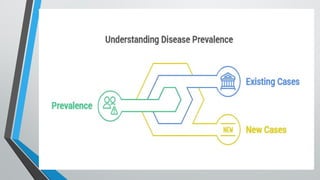
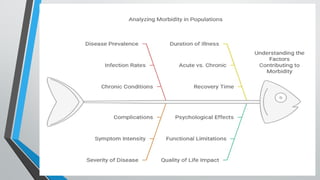
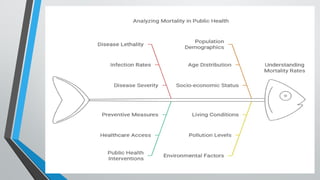
• Key terms: incidence, prevalence, morbidity, mortality
6
Epidemiological Study Designs
•Descriptive studies (case reports, case series)
• Analytical studies (cohort, case-control, cross-sectional)
• Experimental studies (randomized controlled trials)
• Strengths and limitations of each approach
7.
7
Measures of DiseaseFrequency &
Association
• Incidence vs. prevalence
• Relative risk (RR) and odds ratio (OR)
• Attributable risk and risk reduction
• Importance in clinical decision-making
10
Screening & DiagnosticTests
• Sensitivity, specificity, positive predictive value (PPV), negative
predictive value (NPV)
• Criteria for a good screening test
• Role of epidemiology in preventive medicine
11.
11
Outbreak Investigation &Public Health
Surveillance
• Steps in outbreak investigation
• Epidemic curves and disease transmission modes
• Public health reporting and response strategies
• Role of WHO and national health agencies
13
Epidemiology & PublicHealth Policy
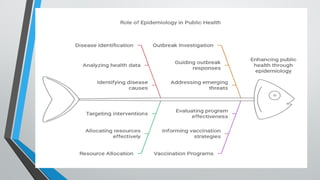
• Role of epidemiology in health policy development
• Impact on vaccination programs and disease prevention
• Application in emerging and re-emerging infectious diseases
15
Conclusion & FutureDirections
• Epidemiology as a cornerstone of evidence-based medicine
• Emerging trends in digital epidemiology and big data analytics
• Continued importance in addressing global health challenges



![Introduction to Epidemiology.pptx [Repaired].pptx](https://cdn.slidesharecdn.com/ss_thumbnails/1-230126203730-23334872-thumbnail.jpg?width=640&height=640&fit=bounds)


