REAL-TIME SYSTEMS
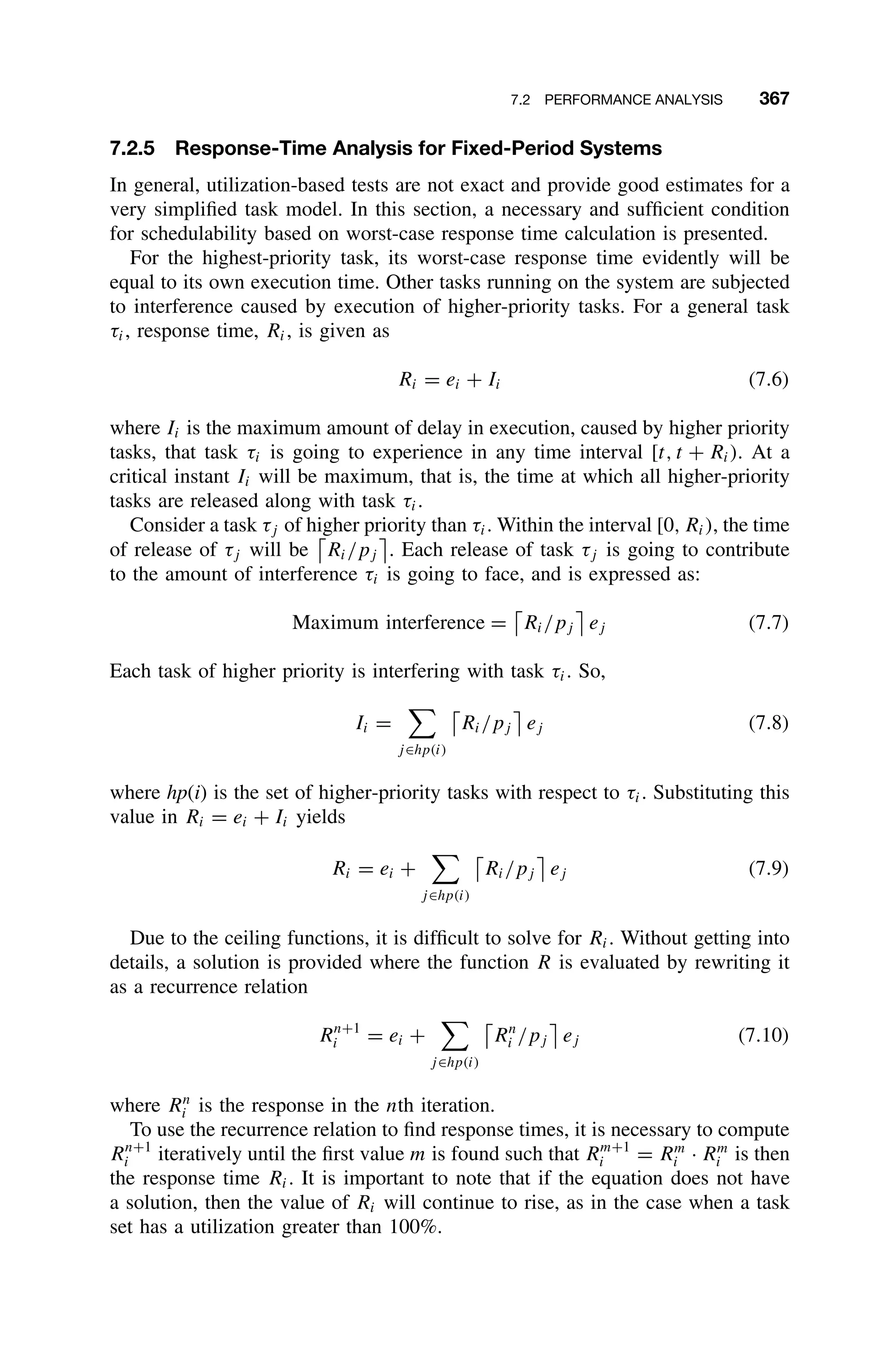
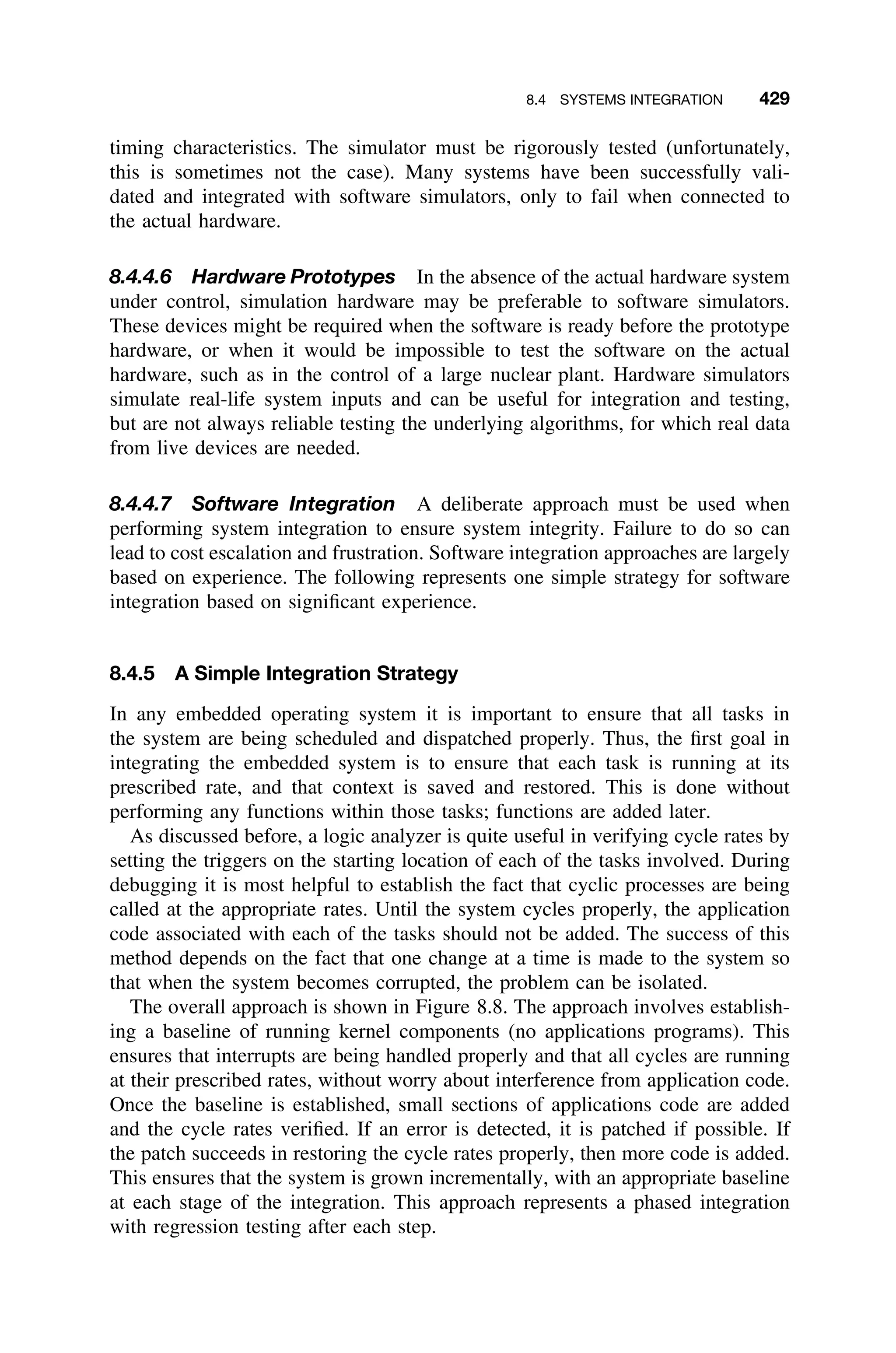
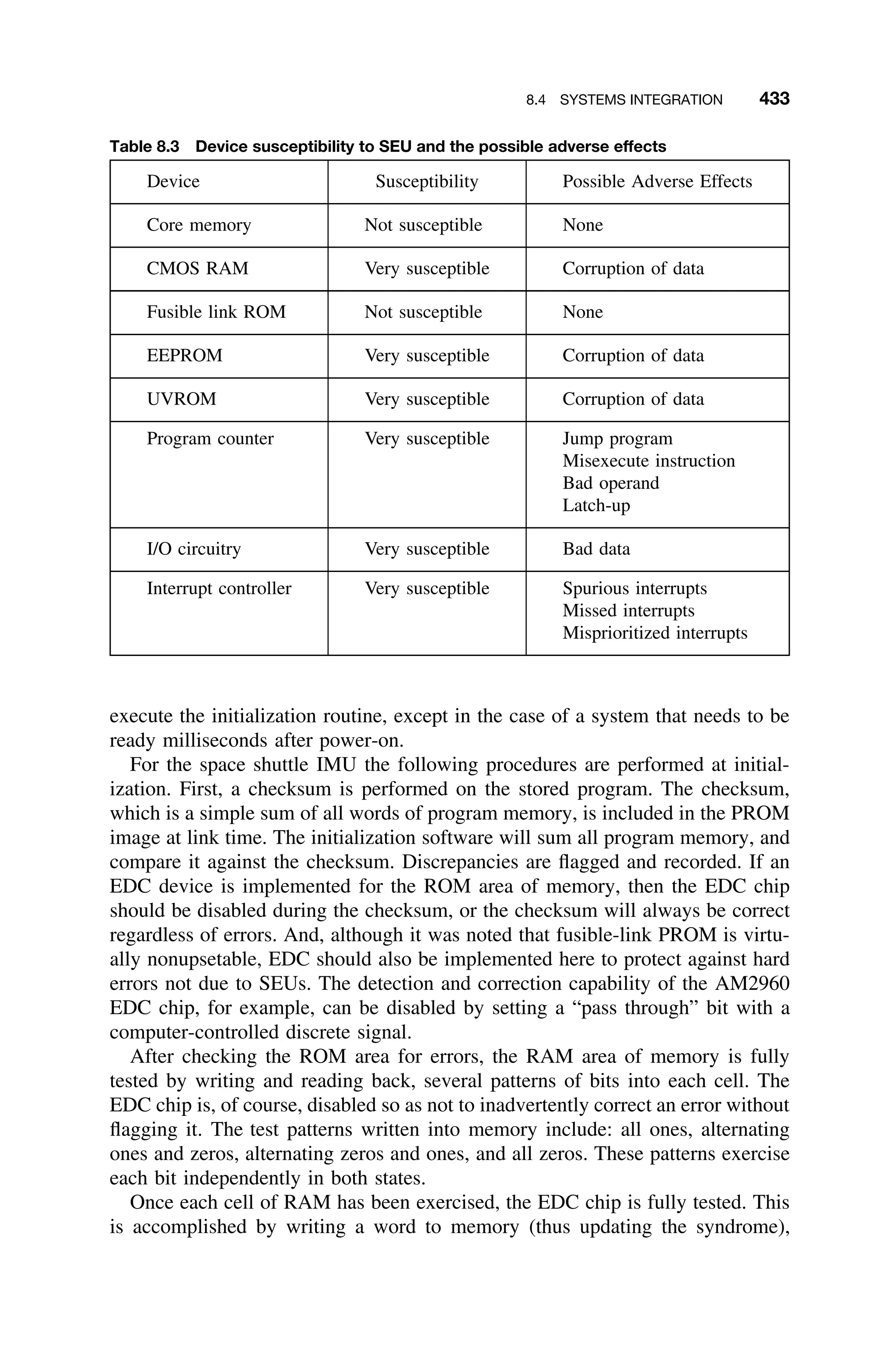
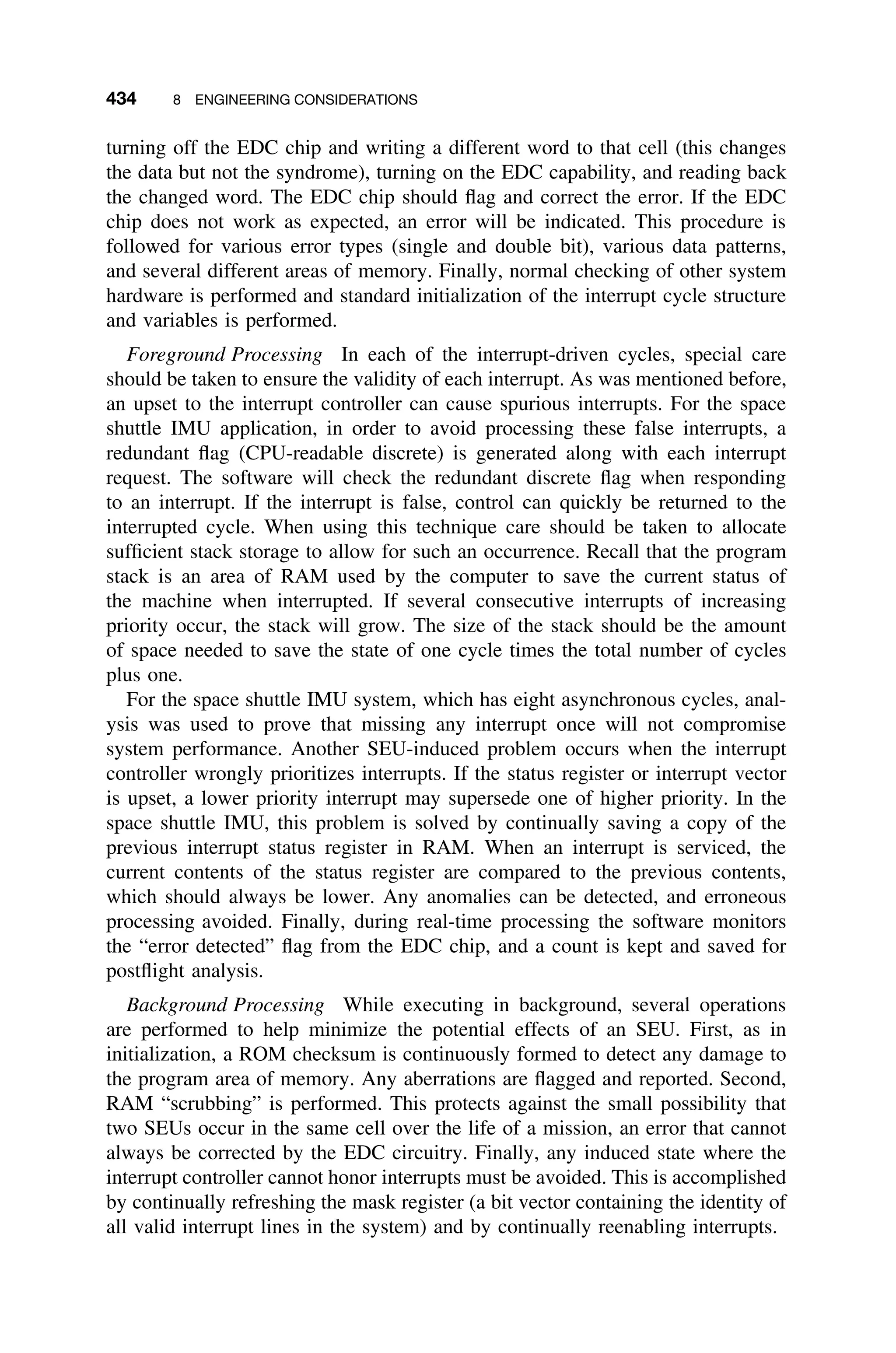
DESIGN AND ANALYSIS
IEEE Press
445 Hoes Lane
Piscataway, NJ 08854
IEEE Press Editorial Board
Stamatios V. Kartalopoulos, Editor in Chief
M. Akay M. E. El-Hawary F. M. B. Periera
J. B. Anderson R. Leonardi C. Singh
R. J. Baker M. Montrose S. Tewksbury
J. E. Brewer M. S. Newman G. Zobrist
Kenneth Moore, Director of Book and Information Services (BIS)
Catherine Faduska, Senior Acquisitions Editor
John Griffin, Acquisitions Editor
Anthony VenGraitis, Project Editor
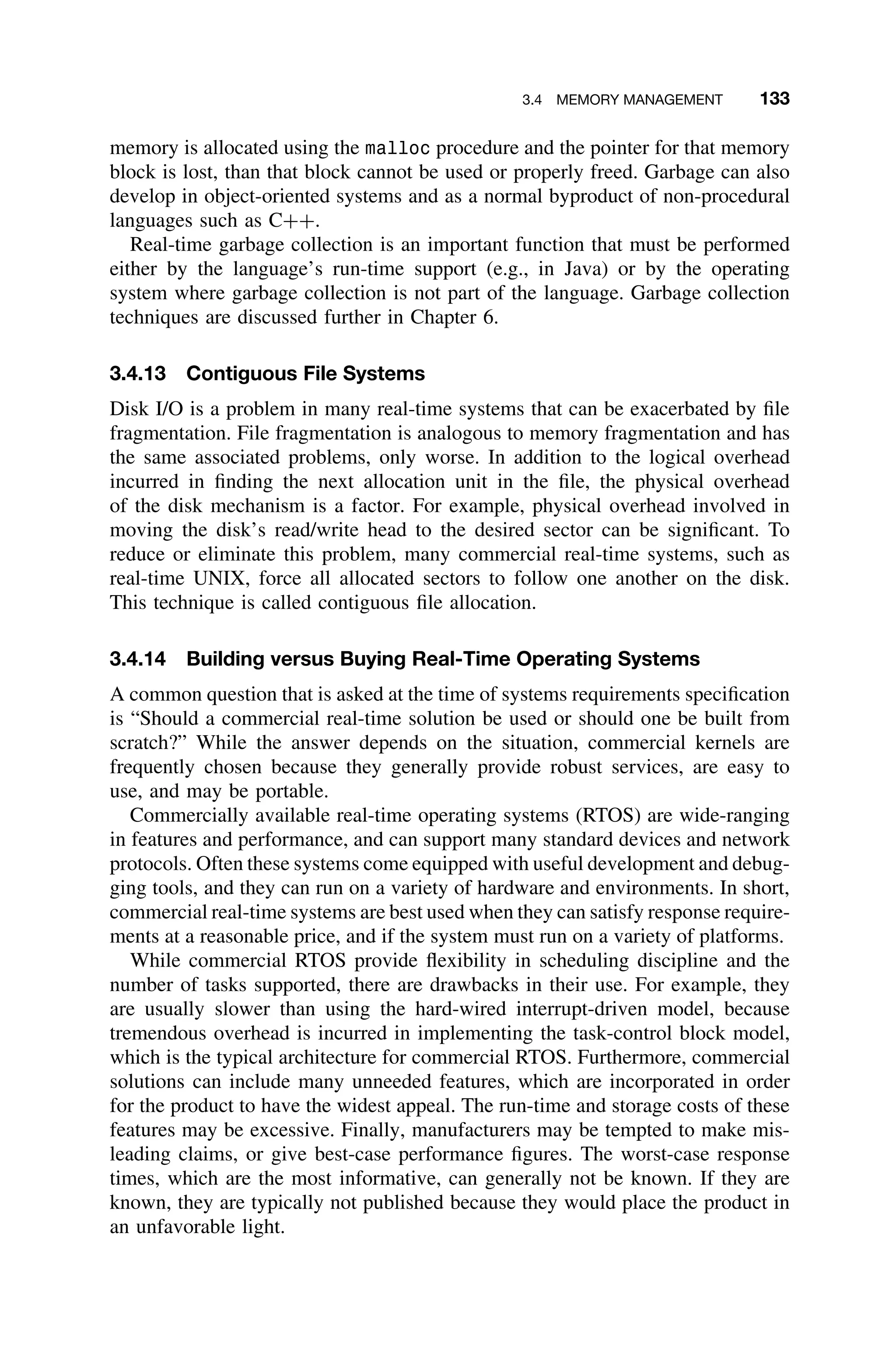
REAL-TIME SYSTEMS
DESIGN AND ANALYSIS
THIRD EDITION
Phillip A. Laplante
A JOHN WILEY & SONS, INC., PUBLICATION
TRADEMARKS
 68000 is a registered trademark of Motorola.
 80386, 80486 are registered trademarks of Intel Corporation.
 CICS is a trademark of IBM.
 OS/2 is a trademark of IBM.
 Presentation Manager is a trademark of IBM.
 Software Through Pictures is a trademark of Aonix.
 Space Invaders is a trademark of Taito
 SPARC is a trademark of Sun Microsystems.
 STATEMATE is a trademark of i-Logix.
 UNIX is a trademark of ATT.
 VAX is a trademark of Digital Equipment Corporation.
Copyright  2004 by the Institute of Electrical and Electronics Engineers, Inc. All rights reserved.
Published simultaneously in Canada.
No part of this publication may be reproduced, stored in a retrieval system, or transmitted in any form or by any
means, electronic, mechanical, photocopying, recording, scanning, or otherwise, except as permitted under
Section 107 or 108 of the 1976 United States Copyright Act, without either the prior written permission of the
Publisher, or authorization through payment of the appropriate per-copy fee to the Copyright Clearance Center,
Inc., 222 Rosewood Drive, Danvers, MA 01923, 978-750-8400, fax 978-750-4470, or on the web at
Department, John Wiley  Sons, Inc., 111 River Street, Hoboken, NJ 07030, (201) 748-6011, fax (201)
748-6008.
Limit of Liability/Disclaimer of Warranty: While the publisher and author have used their best efforts in
preparing this book, they make no representations or warranties with respect to the accuracy or completeness of
the contents of this book and specifically disclaim any implied warranties of merchantability or fitness for a
particular purpose. No warranty may be created or extended by sales representatives or written sales materials.
The advice and strategies contained herein may not be suitable for your situation. You should consult with a
professional where appropriate. Neither the publisher nor author shall be liable for any loss of profit or any other
commercial damages, including but not limited to special, incidental, consequential, or other damages.
For general information on our other products and services please contact our Customer Care Department within
the U.S. at 877-762-2974, outside the U.S. at 317-572-3993 or fax 317-572-4002.
Wiley also publishes its books in a variety of electronic formats. Some content that appears in print, however,
may not be available in electronic format.
Library of Congress Cataloging-in-Publication Data:
Laplante, Phillip A.
Real-time systems design and analysis : an engineer’s handbook / Phillip A. Laplante.–3rd ed.
p. cm.
Includes bibliographical references and index.
ISBN 0-471-22855-9 (cloth)
1. Real-time data processing. 2. System design. I. Title.
QA76.54.L37 2004
004
.33–dc22
2003065702
Printed in the United States of America.
10 9 8 7 6 5 4 3 2 1
www.copyright.com. Requests to the Publisher for permission should be addressed to the Permissions
To my daughter, Charlotte
CONTENTS
Preface to the Third Edition xvii
1 Basic Real-Time Concepts 1
1.1 Terminology / 1
1.1.1 Systems Concepts / 2
1.1.2 Real-Time Definitions / 4
1.1.3 Events and Determinism / 7
1.1.4 CPU Utilization / 10
1.2 Real-Time System Design Issues / 12
1.3 Example Real-Time Systems / 13
1.4 Common Misconceptions / 15
1.5 Brief History / 16
1.5.1 Theoretical Advances / 17
1.5.2 Early Systems / 17
1.5.3 Hardware Developments / 18
1.5.4 Early Software / 18
1.5.5 Commercial Operating System Support / 19
1.6 Exercises / 20
2 Hardware Considerations 23
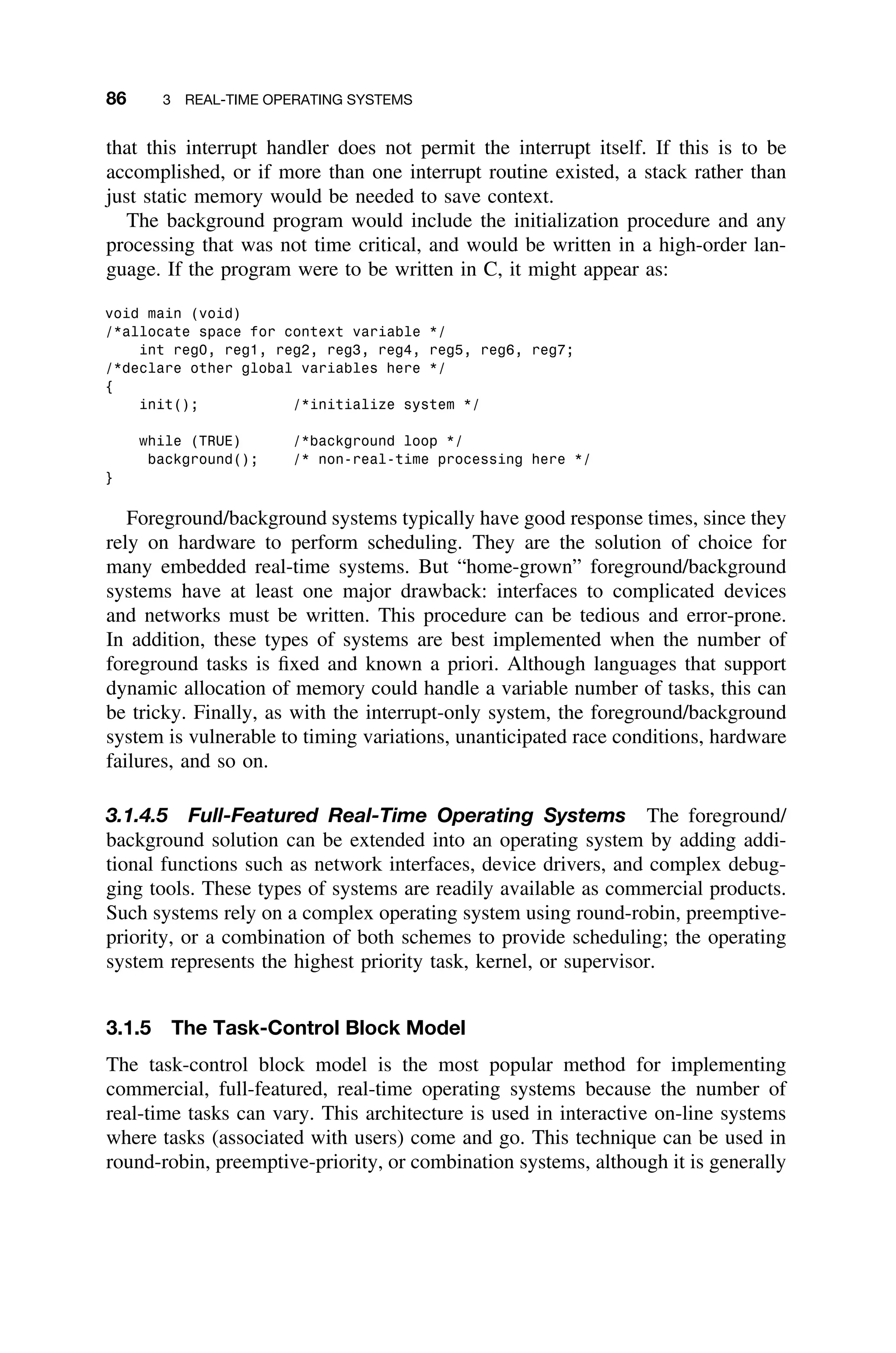
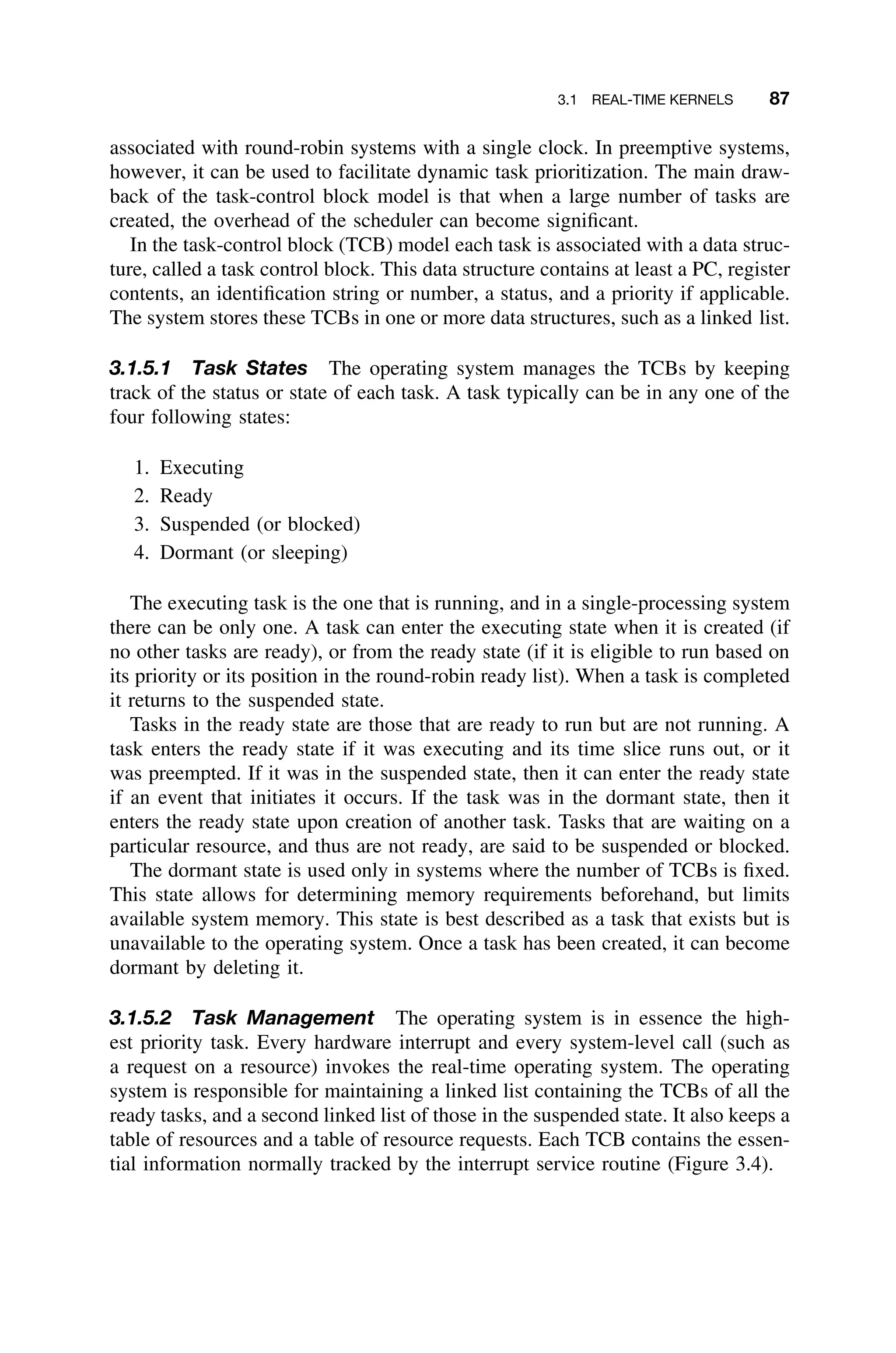
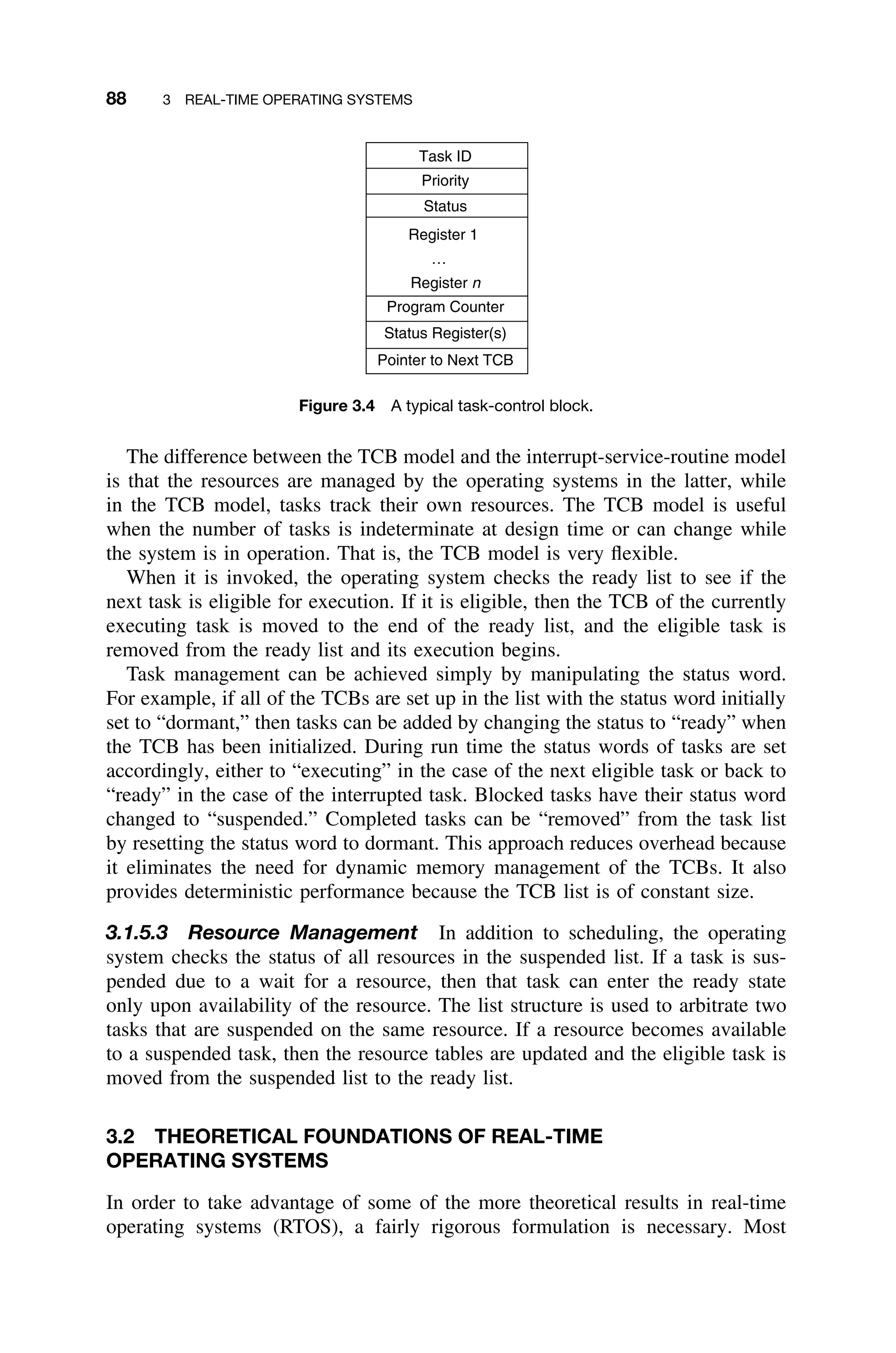
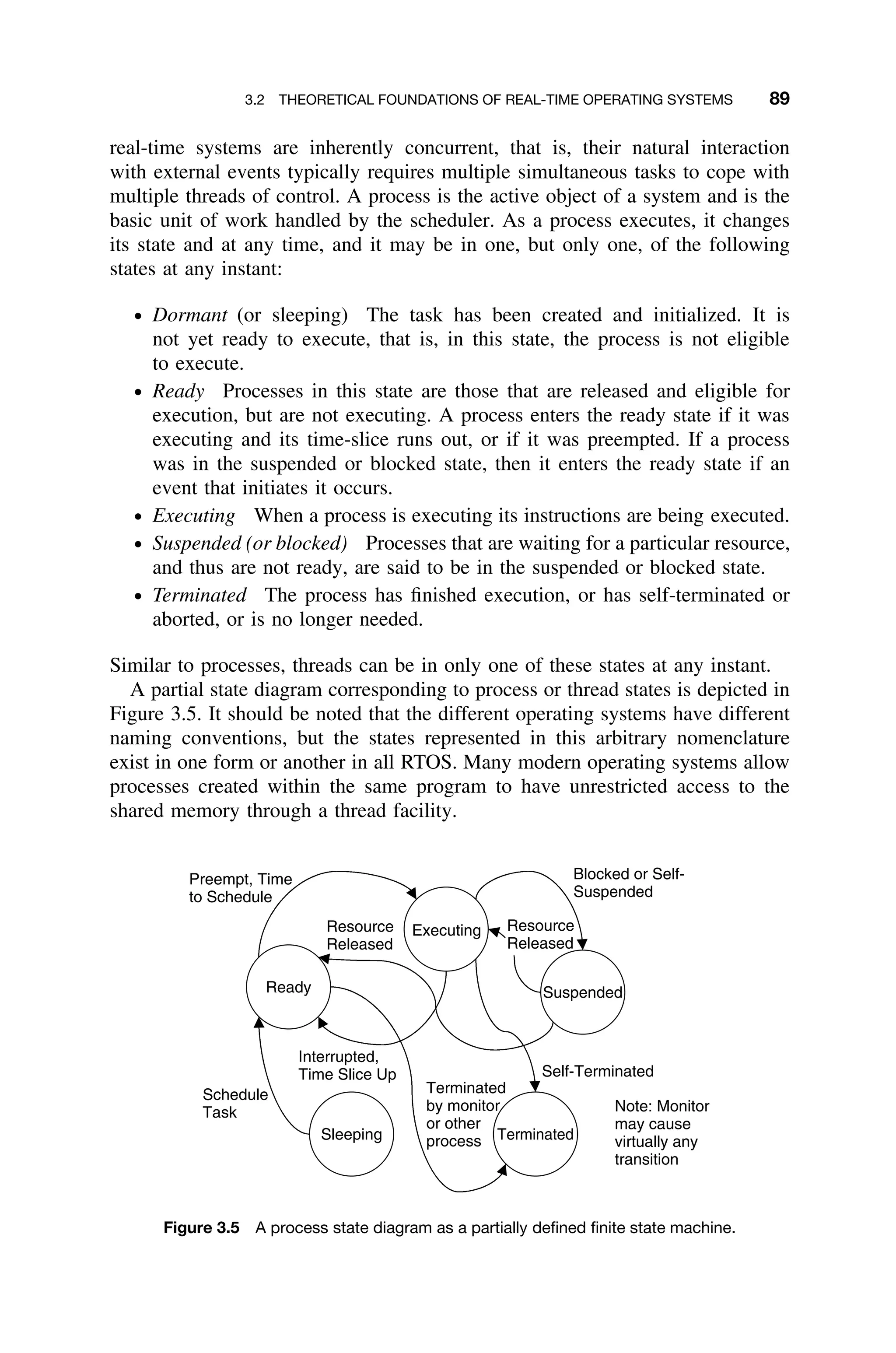
2.1 Basic Architecture / 23
2.2 Hardware Interfacing / 24
2.2.1 Latching / 24
2.2.2 Edge versus Level Triggered / 25
2.2.3 Tristate Logic / 25
2.2.4 Wait States / 26
2.2.5 Systems Interfaces and Buses / 26
2.3 Central Processing Unit / 29
2.3.1 Fetch and Execute Cycle / 30
2.3.2 Microcontrollers / 30
vii
viii CONTENTS
2.3.3 Instruction Forms / 31
2.3.4 Core Instructions / 33
2.3.5 Addressing Modes / 36
2.3.6 RISC versus CISC / 37
2.4 Memory / 38
2.4.1 Memory Access / 39
2.4.2 Memory Technologies / 39
2.4.3 Memory Hierarchy / 42
2.4.4 Memory Organization / 43
2.5 Input/Output / 44
2.5.1 Programmed Input/Output / 44
2.5.2 Direct Memory Access / 45
2.5.3 Memory-Mapped Input/Output / 46
2.5.4 Interrupts / 48
2.6 Enhancing Performance / 55
2.6.1 Locality of Reference / 55
2.6.2 Cache / 55
2.6.3 Pipelining / 56
2.6.4 Coprocessors / 58
2.7 Other Special Devices / 58
2.7.1 Applications-Specific Integrated Circuits / 58
2.7.2 Programmable Array Logic/Programmable Logic
Array / 59
2.7.3 Field-Programmable Gate Arrays / 59
2.7.4 Transducers / 62
2.7.5 Analog/Digital Converters / 64
2.7.6 Digital/Analog Converters / 64
2.8 Non-von-Neumann Architectures / 64
2.8.1 Parallel Systems / 65
2.8.2 Flynn’s Taxonomy for Parallelism / 65
2.9 Exercises / 70
3 Real-Time Operating Systems 73
3.1 Real-Time Kernels / 73
3.1.1 Pseudokernels / 74
3.1.2 Interrupt-Driven Systems / 79
3.1.3 Preemptive-Priority Systems / 82
3.1.4 Hybrid Systems / 83
3.1.5 The Task-Control Block Model / 86
3.2 Theoretical Foundations of Real-Time Operating Systems / 88
3.2.1 Process Scheduling / 90
3.2.2 Round-Robin Scheduling / 91
3.2.3 Cyclic Executives / 92
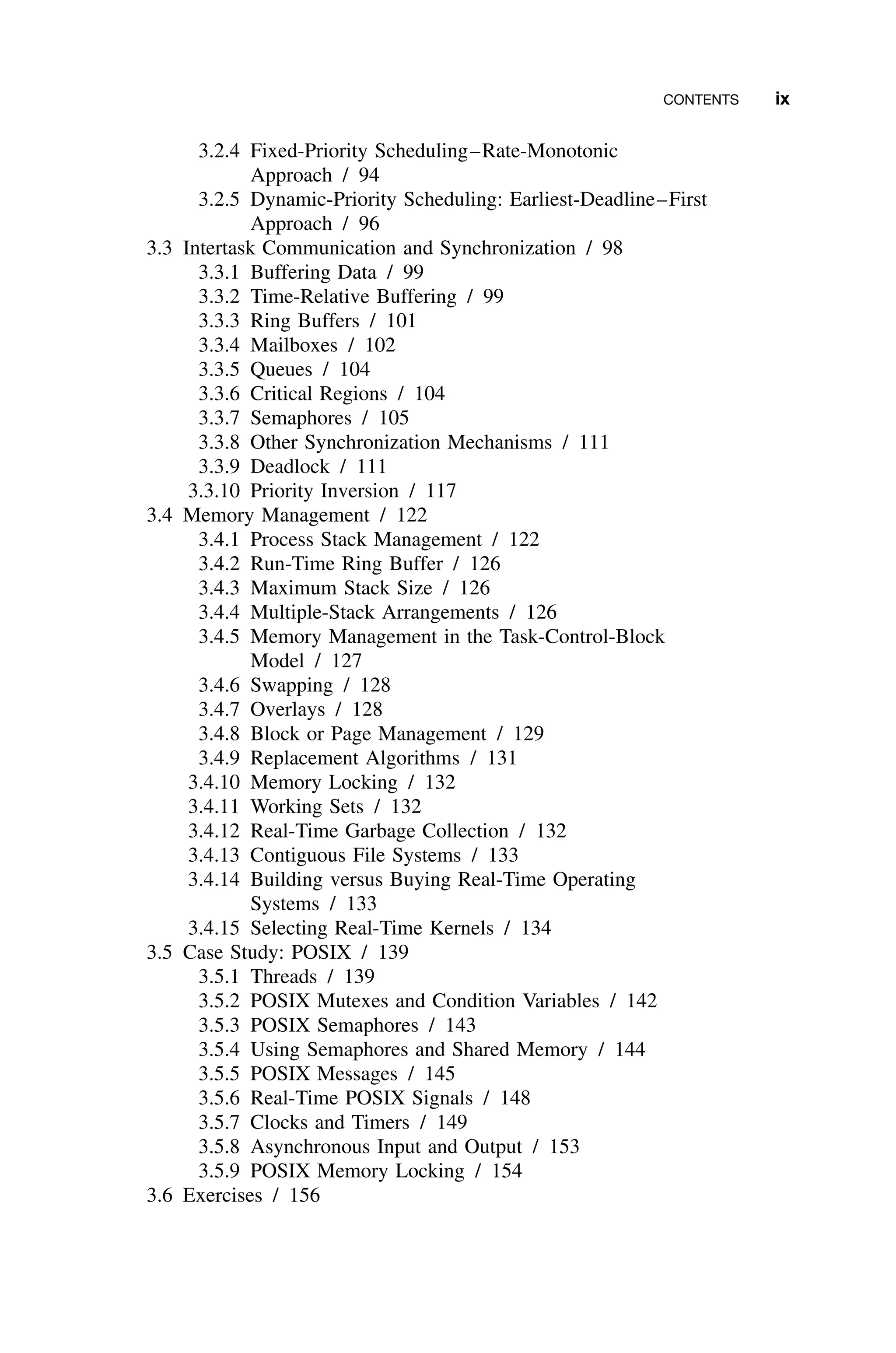
CONTENTS ix
3.2.4 Fixed-Priority Scheduling–Rate-Monotonic
Approach / 94
3.2.5 Dynamic-Priority Scheduling: Earliest-Deadline–First
Approach / 96
3.3 Intertask Communication and Synchronization / 98
3.3.1 Buffering Data / 99
3.3.2 Time-Relative Buffering / 99
3.3.3 Ring Buffers / 101
3.3.4 Mailboxes / 102
3.3.5 Queues / 104
3.3.6 Critical Regions / 104
3.3.7 Semaphores / 105
3.3.8 Other Synchronization Mechanisms / 111
3.3.9 Deadlock / 111
3.3.10 Priority Inversion / 117
3.4 Memory Management / 122
3.4.1 Process Stack Management / 122
3.4.2 Run-Time Ring Buffer / 126
3.4.3 Maximum Stack Size / 126
3.4.4 Multiple-Stack Arrangements / 126
3.4.5 Memory Management in the Task-Control-Block
Model / 127
3.4.6 Swapping / 128
3.4.7 Overlays / 128
3.4.8 Block or Page Management / 129
3.4.9 Replacement Algorithms / 131
3.4.10 Memory Locking / 132
3.4.11 Working Sets / 132
3.4.12 Real-Time Garbage Collection / 132
3.4.13 Contiguous File Systems / 133
3.4.14 Building versus Buying Real-Time Operating
Systems / 133
3.4.15 Selecting Real-Time Kernels / 134
3.5 Case Study: POSIX / 139
3.5.1 Threads / 139
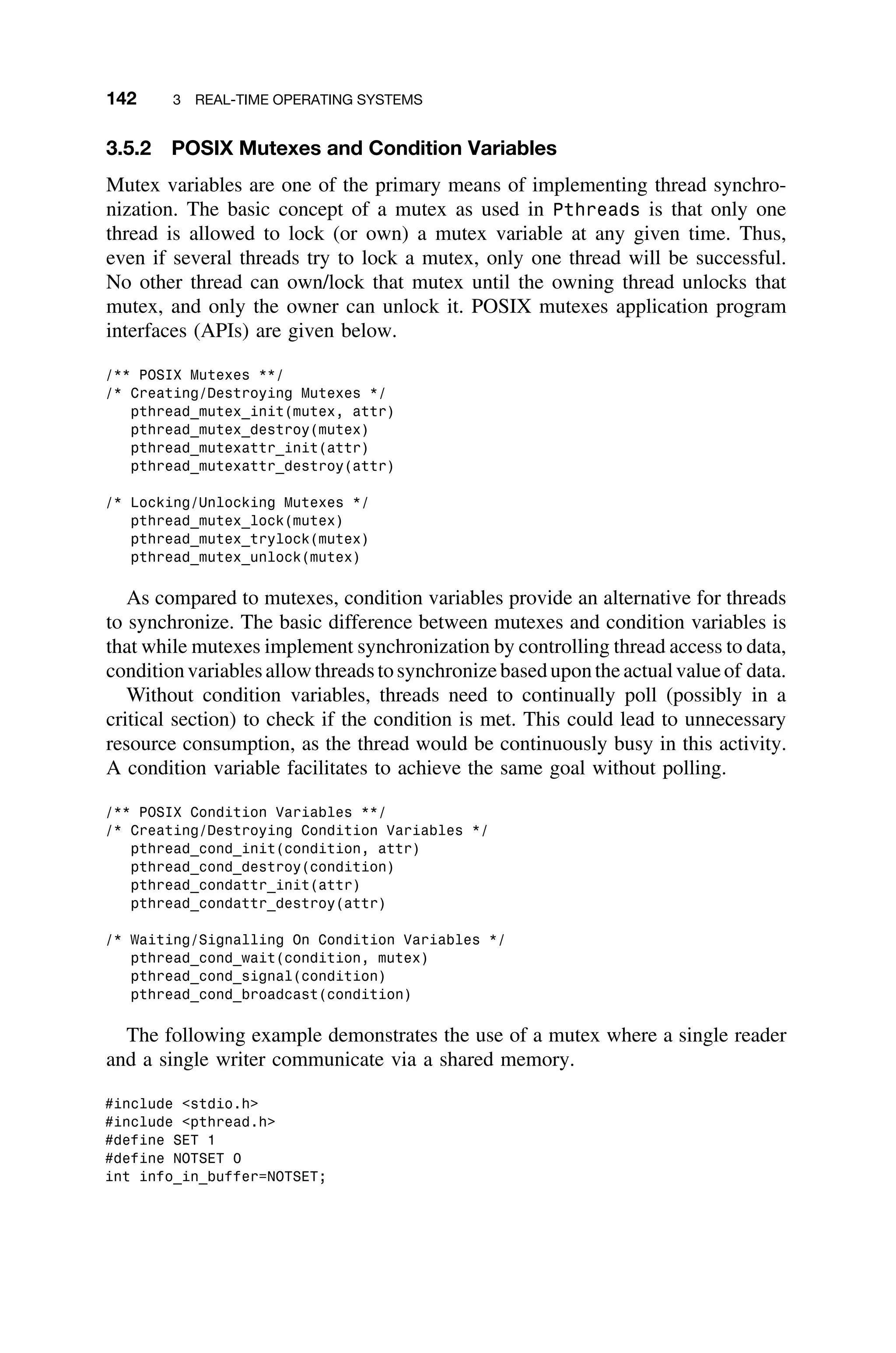
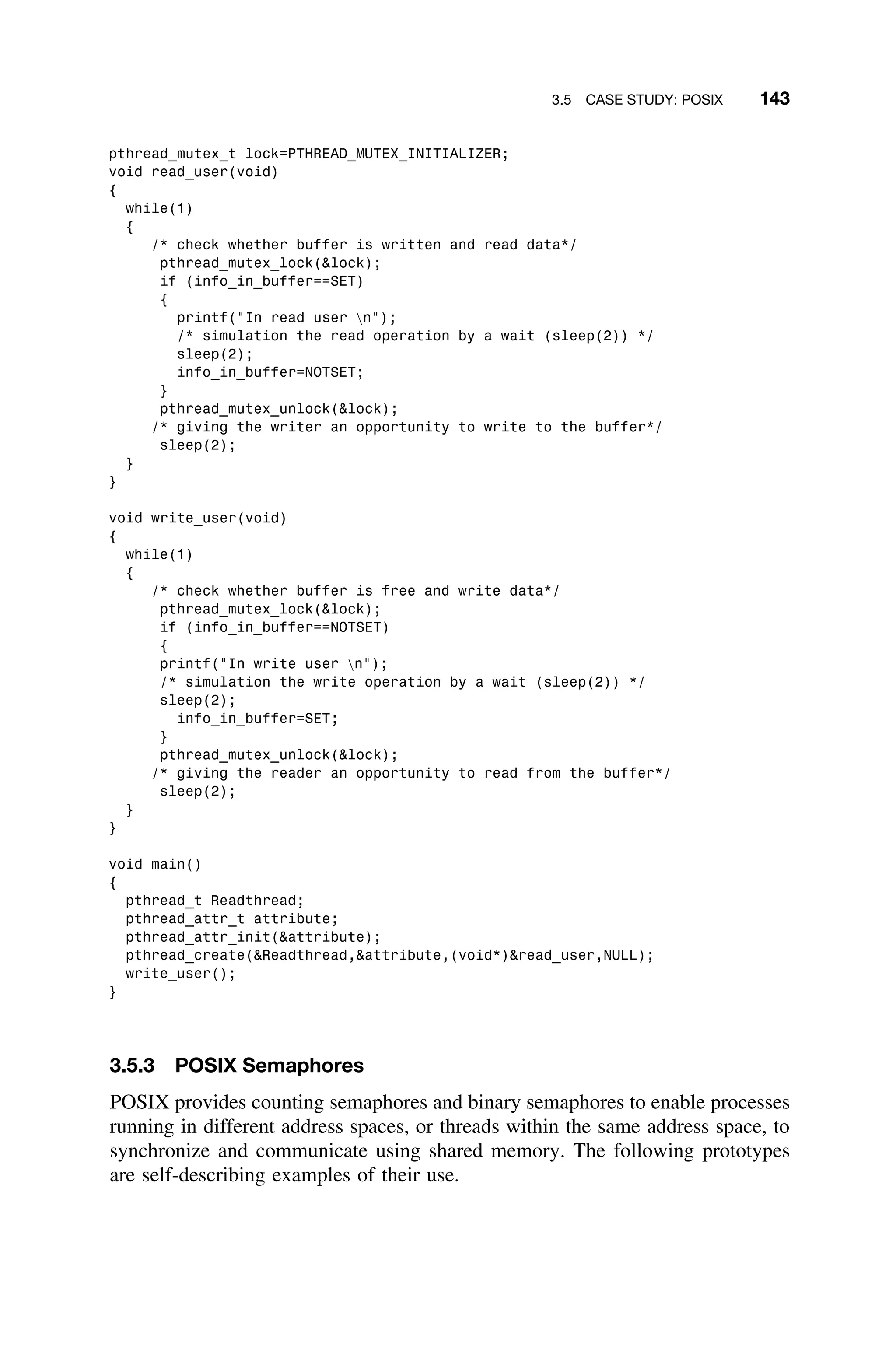
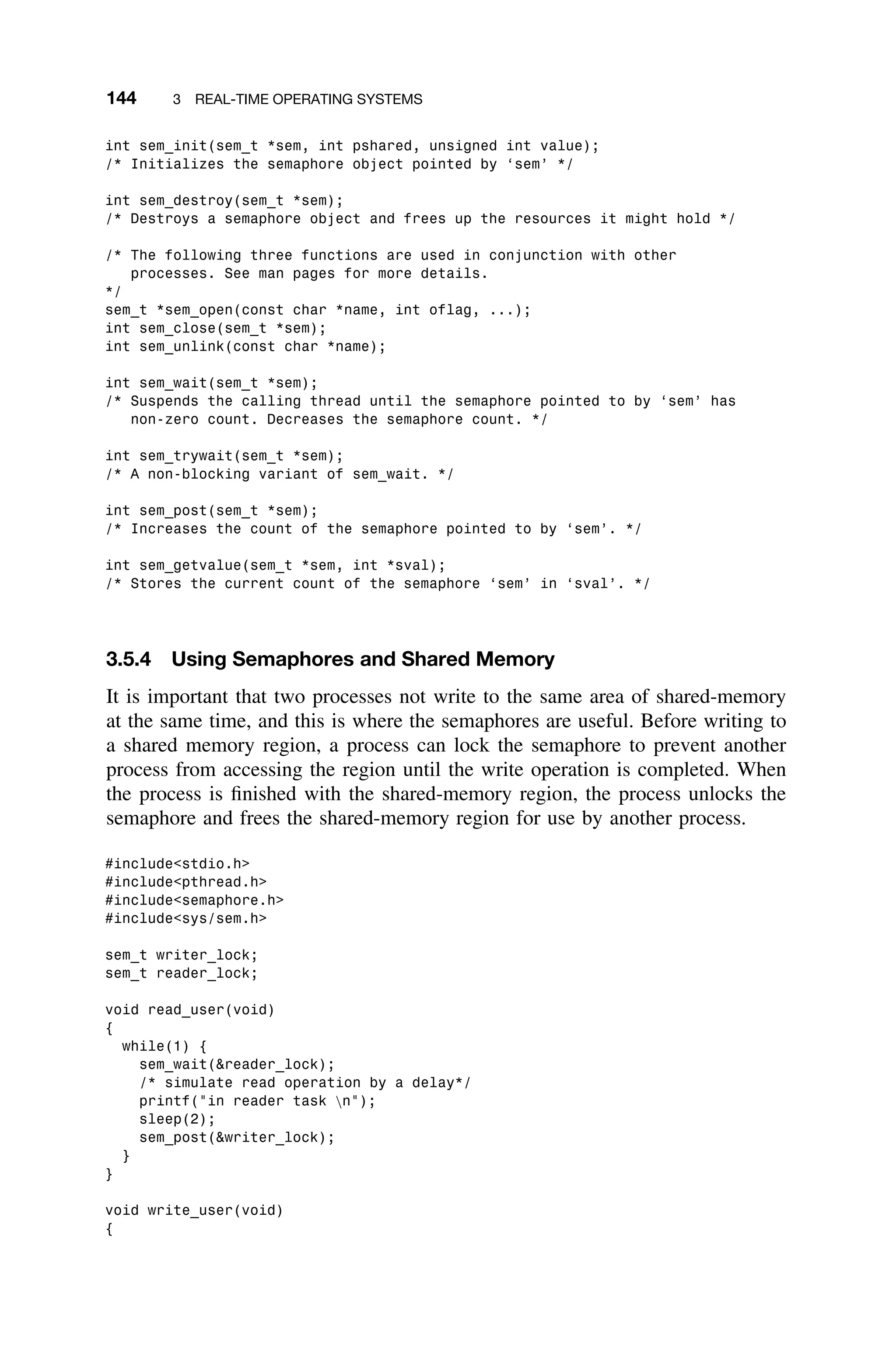
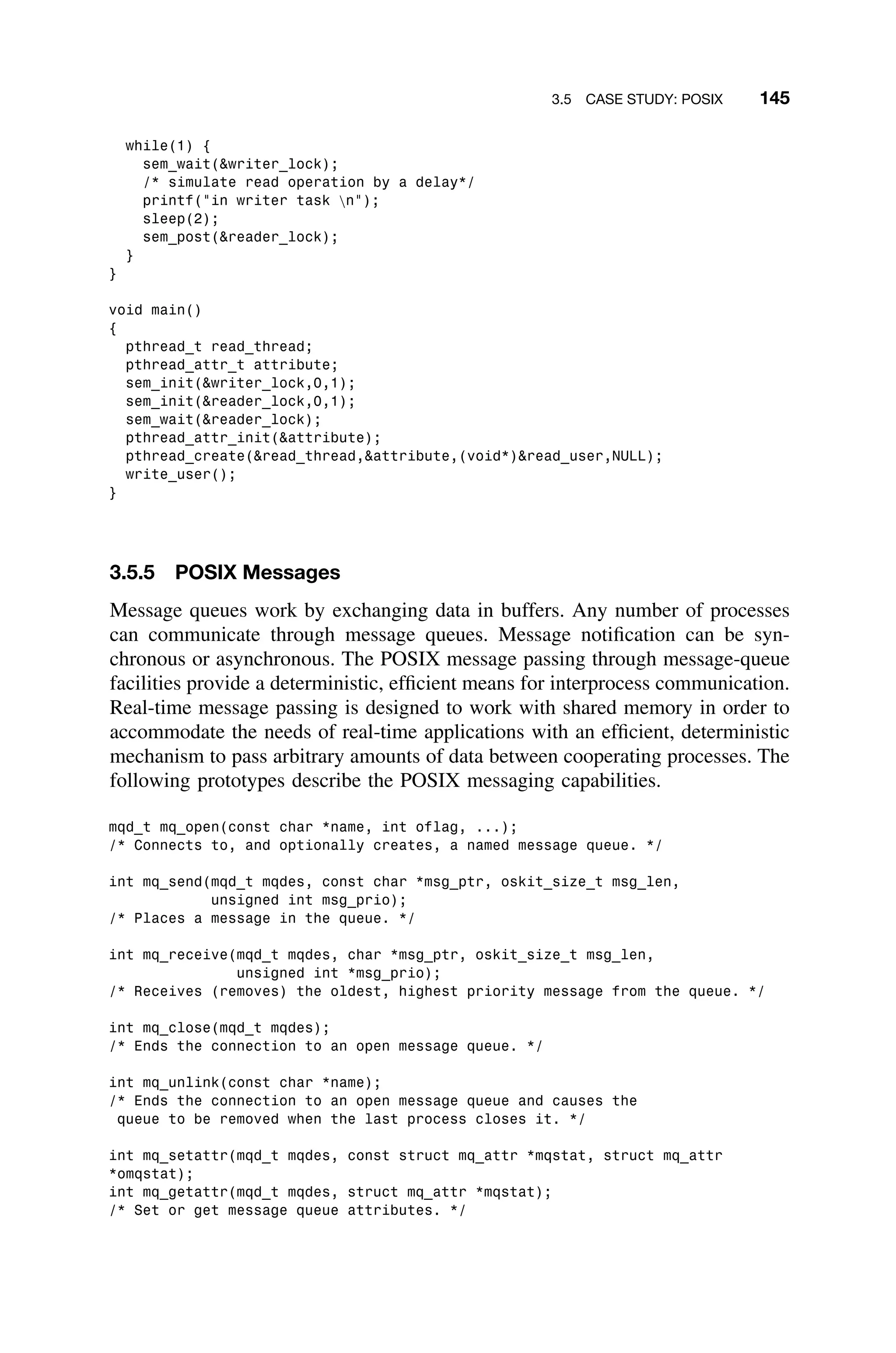
3.5.2 POSIX Mutexes and Condition Variables / 142
3.5.3 POSIX Semaphores / 143
3.5.4 Using Semaphores and Shared Memory / 144
3.5.5 POSIX Messages / 145
3.5.6 Real-Time POSIX Signals / 148
3.5.7 Clocks and Timers / 149
3.5.8 Asynchronous Input and Output / 153
3.5.9 POSIX Memory Locking / 154
3.6 Exercises / 156
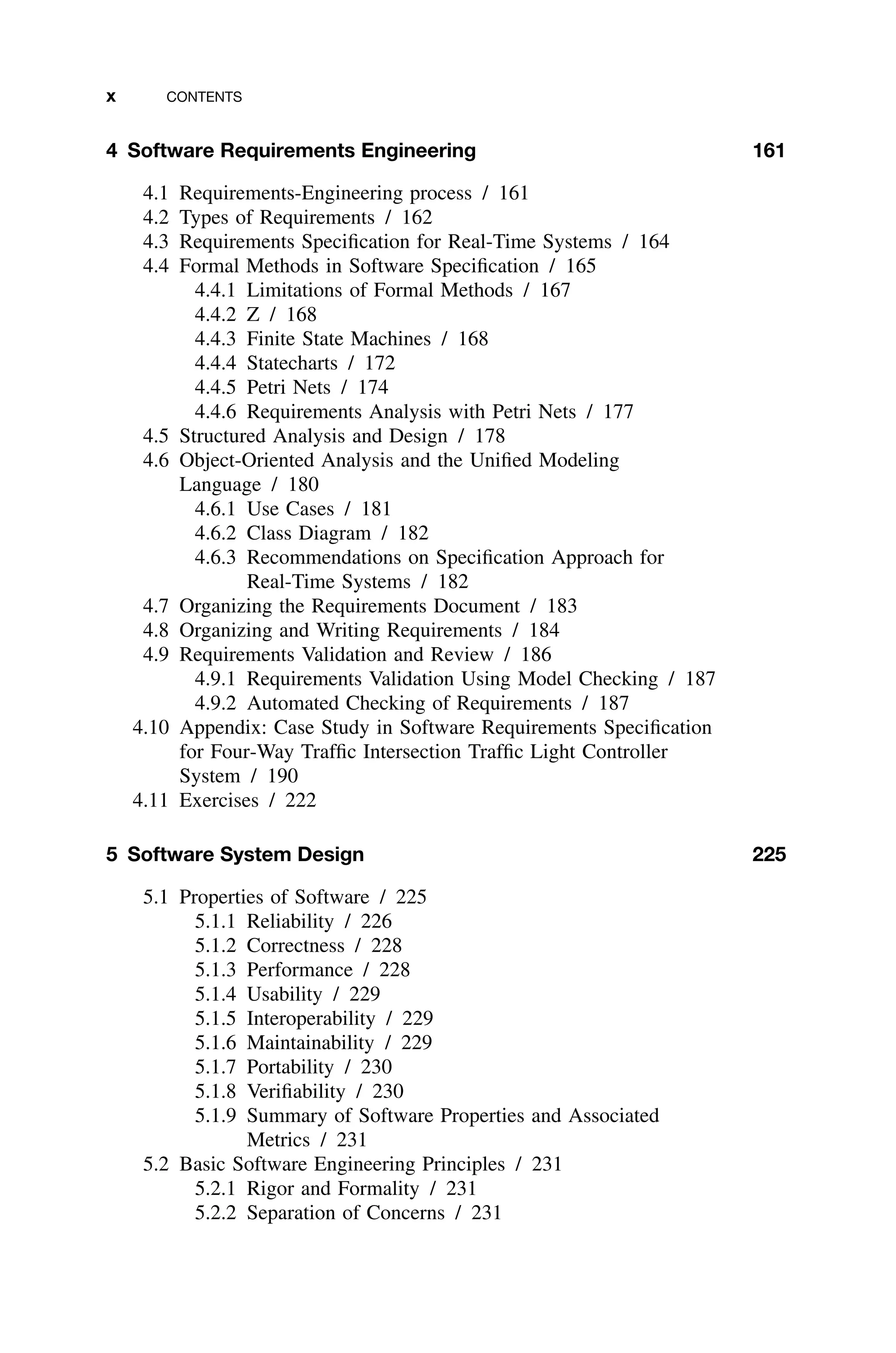
x CONTENTS
4 Software Requirements Engineering 161
4.1 Requirements-Engineering process / 161
4.2 Types of Requirements / 162
4.3 Requirements Specification for Real-Time Systems / 164
4.4 Formal Methods in Software Specification / 165
4.4.1 Limitations of Formal Methods / 167
4.4.2 Z / 168
4.4.3 Finite State Machines / 168
4.4.4 Statecharts / 172
4.4.5 Petri Nets / 174
4.4.6 Requirements Analysis with Petri Nets / 177
4.5 Structured Analysis and Design / 178
4.6 Object-Oriented Analysis and the Unified Modeling
Language / 180
4.6.1 Use Cases / 181
4.6.2 Class Diagram / 182
4.6.3 Recommendations on Specification Approach for
Real-Time Systems / 182
4.7 Organizing the Requirements Document / 183
4.8 Organizing and Writing Requirements / 184
4.9 Requirements Validation and Review / 186
4.9.1 Requirements Validation Using Model Checking / 187
4.9.2 Automated Checking of Requirements / 187
4.10 Appendix: Case Study in Software Requirements Specification
for Four-Way Traffic Intersection Traffic Light Controller
System / 190
4.11 Exercises / 222
5 Software System Design 225
5.1 Properties of Software / 225
5.1.1 Reliability / 226
5.1.2 Correctness / 228
5.1.3 Performance / 228
5.1.4 Usability / 229
5.1.5 Interoperability / 229
5.1.6 Maintainability / 229
5.1.7 Portability / 230
5.1.8 Verifiability / 230
5.1.9 Summary of Software Properties and Associated
Metrics / 231
5.2 Basic Software Engineering Principles / 231
5.2.1 Rigor and Formality / 231
5.2.2 Separation of Concerns / 231
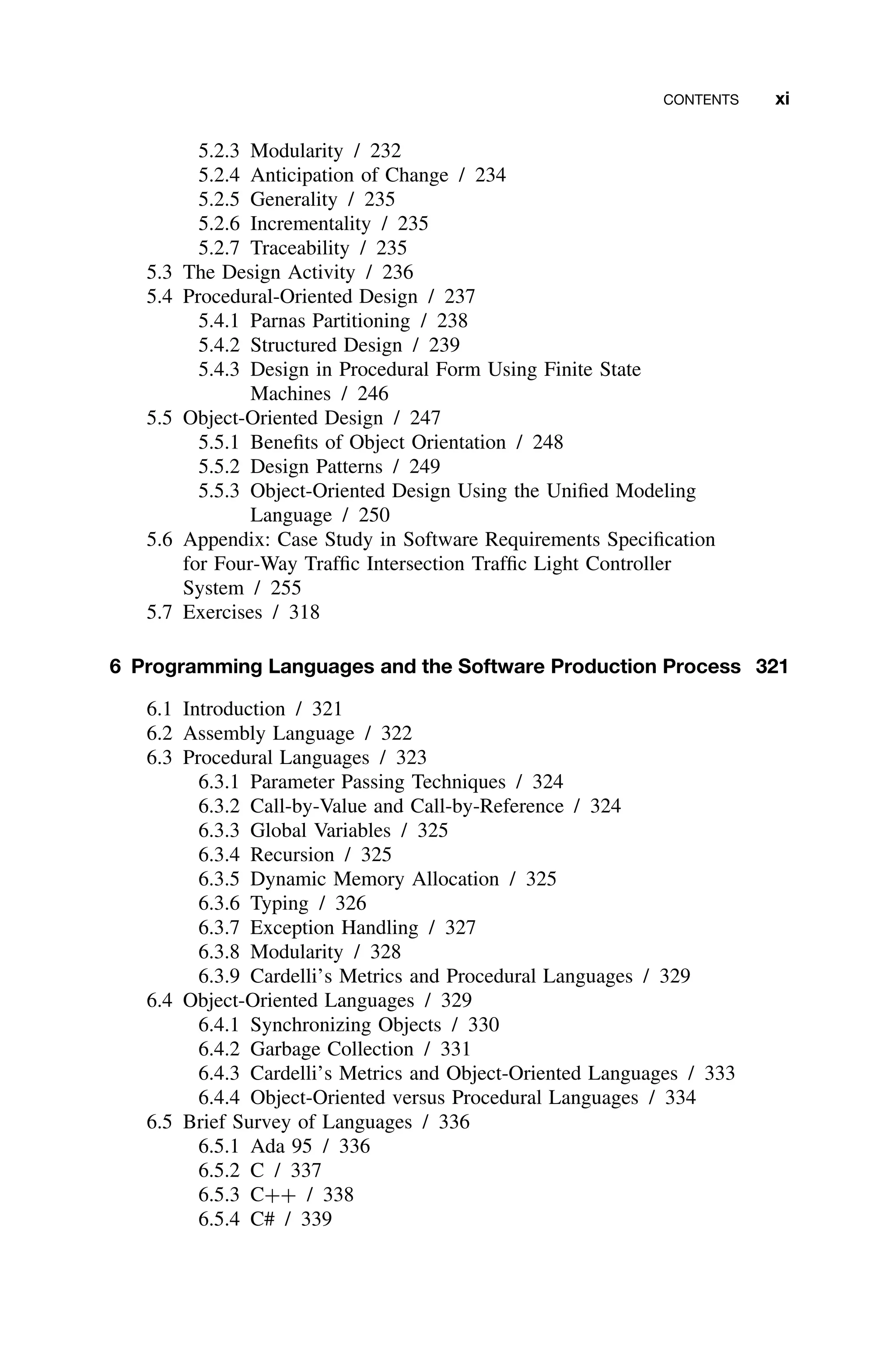
CONTENTS xi
5.2.3 Modularity / 232
5.2.4 Anticipation of Change / 234
5.2.5 Generality / 235
5.2.6 Incrementality / 235
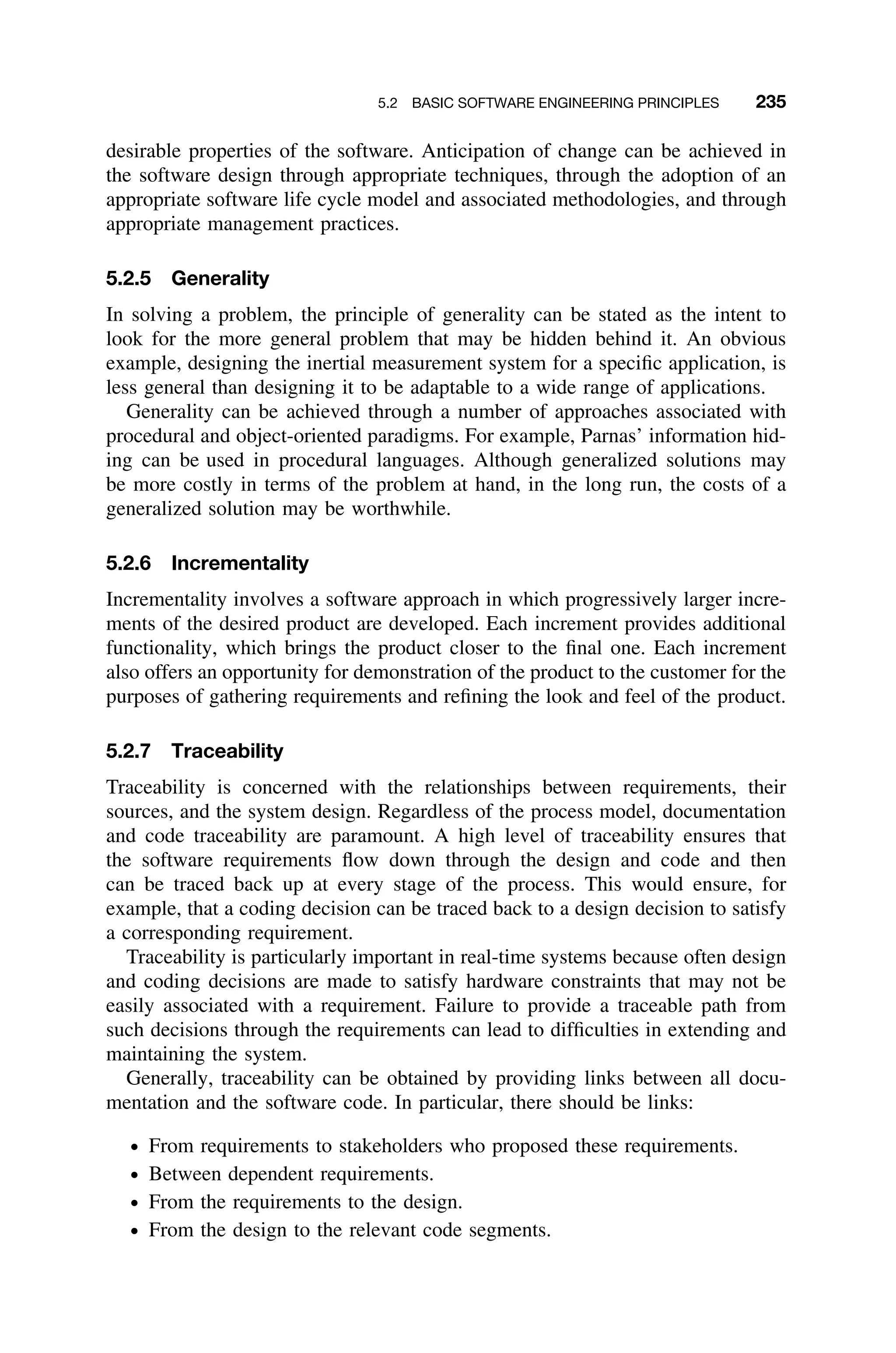
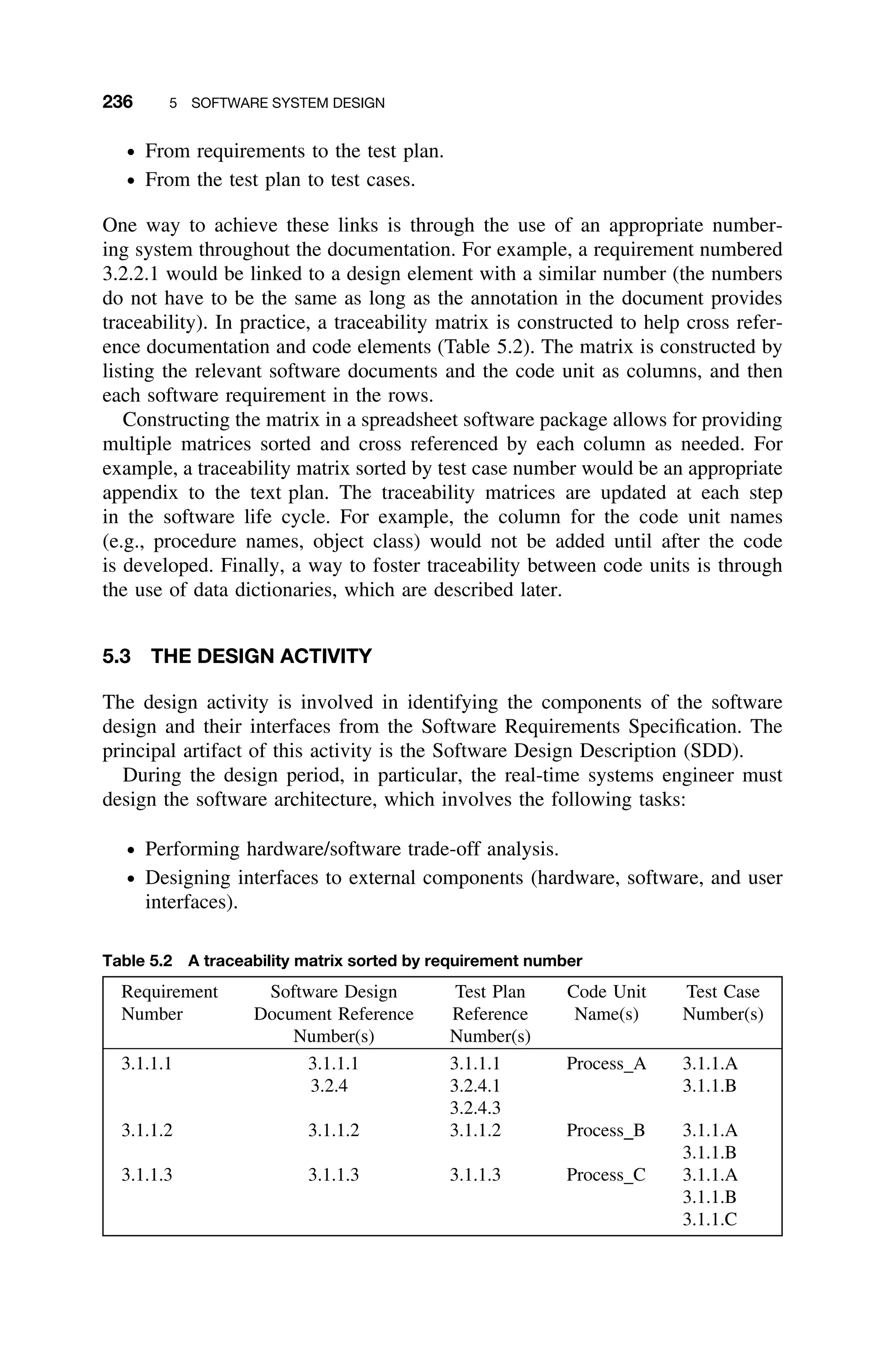
5.2.7 Traceability / 235
5.3 The Design Activity / 236
5.4 Procedural-Oriented Design / 237
5.4.1 Parnas Partitioning / 238
5.4.2 Structured Design / 239
5.4.3 Design in Procedural Form Using Finite State
Machines / 246
5.5 Object-Oriented Design / 247
5.5.1 Benefits of Object Orientation / 248
5.5.2 Design Patterns / 249
5.5.3 Object-Oriented Design Using the Unified Modeling
Language / 250
5.6 Appendix: Case Study in Software Requirements Specification
for Four-Way Traffic Intersection Traffic Light Controller
System / 255
5.7 Exercises / 318
6 Programming Languages and the Software Production Process 321
6.1 Introduction / 321
6.2 Assembly Language / 322
6.3 Procedural Languages / 323
6.3.1 Parameter Passing Techniques / 324
6.3.2 Call-by-Value and Call-by-Reference / 324
6.3.3 Global Variables / 325
6.3.4 Recursion / 325
6.3.5 Dynamic Memory Allocation / 325
6.3.6 Typing / 326
6.3.7 Exception Handling / 327
6.3.8 Modularity / 328
6.3.9 Cardelli’s Metrics and Procedural Languages / 329
6.4 Object-Oriented Languages / 329
6.4.1 Synchronizing Objects / 330
6.4.2 Garbage Collection / 331
6.4.3 Cardelli’s Metrics and Object-Oriented Languages / 333
6.4.4 Object-Oriented versus Procedural Languages / 334
6.5 Brief Survey of Languages / 336
6.5.1 Ada 95 / 336
6.5.2 C / 337
6.5.3 C++ / 338
6.5.4 C# / 339
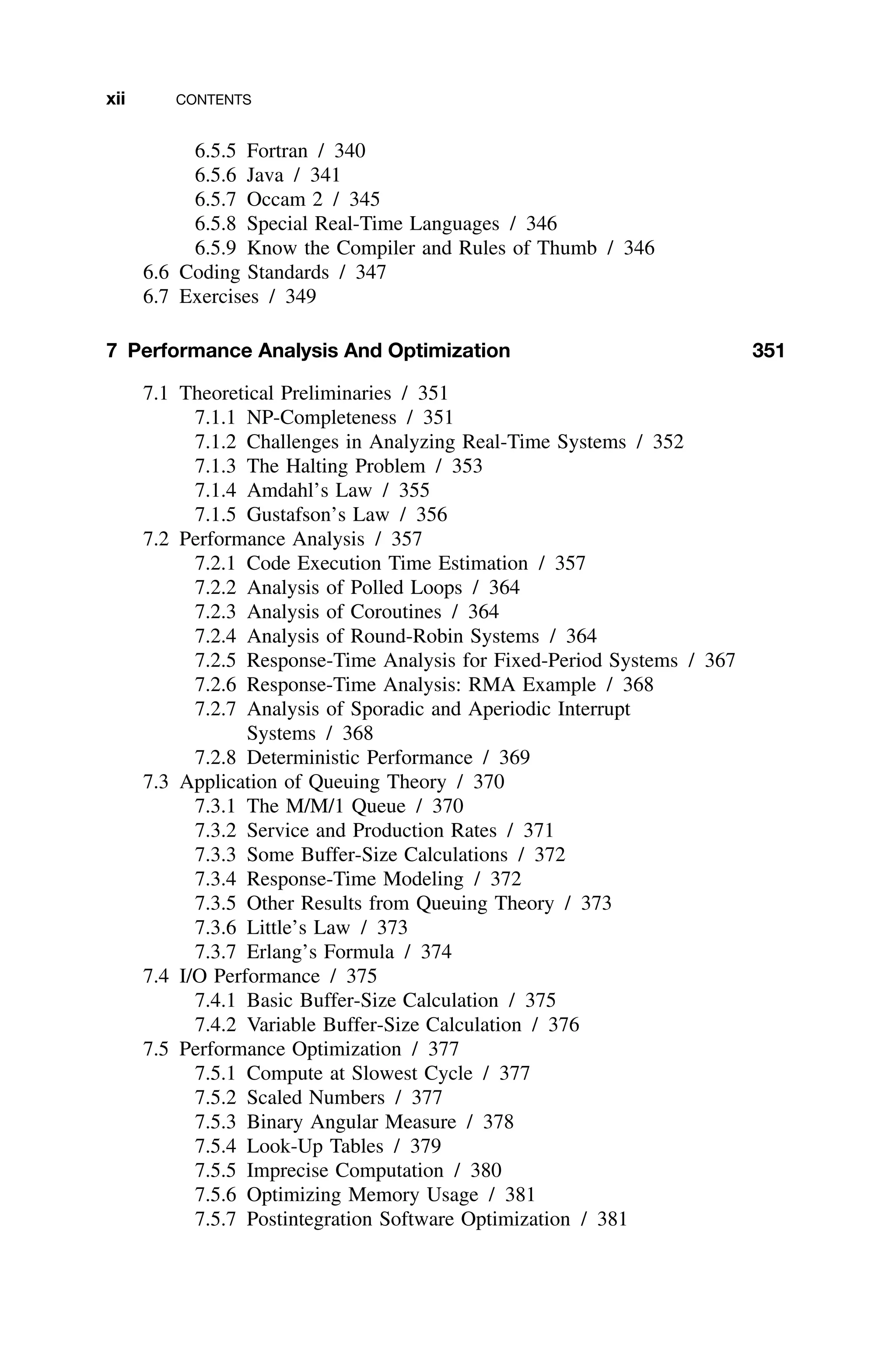
xii CONTENTS
6.5.5 Fortran / 340
6.5.6 Java / 341
6.5.7 Occam 2 / 345
6.5.8 Special Real-Time Languages / 346
6.5.9 Know the Compiler and Rules of Thumb / 346
6.6 Coding Standards / 347
6.7 Exercises / 349
7 Performance Analysis And Optimization 351
7.1 Theoretical Preliminaries / 351
7.1.1 NP-Completeness / 351
7.1.2 Challenges in Analyzing Real-Time Systems / 352
7.1.3 The Halting Problem / 353
7.1.4 Amdahl’s Law / 355
7.1.5 Gustafson’s Law / 356
7.2 Performance Analysis / 357
7.2.1 Code Execution Time Estimation / 357
7.2.2 Analysis of Polled Loops / 364
7.2.3 Analysis of Coroutines / 364
7.2.4 Analysis of Round-Robin Systems / 364
7.2.5 Response-Time Analysis for Fixed-Period Systems / 367
7.2.6 Response-Time Analysis: RMA Example / 368
7.2.7 Analysis of Sporadic and Aperiodic Interrupt
Systems / 368
7.2.8 Deterministic Performance / 369
7.3 Application of Queuing Theory / 370
7.3.1 The M/M/1 Queue / 370
7.3.2 Service and Production Rates / 371
7.3.3 Some Buffer-Size Calculations / 372
7.3.4 Response-Time Modeling / 372
7.3.5 Other Results from Queuing Theory / 373
7.3.6 Little’s Law / 373
7.3.7 Erlang’s Formula / 374
7.4 I/O Performance / 375
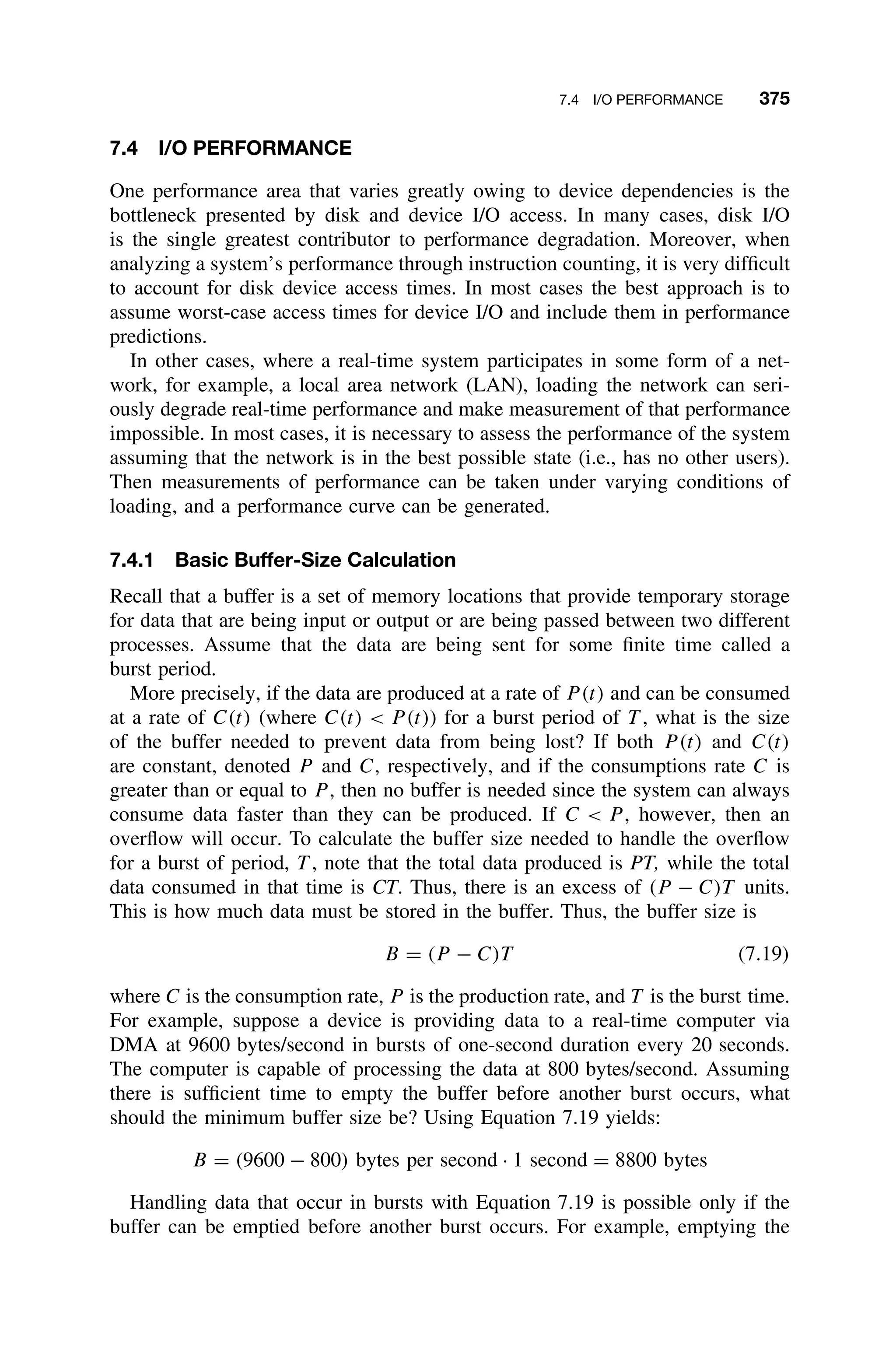
7.4.1 Basic Buffer-Size Calculation / 375
7.4.2 Variable Buffer-Size Calculation / 376
7.5 Performance Optimization / 377
7.5.1 Compute at Slowest Cycle / 377
7.5.2 Scaled Numbers / 377
7.5.3 Binary Angular Measure / 378
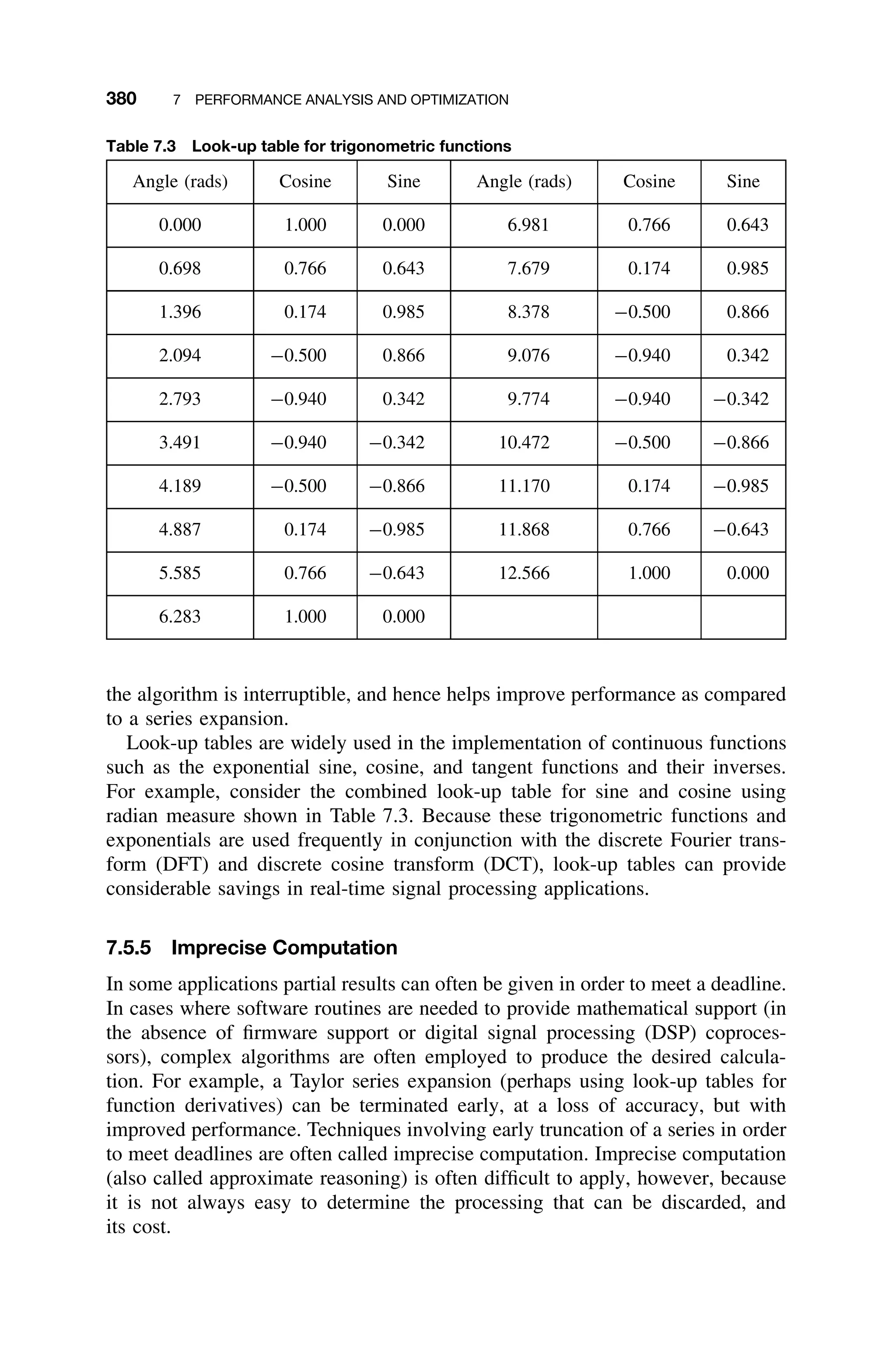
7.5.4 Look-Up Tables / 379
7.5.5 Imprecise Computation / 380
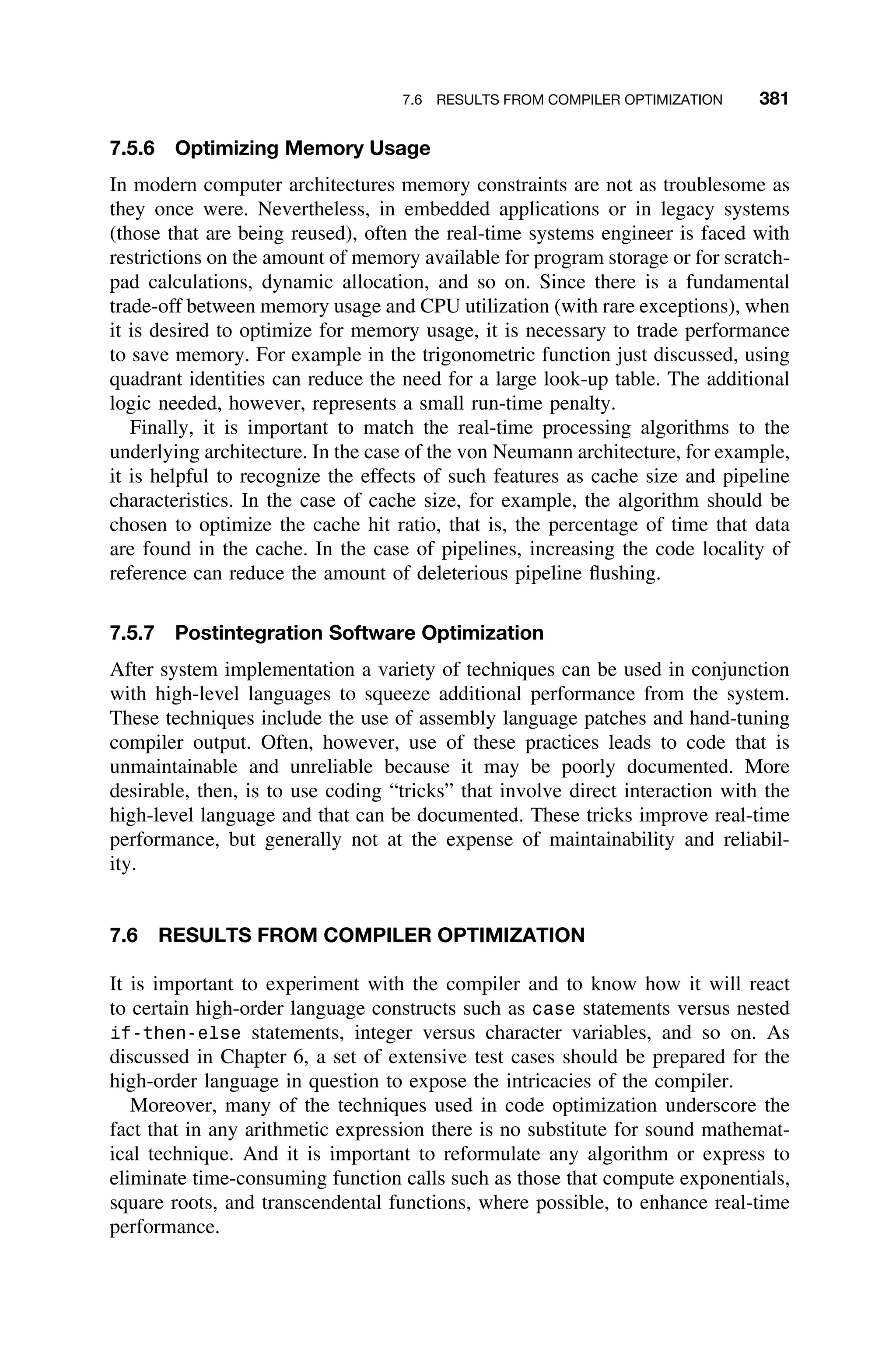
7.5.6 Optimizing Memory Usage / 381
7.5.7 Postintegration Software Optimization / 381
CONTENTS xiii
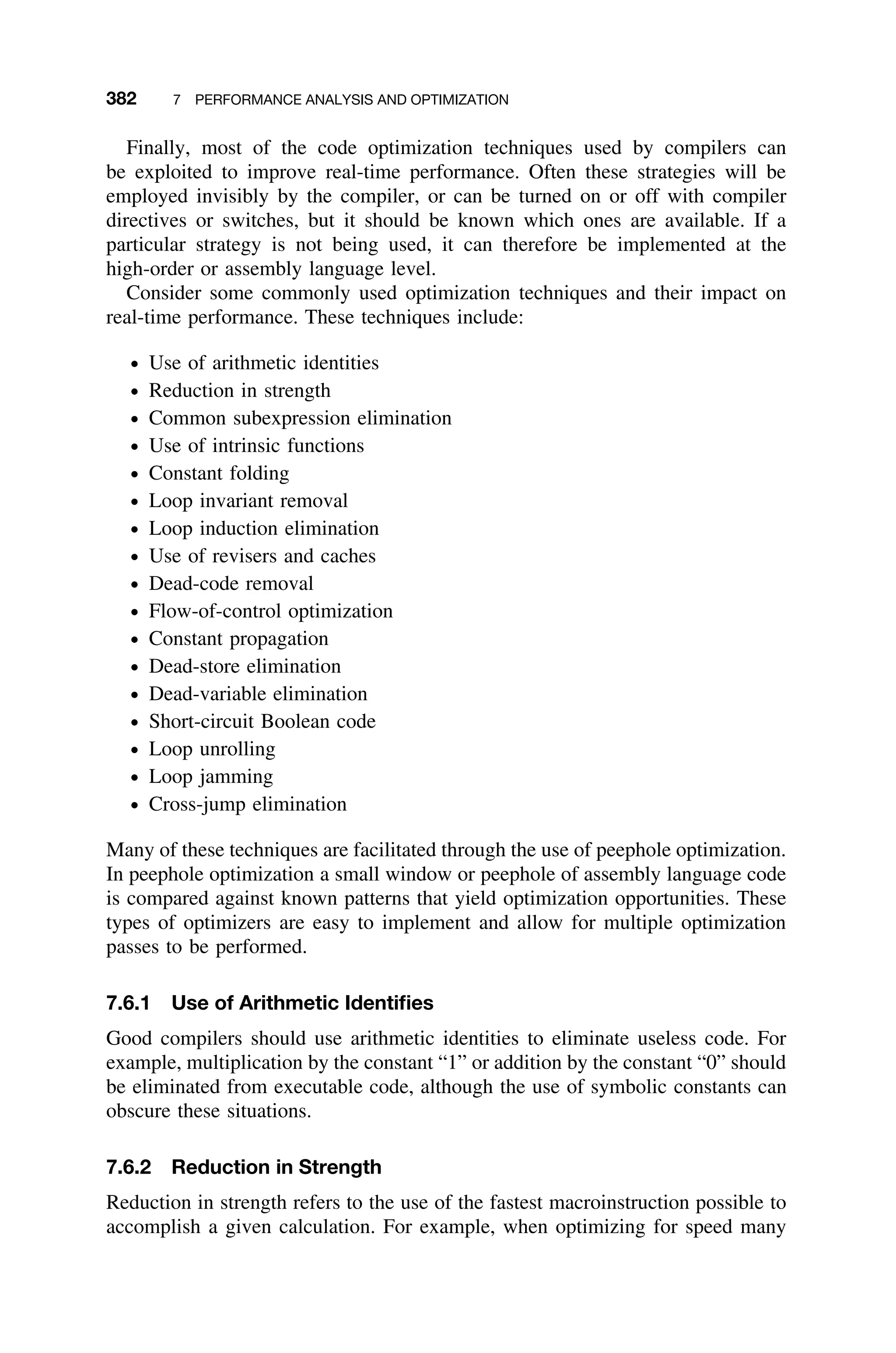
7.6 Results from Compiler Optimization / 381
7.6.1 Use of Arithmetic Identifies / 382
7.6.2 Reduction in Strength / 382
7.6.3 Common Subexpression Elimination / 383
7.6.4 Intrinsic Functions / 383
7.6.5 Constant Folding / 383
7.6.6 Loop Invariant Optimization / 384
7.6.7 Loop Induction Elimination / 384
7.6.8 Use of Registers and Caches / 385
7.6.9 Removal of Dead or Unreachable Code / 385
7.6.10 Flow-of-Control Optimization / 385
7.6.11 Constant Propagation / 386
7.6.12 Dead-Store Elimination / 386
7.6.13 Dead-Variable Elimination / 387
7.6.14 Short-Circuiting Boolean Code / 387
7.6.15 Loop Unrolling / 387
7.6.16 Loop Jamming / 388
7.6.17 More Optimization Techniques / 389
7.6.18 Combination Effects / 390
7.6.19 Speculative Execution / 391
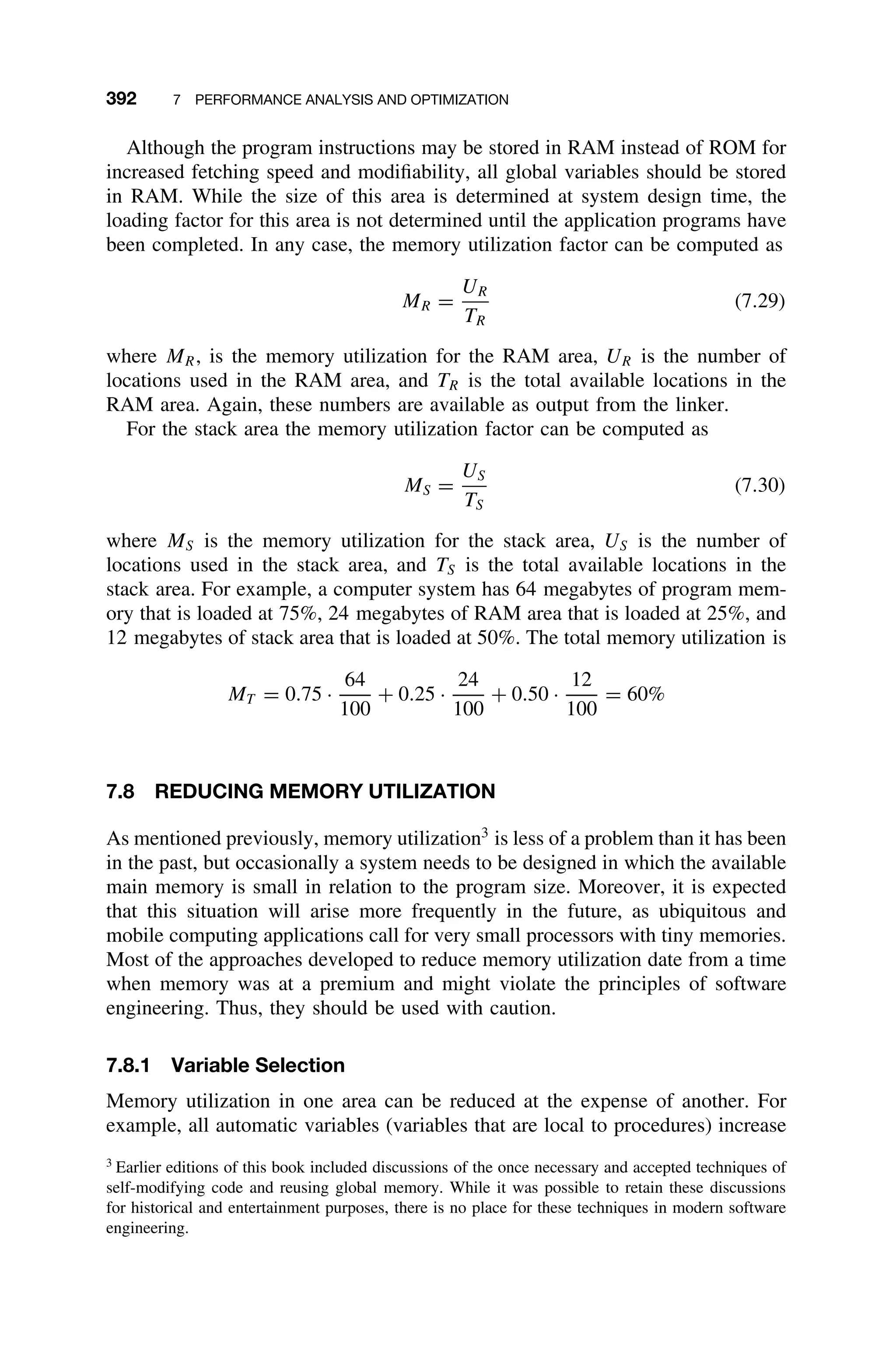
7.7 Analysis of Memory Requirements / 391
7.8 Reducing Memory Utilization / 392
7.8.1 Variable Selection / 392
7.8.2 Memory Fragmentation / 393
7.9 Exercises / 393
8 Engineering Considerations 397
8.1 Metrics / 397
8.1.1 Lines of Code / 397
8.1.2 McCabe’s Metric / 398
8.1.3 Halstead’s Metrics / 399
8.1.4 Function Points / 401
8.1.5 Feature Points / 404
8.1.6 Metrics for Object-Oriented Software / 405
8.1.7 Objections to Metrics / 406
8.1.8 Best Practices / 406
8.2 Faults, Failures, and Bugs / 406
8.2.1 The Role of Testing / 407
8.2.2 Testing Techniques / 407
8.2.3 System-Level Testing / 413
8.2.4 Design of Testing Plans / 415
8.3 Fault-Tolerance / 415
8.3.1 Spatial Fault-Tolerance / 416
8.3.2 Software Black Boxes / 417
xiv CONTENTS
8.3.3 N-Version Programming / 418
8.3.4 Built-In-Test Software / 418
8.3.5 CPU Testing / 418
8.3.6 Memory Testing / 419
8.3.7 ROM / 419
8.3.8 RAM / 420
8.3.9 Other Devices / 422
8.3.10 Spurious and Missed Interrupts / 422
8.3.11 Handling Spurious and Missed Interrupts / 422
8.3.12 The Kalman Filter / 423
8.4 Systems Integration / 424
8.4.1 Goals of System Integration / 425
8.4.2 System Unification / 425
8.4.3 System Verification / 425
8.4.4 System Integration Tools / 426
8.4.5 A Simple Integration Strategy / 429
8.4.6 Patching / 430
8.4.7 The Probe Effect / 431
8.4.8 Fault-Tolerant Design: A Case Study / 432
8.5 Refactoring Real-Time Code / 436
8.5.1 Conditional Logic / 436
8.5.2 Data Clumps / 436
8.5.3 Delays as Loops / 437
8.5.4 Dubious Constraints / 437
8.5.5 Duplicated Code / 437
8.5.6 Generalizations Based on a Single Architecture / 438
8.5.7 Large Procedures / 438
8.5.8 Lazy Procedure / 438
8.5.9 Long Parameter List / 438
8.5.10 Message-Passing Overload / 438
8.5.11 Self-Modifying Code / 439
8.5.12 Speculative Generality / 439
8.5.13 Telltale Comments / 439
8.5.14 Unnecessary Use of Interrupts / 439
8.6 Cost Estimation Using COCOMO / 440
8.6.1 Basic COCOMO / 440
8.6.2 Intermediate and Detailed COCOMO / 441
8.6.3 COCOMO II / 442
8.7 Exercises / 443
CONTENTS xv
Glossary 445
Bibliography 475
Index 487
About the Author 505
PREFACE TO THE
THIRD EDITION
This book is an introduction to real-time systems. It is intended not as a cookbook,
but, rather, as a stimulus for thinking about hardware and software in a different
way. It is necessarily broader than deep. It is a survey book, designed to heighten
the reader’s awareness of real-time issues.
This book is the culmination of more than 20 years of building, studying, and
teaching real-time systems. The author’s travels have taken him to NASA, UPS,
Lockheed Martin, the Canadian and Australian Defense Forces, MIT’s Charles
Stark Draper Labs, and many other places. These visits and interactions with
literally hundreds of students from such places as Boeing, Motorola, and Siemens
have resulted in a wider understanding of real-time systems and particularly their
real application. This book is, in essence, a compendium of these experiences.
The author’s intent is to provide a practical framework for software engineers
to design and implement real-time systems. This approach is somewhat different
from that of other texts on the subject.
Because of the pragmatic approach, a few of the results and viewpoints pre-
sented book’s may be controversial. The author has adapted many of the formal
definitions from their traditional rigid form into words that are more compatible
with practical design. In many places theoretical treatments have been omitted
where they would have obscured applied results. In these cases, the reader is
referred to additional reading. This author is a great believer in research in this
area, and in many places has indicated where research needs to be done or is
being done.
Although the book may appear simplistic, it is subtly complex. Consider the
semaphore operators. They can be written with a minimum amount of code, yet
they are fraught with danger for the real-time designer. In the same way, this
book has a kind of Zen-like simplicity and complexity: a yin and a yang.
INTENDED AUDIENCE
This text is an introductory-level book intended for junior–senior level and grad-
uate computer science and electrical engineering students, and practicing software
engineers. It can be used as a graduate-level text if it is supplemented with an
xvii
xviii PREFACE TO THE THIRD EDITION
advanced reader, such as one by the author [Laplante00]. This book is especially
useful in an industrial setting for new real-time systems designers who need to
get “up to speed” very quickly. This author has used earlier editions of this book
in this way to teach short courses for several clients.
The reader is assumed to have some experience in programming in one of the
more popular languages, but other than this, the prerequisites for this text are
minimal. Some familiarity with discrete mathematics is helpful in understanding
some of the formalizations, but it is not essential. A background in basic calculus
and probability theory will assist in the reading of Chapter 7.
PROGRAMMING LANGUAGES
Although there are certain “preferred” languages for real-time system design,
such as C, C++, Ada 95, and increasingly Java, many real-time systems are still
written in Fortran, assembly language, and even Visual BASIC. It would be unjust
to focus this book on one language, say C, when the theory should be language
independent. However, for uniformity of discussion, points are illustrated, as
appropriate, in generic assembly language and C. While the C code is not intended
to be ready-to-use, it can be easily adapted with a little tweaking for use in a
real system.
ORGANIZATION OF THE BOOK
Real-time software designers must be familiar with computer architecture and
organization, operating systems, software engineering, programming languages,
and compiler theory. The text provides an overview of these subjects from the
perspective of the real-time systems designer. Because this is a staggering task,
depth is occasionally sacrificed for breadth. Again, suggestions for additional
readings are provided where depth has been sacrificed.
The book is organized into chapters that are essentially self-contained. Thus,
the material can be rearranged or omitted, depending on the background and inter-
ests of the audience or instructor. Each chapter contains both easy and challenging
exercises that stimulate the reader to confront actual problems. The exercises,
however, cannot serve as a substitute for practical experience.
The first chapter provides an overview of the nature of real-time systems. Much
of the basic vocabulary relating to real-time systems is developed along with a
discussion of the challenges facing the real-time system designer. Finally, a brief
historical review is given. The purpose of this chapter is to foreshadow the rest
of the book as well as quickly acquaint the reader with pertinent terminology.
The second chapter presents a more detailed review of basic computer archi-
tecture concepts from the perspective of the real-time systems designer and some
basic concepts of electronics. Specifically, the impact of different architectural
features on real-time performance is discussed. The remainder of the chapter
PREFACE TO THE THIRD EDITION xix
discusses different memory technologies, input/output techniques, and peripheral
support for real-time systems. The intent here is to increase the reader’s awareness
of the impact of the computer architecture on design considerations.
Chapter 3 provides the core elements of the text for those who are building
practical real-time systems. This chapter describes the three critical real-time
kernel services: scheduling/dispatching, intertask communication, and memory
management. It also covers special problems inherent in these designs, such as
deadlock and the priority inheritance problem. This chapter also highlights issues
in POSIX compliance of real-time kernels.
In Chapter 4, the nature of requirements engineering is discussed. Next, struc-
tured analysis and object-oriented analysis are discussed as paradigms for require-
ments writing. An extensive design case study is provided.
Chapter 5 surveys several commonly used design specification techniques used
in both structural and object-oriented design. Their applicability to real-time sys-
tems is emphasized throughout. No one technique is a silver bullet, and the reader
is encouraged to adopt his or her own formulation of specification techniques for
the given application. A design case study is also provided.
Chapter 6 begins with a discussion of the language features desirable in good
software engineering practice in general and real-time systems design in particu-
lar. A review of several of the most widely used languages in real-time systems
design, with respect to these features, follows. The intent is to provide criteria
for rating a language’s ability to support real-time systems and to alert the user
to the possible drawbacks of using each language in real-time applications.
Chapter 7 discusses several techniques for improving the response time of real-
time systems. Many of the ideas discussed in this chapter are well-known but
unwritten laws of programming. Some are compiler optimization techniques that
can be used to improve our code. Others are tricks that have been passed down
by word of mouth. This chapter can help wring out that extra bit of performance
from a critical system.
The final chapter discusses general software engineering considerations, includ-
ing the use of metrics and techniques for improving the fault-tolerance and
reliability of real-time systems. Later in the chapter, techniques for improving
reliability through rigorous testing are discussed. Systems integration is also dis-
cussed. The chapter also reviews some special techniques that are needed in
real-time systems.
While the difference between the first and second editions of this book is
incremental, the third edition is essentially a new book. During the intervening
eight years since the second edition, so many changes have taken place that more
than a face-lift was needed. Approximately 50% of the material from the previous
editions has been discarded and the remainder entirely rewritten. Hence, about
50% of the book is new material.
When this course is taught in a university setting, typically students are asked
to build a real-time multitasking system of their choice. Usually, it is a game on a
PC, but some students can be expected to build embedded hardware controllers of
surprising complexity. The author’s “assignment” to the reader would be to build
xx PREFACE TO THE THIRD EDITION
such a game or simulation, using at least the coroutine model. The application
should be useful or at least pleasing, so some sort of a game is a good choice. The
project should take no more than 15 hours and cover all phases of the software
life-cycle model discussed in the text. Hence, those readers who have never built
a real-time system will have the benefit of the experience.
A NOTE ON REFERENCES
Real-Time Systems Engineering is based on more than 50 years of experience and
work by many individuals. Rather than clutter the text with endless citations for
the origin of each idea, the author chose to cite only the most key ideas where
the reader would want to seek out the source for further reading. Some of the text
is adapted from two other books written by the author on software engineering
and computer architecture [Laplante03c] [Gilreath03]. Where this has been done,
it is so noted. Note: In all cases where some sections of this text, particularly
the author’s own, appear as “adapted” or “paraphrased,” it means that the work
is being reprinted with both major and minor differences. However, rather than
confuse the issue with intermittent quotation marks for verbatim text, the reader
should attribute all ideas to cited authors from the point where the usage is
noted to the ending reference. This author, however, retains responsibility for
any errors. In all cases, permission to reprint this material has been obtained.
Many good theoretical treatments of real-time systems exist, and they are
noted where applicable. However, these books are sometimes too theoretical for
practicing software engineers and students who are often too impatient to wade
through the derivations for the resultant payoff. These readers want results that
they can use now in the trenches, and they want to see how they can be used,
not just know that they exist. In this text, an attempt is made to distill the best
of the theoretical results, combined with practical experience to provide a toolkit
for the real-time designer.
This book contains an extensive bibliography. Where verbatim phrases were
used or where a figure came from another source, the author tried to cite it
appropriately. However, if any sources were inadvertently overlooked, the author
wishes to correct the error. In addition, in a book of this magnitude and com-
plexity, errors are bound to occur. Please notify the author if you find any errors
of omission, commission, citation, and so on by email, at plaplante@psu.edu and
they will be corrected at the next possible opportunity.
ACKNOWLEDGMENTS
The author wishes to acknowledge and thank the many individuals who assisted in
the preparation of this book. Dr. Purnendu Sinha of Concordia University, wrote
much of Chapter 3 and various parts of other chapters relating to scheduling
theory, contributed many exercises, and classroom tested the material. Dr. Colin
PREFACE TO THE THIRD EDITION xxi
Neill, a Penn State colleague, co-wrote Chapters 4 and 5, reviewed and con-
tributed to other chapters, and single-handedly changed the author’s mind con-
cerning the value of object-oriented methods. Research collaborator William
Gilreath reviewed parts of the manuscript, contributed to parts on computer
architecture, and provided some of the more interesting exercises. Dr. David
Russell of Penn State reviewed the manuscript and provided a most supportive
environment at the Great Valley School of Graduate Professional Studies where
the author works. Valuable reviews were also provided by Dr. Mike Hinchey,
Dr. Dave Sinha, and Patricia Feingold. The acquisition and editorial team at
IEEE Press/John Wiley, in particular Tony VenGratis and John Griffin, provided
terrific support and encouragement. The author’s wife, Nancy, typed and edited
much of the material.
The author also wishes to thank the many students who, over the last 20 years,
have contributed ideas to this book through discussions, projects, and classes.
While an exhaustive list is impossible, for the third edition the author must
single out Michael Barnes, David Cloutier, Jim Goldman, Dana Gryger, Michael
Lutz, Dr. Jeff Nash, Mike Rapa, and Fred Woolsey. In particular, the author
thanks Fred, Dana, and Mike for contributing the excellent case study on the
traffic controller system found in Chapters 4 and 5, and David for contributing
to the discussion on the use of object-oriented languages in Chapter 6.
The author is grateful for the success of the first editions of this book, with
more than 15,000 copies sold to the college text and professional markets. The
only thing more gratifying than its adoption at such prestigious universities as
Carnegie Mellon University, University of Illinois at Urbana-Champaign, Prince-
ton University, the United States Air Force Academy, Polytechnic University, and
many others, has been the feedback received from individuals thankful for the
influence that the book has had on them.
Finally, the author wishes to thank his wife Nancy, and his children, Christo-
pher and Charlotte, for putting up with the seemingly endless work on this
manuscript and too many other projects to mention. This book is dedicated to
them with love.
PHILLIP A. LAPLANTE
Chester County, Pennsylvania
September, 2003
1
BASIC REAL-TIME
CONCEPTS
Consider a system in which data need to be processed at a regular and timely rate.
For example, an aircraft uses a sequence of accelerometer pulses to determine its
position. In addition, systems other than aeronautic ones require a rapid response
to events that occur at nonregular rates, such as an overtemperature failure in
a nuclear plant. In some sense it is understood that these events require real-
time processing.
Now consider a situation in which a passenger approaches an airline reservation
counter to pick up his ticket for a certain flight from New York to Boston, which
is leaving in 5 minutes. The reservation clerk enters the appropriate information
into the computer and a few seconds later a boarding pass is generated. Is this a
real-time system?
Indeed, all three systems – aircraft, nuclear plant, and airline reservations – are
real-time because they must process information within a specified interval or risk
system failure. Although these examples provide an intuitive definition of a real-
time system, it is necessary to clearly define when a system is real-time and
when it is not. This chapter answers the preceding questions, defines a number
of terms, and introduces issues that are examined further later.
1.1 TERMINOLOGY
The fundamental definitions of real-time systems engineering can vary depending
on the resource consulted. The following definitions have been collected and
refined to the smallest common subset of agreement to form the vocabulary of
Real-Time Systems Design and Analysis, By Phillip A. Laplante
ISBN 0-471-22855-9  2004 Institute of Electrical and Electronics Engineers
1
2 1 BASIC REAL-TIME CONCEPTS
this text. Moreover, these definitions are presented in a form that is intended to
be most useful to the practicing engineer, as opposed to the theorist.
1.1.1 Systems Concepts
The hardware of the general-purpose computer solves problems by repeated
execution of macroinstructions, collectively known as software. Software is tra-
ditionally divided into system programs and application programs.
System programs consist of software that interfaces with the underlying com-
puter hardware, such as schedulers, device drivers, dispatchers, and programs that
act as tools for the development of application programs. These tools include
compilers, which translate high-order language programs into assembly code;
assemblers, which translate the assembly language into a special binary format
called object or machine code; and linkers, which prepare the object code for exe-
cution. An operating system is a specialized collection of system programs that
manage the physical resources of the computer. As such, a real-time operating
system is a systems program.
Application programs are programs written to solve specific problems, such
as payroll preparation, inventory, and navigation. Certain design considerations
play a role in the design of certain systems programs and application software
intended to run in real-time environments.
The notion of a “system” is central to software engineering, and indeed to all
engineering, and warrants formalization.
Definition: A system is a mapping of a set of inputs into a set of outputs.
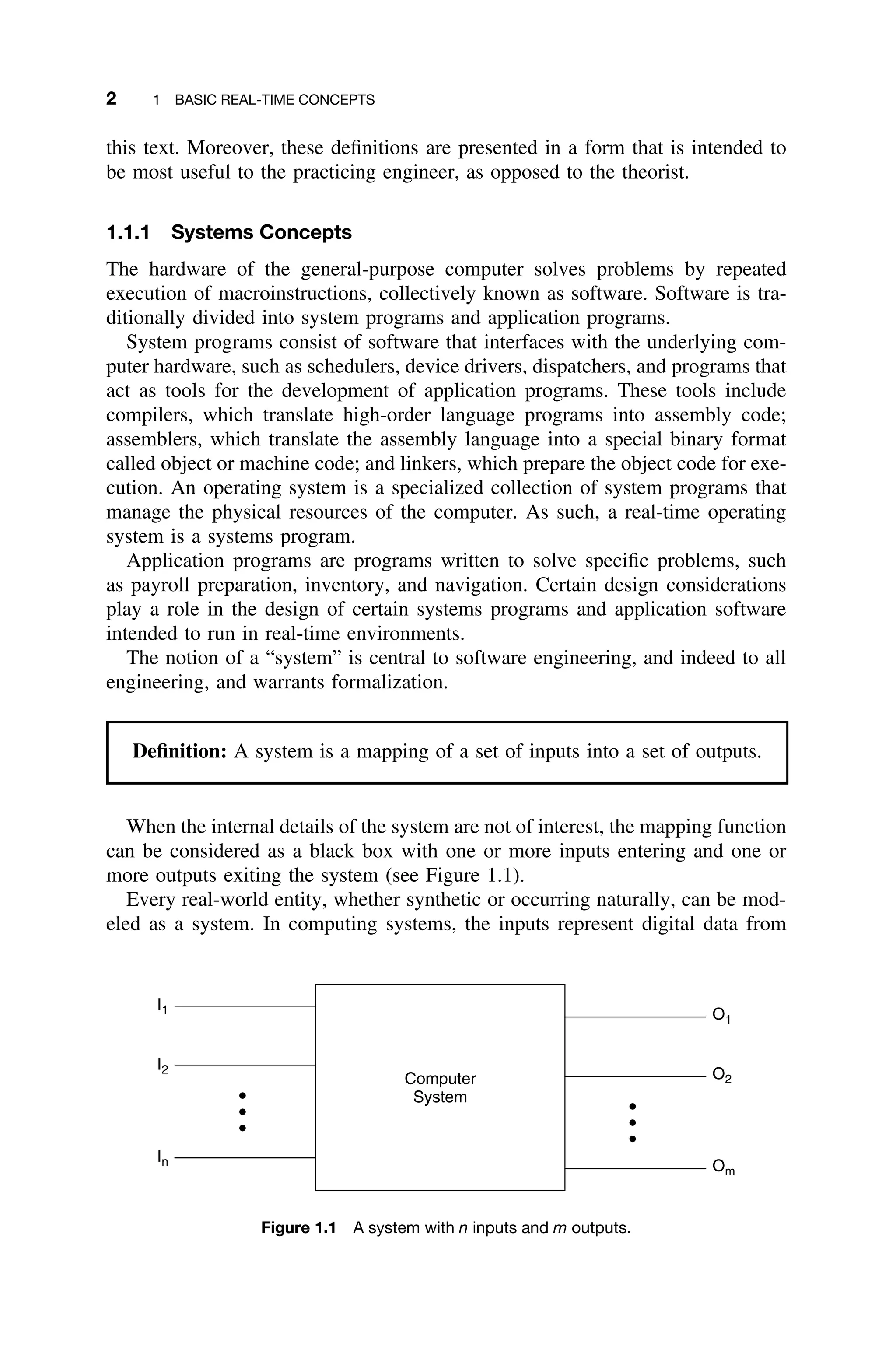
When the internal details of the system are not of interest, the mapping function
can be considered as a black box with one or more inputs entering and one or
more outputs exiting the system (see Figure 1.1).
Every real-world entity, whether synthetic or occurring naturally, can be mod-
eled as a system. In computing systems, the inputs represent digital data from
I1
I2
In
O1
O2
Om
Computer
System
Figure 1.1 A system with n inputs and m outputs.
1.1 TERMINOLOGY 3
hardware devices and other software systems. The inputs are often associated
with sensors, cameras, and other devices that provide analog inputs, which are
converted to digital data, or provide direct digital input. The digital output of the
computer system can be converted to analog outputs to control external hardware
devices such as actuators and displays (Figure 1.2).
Modeling a real-time system, as in Figure 1.2, is somewhat different from
the more traditional model of the real-time system as a sequence of jobs to
be scheduled and performance to be predicted, which is very similar to that
shown in Figure 1.3. The latter view is simplistic in that it ignores the fact that
the input sources and hardware under control are complex. Moreover, there are
other, sweeping software engineering considerations that are hidden by the model
shown in Figure 1.3.
Computer
System
Sensor 1
Sensor 2
Sensor n
Display Data
Control Signal 1
Control Signal 2
Control Signal n
Camera Input
Figure 1.2 Typical real-time control system including inputs from sensors and imaging devices
and producing control signals and display information [Laplante03b].
Computer
System
Job 1
Job 2
Job n
Schedule
Figure 1.3 A classic representation of a real-time system as a sequence of jobs to be
scheduled.
4 1 BASIC REAL-TIME CONCEPTS
Look again at to the model of a real-time system shown in Figure 1.2. Note
that in its realization there is some delay between presentation of the inputs
(stimulus) and appearance of the outputs (response). This fact can be formalized
as follows:
Definition: The time between the presentation of a set of inputs to a sys-
tem (stimulus) and the realization of the required behavior (response),
including the availability of all associated outputs, is called the response
time of the system.
How fast the response time needs to be depends on the purpose of the system.
1.1.2 Real-Time Definitions
The previous definitions set the stage for a formal definition of a real-time system.
Definition: A real-time system is a system that must satisfy explicit
(bounded) response-time constraints or risk severe consequences,
including failure.
What is a “failed” system? In the case of the space shuttle or a nuclear plant,
it is painfully obvious when a failure has occurred. For other systems, such as
an automatic bank teller machine, the notion of failure is less clear. For now,
failure will be defined as the “inability of the system to perform according to
system specification,” or, more formally:
Definition: A failed system is a system that cannot satisfy one or more of
the requirements stipulated in the formal system specification.
Because of this definition of failure, precise specification of the system oper-
ating criteria, including timing constraints, is important. This matter is dis-
cussed later.
Various other definitions exist for real-time, depending on which source is
consulted. Nonetheless, the common theme among all definitions is that the sys-
tem must satisfy deadline constraints in order to be correct. For example, an
alternative definition might be:
Definition: A real-time system is one whose logical correctness is based
on both the correctness of the outputs and their timeliness.
1.1 TERMINOLOGY 5
In any case, note that by making unnecessary the notion of timeliness, every
system becomes a real-time system.
Real-time systems are often reactive or embedded systems. Reactive systems
are those in which scheduling is driven by ongoing interaction with their envi-
ronment; for example, a fire-control system reacts to buttons pressed by a pilot.
Embedded systems are those that are found in a system that is not itself a
computer. For example, a modern automobile contains many embedded com-
puters that control fuel injection, airbag deployment, braking, climate control,
and so forth. Today, many household items such as televisions, stereos, washing
machines, even toys contain embedded computers. It is clear that sophisticated
systems such as aircraft, spacecraft, and industrial machines must contain many
embedded, reactive computer systems.
The three systems mentioned earlier satisfy the criteria for a real-time system
precisely. An aircraft must process accelerometer data within a certain period that
depends on the specifications of the aircraft; for example, every 10 milliseconds.
Failure to do so could result in a false position or velocity indication and cause
the aircraft to go off-course at best or crash at worst. For a nuclear reactor thermal
problem, failure to respond swiftly could result in a meltdown. Finally, an airline
reservation system must be able to handle a surge of passenger requests within
the passenger’s perception of a reasonable time (or before the flights leave the
gate). In short, a system does not have to process data in microseconds to be
considered real-time; it must simply have response times that are constrained.
1.1.2.1 When Is a System Real-Time? It can be argued that all practical
systems are real-time systems. Even a batch-oriented system – for example, grade
processing at the end of a semester or a bimonthly payroll run – is real-time.
Although the system may have response times of days or weeks (e.g., the time
that elapses between submitting the grade or payroll information and issuance of
the report card or check), it must respond within a certain time or there could
be an academic or financial disaster. Even a word-processing program should
respond to commands within a reasonable amount of time (e.g., 1 second), or it
will become torturous to use. Most of the literature refers to such systems as soft
real-time systems.
Definition: A soft real-time system is one in which performance is degraded
but not destroyed by failure to meet response-time constraints.
Conversely, systems where failure to meet response-time constraints leads to
complete and catastrophic system failure are called hard real-time systems.
Definition: A hard real-time system is one in which failure to meet a single
deadline may lead to complete and catastrophic system failure.
6 1 BASIC REAL-TIME CONCEPTS
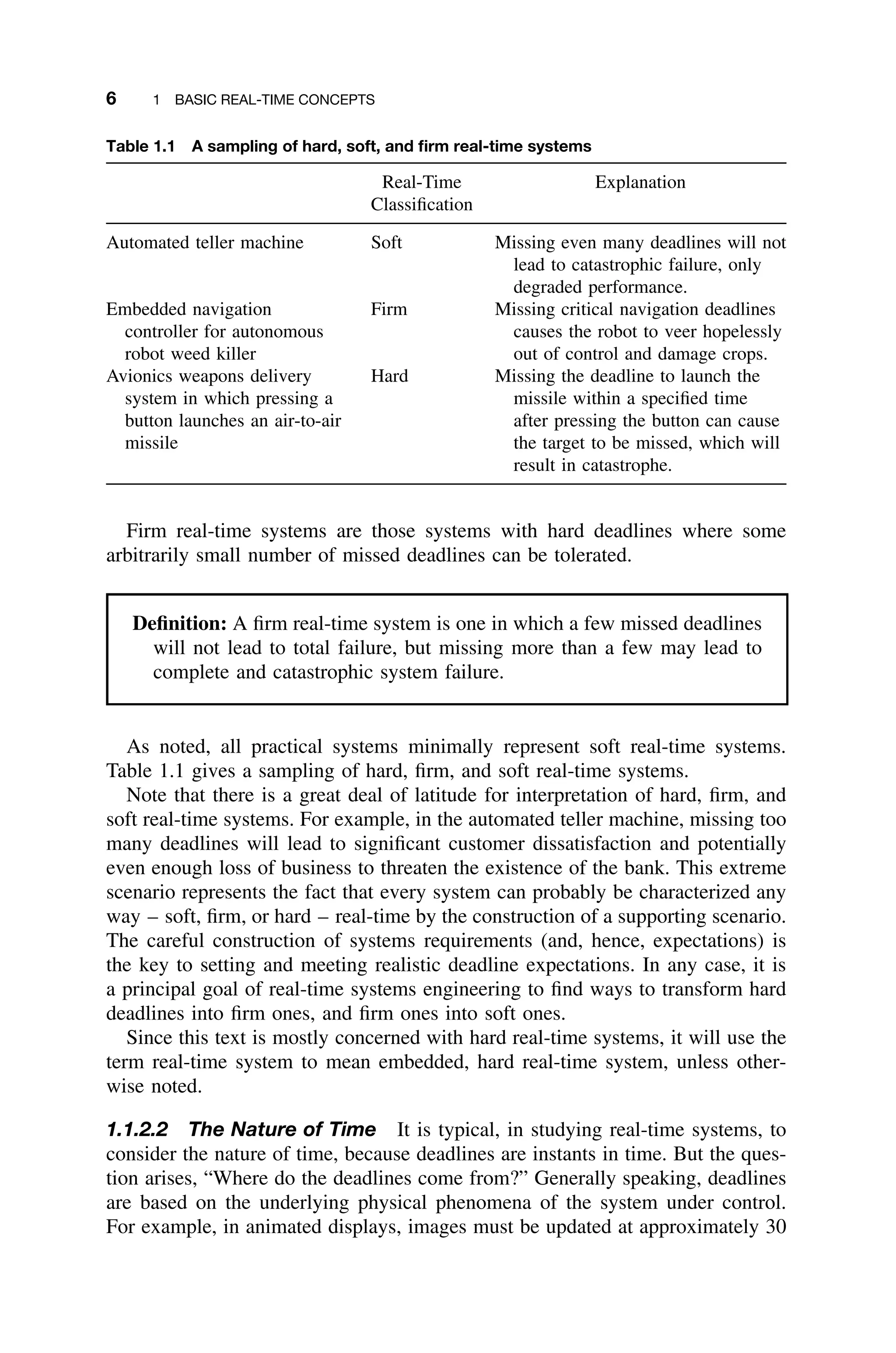
Table 1.1 A sampling of hard, soft, and firm real-time systems
Real-Time
Classification
Explanation
Automated teller machine Soft Missing even many deadlines will not
lead to catastrophic failure, only
degraded performance.
Embedded navigation
controller for autonomous
robot weed killer
Firm Missing critical navigation deadlines
causes the robot to veer hopelessly
out of control and damage crops.
Avionics weapons delivery
system in which pressing a
button launches an air-to-air
missile
Hard Missing the deadline to launch the
missile within a specified time
after pressing the button can cause
the target to be missed, which will
result in catastrophe.
Firm real-time systems are those systems with hard deadlines where some
arbitrarily small number of missed deadlines can be tolerated.
Definition: A firm real-time system is one in which a few missed deadlines
will not lead to total failure, but missing more than a few may lead to
complete and catastrophic system failure.
As noted, all practical systems minimally represent soft real-time systems.
Table 1.1 gives a sampling of hard, firm, and soft real-time systems.
Note that there is a great deal of latitude for interpretation of hard, firm, and
soft real-time systems. For example, in the automated teller machine, missing too
many deadlines will lead to significant customer dissatisfaction and potentially
even enough loss of business to threaten the existence of the bank. This extreme
scenario represents the fact that every system can probably be characterized any
way – soft, firm, or hard – real-time by the construction of a supporting scenario.
The careful construction of systems requirements (and, hence, expectations) is
the key to setting and meeting realistic deadline expectations. In any case, it is
a principal goal of real-time systems engineering to find ways to transform hard
deadlines into firm ones, and firm ones into soft ones.
Since this text is mostly concerned with hard real-time systems, it will use the
term real-time system to mean embedded, hard real-time system, unless other-
wise noted.
1.1.2.2 The Nature of Time It is typical, in studying real-time systems, to
consider the nature of time, because deadlines are instants in time. But the ques-
tion arises, “Where do the deadlines come from?” Generally speaking, deadlines
are based on the underlying physical phenomena of the system under control.
For example, in animated displays, images must be updated at approximately 30
1.1 TERMINOLOGY 7
frames per second to provide continuous motion, because the human eye can
resolve updating at a slower rate. In navigation systems, accelerations must be
read at a rate that is based on the maximum velocity of the vehicle, and so
on. In some cases, systems have deadlines that are imposed on them that are
based on nothing less than guessing or on some forgotten and since eliminated
requirement. The problem in these cases is that the undue constraints may be
placed on the systems. This is a primary maxim of real-time systems design – to
understand the basis and nature of the timing constraints, so that they can be
relaxed if necessary.
Many real-time systems utilize time-stamping and global clocks for synchro-
nization, task initiation, and data marking. It must be noted, however, that clocks
keep inaccurate time; even the official U.S. atomic clock must be adjusted. More-
over, there is an associated digitization error with clocks, which may need to be
considered when using them for data time-stamping.
1.1.3 Events and Determinism
In software systems, a change in state results in a change in the flow-of-control of
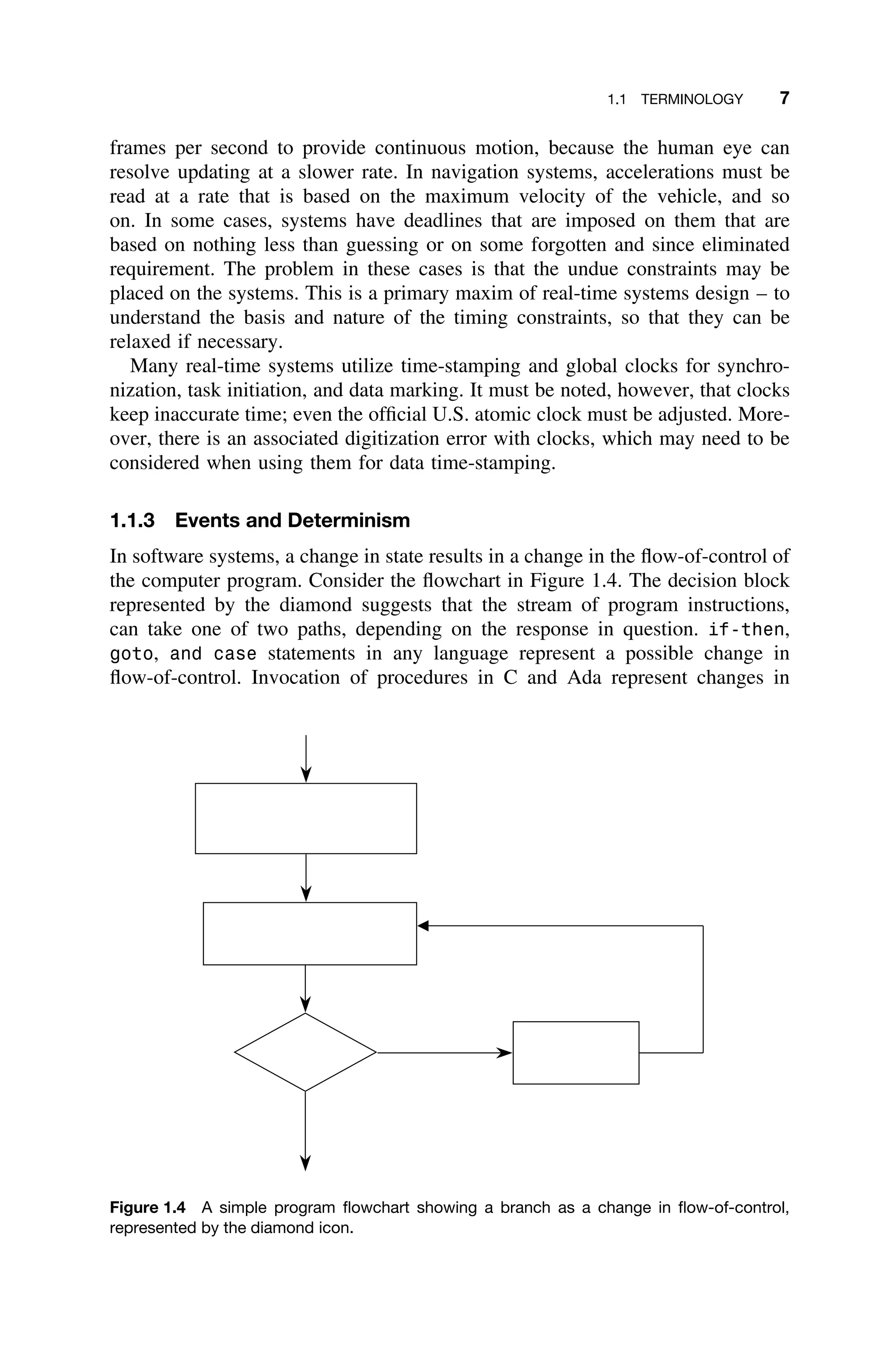
the computer program. Consider the flowchart in Figure 1.4. The decision block
represented by the diamond suggests that the stream of program instructions,
can take one of two paths, depending on the response in question. if-then,
goto, and case statements in any language represent a possible change in
flow-of-control. Invocation of procedures in C and Ada represent changes in
Figure 1.4 A simple program flowchart showing a branch as a change in flow-of-control,
represented by the diamond icon.
8 1 BASIC REAL-TIME CONCEPTS
flow-of-control. In object-oriented languages, instantiation of an object or the
invocation of a method causes the change in sequential flow-of-control. In gen-
eral, consider the following definition.
Definition: Any occurrence that causes the program counter to change
nonsequentially is considered a change of flow-of-control, and thus
an event.
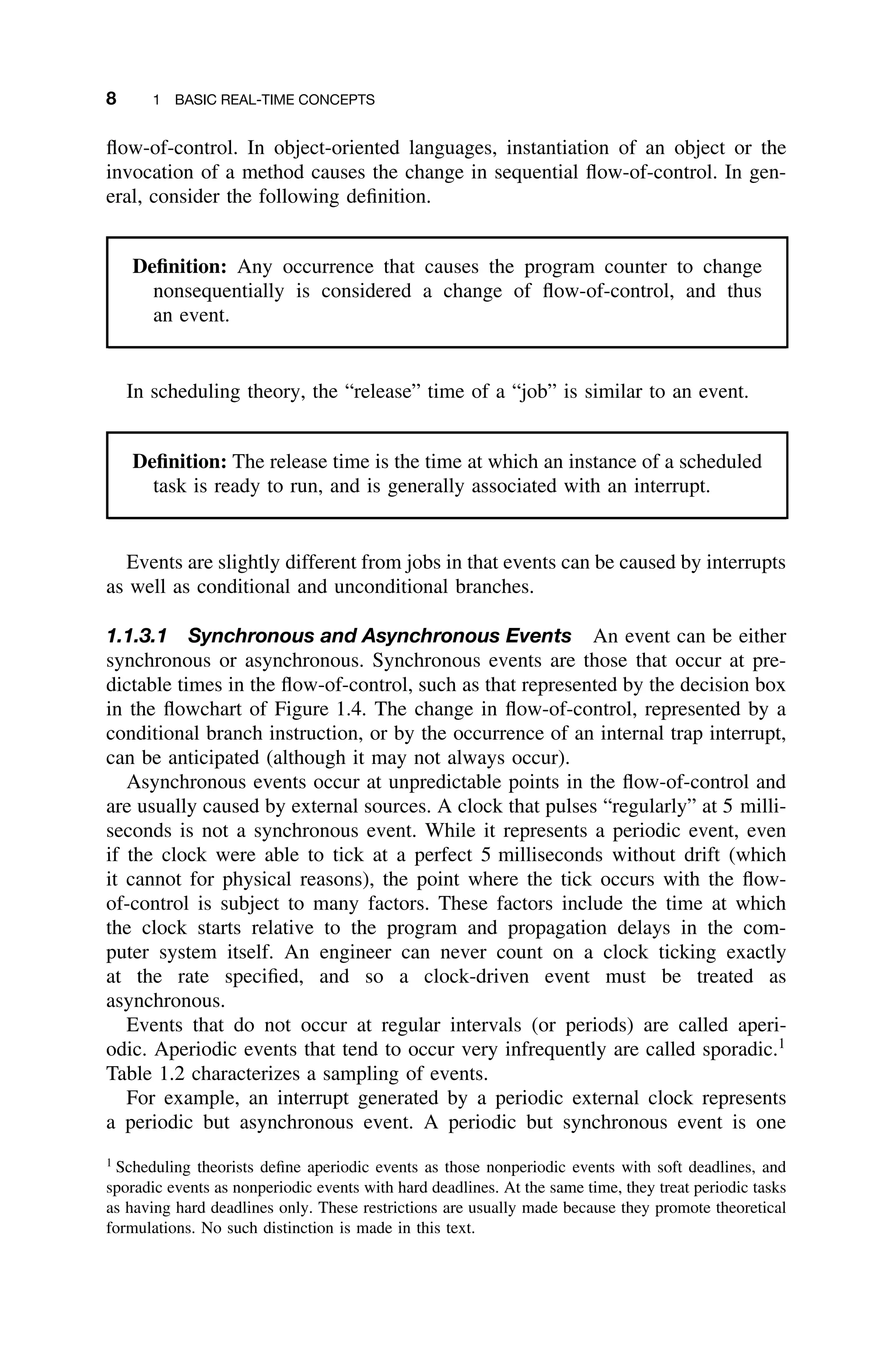
In scheduling theory, the “release” time of a “job” is similar to an event.
Definition: The release time is the time at which an instance of a scheduled
task is ready to run, and is generally associated with an interrupt.
Events are slightly different from jobs in that events can be caused by interrupts
as well as conditional and unconditional branches.
1.1.3.1 Synchronous and Asynchronous Events An event can be either
synchronous or asynchronous. Synchronous events are those that occur at pre-
dictable times in the flow-of-control, such as that represented by the decision box
in the flowchart of Figure 1.4. The change in flow-of-control, represented by a
conditional branch instruction, or by the occurrence of an internal trap interrupt,
can be anticipated (although it may not always occur).
Asynchronous events occur at unpredictable points in the flow-of-control and
are usually caused by external sources. A clock that pulses “regularly” at 5 milli-
seconds is not a synchronous event. While it represents a periodic event, even
if the clock were able to tick at a perfect 5 milliseconds without drift (which
it cannot for physical reasons), the point where the tick occurs with the flow-
of-control is subject to many factors. These factors include the time at which
the clock starts relative to the program and propagation delays in the com-
puter system itself. An engineer can never count on a clock ticking exactly
at the rate specified, and so a clock-driven event must be treated as
asynchronous.
Events that do not occur at regular intervals (or periods) are called aperi-
odic. Aperiodic events that tend to occur very infrequently are called sporadic.1
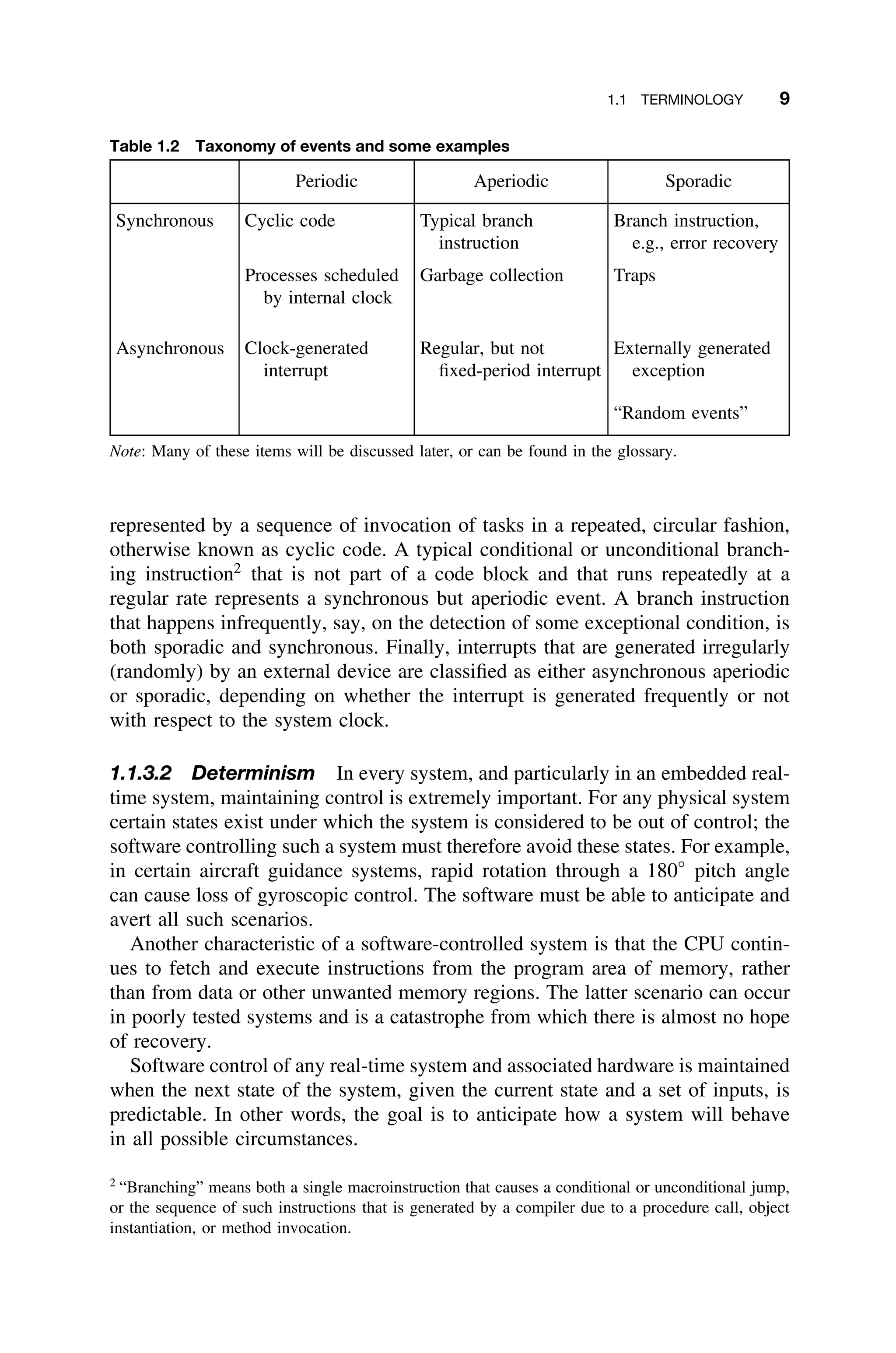
Table 1.2 characterizes a sampling of events.
For example, an interrupt generated by a periodic external clock represents
a periodic but asynchronous event. A periodic but synchronous event is one
1
Scheduling theorists define aperiodic events as those nonperiodic events with soft deadlines, and
sporadic events as nonperiodic events with hard deadlines. At the same time, they treat periodic tasks
as having hard deadlines only. These restrictions are usually made because they promote theoretical
formulations. No such distinction is made in this text.
1.1 TERMINOLOGY 9
Table 1.2 Taxonomy of events and some examples
Periodic Aperiodic Sporadic
Synchronous Cyclic code Typical branch
instruction
Branch instruction,
e.g., error recovery
Processes scheduled
by internal clock
Garbage collection Traps
Asynchronous Clock-generated
interrupt
Regular, but not
fixed-period interrupt
Externally generated
exception
“Random events”
Note: Many of these items will be discussed later, or can be found in the glossary.
represented by a sequence of invocation of tasks in a repeated, circular fashion,
otherwise known as cyclic code. A typical conditional or unconditional branch-
ing instruction2
that is not part of a code block and that runs repeatedly at a
regular rate represents a synchronous but aperiodic event. A branch instruction
that happens infrequently, say, on the detection of some exceptional condition, is
both sporadic and synchronous. Finally, interrupts that are generated irregularly
(randomly) by an external device are classified as either asynchronous aperiodic
or sporadic, depending on whether the interrupt is generated frequently or not
with respect to the system clock.
1.1.3.2 Determinism In every system, and particularly in an embedded real-
time system, maintaining control is extremely important. For any physical system
certain states exist under which the system is considered to be out of control; the
software controlling such a system must therefore avoid these states. For example,
in certain aircraft guidance systems, rapid rotation through a 180◦
pitch angle
can cause loss of gyroscopic control. The software must be able to anticipate and
avert all such scenarios.
Another characteristic of a software-controlled system is that the CPU contin-
ues to fetch and execute instructions from the program area of memory, rather
than from data or other unwanted memory regions. The latter scenario can occur
in poorly tested systems and is a catastrophe from which there is almost no hope
of recovery.
Software control of any real-time system and associated hardware is maintained
when the next state of the system, given the current state and a set of inputs, is
predictable. In other words, the goal is to anticipate how a system will behave
in all possible circumstances.
2
“Branching” means both a single macroinstruction that causes a conditional or unconditional jump,
or the sequence of such instructions that is generated by a compiler due to a procedure call, object
instantiation, or method invocation.
10 1 BASIC REAL-TIME CONCEPTS
Definition: A system is deterministic if, for each possible state and each
set of inputs, a unique set of outputs and next state of the system can
be determined.
Event determinism means the next states and outputs of a system are known for
each set of inputs that trigger events. Thus, a system that is deterministic is event
deterministic. Although it would be difficult for a system to be deterministic only
for those inputs that trigger events, this is plausible, and so event determinism
may not imply determinism.3
It is interesting to note that while it is a significant challenge to design sys-
tems that are completely event deterministic, and as mentioned it is possible to
inadvertently to end up with a system that is nondeterministic, it is also hard
to design systems that are deliberately nondeterministic. This situation arises
from the difficulties in designing completely random number generators. Delib-
erately nondeterministic systems would be desirable, for example, as casino
gambling machines.
Finally, if in a deterministic system the response time for each set of outputs
is known, then, the system also exhibits temporal determinism.
A side benefit of designing deterministic systems is that guarantees can be
given that the system will be able to respond at any time, and in the case of
temporally deterministic systems, when they will respond. This reinforces the
association of control with real-time systems.
1.1.4 CPU Utilization
The final and most important term to be defined is a critical measure of real-time
system performance. Because in the von Neumann paradigm, the CPU continues
to fetch, decode, and execute instructions as long as power is applied, the CPU
will execute either no-ops or instructions or instructions that are not related to the
satisfaction of a deadline (for example, noncritical “housekeeping”). The measure
of the time spent doing idle processing, in a sense, indicates how much real-time
processing is occurring.
Definition: The (CPU) utilization or time-loading factor, U, is a measure
of the percentage of nonidle processing.
A system is said to be time-overloaded if U  100%. Systems that are too
highly utilized are undesirable because changes or additions cannot be made to the
system without risk of time-overloading. Systems that are not sufficiently utilized
3
This definition implies that the system must have a finite number of states. It is reasonable to make
this assumption in a digital computer system where all inputs are digitized to within a finite range.
1.1 TERMINOLOGY 11
Table 1.3 CPU utilization zones and typical applications and recommendations
Utilization (%) Zone Type Typical Application
0–25 Significant excess processing power – CPU
may be more powerful than necessary
Various
26–50 Very safe Various
51–68 Safe Various
69 Theoretical limit Embedded systems
70–82 Questionable Embedded systems
83–99 Dangerous Embedded systems
100+ Overload Stressed systems
are not necessarily good, because this implies that the system was overengineered
and that costs can be reduced with less expensive hardware. While a utilization of
50% is common for new products, 80% might be acceptable for systems that do
not expect growth. However, 70% as a target for U is one of the most celebrated
and potentially useful results in the theory of real-time systems where tasks
are periodic and independent – a result that will be examined later. Table 1.3
gives a summary of certain CPU utilizations and typical situations in which they
are associated.
U is calculated by summing the contribution of utilization factors for each
(periodic or aperiodic) task. Suppose a system has n ≥ 1 periodic tasks, each
with an execution period of pi, and hence, execution frequency, fi = 1/pi. If
task i is known to have (or has been estimated to have) a maximum (worst case)
execution time of ei, then the utilization factor, ui, for task ei is
ui = ei/pi (1.1)
Then the overall system utilization is
U =
n

i=1
ui =
n

i=1
ei/pi (1.2)
Note that the deadline for periodic task i, di, is typically the next cycle or time
period, and is a critical design factor that is constrained by ei. The determination
of the ei either prior to or after the code has been written can be extremely
difficult, and in many cases, impossible, in which case estimation must be used.
For aperiodic and sporadic tasks ui is calculated by assuming some worst-case
execution period, usually the worst-case delay between event occurrences. Such
approximations can inflate the utilization factor unnecessarily or can lead to
12 1 BASIC REAL-TIME CONCEPTS
overconfidence because of the tendency to “not worry” about its excessive con-
tribution. The danger is to discover later that a higher frequency of occurrence
than budgeted has led to a time-overload and system failure.
The utilization factor differs from CPU throughput, which is a measure of the
number of macroinstructions per second that can be processed based on some
predetermined instruction mix. This type of measurement is typically used to
compare CPU horsepower for a particular application.
The choice of task deadlines, calculation and reduction of execution times, and
other factors that influence CPU utilization will be discussed at great length in
Chapter 7.
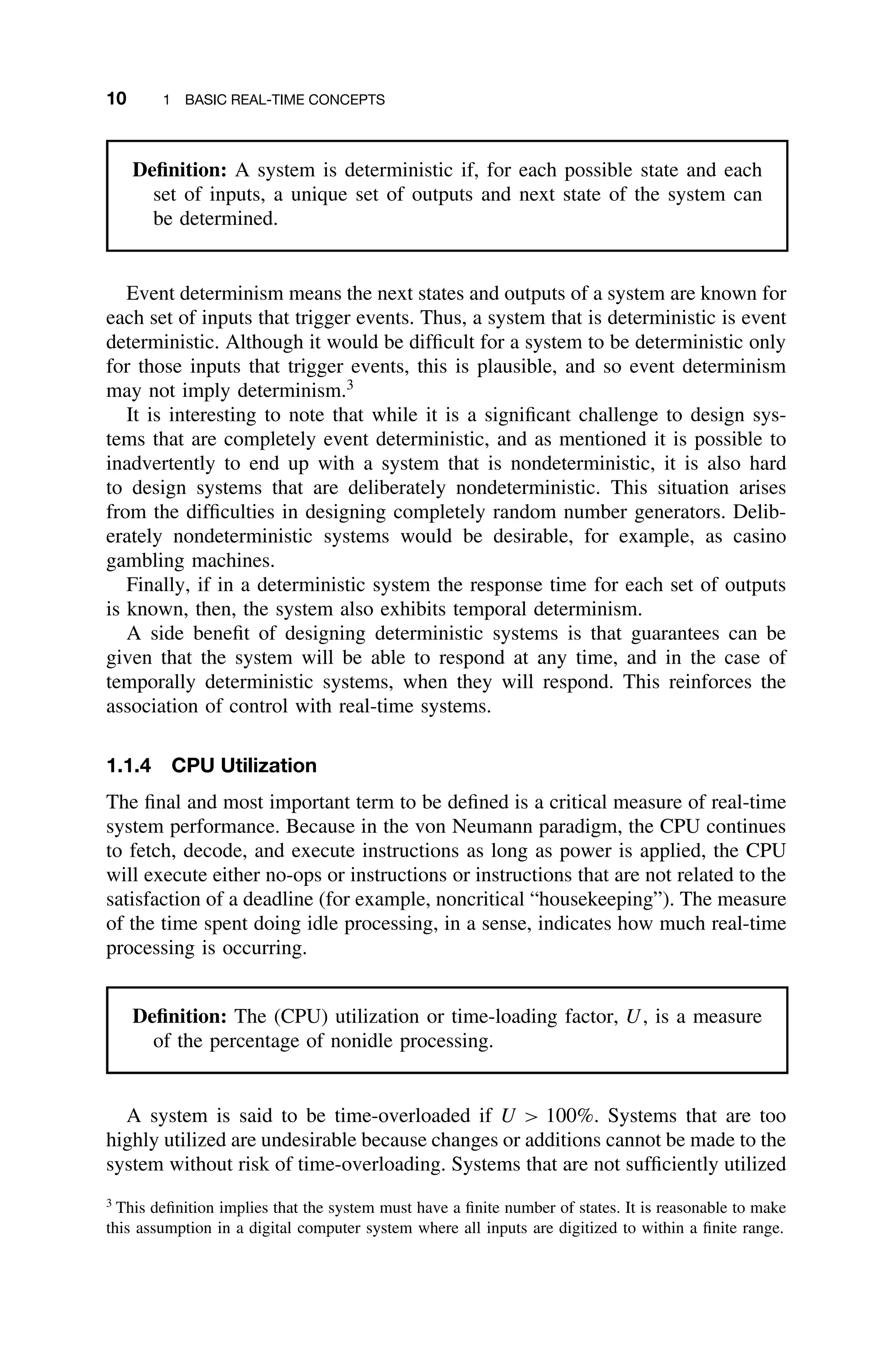
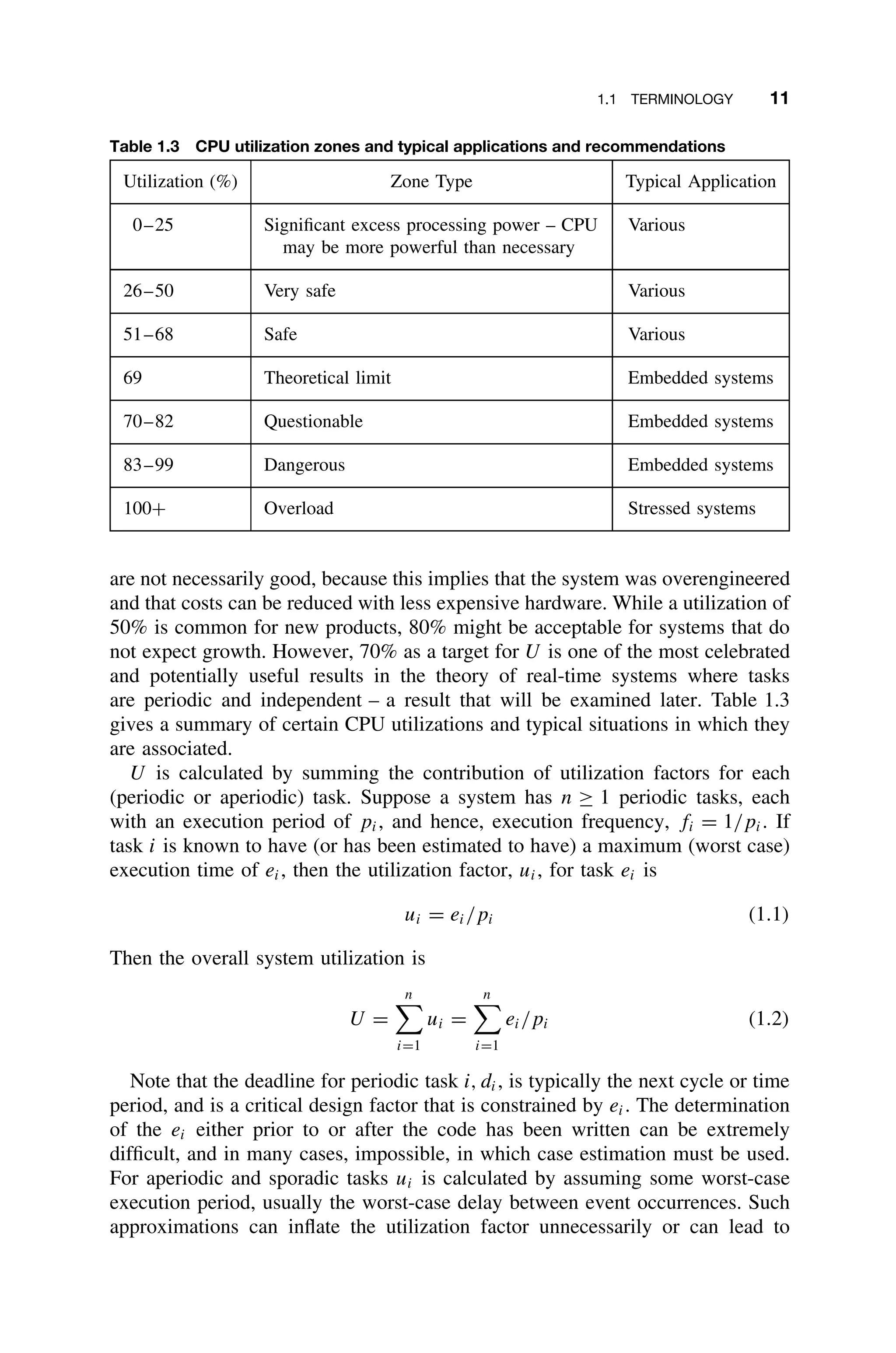
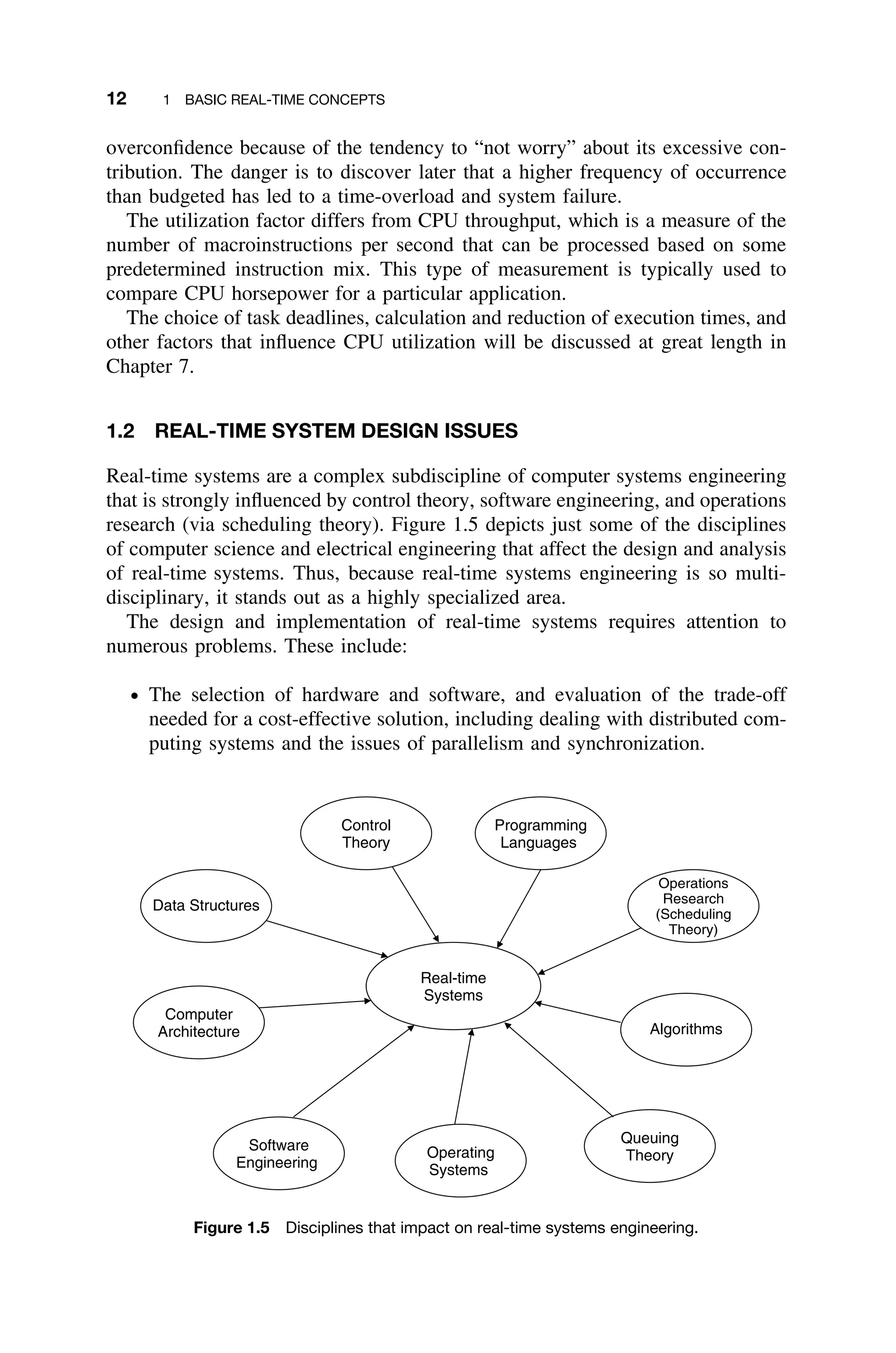
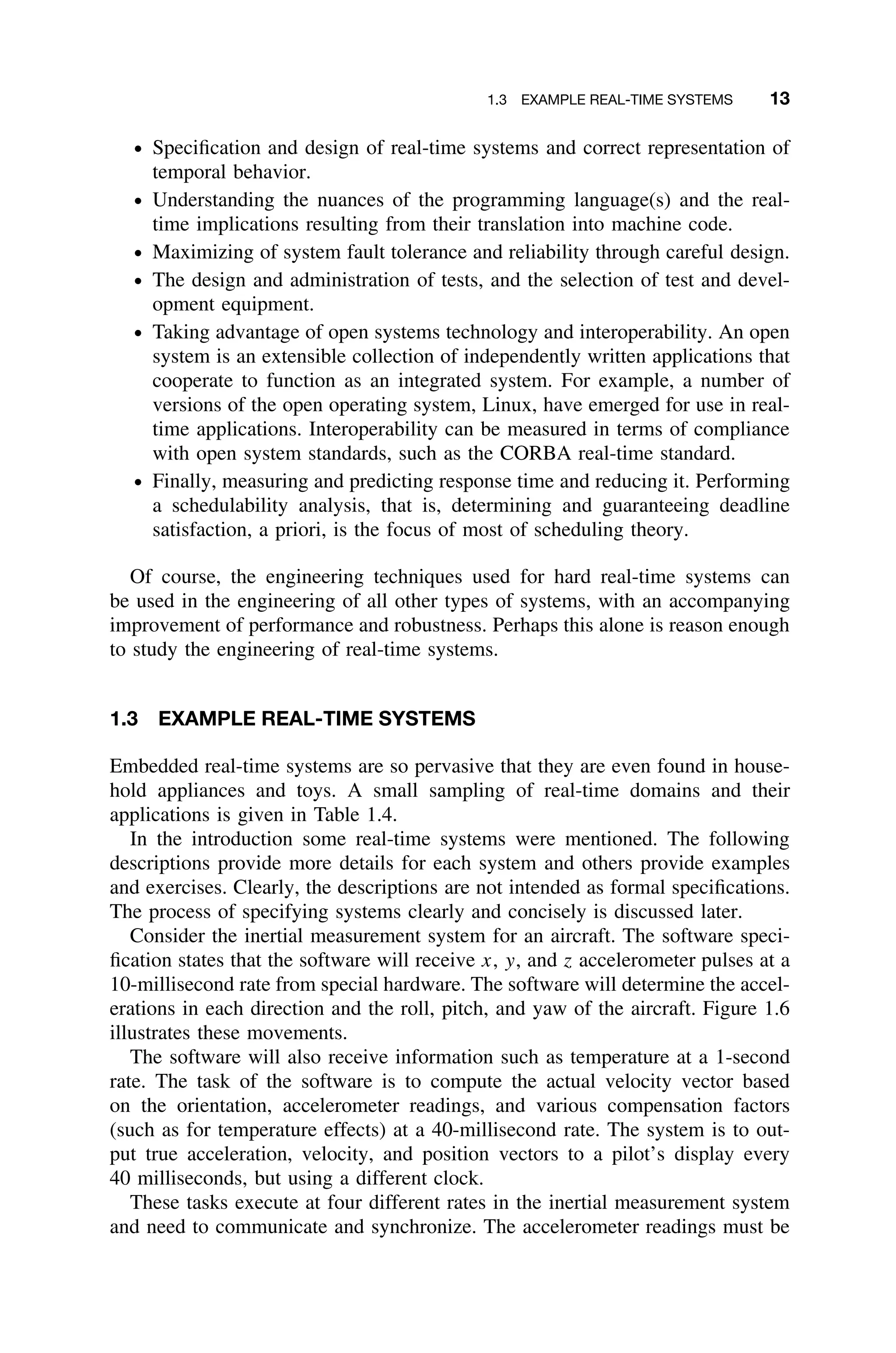
1.2 REAL-TIME SYSTEM DESIGN ISSUES
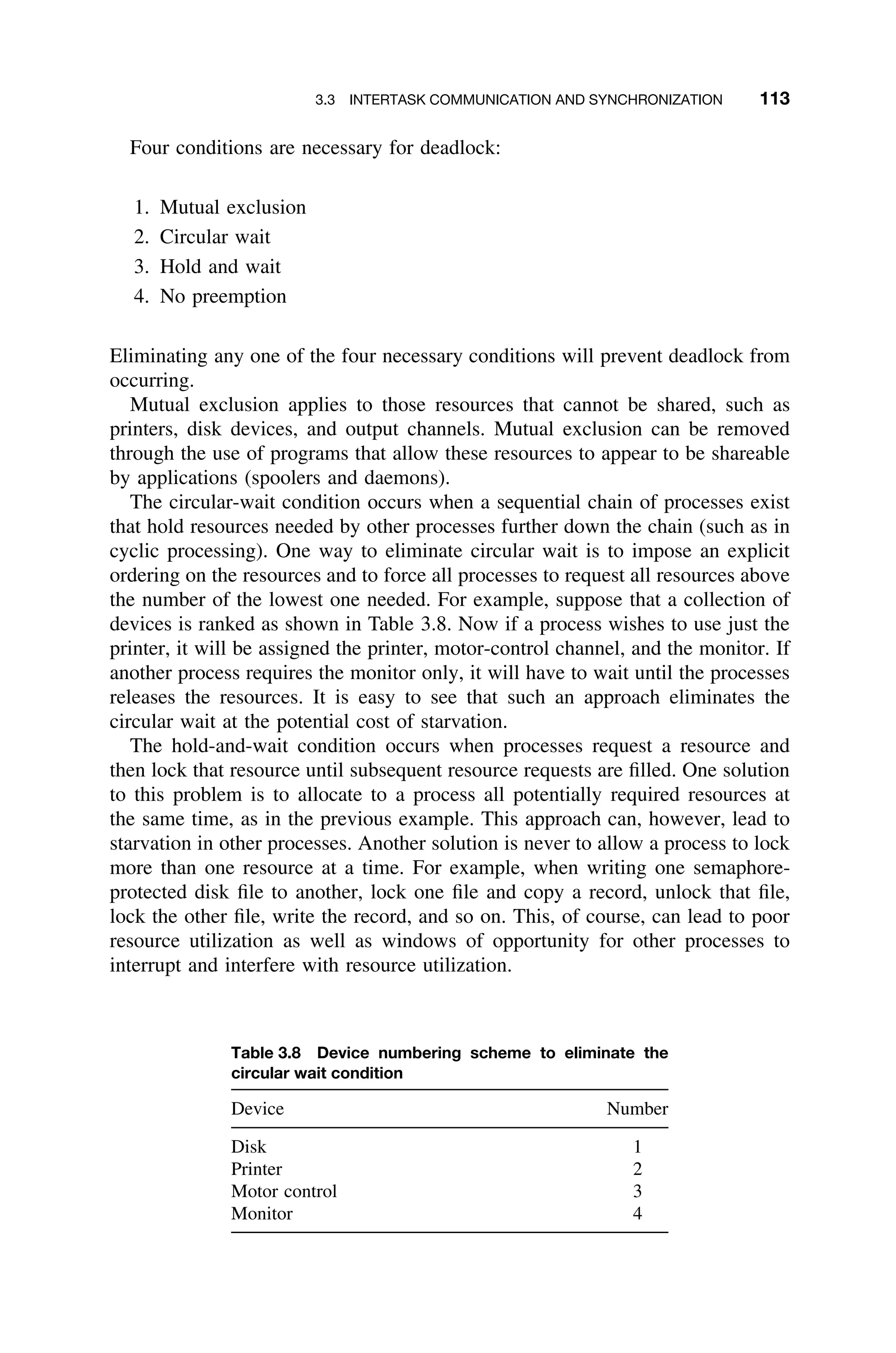
Real-time systems are a complex subdiscipline of computer systems engineering
that is strongly influenced by control theory, software engineering, and operations
research (via scheduling theory). Figure 1.5 depicts just some of the disciplines
of computer science and electrical engineering that affect the design and analysis
of real-time systems. Thus, because real-time systems engineering is so multi-
disciplinary, it stands out as a highly specialized area.
The design and implementation of real-time systems requires attention to
numerous problems. These include:
ž The selection of hardware and software, and evaluation of the trade-off
needed for a cost-effective solution, including dealing with distributed com-
puting systems and the issues of parallelism and synchronization.
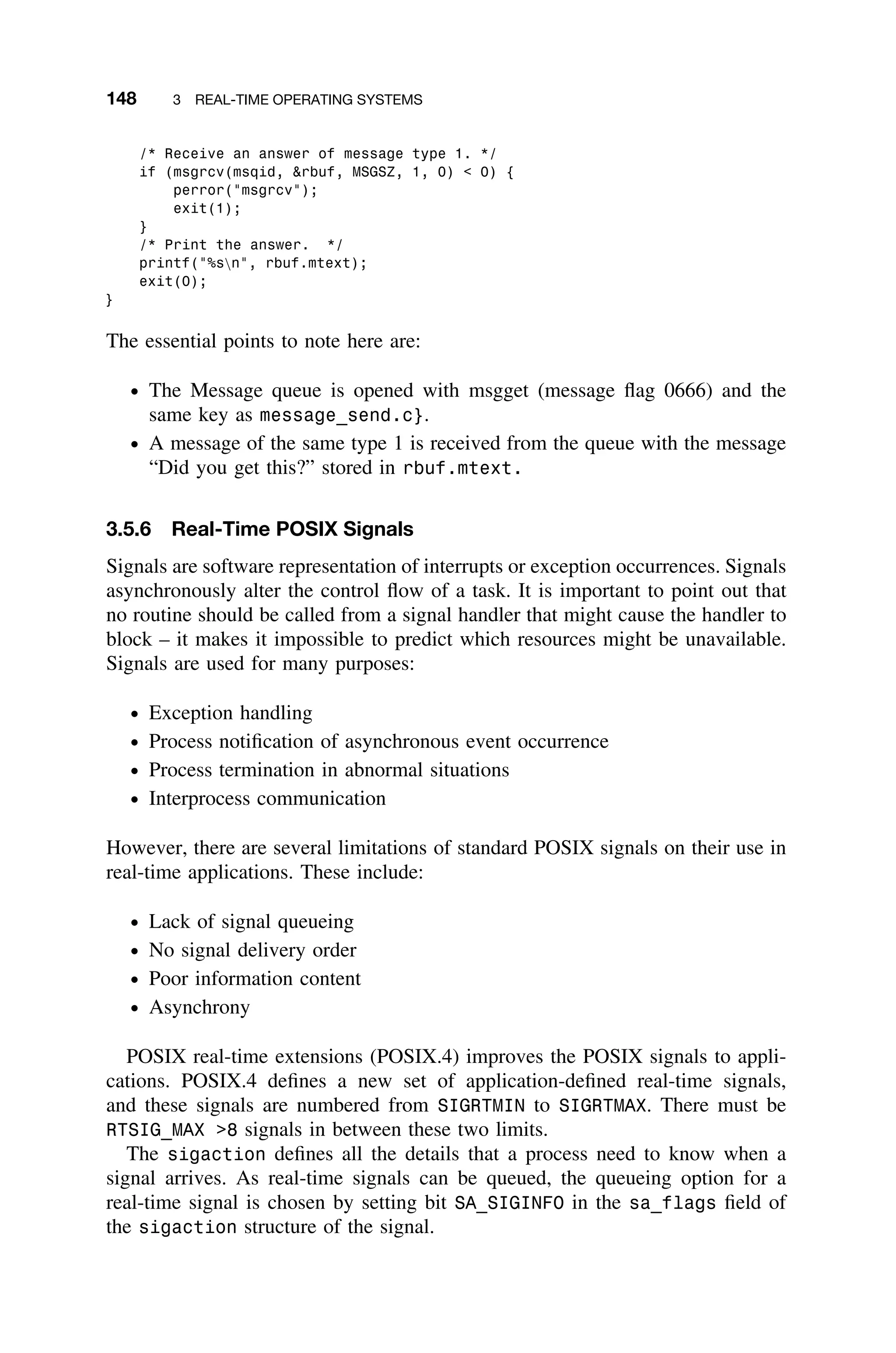
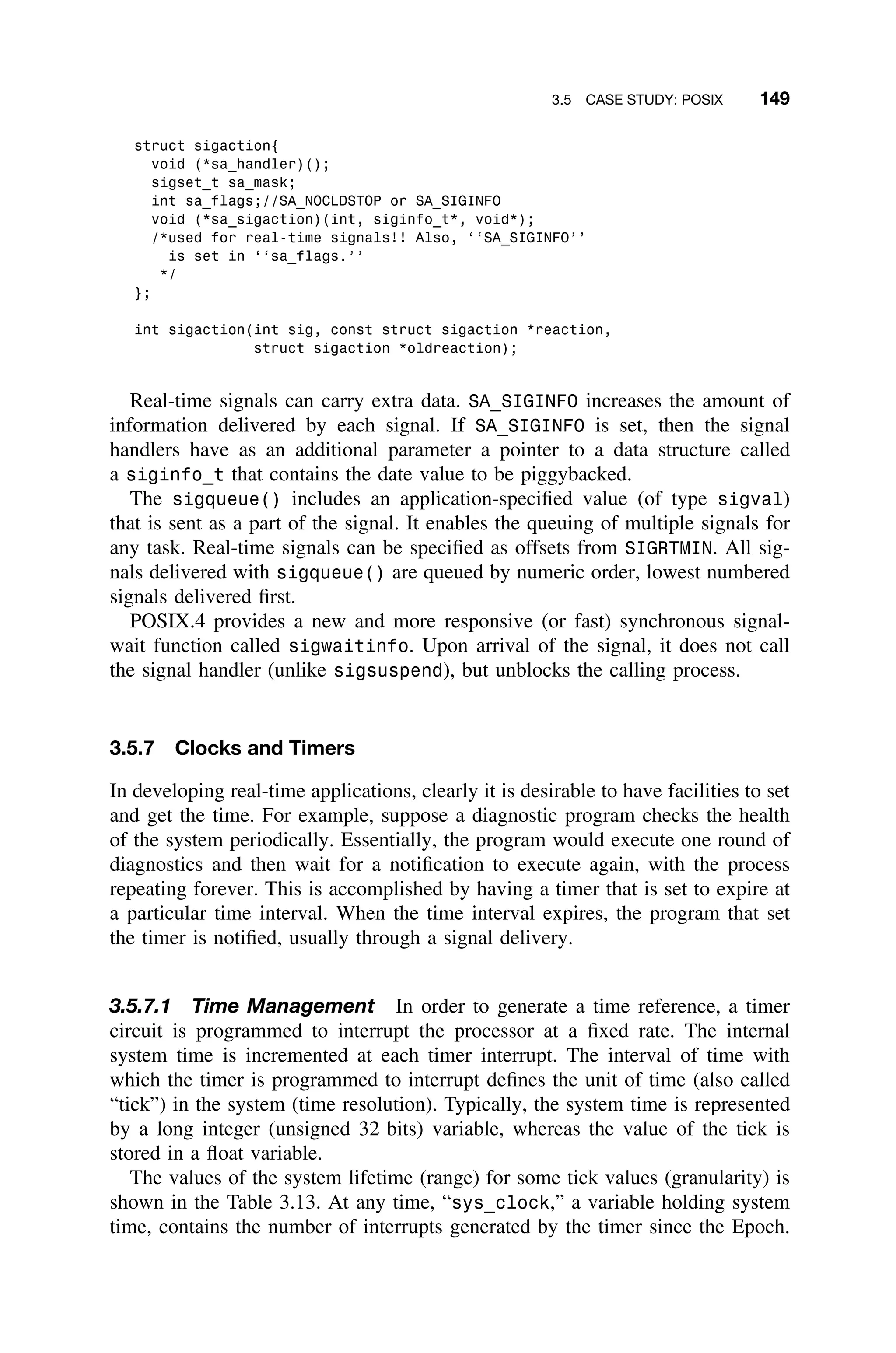
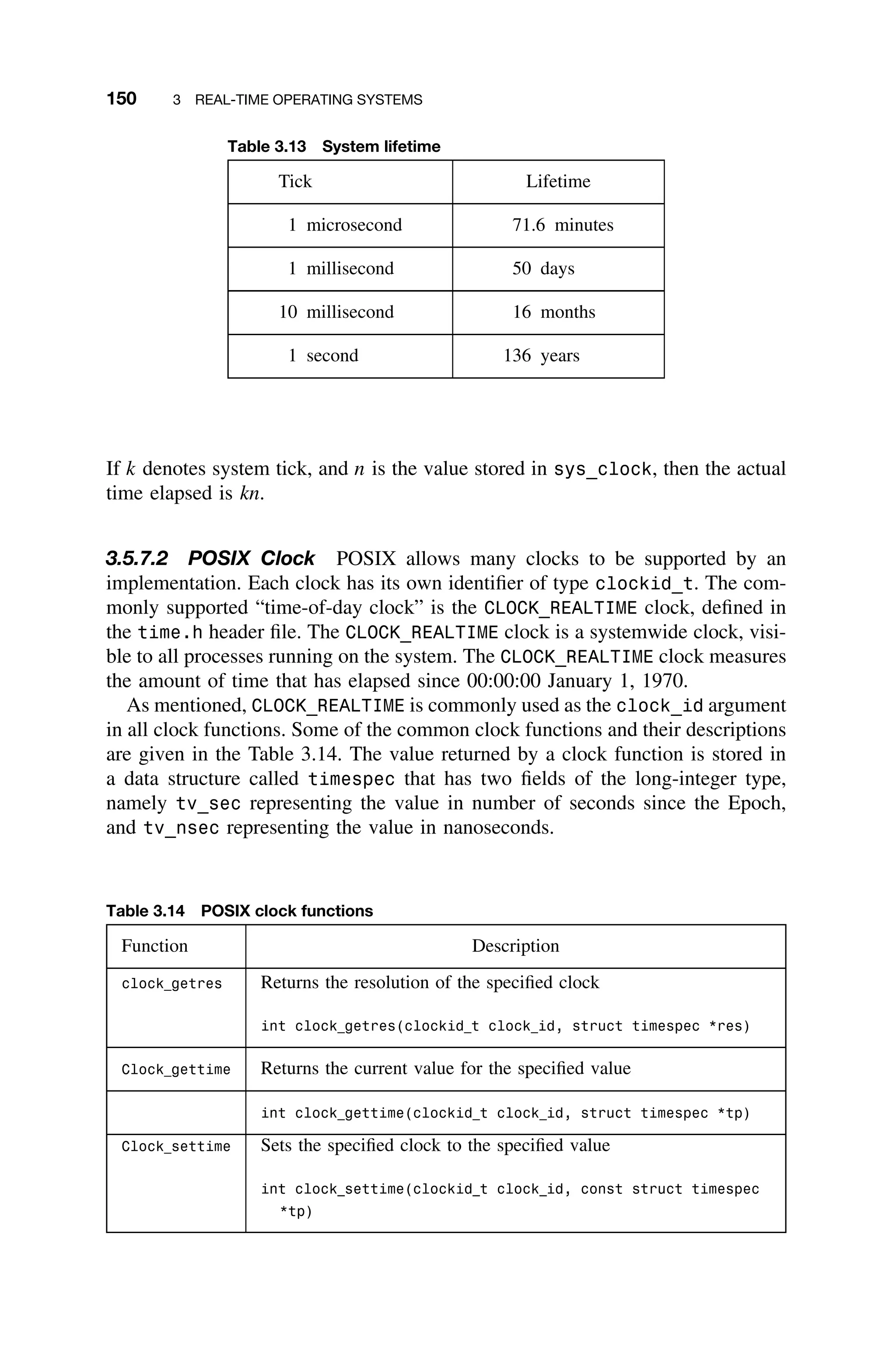
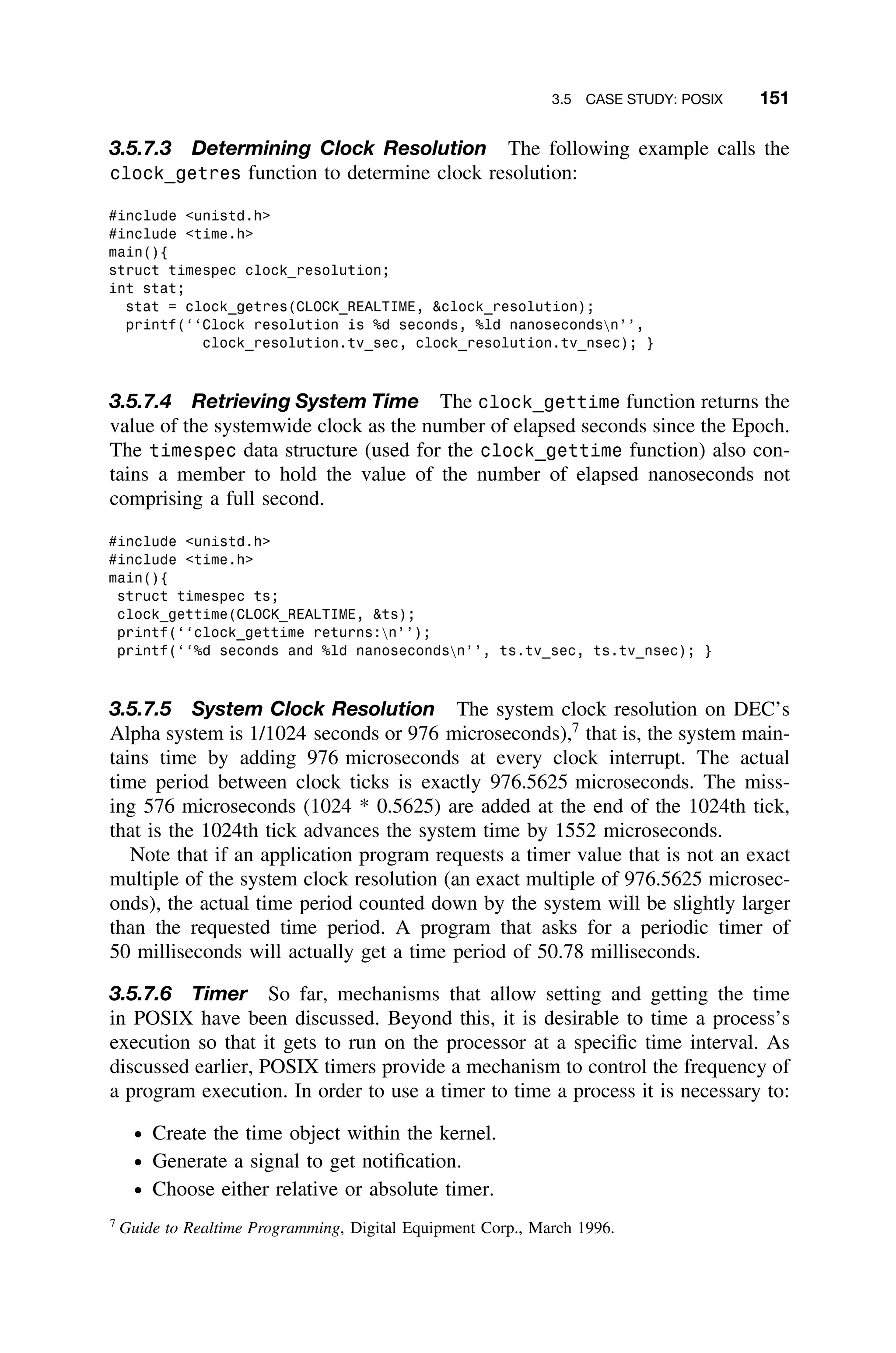
Real-time
Systems
Data Structures
Control
Theory
Programming
Languages
Operations
Research
(Scheduling
Theory)
Computer
Architecture
Software
Engineering
Operating
Systems
Queuing
Theory
Algorithms
Figure 1.5 Disciplines that impact on real-time systems engineering.
1.3 EXAMPLE REAL-TIME SYSTEMS 13
ž Specification and design of real-time systems and correct representation of
temporal behavior.
ž Understanding the nuances of the programming language(s) and the real-
time implications resulting from their translation into machine code.
ž Maximizing of system fault tolerance and reliability through careful design.
ž The design and administration of tests, and the selection of test and devel-
opment equipment.
ž Taking advantage of open systems technology and interoperability. An open
system is an extensible collection of independently written applications that
cooperate to function as an integrated system. For example, a number of
versions of the open operating system, Linux, have emerged for use in real-
time applications. Interoperability can be measured in terms of compliance
with open system standards, such as the CORBA real-time standard.
ž Finally, measuring and predicting response time and reducing it. Performing
a schedulability analysis, that is, determining and guaranteeing deadline
satisfaction, a priori, is the focus of most of scheduling theory.
Of course, the engineering techniques used for hard real-time systems can
be used in the engineering of all other types of systems, with an accompanying
improvement of performance and robustness. Perhaps this alone is reason enough
to study the engineering of real-time systems.
1.3 EXAMPLE REAL-TIME SYSTEMS
Embedded real-time systems are so pervasive that they are even found in house-
hold appliances and toys. A small sampling of real-time domains and their
applications is given in Table 1.4.
In the introduction some real-time systems were mentioned. The following
descriptions provide more details for each system and others provide examples
and exercises. Clearly, the descriptions are not intended as formal specifications.
The process of specifying systems clearly and concisely is discussed later.
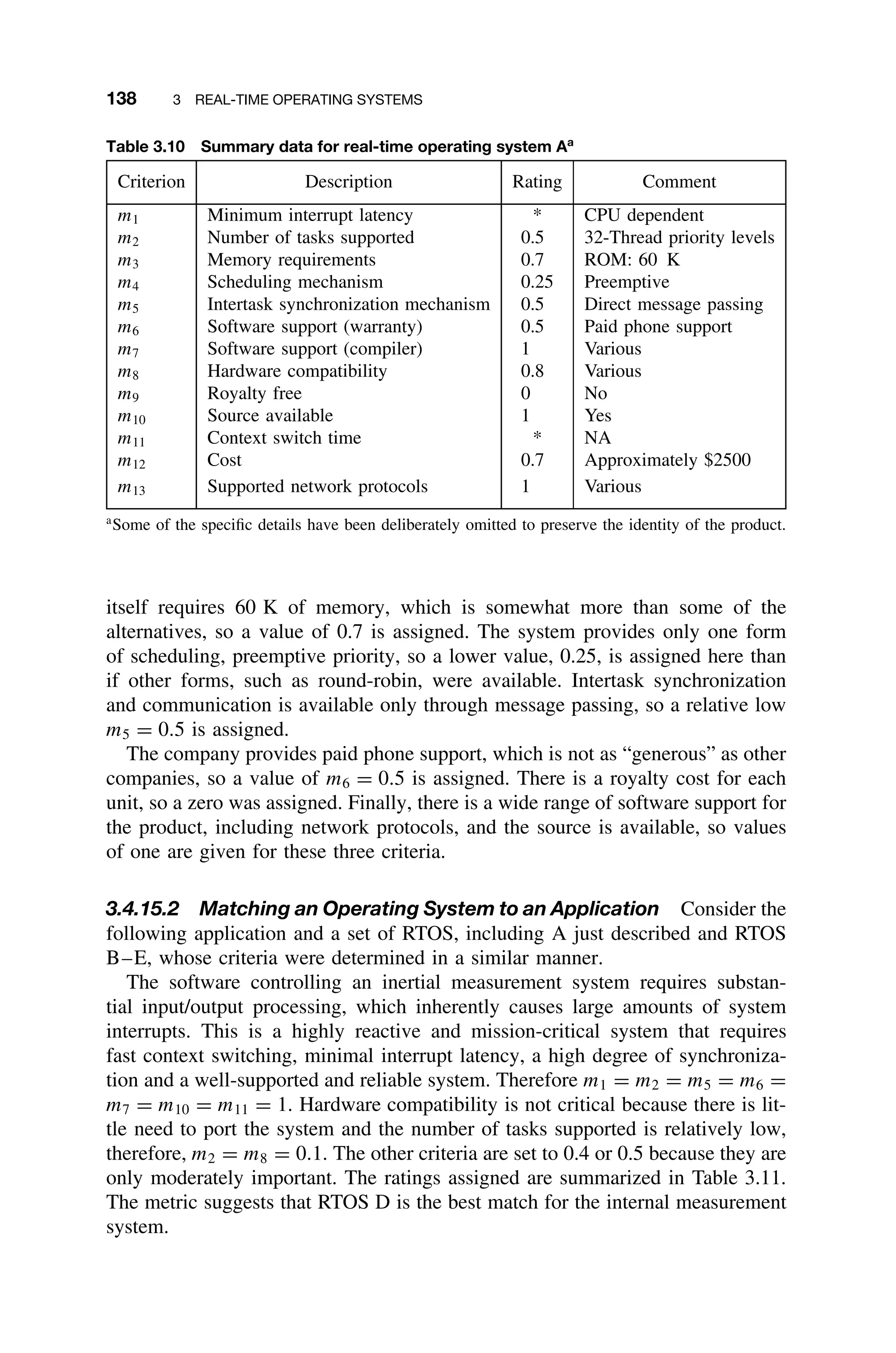
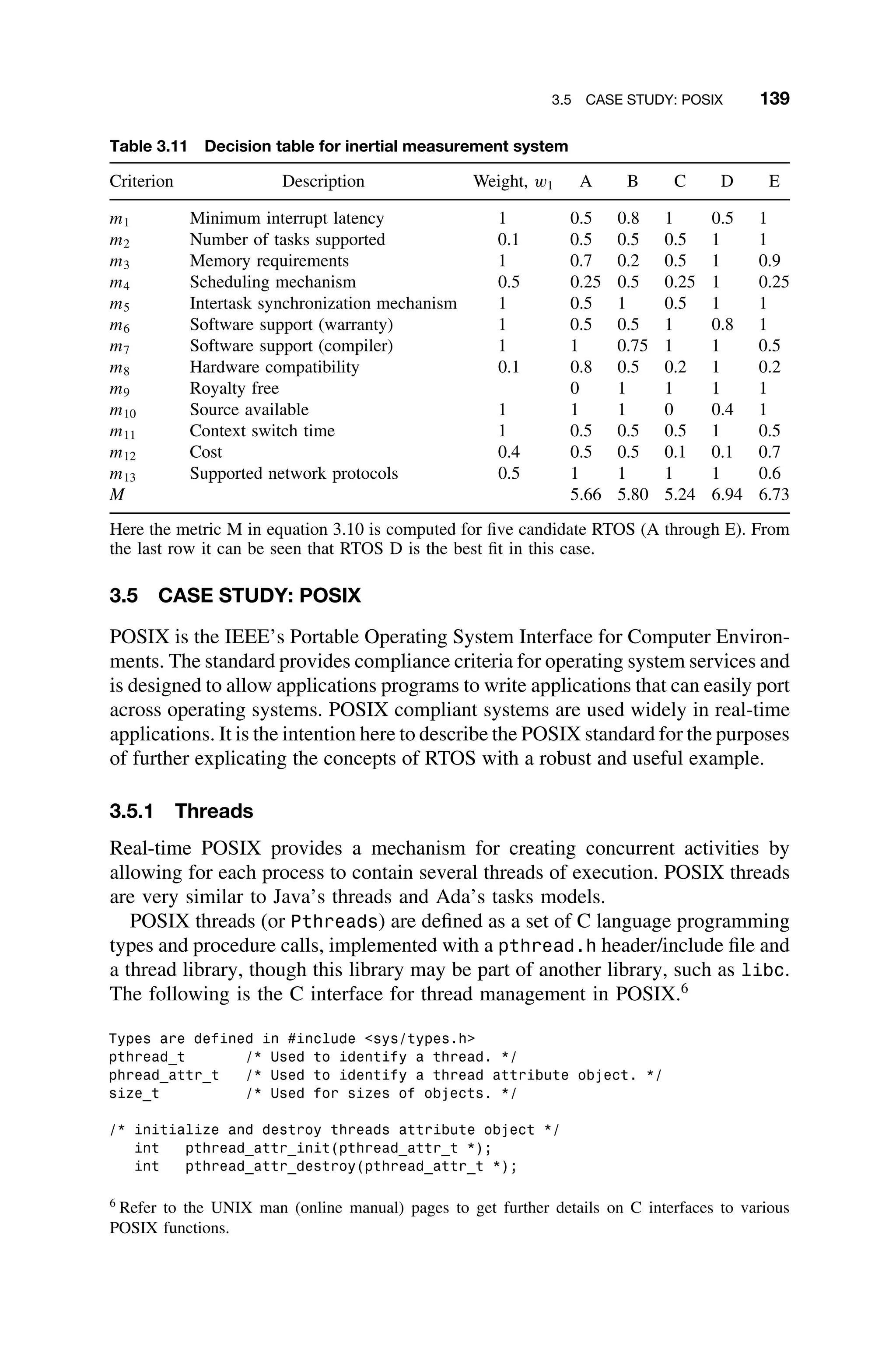
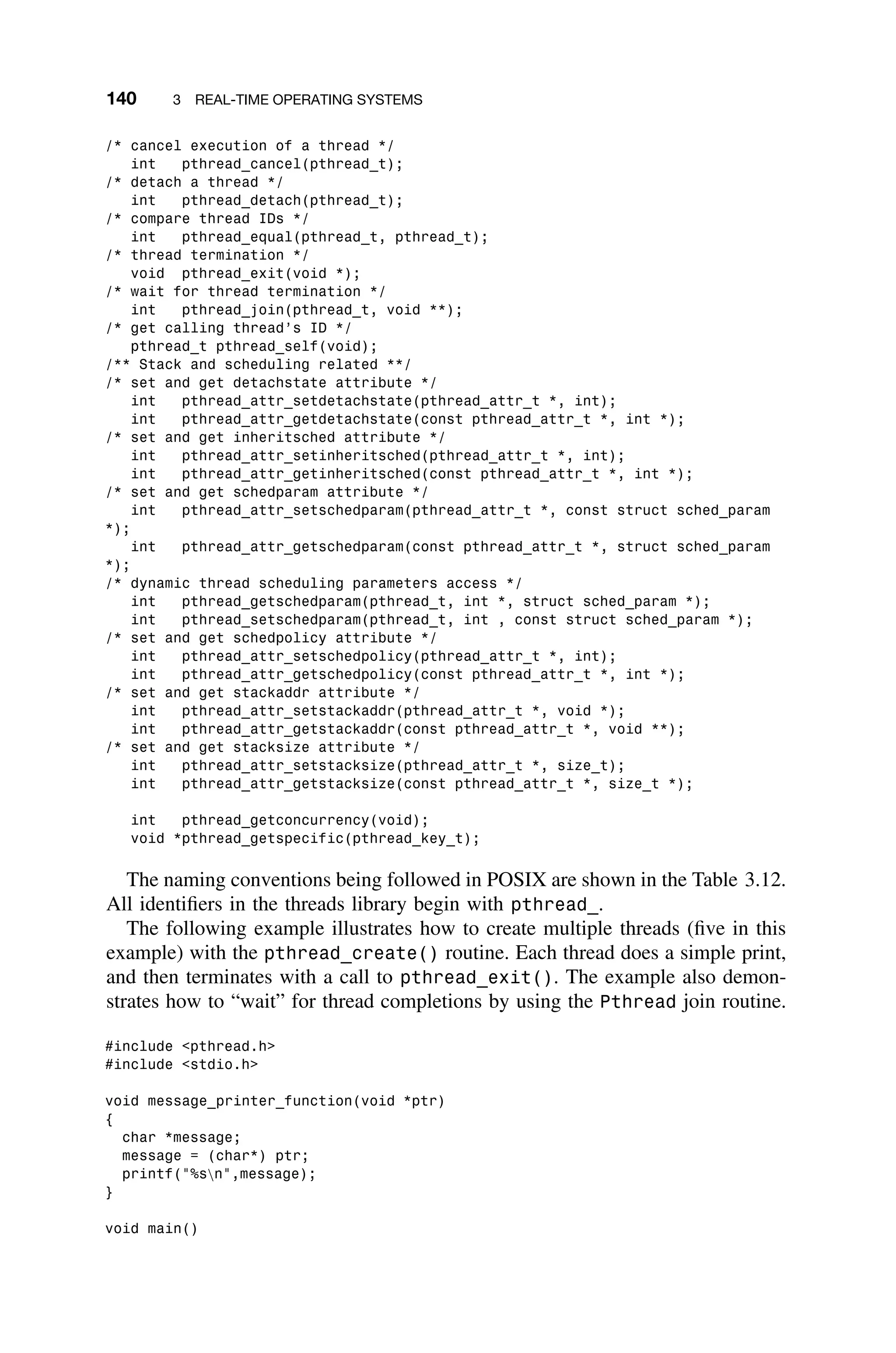
Consider the inertial measurement system for an aircraft. The software speci-
fication states that the software will receive x, y, and z accelerometer pulses at a
10-millisecond rate from special hardware. The software will determine the accel-
erations in each direction and the roll, pitch, and yaw of the aircraft. Figure 1.6
illustrates these movements.
The software will also receive information such as temperature at a 1-second
rate. The task of the software is to compute the actual velocity vector based
on the orientation, accelerometer readings, and various compensation factors
(such as for temperature effects) at a 40-millisecond rate. The system is to out-
put true acceleration, velocity, and position vectors to a pilot’s display every
40 milliseconds, but using a different clock.
These tasks execute at four different rates in the inertial measurement system
and need to communicate and synchronize. The accelerometer readings must be
14 1 BASIC REAL-TIME CONCEPTS
Table 1.4 Some typical real-time domains and
applications
Domain Applications
Avionics Navigation
Displays
Multimedia Games
Simulators
Medicine Robot surgery
Remote surgery
Medical imaging
Industrial Systems Robotic assembly lines
Automated inspection
Civilian Elevator control
Automotive systems
Pitch
Roll
Yaw
Figure 1.6 Movements of an aircraft: roll, pitch, and yaw movements.
time-relative or correlated; that is, it is undesirable to mix an x accelerometer
pulse from t with z and y pulses from time t + 1. These are critical design issues
for this system.
Next, consider a monitoring system for a nuclear plant that will be handling
three events signaled by interrupts. The first event is triggered by any of several
signals at various security points, which will indicate a security breach. The sys-
tem must respond to this signal within 1 second. The second (and most important)
event indicates that the nuclear core has reached an overtemperature. This signal
1.4 COMMON MISCONCEPTIONS 15
must be dealt with within 1 millisecond. Finally, an operator’s display is to be
updated at approximately 30 times per second. The nuclear plant system requires
a mechanism to ensure that the “meltdown imminent” indicator can interrupt any
other processing. How is this accomplished?
As another example, recall the airline reservation system mentioned earlier.
Management has decided that to prevent long lines and customer dissatisfac-
tion, turnaround time for any transaction must be less than 15 seconds, and no
overbooking will be permitted (how lovely this would be). At any time, several
agents may try to access the database and perhaps book the same flight simul-
taneously. Here record-locking and communications mechanisms are needed to
protect against the alteration of the database containing the reservation informa-
tion by more than one clerk simultaneously. How is this done?
Now consider a computer system that controls all aspects of the bottling of
jars of pasta sauce4
as they travel along a conveyor belt. The empty jars are
microwaved to disinfect them. A mechanism fills each jar with a precise serving
of sauce as it passes beneath. Another station caps the bottles. Of course, there is
an operator’s display that provides an animated rendering of the production line
activities. There are numerous events triggered by exceptional conditions such
as the conveyor belt jamming, a bottle overflowing or breaking. If the conveyor
belt travels too fast, the bottle will move past its designated station prematurely.
Therefore there is a wide range of events both synchronous and asynchronous to
be dealt with.
As a final example consider a system used to control a set of traffic lights
at a four-way traffic intersection (north-, south-, east-, and west-bound traffic).
This system controls the lights for auto and foot traffic at a four-way intersection
in a busy city like Philadelphia. Input may be taken from sensors under the
ground, push buttons, cameras, and so on. The traffic lights need to operate in a
synchronized fashion, and yet react to asynchronous events (such as a pedestrian
pressing a button at a crosswalk). Failure to operate in a proper fashion can result
in auto accidents and even fatalities.
The challenge presented by each of these systems is to determine the appro-
priate design approach with respect to the issues discussed in Section 1.2.
1.4 COMMON MISCONCEPTIONS
As a part of truly understanding the nature of real-time systems, it is important
to address a number of frequently cited misconceptions. These are summarized
as follows:
1. Real-time systems are synonymous with “fast” systems.
2. Rate-monotonic analysis has solved “the real-time problem.”
4
The author’s mother, who is Italian, calls sautéed tomatoes “sauce,” while his wife, who is also
Italian, calls it “gravy.” Definitions can vary.
16 1 BASIC REAL-TIME CONCEPTS
3. There are universal, widely accepted methodologies for real-time systems
specification and design.
4. There is never a need to build a real-time operating system, because many
commercial products exist.
5. The study of real-time systems is mostly about scheduling theory.
The first misconception, that real-time systems must be fast, arises from the
fact that many hard real-time systems indeed deal with deadlines in the tens of
milliseconds, such as the aircraft navigation system. But the pasta sauce jars can
move along the conveyor belt past a given point at a rate of one every 2 seconds.
The airline reservation system has a deadline of 15 seconds. These deadlines are
not particularly fast, but satisfying them determines the success or failure of
the system.
The second misconception is that rate-monotonic systems provide a simple
recipe for building real-time systems. Rate-monotonic systems – a periodic sys-
tem in which interrupt priorities are assigned such that the faster the frequency
of execution, the higher the interrupt priority – have received a lot of attention
since the 1970s. While they provide much guidance in the design of real-time
systems, and while there is abundant theory surrounding them, they are not a
panacea. Rate-monotonic systems will be discussed in great detail.
What about the third misconception? Unfortunately, there are no universally
accepted and foolproof methods for the design and specification of real-time
systems. This is not a failure of researchers or the software industry, but is
because of the difficulty of discovering universal solutions. Even after more
than 30 years of research there is no methodology available that answers all
of the challenges of real-time specification and design all the time and for all
applications.
The fourth misconception is that there is never a need to build a real-time
operating system from scratch. While there are a number of viable, popular,
and cost-effective commercial real-time operating systems, these, too, are not
a panacea. Commercial solutions have their place, but choosing when to use
an off-the-shelf solution and choosing the right one are challenges that will be
discussed later.
Last, while it may be challenging and scholarly to study scheduling theory,
from an engineering standpoint, most published results require impractical sim-
plifications and clairvoyance in order to make the theory work. Because this is
an engineering text, it avoids any theoretical results that resort to these measures.
1.5 BRIEF HISTORY
The history of real-time systems, as characterized by developments in the United
States, is loosely tied to the evolution of the computer. Modern real-time sys-
tems, such as those that control nuclear power stations, military aircraft weapons
1.5 BRIEF HISTORY 17
systems, or medical monitoring equipment, are complex, yet many still exhibit
characteristics of systems developed in the 1940s through the 1960s.
1.5.1 Theoretical Advances
Much of the theory of real-time systems is derived from the many underlying
disciplines shown in Figure 1.5. In particular, aspects of operations research,
which emerged in the late 1940s, and queuing systems, which emerged in the
early 1950s, have influenced most of the more theoretical results.
Martin published one of the earliest and certainly the most influential early
book on real-time systems [Martin67]. Martin’s book was soon followed by sev-
eral others (e.g., [Stimler695
]), and the influence of operations research (schedul-
ing) and queuing systems can be seen in these works. It is also interesting to
study these texts in the context of the limitations of the hardware of the time.
In 1973 Liu and Layland published their work on rate-monotonic theory
[Liu73]. Over the last 30 years significant refinement of this theory has made
it a more practical theory for use in designing real systems.
The 1980s and 1990s saw a proliferation of theoretical work on improv-
ing predictability and reliability of real-time systems and on solving problems
related to multiprocessing systems. Today, a rather limited group of experts con-
tinue to study issues of scheduling and performance analysis, even as a wider
group of generalist systems engineers tackle broader issues relating to the imple-
mentation of real, practical systems. An important paper by Stankovic et al.
[Stankovic95] described some of the difficulties in conducting research on real-
time systems – even with significant restriction of the system, most problems
relating to scheduling are too difficult to solve by analytic techniques.6
1.5.2 Early Systems
The origin of the term real-time computing is unclear. It was probably first
used either with project Whirlwind, a flight simulator developed by IBM for
the U.S. Navy in 1947, or with SAGE, the Semiautomatic Ground Environment
air defense system developed for the U.S. Air Force in the early 1950s. Both
projects qualify as real-time systems by today’s standards. In addition to its real-
time contributions, the Whirlwind project included the first use of ferrite core
memory and a form of high-order language compiler that predated Fortran.
Other early real-time systems were used for airline reservations, such as SABRE
(developed for American Airlines in 1959), as well as for process control, but the
advent of the national space program provided even greater opportunities for the
5
By coincidence, the author met Saul Stimler in 1995. He was still vibrant and actively thinking
about real-time systems.
6
At a 1992 NATO Advanced Study Institute that the author attended, Professor C. L. Liu (co-
discoverer of the rate-monotonic theory) stood up at a keynote talk and began by stating, “There are
no useful results in optimal scheduling for real-time systems.” The crowd was stunned (except the
author). There is no reason to believe that this situation has changed since then.
18 1 BASIC REAL-TIME CONCEPTS
development of real-time systems for spacecraft control and telemetry. It was not
until the 1960s that rapid development of such systems took place, and then only
as significant nonmilitary interest in real-time problem solutions become coupled
with the availability of equipment well adapted to real-time processing.
1.5.3 Hardware Developments
Weak processors and exceptionally slow and sparse memories handicapped many
of the earliest systems. Whirlwind introduced the ferrite core memory, a vast
improvement over its predecessor, the vacuum tube.
In the early 1950s the asynchronous interrupt was introduced and incorporated
as a standard feature in the Univac Scientific 1103A. The middle 1950s saw a
distinct increase in the speed and complexity of large-scale digital computers
designed for scientific computation, without an increase in size. These develop-
ments made it possible to apply “real-time” computation in the field of control
systems. Such improvements were particularly noticeable in IBM’s development
of SAGE.
In the 1960s and 1970s, advances in integration levels and processing speeds
enhanced the spectrum of real-time problems that could be solved. In 1965 alone
it was estimated that more than 350 real-time process control systems existed.
The 1980s and 1990s have seen multiprocessing systems and other non–von
Neumann architectures utilized in real-time applications.
Finally, the late 1990s and early 2000s have seen new trends in real-time
embedded systems in consumer goods and Web-enabled devices. The availability
of small processors with limited memory and functionality has rejuvenated some
of the challenges faced by early real-time systems designers. Fortunately, 50 years
of experience is available to draw upon.
1.5.4 Early Software
Early real-time systems were written directly in microcode, assembly language,
and later in higher-level languages. As previously noted, Whirlwind used an early
form of high-order language called an algebraic compiler to simplify coding.
Later systems employed Fortran, CMS-2, and JOVIAL, the preferred languages
in the U.S. Army, Navy, and Air Force, respectively.
In the 1970s, the Department of Defense mandated the development of a
single language that all services could use, and that provided high-level language
constructs for real-time programming. After a selection and refinement process,
the Ada language appeared as a standard in 1983. Shortfalls in the language
were identified and a new, improved version of the language, Ada 95, appeared
in 1995.
Today, however, only a small number of systems are developed in Ada 95.
Most systems are written in C and C++, even assembly language and Fortran. In
the last 5 years, there has been an increase in the use of object-oriented method-
ologies and languages like Java in embedded real-time systems. Of course, other
1.5 BRIEF HISTORY 19
languages are used in various settings. The real-time aspects of programming
languages are discussed later in the text.
1.5.5 Commercial Operating System Support
The first commercial operating systems were designed for mainframe computers.
IBM developed the first real-time executive, its Basic Executive in 1962, which
provided diverse real-time scheduling. By 1963, its Basic Executive II had disk
resident user/systems programs.
By the mid 1970s more affordable minicomputer systems could be found in
many engineering environments. In response, a number of important real-time
operating systems were developed by the minicomputer manufacturers. Notable
among these were the Digital Equipment Corporation (DEC) family of real-time
multitasking executives (RSX) for the PDP-11 and Hewlett-Packard’s Real-Time
Executive (RTE) series of operating systems for its HP 2000 series.
By the late 1970s and early 1980s, the first operating systems for micro-
processor-based systems appeared. These included RMX-80, MROS 68K, VRTX,
and several others. Over the last 20 years many real-time operating systems have
appeared and many have disappeared.
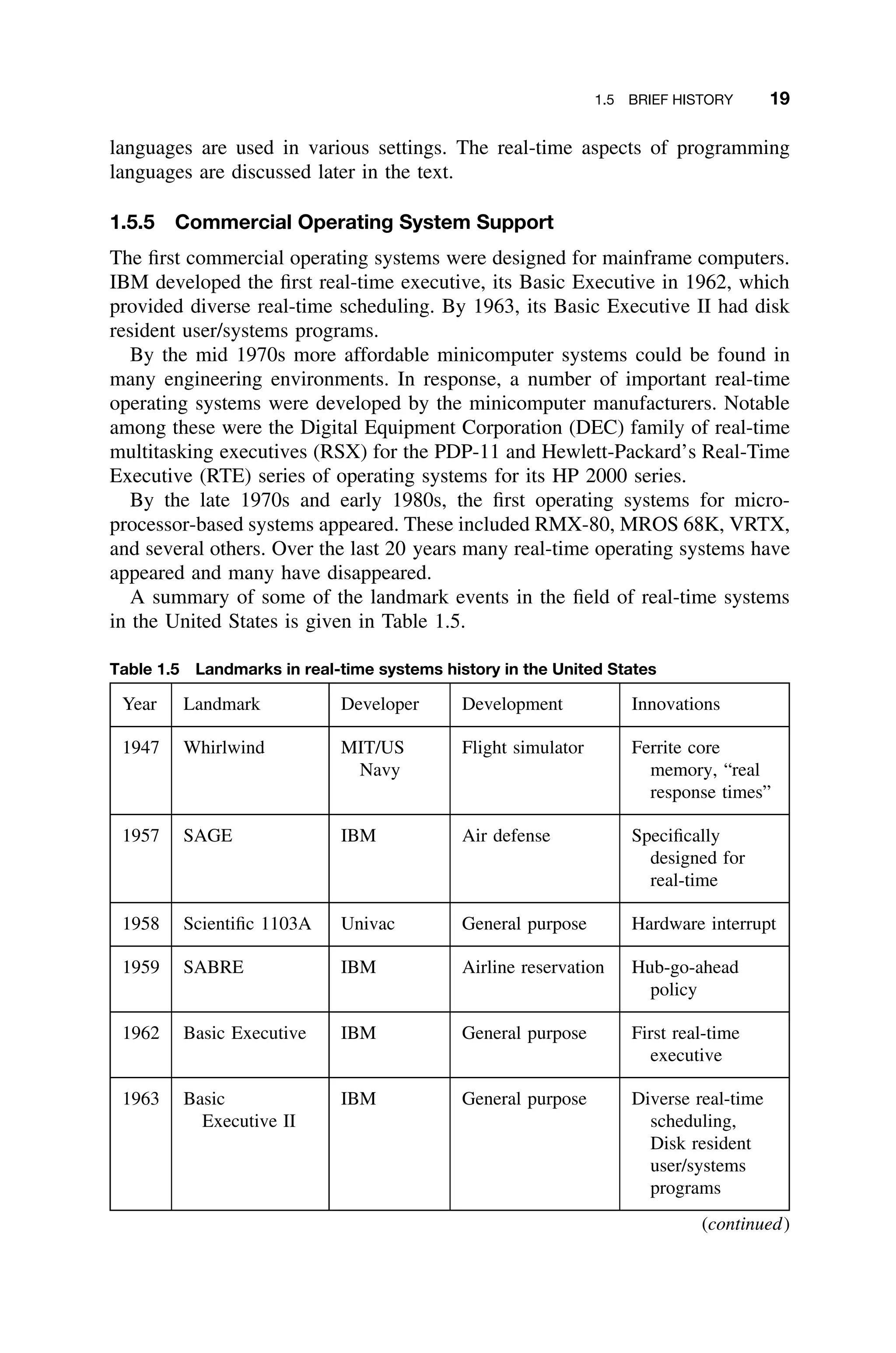
A summary of some of the landmark events in the field of real-time systems
in the United States is given in Table 1.5.
Table 1.5 Landmarks in real-time systems history in the United States
Year Landmark Developer Development Innovations
1947 Whirlwind MIT/US
Navy
Flight simulator Ferrite core
memory, “real
response times”
1957 SAGE IBM Air defense Specifically
designed for
real-time
1958 Scientific 1103A Univac General purpose Hardware interrupt
1959 SABRE IBM Airline reservation Hub-go-ahead
policy
1962 Basic Executive IBM General purpose First real-time
executive
1963 Basic
Executive II
IBM General purpose Diverse real-time
scheduling,
Disk resident
user/systems
programs
(continued)
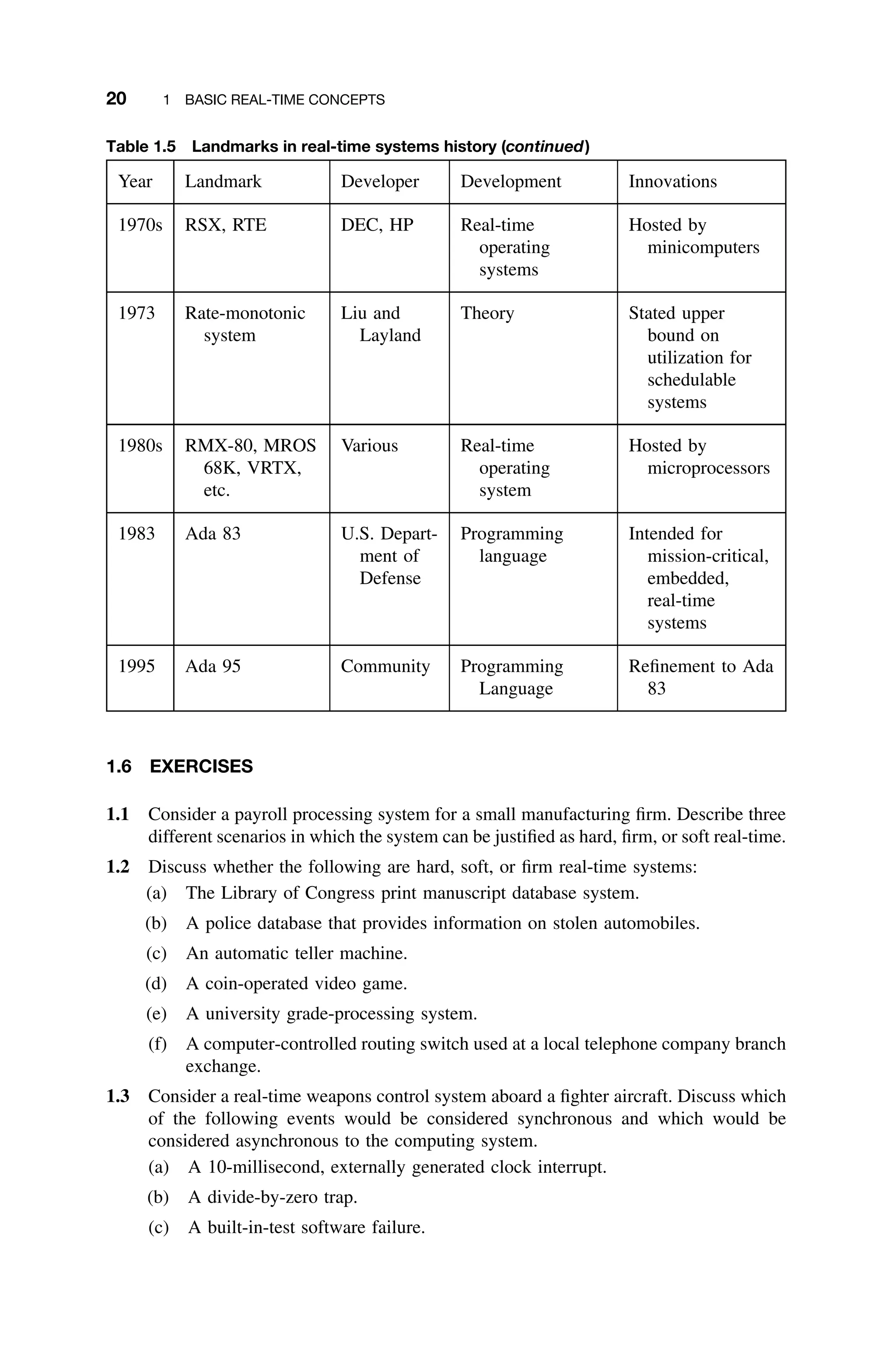
20 1 BASIC REAL-TIME CONCEPTS
Table 1.5 Landmarks in real-time systems history (continued)
Year Landmark Developer Development Innovations
1970s RSX, RTE DEC, HP Real-time
operating
systems
Hosted by
minicomputers
1973 Rate-monotonic
system
Liu and
Layland
Theory Stated upper
bound on
utilization for
schedulable
systems
1980s RMX-80, MROS
68K, VRTX,
etc.
Various Real-time
operating
system
Hosted by
microprocessors
1983 Ada 83 U.S. Depart-
ment of
Defense
Programming
language
Intended for
mission-critical,
embedded,
real-time
systems
1995 Ada 95 Community Programming
Language
Refinement to Ada
83
1.6 EXERCISES
1.1 Consider a payroll processing system for a small manufacturing firm. Describe three
different scenarios in which the system can be justified as hard, firm, or soft real-time.
1.2 Discuss whether the following are hard, soft, or firm real-time systems:
(a) The Library of Congress print manuscript database system.
(b) A police database that provides information on stolen automobiles.
(c) An automatic teller machine.
(d) A coin-operated video game.
(e) A university grade-processing system.
(f) A computer-controlled routing switch used at a local telephone company branch
exchange.
1.3 Consider a real-time weapons control system aboard a fighter aircraft. Discuss which
of the following events would be considered synchronous and which would be
considered asynchronous to the computing system.
(a) A 10-millisecond, externally generated clock interrupt.
(b) A divide-by-zero trap.
(c) A built-in-test software failure.
1.6 EXERCISES 21
(d) A discrete signal generated by the pilot pushing a button to fire a rocket.
(e) A discrete signal indicating “low on fuel.”
1.4 Describe a system that is completely non-real-time, that is, there are no bounds
whatsoever for any response time.
1.5 For the following systems concepts, fill in the cells of Table 1.2 with descriptors for
possible events. Estimate event periods for the periodic events.
(a) Elevator control: this system controls all aspects of a bank of elevators that
service a 50-story building in a busy city like Philadelphia.
(b) Automotive control: this on-board crash avoidance system uses data from a
variety of sensors and makes decisions and affects behavior to avoid collision,
or protect the occupants in the event of an imminent collision. The system
might need to take control of the automobile from the driver.
1.6 For the systems in Exercise 1.2, what are reasonable response times for all the
events?
1.7 For the example systems introduced (inertial measurement, nuclear plant monitoring,
airline reservation, pasta bottling, and traffic-light control) enumerate some possible
events and note whether they are periodic, episodic, or sporadic. Discuss reasonable
response times for the events.
2
HARDWARE
CONSIDERATIONS
Understanding the underlying hardware of the real-time system allows for efficient
hardware and software resource utilization. Although it is desirable for the pro-
gramming language to abstract away hardware details from the designers, this
is usually impossible to achieve – if not at the design state, certainly at the
hardware/software integration stages. Therefore, an understanding of computer
architecture is essential to the real-time systems engineer. While it is not the
intent here to provide a complete review of computer architecture, a brief sur-
vey of the most important issues is appropriate. For a more thorough treatment,
see, for example, [Gilreath03]. Some of the following discussion is adapted from
that resource.
2.1 BASIC ARCHITECTURE
In its simplest form, a computer system consists of a CPU and memory inter-
connected by a bus (Figure 2.1).
There are three systemwide buses: power, address, and data. The power bus
refers to the distribution of power to the various components of the computer sys-
tem; the address bus is the medium for exchanging individual memory addresses,
and therein the data bus is used to move data between the various components
in the system. When referring to the system bus, the address and data buses
collectively are generally what are meant.
For the most part, this book deals with single-processor (uniprocessing) sys-
tems. Some real-time systems are multiprocessing in the sense that there are
Real-Time Systems Design and Analysis, By Phillip A. Laplante
ISBN 0-471-22855-9  2004 Institute of Electrical and Electronics Engineers
23
24 2 HARDWARE CONSIDERATIONS
CPU Memory
Data and
Address
Buses
I/O Displays, Actuators, Sensors, etc.
Figure 2.1 A ‘‘10,000’’ foot view of a von Neumann architecture.
many processors distributed in the system, and that these are loosely coupled
through messaging. Other real-time systems use multiprocessing in a way that
allows the processing system to schedule tasks across the different processors.
These types of systems are far more complex, and the theory and tools available
are generally impractical. Therefore, this text will concentrate on uniprocessing
real-time systems. Even here the challenges are significant.
2.2 HARDWARE INTERFACING
The following sections contain discussions that are slanted toward the software
or systems engineer rather than the electrical engineer. That is, the intent is not
to be able to design these hardware structures, but rather to understand their
behavior in the context of embedded real-time systems.
2.2.1 Latching
In signaling between devices is it is important to have a mechanism for “record-
ing” the appearance of that signal for later processing. This process is called
latching. In essence, latching involves setting a flip-flop corresponding to some
event. For example, interrupt signals are latched into the programmable interrupt
controller so that they can be serviced at an appropriate time.
Once the latch is read, it needs to be reset so that a new signal can be received.
Thus, for example, in the case of an interrupt, if a second interrupt is signaled
on the same input but the previous interrupt has not been serviced (and the latch
reset), the second interrupt will be lost, leading to a missed deadline. Therefore,
in servicing latched inputs of any kind it is important to read and clear the latch
as soon as possible.
2.2 HARDWARE INTERFACING 25
Rising Edge
Rising Edge
Time
Voltage
Vc
Falling Edge
Figure 2.2 A fictitious time-varying signal (typically, a clock) showing two rising edges, each
of which represents a single event, and a falling edge. Vc represents a critical or threshold
voltage.
2.2.2 Edge versus Level Triggered
Logic devices can either be edge or level triggered, and the difference matters
in the sense that it can affect the way the system recognizes true events or false
ones. A transition from low to high is called a rising edge, and from high to low
it is called a falling edge (Figure 2.2).
In other cases, the signal is represented by the voltage exceeding a certain
threshold. When the signal reaches that level, an event is triggered and latched
so that another event cannot be triggered until the latch is reset. For example,
in Figure 2.2 if such level-triggered logic is used, only a single event will be
recorded unless the latch is reset during the time period shown.
The differences between edge-based and level-based logic are important, be-
cause in the course of manipulating certain signals it is possible to create “false”
events by prematurely resetting logic, which will be shown shortly.
2.2.3 Tristate Logic
When multiple devices are connected to the same bus structure it is important that
those devices that are not currently involved in data interchange remain, essen-
tially, unconnected. To achieve this effect, those devices that are not involved are
placed into a high-impedance state at their bus interconnections, that is, they are
“tristated.” Hence a particular electrical signal can be in one of three levels, high,
low, or tristated. Tristate logic is essential in the design of computer systems.
Signals that are improperly tristated will be in an unknown state in which
the signal is “floating,” that is, arbitrarily high or low. Floating signals can be
the source of many insidious problems, such as falsely indicated interrupts and
improper setting of switches.
26 2 HARDWARE CONSIDERATIONS
2.2.4 Wait States
When a microprocessor must interface with a slower peripheral or memory
device, the normal timing of the microprocessor may need to be altered. Specif-
ically, in some cases a wait state may need to be added to the bus cycles that
access that peripheral or memory. Wait states extend the microprocessor read or
write cycle by a certain number of processor clock cycles to allow the device or
memory to “catch up.”
For example, in a certain system EEPROM, RAM, and ROM all have different
memory access times. These memory technologies will be discussed shortly.
Since RAM memory is typically faster than ROM, wait states would need to be
inserted when accessing RAM if the timing is to be made uniform across all
regions of memory. Of course, wait states degrade overall systems performance,
but do preserve determinism because it can be assumed that each memory access
takes the same amount of time.
2.2.5 Systems Interfaces and Buses
A typical microprocessor-based system will have a common group of 8, 16, 32,
or 64 or more signals for reading and writing data. These signals are collectively
referred to as the system bus. Within the CPU there is another common bus for
intraprocessor communication between components.
The system bus is used for communication between the CPU, memory, and
device. Transmit/receive hybrid devices, or transceivers, provide communication
services to other devices joined by a common bus.
When accessing devices that require serial interfacing, or if the number of
lines on the bus is less than those internal to the device, then a multiplexer (or
MUX) is needed to enable communication to the serial device over the paral-
lel bus. The MUX circuitry is responsible for ensuring that all transmitted and
received data conform to an appropriate protocol. This process includes parallel
to serial conversion for transmittal and vice versa with receipt and other circuitry
(Figure 2.3). The standard universal asynchronous relay terminal (UART) is typ-
ically used for parallel-to-serial-bus interfaces and is seen in many commercial
applications. Such a scheme is compatible with 8-, 16-, 32-bit parallel buses and
any device-internal representation.
Of course, there are numerous standardized and customized systems interfaces
and bus types. Three particularly common ones for embedded real-time systems
are introduced.
2.2.5.1 MIL-STD-1553B A widely used standard in both military and com-
mercial avionics applications is the MIL-STD-1553B bus standard that specifies
a hardware configuration and transmission and receipt protocols. The 1553B bus
protocol is a master–slave protocol. “Master–slave” indicates that one device
orchestrates all activities on the bus through directives and the other devices
simply follow those directives, that is, they cannot initiate activity on their own.
2.2 HARDWARE INTERFACING 27
Data
Bus
Bus
Buffers
Transmit
Register
Shift
Register
Receive
Register
Shift
Register
Data to
Transmit
Received
Data
Control Clock
Figure 2.3 A transmitter/receiver device used to multiplex parallel data to serial. To receive,
the parallel data are captured from the bus into a receive register and then shifted into a serial
stream of bits. To transmit, the data are loaded into a shift register, then shifted into a parallel
transmit–receive buffer for transmission.
Device
2
Device
n −1
Device
n
Device
1
Device
3
...
...
Figure 2.4 MIL-STD 1553B configuration. The inset shows the inductive coupling connection
specified. Such a connection helps the system withstand electrical failure of one of the devices.
The 1553B standard is arranged so that one module on the bus acts as a bus
controller (the master) and the others respond to its commands (the slaves). This
type of configuration is common in many commercial networks and computer
subsystems, and is illustrated in Figure 2.4.
The 1553B protocol is based on a list of activities to be performed by each
of the devices connected to the bus. The master device maintains this list. Each
message essentially consists of a device ID number, a directive and, possibly, a
set of data. All devices are listening to the bus at all times, awaiting broadcast of
a message directive with their unique bus ID (or a broadcast message intended
for all devices on the bus).
The following example is a slightly modified version of how the 1553B works.
Suppose the master wants device number 5 to send 10 packets of data to device
28 2 HARDWARE CONSIDERATIONS
number 6. The master puts a message out on the bus that essentially says, “Device
number 5 put 10 packets of data on the bus for device number 6.” Device number
5 then places the data on the bus. When device number 6 sees the data on the
bus with their ID in the header, it captures them. All other devices on the bus
can “see” the data, but only device number 6 takes the data.
Besides electrical fault-tolerance provisions, the 1553B protocol provides for
fault tolerance in that if the master device is disabled, provisions can be made
for another device in the system to take over as master.
2.2.5.2 Small Computer Systems Interface The small computer systems
interface (SCSI) or “scuzzy” is a widely used, PC-based, parallel interface that
supports many kinds of devices. There have been three generations of SCSI (1,
2, and 3) and other variants such as Narrow, Wide, Fast, Ultra, Ultra-2, and
Ultra160 SCSI.
This synopsis focuses on SCSI 3, which is made up of at least 14 separate
standards documents. These standards resolve many of the conflicts in previous
versions and add significant functionality and performance improvements. SCSI 3
also supports Fiber Channel, and FireWire
instead of the familiar ribbon cable
connection. The new interfaces are backward compatible with SCSI-2 as well
as SCSI-1 via the single-ended interface. SCSI supports devices connected in a
daisy-chained fashion (Figure 2.5).
Although the devices are daisy chained and appear to be dependent, they are
independent and each can directly communicate with the others as well as with
the host. Each device is uniquely configured by connecting one end to the host
adapter and then setting the device ID with a plug-in terminator, jumpers, or
switches. Id number 0 (zero) is set for the boot device, and the higher the ID
number, the higher the priority of the device in bus access arbitration.
2.2.5.3 IEEE 1394 Firewire The IEEE 1394 bus standard describes a very
fast external bus standard that supports data transfer rates of up to 400 megabits
per second (Mbps) (in 1394a) and 800 Mbps (in 1394b). Products supporting the
1394 standard assume different names, depending on the company. Apple, which
originally developed the technology, uses the trademarked name FireWire.
FireWire is easy to use, and a single 1394 port can be used to connect up
63 external devices. The standard defines 100-, 200-, and 400-Mbps devices and
Device 1 Device 2
Bus
Terminator
ID = 0 ID = 1
Device n
ID = n −1
Figure 2.5 Daisy-chained devices. Daisy-chain connections are used in many kinds of devices
in an embedded system (e.g., interrupt controllers), because they allow for an easy ‘‘extension’’
of the system bus by simply attaching to the device at the end.
2.3 CENTRAL PROCESSING UNIT 29
can support the multiple speeds on a single bus, and is flexible – the standard
supports freeform daisy chaining and branching for peer-to-peer implementations.
It is also hot pluggable, that is, devices can be added and removed while the bus
is active.
FireWire supports two types of data transfer: asynchronous and isochronous.
For traditional computer memory-mapped, load, and store applications, asyn-
chronous transfer is appropriate and adequate. Isochronous data transfer provides
guaranteed data transport at a predetermined rate. This is especially important for
multimedia applications where uninterrupted transport of time-critical data and
just-in-time delivery reduce the need for costly buffering. This makes it ideal for
devices that need to transfer high levels of data in real time, such as cameras,
VCRs, and televisions.
2.3 CENTRAL PROCESSING UNIT
A reasonable understanding of the internal organization of the CPU is quite
helpful in understanding the basic principles of real-time response; hence, those
concepts are briefly reviewed here.1
The CPU can be thought of as containing several components connected by
its own internal bus, which is distinct from the memory and address buses of
the system. As shown in Figure 2.6 the CPU contains a program counter (PC),
an arithmetic logic unit (ALU), internal CPU memory–scratch pad memory and
PC
SR
IR
MDR
R1
MAR
Rn
…
Stack
Pointer
Micro
Memory
Control
Unit
Interrupt
Controller
CPU
Address Bus
Data Bus
Collectively known
as the “bus” or
“system bus”
Figure 2.6 Partial, stylized, internal structure of a typical CPU. The internal paths represent
connections to the internal bus structure. The connection to the system bus is shown on
the right.
1
Some of the following discussion in this section is adapted from Computer Architecture: A Mini-
malist Perspective by Gilreath and Laplante [Gilreath03].
30 2 HARDWARE CONSIDERATIONS
micromemory, general registers (labelled ‘R1’ through ‘Rn’), an instruction reg-
ister (IR), and a control unit (CU). In addition, a memory address register (MAR)
holds the address of the memory location to be acted on, and a memory date
register (MDR) holds the data to be written to the MAR or that have been read
from the memory location held in the MAR.
There is an internal clock and other signals used for timing and data transfer,
and other hidden internal registers that are typically found inside the CPU, but
are not shown in Figure 2.6.
2.3.1 Fetch and Execute Cycle
Programs are a sequence of macroinstructions or macrocode. These are stored
in the main memory of the computer in binary form and await execution. The
macroinstructions are sequentially fetched from the main memory location pointed
to by the program counter, and placed in the instruction register.
Each instruction consists of an operation code (opcode) field and zero or more
operand fields. The opcode is typically the starting address of a lower-level pro-
gram stored in micromemory (called a microprogram), and the operand represents
registers, memory, or data to be acted upon by this program.
The control unit decodes the instruction. Decoding involves determining the
location of the program in micromemory and then internally executing this
program, using the ALU and scratch-pad memory to perform any necessary
arithmetic computations. The various control signals and other internal registers
facilitate data transfer, branching, and synchronization.
After executing the instruction, the next macroinstruction is retrieved from
main memory and executed. Certain macroinstructions or external conditions
may cause a nonconsecutive macroinstruction to be executed. This case is dis-
cussed shortly. The process of fetching and executing an instruction is called the
fetch–execute cycle. Even when “idling,” the computer is fetching and execut-
ing an instruction that causes no effective change to the state of the CPU and is
called a no-operation (no-op). Hence, the CPU is constantly active.
2.3.2 Microcontrollers
Not all real-time systems are based on a microprocessor. Some may involve a
mainframe or minicomputers, while others are based on a microcontroller. Very
large real-time systems involving mainframe or minicomputer control are unusual
today unless the system requires tremendous CPU horsepower and does not need
to be mobile (for example, an air traffic control system). But, microcontroller-
based real-time systems abound.
A microcontroller is a computer system that is programmable via microinstruc-
tions (Figure 2.7). Because the complex and time-consuming macroinstruction
decoding process does not occur, program execution tends to be very fast.
Unlike the complex instruction decoding process found in a traditional micro-
processor, the microcontroller directly executes “fine grained” instructions stored
2.3 CENTRAL PROCESSING UNIT 31
Microinstruction
Register
Micromemory
Microinstructions
Microcontrol
Unit
Decoder
External input
Signals
Clock
Figure 2.7 Stylized microcontroller block diagram.
in micromemory. These fine-grained instructions are wider than macroinstruc-
tions (in terms of number of bits) and directly control the internal gates of the
microcontroller hardware. The microcontroller can take direct input from devices
and directly control external output signals. High-level language and tool support
allows for straightforward code development.
2.3.3 Instruction Forms
An instruction set constitutes the language that describes a computer’s function-
ality. It is also a function of the computer’s organization.2
While an instruction
set reflects differing underlying processor design, all instruction sets have much
in common in terms of specifying functionality.
Instructions in a processor are akin to functions in procedural programming
language in that both take parameters and return a result. Most instructions make
reference to either memory locations, pointers to a memory location, or a regis-
ter.3
The memory locations eventually referenced contain data that are processed
to produce new data. Hence, any computer processor can be viewed as a machine
for taking data and transforming it, through instructions, into new information.
It is important to distinguish which operand is being referenced in describing
an operation. As in arithmetic, different operations use different terms for the
parameters to distinguish them. For example, addition has addend and augends,
2
Traditionally, the distinction between computer organization and computer architecture is that the
latter involves using only those hardware details that are visible to the programmer, while the former
involves implementation details.
3
An exception to this might be a HALT instruction. However, any other instruction, even those that
are unary, will affect the program counter, accumulator, or a stack location.
32 2 HARDWARE CONSIDERATIONS
subtraction has subtract and and subtrahend, multiplication has multiplicand and
multiplier, and division has dividend and divisor.
In a generic sense, the two terms “operandam” and “operandum” can be used to
deal with any unary or binary operation. The operandam is the first parameter, like
an addend, multiplicand, or dividend. The operandum is the second parameter,
like the augend, multiplier, or divisor. The following formal definitions will be
helpful, as these terms will be used throughout the text.
The defining elements of instructions hint at the varying structures for orga-
nizing information contained within the instruction. In the conventional sense,
instructions can be regarded as an n-tuple, where the n refers to the parameters
of the instruction.
In the following sections, the instruction formats will be described beginning
with the most general to the more specific. The format of an instruction provides
some idea of the processor’s architecture and design. However, note that most
processors use a mix of instruction forms, especially if there is an implicit register.
The following, self-descriptive examples illustrate this point.
2.3.3.1 1-Address and 0-Address Forms Some processors have instruc-
tions that use a single, implicit register called an accumulator as one of the
operands. Other processors have instruction sets organized around an internal
stack in which the operands are found in the two uppermost stack locations
(in the case of binary operations) or in the uppermost location (in the case
of unary operations). These 0-address (or 0-address or stack) architectures can
be found in programmable calculators that are programmed using postfix
notation.
2.3.3.2 2-Address Form A 2-address form is a simplification (or complica-
tion, depending on the point of view) of the 3-address form. The 2-address (or
2-tuple) form means that an architectural decision was made to have the resultant
and operandum as the same. The 2-address instruction is of the form:
op-code operandam, operandum
As a mathematical function, the 2-address would be expressed as:
operandum = op-code(operandam, operandum)
Hence, the resultant is implicitly given as the operandum and stores the result of
the instruction.
The 2-address form simplifies the information provided, and many high-level
language program instructions often are self-referencing, such as the C lan-
guage statement:
i=i+1;
which has the short form:
i++;
2.3 CENTRAL PROCESSING UNIT 33
This operation could be expressed with an ADD instruction in 2-address form as:
ADD 0x01, i ; 2-address
where i is the address of the i variable.4
A 3-address instruction would redun-
dantly state the address of the i variable twice: as the operandum and as the
resultant as follows:
ADD 0x01, i, i ; 3-address
However, not all processor instructions map neatly into 2-address form, so this
form can be inefficient. The 80×86 family of processors, including the Pentium,
use this instruction format.
2.3.3.3 3-Address Form The 3-address instruction is of the form:
op-code operandam, operandum, resultant
This is closer to a mathematical functional form, which would be
resultant = op-code(operandam, operandum)
This form is the most convenient from a programming perspective and leads to
the most compact code.
2.3.4 Core Instructions
In any processor architecture, there are many instructions, some oriented toward
the architecture and others of a more general kind. In fact, all processors share a
core set of common instructions.
There are generally six kinds of instructions. These can be classified as:
ž Horizontal-bit operation
ž Vertical-bit operation
ž Control
ž Data movement
ž Mathematical/special processing
ž Other (processor specific)
The following sections discuss these instruction types in some detail.
2.3.4.1 Horizontal-Bit Operation The horizontal-bit operation is a gener-
alization of the fact that these instructions alter bits within a memory in the
horizontal direction, independent of one another. For example, the third bit in
4
This convention is used throughout the book.
34 2 HARDWARE CONSIDERATIONS
the operands would affect the third bit in the resultant. Usually, these instructions
are the AND, IOR, XOR, NOT operations.
These operations are often called “logical” operators, but practically speaking,
they are bit operations. Some processors have an instruction to specifically access
and alter bits within a memory word.
2.3.4.2 Vertical-Bit Operation The vertical-bit operation alters a bit within
a memory word in relation to the other bits. These are the rotate-left, rotate-right,
shift-right, and shift-left operations. Often shifting has an implicit bit value on
the left or right, and rotating pivots through a predefined bit, often in a status
register of the processor.
2.3.4.3 Control Both horizontal- and vertical-bit operations can alter a word
within a memory location, but a processor has to alter its state to change flow of
execution and which instructions the processor executes.5
This is the purpose of
the control instructions, such as compare and jump on a condition. The compare
instruction determines a condition such as equality, inequality, and magnitude.
The jump instruction alters the program counter based upon the condition of the
status register.
Interrupt handling instructions, such as the Intel 80×86’s CLI, clears the inter-
rupt flag in the status register, or the TRAP in the Motorola 68000 handles
exceptions. Interrupt handling instructions can be viewed as asynchronous control
instructions.
The enable priority interrupt (EPI) is used to enable interrupts for processing
by the CPU. The disable priority interrupt (DPI) instruction prevents the CPU
from processing interrupts (i.e., being interrupted). Disabling interrupts does not
remove the interrupt as it is latched; rather, the CPU “holds off” the interrupt
until an EPI instruction is executed.
Although these systems may have several interrupt signals, assume that the
CPU honors only one interrupt signal. This has the advantage of simplifying the
instruction set and off-loading certain interrupt processing. Such tasks as prioriti-
zation and masking of certain individual interrupts are handled by manipulating
the interrupt controller via memory-mapped I/O or programmed I/O.
Modern microprocessors also provide a number of other instructions specifi-
cally to support the implementation of real-time systems. For example, the Intel
IA-32 family provides LOCK, HLT, and BTS instructions, among others.
The LOCK instruction causes the processor’s LOCK# signal to be asserted dur-
ing execution of the accompanying instruction, which turns the instruction into
an atomic (uninterruptible) instruction. Additionally, in a multiprocessor envi-
ronment, the LOCK# signal ensures that the processor has exclusive use of any
shared memory while the signal is asserted.
The HLT (halt processor) instruction stops the processor until, for example,
an enabled interrupt or a debug exception is received. This can be useful for
5
If this were not the case, the machine in question would be a calculator, not a computer!
2.3 CENTRAL PROCESSING UNIT 35
debugging purposes in conjunction with a coprocessor (discussed shortly), or for
use with a redundant CPU. In this case, a self-diagnosed faulty CPU could issue
a signal to start the redundant CPU, then halt itself, which can be awakened
if needed.
The BTS (bit test and set) can be used with a LOCK prefix to allow the instruction
to be executed atomically. The test and set instructions will be discussed later in
conjunction with the implementation of semaphores.
Finally, the IA-32 family provides a read performance-monitoring counter and
read time-stamp counter instructions, which allow an application program to
read the processor’s performance-monitoring and time-stamp counters, respec-
tively. The Pentium 4
processors have eighteen 40-bit performance-monitoring
counters, and the P6
family processors have two 40-bit counters. These counters
can be used to record either the occurrence or duration of events.
2.3.4.4 Mathematical Most applications require that the computer be able to
process data stored in both integer and floating-point representation. While integer
data can usually be stored in 2 or 4 bytes, floating-point quantities typically need
4 or more bytes of memory. This necessarily increases the number of bus cycles
for any instruction requiring floating-point data.
In addition, the microprograms for floating-point instructions are considerably
longer. Combined with the increased number of bus cycles, this means floating-
point instructions always take longer than their integer equivalents. Hence, for
execution speed, instructions with integer operands are always preferred over
instructions with floating-point operands.
Finally, the instruction set must be equipped with instructions to convert integer
data to floating-point and vice versa. These instructions add overhead while pos-
sibly reducing accuracy. Therefore mixed-mode calculations should be avoided
if possible.
The bit operation instructions can create the effects of binary arithmetic, but
it is far more efficient to have the logic gates at the machine hardware level
implement the mathematical operations. This is true especially in floating-point
and dedicated instructions for math operations. Often these operations are the
ADD, SUB, MUL, DIV, as well as more exotic instructions. For example, in the
Pentium, there are built-in instructions for more efficient processing of graphics.
2.3.4.5 Data Movement The I/O movement instructions are used to move
data to and from registers, ports, and memory. Data must be loaded and stored
often. For example in the C language, the assignment statement is
i = c;
As a 2-address instruction, it would be
MOVE c, i
Most processors have separate instructions to move data into a register from
memory (LOAD), and to move data from a register to memory (STORE). The Intel
36 2 HARDWARE CONSIDERATIONS
80×86 has dedicated IN, OUT to move data in and out of the processor through
ports, but it can be considered to be a data movement instruction type.
2.3.4.6 Other Instructions The only other kinds of instructions are those
specific to a particular architecture. For example, the 8086 LOCK instruction pre-
viously discussed. The 68000 has an ILLEGAL instruction, which does nothing but
generate an exception. Such instructions as LOCK and ILLEGAL are highly processor
architecture specific, and are rooted in the design requirements of the processor.
2.3.5 Addressing Modes
The addressing modes represent how the parameters or operands for an instruction
are obtained. The addressing of data for a parameter is part of the decoding
process for an instruction (along with decoding the instruction) before execution.
Although some architectures have ten or more possible addressing modes, there
are really three basic types of addressing modes:
ž Immediate data
ž Direct memory location
ž Indirect memory location
Each addressing mode has an equivalent in a higher-level language.
2.3.5.1 Immediate Data Immediate data are constant, and they are found in
the memory location succeeding the instruction. Since the processor does not have
to calculate an address to the data for the instruction, the data are immediately
available. This is the simplest form of operand access. The high-level language
equivalent of the immediate mode is a literal constant within the program code.
2.3.5.2 Direct Memory Location A direct memory location is a variable.
That is, the data are stored at a location in memory, and it is accessed to obtain
the data for the instruction parameter. This is much like a variable in a higher-
level language – the data are referenced by a name, but the name itself is not
the value.
2.3.5.3 Indirect Memory Location An indirect memory location is like a
direct memory location, except that the former does not store the data for the
parameter, it references or “points” to the data. The memory location contains an
address that then refers to a direct memory location. A pointer in the high-level
language is the equivalent in that it references where the actual data are stored
in memory and not, literally, the data.
2.3.5.4 Other Addressing Modes Most modern processors employ com-
binations of the three basic addressing modes to create additional addressing
modes. For example, there is a computed offset mode that uses indirect memory
locations. Another would be a predecrement of a memory location, subtracting
2.3 CENTRAL PROCESSING UNIT 37
one from the address where the data are stored. Different processors will expand
upon these basic addressing modes, depending on how the processor is oriented
to getting and storing the data.
One interesting outcome is that the resultant of an operational instruction can-
not be immediate data; it must be a direct memory location, or indirect memory
location. In 2-address instructions, the destination, or operandum resultant, must
always be a direct or indirect memory location, just as an L-value in a higher-level
language cannot be a literal or named constant.
2.3.6 RISC versus CISC
Complex instruction set computers (CISC) supply relatively sophisticated func-
tions as part of the instruction set. This gives the programmer a variety of
powerful instructions with which to build applications programs and even more
powerful software tools, such as assemblers and compilers. In this way, CISC pro-
cessors seek to reduce the programmer’s coding responsibility, increase execution
speeds, and minimize memory usage.
The CISC is based on the following eight principles:
1. Complex instructions take many different cycles.
2. Any instruction can reference memory.
3. No instructions are pipelined.
4. A microprogram is executed for each native instruction.
5. Instructions are of variable format.
6. There are multiple instructions and addressing modes.
7. There is a single set of registers.
8. Complexity is in the microprogram and hardware.
In addition, program memory savings are realized because implementing com-
plex instructions in high-order language requires many words of main memory.
Finally, functions written in microcode always execute faster than those coded
in the high-order language.
In a reduced instruction set computer (RISC) each instruction takes only one
machine cycle. Classically, RISCs employ little or no microcode. This means that
the instruction-decode procedure can be implemented as a fast combinational
circuit, rather than a complicated microprogram scheme. In addition, reduced
chip complexity allows for more on-chip storage (i.e., general-purpose regis-
ters). Effective use of register direct instructions can decrease unwanted memory
fetch time
The RISC criteria are a complementary set of eight principles to CISC.
These are:
1. Simple instructions taking one clock cycle.
2. LOAD/STORE architecture to reference memory.
3. Highly pipelined design.
38 2 HARDWARE CONSIDERATIONS
4. Instructions executed directly by hardware.
5. Fixed-format instructions.
6. Few instructions and addressing modes.
7. Large multiple-register sets.
8. Complexity handled by the compiler and software.
A RISC processor can be viewed simply as a machine with a small number
of vertical microinstructions, in which programs are directly executed in the
hardware. Without any microcode interpreter, the instruction operations can be
completed in a single microinstruction.
RISC has fewer instructions; hence, more complicated instructions are imple-
mented by composing a sequence of simple instructions. When this is a frequently
used instruction, the compiler’s code generator can use a template of the instruc-
tion sequence of simpler instructions to emit code as if it were that complex
instruction.
RISC needs more memory for the sequences of instructions that form a com-
plex instruction. CISC uses more processor cycles to execute the microinstruc-
tions used to implement the complex macroinstruction within the processor
instruction set.
RISCs have a major advantage in real-time systems in that, in theory, the
average instruction execution time is shorter than for CISCs. The reduced instruc-
tion execution time leads to shorter interrupt latency and thus shorter response
times. Moreover, RISC instruction sets tend to allow compilers to generate faster
code. Because the instruction set is limited, the number of special cases that the
compiler must consider is reduced, thus permitting a larger number of optimiza-
tion approaches.
On the downside, RISC processors are usually associated with caches and elab-
orate multistage pipelines. Generally, these architectural enhancements greatly
improve the average case performance of the processor by reducing the mem-
ory access times for frequently accessed instructions and data. However, in the
worst case, response times are increased because low cache hit ratios and fre-
quent pipeline flushing can degrade performance. But in many real-time systems,
worst-case performance is typically based on very unusual, even pathological,
conditions. Thus, greatly improving average-case performance at the expense of
degraded worst-case performance is usually acceptable.
2.4 MEMORY
An understanding of certain characteristics of memory technologies is important
when designing real-time systems. The most important of these characteristics
is access time, which is the interval between when a datum is requested from a
memory cell and when it is available to the CPU. Memory access times can have
a profound effect on real-time performance and should influence the choice of
instruction modes used, both when coding in assembly language and in the use
of high-order language idioms.
2.4 MEMORY 39
The effective access time depends on the memory type and technology, the
memory layout, and other factors; its method of determination is complicated
and beyond the scope of this book. Other important memory considerations are
power requirements, density (bits per unit area), and cost.
2.4.1 Memory Access
The typical microprocessor bus read cycle embodies the handshaking between
the processor and the main memory store. The time to complete the handshaking
is entirely dependent on the electrical characteristics of the memory device and
the bus (Figure 2.8). Assume the transfer is from the CPU to main memory. The
CPU places the appropriate address information on the address bus and allows
the signal to settle. It then places the appropriate data onto the data bus. The
CPU asserts the DST6
signal to indicate to the memory device that the address
lines have been set to the address and the data lines to the data to be accessed.
Another signal (not shown) is used to indicate to the memory device whether the
transfer is to be a load (from) or store (to) transfer. The reverse transfer from
memory to the CPU is enacted in exactly the same way.
2.4.2 Memory Technologies
Memory can be volatile (the contents will be lost if power is removed) or non-
volatile (the contents are preserved upon removing power). In addition there
Time
Data
DST
Clock
Address
Figure 2.8 Illustration of the clock-synchronized memory-transfer process between a device
and the CPU. The symbols ‘‘’’ shown in the data and address signals indicates that multiple
lines are involved during this period in the transfer.
6
The symbol names here are typical and will vary significantly from one system to another.
40 2 HARDWARE CONSIDERATIONS
is RAM which is both readable and writeable, and ROM. Within these two
groups are many different classes of memories. Only the more important ones
will be discussed.
RAM memories may be either dynamic or static, and are denoted DRAM and
SRAM, respectively. DRAM uses a capacitive charge to store logic 1s and 0s, and
must be refreshed periodically due to capacitive discharge. SRAMs do not suffer
from discharge problems and therefore do not need to be refreshed. SRAMs are
typically faster and require less power than DRAMs, but are more expensive.
2.4.2.1 Ferrite Core More for historical interest than a practical matter, con-
sider ferrite core, a type of nonvolatile static RAM that replaced memories based
on vacuum tubes in the early 1950s. Core memory consists of a doughnut-shaped
magnet through which a thin drive line passes.
In a core-memory cell, the direction of flow of current through the drive lines
establishes either a clockwise or counterclockwise magnetic flux through the
doughnut that corresponds to either logic 1 or logic 0. A sense line is used to
“read’ the memory (Figure 2.9). When a current is passed through the drive line,
a pulse is generated (or not) in the sense line, depending on the orientation of
the magnetic flux.
Core memories are slow (10-microsecond access), bulky, and consume lots of
power. Although they have been introduced here for historical interest, they do
have one practical advantage – they cannot be upset by electrostatic discharge or
by a charged particle in space. This consideration is important in the reliability
of space-borne and military real-time systems. In addition, the new ferroelectric
memories are descendents of this type of technology.
2.4.2.2 Semiconductor Memory RAM devices can be constructed from
semiconductor materials in a variety of ways. The basic one-bit cells are then
configured in an array to form the memory store. Both static and dynamic RAM
can be constructed from several types of semiconductor materials and designs.
Drive Line
Sense Line
Magnetic Flux
Figure 2.9 A core-memory element. The figure is approximately 15 times larger than
actual size.
2.4 MEMORY 41
Static memories rely on bipolar logic to represent ones and zeros. Dynamic RAMs
rely on capacitive charges, which need to be refreshed regularly due to charge
leakage. Typically, dynamic memories require less power and are denser than
static ones; however, they are much slower because of the need to refresh them.
A SRAM with a battery back up is referred to as an NVRAM (nonvolatile RAM).
The required refresh of the dynamic RAM is accomplished by accessing each
row in memory by setting the row address strobe (RAS) signal without the need
to activate the column address strobe (CAS) signals. The RAM refresh can occur
at a regular rate (e.g., 4 milliseconds) or in one burst.
A significant amount of bus activity can be held off during the dynamic refresh,
and this must be taken into account when calculating instruction execution time
(and hence system performance). When a memory access must wait for a DRAM
refresh to be completed, cycle stealing occurs, that is, the CPU is stalled until
the memory cycle completes. If burst mode is used to refresh the DRAM, then
the timing of critical regions may be adversely affected when the entire memory
is refreshed simultaneously.
Depending on the materials used and the configuration, access times of 15 nano-
seconds or better can be obtained for static semiconductor RAM.
2.4.2.3 Fusible Link Fusible-link ROMs are a type of nonvolatile memory.
These one-time programmable memories consist of an array of paths to ground or
“fusible links.” During programming these fuses are shorted or fused to represent
either 1s or 0s, thus embedding the program into the memory. Just as fusible-link
memories cannot be reprogrammed, they cannot be accidentally altered. They are
fast and can achieve access time of around 50 nanoseconds, though they are not
very dense.
Fusible-link ROM is used to store program instructions and data that are not to
be altered and that require a level of immutability, such as in hardened military
applications.
2.4.2.4 Ultraviolet ROM Ultraviolet ROM (UVROM) is a type of non-
volatile programmable ROM (PROM), with the special feature that it can be
reprogrammed a limited number of times. For reprogramming, the memory is
first erased by exposing the chip to high-intensity ultraviolet light. This repro-
grammability, however render UVROMS susceptible to upset.
UVROM is typically used for the storage of program and fixed constants.
UVROMs have access times similar to those of fusible-link PROMs.
2.4.2.5 Electronically Erasable PROM Electronically erasable PROM
(EEPROM) is another type of PROM with the special feature that it can be
reprogrammed in situ, without the need for a special programming device (as in
UVROM or fusible-link PROM). These memories are erased by toggling signals
on the chip, which can be accomplished under program control.
EEPROMs are used for long-term storage of variable information. For example,
in embedded applications, “black-box” recorder information from diagnostic tests
might be written to EEPROM for postmission analysis.
42 2 HARDWARE CONSIDERATIONS
These memories are slower than other types of PROMs (50–200 nanosecond
access times), limited rewrite cycles (e.g., 10,000), and have higher power require-
ments (e.g., 12 volts).
2.4.2.6 Flash Memory Flash memory is another type of rewritable PROM
that uses a single transistor per bit, whereas EEPROM uses two transistors per
bit. Hence, flash memory is more cost effective and denser then EEPROM. Read
times for flash memory are fast, 20 to 30 nanoseconds, but write speeds are quite
slow – up to 1 microsecond. Another disadvantage of flash memory is that it
can be written to and erased about 100,000 times, whereas EEPROM is approxi-
mately 1 million. Another disadvantage is that flash memory requires rather high
voltages: 12 V to write; 2 V to read. Finally, flash memory can only be written
to in blocks of size 8–128 kilobytes at a time.
This technology is finding its way into commercial electronics applications,
but it is expected to appear increasingly in embedded real-time applications.
2.4.2.7 Ferroelectric Random-Access Memory An emerging technol-
ogy, ferroelectric RAM relies on a capacitor employing a special insulating
material. Data are represented by the orientation of the ferroelectric domains
in the insulting material, much like the old ferrite-core memories. This similar-
ity also extends to relative immunity to upset. Currently, ferroelectric RAM is
available in arrays of up to 64 megabytes with read/write 40 nanosecond access
time and 1.5/1.5 read/write voltage
2.4.3 Memory Hierarchy
Primary and secondary memory storage forms a hierarchy involving access time,
storage density, cost, and other factors. Clearly, the fastest possible memory is
desired in real-time systems, but cost control generally dictates that the fastest
affordable technology is used as required. In order of fastest to slowest, and
considering cost, memory should be assigned as follows:
1. Internal CPU memory
2. Registers
3. Cache
4. Main memory
5. Memory on board external devices
Selection of the appropriate technology is a systems design issue. Table 2.1
summarizes the previously discussed memory technologies and some appropriate
associations with the memory hierarchy.
Note that these numbers vary widely depending on many factors, such as
manufacturer, model and cost, and change frequently. These figures are given
for relative comparison purposes only.
2.4 MEMORY 43
Table 2.1 A summary of memory technologies
Memory Type Typical Access
Time
Density Typical Applications
DRAM 50–100 ns 64 Mbytes Main memory
SRAM 10 ns 1 Mbyte µmemory, cache, fast
RAM
UVROM 50 ns 32 Mbytes Code and data storage
Fusible-link PROM 50 ns 32 Mbytes Code and data storage
EEPROM 50–200 ns 1 Mbyte Persistent storage of
variable data
Flash 20–30 ns
(read) 1 µs
(write)
64 Mbytes Code and data storage
Ferroelectric RAM 40 ns 64 Mbytes Various
Ferrite core 10 ms 2 kbytes or
less
None, possibly
ultrahardened
nonvolatile memory
2.4.4 Memory Organization
To the real-time systems engineer, particularly when writing code, the kind of
memory and layout is of particular interest. Consider, for example, an embed-
ded processor that supports a 32-bit address memory organized, as shown in
Figure 2.10. Of course, the starting and ending addresses are entirely imagi-
nary, but could be representative of a particular embedded system. For example,
such a map might be consistent with the memory organization of the inertial
measurement system.
The executable program resides in memory addresses 00000000 through
E0000000 hexadecimal in some sort of programmable-only ROM, such as fusible
link. It is useful to have the program in immutable memory so that an accidental
write to this region will not catastrophically alter the program. Other data, possi-
bly related to factory settings and tuned system parameters, are stored at locations
E000001 through E0000F00 in EPROM, which can be rewritten only when the
system is not in operation. Locations E0000F01 through FFC00000 are RAM
memory used for the run-time stack, memory heap, and any other transient data
storage. Addresses FFC00001 through FFFFE00 are fixed system parameters that
might need to be rewritten under program control, for example, calibration con-
stants determined during some kind of diagnostic or initialization mode. During
44 2 HARDWARE CONSIDERATIONS
FFFFFFFF
FFFFFF00
FFFFFE00
FFC00000
DMA
Memory-mapped I/O
E0000F00
E0000000
Devices
Devices
Calibration Constants
Stack, Heap, Variables
Fixed Data
Program
00000000
EEPROM
RAM
EPROM
PROM
Figure 2.10 Typical memory map showing designated regions. (Not to scale.).
run time, diagnostic information or black box data might be stored here. These
data are written to the nonvolatile memory rather than to RAM so that they are
available after the system is shut down (or fails) for analysis. Finally, locations
FFFFE00 through FFFFFFFF contain addresses associated with devices that are
accessed either through DMA or memory-mapped I/O.
2.5 INPUT/OUTPUT
In real-time systems the input devices are sensors, transducers, steering mech-
anisms, and so forth. Output devices are typically actuators, switches, and dis-
play devices.
Input and output are accomplished through one of three different methods:
programmed I/O, memory-mapped I/O, or direct memory address (DMA). Each
method has advantages and disadvantages with respect to real-time performance,
cost, and ease of implementation.
2.5.1 Programmed Input/Output
In programmed I/O, special data-movement instructions are used to transfer data
to and from the CPU. An IN instruction will transfer data from a specified I/O
device into a specified CPU register. An OUT instruction will output from a
register to some I/O device. Normally, the identity of the operative CPU register
2.5 INPUT/OUTPUT 45
is embedded in the instruction code. Both the IN and OUT instructions require the
efforts of the CPU, and thus cost time that could impact real-time performance.
For example, a computer system is used to control the speed of a motor. An
output port is connected to the motor, and a signed integer is written to the port to
set the motor speed. The computer is configured so that when an OUT instruction
is executed, the contents of register 1 are placed on the data bus and sent to
the I/O port at the address contained in register 2. The following code fragment
allows the program to set the motor speed.7
LOAD R1 speed ;motor speed into register 1
LOAD R2 motoraddress ;address of motor control into register 2
OUT ;output from register 1 to the memory-mapped I/O
;port address contained in register 2
2.5.2 Direct Memory Access
In DMA, access to the computer’s memory is given to other devices in the system
without CPU intervention. That is, information is deposited directly into main
memory by the external device. Here a DMA controller is required (Figure 2.11)
unless the DMA circuitry is integrated into the CPU. Because CPU participation
is not required, data transfer is fast.
The DMA controller prevents collisions by requiring each device to issue a
DMA request signal (DMARQ) that will be acknowledged with a DMA acknowl-
edge signal (DMACK). Until the DMACK signal is given to the requesting
device, its connection to the main bus remains in a tristate condition. Any device
that is tristated cannot affect the data on the memory data lines. Once the DMACK
CPU Memory
Data and
Address
Buses
DMA
Controller
I/O
Device
DMARQ
DMACK
Data and Address
Buses
Bus Grant
Read/Write
Line
Figure 2.11 DMA circuitry where an external controller is used. This functionality can also be
integrated on-chip with the CPU.
7
So, for example, “R1” is register number 1.
46 2 HARDWARE CONSIDERATIONS
Time
Data
DST
Clock
Address
DMARQ
DMACK
Figure 2.12 The DMA timing process. The sequence is: request transfer (DMARQ high),
receive acknowledgment (DMACK high), place data on bus, and indicate data are present on
bus (DST high). The signal height indicates voltage high/low.
is given to the requesting device, its memory bus lines become active, and data
transfer occurs, as with the CPU (Figure 2.12).
The CPU is prevented from performing a data transfer during DMA through
the use of a signal called a bus grant. Until the bus grant signal is given by the
controller, no other device can obtain the bus. The DMA controller is responsible
for assuring that only one device can place data on the bus at any one time
through bus arbitration. If two or more devices attempt to gain control of the bus
simultaneously, bus contention occurs. When a device already has control of the
bus and another obtains access, an undesirable occurrence (a collision) occurs.
The device requests control of the bus by signaling the controller via the
DMARQ signal. Once the DMACK signal is asserted by the controller, the device
can place (or access) data to/from the bus (which is indicated by another signal,
typically denoted DST).
Without the bus grant (DMACK) from the DMA controller, the normal CPU
data-transfer processes cannot proceed. At this point, the CPU can proceed with
non-bus-related activities (e.g., the execution phase of an arithmetic instruction)
until it receives the bus grant, or until it gives up (after some predetermined time)
and issues a bus time-out signal. Because of its speed, DMA is often the best
method for input and output for real-time systems.
2.5.3 Memory-Mapped Input/Output
Memory-mapped I/O provides a data-transfer mechanism that is convenient be-
cause it does not require the use of special CPU I/O instructions. In memory-
mapped I/O certain designated locations of memory appear as virtual I/O ports
2.5 INPUT/OUTPUT 47
Data and
Address
Buses
CPU
I/O
I/O
Memory
Address
Decoder
Data and
Address
Buses
Figure 2.13 Memory-mapped I/O circuitry.
(Figure 2.13). For example, consider the control of the speed of a stepping motor.
If it were to be implemented via memory-mapped I/O, the required assembly
language code might look like the following:
LOAD R1 speed ;motor speed into register 1
STORE R1 motoraddress ;store to address of motor control
where speed is a bit-mapped variable and motoraddress is a memory-mapped
location.
In many computer systems, the video display is updated via memory-mapped
I/O. For example, suppose that a display consists of a 24 row by 80 column array
(a total of 1920 cells). Each screen cell is associated with a specific location in
memory. To update the screen, characters are stored on the address assigned to
that cell on the screen.
Input from an appropriate memory-mapped location involves executing a LOAD
instruction on a pseudomemory location connected to an input device.
2.5.3.1 Bit Maps A bit map describes a view of a set of devices that are
accessed by a single (discrete) signal and organized into a word of memory for
convenient access either by DMA or memory-mapped addressing. Figure 2.14
Set Indicator Light, On = 1 Motor Control, 4 bits representing 16 speeds
Other Devices
1 1 1 0 1 0 1 0
Figure 2.14 Bit map showing mappings between specific bits and the respective devices in
a memory-mapped word.
48 2 HARDWARE CONSIDERATIONS
illustrates a typical bit map for a set of output devices. Each bit in the bit map is
associated with a particular device. For example, in the figure the high-order bit
is associated with a display light. When the bit is set to one, it indicates that the
indicator light is on. The low-order four bits indicate the settings for a 16-speed
stepping motor. Other devices are associated with the remaining bits.
Bit maps can represent either output states, that is, the desired state of the
device, or an indication of the current state of the device in questions, that is, it
is an input or an output.
2.5.4 Interrupts
An interrupt is a hardware signal that initiates an event. Interrupts can be initiated
by external devices, or internally if the CPU is has this capability. External
interrupts are caused by other devices (e.g., clocks and switches), and in most
operating systems such interrupts are required for scheduling. Internal interrupts,
or traps, are generated by execution exceptions, such as a divide-by-zero. Traps
do not use external hardware signals; rather, the exceptional conditions are dealt
with through branching in the microcode. Some CPUs can generate true external
interrupts, however.
2.5.4.1 Instruction Support for Interrupts Processors provide two instruc-
tions, one to enable or turn on interrupts EPI, and another to disable or turn
them off (DPI). These are atomic instructions that are used for many purposes,
including buffering, within interrupt handlers, and during parameter passing.
2.5.4.2 Internal CPU Handling of Interrupts Upon receipt of the interrupt
signal, the processor completes the instruction that is currently being executed.
Next, the contents of the program counter are saved to a designated memory
location called the interrupt return location. In many cases, the CPU “flag” or
condition status register (SR) is also saved so that any information about the
previous instruction (for example, a test instruction whose result would indicate
that a branch is required) is also saved. The contents of a memory location called
the interrupt-handler location are loaded into the program counter. Execution then
proceeds with the special code stored at this location, called the interrupt handler.
This process is outlined in Figure 2.15.
Processors that are used in embedded systems are equipped with circuitry that
enables them to handle more than one interrupt in a prioritized fashion. The
overall scheme is depicted in Figure 2.16.
Upon receipt of interrupt i, the circuitry determines whether the interrupt is
allowable given the current status and mask register contents. If the interrupt is
allowed, the CPU completes the current instruction and then saves the program
counter in interrupt-return location i. The program counter is then loaded with
the contents of interrupt-handler location i. In some architectures, however, the
return address is saved in the system stack, which allows for easy return from a
sequence of interrupts by popping the stack. In any case, the code at the address
there is used to service the interrupt.
2.5 INPUT/OUTPUT 49
Interrupt
Signal Program
Counter
CPU
Interrupt-Return
Location
Interrupt-Handler
Location
Memory
2.
1.
3.
Figure 2.15 Sketch of the interrupt-handling process in a single-interrupt system. Step 1:
finish the currently executing macroinstruction. Step 2: save the contents of the program
counter to the interrupt-return location. Step 3: load the address held in the interrupt-handler
location into the program counter. Resume the fetch and execute sequence.
Interrupt
Signal 1
Interrupt
Signal n
. . .
1.
3.
2. 1
1
i
n
Interrupt-Handler Locations
i
n
Interrupt-Return Locations
Program
Counter
Figure 2.16 The interrupt-handling process in a multiple-interrupt system. Step 1: complete
the currently executing instruction. Step 2: save the contents of the program counter to
interrupt-return location i. Step 3: load the address held in interrupt-handler location i into the
program counter. Resume the fetch–execute cycle.
50 2 HARDWARE CONSIDERATIONS
To return from the interrupt, the saved contents of the program counter at the
time of interruption are reloaded into the program counter and the usual fetch
and execute sequence is resumed.
Interrupt-driven I/O is simply a variation of program I/O, memory-mapped
I/O, or DMA, in which an interrupt is used to signal that an I/O transfer has
completed or needs to be initiated via one of the three mechanisms.
2.5.4.3 Programmable Interrupt Controller Not all CPUs have the built-
in capability to prioritize and handle multiple interrupts. An external interrupt-
controller device can be used to enable a CPU with a single-interrupt input to
handle interrupts from several sources. These devices have the ability to pri-
oritize and mask interrupts of different priority levels. The circuitry on board
these devices is quite similar to that used by processors that can handle multiple
interrupts (Figure 2.17).
This additional hardware includes special registers, such as the interrupt vector,
status register, and mask register. The interrupt vector contains the identity of the
highest-priority interrupt request; the status register contains the value of the low-
est interrupt that will currently be honored; and the mask register contains a bit
map that either enables or disables specific interrupts. Another specialized register
is the interrupt register, which contains a bit map of all pending (latched) inter-
rupts. Programmable interrupt controllers (PICs) can support a large number of
devices. For example, the Intel 82093AA I/O Advanced Programmable Interrupt
Controller supports 24 programmable interrupts. Each can be independently set
to be edge or level triggered, depending on the needs of the attached device.
Control Logic
Interrupt
Vector
Priority
Register
Interrupt
Register
Status
Register
Mask
Register
Interrupt Signal
to CPU
Data Bus
Buffer
Interrupts
Data Bus
Figure 2.17 A programmable interrupt controller (PIC). The registers-interrupt, priority, vector,
status, and mask-serve the same functions previously described for the interrupt control circuitry
on board a similarly equipped CPU.
2.5 INPUT/OUTPUT 51
CPU
Interrupt-Return
Location
Interrupt-Handler
Location
Memory
2.
1.
3.
Interrupt
Controller
.
.
.
Interrupt
Signals
Interrupt
Signal Program
Counter
Figure 2.18 Handling multiple interrupts with an external interrupt controller. Step 1: finish
the currently executing instruction. Step 2: save the contents of the program counter into the
interrupt-return location. Step 3: load the address held in the interrupt-handler location into
the program counter. Resume the fetch and execute cycle. The interrupt-handler routine will
interrogate the PIC and take the appropriate action.
When configured as in Figure 2.18, a single-interrupt CPU in conjunction with
an interrupt controller can handle multiple interrupts.
The following scenario illustrates the complexity of writing interrupt-handler
software, and points out a subtle problem that can arise.
An interrupt handler executes upon receipt of a certain interrupt signal that
is level triggered. The first instruction of the routine is to clear the interrupt by
strobing bit 1 of the interrupt clear signal. Here, intclr is a memory-mapped
location whose least significant bit is connected with the clear interrupt signal.
Successively storing 0, 1, and 0 serves to strobe the bit.
Although the interrupt controller automatically disables other interrupts on
receipt of an interrupt, the code immediately reenables them to detect spuri-
ous ones. The following code fragment illustrates this process for a 2-address
architecture pseudoassembly code:
LOAD R1,0 ;load register 1 with the constant value 0
LOAD R2,1 ;load register 2 with the constant value 1
STORE R1, intclr ;set clear interrupt signal low
STORE R2, intclr ;set clear interrupt signal high
STORE R1, intclr ;set clear interrupt signal low
EPI ;enable interrupt
The timing sequence is illustrated in Figure 2.19.
Note, however, that a problem could occur if the interrupt is cleared too
quickly. Suppose that the clear, LOAD, and STORE instructions take 0.75 micro-
second, but the interrupt pulse is 4 microseconds long. If the clear interrupt
instruction is executed immediately upon receipt of the interrupt, a total of
52 2 HARDWARE CONSIDERATIONS
Time
Clear
Interrupt
Interrupt
Signal
Enable
Interrupt
Real Interrupt
Occurs
False Interrupt
Occurs
Figure 2.19 Timing sequence for interrupt clearing that could lead to a problem.
3 microseconds will elapse. Since the interrupt signal is still present, when inter-
rupts are enabled, a spurious interrupt will be caused. This problem is insidious,
because most of the time software and hard delays hold off the interrupt-handler
routine until long after the interrupt signal has latched and gone away. It often
manifests itself when the CPU has been replaced by a faster one.
2.5.4.4 Interfacing Devices to the CPU via Interrupts Most processors
have at least one pin designated as an interrupt input pin, and many peripheral-
device controller chips have a pin designated as an interrupt output pin. The
interrupt request line (IRL) from the peripheral controller chip connects to an
interrupt input pin on the CPU (Figure 2.20).
When the controller needs servicing from the CPU, the controller sends a
signal down the IRL. In response, the CPU begins executing the interrupt service
routine associated with the device in the manner previously described. When the
CPU reads data from (or writes data to) the peripheral controller chip, the CPU
first places the controller’s address on the address bus. The decode logic interprets
that address and enables I/O to the controller through the device-select line.
Suppose now that the system is equipped with a PIC chip that can handle
multiple peripheral controllers and can support 8 or 16 peripheral devices. The
interrupt request lines from the peripheral controllers connect to the interrupt
controller chip. Figure 2.21 depicts a hardware arrangement to handle multiple
peripheral devices.
2.5 INPUT/OUTPUT 53
Address
Decode
Logic
Peripheral
Controller
CPU
IRL
Address Bus
Device Select Line
Data Bus
Figure 2.20 A single peripheral controller. IRL is the interrupt request line.
Peripheral
Controller 1
Interrupt
Controller
Chip
CPU
Address
Decode
Logic
Peripheral
Controller 2
IRL
IRL
IAck
Address Bus
Device Select Line
Data Bus
Figure 2.21 Several peripheral controllers connected to the CPU via a PIC. Notice that the
devices share the common data bus, which is facilitated by tristating, nonactive devices via the
device-select lines.
The interrupt controller chip demultiplexes by combining two or more IRLs
into one IRL that connects to the CPU. Interrupt controllers can be cascaded
in master–slave fashion. When an interrupt arrives at one of the slave interrupt
controllers, the slave interrupts the master controller, which in turn interrupts the
CPU. In this way, the interrupt hardware can be extended.
54 2 HARDWARE CONSIDERATIONS
How does a system respond when more than one device generates an interrupt
at the same time? Essentially, each hardware interrupt is assigned a unique prior-
ity. For systems that use an interrupt controller, whether the controller is on-chip
or external, the priorities are programmed into the controller by software, usu-
ally when the system is initialized (though there may be times where dynamic
assignment of priorities is desirable). So if two or more interrupts happen simul-
taneously, one of them will have the highest priority. In systems that support
multiple interrupts, the interrupt controller keeps track of pending interrupts, and
passes them over to the CPU in order of their priority. In most systems, the inter-
rupt controller responds to a given interrupt by setting a bit in the interrupt vector
to indicate that the interrupt is being serviced. Then at the end of processing the
interrupt, the interrupt service routine (ISR) executes an instruction that informs
the interrupt controller that the ISR has completed. The interrupt controller then
clears the appropriate bit in the interrupt vector.
When the CPU acknowledges the interrupt request, the CPU interrogates the
interrupt controller and reads the interrupt vector. The CPU uses this inter-
rupt number to vector to the correct ISR related to the device that initiated
the interrupt.
2.5.4.5 Interruptible Instructions In rare instances certain macroinstruc-
tion may need to be interruptible. This might be the case where the instruction
takes a great deal of time to complete. For example, consider a memory-to-
memory instruction that moves large amounts of data. In most cases, such an
instruction should be interruptible between blocks to reduce interrupt latency.
However, interrupting this particular instruction could cause data integrity prob-
lems. Ultimately, it is rare that an architecture will support interruptible instruc-
tions because of precisely this kind of problem that can be averted.
2.5.4.6 Watchdog Timers In many computer systems, the CPU or other
devices are equipped with a counting register that is incremented periodically.
The register must be cleared by appropriate code using memory-mapped I/O
before the register overflows and generates an interrupt. This type of hardware
is called a watchdog timer (WDT) (Figure 2.22).
Watchdog timers are used to ensure that certain devices are serviced at regular
intervals, that certain processes execute according to their prescribed rate, and that
Clock In
Reset from
CPU Watchdog
Timer
Overflow
Interrupt
to CPU
Figure 2.22 A watchdog timer. Software issues a reset signal via memory-mapped or pro-
grammed I/O to reset the timer before it can overflow, issuing a watchdog timer interrupt.
2.6 ENHANCING PERFORMANCE 55
the CPU continues to function. Clearing the watchdog timer is often humorously
referred to as “petting the dog.”
2.6 ENHANCING PERFORMANCE
The limitations of the single fetch-and-execute cycle of the von Neumann archi-
tecture have caused various architectural enhancements to evolve. Most of these
architectural enhancements benefit from a high locality of reference.
Two architectural enhancements that can improve average case performance in
real-time systems are caches and pipelines. Both of these enhancements illustrate
the fact that when the locality of reference is high, performance is improved.
But when locality of reference is low, which often occurs in worst-case and
exceptional conditions, performance is actually deteriorated.
2.6.1 Locality of Reference
Locality of reference refers to the relative “distance” in memory between consec-
utive code or data accesses. If the data or code fetched tend to reside relatively
close in memory, then the locality of reference is high. Conversely, when pro-
grams execute instructions that are relatively widely scattered (as in “spaghetti”
code), locality of reference is low, and adverse effects will be seen.
Well-written programs in procedural languages tend to execute sequentially
within code modules and within the body of loops, and hence have a high
locality of reference. While this is not necessarily true for object-oriented code
(which tends to execute in a much more nonlinear fashion), portions of such code
can be linearized. For example, arrays tend to be stored in blocks in sequence,
with elements often accessed sequentially. When software is executed in a linear
sequential fashion, instructions are in sequence and therefore are stored in nearby
memory locations, thus yielding a high locality of reference.
2.6.2 Cache
A cache is a small store of fast memory where frequently used instructions and
data are kept. The cache also contains a list of memory blocks that are currently
in the cache. The list is often in the cache itself. Each block can hold a small
number of instructions or data (e.g., 1 K).
The basic operation of the cache is as follows. Suppose the CPU requests
contents of memory location. First, it checks the address tags to see if data are in
the cache. If present, the data are retrieved from the cache, which is significantly
faster than a fetch from main memory. However, if the needed data or instruction
are not already in the cache one cache block must be written back and the required
new block read from main memory to the cache. The needed information is then
delivered from the cache to CPU and the address tags adjusted.
Cache design considerations include: cache size, mapping function, block
replacement algorithm (e.g., first-in-first out; least recently used), write policy
56 2 HARDWARE CONSIDERATIONS
(e.g., should any altered data be written through or wait for cache replacement),
block size, and number of caches (e.g., there can be separate data and instruc-
tion cache).
What performance benefit does the cache give? Consider a simple system with
a single cache. Assume a noncached memory reference costs 100 ns, whereas an
access from the cache only takes 30 ns. Now assume that the cache hit ratio is
60%. Then the apparent (average) access time would be
0.6 · 30 ns + 0.4 · 100 ns = 58 ns
Because access time for the cache is faster than main memory, performance
benefits are a function of the cache hit radio, that is, the percentage of time that
the needed instruction or data is found in the cache. This is due to the fact that
if needed data or instructions are not found in the cache, then the cache contents
need to be written back (if any were altered) and overwritten by a memory block
containing the needed information. This overhead can become significant when
the hit ratio is low. Therefore a low hit ratio can degrade performance. Hence, if
the locality of reference is low, a low number of cache hits would be expected,
degrading performance.
Another drawback of using a cache is that its performance is nondeterministic;
it is impossible to know a priori what the cache contents and hence the overall
access time will be. Thus system performance in a system using a cache has an
element of nondeterminism in that a worse-case access time (every access causes
a cache replacement) theoretically should be used in any analysis.
2.6.3 Pipelining
Pipelining imparts an implicit execution parallelism in the different cycles of
processing an instruction. Suppose execution of an instruction consists of the
following stages:
1. Fetch – Get the instruction from memory.
2. Decode – Determine what the instruction is.
3. Execute – Perform the instruction decode.
4. Write – Store the results to memory.
In nonpipelined execution (scalar execution), one instruction is processed through
a cycle at a time. With pipelining, more instructions can be processed in different
cycles simultaneously, improving processor performance.
For example, consider Figure 2.23. The first picture shows the sequential
execution of the fetch, decode, execute, and write components of three instruc-
tions. The sequence requires twelve clock cycles. Beneath the sequence is shown
another set of the same three instructions, plus eight more instructions, with over-
lapping execution of the components. The first three instructions are completed
2.6 ENHANCING PERFORMANCE 57
F D X W
F D X W
F D X W
F D X W
F D X W
F D X W
F D X W
F D X W
F D X W
F D X W
F D X W
F D X W
F D X
F D
F
Clock Cycles
Figure 2.23 Sequential instruction execution versus pipelined instruction execution. Nine
complete instructions can be completed in the pipelined approach in the same time it takes to
complete three instructions in the sequential (scalar) approach [Gilreath03].
in only six clock cycles, and most of the remaining instructions are completed
within the twelve clock cycles.
Pipelining is a form of speculative execution in that the instructions that are
prefetched are taken to be the next sequential instructions. If any of the instruc-
tions in the pipeline are a branch instruction, the prefetched instructions further
in the pipeline are no longer valid.
Higher-level pipelines, or superpipelining, can be achieved if the fetch-and-
execute cycle can be decomposed further. For example, a six-stage pipeline can
be achieved, consisting of a fetch stage, two decode stages (needed to support
indirect addressing modes), an execute stage, a write-back stage (which finds
completed operations in the buffer and frees corresponding functional units), and
a commit stage (in which the validated results are written back to memory).
Another approach to pipelining is to use redundant hardware to replicate one
or more stages in the pipeline. Such a design is called a superscalar architecture.
Furthermore, superscalar and superpipelined architectures can be combined to
obtain a superscalar, superpipelined computer.
When a branch instruction is executed, the pipeline registers and flags must
all be reset, that is, the pipeline is flushed, which takes time. Data and input
dependencies can also slow pipeline flowthrough. Pipelining will improve over-
all performance when locality of reference is high. Otherwise, it may degrade
performance.
The real-time systems engineer must realize that before an interrupt can be
handled, the oldest instruction in the pipeline must be completed and then the
58 2 HARDWARE CONSIDERATIONS
others either saved somehow or flushed (the preferred technique). Saving the
intermediate steps of the other instructions requires a sophisticated processor and
increases system response time.
2.6.4 Coprocessors
Many embedded systems incorporate a second specialized CPU, or coproces-
sor, to perform special instructions that are not part of the base instruction set.
Coprocessors improve real-time performance because they extend the instruction
set to support specialized instructions faster. They do not improve performance
because of any inherent parallelism.
For example, in imaging and signal-processing applications a digital signal-
processing (DSP) coprocessor might be used to provide for native instructions to
perform convolution, fast Fourier transforms (FFT), and so forth.
The main processor loads certain registers with data for the coprocessor, issues
an interrupt to the coprocessor, then halts itself. When the coprocessor finishes,
it awakens the main processor via an interrupt, and then halts itself.
The coprocessor and its resources are a critical resource and need to be pro-
tected. For example, registers belonging to the coprocessor should be saved as
part of the context-switching process and a separate stack must be kept.
2.7 OTHER SPECIAL DEVICES
A class of logic devices, called programmable logic devices (PLDs), are used
to provide certain digital logic to the embedded system. Typical programmable
devices include programmable array logics (PALs) and programmable logic arrays
(PLAs) for relatively simple needs. Programmable logic is widely used in embed-
ded real-time systems for creating fast, hard-wired logic for smart devices.
For more complex functionality, custom IC chips or applications-specific inte-
grated circuits (ASIC) can be used. ASICs typically consist of a core processor
of some kind and some simple, built-in peripheral support. Field-programmable
gate arrays (FPGA) provide more sophisticated functionality, like the ASIC, but
they have the added advantage of being reprogrammable in place. In all cases the
real-time systems engineer should be familiar with the operation of these devices
and their role in the embedded system.
2.7.1 Applications-Specific Integrated Circuits
The ASIC is a special-purpose integrated circuit designed for one application
only. In essence, these devices are systems on a chip that can include a micro-
processor, memory, I/O devices, and other specialized circuitry. ASICs are used
in many embedded applications, including image processing, avionics systems,
and medical systems, and the real-time design issues are the same for them as
they are for most other systems.
2.7 OTHER SPECIAL DEVICES 59
a b
x1 x2 x3 x4
Figure 2.24 A typical PAL. Here only the external junctions are programmable. The internal
junctions, marked with a dot, are fixed connections.
2.7.2 Programmable Array Logic/Programmable Logic Array
The PAL consists of a programmable AND array followed by a fixed-number of
input OR elements. Each OR element has a certain number of dedicated product
terms, and sharing of these product terms is not allowed (Figure 2.24).
The PLA array differs from the PAL in that the AND array is followed by a
programmable-width OR array (Figure 2.25). Having a programmable OR array
allows the product terms to be shared between macrocells, which effectively
increases device density. Compared to the PAL, the PLA is much more flexible
and yields more efficient logic, but is more expensive. On the other hand, the
PAL is faster (because it uses fewer fuses) and is less expensive than the PLA.
2.7.3 Field-Programmable Gate Arrays
The FPGA technology provides for the construction of a system on a chip with
an integrated processor, memory, and I/O. The FPGA differs from the ASIC in
that it is reprogrammable, even while embedded in the system.
A reconfigurable architecture allows for the programmed interconnection and
functionality of a conventional processor, with the added advantage that it can
60 2 HARDWARE CONSIDERATIONS
a b
x1 x2 x3 x4
Figure 2.25 A typical PLA. Here all junctions are programmable. That is, they can be selectively
fused to form the necessary product terms.
be tailored to the types of applications involved. Algorithms and functionality
are moved from the software side into the hardware side.
In an FPGA, the programmable logic consists of a series of logic blocks (LBs)
connected in either segmented or continuous interconnect structures (Figure 2.26).
Segmented interconnections are used for short signals between adjacent config-
urable LBs (CLB), while continuous interconnections are used for bus-structured
architectures [Xilinx98].
Each logic block uses one or more look-up tables (LUT) and several bits
of memory. The contents of the LUTs are reprogrammable by changing their
contents. I/O blocks are usually connected to local memories. This design allows
for maximum flexibility, and FPGAs can be used to implement circuit diagrams
into the logic blocks (Figure 2.27). The logic blocks can be configured to exploit
parallelism.
The continuous structure is ideal for connecting large numbers of simple logic
units, such as half adders, full adders, and twos-complement inverters. Moreover,
these logic blocks can also be predesigned to implement higher-level functions,
such as vector addition, convolution, or even an FFT. The ability to reconfigure
logic blocks gives the flexibility of selecting a single instruction and use it to
implement the necessary functionality.
2.7 OTHER SPECIAL DEVICES 61
(a)
Logic
Block
Logic
Block
Logic
Block
Logic
Block
(b)
Logic
Block
Logic
Block
Logic
Block
Logic
Block
Figure 2.26 (a) Segmented and (b) continuous interconnection strategies for FPGA logic
blocks.
I/O I/O I/O I/O I/O I/O I/O
I/O LB LB LB LB LB I/O
Figure 2.27 A conceptual illustration of an FPGA showing internal configurable logic blocks
and periphery I/O elements [Gilreath03].
High-level language and sophisticated tool support are available for develop-
ment using FPGAs. Because of standardization, implementations are portable
across commercial FPGA types and further expand the set of available CLBs.
FPGAs have reached usable densities in the hundreds of thousands of gates and
flip-flops that can be integrated to form system-level solutions. Clock structures
can be driven using dedicated clocks that are provided within the system. FPGAs
are infinitely reprogrammable (even within the system) and design modifications
can be made quickly and easily [Xilinx98]. Hence, they are well adapted to many
embedded real-time systems.
62 2 HARDWARE CONSIDERATIONS
2.7.4 Transducers
Transducers are, generally, any device that converts energy from one form to
another. In the case of the embedded system, transducers provide a usable output
in response to a specified measured quantity. The input is an analog signal,
which must be converted to digital form by another device (discussed shortly).
The output is a scaled number or bit map that is made available to the CPU
either via DMA or memory-mapped I/O.
Typical transducers in embedded systems include temperature sensors, accelero-
meters, gyroscopic devices, pressure and altitude sensors, mechanical and opti-
cal motion-sensing devices, and even chemical sensors. A few of these devices
are discussed, particularly those that relate to the inertial measurement system
already introduced.
2.7.4.1 Temperature Sensors Temperature is an important control param-
eter of most embedded real-time systems. The most commonly used electrical
temperature sensors are thermocouples, thermistors, and resistance thermometers.
Thermocouples take advantage of the junction effect, which is the voltage dif-
ference generated at a junction due to the difference in the energy distribution
of two dissimilar metals. Resistance thermometers rely on the increase in resis-
tance of a metal wire as temperature increases. Thermistors are resistive elements
made of semiconductor materials that have changing resistance properties with
temperature.
2.7.4.2 Accelerometers Accelerometers use a simple transducing function
to convert the compression or stretching of a spring or the deformation of a
membrane into an electrical output. For example, one mechanism takes advantage
of the fact that the capacitance associated with a capacitor is a function of the
gap width, which changes according to the spring or membrane deformation.
Another kind of force sensor is a strain gauge, which takes advantage of the fact
that as a wire is stretched or compressed, its resistance changes. Accelerometers
can be constructed using a strain gauge.
Accelerometers can also be built to take advantage of the piezoelectric effect.
The piezoelectric effect is the phenomenon that if a crystal is compressed in such
a way that the lattice structure is disrupted, it causes the discharge of electrons.
In this way, the compression of the device due to acceleration can be measured.
Piezoelectric accelerometers are widely used where miniaturization is desirable.
2.7.4.3 Gyroscopes Gyroscopes are used in the inertial navigation of air-
craft, spacecraft, robots, and automotive applications. The gyroscope is based on
the fact that a vertically oriented rotating mass will remain fixed with respect to
two spatial directions, but not the third. Mechanical gyroscopes are not used to
sense position; rather, they are used to maintain a platform in a fixed position
with respect to space, that is, in an inertial reference frame (Figure 2.28).
The configuration is as follows. Two accelerometers are fixed to this platform
in orthogonal directions, as shown in Figure 2.28. Because each gyroscope stays
2.7 OTHER SPECIAL DEVICES 63
Hinges
Rotating
Masses
z
x
y
Accelerometers
z
x
y
Figure 2.28 Stylized representation of two gyroscopes used to hold a hinged platform with
three orthogonal accelerometers, fixed with respect to an inertial reference frame (not to scale).
fixed with respect to two directions, two gyroscopes aligned perpendicularly
will stay fixed with respect to all three directions, with one redundant direction
represented. Thus, accelerations in the x, y, and z directions can be accumulated
over time to yield the velocity vector, and accumulating the velocity vector over
time yields the position vector.
Of course, the platform must be held absolutely fixed with respect to the inertial
frame, which is impossible because of gyro drift due to physical imperfections.
Therefore the gyros need to be restored to their original positions by torquing
them, that is, by pivoting them slightly on their axes. In addition, the accelerom-
eters are imperfect and subject to temperature and other variations. Hence, the
accelerometer readings are somewhat inaccurate, leading to less than perfect posi-
tion estimates. For this reason, various compensations of the imperfections must
be performed, and various filtering mechanisms used to improve the quality of
the estimation in real-time.
Rotating mass gyroscopes do not need to be used to hold the platform stable.
Instead, the accelerometers can be attached directly to the frame of the vehicle.
But now the accelerometers do not stay fixed within the inertial reference frame
of space. In these “strap-down systems” position resolvers are needed to measure
the change in orientation of the airframe, and then the accelerometer readings
are mathematically rotated into the reference frame.
2.7.4.4 Position Resolvers Position resolvers are sensors that provide angu-
lar measurements pertaining to the orientation or attitude of the vehicle (roll,
pitch, and yaw; see Figure 1.6). Accelerometers that are mounted orthogonally
can provide enough information from which orientation can be determined via
geometry. Other techniques take advantage of the piezoelectric effect or magnetic
induction to determine position.
64 2 HARDWARE CONSIDERATIONS
Ring-laser gyros can also be used for position resolution. These devices are
constructed from two concentric fiber-optic loops. A laser pulse is sent in opposite
directions through each of the two loops. If the vehicle rotates in the direction of
the loops, then one beam will travel faster than the other (twice the angular veloc-
ity of rotation). This difference can be measured and the amount of rotation deter-
mined. One ring-laser gyro each is needed to measure yaw, pitch, and roll angles.
2.7.5 Analog/Digital Converters
Analog-to-digital (A/D) conversion, or A/D circuitry, converts continuous (ana-
log) signals from various transducers and devices into discrete (digital) ones.
Similar circuitry can be used to convert temperature, sound, pressure, and other
inputs from transducers by using a variety of sampling schemes.
The output of A/D circuitry is a discrete version of the time-varying signal
being monitored. This information can be passed on to the real-time computer
system using any of the three data-transfer methods, but in each case the A/D
circuitry makes available an n-bit number that represents a discrete version of
the signal. The discrete version of the continuous value can be treated as a
scaled number.
The key factor in the service of A/D circuitry for time-varying signals is the
sampling rate. In order to convert an analog signal into a digital form without loss
of information, samples of the analog signal must be taken at twice the rate of
the highest-frequency component of the signal (the Nyquist rate). Thus, a signal
with highest-frequency component at 60 hertz must be sampled at 120 times per
second. This implies that software tasks serving A/D circuitry must run at least
at the same rate, or risk losing information. This consideration is an inherent part
of the design process for the scheduling of tasks.
2.7.6 Digital/Analog Converters
Digital-to-analog (D/A) conversion, or D/A circuitry, performs the inverse func-
tion of A/D circuitry; that is, it converts a discrete quantity to a continuous one.
D/A devices are used to allow the computer to output analog voltages based on
the digital version stored internally. Communication with D/A circuitry uses one
of the three input/output methods discussed.
2.8 NON-VON-NEUMANN ARCHITECTURES
The von Neumann bottleneck refers to the fact that only one instruction or one
datum can occupy the bus at any one time. In addition, only one instruction
can be executed at any given time. Architectural enhancements such as caching,
pipelining, and coprocessing have already been discussed as workarounds to
the fundamental von Neumann bottleneck and serial instruction execution
constraints.8
8
Some of the following discussion in this section is adapted from Computer Architecture: A Mini-
malist Perspective by Gilreath and Laplante [Gilreath03]
2.8 NON-VON-NEUMANN ARCHITECTURES 65
Ring Hyper cube Mesh
Figure 2.29 Three different multiprocessor interconnection schemes: (a) ring, (b) mesh, (c) hy-
percube. There are, of course, many other configurations [Gilreath03].
2.8.1 Parallel Systems
The major difference between two parallel systems is the means for which data
are exchanged and interchanged between processors. The two mechanisms for
data interchange are message passing and shared memory.
Message passing involves exchanging discrete messages between processors.
The standard 1553B protocol is one architecture for message passing. Message
passing is a software-oriented approach to parallelism, in that the actual proces-
sors can be distributed across a network.
Another parallel metric is the interconnection among the processors, mea-
sured in terms of number of connections for processors to communicate with one
another. There are many different interconnection schemes. The more common
ones include ring, mesh, or hypercube (Figure 2.29) and the bus interconnection
topology used in 1553B (Figure 2.4).
Shared memory among the processors is a hardware-oriented solution. Shared
memory uses a model where each processor can address another processor as
memory. This is a nonuniform means of interchanging data, as memory for
a processor is different from memory to a shared memory space, which are
the other processor registers. Shared memory is often organized into different
configurations, such as interleaved or distributed memory. The programmable
random-access machine (PRAM) is the general form used for parallel shared-
memory systems.
2.8.2 Flynn’s Taxonomy for Parallelism
The generally accepted taxonomy of parallel systems was proposed by Flynn
[Flynn66]. The classification is based on the notion of two streams of information
flow to a processor; instructions, and data. These two streams can be either single
or multiple, given four classes of machines:
1. Single instruction, single data (SISD)
2. Single instruction, multiple data (SIMD)
3. Multiple instruction, single data (MISD)
4. Multiple instruction, multiple data (MIMD)
66 2 HARDWARE CONSIDERATIONS
Table 2.2 Flynn’s classification for computer architectures
Single Data Stream Multiple Data Stream
Single instruction stream von Neumann processors Systolic processors
RISC Wavefront
Processors
Multiple-instruction stream Pipelined architectures Data flow processors
VLIW processors Transputers
Grid computers
Hypercube processors
Table 2.2 shows the four primary classes and some of the architectures that fit
in those classes. Most of these architectures either have been discussed or will
be discussed shortly.
Besides the SISD and pipelined MISD architectures, the others tend to be found
only in limited real-time applications in industry. Nevertheless, it is worth survey-
ing these other architectures for completeness and in case they are encountered
in some special-purpose application.
2.8.2.1 Single Instruction, Single Data The SISD architectures encom-
pass standard serial von Neumann architecture computers. There are a number
of ways to introduce parallelism into the architecture of serial computers, such
as microparallelism and using multiple functional units within the processor.
Another possibility is to overlap processor operations with I/O, letting the pro-
cessor concurrently execute instructions during I/O operations.
2.8.2.2 Multiple Instruction, Single Data The MISD classification is a
parallel computer architecture that lends itself naturally to those computations
requiring an input to be subjected to several operations, each receiving the input
in its original form. These applications include classification problems and digital
signal processing. Pipelined and very long instruction word (VLIW) architectures
are usually considered in this class.
In pipelined architectures, for example, more than one instruction can be pro-
cessed simultaneously (one for each level of pipeline). However, since only one
instruction can use data at any one time, it is considered MISD.
Similarly, VLIW computers tend to be implemented with microinstructions
that have very long bit lengths (and hence more capability). Hence, rather than
breaking down macroinstructions into numerous microinstructions, several (non-
conflicting) macroinstructions can be combined into several microinstructions.
For example, if object code was generated that loaded one register followed by
an increment of another register, these two instructions could be executed simul-
taneously by the processor (or at least appear so at the macroinstruction level)
with a series of long microinstructions. Since only nonconflicting instructions
can be combined, any two accessing the data bus cannot. Therefore the VLIW
computer is MISD.
2.8 NON-VON-NEUMANN ARCHITECTURES 67
2.8.2.3 Single Instruction, Multiple Data Two computer architectures that
are usually classified as SIMD are systolic and wavefront-array parallel comput-
ers. In both systolic and wavefront processors, each processing element executes
the same (and only) instruction, but on different data.
1. Systolic Processors Systolic processors consist of a large number of uni-
form processors connected in an array topology. Each processor usually performs
only one specialized operation and has only enough local memory to perform
its designated operation, and to store the inputs and outputs. The individual pro-
cessors, or processing elements (PE), take inputs from the top and left, perform
a specified operation, and output the results to the right and bottom. One such
processing element is depicted in Figure 2.30. The processors are connected to
the four nearest neighboring processors in the nearest-neighbor topology.
Processing or firing at each of the cells occurs simultaneously in synchroniza-
tion with a central clock. The name comes from the fact that each cell fires on
this heartbeat. Inputs to the system are from memory stores or input devices at
the boundary cells at the left and top. Outputs to memory or output devices are
obtained from boundary cells at the right and bottom.
Systolic processors are fast and can be implemented in VLSI. They are some-
what troublesome, however, in dealing with propagation delays in the connection
buses and in the availability of inputs when the clock ticks.
2. Wavefront Processor Wavefront processors consist of an array of identical
processors, each with its own local memory and connected in a nearest-neighbor
topology. Each processor usually performs only one specialized operation.
Hybrids containing two or more different type cells are possible. The cells fire
asynchronously when all required inputs from the left and top are present. Outputs
c
PE
y
x z = f (x, y)
q =g (x, y)
PE PE PE
PE PE PE PE
PE PE PE PE
Figure 2.30 A systolic computer showing basic processing element (PE) and mesh configu-
ration of multiple elements [Gilreath03].
68 2 HARDWARE CONSIDERATIONS
then appear to the right and below. Unlike the systolic processor, the outputs are
the unaltered inputs. That is, the top input is transmitted unaltered to the bottom
output bus, and the left input is transmitted unaltered to the right output bus.
Also, different from the systolic processor, outputs from the wavefront processor
are read directly from the local memory of selected cells and output obtained
form boundary cells. Inputs are still placed on the top and left input buses of
boundary cells. The fact that inputs propagate through the array unaltered like a
wave gives this architecture its name.
Wavefront processors combine the best of systolic architectures with data flow
architectures. That is, they support an asynchronous data flow computing struc-
ture; timing in the interconnection buses and at input and output devices is not a
problem. Furthermore, the structure can be implemented in VLSI.
2.8.2.4 Multiple Instruction, Multiple Data MIMD computers involve
large numbers of processors that are capable of executing more than one instruc-
tion and on more than one datum at any instant. Except for networks of dis-
tributed multiprocessors working on the same problem (grid computing), these
are “exotic” architectures. Two paradigms that follow MIMD are data flow com-
puters and transputers.
1. Data Flow Architectures Data flow architectures use a large number of
special processors in a topology in which each of the processors is connected
to every other. Each of the processors has its own local memory and a counter.
Special tokens are passed between the processors asynchronously. These tokens,
called activity packets, contain an opcode, operand count, operands, and list of
destination addresses for the result of the computation. An example of a generic
activity packet is given in Figure 2.31.
Each processor’s local memory is used to hold a list of activity packets for that
processor, the operands needed for the current activity packet, and a counter used
Opcode
Argument 1
Argument n
Target 1
Target m
Figure 2.31 Generic activity template for data flow machine [Gilreath03].
2.8 NON-VON-NEUMANN ARCHITECTURES 69
to keep track of the number of operands received. When the number of operands
stored in local memory is equivalent to that required for the operation in the
current activity packet, the operation is performed and the results are sent to the
specified destinations. Once an activity packet has been executed, the processor
begins working on the next activity packet in its execution list.
Data flow architectures are an excellent parallel solution for signal processing,
but require a cumbersome graphical programming language, and hence are rarely
seen today.
2. Transputers Transputers are fully self-sufficient, multiple instruction set,
von Neumann processors. The instruction set includes directives to send data or
receive data via ports that are connected to other transputers. The transputers,
though capable of acting as a uniprocessor, are best utilized when connected in a
nearest-neighbor configuration. In a sense, the transputer provides a wavefront or
systolic processing capability, but without the restriction of a single instruction.
Indeed, by providing each transputer in a network with an appropriate stream of
data and synchronization signals, wavefront, or systolic computers – which can
change configurations – can be implemented.
Transputers have been used in some embedded real-time applications, and
commercial implementations are available. Moreover, tool support, such as the
multitasking language occam-2, has made it easier to build transputer-based appli-
cations. Nevertheless, transputer-based systems are relatively rare, especially in
the United States.
3. Transport Triggered Architecture A special case of the MIMD computer
is the distributed heterogeneous architecture in which a number of independent
von Neumann CPUs communicate over a network and employ a time-driven pro-
cessing model rather than an event-driven one. One example, the time-triggered
architecture (TTA) developed by Kopetz and others, can be used for imple-
menting distributed hard real-time systems [Kopetz97]. TTA models a distributed
real-time system as a set of nodes interconnected by a real-time communication
system (Figure 2.32).
TTA is based on fault-tolerant clock synchronization. Each node consists of a
communication controller and a host computer, which are provided with a global,
synchronized clock with a 1-microsecond tick duration. Each node is autonomous
but communicates with other nodes over a replicated broadcast channel. Using
time division multiple access (TDMA), each node is allocated a time slot in which
it can send information on the bus to one or more receiving nodes, through a
unique addressing scheme. It is thus possible to predict the latency of all messages
on the bus, which guarantees hard real-time message delivery. Furthermore, since
the messages are sent at a predetermined point in time, the latency jitter is
minimal. By comparing the known point in time at which a particular message
was sent and when it is received, host computers can synchronize their clocks
without the overhead of messages [Kopetz98]. Each individual node in the TTA
needs to be designed as a self-sufficient real-time system. But the architecture
provides a very reliable and predictable mechanism for communication between
70 2 HARDWARE CONSIDERATIONS
Host
Computer
Communication
Network Interface
Communication
Controller
Host
Computer
Communication
Network Interface
Communication
Controller
Host
Computer
Communication
Network Interface
Communication
Controller
Host
Computer
Communication
Network Interface
Communication
Controller
Host
Computer
Communication
Network Interface
Communication
Controller
Replicated Broadcast
Channel
Figure 2.32 Time-triggered architecture with five nodes.
nodes and for fault tolerance, because should a node fail, it can be detected by
another node that can assume the failed node’s responsibilities.
Commercial products for implementing TTA are available and have been
deployed for safety-critical automotive and avionics applications, mostly
in Europe.
2.9 EXERCISES
2.1. Discuss the possibility of an “n-address” machine, where n  3.
2.2. The instruction set of a certain processor does not have the JLE, JLT, JGE (jump
less equal, less than, and greater or equal), and JGT instructions. Assume the
process does not have all other arithmetic instructions nor the JNE (jump not
equal) and JUA instructions. Implement the missing instructions for the generic
assembly language in a
(a) 0-Address machine
(b) 1-Address machine
(c) 2-Address machine
(d) 3-Address machine
2.3. Why is DMA controller access to main memory in most systems given higher
priority than CPU access to main memory?
2.4. Discuss the relative advantages/disadvantages of DMA, program I/O, and memory-
mapped data transfer as they pertain to real-time systems.
2.5. Describe the relationship between the main processor and coprocessor in a system
with which you are familiar or one that you discover through Web research.
2.9 EXERCISES 71
2.6. What special problems do pipelined architectures pose for real-time system design-
ers? Are they any different for non-real-time systems?
2.7. Compare and contrast the different memory technologies discussed in this chapter
as they pertain to real-time systems.
2.8. Should the instruction following the TEST instruction be interruptible? If so, what
must the implicit BRANCH instruction (interrupt) do?
2.9. It is common practice for programmers to create continuous test and loop code in
order to poll I/O devices or wait for interrupts to occur. Some processors provide an
instruction (WAIT or HALT) that allows the processor to hibernate until an interrupt
occurs. Why is the second form more efficient and desirable?
2.10. In general terms, suggest a possible scheme that would allow a CPU macroin-
struction to be interruptible. What would be the overall effect (if any) on macroin-
struction execution time and CPU throughput and response times?
2.11. Microcoded computers tend to be superior to 1-, 2-, or 3- address computers with
respect to overall performance. Why?
2.12. What is the difference between coprocessing and multiprocessing? What are the
advantages and disadvantages of each?
2.13. Find a processor with unique, special instructions and, considering the typical
application area for that processor, discuss the need for the special instruction.
2.14. GCP, Inc., has contracted you to analyze and develop commercial off-the-shelf
(COTS) processors to be phased into their existing product lines. Your objective is
to select four popular commercial processor solutions, develop a series of relevant
metrics for them, and make a preliminary determination of which is best suited
to each of GCP’s five largest product lines. Physical characteristics such as size
and weight are considered unimportant and negligible in comparison to the present
design of GCP’s products.
2.15. It seems that there are far fewer commercial implementations of SIMD, MIMD,
and MISD architectures than there were just 10 years ago. This is probably due
to a variety of factors, including high design hosts, low demand, lack of support
tools, and, simply, bad business decisions.
A company is considering a number of different commercial SIMD processors
for use in the next generation of pasta sauce bottling systems. Your task is to pre-
pare a report analyzing the market in commercial SIMD processors for presentation
to management. You will need to generate a set of metrics for an apples-to-apples
comparison of the various solutions out there, such as processing power, scalabil-
ity, support tools available, support costs, and purchase price. Try to generate at
least 10 relevant metrics. You might want to review existing articles surveying the
market, but please cite these articles if you use them. You should be able to gather
enough material from Web searches and from a literature search of IEEE sources.
Your analysis should take into consideration the likely applications for the chip
in the inertial measurement system; after all, the solution should fit the problem.
Your market analysis should be sufficient to make a preliminary decision to invite
three or four manufacturers in for a presentation of their devices.
2.16. What would be the appropriate operating system architecture for the:
(a) Inertial measurement system
72 2 HARDWARE CONSIDERATIONS
(b) Nuclear monitoring system
(c) Patient monitoring system
(d) Airline reservations system
(e) Pasta sauce bottling system
(f) Traffic intersection control system
Use a Web search to select any appropriate commercial processor and support
tool set.
3
REAL-TIME OPERATING
SYSTEMS
3.1 REAL-TIME KERNELS
A process1
is an abstraction of a running program and is the logical unit of work
scheduled by the operating system. It is typically represented by a data structure
that contains at least a state of execution, an identity (real-time), attributes (e.g.,
execution time), and the resources associated with it. A thread is a lightweight
process that shares resources with other processes or threads. Each thread must
“reside” within some process and make use of the resources of that process.
Threads that reside within the same process share that processes’ resources.
Real-time operating systems must provide three specific functions with respect
to tasks: scheduling, dispatching, and intercommunication and synchronization.
The kernel of the operating system is the smallest portion that provides for these
functions. A scheduler determines which task will run next in a multitasking
system, while a dispatcher performs the necessary bookkeeping to start that task.
Intertask communication and synchronization assures that the tasks cooperate.
Various layers of operating system functionality and an associated taxonomy are
given in Figure 3.1.
A nanokernel provides simple thread (lightweight process) management. It
essentially provides only one of the three services provided by a kernel, whereas
a microkernel in addition provides for task scheduling. A kernel also provides
for intertask synchronization and communication via semaphores, mailboxes, and
other methods. A real-time executive is a kernel that includes privatized memory
1
Synonymously called “task.”
Real-Time Systems Design and Analysis, By Phillip A. Laplante
ISBN 0-471-22855-9  2004 Institute of Electrical and Electronics Engineers
73
74 3 REAL-TIME OPERATING SYSTEMS
Users
Hardware
User Interface Shell
File and Disk Support
Interprocess Communication and Synchronization
Task Scheduling
Thread Management
Operating System
Executive
Kernel
Microkernel
Nanokernel
Figure 3.1 The role of the kernel in operating systems. Moving up the taxonomy from the
low-level nanokernel to the full-featured operating system shows the additional functionality
provided and also indicates the relative closeness to hardware versus human users.
blocks, I/O services, and other complex features. Most commercial real-time
kernels are executives. Finally, an operating system is an executive that provides
for a generalized user interface, security, and a file-management system.
Regardless of the operating system architecture used, the objective is to satisfy
real-time behavioral requirements and provide a seamless multitasking environ-
ment that is flexible and robust.
3.1.1 Pseudokernels
Real-time multitasking can be achieved without interrupts and even without an
operating system per se. When feasible, these approaches are preferred because
resultant systems are easier to analyze.
3.1.1.1 Polled Loop Polled loops are used for fast response to single devices.
In a polled-loop system, a single and a repetitive instruction is used to test a flag
that indicates whether or not some event has occurred. If the event has not
occurred, then the polling continues.
For example, suppose a software system is needed to handle packets of data
that arrive at a rate of no more than 1 per second. A flag named packet_here
is set by the network, which writes the data into the CPU’s memory via direct
memory access (DMA). The data are available when packet_here = 1. Using
a C code fragment, such a polled loop to handle such a system is:
for(;;) { /* do forever */
if (packet_here) /* check flag */
{
process_data(); /* process data */
packet_here=0; /* reset flag */
}
}
3.1 REAL-TIME KERNELS 75
Polled-loop schemes work well when a single processor is dedicated to han-
dling the I/O for some fast device and when overlapping of events is not allowed
or minimized. Polled loops are ordinarily implemented as a background task in
an interrupt-driven system, or as a task in a cyclic executive. In the latter case,
the polled loop polls each cycle for a finite number of times to allow other tasks
to run. Other tasks handle the nonevent-driven processing.
3.1.1.2 Synchronized Polled Loop A variation on the polled loop uses a
fixed clock interrupt to pause between the time when the signaling event is trig-
gered and then reset. Such a system is used to treat events that exhibit switch
bounce. Switch bounce is a phenomenon that occurs because it is impossible to
build a switch, whether mechanical or electrical, that can change state instan-
taneously. A typical response for such a switch is given in Figure 3.2. Events
triggered by switches, levers, and buttons all exhibit this phenomenon. If, how-
ever, a sufficient delay occurs between the initial triggering of the event and
the reset, the system will avoid interpreting the settling oscillations as events.
These are, of course, spurious events that would surely overwhelm any polled-
loop service. For instance, suppose a polled-loop system is used to handle an
event that occurs randomly, but no more than once per second. The event is
known to exhibit a switch-bounce effect that disappears after 20 milliseconds.
A 10-millisecond fixed-rate interrupt is available for synchronization. The event
is signaled by an external device that sets a memory location via DMA. The C
code looks like the following:
for(;;) { /* do forever */
if(flag) /* check flag */
{
pause(20); /* wait 20 ms */
process_event(); /* process event */
flag=0; /* reset flag */
}
}
where pause(20) is a system timer call that provides a delay in increments of
1 millisecond. Since there is overhead in the system call and return, the wait
time will always be greater than the needed 20 milliseconds, which avoids the
interpretation of spurious events.
Assuming the pause system call is available, polled-loop systems are simple
to write and debug, and the response time is easy to determine.
Polled loops are excellent for handling high-speed data channels, especially
when the events occur at widely dispersed intervals and the processor is dedi-
cated to handling the data channel. Polled-loop systems most often fail, however,
because bursts are not taken into account. Furthermore, polled loops by them-
selves are generally not sufficient to handle complex systems. Finally, polled
loops inherently waste CPU time, especially if the event being polled occurs
infrequently.
3.1.1.3 Cyclic Executives Cyclic executives are noninterrupt-driven sys-
tems that can provide the illusion of simultaneity by taking advantage of relatively
76 3 REAL-TIME OPERATING SYSTEMS
V
Time
On
Off
Close Switch
t0
True Event
Indicated
False Event
Indicated
False Event
Indicated
t1 t2
Figure 3.2 Switch-bounce phenomenon. The switch is closed at time t0, signaling the event;
however, due to the ringing of the signal and the edge-triggered logic several false events could
be indicated at times t1, and t2.
short processes on a fast processor in a continuous loop. For example, consider
the set of self-contained processes Process1 through Process_N in a continuous
loop as depicted below:
for(;;) { /* do forever */
Process_1();
Process_2();
...
Process_N();
}
}
In this case it can be seen that a de facto cycle rate is established, which is
the same for each task, as they execute in “round-robin” fashion. Different rate
structures can be achieved by repeating a task in the list. For example, in the
following code:
for(;;) { /* do forever */
Process_1();
Process_2();
Process_3();
Process_3();
}
}
Process_3 runs twice as frequently as Process_1 and Process_2.
The task list can be made adjustable by keeping a list of pointers to processes
that are managed by the “operating system” as tasks are created and completed.
Intertask synchronization and communication can be achieved through global
variables or parameter lists.
3.1 REAL-TIME KERNELS 77
Consider a more pedestrian example, such as a Space Invaders
game. The
game involves, essentially, servicing three button events (left movement of the
tank, right movement of the tank, and fire missile), moving the aliens, computing
collisions, and updating the screen. Surprisingly, it is possible to build a sim-
ple version of the game on a personal computer with essentially the following
cyclic executive:
for(;;) { /* do forever */
check_for_keypressed();
move_aliens();
check_for_keypressed();
check_for_collison()
check_for_keypressed();
update_screen();
}
}
Note that the process check_for_keypressed, which services the three button
pressings, contains the processes move_tank and fire_missile, and is exe-
cuted three times as frequently as the others in order to provide faster response
to user input. If each process is relatively short and uniform in size, then reac-
tivity and simultaneity can be achieved without interrupts. Moreover, if each
process is carefully constructed including synchronization through messaging
or global variables, complete determinism and schedulability can be achieved.
Cyclic executives are, however, inadequate for all but the simplest of real-time
systems because of the difficulties in uniformly dividing the processes and in the
long response times that are created, as will be seen later.
3.1.1.4 State-Driven Code State-driven code uses nested if–then state-
ments, case statements, or finite state automata to break up the processing of
functions into code segments. The separation of processes allows each to be
temporarily suspended before completion, without loss of critical data. This, in
turn, facilitates multitasking via a scheme such as coroutines, which we will dis-
cuss shortly. State-driven code works well in conjunction with cyclic executives
when the processes are too long or nonuniform in size.
Finally, because mathematical techniques for reducing the number of states
exist, programs based on finite state machines (FSMs) can be formally optimized.
A rich theory surrounds FSMs, and this can be exploited in the development of
system specifications.
Not all processes lend themselves naturally to division into states; some pro-
cesses are therefore unsuitable for this technique. In addition, the tables needed
to implement the code can become quite large. Finally, the manual translation
process from the finite state automaton to tabular form is error-prone.
3.1.1.5 Coroutines Coroutines or cooperative multitasking systems require
disciplined programming and an appropriate application. These types of kernels
are employed in conjunction with code-driven by finite state automata. In this
78 3 REAL-TIME OPERATING SYSTEMS
scheme, two or more processes are coded in the state-driven fashion just dis-
cussed, and after each phase is complete, a call is made to a central dispatcher.
The dispatcher holds the program counter for a list of processes that are executed
in round-robin fashion; that is, it selects the next process to execute. This process
then executes until the next phase is complete, and the central dispatcher is called
again. Note that if there is only one coroutine, then it will be repeated cyclically.
Such a system is called a cycle executive.
Communication between the processes is achieved via global variables. Any
data that need to be preserved between dispatches must be deposited to global
variables. Consider a system in which two processes are executing “in paral-
lel” and in isolation. After executing phase_a1, process_a returns control to
the central dispatcher by executing break. The dispatcher initiates process_b,
which executes phase_b1 to completion before returning control to the dis-
patcher. The dispatcher then starts process_a, which begins phase_a2, and so
on. The C code is depicted below, for process_a and process_b:
void process_a(void)
{
for(;;)
{
switch(state_a)
{
case 1: phase_a1();
break;
case 2: phase_a2();
break;
case 3: phase_a3();
break;
case 4: phase_a4();
break;
case 5: phase_a5();
break;
}
}
}
void process_b(void)
{
for(;;)
{
switch(state_b)
{
case 1: phase_b1();
break;
case 2: phase_b2();
break;
case 3: phase_b3();
break;
case 4: phase_b4();
break;
case 5: phase_b5();
break;
}
}
}
3.1 REAL-TIME KERNELS 79
Note that state_a and state_b are state counters that are global variables
managed by the dispatcher. Indeed, for simplicity, synchronization and com-
munication are maintained entirely via global variables and managed by the
dispatcher (forget about the dangers of this approach for now). The coroutine
approach can be extended to any number of processes, each divided into arbitrary
phases. If each programmer provides calls to the dispatcher at known intervals,
the response time is easy to determine because this system is written without
hardware interrupts.
A variation of this scheme occurs when a polled loop must wait for a par-
ticular event while other processing can continue. Such a scheme reduces the
amount of time wasted polling the event flag, and allows for processing time for
other tasks. In short, coroutines are the easiest type of “fairness scheduling” that
can be implemented. In addition, the processes can be written by independent
parties, and the number of processes need not be known beforehand. Finally,
certain languages such as Ada have built-in constructs for implementing corou-
tines in a way that is superior to the somewhat artificial (but more general)
implementation.
Some surprisingly large and complex applications have been implemented
using coroutines; for example, IBM’s old transaction processing system, Cus-
tomer Information Control System (CICS), was originally constructed entirely
via coroutines. In addition, IBM’s OS/2 Presentation Manager used coroutines to
coordinate the activities within the various user windows. Unfortunately, any use
of coroutines assumes that each task can relinquish the CPU at regular intervals.
It also requires a communication scheme involving global variables, which is
undesirable. Finally, processes cannot always be easily decomposed uniformly,
which can adversely affect response time since the minimum size is a function
of the longest phase.
3.1.2 Interrupt-Driven Systems
In interrupt-driven systems, the main program is a single jump-to-self instruc-
tion. The various tasks in the system are scheduled via either hardware or software
interrupts, whereas dispatching is performed by the interrupt-handling routines.
When hardware scheduling is used, a clock or other external device issues
interrupt signals that are directed to an interrupt controller. The interrupt con-
troller issues interrupt signals, depending on the order of arrival and priority of
the interrupts involved. If the computer architecture supports multiple interrupts,
then the hardware handles dispatching as well. If only a single interrupt level is
available, then the interrupt-handling routine will have to read the interrupt vec-
tor on the interrupt controller, determine which interrupts occurred, and dispatch
the appropriate tasks. Some processors implement this in microcode, and so the
operating systems designer is relieved of this duty.
3.1.2.1 Interrupt Service Routines When writing embedded applications,
it is important to understand how interrupts work because often the real-time
80 3 REAL-TIME OPERATING SYSTEMS
program needs to service interrupts from one or more special-purpose devices.
Commonly, the software engineer needs to write a device driver from scratch or
adapt a generic device driver. In any system, there are two kinds of interrupts:
Hardware Interrupt A signal generated by a peripheral device and sent to the
CPU. In turn, the CPU executes an interrupt service routine (ISR), which
takes action in response to the interrupt.
Software Interrupt Similar to the hardware interrupt, in that it causes one
code module to pass control to another.
The difference between hardware and software interrupts is the trigger mecha-
nism. The trigger of a hardware interrupt is an electrical signal from an external
device, whereas, the trigger of a software interrupt is the execution of a machine
language instruction.
A common concept found in programming languages is that of an exception,
which is akin to an internal interrupt that is triggered by a program’s attempt to
perform an unexpected or illegal operation. All three situations cause the CPU
to transfer execution to a known location and then execute code associated with
that situation.
Hardware interrupts are asynchronous in nature, that is, an interrupt can hap-
pen at any time. When interrupted, the program is suspended while the CPU
invokes the ISR. Often an application developer is required to write an ISR for a
specific type of hardware interrupt. In this case it is important to understand what
constitutes the CPU state, and whether ISRs must preserve anything in addition
to general registers.
Access to resources shared with an ISR is usually controlled by disabling
interrupts in the application around any code that reads or writes to the resource.
Synchronization mechanisms cannot be used in an ISR because it is not possible
for an ISR to wait indefinitely for a resource to be available. When interrupts are
disabled, the system’s ability to receive stimuli from the outside world is minimal.
It is important to keep the critical sections of code in which the interrupts are
disabled as short as possible. If the ISR takes too long to process an interrupt, the
external device may be kept waiting too long before its next interrupt is serviced.
Reentrant code can execute simultaneously in two or more contexts. An ISR is
said to be reentrant if, while the ISR is handling an interrupt, the same interrupt
can occur again and the ISR can process the second occurrence of the interrupt
before it has finished processing the first.
Regardless of the type of ISR to be written, a snapshot of the machine – called
the context – must be preserved upon switching tasks so that it can be restored
upon resuming the interrupted process.
3.1.2.2 Context Switching Context switching is the process of saving and
restoring sufficient information for a real-time task so that it can be resumed
after being interrupted. The context is ordinarily saved to a stack data structure.
Context-switching time is a major contributor to response time and therefore
3.1 REAL-TIME KERNELS 81
must be minimized. The rule for saving context is simple: save the minimum
amount of information necessary to safely restore any process after it has been
interrupted. This information ordinarily includes
ž Contents of general registers
ž Contents of the program counter
ž Contents of coprocessor registers (if present)
ž Memory page register
ž Images of memory-mapped I/O locations (mirror images)
Normally, within the interrupt handlers, interrupts are disabled during the crit-
ical context-switching period. Sometimes, however, after sufficient context has
been saved, interrupts can be enabled after a partial context switch in order to
handle a burst of interrupts, to detect spurious interrupts, or to handle a time-
overloaded condition.
The stack model for context switching is used mostly in embedded systems
where the number of real-time or interrupt-driven tasks is fixed. In the stack
model, each interrupt handler is associated with a hardware interrupt and is
invoked by the CPU, which vectors to the instruction stored at the appropriate
interrupt-handler location. The context is then saved to a specially designated
memory area that can be static, in the case of a single-interrupt system, or a
stack, in the case of a multiple-interrupt system.
Consider the following pseudocode for a partial real-time system, written in
C, and consisting of a simple jump-to-self and three interrupt handlers. Each
saves context using the stack model. The interrupt handlers’ starting addresses
should be loaded into the appropriate interrupt vector location upon initialization.
Alternatively, this procedure can be performed at link time through the link editor
or linker control file.
void main(void)
/*initialize system, load interrupt handlers */
{
init();
while(TRUE); /* infinite wait loop */
}
void intl (void) /* interrupt handler 1 */
{
save(context); /* save context on stack */
task1(); /* execute task 1 */
restore(context); /* restore context from stack */
}
void int2(void) /* interrupt handler 2 */
{
save(context); /* save context on stack */
task2(); /* execute task 2 */
restore(context); /* restore context from stack */
}
82 3 REAL-TIME OPERATING SYSTEMS
void int3(void) /* interrupt handler 3 */
{
save(context); /* save context on stack */
task3(); /* execute task 3 */
restore(context); /* restore context from stack */
}
Procedure save saves certain registers to a stack area, whereas restore restores
those registers from the stack. In practice, save and restore would actually take
two arguments; a pointer to data structure representing the context information
and a pointer to the stack data structure, which will be discussed later. In the case
of the context data structure, the programming language compiler must provide
a mechanism to extract the current contents of the general registers, PCs, and so
forth.2
Finally, both save and restore must adjust the stack pointer, which is
illustrated later.
3.1.3 Preemptive-Priority Systems
A higher-priority task is said to preempt a lower-priority task if it interrupts the
lower-priority task. Systems that use preemption schemes instead of round-robin
or first-come-first-served scheduling are called preemptive-priority systems. The
priorities assigned to each interrupt are based on the urgency of the task associated
with the interrupt. For example, the nuclear power station monitoring system is
best designed as a preemptive-priority system. While the handling of intruder
events is critical, for example, nothing is more important than processing the
core over-temperature alert.
Prioritized interrupts can be either fixed priority or dynamic priority. Fixed-
priority systems are less flexible, since the task priorities cannot be changed.
Dynamic-priority systems can allow the priority of tasks to be adjusted at run-
time to meet changing process demands.
Preemptive-priority schemes can suffer from resource hogging by higher-
priority tasks. This can lead to a lack of available resources for lower-priority
tasks. In this case, the lower-priority tasks are said to be facing a problem
called starvation.
A special class of fixed-rate preemptive-priority interrupt-driven systems, called
rate-monotonic systems, comprises those real-time systems where the priorities
are assigned so that the higher the execution frequency, the higher the priority.
This scheme is common in embedded applications, particularly avionics sys-
tems, and has been studied extensively. For example, in the aircraft navigation
system, the task that gathers accelerometer data every 10 milliseconds has the
highest priority. The task that collect gyro data, and compensates these data and
the accelerometer data every 40 milliseconds, has the second highest priority.
Finally, the task that updates the pilot’s display every second has lowest priority.
The theoretical aspects of rate-monotonic systems will be studied shortly.
2
This is not a trivial thing because the PC and registers are needed to affect the call.
3.1 REAL-TIME KERNELS 83
3.1.4 Hybrid Systems
Hybrid systems include interrupts that occur at both fixed rates and sporadically.
The sporadic interrupts can be used to handle a critical error that requires imme-
diate attention, and thus have highest priority. This type of system is common in
embedded applications.
Another type of hybrid system found in commercial operating systems is a
combination of round-robin and preemptive systems. In these systems, tasks of
higher priority can always preempt those of lower priority. However, if two or
more tasks of the same priority are ready to run simultaneously, then they run in
round-robin fashion, which will be described shortly.
To summarize, interrupt-only systems are easy to write and typically have fast
response times because process scheduling can be done via hardware. Interrupt-
only systems are a special case of foreground/background systems, which are
widely used in embedded systems.
One weakness of interrupt-only systems, however, is the time wasted in the
jump-to-self loop and the difficulty in providing advanced services. These ser-
vices include device drivers and interfaces to multiple layered networks. Another
weakness is vulnerability to malfunctions owing to timing variations, unantici-
pated race conditions, hardware failure, and so on. Some companies avoid designs
based on interrupts for these reasons.
3.1.4.1 Foreground/Background Systems Foreground/background sys-
tems are an improvement over the interrupt-only systems in that the polled loop
is replaced by code that performs useful processing. Foreground/background sys-
tems are the most common architecture for embedded applications. They involve
a set of interrupt-driven or real-time processes called the foreground and a col-
lection of noninterrupt-driven processes called the background (Figure 3.3). The
foreground tasks run in round-robin, preemptive priority, or hybrid fashion. The
background task is fully preemptable by any foreground task and, in a sense,
represents the lowest priority task in the system.
Main Program
initialization
while TRUE do
background process;
Process 1
Process 2
Process n
Interrupts
Figure 3.3 A foreground/background system.
84 3 REAL-TIME OPERATING SYSTEMS
All real-time solutions are just special cases of the foreground/background sys-
tems. For example, the polled loop is simply a foreground/background system
with no foreground, and a polled loop as a background. Adding interrupts for
synchronization yields a full foreground/background system. State-driven code
is a foreground/background system with no foreground and phase-driven code
for a background. Coroutine systems are just a complicated background pro-
cess. Finally, interrupt-only systems are foreground/background systems without
background processing.
3.1.4.2 Background Processing As a noninterrupt-driven task, the back-
ground processing should include anything that is not time critical. While the
background process is the process with the lowest priority, it should always exe-
cute to completion provided the system utilization is less than 100% and no
deadlocking occurs. It is common, for instance, to increment a counter in the
background in order to provide a measure of time loading or to detect if any
foreground process has hung up. It might also be desirable to provide individual
counters for each of the foreground processes, which are reset in those processes.
If the background process detects that one of the counters is not being reset often
enough, it can be assumed that the corresponding task is not being executed and,
that some kind of failure is indicated. This is a form of software watchdog timer.
Certain types of low-priority self-testing can also be performed in the back-
ground. For example, in many systems, a complete test of the CPU instruction
set could be performed. This kind of test should never be performed in fore-
ground, but should be part of a robust system design. The design and coding of
these CPU instruction tests require careful planning. Finally, low-priority display
updates, logging to printers, or other interfaces to slow devices can be performed
in the background.
3.1.4.3 Initialization Initialization of the foreground/background system con-
sists of the following steps:
1. Disable interrupts
2. Set up interrupt vectors and stacks
3. Perform self-test
4. Perform system initialization
5. Enable interrupts
Initialization is actually the first part of the background process. It is impor-
tant to disable interrupts because many systems start up with interrupts enabled
while time is still needed to set things up. This setup consists of initializing the
appropriate interrupt vector addresses, setting up stacks if it is a multiple-level
interrupt system, and initializing any data, counters, arrays, and so on. In addition,
it is necessary to perform any self-diagnostic tests before enabling any interrupts.
Finally, real-time processing can begin.
3.1 REAL-TIME KERNELS 85
3.1.4.4 Real-Time Operation The real-time or foreground operation for the
foreground/background system is the same as that for the interrupt-only system.
For example, suppose it is desired to implement an interrupt handler for a 2-
address computer architecture with a single interrupt. That is, one real-time task
and the background process. The EPI and DPI instructions can be used to enable
and disable the interrupt explicitly, and it is assumed that upon receiving an
interrupt, the CPU will hold off all other interrupts until explicitly reenabled
with an EPI instruction.
For context-switching purposes, it is necessary to save the eight general regis-
ters, R0-R7, on the stack. Note that context switching involves saving the status
of the machine as it is used by the background process. The foreground process
will run to completion so its context is never saved. Further, assume that the
CPU will have the PC in memory location 6 at the time of interruption, and the
address of the interrupt-handler routine (the interrupt vector) is stored in memory
location 5.
The following assembly code could be used to trivially initialize the simple
foreground/background system.
DPI ; disable interrupts
STORE handler,5 ; put interrupt handler address in location 5
EPI ; enable interrupts
Of course, other initialization, such as initializing flags and other data, should be
performed before enabling interrupts.
If symbolic memory locations reg0 through reg7 are used to save the registers,
then the interrupt handler, coded in 2-address code, might look as follows:
DPI ; redundantly disable interrupts
STORE R0,reg0 ; save register 0
STORE R1,reg1 ; save register 1
STORE R2,reg2 ; save register 2
STORE R3,reg3 ; save register 3
STORE R4,reg4 ; save register 4
STORE R5,reg5 ; save register 5
STORE R6,reg6 ; save register 6
STORE R7,reg7 ; save register 7
JU @APP ; execute real-time application program
LOAD R7,reg7 ; restore register 7
LOAD R6,reg6 ; restore register 6
LOAD R5,reg5 ; restore register 5
LOAD R4,reg4 ; restore register 4
LOAD R3,reg3 ; restore register 3
LOAD R2,reg2 ; restore register 2
LOAD R1,reg1 ; restore register 1
LOAD R0,reg0 ; restore register 0
EPI ; re-enable interrupts
RI ; return from interrupt
In many computers, block save and restore instructions are available to
save and restore a set of registers to consecutive memory locations. Also note
86 3 REAL-TIME OPERATING SYSTEMS
that this interrupt handler does not permit the interrupt itself. If this is to be
accomplished, or if more than one interrupt routine existed, a stack rather than
just static memory would be needed to save context.
The background program would include the initialization procedure and any
processing that was not time critical, and would be written in a high-order lan-
guage. If the program were to be written in C, it might appear as:
void main (void)
/*allocate space for context variable */
int reg0, reg1, reg2, reg3, reg4, reg5, reg6, reg7;
/*declare other global variables here */
{
init(); /*initialize system */
while (TRUE) /*background loop */
background(); /* non-real-time processing here */
}
Foreground/background systems typically have good response times, since they
rely on hardware to perform scheduling. They are the solution of choice for
many embedded real-time systems. But “home-grown” foreground/background
systems have at least one major drawback: interfaces to complicated devices
and networks must be written. This procedure can be tedious and error-prone.
In addition, these types of systems are best implemented when the number of
foreground tasks is fixed and known a priori. Although languages that support
dynamic allocation of memory could handle a variable number of tasks, this can
be tricky. Finally, as with the interrupt-only system, the foreground/background
system is vulnerable to timing variations, unanticipated race conditions, hardware
failures, and so on.
3.1.4.5 Full-Featured Real-Time Operating Systems The foreground/
background solution can be extended into an operating system by adding addi-
tional functions such as network interfaces, device drivers, and complex debug-
ging tools. These types of systems are readily available as commercial products.
Such systems rely on a complex operating system using round-robin, preemptive-
priority, or a combination of both schemes to provide scheduling; the operating
system represents the highest priority task, kernel, or supervisor.
3.1.5 The Task-Control Block Model
The task-control block model is the most popular method for implementing
commercial, full-featured, real-time operating systems because the number of
real-time tasks can vary. This architecture is used in interactive on-line systems
where tasks (associated with users) come and go. This technique can be used in
round-robin, preemptive-priority, or combination systems, although it is generally
3.1 REAL-TIME KERNELS 87
associated with round-robin systems with a single clock. In preemptive systems,
however, it can be used to facilitate dynamic task prioritization. The main draw-
back of the task-control block model is that when a large number of tasks are
created, the overhead of the scheduler can become significant.
In the task-control block (TCB) model each task is associated with a data struc-
ture, called a task control block. This data structure contains at least a PC, register
contents, an identification string or number, a status, and a priority if applicable.
The system stores these TCBs in one or more data structures, such as a linked list.
3.1.5.1 Task States The operating system manages the TCBs by keeping
track of the status or state of each task. A task typically can be in any one of the
four following states:
1. Executing
2. Ready
3. Suspended (or blocked)
4. Dormant (or sleeping)
The executing task is the one that is running, and in a single-processing system
there can be only one. A task can enter the executing state when it is created (if
no other tasks are ready), or from the ready state (if it is eligible to run based on
its priority or its position in the round-robin ready list). When a task is completed
it returns to the suspended state.
Tasks in the ready state are those that are ready to run but are not running. A
task enters the ready state if it was executing and its time slice runs out, or it
was preempted. If it was in the suspended state, then it can enter the ready state
if an event that initiates it occurs. If the task was in the dormant state, then it
enters the ready state upon creation of another task. Tasks that are waiting on a
particular resource, and thus are not ready, are said to be suspended or blocked.
The dormant state is used only in systems where the number of TCBs is fixed.
This state allows for determining memory requirements beforehand, but limits
available system memory. This state is best described as a task that exists but is
unavailable to the operating system. Once a task has been created, it can become
dormant by deleting it.
3.1.5.2 Task Management The operating system is in essence the high-
est priority task. Every hardware interrupt and every system-level call (such as
a request on a resource) invokes the real-time operating system. The operating
system is responsible for maintaining a linked list containing the TCBs of all the
ready tasks, and a second linked list of those in the suspended state. It also keeps a
table of resources and a table of resource requests. Each TCB contains the essen-
tial information normally tracked by the interrupt service routine (Figure 3.4).
88 3 REAL-TIME OPERATING SYSTEMS
Pointer to Next TCB
Status Register(s)
Program Counter
Register 1
…
Register n
Status
Priority
Task ID
Figure 3.4 A typical task-control block.
The difference between the TCB model and the interrupt-service-routine model
is that the resources are managed by the operating systems in the latter, while
in the TCB model, tasks track their own resources. The TCB model is useful
when the number of tasks is indeterminate at design time or can change while
the system is in operation. That is, the TCB model is very flexible.
When it is invoked, the operating system checks the ready list to see if the
next task is eligible for execution. If it is eligible, then the TCB of the currently
executing task is moved to the end of the ready list, and the eligible task is
removed from the ready list and its execution begins.
Task management can be achieved simply by manipulating the status word.
For example, if all of the TCBs are set up in the list with the status word initially
set to “dormant,” then tasks can be added by changing the status to “ready” when
the TCB has been initialized. During run time the status words of tasks are set
accordingly, either to “executing” in the case of the next eligible task or back to
“ready” in the case of the interrupted task. Blocked tasks have their status word
changed to “suspended.” Completed tasks can be “removed” from the task list
by resetting the status word to dormant. This approach reduces overhead because
it eliminates the need for dynamic memory management of the TCBs. It also
provides deterministic performance because the TCB list is of constant size.
3.1.5.3 Resource Management In addition to scheduling, the operating
system checks the status of all resources in the suspended list. If a task is sus-
pended due to a wait for a resource, then that task can enter the ready state
only upon availability of the resource. The list structure is used to arbitrate two
tasks that are suspended on the same resource. If a resource becomes available
to a suspended task, then the resource tables are updated and the eligible task is
moved from the suspended list to the ready list.
3.2 THEORETICAL FOUNDATIONS OF REAL-TIME
OPERATING SYSTEMS
In order to take advantage of some of the more theoretical results in real-time
operating systems (RTOS), a fairly rigorous formulation is necessary. Most
3.2 THEORETICAL FOUNDATIONS OF REAL-TIME OPERATING SYSTEMS 89
real-time systems are inherently concurrent, that is, their natural interaction
with external events typically requires multiple simultaneous tasks to cope with
multiple threads of control. A process is the active object of a system and is the
basic unit of work handled by the scheduler. As a process executes, it changes
its state and at any time, and it may be in one, but only one, of the following
states at any instant:
ž Dormant (or sleeping) The task has been created and initialized. It is
not yet ready to execute, that is, in this state, the process is not eligible
to execute.
ž Ready Processes in this state are those that are released and eligible for
execution, but are not executing. A process enters the ready state if it was
executing and its time-slice runs out, or if it was preempted. If a process
was in the suspended or blocked state, then it enters the ready state if an
event that initiates it occurs.
ž Executing When a process is executing its instructions are being executed.
ž Suspended (or blocked) Processes that are waiting for a particular resource,
and thus are not ready, are said to be in the suspended or blocked state.
ž Terminated The process has finished execution, or has self-terminated or
aborted, or is no longer needed.
Similar to processes, threads can be in only one of these states at any instant.
A partial state diagram corresponding to process or thread states is depicted in
Figure 3.5. It should be noted that the different operating systems have different
naming conventions, but the states represented in this arbitrary nomenclature
exist in one form or another in all RTOS. Many modern operating systems allow
processes created within the same program to have unrestricted access to the
shared memory through a thread facility.
Ready Suspended
Sleeping Terminated
Preempt, Time
to Schedule
Interrupted,
Time Slice Up
Blocked or Self-
Suspended
Terminated
by monitor
or other
process
Self-Terminated
Schedule
Task
Resource
Released
Executing
Note: Monitor
may cause
virtually any
transition
Resource
Released
Figure 3.5 A process state diagram as a partially defined finite state machine.
90 3 REAL-TIME OPERATING SYSTEMS
3.2.1 Process Scheduling
Scheduling is a fundamental operating system function. In order to meet a pro-
gram’s temporal requirements in real-time systems a strategy is needed for ordering
the use of system resources, and a mechanism needed for predicting the worst-
case performance (or response time) when a particular scheduling policy is applied.
There are two general classes of scheduling policies: pre-run-time and run-time
scheduling. The goal of both types of scheduling is to satisfy time constraints.
In pre-run-time scheduling, the objective is to create a feasible schedule off-
line, which guarantees the execution order of processes and prevents simultaneous
access to shared resources. Pre-run-time scheduling also takes into account and
reduces the cost of context switching overhead, increasing the chance that a
feasible schedule can be found.
In run-time scheduling, static priorities are assigned and resources are allocated
on a priority basis. Run-time scheduling relies on a complex run-time mechanism
for process synchronization and communication. This approach allows events to
interrupt processes and demand resources randomly. In terms of performance
analysis, engineers must rely on stochastic simulations to verify these types of
system designs.
3.2.1.1 Task Characteristics of a Real Workload The workload on pro-
cessors consists of tasks each of which is a unit of work to be allocated CPU
time and other resources. Every processor is assigned to at most one task at any
time. Every task is assigned to at most one processor at any time. No job is
scheduled before its release time. Each task, τi, is typically characterized by the
following temporal parameters:
ž Precedence Constraints Specify if any task(s) needs to precede other tasks.
ž Release or Arrival Time ri,j The release time of the jth instance of task τi.
ž Phase φi The release time of the first instant of task τi.
ž Response Time Time span between the task activation and its completion.
ž Absolute Deadline di The instant by which the task must complete.
ž Relative Deadline Di The maximum allowable response time of the task.
ž Laxity Type Notion of urgency or leeway in a task’s execution.
ž Period pi The minimum length of intervals between the release times of
consecutive tasks.
ž Execution Time ei The (maximum) amount of time required to complete
the execution of a task i when it executes alone and has all the resources
it requires.
Mathematically, some of the parameters just listed are related as follows:
φi = ri,1 and ri,k = φi + (k − 1) ∗ pi (3.1)
3.2 THEORETICAL FOUNDATIONS OF REAL-TIME OPERATING SYSTEMS 91
di,j : the absolute deadline of the jth instance of task τi is as follows:
di,j = φi + (j − 1) ∗ pi + Di (3.2)
If the relative deadline of a periodic task is equal to its period pi, then
di,k = ri,k + pi = φi + k ∗ pi (3.3)
where k is some positive integer greater than or equal to one, corresponding to
the kth instance of that task.
3.2.1.2 Typical Task Model A simple task model is presented in order to
describe some standard scheduling policies used in real-time systems. The task
model has the following simplifying assumptions:
ž All tasks in the task set are strictly periodic.
ž The relative deadline of a task is equal to its period/frame.
ž All tasks are independent; there are no precedence constraints.
ž No task has any nonpreemptible section, and the cost of preemption is
negligible.
ž Only processing requirements are significant; memory and I/O requirements
are negligible.
For real-time systems, it is of the utmost importance that the scheduling algo-
rithm produces a predictable schedule, that is, at all times it is known which
task is going to execute next. Many RTOS use a round-robin scheduling pol-
icy because it is simple and predictable. Therefore, it is natural to describe that
algorithm more rigorously.
3.2.2 Round-Robin Scheduling
In a round-robin system several processes are executed sequentially to comple-
tion, often in conjunction with a cyclic executive. In round-robin systems with
time slicing, each executable task is assigned a fixed-time quantum called a
time slice in which to execute. A fixed-rate clock is used to initiate an inter-
rupt at a rate corresponding to the time slice. The task executes until it com-
pletes or its execution time expires, as indicated by the clock interrupt. If the
task does not execute to completion, its context must be saved and the task
is placed at the end of the executable list. The context of the next executable
task in the list is restored, and it resumes execution. Essentially, round-robin
scheduling achieves fair allocation of the CPU to tasks of the same priority by
time multiplexing.
92 3 REAL-TIME OPERATING SYSTEMS
A
A
A
B
C
Time-Slice
Time
Process A
resumes
Process A
preempted
Process B
executes
Process A completes
and Process C executes
Figure 3.6 Mixed scheduling of three tasks.
Round-robin systems can be combined with preemptive priority systems, yield-
ing a kind of mixed system. Figure 3.6 illustrates the process. Here processes A
and C are of the same priority, whereas process B is of higher priority. Process A
is executing for some time when it is preempted by task B, which executes until
completion. When process A resumes, it continues until its time slice expires, at
which time context is switched to process C, which begins executing.
3.2.3 Cyclic Executives
The cyclic-executive (CE) approach is very popular, as it is simple and generates
a complete and highly predictable schedule. The CE refers to a scheduler that
deterministically interleaves and sequentializes the execution of periodic tasks on
a processor according to a pre-run-time schedule. In general terms, the CE is a
table of procedure calls, where each task is a procedure, within a single do loop.
In the CE approach, scheduling decisions are made periodically, rather than
at arbitrary times. Time intervals during scheduling decision points are referred
to as frames or minor cycles, and every frame has a length, f , called the frame
size. The major cycle is the minimum time required to execute tasks allocated to
the processor, ensuring that the deadlines and periods of all processes are met.
The major cycle or the hyperperiod is equal to the least common multiple (lcm)
of the periods, that is, lcm(p1, . . . pn).
As scheduling decisions are made only at the beginning of every frame, there
is no preemption within each frame. The phase of each periodic task is a non-
negative integer multiple of the frame size. Furthermore, it is assumed that the
scheduler carries out monitoring and enforcement actions at the beginning of
each frame (see Figure 3.7).
Frames must be sufficiently long so that every task can start and complete
with a single frame. This implies that the frame size, f , is to be larger than the
execution time, ei, of every task, Ti, that is,
C1 : f ≥ max
1≤i≤n
(ei) (3.4)
3.2 THEORETICAL FOUNDATIONS OF REAL-TIME OPERATING SYSTEMS 93
Frame k Frame k + 1 Frame k + 2
t t′ t + f t + 2f t + 3f
t′ + D1
t′ + pi
Figure 3.7 Constraints on the value of frame size.
In order to keep the length of the cyclic schedule as short as possible, the frame
size, f , should be chosen so that the hyperperiod has an integer number of
frames:
C2 : pi/f  − pi/f = 0 (3.5)
In order to ensure that every task completes by its deadline, frames must be small
so that between the release time and deadline of every task, there is at least one
frame. The following relation is derived for a worst-case scenario, which occurs
when the period of a process starts just after the beginning of a frame and,
consequently, the process cannot be released until the next frame.
C3 : 2f − gcd(pi, f ) ≤ Di (3.6)
where gcd is the greatest common divisor and Di is the relative deadline of
task i.
To illustrate the calculation of the framesize, consider the set of tasks shown
in Table 3.1. The hyperperiod is equal to 660, since the least common multiple
of 15, 20, and 22 is 660. The three conditions, C1, C2 and C3 are evaluated as
follows:
C1 : ∀if ≥ ei ⇒ f ≥ 3
C2 : pi/f  − pi/f = 0 ⇒ f = 2, 3, 4, 5, 10, . . .
C3 : 2f − gcd(pi, f ) ≤ Di ⇒ f = 2, 3, 4, 5
From these three conditions, it can be inferred that a possible value for f could
be any one of the values of 3, 4, or 5.
Table 3.1 Example task set for framesize calculation
τi pi ei Di
τ2 15 1 14
τ3 20 2 26
τ4 22 3 22
94 3 REAL-TIME OPERATING SYSTEMS
3.2.4 Fixed-Priority Scheduling–Rate-Monotonic Approach
In the fixed-priority scheduling policy, the priority of each periodic task is fixed
relative to other tasks. A seminal fixed-priority algorithm is the rate-monotonic
(RM) algorithm [Liu73]. It is an optimal static priority algorithm for the task
model previously described, in which a task with a shorter period is given a
higher priority than a task with a longer period. The theorem, known as the rate-
monotonic theorem is the most important (and useful) result of real-time systems
theory. It can be stated as follows.
Theorem (Rate-monotonic) [Liu73] Given a set of periodic tasks and preemptive pri-
ority scheduling, then assigning priorities such that the tasks with shorter periods have
higher priorities (rate-monotonic), yields an optimal scheduling algorithm.
In other words, optimality of RM implies that if a schedule that meets all the
deadlines exists with fixed priorities, then RM will produce a feasible schedule. A
critical instant of a task is defined to be an instant at which a request for that task
will have the largest response time. Liu and Layland proved that a critical instant
for any task occurs whenever the task is requested simultaneously with requests
for all higher-priority tasks. It is then shown that to check for RM schedulability
it suffices to check the case where all tasks phasings are zero [Liu73].
The formal proof of the theorem is rather involved. However, a nice sketch of
the proof due to Shaw uses an inductive argument [Shaw01].
Basis Step Consider two fixed but non-RM priority tasks τ1 = (e1, p1, d1) and τ2 =
(e2, p2, d2) where τ2 has the highest priority, and p1  p2. Suppose both processes are
released at the same time. It is clear that this leads to the worst-case response time for τ1.
However, at this point, in order for both processes to be schedulable, it is necessary that
e1 + e2 ≤ pi; otherwise, τ1 could not meet its period or deadlines. Because of this relation
between the compute times and the period (deadline) of τ2, we can obtain a feasible
schedule by reversing priorities, thereby scheduling τ1 first, that is with RM assignment.
Induction Step Suppose that τ1, . . . , τn are schedulable according to RM, with priorities
in ascending order, but the assignment is not RM. Let τi and τi+1, 1 ≤ i  n, be the
first two tasks with non-RM priorities. That is, pi  pi+1. The “proof” proceeds by
interchanging the priorities of these two processes and showing the set is still schedulable
using the n = 2 result. The proof continues by interchanging non-RM pairs in this fashion
until the assignment is RM. Therefore if a fixed-priority assignment can produce a feasible
schedule, so can RM assignment. 
To illustrate rate-monotonic scheduling, consider the task set shown in
Table 3.2.
Figure 3.8 illustrates the RM-schedule for the task set. All tasks are released
at time 0. Since task τ1 has the smallest period, it is the highest priority task and
is scheduled first. Note that at time 4 the second instance of task τ1 is released
and it preempts the currently running task τ3, which has the lowest priority.
3.2 THEORETICAL FOUNDATIONS OF REAL-TIME OPERATING SYSTEMS 95
Table 3.2 Sample task set for utilization calculation
τi ei pi ui = ei/pi
τ1 1 4 0.25
τ2 2 5 0.4
τ3 5 20 0.25
0 4 8 12 16 20
t1 t2 t3
Figure 3.8 Rate-monotonic task schedule.
Here utilization, ui, is equal to the fraction of time a task with period pi and
execution time ei keeps a processor busy. Recall that the processor utilization of
n tasks is given by Equation 1.2, that is U =
n
i=1 ei/pi.
3.2.4.1 Basic Results of Rate-Monotonic Algorithm Policy From a
practical point of view, it is important to know under what conditions a fea-
sible schedule exists in the static-priority case. The following theorem [Liu73]
yields a schedulable utilization of the rate-monotonic algorithm (RMA). Note
that the relative deadline of every task is equal to its period.
Theorem (RMA Bound) Any set of n periodic tasks is RM schedulable if the processor
utilization, U, is no greater than n(21/n
− 1).
This means that whenever U is at or below the given utilization bound, a
schedule can be constructed with RM. In the limit when the number of tasks
n = ∞, the maximum utilization limit is
lim
n→∞
n(21/n
− 1) = ln 2 ≈ 0.69 (3.7)
The calculation of the limit in Equation 3.7 is straightforward but worth docu-
menting. First recall that
d
dx
ax
= (ln a)ax
dx
Hence,
d
dx
2n−1
= (ln 2)2n−1
(−n−2
)
96 3 REAL-TIME OPERATING SYSTEMS
Now
lim
n→∞
n(2n−1
− 1) = lim
n→∞
(2n−1
− 1)
n−1
And, by L’Hôpital’s rule
lim
n→∞
(2n−1
− 1)
n−1
= lim
n→∞
ln 2(2n−1
)(−n−2
)
−n−2
= lim
n→∞
ln 2(21/n
)
1
passing to the limit, it can be seen that this is just ln 2.
To illustrate, the value of RMA bound for various values of n is given in
Table 3.3 and illustrated in Figure 3.9. Note that the RMA utilization bound is
sufficient, but not necessary. That is, it is not uncommon in practice to construct
a periodic task set with total processor utilization greater than the RMA bound
but still RM-schedulable. For example, the task set shown in Table 3.2 has a total
utilization of 0.9, which is greater than the RM utilization bound of 0.69, but it
is still schedulable using the RM policy as illustrated in Figure 3.8. Recall from
Chapter 1, Table 1.3, the advice regarding utilization zones and recommenda-
tions. Indeed, many complex real-time systems are constructed with a utilization
greater than 80%, with no problems.
3.2.5 Dynamic-Priority Scheduling: Earliest-Deadline–First Approach
In contrast to fixed-priority algorithms, in dynamic-priority schemes the priority
of the task with respect to that of the other tasks changes as tasks are released and
Table 3.3 Upper bound on utilization U for n tasks scheduled using the rate-monotonic
discipline
n 1 2 3 4 5 6 . . . ∞
RMA bound 1.0 0.83 0.78 0.76 0.74 0.73 . . . 0.69
0%
20%
40%
60%
80%
100%
1 3 5 7 9 11 13 15 17 19 21 23 25 27 29 31
Number of Tasks
Upper
Bound
on
Utilization
Utilization ln 2
Figure 3.9 Upper bound on utilization in a rate-monotonic system as a function of the number
of tasks. Notice how it rapidly converges to 0.69.
3.2 THEORETICAL FOUNDATIONS OF REAL-TIME OPERATING SYSTEMS 97
completed. One of the most well-known dynamic algorithms, earliest-deadline-
first (EDF), deals with deadlines rather than execution times. The ready task with
the earliest deadline has the highest priority at any point of time.
The following theorem gives the condition under which a feasible schedule
exists under the EDF priority scheme [Liu73].
Theorem [EDF Bound] A set of n periodic tasks, each of whose relative dead-
line equals its period, can be feasibly scheduled by EDF if and only if
n

i=1
(ei/pi) ≤ 1 (3.8)
Figure 3.10 illustrates the EDF scheduling policy. The schedule is produced
for the task set shown in Table 3.4.
Although τ1 and τ2 release simultaneously, τ1 executes first because its deadline
is earliest. At t = 2, τ2 can execute. Even though τ1 releases again at t = 5, its
deadline is not earlier than τ3. This sequence continues until time t = 15 when τ2
is preempted, as its deadline is later (t = 21) than τ1(t = 20); τ2 resumes when
τ1 completes.
3.2.5.1 Basic Results of EDF Policy EDF is optimal for a uniprocessor,
with task preemption being allowed. In other words, if a feasible schedule exists,
then the EDF policy will also produce a feasible schedule. There is never a
processor idling prior to a missed deadline.
3.2.5.2 Comparison of RMA and EDF Policies Schedulable utilization
is a measure of performance of algorithms used to schedule periodic tasks. It
is desired that a scheduling algorithm yield a highly schedulable utilization. By
t2 Preempted
t1 t2
t2 Resumes
0 2 4 6 8 10 12 14 16 18 20 22 24 26 28 30 32 34 36
Figure 3.10 EDF task schedule for task set in Table 3.4.
Table 3.4 Task set for example of EDF scheduling
τi ei pi
τ1 2 5
τ2 4 7
98 3 REAL-TIME OPERATING SYSTEMS
Table 3.5 Task set that illustrates the advantage of RM
over EDF in the presence of missed deadlinesa
τi ri ei pi
τ1 0 2 5
τ2 0 4 6
a
The reader is encouraged to draw the execution trace timeline
as in Figure 3.10.
this criterion, dynamic-priority algorithms are evidently better than fixed-priority
scheduling algorithms. EDF is more flexible and achieves better utilization. How-
ever, the timing behavior of a system scheduled according to a fixed-priority
algorithm is more predictable than that of a system scheduled according to a
dynamic-priority algorithm. In case of overloads, RM is stable in the presence
of missed deadlines; the same lower-priority tasks miss deadlines every time.
There is no effect on higher-priority tasks. In contrast, when tasks are sched-
uled using EDF, it is difficult to predict which tasks will miss their deadlines
during overloads. Also, note that a late task that has already missed its dead-
line has a higher priority than a task whose deadline is still in the future. If
the execution of a late task is allowed to continue, this may cause many other
tasks to be late. A good overrun management scheme is thus needed for such
dynamic-priority algorithms employed in systems where overload conditions can-
not be avoided.
The following set of tasks illustrate this phenomenon (Table 3.5). It is easy to
check that for this case, EDF misses deadlines for both τ1 and τ2 (assuming that
the late task is allowed to complete at its current assigned priority). RM misses
the deadline of τ2 only (every time).
As a general comment, RM tends to need more preemption; EDF only preempts
when an earlier-deadline task arrives.
3.3 INTERTASK COMMUNICATION AND SYNCHRONIZATION
The task model being considered so far assumes that all tasks are independent and
that all tasks can be preempted at any point of their execution. However, from a
practical viewpoint, this assumption is unreasonable, as task interaction is needed
in most common applications. In this section, the effect of task synchronization
to maintain the consistency/integrity of the shared data/resources is examined.
The main concern is how to minimize blocking that may arise in a uniprocessor
system when concurrent tasks use shared resources. Related to these issues is the
problem of sharing certain resources that can only be used by one task at a time.
In the previous section, techniques for multitasking were discussed in a way
that each task operated in isolation from the others. In practice, strictly controlled
3.3 INTERTASK COMMUNICATION AND SYNCHRONIZATION 99
mechanisms are needed that allow tasks to communicate, share resources, and
synchronize activity. Most of the mechanisms discussed in this section are easy
to understand casually, but a deep understanding is harder to attain. Misuse of
these techniques, semaphores in particular, can have a disastrous effect.
3.3.1 Buffering Data
Several mechanisms can be employed to pass data between tasks in a multitasking
system. The simplest and fastest among these is the use of global variables. Global
variables, though considered contrary to good software engineering practices, are
often used in high-speed operations.
One of the problems related to using global variables is that tasks of higher
priority can preempt lower-priority routines at inopportune times, corrupting the
global data. For example, one task may produce data at a constant 100 units per
second, whereas another may consume these data at a rate less than 100 units
per second. Assuming that the production interval is finite (and relatively short),
the slower consumption rate can be accommodated if the producer fills a storage
buffer with the data. The buffer holds the excess data until the consumer task
can catch up. The buffer can be a queue or other data structure, including an
unorganized mass of variables. Of course, if the consumer task consumes this
information faster than it can be produced, or if the consumer cannot keep up
with the producer, problems occur. Selection of the appropriate size buffer is
critical in reducing or eliminating these problems.
3.3.2 Time-Relative Buffering
A common use of global variables is in double buffering or Ping-Pong buffering.
This technique is used when time-relative (correlated) data need to be transferred
between cycles of different rates, or when a full set of data is needed by one
process, but can only be supplied slowly by another process. This situation is
simply a variant of the classic bounded-buffer problem in which a block of
memory is used as a repository for data produced by “writers” and consumed by
“readers.” A further generalization is the readers and writers problem in which
there are multiple readers and multiple writers of a shared resource, as shown in
Figure 3.11.
Many telemetry systems, which transmit blocks of data from one device to
another, use double-buffering schemes with a hardware or software switch to
alternate the buffers. This strategy is also used in disk controllers, graphical inter-
faces, navigation equipment, robot controls, and many other places. For example,
in the operator display for the pasta sauce factory, suppose, lines are drawn on
the screen one by one until the image is completed. In an animated system, it
is undesirable to see this drawing process. If, however, the software draws on
one screen image while displaying the other and then flips the screens when the
new drawing is complete, the individual line drawing commands will not be seen
(Figure 3.12). If the screens can be updated at about 30 screens per second, the
operator’s display will appear fully animated.
100 3 REAL-TIME OPERATING SYSTEMS
Reader 1 Reader 2 Reader n
Writer 1 Writer 2 Writer m
Buffer
Figure 3.11 Readers and writers problem, with n readers and m writers. The shared resource
is a bounded buffer. The buffer can only be written to or read from by one reader or writer at
a time.
Swap buffers with
interrupts off
Fill Here
Empty Here
Figure 3.12 Double-buffering configuration. Two identical buffers are filled and emptied by
alternating tasks. Switching is accomplished either by a software pointer or hardware discrete.
As an example of time-correlated buffering, consider the inertial measurement
unit. It reads x, y, and z accelerometer pulses in a 10-millisecond cycle. These
data are to be processed in a 40-millisecond cycle, which has lower priority than
the 10-millisecond cycle (i.e., it can be preempted). The accelerometer data pro-
cessed in the 40-millisecond cycle must be time-relative; that is, it is undesirable
to process x and y accelerometer pulses from time t along with z accelerometer
pulses from time t + 1. This scenario could occur if the 40-millisecond cycle has
3.3 INTERTASK COMMUNICATION AND SYNCHRONIZATION 101
completed processing the x and y data, but gets interrupted by the 10-millisecond
cycle. To avoid this problem, use buffered variables xb, yb, and zb in the 40-
millisecond cycle and buffer them, with interrupts disabled. The 40-millisecond
routine might contain the following C code to handle the buffering:
introf(); /* disable interrupts */
xb=x; /* buffer data */
yb=y;
zb=z;
intron(); /* enable interrupts */
process(xb,yb,zb); /* use buffered data */
In practice, the first procedure in any cycle would be a buffering routine to buffer
all data from tasks of higher priority into the current task (“buffer in” routine).
The last procedure in the cycle is a routine to buffer out data to any tasks of
lower priority (“buffer out” routine).
3.3.3 Ring Buffers
A special data structure called a circular queue or ring buffer is used in the same
way as a queue and can be used to solve the problem of synchronizing multiple
reader and writer tasks. Ring buffers, however, are easier to manage than double
buffers or queues when there are more than two readers or writers.
In the ring buffer, simultaneous input and output to the list are achieved
by keeping head and tail indices. Data are loaded at the tail and read from
the head. Figure 3.13 illustrates this. Suppose the ring buffer is a structure
Head, Empty
Here
Tail, Fill
Here
Figure 3.13 A ring buffer. Processes write to the buffer at the tail index and read data from
the head index. Data access is synchronized with a counting semaphore set to size of ring
buffer, to be discussed later.
102 3 REAL-TIME OPERATING SYSTEMS
of type ring_buffer that includes an integer array of size of N called con-
tents, namely,
typedef struct ring_buffer
{
int contents[N];
int head;
int tail;
}
It is further assumed that the head and tail indices have been initialized to 0,
that is, the start of the buffer.
An implementation of the read(data,S) and write(data,S) operations,
which reads from and writes to ring buffer S, respectively, are given below in C
code.3
void read (int data, ring_buffer *s)
{
if (s-head==s-tail)
data=NULL; /* underflow */
else
{
data=s-contents +head; /* retrieve data from buffer */
s-head=(s-head+1) % N; /* decrement head index */
}
}
void write (int data, ring_buffer *s)
{
if ((s-tail+1) %N==head)
error(); /* overflow, invoke error handler */
else
{
s-contents+tail=data;
tail=(tail+1) % N; /*take care of wrap-around */
}
}
Additional code is needed to test for the overflow condition in the ring buffer,
and the task using the ring buffer needs to test the data for the underflow (NULL)
value. An overflow occurs when an attempt is made to write data to a full queue.
Underflow is the condition when a task attempts to retrieve data from an empty
buffer. Implementation of these exception handlers is left as Exercise 3.31.
Ring buffers can be used in conjunction with a counting or binary semaphore to
control multiple requests for a single resource such as memory blocks, modems,
and printers.
3.3.4 Mailboxes
Mailboxes or message exchanges are an intertask communication device available
in many commercial, full-featured operating systems. A mailbox is a mutually
3
For those unfamiliar with C, the notation “-” indicates accessing a particular field of the structure
that is referenced by the pointer.
3.3 INTERTASK COMMUNICATION AND SYNCHRONIZATION 103
agreed upon memory location that one or more tasks can use to pass data, or
more generally for synchronization. The tasks rely on the kernel to allow them
to write to the location via a post operation or to read from it via a pend
operation.
The mailbox operations, pend and post can be described with the follow-
ing interfaces:
void pend (int data, s);
void post (int data, s);
The difference between the pend operation and simply polling the mailbox is that
the pending task is suspended while waiting for data to appear. Thus, no time
is wasted continually checking the mailbox; that is, the busy waiting condition
is eliminated.
The datum that is passed can be a flag used to protect a critical resource (called
a key), a single piece of data, or a pointer to a data structure. In most implemen-
tations, when the key is taken from the mailbox, the mailbox is emptied. Thus,
although several tasks can pend on the same mailbox, only one task can receive
the key. Since the key represents access to a critical resource, simultaneous access
is precluded.
3.3.4.1 Mailbox Implementation Mailboxes are best implemented in sys-
tems based on the task control block model with a supervisor task. A table
containing a list of tasks and needed resources (e.g., mailboxes, printers, etc.) is
kept along with a second table containing a list of resources and their states. For
example, in Tables 3.6 and 3.7, three resources currently exist; a printer and two
mailboxes. Here, the printer is being used by tasks #100, while mailbox #1 is
being used (currently being read from or written to) by task #102. Task #104 is
pending on mailbox #1 and is suspended because it is not available. Mailbox #2
is currently not being used or pended on by any task.
When the supervisor is invoked by a system call or hardware interrupt, it
checks the tables to see if some task is pending on a mailbox. If the key is
available (key status is “full”), then that task must be restarted. Similarly, if a
task posts to a mailbox, then the operating system must ensure that the key is
placed in the mailbox and its status updated to “full.”
There are often other operations on the mailbox. For example, in some imple-
mentations, an accept operation is permitted. accept allows tasks to read the
Table 3.6 Task resource request table
Task ID # Resource Status
100 Printer Has it
102 Mailbox 1 Has it
104 Mailbox 1 Pending
104 3 REAL-TIME OPERATING SYSTEMS
Table 3.7 Resource table used in conjunction with task
resource request table
Resource Status Owner
Printer 1 Busy 100
Mailbox 1 Busy 102
Mailbox 2 Empty None
key if it is available, or immediately return an error code if the key is not available.
In other implementations, the pend operation is equipped with a timeout, to
prevent deadlocks.
3.3.5 Queues
Some operating systems support a type of mailbox that can queue multiple pend
requests. These systems provide qpost, qpend, and qaccept operations to post,
pend, and accept a data to/from the queue. In this case, the queue can be
regarded as any array of mailboxes, and its implementation is facilitated through
the same resource tables already discussed.
Queues should not be used to pass arrays of data; pointers should be used
instead. Queues are useful in implementing device servers where a pool of devices
is involved. Here the ring buffer holds requests for a device, and queues can be
used at both the head and the tail to control access to the ring buffer. Such a
scheme is useful in the construction of device-controlling software.
3.3.6 Critical Regions
Multitasking systems are concerned with resource sharing. In most cases, these
resources can only be used by one task at a time, and use of the resource cannot
be interrupted. Such resources are said to be serially reusable and they include
certain peripherals, shared memory, and the CPU. While the CPU protects itself
against simultaneous use, the code that interacts with the other serially reusable
resources cannot. Such code is called a critical region. If two tasks enter the
same critical region simultaneously, a catastrophic error can occur. For example,
consider two C programs, Task_A and Task_B, which are running in a round-
robin system. Task_B outputs the message “I am task_B” and Task_A outputs
the message “I am Task_A.” In the midst of printing, Task_B is interrupted by
Task_A, which begins printing. The result is the incorrect output:
I am I am Task_A Task_B
The emphasis is placed on the middle text to show that it interrupted the output
of the Task_B. More serious complications could arise if both tasks were con-
trolling devices in an embedded system. Simultaneous use of a serial reusable
3.3 INTERTASK COMMUNICATION AND SYNCHRONIZATION 105
resource results in a collision. The concern, then, is to provide a mechanism for
preventing collisions.
3.3.7 Semaphores
The most common method for protecting critical regions involves a special vari-
able called a semaphore. A semaphore S is a memory location that acts as a lock
to protect critical regions. Two operations, wait and signal are used either to
set or to reset the semaphore. Traditionally, one denotes the wait operation as
P(S) and the signal operations V(S).4
The primitive operations are defined by
the following C code:
void P(int S)
{
while (S == TRUE);
S=TRUE;
}
void V(int S)
{
S=FALSE;
}
The wait operation suspends any program calling until the semaphore S is
FALSE, whereas the signal operation sets the semaphore S to FALSE. Code that
enters a critical region is bracketed by calls to wait and signal. This prevents
more than one process from entering the critical region. Incidentally, recall that C
passes by value unless forced to pass by reference by passing a pointer; therefore,
when calling functions the dereferencing operator “” should be used. However,
for convenience of notation, when a parameter is passed, it is as if the address
of the parameter is passed to the function. Alternatively, the parameter can be
viewed as a global variable.
Now consider two concurrent processes in a multitasking system illustrated by
the pseudocode shown side-by-side:
Process_1
.
.
.
P(S)
critical region
V(S)
.
.
.
Process_2
.
.
.
P(S)
critical region
V(S)
.
.
.
Both processes can access the same critical region, so semaphores are used to
protect the critical region. Note that the semaphore S should be initialized to
FALSE before either process is started.
4
P and V are the first letters of the Dutch “to test” – proberen – and “to increment” – verhogen.
They were first suggested by Dijkstra [Dijkstra65]. P and wait, and V and signal will be used
synonymously throughout the text.
106 3 REAL-TIME OPERATING SYSTEMS
Again, for example, consider the C code for Task_A and Task_B, mentioned
before. The problem can be solved by bracketing the output statements with
semaphore operations as follows:
void Task_A(void)
{
P(S);
printf(I am Task_A);
V(S);
}
void Task_B(void)
{
P(S);
printf(I am Task_B);
V(S);
{
Assume that S is within the scope of both Task_A and Task_B and that it is
initialized to FALSE by the system.
A process will spend much of its time in wait semaphore operation (busy–wait)
if a large amount of contention for the resource is protected by it. Because the wait
operation involves a repeated test of a while loop condition, semaphore protection
is sometimes called a spin lock. Furthermore, in many books the semaphore vari-
able of choice is mutex, emphasizing the fact that mutual exclusion is enforced.
Semaphores appear to be simple, yet they are subtly complex. A thorough
understanding of their nuances is essential to avoid implanting logic errors that
lead to insidious problems. Some of these will be discussed later.
3.3.7.1 Mailboxes and Semaphores Mailboxes can be used to implement
semaphores if semaphore primitives are not provided by the operating system.
In this case, there is the added advantage that the pend instruction suspends the
waiting process rather than actually waiting for the semaphore. For example,
using the dummy data, KEY, the operations are implemented as follows
void P(int S)
{
int KEY=0;
pend(KEY,S);
}
The accompanying signal operation utilizes the mailbox post operation.
void V(int S)
{
int KEY=0;
post(KEY,S);
}
A binary semaphore can be used to implement a mailbox where initially
mutex=1 and proc_sem=0. A sketch of the implementation in C follows:
bool mutex, proc_sem, full_slots, empty_slots;
void post(int mailbox, int message)
{
wait(mutex);
3.3 INTERTASK COMMUNICATION AND SYNCHRONIZATION 107
if (empty_slots)
{
insert(mailbox,message);
update();
signal(mutex);
signal(proc_sem);
}
else
{
.
.
.
signal(mutex);
wait(proc_sem);
wait(mutex);
insert(mailbox,message);
update();
signal(mutex);
signal(proc_sem);
}
};
void pend(int *mailbox,int *message)
{
wait(mutex);
if((full_slots))
{
extract(mailbox,message);
update();
signal(mutex);
}
else
{
.
.
.
signal(mutex);
wait(proc_sem);
wait(mutex);
extract(mailbox,message);
update();
signal(mutex);
}
};
As an example application, the driver–controller interface is readily accomplished
with semaphores (Figure 3.14).
A device driver is software that communicates directly with the firmware of
a particular hardware device. The firmware is implemented on board the device
either via hard-coded logic, a microcontroller, a field-programmable gate array,
(FPGA) or even an on-board processor. Firmware provides the handshaking and
processing at the interface. Here the driver signals the controller with a V(busy)
then waits for completion with a P(done). The controller waits for work with a
P(busy), then indicates completion with V(done).
3.3.7.2 Counting Semaphores The P and V semaphores are called binary
semaphores because they can take one of two values. Alternatively, a counting
semaphore or general semaphore can be used to protect pools of resources, or to
108 3 REAL-TIME OPERATING SYSTEMS
Real-Time Operating
System
Device Driver
Specialized Device
Device Controller
Command
Buffer
Status
Buffer
Data
Buffer
Figure 3.14 The device–controller interface.
keep track of the number of free resources. The semaphore must be initialized
to the total number of free resources before real-time processing can commence.
The new wait and signal semaphore primitives, MP and MV, are designed to
present access to a semaphore-protected region when the semaphore is less than
or equal to zero. The semaphore is released or signaled by incrementing it. The
counting wait becomes
void MP(int S)
{
S=S-1;
while (S  0);
}
and signal becomes
void MV(int S)
{
S=S+1
}
3.3 INTERTASK COMMUNICATION AND SYNCHRONIZATION 109
Some real-time kernels provide only binary semaphores, but the counting
semaphore can be simulated with binary semaphores in the following way. Sup-
pose S and T are binary semaphores and P(S) and V(S) are the wait and signal
operations, respectively, on binary semaphores. The counting semaphore opera-
tions MP(R) and MV(R) can be created on multiple semaphores R using global
binary semaphores S and T and integer R as follows:
void MP (int R) /* multiple wait */
{
P(S); /* lock counter */
R=R-1; /* request a resource */
if(R  0) /* none available? */
{
V(S); /* release counter */
P(T); /* wait for free resource */
};
V(S); /* release counter */
}
void MV(int R) /* multiple signal */
{
P(S); /* lock counter */
R=R+1; /* free resource */
if (R = 0) /* give that task the go ahead */
V(T);
else
V(S); /* release counter}
}
The integer R keeps track of the number of free resources. Binary semaphore
S protects R, and binary semaphore T is used to protect the pool of resources.
The initial values of S are set to FALSE, T to TRUE, and R to the number of
available resources in the kernel.
The operation of the code is subtly intricate. In the multiple wait routine,
MP, the counting variable is locked and decremented by 1 to indicate a resource
request. If enough resources are available (R 0), then the counting variable
is released and processing proceeds. If no resources are free, then the count-
ing variable is released and the process waits until there is a free resource
using the P(T) call. Upon return from the P(T) call the counting variable is
freed.
In the multiple-signal routine, the counting variable is locked and incremented.
If any process was pending on the resource pool (R ≤ 0), then that process is
signaled to go ahead using the V(T) call. If no process was waiting, then the
counter is released. Note that when the waiting process gets the go ahead, it
releases the counting variable with the final V(S) call in the procedure MP. Finally,
it is easy to see that a binary semaphore can be simulated with a counting
semaphore simply by initializing the counting semaphore to 1. It is helpful to
study this code thoroughly by working out examples for different initial values
of R and different resource request scenarios.
110 3 REAL-TIME OPERATING SYSTEMS
3.3.7.3 Problems with Semaphores Certain problems arise if the opera-
tion of testing and subsequent setting of a semaphore are not atomic – that is,
uninterruptible. To illustrate the problem, consider the following example.
Suppose two tasks in a round-robin system with time slicing are using a
resource protected by a binary semaphore S. The wait operation discussed in
the previous section,
void P (int S)
{
while (S == TRUE);
S = TRUE;
}
would generate assembly instructions, in 2-address code, similar to
@1 LOAD R1,S
TEST R1,1
JEQ @1 ; S = TRUE?
STORE S,1 ; S := TRUE
where “1” is TRUE and “0” is FALSE. Suppose the process using the semaphore
primitive were interrupted between the TEST and STORE instructions. The inter-
rupting routine, which might use the same resource, finds S to be available and
begins using it. If this task then suspends (because, say, its time slice ran out)
and the interrupted task resumes, it will still see the device as free because the
old contents of S are still in register 1. Thus, two tasks attempt to use the same
resource and a collision occurs. This problem may occur infrequently, and so it
may be difficult to test and detect.
3.3.7.4 The Test-and-Set Instruction To solve the problem of atomic
operation between testing a memory location and storing a specific value in
it, most instruction sets provide a test-and-set macroinstruction. The instruction
fetches a word from memory and tests the high-order (or other) bit. If the bit is
0, it is set to 1 and stored again, and a condition code of 0 is returned. If the bit
is 1, a condition code of 1 is returned and no store is performed. The fetch, test,
and store are indivisible.
The wait and signal operations can be implemented easily with a test-
and-set instruction.
void P(int S);
{
while (test_and_set(S) == TRUE); /* wait */
}
void V(int S);
{
S=FALSE
}
3.3 INTERTASK COMMUNICATION AND SYNCHRONIZATION 111
Procedure P would generate assembly language code, that may look like
@loop TANDS S
JNE @loop
where TANDS is a test-and-set instruction.
If a machine does not support the TANDS instruction, a semaphore can still
be implemented, for example, by using the solution first proposed by Dijkstra
[Dijkstra68b], shown here in C.
void P(int S)
{
int temp=TRUE;
while (tempTRUE)
{
disable(); /*disable interrupts */
temp=S;
S=TRUE;
enable(); /* enable interrupts */
};
}
Of course, disable() and enable() must be uninterruptible procedures or
in-line assembly code.
3.3.8 Other Synchronization Mechanisms
Monitors are abstract data types that encapsulate the implementation details of the
serial reusable resource and provides a public interface. Instances of the monitor
type can only be executed by one process at a time. Monitors can be used to
implement any critical section.
Certain languages provide for synchronization mechanisms called event flags.
These constructs allow for the specification of an event that causes the setting
of some flag. A second process is designed to react to this flag. Event flags in
essence represent simulated interrupts created by the programmer. Raising the
event flag transfers the flow of control to the operating system, which can then
invoke the appropriate handler. Tasks that are waiting for the occurrence of an
event are said to be blocked.
3.3.9 Deadlock
When tasks are competing for the same set of two or more serially reusable
resources, then a deadlock situation or deadly embrace may ensue. The notion
of deadlock is best illustrated by example.
For example, TASK_A requires resources 1 and 2, as does Task_B. Task_A is
in possession of resource 1 but is waiting on resource 2. Task_B is in possession
112 3 REAL-TIME OPERATING SYSTEMS
of resource 2 but is waiting on resource 1. Neither Task_A nor Task_B will relin-
quish the resource until its other request is satisfied. The situation is illustrated
as follows where two semaphores, S and R, are used to protect resource 1 and
resource 2, respectively, by the side-by-side pseudocode:
Task_A
.
.
.
P(S)
use resource 1
.
.
.
P(R)
stuck here
use resource 2
V(R)
V(S)
.
.
.
Task_B
.
.
.
P(R)
use resource 2
.
.
.
P(S)
stuck here
use resource 1
V(S)
V(R)
.
.
.
Pictorially, if semaphore S guards device 1 and semaphore R guards device 2, then
the realization of the two might appear as the resource diagram in Figure 3.15.
Deadlock is a serious problem because it cannot always be detected through
testing. In addition, it may occur very infrequently, making the pursuit of a known
deadlock problem difficult. Finally, the solution of the deadlock problem is by
no means straightforward and is not without consequences, including significant
impact on real-time performance.
While it is unlikely that such obvious race and deadlock scenarios as those
just described are going to be created, bad designs might be masked by complex
structures. For example, if the system resource diagram contains subgraphs that
look like Figure 3.15, that is, it contains cycles then deadlock can occur. Petri
net analysis can also be helpful in identifying such situations (see Chapter 4).
Starvation differs from deadlock in that at least one process is satisfying its
requirements but one or more are not. In deadlock, two or more processes cannot
advance due to mutual exclusion. Livelock is a related condition in which two
or more processes are stuck in their busy wait loops and hence are “alive” but
unable to progress.
TaskA
TaskB
Device 1
Device 2
Read
Write Read
Read
Read
Write
Write
Write
Figure 3.15 Deadlock realization in a resource diagram.
3.3 INTERTASK COMMUNICATION AND SYNCHRONIZATION 113
Four conditions are necessary for deadlock:
1. Mutual exclusion
2. Circular wait
3. Hold and wait
4. No preemption
Eliminating any one of the four necessary conditions will prevent deadlock from
occurring.
Mutual exclusion applies to those resources that cannot be shared, such as
printers, disk devices, and output channels. Mutual exclusion can be removed
through the use of programs that allow these resources to appear to be shareable
by applications (spoolers and daemons).
The circular-wait condition occurs when a sequential chain of processes exist
that hold resources needed by other processes further down the chain (such as in
cyclic processing). One way to eliminate circular wait is to impose an explicit
ordering on the resources and to force all processes to request all resources above
the number of the lowest one needed. For example, suppose that a collection of
devices is ranked as shown in Table 3.8. Now if a process wishes to use just the
printer, it will be assigned the printer, motor-control channel, and the monitor. If
another process requires the monitor only, it will have to wait until the processes
releases the resources. It is easy to see that such an approach eliminates the
circular wait at the potential cost of starvation.
The hold-and-wait condition occurs when processes request a resource and
then lock that resource until subsequent resource requests are filled. One solution
to this problem is to allocate to a process all potentially required resources at
the same time, as in the previous example. This approach can, however, lead to
starvation in other processes. Another solution is never to allow a process to lock
more than one resource at a time. For example, when writing one semaphore-
protected disk file to another, lock one file and copy a record, unlock that file,
lock the other file, write the record, and so on. This, of course, can lead to poor
resource utilization as well as windows of opportunity for other processes to
interrupt and interfere with resource utilization.
Table 3.8 Device numbering scheme to eliminate the
circular wait condition
Device Number
Disk 1
Printer 2
Motor control 3
Monitor 4
114 3 REAL-TIME OPERATING SYSTEMS
Finally, eliminating preemption will preclude deadlock. Namely, if a low-
priority task holds a resource protected by semaphore S, and if a higher-priority
task interrupts and then waits for semaphore S, the priority inversion will cause
the high-priority task to wait forever, since the lower-priority task can never run
to release the resource and signal the semaphore. If the higher-priority task is
allowed to preempt the lower one, then the deadlock will be avoided. However,
this solution can lead to starvation in the low-priority process, as well as to nasty
interference problems. For example, what if the low-priority task had locked the
printer for output, and now the high-priority task starts printing?
Two other ways of combating deadlock are to avoid it completely by identify-
ing unsafe states using the Banker’s algorithm, or to detect it and recover from
it. Detection of deadlock is not always easy, although watchdog timers or system
monitors can be used for this purpose.
3.3.9.1 Deadlock Avoidance The best way to deal with deadlock is to avoid
it altogether. Several techniques for avoiding deadlock are available. For example,
if the semaphores protecting critical resources are implemented by mailboxes
with time-outs, then deadlocking cannot occur, but starvation of one or more
tasks is possible.
Suppose a lock refers to any semaphore used to protect a critical region.
Then the following resource-management approach is recommended to help
avoid deadlock.
1. Minimize the number of critical regions as well as minimizing their size.
2. All processes must release any lock before returning to the calling function.
3. Do not suspend any task while it controls a critical region.
4. All critical regions must be error free.
5. Do not lock devices in interrupt handlers.
6. Always perform validity checks on pointers used within critical regions.
Pointer errors are common in certain languages, like C, and can lead to
serious problems within the critical regions.
Nevertheless items 1 through 6 are difficult to achieve and other means are often
necessary to avoid deadlock.
1. The Banker’s Algorithm The Banker’s Algorithm can be used to avoid
unsafe situations that can lead to deadlock. The technique, suggested by Dijk-
stra, uses the analogy of a small-town bank, its depositors, and cash reserve
[Dijkstra68b]. In the analogy, depositors have placed money in the bank and
could potentially withdraw it all. The bank never keeps all of its deposits on
hand as cash (it invests about 95% of it). If too many depositors were to with-
draw their savings simultaneously, the bank could not fulfill the requests. The
Banker’s Algorithm was originally formulated for a single resource type, but was
soon extended for multiple resource types by Habermann [Habermann69].
3.3 INTERTASK COMMUNICATION AND SYNCHRONIZATION 115
The algorithm ensures that the number of resources attached to all processes
and potentially needed for at least one to complete, can never exceed the number
of resources for the system. These unsafe states might lead to deadlock, but
do not necessarily. As an example, consider a system with three processes, A,
B, and C, and a pool of 10 resources of a certain type (e.g., memory blocks).
It is known that process A will never need more than 6 blocks at any one
time. For processes B and C the totals are 5 and 7, respectively. A table such
as the one that follows is constructed to keep track of the resource needs and
availability.
Process Max
Requirement
Used Possibly
Needed
A 6 0 6
B 5 0 5
C 7 0 7
Total available 10
When resources are requested, the operating system updates the table, ensuring
that a possible deadlock state is not reached. An example of a “safe state” is:
Process Max
Requirement
Used Possibly
Needed
A 6 2 4
B 5 3 2
C 7 1 6
Total available 4
Here, the requirements of process A or B can be satisfied by the total available,
so the state is safe. An example of an “unsafe state” is:
Process Max
Requirement
Used Possibly
Needed
A 6 4 2
B 5 3 2
C 7 2 5
Total available 1
In this case, the total requirements of no task can be met with the total available
resources, so deadlock could ensue.
116 3 REAL-TIME OPERATING SYSTEMS
2. Generalized Banker’s Algorithm The Banker’s Algorithm can be extended
to a set of two or more resources by expanding the table corresponding to one
resource type to one that tracks multiple resources. Formally, consider a set of
processes p1 · · · pn and a set of resources r1 · · · rm. Form the matrix max[i, j]
that represents the maximum claim of resource type j by process i. Let the
matrix alloc[i, j] represent the number of units of resource j held by process i.
Upon each request of resources of type j, cj , the resulting number of available
resources of type j if the resource is granted avail[j], is computed
avail[j] = cj −

0≤in
alloc[i, j] (3.9)
From this information, it can be determined whether or not an unsafe state will
be entered.
The procedure is as follows.
1. Update alloc[i, j], yielding alloc[i, j]
, the new alloc table.
2. Given c, max, and alloc’, compute the new avail vector.
3. Determine if there exists a pi such that max[i, j] − alloc[i, j]
≤ avail[j]
for 0 ≤ j  m and 0 ≤ i  n.
a. If no such pi exists, then the state is unsafe.
b. If alloc[i, j]
is for all i and j, the state is safe.
Finally, set alloc[i, j]
to 0 and deallocate all resources held by process i. For
example, in the previous scenario suppose that the three processes A, B, C
share resources of type R1, R2, and R3. Resource R1, is the memory block
resource described in the previous example. Resources R2 and R3 represent other
resources, such as printers and disk drives, respectively. The initial resource table
now becomes
Process Max Requirement Used Possibly Needed
R1 R2 R3 R1 R2 R3 R1 R2 R3
A 6 3 4 0 0 0 6 3 4
B 5 3 5 0 0 0 5 3 5
C 7 2 1 0 0 0 7 2 1
Total available 10 4 5
Again, when a process requests a resource, the table is inspected to ensure
that a safe state will result in granting the request. An example of a safe state is
shown below. It is safe because at least process A can satisfy all of its resource
needs with available resources.
3.3 INTERTASK COMMUNICATION AND SYNCHRONIZATION 117
Process Max Requirement Used Possibly Needed
R1 R2 R3 R1 R2 R3 R1 R2 R3
A 6 3 4 2 2 2 4 1 2
B 5 3 5 3 1 0 2 2 5
C 7 2 1 1 0 1 6 2 0
Total available 4 1 2
However, the following state is unsafe:
Process Max Requirement Used Possibly Needed
R1 R2 R3 R1 R2 R3 R1 R2 R3
A 6 3 4 2 2 2 4 1 2
B 5 3 5 3 1 1 2 2 4
C 7 2 1 1 0 1 6 2 0
Total available 4 1 1
because none of the processes can be fully satisfied in a potential request for all
their maximum needs.
Unfortunately, the Banker’s Algorithm adds excessive overhead in real-time
systems. Moreover, the resource needs for each task may not be known a priori,
which is necessary for proper implementation of the algorithm.
3.3.9.2 Detect and Recover Assuming that a deadlock situation can be
detected (for example, by using a watchdog timer), what can be done about it?
If the deadlock situation is known to occur infrequently, for example, once per
year, and the system is not a critical one, this approach may be acceptable. For
example, if in a video game this problem is known to occur rarely, the effort
needed to detect and correct the problem may not be justified, given the cost and
function of the system. For any of the example systems introduced in Chapter 1,
however, ignoring this problem is unacceptable.
What about handling the deadlock by resetting the system? Again, this may
be unacceptable for most critical systems.
Finally, if a deadlock is detected, some form of rollback to a predeadlock state
can be performed, although this may lead to a recurrent deadlock, and operations
such as writing to certain files or devices cannot be rolled back easily.
3.3.10 Priority Inversion
When a low-priority task blocks a higher-priority one, a priority inversion is said
to occur. Consider the following example. Let three tasks τ1, τ2, and τ3 have
decreasing priorities, and τ1 and τ3 share some data or resource that requires
118 3 REAL-TIME OPERATING SYSTEMS
t1
t2
t3
t0 t1 t2 t3 t4 t5 t6 t7 t8
Normal Execution
Blocked
Time
Critical Section
Figure 3.16 A priority inversion problem.
exclusive access, while τ2 does not interact with either of the other tasks. Access
to the critical section is done through the P and V operations on semaphore S.
Now consider the following execution scenario, illustrated in Figure 3.16. Task
τ3 starts at time t0, and locks semaphore S at time t1. At time t2, τ1 arrives and
preempts τ3 inside its critical section. At the same time, τ1 attempts to use the
shared resource by locking S, but it gets blocked, as τ3 is currently using it. At
time t3, τ3 continues to execute inside its critical section. Now if τ2 arrives at
time, t4, it preempts τ3, as it has a higher priority and does not interact with
either τ1 or τ3. The execution of τ2 increases the blocking time of τ1, as it is
no longer dependent only on the length of the critical section executed by τ3.
This event can take place with other intermediate priority tasks, and thereby can
lead to an unbounded or an excessive blocking. Task τ1 resumes its execution
at time t6 when τ3 completes its critical section. A priority inversion is said to
occur between time interval [t3, t6] during which the highest priority task τ1 has
been unduly prevented from execution by a medium-priority task. Note that the
blocking of τ1 during the periods [t3, t4] and [t5, t6] by τ3, which has the lock, is
preferable to maintain the integrity of the shared resources.
3.3.10.1 The Priority Inheritance Protocol The problem of priority inver-
sion in real-time systems has been studied intensively for both fixed-priority and
dynamic-priority scheduling. One result, the Priority Inheritance Protocol, offers
a simple solution to the problem of unbounded priority inversion.
In the Priority Inheritance Protocol the priority of tasks are dynamically changed
so that the priority of any task in a critical region gets the priority of the highest
task pending on that same critical region. In particular, when a task, τi, blocks
one or more higher-priority tasks, it temporarily inherits the highest priority of the
blocked tasks. The highlights of the protocol are:
3.3 INTERTASK COMMUNICATION AND SYNCHRONIZATION 119
ž The highest-priority task, τ, relinquishes the processor whenever it seeks
to lock the semaphore guarding a critical section that is already locked by
some other job.
ž If a task, τ1, is blocked by τ2 and τ1 τ2, (i.e., τ1 has precedence over τ2),
task τ2 inherits the priority of τ1 as long as it blocks τ1. When τ2 exits the
critical section that caused the block, it reverts to the priority it had when
it entered that section.
ž Priority inheritance is transitive. If τ3 blocks τ2, which blocks τ1 (with
τ1 τ2 τ3), then τ3 inherits the priority of τ1 via τ2.
Thus, in the example just discussed, τ3 priority would be temporarily raised to
that of τ1 at time t3, thereby preventing τ2 from preempting it at time t4. The
resulting schedule incorporating the Priority Inheritance Protocol is shown in
Figure 3.17. Here the priority of τ3 reverts back to its original at time t5, and τ2
gets to execute only after τ1 completes its computation, as desired.
It is important to point out that the Priority Inheritance Protocol does not
prevent deadlock. In fact, Priority Inheritance can cause deadlock or multiple
blocking. Nor can it prevent other problems induced by semaphores. For example,
consider the following sequence (with τ1 τ2):
τ1: Lock S1; Lock S2; Unlock S2; Unlock S1
τ2: Lock S2; Lock S1; Unlock S1; Unlock S2
Here two tasks use two semaphores in a nested fashion, but in reverse order.
The explanation of the resulting problem is left as Exercise 3.30. Although the
deadlock does not depend on the Priority Inheritance Protocol (it is caused by an
erroneous use of a semaphore), the Priority Inheritance Protocol does not prevent
the problem. To get around these kinds of problems, it is necessary to use the
t1
t2
t3
t0 t1 t2 t3 t4 t5
Normal Execution
Blocked
Delayed!!
Priority Inherited!
Priority Reverted!
Time
Critical Section
Figure 3.17 Priority Inheritance Protocol illustration.
120 3 REAL-TIME OPERATING SYSTEMS
Priority Ceiling Protocol, which imposes a total ordering on the semaphore access.
This will be discussed momentarily.
A popular commercial operating system implements the Priority Inheritance
Protocol as follows (in this case it is termed “pseudopriority inheritance”). When
process A sees that process B has the resource locked, it suspend waiting for
either (1) the resource to become unlocked, or (2) a minimal time-delay event.
When it does suspend, process A gives the remainder of its time slice to B (to
allow it to run immediately at a pseudohigher priority). If it is ready to run, B
then runs in place of A. If it is not ready to run (i.e., suspended), B and A both
are suspended to allow all other tasks to run. When A wakes up, the process is
repeated until the resource becomes unlocked.
Finally, a notorious incident of the priority inversion problem occurred in 1997
in NASA’s Mars Pathfinder Space mission’s Sojourner rover vehicle, which was
used to explore the surface of Mars. In this case the Mil-std-1553B informa-
tion bus manager was synchronized with mutexes. Accordingly a meteorological
data-gathering task that was of low priority and low frequency blocked a commu-
nications task that was of higher priority and higher frequency. This infrequent
scenario caused the system to reset. The problem would have been avoided if the
priority inheritance mechanism provided by the commercial real-time operating
system (just mentioned) had been used. But it had been disabled. Fortunately,
the problem was diagnosed in ground-based testing and remotely corrected by
reenabling the priority inheritance mechanism [Cottet02].
3.3.10.2 Priority Ceiling Protocol The Priority Ceiling Protocol extends to
the Priority Inheritance Protocol through chained blocking in such a way that no
task can enter a critical section in a way that leads to blocking it. To achieve this,
each resource is assigned a priority (the priority ceiling) equal to the priority of
the highest priority task that can use it.
The Priority Ceiling Protocol is the same as the Priority Inheritance Protocol,
except that a task, T , can also be blocked from entering a critical section if there
exists any semaphore currently held by some other task whose priority ceiling
is greater than or equal to the priority of T . For example, consider the scenario
illustrated in Table 3.9. Suppose that τ2 currently holds a lock on S2, and τ1 is
initiated. Task τ1 will be blocked from entering S1 because its priority is not
greater than the priority ceiling of S2.
As a further example, consider the three tasks with the following sequence of
operations, and having decreasing priorities:
τ1: Lock S1; Unlock S1
τ2: Lock S1; Lock S2; Unlock S2; Unlock S1
τ3: Lock S2; Unlock S2
Following the rules of assigning priority ceiling to semaphores, the priority ceil-
ings of S1 and S2 are P (τ1) and P (τ2), respectively. The following description
3.3 INTERTASK COMMUNICATION AND SYNCHRONIZATION 121
Table 3.9 Data for the Priority Ceiling Protocol illus-
tration
Critical Section Accessed by Priority Ceiling
S1 τ1, τ2 P (τ1)
S2 τ1, τ2, τ3 P (τ1)
S3 τ3 P (τ3)
S4 τ2, τ3 P (τ2)
t1
t2
t3
t1 t2 t3 t4 t5 t6 t7 t8
Acquire S2
Attempt t0
Acquire S1
Acquire S1
Acquire S1
Acquire S2
Figure 3.18 Illustration of the Priority Ceiling Protocol in action.
and Figure 3.18 illustrate the execution of the Priority Ceiling Protocol. Sup-
pose that τ3 starts executing first, locks the semaphore S2 at time t1 and enters
the critical section. At time t2, τ2 starts executing, preempts τ3, and attempts to
lock semaphore S1 at time t3. At this time, τ2 is suspended because its prior-
ity is not higher than priority ceiling of semaphore S2, currently locked by τ3.
Task τ3 temporarily inherits the priority of τ2 and resumes execution. At time
t4, τ1 enters, preempts τ3, and executes until time t5, where it tries to lock S1.
Note that τ1 is allowed to lock S1 at time t5, as its priority is greater than the
priority ceiling of all the semaphores currently being locked (in this case, it is
compared with S2). Task τ1 completes its execution at t6 and lets τ3 execute to
completion at t7. Task τ3 is then allowed to lock S1, and subsequently S2, and
completes at t8.
122 3 REAL-TIME OPERATING SYSTEMS
3.3.10.3 Basic Results of Resource Access Protocols A task can be
blocked by a lower-priority task only once, and at most the duration of one
critical section. The following is a sufficient condition to test for feasibility of
RM scheduling of n periodic tasks under all task phasings:
n

i=1
(ei/pi) + max(B1/p1, . . . , Bn−1/Pn−1) ≤ n(21/n
− 1) (3.10)
where Bi is the blocking time that task τi can experience from a lower-priority
task and pi is the period of task τi.
3.4 MEMORY MANAGEMENT
An often-neglected discussion, dynamic memory allocation, is important in terms
of both the use of on-demand memory by applications tasks and the requirements
of the operating system. Applications tasks use memory explicitly, for example,
through requests for heap memory, and implicitly through the maintenance of
the run-time memory needed to support sophisticated high-order languages. The
operating system needs to perform extensive memory management in order to
keep the tasks isolated.
Dangerous allocation of memory is any allocation that can preclude system
determinism. Dangerous allocation can destroy event determinism, for example,
by overflowing the stack, or it can destroy temporal determinism by causing
a deadlock situation. Therefore, it is important to avoid dangerous allocation
of memory while at the same time reducing the overhead incurred by memory
allocation. This overhead is a standard component of the context switch time and
must be minimized.
3.4.1 Process Stack Management
In a multitasking system, context for each task needs to be saved and restored
in order to switch processes. This can be done by using one or more run-time
stacks or the task-control block model. Run-time stacks work best for interrupt-
only systems and foreground/background systems, whereas the task-control block
model works best with full-featured real-time operating systems.
3.4.1.1 Managing the Stack If a run-time stack is to be used to handle
the run-time saving and restoring of context, two simple routines – save and
restore – are necessary. The save routine is called by an interrupt handler to
save the current context of the machine into a stack area. To present disaster,
this call should be made immediately after interrupts have been disabled. The
restore routine should be called just before interrupts are enabled and before
returning from the interrupt handler.
Consider, for example, the implementation of the save routine. Assume the
global variable stack is to point to the top of the stack and that eight general
3.4 MEMORY MANAGEMENT 123
registers (R0–R7) are to be saved on a stack. The memory location “PC” cor-
responds to the interrupt return vector location, and so it contains the program
counter value at the time of interruption. It is necessary to save this on the stack to
allow stacking of interrupts. The pseudocode for a 2-address architecture works
by saving a pointer to the top of the stack and uses an “indirect: mode represented
by “,I” to sequentially store the other registers.
save(context) ;context is pseudo-argument.
DPI ;disable interrupts
STORE R0,stack,I ;save contents of register 0 onto stack
LOAD R0,stack ;load index register with address of stack
ADD R0,1
STORE R1,R0,I ;save register 1
ADD R0,1
STORE R2,R0,I ;save register 2
ADD R0,1
STORE R3,R0,I ;save register 3
ADD R0,1
STORE R4,R0,I ;save register 4
ADD R0,1
STORE R5,R0, I ;save register 5
ADD R0,1
STORE R6,R0,I ;save register 6
ADD R0,1
STORE R7, R0,I ;save register 7
ADD R0,1
STORE PC, R0,I ;save return location
ADD R0,1
STORE R0,stack ;save new stack pointer
EPI ;enable interrupts
RETURN ;return from interrupt
The argument context, is a pseudoargument, in that as discussed before, it is
really a pointer to a data structure that contains the contents of the general register
set and PC at a given instant in time. A high-order-language-callable program,
written in assemble language, would be needed to save the PC, general registers,
and any other context to the context data structure. Another assembly program is
needed to restore the registers. Fortunately, most high-order language compilers
provide these in a run-time library.
Further, while stack is shown here as a global variable, in practice it is
probably better to make it an argument of the save and restore routines so
that multiple run-time stacks can be maintained. Throughout this chapter, how-
ever, the representation of save and restore have been kept simple for clarity
of discussion.
Next consider the restore routine, written in 2-address code, which restores
context in precisely the reverse way as the save routine using an index register.
restore(context): ;context is a pseudo-argument
DPI ;disable interrupts
LOAD R0,stack
124 3 REAL-TIME OPERATING SYSTEMS
SUB R0,1
LOAD PC,R0,I ;restore return location
SUB R0, 1
LOAD R7, R0, I ;restore register 7
SUB R0,1
LOAD R6, R0,I ;restore register 6
SUB R0,1
LOAD R5,R0,I ;restore register 5
SUB R0,1
LOAD R4,R0,I ;restore register 4
SUB R0,1
LOAD R3,R0,I ;restore register 3
SUB R0,1
LOAD R2,R0,I ;restore register 2
SUB R0,1
LOAD R1, R0, I ;restore register 1
STORE R0,stack ;reset stack pointer
SUB R0,1
LOAD R0,R0,I ;restore register 0
EPI ;enable interrupts
RETURN ;return from interrupt
The individual interrupt–handler routines to save to a main stack written in
C follow:
void int_handler(void)
{
save(mainstack);
switch(interrupt)
{
case 1: int1();
break;
case 2: int2();
break;
case 3: int3();
break;
}
restore(mainstack);
}
void int1(void) /* interrupt handler 1 */
{
save(stack); /* save context on stack */
task1(); /* execute task 1*/
restore(stack); /* restore context from stack */
}
void int2(void) /* interrupt handler 2 */
{
save(stack); /* save context on stack */
task2(); /* execute task2 */
restore(stack); /* restore context from stack */
}
void int3(void) /* interrupt handler 3*/
{
3.4 MEMORY MANAGEMENT 125
save(stack); /* save context on stack */
task3(); /* execute task 3 */
restore(stack); /* restore context from stack */
}
For example, suppose three processes, task1, task2, and task3, are running
in an interrupt-only system where a signal interrupt based on three prioritized
interrupts is generated. Suppose task1 is running when it is interrupted by
task2. Later task2 is interrupted by task3. The run-time stack evolves as
in Figure 3.19.
Certain machine architectures allow block save and block restore instructions
to store and load n general registers in n consecutive memory locations. These
instructions greatly simplify the implementation of the save and restore routines.
Be aware that such macroinstructions may be designed to be interruptible (to
reduce context switch time), so that if interrupts have not already been disabled,
they should be.
3.4.1.2 Task-Control Block Model If the task-control block model is used,
then a list of task-control blocks is kept. This list can be either fixed or dynamic.
In the fixed case, n task-control blocks are allocated at system generation time,
all in the dormant state. As tasks are created, the task-control block enters the
ready state. Prioritization or time slicing will then move the task to the execute
state. If a task is to be deleted, its task-control block is simply placed in the
dormant state. In the case of a fixed number of task-control blocks, no real-time
memory management is necessary.
In the dynamic case, task-control blocks are added to a linked list or some
other dynamic data structure as tasks are created. Again, the tasks are in the
suspended state upon creation and enter the ready state via an operating system
Task 1
Task 1
Task 3
Task 2
Task 2
Priority
High
Low
Stack
Context 1 Context 1
Context 1
Context 2
Time
Figure 3.19 Activity on the run-time stack as tasks are interrupted.
126 3 REAL-TIME OPERATING SYSTEMS
call or event. The tasks enter the execute state owing to priority or time slicing.
When a task is deleted, its task-control block is removed from the linked list,
and its heap memory allocation is returned to the unoccupied or available status.
In this scheme, real-time memory management consists of managing the heap
needed to supply the task-control blocks; however, other data structures such as
a list or sequence can be used.
3.4.2 Run-Time Ring Buffer
A run-time stack cannot be used in a round-robin system because of the first-in,
first-out (FIFO) nature of the scheduling. In this case a ring buffer or circular
queue can be used to save context. The context is saved to the tail of the list and
restored from the list and restored from the head. The save and restore routines
can be easily modified to accomplish this operation.
3.4.3 Maximum Stack Size
The maximum amount of space needed for the run-time stack needs to be known
a priori. In general stack size can be determined if recursion is not used and
heap data structures are avoided. If maximum stack memory requirements are
not known, then a catastrophic memory allocation can occur, and the system will
fail to satisfy event determinism. Ideally, provision for at least one more task
than anticipated should be allocated to the stack to allow for spurious interrupts
and time overloading.
3.4.4 Multiple-Stack Arrangements
Often a single run-time stack is inadequate to manage several processes in, say, a
foreground/background system. A multiple-stack scheme uses a single run-time
stack and several application stacks. Using multiple stacks in embedded real-time
systems has several advantages:
ž It permits tasks to interrupt themselves, thus allowing for handling transient
overload conditions or for detecting spurious interrupts.
ž The system can be written in a language that supports reentrancy and recur-
sion, such as C or Ada. Individual run-time stacks can be kept for each
process, which contains the appropriate activation records with dynamic
links needed to support recursion. Or two stacks for each process can be
kept, one for the activation records and the other for the display (a stack of
pointers used to keep track of variable and procedure scope). In either case,
a pointer to these stacks needs to be saved in the context or task-control
block associated with that task.
ž Only nonreentrant languages such as older versions of Fortran or assembly
language are recommended with a single-stack model.
3.4 MEMORY MANAGEMENT 127
Pointer to Run-Time Stack
Process 1 Stack Process 2 Stack Process n Stack
Context Stack
Tcb1
Figure 3.20 Multiple-stack management.
A multiple-stack arrangement is illustrated in Figure 3.20. The process stacks
are not the same as the context stack. The stacks shown in Figure 3.19 are those
needed to support the run-time allocation and deallocation of storage for the
high-level language.
3.4.5 Memory Management in the Task-Control-Block Model
When implementing the TCB model of real-time multitasking, the chief memory-
management issue is the maintenance of the linked lists for the ready and
suspended tasks. As shown in Figure 3.21, when the currently executing task
completes, is preempted, or is suspended while waiting for a resource, the next
highest priority task in the ready list is removed and is made the executing one.
If the executing task needs to be added to the suspended list, that is done. (If
the executing task has completed, then its TCB is no longer needed.) Hence,
by properly managing the linked lists, updating the status word in the TCBs,
and adhering to the appropriate scheduling policy by checking the priority word
in the TCBs, round-robin, preemptive priority, or both kinds of scheduling can
be induced. Other memory management can include the maintenance of several
blocks of memory that are allocated to individual applications as requested.
An alternative to multiple lists involves a single list in which only the status
variable in the TCB is modified rather than moving the block. Thus, for example,
when a task is moved from suspended to ready state, or from the ready to
executing state, only the status word is changed. This approach has the advantage
128 3 REAL-TIME OPERATING SYSTEMS
Ready List
Suspended List
Executing
Task
Executing task
releases critical resource
needed by suspended
high-priority task
Executing task
inserted in ready list
Suspended task begins
executing
1
2
3
1.
2.
3.
Figure 3.21 Memory management in the task-control-block model.
of less list management but slower traversal times, since the entire list must be
traversed during each context switch to identify the next highest priority task that
is ready to run.
3.4.6 Swapping
The simplest scheme that allows the operating system to allocate memory to two
processes “simultaneously” is swapping. In this case, the operating system is
always memory resident, and one process can coreside in the memory space not
required by the operating system, called the user space. When a second process
needs to run, the first process is suspended and then swapped, along with its
context, to a secondary storage device, usually a disk. The second process, along
with its context, is then loaded into the user space and initiated by the dispatcher.
This type of scheme can be used along with round-robin or preemptive priority
systems, but it is desirable to have the execution time of each process to be long
relative to the swap time. The access time to the secondary store is the principal
contributor to the context switch overhead and real-time response delays.
3.4.7 Overlays
Overlaying is a simple technique that allows a single program to be larger than
the allowable memory. In this case the program is broken up into dependent code
and data sections called overlays, which can fit into available memory. Special
program code must be included that permits new overlays to be swapped into
memory as needed (over the existing overlays), and care must be exercised in
the design of such systems.
This technique has negative real-time implications because the overlays must
be swapped from secondary storage devices. Nevertheless, overlaying can be
3.4 MEMORY MANAGEMENT 129
used to extend the available address space. Some commercial real-time operating
systems support overlaying in conjunction with commonly used programming
languages and machines.
Note that in both swapping and overlaying a portion of memory is never
swapped to disk or overlaid. This memory contains the swap or overlays manager
(and in the case of overlaying any code that is common to all overlays is called
the root).
3.4.8 Block or Page Management
A more elegant scheme than simple swapping allows more than one process to
be memory-resident at any one time by dividing the user space into a number of
fixed-size partitions. This scheme is useful in systems where the number of tasks
to be executed is known and fixed, as in many embedded applications. Partition
swapping to disk can occur when a task is preempted. Tasks, however, must
reside in continuous partitions, and the dynamic allocation and deallocation of
memory can cause problems.
In some cases main memory can become checkered with unused but available
partitions, as in Figure 3.22. In this case, the memory space is said to be externally
fragmented. This type of fragmentation causes problems when memory requests
cannot be satisfied because a contiguous block of the size requested does not
exist, even though the actual memory is available.
Another problem, internal fragmentation, occurs in fixed-partition schemes
when, for example, a process requires 1 megabyte of memory when only 2-
megabyte partitions are available. The amount of wasted memory or internal
fragmentation can be reduced by creating fixed partitions of several sizes and
then allocating the smallest partition greater than the required amount. Both
memory
(a)
used block
unused
block
(b)
memory
unmovable
block
Figure 3.22 Fragmented memory (a) before and (b) after compaction, including unmovable
blocks (for example, representing the operating system root program).
130 3 REAL-TIME OPERATING SYSTEMS
internal and external fragmentation hamper efficient memory usage and ulti-
mately degrade real-time performance because of the overhead associated with
their correction.
This type of dynamic memory allocation uses memory inefficiently as a result
of the overhead associated with fitting a process to available memory and disk
swapping. However, in some implementations, particularly in commercial real-
time executives, memory can be divided into regions in which each region
contains a collection of different-sized, fixed-sized partitions. For example, one
region of memory might consist of 10 blocks of size 16 Mb, while another region
might contain 5 blocks of 32 Mb, and so on. The operating system then tries to
satisfy a memory request (either directly from the program via a system call
or through the operating system in the assignment of that process to memory),
so that the smallest available partitions are used. This approach tends to reduce
internal fragmentation.
In an alternative scheme, memory is allocated in amounts that are not fixed,
but rather are determined by the requirements of the process to be loaded into
memory. This technique is more appropriate when the number of real-time tasks
is unknown or varies. In addition, memory utilization is better for this tech-
nique than for fixed-block schemes because little or no internal fragmentation
can occur, as the memory is allocated in the amount needed for each process.
External fragmentation can still occur because of the dynamic nature of mem-
ory allocation and deallocation, and because memory must still be allocated to a
process contiguously.
Compressing fragmented memory or compaction can be used to mitigate inter-
nal fragmentation (see Figure 3.22). Compaction is a CPU-intensive process and
is not encouraged in hard real-time systems. If compaction must be performed, it
should be done in the background, and it is imperative that interrupts be disabled
while memory is being shuffled.
In demand page systems, program segments are permitted to be loaded in non-
contiguous memory as they are requested in fixed-size chunks called pages. This
scheme helps to eliminate external fragmentation. Program code that is not held
in main memory is “swapped” to secondary storage, usually a disk. When a mem-
ory reference is made to a location within a page not loaded in main memory,
a page fault exception is raised. The interrupt handler for this exception checks
for a free page slot in memory. If none is found, a page block must be selected
and swapped to disk (if it has been altered), a process called page stealing. Pag-
ing, which is provided by most commercial operating systems, is advantageous
because it allows nonconsecutive references to pages via a page table. In addition,
paging can be used in conjunction with bank-switching hardware to extend the
virtual address space. In either case, pointers are used to access the desired page.
These pointers may represent memory-mapped locations to map into the desired
hard-wired memory bank, may be implemented through associative memory, or
may be simple offsets into memory, in which case the actual address in main
memory needs to be calculated with each memory reference.
3.4 MEMORY MANAGEMENT 131
Paging can lead to problems, including very high paging activity called thrash-
ing, internal fragmentation, and the more serious deadlock. But it is unlikely that
a system would use so complex a scheme as paging in an embedded real-time
system, where the overhead would be too great and the associated hardware
support is not usually available.
3.4.9 Replacement Algorithms
Several methods can be used to decide which page should be swapped out of
memory to disk and the same techniques are applicable to cache block replace-
ment. The most straightforward algorithm is FIFO. Its overhead is only the
recording of the loading sequence of the pages.
The best nonclairvoyant algorithm is the least recently used (LRU) rule, which
simply states that the least recently used page will be swapped out if a page
fault occurs. To illustrate the method, consider the following example. A paged
memory system is divided into sixteen 256-kilobyte pages, of which any four
can be loaded at the same time. Each page is tagged (1, 2, etc). The oper-
ating system keeps track of the usage of each page. For example, the page
reference string:
2 3 4 5
indicates that pages 2, 3, 4, and 5 have been used in that order. If a request is
made for page 7, then page 2 will be swapped out in order to make room for
page 7, because it was the least recently used. The loaded pages would then be
3, 4, 5, and 7 with reference string:
2 3 4 5 7
Note that references to pages already loaded in memory cause no page fault. For
instance, if a reference is now made to page 3, no pages need to be swapped,
because page 3 is loaded in memory. If this reference is followed by one to page
6, page 4 would have to be swapped out because it had the least recent reference.
The loaded pages would then be 3, 5, 7, and with reference string:
2 3 4 5 7 3 6
Moreover, in a paging memory scheme, the worst possible scenario involves page
stealing for each request of memory. This occurs, for example, in a four-page
system when five pages are requested cyclically, as in the page reference string:
2 4 6 8 9 2 4 6 8 9
The performance of LRU is the same in this case as FIFO (in terms of num-
ber of page faults). In FIFO page-replacement schemes, it makes sense that by
132 3 REAL-TIME OPERATING SYSTEMS
increasing the number of pages in memory the number of page faults would be
reduced. Often this is the case, but occasionally an anomalous condition occurs
whereby increasing the number of pages actually increases the number of page
faults. This is Belady’s Anomaly, which fortunately, does not occur in LRU
replacement schemes.
Finally, the overhead for the LRU scheme rests in recording the access sequence
to all pages, which can be quite substantial. Therefore, the benefits of using LRU
need to be weighed against the effort in implementing it vis-à-vis FIFO.
3.4.10 Memory Locking
In addition to thrashing, the chief disadvantage of page swapping in real-time
systems is the lack of predictable execution times. In a real-time system, it
is often desirable to lock all or a certain part of a process into memory in
order to reduce the overhead involved in paging and to make the execution
times more predictable. Certain commercial real-time kernels provide this feature,
called memory locking. These kernels typically allow code or data segments, or
both, for a particular process, as well as the run-time stack segment, to be locked
into main memory. Any process with one or more locked pages is then prevented
from being swapped out to disk. Memory locking decreases execution times for
the locked modules and, more importantly, can be used to guarantee execution
times. At the same time, it makes fewer pages available for the application,
encouraging contention.
3.4.11 Working Sets
Working sets are based on the model of locality-of-reference. The idea is if a
list of recently executed program instructions is observed on a logic analyzer,
it can be noted that most of the instructions are localized to within a small
number of instructions in most cases. For example, in the absence of interrupts
and branching, the program is executed sequentially, or the body of a loop may
be executed a large number of times. However, when interrupts, procedure calls,
or branching occurs, the locality-of-reference is altered. The idea in working sets
is that a set of local-code windows is maintained in the cache and that upon
accessing a memory location not contained in one of the working sets, one of
the windows in the working set is replaced (using a replacement rule such as
FIFO or LRU). The performance of the scheme is based entirely on the size of
the working-set window, the number of windows in the working set, and the
locality-of-reference of the code being executed.
3.4.12 Real-Time Garbage Collection
Garbage is memory that has been allocated but is no longer being used by a
task, that is, the task has abandoned it. Garbage can accumulate when processes
terminate abnormally without releasing memory resources. In C, for example, if
3.4 MEMORY MANAGEMENT 133
memory is allocated using the malloc procedure and the pointer for that memory
block is lost, than that block cannot be used or properly freed. Garbage can also
develop in object-oriented systems and as a normal byproduct of non-procedural
languages such as C++.
Real-time garbage collection is an important function that must be performed
either by the language’s run-time support (e.g., in Java) or by the operating
system where garbage collection is not part of the language. Garbage collection
techniques are discussed further in Chapter 6.
3.4.13 Contiguous File Systems
Disk I/O is a problem in many real-time systems that can be exacerbated by file
fragmentation. File fragmentation is analogous to memory fragmentation and has
the same associated problems, only worse. In addition to the logical overhead
incurred in finding the next allocation unit in the file, the physical overhead
of the disk mechanism is a factor. For example, physical overhead involved in
moving the disk’s read/write head to the desired sector can be significant. To
reduce or eliminate this problem, many commercial real-time systems, such as
real-time UNIX, force all allocated sectors to follow one another on the disk.
This technique is called contiguous file allocation.
3.4.14 Building versus Buying Real-Time Operating Systems
A common question that is asked at the time of systems requirements specification
is “Should a commercial real-time solution be used or should one be built from
scratch?” While the answer depends on the situation, commercial kernels are
frequently chosen because they generally provide robust services, are easy to
use, and may be portable.
Commercially available real-time operating systems (RTOS) are wide-ranging
in features and performance, and can support many standard devices and network
protocols. Often these systems come equipped with useful development and debug-
ging tools, and they can run on a variety of hardware and environments. In short,
commercial real-time systems are best used when they can satisfy response require-
ments at a reasonable price, and if the system must run on a variety of platforms.
While commercial RTOS provide flexibility in scheduling discipline and the
number of tasks supported, there are drawbacks in their use. For example, they
are usually slower than using the hard-wired interrupt-driven model, because
tremendous overhead is incurred in implementing the task-control block model,
which is the typical architecture for commercial RTOS. Furthermore, commercial
solutions can include many unneeded features, which are incorporated in order
for the product to have the widest appeal. The run-time and storage costs of these
features may be excessive. Finally, manufacturers may be tempted to make mis-
leading claims, or give best-case performance figures. The worst-case response
times, which are the most informative, can generally not be known. If they are
known, they are typically not published because they would place the product in
an unfavorable light.
134 3 REAL-TIME OPERATING SYSTEMS
For embedded systems, when the per-unit charge for commercial products is
too high, or when desired features are unavailable, or when the overhead is too
high, the only alternative is to write the real-time kernel. But this is not a trivial
task. Therefore, commercial RTOS should be considered wherever possible.
There are many commercial solutions available for real-time systems, but
deciding which one is most suitable for a given application is difficult. Many
features of embedded real-time operating systems must be considered, including
cost, reliability, and speed. But there are many other characteristics that may
be as important or more important, depending on the application. For example,
the RTOS largely resides in some form of ROM and usually controls hardware
that will not tolerate many faults; therefore, the RTOS should be fault-tolerant.
Also, the hardware needs to be able to react to different events in the system
very quickly; therefore, the operating system should be able to handle multiple
processes in an efficient manner. Finally, because of the hardware on which the
operating system has limited memory, the operating system must also require a
reasonable amount of memory in which to run.
In fact, there are so many functional and nonfunctional attributes of any com-
mercial RTOS that evaluation and comparison must be a subjective endeavor.
Some structure, however, should be used in the heuristic decision-making. Using
a standard set of criteria provides such structure [Laplante04].
3.4.15 Selecting Real-Time Kernels
From a business and technical perspective the selection of a commercial real-time
operating system represents a potential make-or-break decision. It is therefore
imperative that a rigorous set of selection criteria be used. The following are
desirable characteristics for real-time systems:5
ž Timeliness
ž Design for survival under peak load
ž Predictability
ž Fault-tolerance
ž Maintainability [Buttazzo00]
Therefore the selection criteria should reflect these desiderata. Unfortunately,
unless a comprehensive experience base exists using several alternative commer-
cial RTOS in multiple, identical application domains, there are only two ways
to objectively determine the fitness of a product for a given application. The
first is to rely on third-party reports of success or failure. These abound and are
published widely on the Web. The second is to compare alternatives based on
the manufacturer’s published information from brochures, technical reports, and
Web sites. The following discussion presents an objective apples-to-apples tech-
nique for comparing commercial RTOS based on marketing information. This
5
This discussion is adapted from [Laplante04].
3.4 MEMORY MANAGEMENT 135
technique can be used, however, in conjunction with supplemental information
from actual experience and third-party reports.
Consider thirteen selection criteria, m1 · · · m13, each having a range mi ∈ [0, 1]
where unity represents the highest possible satisfaction of the criterion and zero
represents complete nonsatisfaction.
1. The minimum interrupt latency, m1, measures the time between the occur-
rences of hardware interrupt and when the interrupt’s service routine
begins executing. A low value represents relatively high interrupt latency,
while a high value represents a low latency. This criterion is impor-
tant because, if the minimum latency is greater than that required by
the embedded system, a different operating system must be selected.
2. This criterion, m2, defines the most processes the operating system can
simultaneously support. Even though the operating system can support
a large number of tasks, this metric may be further limited by available
memory. This criterion is important for systems that need numerous simul-
taneous processes. A relatively high number of tasks supported would
result in m2 = 1, while few task supported would suggest a lower value
for m2.
3. Criterion m3 specifies the system memory required to support the operat-
ing system. It does not include the amount of additional memory required
to run the system’s application software. Criterion m3 = 1 suggests a min-
imal memory requirement, while m3 = 0 would represent a larger memory
requirement.
4. The scheduling mechanism criterion, m4, enumerates whether preemptive,
round-robin, or some other task-scheduling mechanism is used by the
operating system. If many mechanisms were supported, then a high value
would be assigned to m4.
5. Criterion m5 refers to the available methods the operating system has to
allow processes to communicate with each other. Among possible choices
are mutual exclusion (mutexes), binary and counting semaphores, POSIX
pipes, message queues, shared memory, FIFO buffers, control sockets,
and signals and scheduling. Each mechanism has advantages and disad-
vantages, and they have been discussed. Let m5 = 1 if the RTOS provides
all desired scheduling mechanisms. A lower value for m5 implies that
fewer scheduling mechanisms are available.
6. Criterion m6 refers to the after-sale support a company puts behind its
product. Most vendors offer some sort of free technical support for a
short period of time after the sale, with the option of purchasing additional
support if required. Some even offer on-site consultation. A high value
might be assigned to a strong support program, while m6 = 0 if no support
is provided.
7. Application availability, m7, refers to the amount of software available
(either that ships with the operating system or is available elsewhere)
136 3 REAL-TIME OPERATING SYSTEMS
to develop applications to run on the operating system. For example,
RTLinux is supported by the GNU’s suite of software, which includes the
gcc C compiler and many freely available software debuggers, and other
supporting software. This is an important consideration, especially when
using an unfamiliar operating system. Let m7 = 1 if a large amount of soft-
ware were available, while 0 would mean that little or none was available.
8. Criterion m8 refers to the different processors that the operating system
supports. This is important in terms of portability and compatibility with
off-the-shelf hardware and software. This criterion also encompasses the
range of peripherals that the operating system can support, such as video,
audio, SCSI, and such. A high value for the criterion represents a highly
portable and compatible RTOS.
9. Criterion m9 refers to whether the code of the operating system will be
available to the developer, for tweaking or changes. The source also gives
insight to the RTOS architecture, which is quite useful for debugging
purposes and systems integration. Setting m9 = 1 would suggest open
source code or free source code, while a lower value might be assigned
in proportion to the purchase price of the source code. Let m9 = 0 if the
source code were unavailable.
10. Criterion m10 refers to the time it takes for the kernel to save the context
when it needs to switch from one task to another. A relatively fast context
switch time would result in a higher value for m10.
11. This criterion is directly related to the cost of the RTOS alone. This is
critical because for some systems, the RTOS cost may be disproportion-
ately high. In any case, a relatively high cost would be assigned a very
low value, while a low cost would merit a higher value for m11.
12. This criterion, m12, rates which development platforms are available. In
other words, it is a listing of the other operating systems that are com-
patible with the given RTOS. A high value for m12 would represent wide
compatibility, while a lower m12 would indicate compatibility with only
one platform.
13. This criterion, m13, is based on a listing of what networks and network
protocols are supported by the given RTOS. This would be useful to know
because it rates what communication methods the software running on this
operating system would be able to use to communicate to other comput-
ers within the same computer network. A high value for the criterion
represents a relatively large number of networks supported.
Recognizing that the importance of individual criteria will differ depending on
the application, a weighting factor, wi ∈ [0, 1], will be used for each criterion
mi, where unity is assigned if the criterion has highest importance, and zero if
the criterion is unimportant for a particular application. Then a fitness metric,
3.4 MEMORY MANAGEMENT 137
M ∈ [0, 13], is formed as
M =
13

i=1
wimi (3.10)
Clearly, a higher value of M means that the RTOS is well suited to the appli-
cation, while a lower value means that the RTOS is not well suited for the
application.
While selection of the values for mi and wi will be subjective for any given
RTOS and any given application, the availability of this heuristic metric provides
a handle for objective comparison, historical perspective, and other uses.
3.4.15.1 A Case Study in Selecting a Commercial Real-Time Operating
System A typical commercial RTOS is now examined based on the criteria
introduced. Although the data are real, the manufacturer name is omitted, as the
intention is not to imply a recommendation of any product.
The following assumptions are made:
ž For all the sample RTOS, assume that the calculations for the number of
interrupt, the minimum time that it takes, and other system analysis based
on the metrics chosen are performed under the same conditions, that is,
sampling, time constraints, and number of processors.
ž Maximum or minimum of tasks refers to the operating system object, such
as the memory management unit (MMU), device drivers, and other sys-
tem tasks.
ž Assume that interrupt refers to “hardware interrupt.” “Software interrupts,”
together with hardware interrupts and other vectoring mechanisms provided
by the processor, are referred to as “exception handling.”
ž Thread switching latency time is equivalent to the measurement of context
switching latency time.
In the cases where a criterion value can be assigned, this is done. Where the
criteria are “processor dependent” or indeterminate, absent a real application,
assignment of a rating is postponed, and a value of * is given. This “uncertain”
value is fixed at the time of application analysis. Note too that the values between
tables need to be consistent. So, for example, if a 6-microsecond latency yields
m1 = 1 for RTOS X, the same 6-microsecond latency should yield m1 = 1 for
RTOS Y.
Consider commercial RTOS A. Table 3.10 summarizes the criteria and ratings,
which were based on the following rationale. The product literature indicated
that the minimum interrupt latency is CPU dependent, therefore a * value is
assigned here (which will be later resolved as 0.5 for the purposes of evaluating
the metric). Context switch time is not given, and so a * is also indicated.
The RTOS supports 32-thread priority levels, but it is not known if there is a
limit on the total number of tasks, so a value of 0.5 is assigned. The RTOS
138 3 REAL-TIME OPERATING SYSTEMS
Table 3.10 Summary data for real-time operating system Aa
Criterion Description Rating Comment
m1 Minimum interrupt latency * CPU dependent
m2 Number of tasks supported 0.5 32-Thread priority levels
m3 Memory requirements 0.7 ROM: 60 K
m4 Scheduling mechanism 0.25 Preemptive
m5 Intertask synchronization mechanism 0.5 Direct message passing
m6 Software support (warranty) 0.5 Paid phone support
m7 Software support (compiler) 1 Various
m8 Hardware compatibility 0.8 Various
m9 Royalty free 0 No
m10 Source available 1 Yes
m11 Context switch time * NA
m12 Cost 0.7 Approximately $2500
m13 Supported network protocols 1 Various
a
Some of the specific details have been deliberately omitted to preserve the identity of the product.
itself requires 60 K of memory, which is somewhat more than some of the
alternatives, so a value of 0.7 is assigned. The system provides only one form
of scheduling, preemptive priority, so a lower value, 0.25, is assigned here than
if other forms, such as round-robin, were available. Intertask synchronization
and communication is available only through message passing, so a relative low
m5 = 0.5 is assigned.
The company provides paid phone support, which is not as “generous” as other
companies, so a value of m6 = 0.5 is assigned. There is a royalty cost for each
unit, so a zero was assigned. Finally, there is a wide range of software support for
the product, including network protocols, and the source is available, so values
of one are given for these three criteria.
3.4.15.2 Matching an Operating System to an Application Consider the
following application and a set of RTOS, including A just described and RTOS
B–E, whose criteria were determined in a similar manner.
The software controlling an inertial measurement system requires substan-
tial input/output processing, which inherently causes large amounts of system
interrupts. This is a highly reactive and mission-critical system that requires
fast context switching, minimal interrupt latency, a high degree of synchroniza-
tion and a well-supported and reliable system. Therefore m1 = m2 = m5 = m6 =
m7 = m10 = m11 = 1. Hardware compatibility is not critical because there is lit-
tle need to port the system and the number of tasks supported is relatively low,
therefore, m2 = m8 = 0.1. The other criteria are set to 0.4 or 0.5 because they are
only moderately important. The ratings assigned are summarized in Table 3.11.
The metric suggests that RTOS D is the best match for the internal measurement
system.
3.5 CASE STUDY: POSIX 139
Table 3.11 Decision table for inertial measurement system
Criterion Description Weight, w1 A B C D E
m1 Minimum interrupt latency 1 0.5 0.8 1 0.5 1
m2 Number of tasks supported 0.1 0.5 0.5 0.5 1 1
m3 Memory requirements 1 0.7 0.2 0.5 1 0.9
m4 Scheduling mechanism 0.5 0.25 0.5 0.25 1 0.25
m5 Intertask synchronization mechanism 1 0.5 1 0.5 1 1
m6 Software support (warranty) 1 0.5 0.5 1 0.8 1
m7 Software support (compiler) 1 1 0.75 1 1 0.5
m8 Hardware compatibility 0.1 0.8 0.5 0.2 1 0.2
m9 Royalty free 0 1 1 1 1
m10 Source available 1 1 1 0 0.4 1
m11 Context switch time 1 0.5 0.5 0.5 1 0.5
m12 Cost 0.4 0.5 0.5 0.1 0.1 0.7
m13 Supported network protocols 0.5 1 1 1 1 0.6
M 5.66 5.80 5.24 6.94 6.73
Here the metric M in equation 3.10 is computed for five candidate RTOS (A through E). From
the last row it can be seen that RTOS D is the best fit in this case.
3.5 CASE STUDY: POSIX
POSIX is the IEEE’s Portable Operating System Interface for Computer Environ-
ments. The standard provides compliance criteria for operating system services and
is designed to allow applications programs to write applications that can easily port
across operating systems. POSIX compliant systems are used widely in real-time
applications. It is the intention here to describe the POSIX standard for the purposes
of further explicating the concepts of RTOS with a robust and useful example.
3.5.1 Threads
Real-time POSIX provides a mechanism for creating concurrent activities by
allowing for each process to contain several threads of execution. POSIX threads
are very similar to Java’s threads and Ada’s tasks models.
POSIX threads (or Pthreads) are defined as a set of C language programming
types and procedure calls, implemented with a pthread.h header/include file and
a thread library, though this library may be part of another library, such as libc.
The following is the C interface for thread management in POSIX.6
Types are defined in #include sys/types.h
pthread_t /* Used to identify a thread. */
phread_attr_t /* Used to identify a thread attribute object. */
size_t /* Used for sizes of objects. */
/* initialize and destroy threads attribute object */
int pthread_attr_init(pthread_attr_t *);
int pthread_attr_destroy(pthread_attr_t *);
6
Refer to the UNIX man (online manual) pages to get further details on C interfaces to various
POSIX functions.
140 3 REAL-TIME OPERATING SYSTEMS
/* cancel execution of a thread */
int pthread_cancel(pthread_t);
/* detach a thread */
int pthread_detach(pthread_t);
/* compare thread IDs */
int pthread_equal(pthread_t, pthread_t);
/* thread termination */
void pthread_exit(void *);
/* wait for thread termination */
int pthread_join(pthread_t, void **);
/* get calling thread’s ID */
pthread_t pthread_self(void);
/** Stack and scheduling related **/
/* set and get detachstate attribute */
int pthread_attr_setdetachstate(pthread_attr_t *, int);
int pthread_attr_getdetachstate(const pthread_attr_t *, int *);
/* set and get inheritsched attribute */
int pthread_attr_setinheritsched(pthread_attr_t *, int);
int pthread_attr_getinheritsched(const pthread_attr_t *, int *);
/* set and get schedparam attribute */
int pthread_attr_setschedparam(pthread_attr_t *, const struct sched_param
*);
int pthread_attr_getschedparam(const pthread_attr_t *, struct sched_param
*);
/* dynamic thread scheduling parameters access */
int pthread_getschedparam(pthread_t, int *, struct sched_param *);
int pthread_setschedparam(pthread_t, int , const struct sched_param *);
/* set and get schedpolicy attribute */
int pthread_attr_setschedpolicy(pthread_attr_t *, int);
int pthread_attr_getschedpolicy(const pthread_attr_t *, int *);
/* set and get stackaddr attribute */
int pthread_attr_setstackaddr(pthread_attr_t *, void *);
int pthread_attr_getstackaddr(const pthread_attr_t *, void **);
/* set and get stacksize attribute */
int pthread_attr_setstacksize(pthread_attr_t *, size_t);
int pthread_attr_getstacksize(const pthread_attr_t *, size_t *);
int pthread_getconcurrency(void);
void *pthread_getspecific(pthread_key_t);
The naming conventions being followed in POSIX are shown in the Table 3.12.
All identifiers in the threads library begin with pthread_.
The following example illustrates how to create multiple threads (five in this
example) with the pthread_create() routine. Each thread does a simple print,
and then terminates with a call to pthread_exit(). The example also demon-
strates how to “wait” for thread completions by using the Pthread join routine.
#include pthread.h
#include stdio.h
void message_printer_function(void *ptr)
{
char *message;
message = (char*) ptr;
printf(%sn,message);
}
void main()
3.5 CASE STUDY: POSIX 141
Table 3.12 POSIX naming scheme
Routine Prefix Functional Group
pthread Threads themselves and miscellaneous subroutines
pthread attr Thread attributes objects
pthread mutex Mutexes
pthread mutexattr Mutex attributes objects
pthread cond Condition variables
pthread condattr Condition attributes objects
pthread key Thread-specific data keys
{
pthread_t thread[5];
pthread_attr_t attribute;
int errorcode,counter, status;
char *message=TestPrint;
/* Initialize and set thread detached attribute */
pthread_attr_init(attribute);
pthread_attr_setdetachstate(attribute, PTHREAD_CREATE_JOINABLE);
for(counter=0;counter5;counter++)
{
printf(I am creating thread %dn, counter);
errorcode = pthread_create(thread[counter],
attribute,(void*)message_printer_function,(void*)message);
if (errorcode)
{
printf(ERROR happened in thread creation);
exit(-1);
}
}
/* Free attribute and wait for the other threads */
pthread_attr_destroy(attribute);
for(counter=0;counter5;counter++)
{
errorcode = pthread_join(thread[counter], (void **)status);
if (errorcode)
{
printf(ERROR happened in thread join);
exit(-1);
}
printf(Completed join with thread %dn,counter);
/*printf(Completed join with thread %d status= %dn,counter, status);*/
}
pthread_exit(NULL);
}
142 3 REAL-TIME OPERATING SYSTEMS
3.5.2 POSIX Mutexes and Condition Variables
Mutex variables are one of the primary means of implementing thread synchro-
nization. The basic concept of a mutex as used in Pthreads is that only one
thread is allowed to lock (or own) a mutex variable at any given time. Thus,
even if several threads try to lock a mutex, only one thread will be successful.
No other thread can own/lock that mutex until the owning thread unlocks that
mutex, and only the owner can unlock it. POSIX mutexes application program
interfaces (APIs) are given below.
/** POSIX Mutexes **/
/* Creating/Destroying Mutexes */
pthread_mutex_init(mutex, attr)
pthread_mutex_destroy(mutex)
pthread_mutexattr_init(attr)
pthread_mutexattr_destroy(attr)
/* Locking/Unlocking Mutexes */
pthread_mutex_lock(mutex)
pthread_mutex_trylock(mutex)
pthread_mutex_unlock(mutex)
As compared to mutexes, condition variables provide an alternative for threads
to synchronize. The basic difference between mutexes and condition variables is
that while mutexes implement synchronization by controlling thread access to data,
conditionvariablesallowthreadstosynchronizebasedupontheactualvalueof data.
Without condition variables, threads need to continually poll (possibly in a
critical section) to check if the condition is met. This could lead to unnecessary
resource consumption, as the thread would be continuously busy in this activity.
A condition variable facilitates to achieve the same goal without polling.
/** POSIX Condition Variables **/
/* Creating/Destroying Condition Variables */
pthread_cond_init(condition, attr)
pthread_cond_destroy(condition)
pthread_condattr_init(attr)
pthread_condattr_destroy(attr)
/* Waiting/Signalling On Condition Variables */
pthread_cond_wait(condition, mutex)
pthread_cond_signal(condition)
pthread_cond_broadcast(condition)
The following example demonstrates the use of a mutex where a single reader
and a single writer communicate via a shared memory.
#include stdio.h
#include pthread.h
#define SET 1
#define NOTSET 0
int info_in_buffer=NOTSET;
3.5 CASE STUDY: POSIX 143
pthread_mutex_t lock=PTHREAD_MUTEX_INITIALIZER;
void read_user(void)
{
while(1)
{
/* check whether buffer is written and read data*/
pthread_mutex_lock(lock);
if (info_in_buffer==SET)
{
printf(In read user n);
/* simulation the read operation by a wait (sleep(2)) */
sleep(2);
info_in_buffer=NOTSET;
}
pthread_mutex_unlock(lock);
/* giving the writer an opportunity to write to the buffer*/
sleep(2);
}
}
void write_user(void)
{
while(1)
{
/* check whether buffer is free and write data*/
pthread_mutex_lock(lock);
if (info_in_buffer==NOTSET)
{
printf(In write user n);
/* simulation the write operation by a wait (sleep(2)) */
sleep(2);
info_in_buffer=SET;
}
pthread_mutex_unlock(lock);
/* giving the reader an opportunity to read from the buffer*/
sleep(2);
}
}
void main()
{
pthread_t Readthread;
pthread_attr_t attribute;
pthread_attr_init(attribute);
pthread_create(Readthread,attribute,(void*)read_user,NULL);
write_user();
}
3.5.3 POSIX Semaphores
POSIX provides counting semaphores and binary semaphores to enable processes
running in different address spaces, or threads within the same address space, to
synchronize and communicate using shared memory. The following prototypes
are self-describing examples of their use.
144 3 REAL-TIME OPERATING SYSTEMS
int sem_init(sem_t *sem, int pshared, unsigned int value);
/* Initializes the semaphore object pointed by ‘sem’ */
int sem_destroy(sem_t *sem);
/* Destroys a semaphore object and frees up the resources it might hold */
/* The following three functions are used in conjunction with other
processes. See man pages for more details.
*/
sem_t *sem_open(const char *name, int oflag, ...);
int sem_close(sem_t *sem);
int sem_unlink(const char *name);
int sem_wait(sem_t *sem);
/* Suspends the calling thread until the semaphore pointed to by ‘sem’ has
non-zero count. Decreases the semaphore count. */
int sem_trywait(sem_t *sem);
/* A non-blocking variant of sem_wait. */
int sem_post(sem_t *sem);
/* Increases the count of the semaphore pointed to by ‘sem’. */
int sem_getvalue(sem_t *sem, int *sval);
/* Stores the current count of the semaphore ‘sem’ in ‘sval’. */
3.5.4 Using Semaphores and Shared Memory
It is important that two processes not write to the same area of shared-memory
at the same time, and this is where the semaphores are useful. Before writing to
a shared memory region, a process can lock the semaphore to prevent another
process from accessing the region until the write operation is completed. When
the process is finished with the shared-memory region, the process unlocks the
semaphore and frees the shared-memory region for use by another process.
#includestdio.h
#includepthread.h
#includesemaphore.h
#includesys/sem.h
sem_t writer_lock;
sem_t reader_lock;
void read_user(void)
{
while(1) {
sem_wait(reader_lock);
/* simulate read operation by a delay*/
printf(in reader task n);
sleep(2);
sem_post(writer_lock);
}
}
void write_user(void)
{
3.5 CASE STUDY: POSIX 145
while(1) {
sem_wait(writer_lock);
/* simulate read operation by a delay*/
printf(in writer task n);
sleep(2);
sem_post(reader_lock);
}
}
void main()
{
pthread_t read_thread;
pthread_attr_t attribute;
sem_init(writer_lock,0,1);
sem_init(reader_lock,0,1);
sem_wait(reader_lock);
pthread_attr_init(attribute);
pthread_create(read_thread,attribute,(void*)read_user,NULL);
write_user();
}
3.5.5 POSIX Messages
Message queues work by exchanging data in buffers. Any number of processes
can communicate through message queues. Message notification can be syn-
chronous or asynchronous. The POSIX message passing through message-queue
facilities provide a deterministic, efficient means for interprocess communication.
Real-time message passing is designed to work with shared memory in order to
accommodate the needs of real-time applications with an efficient, deterministic
mechanism to pass arbitrary amounts of data between cooperating processes. The
following prototypes describe the POSIX messaging capabilities.
mqd_t mq_open(const char *name, int oflag, ...);
/* Connects to, and optionally creates, a named message queue. */
int mq_send(mqd_t mqdes, const char *msg_ptr, oskit_size_t msg_len,
unsigned int msg_prio);
/* Places a message in the queue. */
int mq_receive(mqd_t mqdes, char *msg_ptr, oskit_size_t msg_len,
unsigned int *msg_prio);
/* Receives (removes) the oldest, highest priority message from the queue. */
int mq_close(mqd_t mqdes);
/* Ends the connection to an open message queue. */
int mq_unlink(const char *name);
/* Ends the connection to an open message queue and causes the
queue to be removed when the last process closes it. */
int mq_setattr(mqd_t mqdes, const struct mq_attr *mqstat, struct mq_attr
*omqstat);
int mq_getattr(mqd_t mqdes, struct mq_attr *mqstat);
/* Set or get message queue attributes. */
146 3 REAL-TIME OPERATING SYSTEMS
int mq_notify(mqd_t mqdes, const struct sigevent *notification);
/* Notifies a process or thread that a message is available in the queue. */
The following example illustrates sending and receiving messages between
two processes using a message queue [Marshall96]. The following two programs
should be compiled and run at the same time to illustrate the basic principle of
message passing:
message_send.c Creates a message queue and sends one message to
the queue.
message_rec.c Reads the message from the queue.
The full code listing for message_send.c is as follows:
#include sys/types.h
#include sys/ipc.h
#include sys/msg.h
#include stdio.h
#include string.h
#define MSGSZ 128
/* Declare the message structure. */
typedef struct msgbuf {
long mtype;
char mtext[MSGSZ];
} message_buf;
main()
{
int msqid;
int msgflg = IPC_CREAT | 0666;
key_t key;
message_buf sbuf;
size_t buf_length;
/* Get the message queue id for the name 1234, which was created by the
server. */
key = 1234;
(void) fprintf(stderr, nmsgget: Calling msgget(%#lx, %#o)n, key, msgflg);
if ((msqid = msgget(key, msgflg ))  0)
{
perror(msgget);
exit(1);
}
else
(void) fprintf(stderr,msgget: msgget succeeded: msqid = %dn, msqid);
/* We’ll send message type 1 */
sbuf.mtype = 1;
(void) fprintf(stderr,msgget: msgget succeeded: msqid = %dn, msqid);
(void) strcpy(sbuf.mtext, Did you get this?);
(void) fprintf(stderr,msgget: msgget succeeded: msqid = %dn, msqid);
3.5 CASE STUDY: POSIX 147
buf_length = strlen(sbuf.mtext) + 1 ;
/* Send a message. */
if (msgsnd(msqid, sbuf, buf_length, IPC_NOWAIT)  0) {
printf (%d, %d, %s, %dn, msqid, sbuf.mtype, sbuf.mtext, buf_length);
perror(msgsnd);
exit(1);
}
else
printf(Message: %s Sentn, sbuf.mtext);
exit(0);
}
The essential points to note here are:
ž The Message queue is created with a basic key and message flag
msgflg = IPC_CREAT | 0666 -- create queue and make it read and
appendable by all.
ž A message of type (sbuf.mtype) 1 is sent to the queue with the message
“Did you get this?”
Receiving the preceding message as sent using message_send program is
illustrated below. The full code listing for message_send.c’s companion pro-
cess, message_rec.c is as follows:
#include sys/types.h
#include sys/ipc.h
#include sys/msg.h
#include stdio.h
#define MSGSZ 128
/* Declare the message structure. */
typedef struct msgbuf {
long mtype;
char mtext[MSGSZ];
} message_buf;
main()
{
int msqid;
key_t key;
message_buf rbuf;
/* Get the message queue id for the name 1234, which was created by the
server. */
key = 1234;
if ((msqid = msgget(key, 0666))  0) {
perror(msgget);
exit(1);
}
148 3 REAL-TIME OPERATING SYSTEMS
/* Receive an answer of message type 1. */
if (msgrcv(msqid, rbuf, MSGSZ, 1, 0)  0) {
perror(msgrcv);
exit(1);
}
/* Print the answer. */
printf(%sn, rbuf.mtext);
exit(0);
}
The essential points to note here are:
ž The Message queue is opened with msgget (message flag 0666) and the
same key as message_send.c}.
ž A message of the same type 1 is received from the queue with the message
“Did you get this?” stored in rbuf.mtext.
3.5.6 Real-Time POSIX Signals
Signals are software representation of interrupts or exception occurrences. Signals
asynchronously alter the control flow of a task. It is important to point out that
no routine should be called from a signal handler that might cause the handler to
block – it makes it impossible to predict which resources might be unavailable.
Signals are used for many purposes:
ž Exception handling
ž Process notification of asynchronous event occurrence
ž Process termination in abnormal situations
ž Interprocess communication
However, there are several limitations of standard POSIX signals on their use in
real-time applications. These include:
ž Lack of signal queueing
ž No signal delivery order
ž Poor information content
ž Asynchrony
POSIX real-time extensions (POSIX.4) improves the POSIX signals to appli-
cations. POSIX.4 defines a new set of application-defined real-time signals,
and these signals are numbered from SIGRTMIN to SIGRTMAX. There must be
RTSIG_MAX 8 signals in between these two limits.
The sigaction defines all the details that a process need to know when a
signal arrives. As real-time signals can be queued, the queueing option for a
real-time signal is chosen by setting bit SA_SIGINFO in the sa_flags field of
the sigaction structure of the signal.
3.5 CASE STUDY: POSIX 149
struct sigaction{
void (*sa_handler)();
sigset_t sa_mask;
int sa_flags;//SA_NOCLDSTOP or SA_SIGINFO
void (*sa_sigaction)(int, siginfo_t*, void*);
/*used for real-time signals!! Also, ‘‘SA_SIGINFO’’
is set in ‘‘sa_flags.’’
*/
};
int sigaction(int sig, const struct sigaction *reaction,
struct sigaction *oldreaction);
Real-time signals can carry extra data. SA_SIGINFO increases the amount of
information delivered by each signal. If SA_SIGINFO is set, then the signal
handlers have as an additional parameter a pointer to a data structure called
a siginfo_t that contains the date value to be piggybacked.
The sigqueue() includes an application-specified value (of type sigval)
that is sent as a part of the signal. It enables the queuing of multiple signals for
any task. Real-time signals can be specified as offsets from SIGRTMIN. All sig-
nals delivered with sigqueue() are queued by numeric order, lowest numbered
signals delivered first.
POSIX.4 provides a new and more responsive (or fast) synchronous signal-
wait function called sigwaitinfo. Upon arrival of the signal, it does not call
the signal handler (unlike sigsuspend), but unblocks the calling process.
3.5.7 Clocks and Timers
In developing real-time applications, clearly it is desirable to have facilities to set
and get the time. For example, suppose a diagnostic program checks the health
of the system periodically. Essentially, the program would execute one round of
diagnostics and then wait for a notification to execute again, with the process
repeating forever. This is accomplished by having a timer that is set to expire at
a particular time interval. When the time interval expires, the program that set
the timer is notified, usually through a signal delivery.
3.5.7.1 Time Management In order to generate a time reference, a timer
circuit is programmed to interrupt the processor at a fixed rate. The internal
system time is incremented at each timer interrupt. The interval of time with
which the timer is programmed to interrupt defines the unit of time (also called
“tick”) in the system (time resolution). Typically, the system time is represented
by a long integer (unsigned 32 bits) variable, whereas the value of the tick is
stored in a float variable.
The values of the system lifetime (range) for some tick values (granularity) is
shown in the Table 3.13. At any time, “sys_clock,” a variable holding system
time, contains the number of interrupts generated by the timer since the Epoch.
150 3 REAL-TIME OPERATING SYSTEMS
Table 3.13 System lifetime
Tick Lifetime
1 microsecond 71.6 minutes
1 millisecond 50 days
10 millisecond 16 months
1 second 136 years
If k denotes system tick, and n is the value stored in sys_clock, then the actual
time elapsed is kn.
3.5.7.2 POSIX Clock POSIX allows many clocks to be supported by an
implementation. Each clock has its own identifier of type clockid_t. The com-
monly supported “time-of-day clock” is the CLOCK_REALTIME clock, defined in
the time.h header file. The CLOCK_REALTIME clock is a systemwide clock, visi-
ble to all processes running on the system. The CLOCK_REALTIME clock measures
the amount of time that has elapsed since 00:00:00 January 1, 1970.
As mentioned, CLOCK_REALTIME is commonly used as the clock_id argument
in all clock functions. Some of the common clock functions and their descriptions
are given in the Table 3.14. The value returned by a clock function is stored in
a data structure called timespec that has two fields of the long-integer type,
namely tv_sec representing the value in number of seconds since the Epoch,
and tv_nsec representing the value in nanoseconds.
Table 3.14 POSIX clock functions
Function Description
clock getres Returns the resolution of the specified clock
int clock getres(clockid t clock id, struct timespec *res)
Clock gettime Returns the current value for the specified value
int clock gettime(clockid t clock id, struct timespec *tp)
Clock settime Sets the specified clock to the specified value
int clock settime(clockid t clock id, const struct timespec
*tp)
3.5 CASE STUDY: POSIX 151
3.5.7.3 Determining Clock Resolution The following example calls the
clock_getres function to determine clock resolution:
#include unistd.h
#include time.h
main(){
struct timespec clock_resolution;
int stat;
stat = clock_getres(CLOCK_REALTIME, clock_resolution);
printf(‘‘Clock resolution is %d seconds, %ld nanosecondsn’’,
clock_resolution.tv_sec, clock_resolution.tv_nsec); }
3.5.7.4 Retrieving System Time The clock_gettime function returns the
value of the systemwide clock as the number of elapsed seconds since the Epoch.
The timespec data structure (used for the clock_gettime function) also con-
tains a member to hold the value of the number of elapsed nanoseconds not
comprising a full second.
#include unistd.h
#include time.h
main(){
struct timespec ts;
clock_gettime(CLOCK_REALTIME, ts);
printf(‘‘clock_gettime returns:n’’);
printf(‘‘%d seconds and %ld nanosecondsn’’, ts.tv_sec, ts.tv_nsec); }
3.5.7.5 System Clock Resolution The system clock resolution on DEC’s
Alpha system is 1/1024 seconds or 976 microseconds),7
that is, the system main-
tains time by adding 976 microseconds at every clock interrupt. The actual
time period between clock ticks is exactly 976.5625 microseconds. The miss-
ing 576 microseconds (1024 * 0.5625) are added at the end of the 1024th tick,
that is the 1024th tick advances the system time by 1552 microseconds.
Note that if an application program requests a timer value that is not an exact
multiple of the system clock resolution (an exact multiple of 976.5625 microsec-
onds), the actual time period counted down by the system will be slightly larger
than the requested time period. A program that asks for a periodic timer of
50 milliseconds will actually get a time period of 50.78 milliseconds.
3.5.7.6 Timer So far, mechanisms that allow setting and getting the time
in POSIX have been discussed. Beyond this, it is desirable to time a process’s
execution so that it gets to run on the processor at a specific time interval. As
discussed earlier, POSIX timers provide a mechanism to control the frequency of
a program execution. In order to use a timer to time a process it is necessary to:
ž Create the time object within the kernel.
ž Generate a signal to get notification.
ž Choose either relative or absolute timer.
7
Guide to Realtime Programming, Digital Equipment Corp., March 1996.
152 3 REAL-TIME OPERATING SYSTEMS
3.5.7.7 Creating a Timer The first step is to create a timer for the application
by using the timer_create() function.
#includesignal.h
#includetime.h
timer_t timer_create(clockid_t clock_id, struct sigevent *event,
timer_t *timer_id);
As per POSIX standard, different platforms can have multiple time bases,
but every platform must support at least the CLOCK_REALTIME time base. A
timer based upon the system clock called CLOCK_REALTIME can be created. The
seconf argument event points to a structure that contains all the information
needed concerning the signal to be generated. This is essentially used to inform
the kernel about what kind of event the timer should deliver whenever it “fires.”
By setting it NULL, the system is forced to use default delivery, which is defined
to be SIGALRM.
The return value from timer_create() is effectively a small integer that just
acts as an index into the kernel’s timer tables.
3.5.7.8 Type of Timers Having created the timer, it is necessary to decide
what kind of timer functionality it will have – a one-shot timer or a repeat-
ing timer. A one-shot timer is armed with an initial expiration time, expires
only once, and then is disarmed. A timer becomes a periodic or repeating timer
with the addition of a repetition value. The timer expires, then loads the rep-
etition interval, rearming the timer to expire after the repetition interval has
elapsed. The function timer_settime() actually sets and starts the timer. The
struct itimerspec simply incorporates two timespecs to form a high-resolution
interval timer structure:
struct itimerspec{
struct timespec it_value,
it_interval;
};
int timer_settime (timer_t timerid, int flag,
struct itimerspec *value,
struct itimerspec *oldvalue);
This function sets the next expiration time for the timer specified. If flag is set to
Timer_ABSTIME, then the timer will expire when the clock reaches the absolute
value specified by *value.it_value. If flag is not set to TIMER_ABSTIME,
the timer will expire when the interval specified by value-it_value passes.
If *value.it_interval is nonzero, then a periodic timer will go off every
value-it_interval after value-it_value has expired. Any previous timer
setting is returned in *oldvalue. For example, to specify a timer that executes
only once, 10.5 seconds from now, specify the following values for the members
of the itimerspec structure:
newtimer_setting.it_value.tv_sec = 10;
newtimer_setting.it_value.tv_nsec = 500000000;
3.5 CASE STUDY: POSIX 153
newtimer_setting.it_interval.tv_sec = 0;
newtimer_setting.it_interval.tv_nsec = 0;
To arm a timer to execute 15 seconds from now and then at 0.25-second intervals,
specify the following values:
newtimer_setting.it_value.tv_sec = 15;
newtimer_setting.it_value.tv_nsec = 0;
newtimer_setting.it_interval.tv_sec = 0;
newtimer_setting.it_interval.tv_nsec = 250000000;
3.5.8 Asynchronous Input and Output
I/O operation is a key component in any real-time application. The real-time pro-
gram is usually responsible for tracking or controlling the external environment
in some desired way. Some of the common I/O operations typically found in
real-time systems include:
ž Data gathering/output from/to devices.
ž Data logging (e.g., for monitoring purposes).
ž Multimedia applications (playback or recording).
ž Operations on (real-time) databases, keyboards, mice, etc.
ž I/O devices: joysticks, keyboards.
It is important to note that UNIX I/O is synchronous, that is, the execution
of a program has to wait while the I/O takes place. For example, UNIX read
calls blocks the calling process until the user buffer is filled up with data being
requested, or an error occurs during the I/O operation. However, many real-time
applications, and those applications requiring high-speed or high-volume data
collection and/or low-priority journaling functions, need to perform I/O asyn-
chronously, that is, the system performs the I/O in parallel with the application,
which is free to perform other tasks while the data are read in or written. When
the I/O completes, the application receives some kind of notification, usually by
the delivery of a signal.
3.5.8.1 Associated Data Structures Asynchronous I/O (AIO) operations
are submitted using a structure called the AIO control block, or aiocb. This
control block contains asynchronous operation information, such as the initial
point for the read operation, the number of bytes to be read, and the file descriptor
on which the AIO operation will be performed. The aiocb structure contains the
following members:
struct aiocb{
int aio_fildes; // File descriptor
off_t aio_offset; // File offset
volatile void *aio_buf; // Pointer to buffer
size_t aio_nbytes; // Number of bytes to transfer
154 3 REAL-TIME OPERATING SYSTEMS
int aio_reqprio; // Request priority offset
struct sigevent aio_sigevent; // Signal structure
int aio_lio_opcode;// Specifies type of I/O operation
};
It is important to understand what actually happens when the aio_read/
aio_write(...) functions are called. In fact, the following code is performed:
lseek(a.aio_fildes, ...); // Seek to position
read(a.aio_fildes,...); // Read data
sigqueue(...); // Queue a signal to a process
The AIO operation is depicted in Figure 3.23. Error handling for synchronous
I/O is simplified by looking at errno. For AIO, the system maintains a return
value, and an errno value, for each asynchronous operation separately. These two
values from the system are obtained via functions aio_return and aio_error.
Each function gives back the return value, or errno value, associated with the
asynchronous operation at that moment.
Multiple I/O operations are permitted in the POSIX AIO specification. AIO
allows a combination of several read and write operations into a single system
call, lio_listio. The function lio_listio permits transfer of large amounts
of I/O simultaneously. The function aio_suspend waits for particular AIO oper-
ations to complete. It does not say which I/O completed, it just returns 0 when
it has determined that one of the asynchronous operations has finished. AIO can
be canceled using aio_cancel, though it is not recommended.
3.5.9 POSIX Memory Locking
Virtual memory, which allows for mapping of virtual addresses to different phys-
ical locations, is useful in real-time systems. In addition to paging (and associated
thrashing problems), the key disadvantage of page swapping in real-time systems
is the lack of predictable execution time. It is not uncommon that an application
demands responsiveness that may be measured in microseconds, and the pro-
gram is waiting milliseconds or more while the operating system is involved in
Process calls
aio_read or
aio_write
Process
continues with
other work
Process gets
notified via
signal
Process
Thread
I/O in
Parallel
Thread
Starts
lseek() read() or
write()
Sigqueue() Terminates
Figure 3.23 Asynchronous I/O operation.
3.5 CASE STUDY: POSIX 155
disk access and in fetching the desired instructions in the memory. In a real-time
system, it is often desirable to lock the important process’s memory down so that
the operating system does not page it, thereby making the execution times more
predictable. In the case of many large processes, it is desirable to lock just the
time-critical portions of these processes.
POSIX allows for a simple procedure to lock the entire process down.
#include unistd.h
#ifdef _POSIX_MEMLOCK
#includesys/mman.h
int mlockall(int flags);
int munlockall(void);
The function mlockall tries to lock all the memory down; this includes the pro-
gram text, data, heap, and stack (Figure 3.24). Locking a process includes shared
libraries that can be mapped in and other shared memory areas that the process may
be using. Depending on the flags being specified, it will either lock all process’s
current mappings (MCL_CURRENT), or the process’s current mapping and any future
mappings that it may make (MCL_CURRENT|MCL_FUTURE). The function munlock-
all unlocks all locked memory and notifies the system that it is okay to page this
process’s memory if the system must do so. Assuming that mlockall is called with
the MCL_FUTURE flag being set, the rightmost column in Figure 3.24 illustrates the
effect of memory locking upon execution of malloc. Instead of locking down the
entire process, POSIX permits the user to lock down part of the process:
#include unistd.h
#ifdef _POSIX_MEMLOCK_RANGE
#includesys/mman.h
int mlock(void *address, size_t length);
int munlock(void *address, size_t length);
#endif
The function mlock locks down the address range being specified, and munlock
unlocks a range (Figure 3.25). If mlock is called for a range of memory, then
Stack
Heap
Data
Text
Heap
Stack
Data
Text
Heap
Stack
Data
Text
Unmapped
Pageable
Locked
Before mlockall Call After mlockall Call After malloc Call
Figure 3.24 mlockall operation.
156 3 REAL-TIME OPERATING SYSTEMS
Stack
Heap
Data
Text
Stack
Heap
Data
Text
Pageable
Locked
char buf[100] char buf[100]
Before mlock Call After mlock(buf, 100) Call
Figure 3.25 mlock operation.
calling munlockall unlocks the memory that has been locked with mlock. It is
not possible to lock memory for all of a small section of code, then unlock it.
Memory locking is a global technique that should not be performed by small,
transient sections of code. In general, once a memory is locked, it should be
locked down until the application is out of “real-time mode.” The function mlock
can cause a segmentation fault if an address is passed to it where there is not
any memory for executable code.
As can be seen from this example, memory locking decreases execution times
for the locked modules and, more importantly, can be used to guarantee execu-
tion time. At the same time, it makes fewer pages available for the application,
encouraging contention.
3.6 EXERCISES
3.1 For the sample real-time systems described in Chapter 1, discuss which real-time
architecture is most appropriate.
(a) Inertial measurement system
(b) Nuclear monitoring system
(c) Airline reservations system
(d) Pasta sauce bottling system
(e) Traffic light control
Make whatever assumptions you like, but document them.
3.2 Should a task be allowed to interrupt itself? If it does, what does this mean?
3.3 What criteria are needed to determine the size of the run-time stack in a multiple-
interrupt system? What safety precautions are necessary?
3.4 Identify some of the limitations of existing commercial real-time kernels for the
development of different mission- and safety-critical applications.
3.5 What are the desirable features that a system should have to provide for predictabil-
ity in time-critical applications?
3.6 Discuss the difference between static and dynamic, on-line and off-line, optimal,
and heuristic scheduling algorithms.
3.6 EXERCISES 157
3.7 Construct a cyclic executive with four procedures, A, B, C, D. Procedure A runs
two times as frequently as B and C, and procedure A runs four times as frequently
as D.
3.8 Discuss some of the advantages of EDF scheduling over RM scheduling and vice
versa.
3.9 Show with an example that EDF is no longer an optimal scheduling policy if
preemption is not allowed.
3.10 Explain what is meant by context-switching overhead, and how to account for it
in the RM and EDF schedulability tests.
3.11 Exceptions can be used as a framework for error recovery. Define the follow-
ing terms:
(a) A synchronous exception
(b) An asynchronous exception
(c) An application-detected error
(d) An environment-detected error
3.12 An operating system provides 256 fixed priorities to threads in the system, but
only 32 priorities levels for their messages exchanged through message queues.
Suppose that each sending thread chooses the priority of its messages by mapping
the 256 thread priority levels to 32 message priority levels. Discuss some potential
problems associated with this uniform mapping scheme. What kind of approach
would you take?
3.13 Verify the schedulability under RM and construct the schedule of the following
task set:
τi ei pi
τ1 3 7
τ2 5 16
τ3 3 15
3.14 Verify the schedulability under EDF and construct the schedule of the following
task set:
τi ei pi Di
τ1 1 5 4
τ2 2 8 6
τ3 1 4 3
158 3 REAL-TIME OPERATING SYSTEMS
3.15 Give two different explanations why the following periodic tasks are schedulable
by the RM algorithm.
τi ei pi
τ1 0.8 2
τ2 1.4 4
τ3 2 8
3.16 The following system of periodic tasks is scheduled and executed according to a
cyclic schedule. Draw an execution trace (timeline) showing two occurances of
each task.
τi ei pi
τ1 1 8
τ2 4 15
τ3 3 20
τ4 8 22
3.17 Verify the schedulability under EDF, and construct the EDF schedule of the fol-
lowing task set in the interval (0,20).
τi ri ei pi Di
τ1 0 2 8 6
τ2 1 2 6 5
τ3 0 4 12 10
3.18 Consider the following tasks with their resource requirements given as:
(a) τ1 = (10, 4, 1; [A; 1]), where the task executes for two time units, then re-
quests the resource A.
(b) τ2 = (7, 4, 2; [A; 1][B; 1]), where the task executes for one time unit, then
requests the resource A and then B.
(c) τ3 = (4, 4, 3; [B; 1][C; 1]), where the task executes for one time unit, then
requests the resource B and then C.
3.6 EXERCISES 159
(d) τ4 = (0, 11, 4; [A; 5[B; 2]][C; 1]), where the task executes for two time units,
then requests the resource A and holds it for one time unit and makes a nested
request for resource B, and then requests C.
Here, the notation τ1 = (ri, ei, [R, t]) represents that the task i is released at time
ri, has execution time ei, priority πi, and the critical section [R; t] for the resource
R and the execution time t. Also note that the representation [R; t[S; w]] denotes
the nested critical sections, that is, that the usage of resource R in turn includes
the usage of resource S, and time t includes the time w of the critical section S.
Construct the schedule for the system using (a) the Priority Inheritance Protocol,
(b) the Priority Ceiling Protocol.
3.19 What effect would size N of a ring buffer have on its performance? How would
you determine the optimal size?
3.20 For a machine you are familiar with, discuss whether the counting semaphore
implementation given in this chapter has any critical-region problems. That is, can
the semaphore itself be interrupted in a harmful way?
3.21 Why is it not wise to disable interrupts before the while statement in the binary
semaphore, P(S)?
3.22 Discuss the problems that can arise if the test and set in the P(S) operation are
not atomic. What could happen if the simple assignment statement in the V(S)
operation were not atomic?
3.23 Rewrite the save and restore routines assuming that eight general register
(R0–R7) and the program counter are to be saved on a stack. Do this for
(a) 0-address machine
(b) 1-address machine
(c) 3-address machine
3.24 Rewrite the save and restore routines so that they save and restore to the
head and tail of a ring buffer, respectively.
3.25 Rewrite the save and restore routines in 2-address code, assuming block move
(BMOVE) and restore (BRESTORE) instructions are available. Make the necessary
assumptions about the format of the instructions.
3.26 Rewrite the save and restore routines in the language of your choice so that
they employ the push and pop procedures.
3.27 Write a pseudocode algorithm that allocates pages of memory on request. Assume
that 100 pages of size 1 megabyte, 2 megabytes, and 4 megabyte are available. The
algorithm should take the size of the page requested as an argument, and return a
pointer to the desired page. The smallest available page should be used, but if the
smallest size is unavailable, the next smallest should be used.
3.28 Write a pseudocode algorithm compacting 64 megabytes of memory that is divided
into 1-megabyte pages. Use a pointer scheme.
3.29 A real-time system has a fixed number of resources of types A, B, and C. There
are five tasks in the system, and the maximum amount of resources A, B, and
C needed for each task is known. Implement a banker’s algorithm scheme in the
language of your choice.
160 3 REAL-TIME OPERATING SYSTEMS
3.30 Show how priority inheritance can cause deadlock and also multiple blocking. For
example, consider the following sequence (with τ1 τ2):
τ1: Lock S1; Lock S2; Unlock S2; Unlock S1
τ2: Lock S2; Lock S1; Unlock S1; Unlock S2
Here two tasks use two semaphores in a nested fashion but in reverse order.
3.31 Modify the write procedure for the ring buffer to handle the overflow condition.
3.32 Write a set of pseudocode routines to access (read from and write to) a 20-item
ring buffer. The routines should use semaphores to allow more than one user to
access the buffer.
3.33 Consider a binary semaphore, counting semaphore, queues, and mailboxes. Any
three can be implemented with the fourth. It was shown how binary semaphores
can be used to implement counting semaphores and vice versa, how mailboxes
can be used to implement binary semaphores, and how mailboxes can be used to
implement queues. For the remaining pairs, show how one can be used it implement
the other.
3.34 The TANDS instruction can be used in a multiprocessing system to prevent simul-
taneous access to a global semaphore by two processors. The instruction is made
indivisible by the CPU refusing to issue a DMA acknowledge (DMACK) signal
in response to a DMA request (DMARQ) signal during execution of the instruc-
tion. The other processors sharing the bus are locked out of accessing memory.
What are the real-time implications for a processor trying to access memory when
another processor is executing a process that is looping for a semaphore using the
following code?
getlock: TANDS semaphore
JNE getlock
If this busy wait must be used, is there a better way to test the semaphore in process
2 so that the bus is not tied up?
3.37 Obtain as much data as you can for as many of the existing commercial real-time
systems as you can. Summarize your findings for each operating system, briefly,
in narrative form.
3.38 Use your selection criteria and the information you have obtained to create a matrix
of features by-products. In other words, present the findings you describe in step
2 more succinctly in tabular form.
3.39 For the following kinds of systems give your best recommendation as to the most
likely commercial real-time operating system to use based on the selection criteria
you developed
(a) A controller application for the fuel injection system of a passenger car.
(b) A hand-held game application.
(c) The F-16 navigation system.
(d) An animatronic robot used in the filming of a new science fiction movie.
(e) A medical device that reduces the time needed for an MRI scan.
Make whatever assumptions you like, but document them.
4
SOFTWARE REQUIREMENTS
ENGINEERING
4.1 REQUIREMENTS-ENGINEERING PROCESS
Requirements engineering is the subdiscipline of software engineering that is
concerned with determining the goals, functions, and constraints of software sys-
tems and the representation of these aspects in forms amenable to modeling and
analysis. The goal is to create a requirements specification that is complete, cor-
rect, and understandable to both customers and developers. This last goal creates
somewhat of a dilemma, as it indicates the duality of purpose of requirements
documents: to provide insight for the customers to ensure the product under
development meets their needs and expectations, and as a complete representa-
tion of the functions and constraints of the system as a basis for developers. In
the real-time system domain this is further complicated by the need to represent
timing and performance constraints as well as the more readily elicited functional
requirements.
A generalized workflow for the requirements engineering phase is shown in
Figure 4.1, where activities are represented as smoothed rectangles and the docu-
ments resulting from those activities are rectangles. The requirements engineering
process begins with a preliminary study. This is an investigation into the motiva-
tion for the project and the nature of the problem. This investigation may consist
of stakeholder perspectives and constraints, determination of project scope and
feature priorities and, in real-time systems, some early analysis of the temporal
Some of this chapter has been adapted from Phillip A. Laplante, Software Engineering for Image
Processing, CRC Press, Boca Raton, FL 2003.
Real-Time Systems Design and Analysis, By Phillip A. Laplante
ISBN 0-471-22855-9  2004 Institute of Electrical and Electronics Engineers
161
162 4 SOFTWARE REQUIREMENTS ENGINEERING
Preliminary
Study
Requirements
Validation
Requirements
Definition
Requirements
Elicitation
Feasibility
Report Domain
Model
Requirements
Document
Definition of
Requirements
Requirements
Specification
Figure 4.1 The requirements-engineering process depicting documentation in rectangles and
activities in smoothed rectangles. Adapted from Sommerville [Sommerville00].
constraints imposed upon the system. One of the major deliverables of the pre-
liminary study is a feasibility report that may advise discontinuing development
of the software product. Most of the time this will not be the case, and the
preliminary study will be followed by requirements elicitation.
Requirements elicitation involves gathering requirements through a variety of
techniques that may include stakeholder interviews and questionnaires, focus
groups, workshops, and prototyping. While requirements can be expressed in
many forms ranging from standard text through mathematical formalisms, it is
usual for requirements to be represented in the form of a domain model, that
is, a model of the problem domain that may include such artifacts as use cases,
entity-relationship diagrams, or context diagrams.
The next stage is requirements definition. It is important to define, as precisely
as possible, each of the captured requirements so that they can be analyzed
for completeness, noncontradiction, and correctness in the validation stage. The
overall outcome of this process is a requirements document containing a software
requirements specification (SRS), which is a description of the features, behav-
iors, and constraints of the final system. Precise software specifications provide
the basis for analyzing the requirements, validating that they are the stakeholder’s
intentions, defining what the designers have to build, and verifying that they have
done so correctly.
4.2 TYPES OF REQUIREMENTS
While there are a number of useful taxonomies of requirements, the most estab-
lished being the simple functional versus nonfunctional classification, the standard
scheme for real-time systems is defined by IEEE Standard [IEEE830]. Standard
830 [IEEE98] defines the following kinds of requirements:
1. Functional
2. External interfaces
4.2 TYPES OF REQUIREMENTS 163
3. Performance
4. Logical database
5. Design constraints
ž Standards compliance
ž Software systems attributes
6. Software system attributes
ž Reliability
ž Availability
ž Security
ž Maintainability
ž Portability
Requirements 2 through 6 are considered to be nonfunctional.
Functional requirements include a description of all system inputs and the
sequence of operations associated with each input set. Either through case-by-
case description or through some other general form of description (e.g., using
universal quantification), the exact sequence of operations and responses (outputs)
to normal and abnormal situations must be provided for every input possibility.
Abnormal situations might include error handling and recovery, including fail-
ure to meet deadlines. In essence, functional requirements describe the complete
deterministic behavior of the system. Generally, the functional requirements are
allocated to software and hardware before requirements analysis begins, though
constant trade-off analysis may cause these to shift further into the project
life cycle.
External interface requirements are a description of all inputs and outputs to
the system including
ž Name of item
ž Description of purpose
ž Source of input or destination of output
ž Valid range, accuracy, and/or tolerance
ž Units of measure
ž Timing
ž Relationships to other inputs/outputs
ž Screen formats/organization
ž Window formats/organization
ž Data formats
ž Command formats
Performance requirements include the static and dynamic requirements placed
on the software or on human interaction with the software as a whole. For a
real-time system, static requirements might include the number of simultaneous
164 4 SOFTWARE REQUIREMENTS ENGINEERING
users to be supported. The dynamic requirements might include the number of
transactions and tasks and the amount of data to be processed within certain time
periods for both normal and peak workload conditions.
Logical database requirements include the types of information used by various
functions, such as frequency of use, accessing capabilities, data entities and their
relationships, integrity constraints and data-retention requirements. Design con-
straint requirements are related to standards compliance and hardware limitations.
Lastly, software system attribute requirements include reliability, availability,
security, maintainability, and portability.
It is worth observing that the conventional nomenclature for functional versus
nonfunctional requirements is unfortunate; however, because the terms functional/
nonfunctional seem inappropriate for real-time systems. A more logical taxonomy
would include a classification of behavior observable via execution and that which
is not observable via execution (e.g., maintainability, portability).
4.3 REQUIREMENTS SPECIFICATION FOR REAL-TIME SYSTEMS
There appears to be no particularly dominant approach for specification of real-
time applications [Bucci95]. In general, it seems that real-time systems engineers
tend to use one or a combination of the following approaches:
ž Top-down process decomposition or structured analysis.
ž Object-oriented approaches.
ž Program description languages (PDL) or pseudocode.
ž High-level functional specifications that are not further decomposed.
ž Ad hoc techniques, including simple natural language and mathematical
description, and are always included in virtually every system specification.
There are three general classifications of specification techniques; informal,
formal, and semiformal. Formal methods have a rigorous, mathematical basis.
A small sampling of these approaches is discussed in the next section. A
requirements specification technique is informal if it cannot be completely
transliterated into a rigorous mathematical notation and associated rules.
Informal specifications, for example, flowcharting, have little or no underlying
mathematical structure, therefore, they cannot be properly analyzed. All that
can be done with informal specifications is to find counterexamples of where
the system fails to meet the requirements or where there are conflicts. This
is simply not good enough for real-time systems where formal substantiation
of performance characteristics of requirements is necessary. Approaches to
requirements specification that defy classification as either formal or informal
are sometimes called semiformal. Semiformal approaches, while not appearing
to be mathematically based, might be. For example, some contend that Unified
Modeling Language (UML) is semiformal because the Statechart is formal and
other metamodeling techniques it employs have a pseudomathematical basis.
4.4 FORMAL METHODS IN SOFTWARE SPECIFICATION 165
Others contend, however, that UML is not even semiformal, because it has
serious holes and inconsistencies. There is a move to make UML more formal.
The proposal for UML 2.0 contains formal components, and there are various
attempts to formalize it further. The 2U consortium, for example, wants to
define an unambiguous and clearly defined subset of UML via a UML-compliant
series of modeling notations. In any case, UML largely enjoys the benefits of
both informal and formal techniques and is widely used in real-time systems
specifications and design.
4.4 FORMAL METHODS IN SOFTWARE SPECIFICATION
Formal methods attempt to improve requirements formulation and expression by
the use and extension of existing mathematical approaches such as propositional
logic, predicate calculus, and set theory. This approach is attractive because it
offers a more scientific way to requirements specification. Writing formal require-
ments can often lead to error discovery in the earliest phases of the software life
cycle, where they can be corrected quickly and at a low cost.
By their nature, specifications for most real-time systems usually contain some
formality in the mathematical expression of the underlying interactions with the
systems in which they are embedded. While this fact does not justify the claim
that every real-time system specification is fully formalized, it does lead to some
optimism that real-time systems can be made suitable for, at least, partial for-
malization.
Formal methods, however, are perceived to be difficult to use by even the most
expertly trained and are sometimes error-prone. For these reasons, and because
they are often believed to increase early life-cycle costs and delay projects, formal
methods are frequently avoided.
Formal methods attempt to improve requirement formulation and expression
by applying mathematics and logic. Formal methods employ some combination
of predicate calculus (first-order logic), recursive function theory, Lambda cal-
culus, programming language semantics, discrete mathematics, number theory,
abstract algebra, and so on. One of the primary attractions of formal methods is
that they offer a highly scientific approach to development. Formal requirements
offer the possibility of discovering errors at the earliest phase of development,
while the errors can be corrected quickly and at a low cost. Informal specifi-
cations might not achieve this goal, because while they can be used to refute
a specific requirement by counterexample, the counterexamples might not be
obvious because there is no rigorous approach to reasoning about them.
Formal methods are typically not intended to take on an all-encompassing role
in system or software development. Instead, individual techniques are designed to
optimize one or two parts of the development life cycle. There are three general
uses for formal methods:
ž Consistency Checking This is where system behavioral requirements are
described using a mathematically based notation.
166 4 SOFTWARE REQUIREMENTS ENGINEERING
ž Model Checking State machines are used to verify whether a given property
is satisfied under all conditions.
ž Theorem Proving Here, axioms of system behavior are used to derive a
proof that a system will behave in a given way.
Formal methods also offer opportunities for reusing requirements. Embedded
systems are often developed as families of similar products, or as incremental
redesigns of existing products. For the first situation, formal methods can help
identify a consistent set of core requirements and abstractions to reduce duplicate
engineering effort. For redesigns, having formal specifications for the existing
system provides a precise reference for baseline behavior, and provides a way to
analyze proposed changes [Bowen95].
As a simple example of the use of formal methods, consider the following
excerpt from the Software Requirements Specification for the nuclear monitor-
ing system:
1.1 If interrupt A arrives, then task B stops executing.
1.2 Task A begins executing upon arrival of interrupt A.
1.3 Either Task A is executing and Task B is not, or Task B is executing
and Task A is not, or both are not executing.
These requirements can be formalized by rewriting each in terms of their com-
ponent propositions, namely:
p: interrupt A arrives
q: task B is executing
r: task A is executing
Then rewriting the requirements using these propositions and logical connec-
tives yields:
1.1 p ⇒ ¬q
1.2 p ⇒ r
1.3 (r ∧ ¬q) ∨ (q ∧ ¬r) ∨ (¬q ∧ ¬r)
Notice the difficulties in dealing with the precise articulation of temporal behav-
ior. For example, in requirement 1.2, task A begins executing upon arrival of the
interrupt, but does it continue executing? For how long?
In any case the consistency of these requirements can be checked by demon-
strating that there is at least one set of truth values that makes each requirement
true. This can be seen by writing the truth table, as seen in Table 4.1. Looking at
the table, clearly in rows 2, 3, 4, and 8 and columns 6, 7, and 8, corresponding
to requirements 1.1, 1.2, and 1.3, are all true, and hence this set of requirements
is consistent.
4.4 FORMAL METHODS IN SOFTWARE SPECIFICATION 167
Table 4.1 Truth table used to check the consistency of the set of three requirements
1 2 3 4 5 6 7 8
p q r ¬q ¬r p ⇒ q p ⇒ r (r ∧ ¬q) ∨ (q ∧ ¬r) ∨ (¬q ∧ ¬r)
1 T T T F F T T F
2 T T F F T T T T
3 T F T T F T T T
4 T F F T T T T T
5 F T T F F F F F
6 F T F F T F T T
7 F F T T F T F T
8 F F F T T T T T
Note that rows 2, 3, 4, and 8 in columns 6, 7, and 8 are all true, indicating that these requirements
are consistent.
Consistency checking is particularly useful when there are large numbers of
complex requirements. If automated tools were available to do the checking,
it would seem that large specifications could be consistency checked this way.
However, aside from the difficulties in formalizing the notation, finding a set of
truth values that yield a composite truth value for the set of propositions is, in
fact, the Boolean satisfiability problem, which is an NP complete problem (see
Chapter 7).
4.4.1 Limitations of Formal Methods
Formal methods have two limitations that are of special interest to real-time
system developers. First, although formalism is often used in pursuit of abso-
lute correctness and safety, it can guarantee neither. Second, formal techniques
do not yet offer good ways to reason about alternative designs or architec-
tures.
Correctness and safety are two of the original motivating factors driving adop-
tion of formal methods. Nuclear, defense, and aerospace regulators in several
countries now mandate or strongly suggests use of formal methods for safety-
critical systems. Some researchers emphasize the “correctness” properties of
particular mathematical approaches, without clarifying that mathematical correct-
ness in the development process might not translate into real-world correctness
in the finished system. After all, it is only the specification that must be produced
and proven at this point, not the software product itself.
168 4 SOFTWARE REQUIREMENTS ENGINEERING
Formal software specifications must be converted to a design, and later, to a
conventional implementation language at some point. This translation process is
subject to all the potential pitfalls of any programming effort. For this reason,
testing is just as important when using formal requirement methods as when using
traditional ones, though the testing load can be reduced with formal methods.
Formal verification is also subject to many of the same limitations as traditional
testing, namely, that testing cannot prove the absence of bugs, only their presence.
Notation evolution is a slow, but ongoing process in the formal methods
community. It can take many years from when a notation is created until it
is adopted in industry. Possibly the biggest challenge in applying formal meth-
ods to real-time embedded systems is choosing an appropriate technique to match
the problem. Still, to make formal models usable by a wide spectrum of people,
requirement documents should use one or more nonmathematical notations, such
as natural language, structured text, or diagrams.
4.4.2 Z
Z (pronounced zed),1
introduced in 1982, is a formal specification language that is
based on set theory and predicate calculus. As in other algebraic approaches, the
final specification in Z is reached by a refinement process starting from the most
abstract aspects of the systems. There is a mechanism for system decomposition
known as the Schema Calculus. Using this calculus, the system specification is
decomposed in smaller pieces called schemas where both static and dynamic
aspects of system behavior are described.
The Z language does not have any support for defining timing constraints.
Therefore, several extensions for time management have emerged. For example,
Z has been integrated with real-time interval logic (RTIL), which provides for
an algebraic representation of temporal behavior.
There are other extensions of Z to accommodate the object-oriented approach,
which adds formalism for modularity and specification reuse. These extensions,
define the system state space as a composition of the state spaces of the individual
system objects. Most of these extensions also provide for information hiding,
inheritance, polymorphism, and instantiation into the Z Schema Calculus. For
example, one extension, Object-Z, includes all the aforementioned extensions and
further integrates the concepts of temporal logic, making it suitable for real-time
specification. In this language the object status is a sort of event history of object
behavior, making the language more operational than the early version of Z.
4.4.3 Finite State Machines
The finite state automaton (FSA), finite state machine (FSM), or state transition
diagram (STD) is a formal mathematical model used in the specification and
1
Z is just one of many formal specification languages. Others, such as CSP and CCS, could have
been used in this discussion instead. This is not a dismissal of these or other techniques – it is simply
a sacrifice to brevity. The reader is encouraged to refer to other texts for a more thorough treatment,
for example, [Burns90], [Shaw01].
4.4 FORMAL METHODS IN SOFTWARE SPECIFICATION 169
design of a wide range of systems. Intuitively, finite state machines rely on the
fact that many systems can be represented by a fixed number of unique states.
The system may change state depending on time or the occurrence of specific
events, a fact that is reflected in the automaton. The use of finite state machines
in the design of real-time software is discussed in Chapter 5.
A finite state machine can be specified in diagrammatic, set-theoretic, and
matrix representations. To illustrate a diagrammatic representation suppose that
it is desired to model an avionics computer for a fighter aircraft. The inertial mea-
surement unit described thus far resides within this avionics system. The avionics
system computer can operate in one of five modes: takeoff (TAK), navigation
(NAV), navigation/evasive (NAE), navigation/attack (NAA), and landing (LAN).
The avionics system computer reacts to various signals received from other com-
puters in the aircraft. These signals consist of: mission assignment (MA), enemy
locked-on (LO), target detected (TD), mission complete (MC), enemy evaded
(EE), enemy destroyed (ED). The initial state is TAK, and the only terminal state
is LAN. The transition from state to state based on the appropriate signal is fairly
clear from Figure 4.2.
Formally, the finite state machine in Figure 4.2 can also be represented math-
ematically by the five-tuple
M = {S, i, T, , δ} (4.1)
where S is a finite, non-empty set of states; i is the initial state (i is a member
of S); T is the set of terminal states (T ⊆ S);  is an alphabet of symbols or
events used to mark transitions; δ is a transition function that describes the next
state of the machine given the current state, and a symbol from the alphabet
(an event). That is, δ : S ×  → S. In the avionics system example, the set of
states, S = {TAK, NAV, NAE, NAA, LAN}, the initial state, i = TAK, the set of
TAK NAV
NAE
LAN
NAA
Else
Else
Else
Else
Else
MA
LO
LO MC
TD
ED
EE
Figure 4.2 A graphical representation of a finite state machine for the avionics system in
which the inertial measurement unit resides.
170 4 SOFTWARE REQUIREMENTS ENGINEERING
terminal states is {LAN}, and the alphabet,  = {MA, LO, TD, MC, EE, ED}.
The transition function, δ, is embodied in the diagram, and can be described
formally as a set of triples, but it is usually more convenient to represent the
transition function with a transition table, as shown in Table 4.2.
As another example, consider three states of the process in a real-time operating
system: suspended, ready, and executing. The events that cause transitions from
one state to another can be clearly depicted by the partial finite state machine
shown in Figure 4.3. A finite state machine that does not depict outputs during
transition is called a Moore machine. However, outputs during transition can
be depicted by a variation of the Moore machine called a Mealy machine. The
Mealy machine can be described mathematically by a six-tuple,
M = {S, i, T, , , δ} (4.2)
Table 4.2 Transition table representation for the finite
state machine in Figure 4.2
MA LO TD MC EE ED
TAK NAV TAK TAK TAK TAK TAK
NAV NAV NAE NAA LAN NAV NAV
NAE NAE NAE NAE NAE NAA NAE
NAA NAA NAE NAA NAA NAA NAV
LAN LAN LAN LAN LAN LAN LAN
Suspended
Executing
Ready
Blocked
Completed Scheduled
to Run
Interrupted
Resource
Available
Figure 4.3 Partial finite state machine specification of a real-time operating system’s behavior.
4.4 FORMAL METHODS IN SOFTWARE SPECIFICATION 171
where the first five elements of the six-tuple are the same as for the Moore
machine and a sixth parameter, , that represents the set of outputs. The transition
function is slightly different from before in that it describes the next state of the
machine given the current state, and a symbol from the alphabet. The transition
function is then δ : S ×  → S × . A general Mealy machine for a system with
three states, three inputs, and three outputs is shown in Figure 4.4. The transition
matrix for the FSM shown in Figure 4.4 is shown in Table 4.3.
Finite state machines are easy to develop, and code can be easily generated
using tables to represent the transitions between states. They are also unambigu-
ous, since they can be represented with a formal mathematical description. In
addition, concurrency can be depicted by using multiple machines.
Because mathematical techniques for reducing the number of states exist, pro-
grams based on FSMs can be formally optimized. A rich theory surrounds finite
state machines, and this can be exploited in the development of system specifi-
cations. On the other hand, the major disadvantage of FSMs is that the internal
aspects, or “insideness” of modules cannot be depicted. That is, there is no way to
indicate how functions can be broken down into subfunctions. In addition, inter-
task communication for multiple FSMs is difficult to depict. Finally, depending
on the system and alphabet used, the number of states can grow very large. Both
of these problems, however, can be overcome through the use of statecharts.
S1 S2
S3
e2/o2 e2/o2
e3/o3
e3/o3
e1/o1
e1/o1
e1/o1
e2/o2
e3/o3
Figure 4.4 A generic Mealy machine for a three-state system with events e1, e2, e3 and
outputs o1, o2, o3 [Laplante03c].
Table 4.3 Transition matrix for FSM in Figure 4.4
S1 S2 S3
e1 S1/S1 S1/S1 S1/S1
e2 S2/O2 S2/O2 S2/O2
e3 S3/O3 S3/O3 S3/O3
172 4 SOFTWARE REQUIREMENTS ENGINEERING
4.4.4 Statecharts
Statecharts combine finite state machines with data flow diagrams and a feature
called broadcast communication in a way that can depict synchronous and
asynchronous operations. Statecharts can be described succinctly as statecharts =
FSM + depth + orthogonality + broadcast communication (Figure 4.5). Here,
FSM is a finite state machine, depth represents levels of detail, orthogonality
represents the existence of separate tasks, and broadcast communication is a
method for allowing different orthogonal processes to react to the same event.
The statechart resembles a finite state machine where each state can contain its
own FSM that describes its behavior. The various components of the statechart
are depicted as follows:
1. The FSM is represented in the usual way, with capital letters or descriptive
phrases used to label the states.
2. Depth is represented by the insideness of states.
3. Broadcast communications are represented by labeled arrows, in the same
way as FSMs.
4. Orthogonality is represented by dashed lines separating states.
5. Symbols a, b, . . . , z represent events that trigger transitions, in the same
way that transitions are represented in FSMs.
6. Small letters within parentheses represent conditions that must be true for
the transitions to occur.
A significant feature of statecharts is the encouragement of top-down design
of a module. For example, for any module (represented like a state in an FSM),
increasing detail is depicted as states internal to it. In Figure 4.6 the system is
composed of states A and B. Each of these in turn can be decomposed into states
A1, A2, and B1 and B2, respectively, which might represent program modules.
Those states can also be decomposed, and so forth. To the software designer,
each nested substate within a state represents a procedure within a procedure.
Orthogonality depicts concurrency in the system for processes that run in iso-
lation, called AND states. Orthogonality is represented by dividing the orthogonal
components by dashed lines. For example, if state Y consists of AND components
A B
X | x/y |x(e1,...,en) | x(e1,...,en)/y
Figure 4.5 Statechart format where A and B are states, x is an event that causes the transition
marked by the arrow, y is an optional event triggered by x, and e1, . . . , en are conditions
qualifying the event [Laplante03c].
4.4 FORMAL METHODS IN SOFTWARE SPECIFICATION 173
e/f
A
B
A1
A2
a1 a2
B1
B2
b1 b2
Figure 4.6 A statechart depicting insideness [Laplante03c].
A and D, Y is called the orthogonal product of A and D. If Y is entered from the
outside (without any additional information), then the states A and D are entered
simultaneously. Communication between the AND states can be achieved through
global memory, whereas synchronization can be achieved through a capability
of statecharts called broadcast communication.
Broadcast communication is depicted by the transition of orthogonal states
based on the same event. For example, if the inertial measurement system switches
from standby to ready mode, an event indicated by an interrupt can cause a state
change in several processes. Another unique aspect of broadcast communication
is the concept of the chain reaction; that is, events triggering other events. The
implementation follows from the fact that statecharts can be viewed as an exten-
sion of Mealy machines, and output events can be attached to the triggering
event. In contrast with the Mealy machine, however, the output is not seen by
the outside world; instead it affects the behavior of an orthogonal component.
For example, in Figure 4.7 suppose there exists a transition labeled e/f , and if
event e occurs then event f is immediately activated. Event f could, in turn,
trigger a transaction such as f/g. The length of a chain reaction is the number
of transitions triggered by the first event. Chain reactions are assumed to occur
instantaneously. In this system a chain reaction of length 2 will occur when the
A
B
e/f
C
D
f
Figure 4.7 Statechart depicting a chain reaction [Laplante03c].
174 4 SOFTWARE REQUIREMENTS ENGINEERING
e/f transition occurs. As a further example, Figure 5 found in the Case Study
in Section 4.10 illustrates a statechart corresponding to the traffic intersection
control system.
Statecharts are excellent for representing embedded systems because they can
easily depict concurrency while preserving modularity. In addition, the concept
of broadcast communication allows for easy intertask.
In summary, the statechart combines the best of data flow diagrams and finite
state machines. Finally, commercial products allow an engineer to graphically
design a real-time system using statecharts, perform detailed simulation analysis,
and generate Ada or C code. Furthermore Statecharts can be used in conjunction
with both structured and object-oriented analysis.
4.4.5 Petri Nets
Petri nets are another formal method used to specify the operations to be per-
formed in a multiprocessing or multitasking environment. While they have a
rigorous foundation, they can also be described graphically. A series of circular
bubbles called “places” are used to represent data stores or processes. Rectangular
boxes are used to represent transitions or operations. The processes and transi-
tions are labeled with a data count and transition function, respectively, and are
connected by unidirectional arcs.
Table 4.4 Transition table for Petri net
shown in Figure 4.8 [Laplante03c]
P1 P2
Before firing 1 0
After firing 0 1
Before firing
P1 P2
P2
T1
T1
P1
After firing
Figure 4.8 Petri net firing rule [Laplante03c].
4.4 FORMAL METHODS IN SOFTWARE SPECIFICATION 175
The initial graph is labeled with markings given by m0, which represent the
initial data count in the process. Net markings are the result of the firing of tran-
sitions. A transition, t, fires if it has as many inputs as required for output. In
Petri nets, the graph topology does not change over time; only the “markings”
or contents of the places do. The system advances as transitions “fire.” To illus-
trate the notion of “firing,” consider the Petri nets given in Figure 4.7 and the
associated firing table given in Table 4.4.
As a somewhat more significant example, consider the Petri net in Figure 4.9.
Reading from left to right and top to bottom indicates the stages of firings in the
net. Table 4.5 depicts the firing table for the Petri net in Figure 4.8.
m4
m3
m2
P1
P3 P4
m0
m1
T2
T1
T3
P2
Figure 4.9 Behavior sequence of a slightly more complex Petri net [Laplante03c].
Table 4.5 Firing table for Petri net in Figure 4.9
[Laplante03c]
P1 P2 P3 P4
m0 1 1 2 0
m1 0 0 3 1
m2 0 0 2 2
m3 0 0 1 3
m4 0 0 0 4
176 4 SOFTWARE REQUIREMENTS ENGINEERING
F1
F2
F1
F2
P1
T1
T2
P2
(a)
?
F2
F1
True
T1 F1 T2
True
F2
(b)
F1
Keep
Looping?
True
T3 (Stop looping)
T1 T3
F1
(c)
Figure 4.10 Flowchart-Petri net equivalence: (a) sequence, (b) conditional branch, (c) while
loop [Laplante03c].
4.4 FORMAL METHODS IN SOFTWARE SPECIFICATION 177
Petri nets can be used to model systems and to analyze timing constraints
and race conditions. Certain Petri net subnetworks can model familiar flowchart
constructs. Figure 4.10 illustrates these analogies.
Petri Nets are excellent for representing multiprocessing and multiprogram-
ming systems, especially where the functions are simple. Because they are
mathematical in nature, techniques for optimization and formal program proving
can be employed. But Petri nets can be overkill if the system is too simple.
Similarly, if the system is highly complex, timing can become obscured.
The model described herein is just one of a variety of available models. For
example, there are timed Petri nets, which enable synchronization of firings,
colored Petri nets, which allow for labeled data to propagate through the net, and
even timed-colored Petri nets, which embody both features.
4.4.6 Requirements Analysis with Petri Nets
The Petri net is a powerful tool that can be used during analysis or design for
deadlock and race-condition identification. For example, suppose a requirement
contains a subnet that resembles Figure 4.11. Clearly, it is impossible to tell
which of the transitions will fire, and in any case, only one of them will fire.
Petri nets can also be used to identify cycles that indicate a potential deadlock.
For example, suppose a requirement can be modeled as in Figure 4.12, which is,
Figure 4.11 Race (or conflict) condition identification with Petri nets.
Figure 4.12 Deadlock in Figure 3.15 depicted using Petri nets.
178 4 SOFTWARE REQUIREMENTS ENGINEERING
in fact, a representation of Figure 3.15 involving two resources and two processes.
Clearly, this scenario is one of deadlock. And while it is unlikely that such an
obvious situation would be specified, Petri net analysis can be used to identify
nonobvious cycles that appear as subgraphs in more complex diagrams.
4.5 STRUCTURED ANALYSIS AND DESIGN
Methods for structured analysis and structured design (SASD) have evolved over
almost 30 years and are widely used in real-time applications, probably because
the techniques are closely associated with the programming languages with which
they co-evolved (Fortran and C) and in which many real-time applications are
written. Structured methods appear in many forms, but the de facto standard is
Yourdon’s Modern Structured Analysis [Yourdon91].
Several extensions to structured analysis emerged in the 1980s to account for
system dynamics and use if for the specification of real-time systems. These
approaches include Gomaa’s DARTS (design approach for real-time systems)
[Gomaa00]. Ward and Mellor extended data flow diagrams by adding edges
to represent control and state machines for representing behavior. Commercial
tools that followed this approach, including Teamwork and Software Through
Pictures
, emerged in the early 1990s.
Structured analysis for real-time systems is still based on the notion of the
flow of data between successive transformations and provides little support to
identify the concurrent processes that must be implemented in a given appli-
cation. Depending upon the detail of the analysis, there is something arbitrary
in identifying the system processes. This may result in the implementation of
unnecessary processes and the possibility that a given process needs concurrency
internally [Bucci95].
Perhaps the most commonly used form of structured analysis, Yourdon’s Mod-
ern Structured Analysis uses three viewpoints to describe a system: an environ-
mental model, a behavioral model, and an implementation model. The elements
of each model are shown in Figure 4.13. The environmental model embodies the
analysis aspect of SASD and consists of a context diagram and an event list.
The purpose of the environmental model is to model the system at a high level
of abstraction. The behavioral model embodies the design aspect of SASD as a
series of data flow diagrams (DFDs), entity relationship diagrams (ERDs), pro-
cess specifications, state transition diagrams, and a data dictionary. Using various
combinations of these tools, the designer models the processes, functions, and
flows of the system in detail. Finally, in the implementation model the developer
uses a selection of structure charts, natural language, and pseudocode to describe
the system to a level that can be readily translated to code.
Structured analysis (SA) is a way to try to overcome the problems of classic
analysis using graphical tools and a top-down, functional decomposition method
to define system requirements. SA deals only with aspects of analysis that can
be structured: the functional specifications and the user interface. SA is used
4.5 STRUCTURED ANALYSIS AND DESIGN 179
Context Diagram
Event List
Natural Language
DFD/CFD
ER Diagram
Data Dictionary
P-SPEC, C-SPEC
STD/FSM
Natural Language
Structure Charts
P-SPEC
Temporal Logic
Natural Language
Environmental
Model
Behavioral
Model
Implementation
Model
Figure 4.13 Elements of structured analysis and design [Laplante03c].
to model a system’s context (where inputs come from and where outputs go),
processes (what functions the system performs, how the functions interact, how
inputs are transformed to outputs), and content (the data the system needs to
perform its functions).
SA seeks to overcome the problems inherent in analysis through:
ž Maintainability of the target document.
ž Use of an effective method of partitioning.
ž Use of graphics.
ž Building a logical model of the system for the user before implementation.
ž Reduction of ambiguity and redundancy.
The target document for SA is called the structured specification. It consists of
a system context diagram, an integrated set of data flow diagrams showing the
decomposition and interconnectivity of components, and an event list to represent
the set of events that drive the system.
To illustrate the SA technique, consider the following simplified description of
the inertial measurement system (IMU) (Figure 4.14). Some liberties have been
taken with the notation, but this is not uncommon, as each organization tends
to have its own “house style,” that is, conventions that are dependent on tools
being used or individual preferences. From the diagram, it is easy to see the four
180 4 SOFTWARE REQUIREMENTS ENGINEERING
Accelerometers
Main
Computer True acceleration,
velocity, and
position
information
Sensors
Temperature, other
physical data
Clock
Gyroscopes
Resolvers
Torquing pulses
(gx, gy, gz)
Display Information Visual
Display Unit
IMU
10, 40a, 40b, 1000
ms interrupts
Attitude data
∆x, ∆y, ∆z
Figure 4.14 Context diagram for aircraft inertial measurement system.
interrupts in the system, each generated by an external device. These interrupts
are identified as 10 ms (an interrupt generated by a clock every 10 ms), 40a ms
(an interrupt generated by a clock every 40 ms), 40b ms (another 40 ms interrupt
generated by a main computer requesting data from the IMU), and 1000 ms (an
interrupt generated by a clock every second. It is clear from the diagram that the
IMU provides display and diagnostic information to the main computer and to
a display. It also outputs gyro torquing pulses in order to keep the gyroscopes
properly oriented with respect to the inertial reference frame. The IMU takes
information from temperature sensors, accelerometers, and position resolvers and
computes true instantaneous acceleration, velocity, and position with respect to
a starting point and orientation (the inertial reference frame). This information is
provided to a main computer onboard the vehicle.
While the intent here is not to provide a complete system design, which means
there are some omissions, a point to be made is that missing functionality is
more easily identified during the requirements elicitation process if some form
of graphical aid, such as the context diagram, is available. In the case of object-
oriented analysis, a use case diagram will be helpful.
4.6 OBJECT-ORIENTED ANALYSIS AND THE UNIFIED
MODELING LANGUAGE
As an alternative to the structured analysis approach to developing software
requirements, consider using an object-oriented approach. There are various “fla-
vors” of object-oriented analysis, each using its own toolsets. In the approach
developed here, the system specification begins with the representation of exter-
nally accessible functionality as use cases.
4.6 OBJECT-ORIENTED ANALYSIS AND THE UNIFIED MODELING LANGUAGE 181
In contrast to procedural programming, which employs algorithmic procedures,
object-oriented programming uses a structure of collaborating objects, in which
each part performs its specialized processing by reacting to inputs from its imme-
diate neighbors.
The use of object-oriented approaches in real-time systems modeling pro-
vides several advantages including understandability and maintainability, modu-
larity of design, concurrency, distributivity, improved management of complexity,
enhanced reuse, increased extensibility, and excellent traceability. However, there
are some disadvantages to an object-oriented approach to real-time systems, as
will be discussed later.
4.6.1 Use Cases
Use cases are an essential artifact in object-oriented analysis and design (OOAD)
and are described graphically using any of several techniques. The use-case dia-
gram can be considered analogous to the context diagram in structured analysis
in that it represents the interactions of the software system with its external envi-
ronment. In the specification of an embedded system this is also where overall
time constraints, sampling rates, and deadlines are specified.
Use cases are represented graphically as ellipses, with the actors involved
represented by stick figures, as can be seen in Figure 4.15. The lines drawn
Visual
Display Unit
Accelerometers
Clock
Gyroscopes
Resolvers
Temp
Sensors
IMU
Compute and
display true
position
Control and
compensate
Detect and
display errors
Figure 4.15 Use-case diagram for the inertial measurement system.
182 4 SOFTWARE REQUIREMENTS ENGINEERING
from the actor to the use case represent the communication between them. Each
use case is, however, a document that describes scenarios of operation of the
system under consideration as well as pre- and postconditions, and exceptions.
In an iterative-development lifecycle these use cases will become increasingly
refined and detailed as the analysis and design workflows progress. Interaction
diagrams are then created to describe the behaviors defined by each use case.
In the first iteration these diagrams depict the system as a black box, but once
domain modeling has been completed, the black box is transformed into a collab-
oration of objects, as will be seen later. As a final example, Figure 3 in the Case
Study in Section 4.10 illustrates the use case diagram for the traffic intersection
control system.
4.6.2 Class Diagram
An analysis class diagram presents the static structure of the system, system
abstractions, and their relationships. It contains classes that represent entities with
common characteristics, including attributes and operations and associations that
represent relationships between classes. The classes are represented by rectangles
and the connection paths represent associations between classes. Classes require a
name within the rectangle, whereas associations may not have an attached name.
The diamond attachment represents an aggregation relationship. If the dia-
mond is filled, it is a dependent aggregation, otherwise it is independent, that
is, the objects so aggregated can exist separately. Figure 4 in the Case Study
in Section 4.10 illustrates an analysis class diagram for the traffic intersection
control system.
4.6.3 Recommendations on Specification Approach
for Real-Time Systems
The preceding discussions illustrate some of the challenges (in fact, one might
consider them “habits”) encountered by engineers specifying real-time systems:
ž Mixing of operational and descriptive specifications.
ž Combining low-level hardware functionality and high-level systems and
software functionality in the same functional level.
ž Omission of timing information.
It is risky to prescribe a preferred technique, because it is well known that
there is no “silver bullet” when it comes to software specification and design, and
each system should be considered on its own merits. Nevertheless, irrespective
of the approach, real-time system modeling should incorporate the following
best practices:
ž Use consistent modeling approaches and techniques throughout the spec-
ification, for example, a top-down decomposition, structured, or object-
oriented approaches.
4.7 ORGANIZING THE REQUIREMENTS DOCUMENT 183
ž Separate operational specification from descriptive behavior.
ž Use consistent levels of abstraction within models and conformance between
levels of refinement across models.
ž Model nonfunctional requirements as a part of the specification models, in
particular, timing properties.
ž Omit hardware and software assignment in the specification (another aspect
of design rather than specification).
4.7 ORGANIZING THE REQUIREMENTS DOCUMENT
There are many ways to organize the SRS, but IEEE Standard 830-1998 is the
IEEE’s Recommended Practice for Software Requirements Specifications (SRS)
[IEEE98], and provides a template of what an SRS should look like.
The SRS is described as a “binding contract among designers, programmers,
customers, and testers,” and it encompasses different design views or paradigms
for system design. The recommended design views include some combination
of decomposition, dependency, interface, and detail descriptions. Together with
boilerplate front matter, these form a standard template for software requirements
specifications, which is depicted in Figure 4.16. Sections 1 and 2 are self-evident;
they provide front matter and introductory material for the SRS. The remainder
1. Introduction
1.1 Purpose
1.2 Scope
1.3 Definitions and Acronyms
1.4 References
1.5 Overview
2. Overall Description
2.1 Product Perspective
2.2 Product Functions
2.3 User Characteristics
2.4 Constraints
2.5 Assumptions and Dependencies
3. Specific Requirements
Appendices
Index
Figure 4.16 Recommended table of contents for an SRS from IEEE Standard 830-1998
[IEEE830].
184 4 SOFTWARE REQUIREMENTS ENGINEERING
of the SRS is devoted to the four description sections. The section headings can
be broken down further using a technique such as structured analysis.
The IEEE 830 standard provides for several alternative means to represent the
requirements specifications, aside from a function perspective. In particular, the
software requirements can be organized by
ž Functional mode (for example, “operational,” “diagnostic,” “calibration”).
ž User class (for example, “operator,” “diagnostic”).
ž Object.
ž Feature (what the system provides to the user).
ž Stimulus (e.g., sensor 1, 2, and so forth).
ž Functional hierarchy.
ž Mixed (combining two or more of the preceding).
4.8 ORGANIZING AND WRITING REQUIREMENTS
The text structure of the SRS can be depicted by the number of statement iden-
tifiers at each hierarchical level. High-level requirements rarely have numbered
statements below a depth of four (e.g., 3.2.1.5). Well-organized documents have a
pyramidal structure to the requirements. Requirements with an hourglass structure
mean too many administrative details. Diamond structured requirements indicate
subjects introduced at higher levels were addressed at different levels of detail
(Figure 4.17). Whatever approach is used in organizing the SRS, the IEEE 830
standard describes the characteristics of good requirements. That is, good require-
ments must be
1. Correct They must correctly describe the system behavior.
2. Unambiguous The requirements must be clear, not subject to different
interpretations.
3. Complete There must be no missing requirements. Ordinarily, the note
TBD [to be defined (later)] is unacceptable in a requirements document.
IEEE 830 sets out some exceptions to this rule.
1, 2, 3,4, 5, 6, 7, 8, 9, 10
1.1, 1.2, 2.1, 2.2
1.1.1, 2.1.1
1.1.1.1, 1.2.1.1
1.1.1.1.1, 1.1.1.1.2, 1.2.1.1.2
1, 2, 3
1.1, 1.2, 2.1, 2.2
1.1.1, 1.1.2, 1.2.1, 1.2.2, 2.1.1
1.1.1.1, 1.1.1.2, 1.1.2.1, 1.1.2.2, 1.2.1.1,…
1.1.1.1.1, 1.1.1.2.1, 1.1.2.2.1, 1.1.2.2.2
1.1.1.1.1.1, 1.1.2.2.1.1
1, 2, 3
1.1, 1.2, 2.1, 2.2
1.1.1, 1.1.2, 1.2.1, 1.2.2, 2.1.1
1.1.1.1, 1.1.1.2, 1.1.2.1, 1.1.2.2, 1.2.1.1,…
Figure 4.17 Triangle-, hourglass-, and diamond-shaped requirements configurations.
4.8 ORGANIZING AND WRITING REQUIREMENTS 185
4. Consistent One requirement must not contradict another. Consistency can
be checked using formal methods, as illustrated previously.
5. Ranked for importance and/or stability Not every requirement is as critical
as another. By ranking the requirements, designers will find guidance in
making trade-off decisions.
6. Verifiable A requirement that cannot be verified is a requirement that
cannot be shown to have been met.
7. Modifiable The requirements need to be written in such a way so as to be
easy to change. In many ways, this approach is similar to the information-
hiding principle.
8. Traceable The benefits of traceability cannot be overstated. The require-
ments provide the starting point for the traceability chain. Numbering the
requirements in hierarchical fashion can aid in this regard.
To meet these criteria and to write clear requirements documentation, there
are several best practices that the requirements engineer can follow. These are
as follows:
ž Invent and use a standard format and use it for all requirements.
ž Use language in a consistent way.
ž Use “shall” for mandatory requirements.
ž Use “should” for desirable requirements.
ž Use text highlighting to identify key parts of the requirement.
ž Avoid the use of technical language unless it is warranted.
To illustrate, consider the following bad requirements:
1. “The systems shall be completely reliable.”
2. “The system shall be modular.”
3. “The system shall be maintainable.”
4. “The system will be fast.”
5. “Errors shall be less than 99%.”
These requirements are bad for a number of reasons. None are verifiable, for
example, how is “reliability” supposed to be measured? Even requirement 5 is
vague, that is, what does “less than 99% mean”?
Now consider the following requirements:
1. “Response times for all level one actions will be less than 100 ms.”
2. “The cyclomatic complexity of each module shall be in the range or 10
to 40.”
3. “95% of the transactions shall be processed in less than 1 s.”
4. “An operator shall not have to wait for the transaction to complete.”
5. “MTBF (mean time between failures) shall be 100 hours of continuous
operation.”
186 4 SOFTWARE REQUIREMENTS ENGINEERING
These requirements are better versions of the preceding ones. Each is measurable,
because each makes some attempt to quantify the qualities that are desired. For
example, cyclomatic complexity is a measure of modularity, MTBF is a measure
of failures, and processing time is a measure of speed. Although these improved
requirements could stand some refinement based on the context of requirements
specification as a whole.
4.9 REQUIREMENTS VALIDATION AND REVIEW
Verification of the software product means ensuring that the software is conform-
ing to the SRS. Verification is akin to asking the question “Am I building the
software right?” in that it requires satisfaction of requirements.
Requirements validation, on the other hand, is tantamount to asking the ques-
tion “Am I building the right software?” Too often, software engineers deliver a
system that conforms to the SRS, only to discover that it is not what the customer
really wanted.
Performing requirements validation involves checking the following:
1. Validity, that is, does the system provide the functions that best support the
customer’s needs?
2. Consistency, that is, are there any requirements conflicts?
3. Completeness, in other words, are all functions required by the customer
included?
4. Realism, or, can the requirements be implemented given available budget
and technology?
5. Verifiability, that is, can the requirements be checked?
There are a number of ways of checking the SRS for conformance to the IEEE
830 best practices and for validity. These approaches include:
1. Requirements reviews.
2. Systematic manual analysis of the requirements.
3. Prototyping.
4. Using an executable model of the system to check requirements.
5. Test-case generation.
6. Developing tests for requirements to check testability.
7. Automated consistency analysis.
8. Checking the consistency of a structured requirements description.
Of these approaches, automated checking is the most desirable and the least likely
because of the context sensitivity of natural languages, and the impossibility of
verifying such things as requirements completeness. However, simple tools can be
developed to perform simple spelling and grammar checking (which is obviously
4.9 REQUIREMENTS VALIDATION AND REVIEW 187
undesirable, but also can indicate ambiguity and incompleteness), flagging of key
words that may be ambiguous (e.g., “fast,” “reliable”), identification of missing
requirements (e.g., search for the phrase “to be determined”) and overly complex
sentences (which can indicate unclear requirements).
4.9.1 Requirements Validation Using Model Checking
Model checking is a formal method that can be used to perform analysis of
requirements specifications, even partial ones. The aim, however, is to find errors,
not prove correctness.
One methodology uses state machines to test for safety and liveness. The first
step involves building a state model of the system, for example, using statecharts.
Once this initial model is obtained, the state space size is estimated in order to
assess the potential for automated validation. Next, the state space is reduced
by identifying equivalence classes and by exploiting symmetries and subclasses.
Finally, a symbolic representation of the main features of the requirements are
derived. This representation represents a behavioral, temporal logic that emu-
lates the coarse-grain behavior of the system. To check for fault-tolerance, faults
are injected into the “live” model and this model is exercised to identify prob-
lems [Schneider98]. Model checking represents, in some ways, a very high-level
prototype of the requirements.
4.9.2 Automated Checking of Requirements
Automated requirements checking is used to assess certain qualities of require-
ments specifications, not to assess the correctness of the SRS (for example,
some of the challenges in automated consistency checking were discussed). One
example of such a tool is NASA’s Automated Requirements Measurement (ARM)
tool [Wilson97].
Tools, like ARM use several requirements indicators at both a coarse-grain
and fine-grain scale. Coarse-grain indicators include
ž Size of requirements
ž Text structure
ž Specification depth
ž Readability
Fine-grain measures look at the use of certain categories of words in the docu-
ments. Typical indicators are
ž Imperatives
ž Continuances
ž Directives
ž Options
188 4 SOFTWARE REQUIREMENTS ENGINEERING
Table 4.6 Imperatives found in requirements specifications and their purpose [Wilson97]
Imperative Purpose
Shall Dictates provision of fundamental capability
Must Establishes performance requirements or constraints
Must not Establishes performance requirements or constraints
Is required to Used in specifications statements written in passive voice
Are applicable Used to include, by reference, standards or other documentation as
an addition to the requirements being specified
Responsible for Used as an imperative for systems whose architectures are already
defined
Will Generally used to cite things that the operational or development
environment are to provide to the capability being specified
Should Not recommended for use
ž Weak phrases
ž Imperatives
Imperatives are given in Table 4.6.
Continuances follow an imperative and introduce the specification of require-
ments at a lower level. Continuances include:
ž “Below”
ž “As follows”
ž “Following”
ž “Listed”
ž “In particular”
ž “Support”
Directives are words and phrases that point to illustrative information:
ž “Figure”
ž “Table”
ž “For example”
Options give the developer latitude in satisfying the specifications, and include:
ž “Can”
ž “May”
ž “Optionally”
Weak phrases, which should be avoided in SRS, include:
ž “Adequate”
ž “As a minimum”
4.9 REQUIREMENTS VALIDATION AND REVIEW 189
ž “As applicable”
ž “Be able to”
ž “Be capable”
ž “But not limited to”
ž “Capability of”
ž “Capability to”
ž “Effective”
ž “If practical”
ž “Normal”
ž “Provide for”
ž “Timely”
ž “TBD”
These fine-grained measures can, minimally, be used to measure certain size
qualities of the SRS, such as:
ž Lines of text
ž Imperatives
ž Subjects (unique words following imperatives)
ž Paragraphs
Certain ratios can also be computed from these fine-grained measures, which
can be used to judge the fitness of the specification of these ratios are shown in
Table 4.7
Readability statistics, similar to those used to measure writing level, can be
used as a quality measure for SRS. Readability statistics include:
ž Flesch Reading Ease Index Number of syllables/word and words/sentence.
ž Flesch-Kincaid Grade Level Index Flesch score converted to a grade level
(standard writing is about seventh or eighth grade).
Table 4.7 Certain ratios derived from software requirements specifications and their
purpose
Ratio Purpose
Imperatives to subjects Indicates level of detail
Lines of text to imperatives Indicates conciseness
Number of imperatives found at each
document levels
Counts the number of lower-level items that
are introduced at a higher level by an
imperative followed by a continuance
Specification depth to total lines of
text
Indicates conciseness of the SRS
190 4 SOFTWARE REQUIREMENTS ENGINEERING
ž Coleman-Liau Grade Level Index Uses word length in characters and sen-
tence length in words to determine grade level.
ž Bormuth Grade Level Index Same as Coleman-Liau.
Any of these requirements metrics can be incorporated into a metrics-management
discipline, and if used consistently and intelligently, will improve the real-time
system in the long run.
4.10 APPENDIX: CASE STUDY IN SOFTWARE REQUIREMENTS
SPECIFICATION FOR FOUR-WAY TRAFFIC INTERSECTION TRAFFIC
LIGHT CONTROLLER SYSTEM
The following is an excerpt from the SRS for the traffic intersection control
system introduced in Chapter 1. It embodies many of the elements discussed in
this chapter in more detail and provides a fully developed example of an object-
oriented approach to requirements specification of a complex real-time system.
1 INTRODUCTION
Traffic controllers currently in use comprise simple timers that follow a fixed
cycle to allow vehicle/pedestrian passage for a pre-determined amount of time
regardless of demand, actuated traffic controllers that allow passage by means
of vehicle/pedestrian detection, and adaptive traffic controllers that determine traf-
fic conditions in real-time by means of vehicle/pedestrian detection and respond
accordingly in order to maintain the highest reasonable level of efficiency under
varying conditions. The traffic controller described in this specification is capable of
operating in all three of these modes.
1.1 Purpose
This specification defines the software design requirements for an intersection
control system for simple, four-way pedestrian/vehicular traffic intersections. The
specification is intended for use by end users as well as software developers.
1.2 Scope
This software package is part of a control system for pedestrian/vehicular traffic
intersections that allows for (1) a fixed cycle mode, (2) an actuated mode, (3) a
fully adaptive automatic mode, (4) a locally controlled manual mode, (5) a remotely
controlled manual mode and (6) an emergency preempt mode. In the fully adaptive
automatic mode, a volume detection feature has been included so that the system
is aware of changes in traffic patterns. Pushbutton fixtures are also included so the
system can account for and respond to pedestrian traffic. The cycle is controlled by an
adaptive algorithm that uses data from many inputs to achieve maximum throughput
and acceptable wait-times for both pedestrians and motorists. A preempting feature
allows emergency vehicles to pass through the intersection in a safe and timely
manner by altering the state of the signals and the cycle time.
4.10 APPENDIX: CASE STUDY IN SOFTWARE REQUIREMENTS SPECIFICATION 191
1.3 Definitions, Acronyms, Abbreviations
The following is a list of terms and their definitions as used in this document.
1.3.1 10-Base T
Physical connection formed by a twisted-pair as described in IEEE 802.3. Networking
connection designed to transfer up to 10 megabits per second.
1.3.2 ADA
Americans With Disabilities Act.
1.3.3 API
Application Program Interface.
1.3.4 Approach
Any one of the routes allowing access to an intersection.
1.3.5 Arterial Road
A major traffic route or route used to gain access to a highway.
1.3.6 Aspect
The physical appearance of an illuminated traffic standard.
1.3.7 Attribute
Property of a class.
1.3.8 Cycle Time
The time required to complete an entire rotation (cycle) of traffic signals at any one
intersection.
1.3.9 Direct Route
A route directly through the intersection that does not require the vehicle to turn.
1.3.10 DOT
Department of Transportation.
1.3.11 Downstream
The normal travel direction for vehicles.
1.3.12 Ethernet
The most commonly used local area networking method as described in IEEE 802.3.
1.3.13 Intersection
A system, including hardware and software, that regulates vehicle and pedestrian
traffic where two or more major roads traverse. The class of intersection considered
in this specification has only two roads.
1.3.14 Manual Override
A device located at and physically connected to each intersection control system
that allows traffic regulatory personnel to control the intersection manually.
192 4 SOFTWARE REQUIREMENTS ENGINEERING
1.3.15 Method
Procedure within a class exhibiting an aspect of class behavior.
1.3.16 Message
An event thrown from one code unit and caught by another.
1.3.17 Occupancy Loop
A device used to detect the presence of vehicles in an approach or to count the
passage of vehicles using an approach.
1.3.18 Offset
The time difference between cycle start times at adjacent intersections. Applies only
to coordinated intersection control, which is not covered by this specification.
1.3.19 Orthogonal Route
A route through an intersection that requires a vehicle to turn.
1.3.20 Pedestrian Presence Detector
A button console located on the corner of an intersection which gives pedestrians
who wish to cross a street the ability to alert the intersection control system to
their presence.
1.3.21 Pedestrian Traffic Standard
Signals facing in the direction of pedestrian cross walks which have lighted indicators
marked ‘‘Walk’’ and ‘‘Don’t Walk.’’
1.3.22 Phase
The state of an intersection. A particular period of the regulatory traffic pattern.
1.3.23 Remote Override
A computer host that includes a software interface allowing a remote administrator
to control the intersection remotely.
1.3.24 RTOS
Real-Time Operating System.
1.3.25 Secondary Road
A route that does not typically support high traffic volume or experiences less usage
relative to another route.
1.3.26 SNMP (Simple Network Management Protocol)
The de facto standard for inter-network management, defined by RFC 1157.
1.3.27 Split
The duty cycle for a given phase, expressed as a decimal or percentage.
1.3.28 Vehicle Traffic Standard
A traditional traffic signal with red, yellow, and green indicators.
4.10 APPENDIX: CASE STUDY IN SOFTWARE REQUIREMENTS SPECIFICATION 193
1.3.29 Upstream
Direction opposite to the normal direction of vehicle travel.
1.3.30 Vehicle Presence Detector
See Occupancy Loop.
1.3.31 WAN
Wide Area Network.
1.4 References
1. 10 base-T Ethernet (IEEE 802.3)
2. SNMP (RFC 1157)
3. ‘‘DEVELOPMENT OF AN ACTUATED TRAFFIC CONTROLPROCESS UTILIZ-
ING REAL-TIME ESTIMATED VOLUME FEEDBACK’’, September 2000
1.5 Overview
2 OVERALL DESCRIPTION
2.1 Intersection Overview
The intersection class to be controlled is illustrated in Figure 1.
SPEED
LIMIT
30
SPEED
LIMIT
55
OCCUPANCY
LOOP
N
E
S
W
PREVIOUS INTERSECTION (UPSTREAM)
NEXT INTERSECTION (DOWNSTREAM)
ORTHOGONAL ROUTE
IDLE
AVENUE
(SECONDARY)
REAL TIME ROAD (ARTERIAL)
DIRECT ROUTE
All approaches are level,
tangent surfaces.
APPROACHES:
W-E
E-W
N-S
S-N
Figure 1 Intersection topography.
194 4 SOFTWARE REQUIREMENTS ENGINEERING
The target class of intersection has the following characteristics:
1. Four-way crossing.
2. Roadway gradients and curvatures are small enough to be neglected.
3. No right-turn or left-turn lanes or right-turn and left-turn signals (note, however,
that the intersection is wide enough to allow vehicles passing directly through
to pass to the right of vehicles turning left).
4. Intersecting roads of different priorities (e.g., one road may be an arterial while
the other may be a secondary road) or of equal priority.
5. Two vehicle traffic standards per approach: one suspended by overhead cable,
the other mounted on a pedestal.
6. One pedestrian crosswalk per approach.
7. Pedestrian traffic standards, pedestal mounted, on each side of each crosswalk.
8. Pedestrian presence detectors (pushbuttons) on each side of each crosswalk.
9. Stop-line vehicle presence detectors (loop detectors) in all approaches (one
per approach) for detecting vehicle presence and for counting vehicles passing
through the intersection.
2.2 Product Perspective
2.2.1 System Interfaces
These are described in detail in the sections below.
2.2.2 User Interfaces
2.2.2.1 Pedestrians
Pedestrian pushes button, generating service request to software and receives, in
time, the ‘‘Walk’’ signal.
2.2.2.2 Motor Vehicles
In ACTUATED mode, vehicle enters the intersection, generating service request to
software and receives, in time, the ‘‘Okay to Proceed’’ signal.
In ADAPTIVE mode, vehicle passes over the loop detector, increasing the vehicle
count, which, in turn, causes an adjustment in intersection timings.
2.2.2.3 Emergency Vehicle
Emergency vehicle operator activates the ‘‘emergency vehicle override signal’’,
generating priority service request to software and receives, in a preemptive time,
the ‘‘Okay to proceed’’ signal.
2.2.2.4 Traffic Regulatory Personnel
Traffic regulatory personnel will remove the manual override device from the control
box and press buttons to control the intersection manually.
2.2.2.5 Remote Operator
Remote operator uses a software control panel either to control the state of the
intersection directly or to observe and manipulate the parameters and state of a
specific intersection control system.
2.2.2.6 Maintainer
Maintainer accesses system through Ethernet port to perform maintenance.
4.10 APPENDIX: CASE STUDY IN SOFTWARE REQUIREMENTS SPECIFICATION 195
2.2.3 Hardware Interfaces
The Intersection Control System hardware interfaces are summarized in Figure 2 on
the following page.
2.2.3.1 Major Hardware Components – Summary
Table 1 Major intersection control system hardware components
Item Description Quantity
1 Intersection Controller Enclosure 1
1.1 Input Circuit Breaker 1
1.2 Input Transformer 1
1.3 Input Power Supply with UPS 1
1.4 Intersection Controller 1
1.5 Lamp Driver 20
1.6 Lamp Current Sensor 40
1.7 Green Signal Safety Relay 1
1.8 Manual Override Console 1
1.9 Vehicle Presence Detector Interface Unit (not shown in Figure 2) 4
1.10 Pedestrian Request Detector Interface Unit (not shown in Figure 2) 8
1.11 RJ-45 Ethernet Connector – DOT Network 1
1.12 RJ-45 Ethernet Connector – Maintenance 1
1.13 Enclosure Wiring A/R
2 Vehicle Traffic Standard – Suspended 4
3 Vehicle Traffic Standard – Pole Mounted 4
4 Pedestrian Traffic Standard 8
5 Pedestrian Request Detector 8
6 Vehicle Presence Detector 4
7 Emergency Vehicle Transponder 1
10 Field Wiring A/R
DON'T
WALK
WALK
DON'T
WALK
WALK
DOT
NETWORK
I/O
FOR
LOOP,
PUSHBUTTONS
AND
OTHER
APPROACHES
EMERGENCY
VEHICLE
TRANSPONDER
GREEN/WALK
SIGNAL
NEUTRAL
GREEN/WALK
SIGNAL
NEUTRAL
GREEN/
WALK
SIGNAL
NEUTRAL
GREEN/WALK
SIGNAL
NEUTRAL
GREEN/WALK
SIGNAL
NEUTRAL
N
ETHERNET
CONNECTION
MANUAL
OVERRIDE
CONSOLE
REGULATED
OUTPUT
POWER
POWER
SUPPLY
with
UPS
MAINTENANCE
PORT
LAMP
POWER
120
VAC
60
HZ
LAMP
DRIVER
(TYPICAL)
CURRENT
FEEDBACK
CURRENT
FEEDBACK
CURRENT
FEEDBACK
CURRENT
FEEDBACK
CURRENT
FEEDBACK
SAFETY
RELAY
CONTROL
SAFETY
RELAY
×
2
(Typical)
RED
YELLOW
GREEN
DON'T
WALK
WALK
ON
FLASH
CONTROLLER
LOOP
PUSHBUTTONS
APPROACH
W-E
APPROACH
N-S
APPROACH
S-N
NEUTRAL
APPROACH
E-W
(TYPICAL)
2
6
4
2
2
16
16
16
Figure
2
Intersection
controller
hardware
(not
all
details
and
interconnects
shown).
196
4.10 APPENDIX: CASE STUDY IN SOFTWARE REQUIREMENTS SPECIFICATION 197
2.2.3.2 Wired Interfaces – Internal
Hard-wired connections between the intersection controller and the following hard-
ware components within the intersection controller enclosure are provided:
1. Traffic Standard Lamp Drivers (20)
2. Traffic Standard Lamp Current Sensors (40)
3. Vehicle Presence Detector Interface Units (4)
4. Pedestrian Presence Detector Interface Units (4)
5. Green Signal Safety Relay (1)
6. Manual Override Console (1)
7. Maintenance Connector (2; 10-base T twisted pair)
2.2.3.3 Wired Interfaces – External
Hard-wired connections between the intersection control enclosure and the following
external hardware components are provided:
1. Pedestrian Presence Detector
2. Pedestrian Traffic Standard
3. Vehicle Presence Detector
4. Vehicle Traffic Standard
5. Emergency Vehicle Transponder
6. DOT Wide-Area Network (WAN)
2.2.3.4 Emergency Vehicle Transponder
The emergency vehicle transponder is a radio frequency link between the intersection
control system and the emergency vehicle override controller.
2.2.3.5 Ethernet Connection to DOT WAN
Interaction between the software system and the remote operator console is con-
ducted over a standard 10 base-T local area network. Each intersection control
system is identified with a unique, statically assigned IP address.
2.2.4 Software Interfaces
2.2.4.1 Operating System
The intersection controller interfaces to the RTOS via standard OS API calls.
2.2.4.2 Resource Managers
Interfaces to hardware are handled by resource managers not specified in this
SRS. Resource managers are assumed to have direct access to the object model
defined here.
2.2.4.3 Software Control Panel
The intersection control system must be able to interact with the software control
panel to allow remote user access. This interface provides a remote user the ability
to modify system parameters, perform maintenance functions, or assume manual
control of the intersection. The standard protocol for this communication will be
SNMP version 1.
198 4 SOFTWARE REQUIREMENTS ENGINEERING
2.2.5 Communications Interfaces
The system will utilize TCP/IP’s SNMP interface for inter-system communication.
2.2.6 Memory Constraints
2.2.6.1 Flash Memory
Flash memory will be the memory media of choice for the system. The software
will require no more than 32 MB of flash memory for RTOS, application program,
and data.
2.2.6.2 RAM
RAM will be used for application execution. The system shall not require more than
32 MB of RAM. Upon boot, the RTOS, application program and static data needed
for execution will be copied from flash into the RAM.
2.2.7 Operations
1. Automatic, unattended operation (normal operation)
2. Local manual operation (through override console)
3. Remote manual operation (through WAN port)
4. Local observed operation (through maintenance port)
5. Remote observed operation (through WAN port)
6. Remote coordinated operation (option; through WAN port)
2.2.8 Site Adaptation Requirements
This is summarized in Section 2.1, above.
2.3 Product Functions
The Intersection Control System provides the following functions:
1. Control of the intersection vehicle traffic standards.
2. Control of the intersection pedestrian traffic standards.
3. Collection and processing of traffic history from all approaches.
4. Adaptive control of intersection timings in response to traffic flow.
5. Actuated control of intersection in response to vehicle presence.
6. Timed control of intersection in response to a fixed scheme.
7. Handling of pedestrian crossing requests.
8. Handling of emergency vehicle pre-emption.
9. Intersection control in response to manual override commands.
10. Intersection control in response to remote override commands.
11. Management of traffic history and incident log databases.
12. Handling of maintenance access requests from the maintenance port.
13. Handling of maintenance access requests from the DOT WAN.
2.4 User Characteristics
2.4.1 Pedestrians
General population, including persons with disabilities.
4.10 APPENDIX: CASE STUDY IN SOFTWARE REQUIREMENTS SPECIFICATION 199
2.4.2 Motor Vehicle
Automobiles and trucks, depending on roadway use limitations.
2.4.3 Traffic Regulatory Personnel
Authorized DOT, police, or other personnel trained in use of the Manual Override
console. Must have key to the system enclosure.
2.4.4 System Administrators
Authorized DOT personnel with training in the use of this system.
2.5 Constraints
System Constraints include the following:
1. Regulatory policy (e.g., ADA).
2. DOT specifications.
3. Local ordinances.
4. Hardware limitations.
5. Minimum time for pedestrian to cross.
6. Minimum stopping distance for vehicles.
7. Momentary power droops/outages.
8. Interfaces to other applications.
9. Audit functions.
10. Higher-order language requirements (OO language supported by RTOS
required).
11. Network protocols (e.g., SNMP).
12. Reliability requirements.
13. Criticality of the application.
14. Security considerations.
15. Safety considerations.
2.6 Assumptions and Dependencies
1. SI units are used for all physical quantities.
2. Commercially available RTOS is used.
3. Hardware interfaces have resource managers (drivers) already developed and
available for integration with the software system specified here.
4. DOT WAN will use SNMP to communicate with intersection control system.
5. Watchdog circuitry forces safe default intersection state through hardware.
3 SPECIFIC REQUIREMENTS
This section describes the basic functional elements of the intersection control
system. In particular, the software object model is described in detail, with attributes
and methods enumerated. External interfaces to users, hardware, and other software
elements are described, and background on the adaptive algorithm to be used
is provided.
200 4 SOFTWARE REQUIREMENTS ENGINEERING
3.1 External Interface Requirements
3.1.1 User Interfaces
Normal Vehicular
Traffic Under
Signal Control
Pedestrian
Preempted
Crossing
Emergency
Vehicle
Preempted Traffic Maintenance
Access
Remote
Parameter
Update
Remote Override
Manual Override
Intersection Controller
Motor Vehicle
Pedestrian
Emergency
Vehicle
Traffic
Control
Officer
DOT
Network
Maintainer
Figure 3 Top-level use-case diagram.
1. Vehicle Presence Detector – User: Motor Vehicle
2. Pedestrian Presence Detector – User: Pedestrian
3. Emergency Vehicle Override – User: Emergency Vehicle
4. Manual Override – User: Traffic Control Officer
5. Remote Override – User: DOT Officer
6. Maintenance Interface – User: Maintainer
3.1.2 Hardware Interfaces
1. Vehicle
2. Pedestrian crossing pushbutton
3. Traffic standard
4. Walk signal
4.10 APPENDIX: CASE STUDY IN SOFTWARE REQUIREMENTS SPECIFICATION 201
5. Hardware watchdog
6. Uninterruptible power supply
3.1.3 Software Interfaces
1. RTOS API calls.
2. Hardware resource manager interfaces.
3.1.4 Communications Interfaces
1. Interface to RTOS TCP/IP stack.
3.2 Classes/Objects
Figure 4 depicts the classes constituting the intersection control system software
application.
manualOverride
vehiclePresenceDetector
vehicleTrafficStandard
pedestrianTrafficStandard
trafficHistory incidentLog
approach
pedestrianRequestPushbutton remoteOverride
intersectionController
networkInterface
transponderInterface
1
1
1 1
1 1 1
1
1 1
1 1
1 1
1
1
1
1
1
2
2
4
Figure 4 Preliminary intersection controller class diagram.
202 4 SOFTWARE REQUIREMENTS ENGINEERING
3.2.1 Intersection Controller
The Intersection Controller is responsible for managing the following functions:
1. Initialization.
2. Instantiation of contained objects.
3. Control of the intersection vehicle traffic standards.
4. Control of the intersection pedestrian traffic standards.
5. Collection and processing of traffic history from all approaches.
6. Adaptive control of intersection timings in response to traffic flow.
7. Actuated control of intersection in response to vehicle presence.
8. Timed control of intersection in response to a fixed scheme.
9. Handling of pedestrian crossing requests.
10. Handling of emergency vehicle pre-emption.
11. Intersection control in response to manual override commands.
12. Intersection control in response to remote override commands.
13. Management of traffic history and incident log databases.
14. Handling of maintenance access requests from the maintenance port.
15. Handling of maintenance access requests from the DOT WAN (wide area
network).
Table 2 below illustrates the attributes, methods, and events of the Interface
Controller class and Figure 5 illustrates the controller functional sequencing.
Table 2 Intersection controller class
Intersection Controller
Name Description
Attributes Approaches Array of Approach objects.
Manual Override Represents the Manual Override console.
Remote Override Represents the Remote Software console.
Traffic History Contains the traffic history for up to at least seven
(7) days.
Incident Log Contains the incident log for up to at least seven
(7) days.
Network Interface Object that provides an interface from the Network
resource manager (driver) to the Intersection
Controller object.
Emergency Vehicle
Interface
Object that provides an interface between the
Emergency Vehicle transponder and the
Intersection Controller object.
Mode Current operating mode of the Intersection
Controller.
4.10 APPENDIX: CASE STUDY IN SOFTWARE REQUIREMENTS SPECIFICATION 203
Table 2 (continued)
Intersection Controller
Name Description
Priority Relative priority of the approaches.
Cycle Time Time to complete a full traversal of all intersection
phases.
Splits Array of numbers defining the fraction of the cycle
time allocated to each phase.
Current Phase Current intersection phase.
Phase Time Remaining Time remaining until the intersection moves to the
next phase in the sequence.
Commanded Green
Signal Safety Relay
State
Based on the Current Phase, this attribute holds the
value required for the Green Signal Safety Relay
resource manager, which is responsible for driving
the relay.
Detected Green Signal
Safety Relay State
This holds the actual state of the Green Signal
Safety Relay.
Methods Initialize
Advance Phase Advance the intersection phase to the next phase in
the sequence.
Calculate Cycle
Parameters
Calculates the cycle time and splits for the next
cycle based on traffic data.
Events Phase Time Remaining
Value Reaches 0
Fires when the Phase Time Remaining timer
reaches 0.
Override Activated Fires when either the Manual Override or Remote
override is activated.
Override Canceled Fires when Overrides are deactivated.
Watchdog Timeout Fires on a watchdog trip.
Error Fires when an error occurs. Takes the Error code is a
parameter.
The corresponding traffic standard aspects are shown in Figure 6 below.
phase_6
phase_5
init
default_2
phase_4
phase_8
phase_7
phase_1...
default_1
phase_3
default_3
phase_2
C
onTimerExpired
onTimerExpired
[priority
=
3]
onDefaultSuccess
[priority
=
2]
onTimerExpired
onTimerExpired
onInitSuccess
[priority
=
1]
onTimerExpired
onTimerExpired
onTimerExpired
onDefaultSuccess
onTimerExpired
onDefaultSuccess
Figure
5
Statechart
for
intersection
controller
phase
sequence.
204
4.10 APPENDIX: CASE STUDY IN SOFTWARE REQUIREMENTS SPECIFICATION 205
Flashing
DONT′T
WALK
Fashing
Yellow
Flashing
Red
Phase
Phase_1
Phase_2
Phase_3
Phase_4
Phase_5
Phase_6
Phase_7
Phase_8
Default_1
Default_2
Default_3
E-W/W-E N-S/S-N
DONT
WALK
DONT
WALK
DONT
WALK
DONT
WALK
DONT
WALK
DONT
WALK
DONT
WALK
DONT
WALK
DONT
WALK
DONT
WALK
WALK
DONT
WALK
DONT
WALK
DONT
WALK
DONT
WALK
DONT
WALK
DONT
WALK
DONT
WALK
DONT
WALK
DONT
WALK
DONT
WALK
DONT
WALK
WALK
Figure 6 Traffic standard aspects for each phase.
206 4 SOFTWARE REQUIREMENTS ENGINEERING
3.2.2 Approach
This is the programmatic representation of an intersection approach.
The Approach object is responsible for managing the following functions:
1. Instantiation of contained objects.
2. Control of the traffic standards associated with the approach.
3. Handling of pedestrian crossing events.
4. Handling of loop detector entry and exit events.
5. Tracking the vehicle count.
Table 3 below illustrates the attributes, methods, and events of the Approach class.
Table 3 Approach class
Approach
Name Description
Attributes Pedestrian Traffic Standard Object representing the two pedestrian traffic
standards associated with the approach.
Vehicle Traffic Standards Object representing the two vehicle traffic
standards associated with the approach.
Pedestrian Service Button Object representing the two pedestrian service
pushbuttons associated with the approach.
Vehicle Presence Detector Object representing the proximity detection
loop, located at the stop line, associated
with the approach.
Vehicle Count Count of vehicles passing through the
approach.
Indication Array used to store the indications actually
being displayed on all associated traffic
standards.
Current Aspect Current commanded aspect corresponding to
the Intersection Controller phase.
Speed Limit Value (in km/h) of the speed limit associated
with the approach.
Methods Set Aspect Set the displayed aspect to the Commanded
Aspect.
Get Aspect Get the actual displayed aspect based on
signals from the current sensor hardware
resource manager.
Increment Count Increase the vehicle count by 1.
Reset Count Reset the vehicle count to 0.
4.10 APPENDIX: CASE STUDY IN SOFTWARE REQUIREMENTS SPECIFICATION 207
Table 3 (continued)
Approach
Name Description
Events Pedestrian Request Fires when a pedestrian request has been
made.
Vehicle Entry Fires when the loop detector detects vehicle
entry.
Vehicle Exit Fires when the loop detector detects vehicle
exit.
3.2.3 Pedestrian Traffic Standard
This is the programmatic representation of a pedestrian crossing signal.
The Pedestrian Traffic Standard object is responsible for managing the following
functions:
1. Displaying the commanded indication aspect from the Approach.
2. Determining the indication actually displayed.
Table 4 below illustrates the attributes, methods, and events of the Pedestrian
Service Button class.
Table 4 Pedestrian traffic standard class
Pedestrian Traffic Standard
Name Description
Attributes Commanded Aspect Commanded aspect from the Intersection
Controller.
Methods Set Indication Set the displayed indication to the
Commanded Indication.
Get Indication Get the actual displayed indication based
on signals from the current sensor
hardware resource manager.
3.2.4 Vehicle Traffic Standard
This is the programmatic representation of a vehicle traffic signal.
The Vehicle Traffic Standard object is responsible for managing the follow-
ing functions:
1. Displaying the commanded aspect from the Intersection Controller.
2. Determining the aspect actually displayed.
208 4 SOFTWARE REQUIREMENTS ENGINEERING
Table 5 below illustrates the attributes, methods, and events of the Vehicle Traffic
Standard class.
Table 5 Vehicle traffic standard class
Vehicle Traffic Standard
Name Description
Attributes Commanded Aspect Commanded aspect from the Intersection
Controller.
Methods Set Indication Set the displayed indication to the Commanded
Indication.
Get Indication Get the actual displayed indication based on
signals from the current sensor hardware
resource manager.
3.2.5 Pedestrian Service Button
This is an object representing the set of pushbutton consoles located on opposite
sides of the crosswalk associated with an approach.
The Pedestrian Service Button object is responsible for managing the
following functions:
1. Filtering of pushbutton service requests.
2. Generation of Pedestrian Service Request event.
Table 6 below illustrates the attributes, methods, and events of the Pedestrian
Service Button class.
Table 6 Pedestrian service button class
Pedestrian Service Button
Name Description
Attributes Request Masked Indicates whether pedestrian service
pushbutton signals should be ignored or
processed.
Request State Indicates whether or not a pedestrian service
request is active.
Methods Set Request State In response to a signal from the pushbutton
hardware resource manager, determine
whether or not to modify the Request State
and raise an event.
Reset Request State Clear the Request State.
4.10 APPENDIX: CASE STUDY IN SOFTWARE REQUIREMENTS SPECIFICATION 209
Table 6 (continued)
Pedestrian Service Button
Name Description
Ignore Request State Masks subsequent pedestrian button
operations.
Listen Request State Respond to subsequent pedestrian button
operations.
Events Pedestrian Service Request Indicates that a valid pedestrian service
request is active.
3.2.6 Vehicle Presence Detector
This is an object representing the proximity detection loop located near the stop line
associated with an approach. The object class is based on the Pedestrian Service
Button class.
The Vehicle Presence Detector object is responsible for managing the
following functions:
1. Filtering of vehicle service requests (ACTUATED mode).
2. Generation of Vehicle Service Request event (ACTUATED mode).
3. Maintenance of the vehicle count statistic (FIXED, ACTUATED, and ADAP-
TIVE mode).
Table 7 below illustrates the attributes, methods, and events of the Pedestrian
Service Button class.
Table 7 Vehicle presence detector class
Vehicle Presence Detector
Name Description
Attributes Request State Indicates whether or not a vehicle service request is
active (ACTUATED mode).
Methods Set Request State Set the Request State.
Reset Request State Clear the Request State.
Events Vehicle Entry Indicates that the detector loop is occupied.
Vehicle Exit Indicates that the detector loop is no longer occupied.
3.2.7 Manual Override
This is an object representing the set of pushbuttons on the manual override console.
210 4 SOFTWARE REQUIREMENTS ENGINEERING
The Manual Override object is responsible for managing the following functions:
1. Triggering the appropriate mode change.
2. Generation and handling of events required to control intersection phase.
Table 8 below illustrates the attributes, methods, and events of the Manual Over-
ride class.
Table 8 Manual override class
Manual Override
Name Description
Attributes None None
Methods None None
Events Override Activated Fires when the override is activated.
Override Canceled Fires when the override is deactivated.
Advance Phase Fires in response to the ADVANCE button on the
override console being pressed.
3.2.8 Remote Override
This is an object representing the commands available on the Remote Software
console. Additionally, the object provides an interface for remote access to and
update of intersection traffic data and cycle parameters for coordinated intersection
control (option).
The Remote Override object is responsible for managing the following functions:
1. Triggering the appropriate mode change.
2. Generation and handling of events required to control intersection phase.
Table 9 below illustrates the attributes, methods, and events of the Remote Over-
ride class.
Table 9 Remote override class
Remote Override
Name Description
Attributes None None
Methods Process Command Processes the events generated by the object,
modifying the appropriate attribute or calling the
appropriate method of the Intersection Controller
object.
4.10 APPENDIX: CASE STUDY IN SOFTWARE REQUIREMENTS SPECIFICATION 211
Table 9 (continued)
Remote Override
Name Description
Get Status Retrieves the all parameter and other status data used
as inputs to the Calculate Cycle Parameters
adaptive control algorithm.
Set Parameters Sets the cycle timing parameters as calculated by the
remote host.
Events Override Activated Fires when the override is activated.
Override Canceled Fires when the override is deactivated.
Advance Phase Fires in response to the ADVANCE command from
the Remote Software console.
3.2.9 Emergency Vehicle Interface
This is an object that manages the wireless transponder interface to authorized
emergency vehicles and accesses the Intersection Control object in order to display
the correct traffic signals, allowing the emergency vehicle priority access to the
intersection.
The Emergency Vehicle Interface object is responsible for managing the following
functions:
1. Triggering the appropriate mode change.
2. Reception of emergency vehicle preemption requests.
3. Decryption and validation of emergency vehicle preemption requests.
4. Generation and handling of events required to control intersection phase.
Table 10 below illustrates the attributes, methods, and events of the Emergency
Vehicle Interface class.
Table 10 Emergency vehicle interface class
Emergency Vehicle Interface
Name Description
Attributes None None
Methods None None
(continued)
212 4 SOFTWARE REQUIREMENTS ENGINEERING
Table 10 (continued)
Emergency Vehicle Interface
Name Description
Events Preempt Activated Fires when preemption is activated.
Preempt Canceled Fires when preemption is deactivated.
Preempt Timeout Fires when the preempt cancellation timeout interval
expires.
3.2.10 Network Interface
This is an object that manages communication via the Ethernet port.
The Network Interface object is responsible for managing the following functions:
1. Routing control messages to the appropriate objects.
2. Transferring traffic history and incident log data.
3. Management of maintenance operations.
Table 11 below illustrates the attributes, methods, and events of the Network
Interface class.
Table 11 Network interface class
Emergency Vehicle Interface
Name Description
Attributes None None
Methods Process Message Analyzes and routes network messages.
Receive Message Receives network messages.
Send Message Sends network messages.
Events None None
3.2.11 Traffic History
This is an object that manages the stored traffic history.
The Traffic History object is responsible for managing the following functions:
1. Storage and retrieval of traffic history database records.
2. Clearing of traffic history in response to a command from a remote host.
4.10 APPENDIX: CASE STUDY IN SOFTWARE REQUIREMENTS SPECIFICATION 213
Table 12 below illustrates the attributes, methods, and events of the Traffic His-
tory class.
Table 12 Traffic history class
Traffic History
Name Description
Attributes Record An array of structures, each of which holds a
single traffic history record.
First Record Index of the first active record.
Last Record Index of the record most recently added.
Record Pointer Index used to sequence through the Traffic
History records.
Methods Write Record Writes a database record at the current position
or at a specified position.
Read Record Reads a database record at the current position or
at a specified position.
Move Record Pointer Moves record pointer as specified.
Clear Database Returns the database to an empty state.
Events EOF Fires when the last record is reached.
Database Full Fires when all allocated space for the database is
used. Since the database is a FIFO structure,
records will begin to be overwritten.
3.2.12 Incident Log
This is an object that manages the stored incident log.
The Incident Log object is responsible for managing the following functions:
1. Storage and retrieval of incident log database records.
2. Clearing of incident in response to a command from a remote host.
Incidents are generated by the following events:
1. Error conditions.
2. Traffic History database full.
3. System resets.
214 4 SOFTWARE REQUIREMENTS ENGINEERING
4. Mode changes, including emergency vehicle preempts.
5. Maintenance actions, as updated by maintenance personnel through portable
test equipment (laptop).
Table 13 below illustrates the attributes, methods, and events of the Traffic His-
tory class.
Table 13 Incident log class
Incident Log
Name Description
Attributes Record An array of structures, each of which holds a
single traffic history record.
First Record Index of the first active record.
Last Record Index of the record most recently added.
Record Pointer Index used to sequence through the Traffic
History records.
Methods Write Record Writes a database record at the current position
or at a specified position.
Read Record Reads a database record at the current position or
at a specified position.
Move Record Pointer Moves record pointer as specified.
Clear Database Returns the database to an empty state.
Events EOF Fires when the last record is reached.
Database Full Fires when all allocated space for the database is
used. Since the database is a FIFO structure,
records will begin to be overwritten.
3.3 Performance Requirements
3.3.1 Timing Requirements
3.3.1.1 Summary
Table 14 below provides a summary of all timing requirements.
Table
14
Software
timing
requirements
ID
Designation
Applies
to
Mode(s)
Object/
From
Event
Object/
To
Response
Min
Time
(ms)
Max
Time
(ms)
1.
Initialization
All
Hardware/Reset
Signal
Intersection
Controller/Initialization
Complete
–
4900
2.
Set
Default
Phase
All
Intersection
Controller/Initialization
Complete
All
Traffic
Standards/Display
of
commanded
phase
–
100
3.
Start
Normal
Operation
ACTUATED
ADAPTIVE
TIMED
Intersection
Controller/Initialization
Complete
All
Traffic
Standards/Display
of
Phase
1
–
500
4.
Advance
Phase
–
Normal
ACTUATED
ADAPTIVE
TIMED
Intersection
Controller/Phase
Time
Remaining
Reaches
0
All
Traffic
Standards/Display
of
Commanded
Phase
–
100
5.
Advance
Phase
–
Local
LOCAL
MANUAL
Manual
Override/Receipt
of
Advance
Phase
signal
from
Manual
Override
Panel
All
Traffic
Standards/Display
of
Commanded
Phase
–
100
(continued)
215
Table
14
(continued
)
ID
Designation
Applies
to
Mode(s)
Object/
From
Event
Object/
To
Response
Min
Time
(ms)
Max
Time
(ms)
6.
Advance
Phase
–
Remote
REMOTE
MANUAL
Remote
Override/Receipt
of
Advance
Phase
signal
from
Network
Interface
All
Traffic
Standards/Display
of
Commanded
Phase
–
100
7.
Calculate
Cycle
Para-
meters
–
Actuated
ACTUATED
Pedestrian
Detector
or
Vehicle
Detector/
Pedestrian
Request
signal
-
or
-
Vehicle
Request
signal
Intersection
Controller/Cycle
Time
and
Splits
updated
–
100
8.
Calculate
Cycle
Para-
meters
–
Adaptive
ADAPTIVE
Intersection
Controller/Start
of
last
phase
in
cycle
Intersection
Controller/Cycle
Time
and
Splits
updated
–
250
9.
Critical
Error
–
Display
Defaults
All
Any/Critical
Error
All
Traffic
Standards/Display
of
Default
State
–
50
10.
Critical
Error
–
Alarm
All
Any/Critical
Error
Network
Interface/Initiation
of
Alarm
Transmission
–
1000
11.
Critical
Error
–
Reset
All
Any/Critical
Error
Intersection
Controller/System
reset
4500
5000
12.
Write
Error
Log
All
Any/Any
Error
Incident
Log/Write
completed
–
500
216
13.
Set
Phase
ACTUATED
ADAPTIVE
MANUAL
REMOTE
Intersection
controller/Advance
phase
All
Traffic
Standards/display
commanded
phase
–
100
14.
Get
Phase
ACTUATED
ADAPTIVE
MANUAL
REMOTE
Intersection
controller/Get
phase
Intersection
Controller/Displayed
phase
determined
–
150
15.
Check
Phase
ACTUATED
ADAPTIVE
MANUAL
REMOTE
Intersection
controller/Check
phase
Intersection
Controller/Phase
check
status
returned
–
10
16.
Pedestrian
Request
Latching
ACTUATED
ADAPTIVE
TIMED
Resource
Manager/Pedestrian
Request
signal
Pedestrian
Detector/Latching
of
Pedestrian
DetectorPending
state
–
10
17.
Pedestrian
Request
Reset
ACTUATED
ADAPTIVE
TIMED
Intersection
Controller/Completion
of
phase(s)
during
which
pedestrian
requests
may
be
accepted
Pedestrian
Detector/Clearing
of
Pedestrian
DetectorPending
state
–
100
18.
Pedestrian
Request
Processing
ACTUATED
ADAPTIVE
TIMED
Pedestrian
Detector/Latching
of
Pedestrian
DetectorPending
state
Intersection
Controller/Updating
of
cycle
time
for
next
two
(2)
cycles;
Updating
of
all
splits
for
next
two
(2)
cycles.
–
100
217
Table
14
(continued
)
ID
Designation
Applies
to
Mode(s)
Object/
From
Event
Object/
To
Response
Min
Time
(ms)
Max
Time
(ms)
19.
Vehicle
Entrance
FIXED
ACTUATED
ADAPTIVE
Resource
manager/Vehicle
Entry
signal
Vehicle
Detector/Vehicle
Entry
state
set
–
10
20.
Vehicle
Exit
FIXED
ACTUATED
ADAPTIVE
Resource
manager/Vehicle
Exit
signal
Vehicle
Detector/Vehicle
Entry
state
cleared
–
10
21.
Vehicle
Request
Processing
FIXED
ACTUATED
ADAPTIVE
Vehicle
Detector/Entry
State
set
Intersection
controller/process
vehicle
request
–
100
22.
Vehicle
Reset
Request
State
ACTUATED
ADAPTIVE
Intersection
controller/reset
vehicle
request
state
Vehicle
Detector/Clear
vehicle
entry
state
–
100
23.
Vehicle
Count
Update
FIXED
ACTUATED
ADAPTIVE
Vehicle
Detector/Entry
State
cleared
Approach/Bump
count
–
50
24.
Vehicle
Count
Fetch
FIXED
ACTUATED
ADAPTIVE
Intersection
controller/Get
Count
Intersection
Controller/Count
returned
–
100
25.
Vehicle
Count
Reset
FIXED
ACTUATED
ADAPTIVE
Intersection
controller/Phase
change
Approach/Reset
count
–
100
26.
Get
Cycle
Parameters
REMOTE
Remote
Override/Parameter
request
Network
interface/Packet
ready
to
send
–
100
218
27.
Update
Cycle
Parameters
REMOTE
Remote
Override/Parameter
update
Intersection
controller/Parameters
updated
–
100
28.
Process
Message
EMERGENCY
PREEMPT
Emergency
Vehicle
Interface/Activate
Intersection
controller/Mode
changed
–
200
29.
Process
Command
EMERGENCY
PREEMPT
Emergency
Vehicle
Interface
Intersection
controller/emergency
vehicle
operations
–
100
30.
Process
Message
REMOTE
Remote
operations
Intersection
controller/Network
Interface
–
200
31.
Fetch
Database
REMOTE
Remote
operations
Intersection
controller/Network
Interface
–
1000
32.
Add
Record
FIXED
ACTUATED
ADAPTIVE
Intersection
controller
Traffic
History
–
200
33.
Clear
Database
FIXED
ACTUATED
ADAPTIVE
Intersection
controller
Traffic
History
–
200
219
(continued
)
ID
Designation
Applies
to
Mode(s)
Object/
From
Event
Object/
To
Response
Min
Time
(ms)
Max
Time
(ms)
34.
Add
Record
FIXED
ACTUATED
ADAPTIVE
Intersection
controller
Incident
Log
–
200
35.
Clear
Database
FIXED
ACTUATED
ADAPTIVE
Intersection
controller
Incident
Log
–
200
Notes:
[1]
The
timing
requirements
for
vehicle
detection
are
based
on
the
following
considerations:
Minimum
vehicle
length
=
8
ft
Minimum
following
distance
in
motion
=
4
ft
Loop
width
=
4
ft
Loop
detects
entrance
with
leading
overlap
=
2
ft
Loop
detects
exit
with
trailing
overlap
=
1
ft
Maximum
vehicle
speed
=
65
mph(=
95.3
ft/s)
Vehicle
speed
for
minimum
gap
time
(see
below)
=
10
mph
(=
14.67
ft/s)
Minimum
presence
pulse
width
=
9
ft/95.3
ft/s
=
94.4
ms
Minimum
gap
time
(time
between
exit
and
next
vehicle
entrance)
=
3
ft/14.67
ft/s
=
204.5
ms
220
4.10 APPENDIX: CASE STUDY IN SOFTWARE REQUIREMENTS SPECIFICATION 221
This is illustrated in Figure 7 and Figure 8 below.
4′
Vmax
Vmax
Vmax
2′
8′
Vmax = 65 mph
1′
NOT PRESENT PRESENT
D = 9 ft
Vmax = 65 mph = 95.3 ft/s
Tpresent = D/Vmax = (9 ft)/(95.3 ft/s) = 94.4 ms
Tpresent = texit − tentry
ENTRY
9′
EXIT
Figure 7 Minimum presence pulse width.
Vmin
Vmin = 10 mph
2′
4′
4′
4′
4′
1′
1′
NOT PRESENT PRESENT
D = 3 ft
Vmax = 10 mph = 14.7 ft/s
Tgap = D/Vmax = (3 ft)/(14.7 ft/s)
= 204.5 ms
Tgap = texit − tentry2
ENTRY 1
ENTRY 2
9′
EXIT 1
2′
Figure 8 Minimum gap pulse width.
222 4 SOFTWARE REQUIREMENTS ENGINEERING
It is necessary to determine the speed at which the minimum gap time between
vehicles occurs in order to determine that time. The distance a following vehicle
must cover in order to trigger the loop detector after the leading vehicle has exited
is given by
Dgap(v) =







4 ft, v  10 mph
v2
2a
−

10 mph ·
88
60
2
2a
+ 3 ft, v ≥ 10 mph
Given this, the gap time is given by
Tgap(v) =
Dgap(v)
v
, v  0
It can be shown that the minimum gap time occurs for v = 10 mph.
4.11 EXERCISES
4.1 What are the problems and ramifications of translating a requirement from one
modeling technique (e.g., finite state machines) to another (e.g., Petri nets)?
4.2 Who should write, analyze, and critique software requirements specifications?
4.3 Under what circumstances and when should software requirements specifications
be changed?
4.4 Use statecharts instead of finite state machines to represent the visual inspection
system as it is described in the examples. Do the same using Petri nets instead.
4.5 Redraw the use-case diagram for the IMU in Figure 4.15 to include calibration and
diagnostic modes.
4.6 For a system with which you are familiar, find three good requirements and
three bad requirements in the software requirements specification. Rewrite the bad
requirements so that they comply with IEEE 830.
4.7 Using the structured analysis draw a context diagram for a credit card system
defined below. You should further refine the context diagram to depict more details
of the functionality of the system. You are free to make assumptions as needed,
but make sure that you have stated them clearly.
The credit card system under consideration handles transactions for retail stores.
For example, a transaction might consist of buying a music CD from your favorite
music store (say, HMV). The diagram should include functions for retrieving and
checking a credit card record for a customer, approving and recording each transac-
tion, and maintaining a log of transactions for each retail store. The system should
maintain files of credit card holders, current transactions, and accounts payable
(approved transactions) for each store.
4.8 Consider a hospital’s patient monitoring system. Each patient is connected to
machines monitoring blood pressure, heart rate, and EKG. These machines issue a
Boolean signal indicating a FAIL or WORKING condition. The results of each of
these machined are ORed together to form a signal called ALARM. The ALARM
4.11 EXERCISES 223
signals for each of the rooms (one patient per room) are then ORed together and
sent to the nurse’s station. If any machine on any patient indicates a failure, the
emergency alarm is sounded and the nurse is directed to the appropriate patient
and machine. Draw a data flow diagram for such a system.
4.9 Discuss the advantages of built-in-test software in enhancing fault-tolerance capa-
bilities of real-time systems.
4.10 Using a data flow diagram, design a process controller for an environment monitor-
ing system that collects data from a set of air-quality sensors situated around a city.
There are 100 sensors located in 5 neighborhoods. Each sensor must be polled four
times per second. When more than 40% of the sensors in a particular neighborhood
indicate that the air quality is below an acceptable level, local warning lights are
activated. All sensors return the readings to a central processing unit that generates
reports every 15 minutes on the air quality.
4.11 Draw a state machine model of the control software for a simple VCR. State clearly
all the assumptions regarding specific features of the chosen VCR.
4.12 For the Petri net shown in Figure 4.18, identify all possible transitions that would
cause the Petri net to be in a dead state, that is, no further transitions are possible.
P1
P3
P2
t1
t2
t3
Figure 4.18 Petri net for Exercise 4.12.
4.13 What would be the appropriate combination of techniques to write the software
specifications for the:
(a) Inertial measurement unit
(b) Nuclear monitoring system
(c) Airline reservations system
(d) Pasta sauce bottling system
Use a Web search to select any appropriate commercial processor and support
tool set.
5
SOFTWARE
SYSTEM DESIGN
Software design is the process concerned with translating the models of the
problem domain generated during analysis into the models of the solution that
are needed for implementation. It is during this phase that decisions are made
concerning responsibility fulfillment and assignment, system architecture and
deployment, separation of concerns, and layering and modularization. Successful
design is achieved when these decisions result in a model that exhibits a number
of properties.
5.1 PROPERTIES OF SOFTWARE
Software can be characterized by any of a number of qualities. External qualities
are those that are visible to the user, such as usability and reliability, and are of
concern to the end user. Internal qualities are those that may not be necessarily
visible to the user, but help the developers to achieve improvement in external
qualities. For example, good requirements and design documentation might not
be seen by the typical user, but these are necessary to achieve improvement in
most of the external qualities. A specific distinction between whether a particular
quality is external or internal is not often made because they are so closely tied.
Moreover, the distinction is largely a function of the software itself and the kind
of user involved.
Some of this chapter has been adapted from Phillip A. Laplante, Software Engineering for Image
Processing, CRC Press, Boca Raton, FL, 2003.
Real-Time Systems Design and Analysis, By Phillip A. Laplante
ISBN 0-471-22855-9  2004 Institute of Electrical and Electronics Engineers
225
226 5 SOFTWARE SYSTEM DESIGN
While it is helpful to describe these qualities, it is equally desirable to quantify
them. Quantification of these characteristics of software is essential in enabling
users and designers to talk succinctly about the product and for software process
control and project management. More importantly, however, it is these properties
or qualities that will be embodied in the real-time design.
5.1.1 Reliability
Reliability is a measure of whether a user can depend on the software. This notion
can be informally defined in a number of ways. For example, one definition might
be “a system that a user can depend on.” Other loose characterization of a reliable
software system includes:
ž The system “stands the test of time.”
ž There is an absence of known catastrophic errors; that is, errors that render
the system useless.
ž The system recovers “gracefully” from errors.
ž The software is robust.
For real-time systems, other informal characterizations of reliability might include:
ž Downtime is below a certain threshold.
ž The accuracy of the system is within a certain tolerance.
ž Real-time performance requirements are met consistently.
While all of these informal characteristics are desirable in real-time systems, they
are difficult to measure. Moreover, they are not truly measures of reliability, but
of other attributes of the software.
There is specialized literature on software reliability that defines this quality in
terms of statistical behavior, that is, the probability that the software will operate
as expected over a specified time interval. These characterizations generally take
the following approach. Let S be a software system, and let T be the time of
system failure. Then the reliability of S at time t, denoted r(t), is the probability
that T is greater than t; that is,
r(t) = P (T  t) (5.1)
This is the probability that a software system will operate without failure for a
specified period of time.
Thus, a system with reliability function r(t) = 1 will never fail. However, it
is unrealistic to have such expectations. Instead, some reasonable goal should
be set, for example, in the nuclear monitoring system that the failure probability
be no more than 10−9
per hour. This represents a reliability function of r(t) =
(0.99999999)t
, with t in hours. Note that as t → ∞, r(t) → 0.
5.1 PROPERTIES OF SOFTWARE 227
Another way to characterize software reliability is in terms of a real-valued
failure function. One failure function uses an exponential distribution where the
abscissa is time and the ordinate represents the expected failure intensity at that
time (Equation 5.2).
f (t) = λe−λt
t ≥ 0 (5.2)
Here the failure intensity is initially high, as would be expected in new software,
as faults are detected during testing. However, the number of failures would
be expected to decrease with time, presumably as failures are uncovered and
repaired (Figure 5.1). The factor λ is a system-dependent parameter.
A second failure model is given by the “bathtub curve” shown in Figure 5.2.
Brooks notes that while this curve is often used to describe the failure function
of hardware components, it might also be useful in describing the number of
errors found in a certain release of a software product [Brooks95].
The interpretation of this failure function is clear for hardware; a certain num-
ber of product units will fail early due to manufacturing defects. Later, the failure
intensity will increase as the hardware ages and wears out. But software does not
wear out. If systems seem to fail according to the bathtub curve, then there has
to be some plausible explanation.
It is clear that a large number of errors will be found early in a particular
software product, just as in the exponential model of failure. But why would the
failure intensity increase much later? There are at least three possible explana-
tions. The first is that the errors are due to the effects of patching the software for
Failures
Detected
Time
l
Figure 5.1 An exponential model of failure represented by the failure function
f(t) = λe−λt
, t ≥ 0. Here λ is a system-dependent parameter [Laplante03c].
228 5 SOFTWARE SYSTEM DESIGN
Time
l
Failures
Detected
Figure 5.2 A software failure function represented by the bathtub curve [Laplante03c].
various reasons. The second reason is that late software failures are really due
to failure of the underlying hardware. Finally, additional failures could appear
because of the increased stress on the software by expert users. That is, as users
master the software and begin to expose and strain advanced features, it is possi-
ble that certain poorly tested functionality of the software is beginning to be used.
Often the traditional quality measures of mean time to first failure (MTFF) or
mean time between failures (MTBF) are used to stipulate reliability in the soft-
ware requirements specification. This approach to failure definition places great
importance on the effective elicitation (gathering) and specification of functional
requirements, because the requirements define the software failure.
5.1.2 Correctness
Software correctness is closely related to reliability, and the terms are often used
interchangeably. The main difference is that minor deviation from the require-
ments is strictly considered a failure and hence means the software is incorrect.
However, a system may still be deemed reliable if only minor deviations from
the requirements are experienced. In real-time systems correctness incorporates
correctness of outputs and deadline satisfaction. This definition is closer to the
formal methods definition of correctness in terms of correctness of outputs if the
software halts and establishing that the software halts.
5.1.3 Performance
Performance is a measure of some required behavior. One method of measur-
ing performance is based on mathematical or algorithmic complexity, either in
5.1 PROPERTIES OF SOFTWARE 229
terms of O, o, , or θ notations. Another approach involves directly timing the
behavior of the completed system with logic analyzers and similar tools. Finally,
a simulation of the finished system might be built with the specific purpose of
estimating performance.
5.1.4 Usability
Often referred to as ease of use, or user friendliness, usability is a measure of how
easy the software is for humans to use. This quantity is an elusive one. Properties
that make an application user friendly to novice users are often different from
those desired by expert users or the software designers. Use of prototyping can
increase the usability of a software system because, for example, interfaces can
be built and tested by the user.
Usability is difficult to quantify. However, informal feedback can be used, as
can user feedback from surveys, and problem reports can be used in most cases.
5.1.5 Interoperability
This quality refers to the ability of the software system to coexist and cooperate
with other systems. For example, in real-time systems the software must be able
to communicate with various devices using standard bus structures and protocols.
A concept related to interoperability is that of an open system. An open system
is an extensible collection of independently written applications that cooperate
to function as an integrated system. Open systems differ from open source code,
which is source code that is made available to the user community for mod-
erate improvement and correction. An open system allows the addition of new
functionality by independent organizations through the use of interfaces whose
characteristics are published. Any applications developer can then take advantage
of these interfaces, and thereby create software that can communicate using the
interface. Open systems allow different applications written by different organi-
zations to interoperate. Interoperability can be measured in terms of compliance
with open system standards.
5.1.6 Maintainability
Anticipation of change is a general principle that should guide the software
engineer. A software system in which changes are relatively easy to make has a
high level of maintainability. In the long run, design for change will significantly
lower software life cycle costs and lead to an enhanced reputation for the software
engineer, the software product, and the company.
Maintainability can be broken down into two contributing properties: evolv-
ability and repairability. Evolvability is a measure of how easily the system can
be changed to accommodate new features or modification of existing features.
Software is repairable if it allows for the fixing of defects.
Measuring these qualities of software is not always easy, and often is based on
anecdotal observation only. This means that changes and the cost of making them
230 5 SOFTWARE SYSTEM DESIGN
are tracked over time. Collecting this data has a twofold purpose. First, the costs
of maintenance can be compared to other similar systems for benchmarking and
project management purposes. Second, the information can provide experiential
learning that will help to improve the overall software production process and
the skills of the software engineers.
5.1.7 Portability
Software is portable if it can easily run in different environments. The term
environment refers to the hardware on which the system runs, operating system,
or other software with which the system is expected to interact. Because of the
specialized hardware with which they interact, special care must be taken in
making real-time systems portable.
Portability is achieved through a deliberate design strategy in which hardware-
dependent code is confined to the fewest code units as possible. This strategy
can be achieved using either object-oriented or procedural programming lan-
guages and through object-oriented or structured approaches. Both of these will
be discussed throughout the text.
Portability is difficult to measure, other than through anecdotal observation.
Person months required to move the software are the standard measure of
this property.
5.1.8 Verifiability
A software system is verifiable if its properties, including all of those previously
introduced, can be verified. In real-time systems, verifiability of deadline satis-
faction is of the utmost importance. This topic is discussed further in Chapter 7.
Table 5.1 Some software properties and the means for measuring them
Software Quality Possible Measurement Approach
Correctness Probabilistic measures, MTBF, MTFF
Interoperability Compliance with open standards
Maintainability Anecdotal observation of resources spent
Performance Algorithmic complexity analysis, direct measurement, simulation
Portability Anecdotal observation
Reliability Probabilistic measures, MTBF, MTFF, heuristic measures
Usability User feedback from surveys and problem reports
Verifiability Software monitors
5.2 BASIC SOFTWARE ENGINEERING PRINCIPLES 231
One common technique for increasing verifiability is through the insertion of
software code that is intended to monitor various qualities, such as performance
or correctness. Modular design, rigorous software engineering practices, and the
effective use of an appropriate programming language can also contribute to
verifiability.
5.1.9 Summary of Software Properties and Associated Metrics
So far it has been emphasized that measurement of the software properties is
essential throughout the software life cycle. A summary of the software qualities
just discussed and possible ways to measure them are given in Table 5.1.
5.2 BASIC SOFTWARE ENGINEERING PRINCIPLES
Software engineering has been criticized for not having the same kind of under-
lying rigor as other engineering disciplines. While it may be true that there are
few formulaic principles, there are many fundamental rules that form the basis
of sound software engineering practice. The following sections describe the most
general and prevalent of these.
5.2.1 Rigor and Formality
Because software development is a creative activity, there is an inherent tendency
toward informal ad hoc techniques in software specification, design, and coding.
But the informal approach is contrary to good software engineering practice.
Rigor in software engineering requires the use of mathematical techniques.
Formality is a higher form of rigor in which precise engineering approaches are
used. In the case of the real-time system, formality further requires that there
be an underlying algorithmic approach to the specification, design, coding, and
documentation of the software.
5.2.2 Separation of Concerns
Separation of concerns is a divide-and-conquer strategy that software engineers
use. There are various ways in which separation of concerns can be achieved. In
terms of software design and coding it is found in modularization of code and in
object-oriented design. There may be separation in time, for example, developing
a schedule for a collection of periodic computing tasks with different periods.
Yet another way of separating concerns is in dealing with qualities. For example,
it may be helpful to address the fault-tolerance of a system while ignoring other
qualities. However, it must be remembered that many of the qualities of software
are interrelated, and it is generally impossible to affect one without affecting the
other, possible adversely.
232 5 SOFTWARE SYSTEM DESIGN
5.2.3 Modularity
Some separation of concerns can be achieved in software through modular design.
Modular design involves the decomposition of software behavior in encapsulated
software units, and can be achieved in either object-oriented or procedurally
oriented programming languages.
Modularity is achieved by grouping together logically related elements, such as
statements, procedures, variable declarations, and object attributes, in an increas-
ingly fine-grained level of detail (Figure 5.3). The main benefit of modularity is
high cohesion and low coupling. With respect to the code units, cohesion repre-
sents intramodule connectivity and coupling represents intermodule connectivity.
Coupling and cohesion can be illustrated informally as in Figure 5.4, which shows
software structures with high cohesion and low coupling (a) and low cohesion
and high coupling (b). The inside squares represent statements or data, arcs indi-
cate functional dependency. Cohesion relates to the relationship of the elements
of a module. High cohesion implies that each module represents a single part of
the problem solution. Therefore, if the system ever needs modification, then that
part that needs to be modified exists in a single place, making it easier to change.
Constantine and Yourdon identified seven levels of cohesion in order of strength
[Pressman00]:
Figure 5.3 Modular decomposition of code units. The arrows represent inputs and outputs
in the procedural paradigm. In the object-oriented paradigm they represent associations.
The boxes represent encapsulated data and procedures in the procedural paradigm. In the
object-oriented paradigm they represent classes [Laplante03c].
5.2 BASIC SOFTWARE ENGINEERING PRINCIPLES 233
(a) (b)
Figure 5.4 Software structures with (a) high cohesion and low coupling and (b) low cohe-
sion and high coupling. The inside squares represent statements or data; arcs indicate
functional dependency.
ž Coincidental – Parts of module are not related, but simply bundled into a
single module.
ž Logical – Parts that perform similar tasks are put together in a module
ž Temporal – Tasks that execute within the same time span are brought
together.
ž Procedural – The elements of a module make up a single control sequence.
ž Communicational – All elements of a module act on the same area of a
data structure.
ž Sequential – The output of one part in a module serves as input for some
other part.
ž Functional – Each part of the module is necessary for the execution of a
single function.
Coupling relates to the relationships between the modules themselves. There
is a great benefit in reducing coupling so that changes made to one code unit do
not propagate to others, that is, they are hidden. This principle of “information
hiding,” also known as Parnas Partitioning, is the cornerstone of all software
design [Parnas79]. Low coupling limits the effects of errors in a module (lower
“ripple effect”) and reduces the likelihood of data-integrity problems. In some
cases, however, high coupling due to control structures may be necessary. For
example, in most graphical user interfaces control coupling is unavoidable, and
indeed desirable.
Coupling has also been characterized in increasing levels as:
1. No Direct Coupling – All modules are completely unrelated.
2. Data – When all arguments are homogeneous data items; that is, every
argument is either a simple argument or data structure in which all elements
are used by the called module.
234 5 SOFTWARE SYSTEM DESIGN
3. Stamp – When a data structure is passed from one module to another, but
that module operates on only some of the data elements of the structure.
4. Control – One module passes an element of control to another; that is, one
module explicitly controls the logic of the other.
5. Common – If two modules both have access to the same global data.
6. Content – One module directly references the contents of another.
To further illustrate both coupling and cohesion, consider the class-structure
diagram shown in Figure 5.5 The figure illustrates two points. The first is the
straightforward difference between the same system embodying low coupling
and high cohesion versus high coupling and low cohesion. The second point is
that the proper use of graphical design techniques can positively influence the
eventual design.
5.2.4 Anticipation of Change
As has been mentioned, software products are subject to frequent change either to
support new hardware or software requirements or to repair defects. A high main-
tainability level of the software product is one of the hallmarks of outstanding
commercial software.
Real-time engineers know that their systems are frequently subject to changes
in hardware, algorithms, and even application. Therefore these systems must
be designed in such a way as to facilitate changes without degrading the other
Right Way
Wrong Way
Figure 5.5 Coupling and cohesion. The right way: low coupling and high cohesion. The wrong
way: high coupling and low cohesion.
5.2 BASIC SOFTWARE ENGINEERING PRINCIPLES 235
desirable properties of the software. Anticipation of change can be achieved in
the software design through appropriate techniques, through the adoption of an
appropriate software life cycle model and associated methodologies, and through
appropriate management practices.
5.2.5 Generality
In solving a problem, the principle of generality can be stated as the intent to
look for the more general problem that may be hidden behind it. An obvious
example, designing the inertial measurement system for a specific application, is
less general than designing it to be adaptable to a wide range of applications.
Generality can be achieved through a number of approaches associated with
procedural and object-oriented paradigms. For example, Parnas’ information hid-
ing can be used in procedural languages. Although generalized solutions may
be more costly in terms of the problem at hand, in the long run, the costs of a
generalized solution may be worthwhile.
5.2.6 Incrementality
Incrementality involves a software approach in which progressively larger incre-
ments of the desired product are developed. Each increment provides additional
functionality, which brings the product closer to the final one. Each increment
also offers an opportunity for demonstration of the product to the customer for the
purposes of gathering requirements and refining the look and feel of the product.
5.2.7 Traceability
Traceability is concerned with the relationships between requirements, their
sources, and the system design. Regardless of the process model, documentation
and code traceability are paramount. A high level of traceability ensures that
the software requirements flow down through the design and code and then
can be traced back up at every stage of the process. This would ensure, for
example, that a coding decision can be traced back to a design decision to satisfy
a corresponding requirement.
Traceability is particularly important in real-time systems because often design
and coding decisions are made to satisfy hardware constraints that may not be
easily associated with a requirement. Failure to provide a traceable path from
such decisions through the requirements can lead to difficulties in extending and
maintaining the system.
Generally, traceability can be obtained by providing links between all docu-
mentation and the software code. In particular, there should be links:
ž From requirements to stakeholders who proposed these requirements.
ž Between dependent requirements.
ž From the requirements to the design.
ž From the design to the relevant code segments.
236 5 SOFTWARE SYSTEM DESIGN
ž From requirements to the test plan.
ž From the test plan to test cases.
One way to achieve these links is through the use of an appropriate number-
ing system throughout the documentation. For example, a requirement numbered
3.2.2.1 would be linked to a design element with a similar number (the numbers
do not have to be the same as long as the annotation in the document provides
traceability). In practice, a traceability matrix is constructed to help cross refer-
ence documentation and code elements (Table 5.2). The matrix is constructed by
listing the relevant software documents and the code unit as columns, and then
each software requirement in the rows.
Constructing the matrix in a spreadsheet software package allows for providing
multiple matrices sorted and cross referenced by each column as needed. For
example, a traceability matrix sorted by test case number would be an appropriate
appendix to the text plan. The traceability matrices are updated at each step
in the software life cycle. For example, the column for the code unit names
(e.g., procedure names, object class) would not be added until after the code
is developed. Finally, a way to foster traceability between code units is through
the use of data dictionaries, which are described later.
5.3 THE DESIGN ACTIVITY
The design activity is involved in identifying the components of the software
design and their interfaces from the Software Requirements Specification. The
principal artifact of this activity is the Software Design Description (SDD).
During the design period, in particular, the real-time systems engineer must
design the software architecture, which involves the following tasks:
ž Performing hardware/software trade-off analysis.
ž Designing interfaces to external components (hardware, software, and user
interfaces).
Table 5.2 A traceability matrix sorted by requirement number
Requirement
Number
Software Design
Document Reference
Number(s)
Test Plan
Reference
Number(s)
Code Unit
Name(s)
Test Case
Number(s)
3.1.1.1 3.1.1.1 3.1.1.1 Process A 3.1.1.A
3.2.4 3.2.4.1 3.1.1.B
3.2.4.3
3.1.1.2 3.1.1.2 3.1.1.2 Process B 3.1.1.A
3.1.1.B
3.1.1.3 3.1.1.3 3.1.1.3 Process C 3.1.1.A
3.1.1.B
3.1.1.C
5.4 PROCEDURAL-ORIENTED DESIGN 237
ž Designing interfaces between components.
ž Making the determination between centralized or distributed processing
schemes.
ž Determining concurrency of execution.
ž Designing control strategies.
ž Determining data storage, maintenance, and allocation strategy.
ž Designing database structures and handling routines.
ž Designing the start-up and shutdown processing.
ž Designing algorithms and functional processing.
ž Designing error processing and error message handling.
ž Conducting performance analyses.
ž Specifying physical location of components and data.
ž Designing any test software identified in test planning.
ž Creating documentation for the system including (if applicable):
Computer System Operator’s Manual
Software User’s Manual
Software Programmer’s Manual
ž Conducting internal reviews.
ž Developing the detailed design for the components identified in the software
architecture.
ž Developing the test cases and procedures to be used in the formal accep-
tance testing.
ž Documenting the software architecture in the form of the SDD.
ž Presenting the design detail information at a formal design review.
This is an intimidating set of tasks that is further complicated by the fact that
many of them must occur in parallel or be iterated several times iteratively. There
is no algorithm, per se, for conducting these tasks. Instead, it takes many years of
practice, experience, learning from the experience of others, and good judgment
to guide the software engineer through this maze of tasks.
Two methodologies, process- or procedural-oriented and object-oriented design
(OOD), which are related to structured analysis and object-oriented analysis,
respectively, can be used to begin to perform the design activities from the
Software Requirements Specification produced by either structured analysis or
structured design. Each methodology seeks to arrive at a model containing small,
detailed components.
5.4 PROCEDURAL-ORIENTED DESIGN
Procedural-oriented design methodologies, such as structured design (SD), involve
top-down or bottom-up approaches centered on procedural languages such as C
238 5 SOFTWARE SYSTEM DESIGN
and Fortran. The most common of these approaches utilize design decomposition
via Parnas Partitioning.
5.4.1 Parnas Partitioning
Software partitioning into software units with low coupling and high cohesion
can be achieved through the principle of information hiding. In this technique, a
list of difficult design decisions or things that are likely to change is prepared.
Modules are then designated to “hide” the eventual implementation of each design
decision or feature from the rest of the system. Thus, only the function of the
module is visible to other modules, not the method of implementation. Changes
in these modules are therefore not likely to affect the rest of the system.
This form of functional decomposition is based on the notion that some aspects
of a system are fundamental, whereas others are arbitrary and likely to change.
Moreover, it is those arbitrary things, which are likely to change, that contain
“information.” Arbitrary facts are hard to remember and usually require lengthier
descriptions; therefore, they are the sources of complexity.
The following steps can be used to implement a design that embodies infor-
mation hiding.
1. Begin by characterizing the likely changes.
2. Estimate the probabilities of each type of change.
3. Organize the software to confine likely changes to a small amount of code.
4. Provide an “abstract interface” that abstracts from the differences.
5. Implement “objects,” that is, abstract data types and modules that hide
changeable data structures.
These steps reduce coupling and increase module cohesion. Parnas also indi-
cated that although module design is easy to describe in textbooks, it is difficult
to achieve. He suggested that extensive practice and examples are needed to
illustrate the point correctly [Parnas79].
As an example, consider a portion of the display function of a graphics system
associated with the nuclear monitoring system and shown in hierarchical form in
Figure 5.6. It consists of graphics that must be displayed (e.g., a representation
of the reactor core or sensor data) and are essentially composed from circles
and boxes. Different objects can also reside in different display windows. The
implementation of circles and boxes is based on the composition of line-drawing
calls. Thus, line drawing is the most basic hardware-dependent function. Whether
the hardware is based on pixel, vector, turtle, or other type of graphics does not
matter; only the line-drawing routine needs to be changed. Hence, the hardware
dependencies have been isolated to a single code unit.
Parnas partitioning “hides” the implementation details of software features,
design decisions, low-level drivers, and so on, in order to limit the scope of
impact of future changes or corrections. By partitioning things likely to change,
only that module needs to be touched when a change is required, without the
5.4 PROCEDURAL-ORIENTED DESIGN 239
Images
Window
Box
Line
Circle
Line
Pixel, Vector,
Turtle, etc.
Figure 5.6 Parnas Partitioning of graphics rendering software [Laplante03c].
need to modify unaffected code. This technique is particularly applicable and
useful in embedded systems; since they are so directly tied to hardware, it is
important to partition and localize each implementation detail with a particu-
lar hardware interface. This allows easier future modification due to hardware
interface changes and reduces the amount of code affected.
If in designing the software modules, increasing levels of detail are deferred
until later (subordinate code units), then the software the approach is top-down.
If, instead, the design detail is dealt with first and then increasing levels of
abstraction are used to encapsulate those details, then the approach is bottom-up.
For example in Figure 5.6, it would be possible to design the software by
first describing the characteristics of the various components of the system and
the functions that are to be performed on them, such as opening, closing, and
sizing windows. Then the window functionality could be broken down into its
constituent parts, such as boxes and text. These could be subdivided even further,
that is, all boxes consist of lines, and so on. The top-down refinement continues
until the lowest level of detail needed for code development has been reached.
Alternatively, it is possible to begin by encapsulating the details of the most
volatile part of the system, the hardware implementation of a single line or pixel,
into a single code unit. Then working upward, increasing levels of abstraction are
created until the system requirements are satisfied. This is a bottom-up approach
to design.
5.4.2 Structured Design
Structured design (SD) is the companion methodology to structured analysis.
Structured design is a systematic approach concerned with the specification of
the software architecture and involves a number of techniques, strategies, and
tools. SD provides a step-by-step design process that is intended to improve
240 5 SOFTWARE SYSTEM DESIGN
software quality and reduce risk of failure, to increase reliability, flexibility,
maintainability, and effectiveness. The data flow diagrams (DFD) partition system
functions and document that partitioning inside the specification.
5.4.2.1 Transitioning from Structured Analysis to Structured Design
Structured analysis (SA) is related to SD in the same way that a requirements rep-
resentation is related to the software architecture, that is, the former is functional
and flat and the latter is modular and hierarchical. In this regard data structure
diagrams are used to give information about logical relationships in complex
data structures.
The transition mechanisms from SA to SD are manual and involve significant
analysis and trade-offs of alternative approaches. Normally, SD proceeds from
SA in the following manner. Once the context diagram is drawn, a set of DFDs is
developed. The first DFD, the level 0 diagram, shows the highest level of system
abstraction. Subdividing processes to lower and lower levels until they are ready
for detailed design renders new DFDs with successive levels of increasing detail.
This decomposition process is called leveling.
In a typical DFD boxes represent terminators that are labeled with a noun
phrase that describes the system, agent, or device from which data enters or to
which data exits. Each process depicted by a circle is labeled as a verb phrase
describing the operation to be performed on the data, although it may be labeled
with the name of a system or operation that manipulates the data. Solid arcs are
used to connect terminators to processes and between processes to indicate the
flow of data through the system. Each arc is labeled with a noun phrase that
describes the data. Dashed arcs are discussed later. Parallel lines indicate data
stores, which are labeled by a noun phrase naming the file, database, or repository
where the system stores data.
Each DFD should typically have between five and nine processes [DeMarco78].
The descriptions for the lowest level, or primitive, processes are called process
specifications, or P-SPECs, and are expressed in either structured English, pseu-
docode, decision tables, or decision trees, and are used to describe the logic
and policy of the program (Figure 5.7). For example, consider the inertial mea-
surement system and refer to its context diagram shown in Figure 4.26. The
associated level 0 DFD is shown in Figure 5.8.
Process 1 in the level 0 DFD can be further decomposed, as shown into the
level 1 DFD shown in Figure 5.9. In this case, short of the equations, DFD 1
for gyro torquing can be used to produce P-SPECs which would include the
necessary equations to convert the attitude adjustment to the appropriate number
of torquing pulses. These are shown in Figure 5.10.
Continuing with the example, DFD 2: processor accelerometer data is sown
in Figure 5.11. To illustrate a further decomposition, DFD 2.3 for compensate
accelerometer data is shown in Figure 5.12. Finally, an associated P-SPEC for
DFD 2.3 is given in Figure 5.13. In addition to the DFDs, SD uses a data
dictionary to document and control interfaces. Entity relationship diagrams are
frequently used to define the relationship between the components of the system,
much as in the object-oriented paradigm. The data dictionary documents each
5.4 PROCEDURAL-ORIENTED DESIGN 241
Context Diagram
DFD Level 1
DFD Level 0
B
C
A
System
Part 1
Part 2
Part 3
X
Y
Z
e
X d
f
Y
Z Part 3.1
Part 3.2
Result
e
Z
f
P_Spec 3.2
Result: data_in;
Z: data_out;
Body
….
Figure 5.7 Context diagram evolution from context diagram to level 0 DFD to level 1 DFD,
and finally, to a P-SPEC, which is suitable for coding [Laplante03b].
DFD 0
Display Information
∆x, ∆y, ∆z
Torquing Pulses
(gx, gy, gz)
40a-ms Interrupt
Attitude Data
Attitude Data
Temperature, Other
Physical Data
Torque
Gyros
1
Process
Accelerometer
Data
2
10-ms
Interrupt
Store and
Transmit
Data
3
40b-ms
Interrupt
Diagnostics
4
True Acceleration,
Velocity, and Position
Information
1000-ms
Interrupt
Temperature,
Other Physical
Data
True Acceleration,
Velocity, and Position
Information Diagnostics
Information
Diagnostics
Information
Diagnostics
Information
Figure 5.8 Level 0 DFD for the inertial measurement system. The dashed arcs represent
control flow in the system.
242 5 SOFTWARE SYSTEM DESIGN
DFD 1: Torque Gyros
40a-ms
Interrupt
Validate
Data
Compute
Pulses
Pulses_Counts
Attitude Data
1.1
1.2
Attitude Data,
Valid_Data
Output
Pulses
1.3
Torquing
Pulses
True Acceleration,
Velocity, and Position
Information
Diagnostics
Information
Figure 5.9 DFD 1: Gyro torquing.
1.1 Validate Data
Check that
data are
within
acceptable
range
1.2 Compute Pulses
If
valid_data=
TRUE,
compute
pulses as
follows…
1.3 Output Pulses
Output
torquing
pulses as
follows…
Figure 5.10 P-SPECs for DFD 1: Torque gyros.
interface flow in the DFD. Data structure diagrams are also used to describe
information about logical relationships in complex data structures.
5.4.2.2 Data Dictionaries A data dictionary is a repository of data about
data that describes every data entity in the system. This dictionary is an essential
component of the structured design, and includes entries for data flows, control
flows, data stores, data elements, control elements. Each entry is identified by
name, range, rate, units, and so forth. The dictionary is organized alphabetically
for ease of use. Other than that there is no standard format, but every design
element should have an entry in it. Most CASE tools provide the data dictio-
nary feature. For example, each entry might be organized to contain the following
information:
Entry type (data flow, data store, terminator, process)
Name
5.4 PROCEDURAL-ORIENTED DESIGN 243
10-ms
Interrupt
DFD 2: Process Accelerometer Data
2.1
Attitude Data
Errors
Diagnostic
Information
True Acceleration,
Velocity, and
Position
Information
∆x, ∆y, ∆z
Temperature, Other
Physical Data
2.2
2.3
2.4
Errors
Validated
Interrupt
Invalidated
Interrupt
Validate
Interrupt
Compute True
Accelerations
Compensate
Accelerometer
Data
Error
Processing
2.4
Compute
Final
Parameters
True
Acceleration,
Velocity, and
Position
Information
Compensated
Accelerometer
Data
True
Accelerations
Errors
Figure 5.11 Level 1 DFD 2: Compensate accelerometer data.
Temperature, Other
Physical Data
True
Accelerations
2.3.1
2.3.2
Compensated
Accelerometer
Data
Calculate
Compensation
Factors
Compensate
Accelerations
Compensation
Factors
Figure 5.12 DFD 2.3 compensate accelerometer data.
244 5 SOFTWARE SYSTEM DESIGN
2.3.2 Compensate Accelerations
begin
cax = f(ax,…)
cay = f(ay,…)
caz = f(az,…)
end
Figure 5.13 P-SPEC corresponding to functionality 2.3.2.
Alias
Description
Found in
For the inertial measurement system in particular one entry might appear as
follows:
Type: Data flow
Name: Compensation factors
Alias: Comp. factors
Description: Accelerometer compensation factors used for temperature
and mass unbalance corrections.
Found in: 2.3.1
The missing information for modules “Found in” will be added as the code is
developed. In this way, data dictionaries help to provide substantial traceability
between code elements.
5.4.2.3 Problems with Structured Analysis and Structured Design in
Real-Time Applications There are several apparent problems in using struc-
tured analysis and structured design (SASD) to model the real-time systems,
including difficulty in modeling time and events. For example, concurrency is
not easily depicted in this form of SASD.
Another problem arises in the context diagram. Control flows are not easily
translated directly into code because they are hardware dependent. In addition,
the control flow does not really make sense since there is no connectivity between
portions of it, a condition known as “floating.”
Details of the underlying hardware also need to be known for further modeling
of Process 1. What happens if the hardware changes? What if the algorithm or
even the sensitivity levels change because of the installation of new hardware?
In this case the changes would need to propagate into the level 1 DFD for each
process, any subsequent levels and, ultimately, into the code.
5.4 PROCEDURAL-ORIENTED DESIGN 245
Clearly making and tracking changes in structured design is fraught with dan-
ger. Moreover, any change means that significant amounts of code would need
to be rewritten, recompiled, and properly linked with the unchanged code to
make the system work. None of these problems arise using the object-oriented
paradigm.
5.4.2.4 Real-Time Extensions of Structured Analysis and Structured
Design It is well known that the standard SASD methodology is not well
equipped for dealing with time, as it is a data-oriented and not a control-oriented
approach. In order to address this shortcoming, Hatley and Pirbhai extended the
SASD method by allowing for the addition of control flow analysis. To do this
the following artifacts were added to the standard approach: arcs made of dashed
lines to indicate the flow of control information, and solid bars indicating “stored”
control commands (control stores), which are left unlabeled [Hatley87].
Additional tools, such as Mealy finite state machines, are used to represent the
encapsulated behavior and process activations. The addition of the new control
flows and control stores allow for the creation of a diagram containing only those
elements called a control flow diagram (CFD). These CFDs can be decomposed
into C-SPECs (control specifications), which can then be described by a finite
state machine. The relationship between the control and process models is shown
in Figure 5.14. Although the Hatley-Pirbhai extensions suggest that the CFD and
C-SPECs stand alone, the CFD by itself makes little sense. Hence, the CFD and
DFD are generally combined as shown in Figure 5.11.
Process Model
DFDs
P-SPECs
Control Model
C-SPECs
CFDs
Data Outputs
Data Inputs
Control
Inputs
Control
Outputs
Process
Activations
Data
Conditions
Figure 5.14 The relationship between the control and process model [Laplante03c].
246 5 SOFTWARE SYSTEM DESIGN
5.4.3 Design in Procedural Form Using Finite State Machines
One of the advantages of using finite state machines in the software requirements
specification and later in the software design is that they are easily converted to
code and test cases. For example, consider the inertial measurement system. The
tabular representation of the state transition function (Table 4.2), which describes
the system’s high-level behavior, can be easily transformed into a design using the
pseudocode shown in Figure 5.15. Each procedure associated with the operational
modes (TAK, NAV, NAE, NAA, LAN) will be structured code that can be viewed
as executing in one of any number of process states at an instant in time. This
functionality can be described by the pseudocode shown in Figure 5.15.
The pseudocode shown in Figures 5.15 and 5.16 can be coded easily in any
procedural language, or even an object-oriented one. Alternatively, the system
behavior can be described with a case statement or nested if then statements
such that, given the current state and receipt of a signal, a new state is assigned.
This is illustrated below:
TAK:
If MA then NAV
Else TAK
NAV:
If TD then NAA
If MC then LAN
If LO then NAE
Else NAV
typedef states: (state 1,...,state n); {n is# of states}
alphabet: (input 1,...,input n);
table_row: array [1..n] of states;
procedure move_forward; {advances FSM one state}
var
state: states;
input: alphabet;
table: array [1..m] of table_row; {m is the size of the alphabet}
begin
repeat
get(input); {read one token from input stream}
state:=table[ord(input)] [state]; {next state}
execute_process (state);
until input = EOF;
end;
Figure 5.15 Pseudocode that can implement the behavior of the finite state machine shown
in Figure 4.1 [Laplante03c].
5.5 OBJECT-ORIENTED DESIGN 247
Procedure execute_process (state: states);
begin
case state of
state 1: process 1; {execute process 1}
state 2: process 2; {execute process 2}
...
state n: process n; {execute process n}
end
Figure 5.16 Finite state machine code for executing a single operational process in the
avionics system. Each process can exist in multiple states, allowing for partitioning of the code
into appropriate modules [Laplante03c].
NAE:
If EE then NAA
Else NAE
NAA:
If LO then NAE
If ED then NAV
Else NAA
LAN:
Else LAN
The advantage of finite state machine design over the case statement, of course,
is that the former is more flexible and compact.
5.5 OBJECT-ORIENTED DESIGN
Object-oriented programming languages are those characterized by data
abstraction, inheritance, polymorphism and messaging. Data abstraction was
defined earlier. Inheritance allows the software engineer to define new objects in
terms of previously defined objects so that the new objects “inherit” properties.
Function polymorphism allows the programmer to define operations that behave
differently, depending on the type of object involved. Messaging allows objects
to communicate and invoke the methods that they support.
Object-oriented languages provide a natural environment for information hid-
ing through encapsulation. The state, data, and behavior of objects are encapsu-
lated and accessed only via a published interface or private methods. For example,
in the inertial measurement system it would be appropriate to design a class called
accelerometer with attributes describing its physical implementation and methods
describing its output, compensation, and so forth.
Object-oriented design is an approach to systems design that views the system
components as objects and data processes, control processes, and data stores that
are encapsulated within objects. Early forays into object-oriented design were led
248 5 SOFTWARE SYSTEM DESIGN
by attempts to reuse some of the better features of conventional methodologies,
such as the DFDs and entity relationship models by reinterpreting them in the
context of object-oriented languages. This can be seen in the Unified Modeling
Language (UML). Over the last several years the object-oriented framework has
gained significant acceptance into the software engineering community.
5.5.1 Benefits of Object Orientation
The benefits of object orientation in combining data and behavior into an encap-
sulated entity have been discussed already. The real advantages of applying
object-oriented paradigms are the future extensibility and reuse that can be
attained, and the relative ease of future changes.
Software systems are subject to near-continuous change: requirements change,
merge, emerge, and mutate; target languages, platforms, and architectures change;
and most significantly the way the software is employed in practice changes. This
flexibility places a considerable burden on the software design: How can systems
that must support such widespread change be built without compromising quality?
There are four basic principles of object-oriented engineering that can answer this
question and they have been recognized as supporting reuse.
5.5.1.1 Open–Closed Principle First recorded by Meyer [Meyer00], the
open–closed principle (OCP) states that classes should be open to extension, but
closed to modification. That is, it should be possible to extend the behavior of
a class in response to new or changing requirements, but modification to the
source code is not allowed. While these expectations may seem at odds, the
key is abstraction. In object-oriented systems a superclass can be created that
is fixed, but can represent unbounded variation by subclassing. This aspect is
clearly superior to structured approaches and top-down design in, for example,
changes in accelerometer compensation algorithms, which would require new
function parameter lists and wholesale recompilation of any modules calling that
code in the structured design.
5.5.1.2 Once and Only Once While certainly not a new idea, Beck [Beck99]
put a name to the principle that any aspect of a software system – be it an algo-
rithm, a set of constants, documentation, or logic – should exist in only one place.
This isolates future changes, makes the system easier to comprehend and main-
tain, and through the low coupling and high cohesion that the principle instills,
the reuse potential of these aspects increases. The encapsulation of state and
behavior in objects, and the ability to inherit properties between classes allows
for the rigorous application of these ideas in an object-oriented system, but is
difficult to implement in structured techniques. More importantly, in structured
techniques, once and only once (OAOO) needs to be breeched frequently for
reasons of performance, reliability, availability, and often, for security.
5.5.1.3 Dependency Inversion Principle The dependency inversion prin-
ciple (DIP) states that high-level modules should not depend upon low-level
5.5 OBJECT-ORIENTED DESIGN 249
modules. Both should depend upon abstractions. This can be restated as: Abstrac-
tions should not depend upon details, details should depend upon abstractions.
Martin introduced this idea as an extension to OCP with reference to the prolifer-
ation of dependencies that exist between high- and low-level modules [Martin96].
For example, in a structured decomposition approach, the high-level procedures
reference the lower-level procedures, but changes often occur at the lowest levels.
This infers that high-level modules or procedures that should be unaffected by
such detailed modifications may be affected due to these dependencies. Again,
consider the case where the accelerometer characteristics change and even though
perhaps only one routine needs to be rewritten, the calling module(s) need to be
modified and recompiled as well. A preferable situation is to reverse these depen-
dencies, as is evident in the Liskov substitution principle (LSP). The intent here
is to allow dynamic changes in the preprocessing scheme, which is achieved by
ensuring that all the accelerometer objects conform to the same interface, and
are therefore interchangeable.
5.5.1.4 Liskov Substitution Principle Liskov expressed the principle of
the substitutivity of subclasses for their base classes as:
What is wanted here is something like the following substitution property: If for
each object o1 of type S there is an object o2 of type T such that for all programs P
defined in terms of T, the behavior of P is unchanged when o1 is substituted for o2
then S is a subtype of T. [Liskov88]
This principle has led to the concept of type inheritance and is the basis of
polymorphism in object-oriented systems, where instances of derived classes can
be substituted for each other, provided they fulfill the obligations of a com-
mon superclass.
5.5.2 Design Patterns
Developing software is hard and developing reusable software is even harder.
Designs should be specific to the current problem, but general enough to address
future problems and requirements. Experienced designers know not to solve every
problem from first principles, but to reuse solutions encountered previously, that
is, they find recurring patterns and use them as a basis for new designs. This is
simply an embodiment of the principle of generality.
While object-oriented systems can be designed to be as rigid and resistant to
extension and modification as in any other paradigm, object-orientation has the
ability to include distinct design elements that can cater to future changes and
extensions. These “design patterns” were first introduced to the mainstream of
software engineering practice by Gamma, Helm, Johnson, and Vlissides, and are
commonly referred to as the “Gang of Four (GoF)” patterns [Gamma94].
The formal definition of a pattern is not consistent in the literature. Sim-
ply, a pattern is a named problem–solution pair that can be applied in new
250 5 SOFTWARE SYSTEM DESIGN
contexts, with advice on how to apply it in novel situations. This text is con-
cerned with three pattern types: architectural patterns, design patterns, and idioms.
An architectural pattern occurs across subsystems; a design pattern occurs within
a subsystem, but is independent of the language; an idiom is a low-level pattern
that is language specific.
In general, a pattern consists of four essential elements: a name, such as
“strategy,” “bridge,” “façade”; the problem to be solved; the solution to the
problem; and the consequences of the solution. More specifically, the problem
describes when to apply the pattern in terms of specific design problems, such
as how to represent algorithms as objects. The problem may describe class
structures that are symptomatic of an inflexible design. Finally, the problem
section might include conditions that must be met before it makes sense to apply
the pattern.
The solution describes the elements that make up the design, though it does
not describe a particular concrete design or implementation. Rather, the solution
provides how a general arrangement of objects and classes solves the problem.
Consider, for example, the previously mentioned GoF patterns. They describe
23 patterns, each organized by either creational, behavioral, or structural in its
intent (Table 5.3). Table 5.3 is provided for illustration only, and it is not the
intention to describe any of these patterns in detail. Other patterns have evolved,
particularly for real-time systems, that provide various approaches to addressing
the real-time communication and synchronization problem (e.g., [Douglass03;
Schmidt00]).
5.5.3 Object-Oriented Design Using the Unified Modeling Language
The UML is widely accepted as the de facto standard language for the specifica-
tion and design of software-intensive systems using an object-oriented approach.
By bringing together the “best-of-breed” in specification techniques, the UML
Table 5.3 The set of design patterns popularized by the
Gang of Four [Gamma94]
Creational Behavioral Structural
Abstract factory Chain of responsibility Adapter
Builder Command Bridge
Factory method Interpreter Composite
Prototype Iterator Decorator
Singleton Mediator Facade
Memento Flyweight
Observer Proxy
State
Strategy
Template method
Visitor
5.5 OBJECT-ORIENTED DESIGN 251
has become a family of languages (diagram types), and users can choose which
members of the family are suitable for their domain.
The UML is a graphical language based upon the premise that any system can
be composed of communities of interacting entities and that various aspects of
those entities, and their communication can be described using the set of nine
diagrams: use case, sequence, collaboration, statechart, activity, class, object,
component, and deployment. Of these, five depict behavioral views (use case,
sequence, collaboration, statechart, and activity), while the remaining are con-
cerned with architectural or static aspects.
With respect to real-time systems it is these behavioral models that are of inter-
est. The use case diagrams document the dialog between external actors and the
system under development; sequence and collaboration diagrams describe inter-
actions between objects; activity diagrams illustrate the flow of control between
objects; and statecharts represent the internal dynamics of active objects. The
principle artifacts generated when using the UML and their relationships are
shown in Figure 5.17.
While not aimed specifically at embedded system design, some notion of time
has been included in the UML through the use of sequence diagrams. Other
modeling tools are needed, however. Statecharts and use case diagrams have
already been discussed, and the rest are introduced below. While discussed only
briefly below, many of these diagrams are illustrated in the extensive design case
study at the end of this chapter.
Application
Modeling
Requirements
Design
Use Case Model
Domain Model
Design Model
Concepts, Attributes,
and Associations
Software classes in domain
layer of design from concepts
in domain model
State Changes in Domain
Objects, Attributes, and
Associations
Class4
Class2
too()
bar()
Use
Cases
Use
Case
Diagrams
System
Sequence
Diagrams
System
Operation
Contracts
:System
System
Class1
Class3
Figure 5.17 The UML and its role in specification and design. (Adapted from [Larman02]).
252 5 SOFTWARE SYSTEM DESIGN
5.5.3.1 Activity Activity diagrams are closely related to the flow chart and
are used for the same purpose, that is, to show flow of control. Typically, they
are used to model dynamic aspects of a system. However, unlike flowcharts, they
can model concurrent computational steps and the flow of objects as they move
from state to state at different points in the flow of control.
5.5.3.2 Class Diagram During system design the class diagram defines the
actual class attributes and methods implemented in an object-oriented program-
ming language. Design pattern architectures are explored and physical require-
ments assessed during design. Design patterns provide guidance on how the
defined class attributes, methods, and responsibilities should be assigned to objects.
Physical requirements require the programmer to revisit the analysis class dia-
gram where new classes for the system requirements are defined. Figure 10 in
the Appendix at the end of this chapter is a design class diagram for the traffic
intersection controller.
5.5.3.3 Collaboration Diagram Collaboration diagrams show the messages
passed between objects through the basic associations between classes. In essence,
they depict the behavior on class diagrams. Collaboration diagrams are the most
emphasized of UML interaction diagrams because of their clarity and expression
of more information. The collaboration diagram contains classes, associations,
and message flows between classes. Figures 4 through 9 in the Appendix at the
end of the chapter are collaboration diagrams for the traffic intersection controller.
5.5.3.4 Component These diagrams are made up of components, interfaces,
and relationships. Components represent preexiting entities. Interfaces represent
the functionality of components that are directly available to the user. Relation-
ships represent conceptual relationships between components [Holt01].
5.5.3.5 Deployment Deployment diagrams consist of nodes, representing
real-world aspects of a system and links that show relationships between nodes.
5.5.3.6 Object Diagram Object diagrams realize part of the static model of
a system and are closely related to class diagrams. They show the insides of
things in the class diagrams and their relationships. Moreover, they are a model
or snapshot of the run-time system at a given point in time.
5.5.3.7 Sequence Diagram Sequence diagrams are composed of three basic
elements: objects, links, and messages, which are exactly the same as for the
collaboration diagram. However, the objects shown in a sequence diagram have
a lifeline associated with them, which shows a logical time line. The time line is
present whenever the object is active, and is represented graphically as a vertical
line with logical time traveling down the line. The objects for the sequence
diagram are shown going horizontally across the page and are shown staggered
down the diagram depending on when they are created [Holt01]. Figure 13 in
5.5 OBJECT-ORIENTED DESIGN 253
the Appendix at the end of the chapter illustrates the sequence diagram for the
traffic control system.
5.5.3.8 Modeling Time Explicitly It is clear from the previous description
that the UML in its current form does not provide sufficient facilities for the
specification and analysis of real-time systems. It is also stated, however, that
the UML is a family of languages, and there is no compelling reason for not
adding to the family if a suitable language is found. Unfortunately, the majority of
appropriate candidates are formal methods – specification languages with a sound
mathematical basis – and these are traditionally shunned by the user community.
As stated earlier, the domain model is created based upon the use cases and,
through further exploration of system behavior via the interaction diagrams, the
domain model evolves systematically into the design class diagram. The construc-
tion of the domain model is, therefore, analogous to the analysis stage in SASD
described earlier. In domain modeling the central objective is to represent the
real-world entities involved in the domain as concepts in the domain model. This
is a key aspect of object-oriented systems and is seen as a significant advantage
of the paradigm, since the resultant model is “closer” to reality than in alterna-
tive modeling approaches, including SASD. Part of the design class diagram that
results from evolution of the domain model is shown in Figure 5.15.
Most development in object-oriented design has been done with little or no
provision for real-time requirements. Two methodologies that do make such pro-
visions, real-time object-oriented modeling (ROOM) [Selic94] and HRT-HOOD
[Burns90] have gained some penetration into industry. But only HRT-HOOD
provides a method for guaranteeing deterministic timing behavior in hard real-
time systems. This is achieved by eliminating inheritance, introducing a small
number of class stereotypes (active, passive, protected, cyclic, and sporadic), and
restricting the synchronization mechanism for class operations [de la Puente00].
However, the Unified Process Model (UPM) with UML has been used success-
fully, with a number of extensions. And, as of this writing, UML 2.0, with
significant extensions for real-time applications, is about to be released.
5.5.3.9 Modeling Time in Object-Oriented Systems Behavioral aspects
of the design can be represented by a number of different diagrams in the UML.
Perhaps the most popular choice is to use sequence diagrams. Other techniques
for modeling time outside of the UML include the use of Q models [Motus94]
and various temporal logics.
5.5.3.10 Object-Oriented or Structured Design The preceding observa-
tions beg the question of whether object-oriented design is more suitable then SD
for the embedded real-time systems and the inertial measure unit in particular. SD
and object-oriented design are often compared and contrasted, and, indeed, they
are similar in some ways. This should be no surprise, since both have their roots
in the work of Parnas and his predecessors [Parnas79], [Parnas72]. Table 5.4
provides a side-by-side comparison of the methodologies.
Both structured and object-oriented analysis (OOA) are full life-cycle method-
ologies and use some similar tools and techniques. However, there are major
254 5 SOFTWARE SYSTEM DESIGN
Table 5.4 A comparison of structured analysis and object-oriented analysis
SA OOA
System components Functions Objects
Data processes Separated through internal
decomposition
Encapsulated within objects
Control processes
Data stores
Characteristics Hierarchical Structure Inheritance
Classifications of functions Classification of objects
Encapsulation of knowledge
within functions
Encapsulation of knowledge
within objects
differences. SA describes the system from a functional perspective and separates
data flows from the functions that transform them, while OOA describes the
system from the perspective of encapsulated entities that possess both function
and form.
Additionally, object-oriented models include inheritance, while structured
design does not. Although SD has a definite hierarchical structure, this is
a hierarchy of composition rather than heredity. This shortcoming leads to
difficulties in maintaining and extending both the specification and design.
The purpose of this discussion is not to dismiss SA, or even to conclude that
it is better than OOA in all cases. An overriding indicator of suitability of OOA
versus SA to real-time systems is the nature of the application. To see this,
consider the vertices of the triangle in Figure 5.18 representing three distinct
viewpoints of a system: data, actions, and events.
Events represent stimuli and responses such as measurements in process control
systems, as in the case study. Actions are rules that are followed in complex algo-
rithms, such as “compensate,” “torque,” and “calibrate” in the case of the inertial
measurement system. The majority of early computer systems were focused on
OO
Actions Events
Data
Figure 5.18 A project’s applicability to either object-oriented or structured analysis according
to system focus.
5.6 APPENDIX: CASE STUDY IN SOFTWARE REQUIREMENTS SPECIFICATION 255
one, or at most two, of these vertices. For example, early, non-real-time image-
processing systems were data and action intensive, but did not encounter much
in the way of stimuli and response.
Real-time systems are usually data intensive and would seem well suited to
structured analysis. But real-time systems also include control information, which
is not well suited to SD. It is likely that a particular real-time system is as much
event or activity based as it is data based, which makes it quite suitable for
object-oriented techniques.
5.6 APPENDIX: CASE STUDY IN SOFTWARE REQUIREMENTS
SPECIFICATION FOR FOUR-WAY TRAFFIC INTERSECTION TRAFFIC
LIGHT CONTROLLER SYSTEM
To further illustrate the concepts of design, the Software Requirements Specifi-
cation given in the case study of Chapter 4 is used to provide a corresponding
object-oriented design for the traffic control system. Many of these figures have
been referenced in the previous sections. The Appendix serves to further explicate
the object-oriented design process, many of its artifacts, and provides a useful
example of an object-oriented design document.
1 INTRODUCTION
Traffic controllers currently in use comprise simple timers that follow a fixed cycle
to allow vehicle/pedestrian passage for a predetermined amount of time regard-
less of demand, actuated traffic controllers that allow passage by means of
vehicle/pedestrian detection, and adaptive traffic controllers that determine traf-
fic conditions in real-time by means of vehicle/pedestrian detection and respond
accordingly in order to maintain the highest reasonable level of efficiency under vary-
ing conditions. The traffic controller described in this design document is capable of
operating in all three of these modes.
1.1 Purpose
The purpose of this document is to provide a comprehensive set of software design
guidelines to be used in the development phase of the application. This specification
is intended for use by software developers.
1.2 Scope
This software package is part of a control system for pedestrian/vehicular traffic
intersections that allows for (1) a fixed cycle mode, (2) an actuated mode, (3) a
fully adaptive automatic mode, (4) a locally controlled manual mode, (5) a remotely
controlled manual mode, and (6) an emergency preempt mode. In the fully adaptive
automatic mode, a volume detection feature has been included so that the system
is aware of changes in traffic patterns. Pushbutton fixtures are also included so the
256 5 SOFTWARE SYSTEM DESIGN
system can account for and respond to pedestrian traffic. The cycle is controlled by an
adaptive algorithm that uses data from many inputs to achieve maximum throughput
and acceptable wait-times for both pedestrians and motorists. A preempting feature
allows emergency vehicles to pass through the intersection in a safe and timely
manner by altering the state of the signals and the cycle time.
This document follows the structure provided in the object-oriented software
requirements specification (SRS) template found in IEEE 830-1999 ([2]) and adopted
in [1] rather than that defined in IEEE 1016-1998 ([3]) due to the fact that, as
acknowledged in the IEEE standard itself, IEEE 1016 is not suitable as a basis for
representing object-oriented designs.
1.3 Definitions and Acronyms
In addition to those given in [1], the following terms are defined here.
1.3.1 Accessor A method used to access a private attribute of an object.
1.3.2 Active Object An object that owns a thread and can initiate control activity.
An instance of active class.
1.3.3 Collaboration A group of objects and messages between them that interact
to perform a specific function.
As defined in [5], a collaboration is ‘‘The specification of how an operation or
classifier, such as a use case, is realized by a set of classifiers and associations
playing specific roles used in a specific way. The collaboration defines an interaction.’’
1.3.4 Mutator A method used to modify a private attribute of an object.
1.4 References
[1] T2-SRS Rev. A, ‘‘Software Requirements Specification (SRS) for an Intersec-
tion Traffic Control System.’’
[2] IEEE 830-1999.
[3] IEEE 1016-1998.
[4] Real Time UML, Second Edition- Developing Efficient Objects for Embedded
Systems, Bruce Powel Douglas, Addison-Wesley, New York, 1999.
[5] OMG Unified Modeling Language Specification, Version 1.4, September 2001.
2 OVERALL DESCRIPTION
2.1 Intersection Overview
The intersection class to be controlled is illustrated in Figure 1. This figure has been
repeated from [1].
5.6 APPENDIX: CASE STUDY IN SOFTWARE REQUIREMENTS SPECIFICATION 257
SPEED
LIMIT
30
SPEED
LIMIT
55
OCCUPANCY
LOOP
N
E
S
W
PREVIOUS INTERSECTION (UPSTREAM)
NEXT INTERSECTION (DOWNSTREAM)
ORTHOGONAL ROUTE
IDLE
AVENUE
(SECONDARY)
REAL TIME ROAD (ARTERIAL)
DIRECT ROUTE
All approaches are level,
tangent surfaces.
APPROACHES:
W-E
E-W
N-S
S-N
Figure 1 Intersection topography.
The target class of intersection is described in detail in [1].
2.2 Intersection Software Architecture
The intersection controller software architecture consists of the major components
shown in Figure 2.
258 5 SOFTWARE SYSTEM DESIGN
Intersection Controller
RTOS
TCP/IP Stack() : void
POSIX Thread Management() : void
Resource Manager Interface() : void
Application
Software
init() : void
Network
Resource
Manager
Transponder
Resource
Manager
Other
Hardware
Resource
Managers
MaintenancePort
DOT WAN
Transponder
Other Hardware
Name: IntersectionController- System Architecture
Author: Team 2
Version: 1.0
Created: 09-Dec-2002 10:02:10
Updated: 09-Dec-2002 10:14:34
«depends»
«depends»
«depends»
SNMP
SNMP
«depends»
Figure 2 Intersection controller software architecture.
2.2.1 Real-Time Operating System (RTOS) The RTOS selected for the intersec-
tion controller is QNX Neutrino 6.2 for the iX86 family of processors.
2.2.2 Application Software Application software is written in C++ and is com-
piled using QNX Photon tools and the GNU gcc 2.95 compiler.
2.2.3 Resource Managers Resource managers are written in C++ using the
QNX Driver Development Kit. Note that these have been developed by another team
and so have not been covered in detail in this document.
3 DESIGN DECOMPOSITION
This section provides a detailed object-oriented decomposition of the intersection
controller software design. The decomposition is based on the use cases and
preliminary class model described in [1].
The decomposition makes use of the Unified Modeling Language (UML), supple-
mented by text descriptions, to define the details of the design. This representation
provides the design views described in IEEE 1016 ([3]) within the framework of
object-oriented design, as shown in Table 1.
5.6 APPENDIX: CASE STUDY IN SOFTWARE REQUIREMENTS SPECIFICATION 259
Table 1 IEEE 1016 design views
Design View Represented By SDD Reference
Decomposition view Classes in class diagram Figure 10
Interrelationship view Associations in class diagram Figure 10
Interface view Collaboration diagrams Figure 4 through Figure 9
Detailed view Attribute and method details; behavioral
diagrams
For each class
3.1 Major Software Functions (Collaborations)
Based on the use case diagram provided in [1], the major functions of the intersection
controller have been grouped into UML collaborations (represented by dashed ovals)
as shown in Figure 3. Collaboration details are described in the following paragraphs.
260 5 SOFTWARE SYSTEM DESIGN
IntersectionController
Move Through
Intersection Under
Adaptive Control
Move Through
Intersection Under
Actuated Control
Move Through
Intersection Under
Timed Control
Vehicle Traffic Signal Control
Press Crossing
Button and Wait for
Walking Signal
Traffic Signal Control
Padestrian Traffic Signal Control
Request Priority
via Transponder and
Proceed Under Traffic
Signal Control
Emergency Pre-Empt
Manual Override
Control Intersection
Signals Using Local
Override Panel
Maintenance
Access Controller
For Maintenance
Coordinated Control
Adjust intersection
Parameters in Coordination
with Other Intersection in
the Network
Remote Override
Control Intersection
Signals Using
Romove Override
Panel
Authorized
DOT
Personnel
Remove
Local
Maintainer
Traffic
Officer
Emergency
vehicle
Pedestrian
Moter
vehicle
«actor»
Name: IntersectionController- Top-Level Users
Author: Team 2
Version: 1.0
Created: 30-Nov-2002 09:01:19
Updated: 03-Dec-2002 07:35:44
DOT Central
Traffic Control
Computer
Figure 3 Intersection controller collaborations.
5.6 APPENDIX: CASE STUDY IN SOFTWARE REQUIREMENTS SPECIFICATION 261
3.1.1 Collaboration Messages The tables below provide a listing of the mes-
sages (method calls and events) passed between objects in each collaboration
defined above. Messages with an ‘‘on. . .’’ prefix correspond to events.
3.1.1.1 Traffic Signal Control
Table 2 IntersectionController – traffic signal control collaboration messages
ID Message From Object To Object
1 setAspect(Aspect) m Intersection Controller m Approach[0]
1.1 getAspect() m Intersection Controller m Approach[0]
1.2 getCount() m Intersection Controller m Approach[0]
2 ignoreState() m Approach[0] m PedestrianDetector[0]
2.1 watchState() m Approach[0] m PedestrianDetector[0]
2.2 resetState() m Approach[0] m PedestrianDetector[0]
3 onEntryStateSet(void) m VehicleDetector m Approach[0]
3.1 onEntryStateCleared(void) m VehicleDetector m Approach[0]
4 onPedestrianRequest() m PedestrianDetector[0] m Approach[0]
5 onPedestrianRequest() m Approach[0] m Intersection Controller
5.1 onVehicleEntry(int) m Approach[0] m Intersection Controller
6 setIndication(Indication) m Approach[0] m PedestrianTrafficStandard[0]
6.1 getIndication() m Approach[0] m PedestrianTrafficStandard[0]
7 setIndication(Indication) m Approach[0] m VehicleTrafficStandard[0]
7.1 getIndication() m Approach[0] m VehicleTrafficStandard[0]
3.1.1.2 Emergency Preempt
Table 3 IntersectionController – emergency preempt collaboration messages
ID Message From Object To Object
1 onActivate() Emergency Vehicle Transponder m EmergencyPreempt
1.1 onDeactivate() Emergency Vehicle Transponder m EmergencyPreempt
2 onPreemptRequest() m EmergencyPreempt m Intersection Controller
(continued)
262 5 SOFTWARE SYSTEM DESIGN
Table 3 (continued)
ID Message From Object To Object
2.1 onPreemptCleared() m EmergencyPreempt m Intersection Controller
3.1.1.3 Manual Override
Table 4 IntersectionController – manual override collaboration messages
ID Message From Object To Object
1 onActivate(OverrideType) Manual Control Panel m ManualOverride
1.1 onDeactivate() Manual Control Panel m ManualOverride
2 onSetPhase() Manual Control Panel m ManualOverride
3 onOverrideActivated(OverrideType) m ManualOverride m Intersection Controller
3.1 onOverrideDeactivated(OverrideType) m ManualOverride m Intersection Controller
4 setPhase() m ManualOverride m Intersection Controller
3.1.1.4 Remote Override
Table 5 IntersectionController – remote override collaboration messages
ID Message From Object To Object
1 onActivate(OverrideType) m Network m RemoteOverride
1.1 onDeactivate(OverrideType) m Network m RemoteOverride
2 onSetPhase() m Network m RemoteOverride
3 onOverrideActivated(OverrideType) m RemoteOverride m Intersection Controller
3.1 onOverrideDeactivated(OverrideType) m RemoteOverride m Intersection Controller
4 setPhase() m RemoteOverride m Intersection Controller
5 sendPacket(void∗
) m RemoteOverride m Network
5.6 APPENDIX: CASE STUDY IN SOFTWARE REQUIREMENTS SPECIFICATION 263
3.1.1.5 Coordinated Control
Table 6 IntersectionController – coordinated control collaboration messages
ID Message From Object To Object
1 setMode(Mode) m RemoteOverride m Intersection Controller
2 setParameters() m RemoteOverride m Intersection Controller
3 getStatus() m RemoteOverride m Intersection Controller
4 onSetParameters(Parameters∗
) m Network m RemoteOverride
5 onGetStatus() m Network m RemoteOverride
6 sendPacket(void∗
) m RemoteOverride m Network
3.1.1.6 Maintenance
Table 7 IntersectionController – maintenance collaboration messages
ID Message From Object To Object
1 getStatus() m Maintenance m Intersection Controller
2 goFirst() m Maintenance m IncidentLog
2.1 read() m Maintenance m IncidentLog
2.2 goNext() m Maintenance m IncidentLog
2.3 isEOF() m Maintenance m IncidentLog
3 flush() m Maintenance m IncidentLog
4 getStatus() m Network m Maintenance
5 readDatabase(int) m Network m Maintenance
6 sendPacket(void∗
) m Maintenance m Network
3.1.2 Collaboration Diagrams The collaborations described above are depicted
in Figure 4 through Figure 9.
264 5 SOFTWARE SYSTEM DESIGN
Same
messages
as
between
m_VehicleTrafficStandard[0]
and
m_Approach[0].
Same
messages
as
between
m_PedestrianTrafficStandard[0]
and
m_Approach[0].
Same
messages
as
between
m_PedestrianDetector[0]
and
m_Approach[0].
«singleton»
m_Intersection
Controller
:IntersectionController
m_Approach[0]
:Approach
m_Approach[1]
:Approach
m_Approach[2]
:Approach
m_Approach[3]
:Approach
m_PedestrianDetector[0]
:OnOffSensor
m_PedestrianDetector[1]
:OnOffSensor
m_VehicleDetector
:VehicleDetector
m_VehicleTrafficStandard[0]
:IntersectionStandard
m_VehicleTrafficStandard[1]
:IntersectionStandard
m_PedestrianTrafficStandard[0]
:IntersectionStandard
m_PedestrianTrafficStandard[1]
:IntersectionStandard
Other
Approach
objects
have
the
same
behavior
as
m_Approach[0].
Name:
IntersectionController-
Traffic
Signal
Control
Collaboration
Author:
Team
2
Version:
1.0
Created:
30-Nov-2002
18:30:05
Updated:
09-Dec-2002
08:03:00
1
setAspect(aspect)
1.1
m_Aspect:
=
getAspect()
1.2
m_Count:
=
getCount()
2
ignoreState()
2.1
watchState()
2.2
resetState()
3
onEntryStateSet(void)
3.1
onEntryStateCleared(void)
4
onPedestrianRequest()
5
onPedestrianRequest()
5.1
onVehicleEntry(approach)
6
setIndication(indication)
6.1
m_Indication:
=
getIndication()
7
setIndication(indication)
7.1
m_Indication:=
getIndication()
Figure
4
Traffic
signal
control.
5.6 APPENDIX: CASE STUDY IN SOFTWARE REQUIREMENTS SPECIFICATION 265
«singleton»
m_Intersection
Controller
:IntersectionController
«singleton»
m_EmergencyPreempt
:PreEmpt
«resource»
Emergency
Vehicle
Transponder
resourceManager()
:
void
Name:
IntersectionController-
Emergency
Preempt
Collaboration
Author:
Team
2
Version:
1.0
Created:
03-Dec-2002
14:56:09
Updated:
03-Dec-2002
15:08:11
1
m_Status:
=
onActivate()
1.1
m_Status:
=
onDeactivate()
2
m_Status:
=
onPreemptRequest()
2.1
m_Status:
=
onPreemptCleared()
Figure
5
Emergency
preempt.
266 5 SOFTWARE SYSTEM DESIGN
«singleton»
m_Intersection
Controller
:IntersectionController
m_ManualOverride
:Override
«resource»
Manual
Control
Panel
Resource
Manager()
:
void
Name:
IntersectionController-
Manual
Override
Collaboration
Author
:
Team
2
Version
:
1.0
Created
:
03-Dec-2002
08:50:43
Updated
:
05-Dec-2002
18:38:06
1
m_Status:
=
onActivate(type)
1.1
m_Status:
=
onDeactivate()
2
m_Status:
=
onSetPhase()
3
m_Status:
=
onOverrideActivated(type)
3.1
m_Status:
=
onOverrideDeactivated(type)
4
m_Status:
=
setPhase()
Figure
6
Manual
override.
5.6 APPENDIX: CASE STUDY IN SOFTWARE REQUIREMENTS SPECIFICATION 267
m_RemoteOverride
:RemoteOverride
singleton
m_Network
:Network
Name:
IntersectionController-
Remote
Override
Collaboration
Author:
Team
2
Version:
1.0
Created:
03-Dec-2002
11:55:19
Updated:
05-Dec-2002
18:46:02
1
m_Status:=
onActivate(type)
1.1
m_Status:=
onDeactivate(type)
2
m_Status:=
onSetPhase()
3
m_Status:=
onOverrideActivated(type)
3.1
m_Status:=
onOverrideDeactivated(type)
4
m_Status:=
setPhase()
5
m_Status:=
sendPacket(packet)
singleton
m_Intersection
Controller
:IntersectionController
Figure
7
Remote
override.
268 5 SOFTWARE SYSTEM DESIGN
Name:
IntersectionController-
Coordinated
Control
Collaboration
Author:
Team
2
Version:
1.0
Created:
03-Dec-2002
15:11:01
Updated:
03-Dec-2002
15:27:15
singleton
m_Intersection
Controller
:IntersectionController
m_RemoteOverride
:RemoteOverride
singleton
m_Network
:Network
1
m_Status:
=
setMode(mode)
2
m_Status:
=
setParameters()
3
m_IntersectionStatus:
=
getStatus()
4
m_Status:
=
onSetParameters(parameters)
5
m_IntersectionStatus:
=
onGetStatus()
6
m_Status:
=
sendPacket(packet)
Figure
8
Coordinated
control.
5.6 APPENDIX: CASE STUDY IN SOFTWARE REQUIREMENTS SPECIFICATION 269
Same
messages
as
m_IncidentLog.
Name:
IntersectionController-
Maintenance
Collaboration
Author:
Team
2
Version:
1.0
Created:
03-Dec-2002
15:27:15
Updated:
03-Dec-2002
15:54:23
singleton
m_Intersection
Controller
:IntersectionController
singleton
m_Maintenance
:Maintenance
m_TrafficHistory
:Database
m_IncidentLog
:Database
singleton
m_Network
:Network
Database
methods
are
accessed
through
the
IntersectionController
object,
e.g.,
(*m_IntersectionController).m_IncidentLog.goFirst().
The
Network
object
provides
access
from
both
the
DOT
WAN
and
the
local
Ethernet
maintenance
port.
1
m_IntersectionStatus:=
getStatus()
2
m_Status:=
goFirst()
2.1
m_Record:=
read()
2.2
m_Status:=
goNext()
2.3
m_EOF:=
isEOF()
3
m_Status:=
flush()
4
m_IntersectionStatus:=
getStatus()
5
m_Packet:=
readDatabase(database)
6
m_Status:=
sendPacket(packet)
Figure
9
Maintenance.
270 5 SOFTWARE SYSTEM DESIGN
3.2 Class Model
Figure 10 depicts the classes constituting the intersection control system software
application. The diagram reflects the preliminary class structure defined in [1], but
with additional detail and, in some cases, addition of classes and reallocation of
responsibilities.
5.6 APPENDIX: CASE STUDY IN SOFTWARE REQUIREMENTS SPECIFICATION 271
singleton
IntersectionController
−
NUMAPPROACHES:
int
=
4
−
m_Priority:
int
−
m_Mode:
Mode
−
m_CurrentPhase:
Phase*
−
m_ErrorHandler:
ErrorHandler*
−
m_Approach:
Approach*
[4
ordered]
−
m_Network:
Network*
−
m_EmergencyPreempt:
PreEmpt*
−
m_Parameters:
Parameters*
−
m_RemoteOverride:
RemoteOverride*
−
m_ManualOverride:
Override*
−
m_LocalTimeZone:
float
−
m_IncidentLog:
Database*
−
m_TrafficHistory:
Database*
−
m_Aspect:
Aspect*
−
m_Count:
int*
−
m_IntersectionStatus:
Status*
+
IntersectionController()
−*
∼
IntersectionController
()
−
init()
:
void
+
run()
:
void
+
setPhase()
:
int
+
setPhase(Phase)
:
int
+
getPhase()
:
Phase
+
checkPhase(Phase)
:
boolean
+
setCycle(float)
:
int
+
getCycle()
:
float
+
setSplits(Split*)
:
int
+
getSplits()
:
Split*
+
setMode(Mode)
:
int
+
getMode()
:
Mode
+
checkMode(Mode)
:
boolean
+
loadTimer(float)
:
int
+
onPreemptRequest()
:
int
+
onPreemptCleared()
:
int
+
onOverrideActivated(OverrideType)
:
int
+
onOverrideDeactivated(OverrideType)
:
int
+
toggleGreenSafetyRelay()
:
int
+
checkGreenSafetyRelay()
:
boolean
+
calculateParameters()
:
int
+
calculateTime(float,
Split*)
:
float
+
setParameters()
:
int
+
getParameters()
:
Parameters*
+
getStatus()
:
Status*
+
onPedestrianRequest()
:
void
+
onVehicleEntry(int)
:
void
Approach
{4}
−
m_CurrentAspect:
Aspect
−
m_PedestrianDetector:
OnOffSensor*
[2
ordered]
−
m_VehicleDetector:
VehicleDetector*
−
m_VehicleTrafficStandard:
IntersectionStandard*
[2
ordered]
−
m_PedestrianTrafficStandard:
IntersectionStandard*
[2
ordered]
−
m_Indication:
Indication*
[4
ordered]
−
m_Count:
int
−
m_SpeedLimit:
int
+
Approach()
−*
∼
Approach
()
+
setAspect(Aspect)
:
void
+
getAspect()
:
Aspect*
+
getCount()
:
int*
+
bumpCount(void)
:
void
+
clearCount(void)
:
void
+
onPedestrianRequest()
:
void
+
onEntryStateSet(void)
:
void
+
onEntryStateCleared(void)
:
void
enumeration
Phase
+
Default:
int
+
GG_GG_RR_RR:
int
+
GY_GY_RR_RR:
int
+
YR_YR_RR_RR:
int
+
RR_RR_RR_RR_4:
int
+
RR_RR_GG_GG:
int
+
RR_RR_GY_GY:
int
+
RR_RR_YR_YR:
int
+
RR_RR_RR_RR_8:
int
enumeration
Aspect
+
RR:
int
+
GG:
int
+
GY:
int
+
YR:
int
OnOffSensor
−
m_State:
boolean
−
m_IgnoreState:
boolean
+
OnOffSensor()
+*
∼
OnOffSensor
()
+
setState()
:
void
+
resetState()
:
void
+
ignoreState()
:
void
+
watchState()
:
void
VehicleDetector
+
VehicleDetector()
−*
~
VehicleDetector
()
IntersectionStandard
−
m_Stop:
boolean
−
m_Caution:
boolean
−
m_Go:
boolean
−
m_CurrentIndication:
Indication*
+
IntersectionStandard()
−*
∼
IntersectionStandard
()
+
setIndication(Indication)
:
void
+
getIndication()
:
Indication
Name:
IntersectionController-
Class
Model
Author:
Team
2
Version:
1.0
Created:
18-Nov-2002
16:34:46
Updated:
09-Dec-2002
07:13:36
enumeration
Indication
+
R:
int
+
Y:
int
+
G:
int
Override
−
m_IntersectionController:
IntersectionController*
+
Override()
−*
~
Override
()
+
onActivate(OverrideType)
:
int
+
onDeactivate(OverrideType)
:
int
+
onSetPhase()
:
int
RemoteOverride
−
m_Network:
Network*
+
RemoteOverride()
−*
~
RemoteOverride
()
+
onSetParameters(Parameters*)
:
int
+
onGetStatus()
:
Status*
Database
{2}
−
MAXRECORDS:
int
=
65536
−
m_Record:
Record*
[0..*
ordered
]
−
m_CurrentRecord:
int
−
m_First:
int
−
m_Last:
int
−
m_Full:
boolean
+
Database()
−*
∼
Database
()
+
goFirst()
:
int
+
goLast()
:
int
+
goNext()
:
int
+
go(int)
:
int
+
isFull()
:
boolean
+
isEOF()
:
boolean
+
read()
:
Record
+
read(int)
:
Record
+
write(Record*)
:
int
+
write(int,
Record*)
:
int
+
flush()
:
int
Record
−
timestamp:
datetime
−
source:
int
−
data:
string
+
Record()
−*
∼
Record
()
+
setTimestamp(datetime*)
:
void
+
setSource(int)
:
void
+
setData(string*)
:
void
+
getTimestamp()
:
datetime
+
getSource()
:
int
+
getData()
:
string
singleton
PreEmpt
−
m_IntersectionController:
IntersectionController*
+
PreEmpt()
−*
∼
PreEmpt
()
+
onActivate()
:
int
+
onDeactivate()
:
int
+
onTimeout()
:
void
enumeration
OverrideType
+
Manual:
int
+
Remote:
int
enumeration
Mode
+
Adaptive:
int
+
Actuated:
int
+
Timed:
int
+
Preempt:
int
+
Manual:
int
+
Remote:
int
+
Default:
int
struct
Split
{8}
+
pctNormal:
float
+
pctExtension
:
float
+
MIN_TIME:
float
=
10
+
MAX_TIME:
float
=
120
singleton
Maintenance
−
m_Network:
Network*
−
m_IntersectionController:
IntersectionController*
+
Maintenance()
−*
∼
Maintenance
()
+
readDatabase(int)
:
void
+
getStatus()
:
Phase
singleton
Network
+
Network()
−*
∼
Network
()
+
receivePacket()
:
void
+
sendPacket(void*)
:
int
+
dispatchCommand(int)
:
void
singleton
ErrorHandler
+
ErrorHandler()
−*
∼
ErrorHandler
()
+
onNonCriticalError(int)
:
void
+
onCriticalError(int)
:
void
struct
Parameters
+
cycleTime:
float
+
splits:
Split*
[8
ordered]
struct
Status
+
mode:
Mode
+
count:
int*
[4
ordered
]
+
parameters:
Parameters*
+
phase:
Phase
−m_ManualOverride
−m_IntersectionController
−m_CurrentAspect
-m_VehicleDetector
−m_IntersectionController
−m_RemoteOverride
−m_IntersectionController
2
{ordered}
−m_PedestrianDetector
2
{ordered}
−m_VehicleTrafficStandard
2
{ordered}
−m_PedestrianTrafficStandard
−m_IncidentLog
−m_TrafficHistory
0..*
{ordered}
+m_Record
−m_ErrorHandler
4
{ordered}
−m_Approach
−m_RemoteOverride
−m_Network
+m_IntersectionStatus
+mode
+phase
+parameters
−m_IntersectionController
−m_CurrentPhase
−m_EmergencyPreempt
−m_CurrentIndication
−m_Network
8
{ordered}
+splits
+m_Mode
−m_Network
−m_Parameters
Figure
10
IntersectionController
class
diagram.
272 5 SOFTWARE SYSTEM DESIGN
Classes corresponding to active objects (i.e., objects with their own thread of
control) are shown in Figure 10 with bold outlines. The active object instances are
summarized in Table 8.
Table 8 Active objects
Level Object Name
1. m IntersectionController
1.1. m IntersectionController::m Approach[0]
1.1.1. m IntersectionController::m Approach[0]::m VehicleTrafficStandard[0]
1.1.2. m IntersectionController::m Approach[0]::m VehicleTrafficStandard[1]
1.1.3. m IntersectionController::m Approach[0]::m VehicleTrafficStandard[0]
1.1.4. m IntersectionController::m Approach[0]::m PedestrianTrafficStandard[1]
1.1.5. m IntersectionController::m Approach[0]::m PedestrianDetector[0]
1.1.6. m IntersectionController::m Approach[0]::m PedestrianDetector[1]
1.1.7. m IntersectionController::m Approach[0]::m VehicleDetector
1.2. m IntersectionController::m Approach[1]
1.2.1. m IntersectionController::m Approach[1]::m VehicleTrafficStandard[0]
1.2.2. m IntersectionController::m Approach[1]::m VehicleTrafficStandard[1]
1.2.3. m IntersectionController::m Approach[1]::m VehicleTrafficStandard[0]
1.2.4. m IntersectionController::m Approach[1]::m PedestrianTrafficStandard[1]
1.2.5. m IntersectionController::m Approach[1]::m PedestrianDetector[0]
1.2.6. m IntersectionController::m Approach[1]::m PedestrianDetector[1]
1.2.7. m IntersectionController::m Approach[1]::m VehicleDetector
1.3. m IntersectionController::m Approach[2]
1.3.1. m IntersectionController::m Approach[2]::m VehicleTrafficStandard[0]
1.3.2. m IntersectionController::m Approach[2]::m VehicleTrafficStandard[1]
1.3.3. m IntersectionController::m Approach[2]::m VehicleTrafficStandard[0]
1.3.4. m IntersectionController::m Approach[2]::m PedestrianTrafficStandard[1]
5.6 APPENDIX: CASE STUDY IN SOFTWARE REQUIREMENTS SPECIFICATION 273
Table 8 (continued)
Level Object Name
1.3.5. m IntersectionController::m Approach[2]::m PedestrianDetector[0]
1.3.6. m IntersectionController::m Approach[2]::m PedestrianDetector[1]
1.3.7. m IntersectionController::m Approach[2]::m VehicleDetector
1.4. m IntersectionController::m Approach[3]
1.4.1. m IntersectionController::m Approach[3]::m VehicleTrafficStandard[0]
1.4.2. m IntersectionController::m Approach[3]::m VehicleTrafficStandard[1]
1.4.3. m IntersectionController::m Approach[3]::m VehicleTrafficStandard[0]
1.4.4. m IntersectionController::m Approach[3]::m PedestrianTrafficStandard[1]
1.4.5. m IntersectionController::m Approach[3]::m PedestrianDetector[0]
1.4.6. m IntersectionController::m Approach[3]::m PedestrianDetector[1]
1.4.7. m IntersectionController::m Approach[3]::m VehicleDetector
2. m IntersectionController::m Network
3. m IntersectionController::m EmergencyPreempt
3.3 Class Details
3.3.1 IntersectionController The IntersectionController class is responsible for
managing the following functions:
1. Initialization.
2. Instantiation of contained objects.
3. Overall control of the intersection vehicle traffic standards.
4. Overall control of the intersection pedestrian traffic standards.
5. Collection and processing of traffic history from all approaches.
6. Adaptive control of intersection timings in response to traffic flow.
7. Actuated control of intersection in response to vehicle presence.
8. Timed control of intersection in response to a fixed scheme.
9. Overall handling of pedestrian crossing requests.
10. Handling of emergency vehicle preemption.
11. Intersection control in response to manual override commands.
12. Intersection control in response to remote override commands.
13. Management of traffic history and incident log databases.
274 5 SOFTWARE SYSTEM DESIGN
14. Handling of maintenance access requests from the maintenance port.
15. Handling of maintenance access requests from the DOT WAN.
Figure 11 illustrates the attributes, methods, and events of the IntersectionCon-
troller class.
5.6 APPENDIX: CASE STUDY IN SOFTWARE REQUIREMENTS SPECIFICATION 275
singleton
IntersectionController
− NUMAPPROACHES: int = 4
− m_Priority: int
− m_Mode: Mode
− m_CurrentPhase: Phase*
− m_ErrorHandler: ErrorHandler*
− m_Approach: Approach* [4 ordered]
− m_Network: Network*
− m_EmergencyPreempt: PreEmpt*
− m_Parameters: Parameters*
− m_RemoteOverride: RemoteOverride*
− m_ManualOverride: Override*
− m_LocalTimeZone: float
− m_IncidentLog: Database*
− m_TrafficHistory: Database*
− m_Aspect: Aspect*
− m_Count: int*
− m_IntersectionStatus: Status*
+ IntersectionController()
−* ~IntersectionController()
− init() : void
+ run() : void
+ setPhase() : int
+ setPhase(Phase) : int
+ getPhase() : Phase
+ checkPhase(Phase) : boolean
+ setCycle(float) : int
+ getCycle() : float
+ setSplits(Split*) : int
+ getSplits() : Split*
+ setMode(Mode) : int
+ getMode() : Mode
+ checkMode(Mode) : boolean
+ loadTimer(float) : int
+ onPreemptRequest() : int
+ onPreemptCleared() : int
+ onOverrideActivated(OverrideType) : int
+ onOverrideDeactivated(OverrideType) : int
+ toggleGreenSafetyRelay() : int
+ checkGreenSafetyRelay() : boolean
+ calculateParameters() : int
+ calculateTime(float, Split*) : float
+ setParameters() : int
+ getParameters() : Parameters*
+ getStatus() : Status*
+ onPedestrianRequest() : void
+ onVehicleEntry(int) : void
Figure 11 IntersectionController class.
276 5 SOFTWARE SYSTEM DESIGN
3.3.1.1 IntersectionController Relationships
ž Association link from class Status
ž Association link to class PreEmpt
ž Association link to class Network
ž Association link from class PreEmpt
ž Association link to class Database
ž Association link from class Override
ž Association link to class Mode
ž Association link from class Maintenance
ž Association link to class Database
ž Association link to class Parameters
ž Association link to class RemoteOverride
ž Association link to class Phase
ž Association link to class ErrorHandler
ž Association link to class Approach
3.3.1.2 IntersectionController Attributes
Table 9 IntersectionController class-attributes
Attribute Type Notes
NUMAPPROACHES private: int Constant defining the number of approaches
in the intersection.
m Priority private: int Indicates the relative priority of the
approaches. Values are as follows:
1. E-W/W-E approach pair has priority = 1.
2. N-S/S-N approach pair has priority = 2.
3. Both approach pairs have equal
priority = 3.
This attribute is used to determine which of
the three default states should be set when
the intersection initializes or is set to
operate in Default mode either by an
override command or by an error condition.
m Mode private: Mode The object m Mode, an instance of the Mode
enumeration class, indicates the method
currently being used to control the
intersection. Valid values for this attribute
are shown in the class diagram.
5.6 APPENDIX: CASE STUDY IN SOFTWARE REQUIREMENTS SPECIFICATION 277
Table 9 (continued)
Attribute Type Notes
The setPhase() method checks for changes in
this value at the beginning of each cycle
and changes the control scheme if required.
Changes to Preempt, Manual or Remote
modes are handled by specific events; these
events cause the control scheme to change
immediately rather than at the beginning of
the next cycle.
m CurrentPhase private: Phase This is an enumeration of class Phase that
also serves as an index into the m Split
array (since C++ automatically casts
enumerated types as arrays where required)
denoting which portion of the cycle is
currently active.
The Default phase is used during initialization
and in response to override commands and
critical system faults. Phases
GG GG RR RR (1) to RR RR RR RR 8
(8) are used in normal operation.
m ErrorHandler private:
ErrorHandler
Pointer to the m ErrorHandler object.
m Approach private: Approach This is an array of type Approach and a
length of NUMAPPROACHES. This array
represents each of the four entrances to an
intersection. See the Approach class for
more details.
The m Approach array is declared as follows:
Approach
m Approach[NUMAPPROACHES]
Where NUMAPPROACHES is a
compile-time constant.
m Network private: Network This object is the instance of the Network
class that provides an abstraction layer
between the network resource manager and
the m IntersectionController object.
m EmergencyPreempt private: PreEmpt This is a pointer to the instance of the
PreEmpt class that provides an abstraction
layer between the emergency vehicle
transponder resource manager and the
m IntersectionController object.
(continued)
278 5 SOFTWARE SYSTEM DESIGN
Table 9 (continued)
Attribute Type Notes
m Parameters private: Parameters Structure holding the intersection parameters,
which are the cycle time and the splits
array.
m RemoteOverride private:
RemoteOverride
This is the instance of the RemoteOverride
class representing the Remote Software
console. This object abstracts requests
made from the off-site software control
panel from the main application.
m ManualOverride private: Override This is the instance of the Override class
representing the Manual Override console.
The object serves as a broker, abstracting
the main application from any requests
made from the Manual Override console,
which is located at the site of the traffic
control system.
m LocalTimeZone private: float Given as an offset in hours to UTC (GMT).
m TrafficHistory private: Database This is the instance of the Database class that
is used to log statistical data regarding
traffic levels at the intersection being
controlled. The data are stored in the
system’s flash memory store. See
Section 2.2.6.1 in [1] for more information
about the flash memory included in the
system.
m IncidentLog private: Database This object, which is another instance of the
Database class, logs abnormal events
observed by the system on the site of the
intersection. Data recorded by this object
will be stored in the system’s flash memory
store. See Section 2.2.6.1 in [1] for more
information about the flash memory
included in the system.
m Aspect private: Aspect Detected Aspect from each m Approach
object; Aspect[4].
m Count private: int Vehicle count from each m Approach object;
int[4].
m IntersectionStatus private: Status
5.6 APPENDIX: CASE STUDY IN SOFTWARE REQUIREMENTS SPECIFICATION 279
3.3.1.3 IntersectionController Methods
Table 10 IntersectionController class-methods
Method Type Notes
IntersectionController () public: Constructor.
∼IntersectionController () private abstract: Destructor.
init () private static: void This is the first code unit executed when the
equipment becomes active. This function
performs the following basic tasks:
1. Test memory and hardware.
2. Gather all environmental information
(initial mode, priority, approach
parameters).
3. Set all the components of the
intersection to their default states.
4. Start the first cycle in normal mode.
run () public static: void
setPhase () public: int Moves the intersection to the next phase in
the cycle.
This method is invoked in response to the
following events:
1. Phase timer reaches 0 (in Actuated,
Fixed and Adaptive modes).
2. Remote Override onSetPhase(void)
event fired (in Remote mode).
3. Manual Override onSetPhase(void)
event fired (in Manual mode).
The following tasks are performed by this
method:
1. Change the m CurrentPhase attribute
according to the assignment operation
m CurrentPhase =
(m CurrentPhase++) mod 9.
2. Change the state of the Green Signal
Safety Relay as required by the new
value of m CurrentPhase.
3. Check the state of the Green Signal
Safety Relay and raise an error if there
is a discrepancy.
4. Manipulate the attributes of the
m Approach objects as required by the
new Current Phase.
(continued)
280 5 SOFTWARE SYSTEM DESIGN
Table 10 (continued)
Method Type Notes
5. Calculate the phase time as
calculateTime(m Cycle,
m Splits[m CurrentPhase]).
6. Load the Phase Time Remaining timer
with the calculated phase time by
invoking
loadTimer(calculateTime(m Cycle,
m Splits[m CurrentPhase])).
7. Check that the phase setting is
displayed properly by the approaches
and raise an error if there is a
discrepancy.
setPhase (Phase) public: int param: phase [Phase - in]
Moves the intersection to the specified
phase.
getPhase () public: Phase Determine the displayed intersection phase
by querying all Aspect objects and
determining their aspects. Used by the
checkPhase method
checkPhase (Phase) public: boolean param: phase [Phase - in]
Returns True if the displayed phase agrees
with the commanded phase (passed as a
parameter), False otherwise.
setCycle (float) public: int param: time [float - in]
Mutator for the cycle time attribute.
getCycle () public: float Accessor for the cycle time attribute.
setSplits (Split∗
) public: int param: splits [Split∗
- inout]
Mutator for the splits attribute.
getSplits () public: Split∗
Accessor for the splits attribute.
setMode (Mode) public: int param: mode [Mode - in]
Mutator for the attribute m Mode.
getMode () public: Mode Accessor for the attribute m Mode.
checkMode (Mode) public: boolean param: mode [Mode - in]
5.6 APPENDIX: CASE STUDY IN SOFTWARE REQUIREMENTS SPECIFICATION 281
Table 10 (continued)
Method Type Notes
loadTimer (float) public: int param: time [float - in]
Loads the phase timer (utilizing OS timer
services) with the phase time, specified as
a parameter.
onPreemptRequest () public: int Emergency preempt request event from the
m EmergencyPreempt object. This
method performs the following tasks:
1. Save the current value of m Mode.
2. Set the mode to Preempt.
3. Set the intersection phase to allow the
emergency vehicle to pass safely under
traffic signal control.
onPreemptCleared () public: int Event that terminates preempted operation
and returns the intersection to normal
operating mode. This method performs
the following tasks:
1. Restores the previous mode.
2. Sets the intersection to the default state.
3. Returns the intersection to normal
operation.
onOverrideActivated
(OverrideType)
public: int param: type [OverrideType - in]
Override activation event from either the
m ManualOverride or m RemoteOverride
object. The parameter type indicates
which override is involved. This method
performs the following tasks:
1. Save the current value of m Mode.
2. Set the mode to Manual or Remote,
depending on the value of parameter
type.
3. Set the intersection to the Default
phase.
onOverrideDeactivated
(OverrideType)
public: int param: type [OverrideType - in]
(continued)
282 5 SOFTWARE SYSTEM DESIGN
Table 10 (continued)
Method Type Notes
Override cancellation event from either the
m ManualOverride or m RemoteOverride
object. The parameter type indicates
which override is involved. This method
performs the following tasks:
1. Restore the previous value of m Mode.
2. Set the intersection to the Default
phase.
3. Returns the intersection to normal
operation.
toggleGreenSafetyRelay () public: int Toggles the state of the Green Safety Relay.
checkGreenSafetyRelay () public: boolean Checks that the Green Safety Relay is in the
proper state for the active intersection
phase.
calculateParameters () public: int Adaptive algorithm for determining
intersection timing parameters for the
next cycle.
calculateTime (float,
Split∗
)
public: float param: cycle [float - in]
param: split [Split∗
- in]
Used to calculate the actual phase time from
the values of m Parameters.cycleTime
and m Parameters.splits.
setParameters () public: int Mutator for the intersection timing
parameters.
getParameters () public: Parameters∗
Accessor for the intersection timing
parameters.
getStatus () public: Status∗
Method used to access the overall status of
the intersection.
onPedestrianRequest () public: void Event triggered by a valid pedestrian
crossing request.
onVehicleEntry (int) public: void param: approach [int - in]
Event triggered by a vehicle entering the
vehicle detection loop.
5.6 APPENDIX: CASE STUDY IN SOFTWARE REQUIREMENTS SPECIFICATION 283
3.3.1.4 IntersectionController Behavioral Details
Vehicle Count Next Cycle Time
Next Cycle Splits
Current Cycle Time
Current Cycle Splits
Figure 12 Black box representation of adaptive algorithm.
284 5 SOFTWARE SYSTEM DESIGN
{While Running}
singleton
m_IntersectionController
:IntersectionController
m_Approach[i]
:Approach
m_PedestrianTrafficStandard[j]
:IntersectionStandard
m_VehicleTrafficStandard[k]
:IntersectionStandard
Name: IntersectionController- Traffic Signal Control
Author: Team 2
Version: 1.0
Created: 08-Dec-2002 14:25:38
Updated: 09-Dec-2002 13:54:53
{t0 = 0}
init()
Approach()
IntersectionStandard()
m_Status: = setPhase(phase)
init complete
{t0 = 5 s}
run()
{t1 = 0}
m_Status: = setPhase()
setAspect(aspect)
setIndication(indication)
{t1 = 100 ms}
*m_CurrentIndication = indication
setIndication(indication)
{t1 = 100 ms}
m_CurrentIndication = indication
{t1 = 50 ms}
m_Status: = return value
loadTimer(time)
{t1 = 100 ms}
[m_CurrentPhase = = 4 || m_CurrentPhase = = 8]:toggleGreenSafetyRelay()
checkPhase(phase)
{t1 = 120 ms}
getAspect()
m_Indication: = getIndication()
{t1 = 220 ms}
m_Aspect: = return value
{t1 = 230 ms}
m_Status: = return value
{t1 = 240 ms}
{t1 = 300 ms}
[m_CurrentPhase = = 8]:calculateParameters()
*[While Phase Timer  0]:idle
(Keep-Alive Pseudo-Message)
m_Status: = checkGreenSafetyRelay()
Figure 13 Traffic signal control sequence diagram.
5.6 APPENDIX: CASE STUDY IN SOFTWARE REQUIREMENTS SPECIFICATION 285
Running
Phase RR-RR-RR-RR
Phase GG-GG-RR-RR
+ Do Action / setPhase(void)
+ Do Action / loadTimer(Phase 1 Time)
+ Do Action / checkPhase(Phase 1)
Phase GY-GY-RR-RR
+ Do Action / setPhase(void)
+ Do Action / loadTimer(Phase 2 Time)
+ Do Action / checkPhase(Phase 2)
Phase YR-YR-RR-RR
+ Do Action / setPhase(void)
+ Do Action / loadTimer(Phase 3 Time)
+ Do Action / checkPhase(Phase 3)
Phase RR-RR-GG-GG
+ Do Action / setPhase(void)
+ Do Action / loadTimer(Phase 5 Time)
+ Do Action / checkPhase(Phase 5)
Phase RR-RR-GY-GY
+ Do Action / setPhase(void)
+ Do Action / loadTimer(Phase 6 Time)
+ Do Action / checkPhase(Phase 6)
Phase RR-RR-YR-YR
+ Do Action / setPhase(void)
+ Do Action / loadTimer(Phase 7 Time)
+ Do Action / checkPhase(Phase 7)
See diagram
for this state
Name: IntersectionController- Running
Author: Team 2
Version: 1.0
Created: 16-Nov-2002 17:12:04
Updated: 05-Dec-2002 19:49:42
phaseTimerExpired 1 phaseTimerExpired 2
phaseTimerExpired 3 /lastPhase = FALSE
phaseTimerExpired 4
phaseTimerExpired 5
phaseTimerExpired 6
phaseTimerExpired 7 /lastPhase = TRUE
phaseTimerExpired 8
Figure 14 Statechart for intersectionController phase sequence.
Phase RR-RR-RR-RR
Start
Setting Phase 4
+ Do Action / setPhase(Phase 4)
+ Do Action / loadTimer(Phase 4 Time)
+ Do Action / checkPhase
Setting Phase 8
+ Do Action / setPhase(Phase 8)
+ Do Action / loadTimer(Phase 8 Time)
+ Do Action / checkPhase
Preparing for Next Cycle
+ Do Action / calculateParameters
Toggling Green Safety Relay
+ Do Action / toggleGreenSafetyRelay
+ Do Action / checkGreenSafetyRelay
Name: Intersection Controller- Phase RR-RR-RR-RR
Author: Team 2
Version: 1.0
Created: 17-Nov-2002 19:22:39
Updated: 30-Nov-2002 17:56:13
Pedestrian requests are not
shown in this diagram.
Phase Timer Expired H
Phase Timer Expired C
[lastPhase = = TRUE]
[lastPhase = = FALSE]
Figure 15 Statechart for Phases 4 and 8.
286 5 SOFTWARE SYSTEM DESIGN
3.3.2 Approach This is the programmatic representation of an individual entrance
into the intersection.
The Approach class is responsible for managing the following functions:
1. Instantiation of contained objects.
2. Control of the traffic standards associated with the approach.
3. Handling of pedestrian crossing events.
4. Handling of loop detector entry and exit events.
5. Tracking the vehicle count.
Figure 16 illustrates the attributes, methods, and events of the Approach class.
Approach
{4}
− m_CurrentAspect: Aspect
− m_PedestrianDetector: OnOffSensor* [2 ordered]
− m_VehicleDetector: VehicleDetector*
− m_VehicleTrafficStandard: IntersectionStandard* [2 ordered]
− m_PedestrianTrafficStandard: IntersectionStandard* [2 ordered]
− m_Indication: Indication* [4 ordered]
− m_Count: int
− m_SpeedLimit: int
+ Approach()
−* ∼Approach()
+ setAspect(Aspect) : void
+ getAspect() : Aspect*
+ getCount() : int*
+ bumpCount(void) : void
+ clearCount(void) : void
+ onPedestrianRequest() : void
+ onEntryStateSet(void) : void
+ onEntryStateCleared(void) : void
Figure 16 Approach class.
3.3.2.1 Aspect Relationships
ž Association link to class IntersectionStandard
ž Association link to class Aspect
ž Association link to class IntersectionStandard
ž Association link to class VehicleDetector
ž Association link to class OnOffSensor
ž Association link from class IntersectionController
5.6 APPENDIX: CASE STUDY IN SOFTWARE REQUIREMENTS SPECIFICATION 287
3.3.2.2 Approach Attributes
Table 11 Approach class-attributes
Attribute Type Notes
m CurrentAspect private: Aspect Current Approach aspect
corresponding to the current
intersection phase.
m PedestrianDetector private: OnOffSensor∗
Pointer to an array of objects of
the OnOffSensor class, which
provide an abstraction layer for
the pedestrian crossing request
pushbuttons.
m VehicleDetector private: VehicleDetector∗
Pointer to an object of class
VehicleDetector (superclass of
OnOffSensor), providing an
abstraction layer for the
vehicle detection loop.
m VehicleTrafficStandard private:
IntersectionStandard
Pointer to an array of
IntersectionStandard objects
representing the vehicle traffic
standards associated with the
approach.
m PedestrianTrafficStandard private:
IntersectionStandard∗
Pointer to an array of
IntersectionStandard objects
representing the pedestrian
traffic standards associated
with the approach.
m Indication private: Indication∗
Pointer to an array of Indication
objects; used to store the
indication values obtained
from associated traffic
standards.
m Count private: int Used to count the number of
vehicle passing through the
approach.
m SpeedLimit private: int Speed limit (in km/h) associated
with the approach.
288 5 SOFTWARE SYSTEM DESIGN
3.3.2.3 Approach Methods
Table 12 Approach class-methods
Method Type Notes
Approach () public: Constructor.
∼Approach () private abstract: Destructor.
setAspect (Aspect) public: void param: aspect [Aspect - in]
Mutator for attribute m CurrentAspect.
getAspect () public: Aspect∗
Accessor used to fetch the aspect actually
being displayed by the set of approach
traffic standards.
getCount () public: int∗
Accessor for the m Count attribute.
bumpCount (void) public: void Method called to increment the attribute
m Count by 1.
clearCount (void) public: void Method called to set the attribute m Count
to 0.
onPedestrianRequest () public: void Event triggered by a valid pedestrian
crossing request from one of the
pedestrian request pushbuttons
associated with the approach.
onEntryStateSet (void) public: void Event triggered when the vehicle detector
attribute m State is set.
onEntryStateCleared (void) public: void Event triggered when the vehicle detector
attribute m State is cleared.
3.3.3 IntersectionStandardClass(PedestrianTrafficVehicleTrafficStandard)
This is the programmatic representation of a traffic control signal.
The IntersectionStandard class is responsible for managing the following functions:
1. Displaying the commanded aspect from the Intersection Controller.
2. Determining the aspect actually displayed.
3. Checking for discrepancies between commanded and displayed aspects.
4. Raising an error event if there is an aspect discrepancy.
Figure 17 illustrates the attributes, methods, and events of the IntersectionStan-
dard class.
5.6 APPENDIX: CASE STUDY IN SOFTWARE REQUIREMENTS SPECIFICATION 289
IntersectionStandard
− m_Stop: boolean
− m_Caution: boolean
− m_Go: boolean
− m_CurrentIndication: Indication*
+ IntersectionStandard()
−* ~IntersectionStandard()
+ setIndication(Indication) : void
+ getIndication() : Indication
Figure 17 IntersectionStandard class.
3.3.3.1 IntersectionStandard Relationships
ž Association link from class Approach
ž Association link to class Indication
ž Association link from class Approach
3.3.3.2 IntersectionStandard Attributes
Table 13 IntersectionStandard class-attributes
Attribute Type Notes
m Stop private: boolean A boolean value indicating that the signal is
commanded to show a Stop signal
(corresponding to an Indication value of R).
m Caution private: boolean A boolean value indicating that the signal is
commanded to show a Caution signal
(corresponding to an Indication value of Y).
m Go private: boolean A boolean value indicating that the signal is
commanded to show a Go signal
(corresponding to an Indication value of G).
m CurrentIndication private: Indication An instance of the Indication enumerated
class indicating the current traffic signal to
be displayed.
290 5 SOFTWARE SYSTEM DESIGN
3.3.3.3 IntersectionStandard Methods
Table 14 IntersectionStandard class-methods
Method Type Notes
IntersectionStandard () public: Constructor.
∼IntersectionStandard () private abstract: Destructor.
setIndication (Indication) public: void param: indication [Indication - in]
Mutator for the m CurrentIndication attribute.
The method performs the following:
1. Check whether the commanded aspect
is valid. If not, raise an error.
2. If the commanded aspect is valid,
display it.
getIndication () public: Indication Accessor for determining the value of the
indication actually being displayed.
3.3.3.4 Correspondence between Indications and Actual Displayed Signals Since
this class is used for both the Vehicle and Pedestrian Traffic Standard objects, it
is necessary to define the relationship between the attribute values and the actual
displayed signal; this is shown in Table 15.
Table 15 Attribute and signal correspondence
m CurrentIndication m Stop m Caution m Go Vehicle
Standard
Pedestrian
Standard
R True False False Red DON’T WALK
Y False True False Amber Flashing DON’T WALK
G False False True Green WALK
3.3.4 OnOffSensor This class represents the pedestrian crossing request push-
buttons located on opposite sides of the crosswalk associated with an approach.
Objects of the OnOffSensor class are responsible for managing the follow-
ing functions:
1. Filtering of pushbutton service requests.
2. Generation of Pedestrian Service Request event.
Figure 18 illustrates the attributes, methods, and events of the OnOffSensor class.
5.6 APPENDIX: CASE STUDY IN SOFTWARE REQUIREMENTS SPECIFICATION 291
OnOffSensor
− m_State: boolean
− m_IgnoreState: boolean
+ OnOffSensor()
+* ~OnOffSensor()
+ setState() : void
+ resetState() : void
+ ignoreState() : void
+ watchState() : void
Figure 18 OnOffSensor class.
3.3.4.1 OnOffSensor Relationships
ž Association link from class Approach
ž Generalization link from class VehicleDetector
3.3.4.2 OnOffSensor Attributes
Table 16 OnOffSensor class-attributes
Attribute Type Notes
m State private: boolean Indicates whether or not a valid pedestrian service
request has been made since the last time the value
was reset.
m IgnoreState private: boolean A value that indicates whether subsequent pedestrian
service requests should raise an event or simply be
ignored.
3.3.4.3 OnOffSensor Methods
Table 17 OnOffSensor class-methods
Method Type Notes
OnOffSensor () public: Constructor.
∼ OnOffSensor () public abstract: Destructor.
setState () public: void Sets the object’s m State attribute to True indicating
that a pedestrian service request is pending.
resetState () public: void Sets the object’s state attribute to False to indicate
that any previous pedestrian service requests have
been completed.
(continued)
292 5 SOFTWARE SYSTEM DESIGN
Table 17 (continued)
Method Type Notes
ignoreState () public: void Sets the object’s m IgnoreState attribute to True
indicating that subsequent pedestrian requests are
to be ignored.
watchState () public: void Sets the object’s m IgnoreState attribute to False
indicating that subsequent pedestrian requests are
to be processed.
3.3.4.4 OnOffSensor Behavioral Details
«singleton»
m_IntersectionController
:IntersectionController
m_PedestrianDetector[j]
:OnOffSensor
m_Approach[i]
:Approach
Name: IntersectionController- Pedestrian Request
Author: Team 2
Version: 1.0
Created: 09-Dec-2002 12:15:35
Updated: 09-Dec-2002 14:05:38
{t0 = 0}
m_State = True
{t0 = 50 ms}
onPedestrianRequest()
{t0 = 100 ms}
onPedestrianRequest()
{t1 = 0}
setPhase()
setAspect(aspect)
resetState()
{t1 = 100 ms}
m_State = False
Figure 19 OnOffSensor sequence diagram.
5.6 APPENDIX: CASE STUDY IN SOFTWARE REQUIREMENTS SPECIFICATION 293
Pedestrian Detector- Operation
Processing Request
Waiting for Pedestrian Request
Waiting for
Positive-Going
Transition
Waiting for
Negative-Going
Transition
Receiving Request
Setting Ignore State
+ Do Action / m_IgnoreState = True
Setting Request State
+ Do Action / m_State = True
Clearing Request State
+ Do Action / m_State = False
m_Approach[i]
:Approach
Clearing Ignore State
+ Do Action / m_IgnoreState = False
No Transition No Transition
/watchState()
[m_IgnoreState == False] /setState()
/ignoreState()
/onPedestrianRequest()
/resetState()
Positive-Going Transition
Negative-Going
Transition
[m_IgnoreState == True]
Figure 20 OnOffSensor statechart.
294 5 SOFTWARE SYSTEM DESIGN
3.3.5 VehicleDetector This class represents the proximity detection loop located
near the stop line associated with an approach. The class is based on the OnOff-
Sensor class.
The Vehicle Presence Detector object is responsible for managing the follow-
ing functions:
1. Filtering of vehicle service requests (ACTUATED mode).
2. Generation of vehicle service request event (ACTUATED mode).
3. Maintenance of the vehicle count statistic (FIXED, ACTUATED, and ADAP-
TIVE modes).
Figure 21 illustrates the attributes, methods, and events of the VehicleDetec-
tor class.
OnOffSensor
− m_State: boolean
− m_IgnoreState: boolean
+ OnOffSensor()
+* ~OnOffSensor()
+ setState() : void
+ resetState() : void
+ ignoreState() : void
+ watchState() : void
VehicleDetector
+ VehicleDetector()
−* ~VehicleDetector()
Figure 21 VehicleDetector class.
3.3.5.1 VehicleDetector Relationships
ž Association link from class Approach
ž Generalization link to class OnOffSensor
3.3.5.2 VehicleDetector Attributes Inherited from superclass.
5.6 APPENDIX: CASE STUDY IN SOFTWARE REQUIREMENTS SPECIFICATION 295
3.3.5.3 VehicleDetector Methods Inherited from superclass. Overridden methods
are described in Table 18.
Table 18 VehicleDetector class-attributes
Method Type Notes
VehicleDetector () public: Constructor.
∼ VehicleDetector () private abstract: Destructor.
setState () public: void Set the m State attribute and trigger the
onVehicleEntry event.
resetState () public: void Clear the m State attribute and trigger the
onVehicleExit event.
3.3.5.4 VehicleDetector Behavioral Details
296 5 SOFTWARE SYSTEM DESIGN
m_Approach[i].m_VehicleDetector
:VehicleDetector
m_Approach[i]
:Approach
«singleton»
m_IntersectionController
:IntersectionController
Name:
IntersectionController-
Vehicle
Detector
Author:
Team
2
Version:
1.0
Created:
07-Dec-2002
21:54:19
Updated:
09-Dec-2002
13:58:06
{t1
=
0}
*[While
Approach
Aspect
=
=
{G,Y]*]:onEntryStateSet(void)
{t1
=
50
ms}
onVehicleEntry(approach)
{t2
=
0}
*[While
Approach
Aspect
=
=
[G,Y]*]:onEntryStateCleared(void)
{t2
=
20
ms}
m_Count++
{t3
=
0}
[if
(Approach
Aspect
Changes
to
RR)]:clearCount(void)
{t3
=
20
ms}
m_Count
=
0
Figure
22
VehicleDetector
class
sequence
diagram.
5.6 APPENDIX: CASE STUDY IN SOFTWARE REQUIREMENTS SPECIFICATION 297
Intersection Controller-Operating
m_VehicleDetector[i]
Blocked
Vehicle Over Loop
+ Do Action / setState(void)
+ Do Action / m_Approach[i].onEntryStateSet(void)
Vehicle Has Passed Loop
+ Do Action / resetState(void)
+ Do Action / m_Approach[i].onEntryStateCleared(void)
m_Approach[i]
Updating Count
+ Do Action / m_Count++
Blocked
Triggering Approach
+ Do Action / m_IntersectionController.onVehicleEntry(int)
Clearing Count
+ Do Action / m_Count = 0
Name: IntersectionController- Vehicle Detector
Author: Team 2
Version: 1.0
Created: 06-Dec-2002 15:21:47
Updated: 07-Dec-2002 21:46:52
Vehicle Entry
Vehicle Exit
onEntryStateCleared
onEntryStateSet
clearCount()
Figure 23 VehicleDetector class statechart.
3.3.6 Override This is class represents the set of pushbuttons on the manual
override console.
298 5 SOFTWARE SYSTEM DESIGN
Override
− m_IntersectionController: IntersectionController*
+ Override()
−* ~Override()
+ onActivate(OverrideType) : int
+ onDeactivate(OverrideType) : int
+ onSetPhase() : int
Figure 24 Override class.
3.3.6.1 Override Relationships
ž Dependency link to class OverrideType
ž Association link to class IntersectionController
ž Generalization link from class RemoteOverride
3.3.6.2 Override Attributes
Table 19 Override class-attributes
Attribute Type Notes
m IntersectionController private:
IntersectionController
Pointer to the
m IntersectionController
object.
3.3.6.3 Override Methods
Table 20 Override class-methods
Method Type Notes
Override () public: Constructor.
∼ Override () private abstract: Destructor.
onActivate
(OverrideType)
public: int param: type [OverrideType - in]
Event triggered by receipt of an activation
command from the local override console.
onDeactivate
(OverrideType)
public: int param: type [OverrideType - in]
Event triggered by receipt of an deactivation
command from the local override console.
onSetPhase () public: int Event triggered by receipt of an advance
phase command from the local override
console.
5.6 APPENDIX: CASE STUDY IN SOFTWARE REQUIREMENTS SPECIFICATION 299
3.3.6.4 Override Behavioral Details
m_ManualOverride
:Override
«singleton»
m_IntersectionController
:IntersectionController
«resource»
:Manual
Control Panel
Name: IntersectionController- Manual Override
Author: Team 2
Version: 1.0
Created: 04-Dec-2002 08:30:25
Updated: 05-Dec-2002 18:52:22
{t0 = 0}
dispatchCommand(command = Activate Manual Override)
{t0 = 10 ms}
onActivate(type)
{t0 = 20 ms}
onOverrideActivated(type)
m_PreviousMode = m_Mode
m_Mode = Manual
setPhase(phase = Default)
checkPhase(phase)
{t0 = 220 ms}
m_Status:= 0 (OK)
{t0 = 250 ms}
m_Status:= 0 (OK)
{t1 = 0}
*[While Override Active]:dispatchCommand(command = Advance Phase)
{t1 = 10 ms}
{t1 = 20 ms}
*[While Override Active]:setPhase()
setPhase()
checkPhase(phase)
{t1 = 220 ms}
*[While Override Active]: m_Status:= 0 (OK)
{t1 = 250 ms}
*[While Override Active]: m_Status:= 0 (OK)
{t2 = 0}
dispatchCommand(command = Deactivate Manual Override)
{t2 = 10 ms}
onDeactivate(type)
{t2 = 20 ms}
onOverrideDeactivated(type)
m_Mode = m_PreviousMode
setPhase(phase)
checkPhase(phase)
{t2 = 220 ms}
m_Status:= 0 (OK)
{t2 = 250 ms}
m_Status:= 0 (OK)
*[While Override Active]:onSetPhase()
Figure 25 Override class sequence diagram.
300 5 SOFTWARE SYSTEM DESIGN
3.3.7 RemoteOverride This class represents the commands available on the
Remote Software console. Additionally, the class provides an interface for remote
access to and update of intersection traffic data and cycle parameters for coordinated
intersection control (option).
The RemoteOverride class is responsible for managing the following functions:
1. Triggering the appropriate mode change.
2. Generation and handling of events required to control intersection phase.
3. Acting as a substitute for the Calculate Cycle Parameters method of the Inter-
section Control object (in coordinated mode, not covered by this specification).
Figure 26 illustrates the attributes, methods, and events of the Remote Over-
ride class.
Override
− m_IntersectionController: IntersectionController*
+ Override()
−* ~Override()
+ onActivate(OverrideType) : int
+ onDeactivate(OverrideType) : int
+ onSetPhase() : int
RemoteOverride
− m_Network: Network*
+ RemoteOverride()
−* ~RemoteOverride()
+ onSetParameters(Parameters*) : int
+ onGetStatus() : Status*
Figure 26 Remote override class.
3.3.7.1 Remote Override Relationships
ž Dependency link to class Status
ž Generalization link to class Override
5.6 APPENDIX: CASE STUDY IN SOFTWARE REQUIREMENTS SPECIFICATION 301
ž Association link from class IntersectionController
ž Association link to class Network
3.3.7.2 RemoteOverride Attributes In addition to those inherited from the super-
class Override, RemoteOverride attributes are as listed in Table 21.
Table 21 RemoteOverride class-attributes
Attribute Type Notes
m Network private: Network Pointer to the m Network object.
3.3.7.3 RemoteOverride Methods In addition to those inherited from the super-
class Override, RemoteOverride methods are as listed in Table 22.
Table 22 RemoteOverride class-methods
Method Type Notes
RemoteOverride () public: Constructor.
∼ RemoteOverride () private abstract: Destructor.
onSetParameters
(Parameters∗
)
public: int param: parameters [Parameters∗
- in]
Event triggered under coordinated control; used
to set the intersection timing parameters under
remote control.
Completes within 100 ms.
onGetStatus () public: Status∗
Event triggered under coordinated control; used
to get the intersection timing parameters under
remote control.
Completes within 100 ms.
3.3.7.4 RemoteOverride Behavioral Details Behavior of the RemoteOverride class
is identical to that of the Override class for methods inherited from the superclass.
3.3.8 PreEmpt This class manages the wireless transponder interface to autho-
rized emergency vehicles and accesses the m IntersectionControl object in order to
display the correct traffic signals, allowing the emergency vehicle priority access to
the intersection.
The PreEmpt class is responsible for managing the following functions:
1. Triggering the appropriate mode change.
2. Reception of emergency vehicle preemption requests.
3. Decryption and validation of emergency vehicle preemption requests.
4. Generation and handling of events required to control intersection phase.
302 5 SOFTWARE SYSTEM DESIGN
Figure 27 illustrates the attributes, methods, and events of the PreEmpt class.
«singleton»
PreEmpt
− m_IntersectionController: IntersectionController*
+ PreEmpt()
−* ~PreEmpt()
+ onActivate() : int
+ onDeactivate() : int
+ onTimeout() : void
Figure 27 PreEmpt class.
3.3.8.1 PreEmpt Relationships
ž Association link from class IntersectionController
ž Association link to class IntersectionController
3.3.8.2 PreEmpt Attributes
Table 23 PreEmpt class-attributes
Attribute Type Notes
m IntersectionController private:
IntersectionController
Pointer to the m Intersection
controller object.
3.3.8.3 PreEmpt Methods
Table 24 PreEmpt class-methods
Method Type Notes
PreEmpt () public: Constructor.
∼PreEmpt () private abstract: Destructor.
onActivate () public: int Event triggered by receipt of an activate signal from the
emergency vehicle transponder.
onDeactivate () public: int Event triggered by receipt of an deactivate signal from
the emergency vehicle transponder.
onTimeout () public: void Event triggered if a deactivate signal is not received
after the timeout interval has elapsed.
5.6 APPENDIX: CASE STUDY IN SOFTWARE REQUIREMENTS SPECIFICATION 303
3.3.8.4 PreEmpt Behavioral Details
m_PreEmpt
:PreEmpt
«singleton»
m_IntersectionController
:IntersectionController
Name: IntersectionController- Emergency Preempt
Author: Team 2
Version: 1.0
Created: 09-Dec-2002 13:39:37
Updated: 09-Dec-2002 13:45:09
{t1 = 0}
m_PreviousMode = m_Mode
m_Mode = Preempt
{t1 = 100 ms}
{t2 = 0}
m_Mode = m_PreviousMode
setPhase(phase = Default)
{t2 = 100 ms}
onPreemptRequest()
m_Status:= 0
onPreemptCleared()
m_Status:= 0
Figure 28 PreEmpt sequence diagram.
3.3.9 Network This class manages communication via the Ethernet port.
Figure 29 below illustrates the attributes, methods, and events of the Network
Interface class.
«singleton»
Network
+ Network()
−* ~Network()
+ receivePacket() : void
+ sendPacket(void*) : int
+ dispatchCommand(int) : void
Figure 29 Network class.
3.3.9.1 Network Relationships
ž Association link from class IntersectionController
ž Association link from class Maintenance
ž Association link from class RemoteOverride
304 5 SOFTWARE SYSTEM DESIGN
3.3.9.2 Network Methods
Table 25 Network class-methods
Method Type Notes
Network () public: Constructor.
∼ Network () private abstract: Destructor.
receivePacket () public: void Method responsible for receiving network SNMP
packets.
sendPacket (void∗
) public: int param: packet [void∗
- in]
Method responsible for sending network SNMP
packets.
dispatchCommand (int) public: void param: command [int - in]
Interprets the received SNMP packet and invokes
the appropriate method in response.
3.3.10 Maintenance This class provides a maintenance interface to the intersec-
tion controller, accessible either from the local maintenance Ethernet port or the
DOT WAN.
The Maintenance class is responsible for managing the following functions:
1. Retrieval of database information.
2. Retrieval of current intersection controller status.
«singleton»
Maintenance
− m_Network: Network*
− m_IntersectionController: IntersectionController*
+ Maintenance()
−* ~Maintenance()
+ readDatabase(int) : void
+ getStatus() : Phase
Figure 30 Maintenance class.
3.3.10.1 Maintenance Relationships
ž Association link to class IntersectionController
ž Association link to class Network
5.6 APPENDIX: CASE STUDY IN SOFTWARE REQUIREMENTS SPECIFICATION 305
3.3.10.2 Maintenance Attributes
Table 26 Maintenance class-attributes
Attribute Type Notes
m Network private: Network Pointer to the m Network object.
m IntersectionController private:
IntersectionController
Pointer to the
m IntersectionController object.
3.3.10.3 Maintenance Methods
Table 27 Maintenance class-methods
Method Type Notes
Maintenance () public: Constructor.
∼ Maintenance () private abstract: Destructor.
readDatabase (int) public: void param: database [int - in]
Method to read the contents of the database specified
by the parameter database.
getStatus () public: Phase Method to get the intersection status.
3.3.11 Database (Traffic History; Incident Log) Instances of this class are used
to store the Traffic History and the Incident Log for the intersection being controlled.
The Traffic History object is responsible for managing the following functions:
1. Storage and retrieval of traffic history database records.
2. Clearing of traffic history in response to a command from a remote host.
Figure 31 illustrates the attributes, methods, and events of the Traffic History class.
306 5 SOFTWARE SYSTEM DESIGN
Database
{2}
− MAXRECORDS: int
− m_Record: Record* [0..* ordered]
− m_CurrentRecord: int
− m_First: int
− m_Last: int
− m_Full: boolean
+ Database()
−* ~Database()
+ goFirst() : int
+ goLast() : int
+ goNext() : int
+ go(int) : int
+ isFull() : boolean
+ isEOF() : boolean
+ read() : Record
+ read(int) : Record
+ write(Record*) : int
+ write(int, Record*) : int
+ flush() : int
Figure 31 Database class.
3.3.11.1 Database Relationships
ž Association link to class Record
ž Association link from class IntersectionController
3.3.11.2 Database Attributes
Table 28 Database class-attributes
Attribute Type Notes
MAXRECORDS private: int Constant defining the maximum number of records
permitted.
m Record private: Record Pointer to database records, which are of type
Record.
m CurrentRecord private: int Position (index) of current record.
m First private: int Position (index) of first (least recent) record in FIFO
database structure.
5.6 APPENDIX: CASE STUDY IN SOFTWARE REQUIREMENTS SPECIFICATION 307
Table 28 (continued)
Attribute Type Notes
m Last private: int Position (index) of last (most recent) record in FIFO
database structure.
m Full private: boolean True if data is being overwritten.
3.3.11.3 Database Methods
Table 29 Database class-methods
Method Type Notes
Database () public: Constructor.
∼ Database () private abstract: Destructor.
goFirst () public: int Move cursor to first (least recent) record. Completes
in 40 ms.
goLast () public: int Move cursor to last (most recent) record. Completes
in 40 ms.
goNext () public: int Move cursor to the next record. Completes in 40 ms.
go (int) public: int param: record [int - in]
Move cursor to the specified record. Completes in
40 ms.
isFull () public: boolean True if the database is full. Subsequent writes will
overwrite oldest data (FIFO).
isEOF () public: boolean True when the cursor is at the last record.
read () public: Record Read record at current position. Completes in 10 ms.
read (int) public: Record param: position [int - in]
Read record at specified position; update current
record to specified position. Completes in 50 ms.
write (Record∗
) public: int param: record [Record∗
- inout]
Add new record to end of database. If isFull() is
True, data will be overwritten. Completes in
50 ms.
write (int, Record∗
) public: int param: position [int - in]
param: record [Record∗
- inout]
(continued)
308 5 SOFTWARE SYSTEM DESIGN
Table 29 (continued)
Method Type Notes
Overwrite record at specified position; update current
record to specified position. Completes in 50 ms.
flush () public: int Clear all records by setting first and last logical
record positions to zero; move cursor to first
physical record position. Completes in 200 ms.
3.3.12 Record This class defines the attributes and methods used by records
contained in object instances of the Database class.
5.6 APPENDIX: CASE STUDY IN SOFTWARE REQUIREMENTS SPECIFICATION 309
Database
{2}
− MAXRECORDS: int = 65536
− m_Record: Record* [0..* ordered]
− m_CurrentRecord: int
− m_First: int
− m_Last: int
− m_Full: boolean
+ Database()
−* ~Database()
+ goFirst() : int
+ goLast() : int
+ goNext() : int
+ go(int) : int
+ isFull() : boolean
+ isEOF() : boolean
+ read() : Record
+ read(int) : Record
+ write(Record*) : int
+ write(int, Record*) : int
+ flush() : int
Record
− timestamp: datetime
− source: int
− data: string
+ Record()
−* ~Record()
+ setTimestamp(datetime*) : void
+ setSource(int) : void
+ setData(string*) : void
+ getTimestamp() : datetime
+ getSource() : int
+ getData() : string
0..* {ordered}
+m_Record
Figure 32 Record class.
310 5 SOFTWARE SYSTEM DESIGN
3.3.12.1 Record Relationships
ž Association link from class Database
3.3.12.2 Record Attributes
String of bytes containing the actual data.
private: string
data
Integer value representing the object that is the
source of the database record.
private: int
source
Date and time of the incident or traffic history
entry.
private: datetime
timestamp
Notes
Type
Attribute
Figure 33 Record class-attributes.
3.3.12.3 Record Methods
public: string
public: int
public: datetime
public: void
public: void
public: void
private abstract:
public:
Accessor for m_Data attribute.
Accessor for m_Source attribute.
Accessor for m_Timestamp attribute.
param: data [ string - inout]
Mutator for m_Data attribute.
param: source [ int - in ]
param: timestamp [ datetime - inout]
Mutator for m_Timestamp attribute.
Destructor.
Constructor.
getData()
getSource()
getTimestamp()
setData (string)
setSource (int)
setTimestamp (datetime)
~Record ()
Record ()
Notes
Type
Method
Figure 34 Record class-methods.
3.3.13 ErrorHandler This class handles all errors generated by the application.
All errors are generated by the IntersectionController class, in response either to
internal errors or error returns from method calls.
3.3.13.1 ErrorHandler Relationships
ž Association link from class IntersectionController
5.6 APPENDIX: CASE STUDY IN SOFTWARE REQUIREMENTS SPECIFICATION 311
3.3.13.2 ErrorHandler Methods
param: error [ int - in ]
Attempts to set the intersection to the default
phase. If unsuccessful, attempts a reset. If this
fails or the error occurs again immediately after
reset, the watchdog timer will override software
error handling.
Logs the error and sends a network message to
the DOT central office via the DOT WAN.
public: void
onCriticalError (int)
param: error [ int - in ]
Logs the error incident and resumes normal
operation.
public: void
onNonCriticalError (int)
Destructor.
private abstract:
~ErrorHandler()
Constructor.
public:
ErrorHandler()
Notes
Type
Method
Figure 35 ErrorHandler class-methods.
3.3.13.3 ErrorHandler Behavioral Details
«singleton»
m_ErrorHandler
:ErrorHandler
«singleton»
m_IntersectionController
:IntersectionController
m_IncidentLog
:Database
Name: IntersectionController- Non-Critical Error Handling
Author: Team 2
Version: 1.0
Created: 09-Dec-2002 11:46:49
Updated: 09-Dec-2002 11:53:07
{t = 0}
onNonCriticalError(error)
{t = 500 ms} write(record)
Figure 36 Noncritical error sequence diagram.
312 5 SOFTWARE SYSTEM DESIGN
«singleton»
m_IntersectionController
:IntersectionController
«singleton»
m_ErrorHandler
:ErrorHandler
m_IncidentLog
:Database
m_Network
:Network
Name: IntersectionController- Critical Error Handling
Author: Team 2
Version: 1.0
Created: 09-Dec-2002 11:55:44
Updated: 09-Dec-2002 12:03:28
{t = 0}
onCriticalError(error)
{t = 50 ms}
setPhase(phase = Default)
{t = 500 ms} write(record)
{t = 1000 ms}
{t = 5000 ms}
resetController()
sendPacket(packet)
Figure 37 Critical error sequence diagram.
3.3.14 Support Classes These comprise the structures and enumerated classes
used to define attributes in the classes detailed above.
3.3.14.1 Split
«struct»
Split
{8}
+ pctNormal: float
+ pctExtension: float
+ MIN_TIME: float = 10
+ MAX_TIME: float = 120
Figure 38 Split class.
Percentage of cycle time per phase. Comprises the nominal phase time plus the
calculated extension due to traffic volume.
The values are determined as follows:
1. In FIXED mode, the nominal times are used (i.e., the extensions are set to zero).
2. In ACTUATED mode, the extensions contain fixed values at the start of each
cycle. These values are modified in response to Vehicle Entry and Pedestrian
Request events.
3. In ADAPTIVE mode, the extensions are updated prior to the start of
each cycle as determined by the calculateParameters() method of the
m IntersectionController object.
5.6 APPENDIX: CASE STUDY IN SOFTWARE REQUIREMENTS SPECIFICATION 313
3.3.14.1.1 SPLIT RELATIONSHIPS
ž Association link from class Parameters
3.3.14.2 Parameters
«struct»
Parameters
+ cycleTime: float
+ splits: Split* [8 ordered]
Figure 39 Parameters class.
3.3.14.2.1 PARAMETERS RELATIONSHIPS
ž Association link from class Status
ž Association link to class Split
ž Association link from class IntersectionController
3.3.14.3 Status
«struct»
Status
+ mode: Mode
+ count: int* [4 ordered]
+ parameters: Parameters*
+ phase: Phase
Figure 40 Status class.
3.3.14.3.1 STATUS RELATIONSHIPS
ž Association link to class Parameters
ž Association link to class IntersectionController
ž Dependency link from class RemoteOverride
ž Association link to class Mode
ž Association link to class Phase
314 5 SOFTWARE SYSTEM DESIGN
3.3.14.4 Phase
«enumeration»
Phase
+ Default: int
+ GG_GG_RR_RR: int
+ GY_GY_RR_RR: int
+ YR_YR_RR_RR: int
+ RR_RR_RR_RR_4: int
+ RR_RR_GG_GG: int
+ RR_RR_GY_GY: int
+ RR_RR_YR_YR: int
+ RR_RR_RR_RR_8: int
Figure 41 Phase class.
3.3.14.4.1 PHASE RELATIONSHIPS
ž Association link from class IntersectionController
ž Association link from class Status
3.3.14.5 Aspect
«enumeration»
Aspect
+ RR: int
+ GG: int
+ GY: int
+ YR: int
Figure 42 Aspect class.
3.3.14.5.1 ASPECT RELATIONSHIPS
ž Association link from class Approach
3.3.14.6 Indication
«enumeration»
Indication
+ R: int
+ Y: int
+ G: int
Figure 43 Indication class.
5.6 APPENDIX: CASE STUDY IN SOFTWARE REQUIREMENTS SPECIFICATION 315
3.3.14.6.1 INDICATION RELATIONSHIPS
ž Association link from class IntersectionStandard
3.3.14.7 Mode
«enumeration»
Mode
+ Adaptive: int
+ Actuated: int
+ Timed: int
+ Preempt: int
+ Manual: int
+ Remote: int
+ Default: int
Figure 44 Mode class.
3.3.14.7.1 MODE RELATIONSHIPS
ž Association link from class Status
ž Association link from class IntersectionController
3.3.14.8 OverrideType
«enumeration»
OverrideType
+ Manual: int
+ Remote: int
Figure 45 OverrideType class.
3.3.14.8.1 OVERRIDETYPE RELATIONSHIPS
ž Dependency link from class Override
4 REQUIREMENTS TRACEABILITY
Table 30, Table 31, and Table 32 illustrate SDD compliance with the SRS
requirements.
316 5 SOFTWARE SYSTEM DESIGN
Table 30 Architectural requirements
Section Reference
for SRS
Requirement
SDD Section
Demonstrating
Compliance
Comments
2.5(10) 2.2.2 Application software to be written in high-order
OO language; C++ selected
2.6(2) 2.2.1 Commercial RTOS
2.6(3) 2.2.3 Resource managers
Table 31 Functional requirements
Section Reference
for SRS
Requirement
SDD Section
Demonstrating
Compliance
Comments
2.6(1) 3.3.2.2 SI units; speed limit is in km/h
3.1.1 (Figure 3) 3.1, Figure 3 Use cases and collaborations
3.2, Figure 4 3.2; Figure 10 Class model
3.2.1 3.1, 3.3.1 Requirements for Intersection Controller class
3.2.2 3.1, 3.3.2 Requirements for Approach class
3.2.3 3.1, 3.3.3 Requirements for Pedestrian Traffic Standard
class
3.2.4 3.1, 3.3.3 Requirements for Vehicle Traffic Standard class
3.2.5 3.1, 3.3.4 Requirements for Pedestrian Service Button class
3.2.6 3.1, 3.3.5 Requirements for Vehicle Presence Detector class
3.2.7 3.1, 3.3.6 Requirements for Manual Override class
3.2.8 3.1, 3.3.7 Requirements for Remote Override class
3.2.9 3.1, 3.3.7.4 Requirements for Emergency Vehicle Interface
class
3.2.10 3.1, 3.3.8.4, 3.3.10 Requirements for Network Interface class
3.2.11 3.1, 3.3.11 Requirements for Traffic History class
3.2.12 3.1, 3.3.11 Requirements for Incident Log class
5.6 APPENDIX: CASE STUDY IN SOFTWARE REQUIREMENTS SPECIFICATION 317
Table 32 Timing requirements
Section Reference
for SRS
Requirement
SDD Section
Demonstrating
Compliance
Comments
3.3.1.1, Table 14 (1) 3.3.1.4, Figure 13 Initialization
3.3.1.1, Table 14 (2) 3.3.1.4, Figure 13 Set Default Phase
3.3.1.1, Table 14 (3) 3.3.1.4, Figure 13 Start Normal Operation
3.3.1.1, Table 14 (4) 3.3.1.4, Figure 13 Advance Phase – Normal
3.3.1.1, Table 14 (5) 3.3.6.4, Figure 25 Advance Phase – Local
3.3.1.1, Table 14 (6) 3.3.6.4, Figure 25 Advance Phase – Remote
3.3.1.1, Table 14 (7) 3.3.1.4, Figure 13 Calculate Cycle Parameters – Actuated
3.3.1.1, Table 14 (8) 3.3.1.4, Figure 13 Calculate Cycle Parameters – Adaptive
3.3.1.1, Table 14 (9) 3.3.13.3, Figure 37 Critical Error – Display Defaults
3.3.1.1, Table 14 (10) 3.3.13.3, Figure 37 Critical Error – Alarm
3.3.1.1, Table 14 (11) 3.3.13.3, Figure 37 Critical Error – Reset
3.3.1.1, Table 14 (12) 3.3.13.3, Figure 37,
Figure 36
Write Error Log
3.3.1.1, Table 14 (13) 3.3.1.4, Figure 13 Set Phase
3.3.1.1, Table 14 (14) 3.3.1.4, Figure 13 Get Phase
3.3.1.1, Table 14 (15) 3.3.1.4, Figure 13 Check Phase
3.3.1.1, Table 14 (16) 3.3.4.4, Figure 19 Pedestrian Request Latching
3.3.1.1, Table 14 (17) 3.3.4.4, Figure 19 Pedestrian Request Reset
3.3.1.1, Table 14 (18) 3.3.4.4, Figure 19 Pedestrian Request Processing
3.3.1.1, Table 14 (19) 3.3.5.4, Figure 22 Vehicle Entrance
3.3.1.1, Table 14 (20) 3.3.5.4, Figure 22 Vehicle Exit
3.3.1.1, Table 14 (21) 3.3.5.4, Figure 22 Vehicle Request Processing
3.3.1.1, Table 14 (22) 3.3.5.4, Figure 22 Vehicle Reset Request State
(continued)
318 5 SOFTWARE SYSTEM DESIGN
Table 32 (continued)
Section Reference
for SRS
Requirement
SDD Section
Demonstrating
Compliance
Comments
3.3.1.1, Table 14 (23) 3.3.5.4, Figure 22 Vehicle Count Update
3.3.1.1, Table 14 (24) 3.3.1.4, Figure 13 Vehicle Count Fetch
3.3.1.1, Table 14 (25) 3.3.5.4, Figure 22 Vehicle Count Reset
3.3.1.1, Table 14 (26) 3.3.7.3 Get Cycle Parameters
3.3.1.1, Table 14 (27) 3.3.7.3 Update Cycle Parameters
3.3.1.1, Table 14 (28) 3.3.8.4, Figure 28 Process Message
3.3.1.1, Table 14 (29) 3.3.8.4, Figure 28 Process Command
3.3.1.1, Table 14 (30) 3.3.8.4, Figure 28 Process Message
3.3.1.1, Table 14 (13) 3.3.11.3, Table 29 Fetch Database
3.3.1.1, Table 14 (32) 3.3.11.3, Table 29 Add Record
3.3.1.1, Table 14 (33) 3.3.11.3, Table 29 Clear Database
3.3.1.1, Table 14 (34) 3.3.11.3, Table 29 Add Record
3.3.1.1, Table 14 (35) 3.3.11.3, Table 29 Clear Database
5.7 EXERCISES
5.1 Why is it that there is no one, universally accepted strategy for software design
modeling?
5.2 How would you handle the situation in which the Software Requirements Specifi-
cation contains numerous, if not excess, design specifications?
5.3 Who should you write the design specification?
5.4 What are the differences between object-oriented modeling and using data flow
diagrams?
5.5 Using a data flow diagram, capture the data and functional requirements for monitor-
ing the entry, exit, and traversal of planes in an airspace. Planes entering the space
are sensed by the Radar input; the Comm input identifies planes that leave the space.
The current contents of the space are maintained in the data area AirspaceStatus.
A log or history of the space is kept in the AirspaceLog storage. An air traffic
controller can request the display of the status of a particular plane through the
Controller} input.
5.7 EXERCISES 319
5.6 Why is it that the code, even though it is a model of behavior, is insufficient in
serving as either a software requirements document or a software design document
5.7 Why is it important that the code be traceable to the Software Design Specification
and in turn, to the Software Requirements Specification? What happens, or should
happen, if it is not?
5.8 Redraw the inertial measurement system context diagram in Figure 4.14 to take into
account calibration and diagnostic modes.
5.9 For each of the following systems
(a) Inertial measurement unit
(b) Nuclear monitoring system
(c) Airline reservations system
(d) Pasta sauce bottling system
what design approach would you use?
6
PROGRAMMING
LANGUAGES AND
THE SOFTWARE
PRODUCTION PROCESS
6.1 INTRODUCTION
Misuse of the underlying programming language can be the single greatest source
of performance deterioration and missed deadlines in real-time systems. Moreover
the increased use of object-oriented languages such as C++, Java, and some-
times Ada1
in real-time systems can make the problem more insidious. But these
languages are rapidly displacing the lower-level languages like C and assembly
language in real-time embedded systems programming, and it is probably a good
thing because of the benefits that accompany these languages.
A programming language represents the nexus of design and structure. Hence,
because the actual “build” of software depends on tools to compile, generate
binary code, link, and create binary objects, “coding” should take relatively lit-
tle time if the design is solid. Nevertheless, coding (or programming) is more
craftlike than mass production, and as with any craft, the best practitioners are
known for the quality of their tools and their skill with them.
The main tool in the software production process is the language compiler.
Real-time systems have been built with a wide range of programming languages,
Some of this chapter has been adapted from Phillip A. Laplante, Software Engineering for Image
Processing, CRC Press, Boca Raton, FL, 2003.
1
Ada has also been called “object based” to recognize is uniqueness as both object oriented and
procedural.
Real-Time Systems Design and Analysis, By Phillip A. Laplante
ISBN 0-471-22855-9  2004 Institute of Electrical and Electronics Engineers
321
322 6 PROGRAMMING LANGUAGES AND THE SOFTWARE PRODUCTION PROCESS
including various dialects of C, C++, C#, Java, Fortran, Pascal, Ada 95, assembly
language, and even Visual BASIC, and Basic.
Of this list C++, Java, and C# are object-oriented, while the others are pro-
cedural. Ada 95 has elements of both object-oriented and procedural languages,
and can be used either way, depending on the skill and preferences of the pro-
grammer. Applicative languages such as LISP and Prolog have also been used to
build real-time systems [Allard91], but this is rather unusual and this discussion
of languages is confined to those just listed.
An appropriate question is: “What is the fitness of a language for real-time
applications and what criteria can be used to measure such fitness?” To answer
this consider the following (informal) metrics [Cardelli96]:
ž Economy of Execution How fast does a program run?
ž Economy of Compilation How long does it take to go from sources to
executables?
ž Economy of Small-Scale Development How hard must an individual pro-
grammer work?
ž Economy of Large-Scale Development How hard must a team of program-
mers work?
ž Economy of Language Features How hard is it to learn or use a program-
ming language?
Each programming language offers its own strengths and weaknesses with
respect to real-time systems, and these criteria can be used to calibrate the
features of a particular language for apples-to-apples comparison for a given
application.
The focus of this chapter is on those language features that minimize the final
code execution time and that lend themselves to performance prediction.
The compile time prediction of execution time performance is known as a
schedulability analysis. In the design of modern real-time languages, the emphasis
is on eliminating those constructs that render the language nonanalyzable, for
example, unbounded recursion and unbounded while loops. Most so-called “real
time languages” strive to eliminate all of these.
6.2 ASSEMBLY LANGUAGE
Although lacking most of the features of high-level languages, assembly language
does have certain advantages for use in real-time systems, in that it provides more
direct control of the computer hardware. Unfortunately, assembly language is
unstructured and has limited abstraction properties. It varies widely from machine
to machine. Coding in assembly language is usually difficult to learn, tedious,
and error prone. Finally, the resulting code is nonportable. Therefore its use in
embedded real-time systems is discouraged.
6.3 PROCEDURAL LANGUAGES 323
Until just a few years ago, the best programmers could generate assembly
code that was more efficient than the code generated by a compiler. But with
improvements in optimizing compilers, this is rarely the case. Thus, the need to
write assembly code exists only in cases where the compiler does not support
certain macroinstructions, or when the timing constraints are so tight that hand
tuning is needed to produce optimal code. In any case, a system will likely find
that 99% of the code, if not all, will be written in the high-order language.
In cases where complex prologues and epilogues are needed to prepare an
assembly language program, often a shell of the program is written in the high-
order language and compiled to an assembly file, which is then massaged to
obtain the desired effect. Some languages, such as Ada2
and versions of Pascal,
provide a pragma pseudo-op, which allows for assembly code to be placed in-line
with the high-order language code.
In terms of Cardelli’s criteria, assembly languages have excellent economy
of execution, and vacuously, of compilation because they are not compiled.
Assembly languages, however, have poor economies of small- and large-scale
development and of language features. Therefore, assembly language program-
ming should be limited to use in very tight timing situations or in controlling
hardware features that are not supported by the compiler.
6.3 PROCEDURAL LANGUAGES
Procedural languages such as C, Fortran, Basic, Ada 95, Modula-2, and Pascal,
are those in which the action of the program is defined by a series of operations
executed in sequence. These languages are characterized by facilities that allow
for instructions to be grouped together into subprograms or procedures (modules).
Appropriate structuring of the subprograms allow for achievement of desirable
properties of the software (e.g., modularity, reliability, reuse).
There are several programming language features that stand out in procedural
languages that are of interest in real-time systems, particularly:
ž Versatile parameter passing mechanisms
ž Dynamic memory allocation facilities
ž Strong typing
ž Abstract data typing
ž Exception handling
ž Modularity
These language features help promote the desirable properties of software and
best real-time engineering practices.
2
From here on, when referring to “Ada” it is assumed that “Ada 95” is meant, unless otherwise
noted.
324 6 PROGRAMMING LANGUAGES AND THE SOFTWARE PRODUCTION PROCESS
6.3.1 Parameter Passing Techniques
There are several methods of parameter passing, including the use of param-
eter lists and global variables. While each of these techniques has preferred
uses, each has a different performance impact. Note that these parameter passing
mechanisms are also found in object-oriented programming languages.
6.3.2 Call-by-Value and Call-by-Reference
The two most widely found parameter passing methods are call-by-value and
call-by-reference.3
In call-by-value parameter passing, the value of the actual
parameter in the subroutine or function call is copied into the procedure’s for-
mal parameter. Since the procedure manipulates the formal parameter, the actual
parameter is not altered. This technique is useful either when a test is being
performed or the output is a function of the input parameters. For example, in
passing accelerometer readings from the 10-ms cycle to the 40-ms cycle, the raw
data need not be returned to the calling routine in changed form. When param-
eters are passed using call-by-value they are copied onto a run-time stack, at
additional execution time cost.
In call-by-reference or call-by-address the address of the parameter is passed
by the calling routine to the called procedure so that it can be altered there.
Execution of a procedure using call-by-reference can take longer than one using
call-by-value, since in call-by-reference indirect mode instructions are needed for
any calculations involving the variables passed. However, in the case of passing
large data structures such as buffers between procedures it is more desirable to
use call-by-reference, since passing a pointer is more efficient than passing the
data by byte.
Parameter lists are likely to promote modular design because the interfaces
between the modules are clearly defined. Clearly defined interfaces can reduce
the potential of untraceable corruption of data by procedures using global access.
However, both call-by-value and call-by-reference parameter passing techniques
can impact performance when the lists are long, since interrupts are frequently
disabled during parameter passing to preserve the integrity of the data passed.
Moreover, call-by-reference can introduce subtle function side effects, depending
on the compiler.
Before deciding on a set of rules concerning parameter passing for optimum
performance, it is advisable to construct a set of test cases that exercise different
variations. These test cases need to be rerun every time the compiler, hardware,
or application (because this can very the instruction mix) changes in order to
update the rules.
3
There are three historically interesting parameter passing mechanisms; call-by-constant, which was
removed almost immediately from the Pascal language; call-by-value-result, which is used in Ada;
and call-by-name, which was a mechanism peculiar to Algol-60.
6.3 PROCEDURAL LANGUAGES 325
6.3.3 Global Variables
Global variables are variables that are within the scope of all code. This usually
means that references to these variables can be made in direct mode, and thus
are faster than references to variables passed via parameter lists. For example,
in many image processing applications, global arrays are defined to represent
images, hence allowing costly parameter passing to be avoided.
Global variables are dangerous because references to them can be made by
unauthorized code, thus introducing subtle faults. Even in languages like Fortran,
where blocks of global variables can be defined via named COMMON declarations,
access is still not well controlled. For this and other reasons, unwarranted use of
global variables is to be avoided. Global parameter passing is only recommended
when timing warrants, or if the use of parameter passing leads to convoluted code.
In any case, the use of global variables must be clearly documented.
The decision to use one method of parameter passing or the other represents
a trade-off between good software engineering practice and performance needs.
For example, often timing constraints force the use of global parameter passing
in instances when parameter lists would have been preferred for clarity and
maintainability.
6.3.4 Recursion
Most programming languages provide recursion in that a procedure can either
call itself or use itself in its construction. While recursion is elegant and is often
necessary, its adverse impact on performance must be considered. Procedure
calls require the allocation of storage on one or more stacks for the passing
of parameters and for storage of local variables. The execution time needed
for the allocation and deallocation, and for the storage of those parameters and
local variables can be costly. In addition, recursion necessitates the use of a
large number of expensive memory and register indirect instructions. Moreover,
precautions need to be taken to ensure that the recursive routine will terminate,
otherwise the run-time stack will overflow. The use of recursion often makes it
impossible to determine the size of run-time memory requirements. Thus, iterative
techniques such as while and for loops must be used where performance and
determinism are crucial or in those languages that do not support recursion.
6.3.5 Dynamic Memory Allocation
The ability to dynamically allocate memory is important in the construction and
maintenance of many data structures needed in real-time systems. While dynamic
allocation can be time-consuming, it is necessary, especially in the construction
of interrupt handlers, memory managers, and the like. Linked lists, trees, heaps
and other dynamic data structures can benefit from the clarity and economy
introduced by dynamic allocation. Furthermore, in cases where just a pointer is
used to pass a data structure, the overhead for dynamic allocation can be quite
326 6 PROGRAMMING LANGUAGES AND THE SOFTWARE PRODUCTION PROCESS
reasonable. When writing real-time systems, however, care should be taken to
ensure that the compiler will pass pointers to large data structures and not the
data structure itself.
Languages that do not allow dynamic allocation of memory, for example, prim-
itive high-order languages or assembly language require data structures of fixed
size. While this may be faster, flexibility is sacrificed and memory requirements
must be predetermined. Languages such as C, C++, Ada, and Java have dynamic
allocation facilities, while BASIC and old versions of Fortran do not.
6.3.6 Typing
Typed languages require that each variable and constant be of a specific type
(e.g., Boolean, integer, and real), and that each be declared as such before use.
Strongly typed languages prohibit the mixing of different types in operations
and assignments, and thus force the programmer to be precise about the way
data are to be handled. Precise typing can prevent corruption of data through
unwanted or unnecessary type conversion. Moreover, compiler type-checking is
an important way to find errors at compile time, rather than at run time, when
they are more costly to repair. Hence, strongly typed languages are desirable for
real-time systems.
Generally, high-level languages provide integer and floating-point types, along
with Boolean, character, and string types. In some cases, abstract data types
are supported. These allow programmers to define their own types along with
the associated operations. Use of abstract data types, however, may incur an
execution time penalty, as complicated internal representations are often needed
to support the abstraction.
Some languages are typed, but do not prohibit mixing of types in arithmetic
operations. Since these languages generally perform mixed calculations using the
type that has the highest storage complexity, they must promote all variables to
that type. For example, in C, the following code fragment illustrates automatic
promotion and demotion of variable types:
int x,y;
float k,l,m;
.
.
j = x*k+m;
Here the variable x will be promoted to a float (real) type and then multipli-
cation and addition will take place in floating point. Afterward, the result will
be truncated and stored in j. The performance impact is that hidden promo-
tion and more time-consuming arithmetic instructions can be generated, with no
additional accuracy. In addition, accuracy can be lost due to the truncation, or
worse, an integer overflow can occur if the floating-point value is larger than
the allowable integer value. Programs written in languages that are weakly typed
need to be scrutinized for such effects. Most C compilers can be tuned to catch
type mismatches in function parameters, preventing unwanted type conversions.
6.3 PROCEDURAL LANGUAGES 327
6.3.7 Exception Handling
Certain languages provide facilities for dealing with errors or other anomalous
conditions that arise during program execution. These conditions include the obvi-
ous, such as floating-point overflow, square root of a negative, divide-by-zero,
and user-defined ones. The ability to define and handle exceptional conditions in
the high-level language aids in the construction of interrupt handlers and other
code used for real-time event processing. Moreover poor handling of excep-
tions can degrade performance. For example, floating-point overflow errors can
propagate bad data through an algorithm and instigate time-consuming error-
recovery routines.
For example, in ANSI-C, the raise and signal facilities are provided. A signal is
a type of software interrupt handler that is used to react to an exception indicated
by the raise operation. Both are provided as function calls, which are typically
implemented as macros.
The following prototype can be used as the front end for an exception handler
to react to signal S.
void (*signal (int S, void (*func) (int)))(int);
When signal S is set, function func is invoked. This function represents the
interrupt handler. The prototype:
int raise (int S);
raise is used to invoke the process that reacts to signal S.
ANSI-C includes a number of predefined signals needed to handle anomalous
conditions such as overflow, memory access violations and illegal instruction,
but these signals can be replaced with user-defined ones. The following C code
portrays a generic exception handler that reacts to a certain error condition.
#include signal.h
main ()
{
void handler (int sig);
.
.
.
signal (SIGINT, handler); /*set up to handle SIGINT */
.
.
. /*do some processing */
if (error) raise (SIGINT); /*anomaly detected */
.
.
. /*continue processing */
}
void handler (int sig)
{
/*handle error here */
}
328 6 PROGRAMMING LANGUAGES AND THE SOFTWARE PRODUCTION PROCESS
In C, the signal library function call is used to construct interrupt handlers
to react to a signal from external hardware, and to handle certain traps, such
as floating-point overflow, by replacing the standard C library handlers. This
situation was illustrated in the case study in the Appendix of Chapter 2.
Of all the procedural languages discussed in this chapter, Ada has the most
explicit exception handling facility. Exception handling in Ada looks some-
what different. Consider an Ada exception handler to determine whether a matrix
is singular (its determinant is 0). Assume that a matrix type has been defined,
and it can be determined that the matrix is singular. An associated code fragment
might be:
begin
--
--calculate determinant
-- ...
--
exception
when SINGULAR : NUMERIC/ERROR = PUT (MATRIX IS SINGULAR );
When others =PUT (FATAL Error);
raise ERROR;
end;
Here the exception keyword is used to indicate that this is an exception handler
and the raise keyword plays a role similar to that of raise in the C exception
handler. The definition of SINGULAR, which represents a matrix whose determi-
nant is zero, is defined elsewhere, such as in a header file. Finally, exception
handling are explicit features of C++ and Java.
6.3.8 Modularity
Procedural languages that are amenable to the principle of information hid-
ing tend to make it easy to construct high-integrity real-time systems. While
C and Fortran both have mechanisms for this (procedures and subroutines),
other languages such as Ada tend to foster more modular design because of the
requirement to have clearly defined input and outputs in the module parameter
lists.
In Ada 95 the notion of a package embodies the concept of Parnas information
hiding exquisitely. The Ada package consists of a specification and declarations
that include its public or visible interface and its invisible or private elements.
In addition the package body, which has more externally invisible components,
contains the working code of the package. Packages are separately compliable
entities, which further enhances their application as black boxes. In Fortran there
is the notion of a SUBROUTINE and separate compilation of source files. These
language features can be used to achieve modularity and design abstract data
types. The C language also provides for separately compiled modules and other
features that promote a rigorous top-down design approach that should lead to a
good modular design.
6.4 OBJECT-ORIENTED LANGUAGES 329
While modular software is desirable, there is a price to pay in the overhead
associated with procedure calls and parameter passing. This adverse effect should
be considered when sizing modules.
6.3.9 Cardelli’s Metrics and Procedural Languages
Taking the set of procedural languages as a whole, Cardelli considered them
for use in real-time systems with respect to his criteria. His comments are
paraphrased in the foregoing discussion. First, he notes that variable typing
was introduced to improve code generation. This was particularly true in the
case of Fortran. Hence, economy of execution is high for procedural languages
provided the compiler is efficient. Further, because modules can be compiled
independently compilation of large systems is efficient, at least when inter-
faces are stable. The more challenging aspects of system integration are thus
eliminated.
Small-scale development is economical because type checking can catch many
coding errors, reducing testing and debugging efforts. The errors that do occur
are easier to debug, simply because large classes of other errors have been ruled
out. Finally, experienced programmers adopt a coding style that causes some
logical errors to show up as type checking errors hence they can use the type
checker as a development tool. For example, changing the name of a type when
its invariants change even though the type structure remains the same, yields
error reports on all its old uses.
In addition, data abstraction and modularization have methodological advan-
tages for large-scale code development. Large teams of programmers can nego-
tiate the interfaces to be implemented, and then proceed separately to implement
the corresponding pieces of code. Dependencies between pieces of code are
minimized, and code can be locally rearranged without fear of global effects.
Finally, procedural languages are economical because some well-designed con-
structions can be naturally composed in orthogonal ways. For example, in C an
array of arrays models two-dimensional arrays. Orthogonality of language fea-
tures reduces the complexity of programming languages. The learning curve for
programmers is thus reduced, and the relearning effort that is constantly necessary
in using complex languages is minimized [Cardelli96].
6.4 OBJECT-ORIENTED LANGUAGES
The benefits of object-oriented techniques are well known, for example, increas-
ing programmer efficiency, reliability, and the potential for reuse. Object-oriented
languages include Smalltalk, C++, Java, C#, Eiffel, and Ada 95 when so used.
Formally, object-oriented programming languages are those that support data
abstraction, inheritance, polymorphism, and messaging.
Objects are an effective way to manage system complexity, as they provide
a natural environment for information hiding, or protected variation and encap-
sulation. In encapsulation, a class of objects and methods associated with them
330 6 PROGRAMMING LANGUAGES AND THE SOFTWARE PRODUCTION PROCESS
are enclosed or encapsulated in class definitions. An object can utilize another
object’s encapsulated data only by sending a message to that object with the name
of the method to apply. For example, consider the problem of sorting objects. A
method may exist for sorting an object class of integers in ascending order. A
class of people might be sorted by height. A class of objects that has an attribute
of color might be sorted by that attribute. All of these objects have a compari-
son message method with different implementations. Therefore, if a client sends
a message to compare one of these objects to another, the runtime code must
resolve which method to apply dynamically – with some execution time penalty.
This matter will be discussed shortly.
Object-oriented languages provide a natural environment for information hid-
ing, for example, in image-processing systems it might be useful to define a class
of type pixel, with attributes describing its position, color, and brightness; and
operations that can be applied to a pixel such as add, activate, deactivate. It might
also be desirable to define objects of type image as a collection of pixels with
other attributes of width, height, and so on. In some cases, expression of system
functionality is easier to do in an object-oriented manner.
6.4.1 Synchronizing Objects
Rather than extending classes through inheritance, in practice, it is often prefer-
able to use composition. However, in doing so there is the need to support
different synchronization policies for objects, due to different usage contexts.
Specifically, consider the following common synchronization policies for objects:
Synchronized Objects A synchronization object (e.g., mutex) is associated
with an object that can be concurrently accessed by multiple threads. If
internal locking is used, then on method entry each public method acquires
a lock on the associated synchronization object and releases the lock on
method exit. If external locking is used, then clients are responsible for
acquiring a lock on the associated synchronization object before accessing
the object and subsequently releasing the lock when finished.
Encapsulated Objects When an object is encapsulated within another object
(i.e., the encapsulated object is not accessible outside of the enclosing
object), it is redundant to acquire a lock on the encapsulated object, since the
lock of the enclosing object also protects the encapsulate object. Operations
on encapsulated objects therefore require no synchronization.
Thread-Local Objects Objects that are only accessed by a single thread
require no synchronization.
Objects Migrating between Threads In this policy, ownership of a migrating
object is transferred between threads. When a thread transfers ownership
of a migrating object it can no longer access it. When a thread receives
ownership of a migrating object it is guaranteed to have exclusive access
to it (i.e., the migrating object is local to the thread). Therefore, migrating
objects require no synchronization. However, the transfer of ownership does
require synchronization.
6.4 OBJECT-ORIENTED LANGUAGES 331
Immutable Objects An immutable object’s state can never be modified after
it is instantiated. Therefore immutable objects require no synchronization
when accessed by multiple threads since all accesses are read-only.
Unsynchronized Objects Objects in a single-threaded program require no
synchronization.
To illustrate the necessity of supporting parameterization of synchronization
policies, consider a class library. A developer of a class library wants to ensure
the widest possible audience for this library, so he or she makes all classes
synchronized so that they can be used safely in both single-threaded and mul-
tithreaded applications. However, clients of the library whose applications are
single-threaded are unduly penalized with the unnecessary execution overhead of
synchronization that they do not need. Even multithreaded applications can be
unduly penalized if the objects do not require synchronization (e.g., the object
is thread-local). Therefore to promote reusability of a class library without sac-
rificing performance, classes in a library ideally would allow clients to select on
a per-object basis which synchronization policy to use.
6.4.2 4
Garbage Collection
Recall that garbage refers to allocated memory that is no longer being used but is
not otherwise available. Excessive garbage accumulation can be detrimental and
therefore garbage must be reclaimed. Garbage collection algorithms generally
have unpredictable performance (although average performance may be known).
Garbage can be created in both procedural and object-oriented languages. For
example, in Pascal or C, garbage can be created by allocating memory, but not
deallocating it properly. But garbage is generally associated with object-oriented
languages like C++ and Java. Java is noteworthy in that the standard envi-
ronment incorporates garbage collection, whereas C++ does not. Therefore this
discussion of garbage collection strategies centers on Java. It is an interesting case
study in comparing several possible solutions to a real-time problem, involving
dynamic memory management, recursion, and bounded performance.
Java garbage collection routines allocate objects in a memory area called the
Java virtual machine (JVM) garbage-collection heap. Unlike traditional heaps for
a process’ virtual memory space, the garbage collector threads monitor objects in
use. Once the garbage collection routines determine that an object is unreachable,
the garbage collector automatically returns that object’s memory to the system.
Because the JVM specification does not specify how to free the memory, a JVM
can implement one of several garbage collection strategies, including:
ž Mark and sweep
ž Generational collection
ž Reference counting
4
Much of this section is adapted from [Lo03] is adapted from [Lo03] with permission.
332 6 PROGRAMMING LANGUAGES AND THE SOFTWARE PRODUCTION PROCESS
ž Copying
ž Mark-compact
ž Stop-the-world garbage collection
Mark-and-sweep involves two phases, marking and sweeping. The marking
phase marks reachable objects through either a depth- or breadth-first search on
the object reference graph. A depth-first search scours one branch of the reference
graph before proceeding to the next branch. Breadth-first searches go through only
the first level of every branch, then return to search another level down.
Generational collectors divide objects into groups (young, old, and so on)
based on their age. Because of infant mortality – the fact that many dynami-
cally created objects die, that is, become garbage quickly – garbage collection
for young-generation objects involves minimal marking effort. Garbage collec-
tion in long-lived objects in old generations, on the other hand, could still need
full marking.
Reference counting tries to circumvent the nondeterministic marking time by
amortizing time over modifications on the object reference graph. This tech-
nique associates each object with a reference count, which records the number
of objects that can access the object. Once the reference count reaches zero,
the corresponding object is garbage. Therefore, the time for reference counting
is bounded (rather than nondeterministic) and is suitable for real-time applica-
tions. However, reference counting cannot handle cyclic structures like the other
methods, which is a significant limitation.
Copy collectors trace garbage but do not mark it. Once a copying collector
identifies live objects, it copies those objects to another memory space to achieve
memory compaction, thus eliminating memory fragmentation. The original mem-
ory space becomes free automatically. After compaction, memory allocation is
very fast. On the other hand, a noncopying collector simply maintains its garbage
collecting data structure to reflect the new header configuration, which, however,
can cause memory fragmentation. A copying collector typically requires a refer-
ence handle for each object. The handle decreases the effort involved in moving
an object around, but consumes more memory space and access time.
Mark-compact garbage collection involves marking and compacting. The mark-
ing phase is similar to that of the mark-and-sweep algorithm. Once the marking
phase finishes, live objects are moved side by side in the memory. The copying
garbage collection, however, does not involve a marking phase. In the copy-
ing garbage collection scheme, the memory is divided into two spaces: a from
space and a to space. The copying garbage collector recursively copies objects,
and those referenced by the object, from the from space to the to space. Both
mark-compact and copying algorithms achieve heap compaction through copy-
ing. Thus, memory allocation is extremely fast. However, the copying garbage
collection has low memory utilization. The mark-compact yields good memory
utilization, but takes some time in the marking phase.
Stop-the-world garbage collector suspends all program threads when garbage
collector threads are running. This suspension is required to prevent the program
6.4 OBJECT-ORIENTED LANGUAGES 333
threads from modifying the object reference graph. This is one way to synchronize
program execution with garbage collection. However, the suspension could result
in a long garbage collection pause with no progress in program execution.
Typically, the shorter the garbage collection pause, the better the performance
of garbage collection. Although stop-the-world garbage collection involves a
garbage collection pause, it does not need a sophisticated synchronization mecha-
nism. The mechanism that suspends the program threads when garbage collection
threads are running tends to result in a smaller memory footprint. Stop-the-world
garbage collection is not the only garbage collector to induce a garbage collec-
tion pause. For example, the copying collector must stop the program threads
during copying, and the mark-compact algorithm requires suspending program
threads in its marking and copying phases. Whether the stop-the-world approach
is suitable for real-time systems depends on application requirements [Lo03].
Garbage collection algorithms generally have unpredictable performance (al-
though average performance may be known). The loss of determinism results
from the unknown amount of garbage, the tagging time of the nondeterministic
data structures, and the fact that many incremental garbage collectors require that
every memory allocation or deallocation from the heap be willing to service a
page-fault trap handler.
6.4.3 Cardelli’s Metrics and Object-Oriented Languages
Consider object-oriented languages in the context of Cardelli’s metrics as para-
phrased from his analysis. In terms of economy of execution, object-oriented
style is intrinsically less efficient than procedural style. In pure object-oriented
style, every routine is supposed to be a method. This introduces additional indi-
rections through method tables and prevents optimizations such as inlining. The
traditional solution to this problem (analyzing and compiling whole programs)
violates modularity and is not applicable to libraries.
With respect to economy of compilation, often there is no distinction between
the code and the interface of a class. Some object-oriented languages are not
sufficiently modular and require recompilation of superclasses when compiling
subclasses. Therefore, the time spent in compilation may grow disproportionately
with the size of the system.
On the other hand, object-oriented languages are superior with respect to econ-
omy of small-scale development. For example, individual programmers can take
advantage of class libraries and frameworks, drastically reducing their work
load. When the project scope grows, however, programmers must be able to
understand the details of those class libraries, and this turns out to be more
difficult than understanding module libraries. The type systems of most object-
oriented languages are not expressive enough; programmers must often resort
to dynamic checking or to unsafe features, damaging the robustness of their
programs.
In terms of economy of large-scale development, many developers are often
involved in developing class libraries and specializing existing class libraries.
334 6 PROGRAMMING LANGUAGES AND THE SOFTWARE PRODUCTION PROCESS
Although reuse is a benefit of object-oriented languages, it is also the case that
these languages have extremely poor modularity properties with respect to class
extension and modification via inheritance. For example, it is easy to override a
method that should not be overridden, or to reimplement a class in a way that
causes problems in subclasses. Other large-scale development problems include
the confusion between classes and object types, which limits the construction
of abstractions, and the fact that subtype polymorphism is not good enough for
expressing container classes.
Object-oriented languages have low economy of language features. Smalltalk
was originally intended as a language that would be easy to learn. C++ is based
on a fairly simple model, inherited from Simula, but is overwhelming in the
complexity of its many features. Unfortunately, what started as economical and
uniform language (“everything is an object”) ended up as a vast collection of
class varieties. Java represents a step forward in the complexity trend, but is
more complex than most people realize [Cardelli96].
6.4.4 Object-Oriented versus Procedural Languages
There is still no agreement on which is better for real-time systems – object-
oriented or procedural languages. Even this author is somewhat conflicted. The
benefit of an object-oriented approach to problem solving and the use of object-
oriented languages are clear, and have already been described. Moreover, it is
possible to imagine certain aspects of an operating system that would benefit
from objectification, such as task, thread, file, or device, and certain applica-
tion domains can clearly benefit from an object-oriented approach. The main
arguments against object-oriented programming languages for real-time systems,
however, are that they can lead to unpredictable and inefficient systems and that
they are hard to optimize.
The unpredictability argument is hard to defend, however, at least with respect
to object-oriented languages, such as C++, that do not use garbage collection.
It is probably the case that a predictable system can be just as easily built in
C++ as C. Similarly, it is probably just as easy to build an unpredictable system
in C as in C++. The case for more unpredictable systems using object-oriented
languages is probably easier to sustain when arguing about garbage collecting
languages like Java.
In any case, the inefficiency argument against object-oriented languages is a
powerful one. Generally, there is an execution time penalty in object-oriented
languages in comparison to procedural languages. This “penalty” is due, in part,
to late binding (resolution of memory locations at run-time rather than at compile
time) necessitated by function polymorphism and inheritance. These represent
considerable and often nondeterministic delay factors. Another problem results
from the overhead of the garbage collection routines. One possible way to reduce
these penalties is not to define too many classes and only define classes that
contain coarse detail and high-level functionality.
Some anecdotal evidence illustrates that the use of object-oriented language for
real-time systems presents other, more subtle, difficulties. Consider the following
6.4 OBJECT-ORIENTED LANGUAGES 335
vignette. A design team for a particular real-time system used Unified Modeling
Language (UML) diagrams and insisted that C++ be used to implement a fairly
simple and straightforward requirements specification. After coding was com-
plete, testing began. Although the system never failed, several users expressed the
desire to add a few requirements that would cause the system to miss deadlines.
A competing company that designed using a structured language met the new
requirements by optimizing the macroinstructions. They could do this because of
the close correspondence between the procedural code they had been written in
C and the actual instructions. This option was not available to developers using
C++.5
Such cases are frequently cited to dispute the viability of object-oriented
languages for real-time applications.
A more serious problem, perhaps, is the inheritance anomaly in object-oriented
languages. The inheritance anomaly arises when an attempt is made to use inher-
itance as a code reuse mechanism, which does not preserve substitutability (i.e.,
the subclass is not a subtype). If the substitutability were preserved, then the
anomaly would not occur. Since the use of inheritance for reuse has fallen out
of favor in object-oriented approaches (in favor of composition), however, it
seems that most inheritance anomaly rejections of object-oriented languages for
real-time focus reflects an antiquated view of object orientation.
Consider the following example from an excellent text on real-time operating
systems [Shaw01]:
BoundedBuffer
{
DEPOSIT
pre: not full
REMOVE
pre: not empty
}
MyBoundedBuffer extends BoundedBuffer
{
DEPOSIT
pre: not full
REMOVE
pre: not empty AND lastInvocationIsDeposit
}
Assuming that preconditions are checked and have “wait semantics” (i.e.,
wait for the precondition to become true), then clearly MyBoundedBuffer has
strengthened the precondition of BoundedBuffer, and hence violated substi-
tutability (and as such is a questionable use of inheritance).
Most opponents of object-oriented languages for real-time assert that concur-
rency and synchronization are poorly supported. However, when built-in language
support for concurrency does not exist, it is standard practice to create “wrapper
facade” classes to encapsulate system concurrency application program interface
(APIs) for use in object-orientation (e.g., wrapper classes in C++ for POSIX
5
Reported by one of the author’s clients who prefers to remain anonymous.
336 6 PROGRAMMING LANGUAGES AND THE SOFTWARE PRODUCTION PROCESS
threads). Further, it has already been noted that there are several concurrency pat-
terns available for object-oriented real-time systems [Douglass03], [Schmidt00].
While concurrency may be poorly supported at the language level in practice, it
is not an issue since developers use libraries instead.
In summary, critics of object-oriented languages for real-time systems (includ-
ing, formerly, the author) seem fixated on Smalltalk and Java, ignoring C++.
C++ is probably more suitable for real-time since among other things it does not
have built-in garbage collection and class methods, and by default does not use
“dynamic binding.” In any case, there are no clear guidelines for where object-
oriented approaches and languages should be used. Each situation needs to be
considered separately.
6.5 BRIEF SURVEY OF LANGUAGES
For purposes of illustrating some of the aforementioned language properties it
is helpful to review some of the more widely used languages in real-time sys-
tems. The languages are presented in alphabetical order, and not in any rank of
endorsement.
Functional languages, such as LISP and ML, have been omitted from the
discussion. This is not because they are useless in the context of real-time appli-
cations, but simply because their use in this setting is rare. The discussion also
omits object-oriented scripting languages, which have become popular for writ-
ing tools, and test harnesses such as Python, Ruby, because they are generally
not appropriate for embedded targets.
6.5.1 Ada 95
Ada was originally intended to be the mandatory language for all U.S. Department
of Defense projects, which included a high percentage of embedded real-time
systems. The first version, which became standardized in 1983, had significant
problems. The programming language community had long been aware of the
problems with the first release of the Ada standard, and practically since the
first delivery of an Ada 83 compiler, had sought to resolve them, which resulted
in a new version. The new language, now called “Ada 95,” was the first inter-
nationally standardized object-oriented programming language. However, Ada’s
original intent has been consistently undermined by numerous exceptions that
were granted, and it seems inevitable that Ada is not destined to fulfill its origi-
nal intent.
Ada was intended to be designed specifically for embedded real-time systems,
but systems builders have typically found the language to be too bulky and
inefficient. Moreover, significant problems were found when trying to implement
multitasking using the limited tools supplied by the language, such as the roundly
criticized rendezvous mechanism.
Three pragmas were introduced in Ada 95 to resolve some of the uncertainty
in scheduling, resource contention, and synchronization.
6.5 BRIEF SURVEY OF LANGUAGES 337
ž A pragma that controls how tasks are dispatched.
ž A pragma that controls the interaction between task scheduling.
ž A pragma that controls the queuing policy of task/resource entry queues.
First-in-first-out (FIFO) and priority queuing policies are available.
Other expansions to the language were intended to make Ada 95 an object-
oriented language. These include:
ž Tagged types
ž Packages
ž Protected units
Proper use of these constructs allows for the construction of objects that exhibit
the four characteristics of object-oriented languages (abstract data typing, inher-
itance, polymorphism, and messaging).
However, as mentioned, Ada has never lived up to its promise of universality.
Nevertheless, even though the number of available Ada developers continues
to dwindle, the language is staging somewhat of a minicomeback, particularly
because of the availability of open-source versions of Ada for Linux (Linux is
an open-source derivative of the Unix operating system).
6.5.2 C
The C programming language, invented around 1971, is a good language for
“low-level” programming. The reason for this is that it is descended from the
language, BCPL (whose successor, C’s parent, was “B”), which supported only
one type, the machine word. Consequently, C supported machine-related objects
like characters, bytes, bits, and addresses, which could be handled directly in high-
level language. These entities can be manipulated to control interrupt controllers,
CPU registers, and other hardware needed by a real-time system. Indeed, C is
also often used as a high-level cross-platform assembly language.
C provides special variable types, such as register, volatile, static, and
constant, which allows for control of code generation at the high-order language
level. For example, declaring a variable as a register type indicates that it will be
used frequently. This encourages the compiler to place such a declared variable
in a register, which often results in smaller and faster programs. C supports call-
by-value only, but call-by-reference can be implemented by passing a pointer to
anything as a value.
Variables declared as type volatile are not optimized by the compiler. This
is useful in handling memory-mapped I/O and other instances where the code
should not be optimized.
Automatic coercion refers to the implicit casting of data types that sometimes
occurs in C. For example, a float value can be assigned to an int variable, which
can result in a loss of information. C provides functions, such as printf, that
take a variable number of arguments. Although this is a convenient feature, it
338 6 PROGRAMMING LANGUAGES AND THE SOFTWARE PRODUCTION PROCESS
is impossible for the compiler to thoroughly type check the arguments, which
means problems can mysteriously arise at runtime.
The C language provides for exception handling through the use of signals (see
Section 3.5.6), and two other mechanisms, setjmp and longjmp, are provided to
allow a procedure to return quickly from a deep level of nesting, a useful feature
in procedures requiring an abort. The setjmp procedures call, which is really
a macro (but often implemented as a function), saves environment information
that can be used by a subsequent longjmp library function call. The longjmp
call restores the program to the state at the time of the last setjmp call. For
example, suppose a process is called to do some processing and error checking.
If an error is detected, a longjmp can be used to transfer to the first statement
after the setjmp.
Overall, the C language is good for embedded programming, because it pro-
vides for structure and flexibility without complex language restrictions.
6.5.3 C++
C++ is a hybrid object-oriented programming language that was originally
implemented as a macro-extension of C. Today, C++ stands as a separately
compiled language, although strictly speaking, C++ compilers should accept
standard C code. C++ exhibits all characteristics of an object-oriented language
and promotes better software engineering practice through encapsulation and
better abstraction mechanisms than C.
C++ compilers implement a preprocessing stage that basically performs an
intelligent search and replace on identifiers that have been declared using the
#define or #typedef directives. Although most advocates of C++ discourage
the use of the preprocessor, which was inherited from C, it is still widely used.
Most of the processor definitions in C++ are stored in header files, which com-
plement the actual source code files. The problem with the preprocessor approach
is that it provides an easy way for programmers to inadvertently add unnecessary
complexity to a program. An additional problem with the preprocessor approach
is that it has weak type checking and validation.
Most developers agree that the misuse of pointers causes the majority of bugs
in C/C++ programming. Previously C++ programmers used complex pointer
arithmetic to create and maintain dynamic data structures, particular during string
manipulation. Consequently, C++ programmers spent a lot of time hunting down
complex bugs for simple string management. Today, however, standard libraries
of dynamic data structures are available. For example the Standard Template
Language (STL), is now a standard library of C++, and it has both a string
and wstring data type for wide character strings. While these data types are not
as flexible as, say, Java’s String class, they neutralize any arguments against
C++ based on string manipulation issues.
There are three types of complex data types in C++: classes, structures, and
unions. C++ has no built-in support for text strings. The standard technique is
to use null-terminated arrays of characters to represent strings.
6.5 BRIEF SURVEY OF LANGUAGES 339
C code is organized into functions, which are global subroutines accessible to
a program. C++ added classes and class methods, which are functions that are
connected to classes. C++ class methods are very similar to Java class methods.
However, because C++ still supports C, there is nothing to discourage C++
programmers from using functions. This results in a mixture of function and
method use that makes for confusing programs.
Multiple inheritance is a feature of C++ that allows a class to be derived from
multiple parent classes. Although multiple inheritance is indeed powerful, it is
difficult to use correctly and causes many problems otherwise. It is also very
complicated to implement from the compiler perspective. The unwanted goto
statement has all but disappeared in C++, although technically it is still a part
of the language.
Significantly, more embedded systems are being constructed in C++ and many
practitioners are asking, “Should I implement the system in C or C++?” The
answer is always “it depends.” Choosing C in lieu of C++ in real-time embed-
ded applications is, roughly speaking, a trade-off between a “lean and mean”
C program that will be faster and easier to predict but harder to maintain, and
a C++ program that will be slower and unpredictable but potentially easier
to maintain.
C++ still allows for low-level control, for example, it can use inline methods
rather than a runtime call. This kind of implementation is not completely abstract,
nor completely low-level, but is acceptable in embedded environments.
To its detriment, there is some tendency to take existing C code and objectify
it by wrapping the procedural code into objects with little regard for the best
practices of object-orientation. This kind of approach is to be avoided because
it has the potential to incorporate all of the disadvantages of C++ and none
of the benefits. C++ also does not provide automatic garbage collection, which
means dynamic memory must be managed manually or garbage collection must
be home grown.
6.5.4 C#
C#6
is a C++-like language that, along with its operating environment, has simi-
larities to the JVM and Java, respectively. C# is associated with Microsoft’s. NET
Framework for scaled-down operating systems like Windows CE 3.0. Windows
CE 3.0 is highly configurable, capable of scaling from small, embedded sys-
tem footprints (350 KB) and upwards (e.g., for systems requiring user interface
support). The minimum kernel configuration provides basic networking support,
thread management, dynamic link library support, and virtual memory manage-
ment. While a detailed discussion is outside the scope of this text, it is clear
that Windows CE 3.0 was intended as a real-time operating system for the. NET
Platform.
C# supports “unsafe code,” allowing pointers to refer to specific memory loca-
tions. Objects referenced by pointers must be “pinned,” disallowing the garbage
6
Much of this discussion is adapted from [Lutz03].
340 6 PROGRAMMING LANGUAGES AND THE SOFTWARE PRODUCTION PROCESS
collector from altering their location in memory. The garbage collector collects
pinned objects, it just does not move them. This capability would tend to increase
schedulability, and it also allows for DMA device access to write to specific
memory locations, a necessary capability in embedded real-time systems. .NET
currently offers a generational approach to garbage collection intended to min-
imize thread blockage during mark and sweep. For instance, a means to create
a thread at a particular instant, and guarantee the thread completes by a partic-
ular point in time, is not supported. C# supports many thread synchronization
mechanisms, but none with this level of precision. C# supports an array of thread
synchronization constructs: (1) lock, (2) monitor, (3) mutex, and (4) interlock. A
Lock is semantically identical to a critical section – a code segment guarantee-
ing entry into itself by only one thread at a time. Lock is shorthand notation for
the monitor class type. A mutex is semantically equivalent to a lock, with the
additional capability of working across process spaces. The downside to mutexes
is their performance cost. Finally, interlock, a set of overloaded static methods,
is used to increment and decrement numerics in a thread safe manner in order to
implement the priority inheritance protocol.
Timers that are similar in functionality to the existing Win32 timer exist in
C#. When constructed, timers are told how long to wait in milliseconds before
their first invocation, and are also supplied an interval, again in milliseconds,
specifying the period between subsequent invocations. The accuracy of these
timers is machine dependent, and not guaranteed, reducing their usefulness for
real-time systems.
C# and the. NET platform may not be appropriate for hard real-time systems
for several reasons, including the unbounded execution of its garbage collected
environment and its lack of threading constructs to adequately support schedu-
lability and determinism. It is possible that C# and. NET might be appropriate
for some soft and firm real-time systems, provided that these shortcomings are
not critical.
Indeed, C#’s ability to interact with operating system API’s, shield develop-
ers from complex memory-management logic, and floating-point performance
approaching C make it a platform that is possibly appropriate for certain soft and
even firm applications. However, disciplined programming would be required
[Lutz03].
6.5.5 Fortran
The Fortran7
language is the oldest high-order language used in modern real-time
systems (developed circa 1955). Because in its earlier versions it lacked recursion
and dynamic allocation facilities, embedded systems written in this language
typically included a large portion of assembly language code to handle interrupts
and scheduling, and communication with external devices was through the use
of memory-mapped I/O, direct memory access (DMA), and I/O instructions.
7
Although Fortran is an acronym for Formula Translator, it is often written as “Fortran” because
the word has entered the mainstream in the same way that the acronyms “laser” and “sonar” have.
6.5 BRIEF SURVEY OF LANGUAGES 341
Later versions of the language included such features as reentrant code, but even
today, an embedded Fortran system requires some assembly language code to
accompany it.
Fortran was developed in an era when efficient code was essential to optimizing
performance in small, slow machines. As a result, the language constructs were
selected for efficiency, and early Fortran code generators were unusually so.8
To its detriment, Fortran is weakly typed, but because of the subroutine con-
struct and the if-then-else construct, it can be used to design highly structured
code. Fortran has no built-in exception handling or abstract data types. Fortran
is still used in many legacy and even new real-time applications.
6.5.6 Java
Java is an interpreted language, that is, the code compiles into machine-indepen-
dent code that runs in a managed execution environment. This environment is
a virtual machine (Figure 6.1), which executes “object” code instructions as a
series of program directives. The advantage of this arrangement is that the Java
code can run on any device that implements the virtual machine. This “write
once, run anywhere” philosophy has important applications in embedded and
portable computing, such as in cell phones, and smart cards, as well as in Web-
based computing.
There are also native-code Java compilers, which allow Java to run directly
“on the bare metal,” that is, the compilers convert Java directly to assembly code
or object code. For example, beginning with Java 2 (JDK 1.2 and later), Java
Virtual Machines support “Hot Spot” compilers that compile into machine code
for several standard architectures. And there are Java microprocessors which
directly execute Java byte code in hardware.
Model of
Abstract
Machine
Computer
Instructions to Interpreter
Interpreter
Figure 6.1 The Java interpreter as a model of a virtual machine.
8
Sheldon Best is credited by Fortran inventor John Backus with introducing the notion of registeri-
zation of frequently used variables. This optimization approach is the basis of RISC computing and
of real-time performance enhancements. In the 1980s the author briefly worked alongside Best, who
was still writing state-of-the-art compilers for avionics computers.
342 6 PROGRAMMING LANGUAGES AND THE SOFTWARE PRODUCTION PROCESS
Java is an object-oriented language that looks very similar to C++. Like C,
Java supports call-by-value, but call-by-reference can be simulated, which will
be discussed shortly.
Java does provide a preprocessor. Constant data members are used in place
of the #define directive, and class definitions are used in lieu of the #type-
def directive. The result is that Java source code is much more consistent and
easier to read than C++ source code. The Java compiler builds class defini-
tions directly from the source-code files, which contain both class definitions
and method implementations. However, there are performance penalties for the
resultant portability.
The Java language does not support pointers, however, it provides similar
functionality via references. Java passes all arrays and objects by reference, which
prevents common errors due to pointer mismanagement. The lack of pointers
might seem to preclude implementation of data structures, such as dynamic arrays.
However, any pointer task can be carried out with references, with the safety
provided by the Java run-time system, such as boundary checking on all array
indexing operations – all with performance penalty.
Java only implements one complex data type: classes. Java programmers use
classes when the functionality of structures and unions is desired. This consis-
tency comes at the cost of increased execution time over simple data structures.
Java does not support stand-alone functions. Instead Java requires programmers
to bundle all routines into class methods again with significant cost.
Java has no direct support for multiple inheritance. Interfaces, however, allow
for implementation of multiple inheritance. Java interfaces provide object method
descriptions, but contain no implementations.
In Java, strings are implemented as first-class objects (String and String-
Buffer), meaning that they are at the core of the Java language. Java’s imple-
mentation of strings as objects provides several advantages. First, string creation
and access is consistent across all systems. Next, because the Java string classes
are defined as part of the Java language strings function predictably every time.
Finally, the Java string classes perform extensive run-time checking, which helps
eliminate errors. But all of this increases execution time.
The Java language specifies goto as a keyword, but its usage is not sup-
ported. Instead it provides labeled breaks, which are a more controlled form of
goto.
Operator overloading is not supported in Java. However, in Java’s string class,
“+” represents concatenation of strings as well as numeric addition.
Java does not support automatic coercions. In Java, if a coercion will result in
a loss of data, then it is necessary to explicitly cast the data element to the new
type. Java does have implicit “upcasting.” However, any instance can be upcast
to Object, which is the parent class for all objects. Downcasting is explicit,
and requires a cast. This explicitness is important to prevent hidden loss of
precision.
6.5 BRIEF SURVEY OF LANGUAGES 343
The command-line arguments passed from the system into a Java program
differ from the command-line arguments passed into a C++ program. In C and
C++, the system passes two arguments to a program: argc and argv. argc
specifies the number of arguments stored in argv, and argv is a pointer to an
array of characters containing the actual arguments. In Java, the system passes
a single value to a program: args. args is an array of strings that contains the
command-line arguments.
6.5.6.1 Real-Time Java In addition to the unpredictable performance of
garbage collection, the Java specification provides only broad guidance for schedu-
ling. For example, when there is competition for processing resources, threads with
higher priority are generally executed in preference to threads with lower prior-
ity. This preference is not, however, a guarantee that the highest priority thread
will always be running, and thread priorities cannot be used to reliably implement
mutual exclusion. It was soon recognized that this and other shortcomings rendered
standard Java inadequate for real-time systems.
In response to this problem, a National Institute of Standards and Technology
(NIST) task force was charged with developing a version of Java that was suitable
for embedded real-time applications. The final workshop report, published in
September 1999, defines nine core requirements for the real-time specification
for Java (RTSJ):
1. The specification must include a framework for the lookup and discovery
of available profiles.
2. Any garbage collection that is provided shall have a bounded preemption
latency.
3. The specification must define the relationships among real-time Java threads
at the same level of detail as is currently available in existing standards
documents.
4. The specification must include APIs to allow communication and synchro-
nization between Java and non-Java tasks.
5. The specification must include handling of both internal and external asyn-
chronous events.
6. The specification must include some form of asynchronous thread termi-
nation.
7. The core must provide mechanisms for enforcing mutual exclusion with-
out blocking.
8. The specification must provide a mechanism to allow code to query whether
it is running under a real-time Java thread or a non-real-time Java thread.
9. The specification must define the relationships that exist between real-time
Java and non-real-time Java threads.
344 6 PROGRAMMING LANGUAGES AND THE SOFTWARE PRODUCTION PROCESS
The RTSJ satisfies all but the first requirement, which was considered irrelevant
because access to physical memory is not part of the NIST requirements, but
industry input led the group to include it [Bollella00a].
6.5.6.2 Implementation of Real-Time Java The RTSJ defines the real-
time thread (RT) class to create threads, which the resident scheduler executes.9
RT threads can access objects on the heap, and therefore can incur delays because
of garbage collection.
For garbage collection, the RTSJ extends the memory model to support memory
management in a way that does not interfere with the real-time code’s abil-
ity to provide deterministic behavior. These extensions allow both short- and
long-lived objects to be allocated outside the garbage-collection heap. There is
also sufficient flexibility to use familiar solutions, such as preallocated object
pools.
RTSJ uses “priority” somewhat more loosely than is traditionally accepted.
“Highest priority thread” merely indicates the most eligible thread – the thread
that the scheduler would choose from among all the threads ready to run. It does
not necessarily presume a strict priority-based dispatch mechanism.
The system must queue all threads waiting to acquire a resource in priority
order. These resources include the processor as well as synchronized blocks. If
the active scheduling policy permits threads with the same priority, the threads
are queued FIFO. Specifically, the system (1) orders waiting threads to enter
synchronized blocks in a priority queue; (2) adds a blocked thread that becomes
ready to run to the end of the run-ready queue for that priority; (3) adds a thread
whose priority is explicitly set by itself or another thread to the end of the run
ready queue for the new priority; and (4) places a thread that performs a yield
to the end of its priority queue. The Priority Inheritance Protocol is implemented
by default. The specification also provides a mechanism by which systemwide
default policy can be implemented.
The asynchronous event facility comprises two classes: AsyncEvent and
AsyncEventHandler. An AsyncEvent object represents something that can
happen – like a Posix signal or hardware interrupt – or it represents a computed
event – like an airplane entering a specified region. When one of these events
occurs, indicated by the fire() method being called, the system schedules
associated AsyncEventHandlers. An AsyncEvent manages two things: the
dispatching of handlers when the event is fired, and the set of handlers associated
with the event. The application can query this set and add or remove handlers. An
AsyncEventHandler is a schedulable object roughly similar to a thread. When
the event fires, the system invokes run() methods of the associated handlers.
9
Most of this discussion has been adapted from [Bollela00a].
6.5 BRIEF SURVEY OF LANGUAGES 345
Unlike other runnable objects, however, an AsyncEventHandler has associated
scheduling, release, and memory parameters that control the actual execution
read or write.
Asynchronous control transfer allows for identification of particular methods by
declaring them to throw an AsynchronouslyInterrupted Exception (AIE).
When such a method is running at the top of a thread’s execution stack and
the system calls java.lang.Thread.interrupt() on the thread, the method
will immediately act as if the system had thrown an AIE. If the system calls
an interrupt on a thread that is not executing such a method, the system will
set the AIE to a pending state for the thread and will throw it the next time
control passes to such a method, either by calling it or returning to it. The
system also sets the AIE’s state to pending while control is in, returns to, or
enters synchronized blocks.
The RTSJ defines two classes for programmers who want to access physical
memory directly from Java code. The first class, RawMemoryAccess, defines
methods that let you build an object representing a range of physical addresses
and then access the physical memory with byte, word, long, and multiple
byte granularity. The RTSJ implies no semantics other than the set and get
methods. The second class, PhysicalMemory, allows the construction of a Phys-
icalMemoryArea object that represents a range of physical memory addresses
where the system can locate Java objects. For example, a new Java object
in a particular PhysicalMemory object can be built using either the newIn-
stance() or newArray() methods. An instance of RawMemoryAccess models
a raw storage area as a fixed-size sequence of bytes. Factory methods allow for
the creation of RawMemoryAccess objects from memory at a particular address
range or using a particular memory type. The implementation must provide and
set a factory method that interprets these requests accordingly. A full com-
plement of get and set methods lets the system access the physical memory
area’s contents through offsets from the base – interpreted as byte, short, int,
or long data values – and copy them to or from byte, short, int, or long
arrays.
6.5.7 Occam 2
Occam 2 is a language based on the communicating sequential processes (CSP)
formalism. The name derives from English philosopher, William of Occam, who
propounded Occam’s Razor, that is, the fewer assumptions an explanation of a
phenomenon depends on, the better it is.
The basic entity in Occam 2 is the process, of which there are four fun-
damental types, assignment, input, output, and wait. More complex processes
are constructed from these by specifying sequential or parallel execution or by
associating a process with an input from a channel. The process whose channel
346 6 PROGRAMMING LANGUAGES AND THE SOFTWARE PRODUCTION PROCESS
inputs first is executed. The branch constructor is IF with a list of conditions and
associated processes. The process executed is the one with the first true condition
in textual order. There is no operator precedence.
The Occam 2 language was designed to support concurrency on transputers,
but compilers are available for other architectures. It has found some practical
implementation in the UK.
6.5.8 Special Real-Time Languages
A number of other specialized languages for real-time have appeared and dis-
appeared over the last 30 years to handle real-time applications. Briefly, these
include:
ž PEARL The Process and Experiment Automation Real-time Language de-
veloped in the early 1970s by a group of German researchers. PEARL
uses the augmentation strategy and has fairly wide application in Germany,
especially in industrial controls settings.
ž Real-Time Euclid An experimental language that enjoys the distinction of
being one of the only languages to be completely suited for schedulability
analysis. This is achieved through language restriction. Unfortunately, the
language never found its way into mainstream application.
ž Real-Time C Actually a generic name for any of a variety of C macroexten-
sion packages. These macroextensions typically provide timing and control
constructs that are not found in standard C.
ž Real-Time C++ A generic name for one of several object-class libraries
specifically developed for C++. These libraries augment standard C++ to
provide an increased level of timing and control.
There are, of course, many other real-time languages/operating environments,
including MACH, Eiffel, MARUTI, ESTEREL. Many of these languages are
used for highly specialized applications or in research only.
6.5.9 Know the Compiler and Rules of Thumb
Understanding the mapping between high-order language source and assembly
language translation for a particular compiler is essential in generating code
that is optimal in either execution time or memory utilization. The easiest and
most reliable way to learn about any compiler is to run a series of tests on
specific language constructs. For example, in many compilers the case statement
is efficient only if more than three cases are to be compared, otherwise nested if
statements should be used. Sometimes the code generated for a case statement
can be quite convoluted, for example, a jump through a register, offset by the
table value. This process can be time-consuming.
It has already been mentioned that procedure calls are costly in terms of the
passing of parameters via the stack. The software engineer should determine
whether the compiler passes the parameters by byte or by word.
6.6 CODING STANDARDS 347
Other language constructs that may need to be considered include:
ž Use of while loops versus for loops or do-while loops.
ž When to “unroll” loops, that is, to replace the looping construct with repet-
itive code (thus saving the loop overhead as well as providing the compiler
the opportunity to use faster, direct, or single indirect mode instructions).
ž Comparison of variable types and their uses (e.g., when to use short integer
in C versus Boolean, when to use single precision versus double precision
floating point, and so forth).
ž Use of in-line expansion of code via macros versus procedure calls.
This is, by no means, an exhaustive list.
While good compilers should provide optimization of the assembly language
code output so as to, in many cases, make the decisions just listed, it is important
to discover what that optimization is doing to produce the resultant code. For
example, compiler output can be affected by optimization for speed, memory
and register usage, jumps, and so on, which can lead to inefficient code, timing
problems, or critical regions. Thus, real-time systems engineers must be masters
of their compilers. That is, at all times the engineer must know what assembly
language code will be output for a given high-order language statement. A full
understanding of each compiler can only be accomplished by developing a set
of test cases to exercise it. The conclusions suggested by these tests can be
included in the set of coding standards to foster improved use of the language
and, ultimately, improved system performance.
When building real-time systems, no matter which language, bear in mind
these rules of thumb:
ž Avoid recursion (and other nondeterministic constructs where possible).
ž Avoid unbounded while loops and other temporally unbounded structures.
ž Avoid priority inversion situations.
ž Avoid overengineering/gold-plating.
ž Know your compiler!
6.6 CODING STANDARDS
Coding standards are different from language standards. A language standard,
for example, ANSI C, embodies the syntactic rules of the language. A pro-
gram violating those rules will be rejected by the compiler. Conversely, a coding
standard is a set of stylistic conventions. Violating the conventions will not lead
to compiler rejection. In another sense, compliance with language standards is
mandatory, while compliance with coding standards is voluntary.
Adhering to language standards fosters portability across different compilers
and, hence, hardware environments. Complying with coding standards will not
foster portability, but rather in many cases, readability and maintainability. Some
348 6 PROGRAMMING LANGUAGES AND THE SOFTWARE PRODUCTION PROCESS
even contend that the use of coding standards can increase reliability. Coding
standards may also be used to foster improved performance by encouraging
or mandating the use of language constructs that are known to generate more
efficient code. Many agile methodologies, for example, eXtreme Programming,
embrace coding standards.
Coding standards involve standardizing some or all of the following elements
of programming language use:
ž Header format.
ž Frequency, length, and style of comments.
ž Naming of classes, methods, procedures, variable names, data, file names,
and so forth.
ž Formatting of program source code, including use of white space and inden-
tation.
ž Size limitations on code units, including maximum and minimum lines of
code, and number of methods.
ž Rules about the choice of language construct to be used; for example, when
to use case statements instead of nested if-then-else statements.
While it is unclear if conforming to these rules fosters improvement in reliability,
clearly close adherence can make programs easier to read and understand and
likely more reusable and maintainable.
There are many different standards for coding that are language independent, or
language specific. Coding standards can be teamwide, companywide, user-group
specific (for example, the Gnu software group has standards for C and C++),
or customers can require conformance to a specific standard that they own. Still
other standards have come into the public domain. One example is the Hungarian
notation standard, named in honor of Charles Simonyi, who is credited with first
promulgating its use. Hungarian notation is a public domain standard intended to
be used with object-oriented languages, particularly C++. The standard uses a
complex naming scheme to embed type information about the objects, methods,
attributes, and variables in the name. Because the standard essentially provides
a set of rules about naming variables, it can be and has been used with other
languages, such as C++, Ada, Java, and even C. Another example is in Java,
which, by convention, uses all uppercase for constants such as PI and E. Further,
some classes use a trailing underscore to distinguish an attribute like x from a
method like x().
One problem with standards like the Hungarian notation is that they can create
mangled variable names, in that they direct focus on how to name in Hungarian
rather than a meaningful name of the variable for its use in code. In other words,
the desire to conform to the standard may not result in a particularly meaningful
variable name. Another problem is that the very strength of a coding standard
can be its own undoing. For example, in Hungarian notation what if the type
information embedded in the object name is, in fact, wrong? There is no way for
6.7 EXERCISES 349
a compiler to check this. There are commercial rules wizards, reminiscent of lint,
that can be tuned to enforce the coding standards, but they must be programmed
to work in conjunction with the compiler.
Finally, adoption of coding standards is not recommended midproject. It is
much easier to start conforming than to be required to change existing code
to comply. The decision to use coding standards is an organizational one that
requires significant forethought and debate.
6.7 EXERCISES
6.1 Which of the languages discussed in this chapter provide for some sort of goto
statement? Does the goto statement affect performance? If so, how?
6.2 It can be argued that in some cases there exists an apparent conflict between
good software engineering techniques and real-time performance. Consider the
relative merits of recursive program design versus interactive techniques, and the
use of global variables versus parameter lists. Using these topics and an appropriate
programming language for examples, compare and contrast real-time performance
versus good software engineering practices as you understand them.
6.3 What other compiler options are available for your compiler and what do they do?
6.4 In the object-oriented language of your choice, design and code an “image” class
that might be useful across a wide range of projects. Be sure to follow the best
principles of object-oriented design.
6.5 In a procedural language of your choice develop an abstract data type called
“image” with associated functions. Be sure to follow the principle of informa-
tion hiding.
6.6 Write a set of coding standards for use with any of the real-time applications
introduced in Chapter 1 for the programming language of your choice. Document
the rationale for each provision of the coding standard.
6.7 Develop a set of tests to exercise a compiler to determine the best use of the
language in a real-time processing environment. For example, your tests should
determine such things as when to use case statements versus nested if-then-
else statements; when to use integers versus Boolean variables for conditional
branching; whether to use while or for loops, and when; and so on.
6.8 How can misuse or misunderstanding of a software technology impede a software
project? For example, writing structured C code instead of classes in C++, or
reinventing a tool for each project instead of using a standard one.
6.9 Compare how Ada95 and Java handle the goto statement. What does this indicate
about the design principles or philosophy of each language?
6.10 Java has been compared to Ada95 in terms of hype and “unification” – defend or
refute the arguments against this.
6.11 Are there language features that are exclusive to C/C++? Do these features provide
any advantage or disadvantage in embedded environments?
6.12 What programming restrictions should be used in a programming language to per-
mit the analysis of real-time applications?
7
PERFORMANCE ANALYSIS
AND OPTIMIZATION
7.1 THEORETICAL PRELIMINARIES
Of all the places where theory and practice never seem to coincide, none is
more obvious than in performance analysis. For all the well-written and well-
meaning research on real-time performance analysis, those that have built real
systems know that practical reality has the annoying habit of getting in the way
of theoretical results. Neat little formulas that ignore resource contention, use
theoretically artificial hardware, or have made the assumption of zero context
switch time are good as abstract art, but of little practical use. These observations,
however, do not mean that theoretical analysis is useless or that there are no
useful theoretical results. It only means that there are far less realistic, cookbook
approaches than might be desired.
7.1.1 NP-Completeness
The complexity class P is the class of problems that can be solved by an algorithm
that runs in polynomial time on a deterministic machine. The complexity class
NP is the class of all problems that cannot be solved in polynomial time by
a deterministic machine, although a candidate solution can be verified to be
correct by a polynomial time algorithm. A decision or recognition problem is
NP-complete if it is in the class NP and all other problems in NP are polynomial
Some of this chapter has been adapted from Phillip A. Laplante, Software Engineering for Image
Processing, CRC Press, Boca Raton, FL, 2003.
Real-Time Systems Design and Analysis, By Phillip A. Laplante
ISBN 0-471-22855-9  2004 Institute of Electrical and Electronics Engineers
351
352 7 PERFORMANCE ANALYSIS AND OPTIMIZATION
transformable to it. A problem is NP-hard if all problems in NP are polynomial
transformable to that problem, but it hasn’t been shown that the problem is in
the class NP.
The Boolean Satisfiability Problem, for example, which arose during require-
ments consistency checking in Chapter 4 is NP-complete. NP-complete problems
tend to be those relating to resource allocation, which is exactly the situation that
occurs in real-time scheduling. This fact does not bode well for the solution of
real-time scheduling problems.
7.1.2 Challenges in Analyzing Real-Time Systems
The challenges in finding workable solutions for real-time scheduling problems
can be seen in more than 30 years of real-time systems research. Unfortunately
most important problems in real-time scheduling require either excessive practical
constraints to be solved or are NP-complete or NP-hard. Here is a sampling from
the literature as summarized in [Stankovic95].
1. When there are mutual exclusion constraints, it is impossible to find a
totally on-line optimal run-time scheduler.
2. The problem of deciding whether it is possible to schedule a set of periodic
processes that use semaphores only to enforce mutual exclusion is NP-hard.
3. The multiprocessor scheduling problem with two processors, no resources,
arbitrary partial-order relations, and every task having unit computation
time is polynomial. A partial-order relation indicates that any process can
call itself (reflexivity), if process A calls process B, then the reverse is not
possible (antisymmetry), and if process A calls process B and process B
calls process C, than process A can call process C (transitivity).
4. The multiprocessor scheduling problem with two processors, no resources,
independent tasks, and arbitrary computation times is NP-complete.
5. The multiprocessor scheduling problem with two processors, no resources,
independent tasks, arbitrary partial order, and task computation times of
either 1 or 2 units of time is NP-complete.
6. The multiprocessor scheduling problem with two processors, one resource,
a forest partial order (partial order on each processor), and each computation
time of every task equal to 1 is NP-complete.
7. The multiprocessor scheduling problem with three or more processors, one
resource, all independent tasks, and each computation time of every task
equal to 1 is NP-complete.
8. Earliest deadline scheduling is not optimal in the multiprocessing case.
9. For two or more processors, no deadline scheduling algorithm can be opti-
mal without complete a priori knowledge of deadlines, computation times,
and task start times,
It turns out that most multiprocessor scheduling problem are in NP, but for deter-
ministic scheduling this is not a major problem because a polynomial scheduling
7.1 THEORETICAL PRELIMINARIES 353
algorithm can be used to develop an optimal schedule if the specific problem is
not NP-complete [Stankovic95]. In these cases, alternative, off-line heuristic search
techniques can be used. These off-line techniques usually only need to find feasible
schedules, not optimal ones. But this is what engineers do when workable theories
do not exist – engineering judgment must prevail.
7.1.3 The Halting Problem
The Halting Problem, simply stated, is: does there exist a computer program that
takes an arbitrary program, Pi, and an arbitrary set of inputs, Ij , and determines
whether or not Pi will halt on Ij (Figure 7.1). The question of the existence of
such an oracle is more than a theoretical exercise, and it has important impli-
cations in the development of process monitors, program verification, and in
schedulability analysis. Unfortunately, such an oracle cannot be built.1
Thus the
Halting Problem is unsolvable. There are several ways to demonstrate this sur-
prising fact. One way is using Cantor’s diagonal argument, first used to show
that the real numbers are not countably denumerable.
It should be clear that every possible program, in any computer language, can
be encoded using a numbering scheme in which each program is represented as
the binary expansion of the concatenated source-code bytes. The same encoding
can be used with each input set. Then if the proposed oracle could be built, its
behavior would be described in tabular form as in Table 7.1. That is, for each
program Pi and each input set Ij it would simply have to determine if program Pi
halts on Ij . Such an oracle would have to account for every conceivable program
and input set.
In Table 7.1, the ↑ symbol indicates that the program does not halt and the
symbol ↓ indicates that the program will halt on the corresponding input. How-
ever, the table is always incomplete in that a new program P ∗
can be found
Oracle
Set of Inputs to Program
Ij
Halt or No Halt
Decision
Arbitirary
Program pi
Source
Code
Figure 7.1 A graphical depiction of the Halting Problem.
1
Strictly speaking, such an oracle can be built if it is restricted to a computer with fixed-size
memory since, eventually, a maximum finite set of inputs would be reached, and hence the table
could be completed.
354 7 PERFORMANCE ANALYSIS AND OPTIMIZATION
Table 7.1 Diagonalization argument to show that no oracle can be constructed to solve
the Halting Problem
I1 I2 In
P1 . . .
. . .
. . .
. . .
. . .
. . .
. . .
. . .
. . .
. . .
. . .
. . .
. . .
. . .
. . .
. . .
. . .
. . .
. . .
. . .
. . .
. . .
.
.
.
.
.
.
.
.
.
.
.
P2
.
.
.
Pn
.
.
.
P*
↑
↑
↓ ↓
↓ ↓
↓
↑ ↑
↑ ↑
↓
that differs from every other in at least the input at the diagonal. Even with the
addition of a new program P ∗
, the table cannot be completed because a new
P ∗
can be added that is different from every other program by using the same
construction.
To see the relevance of the Halting Problem to real-time systems suppose a
schedulability analyzer is to take an arbitrary program and the set of all possible
inputs to that program and determine the best-, worst-, and average-case execution
times for that program (Figure 7.2).
A model of the underlying machine is also needed, but this can be incorporated
as part of the input set. It is easy to see that is a manifestation of the Halting
Problem, since in order to determine the running time, the analyzer must know
when (and hence, if) the program stops. While it is true that given a program in
a specific language and a fixed set of inputs, the execution times can be found,
the running times can be determined only through heuristic techniques that are
not generalizable, that is, they could not work for an arbitrary and dynamic set
of programs.
The Halting Problem also has implications in process monitoring. For example,
is a process deadlocked or simply waiting? And also in the theory of recursive
programs, for example, will a recursive program finish referencing itself?
Schedulability
Analyzer
Model of Target
Computer System
Best, Worst-,
Average-Case
Execution Times
Program
Source
Code
Figure 7.2 A schedulability analyzer whose behavior is related to the Halting Problem.
7.1 THEORETICAL PRELIMINARIES 355
7.1.4 Amdahl’s Law
Amdahl’s Law is a statement regarding the level of parallelization that can be
achieved by a parallel computer [Amdahl67].2
Amdahl’s law states that for a
constant problem size, speedup approaches zero as the number of processor ele-
ments grows. It expresses a limit of parallelism in terms of speedup as a software
property, not a hardware one.
Formally, let n be the number of processors available for parallel processing.
Let s be the fraction of the code that is of a serial nature only, that is, it cannot
be parallelized. A simple reason why a portion of code cannot be parallelized
would be a sequence of operations, each depending on the result of the previous
operation. Clearly (1 − s) is the fraction of code that can be parallelized. The
speedup is then given as the ratio of the code before allocation to the parallel
processors to the ratio of that afterwards. That is,
Speedup =
s + (1 − s)

s +
(1 − s)
n

=
1

s +
(1 − s)
n

=
1

ns
n
+
(1 − s)
n

=
1

ns + 1 − s
n

=
n
ns + 1 − s
Hence,
Speedup =
n
1 + (n − 1)s
(7.1)
Clearly for s = 0 linear speedup can be obtained as a function of the num-
ber of processors. But for s  0, perfect speedup is not possible due to the
sequential component.
Amdahl’s Law is frequently cited as an argument against parallel systems and
massively parallel processors. For example, it is frequently suggested that “there
will always be a part of the computation which is inherently sequential, [and that]
2
Some of the following two sections has been adapted from Gilreath, W. and Laplante, P., Computer
Architecture: A Minimalist Perspective, Kluwer Academic Publishers, Dordrecht, The Netherlands,
2003 [Gilreath03].
356 7 PERFORMANCE ANALYSIS AND OPTIMIZATION
no matter how much you speed up the remaining 90 percent, the computation
as a whole will never speed up by more than a factor of 10. The processors
working on the 90 percent that can be done in parallel will end up waiting for
the single processor to finish the sequential 10 percent of the task” [Hillis98].
But the argument is flawed. One underlying assumption of Amdahl’s law is that
the problem size is constant, and then at some point there is a diminishing margin
of return for speeding up the computation. Problem sizes, however, tend to scale
with the size of a parallel system. Parallel systems that are bigger in number of
processors are used to solve very large problems in science and mathematics.
Amdahl’s Law stymied the field of parallel and massively parallel computers,
creating an insoluble problem that limited the efficiency and application of par-
allelism to different problems. The skeptics of parallelism took Amdahl’s Law
as the insurmountable bottleneck to any kind of practical parallelism, which ulti-
mately impacted on real-time systems. However, later research provided new
insights into Amdahl’s Law and its relation to parallelism.
7.1.5 Gustafson’s Law
Gustafson demonstrated with a 1024-processor system that the basic presump-
tions in Amdahl’s Law are inappropriate for massive parallelism [Gustafson88].
Gustafson found that the underlying principle that “the problem size scales with
the number of processors, or with a more powerful processor, the problem
expands to make use of the increased facilities is inappropriate” [Gustafson88].
Gustafson’s empirical results demonstrated that the parallel or vector part of a
program scales with the problem size. Times for vector start-up, program loading,
serial bottlenecks, and I/O that make up the serial component of the run do not
grow with the problem size [Gustafson88].
Gustafson formulated that if the serial time, s, and parallel time, p = (1 − s),
on a parallel system with n processors, then a serial processor would require
the time:
s + p · n (7.2)
Comparing the plots of Equations 7.1 and 7.2 in Figure 7.3, it can be seen that
Gustafson presents a much more optimistic picture of speedup due to parallelism
than does Amdahl. Unlike the curve for Amdahl’s Law, Gustafson’s Law is a
simple line, “one with a much more moderate slope: 1 − n. It is thus much
easier to achieve parallel performance than is implied by Amdahl’s paradigm”
[Gustafson88].
A different take on the flaw of Amdahl’s Law can be observed as “a more
efficient way to use a parallel computer is to have each processor perform similar
work, but on a different section of the data. . . where large computations are con-
cerned this method works surprisingly well” [Hillis98]. Doing the same task but
on a different range of data circumvents an underlying presumption in Amdahl’s
Law, that is, “the assumption that a fixed portion of the computation. . . must be
sequential. This estimate sounds plausible, but it turns out not to be true of most
computations” [Hillis98].
7.2 PERFORMANCE ANALYSIS 357
0
2
4
6
8
10
12
14
16
18
Number of Processors
Speedup
Amdahl
Gustafson
1 4 7 10 13 16 19 22 25
Figure 7.3 Linear speedup of Gustafson compared to ‘‘diminishing return’’ speedup of
Amdahl with 50% of code available for parallelization. Notice as number of processors increase,
speedup does not increase indefinitely for Amdahl due to serial component [Gilreath03].
7.2 PERFORMANCE ANALYSIS
It is natural to desire to analyze systems a priori to see if they will meet
their deadlines. Unfortunately, in a practical sense, this is rarely possible due
to the NP-completeness of most scheduling problems and constraints imposed
by synchronization mechanisms. Nonetheless, it is possible to get a handle on
the system’s behavior through analysis. The first step in performing any kind
of schedulability analysis is to determine, measure, or otherwise estimate the
execution of specific code units.
The need to know the execution time of various modules and the overall system
time-loading before implementation is important from both a management and
an engineering perspective. Not only are CPU utilization requirements stated as
specific design goals, but also knowing them a priori is important in selecting
hardware and the system design approach. During the coding and testing phases,
careful tracking of CPU utilization is needed to focus on those code units that
are slow or whose response times are inadequate. Several methods can be used
to predict or measure module execution time and CPU utilization.
7.2.1 Code Execution Time Estimation
Most measures of real-time performance require an execution-time estimate, ei,
for each task. The best method for measuring the execution time of completed
code is to use the logic analyzer that is described in Chapter 8. One advantage of
this approach is that hardware latencies and other delays are taken into account.
The drawback in using the logic analyzer is that the system must be completely
(or partially) coded and the target hardware available. Hence, the logic analyzer is
usually only employed in the late stages of coding, during testing, and especially
during system integration.
358 7 PERFORMANCE ANALYSIS AND OPTIMIZATION
When a logic analyzer is not available, the code execution time can be esti-
mated by examining the compiler output and counting macroinstructions either
manually or using automated tools. This technique also requires that the code
be written, an approximation of the final code exists, or similar systems are
available for analysis. The approach simply involves tracing the worst-case path
through the code, counting the macroinstructions along the way, and adding their
execution times.
Another accurate method of code execution timing uses the system clock,
which is read before and after executing code. The time difference can then be
measured to determine the actual time of execution. This technique, however, is
only viable when the code to be timed is large relative to the timer calls.
7.2.1.1 Instruction Counting When it is too early for the logic analyzer,
or if one is not available, instruction counting is the best method of determining
CPU utilization due to code execution time. This technique requires that the code
already be written, that an approximation of the final code exist, or that similar
systems be available for inspection. The approach simply involves tracing the
longest path through the code, counting the instruction types along the way, and
adding their execution times.
Of course, the actual instruction times are required beforehand. They then can
be obtained from the manufacturer’s data sheets, by timing the instructions using
a logic analyzer or simulators, or by educated guessing. If the manufacturer’s
data sheets are used, memory access times and the number of wait states for each
instruction are needed as well. For example, consider, in the inertial measurement
system. This module converts raw pulses into the actual accelerations that are
later compensated for temperature and other effects. The module is to decide if the
aircraft is still on the ground, in which case only a small acceleration reading by
the accelerometer is allowed (represented by the symbolic constant PRE_TAKE).
Consider a time-loading analysis for the corresponding C code.
#define SCALE .01 /*.01 delta ft/sec/pulse is scale factor */
#define PRE_TAKE .1 /* .1 ft.sec/5ms max. allowable */
void accelerometer (unsigned x, unsigned y, unsigned z,
float *ax, float *ay, float *az, unsigned on_ground, unsigned
*signal)
{
*ax = (float) x*SCALE; /*covert pulses to accelerations */
*ay = (float) y*SCALE;
*az = (float) z*SCALE;
if(on_ground)
if(*ax  PRE_TAKE || *ay  PRE_TAKE || *az  PRE_TAKE)
*signal = *signal | 0x0001; /*set bit in signal */
}
A mixed listing combines the high-order language instruction with the equiva-
lent assembly language instructions below it for easy tracing. A mixed listing
for this code in a generic assembly language for a 2-address machine soon
follows. The assembler and compiler directives have been omitted (along with
7.2 PERFORMANCE ANALYSIS 359
some data-allocation pseudo-ops) for clarity and because they do not impact the
time loading.
The instructions beginning in “F” are floating-point instructions that require
50 microseconds. The FLOAT instruction converts an integer to floating-point
format. Assume all other instructions are integer and require 6 microseconds:
void accelerometer (unsigned x, unsigned y, unsigned z,
float *ax, float *ay, float *az, unsigned on_ground, unsigned
*signal)
{
*ax = (float) x *SCALE; /* convert pulses to accelerations */
LOAD R1,x
FLOAT R1
FMULT R1,SCALE
FSTORE R1,ax,I
*ay = (float) y *SCALE
LOAD R1,y
FLOAT R1
FMULT R1,SCALE
FSTORE R1,ay,I
*az = (float) z SCALE;
LOAD R1,z
FLOAT R1
FMULT R1,SCALE
FSTORE R1,az,I
if(on_ground)
LOAD R1,on_ground
CMP R1,0
JE @2
if(*ax  PRE_TAKE || *ay  PRE_TAKE || *az  PRE_TAKE)
FLOAD R1,ax,I
FCMP R1,PRE_TAKE
JLE @1
FLOAD R1,ay,I
FCMP R1,PRE_TAKE
JLE @1
FLOAD R1,ay,I
FCMP R1,PRE_TAKE
JLE @1
@4:
*signal = signal | 0x0001; set bit in signal */
LOAD R1,signal,I
OR R1,1
STORE R1,signal, I
@3:
@2:
@1:
Tracing the worst path and counting the instructions shows that there are 12 integer
and 15 floating-point instructions for a total execution time of 0.822 millisecond.
Since this program runs in a 5-millisecond cycle, the time-loading is 0.822/5 =
16.5%. If the other cycles were analyzed to have a utilization as follows – 1-second
360 7 PERFORMANCE ANALYSIS AND OPTIMIZATION
cycle 1%, 10-millisecond cycle 30%, and 40-millisecond cycle 13% – then the
overall time-loading for this foreground/background systemwould be 60.5%. Could
the execution time be reduced for this module? It can, and these techniques will be
discussed shortly.
In this example, the comparison could have been made in fixed point to
save time. This, however, restricts the range of the variable PRE_TAKE, that
is, PRE_TAKE could only be integer multiples of SCALE. If this were acceptable,
then this module need only check for the pretakeoff condition and read the direct
memory access (DMA) values into the variables ax, ay, and az. The compen-
sation routines would perform all calculations in fixed point and would convert
the results to floating point at the last possible moment.
As another instruction-counting example, consider the following 2-address
assembly language code:
LOAD R1,a ; R1 -- contents of a
LOAD R2,a ; R2 -- contents of a
TEST R1,R2 ; compare R1 and R2, set condition code
JNE @L1 ; goto L1 if not equal
ADD R1,R2 ; R1 -- R1 + R2
TEST R1,R2 ; compare R1 and R2, set condition code
JGE @L2 ; goto L2 if R1 = R2
JMP @END ; goto END
@L1 ADD R1, R2 ; R1 -- R1 + R2
JMP @END ; goto END
@L2 ADD R1, R2 ; R1 -- R1 + R2
@END SUB R2, R3 ; R2 -- R2 - R3
Calculate the following:
1. The best- and worst-case execution times.
2. The best- and worst-case execution times. Assume a three-stage instruction
pipeline is used.
First, construct a branching tree enumerating all of the possible execution paths:
LOAD R1, a
LOAD R2, @b
TEST R1, R2
JNE @L1
ADD R1, R2
JMP @END
SUB R2, R3
L2: ADD R1, R2
END: SUB R2, R3
JMP @END
END: SUB R2, R3
ADD R1, R2
TEST R1, R2
JGE @L2
L1:
1
2
3
7.2 PERFORMANCE ANALYSIS 361
Path 1 includes 7 instructions @ 6 microseconds each = 42 microseconds. Path 2
and 3 include 9 instructions @ 6 microseconds each = 54 microsends. These are
the best- and worst-case execution times.
For the second part, assume that a three-stage pipeline consisting of fetch, decode,
and execute stages is implemented and that each stage takes 2 microseconds. For
each of the three execution paths, it is necessary to simulate the contents of the
pipeline, flushing the pipeline when required. To do this, number the instructions
for ease of reference:
1. LOAD R1, @a ; R1 -- contents of a
2. LOAD R2, @b ; R2 -- contents of b
3. TEST R1,R2 ; compare R1 and R2, set condition code
4. JNE @L1 ; goto L1 if not equal
5. ADD R1,R2 ; R1 -- R1 + R2
6. TEST R1,R2 ; compare R1 and R2, set condition code
7. JGE @L2 ; goto L2 if R1 = R2
8. JMP @END ; goto END
9. ADD R1, R2 ; R1 -- R1 + R2
10.JMP @END ; goto END
11.ADD R1, R2 ; R1 -- R1 + R2
12.SUB R2, R3 ; R2 -- R2 - R3
If “Fn,” “Dn,” and “En” indicate fetch, decode, and execution for instruction n,
respectively, then for path 1, the pipeline execution trace looks like:
2 4 6 8 10 12 14 16 18 20 22
Time in microseconds
24 26
F12 D12 E12
F11 D11
F10 D10 E10 (flush)
F9 D9 E9
F5 D5
F4 D4 E4 (Flush)
F3 D3 E3
F2 D2 E2
F1 D1 E1
This yields a total execution time of 26 microseconds.
362 7 PERFORMANCE ANALYSIS AND OPTIMIZATION
For path 2, the pipeline execution trace looks like:
2 4 6 8 10 12 14 16 18 20 22
Time in microseconds
24 26
F12 D12 E12
F11 D11
F10 D10 E10 (flush)
F9 D9 E9
F5 D5
F4 D4 E4 (Flush)
F3 D3 E3
F2 D2 E2
F1 D1 E1
This represents a total execution time of 26 microseconds.
For path 3, the pipeline execution trace looks like
2 4 6 8 10 12 14 16 18 20 22
Time in microseconds
24 26
F12 D12 E12
F9 E9
F8 D8 E8 (flush)
F7 D7
D6
E5
E6
E7
F5 D5
F6
F4 D4 E4
F3 D3 E3
F2 D2 E2
F1 D1 E1
This yields a total execution time of 26 microseconds. It is just a coincidence
in this case that all three paths have the same execution time. Normally, there
would be different execution times.
As a final note, the process of instruction counting can be automated if a parser
is written for the target assembly language that can resolve branching.
7.2.1.2 Instruction Execution-Time Simulators The determination of in-
struction times requires more than just the information supplied in the CPU
manufacturer’s data books. It is also dependent on memory access times and
7.2 PERFORMANCE ANALYSIS 363
wait states, which can vary depending on the source region of the instruction or
data in memory. Some companies that frequently design real-time systems on
a variety of platforms use simulation programs to predict instruction execution
time and CPU throughput. Then engineers can input the CPU types, memory
speeds for each region of memory, and an instruction mix, and calculate total
instruction times and throughput.
7.2.1.3 Using the System Clock Sections of code can be timed by reading
the system clock before and after the execution of the code. The time differ-
ence can then be measured to determine the actual time of execution. If this
technique is used, it is necessary to calculate the actual time spent in the open
loop and subtract it from the total. Of course, if the code normally takes only
a few microseconds, it is better to execute the code under examination several
thousand times. This will help to remove any inaccuracy introduced by the gran-
ularity of the clock. For example, the following C code can be rewritten in a
suitable language to time a single high-level language instruction or series of
instructions. The number of iterations needed can be varied depending on how
short the code to be timed is. The shorter the code, the more iterations should
be used. current_clock_time() is a system function that returns the current
time. function_to_be_timed() is where the actual code to be timed is placed.
#include system.h
unsigned long timer(void)
{
unsigned long time0,time1,i,j,time2,total_time,time3,
iteration=1000000L;
time0=current_clock_time(); /* read time now */
for (j=1;j=iteration; j++); /* run empty loop */
time1=current_clock_time();
loop_time=time1-time0; /* open loop time */
time2=current_clock_time(); /* read time now */
for (i=1;i=iteration;i++) * time function */
function_to_be_timed();
time3=current_clock_time(); /* read time now */
/* calculate instruction(s) time */
total_time=(time 3-time2-loop_time)/iteration;
return total_time;
}
Accuracy due to the clock resolution should be taken into account. For example,
if 2000 iterations of the function take 1.1 seconds with a clock granularity of
18.2 microseconds, the measurement is accurate to
+18.2
1.1 × 10⁶
≈ ±0.0017%
Clearly, running more iterations can increase the accuracy of the measurement.
364 7 PERFORMANCE ANALYSIS AND OPTIMIZATION
7.2.2 Analysis of Polled Loops
The response-time delay for a polled loop system consists of three components:
the hardware delays involved in setting the software flag by some external device;
the time for the polled loop to test the flag; and the time needed to process the
event associated with the flag (Figure 7.4). The first delay is on the order of
nanoseconds and can be ignored. The time to check the flag and jump to the
handler routine can be several microseconds. The time to process the event related
to the flag depends on the process involved. Hence, calculation of response time
for polled loops is quite easy.
The preceding case assumes that sufficient processing time is afforded between
events. However, if events begin to overlap, that is, if a new event is initiated
while a previous event is still being processed, then the response time is worse. In
general, if f is the time needed to check the flag and P is the time to process the
event, including resetting the flag (and ignoring the time needed by the external
device to set the flag), then the response time for the nth overlapping event is
bounded by
nfP (7.3)
Typically, some limit is placed on n, that is, the number of events that can
overlap. Two overlapping events may not be desirable in any case.
7.2.3 Analysis of Coroutines
The absence of interrupts in a coroutine system makes the determination of
response time rather easy. In this case, response time is simply found by tracing
the worst-case path through each of the tasks (Figure 7.5). In this case, the exe-
cution time of each phase must be determined, which has already been discussed.
7.2.4 Analysis of Round-Robin Systems
Assume that a round-robin system is such that there are n processes in the ready
queue, no new ones arrive after the system starts, and none terminate prematurely.
while (TRUE)
{
while (flagTRUE)
{
flag= FALSE;
process _flag();
}
@loop LOAD flag
CMP TRUE
JNE @loop
STORE flag
…
process flag
…
JUMP @loop
(a) (b)
Figure 7.4 Analysis of polled-loop response time: (a) source code; (b) assembly equivalent.
7.2 PERFORMANCE ANALYSIS 365
void task1(); void task2();
… …
task1a(); task2a();
return; return;
task1b(); task2b();
return; return;
task1c();
return;
Figure 7.5 Tracing the execution path in a two-task coroutine system. The tasks are
task1() and task2(). A switch statement in each task drives the phase-driven code
(not shown). A central dispatcher calls task1() and task2() and provides intertask
communication via global variables or parameter lists.
The release time is arbitrary – in other words, although all processes are ready
at the same time, the order of execution is not predetermined, but is fixed.
Assume all processes have maximum end-to-end execution time, c. While this
assumption might seem unrealistic, suppose that each process, i, has a different
maximum execution time, ci. Then letting c = max{c1, . . . , cn} yields a reason-
ably upper bound for the system performance and allows the use of this model.
Now let the timeslice be q. If a process completes before the end of a time
quantum, in practice, that slack time would be assigned to the next ready pro-
cess. However, for simplicity of analysis, assume that it is not. This does not
hurt the analysis because an upper bound is desired, not an analytic response-
time solution.
In any case, each process, ideally, would get 1/n of the CPU time in chunks
of q time units, and each process would wait no longer than (n − 1)q time units
until its next time up. Now, since each process requires at most c
q
time units
to complete, the waiting time will be (n − 1)q c
q
(where   represents the
“ceiling” function, which yields the smallest integer greater than the quantity
inside the brackets). Thus, the worst-case time from readiness to completion for
any task (also known as turnaround time), denoted T , is the waiting time plus
undisturbed time to complete, c, or
T = (n − 1)
c
q
q + c (7.4)
As an example, suppose that there is only one process with a maximum execution
time of 500 ms and that the time quantum is 100 ms. Thus, n = 1, c = 500,
q = 100, and
T = (1 − 1)
500
100
100 + 500 = 500 ms
which, is as expected.
366 7 PERFORMANCE ANALYSIS AND OPTIMIZATION
Now suppose there are five processes with a maximum execution time of
500 ms. The time quantum is 100 ms. Hence, n = 5, c = 500, q = 100, which
yields
T = (5 − 1)
500
100
100 + 500 = 2500 ms
This is intuitively pleasing, since it would be expected that five consecutive tasks
of 500 ms each would take 2500 ms end-to-end to complete.
However, now assume that there is a context switching overhead, o. Now each
process still waits no longer than (n − 1)q until its next time quantum, but there
is the additional overhead of n · o each time around for context switching. Again,
each process requires at most
c
q
time quanta to complete. So the worst-case
turnaround time for any task is now at most
T = [(n − 1)q + n · o]
c
q
+ c (7.5)
An assumption is that there is an initial context switch to load the first time around.
To illustrate, suppose that there is one process with a maximum execution time
of 500 ms. The time quantum is 40 ms and context switch time is 1 ms. Hence,
n = 1, c = 500, q = 40, o = 1. So,
T = [(1 − 1) · 40 + 1 · 1]
500
40
+ 500
= 1 · 13 + 500 = 513 ms
which is expected since the context switch time to handle the round-robin clock
interrupt costs 1 ms each time for the 13 times it occurs.
Next, suppose that there are six processes, each with a maximum execution
time of 600 ms, the time quantum is 40 ms, and context switch time costs 2 ms.
Now, n = 6, c = 600, q = 40, and o = 2. Then
T = [(6 − 1) · 40 + 6 · 2]
600
40
+ 600
= [5 · 40 + 10] · 15 + 600 = 3750 ms
which again is pleasing, because one would expect six processes of 600 ms in
duration to take at least 3600 ms, without context switching costs.
In terms of the time quantum, it is desirable that q  c to achieve “fair”
behavior. For example, if q is very large, the round-robin algorithm is just the
first-come, first-served algorithm in that each process will execute to completion,
in order of arrival, within the very large time quantum.
The technique just discussed is also useful for cooperative multitasking analysis
or any kind of “fair” cyclic scheduling with context switching costs.
7.2 PERFORMANCE ANALYSIS 367
7.2.5 Response-Time Analysis for Fixed-Period Systems
In general, utilization-based tests are not exact and provide good estimates for a
very simplified task model. In this section, a necessary and sufficient condition
for schedulability based on worst-case response time calculation is presented.
For the highest-priority task, its worst-case response time evidently will be
equal to its own execution time. Other tasks running on the system are subjected
to interference caused by execution of higher-priority tasks. For a general task
τi, response time, Ri, is given as
Ri = ei + Ii (7.6)
where Ii is the maximum amount of delay in execution, caused by higher priority
tasks, that task τi is going to experience in any time interval [t, t + Ri). At a
critical instant Ii will be maximum, that is, the time at which all higher-priority
tasks are released along with task τi.
Consider a task τj of higher priority than τi. Within the interval [0, Ri), the time
of release of τj will be Ri/pj

. Each release of task τj is going to contribute
to the amount of interference τi is going to face, and is expressed as:
Maximum interference = Ri/pj

ej (7.7)
Each task of higher priority is interfering with task τi. So,
Ii =

j∈hp(i)
Ri/pj

ej (7.8)
where hp(i) is the set of higher-priority tasks with respect to τi. Substituting this
value in Ri = ei + Ii yields
Ri = ei +

j∈hp(i)
Ri/pj

ej (7.9)
Due to the ceiling functions, it is difficult to solve for Ri. Without getting into
details, a solution is provided where the function R is evaluated by rewriting it
as a recurrence relation
Rn+1
i = ei +

j∈hp(i)
Rn
i /pj

ej (7.10)
where Rn
i is the response in the nth iteration.
To use the recurrence relation to find response times, it is necessary to compute
Rn+1
i iteratively until the first value m is found such that Rm+1
i = Rm
i · Rm
i is then
the response time Ri. It is important to note that if the equation does not have
a solution, then the value of Ri will continue to rise, as in the case when a task
set has a utilization greater than 100%.
368 7 PERFORMANCE ANALYSIS AND OPTIMIZATION
7.2.6 Response-Time Analysis: RMA Example
To illustrate the calculation of response-time analysis for a fixed-priority schedul-
ing scheme, consider the task set to be scheduled rate monotonically, as shown
below:
τi ei pi
τ1 3 9
τ2 4 12
τ3 2 18
The highest priority task τ1 will have a response time equal to its execution time,
so R1 = 3.
The next highest priority task, τ2 will have its response time calculated as
follows. First, R2 = 4. Using Equation 7.10, the next values of R2 are derived as:
R1
2 = 4 + 4/9 3 = 7
R2
2 = 4 + 7/9 3 = 7
Since, R1
2 = R2
2, it implies that the response time of task τ2, R2, is 7.
Similarly, the lowest priority task τ3 response is derived as follows. First,
R0
3 = 5, then use Equation 7.10 again to compute the next values of R3:
R1
3 = 2 + 2/9 3 + 2/12 4 = 9
R2
3 = 2 + 9/9 3 + 9/12 4 = 9
Since, R1
3 = R2
3, the response time of the lowest priority task is 9.
7.2.7 Analysis of Sporadic and Aperiodic Interrupt Systems
Ideally, a system having one or more aperiodic or sporadic cycles should be
modeled as a rate-monotonic system, but with the nonperiodic tasks modeled as
having a period equal to their worst-case expected interarrival time. However,
if this approximation leads to unacceptably high utilizations, it may be possible
to use a heuristic analysis approach. Queuing theory can also be helpful in this
regard. Certain results from queuing theory are discussed later.
The calculation of response times for interrupt systems is dependent on a
variety of factors, including interrupt latency, scheduling/dispatching times, and
context switch times. Determination of context save/restore times is the same
as for any application code. The schedule time is negligible when the CPU
uses an interrupt controller with multiple interrupts. When a single interrupt
is supported in conjunction with an interrupt controller, it can be timed using
instruction counting.
7.2.7.1 Interrupt Latency Interrupt latency is a component of response
time, and is the period between when a device requests an interrupt and when the
7.2 PERFORMANCE ANALYSIS 369
first instruction for the associated hardware interrupt service routine executes. In
the design of a real-time system, it is necessary to consider what the worst-case
interrupt latency might be. Typically, it will occur when all possible interrupts in
the system are requested simultaneously. The number of threads or processes also
contribute to the worst-case latency. Typically, real-time operating systems need
to disable interrupts while it is processing lists of blocked or waiting threads. If
the design of the system requires a large number of threads or processes, it is
necessary to perform some latency measurements to check that the scheduler is
not disabling interrupts for an unacceptably long time.
7.2.7.2 Instruction Completion Times Another contributor to interrupt
latency is the time needed to complete execution of the macroinstruction that was
interrupted. Thus, it is necessary to find the execution time of every macroinstruc-
tion by calculation, measurement, or manufacturer’s data sheets. The instruction
with the longest execution time in the code will maximize the contribution
to interrupt latency if it has just begun executing when the interrupt signal
is received.
For example, in a certain microprocessor, it is known that all fixed-point instruc-
tions take 10 microseconds, floating-point instructions take 50 microseconds, and
otherinstructions,suchasbuilt-insineandcosinefunctions,take250 microseconds.
The program is known to generate only one such cosine instruction when compiled.
Then its contribution to interrupt latency can be as high as 250 microseconds.
The latency caused by instruction completion is often overlooked, possibly
resulting in mysterious problems. Deliberate disabling of the interrupts by the
software can create substantial interrupt latency, and this must be included in
the overall latency calculation. Interrupts are disabled for a number of reasons,
including protection of critical regions, buffering routines, and context switching.
7.2.8 Deterministic Performance
Cache, pipelines, and DMA, all designed to improve average real-time perfor-
mance, destroy determinism and thus make prediction of real-time performance
troublesome. In the case of cache, for example, is the instruction in the cache?
From where it is being fetched has a significant effect on the execution time of
that instruction. To do a worst-case performance, it must be assumed that every
instruction is not fetched from cache but from in memory. However, to bring
that instruction into the cache, costly replacement algorithms must be applied.
This has a very deleterious effect on the predicted performance. Similarly, in the
case of pipelines, one must always assume that at every possible opportunity the
pipeline needs to be flushed. Finally, when DMA is present in the system, it must
be assumed that cycle stealing is occurring at every opportunity, thus inflating
instruction fetch times. Does this mean that these widely used architectural tech-
niques render a system effectively unanalyzable for performance? Essentially,
yes. However, by making some reasonable assumptions about the real impact of
these effects, some rational approximation of performance is possible.
370 7 PERFORMANCE ANALYSIS AND OPTIMIZATION
7.3 APPLICATION OF QUEUING THEORY
The classic queuing problem involves one or more producer processes called
servers and one or more consumer processes called customers. Queuing theory
has been applied to the analysis of real-time systems this way since the mid-
1960s (e.g., [Martin67]), yet it seems to have been forgotten in modern real-
time literature.
A standard notation for a queuing system is a three-tuple (e.g., M/M/1). The
first component describes the probability distribution for the time between arrivals
of customers, the second is the probability distribution of time needed to service
each customer, and the third is the number of servers. The letter M is customarily
used to represent exponentially distributed interarrival or service times.
In a real-time system, the first component of the tuple might be the arrival
time probability distribution for a certain interrupt request. The second com-
ponent would be the time needed to service that interrupt’s request,. The third
component would be unity for a single processing system and 1 for multipro-
cessing systems. Known properties of this queuing model can be used to predict
service times for tasks in a real-time system.
7.3.1 The M/M/1 Queue
The simplest queuing model is the M/M/1 queue, which represents a single-
server system with a Poisson arrival model (exponential interarrival times for
the customers or interrupt requests with mean 1/λ), and exponential service or
process time with mean 1/µ and λ  µ . As suggested before, this model can be
used effectively to model certain aspects of real-time systems; it is also useful
because it is well known, and several important results are immediately available
[Kleinrock75]. For example, let N be the number of customers in the queue.
Letting ρ = λ/µ, then the average number of customers in the queue in such a
system is
N =
ρ
1 − ρ
(7.11)
with variance
σ2
N =
ρ
(1 − ρ)2
(7.12)
The average time a customer spends in the system is
T =
1/µ
1 − ρ
(7.13)
The random variable Y for the time spent in the system has probability distribu-
tion
s(y) = µ(1 − ρ)e−µ(1−ρ)y
(7.14)
with y ≥ 0.
7.3 APPLICATION OF QUEUING THEORY 371
Finally, it can be shown that the probability that at least k customers are in
the queue is
P [≥ k in system] = ρk
(7.15)
In the M/M/1 model, the probability of exceeding a certain number of customers
in the system decreases geometrically. If interrupt requests are considered cus-
tomers in a certain system, then two such requests in the system at the same time
(a time-overloaded condition) have a far greater probability of occurrence than
three or more such requests. Thus, building systems that can tolerate a single
time-overload will contribute significantly to system reliability, while worrying
about multiple time-overload conditions is probably futile. The following sections
describe how the M/M/1 queue can be used in the analysis of real-time systems.
7.3.2 Service and Production Rates
Consider an M/M/1 system in which the customer represents an interrupt request
of a certain type and the server represents the processing required for that request.
In this single-processor model, waiters in the queue represent a time-overloaded
condition. Because of the nature of the arrival and processing times, this condition
could theoretically occur. Suppose, however, that the arrival or the processing
times can vary. Varying the arrival time, which is represented by the parameter λ,
could be accomplished by changing hardware or altering the process causing the
interrupt. Changing the processing time, represented by the parameter µ could
be achieved by optimization. In any case, fixing one of these two parameters,
and selecting the second parameter in such a way as to reduce the probability
that more than one interrupt will be in the system simultaneously, will ensure
that time-overloading cannot occur within a specific confidence interval.
For example, suppose 1/λ, the mean interarrival time between interrupt re-
quests, is known to be 10 milliseconds. It is desired to find the mean processing
time, 1/µ, necessary to guarantee that the probability of time overloading (more
than one interrupt request in the system) is less than 1%. Use Equation 7.15
as follows:
P [≥ 2 in system] =

λ
µ
2
≤ 0.01
or
1
µ
≤

0.01
λ2
then
⇒
1
µ
≤ 0.001 seconds
Thus, the mean processing time, 1/µ, should be no more than 1 millisecond to
guarantee with 99% confidence that time overloading cannot occur.
As another example, suppose the service time, 1/µ, is known to be 5 millisec-
onds. It is desired to find the average arrival time (interrupt rate), 1/λ, to guarantee
372 7 PERFORMANCE ANALYSIS AND OPTIMIZATION
that the probability of time-overloading is less than 1%. Using Equation 7.19,
yields

λ
µ
2
≤ 0.01
or
⇒
µ
λ
≥ 0.050 second
Hence, the average interarrival time between two interrupt requests should be at
least 50 milliseconds to guarantee only a 1% risk of time overloading. This result
is different from the guarantee that the rate-monotonic theorem, which states that
if a periodic interrupt occurs at exactly a 10-ms rate then a 1/10 = 20% utilization
will be realized. The result of Equation 7.15 applies if an aperiodic interrupt is
arriving at an average of every 10 milliseconds.
Of course, context switching time and blocking due to semaphore waits are
not incorporated in these analyses. Nevertheless, this approach can be useful in
exploring the feasibility of the system with aperiodic or sporadic interrupts.
7.3.3 Some Buffer-Size Calculations
The M/M/1 queue can also be used for buffer-size calculations by portraying
the “customers” as data being placed in a buffer. The “service” time is the time
needed to pick up the data by some consumer task. Here the basic properties of
M/M/1 queues are used to calculate the average buffer size needed to hold the
data using Equation 7.11, and the average time a datum spends in the system (its
age using Equation 7.13). For example, a process produces data with interarrival
times given by the exponential distribution 4e−4t
, and is consumed by a process
at a rate given by the exponential distribution 5e−4t
. To calculate the average
number of data items in the buffer, use Equation 7.11:
N =
ρ
1 − ρ
=
4/5
1 − 4/5
= 4
A probability distribution for the random variable determining the age of the data
can be found by using Equation 7.13:
T =
1/µ
1 − ρ
=
1/5
1 − 4/5
= 1 second
7.3.4 Response-Time Modeling
The “average” response time for a process handling an interrupt request in the
absence of other competing processes can also be computed if an M/M/1 model
is assumed. In this case use Equation 7.13 to measure the average time spent in
the system by an interrupt request (the response time). For example, a process
is based on a sporadic interrupt that occurs with an interarrival rate given by
7.3 APPLICATION OF QUEUING THEORY 373
the exponential function with mean 1/λ = 5 milliseconds. A process handles the
data in an amount of time determined by the exponential function with mean
1/µ = 3 milliseconds. The mean response time for this interrupt request is seen
from Equation 7.13 to be:
T =
3
1 −
1/5
1/3
= 7.5 milliseconds
A probability distribution for the random variable determining the mean response
time can be found by using Equation 7.14. Omitting context switching and inter-
task interference gives
s(t) =
1
3

1 −
3
5

e−(1/3)(1−(3/5))t
or
s(t) =
2
5
e−(2/15)t
Note that the response time will be deleteriously affected if the interrupt rate is
greater than the mean service rate.
7.3.5 Other Results from Queuing Theory
The M/M/1 queue can be used in a variety of other ways to model real-time
systems. The only requirements are that the producer be modeled as a Pois-
son process and that the consumption time be exponential. Although the model
assumes an infinite-length queue, confidence intervals can be fixed for modeling
realistic finite-sized queues.
Systems that can be modeled to match other queuing system models can benefit
from the well-known results there. For example, the M/M/1 queue with Poisson
arrival (exponential interarrival) and general service time probability distributions
can be used. Other results cover the general arrival and service densities. Rela-
tionships involving balking customers, those that leave the queue, can be used
to represent rejected spurious interrupts or time overloads.
7.3.6 Little’s Law
An important result in queuing theory, Little’s Law, has some application in
real-time system performance prediction. Little’s Law, which appeared in 1961,
states that the average number of customers in a queuing system, Nav, is equal
to the average arrival rate of the customers to that system, rav, times the average
time spent in that system, tav [Kleinrock75]:
Nav = ravtav (7.16)
374 7 PERFORMANCE ANALYSIS AND OPTIMIZATION
If n servers are present, then
Nav =
n

i=1
ri,avti,av (7.17)
where ri,av is the average arrival rate for customers to server i, and ti,av is the
average service time for server i.
Viewing each process as a server and interrupt arrivals as customers, Little’s
Law is Equation 1.2 for CPU utilization with ei = ti,av and 1/pi = ri,av. For
example, a system is known to have periodic interrupts occurring at 10, 20, and
100 milliseconds and a sporadic interrupt that is known to occur on average
every 1 second. The average processing time for these interrupts is 3, 8, 25, and
30 milliseconds. Then by Little’s Law the average number of customers in the
queue is
Nav = (1/10)3 + (1/20)8 + (1/100)25 + (1/1000)30 = 0.98
This result is the same one obtained by using Equation 1.2 for CPU utilization.
7.3.7 Erlang’s Formula
Another useful result of queuing theory is Erlang’s Loss Formula. Suppose there
are m servers (or processes) and arriving customers (interrupts). Each newly
arriving interrupt is serviced by a process, unless all servers are busy (a potential
time-overloaded condition). In this, case the customer (interrupt) is lost. If it
is assumed that the average service (process) time is µ and the average arrival
time (interrupt rate) is λ, then the fraction of time that all servers are busy (a
time-overloaded condition) is given by
p =
(λ/µ)m
/m!
m
k=0(λ/µ)k/k!
(7.18)
This result dates back to 1917 [Kleinrock75].
Applying Erlang’s Formula to the previous example gives m = 4, λ = 380,
and µ = 16.5; then
p =
(380/16.5)4
/4!
1 + (380/16.5) + (380/16.5)2/2 + (380/16.5)3/3! + (380/16.5)4/4!
= 0.834
This means there is a potential for time overloading 83.4% of the time. Based
on the average time-loading figure of 98% and the rate-monotonic theorem, this
seems reasonable.
7.4 I/O PERFORMANCE 375
7.4 I/O PERFORMANCE
One performance area that varies greatly owing to device dependencies is the
bottleneck presented by disk and device I/O access. In many cases, disk I/O
is the single greatest contributor to performance degradation. Moreover, when
analyzing a system’s performance through instruction counting, it is very difficult
to account for disk device access times. In most cases the best approach is to
assume worst-case access times for device I/O and include them in performance
predictions.
In other cases, where a real-time system participates in some form of a net-
work, for example, a local area network (LAN), loading the network can seri-
ously degrade real-time performance and make measurement of that performance
impossible. In most cases, it is necessary to assess the performance of the system
assuming that the network is in the best possible state (i.e., has no other users).
Then measurements of performance can be taken under varying conditions of
loading, and a performance curve can be generated.
7.4.1 Basic Buffer-Size Calculation
Recall that a buffer is a set of memory locations that provide temporary storage
for data that are being input or output or are being passed between two different
processes. Assume that the data are being sent for some finite time called a
burst period.
More precisely, if the data are produced at a rate of P (t) and can be consumed
at a rate of C(t) (where C(t)  P (t)) for a burst period of T , what is the size
of the buffer needed to prevent data from being lost? If both P (t) and C(t)
are constant, denoted P and C, respectively, and if the consumptions rate C is
greater than or equal to P , then no buffer is needed since the system can always
consume data faster than they can be produced. If C  P , however, then an
overflow will occur. To calculate the buffer size needed to handle the overflow
for a burst of period, T , note that the total data produced is PT, while the total
data consumed in that time is CT. Thus, there is an excess of (P − C)T units.
This is how much data must be stored in the buffer. Thus, the buffer size is
B = (P − C)T (7.19)
where C is the consumption rate, P is the production rate, and T is the burst time.
For example, suppose a device is providing data to a real-time computer via
DMA at 9600 bytes/second in bursts of one-second duration every 20 seconds.
The computer is capable of processing the data at 800 bytes/second. Assuming
there is sufficient time to empty the buffer before another burst occurs, what
should the minimum buffer size be? Using Equation 7.19 yields:
B = (9600 − 800) bytes per second · 1 second = 8800 bytes
Handling data that occur in bursts with Equation 7.19 is possible only if the
buffer can be emptied before another burst occurs. For example, emptying the
376 7 PERFORMANCE ANALYSIS AND OPTIMIZATION
buffer in the previous cases will take 11 seconds – sufficient time before the
next expected burst. If bursts occur too frequently, then buffer overflow will
occur. In this case the system is unstable, and either upgrading the processor or
downgrading the production process is necessary to solve the problem.
7.4.2 Variable Buffer-Size Calculation
It is often not accurate to assume that burst periods are fixed; they will frequently
be variable. Suppose that a process produces data at a rate given by the real-
valued function p(t). Also suppose that another task consumes or uses the data
produced by the first task at a rate determined by the real-valued function c(t).
The data are produced during a burst period T = t1 − t2, where t1  t2 represent
the start and finish times of the burst. Then the buffer size needed at time t2 can
be expressed as
B(t2) =
 t2
t1
[p(t) − c(t)] dt (7.20)
Note that when p(t) and c(t) are constant, Equation 7.20 becomes Equation 7.19
(see Exercise 7.9). For example, a task produces data at a rate (in bytes per
second) that is determined by the function:
p(t) =

10,000t 0 ≤ t ≤ 1
10,000(t − 2) 1  t ≤ 2
0 elsewhere
with t representing the burst period. The data are consumed by a task at a rate
determined by the function:
c(t) =

10,000(1/4)t 0 ≤ t ≤ 2
10,000(1 − 1/4t) 2  t ≤ 4
0 elsewhere
If the burst period is known to be 1.6 seconds, what is the necessary buffer size?
Using Equation 7.20 yields,
B(1.6) =
 1.6
0
[p(t) − c(t)] dt
= 10,000
 1
0
[(t − 1/4t)] dt + 10,000
 1.6
1
[(2 − t) − 1/4t] dt
= 10,000(3/4)
 1
0
t dt +
 1.6
1
dt − 10,000(5/4)
 1.6
1
t dt
= 10,000(3/8)t2


1
0
+ 10,000(2)t


1.6
1
− 10,000(5/8)t2


1.6
1
= 10,000(3/8) + 10,000(3.2 − 2) − 10,000(5/8)(2.56 − 1)
≈ 600 bytes
7.5 PERFORMANCE OPTIMIZATION 377
If the burst period is determined by the real-valued function u(t), then for a burst
starting at time t1 and ending at t2 the necessary buffer size is
B(t) =
 u(t1)
t1
[p(t) − c(t)] dt (7.21)
In the previous example, if the burst starts at a time determined by the Gaussian
distribution
u(t) =
1
√
2π
e−(t−2)2
/2
(7.22)
at time t = 0, then it is will end at time u(0) = 0.053991. Recalculation of the
buffer size now yields
B(0.053991) =
 0.053991
0
[p(t) − c(t)] dt
= 10,000
 0.053991
0
[t − 1/4t] dt
= 10,000(3/4)
 0.053991
0
t dt
= 10,000(3/8)t2


0.053991
0
= 10,000(3/8)[0.002915]
≈ 11 bytes
7.5 PERFORMANCE OPTIMIZATION
Identifying wasteful computation is a preliminary step in reducing code execu-
tion time, and hence, CPU utilization. Many approaches employed in compiler
optimization can be used, but other methods have evolved that are specifically
oriented toward real-time systems.
7.5.1 Compute at Slowest Cycle
All processing should be done at the slowest rate that can be tolerated. Checking
a discrete temperature for a large room at faster than 1 second may be wasteful,
for temperature typically cannot change quickly owing to thermal inertia. In the
nuclear plant example, a dedicated sensor is used to monitor the temperature,
which then issues a high-level priority if any overtemperature is detected.
7.5.2 Scaled Numbers
In virtually all computers, integer operations are faster than floating-point ones.
This fact can be exploited by converting floating-point algorithms into scaled
378 7 PERFORMANCE ANALYSIS AND OPTIMIZATION
integer algorithms. In these so-called scaled numbers, the least significant bit
(LSB) of an integer variable is assigned a real number scale factor. Scaled
numbers can be added and subtracted together and multiplied and divided by
a constant (but not another scaled number). The results are converted to float-
ing point only at the last step, thus saving considerable time. For example,
suppose an analog-to-digital (A/D) converter is converting accelerometer data.
If the least significant bit of the two’s complement 16-bit integer has value
0.0000153 ft/s2
, then any acceleration can be represented up to the maximum
value of (215
− 1)∗
0.0000153 = 0.5013351 ft/s2
. The 16-bit number 0000 0000
0001 011, for example, represents an acceleration of 0.0001683 ft/s2
.
A common practice is to quickly convert the integer number into its floating-
point equivalent by xf = x · 0.0000153 and then proceed to use it in calculations
directly with other converted numbers; for example, diff = xf − zf , where zf
is a similarly converted floating-point number. Instead, the calculation can be
performed in integer form first and then converted to floating point: diff = (x −
z) · 0.0000153.
For applications involving the numerous addition and subtraction of like data,
scaled numbers can introduce significant savings. Note, however, that multipli-
cation and division by another scaled number cannot be performed on a scaled
number as those operations change the scale factor. Finally, accuracy is generally
sacrificed by excessive use of scaled numbers.
7.5.3 Binary Angular Measure
Another type of scaled number is based on the property that adding 180◦
to any
angle is analogous to taking its two’s complement. This technique, called binary
angular measurement (BAM) works as follows. Consider the LSB of an n-bit
word to be 2n−1
· 180 degrees with the most significant bit (MSB) = 180 degrees.
The range of any angle θ represented this way is 0 ≤ θ ≤ 360 − 180 · 2−(n−1)
degrees. A 16-bit BAM word is shown in Figure 7.6. For more accuracy, BAM
can be extended to two more words. Each n-bit word has a maximum value of
2n
− 2−(n−1)
· 180
◦
= 360
◦
− LSB (7.23)
with granularity
2−(n−1)
· 180
◦
= LSB (7.24)
Consider the 16-bit BAM word:
0000 0000 10100 110
Its binary angular measurement is 166 · 180◦
· 2−15
= 0.9118◦
.
180 90 45 22.5 180·2−14
180·2−15
… … … … … … … … … …
Figure 7.6 A 16-bit binary angular measurement word [Laplante03c].
7.5 PERFORMANCE OPTIMIZATION 379
BAM can be added and subtracted together and multiplied and divided by
constants as if they were unsigned integers, and converted at the last stage to
produce floating-point results. It is easy to show that the overflow condition for
BAM numbers presents no problem as the angle simply wraps around to 0. BAM
is frequently used in navigation software, robotic control, and in conjunction with
digitizing imaging devices.
7.5.4 Look-Up Tables
Another variation of the scaled-number concept uses a stored table of function
values at fixed intervals. Such a table, called a look-up table, allows for the
computation of continuous functions using mostly fixed-point arithmetic.
Let f (x) be a continuous real function and let x be the interval size. Suppose
it is desired to store n values of f over the range [x0, x0 + (n − 1) x] in an array
of scaled integers. Values for the derivative, f 
may also be stored in the table.
The choice of x represents a trade-off between the size of the table and the
desired resolution of the function. A generic look-up table is given in Table 7.2.
It is well known that the table can be used for the interpolation of x  x̂ 
x + x by the formula:
f (x̂) = f (x) + (x̂ − x)
f (x + x) − f (x)
x
(7.25)
This calculation is done using integer instructions except for the final multipli-
cation by the factor (x̂ − x)/ x and conversion to floating point. As a bonus,
the look-up table has faster execution time if x̂ happens to be one of the table
values. If f 
(x) is also stored in the table, then the look-up formula becomes:
f (x̂) = f (x) + (x̂ − x)f 
(x) (7.26)
This improves the execution time of the interpolation somewhat.
The main advantage in using look-up tables, of course, is speed. If a table value
is found and no interpolation is needed, then the algorithm is much faster than the
corresponding series expansion. In addition, even if interpolation is necessary,
Table 7.2 A generic function look-up table
x f (x)
x0 f (x0)
x0 + x f (x0 + x)
x0 + 2 x f (x0 + 2 x)
.
.
.
.
.
.
x0 + (n − 1) x f (x0 + (n − 1) x)
380 7 PERFORMANCE ANALYSIS AND OPTIMIZATION
Table 7.3 Look-up table for trigonometric functions
Angle (rads) Cosine Sine Angle (rads) Cosine Sine
0.000 1.000 0.000 6.981 0.766 0.643
0.698 0.766 0.643 7.679 0.174 0.985
1.396 0.174 0.985 8.378 −0.500 0.866
2.094 −0.500 0.866 9.076 −0.940 0.342
2.793 −0.940 0.342 9.774 −0.940 −0.342
3.491 −0.940 −0.342 10.472 −0.500 −0.866
4.189 −0.500 −0.866 11.170 0.174 −0.985
4.887 0.174 −0.985 11.868 0.766 −0.643
5.585 0.766 −0.643 12.566 1.000 0.000
6.283 1.000 0.000
the algorithm is interruptible, and hence helps improve performance as compared
to a series expansion.
Look-up tables are widely used in the implementation of continuous functions
such as the exponential sine, cosine, and tangent functions and their inverses.
For example, consider the combined look-up table for sine and cosine using
radian measure shown in Table 7.3. Because these trigonometric functions and
exponentials are used frequently in conjunction with the discrete Fourier trans-
form (DFT) and discrete cosine transform (DCT), look-up tables can provide
considerable savings in real-time signal processing applications.
7.5.5 Imprecise Computation
In some applications partial results can often be given in order to meet a deadline.
In cases where software routines are needed to provide mathematical support (in
the absence of firmware support or digital signal processing (DSP) coproces-
sors), complex algorithms are often employed to produce the desired calcula-
tion. For example, a Taylor series expansion (perhaps using look-up tables for
function derivatives) can be terminated early, at a loss of accuracy, but with
improved performance. Techniques involving early truncation of a series in order
to meet deadlines are often called imprecise computation. Imprecise computation
(also called approximate reasoning) is often difficult to apply, however, because
it is not always easy to determine the processing that can be discarded, and
its cost.
7.6 RESULTS FROM COMPILER OPTIMIZATION 381
7.5.6 Optimizing Memory Usage
In modern computer architectures memory constraints are not as troublesome as
they once were. Nevertheless, in embedded applications or in legacy systems
(those that are being reused), often the real-time systems engineer is faced with
restrictions on the amount of memory available for program storage or for scratch-
pad calculations, dynamic allocation, and so on. Since there is a fundamental
trade-off between memory usage and CPU utilization (with rare exceptions), when
it is desired to optimize for memory usage, it is necessary to trade performance
to save memory. For example in the trigonometric function just discussed, using
quadrant identities can reduce the need for a large look-up table. The additional
logic needed, however, represents a small run-time penalty.
Finally, it is important to match the real-time processing algorithms to the
underlying architecture. In the case of the von Neumann architecture, for example,
it is helpful to recognize the effects of such features as cache size and pipeline
characteristics. In the case of cache size, for example, the algorithm should be
chosen to optimize the cache hit ratio, that is, the percentage of time that data
are found in the cache. In the case of pipelines, increasing the code locality of
reference can reduce the amount of deleterious pipeline flushing.
7.5.7 Postintegration Software Optimization
After system implementation a variety of techniques can be used in conjunction
with high-level languages to squeeze additional performance from the system.
These techniques include the use of assembly language patches and hand-tuning
compiler output. Often, however, use of these practices leads to code that is
unmaintainable and unreliable because it may be poorly documented. More
desirable, then, is to use coding “tricks” that involve direct interaction with the
high-level language and that can be documented. These tricks improve real-time
performance, but generally not at the expense of maintainability and reliabil-
ity.
7.6 RESULTS FROM COMPILER OPTIMIZATION
It is important to experiment with the compiler and to know how it will react
to certain high-order language constructs such as case statements versus nested
if-then-else statements, integer versus character variables, and so on. As
discussed in Chapter 6, a set of extensive test cases should be prepared for the
high-order language in question to expose the intricacies of the compiler.
Moreover, many of the techniques used in code optimization underscore the
fact that in any arithmetic expression there is no substitute for sound mathemat-
ical technique. And it is important to reformulate any algorithm or express to
eliminate time-consuming function calls such as those that compute exponentials,
square roots, and transcendental functions, where possible, to enhance real-time
performance.
382 7 PERFORMANCE ANALYSIS AND OPTIMIZATION
Finally, most of the code optimization techniques used by compilers can
be exploited to improve real-time performance. Often these strategies will be
employed invisibly by the compiler, or can be turned on or off with compiler
directives or switches, but it should be known which ones are available. If a
particular strategy is not being used, it can therefore be implemented at the
high-order or assembly language level.
Consider some commonly used optimization techniques and their impact on
real-time performance. These techniques include:
ž Use of arithmetic identities
ž Reduction in strength
ž Common subexpression elimination
ž Use of intrinsic functions
ž Constant folding
ž Loop invariant removal
ž Loop induction elimination
ž Use of revisers and caches
ž Dead-code removal
ž Flow-of-control optimization
ž Constant propagation
ž Dead-store elimination
ž Dead-variable elimination
ž Short-circuit Boolean code
ž Loop unrolling
ž Loop jamming
ž Cross-jump elimination
Many of these techniques are facilitated through the use of peephole optimization.
In peephole optimization a small window or peephole of assembly language code
is compared against known patterns that yield optimization opportunities. These
types of optimizers are easy to implement and allow for multiple optimization
passes to be performed.
7.6.1 Use of Arithmetic Identifies
Good compilers should use arithmetic identities to eliminate useless code. For
example, multiplication by the constant “1” or addition by the constant “0” should
be eliminated from executable code, although the use of symbolic constants can
obscure these situations.
7.6.2 Reduction in Strength
Reduction in strength refers to the use of the fastest macroinstruction possible to
accomplish a given calculation. For example, when optimizing for speed many
7.6 RESULTS FROM COMPILER OPTIMIZATION 383
compilers will replace multiplication of an integer by another integer that is a
power of 2 by a series of shift instructions. Shift instructions are typically faster
than integer multiplication.
In some compilers, character variables are rarely loaded in registers, whereas
integer variables are. This may be because it is assumed that calculations involv-
ing the integers will take place, whereas those involving characters are unlikely.
Care should therefore be taken in deciding whether a variable should be a char-
acter or an integer.
Furthermore, it is well known that divide instructions typically take longer to
execute than multiply instructions. Hence, it may be better to multiply by the
reciprocal of a number than to divide by that number. For example, x*0.5 will
be faster than x/2.0. Many compilers will not do this automatically.
7.6.3 Common Subexpression Elimination
Repeated calculations of the same subexpression in two different equations should
be avoided. For example, the following C program fragment:
x=6+a*b;
y=a*b+z;
could be replaced with
t=a*b;
x=y+t;
y=t+z;
thus eliminating the additional multiplication. This can result in significant sav-
ings if a and b are floating-point numbers and the code occurs in a tight loop.
7.6.4 Intrinsic Functions
When possible, use intrinsic functions rather than ordinary functions. Intrinsic
functions are simply macros where the actual function call is replaced by in-
line code during compilation. This improves real-time performance because the
need to pass parameters, create space for local variables, and release that space,
is eliminated.
7.6.5 Constant Folding
Most compilers perform constant folding, but this should not be assumed. As an
example, the statement:
x=2.0*x*4.0;
would be optimized by folding 2.0 * 4.0 into 8.0. Performing this operation
manually leads to code that is easier to debug, because the programmer performs
384 7 PERFORMANCE ANALYSIS AND OPTIMIZATION
the optimization explicitly. And although the original statement may be more
descriptive, a comment can be provided to explain the optimized statement.
For example, if the program uses π/2 it should be precomputed during the
initialization and stored as a constant named, for example, pi_div_2. This
will typically save one floating-point load and one floating-point divide instruc-
tion – potentially tens of microseconds. In a 5-millisecond real-time cycle, this
can lead to time-loading savings of 0.1%. Incidentally, using this strategy again
illustrates the inverse relationship between time and memory utilization: code
execution time has been reduced, but extra memory is needed to store the pre-
computed constant.
7.6.6 Loop Invariant Optimization
Most compilers will move computations outside loops that do not need to be per-
formed with the loop, a process called loop invariant optimization. For example,
consider the following code fragment in C:
x=100;
while (x0)
x = x-y+z;
it can be replaced by
x=100;
t=y+z;
while(x0)
x=x-t;
This moves an instruction outside the loop, but requires additional memory.
7.6.7 Loop Induction Elimination
A variable i is called an induction variable of a loop if every time i changes
its value, and it is incremented or decremented by some constant. A common
situation is one in which the induction variable is i and another variable, j,
which is a linear function if it, is used to offset into some array. Often i is used
only for a test of loop termination. Variable i can be eliminated by replacing its
test for one on j. For example, consider the following C program fragment:
for (i=1,i=10;i++)
a [i+1] = 1;
an optimized version is
for (i=2,i=11;i++)
a[j] = 1;
eliminating the extra addition within the loop.
7.6 RESULTS FROM COMPILER OPTIMIZATION 385
7.6.8 Use of Registers and Caches
When programming in assembly language, or when using languages that sup-
port register-type variables, such as C, it is usually advantageous to perform
calculations using registers. Typically, register-to-register operations are faster
than register-too-memory ones. Thus, if variables are used frequently within a
module, and if enough registers are available, the compiler should be forced to
generate register-direct instructions, if possible.
If the processor architecture supports memory caching, then it may be possi-
ble to force frequently used variables into the cache at the high-order language
or assembly language level. Although most optimizing compilers will cache
variables where possible, the nature of the source-level code affects the com-
piler’s abilities.
7.6.9 Removal of Dead or Unreachable Code
One of the easiest methods for decreasing memory utilization is to remove dead
or unreachable code – that is, code that can never be reached in the normal
flow-of-control. Such code might be debug statements that are executed only if
a debug flag is set, or redundant initialization instructions used. For example,
consider the following C program fragment:
if (debug)
{
...
}
The test of the variable debug will take several microseconds, time that is con-
sumed regardless of whether or not the code is in debug mode. Debug code
should be implemented using the conditional compile facilities available with
most language compilers. Thus, replace the previous fragment with
#ifdef DEBUG
{
...
}
#endif
Here, #ifdef is a compiler directive that will include the code between it and
the first #endif only if the symbolic constant DEBUG is so defined. Dead code
removal also increases program reliability.
7.6.10 Flow-of-Control Optimization
In flow-of-control optimization, unnecessary jump-to-jump statements are re-
placed by a single-jump statement. The following pseudocode illustrates the
situation:
goto label1;
label0 y=1;
label1 goto label2;
386 7 PERFORMANCE ANALYSIS AND OPTIMIZATION
can be replaced by
goto label2:
label0 y=1;
label1 goto label2;
Such code is not normally generated by programmers, but might result from some
automatic generation or translation process and escape unnoticed.
7.6.11 Constant Propagation
Certain variable assignment statements can be changed to constant assignments,
thereby permitting registerization opportunities or the use of immediate modes.
In C, the following code might appear as the result of an automated transla-
tion process:
x=100;
y=x;
The corresponding 2-address assembly language code generated by a nonopti-
mizing compiler might look like:
LOAD R1,100
STORE R1,x
LOAD R1,x
STORE R1,y
This could be replaced by
x =100;
y = 100;
With associated 2-address assembly output:
LOAD R1,100
STORE R1,x
STORE R1,y
Again, this type of code often appears during mechanical translation form one
language to another.
7.6.12 Dead-Store Elimination
Variables that contain the same value in a short piece of code can be combined
into a single temporary variable. For example,
t=y+z;
x=func(t);
7.6 RESULTS FROM COMPILER OPTIMIZATION 387
Although many compilers might generate an implicit temporary location for
y+z, this cannot always be relied on. By replacing the code in question with
the following:
x=func(y+z);
forces the generation of a temporary location and eliminates the need for the
local variable, t.
7.6.13 Dead-Variable Elimination
A variable is live at a point in a program if its value can be used subsequently;
otherwise it is dead and subject to removal. The following code illustrates that z
is a dead variable:
x=y+z;
x=y;
after removal of z, what is left is
x=y;
While this example appears to be trivial, again it could arise as the result of
poor coding or an automated code generation or translation process.
7.6.14 Short-Circuiting Boolean Code
The test of compound Boolean expressions can be optimized by testing each
subexpression separately. Consider the following:
if (x  0  y0)
z = 1;
which could be replaced by
if (x0)
if (y0)
z = 1;
In many compilers, the code generated by the second fragment will be superior
to the first. ANSI-C, however, executes if(expression) constructs sequen-
tially inside the () and drops out the first FALSE condition. That is, it will
automatically short-circuit Boolean code.
7.6.15 Loop Unrolling
Loop unrolling duplicates statements executed in a loop in order to reduce the
number of operations, and hence the loop overhead incurred. In the exaggerated
case, the loop is completely replaced by inline code. For example,
388 7 PERFORMANCE ANALYSIS AND OPTIMIZATION
for(i=1;i=6;i++)
a[i] = a[i]*8;
is replaced by
a[1]=a[1]*8;
a[2]=a[2]*8;
a[3]=a[3]*8;
a[4]=a[4]*8;
a[5]=a[5]*8;
a[6]=a[6]*8;
A less dramatic version reduces the loop overhead by a factor of 3:
for (i=1;i=6;i+3)
{
a[i]=a[i]*8;
a[i+1]=a[i+1]*8;
a[i+2]=a[i+2]*8;
};
7.6.16 Loop Jamming
Loop jamming or loop fusion is a technique for combining two similar loops into
one, thus reducing loop overhead by a factor of 2. For example, the following
C code:
for (i=1;i=100;i++)
x[i]=y[i]*8;
for (i=1;i=100;i++)
z[i]=x[i]*y[i];
can be replaced by
for (i=1;i=100;i++)
{
x[i]=y[i]*8;
z[i]=x[i]*y[i];
};
7.6.16.1 Cross-Jump Elimination If the same code appears in more than
one case in a case or switch statement, then it is better to combine the cases
into one. This eliminates an additional jump or cross jump. For example, the
following code :
switch (x)
{
case 0: x=x+1;
break;
case 1: x=x*2;
break;
7.6 RESULTS FROM COMPILER OPTIMIZATION 389
case 2: x=x+1;
break;
case 3: x=2;
break;
};
can be replaced by
switch (x)
{
case 0:
case 2: x=x+1;
break;
case 1: x=x*2;
break;
case 3: x=2;
break;
};
7.6.17 More Optimization Techniques
A sampling of other optimization considerations follows [Jain91]. Note that
in most cases these techniques will optimize the average case, not the worst
case.
ž Optimize the common case. The most frequently used path should also be
the most efficient. For example, arrange a series of IF statements so that the
most likely value is tested first. Similarly, arrange a series of AND conditions
so that the condition most likely to fail is tested first. Likewise, arrange OR
conditions so the most likely to succeed is tested first. This technique is
called Boolean short-circuiting.
ž Arrange entries in a table so that the most frequently sought values are the
first to be compared (this is just a variation of the preceding).
ž Replace threshold tests on monotone (continuously nondecreasing or nonin-
creasing) functions by tests on their parameters, thereby avoiding evaluation
of the function. For example, if exp(x) is a function computing ex
, then
instead of using:
if (exp(x)  exp(y)) then . . .
use:
if (x  y) then . . .
which will save two evaluations of the costly function exp(x).
ž Link the most frequently used procedures together to maximize the locality
of the reference (this only applies in paging or cached systems).
ž Store redundant data elements to increase the locality of reference. This
technique only applies in paging or cached systems.
390 7 PERFORMANCE ANALYSIS AND OPTIMIZATION
ž Store procedures in memory in sequence so that calling and called sub-
routines (procedures) will be loaded together to increase the locality of
reference. Again, this only applies in paging or cached systems.
7.6.18 Combination Effects
Although many of the optimization techniques discussed can be automated, most
compilers only perform one optimization pass, overlooking opportunities that are
not revealed until after at least one pass. Hence, hand optimization can provide
additional execution time savings. To see the effects of multiple-pass optimiza-
tion, consider the following example. The C code fragment:
for (j=1;i=3;j++)
{
a[j]=0;
a[j]=a[j]+2*x
};
for (k=1;k=3;k++)
b[k]=b[k]+a[k]+2*k*k;
is improved by loop jamming, loop invariant removal, and removal of extraneous
code (in this case the initialization of a[j]). The resultant code is:
t=2*x;
for (j=1;j=3;j++)
{
a[j]=t;
b[j]=b[j]+a[j]+2*j*j;
};
Next, loop unrolling yields:
t=2*x;
a[1]=t ;
b[1]=b[1]+a[1]+2*1*1;
a[2]=t ;
b[2]=b[2]+a[2]+2*2*2;
a[3]=t ;
b[3]=b[3]+a[3]+2*3*3;
Finally, after constant folding, the improved code is
t=2*x;
a[1]=t;
b[1]=b[1]+a[1]+2;
a[2]=t;
b[2]=b[2]+a[2]+8;
a[3]=t;
The original code involved nine additions and nine multiplications, numerous
data movement instructions, and loop overheads. The improved code requires
only six additions, 1 multiplication, less data movement, and no loop overhead.
7.7 ANALYSIS OF MEMORY REQUIREMENTS 391
It is very unlikely that any compiler would have been able to make such an
optimization.
7.6.19 Speculative Execution
Speculative execution is a compiler optimization technique used in multipro-
cessing software systems. Speculative execution optimization is similar to that
used in pipeline computer architectures (recall the prefetch of the next sequential
instructions from memory). In the case of compiled code, speculative execution
involves an idle processor optimistically and predictively executing code in the
next process block, so long as there is no dependency in that process block on
code that could be running on other processors.
The benefit of this scheme is that idle time and response times can be reduced
on individual processors and for the overall system. However, there is a net
penalty on the average case performance if the optimistic code execution is
nullified by some activity on another processor, for example, a time penalty is
incurred in order to roll back (as in pipeline flushing).
7.7 ANALYSIS OF MEMORY REQUIREMENTS
With memory becoming denser and cheaper, memory utilization analysis has
become less of a concern. Still, its efficient use is important in small embedded
systems and air and space applications where savings in size, power consumption,
and cost are desirable.
The total memory utilization is typically the sum of the individual memory
utilization for each of the memory areas. Suppose that the memory consists of
the program, stack, and RAM areas (see Figure 2.10). That is,
MT = MP · PP + MR · PR + MS · PS (7.27)
where MT is the total memory utilization, MP , MR, and MS are the memory uti-
lization for the program, RAM, and stack areas, respectively, and PP , PR, and PS
are percentages of total memory allocated for the program, RAM, and stack areas,
respectively. Memory-mapped I/O and DMA memory are not included in the
memory-utilization equation (Equation 7.27), since they are fixed in hardware.
The program area of memory is generally ROM, which contains the executable
code of the real-time program, including the operating system and applications
software. In addition, fixed constants can be stored in this area. Here memory
utilization is calculated simply by dividing the number of used locations in the
program area by the allowable locations.
MP =
UP
TP
(7.28)
where Mp is the memory utilization for the program area, UP is the number of
locations used in the program area, and TP is the total available locations in the
program area. These numbers are available as output from the linker.
392 7 PERFORMANCE ANALYSIS AND OPTIMIZATION
Although the program instructions may be stored in RAM instead of ROM for
increased fetching speed and modifiability, all global variables should be stored
in RAM. While the size of this area is determined at system design time, the
loading factor for this area is not determined until the application programs have
been completed. In any case, the memory utilization factor can be computed as
MR =
UR
TR
(7.29)
where MR, is the memory utilization for the RAM area, UR is the number of
locations used in the RAM area, and TR is the total available locations in the
RAM area. Again, these numbers are available as output from the linker.
For the stack area the memory utilization factor can be computed as
MS =
US
TS
(7.30)
where MS is the memory utilization for the stack area, US is the number of
locations used in the stack area, and TS is the total available locations in the
stack area. For example, a computer system has 64 megabytes of program mem-
ory that is loaded at 75%, 24 megabytes of RAM area that is loaded at 25%, and
12 megabytes of stack area that is loaded at 50%. The total memory utilization is
MT = 0.75 ·
64
100
+ 0.25 ·
24
100
+ 0.50 ·
12
100
= 60%
7.8 REDUCING MEMORY UTILIZATION
As mentioned previously, memory utilization3
is less of a problem than it has been
in the past, but occasionally a system needs to be designed in which the available
main memory is small in relation to the program size. Moreover, it is expected
that this situation will arise more frequently in the future, as ubiquitous and
mobile computing applications call for very small processors with tiny memories.
Most of the approaches developed to reduce memory utilization date from a time
when memory was at a premium and might violate the principles of software
engineering. Thus, they should be used with caution.
7.8.1 Variable Selection
Memory utilization in one area can be reduced at the expense of another. For
example, all automatic variables (variables that are local to procedures) increase
3
Earlier editions of this book included discussions of the once necessary and accepted techniques of
self-modifying code and reusing global memory. While it was possible to retain these discussions
for historical and entertainment purposes, there is no place for these techniques in modern software
engineering.
7.9 EXERCISES 393
the loading in the stack area of memory, whereas global variables appear in
the RAM area. By forcing variables to be either local or global, relief can be
purchased in one area of memory at the expense of the other, thus balancing the
memory load.
In addition, intermediate result calculations that are computed explicitly require
a variable either in the stack or the RAM area, depending on whether it is local or
global. The intermediate value can be forced into a register instead by omitting
the intermediate calculation. To illustrate, consider this C code fragment that
calculates one root of a quadratic:
discriminant =b*b-4*a*c;
root=(-b+sqrt(discriminant))*0.5/a;
this code could be replaced by
root=(-b+sqrt(b*B-4*a*c)*0.5/a;
which saves one floating-point variable and thus at least 4 bytes of memory.
In addition, this eliminates at least one STORE macroinstruction, reducing time-
loading as well.
7.8.2 Memory Fragmentation
Memory fragmentation does not impact memory utilization, but it can produce
effects resembling memory overloading. In this case, although sufficient memory
is available, it is not contiguous. Although compaction schemes were discussed
in Chapter 3 and it was noted that they were not desirable in real-time systems,
they may be necessary in serious cases of memory overutilization.
7.9 EXERCISES
7.1 Can the number of instructions executed serve as a timer mechanism in a real-time
operating system? How?
7.2 Derive the look-up table for the tangent function in increments of 1 degree. Be
sure to take advantage of symmetry.
7.3 Suppose x is a 16-bit BAM word representing the angle 225◦
and y is a 16-big
BAM word representing 157.5◦
. Using two’s complement addition show that x +
y = 22.5◦
.
7.4 What is the range of an unsigned scaled 16-bit number with least significant bit
−0.00043?
7.5 What are the advantages and disadvantages of writing a BAM object class in an
object-oriented language?
7.6 Write a program in the language of your choice, which takes an arbitrary function
and table increment and writes a look-up table functional. The arbitrary function
will have to be hard-coded into the program, but the table size or table increment
394 7 PERFORMANCE ANALYSIS AND OPTIMIZATION
can be input interactively. Creation of such a program will increase the accuracy
of your table look-up functions and reduce the time needed to write them.
7.7 A polled loop system polls a discrete signal every 50 microseconds. Testing the
signal and vectoring to the interrupt-processing routine take 40 microseconds. If it
takes 6.2 milliseconds to process the interrupt, what is the minimum response time
for this interrupt? What is the maximum response time?
7.8 A consumer process can read the data in 32-bit words but only at a rate of one
word every 2 microseconds. Calculate the minimum-size buffer required to avoid
spillover, assuming there is enough time between bursts to empty the buffer.
7.9 Show that when the producer and consumer tasks have constant rates, then Equa-
tion 7.20 becomes Equation 7.19.
7.10 A producer process is known to be able to process data at a rate that is exponentially
distributed with average service time of 3 milliseconds per datum. What is the
maximum allowable average data rate if the probability of collision is to be 0.1%?
Assume that the data arrive at intervals that are exponentially distributed.
7.11 Consider a foreground/background system that has three cycles: 10 millisecond,
40 millisecond, and 1 second. If the cycle completion times have been estimated
at 4 milliseconds, 12 milliseconds, and 98 milliseconds, respectively, what is the
CPU utilization of the system?
7.12 What is the worst-case response time for the background process in a foreground/
background system in which the background task requires 100 milliseconds to
complete, the foreground task executes every 50 milliseconds and requires 25 milli-
seconds to complete, and context switching requires no more than 100 microsec-
onds?
7.13 Consider a preemptive priority system. The tasks in the system, time needed to
complete, and priority (1 being the highest) are given below:
Task Time Needed (ms) Priority
Task 1 40 3
Task 2 20 1
Task 3 30 2
If the tasks arrive in the order 1, 2, 3, what is the time needed to complete task 2?
7.14 A preemptive foreground/background system has three interrupt-driven cycles,
described by Table 7.4 (with context switch time ignored):
Table 7.4 Table for time-loading Exercise 7.14
Task Cycle Actual Execution
Time (ms)
Priority
(1 is highest, 10 is lowest)
10 ms 4 1
20 ms 5 3
40 ms 10 2
Background 5 –
7.9 EXERCISES 395
(a) Draw an execution time line for this system.
(b) What is the CPU utilization?
(c) Considering the context switch time to be 1 millisecond, redraw the execution
time line for this system.
(d) What is the system time-loading (CPU utilization) factor with the context
switch time included?
7.15 A periodic task τi with phase φi, period pi, execution time ei, and relative dead-
line Di is represented by the 4-tuple (φi, pi, ei, Di) . For example, (1, 10, 3, 6)
is a periodic task whose phase is 1, period is 10, execution time is 3, and relative
deadline is 6. Using this notation, consider the following problem. The total uti-
lization of the period task (7, 10, 1, 10), (0, 12, 6, 12), (0, 25, 9, 25) is 0.96. Is it
schedulable by the rate-monotonic algorithm? Draw the rate-monotonic schedule.
τi ri ei pi
u1 1 1 3
τ2 0 1 5
τ3 1 3 10
7.16 What characteristics of reduced instruction set computer (RISC) architectures tend
to reduce the total interrupt latency time as compared to complex instruction set
computer (CISC)?
7.17 A computer has instructions that require two bus cycles, one to fetch the instruc-
tion and one to fetch the data. Each bus cycle takes 250 nanoseconds and each
instruction takes 500 nanoseconds (i.e., the internal processing time is negligible).
The computer also has a disk with 16,512 byte sectors per track. Disk rotation
time is 8.092 milliseconds. To what percentage of its normal speed is the computer
reduced during DMA transfer if each DMA takes one bus cycle? Consider two
cases: 8-bit bus transfer and 16-bit bus transfer.
7.18 Use optimization methods to optimize the following C code:
#define UNIT 1
#define FULL 1
void main(void)
{
int a,b;
a = FULL;
b=a;
if ((a==FULL)(b==FULL))
{
if (debug)
printf(a=%d b=%d, a,b);
a=(b * UNIT) /2;
396 7 PERFORMANCE ANALYSIS AND OPTIMIZATION
a= 2.0 * a * 4;
b=d sqrt(a);
}
}
7.19 What unique challenges are presented in performance analysis for the example
systems described in Chapter 1? Namely:
(a) Inertial measurement system
(b) Nuclear monitoring system
(c) Airline reservation system
(d) Pasta sauce bottling system
(e) Traffic light control
8
ENGINEERING
CONSIDERATIONS
8.1 METRICS
Metrics can be used in real-time systems engineering in several ways. First,
certain metrics can be used during software requirements development to assist
in cost estimation. Another useful application for metrics is for benchmarking. For
example, if an engineering group has a set of successful systems, then computing
metrics for those systems yields a set of desirable and measurable characteristics
with which to seek or compare in future systems. Most metrics can be used for
testing in the sense of measuring the desirable properties of the software and
setting limits on the bounds of those criteria.
Of course, metrics can be used to track project progress. In fact, some com-
panies reward employees based on the amount of software developed per day as
measured by some of the metrics to be discussed (e.g., delivered source instruc-
tions, function points, or lines of code). Finally, metrics can be used during the
testing phase and for debugging purposes to help focus on likely sources of errors.
8.1.1 Lines of Code
The easiest characteristic of software that can be measured is the number of
lines of finished source code. Measured as thousands of lines of code (KLOC),
the “clock” metric is also referred to as delivered source instructions (DSI) or
Some of this chapter has been adapted from Phillip A. Laplante, Software Engineering for Image
Processing, CRC Press, Boca Raton, FL, 2003.
Real-Time Systems Design and Analysis, By Phillip A. Laplante
ISBN 0-471-22855-9  2004 Institute of Electrical and Electronics Engineers
397
398 8 ENGINEERING CONSIDERATIONS
noncommented source-code statements (NCSS). That is, the number of executable
program instructions, excluding comment statements, header files, formatting
statements, macros, and anything that does not show up as executable code after
compilation or cause allocation of memory, are counted. Another related metric
is source lines of code (SLOC), the major difference being that a single source
line of code may span several lines. For example, an if-then-else statement
would be a single SLOC, but multiple delivered source instructions.
While the clock metric essentially measures the weight of a printout of the
source code, thinking in these terms makes it likely that the usefulness of KLOC
will be unjustifiably dismissed as supercilious. But is it not likely that 1000 lines
of code is going to have more errors than 100 lines of code? Would it not take
longer to develop the latter than the former? Of course, the answer is dependent
on how complex the code is.
One of the main disadvantages of using lines of source code as a metric is that
it can only be measured after the code has been written. While it can be esti-
mated beforehand and during software production based on similar projects, this
is far less accurate than measuring the code after the fact. Nevertheless, KLOC
is a useful metric, and in many cases is better than measuring nothing. Moreover
many other metrics are fundamentally based on lines of code. For example, a
closely related metric is delta KLOC. Delta KLOC measures how many lines
of code change over some period of time. Such a measure is useful, perhaps,
in the sense that as a project nears the end of code development, Delta KLOC
would be expected to be small. Other, more substantial metrics are also derived
from KLOC.
8.1.2 McCabe’s Metric
A valid criticism of the KLOC metric is that it does not take into account
the complexity of the software involved. For example, one thousand lines of
print statements probably has fewer defects than one hundred lines of a real-
time kernel.
To attempt to measure software complexity, cyclomatic complexity was intro-
duced to measure program flow-of-control [McCabe76]. This concept fits well
with procedural programming, but not necessarily with object-oriented program-
ming, though there are adaptations for use with the latter. In any case, this metric
has two primary uses:
1. To indicate escalating complexity in a module as it is coded and therefore
assisting the coders in determining the “size” of their modules;
2. To determine the upper bound on the number of tests that must be designed
and executed.
8.1.2.1 Measuring Software Complexity The cyclomatic complexity is
based on determining the number of linearly independent paths in a program
module, suggesting that the complexity increases with this number, and reliability
decreases.
8.1 METRICS 399
sequence if while until case
Figure 8.1 Correspondence of language statements and flow graph. (Adapted from
[Pressman00].)
To compute the metric, the following procedure is followed. Consider the flow
graph of a program where the nodes represent program segments and edges
represent independent paths. Let e be the number of edges and n be the number
of nodes. Form the cyclomatic complexity, C, as follows:
C = e − n + 2 (8.1)
This is the most generally accepted form.1
To get a sense of the relationship between program flow for some simple code
fragments and cyclomatic complexity, refer to Figure 8.1. Here, for example, a
sequence of instructions has two nodes, one edge, and hence a complexity of C =
1 − 2 + 2 = 1. This is intuitively pleasing, as nothing could be less complex than
a simple sequence. On the other hand, the case statement shown in Figure 8.1
has six edges and five nodes with C = 6 − 5 + 2 = 3. The higher value for C is
consistent with the notion that a case statement is somehow more complex than
a simple sequence of instructions.
As a more substantial example, consider a segment of code extracted from the
gyro compensation code for the inertial measurement unit. The procedure calls
between modules a, b, c, d, e, and f are depicted in Figure 8.2. Here e = 9, n = 6,
and the cyclomatic complexity of C = 9 − 6 + 2 = 5.
Computation of McCabe’s metric can be done easily during compilation by
analyzing the internal tree structure generated during the parsing phase. However,
commercial tools are available to perform this analysis.
8.1.3 Halstead’s Metrics
One of the drawbacks of McCabe’s metric is that it measures complexity as a
function of control flow. But complexity can exist internally in the way that the
programming language is used. Halstead’s metrics measure information content,
1
There is some confusion in the literature, however, about the correct formula for C. For example,
the following alternative formulations can be found: C = e − n + 2p, or C = e − n + p (where
p is the sum of degrees of freedom of the predicate nodes, that is, those with degree of 2 or
greater). The confusion apparently arises from the transformation of an arbitrary directed graph to
a strongly connected, directed graph obtained by adding one edge from the sink to the source node
[Jorgensen02].
400 8 ENGINEERING CONSIDERATIONS
a
b
R1 R2
R5
R3 R4
c d
e
f
Figure 8.2 Flow graph for gyro compensation code for the inertial measurement unit
[Laplante03c].
or how intensively the programming language is used. Halstead’s metrics are
computed using the following slightly modified algorithm:
ž First, find n1. This is essentially the number of distinct, syntactic begin–end
pairs (or their equivalent), called “operators.”
ž Next find n2, the number of distinct statements. A statement is determined
by the syntax of the language; for example, a line terminated by a semicolon
is a statement in C.
ž Next count N1, the total number of occurrences of n1 in the program.
ž Then count N2, the total number of occurrences of operands or n2 in
the program.
From these statistics the following metrics can be computed.
The program vocabulary, n, is defined as
n = n1 + n2 (8.2)
The program length, N, is defined as
N = N1 + N2 (8.3)
The program volume, V , is defined as
V = N log2 n (8.4)
The potential volume, V ∗
, is defined as
V ∗
= (2 + n2) · log2 (2 + n2) (8.5)
8.1 METRICS 401
The program level, L, is defined as
L = V ∗
/V (8.6)
where L is a measure of the level of abstraction of the program. It is believed
that increasing this number will increase system reliability.
Another Halstead metric measures the amount of mental effort required in the
development of the code. The effort, E, is defined as
E = V/L (8.7)
Again, decreasing the effort level is believed to increase reliability as well as ease
of implementation. In principle, the program length, N, can be estimated, and
therefore is useful in cost and schedule estimation. The length is also a measure
of the “complexity” of the program in terms of language usage, and therefore
can be used to estimate defect rates.
Halstead’s metrics, though dating back almost 30 years, are still widely used
and tools are available to completely automate their determination. Halstead’s
metrics can also be applied to requirements specifications as well as to code,
by adapting the definitions of “operator” and “statements.” In this way, com-
parative statistics can be generated and estimator effort level determined. From
the software requirements specification, Halstead’s metrics have also been used
for related applications such as identifying whether two programs are identical
except for naming changes (something that is useful in plagiarism detection or
software patent infringement).
8.1.4 Function Points
Function points were introduced in the late 1970s as an alternative to metrics
based on simple source line count. The basis of function points is that as more
powerful programming languages are developed the number of source lines neces-
sary to perform a given function decreases. Paradoxically, however, the cost/LOC
measure indicated a reduction in productivity, as the fixed costs of software pro-
duction were largely unchanged.
The solution is to measure the functionality of software via the number of inter-
faces between modules and subsystems in programs or systems. A big advantage
of the function point metric is that it can be calculated before any coding occurs
based solely on the design description.
The following five software characteristics for each module, subsystem, or
system represent its function points:
ž Number of inputs to the application (I)
ž Number of outputs (O)
ž Number of user inquiries (Q)
ž Number of files used (F)
ž Number of external interfaces (X)
402 8 ENGINEERING CONSIDERATIONS
Now consider empirical weighting factors for each aspect that reflect their rel-
ative difficulty in implementation. For example, one set of weighting factors for
a particular kind of system might yield the function point (FP) value:
FP = 4I + 4O + 5Q + 10F + 7X (8.8)
The weights given in Equation 8.8 can be adjusted to compensate for factors
such as application domain and software developer experience. For example, if
Wi are the weighting factors, Fj are the “complexity adjustment factors,” and Ai
are the item counts, then FP is defined as:
FP =

(Ai × Wi) ×

0.65 + 0.01x

Fj

(8.9)
Intuitively, the higher FP, the more difficult the system is to implement. A great
advantage of the function-point metric is that it can be computed before any
coding occurs.
The complexity factor adjustments can be adapted for other application domains
such as embedded and real-time systems. To determine the complexity factor
adjustments a set of 14 questions are answered by the software engineer(s) with
responses from a scale from 0 to 5 where:
0 no influence
1 incidental
2 moderate
3 average
4 significant
5 essential
For example, in the inertial measurement unit system suppose the engineering
team was queried and the following interrogatory and resulting answers to the
questions were obtained.
Question 1 Does the system require reliable backup and recovery? “Yes, this
is a critical system; assign a 4.”
Question 2 Are data communications required? “Yes, there is communica-
tion between various components of the system over the MIL STD 1553
standard bus; therefore, assign a 5.”
Question 3 Are there distributed processing functions? “Yes, assign a 5.”
Question 4 Is performance critical? “Absolutely, this is a hard real-time sys-
tem; assign a 5.”
Question 5 Will the system run in an existing, heavily utilized operational
environment? “In this case yes; assign a 5.”
Question 6 Does the system require on-line data entry? “Yes via sensors;
assign a 4.”
8.1 METRICS 403
Question 7 Does the on-line data entry require the input transactions to be
built over multiple screens or operations? “Yes it does; assign a 4.”
Question 8 Are the master files updated on-line? “Yes they are; assign a 5.”
Question 9 Are the inputs, outputs, files, or inquiries complex? “Yes, they
involve comparatively complex sensor inputs; assign a 4.
Question 10 Is the internal processing complex? “Clearly it is, the compen-
sation and other algorithms are nontrivial; assign a 4.”
Question 11 Is the code designed to be reusable? “Yes, there are high up-
front development costs and multiple applications have to be supported for
this investment to pay off; assign a 4.”
Question 12 Are the conversion and installation included in the design? “In
this case, yes; assign a 5.”
Question 13 Is the system designed for multiple installations in different
organizations? “Not organizations, but in different applications, and there-
fore this must be a highly flexible system; assign a 5.”
Question 14 Is the application designed to facilitate change and ease of use
by the user? “Yes, absolutely; assign a 5.”
Then applying Equation 8.9 yields:
0.01

Fj = 0.01 · (6 · 4 + 8 · 5) = 0.64
Now suppose that it was determined from the Software Requirements Specifica-
tion that the item counts were as follows:
A1 = I = 5
A2 = U = 7
A3 = Q = 8
A4 = F = 5
A5 = X = 5
Using the weighting factors from Equation 8.8:
W1 = 4
W2 = 4
W3 = 5
W4 = 10
W5 = 7
404 8 ENGINEERING CONSIDERATIONS
Table 8.1 Programming language and lines of code per
function point adapted from [Jones98]
Language Lines of Code
per Function Point
Assembly 320
C 128
Fortran 106
Pascal 90
C++ 64
and putting these into Equation 8.9, yields
FP = [5 · 4 + 7 · 4 + 8 · 5 + 5 · 10 + 5 · 7] [0.65 + 0.64]
≈ 223
For the purposes of comparison, and as a management tool, function points
have been mapped to the relative lines of source code in particular programming
languages. These are shown in Table 8.1. For example, it seems intuitively pleas-
ing that it would take many more lines of assembly language code to express
functionality than it would in a high-level language like C. In the case of the
inertial measurement system, with FP = 223, it might be expected that about 28.5
thousand lines of code would be needed to implement the functionality. In turn,
it should take many less to express that same functionality in a more abstract
language such as C++. The same observations that apply to software production
might also apply to maintenance as well as to the potential reliability of software.
Real-time applications like the inertial measurement system are highly complex
and they have many complexity factors rated at five, whereas in other kinds of
systems, such as database applications, these factors would be much lower. This
is an explicit statement about the difficulty in building and maintaining code for
embedded systems versus nonembedded ones.
The function point metric has mostly been used in business processing, and
not nearly as much in embedded systems. However, there is increasing interest
in the use of function points in real-time embedded systems, especially in large-
scale real-time databases, multimedia, and Internet support. These systems are
data driven and often behave like the large-scale transaction-based systems for
which function points were developed.
The International Function Point Users Group maintains a Web database of
weighting factors and function point values for a variety of application domains.
These can be used for comparison.
8.1.5 Feature Points
Feature points are an extension of function points developed by Software Pro-
ductivity Research, Inc., in 1986. Feature points address the fact that the classic
8.1 METRICS 405
function point metric was developed for management information systems and
therefore are not particularly applicable to many other systems, such as real-time,
embedded, communications, and process control software. The motivation is that
these systems exhibit high levels of algorithmic complexity, but relatively sparse
inputs and outputs.
The feature point metric is computed in a similar manner to the function point,
except that a new factor for the number of algorithms, A, is added. The empirical
weightings are:
W1 = 3
W2 = 4
W3 = 5
W4 = 4
W5 = 7
W6 = 7
And the feature point metric, FP, is then
FP = 3I + 4O + 5Q + 4F + 7X + 7A (8.10)
For example, in the inertial measurement, using the same item counts as computed
before, and supposing that the item count for algorithms, A = 10, and using the
same complexity adjustment factor, FP would be computed as follows:
FP = [5 · 3 + 7 · 4 + 8 · 5 + 10 · 4 + 5 · 7 + 10 · 7] [0.65 + 0.64]
≈ 294
If the system were to be written in C, it could be estimated that approximately
37.6 thousand lines of code would be needed, a slightly more pessimistic estimate
than that computed using the function point metric.
8.1.6 Metrics for Object-Oriented Software
While any of the previously discussed metrics can be used in object-oriented
code, other metrics are better suited for this setting. For example, some of the
metrics that have been used include:
ž A weighted count of methods per class.
ž The depth of inheritance tree.
ž The number of children in the inheritance tree.
ž The coupling between object classes.
ž The lack of cohesion in methods.
As with other metrics, the key to use is consistency.
406 8 ENGINEERING CONSIDERATIONS
8.1.7 Objections to Metrics
There are many who object to the use of metrics in one or all of the ways
that have been described. Several counterarguments to the use of metrics have
been stated, for example, that they can be misused or that they are a costly and
an unnecessary distraction. For example, metrics related to the number lines of
code imply that the more powerful the language, the less productive the pro-
grammer. Hence, obsessing with code production based on lines of code is a
meaningless endeavor.
Metrics can also be misused through sloppiness, which can lead to bad decision
making. Finally, metrics can be misused in the sense that they can be abused
to “prove a point.” For example, if a manager wishes to assert that a particular
member of the team is “incompetent,” he or she can simplistically base his
or her assertion on the lines of code produced per day without accounting for
other factors.
Another objection is that measuring the correlation effects of a metric without
clearly understanding the causality is unscientific and dangerous. For example,
while there are numerous studies suggesting that lowering the cyclomatic com-
plexity leads to more reliable software, there just is no real way to know why.
Obviously the arguments about the complexity of well-written code versus “spa-
ghetti code” apply, but there is just no way to show the causal relationship.
So, the opponents of metrics might argue that in if a study of several com-
panies it was shown that software written by software engineers who always
wore yellow shirts had statistically significant fewer defects in their code, com-
panies would start requiring a dress code of yellow shirts! This illustration
is, of course, hyperbole, but the point of correlation versus causality is made.
While it is possible that in many cases these objections may be valid, like most
things, metrics can be either useful or harmful, depending on how they are used
(or abused).
8.1.8 Best Practices
The objections raised about metrics however, suggest that best practices need
to be used in conjunction with metrics. These include establishing the purpose,
scope, and scale if the metrics. In addition, metrics programs need to be incor-
porated into the management plan by setting solid measurement objectives and
plans and embedded measurement throughout the process. Also, it is important to
create a culture where honest measurement and collection of data is encouraged
and rewarded.
8.2 FAULTS, FAILURES, AND BUGS
There is more than a subtle difference between the terms fault, failure, bug, and
defect. Use of “bug” is, in fact, discouraged, since it somehow implies that an
error crept into the program through no one’s action. The preferred term for an
8.2 FAULTS, FAILURES, AND BUGS 407
error in requirement, design, or code is “error” or “defect.” The manifestation of
a defect during the operation of the software system is called a fault. A fault that
causes the software system to fail to meet one of its requirements is a failure.2
8.2.1 The Role of Testing
From 1985 to 1987, faulty software in a Therac-25 radiation treatment system
made by Atomic Energy of Canada Limited (AECL) resulted in several cancer
patients receiving lethal doses of radiation. A subsequent investigation found that
the basic mistakes involved poor testing and debugging. Clearly, such a real-time
system in which human life is at risk, verification and validation of the software
is crucial [Cnet00].
Verification determines whether the products of a given phase of the software
development cycle fulfill the requirements established during the previous phase.
Verification answers the question, “Am I building the product right?”
Validation determines the correctness of the final program or software with
respect to the user’s needs and requirements. Validation answers the question,
“Am I building the right product?”
Testing is the execution of a program or partial program with known inputs
and outputs that are both predicted and observed for the purpose of finding faults
or deviations from the requirements.
Although testing will flush out errors, this is just one of its purposes. The other
is to increase trust in the system. Perhaps once, software testing was thought of as
intended to remove all errors. But testing can only detect the presence of errors,
not the absence of them, therefore, it can never be known when all errors have
been detected. Instead, testing must increase faith in the system, even though
it still may contain undetected faults, by ensuring that the software meets its
requirements. This objective places emphasis on solid design techniques and
a well-developed requirements document. Moreover, a formal test plan must be
developed that provides criteria used in deciding whether the system has satisfied
the requirements.
8.2.2 Testing Techniques
There is a wide range of testing techniques for unit- and system-level test-
ing, desk checking, and integration testing. Some techniques are often inter-
changeable, while others are not. Any one of these test techniques can be either
insufficient or not computationally feasible for real-time systems. Therefore,
some combination of testing techniques is almost always employed. Recently,
commercially and open-source user-guided test-case generators have emerged.
These tools (e.g., X Unit) can greatly facilitate many of the testing strategies to
be discussed.
2
Some define a fault as an error found prior to system delivery and a defect as an error found
post delivery.
408 8 ENGINEERING CONSIDERATIONS
8.2.2.1 Unit Level Testing Several methods can be used to test individual
modules or units. These techniques can be used by the unit author and by the inde-
pendent test team to exercise each unit in the system. These techniques can also
be applied to subsystems (collections of modules related to the same function).
Black-Box Testing In black-box testing, only inputs and outputs of the unit are
considered; how the outputs are generated based on a particular set of inputs is
ignored. Such a technique, being independent of the implementation of the mod-
ule, can be applied to any number of modules with the same functionality. But this
technique does not provide insight into the programmer’s skill in implementing
the module. In addition, dead or unreachable code cannot be detected.
For each module a number of test cases need to be generated. This number
depends on the functionality of the module, the number of inputs, and so on. If a
module fails to pass a single-module-level test, then the error must be repaired,
and all previous module-level test cases are rerun and passed to prevent the repair
from causing other errors.
Some widely used black-box testing techniques include:
ž Exhaustive testing
ž Boundary-value testing
ž Random test generation
ž Worst-case testing
An important aspect of using black-box testing techniques is that clearly
defined interfaces to the modules are required. This places additional emphasis
on the application of Parnas Partitioning principles to module design.
Exhaustive Testing Brute-force or exhaustive testing involves presenting each
code unit with every possible input combination. Brute-force testing can work
well in the case of a small number of inputs, each with a limited input range, for
example, a code unit that evaluates a small number of Boolean inputs. A major
problem with brute-force testing, however, is the combinatorial explosion in the
number of test cases. For example, for the code that will deal with raw accelerom-
eter data 3 · 216
, test cases would be required, which could be prohibitive.
Boundary-Value Testing Boundary-value or corner-case testing solves the
problem of combinatorial explosion by testing some very tiny subset of the
input combinations identified as meaningful “boundaries” of input. For example,
consider a code unit with five different inputs, each of which is a 16-bit signed
integer. Approaching the testing of this code unit using exhaustive testing would
require 216
· 216
· 216
· 216
· 216
= 280
test cases. However, if the test inputs are
restricted to every combination of the min, max, and average values for each
input, then the test set would consist of 35
= 243 test cases. A test set of this
size can be handled easily with automatic test-case generation.
Random Test-Case Generation Random test-case generation, or statistically
based testing, can be used for both unit- and system-level testing. This kind of
testing involves subjecting the code unit to many randomly generated test cases
8.2 FAULTS, FAILURES, AND BUGS 409
over some period of time. The purpose of this approach is to simulate execution
of the software under realistic conditions.
The randomly generated test cases are based on determining the underlying
statistics of the expected inputs. The statistics are usually collected by expert
users of similar systems or, if none exist, by educated guessing. The theory is
that system reliability will be enhanced if prolonged usage of the system can be
simulated in a controlled environment. The major drawback of such a technique
is that the underlying probability distribution functions for the input variables
may be unavailable or incorrect. In addition, randomly generated test cases are
likely to miss conditions with low probability of occurrence. Precisely this kind
of condition is usually overlooked in the design of the module. Failing to test
these scenarios is an invitation to disaster.
Worst-Case Testing Worst-case or pathological-case testing deals with those
test scenarios that might be considered highly unusual and unlikely. It is often
the case that these exceptional cases are exactly those for which the code is likely
to be poorly designed, and therefore, to fail. For example, in the inertial mea-
surement system, while it might be highly unlikely that the system will achieve
the maximum accelerations that can be represented in a 16-bit scaled number,
this worst case still needs to be tested.
8.2.2.2 White-Box Testing One disadvantage of black-box testing is that it
can often bypass unreachable or dead code. In addition, it may not test all of the
control paths in the module. Another away to look at this is that black-box testing
only tests what is expected to happen, not what was not intended. White-box or
clear-box testing techniques can be used to deal with this problem.
Whereas black-box tests are data driven, white-box tests are logic driven, that
is, they are designed to exercise all paths in the code unit. For example, in the
nuclear plant monitoring system, all error paths would need to be tested, including
those pathological situations that deal with simultaneous and multiple failures.
White-box testing also has the advantage that it can discover those code paths
that cannot be executed. This unreachable code is undesirable because it is likely
a sign that the logic is incorrect, because it wastes code space memory, and
because it might inadvertently be executed in the case of the corruption of the
computer’s program counter.
Code Inspections Group walkthroughs or code inspections are a kind of white-
box testing in which code is inspected line-by-line. Walkthroughs have been
shown to be much more effective than testing.
In code inspections, the author of some collection of software presents each
line of code to a review group, which can detect errors as well as discover ways
for improving the implementation. This audit also provides excellent control of
the coding standards. Finally, unreachable code can be discovered.
Formal Methods in Testing Formal program proving is a kind of white-box
testing using formal methods in which the code is treated as a theorem and some
form of calculus is used to prove that the program is correct.
410 8 ENGINEERING CONSIDERATIONS
A program is said to be partially correct if it produces the correct output for
each input if it terminates. It is said to be correct if it is partially correct and
it terminates. Hence to verify a program is correct, partial correctness must be
demonstrated, and then it must be demonstrated that the program terminates.
Recall that the halting problem was shown to be unsolvable, that is, there is no
way to write a program that can answer the problem of program termination
automatically. That is, it must be shown manually.
To casually illustrate formal program verification, consider the following exam-
ple. It is casual because some of the more rigorous mathematics are omitted for
ease of understanding. Consider a function to compute the power ab
, where a is
a floating-point number and b is a nonnegative integer (type and range checking
are omitted from the verification because it is assumed that this is done by the
run-time library).
float power(float real, unsigned b)
{
if (b==0)
return 1;
else
return a*power(a,b-1);
}
In a real-time sense it is more important to show that this program terminates,
that is, unbounded recursion does not occur. To show this, note that int b is a
loop invariant and that b is monotonically decreasing. Hence, b will eventually
become 0, which is the return (termination) condition.
To demonstrate partial correctness, note that ab
= (b
i=1a) · 1. Recognizing
that the program calls itself b times through the else condition and once through
the if condition, yields the equality shown. In its most rigorous form, formal
verification requires a high level of mathematical sophistication and is appropri-
ate, generally, only for limited, mission-critical situations because of the intensity
of activity.
Testing Object-Oriented Software A test process that complements object-
oriented design and programming can significantly increase reuse, quality, and
productivity. There are three issues in testing object-oriented software:
ž Testing the base class.
ž Testing external code that uses a base class.
ž Dealing with inheritance and dynamic binding.
Without inheritance, testing object-oriented code is not very different from simply
testing abstract data types. Each object has some data structure, such as an array,
and a set of member functions to operate. There are also member functions to
operate on the object. These member functions are tested like any other using
black-box or white-box techniques.
In a good object-oriented design there should be a well-defined inheritance
structure. Therefore, most of the tests from the base class can be used for testing
the derived class, and only a small amount of retesting of the derived class is
8.2 FAULTS, FAILURES, AND BUGS 411
required. On the other hand, if the inheritance structure is bad, for example, if
there is inheritance of implementation (where code is used from the base class),
then additional testing will be necessary. Hence, the price of using inheritance
poorly is having to retest all of the inherited code. Finally, dynamic binding
requires that all cases have to be tested for each binding possibility.
Effective testing is guided by information about likely sources of error. The
combination of polymorphism, inheritance, and encapsulation is unique to object-
oriented languages, presenting opportunities for error that do not exist in conven-
tional languages. The main rule here is that if a class is used in a new context,
then it should be tested as if it were new.
Test First Coding Test first coding (or test-driven design) is a code production
approach normally associated with eXtreme Programming. In test first coding the
test cases are designed by the software engineer who will eventually write the
code. The advantage of this approach is that it forces the software engineer to
think about the code in a very different way that involves focusing on “break-
ing down” the software. Those who use this technique report that, while it is
sometimes difficult to change their way of thinking, once the test cases have
been designed, it is actually easier to write the code, and debugging becomes
much easier because the unit-level test cases have already been written. Test first
coding is not really a testing technique, it is a design and analysis technique, and
it does not obviate the need for testing.
8.2.2.3 Determining the Limit on Number of Test Cases As it turns
out, cyclomatic complexity measures the number of linearly independent paths
through the code, and hence, provides an indication of the minimum number of
test cases needed to exercise every code path and provide total code coverage.
To determine the linear independent paths, McCabe developed an algorithmic
procedure (called the baseline method) to determine a set of basis paths.
First, a clever construction is followed to force the complexity graph to look
like a vector space by defining the notions of scalar multiplication and addition
along paths. The basis vectors for this space are then determined. The method
proceeds with the selection of a baseline path, which should correspond to some
“ordinary” case of program execution along one of the basis vector paths. McCabe
advises choosing a path with as many decision nodes as possible. Next the base-
line path is retraced, and in turn, each decision is reversed, that is, when a node
of outdegree of greater than two is reached, a different path must be taken. Con-
tinuing in this way until all possibilities are exhausted, it generates a set of paths
representing the test set [Jorgensen02]. For example, consider Figure 8.2. Here
the cyclomatic complexity was computed to be 5, indicating that there are five
linearly independent test cases. Tracing through the graph, the first path is adcf.
Following McCabe’s procedure yields the paths acf, abef, abeb, . . . , and abea
. . . . The ellipses indicate that the path includes one or more iterations through
paths or subpaths that were already traced.
Function points can also be used to determine the minimum number of test
cases needed for coverage. The International Function Point User’s Group indi-
cates that there is a strong relationship between the number of test cases, defects,
412 8 ENGINEERING CONSIDERATIONS
and function points, that is, they are equal. Accordingly, the number of accep-
tance test cases can be estimated by multiplying the number of function points by
1.2, which is the factor suggested by McCabe. For example, if a project consists
of 200 function points, then 240 test cases would be needed.
8.2.2.4 Debugging In real-time systems, testing methods often affect the
systems that they test. When this is the case, nonintrusive testing should be
considered. For example, when removing code during debugging, do not use
conditional branching; use conditional compilation instead. Conditional branching
affects timing and can introduce subtle timing problems, for example, the one
discussed in Section 2.5.4.3.
Some Debugging Tips: Unit-Level Testing Programs can be affected by syn-
tactic or logic errors. Syntactic or syntax errors arise from the failure to satisfy the
rules of the language. A good compiler will always detect syntax errors, although
the way that it reports the error often can be misleading. For example, in a C
program a missing } may not be detected until many lines after it should have
appeared. Some compilers only report “syntax error” rather than, for example,
“missing }”.
In logic errors, the code adheres to the rules of the language, but the algorithm
that is specified is somehow wrong. Logic errors are more difficult to diagnose
because the compiler cannot detect them, but a few basic rules may help you
find and eliminate logic errors.
ž Document the program carefully. Ideally, each nontrivial line of code should
include a comment. In the course of commenting, this may detect or prevent
logical errors.
ž Where a symbolic debugging is available, use steps, traces, breakpoints,
skips, and so on to isolate the logic error (discussed later).
ž Use automated testing where possible. Open source test generators are avail-
able, for example, the XUnit family, which includes JUnit for Java and
CUnit for C++. These tools help generate test cases and are used for ongo-
ing unit and regression testing of components or classes.
ž In the case of a command line environment (such as Unix/Linux) use print
statements to output intermediate results at checkpoints in the code. This
may help detect logic errors.
ž In case of an error, comment out portions of the code until the program
compiles and runs. Add in the commented-out code, one feature at a time,
checking to see that the program still compiles and runs. When the program
either does not compile or runs incorrectly, the last code added is involved
in the logic error.
Finding and eliminating errors in real-time systems is as much art than science,
and the software engineer develops these skills over time with practice. In many
cases, code audits or walkthroughs can be quite helpful in finding logic errors.
8.2 FAULTS, FAILURES, AND BUGS 413
Symbolic Debugging Source-level debuggers are software programs that pro-
vide the ability to step through code at either a macroassembly or high-order
language level. They are extremely useful in module-level testing. They are less
useful in system-level debugging, because the real-time aspect of the system is
necessarily disabled or affected.
Debuggers can be obtained as part of compiler support packages or in conjunc-
tion with sophisticated logic analyzers. For example, sdb is a generic name for a
symbolic debugger associated with Unix and Linux. sdb allows the engineer to
single step through the source language code and view the results of each step.
In order to use the symbolic debugger, the source code must be compiled with
a particular option set. This has the effect of including special run-time code that
interacts with the debugger. Once the code has been compiled for debugging, then
it can be executed “normally.” For example, in the Unix/Linux environment, the
program can be started normally from the sdb debugger at any point by typing
certain commands at the command prompt. However, it is more useful to single
step through the source code. Lines of code are displayed and executed one at
a time by using the step command. If the statement is an output statement, it
will output to the screen accordingly. If the statement is an input statement, it
will await user input. All other statements execute normally. At any point in the
single-stepping process, individual variables can be set or examined. There are
many other features of sdb, such as breakpoint setting. In more sophisticated
operating environments, a graphical user interface (GUI) is also provided, but
essentially, these tools provide the same functionality.
Very often when debugging a new program, the Unix operating system will
abort execution and indicate that a core dump has occurred. This is a signal that
some fault has occurred. A core dump creates a rather large file named core,
which many programs simply remove before proceeding with the debugging.
But core contains some valuable debugging information, especially when used
in conjunction with sdb. For example, core contains the last line of the program
that was executed and the contents of the function call stack at the time of the
catastrophe. sdb can be used to single step up to the point of the core dump to
identify its cause. Later on, breakpoints can be used to quickly come up to this
line of code.
When removing code during debugging, it is inadvisable to use conditional
branching. Conditional branching affects timing and can introduce subtle timing
problems. Conditional compilation, is more useful in these instances. In condi-
tional compilation, selected code is included only if a compiler directive is set
and does not affect timing in the production system.
8.2.3 System-Level Testing
Once individual modules have been tested, then subsystems or the entire system
need to be tested. In larger systems, the process can be broken down into a series
of subsystem tests, and then a test of the overall system.
System testing treats the system as a black box so that one or more of the black-
box testing techniques can be applied. System-level testing always occurs after all
414 8 ENGINEERING CONSIDERATIONS
modules pass their unit test. At this point the coding team hands the software over
to the test team for validation. If an error occurs during system-level testing, the
error must be repaired then every test case involving the changed module must
be rerun and all previous system-level tests must be passed in succession. The
collection of system test cases is often called a system test suite.
Burn-in testing is a type of system-level testing that seeks to flush out those fail-
ures appearing early in the life of the system, and thus to improve the reliability
of the delivered product. System-level testing may be followed by alpha testing,
which is a type of validation consisting of internal distribution and exercise of
the software. This testing is followed by beta testing, where preliminary ver-
sions of validated software are distributed to friendly customers who test the
software under actual use. Later in the life cycle of the software, if corrections
or enhancements are added, then regression testing is performed.
Regression testing, which can also be performed at the module level, is used to
validate the updated software against the old set of test case that has already been
passed. Any new test case needed for the enhancements are then added to the
test suite, and the software is validated as if it were a new product. Regression
testing is also an integral part of integration testing as new modules are added
to the tested subsystem.
8.2.3.1 Cleanroom Testing The principal tenant of cleanroom software
development is that given sufficient time and with care, error-free software can be
written. Cleanroom software development relies heavily on group walkthroughs,
code inspections, and formal program validation. It is taken for granted that soft-
ware specifications exist that are sufficient to completely describe the system. In
this approach, the development team is not allowed to test code as it is being
developed. Rather, syntax checkers, code walkthroughs, group inspections, and
formal verifications are used to ensure code integrity. Statistically based test-
ing is then applied at various stages of product development by a separate test
team. This technique reportedly produces documentation and code that are more
reliable and maintainable and easier to test than other development methods.
The program is developed by slowly “growing” features into the code, start-
ing with some baseline of functionality. At each milestone an independent test
team checks the code against a set of randomly generated test cases based on
a set of statistics describing the frequency of use for each feature specified in
the requirements. This group tests the code incrementally at predetermined mile-
stones, and either accepts or returns it to the development team for correction.
Once a functional milestone has been reached, the development team adds to the
“clean” code, using the same techniques as before. Thus, like an onion skin, new
layers of functionality are added to the software system until it has completely
satisfied the requirements.
Numerous projects have been developed in this way, in both academic and
industrial environments. In any case, many of the tenets of cleanroom testing can
be incorporated without completely embracing the methodology.
8.3 FAULT-TOLERANCE 415
8.2.3.2 Stress Testing In another type of testing, stress testing, the system
is subjected to a large disturbance in the inputs (for example, a large burst of
interrupts), followed by smaller disturbances spread out over a longer period of
time. One objective of this kind testing is to see how the system fails (gracefully
or catastrophically).
Stress testing can also be useful in dealing with cases and conditions where
the system is under heavy load. For example, in testing for memory or processor
utilization in conjunction with other application and operating system resources,
stress testing can be used to determine if performance is acceptable. An effective
way to stress test, for example, is to generate a configurable number of threads
in a test program and subject the software to them. Running such tests for long
periods of time also has the benefit of checking for memory leaks.
8.2.3.3 Test of Partially Implemented Systems One of the challenges in
testing real-time systems is dealing with partially implemented systems. Many of
the problems that arise are similar to those found in dealing with prototype hard-
ware. There are numerous straightforward strategies involving creating stubs and
drivers to deal with missing components at the interface. Commercial and open-
source test generators can be helpful in these cases. But the strategies involved
for testing real-time systems are nontrivial.
8.2.4 Design of Testing Plans
The test plan should follow the requirement to document item by item, providing
criteria that are used to judge whether the required item has been met. A set of
test cases is then written which is used to measure the criteria set out in the test
plan. Writing such test cases can be extremely difficult when a user interface is
part of the requirements.
The test plan includes criteria for testing the software on a module-by-module
or unit level, and on a system or subsystem level; both should be incorporated
in a good testing scheme. The system-level testing provides criteria for the hard-
ware/software integration process.
Other documentation may be required, particularly in Department of Defense
(DoD)-style software development, where preliminary and final documents are
required and where additional documentation such as a hardware integration plan
and software integration plan may be required. Many software systems that inter-
act directly or indirectly with humans also require some form of users manual to
be developed and tested.
8.3 FAULT-TOLERANCE
Fault-tolerance is the tendency to function in the presence of hardware or soft-
ware failures. In real-time systems, fault-tolerance includes design choices that
transform hard real-time deadlines into soft ones. These are often encountered
416 8 ENGINEERING CONSIDERATIONS
in interrupt-driven systems, which can provide for detecting and reacting to a
missed deadline.
Fault-tolerance designed to increase reliability in embedded systems can be
classified as either spatial or temporal. Spatial fault-tolerance includes meth-
ods involving redundant hardware or software, whereas temporal fault-tolerance
involves techniques that allow for tolerating missed deadlines. Of the two, tem-
poral fault-tolerance is the more difficult to achieve because it requires careful
algorithm design.
8.3.1 Spatial Fault-Tolerance
The reliability of most hardware can be increased using some form of spatial
fault-tolerance using redundant hardware. In one common scheme, two or more
pairs of redundant hardware devices provide inputs to the system. Each device
compares its output to its companion. If the results are unequal, the pair declares
itself in error and the outputs are ignored. An alternative is to use a third device
to determine which of the other two is correct. In either case, the penalty is
increased cost, space, and power requirements.
Voting schemes can also be used in software to increase algorithm robustness.
Often like inputs are processed from more than one source and reduced to some
sort of best estimate of the actual value. For example, an aircraft’s position can be
determined via information from satellite positioning systems, inertial navigation
data, and ground information. A composite of these readings is made using either
simple averaging or a Kalman filter.
8.3.1.1 Checkpoints One way to increase fault-tolerance is to use check-
points. In this scheme, intermediate results are written to memory at fixed locations
in code for diagnostic purposes (Figure 8.3). These locations, called checkpoints,
can be used during system operation and during system verification. If the check-
points are used only during testing, then this code is known as a test probe. Test
probes can introduce subtle timing errors, which are discussed later.
Data needed
by code
unit n + 1
Debug
information
for code
unit n
Code
Unit n
Code
Unit n + 1
Data needed
by code
unit n
Data needed
by code
unit n + 2
Debug
information
for code unit
n + 1
Figure 8.3 Checkpoint implementation [Laplante03c].
8.3 FAULT-TOLERANCE 417
Data needed
by code
unit n + 1
Data needed
by code
unit n
Data needed
by code
unit n + 2
Test data
from code
unit n
Code
Unit n + 1
Code
Unit n Proceed
Restart
Figure 8.4 Recovery-block implementation [Laplante03c].
8.3.1.2 Recovery-Block Approach Fault-tolerance can be further increased
by using checkpoints in conjunction with predetermined reset points in software.
These reset points mark recovery blocks in the software. At the end of each
recovery block, the checkpoints are tested for “reasonableness.” If the results are
not reasonable, then processing resumes with a prior recovery block (Figure 8.4).
The point, of course, is that some hardware device (or another process that is
independent of the one in question) has provided faulty inputs to the block. By
repeating the processing in the block, with presumably valid data, the error will
not be repeated.
In the process-block model, each recovery block represents a redundant par-
allel process to the block being tested. Although this strategy increases system
reliability, it can have a severe impact on performance because of the overhead
added by the checkpoint and repetition of the processing in a block.
8.3.2 Software Black Boxes
The software black box is related to checkpoints and is used in certain mission-
critical systems to recover data to prevent future disasters. The objective of a
software black box is to recreate the sequence of events that led to the software
failure for the purpose of identifying the faulty code. The software black-box
recorder is essentially a checkpoint that records and stores behavioral data during
program execution, while attempting to minimize any impact on that execution.
The execution of program functionalities results in a sequence of module transi-
tions such that the system can be described as modules and their interaction. When
software is running, it passes control from one module to the next. Exchanging
control from one module to the next is considered a transition. Call graphs can
be developed from these transitions graphically using an N × N matrix, where
N represents the number of modules in a system.
When each module is called, each transition is recorded in a matrix, incre-
menting that element in a transition frequency matrix. From this, a posteriori
probability of transition matrix can be derived that records the likeliness that a
transition will occur. The transition frequency and transition matrices indicate the
number of observed transitions and the probability that some sequence is missing
in these data.
418 8 ENGINEERING CONSIDERATIONS
Recovery begins after the system has failed and the software black box has
been recovered. The software black-box decoder generates possible functional
scenarios based on the execution frequencies found in the transition matrix. The
generation process attempts to map the modules in the execution sequence to
functionalities, which allows for the isolation of the likely cause of failure.
8.3.3 N-Version Programming
In any system, a state can be entered where the system is rendered ineffective or
locks up. This is usually due to some untested flow-of-control in the software for
which there is no escape. That is to say that event determinism has been violated.
In order to reduce the likelihood of this sort of catastrophic error, redundant
processors are added to the system. These processors are coded to the same
specifications, but by different programming teams. It is therefore highly unlikely
that more than one of the systems can lock up under the same circumstances.
Since each of the systems usually resets a watchdog timer, it quickly becomes
obvious when one of them is locked up, because it fails to reset its timer. The
other processors in the system can then ignore this processor, and the overall
system continues to function. This technique is called N-version programming,
and it has been used successfully in a number of projects, including the space
shuttle general-purpose computer (GPC).
The redundant processors can use a voting scheme to decide on outputs, or,
more likely, there are two processors, master and slave. The master processor is
on-line and produces the actual outputs to the system under control, whereas the
slave processor shadows the master off-line. If the slave detects that the master
has become hung up, then the slave goes on-line.
8.3.4 Built-In-Test Software
Built-in-test software (BITS) can enhance fault-tolerance by providing ongoing
diagnostics of the underlying hardware for processing by the software. BITS is
especially important in embedded systems. For example, if an I/O channel is
functioning incorrectly as determined by its onboard circuitry, the software may
be able to shut off the channel and redirect the I/O. Although BITS is an important
part of embedded systems, it adds significantly to the worst-case time-loading
analysis. This must be considered when selecting BITS and when interpreting
the CPU utilization contributions that result from the additional software.
8.3.5 CPU Testing
In an embedded system the health of the CPU should be checked regularly. A
set of carefully constructed tests can be performed to test the efficacy of its
instruction set in all addressing modes. Such a test suite will be time-consuming
and thus should be relegated to background processing. Interrupts should be
disabled during each subtest to protect the data being used.
8.3 FAULT-TOLERANCE 419
There is a catch-22 involved in using the CPU to test itself. If, for example,
the CPU detects an error in its instruction set, can it be believed? If the CPU
does not detect an error that is actually present, then this, too, is a paradox.
This contradiction should not be cause for omitting the CPU instruction set
test, because in any case, it is due to some failure either in the test or in the
underlying hardware.
8.3.6 Memory Testing
All types of memory, including nonvolatile memories, can be corrupted via elec-
trostatic discharge, power surging, vibration, or other means. This damage can
manifest either as a permutation of data stored in memory cells or as permanent
damage to the cell. Corruption of both RAM and ROM by randomly encountered
charged particles is a particular problem in space. These single-event upsets do not
usually happen on earth because either the magnetosphere deflects the offending
particle or the mean free path of the particle is not sufficient to reach the surface.
Damage to the contents of memory is a soft error, whereas damage to the cell
itself is a hard error. Chapter 2 discusses some of the characteristics of memory
devices, and refers to their tolerance to upset. The embedded-systems engineer
is particularly interested in techniques that can detect an upset to a memory cell
and then correct it.
8.3.7 ROM
The contents of ROM are often checked by comparing a known checksum. The
known checksum, which is usually a simple binary addition of all program-code
memory locations, is computed at link time and stored in a specific location in
ROM. The new checksum can be recomputed in a slow cycle or background
processing, and compared against the original checksum. Any deviation can be
reported as a memory error.
Checksums are not a very desirable form of error checking because errors to
an even number of locations can result in error cancellation. For example, an
error to bit 12 of two different memory locations may cancel out in the overall
checksum, resulting in no error being detected. In addition, although an error
may be reported, the location of the error in memory is unknown.
A reliable method for checking ROM memory uses a cyclic redundancy code
(CRC). The CRC treats the contents of memory as a stream of bits and each of these
bits as the binary coefficient of a message polynomial. A second binary polyno-
mial of much lower order (for example, 16 for the Comité Consultatif International
Télégraphique et Téléphonique (CCITT) or CRC-16 standards), called the genera-
tor polynomial, is divided (modulo-2) into the message, producing a quotient and
a remainder. Before dividing, the message polynomial is appended with a 0 bit
for every term in the generator. The remainder from the modulo-2 division of the
padded message is the CRC check value. The quotient is discarded.
420 8 ENGINEERING CONSIDERATIONS
The CCITT generator polynomial is
X16
+ X12
+ X5
+ 1 (8.11)
whereas the CRC-16 generator polynomial is
X16
+ X15
+ X2
+ 1 (8.12)
A CRC can detect all 1-bit errors and virtually all multiple-bit errors. The source
of the error, however, cannot be pinpointed. For example, ROM consists of 64
kilobytes of 16-bit memory. CRC-16 is to be employed to check the validity
of the memory contents. The memory contents represent a polynomial of at
most order 65, 536 · 16 = 1, 048, 576. Whether the polynomial starts from high
or low memory does not matter as long as consistency is maintained. After
appending the polynomial with 16 zeroes, the polynomial is at most of order
1,048,592. This so-called message polynomial is then divided by the generator
polynomial X16
+ X15
+ X2
+ 1, producing a quotient, which is discarded, and
the remainder, which is the desired CRC check value.
In addition to checking memory, the CRC can be employed to perform nonvi-
sual validation of screens by comparing a CRC of the actual output with the CRC
of the desired output. The CRC of the screen memory is called a screen signature.
The CRC calculation is CPU-intensive, and should only be performed in back-
ground or at extremely slow rates.
8.3.8 RAM
Because of the dynamic nature of RAM, checksums and CRCs are not viable.
One way of protecting against errors to memory is to equip it with extra bits used
to implement a Hamming code. Depending on the number of extra bits, known
as the syndrome, errors to one or more bits can be detected and corrected. Such
coding schemes can be used to protect ROM memory as well.
Chips that implement Hamming code error detection and correction (EDC
chip) are available commercially. Their operation is of some interest. During a
normal fetch or store, the data must pass through the chip before going into or
out of memory. The chip compares the data against the check bits and makes
corrections if necessary. The chip also sets a readable flag, which indicates that
either a single- or multiple-bit error was found. Realize, however, that the error
is not corrected in memory during a read cycle, so if the same erroneous data are
fetched again, they must be corrected again. When data are stored in memory,
however, the correct check bits for the data are computed and stored along with
the word, thereby fixing any errors. This process is called RAM scrubbing.
In RAM scrubbing, the contents of a RAM location are simply read and written
back. The error detection and correction occurs on the bus, and the corrected
data are reloaded into a register. Upon writing the data back to the memory
location, the correct data and syndrome are stored. Thus, the error is corrected
in memory as well as on the bus. RAM scrubbing is used in the space shuttle
8.3 FAULT-TOLERANCE 421
inertial measurement unit computer [Laplante93]. The EDC chip significantly
reduces the number of soft errors, which will be removed upon rewriting to
the cell, and hard errors, which are caused by stuck bits or permanent physical
damage to the memory.
The disadvantages of EDC are that additional memory is needed for the scheme
(6 bits for every 16 bits), and an access time penalty of about 50 nanoseconds
per access is incurred if an error correction is made. Finally, multiple-bit errors
cannot be corrected.
In the absence of error detecting and correcting hardware, basic techniques can
be used to test the integrity of RAM memory. These tests are usually run upon
initialization, but they can also be implemented in slow cycles if interrupts are
appropriately disabled. For example, suppose a computer system has 8-bit data
and address buses to write to 8-bit memory locations. It is desired to exercise
the address and data buses as well as the memory cells. This is accomplished
by writing and then reading back certain bit patterns to every memory location.
Traditionally, the following hexadecimal bit patterns are used:
AA 00
55 FF
The bit patterns are selected so that any cross talk between wires can be detected.
Bus wires are not always laid out consecutively, however, so that other cross-
talk situations can arise. For instance, the preceding bit patterns do not check
for coupling between odd-numbered wires. The following set of hexadecimal
patterns also checks for odd bit coupling:
AA 00
55 FF
0F 33
This test set, however, does not isolate the problem to the offending wire (bit).
For complete coverage of 8 bits 7 + 6 + 5 + 4 + 3 + 2 + 1 = 28 unique 2-bit
combinations are needed. Since 8-bit words are available, 28/4 = 7 of these
combinations are available per test. Thus, seven 8-bit patterns are needed. These
are given in hexadecimal in the following table:
AA 00
55 FF
0F 33
CC
In general, for n-bit data and address buses writing to n-bit memory, where n
is a power of 2, a total of m(n − 1)/2 patterns of 2 are needed, which can be
implemented in n − 1 patterns of n bits each.
422 8 ENGINEERING CONSIDERATIONS
If walking ones and zeros3
are used, there are 32 different test cases for each of
the 216
memory cells. Another common scheme is to test each cell with the hex
patterns; 0000, FFFF, AAAA, and 5555. This test is faster than the walking ones
or zeros, but still checks for cross talk between data wires and stuck-at faults.
8.3.9 Other Devices
In real-time embedded systems, A/D converters, D/A converters, MUXs, I/O
cards, and the like need to be tested continually. Many of these devices have
built-in watchdog timer circuitry to indicate that the device is still on-line. The
software can check for watchdog timer overflows and either reset the device or
indicate failure.
In addition, the built-in test software can rely on the individual built-in tests
of the devices in the system. Typically, these devices will send a status word via
DMA to indicate their health. The software should check this status word and
indicate failures as required.
8.3.10 Spurious and Missed Interrupts
Extraneous and unwanted interrupts not due to time-loading are called spurious
interrupts. Spurious interrupts can destroy algorithmic integrity and cause run-
time stack overflows or system crashes. Spurious interrupts can be caused by
noisy hardware, power surges, electrostatic discharges, or single-event upset.
Missed interrupts can be caused in a similar way. In either case, hard real-time
deadlines can be compromised, leading to system failure. It is the goal, then, to
transform these hard errors into some kind of tolerable soft error.
8.3.11 Handling Spurious and Missed Interrupts
Spurious interrupts can be tolerated by using redundant interrupt hardware in
conjunction with a voting scheme. Similarly, the device issuing the interrupt can
issue a redundant check, such as using direct memory access (DMA) to send
a confirming flag. Upon receiving the interrupt, the handler routine checks the
redundant flag. If the flag is set, the interrupt is legitimate. The handler should
then clear the flag. If the flag is not set, the interrupt is bogus and the handler
routine should exit quickly and in an orderly fashion. The additional overhead
of checking redundant flag is minimal relative to the benefit derived. Of course,
extra stack space should be allocated to allow for at least one spurious interrupt
per cycle to avoid stack overflow. Stack overflow caused by repeated spurious
interrupts is called a death spiral.
Missed interrupts are more difficult to deal with. Software watchdog timers
can be constructed that must be set or reset by the routine in question. Routines
3
The sequences of bit patterns: 00000001, 00000010, 00000100, . . . and 11111110, 11111101,
11111100, . . . .
8.3 FAULT-TOLERANCE 423
running a higher priority or at a faster rate can check these memory locations to
ensure that they are being accessed properly. If not, the dead task can be restarted
or an error indicated. The surest method for sustaining integrity in the face of
missed interrupts is through the design of robust algorithms.
8.3.12 The Kalman Filter
The Kalman filter is used to estimate the state variables of a multivariable
feedback control system subject to stochastic disturbances caused by noisy mea-
surements of input variables. It can also be used to provide fault-tolerance for
embedded real-time systems in the face of noisy input data.
The Kalman filtering algorithm works by combining the information regarding
the system dynamics with probabilistic information regarding the noise. The filter
is very powerful in that it supports estimations of past, present, and even future
states and, in particular, can do so even when the precise nature of the noise
is unknown.
The Kalman filter estimates a process using a form of feedback control – the
filter estimates the process state at some time and then obtains feedback in the
form of noisy measurements. There are two kinds of equations for the Kaman
filter: time update equations and measurement update equations. The time update
equations project forward in time the current state and error covariance estimates
to obtain the a priori estimates for the next time step. The measurement update
equations are responsible for the feedback in that they incorporate a new mea-
surement into the a priori estimate to obtain an improved estimate (Figure 8.5).
As an example, in the inertial measurement system it is desired to protect against
spurious noise in the accelerometer readings that could lead to unwanted inter-
pretation of a sudden acceleration. The Kalman filter can also be used to deal
Computer
System
Sensor
Control Signal
Kalman
Filter
Noise Model
System
Under
Control
Figure 8.5 Using a Kalman filter for real-time control in the presence of noisy sensor data.
424 8 ENGINEERING CONSIDERATIONS
Computer
System
Kalman
Filter
Noise
Model 1
Control Signal
Sensor 1 Input
Sensor n Input
Noise
Model n
System
Under
Control
Figure 8.6 A Kalman filter used to control a real-time system involving multiple sensor
sources, each with its own noise model.
with sensor fusion in a way that is less sensitive to the subtle spikes than a simple
voting scheme.
In a typical mission-critical system, two or more of the sensors may mea-
sure the same process. This is done to provide redundancy and fault-tolerance.
This goes beyond the simple failure of the sensor (for which the others provide
backup). It helps to compensate for differing types of error in the sensor itself
(Figure 8.6). For example, in the inertial measurement unit one accelerometer
type may have errors that are known to have a large correlation over time, while
a redundant accelerometer has a smaller error, but that exhibits no correlation.
Fusing the sensor readings can provide overall improved measurements. The
design of Kalman filters is beyond the scope of the text, but it is usually a topic
covered in control systems texts.
8.4 SYSTEMS INTEGRATION
Integration is the process of combining partial functionality to form the over-
all system functionality. Because real-time systems are usually embedded, the
integration process involves both multiple software units and hardware. Each of
these parts potentially has been developed by different teams or individuals within
the project organization. Although it is presumed that they have been rigorously
tested and verified separately, the overall behavior of the system, and confor-
mance to most of the software requirements, cannot be tested until the system
is wholly integrated. Software integration can be further complicated when both
hardware and software are new.
8.4 SYSTEMS INTEGRATION 425
8.4.1 Goals of System Integration
The software integration activity has the most uncertain schedule and is typically
the cause of project cost overruns. Moreover, the stage has been set for failure
or success at this phase, by the specification, design, implementation, and testing
practices used throughout the software project life cycle. Hence, by the time
of software integration, it may be very difficult to fix problems. Indeed, many
modern programming practices were devised to ensure arrival at this stage with
the fewest errors in the source code. For example, light-weight methodologies,
such as eXtreme programming, tend to reduce these kinds of problems.
8.4.2 System Unification
Fitting the pieces of the system together from its individual components is a
tricky business, especially for real-time systems. Parameter mismatching, variable
name mistyping, and calling sequence errors are some of the problems possibly
encountered during system integration. Even the most rigorous unit-level testing
cannot eliminate these problems completely.
The system unification process consists of linking together the tested soft-
ware modules drawn in an orderly fashion from the source-code library. During
the linking process, errors are likely to occur that relate to unresolved external
symbols, memory assignment violations, page link errors, and the like. These
problems must, of course, be resolved. Once resolved, the loadable code or
load module, can be downloaded from the development environment to the tar-
get machine. This is achieved in a variety of ways, depending on the system
architecture. In any case, once the load module has been created and loaded
into the target machine, testing of timing and hardware/software interaction
can begin.
8.4.3 System Verification
Final system testing of embedded systems can be a tedious process, often requir-
ing days or weeks. During system validation a careful test log must be kept
indicating the test case number, results, and disposition. Table 8.2 is a sample of
such a test log for the inertial measurement system. If a system test fails, it is
imperative, once the problem has been identified and presumably corrected, that
all affected tests be rerun. These include
1. All module-level test cases for any module that has been changed.
2. All system-level test cases.
Even though the module-level test cases and previous system-level test cases
have been passed, it is imperative that these be rerun to ensure that no side
effects have been introduced during error repair.
426 8 ENGINEERING CONSIDERATIONS
Table 8.2 Sample test log for inertial measurement unit
Test
Number
Reference
Requirements Number
Test Name Pass/Fail Date Tester
S121 3.2.2.2 Compensate
accelerometer
data 1a
Pass 5/16/03 P.L.
S122 3.2.2.2 Compensate
accelerometer
data 1b
Pass 5/16/03 P.L.
S123 3.2.2.2 Compensate
accelerometer
data 1c
Fail 5/16/03 P.L.
8.4.4 System Integration Tools
As mentioned before, it is not always easy to identify sources of error during
a system test. A number of hardware and software tools are available to assist
in the validation of embedded systems. Test tools make the difference between
success and failure – especially in deeply embedded systems.
8.4.4.1 Multimeter The use of a multimeter in the debugging of real-time
systems may seem odd nowadays, but it is an important tool in embedded sys-
tems where the software controls or reads analog values through hardware. The
multimeter measures voltage, current, or power, and can be used to validate the
analog input to or output from the system.
8.4.4.2 Oscilloscope An oscilloscope, like a multimeter, is not always re-
garded as a software-debugging tool, but it is useful in embedded software
environments. Oscilloscopes range from the basic single-trace variety to stor-
age oscilloscopes with multiple traces. Oscilloscopes can be used for validating
interrupt integrity, discrete signal issuance, and receipt, and for monitoring clocks.
The more sophisticated storage oscilloscopes with multiple inputs can often be
used in lieu of logic analyzers, by using the inputs to track the data and address
buses and synchronization with an appropriate clock.
8.4.4.3 Logic Analyzer The logic analyzer is an important tool for debug-
ging software, especially in embedded real-time systems. The logic analyzer can
be used to capture data or events, to measure individual instruction times, or to
time sections of code. Moreover, the introduction of programmable logic analyz-
ers with integrated debugging environments has further enhanced the capabilities
of the system integrator.
More sophisticated logic analyzers include built-in dissemblers and com-
pilers for source-level debugging and performance analysis. These integrated
8.4 SYSTEMS INTEGRATION 427
Display
Memory
Bus
Buffers
Control
Clock
Logic
SUT
Figure 8.7 Basic logic analyzer structure connected to the system under test (SUT).
environments typically are found on more expensive models, but they make the
identification of performance bottlenecks particularly easy.
No matter how elaborate, all logic analyzers have the same basic functionality.
This is shown in Figure 8.7. The logic analyzer is connected to the system under
test by connecting probes that sit directly on the memory and data buses. A clock
probe connects to the memory-access synchronization clock. Upon each memory
access, the data and address are captured by the logic analyzer and stored in
buffers for transfer to the logic analyzer’s main memory, from which it can be
processed for display. Using the logic analyzer, the software engineer can capture
specific memory locations and data for the purposes of timing or for verifying
execution of a specific segment of code.
Timing Instructions The logic analyzer can be used to time an individual
macroinstruction, segments of code, or an entire process. To time an individual
instruction, the engineer finds a memory location in the code segment of mem-
ory containing the desired instruction. Then the logic analyzer is set to trigger on
this opcode at the desired location, and on the opcode and location of the next
instruction. The trace is set for absolute time. The logic analyzer will then display
the difference in time between the fetch of the first instruction (the target) and the
next instruction. This is the most accurate means for determining the instruction
execution time. For example, suppose the pasta sauce bottling plant system con-
tains a 30-millisecond frame buffering task. It is known from the linker output that
instructions and data are found at memory location 4356 through 464B (hexadec-
imal). Then the memory location, corresponding numerical opcode (in hex), and
symbolic equivalent will appear in the display of the logic analyzer as follows:
Location (hex) Opcode (hex) Instruction
4356 2321 STORE R2, R1
4357 4701 1000 LOAD R1, 1000
4359 2401 FC32
.
.
.
464B 6300 2000 JUMP 2000
428 8 ENGINEERING CONSIDERATIONS
The code represents part of an interrupt handler in which the first instruction is
to disable all interrupts and the last instruction is to enable all interrupts. If the
logic analyzer is set to trigger on address = 4357, data = 4701, and capture-only
address = 4357 and data = 4701, the time to complete the LOAD (4701) will be
displayed. In this case, the “data” is the instruction opcode.
Timing Code The logic analyzer also provides an accurate method for mea-
suring time-to-complete for any periodic task. To measure the total elapsed time
for any task in the system, set the logic analyzer to trigger on the starting and
ending address and opcode for the first instruction of that task. It should be the
first instruction of the interrupt handler, usually a disable interrupt instruction.
Disable the interrupts for all higher-priority cycles and set the trace for absolute
time. The time displayed is the total time of that task cycle.
Consider the code shown in the previous example. If the logic analyzer is
set to trigger on address = 4356, data = 2321, and capture-only address = 464B
and data = 6300, the absolute time to execute all instructions in the module will
be measured. Suppose the elapsed time is measured as 3 milliseconds for a 10-
millisecond rate. Then the utilization contribution from this code is 33.33%. This
approach can be used to time one or several modules within a cycle, or even
sections of code within a module.
8.4.4.4 In-Circuit Emulator During module-level debugging and system
integration of embedded systems, the ability to single-step the computer, set
the program counter, and insert into and read from memory is extremely impor-
tant. This capability in conjunction with the symbolic debugger is the key to the
proper integration of real-time systems. In an embedded environment, however,
this capability is provided by an in-circuit emulator. In-circuit emulation (ICE)
uses special hardware in conjunction with software to emulate the target CPU
while providing the aforementioned features. Typically, the in-circuit emulator
plugs into the chip carrier or card slot normally occupied by the CPU. External
wires connect to an emulation system. Access to the emulator is provided directly
or via a secondary computer.
In-circuit emulators are useful in software patching and for single-stepping
through critical portions of code. In-circuit emulators are not typically useful
in timing tests, however, because subtle timing changes can be introduced by
the emulator. In certain ICE systems, the symbol table may be too large to load.
Privatization of certain global variables can be used to reduce the size of the
symbol table. For example, in C, judicious use of the static data type during
testing can reduce the number of variables in the global symbol table. This aids
the debugging process.
8.4.4.5 Software Simulators When integrating and debugging embedded
systems, software simulators are often needed to stand in for hardware or inputs
that do not exist or that are not readily available, for example, to generate simu-
lated accelerometer or gyro readings where real ones are unavailable at the time.
The author of the simulator code has a task that is by no means easy. The soft-
ware must be written to mimic exactly the hardware specification, especially in
8.4 SYSTEMS INTEGRATION 429
timing characteristics. The simulator must be rigorously tested (unfortunately,
this is sometimes not the case). Many systems have been successfully vali-
dated and integrated with software simulators, only to fail when connected to
the actual hardware.
8.4.4.6 Hardware Prototypes In the absence of the actual hardware system
under control, simulation hardware may be preferable to software simulators.
These devices might be required when the software is ready before the prototype
hardware, or when it would be impossible to test the software on the actual
hardware, such as in the control of a large nuclear plant. Hardware simulators
simulate real-life system inputs and can be useful for integration and testing,
but are not always reliable testing the underlying algorithms, for which real data
from live devices are needed.
8.4.4.7 Software Integration A deliberate approach must be used when
performing system integration to ensure system integrity. Failure to do so can
lead to cost escalation and frustration. Software integration approaches are largely
based on experience. The following represents one simple strategy for software
integration based on significant experience.
8.4.5 A Simple Integration Strategy
In any embedded operating system it is important to ensure that all tasks in
the system are being scheduled and dispatched properly. Thus, the first goal in
integrating the embedded system is to ensure that each task is running at its
prescribed rate, and that context is saved and restored. This is done without
performing any functions within those tasks; functions are added later.
As discussed before, a logic analyzer is quite useful in verifying cycle rates by
setting the triggers on the starting location of each of the tasks involved. During
debugging it is most helpful to establish the fact that cyclic processes are being
called at the appropriate rates. Until the system cycles properly, the application
code associated with each of the tasks should not be added. The success of this
method depends on the fact that one change at a time is made to the system so
that when the system becomes corrupted, the problem can be isolated.
The overall approach is shown in Figure 8.8. The approach involves establish-
ing a baseline of running kernel components (no applications programs). This
ensures that interrupts are being handled properly and that all cycles are running
at their prescribed rates, without worry about interference from application code.
Once the baseline is established, small sections of applications code are added
and the cycle rates verified. If an error is detected, it is patched if possible. If
the patch succeeds in restoring the cycle rates properly, then more code is added.
This ensures that the system is grown incrementally, with an appropriate baseline
at each stage of the integration. This approach represents a phased integration
with regression testing after each step.
430 8 ENGINEERING CONSIDERATIONS
Establish
Baseline
Add Code
Test
Error Patch
Figure 8.8 A simple integration strategy [Laplante03c].
8.4.6 Patching
The process of correcting errors in the code directly on the target machine is called
patching. Patching allows minor errors detected during the integration process
to be corrected directly on the target machine, without undergoing the tedious
process of correcting the source code and creating a new load module. It is also
useful in repairing software remotely, for example, in space-borne applications.
Patching requires an expert command of the opcodes for the target machine
unless a macroassembly-level patching facility is available. It also requires an
accurate memory map, which includes the contents of each address in memory,
and a method for inserting directly into memory. This capability is provided by
many commercial development environments and by in-circuit emulators.
Patching, which is analogous to placing jumper wires on prototype hardware,
typically requires only a minor change of memory contents. If the patch needed
fits into the memory space accorded to the code to be changed, then it is consid-
ered an in-line patch. In Figure 8.9, for example, a 1 was supposed to be added
to register 1 (R1) instead of a 0. This error can be changed easily by altering the
memory location containing the LOAD R1,0 instruction to LOAD R1,1.
If the patch requires more memory than is currently occupied by the code to be
replaced, it is considered an oversized patch. In this case a JUMP to some unused
portion of memory is required, followed by the patched code, followed by a return
JUMP to the next significant location. This technique is shown in Figure 8.10. The
loading of patches during system integration can often be automated. However,
a large number of patches and patches on top of others can become confusing. It
is imperative that a careful record be kept of all patches made, that the patches
eventually find their way back to the source code, and that a new system be
generated before validation testing begins. This is essential from a maintenance
standpoint. Final testing should never be performed on a patched system.
8.4 SYSTEMS INTEGRATION 431
LOAD R1,0
ADD R1,R2
STORE R1,@×1
LOAD R1, 1
Figure 8.9 In-line patch.
JUMP
(added
code)
JUMP
Figure 8.10 An oversized patch [Laplante03c].
Patching of software written in object-oriented languages is very difficult
because of the lack of a straightforward mapping from the source code to the
object code. Symbolic debuggers are quite helpful in this case, but even so, in
this situation patching is risky at best.
8.4.7 The Probe Effect
The uncertainty principle, originally postulated by Werner Heisenberg in 1927,
states essentially that the precise position and momentum of a particle cannot
be known simultaneously. An analogy to the Heisenberg uncertainty principle
applies in software integration. While software systems do not explicitly deal
with electrons (except as ensemble behavior), uncertainty arises because the more
closely a system is examined, the more likely the examination process will affect
the system. This fact is especially true for embedded systems where test probes
432 8 ENGINEERING CONSIDERATIONS
can affect timing. For example, an engineer is debugging the pasta sauce bottling
system and discovers that a certain deadline is not being met. Some debugging
code is added to print out a preliminary result to a file. But after adding the
debugging code, the problem goes away. Declaring success, the engineer removes
the debugging code and the problem reappears. In this case, it is clear that the
debugging code somehow changed the timing of the system.
The software version of the Heisenberg uncertainty principle should be taken
as a warning that testing methods often affect the systems that they test. When
this is the case, nonintrusive testing should be considered, for example, using
a logic analyzer. Furthermore, wherever there is an inverse correlation between
two variables affecting system, Heisenberg uncertainty is suggested.
8.4.8 Fault-Tolerant Design: A Case Study
It has already been noted that single-bit errors present significant problems to
control systems operating in space or in the presence of a nuclear event, such as
in the control system for the nuclear energy plant. As a detailed example of a
fault-tolerant design for such an environment, consider the inertial measurement
system for the space shuttle [Laplante93].
8.4.8.1 Problem Description In understanding the potential effects of sin-
gle-event upsets (SEU), recall that different devices have varying susceptibilities
to upset partly based on geometry, logic levels, and manufacturing process. These
susceptibilities are summarized in Table 8.3. Depending on its mission, envi-
ronment, technology used, and other factors, the expectation of error can be
quite low. But the point here really is to illustrate a holistic approach to fault-
tolerant design.
8.4.8.2 Hardware Support Certain parts manufacturers design and test crit-
ical components for radiation hardness. In many cases, parts are preirradiated with
low-level radiation to liberate any radioactive impurities in the packaging mate-
rial that could have become offending particles or created latch-ups. This process
may lower the part’s SEU potential. However, this treatment diminishes the part’s
low-level radiation longevity. In addition to minimizing SEU rates through opti-
mum part selection, error detection and correction should be used. For the space
shuttle internal measurement unit (IMU) application the AMD2960 was selected
to protect the 8K RAM and 4K of EEPROM used for crucial data.
8.4.8.3 Software Fault-Tolerant Various measures can be taken during
system start up, foreground processing, and background processing to enhance
fault-tolerance. The software for the space shuttle IMU was particularly aggres-
sive in this regard.
Initialization During initialization it is necessary to perform as many system-
level and device-level checks as possible. There is usually plenty of time to
8.4 SYSTEMS INTEGRATION 433
Table 8.3 Device susceptibility to SEU and the possible adverse effects
Device Susceptibility Possible Adverse Effects
Core memory Not susceptible None
CMOS RAM Very susceptible Corruption of data
Fusible link ROM Not susceptible None
EEPROM Very susceptible Corruption of data
UVROM Very susceptible Corruption of data
Program counter Very susceptible Jump program
Misexecute instruction
Bad operand
Latch-up
I/O circuitry Very susceptible Bad data
Interrupt controller Very susceptible Spurious interrupts
Missed interrupts
Misprioritized interrupts
execute the initialization routine, except in the case of a system that needs to be
ready milliseconds after power-on.
For the space shuttle IMU the following procedures are performed at initial-
ization. First, a checksum is performed on the stored program. The checksum,
which is a simple sum of all words of program memory, is included in the PROM
image at link time. The initialization software will sum all program memory, and
compare it against the checksum. Discrepancies are flagged and recorded. If an
EDC device is implemented for the ROM area of memory, then the EDC chip
should be disabled during the checksum, or the checksum will always be correct
regardless of errors. And, although it was noted that fusible-link PROM is virtu-
ally nonupsetable, EDC should also be implemented here to protect against hard
errors not due to SEUs. The detection and correction capability of the AM2960
EDC chip, for example, can be disabled by setting a “pass through” bit with a
computer-controlled discrete signal.
After checking the ROM area for errors, the RAM area of memory is fully
tested by writing and reading back, several patterns of bits into each cell. The
EDC chip is, of course, disabled so as not to inadvertently correct an error without
flagging it. The test patterns written into memory include: all ones, alternating
ones and zeros, alternating zeros and ones, and all zeros. These patterns exercise
each bit independently in both states.
Once each cell of RAM has been exercised, the EDC chip is fully tested. This
is accomplished by writing a word to memory (thus updating the syndrome),
434 8 ENGINEERING CONSIDERATIONS
turning off the EDC chip and writing a different word to that cell (this changes
the data but not the syndrome), turning on the EDC capability, and reading back
the changed word. The EDC chip should flag and correct the error. If the EDC
chip does not work as expected, an error will be indicated. This procedure is
followed for various error types (single and double bit), various data patterns,
and several different areas of memory. Finally, normal checking of other system
hardware is performed and standard initialization of the interrupt cycle structure
and variables is performed.
Foreground Processing In each of the interrupt-driven cycles, special care
should be taken to ensure the validity of each interrupt. As was mentioned before,
an upset to the interrupt controller can cause spurious interrupts. For the space
shuttle IMU application, in order to avoid processing these false interrupts, a
redundant flag (CPU-readable discrete) is generated along with each interrupt
request. The software will check the redundant discrete flag when responding
to an interrupt. If the interrupt is false, control can quickly be returned to the
interrupted cycle. When using this technique care should be taken to allocate
sufficient stack storage to allow for such an occurrence. Recall that the program
stack is an area of RAM used by the computer to save the current status of
the machine when interrupted. If several consecutive interrupts of increasing
priority occur, the stack will grow. The size of the stack should be the amount
of space needed to save the state of one cycle times the total number of cycles
plus one.
For the space shuttle IMU system, which has eight asynchronous cycles, anal-
ysis was used to prove that missing any interrupt once will not compromise
system performance. Another SEU-induced problem occurs when the interrupt
controller wrongly prioritizes interrupts. If the status register or interrupt vector
is upset, a lower priority interrupt may supersede one of higher priority. In the
space shuttle IMU, this problem is solved by continually saving a copy of the
previous interrupt status register in RAM. When an interrupt is serviced, the
current contents of the status register are compared to the previous contents,
which should always be lower. Any anomalies can be detected, and erroneous
processing avoided. Finally, during real-time processing the software monitors
the “error detected” flag from the EDC chip, and a count is kept and saved for
postflight analysis.
Background Processing While executing in background, several operations
are performed to help minimize the potential effects of an SEU. First, as in
initialization, a ROM checksum is continuously formed to detect any damage to
the program area of memory. Any aberrations are flagged and reported. Second,
RAM “scrubbing” is performed. This protects against the small possibility that
two SEUs occur in the same cell over the life of a mission, an error that cannot
always be corrected by the EDC circuitry. Finally, any induced state where the
interrupt controller cannot honor interrupts must be avoided. This is accomplished
by continually refreshing the mask register (a bit vector containing the identity of
all valid interrupt lines in the system) and by continually reenabling interrupts.
8.4 SYSTEMS INTEGRATION 435
8.4.8.4 Summary In the case study the serious problem of SEU in real-time
fault-tolerant control system was discussed. Moreover, the damaging effects of
this phenomenon and some of the ways that these effects can be prevented or
minimized were discussed. Finally, a real system, which has attempted to use
some of these techniques to improve system reliability to an acceptable level, was
examined. These techniques and the relative costs of the remedies are summarized
in Tables 8.4 and 8.5. At the time of this writing, actual data on the relative
efficiency of these techniques were unavailable, but it will be interesting to note
which technique fares best.
It seems clear that the SEU problem needs careful attention. Quite a bit is
understood about how SEUs can destroy data, but no system is 100% fault-
tolerant against them. Nevertheless an acceptable risk level can be achieved
through careful design and the use of one or more of the mechanisms discussed.
Table 8.4 SEU protection mechanisms
Adverse Effect Remedy
Corruption of RAM data EDC chip, RAM scrubbing
Corruption of ROM data EDC chip
Corruption of program counter None
CPU latch-up Watchdog timer
I/O circuitry None
Spurious interrupts Confirmation flags
Missed interrupts Watchdog timer, counters
Misprioritized interrupts Double-check status register
Table 8.5 Costs of SEU protection mechanisms
Remedy Cost
RAM scrubbing None
EDC chip Increased memory access times
Watchdog timer Increased power, space, weight
Confirmation flags Increased interrupt response times
Double-check status register Increased interrupt response times
436 8 ENGINEERING CONSIDERATIONS
8.5 REFACTORING REAL-TIME CODE
A code smell is a popular term that refers to an indicator of poor design or coding
[Fowler00]. More specifically, the term relates to visible signs that suggest the
need for refactoring. Refactoring refers to a behavior preserving code transfor-
mation enacted to improve some feature of the software, which is evidenced by
the code smell.
The notion of refactoring, however, is ordinarily associated with object-oriented
code [Fowler00]. On the other hand, code smells are found in both object-oriented
and procedurally oriented code in real-time systems, especially legacy systems.
In this section a brief discussion of some of the more common code smells and
their refactorings are given. Applying these refactorings appropriately can help to
enhance desirable properties of the software while removing the undesirable ones.
8.5.1 Conditional Logic
There are several reasons why excessive switch, if-then, and case state-
ments are an indicator of a bad design in real-time systems. First, they breed
code duplication. Moreover, the code generated for a case statement can be quite
convoluted, for example, a jump through a register, offset by a table value. This
mechanism can be time-consuming. Furthermore, nested conditional logic can be
difficult to test, especially if it is nested due to the large number of logic paths
through the code. Finally, the differences between best- and worst-case execution
times can be significant, leading to highly pessimistic utilization figures.
Conditional logic needs to be refactored, but there is no silver bullet here. In
dealing with performance issues, often trade-offs can be made by exchanging one
type of conditional logic for another. For example, in some compilers, the case
statement is efficient only if more than three cases are to be compared, otherwise,
nested if statements should be used. Reducing the switch logic (and hence, the
number of conditionals) can also be accomplished through application of logical
identities, and in the most complex cases, through traditional logic minimization
techniques such as Karnaugh mapping and the Quine-McCluskey procedure.
8.5.2 Data Clumps
Several data items found together in lots of places are known as data clumps. In
the procedural sense data clumps can arise, for example, in C from too much con-
figuration information in #include files. Stewart calls this problem “#include
globals.h” and notes that this situation is unhealthy because it leads to increased
development and maintenance time and introduces circular dependencies that
make reuse difficult. He suggests that to refactor, each module be defined by
two files “.h” and “.c,” with the former containing only that information that
is to be exported by the module and “.c” file containing everything that is not
exported [Stewart99].
A second manifestation of the data clump smell has to do with excessive use of
#define statements that propagate through the code. Suppose these #defines
8.5 REFACTORING REAL-TIME CODE 437
are expanded in 20 places in the code. If, during debugging, it is desired to place
a patch over one of the #defines, it must be done in 20 places. To refactor,
place the quantity in a global variable that can be changed in one place only
during debugging [Stewart99].
8.5.3 Delays as Loops
Another code smell involves timing delays implemented as while loops with
zero or more instructions [Stewart99]. These delays rely on the overhead cost
of the loop construct plus the execution time of the body to achieve a delay.
The problem is that if the underlying architecture changes or characteristics of
instruction execution (e.g., memory access time) changes, then the delay time
is inadvertently altered. To refactor use a mechanism based on a timer facility
provided by the operating system that is not itself based on individual instruction
execution times.
8.5.4 Dubious Constraints
This code smell is particularly insidious in real-time systems where response-time
constraints have questionable or no attributable source. In some cases, systems
have deadlines that are imposed on them that are based on nothing less than
guessing or on some forgotten and since eliminated requirement. The problem in
these cases is that undue constraints may be placed on the systems. For example,
suppose the response time for an interrupt is 30 ms, but no one knows why.
Similarly, more than one reason given for the constraints in comments or docu-
mentation indicates a traceability conflict, which hints at other problems. This is
a primary lesson in using real-time systems design to understand the basis and
nature of the timing constraints, so that they can be relaxed if necessary.
In any case, to remove the code smell, some detective work is needed to
discover the true reason for the constraint. If it cannot be determined, then the
constraint could be relaxed and the system redesigned accordingly.
8.5.5 Duplicated Code
Obviously, duplicated code refers to the same or similar code found in more
than one place. This code has an unhealthy impact on maintainability (the same
change has to be propagated to each copy), and it also adversely affects memory
utilization.
It is obvious that the purpose of refactoring is to assign the code to a single
common code unit via better application of information hiding. While it is too
easy to mock the designers of systems that contain duplicated code, it is possible
that the situation arose out of a real need at the time. For example, duplicated
code may have been due to legacy concerns for performance where the cost of the
procedure call added too much overhead in a critical instance. Alternatively, in
languages that were not reentrant, such as early versions of Fortran, duplicated
438 8 ENGINEERING CONSIDERATIONS
code was a common means for providing utilities to each cycle in the real-
time system.
8.5.6 Generalizations Based on a Single Architecture
Stewart suggests that writing software for a specific architecture, but with the
intent to support easy porting to other architectures later, can lead to overgen-
eralizing items that are similar across architectures, while not generalizing some
items that are different. He suggests developing the code simultaneously on mul-
tiple architectures and then generalizing only those parts that are different. He
suggests choosing three or four architectures that are very different in order to
obtain the best generalization [Stewart99]. Presumably, such an approach suggests
the appropriate refactoring.
8.5.7 Large Procedures
Fowler describes two code smells, long method and large class, which are
self-evident. In the procedural sense, the analogy is a large procedure. Large pro-
cedures are anathema to the divide-and-conquer principle of software engineering
and need to be refactored by repartitioning the code appropriately.
8.5.8 Lazy Procedure
A lazy method is one that does not do enough to justify its existence. The
procedural analogy to the lazy class/method code smells is the lazy procedure.
In a real-time sense, a procedure that does too little to pay for the overhead of
calling the procedure needs to be eliminated by removing its code to the calling
procedure(s), or redefining the procedure to do more.
8.5.9 Long Parameter List
Long parameter lists are an unwanted remnant of the practice of using parameter
lists to avoid the use of global variables. While well-defined interfaces are clearly
desirable, long parameter lists can cause problems in real-time systems if inter-
rupts are disabled during parameter passing. In this case, overly long interrupt
latencies and possible missed deadlines are possible. The “long parameter list”
code smell can be refactored by passing a pointer to one or more data structures
that contain aggregated parameters, or by using global variables.
8.5.10 Message-Passing Overload
Stewart describes the excessive use of message passing for synchronization as
another unwanted practice. He notes that this practice can lead to unpredictabil-
ity (because of the synchronization necessary), the potential for deadlock, and
the overhead involved. He suggests that the refactoring is to use state-based
communication via shared memory with structured communication [Stewart99].
8.5 REFACTORING REAL-TIME CODE 439
8.5.11 Self-Modifying Code
One method that can be used to save space in the code area of memory is self-
modifying code. This method takes advantage of the fact that the opcodes of
certain instructions may differ by only one bit. For example, by flipping a bit
in a JUMP instruction, an ADD instruction is created. Although this type of
programming usually arises from coincidence, stories exist about programmers
who could write such code effortlessly. In fact, in some settings, it was considered
a sign of cleverness to include some self-modifying code. The most important
disadvantage of such coding is that it destroys determinism.
Unfortunately, many processors include on-chip caches that can obviate self-
modifying code. In these cases the cache does not update the code and executes
the unmodified code. Additionally, the effect of modifying code within the cache
causes performance degradation. In any case, this type of programming should
never be done, but was not uncommon in older systems.
8.5.12 Speculative Generality
Speculative generality relates to hooks and special cases that are built into the
code to handle things that are not required (but might be needed someday). Real-
time systems are no place to build in hooks for “what-if” code. Hooks lead to
testing anomalies and possible unreachable code. Therefore, the refactoring is to
remove hooks and special cases that are not immediately needed.
8.5.13 Telltale Comments
The telltale comment problem appears in real-time and non-real-time systems.
Comments that are excessive, or that tend to explicate the code beyond a rea-
sonable level are often indicators of some serious problem. Comments such as:
ž “Do not remove this code.”
ž “If you remove this statement the code doesn’t work, I don’t know why.”
ž “Please see me for an explanation of this code . . . .”
are not uncommon. Humor in comment statements can sometimes be a glib way
to mask the fact that writer does not know what he or she is doing. For example,
“if you understand this code, could you please explain it to me?” Clearly these
kinds of statements indicate that there are underlying timing errors. In the case of
tell-tale comments, the refactoring involves rewriting the code so that an overly
long explicating comment is not necessary.
8.5.14 Unnecessary Use of Interrupts
Stewart also suggests that indiscriminate use of interrupts is a bad code smell
[Stewart99]. Interrupts can lead to deadlock, priority inversion, and the inability to
440 8 ENGINEERING CONSIDERATIONS
make performance guarantees. Interrupt-based systems should be avoided, though
as has been noted, this is possible only in the simplest of systems where real-time
multitasking can be achieved with coroutines and cyclic executives implemented
without interrupts. When interrupts are required to meet performance constraints,
rate-monotonic or earliest deadline first scheduling should be used.
8.6 COST ESTIMATION USING COCOMO
Cost estimation is an important component of engineering real-time software
systems. One of the most widely used software modeling tools is Boehm’s
COCOMO model, first introduced in 1981 [Boehm81]. COCOMO is an acronym
for constructive cost model. That is, it is a predictive model. There are three ver-
sions of the original COCOMO: basic, intermediate and detailed, and the recently
released COCOMO II model.
8.6.1 Basic COCOMO
The basic COCOMO model is based on thousands of lines of deliverable source
instructions. In short, for a given piece of software, the time, T , to complete is a
function of L, the number of lines of delivered source instructions (KDSI), and
two additional parameters, a and b, which will be explained shortly. This is the
effort equation for the basic COCOMO model:
T = aLb
(8.13)
Dividing T by a known productivity factor, in KLOC per person month, yields
the number of person months estimated to complete the project.
The parameters a and b are a function of the type of software system to
be constructed. For example, if the system is organic, that is, one that is not
heavily embedded in the hardware, then the following parameters are used: a =
3.2, b = 1.05. If the system is semidetached, that is, partially embedded, then
these parameters are used: a = 3.0, b = 1.12. Finally, if the system is embedded,
that is closely tied to the underlying hardware like the inertial measurement
system, then the following parameters are used a = 2.8, b = 1.20. Note that the
exponent for the embedded system is the highest, leading to the longest time to
complete for an equivalent number of delivered source instructions.
Recall that for the inertial measurement system, using feature points, 37.6 thou-
sand lines of C code were estimated. Hence, an effort-level estimate is obtained
using COCOMO of:
T = 2.8 · (37.6K)1.2
= 169K
Suppose, then, it is known that an efficient software engineer using computer-
aided software engineering (CASE) and other tools can generate 2000 lines of
code per month. Then superficially, at least, it might be estimated that the project
8.6 COST ESTIMATION USING COCOMO 441
would take about 84.5 person months to complete. Not counting dependencies in
the task graph, this implies that a five-person team would take about 17 months
to complete the project. It would be expected, however, that more time would
be needed because of task dependencies.
8.6.2 Intermediate and Detailed COCOMO
The intermediate or detailed COCOMO models dictate the kinds of adjustments
used. Consider the intermediate model, for example. Once the effort level for
the basic model is computed based on the appropriate parameters and number of
source instructions, other adjustments can be made based on additional factors.
In this case, for example, if the lines of code to be produced consist of design-
modified code, code modified code, and integration modified code rather than
straight code, a linear combination of these relative percentages is used to create
an adaptation adjustment factor as follows.
Adjustments are then made to T based on two sets of factors, the adaptation
adjustment factor, A, and the effort adjustment factor, E. The adaptation adjust-
ment factor is a measure of the kind and proportion of code that is to be used
in the system, namely, design-modified, code-modified, or integration-modified.
The adaptation factor, A, is given by Equation 8.14:
A = 0.4 (% design modified) + 0.03 (% code modified)
+ 0.3 (% integration modified) (8.14)
For new components A = 100. On the other hand, if all of the code is design
modified, then A = 40, and so on. Then the new estimation for delivered source
instructions, E, is given as
E = L · A/100 (8.15)
An additional adjustment, the effort adjustment factor, can be made to the num-
ber of delivered source instructions based on a variety of other factors, including:
ž Product attributes
ž Computer attributes
ž Personnel attributes
ž Project attributes
Each of these attributes is assigned a number based on an assessment that rates
them on a relative scale. Then, a simple linear combination of the attribute num-
bers is formed based on project type. This gives a new adjustment factor, call it,
E
. The second adjustment, effort adjustment factor, E
, is then made based on
the formula
E
= E
· E (8.16)
442 8 ENGINEERING CONSIDERATIONS
Then the delivered source instructions are adjusted, yielding the new effort
equation:
T = aEb
(8.17)
The detailed model differs from the intermediate model in that different effort
multipliers are used for each phase of the software life cycle.
COCOMO is widely recognized and respected as a software project manage-
ment tool. It is useful even if the underlying model is not really understood.
COCOMO software is commercially available and even can be found on the
Web for free use. One drawback, however, is that the model does not take into
account the leveraging effect of productivity tools. Finally, the model bases its
estimation almost entirely on lines of code, not on program attributes, which is
something that feature points do. Feature points, however, can be converted to
lines of code using standard conversion formulas, as was shown.
8.6.3 COCOMO II
COCOMO II is a major revision of COCOMO that is evolving to deal with some
of the original version’s shortcomings. For example, the original COCOMO 81
model was defined in terms of delivered source instructions. COCOMO II uses
the metric, source lines of code instead of delivered source instructions. The
new model helps accommodate more expressive modern languages as well as
software generation tools that tend to produce more code with essentially the
same effort.
In addition, in COCOMO II some of the more important factors that contribute
to a project’s expected duration and cost are included as new scale drivers. These
five scale drivers are used to modify the exponent used in the effort equation.
These scale drivers are:
ž Project novelty
ž Development flexibility
ž Architectural/risk resolution
ž Team cohesion
ž Process maturity
The first two drivers, project novelty and development flexibility, for example,
describe many of the same influences found in the adjustment factors of
COCOMO 81.
It is beyond the scope of this text to study COCOMO in detail. As with
any metric and model, it must be used carefully and be based on practice and
experience. Nevertheless, using proven models is better than using none at all,
or guessing.
8.7 EXERCISES 443
8.7 EXERCISES
8.1 Recalculate McCabe’s metrics for the if, while, and until structures seen in
Figure 8.1.
8.2 Research the use of McCabe’s metric in real-time systems by searching the
literature.
8.3 Recalculate the FP metric for the inertial measurement system using a set of weight-
ings that assumes that significant off-the-shelf software (say 70%) is to be used.
Make assumptions about which factors will be most influenced by the off-the-shelf
software. How many lines of C code do you estimate you will need?
8.4 Do the same as Exercise 8.3, except recalculate the FP metric. How many lines of
C code do you estimate will be needed?
8.5 For the inertial measurement system, which testing approaches would you use?
When and why?
8.6 If the inertial measurement system were written in C++ according to the design
fragment described in Chapter 5, describe the testing strategy you would use. If
possible, try to design some test cases.
8.7 How much can testing and test case/suite generation be automated? What are the
roadblocks to automating a test suite? In languages like Java?
8.8 A software module is to take as inputs four signed 16-bit integers and produce two
outputs, the sum and average. How many test cases would be needed for a brute-
force testing scheme? How many would be needed if the minimum, maximum,
and average values for each input were to be used?
8.9 Describe the effect of the following BITS and reliability schemes without appro-
priately disabling interrupts. How should interrupts be disabled?
(a) RAM scrubbing
(b) CRC calculation
(c) RAM pattern tests
(d) CPU instruction set test
8.10 Suppose a computer system has 16-bit data and address buses. What test patterns
are necessary and sufficient to test the address and data lines and the memory cells?
8.11 Write a module in the language of your choice that generates a CRC checkword
for a range of 16-bit memory. The modules should take as input the starting and
ending addresses of the range, and output the 16-bit checkword. Use either CCITT
or CRC-16 as generator polynomials.
8.12 In N-version programming, the different programming teams code from the same
set of specifications. Discuss the disadvantages of this (if any).
8.13 Can the tools available impact the software project and the code quality? How?
8.14 For the example systems already described:
ž Nuclear monitoring system
ž Inertial measurement system
444 8 ENGINEERING CONSIDERATIONS
ž Airline reservation system
ž Pasta sauce bottling system
ž Traffic light control system
which testing methods would you use and why?
8.15 Consider the statement “good real-time engineering is not good for software engi-
neering and vice versa.” Do you consider this statement true or false? Justify your
answer with sufficient examples.
GLOSSARY
abstract class A superclass that has no direct instances.
abstract data type A language construct where a user defines his or her own
type (e.g., “pixel”) along with the requisite operation that can be applied to it.
accept operation Operation on a mailbox that is similar to the pend operation,
except that if no data are available, the task returns immediately from the call
with a condition code rather than suspending.
access time The interval between when data are requested from the memory
cell and when they are actually available.
accumulator An anonymous register used in certain computer instructions.
activity packet A special token passed between the processors in a data flow
architecture. Each token contains an opcode, operand count, operands, and a
list of destination addresses for the result of the computation.
actual parameter The named variable passed to a procedure or subroutine.
adaptive programming A lightweight programming methodology that offers a
series of frameworks to apply adaptive principles and encourage collaboration.
address bus The collection of wires needed to access individual memory add-
resses.
agile programming A lightweight programming methodology that is divided
into four activities – planning, designing, coding, and testing – all performed
iteratively.
algorithm A systematic and precise, step-by-step procedure for solving a cer-
tain kind of problem or accomplishing a task, for instance, converting a
particular kind of input data to a particular kind of output data, or controlling
a machine tool. An algorithm can be executed by a machine.
alpha testing A type of validation consisting of internal distribution and exer-
cise of the software.
Many of these terms have been adapted from The Dictionary of Computer Science, Engineering,
and Technology, Phillip A. Laplante (editor-in-chief), CRC Press, Boca Raton, FL, 2001.
Real-Time Systems Design and Analysis, By Phillip A. Laplante
ISBN 0-471-22855-9  2004 Institute of Electrical and Electronics Engineers
445
446 GLOSSARY
ALU See arithmetic logic unit.
analog-to-digital conversion The process of converting continuous (analog)
signals into discrete (digital) ones.
anonymous variable A hidden variable created by the compiler to facilitate
call-by-value parameter passing.
application program Program to solve specific problems.
approximate reasoning See imprecise computation.
argument (1) An address or value that is passed to a procedure or function
call, as a way of communicating cleanly across procedure/function boundaries.
(2) A piece of data given to a hardware operator block.
arithmetic logic unit The CPU internal device that performs arithmetic and
logical operations.
arithmetic operation Any of the following operations and combination thereof:
addition, subtraction, multiplication, division.
artifact Any by-product of the software production process including code and
documentation.
assembler A computer program that translates an assembly-code text file to an
object file suitable for linking.
assemblers Software that translates assembly language to machine code.
assembly code Programs written in assembly language.
assembly language The set of symbolic equivalents to the macroinstruction set.
associative memory Memory organized so that it can be searched according
to its contents.
asynchronous event An event that is not synchronous.
atomic instruction An instruction that cannot be interrupted.
attribute A named property of a class that describes a value held by each object
of the class.
attribute multiplicity The possible number of values for an object–attribute
combination.
Background Noninterrupt-driven processes in foreground/background systems.
BAM See binary angular measurement.
banker’s algorithm A technique sometimes used to prevent deadlock situa-
tions.
bathtub curve A graph describing the phenomenon that in hardware com-
ponents most errors occur either very early or very late in the life of the
component. Some believe that it is applicable to software.
Belady’s anomaly The observation that in the FIFO page replacement rule,
increasing the number of pages in memory may not reduce the number of
page faults.
benchmark Standard tests that are used to compare the performance of com-
puters, processors, circuits, or algorithms.
beta testing A type of system test where preliminary versions of validated
software are distributed to friendly customers who test the software under
actual use.
GLOSSARY 447
binary angular measurement (BAM) An n-bit scaled number where the least
significant bit is 2n−1
· 180.
binary semaphore A semaphore that can take on one of two values.
black-box testing A testing methodology where only the inputs and outputs
of the unit are considered. How the outputs are generated inside the unit
is ignored.
blocked The condition experienced by tasks that are waiting for the occurrence
of an event.
branch instruction An instruction used to modify the instruction execution
sequence of the CPU. The transfer of control to another sequence of instruc-
tions may be unconditional or conditional based on the result of a previous
instruction. In the latter case, if the condition is not satisfied, the transfer of
control will be to the next instruction in sequence. It is equivalent to a JUMP
instruction, although the range of the transfer may be limited in a branch
instruction compared to the JUMP.
branch prediction A mechanism used to predict the outcome of branch instruc-
tions prior to their execution.
breakpoint (1) An instruction address at which a debugger is instructed to
suspend the execution of a program. (2) A critical point in a program, at
which execution can be conditionally stopped to allow examination if the
program variables contain the correct values and/or other manipulation of data.
Breakpoint techniques are often used in modern debuggers, which provide nice
user interfaces to deal with them.
breakpoint instruction A debugging instruction provided through hardware
support in most microprocessors. When a program hits a break point, spec-
ified actions occur that save the state of the program, and then switch to
another program that allows the user to examine the stored state. The user
can suspend the execution of a program, examine the registers, stack, and
memory, and then resume the program’s execution, which is very helpful in a
program’s debugging.
broadcast communication In statecharts, a technique that allows for transitions
to occur in more than one orthogonal system simultaneously.
buffer A temporary data storage area used to interface between, for example,
a fast device and a slower process servicing that device.
built-in test software (BITS) Special software used to perform self-testing.
On-line BITS assures testing concurrently with normal operation (e.g., accom-
plished with coding or duplication techniques). Off-line BITS suspends normal
operation and it is carried out using built-in test pattern generator and test
response analyzer (e.g., signature analyzer).
burn-in testing Testing that seeks to flush out those failures that appear early
in the life of the part and thus improve the reliability of the delivered product.
burst period The time over which data are being passed into a buffer.
bus The wires that connect the CPU and main memory. The bus is used to
exchange memory location information (“addresses”) and data between the
448 GLOSSARY
CPU and main memory in binary-encoded form. The width of the bus is
determined by the number of bits or wires provided for the binary code. Usually
the address and data wires are referred to as the address bus and data bus,
respectively.
bus arbitration The process of ensuring that only one device at a time can
place data on the bus.
bus contention Condition in which two or more devices attempt to gain control
of the main memory bus simultaneously.
bus cycle Memory fetch.
bus grant A signal provided by the DMA controller to a device, indicating that
is has exclusive rights to the bus.
bus time-out A condition whereby a device making a DMA request does not
receive a bus grant before some specified time.
busy wait In polled-loop systems, the process of testing the flag without success.
cache See memory caching.
cache hit ratio The percentage of time in which a requested instruction or data
are actually in the cache.
call-by-address See call-by-reference.
call-by-reference Parameter passing mechanism in which the address of the
parameter is passed by the calling routine to the called procedure so that it can
be altered there. Also known as call-by-address.
call-by-value parameter passing Parameter passing mechanism in which the
value of the actual parameter in the subroutine or function call is copied into
the procedure’s formal parameter.
calling tree See structure chart.
capability An object that contains both a pointer to another object and a set of
access permissions that specify the modes of access permitted to the associated
object from a process that holds the capability.
CASE Computer-aided software engineering.
catastrophic error An error that renders the system useless.
CCR See condition code register.
cellular automata A computational paradigm for an efficient description of
SIMD massively parallel systems.
central processing unit In a computer it provides for arithmetic and logical
operations. Abbreviated CPU.
chain reaction In statecharts, a group of sequential events where the nth event
is triggered by the (n − 1)th event.
checkpoint Time in the history of execution at which a consistent version of
the system’s state is saved so that if a later event causes potential difficulties,
the system can be restarted from the state that had been saved at the check-
point. Checkpoints are important for the reliability of a distributed system,
GLOSSARY 449
since timing problems or message loss can create a need to “backup” to a pre-
vious state that has to be consistent in order for the overall system to operate
functionally.
checkpointing Method used in rollback techniques in which some subset of
the system states (data, program, etc.) is saved at specific points (checkpoints),
during the process execution, to be used for recovery if a fault is detected.
checksum Avalueusedtodetermineifablockofdatahaschanged.Thechecksum
is formed by adding all of the data values in the block together, and then finding
the two’s complement of the sum. The checksum value is added to the end of the
data block. When the data block is examined (possibly after being received over
a serial line), the sum of the data values and checksum should be zero.
circular queue See ring buffer.
CISC See complex instruction set computer.
class A group of objects with similar attributes, behavior, and relationships to
other objects.
class definitions Object declarations along with the methods associated with
them.
clear-box testing See white-box testing.
code inspection See group walkthrough.
coding The process of programming, generating code in a specific language.
The process of translating data from a representation form into a different one
by using a set of rules or tables.
collision Condition in which a device already has control of the bus and another
obtains access. Also, simultaneous use of the critical resource.
compaction The process of compressing fragmented memory so that it is no
longer fragmented. Also called coalescing.
compiler A program that translates a high-level language program into an
executable machine instruction program or other lower-level form such as
assembly language.
complex instruction set computers Architectures characterized by a large,
microcoded instruction set with numerous addressing modes.
composition An operation applied to a reliability matrix that determines the
maximum reliability between processors.
compute-bound Computations in which the number of operations is large in
comparison to the number of I/O instructions.
computer simulation A set of computer programs that allows one to model the
important aspects of the behavior of the specific system under study. Simulation
can aid the design process by, for example, allowing one to determine appro-
priate system design parameters or aid the analysis process by, for example,
allowing one to estimate the end-to-end performance of the system under study.
concrete class A class that can have direct instances.
450 GLOSSARY
condition code register Internal CPU register used to implement a condi-
tional transfer.
conditional instruction An instruction that performs its function only if a cer-
tain condition is met.
conditional transfer A change of the program counter based on the result of
a test transfer.
configuration Operation in which a set of parameters is imposed for defining
the operating conditions.
constant folding An optimization technique that involves precomputing con-
stants at compile time.
content-addressable memory See associative memory.
context The minimum information that is needed in order to save a currently
executing task so that it can be resumed.
context switching The process of saving and restoring sufficient information
for a real-time task so that it can be resumed after being interrupted.
contiguous file allocation The process of forcing all allocated file sectors to
follow one another on the disk.
continuous random variable A random variable with a continuous sample
space.
control flow diagram A real-time extension to data flow diagrams that shows
the flow of control signals through the system.
control specifications In data flow diagrams, a finite state automation in dia-
grammatic and tabulator representation.
control unit CPU internal device that synchronizes the fetch–execute cycle.
cooperative multitasking system A scheme in which two or more processes
are divided into states or phases, determined by a finite state automaton. Calls
to a central dispatcher are made after each phase is complete.
coprocessor A second specialized CPU used to extend the macroinstruction set.
coroutine system See cooperative multitasking system.
correctness A property in which the software does not deviate from the require-
ments specification. Often used synonymously with reliability, correctness
requires a stricter adherence to the requirements.
correlated data See time-relative data.
counting semaphore A semaphore than can take on two or more values. Also
called a general semaphore.
CPU Central processing unit.
CPU utilization A measure of the percentage of nonidle processing.
CRC See cyclic redundancy code.
critical region Code that interacts with a serially reusable resource.
Crystal A lightweight programming methodology that empowers the devel-
opment team to define the development process and refine it in subsequent
iterations until it is stable.
CU See control unit.
GLOSSARY 451
cycle stealing A situation in which DMA access precludes the CPU from
accessing the bus.
cyclic redundancy code A method for checking ROM memory that is superior
to checksum. Abbreviated CRC.
cycling The process whereby all tasks are being appropriately scheduled (al-
though no actual processing is occurring).
cyclomatic complexity A measure of a system complexity devised by McCabe.
daemon A device server that does not run explicitly, but rather lies dormant
waiting for some condition(s) to occur.
dangerous allocation Any memory allocation that can preclude system deter-
minism.
data bus Bus used to carry data between the various components in the system.
data dependency The normal situation in which the data that an instruction
uses or produces depends upon the data used or produced by other instructions
such that the instructions must be executed in a specific order to obtain the
desired results.
data flow architecture A multiprocessing system that uses a large number
of special processors. Computation is performed by passing activity packs
between them.
data flow diagram A structured analysis tool for modeling software systems.
data structure A particular way of organizing a group of data, usually opti-
mized for efficient storage, fast search, fast retrieval, and/or fast modification.
data-oriented methodology An application development methodology that
considers data the focus of activities because they are more stable than
processes.
dead code See unreachable code.
deadlock A catastrophic situation that can arise when tasks are competing for
the same set of two or more serially reusable resources.
deadly embrace See deadlock.
death spiral Stack overflow caused by repeated spurious interrupts.
debug To remove errors from hardware or software.
debug port The facility to switch the processor from run mode into probe mode
to access its debug and general registers.
debugger (1) A program that allows interactive analysis of a running program,
by allowing the user to pause execution of the running program and exam-
ine its variables and path of execution at any point. (2) Program that aids
in debugging.
debugging (1) Locating and correcting errors in a circuit or a computer pro-
gram. (2) Determining the exact nature and location of a program error, and
fixing the error.
decode The process of isolating the opcode field of a macroinstruction and
determining the address in micromemory of the programming corresponding
to it.
452 GLOSSARY
default The value or status that is assumed unless otherwise specified.
defect The preferred term for an error in requirement, design, or code. See also
fault, failure.
demand page system Technique where program segments are permitted to be
loaded in noncontiguous memory, as they are requested in fixed-size chunks.
density In computer memory, the number of bits per unit area.
dependability System feature that combines such concepts as reliability, safety,
maintainability, performance, and testability.
de-referencing The process in which the actual locations of the parameters that
are passed using call-by-value are determined.
derivative of f at x Represents the slope of the function f at point x.
deterministic system A system where for each possible state, and each set of
inputs, a unique set of outputs and next state of the system can be determined.
digital-to-analog conversion The process of converting discrete (digital) sig-
nals into continuous (analog) ones.
direct memory access (DMA) A scheme in which access to the computer’s
memory is afforded to other devices in the system without the intervention of
the CPU.
direct mode instruction Instruction in which the operand is the data contained
at the address specified in the address field of the instruction.
disassembler A computer program that can take an executable image and con-
vert it back into assembly code.
discrete signals Logic lines used to control devices.
discriminator An enumerated attribute that indicates which aspect of an object
is being abstracted by a particular generalization.
disjunctive normal form A representation of a Boolean expression that invol-
ves a logical sum of products (maximum of minima).
dispatcher The part of the kernel that performs the necessary bookkeeping to
start a task.
distributed computing An environment in which multiple computers are net-
worked together and the resources from more than one computer are available
to a user.
distributed real-time systems A collection of interconnected self-contained
processors.
DMA See direct memory access.
DMA controller Device that performs bus arbitration.
dormant state In the task-control block model, a state that is best described as
a TCB belonging to a task that is unavailable to the operating system.
double buffering A technique using two buffers where one is filled while the
data in the other is being used.
double indirect mode A memory addressing scheme similar to indirect mode,
but with another level of indirection.
DRAM Dynamic random-access memory.
GLOSSARY 453
drive line In core memory, a wire used to induce a magnetic field in a toroid-
shaped magnet. The orientation of the field represents either a 1 or a 0.
DSI Delivered source instructions. See KLOC.
dynamic memory Memory that uses a capacitor to store logic 1s and 0s, and
that must be refreshed periodically to restore the charge lost due to capaci-
tive discharge.
dynamic priority system A system in which the priorities to tasks can change.
Contrast with fixed priority system.
Dynamic Systems Development Method (DSDM) A lightweight program-
ming methodology conceived as a methodology for rapid application devel-
opment, DSDM relies on a set of principles that include empowered teams,
frequent deliverables, incremental development, and integrated testing.
effort One of Halstead’s metrics (see Chapter 8).
embedded software Software that is part of an embedded system.
embedded system A computing machine contained in a device whose purpose
is not to be a computer. For example, the computers in automobiles and house-
hold appliances are embedded computers. Embedded computers use embed-
ded software, which integrates an operating system with specific drivers and
application software. Their design often requires special software–hardware
codesign methods for speed, low power, low cost, high testability, or other
special requirements.
emulator (1) The firmware that simulates a given machine architecture. (2) A
device, computer program, or system that accepts the same inputs and produces
the same outputs as a given system.
enabled state In a data flow architecture when all necessary tokens have arrived
and the input lines are full. Also called the ready state.
encapsulation Property of a program that describes the complete integration of
data with legal process relating to the data.
entity relationship diagram A diagram that describes the important entities in
a system and the ways in which they are interrelated.
enumeration A list of permitted values.
environment A set of objects outside the system, a change in whose attributes
affects, and is affected by, the behavior of the system.
event Any occurrence that results in a change in the state of a system.
event determinism When the next states and outputs of the system are known
for each set of inputs that trigger events.
event flag Synchronization mechanism provided by certain languages.
exception Error or other special condition that arises during program execution.
exception handler Code used to process exceptions.
execute Process of sequencing through the steps in micromemory correspond-
ing to a particular macroinstruction.
executing state In the task-control block model, a task that is currently running.
executive See kernel.
454 GLOSSARY
external fragmentation When main memory becomes checkered with unused
but available partitions, as in Figure 3.22.
eXtreme Programming (XP) A lightweight programming methodology based
on twelve practices including pair programming (all code developed jointly by
two developers), test first coding, having the customer on site, and frequent
refactoring. eXtreme programming is, perhaps, the most prescriptive of the
lightweight methodologies. Also written “Extreme programming”.
failed system A system that cannot satisfy one or more of the requirements
listed in the formal system specification.
failure Manifestation of an error at system level. It relates to execution of
wrong actions, nonexecution of correct actions, performance degradation, and
so on as.
failure function A function describing the probability that a system fails at
time t.
fault The appearance of a defect during the operation of a software system.
fault prevention Any technique or process that attempts to eliminate the pos-
sibility of having a failure occur in a hardware device or software routine.
fault tolerance Correct execution of a specified function in a system, provided
by redundancy, despite faults. The redundancy provides the information needed
to negate the effects of faults.
feature-driven development A lightweight model-driven, short-iteration pro-
cess built around the feature, a unit of work that has meaning for the client
and developer and is small enough to be completed quickly.
fetch The process of retrieving a macroinstruction from main memory and
placing it in the instruction register.
fetch–execute cycle The process of continuously fetching and executing macro-
instructions from main memory.
file fragmentation Analogous to memory fragmentation, but occurring within
files, with the same associated problems.
finite state automaton (FSA) See finite state machine.
finite state machine (FSM) A mathematical model of a machine consisting of
a set of inputs, a set of states, and a transition function that describes the next
state given the current state and an input. Also known as finite state automaton
and state transition diagram.
firing In Petri nets or in certain multiprocessor architectures, when a process
performs its prescribed function.
firm real-time system A real-time system that can fail to meet one or more
deadlines without system failure.
fixed priority system A system in which the task priorities cannot be changed.
Contrast with dynamic priority system.
fixed-rate system A system in which interrupts occur only at fixed rates.
flip-flop A bistable logic device.
floating-point number A term describing the computer’s representation of a
real number.
GLOSSARY 455
flowchart A traditional graphic representation of an algorithm or a program,
in using named functional blocks (rectangles), decision evaluators (diamonds),
and I/O symbols (paper, disk) interconnected by directional arrows that indicate
the flow of processing. Syn: flow diagram.
flush In pipelined architectures, the act of emptying the pipeline when branch-
ing occurs.
foreground A collection of interrupt driven or real-time processes.
formal parameter The dummy variable used in the description of a procedure
or subroutine.
forward error recovery A technique (also called roll-forward) of continuing
processing by skipping faulty states (applicable to some real-time systems in
which occasional missed or wrong responses are tolerable).
framework A skeletal structure of a program that requires further elaboration.
FSA Finite state automaton. See finite state machine.
FSM See finite state machine.
function points A widely used metric set in nonembedded environments; they
form the basis of many commercial software analysis packages. Function points
measure the number of interfaces between modules and subsystems in pro-
grams or systems.
function test A check for correct device operation generally by truth table
verification.
functional decomposition The division of processes into modules.
functional requirements Those system features that can be directly tested by
executing the program.
garbage An object or a set of objects that can no longer be accessed, typi-
cally because all pointers that direct accesses to the object or set have been
eliminated.
garbage collector A software run-time system component that periodically
scans dynamically allocated storage and reclaims allocated storage that is no
longer in use (garbage).
general polynomial The modulo-2 divisor of the message polynomial in CRC.
general register CPU internal memory that is addressable in the address field
of certain macroinstructions.
general semaphore See counting semaphore.
generalization The relationship between a class and one or more variations of
that class.
global variable Any variables that is within the scope of all modules of the
software system.
group walkthrough A kind of white-box testing in which a number of persons
inspect the code line-by-line with the unit author.
Hamming code A coding technique used to detect and correct errors in com-
puter memory.
456 GLOSSARY
hard error Physical damage to memory cell.
hard real-time system A real-time system in which missing even one deadline
results in system failure.
hazard A momentary output error that occurs in a logic circuit because of input
signal propagation along different delay paths in the circuit.
heterogeneous Having dissimilar components in a system; in the context of
computers, having different types or classes of machines in a multiprocessor
or multicomputer system.
host A computer that is the one responsible for performing a certain computa-
tion or function.
hybrid system A system in which interrupts occur both at fixed frequencies
and sporadically.
hypercube processors A processor configuration that is similar to the linear
array processor, except that each processor element communicates data along
a number of other higher dimensional pathways.
ICE See in-circuit emulator.
immediate mode instruction An instruction in which the operand is an integer.
implied mode instruction An instruction involving one or more specific mem-
ory locations or registers that are implicitly defined in the operation performed
by instruction.
imprecise computation Techniques involving early termination of a computa-
tion in order to meet deadlines. Sometimes called approximate reasoning.
in-circuit emulator (ICE) A device that replaces the processor and provides
the functions of the processor plus testing and debugging functions.
incrementality A software approach in which progressively larger increments
of the desired product are developed.
indirect mode instruction Instruction where the operand field is a memory
location containing the address of the address of the operand.
induction variable A variable in a loop that is incremented or decremented by
some constant.
information hiding A program design principle that makes available to a func-
tion only the data it needs.
inheritance In object orientation, the possibility for different data types to share
the same code.
initialize (1) To place a hardware system in a known state, for example, at
power-up. (2) To store the correct beginning data in a data item, for example,
filling an array with zero values before it is used.
in-line patch A patch that fits into the memory space allocated to the code to
the changed.
input space The set of all possible input combinations to a system.
instance An occurrence of a class.
instruction issue The sending of an instruction to functional units for execution.
GLOSSARY 457
instruction register CPU internal register that holds the instruction pointed to
by the contents of the program counter.
instruction set The instruction set of a processor is the collection of all the
machine language instructions available to the programmer. Also known as
instruction repertoire.
integration The process of uniting modules from different sources to form the
overall system.
internal fragmentation Condition that occurs in fixed-partition schemes when,
for example, a processor requires 1 kilobyte of memory, while only the
2-kilobyte partitions are available.
interoperability Software quality that refers to the ability of the software sys-
tem to coexist and cooperate with other systems.
interpreter A computer program that translates and immediately performs in-
tended operations of the source statements of a high-level language program.
interrupt An input to a processor that signals the occurrence of an asyn-
chronous event. The processor’s response to an interrupt is to save the current
machine state and execute a predefined subprogram. The subprogram restores
the machine state on exit and the processor continues in the original program.
interrupt controller A device that provides additional interrupt handling capa-
bility to a CPU.
interrupt handler A predefined subprogram that is executed when an interrupt
occurs. The handler can perform input or output, save data, update pointers, or
notify other processes of the event. The handler must return to the interrupted
program with the machine state unchanged.
interrupt handler location Memory location containing the starting address
of an interrupt handler routine. The program counter is automatically loaded
with its address when an interrupt occurs.
interrupt latency The delay between when an interrupt occurs and when the
CPU begins reacting to it.
interrupt register Register containing a big map of all pending (latched) inter-
rupts.
interrupt return location Memory location where the contents of the program
counter is saved when the CPU processes an interrupt.
interrupt vector Register that contains the identity of the highest-priority inter-
rupt request.
intrinsic function A macro where the actual function calls is replaced by in-line
code.
Jackson Chart A form of structure chart that provides for conditional branching.
Kalman filter A mathematical construct used to combine measurements of the
same quantity from different sources.
KDSI See KLOC
kernel The smallest portion of the operating system that provides for task
scheduling, dispatching, and inertia communication.
458 GLOSSARY
kernel preemption A method used in real-time UNIX that provides preemption
points in calls to kernel functions to allow them to be interrupts.
key In a mailbox, the data that are passed as a flag used to protect a critical region.
KLOC A software metric measuring thousands of lines of code (not count-
ing comments and nonexecutable statements). Called the “clock” metric. Also
known as thousands of delivered source instructions (KDSI) and noncom-
mented source-code statements (NCSS).
least recently used rule (LRU) The best nonpredictive page-replacement
algorithm.
legacy system Applications that are in a maintenance phase but are not ready
for retirement.
leveling In data flow diagrams, the process of redrawing a diagram at a finer
level of detail.
library A set of precompiled routines that may be linked with a program at
compile time or loaded at load time or dynamically at run time.
lightweight programming methodology Any programming methodology that
is adaptive rather than predictive and emphasizes people rather than process.
Same as agile programming.
linear array processor A processor organized so that multiple instructions of
the same type can be executed in parallel.
link The portion of the compilation process in which separate modules are
placed together and cross-module references resolved.
linker A computer program that takes one or more object files, assembles them
into blocks that are to fit into particular regions in memory, and resolves all
external (and possibly internal) references to other segments of a program and
to libraries of precompiled program units.
Little’s law Rule from queuing theory stating that the average number of cus-
tomers in a queuing system, Nav, is equal to the average arrival rate of the
customers to that system, rav, times the average time spent in that system, tav.
live variable A variable that can be used subsequently in the program.
livelock Another term for process starvation.
load module Code that can be readily loaded into the machine.
locality-of-reference The notion that if you examine a list of recently exe-
cuted program instructions on a logic analyzer, you will see that most of the
instructions are localized to within a small number of instructions.
lock-up When a system enters a state in which it is rendered ineffective.
logic analyzer A machine that can be used to send signals to, and read output
signals from, individual chips, circuit boards, or systems.
logical operation The machine-level instruction that performs Boolean opera-
tions such as AND, OR, and COMPLEMENT.
look-up table An integer arithmetic technique that uses tables and relies on
mathematical definition of the derivative to compute functions quickly.
loop invariant optimization The process of placing computations outside a
loop that do not need to be performed within the loop.
GLOSSARY 459
loop invariant removal An optimization technique that involves removing
code that does not change inside a looping sequence.
loop jamming An optimization technique that involves combining two loops
within the control of one loop variable.
loop unrolling An optimization technique that involves expanding a loop so
that loop overhead is removed.
loosely coupled system A system that can run on other hardware with the
rewrite of certain modes.
LRU See least recently used rule.
machine code The machine format of a compiled executable, in which indi-
vidual instructions are represented in binary notation.
machine language The set of legal instructions to a machine’s processor,
expressed in binary notation.
macro See macroinstruction.
macroinstruction A native machine instruction.
macroprogram A sequence of macroinstructions.
mailbox An intertask communication device consisting of a memory location
and two operations – post and pend – that can be performed on it.
main memory Memory that is directly addressable by the CPU.
maintainability A software quality that is a measure of how easy the system
can be evolved to accommodate new features, or changed to repair errors.
maintenance The changes made on a system to fix errors, to support new
requirements, or to make it more efficient.
major cycle The largest sequence of repeating processes in cyclic or periodic
systems.
MAR See memory address register.
mask register A register that contains a bit map either enabling or disabling
specific interrupts.
master processor The on-line processor in a master/slave configuration.
MDR See memory data register.
Mealy finite state machine A finite state machine with outputs.
memory address register (MAR) Register that holds the address of the mem-
ory location to be acted on.
memory caching A technique in which frequently used segments of main mem-
ory are stored in a faster bank of memory that is local to the CPU (called
a cache).
memory data register (MDR) Register that holds the data to be written to or
that is read from the memory location held in the MAR.
memory-loading The percentage of usable memory that is being used.
memory locking In a real-time system, the process of locking all or certain
parts of a process into memory to reduce the overhead involved in paging, and
thus make the execution times more predictable.
460 GLOSSARY
memory-mapped I/O An input/output scheme where reading or writing invol-
ves executing a load or store instruction on a pseudomemory address mapped
to the device. Contrast with DMA and programmed I/O.
memory reference instruction An instruction that communicates with virtual
memory, writing to it (store) or reading from it (load).
mesh processor A processor configuration that is similar to the linear array
processor, except that each processor element also communicates data north
and south.
message exchange See mailbox.
message-passing system A multiprocessor system that uses messages passed
among the processors to coordinate and synchronize the activities in the
processors.
message polynomial Used in CRC.
metadata Data that describes other data.
methods In object-oriented systems, functions that can be performed on objects.
microcode A collection of low-level operations that are executed as a result of
a single macro instruction being executed.
microcontroller A computer system that is programmable via microcode.
microinstructions See microcode.
microkernel A nanokernel that also provides for task scheduling.
micromemory CPU internal memory that holds the binary codes corresponding
to macroinstructions.
microprogram Sequence of microcode stored in micromemory.
MIMD See multiple instruction stream, multiple data stream.
minimal representation For a positive Boolean function an equivalent repre-
sentation where no product whose variable set does not contain the variable
set of a distinct products can be deleted without changing the function.
minor cycle A sequence of repeating processes in cyclic or periodic systems.
minterm In disjunctive normal form, a logical sum of products or conjunctions
of Boolean variables is taken. These products are the minterms.
MISD See multiple instruction stream, single-data stream.
mixed listing A printout that combines the high-order language instruction with
the equivalent assembly language code.
mixed system A system in which interrupts occur both at fixed frequencies and
sporadically.
modularity Design principle that calls for design of small, self-contained code
units.
Moore finite state machine See finite state machine.
multiple instruction stream, single data stream (MISD) A computer that can
process two or more instructions concurrently on a single datum.
multiple instruction stream, multiple data stream (MIMD) A computer char-
acterized by a large number of processing elements, each capable of executing
numerous instructions.
GLOSSARY 461
multiplexer A device used to route multiple lines onto fewer lines.
multiprocessing operating system An operating system where more than one
processor is available to provide for simultaneity. Contrast with multitasking
operating system.
multiprocessor A computer system that has more than one internal processor
capable of operating collectively on a computation. Normally associated with
those systems where the processors can access a common main memory.
multitasking operating system An operating system that provides sufficient
functionality to allow multiple programs to run on a single processor so that
the illusion of simultaneity is created. Contrast with multiprocessing operat-
ing system.
mutex A common name for a semaphore variable.
MUX See multiplexer.
nanokernel Code that provides simple thread-of-execution (same as “flow-
of-control”) management; essentially provides only one of the three services
provided by a kernel, that is, it provides for task dispatching.
NCSS Noncommented source statements. See KLOC.
nested subroutine A subroutine called by another subroutine. The program-
ming technique of a subroutine calling another subroutine is called nesting.
nonfunctional requirements System requirements that cannot be tested easily
by program execution.
nonvolatile memory Memory whose contents are preserved upon removing
power.
non–von Neumann architecture An architecture that does not use the stored-
program series fetch–execute cycle.
no-op A macroinstruction that does not change the state of the computer.
NP-complete problem A decision problem that is a seemingly intractable prob-
lem for which the only known solutions are exponential functions of the
problem size and which can be transformed to all other NP-complete problems;
compare with NP-hard.
NP-hard A decision problem that is similar to an NP-complete problem (except
that for the NP-hard problem it cannot be shown to be transformable to all
other NP-complete problems).
N-version programming A technique used to reduce the likelihood of system
lock-up by using redundant processors, each running software that has been
coded to the same specifications by different teams.
nucleus See kernel.
null A special value denoting that an attribute value is unknown or not appli-
cable.
object An instance of a class definition.
object code A file comprising an intermediate description of a program segment.
object-oriented The organization of software into discrete objects that encap-
sulate both data structure and behavior.
462 GLOSSARY
object-oriented analysis A method of analysis that estimates requirements
from the perspective of the classes and objects found in the problem domain.
object-oriented design A design methodology viewing a system as a collection
of objects with messages passed from object to object.
object-oriented language A language that provides constructs that encourage
a high degree of information hiding and data abstraction.
object-oriented methodology An application development methodology that
uses a top-down approach based on the decomposition of a system in a col-
lection of objects communicating via messages.
object-oriented programming A programming style using languages that sup-
port abstract data types, inheritance, function polymorphism, and messaging.
object type The type of an object determines the set of allowable operations
that can be performed on the object. This information can be encoded in a “tag”
associated with the object, can be found along an access path reaching to the
object, or can be determined by the compiler that inserts “correct” instructions
to manipulate the object in a manner consistent with its type.
opcode Starting address of the microcode program stored in micromemory.
open source code Source code that is made available to the user community
for moderate improvement and correction.
open system An extensible collection of independently written applications that
cooperate to function as an integrated system.
operating system A set of programs that manages the operations of a computer.
It oversees the interaction between the hardware and the software and provides
a set of services to system users.
operation Specification of one or a set of computations on the specified source
operands placing the results in the specified destination operands.
organic system A system that is not embedded.
orthogonal product In statecharts, a process that depicts concurrent processes
that run in isolation.
output dependency The situation when two sequential instructions in a pro-
gram write to the same location. To obtain the desired result, the second
instruction must write to the location after the first instruction.
output space The set of all possible output combinations for a system.
overlay Dependent code and data sections used in overlaying.
overlaying A technique that allows a single program to be larger than the
allowable user space.
overloading Principle according to which operations bearing the same name
apply to arguments of different data type.
oversized patch A patch that requires more memory than is currently occupied
by the code to be replaced.
page Fixed-size chunk used in demand-paged systems.
page fault An exception that occurs when a memory reference is made to a
location within a page not loaded in main memory.
GLOSSARY 463
page-frame See page.
page stealing When a page is to be loaded into main memory, and no free
pages are found, then a page frame must be written out or swapped to disk to
make room.
page table A collection of pointers to pages used to allow noncontiguous allo-
cation of page frames in demand paging.
pair-programming A technique in which two persons write code together.
Parnas Partitioning See information hiding.
patching The process of correcting errors in the code directly on the tar-
get machine.
pattern A named problem–solution pair that can be applied in new contexts,
with advice on how to apply it in novel situations.
PC See program counter.
PDL See program design language.
peephole optimization An optimization technique where a small window of
assembly language or machine code is compared against known patterns that
yield optimization opportunities.
pend operation Operation of removing data from a mailbox. If data are not
available, the process performing the pend suspends itself until the data become
available.
performance A measure of the software’s capability of meeting certain func-
tional constraints such as timing or output precision.
Petri net A mathematical/pictorial system description technique.
phase-driven code See state-driven code.
Ping-Pong buffering See double buffering.
pipeline An intertask communication mechanism provided in UNIX.
pipelining A technique used to speed processor execution that relies on the fact
that fetching the instruction is only one part of the fetch–execute cycle, and
that is can overlap with different parts of the fetch–execute cycle for other
instructions.
polled loop system A real-time system in which a single and repetitive test
instruction is used to test a flag that indicates that some event has occurred.
polymorphism In object-oriented programming, polymorphism allows the pro-
grammer to create a single function that operates on different objects, depend-
ing on the type of object involved.
portability A quality in which the software can easily run in different environ-
ments.
positive Boolean function A Boolean function that can be represented as a
logical sum of products in which no variables are complemented. Also called
an increasing Boolean function.
post operation Operation that places data in a mailbox.
power bus The collection of wires used to distribute power to the various
components of the computer systems.
464 GLOSSARY
power on self-test A series of diagnostic tests performed by a machine (such
as the personal computer) when it powers on.
pragma In certain programming languages, a pseudo-op that allows assembly
code to be placed in line with the high-order language code.
preempt A condition that occurs when a higher-priority task interrupts a lower-
priority task.
preemptive priority system A system that uses preemption schemes instead
of round-robin or first-come, first-served scheduling.
primary memory See main memory.
priority inversion A condition that occurs because a noncritical task with a
high execution rate will have a higher priority than a critical task with a low
execution rate.
procedure A self-contained code sequence designed to be reexecuted from
different places in a main program or another procedure.
procedure call In program execution, the execution of a machine language rou-
tine, after which execution of the program continues at the location following
the location of the procedure call.
process The context, consisting of allocated memory, open files, network con-
nections, in which an operating system places a running program.
process control block An area of memory containing information about the
context of an executing program. Although the process control block is pri-
marily a software mechanism used by the operating system for the control of
system resources, some computers use a fixed set of process control blocks as
a mechanism to hold the context of an interrupted process.
processing elements The individual processors in a multiprocessing system
such as a systolic or wavefront architecture.
program counter (PC) A CPU register containing the address of the next
macroinstruction to be executed.
program design language (PDL) A type of abstract high-order language used
in system specification.
programmed I/O Transferring data to or from a peripheral device by running a
program that executes individual computer instruction or commands to control
the transfer. An alternative is to transfer data using DMA.
propagation delay The contribution to interrupt latency due to limitation in
switching speeds of digital devices and in the transit time of electrons across
wires.
protection fault An error condition detected by the address mapper when the
type of request is not permitted by the object’s access code.
prototype A mock-up of a software system often used during the design phase.
prototyping Building an engineering model of all or part of a system to prove
that the concept works.
pseudocode A technique for specifying the logic of a program in an English-
like language. Pseudocode does not have to follow any syntax rules and can
be read by anyone who understands programming logic.
GLOSSARY 465
pseudo-exhaustive testing A testing technique that relies on various forms
of circuit segmentation and application of exhaustive test patterns to these
segments.
pseudo-operation In assembly language, an operation code that is an instruc-
tion to the assembler rather than a machine-language instruction. Also known
as pseudo-op.
pseudorandom testing A testing technique based on pseudorandomly gener-
ated test patterns. Test length is adapted to the required level of fault coverage.
pure procedure A procedure that does not modify itself during its own execu-
tion. The instructions of a pure procedure can be stored in a read-only portion
of the memory and can be accessed by many processes simultaneously.
race condition A situation where multiple processes access and manipulate
shared data with the outcome dependent on the relative timing of these pro-
cesses.
raise Mechanism used to initiate a software interrupt in certain languages, such
as C.
RAM scrubbing A technique used in memory configurations that include error
detection and correction chips. The technique, which reduces the chance of
multiple-bit errors occurring, is needed because in some configurations memory
errors are corrected on the bus and not in memory itself. The corrected memory
data then need to be written back to memory.
random testing The process of testing using a set of pseudorandomly gener-
ated patterns.
random variable A function mapping elements of the sample space into a
real number.
rate-monotonic system A fixed-rate, preemptive, prioritized real-time system
where the priorities are assigned so that the higher the execution frequency,
the higher the priority.
reactive system A system that has some ongoing interaction with its environ-
ment.
read/write line Logic line that is set to logic 0 during memory write and to
logic 1 during memory read.
ready state In the task-control block model, the state of those tasks that are
ready to run, but are not running.
real-time Refers to systems whose correctness depends not only on outputs but
the timeliness of those outputs. Failure to meet one or more of the deadlines
can result in system failure.
real-time computing Support for environments in which response time to an
event must occur within a predetermined amount of time. Real-time systems
may be categorized into hard, firm and, soft real time.
reentrant Term describing a program that uses concurrently exactly the same
executable code in memory for more than one invocations of the program
(each with its own data), rather than separate copies of a program for each
invocation. The read and write operations must be timed so that the correct
466 GLOSSARY
results are always available and the results produced by an invocation are not
overwritten by another one.
recovery Action that restores the state of a process to an earlier configuration
after it has been determined that the system has entered a state that does not
correspond to functional behavior. For overall functional behavior, the states
of all processes should be restored in a manner consistent with each other, and
with the conditions within communication links or message channels.
recovery block Section of code that terminates in checkpoints. If the check
fails, processing can resume at the beginning of a recovery block.
recursion The process whereby a program calls itself.
recursive procedure A procedure that can be called by itself or by another
program that it has called; effectively, a single process can have several exe-
cutions of the same program alive at the same time. Recursion provides one
means of defining functions. The recursive definition of the factorial function
is the classic example: for all n  0, factorial(n) = n∗
factorial (n − 1).
reduced instruction set computer (RISC) Architecture usually characterized
by a small instruction set with limited addressing modes and hardwired (as
opposed to microcoded) instructions.
reduction in strength Optimization technique that uses the fastest macroin-
struction possible to accomplish a given calculation.
redundancy The use of parallel or series components in a system to reduce
the possibility of failure. Similarly, referring to an increase in the number of
components that can interchangeably perform the same function in a system.
Sometimes it is referred to as hardware redundancy in the literature to differ-
entiate from so-called analytical redundancy in the field of fault detection and
isolation/identification. Redundancy can increase the system reliability.
reentrancy The characteristic of a block of software code that if present, allows
the code in the block to be executed by more than one process at a time.
reentrant procedure A procedure that can be used by several concurrently
running tasks in a multitasking system.
refactoring To perform a behavior-preserving code transformation.
register direct mode A memory-addressing scheme similar to direct mode
except the operand is a CPU register and not an address.
register direct mode instruction Instruction in which the operand address is
kept in a register named in the operand field of the instruction.
register indirect addressing An instruction-addressing method in which the
register field contains a pointer to a memory location that contains the memory
address of the data to be accessed or stored.
register indirect mode A memory-addressing scheme similar to indirect mode,
except the operand address is kept in a register rather than in another mem-
ory address.
regression testing A test methodology used to validate updated software against
an old set of test cases that have already been passed.
GLOSSARY 467
reliability The probability that a component or system will function without
failure over a specified time period, under stated conditions.
reliability matrix In a multiprocessing system, a matrix that denotes the reli-
ability of the connections between processors.
requirements analysis A phase of software-development life cycle in which
the business requirements for a software product are defined and documented.
response store In associative memory the tag memory used to mark mem-
ory cells.
response time The time between the presentation of a set of inputs to a software
system and the appearance of all the associated outputs.
reusability The possibility to use or easily adapt the hardware or software
developed for a system to build other systems. Reusability is a property of
module design that permits reuse.
reuse Programming modules are reused when they are copied from one appli-
cation program and used in another.
reverse engineering The reverse analysis of an old application to conform to
a new methodology.
reverse Polish notation The result of building a binary parse tree with operands
at the leaves and operations at the roots, and then traversing it in post-
order fashion.
ring buffer A first-in, first-out list in which simultaneous input and output to
the list is achieved by keeping head and tail pointers. Data are loaded at the
tail and read from the head.
RISC See reduced instruction set computer.
robustness A software quality that measures the software’s tolerance to excep-
tional situations, for example, an input out of range.
root In overlaying memory management, the portion of memory containing the
overlay manage and code common to all overlay segments, such as math libra-
ries.
round-robin system A system in which several processes are executed sequen-
tially to completion, often in conjunction with a cyclic executive.
round-robin system with timeslicing A system in which each executable task
is assigned a fixed time quantum called a time slice in which to execute. A
clock is used to initiate an interrupt at a rate corresponding to the time slice.
safety The probability that a system will either perform its functions correctly
or will discontinue its functions in a well-defined, safe manner.
safety-critical system A system that is intended to handle rare unexpected,
dangerous events.
sampling rate The rate at which an analog signal is converted to digital form.
scale factor A technique used to simulate floating-point operations by assigning
an implicit noninteger value to the least significant big of an integer.
scaled number An optimization technique where the least significant bit (LSB)
of an integer variable is assigned a real number scale factor.
468 GLOSSARY
schedualability analysis The compile-time prediction of execution-time perfor-
mance.
scheduler The part of the kernel that determines which task will run.
scratch-pad memory CPU internal memory used for intermediate results.
screen signature The CRC of a screen memory.
Scrum A lightweight programming methodology based on the empirical pro-
cess control model, the name is a reference to the point in a rugby match
where the opposing teams line up in a tight and contentious formation. Scrum
programming relies on self-directed teams and dispenses with much advanced
planning, task definition, and management reporting.
secondary memory Memory that is characterized by long-term storage devices
such as tapes, disks, and cards.
secondary storage Computer devices such as hard disks, floppy disks, tapes,
and so forth, that are not part of the physical address space of the CPU.
segment In pipelining a disjoint processing circuit. Also called a stage.
self-modifying code A program using a machine instruction that changes the
stored binary pattern of another machine instruction in order to create a differ-
ent instruction that will be executed subsequently. This is not a recommended
practice.
self-test A test that a module, either hardware or software, runs upon itself.
self-test and repair A fault-tolerant technique based on functional unit active
redundancy, spare switching, and reconfiguration.
semaphore A special variable type used for protecting critical regions.
semaphore primitives The two operations that can be performed on a sema-
phore, namely, wait and signal.
semidetached system See loosely coupled system.
sense line In core memory a wire that is used to “read” the memory. Expanding
on the orientation of the magnetic field in the core, a pulse is or is not generated
in the sense line.
sequential fault A fault that causes a combinational circuit to behave like a
sequential one.
serially reusable resource A resource that can only be used by one task at a
time and that must be used to completion.
server A process used to manage multiple requests to a serially reusable re-
source.
SEU See single-event upset.
signal operation Operation on a semaphore that essentially releases the re-
source protected by the semaphore.
SIMD See single instruction stream, multiple data stream.
single-event upset Alteration of memory contents due to charged particles
present in space, or in the presence of a nuclear event.
single instruction stream, multiple data stream (SIMD) A computer where
each processing element is executing the same (and only) instruction, but on
different data.
GLOSSARY 469
single instruction stream, single data stream (SISD) A type of computer
where the CPU processes a single instruction at a time and a single datum at
a time.
SISD See single instruction stream, single data stream.
slave processor The off-line processor in a master–slave configuration.
SLOC See source lines of code.
soft computing An association of computing methodologies centering on fuzzy
logic, artificial neural networks, and evolutionary computing. Each of these
methodologies provides complementary and synergistic reasoning and search-
ing methods to solve complex, real-word problems.
soft error Repairable alternation of the contents of memory.
soft real-time system A real-time system in which failure to meet deadlines
results in performance degradation but not necessarily failure.
software A collection of macroinstructions.
software design A phase of software development life cycle that maps what
the system is supposed to do into how the system will do it in a particular
hardware/software configuration.
software development life cycle A way to divide the work that takes place in
the development of an application.
software engineering Systematic development, operation, maintenance, and
retirement of software.
software evolution The process that adapts the software to changes of the
environment where it is used.
software interrupt A machine instruction that initiates an interrupt function.
Software interrupts are often used for system calls because they can be executed
from anywhere in memory and the processor provides the necessary return
address handling.
software reengineering The reverse analysis of an old application to conform
to a new methodology.
software reliability The probability that a software system will not fail before
some time t.
source code Software code that is written in a form or language meant to be
understood by programmers. Must be translated to object code in order to run
on a computer.
source lines of code (SLOC) A metric that measures the number of executable
program instructions – one SLOC may span several lines, for example, as in
an if-then-else statement.
spatial fault tolerance Methods involving redundant hardware or software.
specification A statement of the design or development requirements to be
satisfied by a system or product.
speculative execution A CPU instruction execution technique in which instruc-
tions are executed without regard to data dependencies.
spin lock Another name for the wait semaphore operation.
470 GLOSSARY
sporadic system A system with all interrupts occurring sporadically.
sporadic task A task driven by an interrupt that occurs periodically.
spurious interrupt Extraneous and unwanted interrupt that is not due to time-
loading.
SRAM See static random-access memory.
stack A first-in, last-out data structure.
stack filter Positive Boolean function used as a filter in conjunction with thresh-
old sets.
stack machine Computer architecture in which the instructions are centered on
an internal memory store called a stack, and an accumulator.
stage See segment.
starvation A condition that occurs when a task is not being serviced fre-
quently enough.
state diagram A diagram showing the conditions (states) that can exist in a
logic system and what signals are required to go from one state to another
state.
state-driven code Program code based on a finite state automaton.
static memory Memory that does not rely on a capacitive charge to store
binary data.
static random-access memory (SRAM) Random access memory that does not
need to be recharged periodically.
statistically based testing Technique that uses an underlying probability dis-
tribution function for each system input to generate random test case.
status register A register involved in interrupt processing that contains the
value of the lowest interrupt that will currently be honored.
stress testing A type of testing wherein the system is subjected to a large
disturbance in the inputs (for example, a large burst of interrupts), followed
by smaller disturbances spread out over a longer period of time.
structure chart Graphical design tool used to partition system functionality.
subclass A class that adds specific attributes, behavior, and relationships for a
generalization.
subroutine A group of instructions written to perform a task, independent of
a main program and can be accessed by a program or another subroutine to
perform the task.
superclass A class that holds common attributes, behavior, and relationships
for generalization.
suspended state In the task-control block model, those tasks that are waiting
on a particular resource, and thus are not ready. Also called blocked state.
swapping The simplest scheme that allows the operating system to allocate
main memory to two processes simultaneously.
switch bounce The physical phenomenon that an electrical signal cannot instan-
taneously change logic states.
GLOSSARY 471
synchronous An operation or operations that are controlled or synchronized by
a clocking signal.
synchronous data See time-relative data.
synchronous event Event that occurs at predictable times in the flow-of-control.
syndrome bits The extra bits needed to implement a Hamming code.
syntax The part of a formal definition of a language that specifies legal com-
binations of symbols that make up statements in the language.
system An entity that when presented with a set of inputs produces correspond-
ing outputs.
system implementation A phase of the software development life cycle during
which a software product is integrated into its operational environment.
system program Software used to manage the resources of the computer.
system unification A process consisting of linking together the testing software
modules in an orderly fashion.
systems engineering An approach to the overall life-cycle evolution of a prod-
uct or system. Generally, the systems engineering process comprises a number
of phases. There are three essential phases in any systems engineering life
cycle: formulation of requirements and specifications, design and develop-
ment of the system or product, and deployment of the system. Each of these
three basic phases can be further expanded into a larger number. For example,
deployment generally comprises operational test and evaluation, maintenance
over an extended operational life of the system, and modification and retrofit
(or replacement) to meet new and evolving user needs.
systolic processor Multiprocessing architecture that consists of a large number
of uniform processors connected in an array topology.
task-control block (TCB) A collection of data associated with a task including
context, process code (or a pointer to it), and other information.
TCB See task control block.
template In a data flow architecture a way of organizing data into tokens. Also
called an activity packet.
temporal determinism A condition that occurs when the response time for
each set of outputs is known in a deterministic system.
temporal fault tolerance Techniques that allow for tolerating missed deadlines.
test-and-set instruction A macroinstruction that can atomically test and then
set a particular memory address to some value.
test first coding A software engineering technique in which the code unit test
cases are written by the programmer before the actual code is written.
test pattern Input vector such that the faulty output is different from the fault-
free output.
test probe A checkpoint used only during testing.
test suite A collection of test cases.
testability The measure of the ease with which a system can be tested.
472 GLOSSARY
testing A phase of software development life cycle during which the application
is exercised for the purpose of finding errors.
thrashing Very high paging activity.
throughput A measure of the number of macroinstructions per second that can
be processed based on some predetermined instruction mix.
time-loading The percentage of “useful” processing the computer is doing.
Also known as the utilization factor.
time overloaded A system that is 100% or more time-loaded.
time-relative data A collection of data that must be timed correlated.
timeslice A fixed time quantum used to limit execution time in round-robin sys-
tems.
timing error An error in a system due to faulty time relationships between its
constituents.
token In data flow architectures, data items employed to represent the dynamics
of a data flow system.
traceability A software property that is concerned with the relationships bet-
ween requirements, their sources, and the system design.
tracing In software engineering, the process of capturing the stream of instruc-
tions, referred to as the trace, for later analysis.
transceiver A transmit/receive hybrid device.
transputer A fully self-sufficient, multiple instruction set, von Neumann pro-
cessor, designed to be connected to other transputers.
trap Internal interrupt caused by the execution of a certain instruction.
tri-state A high-impedance state that, in effect, disconnects a device from
the bus.
UML See Unified Modeling Language.
unconditional branch An instruction that causes a transfer of control to another
address without regard to the state of any condition flags.
Unified Modeling Language (UML) A collection of modeling tools for object-
oriented representation of software and other enterprises.
Unified Process Model (UPM) Process model that uses an object-oriented
approach by modeling a family of related software processes using the Unified
Modeling Language (UML) as a notation.
unit A software module.
unreachable code Code that can never be reached in the normal flow of control.
UPM See Unified Process Model.
usability A property of software detailing the ease in which it can be used.
user space Memory not required by the operating system.
utilization factor See time-loading.
validation A review to establish the quality of a software product for its oper-
ational purpose.
vector processor See linear array processor.
GLOSSARY 473
verifiability Software property in which its other properties (e.g., portability,
usability) can be verified easily.
version control software A system that manages the access to the various
components of the system from the software library.
very long instruction word computer (VLIW) A computer that implements a
form of parallelism by combining microinstructions to exploit redundant CPU
components.
virtual machine A process on a multitasking computer that behaves as if it
were a stand-alone computer and not part of a larger system.
VLIW See very long instruction word computer.
volatile memory Memory in which the contents will be lost if power is removed.
von Neumann architecture A CPU employing a serial fetch–decode–execute
process.
von Neumann bottleneck A situation in which the serial fetch and execution
of instructions limits overall execution speed.
WBS See work breakdown structure.
wait-and-hold condition The situation in which a task acquires a resource and
then does not relinquish it until it can acquire another resource.
wait operation Operation on a semaphore that essentially locks the resource
protected by the semaphore, or prevents the requesting task from proceeding
if the resource is already locked.
wait state Clock cycles used to synchronize macroinstruction execution with
the access time of memory.
watchdog timer A device that must be reset periodically or a discrete signal
is issued.
wavefront array processor Similar to a systolic processor, except that there is
no external clock.
wavefront processor A multiprocessing architecture that consists of an array
of identical processors, each with its own local memory and connected in a
nearest-neighbor topology.
white-box testing Logic-driven testing designed to exercise all paths in the
module. Same as clear-box testing.
work breakdown structure (WBS) A hierarchically decomposed listing of
tasks.
BIBLIOGRAPHY
[Allard91] Allard, J. R., and Hawkinson, L. B. “Real-Time Programming in Common LISP.”
Communications of the ACM, Volume 35, Number 9, September 1991, pp. 64–69.
[Allworth87] Allworth, S. T., and Zobel, R. N. Introduction to Real-Time Software Design, 2nd
Edition. Springer-Verlag, New York, 1987.
[Amdahl67] Amdahl, G. M. “Velocity of the Single-Processor Approach to Large Scale Com-
puting Capabilities.” Proceedings of AFIPS, Volume 30. Atlantic City, NJ, April 18–20,
AFIPS Press, Reston: VA, 1967, pp. 483–485.
[Avrunin98] Avrunin, G., Corbett, J., and Dillon, L. “Analyzing Partially-Implemented Real-
Time Systems.” IEEE Transactions on Software Engineering, Volume 24, Number 8, August
1998, pp. 602–614.
[Baker90] Baker, T. P. “A Stacked-Based Resource Allocation Policy for Real-Time Pro-
cesses.” Proceedings of the 11th Real-Time Systems Symposium. Lake Buena Vista, FL,
December 1990, pp. 191–200.
[Ball00] Ball, S. Embedded Microprocessor Systems. Newnes, Boston: MA, 2000.
[Barr99] Barr, M. Programming Embedded Systems in C and C++. O’Reilly and Associates,
Sebastopol, CA, 1999.
[Bartee91] Bartee, T. C. Computer Architecture and Logic Design. McGraw-Hill, New York,
1991.
[Baruah90] Baruah, S. K., Mok, A. K., and Rosier, L. E. “Preemptively Scheduling Hard Real-
Time Sporadic Tasks on One Processor.” Proceedings of the 11th Real-Time Systems Sym-
posium. Lake Buena Vista, FL, December 1990, pp. 182–190.
[Beck99] Beck, K. Extreme Programming Explained: Embrace Change. Addison-Wesley, New
York, 1999.
[Berger02] Berger, A. Embedded Systems Design: An Introduction to Processes, Tools,  Tech-
niques. CMP Books, Lawrence: KS, 2002.
[Bergman93] Bergman, G. D. Electronic Architectures for Digital Processing: Software/Hard-
ware Balance in Real-Time Systems. Prentice Hall, Englewood Cliffs, NJ, 1993.
[Blackman75] Blackman, M., The Design of Real-Time Applications. John Wiley  Sons, New
York, 1975.
[Blum92] Blum, B. I. Software Engineering: A Holistic View. Oxford University Press, New
York, 1992.
[Bodilsen94] Bodilsen, S. “Scheduling Theory and Ada 9X.” Embedded Systems Programming.
December 1994, December pp. 32–52.
[Boehm81] Boehm, B. Software Engineering Economics. Prentice Hall, Englewood Cliffs, NJ,
1981.
Real-Time Systems Design and Analysis, By Phillip A. Laplante
ISBN 0-471-22855-9  2004 Institute of Electrical and Electronics Engineers
475
476 BIBLIOGRAPHY
[Bollella00a] Bollella, G., and Gosling, J. “The Real-Time Specification for Java.” IEEE Com-
puter, June 2000, Volume 33, Number 6, pp. 47–54.
[Bollella00b] Bollella, G., Brosgol, B., Furr, S., Hardin, D., Dibble, P., Gosling, J., and Turn-
bull, M. The Real-Time Specification for Java. Addison-Wesley, Boston, MA, 2000.
[Booch99] Booch, G., Jacobson, I., and Rumbaugh, J. The Unified Modeling Language User’s
Guide. Addison-Wesley, Boston, MA, 1999.
[Booch91] Booch, G. Object-Oriented Design with Applications, Benjamin Cummings, New
York, 1991.
[Boussinot91] Boussinot, F., and DeSimmi, R. “The ESTEREL Language.” Proceedings of the
IEEE, Volume 79, Number 9, September 1991, pp. 1293–1304.
[Bowen95] Bowen, J. P. and Hinchey, M. G. “Ten Commandments of Formal Methods.” IEEE
Computer, Volume 28, Number 4, April 1995, pp. 56–63.
[Brooks95] Brooks, F. The Mythical Man-Month, 2nd
Edition. Addison-Wesley, New York,
1995.
[Bucci95] Bucci, G., Campanai, M., and Nesi, P. “Tools for Specifying Real-Time Systems.”
Real-Time Systems: The International Journal of Time Critical Systems, Volume 8, Number
2/3, March/April 1995, pp. 117–172.
[Burns90] Burns, A. and Wellings, A. Real-time Systems and Their Programming Languages.
Addison-Wesley, New York, 1990.
[Buttazzo00] Buttazzo, G. Hard Real-Time Computing Systems: Predictable Scheduling Algo-
rithms and Applications. Kluwer Academic Publishers, Norwell, MA, 2000.
[Calvez93] Calvez, J. P., Wyche, A., and Edmundson, C. (Translators). Embedded Real-Time
Systems/a Specification and Design Methodology. John Wiley  Sons, New York, 1993.
[Campbell88] Campbell, J. C Programmer’s Guide to Serial Communications. Howard Sams
 Co., Indianapolis, IN, 1988.
[Cardelli96] Cardelli, L. “Bad Engineering Properties of Object-Oriented Languages.” ACM
Computing Surveys, Volume 28A, Number 4, December 1996, pp. 150–158.
[Chiodo94] Chiodo, M., Giusto, P., Jurecska, A., Marelli, M., Hsieh, H., Sangiovanni-
Vincentelli, A., and Lavagno, L. “Hardware-Software Codesign of Embedded Systems.”
IEEE Micro, Volume 14, Number 4, August 1994, pp. 26–36.
[Clark91] Clark, E. M. Jr., Long, D. E., and McMillen, K. “A Language for Computational
Specification and Verification of Finite State Hardware Controllers.” Proceedings of the
IEEE, Volume 79, Number 9, September 1991, pp. 1283–1292.
[Cnet00] CNet, “10 Great Bugs of History.” http://coverage.cnet.com/content/features/DLife/
Bugs/SS05i.html, accessed 9/13/2000.
[Cottet02] Cottet, F., Delacroix, J., Kaiser, C., and Mammeri, Z. Scheduling in Real Time Sys-
tems. John Wiley  Sons, Chichester England, 2002.
[Craigen95] Craigen, D., Gerhart, S., and Ralston, T. “Formal Methods Reality Check: Indus-
trial Usage.” IEEE Transactions on Software Engineering, Volume 21, Number 2, February
1995, pp. 90–98.
[Crenshaw00] Crenshaw, J. Math Toolkit for Real-Time Programming. CMP Books, Lawrence,
KS, 2000.
[Daigle92] Daigle, J. N. Queuing Theory for Telecommunications. Addison-Wesley, New York,
1992.
[Davari93] Davari, S., Leibfried, T. F. Jr., Natarajan, S., Pruett, D., Sha, L., and Zhao, W.
“Real-Time Issues in the Design of the Data Management System for the Space Station
Freedom.” Proceedings of the First Real-Time Applications Workshop, July 1993, IEEE CS
Press, New York, pp. 161–165.
[Davis73] Davis, M. Computability and Unsolvability. Dover Publishing Co., New York, 1973.
[de la Puente00] de la Puente, J. “Real-Time Object-Oriented Design and Formal Methods.”
The International Journal of Time-Critical Computing Systems, Volume 18, Number 1 2000,
pp. 79–83.
BIBLIOGRAPHY 477
[DeMarco78] DeMarco, T. Structured Analysis and System Specification. Prentice Hall, Engle-
wood Cliffs, NJ, 1978.
[DeMillo79] DeMillo, R. A., Lipton, R. J., and Perlis, A. “Social Processes and Proofs of The-
orems and Programs.” Communications of the ACM, Volume 22, Number 5, May 1979,
pp. 271–280.
[Desmonde64] Desmonde, W. H. Real-Time Data Processing Systems: Introductory Concepts.
Prentice Hall, Englewood Cliffs, NJ, 1964.
[Dibble02] Dibble, P. Real-Time JAVA Platform Programming. Sun Microsystems, Inc., Palo
Alto, CA, 2002.
[Dijkstra68a] Dijkstra, E. W. “Goto Statement Considered Harmful.” Communications of the
ACM, Volume 11, Number 3, March 1968, pp. 147–148.
[Dijkstra68b] Dijkstra, E. W. “Solution of a Problem in Concurrent Programming Control.”
Communications of the ACM, Volume 11, Number 3, March 1968, page 569.
[Dijkstra65] Dijkstra, E. W. “Cooperating Sequential Processes.” Technical Report EWD-123,
Technological University, Eindhoven, Netherlands, 1965.
[DOD-STD88] DOD-STD-2167A. Military Standard Defense System Software Development.
U.S. Department of Defense, Washington: DC, 1988.
[Dougherty95a] Dougherty, E. R., and Laplante, P. A. Introduction to Real-Time Image Pro-
cessing, SPIE Press/IEEE Press, Bellingham, WA, January 1995.
[Douglass03] Douglass, B. P. Real-Time Design Patterns: Robust Scalable Architecture for
Real-Time Systems. Addison-Wesley, Boston, MA, 2003.
[Douglass99] Douglass, B. P., Doing Hard Time – Developing Real-Time Systems with UML,
Objects, Frameworks, and Patterns. Addison-Wesley Longman, Reading, MA, 1999.
[Douglass99] Douglass, B. P., Real-Time UML, Second Edition, Developing Efficient Objects
for Embedded Systems. Addison-Wesley Longman, Reading, MA, 1999.
[Edwards93] Edwards, K. Real-Time Structured Methods: Systems Analysis, John Wiley 
Sons, New York, 1993.
[Electronic Industry98a] Electronic Industry Association, EIA 709.1-1998, Control Network
Protocol Specification. 1998, Arlington, VA.
[Electronic Industry98b] Electronic Industry Association, EIA 709.3-1998, Free Topology
Twisted Pair Channel Specification. 1998, Arlington, VA.
[Ellis94] Ellis, J. R. Objectifying Real-Time Systems. Prentice Hall, Englewood Cliffs, NJ, 1994.
[Fenton96] Fenton, N. Software Metrics: A Rigorous Approach. Chapman  Hall, London,
1996.
[Ferrintino77] Ferrintino, A. B., and Mills, H. D. “State Machines and Their Semantics in
Software Engineering.” Proceedings of the IEEE COMPSAC Conference, 1977, pp. 242–251.
[Fetzer88] Fetzer, J. H. “Program Verification: The Very Idea.” Communications of the ACM,
Volume 31, Number 9, September 1988, pp. 1048–1062.
[Flynn66] Flynn, M. J. “Very High-Speed Computing Systems.” IEEE Transactions on Com-
puting. Volume 54, Number 12, December 1966, pp. 1901–1909.
[Forestier89] Forestier, J. P., Forarino, C., and Franci-Zannettacci, P. “Ada++: A Class and
Inheritance Extension for Ada.” Proceedings of Ada-Europe International Conference,
Madrid. Ada Companion Series. Cambridge University Press, Cambridge, June 1989.
[Foster81] Foster, C. Real Time Programming- Neglected Topics. Addison-Wesley, Reading,
MA, 1981.
[Fowler00] Fowler, M. Refactoring. Addison-Wesley, New York, 2000.
[Frakes96] Frakes, W. B., and Fox, C. J. “Quality Improvement Using a Software Reuse Fail-
ure Modes Model.” IEEE Transactions on Software Engineering, Volume 22, Number 4,
April 1996, pp. 274–279.
[Freedman77] Freedman, A. L., and Lees, R. A. Real-Time Computer Systems. Crane, Russak
 Co., New York, 1977.
478 BIBLIOGRAPHY
[Furht91] Furht, B., Grostick, D., Gluch, D., Rabbat, G., Parker, J., and McRoberts, M. Real-
Time Unix Systems Design and Application Guide. Kluwer Academic Publishers, Boston,
MA, 1991.
[Gamma94] Gamma, E., Helm, R., Johnson, R., and Vlissides, J. Design Patterns: Elements
of Reusable Object-Oriented Software. Addison-Wesley, New York, 1994.
[Gane79] Gane, C., and Saron, T., Structured Systems Analysis, Prentice Hall, Englewood
Cliffs, NJ, 1979.
[Garrett94] Garrett, P. H. Advanced Instrumentation and Computer I/O Design: Real-Time Sys-
tem Computer Interface Engineering. IEEE Press, Piscataway, NJ, 1994.
[Garver94] Garver, R. “How to Implement ISO 9000.” T  D. September 1994, pp 36–42.
[Ghezzi91] Ghezzi, C., Jazayeri, M., and Mandriolo, D. Fundamentals of Software Engineer-
ing. Prentice Hall, Englewood Cliffs, NJ, 1991.
[Gilreath03] Gilreath, W., and Laplante, P. Computer Architecture: A Minimalist Perspective.
Kluwer Academic Publishers, Norwell, MA, 2003.
[Gomaa00] Gomaa, H. Designing Concurrent, Distributed and Real-Time Applications with
UML. Addison-Wesley, Boston, MA, 2000.
[Gomaa93] Gomaa, H. Software Designing Methods for Concurrent and Real-Time Systems.
Addison-Wesley, Reading, MA, 1993.
[Goodenough88] Goodenough, J. B., and Sha, L. “The Priority Ceiling Protocol: A Method for
Minimizing the Blocking of High-Priority Ada Tasks.” Technical Report CMU/SEI-88-SR-4.
Carnegie-Mellon University: Software Engineering Institute, Pittsburgh, PA, 1988.
[Gopinath93] Gopinath, P., Bihri, T., and Gupta, R. “Compiler Support for Object-Oriented
Real-Time Software.” IEEE Software, September 1993, pp. 42–49.
[Grehan98] Grehan, R., Moote, R., and Cyliax, I. Real-Time Programming: A Guide to 32-bit
Embedded Development, Chapter 9. Addison-Wesley, New York, 1998.
[Gustafson88] Gustafson, J. “Reevaluating Amdahl’s Law.” Communications of the ACM, Vol-
ume 31, Number 5, May 1988, pp. 532–533.
[Habermann69] Habermann, A. N. “Prevention of System Deadlocks.” Communications of the
ACM, Volume 12, Number 7, July 1969, pp. 171–176.
[Halang94] Halang, W. A., and Stoyenko, A. Real Time Computing. NATO ASI Series. Springer-
Verlag, Berlin, 1994.
[Halang91] Halang, W. A., and Stoyenko, A. Constructing Predictable Real-Time Systems.
Kleuwer Academic Publishers, Boston, MA, 1991.
[Halstead77] Halstead, M. H. Elements of Software Science. North-Holland, Amsterdam, 1977.
[Harbison91] Harbison, S. P., and Steele, G. L. Jr. C: A Reference Manual. Prentice Hall,
Englewood Cliffs, NJ, 1991.
[Harel90] Harel, D., Lanchover, H., Naamad, A., Pnueli, A., Politi, M., Sherman, R., and Trau-
ring, A. “STATEMATE: A Working Environment for the Development of Complex Reactive
Systems.” IEEE Transactions on Software Engineering, Volume 16, Number 4, April 1990,
pp. 403–414.
[Harel88] Harel, D. “On Visual Formalisms.” Communications of the ACM, Volume 31, Num-
ber 5, May 1988, pp. 514–530.
[Hatley87] Hatley, D., and Pribhai, I. Strategies for Real-time System Specification. Dorset
House, New York, 1987.
[Henize] Henize, J. Understanding Real-Time UNIX. Concurrent Computer Corporation, One
Technology Way, Westford, MA 01886 1987.
[Hetzel88] Hetzel, B. The Complete Guide to Software Testing, Second Edition. QED Informa-
tion Sciences, Wellesley, MA, 1988.
[Hill87] Hill, F. J., and Peterson, G. R. Digital Systems: Hardware Organization and Design,
Third Edition. John Wiley  Sons, New York, 1987.
[Hillis98] Hillis, D. The Pattern on the Stone. Basic Books, New York, 1998.
BIBLIOGRAPHY 479
[Holt01] Holt, J. UML for Systems Engineering. The Institution of Electrical Engineers, London,
2001.
[Howe03] Howe, D. (Editor). The Free Online Dictionary of Computing. (http://foldoc.doc.ic.ac.
uk/), Last accessed 4/23/03.
[IEEE01] Proceedings of the IEEE, Object-Oriented Real-Time Dependable Systems (WORDS).
Rome, Italy January 2001.
[IEEE98] Institute of Electrical and Electronics Engineers, IEEE Std 830-1998, Recommended
Practice for Software Requirements Specifications, IEEE, New York, 1998.
[IEEE87] IEEE Std. 1016. Recommended Practice for Software Design Description. IEEE, New
York, 1987.
[Jain91] Jain, R. The Art of Computer Systems Performance Analysis. John Wiley  Sons, New
York, 1991.
[Jensen94] Jensen, D. “Adventures in Embedded Development: Taking the Guesswork out of
Tool Selection.” IEEE Software, Volume 11, Number 6, November 1994, pp. 116–118.
[Joel57] Joel, A. E. “Communication Switching Systems as Real-Time Computers.” Proceed-
ings of the Eastern Joint Computer Conference – 1957 IRE/ACM, 1957.
[Joerg90] Joerg, W. B. “A Subclass of Petri Nets as a Design Abstraction for Parallel Architec-
tures.” ACM Computer Architecture News, Volume 18, Issue 4, December 1990, pp. 67–75.
[Jones98] Jones, C. Estimating Software Costs. McGraw-Hill, New York, 1998.
[Jorgensen02] Jorgensen, P. Software Testing, A Craftsman’s Approach, Second Edition. CRC
Press, Boca Raton, FL, 2002.
[Jovanovic93] Jovanovic, V., and Mrdalj, S. “A Structured Specification Technique for Hyper
Media Systems.” Communications of the ACM, Volume 36, Issue 1, November 1993,
pp. 18–20.
[Kernighan90] Kernighan, B. W., and Ritchie, D. M. The C Programming Language, Second
Edition. Prentice Hall, Englewood Cliffs, NJ, 1990.
[Kernighan81] Kernighan, B. W. “Why Pascal Is Not My Favorite Language.” Computing
Science Technical Report No. 100. Bell Laboratories, Murray Hill, NJ, July 18, 1981.
[Kfoury82] Kfoury, A. J., Moll, R. N., and Arbib, M. A. A Programming Approach to Com-
putability. Springer-Verlang, New York, 1982.
[Kim97] Kim, K. “Object Structures for Real-Time Systems and Simulators.” IEEE Computer,
Volume 30, Number 8, August 1997, pp. 62–70.
[Kleinrock75] Kleinrock, L. Queuing Systems, Volume 1, Theory. John Wiley  Sons, New
York, 1975.
[Kopetz98] Kopetz, H. “The Time-Triggered (TT) Model Computation.” Real-Time System
Symposium, IEEE Computer Society Press, Los Alamitos, CA, 1998.
[Kopetz97] Kopetz, H. Real-Time Systems Design Principles for Distributed Applications.
Kluwer Academic Press, Norwell, MA, 1997.
[Krishna93] Krishna, C., and Singh, A. “Reliability of Checkpointed Real-Time Systems Using
Time Redundancy.” IEEE Transaction on Reliability, Volume 42, Number 3, September 1993,
pp. 427–435.
[Krishna91] Krishna, C. M., and Lee, Y. H. “Guest Editor’s Introduction: Real-Time Systems.”
IEEE Computer, Volume 24, Number 5, May 1991, pp. 10–11.
[Kung82a] Kung, S.-Y., Arun, K. S., Gal-ezer, R. J., Bhaskar Rao, D. V. “Wavefront Array
Processor: Language, Architecture, and Applications.” IEEE Transactions on Computers,
Volume C-31, Number 11, November 1982, pp. 1054–1066.
[Kung82b] Kung, H. T. “Why Systolic Architectures?” IEEE Computer, Volume 15, Number
1, January 1982, pp. 37–46.
[Labrosse00] Labrosse, J. Embedded Systems Building Blocks. CMP Books, Lawrence, KS,
2000.
[Lala91] Lala, J., Harper, R., and Alger, L. “A Design Approach for Ultrareliable Real-Time
Systems.” IEEE Computer, Volume 24, Number 5, May 1991, pp. 12–22.
480 BIBLIOGRAPHY
[Laplante04] Laplante, Phillip A., “Criteria and an Objective Approach to Selecting Real-Time
Operating Systems Based on Published Information,” to appear, Journal of Computers and
Applications, 2004.
[Laplante03a] Laplante, P. A., and Neill, C. J. “Software Specification and Design for Imaging
Systems.” Journal of Electronic Imaging, Volume 12, Number 2, April 2003, pp. 252–262.
[Laplante03b] Laplante, P. and Neill, C. “A Class of Kalman Filters for Real-Time Image
Processing.” Proceedings of the Real-Time Imaging Conference, SPIE, Santa Clara, CA,
January 2003, pp. 22–29.
[Laplante03c] Laplante, P. A. Software Engineering for Imaging Systems. CRC Press, Boca
Raton, FL, 2003.
[Laplante02a] Laplante, P. A., and Neill, C. J. “An Overview of Software Specification Tech-
niques for Real-Time Imaging.” Proceedings of the Real-Time Imaging Conference, SPIE,
San Jose, CA, January 2002, pp. 55–64.
[Laplante02b] Laplante, P. A., Neill, C. J., and Russell, D. W. “Object-Oriented Requirements
Specification for Imaging Systems.” Proceedings of the Real-Time Imaging Conference, SPIE,
Seattle, WA, July 2002, pp. 189–199.
[Laplante02c] Laplante, P. A. “A Retrospective on Real-Time Imaging: A New Taxonomy
and a Roadmap for the Future.” Real-Time Imaging, Volume 8, Number 5, October 2002,
pp. 413–425.
[Laplante02d] Laplante, P. A., Neill, C. J., and Jacobs, C. “Requirements Specification Prac-
tices: Some Real Data.” Proceedings of the 27th NASA/IEEE Software Engineering Workshop,
December 2002, Greenbelt, MD, pp. 121–128.
[Laplante01] Laplante, Phillip A. (editor-in-chief), Comprehensive Dictionary of Computer Sci-
ence, Engineering and Technology, CRC Press, Boca Raton, FL, 2001.
[Laplante00] Laplante, P. A. (Editor) A Practical Approach to Real-Time Systems. IEEE Press,
Piscataway, NJ, 2000.
[Laplante97] Laplante, P. Real-Time Systems Design and Analysis: An Engineer’s Handbook,
Second Edition. IEEE Press, New York, 1997.
[Laplante96a] Laplante, P., Stoyenko, A., and Sinha, D. Image Processing Methods: Real-Time
Imaging, Conference Proceedings, SPIE Press, Bellingham, WA, 1996.
[Laplante96b] Laplante, P. A., and Stoyenko, A. (Editors), Real-Time Image Processing: The-
ory, Techniques, and Applications. IEEE Press, New York, 1996.
[Laplante95] Laplante, P. A. Funck-Rose, E., and Garcia-Watson, M. “An Historical Overview
of Early Real-Time System Developments in the U.S.” Real-Time Systems Journal, Volume
8, Number 3/4, January 1995, pp. 199–214.
[Laplante93] Laplante, P. A. “Fault-Tolerant Control of Real-Time Systems in the Presence of
Single Event Upsets.” Control Engineering Practice, Volume 1, Number 5, October 1993,
pp. 9–16.
[Laplante91] Laplante, P. A. “The Heisenberg Uncertainty Principle and the Halting Problem.”
ACM SIGACT Newsletter, Volume 22, Number 3, Summer 1991, pp. 63–65.
[Laplante88] Laplante, P. A. “Some Thoughts on Cleanroom Software Development and Its
Impact on System Test.” Proceedings of the Third ATT Software Quality Symposium,
Holmdel, NJ, December 1988, pp. 86–90.
[Larman02] Larman, C. Applying UML and Patterns: An Introduction to Object-Oriented Anal-
ysis and Design and the Unified Process, Second Edition. Prentice Hall, Englewood Cliffs,
NJ, 2002.
[Lawson92] Lawson, H. W. Parallel Processing in Industrial Real-Time Applications. Prentice
Hall, Englewood Cliffs, NJ, 1992.
[Lehoczky89] Lehoczky, J., Sha, L., and Ding, Y. “The Rate Monotonic Scheduling Algorithm:
Exact Characterization and Average Case Behavior.” Proceedings of the 10th Real-Time
Systems Symposium, Santa Monica, CA, December 1989, pp. 166–171.
[Levenson87] Levenson, N. G., and Stolzy, J. L. “Safety Analysis Using Petri Nets.” IEEE
Transactions on Software Engineering, Volume 13, Number 3, March 1987, pp. 386–397.
BIBLIOGRAPHY 481
[Levi90] Levi, S.-T. and Ashok, K. A. Real-Time System Design. McGraw-Hill, New York,
1990.
[Lim95] Lim, S.-S., Bae, Y., Jang, G., Rhee, B.-D., Min, S., Park, C., Shin, H., Park, K.,
Moon, S.-M., and Kim, C. “An Accurate Worst Case Timing Analysis for RISC Processors.”
IEEE Transaction on Software Engineering, Volume 21, Number 7, July 1995, pp. 593–604.
[Liskov88] Liskov, B. “Data Abstraction and Hierarchy,” SIGPLAN Notices, Volume 23, Num-
ber 5, May 1988, pp. 17–34.
[Liu73] Liu, C. L., and Layland, J. W. “Scheduling Algorithms for Multiprogramming in a
Hard Real-Time Environment.” Journal of the ACM, Volume 20, Number 1, January 1973,
pp. 46–61.
[Liu00] Liu, J. Real-Time Systems. Prentice Hall. Upper Saddle River, NJ, 2000.
[Lo03] Lo, C.-T. D., Srisa-an, W., and Chang, J. M. “Who is Collecting Your Java Garbage?”
IT Professional, Volume 5, Number 2, March/April 2003, pp. 45–50.
[Locke88] Locke, C. D., and Goodenough, J. B. “A Practical Application of the Ceiling Pro-
tocol in a Real-Time System.” Technical Report CMU/SEI-88-SR-03, Carnegie-Mellon Uni-
versity: Software Engineering Institute, Pittsburgh, PA, 1988.
[Louden93] Louden, K. C. Programming Languages Principles and Practice. PWS-KENT
Publishing Company, Boston, MA, 1993.
[Low90] Low, G. C., and Jeffery, D. R. “Function Points in the Estimation and Evaluation of
the Software Process.” IEEE Transactions on Software Engineering, Volume 16, Number 1,
January 1990, pp. 64–71.
[Lutz03] Lutz, M. and Laplante, P. A. “An Analysis of the Real-time Performance of C#.”
IEEE Software, Volume 20, Number 1, January 2003, pp. 74–80.
[Lutz01] Lutz, R. R., and Mikulski, I. C. “Evolution of Safety-Critical Requirements Post-
Launch.” Proceedings of the Fifth IEEE International Symposium on Requirements
Engineering, Toronto, Canada, August 2001, pp. 222–227.
[Lyu96] Lyu, M. R., (Editor). Software Reliability Engineering, IEEE Press, Piscataway, NJ,
1996.
[MacWilliams77] MacWilliams, F. J., and Sloane, N. J. A. The Theory of Error-Correcting
Codes. North-Holland, Amsterdam, 1977.
[Maher96] Maher, A., Kuusela, J., Ziegler, J. Object-Oriented Technology for Real-Time Sys-
tems: A Practical Approach Using Omt and Fusion. Prentice Hall, Englewood Cliffs, NJ,
1996.
[Markov84] Markov, J. “RISC Chips.” BYTE. November 1984, pp. 191–206.
[Marshall96] Marshall, A. D. Programming in C UNIX System Calls and Subroutines using
C. Available on-line at http://www.cs.cf.ac.uk/Dave/C/CE.html.
[Martin67] Martin, J. Design of Real-Time Computer Systems. Prentice Hall, Englewood Cliffs,
NJ, 1967.
[Martin65] Martin, J. Programming Real-Time Computer Systems. Prentice Hall, Englewood
Cliffs, NJ, 1965.
[Martin96] Martin, R. C. “The Dependency Inversion Principle,” C++ Report, SIGS publica-
tions, Austin, TX May 1996.
[Massa03] Massa, A. J. Embedded Software Development with eCos. Prentice Hall Professional
Technical Reference, Upper Saddle River, NJ, 2003.
[Mathai96] Mathai, J. (Editor), Real-Time Systems: Specification, Verification and Analysis.
Prentice Hall, Englewood Cliffs: NJ, 1996.
[McCabe76] McCabe, T. J. “A Complexity Measure.” IEEE Transactions on Software Engi-
neering, Volume 2, Number 4, December 1976, pp. 308–320.
[Mellor86] Mellor, S. J., and Ward, P. T. Structured Development for Real-Time Systems. Vol-
umes I, II,  III. Prentice-Hall/Yourdon, Englewood Cliffs, NJ, 1986.
[Meyer00] Meyer, B. Object-Oriented Software Construction, 2nd
Edition. Prentice Hall, Engle-
wood Cliffs, NJ, 2000.
482 BIBLIOGRAPHY
[Möeller99] Möller, T., and Haines, E. Real-Time Rendering. A. K. Peters, Natick, MA, 1999.
[Möeller93] Möeller, K. H., and Paulish, D. J. Software Metrics: A Practitioner’s Guide to
Improved Product Development. Chapman  Hall, London, 1993.
[Moore95] Moore, D. L. “Object-Oriented Facilities in Ada 95.” Dr. Dobb’s Journal, October
1995, pp. 28–35.
[Moore94] Moore, S. W. “Scalable Temporally Predictable Memory Structures.” Proceed-
ings of the 2nd IEEE Workshop on Real-Time Applications, Beltsville, MD, July 1994,
pp. 99–103.
[Motus94] Motus, L., and Rodd, M. G., Timing Analysis of Real-Time Software. Pergamon,
New York, 1994.
[Mrva97] Mrva, M. “Reuse Factors in Embedded Systems Design.” IEEE Computer, Volume
30, Number 8, August 1997, pp. 93–95.
[MTOS89] MTOS-UX/Ada Product Profile. Industrial Programming Inc., Jericho: NY, 1989.
[Muppala91] Muppala, J. K., Woolet, S., and Trivedi, K. S. “Real-Time Systems Performance
in the Presence of Failures.” IEEE Computer, Volume 24, Number 5, May 1991, pp. 37–47.
[Musa80] Musa, J. D. “The Measurement and Management of Software Reliability.” Proceed-
ings of the IEEE, Volume 68, Issue 9. September 1980, pp. 1131–1143.
[Musliner95] Musliner, D., Hendler, J., Agrawala, A., Durfee, E., Strosnider, J., and Paul, C.
“The Challenges of Real-Time AI.” IEEE Computer, Volume 28, Number 1, January 1995,
pp. 58–66.
[Myers75] Myers, G. J. Reliable Software Through Composite Design. Van Nostrand Reinhold,
New York, 1975.
[Naks01] Naks, T., and Motus, L. “Handling Timing in a Time-Critical Reasoning System – A
Case Study.” Annual Reviews in Control, Volume 25, Number 0, January 2001, pp 157–168.
[Nawrocki99] Nawrocki, J., Schwarz, J.-J., and Zalewski, J. (Editors). Real-Time Systems Edu-
cation. IEEE Computer Society, Los Alamitos, CA, 1999.
[Neill03] Neill, C. J., and Laplante, P. A. “Specification of Real-Time Imaging Systems Using
UML.” Real-Time Imaging, Volume 9, Number 2, April 2003, pp. 125–137.
[Neill02] Neill, C. J., and Laplante, P. A. “Modeling Time in Object-Oriented Specifications
of Real-Time Imaging Systems.” Proceedings of the Real-Time Imaging Conference, SPIE,
Seattle, WA, July 2002, pp. 200–206.
[Nissanke97] Nissanke, N. Realtime Systems, Prentice Hall, New York, 1997.
[Orr77] Orr, K. Structured System Development. Yourdon Press, Englewood Cliffs, NJ, 1977.
[özsoyoglu95] özsoyoglu, G., and Snodgrass, R. “Temporal and Real-Time Databases: A Sur-
vey.” IEEE Transactions on Knowledge and Data Engineering, Volume 7, Number 4, August
1995, pp. 513–532.
[Parnas86] Parnas, D. L., and Clements, P. C. “A Rational Design Process – How and Why
to Fake It.” IEEE Transactions on Software Engineering, Volume 12, Number 2, February
1986, pp. 251–257.
[Parnas79] Parnas, D. L., “Designing Software for Ease of Extension and Contraction.” IEEE
Transactions on Software Engineering, Volume SE-5, Number 2, March 1979, pp. 128–138.
[Parnas72] Parnas, D. L. “On the Criteria to be Used in Decomposing Systems into Modules,”
Communications of the ACM, Volume 15, Number 12, December 1972, pp. 1053–1058.
[Patterson96] Patterson, D. A., Hennessy, J. L., and Goldberg, D. Computer Architecture: A
Quantitative Approach, Second Edition. Morgan Kaufman Publishers, San Francisco, CA,
1996.
[Patterson95] Patterson, J. G. ISO 9000 Worldwide Quality Standard. Crisp Publications, Menlo
Park, CA, 1995.
[Paulin97] Paulin, P., Liem, C., Cornero, M., Naçabal, F., and Goossens, G. “Embedded Soft-
ware in Real-Time Signal Processing Systems: Application and Architecture Trends.” Pro-
ceedings of the IEEE, Volume 85, Number 3, March 1997, pp. 419–435.
BIBLIOGRAPHY 483
[Paulish92a] Paulish, D. J. and Moller, K. H. Best Practices of Software Metrics. IEEE Press,
Piscataway, NJ, 1992.
[Paullish92b] Paulish, D. J., and Moller, K. H. Software Metrics: A Practitioner’s Guide to
Improved Product Development. First published by Chapman  Hall, London, 1992. Exclu-
sive North American distribution rights assigned to IEEE Press, Piscataway, NJ.
[Pham95] Pham, H. Software Reliability and Testing, IEEE Press, Piscataway, NJ, 1995.
[POSIX02] IEEE, POSIX Standard, http://standards.ieee.org/reading/ieee/stdpublic/description/
posix/, last accessed 8/5/02.
[Pressman00] Pressman, R. S. Software Engineering: A Practitioner’s Approach, Fifth Edition.
McGraw-Hill, New York, 2000.
[Putnam97] Putnam, L. H., and Myers, W. Industrial Strength Software: Effective Management
Using Measurement. IEEE Computer Society Press, Los Alamitos, CA, 1997.
[Redmond80] Redmond, K. C., and Smith, T. S. Project Whirlwind – The History of a Pioneer
Computer. Digital Press, Bedford, MA, 1980.
[Rich88] Rich, C., and Waters, R. “Automatic Programming: Myths and Prospets.” IEEE Com-
puter, Volume 21, Number 8, August 1988, pp. 40–51.
[Ripps90] Ripps, D. L. An Implementation Guide to Real-Time Programming. Yourdon Press,
Englewood Cliffs, NJ, 1990.
[Ross77] Ross, D. “Structured Analysis (SA): A Language for Communicating Ideas.” IEEE
Transactions on Software Engineering, Volume SE-3, Number 1, January 1977, pp. 16–34.
[Rothstein70] Rothstein, M. F. Guide to the Design of Real-Time Systems. Wiley Interscience,
New York, 1970.
[Rzucidlo02] Rzucidlo, M., “Fault Tolerance and Reliability in Software.” Proceedings of the
Research Institute, Penn State Great Valley, February 2002, pp. 270–281, Malvern, PA.
[Schildt00] Schildt, H. C/C++ Programmer’s Reference, Second Edition. Osborne/McGraw
Hill, Berkely, CA, 2000.
[Schmidt00] Schmidt, D. C., Stal, M., Robert, H., and Bushmann, F. Pattern-Oriented Soft-
ware Architecture: Patterns for Concurrent and Networked Objects. John Wiley  Sons,
New York, 2000.
[Schneider98] Schneider, F., Easterbrook, S. M., Callahan, J. R., and Holzmann, G. J. “Vali-
dating Requirements for Fault Tolerant Systems using Model Checking.” Third IEEE Con-
ference on Requirements Engineering, Colorado Springs, CO, April 6–10, 1998.
[Schoch95] Schoch, D. J., and Laplante, P. A. “A Real-Time Systems Context for the Frame-
work for Information Systems Architecture.” IBM Systems Journal, Volume 34, Number 1,
January 1995. pp. 20–38.
[Selby87] Selby, R. W., Basili, V. R., and Baker, F. T. “Cleanroom Software Development:
An Empirical Evaluation.” IEEE Transactions on Software Engineering, Volume SE-13,
Number 9, September 1987, pp. 1027–1037.
[Selic98] Selic, B., and Rumbaugh, J. “Using UML for Modeling Complex Real-Time Sys-
tems.” ObjecTime Limited/Rational Software Corp. white paper, March 1998. Available at
www.rational.com.
[Selic94] Selic, B., Gullekson, G., and Ward, P. T. Real-Time Object-Oriented Modeling. John
Wiley  Sons, New York, 1994.
[Sha90] Sha, L., Rajkumar, R., and Lehoczky, J. P. “Priority Inheritance Protocols: An
Approach to Real-Time Synchronization.” IEEE Transactions on Computers, Volume 39,
Number 9, September 1990, pp. 1175–1185.
[Sha89] Sha, L., and J. B. Goodenough. “Real-Time Scheduling Theory and Ada.” Techni-
cal Report CMU/SEI-89-TR-14, Carnegie-Mellon University: Software Engineering Institute,
Pittsburgh, PA, 1989.
[Sha88] Sha, L., and Goodenough, J. B. “Real-Time Scheduling Theory and Ada.” Techni-
cal Report CMU/SEI-88-TR-33, Carnegie-Mellon University: Software Engineering Institute,
Pittsburgh, PA, 1988.
[Shaw01] Shaw, A. C. Real-Time Systems and Software. John Wiley  Sons, New York, 2001.
484 BIBLIOGRAPHY
[Shaw92] Shaw, A. C. “Communicating Real-Time State Machines.” IEEE Transactions on
Software Engineering, Volume 18, Number 9, September 1992, pp. 805–816.
[Shen90] Shen, C., Ramamritham, K., and Stankovic, J. A. “Resource Reclaiming in Real-
Time.” Proceedings of the 11th Real-Time System Symposium, Lake Buena Vista, FL, Decem-
ber 1990, pp. 41–50.
[Shin89] Shin, K., and Dolter, J. “Alternative Majority-Voting Methods for Real-Time Com-
puting Systems.” IEEE Transactions on Reliability, Volume 38, Number 1, April 1989,
pp. 58–64.
[Simon99] Simon, D. An Embedded Software Primer. Addison-Wesley, Boston, MA, 1999.
[Sinha96] Sinha, P., Gorinsky, S., Laplante, P. A., and Stoyenko, A. D. “A Survey of Real-
Time Imaging.” The Journal of Electronic Imaging, Volume 5, Number 4, October 1996,
pp. 466–478.
[Som90] Som, S., Mielke, R. R., and Stoughton, J. W. “Strategies for Predictability in Real-
Time Data-Flow Architectures.” Proceedings of the 11th Real-Time Systems Symposium, Lake
Buena Vista, FL, December 1990, pp. 226–235.
[Somerville00] Somerville, I. Software Engineering, Fourth Edition. Addison-Wesley, New
York, 2000.
[Sparks03] Sparks, G., and Mathers, P. Enterprise Architect 3.51 User Guide. Sparx Systems,
Creswick, Victoria, Australia, 2003.
[Sperry95] Sperry, T. “Real-Time Operating Systems: Let the Buyer be Aware.” Embedded
Systems Programming Product News, Summer 1995, pp. 12–21.
[Spivey89] Spivey, J., The Z Notation: A Reference Manual. Series in Computer Science. Pren-
tice Hall, Englewood Cliffs, NJ, 1989.
[Stallings01] Stallings, W. Operating Systems – Internals and Design Principles, Fourth Edi-
tion. Prentice Hall, Upper Saddle River, NJ, 2001.
[Stankovic95] Stankovic, J. A., Spuri, M., DiNatale, M., and Buttazzo, G. “Implications of
Classical Scheduling Results for Real-Time Systems.” IEEE Computer, Volume28, Number
6, June 1995, pp. 16–25.
[Stankovic93] Stankovic, J. A., and Ramamritham, K. Advances in Real-Time Systems, IEEE
Computer Society Press, Los Alamitos, CA, 1993.
[Stankovic88] Stankovic, J., and Ramamritham, K. Hard Real-Time systems – A Tutorial. Com-
puter Science Press (IEEE), Washington, DC, 1988.
[Steele94] Steele, R., and Backes, P. “Ada and Real-Time Robotics: Lessons Learned.” IEEE
Computer, Volume 27, Number 4, April 1994, pp. 49–54.
[Steininger91] Steininger, A., and H. Schweinzer. “Can the Advantages of RISC be Utlized
in Real-Time Systems?” Proceedings of the Euromicro ’91 Workshop on Real-Time Systems,
Paris, September 1991, pp. 30–35.
[Stewart99] Stewart, D. B. “Twenty-Five Most Common Mistakes with Real-Time Software
Development.” Class #304, Proceedings of the 1999 Embedded Systems Conference, San
Jose, CA, September 1999.
[Stimler69] Stimler, S. Real-Time Data-Processing Systems. McGraw-Hill, New York, 1969.
[Stoyenko96] Stoyenko, A., Marlowe, T., and Laplante, P. A. “A Description Language for
Engineering of Complex Real-Time Systems.” Real-Time Systems Journal, Volume 11, Num-
ber 3, November 1996, pp. 223–244.
[Stoyenko92] Stoyenko, A. D. “Evolution and State-of-the-Art of Real-Time Languages.” Jour-
nal of Systems and Software, Volume 18, Number 4, April 1992, pp. 61–84.
[Stoyenko86] Stoyenko, A. D., and Kligeman, E. “Real-Time Euclid: A Language for Reliable
Real-Time Systems.” IEEE Transactions on Software Engineering, Volume SE-12, Number
9, September 1986, pp. 940–949.
[Stroustrup01] Stroustrup, B., and Ellis, M. A. The Annotated C++ Reference Manual.
Addison-Wesley, Boston, MA, 2001.
BIBLIOGRAPHY 485
[Tsai97] Tsai, J., Bi, Y., Yang, S., Smith, J. H., and Ross, A. W. Distributed Real-Time Sys-
tems : Monitoring, Visualization, Debugging, and Analysis, John Wiley  Sons, New York,
1997.
[Tsourkarellas95] Tsourkarellas, M., Gerogiannis, V., and Economides, K. “Systematically
Testing a Real-Time Operating System.” IEEE Micro, Volume 15, Number 5, October 1995,
pp. 50–60.
[Vahid02] Vahid, F., and Givargis, T. Embedded System Design: A Unified Hardware/Software
Introduction. John Wiley  Sons, Hoboken, NJ, 2002.
[Ward85] Ward, P. T., and Mellor, S. J., Structured Development for Real-Time Systems, Vol-
ume 1: Introduction  Tools; Volume 2: Essential Modeling Techniques; Volume 3: Imple-
mentation Modeling Techniques, Yourdon Press, New York, 1985.
[Washabaugh90] Washabaugh, D., and Kafura, D. “Incremental garbage collection of concur-
rent objects for real-time applications.” Proceedings of the 11th Real-Time Systems Sympo-
sium, Lake Buena Vista, FL, December 1990, pp. 21–30.
[Westwater96] Westwater, R., and Furht, B. Real-Time Video Compression: Techniques and
Algorithms, Kluwer Academic Publishers, Dordrecht, The Netherlands, 1996.
[Wilson97] William Wilson, “Writing Effective Requirements Specifications,” Software Tech-
nology Conference, Utah, April 1997.
[Wirth83] Wirth, N. Programming in Modula-2, Second Edition. Springer-Verlag, New York,
1983.
[Wolf94] Wolf, W. “Hardware-Software Codesign of Embedded Systems.” Proceedings of the
IEEE, Volume 82, Number 7, July 1994, pp. 967–989.
[Wulf73] Wulf, W., and Shaw, M. “Global Variables Considered Harmful.” SIGPLAN Notices,
Volume 8, Number 2, February 1973, pp. 28–34.
[WWW Consortium01a] World Wide Web Consortium, XML Schema Part 0: Primer. http:
//www.w3.org/TR/xmlschema-0/. 2001.
[Wyliue03] Wyliue, M., Stoecklin, S., and Allen, C. L. “Extending UML for a Real-Time Sys-
tem Specification,” www.cis.famu.edu/, last accessed 5/1/03.
[Xilinx98] Xlinx, Inc. Core Solutions Databook, San Jose, CA, 1998.
[Yourdon91] Yourdon, E. Modern Structured Analysis. Prentice Hall, Englewood Cliffs, NJ,
1991.
INDEX
Accelerometer compensation algorithms,
248
Accelerometers, 62–63, 82, 100,
242–243
Activity packets, 68–69
Ada, 139, 174, 323, 326, 328, 348
Ada 20, 83, 336
Ada 18, 20, 79, 95, 323, 328–329,
336–337
A/D circuitry, 64
Addressing modes:
combination of, 36–37
direct memory location, 36
immediate data, 36–37
indirect memory location, 36
Air traffic control systems, 30, 432
Aircraft, real-time system applications,
see Military aircraft
generally, 5
guidance system, 9
inertial measurement system, 13–14
Aircraft navigation system,
preemptive-priority systems, 82
Airline reservation system applications,
5, 15
AMD2960, 432
Amdahl’s Law, 355–356
Analog/digital converters, 64
Analog-to-digital (A/D) conversion, 64,
378, 422
Animation, 6–7
ANSI-C, 327, 387
Aperiodic events, 8
Aperiodic interrupt systems, performance
analysis, 368–369
Application program interfaces (APIs),
142
Applications-specific integrated circuits
(ASIC), 58
Arithmetic identifiers, 382
Arithmetic logic unit (ALU), 29–30
Assembly code, 85
Assembly language, generally:
applications, 18, 123, 322–323, 381,
385
code/coding, 38, 111
Asynchronous control transfer, 345
Asynchronous events, 8–9, 15, 344–345
Asynchronous I/O (AIO) operations,
153–154
Asynchronous interrupt, 18
Asynchronous transfer, 29
Atomic clocks, 7
Atomic Energy of Canada Limited
(AECL), 407
Automated teller machines, 6
Avionics system computer, 169, 247
Avionics weapons, 6
Banker’s Algorithm:
characteristics of, 114–116
generalized, 116–117
Bank-switching hardware, 130
Baseline method, 411
Basic, 323
Basic Executive/Basic Executive II, 19
Bathtub curve, 227–228
Real-Time Systems Design and Analysis, By Phillip A. Laplante
ISBN 0-471-22855-9  2004 Institute of Electrical and Electronics Engineers
487
488 INDEX
BCPL, 337
Belady’s Anomaly, 132
Best practices, 406
Binary angular measurement (BAM),
378–379
Binary operations, 32
Binary semaphores, 106–109
Bit maps, 47–48, 62
Bit operation instructions, 35
Black-box recorder information, 41, 44
Black-box testing, 408
Block systems, memory management,
129–131
Blocked state, 87–89
Boolean code, short-circuiting, 387
Bormuth Grade Level Index, 190
Boundary-value testing, 408–409
Bounded-buffer problem, 99
Branch instructions, 9
Branching, 29, 413
Branching tree, 360
Broadcast communication, 173–174
Buffering, intertask communication,
99–101
“Buffer in” routine, 101
“Buffer out” routine, 101
Buffer size, calculation of, 372, 375–377
Built-in test software (BITS), 418
Burn-in testing, 414
Burst mode, 41
Burst period, buffer size calculation,
376–377
Bursts, polled-loop systems, 75
Bus access arbitration, 28
Bus arbitration, 46
Bus ID, 26
C, 18, 81, 126, 132, 178, 237, 321, 323,
326–329, 334–335, 337–339, 383,
342–343, 346–348, 384–386, 404,
412
C++, 18, 132–133, 321, 329, 331,
334–336, 338–339, 342–343, 346,
348, 404, 412
C#, 329, 339–340
Cache, uses of, 55–56, 64, 385, 369,
381, 385
Call-by-reference, 324
Call-by-value, 324, 342
Cardelli’s metrics:
object-oriented languages, 330–334
procedural languages, 329
CASE (computer-aided software
engineering), 242, 440
C code, 106, 174, 339, 363, 390
Central processing unit (CPU):
addressing modes, 36–37
bus interconnections, 26
components of, generally, 29–30
core instructions, 33–36
fetch and execute cycle, 30, 55
interfacing devices to via interrupts,
52–54
instruction forms, 31–33
microcontrollers, 30–31
RISC vs. CISC, 37–38
testing, 418–419
utilization, 10–12
Chain reactions, statecharts, 173–174
Checkpoints, spatial fault-tolerance,
416–417
Circular-wait condition, 113
Class details, software system design
illustration, 273–318
Class diagram, 182, 252
Class model, software system design
illustration, 270–273
Cleanroom testing, 414
Clock(s):
performance analysis, 363
POSIX case study, 150–151
synchronization, fault tolerant, 69
time management, 149–150
CMS-2, 18
COCOMO
basic, 440–441
detailed, 442
intermediate, 441–442
COCOMO 81, 442
COCOMO II, 442
Code audits, 412
Code execution time estimation:
implications of, generally, 357–358
instruction counting, 358–362
instruction execution-time simulators,
362–363
using system clock, 363
Code executive time, reduction of, 384
Code inspections, 409
INDEX 489
Code register, interrupts, 48
Coding standards, 321, 347–349
Cohesion levels, in software, 232–234
Coincidental cohesion, 233
Coleman-Liau Grade Level Index, 190
Collaboration diagram, 252, 263–269
Column address strobe (CAS) signal, 41
Comité Consultatif International
Télégraphique et Téléphonique
(CCITT), 419–420
Common coupling, 234
Communicating sequential processes
(CSP), 345
Communicational cohesion, 233
Compaction, memory management, 130
Compare instruction, 34
Compiler, generally:
functions of, 2
language, 321, 326, 346–347
optimization techniques, see Compiler
optimization techniques
support, 413
Compiler optimization techniques:
arithmetic identifiers, 382
Boolean code, short-circuiting, 387
caches, use of, 385
characteristics of, 381–382
constant folding, 383–384, 390
constant propagation, 386
dead code, removal of, 385
dead-store elimination, 386–387
dead-variable elimination, 387
flow-of-control optimization, 385–386
intrinsic functions, 383
loop induction elimination, 384
loop invariant optimization, 384, 390
loop jamming, 388, 390
loop unrolling, 387–388
registers, use of, 385
strength reduction, 382–383
subexpression elimination, 383
unreachable code, removal of, 385
Complex instruction set computers
(CISCs), 37–38
Component diagrams, 252
Conditional branching instruction, 9
Conditional logic, 436
Condition variables, 142
Configurable Lbs (CLBs), 60–61
Confirming flag, 422
Consistency checking, 165–167
Constant folding, 383–384, 390
Constant propagation, 386
Content coupling, 234
Context-switching, 58, 80–82, 85, 136,
138, 366
Contiguous file systems, 133
Control coupling, 234
Control flow analysis, 245
Control flow diagram (CFD), 245
Control systems, 18, 34–35
Control unit (CU), 30
Convolution, 58, 60
Coprocessor registers, 81
Coprocessors, 58, 64
CORBA, 13
Core instructions, CPU:
control, 34–35
data movement, 35–36
horizontal-bit operation, 33–34
mathematical, 35
miscellaneous, 36
overview, 33
vertical-bit operation, 34
Coroutines:
characteristics of, 77–79, 84
performance analysis of, 364
Cost estimation, using COCOMO, see
COCOMO; COCOMO II
Counting semaphores, 107–108
Coupling levels, in software engineering,
232–234
CRC-16 standards, 419
Critical regions:
deadlock avoidance and, 114
characteristics of, 104
priority inversion, 118
protection of, see Semaphores
Critical voltage, 25
Cross-jump elimination, 388–389
Cross-talk, 422
C-SPECs (control specifications), 245
Customer Information Control System
(CICS), 79
Cyclic executives (CEs), 75–78, 92–93
Cyclic redundancy code (CRC),
419–420
Cyclomatic complexity, 398–399
490 INDEX
D/A circuitry, 64
Daisy chaining, 28–29
DARTS (design for real-time systems),
178
Data clumps, 436–437
Data coupling, 233
Data dictionaries, 242, 244
Data flow architectures, 66, 68–69
Data flow diagrams (DFDs), 178,
240–242, 248
Data flow processors, 66
Data gathering, 153
Data integrity, 233
Data logging, 153
Data movement, 35–36
Dead code, removal of, 385
Deadlines:
implications of, 4, 6, 13
missed, 24
in process scheduling, 91
Deadlock:
avoidance strategies, 114–117
characteristics of, 111–114, 122
detect and recover, 117
priority inversion, 119
recurrent, 117
Dead-store elimination, 386–387
Dead-variable elimination, 387
Debug code, 385
Debugging, 35, 412–413, 432
Decision box, 7–8
Decoding process, macroinstruction, 30
Delivered source instructions (DSI), 397
Delta KLOC, 398
Dependency inversion principle (DIP),
248–249
Deployment diagrams, 252
Design methodologies, 16. See specific
types of design
Determinism, 9–10
Device-controller interface, 107–108
Device-controlling software, 104
Device drivers, 2, 107
Device ID, 27–28
Diagnostic tests, 41, 43–44
Diamond-shaped configuration, 184
Digital/analog converters, 64
Digital Equipment Corporation (DEC),
19
Digital signal processing (DSP), 58, 380
Digital-to-analog (D/A) conversion, 64,
422
Direct memory access (DMA):
analysis, 391
applications, 45–46, 62, 74
instruction counting, 360
interrupts, 48–55
performance analysis, 369
Direct memory location, 36
Disable priority interrupt (DPI), 34, 85
Discrete cosine transform (DCT), 380
Discrete Fourier transform (DFT), 380
Disk resident user/systems programs, 19
Dispatchers, 2
DMA acknowledge signal (DMACK),
45–46
DMA request signal (DMARQ), 45
Domain modeling, 182, 253
Dormant state, 87–89
Double buffering, 99–100
DRAM, see Dynamic RAM (DRAM)
DST signal, 39
Duplicated code, 437–438
Dynamic-priority scheduling,
earliest-deadline-first (EDF)
approach:
basic results of, 97
overview, 96–97
Dynamic-priority systems, 82
Dynamic RAM (DRAM), 40–41, 43
Earliest-deadline-first (EDF) approach:
basic results of, 97
characteristics of, 96–97
rate-monotonic approach (RMA)
compared with, 97–98
theorem (EDF Bound), 97
Edge-based logic, 25
Edge-triggered logic, 25
Eiffel, 329, 346
8086, 36
Electronically erasable PROM
(EEPROM), 26, 41–43, 432
Electrical fault tolerance, 28
Electrostatic discharge,40
Embedded systems:
assembly language, 322–323
characteristics of, generally, 5, 13–15,
18
INDEX 491
hardware considerations, 48, 62
memory management, 126, 134
memory organization, 43–44
probe effect, 431–432
software design, 239
statecharts, 174
Enable priority interrupt (EPI), 34, 85
Encapsulated objects, 329–330
Engineering considerations:
bugs, 407–415
cost estimation, using COCOMO,
440–442
failures, 407–415
faults, 407–415
fault-tolerance, 415–424
metrics, 397–406
refactoring real-time code, 436–440
systems integration, 424–435
Entity relationship diagrams (ERDs), 178
Epoch, 149–150
Erlang’s Loss Formula, 374
Error detection and correction (EDC)
chip, 420–421, 433
ESTEREL, 346
Euclid, 346
Events, see specific types of events
defined, 7–9
determinism, 10, 122
flags, 111
Excessive blocking, 118
Executing state, 87–89, 126, 170
Exhaustive testing, 408
eXtreme Programming, 411
Failed system, defined, 4
Failure function, 227–228
Fairness scheduling, 79
Falling edge, 25
Fast Fourier transform (FFT), 58, 60
Fast SCSI, 28
“Fast” systems, 15–16
Faults, 406
Fault-tolerance:
built-in test software (BITS), 418
characteristics of, generally, 69–70,
415–416
CPU testing, 418–419
design, see Fault tolerance design
case study
interrupts, spurious and missed,
422–423
Kalman filter, 423–424
memory testing, 419
N-version programming, 418
RAM, 420–422
ROM, 419–420
spatial, see Spatial fault-tolerance
Fault tolerance design case study:
hardware support, 432
problem description, 432, 435
results summary, 435
software fault-tolerant, 432–434
software black boxes, 417–418
spatial, 416–417
Feature point metrics, 404–405
Ferrite core memory, 18, 39–40, 43
Ferroelectric random-access memory,
42–43
Fetch-execute cycle, 30
Fiber-optic loops, 64
Field-programmable gate arrays (FPGA),
58–60, 107
Finite state automaton (FSA), 168.
See also Finite state machine
(FSM)
Finite state machines (FSM):
characteristics of, 77, 168–171
software system design using,
246–247
Firm real-time systems, 6
Firmware, 107, 380
First-in first-out (FIFO) scheduling, 126,
131–132
Fixed blocks, in memory management,
130
Fixed-period system, 367
Fixed-priority scheduling,
rate-monotonic approach (RMA),
94–96, 368
Fixed-priority systems, 82
Flash memory, 42–43
Flesch-Kincaid Grade Level Index,
189
Flesch Reading Ease Index, 189
Floating-point algorithms, 377–379
Floating-point instructions, 35
Floating signals, 25
Flowcharts/flowcharting, 164, 176–177
492 INDEX
Flow-of-control:
implications of, 7–8, 398
optimization, 385–386
Flynn’s taxonomy for, see Flynn’s
taxonomy for parallelism
multiple instruction, multiple data
(MIMD), 65, 68–70
multiple instruction, single data
(MISD), 65–66
overview, 65–66
single instruction, multiple data
(SIMD), 65, 67–68
single instruction, single data (SISD),
65–66
Foreground/background system:
background processing, 84–85, 434
characteristics of, generally, 83–84,
126
defined, 83
foreground processing, 434
“home-grown,” 86
initialization of, 84–86
instruction counting, 360
real-time operation, 85–86
vulnerabilities of, 86
Formal approach to software
requirements specification (SRS)
consistency checking, 165–167
finite state machines (FSA/FSM), 168
limitations of, 165, 167–168
model checking, 166
overview, 165–166
petri nets, 174–178
statecharts, 172–174
state transition diagram (STD),
168–169
theorem proving, 166
Z, 168
Formal program verification, white-box
testing, 409–410
Fortran, 18, 126, 178, 238, 323, 325,
340–341, 437
Four-way traffic light controller system,
software requirements specification
(SRS) case illustration:
components of, 190–222
monitoring, 15
object-oriented software design,
255–318
Fragmented memory, 129–130
Frame size, in cyclic schedule, 92–93
Full adders, 60
Functional cohesion, 233
Function points:
implications of, generally, 411
metrics, 401–404
Fusible-link ROMs, 41, 43
Gang of Four (GoF) pattern, 249–250
Gap width, 62
Garbage collection:
memory management, 132–133
object-oriented languages and,
331–333
real-time specification for Java
(RTSJ), 344
Generalist systems, 17
General-purpose computer (GPC), 418
General registers, 30
Generational collectors, 331–332
Generator polynomial, 419–420
Global clocks, 7. See also Clock(s)
Graphical programming language, 69
Graphical user interface (GUI), 413
Grid computers, 66
Gustafson’s Law, 356–357
Gyroscopes, 62–63, 180
Half adders, 60
Halstead’s metrics, 399–401
Halting Problem, 353–354
Hamming code, 420
Hand optimization, 390
Hard real-time systems, 5–6
Hardware:
basic architecture, 23–24
central processing unit (CPU), 29–38
enhancing performance, 55–58
input/output, 44–55
interrupt, see Hardware interrupt;
Interrupt-driven systems
interfacing, 24–29
memory, 38–44
non-von-Neumann architectures,
64–70
programmable interrupt controller, 50
prototypes, 429
selection process, 12
special devices, 58–64
INDEX 493
Hardware interrupt, see Interrupt-driven
systems
in commercial operating systems, 137
defined, 80
mailbox operations, 103
Hatley-Pirbhai extensions, 245
Heisenberg, Werner, 431
High impedance, 25
High-speed operations, 99
Historical perspectives:
commercial operating system support,
19
early software, 18–19
early systems, 17–18
hardware developments, 18
landmarks, 19–20
theoretical advances, 17
Hold-and-wait condition, 113
Horizontal-bit operation, 33–34
Hot Spot compilers, 341
Hourglass-shaped configuration, 184
Housekeeping, noncritical, 10
HRT-HOOD, 253
Hybrid devices, 26
Hybrid operating systems:
foreground/background system, 83–84
full-featured real-time operating
systems, 86
Hypercube interconnection, 65
Hypercube processors, 66
Hyperperiod, cyclic schedule, 92–93
IBM, OS/2 Presentation Manager, 79
Idle processing, 10
Idling computers, 30
IEEE Standard 830, 162, 183–184
IEEE 1394 firewire, 28–29
Immediate data, 36–37
Immutable objects, 331
In-circuit emulation (ICE) systems,
integration, 428
In-circuit emulator, system integration,
428
Indirect memory locations, 36–37
Inertial measurement system, aircraft:
defined, 180
object-oriented software design, 247
structured design, 244
use-case diagram, 181
Inertial measurement unit (IMU):
implications of, 179–180, 432
Kalman filtering, 424
noise-reduction code, 400
Input/output (I/O):
asynchronous, POSIX case study,
153–154
buffer size calculations, basic and
variable, 375–377
cards, 422
direct memory access (DMA), 45–46,
62
interrupts, 48–55
memory-mapped, 46–48, 54, 62, 391
movement instructions, 35–36
parallel systems, 66
programmed, 34, 44–45, 54
types of real-time operations, 153
Inputs, 2–4. See also Input/output (I/O)
Instruction completion time, 369
Instruction forms, CPU:
memory locations and, 31
1-address form, 32
overview, 31–32
3-address form, 33
2-address form, 32–33, 37
0-address form, 32
Instruction register, 30
Integer data, 35
Integration level, 18
Intel 82093AA I/O Advanced
Programmable Interrupt Controller,
50
Intel IA-32, 34–35
Interaction diagrams, 182
Interactive on-line systems, 86
Interfacing, hardware:
edge vs. level triggered, 25
latching, 24–25
system buses, 26–29
tristate logic, 25
wait states, 26
Internal CPU memory, 29
Internal fragmentation, 129–130
International Function Point Users
Group, 404, 411
Interrupt handler, 48
Interrupt handling instructions, 36
Interrupt input pin, 52
Interrupt latency, 368–369
494 INDEX
Interrupt request lines (IRLs), 52–53
Interrupt service routine (ISR), 54,
79–80
Interrupt-driven systems:
characteristics of, generally, 75
context switching, 80–82, 136
interrupt service routines, 79–80
performance analysis, 368–369
Interrupt-only system, 86
Interrupts:
instruction support for, 48, 54
interfacing devices to CPU via, 52–54
internal CPU handling, 48–50
missed, 422–423
programmable interrupt controllers
(PICs), 50–52
spurious, 422–423
unnecessary use of, 439–440
watchdog timers, 54–55
Intertask communication:
buffering data, 99
critical regions, 104–105, 114, 118
kernels, functions in, 73
mailboxes, 102–104
queues, 104
ring buffers, 101–102, 104, 126
semaphores, 73, 105–111, 119,
120–121, 143–145
significance of, 98–99, 135
statecharts, 173, 251
time-relative buffering, 99–101
Intrinsic functions, optimization
techniques, 383
Isochronous transfer, 29
Java:
applications, 18, 133, 139, 329, 331,
334, 336, 339, 341–345, 348
real-time, 343–345
Java virtual machine (JVM), 331–332,
339, 341
JOVIAL, 18
Joysticks, 153
Jump instruction, 34, 79, 439
Jump-to-jump statements, 385
Jump-to-self loop, 34, 83
Just-in-time delivery, 29
Kalman filter, 423–424
Karnaugh mapping, 436
Kernels:
context-switching, 80–82, 85, 136
functions of, generally, 73–74
hybrid systems, 83–86
interrupt-driven systems, 79–82
memory locking, 132, 155
preemptive-priority systems, 82
pseudokernels, 74–79
selection factors/criteria, 134–137
task-control block model, 86–88
types of, 73–74
Key, mailbox operations, 103
Keyboards, 153
Language compiler, functions of, 321,
326, 346–347
Languages, see specific languages
historical perspective, 18–19
memory management, 126
special real-time, 346
Large procedures, 438
Large-scale development, object-oriented
languages, 333–334
Large-scale digital computers, 18
Latching, 24–25
Lazy procedures, 438
Least recently used (LRU) rule, memory
management, 131–132
Least significant bit (LSB), 378
Level-based logic, 25
Level-triggered logic, 25
Line-drawing routines, software design,
238
Lines of code (KLOC), 397–398
Linkers, 2
Linux, 13, 413
Liskov substitution principle, 249
Little’s Law, 373–374
Livelock, 112
Locality of reference, 55, 381, 389
Local area network (LAN), 375
Logic, see specific types of logic
Logical cohesion, 233
Logical operators, 34
Logic analyzer, system integration:
characteristics of, generally, 426–427
timing code, 428
timing instructions, 427–428
Logic blocks (LBs), 60
Long parameter list, 438
INDEX 495
Look-up tables (LUT), 60, 379–381
Loop(s), generally:
delays as, 437
fusion, 388
induction elimination, 384
invariant, see Loop invariant
jamming, cross-jump elimination,
388–389
unrolling, 387–388
Loop invariant:
optimization, 384
removal, 390
McCabe’s metric, 398–399
MACH, 346
Machine code, 2
Macrocode, 30
Macroinstructions, 12, 30, 66. See also
specific types of processes
Magnetic induction, 63
Mailboxes:
characteristics of, 103
defined, 102–103
implementation, 103–104
Mark-and-sweep, 331–332
MARUTI, 346
Master-slave protocol, 26–28, 53
Mathematical operations, 35
Mealy machine, 170–171, 173, 245
Mean processing time, 371
Mean time between failures (MTBF),
228
Mean time to first failure (MTFF), 228
Medical monitoring equipment, 17
Memory, see Memory management
access, 39
ferroelectric random-access memory,
42
fragmentation, 393
hierarchy, 42
locking, see Memory locking
organization, 43–44
technologies, see Memory
technologies
testing, 419
Memory address register (MAR), 30
Memory data register (MDR), 30
Memory locking:
characteristics of, 132, 155
POSIX case study, 154–156
Memory management:
block management, 129–131
contiguous file systems, 133
maximum stack size, 126
memory utilization, see Memory
utilization, reduction strategies
multiple-stack arrangements, 126–127
overlays, 128–129
page management, 81, 129–131
process stack management, 122–126
real-time garbage collection, 132–133
replacement algorithm, 131–132
requirements analysis, 391–392
run-time ring buffer, 126
swapping, 128–129, 131
in task-control block (TCB) model,
127–128
working sets, 132
Memory management unit (MMU), 137
Memory-mapped I/O, 34, 46–48, 54, 62,
81, 391
Memory technologies:
characteristics of, generally, 39–40
electronically erasable PROM
(EEPROM), 41–43, 432
ferrite core, 40, 43
flash memory, 42–43
fusible link, 41, 43
semiconductor memory, 40–41
ultraviolet ROM (UVROM), 41
Memory utilization, r
epdf.pub_real-time-systems-design-and-analysis.pdf

epdf.pub_real-time-systems-design-and-analysis.pdf

  • 2.
  • 3.
    IEEE Press 445 HoesLane Piscataway, NJ 08854 IEEE Press Editorial Board Stamatios V. Kartalopoulos, Editor in Chief M. Akay M. E. El-Hawary F. M. B. Periera J. B. Anderson R. Leonardi C. Singh R. J. Baker M. Montrose S. Tewksbury J. E. Brewer M. S. Newman G. Zobrist Kenneth Moore, Director of Book and Information Services (BIS) Catherine Faduska, Senior Acquisitions Editor John Griffin, Acquisitions Editor Anthony VenGraitis, Project Editor
  • 4.
    REAL-TIME SYSTEMS DESIGN ANDANALYSIS THIRD EDITION Phillip A. Laplante A JOHN WILEY & SONS, INC., PUBLICATION
  • 5.
    TRADEMARKS 68000 isa registered trademark of Motorola. 80386, 80486 are registered trademarks of Intel Corporation. CICS is a trademark of IBM. OS/2 is a trademark of IBM. Presentation Manager is a trademark of IBM. Software Through Pictures is a trademark of Aonix. Space Invaders is a trademark of Taito SPARC is a trademark of Sun Microsystems. STATEMATE is a trademark of i-Logix. UNIX is a trademark of ATT. VAX is a trademark of Digital Equipment Corporation. Copyright  2004 by the Institute of Electrical and Electronics Engineers, Inc. All rights reserved. Published simultaneously in Canada. No part of this publication may be reproduced, stored in a retrieval system, or transmitted in any form or by any means, electronic, mechanical, photocopying, recording, scanning, or otherwise, except as permitted under Section 107 or 108 of the 1976 United States Copyright Act, without either the prior written permission of the Publisher, or authorization through payment of the appropriate per-copy fee to the Copyright Clearance Center, Inc., 222 Rosewood Drive, Danvers, MA 01923, 978-750-8400, fax 978-750-4470, or on the web at Department, John Wiley Sons, Inc., 111 River Street, Hoboken, NJ 07030, (201) 748-6011, fax (201) 748-6008. Limit of Liability/Disclaimer of Warranty: While the publisher and author have used their best efforts in preparing this book, they make no representations or warranties with respect to the accuracy or completeness of the contents of this book and specifically disclaim any implied warranties of merchantability or fitness for a particular purpose. No warranty may be created or extended by sales representatives or written sales materials. The advice and strategies contained herein may not be suitable for your situation. You should consult with a professional where appropriate. Neither the publisher nor author shall be liable for any loss of profit or any other commercial damages, including but not limited to special, incidental, consequential, or other damages. For general information on our other products and services please contact our Customer Care Department within the U.S. at 877-762-2974, outside the U.S. at 317-572-3993 or fax 317-572-4002. Wiley also publishes its books in a variety of electronic formats. Some content that appears in print, however, may not be available in electronic format. Library of Congress Cataloging-in-Publication Data: Laplante, Phillip A. Real-time systems design and analysis : an engineer’s handbook / Phillip A. Laplante.–3rd ed. p. cm. Includes bibliographical references and index. ISBN 0-471-22855-9 (cloth) 1. Real-time data processing. 2. System design. I. Title. QA76.54.L37 2004 004 .33–dc22 2003065702 Printed in the United States of America. 10 9 8 7 6 5 4 3 2 1 www.copyright.com. Requests to the Publisher for permission should be addressed to the Permissions
  • 6.
    To my daughter,Charlotte
  • 8.
    CONTENTS Preface to theThird Edition xvii 1 Basic Real-Time Concepts 1 1.1 Terminology / 1 1.1.1 Systems Concepts / 2 1.1.2 Real-Time Definitions / 4 1.1.3 Events and Determinism / 7 1.1.4 CPU Utilization / 10 1.2 Real-Time System Design Issues / 12 1.3 Example Real-Time Systems / 13 1.4 Common Misconceptions / 15 1.5 Brief History / 16 1.5.1 Theoretical Advances / 17 1.5.2 Early Systems / 17 1.5.3 Hardware Developments / 18 1.5.4 Early Software / 18 1.5.5 Commercial Operating System Support / 19 1.6 Exercises / 20 2 Hardware Considerations 23 2.1 Basic Architecture / 23 2.2 Hardware Interfacing / 24 2.2.1 Latching / 24 2.2.2 Edge versus Level Triggered / 25 2.2.3 Tristate Logic / 25 2.2.4 Wait States / 26 2.2.5 Systems Interfaces and Buses / 26 2.3 Central Processing Unit / 29 2.3.1 Fetch and Execute Cycle / 30 2.3.2 Microcontrollers / 30 vii
  • 9.
    viii CONTENTS 2.3.3 InstructionForms / 31 2.3.4 Core Instructions / 33 2.3.5 Addressing Modes / 36 2.3.6 RISC versus CISC / 37 2.4 Memory / 38 2.4.1 Memory Access / 39 2.4.2 Memory Technologies / 39 2.4.3 Memory Hierarchy / 42 2.4.4 Memory Organization / 43 2.5 Input/Output / 44 2.5.1 Programmed Input/Output / 44 2.5.2 Direct Memory Access / 45 2.5.3 Memory-Mapped Input/Output / 46 2.5.4 Interrupts / 48 2.6 Enhancing Performance / 55 2.6.1 Locality of Reference / 55 2.6.2 Cache / 55 2.6.3 Pipelining / 56 2.6.4 Coprocessors / 58 2.7 Other Special Devices / 58 2.7.1 Applications-Specific Integrated Circuits / 58 2.7.2 Programmable Array Logic/Programmable Logic Array / 59 2.7.3 Field-Programmable Gate Arrays / 59 2.7.4 Transducers / 62 2.7.5 Analog/Digital Converters / 64 2.7.6 Digital/Analog Converters / 64 2.8 Non-von-Neumann Architectures / 64 2.8.1 Parallel Systems / 65 2.8.2 Flynn’s Taxonomy for Parallelism / 65 2.9 Exercises / 70 3 Real-Time Operating Systems 73 3.1 Real-Time Kernels / 73 3.1.1 Pseudokernels / 74 3.1.2 Interrupt-Driven Systems / 79 3.1.3 Preemptive-Priority Systems / 82 3.1.4 Hybrid Systems / 83 3.1.5 The Task-Control Block Model / 86 3.2 Theoretical Foundations of Real-Time Operating Systems / 88 3.2.1 Process Scheduling / 90 3.2.2 Round-Robin Scheduling / 91 3.2.3 Cyclic Executives / 92
  • 10.
    CONTENTS ix 3.2.4 Fixed-PriorityScheduling–Rate-Monotonic Approach / 94 3.2.5 Dynamic-Priority Scheduling: Earliest-Deadline–First Approach / 96 3.3 Intertask Communication and Synchronization / 98 3.3.1 Buffering Data / 99 3.3.2 Time-Relative Buffering / 99 3.3.3 Ring Buffers / 101 3.3.4 Mailboxes / 102 3.3.5 Queues / 104 3.3.6 Critical Regions / 104 3.3.7 Semaphores / 105 3.3.8 Other Synchronization Mechanisms / 111 3.3.9 Deadlock / 111 3.3.10 Priority Inversion / 117 3.4 Memory Management / 122 3.4.1 Process Stack Management / 122 3.4.2 Run-Time Ring Buffer / 126 3.4.3 Maximum Stack Size / 126 3.4.4 Multiple-Stack Arrangements / 126 3.4.5 Memory Management in the Task-Control-Block Model / 127 3.4.6 Swapping / 128 3.4.7 Overlays / 128 3.4.8 Block or Page Management / 129 3.4.9 Replacement Algorithms / 131 3.4.10 Memory Locking / 132 3.4.11 Working Sets / 132 3.4.12 Real-Time Garbage Collection / 132 3.4.13 Contiguous File Systems / 133 3.4.14 Building versus Buying Real-Time Operating Systems / 133 3.4.15 Selecting Real-Time Kernels / 134 3.5 Case Study: POSIX / 139 3.5.1 Threads / 139 3.5.2 POSIX Mutexes and Condition Variables / 142 3.5.3 POSIX Semaphores / 143 3.5.4 Using Semaphores and Shared Memory / 144 3.5.5 POSIX Messages / 145 3.5.6 Real-Time POSIX Signals / 148 3.5.7 Clocks and Timers / 149 3.5.8 Asynchronous Input and Output / 153 3.5.9 POSIX Memory Locking / 154 3.6 Exercises / 156
  • 11.
    x CONTENTS 4 SoftwareRequirements Engineering 161 4.1 Requirements-Engineering process / 161 4.2 Types of Requirements / 162 4.3 Requirements Specification for Real-Time Systems / 164 4.4 Formal Methods in Software Specification / 165 4.4.1 Limitations of Formal Methods / 167 4.4.2 Z / 168 4.4.3 Finite State Machines / 168 4.4.4 Statecharts / 172 4.4.5 Petri Nets / 174 4.4.6 Requirements Analysis with Petri Nets / 177 4.5 Structured Analysis and Design / 178 4.6 Object-Oriented Analysis and the Unified Modeling Language / 180 4.6.1 Use Cases / 181 4.6.2 Class Diagram / 182 4.6.3 Recommendations on Specification Approach for Real-Time Systems / 182 4.7 Organizing the Requirements Document / 183 4.8 Organizing and Writing Requirements / 184 4.9 Requirements Validation and Review / 186 4.9.1 Requirements Validation Using Model Checking / 187 4.9.2 Automated Checking of Requirements / 187 4.10 Appendix: Case Study in Software Requirements Specification for Four-Way Traffic Intersection Traffic Light Controller System / 190 4.11 Exercises / 222 5 Software System Design 225 5.1 Properties of Software / 225 5.1.1 Reliability / 226 5.1.2 Correctness / 228 5.1.3 Performance / 228 5.1.4 Usability / 229 5.1.5 Interoperability / 229 5.1.6 Maintainability / 229 5.1.7 Portability / 230 5.1.8 Verifiability / 230 5.1.9 Summary of Software Properties and Associated Metrics / 231 5.2 Basic Software Engineering Principles / 231 5.2.1 Rigor and Formality / 231 5.2.2 Separation of Concerns / 231
  • 12.
    CONTENTS xi 5.2.3 Modularity/ 232 5.2.4 Anticipation of Change / 234 5.2.5 Generality / 235 5.2.6 Incrementality / 235 5.2.7 Traceability / 235 5.3 The Design Activity / 236 5.4 Procedural-Oriented Design / 237 5.4.1 Parnas Partitioning / 238 5.4.2 Structured Design / 239 5.4.3 Design in Procedural Form Using Finite State Machines / 246 5.5 Object-Oriented Design / 247 5.5.1 Benefits of Object Orientation / 248 5.5.2 Design Patterns / 249 5.5.3 Object-Oriented Design Using the Unified Modeling Language / 250 5.6 Appendix: Case Study in Software Requirements Specification for Four-Way Traffic Intersection Traffic Light Controller System / 255 5.7 Exercises / 318 6 Programming Languages and the Software Production Process 321 6.1 Introduction / 321 6.2 Assembly Language / 322 6.3 Procedural Languages / 323 6.3.1 Parameter Passing Techniques / 324 6.3.2 Call-by-Value and Call-by-Reference / 324 6.3.3 Global Variables / 325 6.3.4 Recursion / 325 6.3.5 Dynamic Memory Allocation / 325 6.3.6 Typing / 326 6.3.7 Exception Handling / 327 6.3.8 Modularity / 328 6.3.9 Cardelli’s Metrics and Procedural Languages / 329 6.4 Object-Oriented Languages / 329 6.4.1 Synchronizing Objects / 330 6.4.2 Garbage Collection / 331 6.4.3 Cardelli’s Metrics and Object-Oriented Languages / 333 6.4.4 Object-Oriented versus Procedural Languages / 334 6.5 Brief Survey of Languages / 336 6.5.1 Ada 95 / 336 6.5.2 C / 337 6.5.3 C++ / 338 6.5.4 C# / 339
  • 13.
    xii CONTENTS 6.5.5 Fortran/ 340 6.5.6 Java / 341 6.5.7 Occam 2 / 345 6.5.8 Special Real-Time Languages / 346 6.5.9 Know the Compiler and Rules of Thumb / 346 6.6 Coding Standards / 347 6.7 Exercises / 349 7 Performance Analysis And Optimization 351 7.1 Theoretical Preliminaries / 351 7.1.1 NP-Completeness / 351 7.1.2 Challenges in Analyzing Real-Time Systems / 352 7.1.3 The Halting Problem / 353 7.1.4 Amdahl’s Law / 355 7.1.5 Gustafson’s Law / 356 7.2 Performance Analysis / 357 7.2.1 Code Execution Time Estimation / 357 7.2.2 Analysis of Polled Loops / 364 7.2.3 Analysis of Coroutines / 364 7.2.4 Analysis of Round-Robin Systems / 364 7.2.5 Response-Time Analysis for Fixed-Period Systems / 367 7.2.6 Response-Time Analysis: RMA Example / 368 7.2.7 Analysis of Sporadic and Aperiodic Interrupt Systems / 368 7.2.8 Deterministic Performance / 369 7.3 Application of Queuing Theory / 370 7.3.1 The M/M/1 Queue / 370 7.3.2 Service and Production Rates / 371 7.3.3 Some Buffer-Size Calculations / 372 7.3.4 Response-Time Modeling / 372 7.3.5 Other Results from Queuing Theory / 373 7.3.6 Little’s Law / 373 7.3.7 Erlang’s Formula / 374 7.4 I/O Performance / 375 7.4.1 Basic Buffer-Size Calculation / 375 7.4.2 Variable Buffer-Size Calculation / 376 7.5 Performance Optimization / 377 7.5.1 Compute at Slowest Cycle / 377 7.5.2 Scaled Numbers / 377 7.5.3 Binary Angular Measure / 378 7.5.4 Look-Up Tables / 379 7.5.5 Imprecise Computation / 380 7.5.6 Optimizing Memory Usage / 381 7.5.7 Postintegration Software Optimization / 381
  • 14.
    CONTENTS xiii 7.6 Resultsfrom Compiler Optimization / 381 7.6.1 Use of Arithmetic Identifies / 382 7.6.2 Reduction in Strength / 382 7.6.3 Common Subexpression Elimination / 383 7.6.4 Intrinsic Functions / 383 7.6.5 Constant Folding / 383 7.6.6 Loop Invariant Optimization / 384 7.6.7 Loop Induction Elimination / 384 7.6.8 Use of Registers and Caches / 385 7.6.9 Removal of Dead or Unreachable Code / 385 7.6.10 Flow-of-Control Optimization / 385 7.6.11 Constant Propagation / 386 7.6.12 Dead-Store Elimination / 386 7.6.13 Dead-Variable Elimination / 387 7.6.14 Short-Circuiting Boolean Code / 387 7.6.15 Loop Unrolling / 387 7.6.16 Loop Jamming / 388 7.6.17 More Optimization Techniques / 389 7.6.18 Combination Effects / 390 7.6.19 Speculative Execution / 391 7.7 Analysis of Memory Requirements / 391 7.8 Reducing Memory Utilization / 392 7.8.1 Variable Selection / 392 7.8.2 Memory Fragmentation / 393 7.9 Exercises / 393 8 Engineering Considerations 397 8.1 Metrics / 397 8.1.1 Lines of Code / 397 8.1.2 McCabe’s Metric / 398 8.1.3 Halstead’s Metrics / 399 8.1.4 Function Points / 401 8.1.5 Feature Points / 404 8.1.6 Metrics for Object-Oriented Software / 405 8.1.7 Objections to Metrics / 406 8.1.8 Best Practices / 406 8.2 Faults, Failures, and Bugs / 406 8.2.1 The Role of Testing / 407 8.2.2 Testing Techniques / 407 8.2.3 System-Level Testing / 413 8.2.4 Design of Testing Plans / 415 8.3 Fault-Tolerance / 415 8.3.1 Spatial Fault-Tolerance / 416 8.3.2 Software Black Boxes / 417
  • 15.
    xiv CONTENTS 8.3.3 N-VersionProgramming / 418 8.3.4 Built-In-Test Software / 418 8.3.5 CPU Testing / 418 8.3.6 Memory Testing / 419 8.3.7 ROM / 419 8.3.8 RAM / 420 8.3.9 Other Devices / 422 8.3.10 Spurious and Missed Interrupts / 422 8.3.11 Handling Spurious and Missed Interrupts / 422 8.3.12 The Kalman Filter / 423 8.4 Systems Integration / 424 8.4.1 Goals of System Integration / 425 8.4.2 System Unification / 425 8.4.3 System Verification / 425 8.4.4 System Integration Tools / 426 8.4.5 A Simple Integration Strategy / 429 8.4.6 Patching / 430 8.4.7 The Probe Effect / 431 8.4.8 Fault-Tolerant Design: A Case Study / 432 8.5 Refactoring Real-Time Code / 436 8.5.1 Conditional Logic / 436 8.5.2 Data Clumps / 436 8.5.3 Delays as Loops / 437 8.5.4 Dubious Constraints / 437 8.5.5 Duplicated Code / 437 8.5.6 Generalizations Based on a Single Architecture / 438 8.5.7 Large Procedures / 438 8.5.8 Lazy Procedure / 438 8.5.9 Long Parameter List / 438 8.5.10 Message-Passing Overload / 438 8.5.11 Self-Modifying Code / 439 8.5.12 Speculative Generality / 439 8.5.13 Telltale Comments / 439 8.5.14 Unnecessary Use of Interrupts / 439 8.6 Cost Estimation Using COCOMO / 440 8.6.1 Basic COCOMO / 440 8.6.2 Intermediate and Detailed COCOMO / 441 8.6.3 COCOMO II / 442 8.7 Exercises / 443
  • 16.
    CONTENTS xv Glossary 445 Bibliography475 Index 487 About the Author 505
  • 18.
    PREFACE TO THE THIRDEDITION This book is an introduction to real-time systems. It is intended not as a cookbook, but, rather, as a stimulus for thinking about hardware and software in a different way. It is necessarily broader than deep. It is a survey book, designed to heighten the reader’s awareness of real-time issues. This book is the culmination of more than 20 years of building, studying, and teaching real-time systems. The author’s travels have taken him to NASA, UPS, Lockheed Martin, the Canadian and Australian Defense Forces, MIT’s Charles Stark Draper Labs, and many other places. These visits and interactions with literally hundreds of students from such places as Boeing, Motorola, and Siemens have resulted in a wider understanding of real-time systems and particularly their real application. This book is, in essence, a compendium of these experiences. The author’s intent is to provide a practical framework for software engineers to design and implement real-time systems. This approach is somewhat different from that of other texts on the subject. Because of the pragmatic approach, a few of the results and viewpoints pre- sented book’s may be controversial. The author has adapted many of the formal definitions from their traditional rigid form into words that are more compatible with practical design. In many places theoretical treatments have been omitted where they would have obscured applied results. In these cases, the reader is referred to additional reading. This author is a great believer in research in this area, and in many places has indicated where research needs to be done or is being done. Although the book may appear simplistic, it is subtly complex. Consider the semaphore operators. They can be written with a minimum amount of code, yet they are fraught with danger for the real-time designer. In the same way, this book has a kind of Zen-like simplicity and complexity: a yin and a yang. INTENDED AUDIENCE This text is an introductory-level book intended for junior–senior level and grad- uate computer science and electrical engineering students, and practicing software engineers. It can be used as a graduate-level text if it is supplemented with an xvii
  • 19.
    xviii PREFACE TOTHE THIRD EDITION advanced reader, such as one by the author [Laplante00]. This book is especially useful in an industrial setting for new real-time systems designers who need to get “up to speed” very quickly. This author has used earlier editions of this book in this way to teach short courses for several clients. The reader is assumed to have some experience in programming in one of the more popular languages, but other than this, the prerequisites for this text are minimal. Some familiarity with discrete mathematics is helpful in understanding some of the formalizations, but it is not essential. A background in basic calculus and probability theory will assist in the reading of Chapter 7. PROGRAMMING LANGUAGES Although there are certain “preferred” languages for real-time system design, such as C, C++, Ada 95, and increasingly Java, many real-time systems are still written in Fortran, assembly language, and even Visual BASIC. It would be unjust to focus this book on one language, say C, when the theory should be language independent. However, for uniformity of discussion, points are illustrated, as appropriate, in generic assembly language and C. While the C code is not intended to be ready-to-use, it can be easily adapted with a little tweaking for use in a real system. ORGANIZATION OF THE BOOK Real-time software designers must be familiar with computer architecture and organization, operating systems, software engineering, programming languages, and compiler theory. The text provides an overview of these subjects from the perspective of the real-time systems designer. Because this is a staggering task, depth is occasionally sacrificed for breadth. Again, suggestions for additional readings are provided where depth has been sacrificed. The book is organized into chapters that are essentially self-contained. Thus, the material can be rearranged or omitted, depending on the background and inter- ests of the audience or instructor. Each chapter contains both easy and challenging exercises that stimulate the reader to confront actual problems. The exercises, however, cannot serve as a substitute for practical experience. The first chapter provides an overview of the nature of real-time systems. Much of the basic vocabulary relating to real-time systems is developed along with a discussion of the challenges facing the real-time system designer. Finally, a brief historical review is given. The purpose of this chapter is to foreshadow the rest of the book as well as quickly acquaint the reader with pertinent terminology. The second chapter presents a more detailed review of basic computer archi- tecture concepts from the perspective of the real-time systems designer and some basic concepts of electronics. Specifically, the impact of different architectural features on real-time performance is discussed. The remainder of the chapter
  • 20.
    PREFACE TO THETHIRD EDITION xix discusses different memory technologies, input/output techniques, and peripheral support for real-time systems. The intent here is to increase the reader’s awareness of the impact of the computer architecture on design considerations. Chapter 3 provides the core elements of the text for those who are building practical real-time systems. This chapter describes the three critical real-time kernel services: scheduling/dispatching, intertask communication, and memory management. It also covers special problems inherent in these designs, such as deadlock and the priority inheritance problem. This chapter also highlights issues in POSIX compliance of real-time kernels. In Chapter 4, the nature of requirements engineering is discussed. Next, struc- tured analysis and object-oriented analysis are discussed as paradigms for require- ments writing. An extensive design case study is provided. Chapter 5 surveys several commonly used design specification techniques used in both structural and object-oriented design. Their applicability to real-time sys- tems is emphasized throughout. No one technique is a silver bullet, and the reader is encouraged to adopt his or her own formulation of specification techniques for the given application. A design case study is also provided. Chapter 6 begins with a discussion of the language features desirable in good software engineering practice in general and real-time systems design in particu- lar. A review of several of the most widely used languages in real-time systems design, with respect to these features, follows. The intent is to provide criteria for rating a language’s ability to support real-time systems and to alert the user to the possible drawbacks of using each language in real-time applications. Chapter 7 discusses several techniques for improving the response time of real- time systems. Many of the ideas discussed in this chapter are well-known but unwritten laws of programming. Some are compiler optimization techniques that can be used to improve our code. Others are tricks that have been passed down by word of mouth. This chapter can help wring out that extra bit of performance from a critical system. The final chapter discusses general software engineering considerations, includ- ing the use of metrics and techniques for improving the fault-tolerance and reliability of real-time systems. Later in the chapter, techniques for improving reliability through rigorous testing are discussed. Systems integration is also dis- cussed. The chapter also reviews some special techniques that are needed in real-time systems. While the difference between the first and second editions of this book is incremental, the third edition is essentially a new book. During the intervening eight years since the second edition, so many changes have taken place that more than a face-lift was needed. Approximately 50% of the material from the previous editions has been discarded and the remainder entirely rewritten. Hence, about 50% of the book is new material. When this course is taught in a university setting, typically students are asked to build a real-time multitasking system of their choice. Usually, it is a game on a PC, but some students can be expected to build embedded hardware controllers of surprising complexity. The author’s “assignment” to the reader would be to build
  • 21.
    xx PREFACE TOTHE THIRD EDITION such a game or simulation, using at least the coroutine model. The application should be useful or at least pleasing, so some sort of a game is a good choice. The project should take no more than 15 hours and cover all phases of the software life-cycle model discussed in the text. Hence, those readers who have never built a real-time system will have the benefit of the experience. A NOTE ON REFERENCES Real-Time Systems Engineering is based on more than 50 years of experience and work by many individuals. Rather than clutter the text with endless citations for the origin of each idea, the author chose to cite only the most key ideas where the reader would want to seek out the source for further reading. Some of the text is adapted from two other books written by the author on software engineering and computer architecture [Laplante03c] [Gilreath03]. Where this has been done, it is so noted. Note: In all cases where some sections of this text, particularly the author’s own, appear as “adapted” or “paraphrased,” it means that the work is being reprinted with both major and minor differences. However, rather than confuse the issue with intermittent quotation marks for verbatim text, the reader should attribute all ideas to cited authors from the point where the usage is noted to the ending reference. This author, however, retains responsibility for any errors. In all cases, permission to reprint this material has been obtained. Many good theoretical treatments of real-time systems exist, and they are noted where applicable. However, these books are sometimes too theoretical for practicing software engineers and students who are often too impatient to wade through the derivations for the resultant payoff. These readers want results that they can use now in the trenches, and they want to see how they can be used, not just know that they exist. In this text, an attempt is made to distill the best of the theoretical results, combined with practical experience to provide a toolkit for the real-time designer. This book contains an extensive bibliography. Where verbatim phrases were used or where a figure came from another source, the author tried to cite it appropriately. However, if any sources were inadvertently overlooked, the author wishes to correct the error. In addition, in a book of this magnitude and com- plexity, errors are bound to occur. Please notify the author if you find any errors of omission, commission, citation, and so on by email, at plaplante@psu.edu and they will be corrected at the next possible opportunity. ACKNOWLEDGMENTS The author wishes to acknowledge and thank the many individuals who assisted in the preparation of this book. Dr. Purnendu Sinha of Concordia University, wrote much of Chapter 3 and various parts of other chapters relating to scheduling theory, contributed many exercises, and classroom tested the material. Dr. Colin
  • 22.
    PREFACE TO THETHIRD EDITION xxi Neill, a Penn State colleague, co-wrote Chapters 4 and 5, reviewed and con- tributed to other chapters, and single-handedly changed the author’s mind con- cerning the value of object-oriented methods. Research collaborator William Gilreath reviewed parts of the manuscript, contributed to parts on computer architecture, and provided some of the more interesting exercises. Dr. David Russell of Penn State reviewed the manuscript and provided a most supportive environment at the Great Valley School of Graduate Professional Studies where the author works. Valuable reviews were also provided by Dr. Mike Hinchey, Dr. Dave Sinha, and Patricia Feingold. The acquisition and editorial team at IEEE Press/John Wiley, in particular Tony VenGratis and John Griffin, provided terrific support and encouragement. The author’s wife, Nancy, typed and edited much of the material. The author also wishes to thank the many students who, over the last 20 years, have contributed ideas to this book through discussions, projects, and classes. While an exhaustive list is impossible, for the third edition the author must single out Michael Barnes, David Cloutier, Jim Goldman, Dana Gryger, Michael Lutz, Dr. Jeff Nash, Mike Rapa, and Fred Woolsey. In particular, the author thanks Fred, Dana, and Mike for contributing the excellent case study on the traffic controller system found in Chapters 4 and 5, and David for contributing to the discussion on the use of object-oriented languages in Chapter 6. The author is grateful for the success of the first editions of this book, with more than 15,000 copies sold to the college text and professional markets. The only thing more gratifying than its adoption at such prestigious universities as Carnegie Mellon University, University of Illinois at Urbana-Champaign, Prince- ton University, the United States Air Force Academy, Polytechnic University, and many others, has been the feedback received from individuals thankful for the influence that the book has had on them. Finally, the author wishes to thank his wife Nancy, and his children, Christo- pher and Charlotte, for putting up with the seemingly endless work on this manuscript and too many other projects to mention. This book is dedicated to them with love. PHILLIP A. LAPLANTE Chester County, Pennsylvania September, 2003
  • 24.
    1 BASIC REAL-TIME CONCEPTS Consider asystem in which data need to be processed at a regular and timely rate. For example, an aircraft uses a sequence of accelerometer pulses to determine its position. In addition, systems other than aeronautic ones require a rapid response to events that occur at nonregular rates, such as an overtemperature failure in a nuclear plant. In some sense it is understood that these events require real- time processing. Now consider a situation in which a passenger approaches an airline reservation counter to pick up his ticket for a certain flight from New York to Boston, which is leaving in 5 minutes. The reservation clerk enters the appropriate information into the computer and a few seconds later a boarding pass is generated. Is this a real-time system? Indeed, all three systems – aircraft, nuclear plant, and airline reservations – are real-time because they must process information within a specified interval or risk system failure. Although these examples provide an intuitive definition of a real- time system, it is necessary to clearly define when a system is real-time and when it is not. This chapter answers the preceding questions, defines a number of terms, and introduces issues that are examined further later. 1.1 TERMINOLOGY The fundamental definitions of real-time systems engineering can vary depending on the resource consulted. The following definitions have been collected and refined to the smallest common subset of agreement to form the vocabulary of Real-Time Systems Design and Analysis, By Phillip A. Laplante ISBN 0-471-22855-9  2004 Institute of Electrical and Electronics Engineers 1
  • 25.
    2 1 BASICREAL-TIME CONCEPTS this text. Moreover, these definitions are presented in a form that is intended to be most useful to the practicing engineer, as opposed to the theorist. 1.1.1 Systems Concepts The hardware of the general-purpose computer solves problems by repeated execution of macroinstructions, collectively known as software. Software is tra- ditionally divided into system programs and application programs. System programs consist of software that interfaces with the underlying com- puter hardware, such as schedulers, device drivers, dispatchers, and programs that act as tools for the development of application programs. These tools include compilers, which translate high-order language programs into assembly code; assemblers, which translate the assembly language into a special binary format called object or machine code; and linkers, which prepare the object code for exe- cution. An operating system is a specialized collection of system programs that manage the physical resources of the computer. As such, a real-time operating system is a systems program. Application programs are programs written to solve specific problems, such as payroll preparation, inventory, and navigation. Certain design considerations play a role in the design of certain systems programs and application software intended to run in real-time environments. The notion of a “system” is central to software engineering, and indeed to all engineering, and warrants formalization. Definition: A system is a mapping of a set of inputs into a set of outputs. When the internal details of the system are not of interest, the mapping function can be considered as a black box with one or more inputs entering and one or more outputs exiting the system (see Figure 1.1). Every real-world entity, whether synthetic or occurring naturally, can be mod- eled as a system. In computing systems, the inputs represent digital data from I1 I2 In O1 O2 Om Computer System Figure 1.1 A system with n inputs and m outputs.
  • 26.
    1.1 TERMINOLOGY 3 hardwaredevices and other software systems. The inputs are often associated with sensors, cameras, and other devices that provide analog inputs, which are converted to digital data, or provide direct digital input. The digital output of the computer system can be converted to analog outputs to control external hardware devices such as actuators and displays (Figure 1.2). Modeling a real-time system, as in Figure 1.2, is somewhat different from the more traditional model of the real-time system as a sequence of jobs to be scheduled and performance to be predicted, which is very similar to that shown in Figure 1.3. The latter view is simplistic in that it ignores the fact that the input sources and hardware under control are complex. Moreover, there are other, sweeping software engineering considerations that are hidden by the model shown in Figure 1.3. Computer System Sensor 1 Sensor 2 Sensor n Display Data Control Signal 1 Control Signal 2 Control Signal n Camera Input Figure 1.2 Typical real-time control system including inputs from sensors and imaging devices and producing control signals and display information [Laplante03b]. Computer System Job 1 Job 2 Job n Schedule Figure 1.3 A classic representation of a real-time system as a sequence of jobs to be scheduled.
  • 27.
    4 1 BASICREAL-TIME CONCEPTS Look again at to the model of a real-time system shown in Figure 1.2. Note that in its realization there is some delay between presentation of the inputs (stimulus) and appearance of the outputs (response). This fact can be formalized as follows: Definition: The time between the presentation of a set of inputs to a sys- tem (stimulus) and the realization of the required behavior (response), including the availability of all associated outputs, is called the response time of the system. How fast the response time needs to be depends on the purpose of the system. 1.1.2 Real-Time Definitions The previous definitions set the stage for a formal definition of a real-time system. Definition: A real-time system is a system that must satisfy explicit (bounded) response-time constraints or risk severe consequences, including failure. What is a “failed” system? In the case of the space shuttle or a nuclear plant, it is painfully obvious when a failure has occurred. For other systems, such as an automatic bank teller machine, the notion of failure is less clear. For now, failure will be defined as the “inability of the system to perform according to system specification,” or, more formally: Definition: A failed system is a system that cannot satisfy one or more of the requirements stipulated in the formal system specification. Because of this definition of failure, precise specification of the system oper- ating criteria, including timing constraints, is important. This matter is dis- cussed later. Various other definitions exist for real-time, depending on which source is consulted. Nonetheless, the common theme among all definitions is that the sys- tem must satisfy deadline constraints in order to be correct. For example, an alternative definition might be: Definition: A real-time system is one whose logical correctness is based on both the correctness of the outputs and their timeliness.
  • 28.
    1.1 TERMINOLOGY 5 Inany case, note that by making unnecessary the notion of timeliness, every system becomes a real-time system. Real-time systems are often reactive or embedded systems. Reactive systems are those in which scheduling is driven by ongoing interaction with their envi- ronment; for example, a fire-control system reacts to buttons pressed by a pilot. Embedded systems are those that are found in a system that is not itself a computer. For example, a modern automobile contains many embedded com- puters that control fuel injection, airbag deployment, braking, climate control, and so forth. Today, many household items such as televisions, stereos, washing machines, even toys contain embedded computers. It is clear that sophisticated systems such as aircraft, spacecraft, and industrial machines must contain many embedded, reactive computer systems. The three systems mentioned earlier satisfy the criteria for a real-time system precisely. An aircraft must process accelerometer data within a certain period that depends on the specifications of the aircraft; for example, every 10 milliseconds. Failure to do so could result in a false position or velocity indication and cause the aircraft to go off-course at best or crash at worst. For a nuclear reactor thermal problem, failure to respond swiftly could result in a meltdown. Finally, an airline reservation system must be able to handle a surge of passenger requests within the passenger’s perception of a reasonable time (or before the flights leave the gate). In short, a system does not have to process data in microseconds to be considered real-time; it must simply have response times that are constrained. 1.1.2.1 When Is a System Real-Time? It can be argued that all practical systems are real-time systems. Even a batch-oriented system – for example, grade processing at the end of a semester or a bimonthly payroll run – is real-time. Although the system may have response times of days or weeks (e.g., the time that elapses between submitting the grade or payroll information and issuance of the report card or check), it must respond within a certain time or there could be an academic or financial disaster. Even a word-processing program should respond to commands within a reasonable amount of time (e.g., 1 second), or it will become torturous to use. Most of the literature refers to such systems as soft real-time systems. Definition: A soft real-time system is one in which performance is degraded but not destroyed by failure to meet response-time constraints. Conversely, systems where failure to meet response-time constraints leads to complete and catastrophic system failure are called hard real-time systems. Definition: A hard real-time system is one in which failure to meet a single deadline may lead to complete and catastrophic system failure.
  • 29.
    6 1 BASICREAL-TIME CONCEPTS Table 1.1 A sampling of hard, soft, and firm real-time systems Real-Time Classification Explanation Automated teller machine Soft Missing even many deadlines will not lead to catastrophic failure, only degraded performance. Embedded navigation controller for autonomous robot weed killer Firm Missing critical navigation deadlines causes the robot to veer hopelessly out of control and damage crops. Avionics weapons delivery system in which pressing a button launches an air-to-air missile Hard Missing the deadline to launch the missile within a specified time after pressing the button can cause the target to be missed, which will result in catastrophe. Firm real-time systems are those systems with hard deadlines where some arbitrarily small number of missed deadlines can be tolerated. Definition: A firm real-time system is one in which a few missed deadlines will not lead to total failure, but missing more than a few may lead to complete and catastrophic system failure. As noted, all practical systems minimally represent soft real-time systems. Table 1.1 gives a sampling of hard, firm, and soft real-time systems. Note that there is a great deal of latitude for interpretation of hard, firm, and soft real-time systems. For example, in the automated teller machine, missing too many deadlines will lead to significant customer dissatisfaction and potentially even enough loss of business to threaten the existence of the bank. This extreme scenario represents the fact that every system can probably be characterized any way – soft, firm, or hard – real-time by the construction of a supporting scenario. The careful construction of systems requirements (and, hence, expectations) is the key to setting and meeting realistic deadline expectations. In any case, it is a principal goal of real-time systems engineering to find ways to transform hard deadlines into firm ones, and firm ones into soft ones. Since this text is mostly concerned with hard real-time systems, it will use the term real-time system to mean embedded, hard real-time system, unless other- wise noted. 1.1.2.2 The Nature of Time It is typical, in studying real-time systems, to consider the nature of time, because deadlines are instants in time. But the ques- tion arises, “Where do the deadlines come from?” Generally speaking, deadlines are based on the underlying physical phenomena of the system under control. For example, in animated displays, images must be updated at approximately 30
  • 30.
    1.1 TERMINOLOGY 7 framesper second to provide continuous motion, because the human eye can resolve updating at a slower rate. In navigation systems, accelerations must be read at a rate that is based on the maximum velocity of the vehicle, and so on. In some cases, systems have deadlines that are imposed on them that are based on nothing less than guessing or on some forgotten and since eliminated requirement. The problem in these cases is that the undue constraints may be placed on the systems. This is a primary maxim of real-time systems design – to understand the basis and nature of the timing constraints, so that they can be relaxed if necessary. Many real-time systems utilize time-stamping and global clocks for synchro- nization, task initiation, and data marking. It must be noted, however, that clocks keep inaccurate time; even the official U.S. atomic clock must be adjusted. More- over, there is an associated digitization error with clocks, which may need to be considered when using them for data time-stamping. 1.1.3 Events and Determinism In software systems, a change in state results in a change in the flow-of-control of the computer program. Consider the flowchart in Figure 1.4. The decision block represented by the diamond suggests that the stream of program instructions, can take one of two paths, depending on the response in question. if-then, goto, and case statements in any language represent a possible change in flow-of-control. Invocation of procedures in C and Ada represent changes in Figure 1.4 A simple program flowchart showing a branch as a change in flow-of-control, represented by the diamond icon.
  • 31.
    8 1 BASICREAL-TIME CONCEPTS flow-of-control. In object-oriented languages, instantiation of an object or the invocation of a method causes the change in sequential flow-of-control. In gen- eral, consider the following definition. Definition: Any occurrence that causes the program counter to change nonsequentially is considered a change of flow-of-control, and thus an event. In scheduling theory, the “release” time of a “job” is similar to an event. Definition: The release time is the time at which an instance of a scheduled task is ready to run, and is generally associated with an interrupt. Events are slightly different from jobs in that events can be caused by interrupts as well as conditional and unconditional branches. 1.1.3.1 Synchronous and Asynchronous Events An event can be either synchronous or asynchronous. Synchronous events are those that occur at pre- dictable times in the flow-of-control, such as that represented by the decision box in the flowchart of Figure 1.4. The change in flow-of-control, represented by a conditional branch instruction, or by the occurrence of an internal trap interrupt, can be anticipated (although it may not always occur). Asynchronous events occur at unpredictable points in the flow-of-control and are usually caused by external sources. A clock that pulses “regularly” at 5 milli- seconds is not a synchronous event. While it represents a periodic event, even if the clock were able to tick at a perfect 5 milliseconds without drift (which it cannot for physical reasons), the point where the tick occurs with the flow- of-control is subject to many factors. These factors include the time at which the clock starts relative to the program and propagation delays in the com- puter system itself. An engineer can never count on a clock ticking exactly at the rate specified, and so a clock-driven event must be treated as asynchronous. Events that do not occur at regular intervals (or periods) are called aperi- odic. Aperiodic events that tend to occur very infrequently are called sporadic.1 Table 1.2 characterizes a sampling of events. For example, an interrupt generated by a periodic external clock represents a periodic but asynchronous event. A periodic but synchronous event is one 1 Scheduling theorists define aperiodic events as those nonperiodic events with soft deadlines, and sporadic events as nonperiodic events with hard deadlines. At the same time, they treat periodic tasks as having hard deadlines only. These restrictions are usually made because they promote theoretical formulations. No such distinction is made in this text.
  • 32.
    1.1 TERMINOLOGY 9 Table1.2 Taxonomy of events and some examples Periodic Aperiodic Sporadic Synchronous Cyclic code Typical branch instruction Branch instruction, e.g., error recovery Processes scheduled by internal clock Garbage collection Traps Asynchronous Clock-generated interrupt Regular, but not fixed-period interrupt Externally generated exception “Random events” Note: Many of these items will be discussed later, or can be found in the glossary. represented by a sequence of invocation of tasks in a repeated, circular fashion, otherwise known as cyclic code. A typical conditional or unconditional branch- ing instruction2 that is not part of a code block and that runs repeatedly at a regular rate represents a synchronous but aperiodic event. A branch instruction that happens infrequently, say, on the detection of some exceptional condition, is both sporadic and synchronous. Finally, interrupts that are generated irregularly (randomly) by an external device are classified as either asynchronous aperiodic or sporadic, depending on whether the interrupt is generated frequently or not with respect to the system clock. 1.1.3.2 Determinism In every system, and particularly in an embedded real- time system, maintaining control is extremely important. For any physical system certain states exist under which the system is considered to be out of control; the software controlling such a system must therefore avoid these states. For example, in certain aircraft guidance systems, rapid rotation through a 180◦ pitch angle can cause loss of gyroscopic control. The software must be able to anticipate and avert all such scenarios. Another characteristic of a software-controlled system is that the CPU contin- ues to fetch and execute instructions from the program area of memory, rather than from data or other unwanted memory regions. The latter scenario can occur in poorly tested systems and is a catastrophe from which there is almost no hope of recovery. Software control of any real-time system and associated hardware is maintained when the next state of the system, given the current state and a set of inputs, is predictable. In other words, the goal is to anticipate how a system will behave in all possible circumstances. 2 “Branching” means both a single macroinstruction that causes a conditional or unconditional jump, or the sequence of such instructions that is generated by a compiler due to a procedure call, object instantiation, or method invocation.
  • 33.
    10 1 BASICREAL-TIME CONCEPTS Definition: A system is deterministic if, for each possible state and each set of inputs, a unique set of outputs and next state of the system can be determined. Event determinism means the next states and outputs of a system are known for each set of inputs that trigger events. Thus, a system that is deterministic is event deterministic. Although it would be difficult for a system to be deterministic only for those inputs that trigger events, this is plausible, and so event determinism may not imply determinism.3 It is interesting to note that while it is a significant challenge to design sys- tems that are completely event deterministic, and as mentioned it is possible to inadvertently to end up with a system that is nondeterministic, it is also hard to design systems that are deliberately nondeterministic. This situation arises from the difficulties in designing completely random number generators. Delib- erately nondeterministic systems would be desirable, for example, as casino gambling machines. Finally, if in a deterministic system the response time for each set of outputs is known, then, the system also exhibits temporal determinism. A side benefit of designing deterministic systems is that guarantees can be given that the system will be able to respond at any time, and in the case of temporally deterministic systems, when they will respond. This reinforces the association of control with real-time systems. 1.1.4 CPU Utilization The final and most important term to be defined is a critical measure of real-time system performance. Because in the von Neumann paradigm, the CPU continues to fetch, decode, and execute instructions as long as power is applied, the CPU will execute either no-ops or instructions or instructions that are not related to the satisfaction of a deadline (for example, noncritical “housekeeping”). The measure of the time spent doing idle processing, in a sense, indicates how much real-time processing is occurring. Definition: The (CPU) utilization or time-loading factor, U, is a measure of the percentage of nonidle processing. A system is said to be time-overloaded if U 100%. Systems that are too highly utilized are undesirable because changes or additions cannot be made to the system without risk of time-overloading. Systems that are not sufficiently utilized 3 This definition implies that the system must have a finite number of states. It is reasonable to make this assumption in a digital computer system where all inputs are digitized to within a finite range.
  • 34.
    1.1 TERMINOLOGY 11 Table1.3 CPU utilization zones and typical applications and recommendations Utilization (%) Zone Type Typical Application 0–25 Significant excess processing power – CPU may be more powerful than necessary Various 26–50 Very safe Various 51–68 Safe Various 69 Theoretical limit Embedded systems 70–82 Questionable Embedded systems 83–99 Dangerous Embedded systems 100+ Overload Stressed systems are not necessarily good, because this implies that the system was overengineered and that costs can be reduced with less expensive hardware. While a utilization of 50% is common for new products, 80% might be acceptable for systems that do not expect growth. However, 70% as a target for U is one of the most celebrated and potentially useful results in the theory of real-time systems where tasks are periodic and independent – a result that will be examined later. Table 1.3 gives a summary of certain CPU utilizations and typical situations in which they are associated. U is calculated by summing the contribution of utilization factors for each (periodic or aperiodic) task. Suppose a system has n ≥ 1 periodic tasks, each with an execution period of pi, and hence, execution frequency, fi = 1/pi. If task i is known to have (or has been estimated to have) a maximum (worst case) execution time of ei, then the utilization factor, ui, for task ei is ui = ei/pi (1.1) Then the overall system utilization is U = n i=1 ui = n i=1 ei/pi (1.2) Note that the deadline for periodic task i, di, is typically the next cycle or time period, and is a critical design factor that is constrained by ei. The determination of the ei either prior to or after the code has been written can be extremely difficult, and in many cases, impossible, in which case estimation must be used. For aperiodic and sporadic tasks ui is calculated by assuming some worst-case execution period, usually the worst-case delay between event occurrences. Such approximations can inflate the utilization factor unnecessarily or can lead to
  • 35.
    12 1 BASICREAL-TIME CONCEPTS overconfidence because of the tendency to “not worry” about its excessive con- tribution. The danger is to discover later that a higher frequency of occurrence than budgeted has led to a time-overload and system failure. The utilization factor differs from CPU throughput, which is a measure of the number of macroinstructions per second that can be processed based on some predetermined instruction mix. This type of measurement is typically used to compare CPU horsepower for a particular application. The choice of task deadlines, calculation and reduction of execution times, and other factors that influence CPU utilization will be discussed at great length in Chapter 7. 1.2 REAL-TIME SYSTEM DESIGN ISSUES Real-time systems are a complex subdiscipline of computer systems engineering that is strongly influenced by control theory, software engineering, and operations research (via scheduling theory). Figure 1.5 depicts just some of the disciplines of computer science and electrical engineering that affect the design and analysis of real-time systems. Thus, because real-time systems engineering is so multi- disciplinary, it stands out as a highly specialized area. The design and implementation of real-time systems requires attention to numerous problems. These include: ž The selection of hardware and software, and evaluation of the trade-off needed for a cost-effective solution, including dealing with distributed com- puting systems and the issues of parallelism and synchronization. Real-time Systems Data Structures Control Theory Programming Languages Operations Research (Scheduling Theory) Computer Architecture Software Engineering Operating Systems Queuing Theory Algorithms Figure 1.5 Disciplines that impact on real-time systems engineering.
  • 36.
    1.3 EXAMPLE REAL-TIMESYSTEMS 13 ž Specification and design of real-time systems and correct representation of temporal behavior. ž Understanding the nuances of the programming language(s) and the real- time implications resulting from their translation into machine code. ž Maximizing of system fault tolerance and reliability through careful design. ž The design and administration of tests, and the selection of test and devel- opment equipment. ž Taking advantage of open systems technology and interoperability. An open system is an extensible collection of independently written applications that cooperate to function as an integrated system. For example, a number of versions of the open operating system, Linux, have emerged for use in real- time applications. Interoperability can be measured in terms of compliance with open system standards, such as the CORBA real-time standard. ž Finally, measuring and predicting response time and reducing it. Performing a schedulability analysis, that is, determining and guaranteeing deadline satisfaction, a priori, is the focus of most of scheduling theory. Of course, the engineering techniques used for hard real-time systems can be used in the engineering of all other types of systems, with an accompanying improvement of performance and robustness. Perhaps this alone is reason enough to study the engineering of real-time systems. 1.3 EXAMPLE REAL-TIME SYSTEMS Embedded real-time systems are so pervasive that they are even found in house- hold appliances and toys. A small sampling of real-time domains and their applications is given in Table 1.4. In the introduction some real-time systems were mentioned. The following descriptions provide more details for each system and others provide examples and exercises. Clearly, the descriptions are not intended as formal specifications. The process of specifying systems clearly and concisely is discussed later. Consider the inertial measurement system for an aircraft. The software speci- fication states that the software will receive x, y, and z accelerometer pulses at a 10-millisecond rate from special hardware. The software will determine the accel- erations in each direction and the roll, pitch, and yaw of the aircraft. Figure 1.6 illustrates these movements. The software will also receive information such as temperature at a 1-second rate. The task of the software is to compute the actual velocity vector based on the orientation, accelerometer readings, and various compensation factors (such as for temperature effects) at a 40-millisecond rate. The system is to out- put true acceleration, velocity, and position vectors to a pilot’s display every 40 milliseconds, but using a different clock. These tasks execute at four different rates in the inertial measurement system and need to communicate and synchronize. The accelerometer readings must be
  • 37.
    14 1 BASICREAL-TIME CONCEPTS Table 1.4 Some typical real-time domains and applications Domain Applications Avionics Navigation Displays Multimedia Games Simulators Medicine Robot surgery Remote surgery Medical imaging Industrial Systems Robotic assembly lines Automated inspection Civilian Elevator control Automotive systems Pitch Roll Yaw Figure 1.6 Movements of an aircraft: roll, pitch, and yaw movements. time-relative or correlated; that is, it is undesirable to mix an x accelerometer pulse from t with z and y pulses from time t + 1. These are critical design issues for this system. Next, consider a monitoring system for a nuclear plant that will be handling three events signaled by interrupts. The first event is triggered by any of several signals at various security points, which will indicate a security breach. The sys- tem must respond to this signal within 1 second. The second (and most important) event indicates that the nuclear core has reached an overtemperature. This signal
  • 38.
    1.4 COMMON MISCONCEPTIONS15 must be dealt with within 1 millisecond. Finally, an operator’s display is to be updated at approximately 30 times per second. The nuclear plant system requires a mechanism to ensure that the “meltdown imminent” indicator can interrupt any other processing. How is this accomplished? As another example, recall the airline reservation system mentioned earlier. Management has decided that to prevent long lines and customer dissatisfac- tion, turnaround time for any transaction must be less than 15 seconds, and no overbooking will be permitted (how lovely this would be). At any time, several agents may try to access the database and perhaps book the same flight simul- taneously. Here record-locking and communications mechanisms are needed to protect against the alteration of the database containing the reservation informa- tion by more than one clerk simultaneously. How is this done? Now consider a computer system that controls all aspects of the bottling of jars of pasta sauce4 as they travel along a conveyor belt. The empty jars are microwaved to disinfect them. A mechanism fills each jar with a precise serving of sauce as it passes beneath. Another station caps the bottles. Of course, there is an operator’s display that provides an animated rendering of the production line activities. There are numerous events triggered by exceptional conditions such as the conveyor belt jamming, a bottle overflowing or breaking. If the conveyor belt travels too fast, the bottle will move past its designated station prematurely. Therefore there is a wide range of events both synchronous and asynchronous to be dealt with. As a final example consider a system used to control a set of traffic lights at a four-way traffic intersection (north-, south-, east-, and west-bound traffic). This system controls the lights for auto and foot traffic at a four-way intersection in a busy city like Philadelphia. Input may be taken from sensors under the ground, push buttons, cameras, and so on. The traffic lights need to operate in a synchronized fashion, and yet react to asynchronous events (such as a pedestrian pressing a button at a crosswalk). Failure to operate in a proper fashion can result in auto accidents and even fatalities. The challenge presented by each of these systems is to determine the appro- priate design approach with respect to the issues discussed in Section 1.2. 1.4 COMMON MISCONCEPTIONS As a part of truly understanding the nature of real-time systems, it is important to address a number of frequently cited misconceptions. These are summarized as follows: 1. Real-time systems are synonymous with “fast” systems. 2. Rate-monotonic analysis has solved “the real-time problem.” 4 The author’s mother, who is Italian, calls sautéed tomatoes “sauce,” while his wife, who is also Italian, calls it “gravy.” Definitions can vary.
  • 39.
    16 1 BASICREAL-TIME CONCEPTS 3. There are universal, widely accepted methodologies for real-time systems specification and design. 4. There is never a need to build a real-time operating system, because many commercial products exist. 5. The study of real-time systems is mostly about scheduling theory. The first misconception, that real-time systems must be fast, arises from the fact that many hard real-time systems indeed deal with deadlines in the tens of milliseconds, such as the aircraft navigation system. But the pasta sauce jars can move along the conveyor belt past a given point at a rate of one every 2 seconds. The airline reservation system has a deadline of 15 seconds. These deadlines are not particularly fast, but satisfying them determines the success or failure of the system. The second misconception is that rate-monotonic systems provide a simple recipe for building real-time systems. Rate-monotonic systems – a periodic sys- tem in which interrupt priorities are assigned such that the faster the frequency of execution, the higher the interrupt priority – have received a lot of attention since the 1970s. While they provide much guidance in the design of real-time systems, and while there is abundant theory surrounding them, they are not a panacea. Rate-monotonic systems will be discussed in great detail. What about the third misconception? Unfortunately, there are no universally accepted and foolproof methods for the design and specification of real-time systems. This is not a failure of researchers or the software industry, but is because of the difficulty of discovering universal solutions. Even after more than 30 years of research there is no methodology available that answers all of the challenges of real-time specification and design all the time and for all applications. The fourth misconception is that there is never a need to build a real-time operating system from scratch. While there are a number of viable, popular, and cost-effective commercial real-time operating systems, these, too, are not a panacea. Commercial solutions have their place, but choosing when to use an off-the-shelf solution and choosing the right one are challenges that will be discussed later. Last, while it may be challenging and scholarly to study scheduling theory, from an engineering standpoint, most published results require impractical sim- plifications and clairvoyance in order to make the theory work. Because this is an engineering text, it avoids any theoretical results that resort to these measures. 1.5 BRIEF HISTORY The history of real-time systems, as characterized by developments in the United States, is loosely tied to the evolution of the computer. Modern real-time sys- tems, such as those that control nuclear power stations, military aircraft weapons
  • 40.
    1.5 BRIEF HISTORY17 systems, or medical monitoring equipment, are complex, yet many still exhibit characteristics of systems developed in the 1940s through the 1960s. 1.5.1 Theoretical Advances Much of the theory of real-time systems is derived from the many underlying disciplines shown in Figure 1.5. In particular, aspects of operations research, which emerged in the late 1940s, and queuing systems, which emerged in the early 1950s, have influenced most of the more theoretical results. Martin published one of the earliest and certainly the most influential early book on real-time systems [Martin67]. Martin’s book was soon followed by sev- eral others (e.g., [Stimler695 ]), and the influence of operations research (schedul- ing) and queuing systems can be seen in these works. It is also interesting to study these texts in the context of the limitations of the hardware of the time. In 1973 Liu and Layland published their work on rate-monotonic theory [Liu73]. Over the last 30 years significant refinement of this theory has made it a more practical theory for use in designing real systems. The 1980s and 1990s saw a proliferation of theoretical work on improv- ing predictability and reliability of real-time systems and on solving problems related to multiprocessing systems. Today, a rather limited group of experts con- tinue to study issues of scheduling and performance analysis, even as a wider group of generalist systems engineers tackle broader issues relating to the imple- mentation of real, practical systems. An important paper by Stankovic et al. [Stankovic95] described some of the difficulties in conducting research on real- time systems – even with significant restriction of the system, most problems relating to scheduling are too difficult to solve by analytic techniques.6 1.5.2 Early Systems The origin of the term real-time computing is unclear. It was probably first used either with project Whirlwind, a flight simulator developed by IBM for the U.S. Navy in 1947, or with SAGE, the Semiautomatic Ground Environment air defense system developed for the U.S. Air Force in the early 1950s. Both projects qualify as real-time systems by today’s standards. In addition to its real- time contributions, the Whirlwind project included the first use of ferrite core memory and a form of high-order language compiler that predated Fortran. Other early real-time systems were used for airline reservations, such as SABRE (developed for American Airlines in 1959), as well as for process control, but the advent of the national space program provided even greater opportunities for the 5 By coincidence, the author met Saul Stimler in 1995. He was still vibrant and actively thinking about real-time systems. 6 At a 1992 NATO Advanced Study Institute that the author attended, Professor C. L. Liu (co- discoverer of the rate-monotonic theory) stood up at a keynote talk and began by stating, “There are no useful results in optimal scheduling for real-time systems.” The crowd was stunned (except the author). There is no reason to believe that this situation has changed since then.
  • 41.
    18 1 BASICREAL-TIME CONCEPTS development of real-time systems for spacecraft control and telemetry. It was not until the 1960s that rapid development of such systems took place, and then only as significant nonmilitary interest in real-time problem solutions become coupled with the availability of equipment well adapted to real-time processing. 1.5.3 Hardware Developments Weak processors and exceptionally slow and sparse memories handicapped many of the earliest systems. Whirlwind introduced the ferrite core memory, a vast improvement over its predecessor, the vacuum tube. In the early 1950s the asynchronous interrupt was introduced and incorporated as a standard feature in the Univac Scientific 1103A. The middle 1950s saw a distinct increase in the speed and complexity of large-scale digital computers designed for scientific computation, without an increase in size. These develop- ments made it possible to apply “real-time” computation in the field of control systems. Such improvements were particularly noticeable in IBM’s development of SAGE. In the 1960s and 1970s, advances in integration levels and processing speeds enhanced the spectrum of real-time problems that could be solved. In 1965 alone it was estimated that more than 350 real-time process control systems existed. The 1980s and 1990s have seen multiprocessing systems and other non–von Neumann architectures utilized in real-time applications. Finally, the late 1990s and early 2000s have seen new trends in real-time embedded systems in consumer goods and Web-enabled devices. The availability of small processors with limited memory and functionality has rejuvenated some of the challenges faced by early real-time systems designers. Fortunately, 50 years of experience is available to draw upon. 1.5.4 Early Software Early real-time systems were written directly in microcode, assembly language, and later in higher-level languages. As previously noted, Whirlwind used an early form of high-order language called an algebraic compiler to simplify coding. Later systems employed Fortran, CMS-2, and JOVIAL, the preferred languages in the U.S. Army, Navy, and Air Force, respectively. In the 1970s, the Department of Defense mandated the development of a single language that all services could use, and that provided high-level language constructs for real-time programming. After a selection and refinement process, the Ada language appeared as a standard in 1983. Shortfalls in the language were identified and a new, improved version of the language, Ada 95, appeared in 1995. Today, however, only a small number of systems are developed in Ada 95. Most systems are written in C and C++, even assembly language and Fortran. In the last 5 years, there has been an increase in the use of object-oriented method- ologies and languages like Java in embedded real-time systems. Of course, other
  • 42.
    1.5 BRIEF HISTORY19 languages are used in various settings. The real-time aspects of programming languages are discussed later in the text. 1.5.5 Commercial Operating System Support The first commercial operating systems were designed for mainframe computers. IBM developed the first real-time executive, its Basic Executive in 1962, which provided diverse real-time scheduling. By 1963, its Basic Executive II had disk resident user/systems programs. By the mid 1970s more affordable minicomputer systems could be found in many engineering environments. In response, a number of important real-time operating systems were developed by the minicomputer manufacturers. Notable among these were the Digital Equipment Corporation (DEC) family of real-time multitasking executives (RSX) for the PDP-11 and Hewlett-Packard’s Real-Time Executive (RTE) series of operating systems for its HP 2000 series. By the late 1970s and early 1980s, the first operating systems for micro- processor-based systems appeared. These included RMX-80, MROS 68K, VRTX, and several others. Over the last 20 years many real-time operating systems have appeared and many have disappeared. A summary of some of the landmark events in the field of real-time systems in the United States is given in Table 1.5. Table 1.5 Landmarks in real-time systems history in the United States Year Landmark Developer Development Innovations 1947 Whirlwind MIT/US Navy Flight simulator Ferrite core memory, “real response times” 1957 SAGE IBM Air defense Specifically designed for real-time 1958 Scientific 1103A Univac General purpose Hardware interrupt 1959 SABRE IBM Airline reservation Hub-go-ahead policy 1962 Basic Executive IBM General purpose First real-time executive 1963 Basic Executive II IBM General purpose Diverse real-time scheduling, Disk resident user/systems programs (continued)
  • 43.
    20 1 BASICREAL-TIME CONCEPTS Table 1.5 Landmarks in real-time systems history (continued) Year Landmark Developer Development Innovations 1970s RSX, RTE DEC, HP Real-time operating systems Hosted by minicomputers 1973 Rate-monotonic system Liu and Layland Theory Stated upper bound on utilization for schedulable systems 1980s RMX-80, MROS 68K, VRTX, etc. Various Real-time operating system Hosted by microprocessors 1983 Ada 83 U.S. Depart- ment of Defense Programming language Intended for mission-critical, embedded, real-time systems 1995 Ada 95 Community Programming Language Refinement to Ada 83 1.6 EXERCISES 1.1 Consider a payroll processing system for a small manufacturing firm. Describe three different scenarios in which the system can be justified as hard, firm, or soft real-time. 1.2 Discuss whether the following are hard, soft, or firm real-time systems: (a) The Library of Congress print manuscript database system. (b) A police database that provides information on stolen automobiles. (c) An automatic teller machine. (d) A coin-operated video game. (e) A university grade-processing system. (f) A computer-controlled routing switch used at a local telephone company branch exchange. 1.3 Consider a real-time weapons control system aboard a fighter aircraft. Discuss which of the following events would be considered synchronous and which would be considered asynchronous to the computing system. (a) A 10-millisecond, externally generated clock interrupt. (b) A divide-by-zero trap. (c) A built-in-test software failure.
  • 44.
    1.6 EXERCISES 21 (d)A discrete signal generated by the pilot pushing a button to fire a rocket. (e) A discrete signal indicating “low on fuel.” 1.4 Describe a system that is completely non-real-time, that is, there are no bounds whatsoever for any response time. 1.5 For the following systems concepts, fill in the cells of Table 1.2 with descriptors for possible events. Estimate event periods for the periodic events. (a) Elevator control: this system controls all aspects of a bank of elevators that service a 50-story building in a busy city like Philadelphia. (b) Automotive control: this on-board crash avoidance system uses data from a variety of sensors and makes decisions and affects behavior to avoid collision, or protect the occupants in the event of an imminent collision. The system might need to take control of the automobile from the driver. 1.6 For the systems in Exercise 1.2, what are reasonable response times for all the events? 1.7 For the example systems introduced (inertial measurement, nuclear plant monitoring, airline reservation, pasta bottling, and traffic-light control) enumerate some possible events and note whether they are periodic, episodic, or sporadic. Discuss reasonable response times for the events.
  • 46.
    2 HARDWARE CONSIDERATIONS Understanding the underlyinghardware of the real-time system allows for efficient hardware and software resource utilization. Although it is desirable for the pro- gramming language to abstract away hardware details from the designers, this is usually impossible to achieve – if not at the design state, certainly at the hardware/software integration stages. Therefore, an understanding of computer architecture is essential to the real-time systems engineer. While it is not the intent here to provide a complete review of computer architecture, a brief sur- vey of the most important issues is appropriate. For a more thorough treatment, see, for example, [Gilreath03]. Some of the following discussion is adapted from that resource. 2.1 BASIC ARCHITECTURE In its simplest form, a computer system consists of a CPU and memory inter- connected by a bus (Figure 2.1). There are three systemwide buses: power, address, and data. The power bus refers to the distribution of power to the various components of the computer sys- tem; the address bus is the medium for exchanging individual memory addresses, and therein the data bus is used to move data between the various components in the system. When referring to the system bus, the address and data buses collectively are generally what are meant. For the most part, this book deals with single-processor (uniprocessing) sys- tems. Some real-time systems are multiprocessing in the sense that there are Real-Time Systems Design and Analysis, By Phillip A. Laplante ISBN 0-471-22855-9  2004 Institute of Electrical and Electronics Engineers 23
  • 47.
    24 2 HARDWARECONSIDERATIONS CPU Memory Data and Address Buses I/O Displays, Actuators, Sensors, etc. Figure 2.1 A ‘‘10,000’’ foot view of a von Neumann architecture. many processors distributed in the system, and that these are loosely coupled through messaging. Other real-time systems use multiprocessing in a way that allows the processing system to schedule tasks across the different processors. These types of systems are far more complex, and the theory and tools available are generally impractical. Therefore, this text will concentrate on uniprocessing real-time systems. Even here the challenges are significant. 2.2 HARDWARE INTERFACING The following sections contain discussions that are slanted toward the software or systems engineer rather than the electrical engineer. That is, the intent is not to be able to design these hardware structures, but rather to understand their behavior in the context of embedded real-time systems. 2.2.1 Latching In signaling between devices is it is important to have a mechanism for “record- ing” the appearance of that signal for later processing. This process is called latching. In essence, latching involves setting a flip-flop corresponding to some event. For example, interrupt signals are latched into the programmable interrupt controller so that they can be serviced at an appropriate time. Once the latch is read, it needs to be reset so that a new signal can be received. Thus, for example, in the case of an interrupt, if a second interrupt is signaled on the same input but the previous interrupt has not been serviced (and the latch reset), the second interrupt will be lost, leading to a missed deadline. Therefore, in servicing latched inputs of any kind it is important to read and clear the latch as soon as possible.
  • 48.
    2.2 HARDWARE INTERFACING25 Rising Edge Rising Edge Time Voltage Vc Falling Edge Figure 2.2 A fictitious time-varying signal (typically, a clock) showing two rising edges, each of which represents a single event, and a falling edge. Vc represents a critical or threshold voltage. 2.2.2 Edge versus Level Triggered Logic devices can either be edge or level triggered, and the difference matters in the sense that it can affect the way the system recognizes true events or false ones. A transition from low to high is called a rising edge, and from high to low it is called a falling edge (Figure 2.2). In other cases, the signal is represented by the voltage exceeding a certain threshold. When the signal reaches that level, an event is triggered and latched so that another event cannot be triggered until the latch is reset. For example, in Figure 2.2 if such level-triggered logic is used, only a single event will be recorded unless the latch is reset during the time period shown. The differences between edge-based and level-based logic are important, be- cause in the course of manipulating certain signals it is possible to create “false” events by prematurely resetting logic, which will be shown shortly. 2.2.3 Tristate Logic When multiple devices are connected to the same bus structure it is important that those devices that are not currently involved in data interchange remain, essen- tially, unconnected. To achieve this effect, those devices that are not involved are placed into a high-impedance state at their bus interconnections, that is, they are “tristated.” Hence a particular electrical signal can be in one of three levels, high, low, or tristated. Tristate logic is essential in the design of computer systems. Signals that are improperly tristated will be in an unknown state in which the signal is “floating,” that is, arbitrarily high or low. Floating signals can be the source of many insidious problems, such as falsely indicated interrupts and improper setting of switches.
  • 49.
    26 2 HARDWARECONSIDERATIONS 2.2.4 Wait States When a microprocessor must interface with a slower peripheral or memory device, the normal timing of the microprocessor may need to be altered. Specif- ically, in some cases a wait state may need to be added to the bus cycles that access that peripheral or memory. Wait states extend the microprocessor read or write cycle by a certain number of processor clock cycles to allow the device or memory to “catch up.” For example, in a certain system EEPROM, RAM, and ROM all have different memory access times. These memory technologies will be discussed shortly. Since RAM memory is typically faster than ROM, wait states would need to be inserted when accessing RAM if the timing is to be made uniform across all regions of memory. Of course, wait states degrade overall systems performance, but do preserve determinism because it can be assumed that each memory access takes the same amount of time. 2.2.5 Systems Interfaces and Buses A typical microprocessor-based system will have a common group of 8, 16, 32, or 64 or more signals for reading and writing data. These signals are collectively referred to as the system bus. Within the CPU there is another common bus for intraprocessor communication between components. The system bus is used for communication between the CPU, memory, and device. Transmit/receive hybrid devices, or transceivers, provide communication services to other devices joined by a common bus. When accessing devices that require serial interfacing, or if the number of lines on the bus is less than those internal to the device, then a multiplexer (or MUX) is needed to enable communication to the serial device over the paral- lel bus. The MUX circuitry is responsible for ensuring that all transmitted and received data conform to an appropriate protocol. This process includes parallel to serial conversion for transmittal and vice versa with receipt and other circuitry (Figure 2.3). The standard universal asynchronous relay terminal (UART) is typ- ically used for parallel-to-serial-bus interfaces and is seen in many commercial applications. Such a scheme is compatible with 8-, 16-, 32-bit parallel buses and any device-internal representation. Of course, there are numerous standardized and customized systems interfaces and bus types. Three particularly common ones for embedded real-time systems are introduced. 2.2.5.1 MIL-STD-1553B A widely used standard in both military and com- mercial avionics applications is the MIL-STD-1553B bus standard that specifies a hardware configuration and transmission and receipt protocols. The 1553B bus protocol is a master–slave protocol. “Master–slave” indicates that one device orchestrates all activities on the bus through directives and the other devices simply follow those directives, that is, they cannot initiate activity on their own.
  • 50.
    2.2 HARDWARE INTERFACING27 Data Bus Bus Buffers Transmit Register Shift Register Receive Register Shift Register Data to Transmit Received Data Control Clock Figure 2.3 A transmitter/receiver device used to multiplex parallel data to serial. To receive, the parallel data are captured from the bus into a receive register and then shifted into a serial stream of bits. To transmit, the data are loaded into a shift register, then shifted into a parallel transmit–receive buffer for transmission. Device 2 Device n −1 Device n Device 1 Device 3 ... ... Figure 2.4 MIL-STD 1553B configuration. The inset shows the inductive coupling connection specified. Such a connection helps the system withstand electrical failure of one of the devices. The 1553B standard is arranged so that one module on the bus acts as a bus controller (the master) and the others respond to its commands (the slaves). This type of configuration is common in many commercial networks and computer subsystems, and is illustrated in Figure 2.4. The 1553B protocol is based on a list of activities to be performed by each of the devices connected to the bus. The master device maintains this list. Each message essentially consists of a device ID number, a directive and, possibly, a set of data. All devices are listening to the bus at all times, awaiting broadcast of a message directive with their unique bus ID (or a broadcast message intended for all devices on the bus). The following example is a slightly modified version of how the 1553B works. Suppose the master wants device number 5 to send 10 packets of data to device
  • 51.
    28 2 HARDWARECONSIDERATIONS number 6. The master puts a message out on the bus that essentially says, “Device number 5 put 10 packets of data on the bus for device number 6.” Device number 5 then places the data on the bus. When device number 6 sees the data on the bus with their ID in the header, it captures them. All other devices on the bus can “see” the data, but only device number 6 takes the data. Besides electrical fault-tolerance provisions, the 1553B protocol provides for fault tolerance in that if the master device is disabled, provisions can be made for another device in the system to take over as master. 2.2.5.2 Small Computer Systems Interface The small computer systems interface (SCSI) or “scuzzy” is a widely used, PC-based, parallel interface that supports many kinds of devices. There have been three generations of SCSI (1, 2, and 3) and other variants such as Narrow, Wide, Fast, Ultra, Ultra-2, and Ultra160 SCSI. This synopsis focuses on SCSI 3, which is made up of at least 14 separate standards documents. These standards resolve many of the conflicts in previous versions and add significant functionality and performance improvements. SCSI 3 also supports Fiber Channel, and FireWire instead of the familiar ribbon cable connection. The new interfaces are backward compatible with SCSI-2 as well as SCSI-1 via the single-ended interface. SCSI supports devices connected in a daisy-chained fashion (Figure 2.5). Although the devices are daisy chained and appear to be dependent, they are independent and each can directly communicate with the others as well as with the host. Each device is uniquely configured by connecting one end to the host adapter and then setting the device ID with a plug-in terminator, jumpers, or switches. Id number 0 (zero) is set for the boot device, and the higher the ID number, the higher the priority of the device in bus access arbitration. 2.2.5.3 IEEE 1394 Firewire The IEEE 1394 bus standard describes a very fast external bus standard that supports data transfer rates of up to 400 megabits per second (Mbps) (in 1394a) and 800 Mbps (in 1394b). Products supporting the 1394 standard assume different names, depending on the company. Apple, which originally developed the technology, uses the trademarked name FireWire. FireWire is easy to use, and a single 1394 port can be used to connect up 63 external devices. The standard defines 100-, 200-, and 400-Mbps devices and Device 1 Device 2 Bus Terminator ID = 0 ID = 1 Device n ID = n −1 Figure 2.5 Daisy-chained devices. Daisy-chain connections are used in many kinds of devices in an embedded system (e.g., interrupt controllers), because they allow for an easy ‘‘extension’’ of the system bus by simply attaching to the device at the end.
  • 52.
    2.3 CENTRAL PROCESSINGUNIT 29 can support the multiple speeds on a single bus, and is flexible – the standard supports freeform daisy chaining and branching for peer-to-peer implementations. It is also hot pluggable, that is, devices can be added and removed while the bus is active. FireWire supports two types of data transfer: asynchronous and isochronous. For traditional computer memory-mapped, load, and store applications, asyn- chronous transfer is appropriate and adequate. Isochronous data transfer provides guaranteed data transport at a predetermined rate. This is especially important for multimedia applications where uninterrupted transport of time-critical data and just-in-time delivery reduce the need for costly buffering. This makes it ideal for devices that need to transfer high levels of data in real time, such as cameras, VCRs, and televisions. 2.3 CENTRAL PROCESSING UNIT A reasonable understanding of the internal organization of the CPU is quite helpful in understanding the basic principles of real-time response; hence, those concepts are briefly reviewed here.1 The CPU can be thought of as containing several components connected by its own internal bus, which is distinct from the memory and address buses of the system. As shown in Figure 2.6 the CPU contains a program counter (PC), an arithmetic logic unit (ALU), internal CPU memory–scratch pad memory and PC SR IR MDR R1 MAR Rn … Stack Pointer Micro Memory Control Unit Interrupt Controller CPU Address Bus Data Bus Collectively known as the “bus” or “system bus” Figure 2.6 Partial, stylized, internal structure of a typical CPU. The internal paths represent connections to the internal bus structure. The connection to the system bus is shown on the right. 1 Some of the following discussion in this section is adapted from Computer Architecture: A Mini- malist Perspective by Gilreath and Laplante [Gilreath03].
  • 53.
    30 2 HARDWARECONSIDERATIONS micromemory, general registers (labelled ‘R1’ through ‘Rn’), an instruction reg- ister (IR), and a control unit (CU). In addition, a memory address register (MAR) holds the address of the memory location to be acted on, and a memory date register (MDR) holds the data to be written to the MAR or that have been read from the memory location held in the MAR. There is an internal clock and other signals used for timing and data transfer, and other hidden internal registers that are typically found inside the CPU, but are not shown in Figure 2.6. 2.3.1 Fetch and Execute Cycle Programs are a sequence of macroinstructions or macrocode. These are stored in the main memory of the computer in binary form and await execution. The macroinstructions are sequentially fetched from the main memory location pointed to by the program counter, and placed in the instruction register. Each instruction consists of an operation code (opcode) field and zero or more operand fields. The opcode is typically the starting address of a lower-level pro- gram stored in micromemory (called a microprogram), and the operand represents registers, memory, or data to be acted upon by this program. The control unit decodes the instruction. Decoding involves determining the location of the program in micromemory and then internally executing this program, using the ALU and scratch-pad memory to perform any necessary arithmetic computations. The various control signals and other internal registers facilitate data transfer, branching, and synchronization. After executing the instruction, the next macroinstruction is retrieved from main memory and executed. Certain macroinstructions or external conditions may cause a nonconsecutive macroinstruction to be executed. This case is dis- cussed shortly. The process of fetching and executing an instruction is called the fetch–execute cycle. Even when “idling,” the computer is fetching and execut- ing an instruction that causes no effective change to the state of the CPU and is called a no-operation (no-op). Hence, the CPU is constantly active. 2.3.2 Microcontrollers Not all real-time systems are based on a microprocessor. Some may involve a mainframe or minicomputers, while others are based on a microcontroller. Very large real-time systems involving mainframe or minicomputer control are unusual today unless the system requires tremendous CPU horsepower and does not need to be mobile (for example, an air traffic control system). But, microcontroller- based real-time systems abound. A microcontroller is a computer system that is programmable via microinstruc- tions (Figure 2.7). Because the complex and time-consuming macroinstruction decoding process does not occur, program execution tends to be very fast. Unlike the complex instruction decoding process found in a traditional micro- processor, the microcontroller directly executes “fine grained” instructions stored
  • 54.
    2.3 CENTRAL PROCESSINGUNIT 31 Microinstruction Register Micromemory Microinstructions Microcontrol Unit Decoder External input Signals Clock Figure 2.7 Stylized microcontroller block diagram. in micromemory. These fine-grained instructions are wider than macroinstruc- tions (in terms of number of bits) and directly control the internal gates of the microcontroller hardware. The microcontroller can take direct input from devices and directly control external output signals. High-level language and tool support allows for straightforward code development. 2.3.3 Instruction Forms An instruction set constitutes the language that describes a computer’s function- ality. It is also a function of the computer’s organization.2 While an instruction set reflects differing underlying processor design, all instruction sets have much in common in terms of specifying functionality. Instructions in a processor are akin to functions in procedural programming language in that both take parameters and return a result. Most instructions make reference to either memory locations, pointers to a memory location, or a regis- ter.3 The memory locations eventually referenced contain data that are processed to produce new data. Hence, any computer processor can be viewed as a machine for taking data and transforming it, through instructions, into new information. It is important to distinguish which operand is being referenced in describing an operation. As in arithmetic, different operations use different terms for the parameters to distinguish them. For example, addition has addend and augends, 2 Traditionally, the distinction between computer organization and computer architecture is that the latter involves using only those hardware details that are visible to the programmer, while the former involves implementation details. 3 An exception to this might be a HALT instruction. However, any other instruction, even those that are unary, will affect the program counter, accumulator, or a stack location.
  • 55.
    32 2 HARDWARECONSIDERATIONS subtraction has subtract and and subtrahend, multiplication has multiplicand and multiplier, and division has dividend and divisor. In a generic sense, the two terms “operandam” and “operandum” can be used to deal with any unary or binary operation. The operandam is the first parameter, like an addend, multiplicand, or dividend. The operandum is the second parameter, like the augend, multiplier, or divisor. The following formal definitions will be helpful, as these terms will be used throughout the text. The defining elements of instructions hint at the varying structures for orga- nizing information contained within the instruction. In the conventional sense, instructions can be regarded as an n-tuple, where the n refers to the parameters of the instruction. In the following sections, the instruction formats will be described beginning with the most general to the more specific. The format of an instruction provides some idea of the processor’s architecture and design. However, note that most processors use a mix of instruction forms, especially if there is an implicit register. The following, self-descriptive examples illustrate this point. 2.3.3.1 1-Address and 0-Address Forms Some processors have instruc- tions that use a single, implicit register called an accumulator as one of the operands. Other processors have instruction sets organized around an internal stack in which the operands are found in the two uppermost stack locations (in the case of binary operations) or in the uppermost location (in the case of unary operations). These 0-address (or 0-address or stack) architectures can be found in programmable calculators that are programmed using postfix notation. 2.3.3.2 2-Address Form A 2-address form is a simplification (or complica- tion, depending on the point of view) of the 3-address form. The 2-address (or 2-tuple) form means that an architectural decision was made to have the resultant and operandum as the same. The 2-address instruction is of the form: op-code operandam, operandum As a mathematical function, the 2-address would be expressed as: operandum = op-code(operandam, operandum) Hence, the resultant is implicitly given as the operandum and stores the result of the instruction. The 2-address form simplifies the information provided, and many high-level language program instructions often are self-referencing, such as the C lan- guage statement: i=i+1; which has the short form: i++;
  • 56.
    2.3 CENTRAL PROCESSINGUNIT 33 This operation could be expressed with an ADD instruction in 2-address form as: ADD 0x01, i ; 2-address where i is the address of the i variable.4 A 3-address instruction would redun- dantly state the address of the i variable twice: as the operandum and as the resultant as follows: ADD 0x01, i, i ; 3-address However, not all processor instructions map neatly into 2-address form, so this form can be inefficient. The 80×86 family of processors, including the Pentium, use this instruction format. 2.3.3.3 3-Address Form The 3-address instruction is of the form: op-code operandam, operandum, resultant This is closer to a mathematical functional form, which would be resultant = op-code(operandam, operandum) This form is the most convenient from a programming perspective and leads to the most compact code. 2.3.4 Core Instructions In any processor architecture, there are many instructions, some oriented toward the architecture and others of a more general kind. In fact, all processors share a core set of common instructions. There are generally six kinds of instructions. These can be classified as: ž Horizontal-bit operation ž Vertical-bit operation ž Control ž Data movement ž Mathematical/special processing ž Other (processor specific) The following sections discuss these instruction types in some detail. 2.3.4.1 Horizontal-Bit Operation The horizontal-bit operation is a gener- alization of the fact that these instructions alter bits within a memory in the horizontal direction, independent of one another. For example, the third bit in 4 This convention is used throughout the book.
  • 57.
    34 2 HARDWARECONSIDERATIONS the operands would affect the third bit in the resultant. Usually, these instructions are the AND, IOR, XOR, NOT operations. These operations are often called “logical” operators, but practically speaking, they are bit operations. Some processors have an instruction to specifically access and alter bits within a memory word. 2.3.4.2 Vertical-Bit Operation The vertical-bit operation alters a bit within a memory word in relation to the other bits. These are the rotate-left, rotate-right, shift-right, and shift-left operations. Often shifting has an implicit bit value on the left or right, and rotating pivots through a predefined bit, often in a status register of the processor. 2.3.4.3 Control Both horizontal- and vertical-bit operations can alter a word within a memory location, but a processor has to alter its state to change flow of execution and which instructions the processor executes.5 This is the purpose of the control instructions, such as compare and jump on a condition. The compare instruction determines a condition such as equality, inequality, and magnitude. The jump instruction alters the program counter based upon the condition of the status register. Interrupt handling instructions, such as the Intel 80×86’s CLI, clears the inter- rupt flag in the status register, or the TRAP in the Motorola 68000 handles exceptions. Interrupt handling instructions can be viewed as asynchronous control instructions. The enable priority interrupt (EPI) is used to enable interrupts for processing by the CPU. The disable priority interrupt (DPI) instruction prevents the CPU from processing interrupts (i.e., being interrupted). Disabling interrupts does not remove the interrupt as it is latched; rather, the CPU “holds off” the interrupt until an EPI instruction is executed. Although these systems may have several interrupt signals, assume that the CPU honors only one interrupt signal. This has the advantage of simplifying the instruction set and off-loading certain interrupt processing. Such tasks as prioriti- zation and masking of certain individual interrupts are handled by manipulating the interrupt controller via memory-mapped I/O or programmed I/O. Modern microprocessors also provide a number of other instructions specifi- cally to support the implementation of real-time systems. For example, the Intel IA-32 family provides LOCK, HLT, and BTS instructions, among others. The LOCK instruction causes the processor’s LOCK# signal to be asserted dur- ing execution of the accompanying instruction, which turns the instruction into an atomic (uninterruptible) instruction. Additionally, in a multiprocessor envi- ronment, the LOCK# signal ensures that the processor has exclusive use of any shared memory while the signal is asserted. The HLT (halt processor) instruction stops the processor until, for example, an enabled interrupt or a debug exception is received. This can be useful for 5 If this were not the case, the machine in question would be a calculator, not a computer!
  • 58.
    2.3 CENTRAL PROCESSINGUNIT 35 debugging purposes in conjunction with a coprocessor (discussed shortly), or for use with a redundant CPU. In this case, a self-diagnosed faulty CPU could issue a signal to start the redundant CPU, then halt itself, which can be awakened if needed. The BTS (bit test and set) can be used with a LOCK prefix to allow the instruction to be executed atomically. The test and set instructions will be discussed later in conjunction with the implementation of semaphores. Finally, the IA-32 family provides a read performance-monitoring counter and read time-stamp counter instructions, which allow an application program to read the processor’s performance-monitoring and time-stamp counters, respec- tively. The Pentium 4 processors have eighteen 40-bit performance-monitoring counters, and the P6 family processors have two 40-bit counters. These counters can be used to record either the occurrence or duration of events. 2.3.4.4 Mathematical Most applications require that the computer be able to process data stored in both integer and floating-point representation. While integer data can usually be stored in 2 or 4 bytes, floating-point quantities typically need 4 or more bytes of memory. This necessarily increases the number of bus cycles for any instruction requiring floating-point data. In addition, the microprograms for floating-point instructions are considerably longer. Combined with the increased number of bus cycles, this means floating- point instructions always take longer than their integer equivalents. Hence, for execution speed, instructions with integer operands are always preferred over instructions with floating-point operands. Finally, the instruction set must be equipped with instructions to convert integer data to floating-point and vice versa. These instructions add overhead while pos- sibly reducing accuracy. Therefore mixed-mode calculations should be avoided if possible. The bit operation instructions can create the effects of binary arithmetic, but it is far more efficient to have the logic gates at the machine hardware level implement the mathematical operations. This is true especially in floating-point and dedicated instructions for math operations. Often these operations are the ADD, SUB, MUL, DIV, as well as more exotic instructions. For example, in the Pentium, there are built-in instructions for more efficient processing of graphics. 2.3.4.5 Data Movement The I/O movement instructions are used to move data to and from registers, ports, and memory. Data must be loaded and stored often. For example in the C language, the assignment statement is i = c; As a 2-address instruction, it would be MOVE c, i Most processors have separate instructions to move data into a register from memory (LOAD), and to move data from a register to memory (STORE). The Intel
  • 59.
    36 2 HARDWARECONSIDERATIONS 80×86 has dedicated IN, OUT to move data in and out of the processor through ports, but it can be considered to be a data movement instruction type. 2.3.4.6 Other Instructions The only other kinds of instructions are those specific to a particular architecture. For example, the 8086 LOCK instruction pre- viously discussed. The 68000 has an ILLEGAL instruction, which does nothing but generate an exception. Such instructions as LOCK and ILLEGAL are highly processor architecture specific, and are rooted in the design requirements of the processor. 2.3.5 Addressing Modes The addressing modes represent how the parameters or operands for an instruction are obtained. The addressing of data for a parameter is part of the decoding process for an instruction (along with decoding the instruction) before execution. Although some architectures have ten or more possible addressing modes, there are really three basic types of addressing modes: ž Immediate data ž Direct memory location ž Indirect memory location Each addressing mode has an equivalent in a higher-level language. 2.3.5.1 Immediate Data Immediate data are constant, and they are found in the memory location succeeding the instruction. Since the processor does not have to calculate an address to the data for the instruction, the data are immediately available. This is the simplest form of operand access. The high-level language equivalent of the immediate mode is a literal constant within the program code. 2.3.5.2 Direct Memory Location A direct memory location is a variable. That is, the data are stored at a location in memory, and it is accessed to obtain the data for the instruction parameter. This is much like a variable in a higher- level language – the data are referenced by a name, but the name itself is not the value. 2.3.5.3 Indirect Memory Location An indirect memory location is like a direct memory location, except that the former does not store the data for the parameter, it references or “points” to the data. The memory location contains an address that then refers to a direct memory location. A pointer in the high-level language is the equivalent in that it references where the actual data are stored in memory and not, literally, the data. 2.3.5.4 Other Addressing Modes Most modern processors employ com- binations of the three basic addressing modes to create additional addressing modes. For example, there is a computed offset mode that uses indirect memory locations. Another would be a predecrement of a memory location, subtracting
  • 60.
    2.3 CENTRAL PROCESSINGUNIT 37 one from the address where the data are stored. Different processors will expand upon these basic addressing modes, depending on how the processor is oriented to getting and storing the data. One interesting outcome is that the resultant of an operational instruction can- not be immediate data; it must be a direct memory location, or indirect memory location. In 2-address instructions, the destination, or operandum resultant, must always be a direct or indirect memory location, just as an L-value in a higher-level language cannot be a literal or named constant. 2.3.6 RISC versus CISC Complex instruction set computers (CISC) supply relatively sophisticated func- tions as part of the instruction set. This gives the programmer a variety of powerful instructions with which to build applications programs and even more powerful software tools, such as assemblers and compilers. In this way, CISC pro- cessors seek to reduce the programmer’s coding responsibility, increase execution speeds, and minimize memory usage. The CISC is based on the following eight principles: 1. Complex instructions take many different cycles. 2. Any instruction can reference memory. 3. No instructions are pipelined. 4. A microprogram is executed for each native instruction. 5. Instructions are of variable format. 6. There are multiple instructions and addressing modes. 7. There is a single set of registers. 8. Complexity is in the microprogram and hardware. In addition, program memory savings are realized because implementing com- plex instructions in high-order language requires many words of main memory. Finally, functions written in microcode always execute faster than those coded in the high-order language. In a reduced instruction set computer (RISC) each instruction takes only one machine cycle. Classically, RISCs employ little or no microcode. This means that the instruction-decode procedure can be implemented as a fast combinational circuit, rather than a complicated microprogram scheme. In addition, reduced chip complexity allows for more on-chip storage (i.e., general-purpose regis- ters). Effective use of register direct instructions can decrease unwanted memory fetch time The RISC criteria are a complementary set of eight principles to CISC. These are: 1. Simple instructions taking one clock cycle. 2. LOAD/STORE architecture to reference memory. 3. Highly pipelined design.
  • 61.
    38 2 HARDWARECONSIDERATIONS 4. Instructions executed directly by hardware. 5. Fixed-format instructions. 6. Few instructions and addressing modes. 7. Large multiple-register sets. 8. Complexity handled by the compiler and software. A RISC processor can be viewed simply as a machine with a small number of vertical microinstructions, in which programs are directly executed in the hardware. Without any microcode interpreter, the instruction operations can be completed in a single microinstruction. RISC has fewer instructions; hence, more complicated instructions are imple- mented by composing a sequence of simple instructions. When this is a frequently used instruction, the compiler’s code generator can use a template of the instruc- tion sequence of simpler instructions to emit code as if it were that complex instruction. RISC needs more memory for the sequences of instructions that form a com- plex instruction. CISC uses more processor cycles to execute the microinstruc- tions used to implement the complex macroinstruction within the processor instruction set. RISCs have a major advantage in real-time systems in that, in theory, the average instruction execution time is shorter than for CISCs. The reduced instruc- tion execution time leads to shorter interrupt latency and thus shorter response times. Moreover, RISC instruction sets tend to allow compilers to generate faster code. Because the instruction set is limited, the number of special cases that the compiler must consider is reduced, thus permitting a larger number of optimiza- tion approaches. On the downside, RISC processors are usually associated with caches and elab- orate multistage pipelines. Generally, these architectural enhancements greatly improve the average case performance of the processor by reducing the mem- ory access times for frequently accessed instructions and data. However, in the worst case, response times are increased because low cache hit ratios and fre- quent pipeline flushing can degrade performance. But in many real-time systems, worst-case performance is typically based on very unusual, even pathological, conditions. Thus, greatly improving average-case performance at the expense of degraded worst-case performance is usually acceptable. 2.4 MEMORY An understanding of certain characteristics of memory technologies is important when designing real-time systems. The most important of these characteristics is access time, which is the interval between when a datum is requested from a memory cell and when it is available to the CPU. Memory access times can have a profound effect on real-time performance and should influence the choice of instruction modes used, both when coding in assembly language and in the use of high-order language idioms.
  • 62.
    2.4 MEMORY 39 Theeffective access time depends on the memory type and technology, the memory layout, and other factors; its method of determination is complicated and beyond the scope of this book. Other important memory considerations are power requirements, density (bits per unit area), and cost. 2.4.1 Memory Access The typical microprocessor bus read cycle embodies the handshaking between the processor and the main memory store. The time to complete the handshaking is entirely dependent on the electrical characteristics of the memory device and the bus (Figure 2.8). Assume the transfer is from the CPU to main memory. The CPU places the appropriate address information on the address bus and allows the signal to settle. It then places the appropriate data onto the data bus. The CPU asserts the DST6 signal to indicate to the memory device that the address lines have been set to the address and the data lines to the data to be accessed. Another signal (not shown) is used to indicate to the memory device whether the transfer is to be a load (from) or store (to) transfer. The reverse transfer from memory to the CPU is enacted in exactly the same way. 2.4.2 Memory Technologies Memory can be volatile (the contents will be lost if power is removed) or non- volatile (the contents are preserved upon removing power). In addition there Time Data DST Clock Address Figure 2.8 Illustration of the clock-synchronized memory-transfer process between a device and the CPU. The symbols ‘‘’’ shown in the data and address signals indicates that multiple lines are involved during this period in the transfer. 6 The symbol names here are typical and will vary significantly from one system to another.
  • 63.
    40 2 HARDWARECONSIDERATIONS is RAM which is both readable and writeable, and ROM. Within these two groups are many different classes of memories. Only the more important ones will be discussed. RAM memories may be either dynamic or static, and are denoted DRAM and SRAM, respectively. DRAM uses a capacitive charge to store logic 1s and 0s, and must be refreshed periodically due to capacitive discharge. SRAMs do not suffer from discharge problems and therefore do not need to be refreshed. SRAMs are typically faster and require less power than DRAMs, but are more expensive. 2.4.2.1 Ferrite Core More for historical interest than a practical matter, con- sider ferrite core, a type of nonvolatile static RAM that replaced memories based on vacuum tubes in the early 1950s. Core memory consists of a doughnut-shaped magnet through which a thin drive line passes. In a core-memory cell, the direction of flow of current through the drive lines establishes either a clockwise or counterclockwise magnetic flux through the doughnut that corresponds to either logic 1 or logic 0. A sense line is used to “read’ the memory (Figure 2.9). When a current is passed through the drive line, a pulse is generated (or not) in the sense line, depending on the orientation of the magnetic flux. Core memories are slow (10-microsecond access), bulky, and consume lots of power. Although they have been introduced here for historical interest, they do have one practical advantage – they cannot be upset by electrostatic discharge or by a charged particle in space. This consideration is important in the reliability of space-borne and military real-time systems. In addition, the new ferroelectric memories are descendents of this type of technology. 2.4.2.2 Semiconductor Memory RAM devices can be constructed from semiconductor materials in a variety of ways. The basic one-bit cells are then configured in an array to form the memory store. Both static and dynamic RAM can be constructed from several types of semiconductor materials and designs. Drive Line Sense Line Magnetic Flux Figure 2.9 A core-memory element. The figure is approximately 15 times larger than actual size.
  • 64.
    2.4 MEMORY 41 Staticmemories rely on bipolar logic to represent ones and zeros. Dynamic RAMs rely on capacitive charges, which need to be refreshed regularly due to charge leakage. Typically, dynamic memories require less power and are denser than static ones; however, they are much slower because of the need to refresh them. A SRAM with a battery back up is referred to as an NVRAM (nonvolatile RAM). The required refresh of the dynamic RAM is accomplished by accessing each row in memory by setting the row address strobe (RAS) signal without the need to activate the column address strobe (CAS) signals. The RAM refresh can occur at a regular rate (e.g., 4 milliseconds) or in one burst. A significant amount of bus activity can be held off during the dynamic refresh, and this must be taken into account when calculating instruction execution time (and hence system performance). When a memory access must wait for a DRAM refresh to be completed, cycle stealing occurs, that is, the CPU is stalled until the memory cycle completes. If burst mode is used to refresh the DRAM, then the timing of critical regions may be adversely affected when the entire memory is refreshed simultaneously. Depending on the materials used and the configuration, access times of 15 nano- seconds or better can be obtained for static semiconductor RAM. 2.4.2.3 Fusible Link Fusible-link ROMs are a type of nonvolatile memory. These one-time programmable memories consist of an array of paths to ground or “fusible links.” During programming these fuses are shorted or fused to represent either 1s or 0s, thus embedding the program into the memory. Just as fusible-link memories cannot be reprogrammed, they cannot be accidentally altered. They are fast and can achieve access time of around 50 nanoseconds, though they are not very dense. Fusible-link ROM is used to store program instructions and data that are not to be altered and that require a level of immutability, such as in hardened military applications. 2.4.2.4 Ultraviolet ROM Ultraviolet ROM (UVROM) is a type of non- volatile programmable ROM (PROM), with the special feature that it can be reprogrammed a limited number of times. For reprogramming, the memory is first erased by exposing the chip to high-intensity ultraviolet light. This repro- grammability, however render UVROMS susceptible to upset. UVROM is typically used for the storage of program and fixed constants. UVROMs have access times similar to those of fusible-link PROMs. 2.4.2.5 Electronically Erasable PROM Electronically erasable PROM (EEPROM) is another type of PROM with the special feature that it can be reprogrammed in situ, without the need for a special programming device (as in UVROM or fusible-link PROM). These memories are erased by toggling signals on the chip, which can be accomplished under program control. EEPROMs are used for long-term storage of variable information. For example, in embedded applications, “black-box” recorder information from diagnostic tests might be written to EEPROM for postmission analysis.
  • 65.
    42 2 HARDWARECONSIDERATIONS These memories are slower than other types of PROMs (50–200 nanosecond access times), limited rewrite cycles (e.g., 10,000), and have higher power require- ments (e.g., 12 volts). 2.4.2.6 Flash Memory Flash memory is another type of rewritable PROM that uses a single transistor per bit, whereas EEPROM uses two transistors per bit. Hence, flash memory is more cost effective and denser then EEPROM. Read times for flash memory are fast, 20 to 30 nanoseconds, but write speeds are quite slow – up to 1 microsecond. Another disadvantage of flash memory is that it can be written to and erased about 100,000 times, whereas EEPROM is approxi- mately 1 million. Another disadvantage is that flash memory requires rather high voltages: 12 V to write; 2 V to read. Finally, flash memory can only be written to in blocks of size 8–128 kilobytes at a time. This technology is finding its way into commercial electronics applications, but it is expected to appear increasingly in embedded real-time applications. 2.4.2.7 Ferroelectric Random-Access Memory An emerging technol- ogy, ferroelectric RAM relies on a capacitor employing a special insulating material. Data are represented by the orientation of the ferroelectric domains in the insulting material, much like the old ferrite-core memories. This similar- ity also extends to relative immunity to upset. Currently, ferroelectric RAM is available in arrays of up to 64 megabytes with read/write 40 nanosecond access time and 1.5/1.5 read/write voltage 2.4.3 Memory Hierarchy Primary and secondary memory storage forms a hierarchy involving access time, storage density, cost, and other factors. Clearly, the fastest possible memory is desired in real-time systems, but cost control generally dictates that the fastest affordable technology is used as required. In order of fastest to slowest, and considering cost, memory should be assigned as follows: 1. Internal CPU memory 2. Registers 3. Cache 4. Main memory 5. Memory on board external devices Selection of the appropriate technology is a systems design issue. Table 2.1 summarizes the previously discussed memory technologies and some appropriate associations with the memory hierarchy. Note that these numbers vary widely depending on many factors, such as manufacturer, model and cost, and change frequently. These figures are given for relative comparison purposes only.
  • 66.
    2.4 MEMORY 43 Table2.1 A summary of memory technologies Memory Type Typical Access Time Density Typical Applications DRAM 50–100 ns 64 Mbytes Main memory SRAM 10 ns 1 Mbyte µmemory, cache, fast RAM UVROM 50 ns 32 Mbytes Code and data storage Fusible-link PROM 50 ns 32 Mbytes Code and data storage EEPROM 50–200 ns 1 Mbyte Persistent storage of variable data Flash 20–30 ns (read) 1 µs (write) 64 Mbytes Code and data storage Ferroelectric RAM 40 ns 64 Mbytes Various Ferrite core 10 ms 2 kbytes or less None, possibly ultrahardened nonvolatile memory 2.4.4 Memory Organization To the real-time systems engineer, particularly when writing code, the kind of memory and layout is of particular interest. Consider, for example, an embed- ded processor that supports a 32-bit address memory organized, as shown in Figure 2.10. Of course, the starting and ending addresses are entirely imagi- nary, but could be representative of a particular embedded system. For example, such a map might be consistent with the memory organization of the inertial measurement system. The executable program resides in memory addresses 00000000 through E0000000 hexadecimal in some sort of programmable-only ROM, such as fusible link. It is useful to have the program in immutable memory so that an accidental write to this region will not catastrophically alter the program. Other data, possi- bly related to factory settings and tuned system parameters, are stored at locations E000001 through E0000F00 in EPROM, which can be rewritten only when the system is not in operation. Locations E0000F01 through FFC00000 are RAM memory used for the run-time stack, memory heap, and any other transient data storage. Addresses FFC00001 through FFFFE00 are fixed system parameters that might need to be rewritten under program control, for example, calibration con- stants determined during some kind of diagnostic or initialization mode. During
  • 67.
    44 2 HARDWARECONSIDERATIONS FFFFFFFF FFFFFF00 FFFFFE00 FFC00000 DMA Memory-mapped I/O E0000F00 E0000000 Devices Devices Calibration Constants Stack, Heap, Variables Fixed Data Program 00000000 EEPROM RAM EPROM PROM Figure 2.10 Typical memory map showing designated regions. (Not to scale.). run time, diagnostic information or black box data might be stored here. These data are written to the nonvolatile memory rather than to RAM so that they are available after the system is shut down (or fails) for analysis. Finally, locations FFFFE00 through FFFFFFFF contain addresses associated with devices that are accessed either through DMA or memory-mapped I/O. 2.5 INPUT/OUTPUT In real-time systems the input devices are sensors, transducers, steering mech- anisms, and so forth. Output devices are typically actuators, switches, and dis- play devices. Input and output are accomplished through one of three different methods: programmed I/O, memory-mapped I/O, or direct memory address (DMA). Each method has advantages and disadvantages with respect to real-time performance, cost, and ease of implementation. 2.5.1 Programmed Input/Output In programmed I/O, special data-movement instructions are used to transfer data to and from the CPU. An IN instruction will transfer data from a specified I/O device into a specified CPU register. An OUT instruction will output from a register to some I/O device. Normally, the identity of the operative CPU register
  • 68.
    2.5 INPUT/OUTPUT 45 isembedded in the instruction code. Both the IN and OUT instructions require the efforts of the CPU, and thus cost time that could impact real-time performance. For example, a computer system is used to control the speed of a motor. An output port is connected to the motor, and a signed integer is written to the port to set the motor speed. The computer is configured so that when an OUT instruction is executed, the contents of register 1 are placed on the data bus and sent to the I/O port at the address contained in register 2. The following code fragment allows the program to set the motor speed.7 LOAD R1 speed ;motor speed into register 1 LOAD R2 motoraddress ;address of motor control into register 2 OUT ;output from register 1 to the memory-mapped I/O ;port address contained in register 2 2.5.2 Direct Memory Access In DMA, access to the computer’s memory is given to other devices in the system without CPU intervention. That is, information is deposited directly into main memory by the external device. Here a DMA controller is required (Figure 2.11) unless the DMA circuitry is integrated into the CPU. Because CPU participation is not required, data transfer is fast. The DMA controller prevents collisions by requiring each device to issue a DMA request signal (DMARQ) that will be acknowledged with a DMA acknowl- edge signal (DMACK). Until the DMACK signal is given to the requesting device, its connection to the main bus remains in a tristate condition. Any device that is tristated cannot affect the data on the memory data lines. Once the DMACK CPU Memory Data and Address Buses DMA Controller I/O Device DMARQ DMACK Data and Address Buses Bus Grant Read/Write Line Figure 2.11 DMA circuitry where an external controller is used. This functionality can also be integrated on-chip with the CPU. 7 So, for example, “R1” is register number 1.
  • 69.
    46 2 HARDWARECONSIDERATIONS Time Data DST Clock Address DMARQ DMACK Figure 2.12 The DMA timing process. The sequence is: request transfer (DMARQ high), receive acknowledgment (DMACK high), place data on bus, and indicate data are present on bus (DST high). The signal height indicates voltage high/low. is given to the requesting device, its memory bus lines become active, and data transfer occurs, as with the CPU (Figure 2.12). The CPU is prevented from performing a data transfer during DMA through the use of a signal called a bus grant. Until the bus grant signal is given by the controller, no other device can obtain the bus. The DMA controller is responsible for assuring that only one device can place data on the bus at any one time through bus arbitration. If two or more devices attempt to gain control of the bus simultaneously, bus contention occurs. When a device already has control of the bus and another obtains access, an undesirable occurrence (a collision) occurs. The device requests control of the bus by signaling the controller via the DMARQ signal. Once the DMACK signal is asserted by the controller, the device can place (or access) data to/from the bus (which is indicated by another signal, typically denoted DST). Without the bus grant (DMACK) from the DMA controller, the normal CPU data-transfer processes cannot proceed. At this point, the CPU can proceed with non-bus-related activities (e.g., the execution phase of an arithmetic instruction) until it receives the bus grant, or until it gives up (after some predetermined time) and issues a bus time-out signal. Because of its speed, DMA is often the best method for input and output for real-time systems. 2.5.3 Memory-Mapped Input/Output Memory-mapped I/O provides a data-transfer mechanism that is convenient be- cause it does not require the use of special CPU I/O instructions. In memory- mapped I/O certain designated locations of memory appear as virtual I/O ports
  • 70.
    2.5 INPUT/OUTPUT 47 Dataand Address Buses CPU I/O I/O Memory Address Decoder Data and Address Buses Figure 2.13 Memory-mapped I/O circuitry. (Figure 2.13). For example, consider the control of the speed of a stepping motor. If it were to be implemented via memory-mapped I/O, the required assembly language code might look like the following: LOAD R1 speed ;motor speed into register 1 STORE R1 motoraddress ;store to address of motor control where speed is a bit-mapped variable and motoraddress is a memory-mapped location. In many computer systems, the video display is updated via memory-mapped I/O. For example, suppose that a display consists of a 24 row by 80 column array (a total of 1920 cells). Each screen cell is associated with a specific location in memory. To update the screen, characters are stored on the address assigned to that cell on the screen. Input from an appropriate memory-mapped location involves executing a LOAD instruction on a pseudomemory location connected to an input device. 2.5.3.1 Bit Maps A bit map describes a view of a set of devices that are accessed by a single (discrete) signal and organized into a word of memory for convenient access either by DMA or memory-mapped addressing. Figure 2.14 Set Indicator Light, On = 1 Motor Control, 4 bits representing 16 speeds Other Devices 1 1 1 0 1 0 1 0 Figure 2.14 Bit map showing mappings between specific bits and the respective devices in a memory-mapped word.
  • 71.
    48 2 HARDWARECONSIDERATIONS illustrates a typical bit map for a set of output devices. Each bit in the bit map is associated with a particular device. For example, in the figure the high-order bit is associated with a display light. When the bit is set to one, it indicates that the indicator light is on. The low-order four bits indicate the settings for a 16-speed stepping motor. Other devices are associated with the remaining bits. Bit maps can represent either output states, that is, the desired state of the device, or an indication of the current state of the device in questions, that is, it is an input or an output. 2.5.4 Interrupts An interrupt is a hardware signal that initiates an event. Interrupts can be initiated by external devices, or internally if the CPU is has this capability. External interrupts are caused by other devices (e.g., clocks and switches), and in most operating systems such interrupts are required for scheduling. Internal interrupts, or traps, are generated by execution exceptions, such as a divide-by-zero. Traps do not use external hardware signals; rather, the exceptional conditions are dealt with through branching in the microcode. Some CPUs can generate true external interrupts, however. 2.5.4.1 Instruction Support for Interrupts Processors provide two instruc- tions, one to enable or turn on interrupts EPI, and another to disable or turn them off (DPI). These are atomic instructions that are used for many purposes, including buffering, within interrupt handlers, and during parameter passing. 2.5.4.2 Internal CPU Handling of Interrupts Upon receipt of the interrupt signal, the processor completes the instruction that is currently being executed. Next, the contents of the program counter are saved to a designated memory location called the interrupt return location. In many cases, the CPU “flag” or condition status register (SR) is also saved so that any information about the previous instruction (for example, a test instruction whose result would indicate that a branch is required) is also saved. The contents of a memory location called the interrupt-handler location are loaded into the program counter. Execution then proceeds with the special code stored at this location, called the interrupt handler. This process is outlined in Figure 2.15. Processors that are used in embedded systems are equipped with circuitry that enables them to handle more than one interrupt in a prioritized fashion. The overall scheme is depicted in Figure 2.16. Upon receipt of interrupt i, the circuitry determines whether the interrupt is allowable given the current status and mask register contents. If the interrupt is allowed, the CPU completes the current instruction and then saves the program counter in interrupt-return location i. The program counter is then loaded with the contents of interrupt-handler location i. In some architectures, however, the return address is saved in the system stack, which allows for easy return from a sequence of interrupts by popping the stack. In any case, the code at the address there is used to service the interrupt.
  • 72.
    2.5 INPUT/OUTPUT 49 Interrupt SignalProgram Counter CPU Interrupt-Return Location Interrupt-Handler Location Memory 2. 1. 3. Figure 2.15 Sketch of the interrupt-handling process in a single-interrupt system. Step 1: finish the currently executing macroinstruction. Step 2: save the contents of the program counter to the interrupt-return location. Step 3: load the address held in the interrupt-handler location into the program counter. Resume the fetch and execute sequence. Interrupt Signal 1 Interrupt Signal n . . . 1. 3. 2. 1 1 i n Interrupt-Handler Locations i n Interrupt-Return Locations Program Counter Figure 2.16 The interrupt-handling process in a multiple-interrupt system. Step 1: complete the currently executing instruction. Step 2: save the contents of the program counter to interrupt-return location i. Step 3: load the address held in interrupt-handler location i into the program counter. Resume the fetch–execute cycle.
  • 73.
    50 2 HARDWARECONSIDERATIONS To return from the interrupt, the saved contents of the program counter at the time of interruption are reloaded into the program counter and the usual fetch and execute sequence is resumed. Interrupt-driven I/O is simply a variation of program I/O, memory-mapped I/O, or DMA, in which an interrupt is used to signal that an I/O transfer has completed or needs to be initiated via one of the three mechanisms. 2.5.4.3 Programmable Interrupt Controller Not all CPUs have the built- in capability to prioritize and handle multiple interrupts. An external interrupt- controller device can be used to enable a CPU with a single-interrupt input to handle interrupts from several sources. These devices have the ability to pri- oritize and mask interrupts of different priority levels. The circuitry on board these devices is quite similar to that used by processors that can handle multiple interrupts (Figure 2.17). This additional hardware includes special registers, such as the interrupt vector, status register, and mask register. The interrupt vector contains the identity of the highest-priority interrupt request; the status register contains the value of the low- est interrupt that will currently be honored; and the mask register contains a bit map that either enables or disables specific interrupts. Another specialized register is the interrupt register, which contains a bit map of all pending (latched) inter- rupts. Programmable interrupt controllers (PICs) can support a large number of devices. For example, the Intel 82093AA I/O Advanced Programmable Interrupt Controller supports 24 programmable interrupts. Each can be independently set to be edge or level triggered, depending on the needs of the attached device. Control Logic Interrupt Vector Priority Register Interrupt Register Status Register Mask Register Interrupt Signal to CPU Data Bus Buffer Interrupts Data Bus Figure 2.17 A programmable interrupt controller (PIC). The registers-interrupt, priority, vector, status, and mask-serve the same functions previously described for the interrupt control circuitry on board a similarly equipped CPU.
  • 74.
    2.5 INPUT/OUTPUT 51 CPU Interrupt-Return Location Interrupt-Handler Location Memory 2. 1. 3. Interrupt Controller . . . Interrupt Signals Interrupt SignalProgram Counter Figure 2.18 Handling multiple interrupts with an external interrupt controller. Step 1: finish the currently executing instruction. Step 2: save the contents of the program counter into the interrupt-return location. Step 3: load the address held in the interrupt-handler location into the program counter. Resume the fetch and execute cycle. The interrupt-handler routine will interrogate the PIC and take the appropriate action. When configured as in Figure 2.18, a single-interrupt CPU in conjunction with an interrupt controller can handle multiple interrupts. The following scenario illustrates the complexity of writing interrupt-handler software, and points out a subtle problem that can arise. An interrupt handler executes upon receipt of a certain interrupt signal that is level triggered. The first instruction of the routine is to clear the interrupt by strobing bit 1 of the interrupt clear signal. Here, intclr is a memory-mapped location whose least significant bit is connected with the clear interrupt signal. Successively storing 0, 1, and 0 serves to strobe the bit. Although the interrupt controller automatically disables other interrupts on receipt of an interrupt, the code immediately reenables them to detect spuri- ous ones. The following code fragment illustrates this process for a 2-address architecture pseudoassembly code: LOAD R1,0 ;load register 1 with the constant value 0 LOAD R2,1 ;load register 2 with the constant value 1 STORE R1, intclr ;set clear interrupt signal low STORE R2, intclr ;set clear interrupt signal high STORE R1, intclr ;set clear interrupt signal low EPI ;enable interrupt The timing sequence is illustrated in Figure 2.19. Note, however, that a problem could occur if the interrupt is cleared too quickly. Suppose that the clear, LOAD, and STORE instructions take 0.75 micro- second, but the interrupt pulse is 4 microseconds long. If the clear interrupt instruction is executed immediately upon receipt of the interrupt, a total of
  • 75.
    52 2 HARDWARECONSIDERATIONS Time Clear Interrupt Interrupt Signal Enable Interrupt Real Interrupt Occurs False Interrupt Occurs Figure 2.19 Timing sequence for interrupt clearing that could lead to a problem. 3 microseconds will elapse. Since the interrupt signal is still present, when inter- rupts are enabled, a spurious interrupt will be caused. This problem is insidious, because most of the time software and hard delays hold off the interrupt-handler routine until long after the interrupt signal has latched and gone away. It often manifests itself when the CPU has been replaced by a faster one. 2.5.4.4 Interfacing Devices to the CPU via Interrupts Most processors have at least one pin designated as an interrupt input pin, and many peripheral- device controller chips have a pin designated as an interrupt output pin. The interrupt request line (IRL) from the peripheral controller chip connects to an interrupt input pin on the CPU (Figure 2.20). When the controller needs servicing from the CPU, the controller sends a signal down the IRL. In response, the CPU begins executing the interrupt service routine associated with the device in the manner previously described. When the CPU reads data from (or writes data to) the peripheral controller chip, the CPU first places the controller’s address on the address bus. The decode logic interprets that address and enables I/O to the controller through the device-select line. Suppose now that the system is equipped with a PIC chip that can handle multiple peripheral controllers and can support 8 or 16 peripheral devices. The interrupt request lines from the peripheral controllers connect to the interrupt controller chip. Figure 2.21 depicts a hardware arrangement to handle multiple peripheral devices.
  • 76.
    2.5 INPUT/OUTPUT 53 Address Decode Logic Peripheral Controller CPU IRL AddressBus Device Select Line Data Bus Figure 2.20 A single peripheral controller. IRL is the interrupt request line. Peripheral Controller 1 Interrupt Controller Chip CPU Address Decode Logic Peripheral Controller 2 IRL IRL IAck Address Bus Device Select Line Data Bus Figure 2.21 Several peripheral controllers connected to the CPU via a PIC. Notice that the devices share the common data bus, which is facilitated by tristating, nonactive devices via the device-select lines. The interrupt controller chip demultiplexes by combining two or more IRLs into one IRL that connects to the CPU. Interrupt controllers can be cascaded in master–slave fashion. When an interrupt arrives at one of the slave interrupt controllers, the slave interrupts the master controller, which in turn interrupts the CPU. In this way, the interrupt hardware can be extended.
  • 77.
    54 2 HARDWARECONSIDERATIONS How does a system respond when more than one device generates an interrupt at the same time? Essentially, each hardware interrupt is assigned a unique prior- ity. For systems that use an interrupt controller, whether the controller is on-chip or external, the priorities are programmed into the controller by software, usu- ally when the system is initialized (though there may be times where dynamic assignment of priorities is desirable). So if two or more interrupts happen simul- taneously, one of them will have the highest priority. In systems that support multiple interrupts, the interrupt controller keeps track of pending interrupts, and passes them over to the CPU in order of their priority. In most systems, the inter- rupt controller responds to a given interrupt by setting a bit in the interrupt vector to indicate that the interrupt is being serviced. Then at the end of processing the interrupt, the interrupt service routine (ISR) executes an instruction that informs the interrupt controller that the ISR has completed. The interrupt controller then clears the appropriate bit in the interrupt vector. When the CPU acknowledges the interrupt request, the CPU interrogates the interrupt controller and reads the interrupt vector. The CPU uses this inter- rupt number to vector to the correct ISR related to the device that initiated the interrupt. 2.5.4.5 Interruptible Instructions In rare instances certain macroinstruc- tion may need to be interruptible. This might be the case where the instruction takes a great deal of time to complete. For example, consider a memory-to- memory instruction that moves large amounts of data. In most cases, such an instruction should be interruptible between blocks to reduce interrupt latency. However, interrupting this particular instruction could cause data integrity prob- lems. Ultimately, it is rare that an architecture will support interruptible instruc- tions because of precisely this kind of problem that can be averted. 2.5.4.6 Watchdog Timers In many computer systems, the CPU or other devices are equipped with a counting register that is incremented periodically. The register must be cleared by appropriate code using memory-mapped I/O before the register overflows and generates an interrupt. This type of hardware is called a watchdog timer (WDT) (Figure 2.22). Watchdog timers are used to ensure that certain devices are serviced at regular intervals, that certain processes execute according to their prescribed rate, and that Clock In Reset from CPU Watchdog Timer Overflow Interrupt to CPU Figure 2.22 A watchdog timer. Software issues a reset signal via memory-mapped or pro- grammed I/O to reset the timer before it can overflow, issuing a watchdog timer interrupt.
  • 78.
    2.6 ENHANCING PERFORMANCE55 the CPU continues to function. Clearing the watchdog timer is often humorously referred to as “petting the dog.” 2.6 ENHANCING PERFORMANCE The limitations of the single fetch-and-execute cycle of the von Neumann archi- tecture have caused various architectural enhancements to evolve. Most of these architectural enhancements benefit from a high locality of reference. Two architectural enhancements that can improve average case performance in real-time systems are caches and pipelines. Both of these enhancements illustrate the fact that when the locality of reference is high, performance is improved. But when locality of reference is low, which often occurs in worst-case and exceptional conditions, performance is actually deteriorated. 2.6.1 Locality of Reference Locality of reference refers to the relative “distance” in memory between consec- utive code or data accesses. If the data or code fetched tend to reside relatively close in memory, then the locality of reference is high. Conversely, when pro- grams execute instructions that are relatively widely scattered (as in “spaghetti” code), locality of reference is low, and adverse effects will be seen. Well-written programs in procedural languages tend to execute sequentially within code modules and within the body of loops, and hence have a high locality of reference. While this is not necessarily true for object-oriented code (which tends to execute in a much more nonlinear fashion), portions of such code can be linearized. For example, arrays tend to be stored in blocks in sequence, with elements often accessed sequentially. When software is executed in a linear sequential fashion, instructions are in sequence and therefore are stored in nearby memory locations, thus yielding a high locality of reference. 2.6.2 Cache A cache is a small store of fast memory where frequently used instructions and data are kept. The cache also contains a list of memory blocks that are currently in the cache. The list is often in the cache itself. Each block can hold a small number of instructions or data (e.g., 1 K). The basic operation of the cache is as follows. Suppose the CPU requests contents of memory location. First, it checks the address tags to see if data are in the cache. If present, the data are retrieved from the cache, which is significantly faster than a fetch from main memory. However, if the needed data or instruction are not already in the cache one cache block must be written back and the required new block read from main memory to the cache. The needed information is then delivered from the cache to CPU and the address tags adjusted. Cache design considerations include: cache size, mapping function, block replacement algorithm (e.g., first-in-first out; least recently used), write policy
  • 79.
    56 2 HARDWARECONSIDERATIONS (e.g., should any altered data be written through or wait for cache replacement), block size, and number of caches (e.g., there can be separate data and instruc- tion cache). What performance benefit does the cache give? Consider a simple system with a single cache. Assume a noncached memory reference costs 100 ns, whereas an access from the cache only takes 30 ns. Now assume that the cache hit ratio is 60%. Then the apparent (average) access time would be 0.6 · 30 ns + 0.4 · 100 ns = 58 ns Because access time for the cache is faster than main memory, performance benefits are a function of the cache hit radio, that is, the percentage of time that the needed instruction or data is found in the cache. This is due to the fact that if needed data or instructions are not found in the cache, then the cache contents need to be written back (if any were altered) and overwritten by a memory block containing the needed information. This overhead can become significant when the hit ratio is low. Therefore a low hit ratio can degrade performance. Hence, if the locality of reference is low, a low number of cache hits would be expected, degrading performance. Another drawback of using a cache is that its performance is nondeterministic; it is impossible to know a priori what the cache contents and hence the overall access time will be. Thus system performance in a system using a cache has an element of nondeterminism in that a worse-case access time (every access causes a cache replacement) theoretically should be used in any analysis. 2.6.3 Pipelining Pipelining imparts an implicit execution parallelism in the different cycles of processing an instruction. Suppose execution of an instruction consists of the following stages: 1. Fetch – Get the instruction from memory. 2. Decode – Determine what the instruction is. 3. Execute – Perform the instruction decode. 4. Write – Store the results to memory. In nonpipelined execution (scalar execution), one instruction is processed through a cycle at a time. With pipelining, more instructions can be processed in different cycles simultaneously, improving processor performance. For example, consider Figure 2.23. The first picture shows the sequential execution of the fetch, decode, execute, and write components of three instruc- tions. The sequence requires twelve clock cycles. Beneath the sequence is shown another set of the same three instructions, plus eight more instructions, with over- lapping execution of the components. The first three instructions are completed
  • 80.
    2.6 ENHANCING PERFORMANCE57 F D X W F D X W F D X W F D X W F D X W F D X W F D X W F D X W F D X W F D X W F D X W F D X W F D X F D F Clock Cycles Figure 2.23 Sequential instruction execution versus pipelined instruction execution. Nine complete instructions can be completed in the pipelined approach in the same time it takes to complete three instructions in the sequential (scalar) approach [Gilreath03]. in only six clock cycles, and most of the remaining instructions are completed within the twelve clock cycles. Pipelining is a form of speculative execution in that the instructions that are prefetched are taken to be the next sequential instructions. If any of the instruc- tions in the pipeline are a branch instruction, the prefetched instructions further in the pipeline are no longer valid. Higher-level pipelines, or superpipelining, can be achieved if the fetch-and- execute cycle can be decomposed further. For example, a six-stage pipeline can be achieved, consisting of a fetch stage, two decode stages (needed to support indirect addressing modes), an execute stage, a write-back stage (which finds completed operations in the buffer and frees corresponding functional units), and a commit stage (in which the validated results are written back to memory). Another approach to pipelining is to use redundant hardware to replicate one or more stages in the pipeline. Such a design is called a superscalar architecture. Furthermore, superscalar and superpipelined architectures can be combined to obtain a superscalar, superpipelined computer. When a branch instruction is executed, the pipeline registers and flags must all be reset, that is, the pipeline is flushed, which takes time. Data and input dependencies can also slow pipeline flowthrough. Pipelining will improve over- all performance when locality of reference is high. Otherwise, it may degrade performance. The real-time systems engineer must realize that before an interrupt can be handled, the oldest instruction in the pipeline must be completed and then the
  • 81.
    58 2 HARDWARECONSIDERATIONS others either saved somehow or flushed (the preferred technique). Saving the intermediate steps of the other instructions requires a sophisticated processor and increases system response time. 2.6.4 Coprocessors Many embedded systems incorporate a second specialized CPU, or coproces- sor, to perform special instructions that are not part of the base instruction set. Coprocessors improve real-time performance because they extend the instruction set to support specialized instructions faster. They do not improve performance because of any inherent parallelism. For example, in imaging and signal-processing applications a digital signal- processing (DSP) coprocessor might be used to provide for native instructions to perform convolution, fast Fourier transforms (FFT), and so forth. The main processor loads certain registers with data for the coprocessor, issues an interrupt to the coprocessor, then halts itself. When the coprocessor finishes, it awakens the main processor via an interrupt, and then halts itself. The coprocessor and its resources are a critical resource and need to be pro- tected. For example, registers belonging to the coprocessor should be saved as part of the context-switching process and a separate stack must be kept. 2.7 OTHER SPECIAL DEVICES A class of logic devices, called programmable logic devices (PLDs), are used to provide certain digital logic to the embedded system. Typical programmable devices include programmable array logics (PALs) and programmable logic arrays (PLAs) for relatively simple needs. Programmable logic is widely used in embed- ded real-time systems for creating fast, hard-wired logic for smart devices. For more complex functionality, custom IC chips or applications-specific inte- grated circuits (ASIC) can be used. ASICs typically consist of a core processor of some kind and some simple, built-in peripheral support. Field-programmable gate arrays (FPGA) provide more sophisticated functionality, like the ASIC, but they have the added advantage of being reprogrammable in place. In all cases the real-time systems engineer should be familiar with the operation of these devices and their role in the embedded system. 2.7.1 Applications-Specific Integrated Circuits The ASIC is a special-purpose integrated circuit designed for one application only. In essence, these devices are systems on a chip that can include a micro- processor, memory, I/O devices, and other specialized circuitry. ASICs are used in many embedded applications, including image processing, avionics systems, and medical systems, and the real-time design issues are the same for them as they are for most other systems.
  • 82.
    2.7 OTHER SPECIALDEVICES 59 a b x1 x2 x3 x4 Figure 2.24 A typical PAL. Here only the external junctions are programmable. The internal junctions, marked with a dot, are fixed connections. 2.7.2 Programmable Array Logic/Programmable Logic Array The PAL consists of a programmable AND array followed by a fixed-number of input OR elements. Each OR element has a certain number of dedicated product terms, and sharing of these product terms is not allowed (Figure 2.24). The PLA array differs from the PAL in that the AND array is followed by a programmable-width OR array (Figure 2.25). Having a programmable OR array allows the product terms to be shared between macrocells, which effectively increases device density. Compared to the PAL, the PLA is much more flexible and yields more efficient logic, but is more expensive. On the other hand, the PAL is faster (because it uses fewer fuses) and is less expensive than the PLA. 2.7.3 Field-Programmable Gate Arrays The FPGA technology provides for the construction of a system on a chip with an integrated processor, memory, and I/O. The FPGA differs from the ASIC in that it is reprogrammable, even while embedded in the system. A reconfigurable architecture allows for the programmed interconnection and functionality of a conventional processor, with the added advantage that it can
  • 83.
    60 2 HARDWARECONSIDERATIONS a b x1 x2 x3 x4 Figure 2.25 A typical PLA. Here all junctions are programmable. That is, they can be selectively fused to form the necessary product terms. be tailored to the types of applications involved. Algorithms and functionality are moved from the software side into the hardware side. In an FPGA, the programmable logic consists of a series of logic blocks (LBs) connected in either segmented or continuous interconnect structures (Figure 2.26). Segmented interconnections are used for short signals between adjacent config- urable LBs (CLB), while continuous interconnections are used for bus-structured architectures [Xilinx98]. Each logic block uses one or more look-up tables (LUT) and several bits of memory. The contents of the LUTs are reprogrammable by changing their contents. I/O blocks are usually connected to local memories. This design allows for maximum flexibility, and FPGAs can be used to implement circuit diagrams into the logic blocks (Figure 2.27). The logic blocks can be configured to exploit parallelism. The continuous structure is ideal for connecting large numbers of simple logic units, such as half adders, full adders, and twos-complement inverters. Moreover, these logic blocks can also be predesigned to implement higher-level functions, such as vector addition, convolution, or even an FFT. The ability to reconfigure logic blocks gives the flexibility of selecting a single instruction and use it to implement the necessary functionality.
  • 84.
    2.7 OTHER SPECIALDEVICES 61 (a) Logic Block Logic Block Logic Block Logic Block (b) Logic Block Logic Block Logic Block Logic Block Figure 2.26 (a) Segmented and (b) continuous interconnection strategies for FPGA logic blocks. I/O I/O I/O I/O I/O I/O I/O I/O I/O I/O I/O I/O I/O I/O I/O LB LB LB LB LB I/O I/O LB LB LB LB LB I/O I/O LB LB LB LB LB I/O Figure 2.27 A conceptual illustration of an FPGA showing internal configurable logic blocks and periphery I/O elements [Gilreath03]. High-level language and sophisticated tool support are available for develop- ment using FPGAs. Because of standardization, implementations are portable across commercial FPGA types and further expand the set of available CLBs. FPGAs have reached usable densities in the hundreds of thousands of gates and flip-flops that can be integrated to form system-level solutions. Clock structures can be driven using dedicated clocks that are provided within the system. FPGAs are infinitely reprogrammable (even within the system) and design modifications can be made quickly and easily [Xilinx98]. Hence, they are well adapted to many embedded real-time systems.
  • 85.
    62 2 HARDWARECONSIDERATIONS 2.7.4 Transducers Transducers are, generally, any device that converts energy from one form to another. In the case of the embedded system, transducers provide a usable output in response to a specified measured quantity. The input is an analog signal, which must be converted to digital form by another device (discussed shortly). The output is a scaled number or bit map that is made available to the CPU either via DMA or memory-mapped I/O. Typical transducers in embedded systems include temperature sensors, accelero- meters, gyroscopic devices, pressure and altitude sensors, mechanical and opti- cal motion-sensing devices, and even chemical sensors. A few of these devices are discussed, particularly those that relate to the inertial measurement system already introduced. 2.7.4.1 Temperature Sensors Temperature is an important control param- eter of most embedded real-time systems. The most commonly used electrical temperature sensors are thermocouples, thermistors, and resistance thermometers. Thermocouples take advantage of the junction effect, which is the voltage dif- ference generated at a junction due to the difference in the energy distribution of two dissimilar metals. Resistance thermometers rely on the increase in resis- tance of a metal wire as temperature increases. Thermistors are resistive elements made of semiconductor materials that have changing resistance properties with temperature. 2.7.4.2 Accelerometers Accelerometers use a simple transducing function to convert the compression or stretching of a spring or the deformation of a membrane into an electrical output. For example, one mechanism takes advantage of the fact that the capacitance associated with a capacitor is a function of the gap width, which changes according to the spring or membrane deformation. Another kind of force sensor is a strain gauge, which takes advantage of the fact that as a wire is stretched or compressed, its resistance changes. Accelerometers can be constructed using a strain gauge. Accelerometers can also be built to take advantage of the piezoelectric effect. The piezoelectric effect is the phenomenon that if a crystal is compressed in such a way that the lattice structure is disrupted, it causes the discharge of electrons. In this way, the compression of the device due to acceleration can be measured. Piezoelectric accelerometers are widely used where miniaturization is desirable. 2.7.4.3 Gyroscopes Gyroscopes are used in the inertial navigation of air- craft, spacecraft, robots, and automotive applications. The gyroscope is based on the fact that a vertically oriented rotating mass will remain fixed with respect to two spatial directions, but not the third. Mechanical gyroscopes are not used to sense position; rather, they are used to maintain a platform in a fixed position with respect to space, that is, in an inertial reference frame (Figure 2.28). The configuration is as follows. Two accelerometers are fixed to this platform in orthogonal directions, as shown in Figure 2.28. Because each gyroscope stays
  • 86.
    2.7 OTHER SPECIALDEVICES 63 Hinges Rotating Masses z x y Accelerometers z x y Figure 2.28 Stylized representation of two gyroscopes used to hold a hinged platform with three orthogonal accelerometers, fixed with respect to an inertial reference frame (not to scale). fixed with respect to two directions, two gyroscopes aligned perpendicularly will stay fixed with respect to all three directions, with one redundant direction represented. Thus, accelerations in the x, y, and z directions can be accumulated over time to yield the velocity vector, and accumulating the velocity vector over time yields the position vector. Of course, the platform must be held absolutely fixed with respect to the inertial frame, which is impossible because of gyro drift due to physical imperfections. Therefore the gyros need to be restored to their original positions by torquing them, that is, by pivoting them slightly on their axes. In addition, the accelerom- eters are imperfect and subject to temperature and other variations. Hence, the accelerometer readings are somewhat inaccurate, leading to less than perfect posi- tion estimates. For this reason, various compensations of the imperfections must be performed, and various filtering mechanisms used to improve the quality of the estimation in real-time. Rotating mass gyroscopes do not need to be used to hold the platform stable. Instead, the accelerometers can be attached directly to the frame of the vehicle. But now the accelerometers do not stay fixed within the inertial reference frame of space. In these “strap-down systems” position resolvers are needed to measure the change in orientation of the airframe, and then the accelerometer readings are mathematically rotated into the reference frame. 2.7.4.4 Position Resolvers Position resolvers are sensors that provide angu- lar measurements pertaining to the orientation or attitude of the vehicle (roll, pitch, and yaw; see Figure 1.6). Accelerometers that are mounted orthogonally can provide enough information from which orientation can be determined via geometry. Other techniques take advantage of the piezoelectric effect or magnetic induction to determine position.
  • 87.
    64 2 HARDWARECONSIDERATIONS Ring-laser gyros can also be used for position resolution. These devices are constructed from two concentric fiber-optic loops. A laser pulse is sent in opposite directions through each of the two loops. If the vehicle rotates in the direction of the loops, then one beam will travel faster than the other (twice the angular veloc- ity of rotation). This difference can be measured and the amount of rotation deter- mined. One ring-laser gyro each is needed to measure yaw, pitch, and roll angles. 2.7.5 Analog/Digital Converters Analog-to-digital (A/D) conversion, or A/D circuitry, converts continuous (ana- log) signals from various transducers and devices into discrete (digital) ones. Similar circuitry can be used to convert temperature, sound, pressure, and other inputs from transducers by using a variety of sampling schemes. The output of A/D circuitry is a discrete version of the time-varying signal being monitored. This information can be passed on to the real-time computer system using any of the three data-transfer methods, but in each case the A/D circuitry makes available an n-bit number that represents a discrete version of the signal. The discrete version of the continuous value can be treated as a scaled number. The key factor in the service of A/D circuitry for time-varying signals is the sampling rate. In order to convert an analog signal into a digital form without loss of information, samples of the analog signal must be taken at twice the rate of the highest-frequency component of the signal (the Nyquist rate). Thus, a signal with highest-frequency component at 60 hertz must be sampled at 120 times per second. This implies that software tasks serving A/D circuitry must run at least at the same rate, or risk losing information. This consideration is an inherent part of the design process for the scheduling of tasks. 2.7.6 Digital/Analog Converters Digital-to-analog (D/A) conversion, or D/A circuitry, performs the inverse func- tion of A/D circuitry; that is, it converts a discrete quantity to a continuous one. D/A devices are used to allow the computer to output analog voltages based on the digital version stored internally. Communication with D/A circuitry uses one of the three input/output methods discussed. 2.8 NON-VON-NEUMANN ARCHITECTURES The von Neumann bottleneck refers to the fact that only one instruction or one datum can occupy the bus at any one time. In addition, only one instruction can be executed at any given time. Architectural enhancements such as caching, pipelining, and coprocessing have already been discussed as workarounds to the fundamental von Neumann bottleneck and serial instruction execution constraints.8 8 Some of the following discussion in this section is adapted from Computer Architecture: A Mini- malist Perspective by Gilreath and Laplante [Gilreath03]
  • 88.
    2.8 NON-VON-NEUMANN ARCHITECTURES65 Ring Hyper cube Mesh Figure 2.29 Three different multiprocessor interconnection schemes: (a) ring, (b) mesh, (c) hy- percube. There are, of course, many other configurations [Gilreath03]. 2.8.1 Parallel Systems The major difference between two parallel systems is the means for which data are exchanged and interchanged between processors. The two mechanisms for data interchange are message passing and shared memory. Message passing involves exchanging discrete messages between processors. The standard 1553B protocol is one architecture for message passing. Message passing is a software-oriented approach to parallelism, in that the actual proces- sors can be distributed across a network. Another parallel metric is the interconnection among the processors, mea- sured in terms of number of connections for processors to communicate with one another. There are many different interconnection schemes. The more common ones include ring, mesh, or hypercube (Figure 2.29) and the bus interconnection topology used in 1553B (Figure 2.4). Shared memory among the processors is a hardware-oriented solution. Shared memory uses a model where each processor can address another processor as memory. This is a nonuniform means of interchanging data, as memory for a processor is different from memory to a shared memory space, which are the other processor registers. Shared memory is often organized into different configurations, such as interleaved or distributed memory. The programmable random-access machine (PRAM) is the general form used for parallel shared- memory systems. 2.8.2 Flynn’s Taxonomy for Parallelism The generally accepted taxonomy of parallel systems was proposed by Flynn [Flynn66]. The classification is based on the notion of two streams of information flow to a processor; instructions, and data. These two streams can be either single or multiple, given four classes of machines: 1. Single instruction, single data (SISD) 2. Single instruction, multiple data (SIMD) 3. Multiple instruction, single data (MISD) 4. Multiple instruction, multiple data (MIMD)
  • 89.
    66 2 HARDWARECONSIDERATIONS Table 2.2 Flynn’s classification for computer architectures Single Data Stream Multiple Data Stream Single instruction stream von Neumann processors Systolic processors RISC Wavefront Processors Multiple-instruction stream Pipelined architectures Data flow processors VLIW processors Transputers Grid computers Hypercube processors Table 2.2 shows the four primary classes and some of the architectures that fit in those classes. Most of these architectures either have been discussed or will be discussed shortly. Besides the SISD and pipelined MISD architectures, the others tend to be found only in limited real-time applications in industry. Nevertheless, it is worth survey- ing these other architectures for completeness and in case they are encountered in some special-purpose application. 2.8.2.1 Single Instruction, Single Data The SISD architectures encom- pass standard serial von Neumann architecture computers. There are a number of ways to introduce parallelism into the architecture of serial computers, such as microparallelism and using multiple functional units within the processor. Another possibility is to overlap processor operations with I/O, letting the pro- cessor concurrently execute instructions during I/O operations. 2.8.2.2 Multiple Instruction, Single Data The MISD classification is a parallel computer architecture that lends itself naturally to those computations requiring an input to be subjected to several operations, each receiving the input in its original form. These applications include classification problems and digital signal processing. Pipelined and very long instruction word (VLIW) architectures are usually considered in this class. In pipelined architectures, for example, more than one instruction can be pro- cessed simultaneously (one for each level of pipeline). However, since only one instruction can use data at any one time, it is considered MISD. Similarly, VLIW computers tend to be implemented with microinstructions that have very long bit lengths (and hence more capability). Hence, rather than breaking down macroinstructions into numerous microinstructions, several (non- conflicting) macroinstructions can be combined into several microinstructions. For example, if object code was generated that loaded one register followed by an increment of another register, these two instructions could be executed simul- taneously by the processor (or at least appear so at the macroinstruction level) with a series of long microinstructions. Since only nonconflicting instructions can be combined, any two accessing the data bus cannot. Therefore the VLIW computer is MISD.
  • 90.
    2.8 NON-VON-NEUMANN ARCHITECTURES67 2.8.2.3 Single Instruction, Multiple Data Two computer architectures that are usually classified as SIMD are systolic and wavefront-array parallel comput- ers. In both systolic and wavefront processors, each processing element executes the same (and only) instruction, but on different data. 1. Systolic Processors Systolic processors consist of a large number of uni- form processors connected in an array topology. Each processor usually performs only one specialized operation and has only enough local memory to perform its designated operation, and to store the inputs and outputs. The individual pro- cessors, or processing elements (PE), take inputs from the top and left, perform a specified operation, and output the results to the right and bottom. One such processing element is depicted in Figure 2.30. The processors are connected to the four nearest neighboring processors in the nearest-neighbor topology. Processing or firing at each of the cells occurs simultaneously in synchroniza- tion with a central clock. The name comes from the fact that each cell fires on this heartbeat. Inputs to the system are from memory stores or input devices at the boundary cells at the left and top. Outputs to memory or output devices are obtained from boundary cells at the right and bottom. Systolic processors are fast and can be implemented in VLSI. They are some- what troublesome, however, in dealing with propagation delays in the connection buses and in the availability of inputs when the clock ticks. 2. Wavefront Processor Wavefront processors consist of an array of identical processors, each with its own local memory and connected in a nearest-neighbor topology. Each processor usually performs only one specialized operation. Hybrids containing two or more different type cells are possible. The cells fire asynchronously when all required inputs from the left and top are present. Outputs c PE y x z = f (x, y) q =g (x, y) PE PE PE PE PE PE PE PE PE PE PE Figure 2.30 A systolic computer showing basic processing element (PE) and mesh configu- ration of multiple elements [Gilreath03].
  • 91.
    68 2 HARDWARECONSIDERATIONS then appear to the right and below. Unlike the systolic processor, the outputs are the unaltered inputs. That is, the top input is transmitted unaltered to the bottom output bus, and the left input is transmitted unaltered to the right output bus. Also, different from the systolic processor, outputs from the wavefront processor are read directly from the local memory of selected cells and output obtained form boundary cells. Inputs are still placed on the top and left input buses of boundary cells. The fact that inputs propagate through the array unaltered like a wave gives this architecture its name. Wavefront processors combine the best of systolic architectures with data flow architectures. That is, they support an asynchronous data flow computing struc- ture; timing in the interconnection buses and at input and output devices is not a problem. Furthermore, the structure can be implemented in VLSI. 2.8.2.4 Multiple Instruction, Multiple Data MIMD computers involve large numbers of processors that are capable of executing more than one instruc- tion and on more than one datum at any instant. Except for networks of dis- tributed multiprocessors working on the same problem (grid computing), these are “exotic” architectures. Two paradigms that follow MIMD are data flow com- puters and transputers. 1. Data Flow Architectures Data flow architectures use a large number of special processors in a topology in which each of the processors is connected to every other. Each of the processors has its own local memory and a counter. Special tokens are passed between the processors asynchronously. These tokens, called activity packets, contain an opcode, operand count, operands, and list of destination addresses for the result of the computation. An example of a generic activity packet is given in Figure 2.31. Each processor’s local memory is used to hold a list of activity packets for that processor, the operands needed for the current activity packet, and a counter used Opcode Argument 1 Argument n Target 1 Target m Figure 2.31 Generic activity template for data flow machine [Gilreath03].
  • 92.
    2.8 NON-VON-NEUMANN ARCHITECTURES69 to keep track of the number of operands received. When the number of operands stored in local memory is equivalent to that required for the operation in the current activity packet, the operation is performed and the results are sent to the specified destinations. Once an activity packet has been executed, the processor begins working on the next activity packet in its execution list. Data flow architectures are an excellent parallel solution for signal processing, but require a cumbersome graphical programming language, and hence are rarely seen today. 2. Transputers Transputers are fully self-sufficient, multiple instruction set, von Neumann processors. The instruction set includes directives to send data or receive data via ports that are connected to other transputers. The transputers, though capable of acting as a uniprocessor, are best utilized when connected in a nearest-neighbor configuration. In a sense, the transputer provides a wavefront or systolic processing capability, but without the restriction of a single instruction. Indeed, by providing each transputer in a network with an appropriate stream of data and synchronization signals, wavefront, or systolic computers – which can change configurations – can be implemented. Transputers have been used in some embedded real-time applications, and commercial implementations are available. Moreover, tool support, such as the multitasking language occam-2, has made it easier to build transputer-based appli- cations. Nevertheless, transputer-based systems are relatively rare, especially in the United States. 3. Transport Triggered Architecture A special case of the MIMD computer is the distributed heterogeneous architecture in which a number of independent von Neumann CPUs communicate over a network and employ a time-driven pro- cessing model rather than an event-driven one. One example, the time-triggered architecture (TTA) developed by Kopetz and others, can be used for imple- menting distributed hard real-time systems [Kopetz97]. TTA models a distributed real-time system as a set of nodes interconnected by a real-time communication system (Figure 2.32). TTA is based on fault-tolerant clock synchronization. Each node consists of a communication controller and a host computer, which are provided with a global, synchronized clock with a 1-microsecond tick duration. Each node is autonomous but communicates with other nodes over a replicated broadcast channel. Using time division multiple access (TDMA), each node is allocated a time slot in which it can send information on the bus to one or more receiving nodes, through a unique addressing scheme. It is thus possible to predict the latency of all messages on the bus, which guarantees hard real-time message delivery. Furthermore, since the messages are sent at a predetermined point in time, the latency jitter is minimal. By comparing the known point in time at which a particular message was sent and when it is received, host computers can synchronize their clocks without the overhead of messages [Kopetz98]. Each individual node in the TTA needs to be designed as a self-sufficient real-time system. But the architecture provides a very reliable and predictable mechanism for communication between
  • 93.
    70 2 HARDWARECONSIDERATIONS Host Computer Communication Network Interface Communication Controller Host Computer Communication Network Interface Communication Controller Host Computer Communication Network Interface Communication Controller Host Computer Communication Network Interface Communication Controller Host Computer Communication Network Interface Communication Controller Replicated Broadcast Channel Figure 2.32 Time-triggered architecture with five nodes. nodes and for fault tolerance, because should a node fail, it can be detected by another node that can assume the failed node’s responsibilities. Commercial products for implementing TTA are available and have been deployed for safety-critical automotive and avionics applications, mostly in Europe. 2.9 EXERCISES 2.1. Discuss the possibility of an “n-address” machine, where n 3. 2.2. The instruction set of a certain processor does not have the JLE, JLT, JGE (jump less equal, less than, and greater or equal), and JGT instructions. Assume the process does not have all other arithmetic instructions nor the JNE (jump not equal) and JUA instructions. Implement the missing instructions for the generic assembly language in a (a) 0-Address machine (b) 1-Address machine (c) 2-Address machine (d) 3-Address machine 2.3. Why is DMA controller access to main memory in most systems given higher priority than CPU access to main memory? 2.4. Discuss the relative advantages/disadvantages of DMA, program I/O, and memory- mapped data transfer as they pertain to real-time systems. 2.5. Describe the relationship between the main processor and coprocessor in a system with which you are familiar or one that you discover through Web research.
  • 94.
    2.9 EXERCISES 71 2.6.What special problems do pipelined architectures pose for real-time system design- ers? Are they any different for non-real-time systems? 2.7. Compare and contrast the different memory technologies discussed in this chapter as they pertain to real-time systems. 2.8. Should the instruction following the TEST instruction be interruptible? If so, what must the implicit BRANCH instruction (interrupt) do? 2.9. It is common practice for programmers to create continuous test and loop code in order to poll I/O devices or wait for interrupts to occur. Some processors provide an instruction (WAIT or HALT) that allows the processor to hibernate until an interrupt occurs. Why is the second form more efficient and desirable? 2.10. In general terms, suggest a possible scheme that would allow a CPU macroin- struction to be interruptible. What would be the overall effect (if any) on macroin- struction execution time and CPU throughput and response times? 2.11. Microcoded computers tend to be superior to 1-, 2-, or 3- address computers with respect to overall performance. Why? 2.12. What is the difference between coprocessing and multiprocessing? What are the advantages and disadvantages of each? 2.13. Find a processor with unique, special instructions and, considering the typical application area for that processor, discuss the need for the special instruction. 2.14. GCP, Inc., has contracted you to analyze and develop commercial off-the-shelf (COTS) processors to be phased into their existing product lines. Your objective is to select four popular commercial processor solutions, develop a series of relevant metrics for them, and make a preliminary determination of which is best suited to each of GCP’s five largest product lines. Physical characteristics such as size and weight are considered unimportant and negligible in comparison to the present design of GCP’s products. 2.15. It seems that there are far fewer commercial implementations of SIMD, MIMD, and MISD architectures than there were just 10 years ago. This is probably due to a variety of factors, including high design hosts, low demand, lack of support tools, and, simply, bad business decisions. A company is considering a number of different commercial SIMD processors for use in the next generation of pasta sauce bottling systems. Your task is to pre- pare a report analyzing the market in commercial SIMD processors for presentation to management. You will need to generate a set of metrics for an apples-to-apples comparison of the various solutions out there, such as processing power, scalabil- ity, support tools available, support costs, and purchase price. Try to generate at least 10 relevant metrics. You might want to review existing articles surveying the market, but please cite these articles if you use them. You should be able to gather enough material from Web searches and from a literature search of IEEE sources. Your analysis should take into consideration the likely applications for the chip in the inertial measurement system; after all, the solution should fit the problem. Your market analysis should be sufficient to make a preliminary decision to invite three or four manufacturers in for a presentation of their devices. 2.16. What would be the appropriate operating system architecture for the: (a) Inertial measurement system
  • 95.
    72 2 HARDWARECONSIDERATIONS (b) Nuclear monitoring system (c) Patient monitoring system (d) Airline reservations system (e) Pasta sauce bottling system (f) Traffic intersection control system Use a Web search to select any appropriate commercial processor and support tool set.
  • 96.
    3 REAL-TIME OPERATING SYSTEMS 3.1 REAL-TIMEKERNELS A process1 is an abstraction of a running program and is the logical unit of work scheduled by the operating system. It is typically represented by a data structure that contains at least a state of execution, an identity (real-time), attributes (e.g., execution time), and the resources associated with it. A thread is a lightweight process that shares resources with other processes or threads. Each thread must “reside” within some process and make use of the resources of that process. Threads that reside within the same process share that processes’ resources. Real-time operating systems must provide three specific functions with respect to tasks: scheduling, dispatching, and intercommunication and synchronization. The kernel of the operating system is the smallest portion that provides for these functions. A scheduler determines which task will run next in a multitasking system, while a dispatcher performs the necessary bookkeeping to start that task. Intertask communication and synchronization assures that the tasks cooperate. Various layers of operating system functionality and an associated taxonomy are given in Figure 3.1. A nanokernel provides simple thread (lightweight process) management. It essentially provides only one of the three services provided by a kernel, whereas a microkernel in addition provides for task scheduling. A kernel also provides for intertask synchronization and communication via semaphores, mailboxes, and other methods. A real-time executive is a kernel that includes privatized memory 1 Synonymously called “task.” Real-Time Systems Design and Analysis, By Phillip A. Laplante ISBN 0-471-22855-9  2004 Institute of Electrical and Electronics Engineers 73
  • 97.
    74 3 REAL-TIMEOPERATING SYSTEMS Users Hardware User Interface Shell File and Disk Support Interprocess Communication and Synchronization Task Scheduling Thread Management Operating System Executive Kernel Microkernel Nanokernel Figure 3.1 The role of the kernel in operating systems. Moving up the taxonomy from the low-level nanokernel to the full-featured operating system shows the additional functionality provided and also indicates the relative closeness to hardware versus human users. blocks, I/O services, and other complex features. Most commercial real-time kernels are executives. Finally, an operating system is an executive that provides for a generalized user interface, security, and a file-management system. Regardless of the operating system architecture used, the objective is to satisfy real-time behavioral requirements and provide a seamless multitasking environ- ment that is flexible and robust. 3.1.1 Pseudokernels Real-time multitasking can be achieved without interrupts and even without an operating system per se. When feasible, these approaches are preferred because resultant systems are easier to analyze. 3.1.1.1 Polled Loop Polled loops are used for fast response to single devices. In a polled-loop system, a single and a repetitive instruction is used to test a flag that indicates whether or not some event has occurred. If the event has not occurred, then the polling continues. For example, suppose a software system is needed to handle packets of data that arrive at a rate of no more than 1 per second. A flag named packet_here is set by the network, which writes the data into the CPU’s memory via direct memory access (DMA). The data are available when packet_here = 1. Using a C code fragment, such a polled loop to handle such a system is: for(;;) { /* do forever */ if (packet_here) /* check flag */ { process_data(); /* process data */ packet_here=0; /* reset flag */ } }
  • 98.
    3.1 REAL-TIME KERNELS75 Polled-loop schemes work well when a single processor is dedicated to han- dling the I/O for some fast device and when overlapping of events is not allowed or minimized. Polled loops are ordinarily implemented as a background task in an interrupt-driven system, or as a task in a cyclic executive. In the latter case, the polled loop polls each cycle for a finite number of times to allow other tasks to run. Other tasks handle the nonevent-driven processing. 3.1.1.2 Synchronized Polled Loop A variation on the polled loop uses a fixed clock interrupt to pause between the time when the signaling event is trig- gered and then reset. Such a system is used to treat events that exhibit switch bounce. Switch bounce is a phenomenon that occurs because it is impossible to build a switch, whether mechanical or electrical, that can change state instan- taneously. A typical response for such a switch is given in Figure 3.2. Events triggered by switches, levers, and buttons all exhibit this phenomenon. If, how- ever, a sufficient delay occurs between the initial triggering of the event and the reset, the system will avoid interpreting the settling oscillations as events. These are, of course, spurious events that would surely overwhelm any polled- loop service. For instance, suppose a polled-loop system is used to handle an event that occurs randomly, but no more than once per second. The event is known to exhibit a switch-bounce effect that disappears after 20 milliseconds. A 10-millisecond fixed-rate interrupt is available for synchronization. The event is signaled by an external device that sets a memory location via DMA. The C code looks like the following: for(;;) { /* do forever */ if(flag) /* check flag */ { pause(20); /* wait 20 ms */ process_event(); /* process event */ flag=0; /* reset flag */ } } where pause(20) is a system timer call that provides a delay in increments of 1 millisecond. Since there is overhead in the system call and return, the wait time will always be greater than the needed 20 milliseconds, which avoids the interpretation of spurious events. Assuming the pause system call is available, polled-loop systems are simple to write and debug, and the response time is easy to determine. Polled loops are excellent for handling high-speed data channels, especially when the events occur at widely dispersed intervals and the processor is dedi- cated to handling the data channel. Polled-loop systems most often fail, however, because bursts are not taken into account. Furthermore, polled loops by them- selves are generally not sufficient to handle complex systems. Finally, polled loops inherently waste CPU time, especially if the event being polled occurs infrequently. 3.1.1.3 Cyclic Executives Cyclic executives are noninterrupt-driven sys- tems that can provide the illusion of simultaneity by taking advantage of relatively
  • 99.
    76 3 REAL-TIMEOPERATING SYSTEMS V Time On Off Close Switch t0 True Event Indicated False Event Indicated False Event Indicated t1 t2 Figure 3.2 Switch-bounce phenomenon. The switch is closed at time t0, signaling the event; however, due to the ringing of the signal and the edge-triggered logic several false events could be indicated at times t1, and t2. short processes on a fast processor in a continuous loop. For example, consider the set of self-contained processes Process1 through Process_N in a continuous loop as depicted below: for(;;) { /* do forever */ Process_1(); Process_2(); ... Process_N(); } } In this case it can be seen that a de facto cycle rate is established, which is the same for each task, as they execute in “round-robin” fashion. Different rate structures can be achieved by repeating a task in the list. For example, in the following code: for(;;) { /* do forever */ Process_1(); Process_2(); Process_3(); Process_3(); } } Process_3 runs twice as frequently as Process_1 and Process_2. The task list can be made adjustable by keeping a list of pointers to processes that are managed by the “operating system” as tasks are created and completed. Intertask synchronization and communication can be achieved through global variables or parameter lists.
  • 100.
    3.1 REAL-TIME KERNELS77 Consider a more pedestrian example, such as a Space Invaders game. The game involves, essentially, servicing three button events (left movement of the tank, right movement of the tank, and fire missile), moving the aliens, computing collisions, and updating the screen. Surprisingly, it is possible to build a sim- ple version of the game on a personal computer with essentially the following cyclic executive: for(;;) { /* do forever */ check_for_keypressed(); move_aliens(); check_for_keypressed(); check_for_collison() check_for_keypressed(); update_screen(); } } Note that the process check_for_keypressed, which services the three button pressings, contains the processes move_tank and fire_missile, and is exe- cuted three times as frequently as the others in order to provide faster response to user input. If each process is relatively short and uniform in size, then reac- tivity and simultaneity can be achieved without interrupts. Moreover, if each process is carefully constructed including synchronization through messaging or global variables, complete determinism and schedulability can be achieved. Cyclic executives are, however, inadequate for all but the simplest of real-time systems because of the difficulties in uniformly dividing the processes and in the long response times that are created, as will be seen later. 3.1.1.4 State-Driven Code State-driven code uses nested if–then state- ments, case statements, or finite state automata to break up the processing of functions into code segments. The separation of processes allows each to be temporarily suspended before completion, without loss of critical data. This, in turn, facilitates multitasking via a scheme such as coroutines, which we will dis- cuss shortly. State-driven code works well in conjunction with cyclic executives when the processes are too long or nonuniform in size. Finally, because mathematical techniques for reducing the number of states exist, programs based on finite state machines (FSMs) can be formally optimized. A rich theory surrounds FSMs, and this can be exploited in the development of system specifications. Not all processes lend themselves naturally to division into states; some pro- cesses are therefore unsuitable for this technique. In addition, the tables needed to implement the code can become quite large. Finally, the manual translation process from the finite state automaton to tabular form is error-prone. 3.1.1.5 Coroutines Coroutines or cooperative multitasking systems require disciplined programming and an appropriate application. These types of kernels are employed in conjunction with code-driven by finite state automata. In this
  • 101.
    78 3 REAL-TIMEOPERATING SYSTEMS scheme, two or more processes are coded in the state-driven fashion just dis- cussed, and after each phase is complete, a call is made to a central dispatcher. The dispatcher holds the program counter for a list of processes that are executed in round-robin fashion; that is, it selects the next process to execute. This process then executes until the next phase is complete, and the central dispatcher is called again. Note that if there is only one coroutine, then it will be repeated cyclically. Such a system is called a cycle executive. Communication between the processes is achieved via global variables. Any data that need to be preserved between dispatches must be deposited to global variables. Consider a system in which two processes are executing “in paral- lel” and in isolation. After executing phase_a1, process_a returns control to the central dispatcher by executing break. The dispatcher initiates process_b, which executes phase_b1 to completion before returning control to the dis- patcher. The dispatcher then starts process_a, which begins phase_a2, and so on. The C code is depicted below, for process_a and process_b: void process_a(void) { for(;;) { switch(state_a) { case 1: phase_a1(); break; case 2: phase_a2(); break; case 3: phase_a3(); break; case 4: phase_a4(); break; case 5: phase_a5(); break; } } } void process_b(void) { for(;;) { switch(state_b) { case 1: phase_b1(); break; case 2: phase_b2(); break; case 3: phase_b3(); break; case 4: phase_b4(); break; case 5: phase_b5(); break; } } }
  • 102.
    3.1 REAL-TIME KERNELS79 Note that state_a and state_b are state counters that are global variables managed by the dispatcher. Indeed, for simplicity, synchronization and com- munication are maintained entirely via global variables and managed by the dispatcher (forget about the dangers of this approach for now). The coroutine approach can be extended to any number of processes, each divided into arbitrary phases. If each programmer provides calls to the dispatcher at known intervals, the response time is easy to determine because this system is written without hardware interrupts. A variation of this scheme occurs when a polled loop must wait for a par- ticular event while other processing can continue. Such a scheme reduces the amount of time wasted polling the event flag, and allows for processing time for other tasks. In short, coroutines are the easiest type of “fairness scheduling” that can be implemented. In addition, the processes can be written by independent parties, and the number of processes need not be known beforehand. Finally, certain languages such as Ada have built-in constructs for implementing corou- tines in a way that is superior to the somewhat artificial (but more general) implementation. Some surprisingly large and complex applications have been implemented using coroutines; for example, IBM’s old transaction processing system, Cus- tomer Information Control System (CICS), was originally constructed entirely via coroutines. In addition, IBM’s OS/2 Presentation Manager used coroutines to coordinate the activities within the various user windows. Unfortunately, any use of coroutines assumes that each task can relinquish the CPU at regular intervals. It also requires a communication scheme involving global variables, which is undesirable. Finally, processes cannot always be easily decomposed uniformly, which can adversely affect response time since the minimum size is a function of the longest phase. 3.1.2 Interrupt-Driven Systems In interrupt-driven systems, the main program is a single jump-to-self instruc- tion. The various tasks in the system are scheduled via either hardware or software interrupts, whereas dispatching is performed by the interrupt-handling routines. When hardware scheduling is used, a clock or other external device issues interrupt signals that are directed to an interrupt controller. The interrupt con- troller issues interrupt signals, depending on the order of arrival and priority of the interrupts involved. If the computer architecture supports multiple interrupts, then the hardware handles dispatching as well. If only a single interrupt level is available, then the interrupt-handling routine will have to read the interrupt vec- tor on the interrupt controller, determine which interrupts occurred, and dispatch the appropriate tasks. Some processors implement this in microcode, and so the operating systems designer is relieved of this duty. 3.1.2.1 Interrupt Service Routines When writing embedded applications, it is important to understand how interrupts work because often the real-time
  • 103.
    80 3 REAL-TIMEOPERATING SYSTEMS program needs to service interrupts from one or more special-purpose devices. Commonly, the software engineer needs to write a device driver from scratch or adapt a generic device driver. In any system, there are two kinds of interrupts: Hardware Interrupt A signal generated by a peripheral device and sent to the CPU. In turn, the CPU executes an interrupt service routine (ISR), which takes action in response to the interrupt. Software Interrupt Similar to the hardware interrupt, in that it causes one code module to pass control to another. The difference between hardware and software interrupts is the trigger mecha- nism. The trigger of a hardware interrupt is an electrical signal from an external device, whereas, the trigger of a software interrupt is the execution of a machine language instruction. A common concept found in programming languages is that of an exception, which is akin to an internal interrupt that is triggered by a program’s attempt to perform an unexpected or illegal operation. All three situations cause the CPU to transfer execution to a known location and then execute code associated with that situation. Hardware interrupts are asynchronous in nature, that is, an interrupt can hap- pen at any time. When interrupted, the program is suspended while the CPU invokes the ISR. Often an application developer is required to write an ISR for a specific type of hardware interrupt. In this case it is important to understand what constitutes the CPU state, and whether ISRs must preserve anything in addition to general registers. Access to resources shared with an ISR is usually controlled by disabling interrupts in the application around any code that reads or writes to the resource. Synchronization mechanisms cannot be used in an ISR because it is not possible for an ISR to wait indefinitely for a resource to be available. When interrupts are disabled, the system’s ability to receive stimuli from the outside world is minimal. It is important to keep the critical sections of code in which the interrupts are disabled as short as possible. If the ISR takes too long to process an interrupt, the external device may be kept waiting too long before its next interrupt is serviced. Reentrant code can execute simultaneously in two or more contexts. An ISR is said to be reentrant if, while the ISR is handling an interrupt, the same interrupt can occur again and the ISR can process the second occurrence of the interrupt before it has finished processing the first. Regardless of the type of ISR to be written, a snapshot of the machine – called the context – must be preserved upon switching tasks so that it can be restored upon resuming the interrupted process. 3.1.2.2 Context Switching Context switching is the process of saving and restoring sufficient information for a real-time task so that it can be resumed after being interrupted. The context is ordinarily saved to a stack data structure. Context-switching time is a major contributor to response time and therefore
  • 104.
    3.1 REAL-TIME KERNELS81 must be minimized. The rule for saving context is simple: save the minimum amount of information necessary to safely restore any process after it has been interrupted. This information ordinarily includes ž Contents of general registers ž Contents of the program counter ž Contents of coprocessor registers (if present) ž Memory page register ž Images of memory-mapped I/O locations (mirror images) Normally, within the interrupt handlers, interrupts are disabled during the crit- ical context-switching period. Sometimes, however, after sufficient context has been saved, interrupts can be enabled after a partial context switch in order to handle a burst of interrupts, to detect spurious interrupts, or to handle a time- overloaded condition. The stack model for context switching is used mostly in embedded systems where the number of real-time or interrupt-driven tasks is fixed. In the stack model, each interrupt handler is associated with a hardware interrupt and is invoked by the CPU, which vectors to the instruction stored at the appropriate interrupt-handler location. The context is then saved to a specially designated memory area that can be static, in the case of a single-interrupt system, or a stack, in the case of a multiple-interrupt system. Consider the following pseudocode for a partial real-time system, written in C, and consisting of a simple jump-to-self and three interrupt handlers. Each saves context using the stack model. The interrupt handlers’ starting addresses should be loaded into the appropriate interrupt vector location upon initialization. Alternatively, this procedure can be performed at link time through the link editor or linker control file. void main(void) /*initialize system, load interrupt handlers */ { init(); while(TRUE); /* infinite wait loop */ } void intl (void) /* interrupt handler 1 */ { save(context); /* save context on stack */ task1(); /* execute task 1 */ restore(context); /* restore context from stack */ } void int2(void) /* interrupt handler 2 */ { save(context); /* save context on stack */ task2(); /* execute task 2 */ restore(context); /* restore context from stack */ }
  • 105.
    82 3 REAL-TIMEOPERATING SYSTEMS void int3(void) /* interrupt handler 3 */ { save(context); /* save context on stack */ task3(); /* execute task 3 */ restore(context); /* restore context from stack */ } Procedure save saves certain registers to a stack area, whereas restore restores those registers from the stack. In practice, save and restore would actually take two arguments; a pointer to data structure representing the context information and a pointer to the stack data structure, which will be discussed later. In the case of the context data structure, the programming language compiler must provide a mechanism to extract the current contents of the general registers, PCs, and so forth.2 Finally, both save and restore must adjust the stack pointer, which is illustrated later. 3.1.3 Preemptive-Priority Systems A higher-priority task is said to preempt a lower-priority task if it interrupts the lower-priority task. Systems that use preemption schemes instead of round-robin or first-come-first-served scheduling are called preemptive-priority systems. The priorities assigned to each interrupt are based on the urgency of the task associated with the interrupt. For example, the nuclear power station monitoring system is best designed as a preemptive-priority system. While the handling of intruder events is critical, for example, nothing is more important than processing the core over-temperature alert. Prioritized interrupts can be either fixed priority or dynamic priority. Fixed- priority systems are less flexible, since the task priorities cannot be changed. Dynamic-priority systems can allow the priority of tasks to be adjusted at run- time to meet changing process demands. Preemptive-priority schemes can suffer from resource hogging by higher- priority tasks. This can lead to a lack of available resources for lower-priority tasks. In this case, the lower-priority tasks are said to be facing a problem called starvation. A special class of fixed-rate preemptive-priority interrupt-driven systems, called rate-monotonic systems, comprises those real-time systems where the priorities are assigned so that the higher the execution frequency, the higher the priority. This scheme is common in embedded applications, particularly avionics sys- tems, and has been studied extensively. For example, in the aircraft navigation system, the task that gathers accelerometer data every 10 milliseconds has the highest priority. The task that collect gyro data, and compensates these data and the accelerometer data every 40 milliseconds, has the second highest priority. Finally, the task that updates the pilot’s display every second has lowest priority. The theoretical aspects of rate-monotonic systems will be studied shortly. 2 This is not a trivial thing because the PC and registers are needed to affect the call.
  • 106.
    3.1 REAL-TIME KERNELS83 3.1.4 Hybrid Systems Hybrid systems include interrupts that occur at both fixed rates and sporadically. The sporadic interrupts can be used to handle a critical error that requires imme- diate attention, and thus have highest priority. This type of system is common in embedded applications. Another type of hybrid system found in commercial operating systems is a combination of round-robin and preemptive systems. In these systems, tasks of higher priority can always preempt those of lower priority. However, if two or more tasks of the same priority are ready to run simultaneously, then they run in round-robin fashion, which will be described shortly. To summarize, interrupt-only systems are easy to write and typically have fast response times because process scheduling can be done via hardware. Interrupt- only systems are a special case of foreground/background systems, which are widely used in embedded systems. One weakness of interrupt-only systems, however, is the time wasted in the jump-to-self loop and the difficulty in providing advanced services. These ser- vices include device drivers and interfaces to multiple layered networks. Another weakness is vulnerability to malfunctions owing to timing variations, unantici- pated race conditions, hardware failure, and so on. Some companies avoid designs based on interrupts for these reasons. 3.1.4.1 Foreground/Background Systems Foreground/background sys- tems are an improvement over the interrupt-only systems in that the polled loop is replaced by code that performs useful processing. Foreground/background sys- tems are the most common architecture for embedded applications. They involve a set of interrupt-driven or real-time processes called the foreground and a col- lection of noninterrupt-driven processes called the background (Figure 3.3). The foreground tasks run in round-robin, preemptive priority, or hybrid fashion. The background task is fully preemptable by any foreground task and, in a sense, represents the lowest priority task in the system. Main Program initialization while TRUE do background process; Process 1 Process 2 Process n Interrupts Figure 3.3 A foreground/background system.
  • 107.
    84 3 REAL-TIMEOPERATING SYSTEMS All real-time solutions are just special cases of the foreground/background sys- tems. For example, the polled loop is simply a foreground/background system with no foreground, and a polled loop as a background. Adding interrupts for synchronization yields a full foreground/background system. State-driven code is a foreground/background system with no foreground and phase-driven code for a background. Coroutine systems are just a complicated background pro- cess. Finally, interrupt-only systems are foreground/background systems without background processing. 3.1.4.2 Background Processing As a noninterrupt-driven task, the back- ground processing should include anything that is not time critical. While the background process is the process with the lowest priority, it should always exe- cute to completion provided the system utilization is less than 100% and no deadlocking occurs. It is common, for instance, to increment a counter in the background in order to provide a measure of time loading or to detect if any foreground process has hung up. It might also be desirable to provide individual counters for each of the foreground processes, which are reset in those processes. If the background process detects that one of the counters is not being reset often enough, it can be assumed that the corresponding task is not being executed and, that some kind of failure is indicated. This is a form of software watchdog timer. Certain types of low-priority self-testing can also be performed in the back- ground. For example, in many systems, a complete test of the CPU instruction set could be performed. This kind of test should never be performed in fore- ground, but should be part of a robust system design. The design and coding of these CPU instruction tests require careful planning. Finally, low-priority display updates, logging to printers, or other interfaces to slow devices can be performed in the background. 3.1.4.3 Initialization Initialization of the foreground/background system con- sists of the following steps: 1. Disable interrupts 2. Set up interrupt vectors and stacks 3. Perform self-test 4. Perform system initialization 5. Enable interrupts Initialization is actually the first part of the background process. It is impor- tant to disable interrupts because many systems start up with interrupts enabled while time is still needed to set things up. This setup consists of initializing the appropriate interrupt vector addresses, setting up stacks if it is a multiple-level interrupt system, and initializing any data, counters, arrays, and so on. In addition, it is necessary to perform any self-diagnostic tests before enabling any interrupts. Finally, real-time processing can begin.
  • 108.
    3.1 REAL-TIME KERNELS85 3.1.4.4 Real-Time Operation The real-time or foreground operation for the foreground/background system is the same as that for the interrupt-only system. For example, suppose it is desired to implement an interrupt handler for a 2- address computer architecture with a single interrupt. That is, one real-time task and the background process. The EPI and DPI instructions can be used to enable and disable the interrupt explicitly, and it is assumed that upon receiving an interrupt, the CPU will hold off all other interrupts until explicitly reenabled with an EPI instruction. For context-switching purposes, it is necessary to save the eight general regis- ters, R0-R7, on the stack. Note that context switching involves saving the status of the machine as it is used by the background process. The foreground process will run to completion so its context is never saved. Further, assume that the CPU will have the PC in memory location 6 at the time of interruption, and the address of the interrupt-handler routine (the interrupt vector) is stored in memory location 5. The following assembly code could be used to trivially initialize the simple foreground/background system. DPI ; disable interrupts STORE handler,5 ; put interrupt handler address in location 5 EPI ; enable interrupts Of course, other initialization, such as initializing flags and other data, should be performed before enabling interrupts. If symbolic memory locations reg0 through reg7 are used to save the registers, then the interrupt handler, coded in 2-address code, might look as follows: DPI ; redundantly disable interrupts STORE R0,reg0 ; save register 0 STORE R1,reg1 ; save register 1 STORE R2,reg2 ; save register 2 STORE R3,reg3 ; save register 3 STORE R4,reg4 ; save register 4 STORE R5,reg5 ; save register 5 STORE R6,reg6 ; save register 6 STORE R7,reg7 ; save register 7 JU @APP ; execute real-time application program LOAD R7,reg7 ; restore register 7 LOAD R6,reg6 ; restore register 6 LOAD R5,reg5 ; restore register 5 LOAD R4,reg4 ; restore register 4 LOAD R3,reg3 ; restore register 3 LOAD R2,reg2 ; restore register 2 LOAD R1,reg1 ; restore register 1 LOAD R0,reg0 ; restore register 0 EPI ; re-enable interrupts RI ; return from interrupt In many computers, block save and restore instructions are available to save and restore a set of registers to consecutive memory locations. Also note
  • 109.
    86 3 REAL-TIMEOPERATING SYSTEMS that this interrupt handler does not permit the interrupt itself. If this is to be accomplished, or if more than one interrupt routine existed, a stack rather than just static memory would be needed to save context. The background program would include the initialization procedure and any processing that was not time critical, and would be written in a high-order lan- guage. If the program were to be written in C, it might appear as: void main (void) /*allocate space for context variable */ int reg0, reg1, reg2, reg3, reg4, reg5, reg6, reg7; /*declare other global variables here */ { init(); /*initialize system */ while (TRUE) /*background loop */ background(); /* non-real-time processing here */ } Foreground/background systems typically have good response times, since they rely on hardware to perform scheduling. They are the solution of choice for many embedded real-time systems. But “home-grown” foreground/background systems have at least one major drawback: interfaces to complicated devices and networks must be written. This procedure can be tedious and error-prone. In addition, these types of systems are best implemented when the number of foreground tasks is fixed and known a priori. Although languages that support dynamic allocation of memory could handle a variable number of tasks, this can be tricky. Finally, as with the interrupt-only system, the foreground/background system is vulnerable to timing variations, unanticipated race conditions, hardware failures, and so on. 3.1.4.5 Full-Featured Real-Time Operating Systems The foreground/ background solution can be extended into an operating system by adding addi- tional functions such as network interfaces, device drivers, and complex debug- ging tools. These types of systems are readily available as commercial products. Such systems rely on a complex operating system using round-robin, preemptive- priority, or a combination of both schemes to provide scheduling; the operating system represents the highest priority task, kernel, or supervisor. 3.1.5 The Task-Control Block Model The task-control block model is the most popular method for implementing commercial, full-featured, real-time operating systems because the number of real-time tasks can vary. This architecture is used in interactive on-line systems where tasks (associated with users) come and go. This technique can be used in round-robin, preemptive-priority, or combination systems, although it is generally
  • 110.
    3.1 REAL-TIME KERNELS87 associated with round-robin systems with a single clock. In preemptive systems, however, it can be used to facilitate dynamic task prioritization. The main draw- back of the task-control block model is that when a large number of tasks are created, the overhead of the scheduler can become significant. In the task-control block (TCB) model each task is associated with a data struc- ture, called a task control block. This data structure contains at least a PC, register contents, an identification string or number, a status, and a priority if applicable. The system stores these TCBs in one or more data structures, such as a linked list. 3.1.5.1 Task States The operating system manages the TCBs by keeping track of the status or state of each task. A task typically can be in any one of the four following states: 1. Executing 2. Ready 3. Suspended (or blocked) 4. Dormant (or sleeping) The executing task is the one that is running, and in a single-processing system there can be only one. A task can enter the executing state when it is created (if no other tasks are ready), or from the ready state (if it is eligible to run based on its priority or its position in the round-robin ready list). When a task is completed it returns to the suspended state. Tasks in the ready state are those that are ready to run but are not running. A task enters the ready state if it was executing and its time slice runs out, or it was preempted. If it was in the suspended state, then it can enter the ready state if an event that initiates it occurs. If the task was in the dormant state, then it enters the ready state upon creation of another task. Tasks that are waiting on a particular resource, and thus are not ready, are said to be suspended or blocked. The dormant state is used only in systems where the number of TCBs is fixed. This state allows for determining memory requirements beforehand, but limits available system memory. This state is best described as a task that exists but is unavailable to the operating system. Once a task has been created, it can become dormant by deleting it. 3.1.5.2 Task Management The operating system is in essence the high- est priority task. Every hardware interrupt and every system-level call (such as a request on a resource) invokes the real-time operating system. The operating system is responsible for maintaining a linked list containing the TCBs of all the ready tasks, and a second linked list of those in the suspended state. It also keeps a table of resources and a table of resource requests. Each TCB contains the essen- tial information normally tracked by the interrupt service routine (Figure 3.4).
  • 111.
    88 3 REAL-TIMEOPERATING SYSTEMS Pointer to Next TCB Status Register(s) Program Counter Register 1 … Register n Status Priority Task ID Figure 3.4 A typical task-control block. The difference between the TCB model and the interrupt-service-routine model is that the resources are managed by the operating systems in the latter, while in the TCB model, tasks track their own resources. The TCB model is useful when the number of tasks is indeterminate at design time or can change while the system is in operation. That is, the TCB model is very flexible. When it is invoked, the operating system checks the ready list to see if the next task is eligible for execution. If it is eligible, then the TCB of the currently executing task is moved to the end of the ready list, and the eligible task is removed from the ready list and its execution begins. Task management can be achieved simply by manipulating the status word. For example, if all of the TCBs are set up in the list with the status word initially set to “dormant,” then tasks can be added by changing the status to “ready” when the TCB has been initialized. During run time the status words of tasks are set accordingly, either to “executing” in the case of the next eligible task or back to “ready” in the case of the interrupted task. Blocked tasks have their status word changed to “suspended.” Completed tasks can be “removed” from the task list by resetting the status word to dormant. This approach reduces overhead because it eliminates the need for dynamic memory management of the TCBs. It also provides deterministic performance because the TCB list is of constant size. 3.1.5.3 Resource Management In addition to scheduling, the operating system checks the status of all resources in the suspended list. If a task is sus- pended due to a wait for a resource, then that task can enter the ready state only upon availability of the resource. The list structure is used to arbitrate two tasks that are suspended on the same resource. If a resource becomes available to a suspended task, then the resource tables are updated and the eligible task is moved from the suspended list to the ready list. 3.2 THEORETICAL FOUNDATIONS OF REAL-TIME OPERATING SYSTEMS In order to take advantage of some of the more theoretical results in real-time operating systems (RTOS), a fairly rigorous formulation is necessary. Most
  • 112.
    3.2 THEORETICAL FOUNDATIONSOF REAL-TIME OPERATING SYSTEMS 89 real-time systems are inherently concurrent, that is, their natural interaction with external events typically requires multiple simultaneous tasks to cope with multiple threads of control. A process is the active object of a system and is the basic unit of work handled by the scheduler. As a process executes, it changes its state and at any time, and it may be in one, but only one, of the following states at any instant: ž Dormant (or sleeping) The task has been created and initialized. It is not yet ready to execute, that is, in this state, the process is not eligible to execute. ž Ready Processes in this state are those that are released and eligible for execution, but are not executing. A process enters the ready state if it was executing and its time-slice runs out, or if it was preempted. If a process was in the suspended or blocked state, then it enters the ready state if an event that initiates it occurs. ž Executing When a process is executing its instructions are being executed. ž Suspended (or blocked) Processes that are waiting for a particular resource, and thus are not ready, are said to be in the suspended or blocked state. ž Terminated The process has finished execution, or has self-terminated or aborted, or is no longer needed. Similar to processes, threads can be in only one of these states at any instant. A partial state diagram corresponding to process or thread states is depicted in Figure 3.5. It should be noted that the different operating systems have different naming conventions, but the states represented in this arbitrary nomenclature exist in one form or another in all RTOS. Many modern operating systems allow processes created within the same program to have unrestricted access to the shared memory through a thread facility. Ready Suspended Sleeping Terminated Preempt, Time to Schedule Interrupted, Time Slice Up Blocked or Self- Suspended Terminated by monitor or other process Self-Terminated Schedule Task Resource Released Executing Note: Monitor may cause virtually any transition Resource Released Figure 3.5 A process state diagram as a partially defined finite state machine.
  • 113.
    90 3 REAL-TIMEOPERATING SYSTEMS 3.2.1 Process Scheduling Scheduling is a fundamental operating system function. In order to meet a pro- gram’s temporal requirements in real-time systems a strategy is needed for ordering the use of system resources, and a mechanism needed for predicting the worst- case performance (or response time) when a particular scheduling policy is applied. There are two general classes of scheduling policies: pre-run-time and run-time scheduling. The goal of both types of scheduling is to satisfy time constraints. In pre-run-time scheduling, the objective is to create a feasible schedule off- line, which guarantees the execution order of processes and prevents simultaneous access to shared resources. Pre-run-time scheduling also takes into account and reduces the cost of context switching overhead, increasing the chance that a feasible schedule can be found. In run-time scheduling, static priorities are assigned and resources are allocated on a priority basis. Run-time scheduling relies on a complex run-time mechanism for process synchronization and communication. This approach allows events to interrupt processes and demand resources randomly. In terms of performance analysis, engineers must rely on stochastic simulations to verify these types of system designs. 3.2.1.1 Task Characteristics of a Real Workload The workload on pro- cessors consists of tasks each of which is a unit of work to be allocated CPU time and other resources. Every processor is assigned to at most one task at any time. Every task is assigned to at most one processor at any time. No job is scheduled before its release time. Each task, τi, is typically characterized by the following temporal parameters: ž Precedence Constraints Specify if any task(s) needs to precede other tasks. ž Release or Arrival Time ri,j The release time of the jth instance of task τi. ž Phase φi The release time of the first instant of task τi. ž Response Time Time span between the task activation and its completion. ž Absolute Deadline di The instant by which the task must complete. ž Relative Deadline Di The maximum allowable response time of the task. ž Laxity Type Notion of urgency or leeway in a task’s execution. ž Period pi The minimum length of intervals between the release times of consecutive tasks. ž Execution Time ei The (maximum) amount of time required to complete the execution of a task i when it executes alone and has all the resources it requires. Mathematically, some of the parameters just listed are related as follows: φi = ri,1 and ri,k = φi + (k − 1) ∗ pi (3.1)
  • 114.
    3.2 THEORETICAL FOUNDATIONSOF REAL-TIME OPERATING SYSTEMS 91 di,j : the absolute deadline of the jth instance of task τi is as follows: di,j = φi + (j − 1) ∗ pi + Di (3.2) If the relative deadline of a periodic task is equal to its period pi, then di,k = ri,k + pi = φi + k ∗ pi (3.3) where k is some positive integer greater than or equal to one, corresponding to the kth instance of that task. 3.2.1.2 Typical Task Model A simple task model is presented in order to describe some standard scheduling policies used in real-time systems. The task model has the following simplifying assumptions: ž All tasks in the task set are strictly periodic. ž The relative deadline of a task is equal to its period/frame. ž All tasks are independent; there are no precedence constraints. ž No task has any nonpreemptible section, and the cost of preemption is negligible. ž Only processing requirements are significant; memory and I/O requirements are negligible. For real-time systems, it is of the utmost importance that the scheduling algo- rithm produces a predictable schedule, that is, at all times it is known which task is going to execute next. Many RTOS use a round-robin scheduling pol- icy because it is simple and predictable. Therefore, it is natural to describe that algorithm more rigorously. 3.2.2 Round-Robin Scheduling In a round-robin system several processes are executed sequentially to comple- tion, often in conjunction with a cyclic executive. In round-robin systems with time slicing, each executable task is assigned a fixed-time quantum called a time slice in which to execute. A fixed-rate clock is used to initiate an inter- rupt at a rate corresponding to the time slice. The task executes until it com- pletes or its execution time expires, as indicated by the clock interrupt. If the task does not execute to completion, its context must be saved and the task is placed at the end of the executable list. The context of the next executable task in the list is restored, and it resumes execution. Essentially, round-robin scheduling achieves fair allocation of the CPU to tasks of the same priority by time multiplexing.
  • 115.
    92 3 REAL-TIMEOPERATING SYSTEMS A A A B C Time-Slice Time Process A resumes Process A preempted Process B executes Process A completes and Process C executes Figure 3.6 Mixed scheduling of three tasks. Round-robin systems can be combined with preemptive priority systems, yield- ing a kind of mixed system. Figure 3.6 illustrates the process. Here processes A and C are of the same priority, whereas process B is of higher priority. Process A is executing for some time when it is preempted by task B, which executes until completion. When process A resumes, it continues until its time slice expires, at which time context is switched to process C, which begins executing. 3.2.3 Cyclic Executives The cyclic-executive (CE) approach is very popular, as it is simple and generates a complete and highly predictable schedule. The CE refers to a scheduler that deterministically interleaves and sequentializes the execution of periodic tasks on a processor according to a pre-run-time schedule. In general terms, the CE is a table of procedure calls, where each task is a procedure, within a single do loop. In the CE approach, scheduling decisions are made periodically, rather than at arbitrary times. Time intervals during scheduling decision points are referred to as frames or minor cycles, and every frame has a length, f , called the frame size. The major cycle is the minimum time required to execute tasks allocated to the processor, ensuring that the deadlines and periods of all processes are met. The major cycle or the hyperperiod is equal to the least common multiple (lcm) of the periods, that is, lcm(p1, . . . pn). As scheduling decisions are made only at the beginning of every frame, there is no preemption within each frame. The phase of each periodic task is a non- negative integer multiple of the frame size. Furthermore, it is assumed that the scheduler carries out monitoring and enforcement actions at the beginning of each frame (see Figure 3.7). Frames must be sufficiently long so that every task can start and complete with a single frame. This implies that the frame size, f , is to be larger than the execution time, ei, of every task, Ti, that is, C1 : f ≥ max 1≤i≤n (ei) (3.4)
  • 116.
    3.2 THEORETICAL FOUNDATIONSOF REAL-TIME OPERATING SYSTEMS 93 Frame k Frame k + 1 Frame k + 2 t t′ t + f t + 2f t + 3f t′ + D1 t′ + pi Figure 3.7 Constraints on the value of frame size. In order to keep the length of the cyclic schedule as short as possible, the frame size, f , should be chosen so that the hyperperiod has an integer number of frames: C2 : pi/f − pi/f = 0 (3.5) In order to ensure that every task completes by its deadline, frames must be small so that between the release time and deadline of every task, there is at least one frame. The following relation is derived for a worst-case scenario, which occurs when the period of a process starts just after the beginning of a frame and, consequently, the process cannot be released until the next frame. C3 : 2f − gcd(pi, f ) ≤ Di (3.6) where gcd is the greatest common divisor and Di is the relative deadline of task i. To illustrate the calculation of the framesize, consider the set of tasks shown in Table 3.1. The hyperperiod is equal to 660, since the least common multiple of 15, 20, and 22 is 660. The three conditions, C1, C2 and C3 are evaluated as follows: C1 : ∀if ≥ ei ⇒ f ≥ 3 C2 : pi/f − pi/f = 0 ⇒ f = 2, 3, 4, 5, 10, . . . C3 : 2f − gcd(pi, f ) ≤ Di ⇒ f = 2, 3, 4, 5 From these three conditions, it can be inferred that a possible value for f could be any one of the values of 3, 4, or 5. Table 3.1 Example task set for framesize calculation τi pi ei Di τ2 15 1 14 τ3 20 2 26 τ4 22 3 22
  • 117.
    94 3 REAL-TIMEOPERATING SYSTEMS 3.2.4 Fixed-Priority Scheduling–Rate-Monotonic Approach In the fixed-priority scheduling policy, the priority of each periodic task is fixed relative to other tasks. A seminal fixed-priority algorithm is the rate-monotonic (RM) algorithm [Liu73]. It is an optimal static priority algorithm for the task model previously described, in which a task with a shorter period is given a higher priority than a task with a longer period. The theorem, known as the rate- monotonic theorem is the most important (and useful) result of real-time systems theory. It can be stated as follows. Theorem (Rate-monotonic) [Liu73] Given a set of periodic tasks and preemptive pri- ority scheduling, then assigning priorities such that the tasks with shorter periods have higher priorities (rate-monotonic), yields an optimal scheduling algorithm. In other words, optimality of RM implies that if a schedule that meets all the deadlines exists with fixed priorities, then RM will produce a feasible schedule. A critical instant of a task is defined to be an instant at which a request for that task will have the largest response time. Liu and Layland proved that a critical instant for any task occurs whenever the task is requested simultaneously with requests for all higher-priority tasks. It is then shown that to check for RM schedulability it suffices to check the case where all tasks phasings are zero [Liu73]. The formal proof of the theorem is rather involved. However, a nice sketch of the proof due to Shaw uses an inductive argument [Shaw01]. Basis Step Consider two fixed but non-RM priority tasks τ1 = (e1, p1, d1) and τ2 = (e2, p2, d2) where τ2 has the highest priority, and p1 p2. Suppose both processes are released at the same time. It is clear that this leads to the worst-case response time for τ1. However, at this point, in order for both processes to be schedulable, it is necessary that e1 + e2 ≤ pi; otherwise, τ1 could not meet its period or deadlines. Because of this relation between the compute times and the period (deadline) of τ2, we can obtain a feasible schedule by reversing priorities, thereby scheduling τ1 first, that is with RM assignment. Induction Step Suppose that τ1, . . . , τn are schedulable according to RM, with priorities in ascending order, but the assignment is not RM. Let τi and τi+1, 1 ≤ i n, be the first two tasks with non-RM priorities. That is, pi pi+1. The “proof” proceeds by interchanging the priorities of these two processes and showing the set is still schedulable using the n = 2 result. The proof continues by interchanging non-RM pairs in this fashion until the assignment is RM. Therefore if a fixed-priority assignment can produce a feasible schedule, so can RM assignment. To illustrate rate-monotonic scheduling, consider the task set shown in Table 3.2. Figure 3.8 illustrates the RM-schedule for the task set. All tasks are released at time 0. Since task τ1 has the smallest period, it is the highest priority task and is scheduled first. Note that at time 4 the second instance of task τ1 is released and it preempts the currently running task τ3, which has the lowest priority.
  • 118.
    3.2 THEORETICAL FOUNDATIONSOF REAL-TIME OPERATING SYSTEMS 95 Table 3.2 Sample task set for utilization calculation τi ei pi ui = ei/pi τ1 1 4 0.25 τ2 2 5 0.4 τ3 5 20 0.25 0 4 8 12 16 20 t1 t2 t3 Figure 3.8 Rate-monotonic task schedule. Here utilization, ui, is equal to the fraction of time a task with period pi and execution time ei keeps a processor busy. Recall that the processor utilization of n tasks is given by Equation 1.2, that is U = n i=1 ei/pi. 3.2.4.1 Basic Results of Rate-Monotonic Algorithm Policy From a practical point of view, it is important to know under what conditions a fea- sible schedule exists in the static-priority case. The following theorem [Liu73] yields a schedulable utilization of the rate-monotonic algorithm (RMA). Note that the relative deadline of every task is equal to its period. Theorem (RMA Bound) Any set of n periodic tasks is RM schedulable if the processor utilization, U, is no greater than n(21/n − 1). This means that whenever U is at or below the given utilization bound, a schedule can be constructed with RM. In the limit when the number of tasks n = ∞, the maximum utilization limit is lim n→∞ n(21/n − 1) = ln 2 ≈ 0.69 (3.7) The calculation of the limit in Equation 3.7 is straightforward but worth docu- menting. First recall that d dx ax = (ln a)ax dx Hence, d dx 2n−1 = (ln 2)2n−1 (−n−2 )
  • 119.
    96 3 REAL-TIMEOPERATING SYSTEMS Now lim n→∞ n(2n−1 − 1) = lim n→∞ (2n−1 − 1) n−1 And, by L’Hôpital’s rule lim n→∞ (2n−1 − 1) n−1 = lim n→∞ ln 2(2n−1 )(−n−2 ) −n−2 = lim n→∞ ln 2(21/n ) 1 passing to the limit, it can be seen that this is just ln 2. To illustrate, the value of RMA bound for various values of n is given in Table 3.3 and illustrated in Figure 3.9. Note that the RMA utilization bound is sufficient, but not necessary. That is, it is not uncommon in practice to construct a periodic task set with total processor utilization greater than the RMA bound but still RM-schedulable. For example, the task set shown in Table 3.2 has a total utilization of 0.9, which is greater than the RM utilization bound of 0.69, but it is still schedulable using the RM policy as illustrated in Figure 3.8. Recall from Chapter 1, Table 1.3, the advice regarding utilization zones and recommenda- tions. Indeed, many complex real-time systems are constructed with a utilization greater than 80%, with no problems. 3.2.5 Dynamic-Priority Scheduling: Earliest-Deadline–First Approach In contrast to fixed-priority algorithms, in dynamic-priority schemes the priority of the task with respect to that of the other tasks changes as tasks are released and Table 3.3 Upper bound on utilization U for n tasks scheduled using the rate-monotonic discipline n 1 2 3 4 5 6 . . . ∞ RMA bound 1.0 0.83 0.78 0.76 0.74 0.73 . . . 0.69 0% 20% 40% 60% 80% 100% 1 3 5 7 9 11 13 15 17 19 21 23 25 27 29 31 Number of Tasks Upper Bound on Utilization Utilization ln 2 Figure 3.9 Upper bound on utilization in a rate-monotonic system as a function of the number of tasks. Notice how it rapidly converges to 0.69.
  • 120.
    3.2 THEORETICAL FOUNDATIONSOF REAL-TIME OPERATING SYSTEMS 97 completed. One of the most well-known dynamic algorithms, earliest-deadline- first (EDF), deals with deadlines rather than execution times. The ready task with the earliest deadline has the highest priority at any point of time. The following theorem gives the condition under which a feasible schedule exists under the EDF priority scheme [Liu73]. Theorem [EDF Bound] A set of n periodic tasks, each of whose relative dead- line equals its period, can be feasibly scheduled by EDF if and only if n i=1 (ei/pi) ≤ 1 (3.8) Figure 3.10 illustrates the EDF scheduling policy. The schedule is produced for the task set shown in Table 3.4. Although τ1 and τ2 release simultaneously, τ1 executes first because its deadline is earliest. At t = 2, τ2 can execute. Even though τ1 releases again at t = 5, its deadline is not earlier than τ3. This sequence continues until time t = 15 when τ2 is preempted, as its deadline is later (t = 21) than τ1(t = 20); τ2 resumes when τ1 completes. 3.2.5.1 Basic Results of EDF Policy EDF is optimal for a uniprocessor, with task preemption being allowed. In other words, if a feasible schedule exists, then the EDF policy will also produce a feasible schedule. There is never a processor idling prior to a missed deadline. 3.2.5.2 Comparison of RMA and EDF Policies Schedulable utilization is a measure of performance of algorithms used to schedule periodic tasks. It is desired that a scheduling algorithm yield a highly schedulable utilization. By t2 Preempted t1 t2 t2 Resumes 0 2 4 6 8 10 12 14 16 18 20 22 24 26 28 30 32 34 36 Figure 3.10 EDF task schedule for task set in Table 3.4. Table 3.4 Task set for example of EDF scheduling τi ei pi τ1 2 5 τ2 4 7
  • 121.
    98 3 REAL-TIMEOPERATING SYSTEMS Table 3.5 Task set that illustrates the advantage of RM over EDF in the presence of missed deadlinesa τi ri ei pi τ1 0 2 5 τ2 0 4 6 a The reader is encouraged to draw the execution trace timeline as in Figure 3.10. this criterion, dynamic-priority algorithms are evidently better than fixed-priority scheduling algorithms. EDF is more flexible and achieves better utilization. How- ever, the timing behavior of a system scheduled according to a fixed-priority algorithm is more predictable than that of a system scheduled according to a dynamic-priority algorithm. In case of overloads, RM is stable in the presence of missed deadlines; the same lower-priority tasks miss deadlines every time. There is no effect on higher-priority tasks. In contrast, when tasks are sched- uled using EDF, it is difficult to predict which tasks will miss their deadlines during overloads. Also, note that a late task that has already missed its dead- line has a higher priority than a task whose deadline is still in the future. If the execution of a late task is allowed to continue, this may cause many other tasks to be late. A good overrun management scheme is thus needed for such dynamic-priority algorithms employed in systems where overload conditions can- not be avoided. The following set of tasks illustrate this phenomenon (Table 3.5). It is easy to check that for this case, EDF misses deadlines for both τ1 and τ2 (assuming that the late task is allowed to complete at its current assigned priority). RM misses the deadline of τ2 only (every time). As a general comment, RM tends to need more preemption; EDF only preempts when an earlier-deadline task arrives. 3.3 INTERTASK COMMUNICATION AND SYNCHRONIZATION The task model being considered so far assumes that all tasks are independent and that all tasks can be preempted at any point of their execution. However, from a practical viewpoint, this assumption is unreasonable, as task interaction is needed in most common applications. In this section, the effect of task synchronization to maintain the consistency/integrity of the shared data/resources is examined. The main concern is how to minimize blocking that may arise in a uniprocessor system when concurrent tasks use shared resources. Related to these issues is the problem of sharing certain resources that can only be used by one task at a time. In the previous section, techniques for multitasking were discussed in a way that each task operated in isolation from the others. In practice, strictly controlled
  • 122.
    3.3 INTERTASK COMMUNICATIONAND SYNCHRONIZATION 99 mechanisms are needed that allow tasks to communicate, share resources, and synchronize activity. Most of the mechanisms discussed in this section are easy to understand casually, but a deep understanding is harder to attain. Misuse of these techniques, semaphores in particular, can have a disastrous effect. 3.3.1 Buffering Data Several mechanisms can be employed to pass data between tasks in a multitasking system. The simplest and fastest among these is the use of global variables. Global variables, though considered contrary to good software engineering practices, are often used in high-speed operations. One of the problems related to using global variables is that tasks of higher priority can preempt lower-priority routines at inopportune times, corrupting the global data. For example, one task may produce data at a constant 100 units per second, whereas another may consume these data at a rate less than 100 units per second. Assuming that the production interval is finite (and relatively short), the slower consumption rate can be accommodated if the producer fills a storage buffer with the data. The buffer holds the excess data until the consumer task can catch up. The buffer can be a queue or other data structure, including an unorganized mass of variables. Of course, if the consumer task consumes this information faster than it can be produced, or if the consumer cannot keep up with the producer, problems occur. Selection of the appropriate size buffer is critical in reducing or eliminating these problems. 3.3.2 Time-Relative Buffering A common use of global variables is in double buffering or Ping-Pong buffering. This technique is used when time-relative (correlated) data need to be transferred between cycles of different rates, or when a full set of data is needed by one process, but can only be supplied slowly by another process. This situation is simply a variant of the classic bounded-buffer problem in which a block of memory is used as a repository for data produced by “writers” and consumed by “readers.” A further generalization is the readers and writers problem in which there are multiple readers and multiple writers of a shared resource, as shown in Figure 3.11. Many telemetry systems, which transmit blocks of data from one device to another, use double-buffering schemes with a hardware or software switch to alternate the buffers. This strategy is also used in disk controllers, graphical inter- faces, navigation equipment, robot controls, and many other places. For example, in the operator display for the pasta sauce factory, suppose, lines are drawn on the screen one by one until the image is completed. In an animated system, it is undesirable to see this drawing process. If, however, the software draws on one screen image while displaying the other and then flips the screens when the new drawing is complete, the individual line drawing commands will not be seen (Figure 3.12). If the screens can be updated at about 30 screens per second, the operator’s display will appear fully animated.
  • 123.
    100 3 REAL-TIMEOPERATING SYSTEMS Reader 1 Reader 2 Reader n Writer 1 Writer 2 Writer m Buffer Figure 3.11 Readers and writers problem, with n readers and m writers. The shared resource is a bounded buffer. The buffer can only be written to or read from by one reader or writer at a time. Swap buffers with interrupts off Fill Here Empty Here Figure 3.12 Double-buffering configuration. Two identical buffers are filled and emptied by alternating tasks. Switching is accomplished either by a software pointer or hardware discrete. As an example of time-correlated buffering, consider the inertial measurement unit. It reads x, y, and z accelerometer pulses in a 10-millisecond cycle. These data are to be processed in a 40-millisecond cycle, which has lower priority than the 10-millisecond cycle (i.e., it can be preempted). The accelerometer data pro- cessed in the 40-millisecond cycle must be time-relative; that is, it is undesirable to process x and y accelerometer pulses from time t along with z accelerometer pulses from time t + 1. This scenario could occur if the 40-millisecond cycle has
  • 124.
    3.3 INTERTASK COMMUNICATIONAND SYNCHRONIZATION 101 completed processing the x and y data, but gets interrupted by the 10-millisecond cycle. To avoid this problem, use buffered variables xb, yb, and zb in the 40- millisecond cycle and buffer them, with interrupts disabled. The 40-millisecond routine might contain the following C code to handle the buffering: introf(); /* disable interrupts */ xb=x; /* buffer data */ yb=y; zb=z; intron(); /* enable interrupts */ process(xb,yb,zb); /* use buffered data */ In practice, the first procedure in any cycle would be a buffering routine to buffer all data from tasks of higher priority into the current task (“buffer in” routine). The last procedure in the cycle is a routine to buffer out data to any tasks of lower priority (“buffer out” routine). 3.3.3 Ring Buffers A special data structure called a circular queue or ring buffer is used in the same way as a queue and can be used to solve the problem of synchronizing multiple reader and writer tasks. Ring buffers, however, are easier to manage than double buffers or queues when there are more than two readers or writers. In the ring buffer, simultaneous input and output to the list are achieved by keeping head and tail indices. Data are loaded at the tail and read from the head. Figure 3.13 illustrates this. Suppose the ring buffer is a structure Head, Empty Here Tail, Fill Here Figure 3.13 A ring buffer. Processes write to the buffer at the tail index and read data from the head index. Data access is synchronized with a counting semaphore set to size of ring buffer, to be discussed later.
  • 125.
    102 3 REAL-TIMEOPERATING SYSTEMS of type ring_buffer that includes an integer array of size of N called con- tents, namely, typedef struct ring_buffer { int contents[N]; int head; int tail; } It is further assumed that the head and tail indices have been initialized to 0, that is, the start of the buffer. An implementation of the read(data,S) and write(data,S) operations, which reads from and writes to ring buffer S, respectively, are given below in C code.3 void read (int data, ring_buffer *s) { if (s-head==s-tail) data=NULL; /* underflow */ else { data=s-contents +head; /* retrieve data from buffer */ s-head=(s-head+1) % N; /* decrement head index */ } } void write (int data, ring_buffer *s) { if ((s-tail+1) %N==head) error(); /* overflow, invoke error handler */ else { s-contents+tail=data; tail=(tail+1) % N; /*take care of wrap-around */ } } Additional code is needed to test for the overflow condition in the ring buffer, and the task using the ring buffer needs to test the data for the underflow (NULL) value. An overflow occurs when an attempt is made to write data to a full queue. Underflow is the condition when a task attempts to retrieve data from an empty buffer. Implementation of these exception handlers is left as Exercise 3.31. Ring buffers can be used in conjunction with a counting or binary semaphore to control multiple requests for a single resource such as memory blocks, modems, and printers. 3.3.4 Mailboxes Mailboxes or message exchanges are an intertask communication device available in many commercial, full-featured operating systems. A mailbox is a mutually 3 For those unfamiliar with C, the notation “-” indicates accessing a particular field of the structure that is referenced by the pointer.
  • 126.
    3.3 INTERTASK COMMUNICATIONAND SYNCHRONIZATION 103 agreed upon memory location that one or more tasks can use to pass data, or more generally for synchronization. The tasks rely on the kernel to allow them to write to the location via a post operation or to read from it via a pend operation. The mailbox operations, pend and post can be described with the follow- ing interfaces: void pend (int data, s); void post (int data, s); The difference between the pend operation and simply polling the mailbox is that the pending task is suspended while waiting for data to appear. Thus, no time is wasted continually checking the mailbox; that is, the busy waiting condition is eliminated. The datum that is passed can be a flag used to protect a critical resource (called a key), a single piece of data, or a pointer to a data structure. In most implemen- tations, when the key is taken from the mailbox, the mailbox is emptied. Thus, although several tasks can pend on the same mailbox, only one task can receive the key. Since the key represents access to a critical resource, simultaneous access is precluded. 3.3.4.1 Mailbox Implementation Mailboxes are best implemented in sys- tems based on the task control block model with a supervisor task. A table containing a list of tasks and needed resources (e.g., mailboxes, printers, etc.) is kept along with a second table containing a list of resources and their states. For example, in Tables 3.6 and 3.7, three resources currently exist; a printer and two mailboxes. Here, the printer is being used by tasks #100, while mailbox #1 is being used (currently being read from or written to) by task #102. Task #104 is pending on mailbox #1 and is suspended because it is not available. Mailbox #2 is currently not being used or pended on by any task. When the supervisor is invoked by a system call or hardware interrupt, it checks the tables to see if some task is pending on a mailbox. If the key is available (key status is “full”), then that task must be restarted. Similarly, if a task posts to a mailbox, then the operating system must ensure that the key is placed in the mailbox and its status updated to “full.” There are often other operations on the mailbox. For example, in some imple- mentations, an accept operation is permitted. accept allows tasks to read the Table 3.6 Task resource request table Task ID # Resource Status 100 Printer Has it 102 Mailbox 1 Has it 104 Mailbox 1 Pending
  • 127.
    104 3 REAL-TIMEOPERATING SYSTEMS Table 3.7 Resource table used in conjunction with task resource request table Resource Status Owner Printer 1 Busy 100 Mailbox 1 Busy 102 Mailbox 2 Empty None key if it is available, or immediately return an error code if the key is not available. In other implementations, the pend operation is equipped with a timeout, to prevent deadlocks. 3.3.5 Queues Some operating systems support a type of mailbox that can queue multiple pend requests. These systems provide qpost, qpend, and qaccept operations to post, pend, and accept a data to/from the queue. In this case, the queue can be regarded as any array of mailboxes, and its implementation is facilitated through the same resource tables already discussed. Queues should not be used to pass arrays of data; pointers should be used instead. Queues are useful in implementing device servers where a pool of devices is involved. Here the ring buffer holds requests for a device, and queues can be used at both the head and the tail to control access to the ring buffer. Such a scheme is useful in the construction of device-controlling software. 3.3.6 Critical Regions Multitasking systems are concerned with resource sharing. In most cases, these resources can only be used by one task at a time, and use of the resource cannot be interrupted. Such resources are said to be serially reusable and they include certain peripherals, shared memory, and the CPU. While the CPU protects itself against simultaneous use, the code that interacts with the other serially reusable resources cannot. Such code is called a critical region. If two tasks enter the same critical region simultaneously, a catastrophic error can occur. For example, consider two C programs, Task_A and Task_B, which are running in a round- robin system. Task_B outputs the message “I am task_B” and Task_A outputs the message “I am Task_A.” In the midst of printing, Task_B is interrupted by Task_A, which begins printing. The result is the incorrect output: I am I am Task_A Task_B The emphasis is placed on the middle text to show that it interrupted the output of the Task_B. More serious complications could arise if both tasks were con- trolling devices in an embedded system. Simultaneous use of a serial reusable
  • 128.
    3.3 INTERTASK COMMUNICATIONAND SYNCHRONIZATION 105 resource results in a collision. The concern, then, is to provide a mechanism for preventing collisions. 3.3.7 Semaphores The most common method for protecting critical regions involves a special vari- able called a semaphore. A semaphore S is a memory location that acts as a lock to protect critical regions. Two operations, wait and signal are used either to set or to reset the semaphore. Traditionally, one denotes the wait operation as P(S) and the signal operations V(S).4 The primitive operations are defined by the following C code: void P(int S) { while (S == TRUE); S=TRUE; } void V(int S) { S=FALSE; } The wait operation suspends any program calling until the semaphore S is FALSE, whereas the signal operation sets the semaphore S to FALSE. Code that enters a critical region is bracketed by calls to wait and signal. This prevents more than one process from entering the critical region. Incidentally, recall that C passes by value unless forced to pass by reference by passing a pointer; therefore, when calling functions the dereferencing operator “” should be used. However, for convenience of notation, when a parameter is passed, it is as if the address of the parameter is passed to the function. Alternatively, the parameter can be viewed as a global variable. Now consider two concurrent processes in a multitasking system illustrated by the pseudocode shown side-by-side: Process_1 . . . P(S) critical region V(S) . . . Process_2 . . . P(S) critical region V(S) . . . Both processes can access the same critical region, so semaphores are used to protect the critical region. Note that the semaphore S should be initialized to FALSE before either process is started. 4 P and V are the first letters of the Dutch “to test” – proberen – and “to increment” – verhogen. They were first suggested by Dijkstra [Dijkstra65]. P and wait, and V and signal will be used synonymously throughout the text.
  • 129.
    106 3 REAL-TIMEOPERATING SYSTEMS Again, for example, consider the C code for Task_A and Task_B, mentioned before. The problem can be solved by bracketing the output statements with semaphore operations as follows: void Task_A(void) { P(S); printf(I am Task_A); V(S); } void Task_B(void) { P(S); printf(I am Task_B); V(S); { Assume that S is within the scope of both Task_A and Task_B and that it is initialized to FALSE by the system. A process will spend much of its time in wait semaphore operation (busy–wait) if a large amount of contention for the resource is protected by it. Because the wait operation involves a repeated test of a while loop condition, semaphore protection is sometimes called a spin lock. Furthermore, in many books the semaphore vari- able of choice is mutex, emphasizing the fact that mutual exclusion is enforced. Semaphores appear to be simple, yet they are subtly complex. A thorough understanding of their nuances is essential to avoid implanting logic errors that lead to insidious problems. Some of these will be discussed later. 3.3.7.1 Mailboxes and Semaphores Mailboxes can be used to implement semaphores if semaphore primitives are not provided by the operating system. In this case, there is the added advantage that the pend instruction suspends the waiting process rather than actually waiting for the semaphore. For example, using the dummy data, KEY, the operations are implemented as follows void P(int S) { int KEY=0; pend(KEY,S); } The accompanying signal operation utilizes the mailbox post operation. void V(int S) { int KEY=0; post(KEY,S); } A binary semaphore can be used to implement a mailbox where initially mutex=1 and proc_sem=0. A sketch of the implementation in C follows: bool mutex, proc_sem, full_slots, empty_slots; void post(int mailbox, int message) { wait(mutex);
  • 130.
    3.3 INTERTASK COMMUNICATIONAND SYNCHRONIZATION 107 if (empty_slots) { insert(mailbox,message); update(); signal(mutex); signal(proc_sem); } else { . . . signal(mutex); wait(proc_sem); wait(mutex); insert(mailbox,message); update(); signal(mutex); signal(proc_sem); } }; void pend(int *mailbox,int *message) { wait(mutex); if((full_slots)) { extract(mailbox,message); update(); signal(mutex); } else { . . . signal(mutex); wait(proc_sem); wait(mutex); extract(mailbox,message); update(); signal(mutex); } }; As an example application, the driver–controller interface is readily accomplished with semaphores (Figure 3.14). A device driver is software that communicates directly with the firmware of a particular hardware device. The firmware is implemented on board the device either via hard-coded logic, a microcontroller, a field-programmable gate array, (FPGA) or even an on-board processor. Firmware provides the handshaking and processing at the interface. Here the driver signals the controller with a V(busy) then waits for completion with a P(done). The controller waits for work with a P(busy), then indicates completion with V(done). 3.3.7.2 Counting Semaphores The P and V semaphores are called binary semaphores because they can take one of two values. Alternatively, a counting semaphore or general semaphore can be used to protect pools of resources, or to
  • 131.
    108 3 REAL-TIMEOPERATING SYSTEMS Real-Time Operating System Device Driver Specialized Device Device Controller Command Buffer Status Buffer Data Buffer Figure 3.14 The device–controller interface. keep track of the number of free resources. The semaphore must be initialized to the total number of free resources before real-time processing can commence. The new wait and signal semaphore primitives, MP and MV, are designed to present access to a semaphore-protected region when the semaphore is less than or equal to zero. The semaphore is released or signaled by incrementing it. The counting wait becomes void MP(int S) { S=S-1; while (S 0); } and signal becomes void MV(int S) { S=S+1 }
  • 132.
    3.3 INTERTASK COMMUNICATIONAND SYNCHRONIZATION 109 Some real-time kernels provide only binary semaphores, but the counting semaphore can be simulated with binary semaphores in the following way. Sup- pose S and T are binary semaphores and P(S) and V(S) are the wait and signal operations, respectively, on binary semaphores. The counting semaphore opera- tions MP(R) and MV(R) can be created on multiple semaphores R using global binary semaphores S and T and integer R as follows: void MP (int R) /* multiple wait */ { P(S); /* lock counter */ R=R-1; /* request a resource */ if(R 0) /* none available? */ { V(S); /* release counter */ P(T); /* wait for free resource */ }; V(S); /* release counter */ } void MV(int R) /* multiple signal */ { P(S); /* lock counter */ R=R+1; /* free resource */ if (R = 0) /* give that task the go ahead */ V(T); else V(S); /* release counter} } The integer R keeps track of the number of free resources. Binary semaphore S protects R, and binary semaphore T is used to protect the pool of resources. The initial values of S are set to FALSE, T to TRUE, and R to the number of available resources in the kernel. The operation of the code is subtly intricate. In the multiple wait routine, MP, the counting variable is locked and decremented by 1 to indicate a resource request. If enough resources are available (R 0), then the counting variable is released and processing proceeds. If no resources are free, then the count- ing variable is released and the process waits until there is a free resource using the P(T) call. Upon return from the P(T) call the counting variable is freed. In the multiple-signal routine, the counting variable is locked and incremented. If any process was pending on the resource pool (R ≤ 0), then that process is signaled to go ahead using the V(T) call. If no process was waiting, then the counter is released. Note that when the waiting process gets the go ahead, it releases the counting variable with the final V(S) call in the procedure MP. Finally, it is easy to see that a binary semaphore can be simulated with a counting semaphore simply by initializing the counting semaphore to 1. It is helpful to study this code thoroughly by working out examples for different initial values of R and different resource request scenarios.
  • 133.
    110 3 REAL-TIMEOPERATING SYSTEMS 3.3.7.3 Problems with Semaphores Certain problems arise if the opera- tion of testing and subsequent setting of a semaphore are not atomic – that is, uninterruptible. To illustrate the problem, consider the following example. Suppose two tasks in a round-robin system with time slicing are using a resource protected by a binary semaphore S. The wait operation discussed in the previous section, void P (int S) { while (S == TRUE); S = TRUE; } would generate assembly instructions, in 2-address code, similar to @1 LOAD R1,S TEST R1,1 JEQ @1 ; S = TRUE? STORE S,1 ; S := TRUE where “1” is TRUE and “0” is FALSE. Suppose the process using the semaphore primitive were interrupted between the TEST and STORE instructions. The inter- rupting routine, which might use the same resource, finds S to be available and begins using it. If this task then suspends (because, say, its time slice ran out) and the interrupted task resumes, it will still see the device as free because the old contents of S are still in register 1. Thus, two tasks attempt to use the same resource and a collision occurs. This problem may occur infrequently, and so it may be difficult to test and detect. 3.3.7.4 The Test-and-Set Instruction To solve the problem of atomic operation between testing a memory location and storing a specific value in it, most instruction sets provide a test-and-set macroinstruction. The instruction fetches a word from memory and tests the high-order (or other) bit. If the bit is 0, it is set to 1 and stored again, and a condition code of 0 is returned. If the bit is 1, a condition code of 1 is returned and no store is performed. The fetch, test, and store are indivisible. The wait and signal operations can be implemented easily with a test- and-set instruction. void P(int S); { while (test_and_set(S) == TRUE); /* wait */ } void V(int S); { S=FALSE }
  • 134.
    3.3 INTERTASK COMMUNICATIONAND SYNCHRONIZATION 111 Procedure P would generate assembly language code, that may look like @loop TANDS S JNE @loop where TANDS is a test-and-set instruction. If a machine does not support the TANDS instruction, a semaphore can still be implemented, for example, by using the solution first proposed by Dijkstra [Dijkstra68b], shown here in C. void P(int S) { int temp=TRUE; while (tempTRUE) { disable(); /*disable interrupts */ temp=S; S=TRUE; enable(); /* enable interrupts */ }; } Of course, disable() and enable() must be uninterruptible procedures or in-line assembly code. 3.3.8 Other Synchronization Mechanisms Monitors are abstract data types that encapsulate the implementation details of the serial reusable resource and provides a public interface. Instances of the monitor type can only be executed by one process at a time. Monitors can be used to implement any critical section. Certain languages provide for synchronization mechanisms called event flags. These constructs allow for the specification of an event that causes the setting of some flag. A second process is designed to react to this flag. Event flags in essence represent simulated interrupts created by the programmer. Raising the event flag transfers the flow of control to the operating system, which can then invoke the appropriate handler. Tasks that are waiting for the occurrence of an event are said to be blocked. 3.3.9 Deadlock When tasks are competing for the same set of two or more serially reusable resources, then a deadlock situation or deadly embrace may ensue. The notion of deadlock is best illustrated by example. For example, TASK_A requires resources 1 and 2, as does Task_B. Task_A is in possession of resource 1 but is waiting on resource 2. Task_B is in possession
  • 135.
    112 3 REAL-TIMEOPERATING SYSTEMS of resource 2 but is waiting on resource 1. Neither Task_A nor Task_B will relin- quish the resource until its other request is satisfied. The situation is illustrated as follows where two semaphores, S and R, are used to protect resource 1 and resource 2, respectively, by the side-by-side pseudocode: Task_A . . . P(S) use resource 1 . . . P(R) stuck here use resource 2 V(R) V(S) . . . Task_B . . . P(R) use resource 2 . . . P(S) stuck here use resource 1 V(S) V(R) . . . Pictorially, if semaphore S guards device 1 and semaphore R guards device 2, then the realization of the two might appear as the resource diagram in Figure 3.15. Deadlock is a serious problem because it cannot always be detected through testing. In addition, it may occur very infrequently, making the pursuit of a known deadlock problem difficult. Finally, the solution of the deadlock problem is by no means straightforward and is not without consequences, including significant impact on real-time performance. While it is unlikely that such obvious race and deadlock scenarios as those just described are going to be created, bad designs might be masked by complex structures. For example, if the system resource diagram contains subgraphs that look like Figure 3.15, that is, it contains cycles then deadlock can occur. Petri net analysis can also be helpful in identifying such situations (see Chapter 4). Starvation differs from deadlock in that at least one process is satisfying its requirements but one or more are not. In deadlock, two or more processes cannot advance due to mutual exclusion. Livelock is a related condition in which two or more processes are stuck in their busy wait loops and hence are “alive” but unable to progress. TaskA TaskB Device 1 Device 2 Read Write Read Read Read Write Write Write Figure 3.15 Deadlock realization in a resource diagram.
  • 136.
    3.3 INTERTASK COMMUNICATIONAND SYNCHRONIZATION 113 Four conditions are necessary for deadlock: 1. Mutual exclusion 2. Circular wait 3. Hold and wait 4. No preemption Eliminating any one of the four necessary conditions will prevent deadlock from occurring. Mutual exclusion applies to those resources that cannot be shared, such as printers, disk devices, and output channels. Mutual exclusion can be removed through the use of programs that allow these resources to appear to be shareable by applications (spoolers and daemons). The circular-wait condition occurs when a sequential chain of processes exist that hold resources needed by other processes further down the chain (such as in cyclic processing). One way to eliminate circular wait is to impose an explicit ordering on the resources and to force all processes to request all resources above the number of the lowest one needed. For example, suppose that a collection of devices is ranked as shown in Table 3.8. Now if a process wishes to use just the printer, it will be assigned the printer, motor-control channel, and the monitor. If another process requires the monitor only, it will have to wait until the processes releases the resources. It is easy to see that such an approach eliminates the circular wait at the potential cost of starvation. The hold-and-wait condition occurs when processes request a resource and then lock that resource until subsequent resource requests are filled. One solution to this problem is to allocate to a process all potentially required resources at the same time, as in the previous example. This approach can, however, lead to starvation in other processes. Another solution is never to allow a process to lock more than one resource at a time. For example, when writing one semaphore- protected disk file to another, lock one file and copy a record, unlock that file, lock the other file, write the record, and so on. This, of course, can lead to poor resource utilization as well as windows of opportunity for other processes to interrupt and interfere with resource utilization. Table 3.8 Device numbering scheme to eliminate the circular wait condition Device Number Disk 1 Printer 2 Motor control 3 Monitor 4
  • 137.
    114 3 REAL-TIMEOPERATING SYSTEMS Finally, eliminating preemption will preclude deadlock. Namely, if a low- priority task holds a resource protected by semaphore S, and if a higher-priority task interrupts and then waits for semaphore S, the priority inversion will cause the high-priority task to wait forever, since the lower-priority task can never run to release the resource and signal the semaphore. If the higher-priority task is allowed to preempt the lower one, then the deadlock will be avoided. However, this solution can lead to starvation in the low-priority process, as well as to nasty interference problems. For example, what if the low-priority task had locked the printer for output, and now the high-priority task starts printing? Two other ways of combating deadlock are to avoid it completely by identify- ing unsafe states using the Banker’s algorithm, or to detect it and recover from it. Detection of deadlock is not always easy, although watchdog timers or system monitors can be used for this purpose. 3.3.9.1 Deadlock Avoidance The best way to deal with deadlock is to avoid it altogether. Several techniques for avoiding deadlock are available. For example, if the semaphores protecting critical resources are implemented by mailboxes with time-outs, then deadlocking cannot occur, but starvation of one or more tasks is possible. Suppose a lock refers to any semaphore used to protect a critical region. Then the following resource-management approach is recommended to help avoid deadlock. 1. Minimize the number of critical regions as well as minimizing their size. 2. All processes must release any lock before returning to the calling function. 3. Do not suspend any task while it controls a critical region. 4. All critical regions must be error free. 5. Do not lock devices in interrupt handlers. 6. Always perform validity checks on pointers used within critical regions. Pointer errors are common in certain languages, like C, and can lead to serious problems within the critical regions. Nevertheless items 1 through 6 are difficult to achieve and other means are often necessary to avoid deadlock. 1. The Banker’s Algorithm The Banker’s Algorithm can be used to avoid unsafe situations that can lead to deadlock. The technique, suggested by Dijk- stra, uses the analogy of a small-town bank, its depositors, and cash reserve [Dijkstra68b]. In the analogy, depositors have placed money in the bank and could potentially withdraw it all. The bank never keeps all of its deposits on hand as cash (it invests about 95% of it). If too many depositors were to with- draw their savings simultaneously, the bank could not fulfill the requests. The Banker’s Algorithm was originally formulated for a single resource type, but was soon extended for multiple resource types by Habermann [Habermann69].
  • 138.
    3.3 INTERTASK COMMUNICATIONAND SYNCHRONIZATION 115 The algorithm ensures that the number of resources attached to all processes and potentially needed for at least one to complete, can never exceed the number of resources for the system. These unsafe states might lead to deadlock, but do not necessarily. As an example, consider a system with three processes, A, B, and C, and a pool of 10 resources of a certain type (e.g., memory blocks). It is known that process A will never need more than 6 blocks at any one time. For processes B and C the totals are 5 and 7, respectively. A table such as the one that follows is constructed to keep track of the resource needs and availability. Process Max Requirement Used Possibly Needed A 6 0 6 B 5 0 5 C 7 0 7 Total available 10 When resources are requested, the operating system updates the table, ensuring that a possible deadlock state is not reached. An example of a “safe state” is: Process Max Requirement Used Possibly Needed A 6 2 4 B 5 3 2 C 7 1 6 Total available 4 Here, the requirements of process A or B can be satisfied by the total available, so the state is safe. An example of an “unsafe state” is: Process Max Requirement Used Possibly Needed A 6 4 2 B 5 3 2 C 7 2 5 Total available 1 In this case, the total requirements of no task can be met with the total available resources, so deadlock could ensue.
  • 139.
    116 3 REAL-TIMEOPERATING SYSTEMS 2. Generalized Banker’s Algorithm The Banker’s Algorithm can be extended to a set of two or more resources by expanding the table corresponding to one resource type to one that tracks multiple resources. Formally, consider a set of processes p1 · · · pn and a set of resources r1 · · · rm. Form the matrix max[i, j] that represents the maximum claim of resource type j by process i. Let the matrix alloc[i, j] represent the number of units of resource j held by process i. Upon each request of resources of type j, cj , the resulting number of available resources of type j if the resource is granted avail[j], is computed avail[j] = cj − 0≤in alloc[i, j] (3.9) From this information, it can be determined whether or not an unsafe state will be entered. The procedure is as follows. 1. Update alloc[i, j], yielding alloc[i, j] , the new alloc table. 2. Given c, max, and alloc’, compute the new avail vector. 3. Determine if there exists a pi such that max[i, j] − alloc[i, j] ≤ avail[j] for 0 ≤ j m and 0 ≤ i n. a. If no such pi exists, then the state is unsafe. b. If alloc[i, j] is for all i and j, the state is safe. Finally, set alloc[i, j] to 0 and deallocate all resources held by process i. For example, in the previous scenario suppose that the three processes A, B, C share resources of type R1, R2, and R3. Resource R1, is the memory block resource described in the previous example. Resources R2 and R3 represent other resources, such as printers and disk drives, respectively. The initial resource table now becomes Process Max Requirement Used Possibly Needed R1 R2 R3 R1 R2 R3 R1 R2 R3 A 6 3 4 0 0 0 6 3 4 B 5 3 5 0 0 0 5 3 5 C 7 2 1 0 0 0 7 2 1 Total available 10 4 5 Again, when a process requests a resource, the table is inspected to ensure that a safe state will result in granting the request. An example of a safe state is shown below. It is safe because at least process A can satisfy all of its resource needs with available resources.
  • 140.
    3.3 INTERTASK COMMUNICATIONAND SYNCHRONIZATION 117 Process Max Requirement Used Possibly Needed R1 R2 R3 R1 R2 R3 R1 R2 R3 A 6 3 4 2 2 2 4 1 2 B 5 3 5 3 1 0 2 2 5 C 7 2 1 1 0 1 6 2 0 Total available 4 1 2 However, the following state is unsafe: Process Max Requirement Used Possibly Needed R1 R2 R3 R1 R2 R3 R1 R2 R3 A 6 3 4 2 2 2 4 1 2 B 5 3 5 3 1 1 2 2 4 C 7 2 1 1 0 1 6 2 0 Total available 4 1 1 because none of the processes can be fully satisfied in a potential request for all their maximum needs. Unfortunately, the Banker’s Algorithm adds excessive overhead in real-time systems. Moreover, the resource needs for each task may not be known a priori, which is necessary for proper implementation of the algorithm. 3.3.9.2 Detect and Recover Assuming that a deadlock situation can be detected (for example, by using a watchdog timer), what can be done about it? If the deadlock situation is known to occur infrequently, for example, once per year, and the system is not a critical one, this approach may be acceptable. For example, if in a video game this problem is known to occur rarely, the effort needed to detect and correct the problem may not be justified, given the cost and function of the system. For any of the example systems introduced in Chapter 1, however, ignoring this problem is unacceptable. What about handling the deadlock by resetting the system? Again, this may be unacceptable for most critical systems. Finally, if a deadlock is detected, some form of rollback to a predeadlock state can be performed, although this may lead to a recurrent deadlock, and operations such as writing to certain files or devices cannot be rolled back easily. 3.3.10 Priority Inversion When a low-priority task blocks a higher-priority one, a priority inversion is said to occur. Consider the following example. Let three tasks τ1, τ2, and τ3 have decreasing priorities, and τ1 and τ3 share some data or resource that requires
  • 141.
    118 3 REAL-TIMEOPERATING SYSTEMS t1 t2 t3 t0 t1 t2 t3 t4 t5 t6 t7 t8 Normal Execution Blocked Time Critical Section Figure 3.16 A priority inversion problem. exclusive access, while τ2 does not interact with either of the other tasks. Access to the critical section is done through the P and V operations on semaphore S. Now consider the following execution scenario, illustrated in Figure 3.16. Task τ3 starts at time t0, and locks semaphore S at time t1. At time t2, τ1 arrives and preempts τ3 inside its critical section. At the same time, τ1 attempts to use the shared resource by locking S, but it gets blocked, as τ3 is currently using it. At time t3, τ3 continues to execute inside its critical section. Now if τ2 arrives at time, t4, it preempts τ3, as it has a higher priority and does not interact with either τ1 or τ3. The execution of τ2 increases the blocking time of τ1, as it is no longer dependent only on the length of the critical section executed by τ3. This event can take place with other intermediate priority tasks, and thereby can lead to an unbounded or an excessive blocking. Task τ1 resumes its execution at time t6 when τ3 completes its critical section. A priority inversion is said to occur between time interval [t3, t6] during which the highest priority task τ1 has been unduly prevented from execution by a medium-priority task. Note that the blocking of τ1 during the periods [t3, t4] and [t5, t6] by τ3, which has the lock, is preferable to maintain the integrity of the shared resources. 3.3.10.1 The Priority Inheritance Protocol The problem of priority inver- sion in real-time systems has been studied intensively for both fixed-priority and dynamic-priority scheduling. One result, the Priority Inheritance Protocol, offers a simple solution to the problem of unbounded priority inversion. In the Priority Inheritance Protocol the priority of tasks are dynamically changed so that the priority of any task in a critical region gets the priority of the highest task pending on that same critical region. In particular, when a task, τi, blocks one or more higher-priority tasks, it temporarily inherits the highest priority of the blocked tasks. The highlights of the protocol are:
  • 142.
    3.3 INTERTASK COMMUNICATIONAND SYNCHRONIZATION 119 ž The highest-priority task, τ, relinquishes the processor whenever it seeks to lock the semaphore guarding a critical section that is already locked by some other job. ž If a task, τ1, is blocked by τ2 and τ1 τ2, (i.e., τ1 has precedence over τ2), task τ2 inherits the priority of τ1 as long as it blocks τ1. When τ2 exits the critical section that caused the block, it reverts to the priority it had when it entered that section. ž Priority inheritance is transitive. If τ3 blocks τ2, which blocks τ1 (with τ1 τ2 τ3), then τ3 inherits the priority of τ1 via τ2. Thus, in the example just discussed, τ3 priority would be temporarily raised to that of τ1 at time t3, thereby preventing τ2 from preempting it at time t4. The resulting schedule incorporating the Priority Inheritance Protocol is shown in Figure 3.17. Here the priority of τ3 reverts back to its original at time t5, and τ2 gets to execute only after τ1 completes its computation, as desired. It is important to point out that the Priority Inheritance Protocol does not prevent deadlock. In fact, Priority Inheritance can cause deadlock or multiple blocking. Nor can it prevent other problems induced by semaphores. For example, consider the following sequence (with τ1 τ2): τ1: Lock S1; Lock S2; Unlock S2; Unlock S1 τ2: Lock S2; Lock S1; Unlock S1; Unlock S2 Here two tasks use two semaphores in a nested fashion, but in reverse order. The explanation of the resulting problem is left as Exercise 3.30. Although the deadlock does not depend on the Priority Inheritance Protocol (it is caused by an erroneous use of a semaphore), the Priority Inheritance Protocol does not prevent the problem. To get around these kinds of problems, it is necessary to use the t1 t2 t3 t0 t1 t2 t3 t4 t5 Normal Execution Blocked Delayed!! Priority Inherited! Priority Reverted! Time Critical Section Figure 3.17 Priority Inheritance Protocol illustration.
  • 143.
    120 3 REAL-TIMEOPERATING SYSTEMS Priority Ceiling Protocol, which imposes a total ordering on the semaphore access. This will be discussed momentarily. A popular commercial operating system implements the Priority Inheritance Protocol as follows (in this case it is termed “pseudopriority inheritance”). When process A sees that process B has the resource locked, it suspend waiting for either (1) the resource to become unlocked, or (2) a minimal time-delay event. When it does suspend, process A gives the remainder of its time slice to B (to allow it to run immediately at a pseudohigher priority). If it is ready to run, B then runs in place of A. If it is not ready to run (i.e., suspended), B and A both are suspended to allow all other tasks to run. When A wakes up, the process is repeated until the resource becomes unlocked. Finally, a notorious incident of the priority inversion problem occurred in 1997 in NASA’s Mars Pathfinder Space mission’s Sojourner rover vehicle, which was used to explore the surface of Mars. In this case the Mil-std-1553B informa- tion bus manager was synchronized with mutexes. Accordingly a meteorological data-gathering task that was of low priority and low frequency blocked a commu- nications task that was of higher priority and higher frequency. This infrequent scenario caused the system to reset. The problem would have been avoided if the priority inheritance mechanism provided by the commercial real-time operating system (just mentioned) had been used. But it had been disabled. Fortunately, the problem was diagnosed in ground-based testing and remotely corrected by reenabling the priority inheritance mechanism [Cottet02]. 3.3.10.2 Priority Ceiling Protocol The Priority Ceiling Protocol extends to the Priority Inheritance Protocol through chained blocking in such a way that no task can enter a critical section in a way that leads to blocking it. To achieve this, each resource is assigned a priority (the priority ceiling) equal to the priority of the highest priority task that can use it. The Priority Ceiling Protocol is the same as the Priority Inheritance Protocol, except that a task, T , can also be blocked from entering a critical section if there exists any semaphore currently held by some other task whose priority ceiling is greater than or equal to the priority of T . For example, consider the scenario illustrated in Table 3.9. Suppose that τ2 currently holds a lock on S2, and τ1 is initiated. Task τ1 will be blocked from entering S1 because its priority is not greater than the priority ceiling of S2. As a further example, consider the three tasks with the following sequence of operations, and having decreasing priorities: τ1: Lock S1; Unlock S1 τ2: Lock S1; Lock S2; Unlock S2; Unlock S1 τ3: Lock S2; Unlock S2 Following the rules of assigning priority ceiling to semaphores, the priority ceil- ings of S1 and S2 are P (τ1) and P (τ2), respectively. The following description
  • 144.
    3.3 INTERTASK COMMUNICATIONAND SYNCHRONIZATION 121 Table 3.9 Data for the Priority Ceiling Protocol illus- tration Critical Section Accessed by Priority Ceiling S1 τ1, τ2 P (τ1) S2 τ1, τ2, τ3 P (τ1) S3 τ3 P (τ3) S4 τ2, τ3 P (τ2) t1 t2 t3 t1 t2 t3 t4 t5 t6 t7 t8 Acquire S2 Attempt t0 Acquire S1 Acquire S1 Acquire S1 Acquire S2 Figure 3.18 Illustration of the Priority Ceiling Protocol in action. and Figure 3.18 illustrate the execution of the Priority Ceiling Protocol. Sup- pose that τ3 starts executing first, locks the semaphore S2 at time t1 and enters the critical section. At time t2, τ2 starts executing, preempts τ3, and attempts to lock semaphore S1 at time t3. At this time, τ2 is suspended because its prior- ity is not higher than priority ceiling of semaphore S2, currently locked by τ3. Task τ3 temporarily inherits the priority of τ2 and resumes execution. At time t4, τ1 enters, preempts τ3, and executes until time t5, where it tries to lock S1. Note that τ1 is allowed to lock S1 at time t5, as its priority is greater than the priority ceiling of all the semaphores currently being locked (in this case, it is compared with S2). Task τ1 completes its execution at t6 and lets τ3 execute to completion at t7. Task τ3 is then allowed to lock S1, and subsequently S2, and completes at t8.
  • 145.
    122 3 REAL-TIMEOPERATING SYSTEMS 3.3.10.3 Basic Results of Resource Access Protocols A task can be blocked by a lower-priority task only once, and at most the duration of one critical section. The following is a sufficient condition to test for feasibility of RM scheduling of n periodic tasks under all task phasings: n i=1 (ei/pi) + max(B1/p1, . . . , Bn−1/Pn−1) ≤ n(21/n − 1) (3.10) where Bi is the blocking time that task τi can experience from a lower-priority task and pi is the period of task τi. 3.4 MEMORY MANAGEMENT An often-neglected discussion, dynamic memory allocation, is important in terms of both the use of on-demand memory by applications tasks and the requirements of the operating system. Applications tasks use memory explicitly, for example, through requests for heap memory, and implicitly through the maintenance of the run-time memory needed to support sophisticated high-order languages. The operating system needs to perform extensive memory management in order to keep the tasks isolated. Dangerous allocation of memory is any allocation that can preclude system determinism. Dangerous allocation can destroy event determinism, for example, by overflowing the stack, or it can destroy temporal determinism by causing a deadlock situation. Therefore, it is important to avoid dangerous allocation of memory while at the same time reducing the overhead incurred by memory allocation. This overhead is a standard component of the context switch time and must be minimized. 3.4.1 Process Stack Management In a multitasking system, context for each task needs to be saved and restored in order to switch processes. This can be done by using one or more run-time stacks or the task-control block model. Run-time stacks work best for interrupt- only systems and foreground/background systems, whereas the task-control block model works best with full-featured real-time operating systems. 3.4.1.1 Managing the Stack If a run-time stack is to be used to handle the run-time saving and restoring of context, two simple routines – save and restore – are necessary. The save routine is called by an interrupt handler to save the current context of the machine into a stack area. To present disaster, this call should be made immediately after interrupts have been disabled. The restore routine should be called just before interrupts are enabled and before returning from the interrupt handler. Consider, for example, the implementation of the save routine. Assume the global variable stack is to point to the top of the stack and that eight general
  • 146.
    3.4 MEMORY MANAGEMENT123 registers (R0–R7) are to be saved on a stack. The memory location “PC” cor- responds to the interrupt return vector location, and so it contains the program counter value at the time of interruption. It is necessary to save this on the stack to allow stacking of interrupts. The pseudocode for a 2-address architecture works by saving a pointer to the top of the stack and uses an “indirect: mode represented by “,I” to sequentially store the other registers. save(context) ;context is pseudo-argument. DPI ;disable interrupts STORE R0,stack,I ;save contents of register 0 onto stack LOAD R0,stack ;load index register with address of stack ADD R0,1 STORE R1,R0,I ;save register 1 ADD R0,1 STORE R2,R0,I ;save register 2 ADD R0,1 STORE R3,R0,I ;save register 3 ADD R0,1 STORE R4,R0,I ;save register 4 ADD R0,1 STORE R5,R0, I ;save register 5 ADD R0,1 STORE R6,R0,I ;save register 6 ADD R0,1 STORE R7, R0,I ;save register 7 ADD R0,1 STORE PC, R0,I ;save return location ADD R0,1 STORE R0,stack ;save new stack pointer EPI ;enable interrupts RETURN ;return from interrupt The argument context, is a pseudoargument, in that as discussed before, it is really a pointer to a data structure that contains the contents of the general register set and PC at a given instant in time. A high-order-language-callable program, written in assemble language, would be needed to save the PC, general registers, and any other context to the context data structure. Another assembly program is needed to restore the registers. Fortunately, most high-order language compilers provide these in a run-time library. Further, while stack is shown here as a global variable, in practice it is probably better to make it an argument of the save and restore routines so that multiple run-time stacks can be maintained. Throughout this chapter, how- ever, the representation of save and restore have been kept simple for clarity of discussion. Next consider the restore routine, written in 2-address code, which restores context in precisely the reverse way as the save routine using an index register. restore(context): ;context is a pseudo-argument DPI ;disable interrupts LOAD R0,stack
  • 147.
    124 3 REAL-TIMEOPERATING SYSTEMS SUB R0,1 LOAD PC,R0,I ;restore return location SUB R0, 1 LOAD R7, R0, I ;restore register 7 SUB R0,1 LOAD R6, R0,I ;restore register 6 SUB R0,1 LOAD R5,R0,I ;restore register 5 SUB R0,1 LOAD R4,R0,I ;restore register 4 SUB R0,1 LOAD R3,R0,I ;restore register 3 SUB R0,1 LOAD R2,R0,I ;restore register 2 SUB R0,1 LOAD R1, R0, I ;restore register 1 STORE R0,stack ;reset stack pointer SUB R0,1 LOAD R0,R0,I ;restore register 0 EPI ;enable interrupts RETURN ;return from interrupt The individual interrupt–handler routines to save to a main stack written in C follow: void int_handler(void) { save(mainstack); switch(interrupt) { case 1: int1(); break; case 2: int2(); break; case 3: int3(); break; } restore(mainstack); } void int1(void) /* interrupt handler 1 */ { save(stack); /* save context on stack */ task1(); /* execute task 1*/ restore(stack); /* restore context from stack */ } void int2(void) /* interrupt handler 2 */ { save(stack); /* save context on stack */ task2(); /* execute task2 */ restore(stack); /* restore context from stack */ } void int3(void) /* interrupt handler 3*/ {
  • 148.
    3.4 MEMORY MANAGEMENT125 save(stack); /* save context on stack */ task3(); /* execute task 3 */ restore(stack); /* restore context from stack */ } For example, suppose three processes, task1, task2, and task3, are running in an interrupt-only system where a signal interrupt based on three prioritized interrupts is generated. Suppose task1 is running when it is interrupted by task2. Later task2 is interrupted by task3. The run-time stack evolves as in Figure 3.19. Certain machine architectures allow block save and block restore instructions to store and load n general registers in n consecutive memory locations. These instructions greatly simplify the implementation of the save and restore routines. Be aware that such macroinstructions may be designed to be interruptible (to reduce context switch time), so that if interrupts have not already been disabled, they should be. 3.4.1.2 Task-Control Block Model If the task-control block model is used, then a list of task-control blocks is kept. This list can be either fixed or dynamic. In the fixed case, n task-control blocks are allocated at system generation time, all in the dormant state. As tasks are created, the task-control block enters the ready state. Prioritization or time slicing will then move the task to the execute state. If a task is to be deleted, its task-control block is simply placed in the dormant state. In the case of a fixed number of task-control blocks, no real-time memory management is necessary. In the dynamic case, task-control blocks are added to a linked list or some other dynamic data structure as tasks are created. Again, the tasks are in the suspended state upon creation and enter the ready state via an operating system Task 1 Task 1 Task 3 Task 2 Task 2 Priority High Low Stack Context 1 Context 1 Context 1 Context 2 Time Figure 3.19 Activity on the run-time stack as tasks are interrupted.
  • 149.
    126 3 REAL-TIMEOPERATING SYSTEMS call or event. The tasks enter the execute state owing to priority or time slicing. When a task is deleted, its task-control block is removed from the linked list, and its heap memory allocation is returned to the unoccupied or available status. In this scheme, real-time memory management consists of managing the heap needed to supply the task-control blocks; however, other data structures such as a list or sequence can be used. 3.4.2 Run-Time Ring Buffer A run-time stack cannot be used in a round-robin system because of the first-in, first-out (FIFO) nature of the scheduling. In this case a ring buffer or circular queue can be used to save context. The context is saved to the tail of the list and restored from the list and restored from the head. The save and restore routines can be easily modified to accomplish this operation. 3.4.3 Maximum Stack Size The maximum amount of space needed for the run-time stack needs to be known a priori. In general stack size can be determined if recursion is not used and heap data structures are avoided. If maximum stack memory requirements are not known, then a catastrophic memory allocation can occur, and the system will fail to satisfy event determinism. Ideally, provision for at least one more task than anticipated should be allocated to the stack to allow for spurious interrupts and time overloading. 3.4.4 Multiple-Stack Arrangements Often a single run-time stack is inadequate to manage several processes in, say, a foreground/background system. A multiple-stack scheme uses a single run-time stack and several application stacks. Using multiple stacks in embedded real-time systems has several advantages: ž It permits tasks to interrupt themselves, thus allowing for handling transient overload conditions or for detecting spurious interrupts. ž The system can be written in a language that supports reentrancy and recur- sion, such as C or Ada. Individual run-time stacks can be kept for each process, which contains the appropriate activation records with dynamic links needed to support recursion. Or two stacks for each process can be kept, one for the activation records and the other for the display (a stack of pointers used to keep track of variable and procedure scope). In either case, a pointer to these stacks needs to be saved in the context or task-control block associated with that task. ž Only nonreentrant languages such as older versions of Fortran or assembly language are recommended with a single-stack model.
  • 150.
    3.4 MEMORY MANAGEMENT127 Pointer to Run-Time Stack Process 1 Stack Process 2 Stack Process n Stack Context Stack Tcb1 Figure 3.20 Multiple-stack management. A multiple-stack arrangement is illustrated in Figure 3.20. The process stacks are not the same as the context stack. The stacks shown in Figure 3.19 are those needed to support the run-time allocation and deallocation of storage for the high-level language. 3.4.5 Memory Management in the Task-Control-Block Model When implementing the TCB model of real-time multitasking, the chief memory- management issue is the maintenance of the linked lists for the ready and suspended tasks. As shown in Figure 3.21, when the currently executing task completes, is preempted, or is suspended while waiting for a resource, the next highest priority task in the ready list is removed and is made the executing one. If the executing task needs to be added to the suspended list, that is done. (If the executing task has completed, then its TCB is no longer needed.) Hence, by properly managing the linked lists, updating the status word in the TCBs, and adhering to the appropriate scheduling policy by checking the priority word in the TCBs, round-robin, preemptive priority, or both kinds of scheduling can be induced. Other memory management can include the maintenance of several blocks of memory that are allocated to individual applications as requested. An alternative to multiple lists involves a single list in which only the status variable in the TCB is modified rather than moving the block. Thus, for example, when a task is moved from suspended to ready state, or from the ready to executing state, only the status word is changed. This approach has the advantage
  • 151.
    128 3 REAL-TIMEOPERATING SYSTEMS Ready List Suspended List Executing Task Executing task releases critical resource needed by suspended high-priority task Executing task inserted in ready list Suspended task begins executing 1 2 3 1. 2. 3. Figure 3.21 Memory management in the task-control-block model. of less list management but slower traversal times, since the entire list must be traversed during each context switch to identify the next highest priority task that is ready to run. 3.4.6 Swapping The simplest scheme that allows the operating system to allocate memory to two processes “simultaneously” is swapping. In this case, the operating system is always memory resident, and one process can coreside in the memory space not required by the operating system, called the user space. When a second process needs to run, the first process is suspended and then swapped, along with its context, to a secondary storage device, usually a disk. The second process, along with its context, is then loaded into the user space and initiated by the dispatcher. This type of scheme can be used along with round-robin or preemptive priority systems, but it is desirable to have the execution time of each process to be long relative to the swap time. The access time to the secondary store is the principal contributor to the context switch overhead and real-time response delays. 3.4.7 Overlays Overlaying is a simple technique that allows a single program to be larger than the allowable memory. In this case the program is broken up into dependent code and data sections called overlays, which can fit into available memory. Special program code must be included that permits new overlays to be swapped into memory as needed (over the existing overlays), and care must be exercised in the design of such systems. This technique has negative real-time implications because the overlays must be swapped from secondary storage devices. Nevertheless, overlaying can be
  • 152.
    3.4 MEMORY MANAGEMENT129 used to extend the available address space. Some commercial real-time operating systems support overlaying in conjunction with commonly used programming languages and machines. Note that in both swapping and overlaying a portion of memory is never swapped to disk or overlaid. This memory contains the swap or overlays manager (and in the case of overlaying any code that is common to all overlays is called the root). 3.4.8 Block or Page Management A more elegant scheme than simple swapping allows more than one process to be memory-resident at any one time by dividing the user space into a number of fixed-size partitions. This scheme is useful in systems where the number of tasks to be executed is known and fixed, as in many embedded applications. Partition swapping to disk can occur when a task is preempted. Tasks, however, must reside in continuous partitions, and the dynamic allocation and deallocation of memory can cause problems. In some cases main memory can become checkered with unused but available partitions, as in Figure 3.22. In this case, the memory space is said to be externally fragmented. This type of fragmentation causes problems when memory requests cannot be satisfied because a contiguous block of the size requested does not exist, even though the actual memory is available. Another problem, internal fragmentation, occurs in fixed-partition schemes when, for example, a process requires 1 megabyte of memory when only 2- megabyte partitions are available. The amount of wasted memory or internal fragmentation can be reduced by creating fixed partitions of several sizes and then allocating the smallest partition greater than the required amount. Both memory (a) used block unused block (b) memory unmovable block Figure 3.22 Fragmented memory (a) before and (b) after compaction, including unmovable blocks (for example, representing the operating system root program).
  • 153.
    130 3 REAL-TIMEOPERATING SYSTEMS internal and external fragmentation hamper efficient memory usage and ulti- mately degrade real-time performance because of the overhead associated with their correction. This type of dynamic memory allocation uses memory inefficiently as a result of the overhead associated with fitting a process to available memory and disk swapping. However, in some implementations, particularly in commercial real- time executives, memory can be divided into regions in which each region contains a collection of different-sized, fixed-sized partitions. For example, one region of memory might consist of 10 blocks of size 16 Mb, while another region might contain 5 blocks of 32 Mb, and so on. The operating system then tries to satisfy a memory request (either directly from the program via a system call or through the operating system in the assignment of that process to memory), so that the smallest available partitions are used. This approach tends to reduce internal fragmentation. In an alternative scheme, memory is allocated in amounts that are not fixed, but rather are determined by the requirements of the process to be loaded into memory. This technique is more appropriate when the number of real-time tasks is unknown or varies. In addition, memory utilization is better for this tech- nique than for fixed-block schemes because little or no internal fragmentation can occur, as the memory is allocated in the amount needed for each process. External fragmentation can still occur because of the dynamic nature of mem- ory allocation and deallocation, and because memory must still be allocated to a process contiguously. Compressing fragmented memory or compaction can be used to mitigate inter- nal fragmentation (see Figure 3.22). Compaction is a CPU-intensive process and is not encouraged in hard real-time systems. If compaction must be performed, it should be done in the background, and it is imperative that interrupts be disabled while memory is being shuffled. In demand page systems, program segments are permitted to be loaded in non- contiguous memory as they are requested in fixed-size chunks called pages. This scheme helps to eliminate external fragmentation. Program code that is not held in main memory is “swapped” to secondary storage, usually a disk. When a mem- ory reference is made to a location within a page not loaded in main memory, a page fault exception is raised. The interrupt handler for this exception checks for a free page slot in memory. If none is found, a page block must be selected and swapped to disk (if it has been altered), a process called page stealing. Pag- ing, which is provided by most commercial operating systems, is advantageous because it allows nonconsecutive references to pages via a page table. In addition, paging can be used in conjunction with bank-switching hardware to extend the virtual address space. In either case, pointers are used to access the desired page. These pointers may represent memory-mapped locations to map into the desired hard-wired memory bank, may be implemented through associative memory, or may be simple offsets into memory, in which case the actual address in main memory needs to be calculated with each memory reference.
  • 154.
    3.4 MEMORY MANAGEMENT131 Paging can lead to problems, including very high paging activity called thrash- ing, internal fragmentation, and the more serious deadlock. But it is unlikely that a system would use so complex a scheme as paging in an embedded real-time system, where the overhead would be too great and the associated hardware support is not usually available. 3.4.9 Replacement Algorithms Several methods can be used to decide which page should be swapped out of memory to disk and the same techniques are applicable to cache block replace- ment. The most straightforward algorithm is FIFO. Its overhead is only the recording of the loading sequence of the pages. The best nonclairvoyant algorithm is the least recently used (LRU) rule, which simply states that the least recently used page will be swapped out if a page fault occurs. To illustrate the method, consider the following example. A paged memory system is divided into sixteen 256-kilobyte pages, of which any four can be loaded at the same time. Each page is tagged (1, 2, etc). The oper- ating system keeps track of the usage of each page. For example, the page reference string: 2 3 4 5 indicates that pages 2, 3, 4, and 5 have been used in that order. If a request is made for page 7, then page 2 will be swapped out in order to make room for page 7, because it was the least recently used. The loaded pages would then be 3, 4, 5, and 7 with reference string: 2 3 4 5 7 Note that references to pages already loaded in memory cause no page fault. For instance, if a reference is now made to page 3, no pages need to be swapped, because page 3 is loaded in memory. If this reference is followed by one to page 6, page 4 would have to be swapped out because it had the least recent reference. The loaded pages would then be 3, 5, 7, and with reference string: 2 3 4 5 7 3 6 Moreover, in a paging memory scheme, the worst possible scenario involves page stealing for each request of memory. This occurs, for example, in a four-page system when five pages are requested cyclically, as in the page reference string: 2 4 6 8 9 2 4 6 8 9 The performance of LRU is the same in this case as FIFO (in terms of num- ber of page faults). In FIFO page-replacement schemes, it makes sense that by
  • 155.
    132 3 REAL-TIMEOPERATING SYSTEMS increasing the number of pages in memory the number of page faults would be reduced. Often this is the case, but occasionally an anomalous condition occurs whereby increasing the number of pages actually increases the number of page faults. This is Belady’s Anomaly, which fortunately, does not occur in LRU replacement schemes. Finally, the overhead for the LRU scheme rests in recording the access sequence to all pages, which can be quite substantial. Therefore, the benefits of using LRU need to be weighed against the effort in implementing it vis-à-vis FIFO. 3.4.10 Memory Locking In addition to thrashing, the chief disadvantage of page swapping in real-time systems is the lack of predictable execution times. In a real-time system, it is often desirable to lock all or a certain part of a process into memory in order to reduce the overhead involved in paging and to make the execution times more predictable. Certain commercial real-time kernels provide this feature, called memory locking. These kernels typically allow code or data segments, or both, for a particular process, as well as the run-time stack segment, to be locked into main memory. Any process with one or more locked pages is then prevented from being swapped out to disk. Memory locking decreases execution times for the locked modules and, more importantly, can be used to guarantee execution times. At the same time, it makes fewer pages available for the application, encouraging contention. 3.4.11 Working Sets Working sets are based on the model of locality-of-reference. The idea is if a list of recently executed program instructions is observed on a logic analyzer, it can be noted that most of the instructions are localized to within a small number of instructions in most cases. For example, in the absence of interrupts and branching, the program is executed sequentially, or the body of a loop may be executed a large number of times. However, when interrupts, procedure calls, or branching occurs, the locality-of-reference is altered. The idea in working sets is that a set of local-code windows is maintained in the cache and that upon accessing a memory location not contained in one of the working sets, one of the windows in the working set is replaced (using a replacement rule such as FIFO or LRU). The performance of the scheme is based entirely on the size of the working-set window, the number of windows in the working set, and the locality-of-reference of the code being executed. 3.4.12 Real-Time Garbage Collection Garbage is memory that has been allocated but is no longer being used by a task, that is, the task has abandoned it. Garbage can accumulate when processes terminate abnormally without releasing memory resources. In C, for example, if
  • 156.
    3.4 MEMORY MANAGEMENT133 memory is allocated using the malloc procedure and the pointer for that memory block is lost, than that block cannot be used or properly freed. Garbage can also develop in object-oriented systems and as a normal byproduct of non-procedural languages such as C++. Real-time garbage collection is an important function that must be performed either by the language’s run-time support (e.g., in Java) or by the operating system where garbage collection is not part of the language. Garbage collection techniques are discussed further in Chapter 6. 3.4.13 Contiguous File Systems Disk I/O is a problem in many real-time systems that can be exacerbated by file fragmentation. File fragmentation is analogous to memory fragmentation and has the same associated problems, only worse. In addition to the logical overhead incurred in finding the next allocation unit in the file, the physical overhead of the disk mechanism is a factor. For example, physical overhead involved in moving the disk’s read/write head to the desired sector can be significant. To reduce or eliminate this problem, many commercial real-time systems, such as real-time UNIX, force all allocated sectors to follow one another on the disk. This technique is called contiguous file allocation. 3.4.14 Building versus Buying Real-Time Operating Systems A common question that is asked at the time of systems requirements specification is “Should a commercial real-time solution be used or should one be built from scratch?” While the answer depends on the situation, commercial kernels are frequently chosen because they generally provide robust services, are easy to use, and may be portable. Commercially available real-time operating systems (RTOS) are wide-ranging in features and performance, and can support many standard devices and network protocols. Often these systems come equipped with useful development and debug- ging tools, and they can run on a variety of hardware and environments. In short, commercial real-time systems are best used when they can satisfy response require- ments at a reasonable price, and if the system must run on a variety of platforms. While commercial RTOS provide flexibility in scheduling discipline and the number of tasks supported, there are drawbacks in their use. For example, they are usually slower than using the hard-wired interrupt-driven model, because tremendous overhead is incurred in implementing the task-control block model, which is the typical architecture for commercial RTOS. Furthermore, commercial solutions can include many unneeded features, which are incorporated in order for the product to have the widest appeal. The run-time and storage costs of these features may be excessive. Finally, manufacturers may be tempted to make mis- leading claims, or give best-case performance figures. The worst-case response times, which are the most informative, can generally not be known. If they are known, they are typically not published because they would place the product in an unfavorable light.
  • 157.
    134 3 REAL-TIMEOPERATING SYSTEMS For embedded systems, when the per-unit charge for commercial products is too high, or when desired features are unavailable, or when the overhead is too high, the only alternative is to write the real-time kernel. But this is not a trivial task. Therefore, commercial RTOS should be considered wherever possible. There are many commercial solutions available for real-time systems, but deciding which one is most suitable for a given application is difficult. Many features of embedded real-time operating systems must be considered, including cost, reliability, and speed. But there are many other characteristics that may be as important or more important, depending on the application. For example, the RTOS largely resides in some form of ROM and usually controls hardware that will not tolerate many faults; therefore, the RTOS should be fault-tolerant. Also, the hardware needs to be able to react to different events in the system very quickly; therefore, the operating system should be able to handle multiple processes in an efficient manner. Finally, because of the hardware on which the operating system has limited memory, the operating system must also require a reasonable amount of memory in which to run. In fact, there are so many functional and nonfunctional attributes of any com- mercial RTOS that evaluation and comparison must be a subjective endeavor. Some structure, however, should be used in the heuristic decision-making. Using a standard set of criteria provides such structure [Laplante04]. 3.4.15 Selecting Real-Time Kernels From a business and technical perspective the selection of a commercial real-time operating system represents a potential make-or-break decision. It is therefore imperative that a rigorous set of selection criteria be used. The following are desirable characteristics for real-time systems:5 ž Timeliness ž Design for survival under peak load ž Predictability ž Fault-tolerance ž Maintainability [Buttazzo00] Therefore the selection criteria should reflect these desiderata. Unfortunately, unless a comprehensive experience base exists using several alternative commer- cial RTOS in multiple, identical application domains, there are only two ways to objectively determine the fitness of a product for a given application. The first is to rely on third-party reports of success or failure. These abound and are published widely on the Web. The second is to compare alternatives based on the manufacturer’s published information from brochures, technical reports, and Web sites. The following discussion presents an objective apples-to-apples tech- nique for comparing commercial RTOS based on marketing information. This 5 This discussion is adapted from [Laplante04].
  • 158.
    3.4 MEMORY MANAGEMENT135 technique can be used, however, in conjunction with supplemental information from actual experience and third-party reports. Consider thirteen selection criteria, m1 · · · m13, each having a range mi ∈ [0, 1] where unity represents the highest possible satisfaction of the criterion and zero represents complete nonsatisfaction. 1. The minimum interrupt latency, m1, measures the time between the occur- rences of hardware interrupt and when the interrupt’s service routine begins executing. A low value represents relatively high interrupt latency, while a high value represents a low latency. This criterion is impor- tant because, if the minimum latency is greater than that required by the embedded system, a different operating system must be selected. 2. This criterion, m2, defines the most processes the operating system can simultaneously support. Even though the operating system can support a large number of tasks, this metric may be further limited by available memory. This criterion is important for systems that need numerous simul- taneous processes. A relatively high number of tasks supported would result in m2 = 1, while few task supported would suggest a lower value for m2. 3. Criterion m3 specifies the system memory required to support the operat- ing system. It does not include the amount of additional memory required to run the system’s application software. Criterion m3 = 1 suggests a min- imal memory requirement, while m3 = 0 would represent a larger memory requirement. 4. The scheduling mechanism criterion, m4, enumerates whether preemptive, round-robin, or some other task-scheduling mechanism is used by the operating system. If many mechanisms were supported, then a high value would be assigned to m4. 5. Criterion m5 refers to the available methods the operating system has to allow processes to communicate with each other. Among possible choices are mutual exclusion (mutexes), binary and counting semaphores, POSIX pipes, message queues, shared memory, FIFO buffers, control sockets, and signals and scheduling. Each mechanism has advantages and disad- vantages, and they have been discussed. Let m5 = 1 if the RTOS provides all desired scheduling mechanisms. A lower value for m5 implies that fewer scheduling mechanisms are available. 6. Criterion m6 refers to the after-sale support a company puts behind its product. Most vendors offer some sort of free technical support for a short period of time after the sale, with the option of purchasing additional support if required. Some even offer on-site consultation. A high value might be assigned to a strong support program, while m6 = 0 if no support is provided. 7. Application availability, m7, refers to the amount of software available (either that ships with the operating system or is available elsewhere)
  • 159.
    136 3 REAL-TIMEOPERATING SYSTEMS to develop applications to run on the operating system. For example, RTLinux is supported by the GNU’s suite of software, which includes the gcc C compiler and many freely available software debuggers, and other supporting software. This is an important consideration, especially when using an unfamiliar operating system. Let m7 = 1 if a large amount of soft- ware were available, while 0 would mean that little or none was available. 8. Criterion m8 refers to the different processors that the operating system supports. This is important in terms of portability and compatibility with off-the-shelf hardware and software. This criterion also encompasses the range of peripherals that the operating system can support, such as video, audio, SCSI, and such. A high value for the criterion represents a highly portable and compatible RTOS. 9. Criterion m9 refers to whether the code of the operating system will be available to the developer, for tweaking or changes. The source also gives insight to the RTOS architecture, which is quite useful for debugging purposes and systems integration. Setting m9 = 1 would suggest open source code or free source code, while a lower value might be assigned in proportion to the purchase price of the source code. Let m9 = 0 if the source code were unavailable. 10. Criterion m10 refers to the time it takes for the kernel to save the context when it needs to switch from one task to another. A relatively fast context switch time would result in a higher value for m10. 11. This criterion is directly related to the cost of the RTOS alone. This is critical because for some systems, the RTOS cost may be disproportion- ately high. In any case, a relatively high cost would be assigned a very low value, while a low cost would merit a higher value for m11. 12. This criterion, m12, rates which development platforms are available. In other words, it is a listing of the other operating systems that are com- patible with the given RTOS. A high value for m12 would represent wide compatibility, while a lower m12 would indicate compatibility with only one platform. 13. This criterion, m13, is based on a listing of what networks and network protocols are supported by the given RTOS. This would be useful to know because it rates what communication methods the software running on this operating system would be able to use to communicate to other comput- ers within the same computer network. A high value for the criterion represents a relatively large number of networks supported. Recognizing that the importance of individual criteria will differ depending on the application, a weighting factor, wi ∈ [0, 1], will be used for each criterion mi, where unity is assigned if the criterion has highest importance, and zero if the criterion is unimportant for a particular application. Then a fitness metric,
  • 160.
    3.4 MEMORY MANAGEMENT137 M ∈ [0, 13], is formed as M = 13 i=1 wimi (3.10) Clearly, a higher value of M means that the RTOS is well suited to the appli- cation, while a lower value means that the RTOS is not well suited for the application. While selection of the values for mi and wi will be subjective for any given RTOS and any given application, the availability of this heuristic metric provides a handle for objective comparison, historical perspective, and other uses. 3.4.15.1 A Case Study in Selecting a Commercial Real-Time Operating System A typical commercial RTOS is now examined based on the criteria introduced. Although the data are real, the manufacturer name is omitted, as the intention is not to imply a recommendation of any product. The following assumptions are made: ž For all the sample RTOS, assume that the calculations for the number of interrupt, the minimum time that it takes, and other system analysis based on the metrics chosen are performed under the same conditions, that is, sampling, time constraints, and number of processors. ž Maximum or minimum of tasks refers to the operating system object, such as the memory management unit (MMU), device drivers, and other sys- tem tasks. ž Assume that interrupt refers to “hardware interrupt.” “Software interrupts,” together with hardware interrupts and other vectoring mechanisms provided by the processor, are referred to as “exception handling.” ž Thread switching latency time is equivalent to the measurement of context switching latency time. In the cases where a criterion value can be assigned, this is done. Where the criteria are “processor dependent” or indeterminate, absent a real application, assignment of a rating is postponed, and a value of * is given. This “uncertain” value is fixed at the time of application analysis. Note too that the values between tables need to be consistent. So, for example, if a 6-microsecond latency yields m1 = 1 for RTOS X, the same 6-microsecond latency should yield m1 = 1 for RTOS Y. Consider commercial RTOS A. Table 3.10 summarizes the criteria and ratings, which were based on the following rationale. The product literature indicated that the minimum interrupt latency is CPU dependent, therefore a * value is assigned here (which will be later resolved as 0.5 for the purposes of evaluating the metric). Context switch time is not given, and so a * is also indicated. The RTOS supports 32-thread priority levels, but it is not known if there is a limit on the total number of tasks, so a value of 0.5 is assigned. The RTOS
  • 161.
    138 3 REAL-TIMEOPERATING SYSTEMS Table 3.10 Summary data for real-time operating system Aa Criterion Description Rating Comment m1 Minimum interrupt latency * CPU dependent m2 Number of tasks supported 0.5 32-Thread priority levels m3 Memory requirements 0.7 ROM: 60 K m4 Scheduling mechanism 0.25 Preemptive m5 Intertask synchronization mechanism 0.5 Direct message passing m6 Software support (warranty) 0.5 Paid phone support m7 Software support (compiler) 1 Various m8 Hardware compatibility 0.8 Various m9 Royalty free 0 No m10 Source available 1 Yes m11 Context switch time * NA m12 Cost 0.7 Approximately $2500 m13 Supported network protocols 1 Various a Some of the specific details have been deliberately omitted to preserve the identity of the product. itself requires 60 K of memory, which is somewhat more than some of the alternatives, so a value of 0.7 is assigned. The system provides only one form of scheduling, preemptive priority, so a lower value, 0.25, is assigned here than if other forms, such as round-robin, were available. Intertask synchronization and communication is available only through message passing, so a relative low m5 = 0.5 is assigned. The company provides paid phone support, which is not as “generous” as other companies, so a value of m6 = 0.5 is assigned. There is a royalty cost for each unit, so a zero was assigned. Finally, there is a wide range of software support for the product, including network protocols, and the source is available, so values of one are given for these three criteria. 3.4.15.2 Matching an Operating System to an Application Consider the following application and a set of RTOS, including A just described and RTOS B–E, whose criteria were determined in a similar manner. The software controlling an inertial measurement system requires substan- tial input/output processing, which inherently causes large amounts of system interrupts. This is a highly reactive and mission-critical system that requires fast context switching, minimal interrupt latency, a high degree of synchroniza- tion and a well-supported and reliable system. Therefore m1 = m2 = m5 = m6 = m7 = m10 = m11 = 1. Hardware compatibility is not critical because there is lit- tle need to port the system and the number of tasks supported is relatively low, therefore, m2 = m8 = 0.1. The other criteria are set to 0.4 or 0.5 because they are only moderately important. The ratings assigned are summarized in Table 3.11. The metric suggests that RTOS D is the best match for the internal measurement system.
  • 162.
    3.5 CASE STUDY:POSIX 139 Table 3.11 Decision table for inertial measurement system Criterion Description Weight, w1 A B C D E m1 Minimum interrupt latency 1 0.5 0.8 1 0.5 1 m2 Number of tasks supported 0.1 0.5 0.5 0.5 1 1 m3 Memory requirements 1 0.7 0.2 0.5 1 0.9 m4 Scheduling mechanism 0.5 0.25 0.5 0.25 1 0.25 m5 Intertask synchronization mechanism 1 0.5 1 0.5 1 1 m6 Software support (warranty) 1 0.5 0.5 1 0.8 1 m7 Software support (compiler) 1 1 0.75 1 1 0.5 m8 Hardware compatibility 0.1 0.8 0.5 0.2 1 0.2 m9 Royalty free 0 1 1 1 1 m10 Source available 1 1 1 0 0.4 1 m11 Context switch time 1 0.5 0.5 0.5 1 0.5 m12 Cost 0.4 0.5 0.5 0.1 0.1 0.7 m13 Supported network protocols 0.5 1 1 1 1 0.6 M 5.66 5.80 5.24 6.94 6.73 Here the metric M in equation 3.10 is computed for five candidate RTOS (A through E). From the last row it can be seen that RTOS D is the best fit in this case. 3.5 CASE STUDY: POSIX POSIX is the IEEE’s Portable Operating System Interface for Computer Environ- ments. The standard provides compliance criteria for operating system services and is designed to allow applications programs to write applications that can easily port across operating systems. POSIX compliant systems are used widely in real-time applications. It is the intention here to describe the POSIX standard for the purposes of further explicating the concepts of RTOS with a robust and useful example. 3.5.1 Threads Real-time POSIX provides a mechanism for creating concurrent activities by allowing for each process to contain several threads of execution. POSIX threads are very similar to Java’s threads and Ada’s tasks models. POSIX threads (or Pthreads) are defined as a set of C language programming types and procedure calls, implemented with a pthread.h header/include file and a thread library, though this library may be part of another library, such as libc. The following is the C interface for thread management in POSIX.6 Types are defined in #include sys/types.h pthread_t /* Used to identify a thread. */ phread_attr_t /* Used to identify a thread attribute object. */ size_t /* Used for sizes of objects. */ /* initialize and destroy threads attribute object */ int pthread_attr_init(pthread_attr_t *); int pthread_attr_destroy(pthread_attr_t *); 6 Refer to the UNIX man (online manual) pages to get further details on C interfaces to various POSIX functions.
  • 163.
    140 3 REAL-TIMEOPERATING SYSTEMS /* cancel execution of a thread */ int pthread_cancel(pthread_t); /* detach a thread */ int pthread_detach(pthread_t); /* compare thread IDs */ int pthread_equal(pthread_t, pthread_t); /* thread termination */ void pthread_exit(void *); /* wait for thread termination */ int pthread_join(pthread_t, void **); /* get calling thread’s ID */ pthread_t pthread_self(void); /** Stack and scheduling related **/ /* set and get detachstate attribute */ int pthread_attr_setdetachstate(pthread_attr_t *, int); int pthread_attr_getdetachstate(const pthread_attr_t *, int *); /* set and get inheritsched attribute */ int pthread_attr_setinheritsched(pthread_attr_t *, int); int pthread_attr_getinheritsched(const pthread_attr_t *, int *); /* set and get schedparam attribute */ int pthread_attr_setschedparam(pthread_attr_t *, const struct sched_param *); int pthread_attr_getschedparam(const pthread_attr_t *, struct sched_param *); /* dynamic thread scheduling parameters access */ int pthread_getschedparam(pthread_t, int *, struct sched_param *); int pthread_setschedparam(pthread_t, int , const struct sched_param *); /* set and get schedpolicy attribute */ int pthread_attr_setschedpolicy(pthread_attr_t *, int); int pthread_attr_getschedpolicy(const pthread_attr_t *, int *); /* set and get stackaddr attribute */ int pthread_attr_setstackaddr(pthread_attr_t *, void *); int pthread_attr_getstackaddr(const pthread_attr_t *, void **); /* set and get stacksize attribute */ int pthread_attr_setstacksize(pthread_attr_t *, size_t); int pthread_attr_getstacksize(const pthread_attr_t *, size_t *); int pthread_getconcurrency(void); void *pthread_getspecific(pthread_key_t); The naming conventions being followed in POSIX are shown in the Table 3.12. All identifiers in the threads library begin with pthread_. The following example illustrates how to create multiple threads (five in this example) with the pthread_create() routine. Each thread does a simple print, and then terminates with a call to pthread_exit(). The example also demon- strates how to “wait” for thread completions by using the Pthread join routine. #include pthread.h #include stdio.h void message_printer_function(void *ptr) { char *message; message = (char*) ptr; printf(%sn,message); } void main()
  • 164.
    3.5 CASE STUDY:POSIX 141 Table 3.12 POSIX naming scheme Routine Prefix Functional Group pthread Threads themselves and miscellaneous subroutines pthread attr Thread attributes objects pthread mutex Mutexes pthread mutexattr Mutex attributes objects pthread cond Condition variables pthread condattr Condition attributes objects pthread key Thread-specific data keys { pthread_t thread[5]; pthread_attr_t attribute; int errorcode,counter, status; char *message=TestPrint; /* Initialize and set thread detached attribute */ pthread_attr_init(attribute); pthread_attr_setdetachstate(attribute, PTHREAD_CREATE_JOINABLE); for(counter=0;counter5;counter++) { printf(I am creating thread %dn, counter); errorcode = pthread_create(thread[counter], attribute,(void*)message_printer_function,(void*)message); if (errorcode) { printf(ERROR happened in thread creation); exit(-1); } } /* Free attribute and wait for the other threads */ pthread_attr_destroy(attribute); for(counter=0;counter5;counter++) { errorcode = pthread_join(thread[counter], (void **)status); if (errorcode) { printf(ERROR happened in thread join); exit(-1); } printf(Completed join with thread %dn,counter); /*printf(Completed join with thread %d status= %dn,counter, status);*/ } pthread_exit(NULL); }
  • 165.
    142 3 REAL-TIMEOPERATING SYSTEMS 3.5.2 POSIX Mutexes and Condition Variables Mutex variables are one of the primary means of implementing thread synchro- nization. The basic concept of a mutex as used in Pthreads is that only one thread is allowed to lock (or own) a mutex variable at any given time. Thus, even if several threads try to lock a mutex, only one thread will be successful. No other thread can own/lock that mutex until the owning thread unlocks that mutex, and only the owner can unlock it. POSIX mutexes application program interfaces (APIs) are given below. /** POSIX Mutexes **/ /* Creating/Destroying Mutexes */ pthread_mutex_init(mutex, attr) pthread_mutex_destroy(mutex) pthread_mutexattr_init(attr) pthread_mutexattr_destroy(attr) /* Locking/Unlocking Mutexes */ pthread_mutex_lock(mutex) pthread_mutex_trylock(mutex) pthread_mutex_unlock(mutex) As compared to mutexes, condition variables provide an alternative for threads to synchronize. The basic difference between mutexes and condition variables is that while mutexes implement synchronization by controlling thread access to data, conditionvariablesallowthreadstosynchronizebasedupontheactualvalueof data. Without condition variables, threads need to continually poll (possibly in a critical section) to check if the condition is met. This could lead to unnecessary resource consumption, as the thread would be continuously busy in this activity. A condition variable facilitates to achieve the same goal without polling. /** POSIX Condition Variables **/ /* Creating/Destroying Condition Variables */ pthread_cond_init(condition, attr) pthread_cond_destroy(condition) pthread_condattr_init(attr) pthread_condattr_destroy(attr) /* Waiting/Signalling On Condition Variables */ pthread_cond_wait(condition, mutex) pthread_cond_signal(condition) pthread_cond_broadcast(condition) The following example demonstrates the use of a mutex where a single reader and a single writer communicate via a shared memory. #include stdio.h #include pthread.h #define SET 1 #define NOTSET 0 int info_in_buffer=NOTSET;
  • 166.
    3.5 CASE STUDY:POSIX 143 pthread_mutex_t lock=PTHREAD_MUTEX_INITIALIZER; void read_user(void) { while(1) { /* check whether buffer is written and read data*/ pthread_mutex_lock(lock); if (info_in_buffer==SET) { printf(In read user n); /* simulation the read operation by a wait (sleep(2)) */ sleep(2); info_in_buffer=NOTSET; } pthread_mutex_unlock(lock); /* giving the writer an opportunity to write to the buffer*/ sleep(2); } } void write_user(void) { while(1) { /* check whether buffer is free and write data*/ pthread_mutex_lock(lock); if (info_in_buffer==NOTSET) { printf(In write user n); /* simulation the write operation by a wait (sleep(2)) */ sleep(2); info_in_buffer=SET; } pthread_mutex_unlock(lock); /* giving the reader an opportunity to read from the buffer*/ sleep(2); } } void main() { pthread_t Readthread; pthread_attr_t attribute; pthread_attr_init(attribute); pthread_create(Readthread,attribute,(void*)read_user,NULL); write_user(); } 3.5.3 POSIX Semaphores POSIX provides counting semaphores and binary semaphores to enable processes running in different address spaces, or threads within the same address space, to synchronize and communicate using shared memory. The following prototypes are self-describing examples of their use.
  • 167.
    144 3 REAL-TIMEOPERATING SYSTEMS int sem_init(sem_t *sem, int pshared, unsigned int value); /* Initializes the semaphore object pointed by ‘sem’ */ int sem_destroy(sem_t *sem); /* Destroys a semaphore object and frees up the resources it might hold */ /* The following three functions are used in conjunction with other processes. See man pages for more details. */ sem_t *sem_open(const char *name, int oflag, ...); int sem_close(sem_t *sem); int sem_unlink(const char *name); int sem_wait(sem_t *sem); /* Suspends the calling thread until the semaphore pointed to by ‘sem’ has non-zero count. Decreases the semaphore count. */ int sem_trywait(sem_t *sem); /* A non-blocking variant of sem_wait. */ int sem_post(sem_t *sem); /* Increases the count of the semaphore pointed to by ‘sem’. */ int sem_getvalue(sem_t *sem, int *sval); /* Stores the current count of the semaphore ‘sem’ in ‘sval’. */ 3.5.4 Using Semaphores and Shared Memory It is important that two processes not write to the same area of shared-memory at the same time, and this is where the semaphores are useful. Before writing to a shared memory region, a process can lock the semaphore to prevent another process from accessing the region until the write operation is completed. When the process is finished with the shared-memory region, the process unlocks the semaphore and frees the shared-memory region for use by another process. #includestdio.h #includepthread.h #includesemaphore.h #includesys/sem.h sem_t writer_lock; sem_t reader_lock; void read_user(void) { while(1) { sem_wait(reader_lock); /* simulate read operation by a delay*/ printf(in reader task n); sleep(2); sem_post(writer_lock); } } void write_user(void) {
  • 168.
    3.5 CASE STUDY:POSIX 145 while(1) { sem_wait(writer_lock); /* simulate read operation by a delay*/ printf(in writer task n); sleep(2); sem_post(reader_lock); } } void main() { pthread_t read_thread; pthread_attr_t attribute; sem_init(writer_lock,0,1); sem_init(reader_lock,0,1); sem_wait(reader_lock); pthread_attr_init(attribute); pthread_create(read_thread,attribute,(void*)read_user,NULL); write_user(); } 3.5.5 POSIX Messages Message queues work by exchanging data in buffers. Any number of processes can communicate through message queues. Message notification can be syn- chronous or asynchronous. The POSIX message passing through message-queue facilities provide a deterministic, efficient means for interprocess communication. Real-time message passing is designed to work with shared memory in order to accommodate the needs of real-time applications with an efficient, deterministic mechanism to pass arbitrary amounts of data between cooperating processes. The following prototypes describe the POSIX messaging capabilities. mqd_t mq_open(const char *name, int oflag, ...); /* Connects to, and optionally creates, a named message queue. */ int mq_send(mqd_t mqdes, const char *msg_ptr, oskit_size_t msg_len, unsigned int msg_prio); /* Places a message in the queue. */ int mq_receive(mqd_t mqdes, char *msg_ptr, oskit_size_t msg_len, unsigned int *msg_prio); /* Receives (removes) the oldest, highest priority message from the queue. */ int mq_close(mqd_t mqdes); /* Ends the connection to an open message queue. */ int mq_unlink(const char *name); /* Ends the connection to an open message queue and causes the queue to be removed when the last process closes it. */ int mq_setattr(mqd_t mqdes, const struct mq_attr *mqstat, struct mq_attr *omqstat); int mq_getattr(mqd_t mqdes, struct mq_attr *mqstat); /* Set or get message queue attributes. */
  • 169.
    146 3 REAL-TIMEOPERATING SYSTEMS int mq_notify(mqd_t mqdes, const struct sigevent *notification); /* Notifies a process or thread that a message is available in the queue. */ The following example illustrates sending and receiving messages between two processes using a message queue [Marshall96]. The following two programs should be compiled and run at the same time to illustrate the basic principle of message passing: message_send.c Creates a message queue and sends one message to the queue. message_rec.c Reads the message from the queue. The full code listing for message_send.c is as follows: #include sys/types.h #include sys/ipc.h #include sys/msg.h #include stdio.h #include string.h #define MSGSZ 128 /* Declare the message structure. */ typedef struct msgbuf { long mtype; char mtext[MSGSZ]; } message_buf; main() { int msqid; int msgflg = IPC_CREAT | 0666; key_t key; message_buf sbuf; size_t buf_length; /* Get the message queue id for the name 1234, which was created by the server. */ key = 1234; (void) fprintf(stderr, nmsgget: Calling msgget(%#lx, %#o)n, key, msgflg); if ((msqid = msgget(key, msgflg )) 0) { perror(msgget); exit(1); } else (void) fprintf(stderr,msgget: msgget succeeded: msqid = %dn, msqid); /* We’ll send message type 1 */ sbuf.mtype = 1; (void) fprintf(stderr,msgget: msgget succeeded: msqid = %dn, msqid); (void) strcpy(sbuf.mtext, Did you get this?); (void) fprintf(stderr,msgget: msgget succeeded: msqid = %dn, msqid);
  • 170.
    3.5 CASE STUDY:POSIX 147 buf_length = strlen(sbuf.mtext) + 1 ; /* Send a message. */ if (msgsnd(msqid, sbuf, buf_length, IPC_NOWAIT) 0) { printf (%d, %d, %s, %dn, msqid, sbuf.mtype, sbuf.mtext, buf_length); perror(msgsnd); exit(1); } else printf(Message: %s Sentn, sbuf.mtext); exit(0); } The essential points to note here are: ž The Message queue is created with a basic key and message flag msgflg = IPC_CREAT | 0666 -- create queue and make it read and appendable by all. ž A message of type (sbuf.mtype) 1 is sent to the queue with the message “Did you get this?” Receiving the preceding message as sent using message_send program is illustrated below. The full code listing for message_send.c’s companion pro- cess, message_rec.c is as follows: #include sys/types.h #include sys/ipc.h #include sys/msg.h #include stdio.h #define MSGSZ 128 /* Declare the message structure. */ typedef struct msgbuf { long mtype; char mtext[MSGSZ]; } message_buf; main() { int msqid; key_t key; message_buf rbuf; /* Get the message queue id for the name 1234, which was created by the server. */ key = 1234; if ((msqid = msgget(key, 0666)) 0) { perror(msgget); exit(1); }
  • 171.
    148 3 REAL-TIMEOPERATING SYSTEMS /* Receive an answer of message type 1. */ if (msgrcv(msqid, rbuf, MSGSZ, 1, 0) 0) { perror(msgrcv); exit(1); } /* Print the answer. */ printf(%sn, rbuf.mtext); exit(0); } The essential points to note here are: ž The Message queue is opened with msgget (message flag 0666) and the same key as message_send.c}. ž A message of the same type 1 is received from the queue with the message “Did you get this?” stored in rbuf.mtext. 3.5.6 Real-Time POSIX Signals Signals are software representation of interrupts or exception occurrences. Signals asynchronously alter the control flow of a task. It is important to point out that no routine should be called from a signal handler that might cause the handler to block – it makes it impossible to predict which resources might be unavailable. Signals are used for many purposes: ž Exception handling ž Process notification of asynchronous event occurrence ž Process termination in abnormal situations ž Interprocess communication However, there are several limitations of standard POSIX signals on their use in real-time applications. These include: ž Lack of signal queueing ž No signal delivery order ž Poor information content ž Asynchrony POSIX real-time extensions (POSIX.4) improves the POSIX signals to appli- cations. POSIX.4 defines a new set of application-defined real-time signals, and these signals are numbered from SIGRTMIN to SIGRTMAX. There must be RTSIG_MAX 8 signals in between these two limits. The sigaction defines all the details that a process need to know when a signal arrives. As real-time signals can be queued, the queueing option for a real-time signal is chosen by setting bit SA_SIGINFO in the sa_flags field of the sigaction structure of the signal.
  • 172.
    3.5 CASE STUDY:POSIX 149 struct sigaction{ void (*sa_handler)(); sigset_t sa_mask; int sa_flags;//SA_NOCLDSTOP or SA_SIGINFO void (*sa_sigaction)(int, siginfo_t*, void*); /*used for real-time signals!! Also, ‘‘SA_SIGINFO’’ is set in ‘‘sa_flags.’’ */ }; int sigaction(int sig, const struct sigaction *reaction, struct sigaction *oldreaction); Real-time signals can carry extra data. SA_SIGINFO increases the amount of information delivered by each signal. If SA_SIGINFO is set, then the signal handlers have as an additional parameter a pointer to a data structure called a siginfo_t that contains the date value to be piggybacked. The sigqueue() includes an application-specified value (of type sigval) that is sent as a part of the signal. It enables the queuing of multiple signals for any task. Real-time signals can be specified as offsets from SIGRTMIN. All sig- nals delivered with sigqueue() are queued by numeric order, lowest numbered signals delivered first. POSIX.4 provides a new and more responsive (or fast) synchronous signal- wait function called sigwaitinfo. Upon arrival of the signal, it does not call the signal handler (unlike sigsuspend), but unblocks the calling process. 3.5.7 Clocks and Timers In developing real-time applications, clearly it is desirable to have facilities to set and get the time. For example, suppose a diagnostic program checks the health of the system periodically. Essentially, the program would execute one round of diagnostics and then wait for a notification to execute again, with the process repeating forever. This is accomplished by having a timer that is set to expire at a particular time interval. When the time interval expires, the program that set the timer is notified, usually through a signal delivery. 3.5.7.1 Time Management In order to generate a time reference, a timer circuit is programmed to interrupt the processor at a fixed rate. The internal system time is incremented at each timer interrupt. The interval of time with which the timer is programmed to interrupt defines the unit of time (also called “tick”) in the system (time resolution). Typically, the system time is represented by a long integer (unsigned 32 bits) variable, whereas the value of the tick is stored in a float variable. The values of the system lifetime (range) for some tick values (granularity) is shown in the Table 3.13. At any time, “sys_clock,” a variable holding system time, contains the number of interrupts generated by the timer since the Epoch.
  • 173.
    150 3 REAL-TIMEOPERATING SYSTEMS Table 3.13 System lifetime Tick Lifetime 1 microsecond 71.6 minutes 1 millisecond 50 days 10 millisecond 16 months 1 second 136 years If k denotes system tick, and n is the value stored in sys_clock, then the actual time elapsed is kn. 3.5.7.2 POSIX Clock POSIX allows many clocks to be supported by an implementation. Each clock has its own identifier of type clockid_t. The com- monly supported “time-of-day clock” is the CLOCK_REALTIME clock, defined in the time.h header file. The CLOCK_REALTIME clock is a systemwide clock, visi- ble to all processes running on the system. The CLOCK_REALTIME clock measures the amount of time that has elapsed since 00:00:00 January 1, 1970. As mentioned, CLOCK_REALTIME is commonly used as the clock_id argument in all clock functions. Some of the common clock functions and their descriptions are given in the Table 3.14. The value returned by a clock function is stored in a data structure called timespec that has two fields of the long-integer type, namely tv_sec representing the value in number of seconds since the Epoch, and tv_nsec representing the value in nanoseconds. Table 3.14 POSIX clock functions Function Description clock getres Returns the resolution of the specified clock int clock getres(clockid t clock id, struct timespec *res) Clock gettime Returns the current value for the specified value int clock gettime(clockid t clock id, struct timespec *tp) Clock settime Sets the specified clock to the specified value int clock settime(clockid t clock id, const struct timespec *tp)
  • 174.
    3.5 CASE STUDY:POSIX 151 3.5.7.3 Determining Clock Resolution The following example calls the clock_getres function to determine clock resolution: #include unistd.h #include time.h main(){ struct timespec clock_resolution; int stat; stat = clock_getres(CLOCK_REALTIME, clock_resolution); printf(‘‘Clock resolution is %d seconds, %ld nanosecondsn’’, clock_resolution.tv_sec, clock_resolution.tv_nsec); } 3.5.7.4 Retrieving System Time The clock_gettime function returns the value of the systemwide clock as the number of elapsed seconds since the Epoch. The timespec data structure (used for the clock_gettime function) also con- tains a member to hold the value of the number of elapsed nanoseconds not comprising a full second. #include unistd.h #include time.h main(){ struct timespec ts; clock_gettime(CLOCK_REALTIME, ts); printf(‘‘clock_gettime returns:n’’); printf(‘‘%d seconds and %ld nanosecondsn’’, ts.tv_sec, ts.tv_nsec); } 3.5.7.5 System Clock Resolution The system clock resolution on DEC’s Alpha system is 1/1024 seconds or 976 microseconds),7 that is, the system main- tains time by adding 976 microseconds at every clock interrupt. The actual time period between clock ticks is exactly 976.5625 microseconds. The miss- ing 576 microseconds (1024 * 0.5625) are added at the end of the 1024th tick, that is the 1024th tick advances the system time by 1552 microseconds. Note that if an application program requests a timer value that is not an exact multiple of the system clock resolution (an exact multiple of 976.5625 microsec- onds), the actual time period counted down by the system will be slightly larger than the requested time period. A program that asks for a periodic timer of 50 milliseconds will actually get a time period of 50.78 milliseconds. 3.5.7.6 Timer So far, mechanisms that allow setting and getting the time in POSIX have been discussed. Beyond this, it is desirable to time a process’s execution so that it gets to run on the processor at a specific time interval. As discussed earlier, POSIX timers provide a mechanism to control the frequency of a program execution. In order to use a timer to time a process it is necessary to: ž Create the time object within the kernel. ž Generate a signal to get notification. ž Choose either relative or absolute timer. 7 Guide to Realtime Programming, Digital Equipment Corp., March 1996.
  • 175.
    152 3 REAL-TIMEOPERATING SYSTEMS 3.5.7.7 Creating a Timer The first step is to create a timer for the application by using the timer_create() function. #includesignal.h #includetime.h timer_t timer_create(clockid_t clock_id, struct sigevent *event, timer_t *timer_id); As per POSIX standard, different platforms can have multiple time bases, but every platform must support at least the CLOCK_REALTIME time base. A timer based upon the system clock called CLOCK_REALTIME can be created. The seconf argument event points to a structure that contains all the information needed concerning the signal to be generated. This is essentially used to inform the kernel about what kind of event the timer should deliver whenever it “fires.” By setting it NULL, the system is forced to use default delivery, which is defined to be SIGALRM. The return value from timer_create() is effectively a small integer that just acts as an index into the kernel’s timer tables. 3.5.7.8 Type of Timers Having created the timer, it is necessary to decide what kind of timer functionality it will have – a one-shot timer or a repeat- ing timer. A one-shot timer is armed with an initial expiration time, expires only once, and then is disarmed. A timer becomes a periodic or repeating timer with the addition of a repetition value. The timer expires, then loads the rep- etition interval, rearming the timer to expire after the repetition interval has elapsed. The function timer_settime() actually sets and starts the timer. The struct itimerspec simply incorporates two timespecs to form a high-resolution interval timer structure: struct itimerspec{ struct timespec it_value, it_interval; }; int timer_settime (timer_t timerid, int flag, struct itimerspec *value, struct itimerspec *oldvalue); This function sets the next expiration time for the timer specified. If flag is set to Timer_ABSTIME, then the timer will expire when the clock reaches the absolute value specified by *value.it_value. If flag is not set to TIMER_ABSTIME, the timer will expire when the interval specified by value-it_value passes. If *value.it_interval is nonzero, then a periodic timer will go off every value-it_interval after value-it_value has expired. Any previous timer setting is returned in *oldvalue. For example, to specify a timer that executes only once, 10.5 seconds from now, specify the following values for the members of the itimerspec structure: newtimer_setting.it_value.tv_sec = 10; newtimer_setting.it_value.tv_nsec = 500000000;
  • 176.
    3.5 CASE STUDY:POSIX 153 newtimer_setting.it_interval.tv_sec = 0; newtimer_setting.it_interval.tv_nsec = 0; To arm a timer to execute 15 seconds from now and then at 0.25-second intervals, specify the following values: newtimer_setting.it_value.tv_sec = 15; newtimer_setting.it_value.tv_nsec = 0; newtimer_setting.it_interval.tv_sec = 0; newtimer_setting.it_interval.tv_nsec = 250000000; 3.5.8 Asynchronous Input and Output I/O operation is a key component in any real-time application. The real-time pro- gram is usually responsible for tracking or controlling the external environment in some desired way. Some of the common I/O operations typically found in real-time systems include: ž Data gathering/output from/to devices. ž Data logging (e.g., for monitoring purposes). ž Multimedia applications (playback or recording). ž Operations on (real-time) databases, keyboards, mice, etc. ž I/O devices: joysticks, keyboards. It is important to note that UNIX I/O is synchronous, that is, the execution of a program has to wait while the I/O takes place. For example, UNIX read calls blocks the calling process until the user buffer is filled up with data being requested, or an error occurs during the I/O operation. However, many real-time applications, and those applications requiring high-speed or high-volume data collection and/or low-priority journaling functions, need to perform I/O asyn- chronously, that is, the system performs the I/O in parallel with the application, which is free to perform other tasks while the data are read in or written. When the I/O completes, the application receives some kind of notification, usually by the delivery of a signal. 3.5.8.1 Associated Data Structures Asynchronous I/O (AIO) operations are submitted using a structure called the AIO control block, or aiocb. This control block contains asynchronous operation information, such as the initial point for the read operation, the number of bytes to be read, and the file descriptor on which the AIO operation will be performed. The aiocb structure contains the following members: struct aiocb{ int aio_fildes; // File descriptor off_t aio_offset; // File offset volatile void *aio_buf; // Pointer to buffer size_t aio_nbytes; // Number of bytes to transfer
  • 177.
    154 3 REAL-TIMEOPERATING SYSTEMS int aio_reqprio; // Request priority offset struct sigevent aio_sigevent; // Signal structure int aio_lio_opcode;// Specifies type of I/O operation }; It is important to understand what actually happens when the aio_read/ aio_write(...) functions are called. In fact, the following code is performed: lseek(a.aio_fildes, ...); // Seek to position read(a.aio_fildes,...); // Read data sigqueue(...); // Queue a signal to a process The AIO operation is depicted in Figure 3.23. Error handling for synchronous I/O is simplified by looking at errno. For AIO, the system maintains a return value, and an errno value, for each asynchronous operation separately. These two values from the system are obtained via functions aio_return and aio_error. Each function gives back the return value, or errno value, associated with the asynchronous operation at that moment. Multiple I/O operations are permitted in the POSIX AIO specification. AIO allows a combination of several read and write operations into a single system call, lio_listio. The function lio_listio permits transfer of large amounts of I/O simultaneously. The function aio_suspend waits for particular AIO oper- ations to complete. It does not say which I/O completed, it just returns 0 when it has determined that one of the asynchronous operations has finished. AIO can be canceled using aio_cancel, though it is not recommended. 3.5.9 POSIX Memory Locking Virtual memory, which allows for mapping of virtual addresses to different phys- ical locations, is useful in real-time systems. In addition to paging (and associated thrashing problems), the key disadvantage of page swapping in real-time systems is the lack of predictable execution time. It is not uncommon that an application demands responsiveness that may be measured in microseconds, and the pro- gram is waiting milliseconds or more while the operating system is involved in Process calls aio_read or aio_write Process continues with other work Process gets notified via signal Process Thread I/O in Parallel Thread Starts lseek() read() or write() Sigqueue() Terminates Figure 3.23 Asynchronous I/O operation.
  • 178.
    3.5 CASE STUDY:POSIX 155 disk access and in fetching the desired instructions in the memory. In a real-time system, it is often desirable to lock the important process’s memory down so that the operating system does not page it, thereby making the execution times more predictable. In the case of many large processes, it is desirable to lock just the time-critical portions of these processes. POSIX allows for a simple procedure to lock the entire process down. #include unistd.h #ifdef _POSIX_MEMLOCK #includesys/mman.h int mlockall(int flags); int munlockall(void); The function mlockall tries to lock all the memory down; this includes the pro- gram text, data, heap, and stack (Figure 3.24). Locking a process includes shared libraries that can be mapped in and other shared memory areas that the process may be using. Depending on the flags being specified, it will either lock all process’s current mappings (MCL_CURRENT), or the process’s current mapping and any future mappings that it may make (MCL_CURRENT|MCL_FUTURE). The function munlock- all unlocks all locked memory and notifies the system that it is okay to page this process’s memory if the system must do so. Assuming that mlockall is called with the MCL_FUTURE flag being set, the rightmost column in Figure 3.24 illustrates the effect of memory locking upon execution of malloc. Instead of locking down the entire process, POSIX permits the user to lock down part of the process: #include unistd.h #ifdef _POSIX_MEMLOCK_RANGE #includesys/mman.h int mlock(void *address, size_t length); int munlock(void *address, size_t length); #endif The function mlock locks down the address range being specified, and munlock unlocks a range (Figure 3.25). If mlock is called for a range of memory, then Stack Heap Data Text Heap Stack Data Text Heap Stack Data Text Unmapped Pageable Locked Before mlockall Call After mlockall Call After malloc Call Figure 3.24 mlockall operation.
  • 179.
    156 3 REAL-TIMEOPERATING SYSTEMS Stack Heap Data Text Stack Heap Data Text Pageable Locked char buf[100] char buf[100] Before mlock Call After mlock(buf, 100) Call Figure 3.25 mlock operation. calling munlockall unlocks the memory that has been locked with mlock. It is not possible to lock memory for all of a small section of code, then unlock it. Memory locking is a global technique that should not be performed by small, transient sections of code. In general, once a memory is locked, it should be locked down until the application is out of “real-time mode.” The function mlock can cause a segmentation fault if an address is passed to it where there is not any memory for executable code. As can be seen from this example, memory locking decreases execution times for the locked modules and, more importantly, can be used to guarantee execu- tion time. At the same time, it makes fewer pages available for the application, encouraging contention. 3.6 EXERCISES 3.1 For the sample real-time systems described in Chapter 1, discuss which real-time architecture is most appropriate. (a) Inertial measurement system (b) Nuclear monitoring system (c) Airline reservations system (d) Pasta sauce bottling system (e) Traffic light control Make whatever assumptions you like, but document them. 3.2 Should a task be allowed to interrupt itself? If it does, what does this mean? 3.3 What criteria are needed to determine the size of the run-time stack in a multiple- interrupt system? What safety precautions are necessary? 3.4 Identify some of the limitations of existing commercial real-time kernels for the development of different mission- and safety-critical applications. 3.5 What are the desirable features that a system should have to provide for predictabil- ity in time-critical applications? 3.6 Discuss the difference between static and dynamic, on-line and off-line, optimal, and heuristic scheduling algorithms.
  • 180.
    3.6 EXERCISES 157 3.7Construct a cyclic executive with four procedures, A, B, C, D. Procedure A runs two times as frequently as B and C, and procedure A runs four times as frequently as D. 3.8 Discuss some of the advantages of EDF scheduling over RM scheduling and vice versa. 3.9 Show with an example that EDF is no longer an optimal scheduling policy if preemption is not allowed. 3.10 Explain what is meant by context-switching overhead, and how to account for it in the RM and EDF schedulability tests. 3.11 Exceptions can be used as a framework for error recovery. Define the follow- ing terms: (a) A synchronous exception (b) An asynchronous exception (c) An application-detected error (d) An environment-detected error 3.12 An operating system provides 256 fixed priorities to threads in the system, but only 32 priorities levels for their messages exchanged through message queues. Suppose that each sending thread chooses the priority of its messages by mapping the 256 thread priority levels to 32 message priority levels. Discuss some potential problems associated with this uniform mapping scheme. What kind of approach would you take? 3.13 Verify the schedulability under RM and construct the schedule of the following task set: τi ei pi τ1 3 7 τ2 5 16 τ3 3 15 3.14 Verify the schedulability under EDF and construct the schedule of the following task set: τi ei pi Di τ1 1 5 4 τ2 2 8 6 τ3 1 4 3
  • 181.
    158 3 REAL-TIMEOPERATING SYSTEMS 3.15 Give two different explanations why the following periodic tasks are schedulable by the RM algorithm. τi ei pi τ1 0.8 2 τ2 1.4 4 τ3 2 8 3.16 The following system of periodic tasks is scheduled and executed according to a cyclic schedule. Draw an execution trace (timeline) showing two occurances of each task. τi ei pi τ1 1 8 τ2 4 15 τ3 3 20 τ4 8 22 3.17 Verify the schedulability under EDF, and construct the EDF schedule of the fol- lowing task set in the interval (0,20). τi ri ei pi Di τ1 0 2 8 6 τ2 1 2 6 5 τ3 0 4 12 10 3.18 Consider the following tasks with their resource requirements given as: (a) τ1 = (10, 4, 1; [A; 1]), where the task executes for two time units, then re- quests the resource A. (b) τ2 = (7, 4, 2; [A; 1][B; 1]), where the task executes for one time unit, then requests the resource A and then B. (c) τ3 = (4, 4, 3; [B; 1][C; 1]), where the task executes for one time unit, then requests the resource B and then C.
  • 182.
    3.6 EXERCISES 159 (d)τ4 = (0, 11, 4; [A; 5[B; 2]][C; 1]), where the task executes for two time units, then requests the resource A and holds it for one time unit and makes a nested request for resource B, and then requests C. Here, the notation τ1 = (ri, ei, [R, t]) represents that the task i is released at time ri, has execution time ei, priority πi, and the critical section [R; t] for the resource R and the execution time t. Also note that the representation [R; t[S; w]] denotes the nested critical sections, that is, that the usage of resource R in turn includes the usage of resource S, and time t includes the time w of the critical section S. Construct the schedule for the system using (a) the Priority Inheritance Protocol, (b) the Priority Ceiling Protocol. 3.19 What effect would size N of a ring buffer have on its performance? How would you determine the optimal size? 3.20 For a machine you are familiar with, discuss whether the counting semaphore implementation given in this chapter has any critical-region problems. That is, can the semaphore itself be interrupted in a harmful way? 3.21 Why is it not wise to disable interrupts before the while statement in the binary semaphore, P(S)? 3.22 Discuss the problems that can arise if the test and set in the P(S) operation are not atomic. What could happen if the simple assignment statement in the V(S) operation were not atomic? 3.23 Rewrite the save and restore routines assuming that eight general register (R0–R7) and the program counter are to be saved on a stack. Do this for (a) 0-address machine (b) 1-address machine (c) 3-address machine 3.24 Rewrite the save and restore routines so that they save and restore to the head and tail of a ring buffer, respectively. 3.25 Rewrite the save and restore routines in 2-address code, assuming block move (BMOVE) and restore (BRESTORE) instructions are available. Make the necessary assumptions about the format of the instructions. 3.26 Rewrite the save and restore routines in the language of your choice so that they employ the push and pop procedures. 3.27 Write a pseudocode algorithm that allocates pages of memory on request. Assume that 100 pages of size 1 megabyte, 2 megabytes, and 4 megabyte are available. The algorithm should take the size of the page requested as an argument, and return a pointer to the desired page. The smallest available page should be used, but if the smallest size is unavailable, the next smallest should be used. 3.28 Write a pseudocode algorithm compacting 64 megabytes of memory that is divided into 1-megabyte pages. Use a pointer scheme. 3.29 A real-time system has a fixed number of resources of types A, B, and C. There are five tasks in the system, and the maximum amount of resources A, B, and C needed for each task is known. Implement a banker’s algorithm scheme in the language of your choice.
  • 183.
    160 3 REAL-TIMEOPERATING SYSTEMS 3.30 Show how priority inheritance can cause deadlock and also multiple blocking. For example, consider the following sequence (with τ1 τ2): τ1: Lock S1; Lock S2; Unlock S2; Unlock S1 τ2: Lock S2; Lock S1; Unlock S1; Unlock S2 Here two tasks use two semaphores in a nested fashion but in reverse order. 3.31 Modify the write procedure for the ring buffer to handle the overflow condition. 3.32 Write a set of pseudocode routines to access (read from and write to) a 20-item ring buffer. The routines should use semaphores to allow more than one user to access the buffer. 3.33 Consider a binary semaphore, counting semaphore, queues, and mailboxes. Any three can be implemented with the fourth. It was shown how binary semaphores can be used to implement counting semaphores and vice versa, how mailboxes can be used to implement binary semaphores, and how mailboxes can be used to implement queues. For the remaining pairs, show how one can be used it implement the other. 3.34 The TANDS instruction can be used in a multiprocessing system to prevent simul- taneous access to a global semaphore by two processors. The instruction is made indivisible by the CPU refusing to issue a DMA acknowledge (DMACK) signal in response to a DMA request (DMARQ) signal during execution of the instruc- tion. The other processors sharing the bus are locked out of accessing memory. What are the real-time implications for a processor trying to access memory when another processor is executing a process that is looping for a semaphore using the following code? getlock: TANDS semaphore JNE getlock If this busy wait must be used, is there a better way to test the semaphore in process 2 so that the bus is not tied up? 3.37 Obtain as much data as you can for as many of the existing commercial real-time systems as you can. Summarize your findings for each operating system, briefly, in narrative form. 3.38 Use your selection criteria and the information you have obtained to create a matrix of features by-products. In other words, present the findings you describe in step 2 more succinctly in tabular form. 3.39 For the following kinds of systems give your best recommendation as to the most likely commercial real-time operating system to use based on the selection criteria you developed (a) A controller application for the fuel injection system of a passenger car. (b) A hand-held game application. (c) The F-16 navigation system. (d) An animatronic robot used in the filming of a new science fiction movie. (e) A medical device that reduces the time needed for an MRI scan. Make whatever assumptions you like, but document them.
  • 184.
    4 SOFTWARE REQUIREMENTS ENGINEERING 4.1 REQUIREMENTS-ENGINEERINGPROCESS Requirements engineering is the subdiscipline of software engineering that is concerned with determining the goals, functions, and constraints of software sys- tems and the representation of these aspects in forms amenable to modeling and analysis. The goal is to create a requirements specification that is complete, cor- rect, and understandable to both customers and developers. This last goal creates somewhat of a dilemma, as it indicates the duality of purpose of requirements documents: to provide insight for the customers to ensure the product under development meets their needs and expectations, and as a complete representa- tion of the functions and constraints of the system as a basis for developers. In the real-time system domain this is further complicated by the need to represent timing and performance constraints as well as the more readily elicited functional requirements. A generalized workflow for the requirements engineering phase is shown in Figure 4.1, where activities are represented as smoothed rectangles and the docu- ments resulting from those activities are rectangles. The requirements engineering process begins with a preliminary study. This is an investigation into the motiva- tion for the project and the nature of the problem. This investigation may consist of stakeholder perspectives and constraints, determination of project scope and feature priorities and, in real-time systems, some early analysis of the temporal Some of this chapter has been adapted from Phillip A. Laplante, Software Engineering for Image Processing, CRC Press, Boca Raton, FL 2003. Real-Time Systems Design and Analysis, By Phillip A. Laplante ISBN 0-471-22855-9  2004 Institute of Electrical and Electronics Engineers 161
  • 185.
    162 4 SOFTWAREREQUIREMENTS ENGINEERING Preliminary Study Requirements Validation Requirements Definition Requirements Elicitation Feasibility Report Domain Model Requirements Document Definition of Requirements Requirements Specification Figure 4.1 The requirements-engineering process depicting documentation in rectangles and activities in smoothed rectangles. Adapted from Sommerville [Sommerville00]. constraints imposed upon the system. One of the major deliverables of the pre- liminary study is a feasibility report that may advise discontinuing development of the software product. Most of the time this will not be the case, and the preliminary study will be followed by requirements elicitation. Requirements elicitation involves gathering requirements through a variety of techniques that may include stakeholder interviews and questionnaires, focus groups, workshops, and prototyping. While requirements can be expressed in many forms ranging from standard text through mathematical formalisms, it is usual for requirements to be represented in the form of a domain model, that is, a model of the problem domain that may include such artifacts as use cases, entity-relationship diagrams, or context diagrams. The next stage is requirements definition. It is important to define, as precisely as possible, each of the captured requirements so that they can be analyzed for completeness, noncontradiction, and correctness in the validation stage. The overall outcome of this process is a requirements document containing a software requirements specification (SRS), which is a description of the features, behav- iors, and constraints of the final system. Precise software specifications provide the basis for analyzing the requirements, validating that they are the stakeholder’s intentions, defining what the designers have to build, and verifying that they have done so correctly. 4.2 TYPES OF REQUIREMENTS While there are a number of useful taxonomies of requirements, the most estab- lished being the simple functional versus nonfunctional classification, the standard scheme for real-time systems is defined by IEEE Standard [IEEE830]. Standard 830 [IEEE98] defines the following kinds of requirements: 1. Functional 2. External interfaces
  • 186.
    4.2 TYPES OFREQUIREMENTS 163 3. Performance 4. Logical database 5. Design constraints ž Standards compliance ž Software systems attributes 6. Software system attributes ž Reliability ž Availability ž Security ž Maintainability ž Portability Requirements 2 through 6 are considered to be nonfunctional. Functional requirements include a description of all system inputs and the sequence of operations associated with each input set. Either through case-by- case description or through some other general form of description (e.g., using universal quantification), the exact sequence of operations and responses (outputs) to normal and abnormal situations must be provided for every input possibility. Abnormal situations might include error handling and recovery, including fail- ure to meet deadlines. In essence, functional requirements describe the complete deterministic behavior of the system. Generally, the functional requirements are allocated to software and hardware before requirements analysis begins, though constant trade-off analysis may cause these to shift further into the project life cycle. External interface requirements are a description of all inputs and outputs to the system including ž Name of item ž Description of purpose ž Source of input or destination of output ž Valid range, accuracy, and/or tolerance ž Units of measure ž Timing ž Relationships to other inputs/outputs ž Screen formats/organization ž Window formats/organization ž Data formats ž Command formats Performance requirements include the static and dynamic requirements placed on the software or on human interaction with the software as a whole. For a real-time system, static requirements might include the number of simultaneous
  • 187.
    164 4 SOFTWAREREQUIREMENTS ENGINEERING users to be supported. The dynamic requirements might include the number of transactions and tasks and the amount of data to be processed within certain time periods for both normal and peak workload conditions. Logical database requirements include the types of information used by various functions, such as frequency of use, accessing capabilities, data entities and their relationships, integrity constraints and data-retention requirements. Design con- straint requirements are related to standards compliance and hardware limitations. Lastly, software system attribute requirements include reliability, availability, security, maintainability, and portability. It is worth observing that the conventional nomenclature for functional versus nonfunctional requirements is unfortunate; however, because the terms functional/ nonfunctional seem inappropriate for real-time systems. A more logical taxonomy would include a classification of behavior observable via execution and that which is not observable via execution (e.g., maintainability, portability). 4.3 REQUIREMENTS SPECIFICATION FOR REAL-TIME SYSTEMS There appears to be no particularly dominant approach for specification of real- time applications [Bucci95]. In general, it seems that real-time systems engineers tend to use one or a combination of the following approaches: ž Top-down process decomposition or structured analysis. ž Object-oriented approaches. ž Program description languages (PDL) or pseudocode. ž High-level functional specifications that are not further decomposed. ž Ad hoc techniques, including simple natural language and mathematical description, and are always included in virtually every system specification. There are three general classifications of specification techniques; informal, formal, and semiformal. Formal methods have a rigorous, mathematical basis. A small sampling of these approaches is discussed in the next section. A requirements specification technique is informal if it cannot be completely transliterated into a rigorous mathematical notation and associated rules. Informal specifications, for example, flowcharting, have little or no underlying mathematical structure, therefore, they cannot be properly analyzed. All that can be done with informal specifications is to find counterexamples of where the system fails to meet the requirements or where there are conflicts. This is simply not good enough for real-time systems where formal substantiation of performance characteristics of requirements is necessary. Approaches to requirements specification that defy classification as either formal or informal are sometimes called semiformal. Semiformal approaches, while not appearing to be mathematically based, might be. For example, some contend that Unified Modeling Language (UML) is semiformal because the Statechart is formal and other metamodeling techniques it employs have a pseudomathematical basis.
  • 188.
    4.4 FORMAL METHODSIN SOFTWARE SPECIFICATION 165 Others contend, however, that UML is not even semiformal, because it has serious holes and inconsistencies. There is a move to make UML more formal. The proposal for UML 2.0 contains formal components, and there are various attempts to formalize it further. The 2U consortium, for example, wants to define an unambiguous and clearly defined subset of UML via a UML-compliant series of modeling notations. In any case, UML largely enjoys the benefits of both informal and formal techniques and is widely used in real-time systems specifications and design. 4.4 FORMAL METHODS IN SOFTWARE SPECIFICATION Formal methods attempt to improve requirements formulation and expression by the use and extension of existing mathematical approaches such as propositional logic, predicate calculus, and set theory. This approach is attractive because it offers a more scientific way to requirements specification. Writing formal require- ments can often lead to error discovery in the earliest phases of the software life cycle, where they can be corrected quickly and at a low cost. By their nature, specifications for most real-time systems usually contain some formality in the mathematical expression of the underlying interactions with the systems in which they are embedded. While this fact does not justify the claim that every real-time system specification is fully formalized, it does lead to some optimism that real-time systems can be made suitable for, at least, partial for- malization. Formal methods, however, are perceived to be difficult to use by even the most expertly trained and are sometimes error-prone. For these reasons, and because they are often believed to increase early life-cycle costs and delay projects, formal methods are frequently avoided. Formal methods attempt to improve requirement formulation and expression by applying mathematics and logic. Formal methods employ some combination of predicate calculus (first-order logic), recursive function theory, Lambda cal- culus, programming language semantics, discrete mathematics, number theory, abstract algebra, and so on. One of the primary attractions of formal methods is that they offer a highly scientific approach to development. Formal requirements offer the possibility of discovering errors at the earliest phase of development, while the errors can be corrected quickly and at a low cost. Informal specifi- cations might not achieve this goal, because while they can be used to refute a specific requirement by counterexample, the counterexamples might not be obvious because there is no rigorous approach to reasoning about them. Formal methods are typically not intended to take on an all-encompassing role in system or software development. Instead, individual techniques are designed to optimize one or two parts of the development life cycle. There are three general uses for formal methods: ž Consistency Checking This is where system behavioral requirements are described using a mathematically based notation.
  • 189.
    166 4 SOFTWAREREQUIREMENTS ENGINEERING ž Model Checking State machines are used to verify whether a given property is satisfied under all conditions. ž Theorem Proving Here, axioms of system behavior are used to derive a proof that a system will behave in a given way. Formal methods also offer opportunities for reusing requirements. Embedded systems are often developed as families of similar products, or as incremental redesigns of existing products. For the first situation, formal methods can help identify a consistent set of core requirements and abstractions to reduce duplicate engineering effort. For redesigns, having formal specifications for the existing system provides a precise reference for baseline behavior, and provides a way to analyze proposed changes [Bowen95]. As a simple example of the use of formal methods, consider the following excerpt from the Software Requirements Specification for the nuclear monitor- ing system: 1.1 If interrupt A arrives, then task B stops executing. 1.2 Task A begins executing upon arrival of interrupt A. 1.3 Either Task A is executing and Task B is not, or Task B is executing and Task A is not, or both are not executing. These requirements can be formalized by rewriting each in terms of their com- ponent propositions, namely: p: interrupt A arrives q: task B is executing r: task A is executing Then rewriting the requirements using these propositions and logical connec- tives yields: 1.1 p ⇒ ¬q 1.2 p ⇒ r 1.3 (r ∧ ¬q) ∨ (q ∧ ¬r) ∨ (¬q ∧ ¬r) Notice the difficulties in dealing with the precise articulation of temporal behav- ior. For example, in requirement 1.2, task A begins executing upon arrival of the interrupt, but does it continue executing? For how long? In any case the consistency of these requirements can be checked by demon- strating that there is at least one set of truth values that makes each requirement true. This can be seen by writing the truth table, as seen in Table 4.1. Looking at the table, clearly in rows 2, 3, 4, and 8 and columns 6, 7, and 8, corresponding to requirements 1.1, 1.2, and 1.3, are all true, and hence this set of requirements is consistent.
  • 190.
    4.4 FORMAL METHODSIN SOFTWARE SPECIFICATION 167 Table 4.1 Truth table used to check the consistency of the set of three requirements 1 2 3 4 5 6 7 8 p q r ¬q ¬r p ⇒ q p ⇒ r (r ∧ ¬q) ∨ (q ∧ ¬r) ∨ (¬q ∧ ¬r) 1 T T T F F T T F 2 T T F F T T T T 3 T F T T F T T T 4 T F F T T T T T 5 F T T F F F F F 6 F T F F T F T T 7 F F T T F T F T 8 F F F T T T T T Note that rows 2, 3, 4, and 8 in columns 6, 7, and 8 are all true, indicating that these requirements are consistent. Consistency checking is particularly useful when there are large numbers of complex requirements. If automated tools were available to do the checking, it would seem that large specifications could be consistency checked this way. However, aside from the difficulties in formalizing the notation, finding a set of truth values that yield a composite truth value for the set of propositions is, in fact, the Boolean satisfiability problem, which is an NP complete problem (see Chapter 7). 4.4.1 Limitations of Formal Methods Formal methods have two limitations that are of special interest to real-time system developers. First, although formalism is often used in pursuit of abso- lute correctness and safety, it can guarantee neither. Second, formal techniques do not yet offer good ways to reason about alternative designs or architec- tures. Correctness and safety are two of the original motivating factors driving adop- tion of formal methods. Nuclear, defense, and aerospace regulators in several countries now mandate or strongly suggests use of formal methods for safety- critical systems. Some researchers emphasize the “correctness” properties of particular mathematical approaches, without clarifying that mathematical correct- ness in the development process might not translate into real-world correctness in the finished system. After all, it is only the specification that must be produced and proven at this point, not the software product itself.
  • 191.
    168 4 SOFTWAREREQUIREMENTS ENGINEERING Formal software specifications must be converted to a design, and later, to a conventional implementation language at some point. This translation process is subject to all the potential pitfalls of any programming effort. For this reason, testing is just as important when using formal requirement methods as when using traditional ones, though the testing load can be reduced with formal methods. Formal verification is also subject to many of the same limitations as traditional testing, namely, that testing cannot prove the absence of bugs, only their presence. Notation evolution is a slow, but ongoing process in the formal methods community. It can take many years from when a notation is created until it is adopted in industry. Possibly the biggest challenge in applying formal meth- ods to real-time embedded systems is choosing an appropriate technique to match the problem. Still, to make formal models usable by a wide spectrum of people, requirement documents should use one or more nonmathematical notations, such as natural language, structured text, or diagrams. 4.4.2 Z Z (pronounced zed),1 introduced in 1982, is a formal specification language that is based on set theory and predicate calculus. As in other algebraic approaches, the final specification in Z is reached by a refinement process starting from the most abstract aspects of the systems. There is a mechanism for system decomposition known as the Schema Calculus. Using this calculus, the system specification is decomposed in smaller pieces called schemas where both static and dynamic aspects of system behavior are described. The Z language does not have any support for defining timing constraints. Therefore, several extensions for time management have emerged. For example, Z has been integrated with real-time interval logic (RTIL), which provides for an algebraic representation of temporal behavior. There are other extensions of Z to accommodate the object-oriented approach, which adds formalism for modularity and specification reuse. These extensions, define the system state space as a composition of the state spaces of the individual system objects. Most of these extensions also provide for information hiding, inheritance, polymorphism, and instantiation into the Z Schema Calculus. For example, one extension, Object-Z, includes all the aforementioned extensions and further integrates the concepts of temporal logic, making it suitable for real-time specification. In this language the object status is a sort of event history of object behavior, making the language more operational than the early version of Z. 4.4.3 Finite State Machines The finite state automaton (FSA), finite state machine (FSM), or state transition diagram (STD) is a formal mathematical model used in the specification and 1 Z is just one of many formal specification languages. Others, such as CSP and CCS, could have been used in this discussion instead. This is not a dismissal of these or other techniques – it is simply a sacrifice to brevity. The reader is encouraged to refer to other texts for a more thorough treatment, for example, [Burns90], [Shaw01].
  • 192.
    4.4 FORMAL METHODSIN SOFTWARE SPECIFICATION 169 design of a wide range of systems. Intuitively, finite state machines rely on the fact that many systems can be represented by a fixed number of unique states. The system may change state depending on time or the occurrence of specific events, a fact that is reflected in the automaton. The use of finite state machines in the design of real-time software is discussed in Chapter 5. A finite state machine can be specified in diagrammatic, set-theoretic, and matrix representations. To illustrate a diagrammatic representation suppose that it is desired to model an avionics computer for a fighter aircraft. The inertial mea- surement unit described thus far resides within this avionics system. The avionics system computer can operate in one of five modes: takeoff (TAK), navigation (NAV), navigation/evasive (NAE), navigation/attack (NAA), and landing (LAN). The avionics system computer reacts to various signals received from other com- puters in the aircraft. These signals consist of: mission assignment (MA), enemy locked-on (LO), target detected (TD), mission complete (MC), enemy evaded (EE), enemy destroyed (ED). The initial state is TAK, and the only terminal state is LAN. The transition from state to state based on the appropriate signal is fairly clear from Figure 4.2. Formally, the finite state machine in Figure 4.2 can also be represented math- ematically by the five-tuple M = {S, i, T, , δ} (4.1) where S is a finite, non-empty set of states; i is the initial state (i is a member of S); T is the set of terminal states (T ⊆ S); is an alphabet of symbols or events used to mark transitions; δ is a transition function that describes the next state of the machine given the current state, and a symbol from the alphabet (an event). That is, δ : S × → S. In the avionics system example, the set of states, S = {TAK, NAV, NAE, NAA, LAN}, the initial state, i = TAK, the set of TAK NAV NAE LAN NAA Else Else Else Else Else MA LO LO MC TD ED EE Figure 4.2 A graphical representation of a finite state machine for the avionics system in which the inertial measurement unit resides.
  • 193.
    170 4 SOFTWAREREQUIREMENTS ENGINEERING terminal states is {LAN}, and the alphabet, = {MA, LO, TD, MC, EE, ED}. The transition function, δ, is embodied in the diagram, and can be described formally as a set of triples, but it is usually more convenient to represent the transition function with a transition table, as shown in Table 4.2. As another example, consider three states of the process in a real-time operating system: suspended, ready, and executing. The events that cause transitions from one state to another can be clearly depicted by the partial finite state machine shown in Figure 4.3. A finite state machine that does not depict outputs during transition is called a Moore machine. However, outputs during transition can be depicted by a variation of the Moore machine called a Mealy machine. The Mealy machine can be described mathematically by a six-tuple, M = {S, i, T, , , δ} (4.2) Table 4.2 Transition table representation for the finite state machine in Figure 4.2 MA LO TD MC EE ED TAK NAV TAK TAK TAK TAK TAK NAV NAV NAE NAA LAN NAV NAV NAE NAE NAE NAE NAE NAA NAE NAA NAA NAE NAA NAA NAA NAV LAN LAN LAN LAN LAN LAN LAN Suspended Executing Ready Blocked Completed Scheduled to Run Interrupted Resource Available Figure 4.3 Partial finite state machine specification of a real-time operating system’s behavior.
  • 194.
    4.4 FORMAL METHODSIN SOFTWARE SPECIFICATION 171 where the first five elements of the six-tuple are the same as for the Moore machine and a sixth parameter, , that represents the set of outputs. The transition function is slightly different from before in that it describes the next state of the machine given the current state, and a symbol from the alphabet. The transition function is then δ : S × → S × . A general Mealy machine for a system with three states, three inputs, and three outputs is shown in Figure 4.4. The transition matrix for the FSM shown in Figure 4.4 is shown in Table 4.3. Finite state machines are easy to develop, and code can be easily generated using tables to represent the transitions between states. They are also unambigu- ous, since they can be represented with a formal mathematical description. In addition, concurrency can be depicted by using multiple machines. Because mathematical techniques for reducing the number of states exist, pro- grams based on FSMs can be formally optimized. A rich theory surrounds finite state machines, and this can be exploited in the development of system specifi- cations. On the other hand, the major disadvantage of FSMs is that the internal aspects, or “insideness” of modules cannot be depicted. That is, there is no way to indicate how functions can be broken down into subfunctions. In addition, inter- task communication for multiple FSMs is difficult to depict. Finally, depending on the system and alphabet used, the number of states can grow very large. Both of these problems, however, can be overcome through the use of statecharts. S1 S2 S3 e2/o2 e2/o2 e3/o3 e3/o3 e1/o1 e1/o1 e1/o1 e2/o2 e3/o3 Figure 4.4 A generic Mealy machine for a three-state system with events e1, e2, e3 and outputs o1, o2, o3 [Laplante03c]. Table 4.3 Transition matrix for FSM in Figure 4.4 S1 S2 S3 e1 S1/S1 S1/S1 S1/S1 e2 S2/O2 S2/O2 S2/O2 e3 S3/O3 S3/O3 S3/O3
  • 195.
    172 4 SOFTWAREREQUIREMENTS ENGINEERING 4.4.4 Statecharts Statecharts combine finite state machines with data flow diagrams and a feature called broadcast communication in a way that can depict synchronous and asynchronous operations. Statecharts can be described succinctly as statecharts = FSM + depth + orthogonality + broadcast communication (Figure 4.5). Here, FSM is a finite state machine, depth represents levels of detail, orthogonality represents the existence of separate tasks, and broadcast communication is a method for allowing different orthogonal processes to react to the same event. The statechart resembles a finite state machine where each state can contain its own FSM that describes its behavior. The various components of the statechart are depicted as follows: 1. The FSM is represented in the usual way, with capital letters or descriptive phrases used to label the states. 2. Depth is represented by the insideness of states. 3. Broadcast communications are represented by labeled arrows, in the same way as FSMs. 4. Orthogonality is represented by dashed lines separating states. 5. Symbols a, b, . . . , z represent events that trigger transitions, in the same way that transitions are represented in FSMs. 6. Small letters within parentheses represent conditions that must be true for the transitions to occur. A significant feature of statecharts is the encouragement of top-down design of a module. For example, for any module (represented like a state in an FSM), increasing detail is depicted as states internal to it. In Figure 4.6 the system is composed of states A and B. Each of these in turn can be decomposed into states A1, A2, and B1 and B2, respectively, which might represent program modules. Those states can also be decomposed, and so forth. To the software designer, each nested substate within a state represents a procedure within a procedure. Orthogonality depicts concurrency in the system for processes that run in iso- lation, called AND states. Orthogonality is represented by dividing the orthogonal components by dashed lines. For example, if state Y consists of AND components A B X | x/y |x(e1,...,en) | x(e1,...,en)/y Figure 4.5 Statechart format where A and B are states, x is an event that causes the transition marked by the arrow, y is an optional event triggered by x, and e1, . . . , en are conditions qualifying the event [Laplante03c].
  • 196.
    4.4 FORMAL METHODSIN SOFTWARE SPECIFICATION 173 e/f A B A1 A2 a1 a2 B1 B2 b1 b2 Figure 4.6 A statechart depicting insideness [Laplante03c]. A and D, Y is called the orthogonal product of A and D. If Y is entered from the outside (without any additional information), then the states A and D are entered simultaneously. Communication between the AND states can be achieved through global memory, whereas synchronization can be achieved through a capability of statecharts called broadcast communication. Broadcast communication is depicted by the transition of orthogonal states based on the same event. For example, if the inertial measurement system switches from standby to ready mode, an event indicated by an interrupt can cause a state change in several processes. Another unique aspect of broadcast communication is the concept of the chain reaction; that is, events triggering other events. The implementation follows from the fact that statecharts can be viewed as an exten- sion of Mealy machines, and output events can be attached to the triggering event. In contrast with the Mealy machine, however, the output is not seen by the outside world; instead it affects the behavior of an orthogonal component. For example, in Figure 4.7 suppose there exists a transition labeled e/f , and if event e occurs then event f is immediately activated. Event f could, in turn, trigger a transaction such as f/g. The length of a chain reaction is the number of transitions triggered by the first event. Chain reactions are assumed to occur instantaneously. In this system a chain reaction of length 2 will occur when the A B e/f C D f Figure 4.7 Statechart depicting a chain reaction [Laplante03c].
  • 197.
    174 4 SOFTWAREREQUIREMENTS ENGINEERING e/f transition occurs. As a further example, Figure 5 found in the Case Study in Section 4.10 illustrates a statechart corresponding to the traffic intersection control system. Statecharts are excellent for representing embedded systems because they can easily depict concurrency while preserving modularity. In addition, the concept of broadcast communication allows for easy intertask. In summary, the statechart combines the best of data flow diagrams and finite state machines. Finally, commercial products allow an engineer to graphically design a real-time system using statecharts, perform detailed simulation analysis, and generate Ada or C code. Furthermore Statecharts can be used in conjunction with both structured and object-oriented analysis. 4.4.5 Petri Nets Petri nets are another formal method used to specify the operations to be per- formed in a multiprocessing or multitasking environment. While they have a rigorous foundation, they can also be described graphically. A series of circular bubbles called “places” are used to represent data stores or processes. Rectangular boxes are used to represent transitions or operations. The processes and transi- tions are labeled with a data count and transition function, respectively, and are connected by unidirectional arcs. Table 4.4 Transition table for Petri net shown in Figure 4.8 [Laplante03c] P1 P2 Before firing 1 0 After firing 0 1 Before firing P1 P2 P2 T1 T1 P1 After firing Figure 4.8 Petri net firing rule [Laplante03c].
  • 198.
    4.4 FORMAL METHODSIN SOFTWARE SPECIFICATION 175 The initial graph is labeled with markings given by m0, which represent the initial data count in the process. Net markings are the result of the firing of tran- sitions. A transition, t, fires if it has as many inputs as required for output. In Petri nets, the graph topology does not change over time; only the “markings” or contents of the places do. The system advances as transitions “fire.” To illus- trate the notion of “firing,” consider the Petri nets given in Figure 4.7 and the associated firing table given in Table 4.4. As a somewhat more significant example, consider the Petri net in Figure 4.9. Reading from left to right and top to bottom indicates the stages of firings in the net. Table 4.5 depicts the firing table for the Petri net in Figure 4.8. m4 m3 m2 P1 P3 P4 m0 m1 T2 T1 T3 P2 Figure 4.9 Behavior sequence of a slightly more complex Petri net [Laplante03c]. Table 4.5 Firing table for Petri net in Figure 4.9 [Laplante03c] P1 P2 P3 P4 m0 1 1 2 0 m1 0 0 3 1 m2 0 0 2 2 m3 0 0 1 3 m4 0 0 0 4
  • 199.
    176 4 SOFTWAREREQUIREMENTS ENGINEERING F1 F2 F1 F2 P1 T1 T2 P2 (a) ? F2 F1 True T1 F1 T2 True F2 (b) F1 Keep Looping? True T3 (Stop looping) T1 T3 F1 (c) Figure 4.10 Flowchart-Petri net equivalence: (a) sequence, (b) conditional branch, (c) while loop [Laplante03c].
  • 200.
    4.4 FORMAL METHODSIN SOFTWARE SPECIFICATION 177 Petri nets can be used to model systems and to analyze timing constraints and race conditions. Certain Petri net subnetworks can model familiar flowchart constructs. Figure 4.10 illustrates these analogies. Petri Nets are excellent for representing multiprocessing and multiprogram- ming systems, especially where the functions are simple. Because they are mathematical in nature, techniques for optimization and formal program proving can be employed. But Petri nets can be overkill if the system is too simple. Similarly, if the system is highly complex, timing can become obscured. The model described herein is just one of a variety of available models. For example, there are timed Petri nets, which enable synchronization of firings, colored Petri nets, which allow for labeled data to propagate through the net, and even timed-colored Petri nets, which embody both features. 4.4.6 Requirements Analysis with Petri Nets The Petri net is a powerful tool that can be used during analysis or design for deadlock and race-condition identification. For example, suppose a requirement contains a subnet that resembles Figure 4.11. Clearly, it is impossible to tell which of the transitions will fire, and in any case, only one of them will fire. Petri nets can also be used to identify cycles that indicate a potential deadlock. For example, suppose a requirement can be modeled as in Figure 4.12, which is, Figure 4.11 Race (or conflict) condition identification with Petri nets. Figure 4.12 Deadlock in Figure 3.15 depicted using Petri nets.
  • 201.
    178 4 SOFTWAREREQUIREMENTS ENGINEERING in fact, a representation of Figure 3.15 involving two resources and two processes. Clearly, this scenario is one of deadlock. And while it is unlikely that such an obvious situation would be specified, Petri net analysis can be used to identify nonobvious cycles that appear as subgraphs in more complex diagrams. 4.5 STRUCTURED ANALYSIS AND DESIGN Methods for structured analysis and structured design (SASD) have evolved over almost 30 years and are widely used in real-time applications, probably because the techniques are closely associated with the programming languages with which they co-evolved (Fortran and C) and in which many real-time applications are written. Structured methods appear in many forms, but the de facto standard is Yourdon’s Modern Structured Analysis [Yourdon91]. Several extensions to structured analysis emerged in the 1980s to account for system dynamics and use if for the specification of real-time systems. These approaches include Gomaa’s DARTS (design approach for real-time systems) [Gomaa00]. Ward and Mellor extended data flow diagrams by adding edges to represent control and state machines for representing behavior. Commercial tools that followed this approach, including Teamwork and Software Through Pictures , emerged in the early 1990s. Structured analysis for real-time systems is still based on the notion of the flow of data between successive transformations and provides little support to identify the concurrent processes that must be implemented in a given appli- cation. Depending upon the detail of the analysis, there is something arbitrary in identifying the system processes. This may result in the implementation of unnecessary processes and the possibility that a given process needs concurrency internally [Bucci95]. Perhaps the most commonly used form of structured analysis, Yourdon’s Mod- ern Structured Analysis uses three viewpoints to describe a system: an environ- mental model, a behavioral model, and an implementation model. The elements of each model are shown in Figure 4.13. The environmental model embodies the analysis aspect of SASD and consists of a context diagram and an event list. The purpose of the environmental model is to model the system at a high level of abstraction. The behavioral model embodies the design aspect of SASD as a series of data flow diagrams (DFDs), entity relationship diagrams (ERDs), pro- cess specifications, state transition diagrams, and a data dictionary. Using various combinations of these tools, the designer models the processes, functions, and flows of the system in detail. Finally, in the implementation model the developer uses a selection of structure charts, natural language, and pseudocode to describe the system to a level that can be readily translated to code. Structured analysis (SA) is a way to try to overcome the problems of classic analysis using graphical tools and a top-down, functional decomposition method to define system requirements. SA deals only with aspects of analysis that can be structured: the functional specifications and the user interface. SA is used
  • 202.
    4.5 STRUCTURED ANALYSISAND DESIGN 179 Context Diagram Event List Natural Language DFD/CFD ER Diagram Data Dictionary P-SPEC, C-SPEC STD/FSM Natural Language Structure Charts P-SPEC Temporal Logic Natural Language Environmental Model Behavioral Model Implementation Model Figure 4.13 Elements of structured analysis and design [Laplante03c]. to model a system’s context (where inputs come from and where outputs go), processes (what functions the system performs, how the functions interact, how inputs are transformed to outputs), and content (the data the system needs to perform its functions). SA seeks to overcome the problems inherent in analysis through: ž Maintainability of the target document. ž Use of an effective method of partitioning. ž Use of graphics. ž Building a logical model of the system for the user before implementation. ž Reduction of ambiguity and redundancy. The target document for SA is called the structured specification. It consists of a system context diagram, an integrated set of data flow diagrams showing the decomposition and interconnectivity of components, and an event list to represent the set of events that drive the system. To illustrate the SA technique, consider the following simplified description of the inertial measurement system (IMU) (Figure 4.14). Some liberties have been taken with the notation, but this is not uncommon, as each organization tends to have its own “house style,” that is, conventions that are dependent on tools being used or individual preferences. From the diagram, it is easy to see the four
  • 203.
    180 4 SOFTWAREREQUIREMENTS ENGINEERING Accelerometers Main Computer True acceleration, velocity, and position information Sensors Temperature, other physical data Clock Gyroscopes Resolvers Torquing pulses (gx, gy, gz) Display Information Visual Display Unit IMU 10, 40a, 40b, 1000 ms interrupts Attitude data ∆x, ∆y, ∆z Figure 4.14 Context diagram for aircraft inertial measurement system. interrupts in the system, each generated by an external device. These interrupts are identified as 10 ms (an interrupt generated by a clock every 10 ms), 40a ms (an interrupt generated by a clock every 40 ms), 40b ms (another 40 ms interrupt generated by a main computer requesting data from the IMU), and 1000 ms (an interrupt generated by a clock every second. It is clear from the diagram that the IMU provides display and diagnostic information to the main computer and to a display. It also outputs gyro torquing pulses in order to keep the gyroscopes properly oriented with respect to the inertial reference frame. The IMU takes information from temperature sensors, accelerometers, and position resolvers and computes true instantaneous acceleration, velocity, and position with respect to a starting point and orientation (the inertial reference frame). This information is provided to a main computer onboard the vehicle. While the intent here is not to provide a complete system design, which means there are some omissions, a point to be made is that missing functionality is more easily identified during the requirements elicitation process if some form of graphical aid, such as the context diagram, is available. In the case of object- oriented analysis, a use case diagram will be helpful. 4.6 OBJECT-ORIENTED ANALYSIS AND THE UNIFIED MODELING LANGUAGE As an alternative to the structured analysis approach to developing software requirements, consider using an object-oriented approach. There are various “fla- vors” of object-oriented analysis, each using its own toolsets. In the approach developed here, the system specification begins with the representation of exter- nally accessible functionality as use cases.
  • 204.
    4.6 OBJECT-ORIENTED ANALYSISAND THE UNIFIED MODELING LANGUAGE 181 In contrast to procedural programming, which employs algorithmic procedures, object-oriented programming uses a structure of collaborating objects, in which each part performs its specialized processing by reacting to inputs from its imme- diate neighbors. The use of object-oriented approaches in real-time systems modeling pro- vides several advantages including understandability and maintainability, modu- larity of design, concurrency, distributivity, improved management of complexity, enhanced reuse, increased extensibility, and excellent traceability. However, there are some disadvantages to an object-oriented approach to real-time systems, as will be discussed later. 4.6.1 Use Cases Use cases are an essential artifact in object-oriented analysis and design (OOAD) and are described graphically using any of several techniques. The use-case dia- gram can be considered analogous to the context diagram in structured analysis in that it represents the interactions of the software system with its external envi- ronment. In the specification of an embedded system this is also where overall time constraints, sampling rates, and deadlines are specified. Use cases are represented graphically as ellipses, with the actors involved represented by stick figures, as can be seen in Figure 4.15. The lines drawn Visual Display Unit Accelerometers Clock Gyroscopes Resolvers Temp Sensors IMU Compute and display true position Control and compensate Detect and display errors Figure 4.15 Use-case diagram for the inertial measurement system.
  • 205.
    182 4 SOFTWAREREQUIREMENTS ENGINEERING from the actor to the use case represent the communication between them. Each use case is, however, a document that describes scenarios of operation of the system under consideration as well as pre- and postconditions, and exceptions. In an iterative-development lifecycle these use cases will become increasingly refined and detailed as the analysis and design workflows progress. Interaction diagrams are then created to describe the behaviors defined by each use case. In the first iteration these diagrams depict the system as a black box, but once domain modeling has been completed, the black box is transformed into a collab- oration of objects, as will be seen later. As a final example, Figure 3 in the Case Study in Section 4.10 illustrates the use case diagram for the traffic intersection control system. 4.6.2 Class Diagram An analysis class diagram presents the static structure of the system, system abstractions, and their relationships. It contains classes that represent entities with common characteristics, including attributes and operations and associations that represent relationships between classes. The classes are represented by rectangles and the connection paths represent associations between classes. Classes require a name within the rectangle, whereas associations may not have an attached name. The diamond attachment represents an aggregation relationship. If the dia- mond is filled, it is a dependent aggregation, otherwise it is independent, that is, the objects so aggregated can exist separately. Figure 4 in the Case Study in Section 4.10 illustrates an analysis class diagram for the traffic intersection control system. 4.6.3 Recommendations on Specification Approach for Real-Time Systems The preceding discussions illustrate some of the challenges (in fact, one might consider them “habits”) encountered by engineers specifying real-time systems: ž Mixing of operational and descriptive specifications. ž Combining low-level hardware functionality and high-level systems and software functionality in the same functional level. ž Omission of timing information. It is risky to prescribe a preferred technique, because it is well known that there is no “silver bullet” when it comes to software specification and design, and each system should be considered on its own merits. Nevertheless, irrespective of the approach, real-time system modeling should incorporate the following best practices: ž Use consistent modeling approaches and techniques throughout the spec- ification, for example, a top-down decomposition, structured, or object- oriented approaches.
  • 206.
    4.7 ORGANIZING THEREQUIREMENTS DOCUMENT 183 ž Separate operational specification from descriptive behavior. ž Use consistent levels of abstraction within models and conformance between levels of refinement across models. ž Model nonfunctional requirements as a part of the specification models, in particular, timing properties. ž Omit hardware and software assignment in the specification (another aspect of design rather than specification). 4.7 ORGANIZING THE REQUIREMENTS DOCUMENT There are many ways to organize the SRS, but IEEE Standard 830-1998 is the IEEE’s Recommended Practice for Software Requirements Specifications (SRS) [IEEE98], and provides a template of what an SRS should look like. The SRS is described as a “binding contract among designers, programmers, customers, and testers,” and it encompasses different design views or paradigms for system design. The recommended design views include some combination of decomposition, dependency, interface, and detail descriptions. Together with boilerplate front matter, these form a standard template for software requirements specifications, which is depicted in Figure 4.16. Sections 1 and 2 are self-evident; they provide front matter and introductory material for the SRS. The remainder 1. Introduction 1.1 Purpose 1.2 Scope 1.3 Definitions and Acronyms 1.4 References 1.5 Overview 2. Overall Description 2.1 Product Perspective 2.2 Product Functions 2.3 User Characteristics 2.4 Constraints 2.5 Assumptions and Dependencies 3. Specific Requirements Appendices Index Figure 4.16 Recommended table of contents for an SRS from IEEE Standard 830-1998 [IEEE830].
  • 207.
    184 4 SOFTWAREREQUIREMENTS ENGINEERING of the SRS is devoted to the four description sections. The section headings can be broken down further using a technique such as structured analysis. The IEEE 830 standard provides for several alternative means to represent the requirements specifications, aside from a function perspective. In particular, the software requirements can be organized by ž Functional mode (for example, “operational,” “diagnostic,” “calibration”). ž User class (for example, “operator,” “diagnostic”). ž Object. ž Feature (what the system provides to the user). ž Stimulus (e.g., sensor 1, 2, and so forth). ž Functional hierarchy. ž Mixed (combining two or more of the preceding). 4.8 ORGANIZING AND WRITING REQUIREMENTS The text structure of the SRS can be depicted by the number of statement iden- tifiers at each hierarchical level. High-level requirements rarely have numbered statements below a depth of four (e.g., 3.2.1.5). Well-organized documents have a pyramidal structure to the requirements. Requirements with an hourglass structure mean too many administrative details. Diamond structured requirements indicate subjects introduced at higher levels were addressed at different levels of detail (Figure 4.17). Whatever approach is used in organizing the SRS, the IEEE 830 standard describes the characteristics of good requirements. That is, good require- ments must be 1. Correct They must correctly describe the system behavior. 2. Unambiguous The requirements must be clear, not subject to different interpretations. 3. Complete There must be no missing requirements. Ordinarily, the note TBD [to be defined (later)] is unacceptable in a requirements document. IEEE 830 sets out some exceptions to this rule. 1, 2, 3,4, 5, 6, 7, 8, 9, 10 1.1, 1.2, 2.1, 2.2 1.1.1, 2.1.1 1.1.1.1, 1.2.1.1 1.1.1.1.1, 1.1.1.1.2, 1.2.1.1.2 1, 2, 3 1.1, 1.2, 2.1, 2.2 1.1.1, 1.1.2, 1.2.1, 1.2.2, 2.1.1 1.1.1.1, 1.1.1.2, 1.1.2.1, 1.1.2.2, 1.2.1.1,… 1.1.1.1.1, 1.1.1.2.1, 1.1.2.2.1, 1.1.2.2.2 1.1.1.1.1.1, 1.1.2.2.1.1 1, 2, 3 1.1, 1.2, 2.1, 2.2 1.1.1, 1.1.2, 1.2.1, 1.2.2, 2.1.1 1.1.1.1, 1.1.1.2, 1.1.2.1, 1.1.2.2, 1.2.1.1,… Figure 4.17 Triangle-, hourglass-, and diamond-shaped requirements configurations.
  • 208.
    4.8 ORGANIZING ANDWRITING REQUIREMENTS 185 4. Consistent One requirement must not contradict another. Consistency can be checked using formal methods, as illustrated previously. 5. Ranked for importance and/or stability Not every requirement is as critical as another. By ranking the requirements, designers will find guidance in making trade-off decisions. 6. Verifiable A requirement that cannot be verified is a requirement that cannot be shown to have been met. 7. Modifiable The requirements need to be written in such a way so as to be easy to change. In many ways, this approach is similar to the information- hiding principle. 8. Traceable The benefits of traceability cannot be overstated. The require- ments provide the starting point for the traceability chain. Numbering the requirements in hierarchical fashion can aid in this regard. To meet these criteria and to write clear requirements documentation, there are several best practices that the requirements engineer can follow. These are as follows: ž Invent and use a standard format and use it for all requirements. ž Use language in a consistent way. ž Use “shall” for mandatory requirements. ž Use “should” for desirable requirements. ž Use text highlighting to identify key parts of the requirement. ž Avoid the use of technical language unless it is warranted. To illustrate, consider the following bad requirements: 1. “The systems shall be completely reliable.” 2. “The system shall be modular.” 3. “The system shall be maintainable.” 4. “The system will be fast.” 5. “Errors shall be less than 99%.” These requirements are bad for a number of reasons. None are verifiable, for example, how is “reliability” supposed to be measured? Even requirement 5 is vague, that is, what does “less than 99% mean”? Now consider the following requirements: 1. “Response times for all level one actions will be less than 100 ms.” 2. “The cyclomatic complexity of each module shall be in the range or 10 to 40.” 3. “95% of the transactions shall be processed in less than 1 s.” 4. “An operator shall not have to wait for the transaction to complete.” 5. “MTBF (mean time between failures) shall be 100 hours of continuous operation.”
  • 209.
    186 4 SOFTWAREREQUIREMENTS ENGINEERING These requirements are better versions of the preceding ones. Each is measurable, because each makes some attempt to quantify the qualities that are desired. For example, cyclomatic complexity is a measure of modularity, MTBF is a measure of failures, and processing time is a measure of speed. Although these improved requirements could stand some refinement based on the context of requirements specification as a whole. 4.9 REQUIREMENTS VALIDATION AND REVIEW Verification of the software product means ensuring that the software is conform- ing to the SRS. Verification is akin to asking the question “Am I building the software right?” in that it requires satisfaction of requirements. Requirements validation, on the other hand, is tantamount to asking the ques- tion “Am I building the right software?” Too often, software engineers deliver a system that conforms to the SRS, only to discover that it is not what the customer really wanted. Performing requirements validation involves checking the following: 1. Validity, that is, does the system provide the functions that best support the customer’s needs? 2. Consistency, that is, are there any requirements conflicts? 3. Completeness, in other words, are all functions required by the customer included? 4. Realism, or, can the requirements be implemented given available budget and technology? 5. Verifiability, that is, can the requirements be checked? There are a number of ways of checking the SRS for conformance to the IEEE 830 best practices and for validity. These approaches include: 1. Requirements reviews. 2. Systematic manual analysis of the requirements. 3. Prototyping. 4. Using an executable model of the system to check requirements. 5. Test-case generation. 6. Developing tests for requirements to check testability. 7. Automated consistency analysis. 8. Checking the consistency of a structured requirements description. Of these approaches, automated checking is the most desirable and the least likely because of the context sensitivity of natural languages, and the impossibility of verifying such things as requirements completeness. However, simple tools can be developed to perform simple spelling and grammar checking (which is obviously
  • 210.
    4.9 REQUIREMENTS VALIDATIONAND REVIEW 187 undesirable, but also can indicate ambiguity and incompleteness), flagging of key words that may be ambiguous (e.g., “fast,” “reliable”), identification of missing requirements (e.g., search for the phrase “to be determined”) and overly complex sentences (which can indicate unclear requirements). 4.9.1 Requirements Validation Using Model Checking Model checking is a formal method that can be used to perform analysis of requirements specifications, even partial ones. The aim, however, is to find errors, not prove correctness. One methodology uses state machines to test for safety and liveness. The first step involves building a state model of the system, for example, using statecharts. Once this initial model is obtained, the state space size is estimated in order to assess the potential for automated validation. Next, the state space is reduced by identifying equivalence classes and by exploiting symmetries and subclasses. Finally, a symbolic representation of the main features of the requirements are derived. This representation represents a behavioral, temporal logic that emu- lates the coarse-grain behavior of the system. To check for fault-tolerance, faults are injected into the “live” model and this model is exercised to identify prob- lems [Schneider98]. Model checking represents, in some ways, a very high-level prototype of the requirements. 4.9.2 Automated Checking of Requirements Automated requirements checking is used to assess certain qualities of require- ments specifications, not to assess the correctness of the SRS (for example, some of the challenges in automated consistency checking were discussed). One example of such a tool is NASA’s Automated Requirements Measurement (ARM) tool [Wilson97]. Tools, like ARM use several requirements indicators at both a coarse-grain and fine-grain scale. Coarse-grain indicators include ž Size of requirements ž Text structure ž Specification depth ž Readability Fine-grain measures look at the use of certain categories of words in the docu- ments. Typical indicators are ž Imperatives ž Continuances ž Directives ž Options
  • 211.
    188 4 SOFTWAREREQUIREMENTS ENGINEERING Table 4.6 Imperatives found in requirements specifications and their purpose [Wilson97] Imperative Purpose Shall Dictates provision of fundamental capability Must Establishes performance requirements or constraints Must not Establishes performance requirements or constraints Is required to Used in specifications statements written in passive voice Are applicable Used to include, by reference, standards or other documentation as an addition to the requirements being specified Responsible for Used as an imperative for systems whose architectures are already defined Will Generally used to cite things that the operational or development environment are to provide to the capability being specified Should Not recommended for use ž Weak phrases ž Imperatives Imperatives are given in Table 4.6. Continuances follow an imperative and introduce the specification of require- ments at a lower level. Continuances include: ž “Below” ž “As follows” ž “Following” ž “Listed” ž “In particular” ž “Support” Directives are words and phrases that point to illustrative information: ž “Figure” ž “Table” ž “For example” Options give the developer latitude in satisfying the specifications, and include: ž “Can” ž “May” ž “Optionally” Weak phrases, which should be avoided in SRS, include: ž “Adequate” ž “As a minimum”
  • 212.
    4.9 REQUIREMENTS VALIDATIONAND REVIEW 189 ž “As applicable” ž “Be able to” ž “Be capable” ž “But not limited to” ž “Capability of” ž “Capability to” ž “Effective” ž “If practical” ž “Normal” ž “Provide for” ž “Timely” ž “TBD” These fine-grained measures can, minimally, be used to measure certain size qualities of the SRS, such as: ž Lines of text ž Imperatives ž Subjects (unique words following imperatives) ž Paragraphs Certain ratios can also be computed from these fine-grained measures, which can be used to judge the fitness of the specification of these ratios are shown in Table 4.7 Readability statistics, similar to those used to measure writing level, can be used as a quality measure for SRS. Readability statistics include: ž Flesch Reading Ease Index Number of syllables/word and words/sentence. ž Flesch-Kincaid Grade Level Index Flesch score converted to a grade level (standard writing is about seventh or eighth grade). Table 4.7 Certain ratios derived from software requirements specifications and their purpose Ratio Purpose Imperatives to subjects Indicates level of detail Lines of text to imperatives Indicates conciseness Number of imperatives found at each document levels Counts the number of lower-level items that are introduced at a higher level by an imperative followed by a continuance Specification depth to total lines of text Indicates conciseness of the SRS
  • 213.
    190 4 SOFTWAREREQUIREMENTS ENGINEERING ž Coleman-Liau Grade Level Index Uses word length in characters and sen- tence length in words to determine grade level. ž Bormuth Grade Level Index Same as Coleman-Liau. Any of these requirements metrics can be incorporated into a metrics-management discipline, and if used consistently and intelligently, will improve the real-time system in the long run. 4.10 APPENDIX: CASE STUDY IN SOFTWARE REQUIREMENTS SPECIFICATION FOR FOUR-WAY TRAFFIC INTERSECTION TRAFFIC LIGHT CONTROLLER SYSTEM The following is an excerpt from the SRS for the traffic intersection control system introduced in Chapter 1. It embodies many of the elements discussed in this chapter in more detail and provides a fully developed example of an object- oriented approach to requirements specification of a complex real-time system. 1 INTRODUCTION Traffic controllers currently in use comprise simple timers that follow a fixed cycle to allow vehicle/pedestrian passage for a pre-determined amount of time regardless of demand, actuated traffic controllers that allow passage by means of vehicle/pedestrian detection, and adaptive traffic controllers that determine traf- fic conditions in real-time by means of vehicle/pedestrian detection and respond accordingly in order to maintain the highest reasonable level of efficiency under varying conditions. The traffic controller described in this specification is capable of operating in all three of these modes. 1.1 Purpose This specification defines the software design requirements for an intersection control system for simple, four-way pedestrian/vehicular traffic intersections. The specification is intended for use by end users as well as software developers. 1.2 Scope This software package is part of a control system for pedestrian/vehicular traffic intersections that allows for (1) a fixed cycle mode, (2) an actuated mode, (3) a fully adaptive automatic mode, (4) a locally controlled manual mode, (5) a remotely controlled manual mode and (6) an emergency preempt mode. In the fully adaptive automatic mode, a volume detection feature has been included so that the system is aware of changes in traffic patterns. Pushbutton fixtures are also included so the system can account for and respond to pedestrian traffic. The cycle is controlled by an adaptive algorithm that uses data from many inputs to achieve maximum throughput and acceptable wait-times for both pedestrians and motorists. A preempting feature allows emergency vehicles to pass through the intersection in a safe and timely manner by altering the state of the signals and the cycle time.
  • 214.
    4.10 APPENDIX: CASESTUDY IN SOFTWARE REQUIREMENTS SPECIFICATION 191 1.3 Definitions, Acronyms, Abbreviations The following is a list of terms and their definitions as used in this document. 1.3.1 10-Base T Physical connection formed by a twisted-pair as described in IEEE 802.3. Networking connection designed to transfer up to 10 megabits per second. 1.3.2 ADA Americans With Disabilities Act. 1.3.3 API Application Program Interface. 1.3.4 Approach Any one of the routes allowing access to an intersection. 1.3.5 Arterial Road A major traffic route or route used to gain access to a highway. 1.3.6 Aspect The physical appearance of an illuminated traffic standard. 1.3.7 Attribute Property of a class. 1.3.8 Cycle Time The time required to complete an entire rotation (cycle) of traffic signals at any one intersection. 1.3.9 Direct Route A route directly through the intersection that does not require the vehicle to turn. 1.3.10 DOT Department of Transportation. 1.3.11 Downstream The normal travel direction for vehicles. 1.3.12 Ethernet The most commonly used local area networking method as described in IEEE 802.3. 1.3.13 Intersection A system, including hardware and software, that regulates vehicle and pedestrian traffic where two or more major roads traverse. The class of intersection considered in this specification has only two roads. 1.3.14 Manual Override A device located at and physically connected to each intersection control system that allows traffic regulatory personnel to control the intersection manually.
  • 215.
    192 4 SOFTWAREREQUIREMENTS ENGINEERING 1.3.15 Method Procedure within a class exhibiting an aspect of class behavior. 1.3.16 Message An event thrown from one code unit and caught by another. 1.3.17 Occupancy Loop A device used to detect the presence of vehicles in an approach or to count the passage of vehicles using an approach. 1.3.18 Offset The time difference between cycle start times at adjacent intersections. Applies only to coordinated intersection control, which is not covered by this specification. 1.3.19 Orthogonal Route A route through an intersection that requires a vehicle to turn. 1.3.20 Pedestrian Presence Detector A button console located on the corner of an intersection which gives pedestrians who wish to cross a street the ability to alert the intersection control system to their presence. 1.3.21 Pedestrian Traffic Standard Signals facing in the direction of pedestrian cross walks which have lighted indicators marked ‘‘Walk’’ and ‘‘Don’t Walk.’’ 1.3.22 Phase The state of an intersection. A particular period of the regulatory traffic pattern. 1.3.23 Remote Override A computer host that includes a software interface allowing a remote administrator to control the intersection remotely. 1.3.24 RTOS Real-Time Operating System. 1.3.25 Secondary Road A route that does not typically support high traffic volume or experiences less usage relative to another route. 1.3.26 SNMP (Simple Network Management Protocol) The de facto standard for inter-network management, defined by RFC 1157. 1.3.27 Split The duty cycle for a given phase, expressed as a decimal or percentage. 1.3.28 Vehicle Traffic Standard A traditional traffic signal with red, yellow, and green indicators.
  • 216.
    4.10 APPENDIX: CASESTUDY IN SOFTWARE REQUIREMENTS SPECIFICATION 193 1.3.29 Upstream Direction opposite to the normal direction of vehicle travel. 1.3.30 Vehicle Presence Detector See Occupancy Loop. 1.3.31 WAN Wide Area Network. 1.4 References 1. 10 base-T Ethernet (IEEE 802.3) 2. SNMP (RFC 1157) 3. ‘‘DEVELOPMENT OF AN ACTUATED TRAFFIC CONTROLPROCESS UTILIZ- ING REAL-TIME ESTIMATED VOLUME FEEDBACK’’, September 2000 1.5 Overview 2 OVERALL DESCRIPTION 2.1 Intersection Overview The intersection class to be controlled is illustrated in Figure 1. SPEED LIMIT 30 SPEED LIMIT 55 OCCUPANCY LOOP N E S W PREVIOUS INTERSECTION (UPSTREAM) NEXT INTERSECTION (DOWNSTREAM) NEXT INTERSECTION (DOWNSTREAM) ORTHOGONAL ROUTE IDLE AVENUE (SECONDARY) REAL TIME ROAD (ARTERIAL) DIRECT ROUTE All approaches are level, tangent surfaces. APPROACHES: W-E E-W N-S S-N Figure 1 Intersection topography.
  • 217.
    194 4 SOFTWAREREQUIREMENTS ENGINEERING The target class of intersection has the following characteristics: 1. Four-way crossing. 2. Roadway gradients and curvatures are small enough to be neglected. 3. No right-turn or left-turn lanes or right-turn and left-turn signals (note, however, that the intersection is wide enough to allow vehicles passing directly through to pass to the right of vehicles turning left). 4. Intersecting roads of different priorities (e.g., one road may be an arterial while the other may be a secondary road) or of equal priority. 5. Two vehicle traffic standards per approach: one suspended by overhead cable, the other mounted on a pedestal. 6. One pedestrian crosswalk per approach. 7. Pedestrian traffic standards, pedestal mounted, on each side of each crosswalk. 8. Pedestrian presence detectors (pushbuttons) on each side of each crosswalk. 9. Stop-line vehicle presence detectors (loop detectors) in all approaches (one per approach) for detecting vehicle presence and for counting vehicles passing through the intersection. 2.2 Product Perspective 2.2.1 System Interfaces These are described in detail in the sections below. 2.2.2 User Interfaces 2.2.2.1 Pedestrians Pedestrian pushes button, generating service request to software and receives, in time, the ‘‘Walk’’ signal. 2.2.2.2 Motor Vehicles In ACTUATED mode, vehicle enters the intersection, generating service request to software and receives, in time, the ‘‘Okay to Proceed’’ signal. In ADAPTIVE mode, vehicle passes over the loop detector, increasing the vehicle count, which, in turn, causes an adjustment in intersection timings. 2.2.2.3 Emergency Vehicle Emergency vehicle operator activates the ‘‘emergency vehicle override signal’’, generating priority service request to software and receives, in a preemptive time, the ‘‘Okay to proceed’’ signal. 2.2.2.4 Traffic Regulatory Personnel Traffic regulatory personnel will remove the manual override device from the control box and press buttons to control the intersection manually. 2.2.2.5 Remote Operator Remote operator uses a software control panel either to control the state of the intersection directly or to observe and manipulate the parameters and state of a specific intersection control system. 2.2.2.6 Maintainer Maintainer accesses system through Ethernet port to perform maintenance.
  • 218.
    4.10 APPENDIX: CASESTUDY IN SOFTWARE REQUIREMENTS SPECIFICATION 195 2.2.3 Hardware Interfaces The Intersection Control System hardware interfaces are summarized in Figure 2 on the following page. 2.2.3.1 Major Hardware Components – Summary Table 1 Major intersection control system hardware components Item Description Quantity 1 Intersection Controller Enclosure 1 1.1 Input Circuit Breaker 1 1.2 Input Transformer 1 1.3 Input Power Supply with UPS 1 1.4 Intersection Controller 1 1.5 Lamp Driver 20 1.6 Lamp Current Sensor 40 1.7 Green Signal Safety Relay 1 1.8 Manual Override Console 1 1.9 Vehicle Presence Detector Interface Unit (not shown in Figure 2) 4 1.10 Pedestrian Request Detector Interface Unit (not shown in Figure 2) 8 1.11 RJ-45 Ethernet Connector – DOT Network 1 1.12 RJ-45 Ethernet Connector – Maintenance 1 1.13 Enclosure Wiring A/R 2 Vehicle Traffic Standard – Suspended 4 3 Vehicle Traffic Standard – Pole Mounted 4 4 Pedestrian Traffic Standard 8 5 Pedestrian Request Detector 8 6 Vehicle Presence Detector 4 7 Emergency Vehicle Transponder 1 10 Field Wiring A/R
  • 219.
  • 220.
    4.10 APPENDIX: CASESTUDY IN SOFTWARE REQUIREMENTS SPECIFICATION 197 2.2.3.2 Wired Interfaces – Internal Hard-wired connections between the intersection controller and the following hard- ware components within the intersection controller enclosure are provided: 1. Traffic Standard Lamp Drivers (20) 2. Traffic Standard Lamp Current Sensors (40) 3. Vehicle Presence Detector Interface Units (4) 4. Pedestrian Presence Detector Interface Units (4) 5. Green Signal Safety Relay (1) 6. Manual Override Console (1) 7. Maintenance Connector (2; 10-base T twisted pair) 2.2.3.3 Wired Interfaces – External Hard-wired connections between the intersection control enclosure and the following external hardware components are provided: 1. Pedestrian Presence Detector 2. Pedestrian Traffic Standard 3. Vehicle Presence Detector 4. Vehicle Traffic Standard 5. Emergency Vehicle Transponder 6. DOT Wide-Area Network (WAN) 2.2.3.4 Emergency Vehicle Transponder The emergency vehicle transponder is a radio frequency link between the intersection control system and the emergency vehicle override controller. 2.2.3.5 Ethernet Connection to DOT WAN Interaction between the software system and the remote operator console is con- ducted over a standard 10 base-T local area network. Each intersection control system is identified with a unique, statically assigned IP address. 2.2.4 Software Interfaces 2.2.4.1 Operating System The intersection controller interfaces to the RTOS via standard OS API calls. 2.2.4.2 Resource Managers Interfaces to hardware are handled by resource managers not specified in this SRS. Resource managers are assumed to have direct access to the object model defined here. 2.2.4.3 Software Control Panel The intersection control system must be able to interact with the software control panel to allow remote user access. This interface provides a remote user the ability to modify system parameters, perform maintenance functions, or assume manual control of the intersection. The standard protocol for this communication will be SNMP version 1.
  • 221.
    198 4 SOFTWAREREQUIREMENTS ENGINEERING 2.2.5 Communications Interfaces The system will utilize TCP/IP’s SNMP interface for inter-system communication. 2.2.6 Memory Constraints 2.2.6.1 Flash Memory Flash memory will be the memory media of choice for the system. The software will require no more than 32 MB of flash memory for RTOS, application program, and data. 2.2.6.2 RAM RAM will be used for application execution. The system shall not require more than 32 MB of RAM. Upon boot, the RTOS, application program and static data needed for execution will be copied from flash into the RAM. 2.2.7 Operations 1. Automatic, unattended operation (normal operation) 2. Local manual operation (through override console) 3. Remote manual operation (through WAN port) 4. Local observed operation (through maintenance port) 5. Remote observed operation (through WAN port) 6. Remote coordinated operation (option; through WAN port) 2.2.8 Site Adaptation Requirements This is summarized in Section 2.1, above. 2.3 Product Functions The Intersection Control System provides the following functions: 1. Control of the intersection vehicle traffic standards. 2. Control of the intersection pedestrian traffic standards. 3. Collection and processing of traffic history from all approaches. 4. Adaptive control of intersection timings in response to traffic flow. 5. Actuated control of intersection in response to vehicle presence. 6. Timed control of intersection in response to a fixed scheme. 7. Handling of pedestrian crossing requests. 8. Handling of emergency vehicle pre-emption. 9. Intersection control in response to manual override commands. 10. Intersection control in response to remote override commands. 11. Management of traffic history and incident log databases. 12. Handling of maintenance access requests from the maintenance port. 13. Handling of maintenance access requests from the DOT WAN. 2.4 User Characteristics 2.4.1 Pedestrians General population, including persons with disabilities.
  • 222.
    4.10 APPENDIX: CASESTUDY IN SOFTWARE REQUIREMENTS SPECIFICATION 199 2.4.2 Motor Vehicle Automobiles and trucks, depending on roadway use limitations. 2.4.3 Traffic Regulatory Personnel Authorized DOT, police, or other personnel trained in use of the Manual Override console. Must have key to the system enclosure. 2.4.4 System Administrators Authorized DOT personnel with training in the use of this system. 2.5 Constraints System Constraints include the following: 1. Regulatory policy (e.g., ADA). 2. DOT specifications. 3. Local ordinances. 4. Hardware limitations. 5. Minimum time for pedestrian to cross. 6. Minimum stopping distance for vehicles. 7. Momentary power droops/outages. 8. Interfaces to other applications. 9. Audit functions. 10. Higher-order language requirements (OO language supported by RTOS required). 11. Network protocols (e.g., SNMP). 12. Reliability requirements. 13. Criticality of the application. 14. Security considerations. 15. Safety considerations. 2.6 Assumptions and Dependencies 1. SI units are used for all physical quantities. 2. Commercially available RTOS is used. 3. Hardware interfaces have resource managers (drivers) already developed and available for integration with the software system specified here. 4. DOT WAN will use SNMP to communicate with intersection control system. 5. Watchdog circuitry forces safe default intersection state through hardware. 3 SPECIFIC REQUIREMENTS This section describes the basic functional elements of the intersection control system. In particular, the software object model is described in detail, with attributes and methods enumerated. External interfaces to users, hardware, and other software elements are described, and background on the adaptive algorithm to be used is provided.
  • 223.
    200 4 SOFTWAREREQUIREMENTS ENGINEERING 3.1 External Interface Requirements 3.1.1 User Interfaces Normal Vehicular Traffic Under Signal Control Pedestrian Preempted Crossing Emergency Vehicle Preempted Traffic Maintenance Access Remote Parameter Update Remote Override Manual Override Intersection Controller Motor Vehicle Pedestrian Emergency Vehicle Traffic Control Officer DOT Network Maintainer Figure 3 Top-level use-case diagram. 1. Vehicle Presence Detector – User: Motor Vehicle 2. Pedestrian Presence Detector – User: Pedestrian 3. Emergency Vehicle Override – User: Emergency Vehicle 4. Manual Override – User: Traffic Control Officer 5. Remote Override – User: DOT Officer 6. Maintenance Interface – User: Maintainer 3.1.2 Hardware Interfaces 1. Vehicle 2. Pedestrian crossing pushbutton 3. Traffic standard 4. Walk signal
  • 224.
    4.10 APPENDIX: CASESTUDY IN SOFTWARE REQUIREMENTS SPECIFICATION 201 5. Hardware watchdog 6. Uninterruptible power supply 3.1.3 Software Interfaces 1. RTOS API calls. 2. Hardware resource manager interfaces. 3.1.4 Communications Interfaces 1. Interface to RTOS TCP/IP stack. 3.2 Classes/Objects Figure 4 depicts the classes constituting the intersection control system software application. manualOverride vehiclePresenceDetector vehicleTrafficStandard pedestrianTrafficStandard trafficHistory incidentLog approach pedestrianRequestPushbutton remoteOverride intersectionController networkInterface transponderInterface 1 1 1 1 1 1 1 1 1 1 1 1 1 1 1 1 1 1 1 2 2 4 Figure 4 Preliminary intersection controller class diagram.
  • 225.
    202 4 SOFTWAREREQUIREMENTS ENGINEERING 3.2.1 Intersection Controller The Intersection Controller is responsible for managing the following functions: 1. Initialization. 2. Instantiation of contained objects. 3. Control of the intersection vehicle traffic standards. 4. Control of the intersection pedestrian traffic standards. 5. Collection and processing of traffic history from all approaches. 6. Adaptive control of intersection timings in response to traffic flow. 7. Actuated control of intersection in response to vehicle presence. 8. Timed control of intersection in response to a fixed scheme. 9. Handling of pedestrian crossing requests. 10. Handling of emergency vehicle pre-emption. 11. Intersection control in response to manual override commands. 12. Intersection control in response to remote override commands. 13. Management of traffic history and incident log databases. 14. Handling of maintenance access requests from the maintenance port. 15. Handling of maintenance access requests from the DOT WAN (wide area network). Table 2 below illustrates the attributes, methods, and events of the Interface Controller class and Figure 5 illustrates the controller functional sequencing. Table 2 Intersection controller class Intersection Controller Name Description Attributes Approaches Array of Approach objects. Manual Override Represents the Manual Override console. Remote Override Represents the Remote Software console. Traffic History Contains the traffic history for up to at least seven (7) days. Incident Log Contains the incident log for up to at least seven (7) days. Network Interface Object that provides an interface from the Network resource manager (driver) to the Intersection Controller object. Emergency Vehicle Interface Object that provides an interface between the Emergency Vehicle transponder and the Intersection Controller object. Mode Current operating mode of the Intersection Controller.
  • 226.
    4.10 APPENDIX: CASESTUDY IN SOFTWARE REQUIREMENTS SPECIFICATION 203 Table 2 (continued) Intersection Controller Name Description Priority Relative priority of the approaches. Cycle Time Time to complete a full traversal of all intersection phases. Splits Array of numbers defining the fraction of the cycle time allocated to each phase. Current Phase Current intersection phase. Phase Time Remaining Time remaining until the intersection moves to the next phase in the sequence. Commanded Green Signal Safety Relay State Based on the Current Phase, this attribute holds the value required for the Green Signal Safety Relay resource manager, which is responsible for driving the relay. Detected Green Signal Safety Relay State This holds the actual state of the Green Signal Safety Relay. Methods Initialize Advance Phase Advance the intersection phase to the next phase in the sequence. Calculate Cycle Parameters Calculates the cycle time and splits for the next cycle based on traffic data. Events Phase Time Remaining Value Reaches 0 Fires when the Phase Time Remaining timer reaches 0. Override Activated Fires when either the Manual Override or Remote override is activated. Override Canceled Fires when Overrides are deactivated. Watchdog Timeout Fires on a watchdog trip. Error Fires when an error occurs. Takes the Error code is a parameter. The corresponding traffic standard aspects are shown in Figure 6 below.
  • 227.
  • 228.
    4.10 APPENDIX: CASESTUDY IN SOFTWARE REQUIREMENTS SPECIFICATION 205 Flashing DONT′T WALK Fashing Yellow Flashing Red Phase Phase_1 Phase_2 Phase_3 Phase_4 Phase_5 Phase_6 Phase_7 Phase_8 Default_1 Default_2 Default_3 E-W/W-E N-S/S-N DONT WALK DONT WALK DONT WALK DONT WALK DONT WALK DONT WALK DONT WALK DONT WALK DONT WALK DONT WALK WALK DONT WALK DONT WALK DONT WALK DONT WALK DONT WALK DONT WALK DONT WALK DONT WALK DONT WALK DONT WALK DONT WALK WALK Figure 6 Traffic standard aspects for each phase.
  • 229.
    206 4 SOFTWAREREQUIREMENTS ENGINEERING 3.2.2 Approach This is the programmatic representation of an intersection approach. The Approach object is responsible for managing the following functions: 1. Instantiation of contained objects. 2. Control of the traffic standards associated with the approach. 3. Handling of pedestrian crossing events. 4. Handling of loop detector entry and exit events. 5. Tracking the vehicle count. Table 3 below illustrates the attributes, methods, and events of the Approach class. Table 3 Approach class Approach Name Description Attributes Pedestrian Traffic Standard Object representing the two pedestrian traffic standards associated with the approach. Vehicle Traffic Standards Object representing the two vehicle traffic standards associated with the approach. Pedestrian Service Button Object representing the two pedestrian service pushbuttons associated with the approach. Vehicle Presence Detector Object representing the proximity detection loop, located at the stop line, associated with the approach. Vehicle Count Count of vehicles passing through the approach. Indication Array used to store the indications actually being displayed on all associated traffic standards. Current Aspect Current commanded aspect corresponding to the Intersection Controller phase. Speed Limit Value (in km/h) of the speed limit associated with the approach. Methods Set Aspect Set the displayed aspect to the Commanded Aspect. Get Aspect Get the actual displayed aspect based on signals from the current sensor hardware resource manager. Increment Count Increase the vehicle count by 1. Reset Count Reset the vehicle count to 0.
  • 230.
    4.10 APPENDIX: CASESTUDY IN SOFTWARE REQUIREMENTS SPECIFICATION 207 Table 3 (continued) Approach Name Description Events Pedestrian Request Fires when a pedestrian request has been made. Vehicle Entry Fires when the loop detector detects vehicle entry. Vehicle Exit Fires when the loop detector detects vehicle exit. 3.2.3 Pedestrian Traffic Standard This is the programmatic representation of a pedestrian crossing signal. The Pedestrian Traffic Standard object is responsible for managing the following functions: 1. Displaying the commanded indication aspect from the Approach. 2. Determining the indication actually displayed. Table 4 below illustrates the attributes, methods, and events of the Pedestrian Service Button class. Table 4 Pedestrian traffic standard class Pedestrian Traffic Standard Name Description Attributes Commanded Aspect Commanded aspect from the Intersection Controller. Methods Set Indication Set the displayed indication to the Commanded Indication. Get Indication Get the actual displayed indication based on signals from the current sensor hardware resource manager. 3.2.4 Vehicle Traffic Standard This is the programmatic representation of a vehicle traffic signal. The Vehicle Traffic Standard object is responsible for managing the follow- ing functions: 1. Displaying the commanded aspect from the Intersection Controller. 2. Determining the aspect actually displayed.
  • 231.
    208 4 SOFTWAREREQUIREMENTS ENGINEERING Table 5 below illustrates the attributes, methods, and events of the Vehicle Traffic Standard class. Table 5 Vehicle traffic standard class Vehicle Traffic Standard Name Description Attributes Commanded Aspect Commanded aspect from the Intersection Controller. Methods Set Indication Set the displayed indication to the Commanded Indication. Get Indication Get the actual displayed indication based on signals from the current sensor hardware resource manager. 3.2.5 Pedestrian Service Button This is an object representing the set of pushbutton consoles located on opposite sides of the crosswalk associated with an approach. The Pedestrian Service Button object is responsible for managing the following functions: 1. Filtering of pushbutton service requests. 2. Generation of Pedestrian Service Request event. Table 6 below illustrates the attributes, methods, and events of the Pedestrian Service Button class. Table 6 Pedestrian service button class Pedestrian Service Button Name Description Attributes Request Masked Indicates whether pedestrian service pushbutton signals should be ignored or processed. Request State Indicates whether or not a pedestrian service request is active. Methods Set Request State In response to a signal from the pushbutton hardware resource manager, determine whether or not to modify the Request State and raise an event. Reset Request State Clear the Request State.
  • 232.
    4.10 APPENDIX: CASESTUDY IN SOFTWARE REQUIREMENTS SPECIFICATION 209 Table 6 (continued) Pedestrian Service Button Name Description Ignore Request State Masks subsequent pedestrian button operations. Listen Request State Respond to subsequent pedestrian button operations. Events Pedestrian Service Request Indicates that a valid pedestrian service request is active. 3.2.6 Vehicle Presence Detector This is an object representing the proximity detection loop located near the stop line associated with an approach. The object class is based on the Pedestrian Service Button class. The Vehicle Presence Detector object is responsible for managing the following functions: 1. Filtering of vehicle service requests (ACTUATED mode). 2. Generation of Vehicle Service Request event (ACTUATED mode). 3. Maintenance of the vehicle count statistic (FIXED, ACTUATED, and ADAP- TIVE mode). Table 7 below illustrates the attributes, methods, and events of the Pedestrian Service Button class. Table 7 Vehicle presence detector class Vehicle Presence Detector Name Description Attributes Request State Indicates whether or not a vehicle service request is active (ACTUATED mode). Methods Set Request State Set the Request State. Reset Request State Clear the Request State. Events Vehicle Entry Indicates that the detector loop is occupied. Vehicle Exit Indicates that the detector loop is no longer occupied. 3.2.7 Manual Override This is an object representing the set of pushbuttons on the manual override console.
  • 233.
    210 4 SOFTWAREREQUIREMENTS ENGINEERING The Manual Override object is responsible for managing the following functions: 1. Triggering the appropriate mode change. 2. Generation and handling of events required to control intersection phase. Table 8 below illustrates the attributes, methods, and events of the Manual Over- ride class. Table 8 Manual override class Manual Override Name Description Attributes None None Methods None None Events Override Activated Fires when the override is activated. Override Canceled Fires when the override is deactivated. Advance Phase Fires in response to the ADVANCE button on the override console being pressed. 3.2.8 Remote Override This is an object representing the commands available on the Remote Software console. Additionally, the object provides an interface for remote access to and update of intersection traffic data and cycle parameters for coordinated intersection control (option). The Remote Override object is responsible for managing the following functions: 1. Triggering the appropriate mode change. 2. Generation and handling of events required to control intersection phase. Table 9 below illustrates the attributes, methods, and events of the Remote Over- ride class. Table 9 Remote override class Remote Override Name Description Attributes None None Methods Process Command Processes the events generated by the object, modifying the appropriate attribute or calling the appropriate method of the Intersection Controller object.
  • 234.
    4.10 APPENDIX: CASESTUDY IN SOFTWARE REQUIREMENTS SPECIFICATION 211 Table 9 (continued) Remote Override Name Description Get Status Retrieves the all parameter and other status data used as inputs to the Calculate Cycle Parameters adaptive control algorithm. Set Parameters Sets the cycle timing parameters as calculated by the remote host. Events Override Activated Fires when the override is activated. Override Canceled Fires when the override is deactivated. Advance Phase Fires in response to the ADVANCE command from the Remote Software console. 3.2.9 Emergency Vehicle Interface This is an object that manages the wireless transponder interface to authorized emergency vehicles and accesses the Intersection Control object in order to display the correct traffic signals, allowing the emergency vehicle priority access to the intersection. The Emergency Vehicle Interface object is responsible for managing the following functions: 1. Triggering the appropriate mode change. 2. Reception of emergency vehicle preemption requests. 3. Decryption and validation of emergency vehicle preemption requests. 4. Generation and handling of events required to control intersection phase. Table 10 below illustrates the attributes, methods, and events of the Emergency Vehicle Interface class. Table 10 Emergency vehicle interface class Emergency Vehicle Interface Name Description Attributes None None Methods None None (continued)
  • 235.
    212 4 SOFTWAREREQUIREMENTS ENGINEERING Table 10 (continued) Emergency Vehicle Interface Name Description Events Preempt Activated Fires when preemption is activated. Preempt Canceled Fires when preemption is deactivated. Preempt Timeout Fires when the preempt cancellation timeout interval expires. 3.2.10 Network Interface This is an object that manages communication via the Ethernet port. The Network Interface object is responsible for managing the following functions: 1. Routing control messages to the appropriate objects. 2. Transferring traffic history and incident log data. 3. Management of maintenance operations. Table 11 below illustrates the attributes, methods, and events of the Network Interface class. Table 11 Network interface class Emergency Vehicle Interface Name Description Attributes None None Methods Process Message Analyzes and routes network messages. Receive Message Receives network messages. Send Message Sends network messages. Events None None 3.2.11 Traffic History This is an object that manages the stored traffic history. The Traffic History object is responsible for managing the following functions: 1. Storage and retrieval of traffic history database records. 2. Clearing of traffic history in response to a command from a remote host.
  • 236.
    4.10 APPENDIX: CASESTUDY IN SOFTWARE REQUIREMENTS SPECIFICATION 213 Table 12 below illustrates the attributes, methods, and events of the Traffic His- tory class. Table 12 Traffic history class Traffic History Name Description Attributes Record An array of structures, each of which holds a single traffic history record. First Record Index of the first active record. Last Record Index of the record most recently added. Record Pointer Index used to sequence through the Traffic History records. Methods Write Record Writes a database record at the current position or at a specified position. Read Record Reads a database record at the current position or at a specified position. Move Record Pointer Moves record pointer as specified. Clear Database Returns the database to an empty state. Events EOF Fires when the last record is reached. Database Full Fires when all allocated space for the database is used. Since the database is a FIFO structure, records will begin to be overwritten. 3.2.12 Incident Log This is an object that manages the stored incident log. The Incident Log object is responsible for managing the following functions: 1. Storage and retrieval of incident log database records. 2. Clearing of incident in response to a command from a remote host. Incidents are generated by the following events: 1. Error conditions. 2. Traffic History database full. 3. System resets.
  • 237.
    214 4 SOFTWAREREQUIREMENTS ENGINEERING 4. Mode changes, including emergency vehicle preempts. 5. Maintenance actions, as updated by maintenance personnel through portable test equipment (laptop). Table 13 below illustrates the attributes, methods, and events of the Traffic His- tory class. Table 13 Incident log class Incident Log Name Description Attributes Record An array of structures, each of which holds a single traffic history record. First Record Index of the first active record. Last Record Index of the record most recently added. Record Pointer Index used to sequence through the Traffic History records. Methods Write Record Writes a database record at the current position or at a specified position. Read Record Reads a database record at the current position or at a specified position. Move Record Pointer Moves record pointer as specified. Clear Database Returns the database to an empty state. Events EOF Fires when the last record is reached. Database Full Fires when all allocated space for the database is used. Since the database is a FIFO structure, records will begin to be overwritten. 3.3 Performance Requirements 3.3.1 Timing Requirements 3.3.1.1 Summary Table 14 below provides a summary of all timing requirements.
  • 238.
    Table 14 Software timing requirements ID Designation Applies to Mode(s) Object/ From Event Object/ To Response Min Time (ms) Max Time (ms) 1. Initialization All Hardware/Reset Signal Intersection Controller/Initialization Complete – 4900 2. Set Default Phase All Intersection Controller/Initialization Complete All Traffic Standards/Display of commanded phase – 100 3. Start Normal Operation ACTUATED ADAPTIVE TIMED Intersection Controller/Initialization Complete All Traffic Standards/Display of Phase 1 – 500 4. Advance Phase – Normal ACTUATED ADAPTIVE TIMED Intersection Controller/Phase Time Remaining Reaches 0 All Traffic Standards/Display of Commanded Phase – 100 5. Advance Phase – Local LOCAL MANUAL Manual Override/Receipt of Advance Phase signal from Manual Override Panel All Traffic Standards/Display of Commanded Phase – 100 (continued) 215
  • 239.
    Table 14 (continued ) ID Designation Applies to Mode(s) Object/ From Event Object/ To Response Min Time (ms) Max Time (ms) 6. Advance Phase – Remote REMOTE MANUAL Remote Override/Receipt of Advance Phase signal from Network Interface All Traffic Standards/Display of Commanded Phase – 100 7. Calculate Cycle Para- meters – Actuated ACTUATED Pedestrian Detector or Vehicle Detector/ Pedestrian Request signal - or - Vehicle Request signal Intersection Controller/Cycle Time and Splits updated – 100 8. Calculate Cycle Para- meters – Adaptive ADAPTIVE Intersection Controller/Start of last phase in cycle Intersection Controller/Cycle Time and Splits updated – 250 9. Critical Error – Display Defaults All Any/Critical Error All Traffic Standards/Display of Default State – 50 10. Critical Error – Alarm All Any/Critical Error Network Interface/Initiation of Alarm Transmission – 1000 11. Critical Error – Reset All Any/Critical Error Intersection Controller/System reset 4500 5000 12. Write Error Log All Any/Any Error Incident Log/Write completed – 500 216
  • 240.
    13. Set Phase ACTUATED ADAPTIVE MANUAL REMOTE Intersection controller/Advance phase All Traffic Standards/display commanded phase – 100 14. Get Phase ACTUATED ADAPTIVE MANUAL REMOTE Intersection controller/Get phase Intersection Controller/Displayed phase determined – 150 15. Check Phase ACTUATED ADAPTIVE MANUAL REMOTE Intersection controller/Check phase Intersection Controller/Phase check status returned – 10 16. Pedestrian Request Latching ACTUATED ADAPTIVE TIMED Resource Manager/Pedestrian Request signal Pedestrian Detector/Latching of Pedestrian DetectorPending state – 10 17. Pedestrian Request Reset ACTUATED ADAPTIVE TIMED Intersection Controller/Completion of phase(s) during which pedestrian requests may be accepted Pedestrian Detector/Clearing of Pedestrian DetectorPending state – 100 18. Pedestrian Request Processing ACTUATED ADAPTIVE TIMED Pedestrian Detector/Latching of Pedestrian DetectorPending state Intersection Controller/Updating of cycle time for next two (2) cycles; Updating of all splits for next two (2) cycles. – 100 217
  • 241.
    Table 14 (continued ) ID Designation Applies to Mode(s) Object/ From Event Object/ To Response Min Time (ms) Max Time (ms) 19. Vehicle Entrance FIXED ACTUATED ADAPTIVE Resource manager/Vehicle Entry signal Vehicle Detector/Vehicle Entry state set – 10 20. Vehicle Exit FIXED ACTUATED ADAPTIVE Resource manager/Vehicle Exit signal Vehicle Detector/Vehicle Entry state cleared – 10 21. Vehicle Request Processing FIXED ACTUATED ADAPTIVE Vehicle Detector/Entry State set Intersection controller/process vehicle request – 100 22. Vehicle Reset Request State ACTUATED ADAPTIVE Intersection controller/reset vehicle request state Vehicle Detector/Clear vehicle entry state – 100 23. Vehicle Count Update FIXED ACTUATED ADAPTIVE Vehicle Detector/Entry State cleared Approach/Bump count – 50 24. Vehicle Count Fetch FIXED ACTUATED ADAPTIVE Intersection controller/Get Count Intersection Controller/Count returned – 100 25. Vehicle Count Reset FIXED ACTUATED ADAPTIVE Intersection controller/Phase change Approach/Reset count – 100 26. Get Cycle Parameters REMOTE Remote Override/Parameter request Network interface/Packet ready to send – 100 218
  • 242.
  • 243.
    (continued ) ID Designation Applies to Mode(s) Object/ From Event Object/ To Response Min Time (ms) Max Time (ms) 34. Add Record FIXED ACTUATED ADAPTIVE Intersection controller Incident Log – 200 35. Clear Database FIXED ACTUATED ADAPTIVE Intersection controller Incident Log – 200 Notes: [1] The timing requirements for vehicle detection are based on the following considerations: Minimum vehicle length = 8 ft Minimum following distance in motion = 4 ft Loop width = 4 ft Loop detects entrance with leading overlap = 2 ft Loop detects exit with trailing overlap = 1 ft Maximum vehicle speed = 65 mph(= 95.3 ft/s) Vehicle speed for minimum gap time (see below) = 10 mph (= 14.67 ft/s) Minimum presence pulse width = 9 ft/95.3 ft/s = 94.4 ms Minimum gap time (time between exit and next vehicle entrance) = 3 ft/14.67 ft/s = 204.5 ms 220
  • 244.
    4.10 APPENDIX: CASESTUDY IN SOFTWARE REQUIREMENTS SPECIFICATION 221 This is illustrated in Figure 7 and Figure 8 below. 4′ Vmax Vmax Vmax 2′ 8′ Vmax = 65 mph 1′ NOT PRESENT PRESENT D = 9 ft Vmax = 65 mph = 95.3 ft/s Tpresent = D/Vmax = (9 ft)/(95.3 ft/s) = 94.4 ms Tpresent = texit − tentry ENTRY 9′ EXIT Figure 7 Minimum presence pulse width. Vmin Vmin = 10 mph 2′ 4′ 4′ 4′ 4′ 1′ 1′ NOT PRESENT PRESENT D = 3 ft Vmax = 10 mph = 14.7 ft/s Tgap = D/Vmax = (3 ft)/(14.7 ft/s) = 204.5 ms Tgap = texit − tentry2 ENTRY 1 ENTRY 2 9′ EXIT 1 2′ Figure 8 Minimum gap pulse width.
  • 245.
    222 4 SOFTWAREREQUIREMENTS ENGINEERING It is necessary to determine the speed at which the minimum gap time between vehicles occurs in order to determine that time. The distance a following vehicle must cover in order to trigger the loop detector after the leading vehicle has exited is given by Dgap(v) =        4 ft, v 10 mph v2 2a − 10 mph · 88 60 2 2a + 3 ft, v ≥ 10 mph Given this, the gap time is given by Tgap(v) = Dgap(v) v , v 0 It can be shown that the minimum gap time occurs for v = 10 mph. 4.11 EXERCISES 4.1 What are the problems and ramifications of translating a requirement from one modeling technique (e.g., finite state machines) to another (e.g., Petri nets)? 4.2 Who should write, analyze, and critique software requirements specifications? 4.3 Under what circumstances and when should software requirements specifications be changed? 4.4 Use statecharts instead of finite state machines to represent the visual inspection system as it is described in the examples. Do the same using Petri nets instead. 4.5 Redraw the use-case diagram for the IMU in Figure 4.15 to include calibration and diagnostic modes. 4.6 For a system with which you are familiar, find three good requirements and three bad requirements in the software requirements specification. Rewrite the bad requirements so that they comply with IEEE 830. 4.7 Using the structured analysis draw a context diagram for a credit card system defined below. You should further refine the context diagram to depict more details of the functionality of the system. You are free to make assumptions as needed, but make sure that you have stated them clearly. The credit card system under consideration handles transactions for retail stores. For example, a transaction might consist of buying a music CD from your favorite music store (say, HMV). The diagram should include functions for retrieving and checking a credit card record for a customer, approving and recording each transac- tion, and maintaining a log of transactions for each retail store. The system should maintain files of credit card holders, current transactions, and accounts payable (approved transactions) for each store. 4.8 Consider a hospital’s patient monitoring system. Each patient is connected to machines monitoring blood pressure, heart rate, and EKG. These machines issue a Boolean signal indicating a FAIL or WORKING condition. The results of each of these machined are ORed together to form a signal called ALARM. The ALARM
  • 246.
    4.11 EXERCISES 223 signalsfor each of the rooms (one patient per room) are then ORed together and sent to the nurse’s station. If any machine on any patient indicates a failure, the emergency alarm is sounded and the nurse is directed to the appropriate patient and machine. Draw a data flow diagram for such a system. 4.9 Discuss the advantages of built-in-test software in enhancing fault-tolerance capa- bilities of real-time systems. 4.10 Using a data flow diagram, design a process controller for an environment monitor- ing system that collects data from a set of air-quality sensors situated around a city. There are 100 sensors located in 5 neighborhoods. Each sensor must be polled four times per second. When more than 40% of the sensors in a particular neighborhood indicate that the air quality is below an acceptable level, local warning lights are activated. All sensors return the readings to a central processing unit that generates reports every 15 minutes on the air quality. 4.11 Draw a state machine model of the control software for a simple VCR. State clearly all the assumptions regarding specific features of the chosen VCR. 4.12 For the Petri net shown in Figure 4.18, identify all possible transitions that would cause the Petri net to be in a dead state, that is, no further transitions are possible. P1 P3 P2 t1 t2 t3 Figure 4.18 Petri net for Exercise 4.12. 4.13 What would be the appropriate combination of techniques to write the software specifications for the: (a) Inertial measurement unit (b) Nuclear monitoring system (c) Airline reservations system (d) Pasta sauce bottling system Use a Web search to select any appropriate commercial processor and support tool set.
  • 248.
    5 SOFTWARE SYSTEM DESIGN Software designis the process concerned with translating the models of the problem domain generated during analysis into the models of the solution that are needed for implementation. It is during this phase that decisions are made concerning responsibility fulfillment and assignment, system architecture and deployment, separation of concerns, and layering and modularization. Successful design is achieved when these decisions result in a model that exhibits a number of properties. 5.1 PROPERTIES OF SOFTWARE Software can be characterized by any of a number of qualities. External qualities are those that are visible to the user, such as usability and reliability, and are of concern to the end user. Internal qualities are those that may not be necessarily visible to the user, but help the developers to achieve improvement in external qualities. For example, good requirements and design documentation might not be seen by the typical user, but these are necessary to achieve improvement in most of the external qualities. A specific distinction between whether a particular quality is external or internal is not often made because they are so closely tied. Moreover, the distinction is largely a function of the software itself and the kind of user involved. Some of this chapter has been adapted from Phillip A. Laplante, Software Engineering for Image Processing, CRC Press, Boca Raton, FL, 2003. Real-Time Systems Design and Analysis, By Phillip A. Laplante ISBN 0-471-22855-9  2004 Institute of Electrical and Electronics Engineers 225
  • 249.
    226 5 SOFTWARESYSTEM DESIGN While it is helpful to describe these qualities, it is equally desirable to quantify them. Quantification of these characteristics of software is essential in enabling users and designers to talk succinctly about the product and for software process control and project management. More importantly, however, it is these properties or qualities that will be embodied in the real-time design. 5.1.1 Reliability Reliability is a measure of whether a user can depend on the software. This notion can be informally defined in a number of ways. For example, one definition might be “a system that a user can depend on.” Other loose characterization of a reliable software system includes: ž The system “stands the test of time.” ž There is an absence of known catastrophic errors; that is, errors that render the system useless. ž The system recovers “gracefully” from errors. ž The software is robust. For real-time systems, other informal characterizations of reliability might include: ž Downtime is below a certain threshold. ž The accuracy of the system is within a certain tolerance. ž Real-time performance requirements are met consistently. While all of these informal characteristics are desirable in real-time systems, they are difficult to measure. Moreover, they are not truly measures of reliability, but of other attributes of the software. There is specialized literature on software reliability that defines this quality in terms of statistical behavior, that is, the probability that the software will operate as expected over a specified time interval. These characterizations generally take the following approach. Let S be a software system, and let T be the time of system failure. Then the reliability of S at time t, denoted r(t), is the probability that T is greater than t; that is, r(t) = P (T t) (5.1) This is the probability that a software system will operate without failure for a specified period of time. Thus, a system with reliability function r(t) = 1 will never fail. However, it is unrealistic to have such expectations. Instead, some reasonable goal should be set, for example, in the nuclear monitoring system that the failure probability be no more than 10−9 per hour. This represents a reliability function of r(t) = (0.99999999)t , with t in hours. Note that as t → ∞, r(t) → 0.
  • 250.
    5.1 PROPERTIES OFSOFTWARE 227 Another way to characterize software reliability is in terms of a real-valued failure function. One failure function uses an exponential distribution where the abscissa is time and the ordinate represents the expected failure intensity at that time (Equation 5.2). f (t) = λe−λt t ≥ 0 (5.2) Here the failure intensity is initially high, as would be expected in new software, as faults are detected during testing. However, the number of failures would be expected to decrease with time, presumably as failures are uncovered and repaired (Figure 5.1). The factor λ is a system-dependent parameter. A second failure model is given by the “bathtub curve” shown in Figure 5.2. Brooks notes that while this curve is often used to describe the failure function of hardware components, it might also be useful in describing the number of errors found in a certain release of a software product [Brooks95]. The interpretation of this failure function is clear for hardware; a certain num- ber of product units will fail early due to manufacturing defects. Later, the failure intensity will increase as the hardware ages and wears out. But software does not wear out. If systems seem to fail according to the bathtub curve, then there has to be some plausible explanation. It is clear that a large number of errors will be found early in a particular software product, just as in the exponential model of failure. But why would the failure intensity increase much later? There are at least three possible explana- tions. The first is that the errors are due to the effects of patching the software for Failures Detected Time l Figure 5.1 An exponential model of failure represented by the failure function f(t) = λe−λt , t ≥ 0. Here λ is a system-dependent parameter [Laplante03c].
  • 251.
    228 5 SOFTWARESYSTEM DESIGN Time l Failures Detected Figure 5.2 A software failure function represented by the bathtub curve [Laplante03c]. various reasons. The second reason is that late software failures are really due to failure of the underlying hardware. Finally, additional failures could appear because of the increased stress on the software by expert users. That is, as users master the software and begin to expose and strain advanced features, it is possi- ble that certain poorly tested functionality of the software is beginning to be used. Often the traditional quality measures of mean time to first failure (MTFF) or mean time between failures (MTBF) are used to stipulate reliability in the soft- ware requirements specification. This approach to failure definition places great importance on the effective elicitation (gathering) and specification of functional requirements, because the requirements define the software failure. 5.1.2 Correctness Software correctness is closely related to reliability, and the terms are often used interchangeably. The main difference is that minor deviation from the require- ments is strictly considered a failure and hence means the software is incorrect. However, a system may still be deemed reliable if only minor deviations from the requirements are experienced. In real-time systems correctness incorporates correctness of outputs and deadline satisfaction. This definition is closer to the formal methods definition of correctness in terms of correctness of outputs if the software halts and establishing that the software halts. 5.1.3 Performance Performance is a measure of some required behavior. One method of measur- ing performance is based on mathematical or algorithmic complexity, either in
  • 252.
    5.1 PROPERTIES OFSOFTWARE 229 terms of O, o, , or θ notations. Another approach involves directly timing the behavior of the completed system with logic analyzers and similar tools. Finally, a simulation of the finished system might be built with the specific purpose of estimating performance. 5.1.4 Usability Often referred to as ease of use, or user friendliness, usability is a measure of how easy the software is for humans to use. This quantity is an elusive one. Properties that make an application user friendly to novice users are often different from those desired by expert users or the software designers. Use of prototyping can increase the usability of a software system because, for example, interfaces can be built and tested by the user. Usability is difficult to quantify. However, informal feedback can be used, as can user feedback from surveys, and problem reports can be used in most cases. 5.1.5 Interoperability This quality refers to the ability of the software system to coexist and cooperate with other systems. For example, in real-time systems the software must be able to communicate with various devices using standard bus structures and protocols. A concept related to interoperability is that of an open system. An open system is an extensible collection of independently written applications that cooperate to function as an integrated system. Open systems differ from open source code, which is source code that is made available to the user community for mod- erate improvement and correction. An open system allows the addition of new functionality by independent organizations through the use of interfaces whose characteristics are published. Any applications developer can then take advantage of these interfaces, and thereby create software that can communicate using the interface. Open systems allow different applications written by different organi- zations to interoperate. Interoperability can be measured in terms of compliance with open system standards. 5.1.6 Maintainability Anticipation of change is a general principle that should guide the software engineer. A software system in which changes are relatively easy to make has a high level of maintainability. In the long run, design for change will significantly lower software life cycle costs and lead to an enhanced reputation for the software engineer, the software product, and the company. Maintainability can be broken down into two contributing properties: evolv- ability and repairability. Evolvability is a measure of how easily the system can be changed to accommodate new features or modification of existing features. Software is repairable if it allows for the fixing of defects. Measuring these qualities of software is not always easy, and often is based on anecdotal observation only. This means that changes and the cost of making them
  • 253.
    230 5 SOFTWARESYSTEM DESIGN are tracked over time. Collecting this data has a twofold purpose. First, the costs of maintenance can be compared to other similar systems for benchmarking and project management purposes. Second, the information can provide experiential learning that will help to improve the overall software production process and the skills of the software engineers. 5.1.7 Portability Software is portable if it can easily run in different environments. The term environment refers to the hardware on which the system runs, operating system, or other software with which the system is expected to interact. Because of the specialized hardware with which they interact, special care must be taken in making real-time systems portable. Portability is achieved through a deliberate design strategy in which hardware- dependent code is confined to the fewest code units as possible. This strategy can be achieved using either object-oriented or procedural programming lan- guages and through object-oriented or structured approaches. Both of these will be discussed throughout the text. Portability is difficult to measure, other than through anecdotal observation. Person months required to move the software are the standard measure of this property. 5.1.8 Verifiability A software system is verifiable if its properties, including all of those previously introduced, can be verified. In real-time systems, verifiability of deadline satis- faction is of the utmost importance. This topic is discussed further in Chapter 7. Table 5.1 Some software properties and the means for measuring them Software Quality Possible Measurement Approach Correctness Probabilistic measures, MTBF, MTFF Interoperability Compliance with open standards Maintainability Anecdotal observation of resources spent Performance Algorithmic complexity analysis, direct measurement, simulation Portability Anecdotal observation Reliability Probabilistic measures, MTBF, MTFF, heuristic measures Usability User feedback from surveys and problem reports Verifiability Software monitors
  • 254.
    5.2 BASIC SOFTWAREENGINEERING PRINCIPLES 231 One common technique for increasing verifiability is through the insertion of software code that is intended to monitor various qualities, such as performance or correctness. Modular design, rigorous software engineering practices, and the effective use of an appropriate programming language can also contribute to verifiability. 5.1.9 Summary of Software Properties and Associated Metrics So far it has been emphasized that measurement of the software properties is essential throughout the software life cycle. A summary of the software qualities just discussed and possible ways to measure them are given in Table 5.1. 5.2 BASIC SOFTWARE ENGINEERING PRINCIPLES Software engineering has been criticized for not having the same kind of under- lying rigor as other engineering disciplines. While it may be true that there are few formulaic principles, there are many fundamental rules that form the basis of sound software engineering practice. The following sections describe the most general and prevalent of these. 5.2.1 Rigor and Formality Because software development is a creative activity, there is an inherent tendency toward informal ad hoc techniques in software specification, design, and coding. But the informal approach is contrary to good software engineering practice. Rigor in software engineering requires the use of mathematical techniques. Formality is a higher form of rigor in which precise engineering approaches are used. In the case of the real-time system, formality further requires that there be an underlying algorithmic approach to the specification, design, coding, and documentation of the software. 5.2.2 Separation of Concerns Separation of concerns is a divide-and-conquer strategy that software engineers use. There are various ways in which separation of concerns can be achieved. In terms of software design and coding it is found in modularization of code and in object-oriented design. There may be separation in time, for example, developing a schedule for a collection of periodic computing tasks with different periods. Yet another way of separating concerns is in dealing with qualities. For example, it may be helpful to address the fault-tolerance of a system while ignoring other qualities. However, it must be remembered that many of the qualities of software are interrelated, and it is generally impossible to affect one without affecting the other, possible adversely.
  • 255.
    232 5 SOFTWARESYSTEM DESIGN 5.2.3 Modularity Some separation of concerns can be achieved in software through modular design. Modular design involves the decomposition of software behavior in encapsulated software units, and can be achieved in either object-oriented or procedurally oriented programming languages. Modularity is achieved by grouping together logically related elements, such as statements, procedures, variable declarations, and object attributes, in an increas- ingly fine-grained level of detail (Figure 5.3). The main benefit of modularity is high cohesion and low coupling. With respect to the code units, cohesion repre- sents intramodule connectivity and coupling represents intermodule connectivity. Coupling and cohesion can be illustrated informally as in Figure 5.4, which shows software structures with high cohesion and low coupling (a) and low cohesion and high coupling (b). The inside squares represent statements or data, arcs indi- cate functional dependency. Cohesion relates to the relationship of the elements of a module. High cohesion implies that each module represents a single part of the problem solution. Therefore, if the system ever needs modification, then that part that needs to be modified exists in a single place, making it easier to change. Constantine and Yourdon identified seven levels of cohesion in order of strength [Pressman00]: Figure 5.3 Modular decomposition of code units. The arrows represent inputs and outputs in the procedural paradigm. In the object-oriented paradigm they represent associations. The boxes represent encapsulated data and procedures in the procedural paradigm. In the object-oriented paradigm they represent classes [Laplante03c].
  • 256.
    5.2 BASIC SOFTWAREENGINEERING PRINCIPLES 233 (a) (b) Figure 5.4 Software structures with (a) high cohesion and low coupling and (b) low cohe- sion and high coupling. The inside squares represent statements or data; arcs indicate functional dependency. ž Coincidental – Parts of module are not related, but simply bundled into a single module. ž Logical – Parts that perform similar tasks are put together in a module ž Temporal – Tasks that execute within the same time span are brought together. ž Procedural – The elements of a module make up a single control sequence. ž Communicational – All elements of a module act on the same area of a data structure. ž Sequential – The output of one part in a module serves as input for some other part. ž Functional – Each part of the module is necessary for the execution of a single function. Coupling relates to the relationships between the modules themselves. There is a great benefit in reducing coupling so that changes made to one code unit do not propagate to others, that is, they are hidden. This principle of “information hiding,” also known as Parnas Partitioning, is the cornerstone of all software design [Parnas79]. Low coupling limits the effects of errors in a module (lower “ripple effect”) and reduces the likelihood of data-integrity problems. In some cases, however, high coupling due to control structures may be necessary. For example, in most graphical user interfaces control coupling is unavoidable, and indeed desirable. Coupling has also been characterized in increasing levels as: 1. No Direct Coupling – All modules are completely unrelated. 2. Data – When all arguments are homogeneous data items; that is, every argument is either a simple argument or data structure in which all elements are used by the called module.
  • 257.
    234 5 SOFTWARESYSTEM DESIGN 3. Stamp – When a data structure is passed from one module to another, but that module operates on only some of the data elements of the structure. 4. Control – One module passes an element of control to another; that is, one module explicitly controls the logic of the other. 5. Common – If two modules both have access to the same global data. 6. Content – One module directly references the contents of another. To further illustrate both coupling and cohesion, consider the class-structure diagram shown in Figure 5.5 The figure illustrates two points. The first is the straightforward difference between the same system embodying low coupling and high cohesion versus high coupling and low cohesion. The second point is that the proper use of graphical design techniques can positively influence the eventual design. 5.2.4 Anticipation of Change As has been mentioned, software products are subject to frequent change either to support new hardware or software requirements or to repair defects. A high main- tainability level of the software product is one of the hallmarks of outstanding commercial software. Real-time engineers know that their systems are frequently subject to changes in hardware, algorithms, and even application. Therefore these systems must be designed in such a way as to facilitate changes without degrading the other Right Way Wrong Way Figure 5.5 Coupling and cohesion. The right way: low coupling and high cohesion. The wrong way: high coupling and low cohesion.
  • 258.
    5.2 BASIC SOFTWAREENGINEERING PRINCIPLES 235 desirable properties of the software. Anticipation of change can be achieved in the software design through appropriate techniques, through the adoption of an appropriate software life cycle model and associated methodologies, and through appropriate management practices. 5.2.5 Generality In solving a problem, the principle of generality can be stated as the intent to look for the more general problem that may be hidden behind it. An obvious example, designing the inertial measurement system for a specific application, is less general than designing it to be adaptable to a wide range of applications. Generality can be achieved through a number of approaches associated with procedural and object-oriented paradigms. For example, Parnas’ information hid- ing can be used in procedural languages. Although generalized solutions may be more costly in terms of the problem at hand, in the long run, the costs of a generalized solution may be worthwhile. 5.2.6 Incrementality Incrementality involves a software approach in which progressively larger incre- ments of the desired product are developed. Each increment provides additional functionality, which brings the product closer to the final one. Each increment also offers an opportunity for demonstration of the product to the customer for the purposes of gathering requirements and refining the look and feel of the product. 5.2.7 Traceability Traceability is concerned with the relationships between requirements, their sources, and the system design. Regardless of the process model, documentation and code traceability are paramount. A high level of traceability ensures that the software requirements flow down through the design and code and then can be traced back up at every stage of the process. This would ensure, for example, that a coding decision can be traced back to a design decision to satisfy a corresponding requirement. Traceability is particularly important in real-time systems because often design and coding decisions are made to satisfy hardware constraints that may not be easily associated with a requirement. Failure to provide a traceable path from such decisions through the requirements can lead to difficulties in extending and maintaining the system. Generally, traceability can be obtained by providing links between all docu- mentation and the software code. In particular, there should be links: ž From requirements to stakeholders who proposed these requirements. ž Between dependent requirements. ž From the requirements to the design. ž From the design to the relevant code segments.
  • 259.
    236 5 SOFTWARESYSTEM DESIGN ž From requirements to the test plan. ž From the test plan to test cases. One way to achieve these links is through the use of an appropriate number- ing system throughout the documentation. For example, a requirement numbered 3.2.2.1 would be linked to a design element with a similar number (the numbers do not have to be the same as long as the annotation in the document provides traceability). In practice, a traceability matrix is constructed to help cross refer- ence documentation and code elements (Table 5.2). The matrix is constructed by listing the relevant software documents and the code unit as columns, and then each software requirement in the rows. Constructing the matrix in a spreadsheet software package allows for providing multiple matrices sorted and cross referenced by each column as needed. For example, a traceability matrix sorted by test case number would be an appropriate appendix to the text plan. The traceability matrices are updated at each step in the software life cycle. For example, the column for the code unit names (e.g., procedure names, object class) would not be added until after the code is developed. Finally, a way to foster traceability between code units is through the use of data dictionaries, which are described later. 5.3 THE DESIGN ACTIVITY The design activity is involved in identifying the components of the software design and their interfaces from the Software Requirements Specification. The principal artifact of this activity is the Software Design Description (SDD). During the design period, in particular, the real-time systems engineer must design the software architecture, which involves the following tasks: ž Performing hardware/software trade-off analysis. ž Designing interfaces to external components (hardware, software, and user interfaces). Table 5.2 A traceability matrix sorted by requirement number Requirement Number Software Design Document Reference Number(s) Test Plan Reference Number(s) Code Unit Name(s) Test Case Number(s) 3.1.1.1 3.1.1.1 3.1.1.1 Process A 3.1.1.A 3.2.4 3.2.4.1 3.1.1.B 3.2.4.3 3.1.1.2 3.1.1.2 3.1.1.2 Process B 3.1.1.A 3.1.1.B 3.1.1.3 3.1.1.3 3.1.1.3 Process C 3.1.1.A 3.1.1.B 3.1.1.C
  • 260.
    5.4 PROCEDURAL-ORIENTED DESIGN237 ž Designing interfaces between components. ž Making the determination between centralized or distributed processing schemes. ž Determining concurrency of execution. ž Designing control strategies. ž Determining data storage, maintenance, and allocation strategy. ž Designing database structures and handling routines. ž Designing the start-up and shutdown processing. ž Designing algorithms and functional processing. ž Designing error processing and error message handling. ž Conducting performance analyses. ž Specifying physical location of components and data. ž Designing any test software identified in test planning. ž Creating documentation for the system including (if applicable): Computer System Operator’s Manual Software User’s Manual Software Programmer’s Manual ž Conducting internal reviews. ž Developing the detailed design for the components identified in the software architecture. ž Developing the test cases and procedures to be used in the formal accep- tance testing. ž Documenting the software architecture in the form of the SDD. ž Presenting the design detail information at a formal design review. This is an intimidating set of tasks that is further complicated by the fact that many of them must occur in parallel or be iterated several times iteratively. There is no algorithm, per se, for conducting these tasks. Instead, it takes many years of practice, experience, learning from the experience of others, and good judgment to guide the software engineer through this maze of tasks. Two methodologies, process- or procedural-oriented and object-oriented design (OOD), which are related to structured analysis and object-oriented analysis, respectively, can be used to begin to perform the design activities from the Software Requirements Specification produced by either structured analysis or structured design. Each methodology seeks to arrive at a model containing small, detailed components. 5.4 PROCEDURAL-ORIENTED DESIGN Procedural-oriented design methodologies, such as structured design (SD), involve top-down or bottom-up approaches centered on procedural languages such as C
  • 261.
    238 5 SOFTWARESYSTEM DESIGN and Fortran. The most common of these approaches utilize design decomposition via Parnas Partitioning. 5.4.1 Parnas Partitioning Software partitioning into software units with low coupling and high cohesion can be achieved through the principle of information hiding. In this technique, a list of difficult design decisions or things that are likely to change is prepared. Modules are then designated to “hide” the eventual implementation of each design decision or feature from the rest of the system. Thus, only the function of the module is visible to other modules, not the method of implementation. Changes in these modules are therefore not likely to affect the rest of the system. This form of functional decomposition is based on the notion that some aspects of a system are fundamental, whereas others are arbitrary and likely to change. Moreover, it is those arbitrary things, which are likely to change, that contain “information.” Arbitrary facts are hard to remember and usually require lengthier descriptions; therefore, they are the sources of complexity. The following steps can be used to implement a design that embodies infor- mation hiding. 1. Begin by characterizing the likely changes. 2. Estimate the probabilities of each type of change. 3. Organize the software to confine likely changes to a small amount of code. 4. Provide an “abstract interface” that abstracts from the differences. 5. Implement “objects,” that is, abstract data types and modules that hide changeable data structures. These steps reduce coupling and increase module cohesion. Parnas also indi- cated that although module design is easy to describe in textbooks, it is difficult to achieve. He suggested that extensive practice and examples are needed to illustrate the point correctly [Parnas79]. As an example, consider a portion of the display function of a graphics system associated with the nuclear monitoring system and shown in hierarchical form in Figure 5.6. It consists of graphics that must be displayed (e.g., a representation of the reactor core or sensor data) and are essentially composed from circles and boxes. Different objects can also reside in different display windows. The implementation of circles and boxes is based on the composition of line-drawing calls. Thus, line drawing is the most basic hardware-dependent function. Whether the hardware is based on pixel, vector, turtle, or other type of graphics does not matter; only the line-drawing routine needs to be changed. Hence, the hardware dependencies have been isolated to a single code unit. Parnas partitioning “hides” the implementation details of software features, design decisions, low-level drivers, and so on, in order to limit the scope of impact of future changes or corrections. By partitioning things likely to change, only that module needs to be touched when a change is required, without the
  • 262.
    5.4 PROCEDURAL-ORIENTED DESIGN239 Images Window Box Line Circle Line Pixel, Vector, Turtle, etc. Figure 5.6 Parnas Partitioning of graphics rendering software [Laplante03c]. need to modify unaffected code. This technique is particularly applicable and useful in embedded systems; since they are so directly tied to hardware, it is important to partition and localize each implementation detail with a particu- lar hardware interface. This allows easier future modification due to hardware interface changes and reduces the amount of code affected. If in designing the software modules, increasing levels of detail are deferred until later (subordinate code units), then the software the approach is top-down. If, instead, the design detail is dealt with first and then increasing levels of abstraction are used to encapsulate those details, then the approach is bottom-up. For example in Figure 5.6, it would be possible to design the software by first describing the characteristics of the various components of the system and the functions that are to be performed on them, such as opening, closing, and sizing windows. Then the window functionality could be broken down into its constituent parts, such as boxes and text. These could be subdivided even further, that is, all boxes consist of lines, and so on. The top-down refinement continues until the lowest level of detail needed for code development has been reached. Alternatively, it is possible to begin by encapsulating the details of the most volatile part of the system, the hardware implementation of a single line or pixel, into a single code unit. Then working upward, increasing levels of abstraction are created until the system requirements are satisfied. This is a bottom-up approach to design. 5.4.2 Structured Design Structured design (SD) is the companion methodology to structured analysis. Structured design is a systematic approach concerned with the specification of the software architecture and involves a number of techniques, strategies, and tools. SD provides a step-by-step design process that is intended to improve
  • 263.
    240 5 SOFTWARESYSTEM DESIGN software quality and reduce risk of failure, to increase reliability, flexibility, maintainability, and effectiveness. The data flow diagrams (DFD) partition system functions and document that partitioning inside the specification. 5.4.2.1 Transitioning from Structured Analysis to Structured Design Structured analysis (SA) is related to SD in the same way that a requirements rep- resentation is related to the software architecture, that is, the former is functional and flat and the latter is modular and hierarchical. In this regard data structure diagrams are used to give information about logical relationships in complex data structures. The transition mechanisms from SA to SD are manual and involve significant analysis and trade-offs of alternative approaches. Normally, SD proceeds from SA in the following manner. Once the context diagram is drawn, a set of DFDs is developed. The first DFD, the level 0 diagram, shows the highest level of system abstraction. Subdividing processes to lower and lower levels until they are ready for detailed design renders new DFDs with successive levels of increasing detail. This decomposition process is called leveling. In a typical DFD boxes represent terminators that are labeled with a noun phrase that describes the system, agent, or device from which data enters or to which data exits. Each process depicted by a circle is labeled as a verb phrase describing the operation to be performed on the data, although it may be labeled with the name of a system or operation that manipulates the data. Solid arcs are used to connect terminators to processes and between processes to indicate the flow of data through the system. Each arc is labeled with a noun phrase that describes the data. Dashed arcs are discussed later. Parallel lines indicate data stores, which are labeled by a noun phrase naming the file, database, or repository where the system stores data. Each DFD should typically have between five and nine processes [DeMarco78]. The descriptions for the lowest level, or primitive, processes are called process specifications, or P-SPECs, and are expressed in either structured English, pseu- docode, decision tables, or decision trees, and are used to describe the logic and policy of the program (Figure 5.7). For example, consider the inertial mea- surement system and refer to its context diagram shown in Figure 4.26. The associated level 0 DFD is shown in Figure 5.8. Process 1 in the level 0 DFD can be further decomposed, as shown into the level 1 DFD shown in Figure 5.9. In this case, short of the equations, DFD 1 for gyro torquing can be used to produce P-SPECs which would include the necessary equations to convert the attitude adjustment to the appropriate number of torquing pulses. These are shown in Figure 5.10. Continuing with the example, DFD 2: processor accelerometer data is sown in Figure 5.11. To illustrate a further decomposition, DFD 2.3 for compensate accelerometer data is shown in Figure 5.12. Finally, an associated P-SPEC for DFD 2.3 is given in Figure 5.13. In addition to the DFDs, SD uses a data dictionary to document and control interfaces. Entity relationship diagrams are frequently used to define the relationship between the components of the system, much as in the object-oriented paradigm. The data dictionary documents each
  • 264.
    5.4 PROCEDURAL-ORIENTED DESIGN241 Context Diagram DFD Level 1 DFD Level 0 B C A System Part 1 Part 2 Part 3 X Y Z e X d f Y Z Part 3.1 Part 3.2 Result e Z f P_Spec 3.2 Result: data_in; Z: data_out; Body …. Figure 5.7 Context diagram evolution from context diagram to level 0 DFD to level 1 DFD, and finally, to a P-SPEC, which is suitable for coding [Laplante03b]. DFD 0 Display Information ∆x, ∆y, ∆z Torquing Pulses (gx, gy, gz) 40a-ms Interrupt Attitude Data Attitude Data Temperature, Other Physical Data Torque Gyros 1 Process Accelerometer Data 2 10-ms Interrupt Store and Transmit Data 3 40b-ms Interrupt Diagnostics 4 True Acceleration, Velocity, and Position Information 1000-ms Interrupt Temperature, Other Physical Data True Acceleration, Velocity, and Position Information Diagnostics Information Diagnostics Information Diagnostics Information Figure 5.8 Level 0 DFD for the inertial measurement system. The dashed arcs represent control flow in the system.
  • 265.
    242 5 SOFTWARESYSTEM DESIGN DFD 1: Torque Gyros 40a-ms Interrupt Validate Data Compute Pulses Pulses_Counts Attitude Data 1.1 1.2 Attitude Data, Valid_Data Output Pulses 1.3 Torquing Pulses True Acceleration, Velocity, and Position Information Diagnostics Information Figure 5.9 DFD 1: Gyro torquing. 1.1 Validate Data Check that data are within acceptable range 1.2 Compute Pulses If valid_data= TRUE, compute pulses as follows… 1.3 Output Pulses Output torquing pulses as follows… Figure 5.10 P-SPECs for DFD 1: Torque gyros. interface flow in the DFD. Data structure diagrams are also used to describe information about logical relationships in complex data structures. 5.4.2.2 Data Dictionaries A data dictionary is a repository of data about data that describes every data entity in the system. This dictionary is an essential component of the structured design, and includes entries for data flows, control flows, data stores, data elements, control elements. Each entry is identified by name, range, rate, units, and so forth. The dictionary is organized alphabetically for ease of use. Other than that there is no standard format, but every design element should have an entry in it. Most CASE tools provide the data dictio- nary feature. For example, each entry might be organized to contain the following information: Entry type (data flow, data store, terminator, process) Name
  • 266.
    5.4 PROCEDURAL-ORIENTED DESIGN243 10-ms Interrupt DFD 2: Process Accelerometer Data 2.1 Attitude Data Errors Diagnostic Information True Acceleration, Velocity, and Position Information ∆x, ∆y, ∆z Temperature, Other Physical Data 2.2 2.3 2.4 Errors Validated Interrupt Invalidated Interrupt Validate Interrupt Compute True Accelerations Compensate Accelerometer Data Error Processing 2.4 Compute Final Parameters True Acceleration, Velocity, and Position Information Compensated Accelerometer Data True Accelerations Errors Figure 5.11 Level 1 DFD 2: Compensate accelerometer data. Temperature, Other Physical Data True Accelerations 2.3.1 2.3.2 Compensated Accelerometer Data Calculate Compensation Factors Compensate Accelerations Compensation Factors Figure 5.12 DFD 2.3 compensate accelerometer data.
  • 267.
    244 5 SOFTWARESYSTEM DESIGN 2.3.2 Compensate Accelerations begin cax = f(ax,…) cay = f(ay,…) caz = f(az,…) end Figure 5.13 P-SPEC corresponding to functionality 2.3.2. Alias Description Found in For the inertial measurement system in particular one entry might appear as follows: Type: Data flow Name: Compensation factors Alias: Comp. factors Description: Accelerometer compensation factors used for temperature and mass unbalance corrections. Found in: 2.3.1 The missing information for modules “Found in” will be added as the code is developed. In this way, data dictionaries help to provide substantial traceability between code elements. 5.4.2.3 Problems with Structured Analysis and Structured Design in Real-Time Applications There are several apparent problems in using struc- tured analysis and structured design (SASD) to model the real-time systems, including difficulty in modeling time and events. For example, concurrency is not easily depicted in this form of SASD. Another problem arises in the context diagram. Control flows are not easily translated directly into code because they are hardware dependent. In addition, the control flow does not really make sense since there is no connectivity between portions of it, a condition known as “floating.” Details of the underlying hardware also need to be known for further modeling of Process 1. What happens if the hardware changes? What if the algorithm or even the sensitivity levels change because of the installation of new hardware? In this case the changes would need to propagate into the level 1 DFD for each process, any subsequent levels and, ultimately, into the code.
  • 268.
    5.4 PROCEDURAL-ORIENTED DESIGN245 Clearly making and tracking changes in structured design is fraught with dan- ger. Moreover, any change means that significant amounts of code would need to be rewritten, recompiled, and properly linked with the unchanged code to make the system work. None of these problems arise using the object-oriented paradigm. 5.4.2.4 Real-Time Extensions of Structured Analysis and Structured Design It is well known that the standard SASD methodology is not well equipped for dealing with time, as it is a data-oriented and not a control-oriented approach. In order to address this shortcoming, Hatley and Pirbhai extended the SASD method by allowing for the addition of control flow analysis. To do this the following artifacts were added to the standard approach: arcs made of dashed lines to indicate the flow of control information, and solid bars indicating “stored” control commands (control stores), which are left unlabeled [Hatley87]. Additional tools, such as Mealy finite state machines, are used to represent the encapsulated behavior and process activations. The addition of the new control flows and control stores allow for the creation of a diagram containing only those elements called a control flow diagram (CFD). These CFDs can be decomposed into C-SPECs (control specifications), which can then be described by a finite state machine. The relationship between the control and process models is shown in Figure 5.14. Although the Hatley-Pirbhai extensions suggest that the CFD and C-SPECs stand alone, the CFD by itself makes little sense. Hence, the CFD and DFD are generally combined as shown in Figure 5.11. Process Model DFDs P-SPECs Control Model C-SPECs CFDs Data Outputs Data Inputs Control Inputs Control Outputs Process Activations Data Conditions Figure 5.14 The relationship between the control and process model [Laplante03c].
  • 269.
    246 5 SOFTWARESYSTEM DESIGN 5.4.3 Design in Procedural Form Using Finite State Machines One of the advantages of using finite state machines in the software requirements specification and later in the software design is that they are easily converted to code and test cases. For example, consider the inertial measurement system. The tabular representation of the state transition function (Table 4.2), which describes the system’s high-level behavior, can be easily transformed into a design using the pseudocode shown in Figure 5.15. Each procedure associated with the operational modes (TAK, NAV, NAE, NAA, LAN) will be structured code that can be viewed as executing in one of any number of process states at an instant in time. This functionality can be described by the pseudocode shown in Figure 5.15. The pseudocode shown in Figures 5.15 and 5.16 can be coded easily in any procedural language, or even an object-oriented one. Alternatively, the system behavior can be described with a case statement or nested if then statements such that, given the current state and receipt of a signal, a new state is assigned. This is illustrated below: TAK: If MA then NAV Else TAK NAV: If TD then NAA If MC then LAN If LO then NAE Else NAV typedef states: (state 1,...,state n); {n is# of states} alphabet: (input 1,...,input n); table_row: array [1..n] of states; procedure move_forward; {advances FSM one state} var state: states; input: alphabet; table: array [1..m] of table_row; {m is the size of the alphabet} begin repeat get(input); {read one token from input stream} state:=table[ord(input)] [state]; {next state} execute_process (state); until input = EOF; end; Figure 5.15 Pseudocode that can implement the behavior of the finite state machine shown in Figure 4.1 [Laplante03c].
  • 270.
    5.5 OBJECT-ORIENTED DESIGN247 Procedure execute_process (state: states); begin case state of state 1: process 1; {execute process 1} state 2: process 2; {execute process 2} ... state n: process n; {execute process n} end Figure 5.16 Finite state machine code for executing a single operational process in the avionics system. Each process can exist in multiple states, allowing for partitioning of the code into appropriate modules [Laplante03c]. NAE: If EE then NAA Else NAE NAA: If LO then NAE If ED then NAV Else NAA LAN: Else LAN The advantage of finite state machine design over the case statement, of course, is that the former is more flexible and compact. 5.5 OBJECT-ORIENTED DESIGN Object-oriented programming languages are those characterized by data abstraction, inheritance, polymorphism and messaging. Data abstraction was defined earlier. Inheritance allows the software engineer to define new objects in terms of previously defined objects so that the new objects “inherit” properties. Function polymorphism allows the programmer to define operations that behave differently, depending on the type of object involved. Messaging allows objects to communicate and invoke the methods that they support. Object-oriented languages provide a natural environment for information hid- ing through encapsulation. The state, data, and behavior of objects are encapsu- lated and accessed only via a published interface or private methods. For example, in the inertial measurement system it would be appropriate to design a class called accelerometer with attributes describing its physical implementation and methods describing its output, compensation, and so forth. Object-oriented design is an approach to systems design that views the system components as objects and data processes, control processes, and data stores that are encapsulated within objects. Early forays into object-oriented design were led
  • 271.
    248 5 SOFTWARESYSTEM DESIGN by attempts to reuse some of the better features of conventional methodologies, such as the DFDs and entity relationship models by reinterpreting them in the context of object-oriented languages. This can be seen in the Unified Modeling Language (UML). Over the last several years the object-oriented framework has gained significant acceptance into the software engineering community. 5.5.1 Benefits of Object Orientation The benefits of object orientation in combining data and behavior into an encap- sulated entity have been discussed already. The real advantages of applying object-oriented paradigms are the future extensibility and reuse that can be attained, and the relative ease of future changes. Software systems are subject to near-continuous change: requirements change, merge, emerge, and mutate; target languages, platforms, and architectures change; and most significantly the way the software is employed in practice changes. This flexibility places a considerable burden on the software design: How can systems that must support such widespread change be built without compromising quality? There are four basic principles of object-oriented engineering that can answer this question and they have been recognized as supporting reuse. 5.5.1.1 Open–Closed Principle First recorded by Meyer [Meyer00], the open–closed principle (OCP) states that classes should be open to extension, but closed to modification. That is, it should be possible to extend the behavior of a class in response to new or changing requirements, but modification to the source code is not allowed. While these expectations may seem at odds, the key is abstraction. In object-oriented systems a superclass can be created that is fixed, but can represent unbounded variation by subclassing. This aspect is clearly superior to structured approaches and top-down design in, for example, changes in accelerometer compensation algorithms, which would require new function parameter lists and wholesale recompilation of any modules calling that code in the structured design. 5.5.1.2 Once and Only Once While certainly not a new idea, Beck [Beck99] put a name to the principle that any aspect of a software system – be it an algo- rithm, a set of constants, documentation, or logic – should exist in only one place. This isolates future changes, makes the system easier to comprehend and main- tain, and through the low coupling and high cohesion that the principle instills, the reuse potential of these aspects increases. The encapsulation of state and behavior in objects, and the ability to inherit properties between classes allows for the rigorous application of these ideas in an object-oriented system, but is difficult to implement in structured techniques. More importantly, in structured techniques, once and only once (OAOO) needs to be breeched frequently for reasons of performance, reliability, availability, and often, for security. 5.5.1.3 Dependency Inversion Principle The dependency inversion prin- ciple (DIP) states that high-level modules should not depend upon low-level
  • 272.
    5.5 OBJECT-ORIENTED DESIGN249 modules. Both should depend upon abstractions. This can be restated as: Abstrac- tions should not depend upon details, details should depend upon abstractions. Martin introduced this idea as an extension to OCP with reference to the prolifer- ation of dependencies that exist between high- and low-level modules [Martin96]. For example, in a structured decomposition approach, the high-level procedures reference the lower-level procedures, but changes often occur at the lowest levels. This infers that high-level modules or procedures that should be unaffected by such detailed modifications may be affected due to these dependencies. Again, consider the case where the accelerometer characteristics change and even though perhaps only one routine needs to be rewritten, the calling module(s) need to be modified and recompiled as well. A preferable situation is to reverse these depen- dencies, as is evident in the Liskov substitution principle (LSP). The intent here is to allow dynamic changes in the preprocessing scheme, which is achieved by ensuring that all the accelerometer objects conform to the same interface, and are therefore interchangeable. 5.5.1.4 Liskov Substitution Principle Liskov expressed the principle of the substitutivity of subclasses for their base classes as: What is wanted here is something like the following substitution property: If for each object o1 of type S there is an object o2 of type T such that for all programs P defined in terms of T, the behavior of P is unchanged when o1 is substituted for o2 then S is a subtype of T. [Liskov88] This principle has led to the concept of type inheritance and is the basis of polymorphism in object-oriented systems, where instances of derived classes can be substituted for each other, provided they fulfill the obligations of a com- mon superclass. 5.5.2 Design Patterns Developing software is hard and developing reusable software is even harder. Designs should be specific to the current problem, but general enough to address future problems and requirements. Experienced designers know not to solve every problem from first principles, but to reuse solutions encountered previously, that is, they find recurring patterns and use them as a basis for new designs. This is simply an embodiment of the principle of generality. While object-oriented systems can be designed to be as rigid and resistant to extension and modification as in any other paradigm, object-orientation has the ability to include distinct design elements that can cater to future changes and extensions. These “design patterns” were first introduced to the mainstream of software engineering practice by Gamma, Helm, Johnson, and Vlissides, and are commonly referred to as the “Gang of Four (GoF)” patterns [Gamma94]. The formal definition of a pattern is not consistent in the literature. Sim- ply, a pattern is a named problem–solution pair that can be applied in new
  • 273.
    250 5 SOFTWARESYSTEM DESIGN contexts, with advice on how to apply it in novel situations. This text is con- cerned with three pattern types: architectural patterns, design patterns, and idioms. An architectural pattern occurs across subsystems; a design pattern occurs within a subsystem, but is independent of the language; an idiom is a low-level pattern that is language specific. In general, a pattern consists of four essential elements: a name, such as “strategy,” “bridge,” “façade”; the problem to be solved; the solution to the problem; and the consequences of the solution. More specifically, the problem describes when to apply the pattern in terms of specific design problems, such as how to represent algorithms as objects. The problem may describe class structures that are symptomatic of an inflexible design. Finally, the problem section might include conditions that must be met before it makes sense to apply the pattern. The solution describes the elements that make up the design, though it does not describe a particular concrete design or implementation. Rather, the solution provides how a general arrangement of objects and classes solves the problem. Consider, for example, the previously mentioned GoF patterns. They describe 23 patterns, each organized by either creational, behavioral, or structural in its intent (Table 5.3). Table 5.3 is provided for illustration only, and it is not the intention to describe any of these patterns in detail. Other patterns have evolved, particularly for real-time systems, that provide various approaches to addressing the real-time communication and synchronization problem (e.g., [Douglass03; Schmidt00]). 5.5.3 Object-Oriented Design Using the Unified Modeling Language The UML is widely accepted as the de facto standard language for the specifica- tion and design of software-intensive systems using an object-oriented approach. By bringing together the “best-of-breed” in specification techniques, the UML Table 5.3 The set of design patterns popularized by the Gang of Four [Gamma94] Creational Behavioral Structural Abstract factory Chain of responsibility Adapter Builder Command Bridge Factory method Interpreter Composite Prototype Iterator Decorator Singleton Mediator Facade Memento Flyweight Observer Proxy State Strategy Template method Visitor
  • 274.
    5.5 OBJECT-ORIENTED DESIGN251 has become a family of languages (diagram types), and users can choose which members of the family are suitable for their domain. The UML is a graphical language based upon the premise that any system can be composed of communities of interacting entities and that various aspects of those entities, and their communication can be described using the set of nine diagrams: use case, sequence, collaboration, statechart, activity, class, object, component, and deployment. Of these, five depict behavioral views (use case, sequence, collaboration, statechart, and activity), while the remaining are con- cerned with architectural or static aspects. With respect to real-time systems it is these behavioral models that are of inter- est. The use case diagrams document the dialog between external actors and the system under development; sequence and collaboration diagrams describe inter- actions between objects; activity diagrams illustrate the flow of control between objects; and statecharts represent the internal dynamics of active objects. The principle artifacts generated when using the UML and their relationships are shown in Figure 5.17. While not aimed specifically at embedded system design, some notion of time has been included in the UML through the use of sequence diagrams. Other modeling tools are needed, however. Statecharts and use case diagrams have already been discussed, and the rest are introduced below. While discussed only briefly below, many of these diagrams are illustrated in the extensive design case study at the end of this chapter. Application Modeling Requirements Design Use Case Model Domain Model Design Model Concepts, Attributes, and Associations Software classes in domain layer of design from concepts in domain model State Changes in Domain Objects, Attributes, and Associations Class4 Class2 too() bar() Use Cases Use Case Diagrams System Sequence Diagrams System Operation Contracts :System System Class1 Class3 Figure 5.17 The UML and its role in specification and design. (Adapted from [Larman02]).
  • 275.
    252 5 SOFTWARESYSTEM DESIGN 5.5.3.1 Activity Activity diagrams are closely related to the flow chart and are used for the same purpose, that is, to show flow of control. Typically, they are used to model dynamic aspects of a system. However, unlike flowcharts, they can model concurrent computational steps and the flow of objects as they move from state to state at different points in the flow of control. 5.5.3.2 Class Diagram During system design the class diagram defines the actual class attributes and methods implemented in an object-oriented program- ming language. Design pattern architectures are explored and physical require- ments assessed during design. Design patterns provide guidance on how the defined class attributes, methods, and responsibilities should be assigned to objects. Physical requirements require the programmer to revisit the analysis class dia- gram where new classes for the system requirements are defined. Figure 10 in the Appendix at the end of this chapter is a design class diagram for the traffic intersection controller. 5.5.3.3 Collaboration Diagram Collaboration diagrams show the messages passed between objects through the basic associations between classes. In essence, they depict the behavior on class diagrams. Collaboration diagrams are the most emphasized of UML interaction diagrams because of their clarity and expression of more information. The collaboration diagram contains classes, associations, and message flows between classes. Figures 4 through 9 in the Appendix at the end of the chapter are collaboration diagrams for the traffic intersection controller. 5.5.3.4 Component These diagrams are made up of components, interfaces, and relationships. Components represent preexiting entities. Interfaces represent the functionality of components that are directly available to the user. Relation- ships represent conceptual relationships between components [Holt01]. 5.5.3.5 Deployment Deployment diagrams consist of nodes, representing real-world aspects of a system and links that show relationships between nodes. 5.5.3.6 Object Diagram Object diagrams realize part of the static model of a system and are closely related to class diagrams. They show the insides of things in the class diagrams and their relationships. Moreover, they are a model or snapshot of the run-time system at a given point in time. 5.5.3.7 Sequence Diagram Sequence diagrams are composed of three basic elements: objects, links, and messages, which are exactly the same as for the collaboration diagram. However, the objects shown in a sequence diagram have a lifeline associated with them, which shows a logical time line. The time line is present whenever the object is active, and is represented graphically as a vertical line with logical time traveling down the line. The objects for the sequence diagram are shown going horizontally across the page and are shown staggered down the diagram depending on when they are created [Holt01]. Figure 13 in
  • 276.
    5.5 OBJECT-ORIENTED DESIGN253 the Appendix at the end of the chapter illustrates the sequence diagram for the traffic control system. 5.5.3.8 Modeling Time Explicitly It is clear from the previous description that the UML in its current form does not provide sufficient facilities for the specification and analysis of real-time systems. It is also stated, however, that the UML is a family of languages, and there is no compelling reason for not adding to the family if a suitable language is found. Unfortunately, the majority of appropriate candidates are formal methods – specification languages with a sound mathematical basis – and these are traditionally shunned by the user community. As stated earlier, the domain model is created based upon the use cases and, through further exploration of system behavior via the interaction diagrams, the domain model evolves systematically into the design class diagram. The construc- tion of the domain model is, therefore, analogous to the analysis stage in SASD described earlier. In domain modeling the central objective is to represent the real-world entities involved in the domain as concepts in the domain model. This is a key aspect of object-oriented systems and is seen as a significant advantage of the paradigm, since the resultant model is “closer” to reality than in alterna- tive modeling approaches, including SASD. Part of the design class diagram that results from evolution of the domain model is shown in Figure 5.15. Most development in object-oriented design has been done with little or no provision for real-time requirements. Two methodologies that do make such pro- visions, real-time object-oriented modeling (ROOM) [Selic94] and HRT-HOOD [Burns90] have gained some penetration into industry. But only HRT-HOOD provides a method for guaranteeing deterministic timing behavior in hard real- time systems. This is achieved by eliminating inheritance, introducing a small number of class stereotypes (active, passive, protected, cyclic, and sporadic), and restricting the synchronization mechanism for class operations [de la Puente00]. However, the Unified Process Model (UPM) with UML has been used success- fully, with a number of extensions. And, as of this writing, UML 2.0, with significant extensions for real-time applications, is about to be released. 5.5.3.9 Modeling Time in Object-Oriented Systems Behavioral aspects of the design can be represented by a number of different diagrams in the UML. Perhaps the most popular choice is to use sequence diagrams. Other techniques for modeling time outside of the UML include the use of Q models [Motus94] and various temporal logics. 5.5.3.10 Object-Oriented or Structured Design The preceding observa- tions beg the question of whether object-oriented design is more suitable then SD for the embedded real-time systems and the inertial measure unit in particular. SD and object-oriented design are often compared and contrasted, and, indeed, they are similar in some ways. This should be no surprise, since both have their roots in the work of Parnas and his predecessors [Parnas79], [Parnas72]. Table 5.4 provides a side-by-side comparison of the methodologies. Both structured and object-oriented analysis (OOA) are full life-cycle method- ologies and use some similar tools and techniques. However, there are major
  • 277.
    254 5 SOFTWARESYSTEM DESIGN Table 5.4 A comparison of structured analysis and object-oriented analysis SA OOA System components Functions Objects Data processes Separated through internal decomposition Encapsulated within objects Control processes Data stores Characteristics Hierarchical Structure Inheritance Classifications of functions Classification of objects Encapsulation of knowledge within functions Encapsulation of knowledge within objects differences. SA describes the system from a functional perspective and separates data flows from the functions that transform them, while OOA describes the system from the perspective of encapsulated entities that possess both function and form. Additionally, object-oriented models include inheritance, while structured design does not. Although SD has a definite hierarchical structure, this is a hierarchy of composition rather than heredity. This shortcoming leads to difficulties in maintaining and extending both the specification and design. The purpose of this discussion is not to dismiss SA, or even to conclude that it is better than OOA in all cases. An overriding indicator of suitability of OOA versus SA to real-time systems is the nature of the application. To see this, consider the vertices of the triangle in Figure 5.18 representing three distinct viewpoints of a system: data, actions, and events. Events represent stimuli and responses such as measurements in process control systems, as in the case study. Actions are rules that are followed in complex algo- rithms, such as “compensate,” “torque,” and “calibrate” in the case of the inertial measurement system. The majority of early computer systems were focused on OO Actions Events Data Figure 5.18 A project’s applicability to either object-oriented or structured analysis according to system focus.
  • 278.
    5.6 APPENDIX: CASESTUDY IN SOFTWARE REQUIREMENTS SPECIFICATION 255 one, or at most two, of these vertices. For example, early, non-real-time image- processing systems were data and action intensive, but did not encounter much in the way of stimuli and response. Real-time systems are usually data intensive and would seem well suited to structured analysis. But real-time systems also include control information, which is not well suited to SD. It is likely that a particular real-time system is as much event or activity based as it is data based, which makes it quite suitable for object-oriented techniques. 5.6 APPENDIX: CASE STUDY IN SOFTWARE REQUIREMENTS SPECIFICATION FOR FOUR-WAY TRAFFIC INTERSECTION TRAFFIC LIGHT CONTROLLER SYSTEM To further illustrate the concepts of design, the Software Requirements Specifi- cation given in the case study of Chapter 4 is used to provide a corresponding object-oriented design for the traffic control system. Many of these figures have been referenced in the previous sections. The Appendix serves to further explicate the object-oriented design process, many of its artifacts, and provides a useful example of an object-oriented design document. 1 INTRODUCTION Traffic controllers currently in use comprise simple timers that follow a fixed cycle to allow vehicle/pedestrian passage for a predetermined amount of time regard- less of demand, actuated traffic controllers that allow passage by means of vehicle/pedestrian detection, and adaptive traffic controllers that determine traf- fic conditions in real-time by means of vehicle/pedestrian detection and respond accordingly in order to maintain the highest reasonable level of efficiency under vary- ing conditions. The traffic controller described in this design document is capable of operating in all three of these modes. 1.1 Purpose The purpose of this document is to provide a comprehensive set of software design guidelines to be used in the development phase of the application. This specification is intended for use by software developers. 1.2 Scope This software package is part of a control system for pedestrian/vehicular traffic intersections that allows for (1) a fixed cycle mode, (2) an actuated mode, (3) a fully adaptive automatic mode, (4) a locally controlled manual mode, (5) a remotely controlled manual mode, and (6) an emergency preempt mode. In the fully adaptive automatic mode, a volume detection feature has been included so that the system is aware of changes in traffic patterns. Pushbutton fixtures are also included so the
  • 279.
    256 5 SOFTWARESYSTEM DESIGN system can account for and respond to pedestrian traffic. The cycle is controlled by an adaptive algorithm that uses data from many inputs to achieve maximum throughput and acceptable wait-times for both pedestrians and motorists. A preempting feature allows emergency vehicles to pass through the intersection in a safe and timely manner by altering the state of the signals and the cycle time. This document follows the structure provided in the object-oriented software requirements specification (SRS) template found in IEEE 830-1999 ([2]) and adopted in [1] rather than that defined in IEEE 1016-1998 ([3]) due to the fact that, as acknowledged in the IEEE standard itself, IEEE 1016 is not suitable as a basis for representing object-oriented designs. 1.3 Definitions and Acronyms In addition to those given in [1], the following terms are defined here. 1.3.1 Accessor A method used to access a private attribute of an object. 1.3.2 Active Object An object that owns a thread and can initiate control activity. An instance of active class. 1.3.3 Collaboration A group of objects and messages between them that interact to perform a specific function. As defined in [5], a collaboration is ‘‘The specification of how an operation or classifier, such as a use case, is realized by a set of classifiers and associations playing specific roles used in a specific way. The collaboration defines an interaction.’’ 1.3.4 Mutator A method used to modify a private attribute of an object. 1.4 References [1] T2-SRS Rev. A, ‘‘Software Requirements Specification (SRS) for an Intersec- tion Traffic Control System.’’ [2] IEEE 830-1999. [3] IEEE 1016-1998. [4] Real Time UML, Second Edition- Developing Efficient Objects for Embedded Systems, Bruce Powel Douglas, Addison-Wesley, New York, 1999. [5] OMG Unified Modeling Language Specification, Version 1.4, September 2001. 2 OVERALL DESCRIPTION 2.1 Intersection Overview The intersection class to be controlled is illustrated in Figure 1. This figure has been repeated from [1].
  • 280.
    5.6 APPENDIX: CASESTUDY IN SOFTWARE REQUIREMENTS SPECIFICATION 257 SPEED LIMIT 30 SPEED LIMIT 55 OCCUPANCY LOOP N E S W PREVIOUS INTERSECTION (UPSTREAM) NEXT INTERSECTION (DOWNSTREAM) NEXT INTERSECTION (DOWNSTREAM) ORTHOGONAL ROUTE IDLE AVENUE (SECONDARY) REAL TIME ROAD (ARTERIAL) DIRECT ROUTE All approaches are level, tangent surfaces. APPROACHES: W-E E-W N-S S-N Figure 1 Intersection topography. The target class of intersection is described in detail in [1]. 2.2 Intersection Software Architecture The intersection controller software architecture consists of the major components shown in Figure 2.
  • 281.
    258 5 SOFTWARESYSTEM DESIGN Intersection Controller RTOS TCP/IP Stack() : void POSIX Thread Management() : void Resource Manager Interface() : void Application Software init() : void Network Resource Manager Transponder Resource Manager Other Hardware Resource Managers MaintenancePort DOT WAN Transponder Other Hardware Name: IntersectionController- System Architecture Author: Team 2 Version: 1.0 Created: 09-Dec-2002 10:02:10 Updated: 09-Dec-2002 10:14:34 «depends» «depends» «depends» SNMP SNMP «depends» Figure 2 Intersection controller software architecture. 2.2.1 Real-Time Operating System (RTOS) The RTOS selected for the intersec- tion controller is QNX Neutrino 6.2 for the iX86 family of processors. 2.2.2 Application Software Application software is written in C++ and is com- piled using QNX Photon tools and the GNU gcc 2.95 compiler. 2.2.3 Resource Managers Resource managers are written in C++ using the QNX Driver Development Kit. Note that these have been developed by another team and so have not been covered in detail in this document. 3 DESIGN DECOMPOSITION This section provides a detailed object-oriented decomposition of the intersection controller software design. The decomposition is based on the use cases and preliminary class model described in [1]. The decomposition makes use of the Unified Modeling Language (UML), supple- mented by text descriptions, to define the details of the design. This representation provides the design views described in IEEE 1016 ([3]) within the framework of object-oriented design, as shown in Table 1.
  • 282.
    5.6 APPENDIX: CASESTUDY IN SOFTWARE REQUIREMENTS SPECIFICATION 259 Table 1 IEEE 1016 design views Design View Represented By SDD Reference Decomposition view Classes in class diagram Figure 10 Interrelationship view Associations in class diagram Figure 10 Interface view Collaboration diagrams Figure 4 through Figure 9 Detailed view Attribute and method details; behavioral diagrams For each class 3.1 Major Software Functions (Collaborations) Based on the use case diagram provided in [1], the major functions of the intersection controller have been grouped into UML collaborations (represented by dashed ovals) as shown in Figure 3. Collaboration details are described in the following paragraphs.
  • 283.
    260 5 SOFTWARESYSTEM DESIGN IntersectionController Move Through Intersection Under Adaptive Control Move Through Intersection Under Actuated Control Move Through Intersection Under Timed Control Vehicle Traffic Signal Control Press Crossing Button and Wait for Walking Signal Traffic Signal Control Padestrian Traffic Signal Control Request Priority via Transponder and Proceed Under Traffic Signal Control Emergency Pre-Empt Manual Override Control Intersection Signals Using Local Override Panel Maintenance Access Controller For Maintenance Coordinated Control Adjust intersection Parameters in Coordination with Other Intersection in the Network Remote Override Control Intersection Signals Using Romove Override Panel Authorized DOT Personnel Remove Local Maintainer Traffic Officer Emergency vehicle Pedestrian Moter vehicle «actor» Name: IntersectionController- Top-Level Users Author: Team 2 Version: 1.0 Created: 30-Nov-2002 09:01:19 Updated: 03-Dec-2002 07:35:44 DOT Central Traffic Control Computer Figure 3 Intersection controller collaborations.
  • 284.
    5.6 APPENDIX: CASESTUDY IN SOFTWARE REQUIREMENTS SPECIFICATION 261 3.1.1 Collaboration Messages The tables below provide a listing of the mes- sages (method calls and events) passed between objects in each collaboration defined above. Messages with an ‘‘on. . .’’ prefix correspond to events. 3.1.1.1 Traffic Signal Control Table 2 IntersectionController – traffic signal control collaboration messages ID Message From Object To Object 1 setAspect(Aspect) m Intersection Controller m Approach[0] 1.1 getAspect() m Intersection Controller m Approach[0] 1.2 getCount() m Intersection Controller m Approach[0] 2 ignoreState() m Approach[0] m PedestrianDetector[0] 2.1 watchState() m Approach[0] m PedestrianDetector[0] 2.2 resetState() m Approach[0] m PedestrianDetector[0] 3 onEntryStateSet(void) m VehicleDetector m Approach[0] 3.1 onEntryStateCleared(void) m VehicleDetector m Approach[0] 4 onPedestrianRequest() m PedestrianDetector[0] m Approach[0] 5 onPedestrianRequest() m Approach[0] m Intersection Controller 5.1 onVehicleEntry(int) m Approach[0] m Intersection Controller 6 setIndication(Indication) m Approach[0] m PedestrianTrafficStandard[0] 6.1 getIndication() m Approach[0] m PedestrianTrafficStandard[0] 7 setIndication(Indication) m Approach[0] m VehicleTrafficStandard[0] 7.1 getIndication() m Approach[0] m VehicleTrafficStandard[0] 3.1.1.2 Emergency Preempt Table 3 IntersectionController – emergency preempt collaboration messages ID Message From Object To Object 1 onActivate() Emergency Vehicle Transponder m EmergencyPreempt 1.1 onDeactivate() Emergency Vehicle Transponder m EmergencyPreempt 2 onPreemptRequest() m EmergencyPreempt m Intersection Controller (continued)
  • 285.
    262 5 SOFTWARESYSTEM DESIGN Table 3 (continued) ID Message From Object To Object 2.1 onPreemptCleared() m EmergencyPreempt m Intersection Controller 3.1.1.3 Manual Override Table 4 IntersectionController – manual override collaboration messages ID Message From Object To Object 1 onActivate(OverrideType) Manual Control Panel m ManualOverride 1.1 onDeactivate() Manual Control Panel m ManualOverride 2 onSetPhase() Manual Control Panel m ManualOverride 3 onOverrideActivated(OverrideType) m ManualOverride m Intersection Controller 3.1 onOverrideDeactivated(OverrideType) m ManualOverride m Intersection Controller 4 setPhase() m ManualOverride m Intersection Controller 3.1.1.4 Remote Override Table 5 IntersectionController – remote override collaboration messages ID Message From Object To Object 1 onActivate(OverrideType) m Network m RemoteOverride 1.1 onDeactivate(OverrideType) m Network m RemoteOverride 2 onSetPhase() m Network m RemoteOverride 3 onOverrideActivated(OverrideType) m RemoteOverride m Intersection Controller 3.1 onOverrideDeactivated(OverrideType) m RemoteOverride m Intersection Controller 4 setPhase() m RemoteOverride m Intersection Controller 5 sendPacket(void∗ ) m RemoteOverride m Network
  • 286.
    5.6 APPENDIX: CASESTUDY IN SOFTWARE REQUIREMENTS SPECIFICATION 263 3.1.1.5 Coordinated Control Table 6 IntersectionController – coordinated control collaboration messages ID Message From Object To Object 1 setMode(Mode) m RemoteOverride m Intersection Controller 2 setParameters() m RemoteOverride m Intersection Controller 3 getStatus() m RemoteOverride m Intersection Controller 4 onSetParameters(Parameters∗ ) m Network m RemoteOverride 5 onGetStatus() m Network m RemoteOverride 6 sendPacket(void∗ ) m RemoteOverride m Network 3.1.1.6 Maintenance Table 7 IntersectionController – maintenance collaboration messages ID Message From Object To Object 1 getStatus() m Maintenance m Intersection Controller 2 goFirst() m Maintenance m IncidentLog 2.1 read() m Maintenance m IncidentLog 2.2 goNext() m Maintenance m IncidentLog 2.3 isEOF() m Maintenance m IncidentLog 3 flush() m Maintenance m IncidentLog 4 getStatus() m Network m Maintenance 5 readDatabase(int) m Network m Maintenance 6 sendPacket(void∗ ) m Maintenance m Network 3.1.2 Collaboration Diagrams The collaborations described above are depicted in Figure 4 through Figure 9.
  • 287.
    264 5 SOFTWARESYSTEM DESIGN Same messages as between m_VehicleTrafficStandard[0] and m_Approach[0]. Same messages as between m_PedestrianTrafficStandard[0] and m_Approach[0]. Same messages as between m_PedestrianDetector[0] and m_Approach[0]. «singleton» m_Intersection Controller :IntersectionController m_Approach[0] :Approach m_Approach[1] :Approach m_Approach[2] :Approach m_Approach[3] :Approach m_PedestrianDetector[0] :OnOffSensor m_PedestrianDetector[1] :OnOffSensor m_VehicleDetector :VehicleDetector m_VehicleTrafficStandard[0] :IntersectionStandard m_VehicleTrafficStandard[1] :IntersectionStandard m_PedestrianTrafficStandard[0] :IntersectionStandard m_PedestrianTrafficStandard[1] :IntersectionStandard Other Approach objects have the same behavior as m_Approach[0]. Name: IntersectionController- Traffic Signal Control Collaboration Author: Team 2 Version: 1.0 Created: 30-Nov-2002 18:30:05 Updated: 09-Dec-2002 08:03:00 1 setAspect(aspect) 1.1 m_Aspect: = getAspect() 1.2 m_Count: = getCount() 2 ignoreState() 2.1 watchState() 2.2 resetState() 3 onEntryStateSet(void) 3.1 onEntryStateCleared(void) 4 onPedestrianRequest() 5 onPedestrianRequest() 5.1 onVehicleEntry(approach) 6 setIndication(indication) 6.1 m_Indication: = getIndication() 7 setIndication(indication) 7.1 m_Indication:= getIndication() Figure 4 Traffic signal control.
  • 288.
    5.6 APPENDIX: CASESTUDY IN SOFTWARE REQUIREMENTS SPECIFICATION 265 «singleton» m_Intersection Controller :IntersectionController «singleton» m_EmergencyPreempt :PreEmpt «resource» Emergency Vehicle Transponder resourceManager() : void Name: IntersectionController- Emergency Preempt Collaboration Author: Team 2 Version: 1.0 Created: 03-Dec-2002 14:56:09 Updated: 03-Dec-2002 15:08:11 1 m_Status: = onActivate() 1.1 m_Status: = onDeactivate() 2 m_Status: = onPreemptRequest() 2.1 m_Status: = onPreemptCleared() Figure 5 Emergency preempt.
  • 289.
    266 5 SOFTWARESYSTEM DESIGN «singleton» m_Intersection Controller :IntersectionController m_ManualOverride :Override «resource» Manual Control Panel Resource Manager() : void Name: IntersectionController- Manual Override Collaboration Author : Team 2 Version : 1.0 Created : 03-Dec-2002 08:50:43 Updated : 05-Dec-2002 18:38:06 1 m_Status: = onActivate(type) 1.1 m_Status: = onDeactivate() 2 m_Status: = onSetPhase() 3 m_Status: = onOverrideActivated(type) 3.1 m_Status: = onOverrideDeactivated(type) 4 m_Status: = setPhase() Figure 6 Manual override.
  • 290.
    5.6 APPENDIX: CASESTUDY IN SOFTWARE REQUIREMENTS SPECIFICATION 267 m_RemoteOverride :RemoteOverride singleton m_Network :Network Name: IntersectionController- Remote Override Collaboration Author: Team 2 Version: 1.0 Created: 03-Dec-2002 11:55:19 Updated: 05-Dec-2002 18:46:02 1 m_Status:= onActivate(type) 1.1 m_Status:= onDeactivate(type) 2 m_Status:= onSetPhase() 3 m_Status:= onOverrideActivated(type) 3.1 m_Status:= onOverrideDeactivated(type) 4 m_Status:= setPhase() 5 m_Status:= sendPacket(packet) singleton m_Intersection Controller :IntersectionController Figure 7 Remote override.
  • 291.
    268 5 SOFTWARESYSTEM DESIGN Name: IntersectionController- Coordinated Control Collaboration Author: Team 2 Version: 1.0 Created: 03-Dec-2002 15:11:01 Updated: 03-Dec-2002 15:27:15 singleton m_Intersection Controller :IntersectionController m_RemoteOverride :RemoteOverride singleton m_Network :Network 1 m_Status: = setMode(mode) 2 m_Status: = setParameters() 3 m_IntersectionStatus: = getStatus() 4 m_Status: = onSetParameters(parameters) 5 m_IntersectionStatus: = onGetStatus() 6 m_Status: = sendPacket(packet) Figure 8 Coordinated control.
  • 292.
    5.6 APPENDIX: CASESTUDY IN SOFTWARE REQUIREMENTS SPECIFICATION 269 Same messages as m_IncidentLog. Name: IntersectionController- Maintenance Collaboration Author: Team 2 Version: 1.0 Created: 03-Dec-2002 15:27:15 Updated: 03-Dec-2002 15:54:23 singleton m_Intersection Controller :IntersectionController singleton m_Maintenance :Maintenance m_TrafficHistory :Database m_IncidentLog :Database singleton m_Network :Network Database methods are accessed through the IntersectionController object, e.g., (*m_IntersectionController).m_IncidentLog.goFirst(). The Network object provides access from both the DOT WAN and the local Ethernet maintenance port. 1 m_IntersectionStatus:= getStatus() 2 m_Status:= goFirst() 2.1 m_Record:= read() 2.2 m_Status:= goNext() 2.3 m_EOF:= isEOF() 3 m_Status:= flush() 4 m_IntersectionStatus:= getStatus() 5 m_Packet:= readDatabase(database) 6 m_Status:= sendPacket(packet) Figure 9 Maintenance.
  • 293.
    270 5 SOFTWARESYSTEM DESIGN 3.2 Class Model Figure 10 depicts the classes constituting the intersection control system software application. The diagram reflects the preliminary class structure defined in [1], but with additional detail and, in some cases, addition of classes and reallocation of responsibilities.
  • 294.
    5.6 APPENDIX: CASESTUDY IN SOFTWARE REQUIREMENTS SPECIFICATION 271 singleton IntersectionController − NUMAPPROACHES: int = 4 − m_Priority: int − m_Mode: Mode − m_CurrentPhase: Phase* − m_ErrorHandler: ErrorHandler* − m_Approach: Approach* [4 ordered] − m_Network: Network* − m_EmergencyPreempt: PreEmpt* − m_Parameters: Parameters* − m_RemoteOverride: RemoteOverride* − m_ManualOverride: Override* − m_LocalTimeZone: float − m_IncidentLog: Database* − m_TrafficHistory: Database* − m_Aspect: Aspect* − m_Count: int* − m_IntersectionStatus: Status* + IntersectionController() −* ∼ IntersectionController () − init() : void + run() : void + setPhase() : int + setPhase(Phase) : int + getPhase() : Phase + checkPhase(Phase) : boolean + setCycle(float) : int + getCycle() : float + setSplits(Split*) : int + getSplits() : Split* + setMode(Mode) : int + getMode() : Mode + checkMode(Mode) : boolean + loadTimer(float) : int + onPreemptRequest() : int + onPreemptCleared() : int + onOverrideActivated(OverrideType) : int + onOverrideDeactivated(OverrideType) : int + toggleGreenSafetyRelay() : int + checkGreenSafetyRelay() : boolean + calculateParameters() : int + calculateTime(float, Split*) : float + setParameters() : int + getParameters() : Parameters* + getStatus() : Status* + onPedestrianRequest() : void + onVehicleEntry(int) : void Approach {4} − m_CurrentAspect: Aspect − m_PedestrianDetector: OnOffSensor* [2 ordered] − m_VehicleDetector: VehicleDetector* − m_VehicleTrafficStandard: IntersectionStandard* [2 ordered] − m_PedestrianTrafficStandard: IntersectionStandard* [2 ordered] − m_Indication: Indication* [4 ordered] − m_Count: int − m_SpeedLimit: int + Approach() −* ∼ Approach () + setAspect(Aspect) : void + getAspect() : Aspect* + getCount() : int* + bumpCount(void) : void + clearCount(void) : void + onPedestrianRequest() : void + onEntryStateSet(void) : void + onEntryStateCleared(void) : void enumeration Phase + Default: int + GG_GG_RR_RR: int + GY_GY_RR_RR: int + YR_YR_RR_RR: int + RR_RR_RR_RR_4: int + RR_RR_GG_GG: int + RR_RR_GY_GY: int + RR_RR_YR_YR: int + RR_RR_RR_RR_8: int enumeration Aspect + RR: int + GG: int + GY: int + YR: int OnOffSensor − m_State: boolean − m_IgnoreState: boolean + OnOffSensor() +* ∼ OnOffSensor () + setState() : void + resetState() : void + ignoreState() : void + watchState() : void VehicleDetector + VehicleDetector() −* ~ VehicleDetector () IntersectionStandard − m_Stop: boolean − m_Caution: boolean − m_Go: boolean − m_CurrentIndication: Indication* + IntersectionStandard() −* ∼ IntersectionStandard () + setIndication(Indication) : void + getIndication() : Indication Name: IntersectionController- Class Model Author: Team 2 Version: 1.0 Created: 18-Nov-2002 16:34:46 Updated: 09-Dec-2002 07:13:36 enumeration Indication + R: int + Y: int + G: int Override − m_IntersectionController: IntersectionController* + Override() −* ~ Override () + onActivate(OverrideType) : int + onDeactivate(OverrideType) : int + onSetPhase() : int RemoteOverride − m_Network: Network* + RemoteOverride() −* ~ RemoteOverride () + onSetParameters(Parameters*) : int + onGetStatus() : Status* Database {2} − MAXRECORDS: int = 65536 − m_Record: Record* [0..* ordered ] − m_CurrentRecord: int − m_First: int − m_Last: int − m_Full: boolean + Database() −* ∼ Database () + goFirst() : int + goLast() : int + goNext() : int + go(int) : int + isFull() : boolean + isEOF() : boolean + read() : Record + read(int) : Record + write(Record*) : int + write(int, Record*) : int + flush() : int Record − timestamp: datetime − source: int − data: string + Record() −* ∼ Record () + setTimestamp(datetime*) : void + setSource(int) : void + setData(string*) : void + getTimestamp() : datetime + getSource() : int + getData() : string singleton PreEmpt − m_IntersectionController: IntersectionController* + PreEmpt() −* ∼ PreEmpt () + onActivate() : int + onDeactivate() : int + onTimeout() : void enumeration OverrideType + Manual: int + Remote: int enumeration Mode + Adaptive: int + Actuated: int + Timed: int + Preempt: int + Manual: int + Remote: int + Default: int struct Split {8} + pctNormal: float + pctExtension : float + MIN_TIME: float = 10 + MAX_TIME: float = 120 singleton Maintenance − m_Network: Network* − m_IntersectionController: IntersectionController* + Maintenance() −* ∼ Maintenance () + readDatabase(int) : void + getStatus() : Phase singleton Network + Network() −* ∼ Network () + receivePacket() : void + sendPacket(void*) : int + dispatchCommand(int) : void singleton ErrorHandler + ErrorHandler() −* ∼ ErrorHandler () + onNonCriticalError(int) : void + onCriticalError(int) : void struct Parameters + cycleTime: float + splits: Split* [8 ordered] struct Status + mode: Mode + count: int* [4 ordered ] + parameters: Parameters* + phase: Phase −m_ManualOverride −m_IntersectionController −m_CurrentAspect -m_VehicleDetector −m_IntersectionController −m_RemoteOverride −m_IntersectionController 2 {ordered} −m_PedestrianDetector 2 {ordered} −m_VehicleTrafficStandard 2 {ordered} −m_PedestrianTrafficStandard −m_IncidentLog −m_TrafficHistory 0..* {ordered} +m_Record −m_ErrorHandler 4 {ordered} −m_Approach −m_RemoteOverride −m_Network +m_IntersectionStatus +mode +phase +parameters −m_IntersectionController −m_CurrentPhase −m_EmergencyPreempt −m_CurrentIndication −m_Network 8 {ordered} +splits +m_Mode −m_Network −m_Parameters Figure 10 IntersectionController class diagram.
  • 295.
    272 5 SOFTWARESYSTEM DESIGN Classes corresponding to active objects (i.e., objects with their own thread of control) are shown in Figure 10 with bold outlines. The active object instances are summarized in Table 8. Table 8 Active objects Level Object Name 1. m IntersectionController 1.1. m IntersectionController::m Approach[0] 1.1.1. m IntersectionController::m Approach[0]::m VehicleTrafficStandard[0] 1.1.2. m IntersectionController::m Approach[0]::m VehicleTrafficStandard[1] 1.1.3. m IntersectionController::m Approach[0]::m VehicleTrafficStandard[0] 1.1.4. m IntersectionController::m Approach[0]::m PedestrianTrafficStandard[1] 1.1.5. m IntersectionController::m Approach[0]::m PedestrianDetector[0] 1.1.6. m IntersectionController::m Approach[0]::m PedestrianDetector[1] 1.1.7. m IntersectionController::m Approach[0]::m VehicleDetector 1.2. m IntersectionController::m Approach[1] 1.2.1. m IntersectionController::m Approach[1]::m VehicleTrafficStandard[0] 1.2.2. m IntersectionController::m Approach[1]::m VehicleTrafficStandard[1] 1.2.3. m IntersectionController::m Approach[1]::m VehicleTrafficStandard[0] 1.2.4. m IntersectionController::m Approach[1]::m PedestrianTrafficStandard[1] 1.2.5. m IntersectionController::m Approach[1]::m PedestrianDetector[0] 1.2.6. m IntersectionController::m Approach[1]::m PedestrianDetector[1] 1.2.7. m IntersectionController::m Approach[1]::m VehicleDetector 1.3. m IntersectionController::m Approach[2] 1.3.1. m IntersectionController::m Approach[2]::m VehicleTrafficStandard[0] 1.3.2. m IntersectionController::m Approach[2]::m VehicleTrafficStandard[1] 1.3.3. m IntersectionController::m Approach[2]::m VehicleTrafficStandard[0] 1.3.4. m IntersectionController::m Approach[2]::m PedestrianTrafficStandard[1]
  • 296.
    5.6 APPENDIX: CASESTUDY IN SOFTWARE REQUIREMENTS SPECIFICATION 273 Table 8 (continued) Level Object Name 1.3.5. m IntersectionController::m Approach[2]::m PedestrianDetector[0] 1.3.6. m IntersectionController::m Approach[2]::m PedestrianDetector[1] 1.3.7. m IntersectionController::m Approach[2]::m VehicleDetector 1.4. m IntersectionController::m Approach[3] 1.4.1. m IntersectionController::m Approach[3]::m VehicleTrafficStandard[0] 1.4.2. m IntersectionController::m Approach[3]::m VehicleTrafficStandard[1] 1.4.3. m IntersectionController::m Approach[3]::m VehicleTrafficStandard[0] 1.4.4. m IntersectionController::m Approach[3]::m PedestrianTrafficStandard[1] 1.4.5. m IntersectionController::m Approach[3]::m PedestrianDetector[0] 1.4.6. m IntersectionController::m Approach[3]::m PedestrianDetector[1] 1.4.7. m IntersectionController::m Approach[3]::m VehicleDetector 2. m IntersectionController::m Network 3. m IntersectionController::m EmergencyPreempt 3.3 Class Details 3.3.1 IntersectionController The IntersectionController class is responsible for managing the following functions: 1. Initialization. 2. Instantiation of contained objects. 3. Overall control of the intersection vehicle traffic standards. 4. Overall control of the intersection pedestrian traffic standards. 5. Collection and processing of traffic history from all approaches. 6. Adaptive control of intersection timings in response to traffic flow. 7. Actuated control of intersection in response to vehicle presence. 8. Timed control of intersection in response to a fixed scheme. 9. Overall handling of pedestrian crossing requests. 10. Handling of emergency vehicle preemption. 11. Intersection control in response to manual override commands. 12. Intersection control in response to remote override commands. 13. Management of traffic history and incident log databases.
  • 297.
    274 5 SOFTWARESYSTEM DESIGN 14. Handling of maintenance access requests from the maintenance port. 15. Handling of maintenance access requests from the DOT WAN. Figure 11 illustrates the attributes, methods, and events of the IntersectionCon- troller class.
  • 298.
    5.6 APPENDIX: CASESTUDY IN SOFTWARE REQUIREMENTS SPECIFICATION 275 singleton IntersectionController − NUMAPPROACHES: int = 4 − m_Priority: int − m_Mode: Mode − m_CurrentPhase: Phase* − m_ErrorHandler: ErrorHandler* − m_Approach: Approach* [4 ordered] − m_Network: Network* − m_EmergencyPreempt: PreEmpt* − m_Parameters: Parameters* − m_RemoteOverride: RemoteOverride* − m_ManualOverride: Override* − m_LocalTimeZone: float − m_IncidentLog: Database* − m_TrafficHistory: Database* − m_Aspect: Aspect* − m_Count: int* − m_IntersectionStatus: Status* + IntersectionController() −* ~IntersectionController() − init() : void + run() : void + setPhase() : int + setPhase(Phase) : int + getPhase() : Phase + checkPhase(Phase) : boolean + setCycle(float) : int + getCycle() : float + setSplits(Split*) : int + getSplits() : Split* + setMode(Mode) : int + getMode() : Mode + checkMode(Mode) : boolean + loadTimer(float) : int + onPreemptRequest() : int + onPreemptCleared() : int + onOverrideActivated(OverrideType) : int + onOverrideDeactivated(OverrideType) : int + toggleGreenSafetyRelay() : int + checkGreenSafetyRelay() : boolean + calculateParameters() : int + calculateTime(float, Split*) : float + setParameters() : int + getParameters() : Parameters* + getStatus() : Status* + onPedestrianRequest() : void + onVehicleEntry(int) : void Figure 11 IntersectionController class.
  • 299.
    276 5 SOFTWARESYSTEM DESIGN 3.3.1.1 IntersectionController Relationships ž Association link from class Status ž Association link to class PreEmpt ž Association link to class Network ž Association link from class PreEmpt ž Association link to class Database ž Association link from class Override ž Association link to class Mode ž Association link from class Maintenance ž Association link to class Database ž Association link to class Parameters ž Association link to class RemoteOverride ž Association link to class Phase ž Association link to class ErrorHandler ž Association link to class Approach 3.3.1.2 IntersectionController Attributes Table 9 IntersectionController class-attributes Attribute Type Notes NUMAPPROACHES private: int Constant defining the number of approaches in the intersection. m Priority private: int Indicates the relative priority of the approaches. Values are as follows: 1. E-W/W-E approach pair has priority = 1. 2. N-S/S-N approach pair has priority = 2. 3. Both approach pairs have equal priority = 3. This attribute is used to determine which of the three default states should be set when the intersection initializes or is set to operate in Default mode either by an override command or by an error condition. m Mode private: Mode The object m Mode, an instance of the Mode enumeration class, indicates the method currently being used to control the intersection. Valid values for this attribute are shown in the class diagram.
  • 300.
    5.6 APPENDIX: CASESTUDY IN SOFTWARE REQUIREMENTS SPECIFICATION 277 Table 9 (continued) Attribute Type Notes The setPhase() method checks for changes in this value at the beginning of each cycle and changes the control scheme if required. Changes to Preempt, Manual or Remote modes are handled by specific events; these events cause the control scheme to change immediately rather than at the beginning of the next cycle. m CurrentPhase private: Phase This is an enumeration of class Phase that also serves as an index into the m Split array (since C++ automatically casts enumerated types as arrays where required) denoting which portion of the cycle is currently active. The Default phase is used during initialization and in response to override commands and critical system faults. Phases GG GG RR RR (1) to RR RR RR RR 8 (8) are used in normal operation. m ErrorHandler private: ErrorHandler Pointer to the m ErrorHandler object. m Approach private: Approach This is an array of type Approach and a length of NUMAPPROACHES. This array represents each of the four entrances to an intersection. See the Approach class for more details. The m Approach array is declared as follows: Approach m Approach[NUMAPPROACHES] Where NUMAPPROACHES is a compile-time constant. m Network private: Network This object is the instance of the Network class that provides an abstraction layer between the network resource manager and the m IntersectionController object. m EmergencyPreempt private: PreEmpt This is a pointer to the instance of the PreEmpt class that provides an abstraction layer between the emergency vehicle transponder resource manager and the m IntersectionController object. (continued)
  • 301.
    278 5 SOFTWARESYSTEM DESIGN Table 9 (continued) Attribute Type Notes m Parameters private: Parameters Structure holding the intersection parameters, which are the cycle time and the splits array. m RemoteOverride private: RemoteOverride This is the instance of the RemoteOverride class representing the Remote Software console. This object abstracts requests made from the off-site software control panel from the main application. m ManualOverride private: Override This is the instance of the Override class representing the Manual Override console. The object serves as a broker, abstracting the main application from any requests made from the Manual Override console, which is located at the site of the traffic control system. m LocalTimeZone private: float Given as an offset in hours to UTC (GMT). m TrafficHistory private: Database This is the instance of the Database class that is used to log statistical data regarding traffic levels at the intersection being controlled. The data are stored in the system’s flash memory store. See Section 2.2.6.1 in [1] for more information about the flash memory included in the system. m IncidentLog private: Database This object, which is another instance of the Database class, logs abnormal events observed by the system on the site of the intersection. Data recorded by this object will be stored in the system’s flash memory store. See Section 2.2.6.1 in [1] for more information about the flash memory included in the system. m Aspect private: Aspect Detected Aspect from each m Approach object; Aspect[4]. m Count private: int Vehicle count from each m Approach object; int[4]. m IntersectionStatus private: Status
  • 302.
    5.6 APPENDIX: CASESTUDY IN SOFTWARE REQUIREMENTS SPECIFICATION 279 3.3.1.3 IntersectionController Methods Table 10 IntersectionController class-methods Method Type Notes IntersectionController () public: Constructor. ∼IntersectionController () private abstract: Destructor. init () private static: void This is the first code unit executed when the equipment becomes active. This function performs the following basic tasks: 1. Test memory and hardware. 2. Gather all environmental information (initial mode, priority, approach parameters). 3. Set all the components of the intersection to their default states. 4. Start the first cycle in normal mode. run () public static: void setPhase () public: int Moves the intersection to the next phase in the cycle. This method is invoked in response to the following events: 1. Phase timer reaches 0 (in Actuated, Fixed and Adaptive modes). 2. Remote Override onSetPhase(void) event fired (in Remote mode). 3. Manual Override onSetPhase(void) event fired (in Manual mode). The following tasks are performed by this method: 1. Change the m CurrentPhase attribute according to the assignment operation m CurrentPhase = (m CurrentPhase++) mod 9. 2. Change the state of the Green Signal Safety Relay as required by the new value of m CurrentPhase. 3. Check the state of the Green Signal Safety Relay and raise an error if there is a discrepancy. 4. Manipulate the attributes of the m Approach objects as required by the new Current Phase. (continued)
  • 303.
    280 5 SOFTWARESYSTEM DESIGN Table 10 (continued) Method Type Notes 5. Calculate the phase time as calculateTime(m Cycle, m Splits[m CurrentPhase]). 6. Load the Phase Time Remaining timer with the calculated phase time by invoking loadTimer(calculateTime(m Cycle, m Splits[m CurrentPhase])). 7. Check that the phase setting is displayed properly by the approaches and raise an error if there is a discrepancy. setPhase (Phase) public: int param: phase [Phase - in] Moves the intersection to the specified phase. getPhase () public: Phase Determine the displayed intersection phase by querying all Aspect objects and determining their aspects. Used by the checkPhase method checkPhase (Phase) public: boolean param: phase [Phase - in] Returns True if the displayed phase agrees with the commanded phase (passed as a parameter), False otherwise. setCycle (float) public: int param: time [float - in] Mutator for the cycle time attribute. getCycle () public: float Accessor for the cycle time attribute. setSplits (Split∗ ) public: int param: splits [Split∗ - inout] Mutator for the splits attribute. getSplits () public: Split∗ Accessor for the splits attribute. setMode (Mode) public: int param: mode [Mode - in] Mutator for the attribute m Mode. getMode () public: Mode Accessor for the attribute m Mode. checkMode (Mode) public: boolean param: mode [Mode - in]
  • 304.
    5.6 APPENDIX: CASESTUDY IN SOFTWARE REQUIREMENTS SPECIFICATION 281 Table 10 (continued) Method Type Notes loadTimer (float) public: int param: time [float - in] Loads the phase timer (utilizing OS timer services) with the phase time, specified as a parameter. onPreemptRequest () public: int Emergency preempt request event from the m EmergencyPreempt object. This method performs the following tasks: 1. Save the current value of m Mode. 2. Set the mode to Preempt. 3. Set the intersection phase to allow the emergency vehicle to pass safely under traffic signal control. onPreemptCleared () public: int Event that terminates preempted operation and returns the intersection to normal operating mode. This method performs the following tasks: 1. Restores the previous mode. 2. Sets the intersection to the default state. 3. Returns the intersection to normal operation. onOverrideActivated (OverrideType) public: int param: type [OverrideType - in] Override activation event from either the m ManualOverride or m RemoteOverride object. The parameter type indicates which override is involved. This method performs the following tasks: 1. Save the current value of m Mode. 2. Set the mode to Manual or Remote, depending on the value of parameter type. 3. Set the intersection to the Default phase. onOverrideDeactivated (OverrideType) public: int param: type [OverrideType - in] (continued)
  • 305.
    282 5 SOFTWARESYSTEM DESIGN Table 10 (continued) Method Type Notes Override cancellation event from either the m ManualOverride or m RemoteOverride object. The parameter type indicates which override is involved. This method performs the following tasks: 1. Restore the previous value of m Mode. 2. Set the intersection to the Default phase. 3. Returns the intersection to normal operation. toggleGreenSafetyRelay () public: int Toggles the state of the Green Safety Relay. checkGreenSafetyRelay () public: boolean Checks that the Green Safety Relay is in the proper state for the active intersection phase. calculateParameters () public: int Adaptive algorithm for determining intersection timing parameters for the next cycle. calculateTime (float, Split∗ ) public: float param: cycle [float - in] param: split [Split∗ - in] Used to calculate the actual phase time from the values of m Parameters.cycleTime and m Parameters.splits. setParameters () public: int Mutator for the intersection timing parameters. getParameters () public: Parameters∗ Accessor for the intersection timing parameters. getStatus () public: Status∗ Method used to access the overall status of the intersection. onPedestrianRequest () public: void Event triggered by a valid pedestrian crossing request. onVehicleEntry (int) public: void param: approach [int - in] Event triggered by a vehicle entering the vehicle detection loop.
  • 306.
    5.6 APPENDIX: CASESTUDY IN SOFTWARE REQUIREMENTS SPECIFICATION 283 3.3.1.4 IntersectionController Behavioral Details Vehicle Count Next Cycle Time Next Cycle Splits Current Cycle Time Current Cycle Splits Figure 12 Black box representation of adaptive algorithm.
  • 307.
    284 5 SOFTWARESYSTEM DESIGN {While Running} singleton m_IntersectionController :IntersectionController m_Approach[i] :Approach m_PedestrianTrafficStandard[j] :IntersectionStandard m_VehicleTrafficStandard[k] :IntersectionStandard Name: IntersectionController- Traffic Signal Control Author: Team 2 Version: 1.0 Created: 08-Dec-2002 14:25:38 Updated: 09-Dec-2002 13:54:53 {t0 = 0} init() Approach() IntersectionStandard() IntersectionStandard() m_Status: = setPhase(phase) init complete {t0 = 5 s} run() {t1 = 0} m_Status: = setPhase() setAspect(aspect) setIndication(indication) {t1 = 100 ms} *m_CurrentIndication = indication setIndication(indication) {t1 = 100 ms} m_CurrentIndication = indication {t1 = 50 ms} m_Status: = return value loadTimer(time) {t1 = 100 ms} [m_CurrentPhase = = 4 || m_CurrentPhase = = 8]:toggleGreenSafetyRelay() checkPhase(phase) {t1 = 120 ms} getAspect() m_Indication: = getIndication() m_Indication: = getIndication() {t1 = 220 ms} m_Aspect: = return value {t1 = 230 ms} m_Status: = return value {t1 = 240 ms} {t1 = 300 ms} [m_CurrentPhase = = 8]:calculateParameters() *[While Phase Timer 0]:idle (Keep-Alive Pseudo-Message) (Keep-Alive Pseudo-Message) (Keep-Alive Pseudo-Message) m_Status: = checkGreenSafetyRelay() Figure 13 Traffic signal control sequence diagram.
  • 308.
    5.6 APPENDIX: CASESTUDY IN SOFTWARE REQUIREMENTS SPECIFICATION 285 Running Phase RR-RR-RR-RR Phase GG-GG-RR-RR + Do Action / setPhase(void) + Do Action / loadTimer(Phase 1 Time) + Do Action / checkPhase(Phase 1) Phase GY-GY-RR-RR + Do Action / setPhase(void) + Do Action / loadTimer(Phase 2 Time) + Do Action / checkPhase(Phase 2) Phase YR-YR-RR-RR + Do Action / setPhase(void) + Do Action / loadTimer(Phase 3 Time) + Do Action / checkPhase(Phase 3) Phase RR-RR-GG-GG + Do Action / setPhase(void) + Do Action / loadTimer(Phase 5 Time) + Do Action / checkPhase(Phase 5) Phase RR-RR-GY-GY + Do Action / setPhase(void) + Do Action / loadTimer(Phase 6 Time) + Do Action / checkPhase(Phase 6) Phase RR-RR-YR-YR + Do Action / setPhase(void) + Do Action / loadTimer(Phase 7 Time) + Do Action / checkPhase(Phase 7) See diagram for this state Name: IntersectionController- Running Author: Team 2 Version: 1.0 Created: 16-Nov-2002 17:12:04 Updated: 05-Dec-2002 19:49:42 phaseTimerExpired 1 phaseTimerExpired 2 phaseTimerExpired 3 /lastPhase = FALSE phaseTimerExpired 4 phaseTimerExpired 5 phaseTimerExpired 6 phaseTimerExpired 7 /lastPhase = TRUE phaseTimerExpired 8 Figure 14 Statechart for intersectionController phase sequence. Phase RR-RR-RR-RR Start Setting Phase 4 + Do Action / setPhase(Phase 4) + Do Action / loadTimer(Phase 4 Time) + Do Action / checkPhase Setting Phase 8 + Do Action / setPhase(Phase 8) + Do Action / loadTimer(Phase 8 Time) + Do Action / checkPhase Preparing for Next Cycle + Do Action / calculateParameters Toggling Green Safety Relay + Do Action / toggleGreenSafetyRelay + Do Action / checkGreenSafetyRelay Name: Intersection Controller- Phase RR-RR-RR-RR Author: Team 2 Version: 1.0 Created: 17-Nov-2002 19:22:39 Updated: 30-Nov-2002 17:56:13 Pedestrian requests are not shown in this diagram. Phase Timer Expired H Phase Timer Expired C [lastPhase = = TRUE] [lastPhase = = FALSE] Figure 15 Statechart for Phases 4 and 8.
  • 309.
    286 5 SOFTWARESYSTEM DESIGN 3.3.2 Approach This is the programmatic representation of an individual entrance into the intersection. The Approach class is responsible for managing the following functions: 1. Instantiation of contained objects. 2. Control of the traffic standards associated with the approach. 3. Handling of pedestrian crossing events. 4. Handling of loop detector entry and exit events. 5. Tracking the vehicle count. Figure 16 illustrates the attributes, methods, and events of the Approach class. Approach {4} − m_CurrentAspect: Aspect − m_PedestrianDetector: OnOffSensor* [2 ordered] − m_VehicleDetector: VehicleDetector* − m_VehicleTrafficStandard: IntersectionStandard* [2 ordered] − m_PedestrianTrafficStandard: IntersectionStandard* [2 ordered] − m_Indication: Indication* [4 ordered] − m_Count: int − m_SpeedLimit: int + Approach() −* ∼Approach() + setAspect(Aspect) : void + getAspect() : Aspect* + getCount() : int* + bumpCount(void) : void + clearCount(void) : void + onPedestrianRequest() : void + onEntryStateSet(void) : void + onEntryStateCleared(void) : void Figure 16 Approach class. 3.3.2.1 Aspect Relationships ž Association link to class IntersectionStandard ž Association link to class Aspect ž Association link to class IntersectionStandard ž Association link to class VehicleDetector ž Association link to class OnOffSensor ž Association link from class IntersectionController
  • 310.
    5.6 APPENDIX: CASESTUDY IN SOFTWARE REQUIREMENTS SPECIFICATION 287 3.3.2.2 Approach Attributes Table 11 Approach class-attributes Attribute Type Notes m CurrentAspect private: Aspect Current Approach aspect corresponding to the current intersection phase. m PedestrianDetector private: OnOffSensor∗ Pointer to an array of objects of the OnOffSensor class, which provide an abstraction layer for the pedestrian crossing request pushbuttons. m VehicleDetector private: VehicleDetector∗ Pointer to an object of class VehicleDetector (superclass of OnOffSensor), providing an abstraction layer for the vehicle detection loop. m VehicleTrafficStandard private: IntersectionStandard Pointer to an array of IntersectionStandard objects representing the vehicle traffic standards associated with the approach. m PedestrianTrafficStandard private: IntersectionStandard∗ Pointer to an array of IntersectionStandard objects representing the pedestrian traffic standards associated with the approach. m Indication private: Indication∗ Pointer to an array of Indication objects; used to store the indication values obtained from associated traffic standards. m Count private: int Used to count the number of vehicle passing through the approach. m SpeedLimit private: int Speed limit (in km/h) associated with the approach.
  • 311.
    288 5 SOFTWARESYSTEM DESIGN 3.3.2.3 Approach Methods Table 12 Approach class-methods Method Type Notes Approach () public: Constructor. ∼Approach () private abstract: Destructor. setAspect (Aspect) public: void param: aspect [Aspect - in] Mutator for attribute m CurrentAspect. getAspect () public: Aspect∗ Accessor used to fetch the aspect actually being displayed by the set of approach traffic standards. getCount () public: int∗ Accessor for the m Count attribute. bumpCount (void) public: void Method called to increment the attribute m Count by 1. clearCount (void) public: void Method called to set the attribute m Count to 0. onPedestrianRequest () public: void Event triggered by a valid pedestrian crossing request from one of the pedestrian request pushbuttons associated with the approach. onEntryStateSet (void) public: void Event triggered when the vehicle detector attribute m State is set. onEntryStateCleared (void) public: void Event triggered when the vehicle detector attribute m State is cleared. 3.3.3 IntersectionStandardClass(PedestrianTrafficVehicleTrafficStandard) This is the programmatic representation of a traffic control signal. The IntersectionStandard class is responsible for managing the following functions: 1. Displaying the commanded aspect from the Intersection Controller. 2. Determining the aspect actually displayed. 3. Checking for discrepancies between commanded and displayed aspects. 4. Raising an error event if there is an aspect discrepancy. Figure 17 illustrates the attributes, methods, and events of the IntersectionStan- dard class.
  • 312.
    5.6 APPENDIX: CASESTUDY IN SOFTWARE REQUIREMENTS SPECIFICATION 289 IntersectionStandard − m_Stop: boolean − m_Caution: boolean − m_Go: boolean − m_CurrentIndication: Indication* + IntersectionStandard() −* ~IntersectionStandard() + setIndication(Indication) : void + getIndication() : Indication Figure 17 IntersectionStandard class. 3.3.3.1 IntersectionStandard Relationships ž Association link from class Approach ž Association link to class Indication ž Association link from class Approach 3.3.3.2 IntersectionStandard Attributes Table 13 IntersectionStandard class-attributes Attribute Type Notes m Stop private: boolean A boolean value indicating that the signal is commanded to show a Stop signal (corresponding to an Indication value of R). m Caution private: boolean A boolean value indicating that the signal is commanded to show a Caution signal (corresponding to an Indication value of Y). m Go private: boolean A boolean value indicating that the signal is commanded to show a Go signal (corresponding to an Indication value of G). m CurrentIndication private: Indication An instance of the Indication enumerated class indicating the current traffic signal to be displayed.
  • 313.
    290 5 SOFTWARESYSTEM DESIGN 3.3.3.3 IntersectionStandard Methods Table 14 IntersectionStandard class-methods Method Type Notes IntersectionStandard () public: Constructor. ∼IntersectionStandard () private abstract: Destructor. setIndication (Indication) public: void param: indication [Indication - in] Mutator for the m CurrentIndication attribute. The method performs the following: 1. Check whether the commanded aspect is valid. If not, raise an error. 2. If the commanded aspect is valid, display it. getIndication () public: Indication Accessor for determining the value of the indication actually being displayed. 3.3.3.4 Correspondence between Indications and Actual Displayed Signals Since this class is used for both the Vehicle and Pedestrian Traffic Standard objects, it is necessary to define the relationship between the attribute values and the actual displayed signal; this is shown in Table 15. Table 15 Attribute and signal correspondence m CurrentIndication m Stop m Caution m Go Vehicle Standard Pedestrian Standard R True False False Red DON’T WALK Y False True False Amber Flashing DON’T WALK G False False True Green WALK 3.3.4 OnOffSensor This class represents the pedestrian crossing request push- buttons located on opposite sides of the crosswalk associated with an approach. Objects of the OnOffSensor class are responsible for managing the follow- ing functions: 1. Filtering of pushbutton service requests. 2. Generation of Pedestrian Service Request event. Figure 18 illustrates the attributes, methods, and events of the OnOffSensor class.
  • 314.
    5.6 APPENDIX: CASESTUDY IN SOFTWARE REQUIREMENTS SPECIFICATION 291 OnOffSensor − m_State: boolean − m_IgnoreState: boolean + OnOffSensor() +* ~OnOffSensor() + setState() : void + resetState() : void + ignoreState() : void + watchState() : void Figure 18 OnOffSensor class. 3.3.4.1 OnOffSensor Relationships ž Association link from class Approach ž Generalization link from class VehicleDetector 3.3.4.2 OnOffSensor Attributes Table 16 OnOffSensor class-attributes Attribute Type Notes m State private: boolean Indicates whether or not a valid pedestrian service request has been made since the last time the value was reset. m IgnoreState private: boolean A value that indicates whether subsequent pedestrian service requests should raise an event or simply be ignored. 3.3.4.3 OnOffSensor Methods Table 17 OnOffSensor class-methods Method Type Notes OnOffSensor () public: Constructor. ∼ OnOffSensor () public abstract: Destructor. setState () public: void Sets the object’s m State attribute to True indicating that a pedestrian service request is pending. resetState () public: void Sets the object’s state attribute to False to indicate that any previous pedestrian service requests have been completed. (continued)
  • 315.
    292 5 SOFTWARESYSTEM DESIGN Table 17 (continued) Method Type Notes ignoreState () public: void Sets the object’s m IgnoreState attribute to True indicating that subsequent pedestrian requests are to be ignored. watchState () public: void Sets the object’s m IgnoreState attribute to False indicating that subsequent pedestrian requests are to be processed. 3.3.4.4 OnOffSensor Behavioral Details «singleton» m_IntersectionController :IntersectionController m_PedestrianDetector[j] :OnOffSensor m_Approach[i] :Approach Name: IntersectionController- Pedestrian Request Author: Team 2 Version: 1.0 Created: 09-Dec-2002 12:15:35 Updated: 09-Dec-2002 14:05:38 {t0 = 0} m_State = True {t0 = 50 ms} onPedestrianRequest() {t0 = 100 ms} onPedestrianRequest() {t1 = 0} setPhase() setAspect(aspect) resetState() {t1 = 100 ms} m_State = False Figure 19 OnOffSensor sequence diagram.
  • 316.
    5.6 APPENDIX: CASESTUDY IN SOFTWARE REQUIREMENTS SPECIFICATION 293 Pedestrian Detector- Operation Processing Request Waiting for Pedestrian Request Waiting for Positive-Going Transition Waiting for Negative-Going Transition Receiving Request Setting Ignore State + Do Action / m_IgnoreState = True Setting Request State + Do Action / m_State = True Clearing Request State + Do Action / m_State = False m_Approach[i] :Approach Clearing Ignore State + Do Action / m_IgnoreState = False No Transition No Transition /watchState() [m_IgnoreState == False] /setState() /ignoreState() /onPedestrianRequest() /resetState() Positive-Going Transition Negative-Going Transition [m_IgnoreState == True] Figure 20 OnOffSensor statechart.
  • 317.
    294 5 SOFTWARESYSTEM DESIGN 3.3.5 VehicleDetector This class represents the proximity detection loop located near the stop line associated with an approach. The class is based on the OnOff- Sensor class. The Vehicle Presence Detector object is responsible for managing the follow- ing functions: 1. Filtering of vehicle service requests (ACTUATED mode). 2. Generation of vehicle service request event (ACTUATED mode). 3. Maintenance of the vehicle count statistic (FIXED, ACTUATED, and ADAP- TIVE modes). Figure 21 illustrates the attributes, methods, and events of the VehicleDetec- tor class. OnOffSensor − m_State: boolean − m_IgnoreState: boolean + OnOffSensor() +* ~OnOffSensor() + setState() : void + resetState() : void + ignoreState() : void + watchState() : void VehicleDetector + VehicleDetector() −* ~VehicleDetector() Figure 21 VehicleDetector class. 3.3.5.1 VehicleDetector Relationships ž Association link from class Approach ž Generalization link to class OnOffSensor 3.3.5.2 VehicleDetector Attributes Inherited from superclass.
  • 318.
    5.6 APPENDIX: CASESTUDY IN SOFTWARE REQUIREMENTS SPECIFICATION 295 3.3.5.3 VehicleDetector Methods Inherited from superclass. Overridden methods are described in Table 18. Table 18 VehicleDetector class-attributes Method Type Notes VehicleDetector () public: Constructor. ∼ VehicleDetector () private abstract: Destructor. setState () public: void Set the m State attribute and trigger the onVehicleEntry event. resetState () public: void Clear the m State attribute and trigger the onVehicleExit event. 3.3.5.4 VehicleDetector Behavioral Details
  • 319.
    296 5 SOFTWARESYSTEM DESIGN m_Approach[i].m_VehicleDetector :VehicleDetector m_Approach[i] :Approach «singleton» m_IntersectionController :IntersectionController Name: IntersectionController- Vehicle Detector Author: Team 2 Version: 1.0 Created: 07-Dec-2002 21:54:19 Updated: 09-Dec-2002 13:58:06 {t1 = 0} *[While Approach Aspect = = {G,Y]*]:onEntryStateSet(void) {t1 = 50 ms} onVehicleEntry(approach) {t2 = 0} *[While Approach Aspect = = [G,Y]*]:onEntryStateCleared(void) {t2 = 20 ms} m_Count++ {t3 = 0} [if (Approach Aspect Changes to RR)]:clearCount(void) {t3 = 20 ms} m_Count = 0 Figure 22 VehicleDetector class sequence diagram.
  • 320.
    5.6 APPENDIX: CASESTUDY IN SOFTWARE REQUIREMENTS SPECIFICATION 297 Intersection Controller-Operating m_VehicleDetector[i] Blocked Vehicle Over Loop + Do Action / setState(void) + Do Action / m_Approach[i].onEntryStateSet(void) Vehicle Has Passed Loop + Do Action / resetState(void) + Do Action / m_Approach[i].onEntryStateCleared(void) m_Approach[i] Updating Count + Do Action / m_Count++ Blocked Triggering Approach + Do Action / m_IntersectionController.onVehicleEntry(int) Clearing Count + Do Action / m_Count = 0 Name: IntersectionController- Vehicle Detector Author: Team 2 Version: 1.0 Created: 06-Dec-2002 15:21:47 Updated: 07-Dec-2002 21:46:52 Vehicle Entry Vehicle Exit onEntryStateCleared onEntryStateSet clearCount() Figure 23 VehicleDetector class statechart. 3.3.6 Override This is class represents the set of pushbuttons on the manual override console.
  • 321.
    298 5 SOFTWARESYSTEM DESIGN Override − m_IntersectionController: IntersectionController* + Override() −* ~Override() + onActivate(OverrideType) : int + onDeactivate(OverrideType) : int + onSetPhase() : int Figure 24 Override class. 3.3.6.1 Override Relationships ž Dependency link to class OverrideType ž Association link to class IntersectionController ž Generalization link from class RemoteOverride 3.3.6.2 Override Attributes Table 19 Override class-attributes Attribute Type Notes m IntersectionController private: IntersectionController Pointer to the m IntersectionController object. 3.3.6.3 Override Methods Table 20 Override class-methods Method Type Notes Override () public: Constructor. ∼ Override () private abstract: Destructor. onActivate (OverrideType) public: int param: type [OverrideType - in] Event triggered by receipt of an activation command from the local override console. onDeactivate (OverrideType) public: int param: type [OverrideType - in] Event triggered by receipt of an deactivation command from the local override console. onSetPhase () public: int Event triggered by receipt of an advance phase command from the local override console.
  • 322.
    5.6 APPENDIX: CASESTUDY IN SOFTWARE REQUIREMENTS SPECIFICATION 299 3.3.6.4 Override Behavioral Details m_ManualOverride :Override «singleton» m_IntersectionController :IntersectionController «resource» :Manual Control Panel Name: IntersectionController- Manual Override Author: Team 2 Version: 1.0 Created: 04-Dec-2002 08:30:25 Updated: 05-Dec-2002 18:52:22 {t0 = 0} dispatchCommand(command = Activate Manual Override) {t0 = 10 ms} onActivate(type) {t0 = 20 ms} onOverrideActivated(type) m_PreviousMode = m_Mode m_Mode = Manual setPhase(phase = Default) checkPhase(phase) {t0 = 220 ms} m_Status:= 0 (OK) {t0 = 250 ms} m_Status:= 0 (OK) {t1 = 0} *[While Override Active]:dispatchCommand(command = Advance Phase) {t1 = 10 ms} {t1 = 20 ms} *[While Override Active]:setPhase() setPhase() checkPhase(phase) {t1 = 220 ms} *[While Override Active]: m_Status:= 0 (OK) {t1 = 250 ms} *[While Override Active]: m_Status:= 0 (OK) {t2 = 0} dispatchCommand(command = Deactivate Manual Override) {t2 = 10 ms} onDeactivate(type) {t2 = 20 ms} onOverrideDeactivated(type) m_Mode = m_PreviousMode setPhase(phase) checkPhase(phase) {t2 = 220 ms} m_Status:= 0 (OK) {t2 = 250 ms} m_Status:= 0 (OK) *[While Override Active]:onSetPhase() Figure 25 Override class sequence diagram.
  • 323.
    300 5 SOFTWARESYSTEM DESIGN 3.3.7 RemoteOverride This class represents the commands available on the Remote Software console. Additionally, the class provides an interface for remote access to and update of intersection traffic data and cycle parameters for coordinated intersection control (option). The RemoteOverride class is responsible for managing the following functions: 1. Triggering the appropriate mode change. 2. Generation and handling of events required to control intersection phase. 3. Acting as a substitute for the Calculate Cycle Parameters method of the Inter- section Control object (in coordinated mode, not covered by this specification). Figure 26 illustrates the attributes, methods, and events of the Remote Over- ride class. Override − m_IntersectionController: IntersectionController* + Override() −* ~Override() + onActivate(OverrideType) : int + onDeactivate(OverrideType) : int + onSetPhase() : int RemoteOverride − m_Network: Network* + RemoteOverride() −* ~RemoteOverride() + onSetParameters(Parameters*) : int + onGetStatus() : Status* Figure 26 Remote override class. 3.3.7.1 Remote Override Relationships ž Dependency link to class Status ž Generalization link to class Override
  • 324.
    5.6 APPENDIX: CASESTUDY IN SOFTWARE REQUIREMENTS SPECIFICATION 301 ž Association link from class IntersectionController ž Association link to class Network 3.3.7.2 RemoteOverride Attributes In addition to those inherited from the super- class Override, RemoteOverride attributes are as listed in Table 21. Table 21 RemoteOverride class-attributes Attribute Type Notes m Network private: Network Pointer to the m Network object. 3.3.7.3 RemoteOverride Methods In addition to those inherited from the super- class Override, RemoteOverride methods are as listed in Table 22. Table 22 RemoteOverride class-methods Method Type Notes RemoteOverride () public: Constructor. ∼ RemoteOverride () private abstract: Destructor. onSetParameters (Parameters∗ ) public: int param: parameters [Parameters∗ - in] Event triggered under coordinated control; used to set the intersection timing parameters under remote control. Completes within 100 ms. onGetStatus () public: Status∗ Event triggered under coordinated control; used to get the intersection timing parameters under remote control. Completes within 100 ms. 3.3.7.4 RemoteOverride Behavioral Details Behavior of the RemoteOverride class is identical to that of the Override class for methods inherited from the superclass. 3.3.8 PreEmpt This class manages the wireless transponder interface to autho- rized emergency vehicles and accesses the m IntersectionControl object in order to display the correct traffic signals, allowing the emergency vehicle priority access to the intersection. The PreEmpt class is responsible for managing the following functions: 1. Triggering the appropriate mode change. 2. Reception of emergency vehicle preemption requests. 3. Decryption and validation of emergency vehicle preemption requests. 4. Generation and handling of events required to control intersection phase.
  • 325.
    302 5 SOFTWARESYSTEM DESIGN Figure 27 illustrates the attributes, methods, and events of the PreEmpt class. «singleton» PreEmpt − m_IntersectionController: IntersectionController* + PreEmpt() −* ~PreEmpt() + onActivate() : int + onDeactivate() : int + onTimeout() : void Figure 27 PreEmpt class. 3.3.8.1 PreEmpt Relationships ž Association link from class IntersectionController ž Association link to class IntersectionController 3.3.8.2 PreEmpt Attributes Table 23 PreEmpt class-attributes Attribute Type Notes m IntersectionController private: IntersectionController Pointer to the m Intersection controller object. 3.3.8.3 PreEmpt Methods Table 24 PreEmpt class-methods Method Type Notes PreEmpt () public: Constructor. ∼PreEmpt () private abstract: Destructor. onActivate () public: int Event triggered by receipt of an activate signal from the emergency vehicle transponder. onDeactivate () public: int Event triggered by receipt of an deactivate signal from the emergency vehicle transponder. onTimeout () public: void Event triggered if a deactivate signal is not received after the timeout interval has elapsed.
  • 326.
    5.6 APPENDIX: CASESTUDY IN SOFTWARE REQUIREMENTS SPECIFICATION 303 3.3.8.4 PreEmpt Behavioral Details m_PreEmpt :PreEmpt «singleton» m_IntersectionController :IntersectionController Name: IntersectionController- Emergency Preempt Author: Team 2 Version: 1.0 Created: 09-Dec-2002 13:39:37 Updated: 09-Dec-2002 13:45:09 {t1 = 0} m_PreviousMode = m_Mode m_Mode = Preempt {t1 = 100 ms} {t2 = 0} m_Mode = m_PreviousMode setPhase(phase = Default) {t2 = 100 ms} onPreemptRequest() m_Status:= 0 onPreemptCleared() m_Status:= 0 Figure 28 PreEmpt sequence diagram. 3.3.9 Network This class manages communication via the Ethernet port. Figure 29 below illustrates the attributes, methods, and events of the Network Interface class. «singleton» Network + Network() −* ~Network() + receivePacket() : void + sendPacket(void*) : int + dispatchCommand(int) : void Figure 29 Network class. 3.3.9.1 Network Relationships ž Association link from class IntersectionController ž Association link from class Maintenance ž Association link from class RemoteOverride
  • 327.
    304 5 SOFTWARESYSTEM DESIGN 3.3.9.2 Network Methods Table 25 Network class-methods Method Type Notes Network () public: Constructor. ∼ Network () private abstract: Destructor. receivePacket () public: void Method responsible for receiving network SNMP packets. sendPacket (void∗ ) public: int param: packet [void∗ - in] Method responsible for sending network SNMP packets. dispatchCommand (int) public: void param: command [int - in] Interprets the received SNMP packet and invokes the appropriate method in response. 3.3.10 Maintenance This class provides a maintenance interface to the intersec- tion controller, accessible either from the local maintenance Ethernet port or the DOT WAN. The Maintenance class is responsible for managing the following functions: 1. Retrieval of database information. 2. Retrieval of current intersection controller status. «singleton» Maintenance − m_Network: Network* − m_IntersectionController: IntersectionController* + Maintenance() −* ~Maintenance() + readDatabase(int) : void + getStatus() : Phase Figure 30 Maintenance class. 3.3.10.1 Maintenance Relationships ž Association link to class IntersectionController ž Association link to class Network
  • 328.
    5.6 APPENDIX: CASESTUDY IN SOFTWARE REQUIREMENTS SPECIFICATION 305 3.3.10.2 Maintenance Attributes Table 26 Maintenance class-attributes Attribute Type Notes m Network private: Network Pointer to the m Network object. m IntersectionController private: IntersectionController Pointer to the m IntersectionController object. 3.3.10.3 Maintenance Methods Table 27 Maintenance class-methods Method Type Notes Maintenance () public: Constructor. ∼ Maintenance () private abstract: Destructor. readDatabase (int) public: void param: database [int - in] Method to read the contents of the database specified by the parameter database. getStatus () public: Phase Method to get the intersection status. 3.3.11 Database (Traffic History; Incident Log) Instances of this class are used to store the Traffic History and the Incident Log for the intersection being controlled. The Traffic History object is responsible for managing the following functions: 1. Storage and retrieval of traffic history database records. 2. Clearing of traffic history in response to a command from a remote host. Figure 31 illustrates the attributes, methods, and events of the Traffic History class.
  • 329.
    306 5 SOFTWARESYSTEM DESIGN Database {2} − MAXRECORDS: int − m_Record: Record* [0..* ordered] − m_CurrentRecord: int − m_First: int − m_Last: int − m_Full: boolean + Database() −* ~Database() + goFirst() : int + goLast() : int + goNext() : int + go(int) : int + isFull() : boolean + isEOF() : boolean + read() : Record + read(int) : Record + write(Record*) : int + write(int, Record*) : int + flush() : int Figure 31 Database class. 3.3.11.1 Database Relationships ž Association link to class Record ž Association link from class IntersectionController ž Association link from class IntersectionController 3.3.11.2 Database Attributes Table 28 Database class-attributes Attribute Type Notes MAXRECORDS private: int Constant defining the maximum number of records permitted. m Record private: Record Pointer to database records, which are of type Record. m CurrentRecord private: int Position (index) of current record. m First private: int Position (index) of first (least recent) record in FIFO database structure.
  • 330.
    5.6 APPENDIX: CASESTUDY IN SOFTWARE REQUIREMENTS SPECIFICATION 307 Table 28 (continued) Attribute Type Notes m Last private: int Position (index) of last (most recent) record in FIFO database structure. m Full private: boolean True if data is being overwritten. 3.3.11.3 Database Methods Table 29 Database class-methods Method Type Notes Database () public: Constructor. ∼ Database () private abstract: Destructor. goFirst () public: int Move cursor to first (least recent) record. Completes in 40 ms. goLast () public: int Move cursor to last (most recent) record. Completes in 40 ms. goNext () public: int Move cursor to the next record. Completes in 40 ms. go (int) public: int param: record [int - in] Move cursor to the specified record. Completes in 40 ms. isFull () public: boolean True if the database is full. Subsequent writes will overwrite oldest data (FIFO). isEOF () public: boolean True when the cursor is at the last record. read () public: Record Read record at current position. Completes in 10 ms. read (int) public: Record param: position [int - in] Read record at specified position; update current record to specified position. Completes in 50 ms. write (Record∗ ) public: int param: record [Record∗ - inout] Add new record to end of database. If isFull() is True, data will be overwritten. Completes in 50 ms. write (int, Record∗ ) public: int param: position [int - in] param: record [Record∗ - inout] (continued)
  • 331.
    308 5 SOFTWARESYSTEM DESIGN Table 29 (continued) Method Type Notes Overwrite record at specified position; update current record to specified position. Completes in 50 ms. flush () public: int Clear all records by setting first and last logical record positions to zero; move cursor to first physical record position. Completes in 200 ms. 3.3.12 Record This class defines the attributes and methods used by records contained in object instances of the Database class.
  • 332.
    5.6 APPENDIX: CASESTUDY IN SOFTWARE REQUIREMENTS SPECIFICATION 309 Database {2} − MAXRECORDS: int = 65536 − m_Record: Record* [0..* ordered] − m_CurrentRecord: int − m_First: int − m_Last: int − m_Full: boolean + Database() −* ~Database() + goFirst() : int + goLast() : int + goNext() : int + go(int) : int + isFull() : boolean + isEOF() : boolean + read() : Record + read(int) : Record + write(Record*) : int + write(int, Record*) : int + flush() : int Record − timestamp: datetime − source: int − data: string + Record() −* ~Record() + setTimestamp(datetime*) : void + setSource(int) : void + setData(string*) : void + getTimestamp() : datetime + getSource() : int + getData() : string 0..* {ordered} +m_Record Figure 32 Record class.
  • 333.
    310 5 SOFTWARESYSTEM DESIGN 3.3.12.1 Record Relationships ž Association link from class Database 3.3.12.2 Record Attributes String of bytes containing the actual data. private: string data Integer value representing the object that is the source of the database record. private: int source Date and time of the incident or traffic history entry. private: datetime timestamp Notes Type Attribute Figure 33 Record class-attributes. 3.3.12.3 Record Methods public: string public: int public: datetime public: void public: void public: void private abstract: public: Accessor for m_Data attribute. Accessor for m_Source attribute. Accessor for m_Timestamp attribute. param: data [ string - inout] Mutator for m_Data attribute. param: source [ int - in ] param: timestamp [ datetime - inout] Mutator for m_Timestamp attribute. Destructor. Constructor. getData() getSource() getTimestamp() setData (string) setSource (int) setTimestamp (datetime) ~Record () Record () Notes Type Method Figure 34 Record class-methods. 3.3.13 ErrorHandler This class handles all errors generated by the application. All errors are generated by the IntersectionController class, in response either to internal errors or error returns from method calls. 3.3.13.1 ErrorHandler Relationships ž Association link from class IntersectionController
  • 334.
    5.6 APPENDIX: CASESTUDY IN SOFTWARE REQUIREMENTS SPECIFICATION 311 3.3.13.2 ErrorHandler Methods param: error [ int - in ] Attempts to set the intersection to the default phase. If unsuccessful, attempts a reset. If this fails or the error occurs again immediately after reset, the watchdog timer will override software error handling. Logs the error and sends a network message to the DOT central office via the DOT WAN. public: void onCriticalError (int) param: error [ int - in ] Logs the error incident and resumes normal operation. public: void onNonCriticalError (int) Destructor. private abstract: ~ErrorHandler() Constructor. public: ErrorHandler() Notes Type Method Figure 35 ErrorHandler class-methods. 3.3.13.3 ErrorHandler Behavioral Details «singleton» m_ErrorHandler :ErrorHandler «singleton» m_IntersectionController :IntersectionController m_IncidentLog :Database Name: IntersectionController- Non-Critical Error Handling Author: Team 2 Version: 1.0 Created: 09-Dec-2002 11:46:49 Updated: 09-Dec-2002 11:53:07 {t = 0} onNonCriticalError(error) {t = 500 ms} write(record) Figure 36 Noncritical error sequence diagram.
  • 335.
    312 5 SOFTWARESYSTEM DESIGN «singleton» m_IntersectionController :IntersectionController «singleton» m_ErrorHandler :ErrorHandler m_IncidentLog :Database m_Network :Network Name: IntersectionController- Critical Error Handling Author: Team 2 Version: 1.0 Created: 09-Dec-2002 11:55:44 Updated: 09-Dec-2002 12:03:28 {t = 0} onCriticalError(error) {t = 50 ms} setPhase(phase = Default) {t = 500 ms} write(record) {t = 1000 ms} {t = 5000 ms} resetController() sendPacket(packet) Figure 37 Critical error sequence diagram. 3.3.14 Support Classes These comprise the structures and enumerated classes used to define attributes in the classes detailed above. 3.3.14.1 Split «struct» Split {8} + pctNormal: float + pctExtension: float + MIN_TIME: float = 10 + MAX_TIME: float = 120 Figure 38 Split class. Percentage of cycle time per phase. Comprises the nominal phase time plus the calculated extension due to traffic volume. The values are determined as follows: 1. In FIXED mode, the nominal times are used (i.e., the extensions are set to zero). 2. In ACTUATED mode, the extensions contain fixed values at the start of each cycle. These values are modified in response to Vehicle Entry and Pedestrian Request events. 3. In ADAPTIVE mode, the extensions are updated prior to the start of each cycle as determined by the calculateParameters() method of the m IntersectionController object.
  • 336.
    5.6 APPENDIX: CASESTUDY IN SOFTWARE REQUIREMENTS SPECIFICATION 313 3.3.14.1.1 SPLIT RELATIONSHIPS ž Association link from class Parameters 3.3.14.2 Parameters «struct» Parameters + cycleTime: float + splits: Split* [8 ordered] Figure 39 Parameters class. 3.3.14.2.1 PARAMETERS RELATIONSHIPS ž Association link from class Status ž Association link to class Split ž Association link from class IntersectionController 3.3.14.3 Status «struct» Status + mode: Mode + count: int* [4 ordered] + parameters: Parameters* + phase: Phase Figure 40 Status class. 3.3.14.3.1 STATUS RELATIONSHIPS ž Association link to class Parameters ž Association link to class IntersectionController ž Dependency link from class RemoteOverride ž Association link to class Mode ž Association link to class Phase
  • 337.
    314 5 SOFTWARESYSTEM DESIGN 3.3.14.4 Phase «enumeration» Phase + Default: int + GG_GG_RR_RR: int + GY_GY_RR_RR: int + YR_YR_RR_RR: int + RR_RR_RR_RR_4: int + RR_RR_GG_GG: int + RR_RR_GY_GY: int + RR_RR_YR_YR: int + RR_RR_RR_RR_8: int Figure 41 Phase class. 3.3.14.4.1 PHASE RELATIONSHIPS ž Association link from class IntersectionController ž Association link from class Status 3.3.14.5 Aspect «enumeration» Aspect + RR: int + GG: int + GY: int + YR: int Figure 42 Aspect class. 3.3.14.5.1 ASPECT RELATIONSHIPS ž Association link from class Approach 3.3.14.6 Indication «enumeration» Indication + R: int + Y: int + G: int Figure 43 Indication class.
  • 338.
    5.6 APPENDIX: CASESTUDY IN SOFTWARE REQUIREMENTS SPECIFICATION 315 3.3.14.6.1 INDICATION RELATIONSHIPS ž Association link from class IntersectionStandard 3.3.14.7 Mode «enumeration» Mode + Adaptive: int + Actuated: int + Timed: int + Preempt: int + Manual: int + Remote: int + Default: int Figure 44 Mode class. 3.3.14.7.1 MODE RELATIONSHIPS ž Association link from class Status ž Association link from class IntersectionController 3.3.14.8 OverrideType «enumeration» OverrideType + Manual: int + Remote: int Figure 45 OverrideType class. 3.3.14.8.1 OVERRIDETYPE RELATIONSHIPS ž Dependency link from class Override 4 REQUIREMENTS TRACEABILITY Table 30, Table 31, and Table 32 illustrate SDD compliance with the SRS requirements.
  • 339.
    316 5 SOFTWARESYSTEM DESIGN Table 30 Architectural requirements Section Reference for SRS Requirement SDD Section Demonstrating Compliance Comments 2.5(10) 2.2.2 Application software to be written in high-order OO language; C++ selected 2.6(2) 2.2.1 Commercial RTOS 2.6(3) 2.2.3 Resource managers Table 31 Functional requirements Section Reference for SRS Requirement SDD Section Demonstrating Compliance Comments 2.6(1) 3.3.2.2 SI units; speed limit is in km/h 3.1.1 (Figure 3) 3.1, Figure 3 Use cases and collaborations 3.2, Figure 4 3.2; Figure 10 Class model 3.2.1 3.1, 3.3.1 Requirements for Intersection Controller class 3.2.2 3.1, 3.3.2 Requirements for Approach class 3.2.3 3.1, 3.3.3 Requirements for Pedestrian Traffic Standard class 3.2.4 3.1, 3.3.3 Requirements for Vehicle Traffic Standard class 3.2.5 3.1, 3.3.4 Requirements for Pedestrian Service Button class 3.2.6 3.1, 3.3.5 Requirements for Vehicle Presence Detector class 3.2.7 3.1, 3.3.6 Requirements for Manual Override class 3.2.8 3.1, 3.3.7 Requirements for Remote Override class 3.2.9 3.1, 3.3.7.4 Requirements for Emergency Vehicle Interface class 3.2.10 3.1, 3.3.8.4, 3.3.10 Requirements for Network Interface class 3.2.11 3.1, 3.3.11 Requirements for Traffic History class 3.2.12 3.1, 3.3.11 Requirements for Incident Log class
  • 340.
    5.6 APPENDIX: CASESTUDY IN SOFTWARE REQUIREMENTS SPECIFICATION 317 Table 32 Timing requirements Section Reference for SRS Requirement SDD Section Demonstrating Compliance Comments 3.3.1.1, Table 14 (1) 3.3.1.4, Figure 13 Initialization 3.3.1.1, Table 14 (2) 3.3.1.4, Figure 13 Set Default Phase 3.3.1.1, Table 14 (3) 3.3.1.4, Figure 13 Start Normal Operation 3.3.1.1, Table 14 (4) 3.3.1.4, Figure 13 Advance Phase – Normal 3.3.1.1, Table 14 (5) 3.3.6.4, Figure 25 Advance Phase – Local 3.3.1.1, Table 14 (6) 3.3.6.4, Figure 25 Advance Phase – Remote 3.3.1.1, Table 14 (7) 3.3.1.4, Figure 13 Calculate Cycle Parameters – Actuated 3.3.1.1, Table 14 (8) 3.3.1.4, Figure 13 Calculate Cycle Parameters – Adaptive 3.3.1.1, Table 14 (9) 3.3.13.3, Figure 37 Critical Error – Display Defaults 3.3.1.1, Table 14 (10) 3.3.13.3, Figure 37 Critical Error – Alarm 3.3.1.1, Table 14 (11) 3.3.13.3, Figure 37 Critical Error – Reset 3.3.1.1, Table 14 (12) 3.3.13.3, Figure 37, Figure 36 Write Error Log 3.3.1.1, Table 14 (13) 3.3.1.4, Figure 13 Set Phase 3.3.1.1, Table 14 (14) 3.3.1.4, Figure 13 Get Phase 3.3.1.1, Table 14 (15) 3.3.1.4, Figure 13 Check Phase 3.3.1.1, Table 14 (16) 3.3.4.4, Figure 19 Pedestrian Request Latching 3.3.1.1, Table 14 (17) 3.3.4.4, Figure 19 Pedestrian Request Reset 3.3.1.1, Table 14 (18) 3.3.4.4, Figure 19 Pedestrian Request Processing 3.3.1.1, Table 14 (19) 3.3.5.4, Figure 22 Vehicle Entrance 3.3.1.1, Table 14 (20) 3.3.5.4, Figure 22 Vehicle Exit 3.3.1.1, Table 14 (21) 3.3.5.4, Figure 22 Vehicle Request Processing 3.3.1.1, Table 14 (22) 3.3.5.4, Figure 22 Vehicle Reset Request State (continued)
  • 341.
    318 5 SOFTWARESYSTEM DESIGN Table 32 (continued) Section Reference for SRS Requirement SDD Section Demonstrating Compliance Comments 3.3.1.1, Table 14 (23) 3.3.5.4, Figure 22 Vehicle Count Update 3.3.1.1, Table 14 (24) 3.3.1.4, Figure 13 Vehicle Count Fetch 3.3.1.1, Table 14 (25) 3.3.5.4, Figure 22 Vehicle Count Reset 3.3.1.1, Table 14 (26) 3.3.7.3 Get Cycle Parameters 3.3.1.1, Table 14 (27) 3.3.7.3 Update Cycle Parameters 3.3.1.1, Table 14 (28) 3.3.8.4, Figure 28 Process Message 3.3.1.1, Table 14 (29) 3.3.8.4, Figure 28 Process Command 3.3.1.1, Table 14 (30) 3.3.8.4, Figure 28 Process Message 3.3.1.1, Table 14 (13) 3.3.11.3, Table 29 Fetch Database 3.3.1.1, Table 14 (32) 3.3.11.3, Table 29 Add Record 3.3.1.1, Table 14 (33) 3.3.11.3, Table 29 Clear Database 3.3.1.1, Table 14 (34) 3.3.11.3, Table 29 Add Record 3.3.1.1, Table 14 (35) 3.3.11.3, Table 29 Clear Database 5.7 EXERCISES 5.1 Why is it that there is no one, universally accepted strategy for software design modeling? 5.2 How would you handle the situation in which the Software Requirements Specifi- cation contains numerous, if not excess, design specifications? 5.3 Who should you write the design specification? 5.4 What are the differences between object-oriented modeling and using data flow diagrams? 5.5 Using a data flow diagram, capture the data and functional requirements for monitor- ing the entry, exit, and traversal of planes in an airspace. Planes entering the space are sensed by the Radar input; the Comm input identifies planes that leave the space. The current contents of the space are maintained in the data area AirspaceStatus. A log or history of the space is kept in the AirspaceLog storage. An air traffic controller can request the display of the status of a particular plane through the Controller} input.
  • 342.
    5.7 EXERCISES 319 5.6Why is it that the code, even though it is a model of behavior, is insufficient in serving as either a software requirements document or a software design document 5.7 Why is it important that the code be traceable to the Software Design Specification and in turn, to the Software Requirements Specification? What happens, or should happen, if it is not? 5.8 Redraw the inertial measurement system context diagram in Figure 4.14 to take into account calibration and diagnostic modes. 5.9 For each of the following systems (a) Inertial measurement unit (b) Nuclear monitoring system (c) Airline reservations system (d) Pasta sauce bottling system what design approach would you use?
  • 344.
    6 PROGRAMMING LANGUAGES AND THE SOFTWARE PRODUCTIONPROCESS 6.1 INTRODUCTION Misuse of the underlying programming language can be the single greatest source of performance deterioration and missed deadlines in real-time systems. Moreover the increased use of object-oriented languages such as C++, Java, and some- times Ada1 in real-time systems can make the problem more insidious. But these languages are rapidly displacing the lower-level languages like C and assembly language in real-time embedded systems programming, and it is probably a good thing because of the benefits that accompany these languages. A programming language represents the nexus of design and structure. Hence, because the actual “build” of software depends on tools to compile, generate binary code, link, and create binary objects, “coding” should take relatively lit- tle time if the design is solid. Nevertheless, coding (or programming) is more craftlike than mass production, and as with any craft, the best practitioners are known for the quality of their tools and their skill with them. The main tool in the software production process is the language compiler. Real-time systems have been built with a wide range of programming languages, Some of this chapter has been adapted from Phillip A. Laplante, Software Engineering for Image Processing, CRC Press, Boca Raton, FL, 2003. 1 Ada has also been called “object based” to recognize is uniqueness as both object oriented and procedural. Real-Time Systems Design and Analysis, By Phillip A. Laplante ISBN 0-471-22855-9  2004 Institute of Electrical and Electronics Engineers 321
  • 345.
    322 6 PROGRAMMINGLANGUAGES AND THE SOFTWARE PRODUCTION PROCESS including various dialects of C, C++, C#, Java, Fortran, Pascal, Ada 95, assembly language, and even Visual BASIC, and Basic. Of this list C++, Java, and C# are object-oriented, while the others are pro- cedural. Ada 95 has elements of both object-oriented and procedural languages, and can be used either way, depending on the skill and preferences of the pro- grammer. Applicative languages such as LISP and Prolog have also been used to build real-time systems [Allard91], but this is rather unusual and this discussion of languages is confined to those just listed. An appropriate question is: “What is the fitness of a language for real-time applications and what criteria can be used to measure such fitness?” To answer this consider the following (informal) metrics [Cardelli96]: ž Economy of Execution How fast does a program run? ž Economy of Compilation How long does it take to go from sources to executables? ž Economy of Small-Scale Development How hard must an individual pro- grammer work? ž Economy of Large-Scale Development How hard must a team of program- mers work? ž Economy of Language Features How hard is it to learn or use a program- ming language? Each programming language offers its own strengths and weaknesses with respect to real-time systems, and these criteria can be used to calibrate the features of a particular language for apples-to-apples comparison for a given application. The focus of this chapter is on those language features that minimize the final code execution time and that lend themselves to performance prediction. The compile time prediction of execution time performance is known as a schedulability analysis. In the design of modern real-time languages, the emphasis is on eliminating those constructs that render the language nonanalyzable, for example, unbounded recursion and unbounded while loops. Most so-called “real time languages” strive to eliminate all of these. 6.2 ASSEMBLY LANGUAGE Although lacking most of the features of high-level languages, assembly language does have certain advantages for use in real-time systems, in that it provides more direct control of the computer hardware. Unfortunately, assembly language is unstructured and has limited abstraction properties. It varies widely from machine to machine. Coding in assembly language is usually difficult to learn, tedious, and error prone. Finally, the resulting code is nonportable. Therefore its use in embedded real-time systems is discouraged.
  • 346.
    6.3 PROCEDURAL LANGUAGES323 Until just a few years ago, the best programmers could generate assembly code that was more efficient than the code generated by a compiler. But with improvements in optimizing compilers, this is rarely the case. Thus, the need to write assembly code exists only in cases where the compiler does not support certain macroinstructions, or when the timing constraints are so tight that hand tuning is needed to produce optimal code. In any case, a system will likely find that 99% of the code, if not all, will be written in the high-order language. In cases where complex prologues and epilogues are needed to prepare an assembly language program, often a shell of the program is written in the high- order language and compiled to an assembly file, which is then massaged to obtain the desired effect. Some languages, such as Ada2 and versions of Pascal, provide a pragma pseudo-op, which allows for assembly code to be placed in-line with the high-order language code. In terms of Cardelli’s criteria, assembly languages have excellent economy of execution, and vacuously, of compilation because they are not compiled. Assembly languages, however, have poor economies of small- and large-scale development and of language features. Therefore, assembly language program- ming should be limited to use in very tight timing situations or in controlling hardware features that are not supported by the compiler. 6.3 PROCEDURAL LANGUAGES Procedural languages such as C, Fortran, Basic, Ada 95, Modula-2, and Pascal, are those in which the action of the program is defined by a series of operations executed in sequence. These languages are characterized by facilities that allow for instructions to be grouped together into subprograms or procedures (modules). Appropriate structuring of the subprograms allow for achievement of desirable properties of the software (e.g., modularity, reliability, reuse). There are several programming language features that stand out in procedural languages that are of interest in real-time systems, particularly: ž Versatile parameter passing mechanisms ž Dynamic memory allocation facilities ž Strong typing ž Abstract data typing ž Exception handling ž Modularity These language features help promote the desirable properties of software and best real-time engineering practices. 2 From here on, when referring to “Ada” it is assumed that “Ada 95” is meant, unless otherwise noted.
  • 347.
    324 6 PROGRAMMINGLANGUAGES AND THE SOFTWARE PRODUCTION PROCESS 6.3.1 Parameter Passing Techniques There are several methods of parameter passing, including the use of param- eter lists and global variables. While each of these techniques has preferred uses, each has a different performance impact. Note that these parameter passing mechanisms are also found in object-oriented programming languages. 6.3.2 Call-by-Value and Call-by-Reference The two most widely found parameter passing methods are call-by-value and call-by-reference.3 In call-by-value parameter passing, the value of the actual parameter in the subroutine or function call is copied into the procedure’s for- mal parameter. Since the procedure manipulates the formal parameter, the actual parameter is not altered. This technique is useful either when a test is being performed or the output is a function of the input parameters. For example, in passing accelerometer readings from the 10-ms cycle to the 40-ms cycle, the raw data need not be returned to the calling routine in changed form. When param- eters are passed using call-by-value they are copied onto a run-time stack, at additional execution time cost. In call-by-reference or call-by-address the address of the parameter is passed by the calling routine to the called procedure so that it can be altered there. Execution of a procedure using call-by-reference can take longer than one using call-by-value, since in call-by-reference indirect mode instructions are needed for any calculations involving the variables passed. However, in the case of passing large data structures such as buffers between procedures it is more desirable to use call-by-reference, since passing a pointer is more efficient than passing the data by byte. Parameter lists are likely to promote modular design because the interfaces between the modules are clearly defined. Clearly defined interfaces can reduce the potential of untraceable corruption of data by procedures using global access. However, both call-by-value and call-by-reference parameter passing techniques can impact performance when the lists are long, since interrupts are frequently disabled during parameter passing to preserve the integrity of the data passed. Moreover, call-by-reference can introduce subtle function side effects, depending on the compiler. Before deciding on a set of rules concerning parameter passing for optimum performance, it is advisable to construct a set of test cases that exercise different variations. These test cases need to be rerun every time the compiler, hardware, or application (because this can very the instruction mix) changes in order to update the rules. 3 There are three historically interesting parameter passing mechanisms; call-by-constant, which was removed almost immediately from the Pascal language; call-by-value-result, which is used in Ada; and call-by-name, which was a mechanism peculiar to Algol-60.
  • 348.
    6.3 PROCEDURAL LANGUAGES325 6.3.3 Global Variables Global variables are variables that are within the scope of all code. This usually means that references to these variables can be made in direct mode, and thus are faster than references to variables passed via parameter lists. For example, in many image processing applications, global arrays are defined to represent images, hence allowing costly parameter passing to be avoided. Global variables are dangerous because references to them can be made by unauthorized code, thus introducing subtle faults. Even in languages like Fortran, where blocks of global variables can be defined via named COMMON declarations, access is still not well controlled. For this and other reasons, unwarranted use of global variables is to be avoided. Global parameter passing is only recommended when timing warrants, or if the use of parameter passing leads to convoluted code. In any case, the use of global variables must be clearly documented. The decision to use one method of parameter passing or the other represents a trade-off between good software engineering practice and performance needs. For example, often timing constraints force the use of global parameter passing in instances when parameter lists would have been preferred for clarity and maintainability. 6.3.4 Recursion Most programming languages provide recursion in that a procedure can either call itself or use itself in its construction. While recursion is elegant and is often necessary, its adverse impact on performance must be considered. Procedure calls require the allocation of storage on one or more stacks for the passing of parameters and for storage of local variables. The execution time needed for the allocation and deallocation, and for the storage of those parameters and local variables can be costly. In addition, recursion necessitates the use of a large number of expensive memory and register indirect instructions. Moreover, precautions need to be taken to ensure that the recursive routine will terminate, otherwise the run-time stack will overflow. The use of recursion often makes it impossible to determine the size of run-time memory requirements. Thus, iterative techniques such as while and for loops must be used where performance and determinism are crucial or in those languages that do not support recursion. 6.3.5 Dynamic Memory Allocation The ability to dynamically allocate memory is important in the construction and maintenance of many data structures needed in real-time systems. While dynamic allocation can be time-consuming, it is necessary, especially in the construction of interrupt handlers, memory managers, and the like. Linked lists, trees, heaps and other dynamic data structures can benefit from the clarity and economy introduced by dynamic allocation. Furthermore, in cases where just a pointer is used to pass a data structure, the overhead for dynamic allocation can be quite
  • 349.
    326 6 PROGRAMMINGLANGUAGES AND THE SOFTWARE PRODUCTION PROCESS reasonable. When writing real-time systems, however, care should be taken to ensure that the compiler will pass pointers to large data structures and not the data structure itself. Languages that do not allow dynamic allocation of memory, for example, prim- itive high-order languages or assembly language require data structures of fixed size. While this may be faster, flexibility is sacrificed and memory requirements must be predetermined. Languages such as C, C++, Ada, and Java have dynamic allocation facilities, while BASIC and old versions of Fortran do not. 6.3.6 Typing Typed languages require that each variable and constant be of a specific type (e.g., Boolean, integer, and real), and that each be declared as such before use. Strongly typed languages prohibit the mixing of different types in operations and assignments, and thus force the programmer to be precise about the way data are to be handled. Precise typing can prevent corruption of data through unwanted or unnecessary type conversion. Moreover, compiler type-checking is an important way to find errors at compile time, rather than at run time, when they are more costly to repair. Hence, strongly typed languages are desirable for real-time systems. Generally, high-level languages provide integer and floating-point types, along with Boolean, character, and string types. In some cases, abstract data types are supported. These allow programmers to define their own types along with the associated operations. Use of abstract data types, however, may incur an execution time penalty, as complicated internal representations are often needed to support the abstraction. Some languages are typed, but do not prohibit mixing of types in arithmetic operations. Since these languages generally perform mixed calculations using the type that has the highest storage complexity, they must promote all variables to that type. For example, in C, the following code fragment illustrates automatic promotion and demotion of variable types: int x,y; float k,l,m; . . j = x*k+m; Here the variable x will be promoted to a float (real) type and then multipli- cation and addition will take place in floating point. Afterward, the result will be truncated and stored in j. The performance impact is that hidden promo- tion and more time-consuming arithmetic instructions can be generated, with no additional accuracy. In addition, accuracy can be lost due to the truncation, or worse, an integer overflow can occur if the floating-point value is larger than the allowable integer value. Programs written in languages that are weakly typed need to be scrutinized for such effects. Most C compilers can be tuned to catch type mismatches in function parameters, preventing unwanted type conversions.
  • 350.
    6.3 PROCEDURAL LANGUAGES327 6.3.7 Exception Handling Certain languages provide facilities for dealing with errors or other anomalous conditions that arise during program execution. These conditions include the obvi- ous, such as floating-point overflow, square root of a negative, divide-by-zero, and user-defined ones. The ability to define and handle exceptional conditions in the high-level language aids in the construction of interrupt handlers and other code used for real-time event processing. Moreover poor handling of excep- tions can degrade performance. For example, floating-point overflow errors can propagate bad data through an algorithm and instigate time-consuming error- recovery routines. For example, in ANSI-C, the raise and signal facilities are provided. A signal is a type of software interrupt handler that is used to react to an exception indicated by the raise operation. Both are provided as function calls, which are typically implemented as macros. The following prototype can be used as the front end for an exception handler to react to signal S. void (*signal (int S, void (*func) (int)))(int); When signal S is set, function func is invoked. This function represents the interrupt handler. The prototype: int raise (int S); raise is used to invoke the process that reacts to signal S. ANSI-C includes a number of predefined signals needed to handle anomalous conditions such as overflow, memory access violations and illegal instruction, but these signals can be replaced with user-defined ones. The following C code portrays a generic exception handler that reacts to a certain error condition. #include signal.h main () { void handler (int sig); . . . signal (SIGINT, handler); /*set up to handle SIGINT */ . . . /*do some processing */ if (error) raise (SIGINT); /*anomaly detected */ . . . /*continue processing */ } void handler (int sig) { /*handle error here */ }
  • 351.
    328 6 PROGRAMMINGLANGUAGES AND THE SOFTWARE PRODUCTION PROCESS In C, the signal library function call is used to construct interrupt handlers to react to a signal from external hardware, and to handle certain traps, such as floating-point overflow, by replacing the standard C library handlers. This situation was illustrated in the case study in the Appendix of Chapter 2. Of all the procedural languages discussed in this chapter, Ada has the most explicit exception handling facility. Exception handling in Ada looks some- what different. Consider an Ada exception handler to determine whether a matrix is singular (its determinant is 0). Assume that a matrix type has been defined, and it can be determined that the matrix is singular. An associated code fragment might be: begin -- --calculate determinant -- ... -- exception when SINGULAR : NUMERIC/ERROR = PUT (MATRIX IS SINGULAR ); When others =PUT (FATAL Error); raise ERROR; end; Here the exception keyword is used to indicate that this is an exception handler and the raise keyword plays a role similar to that of raise in the C exception handler. The definition of SINGULAR, which represents a matrix whose determi- nant is zero, is defined elsewhere, such as in a header file. Finally, exception handling are explicit features of C++ and Java. 6.3.8 Modularity Procedural languages that are amenable to the principle of information hid- ing tend to make it easy to construct high-integrity real-time systems. While C and Fortran both have mechanisms for this (procedures and subroutines), other languages such as Ada tend to foster more modular design because of the requirement to have clearly defined input and outputs in the module parameter lists. In Ada 95 the notion of a package embodies the concept of Parnas information hiding exquisitely. The Ada package consists of a specification and declarations that include its public or visible interface and its invisible or private elements. In addition the package body, which has more externally invisible components, contains the working code of the package. Packages are separately compliable entities, which further enhances their application as black boxes. In Fortran there is the notion of a SUBROUTINE and separate compilation of source files. These language features can be used to achieve modularity and design abstract data types. The C language also provides for separately compiled modules and other features that promote a rigorous top-down design approach that should lead to a good modular design.
  • 352.
    6.4 OBJECT-ORIENTED LANGUAGES329 While modular software is desirable, there is a price to pay in the overhead associated with procedure calls and parameter passing. This adverse effect should be considered when sizing modules. 6.3.9 Cardelli’s Metrics and Procedural Languages Taking the set of procedural languages as a whole, Cardelli considered them for use in real-time systems with respect to his criteria. His comments are paraphrased in the foregoing discussion. First, he notes that variable typing was introduced to improve code generation. This was particularly true in the case of Fortran. Hence, economy of execution is high for procedural languages provided the compiler is efficient. Further, because modules can be compiled independently compilation of large systems is efficient, at least when inter- faces are stable. The more challenging aspects of system integration are thus eliminated. Small-scale development is economical because type checking can catch many coding errors, reducing testing and debugging efforts. The errors that do occur are easier to debug, simply because large classes of other errors have been ruled out. Finally, experienced programmers adopt a coding style that causes some logical errors to show up as type checking errors hence they can use the type checker as a development tool. For example, changing the name of a type when its invariants change even though the type structure remains the same, yields error reports on all its old uses. In addition, data abstraction and modularization have methodological advan- tages for large-scale code development. Large teams of programmers can nego- tiate the interfaces to be implemented, and then proceed separately to implement the corresponding pieces of code. Dependencies between pieces of code are minimized, and code can be locally rearranged without fear of global effects. Finally, procedural languages are economical because some well-designed con- structions can be naturally composed in orthogonal ways. For example, in C an array of arrays models two-dimensional arrays. Orthogonality of language fea- tures reduces the complexity of programming languages. The learning curve for programmers is thus reduced, and the relearning effort that is constantly necessary in using complex languages is minimized [Cardelli96]. 6.4 OBJECT-ORIENTED LANGUAGES The benefits of object-oriented techniques are well known, for example, increas- ing programmer efficiency, reliability, and the potential for reuse. Object-oriented languages include Smalltalk, C++, Java, C#, Eiffel, and Ada 95 when so used. Formally, object-oriented programming languages are those that support data abstraction, inheritance, polymorphism, and messaging. Objects are an effective way to manage system complexity, as they provide a natural environment for information hiding, or protected variation and encap- sulation. In encapsulation, a class of objects and methods associated with them
  • 353.
    330 6 PROGRAMMINGLANGUAGES AND THE SOFTWARE PRODUCTION PROCESS are enclosed or encapsulated in class definitions. An object can utilize another object’s encapsulated data only by sending a message to that object with the name of the method to apply. For example, consider the problem of sorting objects. A method may exist for sorting an object class of integers in ascending order. A class of people might be sorted by height. A class of objects that has an attribute of color might be sorted by that attribute. All of these objects have a compari- son message method with different implementations. Therefore, if a client sends a message to compare one of these objects to another, the runtime code must resolve which method to apply dynamically – with some execution time penalty. This matter will be discussed shortly. Object-oriented languages provide a natural environment for information hid- ing, for example, in image-processing systems it might be useful to define a class of type pixel, with attributes describing its position, color, and brightness; and operations that can be applied to a pixel such as add, activate, deactivate. It might also be desirable to define objects of type image as a collection of pixels with other attributes of width, height, and so on. In some cases, expression of system functionality is easier to do in an object-oriented manner. 6.4.1 Synchronizing Objects Rather than extending classes through inheritance, in practice, it is often prefer- able to use composition. However, in doing so there is the need to support different synchronization policies for objects, due to different usage contexts. Specifically, consider the following common synchronization policies for objects: Synchronized Objects A synchronization object (e.g., mutex) is associated with an object that can be concurrently accessed by multiple threads. If internal locking is used, then on method entry each public method acquires a lock on the associated synchronization object and releases the lock on method exit. If external locking is used, then clients are responsible for acquiring a lock on the associated synchronization object before accessing the object and subsequently releasing the lock when finished. Encapsulated Objects When an object is encapsulated within another object (i.e., the encapsulated object is not accessible outside of the enclosing object), it is redundant to acquire a lock on the encapsulated object, since the lock of the enclosing object also protects the encapsulate object. Operations on encapsulated objects therefore require no synchronization. Thread-Local Objects Objects that are only accessed by a single thread require no synchronization. Objects Migrating between Threads In this policy, ownership of a migrating object is transferred between threads. When a thread transfers ownership of a migrating object it can no longer access it. When a thread receives ownership of a migrating object it is guaranteed to have exclusive access to it (i.e., the migrating object is local to the thread). Therefore, migrating objects require no synchronization. However, the transfer of ownership does require synchronization.
  • 354.
    6.4 OBJECT-ORIENTED LANGUAGES331 Immutable Objects An immutable object’s state can never be modified after it is instantiated. Therefore immutable objects require no synchronization when accessed by multiple threads since all accesses are read-only. Unsynchronized Objects Objects in a single-threaded program require no synchronization. To illustrate the necessity of supporting parameterization of synchronization policies, consider a class library. A developer of a class library wants to ensure the widest possible audience for this library, so he or she makes all classes synchronized so that they can be used safely in both single-threaded and mul- tithreaded applications. However, clients of the library whose applications are single-threaded are unduly penalized with the unnecessary execution overhead of synchronization that they do not need. Even multithreaded applications can be unduly penalized if the objects do not require synchronization (e.g., the object is thread-local). Therefore to promote reusability of a class library without sac- rificing performance, classes in a library ideally would allow clients to select on a per-object basis which synchronization policy to use. 6.4.2 4 Garbage Collection Recall that garbage refers to allocated memory that is no longer being used but is not otherwise available. Excessive garbage accumulation can be detrimental and therefore garbage must be reclaimed. Garbage collection algorithms generally have unpredictable performance (although average performance may be known). Garbage can be created in both procedural and object-oriented languages. For example, in Pascal or C, garbage can be created by allocating memory, but not deallocating it properly. But garbage is generally associated with object-oriented languages like C++ and Java. Java is noteworthy in that the standard envi- ronment incorporates garbage collection, whereas C++ does not. Therefore this discussion of garbage collection strategies centers on Java. It is an interesting case study in comparing several possible solutions to a real-time problem, involving dynamic memory management, recursion, and bounded performance. Java garbage collection routines allocate objects in a memory area called the Java virtual machine (JVM) garbage-collection heap. Unlike traditional heaps for a process’ virtual memory space, the garbage collector threads monitor objects in use. Once the garbage collection routines determine that an object is unreachable, the garbage collector automatically returns that object’s memory to the system. Because the JVM specification does not specify how to free the memory, a JVM can implement one of several garbage collection strategies, including: ž Mark and sweep ž Generational collection ž Reference counting 4 Much of this section is adapted from [Lo03] is adapted from [Lo03] with permission.
  • 355.
    332 6 PROGRAMMINGLANGUAGES AND THE SOFTWARE PRODUCTION PROCESS ž Copying ž Mark-compact ž Stop-the-world garbage collection Mark-and-sweep involves two phases, marking and sweeping. The marking phase marks reachable objects through either a depth- or breadth-first search on the object reference graph. A depth-first search scours one branch of the reference graph before proceeding to the next branch. Breadth-first searches go through only the first level of every branch, then return to search another level down. Generational collectors divide objects into groups (young, old, and so on) based on their age. Because of infant mortality – the fact that many dynami- cally created objects die, that is, become garbage quickly – garbage collection for young-generation objects involves minimal marking effort. Garbage collec- tion in long-lived objects in old generations, on the other hand, could still need full marking. Reference counting tries to circumvent the nondeterministic marking time by amortizing time over modifications on the object reference graph. This tech- nique associates each object with a reference count, which records the number of objects that can access the object. Once the reference count reaches zero, the corresponding object is garbage. Therefore, the time for reference counting is bounded (rather than nondeterministic) and is suitable for real-time applica- tions. However, reference counting cannot handle cyclic structures like the other methods, which is a significant limitation. Copy collectors trace garbage but do not mark it. Once a copying collector identifies live objects, it copies those objects to another memory space to achieve memory compaction, thus eliminating memory fragmentation. The original mem- ory space becomes free automatically. After compaction, memory allocation is very fast. On the other hand, a noncopying collector simply maintains its garbage collecting data structure to reflect the new header configuration, which, however, can cause memory fragmentation. A copying collector typically requires a refer- ence handle for each object. The handle decreases the effort involved in moving an object around, but consumes more memory space and access time. Mark-compact garbage collection involves marking and compacting. The mark- ing phase is similar to that of the mark-and-sweep algorithm. Once the marking phase finishes, live objects are moved side by side in the memory. The copying garbage collection, however, does not involve a marking phase. In the copy- ing garbage collection scheme, the memory is divided into two spaces: a from space and a to space. The copying garbage collector recursively copies objects, and those referenced by the object, from the from space to the to space. Both mark-compact and copying algorithms achieve heap compaction through copy- ing. Thus, memory allocation is extremely fast. However, the copying garbage collection has low memory utilization. The mark-compact yields good memory utilization, but takes some time in the marking phase. Stop-the-world garbage collector suspends all program threads when garbage collector threads are running. This suspension is required to prevent the program
  • 356.
    6.4 OBJECT-ORIENTED LANGUAGES333 threads from modifying the object reference graph. This is one way to synchronize program execution with garbage collection. However, the suspension could result in a long garbage collection pause with no progress in program execution. Typically, the shorter the garbage collection pause, the better the performance of garbage collection. Although stop-the-world garbage collection involves a garbage collection pause, it does not need a sophisticated synchronization mecha- nism. The mechanism that suspends the program threads when garbage collection threads are running tends to result in a smaller memory footprint. Stop-the-world garbage collection is not the only garbage collector to induce a garbage collec- tion pause. For example, the copying collector must stop the program threads during copying, and the mark-compact algorithm requires suspending program threads in its marking and copying phases. Whether the stop-the-world approach is suitable for real-time systems depends on application requirements [Lo03]. Garbage collection algorithms generally have unpredictable performance (al- though average performance may be known). The loss of determinism results from the unknown amount of garbage, the tagging time of the nondeterministic data structures, and the fact that many incremental garbage collectors require that every memory allocation or deallocation from the heap be willing to service a page-fault trap handler. 6.4.3 Cardelli’s Metrics and Object-Oriented Languages Consider object-oriented languages in the context of Cardelli’s metrics as para- phrased from his analysis. In terms of economy of execution, object-oriented style is intrinsically less efficient than procedural style. In pure object-oriented style, every routine is supposed to be a method. This introduces additional indi- rections through method tables and prevents optimizations such as inlining. The traditional solution to this problem (analyzing and compiling whole programs) violates modularity and is not applicable to libraries. With respect to economy of compilation, often there is no distinction between the code and the interface of a class. Some object-oriented languages are not sufficiently modular and require recompilation of superclasses when compiling subclasses. Therefore, the time spent in compilation may grow disproportionately with the size of the system. On the other hand, object-oriented languages are superior with respect to econ- omy of small-scale development. For example, individual programmers can take advantage of class libraries and frameworks, drastically reducing their work load. When the project scope grows, however, programmers must be able to understand the details of those class libraries, and this turns out to be more difficult than understanding module libraries. The type systems of most object- oriented languages are not expressive enough; programmers must often resort to dynamic checking or to unsafe features, damaging the robustness of their programs. In terms of economy of large-scale development, many developers are often involved in developing class libraries and specializing existing class libraries.
  • 357.
    334 6 PROGRAMMINGLANGUAGES AND THE SOFTWARE PRODUCTION PROCESS Although reuse is a benefit of object-oriented languages, it is also the case that these languages have extremely poor modularity properties with respect to class extension and modification via inheritance. For example, it is easy to override a method that should not be overridden, or to reimplement a class in a way that causes problems in subclasses. Other large-scale development problems include the confusion between classes and object types, which limits the construction of abstractions, and the fact that subtype polymorphism is not good enough for expressing container classes. Object-oriented languages have low economy of language features. Smalltalk was originally intended as a language that would be easy to learn. C++ is based on a fairly simple model, inherited from Simula, but is overwhelming in the complexity of its many features. Unfortunately, what started as economical and uniform language (“everything is an object”) ended up as a vast collection of class varieties. Java represents a step forward in the complexity trend, but is more complex than most people realize [Cardelli96]. 6.4.4 Object-Oriented versus Procedural Languages There is still no agreement on which is better for real-time systems – object- oriented or procedural languages. Even this author is somewhat conflicted. The benefit of an object-oriented approach to problem solving and the use of object- oriented languages are clear, and have already been described. Moreover, it is possible to imagine certain aspects of an operating system that would benefit from objectification, such as task, thread, file, or device, and certain applica- tion domains can clearly benefit from an object-oriented approach. The main arguments against object-oriented programming languages for real-time systems, however, are that they can lead to unpredictable and inefficient systems and that they are hard to optimize. The unpredictability argument is hard to defend, however, at least with respect to object-oriented languages, such as C++, that do not use garbage collection. It is probably the case that a predictable system can be just as easily built in C++ as C. Similarly, it is probably just as easy to build an unpredictable system in C as in C++. The case for more unpredictable systems using object-oriented languages is probably easier to sustain when arguing about garbage collecting languages like Java. In any case, the inefficiency argument against object-oriented languages is a powerful one. Generally, there is an execution time penalty in object-oriented languages in comparison to procedural languages. This “penalty” is due, in part, to late binding (resolution of memory locations at run-time rather than at compile time) necessitated by function polymorphism and inheritance. These represent considerable and often nondeterministic delay factors. Another problem results from the overhead of the garbage collection routines. One possible way to reduce these penalties is not to define too many classes and only define classes that contain coarse detail and high-level functionality. Some anecdotal evidence illustrates that the use of object-oriented language for real-time systems presents other, more subtle, difficulties. Consider the following
  • 358.
    6.4 OBJECT-ORIENTED LANGUAGES335 vignette. A design team for a particular real-time system used Unified Modeling Language (UML) diagrams and insisted that C++ be used to implement a fairly simple and straightforward requirements specification. After coding was com- plete, testing began. Although the system never failed, several users expressed the desire to add a few requirements that would cause the system to miss deadlines. A competing company that designed using a structured language met the new requirements by optimizing the macroinstructions. They could do this because of the close correspondence between the procedural code they had been written in C and the actual instructions. This option was not available to developers using C++.5 Such cases are frequently cited to dispute the viability of object-oriented languages for real-time applications. A more serious problem, perhaps, is the inheritance anomaly in object-oriented languages. The inheritance anomaly arises when an attempt is made to use inher- itance as a code reuse mechanism, which does not preserve substitutability (i.e., the subclass is not a subtype). If the substitutability were preserved, then the anomaly would not occur. Since the use of inheritance for reuse has fallen out of favor in object-oriented approaches (in favor of composition), however, it seems that most inheritance anomaly rejections of object-oriented languages for real-time focus reflects an antiquated view of object orientation. Consider the following example from an excellent text on real-time operating systems [Shaw01]: BoundedBuffer { DEPOSIT pre: not full REMOVE pre: not empty } MyBoundedBuffer extends BoundedBuffer { DEPOSIT pre: not full REMOVE pre: not empty AND lastInvocationIsDeposit } Assuming that preconditions are checked and have “wait semantics” (i.e., wait for the precondition to become true), then clearly MyBoundedBuffer has strengthened the precondition of BoundedBuffer, and hence violated substi- tutability (and as such is a questionable use of inheritance). Most opponents of object-oriented languages for real-time assert that concur- rency and synchronization are poorly supported. However, when built-in language support for concurrency does not exist, it is standard practice to create “wrapper facade” classes to encapsulate system concurrency application program interface (APIs) for use in object-orientation (e.g., wrapper classes in C++ for POSIX 5 Reported by one of the author’s clients who prefers to remain anonymous.
  • 359.
    336 6 PROGRAMMINGLANGUAGES AND THE SOFTWARE PRODUCTION PROCESS threads). Further, it has already been noted that there are several concurrency pat- terns available for object-oriented real-time systems [Douglass03], [Schmidt00]. While concurrency may be poorly supported at the language level in practice, it is not an issue since developers use libraries instead. In summary, critics of object-oriented languages for real-time systems (includ- ing, formerly, the author) seem fixated on Smalltalk and Java, ignoring C++. C++ is probably more suitable for real-time since among other things it does not have built-in garbage collection and class methods, and by default does not use “dynamic binding.” In any case, there are no clear guidelines for where object- oriented approaches and languages should be used. Each situation needs to be considered separately. 6.5 BRIEF SURVEY OF LANGUAGES For purposes of illustrating some of the aforementioned language properties it is helpful to review some of the more widely used languages in real-time sys- tems. The languages are presented in alphabetical order, and not in any rank of endorsement. Functional languages, such as LISP and ML, have been omitted from the discussion. This is not because they are useless in the context of real-time appli- cations, but simply because their use in this setting is rare. The discussion also omits object-oriented scripting languages, which have become popular for writ- ing tools, and test harnesses such as Python, Ruby, because they are generally not appropriate for embedded targets. 6.5.1 Ada 95 Ada was originally intended to be the mandatory language for all U.S. Department of Defense projects, which included a high percentage of embedded real-time systems. The first version, which became standardized in 1983, had significant problems. The programming language community had long been aware of the problems with the first release of the Ada standard, and practically since the first delivery of an Ada 83 compiler, had sought to resolve them, which resulted in a new version. The new language, now called “Ada 95,” was the first inter- nationally standardized object-oriented programming language. However, Ada’s original intent has been consistently undermined by numerous exceptions that were granted, and it seems inevitable that Ada is not destined to fulfill its origi- nal intent. Ada was intended to be designed specifically for embedded real-time systems, but systems builders have typically found the language to be too bulky and inefficient. Moreover, significant problems were found when trying to implement multitasking using the limited tools supplied by the language, such as the roundly criticized rendezvous mechanism. Three pragmas were introduced in Ada 95 to resolve some of the uncertainty in scheduling, resource contention, and synchronization.
  • 360.
    6.5 BRIEF SURVEYOF LANGUAGES 337 ž A pragma that controls how tasks are dispatched. ž A pragma that controls the interaction between task scheduling. ž A pragma that controls the queuing policy of task/resource entry queues. First-in-first-out (FIFO) and priority queuing policies are available. Other expansions to the language were intended to make Ada 95 an object- oriented language. These include: ž Tagged types ž Packages ž Protected units Proper use of these constructs allows for the construction of objects that exhibit the four characteristics of object-oriented languages (abstract data typing, inher- itance, polymorphism, and messaging). However, as mentioned, Ada has never lived up to its promise of universality. Nevertheless, even though the number of available Ada developers continues to dwindle, the language is staging somewhat of a minicomeback, particularly because of the availability of open-source versions of Ada for Linux (Linux is an open-source derivative of the Unix operating system). 6.5.2 C The C programming language, invented around 1971, is a good language for “low-level” programming. The reason for this is that it is descended from the language, BCPL (whose successor, C’s parent, was “B”), which supported only one type, the machine word. Consequently, C supported machine-related objects like characters, bytes, bits, and addresses, which could be handled directly in high- level language. These entities can be manipulated to control interrupt controllers, CPU registers, and other hardware needed by a real-time system. Indeed, C is also often used as a high-level cross-platform assembly language. C provides special variable types, such as register, volatile, static, and constant, which allows for control of code generation at the high-order language level. For example, declaring a variable as a register type indicates that it will be used frequently. This encourages the compiler to place such a declared variable in a register, which often results in smaller and faster programs. C supports call- by-value only, but call-by-reference can be implemented by passing a pointer to anything as a value. Variables declared as type volatile are not optimized by the compiler. This is useful in handling memory-mapped I/O and other instances where the code should not be optimized. Automatic coercion refers to the implicit casting of data types that sometimes occurs in C. For example, a float value can be assigned to an int variable, which can result in a loss of information. C provides functions, such as printf, that take a variable number of arguments. Although this is a convenient feature, it
  • 361.
    338 6 PROGRAMMINGLANGUAGES AND THE SOFTWARE PRODUCTION PROCESS is impossible for the compiler to thoroughly type check the arguments, which means problems can mysteriously arise at runtime. The C language provides for exception handling through the use of signals (see Section 3.5.6), and two other mechanisms, setjmp and longjmp, are provided to allow a procedure to return quickly from a deep level of nesting, a useful feature in procedures requiring an abort. The setjmp procedures call, which is really a macro (but often implemented as a function), saves environment information that can be used by a subsequent longjmp library function call. The longjmp call restores the program to the state at the time of the last setjmp call. For example, suppose a process is called to do some processing and error checking. If an error is detected, a longjmp can be used to transfer to the first statement after the setjmp. Overall, the C language is good for embedded programming, because it pro- vides for structure and flexibility without complex language restrictions. 6.5.3 C++ C++ is a hybrid object-oriented programming language that was originally implemented as a macro-extension of C. Today, C++ stands as a separately compiled language, although strictly speaking, C++ compilers should accept standard C code. C++ exhibits all characteristics of an object-oriented language and promotes better software engineering practice through encapsulation and better abstraction mechanisms than C. C++ compilers implement a preprocessing stage that basically performs an intelligent search and replace on identifiers that have been declared using the #define or #typedef directives. Although most advocates of C++ discourage the use of the preprocessor, which was inherited from C, it is still widely used. Most of the processor definitions in C++ are stored in header files, which com- plement the actual source code files. The problem with the preprocessor approach is that it provides an easy way for programmers to inadvertently add unnecessary complexity to a program. An additional problem with the preprocessor approach is that it has weak type checking and validation. Most developers agree that the misuse of pointers causes the majority of bugs in C/C++ programming. Previously C++ programmers used complex pointer arithmetic to create and maintain dynamic data structures, particular during string manipulation. Consequently, C++ programmers spent a lot of time hunting down complex bugs for simple string management. Today, however, standard libraries of dynamic data structures are available. For example the Standard Template Language (STL), is now a standard library of C++, and it has both a string and wstring data type for wide character strings. While these data types are not as flexible as, say, Java’s String class, they neutralize any arguments against C++ based on string manipulation issues. There are three types of complex data types in C++: classes, structures, and unions. C++ has no built-in support for text strings. The standard technique is to use null-terminated arrays of characters to represent strings.
  • 362.
    6.5 BRIEF SURVEYOF LANGUAGES 339 C code is organized into functions, which are global subroutines accessible to a program. C++ added classes and class methods, which are functions that are connected to classes. C++ class methods are very similar to Java class methods. However, because C++ still supports C, there is nothing to discourage C++ programmers from using functions. This results in a mixture of function and method use that makes for confusing programs. Multiple inheritance is a feature of C++ that allows a class to be derived from multiple parent classes. Although multiple inheritance is indeed powerful, it is difficult to use correctly and causes many problems otherwise. It is also very complicated to implement from the compiler perspective. The unwanted goto statement has all but disappeared in C++, although technically it is still a part of the language. Significantly, more embedded systems are being constructed in C++ and many practitioners are asking, “Should I implement the system in C or C++?” The answer is always “it depends.” Choosing C in lieu of C++ in real-time embed- ded applications is, roughly speaking, a trade-off between a “lean and mean” C program that will be faster and easier to predict but harder to maintain, and a C++ program that will be slower and unpredictable but potentially easier to maintain. C++ still allows for low-level control, for example, it can use inline methods rather than a runtime call. This kind of implementation is not completely abstract, nor completely low-level, but is acceptable in embedded environments. To its detriment, there is some tendency to take existing C code and objectify it by wrapping the procedural code into objects with little regard for the best practices of object-orientation. This kind of approach is to be avoided because it has the potential to incorporate all of the disadvantages of C++ and none of the benefits. C++ also does not provide automatic garbage collection, which means dynamic memory must be managed manually or garbage collection must be home grown. 6.5.4 C# C#6 is a C++-like language that, along with its operating environment, has simi- larities to the JVM and Java, respectively. C# is associated with Microsoft’s. NET Framework for scaled-down operating systems like Windows CE 3.0. Windows CE 3.0 is highly configurable, capable of scaling from small, embedded sys- tem footprints (350 KB) and upwards (e.g., for systems requiring user interface support). The minimum kernel configuration provides basic networking support, thread management, dynamic link library support, and virtual memory manage- ment. While a detailed discussion is outside the scope of this text, it is clear that Windows CE 3.0 was intended as a real-time operating system for the. NET Platform. C# supports “unsafe code,” allowing pointers to refer to specific memory loca- tions. Objects referenced by pointers must be “pinned,” disallowing the garbage 6 Much of this discussion is adapted from [Lutz03].
  • 363.
    340 6 PROGRAMMINGLANGUAGES AND THE SOFTWARE PRODUCTION PROCESS collector from altering their location in memory. The garbage collector collects pinned objects, it just does not move them. This capability would tend to increase schedulability, and it also allows for DMA device access to write to specific memory locations, a necessary capability in embedded real-time systems. .NET currently offers a generational approach to garbage collection intended to min- imize thread blockage during mark and sweep. For instance, a means to create a thread at a particular instant, and guarantee the thread completes by a partic- ular point in time, is not supported. C# supports many thread synchronization mechanisms, but none with this level of precision. C# supports an array of thread synchronization constructs: (1) lock, (2) monitor, (3) mutex, and (4) interlock. A Lock is semantically identical to a critical section – a code segment guarantee- ing entry into itself by only one thread at a time. Lock is shorthand notation for the monitor class type. A mutex is semantically equivalent to a lock, with the additional capability of working across process spaces. The downside to mutexes is their performance cost. Finally, interlock, a set of overloaded static methods, is used to increment and decrement numerics in a thread safe manner in order to implement the priority inheritance protocol. Timers that are similar in functionality to the existing Win32 timer exist in C#. When constructed, timers are told how long to wait in milliseconds before their first invocation, and are also supplied an interval, again in milliseconds, specifying the period between subsequent invocations. The accuracy of these timers is machine dependent, and not guaranteed, reducing their usefulness for real-time systems. C# and the. NET platform may not be appropriate for hard real-time systems for several reasons, including the unbounded execution of its garbage collected environment and its lack of threading constructs to adequately support schedu- lability and determinism. It is possible that C# and. NET might be appropriate for some soft and firm real-time systems, provided that these shortcomings are not critical. Indeed, C#’s ability to interact with operating system API’s, shield develop- ers from complex memory-management logic, and floating-point performance approaching C make it a platform that is possibly appropriate for certain soft and even firm applications. However, disciplined programming would be required [Lutz03]. 6.5.5 Fortran The Fortran7 language is the oldest high-order language used in modern real-time systems (developed circa 1955). Because in its earlier versions it lacked recursion and dynamic allocation facilities, embedded systems written in this language typically included a large portion of assembly language code to handle interrupts and scheduling, and communication with external devices was through the use of memory-mapped I/O, direct memory access (DMA), and I/O instructions. 7 Although Fortran is an acronym for Formula Translator, it is often written as “Fortran” because the word has entered the mainstream in the same way that the acronyms “laser” and “sonar” have.
  • 364.
    6.5 BRIEF SURVEYOF LANGUAGES 341 Later versions of the language included such features as reentrant code, but even today, an embedded Fortran system requires some assembly language code to accompany it. Fortran was developed in an era when efficient code was essential to optimizing performance in small, slow machines. As a result, the language constructs were selected for efficiency, and early Fortran code generators were unusually so.8 To its detriment, Fortran is weakly typed, but because of the subroutine con- struct and the if-then-else construct, it can be used to design highly structured code. Fortran has no built-in exception handling or abstract data types. Fortran is still used in many legacy and even new real-time applications. 6.5.6 Java Java is an interpreted language, that is, the code compiles into machine-indepen- dent code that runs in a managed execution environment. This environment is a virtual machine (Figure 6.1), which executes “object” code instructions as a series of program directives. The advantage of this arrangement is that the Java code can run on any device that implements the virtual machine. This “write once, run anywhere” philosophy has important applications in embedded and portable computing, such as in cell phones, and smart cards, as well as in Web- based computing. There are also native-code Java compilers, which allow Java to run directly “on the bare metal,” that is, the compilers convert Java directly to assembly code or object code. For example, beginning with Java 2 (JDK 1.2 and later), Java Virtual Machines support “Hot Spot” compilers that compile into machine code for several standard architectures. And there are Java microprocessors which directly execute Java byte code in hardware. Model of Abstract Machine Computer Instructions to Interpreter Interpreter Figure 6.1 The Java interpreter as a model of a virtual machine. 8 Sheldon Best is credited by Fortran inventor John Backus with introducing the notion of registeri- zation of frequently used variables. This optimization approach is the basis of RISC computing and of real-time performance enhancements. In the 1980s the author briefly worked alongside Best, who was still writing state-of-the-art compilers for avionics computers.
  • 365.
    342 6 PROGRAMMINGLANGUAGES AND THE SOFTWARE PRODUCTION PROCESS Java is an object-oriented language that looks very similar to C++. Like C, Java supports call-by-value, but call-by-reference can be simulated, which will be discussed shortly. Java does provide a preprocessor. Constant data members are used in place of the #define directive, and class definitions are used in lieu of the #type- def directive. The result is that Java source code is much more consistent and easier to read than C++ source code. The Java compiler builds class defini- tions directly from the source-code files, which contain both class definitions and method implementations. However, there are performance penalties for the resultant portability. The Java language does not support pointers, however, it provides similar functionality via references. Java passes all arrays and objects by reference, which prevents common errors due to pointer mismanagement. The lack of pointers might seem to preclude implementation of data structures, such as dynamic arrays. However, any pointer task can be carried out with references, with the safety provided by the Java run-time system, such as boundary checking on all array indexing operations – all with performance penalty. Java only implements one complex data type: classes. Java programmers use classes when the functionality of structures and unions is desired. This consis- tency comes at the cost of increased execution time over simple data structures. Java does not support stand-alone functions. Instead Java requires programmers to bundle all routines into class methods again with significant cost. Java has no direct support for multiple inheritance. Interfaces, however, allow for implementation of multiple inheritance. Java interfaces provide object method descriptions, but contain no implementations. In Java, strings are implemented as first-class objects (String and String- Buffer), meaning that they are at the core of the Java language. Java’s imple- mentation of strings as objects provides several advantages. First, string creation and access is consistent across all systems. Next, because the Java string classes are defined as part of the Java language strings function predictably every time. Finally, the Java string classes perform extensive run-time checking, which helps eliminate errors. But all of this increases execution time. The Java language specifies goto as a keyword, but its usage is not sup- ported. Instead it provides labeled breaks, which are a more controlled form of goto. Operator overloading is not supported in Java. However, in Java’s string class, “+” represents concatenation of strings as well as numeric addition. Java does not support automatic coercions. In Java, if a coercion will result in a loss of data, then it is necessary to explicitly cast the data element to the new type. Java does have implicit “upcasting.” However, any instance can be upcast to Object, which is the parent class for all objects. Downcasting is explicit, and requires a cast. This explicitness is important to prevent hidden loss of precision.
  • 366.
    6.5 BRIEF SURVEYOF LANGUAGES 343 The command-line arguments passed from the system into a Java program differ from the command-line arguments passed into a C++ program. In C and C++, the system passes two arguments to a program: argc and argv. argc specifies the number of arguments stored in argv, and argv is a pointer to an array of characters containing the actual arguments. In Java, the system passes a single value to a program: args. args is an array of strings that contains the command-line arguments. 6.5.6.1 Real-Time Java In addition to the unpredictable performance of garbage collection, the Java specification provides only broad guidance for schedu- ling. For example, when there is competition for processing resources, threads with higher priority are generally executed in preference to threads with lower prior- ity. This preference is not, however, a guarantee that the highest priority thread will always be running, and thread priorities cannot be used to reliably implement mutual exclusion. It was soon recognized that this and other shortcomings rendered standard Java inadequate for real-time systems. In response to this problem, a National Institute of Standards and Technology (NIST) task force was charged with developing a version of Java that was suitable for embedded real-time applications. The final workshop report, published in September 1999, defines nine core requirements for the real-time specification for Java (RTSJ): 1. The specification must include a framework for the lookup and discovery of available profiles. 2. Any garbage collection that is provided shall have a bounded preemption latency. 3. The specification must define the relationships among real-time Java threads at the same level of detail as is currently available in existing standards documents. 4. The specification must include APIs to allow communication and synchro- nization between Java and non-Java tasks. 5. The specification must include handling of both internal and external asyn- chronous events. 6. The specification must include some form of asynchronous thread termi- nation. 7. The core must provide mechanisms for enforcing mutual exclusion with- out blocking. 8. The specification must provide a mechanism to allow code to query whether it is running under a real-time Java thread or a non-real-time Java thread. 9. The specification must define the relationships that exist between real-time Java and non-real-time Java threads.
  • 367.
    344 6 PROGRAMMINGLANGUAGES AND THE SOFTWARE PRODUCTION PROCESS The RTSJ satisfies all but the first requirement, which was considered irrelevant because access to physical memory is not part of the NIST requirements, but industry input led the group to include it [Bollella00a]. 6.5.6.2 Implementation of Real-Time Java The RTSJ defines the real- time thread (RT) class to create threads, which the resident scheduler executes.9 RT threads can access objects on the heap, and therefore can incur delays because of garbage collection. For garbage collection, the RTSJ extends the memory model to support memory management in a way that does not interfere with the real-time code’s abil- ity to provide deterministic behavior. These extensions allow both short- and long-lived objects to be allocated outside the garbage-collection heap. There is also sufficient flexibility to use familiar solutions, such as preallocated object pools. RTSJ uses “priority” somewhat more loosely than is traditionally accepted. “Highest priority thread” merely indicates the most eligible thread – the thread that the scheduler would choose from among all the threads ready to run. It does not necessarily presume a strict priority-based dispatch mechanism. The system must queue all threads waiting to acquire a resource in priority order. These resources include the processor as well as synchronized blocks. If the active scheduling policy permits threads with the same priority, the threads are queued FIFO. Specifically, the system (1) orders waiting threads to enter synchronized blocks in a priority queue; (2) adds a blocked thread that becomes ready to run to the end of the run-ready queue for that priority; (3) adds a thread whose priority is explicitly set by itself or another thread to the end of the run ready queue for the new priority; and (4) places a thread that performs a yield to the end of its priority queue. The Priority Inheritance Protocol is implemented by default. The specification also provides a mechanism by which systemwide default policy can be implemented. The asynchronous event facility comprises two classes: AsyncEvent and AsyncEventHandler. An AsyncEvent object represents something that can happen – like a Posix signal or hardware interrupt – or it represents a computed event – like an airplane entering a specified region. When one of these events occurs, indicated by the fire() method being called, the system schedules associated AsyncEventHandlers. An AsyncEvent manages two things: the dispatching of handlers when the event is fired, and the set of handlers associated with the event. The application can query this set and add or remove handlers. An AsyncEventHandler is a schedulable object roughly similar to a thread. When the event fires, the system invokes run() methods of the associated handlers. 9 Most of this discussion has been adapted from [Bollela00a].
  • 368.
    6.5 BRIEF SURVEYOF LANGUAGES 345 Unlike other runnable objects, however, an AsyncEventHandler has associated scheduling, release, and memory parameters that control the actual execution read or write. Asynchronous control transfer allows for identification of particular methods by declaring them to throw an AsynchronouslyInterrupted Exception (AIE). When such a method is running at the top of a thread’s execution stack and the system calls java.lang.Thread.interrupt() on the thread, the method will immediately act as if the system had thrown an AIE. If the system calls an interrupt on a thread that is not executing such a method, the system will set the AIE to a pending state for the thread and will throw it the next time control passes to such a method, either by calling it or returning to it. The system also sets the AIE’s state to pending while control is in, returns to, or enters synchronized blocks. The RTSJ defines two classes for programmers who want to access physical memory directly from Java code. The first class, RawMemoryAccess, defines methods that let you build an object representing a range of physical addresses and then access the physical memory with byte, word, long, and multiple byte granularity. The RTSJ implies no semantics other than the set and get methods. The second class, PhysicalMemory, allows the construction of a Phys- icalMemoryArea object that represents a range of physical memory addresses where the system can locate Java objects. For example, a new Java object in a particular PhysicalMemory object can be built using either the newIn- stance() or newArray() methods. An instance of RawMemoryAccess models a raw storage area as a fixed-size sequence of bytes. Factory methods allow for the creation of RawMemoryAccess objects from memory at a particular address range or using a particular memory type. The implementation must provide and set a factory method that interprets these requests accordingly. A full com- plement of get and set methods lets the system access the physical memory area’s contents through offsets from the base – interpreted as byte, short, int, or long data values – and copy them to or from byte, short, int, or long arrays. 6.5.7 Occam 2 Occam 2 is a language based on the communicating sequential processes (CSP) formalism. The name derives from English philosopher, William of Occam, who propounded Occam’s Razor, that is, the fewer assumptions an explanation of a phenomenon depends on, the better it is. The basic entity in Occam 2 is the process, of which there are four fun- damental types, assignment, input, output, and wait. More complex processes are constructed from these by specifying sequential or parallel execution or by associating a process with an input from a channel. The process whose channel
  • 369.
    346 6 PROGRAMMINGLANGUAGES AND THE SOFTWARE PRODUCTION PROCESS inputs first is executed. The branch constructor is IF with a list of conditions and associated processes. The process executed is the one with the first true condition in textual order. There is no operator precedence. The Occam 2 language was designed to support concurrency on transputers, but compilers are available for other architectures. It has found some practical implementation in the UK. 6.5.8 Special Real-Time Languages A number of other specialized languages for real-time have appeared and dis- appeared over the last 30 years to handle real-time applications. Briefly, these include: ž PEARL The Process and Experiment Automation Real-time Language de- veloped in the early 1970s by a group of German researchers. PEARL uses the augmentation strategy and has fairly wide application in Germany, especially in industrial controls settings. ž Real-Time Euclid An experimental language that enjoys the distinction of being one of the only languages to be completely suited for schedulability analysis. This is achieved through language restriction. Unfortunately, the language never found its way into mainstream application. ž Real-Time C Actually a generic name for any of a variety of C macroexten- sion packages. These macroextensions typically provide timing and control constructs that are not found in standard C. ž Real-Time C++ A generic name for one of several object-class libraries specifically developed for C++. These libraries augment standard C++ to provide an increased level of timing and control. There are, of course, many other real-time languages/operating environments, including MACH, Eiffel, MARUTI, ESTEREL. Many of these languages are used for highly specialized applications or in research only. 6.5.9 Know the Compiler and Rules of Thumb Understanding the mapping between high-order language source and assembly language translation for a particular compiler is essential in generating code that is optimal in either execution time or memory utilization. The easiest and most reliable way to learn about any compiler is to run a series of tests on specific language constructs. For example, in many compilers the case statement is efficient only if more than three cases are to be compared, otherwise nested if statements should be used. Sometimes the code generated for a case statement can be quite convoluted, for example, a jump through a register, offset by the table value. This process can be time-consuming. It has already been mentioned that procedure calls are costly in terms of the passing of parameters via the stack. The software engineer should determine whether the compiler passes the parameters by byte or by word.
  • 370.
    6.6 CODING STANDARDS347 Other language constructs that may need to be considered include: ž Use of while loops versus for loops or do-while loops. ž When to “unroll” loops, that is, to replace the looping construct with repet- itive code (thus saving the loop overhead as well as providing the compiler the opportunity to use faster, direct, or single indirect mode instructions). ž Comparison of variable types and their uses (e.g., when to use short integer in C versus Boolean, when to use single precision versus double precision floating point, and so forth). ž Use of in-line expansion of code via macros versus procedure calls. This is, by no means, an exhaustive list. While good compilers should provide optimization of the assembly language code output so as to, in many cases, make the decisions just listed, it is important to discover what that optimization is doing to produce the resultant code. For example, compiler output can be affected by optimization for speed, memory and register usage, jumps, and so on, which can lead to inefficient code, timing problems, or critical regions. Thus, real-time systems engineers must be masters of their compilers. That is, at all times the engineer must know what assembly language code will be output for a given high-order language statement. A full understanding of each compiler can only be accomplished by developing a set of test cases to exercise it. The conclusions suggested by these tests can be included in the set of coding standards to foster improved use of the language and, ultimately, improved system performance. When building real-time systems, no matter which language, bear in mind these rules of thumb: ž Avoid recursion (and other nondeterministic constructs where possible). ž Avoid unbounded while loops and other temporally unbounded structures. ž Avoid priority inversion situations. ž Avoid overengineering/gold-plating. ž Know your compiler! 6.6 CODING STANDARDS Coding standards are different from language standards. A language standard, for example, ANSI C, embodies the syntactic rules of the language. A pro- gram violating those rules will be rejected by the compiler. Conversely, a coding standard is a set of stylistic conventions. Violating the conventions will not lead to compiler rejection. In another sense, compliance with language standards is mandatory, while compliance with coding standards is voluntary. Adhering to language standards fosters portability across different compilers and, hence, hardware environments. Complying with coding standards will not foster portability, but rather in many cases, readability and maintainability. Some
  • 371.
    348 6 PROGRAMMINGLANGUAGES AND THE SOFTWARE PRODUCTION PROCESS even contend that the use of coding standards can increase reliability. Coding standards may also be used to foster improved performance by encouraging or mandating the use of language constructs that are known to generate more efficient code. Many agile methodologies, for example, eXtreme Programming, embrace coding standards. Coding standards involve standardizing some or all of the following elements of programming language use: ž Header format. ž Frequency, length, and style of comments. ž Naming of classes, methods, procedures, variable names, data, file names, and so forth. ž Formatting of program source code, including use of white space and inden- tation. ž Size limitations on code units, including maximum and minimum lines of code, and number of methods. ž Rules about the choice of language construct to be used; for example, when to use case statements instead of nested if-then-else statements. While it is unclear if conforming to these rules fosters improvement in reliability, clearly close adherence can make programs easier to read and understand and likely more reusable and maintainable. There are many different standards for coding that are language independent, or language specific. Coding standards can be teamwide, companywide, user-group specific (for example, the Gnu software group has standards for C and C++), or customers can require conformance to a specific standard that they own. Still other standards have come into the public domain. One example is the Hungarian notation standard, named in honor of Charles Simonyi, who is credited with first promulgating its use. Hungarian notation is a public domain standard intended to be used with object-oriented languages, particularly C++. The standard uses a complex naming scheme to embed type information about the objects, methods, attributes, and variables in the name. Because the standard essentially provides a set of rules about naming variables, it can be and has been used with other languages, such as C++, Ada, Java, and even C. Another example is in Java, which, by convention, uses all uppercase for constants such as PI and E. Further, some classes use a trailing underscore to distinguish an attribute like x from a method like x(). One problem with standards like the Hungarian notation is that they can create mangled variable names, in that they direct focus on how to name in Hungarian rather than a meaningful name of the variable for its use in code. In other words, the desire to conform to the standard may not result in a particularly meaningful variable name. Another problem is that the very strength of a coding standard can be its own undoing. For example, in Hungarian notation what if the type information embedded in the object name is, in fact, wrong? There is no way for
  • 372.
    6.7 EXERCISES 349 acompiler to check this. There are commercial rules wizards, reminiscent of lint, that can be tuned to enforce the coding standards, but they must be programmed to work in conjunction with the compiler. Finally, adoption of coding standards is not recommended midproject. It is much easier to start conforming than to be required to change existing code to comply. The decision to use coding standards is an organizational one that requires significant forethought and debate. 6.7 EXERCISES 6.1 Which of the languages discussed in this chapter provide for some sort of goto statement? Does the goto statement affect performance? If so, how? 6.2 It can be argued that in some cases there exists an apparent conflict between good software engineering techniques and real-time performance. Consider the relative merits of recursive program design versus interactive techniques, and the use of global variables versus parameter lists. Using these topics and an appropriate programming language for examples, compare and contrast real-time performance versus good software engineering practices as you understand them. 6.3 What other compiler options are available for your compiler and what do they do? 6.4 In the object-oriented language of your choice, design and code an “image” class that might be useful across a wide range of projects. Be sure to follow the best principles of object-oriented design. 6.5 In a procedural language of your choice develop an abstract data type called “image” with associated functions. Be sure to follow the principle of informa- tion hiding. 6.6 Write a set of coding standards for use with any of the real-time applications introduced in Chapter 1 for the programming language of your choice. Document the rationale for each provision of the coding standard. 6.7 Develop a set of tests to exercise a compiler to determine the best use of the language in a real-time processing environment. For example, your tests should determine such things as when to use case statements versus nested if-then- else statements; when to use integers versus Boolean variables for conditional branching; whether to use while or for loops, and when; and so on. 6.8 How can misuse or misunderstanding of a software technology impede a software project? For example, writing structured C code instead of classes in C++, or reinventing a tool for each project instead of using a standard one. 6.9 Compare how Ada95 and Java handle the goto statement. What does this indicate about the design principles or philosophy of each language? 6.10 Java has been compared to Ada95 in terms of hype and “unification” – defend or refute the arguments against this. 6.11 Are there language features that are exclusive to C/C++? Do these features provide any advantage or disadvantage in embedded environments? 6.12 What programming restrictions should be used in a programming language to per- mit the analysis of real-time applications?
  • 374.
    7 PERFORMANCE ANALYSIS AND OPTIMIZATION 7.1THEORETICAL PRELIMINARIES Of all the places where theory and practice never seem to coincide, none is more obvious than in performance analysis. For all the well-written and well- meaning research on real-time performance analysis, those that have built real systems know that practical reality has the annoying habit of getting in the way of theoretical results. Neat little formulas that ignore resource contention, use theoretically artificial hardware, or have made the assumption of zero context switch time are good as abstract art, but of little practical use. These observations, however, do not mean that theoretical analysis is useless or that there are no useful theoretical results. It only means that there are far less realistic, cookbook approaches than might be desired. 7.1.1 NP-Completeness The complexity class P is the class of problems that can be solved by an algorithm that runs in polynomial time on a deterministic machine. The complexity class NP is the class of all problems that cannot be solved in polynomial time by a deterministic machine, although a candidate solution can be verified to be correct by a polynomial time algorithm. A decision or recognition problem is NP-complete if it is in the class NP and all other problems in NP are polynomial Some of this chapter has been adapted from Phillip A. Laplante, Software Engineering for Image Processing, CRC Press, Boca Raton, FL, 2003. Real-Time Systems Design and Analysis, By Phillip A. Laplante ISBN 0-471-22855-9  2004 Institute of Electrical and Electronics Engineers 351
  • 375.
    352 7 PERFORMANCEANALYSIS AND OPTIMIZATION transformable to it. A problem is NP-hard if all problems in NP are polynomial transformable to that problem, but it hasn’t been shown that the problem is in the class NP. The Boolean Satisfiability Problem, for example, which arose during require- ments consistency checking in Chapter 4 is NP-complete. NP-complete problems tend to be those relating to resource allocation, which is exactly the situation that occurs in real-time scheduling. This fact does not bode well for the solution of real-time scheduling problems. 7.1.2 Challenges in Analyzing Real-Time Systems The challenges in finding workable solutions for real-time scheduling problems can be seen in more than 30 years of real-time systems research. Unfortunately most important problems in real-time scheduling require either excessive practical constraints to be solved or are NP-complete or NP-hard. Here is a sampling from the literature as summarized in [Stankovic95]. 1. When there are mutual exclusion constraints, it is impossible to find a totally on-line optimal run-time scheduler. 2. The problem of deciding whether it is possible to schedule a set of periodic processes that use semaphores only to enforce mutual exclusion is NP-hard. 3. The multiprocessor scheduling problem with two processors, no resources, arbitrary partial-order relations, and every task having unit computation time is polynomial. A partial-order relation indicates that any process can call itself (reflexivity), if process A calls process B, then the reverse is not possible (antisymmetry), and if process A calls process B and process B calls process C, than process A can call process C (transitivity). 4. The multiprocessor scheduling problem with two processors, no resources, independent tasks, and arbitrary computation times is NP-complete. 5. The multiprocessor scheduling problem with two processors, no resources, independent tasks, arbitrary partial order, and task computation times of either 1 or 2 units of time is NP-complete. 6. The multiprocessor scheduling problem with two processors, one resource, a forest partial order (partial order on each processor), and each computation time of every task equal to 1 is NP-complete. 7. The multiprocessor scheduling problem with three or more processors, one resource, all independent tasks, and each computation time of every task equal to 1 is NP-complete. 8. Earliest deadline scheduling is not optimal in the multiprocessing case. 9. For two or more processors, no deadline scheduling algorithm can be opti- mal without complete a priori knowledge of deadlines, computation times, and task start times, It turns out that most multiprocessor scheduling problem are in NP, but for deter- ministic scheduling this is not a major problem because a polynomial scheduling
  • 376.
    7.1 THEORETICAL PRELIMINARIES353 algorithm can be used to develop an optimal schedule if the specific problem is not NP-complete [Stankovic95]. In these cases, alternative, off-line heuristic search techniques can be used. These off-line techniques usually only need to find feasible schedules, not optimal ones. But this is what engineers do when workable theories do not exist – engineering judgment must prevail. 7.1.3 The Halting Problem The Halting Problem, simply stated, is: does there exist a computer program that takes an arbitrary program, Pi, and an arbitrary set of inputs, Ij , and determines whether or not Pi will halt on Ij (Figure 7.1). The question of the existence of such an oracle is more than a theoretical exercise, and it has important impli- cations in the development of process monitors, program verification, and in schedulability analysis. Unfortunately, such an oracle cannot be built.1 Thus the Halting Problem is unsolvable. There are several ways to demonstrate this sur- prising fact. One way is using Cantor’s diagonal argument, first used to show that the real numbers are not countably denumerable. It should be clear that every possible program, in any computer language, can be encoded using a numbering scheme in which each program is represented as the binary expansion of the concatenated source-code bytes. The same encoding can be used with each input set. Then if the proposed oracle could be built, its behavior would be described in tabular form as in Table 7.1. That is, for each program Pi and each input set Ij it would simply have to determine if program Pi halts on Ij . Such an oracle would have to account for every conceivable program and input set. In Table 7.1, the ↑ symbol indicates that the program does not halt and the symbol ↓ indicates that the program will halt on the corresponding input. How- ever, the table is always incomplete in that a new program P ∗ can be found Oracle Set of Inputs to Program Ij Halt or No Halt Decision Arbitirary Program pi Source Code Figure 7.1 A graphical depiction of the Halting Problem. 1 Strictly speaking, such an oracle can be built if it is restricted to a computer with fixed-size memory since, eventually, a maximum finite set of inputs would be reached, and hence the table could be completed.
  • 377.
    354 7 PERFORMANCEANALYSIS AND OPTIMIZATION Table 7.1 Diagonalization argument to show that no oracle can be constructed to solve the Halting Problem I1 I2 In P1 . . . . . . . . . . . . . . . . . . . . . . . . . . . . . . . . . . . . . . . . . . . . . . . . . . . . . . . . . . . . . . . . . . . . . . . . . . . . . P2 . . . Pn . . . P* ↑ ↑ ↓ ↓ ↓ ↓ ↓ ↑ ↑ ↑ ↑ ↓ that differs from every other in at least the input at the diagonal. Even with the addition of a new program P ∗ , the table cannot be completed because a new P ∗ can be added that is different from every other program by using the same construction. To see the relevance of the Halting Problem to real-time systems suppose a schedulability analyzer is to take an arbitrary program and the set of all possible inputs to that program and determine the best-, worst-, and average-case execution times for that program (Figure 7.2). A model of the underlying machine is also needed, but this can be incorporated as part of the input set. It is easy to see that is a manifestation of the Halting Problem, since in order to determine the running time, the analyzer must know when (and hence, if) the program stops. While it is true that given a program in a specific language and a fixed set of inputs, the execution times can be found, the running times can be determined only through heuristic techniques that are not generalizable, that is, they could not work for an arbitrary and dynamic set of programs. The Halting Problem also has implications in process monitoring. For example, is a process deadlocked or simply waiting? And also in the theory of recursive programs, for example, will a recursive program finish referencing itself? Schedulability Analyzer Model of Target Computer System Best, Worst-, Average-Case Execution Times Program Source Code Figure 7.2 A schedulability analyzer whose behavior is related to the Halting Problem.
  • 378.
    7.1 THEORETICAL PRELIMINARIES355 7.1.4 Amdahl’s Law Amdahl’s Law is a statement regarding the level of parallelization that can be achieved by a parallel computer [Amdahl67].2 Amdahl’s law states that for a constant problem size, speedup approaches zero as the number of processor ele- ments grows. It expresses a limit of parallelism in terms of speedup as a software property, not a hardware one. Formally, let n be the number of processors available for parallel processing. Let s be the fraction of the code that is of a serial nature only, that is, it cannot be parallelized. A simple reason why a portion of code cannot be parallelized would be a sequence of operations, each depending on the result of the previous operation. Clearly (1 − s) is the fraction of code that can be parallelized. The speedup is then given as the ratio of the code before allocation to the parallel processors to the ratio of that afterwards. That is, Speedup = s + (1 − s) s + (1 − s) n = 1 s + (1 − s) n = 1 ns n + (1 − s) n = 1 ns + 1 − s n = n ns + 1 − s Hence, Speedup = n 1 + (n − 1)s (7.1) Clearly for s = 0 linear speedup can be obtained as a function of the num- ber of processors. But for s 0, perfect speedup is not possible due to the sequential component. Amdahl’s Law is frequently cited as an argument against parallel systems and massively parallel processors. For example, it is frequently suggested that “there will always be a part of the computation which is inherently sequential, [and that] 2 Some of the following two sections has been adapted from Gilreath, W. and Laplante, P., Computer Architecture: A Minimalist Perspective, Kluwer Academic Publishers, Dordrecht, The Netherlands, 2003 [Gilreath03].
  • 379.
    356 7 PERFORMANCEANALYSIS AND OPTIMIZATION no matter how much you speed up the remaining 90 percent, the computation as a whole will never speed up by more than a factor of 10. The processors working on the 90 percent that can be done in parallel will end up waiting for the single processor to finish the sequential 10 percent of the task” [Hillis98]. But the argument is flawed. One underlying assumption of Amdahl’s law is that the problem size is constant, and then at some point there is a diminishing margin of return for speeding up the computation. Problem sizes, however, tend to scale with the size of a parallel system. Parallel systems that are bigger in number of processors are used to solve very large problems in science and mathematics. Amdahl’s Law stymied the field of parallel and massively parallel computers, creating an insoluble problem that limited the efficiency and application of par- allelism to different problems. The skeptics of parallelism took Amdahl’s Law as the insurmountable bottleneck to any kind of practical parallelism, which ulti- mately impacted on real-time systems. However, later research provided new insights into Amdahl’s Law and its relation to parallelism. 7.1.5 Gustafson’s Law Gustafson demonstrated with a 1024-processor system that the basic presump- tions in Amdahl’s Law are inappropriate for massive parallelism [Gustafson88]. Gustafson found that the underlying principle that “the problem size scales with the number of processors, or with a more powerful processor, the problem expands to make use of the increased facilities is inappropriate” [Gustafson88]. Gustafson’s empirical results demonstrated that the parallel or vector part of a program scales with the problem size. Times for vector start-up, program loading, serial bottlenecks, and I/O that make up the serial component of the run do not grow with the problem size [Gustafson88]. Gustafson formulated that if the serial time, s, and parallel time, p = (1 − s), on a parallel system with n processors, then a serial processor would require the time: s + p · n (7.2) Comparing the plots of Equations 7.1 and 7.2 in Figure 7.3, it can be seen that Gustafson presents a much more optimistic picture of speedup due to parallelism than does Amdahl. Unlike the curve for Amdahl’s Law, Gustafson’s Law is a simple line, “one with a much more moderate slope: 1 − n. It is thus much easier to achieve parallel performance than is implied by Amdahl’s paradigm” [Gustafson88]. A different take on the flaw of Amdahl’s Law can be observed as “a more efficient way to use a parallel computer is to have each processor perform similar work, but on a different section of the data. . . where large computations are con- cerned this method works surprisingly well” [Hillis98]. Doing the same task but on a different range of data circumvents an underlying presumption in Amdahl’s Law, that is, “the assumption that a fixed portion of the computation. . . must be sequential. This estimate sounds plausible, but it turns out not to be true of most computations” [Hillis98].
  • 380.
    7.2 PERFORMANCE ANALYSIS357 0 2 4 6 8 10 12 14 16 18 Number of Processors Speedup Amdahl Gustafson 1 4 7 10 13 16 19 22 25 Figure 7.3 Linear speedup of Gustafson compared to ‘‘diminishing return’’ speedup of Amdahl with 50% of code available for parallelization. Notice as number of processors increase, speedup does not increase indefinitely for Amdahl due to serial component [Gilreath03]. 7.2 PERFORMANCE ANALYSIS It is natural to desire to analyze systems a priori to see if they will meet their deadlines. Unfortunately, in a practical sense, this is rarely possible due to the NP-completeness of most scheduling problems and constraints imposed by synchronization mechanisms. Nonetheless, it is possible to get a handle on the system’s behavior through analysis. The first step in performing any kind of schedulability analysis is to determine, measure, or otherwise estimate the execution of specific code units. The need to know the execution time of various modules and the overall system time-loading before implementation is important from both a management and an engineering perspective. Not only are CPU utilization requirements stated as specific design goals, but also knowing them a priori is important in selecting hardware and the system design approach. During the coding and testing phases, careful tracking of CPU utilization is needed to focus on those code units that are slow or whose response times are inadequate. Several methods can be used to predict or measure module execution time and CPU utilization. 7.2.1 Code Execution Time Estimation Most measures of real-time performance require an execution-time estimate, ei, for each task. The best method for measuring the execution time of completed code is to use the logic analyzer that is described in Chapter 8. One advantage of this approach is that hardware latencies and other delays are taken into account. The drawback in using the logic analyzer is that the system must be completely (or partially) coded and the target hardware available. Hence, the logic analyzer is usually only employed in the late stages of coding, during testing, and especially during system integration.
  • 381.
    358 7 PERFORMANCEANALYSIS AND OPTIMIZATION When a logic analyzer is not available, the code execution time can be esti- mated by examining the compiler output and counting macroinstructions either manually or using automated tools. This technique also requires that the code be written, an approximation of the final code exists, or similar systems are available for analysis. The approach simply involves tracing the worst-case path through the code, counting the macroinstructions along the way, and adding their execution times. Another accurate method of code execution timing uses the system clock, which is read before and after executing code. The time difference can then be measured to determine the actual time of execution. This technique, however, is only viable when the code to be timed is large relative to the timer calls. 7.2.1.1 Instruction Counting When it is too early for the logic analyzer, or if one is not available, instruction counting is the best method of determining CPU utilization due to code execution time. This technique requires that the code already be written, that an approximation of the final code exist, or that similar systems be available for inspection. The approach simply involves tracing the longest path through the code, counting the instruction types along the way, and adding their execution times. Of course, the actual instruction times are required beforehand. They then can be obtained from the manufacturer’s data sheets, by timing the instructions using a logic analyzer or simulators, or by educated guessing. If the manufacturer’s data sheets are used, memory access times and the number of wait states for each instruction are needed as well. For example, consider, in the inertial measurement system. This module converts raw pulses into the actual accelerations that are later compensated for temperature and other effects. The module is to decide if the aircraft is still on the ground, in which case only a small acceleration reading by the accelerometer is allowed (represented by the symbolic constant PRE_TAKE). Consider a time-loading analysis for the corresponding C code. #define SCALE .01 /*.01 delta ft/sec/pulse is scale factor */ #define PRE_TAKE .1 /* .1 ft.sec/5ms max. allowable */ void accelerometer (unsigned x, unsigned y, unsigned z, float *ax, float *ay, float *az, unsigned on_ground, unsigned *signal) { *ax = (float) x*SCALE; /*covert pulses to accelerations */ *ay = (float) y*SCALE; *az = (float) z*SCALE; if(on_ground) if(*ax PRE_TAKE || *ay PRE_TAKE || *az PRE_TAKE) *signal = *signal | 0x0001; /*set bit in signal */ } A mixed listing combines the high-order language instruction with the equiva- lent assembly language instructions below it for easy tracing. A mixed listing for this code in a generic assembly language for a 2-address machine soon follows. The assembler and compiler directives have been omitted (along with
  • 382.
    7.2 PERFORMANCE ANALYSIS359 some data-allocation pseudo-ops) for clarity and because they do not impact the time loading. The instructions beginning in “F” are floating-point instructions that require 50 microseconds. The FLOAT instruction converts an integer to floating-point format. Assume all other instructions are integer and require 6 microseconds: void accelerometer (unsigned x, unsigned y, unsigned z, float *ax, float *ay, float *az, unsigned on_ground, unsigned *signal) { *ax = (float) x *SCALE; /* convert pulses to accelerations */ LOAD R1,x FLOAT R1 FMULT R1,SCALE FSTORE R1,ax,I *ay = (float) y *SCALE LOAD R1,y FLOAT R1 FMULT R1,SCALE FSTORE R1,ay,I *az = (float) z SCALE; LOAD R1,z FLOAT R1 FMULT R1,SCALE FSTORE R1,az,I if(on_ground) LOAD R1,on_ground CMP R1,0 JE @2 if(*ax PRE_TAKE || *ay PRE_TAKE || *az PRE_TAKE) FLOAD R1,ax,I FCMP R1,PRE_TAKE JLE @1 FLOAD R1,ay,I FCMP R1,PRE_TAKE JLE @1 FLOAD R1,ay,I FCMP R1,PRE_TAKE JLE @1 @4: *signal = signal | 0x0001; set bit in signal */ LOAD R1,signal,I OR R1,1 STORE R1,signal, I @3: @2: @1: Tracing the worst path and counting the instructions shows that there are 12 integer and 15 floating-point instructions for a total execution time of 0.822 millisecond. Since this program runs in a 5-millisecond cycle, the time-loading is 0.822/5 = 16.5%. If the other cycles were analyzed to have a utilization as follows – 1-second
  • 383.
    360 7 PERFORMANCEANALYSIS AND OPTIMIZATION cycle 1%, 10-millisecond cycle 30%, and 40-millisecond cycle 13% – then the overall time-loading for this foreground/background systemwould be 60.5%. Could the execution time be reduced for this module? It can, and these techniques will be discussed shortly. In this example, the comparison could have been made in fixed point to save time. This, however, restricts the range of the variable PRE_TAKE, that is, PRE_TAKE could only be integer multiples of SCALE. If this were acceptable, then this module need only check for the pretakeoff condition and read the direct memory access (DMA) values into the variables ax, ay, and az. The compen- sation routines would perform all calculations in fixed point and would convert the results to floating point at the last possible moment. As another instruction-counting example, consider the following 2-address assembly language code: LOAD R1,a ; R1 -- contents of a LOAD R2,a ; R2 -- contents of a TEST R1,R2 ; compare R1 and R2, set condition code JNE @L1 ; goto L1 if not equal ADD R1,R2 ; R1 -- R1 + R2 TEST R1,R2 ; compare R1 and R2, set condition code JGE @L2 ; goto L2 if R1 = R2 JMP @END ; goto END @L1 ADD R1, R2 ; R1 -- R1 + R2 JMP @END ; goto END @L2 ADD R1, R2 ; R1 -- R1 + R2 @END SUB R2, R3 ; R2 -- R2 - R3 Calculate the following: 1. The best- and worst-case execution times. 2. The best- and worst-case execution times. Assume a three-stage instruction pipeline is used. First, construct a branching tree enumerating all of the possible execution paths: LOAD R1, a LOAD R2, @b TEST R1, R2 JNE @L1 ADD R1, R2 JMP @END SUB R2, R3 L2: ADD R1, R2 END: SUB R2, R3 JMP @END END: SUB R2, R3 ADD R1, R2 TEST R1, R2 JGE @L2 L1: 1 2 3
  • 384.
    7.2 PERFORMANCE ANALYSIS361 Path 1 includes 7 instructions @ 6 microseconds each = 42 microseconds. Path 2 and 3 include 9 instructions @ 6 microseconds each = 54 microsends. These are the best- and worst-case execution times. For the second part, assume that a three-stage pipeline consisting of fetch, decode, and execute stages is implemented and that each stage takes 2 microseconds. For each of the three execution paths, it is necessary to simulate the contents of the pipeline, flushing the pipeline when required. To do this, number the instructions for ease of reference: 1. LOAD R1, @a ; R1 -- contents of a 2. LOAD R2, @b ; R2 -- contents of b 3. TEST R1,R2 ; compare R1 and R2, set condition code 4. JNE @L1 ; goto L1 if not equal 5. ADD R1,R2 ; R1 -- R1 + R2 6. TEST R1,R2 ; compare R1 and R2, set condition code 7. JGE @L2 ; goto L2 if R1 = R2 8. JMP @END ; goto END 9. ADD R1, R2 ; R1 -- R1 + R2 10.JMP @END ; goto END 11.ADD R1, R2 ; R1 -- R1 + R2 12.SUB R2, R3 ; R2 -- R2 - R3 If “Fn,” “Dn,” and “En” indicate fetch, decode, and execution for instruction n, respectively, then for path 1, the pipeline execution trace looks like: 2 4 6 8 10 12 14 16 18 20 22 Time in microseconds 24 26 F12 D12 E12 F11 D11 F10 D10 E10 (flush) F9 D9 E9 F5 D5 F4 D4 E4 (Flush) F3 D3 E3 F2 D2 E2 F1 D1 E1 This yields a total execution time of 26 microseconds.
  • 385.
    362 7 PERFORMANCEANALYSIS AND OPTIMIZATION For path 2, the pipeline execution trace looks like: 2 4 6 8 10 12 14 16 18 20 22 Time in microseconds 24 26 F12 D12 E12 F11 D11 F10 D10 E10 (flush) F9 D9 E9 F5 D5 F4 D4 E4 (Flush) F3 D3 E3 F2 D2 E2 F1 D1 E1 This represents a total execution time of 26 microseconds. For path 3, the pipeline execution trace looks like 2 4 6 8 10 12 14 16 18 20 22 Time in microseconds 24 26 F12 D12 E12 F9 E9 F8 D8 E8 (flush) F7 D7 D6 E5 E6 E7 F5 D5 F6 F4 D4 E4 F3 D3 E3 F2 D2 E2 F1 D1 E1 This yields a total execution time of 26 microseconds. It is just a coincidence in this case that all three paths have the same execution time. Normally, there would be different execution times. As a final note, the process of instruction counting can be automated if a parser is written for the target assembly language that can resolve branching. 7.2.1.2 Instruction Execution-Time Simulators The determination of in- struction times requires more than just the information supplied in the CPU manufacturer’s data books. It is also dependent on memory access times and
  • 386.
    7.2 PERFORMANCE ANALYSIS363 wait states, which can vary depending on the source region of the instruction or data in memory. Some companies that frequently design real-time systems on a variety of platforms use simulation programs to predict instruction execution time and CPU throughput. Then engineers can input the CPU types, memory speeds for each region of memory, and an instruction mix, and calculate total instruction times and throughput. 7.2.1.3 Using the System Clock Sections of code can be timed by reading the system clock before and after the execution of the code. The time differ- ence can then be measured to determine the actual time of execution. If this technique is used, it is necessary to calculate the actual time spent in the open loop and subtract it from the total. Of course, if the code normally takes only a few microseconds, it is better to execute the code under examination several thousand times. This will help to remove any inaccuracy introduced by the gran- ularity of the clock. For example, the following C code can be rewritten in a suitable language to time a single high-level language instruction or series of instructions. The number of iterations needed can be varied depending on how short the code to be timed is. The shorter the code, the more iterations should be used. current_clock_time() is a system function that returns the current time. function_to_be_timed() is where the actual code to be timed is placed. #include system.h unsigned long timer(void) { unsigned long time0,time1,i,j,time2,total_time,time3, iteration=1000000L; time0=current_clock_time(); /* read time now */ for (j=1;j=iteration; j++); /* run empty loop */ time1=current_clock_time(); loop_time=time1-time0; /* open loop time */ time2=current_clock_time(); /* read time now */ for (i=1;i=iteration;i++) * time function */ function_to_be_timed(); time3=current_clock_time(); /* read time now */ /* calculate instruction(s) time */ total_time=(time 3-time2-loop_time)/iteration; return total_time; } Accuracy due to the clock resolution should be taken into account. For example, if 2000 iterations of the function take 1.1 seconds with a clock granularity of 18.2 microseconds, the measurement is accurate to +18.2 1.1 × 10⁶ ≈ ±0.0017% Clearly, running more iterations can increase the accuracy of the measurement.
  • 387.
    364 7 PERFORMANCEANALYSIS AND OPTIMIZATION 7.2.2 Analysis of Polled Loops The response-time delay for a polled loop system consists of three components: the hardware delays involved in setting the software flag by some external device; the time for the polled loop to test the flag; and the time needed to process the event associated with the flag (Figure 7.4). The first delay is on the order of nanoseconds and can be ignored. The time to check the flag and jump to the handler routine can be several microseconds. The time to process the event related to the flag depends on the process involved. Hence, calculation of response time for polled loops is quite easy. The preceding case assumes that sufficient processing time is afforded between events. However, if events begin to overlap, that is, if a new event is initiated while a previous event is still being processed, then the response time is worse. In general, if f is the time needed to check the flag and P is the time to process the event, including resetting the flag (and ignoring the time needed by the external device to set the flag), then the response time for the nth overlapping event is bounded by nfP (7.3) Typically, some limit is placed on n, that is, the number of events that can overlap. Two overlapping events may not be desirable in any case. 7.2.3 Analysis of Coroutines The absence of interrupts in a coroutine system makes the determination of response time rather easy. In this case, response time is simply found by tracing the worst-case path through each of the tasks (Figure 7.5). In this case, the exe- cution time of each phase must be determined, which has already been discussed. 7.2.4 Analysis of Round-Robin Systems Assume that a round-robin system is such that there are n processes in the ready queue, no new ones arrive after the system starts, and none terminate prematurely. while (TRUE) { while (flagTRUE) { flag= FALSE; process _flag(); } @loop LOAD flag CMP TRUE JNE @loop STORE flag … process flag … JUMP @loop (a) (b) Figure 7.4 Analysis of polled-loop response time: (a) source code; (b) assembly equivalent.
  • 388.
    7.2 PERFORMANCE ANALYSIS365 void task1(); void task2(); … … task1a(); task2a(); return; return; task1b(); task2b(); return; return; task1c(); return; Figure 7.5 Tracing the execution path in a two-task coroutine system. The tasks are task1() and task2(). A switch statement in each task drives the phase-driven code (not shown). A central dispatcher calls task1() and task2() and provides intertask communication via global variables or parameter lists. The release time is arbitrary – in other words, although all processes are ready at the same time, the order of execution is not predetermined, but is fixed. Assume all processes have maximum end-to-end execution time, c. While this assumption might seem unrealistic, suppose that each process, i, has a different maximum execution time, ci. Then letting c = max{c1, . . . , cn} yields a reason- ably upper bound for the system performance and allows the use of this model. Now let the timeslice be q. If a process completes before the end of a time quantum, in practice, that slack time would be assigned to the next ready pro- cess. However, for simplicity of analysis, assume that it is not. This does not hurt the analysis because an upper bound is desired, not an analytic response- time solution. In any case, each process, ideally, would get 1/n of the CPU time in chunks of q time units, and each process would wait no longer than (n − 1)q time units until its next time up. Now, since each process requires at most c q time units to complete, the waiting time will be (n − 1)q c q (where represents the “ceiling” function, which yields the smallest integer greater than the quantity inside the brackets). Thus, the worst-case time from readiness to completion for any task (also known as turnaround time), denoted T , is the waiting time plus undisturbed time to complete, c, or T = (n − 1) c q q + c (7.4) As an example, suppose that there is only one process with a maximum execution time of 500 ms and that the time quantum is 100 ms. Thus, n = 1, c = 500, q = 100, and T = (1 − 1) 500 100 100 + 500 = 500 ms which, is as expected.
  • 389.
    366 7 PERFORMANCEANALYSIS AND OPTIMIZATION Now suppose there are five processes with a maximum execution time of 500 ms. The time quantum is 100 ms. Hence, n = 5, c = 500, q = 100, which yields T = (5 − 1) 500 100 100 + 500 = 2500 ms This is intuitively pleasing, since it would be expected that five consecutive tasks of 500 ms each would take 2500 ms end-to-end to complete. However, now assume that there is a context switching overhead, o. Now each process still waits no longer than (n − 1)q until its next time quantum, but there is the additional overhead of n · o each time around for context switching. Again, each process requires at most c q time quanta to complete. So the worst-case turnaround time for any task is now at most T = [(n − 1)q + n · o] c q + c (7.5) An assumption is that there is an initial context switch to load the first time around. To illustrate, suppose that there is one process with a maximum execution time of 500 ms. The time quantum is 40 ms and context switch time is 1 ms. Hence, n = 1, c = 500, q = 40, o = 1. So, T = [(1 − 1) · 40 + 1 · 1] 500 40 + 500 = 1 · 13 + 500 = 513 ms which is expected since the context switch time to handle the round-robin clock interrupt costs 1 ms each time for the 13 times it occurs. Next, suppose that there are six processes, each with a maximum execution time of 600 ms, the time quantum is 40 ms, and context switch time costs 2 ms. Now, n = 6, c = 600, q = 40, and o = 2. Then T = [(6 − 1) · 40 + 6 · 2] 600 40 + 600 = [5 · 40 + 10] · 15 + 600 = 3750 ms which again is pleasing, because one would expect six processes of 600 ms in duration to take at least 3600 ms, without context switching costs. In terms of the time quantum, it is desirable that q c to achieve “fair” behavior. For example, if q is very large, the round-robin algorithm is just the first-come, first-served algorithm in that each process will execute to completion, in order of arrival, within the very large time quantum. The technique just discussed is also useful for cooperative multitasking analysis or any kind of “fair” cyclic scheduling with context switching costs.
  • 390.
    7.2 PERFORMANCE ANALYSIS367 7.2.5 Response-Time Analysis for Fixed-Period Systems In general, utilization-based tests are not exact and provide good estimates for a very simplified task model. In this section, a necessary and sufficient condition for schedulability based on worst-case response time calculation is presented. For the highest-priority task, its worst-case response time evidently will be equal to its own execution time. Other tasks running on the system are subjected to interference caused by execution of higher-priority tasks. For a general task τi, response time, Ri, is given as Ri = ei + Ii (7.6) where Ii is the maximum amount of delay in execution, caused by higher priority tasks, that task τi is going to experience in any time interval [t, t + Ri). At a critical instant Ii will be maximum, that is, the time at which all higher-priority tasks are released along with task τi. Consider a task τj of higher priority than τi. Within the interval [0, Ri), the time of release of τj will be Ri/pj . Each release of task τj is going to contribute to the amount of interference τi is going to face, and is expressed as: Maximum interference = Ri/pj ej (7.7) Each task of higher priority is interfering with task τi. So, Ii = j∈hp(i) Ri/pj ej (7.8) where hp(i) is the set of higher-priority tasks with respect to τi. Substituting this value in Ri = ei + Ii yields Ri = ei + j∈hp(i) Ri/pj ej (7.9) Due to the ceiling functions, it is difficult to solve for Ri. Without getting into details, a solution is provided where the function R is evaluated by rewriting it as a recurrence relation Rn+1 i = ei + j∈hp(i) Rn i /pj ej (7.10) where Rn i is the response in the nth iteration. To use the recurrence relation to find response times, it is necessary to compute Rn+1 i iteratively until the first value m is found such that Rm+1 i = Rm i · Rm i is then the response time Ri. It is important to note that if the equation does not have a solution, then the value of Ri will continue to rise, as in the case when a task set has a utilization greater than 100%.
  • 391.
    368 7 PERFORMANCEANALYSIS AND OPTIMIZATION 7.2.6 Response-Time Analysis: RMA Example To illustrate the calculation of response-time analysis for a fixed-priority schedul- ing scheme, consider the task set to be scheduled rate monotonically, as shown below: τi ei pi τ1 3 9 τ2 4 12 τ3 2 18 The highest priority task τ1 will have a response time equal to its execution time, so R1 = 3. The next highest priority task, τ2 will have its response time calculated as follows. First, R2 = 4. Using Equation 7.10, the next values of R2 are derived as: R1 2 = 4 + 4/9 3 = 7 R2 2 = 4 + 7/9 3 = 7 Since, R1 2 = R2 2, it implies that the response time of task τ2, R2, is 7. Similarly, the lowest priority task τ3 response is derived as follows. First, R0 3 = 5, then use Equation 7.10 again to compute the next values of R3: R1 3 = 2 + 2/9 3 + 2/12 4 = 9 R2 3 = 2 + 9/9 3 + 9/12 4 = 9 Since, R1 3 = R2 3, the response time of the lowest priority task is 9. 7.2.7 Analysis of Sporadic and Aperiodic Interrupt Systems Ideally, a system having one or more aperiodic or sporadic cycles should be modeled as a rate-monotonic system, but with the nonperiodic tasks modeled as having a period equal to their worst-case expected interarrival time. However, if this approximation leads to unacceptably high utilizations, it may be possible to use a heuristic analysis approach. Queuing theory can also be helpful in this regard. Certain results from queuing theory are discussed later. The calculation of response times for interrupt systems is dependent on a variety of factors, including interrupt latency, scheduling/dispatching times, and context switch times. Determination of context save/restore times is the same as for any application code. The schedule time is negligible when the CPU uses an interrupt controller with multiple interrupts. When a single interrupt is supported in conjunction with an interrupt controller, it can be timed using instruction counting. 7.2.7.1 Interrupt Latency Interrupt latency is a component of response time, and is the period between when a device requests an interrupt and when the
  • 392.
    7.2 PERFORMANCE ANALYSIS369 first instruction for the associated hardware interrupt service routine executes. In the design of a real-time system, it is necessary to consider what the worst-case interrupt latency might be. Typically, it will occur when all possible interrupts in the system are requested simultaneously. The number of threads or processes also contribute to the worst-case latency. Typically, real-time operating systems need to disable interrupts while it is processing lists of blocked or waiting threads. If the design of the system requires a large number of threads or processes, it is necessary to perform some latency measurements to check that the scheduler is not disabling interrupts for an unacceptably long time. 7.2.7.2 Instruction Completion Times Another contributor to interrupt latency is the time needed to complete execution of the macroinstruction that was interrupted. Thus, it is necessary to find the execution time of every macroinstruc- tion by calculation, measurement, or manufacturer’s data sheets. The instruction with the longest execution time in the code will maximize the contribution to interrupt latency if it has just begun executing when the interrupt signal is received. For example, in a certain microprocessor, it is known that all fixed-point instruc- tions take 10 microseconds, floating-point instructions take 50 microseconds, and otherinstructions,suchasbuilt-insineandcosinefunctions,take250 microseconds. The program is known to generate only one such cosine instruction when compiled. Then its contribution to interrupt latency can be as high as 250 microseconds. The latency caused by instruction completion is often overlooked, possibly resulting in mysterious problems. Deliberate disabling of the interrupts by the software can create substantial interrupt latency, and this must be included in the overall latency calculation. Interrupts are disabled for a number of reasons, including protection of critical regions, buffering routines, and context switching. 7.2.8 Deterministic Performance Cache, pipelines, and DMA, all designed to improve average real-time perfor- mance, destroy determinism and thus make prediction of real-time performance troublesome. In the case of cache, for example, is the instruction in the cache? From where it is being fetched has a significant effect on the execution time of that instruction. To do a worst-case performance, it must be assumed that every instruction is not fetched from cache but from in memory. However, to bring that instruction into the cache, costly replacement algorithms must be applied. This has a very deleterious effect on the predicted performance. Similarly, in the case of pipelines, one must always assume that at every possible opportunity the pipeline needs to be flushed. Finally, when DMA is present in the system, it must be assumed that cycle stealing is occurring at every opportunity, thus inflating instruction fetch times. Does this mean that these widely used architectural tech- niques render a system effectively unanalyzable for performance? Essentially, yes. However, by making some reasonable assumptions about the real impact of these effects, some rational approximation of performance is possible.
  • 393.
    370 7 PERFORMANCEANALYSIS AND OPTIMIZATION 7.3 APPLICATION OF QUEUING THEORY The classic queuing problem involves one or more producer processes called servers and one or more consumer processes called customers. Queuing theory has been applied to the analysis of real-time systems this way since the mid- 1960s (e.g., [Martin67]), yet it seems to have been forgotten in modern real- time literature. A standard notation for a queuing system is a three-tuple (e.g., M/M/1). The first component describes the probability distribution for the time between arrivals of customers, the second is the probability distribution of time needed to service each customer, and the third is the number of servers. The letter M is customarily used to represent exponentially distributed interarrival or service times. In a real-time system, the first component of the tuple might be the arrival time probability distribution for a certain interrupt request. The second com- ponent would be the time needed to service that interrupt’s request,. The third component would be unity for a single processing system and 1 for multipro- cessing systems. Known properties of this queuing model can be used to predict service times for tasks in a real-time system. 7.3.1 The M/M/1 Queue The simplest queuing model is the M/M/1 queue, which represents a single- server system with a Poisson arrival model (exponential interarrival times for the customers or interrupt requests with mean 1/λ), and exponential service or process time with mean 1/µ and λ µ . As suggested before, this model can be used effectively to model certain aspects of real-time systems; it is also useful because it is well known, and several important results are immediately available [Kleinrock75]. For example, let N be the number of customers in the queue. Letting ρ = λ/µ, then the average number of customers in the queue in such a system is N = ρ 1 − ρ (7.11) with variance σ2 N = ρ (1 − ρ)2 (7.12) The average time a customer spends in the system is T = 1/µ 1 − ρ (7.13) The random variable Y for the time spent in the system has probability distribu- tion s(y) = µ(1 − ρ)e−µ(1−ρ)y (7.14) with y ≥ 0.
  • 394.
    7.3 APPLICATION OFQUEUING THEORY 371 Finally, it can be shown that the probability that at least k customers are in the queue is P [≥ k in system] = ρk (7.15) In the M/M/1 model, the probability of exceeding a certain number of customers in the system decreases geometrically. If interrupt requests are considered cus- tomers in a certain system, then two such requests in the system at the same time (a time-overloaded condition) have a far greater probability of occurrence than three or more such requests. Thus, building systems that can tolerate a single time-overload will contribute significantly to system reliability, while worrying about multiple time-overload conditions is probably futile. The following sections describe how the M/M/1 queue can be used in the analysis of real-time systems. 7.3.2 Service and Production Rates Consider an M/M/1 system in which the customer represents an interrupt request of a certain type and the server represents the processing required for that request. In this single-processor model, waiters in the queue represent a time-overloaded condition. Because of the nature of the arrival and processing times, this condition could theoretically occur. Suppose, however, that the arrival or the processing times can vary. Varying the arrival time, which is represented by the parameter λ, could be accomplished by changing hardware or altering the process causing the interrupt. Changing the processing time, represented by the parameter µ could be achieved by optimization. In any case, fixing one of these two parameters, and selecting the second parameter in such a way as to reduce the probability that more than one interrupt will be in the system simultaneously, will ensure that time-overloading cannot occur within a specific confidence interval. For example, suppose 1/λ, the mean interarrival time between interrupt re- quests, is known to be 10 milliseconds. It is desired to find the mean processing time, 1/µ, necessary to guarantee that the probability of time overloading (more than one interrupt request in the system) is less than 1%. Use Equation 7.15 as follows: P [≥ 2 in system] = λ µ 2 ≤ 0.01 or 1 µ ≤ 0.01 λ2 then ⇒ 1 µ ≤ 0.001 seconds Thus, the mean processing time, 1/µ, should be no more than 1 millisecond to guarantee with 99% confidence that time overloading cannot occur. As another example, suppose the service time, 1/µ, is known to be 5 millisec- onds. It is desired to find the average arrival time (interrupt rate), 1/λ, to guarantee
  • 395.
    372 7 PERFORMANCEANALYSIS AND OPTIMIZATION that the probability of time-overloading is less than 1%. Using Equation 7.19, yields λ µ 2 ≤ 0.01 or ⇒ µ λ ≥ 0.050 second Hence, the average interarrival time between two interrupt requests should be at least 50 milliseconds to guarantee only a 1% risk of time overloading. This result is different from the guarantee that the rate-monotonic theorem, which states that if a periodic interrupt occurs at exactly a 10-ms rate then a 1/10 = 20% utilization will be realized. The result of Equation 7.15 applies if an aperiodic interrupt is arriving at an average of every 10 milliseconds. Of course, context switching time and blocking due to semaphore waits are not incorporated in these analyses. Nevertheless, this approach can be useful in exploring the feasibility of the system with aperiodic or sporadic interrupts. 7.3.3 Some Buffer-Size Calculations The M/M/1 queue can also be used for buffer-size calculations by portraying the “customers” as data being placed in a buffer. The “service” time is the time needed to pick up the data by some consumer task. Here the basic properties of M/M/1 queues are used to calculate the average buffer size needed to hold the data using Equation 7.11, and the average time a datum spends in the system (its age using Equation 7.13). For example, a process produces data with interarrival times given by the exponential distribution 4e−4t , and is consumed by a process at a rate given by the exponential distribution 5e−4t . To calculate the average number of data items in the buffer, use Equation 7.11: N = ρ 1 − ρ = 4/5 1 − 4/5 = 4 A probability distribution for the random variable determining the age of the data can be found by using Equation 7.13: T = 1/µ 1 − ρ = 1/5 1 − 4/5 = 1 second 7.3.4 Response-Time Modeling The “average” response time for a process handling an interrupt request in the absence of other competing processes can also be computed if an M/M/1 model is assumed. In this case use Equation 7.13 to measure the average time spent in the system by an interrupt request (the response time). For example, a process is based on a sporadic interrupt that occurs with an interarrival rate given by
  • 396.
    7.3 APPLICATION OFQUEUING THEORY 373 the exponential function with mean 1/λ = 5 milliseconds. A process handles the data in an amount of time determined by the exponential function with mean 1/µ = 3 milliseconds. The mean response time for this interrupt request is seen from Equation 7.13 to be: T = 3 1 − 1/5 1/3 = 7.5 milliseconds A probability distribution for the random variable determining the mean response time can be found by using Equation 7.14. Omitting context switching and inter- task interference gives s(t) = 1 3 1 − 3 5 e−(1/3)(1−(3/5))t or s(t) = 2 5 e−(2/15)t Note that the response time will be deleteriously affected if the interrupt rate is greater than the mean service rate. 7.3.5 Other Results from Queuing Theory The M/M/1 queue can be used in a variety of other ways to model real-time systems. The only requirements are that the producer be modeled as a Pois- son process and that the consumption time be exponential. Although the model assumes an infinite-length queue, confidence intervals can be fixed for modeling realistic finite-sized queues. Systems that can be modeled to match other queuing system models can benefit from the well-known results there. For example, the M/M/1 queue with Poisson arrival (exponential interarrival) and general service time probability distributions can be used. Other results cover the general arrival and service densities. Rela- tionships involving balking customers, those that leave the queue, can be used to represent rejected spurious interrupts or time overloads. 7.3.6 Little’s Law An important result in queuing theory, Little’s Law, has some application in real-time system performance prediction. Little’s Law, which appeared in 1961, states that the average number of customers in a queuing system, Nav, is equal to the average arrival rate of the customers to that system, rav, times the average time spent in that system, tav [Kleinrock75]: Nav = ravtav (7.16)
  • 397.
    374 7 PERFORMANCEANALYSIS AND OPTIMIZATION If n servers are present, then Nav = n i=1 ri,avti,av (7.17) where ri,av is the average arrival rate for customers to server i, and ti,av is the average service time for server i. Viewing each process as a server and interrupt arrivals as customers, Little’s Law is Equation 1.2 for CPU utilization with ei = ti,av and 1/pi = ri,av. For example, a system is known to have periodic interrupts occurring at 10, 20, and 100 milliseconds and a sporadic interrupt that is known to occur on average every 1 second. The average processing time for these interrupts is 3, 8, 25, and 30 milliseconds. Then by Little’s Law the average number of customers in the queue is Nav = (1/10)3 + (1/20)8 + (1/100)25 + (1/1000)30 = 0.98 This result is the same one obtained by using Equation 1.2 for CPU utilization. 7.3.7 Erlang’s Formula Another useful result of queuing theory is Erlang’s Loss Formula. Suppose there are m servers (or processes) and arriving customers (interrupts). Each newly arriving interrupt is serviced by a process, unless all servers are busy (a potential time-overloaded condition). In this, case the customer (interrupt) is lost. If it is assumed that the average service (process) time is µ and the average arrival time (interrupt rate) is λ, then the fraction of time that all servers are busy (a time-overloaded condition) is given by p = (λ/µ)m /m! m k=0(λ/µ)k/k! (7.18) This result dates back to 1917 [Kleinrock75]. Applying Erlang’s Formula to the previous example gives m = 4, λ = 380, and µ = 16.5; then p = (380/16.5)4 /4! 1 + (380/16.5) + (380/16.5)2/2 + (380/16.5)3/3! + (380/16.5)4/4! = 0.834 This means there is a potential for time overloading 83.4% of the time. Based on the average time-loading figure of 98% and the rate-monotonic theorem, this seems reasonable.
  • 398.
    7.4 I/O PERFORMANCE375 7.4 I/O PERFORMANCE One performance area that varies greatly owing to device dependencies is the bottleneck presented by disk and device I/O access. In many cases, disk I/O is the single greatest contributor to performance degradation. Moreover, when analyzing a system’s performance through instruction counting, it is very difficult to account for disk device access times. In most cases the best approach is to assume worst-case access times for device I/O and include them in performance predictions. In other cases, where a real-time system participates in some form of a net- work, for example, a local area network (LAN), loading the network can seri- ously degrade real-time performance and make measurement of that performance impossible. In most cases, it is necessary to assess the performance of the system assuming that the network is in the best possible state (i.e., has no other users). Then measurements of performance can be taken under varying conditions of loading, and a performance curve can be generated. 7.4.1 Basic Buffer-Size Calculation Recall that a buffer is a set of memory locations that provide temporary storage for data that are being input or output or are being passed between two different processes. Assume that the data are being sent for some finite time called a burst period. More precisely, if the data are produced at a rate of P (t) and can be consumed at a rate of C(t) (where C(t) P (t)) for a burst period of T , what is the size of the buffer needed to prevent data from being lost? If both P (t) and C(t) are constant, denoted P and C, respectively, and if the consumptions rate C is greater than or equal to P , then no buffer is needed since the system can always consume data faster than they can be produced. If C P , however, then an overflow will occur. To calculate the buffer size needed to handle the overflow for a burst of period, T , note that the total data produced is PT, while the total data consumed in that time is CT. Thus, there is an excess of (P − C)T units. This is how much data must be stored in the buffer. Thus, the buffer size is B = (P − C)T (7.19) where C is the consumption rate, P is the production rate, and T is the burst time. For example, suppose a device is providing data to a real-time computer via DMA at 9600 bytes/second in bursts of one-second duration every 20 seconds. The computer is capable of processing the data at 800 bytes/second. Assuming there is sufficient time to empty the buffer before another burst occurs, what should the minimum buffer size be? Using Equation 7.19 yields: B = (9600 − 800) bytes per second · 1 second = 8800 bytes Handling data that occur in bursts with Equation 7.19 is possible only if the buffer can be emptied before another burst occurs. For example, emptying the
  • 399.
    376 7 PERFORMANCEANALYSIS AND OPTIMIZATION buffer in the previous cases will take 11 seconds – sufficient time before the next expected burst. If bursts occur too frequently, then buffer overflow will occur. In this case the system is unstable, and either upgrading the processor or downgrading the production process is necessary to solve the problem. 7.4.2 Variable Buffer-Size Calculation It is often not accurate to assume that burst periods are fixed; they will frequently be variable. Suppose that a process produces data at a rate given by the real- valued function p(t). Also suppose that another task consumes or uses the data produced by the first task at a rate determined by the real-valued function c(t). The data are produced during a burst period T = t1 − t2, where t1 t2 represent the start and finish times of the burst. Then the buffer size needed at time t2 can be expressed as B(t2) = t2 t1 [p(t) − c(t)] dt (7.20) Note that when p(t) and c(t) are constant, Equation 7.20 becomes Equation 7.19 (see Exercise 7.9). For example, a task produces data at a rate (in bytes per second) that is determined by the function: p(t) = 10,000t 0 ≤ t ≤ 1 10,000(t − 2) 1 t ≤ 2 0 elsewhere with t representing the burst period. The data are consumed by a task at a rate determined by the function: c(t) = 10,000(1/4)t 0 ≤ t ≤ 2 10,000(1 − 1/4t) 2 t ≤ 4 0 elsewhere If the burst period is known to be 1.6 seconds, what is the necessary buffer size? Using Equation 7.20 yields, B(1.6) = 1.6 0 [p(t) − c(t)] dt = 10,000 1 0 [(t − 1/4t)] dt + 10,000 1.6 1 [(2 − t) − 1/4t] dt = 10,000(3/4) 1 0 t dt + 1.6 1 dt − 10,000(5/4) 1.6 1 t dt = 10,000(3/8)t2 1 0 + 10,000(2)t 1.6 1 − 10,000(5/8)t2 1.6 1 = 10,000(3/8) + 10,000(3.2 − 2) − 10,000(5/8)(2.56 − 1) ≈ 600 bytes
  • 400.
    7.5 PERFORMANCE OPTIMIZATION377 If the burst period is determined by the real-valued function u(t), then for a burst starting at time t1 and ending at t2 the necessary buffer size is B(t) = u(t1) t1 [p(t) − c(t)] dt (7.21) In the previous example, if the burst starts at a time determined by the Gaussian distribution u(t) = 1 √ 2π e−(t−2)2 /2 (7.22) at time t = 0, then it is will end at time u(0) = 0.053991. Recalculation of the buffer size now yields B(0.053991) = 0.053991 0 [p(t) − c(t)] dt = 10,000 0.053991 0 [t − 1/4t] dt = 10,000(3/4) 0.053991 0 t dt = 10,000(3/8)t2 0.053991 0 = 10,000(3/8)[0.002915] ≈ 11 bytes 7.5 PERFORMANCE OPTIMIZATION Identifying wasteful computation is a preliminary step in reducing code execu- tion time, and hence, CPU utilization. Many approaches employed in compiler optimization can be used, but other methods have evolved that are specifically oriented toward real-time systems. 7.5.1 Compute at Slowest Cycle All processing should be done at the slowest rate that can be tolerated. Checking a discrete temperature for a large room at faster than 1 second may be wasteful, for temperature typically cannot change quickly owing to thermal inertia. In the nuclear plant example, a dedicated sensor is used to monitor the temperature, which then issues a high-level priority if any overtemperature is detected. 7.5.2 Scaled Numbers In virtually all computers, integer operations are faster than floating-point ones. This fact can be exploited by converting floating-point algorithms into scaled
  • 401.
    378 7 PERFORMANCEANALYSIS AND OPTIMIZATION integer algorithms. In these so-called scaled numbers, the least significant bit (LSB) of an integer variable is assigned a real number scale factor. Scaled numbers can be added and subtracted together and multiplied and divided by a constant (but not another scaled number). The results are converted to float- ing point only at the last step, thus saving considerable time. For example, suppose an analog-to-digital (A/D) converter is converting accelerometer data. If the least significant bit of the two’s complement 16-bit integer has value 0.0000153 ft/s2 , then any acceleration can be represented up to the maximum value of (215 − 1)∗ 0.0000153 = 0.5013351 ft/s2 . The 16-bit number 0000 0000 0001 011, for example, represents an acceleration of 0.0001683 ft/s2 . A common practice is to quickly convert the integer number into its floating- point equivalent by xf = x · 0.0000153 and then proceed to use it in calculations directly with other converted numbers; for example, diff = xf − zf , where zf is a similarly converted floating-point number. Instead, the calculation can be performed in integer form first and then converted to floating point: diff = (x − z) · 0.0000153. For applications involving the numerous addition and subtraction of like data, scaled numbers can introduce significant savings. Note, however, that multipli- cation and division by another scaled number cannot be performed on a scaled number as those operations change the scale factor. Finally, accuracy is generally sacrificed by excessive use of scaled numbers. 7.5.3 Binary Angular Measure Another type of scaled number is based on the property that adding 180◦ to any angle is analogous to taking its two’s complement. This technique, called binary angular measurement (BAM) works as follows. Consider the LSB of an n-bit word to be 2n−1 · 180 degrees with the most significant bit (MSB) = 180 degrees. The range of any angle θ represented this way is 0 ≤ θ ≤ 360 − 180 · 2−(n−1) degrees. A 16-bit BAM word is shown in Figure 7.6. For more accuracy, BAM can be extended to two more words. Each n-bit word has a maximum value of 2n − 2−(n−1) · 180 ◦ = 360 ◦ − LSB (7.23) with granularity 2−(n−1) · 180 ◦ = LSB (7.24) Consider the 16-bit BAM word: 0000 0000 10100 110 Its binary angular measurement is 166 · 180◦ · 2−15 = 0.9118◦ . 180 90 45 22.5 180·2−14 180·2−15 … … … … … … … … … … Figure 7.6 A 16-bit binary angular measurement word [Laplante03c].
  • 402.
    7.5 PERFORMANCE OPTIMIZATION379 BAM can be added and subtracted together and multiplied and divided by constants as if they were unsigned integers, and converted at the last stage to produce floating-point results. It is easy to show that the overflow condition for BAM numbers presents no problem as the angle simply wraps around to 0. BAM is frequently used in navigation software, robotic control, and in conjunction with digitizing imaging devices. 7.5.4 Look-Up Tables Another variation of the scaled-number concept uses a stored table of function values at fixed intervals. Such a table, called a look-up table, allows for the computation of continuous functions using mostly fixed-point arithmetic. Let f (x) be a continuous real function and let x be the interval size. Suppose it is desired to store n values of f over the range [x0, x0 + (n − 1) x] in an array of scaled integers. Values for the derivative, f may also be stored in the table. The choice of x represents a trade-off between the size of the table and the desired resolution of the function. A generic look-up table is given in Table 7.2. It is well known that the table can be used for the interpolation of x x̂ x + x by the formula: f (x̂) = f (x) + (x̂ − x) f (x + x) − f (x) x (7.25) This calculation is done using integer instructions except for the final multipli- cation by the factor (x̂ − x)/ x and conversion to floating point. As a bonus, the look-up table has faster execution time if x̂ happens to be one of the table values. If f (x) is also stored in the table, then the look-up formula becomes: f (x̂) = f (x) + (x̂ − x)f (x) (7.26) This improves the execution time of the interpolation somewhat. The main advantage in using look-up tables, of course, is speed. If a table value is found and no interpolation is needed, then the algorithm is much faster than the corresponding series expansion. In addition, even if interpolation is necessary, Table 7.2 A generic function look-up table x f (x) x0 f (x0) x0 + x f (x0 + x) x0 + 2 x f (x0 + 2 x) . . . . . . x0 + (n − 1) x f (x0 + (n − 1) x)
  • 403.
    380 7 PERFORMANCEANALYSIS AND OPTIMIZATION Table 7.3 Look-up table for trigonometric functions Angle (rads) Cosine Sine Angle (rads) Cosine Sine 0.000 1.000 0.000 6.981 0.766 0.643 0.698 0.766 0.643 7.679 0.174 0.985 1.396 0.174 0.985 8.378 −0.500 0.866 2.094 −0.500 0.866 9.076 −0.940 0.342 2.793 −0.940 0.342 9.774 −0.940 −0.342 3.491 −0.940 −0.342 10.472 −0.500 −0.866 4.189 −0.500 −0.866 11.170 0.174 −0.985 4.887 0.174 −0.985 11.868 0.766 −0.643 5.585 0.766 −0.643 12.566 1.000 0.000 6.283 1.000 0.000 the algorithm is interruptible, and hence helps improve performance as compared to a series expansion. Look-up tables are widely used in the implementation of continuous functions such as the exponential sine, cosine, and tangent functions and their inverses. For example, consider the combined look-up table for sine and cosine using radian measure shown in Table 7.3. Because these trigonometric functions and exponentials are used frequently in conjunction with the discrete Fourier trans- form (DFT) and discrete cosine transform (DCT), look-up tables can provide considerable savings in real-time signal processing applications. 7.5.5 Imprecise Computation In some applications partial results can often be given in order to meet a deadline. In cases where software routines are needed to provide mathematical support (in the absence of firmware support or digital signal processing (DSP) coproces- sors), complex algorithms are often employed to produce the desired calcula- tion. For example, a Taylor series expansion (perhaps using look-up tables for function derivatives) can be terminated early, at a loss of accuracy, but with improved performance. Techniques involving early truncation of a series in order to meet deadlines are often called imprecise computation. Imprecise computation (also called approximate reasoning) is often difficult to apply, however, because it is not always easy to determine the processing that can be discarded, and its cost.
  • 404.
    7.6 RESULTS FROMCOMPILER OPTIMIZATION 381 7.5.6 Optimizing Memory Usage In modern computer architectures memory constraints are not as troublesome as they once were. Nevertheless, in embedded applications or in legacy systems (those that are being reused), often the real-time systems engineer is faced with restrictions on the amount of memory available for program storage or for scratch- pad calculations, dynamic allocation, and so on. Since there is a fundamental trade-off between memory usage and CPU utilization (with rare exceptions), when it is desired to optimize for memory usage, it is necessary to trade performance to save memory. For example in the trigonometric function just discussed, using quadrant identities can reduce the need for a large look-up table. The additional logic needed, however, represents a small run-time penalty. Finally, it is important to match the real-time processing algorithms to the underlying architecture. In the case of the von Neumann architecture, for example, it is helpful to recognize the effects of such features as cache size and pipeline characteristics. In the case of cache size, for example, the algorithm should be chosen to optimize the cache hit ratio, that is, the percentage of time that data are found in the cache. In the case of pipelines, increasing the code locality of reference can reduce the amount of deleterious pipeline flushing. 7.5.7 Postintegration Software Optimization After system implementation a variety of techniques can be used in conjunction with high-level languages to squeeze additional performance from the system. These techniques include the use of assembly language patches and hand-tuning compiler output. Often, however, use of these practices leads to code that is unmaintainable and unreliable because it may be poorly documented. More desirable, then, is to use coding “tricks” that involve direct interaction with the high-level language and that can be documented. These tricks improve real-time performance, but generally not at the expense of maintainability and reliabil- ity. 7.6 RESULTS FROM COMPILER OPTIMIZATION It is important to experiment with the compiler and to know how it will react to certain high-order language constructs such as case statements versus nested if-then-else statements, integer versus character variables, and so on. As discussed in Chapter 6, a set of extensive test cases should be prepared for the high-order language in question to expose the intricacies of the compiler. Moreover, many of the techniques used in code optimization underscore the fact that in any arithmetic expression there is no substitute for sound mathemat- ical technique. And it is important to reformulate any algorithm or express to eliminate time-consuming function calls such as those that compute exponentials, square roots, and transcendental functions, where possible, to enhance real-time performance.
  • 405.
    382 7 PERFORMANCEANALYSIS AND OPTIMIZATION Finally, most of the code optimization techniques used by compilers can be exploited to improve real-time performance. Often these strategies will be employed invisibly by the compiler, or can be turned on or off with compiler directives or switches, but it should be known which ones are available. If a particular strategy is not being used, it can therefore be implemented at the high-order or assembly language level. Consider some commonly used optimization techniques and their impact on real-time performance. These techniques include: ž Use of arithmetic identities ž Reduction in strength ž Common subexpression elimination ž Use of intrinsic functions ž Constant folding ž Loop invariant removal ž Loop induction elimination ž Use of revisers and caches ž Dead-code removal ž Flow-of-control optimization ž Constant propagation ž Dead-store elimination ž Dead-variable elimination ž Short-circuit Boolean code ž Loop unrolling ž Loop jamming ž Cross-jump elimination Many of these techniques are facilitated through the use of peephole optimization. In peephole optimization a small window or peephole of assembly language code is compared against known patterns that yield optimization opportunities. These types of optimizers are easy to implement and allow for multiple optimization passes to be performed. 7.6.1 Use of Arithmetic Identifies Good compilers should use arithmetic identities to eliminate useless code. For example, multiplication by the constant “1” or addition by the constant “0” should be eliminated from executable code, although the use of symbolic constants can obscure these situations. 7.6.2 Reduction in Strength Reduction in strength refers to the use of the fastest macroinstruction possible to accomplish a given calculation. For example, when optimizing for speed many
  • 406.
    7.6 RESULTS FROMCOMPILER OPTIMIZATION 383 compilers will replace multiplication of an integer by another integer that is a power of 2 by a series of shift instructions. Shift instructions are typically faster than integer multiplication. In some compilers, character variables are rarely loaded in registers, whereas integer variables are. This may be because it is assumed that calculations involv- ing the integers will take place, whereas those involving characters are unlikely. Care should therefore be taken in deciding whether a variable should be a char- acter or an integer. Furthermore, it is well known that divide instructions typically take longer to execute than multiply instructions. Hence, it may be better to multiply by the reciprocal of a number than to divide by that number. For example, x*0.5 will be faster than x/2.0. Many compilers will not do this automatically. 7.6.3 Common Subexpression Elimination Repeated calculations of the same subexpression in two different equations should be avoided. For example, the following C program fragment: x=6+a*b; y=a*b+z; could be replaced with t=a*b; x=y+t; y=t+z; thus eliminating the additional multiplication. This can result in significant sav- ings if a and b are floating-point numbers and the code occurs in a tight loop. 7.6.4 Intrinsic Functions When possible, use intrinsic functions rather than ordinary functions. Intrinsic functions are simply macros where the actual function call is replaced by in- line code during compilation. This improves real-time performance because the need to pass parameters, create space for local variables, and release that space, is eliminated. 7.6.5 Constant Folding Most compilers perform constant folding, but this should not be assumed. As an example, the statement: x=2.0*x*4.0; would be optimized by folding 2.0 * 4.0 into 8.0. Performing this operation manually leads to code that is easier to debug, because the programmer performs
  • 407.
    384 7 PERFORMANCEANALYSIS AND OPTIMIZATION the optimization explicitly. And although the original statement may be more descriptive, a comment can be provided to explain the optimized statement. For example, if the program uses π/2 it should be precomputed during the initialization and stored as a constant named, for example, pi_div_2. This will typically save one floating-point load and one floating-point divide instruc- tion – potentially tens of microseconds. In a 5-millisecond real-time cycle, this can lead to time-loading savings of 0.1%. Incidentally, using this strategy again illustrates the inverse relationship between time and memory utilization: code execution time has been reduced, but extra memory is needed to store the pre- computed constant. 7.6.6 Loop Invariant Optimization Most compilers will move computations outside loops that do not need to be per- formed with the loop, a process called loop invariant optimization. For example, consider the following code fragment in C: x=100; while (x0) x = x-y+z; it can be replaced by x=100; t=y+z; while(x0) x=x-t; This moves an instruction outside the loop, but requires additional memory. 7.6.7 Loop Induction Elimination A variable i is called an induction variable of a loop if every time i changes its value, and it is incremented or decremented by some constant. A common situation is one in which the induction variable is i and another variable, j, which is a linear function if it, is used to offset into some array. Often i is used only for a test of loop termination. Variable i can be eliminated by replacing its test for one on j. For example, consider the following C program fragment: for (i=1,i=10;i++) a [i+1] = 1; an optimized version is for (i=2,i=11;i++) a[j] = 1; eliminating the extra addition within the loop.
  • 408.
    7.6 RESULTS FROMCOMPILER OPTIMIZATION 385 7.6.8 Use of Registers and Caches When programming in assembly language, or when using languages that sup- port register-type variables, such as C, it is usually advantageous to perform calculations using registers. Typically, register-to-register operations are faster than register-too-memory ones. Thus, if variables are used frequently within a module, and if enough registers are available, the compiler should be forced to generate register-direct instructions, if possible. If the processor architecture supports memory caching, then it may be possi- ble to force frequently used variables into the cache at the high-order language or assembly language level. Although most optimizing compilers will cache variables where possible, the nature of the source-level code affects the com- piler’s abilities. 7.6.9 Removal of Dead or Unreachable Code One of the easiest methods for decreasing memory utilization is to remove dead or unreachable code – that is, code that can never be reached in the normal flow-of-control. Such code might be debug statements that are executed only if a debug flag is set, or redundant initialization instructions used. For example, consider the following C program fragment: if (debug) { ... } The test of the variable debug will take several microseconds, time that is con- sumed regardless of whether or not the code is in debug mode. Debug code should be implemented using the conditional compile facilities available with most language compilers. Thus, replace the previous fragment with #ifdef DEBUG { ... } #endif Here, #ifdef is a compiler directive that will include the code between it and the first #endif only if the symbolic constant DEBUG is so defined. Dead code removal also increases program reliability. 7.6.10 Flow-of-Control Optimization In flow-of-control optimization, unnecessary jump-to-jump statements are re- placed by a single-jump statement. The following pseudocode illustrates the situation: goto label1; label0 y=1; label1 goto label2;
  • 409.
    386 7 PERFORMANCEANALYSIS AND OPTIMIZATION can be replaced by goto label2: label0 y=1; label1 goto label2; Such code is not normally generated by programmers, but might result from some automatic generation or translation process and escape unnoticed. 7.6.11 Constant Propagation Certain variable assignment statements can be changed to constant assignments, thereby permitting registerization opportunities or the use of immediate modes. In C, the following code might appear as the result of an automated transla- tion process: x=100; y=x; The corresponding 2-address assembly language code generated by a nonopti- mizing compiler might look like: LOAD R1,100 STORE R1,x LOAD R1,x STORE R1,y This could be replaced by x =100; y = 100; With associated 2-address assembly output: LOAD R1,100 STORE R1,x STORE R1,y Again, this type of code often appears during mechanical translation form one language to another. 7.6.12 Dead-Store Elimination Variables that contain the same value in a short piece of code can be combined into a single temporary variable. For example, t=y+z; x=func(t);
  • 410.
    7.6 RESULTS FROMCOMPILER OPTIMIZATION 387 Although many compilers might generate an implicit temporary location for y+z, this cannot always be relied on. By replacing the code in question with the following: x=func(y+z); forces the generation of a temporary location and eliminates the need for the local variable, t. 7.6.13 Dead-Variable Elimination A variable is live at a point in a program if its value can be used subsequently; otherwise it is dead and subject to removal. The following code illustrates that z is a dead variable: x=y+z; x=y; after removal of z, what is left is x=y; While this example appears to be trivial, again it could arise as the result of poor coding or an automated code generation or translation process. 7.6.14 Short-Circuiting Boolean Code The test of compound Boolean expressions can be optimized by testing each subexpression separately. Consider the following: if (x 0 y0) z = 1; which could be replaced by if (x0) if (y0) z = 1; In many compilers, the code generated by the second fragment will be superior to the first. ANSI-C, however, executes if(expression) constructs sequen- tially inside the () and drops out the first FALSE condition. That is, it will automatically short-circuit Boolean code. 7.6.15 Loop Unrolling Loop unrolling duplicates statements executed in a loop in order to reduce the number of operations, and hence the loop overhead incurred. In the exaggerated case, the loop is completely replaced by inline code. For example,
  • 411.
    388 7 PERFORMANCEANALYSIS AND OPTIMIZATION for(i=1;i=6;i++) a[i] = a[i]*8; is replaced by a[1]=a[1]*8; a[2]=a[2]*8; a[3]=a[3]*8; a[4]=a[4]*8; a[5]=a[5]*8; a[6]=a[6]*8; A less dramatic version reduces the loop overhead by a factor of 3: for (i=1;i=6;i+3) { a[i]=a[i]*8; a[i+1]=a[i+1]*8; a[i+2]=a[i+2]*8; }; 7.6.16 Loop Jamming Loop jamming or loop fusion is a technique for combining two similar loops into one, thus reducing loop overhead by a factor of 2. For example, the following C code: for (i=1;i=100;i++) x[i]=y[i]*8; for (i=1;i=100;i++) z[i]=x[i]*y[i]; can be replaced by for (i=1;i=100;i++) { x[i]=y[i]*8; z[i]=x[i]*y[i]; }; 7.6.16.1 Cross-Jump Elimination If the same code appears in more than one case in a case or switch statement, then it is better to combine the cases into one. This eliminates an additional jump or cross jump. For example, the following code : switch (x) { case 0: x=x+1; break; case 1: x=x*2; break;
  • 412.
    7.6 RESULTS FROMCOMPILER OPTIMIZATION 389 case 2: x=x+1; break; case 3: x=2; break; }; can be replaced by switch (x) { case 0: case 2: x=x+1; break; case 1: x=x*2; break; case 3: x=2; break; }; 7.6.17 More Optimization Techniques A sampling of other optimization considerations follows [Jain91]. Note that in most cases these techniques will optimize the average case, not the worst case. ž Optimize the common case. The most frequently used path should also be the most efficient. For example, arrange a series of IF statements so that the most likely value is tested first. Similarly, arrange a series of AND conditions so that the condition most likely to fail is tested first. Likewise, arrange OR conditions so the most likely to succeed is tested first. This technique is called Boolean short-circuiting. ž Arrange entries in a table so that the most frequently sought values are the first to be compared (this is just a variation of the preceding). ž Replace threshold tests on monotone (continuously nondecreasing or nonin- creasing) functions by tests on their parameters, thereby avoiding evaluation of the function. For example, if exp(x) is a function computing ex , then instead of using: if (exp(x) exp(y)) then . . . use: if (x y) then . . . which will save two evaluations of the costly function exp(x). ž Link the most frequently used procedures together to maximize the locality of the reference (this only applies in paging or cached systems). ž Store redundant data elements to increase the locality of reference. This technique only applies in paging or cached systems.
  • 413.
    390 7 PERFORMANCEANALYSIS AND OPTIMIZATION ž Store procedures in memory in sequence so that calling and called sub- routines (procedures) will be loaded together to increase the locality of reference. Again, this only applies in paging or cached systems. 7.6.18 Combination Effects Although many of the optimization techniques discussed can be automated, most compilers only perform one optimization pass, overlooking opportunities that are not revealed until after at least one pass. Hence, hand optimization can provide additional execution time savings. To see the effects of multiple-pass optimiza- tion, consider the following example. The C code fragment: for (j=1;i=3;j++) { a[j]=0; a[j]=a[j]+2*x }; for (k=1;k=3;k++) b[k]=b[k]+a[k]+2*k*k; is improved by loop jamming, loop invariant removal, and removal of extraneous code (in this case the initialization of a[j]). The resultant code is: t=2*x; for (j=1;j=3;j++) { a[j]=t; b[j]=b[j]+a[j]+2*j*j; }; Next, loop unrolling yields: t=2*x; a[1]=t ; b[1]=b[1]+a[1]+2*1*1; a[2]=t ; b[2]=b[2]+a[2]+2*2*2; a[3]=t ; b[3]=b[3]+a[3]+2*3*3; Finally, after constant folding, the improved code is t=2*x; a[1]=t; b[1]=b[1]+a[1]+2; a[2]=t; b[2]=b[2]+a[2]+8; a[3]=t; The original code involved nine additions and nine multiplications, numerous data movement instructions, and loop overheads. The improved code requires only six additions, 1 multiplication, less data movement, and no loop overhead.
  • 414.
    7.7 ANALYSIS OFMEMORY REQUIREMENTS 391 It is very unlikely that any compiler would have been able to make such an optimization. 7.6.19 Speculative Execution Speculative execution is a compiler optimization technique used in multipro- cessing software systems. Speculative execution optimization is similar to that used in pipeline computer architectures (recall the prefetch of the next sequential instructions from memory). In the case of compiled code, speculative execution involves an idle processor optimistically and predictively executing code in the next process block, so long as there is no dependency in that process block on code that could be running on other processors. The benefit of this scheme is that idle time and response times can be reduced on individual processors and for the overall system. However, there is a net penalty on the average case performance if the optimistic code execution is nullified by some activity on another processor, for example, a time penalty is incurred in order to roll back (as in pipeline flushing). 7.7 ANALYSIS OF MEMORY REQUIREMENTS With memory becoming denser and cheaper, memory utilization analysis has become less of a concern. Still, its efficient use is important in small embedded systems and air and space applications where savings in size, power consumption, and cost are desirable. The total memory utilization is typically the sum of the individual memory utilization for each of the memory areas. Suppose that the memory consists of the program, stack, and RAM areas (see Figure 2.10). That is, MT = MP · PP + MR · PR + MS · PS (7.27) where MT is the total memory utilization, MP , MR, and MS are the memory uti- lization for the program, RAM, and stack areas, respectively, and PP , PR, and PS are percentages of total memory allocated for the program, RAM, and stack areas, respectively. Memory-mapped I/O and DMA memory are not included in the memory-utilization equation (Equation 7.27), since they are fixed in hardware. The program area of memory is generally ROM, which contains the executable code of the real-time program, including the operating system and applications software. In addition, fixed constants can be stored in this area. Here memory utilization is calculated simply by dividing the number of used locations in the program area by the allowable locations. MP = UP TP (7.28) where Mp is the memory utilization for the program area, UP is the number of locations used in the program area, and TP is the total available locations in the program area. These numbers are available as output from the linker.
  • 415.
    392 7 PERFORMANCEANALYSIS AND OPTIMIZATION Although the program instructions may be stored in RAM instead of ROM for increased fetching speed and modifiability, all global variables should be stored in RAM. While the size of this area is determined at system design time, the loading factor for this area is not determined until the application programs have been completed. In any case, the memory utilization factor can be computed as MR = UR TR (7.29) where MR, is the memory utilization for the RAM area, UR is the number of locations used in the RAM area, and TR is the total available locations in the RAM area. Again, these numbers are available as output from the linker. For the stack area the memory utilization factor can be computed as MS = US TS (7.30) where MS is the memory utilization for the stack area, US is the number of locations used in the stack area, and TS is the total available locations in the stack area. For example, a computer system has 64 megabytes of program mem- ory that is loaded at 75%, 24 megabytes of RAM area that is loaded at 25%, and 12 megabytes of stack area that is loaded at 50%. The total memory utilization is MT = 0.75 · 64 100 + 0.25 · 24 100 + 0.50 · 12 100 = 60% 7.8 REDUCING MEMORY UTILIZATION As mentioned previously, memory utilization3 is less of a problem than it has been in the past, but occasionally a system needs to be designed in which the available main memory is small in relation to the program size. Moreover, it is expected that this situation will arise more frequently in the future, as ubiquitous and mobile computing applications call for very small processors with tiny memories. Most of the approaches developed to reduce memory utilization date from a time when memory was at a premium and might violate the principles of software engineering. Thus, they should be used with caution. 7.8.1 Variable Selection Memory utilization in one area can be reduced at the expense of another. For example, all automatic variables (variables that are local to procedures) increase 3 Earlier editions of this book included discussions of the once necessary and accepted techniques of self-modifying code and reusing global memory. While it was possible to retain these discussions for historical and entertainment purposes, there is no place for these techniques in modern software engineering.
  • 416.
    7.9 EXERCISES 393 theloading in the stack area of memory, whereas global variables appear in the RAM area. By forcing variables to be either local or global, relief can be purchased in one area of memory at the expense of the other, thus balancing the memory load. In addition, intermediate result calculations that are computed explicitly require a variable either in the stack or the RAM area, depending on whether it is local or global. The intermediate value can be forced into a register instead by omitting the intermediate calculation. To illustrate, consider this C code fragment that calculates one root of a quadratic: discriminant =b*b-4*a*c; root=(-b+sqrt(discriminant))*0.5/a; this code could be replaced by root=(-b+sqrt(b*B-4*a*c)*0.5/a; which saves one floating-point variable and thus at least 4 bytes of memory. In addition, this eliminates at least one STORE macroinstruction, reducing time- loading as well. 7.8.2 Memory Fragmentation Memory fragmentation does not impact memory utilization, but it can produce effects resembling memory overloading. In this case, although sufficient memory is available, it is not contiguous. Although compaction schemes were discussed in Chapter 3 and it was noted that they were not desirable in real-time systems, they may be necessary in serious cases of memory overutilization. 7.9 EXERCISES 7.1 Can the number of instructions executed serve as a timer mechanism in a real-time operating system? How? 7.2 Derive the look-up table for the tangent function in increments of 1 degree. Be sure to take advantage of symmetry. 7.3 Suppose x is a 16-bit BAM word representing the angle 225◦ and y is a 16-big BAM word representing 157.5◦ . Using two’s complement addition show that x + y = 22.5◦ . 7.4 What is the range of an unsigned scaled 16-bit number with least significant bit −0.00043? 7.5 What are the advantages and disadvantages of writing a BAM object class in an object-oriented language? 7.6 Write a program in the language of your choice, which takes an arbitrary function and table increment and writes a look-up table functional. The arbitrary function will have to be hard-coded into the program, but the table size or table increment
  • 417.
    394 7 PERFORMANCEANALYSIS AND OPTIMIZATION can be input interactively. Creation of such a program will increase the accuracy of your table look-up functions and reduce the time needed to write them. 7.7 A polled loop system polls a discrete signal every 50 microseconds. Testing the signal and vectoring to the interrupt-processing routine take 40 microseconds. If it takes 6.2 milliseconds to process the interrupt, what is the minimum response time for this interrupt? What is the maximum response time? 7.8 A consumer process can read the data in 32-bit words but only at a rate of one word every 2 microseconds. Calculate the minimum-size buffer required to avoid spillover, assuming there is enough time between bursts to empty the buffer. 7.9 Show that when the producer and consumer tasks have constant rates, then Equa- tion 7.20 becomes Equation 7.19. 7.10 A producer process is known to be able to process data at a rate that is exponentially distributed with average service time of 3 milliseconds per datum. What is the maximum allowable average data rate if the probability of collision is to be 0.1%? Assume that the data arrive at intervals that are exponentially distributed. 7.11 Consider a foreground/background system that has three cycles: 10 millisecond, 40 millisecond, and 1 second. If the cycle completion times have been estimated at 4 milliseconds, 12 milliseconds, and 98 milliseconds, respectively, what is the CPU utilization of the system? 7.12 What is the worst-case response time for the background process in a foreground/ background system in which the background task requires 100 milliseconds to complete, the foreground task executes every 50 milliseconds and requires 25 milli- seconds to complete, and context switching requires no more than 100 microsec- onds? 7.13 Consider a preemptive priority system. The tasks in the system, time needed to complete, and priority (1 being the highest) are given below: Task Time Needed (ms) Priority Task 1 40 3 Task 2 20 1 Task 3 30 2 If the tasks arrive in the order 1, 2, 3, what is the time needed to complete task 2? 7.14 A preemptive foreground/background system has three interrupt-driven cycles, described by Table 7.4 (with context switch time ignored): Table 7.4 Table for time-loading Exercise 7.14 Task Cycle Actual Execution Time (ms) Priority (1 is highest, 10 is lowest) 10 ms 4 1 20 ms 5 3 40 ms 10 2 Background 5 –
  • 418.
    7.9 EXERCISES 395 (a)Draw an execution time line for this system. (b) What is the CPU utilization? (c) Considering the context switch time to be 1 millisecond, redraw the execution time line for this system. (d) What is the system time-loading (CPU utilization) factor with the context switch time included? 7.15 A periodic task τi with phase φi, period pi, execution time ei, and relative dead- line Di is represented by the 4-tuple (φi, pi, ei, Di) . For example, (1, 10, 3, 6) is a periodic task whose phase is 1, period is 10, execution time is 3, and relative deadline is 6. Using this notation, consider the following problem. The total uti- lization of the period task (7, 10, 1, 10), (0, 12, 6, 12), (0, 25, 9, 25) is 0.96. Is it schedulable by the rate-monotonic algorithm? Draw the rate-monotonic schedule. τi ri ei pi u1 1 1 3 τ2 0 1 5 τ3 1 3 10 7.16 What characteristics of reduced instruction set computer (RISC) architectures tend to reduce the total interrupt latency time as compared to complex instruction set computer (CISC)? 7.17 A computer has instructions that require two bus cycles, one to fetch the instruc- tion and one to fetch the data. Each bus cycle takes 250 nanoseconds and each instruction takes 500 nanoseconds (i.e., the internal processing time is negligible). The computer also has a disk with 16,512 byte sectors per track. Disk rotation time is 8.092 milliseconds. To what percentage of its normal speed is the computer reduced during DMA transfer if each DMA takes one bus cycle? Consider two cases: 8-bit bus transfer and 16-bit bus transfer. 7.18 Use optimization methods to optimize the following C code: #define UNIT 1 #define FULL 1 void main(void) { int a,b; a = FULL; b=a; if ((a==FULL)(b==FULL)) { if (debug) printf(a=%d b=%d, a,b); a=(b * UNIT) /2;
  • 419.
    396 7 PERFORMANCEANALYSIS AND OPTIMIZATION a= 2.0 * a * 4; b=d sqrt(a); } } 7.19 What unique challenges are presented in performance analysis for the example systems described in Chapter 1? Namely: (a) Inertial measurement system (b) Nuclear monitoring system (c) Airline reservation system (d) Pasta sauce bottling system (e) Traffic light control
  • 420.
    8 ENGINEERING CONSIDERATIONS 8.1 METRICS Metrics canbe used in real-time systems engineering in several ways. First, certain metrics can be used during software requirements development to assist in cost estimation. Another useful application for metrics is for benchmarking. For example, if an engineering group has a set of successful systems, then computing metrics for those systems yields a set of desirable and measurable characteristics with which to seek or compare in future systems. Most metrics can be used for testing in the sense of measuring the desirable properties of the software and setting limits on the bounds of those criteria. Of course, metrics can be used to track project progress. In fact, some com- panies reward employees based on the amount of software developed per day as measured by some of the metrics to be discussed (e.g., delivered source instruc- tions, function points, or lines of code). Finally, metrics can be used during the testing phase and for debugging purposes to help focus on likely sources of errors. 8.1.1 Lines of Code The easiest characteristic of software that can be measured is the number of lines of finished source code. Measured as thousands of lines of code (KLOC), the “clock” metric is also referred to as delivered source instructions (DSI) or Some of this chapter has been adapted from Phillip A. Laplante, Software Engineering for Image Processing, CRC Press, Boca Raton, FL, 2003. Real-Time Systems Design and Analysis, By Phillip A. Laplante ISBN 0-471-22855-9  2004 Institute of Electrical and Electronics Engineers 397
  • 421.
    398 8 ENGINEERINGCONSIDERATIONS noncommented source-code statements (NCSS). That is, the number of executable program instructions, excluding comment statements, header files, formatting statements, macros, and anything that does not show up as executable code after compilation or cause allocation of memory, are counted. Another related metric is source lines of code (SLOC), the major difference being that a single source line of code may span several lines. For example, an if-then-else statement would be a single SLOC, but multiple delivered source instructions. While the clock metric essentially measures the weight of a printout of the source code, thinking in these terms makes it likely that the usefulness of KLOC will be unjustifiably dismissed as supercilious. But is it not likely that 1000 lines of code is going to have more errors than 100 lines of code? Would it not take longer to develop the latter than the former? Of course, the answer is dependent on how complex the code is. One of the main disadvantages of using lines of source code as a metric is that it can only be measured after the code has been written. While it can be esti- mated beforehand and during software production based on similar projects, this is far less accurate than measuring the code after the fact. Nevertheless, KLOC is a useful metric, and in many cases is better than measuring nothing. Moreover many other metrics are fundamentally based on lines of code. For example, a closely related metric is delta KLOC. Delta KLOC measures how many lines of code change over some period of time. Such a measure is useful, perhaps, in the sense that as a project nears the end of code development, Delta KLOC would be expected to be small. Other, more substantial metrics are also derived from KLOC. 8.1.2 McCabe’s Metric A valid criticism of the KLOC metric is that it does not take into account the complexity of the software involved. For example, one thousand lines of print statements probably has fewer defects than one hundred lines of a real- time kernel. To attempt to measure software complexity, cyclomatic complexity was intro- duced to measure program flow-of-control [McCabe76]. This concept fits well with procedural programming, but not necessarily with object-oriented program- ming, though there are adaptations for use with the latter. In any case, this metric has two primary uses: 1. To indicate escalating complexity in a module as it is coded and therefore assisting the coders in determining the “size” of their modules; 2. To determine the upper bound on the number of tests that must be designed and executed. 8.1.2.1 Measuring Software Complexity The cyclomatic complexity is based on determining the number of linearly independent paths in a program module, suggesting that the complexity increases with this number, and reliability decreases.
  • 422.
    8.1 METRICS 399 sequenceif while until case Figure 8.1 Correspondence of language statements and flow graph. (Adapted from [Pressman00].) To compute the metric, the following procedure is followed. Consider the flow graph of a program where the nodes represent program segments and edges represent independent paths. Let e be the number of edges and n be the number of nodes. Form the cyclomatic complexity, C, as follows: C = e − n + 2 (8.1) This is the most generally accepted form.1 To get a sense of the relationship between program flow for some simple code fragments and cyclomatic complexity, refer to Figure 8.1. Here, for example, a sequence of instructions has two nodes, one edge, and hence a complexity of C = 1 − 2 + 2 = 1. This is intuitively pleasing, as nothing could be less complex than a simple sequence. On the other hand, the case statement shown in Figure 8.1 has six edges and five nodes with C = 6 − 5 + 2 = 3. The higher value for C is consistent with the notion that a case statement is somehow more complex than a simple sequence of instructions. As a more substantial example, consider a segment of code extracted from the gyro compensation code for the inertial measurement unit. The procedure calls between modules a, b, c, d, e, and f are depicted in Figure 8.2. Here e = 9, n = 6, and the cyclomatic complexity of C = 9 − 6 + 2 = 5. Computation of McCabe’s metric can be done easily during compilation by analyzing the internal tree structure generated during the parsing phase. However, commercial tools are available to perform this analysis. 8.1.3 Halstead’s Metrics One of the drawbacks of McCabe’s metric is that it measures complexity as a function of control flow. But complexity can exist internally in the way that the programming language is used. Halstead’s metrics measure information content, 1 There is some confusion in the literature, however, about the correct formula for C. For example, the following alternative formulations can be found: C = e − n + 2p, or C = e − n + p (where p is the sum of degrees of freedom of the predicate nodes, that is, those with degree of 2 or greater). The confusion apparently arises from the transformation of an arbitrary directed graph to a strongly connected, directed graph obtained by adding one edge from the sink to the source node [Jorgensen02].
  • 423.
    400 8 ENGINEERINGCONSIDERATIONS a b R1 R2 R5 R3 R4 c d e f Figure 8.2 Flow graph for gyro compensation code for the inertial measurement unit [Laplante03c]. or how intensively the programming language is used. Halstead’s metrics are computed using the following slightly modified algorithm: ž First, find n1. This is essentially the number of distinct, syntactic begin–end pairs (or their equivalent), called “operators.” ž Next find n2, the number of distinct statements. A statement is determined by the syntax of the language; for example, a line terminated by a semicolon is a statement in C. ž Next count N1, the total number of occurrences of n1 in the program. ž Then count N2, the total number of occurrences of operands or n2 in the program. From these statistics the following metrics can be computed. The program vocabulary, n, is defined as n = n1 + n2 (8.2) The program length, N, is defined as N = N1 + N2 (8.3) The program volume, V , is defined as V = N log2 n (8.4) The potential volume, V ∗ , is defined as V ∗ = (2 + n2) · log2 (2 + n2) (8.5)
  • 424.
    8.1 METRICS 401 Theprogram level, L, is defined as L = V ∗ /V (8.6) where L is a measure of the level of abstraction of the program. It is believed that increasing this number will increase system reliability. Another Halstead metric measures the amount of mental effort required in the development of the code. The effort, E, is defined as E = V/L (8.7) Again, decreasing the effort level is believed to increase reliability as well as ease of implementation. In principle, the program length, N, can be estimated, and therefore is useful in cost and schedule estimation. The length is also a measure of the “complexity” of the program in terms of language usage, and therefore can be used to estimate defect rates. Halstead’s metrics, though dating back almost 30 years, are still widely used and tools are available to completely automate their determination. Halstead’s metrics can also be applied to requirements specifications as well as to code, by adapting the definitions of “operator” and “statements.” In this way, com- parative statistics can be generated and estimator effort level determined. From the software requirements specification, Halstead’s metrics have also been used for related applications such as identifying whether two programs are identical except for naming changes (something that is useful in plagiarism detection or software patent infringement). 8.1.4 Function Points Function points were introduced in the late 1970s as an alternative to metrics based on simple source line count. The basis of function points is that as more powerful programming languages are developed the number of source lines neces- sary to perform a given function decreases. Paradoxically, however, the cost/LOC measure indicated a reduction in productivity, as the fixed costs of software pro- duction were largely unchanged. The solution is to measure the functionality of software via the number of inter- faces between modules and subsystems in programs or systems. A big advantage of the function point metric is that it can be calculated before any coding occurs based solely on the design description. The following five software characteristics for each module, subsystem, or system represent its function points: ž Number of inputs to the application (I) ž Number of outputs (O) ž Number of user inquiries (Q) ž Number of files used (F) ž Number of external interfaces (X)
  • 425.
    402 8 ENGINEERINGCONSIDERATIONS Now consider empirical weighting factors for each aspect that reflect their rel- ative difficulty in implementation. For example, one set of weighting factors for a particular kind of system might yield the function point (FP) value: FP = 4I + 4O + 5Q + 10F + 7X (8.8) The weights given in Equation 8.8 can be adjusted to compensate for factors such as application domain and software developer experience. For example, if Wi are the weighting factors, Fj are the “complexity adjustment factors,” and Ai are the item counts, then FP is defined as: FP = (Ai × Wi) × 0.65 + 0.01x Fj (8.9) Intuitively, the higher FP, the more difficult the system is to implement. A great advantage of the function-point metric is that it can be computed before any coding occurs. The complexity factor adjustments can be adapted for other application domains such as embedded and real-time systems. To determine the complexity factor adjustments a set of 14 questions are answered by the software engineer(s) with responses from a scale from 0 to 5 where: 0 no influence 1 incidental 2 moderate 3 average 4 significant 5 essential For example, in the inertial measurement unit system suppose the engineering team was queried and the following interrogatory and resulting answers to the questions were obtained. Question 1 Does the system require reliable backup and recovery? “Yes, this is a critical system; assign a 4.” Question 2 Are data communications required? “Yes, there is communica- tion between various components of the system over the MIL STD 1553 standard bus; therefore, assign a 5.” Question 3 Are there distributed processing functions? “Yes, assign a 5.” Question 4 Is performance critical? “Absolutely, this is a hard real-time sys- tem; assign a 5.” Question 5 Will the system run in an existing, heavily utilized operational environment? “In this case yes; assign a 5.” Question 6 Does the system require on-line data entry? “Yes via sensors; assign a 4.”
  • 426.
    8.1 METRICS 403 Question7 Does the on-line data entry require the input transactions to be built over multiple screens or operations? “Yes it does; assign a 4.” Question 8 Are the master files updated on-line? “Yes they are; assign a 5.” Question 9 Are the inputs, outputs, files, or inquiries complex? “Yes, they involve comparatively complex sensor inputs; assign a 4. Question 10 Is the internal processing complex? “Clearly it is, the compen- sation and other algorithms are nontrivial; assign a 4.” Question 11 Is the code designed to be reusable? “Yes, there are high up- front development costs and multiple applications have to be supported for this investment to pay off; assign a 4.” Question 12 Are the conversion and installation included in the design? “In this case, yes; assign a 5.” Question 13 Is the system designed for multiple installations in different organizations? “Not organizations, but in different applications, and there- fore this must be a highly flexible system; assign a 5.” Question 14 Is the application designed to facilitate change and ease of use by the user? “Yes, absolutely; assign a 5.” Then applying Equation 8.9 yields: 0.01 Fj = 0.01 · (6 · 4 + 8 · 5) = 0.64 Now suppose that it was determined from the Software Requirements Specifica- tion that the item counts were as follows: A1 = I = 5 A2 = U = 7 A3 = Q = 8 A4 = F = 5 A5 = X = 5 Using the weighting factors from Equation 8.8: W1 = 4 W2 = 4 W3 = 5 W4 = 10 W5 = 7
  • 427.
    404 8 ENGINEERINGCONSIDERATIONS Table 8.1 Programming language and lines of code per function point adapted from [Jones98] Language Lines of Code per Function Point Assembly 320 C 128 Fortran 106 Pascal 90 C++ 64 and putting these into Equation 8.9, yields FP = [5 · 4 + 7 · 4 + 8 · 5 + 5 · 10 + 5 · 7] [0.65 + 0.64] ≈ 223 For the purposes of comparison, and as a management tool, function points have been mapped to the relative lines of source code in particular programming languages. These are shown in Table 8.1. For example, it seems intuitively pleas- ing that it would take many more lines of assembly language code to express functionality than it would in a high-level language like C. In the case of the inertial measurement system, with FP = 223, it might be expected that about 28.5 thousand lines of code would be needed to implement the functionality. In turn, it should take many less to express that same functionality in a more abstract language such as C++. The same observations that apply to software production might also apply to maintenance as well as to the potential reliability of software. Real-time applications like the inertial measurement system are highly complex and they have many complexity factors rated at five, whereas in other kinds of systems, such as database applications, these factors would be much lower. This is an explicit statement about the difficulty in building and maintaining code for embedded systems versus nonembedded ones. The function point metric has mostly been used in business processing, and not nearly as much in embedded systems. However, there is increasing interest in the use of function points in real-time embedded systems, especially in large- scale real-time databases, multimedia, and Internet support. These systems are data driven and often behave like the large-scale transaction-based systems for which function points were developed. The International Function Point Users Group maintains a Web database of weighting factors and function point values for a variety of application domains. These can be used for comparison. 8.1.5 Feature Points Feature points are an extension of function points developed by Software Pro- ductivity Research, Inc., in 1986. Feature points address the fact that the classic
  • 428.
    8.1 METRICS 405 functionpoint metric was developed for management information systems and therefore are not particularly applicable to many other systems, such as real-time, embedded, communications, and process control software. The motivation is that these systems exhibit high levels of algorithmic complexity, but relatively sparse inputs and outputs. The feature point metric is computed in a similar manner to the function point, except that a new factor for the number of algorithms, A, is added. The empirical weightings are: W1 = 3 W2 = 4 W3 = 5 W4 = 4 W5 = 7 W6 = 7 And the feature point metric, FP, is then FP = 3I + 4O + 5Q + 4F + 7X + 7A (8.10) For example, in the inertial measurement, using the same item counts as computed before, and supposing that the item count for algorithms, A = 10, and using the same complexity adjustment factor, FP would be computed as follows: FP = [5 · 3 + 7 · 4 + 8 · 5 + 10 · 4 + 5 · 7 + 10 · 7] [0.65 + 0.64] ≈ 294 If the system were to be written in C, it could be estimated that approximately 37.6 thousand lines of code would be needed, a slightly more pessimistic estimate than that computed using the function point metric. 8.1.6 Metrics for Object-Oriented Software While any of the previously discussed metrics can be used in object-oriented code, other metrics are better suited for this setting. For example, some of the metrics that have been used include: ž A weighted count of methods per class. ž The depth of inheritance tree. ž The number of children in the inheritance tree. ž The coupling between object classes. ž The lack of cohesion in methods. As with other metrics, the key to use is consistency.
  • 429.
    406 8 ENGINEERINGCONSIDERATIONS 8.1.7 Objections to Metrics There are many who object to the use of metrics in one or all of the ways that have been described. Several counterarguments to the use of metrics have been stated, for example, that they can be misused or that they are a costly and an unnecessary distraction. For example, metrics related to the number lines of code imply that the more powerful the language, the less productive the pro- grammer. Hence, obsessing with code production based on lines of code is a meaningless endeavor. Metrics can also be misused through sloppiness, which can lead to bad decision making. Finally, metrics can be misused in the sense that they can be abused to “prove a point.” For example, if a manager wishes to assert that a particular member of the team is “incompetent,” he or she can simplistically base his or her assertion on the lines of code produced per day without accounting for other factors. Another objection is that measuring the correlation effects of a metric without clearly understanding the causality is unscientific and dangerous. For example, while there are numerous studies suggesting that lowering the cyclomatic com- plexity leads to more reliable software, there just is no real way to know why. Obviously the arguments about the complexity of well-written code versus “spa- ghetti code” apply, but there is just no way to show the causal relationship. So, the opponents of metrics might argue that in if a study of several com- panies it was shown that software written by software engineers who always wore yellow shirts had statistically significant fewer defects in their code, com- panies would start requiring a dress code of yellow shirts! This illustration is, of course, hyperbole, but the point of correlation versus causality is made. While it is possible that in many cases these objections may be valid, like most things, metrics can be either useful or harmful, depending on how they are used (or abused). 8.1.8 Best Practices The objections raised about metrics however, suggest that best practices need to be used in conjunction with metrics. These include establishing the purpose, scope, and scale if the metrics. In addition, metrics programs need to be incor- porated into the management plan by setting solid measurement objectives and plans and embedded measurement throughout the process. Also, it is important to create a culture where honest measurement and collection of data is encouraged and rewarded. 8.2 FAULTS, FAILURES, AND BUGS There is more than a subtle difference between the terms fault, failure, bug, and defect. Use of “bug” is, in fact, discouraged, since it somehow implies that an error crept into the program through no one’s action. The preferred term for an
  • 430.
    8.2 FAULTS, FAILURES,AND BUGS 407 error in requirement, design, or code is “error” or “defect.” The manifestation of a defect during the operation of the software system is called a fault. A fault that causes the software system to fail to meet one of its requirements is a failure.2 8.2.1 The Role of Testing From 1985 to 1987, faulty software in a Therac-25 radiation treatment system made by Atomic Energy of Canada Limited (AECL) resulted in several cancer patients receiving lethal doses of radiation. A subsequent investigation found that the basic mistakes involved poor testing and debugging. Clearly, such a real-time system in which human life is at risk, verification and validation of the software is crucial [Cnet00]. Verification determines whether the products of a given phase of the software development cycle fulfill the requirements established during the previous phase. Verification answers the question, “Am I building the product right?” Validation determines the correctness of the final program or software with respect to the user’s needs and requirements. Validation answers the question, “Am I building the right product?” Testing is the execution of a program or partial program with known inputs and outputs that are both predicted and observed for the purpose of finding faults or deviations from the requirements. Although testing will flush out errors, this is just one of its purposes. The other is to increase trust in the system. Perhaps once, software testing was thought of as intended to remove all errors. But testing can only detect the presence of errors, not the absence of them, therefore, it can never be known when all errors have been detected. Instead, testing must increase faith in the system, even though it still may contain undetected faults, by ensuring that the software meets its requirements. This objective places emphasis on solid design techniques and a well-developed requirements document. Moreover, a formal test plan must be developed that provides criteria used in deciding whether the system has satisfied the requirements. 8.2.2 Testing Techniques There is a wide range of testing techniques for unit- and system-level test- ing, desk checking, and integration testing. Some techniques are often inter- changeable, while others are not. Any one of these test techniques can be either insufficient or not computationally feasible for real-time systems. Therefore, some combination of testing techniques is almost always employed. Recently, commercially and open-source user-guided test-case generators have emerged. These tools (e.g., X Unit) can greatly facilitate many of the testing strategies to be discussed. 2 Some define a fault as an error found prior to system delivery and a defect as an error found post delivery.
  • 431.
    408 8 ENGINEERINGCONSIDERATIONS 8.2.2.1 Unit Level Testing Several methods can be used to test individual modules or units. These techniques can be used by the unit author and by the inde- pendent test team to exercise each unit in the system. These techniques can also be applied to subsystems (collections of modules related to the same function). Black-Box Testing In black-box testing, only inputs and outputs of the unit are considered; how the outputs are generated based on a particular set of inputs is ignored. Such a technique, being independent of the implementation of the mod- ule, can be applied to any number of modules with the same functionality. But this technique does not provide insight into the programmer’s skill in implementing the module. In addition, dead or unreachable code cannot be detected. For each module a number of test cases need to be generated. This number depends on the functionality of the module, the number of inputs, and so on. If a module fails to pass a single-module-level test, then the error must be repaired, and all previous module-level test cases are rerun and passed to prevent the repair from causing other errors. Some widely used black-box testing techniques include: ž Exhaustive testing ž Boundary-value testing ž Random test generation ž Worst-case testing An important aspect of using black-box testing techniques is that clearly defined interfaces to the modules are required. This places additional emphasis on the application of Parnas Partitioning principles to module design. Exhaustive Testing Brute-force or exhaustive testing involves presenting each code unit with every possible input combination. Brute-force testing can work well in the case of a small number of inputs, each with a limited input range, for example, a code unit that evaluates a small number of Boolean inputs. A major problem with brute-force testing, however, is the combinatorial explosion in the number of test cases. For example, for the code that will deal with raw accelerom- eter data 3 · 216 , test cases would be required, which could be prohibitive. Boundary-Value Testing Boundary-value or corner-case testing solves the problem of combinatorial explosion by testing some very tiny subset of the input combinations identified as meaningful “boundaries” of input. For example, consider a code unit with five different inputs, each of which is a 16-bit signed integer. Approaching the testing of this code unit using exhaustive testing would require 216 · 216 · 216 · 216 · 216 = 280 test cases. However, if the test inputs are restricted to every combination of the min, max, and average values for each input, then the test set would consist of 35 = 243 test cases. A test set of this size can be handled easily with automatic test-case generation. Random Test-Case Generation Random test-case generation, or statistically based testing, can be used for both unit- and system-level testing. This kind of testing involves subjecting the code unit to many randomly generated test cases
  • 432.
    8.2 FAULTS, FAILURES,AND BUGS 409 over some period of time. The purpose of this approach is to simulate execution of the software under realistic conditions. The randomly generated test cases are based on determining the underlying statistics of the expected inputs. The statistics are usually collected by expert users of similar systems or, if none exist, by educated guessing. The theory is that system reliability will be enhanced if prolonged usage of the system can be simulated in a controlled environment. The major drawback of such a technique is that the underlying probability distribution functions for the input variables may be unavailable or incorrect. In addition, randomly generated test cases are likely to miss conditions with low probability of occurrence. Precisely this kind of condition is usually overlooked in the design of the module. Failing to test these scenarios is an invitation to disaster. Worst-Case Testing Worst-case or pathological-case testing deals with those test scenarios that might be considered highly unusual and unlikely. It is often the case that these exceptional cases are exactly those for which the code is likely to be poorly designed, and therefore, to fail. For example, in the inertial mea- surement system, while it might be highly unlikely that the system will achieve the maximum accelerations that can be represented in a 16-bit scaled number, this worst case still needs to be tested. 8.2.2.2 White-Box Testing One disadvantage of black-box testing is that it can often bypass unreachable or dead code. In addition, it may not test all of the control paths in the module. Another away to look at this is that black-box testing only tests what is expected to happen, not what was not intended. White-box or clear-box testing techniques can be used to deal with this problem. Whereas black-box tests are data driven, white-box tests are logic driven, that is, they are designed to exercise all paths in the code unit. For example, in the nuclear plant monitoring system, all error paths would need to be tested, including those pathological situations that deal with simultaneous and multiple failures. White-box testing also has the advantage that it can discover those code paths that cannot be executed. This unreachable code is undesirable because it is likely a sign that the logic is incorrect, because it wastes code space memory, and because it might inadvertently be executed in the case of the corruption of the computer’s program counter. Code Inspections Group walkthroughs or code inspections are a kind of white- box testing in which code is inspected line-by-line. Walkthroughs have been shown to be much more effective than testing. In code inspections, the author of some collection of software presents each line of code to a review group, which can detect errors as well as discover ways for improving the implementation. This audit also provides excellent control of the coding standards. Finally, unreachable code can be discovered. Formal Methods in Testing Formal program proving is a kind of white-box testing using formal methods in which the code is treated as a theorem and some form of calculus is used to prove that the program is correct.
  • 433.
    410 8 ENGINEERINGCONSIDERATIONS A program is said to be partially correct if it produces the correct output for each input if it terminates. It is said to be correct if it is partially correct and it terminates. Hence to verify a program is correct, partial correctness must be demonstrated, and then it must be demonstrated that the program terminates. Recall that the halting problem was shown to be unsolvable, that is, there is no way to write a program that can answer the problem of program termination automatically. That is, it must be shown manually. To casually illustrate formal program verification, consider the following exam- ple. It is casual because some of the more rigorous mathematics are omitted for ease of understanding. Consider a function to compute the power ab , where a is a floating-point number and b is a nonnegative integer (type and range checking are omitted from the verification because it is assumed that this is done by the run-time library). float power(float real, unsigned b) { if (b==0) return 1; else return a*power(a,b-1); } In a real-time sense it is more important to show that this program terminates, that is, unbounded recursion does not occur. To show this, note that int b is a loop invariant and that b is monotonically decreasing. Hence, b will eventually become 0, which is the return (termination) condition. To demonstrate partial correctness, note that ab = (b i=1a) · 1. Recognizing that the program calls itself b times through the else condition and once through the if condition, yields the equality shown. In its most rigorous form, formal verification requires a high level of mathematical sophistication and is appropri- ate, generally, only for limited, mission-critical situations because of the intensity of activity. Testing Object-Oriented Software A test process that complements object- oriented design and programming can significantly increase reuse, quality, and productivity. There are three issues in testing object-oriented software: ž Testing the base class. ž Testing external code that uses a base class. ž Dealing with inheritance and dynamic binding. Without inheritance, testing object-oriented code is not very different from simply testing abstract data types. Each object has some data structure, such as an array, and a set of member functions to operate. There are also member functions to operate on the object. These member functions are tested like any other using black-box or white-box techniques. In a good object-oriented design there should be a well-defined inheritance structure. Therefore, most of the tests from the base class can be used for testing the derived class, and only a small amount of retesting of the derived class is
  • 434.
    8.2 FAULTS, FAILURES,AND BUGS 411 required. On the other hand, if the inheritance structure is bad, for example, if there is inheritance of implementation (where code is used from the base class), then additional testing will be necessary. Hence, the price of using inheritance poorly is having to retest all of the inherited code. Finally, dynamic binding requires that all cases have to be tested for each binding possibility. Effective testing is guided by information about likely sources of error. The combination of polymorphism, inheritance, and encapsulation is unique to object- oriented languages, presenting opportunities for error that do not exist in conven- tional languages. The main rule here is that if a class is used in a new context, then it should be tested as if it were new. Test First Coding Test first coding (or test-driven design) is a code production approach normally associated with eXtreme Programming. In test first coding the test cases are designed by the software engineer who will eventually write the code. The advantage of this approach is that it forces the software engineer to think about the code in a very different way that involves focusing on “break- ing down” the software. Those who use this technique report that, while it is sometimes difficult to change their way of thinking, once the test cases have been designed, it is actually easier to write the code, and debugging becomes much easier because the unit-level test cases have already been written. Test first coding is not really a testing technique, it is a design and analysis technique, and it does not obviate the need for testing. 8.2.2.3 Determining the Limit on Number of Test Cases As it turns out, cyclomatic complexity measures the number of linearly independent paths through the code, and hence, provides an indication of the minimum number of test cases needed to exercise every code path and provide total code coverage. To determine the linear independent paths, McCabe developed an algorithmic procedure (called the baseline method) to determine a set of basis paths. First, a clever construction is followed to force the complexity graph to look like a vector space by defining the notions of scalar multiplication and addition along paths. The basis vectors for this space are then determined. The method proceeds with the selection of a baseline path, which should correspond to some “ordinary” case of program execution along one of the basis vector paths. McCabe advises choosing a path with as many decision nodes as possible. Next the base- line path is retraced, and in turn, each decision is reversed, that is, when a node of outdegree of greater than two is reached, a different path must be taken. Con- tinuing in this way until all possibilities are exhausted, it generates a set of paths representing the test set [Jorgensen02]. For example, consider Figure 8.2. Here the cyclomatic complexity was computed to be 5, indicating that there are five linearly independent test cases. Tracing through the graph, the first path is adcf. Following McCabe’s procedure yields the paths acf, abef, abeb, . . . , and abea . . . . The ellipses indicate that the path includes one or more iterations through paths or subpaths that were already traced. Function points can also be used to determine the minimum number of test cases needed for coverage. The International Function Point User’s Group indi- cates that there is a strong relationship between the number of test cases, defects,
  • 435.
    412 8 ENGINEERINGCONSIDERATIONS and function points, that is, they are equal. Accordingly, the number of accep- tance test cases can be estimated by multiplying the number of function points by 1.2, which is the factor suggested by McCabe. For example, if a project consists of 200 function points, then 240 test cases would be needed. 8.2.2.4 Debugging In real-time systems, testing methods often affect the systems that they test. When this is the case, nonintrusive testing should be considered. For example, when removing code during debugging, do not use conditional branching; use conditional compilation instead. Conditional branching affects timing and can introduce subtle timing problems, for example, the one discussed in Section 2.5.4.3. Some Debugging Tips: Unit-Level Testing Programs can be affected by syn- tactic or logic errors. Syntactic or syntax errors arise from the failure to satisfy the rules of the language. A good compiler will always detect syntax errors, although the way that it reports the error often can be misleading. For example, in a C program a missing } may not be detected until many lines after it should have appeared. Some compilers only report “syntax error” rather than, for example, “missing }”. In logic errors, the code adheres to the rules of the language, but the algorithm that is specified is somehow wrong. Logic errors are more difficult to diagnose because the compiler cannot detect them, but a few basic rules may help you find and eliminate logic errors. ž Document the program carefully. Ideally, each nontrivial line of code should include a comment. In the course of commenting, this may detect or prevent logical errors. ž Where a symbolic debugging is available, use steps, traces, breakpoints, skips, and so on to isolate the logic error (discussed later). ž Use automated testing where possible. Open source test generators are avail- able, for example, the XUnit family, which includes JUnit for Java and CUnit for C++. These tools help generate test cases and are used for ongo- ing unit and regression testing of components or classes. ž In the case of a command line environment (such as Unix/Linux) use print statements to output intermediate results at checkpoints in the code. This may help detect logic errors. ž In case of an error, comment out portions of the code until the program compiles and runs. Add in the commented-out code, one feature at a time, checking to see that the program still compiles and runs. When the program either does not compile or runs incorrectly, the last code added is involved in the logic error. Finding and eliminating errors in real-time systems is as much art than science, and the software engineer develops these skills over time with practice. In many cases, code audits or walkthroughs can be quite helpful in finding logic errors.
  • 436.
    8.2 FAULTS, FAILURES,AND BUGS 413 Symbolic Debugging Source-level debuggers are software programs that pro- vide the ability to step through code at either a macroassembly or high-order language level. They are extremely useful in module-level testing. They are less useful in system-level debugging, because the real-time aspect of the system is necessarily disabled or affected. Debuggers can be obtained as part of compiler support packages or in conjunc- tion with sophisticated logic analyzers. For example, sdb is a generic name for a symbolic debugger associated with Unix and Linux. sdb allows the engineer to single step through the source language code and view the results of each step. In order to use the symbolic debugger, the source code must be compiled with a particular option set. This has the effect of including special run-time code that interacts with the debugger. Once the code has been compiled for debugging, then it can be executed “normally.” For example, in the Unix/Linux environment, the program can be started normally from the sdb debugger at any point by typing certain commands at the command prompt. However, it is more useful to single step through the source code. Lines of code are displayed and executed one at a time by using the step command. If the statement is an output statement, it will output to the screen accordingly. If the statement is an input statement, it will await user input. All other statements execute normally. At any point in the single-stepping process, individual variables can be set or examined. There are many other features of sdb, such as breakpoint setting. In more sophisticated operating environments, a graphical user interface (GUI) is also provided, but essentially, these tools provide the same functionality. Very often when debugging a new program, the Unix operating system will abort execution and indicate that a core dump has occurred. This is a signal that some fault has occurred. A core dump creates a rather large file named core, which many programs simply remove before proceeding with the debugging. But core contains some valuable debugging information, especially when used in conjunction with sdb. For example, core contains the last line of the program that was executed and the contents of the function call stack at the time of the catastrophe. sdb can be used to single step up to the point of the core dump to identify its cause. Later on, breakpoints can be used to quickly come up to this line of code. When removing code during debugging, it is inadvisable to use conditional branching. Conditional branching affects timing and can introduce subtle timing problems. Conditional compilation, is more useful in these instances. In condi- tional compilation, selected code is included only if a compiler directive is set and does not affect timing in the production system. 8.2.3 System-Level Testing Once individual modules have been tested, then subsystems or the entire system need to be tested. In larger systems, the process can be broken down into a series of subsystem tests, and then a test of the overall system. System testing treats the system as a black box so that one or more of the black- box testing techniques can be applied. System-level testing always occurs after all
  • 437.
    414 8 ENGINEERINGCONSIDERATIONS modules pass their unit test. At this point the coding team hands the software over to the test team for validation. If an error occurs during system-level testing, the error must be repaired then every test case involving the changed module must be rerun and all previous system-level tests must be passed in succession. The collection of system test cases is often called a system test suite. Burn-in testing is a type of system-level testing that seeks to flush out those fail- ures appearing early in the life of the system, and thus to improve the reliability of the delivered product. System-level testing may be followed by alpha testing, which is a type of validation consisting of internal distribution and exercise of the software. This testing is followed by beta testing, where preliminary ver- sions of validated software are distributed to friendly customers who test the software under actual use. Later in the life cycle of the software, if corrections or enhancements are added, then regression testing is performed. Regression testing, which can also be performed at the module level, is used to validate the updated software against the old set of test case that has already been passed. Any new test case needed for the enhancements are then added to the test suite, and the software is validated as if it were a new product. Regression testing is also an integral part of integration testing as new modules are added to the tested subsystem. 8.2.3.1 Cleanroom Testing The principal tenant of cleanroom software development is that given sufficient time and with care, error-free software can be written. Cleanroom software development relies heavily on group walkthroughs, code inspections, and formal program validation. It is taken for granted that soft- ware specifications exist that are sufficient to completely describe the system. In this approach, the development team is not allowed to test code as it is being developed. Rather, syntax checkers, code walkthroughs, group inspections, and formal verifications are used to ensure code integrity. Statistically based test- ing is then applied at various stages of product development by a separate test team. This technique reportedly produces documentation and code that are more reliable and maintainable and easier to test than other development methods. The program is developed by slowly “growing” features into the code, start- ing with some baseline of functionality. At each milestone an independent test team checks the code against a set of randomly generated test cases based on a set of statistics describing the frequency of use for each feature specified in the requirements. This group tests the code incrementally at predetermined mile- stones, and either accepts or returns it to the development team for correction. Once a functional milestone has been reached, the development team adds to the “clean” code, using the same techniques as before. Thus, like an onion skin, new layers of functionality are added to the software system until it has completely satisfied the requirements. Numerous projects have been developed in this way, in both academic and industrial environments. In any case, many of the tenets of cleanroom testing can be incorporated without completely embracing the methodology.
  • 438.
    8.3 FAULT-TOLERANCE 415 8.2.3.2Stress Testing In another type of testing, stress testing, the system is subjected to a large disturbance in the inputs (for example, a large burst of interrupts), followed by smaller disturbances spread out over a longer period of time. One objective of this kind testing is to see how the system fails (gracefully or catastrophically). Stress testing can also be useful in dealing with cases and conditions where the system is under heavy load. For example, in testing for memory or processor utilization in conjunction with other application and operating system resources, stress testing can be used to determine if performance is acceptable. An effective way to stress test, for example, is to generate a configurable number of threads in a test program and subject the software to them. Running such tests for long periods of time also has the benefit of checking for memory leaks. 8.2.3.3 Test of Partially Implemented Systems One of the challenges in testing real-time systems is dealing with partially implemented systems. Many of the problems that arise are similar to those found in dealing with prototype hard- ware. There are numerous straightforward strategies involving creating stubs and drivers to deal with missing components at the interface. Commercial and open- source test generators can be helpful in these cases. But the strategies involved for testing real-time systems are nontrivial. 8.2.4 Design of Testing Plans The test plan should follow the requirement to document item by item, providing criteria that are used to judge whether the required item has been met. A set of test cases is then written which is used to measure the criteria set out in the test plan. Writing such test cases can be extremely difficult when a user interface is part of the requirements. The test plan includes criteria for testing the software on a module-by-module or unit level, and on a system or subsystem level; both should be incorporated in a good testing scheme. The system-level testing provides criteria for the hard- ware/software integration process. Other documentation may be required, particularly in Department of Defense (DoD)-style software development, where preliminary and final documents are required and where additional documentation such as a hardware integration plan and software integration plan may be required. Many software systems that inter- act directly or indirectly with humans also require some form of users manual to be developed and tested. 8.3 FAULT-TOLERANCE Fault-tolerance is the tendency to function in the presence of hardware or soft- ware failures. In real-time systems, fault-tolerance includes design choices that transform hard real-time deadlines into soft ones. These are often encountered
  • 439.
    416 8 ENGINEERINGCONSIDERATIONS in interrupt-driven systems, which can provide for detecting and reacting to a missed deadline. Fault-tolerance designed to increase reliability in embedded systems can be classified as either spatial or temporal. Spatial fault-tolerance includes meth- ods involving redundant hardware or software, whereas temporal fault-tolerance involves techniques that allow for tolerating missed deadlines. Of the two, tem- poral fault-tolerance is the more difficult to achieve because it requires careful algorithm design. 8.3.1 Spatial Fault-Tolerance The reliability of most hardware can be increased using some form of spatial fault-tolerance using redundant hardware. In one common scheme, two or more pairs of redundant hardware devices provide inputs to the system. Each device compares its output to its companion. If the results are unequal, the pair declares itself in error and the outputs are ignored. An alternative is to use a third device to determine which of the other two is correct. In either case, the penalty is increased cost, space, and power requirements. Voting schemes can also be used in software to increase algorithm robustness. Often like inputs are processed from more than one source and reduced to some sort of best estimate of the actual value. For example, an aircraft’s position can be determined via information from satellite positioning systems, inertial navigation data, and ground information. A composite of these readings is made using either simple averaging or a Kalman filter. 8.3.1.1 Checkpoints One way to increase fault-tolerance is to use check- points. In this scheme, intermediate results are written to memory at fixed locations in code for diagnostic purposes (Figure 8.3). These locations, called checkpoints, can be used during system operation and during system verification. If the check- points are used only during testing, then this code is known as a test probe. Test probes can introduce subtle timing errors, which are discussed later. Data needed by code unit n + 1 Debug information for code unit n Code Unit n Code Unit n + 1 Data needed by code unit n Data needed by code unit n + 2 Debug information for code unit n + 1 Figure 8.3 Checkpoint implementation [Laplante03c].
  • 440.
    8.3 FAULT-TOLERANCE 417 Dataneeded by code unit n + 1 Data needed by code unit n Data needed by code unit n + 2 Test data from code unit n Code Unit n + 1 Code Unit n Proceed Restart Figure 8.4 Recovery-block implementation [Laplante03c]. 8.3.1.2 Recovery-Block Approach Fault-tolerance can be further increased by using checkpoints in conjunction with predetermined reset points in software. These reset points mark recovery blocks in the software. At the end of each recovery block, the checkpoints are tested for “reasonableness.” If the results are not reasonable, then processing resumes with a prior recovery block (Figure 8.4). The point, of course, is that some hardware device (or another process that is independent of the one in question) has provided faulty inputs to the block. By repeating the processing in the block, with presumably valid data, the error will not be repeated. In the process-block model, each recovery block represents a redundant par- allel process to the block being tested. Although this strategy increases system reliability, it can have a severe impact on performance because of the overhead added by the checkpoint and repetition of the processing in a block. 8.3.2 Software Black Boxes The software black box is related to checkpoints and is used in certain mission- critical systems to recover data to prevent future disasters. The objective of a software black box is to recreate the sequence of events that led to the software failure for the purpose of identifying the faulty code. The software black-box recorder is essentially a checkpoint that records and stores behavioral data during program execution, while attempting to minimize any impact on that execution. The execution of program functionalities results in a sequence of module transi- tions such that the system can be described as modules and their interaction. When software is running, it passes control from one module to the next. Exchanging control from one module to the next is considered a transition. Call graphs can be developed from these transitions graphically using an N × N matrix, where N represents the number of modules in a system. When each module is called, each transition is recorded in a matrix, incre- menting that element in a transition frequency matrix. From this, a posteriori probability of transition matrix can be derived that records the likeliness that a transition will occur. The transition frequency and transition matrices indicate the number of observed transitions and the probability that some sequence is missing in these data.
  • 441.
    418 8 ENGINEERINGCONSIDERATIONS Recovery begins after the system has failed and the software black box has been recovered. The software black-box decoder generates possible functional scenarios based on the execution frequencies found in the transition matrix. The generation process attempts to map the modules in the execution sequence to functionalities, which allows for the isolation of the likely cause of failure. 8.3.3 N-Version Programming In any system, a state can be entered where the system is rendered ineffective or locks up. This is usually due to some untested flow-of-control in the software for which there is no escape. That is to say that event determinism has been violated. In order to reduce the likelihood of this sort of catastrophic error, redundant processors are added to the system. These processors are coded to the same specifications, but by different programming teams. It is therefore highly unlikely that more than one of the systems can lock up under the same circumstances. Since each of the systems usually resets a watchdog timer, it quickly becomes obvious when one of them is locked up, because it fails to reset its timer. The other processors in the system can then ignore this processor, and the overall system continues to function. This technique is called N-version programming, and it has been used successfully in a number of projects, including the space shuttle general-purpose computer (GPC). The redundant processors can use a voting scheme to decide on outputs, or, more likely, there are two processors, master and slave. The master processor is on-line and produces the actual outputs to the system under control, whereas the slave processor shadows the master off-line. If the slave detects that the master has become hung up, then the slave goes on-line. 8.3.4 Built-In-Test Software Built-in-test software (BITS) can enhance fault-tolerance by providing ongoing diagnostics of the underlying hardware for processing by the software. BITS is especially important in embedded systems. For example, if an I/O channel is functioning incorrectly as determined by its onboard circuitry, the software may be able to shut off the channel and redirect the I/O. Although BITS is an important part of embedded systems, it adds significantly to the worst-case time-loading analysis. This must be considered when selecting BITS and when interpreting the CPU utilization contributions that result from the additional software. 8.3.5 CPU Testing In an embedded system the health of the CPU should be checked regularly. A set of carefully constructed tests can be performed to test the efficacy of its instruction set in all addressing modes. Such a test suite will be time-consuming and thus should be relegated to background processing. Interrupts should be disabled during each subtest to protect the data being used.
  • 442.
    8.3 FAULT-TOLERANCE 419 Thereis a catch-22 involved in using the CPU to test itself. If, for example, the CPU detects an error in its instruction set, can it be believed? If the CPU does not detect an error that is actually present, then this, too, is a paradox. This contradiction should not be cause for omitting the CPU instruction set test, because in any case, it is due to some failure either in the test or in the underlying hardware. 8.3.6 Memory Testing All types of memory, including nonvolatile memories, can be corrupted via elec- trostatic discharge, power surging, vibration, or other means. This damage can manifest either as a permutation of data stored in memory cells or as permanent damage to the cell. Corruption of both RAM and ROM by randomly encountered charged particles is a particular problem in space. These single-event upsets do not usually happen on earth because either the magnetosphere deflects the offending particle or the mean free path of the particle is not sufficient to reach the surface. Damage to the contents of memory is a soft error, whereas damage to the cell itself is a hard error. Chapter 2 discusses some of the characteristics of memory devices, and refers to their tolerance to upset. The embedded-systems engineer is particularly interested in techniques that can detect an upset to a memory cell and then correct it. 8.3.7 ROM The contents of ROM are often checked by comparing a known checksum. The known checksum, which is usually a simple binary addition of all program-code memory locations, is computed at link time and stored in a specific location in ROM. The new checksum can be recomputed in a slow cycle or background processing, and compared against the original checksum. Any deviation can be reported as a memory error. Checksums are not a very desirable form of error checking because errors to an even number of locations can result in error cancellation. For example, an error to bit 12 of two different memory locations may cancel out in the overall checksum, resulting in no error being detected. In addition, although an error may be reported, the location of the error in memory is unknown. A reliable method for checking ROM memory uses a cyclic redundancy code (CRC). The CRC treats the contents of memory as a stream of bits and each of these bits as the binary coefficient of a message polynomial. A second binary polyno- mial of much lower order (for example, 16 for the Comité Consultatif International Télégraphique et Téléphonique (CCITT) or CRC-16 standards), called the genera- tor polynomial, is divided (modulo-2) into the message, producing a quotient and a remainder. Before dividing, the message polynomial is appended with a 0 bit for every term in the generator. The remainder from the modulo-2 division of the padded message is the CRC check value. The quotient is discarded.
  • 443.
    420 8 ENGINEERINGCONSIDERATIONS The CCITT generator polynomial is X16 + X12 + X5 + 1 (8.11) whereas the CRC-16 generator polynomial is X16 + X15 + X2 + 1 (8.12) A CRC can detect all 1-bit errors and virtually all multiple-bit errors. The source of the error, however, cannot be pinpointed. For example, ROM consists of 64 kilobytes of 16-bit memory. CRC-16 is to be employed to check the validity of the memory contents. The memory contents represent a polynomial of at most order 65, 536 · 16 = 1, 048, 576. Whether the polynomial starts from high or low memory does not matter as long as consistency is maintained. After appending the polynomial with 16 zeroes, the polynomial is at most of order 1,048,592. This so-called message polynomial is then divided by the generator polynomial X16 + X15 + X2 + 1, producing a quotient, which is discarded, and the remainder, which is the desired CRC check value. In addition to checking memory, the CRC can be employed to perform nonvi- sual validation of screens by comparing a CRC of the actual output with the CRC of the desired output. The CRC of the screen memory is called a screen signature. The CRC calculation is CPU-intensive, and should only be performed in back- ground or at extremely slow rates. 8.3.8 RAM Because of the dynamic nature of RAM, checksums and CRCs are not viable. One way of protecting against errors to memory is to equip it with extra bits used to implement a Hamming code. Depending on the number of extra bits, known as the syndrome, errors to one or more bits can be detected and corrected. Such coding schemes can be used to protect ROM memory as well. Chips that implement Hamming code error detection and correction (EDC chip) are available commercially. Their operation is of some interest. During a normal fetch or store, the data must pass through the chip before going into or out of memory. The chip compares the data against the check bits and makes corrections if necessary. The chip also sets a readable flag, which indicates that either a single- or multiple-bit error was found. Realize, however, that the error is not corrected in memory during a read cycle, so if the same erroneous data are fetched again, they must be corrected again. When data are stored in memory, however, the correct check bits for the data are computed and stored along with the word, thereby fixing any errors. This process is called RAM scrubbing. In RAM scrubbing, the contents of a RAM location are simply read and written back. The error detection and correction occurs on the bus, and the corrected data are reloaded into a register. Upon writing the data back to the memory location, the correct data and syndrome are stored. Thus, the error is corrected in memory as well as on the bus. RAM scrubbing is used in the space shuttle
  • 444.
    8.3 FAULT-TOLERANCE 421 inertialmeasurement unit computer [Laplante93]. The EDC chip significantly reduces the number of soft errors, which will be removed upon rewriting to the cell, and hard errors, which are caused by stuck bits or permanent physical damage to the memory. The disadvantages of EDC are that additional memory is needed for the scheme (6 bits for every 16 bits), and an access time penalty of about 50 nanoseconds per access is incurred if an error correction is made. Finally, multiple-bit errors cannot be corrected. In the absence of error detecting and correcting hardware, basic techniques can be used to test the integrity of RAM memory. These tests are usually run upon initialization, but they can also be implemented in slow cycles if interrupts are appropriately disabled. For example, suppose a computer system has 8-bit data and address buses to write to 8-bit memory locations. It is desired to exercise the address and data buses as well as the memory cells. This is accomplished by writing and then reading back certain bit patterns to every memory location. Traditionally, the following hexadecimal bit patterns are used: AA 00 55 FF The bit patterns are selected so that any cross talk between wires can be detected. Bus wires are not always laid out consecutively, however, so that other cross- talk situations can arise. For instance, the preceding bit patterns do not check for coupling between odd-numbered wires. The following set of hexadecimal patterns also checks for odd bit coupling: AA 00 55 FF 0F 33 This test set, however, does not isolate the problem to the offending wire (bit). For complete coverage of 8 bits 7 + 6 + 5 + 4 + 3 + 2 + 1 = 28 unique 2-bit combinations are needed. Since 8-bit words are available, 28/4 = 7 of these combinations are available per test. Thus, seven 8-bit patterns are needed. These are given in hexadecimal in the following table: AA 00 55 FF 0F 33 CC In general, for n-bit data and address buses writing to n-bit memory, where n is a power of 2, a total of m(n − 1)/2 patterns of 2 are needed, which can be implemented in n − 1 patterns of n bits each.
  • 445.
    422 8 ENGINEERINGCONSIDERATIONS If walking ones and zeros3 are used, there are 32 different test cases for each of the 216 memory cells. Another common scheme is to test each cell with the hex patterns; 0000, FFFF, AAAA, and 5555. This test is faster than the walking ones or zeros, but still checks for cross talk between data wires and stuck-at faults. 8.3.9 Other Devices In real-time embedded systems, A/D converters, D/A converters, MUXs, I/O cards, and the like need to be tested continually. Many of these devices have built-in watchdog timer circuitry to indicate that the device is still on-line. The software can check for watchdog timer overflows and either reset the device or indicate failure. In addition, the built-in test software can rely on the individual built-in tests of the devices in the system. Typically, these devices will send a status word via DMA to indicate their health. The software should check this status word and indicate failures as required. 8.3.10 Spurious and Missed Interrupts Extraneous and unwanted interrupts not due to time-loading are called spurious interrupts. Spurious interrupts can destroy algorithmic integrity and cause run- time stack overflows or system crashes. Spurious interrupts can be caused by noisy hardware, power surges, electrostatic discharges, or single-event upset. Missed interrupts can be caused in a similar way. In either case, hard real-time deadlines can be compromised, leading to system failure. It is the goal, then, to transform these hard errors into some kind of tolerable soft error. 8.3.11 Handling Spurious and Missed Interrupts Spurious interrupts can be tolerated by using redundant interrupt hardware in conjunction with a voting scheme. Similarly, the device issuing the interrupt can issue a redundant check, such as using direct memory access (DMA) to send a confirming flag. Upon receiving the interrupt, the handler routine checks the redundant flag. If the flag is set, the interrupt is legitimate. The handler should then clear the flag. If the flag is not set, the interrupt is bogus and the handler routine should exit quickly and in an orderly fashion. The additional overhead of checking redundant flag is minimal relative to the benefit derived. Of course, extra stack space should be allocated to allow for at least one spurious interrupt per cycle to avoid stack overflow. Stack overflow caused by repeated spurious interrupts is called a death spiral. Missed interrupts are more difficult to deal with. Software watchdog timers can be constructed that must be set or reset by the routine in question. Routines 3 The sequences of bit patterns: 00000001, 00000010, 00000100, . . . and 11111110, 11111101, 11111100, . . . .
  • 446.
    8.3 FAULT-TOLERANCE 423 runninga higher priority or at a faster rate can check these memory locations to ensure that they are being accessed properly. If not, the dead task can be restarted or an error indicated. The surest method for sustaining integrity in the face of missed interrupts is through the design of robust algorithms. 8.3.12 The Kalman Filter The Kalman filter is used to estimate the state variables of a multivariable feedback control system subject to stochastic disturbances caused by noisy mea- surements of input variables. It can also be used to provide fault-tolerance for embedded real-time systems in the face of noisy input data. The Kalman filtering algorithm works by combining the information regarding the system dynamics with probabilistic information regarding the noise. The filter is very powerful in that it supports estimations of past, present, and even future states and, in particular, can do so even when the precise nature of the noise is unknown. The Kalman filter estimates a process using a form of feedback control – the filter estimates the process state at some time and then obtains feedback in the form of noisy measurements. There are two kinds of equations for the Kaman filter: time update equations and measurement update equations. The time update equations project forward in time the current state and error covariance estimates to obtain the a priori estimates for the next time step. The measurement update equations are responsible for the feedback in that they incorporate a new mea- surement into the a priori estimate to obtain an improved estimate (Figure 8.5). As an example, in the inertial measurement system it is desired to protect against spurious noise in the accelerometer readings that could lead to unwanted inter- pretation of a sudden acceleration. The Kalman filter can also be used to deal Computer System Sensor Control Signal Kalman Filter Noise Model System Under Control Figure 8.5 Using a Kalman filter for real-time control in the presence of noisy sensor data.
  • 447.
    424 8 ENGINEERINGCONSIDERATIONS Computer System Kalman Filter Noise Model 1 Control Signal Sensor 1 Input Sensor n Input Noise Model n System Under Control Figure 8.6 A Kalman filter used to control a real-time system involving multiple sensor sources, each with its own noise model. with sensor fusion in a way that is less sensitive to the subtle spikes than a simple voting scheme. In a typical mission-critical system, two or more of the sensors may mea- sure the same process. This is done to provide redundancy and fault-tolerance. This goes beyond the simple failure of the sensor (for which the others provide backup). It helps to compensate for differing types of error in the sensor itself (Figure 8.6). For example, in the inertial measurement unit one accelerometer type may have errors that are known to have a large correlation over time, while a redundant accelerometer has a smaller error, but that exhibits no correlation. Fusing the sensor readings can provide overall improved measurements. The design of Kalman filters is beyond the scope of the text, but it is usually a topic covered in control systems texts. 8.4 SYSTEMS INTEGRATION Integration is the process of combining partial functionality to form the over- all system functionality. Because real-time systems are usually embedded, the integration process involves both multiple software units and hardware. Each of these parts potentially has been developed by different teams or individuals within the project organization. Although it is presumed that they have been rigorously tested and verified separately, the overall behavior of the system, and confor- mance to most of the software requirements, cannot be tested until the system is wholly integrated. Software integration can be further complicated when both hardware and software are new.
  • 448.
    8.4 SYSTEMS INTEGRATION425 8.4.1 Goals of System Integration The software integration activity has the most uncertain schedule and is typically the cause of project cost overruns. Moreover, the stage has been set for failure or success at this phase, by the specification, design, implementation, and testing practices used throughout the software project life cycle. Hence, by the time of software integration, it may be very difficult to fix problems. Indeed, many modern programming practices were devised to ensure arrival at this stage with the fewest errors in the source code. For example, light-weight methodologies, such as eXtreme programming, tend to reduce these kinds of problems. 8.4.2 System Unification Fitting the pieces of the system together from its individual components is a tricky business, especially for real-time systems. Parameter mismatching, variable name mistyping, and calling sequence errors are some of the problems possibly encountered during system integration. Even the most rigorous unit-level testing cannot eliminate these problems completely. The system unification process consists of linking together the tested soft- ware modules drawn in an orderly fashion from the source-code library. During the linking process, errors are likely to occur that relate to unresolved external symbols, memory assignment violations, page link errors, and the like. These problems must, of course, be resolved. Once resolved, the loadable code or load module, can be downloaded from the development environment to the tar- get machine. This is achieved in a variety of ways, depending on the system architecture. In any case, once the load module has been created and loaded into the target machine, testing of timing and hardware/software interaction can begin. 8.4.3 System Verification Final system testing of embedded systems can be a tedious process, often requir- ing days or weeks. During system validation a careful test log must be kept indicating the test case number, results, and disposition. Table 8.2 is a sample of such a test log for the inertial measurement system. If a system test fails, it is imperative, once the problem has been identified and presumably corrected, that all affected tests be rerun. These include 1. All module-level test cases for any module that has been changed. 2. All system-level test cases. Even though the module-level test cases and previous system-level test cases have been passed, it is imperative that these be rerun to ensure that no side effects have been introduced during error repair.
  • 449.
    426 8 ENGINEERINGCONSIDERATIONS Table 8.2 Sample test log for inertial measurement unit Test Number Reference Requirements Number Test Name Pass/Fail Date Tester S121 3.2.2.2 Compensate accelerometer data 1a Pass 5/16/03 P.L. S122 3.2.2.2 Compensate accelerometer data 1b Pass 5/16/03 P.L. S123 3.2.2.2 Compensate accelerometer data 1c Fail 5/16/03 P.L. 8.4.4 System Integration Tools As mentioned before, it is not always easy to identify sources of error during a system test. A number of hardware and software tools are available to assist in the validation of embedded systems. Test tools make the difference between success and failure – especially in deeply embedded systems. 8.4.4.1 Multimeter The use of a multimeter in the debugging of real-time systems may seem odd nowadays, but it is an important tool in embedded sys- tems where the software controls or reads analog values through hardware. The multimeter measures voltage, current, or power, and can be used to validate the analog input to or output from the system. 8.4.4.2 Oscilloscope An oscilloscope, like a multimeter, is not always re- garded as a software-debugging tool, but it is useful in embedded software environments. Oscilloscopes range from the basic single-trace variety to stor- age oscilloscopes with multiple traces. Oscilloscopes can be used for validating interrupt integrity, discrete signal issuance, and receipt, and for monitoring clocks. The more sophisticated storage oscilloscopes with multiple inputs can often be used in lieu of logic analyzers, by using the inputs to track the data and address buses and synchronization with an appropriate clock. 8.4.4.3 Logic Analyzer The logic analyzer is an important tool for debug- ging software, especially in embedded real-time systems. The logic analyzer can be used to capture data or events, to measure individual instruction times, or to time sections of code. Moreover, the introduction of programmable logic analyz- ers with integrated debugging environments has further enhanced the capabilities of the system integrator. More sophisticated logic analyzers include built-in dissemblers and com- pilers for source-level debugging and performance analysis. These integrated
  • 450.
    8.4 SYSTEMS INTEGRATION427 Display Memory Bus Buffers Control Clock Logic SUT Figure 8.7 Basic logic analyzer structure connected to the system under test (SUT). environments typically are found on more expensive models, but they make the identification of performance bottlenecks particularly easy. No matter how elaborate, all logic analyzers have the same basic functionality. This is shown in Figure 8.7. The logic analyzer is connected to the system under test by connecting probes that sit directly on the memory and data buses. A clock probe connects to the memory-access synchronization clock. Upon each memory access, the data and address are captured by the logic analyzer and stored in buffers for transfer to the logic analyzer’s main memory, from which it can be processed for display. Using the logic analyzer, the software engineer can capture specific memory locations and data for the purposes of timing or for verifying execution of a specific segment of code. Timing Instructions The logic analyzer can be used to time an individual macroinstruction, segments of code, or an entire process. To time an individual instruction, the engineer finds a memory location in the code segment of mem- ory containing the desired instruction. Then the logic analyzer is set to trigger on this opcode at the desired location, and on the opcode and location of the next instruction. The trace is set for absolute time. The logic analyzer will then display the difference in time between the fetch of the first instruction (the target) and the next instruction. This is the most accurate means for determining the instruction execution time. For example, suppose the pasta sauce bottling plant system con- tains a 30-millisecond frame buffering task. It is known from the linker output that instructions and data are found at memory location 4356 through 464B (hexadec- imal). Then the memory location, corresponding numerical opcode (in hex), and symbolic equivalent will appear in the display of the logic analyzer as follows: Location (hex) Opcode (hex) Instruction 4356 2321 STORE R2, R1 4357 4701 1000 LOAD R1, 1000 4359 2401 FC32 . . . 464B 6300 2000 JUMP 2000
  • 451.
    428 8 ENGINEERINGCONSIDERATIONS The code represents part of an interrupt handler in which the first instruction is to disable all interrupts and the last instruction is to enable all interrupts. If the logic analyzer is set to trigger on address = 4357, data = 4701, and capture-only address = 4357 and data = 4701, the time to complete the LOAD (4701) will be displayed. In this case, the “data” is the instruction opcode. Timing Code The logic analyzer also provides an accurate method for mea- suring time-to-complete for any periodic task. To measure the total elapsed time for any task in the system, set the logic analyzer to trigger on the starting and ending address and opcode for the first instruction of that task. It should be the first instruction of the interrupt handler, usually a disable interrupt instruction. Disable the interrupts for all higher-priority cycles and set the trace for absolute time. The time displayed is the total time of that task cycle. Consider the code shown in the previous example. If the logic analyzer is set to trigger on address = 4356, data = 2321, and capture-only address = 464B and data = 6300, the absolute time to execute all instructions in the module will be measured. Suppose the elapsed time is measured as 3 milliseconds for a 10- millisecond rate. Then the utilization contribution from this code is 33.33%. This approach can be used to time one or several modules within a cycle, or even sections of code within a module. 8.4.4.4 In-Circuit Emulator During module-level debugging and system integration of embedded systems, the ability to single-step the computer, set the program counter, and insert into and read from memory is extremely impor- tant. This capability in conjunction with the symbolic debugger is the key to the proper integration of real-time systems. In an embedded environment, however, this capability is provided by an in-circuit emulator. In-circuit emulation (ICE) uses special hardware in conjunction with software to emulate the target CPU while providing the aforementioned features. Typically, the in-circuit emulator plugs into the chip carrier or card slot normally occupied by the CPU. External wires connect to an emulation system. Access to the emulator is provided directly or via a secondary computer. In-circuit emulators are useful in software patching and for single-stepping through critical portions of code. In-circuit emulators are not typically useful in timing tests, however, because subtle timing changes can be introduced by the emulator. In certain ICE systems, the symbol table may be too large to load. Privatization of certain global variables can be used to reduce the size of the symbol table. For example, in C, judicious use of the static data type during testing can reduce the number of variables in the global symbol table. This aids the debugging process. 8.4.4.5 Software Simulators When integrating and debugging embedded systems, software simulators are often needed to stand in for hardware or inputs that do not exist or that are not readily available, for example, to generate simu- lated accelerometer or gyro readings where real ones are unavailable at the time. The author of the simulator code has a task that is by no means easy. The soft- ware must be written to mimic exactly the hardware specification, especially in
  • 452.
    8.4 SYSTEMS INTEGRATION429 timing characteristics. The simulator must be rigorously tested (unfortunately, this is sometimes not the case). Many systems have been successfully vali- dated and integrated with software simulators, only to fail when connected to the actual hardware. 8.4.4.6 Hardware Prototypes In the absence of the actual hardware system under control, simulation hardware may be preferable to software simulators. These devices might be required when the software is ready before the prototype hardware, or when it would be impossible to test the software on the actual hardware, such as in the control of a large nuclear plant. Hardware simulators simulate real-life system inputs and can be useful for integration and testing, but are not always reliable testing the underlying algorithms, for which real data from live devices are needed. 8.4.4.7 Software Integration A deliberate approach must be used when performing system integration to ensure system integrity. Failure to do so can lead to cost escalation and frustration. Software integration approaches are largely based on experience. The following represents one simple strategy for software integration based on significant experience. 8.4.5 A Simple Integration Strategy In any embedded operating system it is important to ensure that all tasks in the system are being scheduled and dispatched properly. Thus, the first goal in integrating the embedded system is to ensure that each task is running at its prescribed rate, and that context is saved and restored. This is done without performing any functions within those tasks; functions are added later. As discussed before, a logic analyzer is quite useful in verifying cycle rates by setting the triggers on the starting location of each of the tasks involved. During debugging it is most helpful to establish the fact that cyclic processes are being called at the appropriate rates. Until the system cycles properly, the application code associated with each of the tasks should not be added. The success of this method depends on the fact that one change at a time is made to the system so that when the system becomes corrupted, the problem can be isolated. The overall approach is shown in Figure 8.8. The approach involves establish- ing a baseline of running kernel components (no applications programs). This ensures that interrupts are being handled properly and that all cycles are running at their prescribed rates, without worry about interference from application code. Once the baseline is established, small sections of applications code are added and the cycle rates verified. If an error is detected, it is patched if possible. If the patch succeeds in restoring the cycle rates properly, then more code is added. This ensures that the system is grown incrementally, with an appropriate baseline at each stage of the integration. This approach represents a phased integration with regression testing after each step.
  • 453.
    430 8 ENGINEERINGCONSIDERATIONS Establish Baseline Add Code Test Error Patch Figure 8.8 A simple integration strategy [Laplante03c]. 8.4.6 Patching The process of correcting errors in the code directly on the target machine is called patching. Patching allows minor errors detected during the integration process to be corrected directly on the target machine, without undergoing the tedious process of correcting the source code and creating a new load module. It is also useful in repairing software remotely, for example, in space-borne applications. Patching requires an expert command of the opcodes for the target machine unless a macroassembly-level patching facility is available. It also requires an accurate memory map, which includes the contents of each address in memory, and a method for inserting directly into memory. This capability is provided by many commercial development environments and by in-circuit emulators. Patching, which is analogous to placing jumper wires on prototype hardware, typically requires only a minor change of memory contents. If the patch needed fits into the memory space accorded to the code to be changed, then it is consid- ered an in-line patch. In Figure 8.9, for example, a 1 was supposed to be added to register 1 (R1) instead of a 0. This error can be changed easily by altering the memory location containing the LOAD R1,0 instruction to LOAD R1,1. If the patch requires more memory than is currently occupied by the code to be replaced, it is considered an oversized patch. In this case a JUMP to some unused portion of memory is required, followed by the patched code, followed by a return JUMP to the next significant location. This technique is shown in Figure 8.10. The loading of patches during system integration can often be automated. However, a large number of patches and patches on top of others can become confusing. It is imperative that a careful record be kept of all patches made, that the patches eventually find their way back to the source code, and that a new system be generated before validation testing begins. This is essential from a maintenance standpoint. Final testing should never be performed on a patched system.
  • 454.
    8.4 SYSTEMS INTEGRATION431 LOAD R1,0 ADD R1,R2 STORE R1,@×1 LOAD R1, 1 Figure 8.9 In-line patch. JUMP (added code) JUMP Figure 8.10 An oversized patch [Laplante03c]. Patching of software written in object-oriented languages is very difficult because of the lack of a straightforward mapping from the source code to the object code. Symbolic debuggers are quite helpful in this case, but even so, in this situation patching is risky at best. 8.4.7 The Probe Effect The uncertainty principle, originally postulated by Werner Heisenberg in 1927, states essentially that the precise position and momentum of a particle cannot be known simultaneously. An analogy to the Heisenberg uncertainty principle applies in software integration. While software systems do not explicitly deal with electrons (except as ensemble behavior), uncertainty arises because the more closely a system is examined, the more likely the examination process will affect the system. This fact is especially true for embedded systems where test probes
  • 455.
    432 8 ENGINEERINGCONSIDERATIONS can affect timing. For example, an engineer is debugging the pasta sauce bottling system and discovers that a certain deadline is not being met. Some debugging code is added to print out a preliminary result to a file. But after adding the debugging code, the problem goes away. Declaring success, the engineer removes the debugging code and the problem reappears. In this case, it is clear that the debugging code somehow changed the timing of the system. The software version of the Heisenberg uncertainty principle should be taken as a warning that testing methods often affect the systems that they test. When this is the case, nonintrusive testing should be considered, for example, using a logic analyzer. Furthermore, wherever there is an inverse correlation between two variables affecting system, Heisenberg uncertainty is suggested. 8.4.8 Fault-Tolerant Design: A Case Study It has already been noted that single-bit errors present significant problems to control systems operating in space or in the presence of a nuclear event, such as in the control system for the nuclear energy plant. As a detailed example of a fault-tolerant design for such an environment, consider the inertial measurement system for the space shuttle [Laplante93]. 8.4.8.1 Problem Description In understanding the potential effects of sin- gle-event upsets (SEU), recall that different devices have varying susceptibilities to upset partly based on geometry, logic levels, and manufacturing process. These susceptibilities are summarized in Table 8.3. Depending on its mission, envi- ronment, technology used, and other factors, the expectation of error can be quite low. But the point here really is to illustrate a holistic approach to fault- tolerant design. 8.4.8.2 Hardware Support Certain parts manufacturers design and test crit- ical components for radiation hardness. In many cases, parts are preirradiated with low-level radiation to liberate any radioactive impurities in the packaging mate- rial that could have become offending particles or created latch-ups. This process may lower the part’s SEU potential. However, this treatment diminishes the part’s low-level radiation longevity. In addition to minimizing SEU rates through opti- mum part selection, error detection and correction should be used. For the space shuttle internal measurement unit (IMU) application the AMD2960 was selected to protect the 8K RAM and 4K of EEPROM used for crucial data. 8.4.8.3 Software Fault-Tolerant Various measures can be taken during system start up, foreground processing, and background processing to enhance fault-tolerance. The software for the space shuttle IMU was particularly aggres- sive in this regard. Initialization During initialization it is necessary to perform as many system- level and device-level checks as possible. There is usually plenty of time to
  • 456.
    8.4 SYSTEMS INTEGRATION433 Table 8.3 Device susceptibility to SEU and the possible adverse effects Device Susceptibility Possible Adverse Effects Core memory Not susceptible None CMOS RAM Very susceptible Corruption of data Fusible link ROM Not susceptible None EEPROM Very susceptible Corruption of data UVROM Very susceptible Corruption of data Program counter Very susceptible Jump program Misexecute instruction Bad operand Latch-up I/O circuitry Very susceptible Bad data Interrupt controller Very susceptible Spurious interrupts Missed interrupts Misprioritized interrupts execute the initialization routine, except in the case of a system that needs to be ready milliseconds after power-on. For the space shuttle IMU the following procedures are performed at initial- ization. First, a checksum is performed on the stored program. The checksum, which is a simple sum of all words of program memory, is included in the PROM image at link time. The initialization software will sum all program memory, and compare it against the checksum. Discrepancies are flagged and recorded. If an EDC device is implemented for the ROM area of memory, then the EDC chip should be disabled during the checksum, or the checksum will always be correct regardless of errors. And, although it was noted that fusible-link PROM is virtu- ally nonupsetable, EDC should also be implemented here to protect against hard errors not due to SEUs. The detection and correction capability of the AM2960 EDC chip, for example, can be disabled by setting a “pass through” bit with a computer-controlled discrete signal. After checking the ROM area for errors, the RAM area of memory is fully tested by writing and reading back, several patterns of bits into each cell. The EDC chip is, of course, disabled so as not to inadvertently correct an error without flagging it. The test patterns written into memory include: all ones, alternating ones and zeros, alternating zeros and ones, and all zeros. These patterns exercise each bit independently in both states. Once each cell of RAM has been exercised, the EDC chip is fully tested. This is accomplished by writing a word to memory (thus updating the syndrome),
  • 457.
    434 8 ENGINEERINGCONSIDERATIONS turning off the EDC chip and writing a different word to that cell (this changes the data but not the syndrome), turning on the EDC capability, and reading back the changed word. The EDC chip should flag and correct the error. If the EDC chip does not work as expected, an error will be indicated. This procedure is followed for various error types (single and double bit), various data patterns, and several different areas of memory. Finally, normal checking of other system hardware is performed and standard initialization of the interrupt cycle structure and variables is performed. Foreground Processing In each of the interrupt-driven cycles, special care should be taken to ensure the validity of each interrupt. As was mentioned before, an upset to the interrupt controller can cause spurious interrupts. For the space shuttle IMU application, in order to avoid processing these false interrupts, a redundant flag (CPU-readable discrete) is generated along with each interrupt request. The software will check the redundant discrete flag when responding to an interrupt. If the interrupt is false, control can quickly be returned to the interrupted cycle. When using this technique care should be taken to allocate sufficient stack storage to allow for such an occurrence. Recall that the program stack is an area of RAM used by the computer to save the current status of the machine when interrupted. If several consecutive interrupts of increasing priority occur, the stack will grow. The size of the stack should be the amount of space needed to save the state of one cycle times the total number of cycles plus one. For the space shuttle IMU system, which has eight asynchronous cycles, anal- ysis was used to prove that missing any interrupt once will not compromise system performance. Another SEU-induced problem occurs when the interrupt controller wrongly prioritizes interrupts. If the status register or interrupt vector is upset, a lower priority interrupt may supersede one of higher priority. In the space shuttle IMU, this problem is solved by continually saving a copy of the previous interrupt status register in RAM. When an interrupt is serviced, the current contents of the status register are compared to the previous contents, which should always be lower. Any anomalies can be detected, and erroneous processing avoided. Finally, during real-time processing the software monitors the “error detected” flag from the EDC chip, and a count is kept and saved for postflight analysis. Background Processing While executing in background, several operations are performed to help minimize the potential effects of an SEU. First, as in initialization, a ROM checksum is continuously formed to detect any damage to the program area of memory. Any aberrations are flagged and reported. Second, RAM “scrubbing” is performed. This protects against the small possibility that two SEUs occur in the same cell over the life of a mission, an error that cannot always be corrected by the EDC circuitry. Finally, any induced state where the interrupt controller cannot honor interrupts must be avoided. This is accomplished by continually refreshing the mask register (a bit vector containing the identity of all valid interrupt lines in the system) and by continually reenabling interrupts.
  • 458.
    8.4 SYSTEMS INTEGRATION435 8.4.8.4 Summary In the case study the serious problem of SEU in real-time fault-tolerant control system was discussed. Moreover, the damaging effects of this phenomenon and some of the ways that these effects can be prevented or minimized were discussed. Finally, a real system, which has attempted to use some of these techniques to improve system reliability to an acceptable level, was examined. These techniques and the relative costs of the remedies are summarized in Tables 8.4 and 8.5. At the time of this writing, actual data on the relative efficiency of these techniques were unavailable, but it will be interesting to note which technique fares best. It seems clear that the SEU problem needs careful attention. Quite a bit is understood about how SEUs can destroy data, but no system is 100% fault- tolerant against them. Nevertheless an acceptable risk level can be achieved through careful design and the use of one or more of the mechanisms discussed. Table 8.4 SEU protection mechanisms Adverse Effect Remedy Corruption of RAM data EDC chip, RAM scrubbing Corruption of ROM data EDC chip Corruption of program counter None CPU latch-up Watchdog timer I/O circuitry None Spurious interrupts Confirmation flags Missed interrupts Watchdog timer, counters Misprioritized interrupts Double-check status register Table 8.5 Costs of SEU protection mechanisms Remedy Cost RAM scrubbing None EDC chip Increased memory access times Watchdog timer Increased power, space, weight Confirmation flags Increased interrupt response times Double-check status register Increased interrupt response times
  • 459.
    436 8 ENGINEERINGCONSIDERATIONS 8.5 REFACTORING REAL-TIME CODE A code smell is a popular term that refers to an indicator of poor design or coding [Fowler00]. More specifically, the term relates to visible signs that suggest the need for refactoring. Refactoring refers to a behavior preserving code transfor- mation enacted to improve some feature of the software, which is evidenced by the code smell. The notion of refactoring, however, is ordinarily associated with object-oriented code [Fowler00]. On the other hand, code smells are found in both object-oriented and procedurally oriented code in real-time systems, especially legacy systems. In this section a brief discussion of some of the more common code smells and their refactorings are given. Applying these refactorings appropriately can help to enhance desirable properties of the software while removing the undesirable ones. 8.5.1 Conditional Logic There are several reasons why excessive switch, if-then, and case state- ments are an indicator of a bad design in real-time systems. First, they breed code duplication. Moreover, the code generated for a case statement can be quite convoluted, for example, a jump through a register, offset by a table value. This mechanism can be time-consuming. Furthermore, nested conditional logic can be difficult to test, especially if it is nested due to the large number of logic paths through the code. Finally, the differences between best- and worst-case execution times can be significant, leading to highly pessimistic utilization figures. Conditional logic needs to be refactored, but there is no silver bullet here. In dealing with performance issues, often trade-offs can be made by exchanging one type of conditional logic for another. For example, in some compilers, the case statement is efficient only if more than three cases are to be compared, otherwise, nested if statements should be used. Reducing the switch logic (and hence, the number of conditionals) can also be accomplished through application of logical identities, and in the most complex cases, through traditional logic minimization techniques such as Karnaugh mapping and the Quine-McCluskey procedure. 8.5.2 Data Clumps Several data items found together in lots of places are known as data clumps. In the procedural sense data clumps can arise, for example, in C from too much con- figuration information in #include files. Stewart calls this problem “#include globals.h” and notes that this situation is unhealthy because it leads to increased development and maintenance time and introduces circular dependencies that make reuse difficult. He suggests that to refactor, each module be defined by two files “.h” and “.c,” with the former containing only that information that is to be exported by the module and “.c” file containing everything that is not exported [Stewart99]. A second manifestation of the data clump smell has to do with excessive use of #define statements that propagate through the code. Suppose these #defines
  • 460.
    8.5 REFACTORING REAL-TIMECODE 437 are expanded in 20 places in the code. If, during debugging, it is desired to place a patch over one of the #defines, it must be done in 20 places. To refactor, place the quantity in a global variable that can be changed in one place only during debugging [Stewart99]. 8.5.3 Delays as Loops Another code smell involves timing delays implemented as while loops with zero or more instructions [Stewart99]. These delays rely on the overhead cost of the loop construct plus the execution time of the body to achieve a delay. The problem is that if the underlying architecture changes or characteristics of instruction execution (e.g., memory access time) changes, then the delay time is inadvertently altered. To refactor use a mechanism based on a timer facility provided by the operating system that is not itself based on individual instruction execution times. 8.5.4 Dubious Constraints This code smell is particularly insidious in real-time systems where response-time constraints have questionable or no attributable source. In some cases, systems have deadlines that are imposed on them that are based on nothing less than guessing or on some forgotten and since eliminated requirement. The problem in these cases is that undue constraints may be placed on the systems. For example, suppose the response time for an interrupt is 30 ms, but no one knows why. Similarly, more than one reason given for the constraints in comments or docu- mentation indicates a traceability conflict, which hints at other problems. This is a primary lesson in using real-time systems design to understand the basis and nature of the timing constraints, so that they can be relaxed if necessary. In any case, to remove the code smell, some detective work is needed to discover the true reason for the constraint. If it cannot be determined, then the constraint could be relaxed and the system redesigned accordingly. 8.5.5 Duplicated Code Obviously, duplicated code refers to the same or similar code found in more than one place. This code has an unhealthy impact on maintainability (the same change has to be propagated to each copy), and it also adversely affects memory utilization. It is obvious that the purpose of refactoring is to assign the code to a single common code unit via better application of information hiding. While it is too easy to mock the designers of systems that contain duplicated code, it is possible that the situation arose out of a real need at the time. For example, duplicated code may have been due to legacy concerns for performance where the cost of the procedure call added too much overhead in a critical instance. Alternatively, in languages that were not reentrant, such as early versions of Fortran, duplicated
  • 461.
    438 8 ENGINEERINGCONSIDERATIONS code was a common means for providing utilities to each cycle in the real- time system. 8.5.6 Generalizations Based on a Single Architecture Stewart suggests that writing software for a specific architecture, but with the intent to support easy porting to other architectures later, can lead to overgen- eralizing items that are similar across architectures, while not generalizing some items that are different. He suggests developing the code simultaneously on mul- tiple architectures and then generalizing only those parts that are different. He suggests choosing three or four architectures that are very different in order to obtain the best generalization [Stewart99]. Presumably, such an approach suggests the appropriate refactoring. 8.5.7 Large Procedures Fowler describes two code smells, long method and large class, which are self-evident. In the procedural sense, the analogy is a large procedure. Large pro- cedures are anathema to the divide-and-conquer principle of software engineering and need to be refactored by repartitioning the code appropriately. 8.5.8 Lazy Procedure A lazy method is one that does not do enough to justify its existence. The procedural analogy to the lazy class/method code smells is the lazy procedure. In a real-time sense, a procedure that does too little to pay for the overhead of calling the procedure needs to be eliminated by removing its code to the calling procedure(s), or redefining the procedure to do more. 8.5.9 Long Parameter List Long parameter lists are an unwanted remnant of the practice of using parameter lists to avoid the use of global variables. While well-defined interfaces are clearly desirable, long parameter lists can cause problems in real-time systems if inter- rupts are disabled during parameter passing. In this case, overly long interrupt latencies and possible missed deadlines are possible. The “long parameter list” code smell can be refactored by passing a pointer to one or more data structures that contain aggregated parameters, or by using global variables. 8.5.10 Message-Passing Overload Stewart describes the excessive use of message passing for synchronization as another unwanted practice. He notes that this practice can lead to unpredictabil- ity (because of the synchronization necessary), the potential for deadlock, and the overhead involved. He suggests that the refactoring is to use state-based communication via shared memory with structured communication [Stewart99].
  • 462.
    8.5 REFACTORING REAL-TIMECODE 439 8.5.11 Self-Modifying Code One method that can be used to save space in the code area of memory is self- modifying code. This method takes advantage of the fact that the opcodes of certain instructions may differ by only one bit. For example, by flipping a bit in a JUMP instruction, an ADD instruction is created. Although this type of programming usually arises from coincidence, stories exist about programmers who could write such code effortlessly. In fact, in some settings, it was considered a sign of cleverness to include some self-modifying code. The most important disadvantage of such coding is that it destroys determinism. Unfortunately, many processors include on-chip caches that can obviate self- modifying code. In these cases the cache does not update the code and executes the unmodified code. Additionally, the effect of modifying code within the cache causes performance degradation. In any case, this type of programming should never be done, but was not uncommon in older systems. 8.5.12 Speculative Generality Speculative generality relates to hooks and special cases that are built into the code to handle things that are not required (but might be needed someday). Real- time systems are no place to build in hooks for “what-if” code. Hooks lead to testing anomalies and possible unreachable code. Therefore, the refactoring is to remove hooks and special cases that are not immediately needed. 8.5.13 Telltale Comments The telltale comment problem appears in real-time and non-real-time systems. Comments that are excessive, or that tend to explicate the code beyond a rea- sonable level are often indicators of some serious problem. Comments such as: ž “Do not remove this code.” ž “If you remove this statement the code doesn’t work, I don’t know why.” ž “Please see me for an explanation of this code . . . .” are not uncommon. Humor in comment statements can sometimes be a glib way to mask the fact that writer does not know what he or she is doing. For example, “if you understand this code, could you please explain it to me?” Clearly these kinds of statements indicate that there are underlying timing errors. In the case of tell-tale comments, the refactoring involves rewriting the code so that an overly long explicating comment is not necessary. 8.5.14 Unnecessary Use of Interrupts Stewart also suggests that indiscriminate use of interrupts is a bad code smell [Stewart99]. Interrupts can lead to deadlock, priority inversion, and the inability to
  • 463.
    440 8 ENGINEERINGCONSIDERATIONS make performance guarantees. Interrupt-based systems should be avoided, though as has been noted, this is possible only in the simplest of systems where real-time multitasking can be achieved with coroutines and cyclic executives implemented without interrupts. When interrupts are required to meet performance constraints, rate-monotonic or earliest deadline first scheduling should be used. 8.6 COST ESTIMATION USING COCOMO Cost estimation is an important component of engineering real-time software systems. One of the most widely used software modeling tools is Boehm’s COCOMO model, first introduced in 1981 [Boehm81]. COCOMO is an acronym for constructive cost model. That is, it is a predictive model. There are three ver- sions of the original COCOMO: basic, intermediate and detailed, and the recently released COCOMO II model. 8.6.1 Basic COCOMO The basic COCOMO model is based on thousands of lines of deliverable source instructions. In short, for a given piece of software, the time, T , to complete is a function of L, the number of lines of delivered source instructions (KDSI), and two additional parameters, a and b, which will be explained shortly. This is the effort equation for the basic COCOMO model: T = aLb (8.13) Dividing T by a known productivity factor, in KLOC per person month, yields the number of person months estimated to complete the project. The parameters a and b are a function of the type of software system to be constructed. For example, if the system is organic, that is, one that is not heavily embedded in the hardware, then the following parameters are used: a = 3.2, b = 1.05. If the system is semidetached, that is, partially embedded, then these parameters are used: a = 3.0, b = 1.12. Finally, if the system is embedded, that is closely tied to the underlying hardware like the inertial measurement system, then the following parameters are used a = 2.8, b = 1.20. Note that the exponent for the embedded system is the highest, leading to the longest time to complete for an equivalent number of delivered source instructions. Recall that for the inertial measurement system, using feature points, 37.6 thou- sand lines of C code were estimated. Hence, an effort-level estimate is obtained using COCOMO of: T = 2.8 · (37.6K)1.2 = 169K Suppose, then, it is known that an efficient software engineer using computer- aided software engineering (CASE) and other tools can generate 2000 lines of code per month. Then superficially, at least, it might be estimated that the project
  • 464.
    8.6 COST ESTIMATIONUSING COCOMO 441 would take about 84.5 person months to complete. Not counting dependencies in the task graph, this implies that a five-person team would take about 17 months to complete the project. It would be expected, however, that more time would be needed because of task dependencies. 8.6.2 Intermediate and Detailed COCOMO The intermediate or detailed COCOMO models dictate the kinds of adjustments used. Consider the intermediate model, for example. Once the effort level for the basic model is computed based on the appropriate parameters and number of source instructions, other adjustments can be made based on additional factors. In this case, for example, if the lines of code to be produced consist of design- modified code, code modified code, and integration modified code rather than straight code, a linear combination of these relative percentages is used to create an adaptation adjustment factor as follows. Adjustments are then made to T based on two sets of factors, the adaptation adjustment factor, A, and the effort adjustment factor, E. The adaptation adjust- ment factor is a measure of the kind and proportion of code that is to be used in the system, namely, design-modified, code-modified, or integration-modified. The adaptation factor, A, is given by Equation 8.14: A = 0.4 (% design modified) + 0.03 (% code modified) + 0.3 (% integration modified) (8.14) For new components A = 100. On the other hand, if all of the code is design modified, then A = 40, and so on. Then the new estimation for delivered source instructions, E, is given as E = L · A/100 (8.15) An additional adjustment, the effort adjustment factor, can be made to the num- ber of delivered source instructions based on a variety of other factors, including: ž Product attributes ž Computer attributes ž Personnel attributes ž Project attributes Each of these attributes is assigned a number based on an assessment that rates them on a relative scale. Then, a simple linear combination of the attribute num- bers is formed based on project type. This gives a new adjustment factor, call it, E . The second adjustment, effort adjustment factor, E , is then made based on the formula E = E · E (8.16)
  • 465.
    442 8 ENGINEERINGCONSIDERATIONS Then the delivered source instructions are adjusted, yielding the new effort equation: T = aEb (8.17) The detailed model differs from the intermediate model in that different effort multipliers are used for each phase of the software life cycle. COCOMO is widely recognized and respected as a software project manage- ment tool. It is useful even if the underlying model is not really understood. COCOMO software is commercially available and even can be found on the Web for free use. One drawback, however, is that the model does not take into account the leveraging effect of productivity tools. Finally, the model bases its estimation almost entirely on lines of code, not on program attributes, which is something that feature points do. Feature points, however, can be converted to lines of code using standard conversion formulas, as was shown. 8.6.3 COCOMO II COCOMO II is a major revision of COCOMO that is evolving to deal with some of the original version’s shortcomings. For example, the original COCOMO 81 model was defined in terms of delivered source instructions. COCOMO II uses the metric, source lines of code instead of delivered source instructions. The new model helps accommodate more expressive modern languages as well as software generation tools that tend to produce more code with essentially the same effort. In addition, in COCOMO II some of the more important factors that contribute to a project’s expected duration and cost are included as new scale drivers. These five scale drivers are used to modify the exponent used in the effort equation. These scale drivers are: ž Project novelty ž Development flexibility ž Architectural/risk resolution ž Team cohesion ž Process maturity The first two drivers, project novelty and development flexibility, for example, describe many of the same influences found in the adjustment factors of COCOMO 81. It is beyond the scope of this text to study COCOMO in detail. As with any metric and model, it must be used carefully and be based on practice and experience. Nevertheless, using proven models is better than using none at all, or guessing.
  • 466.
    8.7 EXERCISES 443 8.7EXERCISES 8.1 Recalculate McCabe’s metrics for the if, while, and until structures seen in Figure 8.1. 8.2 Research the use of McCabe’s metric in real-time systems by searching the literature. 8.3 Recalculate the FP metric for the inertial measurement system using a set of weight- ings that assumes that significant off-the-shelf software (say 70%) is to be used. Make assumptions about which factors will be most influenced by the off-the-shelf software. How many lines of C code do you estimate you will need? 8.4 Do the same as Exercise 8.3, except recalculate the FP metric. How many lines of C code do you estimate will be needed? 8.5 For the inertial measurement system, which testing approaches would you use? When and why? 8.6 If the inertial measurement system were written in C++ according to the design fragment described in Chapter 5, describe the testing strategy you would use. If possible, try to design some test cases. 8.7 How much can testing and test case/suite generation be automated? What are the roadblocks to automating a test suite? In languages like Java? 8.8 A software module is to take as inputs four signed 16-bit integers and produce two outputs, the sum and average. How many test cases would be needed for a brute- force testing scheme? How many would be needed if the minimum, maximum, and average values for each input were to be used? 8.9 Describe the effect of the following BITS and reliability schemes without appro- priately disabling interrupts. How should interrupts be disabled? (a) RAM scrubbing (b) CRC calculation (c) RAM pattern tests (d) CPU instruction set test 8.10 Suppose a computer system has 16-bit data and address buses. What test patterns are necessary and sufficient to test the address and data lines and the memory cells? 8.11 Write a module in the language of your choice that generates a CRC checkword for a range of 16-bit memory. The modules should take as input the starting and ending addresses of the range, and output the 16-bit checkword. Use either CCITT or CRC-16 as generator polynomials. 8.12 In N-version programming, the different programming teams code from the same set of specifications. Discuss the disadvantages of this (if any). 8.13 Can the tools available impact the software project and the code quality? How? 8.14 For the example systems already described: ž Nuclear monitoring system ž Inertial measurement system
  • 467.
    444 8 ENGINEERINGCONSIDERATIONS ž Airline reservation system ž Pasta sauce bottling system ž Traffic light control system which testing methods would you use and why? 8.15 Consider the statement “good real-time engineering is not good for software engi- neering and vice versa.” Do you consider this statement true or false? Justify your answer with sufficient examples.
  • 468.
    GLOSSARY abstract class Asuperclass that has no direct instances. abstract data type A language construct where a user defines his or her own type (e.g., “pixel”) along with the requisite operation that can be applied to it. accept operation Operation on a mailbox that is similar to the pend operation, except that if no data are available, the task returns immediately from the call with a condition code rather than suspending. access time The interval between when data are requested from the memory cell and when they are actually available. accumulator An anonymous register used in certain computer instructions. activity packet A special token passed between the processors in a data flow architecture. Each token contains an opcode, operand count, operands, and a list of destination addresses for the result of the computation. actual parameter The named variable passed to a procedure or subroutine. adaptive programming A lightweight programming methodology that offers a series of frameworks to apply adaptive principles and encourage collaboration. address bus The collection of wires needed to access individual memory add- resses. agile programming A lightweight programming methodology that is divided into four activities – planning, designing, coding, and testing – all performed iteratively. algorithm A systematic and precise, step-by-step procedure for solving a cer- tain kind of problem or accomplishing a task, for instance, converting a particular kind of input data to a particular kind of output data, or controlling a machine tool. An algorithm can be executed by a machine. alpha testing A type of validation consisting of internal distribution and exer- cise of the software. Many of these terms have been adapted from The Dictionary of Computer Science, Engineering, and Technology, Phillip A. Laplante (editor-in-chief), CRC Press, Boca Raton, FL, 2001. Real-Time Systems Design and Analysis, By Phillip A. Laplante ISBN 0-471-22855-9  2004 Institute of Electrical and Electronics Engineers 445
  • 469.
    446 GLOSSARY ALU Seearithmetic logic unit. analog-to-digital conversion The process of converting continuous (analog) signals into discrete (digital) ones. anonymous variable A hidden variable created by the compiler to facilitate call-by-value parameter passing. application program Program to solve specific problems. approximate reasoning See imprecise computation. argument (1) An address or value that is passed to a procedure or function call, as a way of communicating cleanly across procedure/function boundaries. (2) A piece of data given to a hardware operator block. arithmetic logic unit The CPU internal device that performs arithmetic and logical operations. arithmetic operation Any of the following operations and combination thereof: addition, subtraction, multiplication, division. artifact Any by-product of the software production process including code and documentation. assembler A computer program that translates an assembly-code text file to an object file suitable for linking. assemblers Software that translates assembly language to machine code. assembly code Programs written in assembly language. assembly language The set of symbolic equivalents to the macroinstruction set. associative memory Memory organized so that it can be searched according to its contents. asynchronous event An event that is not synchronous. atomic instruction An instruction that cannot be interrupted. attribute A named property of a class that describes a value held by each object of the class. attribute multiplicity The possible number of values for an object–attribute combination. Background Noninterrupt-driven processes in foreground/background systems. BAM See binary angular measurement. banker’s algorithm A technique sometimes used to prevent deadlock situa- tions. bathtub curve A graph describing the phenomenon that in hardware com- ponents most errors occur either very early or very late in the life of the component. Some believe that it is applicable to software. Belady’s anomaly The observation that in the FIFO page replacement rule, increasing the number of pages in memory may not reduce the number of page faults. benchmark Standard tests that are used to compare the performance of com- puters, processors, circuits, or algorithms. beta testing A type of system test where preliminary versions of validated software are distributed to friendly customers who test the software under actual use.
  • 470.
    GLOSSARY 447 binary angularmeasurement (BAM) An n-bit scaled number where the least significant bit is 2n−1 · 180. binary semaphore A semaphore that can take on one of two values. black-box testing A testing methodology where only the inputs and outputs of the unit are considered. How the outputs are generated inside the unit is ignored. blocked The condition experienced by tasks that are waiting for the occurrence of an event. branch instruction An instruction used to modify the instruction execution sequence of the CPU. The transfer of control to another sequence of instruc- tions may be unconditional or conditional based on the result of a previous instruction. In the latter case, if the condition is not satisfied, the transfer of control will be to the next instruction in sequence. It is equivalent to a JUMP instruction, although the range of the transfer may be limited in a branch instruction compared to the JUMP. branch prediction A mechanism used to predict the outcome of branch instruc- tions prior to their execution. breakpoint (1) An instruction address at which a debugger is instructed to suspend the execution of a program. (2) A critical point in a program, at which execution can be conditionally stopped to allow examination if the program variables contain the correct values and/or other manipulation of data. Breakpoint techniques are often used in modern debuggers, which provide nice user interfaces to deal with them. breakpoint instruction A debugging instruction provided through hardware support in most microprocessors. When a program hits a break point, spec- ified actions occur that save the state of the program, and then switch to another program that allows the user to examine the stored state. The user can suspend the execution of a program, examine the registers, stack, and memory, and then resume the program’s execution, which is very helpful in a program’s debugging. broadcast communication In statecharts, a technique that allows for transitions to occur in more than one orthogonal system simultaneously. buffer A temporary data storage area used to interface between, for example, a fast device and a slower process servicing that device. built-in test software (BITS) Special software used to perform self-testing. On-line BITS assures testing concurrently with normal operation (e.g., accom- plished with coding or duplication techniques). Off-line BITS suspends normal operation and it is carried out using built-in test pattern generator and test response analyzer (e.g., signature analyzer). burn-in testing Testing that seeks to flush out those failures that appear early in the life of the part and thus improve the reliability of the delivered product. burst period The time over which data are being passed into a buffer. bus The wires that connect the CPU and main memory. The bus is used to exchange memory location information (“addresses”) and data between the
  • 471.
    448 GLOSSARY CPU andmain memory in binary-encoded form. The width of the bus is determined by the number of bits or wires provided for the binary code. Usually the address and data wires are referred to as the address bus and data bus, respectively. bus arbitration The process of ensuring that only one device at a time can place data on the bus. bus contention Condition in which two or more devices attempt to gain control of the main memory bus simultaneously. bus cycle Memory fetch. bus grant A signal provided by the DMA controller to a device, indicating that is has exclusive rights to the bus. bus time-out A condition whereby a device making a DMA request does not receive a bus grant before some specified time. busy wait In polled-loop systems, the process of testing the flag without success. cache See memory caching. cache hit ratio The percentage of time in which a requested instruction or data are actually in the cache. call-by-address See call-by-reference. call-by-reference Parameter passing mechanism in which the address of the parameter is passed by the calling routine to the called procedure so that it can be altered there. Also known as call-by-address. call-by-value parameter passing Parameter passing mechanism in which the value of the actual parameter in the subroutine or function call is copied into the procedure’s formal parameter. calling tree See structure chart. capability An object that contains both a pointer to another object and a set of access permissions that specify the modes of access permitted to the associated object from a process that holds the capability. CASE Computer-aided software engineering. catastrophic error An error that renders the system useless. CCR See condition code register. cellular automata A computational paradigm for an efficient description of SIMD massively parallel systems. central processing unit In a computer it provides for arithmetic and logical operations. Abbreviated CPU. chain reaction In statecharts, a group of sequential events where the nth event is triggered by the (n − 1)th event. checkpoint Time in the history of execution at which a consistent version of the system’s state is saved so that if a later event causes potential difficulties, the system can be restarted from the state that had been saved at the check- point. Checkpoints are important for the reliability of a distributed system,
  • 472.
    GLOSSARY 449 since timingproblems or message loss can create a need to “backup” to a pre- vious state that has to be consistent in order for the overall system to operate functionally. checkpointing Method used in rollback techniques in which some subset of the system states (data, program, etc.) is saved at specific points (checkpoints), during the process execution, to be used for recovery if a fault is detected. checksum Avalueusedtodetermineifablockofdatahaschanged.Thechecksum is formed by adding all of the data values in the block together, and then finding the two’s complement of the sum. The checksum value is added to the end of the data block. When the data block is examined (possibly after being received over a serial line), the sum of the data values and checksum should be zero. circular queue See ring buffer. CISC See complex instruction set computer. class A group of objects with similar attributes, behavior, and relationships to other objects. class definitions Object declarations along with the methods associated with them. clear-box testing See white-box testing. code inspection See group walkthrough. coding The process of programming, generating code in a specific language. The process of translating data from a representation form into a different one by using a set of rules or tables. collision Condition in which a device already has control of the bus and another obtains access. Also, simultaneous use of the critical resource. compaction The process of compressing fragmented memory so that it is no longer fragmented. Also called coalescing. compiler A program that translates a high-level language program into an executable machine instruction program or other lower-level form such as assembly language. complex instruction set computers Architectures characterized by a large, microcoded instruction set with numerous addressing modes. composition An operation applied to a reliability matrix that determines the maximum reliability between processors. compute-bound Computations in which the number of operations is large in comparison to the number of I/O instructions. computer simulation A set of computer programs that allows one to model the important aspects of the behavior of the specific system under study. Simulation can aid the design process by, for example, allowing one to determine appro- priate system design parameters or aid the analysis process by, for example, allowing one to estimate the end-to-end performance of the system under study. concrete class A class that can have direct instances.
  • 473.
    450 GLOSSARY condition coderegister Internal CPU register used to implement a condi- tional transfer. conditional instruction An instruction that performs its function only if a cer- tain condition is met. conditional transfer A change of the program counter based on the result of a test transfer. configuration Operation in which a set of parameters is imposed for defining the operating conditions. constant folding An optimization technique that involves precomputing con- stants at compile time. content-addressable memory See associative memory. context The minimum information that is needed in order to save a currently executing task so that it can be resumed. context switching The process of saving and restoring sufficient information for a real-time task so that it can be resumed after being interrupted. contiguous file allocation The process of forcing all allocated file sectors to follow one another on the disk. continuous random variable A random variable with a continuous sample space. control flow diagram A real-time extension to data flow diagrams that shows the flow of control signals through the system. control specifications In data flow diagrams, a finite state automation in dia- grammatic and tabulator representation. control unit CPU internal device that synchronizes the fetch–execute cycle. cooperative multitasking system A scheme in which two or more processes are divided into states or phases, determined by a finite state automaton. Calls to a central dispatcher are made after each phase is complete. coprocessor A second specialized CPU used to extend the macroinstruction set. coroutine system See cooperative multitasking system. correctness A property in which the software does not deviate from the require- ments specification. Often used synonymously with reliability, correctness requires a stricter adherence to the requirements. correlated data See time-relative data. counting semaphore A semaphore than can take on two or more values. Also called a general semaphore. CPU Central processing unit. CPU utilization A measure of the percentage of nonidle processing. CRC See cyclic redundancy code. critical region Code that interacts with a serially reusable resource. Crystal A lightweight programming methodology that empowers the devel- opment team to define the development process and refine it in subsequent iterations until it is stable. CU See control unit.
  • 474.
    GLOSSARY 451 cycle stealingA situation in which DMA access precludes the CPU from accessing the bus. cyclic redundancy code A method for checking ROM memory that is superior to checksum. Abbreviated CRC. cycling The process whereby all tasks are being appropriately scheduled (al- though no actual processing is occurring). cyclomatic complexity A measure of a system complexity devised by McCabe. daemon A device server that does not run explicitly, but rather lies dormant waiting for some condition(s) to occur. dangerous allocation Any memory allocation that can preclude system deter- minism. data bus Bus used to carry data between the various components in the system. data dependency The normal situation in which the data that an instruction uses or produces depends upon the data used or produced by other instructions such that the instructions must be executed in a specific order to obtain the desired results. data flow architecture A multiprocessing system that uses a large number of special processors. Computation is performed by passing activity packs between them. data flow diagram A structured analysis tool for modeling software systems. data structure A particular way of organizing a group of data, usually opti- mized for efficient storage, fast search, fast retrieval, and/or fast modification. data-oriented methodology An application development methodology that considers data the focus of activities because they are more stable than processes. dead code See unreachable code. deadlock A catastrophic situation that can arise when tasks are competing for the same set of two or more serially reusable resources. deadly embrace See deadlock. death spiral Stack overflow caused by repeated spurious interrupts. debug To remove errors from hardware or software. debug port The facility to switch the processor from run mode into probe mode to access its debug and general registers. debugger (1) A program that allows interactive analysis of a running program, by allowing the user to pause execution of the running program and exam- ine its variables and path of execution at any point. (2) Program that aids in debugging. debugging (1) Locating and correcting errors in a circuit or a computer pro- gram. (2) Determining the exact nature and location of a program error, and fixing the error. decode The process of isolating the opcode field of a macroinstruction and determining the address in micromemory of the programming corresponding to it.
  • 475.
    452 GLOSSARY default Thevalue or status that is assumed unless otherwise specified. defect The preferred term for an error in requirement, design, or code. See also fault, failure. demand page system Technique where program segments are permitted to be loaded in noncontiguous memory, as they are requested in fixed-size chunks. density In computer memory, the number of bits per unit area. dependability System feature that combines such concepts as reliability, safety, maintainability, performance, and testability. de-referencing The process in which the actual locations of the parameters that are passed using call-by-value are determined. derivative of f at x Represents the slope of the function f at point x. deterministic system A system where for each possible state, and each set of inputs, a unique set of outputs and next state of the system can be determined. digital-to-analog conversion The process of converting discrete (digital) sig- nals into continuous (analog) ones. direct memory access (DMA) A scheme in which access to the computer’s memory is afforded to other devices in the system without the intervention of the CPU. direct mode instruction Instruction in which the operand is the data contained at the address specified in the address field of the instruction. disassembler A computer program that can take an executable image and con- vert it back into assembly code. discrete signals Logic lines used to control devices. discriminator An enumerated attribute that indicates which aspect of an object is being abstracted by a particular generalization. disjunctive normal form A representation of a Boolean expression that invol- ves a logical sum of products (maximum of minima). dispatcher The part of the kernel that performs the necessary bookkeeping to start a task. distributed computing An environment in which multiple computers are net- worked together and the resources from more than one computer are available to a user. distributed real-time systems A collection of interconnected self-contained processors. DMA See direct memory access. DMA controller Device that performs bus arbitration. dormant state In the task-control block model, a state that is best described as a TCB belonging to a task that is unavailable to the operating system. double buffering A technique using two buffers where one is filled while the data in the other is being used. double indirect mode A memory addressing scheme similar to indirect mode, but with another level of indirection. DRAM Dynamic random-access memory.
  • 476.
    GLOSSARY 453 drive lineIn core memory, a wire used to induce a magnetic field in a toroid- shaped magnet. The orientation of the field represents either a 1 or a 0. DSI Delivered source instructions. See KLOC. dynamic memory Memory that uses a capacitor to store logic 1s and 0s, and that must be refreshed periodically to restore the charge lost due to capaci- tive discharge. dynamic priority system A system in which the priorities to tasks can change. Contrast with fixed priority system. Dynamic Systems Development Method (DSDM) A lightweight program- ming methodology conceived as a methodology for rapid application devel- opment, DSDM relies on a set of principles that include empowered teams, frequent deliverables, incremental development, and integrated testing. effort One of Halstead’s metrics (see Chapter 8). embedded software Software that is part of an embedded system. embedded system A computing machine contained in a device whose purpose is not to be a computer. For example, the computers in automobiles and house- hold appliances are embedded computers. Embedded computers use embed- ded software, which integrates an operating system with specific drivers and application software. Their design often requires special software–hardware codesign methods for speed, low power, low cost, high testability, or other special requirements. emulator (1) The firmware that simulates a given machine architecture. (2) A device, computer program, or system that accepts the same inputs and produces the same outputs as a given system. enabled state In a data flow architecture when all necessary tokens have arrived and the input lines are full. Also called the ready state. encapsulation Property of a program that describes the complete integration of data with legal process relating to the data. entity relationship diagram A diagram that describes the important entities in a system and the ways in which they are interrelated. enumeration A list of permitted values. environment A set of objects outside the system, a change in whose attributes affects, and is affected by, the behavior of the system. event Any occurrence that results in a change in the state of a system. event determinism When the next states and outputs of the system are known for each set of inputs that trigger events. event flag Synchronization mechanism provided by certain languages. exception Error or other special condition that arises during program execution. exception handler Code used to process exceptions. execute Process of sequencing through the steps in micromemory correspond- ing to a particular macroinstruction. executing state In the task-control block model, a task that is currently running. executive See kernel.
  • 477.
    454 GLOSSARY external fragmentationWhen main memory becomes checkered with unused but available partitions, as in Figure 3.22. eXtreme Programming (XP) A lightweight programming methodology based on twelve practices including pair programming (all code developed jointly by two developers), test first coding, having the customer on site, and frequent refactoring. eXtreme programming is, perhaps, the most prescriptive of the lightweight methodologies. Also written “Extreme programming”. failed system A system that cannot satisfy one or more of the requirements listed in the formal system specification. failure Manifestation of an error at system level. It relates to execution of wrong actions, nonexecution of correct actions, performance degradation, and so on as. failure function A function describing the probability that a system fails at time t. fault The appearance of a defect during the operation of a software system. fault prevention Any technique or process that attempts to eliminate the pos- sibility of having a failure occur in a hardware device or software routine. fault tolerance Correct execution of a specified function in a system, provided by redundancy, despite faults. The redundancy provides the information needed to negate the effects of faults. feature-driven development A lightweight model-driven, short-iteration pro- cess built around the feature, a unit of work that has meaning for the client and developer and is small enough to be completed quickly. fetch The process of retrieving a macroinstruction from main memory and placing it in the instruction register. fetch–execute cycle The process of continuously fetching and executing macro- instructions from main memory. file fragmentation Analogous to memory fragmentation, but occurring within files, with the same associated problems. finite state automaton (FSA) See finite state machine. finite state machine (FSM) A mathematical model of a machine consisting of a set of inputs, a set of states, and a transition function that describes the next state given the current state and an input. Also known as finite state automaton and state transition diagram. firing In Petri nets or in certain multiprocessor architectures, when a process performs its prescribed function. firm real-time system A real-time system that can fail to meet one or more deadlines without system failure. fixed priority system A system in which the task priorities cannot be changed. Contrast with dynamic priority system. fixed-rate system A system in which interrupts occur only at fixed rates. flip-flop A bistable logic device. floating-point number A term describing the computer’s representation of a real number.
  • 478.
    GLOSSARY 455 flowchart Atraditional graphic representation of an algorithm or a program, in using named functional blocks (rectangles), decision evaluators (diamonds), and I/O symbols (paper, disk) interconnected by directional arrows that indicate the flow of processing. Syn: flow diagram. flush In pipelined architectures, the act of emptying the pipeline when branch- ing occurs. foreground A collection of interrupt driven or real-time processes. formal parameter The dummy variable used in the description of a procedure or subroutine. forward error recovery A technique (also called roll-forward) of continuing processing by skipping faulty states (applicable to some real-time systems in which occasional missed or wrong responses are tolerable). framework A skeletal structure of a program that requires further elaboration. FSA Finite state automaton. See finite state machine. FSM See finite state machine. function points A widely used metric set in nonembedded environments; they form the basis of many commercial software analysis packages. Function points measure the number of interfaces between modules and subsystems in pro- grams or systems. function test A check for correct device operation generally by truth table verification. functional decomposition The division of processes into modules. functional requirements Those system features that can be directly tested by executing the program. garbage An object or a set of objects that can no longer be accessed, typi- cally because all pointers that direct accesses to the object or set have been eliminated. garbage collector A software run-time system component that periodically scans dynamically allocated storage and reclaims allocated storage that is no longer in use (garbage). general polynomial The modulo-2 divisor of the message polynomial in CRC. general register CPU internal memory that is addressable in the address field of certain macroinstructions. general semaphore See counting semaphore. generalization The relationship between a class and one or more variations of that class. global variable Any variables that is within the scope of all modules of the software system. group walkthrough A kind of white-box testing in which a number of persons inspect the code line-by-line with the unit author. Hamming code A coding technique used to detect and correct errors in com- puter memory.
  • 479.
    456 GLOSSARY hard errorPhysical damage to memory cell. hard real-time system A real-time system in which missing even one deadline results in system failure. hazard A momentary output error that occurs in a logic circuit because of input signal propagation along different delay paths in the circuit. heterogeneous Having dissimilar components in a system; in the context of computers, having different types or classes of machines in a multiprocessor or multicomputer system. host A computer that is the one responsible for performing a certain computa- tion or function. hybrid system A system in which interrupts occur both at fixed frequencies and sporadically. hypercube processors A processor configuration that is similar to the linear array processor, except that each processor element communicates data along a number of other higher dimensional pathways. ICE See in-circuit emulator. immediate mode instruction An instruction in which the operand is an integer. implied mode instruction An instruction involving one or more specific mem- ory locations or registers that are implicitly defined in the operation performed by instruction. imprecise computation Techniques involving early termination of a computa- tion in order to meet deadlines. Sometimes called approximate reasoning. in-circuit emulator (ICE) A device that replaces the processor and provides the functions of the processor plus testing and debugging functions. incrementality A software approach in which progressively larger increments of the desired product are developed. indirect mode instruction Instruction where the operand field is a memory location containing the address of the address of the operand. induction variable A variable in a loop that is incremented or decremented by some constant. information hiding A program design principle that makes available to a func- tion only the data it needs. inheritance In object orientation, the possibility for different data types to share the same code. initialize (1) To place a hardware system in a known state, for example, at power-up. (2) To store the correct beginning data in a data item, for example, filling an array with zero values before it is used. in-line patch A patch that fits into the memory space allocated to the code to the changed. input space The set of all possible input combinations to a system. instance An occurrence of a class. instruction issue The sending of an instruction to functional units for execution.
  • 480.
    GLOSSARY 457 instruction registerCPU internal register that holds the instruction pointed to by the contents of the program counter. instruction set The instruction set of a processor is the collection of all the machine language instructions available to the programmer. Also known as instruction repertoire. integration The process of uniting modules from different sources to form the overall system. internal fragmentation Condition that occurs in fixed-partition schemes when, for example, a processor requires 1 kilobyte of memory, while only the 2-kilobyte partitions are available. interoperability Software quality that refers to the ability of the software sys- tem to coexist and cooperate with other systems. interpreter A computer program that translates and immediately performs in- tended operations of the source statements of a high-level language program. interrupt An input to a processor that signals the occurrence of an asyn- chronous event. The processor’s response to an interrupt is to save the current machine state and execute a predefined subprogram. The subprogram restores the machine state on exit and the processor continues in the original program. interrupt controller A device that provides additional interrupt handling capa- bility to a CPU. interrupt handler A predefined subprogram that is executed when an interrupt occurs. The handler can perform input or output, save data, update pointers, or notify other processes of the event. The handler must return to the interrupted program with the machine state unchanged. interrupt handler location Memory location containing the starting address of an interrupt handler routine. The program counter is automatically loaded with its address when an interrupt occurs. interrupt latency The delay between when an interrupt occurs and when the CPU begins reacting to it. interrupt register Register containing a big map of all pending (latched) inter- rupts. interrupt return location Memory location where the contents of the program counter is saved when the CPU processes an interrupt. interrupt vector Register that contains the identity of the highest-priority inter- rupt request. intrinsic function A macro where the actual function calls is replaced by in-line code. Jackson Chart A form of structure chart that provides for conditional branching. Kalman filter A mathematical construct used to combine measurements of the same quantity from different sources. KDSI See KLOC kernel The smallest portion of the operating system that provides for task scheduling, dispatching, and inertia communication.
  • 481.
    458 GLOSSARY kernel preemptionA method used in real-time UNIX that provides preemption points in calls to kernel functions to allow them to be interrupts. key In a mailbox, the data that are passed as a flag used to protect a critical region. KLOC A software metric measuring thousands of lines of code (not count- ing comments and nonexecutable statements). Called the “clock” metric. Also known as thousands of delivered source instructions (KDSI) and noncom- mented source-code statements (NCSS). least recently used rule (LRU) The best nonpredictive page-replacement algorithm. legacy system Applications that are in a maintenance phase but are not ready for retirement. leveling In data flow diagrams, the process of redrawing a diagram at a finer level of detail. library A set of precompiled routines that may be linked with a program at compile time or loaded at load time or dynamically at run time. lightweight programming methodology Any programming methodology that is adaptive rather than predictive and emphasizes people rather than process. Same as agile programming. linear array processor A processor organized so that multiple instructions of the same type can be executed in parallel. link The portion of the compilation process in which separate modules are placed together and cross-module references resolved. linker A computer program that takes one or more object files, assembles them into blocks that are to fit into particular regions in memory, and resolves all external (and possibly internal) references to other segments of a program and to libraries of precompiled program units. Little’s law Rule from queuing theory stating that the average number of cus- tomers in a queuing system, Nav, is equal to the average arrival rate of the customers to that system, rav, times the average time spent in that system, tav. live variable A variable that can be used subsequently in the program. livelock Another term for process starvation. load module Code that can be readily loaded into the machine. locality-of-reference The notion that if you examine a list of recently exe- cuted program instructions on a logic analyzer, you will see that most of the instructions are localized to within a small number of instructions. lock-up When a system enters a state in which it is rendered ineffective. logic analyzer A machine that can be used to send signals to, and read output signals from, individual chips, circuit boards, or systems. logical operation The machine-level instruction that performs Boolean opera- tions such as AND, OR, and COMPLEMENT. look-up table An integer arithmetic technique that uses tables and relies on mathematical definition of the derivative to compute functions quickly. loop invariant optimization The process of placing computations outside a loop that do not need to be performed within the loop.
  • 482.
    GLOSSARY 459 loop invariantremoval An optimization technique that involves removing code that does not change inside a looping sequence. loop jamming An optimization technique that involves combining two loops within the control of one loop variable. loop unrolling An optimization technique that involves expanding a loop so that loop overhead is removed. loosely coupled system A system that can run on other hardware with the rewrite of certain modes. LRU See least recently used rule. machine code The machine format of a compiled executable, in which indi- vidual instructions are represented in binary notation. machine language The set of legal instructions to a machine’s processor, expressed in binary notation. macro See macroinstruction. macroinstruction A native machine instruction. macroprogram A sequence of macroinstructions. mailbox An intertask communication device consisting of a memory location and two operations – post and pend – that can be performed on it. main memory Memory that is directly addressable by the CPU. maintainability A software quality that is a measure of how easy the system can be evolved to accommodate new features, or changed to repair errors. maintenance The changes made on a system to fix errors, to support new requirements, or to make it more efficient. major cycle The largest sequence of repeating processes in cyclic or periodic systems. MAR See memory address register. mask register A register that contains a bit map either enabling or disabling specific interrupts. master processor The on-line processor in a master/slave configuration. MDR See memory data register. Mealy finite state machine A finite state machine with outputs. memory address register (MAR) Register that holds the address of the mem- ory location to be acted on. memory caching A technique in which frequently used segments of main mem- ory are stored in a faster bank of memory that is local to the CPU (called a cache). memory data register (MDR) Register that holds the data to be written to or that is read from the memory location held in the MAR. memory-loading The percentage of usable memory that is being used. memory locking In a real-time system, the process of locking all or certain parts of a process into memory to reduce the overhead involved in paging, and thus make the execution times more predictable.
  • 483.
    460 GLOSSARY memory-mapped I/OAn input/output scheme where reading or writing invol- ves executing a load or store instruction on a pseudomemory address mapped to the device. Contrast with DMA and programmed I/O. memory reference instruction An instruction that communicates with virtual memory, writing to it (store) or reading from it (load). mesh processor A processor configuration that is similar to the linear array processor, except that each processor element also communicates data north and south. message exchange See mailbox. message-passing system A multiprocessor system that uses messages passed among the processors to coordinate and synchronize the activities in the processors. message polynomial Used in CRC. metadata Data that describes other data. methods In object-oriented systems, functions that can be performed on objects. microcode A collection of low-level operations that are executed as a result of a single macro instruction being executed. microcontroller A computer system that is programmable via microcode. microinstructions See microcode. microkernel A nanokernel that also provides for task scheduling. micromemory CPU internal memory that holds the binary codes corresponding to macroinstructions. microprogram Sequence of microcode stored in micromemory. MIMD See multiple instruction stream, multiple data stream. minimal representation For a positive Boolean function an equivalent repre- sentation where no product whose variable set does not contain the variable set of a distinct products can be deleted without changing the function. minor cycle A sequence of repeating processes in cyclic or periodic systems. minterm In disjunctive normal form, a logical sum of products or conjunctions of Boolean variables is taken. These products are the minterms. MISD See multiple instruction stream, single-data stream. mixed listing A printout that combines the high-order language instruction with the equivalent assembly language code. mixed system A system in which interrupts occur both at fixed frequencies and sporadically. modularity Design principle that calls for design of small, self-contained code units. Moore finite state machine See finite state machine. multiple instruction stream, single data stream (MISD) A computer that can process two or more instructions concurrently on a single datum. multiple instruction stream, multiple data stream (MIMD) A computer char- acterized by a large number of processing elements, each capable of executing numerous instructions.
  • 484.
    GLOSSARY 461 multiplexer Adevice used to route multiple lines onto fewer lines. multiprocessing operating system An operating system where more than one processor is available to provide for simultaneity. Contrast with multitasking operating system. multiprocessor A computer system that has more than one internal processor capable of operating collectively on a computation. Normally associated with those systems where the processors can access a common main memory. multitasking operating system An operating system that provides sufficient functionality to allow multiple programs to run on a single processor so that the illusion of simultaneity is created. Contrast with multiprocessing operat- ing system. mutex A common name for a semaphore variable. MUX See multiplexer. nanokernel Code that provides simple thread-of-execution (same as “flow- of-control”) management; essentially provides only one of the three services provided by a kernel, that is, it provides for task dispatching. NCSS Noncommented source statements. See KLOC. nested subroutine A subroutine called by another subroutine. The program- ming technique of a subroutine calling another subroutine is called nesting. nonfunctional requirements System requirements that cannot be tested easily by program execution. nonvolatile memory Memory whose contents are preserved upon removing power. non–von Neumann architecture An architecture that does not use the stored- program series fetch–execute cycle. no-op A macroinstruction that does not change the state of the computer. NP-complete problem A decision problem that is a seemingly intractable prob- lem for which the only known solutions are exponential functions of the problem size and which can be transformed to all other NP-complete problems; compare with NP-hard. NP-hard A decision problem that is similar to an NP-complete problem (except that for the NP-hard problem it cannot be shown to be transformable to all other NP-complete problems). N-version programming A technique used to reduce the likelihood of system lock-up by using redundant processors, each running software that has been coded to the same specifications by different teams. nucleus See kernel. null A special value denoting that an attribute value is unknown or not appli- cable. object An instance of a class definition. object code A file comprising an intermediate description of a program segment. object-oriented The organization of software into discrete objects that encap- sulate both data structure and behavior.
  • 485.
    462 GLOSSARY object-oriented analysisA method of analysis that estimates requirements from the perspective of the classes and objects found in the problem domain. object-oriented design A design methodology viewing a system as a collection of objects with messages passed from object to object. object-oriented language A language that provides constructs that encourage a high degree of information hiding and data abstraction. object-oriented methodology An application development methodology that uses a top-down approach based on the decomposition of a system in a col- lection of objects communicating via messages. object-oriented programming A programming style using languages that sup- port abstract data types, inheritance, function polymorphism, and messaging. object type The type of an object determines the set of allowable operations that can be performed on the object. This information can be encoded in a “tag” associated with the object, can be found along an access path reaching to the object, or can be determined by the compiler that inserts “correct” instructions to manipulate the object in a manner consistent with its type. opcode Starting address of the microcode program stored in micromemory. open source code Source code that is made available to the user community for moderate improvement and correction. open system An extensible collection of independently written applications that cooperate to function as an integrated system. operating system A set of programs that manages the operations of a computer. It oversees the interaction between the hardware and the software and provides a set of services to system users. operation Specification of one or a set of computations on the specified source operands placing the results in the specified destination operands. organic system A system that is not embedded. orthogonal product In statecharts, a process that depicts concurrent processes that run in isolation. output dependency The situation when two sequential instructions in a pro- gram write to the same location. To obtain the desired result, the second instruction must write to the location after the first instruction. output space The set of all possible output combinations for a system. overlay Dependent code and data sections used in overlaying. overlaying A technique that allows a single program to be larger than the allowable user space. overloading Principle according to which operations bearing the same name apply to arguments of different data type. oversized patch A patch that requires more memory than is currently occupied by the code to be replaced. page Fixed-size chunk used in demand-paged systems. page fault An exception that occurs when a memory reference is made to a location within a page not loaded in main memory.
  • 486.
    GLOSSARY 463 page-frame Seepage. page stealing When a page is to be loaded into main memory, and no free pages are found, then a page frame must be written out or swapped to disk to make room. page table A collection of pointers to pages used to allow noncontiguous allo- cation of page frames in demand paging. pair-programming A technique in which two persons write code together. Parnas Partitioning See information hiding. patching The process of correcting errors in the code directly on the tar- get machine. pattern A named problem–solution pair that can be applied in new contexts, with advice on how to apply it in novel situations. PC See program counter. PDL See program design language. peephole optimization An optimization technique where a small window of assembly language or machine code is compared against known patterns that yield optimization opportunities. pend operation Operation of removing data from a mailbox. If data are not available, the process performing the pend suspends itself until the data become available. performance A measure of the software’s capability of meeting certain func- tional constraints such as timing or output precision. Petri net A mathematical/pictorial system description technique. phase-driven code See state-driven code. Ping-Pong buffering See double buffering. pipeline An intertask communication mechanism provided in UNIX. pipelining A technique used to speed processor execution that relies on the fact that fetching the instruction is only one part of the fetch–execute cycle, and that is can overlap with different parts of the fetch–execute cycle for other instructions. polled loop system A real-time system in which a single and repetitive test instruction is used to test a flag that indicates that some event has occurred. polymorphism In object-oriented programming, polymorphism allows the pro- grammer to create a single function that operates on different objects, depend- ing on the type of object involved. portability A quality in which the software can easily run in different environ- ments. positive Boolean function A Boolean function that can be represented as a logical sum of products in which no variables are complemented. Also called an increasing Boolean function. post operation Operation that places data in a mailbox. power bus The collection of wires used to distribute power to the various components of the computer systems.
  • 487.
    464 GLOSSARY power onself-test A series of diagnostic tests performed by a machine (such as the personal computer) when it powers on. pragma In certain programming languages, a pseudo-op that allows assembly code to be placed in line with the high-order language code. preempt A condition that occurs when a higher-priority task interrupts a lower- priority task. preemptive priority system A system that uses preemption schemes instead of round-robin or first-come, first-served scheduling. primary memory See main memory. priority inversion A condition that occurs because a noncritical task with a high execution rate will have a higher priority than a critical task with a low execution rate. procedure A self-contained code sequence designed to be reexecuted from different places in a main program or another procedure. procedure call In program execution, the execution of a machine language rou- tine, after which execution of the program continues at the location following the location of the procedure call. process The context, consisting of allocated memory, open files, network con- nections, in which an operating system places a running program. process control block An area of memory containing information about the context of an executing program. Although the process control block is pri- marily a software mechanism used by the operating system for the control of system resources, some computers use a fixed set of process control blocks as a mechanism to hold the context of an interrupted process. processing elements The individual processors in a multiprocessing system such as a systolic or wavefront architecture. program counter (PC) A CPU register containing the address of the next macroinstruction to be executed. program design language (PDL) A type of abstract high-order language used in system specification. programmed I/O Transferring data to or from a peripheral device by running a program that executes individual computer instruction or commands to control the transfer. An alternative is to transfer data using DMA. propagation delay The contribution to interrupt latency due to limitation in switching speeds of digital devices and in the transit time of electrons across wires. protection fault An error condition detected by the address mapper when the type of request is not permitted by the object’s access code. prototype A mock-up of a software system often used during the design phase. prototyping Building an engineering model of all or part of a system to prove that the concept works. pseudocode A technique for specifying the logic of a program in an English- like language. Pseudocode does not have to follow any syntax rules and can be read by anyone who understands programming logic.
  • 488.
    GLOSSARY 465 pseudo-exhaustive testingA testing technique that relies on various forms of circuit segmentation and application of exhaustive test patterns to these segments. pseudo-operation In assembly language, an operation code that is an instruc- tion to the assembler rather than a machine-language instruction. Also known as pseudo-op. pseudorandom testing A testing technique based on pseudorandomly gener- ated test patterns. Test length is adapted to the required level of fault coverage. pure procedure A procedure that does not modify itself during its own execu- tion. The instructions of a pure procedure can be stored in a read-only portion of the memory and can be accessed by many processes simultaneously. race condition A situation where multiple processes access and manipulate shared data with the outcome dependent on the relative timing of these pro- cesses. raise Mechanism used to initiate a software interrupt in certain languages, such as C. RAM scrubbing A technique used in memory configurations that include error detection and correction chips. The technique, which reduces the chance of multiple-bit errors occurring, is needed because in some configurations memory errors are corrected on the bus and not in memory itself. The corrected memory data then need to be written back to memory. random testing The process of testing using a set of pseudorandomly gener- ated patterns. random variable A function mapping elements of the sample space into a real number. rate-monotonic system A fixed-rate, preemptive, prioritized real-time system where the priorities are assigned so that the higher the execution frequency, the higher the priority. reactive system A system that has some ongoing interaction with its environ- ment. read/write line Logic line that is set to logic 0 during memory write and to logic 1 during memory read. ready state In the task-control block model, the state of those tasks that are ready to run, but are not running. real-time Refers to systems whose correctness depends not only on outputs but the timeliness of those outputs. Failure to meet one or more of the deadlines can result in system failure. real-time computing Support for environments in which response time to an event must occur within a predetermined amount of time. Real-time systems may be categorized into hard, firm and, soft real time. reentrant Term describing a program that uses concurrently exactly the same executable code in memory for more than one invocations of the program (each with its own data), rather than separate copies of a program for each invocation. The read and write operations must be timed so that the correct
  • 489.
    466 GLOSSARY results arealways available and the results produced by an invocation are not overwritten by another one. recovery Action that restores the state of a process to an earlier configuration after it has been determined that the system has entered a state that does not correspond to functional behavior. For overall functional behavior, the states of all processes should be restored in a manner consistent with each other, and with the conditions within communication links or message channels. recovery block Section of code that terminates in checkpoints. If the check fails, processing can resume at the beginning of a recovery block. recursion The process whereby a program calls itself. recursive procedure A procedure that can be called by itself or by another program that it has called; effectively, a single process can have several exe- cutions of the same program alive at the same time. Recursion provides one means of defining functions. The recursive definition of the factorial function is the classic example: for all n 0, factorial(n) = n∗ factorial (n − 1). reduced instruction set computer (RISC) Architecture usually characterized by a small instruction set with limited addressing modes and hardwired (as opposed to microcoded) instructions. reduction in strength Optimization technique that uses the fastest macroin- struction possible to accomplish a given calculation. redundancy The use of parallel or series components in a system to reduce the possibility of failure. Similarly, referring to an increase in the number of components that can interchangeably perform the same function in a system. Sometimes it is referred to as hardware redundancy in the literature to differ- entiate from so-called analytical redundancy in the field of fault detection and isolation/identification. Redundancy can increase the system reliability. reentrancy The characteristic of a block of software code that if present, allows the code in the block to be executed by more than one process at a time. reentrant procedure A procedure that can be used by several concurrently running tasks in a multitasking system. refactoring To perform a behavior-preserving code transformation. register direct mode A memory-addressing scheme similar to direct mode except the operand is a CPU register and not an address. register direct mode instruction Instruction in which the operand address is kept in a register named in the operand field of the instruction. register indirect addressing An instruction-addressing method in which the register field contains a pointer to a memory location that contains the memory address of the data to be accessed or stored. register indirect mode A memory-addressing scheme similar to indirect mode, except the operand address is kept in a register rather than in another mem- ory address. regression testing A test methodology used to validate updated software against an old set of test cases that have already been passed.
  • 490.
    GLOSSARY 467 reliability Theprobability that a component or system will function without failure over a specified time period, under stated conditions. reliability matrix In a multiprocessing system, a matrix that denotes the reli- ability of the connections between processors. requirements analysis A phase of software-development life cycle in which the business requirements for a software product are defined and documented. response store In associative memory the tag memory used to mark mem- ory cells. response time The time between the presentation of a set of inputs to a software system and the appearance of all the associated outputs. reusability The possibility to use or easily adapt the hardware or software developed for a system to build other systems. Reusability is a property of module design that permits reuse. reuse Programming modules are reused when they are copied from one appli- cation program and used in another. reverse engineering The reverse analysis of an old application to conform to a new methodology. reverse Polish notation The result of building a binary parse tree with operands at the leaves and operations at the roots, and then traversing it in post- order fashion. ring buffer A first-in, first-out list in which simultaneous input and output to the list is achieved by keeping head and tail pointers. Data are loaded at the tail and read from the head. RISC See reduced instruction set computer. robustness A software quality that measures the software’s tolerance to excep- tional situations, for example, an input out of range. root In overlaying memory management, the portion of memory containing the overlay manage and code common to all overlay segments, such as math libra- ries. round-robin system A system in which several processes are executed sequen- tially to completion, often in conjunction with a cyclic executive. round-robin system with timeslicing A system in which each executable task is assigned a fixed time quantum called a time slice in which to execute. A clock is used to initiate an interrupt at a rate corresponding to the time slice. safety The probability that a system will either perform its functions correctly or will discontinue its functions in a well-defined, safe manner. safety-critical system A system that is intended to handle rare unexpected, dangerous events. sampling rate The rate at which an analog signal is converted to digital form. scale factor A technique used to simulate floating-point operations by assigning an implicit noninteger value to the least significant big of an integer. scaled number An optimization technique where the least significant bit (LSB) of an integer variable is assigned a real number scale factor.
  • 491.
    468 GLOSSARY schedualability analysisThe compile-time prediction of execution-time perfor- mance. scheduler The part of the kernel that determines which task will run. scratch-pad memory CPU internal memory used for intermediate results. screen signature The CRC of a screen memory. Scrum A lightweight programming methodology based on the empirical pro- cess control model, the name is a reference to the point in a rugby match where the opposing teams line up in a tight and contentious formation. Scrum programming relies on self-directed teams and dispenses with much advanced planning, task definition, and management reporting. secondary memory Memory that is characterized by long-term storage devices such as tapes, disks, and cards. secondary storage Computer devices such as hard disks, floppy disks, tapes, and so forth, that are not part of the physical address space of the CPU. segment In pipelining a disjoint processing circuit. Also called a stage. self-modifying code A program using a machine instruction that changes the stored binary pattern of another machine instruction in order to create a differ- ent instruction that will be executed subsequently. This is not a recommended practice. self-test A test that a module, either hardware or software, runs upon itself. self-test and repair A fault-tolerant technique based on functional unit active redundancy, spare switching, and reconfiguration. semaphore A special variable type used for protecting critical regions. semaphore primitives The two operations that can be performed on a sema- phore, namely, wait and signal. semidetached system See loosely coupled system. sense line In core memory a wire that is used to “read” the memory. Expanding on the orientation of the magnetic field in the core, a pulse is or is not generated in the sense line. sequential fault A fault that causes a combinational circuit to behave like a sequential one. serially reusable resource A resource that can only be used by one task at a time and that must be used to completion. server A process used to manage multiple requests to a serially reusable re- source. SEU See single-event upset. signal operation Operation on a semaphore that essentially releases the re- source protected by the semaphore. SIMD See single instruction stream, multiple data stream. single-event upset Alteration of memory contents due to charged particles present in space, or in the presence of a nuclear event. single instruction stream, multiple data stream (SIMD) A computer where each processing element is executing the same (and only) instruction, but on different data.
  • 492.
    GLOSSARY 469 single instructionstream, single data stream (SISD) A type of computer where the CPU processes a single instruction at a time and a single datum at a time. SISD See single instruction stream, single data stream. slave processor The off-line processor in a master–slave configuration. SLOC See source lines of code. soft computing An association of computing methodologies centering on fuzzy logic, artificial neural networks, and evolutionary computing. Each of these methodologies provides complementary and synergistic reasoning and search- ing methods to solve complex, real-word problems. soft error Repairable alternation of the contents of memory. soft real-time system A real-time system in which failure to meet deadlines results in performance degradation but not necessarily failure. software A collection of macroinstructions. software design A phase of software development life cycle that maps what the system is supposed to do into how the system will do it in a particular hardware/software configuration. software development life cycle A way to divide the work that takes place in the development of an application. software engineering Systematic development, operation, maintenance, and retirement of software. software evolution The process that adapts the software to changes of the environment where it is used. software interrupt A machine instruction that initiates an interrupt function. Software interrupts are often used for system calls because they can be executed from anywhere in memory and the processor provides the necessary return address handling. software reengineering The reverse analysis of an old application to conform to a new methodology. software reliability The probability that a software system will not fail before some time t. source code Software code that is written in a form or language meant to be understood by programmers. Must be translated to object code in order to run on a computer. source lines of code (SLOC) A metric that measures the number of executable program instructions – one SLOC may span several lines, for example, as in an if-then-else statement. spatial fault tolerance Methods involving redundant hardware or software. specification A statement of the design or development requirements to be satisfied by a system or product. speculative execution A CPU instruction execution technique in which instruc- tions are executed without regard to data dependencies. spin lock Another name for the wait semaphore operation.
  • 493.
    470 GLOSSARY sporadic systemA system with all interrupts occurring sporadically. sporadic task A task driven by an interrupt that occurs periodically. spurious interrupt Extraneous and unwanted interrupt that is not due to time- loading. SRAM See static random-access memory. stack A first-in, last-out data structure. stack filter Positive Boolean function used as a filter in conjunction with thresh- old sets. stack machine Computer architecture in which the instructions are centered on an internal memory store called a stack, and an accumulator. stage See segment. starvation A condition that occurs when a task is not being serviced fre- quently enough. state diagram A diagram showing the conditions (states) that can exist in a logic system and what signals are required to go from one state to another state. state-driven code Program code based on a finite state automaton. static memory Memory that does not rely on a capacitive charge to store binary data. static random-access memory (SRAM) Random access memory that does not need to be recharged periodically. statistically based testing Technique that uses an underlying probability dis- tribution function for each system input to generate random test case. status register A register involved in interrupt processing that contains the value of the lowest interrupt that will currently be honored. stress testing A type of testing wherein the system is subjected to a large disturbance in the inputs (for example, a large burst of interrupts), followed by smaller disturbances spread out over a longer period of time. structure chart Graphical design tool used to partition system functionality. subclass A class that adds specific attributes, behavior, and relationships for a generalization. subroutine A group of instructions written to perform a task, independent of a main program and can be accessed by a program or another subroutine to perform the task. superclass A class that holds common attributes, behavior, and relationships for generalization. suspended state In the task-control block model, those tasks that are waiting on a particular resource, and thus are not ready. Also called blocked state. swapping The simplest scheme that allows the operating system to allocate main memory to two processes simultaneously. switch bounce The physical phenomenon that an electrical signal cannot instan- taneously change logic states.
  • 494.
    GLOSSARY 471 synchronous Anoperation or operations that are controlled or synchronized by a clocking signal. synchronous data See time-relative data. synchronous event Event that occurs at predictable times in the flow-of-control. syndrome bits The extra bits needed to implement a Hamming code. syntax The part of a formal definition of a language that specifies legal com- binations of symbols that make up statements in the language. system An entity that when presented with a set of inputs produces correspond- ing outputs. system implementation A phase of the software development life cycle during which a software product is integrated into its operational environment. system program Software used to manage the resources of the computer. system unification A process consisting of linking together the testing software modules in an orderly fashion. systems engineering An approach to the overall life-cycle evolution of a prod- uct or system. Generally, the systems engineering process comprises a number of phases. There are three essential phases in any systems engineering life cycle: formulation of requirements and specifications, design and develop- ment of the system or product, and deployment of the system. Each of these three basic phases can be further expanded into a larger number. For example, deployment generally comprises operational test and evaluation, maintenance over an extended operational life of the system, and modification and retrofit (or replacement) to meet new and evolving user needs. systolic processor Multiprocessing architecture that consists of a large number of uniform processors connected in an array topology. task-control block (TCB) A collection of data associated with a task including context, process code (or a pointer to it), and other information. TCB See task control block. template In a data flow architecture a way of organizing data into tokens. Also called an activity packet. temporal determinism A condition that occurs when the response time for each set of outputs is known in a deterministic system. temporal fault tolerance Techniques that allow for tolerating missed deadlines. test-and-set instruction A macroinstruction that can atomically test and then set a particular memory address to some value. test first coding A software engineering technique in which the code unit test cases are written by the programmer before the actual code is written. test pattern Input vector such that the faulty output is different from the fault- free output. test probe A checkpoint used only during testing. test suite A collection of test cases. testability The measure of the ease with which a system can be tested.
  • 495.
    472 GLOSSARY testing Aphase of software development life cycle during which the application is exercised for the purpose of finding errors. thrashing Very high paging activity. throughput A measure of the number of macroinstructions per second that can be processed based on some predetermined instruction mix. time-loading The percentage of “useful” processing the computer is doing. Also known as the utilization factor. time overloaded A system that is 100% or more time-loaded. time-relative data A collection of data that must be timed correlated. timeslice A fixed time quantum used to limit execution time in round-robin sys- tems. timing error An error in a system due to faulty time relationships between its constituents. token In data flow architectures, data items employed to represent the dynamics of a data flow system. traceability A software property that is concerned with the relationships bet- ween requirements, their sources, and the system design. tracing In software engineering, the process of capturing the stream of instruc- tions, referred to as the trace, for later analysis. transceiver A transmit/receive hybrid device. transputer A fully self-sufficient, multiple instruction set, von Neumann pro- cessor, designed to be connected to other transputers. trap Internal interrupt caused by the execution of a certain instruction. tri-state A high-impedance state that, in effect, disconnects a device from the bus. UML See Unified Modeling Language. unconditional branch An instruction that causes a transfer of control to another address without regard to the state of any condition flags. Unified Modeling Language (UML) A collection of modeling tools for object- oriented representation of software and other enterprises. Unified Process Model (UPM) Process model that uses an object-oriented approach by modeling a family of related software processes using the Unified Modeling Language (UML) as a notation. unit A software module. unreachable code Code that can never be reached in the normal flow of control. UPM See Unified Process Model. usability A property of software detailing the ease in which it can be used. user space Memory not required by the operating system. utilization factor See time-loading. validation A review to establish the quality of a software product for its oper- ational purpose. vector processor See linear array processor.
  • 496.
    GLOSSARY 473 verifiability Softwareproperty in which its other properties (e.g., portability, usability) can be verified easily. version control software A system that manages the access to the various components of the system from the software library. very long instruction word computer (VLIW) A computer that implements a form of parallelism by combining microinstructions to exploit redundant CPU components. virtual machine A process on a multitasking computer that behaves as if it were a stand-alone computer and not part of a larger system. VLIW See very long instruction word computer. volatile memory Memory in which the contents will be lost if power is removed. von Neumann architecture A CPU employing a serial fetch–decode–execute process. von Neumann bottleneck A situation in which the serial fetch and execution of instructions limits overall execution speed. WBS See work breakdown structure. wait-and-hold condition The situation in which a task acquires a resource and then does not relinquish it until it can acquire another resource. wait operation Operation on a semaphore that essentially locks the resource protected by the semaphore, or prevents the requesting task from proceeding if the resource is already locked. wait state Clock cycles used to synchronize macroinstruction execution with the access time of memory. watchdog timer A device that must be reset periodically or a discrete signal is issued. wavefront array processor Similar to a systolic processor, except that there is no external clock. wavefront processor A multiprocessing architecture that consists of an array of identical processors, each with its own local memory and connected in a nearest-neighbor topology. white-box testing Logic-driven testing designed to exercise all paths in the module. Same as clear-box testing. work breakdown structure (WBS) A hierarchically decomposed listing of tasks.
  • 498.
    BIBLIOGRAPHY [Allard91] Allard, J.R., and Hawkinson, L. B. “Real-Time Programming in Common LISP.” Communications of the ACM, Volume 35, Number 9, September 1991, pp. 64–69. [Allworth87] Allworth, S. T., and Zobel, R. N. Introduction to Real-Time Software Design, 2nd Edition. Springer-Verlag, New York, 1987. [Amdahl67] Amdahl, G. M. “Velocity of the Single-Processor Approach to Large Scale Com- puting Capabilities.” Proceedings of AFIPS, Volume 30. Atlantic City, NJ, April 18–20, AFIPS Press, Reston: VA, 1967, pp. 483–485. [Avrunin98] Avrunin, G., Corbett, J., and Dillon, L. “Analyzing Partially-Implemented Real- Time Systems.” IEEE Transactions on Software Engineering, Volume 24, Number 8, August 1998, pp. 602–614. [Baker90] Baker, T. P. “A Stacked-Based Resource Allocation Policy for Real-Time Pro- cesses.” Proceedings of the 11th Real-Time Systems Symposium. Lake Buena Vista, FL, December 1990, pp. 191–200. [Ball00] Ball, S. Embedded Microprocessor Systems. Newnes, Boston: MA, 2000. [Barr99] Barr, M. Programming Embedded Systems in C and C++. O’Reilly and Associates, Sebastopol, CA, 1999. [Bartee91] Bartee, T. C. Computer Architecture and Logic Design. McGraw-Hill, New York, 1991. [Baruah90] Baruah, S. K., Mok, A. K., and Rosier, L. E. “Preemptively Scheduling Hard Real- Time Sporadic Tasks on One Processor.” Proceedings of the 11th Real-Time Systems Sym- posium. Lake Buena Vista, FL, December 1990, pp. 182–190. [Beck99] Beck, K. Extreme Programming Explained: Embrace Change. Addison-Wesley, New York, 1999. [Berger02] Berger, A. Embedded Systems Design: An Introduction to Processes, Tools, Tech- niques. CMP Books, Lawrence: KS, 2002. [Bergman93] Bergman, G. D. Electronic Architectures for Digital Processing: Software/Hard- ware Balance in Real-Time Systems. Prentice Hall, Englewood Cliffs, NJ, 1993. [Blackman75] Blackman, M., The Design of Real-Time Applications. John Wiley Sons, New York, 1975. [Blum92] Blum, B. I. Software Engineering: A Holistic View. Oxford University Press, New York, 1992. [Bodilsen94] Bodilsen, S. “Scheduling Theory and Ada 9X.” Embedded Systems Programming. December 1994, December pp. 32–52. [Boehm81] Boehm, B. Software Engineering Economics. Prentice Hall, Englewood Cliffs, NJ, 1981. Real-Time Systems Design and Analysis, By Phillip A. Laplante ISBN 0-471-22855-9  2004 Institute of Electrical and Electronics Engineers 475
  • 499.
    476 BIBLIOGRAPHY [Bollella00a] Bollella,G., and Gosling, J. “The Real-Time Specification for Java.” IEEE Com- puter, June 2000, Volume 33, Number 6, pp. 47–54. [Bollella00b] Bollella, G., Brosgol, B., Furr, S., Hardin, D., Dibble, P., Gosling, J., and Turn- bull, M. The Real-Time Specification for Java. Addison-Wesley, Boston, MA, 2000. [Booch99] Booch, G., Jacobson, I., and Rumbaugh, J. The Unified Modeling Language User’s Guide. Addison-Wesley, Boston, MA, 1999. [Booch91] Booch, G. Object-Oriented Design with Applications, Benjamin Cummings, New York, 1991. [Boussinot91] Boussinot, F., and DeSimmi, R. “The ESTEREL Language.” Proceedings of the IEEE, Volume 79, Number 9, September 1991, pp. 1293–1304. [Bowen95] Bowen, J. P. and Hinchey, M. G. “Ten Commandments of Formal Methods.” IEEE Computer, Volume 28, Number 4, April 1995, pp. 56–63. [Brooks95] Brooks, F. The Mythical Man-Month, 2nd Edition. Addison-Wesley, New York, 1995. [Bucci95] Bucci, G., Campanai, M., and Nesi, P. “Tools for Specifying Real-Time Systems.” Real-Time Systems: The International Journal of Time Critical Systems, Volume 8, Number 2/3, March/April 1995, pp. 117–172. [Burns90] Burns, A. and Wellings, A. Real-time Systems and Their Programming Languages. Addison-Wesley, New York, 1990. [Buttazzo00] Buttazzo, G. Hard Real-Time Computing Systems: Predictable Scheduling Algo- rithms and Applications. Kluwer Academic Publishers, Norwell, MA, 2000. [Calvez93] Calvez, J. P., Wyche, A., and Edmundson, C. (Translators). Embedded Real-Time Systems/a Specification and Design Methodology. John Wiley Sons, New York, 1993. [Campbell88] Campbell, J. C Programmer’s Guide to Serial Communications. Howard Sams Co., Indianapolis, IN, 1988. [Cardelli96] Cardelli, L. “Bad Engineering Properties of Object-Oriented Languages.” ACM Computing Surveys, Volume 28A, Number 4, December 1996, pp. 150–158. [Chiodo94] Chiodo, M., Giusto, P., Jurecska, A., Marelli, M., Hsieh, H., Sangiovanni- Vincentelli, A., and Lavagno, L. “Hardware-Software Codesign of Embedded Systems.” IEEE Micro, Volume 14, Number 4, August 1994, pp. 26–36. [Clark91] Clark, E. M. Jr., Long, D. E., and McMillen, K. “A Language for Computational Specification and Verification of Finite State Hardware Controllers.” Proceedings of the IEEE, Volume 79, Number 9, September 1991, pp. 1283–1292. [Cnet00] CNet, “10 Great Bugs of History.” http://coverage.cnet.com/content/features/DLife/ Bugs/SS05i.html, accessed 9/13/2000. [Cottet02] Cottet, F., Delacroix, J., Kaiser, C., and Mammeri, Z. Scheduling in Real Time Sys- tems. John Wiley Sons, Chichester England, 2002. [Craigen95] Craigen, D., Gerhart, S., and Ralston, T. “Formal Methods Reality Check: Indus- trial Usage.” IEEE Transactions on Software Engineering, Volume 21, Number 2, February 1995, pp. 90–98. [Crenshaw00] Crenshaw, J. Math Toolkit for Real-Time Programming. CMP Books, Lawrence, KS, 2000. [Daigle92] Daigle, J. N. Queuing Theory for Telecommunications. Addison-Wesley, New York, 1992. [Davari93] Davari, S., Leibfried, T. F. Jr., Natarajan, S., Pruett, D., Sha, L., and Zhao, W. “Real-Time Issues in the Design of the Data Management System for the Space Station Freedom.” Proceedings of the First Real-Time Applications Workshop, July 1993, IEEE CS Press, New York, pp. 161–165. [Davis73] Davis, M. Computability and Unsolvability. Dover Publishing Co., New York, 1973. [de la Puente00] de la Puente, J. “Real-Time Object-Oriented Design and Formal Methods.” The International Journal of Time-Critical Computing Systems, Volume 18, Number 1 2000, pp. 79–83.
  • 500.
    BIBLIOGRAPHY 477 [DeMarco78] DeMarco,T. Structured Analysis and System Specification. Prentice Hall, Engle- wood Cliffs, NJ, 1978. [DeMillo79] DeMillo, R. A., Lipton, R. J., and Perlis, A. “Social Processes and Proofs of The- orems and Programs.” Communications of the ACM, Volume 22, Number 5, May 1979, pp. 271–280. [Desmonde64] Desmonde, W. H. Real-Time Data Processing Systems: Introductory Concepts. Prentice Hall, Englewood Cliffs, NJ, 1964. [Dibble02] Dibble, P. Real-Time JAVA Platform Programming. Sun Microsystems, Inc., Palo Alto, CA, 2002. [Dijkstra68a] Dijkstra, E. W. “Goto Statement Considered Harmful.” Communications of the ACM, Volume 11, Number 3, March 1968, pp. 147–148. [Dijkstra68b] Dijkstra, E. W. “Solution of a Problem in Concurrent Programming Control.” Communications of the ACM, Volume 11, Number 3, March 1968, page 569. [Dijkstra65] Dijkstra, E. W. “Cooperating Sequential Processes.” Technical Report EWD-123, Technological University, Eindhoven, Netherlands, 1965. [DOD-STD88] DOD-STD-2167A. Military Standard Defense System Software Development. U.S. Department of Defense, Washington: DC, 1988. [Dougherty95a] Dougherty, E. R., and Laplante, P. A. Introduction to Real-Time Image Pro- cessing, SPIE Press/IEEE Press, Bellingham, WA, January 1995. [Douglass03] Douglass, B. P. Real-Time Design Patterns: Robust Scalable Architecture for Real-Time Systems. Addison-Wesley, Boston, MA, 2003. [Douglass99] Douglass, B. P., Doing Hard Time – Developing Real-Time Systems with UML, Objects, Frameworks, and Patterns. Addison-Wesley Longman, Reading, MA, 1999. [Douglass99] Douglass, B. P., Real-Time UML, Second Edition, Developing Efficient Objects for Embedded Systems. Addison-Wesley Longman, Reading, MA, 1999. [Edwards93] Edwards, K. Real-Time Structured Methods: Systems Analysis, John Wiley Sons, New York, 1993. [Electronic Industry98a] Electronic Industry Association, EIA 709.1-1998, Control Network Protocol Specification. 1998, Arlington, VA. [Electronic Industry98b] Electronic Industry Association, EIA 709.3-1998, Free Topology Twisted Pair Channel Specification. 1998, Arlington, VA. [Ellis94] Ellis, J. R. Objectifying Real-Time Systems. Prentice Hall, Englewood Cliffs, NJ, 1994. [Fenton96] Fenton, N. Software Metrics: A Rigorous Approach. Chapman Hall, London, 1996. [Ferrintino77] Ferrintino, A. B., and Mills, H. D. “State Machines and Their Semantics in Software Engineering.” Proceedings of the IEEE COMPSAC Conference, 1977, pp. 242–251. [Fetzer88] Fetzer, J. H. “Program Verification: The Very Idea.” Communications of the ACM, Volume 31, Number 9, September 1988, pp. 1048–1062. [Flynn66] Flynn, M. J. “Very High-Speed Computing Systems.” IEEE Transactions on Com- puting. Volume 54, Number 12, December 1966, pp. 1901–1909. [Forestier89] Forestier, J. P., Forarino, C., and Franci-Zannettacci, P. “Ada++: A Class and Inheritance Extension for Ada.” Proceedings of Ada-Europe International Conference, Madrid. Ada Companion Series. Cambridge University Press, Cambridge, June 1989. [Foster81] Foster, C. Real Time Programming- Neglected Topics. Addison-Wesley, Reading, MA, 1981. [Fowler00] Fowler, M. Refactoring. Addison-Wesley, New York, 2000. [Frakes96] Frakes, W. B., and Fox, C. J. “Quality Improvement Using a Software Reuse Fail- ure Modes Model.” IEEE Transactions on Software Engineering, Volume 22, Number 4, April 1996, pp. 274–279. [Freedman77] Freedman, A. L., and Lees, R. A. Real-Time Computer Systems. Crane, Russak Co., New York, 1977.
  • 501.
    478 BIBLIOGRAPHY [Furht91] Furht,B., Grostick, D., Gluch, D., Rabbat, G., Parker, J., and McRoberts, M. Real- Time Unix Systems Design and Application Guide. Kluwer Academic Publishers, Boston, MA, 1991. [Gamma94] Gamma, E., Helm, R., Johnson, R., and Vlissides, J. Design Patterns: Elements of Reusable Object-Oriented Software. Addison-Wesley, New York, 1994. [Gane79] Gane, C., and Saron, T., Structured Systems Analysis, Prentice Hall, Englewood Cliffs, NJ, 1979. [Garrett94] Garrett, P. H. Advanced Instrumentation and Computer I/O Design: Real-Time Sys- tem Computer Interface Engineering. IEEE Press, Piscataway, NJ, 1994. [Garver94] Garver, R. “How to Implement ISO 9000.” T D. September 1994, pp 36–42. [Ghezzi91] Ghezzi, C., Jazayeri, M., and Mandriolo, D. Fundamentals of Software Engineer- ing. Prentice Hall, Englewood Cliffs, NJ, 1991. [Gilreath03] Gilreath, W., and Laplante, P. Computer Architecture: A Minimalist Perspective. Kluwer Academic Publishers, Norwell, MA, 2003. [Gomaa00] Gomaa, H. Designing Concurrent, Distributed and Real-Time Applications with UML. Addison-Wesley, Boston, MA, 2000. [Gomaa93] Gomaa, H. Software Designing Methods for Concurrent and Real-Time Systems. Addison-Wesley, Reading, MA, 1993. [Goodenough88] Goodenough, J. B., and Sha, L. “The Priority Ceiling Protocol: A Method for Minimizing the Blocking of High-Priority Ada Tasks.” Technical Report CMU/SEI-88-SR-4. Carnegie-Mellon University: Software Engineering Institute, Pittsburgh, PA, 1988. [Gopinath93] Gopinath, P., Bihri, T., and Gupta, R. “Compiler Support for Object-Oriented Real-Time Software.” IEEE Software, September 1993, pp. 42–49. [Grehan98] Grehan, R., Moote, R., and Cyliax, I. Real-Time Programming: A Guide to 32-bit Embedded Development, Chapter 9. Addison-Wesley, New York, 1998. [Gustafson88] Gustafson, J. “Reevaluating Amdahl’s Law.” Communications of the ACM, Vol- ume 31, Number 5, May 1988, pp. 532–533. [Habermann69] Habermann, A. N. “Prevention of System Deadlocks.” Communications of the ACM, Volume 12, Number 7, July 1969, pp. 171–176. [Halang94] Halang, W. A., and Stoyenko, A. Real Time Computing. NATO ASI Series. Springer- Verlag, Berlin, 1994. [Halang91] Halang, W. A., and Stoyenko, A. Constructing Predictable Real-Time Systems. Kleuwer Academic Publishers, Boston, MA, 1991. [Halstead77] Halstead, M. H. Elements of Software Science. North-Holland, Amsterdam, 1977. [Harbison91] Harbison, S. P., and Steele, G. L. Jr. C: A Reference Manual. Prentice Hall, Englewood Cliffs, NJ, 1991. [Harel90] Harel, D., Lanchover, H., Naamad, A., Pnueli, A., Politi, M., Sherman, R., and Trau- ring, A. “STATEMATE: A Working Environment for the Development of Complex Reactive Systems.” IEEE Transactions on Software Engineering, Volume 16, Number 4, April 1990, pp. 403–414. [Harel88] Harel, D. “On Visual Formalisms.” Communications of the ACM, Volume 31, Num- ber 5, May 1988, pp. 514–530. [Hatley87] Hatley, D., and Pribhai, I. Strategies for Real-time System Specification. Dorset House, New York, 1987. [Henize] Henize, J. Understanding Real-Time UNIX. Concurrent Computer Corporation, One Technology Way, Westford, MA 01886 1987. [Hetzel88] Hetzel, B. The Complete Guide to Software Testing, Second Edition. QED Informa- tion Sciences, Wellesley, MA, 1988. [Hill87] Hill, F. J., and Peterson, G. R. Digital Systems: Hardware Organization and Design, Third Edition. John Wiley Sons, New York, 1987. [Hillis98] Hillis, D. The Pattern on the Stone. Basic Books, New York, 1998.
  • 502.
    BIBLIOGRAPHY 479 [Holt01] Holt,J. UML for Systems Engineering. The Institution of Electrical Engineers, London, 2001. [Howe03] Howe, D. (Editor). The Free Online Dictionary of Computing. (http://foldoc.doc.ic.ac. uk/), Last accessed 4/23/03. [IEEE01] Proceedings of the IEEE, Object-Oriented Real-Time Dependable Systems (WORDS). Rome, Italy January 2001. [IEEE98] Institute of Electrical and Electronics Engineers, IEEE Std 830-1998, Recommended Practice for Software Requirements Specifications, IEEE, New York, 1998. [IEEE87] IEEE Std. 1016. Recommended Practice for Software Design Description. IEEE, New York, 1987. [Jain91] Jain, R. The Art of Computer Systems Performance Analysis. John Wiley Sons, New York, 1991. [Jensen94] Jensen, D. “Adventures in Embedded Development: Taking the Guesswork out of Tool Selection.” IEEE Software, Volume 11, Number 6, November 1994, pp. 116–118. [Joel57] Joel, A. E. “Communication Switching Systems as Real-Time Computers.” Proceed- ings of the Eastern Joint Computer Conference – 1957 IRE/ACM, 1957. [Joerg90] Joerg, W. B. “A Subclass of Petri Nets as a Design Abstraction for Parallel Architec- tures.” ACM Computer Architecture News, Volume 18, Issue 4, December 1990, pp. 67–75. [Jones98] Jones, C. Estimating Software Costs. McGraw-Hill, New York, 1998. [Jorgensen02] Jorgensen, P. Software Testing, A Craftsman’s Approach, Second Edition. CRC Press, Boca Raton, FL, 2002. [Jovanovic93] Jovanovic, V., and Mrdalj, S. “A Structured Specification Technique for Hyper Media Systems.” Communications of the ACM, Volume 36, Issue 1, November 1993, pp. 18–20. [Kernighan90] Kernighan, B. W., and Ritchie, D. M. The C Programming Language, Second Edition. Prentice Hall, Englewood Cliffs, NJ, 1990. [Kernighan81] Kernighan, B. W. “Why Pascal Is Not My Favorite Language.” Computing Science Technical Report No. 100. Bell Laboratories, Murray Hill, NJ, July 18, 1981. [Kfoury82] Kfoury, A. J., Moll, R. N., and Arbib, M. A. A Programming Approach to Com- putability. Springer-Verlang, New York, 1982. [Kim97] Kim, K. “Object Structures for Real-Time Systems and Simulators.” IEEE Computer, Volume 30, Number 8, August 1997, pp. 62–70. [Kleinrock75] Kleinrock, L. Queuing Systems, Volume 1, Theory. John Wiley Sons, New York, 1975. [Kopetz98] Kopetz, H. “The Time-Triggered (TT) Model Computation.” Real-Time System Symposium, IEEE Computer Society Press, Los Alamitos, CA, 1998. [Kopetz97] Kopetz, H. Real-Time Systems Design Principles for Distributed Applications. Kluwer Academic Press, Norwell, MA, 1997. [Krishna93] Krishna, C., and Singh, A. “Reliability of Checkpointed Real-Time Systems Using Time Redundancy.” IEEE Transaction on Reliability, Volume 42, Number 3, September 1993, pp. 427–435. [Krishna91] Krishna, C. M., and Lee, Y. H. “Guest Editor’s Introduction: Real-Time Systems.” IEEE Computer, Volume 24, Number 5, May 1991, pp. 10–11. [Kung82a] Kung, S.-Y., Arun, K. S., Gal-ezer, R. J., Bhaskar Rao, D. V. “Wavefront Array Processor: Language, Architecture, and Applications.” IEEE Transactions on Computers, Volume C-31, Number 11, November 1982, pp. 1054–1066. [Kung82b] Kung, H. T. “Why Systolic Architectures?” IEEE Computer, Volume 15, Number 1, January 1982, pp. 37–46. [Labrosse00] Labrosse, J. Embedded Systems Building Blocks. CMP Books, Lawrence, KS, 2000. [Lala91] Lala, J., Harper, R., and Alger, L. “A Design Approach for Ultrareliable Real-Time Systems.” IEEE Computer, Volume 24, Number 5, May 1991, pp. 12–22.
  • 503.
    480 BIBLIOGRAPHY [Laplante04] Laplante,Phillip A., “Criteria and an Objective Approach to Selecting Real-Time Operating Systems Based on Published Information,” to appear, Journal of Computers and Applications, 2004. [Laplante03a] Laplante, P. A., and Neill, C. J. “Software Specification and Design for Imaging Systems.” Journal of Electronic Imaging, Volume 12, Number 2, April 2003, pp. 252–262. [Laplante03b] Laplante, P. and Neill, C. “A Class of Kalman Filters for Real-Time Image Processing.” Proceedings of the Real-Time Imaging Conference, SPIE, Santa Clara, CA, January 2003, pp. 22–29. [Laplante03c] Laplante, P. A. Software Engineering for Imaging Systems. CRC Press, Boca Raton, FL, 2003. [Laplante02a] Laplante, P. A., and Neill, C. J. “An Overview of Software Specification Tech- niques for Real-Time Imaging.” Proceedings of the Real-Time Imaging Conference, SPIE, San Jose, CA, January 2002, pp. 55–64. [Laplante02b] Laplante, P. A., Neill, C. J., and Russell, D. W. “Object-Oriented Requirements Specification for Imaging Systems.” Proceedings of the Real-Time Imaging Conference, SPIE, Seattle, WA, July 2002, pp. 189–199. [Laplante02c] Laplante, P. A. “A Retrospective on Real-Time Imaging: A New Taxonomy and a Roadmap for the Future.” Real-Time Imaging, Volume 8, Number 5, October 2002, pp. 413–425. [Laplante02d] Laplante, P. A., Neill, C. J., and Jacobs, C. “Requirements Specification Prac- tices: Some Real Data.” Proceedings of the 27th NASA/IEEE Software Engineering Workshop, December 2002, Greenbelt, MD, pp. 121–128. [Laplante01] Laplante, Phillip A. (editor-in-chief), Comprehensive Dictionary of Computer Sci- ence, Engineering and Technology, CRC Press, Boca Raton, FL, 2001. [Laplante00] Laplante, P. A. (Editor) A Practical Approach to Real-Time Systems. IEEE Press, Piscataway, NJ, 2000. [Laplante97] Laplante, P. Real-Time Systems Design and Analysis: An Engineer’s Handbook, Second Edition. IEEE Press, New York, 1997. [Laplante96a] Laplante, P., Stoyenko, A., and Sinha, D. Image Processing Methods: Real-Time Imaging, Conference Proceedings, SPIE Press, Bellingham, WA, 1996. [Laplante96b] Laplante, P. A., and Stoyenko, A. (Editors), Real-Time Image Processing: The- ory, Techniques, and Applications. IEEE Press, New York, 1996. [Laplante95] Laplante, P. A. Funck-Rose, E., and Garcia-Watson, M. “An Historical Overview of Early Real-Time System Developments in the U.S.” Real-Time Systems Journal, Volume 8, Number 3/4, January 1995, pp. 199–214. [Laplante93] Laplante, P. A. “Fault-Tolerant Control of Real-Time Systems in the Presence of Single Event Upsets.” Control Engineering Practice, Volume 1, Number 5, October 1993, pp. 9–16. [Laplante91] Laplante, P. A. “The Heisenberg Uncertainty Principle and the Halting Problem.” ACM SIGACT Newsletter, Volume 22, Number 3, Summer 1991, pp. 63–65. [Laplante88] Laplante, P. A. “Some Thoughts on Cleanroom Software Development and Its Impact on System Test.” Proceedings of the Third ATT Software Quality Symposium, Holmdel, NJ, December 1988, pp. 86–90. [Larman02] Larman, C. Applying UML and Patterns: An Introduction to Object-Oriented Anal- ysis and Design and the Unified Process, Second Edition. Prentice Hall, Englewood Cliffs, NJ, 2002. [Lawson92] Lawson, H. W. Parallel Processing in Industrial Real-Time Applications. Prentice Hall, Englewood Cliffs, NJ, 1992. [Lehoczky89] Lehoczky, J., Sha, L., and Ding, Y. “The Rate Monotonic Scheduling Algorithm: Exact Characterization and Average Case Behavior.” Proceedings of the 10th Real-Time Systems Symposium, Santa Monica, CA, December 1989, pp. 166–171. [Levenson87] Levenson, N. G., and Stolzy, J. L. “Safety Analysis Using Petri Nets.” IEEE Transactions on Software Engineering, Volume 13, Number 3, March 1987, pp. 386–397.
  • 504.
    BIBLIOGRAPHY 481 [Levi90] Levi,S.-T. and Ashok, K. A. Real-Time System Design. McGraw-Hill, New York, 1990. [Lim95] Lim, S.-S., Bae, Y., Jang, G., Rhee, B.-D., Min, S., Park, C., Shin, H., Park, K., Moon, S.-M., and Kim, C. “An Accurate Worst Case Timing Analysis for RISC Processors.” IEEE Transaction on Software Engineering, Volume 21, Number 7, July 1995, pp. 593–604. [Liskov88] Liskov, B. “Data Abstraction and Hierarchy,” SIGPLAN Notices, Volume 23, Num- ber 5, May 1988, pp. 17–34. [Liu73] Liu, C. L., and Layland, J. W. “Scheduling Algorithms for Multiprogramming in a Hard Real-Time Environment.” Journal of the ACM, Volume 20, Number 1, January 1973, pp. 46–61. [Liu00] Liu, J. Real-Time Systems. Prentice Hall. Upper Saddle River, NJ, 2000. [Lo03] Lo, C.-T. D., Srisa-an, W., and Chang, J. M. “Who is Collecting Your Java Garbage?” IT Professional, Volume 5, Number 2, March/April 2003, pp. 45–50. [Locke88] Locke, C. D., and Goodenough, J. B. “A Practical Application of the Ceiling Pro- tocol in a Real-Time System.” Technical Report CMU/SEI-88-SR-03, Carnegie-Mellon Uni- versity: Software Engineering Institute, Pittsburgh, PA, 1988. [Louden93] Louden, K. C. Programming Languages Principles and Practice. PWS-KENT Publishing Company, Boston, MA, 1993. [Low90] Low, G. C., and Jeffery, D. R. “Function Points in the Estimation and Evaluation of the Software Process.” IEEE Transactions on Software Engineering, Volume 16, Number 1, January 1990, pp. 64–71. [Lutz03] Lutz, M. and Laplante, P. A. “An Analysis of the Real-time Performance of C#.” IEEE Software, Volume 20, Number 1, January 2003, pp. 74–80. [Lutz01] Lutz, R. R., and Mikulski, I. C. “Evolution of Safety-Critical Requirements Post- Launch.” Proceedings of the Fifth IEEE International Symposium on Requirements Engineering, Toronto, Canada, August 2001, pp. 222–227. [Lyu96] Lyu, M. R., (Editor). Software Reliability Engineering, IEEE Press, Piscataway, NJ, 1996. [MacWilliams77] MacWilliams, F. J., and Sloane, N. J. A. The Theory of Error-Correcting Codes. North-Holland, Amsterdam, 1977. [Maher96] Maher, A., Kuusela, J., Ziegler, J. Object-Oriented Technology for Real-Time Sys- tems: A Practical Approach Using Omt and Fusion. Prentice Hall, Englewood Cliffs, NJ, 1996. [Markov84] Markov, J. “RISC Chips.” BYTE. November 1984, pp. 191–206. [Marshall96] Marshall, A. D. Programming in C UNIX System Calls and Subroutines using C. Available on-line at http://www.cs.cf.ac.uk/Dave/C/CE.html. [Martin67] Martin, J. Design of Real-Time Computer Systems. Prentice Hall, Englewood Cliffs, NJ, 1967. [Martin65] Martin, J. Programming Real-Time Computer Systems. Prentice Hall, Englewood Cliffs, NJ, 1965. [Martin96] Martin, R. C. “The Dependency Inversion Principle,” C++ Report, SIGS publica- tions, Austin, TX May 1996. [Massa03] Massa, A. J. Embedded Software Development with eCos. Prentice Hall Professional Technical Reference, Upper Saddle River, NJ, 2003. [Mathai96] Mathai, J. (Editor), Real-Time Systems: Specification, Verification and Analysis. Prentice Hall, Englewood Cliffs: NJ, 1996. [McCabe76] McCabe, T. J. “A Complexity Measure.” IEEE Transactions on Software Engi- neering, Volume 2, Number 4, December 1976, pp. 308–320. [Mellor86] Mellor, S. J., and Ward, P. T. Structured Development for Real-Time Systems. Vol- umes I, II, III. Prentice-Hall/Yourdon, Englewood Cliffs, NJ, 1986. [Meyer00] Meyer, B. Object-Oriented Software Construction, 2nd Edition. Prentice Hall, Engle- wood Cliffs, NJ, 2000.
  • 505.
    482 BIBLIOGRAPHY [Möeller99] Möller,T., and Haines, E. Real-Time Rendering. A. K. Peters, Natick, MA, 1999. [Möeller93] Möeller, K. H., and Paulish, D. J. Software Metrics: A Practitioner’s Guide to Improved Product Development. Chapman Hall, London, 1993. [Moore95] Moore, D. L. “Object-Oriented Facilities in Ada 95.” Dr. Dobb’s Journal, October 1995, pp. 28–35. [Moore94] Moore, S. W. “Scalable Temporally Predictable Memory Structures.” Proceed- ings of the 2nd IEEE Workshop on Real-Time Applications, Beltsville, MD, July 1994, pp. 99–103. [Motus94] Motus, L., and Rodd, M. G., Timing Analysis of Real-Time Software. Pergamon, New York, 1994. [Mrva97] Mrva, M. “Reuse Factors in Embedded Systems Design.” IEEE Computer, Volume 30, Number 8, August 1997, pp. 93–95. [MTOS89] MTOS-UX/Ada Product Profile. Industrial Programming Inc., Jericho: NY, 1989. [Muppala91] Muppala, J. K., Woolet, S., and Trivedi, K. S. “Real-Time Systems Performance in the Presence of Failures.” IEEE Computer, Volume 24, Number 5, May 1991, pp. 37–47. [Musa80] Musa, J. D. “The Measurement and Management of Software Reliability.” Proceed- ings of the IEEE, Volume 68, Issue 9. September 1980, pp. 1131–1143. [Musliner95] Musliner, D., Hendler, J., Agrawala, A., Durfee, E., Strosnider, J., and Paul, C. “The Challenges of Real-Time AI.” IEEE Computer, Volume 28, Number 1, January 1995, pp. 58–66. [Myers75] Myers, G. J. Reliable Software Through Composite Design. Van Nostrand Reinhold, New York, 1975. [Naks01] Naks, T., and Motus, L. “Handling Timing in a Time-Critical Reasoning System – A Case Study.” Annual Reviews in Control, Volume 25, Number 0, January 2001, pp 157–168. [Nawrocki99] Nawrocki, J., Schwarz, J.-J., and Zalewski, J. (Editors). Real-Time Systems Edu- cation. IEEE Computer Society, Los Alamitos, CA, 1999. [Neill03] Neill, C. J., and Laplante, P. A. “Specification of Real-Time Imaging Systems Using UML.” Real-Time Imaging, Volume 9, Number 2, April 2003, pp. 125–137. [Neill02] Neill, C. J., and Laplante, P. A. “Modeling Time in Object-Oriented Specifications of Real-Time Imaging Systems.” Proceedings of the Real-Time Imaging Conference, SPIE, Seattle, WA, July 2002, pp. 200–206. [Nissanke97] Nissanke, N. Realtime Systems, Prentice Hall, New York, 1997. [Orr77] Orr, K. Structured System Development. Yourdon Press, Englewood Cliffs, NJ, 1977. [özsoyoglu95] özsoyoglu, G., and Snodgrass, R. “Temporal and Real-Time Databases: A Sur- vey.” IEEE Transactions on Knowledge and Data Engineering, Volume 7, Number 4, August 1995, pp. 513–532. [Parnas86] Parnas, D. L., and Clements, P. C. “A Rational Design Process – How and Why to Fake It.” IEEE Transactions on Software Engineering, Volume 12, Number 2, February 1986, pp. 251–257. [Parnas79] Parnas, D. L., “Designing Software for Ease of Extension and Contraction.” IEEE Transactions on Software Engineering, Volume SE-5, Number 2, March 1979, pp. 128–138. [Parnas72] Parnas, D. L. “On the Criteria to be Used in Decomposing Systems into Modules,” Communications of the ACM, Volume 15, Number 12, December 1972, pp. 1053–1058. [Patterson96] Patterson, D. A., Hennessy, J. L., and Goldberg, D. Computer Architecture: A Quantitative Approach, Second Edition. Morgan Kaufman Publishers, San Francisco, CA, 1996. [Patterson95] Patterson, J. G. ISO 9000 Worldwide Quality Standard. Crisp Publications, Menlo Park, CA, 1995. [Paulin97] Paulin, P., Liem, C., Cornero, M., Naçabal, F., and Goossens, G. “Embedded Soft- ware in Real-Time Signal Processing Systems: Application and Architecture Trends.” Pro- ceedings of the IEEE, Volume 85, Number 3, March 1997, pp. 419–435.
  • 506.
    BIBLIOGRAPHY 483 [Paulish92a] Paulish,D. J. and Moller, K. H. Best Practices of Software Metrics. IEEE Press, Piscataway, NJ, 1992. [Paullish92b] Paulish, D. J., and Moller, K. H. Software Metrics: A Practitioner’s Guide to Improved Product Development. First published by Chapman Hall, London, 1992. Exclu- sive North American distribution rights assigned to IEEE Press, Piscataway, NJ. [Pham95] Pham, H. Software Reliability and Testing, IEEE Press, Piscataway, NJ, 1995. [POSIX02] IEEE, POSIX Standard, http://standards.ieee.org/reading/ieee/stdpublic/description/ posix/, last accessed 8/5/02. [Pressman00] Pressman, R. S. Software Engineering: A Practitioner’s Approach, Fifth Edition. McGraw-Hill, New York, 2000. [Putnam97] Putnam, L. H., and Myers, W. Industrial Strength Software: Effective Management Using Measurement. IEEE Computer Society Press, Los Alamitos, CA, 1997. [Redmond80] Redmond, K. C., and Smith, T. S. Project Whirlwind – The History of a Pioneer Computer. Digital Press, Bedford, MA, 1980. [Rich88] Rich, C., and Waters, R. “Automatic Programming: Myths and Prospets.” IEEE Com- puter, Volume 21, Number 8, August 1988, pp. 40–51. [Ripps90] Ripps, D. L. An Implementation Guide to Real-Time Programming. Yourdon Press, Englewood Cliffs, NJ, 1990. [Ross77] Ross, D. “Structured Analysis (SA): A Language for Communicating Ideas.” IEEE Transactions on Software Engineering, Volume SE-3, Number 1, January 1977, pp. 16–34. [Rothstein70] Rothstein, M. F. Guide to the Design of Real-Time Systems. Wiley Interscience, New York, 1970. [Rzucidlo02] Rzucidlo, M., “Fault Tolerance and Reliability in Software.” Proceedings of the Research Institute, Penn State Great Valley, February 2002, pp. 270–281, Malvern, PA. [Schildt00] Schildt, H. C/C++ Programmer’s Reference, Second Edition. Osborne/McGraw Hill, Berkely, CA, 2000. [Schmidt00] Schmidt, D. C., Stal, M., Robert, H., and Bushmann, F. Pattern-Oriented Soft- ware Architecture: Patterns for Concurrent and Networked Objects. John Wiley Sons, New York, 2000. [Schneider98] Schneider, F., Easterbrook, S. M., Callahan, J. R., and Holzmann, G. J. “Vali- dating Requirements for Fault Tolerant Systems using Model Checking.” Third IEEE Con- ference on Requirements Engineering, Colorado Springs, CO, April 6–10, 1998. [Schoch95] Schoch, D. J., and Laplante, P. A. “A Real-Time Systems Context for the Frame- work for Information Systems Architecture.” IBM Systems Journal, Volume 34, Number 1, January 1995. pp. 20–38. [Selby87] Selby, R. W., Basili, V. R., and Baker, F. T. “Cleanroom Software Development: An Empirical Evaluation.” IEEE Transactions on Software Engineering, Volume SE-13, Number 9, September 1987, pp. 1027–1037. [Selic98] Selic, B., and Rumbaugh, J. “Using UML for Modeling Complex Real-Time Sys- tems.” ObjecTime Limited/Rational Software Corp. white paper, March 1998. Available at www.rational.com. [Selic94] Selic, B., Gullekson, G., and Ward, P. T. Real-Time Object-Oriented Modeling. John Wiley Sons, New York, 1994. [Sha90] Sha, L., Rajkumar, R., and Lehoczky, J. P. “Priority Inheritance Protocols: An Approach to Real-Time Synchronization.” IEEE Transactions on Computers, Volume 39, Number 9, September 1990, pp. 1175–1185. [Sha89] Sha, L., and J. B. Goodenough. “Real-Time Scheduling Theory and Ada.” Techni- cal Report CMU/SEI-89-TR-14, Carnegie-Mellon University: Software Engineering Institute, Pittsburgh, PA, 1989. [Sha88] Sha, L., and Goodenough, J. B. “Real-Time Scheduling Theory and Ada.” Techni- cal Report CMU/SEI-88-TR-33, Carnegie-Mellon University: Software Engineering Institute, Pittsburgh, PA, 1988. [Shaw01] Shaw, A. C. Real-Time Systems and Software. John Wiley Sons, New York, 2001.
  • 507.
    484 BIBLIOGRAPHY [Shaw92] Shaw,A. C. “Communicating Real-Time State Machines.” IEEE Transactions on Software Engineering, Volume 18, Number 9, September 1992, pp. 805–816. [Shen90] Shen, C., Ramamritham, K., and Stankovic, J. A. “Resource Reclaiming in Real- Time.” Proceedings of the 11th Real-Time System Symposium, Lake Buena Vista, FL, Decem- ber 1990, pp. 41–50. [Shin89] Shin, K., and Dolter, J. “Alternative Majority-Voting Methods for Real-Time Com- puting Systems.” IEEE Transactions on Reliability, Volume 38, Number 1, April 1989, pp. 58–64. [Simon99] Simon, D. An Embedded Software Primer. Addison-Wesley, Boston, MA, 1999. [Sinha96] Sinha, P., Gorinsky, S., Laplante, P. A., and Stoyenko, A. D. “A Survey of Real- Time Imaging.” The Journal of Electronic Imaging, Volume 5, Number 4, October 1996, pp. 466–478. [Som90] Som, S., Mielke, R. R., and Stoughton, J. W. “Strategies for Predictability in Real- Time Data-Flow Architectures.” Proceedings of the 11th Real-Time Systems Symposium, Lake Buena Vista, FL, December 1990, pp. 226–235. [Somerville00] Somerville, I. Software Engineering, Fourth Edition. Addison-Wesley, New York, 2000. [Sparks03] Sparks, G., and Mathers, P. Enterprise Architect 3.51 User Guide. Sparx Systems, Creswick, Victoria, Australia, 2003. [Sperry95] Sperry, T. “Real-Time Operating Systems: Let the Buyer be Aware.” Embedded Systems Programming Product News, Summer 1995, pp. 12–21. [Spivey89] Spivey, J., The Z Notation: A Reference Manual. Series in Computer Science. Pren- tice Hall, Englewood Cliffs, NJ, 1989. [Stallings01] Stallings, W. Operating Systems – Internals and Design Principles, Fourth Edi- tion. Prentice Hall, Upper Saddle River, NJ, 2001. [Stankovic95] Stankovic, J. A., Spuri, M., DiNatale, M., and Buttazzo, G. “Implications of Classical Scheduling Results for Real-Time Systems.” IEEE Computer, Volume28, Number 6, June 1995, pp. 16–25. [Stankovic93] Stankovic, J. A., and Ramamritham, K. Advances in Real-Time Systems, IEEE Computer Society Press, Los Alamitos, CA, 1993. [Stankovic88] Stankovic, J., and Ramamritham, K. Hard Real-Time systems – A Tutorial. Com- puter Science Press (IEEE), Washington, DC, 1988. [Steele94] Steele, R., and Backes, P. “Ada and Real-Time Robotics: Lessons Learned.” IEEE Computer, Volume 27, Number 4, April 1994, pp. 49–54. [Steininger91] Steininger, A., and H. Schweinzer. “Can the Advantages of RISC be Utlized in Real-Time Systems?” Proceedings of the Euromicro ’91 Workshop on Real-Time Systems, Paris, September 1991, pp. 30–35. [Stewart99] Stewart, D. B. “Twenty-Five Most Common Mistakes with Real-Time Software Development.” Class #304, Proceedings of the 1999 Embedded Systems Conference, San Jose, CA, September 1999. [Stimler69] Stimler, S. Real-Time Data-Processing Systems. McGraw-Hill, New York, 1969. [Stoyenko96] Stoyenko, A., Marlowe, T., and Laplante, P. A. “A Description Language for Engineering of Complex Real-Time Systems.” Real-Time Systems Journal, Volume 11, Num- ber 3, November 1996, pp. 223–244. [Stoyenko92] Stoyenko, A. D. “Evolution and State-of-the-Art of Real-Time Languages.” Jour- nal of Systems and Software, Volume 18, Number 4, April 1992, pp. 61–84. [Stoyenko86] Stoyenko, A. D., and Kligeman, E. “Real-Time Euclid: A Language for Reliable Real-Time Systems.” IEEE Transactions on Software Engineering, Volume SE-12, Number 9, September 1986, pp. 940–949. [Stroustrup01] Stroustrup, B., and Ellis, M. A. The Annotated C++ Reference Manual. Addison-Wesley, Boston, MA, 2001.
  • 508.
    BIBLIOGRAPHY 485 [Tsai97] Tsai,J., Bi, Y., Yang, S., Smith, J. H., and Ross, A. W. Distributed Real-Time Sys- tems : Monitoring, Visualization, Debugging, and Analysis, John Wiley Sons, New York, 1997. [Tsourkarellas95] Tsourkarellas, M., Gerogiannis, V., and Economides, K. “Systematically Testing a Real-Time Operating System.” IEEE Micro, Volume 15, Number 5, October 1995, pp. 50–60. [Vahid02] Vahid, F., and Givargis, T. Embedded System Design: A Unified Hardware/Software Introduction. John Wiley Sons, Hoboken, NJ, 2002. [Ward85] Ward, P. T., and Mellor, S. J., Structured Development for Real-Time Systems, Vol- ume 1: Introduction Tools; Volume 2: Essential Modeling Techniques; Volume 3: Imple- mentation Modeling Techniques, Yourdon Press, New York, 1985. [Washabaugh90] Washabaugh, D., and Kafura, D. “Incremental garbage collection of concur- rent objects for real-time applications.” Proceedings of the 11th Real-Time Systems Sympo- sium, Lake Buena Vista, FL, December 1990, pp. 21–30. [Westwater96] Westwater, R., and Furht, B. Real-Time Video Compression: Techniques and Algorithms, Kluwer Academic Publishers, Dordrecht, The Netherlands, 1996. [Wilson97] William Wilson, “Writing Effective Requirements Specifications,” Software Tech- nology Conference, Utah, April 1997. [Wirth83] Wirth, N. Programming in Modula-2, Second Edition. Springer-Verlag, New York, 1983. [Wolf94] Wolf, W. “Hardware-Software Codesign of Embedded Systems.” Proceedings of the IEEE, Volume 82, Number 7, July 1994, pp. 967–989. [Wulf73] Wulf, W., and Shaw, M. “Global Variables Considered Harmful.” SIGPLAN Notices, Volume 8, Number 2, February 1973, pp. 28–34. [WWW Consortium01a] World Wide Web Consortium, XML Schema Part 0: Primer. http: //www.w3.org/TR/xmlschema-0/. 2001. [Wyliue03] Wyliue, M., Stoecklin, S., and Allen, C. L. “Extending UML for a Real-Time Sys- tem Specification,” www.cis.famu.edu/, last accessed 5/1/03. [Xilinx98] Xlinx, Inc. Core Solutions Databook, San Jose, CA, 1998. [Yourdon91] Yourdon, E. Modern Structured Analysis. Prentice Hall, Englewood Cliffs, NJ, 1991.
  • 510.
    INDEX Accelerometer compensation algorithms, 248 Accelerometers,62–63, 82, 100, 242–243 Activity packets, 68–69 Ada, 139, 174, 323, 326, 328, 348 Ada 20, 83, 336 Ada 18, 20, 79, 95, 323, 328–329, 336–337 A/D circuitry, 64 Addressing modes: combination of, 36–37 direct memory location, 36 immediate data, 36–37 indirect memory location, 36 Air traffic control systems, 30, 432 Aircraft, real-time system applications, see Military aircraft generally, 5 guidance system, 9 inertial measurement system, 13–14 Aircraft navigation system, preemptive-priority systems, 82 Airline reservation system applications, 5, 15 AMD2960, 432 Amdahl’s Law, 355–356 Analog/digital converters, 64 Analog-to-digital (A/D) conversion, 64, 378, 422 Animation, 6–7 ANSI-C, 327, 387 Aperiodic events, 8 Aperiodic interrupt systems, performance analysis, 368–369 Application program interfaces (APIs), 142 Applications-specific integrated circuits (ASIC), 58 Arithmetic identifiers, 382 Arithmetic logic unit (ALU), 29–30 Assembly code, 85 Assembly language, generally: applications, 18, 123, 322–323, 381, 385 code/coding, 38, 111 Asynchronous control transfer, 345 Asynchronous events, 8–9, 15, 344–345 Asynchronous I/O (AIO) operations, 153–154 Asynchronous interrupt, 18 Asynchronous transfer, 29 Atomic clocks, 7 Atomic Energy of Canada Limited (AECL), 407 Automated teller machines, 6 Avionics system computer, 169, 247 Avionics weapons, 6 Banker’s Algorithm: characteristics of, 114–116 generalized, 116–117 Bank-switching hardware, 130 Baseline method, 411 Basic, 323 Basic Executive/Basic Executive II, 19 Bathtub curve, 227–228 Real-Time Systems Design and Analysis, By Phillip A. Laplante ISBN 0-471-22855-9  2004 Institute of Electrical and Electronics Engineers 487
  • 511.
    488 INDEX BCPL, 337 Belady’sAnomaly, 132 Best practices, 406 Binary angular measurement (BAM), 378–379 Binary operations, 32 Binary semaphores, 106–109 Bit maps, 47–48, 62 Bit operation instructions, 35 Black-box recorder information, 41, 44 Black-box testing, 408 Block systems, memory management, 129–131 Blocked state, 87–89 Boolean code, short-circuiting, 387 Bormuth Grade Level Index, 190 Boundary-value testing, 408–409 Bounded-buffer problem, 99 Branch instructions, 9 Branching, 29, 413 Branching tree, 360 Broadcast communication, 173–174 Buffering, intertask communication, 99–101 “Buffer in” routine, 101 “Buffer out” routine, 101 Buffer size, calculation of, 372, 375–377 Built-in test software (BITS), 418 Burn-in testing, 414 Burst mode, 41 Burst period, buffer size calculation, 376–377 Bursts, polled-loop systems, 75 Bus access arbitration, 28 Bus arbitration, 46 Bus ID, 26 C, 18, 81, 126, 132, 178, 237, 321, 323, 326–329, 334–335, 337–339, 383, 342–343, 346–348, 384–386, 404, 412 C++, 18, 132–133, 321, 329, 331, 334–336, 338–339, 342–343, 346, 348, 404, 412 C#, 329, 339–340 Cache, uses of, 55–56, 64, 385, 369, 381, 385 Call-by-reference, 324 Call-by-value, 324, 342 Cardelli’s metrics: object-oriented languages, 330–334 procedural languages, 329 CASE (computer-aided software engineering), 242, 440 C code, 106, 174, 339, 363, 390 Central processing unit (CPU): addressing modes, 36–37 bus interconnections, 26 components of, generally, 29–30 core instructions, 33–36 fetch and execute cycle, 30, 55 interfacing devices to via interrupts, 52–54 instruction forms, 31–33 microcontrollers, 30–31 RISC vs. CISC, 37–38 testing, 418–419 utilization, 10–12 Chain reactions, statecharts, 173–174 Checkpoints, spatial fault-tolerance, 416–417 Circular-wait condition, 113 Class details, software system design illustration, 273–318 Class diagram, 182, 252 Class model, software system design illustration, 270–273 Cleanroom testing, 414 Clock(s): performance analysis, 363 POSIX case study, 150–151 synchronization, fault tolerant, 69 time management, 149–150 CMS-2, 18 COCOMO basic, 440–441 detailed, 442 intermediate, 441–442 COCOMO 81, 442 COCOMO II, 442 Code audits, 412 Code execution time estimation: implications of, generally, 357–358 instruction counting, 358–362 instruction execution-time simulators, 362–363 using system clock, 363 Code executive time, reduction of, 384 Code inspections, 409
  • 512.
    INDEX 489 Code register,interrupts, 48 Coding standards, 321, 347–349 Cohesion levels, in software, 232–234 Coincidental cohesion, 233 Coleman-Liau Grade Level Index, 190 Collaboration diagram, 252, 263–269 Column address strobe (CAS) signal, 41 Comité Consultatif International Télégraphique et Téléphonique (CCITT), 419–420 Common coupling, 234 Communicating sequential processes (CSP), 345 Communicational cohesion, 233 Compaction, memory management, 130 Compare instruction, 34 Compiler, generally: functions of, 2 language, 321, 326, 346–347 optimization techniques, see Compiler optimization techniques support, 413 Compiler optimization techniques: arithmetic identifiers, 382 Boolean code, short-circuiting, 387 caches, use of, 385 characteristics of, 381–382 constant folding, 383–384, 390 constant propagation, 386 dead code, removal of, 385 dead-store elimination, 386–387 dead-variable elimination, 387 flow-of-control optimization, 385–386 intrinsic functions, 383 loop induction elimination, 384 loop invariant optimization, 384, 390 loop jamming, 388, 390 loop unrolling, 387–388 registers, use of, 385 strength reduction, 382–383 subexpression elimination, 383 unreachable code, removal of, 385 Complex instruction set computers (CISCs), 37–38 Component diagrams, 252 Conditional branching instruction, 9 Conditional logic, 436 Condition variables, 142 Configurable Lbs (CLBs), 60–61 Confirming flag, 422 Consistency checking, 165–167 Constant folding, 383–384, 390 Constant propagation, 386 Content coupling, 234 Context-switching, 58, 80–82, 85, 136, 138, 366 Contiguous file systems, 133 Control coupling, 234 Control flow analysis, 245 Control flow diagram (CFD), 245 Control systems, 18, 34–35 Control unit (CU), 30 Convolution, 58, 60 Coprocessor registers, 81 Coprocessors, 58, 64 CORBA, 13 Core instructions, CPU: control, 34–35 data movement, 35–36 horizontal-bit operation, 33–34 mathematical, 35 miscellaneous, 36 overview, 33 vertical-bit operation, 34 Coroutines: characteristics of, 77–79, 84 performance analysis of, 364 Cost estimation, using COCOMO, see COCOMO; COCOMO II Counting semaphores, 107–108 Coupling levels, in software engineering, 232–234 CRC-16 standards, 419 Critical regions: deadlock avoidance and, 114 characteristics of, 104 priority inversion, 118 protection of, see Semaphores Critical voltage, 25 Cross-jump elimination, 388–389 Cross-talk, 422 C-SPECs (control specifications), 245 Customer Information Control System (CICS), 79 Cyclic executives (CEs), 75–78, 92–93 Cyclic redundancy code (CRC), 419–420 Cyclomatic complexity, 398–399
  • 513.
    490 INDEX D/A circuitry,64 Daisy chaining, 28–29 DARTS (design for real-time systems), 178 Data clumps, 436–437 Data coupling, 233 Data dictionaries, 242, 244 Data flow architectures, 66, 68–69 Data flow diagrams (DFDs), 178, 240–242, 248 Data flow processors, 66 Data gathering, 153 Data integrity, 233 Data logging, 153 Data movement, 35–36 Dead code, removal of, 385 Deadlines: implications of, 4, 6, 13 missed, 24 in process scheduling, 91 Deadlock: avoidance strategies, 114–117 characteristics of, 111–114, 122 detect and recover, 117 priority inversion, 119 recurrent, 117 Dead-store elimination, 386–387 Dead-variable elimination, 387 Debug code, 385 Debugging, 35, 412–413, 432 Decision box, 7–8 Decoding process, macroinstruction, 30 Delivered source instructions (DSI), 397 Delta KLOC, 398 Dependency inversion principle (DIP), 248–249 Deployment diagrams, 252 Design methodologies, 16. See specific types of design Determinism, 9–10 Device-controller interface, 107–108 Device-controlling software, 104 Device drivers, 2, 107 Device ID, 27–28 Diagnostic tests, 41, 43–44 Diamond-shaped configuration, 184 Digital/analog converters, 64 Digital Equipment Corporation (DEC), 19 Digital signal processing (DSP), 58, 380 Digital-to-analog (D/A) conversion, 64, 422 Direct memory access (DMA): analysis, 391 applications, 45–46, 62, 74 instruction counting, 360 interrupts, 48–55 performance analysis, 369 Direct memory location, 36 Disable priority interrupt (DPI), 34, 85 Discrete cosine transform (DCT), 380 Discrete Fourier transform (DFT), 380 Disk resident user/systems programs, 19 Dispatchers, 2 DMA acknowledge signal (DMACK), 45–46 DMA request signal (DMARQ), 45 Domain modeling, 182, 253 Dormant state, 87–89 Double buffering, 99–100 DRAM, see Dynamic RAM (DRAM) DST signal, 39 Duplicated code, 437–438 Dynamic-priority scheduling, earliest-deadline-first (EDF) approach: basic results of, 97 overview, 96–97 Dynamic-priority systems, 82 Dynamic RAM (DRAM), 40–41, 43 Earliest-deadline-first (EDF) approach: basic results of, 97 characteristics of, 96–97 rate-monotonic approach (RMA) compared with, 97–98 theorem (EDF Bound), 97 Edge-based logic, 25 Edge-triggered logic, 25 Eiffel, 329, 346 8086, 36 Electronically erasable PROM (EEPROM), 26, 41–43, 432 Electrical fault tolerance, 28 Electrostatic discharge,40 Embedded systems: assembly language, 322–323 characteristics of, generally, 5, 13–15, 18
  • 514.
    INDEX 491 hardware considerations,48, 62 memory management, 126, 134 memory organization, 43–44 probe effect, 431–432 software design, 239 statecharts, 174 Enable priority interrupt (EPI), 34, 85 Encapsulated objects, 329–330 Engineering considerations: bugs, 407–415 cost estimation, using COCOMO, 440–442 failures, 407–415 faults, 407–415 fault-tolerance, 415–424 metrics, 397–406 refactoring real-time code, 436–440 systems integration, 424–435 Entity relationship diagrams (ERDs), 178 Epoch, 149–150 Erlang’s Loss Formula, 374 Error detection and correction (EDC) chip, 420–421, 433 ESTEREL, 346 Euclid, 346 Events, see specific types of events defined, 7–9 determinism, 10, 122 flags, 111 Excessive blocking, 118 Executing state, 87–89, 126, 170 Exhaustive testing, 408 eXtreme Programming, 411 Failed system, defined, 4 Failure function, 227–228 Fairness scheduling, 79 Falling edge, 25 Fast Fourier transform (FFT), 58, 60 Fast SCSI, 28 “Fast” systems, 15–16 Faults, 406 Fault-tolerance: built-in test software (BITS), 418 characteristics of, generally, 69–70, 415–416 CPU testing, 418–419 design, see Fault tolerance design case study interrupts, spurious and missed, 422–423 Kalman filter, 423–424 memory testing, 419 N-version programming, 418 RAM, 420–422 ROM, 419–420 spatial, see Spatial fault-tolerance Fault tolerance design case study: hardware support, 432 problem description, 432, 435 results summary, 435 software fault-tolerant, 432–434 software black boxes, 417–418 spatial, 416–417 Feature point metrics, 404–405 Ferrite core memory, 18, 39–40, 43 Ferroelectric random-access memory, 42–43 Fetch-execute cycle, 30 Fiber-optic loops, 64 Field-programmable gate arrays (FPGA), 58–60, 107 Finite state automaton (FSA), 168. See also Finite state machine (FSM) Finite state machines (FSM): characteristics of, 77, 168–171 software system design using, 246–247 Firm real-time systems, 6 Firmware, 107, 380 First-in first-out (FIFO) scheduling, 126, 131–132 Fixed blocks, in memory management, 130 Fixed-period system, 367 Fixed-priority scheduling, rate-monotonic approach (RMA), 94–96, 368 Fixed-priority systems, 82 Flash memory, 42–43 Flesch-Kincaid Grade Level Index, 189 Flesch Reading Ease Index, 189 Floating-point algorithms, 377–379 Floating-point instructions, 35 Floating signals, 25 Flowcharts/flowcharting, 164, 176–177
  • 515.
    492 INDEX Flow-of-control: implications of,7–8, 398 optimization, 385–386 Flynn’s taxonomy for, see Flynn’s taxonomy for parallelism multiple instruction, multiple data (MIMD), 65, 68–70 multiple instruction, single data (MISD), 65–66 overview, 65–66 single instruction, multiple data (SIMD), 65, 67–68 single instruction, single data (SISD), 65–66 Foreground/background system: background processing, 84–85, 434 characteristics of, generally, 83–84, 126 defined, 83 foreground processing, 434 “home-grown,” 86 initialization of, 84–86 instruction counting, 360 real-time operation, 85–86 vulnerabilities of, 86 Formal approach to software requirements specification (SRS) consistency checking, 165–167 finite state machines (FSA/FSM), 168 limitations of, 165, 167–168 model checking, 166 overview, 165–166 petri nets, 174–178 statecharts, 172–174 state transition diagram (STD), 168–169 theorem proving, 166 Z, 168 Formal program verification, white-box testing, 409–410 Fortran, 18, 126, 178, 238, 323, 325, 340–341, 437 Four-way traffic light controller system, software requirements specification (SRS) case illustration: components of, 190–222 monitoring, 15 object-oriented software design, 255–318 Fragmented memory, 129–130 Frame size, in cyclic schedule, 92–93 Full adders, 60 Functional cohesion, 233 Function points: implications of, generally, 411 metrics, 401–404 Fusible-link ROMs, 41, 43 Gang of Four (GoF) pattern, 249–250 Gap width, 62 Garbage collection: memory management, 132–133 object-oriented languages and, 331–333 real-time specification for Java (RTSJ), 344 Generalist systems, 17 General-purpose computer (GPC), 418 General registers, 30 Generational collectors, 331–332 Generator polynomial, 419–420 Global clocks, 7. See also Clock(s) Graphical programming language, 69 Graphical user interface (GUI), 413 Grid computers, 66 Gustafson’s Law, 356–357 Gyroscopes, 62–63, 180 Half adders, 60 Halstead’s metrics, 399–401 Halting Problem, 353–354 Hamming code, 420 Hand optimization, 390 Hard real-time systems, 5–6 Hardware: basic architecture, 23–24 central processing unit (CPU), 29–38 enhancing performance, 55–58 input/output, 44–55 interrupt, see Hardware interrupt; Interrupt-driven systems interfacing, 24–29 memory, 38–44 non-von-Neumann architectures, 64–70 programmable interrupt controller, 50 prototypes, 429 selection process, 12 special devices, 58–64
  • 516.
    INDEX 493 Hardware interrupt,see Interrupt-driven systems in commercial operating systems, 137 defined, 80 mailbox operations, 103 Hatley-Pirbhai extensions, 245 Heisenberg, Werner, 431 High impedance, 25 High-speed operations, 99 Historical perspectives: commercial operating system support, 19 early software, 18–19 early systems, 17–18 hardware developments, 18 landmarks, 19–20 theoretical advances, 17 Hold-and-wait condition, 113 Horizontal-bit operation, 33–34 Hot Spot compilers, 341 Hourglass-shaped configuration, 184 Housekeeping, noncritical, 10 HRT-HOOD, 253 Hybrid devices, 26 Hybrid operating systems: foreground/background system, 83–84 full-featured real-time operating systems, 86 Hypercube interconnection, 65 Hypercube processors, 66 Hyperperiod, cyclic schedule, 92–93 IBM, OS/2 Presentation Manager, 79 Idle processing, 10 Idling computers, 30 IEEE Standard 830, 162, 183–184 IEEE 1394 firewire, 28–29 Immediate data, 36–37 Immutable objects, 331 In-circuit emulation (ICE) systems, integration, 428 In-circuit emulator, system integration, 428 Indirect memory locations, 36–37 Inertial measurement system, aircraft: defined, 180 object-oriented software design, 247 structured design, 244 use-case diagram, 181 Inertial measurement unit (IMU): implications of, 179–180, 432 Kalman filtering, 424 noise-reduction code, 400 Input/output (I/O): asynchronous, POSIX case study, 153–154 buffer size calculations, basic and variable, 375–377 cards, 422 direct memory access (DMA), 45–46, 62 interrupts, 48–55 memory-mapped, 46–48, 54, 62, 391 movement instructions, 35–36 parallel systems, 66 programmed, 34, 44–45, 54 types of real-time operations, 153 Inputs, 2–4. See also Input/output (I/O) Instruction completion time, 369 Instruction forms, CPU: memory locations and, 31 1-address form, 32 overview, 31–32 3-address form, 33 2-address form, 32–33, 37 0-address form, 32 Instruction register, 30 Integer data, 35 Integration level, 18 Intel 82093AA I/O Advanced Programmable Interrupt Controller, 50 Intel IA-32, 34–35 Interaction diagrams, 182 Interactive on-line systems, 86 Interfacing, hardware: edge vs. level triggered, 25 latching, 24–25 system buses, 26–29 tristate logic, 25 wait states, 26 Internal CPU memory, 29 Internal fragmentation, 129–130 International Function Point Users Group, 404, 411 Interrupt handler, 48 Interrupt handling instructions, 36 Interrupt input pin, 52 Interrupt latency, 368–369
  • 517.
    494 INDEX Interrupt requestlines (IRLs), 52–53 Interrupt service routine (ISR), 54, 79–80 Interrupt-driven systems: characteristics of, generally, 75 context switching, 80–82, 136 interrupt service routines, 79–80 performance analysis, 368–369 Interrupt-only system, 86 Interrupts: instruction support for, 48, 54 interfacing devices to CPU via, 52–54 internal CPU handling, 48–50 missed, 422–423 programmable interrupt controllers (PICs), 50–52 spurious, 422–423 unnecessary use of, 439–440 watchdog timers, 54–55 Intertask communication: buffering data, 99 critical regions, 104–105, 114, 118 kernels, functions in, 73 mailboxes, 102–104 queues, 104 ring buffers, 101–102, 104, 126 semaphores, 73, 105–111, 119, 120–121, 143–145 significance of, 98–99, 135 statecharts, 173, 251 time-relative buffering, 99–101 Intrinsic functions, optimization techniques, 383 Isochronous transfer, 29 Java: applications, 18, 133, 139, 329, 331, 334, 336, 339, 341–345, 348 real-time, 343–345 Java virtual machine (JVM), 331–332, 339, 341 JOVIAL, 18 Joysticks, 153 Jump instruction, 34, 79, 439 Jump-to-jump statements, 385 Jump-to-self loop, 34, 83 Just-in-time delivery, 29 Kalman filter, 423–424 Karnaugh mapping, 436 Kernels: context-switching, 80–82, 85, 136 functions of, generally, 73–74 hybrid systems, 83–86 interrupt-driven systems, 79–82 memory locking, 132, 155 preemptive-priority systems, 82 pseudokernels, 74–79 selection factors/criteria, 134–137 task-control block model, 86–88 types of, 73–74 Key, mailbox operations, 103 Keyboards, 153 Language compiler, functions of, 321, 326, 346–347 Languages, see specific languages historical perspective, 18–19 memory management, 126 special real-time, 346 Large procedures, 438 Large-scale development, object-oriented languages, 333–334 Large-scale digital computers, 18 Latching, 24–25 Lazy procedures, 438 Least recently used (LRU) rule, memory management, 131–132 Least significant bit (LSB), 378 Level-based logic, 25 Level-triggered logic, 25 Line-drawing routines, software design, 238 Lines of code (KLOC), 397–398 Linkers, 2 Linux, 13, 413 Liskov substitution principle, 249 Little’s Law, 373–374 Livelock, 112 Locality of reference, 55, 381, 389 Local area network (LAN), 375 Logic, see specific types of logic Logical cohesion, 233 Logical operators, 34 Logic analyzer, system integration: characteristics of, generally, 426–427 timing code, 428 timing instructions, 427–428 Logic blocks (LBs), 60 Long parameter list, 438
  • 518.
    INDEX 495 Look-up tables(LUT), 60, 379–381 Loop(s), generally: delays as, 437 fusion, 388 induction elimination, 384 invariant, see Loop invariant jamming, cross-jump elimination, 388–389 unrolling, 387–388 Loop invariant: optimization, 384 removal, 390 McCabe’s metric, 398–399 MACH, 346 Machine code, 2 Macrocode, 30 Macroinstructions, 12, 30, 66. See also specific types of processes Magnetic induction, 63 Mailboxes: characteristics of, 103 defined, 102–103 implementation, 103–104 Mark-and-sweep, 331–332 MARUTI, 346 Master-slave protocol, 26–28, 53 Mathematical operations, 35 Mealy machine, 170–171, 173, 245 Mean processing time, 371 Mean time between failures (MTBF), 228 Mean time to first failure (MTFF), 228 Medical monitoring equipment, 17 Memory, see Memory management access, 39 ferroelectric random-access memory, 42 fragmentation, 393 hierarchy, 42 locking, see Memory locking organization, 43–44 technologies, see Memory technologies testing, 419 Memory address register (MAR), 30 Memory data register (MDR), 30 Memory locking: characteristics of, 132, 155 POSIX case study, 154–156 Memory management: block management, 129–131 contiguous file systems, 133 maximum stack size, 126 memory utilization, see Memory utilization, reduction strategies multiple-stack arrangements, 126–127 overlays, 128–129 page management, 81, 129–131 process stack management, 122–126 real-time garbage collection, 132–133 replacement algorithm, 131–132 requirements analysis, 391–392 run-time ring buffer, 126 swapping, 128–129, 131 in task-control block (TCB) model, 127–128 working sets, 132 Memory management unit (MMU), 137 Memory-mapped I/O, 34, 46–48, 54, 62, 81, 391 Memory technologies: characteristics of, generally, 39–40 electronically erasable PROM (EEPROM), 41–43, 432 ferrite core, 40, 43 flash memory, 42–43 fusible link, 41, 43 semiconductor memory, 40–41 ultraviolet ROM (UVROM), 41 Memory utilization, r