A Paradigm Shift :
         Supply Chain Collaboration and Competition
         in and between Europe’s Chemical Clusters
         Results of the EPCA Think Tank Sessions organized and sponsored by EPCA


With contribution of the INSEAD team, Technology and Operations Management,


and the Editorial Committee


                                                                              THE EUROPEAN PETROCHEMICAL ASSOCIATION
August 2007
DISCLAIMER :
    All information contained in the report was collected from the participants
    and EPCA does not guarantee the accuracy thereof nor can it be held
               A
    liable in case it is not. Participants have guaranteed that information relating
    to cases summarised in the report was in the public domain and did not
    consist in sensitive business information. EPCA did not check the individual
                                                     A
    compliance with competition rules of cases summarised nor can it be held
    liable if all or part thereof would violate competition rules. Competition
    law compliance is the individual responsibility of the individual companies
    concerned.

2
INDEX


Note on Competition Law                                                   6


1. Management Summary                                                     9


2. Introduction                                                           13
      2.1 European Chemical Industry – A Major Force under Threat?        13
      2.2 Clusters & Competitiveness                                      14
      2.3 The EPCA Study                                                  15


3. Presentation of the ARRR and Tarragona chemical clusters               17
      3.1 Definition of chemical clusters                                  17
      3.2 Presentation of the ARRR and Tarragona clusters                 20
          3.2.1 ARRR Cluster                                              20
                  3.2.1.1 Antwerp subcluster                              22
                  3.2.1.2 Rotterdam subcluster                            24
                  3.2.1.3 Rhine Ruhr subcluster                           27
                  3.2.1.4 Rhine Main subcluster                           30
          3.2.2 Tarragona cluster                                         30


4. Interview results                                                      35
      4.1 ARRR                                                            35
          4.1.1 Advantages of the ARRR cluster                            35
                  Caselet: The benefits of co-siting: the Rotterdam        36
                  chlorine case
                  Caselet: MultiCore pipeline in the port of Rotterdam:   38
                  a common infrastructure to the benefit of all
                                                                               3
4.1.2 Disadvantages of the ARRR cluster                                  39
             Caselet: Asset pooling between LSPs in the Antwerp                 41
             cluster: the Oiltanking/Stolthaven collaboration
             Caselet: Benefit from cluster synergies via vertical                42
             collaboration: the LBC/Ertisa case
       4.1.3 Obstacles to overcoming cluster disadvantages                      43
             Caselet: Horizontal LSP collaboration in the Port of               44
             Rotterdam - Pernis Combi Terminal
       4.1.4 Opportunities for horizontal cluster collaboration                 45
             Caselet: ComLog – Common Logistics Procurement:                    47
             an example of both vertical and horizontal cooperation
             Caselet: The challenge of multi-company infrastructure             49
             investments: the EPDC case
       4.1.5 Opportunities for vertical cluster collaboration                   52
             Caselet: Joint consortium in the cluster: the CLA                  54
             initiative
       4.1.6 Who should lead the development of the cluster?                    55
             Caselet: Proactive site leadership: the INEOS Ethylene             57
             Oxide case
    4.2 Tarragona                                                               58
       4.2.1 Advantages of the Tarragona cluster                                58
             Caselet: Dixquimics Pipe Rack                                      59
       4.2.2 Disadvantages of the Tarragona cluster                             60
             Caselet: Multimodal Container Terminal                             62
       4.2.3 Obstacles to overcome cluster disadvantages                        63
             Caselet: Overcoming water scarcity in Tarragona:                   64
             a collaboration to the benefit of the cluster and its suroundings
             Caselet: Exploit synergies in the Tarragona cluster:               65
4
             the disposal of treated water
4.2.4 Opportunities for horizontal cluster collaboration               68
                Caselet: When LSPs collaborate:                        69
                the Tradilo Multimodal Transport JV
                Caselet: When shippers collaborate:                    70
                the TAPP Mooring case
          4.2.5 Opportunities for vertical cluster collaboration       71
                Caselet: Ammonia Logistics                             72
          4.2.6 Who should lead the development of the cluster?        73


5. Comparison between the clusters in Antwerp, Rotterdam,              77
   the Rhine/Ruhr region, and Tarragona
      5.1 Raw material and competitive feedstock                       77
      5.2 Exports                                                      77
      5.3 Logistics                                                    80
      5.4 Authorities                                                  80
      5.5 Land owners                                                  80


6. Conclusions & Recommendations                                       83
      6.1 Manage cluster information to identify opportunities         83
      6.2 Provide a platform to discuss cluster opportunities          84
      6.3 Take common actions to exploit cluster opportunities         84
      6.4 Long-term relationships are more profitable than short-term   85
          benefits


7. Appendix                                                            87
   Organization of the study                                           87
   Literature sources                                                  89
   Definitions                                                          89
                                                                            5
   Acknowledgments                                                     90
NOTE ON COMPETITION LAW


    Competition law, both at national       observed that the key objective
    level and at EC level, regulates –      of rules against anticompetitive
    among other things – agreements         agreements is that companies
    between companies that have the         should act independently This
                                                              p       y.
    purpose or the effect of restricting    of course does not mean that
    competition.                            any form of common action is
                                            excluded. It does, however, imply
    While in itself cooperation between     that where cooperation is envis-
    companies to enhance supply             aged, the intention should not be
    chain efficiency and, more broadly,      to dampen rivalry between firms.
    to develop competitive industry         It is therefore important that the
    clusters does not give rise to com-     efficiency or competition enhanc-
    petition law concerns –and may          ing intent behind cooperation be
    indeed help to reinvigorate compe-      clearly identified at the outset.
    tition– the existence and nature of     Moreover, the concrete effects on
    such cooperation may be misinter- r     competition of cooperation should
    preted or not fully understood by       be carefully weighed up. Do the
    competition authorities, or indeed      increased efficiency, improved
    may be open to abuse.                   customer service and/or techno-
                                            logical advances promised by a
    For this reason it is important when    certain cooperative strategy out-
    considering any form of coop-           weigh the possible loss of rivalry
    eration to ensure (i) the compat-       between firms working together on
    ibility of individual strategies with   a project?
    competition law and (ii) that these
    strategies are described and com-       Clearly, the compatibility of
    municated in a clear way that limits    specific cooperative agreements
    any possible misunderstanding as        with competition law ultimately
    to their nature and intent.             requires a case by case approach.
                                            However, the following general ob-
    Broadly speaking, it can be             servations can be made. Generally


6
speaking, competition authorities     volved in cooperative agreements
will be more concerned about:         are important elements of evi-
  “Horizontal” cooperation than       dence in the event that breaches
  “vertical” cooperation;             of competition law are alleged at a
  Cooperation involving (even ex-     later date.
  changes of information on) key
  parameters of competition such      Finally, it is emphasized that – in
  as price or output;                 accordance with competition
  Cooperation between players in      law – the present report is not
  concentrated sectors or coop-       intended as a “shopping list” or set
  eration involving many players in   of recommendations to industry,
  a sector.                           but aims to identify the great
                                      efficiencies that can be derived
In addition to assuring themselves    from the development of effi-
that a particular course of conduct   cient supply chain management
is indeed compatible with com-        and strong economic clusters
petition law, companies must also     more generally. Ultimately, it is
ensure that their assessments are     up to each company to decide
carefully documented. Rigorous        individually upon its own best
documentation and document            business strategy.
retention policies are therefore
key. Clear records must be kept,
for example, of the reasoning
behind strategies adopted and any
meetings concerning them, the
assessment of the effects of those
strategies and why the company
considers them to be compatible
with competition law. Paper trails
clearly showing the good will and
intentions of the companies in-


                                                                             7
8
1. MANAGEMENT SUMMARY


           With the attention of the chemical indus-       Develop research connections with
           try focused on exploiting the low cost          universities and institutions.
           feedstocks in the Middle East and the           Continue with the working group
           growth markets of Brazil, Russia, India,        activities where there are areas for
           China and South East Asia, this report          further discussion and development.


                                                                                                      > A PARADIGM SHIFT : SUPPLY CHAIN COLLABORATION AND COMPETITION IN AND BETWEEN EUROPE’S CHEMICAL CLUSTERS
           provides a timely reminder to policy
           makers, chemical companies and logis-         As a consequence it was proposed that
           tics service providers of the significant      the successful Think Tank model be
           opportunities for improving business          maintained, comprising senior stake-
           potential in Europe’s chemical clusters.      holders and decision-makers, to study
           Europe is still the largest, most sophisti-   supply chain collaboration in chemical
           cated global market for chemical prod-        clusters in Europe. During the first half
           ucts, with a well developed, efficient,        of 2007, under the sponsorship of the
           highly productive asset base, sound           EPCA Board, 53 senior representatives
                                                              A
           infrastructure, leading edge research and     of chemical companies, logistics service
           development and significant purchasing         providers, public authorities and institu-
           power. Provided these advantages are          tions, together with researchers from IN-
           sustained, including continued attention      SEAD, engaged in this study. The Think
           to asset maintenance and operational          Tank was chartered to test the conclu-
           and supply chain improvements, Europe         sions from previous think tanks, identify
           can remain a competitive force in the         working examples of cooperation (suc-
           global market place, despite what the         cesses as well as opportunities for
           doom-mongers may say to the contrary.         improvement and missed opportunities),
                                                         develop ideas to overcome constraints
           The EPCA Supply Chain Think Tank              and stimulate future supply chain col-
           reports of 2004 and 2005 concluded that       laboration initiatives, using the examples
           there is a huge potential to be achieved      of Tarragona and Antwerp/Rotterdam/
           through collaboration between produc-         Rhine-Ruhr (ARRR). Although each of
           ers, customers, suppliers and service         the components of ARRR are clusters
           providers to drive out waste and cost.        in themselves, the integration through
           Recommendations were made to:                 pipelines, waterways, rail and roads as
                                                         well as the intensity of the exchanges
              Actively promote the conclusions of        between them encouraged the Think
              the Think Tank working groups in order     Tank to explore this as one mega-cluster.
              to change attitudes and perceptions of
              the industry.                              The work of the Think Tank has culmi-
              Alert entrepreneurial stakeholders to      nated in the production of this report.                            9
              the business opportunities.

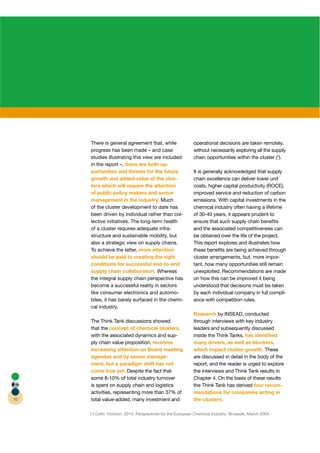
Tank train, Marl Chemical Park, ChemSite
There is general agreement that, while                operational decisions are taken remotely,
     progress has been made – and case                     without necessarily exploring all the supply
     studies illustrating this view are included           chain opportunities within the cluster (*).
     in the report –, there are both op-
     portunities and threats for the future                It is generally acknowledged that supply
     growth and added value of the clus-                   chain excellence can deliver lower unit
     ters which will require the attention                 costs, higher capital productivity (ROCE),
     of public policy makers and senior                    improved service and reduction of carbon
     management in the industry. Much                      emissions. With capital investments in the
     of the cluster development to date has                chemical industry often having a lifetime
     been driven by individual rather than col-            of 30-40 years, it appears prudent to
     lective initiatives. The long-term health             ensure that such supply chain benefits
     of a cluster requires adequate infra-                 and the associated competitiveness can
     structure and sustainable mobility, but               be obtained over the life of the project.
     also a strategic view on supply chains.               This report explores and illustrates how
     To achieve the latter, more attention                 these benefits are being achieved through
     should be paid to creating the right                  cluster arrangements, but, more impor-  r
     conditions for successful end-to-end                  tant, how many opportunities still remain
     supply chain collaboration. Whereas                   unexploited. Recommendations are made
     the integral supply chain perspective has             on how this can be improved it being
     become a successful reality in sectors                understood that decisions must be taken
     like consumer electronics and automo-                 by each individual company in full compli-
     biles, it has barely surfaced in the chemi-           ance with competition rules.
     cal industry.
                                                           Research by INSEAD, conducted
     The Think Tank discussions showed                     through interviews with key industry
     that the concept of chemical clusters,                leaders and subsequently discussed
     with the associated dynamics and sup-                 inside the Think Tanks, has identified
     ply chain value proposition, receives                 many drivers, as well as blockers,
     increasing attention on Board meeting                 which impact cluster growth. These
     agendas and by senior manage-                         are discussed in detail in the body of the
     ment, but a paradigm shift has not                    report, and the reader is urged to explore
     come true yet. Despite the fact that                  the interviews and Think Tank results in
     some 8-10% of total industry turnover                 Chapter 4. On the basis of these results
     is spent on supply chain and logistics                the Think Tank has derived four recom-
     activities, representing more than 37% of             mendations for companies acting in
10   total value-added, many investment and                the clusters.

     (*) Cefic ‘Horizon: 2015: Perspectives for the European Chemical Industry’ Brussels, March 2004.
Information sharing is key.
The interviews have shown that many
opportunities to benefit from chemi-
cal clusters are missed because each
cluster stakeholder (producer, Logistics
Service Provider (LSP) or authority) has
only a partial view of the flows proc-
essed. Compared to chemical clusters
in the rest of the world, it is surprisingly
difficult to obtain even basic aggregate
information on European chemical clus-
ters. Consequently, initiatives to build
cluster-wide infrastructure solutions or
even merge shipments from different
companies are very difficult to under-    r
take. Without a certain level of structured
and available information accessible
to all partners, firms will value invest-
ments in the cluster with a higher risk or
might even invest in the wrong alterna-
tive. Thus, to ensure that the competi-
tive forces still work to the benefit of all
cluster members, information sharing is
key and should go beyond exchanging
forecasts between business partners.
Clearly, any information exchange must
be done in full compliance with competi-
tion rules.

A flexible discussion platform
is required to organize
information sharing and
coordinate cluster initiatives.
Considering the constraints of the chem-
ical industry with respect to competition
law as well as the fact that firms operate
independently, we recommend the                11
creation of a flexible discussion platform    in this report, the study has shown that
                         to coordinate the information gather- r      a significant gap between words and
                         ing at a supply chain level and to create    facts still exists. Although producers are
                         common knowledge. This platform              very knowledgeable about the benefits
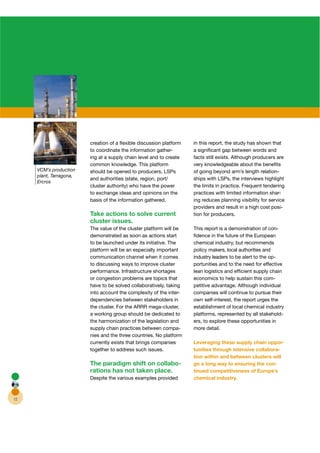
     VCM’s production    should be opened to producers, LSPs          of going beyond arm’s length relation-
     plant, Tarragona,
                         and authorities (state, region, port/        ships with LSPs, the interviews highlight
     Ercros
                         cluster authority) who have the power        the limits in practice. Frequent tendering
                         to exchange ideas and opinions on the        practices with limited information shar-r
                         basis of the information gathered.           ing reduces planning visibility for service
                                                                      providers and result in a high cost posi-
                         Take actions to solve current                tion for producers.
                         cluster issues.
                         The value of the cluster platform will be    This report is a demonstration of con-
                         demonstrated as soon as actions start        fidence in the future of the European
                         to be launched under its initiative. The     chemical industry, but recommends
                         platform will be an especially important     policy makers, local authorities and
                         communication channel when it comes          industry leaders to be alert to the op-
                         to discussing ways to improve cluster        portunities and to the need for effective
                         performance. Infrastructure shortages        lean logistics and efficient supply chain
                         or congestion problems are topics that       economics to help sustain this com-
                         have to be solved collaboratively, taking    petitive advantage. Although individual
                         into account the complexity of the inter-r   companies will continue to pursue their
                         dependencies between stakeholders in         own self-interest, the report urges the
                         the cluster. For the ARRR mega-cluster,      establishment of local chemical industry
                         a working group should be dedicated to       platforms, represented by all stakehold-
                         the harmonization of the legislation and     ers, to explore these opportunities in
                         supply chain practices between compa-        more detail.
                         nies and the three countries. No platform
                         currently exists that brings companies       Leveraging these supply chain oppor-
                         together to address such issues.             tunities through intensive collabora-
                                                                      tion within and between clusters will
                         The paradigm shift on collabo-               go a long way to ensuring the con-
                         rations has not taken place.                 tinued competitiveness of Europe’s
                         Despite the various examples provided        chemical industry.


12
2. INTRODUCTION


2.1 European Chemical Industry –                             and generated 2% of Europe’s gross
    A Major Force under Threat?                              national product (Source: Eurostat,
                                                             2007). Recent studies performed in the
From food packaging to pharmaceuti-                          Rhine/Ruhr region indicate that one job


                                                                                                             > A PARADIGM SHIFT : SUPPLY CHAIN COLLABORATION AND COMPETITION IN AND BETWEEN EUROPE’S CHEMICAL CLUSTERS
cals, the chemical industry plays a domi-                    in the chemical industry creates three
nant role in today’s national and global                     additional jobs in the chemical-related
economies. Developing and sustaining a                       sector.
local chemical industry, able to compete
on a global scale, has both economic                         Since 1990 the European chemical
and political importance as the chemi-                       industry has been growing at an average
cal industry supplies the full spectrum                      rate of 2.8% per year, outstripping the
of Europe’s manufacturing industry with                      European manufacturing industry which
intermediate products.                                       has grown by 1.6% in the same period.
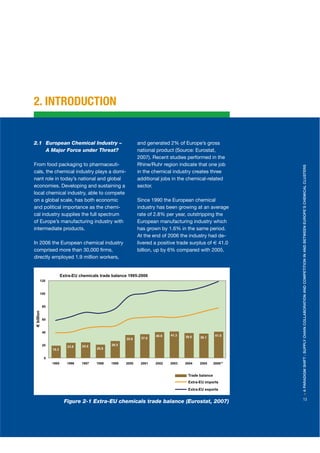
                                                             At the end of 2006 the industry had de-
In 2006 the European chemical industry                       livered a positive trade surplus of 41.0
comprised more than 30,000 firms,                             billion, up by 6% compared with 2005.
directly employed 1.9 million workers,


                       Extra-EU chemicals trade balance 1995-2006
      120


      100


           80
 billion


           60


           40
                                                                     40.6   41.3   39.0              41.0
                                                      35.8    37.0                        38.1

           20                    24.5          26.5
                          23.8
                19.3                    20.9

            0
                1995      1996   1997   1998   1999   2000    2001   2002   2003   2004   2005      2006**


                                                                                    Trade balance
                                                                                    Extra-EU imports
                                                                                    Extra-EU exports

                                                                                                             13
                         Figure 2-1 Extra-EU chemicals trade balance (Eurostat, 2007)
Therefore, the European chemical             2.2 Clusters & Competitiveness
     industry has been, and will remain,
     a leading factor in economic                 An Arthur D. Little study from 2005 – The
     growth, warranting specific atten-            Staying Power of Europe’s Chemical In-
     tion from policy makers.                     dustry – compared the production costs
                                                  of Europe’s chemical sites to the US,
     Despite these positive numbers, there        India, China, and the Middle East. While
     are signals that the growth and export       the report acknowledged that Europe
     potential of the European chemical in-       may be expensive, the surprising conclu-
     dustry could be under threat. Agricultural   sion was that it still remains one of the
     chemicals and fibers have experienced         most competitive regions in the world.
     negative growth, the trade surplus for       The study challenges the hypothesis that
     organic chemicals has declined in the        significant relocation of European-based
     face of increased import flows from           chemicals manufacturing operations
     Saudi Arabia, and despite a strong           is likely to happen in order to serve
     performance from polyolefins, huge new        developing and developed markets at
     petrochemical capacity in the Middle         reduced cost.
     East will inevitably impact demand for
     European sourced production.                 The study conducted both a qualita-
                                                  tive and a cost based assessment of
     European companies have of course            the operating environment in which a
     contributed to the development of com-       chemical company can deliver value.
     peting clusters closer to emerging mar-      The four factors determining the quality
     kets (China/India) and cheap feedstocks      of the environment were demand condi-
     in the Middle East. Although much of         tions, technological advancement and
     the new production is expected to find        innovation, environmental regulations,
     a home in Asian markets, there is a          and the formation of clusters. With
     concern that European competitiveness        the exception of environmental regula-
     will suffer as companies prefer to invest    tions for which the report underlined that
     scarce financial resources in growing         “governments must improve cooperation
     regions, and allow the European asset        with companies to develop environmen-
     base to become obsolete. Up-to-date          tal efficiency at low administrative cost”,
     manufacturing assets as well as efficient     all other factors are well established
     and reliable logistics networks are a        in Europe, including the presence of
     prerequisite for remaining competitive in    strongly integrated clusters.
     global markets.
14
The report observed that Europe enjoys        collaborative relationships, as a way of
the benefit of a limited number of             raising the bar on performance, without
strongly clustered areas. With raw mate-      negatively impacting competition.
rials being the main input to the chemi-
cals industry, their immediate availability   In addition, notwithstanding the fact
through ports, refineries, and pipelines is    that Europe has well-established and
of prime importance, as well as the op-       effective clusters in place, supported
portunity to develop derivative products      by highly sophisticated logistics service
at the lowest possible logistics cost.        providers and supportive public authori-
                                              ties, further benefits would be obtained
It should be clear that the continued         by engaging all stakeholders in enhanc-
global competitiveness of European            ing the linkage between clusters.
chemical manufacturing is closely
linked to the efficiency of its clus-          In this context EPCA took the initiative
ters. Chemical clusters are all about         of conducting a more in-depth study of
the supply chain at work.                     European chemical clusters.

The port and pipeline infrastructure
facilitates upstream supply chain             2.3 The EPCA Study
operations and economics. The high
level of integration and interconnectivity    Since European manufacturers cannot
between the cluster participants creates      differentiate themselves through a cost
significant opportunities to benefit from       advantage on feedstocks (versus Middle
efficiencies through reduced transporta-       Eastern producers), the integration of
tion intensity (i.e. lower freight costs,     energy and intermediate raw materials
reduced risk from the movement of haz-        as well as supply chain efficiencies rep-
ardous products, reduced emissions),          resent key drivers for competitiveness.
more effective utilization of assets, and     Previous studies from EPCA and CEFIC
efficient use of working capital.              have shown that 37% of the value added
                                              created by chemical companies can be
The inevitable tension between com-           spent on transforming, storing, and mov-
petition and collaboration has probably       ing products.
limited the full exploitation of these
opportunities in the past. However, there     The EPCA-CEFIC Think Tank Reports
is evidence of an increasing willingness      issued in 2004 and 2005 concluded
to explore the scope and benefits of           that a huge potential can be achieved
                                                                                          15
through collaboration between “custom-      tion as well as missed opportunities,
             ers, suppliers, service providers and,      develop ideas to overcome blockers and
             occasionally, competitors, to drive out     constraints and stimulate future supply
             waste, and hence cost”. The estimated       chain collaborative initiatives.
             accumulated potential in Europe from a
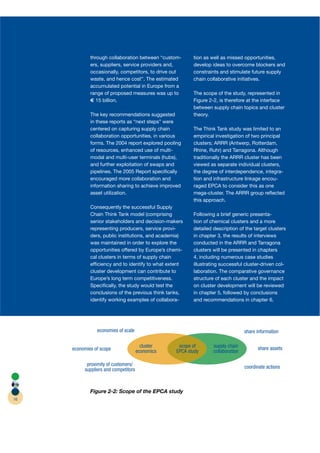
             range of proposed measures was up to        The scope of the study, represented in
               15 billion.                               Figure 2-2, is therefore at the interface
                                                         between supply chain topics and cluster
             The key recommendations suggested           theory.
             in these reports as “next steps” were
             centered on capturing supply chain          The Think Tank study was limited to an
             collaboration opportunities, in various     empirical investigation of two principal
             forms. The 2004 report explored pooling     clusters; ARRR (Antwerp, Rotterdam,
             of resources, enhanced use of multi-        Rhine, Ruhr) and Tarragona. Although
             modal and multi-user terminals (hubs),      traditionally the ARRR cluster has been
             and further exploitation of swaps and       viewed as separate individual clusters,
             pipelines. The 2005 Report specifically      the degree of interdependence, integra-
             encouraged more collaboration and           tion and infrastructure linkage encou-
             information sharing to achieve improved     raged EPCA to consider this as one
             asset utilization.                          mega-cluster. The ARRR group reflected
                                                         this approach.
             Consequently the successful Supply
             Chain Think Tank model (comprising          Following a brief generic presenta-
             senior stakeholders and decision-makers     tion of chemical clusters and a more
             representing producers, service provi-      detailed description of the target clusters
             ders, public institutions, and academia)    in chapter 3, the results of interviews
             was maintained in order to explore the      conducted in the ARRR and Tarragona
             opportunities offered by Europe’s chemi-    clusters will be presented in chapters
             cal clusters in terms of supply chain       4, including numerous case studies
             efficiency and to identify to what extent    illustrating successful cluster-driven col-
             cluster development can contribute to       laboration. The comparative governance
             Europe’s long term competitiveness.         structure of each cluster and the impact
             Specifically, the study would test the       on cluster development will be reviewed
             conclusions of the previous think tanks,    in chapter 5, followed by conclusions
             identify working examples of collabora-     and recommendations in chapter 6.


                economies of scale                                                share information

                                        cluster    scope of       supply chain          share assets
     economies of scope               economics   EPCA study      collaboration

           proximity of customers/
                                                                                  coordinate actions
          suppliers and competitors


             Figure 2-2: Scope of the EPCA study
16
3. PRESENTATION OF
   THE ARRR AND TARRAGONA
   CHEMICAL CLUSTERS


3.1 Definition of chemical clusters           Langen, 2004), a cluster is defined as a
                                             “geographically limited concentration
Links between a specific industry and         of mutually related business units,
a geographic location can be easily          associations and public or private
observed in the economic map of the          organizations centered on a specific


                                                                                          > A PARADIGM SHIFT : SUPPLY CHAIN COLLABORATION AND COMPETITION IN AND BETWEEN EUROPE’S CHEMICAL CLUSTERS
world. For example, financial services        economic focus”. This definition will
are related to the city of London, fashion   be extended in the following chapters to
to Milan and Paris and high-technology       match the specificities of the chemical
electronics to Silicon Valley. The chemi-    industry.
cal industry could be associated with
the area of Rotterdam, Antwerp and the       A chemical cluster, like other industrial
Rhine/Ruhr region, strongly sustained by     clusters, is characterized by a high
the presence of 3 important ports (the 2     concentration of manufacturing compa-
seaports of Antwerp and Rotterdam and        nies and service providers operating in
the inland port of Duisburg) and by the      the chemical business. But the cluster
dense network of logistics interconnec-      population consists also of associations
tions in place.                              and public or private organizations that
                                             participate in and are co-responsible for
The phenomenon of regional industry          creating a vibrant environment in terms
concentration was explored by Alfred         of productivity, innovation and creation
Marshall as early as the 1920s (Marshall,    of new businesses. For example, in the
1920) with respect to the progressive        chemical clusters examined by the Think
concentration of firms making and ma-         Tank the relevant port authorities attract
chining steel around Sheffield. The atten-    new investors in the area and offer stra-
tion of the economic and political sphere    tegic land positions for specific business
on this phenomenon has continuously          development in addition to dealing with
increased since then, due especially         traditional port activities.
to the recognition that such networks
would constitute an ultimate source of       In the manufacturing stage of the value
competitive advantage for an economy         chain, the products of a company are
(Porter, 1990).                              the inputs for the manufacturing process
                                             of a company further downstream in
These localized industries that combine      the value chain. In addition, chemical
a high specialization with an unusual        companies tend to outsource industry-
competitive success in a particular          related services and therefore attract
field and a specific geographic location       waves of third party investments in
represent what Michael Porter described      warehousing, transportation, general         17
in the 1990s as “clusters” (Porter, 1998).   services, waste treatment and disposal,
According to more recent research (de        as well as a full range of utilities.
This interaction and interdependence          same might not be true for companies
     between the firms in a cluster creates         operating in the same stage of the value
     complementarities, synergies and a            chain. Companies operating in the same
     combination of skills and incentives          product or business segment in the
     that is hard to reproduce by competi-         cluster could choose whether or not to
     tors operating on an isolated basis.          collaborate.
     This aspect is the real strength of a clus-
     ter and explains why many governments,        However, the fact of being located in
     especially in Europe, are attempting to       a cluster offers unique opportunities
     promote the formation of local clusters.      for collaboration, even between rival
                                                   firms. Optimizing capital investments,
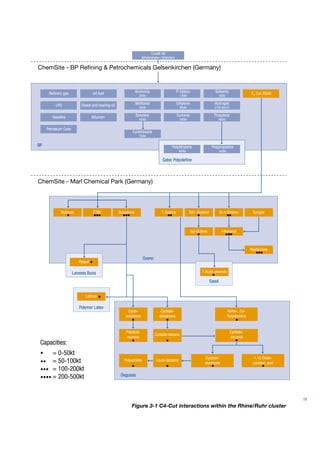
     Figure 3-1 shows how chemical compa-          increasing the average utilization of
     nies are integrated into the materials flow    assets, swapping capacities and ma-
     system from crude-oil to ethylene and         terials and exchanging information are
     propylene and the C4 cut between BP’s         only a few examples of collaboration
     Gelsenkirchen sites and the companies         opportunities that can successfully
     located in the ChemSite-Marl Chemical         take place in a cluster. The geographi-
     Park in Germany.                              cal proximity of firms within the cluster
                                                   and the possibility of having frequent
     While the interaction between compa-          face-to-face interactions represent an
     nies operating in subsequent stages           ideal trigger for developing this kind of
     of the value chain is almost essen-           collaboration initiative.
     tial for each company’s success, the


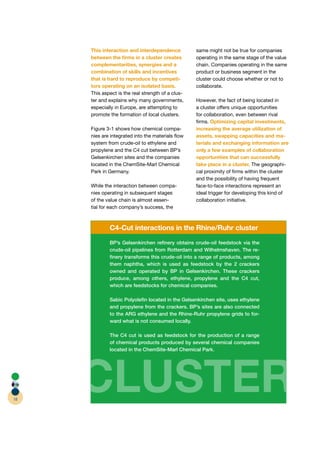
             C4-Cut interactions in the Rhine/Ruhr cluster
             BP’s Gelsenkirchen refinery obtains crude-oil feedstock via the
             crude-oil pipelines from Rotterdam and Wilhelmshaven. The re-
             finery transforms this crude-oil into a range of products, among
             them naphtha, which is used as feedstock by the 2 crackers
             owned and operated by BP in Gelsenkirchen. These crackers
             produce, among others, ethylene, propylene and the C4 cut,
             which are feedstocks for chemical companies.

             Sabic Polyolefin located in the Gelsenkirchen site, uses ethylene
             and propylene from the crackers. BP’s sites are also connected
             to the ARG ethylene and the Rhine-Ruhr propylene grids to for-
             ward what is not consumed locally.

             The C4 cut is used as feedstock for the production of a range
             of chemical products produced by several chemical companies
             located in the ChemSite-Marl Chemical Park.


18
     CLUSTER
Crude oil
                                                                   Wilhelmshafen / Rotterdam


ChemSite - BP Refining & Petrochemicals Gelsenkirchen (Germany)


      Refinery gas                 Jet fuel                    Ammonia                         P-Xylene                    Solvents                    C4 Cut 350kt
                                                                 280kt                          130kt                       100kt


          LPG             Diesel and heating oil               Methanol                        Ethylene                   Hydrogen
                                                                 300kt                          960kt                     210K Nm3/h


        Gasoline                   Bitumen                     Benzene                         Cumene                     Propylene
                                                                 430kt                          500kt                       660kt


     Petroleum Coke
                                                           Cyclohexane
                                                                 150kt

BP                                                                                        Polyethylene                   Polypropylene
                                                                                                400kt                           500kt

                                                                                  Sabic Polyolefine


ChemSite - Marl Chemical Park (Germany)


             Butanes               ETBE            Butadiene                      1-Butene              Tert.-Butanol           Di-n-Butene             Syngas


                                                                                                          Iso-Butene             i-Nonanol


                                                                                                                                                      Plasticizers

                                                                   Oxeno
                         Polyoil

                      Lanxess Buna                                                                              T-Butyl-phenols

                                                                                                                        Sasol


                             Latices

                         Polymer Latex
                                                       Cyclo-                    Cyclodo-                                               Homo-, Co-
                                                      octadiene                 decatriene                                              Terpolymers


                                                       Polyocte-                                                                         Cyclodo-
                                                                             Cyclodo-decane
                                                        namers                                                                           decanol
 Capacities:
        = 0-50kt
                                                                                                                  Cyclodo-                              1,12-Dode-
        = 50-100kt                                    Polyamides             Lauro-lactame
                                                                                                                  decanone                             candioic acid
        = 100-200kt
        = 200-500kt                                 Degussa


                                                                                                                                                                       19
                                                          Figure 3-1 C4-Cut interactions within the Rhine/Ruhr cluster
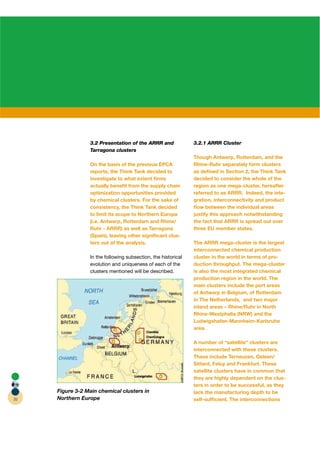
3.2 Presentation of the ARRR and              3.2.1 ARRR Cluster
                 Tarragona clusters
                                                               Though Antwerp, Rotterdam, and the
                 On the basis of the previous EPCA             Rhine-Ruhr separately form clusters
                 reports, the Think Tank decided to            as defined in Section 2, the Think Tank
                 investigate to what extent firms               decided to consider the whole of the
                 actually benefit from the supply chain         region as one mega-cluster, hereafter
                 optimization opportunities provided           referred to as ARRR. Indeed, the inte-
                 by chemical clusters. For the sake of         gration, interconnectivity and product
                 consistency, the Think Tank decided           flow between the individual areas
                 to limit its scope to Northern Europe         justify this approach notwithstanding
                 (i.e. Antwerp, Rotterdam and Rhine/           the fact that ARRR is spread out over
                 Ruhr - ARRR) as well as Tarragona             three EU member states.
                 (Spain), leaving other significant clus-
                 ters out of the analysis.                     The ARRR mega-cluster is the largest
                                                               interconnected chemical production
                 In the following subsection, the historical   cluster in the world in terms of pro-
                 evolution and uniqueness of each of the       duction throughput. The mega-cluster
                 clusters mentioned will be described.         is also the most integrated chemical
                                                               production region in the world. The
                                                               main clusters include the port areas
                                                               of Antwerp in Belgium, of Rotterdam
                                                               in The Netherlands, and two major
                                                               inland areas – Rhine/Ruhr in North
                                                               Rhine-Westphalia (NRW) and the
                                                               Ludwigshafen-Mannheim-Karlsruhe
                                                               area.

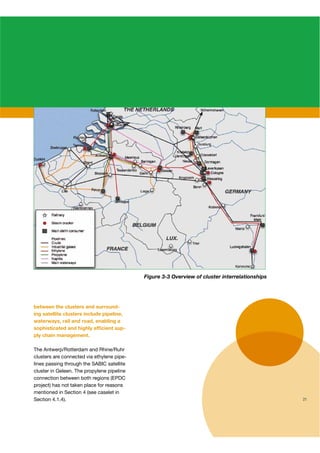
                                                               A number of “satellite” clusters are
                                                               interconnected with these clusters.
                                                               These include Terneuzen, Geleen/
                                                               Sittard, Feluy and Frankfurt. These
                                                               satellite clusters have in common that
                                                               they are highly dependent on the clus-
                                                               ters in order to be successful, as they
     Figure 3-2 Main chemical clusters in                      lack the manufacturing depth to be
20   Northern Europe                                           self-sufficient. The interconnections
Figure 3-3 Overview of cluster interrelationships


between the clusters and surround-
ing satellite clusters include pipeline,
waterways, rail and road, enabling a
sophisticated and highly efficient sup-
ply chain management.

The Antwerp/Rotterdam and Rhine/Ruhr
clusters are connected via ethylene pipe-
lines passing through the SABIC satellite
cluster in Geleen. The propylene pipeline
connection between both regions (EPDC
project) has not taken place for reasons
mentioned in Section 4 (see caselet in
Section 4.1.4).                                                                                 21
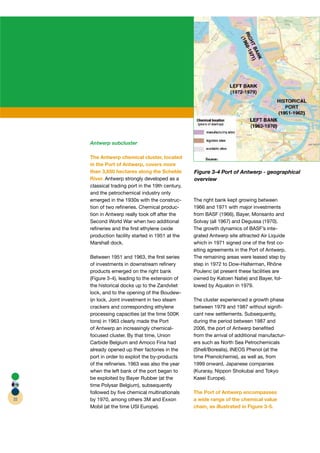
Antwerp subcluster

     The Antwerp chemical cluster, located
     in the Port of Antwerp, covers more
     than 3,650 hectares along the Schelde         Figure 3-4 Port of Antwerp - geographical
     River. Antwerp strongly developed as a        overview
     classical trading port in the 19th century,
     and the petrochemical industry only
     emerged in the 1930s with the construc-       The right bank kept growing between
     tion of two refineries. Chemical produc-       1966 and 1971 with major investments
     tion in Antwerp really took off after the     from BASF (1966), Bayer, Monsanto and
     Second World War when two additional          Solvay (all 1967) and Degussa (1970).
     refineries and the first ethylene oxide         The growth dynamics of BASF’s inte-
     production facility started in 1951 at the    grated Antwerp site attracted Air Liquide
     Marshall dock.                                which in 1971 signed one of the first co-
                                                   siting agreements in the Port of Antwerp.
     Between 1951 and 1963, the first series        The remaining areas were leased step by
     of investments in downstream refinery          step in 1972 to Dow-Halterman, Rhône
     products emerged on the right bank            Poulenc (at present these facilities are
     (Figure 3-4), leading to the extension of     owned by Katoen Natie) and Bayer, fol-
     the historical docks up to the Zandvliet      lowed by Aqualon in 1979.
     lock, and to the opening of the Boudew-
     ijn lock. Joint investment in two steam       The cluster experienced a growth phase
     crackers and corresponding ethylene           between 1979 and 1987 without signifi-
     processing capacities (at the time 500K       cant new settlements. Subsequently,
     tons) in 1963 clearly made the Port           during the period between 1987 and
     of Antwerp an increasingly chemical-          2006, the port of Antwerp benefited
     focused cluster. By that time, Union          from the arrival of additional manufactur-
                                                                                           r
     Carbide Belgium and Amoco Fina had            ers such as North Sea Petrochemicals
     already opened up their factories in the      (Shell/Borealis), INEOS Phenol (at the
     port in order to exploit the by-products      time Phenolchemie), as well as, from
     of the refineries. 1963 was also the year      1999 onward, Japanese companies
     when the left bank of the port began to       (Kuraray, Nippon Shokubai and Tokyo
     be exploited by Bayer Rubber (at the          Kasei Europe).
     time Polysar Belgium), subsequently
     followed by five chemical multinationals       The Port of Antwerp encompasses
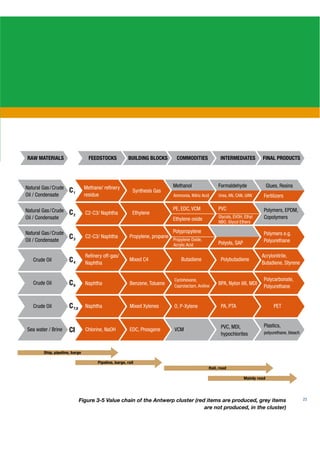
22   by 1970, among others 3M and Exxon            a wide range of the chemical value
     Mobil (at the time USI Europe).               chain, as illustrated in Figure 3-5.
C1


              C2


              C3


              C4


              C6


              C 7,8


              CI


Ship, pipeline, barge

                             Pipeline, barge, rail
                                                                          Rail, road

                                                                                        Mainly road


                      Figure 3-5 Value chain of the Antwerp cluster (red items are produced, grey items     23

                                                                        are not produced, in the cluster)
Rotterdam subcluster                           replaced coal during the war), industry
                                                    and society. Oil had to be imported
     Rotterdam, initially a fishing village in the   from other world regions and Rotterdam
     15th century, was already a significant         quickly became the biggest European
     gateway to the European hinterland             port of oil imports.
     before the rise of the industrial revolu-
     tion, due to regular trade lines to Asia       The oil refineries of Shell and Caltex
     and South America (for tobacco and             (Texaco) started the cluster just after the
     spices). Fueled by the rise of the Ger-r       Second World War. In the sixties, crude
     man steel industry in the Ruhr region,         oil pipelines to refineries in Germany
     Rotterdam became through its access            and Antwerp were commissioned. This
     to the Rhine River the port of choice for      decade also saw the first big wave of
     importing ores for the German factories        chemical investments: Dow, Akzo, ICI
     and exporting steel products. In order         (now Hexion), Esso Chemicals, Kemira
     to cope with higher traffic and heavier         and Arco (now Lyondell) all set up their
                                                                     L
     loads, access to the port was improved         plants. Since the petroleum trade con-
     by a new channel (“Nieuwe Waterweg”)           tinued to grow tremendously quick in the
     and the port was extended stepwise             sixties, shipbuilders had to increase the
     towards the sea.                               capacity of their vessels. However, the
                                                    new “mammoth” tankers were not able
     After the First World War, with the grow-      to enter the existing port infrastructures.
     ing use of automobiles, oil became a           Consequently, the Europoort zone was
24   strategic resource for armies (oil had         built to the west of the port; it was 20
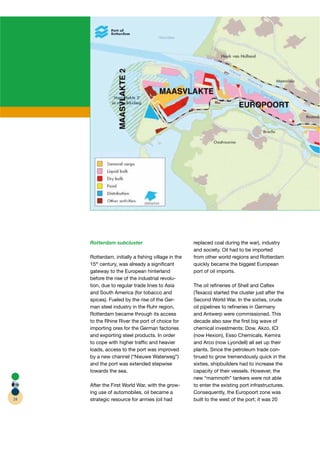
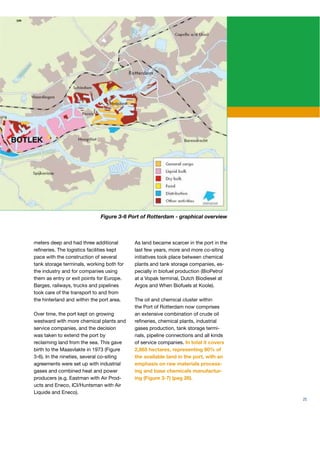
Figure 3-6 Port of Rotterdam - graphical overview


meters deep and had three additional       As land became scarcer in the port in the
refineries. The logistics facilities kept   last few years, more and more co-siting
pace with the construction of several      initiatives took place between chemical
tank storage terminals, working both for   plants and tank storage companies, es-
the industry and for companies using       pecially in biofuel production (BioPetrol
them as entry or exit points for Europe.   at a Vopak terminal, Dutch Biodiesel at
Barges, railways, trucks and pipelines     Argos and When Biofuels at Koole).
took care of the transport to and from
the hinterland and within the port area.   The oil and chemical cluster within
                                           the Port of Rotterdam now comprises
Over time, the port kept on growing        an extensive combination of crude oil
westward with more chemical plants and     refineries, chemical plants, industrial
service companies, and the decision        gases production, tank storage termi-
was taken to extend the port by            nals, pipeline connections and all kinds
reclaiming land from the sea. This gave    of service companies. In total it covers
birth to the Maasvlakte in 1973 (Figure    2,865 hectares, representing 60% of
3-6). In the nineties, several co-siting   the available land in the port, with an
agreements were set up with industrial     emphasis on raw materials process-
gases and combined heat and power          ing and base chemicals manufactur-
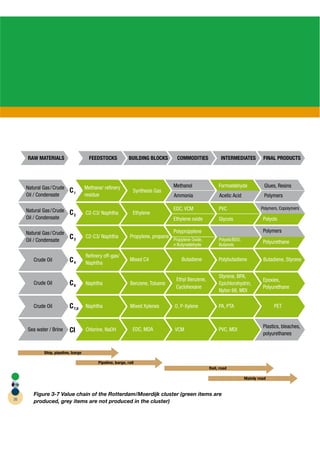
producers (e.g. Eastman with Air Prod-     ing (Figure 3-7) (pag 26).
ucts and Eneco, ICI/Huntsman with Air
Liquide and Eneco).
                                                                                       25
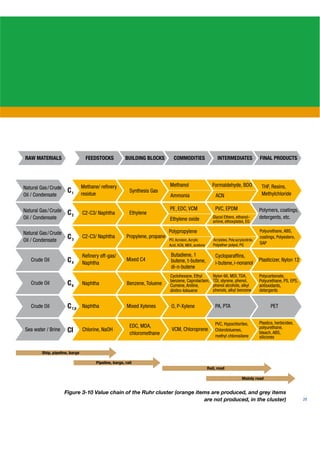
C1


                       C2


                       C3


                       C4


                       C6


                       C 7,8


                       CI


         Ship, pipeline, barge

                                 Pipeline, barge, rail
                                                                         Rail, road

                                                                                      Mainly road


     Figure 3-7 Value chain of the Rotterdam/Moerdijk cluster (green items are
26
     produced, grey items are not produced in the cluster)
Rhine-Ruhr subcluster                        Most of the chemical sites were run by
                                             one user only (single user sites) until
The German state of North Rhine-             the mid-1990s when chemical majors
Westphalia is the base of two major          started to reorganize their product port-
chemical centers: the Ruhr region            folio. In the course of structural changes
(ChemSite cluster) in the northern           in the chemical industry, traditional
part and the Rhine area (ChemCo-             chemical industry sites with single users
logne cluster) in the southern part.         were transformed into integrated multi-
Together these chemical regions form         user sites (chemical parks), where many
the Rhine/Ruhr cluster. They are well        users benefit from shared material flows
connected by road, rail, pipeline and        and infrastructure, making efficient joint
waterway, with Duisburg as the largest       use of all the facilities available. The utili-
inland port in Europe. With 720 km of        ties as well as the site management are
waterways, 180 inland ports and 8,000        mostly still performed by the initial user
km of railways, the region is connected      of the site (site operator). This structural
to both the raw material import centers      change has created new opportunities,
or feedstock production sites (Rotter-       as each site is now even more focused
dam, Antwerp, Wilhelms-haven) and the        on attracting complementary partners
German and Eastern European hinter-          (manufacturers, LSPs, research centers)
land.                                        to create additional synergies within the
                                             chemical parks.
The chemical industry in the Rhine/Ruhr
cluster emerged in the 19th century          In the late nineties, some manufacturers
with the exploitation of the neighboring     of the cluster decided to merge their
coal reserves of the Ruhr. In a similar      efforts in attracting new companies,
fashion as in Antwerp and Rotterdam,         triggered by the vision of the “opened
the development really took off after        chemical cluster” idea. The ChemSite
the Second World War when the former         initiative was created in 1997 as a public-
chemical group IG Farben was broken          private partnership between the German
down into several units and petrochemi-      state of North-Rhine-Westphalia and
cal manufacturers installed refineries and    chemical manufacturers in the Northern
steam crackers in the cluster (Rheinische    Ruhr region promoting the attractiveness
Olefinwerke GmbH in Wesseling, EC             of the region. Hüls AG (now Degussa),
Erölchemie in Worringen). This helped        which has been operating in Marl one
the cluster to maintain its long-term        of Germany’s biggest sites since 1938,
competitiveness by replacing the declin-     founded ChemSite together with, among
ing lignite and anthracite reserves by oil   others, Veba Oel (now BP Refining &                27
as an input for the chemical cluster.        Petrochemicals), Rutgers Chemicals,
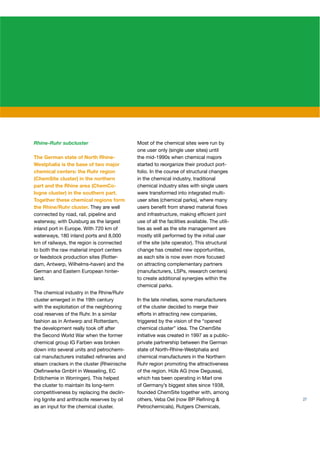
Figure 3-8
 ChemSite cluster -
 graphical overview
 (source ChemSite,
              2007)


                           DSM (now SABIC) and the state of           ChemSite currently promotes 7 sites,
                           North Rhine-Westphalia. Since then,        from the fully integrated petro-chemical
                           the ChemSite initiative has successfully   cluster operated by Degussa to the
                           extended to the whole Ruhr region.         research focused cluster of TechnoMarl.
                                                                      All chemical parks and sites are situated
                                                                      very closely together in the Ruhr region.
                                                                      With a total area of 1,400 hectares, these
                                                                      locations offer about 240 hectares for
                                                                      the relocation of new companies.

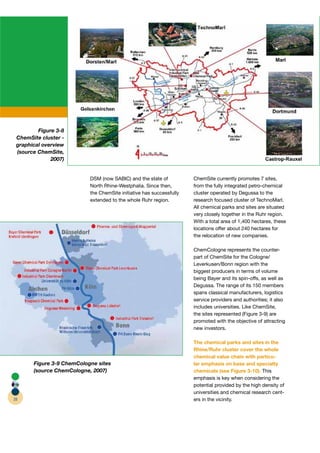
                                                                      ChemCologne represents the counter-
                                                                      part of ChemSite for the Cologne/
                                                                      Leverkusen/Bonn region with the
                                                                      biggest producers in terms of volume
                                                                      being Bayer and its spin-offs, as well as
                                                                      Degussa. The range of its 150 members
                                                                      spans classical manufacturers, logistics
                                                                      service providers and authorities; it also
                                                                      includes universities. Like ChemSite,
                                                                      the sites represented (Figure 3-9) are
                                                                      promoted with the objective of attracting
                                                                      new investors.

                                                                      The chemical parks and sites in the
                                                                      Rhine/Ruhr cluster cover the whole
                                                                      chemical value chain with particu-
       Figure 3-9 ChemCologne sites                                   lar emphasis on base and specialty
       (source ChemCologne, 2007)                                     chemicals (see Figure 3-10). This
                                                                      emphasis is key when considering the
                                                                      potential provided by the high density of
                                                                      universities and chemical research cent-
28                                                                    ers in the vicinity.
C1


              C2


              C3
                                                                       Polyether polyol, PG


              C4


              C6


              C 7,8


              CI


Ship, pipeline, barge

                        Pipeline, barge, rail
                                                                    Rail, road

                                                                                         Mainly road


            Figure 3-10 Value chain of the Ruhr cluster (orange items are produced, and grey items
                                                                   are not produced, in the cluster)   29
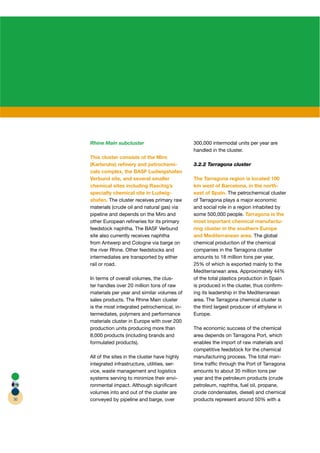
Rhine Main subcluster                         300,000 intermodal units per year are
                                                   handled in the cluster.
     This cluster consists of the Miro
     (Karlsruhe) refinery and petrochemi-           3.2.2 Tarragona cluster
     cals complex, the BASF Ludwigshafen
     Verbund site, and several smaller             The Tarragona region is located 100
     chemical sites including Raschig’s            km west of Barcelona, in the north-
     specialty chemical site in Ludwig-            east of Spain. The petrochemical cluster
     shafen. The cluster receives primary raw      of Tarragona plays a major economic
     materials (crude oil and natural gas) via     and social role in a region inhabited by
     pipeline and depends on the Miro and          some 500,000 people. Tarragona is the
     other European refineries for its primary      most important chemical manufactu-
     feedstock naphtha. The BASF Verbund           ring cluster in the southern Europe
     site also currently receives naphtha          and Mediterranean area. The global
     from Antwerp and Cologne via barge on         chemical production of the chemical
     the river Rhine. Other feedstocks and         companies in the Tarragona cluster
     intermediates are transported by either       amounts to 18 million tons per year,
     rail or road.                                 25% of which is exported mainly to the
                                                   Mediterranean area. Approximately 44%
     In terms of overall volumes, the clus-        of the total plastics production in Spain
     ter handles over 20 million tons of raw       is produced in the cluster, thus confirm-
     materials per year and similar volumes of     ing its leadership in the Mediterranean
     sales products. The Rhine Main cluster        area. The Tarragona chemical cluster is
     is the most integrated petrochemical, in-     the third largest producer of ethylene in
     termediates, polymers and performance         Europe.
     materials cluster in Europe with over 200
     production units producing more than          The economic success of the chemical
     8,000 products (including brands and          area depends on Tarragona Port, which
     formulated products).                         enables the import of raw materials and
                                                   competitive feedstock for the chemical
     All of the sites in the cluster have highly   manufacturing process. The total mari-
     integrated infrastructure, utilities, ser-    time traffic through the Port of Tarragona
     vice, waste management and logistics          amounts to about 35 million tons per
     systems serving to minimize their envi-       year and the petroleum products (crude
     ronmental impact. Although significant         petroleum, naphtha, fuel oil, propane,
     volumes into and out of the cluster are       crude condensates, diesel) and chemical
30   conveyed by pipeline and barge, over          products represent around 50% with a
total of almost 18 million tons per year.
Since the 1960s, thirty-four companies
including some major international ones
like Bayer, BASF and Dow, and Repsol,
Spain’s largest petrochemical company,
have set up production sites in the
chemical cluster of Tarragona.

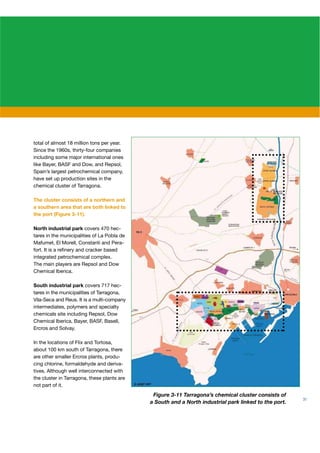
The cluster consists of a northern and
a southern area that are both linked to
the port (Figure 3-11).

North industrial park covers 470 hec-
tares in the municipalities of La Pobla de
Mafumet, El Morell, Constantí and Pera-
fort. It is a refinery and cracker based
integrated petrochemical complex.
The main players are Repsol and Dow
Chemical Iberica.

South industrial park covers 717 hec-
tares in the municipalities of Tarragona,
Vila-Seca and Reus. It is a multi-company
intermediates, polymers and specialty
chemicals site including Repsol, Dow
Chemical Iberica, Bayer, BASF, Basell,
Ercros and Solvay.

In the locations of Flix and Tortosa,
about 100 km south of Tarragona, there
are other smaller Ercros plants, produ-
cing chlorine, formaldehyde and deriva-
tives. Although well interconnected with
the cluster in Tarragona, these plants are
not part of it.
                                              Figure 3-11 Tarragona’s chemical cluster consists of
                                                                                                       31
                                             a South and a North industrial park linked to the port.
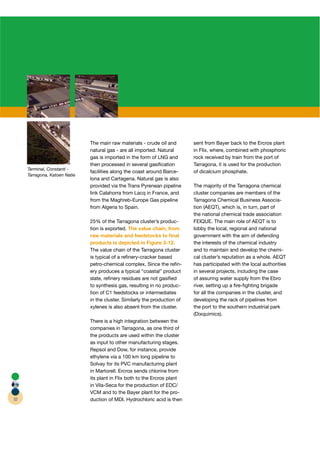
The main raw materials - crude oil and        sent from Bayer back to the Ercros plant
                               natural gas - are all imported. Natural       in Flix, where, combined with phosphoric
                               gas is imported in the form of LNG and        rock received by train from the port of
                               then processed in several gasification         Tarragona, it is used for the production
     Terminal, Constantí -
                               facilities along the coast around Barce-      of dicalcium phosphate.
     Tarragona, Katoen Natie
                               lona and Cartagena. Natural gas is also
                               provided via the Trans Pyrenean pipeline      The majority of the Tarragona chemical
                               link Calahorra from Lacq in France, and       cluster companies are members of the
                               from the Maghreb-Europe Gas pipeline          Tarragona Chemical Business Associa-
                               from Algeria to Spain.                        tion (AEQT), which is, in turn, part of
                                                                                  (
                                                                             the national chemical trade association
                               25% of the Tarragona cluster’s produc-        FEIQUE. The main role of AEQT is to
                               tion is exported. The value chain, from       lobby the local, regional and national
                               raw materials and feedstocks to final          government with the aim of defending
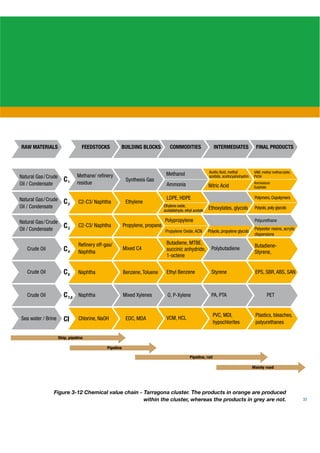
                               products is depicted in Figure 3-12.          the interests of the chemical industry
                               The value chain of the Tarragona cluster      and to maintain and develop the chemi-
                               is typical of a refinery-cracker based         cal cluster’s reputation as a whole. AEQT
                               petro-chemical complex. Since the refin-       has participated with the local authorities
                               ery produces a typical “coastal” product      in several projects, including the case
                               slate, refinery residues are not gasified       of assuring water supply from the Ebro
                               to synthesis gas, resulting in no produc-     river, setting up a fire-fighting brigade
                               tion of C1 feedstocks or intermediates        for all the companies in the cluster, and
                               in the cluster. Similarly the production of   developing the rack of pipelines from
                               xylenes is also absent from the cluster.      the port to the southern industrial park
                                                                             (Dixquimics).
                               There is a high integration between the
                               companies in Tarragona, as one third of
                               the products are used within the cluster
                               as input to other manufacturing stages.
                               Repsol and Dow, for instance, provide
                               ethylene via a 100 km long pipeline to
                               Solvay for its PVC manufacturing plant
                               in Martorell. Ercros sends chlorine from
                               its plant in Flix both to the Ercros plant
                               in Vila-Seca for the production of EDC/
                               VCM and to the Bayer plant for the pro-
32                             duction of MDI. Hydrochloric acid is then
Acetic Acid, methyl           VAM, methyl methacrylate,
                                                                         acetate, acetocyanohydrin     PVOH
    C1                                                                                                 Ammonium
                                                                         Nitric Acid                   Sulphate

                                            LDPE, HDPE                                                 Polymers, Copolymers
    C2                                     Ethylene oxide,
                                           acetaldehyde, ethyl acetate
                                                                         Ethoxylates, glycols          Polyols, poly glycols

                                                                                                       Polyurethane
    C3                                                                                                 Polyester resins, acrylic
                                            Propylene Oxide, ACN         Polyols, propylene glycols
                                                                                                       dispersions
                                            Butadiene, MTBE,
                                                                                                       Butadiene-
    C4                                      succinic anhydride,            Polybutadiene
                                                                                                       Styrene,
                                            1-octene


    C6                                      Ethyl Benzene                  Styrene                     EPS, SBR, ABS, SAN


    C 7,8

                                                                             PVC, MDI,                 Plastics, bleaches,
    CI                                      VCM, HCL
                                                                             hypochlorites             polyurethanes

 Ship, pipeline

                     Pipeline

                                                            Pipeline, rail

                                                                                                      Mainly road


Figure 3-12 Chemical value chain - Tarragona cluster. The products in orange are produced
                                   within the cluster, whereas the products in grey are not.                                       33
34
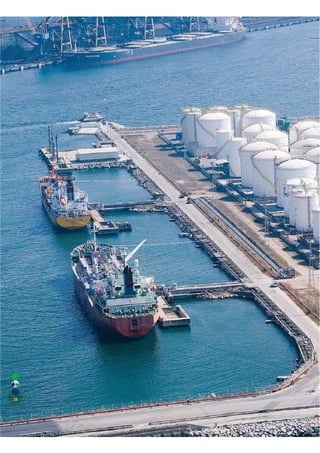
TERQUIMSA terminal, Port of Tarragona


            4. INTERVIEW RESULTS

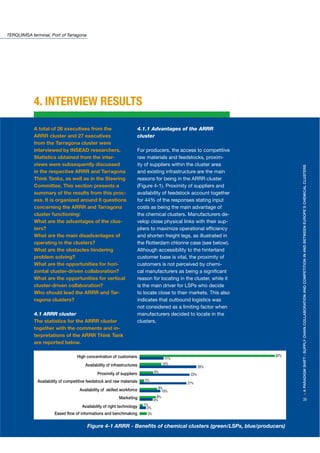
            A total of 26 executives from the                           4.1.1 Advantages of the ARRR
            ARRR cluster and 27 executives                              cluster
            from the Tarragona cluster were
            interviewed by INSEAD researchers.                          For producers, the access to competitive
            Statistics obtained from the inter-                         raw materials and feedstocks, proxim-
            views were subsequently discussed                           ity of suppliers within the cluster area


                                                                                                                             > A PARADIGM SHIFT : SUPPLY CHAIN COLLABORATION AND COMPETITION IN AND BETWEEN EUROPE’S CHEMICAL CLUSTERS
            in the respective ARRR and Tarragona                        and existing infrastructure are the main
            Think Tanks, as well as in the Steering                     reasons for being in the ARRR cluster
            Committee. This section presents a                          (Figure 4-1). Proximity of suppliers and
            summary of the results from this proc-                      availability of feedstock account together
            ess. It is organized around 6 questions                     for 44% of the responses stating input
            concerning the ARRR and Tarragona                           costs as being the main advantage of
            cluster functioning:                                        the chemical clusters. Manufacturers de-
            What are the advantages of the clus-                        velop close physical links with their sup-
            ters?                                                       pliers to maximize operational efficiency
            What are the main disadvantages of                          and shorten freight legs, as illustrated in
            operating in the clusters?                                  the Rotterdam chlorine case (see below).
            What are the obstacles hindering                            Although accessibility to the hinterland
            problem solving?                                            customer base is vital, the proximity of
            What are the opportunities for hori-                        customers is not perceived by chemi-
            zontal cluster-driven collaboration?                        cal manufacturers as being a significant
            What are the opportunities for vertical                     reason for locating in the cluster, while it
            cluster-driven collaboration?                               is the main driver for LSPs who decide
            Who should lead the ARRR and Tar-                           to locate close to their markets. This also
            ragona clusters?                                            indicates that outbound logistics was
                                                                        not considered as a limiting factor when
            4.1 ARRR cluster                                            manufacturers decided to locate in the
            The statistics for the ARRR cluster                         clusters.
            together with the comments and in-
            terpretations of the ARRR Think Tank
            are reported below.

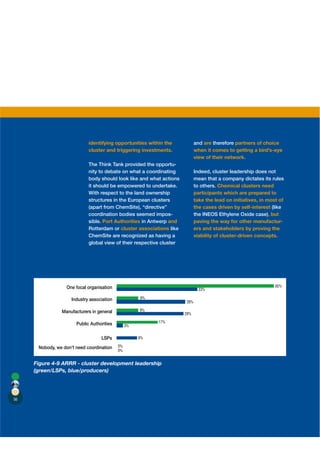
                                   High concentration of customers                                                     62%
                                                                                          11%
                                        Availability of infrastructures                  10%
                                                                                                       26%
                                               Proximity of suppliers             6%
                                                                                                 23%
              Availability of competitive feedstock and raw materials      2%
                                                                                                21%
                                     Availability of skilled workforce              8%
                                                                                      10%
                                                            Marketing               8%
                                                                                  6%                                         35
                                      Availability of right technology     1%
                                                                             3%
                       Eased flow of informations and benchmaking            3%


                                         Figure 4-1 ARRR - Benefits of chemical clusters (green/LSPs, blue/producers)
The benefits of co-siting:
     the Rotterdam chlorine case
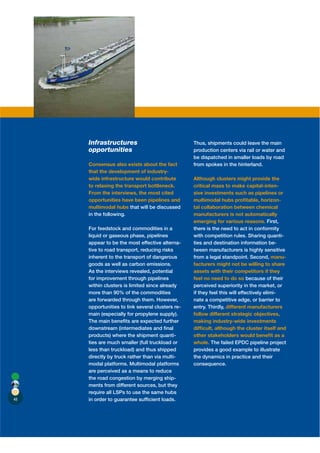
     Rotterdam is home to one of the most highly integrated and ef-
     ficient chlorine and derivatives clusters in the world, built around
     the modern chlorine manufacturing operations of Akzo Nobel in
     the Botlek part of Rotterdam. Chlorine is supplied by a network of
     pipelines to a number of derivatives producers in the vicinity.

     Shin-Etsu, a Japanese producer of vinyls, has a long-term contract
     with Akzo Nobel for the supply of chlorine to its ethylene dichloride
     (EDC), vinyl chloride monomer (VCM) and polyvinyl chloride (PVC)
     manufacturing processes. The EDC and VCM plants are physically
     located on the Akzo Nobel site, while the PVC plant is a few kilom-
     eters away in Pernis. The connection between VCM and PVC units
     is by pipeline, leasing one of the multicore pipelines for this stretch
     (see description of Multicore below).

     Huntsman is another important member of the Rotterdam chlorine
     derivatives cluster, having a long-term chlorine supply contract
     with Akzo Nobel for its MDI manufacturing operations in the Ro-
     zenburg area of Rotterdam. The chlorine that Huntsman uses is
     returned to Akzo Nobel in the form of gaseous hydrochloric acid,
     which is then used as an additional feedstock for the EDC/VCM
     production by Shin-Etsu. This recycling step allows the chlorine
     molecules to be used twice.

     Hexion takes chlorine from Akzo Nobel for epichlorhydrin produc-
     tion and uses it to manufacture a range of epoxy resins at its plant
     in Pernis.

     Tronox also plays a role in the Rotterdam chlorine derivatives clus-
     ter. The company manufactures titanium dioxide at its Botlek plant
     and draws its chlorine needs from Akzo Nobel via a dedicated
     pipeline link.

     These 5 companies have established a highly integrated and syn-
     ergistic collaborative model enabling optimal production efficien-
     cies and economics to the benefit of all stakeholders, avoiding
     in addition the highly dangerous above-ground transportation of
     chlorine. A significant expansion of chlorine capacity has been
     necessary to support the growing demand among the derivative
     producers.


36   CLUSTER
Terminal, Tarragona, VOPAK


The discussion of the Think Tank
around these results provided the
occasion to review the history of the
existing clusters with the participants.
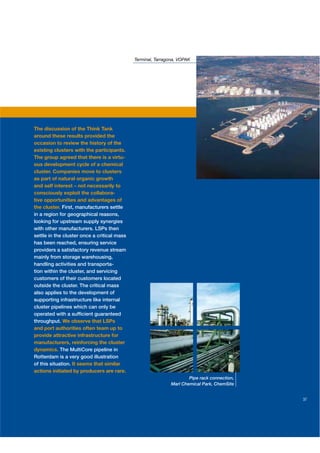
The group agreed that there is a virtu-
ous development cycle of a chemical
cluster. Companies move to clusters
as part of natural organic growth
and self interest – not necessarily to
consciously exploit the collabora-
tive opportunities and advantages of
the cluster. First, manufacturers settle
in a region for geographical reasons,
looking for upstream supply synergies
with other manufacturers. LSPs then
settle in the cluster once a critical mass
has been reached, ensuring service
providers a satisfactory revenue stream
mainly from storage warehousing,
handling activities and transporta-
tion within the cluster, and servicing
customers of their customers located
outside the cluster. The critical mass
also applies to the development of
supporting infrastructure like internal
cluster pipelines which can only be
operated with a sufficient guaranteed
throughput. We observe that LSPs
and port authorities often team up to
provide attractive infrastructure for
manufacturers, reinforcing the cluster
dynamics. The MultiCore pipeline in
Rotterdam is a very good illustration
of this situation. It seems that similar
actions initiated by producers are rare.
                                                                      Pipe rack connection,
                                                              Marl Chemical Park, ChemSite


                                                                                              37
MultiCore pipeline in the port of Rotterdam:
           a common infrastructure to the benefit of all
           The effective and efficient operation of the Rotterdam chemical
           cluster depends on the availability of adequate infrastructure. For
           many years the Port of Rotterdam Authority has played an active
           role in supporting the creation of optimum conditions for par-
           ticipants in the cluster. Pipelines play a key role in the cluster in
           moving large volumes of liquids and gases in a safe, environmen-
           tally friendly, and cost efficient manner between producers and
           users. Working in a Joint Venture with VOPAK, the Port of Rot-
           terdam Authority has created Multicore, a unique concept for the
           renting of pipeline capacity (on a variable time and distance basis)
           for companies in the port and industrial area. This offers an attrac-
           tive, cost effective alternative to truck transport or inland vessels
           and barges.

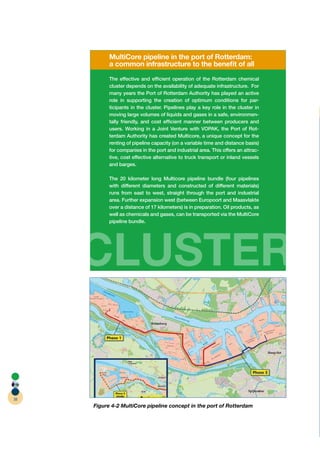
           The 20 kilometer long Multicore pipeline bundle (four pipelines
           with different diameters and constructed of different materials)
           runs from east to west, straight through the port and industrial
           area. Further expansion west (between Europoort and Maasvlakte
           over a distance of 17 kilometers) is in preparation. Oil products, as
           well as chemicals and gases, can be transported via the MultiCore
           pipeline bundle.


     CLUSTER

38
     Figure 4-2 MultiCore pipeline concept in the port of Rotterdam
The competition of LSPs benefits the         4.1.2 Disadvantages of the ARRR
existing base of chemical producers         cluster
and signals the attractiveness of the
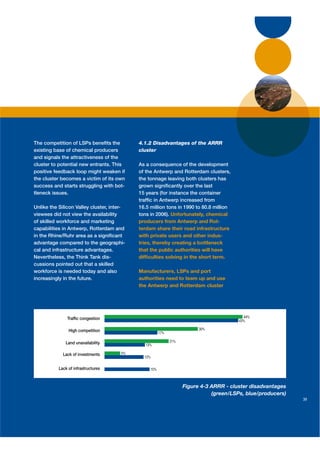
cluster to potential new entrants. This     As a consequence of the development
positive feedback loop might weaken if      of the Antwerp and Rotterdam clusters,
the cluster becomes a victim of its own     the tonnage leaving both clusters has
success and starts struggling with bot-     grown significantly over the last
tleneck issues.                             15 years (for instance the container
                                            traffic in Antwerp increased from
Unlike the Silicon Valley cluster, inter-   16.5 million tons in 1990 to 80.8 million
viewees did not view the availability       tons in 2006). Unfortunately, chemical
of skilled workforce and marketing          producers from Antwerp and Rot-
capabilities in Antwerp, Rotterdam and      terdam share their road infrastructure
in the Rhine/Ruhr area as a significant      with private users and other indus-
advantage compared to the geographi-        tries, thereby creating a bottleneck
cal and infrastructure advantages.          that the public authorities will have
Nevertheless, the Think Tank dis-           difficulties solving in the short term.
cussions pointed out that a skilled
workforce is needed today and also          Manufacturers, LSPs and port
increasingly in the future.                 authorities need to team up and use
                                            the Antwerp and Rotterdam cluster


               Traffic congestion                                                          44%
                                                                                        43%

                High competition                                         30%
                                                       17%

              Land unavailability                            21%
                                               13%

             Lack of investments       5%
                                              13%


           Lack of infrastructures               15%


                                                                   Figure 4-3 ARRR - cluster disadvantages
                                                                              (green/LSPs, blue/producers)
                                                                                                             39
Derivatives site, Tarragona, Dow


     synergies on hinterland deliveries to            cluster development that has attract-
     make environmentally friendly trans-             ed many service providers to the
     port modes a competitive alternative             region. However, one LSP mentioned
     to road transport. Indeed, more than             that the size of the market was big
     70% of the responses mention conges-             enough to allow many LSPs to build
     tion stems from the lack of investment           sufficient critical mass to work profit-
     in infrastructure in the Antwerp/Rot-            ably, thus not requiring LSPs to merge
     terdam cluster. The extension of the             their assets. As a result of this frag-
     Port of Rotterdam with the scheduled             mentation of the market, companies
     Maasvlakte 2 (see Figure 3-6) might              may have to load and/or discharge
     aggravate the problem if producers are           parcels from different storage points
     not willing or able to increase the rail         in the port. This extends the waiting
     and barge portion of their shipments in          time for the vessels, increases demur-
     the near future.                                 rage costs and harms asset produc-
                                                      tivity. To tackle the asset fragmenta-
     Apart from traffic congestion, manufac-           tion issue, Oiltanking and Stolthaven
     turers do not consider land availability         Terminals, two logistics providers,
     or competition as being significant               have teamed up to develop dedicated
     hurdles for operating in the clusters.           storage facilities, thereby reducing inef-
     Competition is considered by the                 ficiencies in vessel loading.
     interviewees as being worldwide and
     not simply limited to the ARRR cluster.
     Furthermore, the existence of swap
     arrangements and common capacity
     investments such as the HPPO plant
     in Antwerp show that, subject to the
     respect of competition rules, manufac-
     turers have no problem collaborating
     when the synergies are obvious and the
     value proposition is economically and
     strategically sound.

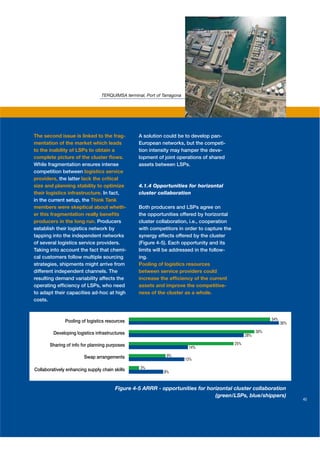
     Apart from traffic congestion, LSPs
     perceive competition between them-
     selves as a disadvantage of the clus-
     ter. This, as mentioned earlier, is the
40   logical consequence of a successful
Asset pooling between LSPs in the Antwerp
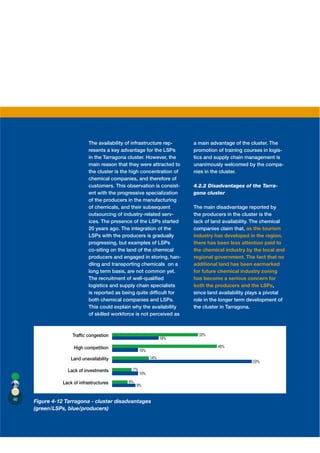
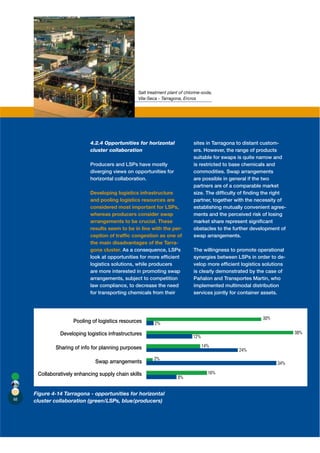
cluster: the Oiltanking/Stolthaven collaboration

In March 2006, Oiltanking GmbH and Stolthaven Terminals BV
announced an Antwerp terminal joint venture called Oiltanking
Stolthaven Antwerp NV, which will operate as an independent
liquid storage provider on the right bank of the river Schelde.

The terminal is located in the midst of the Antwerp chemical clus-
ter and is part of the extensive logistics infrastructure supporting
cluster operations. The terminal will be developed as a “Specialty
Chemical Hub” for the Antwerp and Rotterdam (plus Amsterdam)
clusters, and as a transportation hub to improve the turnaround
and utilization of the Stolt chemical parcel tanker fleet.

Parcel tanker operators can face up to 40% of total vessel time
in port, moving from one jetty to another. The downside of the
cluster may be that there are too many producers and LSPs who
have the critical mass to build their own assets, rather than being
forced by their small size to explore all the opportunities to share
logistics assets inside the cluster.


CLUSTER
The LBC/Ertisa collaboration is another illustration of a logistics pro-
vider (LBC) collaborating and setting up dedicated storage assets
on a customer’s site (Bayer) to serve another customer (Ertisa).


                                                                           41
Benefit from cluster synergies via vertical
     collaboration: the LBC/Ertisa case

     In July 2006 the LBC tank terminal group and Ertisa, a subsidiary
     of the Spanish oil and energy group CEPSA announced their
     intention to form a Joint Venture to build and operate a tank stor-
     age terminal in Antwerp. The first phase of the project would be to
     build storage for Ertisa products – followed by a second phase for
     other LBC customers. There would also be facilities for the han-
     dling of rail tank cars, road tank trucks, and tank containers. Other
     value added services, such as drumming and blending, would be
     built in line with demand.

     The terminal will be located at the Bayer site on the right bank
     of the Schelde river, in the heart of the chemical cluster. The site
     offers deepwater access to accommodate the largest chemical
     parcel and product tankers.

     The demand for storage was based on Ertisa’s increasing pro-
     duction of phenol and acetone in Huelva in the south of Spain,
     and the need to position product close to its major customers in
     Northern Europe. This complemented LBC’s plans to strengthen
     their position in the growing Antwerp chemical cluster, extend
     their relationship with an established customer, and provide
     existing and new customers with a prime new location for stor-
     age and other services.

     This development is also in line with Bayer’s plans to develop the
     spare land on their site as a chemical park, and with the process
     of optimizing the use of services and infrastructure available on
     the site. This is a good example of cluster-driven collaboration.


42
     CLUSTER
TTR terminal, Port of Rotterdam, VOPAK


      4.1.3 Obstacles to overcoming                       balanced, but point out two issues in
      cluster disadvantages                               the current cluster setup. The first
                                                          is linked to the competition intensity
      According to shippers, the main ob-                 between LSPs, which is fueled by the
      stacle to solving congestion issues is              producers’ practice of breaking down
      the low willingness of the stakehold-               their logistics activities into smaller
      ers to tackle this issue in a collabo-              pieces and granting short term con-
      rative fashion (55% of the answers,                 tracts to a set of competing LSPs,
      Figure 4-4). Since manufacturers have               rather than exploiting a “total cost to
      outsourced their logistics activities,              serve” solution. According to a service
      they do not see themselves taking the               provider participating in the Think
      lead in developing logistics solutions              Tank, the fragmentation of the logistics
      on a local scale. This point of view is             market is the consequence of the lack
      reinforced by the fact that the deci-               of willingness of producers to collabo-
      sion centers for potential investments              rate with LSPs. Nevertheless, the Think
      are often not located in the cluster,               Tank discussions also highlighted the
      which leads to such projects receiving              fact that LSPs collaborate voluntarily
      lower attention on the radar screen of              when their service scope is comple-
      a producer’s top management (22% of                 mentary (e.g., the Pernis Combi Termi-
      the answers).                                       nal in Rotterdam) or when a producer
                                                          asks competing service providers to
      The answers of LSPs are more                        develop a solution together.


              Lack of collaboration between the companies                                  23%
                                                                                                              55%

Lack of port authorities', governmental and regional actions                               23%
                                                                               12%

             Absence of companies' local decision centres                 9%
                                                                                           22%

                               Fragmentation of the market                                       26%
                                                                   5%

              Lack or misallocation of EU investment funds                           19%
                                                                     6%


                                                 Figure 4-4 ARRR - obstacles to overcoming cluster disadvantage
                                                                                   (green/LSPs, blue/producers)
                                                                                                                    43
Horizontal LSP collaboration in the Port of Rot-
     terdam - Pernis Combi Terminal

     Pernis Combi Terminal in the heart of the industrial port area of
     Rotterdam was created in 2005 on the initiative of Den Hartogh
     Logistics, Nijhof-Wassink, MCS (Multi-Modal Container Ship-
     ping) and VLS. The project started in 2003 when the LSPs agreed
     that there was market potential for a Tri-modal service centre in
     the Rotterdam industrial area, combining road, rail and water.
     This terminal could be further complemented with warehousing,
     drumming lines and container storage. The terminal started its
     operations in February 2006.

     Each of the four collaborators has its own specialty to bring to
     the venture: Den Hartogh Logistics is a bulk liquid chemical logis-
     tics specialist, Nijhof-Wassink a bulk specialist, MCS a shipping
     specialist and VLS a warehouse specialist.

     This LSP collaboration offers the Rotterdam chemical cluster an
     efficient hub and spoke tri-modal solution. Truck, barge and rail
     combine Sea Port and European Maritime cargo with the Europe-
     an rail and road network, offering the possibility of consolidating
     Continental and Maritime cargo for distribution into Europe or
     transshipment to overseas destinations by truck, rail or barge.
     The drumming and warehouse operations further complement
     these services.

     The current train services have been operating directly to Györ
     (Hungary) since February 2006 and to Lyon (France) since June
     2007, and there is a daily shunt to the main Rotterdam station
     for outbound services to other destinations. The current barge
     services offer shuttles to and from the other European chemical
     clusters.


     CLUSTER
44
TERQUIMSA terminal, Port of Tarragona


The second issue is linked to the frag-           A solution could be to develop pan-
mentation of the market which leads               European networks, but the competi-
to the inability of LSPs to obtain a              tion intensity may hamper the deve-
complete picture of the cluster flows.             lopment of joint operations of shared
While fragmentation ensures intense               assets between LSPs.
competition between logistics service
providers, the latter lack the critical
size and planning stability to optimize           4.1.4 Opportunities for horizontal
their logistics infrastructure. In fact,          cluster collaboration
in the current setup, the Think Tank
members were skeptical about wheth-               Both producers and LSPs agree on
er this fragmentation really benefits              the opportunities offered by horizontal
producers in the long run. Producers              cluster collaboration, i.e., cooperation
establish their logistics network by              with competitors in order to capture the
tapping into the independent networks             synergy effects offered by the cluster
of several logistics service providers.           (Figure 4-5). Each opportunity and its
Taking into account the fact that chemi-          limits will be addressed in the follow-
cal customers follow multiple sourcing            ing.
strategies, shipments might arrive from           Pooling of logistics resources
different independent channels. The               between service providers could
resulting demand variability affects the          increase the efficiency of the current
operating efficiency of LSPs, who need             assets and improve the competitive-
to adapt their capacities ad-hoc at high          ness of the cluster as a whole.
costs.


               Pooling of logistics resources                                                                  34%
                                                                                                                     36%

         Developing logistics infrastructures                                                            30%
                                                                                                   28%

       Sharing of info for planning purposes                                                 25%
                                                                          14%

                        Swap arrangements                      9%
                                                                         13%

Collaboratively enhancing supply chain skills      3%
                                                              8%


                                        Figure 4-5 ARRR - opportunities for horizontal cluster collaboration
                                                                               (green/LSPs, blue/shippers)
                                                                                                                           45
Pooling of logistics assets                 the cluster. The horizontal collaboration
                                                                         of Oiltanking and Stolthaven Terminals
                             Interestingly, the pooling of logistics     is an example of LSPs consolidating
                             resources is the most frequent answer       assets in order to correct inefficiencies
                             for both producers and service provi-       related to jetty fragmentation.
                             ders (35% of the answers). According
                             to the LSPs, the growth of the cluster      As mentioned previously, producers
                             has allowed them to build their own lo-     follow a contradictory strategy with
                             gistics capabilities separately. In some    respect to the cluster opportunities.
                             cases, however, this uncoordinated          Producers expect LSPs to be able to
                             growth has led to inefficiencies within      collaborate in order to optimize the use
                                                                         of their assets. Simultaneously, they
                                                                         fuel the competition between LSPs
                                                                         by frequently tendering their logistic
                            CURRENT SITUATION                            processes while not giving guarantees
                ISOLATED OUTSOURCING OF LOGISTICS SERVICES
                                                                         on quantities. The fact that service
                                                   hinterland region X   providers have currently a very partial
              cluster
                                                                         and temporary view of the overall
            shipper 1             LSP 1                 customer 1       cluster flows prevents them to design
              shipper 2                                                  long-term, sustainable concepts for
                                  LSP 2                                  supplying the hinterland. In a nutshell,
                                                          customer 2
                shipper 3         LSP 1
                                                                         manufacturers forego cluster-inherent
                                                                         synergies with respect to their out-
                                                                         bound logistics by fragmenting the
                            POTENTIAL SCENARIO                           market and not sharing logistics assets
              COORDINATED OUTSOURCING OF LOGISTICS SERVICES
                                                                         with their competitors.
                                                   hinterland region X
              cluster
                                                                         In the presence of a dynamic but
            shipper 1                                   customer 1
                                                                         fragmented market for LSPs, shippers
              shipper 2            LSP 1&2                               are the main players able to trigger
                                                          customer 2     the development of solutions exploit-
                shipper 3
                                                                         ing cluster synergies in distribution
                                                                         logistics. In this context, one promising
                                                                         opportunity is the ComLog initiative of
                                                                         Bayer, Degussa and Lanxess.
     Figure 4-6 Isolated tendering cannot take
46   advantage of cluster opportunities
ComLog – Common Logistics Procurement:
an example of both vertical and horizontal
cooperation

Besides integrating service providers more closely into producer
supply chains (vertical cooperation), the cooperation between
producers themselves (horizontal cooperation) presents poten-
tial for synergies (e.g., by using a common portfolio of service
providers, optimizing logistics concepts, and achieving operat-
ing efficiencies for all parties involved). When all the parties are
located within a cluster the concepts can be more easily devel-
oped and the opportunities and benefits more readily achieved.

Based in the ChemSite cluster, Bayer and Degussa imple-
mented an innovative form of horizontal cooperation when
they set up a common logistics procurement operation in 2003
called ComLog. Today the partners are Bayer, Lanxess and
Degussa – the latter being represented within the RAG Group by
RAG Service GmbH, under which the procurement function has
since been centralized.

Operating within a cluster environment leverages the benefits of
bundling of demand for logistics services from three manufac-
turers. As a result LSPs are able to operate on a more efficient
scale.

One example that horizontal collaboration can foster vertical
collaboration is the strategic partnership between ComLog and
the German Railway company Railion. Next to a long term frame
contract minimizing operating costs for inland transportation
and providing incentives to shift more cargo from road to rail, the
contracted volumes allowed the implementation of a ComLog
specific single railcar solution.


CLUSTER                                                               47
Infrastructures                              Thus, shipments could leave the main
     opportunities                                production centers via rail or water and
                                                  be dispatched in smaller loads by road
     Consensus also exists about the fact         from spokes in the hinterland.
     that the development of industry-
     wide infrastructure would contribute         Although clusters might provide the
     to relaxing the transport bottleneck.        critical mass to make capital-inten-
     From the interviews, the most cited          sive investments such as pipelines or
     opportunities have been pipelines and        multimodal hubs profitable, horizon-
     multimodal hubs that will be discussed       tal collaboration between chemical
     in the following.                            manufacturers is not automatically
                                                  emerging for various reasons. First,
     For feedstock and commodities in a           there is the need to act in conformity
     liquid or gaseous phase, pipelines           with competition rules. Sharing quanti-
     appear to be the most effective alterna-     ties and destination information be-
     tive to road transport, reducing risks       tween manufacturers is highly sensitive
     inherent to the transport of dangerous       from a legal standpoint. Second, manu-
     goods as well as carbon emissions.           facturers might not be willing to share
     As the interviews revealed, potential        assets with their competitors if they
     for improvement through pipelines            feel no need to do so because of their
     within clusters is limited since already     perceived superiority in the market, or
     more than 90% of the commodities             if they feel this will effectively elimi-
     are forwarded through them. However,         nate a competitive edge, or barrier to
     opportunities to link several clusters re-   entry. Thirdly, different manufacturers
     main (especially for propylene supply).      follow different strategic objectives,
     The main benefits are expected further        making industry-wide investments
     downstream (intermediates and final           difficult, although the cluster itself and
     products) where the shipment quanti-         other stakeholders would benefit as a
     ties are much smaller (full truckload or     whole. The failed EPDC pipeline project
     less than truckload) and thus shipped        provides a good example to illustrate
     directly by truck rather than via multi-     the dynamics in practice and their
     modal platforms. Multimodal platforms        consequence.
     are perceived as a means to reduce
     the road congestion by merging ship-
     ments from different sources, but they
     require all LSPs to use the same hubs
48   in order to guarantee sufficient loads.
The challenge of multi-company infrastruc-
ture investments: the EPDC case
A project to construct a polymer grade propylene pipeline link-
ing several production and consumption sites in northwest Eu-
rope had been considered by some companies in the European
petrochemical industry for many years. The example of the ARG
ethylene line illustrated that this type of line could be a success-
ful way of moving propylene around the industry, with the clear
environmental benefits of using pipelines to transport this gas
while preserving potentially beneficial economics.

By 1999 the industry believed that a substantial European short-
fall of polymer grade propylene to supply derivatives was likely
to come about in the following years, requiring increased imports
from other regions of the world. Consequently, more companies
became interested in a pipeline linking European polypropylene
manufacturers to the sea and access to polypropylene imports. It
was at this time that the EPDC (European Pipeline Development
Corp) was created in order to construct the so-called ‘U-line’
linking Rotterdam/Antwerp with Marl in the North and Wesseling
in the South.

EPDC originally comprised 15 industry shareholder companies; by
2005 these had been reduced to 8 as a result of industry consoli-
dation. These 8 companies (INEOS, Westgas, Shell, Sabic, Cela-
nese, DSM, Sasol and BASF) had interests in, and economic ben-
efits from, different parts of the line. All agreed that, once the whole
line was constructed, the entire petrochemical industry in Western
Europe would benefit in unforeseen ways from its completion.

On the surface, this seems like a real example of industry cooper-
ation leading to improved infrastructure linkage between clusters
in Western Europe. However the decision was taken in March
2007 to terminate the full project, although a build of reduced
scope, in northern Germany only, may still go ahead.

According to industry experts, the failure of this apparently ben-
eficial horizontal collaboration has several origins. Firstly, the
‘lowest cost’ objective of the project introduced elements (i.e., a
drive for subsidies) which extended the project and, in fact, add-
ed cost. To achieve the maximum in subsidies, at least two years
was added to the project timeline. Furthermore, the conditions
imposed by the authorities to obtain these subsidies resulted in
higher costs and restricted flexibility in attracting new investors.
As a result costs were 35% higher as a direct consequence of the
subsidy conditions – far outweighing the value of the subsidy!


                                                     >>                   49
>
     A second reason is that the single project cross-border execution
     strategy was not in line with existing pipeline construction market
     realities, as there were no cross-border pipeline and engineering
     companies. A tailored approach by country had to be adopted
     which, with hindsight, added complexity and cost.

     Thirdly, the business model, which had many shareholder
     ‘givens’ or conditions, hindered the project roll-out. The share-
     holder companies were driven by their ‘internal economics’:
     “What’s in it for me?” - and not in the first place by an overall
     general industry or stakeholder value. This had several conse-
     quences, but, put simply, each decision taken by EPDC had to
     be tested against individual company self interest. This length-
     ened both the process and the overall project time and cost. The
     shareholder ‘givens’ thus restricted the EPDC ability to optimally
     manage the overall project.

     Hence the project took too long from inception to decision,
     leading to increasing costs, particularly in the last two years, as
     global shortages of raw materials and EPDC contractor capac-
     ity impacted all projects. Of course, as costs rose, profitability
     declined – which led to a unanimous view in March 2007 that the
     project was not viable.


     C
     CLUSTER
           R

50
number of SKUs

         1000


                   scope of profitable
                        swaps


          100

          10
                                                                                            product type
                 feedstock          commodities         intermediates        specialities


                                                                Figure 4-7 Scope of profitable swaps


Sharing of planning infor-                    and polypropylene producers are less
mation to exploit cluster                     willing to collaborate in swap arrange-
synergies                                     ments within a local area.

Despite the ComLog example, sharing           Apart from the increasing number of
of transport planning information be-         product variants making a direct swap
tween chemical manufacturers is very          cumbersome to organize (see Figure
critically perceived, especially because      4- 7), polymer commodities manufac-
of concerns related to competition            turers are reluctant to allow their cus-
rules. Moreover, the joint design of a        tomers to receive competing products.
logistics network could lead to the           To cite one interviewee: “you do not
exchange of strategic information             want to remind your customer that your
related to the long-term sales plans of       competitor can also deliver the same
competing manufacturers. For these            item”. Swap agreements thus seem
reasons, producers consider that              to be triggered by the willingness to
LSPs should share planning data in            avoid empty transport legs. In this
order to exploit the synergies of joint       context, the most significant savings
shipments.                                    are achieved through swaps between
                                              two different clusters. Isolated chemi-
                                              cal clusters separated from each
Swap arrangements                             other seem more interested in swaps
                                              than integrated ones. Therefore, it
Although the manufacturers have cited         is not surprising that the potential
swap arrangements as examples of              of swap arrangements is cited more
horizontal collaboration in 13% of the        frequently in Tarragona than in the
cases, we observe that the occurrence         Antwerp/Rotterdam region.
of this answer depends on the posi-
tion of the company in the chemical
chain and on its competitive strategy.
All interviewees are concerned about
compliance with competition rules and
companies referring to swaps do this
after due examination of competition
law effects. Swaps seem to be more
common practice for raw materials
and feedstock, whereas polyethylene                                                                        51
Development of workforce                    Concerning inbound and outbound
     competencies                                logistics, we recall that this integration
                                                 might only pay off in the cluster con-
     Finally, companies do not grant the         cept if the service provider has already
     same importance to the joint develop-       reached a critical mass in the cluster.
     ment of workforce competencies as
     they do to infrastructure topics. Supply    To benefit from cluster synergies, LSPs
     chain skills are not seen as a priority,    need to have access to the best plan-
     although the interviewees fear an           ning information available so they can
     imminent shortage of skilled work-          efficiently plan their loads and optimize
     ers when the baby-boom generation           the use of their assets. Thus, service
     retires.                                    providers perceive a collaborative
                                                 sharing of data as the main opportunity
     4.1.5 Opportunities for vertical            (35% of answers), while this is not re-
     cluster collaboration                       flected in the producers’ answers. From
                                                 the interviews, we know that automat-
     Customer/supplier relationships offer       ed forecast exchanges between LSPs
     opportunities to obtain the benefits of      and producers (via electronic data in-
     clustered operations. From the Think        terchange for instance) are very rare,
     Tank discussions in 2004 and 2005, it       and this potentially results in higher
     was obvious that lack of information        transaction costs to the service
     sharing made it difficult for manu-          providers. Forecasts are generally
     facturers and LSPs to obtain a clear        exchanged on a monthly aggregated
     picture of structural network oppor-        basis via spreadsheet applications.
     tunities and benefits from operational       Forecast data with higher granularity is
     planning. The integration of service        either not available due to planning
     providers in the strategic network          uncertainty or too costly to exchange
     planning process of shippers is the         via automated IT bridges. The CLA
     most frequently quoted opportunity in       initiative between BP Chemicals and
     our interviews (48% for LSPs, 33% for       major logistics players, organized
     producers - Figure 4-8). This inte-         within the scope of one single legal
     grated planning has started with some       entity located on the BP site in order to
     shippers but remains limited to a very      enable access to the best information
     small set of logistics service providers.   available, is an exception to the rule.


52
Towers of distillation for the production of VCM at plant,
                                                                                                Vila-Seca - Tarragona, Ercros


              Integration of LSPs in designing SC solutions                                                                     48%
                                                                                                        33%

Collaboratively sharing planning data for logistics resources                                              35%
                                                                                      19%

         Develop more rational use of transportation modes                       18%
                                                                                       20%

                                 Develop VMI/CMI solutions                      17%

                                 Increasing bulk distribution          11%


                                                                                                                                      53
                                                Figure 4-8 ARRR - opportunities for vertical cluster collaboration
                                                                                   (green/LSPs, blue/producers)
Joint consortium in the cluster:
     the CLA initiative

     BP Chemicals decided in 1999 to tender all the liquid volumes
     out of their Benelux storage and production facilities, seeking a
     Pan-European solution for the transportation of their total volume.
     In 1999, the whole package was divided between 12 transport
     companies, who all had their niche market strengths.

     To enter the tendering process, 4 companies decided to establish
     a legal entity with the sole purpose of delivering a one-stop-shop
     service to BP Chemicals for the complete Benelux liquid package.
     The legal entity was headed by the following companies: Bertschi
     AG, Dedijcker NV, Dedecker-Vanriet NV, and VanderLee Transport

     This ‘natural’ alliance between 4 LSPs was enabled by the follow-
     ing factors:

     They had trust and respect for each other with a similar back-
     ground (family owned, own fleet and drivers, high quality stand-
     ards).

     Each company had its own geographical strength and they were
     therefore complementary partners with subsidiaries spread
     throughout the ARRR-cluster.

     When, in mid 2005, Dedijcker NV stopped its activities in the haul-
     age industry, the three remaining partners managed to absorb its
     volume without hampering the day-to-day operations.

     The success of the Alliance was dependent on a single contract,
     joint investment in equipment, and a CLA implant in the BP Chem-
     icals office. BP enjoyed the advantage of dealing with one part-
     ner, both commercially and operationally, and having joint project
     teams to work on continuous improvement in the supply chain.

     This is an example of cluster driven collaboration with natural
     alignment, resulting from cluster proximity, rather than being
     enforced. According to the interviewees, success was heavily
     dependent on mutual trust and an openness to share information
     and costs.


54
     CLUSTER
Site, Worringen - Cologne, INEOS


Chemical manufacturers face similar in-      The shift from road to rail and water-
formation quality issues with their cus-     based freight was seen as an oppor-
tomers and identify vendor-managed           tunity by both LSPs and producers
inventory (VMI) solutions more than          in about 20% of the cases. However,
customer-managed inventory (CMI)             the interviews highlighted the lack of
as an opportunity to improve supply          reliability of these transport modes
chain transparency. Currently, suppli-       compared to road, as well as the
ers of chemicals face erratic demand         costs of accessibility. Similar to the
patterns from their customers and do         Rotterdam MultiCore case, a coordi-
not have the opportunity to be proac-        nated approach between producers,
tive because of the lack of information      port authorities and LSPs appears to
shared. Without reliable forecast data,      be necessary, given the significant
shippers are not able to optimize their      investments required.
shipments to use the synergies of-
fered by clustered customers.                4.1.6 Who should lead the develop-
                                             ment of the cluster?
The last main opportunity related to
vertical cluster collaboration is the        The earlier discussions highlighted
development of more efficient ways            the need for coordination between
to dispatch products outside the             stakeholders (producers, LSPs,
cluster. Producers agree on the fact         authorities) to identify and exploit the
that increased bulk shipments would          opportunities offered by chemical
improve the load of the trucks, but in       clusters. This opinion is shared by all
the interviews they also mentioned           interviewees; none of them answered
repeatedly the limits of this approach.      positively to “we don’t need coordina-
First, customers might not want to           tion” (Figure 4- 9).
invest in bulk storage capacities. When      The question however remains who
it comes to commodities and certainly        should take the lead in the identifica-
to specialty chemicals, the quantities       tion and exploitation of the opportu-
to be delivered can be too small to          nities. The interview results are very
justify bulk shipment, or the material       revealing in the sense that LSPs state
may not be suited for this purpose           in the majority of cases (65%) one focal
(e.g. PVC rolls). Although an increase       organization is required to take the
in bulk transport is attractive from an      lead, but there was no agreement on
environmental perspective, marketing         who that should be. The manufactur-
aspects constrain the expansion of           ers’ answers are more precise and sug-
bulk transportation further down the         gest industry associations and manu-       55
chemical chain.                              facturers in general take the lead in
identifying opportunities within the            and are therefore partners of choice
                             cluster and triggering investments.             when it comes to getting a bird’s-eye
                                                                             view of their network.
                             The Think Tank provided the opportu-
                             nity to debate on what a coordinating           Indeed, cluster leadership does not
                             body should look like and what actions          mean that a company dictates its rules
                             it should be empowered to undertake.            to others. Chemical clusters need
                             With respect to the land ownership              participants which are prepared to
                             structures in the European clusters             take the lead on initiatives, in most of
                             (apart from ChemSite), “directive”              the cases driven by self-interest (like
                             coordination bodies seemed impos-               the INEOS Ethylene Oxide case), but
                             sible. Port Authorities in Antwerp and          paving the way for other manufactur-
                             Rotterdam or cluster associations like          ers and stakeholders by proving the
                             ChemSite are recognized as having a             viability of cluster-driven concepts.
                             global view of their respective cluster


                  One focal organisation                                                                         65%
                                                                               33%

                     Industry association             9%
                                                                       28%

                Manufacturers in general              9%
                                                                       28%

                       Public Authorities                  17%
                                                 3%


                                   LSPs               8%

      Nobody, we don't need coordination    0%
                                            0%


     Figure 4-9 ARRR - cluster development leadership
     (green/LSPs, blue/producers)


56
Proactive site leadership:
 the INEOS Ethylene Oxide case
 INEOS Oxide has a long history in Antwerp through a series of suc-
 cessive ownerships. In turn it has been Union Carbide, BP Chemi-
 cals and Inspec at the Zwijndrecht site on the left bank of the River
 Schelde. Third party hosting at the 200 ha site has been in place
 for many years, since BP Chemicals’ decision to sell its LDPE as-
 sets to Neste and its hydroethoxylates facilities to Union Carbide.

 With spare land available, and a strong interest on the part of IN-
 EOS to find additional on-site users for ethylene oxide, a highly
 hazardous product unsuitable for transportation, the site has been
 heavily promoted to attract investors; especially companies look-
 ing to establish an operational foothold in Europe.

 Kuraray, the first Japanese chemical company to settle in the Ant-
 werp port area, built an ethylene vinyl alcohol (EVOH) copolymer
 resin plant in 1999, and has subsequently progressively increased
 capacity.

 Nippon Shokubai followed Kuraray two years later and built a
 super-absorbent polymers plant on a plot adjacent to the INEOS
 site. As a result eight parties are now on the site including General
 Electric, Dow, Praxair, Seppic, Specialty Polymers Antwerp, and
 Borealis.

INEOS site

                                                                    Dow
                                                       Kuraray                       Seppic
                               ethylene oxide


             INEOS                                                Borealis
                                                                                  Spec. Polymers
                                                       Nippon                         Antw.
                                                      Shokubai   GE plastics


                                        oxygen, nitrogen                  power

                     Praxair                                     INEOS / Essent Energy


Utilities, wastewater treatment, maintenance, process control


                               Figure 4-10 INEOS Oxide co-siting concept

 The site offers many cluster advantages to new investors: land
 for production facilities; shared infrastructure; feedstock supply
 on site as well as by pipeline; utilities; waste treatment; and lo-
 gistics facilities, including a jetty, a railhead, loading gantries and
 tank storage. Due to this proactive site management, the ethylene
 oxide capacity has more than tripled in the last 15 years.
                                                                                                   57


CLUSTER
TAPP AIE - oil products terminal,
       Port of Tarragona, BASF and Dow


                                4.2 Tarragona                                    of the necessary inputs for the manu-
                                                                                 facturing processes of the chemical
                                The statistics for the Tarragona cluster         companies settled in Tarragona. The
                                together with the comments and inter-            appropriate flow of chemicals from the
                                pretations of the Tarragona Think Tank           port to the refineries, the crackers and
                                are reported below.                              the storage locations is ensured by a
                                                                                 suitable infrastructure.
                                4.2.1 Advantages of the Tarragona
                                cluster                                          The Dixquimics pipelines rack, which
                                                                                 involved both a high percentage of
                                The main advantages perceived by the             companies and the local authorities,
                                Tarragona producers are the availability         emphasizes the importance of infra-
                                of competitive feedstock and raw ma-             structure in the Tarragona cluster op-
                                terials, and the proximity of suppliers.         erations. It also points to the necessity
                                With an import of almost                         of considering the longer term mainte-
                                18 million tons of petroleum products,           nance and growth of the cluster’s and
                                the port represents the main source              regional infrastructure.


                          High concentration of customers                                                               53%
                                                                           10%
                               Availability of infrastructures                   18%
                                                                                       22%
                                      Proximity of suppliers               9%
                                                                                             27%
     Availability of competitive feedstock and raw materials          6%
                                                                                             27%
                            Availability of skilled workforce         6%
                                                                           9%
                                                   Marketing     4%

                             Availability of right technology    3%
                                                                      6%
              Eased flow of informations and benchmaking


     Figure 4-11 Tarragona - Benefits of chemical cluster
     (green/LSPs, blue/producers)


58
Dixquimics Pipe Rack

Dixquimics represents the rack of over 60 pipelines connecting
the port with the south industrial park in the Tarragona chemi-
cal cluster. Several companies use the same pipeline complex
for their product interchanges. We can report as an example the
case of ethylene oxide, flowing from IQA to Dow Quimica and
Clariant, and the case of chlorine, flowing from Ercros to Bayer.

Started in 1998 with the participation of just 5 chemical com-
panies, Dixquimics now involves 16 companies in the Tarragona
industrial complex, and moves 1.5 million tons/year of chemicals
along a route of about 7 km.

The prospect of significantly decreasing investment costs and
unifying all the pipelines into one single legal entity, in order to
obtain a simplified authorization process, led the chemical com-
panies to collaborate to embark on this project.

Since its construction, Dixquimics has favored the development
of logistics synergies between cluster players. In this respect, the
example of Terminales Quimicos S.A. (Terquimsa) handling vinyl
acetate for Celanese at its port facilities, constitutes an impor-
tant example. Indeed, due to the Dixquimics rack of pipelines,
the previous vinyl acetate road transportation has been com-
pletely eliminated and product handling has been completely
outsourced to Terquimsa.


CLUSTER                                                                59
The availability of infrastructure rep-    a main advantage of the cluster. The
                             resents a key advantage for the LSPs       promotion of training courses in logis-
                             in the Tarragona cluster. However, the     tics and supply chain management is
                             main reason that they were attracted to    unanimously welcomed by the compa-
                             the cluster is the high concentration of   nies in the cluster.
                             chemical companies, and therefore of
                             customers. This observation is consist-    4.2.2 Disadvantages of the Tarra-
                             ent with the progressive specialization    gona cluster
                             of the producers in the manufacturing
                             of chemicals, and their subsequent         The main disadvantage reported by
                             outsourcing of industry-related serv-      the producers in the cluster is the
                             ices. The presence of the LSPs started     lack of land availability. The chemical
                             20 years ago. The integration of the       companies claim that, as the tourism
                             LSPs with the producers is gradually       industry has developed in the region,
                             progressing, but examples of LSPs          there has been less attention paid to
                             co-siting on the land of the chemical      the chemical industry by the local and
                             producers and engaged in storing, han-     regional government. The fact that no
                             dling and transporting chemicals on a      additional land has been earmarked
                             long term basis, are not common yet.       for future chemical industry zoning
                             The recruitment of well-qualified           has become a serious concern for
                             logistics and supply chain specialists     both the producers and the LSPs,
                             is reported as being quite difficult for    since land availability plays a pivotal
                             both chemical companies and LSPs.          role in the longer term development of
                             This could explain why the availability    the cluster in Tarragona.
                             of skilled workforce is not perceived as


                    Traffic congestion                                    33%
                                                                 18%

                     High competition                                             40%
                                                     10%

                    Land unavailability                    14%
                                                                                                 53%

                  Lack of investments           7%
                                                     10%

                Lack of infrastructures       6%
                                                   9%


60
     Figure 4-12 Tarragona - cluster disadvantages
     (green/LSPs, blue/producers)
Chemical park, Tarragona, Bayer


Land for future growth of the chemi-             According to LSPs, the main disad-
cal industry in Tarragona is available           vantage of being associated with the
almost uniquely within the properties            cluster is the high level of competi-
of the chemical companies. Indeed the            tion. This may explain the rare cases of
chemical facilities do not fully occupy          horizontal collaboration between LSPs
the land of many chemical companies,             in the cluster. Pooling logistics resourc-
and a substantial part (about 50%)               es and joint development of logistics
remains unexploited. The Think Tank              infrastructures are not considered as
in Tarragona agreed on the necessity             real opportunities by the LSPs. A high
to analyze the feasibility of managing           percentage of LSPs consider that
existing unexploited land on a joint/            the trigger for collaboration between
collaborative basis which could en-              them should come from the chemical
able long term land leases or sales of           producers.
land to third party investments. The
association of chemical companies                Producers and LSPs partly agree that
in Tarragona, AEQT, is not vested                traffic congestion is a disadvantage of
with the power of managing the land,             the cluster. The traffic congestion is-
but the possibility of broadening and            sues do not relate to movements within
strengthening its role has been the              the cluster, but rather to linking Tar-
subject of several discussions in the            ragona to its hinterland markets. The
Think Tank sessions.                             distance from neighboring European
                                                 countries, the specific Spanish rail
However, the chemical companies                  gauge different from the French one,
claim that the substantial percentage            and national constraints in road trans-
of unexploited land in the Tarragona             port (e.g. driving bans) are reported
cluster is also related to the complex-          by the companies in Tarragona as the
ity of getting the right authorizations          main complications in the distribution
for the development of chemical                  of the products from the manufacturers
projects on available/zoned land.                to the customers.
Finally, although showing a lower
percentage result, the LSPs are also             The prospect of increasing logistics
seriously concerned about the issue of           efficiency triggered for example a
land availability, since land prices in the      collaboration initiative between Bayer
chemical industrial parks in and around          Polimeros, S.L. and Bertschi Iberica,
Tarragona have significantly increased            S.L., with the objective of develop-
over the last few years.                         ing a container terminal based on the
                                                 existing railway connection on Bayer’s       61
                                                 property.
Multimodal Container Terminal

     The Tarragona chemical cluster does not have a container rail
     terminal. Containers to and from the Tarragona manufacturing
     sites have to be moved by truck to Constantí, where the nearest
     terminal is located. In 2005 the opportunity of constructing a
     container terminal for the whole Tarragona chemical cluster led
     Bertschi to start negotiating with Bayer, which had ample land
     available, and on whose property a railway connection was al-
     ready present. After signing the land lease contract with Bayer
     at the beginning of 2007, Bertschi is expected to complete the
     project by the fourth quarter of 2008.

     The new set-up on the Bayer site will serve the whole Tarragona
     chemical cluster, with the following advantages:
                                                                     -
        pected to significantly decrease, due to the proximity, easy
        access and flexibility of the rail terminal. This in turn would
        positively impact the carbon footprint;

        transshipment to rail within the cluster;

        mean that supply chain and production optimizations are
        possible.

     The project of developing the multimodal terminal on the Bayer
     property will benefit several other chemical producers in the
     cluster of Tarragona, such as Dow, Lanxess, INEOS, BASF, Rep-
     sol, Aiscondel, Basell and Clariant. The vertical collaboration
     between Bertschi, Bayer and the other producers in the logis-
     tics infrastructure on the Tarragona site is expected to create
     significant synergies between the chemical companies and to
     enhance the competitiveness of the Tarragona chemical cluster
     as a whole.


62
     CLUSTER
4.2.3 Obstacles to overcoming clus-                right partner and mutual trust, appear
ter disadvantages                                  difficult to fulfill. However, the opportu-
                                                   nity to share capital investments, mixed
The lack of collaboration between                  with the specific needs of the industry,
companies is perceived by both pro-                has triggered several collaboration
ducers and LSPs as the main obstacle               initiatives within the cluster. The project
that stands in the way of overcoming               undertaken by chemical companies
the cluster disadvantages.                         and local authorities to recover water
                                                   for the chemical industry from the
The prerequisites for any collabora-               urban water treatment plant represents
tion initiative, such as establishing a            a key example.
fair allocation mechanism, finding the


               Lack of collaboration between the companies                                                   36%
                                                                                                       32%

  Lack of port authorities', governmental and regional actions                     14%
                                                                                                 23%

               Absence of companies' local decision centres                                  21%
                                                                                                       32%

                                 Fragmentation of the market                      14%
                                                                         7%

                Lack or misallocation of EU investment funds                        15%
                                                                         7%


                                                              Figure 4-13 Tarragona - obstacles to overcoming
                                                           cluster disadvantages (green/LSPs, blue/producers)


                                                                                                                   63
Overcoming water scarcity in Tarragona:
     a collaboration to the benefit of the cluster
     and its surroundings

     Water shortage is a critical problem along the Spanish coasts,
     and more generally in the whole Mediterranean area. Tarragona is
     a location where a combination of different factors, including ex-
     pansion of the chemical industry, population growth and tourism
     pressure, has increased water consumption to dangerous limits.
     The increasing demand for water, with limited natural resources,
     has even challenged the quality of the water, which has attracted
     the attention of the Catalan government. In this context, a water
     pipeline of about 100 km from the Ebro river to the Tarragona
     area has been constructed. The pipeline, with a capacity of 4 m3/
     second, was built to provide water for both industrial and urban
     use, at respectively 60% and 40%.

     Since the start up of the line, industry consumption has increased
     from 0.79 m3/second to 1.05 m3/second. Urban demand has
     approximately doubled, due to a population growth in the area by
     40% from 1990 to 2005. Finally, the increase in tourism has satu-
     rated the capacity of the pipeline, especially during the months
     of July and August.

     The need to explore new sources of water led the local authori-
     ties to embark in 2005 on a project for recovering water from
     the wastewater urban treatment plants. The project required an
     investment of    25 million and had the objective of reclaiming
     part of the chemical wastewater intended for industrial use and
     making it available for urban use. Finally, by using recovered
     water for the cooling towers of the chemical plants, an amount
     of 0.57 m3/s of additional water was made available for human
     consumption.


64
     CLUSTER
The project of unifying the current pipelines that dispose of treated
water into the sea represents another example of collaboration that
has involved all chemical companies in the cluster.


Exploit synergies in the Tarragona cluster:
the disposal of treated water
The different start-ups of the chemical companies in Tarragona
and the absence of a cluster coordinating central body can be
considered the causes of the existence of eight pipelines for dis-
charging treated water into the sea.

Two of these pipelines are in the north industrial park and dis-
charge water from the crackers, the refinery and the chemical
companies into the sea. The remaining six pipelines are in the
southern industrial park; one from Asesa inside the port, one
from Dow and BASF in the central area of the cluster, and the
remaining in the west part of the cluster.

Following the expansion of the port area, the pipelines for the
treated water disposal became internal to it. The resulting envi-
ronmental concerns required an urgent solution.

This situation has driven all the chemical companies to invest in
merging the eight pipelines into one, with a disposal point twice
as far from the shore (from 1800 m to 3600 m) and at an increased
depth below the surface (from 22 m to 35 m). All the companies
active in the cluster have embarked on this project, with a
contribution proportional to the company’s rate of treated water
disposal.

Starting in mid 2008, the project is expected to reduce the
environmental impact of the cluster operation, since moving the
disposal point to a location deeper and farther away will improve
the dilution of the treated water with sea water.


CLUSTER                                                                 65
The examples of collaboration re-
     ported above are clearly triggered by
     the necessity to share capital invest-
     ments on assets and infrastructure
     necessary for the manufacturing of
     chemicals. However, when the chemi-
     cal companies and the LSPs address
     the lack of collaboration as one of the
     main obstacles overcoming cluster
     disadvantages, with a percentage re-
     spectively of 36% and 32%, they mean
     something more than sharing capital
     investments. Both the chemical com-
     panies and the LSPs are concerned
     about the necessity of joint action for
     defending and developing the chemi-
     cal business interests and lobbying the
     regional and local authorities. Indeed
     23% of the chemical companies and
     14% of the LSPs claim that there is a
     lack of action and of involvement of
     public institutions and local/regional
     governments in supporting further
     development of the chemical cluster
     in Tarragona.


66
Styrene plant, Perafort - Tarragona, Repsol


                                              67
Salt treatment plant of chlorine-soda,
                                                 Vila-Seca - Tarragona, Ercros


                            4.2.4 Opportunities for horizontal               sites in Tarragona to distant custom-
                            cluster collaboration                            ers. However, the range of products
                                                                             suitable for swaps is quite narrow and
                            Producers and LSPs have mostly                   is restricted to base chemicals and
                            diverging views on opportunities for             commodities. Swap arrangements
                            horizontal collaboration.                        are possible in general if the two
                                                                             partners are of a comparable market
                            Developing logistics infrastructure              size. The difficulty of finding the right
                            and pooling logistics resources are              partner, together with the necessity of
                            considered most important for LSPs,              establishing mutually convenient agree-
                            whereas producers consider swap                  ments and the perceived risk of losing
                            arrangements to be crucial. These                market share represent significant
                            results seem to be in line with the per-         obstacles to the further development of
                            ception of traffic congestion as one of           swap arrangements.
                            the main disadvantages of the Tarra-
                            gona cluster. As a consequence, LSPs             The willingness to promote operational
                            look at opportunities for more efficient          synergies between LSPs in order to de-
                            logistics solutions, while producers             velop more efficient logistics solutions
                            are more interested in promoting swap            is clearly demonstrated by the case of
                            arrangements, subject to competition             Pañalon and Transportes Martin, who
                            law compliance, to decrease the need             implemented multimodal distribution
                            for transporting chemicals from their            services jointly for container assets.


                                                                                                          30%
                     Pooling of logistics resources      2%

               Developing logistics infrastructures                                                                    38%
                                                                             12%

             Sharing of info for planning purposes                                 14%
                                                                                                24%
                                                         2%
                              Swap arrangements                                                                 34%

      Collaboratively enhancing supply chain skills                                  16%
                                                                     8%


     Figure 4-14 Tarragona - opportunities for horizontal
68   cluster collaboration (green/LSPs, blue/producers)
When LSPs collaborate:
the Tradilo Multimodal Transport JV

In the cluster of Tarragona the two companies Pañalon and
Transportes Martín have been active in transporting chemical
products by road for more than 30 years. In Spain, both companies
were considered leaders in the market of chemicals transporta-
tion.

In 1999, based on the customers’ increasing demand and the per-
spective of its continuous growth over the following years, the two
companies decided to join their resources and found Tradilo. The
objective of the new company was to develop a reliable and flex-
ible plan of multimodal distribution services, based in Tarragona.

Tradilo has quickly developed, together with shipping companies,
a reliable sea “highway”, connecting Tarragona with almost all the
big ports of the Mediterranean Sea. The link with Italy has proved
to be particularly efficient.

Tradilo owns 200 tank containers, dedicated to the transport of
chemical and petrochemical products, and benefits from the fleets
of vehicles of both the two founding companies, amounting to a
total of 1,800 vehicles.

Three years after the foundation of Tradilo, the two companies
Pañalon and Transportes Martín decided again to join their re-
sources and found a new company, Tradilo Inversiones. The new
company is a logistic public platform of 130,000 m2, providing
full complementary services to the chemical transportation com-
panies, such as ADR parking, a container platform, a station of
6 cleaning lines, a waste treatment plant and all the adminis-
trative services. Tradilo and Tradilo Inversiones have settled in
the industrial park of Constantí. This location benefits from the
proximity to customers’ plants (the distance between Tarragona
and Constantí is about 6 km) and a well developed transport
infrastructure network (airport in Reus, port of Tarragona, contain-
er railway station and motorway).


CLUSTER                                                                69
The opportunity of increasing asset utilization rate and sharing
                                               z
     handling costs of bulk chemicals led two other companies, Dow
     Quimica and BASF, to start a joint venture.


     When shippers collaborate:
     the TAPP Mooring case
     In 1998, BASF installed a dock in the Port of Tarragona for the
     charge/discharge of bulk chemicals. In recent years, this facility
     was operated at low utilization rates (less than 50% of capacity),
     creating a sizeable operational inefficiency.

     In 2003 Dow was planning to install a dock in the Port of Tarra-
     gona (next to the existing BASF dock) for the charge/discharge
     of bulk chemicals, and the opportunity for the two companies to
     collaborate was obvious.

     BASF sold 50% of the existing dock to Dow, and in June 2006
     both companies integrated their respective part of the dock into
     a new society, TAPP A.I.E. (Terminal de Atraque de Productos
     Petroquímicos, Asociación de Interés Económico).

     The collaboration between BASF and Dow resulted in fully ex-
     ploiting the capacity of the dock, while sharing equally the related
     operation and depreciation costs.


     CLUSTER
70
Producers and LSPs agree that shar-             and more reliable and complete plan-
      ing planning information is an oppor-           ning data from the producers would
      tunity for horizontal collaboration. The        be crucial for providing more efficient
      possibility for producers to collabora-         logistics solutions.
      tively provide LSPs with planning data
      for logistics services was explored by
      the Tarragona Think Tank. The main              4.2.5 Opportunities for vertical
      obstacle to this kind of interaction            cluster collaboration
      lies in the way chemical companies
      choose their LSPs. Indeed it seems              Producers and LSPs are mostly in
      that a large part of the demand for             agreement on opportunities for vertical
      logistics services is aggregated by             collaboration.
      several chemical producers at a
      company level, and contracts with               Integration of LSPs in designing Sup-
      LSPs are drawn up at headquarters.              ply Chain solutions and collaboratively
      Promoting more effective integration            sharing planning data are considered
      of local decision makers into central           most important. A tighter integration
      decision making and procurement                 between producers and LSPs has
      processes could represent a large op-           already demonstrated several benefits,
      portunity to enhance the efficiency of           as exemplified by the case of the
      logistics services. Indeed LSPs have            Repsol and Terquimsa collaboration in
      confirmed that long term contracts,              the Ammonia Logistics project.


               Integration of LSPs in designing SC solutions                                                35%
                                                                                                      30%

Collaboratively sharing planning data for logistics resources                            20%
                                                                                                                   42%

         Develop more rational use of transportation modes                                            29%
                                                                    4%

                                Develop VMI /CMI solutions            6%


                                 Increasing bulk distribution                11%
                                                                                                24%


                                        Figure 4-15 Tarragona - opportunities for vertical cluster collaboration
                                                                                 (green/LSPs, blue/producers)            71
Ammonia Logistics: Repsol/Terquimsa
     collaboration

     Before 1999, ammonia was delivered to the Tarragona chemi-
     cal cluster by sea through the ports of Valencia and Barcelona
     and from there by rail to the Repsol manufacturing plants. The
     absence of cryogenic storage facilities at the port of Tarragona
     prevented the product from being delivered to the port itself. The
     opportunity of reducing the logistics costs and increasing the se-
     curity level of the transportation triggered a collaboration initia-
     tive between the companies Repsol and Terquimsa.

     By installing a cryogenic facility at the port of Tarragona and by
     building a 14 km long pipeline from the port of Tarragona to the
     Repsol chemical plants, the rail deliveries of ammonia have been
     completely discontinued.

     Ammonia storage and the pipeline have been fully operative
     since the end of 1999. The project has benefited both parties
     involved, especially in terms of increased safety, and flexibility of
     the procurement process. The project resulted then in a consist-
     ent release of logistic assets (Rail Tank Cars), up to 1400 RTC/
     year.


     CLUSTER
72
Large platform, Antwerp, Katoen Natie


LSPs are also interested in a more               4.2.6 Who should lead the develop-
rational use of transportation modes.            ment of the cluster?
However, lack of flexibility, limited net-
work access, and poor service quality            Producers and LSPs are in agreement
still prevent chemical companies from            that the cluster requires leadership.
choosing rail or water-based trans-
portation modes. In this context, it             In order to develop the long-term vision
appears that the export of chemicals             for the chemical cluster in Tarragona,
from the port of Tarragona could be              the think tank focused on the need to
improved. Insufficient export through-            investigate the formation of a stake-
put does not justify regular shipping            holder driven model.
lines, especially for containers, and
many companies are forced to use the             This model would consist of three dif-
more flexible port of Barcelona, which            ferent tiers:
has the disadvantage of being almost
100 km away and therefore of adding                authorities on the operational or
unnecessary logistics costs.                       implementation level


                  One focal organisation                    12%
                                                                                 30%

                    Industry association                                                            49%
                                                                                              46%
                Manufacturers in general                      14%
                                                      8%
                       Public Authorities                    13%
                                                       9%
                                   LSPs                     12%
                                                     7%
     Nobody, we don't need coordination 0%
                                            0%


                                                   Figure 4-16 Tarragona - cluster development leadership
                                                                                                             73
                                                                               (green/LSPs, blue/shippers)
Plant, Tarragona, Pañalon


                                                       Defining what decision-making powers
       and the Port, Road, Rail authorities/           this cluster leader would be vested with
       Infrastructure Companies on the                 would be a further step. It emerged
       coordination level                              from the interviews that the issue
                                                       of land scarcity is one of the priori-
       be agreed by the stakeholders                   ties that the cluster leader would be
                                                       encouraged to address, since the
     The activities/roles of the various par-          opportunities of further development
     ties in the model would be:                       for the cluster in Tarragona appear to
                                              -        depend very much on this.
        ment and operation is the domain of
        the Port, Road, Rail or Infrastructure
        Companies together with the Produc-
        ers and Local/Regional Authorities

       domain of the LSPs, Producers and a
       Supply Chain Group to be formed (it
       is anticipated that the SC Group will
       consist of representatives from all
       key stakeholders)
                                           -
       structure, coordination and operation
       strategies is the domain of the LSPs,
       SC Group, Producers, Port, Road,
       Rail authorities, and Local authori-
       ties

       public-private partnership between
       the stakeholders) is responsible for
       creating the vision and strategy for
       the cluster which is then implement-
       ed as above.


74
Strategic Level                      Cluster Leadership


                                               Vision, Strategy
                                                                            Port, Road and Rail
                      SC
Coordination Level                                                          Authorities, or
                      Group                                                 Infrastructure Companies
                                               Implementation

                              SC Integration                  SC Infrastructure


                                                                                  Local and
 Operational Level   LSPs                      Producers                          Regional
                                                                                  Authorities


                                        Figure 4-17: Proposed Tarragona stakeholder model


                                                                                                       75
76
5. COMPARISON BETWEEN THE CLUSTERS
             IN ANTWERP, ROTTERDAM, THE RHINE/RUHR
             REGION, AND TARRAGONA


             5.1 Raw material and competitive              terdam are extensively exploited for
             feedstock                                     shipping outgoing containers. In some
                                                           cases, the Tarragona throughput does
             The clusters in Antwerp, Rotterdam            not reach a sufficient volume to justify
             and Tarragona have developed around           regular shipping lines. It therefore often


                                                                                                        > A PARADIGM SHIFT : SUPPLY CHAIN COLLABORATION AND COMPETITION IN AND BETWEEN EUROPE’S CHEMICAL CLUSTERS
             their respective ports. Indeed the port       occurs that companies ship contain-
             represents the principal access point         ers from the port of Barcelona instead
             to raw materials and competitive              of Tarragona, thus adding unnecessary
             feedstock for the manufacturing of            logistics costs and contributing to traffic
             chemicals. Significant quantities of           congestion. Investments in the area
             crude oil and natural gas find their way       could increase the throughput of the
             to the Ruhr region (ChemSite cluster) via     port exports and pave the way for the
             other sources: crude oil via a pipeline       development of more regular shipping
             from Rotterdam and Wilhelmshaven;             lines.
             and natural gas via the German pipeline
             network. The Ruhr region, although land-      The Think Tank discussions revealed
             locked, is well connected to the seaports     that both import and export activities
             of Rotterdam and Antwerp due to the           of the clusters made better coordina-
             nearby river Rhine and the inland water-r     tion of legislation on VAT, customs
             ways. The importance of the necessary         and security between Belgium, The
             inputs for the manufacturing processes        Netherlands and Germany a must
             within the cluster is underlined by the       for the ARRR mega-cluster. These
             results of the interviews, where the avail-   discussions stressed also the impor-
             ability of raw materials and competitive      tance of the coordinated development
             feedstock is considered by almost one         of suitable container infrastructure
             third of the companies as one of the          in and around the clusters as well as
             main advantages of the clusters.              from the clusters to the hinterland.

             5.2 Exports                                   Figure 5-1 compares the clusters in Ant-
                                                           werp, Rotterdam, the Ruhr region and
             The impact of the port on the eco-            Tarragona along several critical dimen-
             nomic success of the chemical clusters        sions, such as the link between industry
             is considered fundamental for exports         and government, land ownership, and
             as well. The ports of Antwerp and Rot-        cluster growth opportunities.


                                                                                                        77


Plant, Krefeld - Uerdingen, Bayer
Tarragona Cluster   Port of Antwerp Authority

     Configuration


     Link with government


                                                   ports

     Land Ownership


     Infrastucture & Service


     Cluster Growth


     Investment


78
Port of Rotterdam Authority            ChemSite


       Figure 5-1 Comparison between the four clusters in Antwerp, Rotterdam, Ruhr
            region (ChemSite cluster) and Tarragona along several critical dimensions


                                                                                        79
5.3 Logistics                                staffed by the local/regional government
                                                  to coordinate interest in the development
     The importance of the logistics serv-        and operation of ports.
     ices offered by the cluster is different
     in the four areas considered.                ChemSite is a public-private partner-  r
                                                  ship launched by the chemical industry,
     In the case of Rotterdam and Antwerp,        the state of North Rhine-Westphalia and
     the ports are responsible for the mari-      local authorities in the Ruhr region. It
     time traffic but are also involved in the     forms an umbrella for all activities in the
     maintenance and development of the           chemical industry value stream in the
     cluster infrastructure.                      region.

     In the Ruhr region, ChemSite offers the      Tarragona does not benefit from a spe-
     chemical companies highly developed          cific partnership between local industry
     chemical parks and sites with sophisti-      and government with respect to chemi-
     cated infrastructure, tailor-made services   cal operations.
     and integrated material supply systems.
                                                  5.5 Land ownership
     The Port Authority of Tarragona has the
     function of managing the imports and         Land ownership also plays a role
     exports of cargo through the port, but is    in the governance of the cluster as
     not involved in projects on infrastructure   expansion investments can only be
     maintenance and development. These           performed if attractive land parcels
     activities remain mainly a prerogative of    are made available.
     the chemical companies.
                                                  In Rotterdam, the Port Authority is the
     5.4 Authorities                              owner of the land. Usually, land in port
                                                  areas cannot be bought by the chemi-
     The involvement of the local authori-        cal companies but is leased for long
     ties and the regional government in          periods, from 20 to 50 years. The Port
     the chemical industry constitutes            of Rotterdam Authority is engaged,
     a further element of differentiation         together with the Dutch government, in
     between the four areas.                      projects for increasing land availability.
                                                  The project Maasvlakte 2, which involves
     The Port Authorities of Antwerp and          the reclamation of new land from the
     Rotterdam are government-owned               North Sea at the western end of the port,
80   corporations, therefore appointed and        is a key example.
In the case of Antwerp, the land is
owned by several stakeholders, i.e. the
Port Authority, private companies and
local government. The availability of
land within the Antwerp port area, both
greenfield and on host sites, is the result
of a deliberate strategy from the Belgian
government and local and port authori-
ties. Since the 1950s, they have called                                  Figure 5-2 Land under-utilization
for land clearance on both sides of the                                      due to misaligned incentives
river Schelde and have mapped out
industrial zones.

ChemSite offers about 240 hectares of        Tarragona cluster: 53% of the chemical
vacant industrial land to new compa-         companies interviewed in Tarragona have
nies at a total of seven chemical parks      raised the problem of land availability,
and sites in the Ruhr region. The land is    whereas in ARRR only 13% of the com-
owned by industry partners. The sites        panies interviewed are concerned about
vary between fully developed petro-          this issue.
chemical, base and specialty chemical,
high-technology and chemical process-        Figure 5-2 shows a typical case in Tar-
ing locations, both greenfield and            ragona of a chemical company whose
brownfield sites. New companies can           owned land is less than 50% exploited.
be integrated into the comprehensive
materials flow system, can share the in-
frastructure with other companies on site
and can make use of all kinds of services
available on site.

In Tarragona the land is owned by the
chemical companies. The unoccupied by
the chemical companies, which amounts
to more than 50% of their land, can only
be exploited with their agreement. From
the results of the interviews, we see
that the lack of land availability is con-
sidered the principal disadvantage of the                                                                    81
In addition to owning all or part of the      In conclusion, the differences between
     land, the Port Authorities in Rotter-
                                         r         the four areas can be summarized to
     dam and Antwerp play the role of land         one main dimension : centralization of
     brokers. Subject to the business of           the development initiatives. While the
     new investors, they have the necessary        northern European clusters benefit from
     experience to propose strategic loca-         the efforts of Port or cluster authorities
     tions for the supply of raw materials and     to push the development of their respec-
     the integration of their operations with      tive clusters, Tarragona still suffers from
     other cluster players. ChemSite provides      the absence of a central coordination
     a comprehensive “one-stop-shop” for           body initiating collaboration initiatives
     new investors and acts as a land broker       and attracting investments. Having
     on behalf of its industrial partners in the   said this, the study still points out the
     Ruhr region.                                  difficulties experienced by all cluster
                                                   stakeholders in getting information
     In Tarragona there is no central unit         which enables them to obtain a clear
     that assumes the role of land broker. As      picture of the flows and thus iden-
     owners of the land, chemical companies,       tify opportunities. Given the variety of
     and only they, have the right to rent on      independent firms acting in the cluster,
     an individual basis their unexploited land    retrieving and managing cluster-relevant
     to potential investors.                       information is a challenge that still needs
                                                   to be addressed.
     In Rotterdam and Antwerp, the Port
     Authorities actively coordinate strategic     The mega-cluster ARRR is decentral-
     initiatives with stakeholders in the port.    ized. Discussions in the Think Tank
     They act as chemical cluster leaders,         revealed the need for a co-operation
     lobbying the government on develop-           platform between the subclusters of
     ment initiatives. ChemSite leads the          Antwerp, Rotterdam and Rhine-Ruhr.
     cluster in the Ruhr region and is respon-
     sible for formulating long-term cluster
     development strategy in collaboration
     with stakeholders and shareholders. In
     Tarragona the cluster growth depends
     on initiatives of individual companies
     promoting their sites for investments.


82
6. CONCLUSIONS & RECOMMENDATIONS


The co-existence of competition             6.1 Manage cluster information to
and collaboration is a key feature          identify opportunities
and strength of European chemical
clusters. The competition within and         Organized information sharing


                                                                                        > A PARADIGM SHIFT : SUPPLY CHAIN COLLABORATION AND COMPETITION IN AND BETWEEN EUROPE’S CHEMICAL CLUSTERS
between chemical clusters benefits all        between all stakeholders should be
stakeholders. Shippers benefit from a         put in place to improve cluster op-
greater range of alternatives to design      erations. Information sharing is not
and operate their networks. LSPs enjoy       simply a case of producers providing
the advantage of a larger, local market      forecasts to service providers. The
while potential investors benefit from        willingness to create common knowl-
competing cluster authorities investing      edge about capacities and flows in
to further attract new cluster partici-      the cluster will create an awareness
pants. Despite the competitive inten-        of the potential efficiencies and will
sity, collaboration is being increasingly    drive market initiatives towards the
recognized as the next frontier to mas-      discovery of more opportunities than
ter interdependencies and maximize           are known currently. In many cases,
efficiencies in the supply chain. The         the existing asset base could be
many caselets throughout this report         much better utilized. Cluster-wide
are evidence of the fact that supply         issues such as traffic congestion
chain collaborations (recommended            (Antwerp/Rotterdam, Tarragona)
by the previous think tank reports) are      or suboptimal land use (Tarragona)
increasingly being explored. Never-          might require significant investments
theless, considering the supply chain        in the future. Authorities, i.e. cluster
issues discussed in this report, we con-     authorities, national and local gov-
clude that there is still significant room    ernments and the European Com-
for improvement. This section of the         mission (DG Enterprise, DG Energy
report will make recommendations and         and Transport) are willing to support
propose solutions, which if adopted,         the chemical industry in this, but
will go a long way to ensuring that ad-      require the best information available
ditional benefits in chemical clusters        to value investment proposals that
can be continuously achieved.                cannot be carried by listed compa-
                                             nies. Consequently, authorities must
                                             become partners in the informa-
                                             tion sharing process and become
                                             partners in the development of the
                                             European chemical clusters.
                                                                                        83
6.2 Provide a platform to discuss           6.3 Take common actions to exploit
     cluster opportunities                       cluster opportunities

                                        -
      mously agree on the urgent need for         countries that are, despite EU-wide
      the chemical clusters to be effec-          directives, not fully aligned in terms
      tively managed and to set up an             of legislation. Since this lack of
      appropriate organization to imple-          harmonization creates unnecessary
      ment a suitable management system.          transaction costs, the Think Tank
      Operating in clusters is complex            participants strongly recommend an
      considering the interdependencies           identical implementation of EU-leg-
      between manufacturers, service              islation by the Belgian, Dutch and
      providers and authorities. Information      German states. This encompasses
      sharing is key to the coordination of       especially VAT harmonization and
      actions within the clusters. How-           customs-related as well as security
      ever, both for the Tarragona cluster        legislation. This can be worked out in
      and for the mega-cluster Antwerp-           the scope of the cluster platform to
      Rotterdam and Rhine/Ruhr, no single         be created. Over a longer term, this
      coordinating body is currently active       type of co-ordination and harmoniza-
      to support cluster-related informa-         tion between different clusters could
      tion exchange. Therefore, the Think         be extended to all chemical clusters
      Tank recommends, for Tarragona              in Europe.
      and ARRR, the creation of a working
      group bringing all relevant cluster         development of infrastructure link-
      stakeholders together in order to           ing all European chemical clusters
      ensure that the recommendations             so that the European Chemical
      mentioned above become reality.             Industry can effectively continue to
      Otherwise, the isolated initiatives will    compete with other regions in the
      not exploit the benefits of the chemi-       world such as the US Gulf Coast. The
      cal clusters.                               set up of a specific working group
                                                  for that purpose is suggested.
      European clusters (Chapter 5) calls
      for a working group relying on volun-       the development of appropriate im-
      tary participation of manufacturers,        port/export container facilities facili-
      LSPs and authorities.                       tating massive imports and exports
                                                  as well as the transportation of the
84                                                containers to the customers located
                                                  in the hinterland of the clusters.
Rail sliding on the Cologne site, INEOS


6.4 Long-term relationships are
more profitable than short-term
benefits

The former EPCA reports have been
actively promoting long-term collabo-                hubs), and consequently undermines
rations between shippers and service                 efforts to reduce the carbon footprint
providers for the benefit of both. The                in chemical supply chains. Clearly the
Think Tank members acknowledge                       development of long-term relation-
the progress that has been made, as                  ships with a limited set of partners
shown by some caselets in this report,               provides the opportunity for service
since the first EPCA report in 2004                   providers to develop the logistics
but the interviews show that there is                solutions producers are seeking.
still a gap between what the chemical
industry says and what is practiced.                 benefits of long-term relationships,
The Think Tank therefore makes the                   LSPs will have to put greater em-
following recommendations.                           phasis on their ability to think stra-
   Shippers should develop long-term                 tegically and to implement strategy
   relationships with selected logistics             in a pro-active way. Manufacturers
   providers, allowing them the possi-               often perceive service providers as
   bility of fulfilling the collaborative role        operators and do not involve them in
   that producers expect from LSPs (i.e.             their strategic and tactical planning
   proactive, forward-looking, flexible               processes. A paradigm shift starts
   and highly competitive). Traditional              with the design of contracts which
   confrontational relationships be-                 give a greater degree of freedom but
   tween shippers and service providers              also higher responsibilities to LSPs.
   encourage market fragmentation,                   These contracts should however en-
   with the result that many LSPs are                courage LSPs to pro-actively develop
   too small to cover a large propor-                cluster- and Europe-wide services
   tion of a single shipper’s demand for             instead of condemning them to react
   logistics services. Manufacturers fuel            at each tendering round.
   this fragmentation through frequent                                        developing
   tendering rounds and cherry-picking               coordination skills and high level
   at several suppliers. This competitive            generalists trained in strategic
   intensity often prevents the realiza-             thinking and planning is the recom-
   tion of synergies between LSPs (such              mendation to attain this goal for both
   as merging shipments in multimodal                producers and LSPs.                      85
The European chemical sector has
     some of the strongest industrial clus-
     ters in the world. Its future is bright,
     provided it manages to strongly build
     on these clusters, for instance by ena-
     bling successful supply chain collabo-
     ration. Other sectors, like automobiles
     and consumer electronics have led
     the way, and showed that competi-
     tion and collaboration can effectively
     co-exist, to the benefit of all stakehold-
     ers. However, the groundwork needs
     to be laid out first. It consists of basics
     like information exchange, discussion
     platforms, collaborative end-to-end
     solution development, and a long-term
     perspective on cluster development.

                                                  Botlek and Pernis area, Port of Rotterdam


86
7. APPENDIX


Organization of the study                      participating to the Think Tank meetings,
                                               while the remaining part was suitably
From September 2006 to August 2007,            selected among industry experts of the
EPCA set up a Think Tank dedicated to
     A                                         respective cluster. The later Think Tank
two chemical cluster areas in Europe.          meetings served the purpose of com-


                                                                                             > A PARADIGM SHIFT : SUPPLY CHAIN COLLABORATION AND COMPETITION IN AND BETWEEN EUROPE’S CHEMICAL CLUSTERS
The Think Tank consisted of a Steering         menting on both the statistical results
Group and two sub-groups of chemical           of these interviews and the anonymous
managers, each dedicated to a specific          statements made during them. Together
cluster. The ARRR (Antwerp, Rotterdam,
                    (                          the results and the comments provided
Rhine/Ruhr area) group examined the            a basis from which to discuss the issues
transnational cluster covering parts of        raised, understand their origin and find
Belgium, The Netherlands and Germany.          ways to tackle them.
The other group examined the Tarragona
cluster located in the North of Spain.         From this process description, it should
                                               be clear that the report, at best, presents
Each group was composed of repre-              the collective views of the participat-
sentatives of EPCA member companies,
                   A                           ing experts. It is neither a scientific
designated or invited by the EPCA              document nor a fully representative
board, and supply chain researchers            account of all relevant industry experts.
from INSEAD, Fontainebleau, France.            Nevertheless, the process followed
The ARRR Think Tank meetings took              was sufficiently rigorous and we are
place in Brussels, and the Tarragona           confident that the report does provide a
Think Tank took place in the offices of         solid baisis for discussion and, hopefully,
several companies of this cluster. The         action.
ARRR Think Tank had 7 meetings while
the Tarragona members met 6 times,
with a high level of attendance.

The first Think Tank sessions contrib-
uted to the determination of a relevant
cluster charter, to the definition of cluster
boundaries and to the issues faced by
the clusters. Based on the result of the
discussions, INSEAD drafted a ques-
tionnaire and interviewed 53 persons,
shared between the ARRR and the
Tarragona cluster and between produc-                                                        87
ers and service providers. The majority
of the persons interviewed were also
The Steering Group (SG) had a major role in initiating the process and moni-
                                                                               i
     toring the Think Tank discussions. The Steering Group was composed as fol-l
     lows:

       Frank Andreesen (Bayer)
       Hans-Jörg Bertschi (Bertschi)
       Phil Browitt ( gility)
                    (A
       Cathy Demeestere (EPCA) A
       Fred du Plessis (ECSPP)
       Antonio Gomis (Repsol YPF), replaced later by Benjamin Palomo (Repsol YPF)
       Paul Gooch (The Logical Group)
       Alfred Heuser (BASF)
       Baptiste Lebreton (INSEAD)
       Paolo Letizia (INSEAD)
       Graham van’t Hoff (Shell)
       Luk Van Wassenhove (INSEAD, Chairman)


     The two Think Tank groups were composed as follows:

     ARRR cluster                               Tarragona cluster

       Ronald Backers (Port of Rotterdam)        Josep Andreu (Transport Prats)
       Thomas Bode (RAG Degussa)                 Manuel Arce (Ercros)
       Cathy Demeestere (EPCA) A                 Javier Bort ( QT, Chairman)
                                                             (AE
       Johan Devos (Bertschi)                    Josep Maria Chillida (BASF)
       Hans de Willigen (VOPAK)                  Genoveva Climent (Port of Tarragona)
       Bas Ensink op Kemna (SABIC)               José Curado (BASF)
       Danny Eyckmans (Shell)                    Fred du Plessis (ECSPP)
       Paul Gooch (The Logical Group, Chair-r    Michael Euler (Schmidt Iberica)
       man)                                      Antonio Gomis (Repsol YPF)
       Margarete Gersemann (ChemSite)            Luis Jove (Bayer)
       Bertrand Gyselynck (Total Petrofina)       Erik Klonhammer (Katoen Natie)
       Joris Hurenkamp (Port of Rotterdam)       Paolo Letizia (INSEAD)
       Eric Janssens (Port of Antwerp)           Jesus Loma (Bayer)
       Baptiste Lebreton (INSEAD)                Cesar Meler (Repsol YPF)
       Fabian Leroy (Katoen Natie)               Sebastian Mussini (Repsol YPF)
       Paolo Letizia (INSEAD)                    Juan Carlos Nebot (Bayer)
       Angela Neu Meij (BASF)                    Cesar Nunez (Solvay)
       Susanne Ramp (Hoyer)                      Ed op den Camp (SABIC)
       Peter Rose (INEOS Olefines)                Josep Pallares (Universita Rovira i
       Phillip Schneider (Reederei Jaegers)      Virgili)
       Bernhard Schnittger (European Com-        Benjamin Palomo (Repsol YPF)
       mission)                                  Rose-Marie Pype (ECTA)TA
       Xavier Van Rolleghem (Port of Antwerp)    Aurora Sanchez (Panalon)
       Peter Viebig (Bayer)                      Jan Schoonbaert (VOPAK)
       Mark Warner (Den Hartogh)                 Cesar Valdes (Dow Chemical)
       Aernoud Willeumier (Port of Rotterdam)    Salvador Vidal Rodriguez (Bayer)
88
Literature sources

Arthur D. Little (2005). The Staying Power of Europe’s Chemical Industry.

Cefic ‘Horizon : 2015 : Perspectives for the European Chemical Industry’ Brussels,
March 2004.

De Langen, P.W. (2004). The Performance of Seaport Clusters. PhD Thesis, Erasmus
Research Institute of Management, University Rotterdam.

Marshall, A. (1920). Principles of Economics (8th edition). London: MacMillan.

Porter, M. E. (1990). The competitive advantage of nations. New York: Free Press.

Porter, M. E. (1998). Clusters and the new economics of competition. Harvard Busi-
ness Review, 76(6): 77-90.

Porter, M.E. (1998). On Competition. Harvard Business Review.


Definitions

ADR           International Carriage of Dangerous Goods by Road
AEQT          Tarragone Chemical Business Association
ARG           Aethylen Rohrleitungsgesellschaft mbH & Co.KG
              (Ethylene Pipeline Company – not a strict translation)
ARRR          Antwerp Rotterdam Rhine Ruhr
C4 Cut        Effluent from steam cracking containing Butadiene and
              Isobutene
CEO           Chief Executive Officer
CMI           Customer Managed Inventory
EPCA          European Petrochemical Association
EPDC          European Pipeline Development Corporation
HPPO          Hydrogen Peroxide Propylene Oxide. A cooperation
              between Dow, BASF, and Solvay
HSSE          Health, Safety, Security, and Environment
INSEAD        Institut Europeen d’Administration des Affaires
LNG           Liquified Natural Gas
LSP           Logistics Service Provider
NRW           North Rhine-Westphalia
ROCE          Return on Capital Employed
RTC           Rail Tank Car
VMI           Vendor Managed Inventory


                                                                                     89
Acknowledgments

     On behalf of the EPCA Board I wish
                           A                      In addition to delivering content, the
     to express our sincere thanks to the         Think Tank sessions were pleasant and
     member companies who have delegated          were characterized by mutual respect
     senior persons of their organizations to     and fellowship, so typical for the chemi-
     participate in the 2006-2007 EPCA Think
                                       A          cal industry. It rapidly became clear
     Tank on chemical clusters in Europe.         during the meetings that European
                                                  chemical players are not only clustering
     We also are very grateful to all the Think   industrially, but that they are also good
     Tank participants who have dedicated         at networking, generating through the
     time and efforts to generate and sub-        meetings dynamics of creativity and
     stantiate the messages contained in this     readiness for a mindset shift from the
     report. Both the Steering Group mem-         competition model to other business
     bers and the participants in the groups      models integrating a partnership ap-
     of ARRR and Tarragona have done a            proach.
     great job.
                                                  The many examples in the report show
     Special gratitude goes to Paul Gooch         that to some extent collaborative
     and Fred du Plessis. Their in-depth          models already exist, as suggested in
     knowledge of Supply Chain and the            the 2004 and 2005 Think Tank reports.
     Chemical Industry as well as their contri-   The recommendations of the Think Tank
     bution at meetings supported, together       however also show that a lot remains to
     with the input of all participants, the      be done to optimize supply chain and
     progress of the work.                        chemical clustering in Europe in order to
                                                  safeguard a sustainable and competitive
     Our thanks also go to the INSEAD team        European chemical business community.
     who handled the interviews and summa-
     rized the results so that the Think Tank     So let us all work on turning recommen-
     could focus on understanding what ex-        dations into action!
     ists and what is lacking in the examined
     European chemical clusters. With their       We hope you enjoyed reading this report
     contribution, the Think Tank could reflect    as much as we all enjoyed making it for
     on what we want the examined clusters        you.
     to be and on how we could get there. IN-
     SEAD also drafted this report, for which     Cathy Demeestere
     we are very grateful.                        Secretary General EPCA.
90
EPCA Thanks following companies for their participation in the Think Tank sessions
and their contribution to this report :


Photos cover : © Bertschi, © ChemSite, © Port of Rotterdam

Photos inside : © Bayer, © Bertschi, © ChemSite, © Dow Europe, © Ercros, © INEOS Olefins,
© Katoen Natie, © Pañalon, © Port of Rotterdam, © Port of Tarragona, © Repsol YPF, © ROYAL VOPAK

Design, lay-out and production www.tabeoka.be

Printed in Belgium by De Plano                                                                     91
The Think Tank activities and this report
are due to the courtesy of EPCA.

EPCA
a.i.s.b.l. The European Petrochemical
Association i.v.z.w.
Avenue de Tervueren 270 Tervurenlaan
B 1150 Brussels - Belgium
Phone + 32 (0)2 741 86 60
Fax + 32 (0)2 741 86 80

WWW.EPCA.BE


THE EUROPEAN PETROCHEMICAL ASSOCIATION

Epca Cluster Report

  • 1.
    A Paradigm Shift: Supply Chain Collaboration and Competition in and between Europe’s Chemical Clusters Results of the EPCA Think Tank Sessions organized and sponsored by EPCA With contribution of the INSEAD team, Technology and Operations Management, and the Editorial Committee THE EUROPEAN PETROCHEMICAL ASSOCIATION August 2007
  • 2.
    DISCLAIMER : All information contained in the report was collected from the participants and EPCA does not guarantee the accuracy thereof nor can it be held A liable in case it is not. Participants have guaranteed that information relating to cases summarised in the report was in the public domain and did not consist in sensitive business information. EPCA did not check the individual A compliance with competition rules of cases summarised nor can it be held liable if all or part thereof would violate competition rules. Competition law compliance is the individual responsibility of the individual companies concerned. 2
  • 3.
    INDEX Note on CompetitionLaw 6 1. Management Summary 9 2. Introduction 13 2.1 European Chemical Industry – A Major Force under Threat? 13 2.2 Clusters & Competitiveness 14 2.3 The EPCA Study 15 3. Presentation of the ARRR and Tarragona chemical clusters 17 3.1 Definition of chemical clusters 17 3.2 Presentation of the ARRR and Tarragona clusters 20 3.2.1 ARRR Cluster 20 3.2.1.1 Antwerp subcluster 22 3.2.1.2 Rotterdam subcluster 24 3.2.1.3 Rhine Ruhr subcluster 27 3.2.1.4 Rhine Main subcluster 30 3.2.2 Tarragona cluster 30 4. Interview results 35 4.1 ARRR 35 4.1.1 Advantages of the ARRR cluster 35 Caselet: The benefits of co-siting: the Rotterdam 36 chlorine case Caselet: MultiCore pipeline in the port of Rotterdam: 38 a common infrastructure to the benefit of all 3
  • 4.
    4.1.2 Disadvantages ofthe ARRR cluster 39 Caselet: Asset pooling between LSPs in the Antwerp 41 cluster: the Oiltanking/Stolthaven collaboration Caselet: Benefit from cluster synergies via vertical 42 collaboration: the LBC/Ertisa case 4.1.3 Obstacles to overcoming cluster disadvantages 43 Caselet: Horizontal LSP collaboration in the Port of 44 Rotterdam - Pernis Combi Terminal 4.1.4 Opportunities for horizontal cluster collaboration 45 Caselet: ComLog – Common Logistics Procurement: 47 an example of both vertical and horizontal cooperation Caselet: The challenge of multi-company infrastructure 49 investments: the EPDC case 4.1.5 Opportunities for vertical cluster collaboration 52 Caselet: Joint consortium in the cluster: the CLA 54 initiative 4.1.6 Who should lead the development of the cluster? 55 Caselet: Proactive site leadership: the INEOS Ethylene 57 Oxide case 4.2 Tarragona 58 4.2.1 Advantages of the Tarragona cluster 58 Caselet: Dixquimics Pipe Rack 59 4.2.2 Disadvantages of the Tarragona cluster 60 Caselet: Multimodal Container Terminal 62 4.2.3 Obstacles to overcome cluster disadvantages 63 Caselet: Overcoming water scarcity in Tarragona: 64 a collaboration to the benefit of the cluster and its suroundings Caselet: Exploit synergies in the Tarragona cluster: 65 4 the disposal of treated water
  • 5.
    4.2.4 Opportunities forhorizontal cluster collaboration 68 Caselet: When LSPs collaborate: 69 the Tradilo Multimodal Transport JV Caselet: When shippers collaborate: 70 the TAPP Mooring case 4.2.5 Opportunities for vertical cluster collaboration 71 Caselet: Ammonia Logistics 72 4.2.6 Who should lead the development of the cluster? 73 5. Comparison between the clusters in Antwerp, Rotterdam, 77 the Rhine/Ruhr region, and Tarragona 5.1 Raw material and competitive feedstock 77 5.2 Exports 77 5.3 Logistics 80 5.4 Authorities 80 5.5 Land owners 80 6. Conclusions & Recommendations 83 6.1 Manage cluster information to identify opportunities 83 6.2 Provide a platform to discuss cluster opportunities 84 6.3 Take common actions to exploit cluster opportunities 84 6.4 Long-term relationships are more profitable than short-term 85 benefits 7. Appendix 87 Organization of the study 87 Literature sources 89 Definitions 89 5 Acknowledgments 90
  • 6.
    NOTE ON COMPETITIONLAW Competition law, both at national observed that the key objective level and at EC level, regulates – of rules against anticompetitive among other things – agreements agreements is that companies between companies that have the should act independently This p y. purpose or the effect of restricting of course does not mean that competition. any form of common action is excluded. It does, however, imply While in itself cooperation between that where cooperation is envis- companies to enhance supply aged, the intention should not be chain efficiency and, more broadly, to dampen rivalry between firms. to develop competitive industry It is therefore important that the clusters does not give rise to com- efficiency or competition enhanc- petition law concerns –and may ing intent behind cooperation be indeed help to reinvigorate compe- clearly identified at the outset. tition– the existence and nature of Moreover, the concrete effects on such cooperation may be misinter- r competition of cooperation should preted or not fully understood by be carefully weighed up. Do the competition authorities, or indeed increased efficiency, improved may be open to abuse. customer service and/or techno- logical advances promised by a For this reason it is important when certain cooperative strategy out- considering any form of coop- weigh the possible loss of rivalry eration to ensure (i) the compat- between firms working together on ibility of individual strategies with a project? competition law and (ii) that these strategies are described and com- Clearly, the compatibility of municated in a clear way that limits specific cooperative agreements any possible misunderstanding as with competition law ultimately to their nature and intent. requires a case by case approach. However, the following general ob- Broadly speaking, it can be servations can be made. Generally 6
  • 7.
    speaking, competition authorities volved in cooperative agreements will be more concerned about: are important elements of evi- “Horizontal” cooperation than dence in the event that breaches “vertical” cooperation; of competition law are alleged at a Cooperation involving (even ex- later date. changes of information on) key parameters of competition such Finally, it is emphasized that – in as price or output; accordance with competition Cooperation between players in law – the present report is not concentrated sectors or coop- intended as a “shopping list” or set eration involving many players in of recommendations to industry, a sector. but aims to identify the great efficiencies that can be derived In addition to assuring themselves from the development of effi- that a particular course of conduct cient supply chain management is indeed compatible with com- and strong economic clusters petition law, companies must also more generally. Ultimately, it is ensure that their assessments are up to each company to decide carefully documented. Rigorous individually upon its own best documentation and document business strategy. retention policies are therefore key. Clear records must be kept, for example, of the reasoning behind strategies adopted and any meetings concerning them, the assessment of the effects of those strategies and why the company considers them to be compatible with competition law. Paper trails clearly showing the good will and intentions of the companies in- 7
  • 8.
  • 9.
    1. MANAGEMENT SUMMARY With the attention of the chemical indus- Develop research connections with try focused on exploiting the low cost universities and institutions. feedstocks in the Middle East and the Continue with the working group growth markets of Brazil, Russia, India, activities where there are areas for China and South East Asia, this report further discussion and development. > A PARADIGM SHIFT : SUPPLY CHAIN COLLABORATION AND COMPETITION IN AND BETWEEN EUROPE’S CHEMICAL CLUSTERS provides a timely reminder to policy makers, chemical companies and logis- As a consequence it was proposed that tics service providers of the significant the successful Think Tank model be opportunities for improving business maintained, comprising senior stake- potential in Europe’s chemical clusters. holders and decision-makers, to study Europe is still the largest, most sophisti- supply chain collaboration in chemical cated global market for chemical prod- clusters in Europe. During the first half ucts, with a well developed, efficient, of 2007, under the sponsorship of the highly productive asset base, sound EPCA Board, 53 senior representatives A infrastructure, leading edge research and of chemical companies, logistics service development and significant purchasing providers, public authorities and institu- power. Provided these advantages are tions, together with researchers from IN- sustained, including continued attention SEAD, engaged in this study. The Think to asset maintenance and operational Tank was chartered to test the conclu- and supply chain improvements, Europe sions from previous think tanks, identify can remain a competitive force in the working examples of cooperation (suc- global market place, despite what the cesses as well as opportunities for doom-mongers may say to the contrary. improvement and missed opportunities), develop ideas to overcome constraints The EPCA Supply Chain Think Tank and stimulate future supply chain col- reports of 2004 and 2005 concluded that laboration initiatives, using the examples there is a huge potential to be achieved of Tarragona and Antwerp/Rotterdam/ through collaboration between produc- Rhine-Ruhr (ARRR). Although each of ers, customers, suppliers and service the components of ARRR are clusters providers to drive out waste and cost. in themselves, the integration through Recommendations were made to: pipelines, waterways, rail and roads as well as the intensity of the exchanges Actively promote the conclusions of between them encouraged the Think the Think Tank working groups in order Tank to explore this as one mega-cluster. to change attitudes and perceptions of the industry. The work of the Think Tank has culmi- Alert entrepreneurial stakeholders to nated in the production of this report. 9 the business opportunities. Tank train, Marl Chemical Park, ChemSite
  • 10.
    There is generalagreement that, while operational decisions are taken remotely, progress has been made – and case without necessarily exploring all the supply studies illustrating this view are included chain opportunities within the cluster (*). in the report –, there are both op- portunities and threats for the future It is generally acknowledged that supply growth and added value of the clus- chain excellence can deliver lower unit ters which will require the attention costs, higher capital productivity (ROCE), of public policy makers and senior improved service and reduction of carbon management in the industry. Much emissions. With capital investments in the of the cluster development to date has chemical industry often having a lifetime been driven by individual rather than col- of 30-40 years, it appears prudent to lective initiatives. The long-term health ensure that such supply chain benefits of a cluster requires adequate infra- and the associated competitiveness can structure and sustainable mobility, but be obtained over the life of the project. also a strategic view on supply chains. This report explores and illustrates how To achieve the latter, more attention these benefits are being achieved through should be paid to creating the right cluster arrangements, but, more impor- r conditions for successful end-to-end tant, how many opportunities still remain supply chain collaboration. Whereas unexploited. Recommendations are made the integral supply chain perspective has on how this can be improved it being become a successful reality in sectors understood that decisions must be taken like consumer electronics and automo- by each individual company in full compli- biles, it has barely surfaced in the chemi- ance with competition rules. cal industry. Research by INSEAD, conducted The Think Tank discussions showed through interviews with key industry that the concept of chemical clusters, leaders and subsequently discussed with the associated dynamics and sup- inside the Think Tanks, has identified ply chain value proposition, receives many drivers, as well as blockers, increasing attention on Board meeting which impact cluster growth. These agendas and by senior manage- are discussed in detail in the body of the ment, but a paradigm shift has not report, and the reader is urged to explore come true yet. Despite the fact that the interviews and Think Tank results in some 8-10% of total industry turnover Chapter 4. On the basis of these results is spent on supply chain and logistics the Think Tank has derived four recom- activities, representing more than 37% of mendations for companies acting in 10 total value-added, many investment and the clusters. (*) Cefic ‘Horizon: 2015: Perspectives for the European Chemical Industry’ Brussels, March 2004.
  • 11.
    Information sharing iskey. The interviews have shown that many opportunities to benefit from chemi- cal clusters are missed because each cluster stakeholder (producer, Logistics Service Provider (LSP) or authority) has only a partial view of the flows proc- essed. Compared to chemical clusters in the rest of the world, it is surprisingly difficult to obtain even basic aggregate information on European chemical clus- ters. Consequently, initiatives to build cluster-wide infrastructure solutions or even merge shipments from different companies are very difficult to under- r take. Without a certain level of structured and available information accessible to all partners, firms will value invest- ments in the cluster with a higher risk or might even invest in the wrong alterna- tive. Thus, to ensure that the competi- tive forces still work to the benefit of all cluster members, information sharing is key and should go beyond exchanging forecasts between business partners. Clearly, any information exchange must be done in full compliance with competi- tion rules. A flexible discussion platform is required to organize information sharing and coordinate cluster initiatives. Considering the constraints of the chem- ical industry with respect to competition law as well as the fact that firms operate independently, we recommend the 11
  • 12.
    creation of aflexible discussion platform in this report, the study has shown that to coordinate the information gather- r a significant gap between words and ing at a supply chain level and to create facts still exists. Although producers are common knowledge. This platform very knowledgeable about the benefits VCM’s production should be opened to producers, LSPs of going beyond arm’s length relation- plant, Tarragona, and authorities (state, region, port/ ships with LSPs, the interviews highlight Ercros cluster authority) who have the power the limits in practice. Frequent tendering to exchange ideas and opinions on the practices with limited information shar-r basis of the information gathered. ing reduces planning visibility for service providers and result in a high cost posi- Take actions to solve current tion for producers. cluster issues. The value of the cluster platform will be This report is a demonstration of con- demonstrated as soon as actions start fidence in the future of the European to be launched under its initiative. The chemical industry, but recommends platform will be an especially important policy makers, local authorities and communication channel when it comes industry leaders to be alert to the op- to discussing ways to improve cluster portunities and to the need for effective performance. Infrastructure shortages lean logistics and efficient supply chain or congestion problems are topics that economics to help sustain this com- have to be solved collaboratively, taking petitive advantage. Although individual into account the complexity of the inter-r companies will continue to pursue their dependencies between stakeholders in own self-interest, the report urges the the cluster. For the ARRR mega-cluster, establishment of local chemical industry a working group should be dedicated to platforms, represented by all stakehold- the harmonization of the legislation and ers, to explore these opportunities in supply chain practices between compa- more detail. nies and the three countries. No platform currently exists that brings companies Leveraging these supply chain oppor- together to address such issues. tunities through intensive collabora- tion within and between clusters will The paradigm shift on collabo- go a long way to ensuring the con- rations has not taken place. tinued competitiveness of Europe’s Despite the various examples provided chemical industry. 12
  • 13.
    2. INTRODUCTION 2.1 EuropeanChemical Industry – and generated 2% of Europe’s gross A Major Force under Threat? national product (Source: Eurostat, 2007). Recent studies performed in the From food packaging to pharmaceuti- Rhine/Ruhr region indicate that one job > A PARADIGM SHIFT : SUPPLY CHAIN COLLABORATION AND COMPETITION IN AND BETWEEN EUROPE’S CHEMICAL CLUSTERS cals, the chemical industry plays a domi- in the chemical industry creates three nant role in today’s national and global additional jobs in the chemical-related economies. Developing and sustaining a sector. local chemical industry, able to compete on a global scale, has both economic Since 1990 the European chemical and political importance as the chemi- industry has been growing at an average cal industry supplies the full spectrum rate of 2.8% per year, outstripping the of Europe’s manufacturing industry with European manufacturing industry which intermediate products. has grown by 1.6% in the same period. At the end of 2006 the industry had de- In 2006 the European chemical industry livered a positive trade surplus of 41.0 comprised more than 30,000 firms, billion, up by 6% compared with 2005. directly employed 1.9 million workers, Extra-EU chemicals trade balance 1995-2006 120 100 80 billion 60 40 40.6 41.3 39.0 41.0 35.8 37.0 38.1 20 24.5 26.5 23.8 19.3 20.9 0 1995 1996 1997 1998 1999 2000 2001 2002 2003 2004 2005 2006** Trade balance Extra-EU imports Extra-EU exports 13 Figure 2-1 Extra-EU chemicals trade balance (Eurostat, 2007)
  • 14.
    Therefore, the Europeanchemical 2.2 Clusters & Competitiveness industry has been, and will remain, a leading factor in economic An Arthur D. Little study from 2005 – The growth, warranting specific atten- Staying Power of Europe’s Chemical In- tion from policy makers. dustry – compared the production costs of Europe’s chemical sites to the US, Despite these positive numbers, there India, China, and the Middle East. While are signals that the growth and export the report acknowledged that Europe potential of the European chemical in- may be expensive, the surprising conclu- dustry could be under threat. Agricultural sion was that it still remains one of the chemicals and fibers have experienced most competitive regions in the world. negative growth, the trade surplus for The study challenges the hypothesis that organic chemicals has declined in the significant relocation of European-based face of increased import flows from chemicals manufacturing operations Saudi Arabia, and despite a strong is likely to happen in order to serve performance from polyolefins, huge new developing and developed markets at petrochemical capacity in the Middle reduced cost. East will inevitably impact demand for European sourced production. The study conducted both a qualita- tive and a cost based assessment of European companies have of course the operating environment in which a contributed to the development of com- chemical company can deliver value. peting clusters closer to emerging mar- The four factors determining the quality kets (China/India) and cheap feedstocks of the environment were demand condi- in the Middle East. Although much of tions, technological advancement and the new production is expected to find innovation, environmental regulations, a home in Asian markets, there is a and the formation of clusters. With concern that European competitiveness the exception of environmental regula- will suffer as companies prefer to invest tions for which the report underlined that scarce financial resources in growing “governments must improve cooperation regions, and allow the European asset with companies to develop environmen- base to become obsolete. Up-to-date tal efficiency at low administrative cost”, manufacturing assets as well as efficient all other factors are well established and reliable logistics networks are a in Europe, including the presence of prerequisite for remaining competitive in strongly integrated clusters. global markets. 14
  • 15.
    The report observedthat Europe enjoys collaborative relationships, as a way of the benefit of a limited number of raising the bar on performance, without strongly clustered areas. With raw mate- negatively impacting competition. rials being the main input to the chemi- cals industry, their immediate availability In addition, notwithstanding the fact through ports, refineries, and pipelines is that Europe has well-established and of prime importance, as well as the op- effective clusters in place, supported portunity to develop derivative products by highly sophisticated logistics service at the lowest possible logistics cost. providers and supportive public authori- ties, further benefits would be obtained It should be clear that the continued by engaging all stakeholders in enhanc- global competitiveness of European ing the linkage between clusters. chemical manufacturing is closely linked to the efficiency of its clus- In this context EPCA took the initiative ters. Chemical clusters are all about of conducting a more in-depth study of the supply chain at work. European chemical clusters. The port and pipeline infrastructure facilitates upstream supply chain 2.3 The EPCA Study operations and economics. The high level of integration and interconnectivity Since European manufacturers cannot between the cluster participants creates differentiate themselves through a cost significant opportunities to benefit from advantage on feedstocks (versus Middle efficiencies through reduced transporta- Eastern producers), the integration of tion intensity (i.e. lower freight costs, energy and intermediate raw materials reduced risk from the movement of haz- as well as supply chain efficiencies rep- ardous products, reduced emissions), resent key drivers for competitiveness. more effective utilization of assets, and Previous studies from EPCA and CEFIC efficient use of working capital. have shown that 37% of the value added created by chemical companies can be The inevitable tension between com- spent on transforming, storing, and mov- petition and collaboration has probably ing products. limited the full exploitation of these opportunities in the past. However, there The EPCA-CEFIC Think Tank Reports is evidence of an increasing willingness issued in 2004 and 2005 concluded to explore the scope and benefits of that a huge potential can be achieved 15
  • 16.
    through collaboration between“custom- tion as well as missed opportunities, ers, suppliers, service providers and, develop ideas to overcome blockers and occasionally, competitors, to drive out constraints and stimulate future supply waste, and hence cost”. The estimated chain collaborative initiatives. accumulated potential in Europe from a range of proposed measures was up to The scope of the study, represented in 15 billion. Figure 2-2, is therefore at the interface between supply chain topics and cluster The key recommendations suggested theory. in these reports as “next steps” were centered on capturing supply chain The Think Tank study was limited to an collaboration opportunities, in various empirical investigation of two principal forms. The 2004 report explored pooling clusters; ARRR (Antwerp, Rotterdam, of resources, enhanced use of multi- Rhine, Ruhr) and Tarragona. Although modal and multi-user terminals (hubs), traditionally the ARRR cluster has been and further exploitation of swaps and viewed as separate individual clusters, pipelines. The 2005 Report specifically the degree of interdependence, integra- encouraged more collaboration and tion and infrastructure linkage encou- information sharing to achieve improved raged EPCA to consider this as one asset utilization. mega-cluster. The ARRR group reflected this approach. Consequently the successful Supply Chain Think Tank model (comprising Following a brief generic presenta- senior stakeholders and decision-makers tion of chemical clusters and a more representing producers, service provi- detailed description of the target clusters ders, public institutions, and academia) in chapter 3, the results of interviews was maintained in order to explore the conducted in the ARRR and Tarragona opportunities offered by Europe’s chemi- clusters will be presented in chapters cal clusters in terms of supply chain 4, including numerous case studies efficiency and to identify to what extent illustrating successful cluster-driven col- cluster development can contribute to laboration. The comparative governance Europe’s long term competitiveness. structure of each cluster and the impact Specifically, the study would test the on cluster development will be reviewed conclusions of the previous think tanks, in chapter 5, followed by conclusions identify working examples of collabora- and recommendations in chapter 6. economies of scale share information cluster scope of supply chain share assets economies of scope economics EPCA study collaboration proximity of customers/ coordinate actions suppliers and competitors Figure 2-2: Scope of the EPCA study 16
  • 17.
    3. PRESENTATION OF THE ARRR AND TARRAGONA CHEMICAL CLUSTERS 3.1 Definition of chemical clusters Langen, 2004), a cluster is defined as a “geographically limited concentration Links between a specific industry and of mutually related business units, a geographic location can be easily associations and public or private observed in the economic map of the organizations centered on a specific > A PARADIGM SHIFT : SUPPLY CHAIN COLLABORATION AND COMPETITION IN AND BETWEEN EUROPE’S CHEMICAL CLUSTERS world. For example, financial services economic focus”. This definition will are related to the city of London, fashion be extended in the following chapters to to Milan and Paris and high-technology match the specificities of the chemical electronics to Silicon Valley. The chemi- industry. cal industry could be associated with the area of Rotterdam, Antwerp and the A chemical cluster, like other industrial Rhine/Ruhr region, strongly sustained by clusters, is characterized by a high the presence of 3 important ports (the 2 concentration of manufacturing compa- seaports of Antwerp and Rotterdam and nies and service providers operating in the inland port of Duisburg) and by the the chemical business. But the cluster dense network of logistics interconnec- population consists also of associations tions in place. and public or private organizations that participate in and are co-responsible for The phenomenon of regional industry creating a vibrant environment in terms concentration was explored by Alfred of productivity, innovation and creation Marshall as early as the 1920s (Marshall, of new businesses. For example, in the 1920) with respect to the progressive chemical clusters examined by the Think concentration of firms making and ma- Tank the relevant port authorities attract chining steel around Sheffield. The atten- new investors in the area and offer stra- tion of the economic and political sphere tegic land positions for specific business on this phenomenon has continuously development in addition to dealing with increased since then, due especially traditional port activities. to the recognition that such networks would constitute an ultimate source of In the manufacturing stage of the value competitive advantage for an economy chain, the products of a company are (Porter, 1990). the inputs for the manufacturing process of a company further downstream in These localized industries that combine the value chain. In addition, chemical a high specialization with an unusual companies tend to outsource industry- competitive success in a particular related services and therefore attract field and a specific geographic location waves of third party investments in represent what Michael Porter described warehousing, transportation, general 17 in the 1990s as “clusters” (Porter, 1998). services, waste treatment and disposal, According to more recent research (de as well as a full range of utilities.
  • 18.
    This interaction andinterdependence same might not be true for companies between the firms in a cluster creates operating in the same stage of the value complementarities, synergies and a chain. Companies operating in the same combination of skills and incentives product or business segment in the that is hard to reproduce by competi- cluster could choose whether or not to tors operating on an isolated basis. collaborate. This aspect is the real strength of a clus- ter and explains why many governments, However, the fact of being located in especially in Europe, are attempting to a cluster offers unique opportunities promote the formation of local clusters. for collaboration, even between rival firms. Optimizing capital investments, Figure 3-1 shows how chemical compa- increasing the average utilization of nies are integrated into the materials flow assets, swapping capacities and ma- system from crude-oil to ethylene and terials and exchanging information are propylene and the C4 cut between BP’s only a few examples of collaboration Gelsenkirchen sites and the companies opportunities that can successfully located in the ChemSite-Marl Chemical take place in a cluster. The geographi- Park in Germany. cal proximity of firms within the cluster and the possibility of having frequent While the interaction between compa- face-to-face interactions represent an nies operating in subsequent stages ideal trigger for developing this kind of of the value chain is almost essen- collaboration initiative. tial for each company’s success, the C4-Cut interactions in the Rhine/Ruhr cluster BP’s Gelsenkirchen refinery obtains crude-oil feedstock via the crude-oil pipelines from Rotterdam and Wilhelmshaven. The re- finery transforms this crude-oil into a range of products, among them naphtha, which is used as feedstock by the 2 crackers owned and operated by BP in Gelsenkirchen. These crackers produce, among others, ethylene, propylene and the C4 cut, which are feedstocks for chemical companies. Sabic Polyolefin located in the Gelsenkirchen site, uses ethylene and propylene from the crackers. BP’s sites are also connected to the ARG ethylene and the Rhine-Ruhr propylene grids to for- ward what is not consumed locally. The C4 cut is used as feedstock for the production of a range of chemical products produced by several chemical companies located in the ChemSite-Marl Chemical Park. 18 CLUSTER
  • 19.
    Crude oil Wilhelmshafen / Rotterdam ChemSite - BP Refining & Petrochemicals Gelsenkirchen (Germany) Refinery gas Jet fuel Ammonia P-Xylene Solvents C4 Cut 350kt 280kt 130kt 100kt LPG Diesel and heating oil Methanol Ethylene Hydrogen 300kt 960kt 210K Nm3/h Gasoline Bitumen Benzene Cumene Propylene 430kt 500kt 660kt Petroleum Coke Cyclohexane 150kt BP Polyethylene Polypropylene 400kt 500kt Sabic Polyolefine ChemSite - Marl Chemical Park (Germany) Butanes ETBE Butadiene 1-Butene Tert.-Butanol Di-n-Butene Syngas Iso-Butene i-Nonanol Plasticizers Oxeno Polyoil Lanxess Buna T-Butyl-phenols Sasol Latices Polymer Latex Cyclo- Cyclodo- Homo-, Co- octadiene decatriene Terpolymers Polyocte- Cyclodo- Cyclodo-decane namers decanol Capacities: = 0-50kt Cyclodo- 1,12-Dode- = 50-100kt Polyamides Lauro-lactame decanone candioic acid = 100-200kt = 200-500kt Degussa 19 Figure 3-1 C4-Cut interactions within the Rhine/Ruhr cluster
  • 20.
    3.2 Presentation ofthe ARRR and 3.2.1 ARRR Cluster Tarragona clusters Though Antwerp, Rotterdam, and the On the basis of the previous EPCA Rhine-Ruhr separately form clusters reports, the Think Tank decided to as defined in Section 2, the Think Tank investigate to what extent firms decided to consider the whole of the actually benefit from the supply chain region as one mega-cluster, hereafter optimization opportunities provided referred to as ARRR. Indeed, the inte- by chemical clusters. For the sake of gration, interconnectivity and product consistency, the Think Tank decided flow between the individual areas to limit its scope to Northern Europe justify this approach notwithstanding (i.e. Antwerp, Rotterdam and Rhine/ the fact that ARRR is spread out over Ruhr - ARRR) as well as Tarragona three EU member states. (Spain), leaving other significant clus- ters out of the analysis. The ARRR mega-cluster is the largest interconnected chemical production In the following subsection, the historical cluster in the world in terms of pro- evolution and uniqueness of each of the duction throughput. The mega-cluster clusters mentioned will be described. is also the most integrated chemical production region in the world. The main clusters include the port areas of Antwerp in Belgium, of Rotterdam in The Netherlands, and two major inland areas – Rhine/Ruhr in North Rhine-Westphalia (NRW) and the Ludwigshafen-Mannheim-Karlsruhe area. A number of “satellite” clusters are interconnected with these clusters. These include Terneuzen, Geleen/ Sittard, Feluy and Frankfurt. These satellite clusters have in common that they are highly dependent on the clus- ters in order to be successful, as they Figure 3-2 Main chemical clusters in lack the manufacturing depth to be 20 Northern Europe self-sufficient. The interconnections
  • 21.
    Figure 3-3 Overviewof cluster interrelationships between the clusters and surround- ing satellite clusters include pipeline, waterways, rail and road, enabling a sophisticated and highly efficient sup- ply chain management. The Antwerp/Rotterdam and Rhine/Ruhr clusters are connected via ethylene pipe- lines passing through the SABIC satellite cluster in Geleen. The propylene pipeline connection between both regions (EPDC project) has not taken place for reasons mentioned in Section 4 (see caselet in Section 4.1.4). 21
  • 22.
    Antwerp subcluster The Antwerp chemical cluster, located in the Port of Antwerp, covers more than 3,650 hectares along the Schelde Figure 3-4 Port of Antwerp - geographical River. Antwerp strongly developed as a overview classical trading port in the 19th century, and the petrochemical industry only emerged in the 1930s with the construc- The right bank kept growing between tion of two refineries. Chemical produc- 1966 and 1971 with major investments tion in Antwerp really took off after the from BASF (1966), Bayer, Monsanto and Second World War when two additional Solvay (all 1967) and Degussa (1970). refineries and the first ethylene oxide The growth dynamics of BASF’s inte- production facility started in 1951 at the grated Antwerp site attracted Air Liquide Marshall dock. which in 1971 signed one of the first co- siting agreements in the Port of Antwerp. Between 1951 and 1963, the first series The remaining areas were leased step by of investments in downstream refinery step in 1972 to Dow-Halterman, Rhône products emerged on the right bank Poulenc (at present these facilities are (Figure 3-4), leading to the extension of owned by Katoen Natie) and Bayer, fol- the historical docks up to the Zandvliet lowed by Aqualon in 1979. lock, and to the opening of the Boudew- ijn lock. Joint investment in two steam The cluster experienced a growth phase crackers and corresponding ethylene between 1979 and 1987 without signifi- processing capacities (at the time 500K cant new settlements. Subsequently, tons) in 1963 clearly made the Port during the period between 1987 and of Antwerp an increasingly chemical- 2006, the port of Antwerp benefited focused cluster. By that time, Union from the arrival of additional manufactur- r Carbide Belgium and Amoco Fina had ers such as North Sea Petrochemicals already opened up their factories in the (Shell/Borealis), INEOS Phenol (at the port in order to exploit the by-products time Phenolchemie), as well as, from of the refineries. 1963 was also the year 1999 onward, Japanese companies when the left bank of the port began to (Kuraray, Nippon Shokubai and Tokyo be exploited by Bayer Rubber (at the Kasei Europe). time Polysar Belgium), subsequently followed by five chemical multinationals The Port of Antwerp encompasses 22 by 1970, among others 3M and Exxon a wide range of the chemical value Mobil (at the time USI Europe). chain, as illustrated in Figure 3-5.
  • 23.
    C1 C2 C3 C4 C6 C 7,8 CI Ship, pipeline, barge Pipeline, barge, rail Rail, road Mainly road Figure 3-5 Value chain of the Antwerp cluster (red items are produced, grey items 23 are not produced, in the cluster)
  • 24.
    Rotterdam subcluster replaced coal during the war), industry and society. Oil had to be imported Rotterdam, initially a fishing village in the from other world regions and Rotterdam 15th century, was already a significant quickly became the biggest European gateway to the European hinterland port of oil imports. before the rise of the industrial revolu- tion, due to regular trade lines to Asia The oil refineries of Shell and Caltex and South America (for tobacco and (Texaco) started the cluster just after the spices). Fueled by the rise of the Ger-r Second World War. In the sixties, crude man steel industry in the Ruhr region, oil pipelines to refineries in Germany Rotterdam became through its access and Antwerp were commissioned. This to the Rhine River the port of choice for decade also saw the first big wave of importing ores for the German factories chemical investments: Dow, Akzo, ICI and exporting steel products. In order (now Hexion), Esso Chemicals, Kemira to cope with higher traffic and heavier and Arco (now Lyondell) all set up their L loads, access to the port was improved plants. Since the petroleum trade con- by a new channel (“Nieuwe Waterweg”) tinued to grow tremendously quick in the and the port was extended stepwise sixties, shipbuilders had to increase the towards the sea. capacity of their vessels. However, the new “mammoth” tankers were not able After the First World War, with the grow- to enter the existing port infrastructures. ing use of automobiles, oil became a Consequently, the Europoort zone was 24 strategic resource for armies (oil had built to the west of the port; it was 20
  • 25.
    Figure 3-6 Portof Rotterdam - graphical overview meters deep and had three additional As land became scarcer in the port in the refineries. The logistics facilities kept last few years, more and more co-siting pace with the construction of several initiatives took place between chemical tank storage terminals, working both for plants and tank storage companies, es- the industry and for companies using pecially in biofuel production (BioPetrol them as entry or exit points for Europe. at a Vopak terminal, Dutch Biodiesel at Barges, railways, trucks and pipelines Argos and When Biofuels at Koole). took care of the transport to and from the hinterland and within the port area. The oil and chemical cluster within the Port of Rotterdam now comprises Over time, the port kept on growing an extensive combination of crude oil westward with more chemical plants and refineries, chemical plants, industrial service companies, and the decision gases production, tank storage termi- was taken to extend the port by nals, pipeline connections and all kinds reclaiming land from the sea. This gave of service companies. In total it covers birth to the Maasvlakte in 1973 (Figure 2,865 hectares, representing 60% of 3-6). In the nineties, several co-siting the available land in the port, with an agreements were set up with industrial emphasis on raw materials process- gases and combined heat and power ing and base chemicals manufactur- producers (e.g. Eastman with Air Prod- ing (Figure 3-7) (pag 26). ucts and Eneco, ICI/Huntsman with Air Liquide and Eneco). 25
  • 26.
    C1 C2 C3 C4 C6 C 7,8 CI Ship, pipeline, barge Pipeline, barge, rail Rail, road Mainly road Figure 3-7 Value chain of the Rotterdam/Moerdijk cluster (green items are 26 produced, grey items are not produced in the cluster)
  • 27.
    Rhine-Ruhr subcluster Most of the chemical sites were run by one user only (single user sites) until The German state of North Rhine- the mid-1990s when chemical majors Westphalia is the base of two major started to reorganize their product port- chemical centers: the Ruhr region folio. In the course of structural changes (ChemSite cluster) in the northern in the chemical industry, traditional part and the Rhine area (ChemCo- chemical industry sites with single users logne cluster) in the southern part. were transformed into integrated multi- Together these chemical regions form user sites (chemical parks), where many the Rhine/Ruhr cluster. They are well users benefit from shared material flows connected by road, rail, pipeline and and infrastructure, making efficient joint waterway, with Duisburg as the largest use of all the facilities available. The utili- inland port in Europe. With 720 km of ties as well as the site management are waterways, 180 inland ports and 8,000 mostly still performed by the initial user km of railways, the region is connected of the site (site operator). This structural to both the raw material import centers change has created new opportunities, or feedstock production sites (Rotter- as each site is now even more focused dam, Antwerp, Wilhelms-haven) and the on attracting complementary partners German and Eastern European hinter- (manufacturers, LSPs, research centers) land. to create additional synergies within the chemical parks. The chemical industry in the Rhine/Ruhr cluster emerged in the 19th century In the late nineties, some manufacturers with the exploitation of the neighboring of the cluster decided to merge their coal reserves of the Ruhr. In a similar efforts in attracting new companies, fashion as in Antwerp and Rotterdam, triggered by the vision of the “opened the development really took off after chemical cluster” idea. The ChemSite the Second World War when the former initiative was created in 1997 as a public- chemical group IG Farben was broken private partnership between the German down into several units and petrochemi- state of North-Rhine-Westphalia and cal manufacturers installed refineries and chemical manufacturers in the Northern steam crackers in the cluster (Rheinische Ruhr region promoting the attractiveness Olefinwerke GmbH in Wesseling, EC of the region. Hüls AG (now Degussa), Erölchemie in Worringen). This helped which has been operating in Marl one the cluster to maintain its long-term of Germany’s biggest sites since 1938, competitiveness by replacing the declin- founded ChemSite together with, among ing lignite and anthracite reserves by oil others, Veba Oel (now BP Refining & 27 as an input for the chemical cluster. Petrochemicals), Rutgers Chemicals,
  • 28.
    Figure 3-8 ChemSitecluster - graphical overview (source ChemSite, 2007) DSM (now SABIC) and the state of ChemSite currently promotes 7 sites, North Rhine-Westphalia. Since then, from the fully integrated petro-chemical the ChemSite initiative has successfully cluster operated by Degussa to the extended to the whole Ruhr region. research focused cluster of TechnoMarl. All chemical parks and sites are situated very closely together in the Ruhr region. With a total area of 1,400 hectares, these locations offer about 240 hectares for the relocation of new companies. ChemCologne represents the counter- part of ChemSite for the Cologne/ Leverkusen/Bonn region with the biggest producers in terms of volume being Bayer and its spin-offs, as well as Degussa. The range of its 150 members spans classical manufacturers, logistics service providers and authorities; it also includes universities. Like ChemSite, the sites represented (Figure 3-9) are promoted with the objective of attracting new investors. The chemical parks and sites in the Rhine/Ruhr cluster cover the whole chemical value chain with particu- Figure 3-9 ChemCologne sites lar emphasis on base and specialty (source ChemCologne, 2007) chemicals (see Figure 3-10). This emphasis is key when considering the potential provided by the high density of universities and chemical research cent- 28 ers in the vicinity.
  • 29.
    C1 C2 C3 Polyether polyol, PG C4 C6 C 7,8 CI Ship, pipeline, barge Pipeline, barge, rail Rail, road Mainly road Figure 3-10 Value chain of the Ruhr cluster (orange items are produced, and grey items are not produced, in the cluster) 29
  • 30.
    Rhine Main subcluster 300,000 intermodal units per year are handled in the cluster. This cluster consists of the Miro (Karlsruhe) refinery and petrochemi- 3.2.2 Tarragona cluster cals complex, the BASF Ludwigshafen Verbund site, and several smaller The Tarragona region is located 100 chemical sites including Raschig’s km west of Barcelona, in the north- specialty chemical site in Ludwig- east of Spain. The petrochemical cluster shafen. The cluster receives primary raw of Tarragona plays a major economic materials (crude oil and natural gas) via and social role in a region inhabited by pipeline and depends on the Miro and some 500,000 people. Tarragona is the other European refineries for its primary most important chemical manufactu- feedstock naphtha. The BASF Verbund ring cluster in the southern Europe site also currently receives naphtha and Mediterranean area. The global from Antwerp and Cologne via barge on chemical production of the chemical the river Rhine. Other feedstocks and companies in the Tarragona cluster intermediates are transported by either amounts to 18 million tons per year, rail or road. 25% of which is exported mainly to the Mediterranean area. Approximately 44% In terms of overall volumes, the clus- of the total plastics production in Spain ter handles over 20 million tons of raw is produced in the cluster, thus confirm- materials per year and similar volumes of ing its leadership in the Mediterranean sales products. The Rhine Main cluster area. The Tarragona chemical cluster is is the most integrated petrochemical, in- the third largest producer of ethylene in termediates, polymers and performance Europe. materials cluster in Europe with over 200 production units producing more than The economic success of the chemical 8,000 products (including brands and area depends on Tarragona Port, which formulated products). enables the import of raw materials and competitive feedstock for the chemical All of the sites in the cluster have highly manufacturing process. The total mari- integrated infrastructure, utilities, ser- time traffic through the Port of Tarragona vice, waste management and logistics amounts to about 35 million tons per systems serving to minimize their envi- year and the petroleum products (crude ronmental impact. Although significant petroleum, naphtha, fuel oil, propane, volumes into and out of the cluster are crude condensates, diesel) and chemical 30 conveyed by pipeline and barge, over products represent around 50% with a
  • 31.
    total of almost18 million tons per year. Since the 1960s, thirty-four companies including some major international ones like Bayer, BASF and Dow, and Repsol, Spain’s largest petrochemical company, have set up production sites in the chemical cluster of Tarragona. The cluster consists of a northern and a southern area that are both linked to the port (Figure 3-11). North industrial park covers 470 hec- tares in the municipalities of La Pobla de Mafumet, El Morell, Constantí and Pera- fort. It is a refinery and cracker based integrated petrochemical complex. The main players are Repsol and Dow Chemical Iberica. South industrial park covers 717 hec- tares in the municipalities of Tarragona, Vila-Seca and Reus. It is a multi-company intermediates, polymers and specialty chemicals site including Repsol, Dow Chemical Iberica, Bayer, BASF, Basell, Ercros and Solvay. In the locations of Flix and Tortosa, about 100 km south of Tarragona, there are other smaller Ercros plants, produ- cing chlorine, formaldehyde and deriva- tives. Although well interconnected with the cluster in Tarragona, these plants are not part of it. Figure 3-11 Tarragona’s chemical cluster consists of 31 a South and a North industrial park linked to the port.
  • 32.
    The main rawmaterials - crude oil and sent from Bayer back to the Ercros plant natural gas - are all imported. Natural in Flix, where, combined with phosphoric gas is imported in the form of LNG and rock received by train from the port of then processed in several gasification Tarragona, it is used for the production Terminal, Constantí - facilities along the coast around Barce- of dicalcium phosphate. Tarragona, Katoen Natie lona and Cartagena. Natural gas is also provided via the Trans Pyrenean pipeline The majority of the Tarragona chemical link Calahorra from Lacq in France, and cluster companies are members of the from the Maghreb-Europe Gas pipeline Tarragona Chemical Business Associa- from Algeria to Spain. tion (AEQT), which is, in turn, part of ( the national chemical trade association 25% of the Tarragona cluster’s produc- FEIQUE. The main role of AEQT is to tion is exported. The value chain, from lobby the local, regional and national raw materials and feedstocks to final government with the aim of defending products is depicted in Figure 3-12. the interests of the chemical industry The value chain of the Tarragona cluster and to maintain and develop the chemi- is typical of a refinery-cracker based cal cluster’s reputation as a whole. AEQT petro-chemical complex. Since the refin- has participated with the local authorities ery produces a typical “coastal” product in several projects, including the case slate, refinery residues are not gasified of assuring water supply from the Ebro to synthesis gas, resulting in no produc- river, setting up a fire-fighting brigade tion of C1 feedstocks or intermediates for all the companies in the cluster, and in the cluster. Similarly the production of developing the rack of pipelines from xylenes is also absent from the cluster. the port to the southern industrial park (Dixquimics). There is a high integration between the companies in Tarragona, as one third of the products are used within the cluster as input to other manufacturing stages. Repsol and Dow, for instance, provide ethylene via a 100 km long pipeline to Solvay for its PVC manufacturing plant in Martorell. Ercros sends chlorine from its plant in Flix both to the Ercros plant in Vila-Seca for the production of EDC/ VCM and to the Bayer plant for the pro- 32 duction of MDI. Hydrochloric acid is then
  • 33.
    Acetic Acid, methyl VAM, methyl methacrylate, acetate, acetocyanohydrin PVOH C1 Ammonium Nitric Acid Sulphate LDPE, HDPE Polymers, Copolymers C2 Ethylene oxide, acetaldehyde, ethyl acetate Ethoxylates, glycols Polyols, poly glycols Polyurethane C3 Polyester resins, acrylic Propylene Oxide, ACN Polyols, propylene glycols dispersions Butadiene, MTBE, Butadiene- C4 succinic anhydride, Polybutadiene Styrene, 1-octene C6 Ethyl Benzene Styrene EPS, SBR, ABS, SAN C 7,8 PVC, MDI, Plastics, bleaches, CI VCM, HCL hypochlorites polyurethanes Ship, pipeline Pipeline Pipeline, rail Mainly road Figure 3-12 Chemical value chain - Tarragona cluster. The products in orange are produced within the cluster, whereas the products in grey are not. 33
  • 34.
  • 35.
    TERQUIMSA terminal, Portof Tarragona 4. INTERVIEW RESULTS A total of 26 executives from the 4.1.1 Advantages of the ARRR ARRR cluster and 27 executives cluster from the Tarragona cluster were interviewed by INSEAD researchers. For producers, the access to competitive Statistics obtained from the inter- raw materials and feedstocks, proxim- views were subsequently discussed ity of suppliers within the cluster area > A PARADIGM SHIFT : SUPPLY CHAIN COLLABORATION AND COMPETITION IN AND BETWEEN EUROPE’S CHEMICAL CLUSTERS in the respective ARRR and Tarragona and existing infrastructure are the main Think Tanks, as well as in the Steering reasons for being in the ARRR cluster Committee. This section presents a (Figure 4-1). Proximity of suppliers and summary of the results from this proc- availability of feedstock account together ess. It is organized around 6 questions for 44% of the responses stating input concerning the ARRR and Tarragona costs as being the main advantage of cluster functioning: the chemical clusters. Manufacturers de- What are the advantages of the clus- velop close physical links with their sup- ters? pliers to maximize operational efficiency What are the main disadvantages of and shorten freight legs, as illustrated in operating in the clusters? the Rotterdam chlorine case (see below). What are the obstacles hindering Although accessibility to the hinterland problem solving? customer base is vital, the proximity of What are the opportunities for hori- customers is not perceived by chemi- zontal cluster-driven collaboration? cal manufacturers as being a significant What are the opportunities for vertical reason for locating in the cluster, while it cluster-driven collaboration? is the main driver for LSPs who decide Who should lead the ARRR and Tar- to locate close to their markets. This also ragona clusters? indicates that outbound logistics was not considered as a limiting factor when 4.1 ARRR cluster manufacturers decided to locate in the The statistics for the ARRR cluster clusters. together with the comments and in- terpretations of the ARRR Think Tank are reported below. High concentration of customers 62% 11% Availability of infrastructures 10% 26% Proximity of suppliers 6% 23% Availability of competitive feedstock and raw materials 2% 21% Availability of skilled workforce 8% 10% Marketing 8% 6% 35 Availability of right technology 1% 3% Eased flow of informations and benchmaking 3% Figure 4-1 ARRR - Benefits of chemical clusters (green/LSPs, blue/producers)
  • 36.
    The benefits ofco-siting: the Rotterdam chlorine case Rotterdam is home to one of the most highly integrated and ef- ficient chlorine and derivatives clusters in the world, built around the modern chlorine manufacturing operations of Akzo Nobel in the Botlek part of Rotterdam. Chlorine is supplied by a network of pipelines to a number of derivatives producers in the vicinity. Shin-Etsu, a Japanese producer of vinyls, has a long-term contract with Akzo Nobel for the supply of chlorine to its ethylene dichloride (EDC), vinyl chloride monomer (VCM) and polyvinyl chloride (PVC) manufacturing processes. The EDC and VCM plants are physically located on the Akzo Nobel site, while the PVC plant is a few kilom- eters away in Pernis. The connection between VCM and PVC units is by pipeline, leasing one of the multicore pipelines for this stretch (see description of Multicore below). Huntsman is another important member of the Rotterdam chlorine derivatives cluster, having a long-term chlorine supply contract with Akzo Nobel for its MDI manufacturing operations in the Ro- zenburg area of Rotterdam. The chlorine that Huntsman uses is returned to Akzo Nobel in the form of gaseous hydrochloric acid, which is then used as an additional feedstock for the EDC/VCM production by Shin-Etsu. This recycling step allows the chlorine molecules to be used twice. Hexion takes chlorine from Akzo Nobel for epichlorhydrin produc- tion and uses it to manufacture a range of epoxy resins at its plant in Pernis. Tronox also plays a role in the Rotterdam chlorine derivatives clus- ter. The company manufactures titanium dioxide at its Botlek plant and draws its chlorine needs from Akzo Nobel via a dedicated pipeline link. These 5 companies have established a highly integrated and syn- ergistic collaborative model enabling optimal production efficien- cies and economics to the benefit of all stakeholders, avoiding in addition the highly dangerous above-ground transportation of chlorine. A significant expansion of chlorine capacity has been necessary to support the growing demand among the derivative producers. 36 CLUSTER
  • 37.
    Terminal, Tarragona, VOPAK Thediscussion of the Think Tank around these results provided the occasion to review the history of the existing clusters with the participants. The group agreed that there is a virtu- ous development cycle of a chemical cluster. Companies move to clusters as part of natural organic growth and self interest – not necessarily to consciously exploit the collabora- tive opportunities and advantages of the cluster. First, manufacturers settle in a region for geographical reasons, looking for upstream supply synergies with other manufacturers. LSPs then settle in the cluster once a critical mass has been reached, ensuring service providers a satisfactory revenue stream mainly from storage warehousing, handling activities and transporta- tion within the cluster, and servicing customers of their customers located outside the cluster. The critical mass also applies to the development of supporting infrastructure like internal cluster pipelines which can only be operated with a sufficient guaranteed throughput. We observe that LSPs and port authorities often team up to provide attractive infrastructure for manufacturers, reinforcing the cluster dynamics. The MultiCore pipeline in Rotterdam is a very good illustration of this situation. It seems that similar actions initiated by producers are rare. Pipe rack connection, Marl Chemical Park, ChemSite 37
  • 38.
    MultiCore pipeline inthe port of Rotterdam: a common infrastructure to the benefit of all The effective and efficient operation of the Rotterdam chemical cluster depends on the availability of adequate infrastructure. For many years the Port of Rotterdam Authority has played an active role in supporting the creation of optimum conditions for par- ticipants in the cluster. Pipelines play a key role in the cluster in moving large volumes of liquids and gases in a safe, environmen- tally friendly, and cost efficient manner between producers and users. Working in a Joint Venture with VOPAK, the Port of Rot- terdam Authority has created Multicore, a unique concept for the renting of pipeline capacity (on a variable time and distance basis) for companies in the port and industrial area. This offers an attrac- tive, cost effective alternative to truck transport or inland vessels and barges. The 20 kilometer long Multicore pipeline bundle (four pipelines with different diameters and constructed of different materials) runs from east to west, straight through the port and industrial area. Further expansion west (between Europoort and Maasvlakte over a distance of 17 kilometers) is in preparation. Oil products, as well as chemicals and gases, can be transported via the MultiCore pipeline bundle. CLUSTER 38 Figure 4-2 MultiCore pipeline concept in the port of Rotterdam
  • 39.
    The competition ofLSPs benefits the 4.1.2 Disadvantages of the ARRR existing base of chemical producers cluster and signals the attractiveness of the cluster to potential new entrants. This As a consequence of the development positive feedback loop might weaken if of the Antwerp and Rotterdam clusters, the cluster becomes a victim of its own the tonnage leaving both clusters has success and starts struggling with bot- grown significantly over the last tleneck issues. 15 years (for instance the container traffic in Antwerp increased from Unlike the Silicon Valley cluster, inter- 16.5 million tons in 1990 to 80.8 million viewees did not view the availability tons in 2006). Unfortunately, chemical of skilled workforce and marketing producers from Antwerp and Rot- capabilities in Antwerp, Rotterdam and terdam share their road infrastructure in the Rhine/Ruhr area as a significant with private users and other indus- advantage compared to the geographi- tries, thereby creating a bottleneck cal and infrastructure advantages. that the public authorities will have Nevertheless, the Think Tank dis- difficulties solving in the short term. cussions pointed out that a skilled workforce is needed today and also Manufacturers, LSPs and port increasingly in the future. authorities need to team up and use the Antwerp and Rotterdam cluster Traffic congestion 44% 43% High competition 30% 17% Land unavailability 21% 13% Lack of investments 5% 13% Lack of infrastructures 15% Figure 4-3 ARRR - cluster disadvantages (green/LSPs, blue/producers) 39
  • 40.
    Derivatives site, Tarragona,Dow synergies on hinterland deliveries to cluster development that has attract- make environmentally friendly trans- ed many service providers to the port modes a competitive alternative region. However, one LSP mentioned to road transport. Indeed, more than that the size of the market was big 70% of the responses mention conges- enough to allow many LSPs to build tion stems from the lack of investment sufficient critical mass to work profit- in infrastructure in the Antwerp/Rot- ably, thus not requiring LSPs to merge terdam cluster. The extension of the their assets. As a result of this frag- Port of Rotterdam with the scheduled mentation of the market, companies Maasvlakte 2 (see Figure 3-6) might may have to load and/or discharge aggravate the problem if producers are parcels from different storage points not willing or able to increase the rail in the port. This extends the waiting and barge portion of their shipments in time for the vessels, increases demur- the near future. rage costs and harms asset produc- tivity. To tackle the asset fragmenta- Apart from traffic congestion, manufac- tion issue, Oiltanking and Stolthaven turers do not consider land availability Terminals, two logistics providers, or competition as being significant have teamed up to develop dedicated hurdles for operating in the clusters. storage facilities, thereby reducing inef- Competition is considered by the ficiencies in vessel loading. interviewees as being worldwide and not simply limited to the ARRR cluster. Furthermore, the existence of swap arrangements and common capacity investments such as the HPPO plant in Antwerp show that, subject to the respect of competition rules, manufac- turers have no problem collaborating when the synergies are obvious and the value proposition is economically and strategically sound. Apart from traffic congestion, LSPs perceive competition between them- selves as a disadvantage of the clus- ter. This, as mentioned earlier, is the 40 logical consequence of a successful
  • 41.
    Asset pooling betweenLSPs in the Antwerp cluster: the Oiltanking/Stolthaven collaboration In March 2006, Oiltanking GmbH and Stolthaven Terminals BV announced an Antwerp terminal joint venture called Oiltanking Stolthaven Antwerp NV, which will operate as an independent liquid storage provider on the right bank of the river Schelde. The terminal is located in the midst of the Antwerp chemical clus- ter and is part of the extensive logistics infrastructure supporting cluster operations. The terminal will be developed as a “Specialty Chemical Hub” for the Antwerp and Rotterdam (plus Amsterdam) clusters, and as a transportation hub to improve the turnaround and utilization of the Stolt chemical parcel tanker fleet. Parcel tanker operators can face up to 40% of total vessel time in port, moving from one jetty to another. The downside of the cluster may be that there are too many producers and LSPs who have the critical mass to build their own assets, rather than being forced by their small size to explore all the opportunities to share logistics assets inside the cluster. CLUSTER The LBC/Ertisa collaboration is another illustration of a logistics pro- vider (LBC) collaborating and setting up dedicated storage assets on a customer’s site (Bayer) to serve another customer (Ertisa). 41
  • 42.
    Benefit from clustersynergies via vertical collaboration: the LBC/Ertisa case In July 2006 the LBC tank terminal group and Ertisa, a subsidiary of the Spanish oil and energy group CEPSA announced their intention to form a Joint Venture to build and operate a tank stor- age terminal in Antwerp. The first phase of the project would be to build storage for Ertisa products – followed by a second phase for other LBC customers. There would also be facilities for the han- dling of rail tank cars, road tank trucks, and tank containers. Other value added services, such as drumming and blending, would be built in line with demand. The terminal will be located at the Bayer site on the right bank of the Schelde river, in the heart of the chemical cluster. The site offers deepwater access to accommodate the largest chemical parcel and product tankers. The demand for storage was based on Ertisa’s increasing pro- duction of phenol and acetone in Huelva in the south of Spain, and the need to position product close to its major customers in Northern Europe. This complemented LBC’s plans to strengthen their position in the growing Antwerp chemical cluster, extend their relationship with an established customer, and provide existing and new customers with a prime new location for stor- age and other services. This development is also in line with Bayer’s plans to develop the spare land on their site as a chemical park, and with the process of optimizing the use of services and infrastructure available on the site. This is a good example of cluster-driven collaboration. 42 CLUSTER
  • 43.
    TTR terminal, Portof Rotterdam, VOPAK 4.1.3 Obstacles to overcoming balanced, but point out two issues in cluster disadvantages the current cluster setup. The first is linked to the competition intensity According to shippers, the main ob- between LSPs, which is fueled by the stacle to solving congestion issues is producers’ practice of breaking down the low willingness of the stakehold- their logistics activities into smaller ers to tackle this issue in a collabo- pieces and granting short term con- rative fashion (55% of the answers, tracts to a set of competing LSPs, Figure 4-4). Since manufacturers have rather than exploiting a “total cost to outsourced their logistics activities, serve” solution. According to a service they do not see themselves taking the provider participating in the Think lead in developing logistics solutions Tank, the fragmentation of the logistics on a local scale. This point of view is market is the consequence of the lack reinforced by the fact that the deci- of willingness of producers to collabo- sion centers for potential investments rate with LSPs. Nevertheless, the Think are often not located in the cluster, Tank discussions also highlighted the which leads to such projects receiving fact that LSPs collaborate voluntarily lower attention on the radar screen of when their service scope is comple- a producer’s top management (22% of mentary (e.g., the Pernis Combi Termi- the answers). nal in Rotterdam) or when a producer asks competing service providers to The answers of LSPs are more develop a solution together. Lack of collaboration between the companies 23% 55% Lack of port authorities', governmental and regional actions 23% 12% Absence of companies' local decision centres 9% 22% Fragmentation of the market 26% 5% Lack or misallocation of EU investment funds 19% 6% Figure 4-4 ARRR - obstacles to overcoming cluster disadvantage (green/LSPs, blue/producers) 43
  • 44.
    Horizontal LSP collaborationin the Port of Rot- terdam - Pernis Combi Terminal Pernis Combi Terminal in the heart of the industrial port area of Rotterdam was created in 2005 on the initiative of Den Hartogh Logistics, Nijhof-Wassink, MCS (Multi-Modal Container Ship- ping) and VLS. The project started in 2003 when the LSPs agreed that there was market potential for a Tri-modal service centre in the Rotterdam industrial area, combining road, rail and water. This terminal could be further complemented with warehousing, drumming lines and container storage. The terminal started its operations in February 2006. Each of the four collaborators has its own specialty to bring to the venture: Den Hartogh Logistics is a bulk liquid chemical logis- tics specialist, Nijhof-Wassink a bulk specialist, MCS a shipping specialist and VLS a warehouse specialist. This LSP collaboration offers the Rotterdam chemical cluster an efficient hub and spoke tri-modal solution. Truck, barge and rail combine Sea Port and European Maritime cargo with the Europe- an rail and road network, offering the possibility of consolidating Continental and Maritime cargo for distribution into Europe or transshipment to overseas destinations by truck, rail or barge. The drumming and warehouse operations further complement these services. The current train services have been operating directly to Györ (Hungary) since February 2006 and to Lyon (France) since June 2007, and there is a daily shunt to the main Rotterdam station for outbound services to other destinations. The current barge services offer shuttles to and from the other European chemical clusters. CLUSTER 44
  • 45.
    TERQUIMSA terminal, Portof Tarragona The second issue is linked to the frag- A solution could be to develop pan- mentation of the market which leads European networks, but the competi- to the inability of LSPs to obtain a tion intensity may hamper the deve- complete picture of the cluster flows. lopment of joint operations of shared While fragmentation ensures intense assets between LSPs. competition between logistics service providers, the latter lack the critical size and planning stability to optimize 4.1.4 Opportunities for horizontal their logistics infrastructure. In fact, cluster collaboration in the current setup, the Think Tank members were skeptical about wheth- Both producers and LSPs agree on er this fragmentation really benefits the opportunities offered by horizontal producers in the long run. Producers cluster collaboration, i.e., cooperation establish their logistics network by with competitors in order to capture the tapping into the independent networks synergy effects offered by the cluster of several logistics service providers. (Figure 4-5). Each opportunity and its Taking into account the fact that chemi- limits will be addressed in the follow- cal customers follow multiple sourcing ing. strategies, shipments might arrive from Pooling of logistics resources different independent channels. The between service providers could resulting demand variability affects the increase the efficiency of the current operating efficiency of LSPs, who need assets and improve the competitive- to adapt their capacities ad-hoc at high ness of the cluster as a whole. costs. Pooling of logistics resources 34% 36% Developing logistics infrastructures 30% 28% Sharing of info for planning purposes 25% 14% Swap arrangements 9% 13% Collaboratively enhancing supply chain skills 3% 8% Figure 4-5 ARRR - opportunities for horizontal cluster collaboration (green/LSPs, blue/shippers) 45
  • 46.
    Pooling of logisticsassets the cluster. The horizontal collaboration of Oiltanking and Stolthaven Terminals Interestingly, the pooling of logistics is an example of LSPs consolidating resources is the most frequent answer assets in order to correct inefficiencies for both producers and service provi- related to jetty fragmentation. ders (35% of the answers). According to the LSPs, the growth of the cluster As mentioned previously, producers has allowed them to build their own lo- follow a contradictory strategy with gistics capabilities separately. In some respect to the cluster opportunities. cases, however, this uncoordinated Producers expect LSPs to be able to growth has led to inefficiencies within collaborate in order to optimize the use of their assets. Simultaneously, they fuel the competition between LSPs by frequently tendering their logistic CURRENT SITUATION processes while not giving guarantees ISOLATED OUTSOURCING OF LOGISTICS SERVICES on quantities. The fact that service hinterland region X providers have currently a very partial cluster and temporary view of the overall shipper 1 LSP 1 customer 1 cluster flows prevents them to design shipper 2 long-term, sustainable concepts for LSP 2 supplying the hinterland. In a nutshell, customer 2 shipper 3 LSP 1 manufacturers forego cluster-inherent synergies with respect to their out- bound logistics by fragmenting the POTENTIAL SCENARIO market and not sharing logistics assets COORDINATED OUTSOURCING OF LOGISTICS SERVICES with their competitors. hinterland region X cluster In the presence of a dynamic but shipper 1 customer 1 fragmented market for LSPs, shippers shipper 2 LSP 1&2 are the main players able to trigger customer 2 the development of solutions exploit- shipper 3 ing cluster synergies in distribution logistics. In this context, one promising opportunity is the ComLog initiative of Bayer, Degussa and Lanxess. Figure 4-6 Isolated tendering cannot take 46 advantage of cluster opportunities
  • 47.
    ComLog – CommonLogistics Procurement: an example of both vertical and horizontal cooperation Besides integrating service providers more closely into producer supply chains (vertical cooperation), the cooperation between producers themselves (horizontal cooperation) presents poten- tial for synergies (e.g., by using a common portfolio of service providers, optimizing logistics concepts, and achieving operat- ing efficiencies for all parties involved). When all the parties are located within a cluster the concepts can be more easily devel- oped and the opportunities and benefits more readily achieved. Based in the ChemSite cluster, Bayer and Degussa imple- mented an innovative form of horizontal cooperation when they set up a common logistics procurement operation in 2003 called ComLog. Today the partners are Bayer, Lanxess and Degussa – the latter being represented within the RAG Group by RAG Service GmbH, under which the procurement function has since been centralized. Operating within a cluster environment leverages the benefits of bundling of demand for logistics services from three manufac- turers. As a result LSPs are able to operate on a more efficient scale. One example that horizontal collaboration can foster vertical collaboration is the strategic partnership between ComLog and the German Railway company Railion. Next to a long term frame contract minimizing operating costs for inland transportation and providing incentives to shift more cargo from road to rail, the contracted volumes allowed the implementation of a ComLog specific single railcar solution. CLUSTER 47
  • 48.
    Infrastructures Thus, shipments could leave the main opportunities production centers via rail or water and be dispatched in smaller loads by road Consensus also exists about the fact from spokes in the hinterland. that the development of industry- wide infrastructure would contribute Although clusters might provide the to relaxing the transport bottleneck. critical mass to make capital-inten- From the interviews, the most cited sive investments such as pipelines or opportunities have been pipelines and multimodal hubs profitable, horizon- multimodal hubs that will be discussed tal collaboration between chemical in the following. manufacturers is not automatically emerging for various reasons. First, For feedstock and commodities in a there is the need to act in conformity liquid or gaseous phase, pipelines with competition rules. Sharing quanti- appear to be the most effective alterna- ties and destination information be- tive to road transport, reducing risks tween manufacturers is highly sensitive inherent to the transport of dangerous from a legal standpoint. Second, manu- goods as well as carbon emissions. facturers might not be willing to share As the interviews revealed, potential assets with their competitors if they for improvement through pipelines feel no need to do so because of their within clusters is limited since already perceived superiority in the market, or more than 90% of the commodities if they feel this will effectively elimi- are forwarded through them. However, nate a competitive edge, or barrier to opportunities to link several clusters re- entry. Thirdly, different manufacturers main (especially for propylene supply). follow different strategic objectives, The main benefits are expected further making industry-wide investments downstream (intermediates and final difficult, although the cluster itself and products) where the shipment quanti- other stakeholders would benefit as a ties are much smaller (full truckload or whole. The failed EPDC pipeline project less than truckload) and thus shipped provides a good example to illustrate directly by truck rather than via multi- the dynamics in practice and their modal platforms. Multimodal platforms consequence. are perceived as a means to reduce the road congestion by merging ship- ments from different sources, but they require all LSPs to use the same hubs 48 in order to guarantee sufficient loads.
  • 49.
    The challenge ofmulti-company infrastruc- ture investments: the EPDC case A project to construct a polymer grade propylene pipeline link- ing several production and consumption sites in northwest Eu- rope had been considered by some companies in the European petrochemical industry for many years. The example of the ARG ethylene line illustrated that this type of line could be a success- ful way of moving propylene around the industry, with the clear environmental benefits of using pipelines to transport this gas while preserving potentially beneficial economics. By 1999 the industry believed that a substantial European short- fall of polymer grade propylene to supply derivatives was likely to come about in the following years, requiring increased imports from other regions of the world. Consequently, more companies became interested in a pipeline linking European polypropylene manufacturers to the sea and access to polypropylene imports. It was at this time that the EPDC (European Pipeline Development Corp) was created in order to construct the so-called ‘U-line’ linking Rotterdam/Antwerp with Marl in the North and Wesseling in the South. EPDC originally comprised 15 industry shareholder companies; by 2005 these had been reduced to 8 as a result of industry consoli- dation. These 8 companies (INEOS, Westgas, Shell, Sabic, Cela- nese, DSM, Sasol and BASF) had interests in, and economic ben- efits from, different parts of the line. All agreed that, once the whole line was constructed, the entire petrochemical industry in Western Europe would benefit in unforeseen ways from its completion. On the surface, this seems like a real example of industry cooper- ation leading to improved infrastructure linkage between clusters in Western Europe. However the decision was taken in March 2007 to terminate the full project, although a build of reduced scope, in northern Germany only, may still go ahead. According to industry experts, the failure of this apparently ben- eficial horizontal collaboration has several origins. Firstly, the ‘lowest cost’ objective of the project introduced elements (i.e., a drive for subsidies) which extended the project and, in fact, add- ed cost. To achieve the maximum in subsidies, at least two years was added to the project timeline. Furthermore, the conditions imposed by the authorities to obtain these subsidies resulted in higher costs and restricted flexibility in attracting new investors. As a result costs were 35% higher as a direct consequence of the subsidy conditions – far outweighing the value of the subsidy! >> 49
  • 50.
    > A second reason is that the single project cross-border execution strategy was not in line with existing pipeline construction market realities, as there were no cross-border pipeline and engineering companies. A tailored approach by country had to be adopted which, with hindsight, added complexity and cost. Thirdly, the business model, which had many shareholder ‘givens’ or conditions, hindered the project roll-out. The share- holder companies were driven by their ‘internal economics’: “What’s in it for me?” - and not in the first place by an overall general industry or stakeholder value. This had several conse- quences, but, put simply, each decision taken by EPDC had to be tested against individual company self interest. This length- ened both the process and the overall project time and cost. The shareholder ‘givens’ thus restricted the EPDC ability to optimally manage the overall project. Hence the project took too long from inception to decision, leading to increasing costs, particularly in the last two years, as global shortages of raw materials and EPDC contractor capac- ity impacted all projects. Of course, as costs rose, profitability declined – which led to a unanimous view in March 2007 that the project was not viable. C CLUSTER R 50
  • 51.
    number of SKUs 1000 scope of profitable swaps 100 10 product type feedstock commodities intermediates specialities Figure 4-7 Scope of profitable swaps Sharing of planning infor- and polypropylene producers are less mation to exploit cluster willing to collaborate in swap arrange- synergies ments within a local area. Despite the ComLog example, sharing Apart from the increasing number of of transport planning information be- product variants making a direct swap tween chemical manufacturers is very cumbersome to organize (see Figure critically perceived, especially because 4- 7), polymer commodities manufac- of concerns related to competition turers are reluctant to allow their cus- rules. Moreover, the joint design of a tomers to receive competing products. logistics network could lead to the To cite one interviewee: “you do not exchange of strategic information want to remind your customer that your related to the long-term sales plans of competitor can also deliver the same competing manufacturers. For these item”. Swap agreements thus seem reasons, producers consider that to be triggered by the willingness to LSPs should share planning data in avoid empty transport legs. In this order to exploit the synergies of joint context, the most significant savings shipments. are achieved through swaps between two different clusters. Isolated chemi- cal clusters separated from each Swap arrangements other seem more interested in swaps than integrated ones. Therefore, it Although the manufacturers have cited is not surprising that the potential swap arrangements as examples of of swap arrangements is cited more horizontal collaboration in 13% of the frequently in Tarragona than in the cases, we observe that the occurrence Antwerp/Rotterdam region. of this answer depends on the posi- tion of the company in the chemical chain and on its competitive strategy. All interviewees are concerned about compliance with competition rules and companies referring to swaps do this after due examination of competition law effects. Swaps seem to be more common practice for raw materials and feedstock, whereas polyethylene 51
  • 52.
    Development of workforce Concerning inbound and outbound competencies logistics, we recall that this integration might only pay off in the cluster con- Finally, companies do not grant the cept if the service provider has already same importance to the joint develop- reached a critical mass in the cluster. ment of workforce competencies as they do to infrastructure topics. Supply To benefit from cluster synergies, LSPs chain skills are not seen as a priority, need to have access to the best plan- although the interviewees fear an ning information available so they can imminent shortage of skilled work- efficiently plan their loads and optimize ers when the baby-boom generation the use of their assets. Thus, service retires. providers perceive a collaborative sharing of data as the main opportunity 4.1.5 Opportunities for vertical (35% of answers), while this is not re- cluster collaboration flected in the producers’ answers. From the interviews, we know that automat- Customer/supplier relationships offer ed forecast exchanges between LSPs opportunities to obtain the benefits of and producers (via electronic data in- clustered operations. From the Think terchange for instance) are very rare, Tank discussions in 2004 and 2005, it and this potentially results in higher was obvious that lack of information transaction costs to the service sharing made it difficult for manu- providers. Forecasts are generally facturers and LSPs to obtain a clear exchanged on a monthly aggregated picture of structural network oppor- basis via spreadsheet applications. tunities and benefits from operational Forecast data with higher granularity is planning. The integration of service either not available due to planning providers in the strategic network uncertainty or too costly to exchange planning process of shippers is the via automated IT bridges. The CLA most frequently quoted opportunity in initiative between BP Chemicals and our interviews (48% for LSPs, 33% for major logistics players, organized producers - Figure 4-8). This inte- within the scope of one single legal grated planning has started with some entity located on the BP site in order to shippers but remains limited to a very enable access to the best information small set of logistics service providers. available, is an exception to the rule. 52
  • 53.
    Towers of distillationfor the production of VCM at plant, Vila-Seca - Tarragona, Ercros Integration of LSPs in designing SC solutions 48% 33% Collaboratively sharing planning data for logistics resources 35% 19% Develop more rational use of transportation modes 18% 20% Develop VMI/CMI solutions 17% Increasing bulk distribution 11% 53 Figure 4-8 ARRR - opportunities for vertical cluster collaboration (green/LSPs, blue/producers)
  • 54.
    Joint consortium inthe cluster: the CLA initiative BP Chemicals decided in 1999 to tender all the liquid volumes out of their Benelux storage and production facilities, seeking a Pan-European solution for the transportation of their total volume. In 1999, the whole package was divided between 12 transport companies, who all had their niche market strengths. To enter the tendering process, 4 companies decided to establish a legal entity with the sole purpose of delivering a one-stop-shop service to BP Chemicals for the complete Benelux liquid package. The legal entity was headed by the following companies: Bertschi AG, Dedijcker NV, Dedecker-Vanriet NV, and VanderLee Transport This ‘natural’ alliance between 4 LSPs was enabled by the follow- ing factors: They had trust and respect for each other with a similar back- ground (family owned, own fleet and drivers, high quality stand- ards). Each company had its own geographical strength and they were therefore complementary partners with subsidiaries spread throughout the ARRR-cluster. When, in mid 2005, Dedijcker NV stopped its activities in the haul- age industry, the three remaining partners managed to absorb its volume without hampering the day-to-day operations. The success of the Alliance was dependent on a single contract, joint investment in equipment, and a CLA implant in the BP Chem- icals office. BP enjoyed the advantage of dealing with one part- ner, both commercially and operationally, and having joint project teams to work on continuous improvement in the supply chain. This is an example of cluster driven collaboration with natural alignment, resulting from cluster proximity, rather than being enforced. According to the interviewees, success was heavily dependent on mutual trust and an openness to share information and costs. 54 CLUSTER
  • 55.
    Site, Worringen -Cologne, INEOS Chemical manufacturers face similar in- The shift from road to rail and water- formation quality issues with their cus- based freight was seen as an oppor- tomers and identify vendor-managed tunity by both LSPs and producers inventory (VMI) solutions more than in about 20% of the cases. However, customer-managed inventory (CMI) the interviews highlighted the lack of as an opportunity to improve supply reliability of these transport modes chain transparency. Currently, suppli- compared to road, as well as the ers of chemicals face erratic demand costs of accessibility. Similar to the patterns from their customers and do Rotterdam MultiCore case, a coordi- not have the opportunity to be proac- nated approach between producers, tive because of the lack of information port authorities and LSPs appears to shared. Without reliable forecast data, be necessary, given the significant shippers are not able to optimize their investments required. shipments to use the synergies of- fered by clustered customers. 4.1.6 Who should lead the develop- ment of the cluster? The last main opportunity related to vertical cluster collaboration is the The earlier discussions highlighted development of more efficient ways the need for coordination between to dispatch products outside the stakeholders (producers, LSPs, cluster. Producers agree on the fact authorities) to identify and exploit the that increased bulk shipments would opportunities offered by chemical improve the load of the trucks, but in clusters. This opinion is shared by all the interviews they also mentioned interviewees; none of them answered repeatedly the limits of this approach. positively to “we don’t need coordina- First, customers might not want to tion” (Figure 4- 9). invest in bulk storage capacities. When The question however remains who it comes to commodities and certainly should take the lead in the identifica- to specialty chemicals, the quantities tion and exploitation of the opportu- to be delivered can be too small to nities. The interview results are very justify bulk shipment, or the material revealing in the sense that LSPs state may not be suited for this purpose in the majority of cases (65%) one focal (e.g. PVC rolls). Although an increase organization is required to take the in bulk transport is attractive from an lead, but there was no agreement on environmental perspective, marketing who that should be. The manufactur- aspects constrain the expansion of ers’ answers are more precise and sug- bulk transportation further down the gest industry associations and manu- 55 chemical chain. facturers in general take the lead in
  • 56.
    identifying opportunities withinthe and are therefore partners of choice cluster and triggering investments. when it comes to getting a bird’s-eye view of their network. The Think Tank provided the opportu- nity to debate on what a coordinating Indeed, cluster leadership does not body should look like and what actions mean that a company dictates its rules it should be empowered to undertake. to others. Chemical clusters need With respect to the land ownership participants which are prepared to structures in the European clusters take the lead on initiatives, in most of (apart from ChemSite), “directive” the cases driven by self-interest (like coordination bodies seemed impos- the INEOS Ethylene Oxide case), but sible. Port Authorities in Antwerp and paving the way for other manufactur- Rotterdam or cluster associations like ers and stakeholders by proving the ChemSite are recognized as having a viability of cluster-driven concepts. global view of their respective cluster One focal organisation 65% 33% Industry association 9% 28% Manufacturers in general 9% 28% Public Authorities 17% 3% LSPs 8% Nobody, we don't need coordination 0% 0% Figure 4-9 ARRR - cluster development leadership (green/LSPs, blue/producers) 56
  • 57.
    Proactive site leadership: the INEOS Ethylene Oxide case INEOS Oxide has a long history in Antwerp through a series of suc- cessive ownerships. In turn it has been Union Carbide, BP Chemi- cals and Inspec at the Zwijndrecht site on the left bank of the River Schelde. Third party hosting at the 200 ha site has been in place for many years, since BP Chemicals’ decision to sell its LDPE as- sets to Neste and its hydroethoxylates facilities to Union Carbide. With spare land available, and a strong interest on the part of IN- EOS to find additional on-site users for ethylene oxide, a highly hazardous product unsuitable for transportation, the site has been heavily promoted to attract investors; especially companies look- ing to establish an operational foothold in Europe. Kuraray, the first Japanese chemical company to settle in the Ant- werp port area, built an ethylene vinyl alcohol (EVOH) copolymer resin plant in 1999, and has subsequently progressively increased capacity. Nippon Shokubai followed Kuraray two years later and built a super-absorbent polymers plant on a plot adjacent to the INEOS site. As a result eight parties are now on the site including General Electric, Dow, Praxair, Seppic, Specialty Polymers Antwerp, and Borealis. INEOS site Dow Kuraray Seppic ethylene oxide INEOS Borealis Spec. Polymers Nippon Antw. Shokubai GE plastics oxygen, nitrogen power Praxair INEOS / Essent Energy Utilities, wastewater treatment, maintenance, process control Figure 4-10 INEOS Oxide co-siting concept The site offers many cluster advantages to new investors: land for production facilities; shared infrastructure; feedstock supply on site as well as by pipeline; utilities; waste treatment; and lo- gistics facilities, including a jetty, a railhead, loading gantries and tank storage. Due to this proactive site management, the ethylene oxide capacity has more than tripled in the last 15 years. 57 CLUSTER
  • 58.
    TAPP AIE -oil products terminal, Port of Tarragona, BASF and Dow 4.2 Tarragona of the necessary inputs for the manu- facturing processes of the chemical The statistics for the Tarragona cluster companies settled in Tarragona. The together with the comments and inter- appropriate flow of chemicals from the pretations of the Tarragona Think Tank port to the refineries, the crackers and are reported below. the storage locations is ensured by a suitable infrastructure. 4.2.1 Advantages of the Tarragona cluster The Dixquimics pipelines rack, which involved both a high percentage of The main advantages perceived by the companies and the local authorities, Tarragona producers are the availability emphasizes the importance of infra- of competitive feedstock and raw ma- structure in the Tarragona cluster op- terials, and the proximity of suppliers. erations. It also points to the necessity With an import of almost of considering the longer term mainte- 18 million tons of petroleum products, nance and growth of the cluster’s and the port represents the main source regional infrastructure. High concentration of customers 53% 10% Availability of infrastructures 18% 22% Proximity of suppliers 9% 27% Availability of competitive feedstock and raw materials 6% 27% Availability of skilled workforce 6% 9% Marketing 4% Availability of right technology 3% 6% Eased flow of informations and benchmaking Figure 4-11 Tarragona - Benefits of chemical cluster (green/LSPs, blue/producers) 58
  • 59.
    Dixquimics Pipe Rack Dixquimicsrepresents the rack of over 60 pipelines connecting the port with the south industrial park in the Tarragona chemi- cal cluster. Several companies use the same pipeline complex for their product interchanges. We can report as an example the case of ethylene oxide, flowing from IQA to Dow Quimica and Clariant, and the case of chlorine, flowing from Ercros to Bayer. Started in 1998 with the participation of just 5 chemical com- panies, Dixquimics now involves 16 companies in the Tarragona industrial complex, and moves 1.5 million tons/year of chemicals along a route of about 7 km. The prospect of significantly decreasing investment costs and unifying all the pipelines into one single legal entity, in order to obtain a simplified authorization process, led the chemical com- panies to collaborate to embark on this project. Since its construction, Dixquimics has favored the development of logistics synergies between cluster players. In this respect, the example of Terminales Quimicos S.A. (Terquimsa) handling vinyl acetate for Celanese at its port facilities, constitutes an impor- tant example. Indeed, due to the Dixquimics rack of pipelines, the previous vinyl acetate road transportation has been com- pletely eliminated and product handling has been completely outsourced to Terquimsa. CLUSTER 59
  • 60.
    The availability ofinfrastructure rep- a main advantage of the cluster. The resents a key advantage for the LSPs promotion of training courses in logis- in the Tarragona cluster. However, the tics and supply chain management is main reason that they were attracted to unanimously welcomed by the compa- the cluster is the high concentration of nies in the cluster. chemical companies, and therefore of customers. This observation is consist- 4.2.2 Disadvantages of the Tarra- ent with the progressive specialization gona cluster of the producers in the manufacturing of chemicals, and their subsequent The main disadvantage reported by outsourcing of industry-related serv- the producers in the cluster is the ices. The presence of the LSPs started lack of land availability. The chemical 20 years ago. The integration of the companies claim that, as the tourism LSPs with the producers is gradually industry has developed in the region, progressing, but examples of LSPs there has been less attention paid to co-siting on the land of the chemical the chemical industry by the local and producers and engaged in storing, han- regional government. The fact that no dling and transporting chemicals on a additional land has been earmarked long term basis, are not common yet. for future chemical industry zoning The recruitment of well-qualified has become a serious concern for logistics and supply chain specialists both the producers and the LSPs, is reported as being quite difficult for since land availability plays a pivotal both chemical companies and LSPs. role in the longer term development of This could explain why the availability the cluster in Tarragona. of skilled workforce is not perceived as Traffic congestion 33% 18% High competition 40% 10% Land unavailability 14% 53% Lack of investments 7% 10% Lack of infrastructures 6% 9% 60 Figure 4-12 Tarragona - cluster disadvantages (green/LSPs, blue/producers)
  • 61.
    Chemical park, Tarragona,Bayer Land for future growth of the chemi- According to LSPs, the main disad- cal industry in Tarragona is available vantage of being associated with the almost uniquely within the properties cluster is the high level of competi- of the chemical companies. Indeed the tion. This may explain the rare cases of chemical facilities do not fully occupy horizontal collaboration between LSPs the land of many chemical companies, in the cluster. Pooling logistics resourc- and a substantial part (about 50%) es and joint development of logistics remains unexploited. The Think Tank infrastructures are not considered as in Tarragona agreed on the necessity real opportunities by the LSPs. A high to analyze the feasibility of managing percentage of LSPs consider that existing unexploited land on a joint/ the trigger for collaboration between collaborative basis which could en- them should come from the chemical able long term land leases or sales of producers. land to third party investments. The association of chemical companies Producers and LSPs partly agree that in Tarragona, AEQT, is not vested traffic congestion is a disadvantage of with the power of managing the land, the cluster. The traffic congestion is- but the possibility of broadening and sues do not relate to movements within strengthening its role has been the the cluster, but rather to linking Tar- subject of several discussions in the ragona to its hinterland markets. The Think Tank sessions. distance from neighboring European countries, the specific Spanish rail However, the chemical companies gauge different from the French one, claim that the substantial percentage and national constraints in road trans- of unexploited land in the Tarragona port (e.g. driving bans) are reported cluster is also related to the complex- by the companies in Tarragona as the ity of getting the right authorizations main complications in the distribution for the development of chemical of the products from the manufacturers projects on available/zoned land. to the customers. Finally, although showing a lower percentage result, the LSPs are also The prospect of increasing logistics seriously concerned about the issue of efficiency triggered for example a land availability, since land prices in the collaboration initiative between Bayer chemical industrial parks in and around Polimeros, S.L. and Bertschi Iberica, Tarragona have significantly increased S.L., with the objective of develop- over the last few years. ing a container terminal based on the existing railway connection on Bayer’s 61 property.
  • 62.
    Multimodal Container Terminal The Tarragona chemical cluster does not have a container rail terminal. Containers to and from the Tarragona manufacturing sites have to be moved by truck to Constantí, where the nearest terminal is located. In 2005 the opportunity of constructing a container terminal for the whole Tarragona chemical cluster led Bertschi to start negotiating with Bayer, which had ample land available, and on whose property a railway connection was al- ready present. After signing the land lease contract with Bayer at the beginning of 2007, Bertschi is expected to complete the project by the fourth quarter of 2008. The new set-up on the Bayer site will serve the whole Tarragona chemical cluster, with the following advantages: - pected to significantly decrease, due to the proximity, easy access and flexibility of the rail terminal. This in turn would positively impact the carbon footprint; transshipment to rail within the cluster; mean that supply chain and production optimizations are possible. The project of developing the multimodal terminal on the Bayer property will benefit several other chemical producers in the cluster of Tarragona, such as Dow, Lanxess, INEOS, BASF, Rep- sol, Aiscondel, Basell and Clariant. The vertical collaboration between Bertschi, Bayer and the other producers in the logis- tics infrastructure on the Tarragona site is expected to create significant synergies between the chemical companies and to enhance the competitiveness of the Tarragona chemical cluster as a whole. 62 CLUSTER
  • 63.
    4.2.3 Obstacles toovercoming clus- right partner and mutual trust, appear ter disadvantages difficult to fulfill. However, the opportu- nity to share capital investments, mixed The lack of collaboration between with the specific needs of the industry, companies is perceived by both pro- has triggered several collaboration ducers and LSPs as the main obstacle initiatives within the cluster. The project that stands in the way of overcoming undertaken by chemical companies the cluster disadvantages. and local authorities to recover water for the chemical industry from the The prerequisites for any collabora- urban water treatment plant represents tion initiative, such as establishing a a key example. fair allocation mechanism, finding the Lack of collaboration between the companies 36% 32% Lack of port authorities', governmental and regional actions 14% 23% Absence of companies' local decision centres 21% 32% Fragmentation of the market 14% 7% Lack or misallocation of EU investment funds 15% 7% Figure 4-13 Tarragona - obstacles to overcoming cluster disadvantages (green/LSPs, blue/producers) 63
  • 64.
    Overcoming water scarcityin Tarragona: a collaboration to the benefit of the cluster and its surroundings Water shortage is a critical problem along the Spanish coasts, and more generally in the whole Mediterranean area. Tarragona is a location where a combination of different factors, including ex- pansion of the chemical industry, population growth and tourism pressure, has increased water consumption to dangerous limits. The increasing demand for water, with limited natural resources, has even challenged the quality of the water, which has attracted the attention of the Catalan government. In this context, a water pipeline of about 100 km from the Ebro river to the Tarragona area has been constructed. The pipeline, with a capacity of 4 m3/ second, was built to provide water for both industrial and urban use, at respectively 60% and 40%. Since the start up of the line, industry consumption has increased from 0.79 m3/second to 1.05 m3/second. Urban demand has approximately doubled, due to a population growth in the area by 40% from 1990 to 2005. Finally, the increase in tourism has satu- rated the capacity of the pipeline, especially during the months of July and August. The need to explore new sources of water led the local authori- ties to embark in 2005 on a project for recovering water from the wastewater urban treatment plants. The project required an investment of 25 million and had the objective of reclaiming part of the chemical wastewater intended for industrial use and making it available for urban use. Finally, by using recovered water for the cooling towers of the chemical plants, an amount of 0.57 m3/s of additional water was made available for human consumption. 64 CLUSTER
  • 65.
    The project ofunifying the current pipelines that dispose of treated water into the sea represents another example of collaboration that has involved all chemical companies in the cluster. Exploit synergies in the Tarragona cluster: the disposal of treated water The different start-ups of the chemical companies in Tarragona and the absence of a cluster coordinating central body can be considered the causes of the existence of eight pipelines for dis- charging treated water into the sea. Two of these pipelines are in the north industrial park and dis- charge water from the crackers, the refinery and the chemical companies into the sea. The remaining six pipelines are in the southern industrial park; one from Asesa inside the port, one from Dow and BASF in the central area of the cluster, and the remaining in the west part of the cluster. Following the expansion of the port area, the pipelines for the treated water disposal became internal to it. The resulting envi- ronmental concerns required an urgent solution. This situation has driven all the chemical companies to invest in merging the eight pipelines into one, with a disposal point twice as far from the shore (from 1800 m to 3600 m) and at an increased depth below the surface (from 22 m to 35 m). All the companies active in the cluster have embarked on this project, with a contribution proportional to the company’s rate of treated water disposal. Starting in mid 2008, the project is expected to reduce the environmental impact of the cluster operation, since moving the disposal point to a location deeper and farther away will improve the dilution of the treated water with sea water. CLUSTER 65
  • 66.
    The examples ofcollaboration re- ported above are clearly triggered by the necessity to share capital invest- ments on assets and infrastructure necessary for the manufacturing of chemicals. However, when the chemi- cal companies and the LSPs address the lack of collaboration as one of the main obstacles overcoming cluster disadvantages, with a percentage re- spectively of 36% and 32%, they mean something more than sharing capital investments. Both the chemical com- panies and the LSPs are concerned about the necessity of joint action for defending and developing the chemi- cal business interests and lobbying the regional and local authorities. Indeed 23% of the chemical companies and 14% of the LSPs claim that there is a lack of action and of involvement of public institutions and local/regional governments in supporting further development of the chemical cluster in Tarragona. 66
  • 67.
    Styrene plant, Perafort- Tarragona, Repsol 67
  • 68.
    Salt treatment plantof chlorine-soda, Vila-Seca - Tarragona, Ercros 4.2.4 Opportunities for horizontal sites in Tarragona to distant custom- cluster collaboration ers. However, the range of products suitable for swaps is quite narrow and Producers and LSPs have mostly is restricted to base chemicals and diverging views on opportunities for commodities. Swap arrangements horizontal collaboration. are possible in general if the two partners are of a comparable market Developing logistics infrastructure size. The difficulty of finding the right and pooling logistics resources are partner, together with the necessity of considered most important for LSPs, establishing mutually convenient agree- whereas producers consider swap ments and the perceived risk of losing arrangements to be crucial. These market share represent significant results seem to be in line with the per- obstacles to the further development of ception of traffic congestion as one of swap arrangements. the main disadvantages of the Tarra- gona cluster. As a consequence, LSPs The willingness to promote operational look at opportunities for more efficient synergies between LSPs in order to de- logistics solutions, while producers velop more efficient logistics solutions are more interested in promoting swap is clearly demonstrated by the case of arrangements, subject to competition Pañalon and Transportes Martin, who law compliance, to decrease the need implemented multimodal distribution for transporting chemicals from their services jointly for container assets. 30% Pooling of logistics resources 2% Developing logistics infrastructures 38% 12% Sharing of info for planning purposes 14% 24% 2% Swap arrangements 34% Collaboratively enhancing supply chain skills 16% 8% Figure 4-14 Tarragona - opportunities for horizontal 68 cluster collaboration (green/LSPs, blue/producers)
  • 69.
    When LSPs collaborate: theTradilo Multimodal Transport JV In the cluster of Tarragona the two companies Pañalon and Transportes Martín have been active in transporting chemical products by road for more than 30 years. In Spain, both companies were considered leaders in the market of chemicals transporta- tion. In 1999, based on the customers’ increasing demand and the per- spective of its continuous growth over the following years, the two companies decided to join their resources and found Tradilo. The objective of the new company was to develop a reliable and flex- ible plan of multimodal distribution services, based in Tarragona. Tradilo has quickly developed, together with shipping companies, a reliable sea “highway”, connecting Tarragona with almost all the big ports of the Mediterranean Sea. The link with Italy has proved to be particularly efficient. Tradilo owns 200 tank containers, dedicated to the transport of chemical and petrochemical products, and benefits from the fleets of vehicles of both the two founding companies, amounting to a total of 1,800 vehicles. Three years after the foundation of Tradilo, the two companies Pañalon and Transportes Martín decided again to join their re- sources and found a new company, Tradilo Inversiones. The new company is a logistic public platform of 130,000 m2, providing full complementary services to the chemical transportation com- panies, such as ADR parking, a container platform, a station of 6 cleaning lines, a waste treatment plant and all the adminis- trative services. Tradilo and Tradilo Inversiones have settled in the industrial park of Constantí. This location benefits from the proximity to customers’ plants (the distance between Tarragona and Constantí is about 6 km) and a well developed transport infrastructure network (airport in Reus, port of Tarragona, contain- er railway station and motorway). CLUSTER 69
  • 70.
    The opportunity ofincreasing asset utilization rate and sharing z handling costs of bulk chemicals led two other companies, Dow Quimica and BASF, to start a joint venture. When shippers collaborate: the TAPP Mooring case In 1998, BASF installed a dock in the Port of Tarragona for the charge/discharge of bulk chemicals. In recent years, this facility was operated at low utilization rates (less than 50% of capacity), creating a sizeable operational inefficiency. In 2003 Dow was planning to install a dock in the Port of Tarra- gona (next to the existing BASF dock) for the charge/discharge of bulk chemicals, and the opportunity for the two companies to collaborate was obvious. BASF sold 50% of the existing dock to Dow, and in June 2006 both companies integrated their respective part of the dock into a new society, TAPP A.I.E. (Terminal de Atraque de Productos Petroquímicos, Asociación de Interés Económico). The collaboration between BASF and Dow resulted in fully ex- ploiting the capacity of the dock, while sharing equally the related operation and depreciation costs. CLUSTER 70
  • 71.
    Producers and LSPsagree that shar- and more reliable and complete plan- ing planning information is an oppor- ning data from the producers would tunity for horizontal collaboration. The be crucial for providing more efficient possibility for producers to collabora- logistics solutions. tively provide LSPs with planning data for logistics services was explored by the Tarragona Think Tank. The main 4.2.5 Opportunities for vertical obstacle to this kind of interaction cluster collaboration lies in the way chemical companies choose their LSPs. Indeed it seems Producers and LSPs are mostly in that a large part of the demand for agreement on opportunities for vertical logistics services is aggregated by collaboration. several chemical producers at a company level, and contracts with Integration of LSPs in designing Sup- LSPs are drawn up at headquarters. ply Chain solutions and collaboratively Promoting more effective integration sharing planning data are considered of local decision makers into central most important. A tighter integration decision making and procurement between producers and LSPs has processes could represent a large op- already demonstrated several benefits, portunity to enhance the efficiency of as exemplified by the case of the logistics services. Indeed LSPs have Repsol and Terquimsa collaboration in confirmed that long term contracts, the Ammonia Logistics project. Integration of LSPs in designing SC solutions 35% 30% Collaboratively sharing planning data for logistics resources 20% 42% Develop more rational use of transportation modes 29% 4% Develop VMI /CMI solutions 6% Increasing bulk distribution 11% 24% Figure 4-15 Tarragona - opportunities for vertical cluster collaboration (green/LSPs, blue/producers) 71
  • 72.
    Ammonia Logistics: Repsol/Terquimsa collaboration Before 1999, ammonia was delivered to the Tarragona chemi- cal cluster by sea through the ports of Valencia and Barcelona and from there by rail to the Repsol manufacturing plants. The absence of cryogenic storage facilities at the port of Tarragona prevented the product from being delivered to the port itself. The opportunity of reducing the logistics costs and increasing the se- curity level of the transportation triggered a collaboration initia- tive between the companies Repsol and Terquimsa. By installing a cryogenic facility at the port of Tarragona and by building a 14 km long pipeline from the port of Tarragona to the Repsol chemical plants, the rail deliveries of ammonia have been completely discontinued. Ammonia storage and the pipeline have been fully operative since the end of 1999. The project has benefited both parties involved, especially in terms of increased safety, and flexibility of the procurement process. The project resulted then in a consist- ent release of logistic assets (Rail Tank Cars), up to 1400 RTC/ year. CLUSTER 72
  • 73.
    Large platform, Antwerp,Katoen Natie LSPs are also interested in a more 4.2.6 Who should lead the develop- rational use of transportation modes. ment of the cluster? However, lack of flexibility, limited net- work access, and poor service quality Producers and LSPs are in agreement still prevent chemical companies from that the cluster requires leadership. choosing rail or water-based trans- portation modes. In this context, it In order to develop the long-term vision appears that the export of chemicals for the chemical cluster in Tarragona, from the port of Tarragona could be the think tank focused on the need to improved. Insufficient export through- investigate the formation of a stake- put does not justify regular shipping holder driven model. lines, especially for containers, and many companies are forced to use the This model would consist of three dif- more flexible port of Barcelona, which ferent tiers: has the disadvantage of being almost 100 km away and therefore of adding authorities on the operational or unnecessary logistics costs. implementation level One focal organisation 12% 30% Industry association 49% 46% Manufacturers in general 14% 8% Public Authorities 13% 9% LSPs 12% 7% Nobody, we don't need coordination 0% 0% Figure 4-16 Tarragona - cluster development leadership 73 (green/LSPs, blue/shippers)
  • 74.
    Plant, Tarragona, Pañalon Defining what decision-making powers and the Port, Road, Rail authorities/ this cluster leader would be vested with Infrastructure Companies on the would be a further step. It emerged coordination level from the interviews that the issue of land scarcity is one of the priori- be agreed by the stakeholders ties that the cluster leader would be encouraged to address, since the The activities/roles of the various par- opportunities of further development ties in the model would be: for the cluster in Tarragona appear to - depend very much on this. ment and operation is the domain of the Port, Road, Rail or Infrastructure Companies together with the Produc- ers and Local/Regional Authorities domain of the LSPs, Producers and a Supply Chain Group to be formed (it is anticipated that the SC Group will consist of representatives from all key stakeholders) - structure, coordination and operation strategies is the domain of the LSPs, SC Group, Producers, Port, Road, Rail authorities, and Local authori- ties public-private partnership between the stakeholders) is responsible for creating the vision and strategy for the cluster which is then implement- ed as above. 74
  • 75.
    Strategic Level Cluster Leadership Vision, Strategy Port, Road and Rail SC Coordination Level Authorities, or Group Infrastructure Companies Implementation SC Integration SC Infrastructure Local and Operational Level LSPs Producers Regional Authorities Figure 4-17: Proposed Tarragona stakeholder model 75
  • 76.
  • 77.
    5. COMPARISON BETWEENTHE CLUSTERS IN ANTWERP, ROTTERDAM, THE RHINE/RUHR REGION, AND TARRAGONA 5.1 Raw material and competitive terdam are extensively exploited for feedstock shipping outgoing containers. In some cases, the Tarragona throughput does The clusters in Antwerp, Rotterdam not reach a sufficient volume to justify and Tarragona have developed around regular shipping lines. It therefore often > A PARADIGM SHIFT : SUPPLY CHAIN COLLABORATION AND COMPETITION IN AND BETWEEN EUROPE’S CHEMICAL CLUSTERS their respective ports. Indeed the port occurs that companies ship contain- represents the principal access point ers from the port of Barcelona instead to raw materials and competitive of Tarragona, thus adding unnecessary feedstock for the manufacturing of logistics costs and contributing to traffic chemicals. Significant quantities of congestion. Investments in the area crude oil and natural gas find their way could increase the throughput of the to the Ruhr region (ChemSite cluster) via port exports and pave the way for the other sources: crude oil via a pipeline development of more regular shipping from Rotterdam and Wilhelmshaven; lines. and natural gas via the German pipeline network. The Ruhr region, although land- The Think Tank discussions revealed locked, is well connected to the seaports that both import and export activities of Rotterdam and Antwerp due to the of the clusters made better coordina- nearby river Rhine and the inland water-r tion of legislation on VAT, customs ways. The importance of the necessary and security between Belgium, The inputs for the manufacturing processes Netherlands and Germany a must within the cluster is underlined by the for the ARRR mega-cluster. These results of the interviews, where the avail- discussions stressed also the impor- ability of raw materials and competitive tance of the coordinated development feedstock is considered by almost one of suitable container infrastructure third of the companies as one of the in and around the clusters as well as main advantages of the clusters. from the clusters to the hinterland. 5.2 Exports Figure 5-1 compares the clusters in Ant- werp, Rotterdam, the Ruhr region and The impact of the port on the eco- Tarragona along several critical dimen- nomic success of the chemical clusters sions, such as the link between industry is considered fundamental for exports and government, land ownership, and as well. The ports of Antwerp and Rot- cluster growth opportunities. 77 Plant, Krefeld - Uerdingen, Bayer
  • 78.
    Tarragona Cluster Port of Antwerp Authority Configuration Link with government ports Land Ownership Infrastucture & Service Cluster Growth Investment 78
  • 79.
    Port of RotterdamAuthority ChemSite Figure 5-1 Comparison between the four clusters in Antwerp, Rotterdam, Ruhr region (ChemSite cluster) and Tarragona along several critical dimensions 79
  • 80.
    5.3 Logistics staffed by the local/regional government to coordinate interest in the development The importance of the logistics serv- and operation of ports. ices offered by the cluster is different in the four areas considered. ChemSite is a public-private partner- r ship launched by the chemical industry, In the case of Rotterdam and Antwerp, the state of North Rhine-Westphalia and the ports are responsible for the mari- local authorities in the Ruhr region. It time traffic but are also involved in the forms an umbrella for all activities in the maintenance and development of the chemical industry value stream in the cluster infrastructure. region. In the Ruhr region, ChemSite offers the Tarragona does not benefit from a spe- chemical companies highly developed cific partnership between local industry chemical parks and sites with sophisti- and government with respect to chemi- cated infrastructure, tailor-made services cal operations. and integrated material supply systems. 5.5 Land ownership The Port Authority of Tarragona has the function of managing the imports and Land ownership also plays a role exports of cargo through the port, but is in the governance of the cluster as not involved in projects on infrastructure expansion investments can only be maintenance and development. These performed if attractive land parcels activities remain mainly a prerogative of are made available. the chemical companies. In Rotterdam, the Port Authority is the 5.4 Authorities owner of the land. Usually, land in port areas cannot be bought by the chemi- The involvement of the local authori- cal companies but is leased for long ties and the regional government in periods, from 20 to 50 years. The Port the chemical industry constitutes of Rotterdam Authority is engaged, a further element of differentiation together with the Dutch government, in between the four areas. projects for increasing land availability. The project Maasvlakte 2, which involves The Port Authorities of Antwerp and the reclamation of new land from the Rotterdam are government-owned North Sea at the western end of the port, 80 corporations, therefore appointed and is a key example.
  • 81.
    In the caseof Antwerp, the land is owned by several stakeholders, i.e. the Port Authority, private companies and local government. The availability of land within the Antwerp port area, both greenfield and on host sites, is the result of a deliberate strategy from the Belgian government and local and port authori- ties. Since the 1950s, they have called Figure 5-2 Land under-utilization for land clearance on both sides of the due to misaligned incentives river Schelde and have mapped out industrial zones. ChemSite offers about 240 hectares of Tarragona cluster: 53% of the chemical vacant industrial land to new compa- companies interviewed in Tarragona have nies at a total of seven chemical parks raised the problem of land availability, and sites in the Ruhr region. The land is whereas in ARRR only 13% of the com- owned by industry partners. The sites panies interviewed are concerned about vary between fully developed petro- this issue. chemical, base and specialty chemical, high-technology and chemical process- Figure 5-2 shows a typical case in Tar- ing locations, both greenfield and ragona of a chemical company whose brownfield sites. New companies can owned land is less than 50% exploited. be integrated into the comprehensive materials flow system, can share the in- frastructure with other companies on site and can make use of all kinds of services available on site. In Tarragona the land is owned by the chemical companies. The unoccupied by the chemical companies, which amounts to more than 50% of their land, can only be exploited with their agreement. From the results of the interviews, we see that the lack of land availability is con- sidered the principal disadvantage of the 81
  • 82.
    In addition toowning all or part of the In conclusion, the differences between land, the Port Authorities in Rotter- r the four areas can be summarized to dam and Antwerp play the role of land one main dimension : centralization of brokers. Subject to the business of the development initiatives. While the new investors, they have the necessary northern European clusters benefit from experience to propose strategic loca- the efforts of Port or cluster authorities tions for the supply of raw materials and to push the development of their respec- the integration of their operations with tive clusters, Tarragona still suffers from other cluster players. ChemSite provides the absence of a central coordination a comprehensive “one-stop-shop” for body initiating collaboration initiatives new investors and acts as a land broker and attracting investments. Having on behalf of its industrial partners in the said this, the study still points out the Ruhr region. difficulties experienced by all cluster stakeholders in getting information In Tarragona there is no central unit which enables them to obtain a clear that assumes the role of land broker. As picture of the flows and thus iden- owners of the land, chemical companies, tify opportunities. Given the variety of and only they, have the right to rent on independent firms acting in the cluster, an individual basis their unexploited land retrieving and managing cluster-relevant to potential investors. information is a challenge that still needs to be addressed. In Rotterdam and Antwerp, the Port Authorities actively coordinate strategic The mega-cluster ARRR is decentral- initiatives with stakeholders in the port. ized. Discussions in the Think Tank They act as chemical cluster leaders, revealed the need for a co-operation lobbying the government on develop- platform between the subclusters of ment initiatives. ChemSite leads the Antwerp, Rotterdam and Rhine-Ruhr. cluster in the Ruhr region and is respon- sible for formulating long-term cluster development strategy in collaboration with stakeholders and shareholders. In Tarragona the cluster growth depends on initiatives of individual companies promoting their sites for investments. 82
  • 83.
    6. CONCLUSIONS &RECOMMENDATIONS The co-existence of competition 6.1 Manage cluster information to and collaboration is a key feature identify opportunities and strength of European chemical clusters. The competition within and Organized information sharing > A PARADIGM SHIFT : SUPPLY CHAIN COLLABORATION AND COMPETITION IN AND BETWEEN EUROPE’S CHEMICAL CLUSTERS between chemical clusters benefits all between all stakeholders should be stakeholders. Shippers benefit from a put in place to improve cluster op- greater range of alternatives to design erations. Information sharing is not and operate their networks. LSPs enjoy simply a case of producers providing the advantage of a larger, local market forecasts to service providers. The while potential investors benefit from willingness to create common knowl- competing cluster authorities investing edge about capacities and flows in to further attract new cluster partici- the cluster will create an awareness pants. Despite the competitive inten- of the potential efficiencies and will sity, collaboration is being increasingly drive market initiatives towards the recognized as the next frontier to mas- discovery of more opportunities than ter interdependencies and maximize are known currently. In many cases, efficiencies in the supply chain. The the existing asset base could be many caselets throughout this report much better utilized. Cluster-wide are evidence of the fact that supply issues such as traffic congestion chain collaborations (recommended (Antwerp/Rotterdam, Tarragona) by the previous think tank reports) are or suboptimal land use (Tarragona) increasingly being explored. Never- might require significant investments theless, considering the supply chain in the future. Authorities, i.e. cluster issues discussed in this report, we con- authorities, national and local gov- clude that there is still significant room ernments and the European Com- for improvement. This section of the mission (DG Enterprise, DG Energy report will make recommendations and and Transport) are willing to support propose solutions, which if adopted, the chemical industry in this, but will go a long way to ensuring that ad- require the best information available ditional benefits in chemical clusters to value investment proposals that can be continuously achieved. cannot be carried by listed compa- nies. Consequently, authorities must become partners in the informa- tion sharing process and become partners in the development of the European chemical clusters. 83
  • 84.
    6.2 Provide aplatform to discuss 6.3 Take common actions to exploit cluster opportunities cluster opportunities - mously agree on the urgent need for countries that are, despite EU-wide the chemical clusters to be effec- directives, not fully aligned in terms tively managed and to set up an of legislation. Since this lack of appropriate organization to imple- harmonization creates unnecessary ment a suitable management system. transaction costs, the Think Tank Operating in clusters is complex participants strongly recommend an considering the interdependencies identical implementation of EU-leg- between manufacturers, service islation by the Belgian, Dutch and providers and authorities. Information German states. This encompasses sharing is key to the coordination of especially VAT harmonization and actions within the clusters. How- customs-related as well as security ever, both for the Tarragona cluster legislation. This can be worked out in and for the mega-cluster Antwerp- the scope of the cluster platform to Rotterdam and Rhine/Ruhr, no single be created. Over a longer term, this coordinating body is currently active type of co-ordination and harmoniza- to support cluster-related informa- tion between different clusters could tion exchange. Therefore, the Think be extended to all chemical clusters Tank recommends, for Tarragona in Europe. and ARRR, the creation of a working group bringing all relevant cluster development of infrastructure link- stakeholders together in order to ing all European chemical clusters ensure that the recommendations so that the European Chemical mentioned above become reality. Industry can effectively continue to Otherwise, the isolated initiatives will compete with other regions in the not exploit the benefits of the chemi- world such as the US Gulf Coast. The cal clusters. set up of a specific working group for that purpose is suggested. European clusters (Chapter 5) calls for a working group relying on volun- the development of appropriate im- tary participation of manufacturers, port/export container facilities facili- LSPs and authorities. tating massive imports and exports as well as the transportation of the 84 containers to the customers located in the hinterland of the clusters.
  • 85.
    Rail sliding onthe Cologne site, INEOS 6.4 Long-term relationships are more profitable than short-term benefits The former EPCA reports have been actively promoting long-term collabo- hubs), and consequently undermines rations between shippers and service efforts to reduce the carbon footprint providers for the benefit of both. The in chemical supply chains. Clearly the Think Tank members acknowledge development of long-term relation- the progress that has been made, as ships with a limited set of partners shown by some caselets in this report, provides the opportunity for service since the first EPCA report in 2004 providers to develop the logistics but the interviews show that there is solutions producers are seeking. still a gap between what the chemical industry says and what is practiced. benefits of long-term relationships, The Think Tank therefore makes the LSPs will have to put greater em- following recommendations. phasis on their ability to think stra- Shippers should develop long-term tegically and to implement strategy relationships with selected logistics in a pro-active way. Manufacturers providers, allowing them the possi- often perceive service providers as bility of fulfilling the collaborative role operators and do not involve them in that producers expect from LSPs (i.e. their strategic and tactical planning proactive, forward-looking, flexible processes. A paradigm shift starts and highly competitive). Traditional with the design of contracts which confrontational relationships be- give a greater degree of freedom but tween shippers and service providers also higher responsibilities to LSPs. encourage market fragmentation, These contracts should however en- with the result that many LSPs are courage LSPs to pro-actively develop too small to cover a large propor- cluster- and Europe-wide services tion of a single shipper’s demand for instead of condemning them to react logistics services. Manufacturers fuel at each tendering round. this fragmentation through frequent developing tendering rounds and cherry-picking coordination skills and high level at several suppliers. This competitive generalists trained in strategic intensity often prevents the realiza- thinking and planning is the recom- tion of synergies between LSPs (such mendation to attain this goal for both as merging shipments in multimodal producers and LSPs. 85
  • 86.
    The European chemicalsector has some of the strongest industrial clus- ters in the world. Its future is bright, provided it manages to strongly build on these clusters, for instance by ena- bling successful supply chain collabo- ration. Other sectors, like automobiles and consumer electronics have led the way, and showed that competi- tion and collaboration can effectively co-exist, to the benefit of all stakehold- ers. However, the groundwork needs to be laid out first. It consists of basics like information exchange, discussion platforms, collaborative end-to-end solution development, and a long-term perspective on cluster development. Botlek and Pernis area, Port of Rotterdam 86
  • 87.
    7. APPENDIX Organization ofthe study participating to the Think Tank meetings, while the remaining part was suitably From September 2006 to August 2007, selected among industry experts of the EPCA set up a Think Tank dedicated to A respective cluster. The later Think Tank two chemical cluster areas in Europe. meetings served the purpose of com- > A PARADIGM SHIFT : SUPPLY CHAIN COLLABORATION AND COMPETITION IN AND BETWEEN EUROPE’S CHEMICAL CLUSTERS The Think Tank consisted of a Steering menting on both the statistical results Group and two sub-groups of chemical of these interviews and the anonymous managers, each dedicated to a specific statements made during them. Together cluster. The ARRR (Antwerp, Rotterdam, ( the results and the comments provided Rhine/Ruhr area) group examined the a basis from which to discuss the issues transnational cluster covering parts of raised, understand their origin and find Belgium, The Netherlands and Germany. ways to tackle them. The other group examined the Tarragona cluster located in the North of Spain. From this process description, it should be clear that the report, at best, presents Each group was composed of repre- the collective views of the participat- sentatives of EPCA member companies, A ing experts. It is neither a scientific designated or invited by the EPCA document nor a fully representative board, and supply chain researchers account of all relevant industry experts. from INSEAD, Fontainebleau, France. Nevertheless, the process followed The ARRR Think Tank meetings took was sufficiently rigorous and we are place in Brussels, and the Tarragona confident that the report does provide a Think Tank took place in the offices of solid baisis for discussion and, hopefully, several companies of this cluster. The action. ARRR Think Tank had 7 meetings while the Tarragona members met 6 times, with a high level of attendance. The first Think Tank sessions contrib- uted to the determination of a relevant cluster charter, to the definition of cluster boundaries and to the issues faced by the clusters. Based on the result of the discussions, INSEAD drafted a ques- tionnaire and interviewed 53 persons, shared between the ARRR and the Tarragona cluster and between produc- 87 ers and service providers. The majority of the persons interviewed were also
  • 88.
    The Steering Group(SG) had a major role in initiating the process and moni- i toring the Think Tank discussions. The Steering Group was composed as fol-l lows: Frank Andreesen (Bayer) Hans-Jörg Bertschi (Bertschi) Phil Browitt ( gility) (A Cathy Demeestere (EPCA) A Fred du Plessis (ECSPP) Antonio Gomis (Repsol YPF), replaced later by Benjamin Palomo (Repsol YPF) Paul Gooch (The Logical Group) Alfred Heuser (BASF) Baptiste Lebreton (INSEAD) Paolo Letizia (INSEAD) Graham van’t Hoff (Shell) Luk Van Wassenhove (INSEAD, Chairman) The two Think Tank groups were composed as follows: ARRR cluster Tarragona cluster Ronald Backers (Port of Rotterdam) Josep Andreu (Transport Prats) Thomas Bode (RAG Degussa) Manuel Arce (Ercros) Cathy Demeestere (EPCA) A Javier Bort ( QT, Chairman) (AE Johan Devos (Bertschi) Josep Maria Chillida (BASF) Hans de Willigen (VOPAK) Genoveva Climent (Port of Tarragona) Bas Ensink op Kemna (SABIC) José Curado (BASF) Danny Eyckmans (Shell) Fred du Plessis (ECSPP) Paul Gooch (The Logical Group, Chair-r Michael Euler (Schmidt Iberica) man) Antonio Gomis (Repsol YPF) Margarete Gersemann (ChemSite) Luis Jove (Bayer) Bertrand Gyselynck (Total Petrofina) Erik Klonhammer (Katoen Natie) Joris Hurenkamp (Port of Rotterdam) Paolo Letizia (INSEAD) Eric Janssens (Port of Antwerp) Jesus Loma (Bayer) Baptiste Lebreton (INSEAD) Cesar Meler (Repsol YPF) Fabian Leroy (Katoen Natie) Sebastian Mussini (Repsol YPF) Paolo Letizia (INSEAD) Juan Carlos Nebot (Bayer) Angela Neu Meij (BASF) Cesar Nunez (Solvay) Susanne Ramp (Hoyer) Ed op den Camp (SABIC) Peter Rose (INEOS Olefines) Josep Pallares (Universita Rovira i Phillip Schneider (Reederei Jaegers) Virgili) Bernhard Schnittger (European Com- Benjamin Palomo (Repsol YPF) mission) Rose-Marie Pype (ECTA)TA Xavier Van Rolleghem (Port of Antwerp) Aurora Sanchez (Panalon) Peter Viebig (Bayer) Jan Schoonbaert (VOPAK) Mark Warner (Den Hartogh) Cesar Valdes (Dow Chemical) Aernoud Willeumier (Port of Rotterdam) Salvador Vidal Rodriguez (Bayer) 88
  • 89.
    Literature sources Arthur D.Little (2005). The Staying Power of Europe’s Chemical Industry. Cefic ‘Horizon : 2015 : Perspectives for the European Chemical Industry’ Brussels, March 2004. De Langen, P.W. (2004). The Performance of Seaport Clusters. PhD Thesis, Erasmus Research Institute of Management, University Rotterdam. Marshall, A. (1920). Principles of Economics (8th edition). London: MacMillan. Porter, M. E. (1990). The competitive advantage of nations. New York: Free Press. Porter, M. E. (1998). Clusters and the new economics of competition. Harvard Busi- ness Review, 76(6): 77-90. Porter, M.E. (1998). On Competition. Harvard Business Review. Definitions ADR International Carriage of Dangerous Goods by Road AEQT Tarragone Chemical Business Association ARG Aethylen Rohrleitungsgesellschaft mbH & Co.KG (Ethylene Pipeline Company – not a strict translation) ARRR Antwerp Rotterdam Rhine Ruhr C4 Cut Effluent from steam cracking containing Butadiene and Isobutene CEO Chief Executive Officer CMI Customer Managed Inventory EPCA European Petrochemical Association EPDC European Pipeline Development Corporation HPPO Hydrogen Peroxide Propylene Oxide. A cooperation between Dow, BASF, and Solvay HSSE Health, Safety, Security, and Environment INSEAD Institut Europeen d’Administration des Affaires LNG Liquified Natural Gas LSP Logistics Service Provider NRW North Rhine-Westphalia ROCE Return on Capital Employed RTC Rail Tank Car VMI Vendor Managed Inventory 89
  • 90.
    Acknowledgments On behalf of the EPCA Board I wish A In addition to delivering content, the to express our sincere thanks to the Think Tank sessions were pleasant and member companies who have delegated were characterized by mutual respect senior persons of their organizations to and fellowship, so typical for the chemi- participate in the 2006-2007 EPCA Think A cal industry. It rapidly became clear Tank on chemical clusters in Europe. during the meetings that European chemical players are not only clustering We also are very grateful to all the Think industrially, but that they are also good Tank participants who have dedicated at networking, generating through the time and efforts to generate and sub- meetings dynamics of creativity and stantiate the messages contained in this readiness for a mindset shift from the report. Both the Steering Group mem- competition model to other business bers and the participants in the groups models integrating a partnership ap- of ARRR and Tarragona have done a proach. great job. The many examples in the report show Special gratitude goes to Paul Gooch that to some extent collaborative and Fred du Plessis. Their in-depth models already exist, as suggested in knowledge of Supply Chain and the the 2004 and 2005 Think Tank reports. Chemical Industry as well as their contri- The recommendations of the Think Tank bution at meetings supported, together however also show that a lot remains to with the input of all participants, the be done to optimize supply chain and progress of the work. chemical clustering in Europe in order to safeguard a sustainable and competitive Our thanks also go to the INSEAD team European chemical business community. who handled the interviews and summa- rized the results so that the Think Tank So let us all work on turning recommen- could focus on understanding what ex- dations into action! ists and what is lacking in the examined European chemical clusters. With their We hope you enjoyed reading this report contribution, the Think Tank could reflect as much as we all enjoyed making it for on what we want the examined clusters you. to be and on how we could get there. IN- SEAD also drafted this report, for which Cathy Demeestere we are very grateful. Secretary General EPCA. 90
  • 91.
    EPCA Thanks followingcompanies for their participation in the Think Tank sessions and their contribution to this report : Photos cover : © Bertschi, © ChemSite, © Port of Rotterdam Photos inside : © Bayer, © Bertschi, © ChemSite, © Dow Europe, © Ercros, © INEOS Olefins, © Katoen Natie, © Pañalon, © Port of Rotterdam, © Port of Tarragona, © Repsol YPF, © ROYAL VOPAK Design, lay-out and production www.tabeoka.be Printed in Belgium by De Plano 91
  • 92.
    The Think Tankactivities and this report are due to the courtesy of EPCA. EPCA a.i.s.b.l. The European Petrochemical Association i.v.z.w. Avenue de Tervueren 270 Tervurenlaan B 1150 Brussels - Belgium Phone + 32 (0)2 741 86 60 Fax + 32 (0)2 741 86 80 WWW.EPCA.BE THE EUROPEAN PETROCHEMICAL ASSOCIATION