European wound-registry (EWR) -
characteristics and methodology
European Wound Management Association (EWMA) Conference
Heyer K1, Blome C1 Storck M2, Schmidt M2, Herberger K1,
Imkamp U3, Wild T4, Debus S5, Augustin M1
1) Institute for Health Services Research in Dermatology and Nursing, University Medical
Center, Hamburg-Eppendorf
2) Clinic for Vascular and Thoracic surgery, Karlsruhe,
3) Mamedicon GmbH, Magdeburg,
4) German Wound Academy,
5) Clinic for Vascular Surgery, University Medical Center, Hamburg-Eppendorf
Introduction and objective
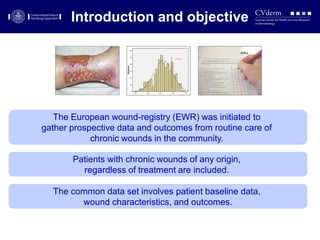
The European wound-registry (EWR) was initiated to
gather prospective data and outcomes from routine care of
chronic wounds in the community.
Patients with chronic wounds of any origin,
regardless of treatment are included.
The common data set involves patient baseline data,
wound characteristics, and outcomes.
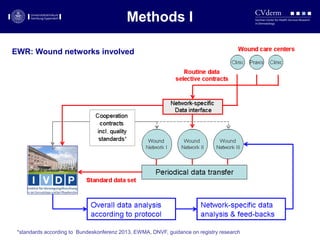
EWR: Wound networks involved
Methods I
*standards according to Bundeskonferenz 2013, EWMA, DNVF, guidance on registry research
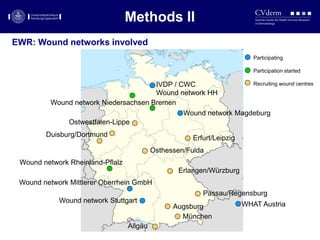
Participating
Participation started
Recruiting wound centres
EWR: Wound networks involved
Methods II
Wound network Mittlerer Oberrhein GmbH
WHAT Austria
Wound network Rheinland-Pflalz
Wound network Magdeburg
Wound network Niedersachsen Bremen
IVDP / CWC
Wound network HH
Ostwestfalen-Lippe
Passau/Regensburg
Erlangen/Würzburg
Osthessen/Fulda
Erfurt/LeipzigDuisburg/Dortmund
Wound network Stuttgart
München
Allgäu
Augsburg
Results
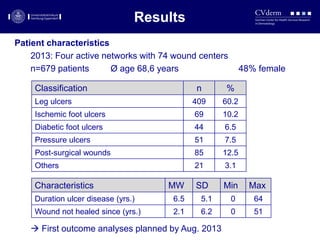
Patient characteristics
2013: Four active networks with 74 wound centers
n=679 patients Ø age 68,6 years 48% female
 First outcome analyses planned by Aug. 2013
Classification n %
Leg ulcers 409 60.2
Ischemic foot ulcers 69 10.2
Diabetic foot ulcers 44 6.5
Pressure ulcers 51 7.5
Post-surgical wounds 85 12.5
Others 21 3.1
Characteristics MW SD Min Max
Duration ulcer disease (yrs.) 6.5 5.1 0 64
Wound not healed since (yrs.) 2.1 6.2 0 51
Conclusions
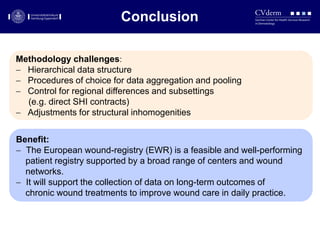
Benefit:
 The European wound-registry (EWR) is a feasible and well-performing
patient registry supported by a broad range of centers and wound
networks.
 It will support the collection of data on long-term outcomes of
chronic wound treatments to improve wound care in daily practice.
Methodology challenges:
 Hierarchical data structure
 Procedures of choice for data aggregation and pooling
 Control for regional differences and subsettings
(e.g. direct SHI contracts)
 Adjustments for structural inhomogenities
Conclusion

EWMA 2013 - Ep547 - European wound-registry (EWR) -characteristics and methodology

  • 1.
    European wound-registry (EWR)- characteristics and methodology European Wound Management Association (EWMA) Conference Heyer K1, Blome C1 Storck M2, Schmidt M2, Herberger K1, Imkamp U3, Wild T4, Debus S5, Augustin M1 1) Institute for Health Services Research in Dermatology and Nursing, University Medical Center, Hamburg-Eppendorf 2) Clinic for Vascular and Thoracic surgery, Karlsruhe, 3) Mamedicon GmbH, Magdeburg, 4) German Wound Academy, 5) Clinic for Vascular Surgery, University Medical Center, Hamburg-Eppendorf
  • 2.
    Introduction and objective TheEuropean wound-registry (EWR) was initiated to gather prospective data and outcomes from routine care of chronic wounds in the community. Patients with chronic wounds of any origin, regardless of treatment are included. The common data set involves patient baseline data, wound characteristics, and outcomes.
  • 3.
    EWR: Wound networksinvolved Methods I *standards according to Bundeskonferenz 2013, EWMA, DNVF, guidance on registry research
  • 4.
    Participating Participation started Recruiting woundcentres EWR: Wound networks involved Methods II Wound network Mittlerer Oberrhein GmbH WHAT Austria Wound network Rheinland-Pflalz Wound network Magdeburg Wound network Niedersachsen Bremen IVDP / CWC Wound network HH Ostwestfalen-Lippe Passau/Regensburg Erlangen/Würzburg Osthessen/Fulda Erfurt/LeipzigDuisburg/Dortmund Wound network Stuttgart München Allgäu Augsburg
  • 5.
    Results Patient characteristics 2013: Fouractive networks with 74 wound centers n=679 patients Ø age 68,6 years 48% female  First outcome analyses planned by Aug. 2013 Classification n % Leg ulcers 409 60.2 Ischemic foot ulcers 69 10.2 Diabetic foot ulcers 44 6.5 Pressure ulcers 51 7.5 Post-surgical wounds 85 12.5 Others 21 3.1 Characteristics MW SD Min Max Duration ulcer disease (yrs.) 6.5 5.1 0 64 Wound not healed since (yrs.) 2.1 6.2 0 51
  • 6.
    Conclusions Benefit:  The Europeanwound-registry (EWR) is a feasible and well-performing patient registry supported by a broad range of centers and wound networks.  It will support the collection of data on long-term outcomes of chronic wound treatments to improve wound care in daily practice. Methodology challenges:  Hierarchical data structure  Procedures of choice for data aggregation and pooling  Control for regional differences and subsettings (e.g. direct SHI contracts)  Adjustments for structural inhomogenities Conclusion