International Law and Brazilian Law:Indigenous Peoples Rights and Sustainable DevelopmentPresenter: João Murilo S. V. da Fonseca
Presentation OutlinePart I: 	IntroductionPart II: 	Material ResearchedPart III: 	Next TopicsPart IV: 	Conducting the ResearchPart V: 	Questions?
PART IIntroduction:BrazilThe AmazonInternational Law
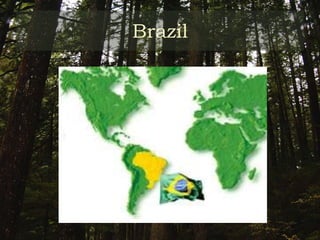
Brazil
BrazilBasic Facts:Largest Country in Latin America (slightly smaller than the United States)
190 million people
Official language: Portuguese
Ethnic Groups: Europeans, Asians, Africans, and Indigenous PeoplesBrazilGovernment and Legal System:Federative Republic formed by union of States, Municipalities and Federal District, under democratic governmentAll persons are equal before the lawThe Constitution outlines principles of social orderStates have their own Constitution based upon Federal Constitution
BrazilGovernment and Legal System:Legislative power of Republic is exercised by a Congress formed by Chamber of Federal Deputies and Federal Senate. All representatives are elected by direct vote Judicial power is exercised by the Supreme Federal Court and the Superior Court of Justice, Federal Regional Courts, and Federal Judges, Military, Electoral, and Labor Courts. States have their own judiciary for State matters.
BrazilCourts and Legislature:Federal Supreme Court: declares unconstitutionality of treaty or federal law; and considers valid law or local government contested under Constitution.Superior Court of Justice: Adjudicates at Ordinary appeal level cases in which parties are foreign State or international organization on one part, and Municipality or person resident or domiciled in Brazil or another Federal Regional Courts:  process and adjudicates: cases between foreign State or international organizations and Municipality or person domiciled or resident in Brazil ; cases based on treaty or contract of Republic with foreign State or international organization; and disputes over the right of Indians
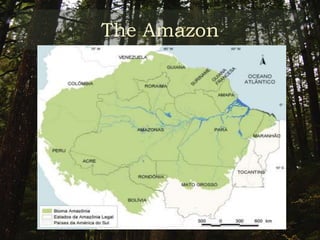
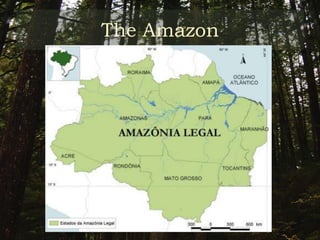
The AmazonTerminology Clarifications:The Amazonia rainforestRepresent an area greater than the scope of this researchThe Amazônia LegalMain scenario of this researchLocated in the Northern Region of Brazil The State of Amazonas Relevant for the purposes of this research because it is one of the states that comprises the Amazonia Legal
The AmazonThe Amazon Biomass:Biomass: “group of eco regions, fauna, flora, dynamics of ecological processes and similar ecology”French Guiana, Guiana, Suriname, Colombia, Bolivia, Ecuador, Venezuela and Brazil Brazil hosts 63% of the total Amazon biomass17% rate of deforestation in relation to its original mass
The Amazon
The AmazonThe Amazônia Legal:Law No. 1.806 of December 6 of 1953:Established the region comprised of seven full states and parts of other two statesSeeks economic developmentTakes in consideration the needs of the local community and the environment as limiting factors for economic developmentRepresents 59% of the Brazilian territoryEncompasses 63% of the total Rainforest Biomass. This is an area of 5 million square kilometers, or more than half of the forty-eight contiguous United States
The AmazonThe Amazônia Legal:In 2004, it was 60% covered with forest (Original area was 74%)27,5 billion dollars or 6.1% of Brazil’s GDP (2002)Land distribution:24% Private33 % Indigenous reserves10 % Special Areas (Military, Protected Ecosystems)33 % Disputed Lands or Lands with no ownership
The Amazon
International LawWhat is it?Rules of conduct that are binding on international actors in relations, transactions, and problems that transcend national frontiers In its initial phase states were regarded as the only legitimate international actorsIn the 20th Century, states ceased to be the sole subjects of international legal rules. This makes it possible the application of norms of conduct to a wide range of individuals, and institutions
International LawSources of International as established by the International Court of Justice: International ConventionsInternational CustomGeneral Principles of LawJudicial decisions Teachings of the most highly qualified publicists of the various nations
Part IIMaterial Researched:Definition of Sustainable DevelopmentMajor International Treaties  The Brazilian Environmental DilemmaThe Brazilian Law in Respect to Sustainable Development  Further Research
Definition of Sustainable DevelopmentMagraw and Hawke (2007):Acknowledges that important disagreements exist about its precise meaning and implications, and resistance to its definition still surfaces from time to time Sustainable development takes into account economic development, environmental protection (including human health), and social development (including human rights)
Definition of Sustainable DevelopmentGould (2006):Has come to be a deeply contested and co-opted conceptSustainable development implies global, national, regional, and local development strategies that meet basic needs while ensuring the integrity of ecosystems, and doing so in a manner that does not reduce the capacity of future generations to do the same.
Definition of Sustainable DevelopmentGould (Cont.):It also seeks to meets human’s needs and intragenerational, intergenerational, and international equity. Human basic needs means food, shelter, medicine, livelihood, and communityPearce (1999): Defines sustainable development as “economic development that lasts”, which in turn is defined as “non-declining consumption per capita, or GNP, or whatever the agreed indicator of development is”
Major International Treaties1992 UN Conference on Environment and Development (UNCED)For the first time, world’s government officially adopted sustainable development as the development paradigm27 key principles are to guide the integration of environment and development policiesPrinciple 7 of Rio Declaration states: ‘States shall cooperate in a spirit of global partnership to conserve, protect and restore the health and integrity of the Earth’s ecosystem. In views of different contributions to global environmental degradation, States have common but differentiated responsibilities’
Major International TreatiesIn 1994 WTO recognized sustainable development as one of its objectives (1st paragraph of the preamble to the Marrakech Agreement Establishing the World Trade Organization)For the first time in a renowned convention, in the 1995 World Summit for Sustainable Development there was an explicit linkage between economic development, social development, and environmental protection.
Major International Treaties2000 United Nations Millennium Declaration: Reaffirmed concept of Sustainable Development agreed upon UNCED, including six fundamental values essential to international relations: FreedomEqualitySolidarityToleranceRespect for natureShared responsibility
Major International Treaties2002 WSSD in Johannesburg:Representatives from around the world reaffirmed their commitment to sustainable development. Plan of Implementation recognizes as ‘overacting objective of, and essential requirements for, sustainable development’:Poverty eradicationChanging unsustainable consumption and production patternsProtecting and managing the natural resources base for economic and social development
Major International TreatiesIn 2005 UN released the Millennium  Development Goals Report:Most countries have committed to the principles of sustainable development by incorporating them into national policies as well as agreeing to relevant international instruments. It also states that these good intentions have not resulted in sufficient progress to reverse the loss of environmental resources
The Brazilian Environmental Dilemma82.1% of Original cover remaining (FAO)Population continues to grow:8.2 million* 	(1970) 17 million 	(1991)20 million 	(2000) The Amazon Legal remains relatively under populated in relation to other regions of the country* Data did not include the state of Roraima
The Brazilian Environmental DilemmaMain Causes of Deforestation: Clearly (2000):	RanchingAgricultureTimber extractionUrban expansionBrazilian Scientists:Public politics (environmental and economic)Institutional (fragility)AgrotechnologySocio-economic (i.e.: population, income, food demand)All of the above are intersected and act synergistically in the deforestation of the Amazon
The Brazilian Environmental DilemmaRayfuse on the consequences of deforestation:	“The consequence of deforestation are practical and ecological threatening economic, agricultural, medical, moral, and aesthetic interests and, ultimately, the continued viability of life on earth”
The Brazilian Environmental DilemmaValadares (Brazilian Diplomat) wrote in 1991:“How much of the Brazilian forest has been destroyed? Some say 12 percent; others say 7 percent. The Brazilian government says 5 percent.”
The Brazilian Environmental DilemmaAnthony Hall:	“There are a few statistics in Brazil as politically contentious as those on Amazonian deforestations… Officials also use them to illustrate the alleged power of government directly to contain deforestation through the application of policy measures.”
The Brazilian Environmental DilemmaBBC News on President da Silva:	“In a speech in Rio de Janeiro, President Lula said it was time for wealthy countries to do more to reduce gas emissions. 	He called on them to stop preaching on what to do with the Amazon rainforest.”
The Brazilian Environmental DilemmaGovernor Blario Maggi:Governor Blario Maggi:"Brazilian producers are the only ones in the world who are obliged to maintain a reserve," Maggi said. "There should be a royalty for leaving those areas intact--they need to be compensated in some way." 	- On the law’s requirement 50 percent of new settled areas that are to be maintained as ‘legal reserve’
The Brazilian Environmental DilemmaClearly (1993):	“[The Amazon’s future is] unregulated and unregulatable, save by market mechanisms, highly volatile and sustained by a regional economy unable to generate sufficient formal sector employment.”
The Brazilian Environmental DilemmaHall (1999):	“Variations in deforestation rates appear to be far more sensitive to changing macroeconomic climate than to environmental controls”	“Critics suggest that deforestation trends are not generally sensitive to environmental policy controls but are, rather, a function of macroeconomic factors such as inflation and land prices, or are condition by climatic phenomena such as the impact of El Niño in provoking forest fires.”
The Brazilian Environmental DilemmaHirakuri’s “Can Law Save the Forest?”:She writes on the deficiencies of the Brazilian rule of lawHas number of recommendations on how the law can become more efficient in terms of forestry managementDoes not grant the economic market full power in influencing rain forest matters
The Brazilian Environmental DilemmaHirakuri’s “Can Law Save the Forest?”:Recommendations for the deforestation issue, illegal logging in particular:Factors that can be changed Regulatory approachMarket-oriented approachSocial control/consensus-oriented approachFactors that are more difficult to changeForest culture Forest land tenure Legitimacy of the government
The Brazilian Law and Sustainable DevelopmentConstitution Article 225:	“Declares that the environment is a common heritage of the Brazilian people and entrusts the government and society with the duty to defend and preserve it for future generations” – Valadares (1991)
The Brazilian Law and Sustainable DevelopmentIBAMA :Stands for Brazilian Institute of the Environment and Renewable ResourcesCentralize government action concerning:Ecological issuesForestry exploitationFishingProtection of ecological systemsCame in the wake of vociferous domestic and international campaigning against accelerating deforestation and land conflict in Amazonia during the 1980s
The Brazilian Law and Sustainable DevelopmentEnvironmental Minister Marina Silva:Since the creation of IBAMA Brazil has enacted successful policies in respect to environmental protection in the Amazon. In 1989 there were 134 federal protection units that totaled 150 thousand square kilometers , now there are 288 federal protected unities that totals 700 thousand square kilometers (more than three times the area of Minnesota)
The Brazilian Law and Sustainable DevelopmentHall (1999) on IBAMA:“In the region overall, there are some 275 IBAMA officials, or one for every 5,984 square miles .”“New environment minister dismissed a number of state-level IBAMA officials due to their proven involvement in illegal sales of timber from areas under their jurisdiction”
The Brazilian Law and Sustainable DevelopmentHall (1999):	“IBAMA had been deprived of statutory powers to enforce environmental laws. Congress had failed to authorize a measure propose in the 1988 Constitutional that would have allowed executive agencies to enforce environmental legislation.  Partly as a result of this situation, IBAMA has managed to collect only six percent of fines (US$23 million) levied under the Forestry Code of 1965 ”
The Brazilian Law and Sustainable DevelopmentLaw against Environmental Crimes effective from 30 March 1998Imposes large fines and prison sentences for a range of offences, including illegal logging The law has been subject to President veto as the result of powerful lobby by certain interest groups, but should nonetheless provide IBAMA with the legal teeth it has been missing
The Brazilian Law and Sustainable Development1996 Amazon Package:Limits forest removal on newly settled plots to 20 percent of the area, maintaining 80 percent as ‘legal reserve’Before, Forestry Code of 1965 maintained 50% percent of newly settlement plots as ‘legal reserve’
Further ResearchData:What sources are reliable?Actors:Actions of Politicians in respect to the Brazilian environmental dilemmaWhat is the say of Brazilians in general on this issue, if any?International Community:What are the most recent international initiatives, treaties?LawWhat has been the outcome of the laws that were passed?What are the new laws that are being proposed?NGOsAre they beneficial or not? Should laws benefit/limit the power of NGOs?
Part IIINext Topics:Indigenous Peoples RightsSustainable Development (Economic perspective)
Indigenous Peoples RightsIssues:Broad discussion regarding the meaning of the term indigenous and its implicationsIndigenous peoples hold 33% of Amazonia Legal territory. Are their lands protected? Do they have too much land? What are they doing with their land? Should it matter? What are the datas?Are their voices being heard when domestic and international laws are passed?What are the human rights violations?Do they take their issues to the court?Can their interests intersect with sustainable development?
Sustainable Development (Economic perspective)What are the needs of the Brazilian economy in the forest?Who are the actors that benefiting the most with the resources available on Amazonia legal? The greater portion of society or big business? Should this be an issue?What are the most successful business in the Amazonia Legal region?What are the government’s current development programs?What are the politicians say on this matter?What is the voice of powerful interest groups that are pro-development?Can economic development be sensitive to indigenous peoples and the protection of the environment?
Part IVWays of Conducting Research:Books: CLICnet Internet:Acess treatiesAccess Brazilian government websitesAccess to lawsNews Source (Brazilian as well as international)ArticlesNGOs websites Prof. Karen VogelContinue to ask questions and guidanceWrite two more literature reviews papers (one on Brazilian indigenous peoples rights and the other on sustainable economic development)

Environmental Law Research--Brazil

  • 1.
    International Law andBrazilian Law:Indigenous Peoples Rights and Sustainable DevelopmentPresenter: João Murilo S. V. da Fonseca
  • 2.
    Presentation OutlinePart I: IntroductionPart II: Material ResearchedPart III: Next TopicsPart IV: Conducting the ResearchPart V: Questions?
  • 3.
  • 4.
  • 5.
    BrazilBasic Facts:Largest Countryin Latin America (slightly smaller than the United States)
  • 6.
  • 7.
  • 8.
    Ethnic Groups: Europeans,Asians, Africans, and Indigenous PeoplesBrazilGovernment and Legal System:Federative Republic formed by union of States, Municipalities and Federal District, under democratic governmentAll persons are equal before the lawThe Constitution outlines principles of social orderStates have their own Constitution based upon Federal Constitution
  • 9.
    BrazilGovernment and LegalSystem:Legislative power of Republic is exercised by a Congress formed by Chamber of Federal Deputies and Federal Senate. All representatives are elected by direct vote Judicial power is exercised by the Supreme Federal Court and the Superior Court of Justice, Federal Regional Courts, and Federal Judges, Military, Electoral, and Labor Courts. States have their own judiciary for State matters.
  • 10.
    BrazilCourts and Legislature:FederalSupreme Court: declares unconstitutionality of treaty or federal law; and considers valid law or local government contested under Constitution.Superior Court of Justice: Adjudicates at Ordinary appeal level cases in which parties are foreign State or international organization on one part, and Municipality or person resident or domiciled in Brazil or another Federal Regional Courts: process and adjudicates: cases between foreign State or international organizations and Municipality or person domiciled or resident in Brazil ; cases based on treaty or contract of Republic with foreign State or international organization; and disputes over the right of Indians
  • 11.
    The AmazonTerminology Clarifications:TheAmazonia rainforestRepresent an area greater than the scope of this researchThe Amazônia LegalMain scenario of this researchLocated in the Northern Region of Brazil The State of Amazonas Relevant for the purposes of this research because it is one of the states that comprises the Amazonia Legal
  • 12.
    The AmazonThe AmazonBiomass:Biomass: “group of eco regions, fauna, flora, dynamics of ecological processes and similar ecology”French Guiana, Guiana, Suriname, Colombia, Bolivia, Ecuador, Venezuela and Brazil Brazil hosts 63% of the total Amazon biomass17% rate of deforestation in relation to its original mass
  • 13.
  • 14.
    The AmazonThe AmazôniaLegal:Law No. 1.806 of December 6 of 1953:Established the region comprised of seven full states and parts of other two statesSeeks economic developmentTakes in consideration the needs of the local community and the environment as limiting factors for economic developmentRepresents 59% of the Brazilian territoryEncompasses 63% of the total Rainforest Biomass. This is an area of 5 million square kilometers, or more than half of the forty-eight contiguous United States
  • 15.
    The AmazonThe AmazôniaLegal:In 2004, it was 60% covered with forest (Original area was 74%)27,5 billion dollars or 6.1% of Brazil’s GDP (2002)Land distribution:24% Private33 % Indigenous reserves10 % Special Areas (Military, Protected Ecosystems)33 % Disputed Lands or Lands with no ownership
  • 16.
  • 17.
    International LawWhat isit?Rules of conduct that are binding on international actors in relations, transactions, and problems that transcend national frontiers In its initial phase states were regarded as the only legitimate international actorsIn the 20th Century, states ceased to be the sole subjects of international legal rules. This makes it possible the application of norms of conduct to a wide range of individuals, and institutions
  • 18.
    International LawSources ofInternational as established by the International Court of Justice: International ConventionsInternational CustomGeneral Principles of LawJudicial decisions Teachings of the most highly qualified publicists of the various nations
  • 19.
    Part IIMaterial Researched:Definitionof Sustainable DevelopmentMajor International Treaties The Brazilian Environmental DilemmaThe Brazilian Law in Respect to Sustainable Development Further Research
  • 20.
    Definition of SustainableDevelopmentMagraw and Hawke (2007):Acknowledges that important disagreements exist about its precise meaning and implications, and resistance to its definition still surfaces from time to time Sustainable development takes into account economic development, environmental protection (including human health), and social development (including human rights)
  • 21.
    Definition of SustainableDevelopmentGould (2006):Has come to be a deeply contested and co-opted conceptSustainable development implies global, national, regional, and local development strategies that meet basic needs while ensuring the integrity of ecosystems, and doing so in a manner that does not reduce the capacity of future generations to do the same.
  • 22.
    Definition of SustainableDevelopmentGould (Cont.):It also seeks to meets human’s needs and intragenerational, intergenerational, and international equity. Human basic needs means food, shelter, medicine, livelihood, and communityPearce (1999): Defines sustainable development as “economic development that lasts”, which in turn is defined as “non-declining consumption per capita, or GNP, or whatever the agreed indicator of development is”
  • 23.
    Major International Treaties1992UN Conference on Environment and Development (UNCED)For the first time, world’s government officially adopted sustainable development as the development paradigm27 key principles are to guide the integration of environment and development policiesPrinciple 7 of Rio Declaration states: ‘States shall cooperate in a spirit of global partnership to conserve, protect and restore the health and integrity of the Earth’s ecosystem. In views of different contributions to global environmental degradation, States have common but differentiated responsibilities’
  • 24.
    Major International TreatiesIn1994 WTO recognized sustainable development as one of its objectives (1st paragraph of the preamble to the Marrakech Agreement Establishing the World Trade Organization)For the first time in a renowned convention, in the 1995 World Summit for Sustainable Development there was an explicit linkage between economic development, social development, and environmental protection.
  • 25.
    Major International Treaties2000United Nations Millennium Declaration: Reaffirmed concept of Sustainable Development agreed upon UNCED, including six fundamental values essential to international relations: FreedomEqualitySolidarityToleranceRespect for natureShared responsibility
  • 26.
    Major International Treaties2002WSSD in Johannesburg:Representatives from around the world reaffirmed their commitment to sustainable development. Plan of Implementation recognizes as ‘overacting objective of, and essential requirements for, sustainable development’:Poverty eradicationChanging unsustainable consumption and production patternsProtecting and managing the natural resources base for economic and social development
  • 27.
    Major International TreatiesIn2005 UN released the Millennium Development Goals Report:Most countries have committed to the principles of sustainable development by incorporating them into national policies as well as agreeing to relevant international instruments. It also states that these good intentions have not resulted in sufficient progress to reverse the loss of environmental resources
  • 28.
    The Brazilian EnvironmentalDilemma82.1% of Original cover remaining (FAO)Population continues to grow:8.2 million* (1970) 17 million (1991)20 million (2000) The Amazon Legal remains relatively under populated in relation to other regions of the country* Data did not include the state of Roraima
  • 29.
    The Brazilian EnvironmentalDilemmaMain Causes of Deforestation: Clearly (2000): RanchingAgricultureTimber extractionUrban expansionBrazilian Scientists:Public politics (environmental and economic)Institutional (fragility)AgrotechnologySocio-economic (i.e.: population, income, food demand)All of the above are intersected and act synergistically in the deforestation of the Amazon
  • 30.
    The Brazilian EnvironmentalDilemmaRayfuse on the consequences of deforestation: “The consequence of deforestation are practical and ecological threatening economic, agricultural, medical, moral, and aesthetic interests and, ultimately, the continued viability of life on earth”
  • 31.
    The Brazilian EnvironmentalDilemmaValadares (Brazilian Diplomat) wrote in 1991:“How much of the Brazilian forest has been destroyed? Some say 12 percent; others say 7 percent. The Brazilian government says 5 percent.”
  • 32.
    The Brazilian EnvironmentalDilemmaAnthony Hall: “There are a few statistics in Brazil as politically contentious as those on Amazonian deforestations… Officials also use them to illustrate the alleged power of government directly to contain deforestation through the application of policy measures.”
  • 33.
    The Brazilian EnvironmentalDilemmaBBC News on President da Silva: “In a speech in Rio de Janeiro, President Lula said it was time for wealthy countries to do more to reduce gas emissions. He called on them to stop preaching on what to do with the Amazon rainforest.”
  • 34.
    The Brazilian EnvironmentalDilemmaGovernor Blario Maggi:Governor Blario Maggi:"Brazilian producers are the only ones in the world who are obliged to maintain a reserve," Maggi said. "There should be a royalty for leaving those areas intact--they need to be compensated in some way." - On the law’s requirement 50 percent of new settled areas that are to be maintained as ‘legal reserve’
  • 35.
    The Brazilian EnvironmentalDilemmaClearly (1993): “[The Amazon’s future is] unregulated and unregulatable, save by market mechanisms, highly volatile and sustained by a regional economy unable to generate sufficient formal sector employment.”
  • 36.
    The Brazilian EnvironmentalDilemmaHall (1999): “Variations in deforestation rates appear to be far more sensitive to changing macroeconomic climate than to environmental controls” “Critics suggest that deforestation trends are not generally sensitive to environmental policy controls but are, rather, a function of macroeconomic factors such as inflation and land prices, or are condition by climatic phenomena such as the impact of El Niño in provoking forest fires.”
  • 37.
    The Brazilian EnvironmentalDilemmaHirakuri’s “Can Law Save the Forest?”:She writes on the deficiencies of the Brazilian rule of lawHas number of recommendations on how the law can become more efficient in terms of forestry managementDoes not grant the economic market full power in influencing rain forest matters
  • 38.
    The Brazilian EnvironmentalDilemmaHirakuri’s “Can Law Save the Forest?”:Recommendations for the deforestation issue, illegal logging in particular:Factors that can be changed Regulatory approachMarket-oriented approachSocial control/consensus-oriented approachFactors that are more difficult to changeForest culture Forest land tenure Legitimacy of the government
  • 39.
    The Brazilian Lawand Sustainable DevelopmentConstitution Article 225: “Declares that the environment is a common heritage of the Brazilian people and entrusts the government and society with the duty to defend and preserve it for future generations” – Valadares (1991)
  • 40.
    The Brazilian Lawand Sustainable DevelopmentIBAMA :Stands for Brazilian Institute of the Environment and Renewable ResourcesCentralize government action concerning:Ecological issuesForestry exploitationFishingProtection of ecological systemsCame in the wake of vociferous domestic and international campaigning against accelerating deforestation and land conflict in Amazonia during the 1980s
  • 41.
    The Brazilian Lawand Sustainable DevelopmentEnvironmental Minister Marina Silva:Since the creation of IBAMA Brazil has enacted successful policies in respect to environmental protection in the Amazon. In 1989 there were 134 federal protection units that totaled 150 thousand square kilometers , now there are 288 federal protected unities that totals 700 thousand square kilometers (more than three times the area of Minnesota)
  • 42.
    The Brazilian Lawand Sustainable DevelopmentHall (1999) on IBAMA:“In the region overall, there are some 275 IBAMA officials, or one for every 5,984 square miles .”“New environment minister dismissed a number of state-level IBAMA officials due to their proven involvement in illegal sales of timber from areas under their jurisdiction”
  • 43.
    The Brazilian Lawand Sustainable DevelopmentHall (1999): “IBAMA had been deprived of statutory powers to enforce environmental laws. Congress had failed to authorize a measure propose in the 1988 Constitutional that would have allowed executive agencies to enforce environmental legislation. Partly as a result of this situation, IBAMA has managed to collect only six percent of fines (US$23 million) levied under the Forestry Code of 1965 ”
  • 44.
    The Brazilian Lawand Sustainable DevelopmentLaw against Environmental Crimes effective from 30 March 1998Imposes large fines and prison sentences for a range of offences, including illegal logging The law has been subject to President veto as the result of powerful lobby by certain interest groups, but should nonetheless provide IBAMA with the legal teeth it has been missing
  • 45.
    The Brazilian Lawand Sustainable Development1996 Amazon Package:Limits forest removal on newly settled plots to 20 percent of the area, maintaining 80 percent as ‘legal reserve’Before, Forestry Code of 1965 maintained 50% percent of newly settlement plots as ‘legal reserve’
  • 46.
    Further ResearchData:What sourcesare reliable?Actors:Actions of Politicians in respect to the Brazilian environmental dilemmaWhat is the say of Brazilians in general on this issue, if any?International Community:What are the most recent international initiatives, treaties?LawWhat has been the outcome of the laws that were passed?What are the new laws that are being proposed?NGOsAre they beneficial or not? Should laws benefit/limit the power of NGOs?
  • 47.
    Part IIINext Topics:IndigenousPeoples RightsSustainable Development (Economic perspective)
  • 48.
    Indigenous Peoples RightsIssues:Broaddiscussion regarding the meaning of the term indigenous and its implicationsIndigenous peoples hold 33% of Amazonia Legal territory. Are their lands protected? Do they have too much land? What are they doing with their land? Should it matter? What are the datas?Are their voices being heard when domestic and international laws are passed?What are the human rights violations?Do they take their issues to the court?Can their interests intersect with sustainable development?
  • 49.
    Sustainable Development (Economicperspective)What are the needs of the Brazilian economy in the forest?Who are the actors that benefiting the most with the resources available on Amazonia legal? The greater portion of society or big business? Should this be an issue?What are the most successful business in the Amazonia Legal region?What are the government’s current development programs?What are the politicians say on this matter?What is the voice of powerful interest groups that are pro-development?Can economic development be sensitive to indigenous peoples and the protection of the environment?
  • 50.
    Part IVWays ofConducting Research:Books: CLICnet Internet:Acess treatiesAccess Brazilian government websitesAccess to lawsNews Source (Brazilian as well as international)ArticlesNGOs websites Prof. Karen VogelContinue to ask questions and guidanceWrite two more literature reviews papers (one on Brazilian indigenous peoples rights and the other on sustainable economic development)