MRS. K. Balambal
Assistant Professor of Commerce
SRI SARADA NIKETAN COLLEGE OF
SCIENCE FOR WOMEN,KARUR
ENTERPRENEURIAL DEVELOPMENT
UNIT I
Introduction:
An entrepreneur is a person who organizes a venture
to benefit from an opportunity, rather than working as
an employee. Entrepreneurs play a key role in
any economy. These are the people who have the skills
and initiative necessary to anticipate current and future
needs and bring good new ideas to market.
Entrepreneurs who prove to be successful in taking
on the risks of a start-up are rewarded with profits, fame
and continued growth opportunities. Those who fail
suffer losses and become less important in the markets.
Many fail, lose money, and close the business.
What Is an Entrepreneur?
An entrepreneur is an individual who creates a new
business, bearing most of the risks and enjoying most of the
rewards. The entrepreneur is commonly seen as an
innovator, a source of new ideas, goods, services, and
business/or procedures.
Entrepreneurs play a key role in any economy, using the
skills and initiative necessary to anticipate needs and bring
good new ideas to market. Entrepreneurs who prove to be
successful in taking on the risks of a start-up are rewarded
with profits, fame, and continued growth opportunities.
Those who fail, suffer losses and become less prevalent in
the markets.
Definition:
An Entrepreneur is a person who has a role of an
industrialist and forms an organization for the
commercial use. He is a change agent who
transforms the demand into supply by forecasting
the needs of the society.
Characteristics of Entrepreneurship
1.Profit Chances
The chances of profit are the level of return to the person who is taking risks
and developing an idea into its business venture. The actions of the
entrepreneurs will likely remain abstract and a paper leisure activity without
the potential of the profit.
2.Creativity and Persuasiveness
There is a need to have the creative capacity for recognizing and pursuing
the opportunities in a successful entrepreneurship. The entrepreneurs should
possess great selling skills and be persistent
3.Innovation
The entrepreneurship continuously demands a continuous search for
innovative ideas. The entrepreneur should evaluate the present modes of
business operations for developing more efficient and effective systems. In a
simple definition, it is a continuous effort for optimization of performance in
an organization.
4.Risk Bearing
As we defined above, the entrepreneurship is the willingness to take
risks. The individuals should arise out of the implementation and
creation of the creative ideas. They should believe that new ideas take
some time to offer results and their results may not be instantaneous.
5.Vision
Probably, one of the biggest responsibilities of the entrepreneur is to
decide the direction of the business. There is a need to have proper
vision. If a company doesn’t have this, they will likely get lost in the sea.
6.Excellent Business Skills
A successful entrepreneur always has the ability to set up the internal
procedures, systems, and processes required to operate a company.
He/she should focus on sales, revenue, and cash flow all the times. They
always evaluate the current talents and professional network.
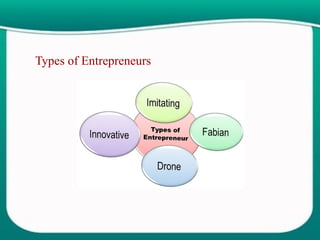
Types of Entrepreneurs
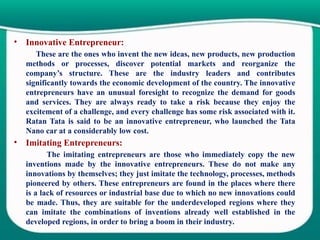
• Innovative Entrepreneur:
These are the ones who invent the new ideas, new products, new production
methods or processes, discover potential markets and reorganize the
company’s structure. These are the industry leaders and contributes
significantly towards the economic development of the country. The innovative
entrepreneurs have an unusual foresight to recognize the demand for goods
and services. They are always ready to take a risk because they enjoy the
excitement of a challenge, and every challenge has some risk associated with it.
Ratan Tata is said to be an innovative entrepreneur, who launched the Tata
Nano car at a considerably low cost.
• Imitating Entrepreneurs:
The imitating entrepreneurs are those who immediately copy the new
inventions made by the innovative entrepreneurs. These do not make any
innovations by themselves; they just imitate the technology, processes, methods
pioneered by others. These entrepreneurs are found in the places where there
is a lack of resources or industrial base due to which no new innovations could
be made. Thus, they are suitable for the underdeveloped regions where they
can imitate the combinations of inventions already well established in the
developed regions, in order to bring a boom in their industry.
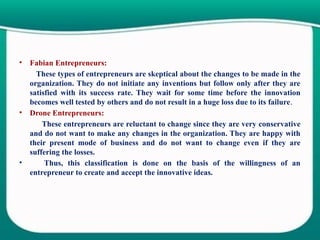
• Fabian Entrepreneurs:
These types of entrepreneurs are skeptical about the changes to be made in the
organization. They do not initiate any inventions but follow only after they are
satisfied with its success rate. They wait for some time before the innovation
becomes well tested by others and do not result in a huge loss due to its failure.
• Drone Entrepreneurs:
These entrepreneurs are reluctant to change since they are very conservative
and do not want to make any changes in the organization. They are happy with
their present mode of business and do not want to change even if they are
suffering the losses.
• Thus, this classification is done on the basis of the willingness of an
entrepreneur to create and accept the innovative ideas.
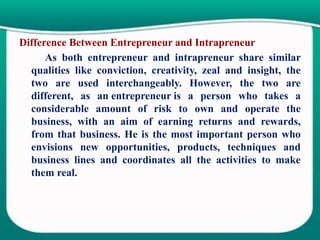
Difference Between Entrepreneur and Intrapreneur
As both entrepreneur and intrapreneur share similar
qualities like conviction, creativity, zeal and insight, the
two are used interchangeably. However, the two are
different, as an entrepreneur is a person who takes a
considerable amount of risk to own and operate the
business, with an aim of earning returns and rewards,
from that business. He is the most important person who
envisions new opportunities, products, techniques and
business lines and coordinates all the activities to make
them real.
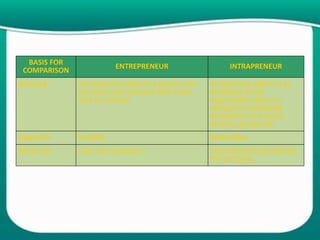
BASIS FOR
COMPARISON
ENTREPRENEUR INTRAPRENEUR
Meaning Entrepreneur refers to a person who
set up his own business with a new
idea or concept.
Intrapreneur refers to an
employee of the
organization who is in
charge of undertaking
innovations in product,
service, process etc.
Approach Intuitive Restorative
Resources Uses own resources. Use resources provided by
the company.
..
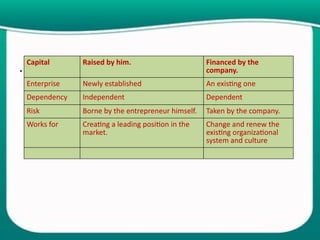
Capital Raised by him. Financed by the
company.
Enterprise Newly established An existing one
Dependency Independent Dependent
Risk Borne by the entrepreneur himself. Taken by the company.
Works for Creating a leading position in the
market.
Change and renew the
existing organizational
system and culture

ENTREPRENEURIAL DEVELOPMENT NOTES-I.pptx

  • 1.
    MRS. K. Balambal AssistantProfessor of Commerce SRI SARADA NIKETAN COLLEGE OF SCIENCE FOR WOMEN,KARUR
  • 2.
  • 3.
    Introduction: An entrepreneur isa person who organizes a venture to benefit from an opportunity, rather than working as an employee. Entrepreneurs play a key role in any economy. These are the people who have the skills and initiative necessary to anticipate current and future needs and bring good new ideas to market. Entrepreneurs who prove to be successful in taking on the risks of a start-up are rewarded with profits, fame and continued growth opportunities. Those who fail suffer losses and become less important in the markets. Many fail, lose money, and close the business.
  • 4.
    What Is anEntrepreneur? An entrepreneur is an individual who creates a new business, bearing most of the risks and enjoying most of the rewards. The entrepreneur is commonly seen as an innovator, a source of new ideas, goods, services, and business/or procedures. Entrepreneurs play a key role in any economy, using the skills and initiative necessary to anticipate needs and bring good new ideas to market. Entrepreneurs who prove to be successful in taking on the risks of a start-up are rewarded with profits, fame, and continued growth opportunities. Those who fail, suffer losses and become less prevalent in the markets.
  • 5.
    Definition: An Entrepreneur isa person who has a role of an industrialist and forms an organization for the commercial use. He is a change agent who transforms the demand into supply by forecasting the needs of the society.
  • 6.
    Characteristics of Entrepreneurship 1.ProfitChances The chances of profit are the level of return to the person who is taking risks and developing an idea into its business venture. The actions of the entrepreneurs will likely remain abstract and a paper leisure activity without the potential of the profit. 2.Creativity and Persuasiveness There is a need to have the creative capacity for recognizing and pursuing the opportunities in a successful entrepreneurship. The entrepreneurs should possess great selling skills and be persistent 3.Innovation The entrepreneurship continuously demands a continuous search for innovative ideas. The entrepreneur should evaluate the present modes of business operations for developing more efficient and effective systems. In a simple definition, it is a continuous effort for optimization of performance in an organization.
  • 7.
    4.Risk Bearing As wedefined above, the entrepreneurship is the willingness to take risks. The individuals should arise out of the implementation and creation of the creative ideas. They should believe that new ideas take some time to offer results and their results may not be instantaneous. 5.Vision Probably, one of the biggest responsibilities of the entrepreneur is to decide the direction of the business. There is a need to have proper vision. If a company doesn’t have this, they will likely get lost in the sea. 6.Excellent Business Skills A successful entrepreneur always has the ability to set up the internal procedures, systems, and processes required to operate a company. He/she should focus on sales, revenue, and cash flow all the times. They always evaluate the current talents and professional network.
  • 8.
  • 9.
    • Innovative Entrepreneur: Theseare the ones who invent the new ideas, new products, new production methods or processes, discover potential markets and reorganize the company’s structure. These are the industry leaders and contributes significantly towards the economic development of the country. The innovative entrepreneurs have an unusual foresight to recognize the demand for goods and services. They are always ready to take a risk because they enjoy the excitement of a challenge, and every challenge has some risk associated with it. Ratan Tata is said to be an innovative entrepreneur, who launched the Tata Nano car at a considerably low cost. • Imitating Entrepreneurs: The imitating entrepreneurs are those who immediately copy the new inventions made by the innovative entrepreneurs. These do not make any innovations by themselves; they just imitate the technology, processes, methods pioneered by others. These entrepreneurs are found in the places where there is a lack of resources or industrial base due to which no new innovations could be made. Thus, they are suitable for the underdeveloped regions where they can imitate the combinations of inventions already well established in the developed regions, in order to bring a boom in their industry.
  • 10.
    • Fabian Entrepreneurs: Thesetypes of entrepreneurs are skeptical about the changes to be made in the organization. They do not initiate any inventions but follow only after they are satisfied with its success rate. They wait for some time before the innovation becomes well tested by others and do not result in a huge loss due to its failure. • Drone Entrepreneurs: These entrepreneurs are reluctant to change since they are very conservative and do not want to make any changes in the organization. They are happy with their present mode of business and do not want to change even if they are suffering the losses. • Thus, this classification is done on the basis of the willingness of an entrepreneur to create and accept the innovative ideas.
  • 11.
    Difference Between Entrepreneurand Intrapreneur As both entrepreneur and intrapreneur share similar qualities like conviction, creativity, zeal and insight, the two are used interchangeably. However, the two are different, as an entrepreneur is a person who takes a considerable amount of risk to own and operate the business, with an aim of earning returns and rewards, from that business. He is the most important person who envisions new opportunities, products, techniques and business lines and coordinates all the activities to make them real.
  • 12.
    BASIS FOR COMPARISON ENTREPRENEUR INTRAPRENEUR MeaningEntrepreneur refers to a person who set up his own business with a new idea or concept. Intrapreneur refers to an employee of the organization who is in charge of undertaking innovations in product, service, process etc. Approach Intuitive Restorative Resources Uses own resources. Use resources provided by the company.
  • 13.
    .. Capital Raised byhim. Financed by the company. Enterprise Newly established An existing one Dependency Independent Dependent Risk Borne by the entrepreneur himself. Taken by the company. Works for Creating a leading position in the market. Change and renew the existing organizational system and culture