CHAPTER 3
FORMATION OF
SMALL SCALE
INDUSTRY
Meaning of business
opportunity :
A business opportunity is a consumer
need or want that can potentially be
met by a new business.
A successful entrepreneur is one who
capture opportunities.
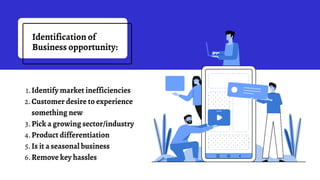
Identification of
Business opportunity:
Identify market inefficiencies
Customer desire to experience
something new
Pick a growing sector/industry
Product differentiation
Is it a seasonal business
Remove key hassles
1.
2.
3.
4.
5.
6.
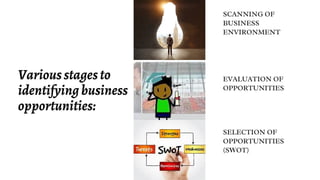
Variousstagesto
identifyingbusiness
opportunities:
SCANNING OF
BUSINESS
ENVIRONMENT
EVALUATION OF
OPPORTUNITIES
SELECTION OF
OPPORTUNITIES
(SWOT)
Scanning of business environment:
Meaning: It is the process of carefully examining the internal and external
environment of an organization to detect threats and opportunities that may
affect its future direction.
Understanding
business
environment will
help the business
in following
ways:
Determining
opportunities and
threats
Giving direction for
growth
Continuous learning
Image building
Meeting competition
1.
2.
3.
4.
5.
Identification of strength
Identification of weakness
Identification of
opportunities
Identification of threats
Optimum use of resources
Survival and growth
Decision making
1.
2.
3.
4.
5.
6.
7.
Importance
or need of
environment
scanning:
Have you considered all the merits and
demerits of the idea?
Have you pinpointed the exact problem?
Is your idea an original?
Are there any problems your idea may
generate?
Can your company be competitive?
Does your idea fill a real need?
How soon could the idea be put into
operation?
Could you offer alternative ideas?
EVALUATION OF ALTERNATIVE:
An entrepreneur should ask the following
questions when evaluating an idea for
business:
New experience
Economic advantage
Opportunity for the
technology to add value
Size of the market
opportunity
Frequency
FACTORS TO BE
CONSIDERED WHILE
ANALYZING THE MARKET:
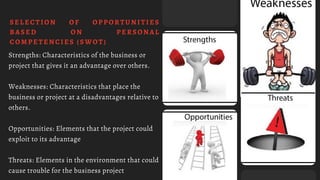
SELECTION OF OPPORTUNITIES
BASED ON PERSONAL
COMPETENCIES (SWOT)
Strengths: Characteristics of the business or
project that gives it an advantage over others.
Weaknesses: Characteristics that place the
business or project at a disadvantages relative to
others.
Opportunities: Elements that the project could
exploit to its advantage
Threats: Elements in the environment that could
cause trouble for the business project
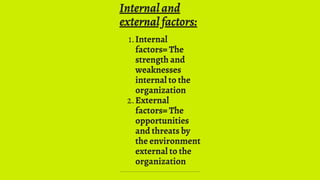
Internaland
externalfactors:
Internal
factors= The
strength and
weaknesses
internal to the
organization
External
factors= The
opportunities
and threats by
the environment
external to the
organization
1.
2.
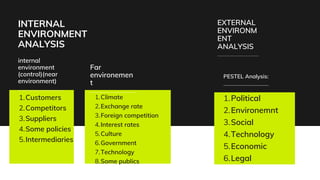
INTERNAL
ENVIRONMENT
ANALYSIS
internal
environment
(control)(near
environment)
Customers
Competitors
Suppliers
Some policies
Intermediaries
1.
2.
3.
4.
5.
Climate
Exchange rate
Foreign competition
Interest rates
Culture
Government
Technology
Some publics
1.
2.
3.
4.
5.
6.
7.
8.
Political
Environemnt
Social
Technology
Economic
Legal
1.
2.
3.
4.
5.
6.
Far
environemen
t
PESTEL Analysis:
EXTERNAL
ENVIRONM
ENT
ANALYSIS
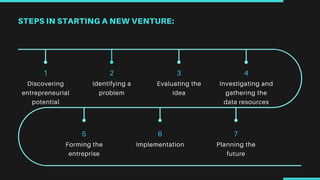
1
Discovering
entrepreneurial
potential
2
Identifying a
problem
3
Evaluating the
idea
4
Investigating and
gathering the
data resources
5
Forming the
entreprise
6
Implementation
7
Planning the
future
STEPS IN STARTING A NEW VENTURE:
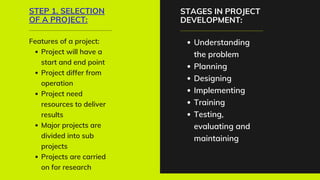
Project will have a
start and end point
Project differ from
operation
Project need
resources to deliver
results
Major projects are
divided into sub
projects
Projects are carried
on for research
Features of a project:
STEP 1. SELECTION
OF A PROJECT:
Understanding
the problem
Planning
Designing
Implementing
Training
Testing,
evaluating and
maintaining
STAGES IN PROJECT
DEVELOPMENT:
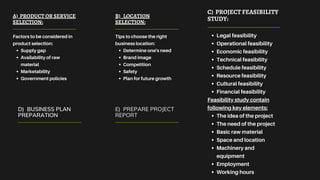
A) PRODUCT OR SERVICE
SELECTION:
Supply gap
Availability of raw
material
Marketability
Government policies
Factors to be considered in
product selection:
D) BUSINESS PLAN
PREPARATION
B) LOCATION
SELECTION:
Determine one's need
Brand image
Competition
Safety
Plan for future growth
Tips to choose the right
business location:
E) PREPARE PROJECT
REPORT
C) PROJECT FEASIBILITY
STUDY:
Legal feasibility
Operational feasibility
Economic feasibility
Technical feasibility
Schedule feasibility
Resource feasibility
Cultural feasibility
Financial feasibility
The idea of the project
The need of the project
Basic raw material
Space and location
Machinery and
equipment
Employment
Working hours
Feasibility study contain
following key elements:
Types of Business
Entities
Ownership
STEP 2 DECIDE ON
THE CONSTITUTION
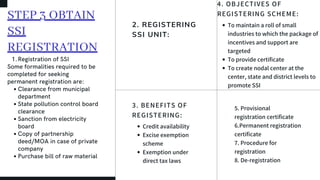
Registration of SSI
Clearance from municipal
department
State pollution control board
clearance
Sanction from electricity
board
Copy of partnership
deed/MOA in case of private
company
Purchase bill of raw material
STEP 3 OBTAIN
SSI
REGISTRATION
1.
Some formalities required to be
completed for seeking
permanent registration are:
2. REGISTERING
SSI UNIT:
4. OBJECTIVES OF
REGISTERING SCHEME:
To maintain a roll of small
industries to which the package of
incentives and support are
targeted
To provide certificate
To create nodal center at the
center, state and district levels to
promote SSI
3. BENEFITS OF
REGISTERING:
Credit availability
Excise exemption
scheme
Exemption under
direct tax laws
5. Provisional
registration certificate
6.Permanent registration
certificate
7. Procedure for
registration
8. De-registration
2 0 2 0
09
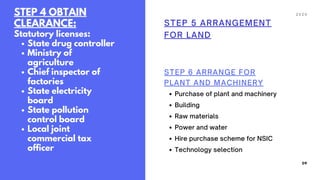
State drug controller
Ministry of
agriculture
Chief inspector of
factories
State electricity
board
State pollution
control board
Local joint
commercial tax
officer
STEP 4 OBTAIN
CLEARANCE:
Statutory licenses:
STEP 6 ARRANGE FOR
PLANT AND MACHINERY
Purchase of plant and machinery
Building
Raw materials
Power and water
Hire purchase scheme for NSIC
Technology selection
STEP 5 ARRANGEMENT
FOR LAND
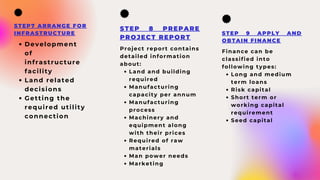
Development
of
infrastructure
facility
Land related
decisions
Getting the
required utility
connection
STEP7 ARRANGE FOR
INFRASTRUCTURE
Land and building
required
Manufacturing
capacity per annum
Manufacturing
process
Machinery and
equipment along
with their prices
Required of raw
materials
Man power needs
Marketing
Project report contains
detailed information
about:
STEP 8 PREPARE
PROJECT REPORT
Long and medium
term loans
Risk capital
Short term or
working capital
requirement
Seed capital
Finance can be
classified into
following types:
STEP 9 APPLY AND
OBTAIN FINANCE
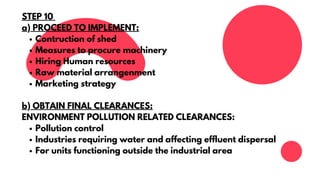
Contruction of shed
Measures to procure machinery
Hiring Human resources
Raw material arrangenment
Marketing strategy
Pollution control
Industries requiring water and affecting effluent dispersal
For units functioning outside the industrial area
STEP 10
a) PROCEED TO IMPLEMENT:
b) OBTAIN FINAL CLEARANCES:
ENVIRONMENT POLLUTION RELATED CLEARANCES:
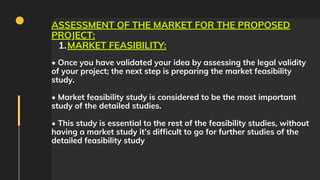
MARKET FEASIBILITY:
ASSESSMENT OF THE MARKET FOR THE PROPOSED
PROJECT:
1.
• Once you have validated your idea by assessing the legal validity
of your project; the next step is preparing the market feasibility
study.
• Market feasibility study is considered to be the most important
study of the detailed studies.
• This study is essential to the rest of the feasibility studies, without
having a market study it’s difficult to go for further studies of the
detailed feasibility study
Create a
business plan.
Goals for Market Study:
We can set up the goals of the market
feasibility study as follows:
• Determine the market structure and shape.
• Determine exact demand for product.
• Identify the factors affecting the market
demand and supply.
• Identify market targeted groups, and
market segments.
• Selecting the price policy and the best price
mechanism to sell the products.
Important questions for the market study:
• What you are going to sell?
• Who are your customers?
• How will you operate and how will you sell your
product?
• Why this way and not another?
• How much: What is the estimated level of sales?
• Whereabouts? (area & site) What are your reasons
for thinking this is the ideal location,
particularly if you are counting on a local customer
base?
FINANCIAL FEASIBILITY:
Purchase or installment of machinery
Procurement of raw material
Working funds
Statement of total project cost, initial cost, capital
requirement
Collection period of sales, inventory levels, payment
period of purchase, selling, administration and financial
expenses
Return on investment
The area where finance is needed, after the SSI has acquired
the land:
Financial analysis should include:
TECHNICAL FEASIBILITY:
Expected to be advantageous or not
Technology should be based on
indigenous raw material and
resources
Technology should be workable under
local condition(climate, humidity etc)
Continuous updating of technology
Whether the technology is patented or
not
Scale of development
Flexibility
Important aspects examined while
deciding upon a particular technology are
as under:
Factors to be considered:
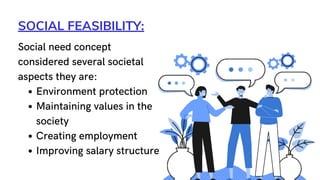
SOCIAL FEASIBILITY:
Environment protection
Maintaining values in the
society
Creating employment
Improving salary structure
Social need concept
considered several societal
aspects they are:

Entrepreneurship Development chapter 3 small scale industries.pdf

  • 1.
  • 2.
    Meaning of business opportunity: A business opportunity is a consumer need or want that can potentially be met by a new business. A successful entrepreneur is one who capture opportunities.
  • 3.
    Identification of Business opportunity: Identifymarket inefficiencies Customer desire to experience something new Pick a growing sector/industry Product differentiation Is it a seasonal business Remove key hassles 1. 2. 3. 4. 5. 6.
  • 4.
  • 5.
    Scanning of businessenvironment: Meaning: It is the process of carefully examining the internal and external environment of an organization to detect threats and opportunities that may affect its future direction. Understanding business environment will help the business in following ways: Determining opportunities and threats Giving direction for growth Continuous learning Image building Meeting competition 1. 2. 3. 4. 5. Identification of strength Identification of weakness Identification of opportunities Identification of threats Optimum use of resources Survival and growth Decision making 1. 2. 3. 4. 5. 6. 7. Importance or need of environment scanning:
  • 6.
    Have you consideredall the merits and demerits of the idea? Have you pinpointed the exact problem? Is your idea an original? Are there any problems your idea may generate? Can your company be competitive? Does your idea fill a real need? How soon could the idea be put into operation? Could you offer alternative ideas? EVALUATION OF ALTERNATIVE: An entrepreneur should ask the following questions when evaluating an idea for business: New experience Economic advantage Opportunity for the technology to add value Size of the market opportunity Frequency FACTORS TO BE CONSIDERED WHILE ANALYZING THE MARKET:
  • 7.
    SELECTION OF OPPORTUNITIES BASEDON PERSONAL COMPETENCIES (SWOT) Strengths: Characteristics of the business or project that gives it an advantage over others. Weaknesses: Characteristics that place the business or project at a disadvantages relative to others. Opportunities: Elements that the project could exploit to its advantage Threats: Elements in the environment that could cause trouble for the business project
  • 8.
    Internaland externalfactors: Internal factors= The strength and weaknesses internalto the organization External factors= The opportunities and threats by the environment external to the organization 1. 2.
  • 9.
    INTERNAL ENVIRONMENT ANALYSIS internal environment (control)(near environment) Customers Competitors Suppliers Some policies Intermediaries 1. 2. 3. 4. 5. Climate Exchange rate Foreigncompetition Interest rates Culture Government Technology Some publics 1. 2. 3. 4. 5. 6. 7. 8. Political Environemnt Social Technology Economic Legal 1. 2. 3. 4. 5. 6. Far environemen t PESTEL Analysis: EXTERNAL ENVIRONM ENT ANALYSIS
  • 10.
    1 Discovering entrepreneurial potential 2 Identifying a problem 3 Evaluating the idea 4 Investigatingand gathering the data resources 5 Forming the entreprise 6 Implementation 7 Planning the future STEPS IN STARTING A NEW VENTURE:
  • 11.
    Project will havea start and end point Project differ from operation Project need resources to deliver results Major projects are divided into sub projects Projects are carried on for research Features of a project: STEP 1. SELECTION OF A PROJECT: Understanding the problem Planning Designing Implementing Training Testing, evaluating and maintaining STAGES IN PROJECT DEVELOPMENT:
  • 12.
    A) PRODUCT ORSERVICE SELECTION: Supply gap Availability of raw material Marketability Government policies Factors to be considered in product selection: D) BUSINESS PLAN PREPARATION B) LOCATION SELECTION: Determine one's need Brand image Competition Safety Plan for future growth Tips to choose the right business location: E) PREPARE PROJECT REPORT C) PROJECT FEASIBILITY STUDY: Legal feasibility Operational feasibility Economic feasibility Technical feasibility Schedule feasibility Resource feasibility Cultural feasibility Financial feasibility The idea of the project The need of the project Basic raw material Space and location Machinery and equipment Employment Working hours Feasibility study contain following key elements:
  • 13.
    Types of Business Entities Ownership STEP2 DECIDE ON THE CONSTITUTION
  • 14.
    Registration of SSI Clearancefrom municipal department State pollution control board clearance Sanction from electricity board Copy of partnership deed/MOA in case of private company Purchase bill of raw material STEP 3 OBTAIN SSI REGISTRATION 1. Some formalities required to be completed for seeking permanent registration are: 2. REGISTERING SSI UNIT: 4. OBJECTIVES OF REGISTERING SCHEME: To maintain a roll of small industries to which the package of incentives and support are targeted To provide certificate To create nodal center at the center, state and district levels to promote SSI 3. BENEFITS OF REGISTERING: Credit availability Excise exemption scheme Exemption under direct tax laws 5. Provisional registration certificate 6.Permanent registration certificate 7. Procedure for registration 8. De-registration
  • 15.
    2 0 20 09 State drug controller Ministry of agriculture Chief inspector of factories State electricity board State pollution control board Local joint commercial tax officer STEP 4 OBTAIN CLEARANCE: Statutory licenses: STEP 6 ARRANGE FOR PLANT AND MACHINERY Purchase of plant and machinery Building Raw materials Power and water Hire purchase scheme for NSIC Technology selection STEP 5 ARRANGEMENT FOR LAND
  • 16.
    Development of infrastructure facility Land related decisions Getting the requiredutility connection STEP7 ARRANGE FOR INFRASTRUCTURE Land and building required Manufacturing capacity per annum Manufacturing process Machinery and equipment along with their prices Required of raw materials Man power needs Marketing Project report contains detailed information about: STEP 8 PREPARE PROJECT REPORT Long and medium term loans Risk capital Short term or working capital requirement Seed capital Finance can be classified into following types: STEP 9 APPLY AND OBTAIN FINANCE
  • 17.
    Contruction of shed Measuresto procure machinery Hiring Human resources Raw material arrangenment Marketing strategy Pollution control Industries requiring water and affecting effluent dispersal For units functioning outside the industrial area STEP 10 a) PROCEED TO IMPLEMENT: b) OBTAIN FINAL CLEARANCES: ENVIRONMENT POLLUTION RELATED CLEARANCES:
  • 18.
    MARKET FEASIBILITY: ASSESSMENT OFTHE MARKET FOR THE PROPOSED PROJECT: 1. • Once you have validated your idea by assessing the legal validity of your project; the next step is preparing the market feasibility study. • Market feasibility study is considered to be the most important study of the detailed studies. • This study is essential to the rest of the feasibility studies, without having a market study it’s difficult to go for further studies of the detailed feasibility study
  • 19.
    Create a business plan. Goalsfor Market Study: We can set up the goals of the market feasibility study as follows: • Determine the market structure and shape. • Determine exact demand for product. • Identify the factors affecting the market demand and supply. • Identify market targeted groups, and market segments. • Selecting the price policy and the best price mechanism to sell the products.
  • 20.
    Important questions forthe market study: • What you are going to sell? • Who are your customers? • How will you operate and how will you sell your product? • Why this way and not another? • How much: What is the estimated level of sales? • Whereabouts? (area & site) What are your reasons for thinking this is the ideal location, particularly if you are counting on a local customer base?
  • 21.
    FINANCIAL FEASIBILITY: Purchase orinstallment of machinery Procurement of raw material Working funds Statement of total project cost, initial cost, capital requirement Collection period of sales, inventory levels, payment period of purchase, selling, administration and financial expenses Return on investment The area where finance is needed, after the SSI has acquired the land: Financial analysis should include:
  • 22.
    TECHNICAL FEASIBILITY: Expected tobe advantageous or not Technology should be based on indigenous raw material and resources Technology should be workable under local condition(climate, humidity etc) Continuous updating of technology Whether the technology is patented or not Scale of development Flexibility Important aspects examined while deciding upon a particular technology are as under: Factors to be considered:
  • 23.
    SOCIAL FEASIBILITY: Environment protection Maintainingvalues in the society Creating employment Improving salary structure Social need concept considered several societal aspects they are: