Case study
 Have you ever worked with a group of people trying to solve a
problem?
 There are different opinions, different considerations, and each
person’s perspective provides a different angle on the problem.
 Ultimately, you must decide a course of action.
 There’s no right answer, but you have to confront the
complexities of the choice you make. What if that room was filled
with people from diverse industries, functions, countries, and
backgrounds?
 All trying to analyze a problem and make a decision? Every day?
 That is what the case method at HBS prepares you to do.
Method of Case Study Process
• Read and analyze the case. Each case is a 10-20 page
document written from the viewpoint of a real person
leading a real organization.
• In addition to background information on the situation,
each case ends in a key decision to be made.
• Your job is to sift through the information, incomplete by
design, and decide what you would do.
• Discuss the case.
• Each morning, you’ll bring your ideas to a small team of
classmates from various professional backgrounds, your
discussion group, to share your findings and listen to theirs
voices.
• Together, you begin to see the case from different
perspectives, better preparing you for class.
• Engage in class.
• Be prepared to change the way you think as you debate with
classmates the best path forward for this organization.
• The highly engaged conversation is facilitated by the faculty
member, but it’s driven by your classmates’ comments and
experiences.
• HBS brings together amazingly talented people from diverse backgrounds and
puts that experience front and center.
• Students do the majority of the talking (and lots of active listening), and your
job is to better understand the decision at hand.
• You will not leave a class thinking about the case the same way you thought
about it coming in!
• In addition to learning more about many businesses, in the case method you
will develop communication, listening, analysis, and leadership skills.
• It is a truly dynamic and immersive learning environment.
Reflect.
• The case method prepares you to be in leadership positions where you will
face time-sensitive decisions with limited information.
• Reflecting on each class discussion will prepare you to face these situations in
your future roles.
• Just as actors, athletes, and musicians spend thousands of hours practicing
their craft, business students benefit from practicing their critical-thinking
and decision-making skills.
• Students, however, often have limited exposure to real-world problem-
solving scenarios; they need more opportunities to practice tackling tough
business problems and deciding on—and executing—the best solutions.
• To ensure students have good opportunity to develop these critical-
thinking and decision-making skills, we believe business faculty should shift
from teaching mostly principles and ideas to mostly applications and
practices.
• And in doing so, they should emphasize the case method, which simulates
real-world management challenges and opportunities for students.
• To help educators facilitate this shift and help students get the
most out of case-based learning, we have developed a
framework for analyzing cases.
• We call it PACADI (Problem, Alternatives, Criteria, Analysis,
Decision, Implementation); it can improve learning outcomes
by helping students better solve and analyze business
problems, make decisions, and develop and implement
strategy.
• Here, we’ll explain why we developed this framework, how it
works, and what makes it an effective learning tool.
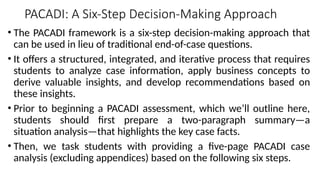
PACADI: A Six-Step Decision-Making Approach
• The PACADI framework is a six-step decision-making approach that
can be used in lieu of traditional end-of-case questions.
• It offers a structured, integrated, and iterative process that requires
students to analyze case information, apply business concepts to
derive valuable insights, and develop recommendations based on
these insights.
• Prior to beginning a PACADI assessment, which we’ll outline here,
students should first prepare a two-paragraph summary—a
situation analysis—that highlights the key case facts.
• Then, we task students with providing a five-page PACADI case
analysis (excluding appendices) based on the following six steps.
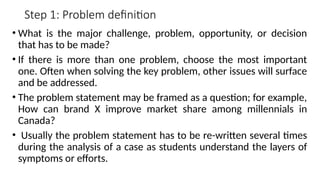
Step 1: Problem definition
• What is the major challenge, problem, opportunity, or decision
that has to be made?
• If there is more than one problem, choose the most important
one. Often when solving the key problem, other issues will surface
and be addressed.
• The problem statement may be framed as a question; for example,
How can brand X improve market share among millennials in
Canada?
• Usually the problem statement has to be re-written several times
during the analysis of a case as students understand the layers of
symptoms or efforts.
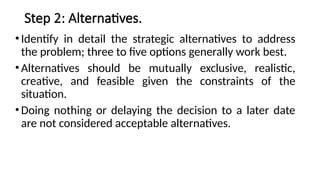
Step 2: Alternatives.
•Identify in detail the strategic alternatives to address
the problem; three to five options generally work best.
•Alternatives should be mutually exclusive, realistic,
creative, and feasible given the constraints of the
situation.
•Doing nothing or delaying the decision to a later date
are not considered acceptable alternatives.

entrepreneurship case study with business Case study.pptx

  • 1.
    Case study  Haveyou ever worked with a group of people trying to solve a problem?  There are different opinions, different considerations, and each person’s perspective provides a different angle on the problem.  Ultimately, you must decide a course of action.  There’s no right answer, but you have to confront the complexities of the choice you make. What if that room was filled with people from diverse industries, functions, countries, and backgrounds?  All trying to analyze a problem and make a decision? Every day?  That is what the case method at HBS prepares you to do.
  • 2.
    Method of CaseStudy Process • Read and analyze the case. Each case is a 10-20 page document written from the viewpoint of a real person leading a real organization. • In addition to background information on the situation, each case ends in a key decision to be made. • Your job is to sift through the information, incomplete by design, and decide what you would do. • Discuss the case.
  • 3.
    • Each morning,you’ll bring your ideas to a small team of classmates from various professional backgrounds, your discussion group, to share your findings and listen to theirs voices. • Together, you begin to see the case from different perspectives, better preparing you for class. • Engage in class. • Be prepared to change the way you think as you debate with classmates the best path forward for this organization. • The highly engaged conversation is facilitated by the faculty member, but it’s driven by your classmates’ comments and experiences.
  • 4.
    • HBS bringstogether amazingly talented people from diverse backgrounds and puts that experience front and center. • Students do the majority of the talking (and lots of active listening), and your job is to better understand the decision at hand. • You will not leave a class thinking about the case the same way you thought about it coming in! • In addition to learning more about many businesses, in the case method you will develop communication, listening, analysis, and leadership skills. • It is a truly dynamic and immersive learning environment. Reflect. • The case method prepares you to be in leadership positions where you will face time-sensitive decisions with limited information. • Reflecting on each class discussion will prepare you to face these situations in your future roles.
  • 5.
    • Just asactors, athletes, and musicians spend thousands of hours practicing their craft, business students benefit from practicing their critical-thinking and decision-making skills. • Students, however, often have limited exposure to real-world problem- solving scenarios; they need more opportunities to practice tackling tough business problems and deciding on—and executing—the best solutions. • To ensure students have good opportunity to develop these critical- thinking and decision-making skills, we believe business faculty should shift from teaching mostly principles and ideas to mostly applications and practices. • And in doing so, they should emphasize the case method, which simulates real-world management challenges and opportunities for students.
  • 6.
    • To helpeducators facilitate this shift and help students get the most out of case-based learning, we have developed a framework for analyzing cases. • We call it PACADI (Problem, Alternatives, Criteria, Analysis, Decision, Implementation); it can improve learning outcomes by helping students better solve and analyze business problems, make decisions, and develop and implement strategy. • Here, we’ll explain why we developed this framework, how it works, and what makes it an effective learning tool.
  • 7.
    PACADI: A Six-StepDecision-Making Approach • The PACADI framework is a six-step decision-making approach that can be used in lieu of traditional end-of-case questions. • It offers a structured, integrated, and iterative process that requires students to analyze case information, apply business concepts to derive valuable insights, and develop recommendations based on these insights. • Prior to beginning a PACADI assessment, which we’ll outline here, students should first prepare a two-paragraph summary—a situation analysis—that highlights the key case facts. • Then, we task students with providing a five-page PACADI case analysis (excluding appendices) based on the following six steps.
  • 8.
    Step 1: Problemdefinition • What is the major challenge, problem, opportunity, or decision that has to be made? • If there is more than one problem, choose the most important one. Often when solving the key problem, other issues will surface and be addressed. • The problem statement may be framed as a question; for example, How can brand X improve market share among millennials in Canada? • Usually the problem statement has to be re-written several times during the analysis of a case as students understand the layers of symptoms or efforts.
  • 9.
    Step 2: Alternatives. •Identifyin detail the strategic alternatives to address the problem; three to five options generally work best. •Alternatives should be mutually exclusive, realistic, creative, and feasible given the constraints of the situation. •Doing nothing or delaying the decision to a later date are not considered acceptable alternatives.