Chapter 11 & 12
Entity-Relationship (E-R)
Model
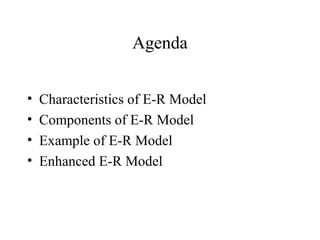
Agenda
• Characteristics of E-R Model
• Components of E-R Model
• Example of E-R Model
• Enhanced E-R Model
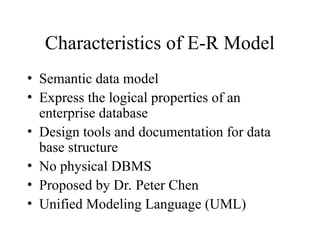
Characteristics of E-R Model
• Semantic data model
• Express the logical properties of an
enterprise database
• Design tools and documentation for data
base structure
• No physical DBMS
• Proposed by Dr. Peter Chen
• Unified Modeling Language (UML)
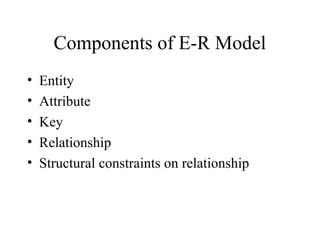
Components of E-R Model
• Entity
• Attribute
• Key
• Relationship
• Structural constraints on relationship
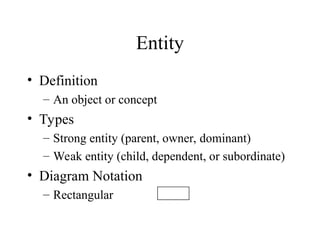
Entity
• Definition
– An object or concept
• Types
– Strong entity (parent, owner, dominant)
– Weak entity (child, dependent, or subordinate)
• Diagram Notation
– Rectangular
Attribute
• Domain
• Types
– Single
– Composite
– Single-valued
– Multi-valued
– Derived
Key
• Candidate key
• Primary key
• Composite key
Relationship
• Definition
– Association among entities
• Diagram Notation
– Line – (relation or role name)
• Degree of a relationship
– Number of participating entities
– Types
• Unary (recursive relationship)
• Binary
• Ternary
• Quaternary
Structural Constraints on
Relationship
• Cardinality constraints
– Zero-to-one 0..1
– Zero-to-many 0..*
– One-to-many 1..*
– Many-to-many *..*
• Participation constraints
– Total (mandatory, every one involved)
– Partial (optional, only some involved)
• Improper relationship
– Fan trap (ambiguous pathway)
– Chasm trap (missing pathway)
Enhanced Entity-Relationship Model
• Additional entity types
– Superclass: including one or more distinct subgroups in the data model
– Subclass: a distinct subgroup of an entity type in the data model
• Attribute Inheritance
– Specialization hierarchy (specialization: maximizing the differences
between members of an entity by identifying their distinguishing
characteristics)
– Generalization hierarchy (generalization: minimizing the differences
between entities by identifying their common characteristics)
– Is-A hierarchy
• Constraints on specialization/generalization
– Participation (mandatory, optional)
– Disjoint: disjoint (or), non-disjoint (and)
• Other
– Aggregation (has a or is part of)
– Composition (strong ownership of aggregation)
Design Steps
• Identify
– Entity types, relationship types
– Cardinality and participation constraints
– Attributes
– Keys
– Specialize/generalize
– EER diagram
• EER model example
• Create an enhanced ER diagram for a rental
management using following entities:
– Rental agency
– Staff
• Part time
• Full time
– Owner
– Renter
– Property
• Business
• Home
Points To Remember
• Characteristics of E-R Model
• Components of E-R Model
• Example of E-R Model
• Enhanced E-R Model
Assignment
• Review chapters 5, 6, 9, 10, 11, and 12
• Read chapter 13
• Homework assignment
– 11.11 (enhanced e-r diagram)
– Due date:
• Exam 2 date:

Entity relationship modelling and entity relationship diagrams

  • 1.
    Chapter 11 &12 Entity-Relationship (E-R) Model
  • 2.
    Agenda • Characteristics ofE-R Model • Components of E-R Model • Example of E-R Model • Enhanced E-R Model
  • 3.
    Characteristics of E-RModel • Semantic data model • Express the logical properties of an enterprise database • Design tools and documentation for data base structure • No physical DBMS • Proposed by Dr. Peter Chen • Unified Modeling Language (UML)
  • 4.
    Components of E-RModel • Entity • Attribute • Key • Relationship • Structural constraints on relationship
  • 5.
    Entity • Definition – Anobject or concept • Types – Strong entity (parent, owner, dominant) – Weak entity (child, dependent, or subordinate) • Diagram Notation – Rectangular
  • 6.
    Attribute • Domain • Types –Single – Composite – Single-valued – Multi-valued – Derived
  • 7.
    Key • Candidate key •Primary key • Composite key
  • 8.
    Relationship • Definition – Associationamong entities • Diagram Notation – Line – (relation or role name) • Degree of a relationship – Number of participating entities – Types • Unary (recursive relationship) • Binary • Ternary • Quaternary
  • 9.
    Structural Constraints on Relationship •Cardinality constraints – Zero-to-one 0..1 – Zero-to-many 0..* – One-to-many 1..* – Many-to-many *..* • Participation constraints – Total (mandatory, every one involved) – Partial (optional, only some involved) • Improper relationship – Fan trap (ambiguous pathway) – Chasm trap (missing pathway)
  • 10.
    Enhanced Entity-Relationship Model •Additional entity types – Superclass: including one or more distinct subgroups in the data model – Subclass: a distinct subgroup of an entity type in the data model • Attribute Inheritance – Specialization hierarchy (specialization: maximizing the differences between members of an entity by identifying their distinguishing characteristics) – Generalization hierarchy (generalization: minimizing the differences between entities by identifying their common characteristics) – Is-A hierarchy • Constraints on specialization/generalization – Participation (mandatory, optional) – Disjoint: disjoint (or), non-disjoint (and) • Other – Aggregation (has a or is part of) – Composition (strong ownership of aggregation)
  • 11.
    Design Steps • Identify –Entity types, relationship types – Cardinality and participation constraints – Attributes – Keys – Specialize/generalize – EER diagram • EER model example
  • 12.
    • Create anenhanced ER diagram for a rental management using following entities: – Rental agency – Staff • Part time • Full time – Owner – Renter – Property • Business • Home
  • 13.
    Points To Remember •Characteristics of E-R Model • Components of E-R Model • Example of E-R Model • Enhanced E-R Model
  • 14.
    Assignment • Review chapters5, 6, 9, 10, 11, and 12 • Read chapter 13 • Homework assignment – 11.11 (enhanced e-r diagram) – Due date: • Exam 2 date: