Entity Framework 6 Recipes 2nd Edition Brian Driscoll
1.
Entity Framework 6Recipes 2nd Edition Brian
Driscoll pdf download
https://ebookgate.com/product/entity-framework-6-recipes-2nd-
edition-brian-driscoll/
Get the full ebook with Bonus Features for a Better Reading Experience on ebookgate.com
2.
Instant digital products(PDF, ePub, MOBI) available
Download now and explore formats that suit you...
Entity Framework 4 in Action Stefano Mostarda
https://ebookgate.com/product/entity-framework-4-in-action-stefano-
mostarda/
ebookgate.com
Entity Framework Core in Action Second Edition Jon P Smith
https://ebookgate.com/product/entity-framework-core-in-action-second-
edition-jon-p-smith/
ebookgate.com
Web Development Recipes 2nd Edition Edition Brian P. Hogan
https://ebookgate.com/product/web-development-recipes-2nd-edition-
edition-brian-p-hogan/
ebookgate.com
WCF 4 5 Multi Layer Services Development with Entity
Framework Third Edition Mike Liu
https://ebookgate.com/product/wcf-4-5-multi-layer-services-
development-with-entity-framework-third-edition-mike-liu/
ebookgate.com
3.
WCF 4 5Multi Layer Services Development with Entity
Framework 3rd New edition Edition Liu Mike
https://ebookgate.com/product/wcf-4-5-multi-layer-services-
development-with-entity-framework-3rd-new-edition-edition-liu-mike/
ebookgate.com
Web Development Recipes Second Edition Brian P. Hogan Et
Al.
https://ebookgate.com/product/web-development-recipes-second-edition-
brian-p-hogan-et-al/
ebookgate.com
Web Based Training Creating e Learning Experiences 2nd
Edition Margaret Driscoll
https://ebookgate.com/product/web-based-training-creating-e-learning-
experiences-2nd-edition-margaret-driscoll/
ebookgate.com
Schwarz Christoffel Mapping 1st Edition Tobin A. Driscoll
https://ebookgate.com/product/schwarz-christoffel-mapping-1st-edition-
tobin-a-driscoll/
ebookgate.com
Database Design Using Entity Relationship Diagrams Second
Edition Bagui
https://ebookgate.com/product/database-design-using-entity-
relationship-diagrams-second-edition-bagui/
ebookgate.com
6.
For your convenienceApress has placed some of the front
matter material after the index. Please use the Bookmarks
and Contents at a Glance links to access them.
7.
v
Contents at aGlance
About the Authors
����������������������������������������������������������������������������������������������������������� xxvii
About the Technical Reviewer����������������������������������������������������������������������������������������� xxix
Preface���������������������������������������������������������������������������������������������������������������������������� xxxi
Chapter 1: Getting Started with Entity Framework
■
■ �����������������������������������������������������������1
Chapter 2: Entity Data Modeling Fundamentals
■
■ ��������������������������������������������������������������11
Chapter 3: Querying an Entity Data Model
■
■ ����������������������������������������������������������������������55
Chapter 4: Using Entity Framework in ASP.NET MVC
■
■
�����������������������������������������������������107
Chapter 5: Loading Entities and Navigation Properties
■
■ �������������������������������������������������129
Chapter 6: Beyond the Basics with Modeling and Inheritance
■
■
��������������������������������������183
Chapter 7: Working with Object Services
■
■ ����������������������������������������������������������������������235
Chapter 8: Plain Old CLR Objects
■
■ �����������������������������������������������������������������������������������257
Chapter 9: Using the Entity Framework in N-Tier Applications
■
■ �������������������������������������295
Chapter 10: Stored Procedures
■
■ �������������������������������������������������������������������������������������341
Chapter 11: Functions
■
■ ���������������������������������������������������������������������������������������������������375
Chapter 12: Customizing Entity Framework Objects
■
■ �����������������������������������������������������413
Chapter 13: Improving Performance
■
■ �����������������������������������������������������������������������������451
Chapter 14: Concurrency
■
■ �����������������������������������������������������������������������������������������������483
Index���������������������������������������������������������������������������������������������������������������������������������503
8.
1
Chapter 1
Getting Startedwith Entity Framework
When working with relational databases, we think in terms of tables with rows and columns. Tables are highly
structured and excel at set-based processing. Before the wide adoption of object-oriented programming, we thought
about problems “procedurally” and solved them by writing code in a structured, top-down manner, function after
function. Both worlds lined up well: Tables, rows, and columns closely matched the structured and procedural
patterns in our code. Life was good - for a time...
Much has evolved on the code side. We now think in terms of objects and domain models. We architect,
design, and program against real-world things, like customers and orders. We draw nouns in our problem space
on whiteboards. We draw lines between them, denoting relationships and interactions. We build specifications
and assign work to development teams in terms of these drawings. In short, we architect, design, and program at a
conceptual level that is very distant from the logical and physical organization of the database.
While the software development process has dramatically matured and the way in which we reason and
solve problems has evolved, the database has not. The data remains locked in the same tables, rows, and columns
paradigm, where it has been for many years. Unfortunately, this creates a mismatch (an impedance mismatch, as
Microsoft fellow Anders Hejlsberg might call it): Object-oriented class hierarchies vs. a highly normalized database
structure.
To cope with this gap, software projects often introduce a “database layer” that translates application domain
classes into the rows and columns saved in tables. This approach has spawned many commercial and open-source
data access frameworks; all attempting to bridge the ever widening gap between evolving development processes and
structured data. Interestingly, an entire new field of Object Relational Mapping (ORM) has come out it.
The Entity Framework, coupled with the Language-Integrated Query (LINQ) framework, both from Microsoft,
enables us to address the mismatch problem head-on. Using Entity Framework, we model entity classes for our
application on a design surface or directly in code. Then we model relationships (associations) between these entities.
In our code, we construct LINQ queries to program against these entities and associations. LINQ allows us to express
relational database set concepts directly into our code while working in terms of entity types and associations. All
of this helps to streamline our development experience while reducing the overall effort. Instead of coding large
numbers of highly redundant ADO.NET data access constructs, we express our data needs in simple LINQ queries.
Instead of programming against the schema of a highly normalized database, we code against entity classes. Entity
Framework maps entity classes to the underlying database for you.
Note
■
■ We use the term entity class or entity object to refer to a class that typically represents a domain item in an
application. Domain classes represent real-world objects, such as an Employee, Department, or Manager, which your
application will represent and track. The end users and stakeholders of your application should be able to look at the
domain classes in your application and say, “Yes, that’s what our business does.” Entity classes define the schema,
or properties, but not the behavior, of a domain class. In essence, entity classes expose the state of an object.
9.
Chapter 1 ■Getting Started with Entity Framework
2
1-1. A Brief Tour of the Entity Framework World
Entity Framework is Microsoft’s strategic approach to data access technology for building software applications.
Unlike earlier data access technologies, Entity Framework, coupled with Visual Studio, delivers a comprehensive,
model-based ecosystem that enables you to develop a wide range of data-oriented applications, including desktop,
Internet, cloud, and service-based applications, many of which will be covered in this book.
The History
Entity Framework is not new. The product dates back to Visual Studio 2008 and has come a long way in features and
functionality. Figure 1-1 gives the pictorial history.
The first version of Entity Framework was limited, featuring basic ORM support and the ability to implement
a single approach known as Database First, which we thoroughly demonstrate in this book. Version 4 brought us
another approach to using Entity Framework: Model First, along with full Plain Old CLR Object (POCO) support and
default lazy loading behavior. Soon after, the Entity Framework team released three smaller, or point releases, 4.1
through 4.3, which represented yet another approach to using Entity Framework: Code First. As shown above,
Version 5 of Entity Framework coordinated with the release of the .NET 4.5 framework and Visual Studio 2012,
delivering significant performance improvements along with support for enums, table value functions, spatial types,
the batch import of stored procedures, and deep support with the ASP.NET MVC framework.
Now we are at Version 6 of the Entity Framework. Version 6 delivers asynchronous support for querying and
updates, stored procedure support for updates in Code First, improved performance, and a long list of new features,
which we will focus on in this book.
Figure 1-1. A short history of the Entity Framework
10.
Chapter 1 ■Getting Started with Entity Framework
3
Note
■
■ Version 5 of Entity Framework can also be used with Visual Studio 2010. Version 6 of Entity Framework, released
with Visual Studio 2013, has tooling/runtime support for Visual Studio 2012 and runtime support for Visual Studio 2010.
To level set, let’s take a brief look at some of the key components of the Entity Framework ecosystem. What
follows is not by any means a comprehensive description of Entity Framework; that would take hundreds of pages.
We’ll look at just a few key areas to help get you oriented for the recipes that are at the heart of this book.
The Model
Entity Framework is a technology with a strong focus on modeling. As you model with Entity Framework, you will
see many familiar genetic markers from previous technologies and patterns. For example, you will, no doubt, see a
resemblance to entity-relationship diagrams and the widely adopted conceptual, logical, and physical design layering
approach.
The model that you create in Entity Framework is characterized by a construct called an Entity Data Model
(EDM), which enables you to code against strongly typed entity classes, not database schema and objects. (Figure 1-2
shows this model in conceptual form.) The Entity Data Model enables you to customize the mappings between entity
classes and database tables to move beyond the classic, one-to-one mapping, or class-to-table mapping.
In Figure 1-2, note how the database tables (on the left) do not directly map to the entity classes, which we code
against (on the right). Instead, the mapping capabilities built into the Entity Data Model enable the developer to code
against a set of entity classes that more closely resemble the problem domain, as opposed to a highly normalized
database, designed for performance, scalability, and maintainability.
For example, note above how the Employees, Devices, and Phone numbers) are physically stored in three
different tables, which from a DBA perspective makes perfect sense. But the developer codes against a single
Employee entity class that contains a collection of Devices and Phone Numbers. From a developer and project
Figure 1-2. The Entity Data Model
11.
Chapter 1 ■Getting Started with Entity Framework
4
stakeholder perspective, an employee is a single object, which happens to contain phone numbers and devices.
The developer is unaware, and does not care, that the DBA has normalized this employee object into three separate
database tables. Once configured, the mapping between the single class and three database tables is abstracted away
and handled by the Entity Framework.
A reverse situation can be seen for the single Department table, which programmatically maps to three entity
classes that represent individual departments. Again, to the developer and project stakeholders, a separate entity
object represents each department (Accounting, Marketing, Finance, and so on), but DBA optimizes and collapses
these objects into a single database table for data storage purposes.
Of course, as can be seen in the Location table, you can easily map a single entity class to a single database table,
which is the default behavior for Entity Framework.
The key takeaway here is that developer and project stakeholders work with a representation of domain classes
that make sense in the context of the application. The DBA can structure the underlying database tables in order to
efficiently tune the database. And you can easily bridge these two worlds with the Entity Framework.
The Layers
The Entity Data Model consists of three separate layers: the conceptual, store, and mapping layers. Each layer is
decoupled from the others.
The entity classes are contained in the conceptual layer of the Entity Data Model. This is layer in which developers
and project stakeholders work. Depending upon how you implement the Entity Framework, the conceptual layer can
be modeled with a designer or from code. Once you make that decision, you can reverse- engineer your model from
an existing database, leveraging the designer and extensive tooling that ships with Entity Framework or create your
model with code and have Entity Framework generate the database for you. The syntax for the conceptual layer is
defined in the Conceptual Schema Definition Language (CSDL).
Every useful application needs to persist objects to some data store. The store layer of the Entity Data Model
defines the tables, columns, relationships, and data types that map to the underlying database. The Store Schema
Definition Language (SSDL) defines the syntax for the store model.
Finally, the mapping layer defines the mapping between the conceptual and store layer. Among other things,
this layer defines how properties from entity classes map to columns in database tables. This layer is exposed to the
developer from the Mapping Details window contained in the Entity Framework designer or data annotations and
fluent API if choosing a code-based approach. The Mapping Specification Language (MSL) defines the syntax for the
mapping layer.
The Terminology
As expected, the Entity Framework comes with its own vocabulary. If you have used any of the popular ORM tools
or are familiar with database modeling, you’ve probably encountered some of the terminology before. Although the
entire vocabulary is extensive, we’ll provide just a few of the basic terms to get us started.
As discussed earlier, an EntityType represents a class in your domain model. An instance of an EntityType is often
referred to as an entity. If you are using the Entity Framework designer, an EntityType is represented on the design
surface as a box with various properties. Figure 1-3 shows two EntityTypes: Employee and Task.
12.
Chapter 1 ■Getting Started with Entity Framework
5
An EntityType usually has one or more properties. Just like with a class, a property is a named value with a specific
data type. Properties can have simple types like integer, string, and so on; or have ComplexTypes; or be collections.
Navigation properties refer to other related entities (typically represented by foreign key relationships in a database).
The non-navigation properties on an EntityType are usually just called scalar properties.
A relationship between two entities is called an association. Associations between EntityTypes are shown on the
design surface as a line connecting the EntityTypes. The line is annotated to show the multiplicity on each end of the
association. The association in Figure 1-3 is a one-to-many association between Employee and Task. An Employee
can have zero or more tasks. Each Task is associated to exactly one Employee.
Every EntityType has a property or set of properties that denote its EntityKey. An EntityKey uniquely identifies
the entity to Entity Framework and is most often mapped to a primary key from the entity’s representation in the
underlying database.
Finally, no discussion on Entity Framework would be complete without mentioning the context object. The
context object for Entity Framework is your gateway into the Entity Framework services. The context object exposes
entity objects, manages the database connection, generates parameterized SQL, marshals data to and from the
database, caches objects, helps maintain change tracking and materializes, or transforms, an untyped result set into a
collection of strongly typed objects.
In the beginning, there was the ObjectContext object. Now, Entity Framework supports an alternate, more
streamlined context object called the DbContext. The DbContext greatly simplifies the developer experience when
working with Entity Framework. Interestingly, the DbContext is a wrapper, or facade, around the ObjectContext,
exposing the underlying ObjectContext functionality in an intuitive, friendly and productive way.
Clearly, the DbContext is the preferred approach for working with Entity Framework as we will demonstrate in
great detail in this book.
The Code
Despite a tremendous emphasis on visual design support, the Entity Framework is all about code. The models,
EntityTypes, associations, mappings, and so on are ultimately expressed in concrete code that becomes part of
your application. This code is either generated by Visual Studio and Entity Framework or created manually by the
development team. You can choose quite a bit about the code-generation process or the lack of it by changing various
properties on your project or modifying the underlying code-generation templates.
Visual Studio uses a code-generation technology called Text Template Transformation Toolkit, simply referred
to as T4 templates. The Visual Studio tooling uses T4 templates to generate, or scaffold, code automatically. The great
thing about T4 template support in Visual Studio is that you can edit the templates to tailor the code-generation
process to match your exact needs. This is an advanced technique, but it is necessary in some cases. We’ll show you
how to do this in a few recipes.
Figure 1-3. A model with Employee and Task with a one-to-many association between them
13.
Chapter 1 ■Getting Started with Entity Framework
6
Alternatively, you can leverage the more recent Code-First approach to manually create the concrete code
yourself, gaining direct control over the entire process. With Code First, the developer can create entity classes,
mappings and context object, all without the help of a designer. These manually created entity classes, commonly
referred to as POCO, or Plain Old CLR Objects, have no dependence on Entity Framework plumbing. Even more
interesting, the development team can leverage the Entity Framework Power Tool utilities (free download from
Microsoft) to reverse-engineer a Code First model from an existing database, foregoing the effort to have manually
create the entity classes, mappings and context object. The recipes in Chapter 8 show you the basics of creating and
using POCO. Many of the recipes throughout the book will show you how to use Code First across specific contexts
such as in n-Tier applications.
Visual Studio
Of course, the main tool we use when developing applications for the Windows environment is Visual Studio. This
Integrated Development Environment has evolved over many years from a simple C++ compiler and editor to a
highly integrated, multi-language environment that supports the entire software development lifecycle. Visual Studio
and its related tools and services provide for design, development, unit testing, debugging, software configuration
management, build management and continuous integration, and much more. Don’t be worried if you haven’t used
all these in your work; few developers have. The point is that Visual Studio is a full-featured toolset. Visual Studio
plays a vital role in the development of Entity Framework applications.
Visual Studio provides an integrated design surface for Entity Framework models. Using this design surface and
other tools in Visual Studio, you can create models from scratch or create them from an existing database. You also
have the option to completely eliminate the designer and manually craft your Entity Types and configuration.
If you have an existing database, which is the case for many of us with existing applications, Visual Studio
provides tools for importing your tables and relationships into a model. This fits nicely with the real world because
few of us have the luxury of developing brand-new applications. Most of us have to extend, maintain, and evolve our
existing code and databases.
Alternately, you can create a model from scratch by starting with an empty design surface and adding new
EntityTypes to the surface, creating both associations and inheritance hierarchies for your model. When you are done
creating the model, right-click the design surface and select Generate Database from Model.
If your project team is code-centric, you can instead create a set of domain classes, including relationships and a
context class and then wire up these classes to hook into the Entity Framework engine and features without having to
use a designer.
Once you have created your model, changes often happen. That’s the nature of software development. Visual
Studio provides tools for updating the model from the database. This will keep the model synchronized with changes
in the database. Additionally, the Entity Framework Team also supports a tool called Code First Migrations, which can
be used to keep your database up-to-date with changes in your model.
1-2. Using Entity Framework
Entity Framework is tightly integrated with Visual Studio. To implement Entity Framework in your application, add a
new ADO.NET Entity Data Model in your project. Right-click your project and select Add ➤ New Item. In the dialog
box (see Figure 1-4), choose the ADO.NET Entity Data Model template. This template is located under the Data
templates. Click Add to launch the Entity Data Model Wizard.
14.
Chapter 1 ■Getting Started with Entity Framework
7
There are two options on the first page of the Entity Data Model Wizard: start with an existing database or start
with an empty model. (The former option is actually labeled “Generate from database.”) This first page is shown in
Figure 1-5.
Figure 1-4. Adding a new model to your project
15.
Chapter 1 ■Getting Started with Entity Framework
8
Generating a model from an existing database is the Database-First approach. From the tables, views, and stored
procedures that you select from the underlying database, the wizard will create a model and entity classes, against
which you can write code. The immediate benefit here is that you write code against strongly typed entity classes,
which Entity Framework maps to the underlying database tables and columns. If the tables you include are related in
the database, these relationships will be modeled as associations. This is one way to create your model if you already
have a database for your application. However, if you prefer to use the Code-First approach with an existing database,
worry not. The Entity Framework team has created tooling (The Entity Framework Power Tools) that reverse-engineers
an existing database into domain entity classes, just as if you coded them by hand.
If you’re working on a brand-new application, without an existing database, you have options as well. In the
Entity Framework designer, you can start with an empty design surface. Right-click the design surface to create new
EntityTypes, associations, or inheritances. You can also drag them from the Toolbox onto the design surface. Once
your model is complete, just right-click the design surface and select Generate Database from Model. This will
generate a script you can use to create the database tables and relationships for the model.
Figure 1-5. The Entity Data Model Wizard gives you a choice between creating a model from an existing database or
starting with an empty model
16.
Chapter 1 ■Getting Started with Entity Framework
9
Alternately, you can manually create each of your entity classes in Visual Studio and simply register them in
the DbContext object, then hook into the Entity Framework services. Entity Framework will map the classes to the
underlying databases and automatically create a model in memory at runtime.
With the Model-First or Database-First approaches, you use the Entity Framework designer to develop your
model. The key parts of a model in the designer are shown in Figure 1-6. In this model, a Customer has a one-to-many
association with an Order. Each customer may have many orders, but each order is associated with just one customer.
The Mapping Details window shows that the Customer EntityType maps to the Customer table in the database.
The Mapping Detail window also shows the mapping between the columns in the Customer table and the scalar
properties in the Customer EntityType. Keep in mind that you can make the same kind of mapping configurations
using the data annotations or fluent API features found in the Code First approach to using Entity Framework.
Figure 1-6. Key parts of a model in the designer
17.
Chapter 1 ■Getting Started with Entity Framework
10
Of course, there’s more to the designer and model than just the few key parts illustrated in Figure 1-6. In the
recipes in this book, we’ll cover just about every aspect of using the designer to create models. In some cases, we go
beyond what can be done with the designer and show you how to create models that require direct editing of the
underlying .edmx file. The .edmx file contains the complete model definition, including the conceptual layer, store
layer, and mapping layer.
So, whether we implement Entity Framework with the Database-First, Model-First or Code-First approach,
we always end up with a model. We gain significant productivity, as we can program against objects in the model
(EntityTypes) as you do with other objects in your application. For the model in Figure 1-6, your code uses Customer
and Order in much the same way as you use other objects.
If you want to insert a new customer and order into the database, you can create instances of the Customer
and Order types, set the properties, add them to the in-memory context that represents the model, and call
SaveChanges(). All the necessary SQL code is generated and sent to the database to insert the rows. To retrieve
customers and orders from the database, you use either LINQ or Entity SQL to create a query in terms of the
EntityTypes and associations in the model.
The recipes throughout this book will show you step by step how to model just about every conceivable database
scenario; how to query, insert, update, and delete using these models; and how to use Entity Framework in many
kinds of applications.
18.
11
Chapter 2
Entity DataModeling Fundamentals
More likely than not, you are just beginning to explore Entity Framework, and you are probably asking the question,
“Okay, how do I get started?” If this describes you, this chapter is a great place to start. If, on the other hand,
you have built some working models and feel comfortable with a few key modeling concepts, such as entity splitting
and inheritance, you can skip this chapter.
In this chapter, we will walk you through the basic examples of modeling with Entity Framework. Modeling is
the core feature of Entity Framework and what distinguishes Entity Framework from previous Microsoft data access
platforms. Once you have built your model, you can write code against the model rather than against the rows and
columns in the relational database.
We start off this chapter with an example of how to create a simple conceptual model, and then let Entity
Framework create the underlying database. In the remaining examples, we will show you how to create models from
existing tables and relationships in your databases.
2-1. Creating a Simple Model
Problem
You have a brand new project, and you want to create a model.
Solution
Let’s imagine that you want to create an application to hold the names and phone numbers of people that you know.
To keep things simple, let’s assume that you need just one entity type: Person.
To create the new model, do the following:
1. Right-click your project, and select Add ➤ New Item.
2. From the templates, select ADO.NET Entity Data Model and click Add. This template is
located in Data under Visual C# Items (see Figure 2-1).
19.
Chapter 2 ■Entity Data Modeling Fundamentals
12
3. In the first step of the wizard, choose Empty Model and click Finish. The wizard will create
a new conceptual model with an empty design surface.
4. Right-click the design surface, and select Add ➤ Entity.
5. Type Person in the Entity name field, and select the box to Create a key property. Use Id
as the Key Property. Make sure that its Property Type is Int32. Click OK, and a new Person
entity will appear on the design surface (see Figure 2-2).
Figure 2-1. Adding a new .emdx file that contains XML describing the conceptual model, storage model,
and mapping layer
20.
Chapter 2 ■Entity Data Modeling Fundamentals
13
6. Right-click near the top of the Person entity, and select Add ➤ Scalar Property.
A new scalar property will be added to the Person entity.
7. Rename the scalar property FirstName. Add scalar properties for LastName, MiddleName,
and PhoneNumber.
8. Right-click the Id property, and select Properties. In the properties view, change
the StoreGeneratedPattern property to Identity if it is not already set to Identity.
This flags the Id property as a value that will be computed by the store layer (database).
The database script we get at the end will flag the Id column as an identity column,
and the storage model will know that the database will automatically manage the values
in this column.
The completed conceptual model should look like the model in Figure 2-3.
Figure 2-2. Adding a new entity type representing a Person in our conceptual model
21.
Chapter 2 ■Entity Data Modeling Fundamentals
14
You now have a simple conceptual model. To generate a database for our model, there are a few things we still
have to do:
9. We need to change a couple of properties of our model to help with housekeeping.
Right-click the design surface, and select properties. Change the Database Schema Name
to Chapter2, and change the Entity Container Name to EF6RecipesContext. Figure 2-4
illustrates these changes.
Figure 2-4. Changing the properties of our model
Figure 2-3. Our completed model with an entity type representing a Person
22.
Chapter 2 ■Entity Data Modeling Fundamentals
15
10. Right-click the design surface, and select Generate Database Script from Model. Select an
existing database connection or create a new one. In Figure 2-5, we’ve opted to create a
new connection to our local machine and to the database EF6Recipes.
11. Click OK to complete the connection properties, and click Next to preview the database
script (see Figure 2-6). Once you click Finish, the generated script is added to your project.
Figure 2-5. Creating a new database connection that will be used by Entity Framework to create a database script that
we can use to create a database from our conceptual model
23.
Chapter 2 ■Entity Data Modeling Fundamentals
16
12. Run the database script in an SSMS query window to create the database and the
People table.
How It Works
The Entity Framework Designer is a powerful tool for creating and updating a conceptual model, storage model,
and mapping layer. This tool provides support for bidirectional model development. You can either start with a clean
design surface and create a model; or start with a database that you already have and import it to create a conceptual
model, storage model, and mapping layer. The current version of the Designer supports somewhat limited roundtrip
modeling, allowing you to re-create your database from a model and update the model from changes in your
database.
The model has a number of properties that affect what goes in the generated storage model and database script.
We changed two of these properties. The first was the name of the container. This is the class derived from DbContext.
We called this EF6RecipesContext to be consistent with the contexts we use throughout this book.
Additionally, we changed the schema to “Chapter 2.” This represents the schema used to generate the storage
model as well as the database script.
Figure 2-6. Generating the storage model in the .edmx file and creating the database script
24.
Chapter 2 ■Entity Data Modeling Fundamentals
17
The code in Listing 2-1 demonstrates one simple way to create and insert instances of our Person entity type.
The code also demonstrates iterating through all the Person entities in our database.
Listing 2-1. Inserting into and Retrieving from Our Model
using (var context = new EF6RecipesContext())
{
var person = new Person { FirstName = Robert, MiddleName=Allen,
LastName = Doe, PhoneNumber = 867-5309 };
context.People.Add(person);
person = new Person { FirstName = John, MiddleName=K.,
LastName = Smith, PhoneNumber = 824-3031 };
context.People.Add(person);
person = new Person { FirstName = Billy, MiddleName=Albert,
LastName = Minor, PhoneNumber = 907-2212 };
context.People.Add(person);
person = new Person { FirstName = Kathy, MiddleName=Anne,
LastName = Ryan, PhoneNumber = 722-0038 };
context.People.Add(person);
context.SaveChanges();
}
using (var context = new EF6RecipesContext())
{
foreach (var person in context.People)
{
System.Console.WriteLine({0} {1} {2}, Phone: {3},
person.FirstName, person.MiddleName,
person.LastName, person.PhoneNumber);
}
}
The output of the code in Listing 2-1 should look something like the following:
John K. Smith, Phone: 824-3031
Robert Allen Doe, Phone: 867-5309
Kathy Anne Ryan, Phone: 722-0038
Billy Albert Minor, Phone: 907-2212
Best Practice
When we created a new instance of the database context, we did it within a using() statement:
using (var context = new EF6RecipesContext())
{
...
}
25.
Chapter 2 ■Entity Data Modeling Fundamentals
18
If you are not familiar with this pattern, it’s really pretty simple. Normally, when we get a new instance of an
object, we use the new operator and assign the result to some variable. When the variable goes out of scope and the
object is no longer referenced by anything else, the garbage collector will do its job at some point and reclaim the
memory for the object. That works great for most of the objects that we create in our .NET applications because most
objects hold on to resources that can wait around for whenever the garbage collector has a chance to reclaim them.
The garbage collector is rather nondeterministic. It reclaims resources pretty much on its own schedule, which we can
only partially influence.
Instances of DbContext hold on to system resources such as database connections that we want to release as
soon as we’re done with them. We don’t really want these database connections to stay open waiting for the garbage
collector eventually to reclaim them.
There are a few nice features of using() statements. First, when the code execution leaves the using() {} block,
the Dispose() method on the context will be called because DbContext implements the IDisposable interface. For
DbContext, the Dispose() method closes any active database connections and properly cleans up any other resources
that need to be released.
Second, no matter how the code leaves the using(){} block, the Dispose() method is called. Most importantly,
this includes return statements and exceptions that may be thrown within the code block. The using(){} block is kind
of a guarantee that critical resources will be reclaimed properly.
The best practice here is always to wrap your code in the using(){} block when creating new instances of
DbContext. It’s one more step to help bulletproof your code.
2-2. Creating a Model from an Existing Database
Problem
You have an existing database with tables, perhaps a few views, and some foreign key constraints, and you want to
create a model for this database.
Solution
Let’s say that you have database describing poets and their poetry. Your relational database might look something like
the diagram in Figure 2-7.
From this database diagram, you can see that a poet can be the author of one or more poems, and each poem
can be categorized by its meter, which is the basic pattern of a poem’s verse. It’s not shown in this diagram, but our
database also has a view that joins the tables together so that we can more easily enumerate each poet and poem,
as well as the poem’s meter.
Figure 2-7. A simple database for poets and their poetry
26.
Chapter 2 ■Entity Data Modeling Fundamentals
19
To import the view, tables, and relationships into a model, do the following:
1. Right-click your project, and select Add ➤ New Item.
2. From the Visual C# Items Data templates, select ADO.NET Entity Data Model.
3. Select Generate from database to create the model from our existing tables. Click Next.
4. Either choose an existing connection to your database or create a new connection.
If you are creating a new connection, you will need to select your database server,
your authentication method (Windows or SQL Server), and the database. Once you have
selected these, it’s a good idea to click Test Connection to be sure that the connection is
ready to go. Once you have tested the connection, click Next.
The next dialog box shows all of the tables, views, and stored procedures in the database.
Check the items you want to include in the model. We want to select all of the tables
(Meter, Poem, and Poet). We also want to select the view (vwLibrary). For now, leave
the two check boxes for pluralizing and including foreign key columns selected. We will
discuss them further momentarily. Figure 2-8 shows the things we’ve selected.
When you click Finish, the wizard will create a new model with our three tables and the view. The wizard will also
read the foreign key constraints from the database and infer a one-to-many relationship between Poet and Poem(s)
as well as a one-to-many relationship between Meter and Poem(s).
Figure 2-8. Selecting the tables and view to include in our model. Leave the Pluralize or singularize generated object
names and Include Foreign Key Columns in the model checked
27.
Chapter 2 ■Entity Data Modeling Fundamentals
20
Figure 2-9 shows the new model created for us by including the Poet, Poem, and Meter tables as well as the
vwLibrary view.
You now have a model that you can use in your code. Note that the vwLibrary entity is based on the vwLibrary
view in our database. In most databases, views are read-only objects: inserts, deletes, and updates are typically not
supported at the database layer. This is also the case with Entity Framework. Entity Framework considers views read
only. You can get around this by mapping stored procedures for the create, update, and delete actions for view-based
entities. We will show you how to do just that in Chapter 6.
How It Works
Let’s look at the model created for us by the importing process. Notice that the entities have scalar properties and
navigation properties. The scalar properties map to the columns in the tables of the database, while the navigation
properties are derived from the relationships between the tables.
In our database diagram, a poem has a meter and a poet (the author). These correspond to the Meter and Poet
navigation properties. If we have an instance of a Poem entity, the Poet navigation property holds an instance of a Poet
entity, while the Meter navigation property holds an instance of a Meter entity.
A poet can be the author of any number of poems. The Poems navigation property contains a collection of
instances of the Poem entity. This collection can be empty, of course, for those poets that have yet to write any poetry.
For the Meter entity, the Poems navigation property is also a collection. For this navigation property, the collection
holds instances of Poems that have the given meter. SQL Server does not support relationships defined on views, and
our model reflects this with an empty set of navigation properties on the vwLibrary entity.
Notice that the Import Wizard was smart enough to pluralize the navigation properties that contained collections.
If you right-click the entities and look at their properties, you will notice that the entity set names for each of the
Figure 2-9. Our completed model
28.
Chapter 2 ■Entity Data Modeling Fundamentals
21
entities are also property pluralized. For example, the entity set name for the Poem entity is Poems. This automatic
pluralization happened because we left the Pluralize or singularize generated object names option checked.
The Include Foreign Key Columns in the model option also caused the foreign keys to be included in the model.
Although it may seem a little unnecessary to have both foreign keys and navigation properties, we’ll see in many of the
following recipes that having direct access to the foreign keys can be useful.
The code in Listing 2-2 demonstrates how to create instances of Poet, Poem, and Meter entities in our model and
how to save these entities to our database. The code also shows you how to query the model to retrieve the poets and
poems from the database.
Listing 2-2. Inserting into and Querying Our Model
using (var context = new EF6RecipesContext())
{
var poet = new Poet { FirstName = John, LastName = Milton };
var poem = new Poem { Title = Paradise Lost };
var meter = new Meter { MeterName = Iambic Pentameter };
poem.Meter = meter;
poem.Poet = poet;
context.Poems.Add(poem);
poem = new Poem { Title = Paradise Regained };
poem.Meter = meter;
poem.Poet = poet;
context.Poems.Add(poem);
poet = new Poet { FirstName = Lewis, LastName = Carroll };
poem = new Poem { Title = The Hunting of the Shark };
meter = new Meter { MeterName = Anapestic Tetrameter };
poem.Meter = meter;
poem.Poet = poet;
context.Poems.Add(poem);
poet = new Poet { FirstName = Lord, LastName = Byron };
poem = new Poem { Title = Don Juan };
poem.Meter = meter;
poem.Poet = poet;
context.Poems.Add(poem);
context.SaveChanges();
}
using (var context = new EF6RecipesContext())
{
var poets = context.Poets;
foreach (var poet in poets)
{
Console.WriteLine({0} {1}, poet.FirstName, poet.LastName);
foreach (var poem in poet.Poems)
{
Console.WriteLine(t{0} ({1}), poem.Title, poem.Meter.MeterName);
}
}
}
29.
Chapter 2 ■Entity Data Modeling Fundamentals
22
// using our vwLibrary view
using (var context = new EF6RecipesContext())
{
var items = context.vwLibraries;
foreach (var item in items)
{
Console.WriteLine({0} {1}, item.FirstName, item.LastName);
Console.WriteLine(t{0} ({1}), item.Title, item.MeterName);
}
}
In the first block of code in Listing 2-2, we create instances of the Poet, Poem, and Meter entity types for the poet
John Milton, his poem “Paradise Lost,” and the meter for the poem, which in this case is Iambic Pentameter. Once we
have created the instances of the entity types, we set the poem’s Meter property to the meter instance and the poem’s
Poet property to the poet instance. Using the same approach, we build up the other entities relating each poem to its
meter and poet. Once we have everything in place, we call SaveChanges()to generate and execute the appropriate
SQL statements to insert the rows into the underlying database.
The output from the code in Listing 2-2 is as follows:
Lord Byron
Don Juan (Anapestic Tetrameter)
Lewis Carroll
The Hunting of the Shark (Anapestic Tetrameter)
John Milton
Paradise Regained (Iambic Pentameter)
Paradise Lost (Iambic Pentameter)
Lewis Carroll
The Hunting of the Shark (Anapestic Tetrameter)
Lord Byron
Don Juan (Anapestic Tetrameter)
John Milton
Paradise Regained (Iambic Pentameter)
John Milton
Paradise Lost (Iambic Pentameter)
In the code, we start by creating and initializing instances of the poet, poem, and meter for the first of John
Milton’s poems. Once we have these in place, we set the poem’s Meter navigation property and the poem’s Poet
navigation property to the instances of poem and meter. Now that we have the poem instance completed, we add it
using the Add() method. Entity Framework does all of the remaining work of adding the poem to the Poems collection
on the poet instance and adding the poem to the Poems collection on the meter instance. The rest of the setup follows
the same pattern. To shorten the code, we reuse variables and instances where we can.
Once we have all of the objects created and all the navigation properties initialized, we have completed the
object graph. Entity Framework keeps track of the changes we’ve made to build the object graph. These changes
are tracked in the database context. Our context variable contains an instance of the database context (it’s of type
DbContext), and it is what we used to build the object graph. To send these changes to the database, we call the
SaveChanges() method.
30.
Chapter 2 ■Entity Data Modeling Fundamentals
23
To query our model and, of course, verify that we did indeed save everything to the database, we grab a fresh
instance of the object context and query it using LINQ to Entities. We could have reused the same instance of the
database context, but then we know it has the object graph and any subsequent queries we run against it won’t flow
through to the database because the graph is already in memory.
Using LINQ to Entities, we query for all of the poets, and for each poet we print out the poet’s name and the
details for each of their poems. The code is pretty simple, but it does use a couple of nested for loops.
The last block of code uses the vwLibrary entity. This entity is based on our vwLibrary view. This view joins the
tables together to flatten things out a bit and provide a cleaner perspective. When we query for each poet against the
vwLibraries entity set, we can get by with just one for loop. The output is a little different because we repeat the poet’s
name for each poem.
There is one last thing to note in this example. We didn’t insert the poets, poems, and meters using the vwLibrary
entity because views are always read-only in most database systems. In Entity Framework, we can’t insert (or update,
or delete) entities that are based on views. Of course, we’ll show you exactly how to overcome this little challenge in
many of the recipes in this book!
2-3. Modeling a Many-to-Many Relationship with No Payload
Problem
You have a couple of tables in an existing database that are related to each other via a link or junction table. The link
table contains just the foreign keys used to link the two tables together into a many-to-many relationship. You want
to import these tables to model this many-to-many relationship.
Solution
Let’s say that your database tables look something like the database diagram in Figure 2-10.
To create a model and import these tables and relationships, do the following:
1. Add a new model to your project by right-clicking your project and selecting Add ➤ New
Item. Choose ADO.NET Entity Data Model from the Visual C# Items Data templates.
2. Select Generate from database. Click Next.
3. Use the wizard to select an existing connection to your database, or create a new
connection.
4. From the Choose Your Database Object dialog box, select the tables Album, LinkTable,
and Artist. Leave the Pluralize and Foreign Key options checked. Click Finish.
The wizard will create the model shown in Figure 2-11.
Figure 2-10. Artists and albums in a many-to-many relationship
31.
Chapter 2 ■Entity Data Modeling Fundamentals
24
The many-to-many relationship between Album and Artist is represented by a line with the * character on
both ends. Because an Album can have many Artists, and an Artist can responsible for many Albums, each of these
navigation properties is of type EntityCollection.
How It Works
In Figure 2-11, an artist can be related to many albums, whereas an album can be the work of many artists. Notice
that the link table from Figure 2-10 is not represented as an entity in our model. Because our link table has no scalar
properties (that is, it has no payload), Entity Framework assumes that its sole purpose is to create the association
between Album and Artist. If the link table had scalar properties, Entity Framework would have created a very
different model, as we will see in the next recipe.
The code in Listing 2-3 demonstrates how to insert new albums and artists into our model and how to query our
model for both artists and their albums and albums with their artists.
Listing 2-3. Inserting and Querying Our Artists and Albums Model Through the Many-to-Many Association
using (var context = new EF6RecipesContext())
{
// add an artist with two albums
var artist = new Artist { FirstName = Alan, LastName = Jackson };
var album1 = new Album { AlbumName = Drive };
var album2 = new Album { AlbumName = Live at Texas Stadium };
artist.Albums.Add(album1);
artist.Albums.Add(album2);
context.Artists.Add(artist);
// add an album for two artists
var artist1 = new Artist { FirstName = Tobby, LastName = Keith };
var artist2 = new Artist { FirstName = Merle, LastName = Haggard };
var album = new Album { AlbumName = Honkytonk University };
artist1.Albums.Add(album);
artist2.Albums.Add(album);
context.Albums.Add(album);
context.SaveChanges();
}
Figure 2-11. The model with a many-to-many relationship between our tables
32.
Chapter 2 ■Entity Data Modeling Fundamentals
25
using (var context = new EF6RecipesContext())
{
Console.WriteLine(Artists and their albums...);
var artists = context.Artists;
foreach (var artist in artists)
{
Console.WriteLine({0} {1}, artist.FirstName, artist.LastName);
foreach (var album in artist.Albums)
{
Console.WriteLine(t{0}, album.AlbumName);
}
}
Console.WriteLine(nAlbums and their artists...);
var albums = context.Albums;
foreach (var album in albums)
{
Console.WriteLine({0}, album.AlbumName);
foreach (var artist in album.Artists)
{
Console.WriteLine(t{0} {1}, artist.FirstName, artist.LastName);
}
}
}
The output from the code in Listing 2-3 looks like the following:
Artists and their albums...
Alan Jackson
Drive
Live at Texas Stadium
Tobby Keith
Honkytonk University
Merle Haggard
Honkytonk University
Albums and their artists...
Drive
Alan Jackson
Live at Texas Stadium
Alan Jackson
Honkytonk University
Tobby Keith
Merle Haggard
After getting an instance of our database context, we create and initialize an instance of an Artist entity type and
a couple of instances of the Album entity type. We add the albums to the artist and then add the artist to the Database
Context.
Next we create and initialize a couple of instances of the Artist entity type and an instance of the Album entity
type. Because the two artists collaborated on the album, we add the album to both artists’ Albums navigation property
(which is of type EntityCollection). Adding the album to the Database Context causes the artists to get added as well.
33.
Chapter 2 ■Entity Data Modeling Fundamentals
26
Now that the completed object graph is part of the database context, the only thing left to do is to use
SaveChanges() to save the whole thing to the database.
When we query the database in a brand-new Database Context, we grab the artists and display their albums.
Then we grab the albums and print the artists that created the albums.
Notice that we never refer to the underlying LinkTable from Figure 2-10. In fact, this table is not even represented
in our model as an entity. The LinkTable is represented in the many-to-many association, which we access via the
Artists and Albums navigation properties.
2-4. Modeling a Many-to-Many Relationship with a Payload
Problem
You have a many-to-many relationship in which the link table contains some payload data (any additional columns
beyond the foreign keys), and you want to create a model that represents the many-to-many relationship as two
one-to-many associations.
Solution
Entity Framework does not support associations with properties, so creating a model like the one in the previous
recipe won’t work. As we saw in the previous recipe, if the link table in a many-to-many relationship contains just the
foreign keys for the relationship, Entity Framework will surface the link table as an association and not as an entity
type. If the link table contains additional information, Entity Framework will create a separate entity type to represent
the link table. The resulting model will contain two one-to-many associations with an entity type representing the
underlying link table.
Suppose we have the tables and relationships shown in Figure 2-12.
Figure 2-12. A many-to-many relationship with payload
An Order can have many Items. An Item can be on many Orders. Additionally, we have a Count property
connected to each instance of the Order, Item relationship. This Count property is referred to as a payload.
To create a model and import these tables and relationships into the model, do the following:
1. Add a new model to your project by right-clicking your project and selecting
Add ➤ New Item. Choose ADO.NET Entity Data Model from the Visual C# Data templates.
2. Select Generate from database. Click Next.
3. Use the wizard to select an existing connection to your database or create a new
connection.
4. From the Choose Your Database Object dialog box, select the tables Order, OrderItem,
and Item. Leave the Pluralize and Foreign Key options checked. Click Finish.
The wizard will create the model in Figure 2-13.
34.
Chapter 2 ■Entity Data Modeling Fundamentals
27
How It Works
As we saw in the previous recipe, for a many-to-many relationship with no payload, the model is clean and simple to
navigate. Because Entity Framework does not support the notion of payloads on associations, it surfaces the link table
as an entity with two one-to-many associations to the related entities. In this case, the OrderItem table is represented
not as an association, but as an entity type with a one-to-many association to Order and a one-to-many association
to Item. In the previous recipe, the payload-free link table did not translate into an entity type in the model. Instead,
it became part of the many-to-many association.
The addition of a payload requires an additional hop through the entity representing the link table to retrieve the
related items. This is illustrated in code in Listing 2-4.
Listing 2-4. Inserting into and Retrieving from the Model
using (var context = new EF6RecipesContext())
{
var order = new Order { OrderId = 1,
OrderDate = new DateTime(2010, 1, 18) };
var item = new Item { SKU = 1729, Description = Backpack,
Price = 29.97M };
var oi = new OrderItem { Order = order, Item = item, Count = 1 };
item = new Item { SKU = 2929, Description = Water Filter,
Price = 13.97M };
oi = new OrderItem { Order = order, Item = item, Count = 3 };
item = new Item { SKU = 1847, Description = Camp Stove,
Price = 43.99M };
oi = new OrderItem { Order = order, Item = item, Count = 1 };
context.Orders.Add(order);
context.SaveChanges();
}
using (var context = new EF6RecipesContext())
{ foreach (var order in context.Orders)
{
Console.WriteLine(Order # {0}, ordered on {1},
order.OrderId.ToString(),
order.OrderDate.ToShortDateString());
Figure 2-13. Two one-to-many associations from a many-to-many relationship with payload
35.
Chapter 2 ■Entity Data Modeling Fundamentals
28
Console.WriteLine(SKUtDescriptiontQtytPrice);
Console.WriteLine(---t-----------t---t-----);
foreach (var oi in order.OrderItems)
{
Console.WriteLine({0}t{1}t{2}t{3}, oi.Item.SKU,
oi.Item.Description, oi.Count.ToString(),
oi.Item.Price.ToString(C));
}
}
}
The following is the output from the code shown in Listing 2-4.
Order # 1, ordered on 1/18/2010
SKU Description Qty Price
---- ----------- --- ------
1729 Backpack 1 $29.97
1847 Camp Stove 1 $43.99
2929 Water Filter 3 $13.97
After we create an instance of our database context, we create and initialize an Order entity as well as the items
and order items for the order. We connect the order with the items by initializing the OrderItem entities with the
instances of the Order entity and the Item entity. We use the Add() method to add the order to the context.
With the object graph complete and the order added to the context, we update the database with the
SaveChanges() method.
To retrieve the entities from the database, we create a fresh instance of the context and iterate through the
context.Orders collection. For each order (well, we just have one in this example), we print the order detail and
we iterate through the entity collection on the OrderItems navigation property. These instances of the OrderItem
entity type give us access to the Count scalar property (the payload) directly, and each item on the order via the Item
navigation property. Going through the OrderItems entity to get to the items is the “extra” hop that is the cost of
having a payload in the link table (OrderItems, in our example) in a many-to-many relationship.
Best Practice
Unfortunately, a project that starts out with several payload-free many-to-many relationships often ends up with
several payload-rich many-to-many relationships. Refactoring a model, especially late in the development cycle,
to accommodate payloads in the many-to-many relationships can be tedious. Not only are additional entities
introduced, but the queries and navigation patterns through the relationships change as well. Some developers
argue that every many-to-many relationship should start off with some payload, typically a synthetic key, so that the
inevitable addition of more payload has significantly less impact on the project.
So here’s the best practice: If you have a payload-free many-to-many relationship and you think there is some
chance that it may change over time to include a payload, start with an extra identity column in the link table. When
you import the tables into your model, you will get two one-to-many relationships, which means the code you write
and the model you have will be ready for any number of additional payload columns that come along as the project
matures. The cost of an additional integer identity column is usually a pretty small price to pay to keep the model
more flexible.
36.
Chapter 2 ■Entity Data Modeling Fundamentals
29
2-5. Modeling a Self-Referencing Relationship with
a Code-First Approach
Problem
You have a table that references itself, and you want to model this as an entity with a self-referencing association using
a Code-First approach.
Solution
Let’s say that you have a self-referencing table that’s like the one shown in the database diagram in Figure 2-14.
To create a model and import this table and the self-referencing relationship into the model, do the following:
1. Create a new class that inherits from DbContext in your project.
2. Use the code in Listing 2-5 to create the PictureCategory POCO entity.
Listing 2-5. Creating the PictureCategory POCO Entity
public class PictureCategory
{
[Key]
[DatabaseGenerated(DatabaseGeneratedOption.Identity)]
public int CategoryId { get; private set; }
public string Name { get; set; }
public int? ParentCategoryId { get; private set; }
[ForeignKey(ParentCategoryId)]
public PictureCategory ParentCategory { get; set; }
public ListPictureCategory Subcategories { get; set; }
public PictureCategory()
{
Subcategories = new ListPictureCategory();
}
}
Figure 2-14. A self-referencing table
37.
Chapter 2 ■Entity Data Modeling Fundamentals
30
3. Add a DbSetPictureCategory auto property to your DbContext subclass.
4. Override the OnModelCreating method in your DbContext class to configure the
bidirectional association (ParentCategory and SubCategories), as seen in Listing 2-6.
Listing 2-6. Overriding OnModelCreating in DbContext Subclass
public class EF6RecipesContext : DbContext
{
public DbSetPictureCategory PictureCategories { get; set; }
public PictureContext() : base(name=EF6CodeFirstRecipesContext)
{
}
protected override void OnModelCreating(DbModelBuilder modelBuilder)
{
base.OnModelCreating(modelBuilder);
modelBuilder.EntityPictureCategory()
.HasMany(cat = cat.SubCategories)
.WithOptional(cat = cat.ParentCategory);
}
}
How It Works
Database relationships are characterized by degree, multiplicity, and direction. Degree is the number of entity types
that participate in the relationship. Unary and binary relationships are the most common. Tertiary and n-place
relationships are more theoretical than practical.
Multiplicity is the number of entity types on each end of the relationship. You have seen the multiplicities 0..1
(zero or 1), 1 (one), and * (many).
Finally, the direction is either one-way or bidirectional.
The Entity Data Model supports a particular kind of database relationship called an Association Type.
An Association Type relationship has either unary or binary degree, multiplicities 0..1, 1, or *, and a direction that
is bidirectional.
In this example, the degree is unary (just the entity type PictureCategory is involved), the multiplicity is 0..1
and *, and the direction is, of course, bidirectional.
As is the case in this example, a self-referencing table often denotes a parent-child relationship, with each parent
having many children while each child has just one parent. Because the parent end of the relationship is 0..1 and
not 1, it is possible for a child to have no parent. This is just what you want to leverage in representing the root node;
that is, the one node that has no parent and is the top of the hierarchy.
Listing 2-7 shows how you can recursively enumerate the picture categories starting with the root node, which,
of course, is the only node that has no parent.
38.
Chapter 2 ■Entity Data Modeling Fundamentals
31
Listing 2-7. Inserting into Our Model and Recursively Enumerating All of the Instances of the Self-referencing entity
static void RunExample()
{
using (var context = new EF6RecipesContext())
{
var louvre = new PictureCategory { Name = Louvre };
var child = new PictureCategory { Name = Egyptian Antiquites };
louvre.Subcategories.Add(child);
child = new PictureCategory { Name = Sculptures };
louvre.Subcategories.Add(child);
child = new PictureCategory { Name = Paintings };
louvre.Subcategories.Add(child);
var paris = new PictureCategory { Name = Paris };
paris.Subcategories.Add(louvre);
var vacation = new PictureCategory { Name = Summer Vacation };
vacation.Subcategories.Add(paris);
context.PictureCategories.Add(paris);
context.SaveChanges();
}
using (var context = new EF6RecipesContext())
{
var roots = context.PictureCategories.Where(c = c.ParentCategory == null);
roots.ForEach(root = Print(root, 0));
}
}
static void Print(PictureCategory cat, int level)
{
StringBuilder sb = new StringBuilder();
Console.WriteLine({0}{1}, sb.Append(' ', level).ToString(), cat.Name);
cat.Subcategories.ForEach(child = Print(child, level + 1));
}
The output of the code in Listing 2-7 shows our root node: Summer Vacation. The first (and only) child is Paris.
Paris has Louvre as a child. Finally, at the Louvre, we categorized our pictures by the various collections we visited.
Summer Vacation
Paris
Louvre
Egyptian Antiquities
Sculptures
Paintings
Clearly, the code is a little involved. We start by creating and initializing the instances of our entity types. We wire
them together in the object graph by adding the PictureCategories to our louvre category. Then we add the louvre
category to the paris category. Finally, we add the paris category to our summer vacation category. We build the
hierarchy from the bottom up.
39.
Chapter 2 ■Entity Data Modeling Fundamentals
32
Once we do a SaveChanges(), the inserts are all done on the database, and it’s time to query our tables to see
whether we’ve actually inserted all of the rows correctly.
For the retrieval part, we start by getting the root entity. This is the one that has no parent. In our case, we created
a summer vacation entity, but we didn’t make it the child of any other entity. This makes our summer vacation entity
the root of the hierarchy.
Now, with the root, we call another method we wrote: Print(). The Print() method takes a couple of
parameters. The first parameter is an instance of a PictureCategory. The second parameter is a level, or depth,
we are at in the hierarchy. With the root category, summer vacation, we’re at the top of the hierarchy, so we pass in 0.
The method call looks like Print(root, 0).
In the Print() method, we write out the name of the category preceded by a space for each level deep in the
hierarchy. One of the Append() methods of the StringBuilder class takes a character and an integer. It creates an
instance of StringBuilder with the character appended the number of times specified by the integer parameter. In our
call, we send in a space and level, and it returns a string with a space for every level deep that we are in the hierarchy.
We use the ToString() method to convert the StringBuilder instance to a string.
Now for the recursive part: We iterate through the children and call the Print() method on each child, making
sure to increment the level by one. When we run out of children, we simply return. The result is the output shown
previously.
In Recipe 6-5, we show another approach to this problem using a Common Table Expression in a stored
procedure on the store side to iterate through the graph and return a single flattened result set.
2-6. Splitting an Entity Among Multiple Tables
Problem
You have two or more tables that share the same primary key, and you want to map a single entity to these two tables.
Solution
Let’s illustrate the problem with the two tables shown in Figure 2-15.
Figure 2-15. Two tables, Product and ProductWebInfo, with common primary keys
To create a model with a single entity representing these two tables, do the following:
1. Create a new class in your project that inherits from DbContext.
2. Create a Product POCO entity using the code in Listing 2-8.
40.
Chapter 2 ■Entity Data Modeling Fundamentals
33
Listing 2-8. Creating the Product POCO Entity
public class Product
{
[Key]
[DatabaseGenerated(DatabaseGeneratedOption.None)]
public int SKU { get; set; }
public string Description { get; set; }
public decimal Price { get; set; }
public string ImageURL { get; set; }
}
3. Add an auto-property of type DbSetProduct to your DbContext subclass.
4. Override the OnModelCreating() method of DbContext with the code in Listing 2-9.
Listing 2-9. Overriding OnModelCreating in the DbContext Subclass
public class EF6RecipesContext : DbContext
{
public DbSetProduct Products { get; set; }
public ProductContext() : base(name=EF6CodeFirstRecipesContext)
{
}
protected override void OnModelCreating(DbModelBuilder modelBuilder)
{
base.OnModelCreating(modelBuilder);
modelBuilder.EntityProduct()
.Map(m =
{
m.Properties(p = new {p.SKU, p.Description, p.Price});
m.ToTable(Product, Chapter2);
})
.Map(m =
{
m.Properties(p = new {p.SKU, p.ImageURL});
m.ToTable(ProductWebInfo, Chapter2);
});
}
}
How It Works
It seems all too common in legacy systems to find “extra” information for each row in one table tucked away in
another table. Often this happens over time as a database evolves, and no one is willing to break existing code by
adding columns to some critical table. The answer is to “graft on” a new table to hold the additional columns.
By merging two or more tables into a single entity or, as it is usually perceived, splitting a single entity across two
or more tables, we can treat all of the parts as one logical entity. This process is often referred to as vertical splitting.
41.
Chapter 2 ■Entity Data Modeling Fundamentals
34
The downside of vertical splitting is that retrieving each instance of our entity now requires an additional join for
each additional table that makes up the entity type. This extra join is shown in Listing 2-10.
Listing 2-10. Additional Join Required by Vertical Splitting
SELECT
[Extent1].[SKU] AS [SKU],
[Extent2].[Description] AS [Description],
[Extent2].[Price] AS [Price],
[Extent1].[ImageURL] AS [ImageURL]
FROM [dbo].[ProductWebInfo] AS [Extent1]
INNER JOIN [dbo].[Product] AS [Extent2] ON [Extent1].[SKU] = [Extent2].[SKU]
Nothing special is required to insert into or retrieve from the Product entity. Listing 2-11 demonstrates working
with the vertically split Product entity type.
Listing 2-11. Inserting into and Retrieving from Our Model with the Product Entity Type
using (var context = new EF6RecipesContext())
{
var product = new Product { SKU = 147,
Description = Expandable Hydration Pack,
Price = 19.97M, ImageURL = /pack147.jpg };
context.Products.Add(product);
product = new Product { SKU = 178,
Description = Rugged Ranger Duffel Bag,
Price = 39.97M, ImageURL = /pack178.jpg };
context.Products.Add(product);
product = new Product { SKU = 186,
Description = Range Field Pack,
Price = 98.97M, ImageURL = /noimage.jp };
context.Products.Add(product);
product = new Product { SKU = 202,
Description = Small Deployment Back Pack,
Price = 29.97M, ImageURL = /pack202.jpg };
context.Products.Add(product);
context.SaveChanges();
}
using (var context = new EF6RecipesContext())
{
foreach (var p in context.Products)
{
Console.WriteLine({0} {1} {2} {3}, p.SKU, p.Description,
p.Price.ToString(C), p.ImageURL);
}
}
42.
Chapter 2 ■Entity Data Modeling Fundamentals
35
The code in Listing 2-7 produces the following results:
147 Expandable Hydration Pack $19.97 /pack147.jpg
178 Rugged Ranger Duffel Bag $39.97 /pack178.jpg
186 Range Field Pack $98.97 /noimage.jpg
202 Small Deployment Back Pack $29.97 /pack202.jpg
2-7. Splitting a Table Among Multiple Entities
Problem
You have a table with some frequently used fields and a few large, but rarely needed fields. For performance reasons,
you want to avoid needlessly loading these expensive fields on every query. You want to split the table across two or
more entities.
Solution
Let’s say that you have a table like the one shown in Figure 2-16, which holds information about photographs as well
as the bits for both the thumbnail and full-resolution image of the photograph.
Figure 2-16. A Photograph table with a field holding the binary large object (blob) representing the data for the image
To create an entity type that contains the reasonably low-cost and frequently used columns, as well as an entity
type containing the high-cost but rarely used HighResolutionBits column, do the following:
1. Create a new class in your project that inherits from DbContext.
2. Create a Photograph POCO entity class using the code in Listing 2-12.
43.
Chapter 2 ■Entity Data Modeling Fundamentals
36
Listing 2-12. Creating the Photograph POCO Entity
public class Photograph
{
[Key]
[DatabaseGenerated(DatabaseGeneratedOption.Identity)]
public int PhotoId { get; set; }
public string Title { get; set; }
public byte[] ThumbnailBits { get; set; }
[ForeignKey(PhotoId)]
public virtual PhotographFullImage PhotographFullImage { get; set; }
}
3. Create a PhotographFullImage POCO entity class using the code in Listing 2-13.
Listing 2-13. Creating the PhotographFullImage POCO Entity
public class PhotographFullImage
{
[Key]
public int PhotoId { get; set; }
public byte[] HighResolutionBits { get; set; }
[ForeignKey(PhotoId)]
public virtual Photograph Photograph { get; set; }
}
4. Add an auto-property of type DbSetPhotograph to your DbContext subclass.
5. Add another auto-property type of DbSetPhotographFullImage to your DbContext
subclass.
6. Override the OnModelCreating() method of the DbContext class, as shown in Listing 2-14.
Listing 2-14. Overriding the OnModelCreating Method of DbContext
protected override void OnModelCreating(DbModelBuilder modelBuilder)
{
base.OnModelCreating(modelBuilder);
modelBuilder.EntityPhotograph()
.HasRequired(p = p.PhotographFullImage)
.WithRequiredPrincipal(p = p.Photograph);
modelBuilder.EntityPhotograph().ToTable(Photograph, Chapter2);
modelBuilder.EntityPhotographFullImage().ToTable(Photograph, Chapter2);
}
44.
Chapter 2 ■Entity Data Modeling Fundamentals
37
How It Works
Entity Framework does not directly support the notion of lazy loading of individual entity properties. To get the effect
of lazy loading expensive properties, we exploit Entity Framework’s support for lazy loading of associated entities.
We created a new entity type to hold the expensive full image property and created a one-to-one association between
our Photograph entity type and the new PhotographFullImage entity type. We added a referential constraint on the
conceptual layer that, much like a database referential constraint, tells Entity Framework that a PhotographFullImage
can’t exist without a Photograph.
Due to the referential constraint, there are a couple of things to note about our model. If we have a newly created
PhotographFullImage, an instance of Photograph must exist in the object context or the data source prior to calling
SaveChanges(). Also, if we delete a photograph, the associated PhotographFullImage is also deleted. This is just like
cascading deletes in database referential constraints.
The code in Listing 2-15 demonstrates inserting and retrieving from our model.
Listing 2-15. Inserting into and Lazy Loading Expensive Fields
byte[] thumbBits = new byte[100];
byte[] fullBits = new byte[2000];
using (var context = new EF6RecipesContext())
{
var photo = new Photograph { Title = My Dog,
ThumbnailBits = thumbBits };
var fullImage = new PhotographFullImage { HighResolutionBits = fullBits };
photo.PhotographFullImage = fullImage;
context.Photographs.Add(photo);
context.SaveChanges();
}
using (var context = new EF6RecipesContext())
{
foreach (var photo in context.Photographs)
{
Console.WriteLine(Photo: {0}, ThumbnailSize {1} bytes,
photo.Title, photo.ThumbnailBits.Length);
// explicitly load the expensive entity,
PhotographFullImagecontext.Entry(photo).Reference(p = p.PhotographFullImage).Load();
Console.WriteLine(Full Image Size: {0} bytes,
photo.PhotographFullImage.HighResolutionBits.Length);
}
}
The output from Listing 2-15 is as follows:
Photo: My Dog, Thumbnail Size: 100 bytes
Full Image Size: 2000 bytes
The code in Listing 2-15 creates and initializes instances of the Photograph and PhotographFullImage entities,
adds them to the object context, and calls SaveChanges().
45.
Chapter 2 ■Entity Data Modeling Fundamentals
38
On the query side, we retrieve each of the photographs from the database, print some information about the
photograph, and then explicitly load the associated PhotographFullImage entity. Notice that we did not change the
default context option to turn off lazy loading. This puts the burden on us to load related entities explicitly. This is
just what we want. We could have chosen not to load the associated instances of PhotographFullImage, and if we
were iterating through hundreds or thousands of photographs, this would have saved us an awful lot of cycles and
bandwidth.
2-8. Modeling Table per Type Inheritance
Problem
You have some tables that contain additional information about a common table, and you want to model this using
table per type inheritance.
Solution
Suppose that you have two tables that are closely related to a common table, as shown in Figure 2-17. The Business
table is on the 1 side of a 1:0..1 relationship with the eCommerce and the Retail tables. The key feature here is that the
eCommerce and Retail tables extend information about a business represented in the Business table.
The tables Retail and eCommerce are related to the Business table, which holds a few properties that we would
naturally associate with any business. To model table per type inheritance such that entities Retail and eCommerce
inherit from the Business base entity type, perform the following steps:
1. Create a new class in your project that inherits from DbContext.
2. Create a Business POCO entity class using the code in Listing 2-16.
Figure 2-17. Closely related tables ripe for inheritance
46.
Chapter 2 ■Entity Data Modeling Fundamentals
39
Listing 2-16. Creating the Business POCO Entity Class
[Table(Business, Schema = Chapter2)]
public class Business
{
[Key]
[DatabaseGenerated(DatabaseGeneratedOption.Identity)]
public int BusinessId { get; protected set; }
public string Name { get; set; }
public string LicenseNumber { get; set; }
}
3. Create an eCommerce POCO entity class that inherits from the Business class using the
code in Listing 2-17.
Listing 2-17. Creating the eCommerce POCO Entity Class
[Table(eCommerce, Schema = Chapter2)]
public class eCommerce : Business
{
public string URL { get; set; }
}
4. Create a Retail POCO entity class that inherits from the Business class using the code
in Listing 2-18.
Listing 2-18. Creating the Retail POCO Entity Class
[Table(Retail, Schema = Chapter2)]
public class Retail : Business
{
public string Address { get; set; }
public string City { get; set; }
public string State { get; set; }
public string ZIPCode { get; set; }
}
5. Add an auto-property of type DbSetBusiness to your DbContext subclass.
How It Works
Both the Retail and the eCommerce tables are on the 0..1 side of a 1:0..1 relationship with the Business table.
This means that we could have a business with no additional information or a business with additional Retail or
eCommerce information. In object-oriented programming terms, we have a base type, Business, with two derived
types, Retail and eCommerce.
Because of the 1:0..1 relationship, we cannot have a row in the Retail or eCommerce tables without a
corresponding row in the Business table. In object-oriented terms, an instance of a derived type has the properties
of the base type. This concept of a derived type extending the properties of a base type is a key feature of inheritance.
In table per type (often abbreviated TPT) inheritance, each of the derived types is represented in separate tables.
47.
Chapter 2 ■Entity Data Modeling Fundamentals
40
Listing 2-19 demonstrates inserting and retrieving from our model.
Listing 2-19. Inserting and Retrieving Entities in TPT Inheritance
using (var context = new EF6RecipesContext())
{
var business = new Business { Name = Corner Dry Cleaning,
LicenseNumber = 100x1 };
context.Businesses.Add(business);
var retail = new Retail { Name = Shop and Save, LicenseNumber = 200C,
Address = 101 Main, City = Anytown,
State = TX, ZIPCode = 76106 };
context.Businesses.Add(retail);
var web = new eCommerce { Name = BuyNow.com, LicenseNumber = 300AB,
URL = www.buynow.com };
context.Businesses.Add(web);
context.SaveChanges();
}
using (var context = new EF6RecipesContext())
{
Console.WriteLine(n--- All Businesses ---);
foreach (var b in context.Businesses)
{
Console.WriteLine({0} (#{1}), b.Name, b.LicenseNumber);
}
Console.WriteLine(n--- Retail Businesses ---);
foreach (var r in context.Businesses.OfTypeRetail())
{
Console.WriteLine({0} (#{1}), r.Name, r.LicenseNumber);
Console.WriteLine({0}, r.Address);
Console.WriteLine({0}, {1} {2}, r.City, r.State, r.ZIPCode);
}
Console.WriteLine(n--- eCommerce Businesses ---);
foreach (var e in context.Businesses.OfTypeeCommerce())
{
Console.WriteLine({0} (#{1}), e.Name, e.LicenseNumber);
Console.WriteLine(Online address is: {0}, e.URL);
}
}
The code in Listing 2-19 creates and initializes instances of the Business entity type and the two derived types.
To add these to the Database Context, we use the Add() method exposed on the Business entity set in the context.
On the query side, to access all of the businesses, we iterate through the Businesses entity set. For the derived
types, we use the OfType() method specifying the derived type to filter the Business entity set.
48.
Chapter 2 ■Entity Data Modeling Fundamentals
41
The output of Listing 2-19 looks like the following:
--- All Businesses ---
Corner Dry Cleaning (#100X1)
Shop and Save (#200C)
BuyNow.com (#300AB)
--- Retail Businesses ---
Shop and Save (#200C)
101 Main
Anytown, TX 76106
---- eCommerce Businesses ---
BuyNow.com (#300AB)
Online address is: www.buynow.com
Table per type is one of three inheritance models supported by Entity Framework. The other two are Table per
Hierarchy (discussed in this chapter) and Table per Concrete Type (see Chapter 15).
Table per type inheritance provides a lot of database flexibility because we can easily add tables as new derived
types find their way into our model as an application develops. However, each derived type involves additional joins
that can reduce performance. In real-world applications, we have seen significant performance problems with TPT
when many derived types are modeled.
Table per hierarchy, as you will see in Recipe 2-10, stores the entire hierarchy in a single table. This eliminates
the joins of TPT and thereby provides better performance, but at the cost of some flexibility.
Table per concrete type is supported by the Entity Framework runtime, but not by the designer. Table per
Concrete Type has some important applications, as we will see in Chapter 15.
2-9. Using Conditions to Filter an ObjectSet
Problem
You want to create a permanent filter on an entity type so that it maps to a subset of the rows in a table.
Solution
Let’s say that you have a table holding account information, as shown in the database diagram in Figure 2-18.
The table has a DeletedOn nullable column that holds the date and time the account was deleted. If the account
is still active, the DeletedOn column is null. We want our Account entity to represent only active accounts; that is,
an account without a DeletedOn value.
49.
Chapter 2 ■Entity Data Modeling Fundamentals
42
To model this table so that only active accounts are used to populate the Account entity type, do the following:
1. Add a new model to your project by right-clicking your project and selecting Add ➤ New
Item. Choose ADO.NET Entity Data Model from the Visual C# Data templates.
2. Select Generate from database. Click Next.
3. Use the wizard to select an existing connection to your database, or create a new
connection.
4. From the Choose Your Database Object dialog box, select the Account table. Leave the
Pluralize and Foreign Key options checked. Click Finish.
5. Click the Account entity to view the Mapping Details window. If the Mapping Details
window is not visible, show it by selecting View ➤ Other Windows ➤ Entity Data Model
Mapping Details. Click Add a Condition, and select the DeletedOn column. In the
Operator column, select Is, and in the Value/Property column, select Null. This creates a
mapping condition when the DeletedOn column is Is Null (see Figure 2-19).
Figure 2-18. Account table with DeletedOn DateTime column
publication; but nowthe subject became one of the
great controversies of the day. An American writer
affirms that “it had more to do with the American
Revolution than is generally supposed.”572
The
American Whig, a weekly newspaper, stoutly
opposed the scheme of Dr. Chandler. So also did the
Philadelphia Centinél. Their articles on the subject
were reprinted in several of the colonies; and a
general agitation followed. The chief opponent,
however, was Dr. Chauncy, minister in Boston, who,
more than twenty years before, had made a vigorous
onslaught upon Whitefield and his co-revivalists. The
general apprehension was, that the taxation of the
colonies, and the proposal to send them bishops,
were parts of the same system, the object of which
was to infringe upon the political and religious
privileges of the people. Chauncy and his friends
were afraid, and perhaps not without reason, that
the power and influence of the government were
being used to give ascendancy to the Episcopal
Church. They were angry with the Society for the
Propagation of the Gospel in Foreign Parts for
sending so many of their clergy to New England,
where they were not wanted. At this time, there
were at least five hundred and fifty educated
ministers in the province, and not a town, unless just
settled, without a pastor. Besides, the clergy thus
52.
sent were arrogant.They spoke of all the inhabitants
of the town, in which they lived, as their
parishioners, and as bound both by the law of God
and the state to be in communion with the Church of
England. Other churches were represented as mere
excrescences or fungosities, and their ministers were
declared to be unauthorised, and their ordinances
invalid. All this naturally created opposition among
the non-episcopal churches. And, further, though
Dr. Chandler professed that the bishops to be sent
would be no burden to the population, the people
feared it would be otherwise. Already the support of
the episcopal clergy had been thrown upon the
community in South Carolina, Virginia, and Maryland;
and it was thought to be possible and probable that
the bishops, if sent, would have to be sustained, at
least in part, by the public taxes.
Amid this state of things, Whitefield commenced
a correspondence with the Archbishop of Canterbury,
respecting the conversion of his Orphanage into a
College; and a remembrance of the facts just noticed
will help to a better understanding of some parts of
that correspondence. The letters are too long to be
inserted in extenso, but their substance shall be
given. They were first published in the month of May,
1768, with the title, “A Letter to his Excellency
Governor Wright, giving an Account of the Steps
53.
taken relative tothe converting the Georgia Orphan
House into a College; together with the Literary
Correspondence that passed upon that Subject
between his Grace the Archbishop of Canterbury and
the Reverend Mr. Whitefield. To which also is
annexed the Plan and Elevation of the present and
intended Buildings,574
and Orphan House Lands
adjacent, By G. Whitefield, A.M., late of Pembroke
College, Oxford, and Chaplain to the Countess of
Huntingdon. London, 1768.” (8vo. 31 pp.)
In his letter to “Governor Wright,” Whitefield
mentions the deep interest which his Excellency and
the Council of Georgia had taken in the scheme to
convert the Orphan House into a College. He relates
that, since his return to England, in 1765, he had
exerted his utmost efforts to accomplish this; but
various circumstances had impeded the fulfilment of
his plan. He had “delivered a memorial into the
hands of the late Clerk of his Majesty’s most
honourable Privy Council.” The memorial had been
“transmitted to the Lord President;” and the Lord
President had submitted it “to the consideration of
his Grace the Archbishop of Canterbury.” He
(Whitefield) had had “a literary correspondence” with
his Grace; but the correspondence, and the
negotiations, were now ended. He, therefore, wished
to lay an account of the whole transactions before
54.
his Excellency, andthe Council and Assembly of
Georgia, and also before “all the other American
colonists, and the public in general.”
Whitefield commenced his correspondence with
the Archbishop on June 17, 1767, and terminated it
on February 12, 1768, within six months of his
Grace’s death.
He begins by reminding the Primate that the Lord
President had submitted his memorial to his Grace’s
consideration, and that the Earl of Dartmouth had
put into his hands a copy of the intended charter for
the College. The Archbishop had made “judicious
corrections,” and had suggested that the charter
should provide that the president of the College
should be a member or minister of the Church of
England. In reply to this, Whitefield writes:—
“I cannot in honour and conscience oblige the master of
the Georgia College to be a member or minister of the
Church of England. Such an obligation has greatly retarded
the progress of the College of New York; as, on the
contrary, the letter signed by your Grace, Proprietor Penn,
and the late Dr. Chandler, engaging that the College of
Philadelphia shall be continued on a broad bottom, has
promoted the growth of that institution. The trustees of
that seminary (as your Grace is pleased to observe) have
agreed ‘That their provost shall always be a minister of the
Established Church.’ But they are not thereto enjoined by
their charter. That is entirely silent concerning this matter.
55.
Their agreement ispurely voluntary. The wardens of the
College of Georgia will not be prohibited by charter from
following the example of the trustees of the College of
Philadelphia,” if they choose.
“The first master will assuredly be a clergyman of the
Church of England. By far the majority of the intended
wardens are, and always will be, members of that
communion; and, consequently, the choice of a master will
always run in that channel. I also desire that some worthy
duly qualified minister of that Church may be always found
for this office. But, as persons of all denominations have
been contributors, I dare not confine or fetter the future
electors. The monies for the erecting a college in New York
were given by persons of all religious persuasions, in
confidence that the college would be founded on an
enlarged basis; and great numbers think themselves injured
by its being confined within its present contracted
boundary. Hence, many fine promising youths are sent from
the college in their native city to that of New Jersey. I dread
giving the same occasion of offence, and, therefore, am
determined to avoid it in the wording of the Georgia College
charter.”
The Archbishop had further suggested that the
charter should provide for the daily use of the liturgy
of the Church of England in the College, and that the
doctrines to be taught in it should be specified.
Whitefield objected to these suggestions, and wrote:
—
“For the same reasons, I dare not enjoin the daily use of
our Church liturgy. I myself love to use it. I have fallen a
martyr, in respect to bodily health, to the frequent reading
56.
it in TottenhamCourt chapel. It has, also, been constantly
read twice every Sunday in the Orphan House, from its first
institution to this very day. The wardens, likewise, when the
power is devolved upon them, may determine this point as
they please. But I cannot enjoin it by charter; and have,
therefore, in the accompanying draught, not only omitted
the paragraph concerning public prayer, but also that
concerning doctrinal articles.
“Your Grace further wisely observes, ‘His Majesty should
be well advised, whom he names for the first master.’ I
trust he will be so. I believe the Earl of Dartmouth will be
so good as to present the first master to your Grace’s
approbation; but, in the meanwhile, you may be assured
the lot will not fall upon me. My shoulders are too weak for
such an academical burden. My capacity is by no means
extensive enough for such a scholastic trust. To be a
Presbyter at large is the station which Divine Providence
has called me to for near thirty years past. During that
space, I trust my eye has been single, and my views
disinterested; and my highest, my only ambition is that the
last glimmerings of an expiring taper may be blessed to
guide some wandering sinners to the practical knowledge of
the great Shepherd and Bishop of souls.
“I desire to bless His name, that I have been spared
long enough to see the colony of the once-despised
Georgia, and the yet more despised Orphan House,
advanced to such a promising height. My honoured friend
and father, good Bishop Benson, from his dying bed, sent
me a benefaction for it of ten guineas, and poured forth his
dying breathings for its future prosperity. That your Grace
may be instrumental in promoting its welfare, when turned
into a College, is the earnest prayer of, etc.,
“George Whitefield.”
57.
On July 1,the Archbishop acknowledged the
receipt of Whitefield’s letter, and stated that he had
put Whitefield’s draught of a charter for the College
into the hands of the Lord President, who had
promised to consider it, but, meanwhile, desired to
know how Whitefield proposed to endow the College.
Whitefield replied to this three days afterwards to the
following effect:—
“The present annual income of the Orphan House is
between four and five hundred pounds sterling. The house
is surrounded with 1,800 acres of land. The number of
negroes employed on this land, in sawing timber, raising
rice for exportation, and corn, with all other provisions for
the family, is about thirty. The College will also be
immediately possessed of 2,000 acres of land near
Altamaha, which were granted me by the Governor and
Council, when I was last in Georgia; and 1,000 acres more,
left, as I am informed, by the late Rev. Mr. Zububuhler.575
By laying out £1,000 in purchasing an additional number of
negroes, and allowing another £1,000 for repairing the
house and building the two intended wings, the present
annual income may easily and speedily be augmented to
£1,000 per annum.
“Out of this standing fund may be paid the salaries of
the master, professors, tutors, etc., and also small
exhibitions be allowed for orphans or other poor students,
who may have their tutorage and room-rent gratis, and act
as servitors to those who enter commoners.
“At present, I would only further propose, that the
negro children, belonging to the College, shall be
58.
instructed, in theirintervals of labour, by one of the poorer
students, as is done now by one of the scholars in the
present Orphan House. And I do not see why provision may
not likewise be made for educating and maintaining a
number of Indian children, which, I imagine, may easily be
procured from the Creeks, Choctaws, Cherokees, and the
other neighbouring nations.”
Such was Whitefield’s scheme. Further
correspondence followed. The Lord President
expressed the opinion that the head of the College
must be a member of the Church of England, and
that “the public prayers in the College should not be
extempore ones, but the liturgy of the Church, or
some part thereof, or some other settled and
established form.” Whitefield’s reply is dated,
“Tottenham Court, October 16, 1767.” He again
objected to any clause being inserted in the charter,
making it obligatory that the head of the College
should be a member of the Established Church. He
reminded the Archbishop that “by far the greatest
part of the Orphan House collections and
contributions came from Dissenters, not only in New
England, New York, Pennsylvania, South Carolina,
and Scotland, but in England also.” He stated that,
since the announcement of the design to turn the
Orphan House into a College, and of the approval of
that project by the Governor, Council, and Assembly
of Georgia, he had visited most of the places where
59.
the benefactors ofthe Orphan House resided, and
had frequently been asked, “Upon what bottom the
College was to be founded?” To these enquiries he
had answered, indeed, he had declared from the
pulpit, that “it should be upon a broad bottom, and
no other.” He then continues:—
“This being the case, I would humbly appeal to the Lord
President, whether I can answer it to my God, my
conscience, my king, my country, my constituents, and
Orphan House benefactors and contributors, both at home
and abroad, to betray my trust, forfeit my word, act
contrary to my own convictions, and greatly retard and
prejudice the growth and progress of the institution, by
narrowing its foundation, and thereby letting it fall upon
such a bottom, as will occasion general disgust, and most
justly open the mouths of persons of all denominations
against me. This is what I dare not do.”
Whitefield concludes by telling the Archbishop,
that, as the influence of his Grace, and of the Lord
President, “will undoubtedly extend itself to others of
His Majesty’s Most Honourable Privy Council,” he will
not trouble them again about the business, but will
himself “turn the charity into a more generous and
extensively useful channel.”
Thus the matter ended. Whitefield tried to
convert his Orphan House into a College; but,
because the Lord President of the Privy Council, and
60.
the Archbishop ofCanterbury, insisted that it should
practically be an institution of the Church of England,
by insisting that its provost should be a member of
that Church, his design, together with that of the
governor and rulers of Georgia, was frustrated. He
was well aware, that, in the present state of excited
feeling among the non-episcopalians of America, it
would have been worse than useless to turn his
Orphanage into a Church of England College. His
decision was, at once, just and prudent. When the
correspondence with the Archbishop was concluded,
Whitefield wrote as follows “To his Excellency James
Wright, Esq., Captain-General and Governor-in-Chief
of the Province of Georgia”:—
“Thus, may it please your Excellency, concluded my
correspondence with his Grace; and, I humbly hope, the
Province of Georgia will, in the end, be no loser by this
negotiation. For, I now purpose to superadd a public
academy to the Orphan House, as the College of
Philadelphia576 as constituted a public academy, as well as
charitable school, for some time before its present college
charter was granted in 1755.”
Whitefield then suggests that the Orphan House
estate, which, for three years, had been neglected,
should be vigorously improved, so as to make
permanent provision for the maintenance of indigent
orphans, and to convert the Orphan House itself into
a suitable academy for opulent students. He
61.
proposes to sendfrom England proper masters to
“prepare for academical honours the many youths, in
Georgia and the adjacent provinces, waiting for
admission.” He expresses his willingness to settle the
whole estate upon trustees, with the proviso, that no
opportunity should be neglected “of making fresh
application for a college charter, upon a broad
bottom, whenever those in power might think it for
the glory of God, and the interest of their king and
country, to grant the same.” And he concludes by
hoping, that, in this way, his “beloved Bethesda will
not only be continued as a house of mercy for poor
orphans, but will be confirmed as a seat and nursery
of sound learning and religious education, to the
latest posterity.”
On Whitefield’s return to London, in the month of
June, 1767, he continued his correspondence with
Rowland Hill. The latter had left Cambridge, for the
long vacation, and had returned to Hawkstone, the
residence of his father. Here he was warmly
welcomed by Richard, his elder brother, who, like
himself, had lately become a village preacher, and a
visitor of prisons; but his parents were profoundly
grieved at his religious irregularities; and his walks,
amid the beautiful scenery of his father’s grounds,
were often sorrowful. To cheer him and his brother,
Whitefield wrote as follows:—
62.
“London, July 14,1767.
“Blessed be God, for what he has done for your dear
brother! A preaching, prison-preaching, field-preaching
esquire strikes more than all black gowns and lawn sleeves
in the world. If I am not mistaken, God will let the world,
and His own children too, know that He will not be
prescribed to, in respect to men, or garbs, or places, much
less will He be confined to any order, or set of men under
heaven. I wish you both much, very much, prosperity. You
will have it. This is the way: walk in it. Both the Tabernacle
and the chapel pulpits shall be open to a captain or an
esquire sent of God. The good news from Oxford is
encouraging.577 Say what they will, preaching should be
one part of the education of a student in divinity. Usus
promptos facit. Write often and let me know how you go
on. What says your friend Mr. Powys. God bless him, and
help him to go forwards!”578
A week later, Whitefield wrote again:—
“London, July 21, 1767. I hope, ere this comes to hand,
you will have taken your second degree. A good degree
indeed! To be a preacher,—a young preacher,—a mobbed,
perhaps, a stoned preacher,—O what an honour! How many
prayers will you get, when I read your letter at the
Tabernacle! And the prayers of so many dear children of
God will do you no hurt. When we are fighting with Amalek
below, it is good to have a Joshua praying for us above.
Jesus is our Joshua—Jesus is our intercessor. He liveth, He
ever liveth to make intercession, especially for His young
soldiers. Yonder, yonder He sits! Whilst praying, He reaches
out a crown. At this distance, you may see written in capital
letters, ‘Vincenti dabo.’ All a gift—a free gift, though
purchased by His precious blood. Tell churchmen, tell
63.
meetingers, tell thewounded, tell all of this. Tell them when
you are young; you may not live to be old. Tell them whilst
you are an undergraduate; you may be dead, buried,
glorified, before you take a college degree. Tell those who
would have you spare yourself, that time is short, that
eternity is endless, that the Judge is before the door. God
bless you! God bless you! Yours in Jesus,
“George Whitefield.”
Before proceeding with Whitefield’s history,
extracts from three other letters, to Rowland Hill,
may be welcome:—
“London, August 6, 1767. The enclosed made me pity,
smile, and rejoice: pity the writer’s ignorance, smile at his
worn-out sarcasms, and rejoice that you are called to be a
living martyr for our common Lord. Fear not; only go
forward. You know Jesus, and, by preaching, will know
more. If you write, let him know that Jesus has revealed
Himself not only to you by His word, but in you by His
spirit; that you look upon those whom he is pleased to term
fanatics, as the excellent of the earth; and that you choose
rather to suffer reproach with them, than to enjoy all the
pleasures of sense, and all the preferments in the world.”
“London, August 8, 1767. God be praised, if another of
your brothers is gained! What grace is this! Four or five out
of one family! It is scarcely to be paralleled. Who knows but
the root, as well as the branches, may be taken by and by.
Steadiness and perseverance, in the children, will be one of
the best means, under God, of convincing the parents.
Their present opposition, I think, cannot last very long. If it
does, to obey God rather than man, when forbidden to do
what is undoubted duty, is the invariable rule. Our dear
64.
Penty579 is underthe cross at Cambridge; but crescit sub
pondere. I should be glad if any one’s exhibition was taken
from him for visiting the sick, etc.580 It would vastly tend to
the furtherance of the Gospel; but Satan sees too far, I
imagine, to play such a game now. Let him do his work—he
is only a mastiff chained. Continue to inform me how he
barks, and how far he is permitted to go in your parts; and
God’s people shall be more and more stirred up to pray for
you all, by yours, in our all-conquering Emmanuel,
“George Whitefield.”581
“London, August 26, 1767. Go to Jesus. Learn to pray of
the threatened apostles. (Acts iv. 23–30.) I am afraid they
will only threaten. If an expulsion should be permitted, it
will take place, I believe, only for a little time, and will soon
be repented of. Thousands of prayers were put up for you
last Monday, at the Tabernacle letter-day. The verses sung
were these:—
‘Give him thy strength, O God of pow’r!
Then, let men rage and devils roar,
Thy faithful witness he shall be:
’Tis fixed, he can do all through Thee.’”
While Whitefield was acquiring new friends, he
was faithful to his old. The friendship between him
and Wesley was never tenderer than now. During the
month of August, Wesley held his annual Conference,
in London, and wrote:—
65.
“1767, August 18.Tuesday. I met in Conference with our
assistants and a select number of preachers. To these were
added, on Thursday and Friday, Mr. Whitefield, Howell
Harris, and many stewards and local preachers. Love and
harmony reigned from the beginning to the end.”582
Such a re-union of old friends, fellow-labourers,
and fellow-sufferers, must have been delightful. A
trio, like Wesley, Whitefield, and Howell Harris, was a
sight worth seeing,—three great reformers, because
three great revivers of pure and undefiled religion.
In reference to this Conference, Thomas Olivers
remarks:—
“Mr. Whitefield not only attended the Conference, but
also invited the preachers to the Tabernacle, ordered them
to be placed round the front of his galleries, and preached
a good sermon, to encourage them in their holy calling.
When he had done, he took them to his house, by ten or
twenty at a time, and entertained them in the most
genteel, the most hospitable, and the most friendly
manner.”
Olivers, who was one of the preachers thus
entertained, continues:—
“While Mr. Whitefield lived, he was glad to confirm his
love to the members of Mr. Wesley’s Societies, by preaching
in their chapels, by sitting at their tables, by lying in their
beds, and by conversing with them, late and early, in the
most friendly and Christian manner. When he preached in
Mr. Wesley’s pulpits, in the north of England, he several
66.
times did methe honour of making my house his home. On
all such occasions, multitudes can tell what expressions of
the highest esteem he frequently made use of, in exhorting
Mr. Wesley’s Societies; in keeping lovefeasts, and watch-
nights with them; in his table talk; and as he travelled with
them by the way. Nay, strange as it may seem, he has been
known to say, that he found more Christian freedom among
Mr. Wesley’s people than he did among his own in London.
As to the preachers in connexion with Mr. Wesley, these
have frequently received very great marks of
Mr. Whitefield’s esteem. In private, he conversed with them,
as with brethren and fellow-labourers. In public, he
frequently said far greater things in their favour than
Mr. Wesley thought it prudent to say. He never seemed
happier than when he had a number of them about him.
When he had opportunity, he gladly attended our
Conferences; sometimes listening to our debates, and at
others joining in them. On these occasions, he more than
once favoured us with a suitable sermon; and often said
such things in our behalf, as decency forbids me to
mention.”583
A testimony like this from a man of great
acuteness, and inflexible veracity, is more than
ordinarily valuable. Immediately after Wesley’s
Conference, Whitefield was anxious to make another
of his gospel tours. Writing to his old assistant,
Thomas Adams, on August 14, he says:—
“I have been sick; but, blessed be God! I am better.
Who knows but I may be strengthened to take a trip to
Scotland. This itch after itinerating, I hope, will never be
cured till we come to heaven. Though laymen occupy the
pulpits, both at Tottenham Court chapel and the
67.
Tabernacle, the congregationsincrease. ‘Not by might, nor
by power, but by my Spirit, saith the Lord of hosts.’ No
weapon, formed against Sion, shall or can prosper. Our
Thursday morning six o’clock lecture at the Tabernacle is
crowded.”
Whitefield was not able to extend his “trip” as far
as Scotland; but he travelled what he called his
“northern circuit,” reaching, at least, from Sheffield
to Newcastle. He started about the beginning of
September, and, on his way, preached at
Northampton and Sheffield. He arrived at Leeds on
Thursday, September 10,584
accompanied by the
Countess of Huntingdon. Here, they were joined by
Captain Scott, who preached to amazing crowds.585
From Leeds, Whitefield proceeded further north.
He preached at York; and, among many other
curious entries in the old book of the Methodist
Society in that city, is the following: “1767.
September 16. By expenses on account of the Rev.
Mr. Whitefield, 14s. 9d.”
On reaching Newcastle, he wrote, as follows, to
Mr. Keen:—
“Newcastle, September 20, 1767.
“My dear, very dear Friend,—Preaching and travelling
prevent writing. Through unmerited mercy, I am well; but,
68.
for several reasons,I decline going to Scotland this fall. I
have a blessed Methodist field, street-preaching plan before
me. This afternoon, in the Castle Garth. To-morrow,
Sunderland. Next day, at Mr. Romaine’s mother’s door (at
Hartlepool.)586 Then to Yarm, etc. You may venture to
direct for me at Mr. William Shent’s, peruke-maker, at
Leeds; but send me no bad news, unless absolutely
necessary. Let me enjoy myself in my delightful itinerancy.
It is good, both for my body and soul. I have been enabled
to preach in the street at several places; and hope to go to
Guisborough, Whitby, Scarborough, Malton, York, Leeds,
Liverpool, Chester, Manchester, etc., etc. You shall know
particulars as we go on. Tender love to all friends. Golden
seasons! Golden seasons! Grace! Grace!”
Immediately after Whitefield’s departure from
London, Bartholomew Carrol and three other
burglars broke into his house, stole a large quantity
of linen and other articles, were arrested, and
committed for trial at the Old Bailey.587
In the
following letter to Mr. Keen, Whitefield refers to this
unpleasantness:—
“Thirsk, September 28, 1767. Never was I so long a
stranger to London affairs before. What part of the
paragraph is true, about the commitment of several
persons for a certain robbery? I hope that death will not be
the consequence to any of the criminals. Father, convict,
and convert them for Thy infinite mercy’s sake! I should be
glad to ramble till their trial is over. I trust there will be no
necessity of my appearing in person. To-morrow, God
willing, I go to Dr. Conyers.588 He earnestly desires to see
me. Where the next remove will be, I know not. Be pleased
69.
to direct toLeeds. Every stage, more and more, convinces
me, that old Methodism is the thing. Hallelujah!”
Two days after the date of this letter, Whitefield
was at Leeds, and wrote: “I have been enabled to go
forth into the highways and hedges, into the streets
and lanes of the towns and cities. Good old work!
Good old seasons! Help, help to praise Him, whose
mercy endureth for ever!” Whitefield’s labours were
still of sufficient importance to attract the attention
of the public press. Lloyd’s Evening Post of October 2
had the following announcement: “For about a
fortnight past, the Rev. Mr. Whitefield has been
travelling, and preaching, at York, Thirsk, Yarm,
Hartlepool, Stokesley, Sunderland, and Newcastle,
where his congregations have been very numerous.”
Whitefield was requested to visit Fletcher at
Madeley, but the distance, and the season of the
year, deterred his going. He, however, spent two or
three days at Huddersfield,589
with Venn, who had
recently lost his wife by death. While in Venn’s home
of sorrow, he wrote:—
“Huddersfield, October 6, 1767. How is death scattering
his arrows all around us? The call to us is loud, very loud.
Its language is quite articulate. ‘Watch and pray, for ye
know not at what day or hour the Son of Man cometh.’
What is this world? Nothing, less than nothing. What is the
other world? An eternity of endless misery or endless bliss.
70.
We have notime to trifle, to be light, foolish, or worldly-
minded.”
It ought to be kept in mind, that, in all the towns
mentioned in the foregoing extracts, Wesley and his
preachers had already formed Societies, and that
Whitefield went among them, not as Wesley’s rival,
but as his helper. For many years, in his country
excursions, Whitefield, without ostentatiously
professing it, acted in this capacity,—an important
fact, which Whitefield’s biographers, for some
reason, have not noticed. Whitefield and Wesley
were never firmer friends than now. Writing to Mrs.
Moon, of Yarm, a few weeks after Whitefield’s return
to London, Wesley says:—
“In every place where Mr. Whitefield has been, he has
laboured in the same friendly, Christian manner. God has
indeed effectually broken down the wall of partition which
was between us. Thirty years ago we were one; then the
sower of tares rent us asunder; but now a stronger than he
has made us one again.”590
On reaching London, Whitefield, in a jubilant
strain, wrote to his old helper, Thomas Adams:—
“London, October 12, 1767.
“My very dear Tommy,—Good-morrow! This comes to
enquire how you and yours do. I am just returned from my
northern circuit. It has been pleasant, and, I trust,
71.
profitable. Praise theLord, O our souls! Everywhere the
fields have been white, ready unto harvest. I am become a
downright street and field preacher. I wish the city, and
want of riding, may not hurt me. No nestling, no nestling
on this side Jordan. Heaven is the believer’s only resting
place. Mr. Joss has been much blessed here.”
If possible, Whitefield was more popular than
ever, as the following extract from Lloyd’s Evening
Post, of October 30, will tend to show:—
“Wednesday morning, October 28, was preached, by the
Rev. Mr. Whitefield, at his Tabernacle near Moorfields, a
sermon, for the benefit of the Society for Promoting
Christian Knowledge among the Poor, by distributing Bibles
and other good books, before a very polite audience of
upwards of six thousand people, and above forty ministers
of different persuasions. Near £200 was collected.”591
In reference to this remarkable service, on a busy
week-day morning, Whitefield simply says: “I would
reflect upon Wednesday with humility and gratitude.
Lord, what am I? ‘Less than the least of all,’ must be
my motto still.”
Whitefield’s text on this occasion was “Thy
kingdom come.” The collection was four times larger
than usual, and eighty persons became new
subscribers. After his sermon, Whitefield dined with
the ministers present at Draper’s Hall, and was
treated with great respect.592
72.
Welcome to OurBookstore - The Ultimate Destination for Book Lovers
Are you passionate about books and eager to explore new worlds of
knowledge? At our website, we offer a vast collection of books that
cater to every interest and age group. From classic literature to
specialized publications, self-help books, and children’s stories, we
have it all! Each book is a gateway to new adventures, helping you
expand your knowledge and nourish your soul
Experience Convenient and Enjoyable Book Shopping Our website is more
than just an online bookstore—it’s a bridge connecting readers to the
timeless values of culture and wisdom. With a sleek and user-friendly
interface and a smart search system, you can find your favorite books
quickly and easily. Enjoy special promotions, fast home delivery, and
a seamless shopping experience that saves you time and enhances your
love for reading.
Let us accompany you on the journey of exploring knowledge and
personal growth!
ebookgate.com




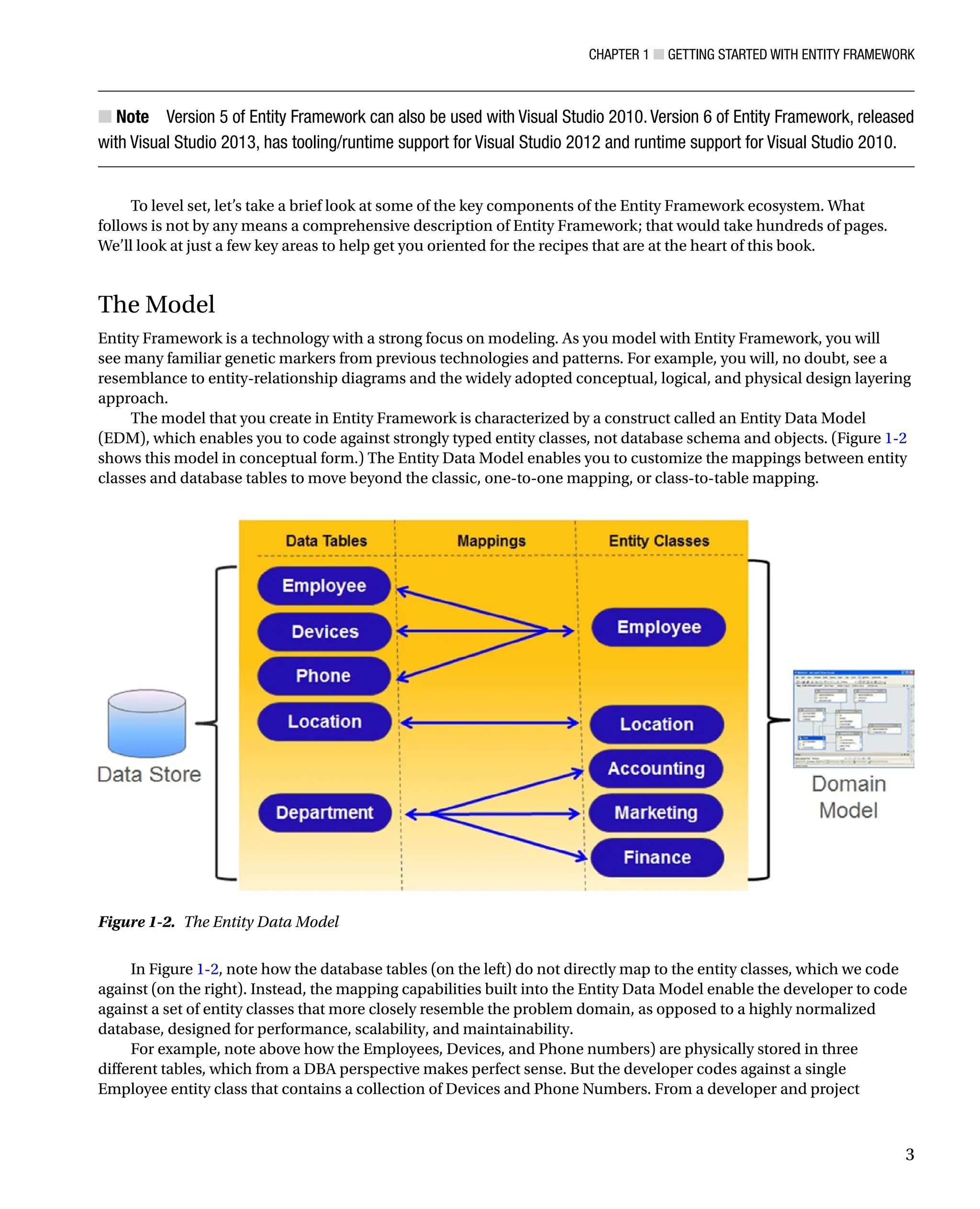

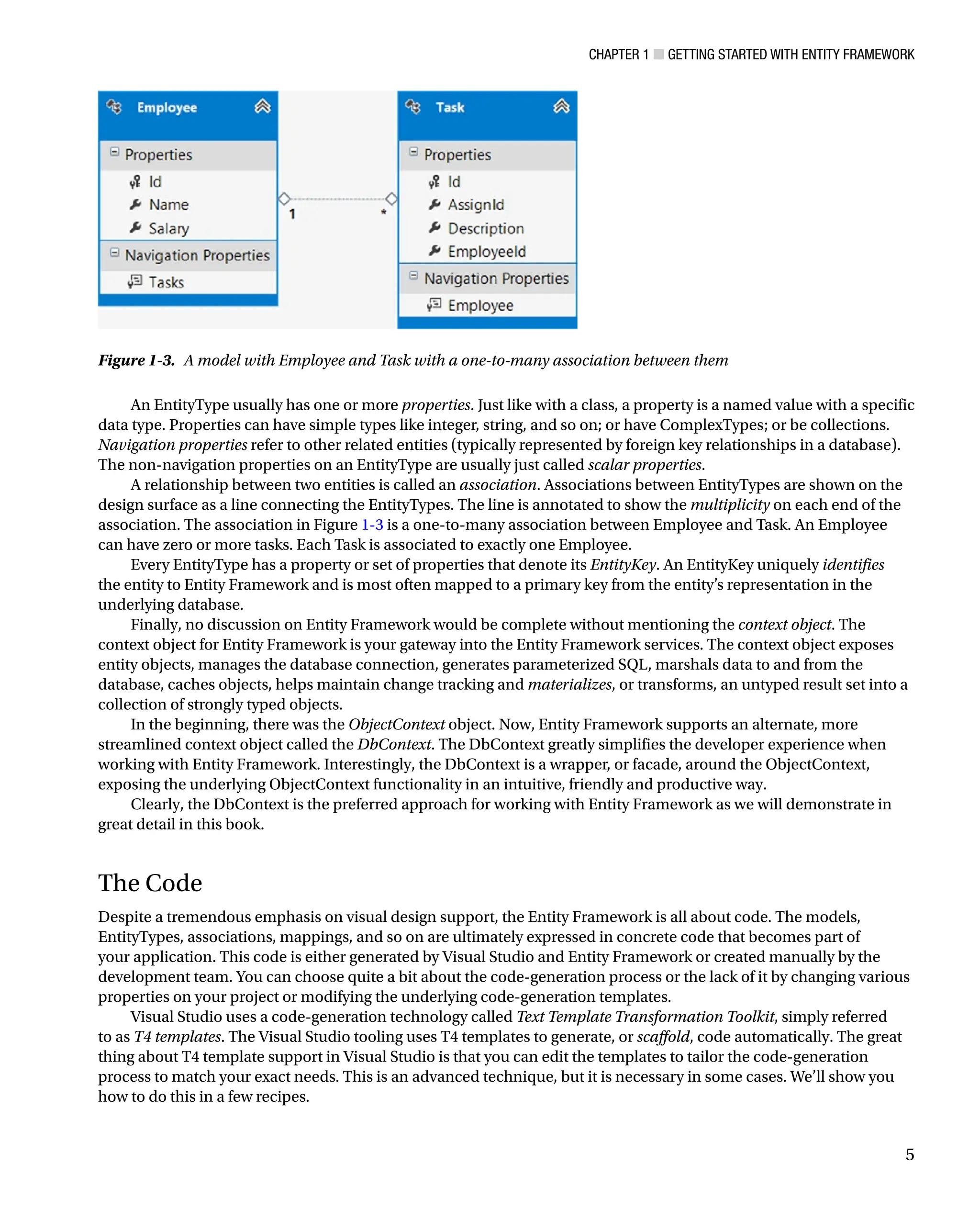


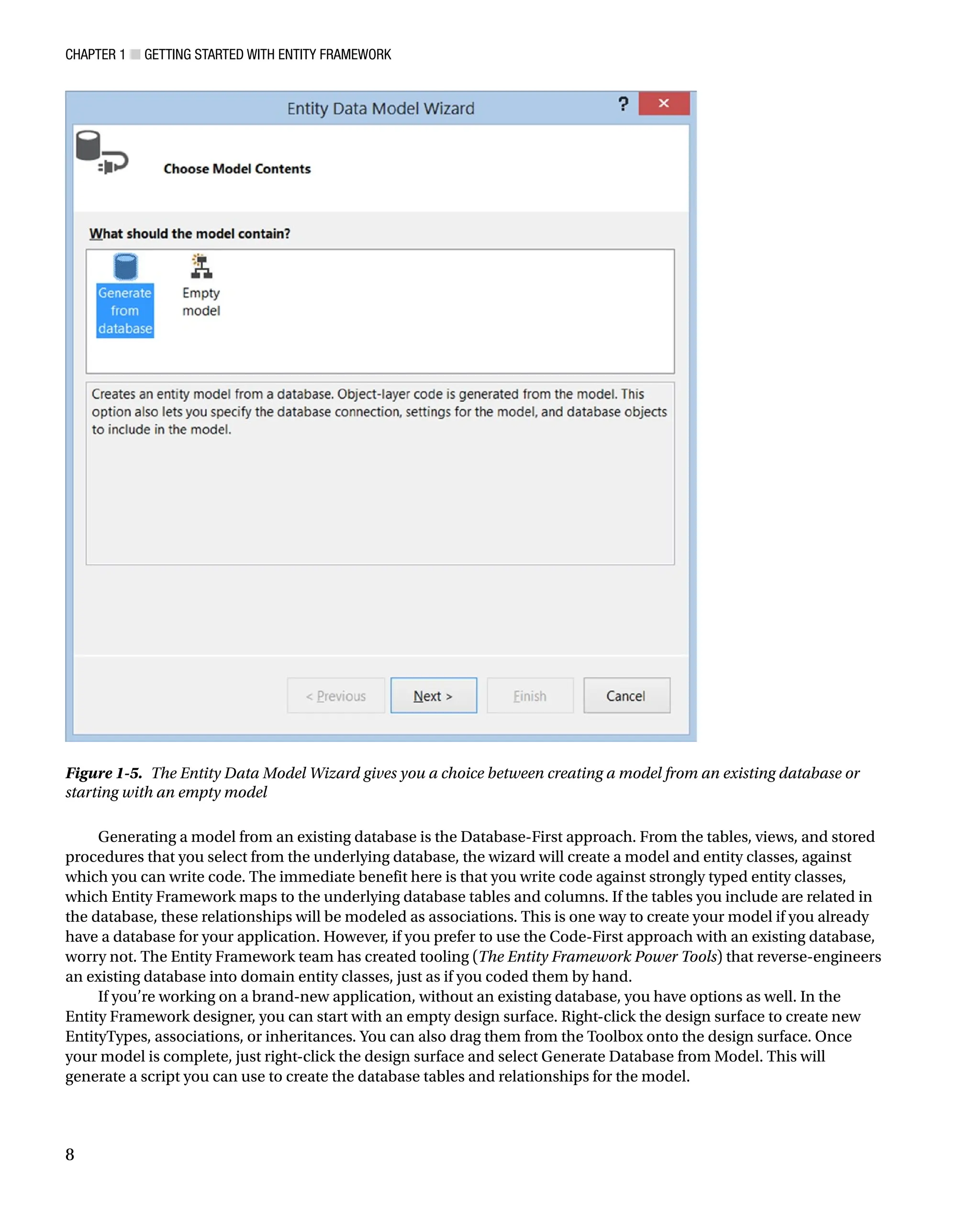



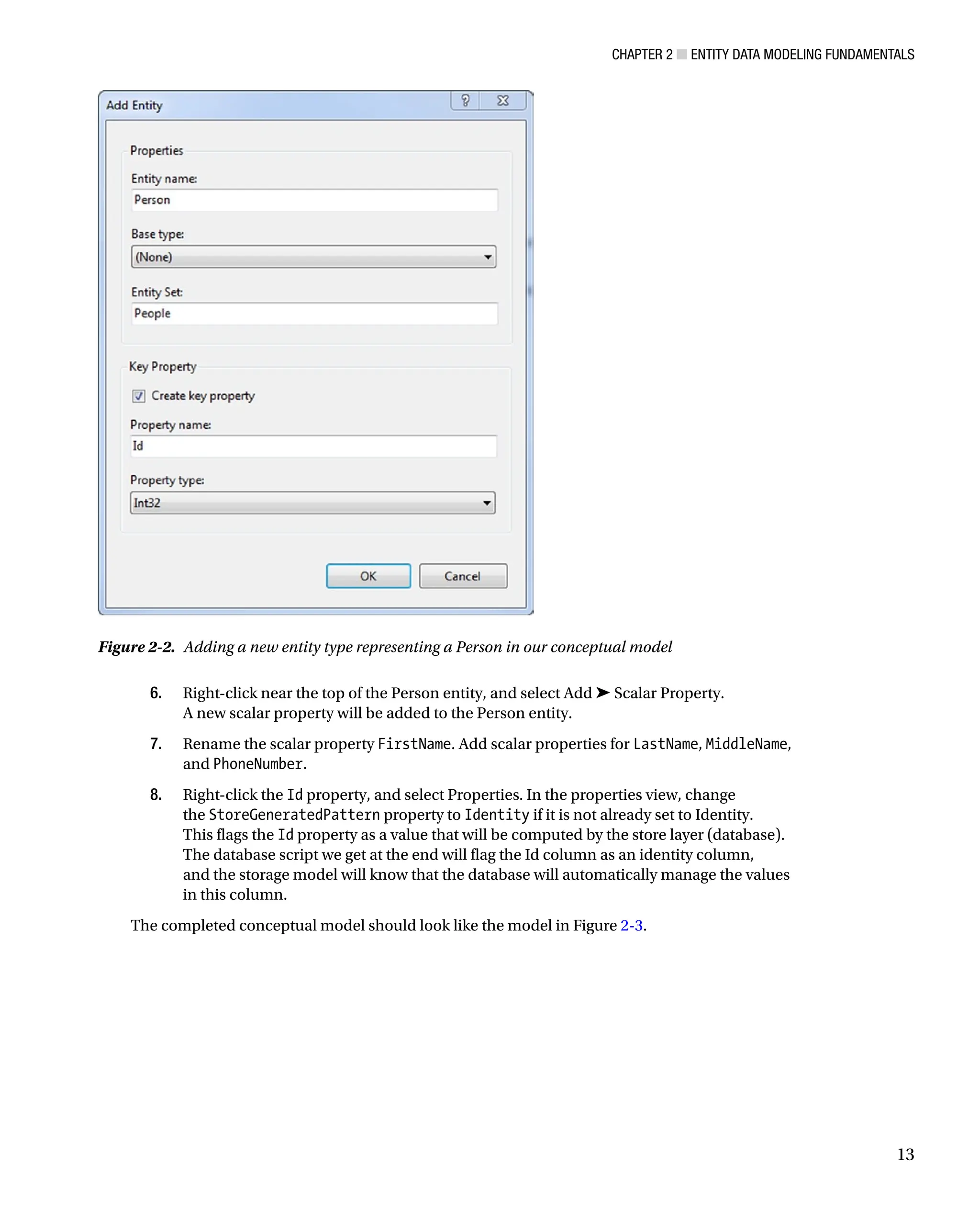
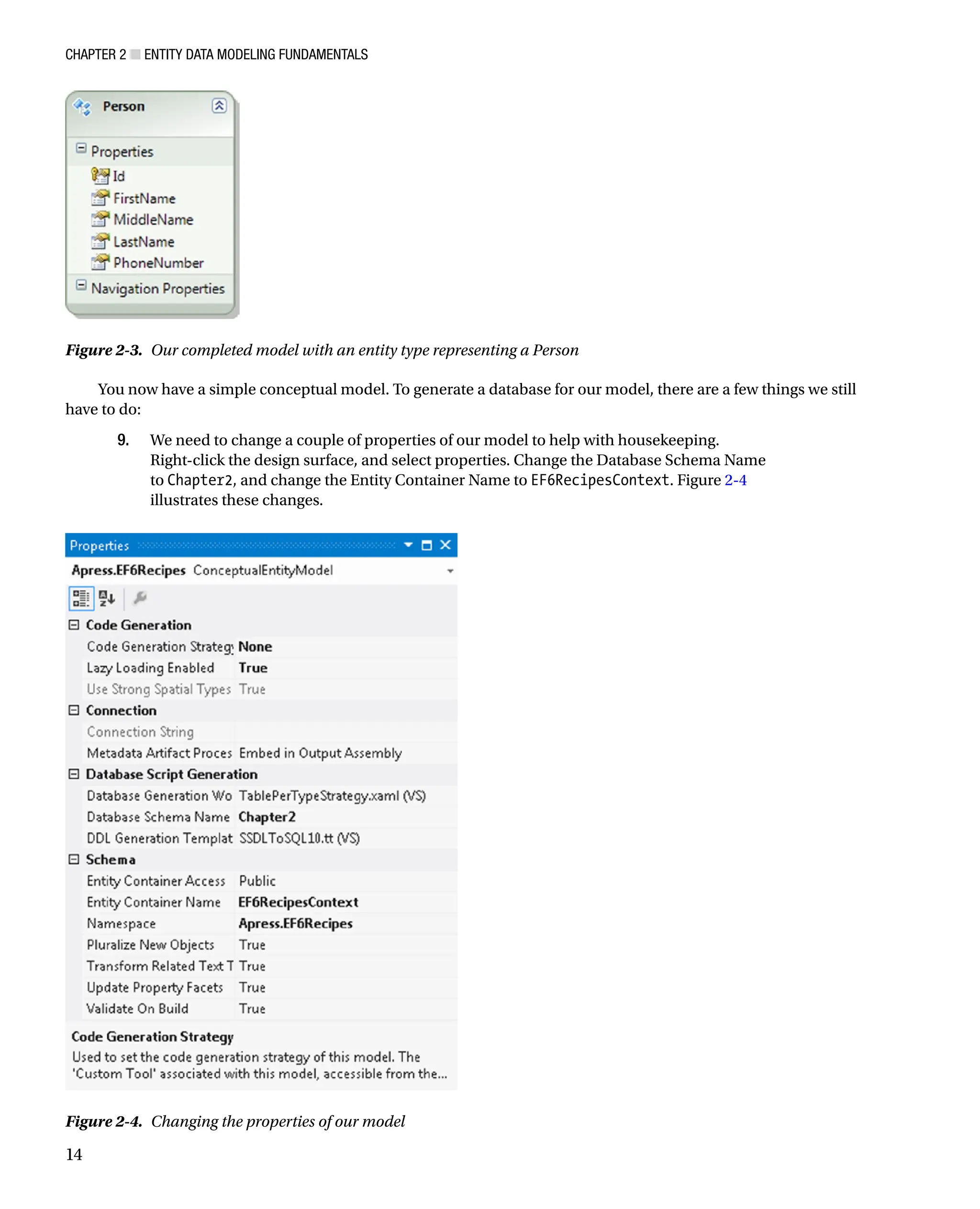
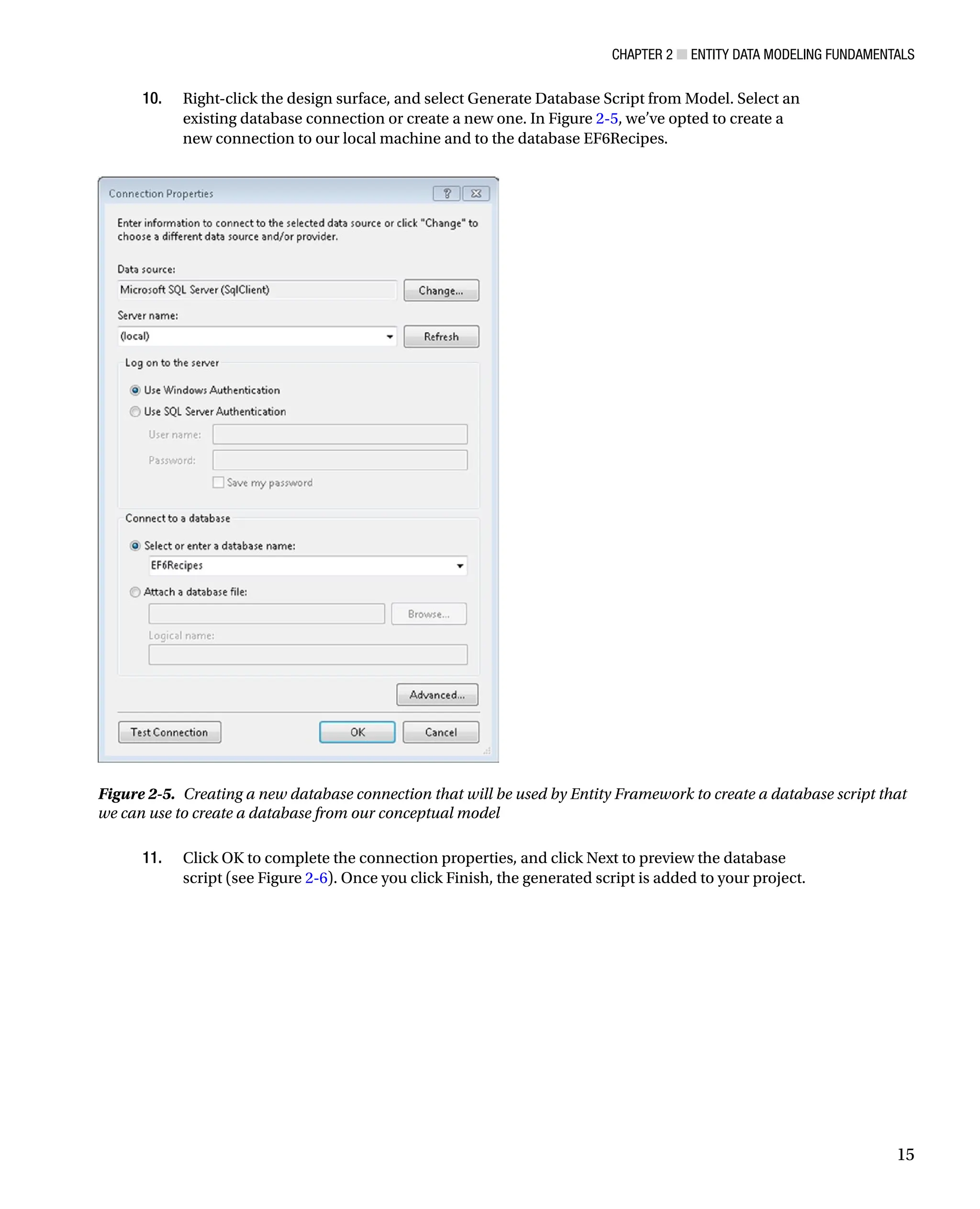
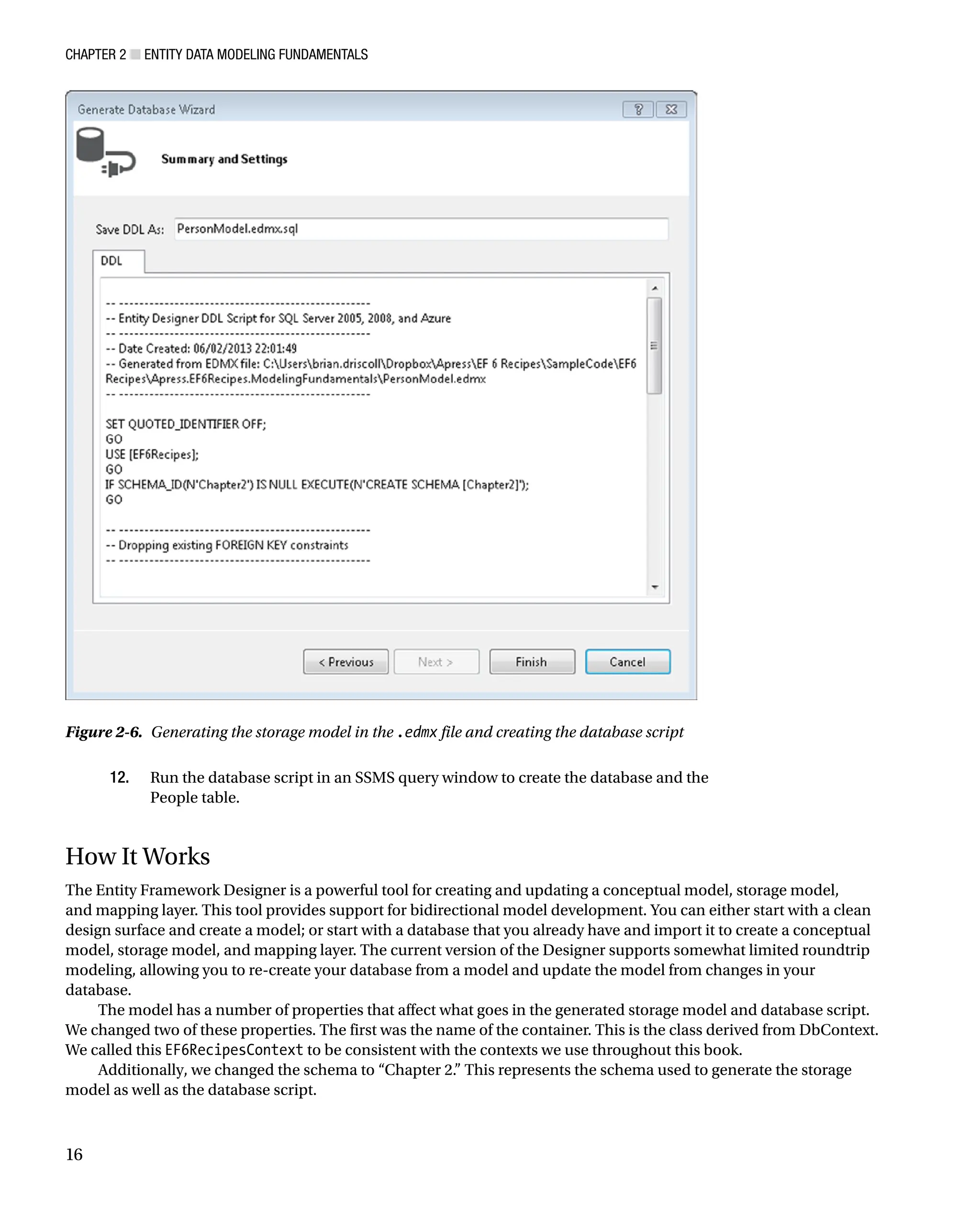

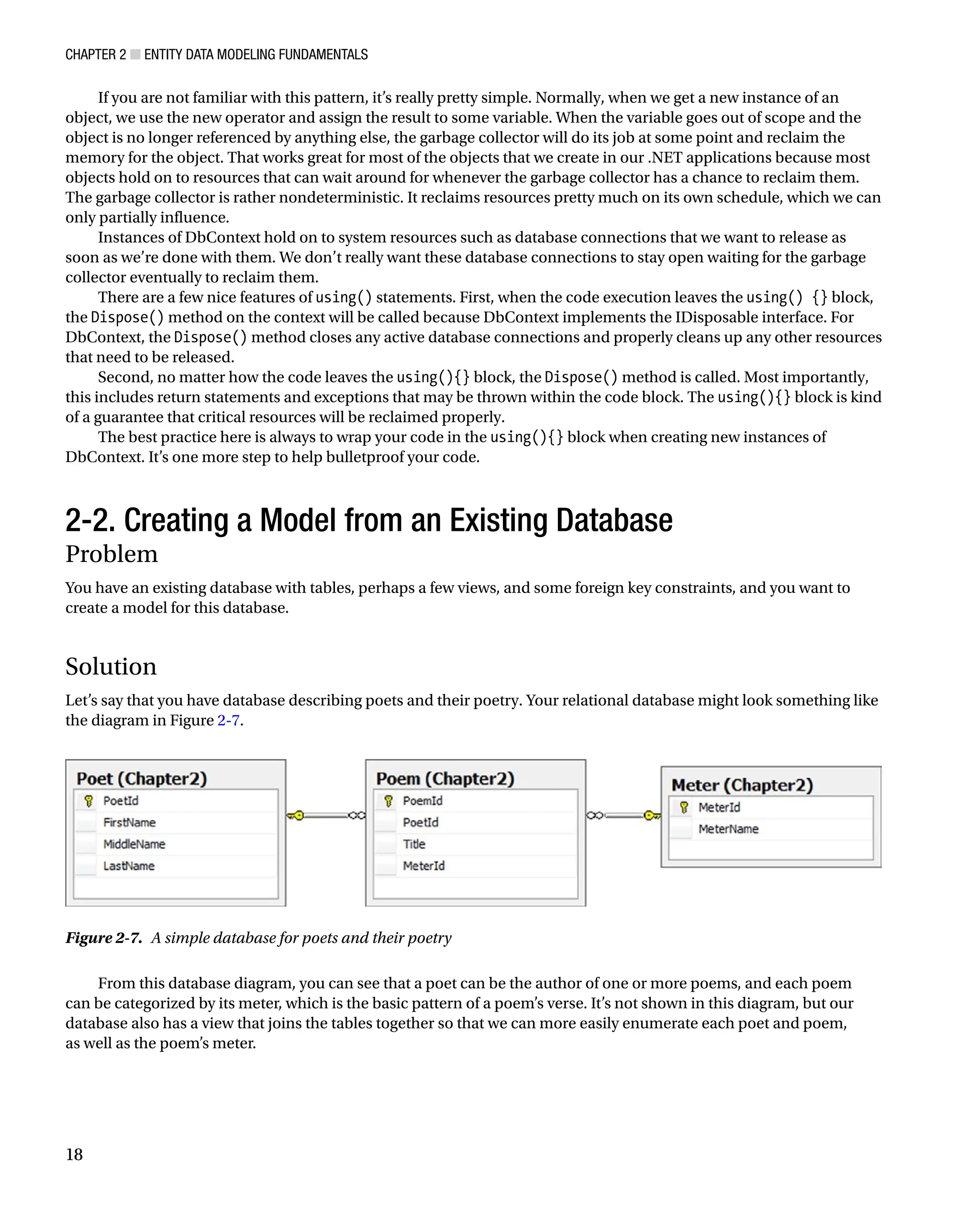



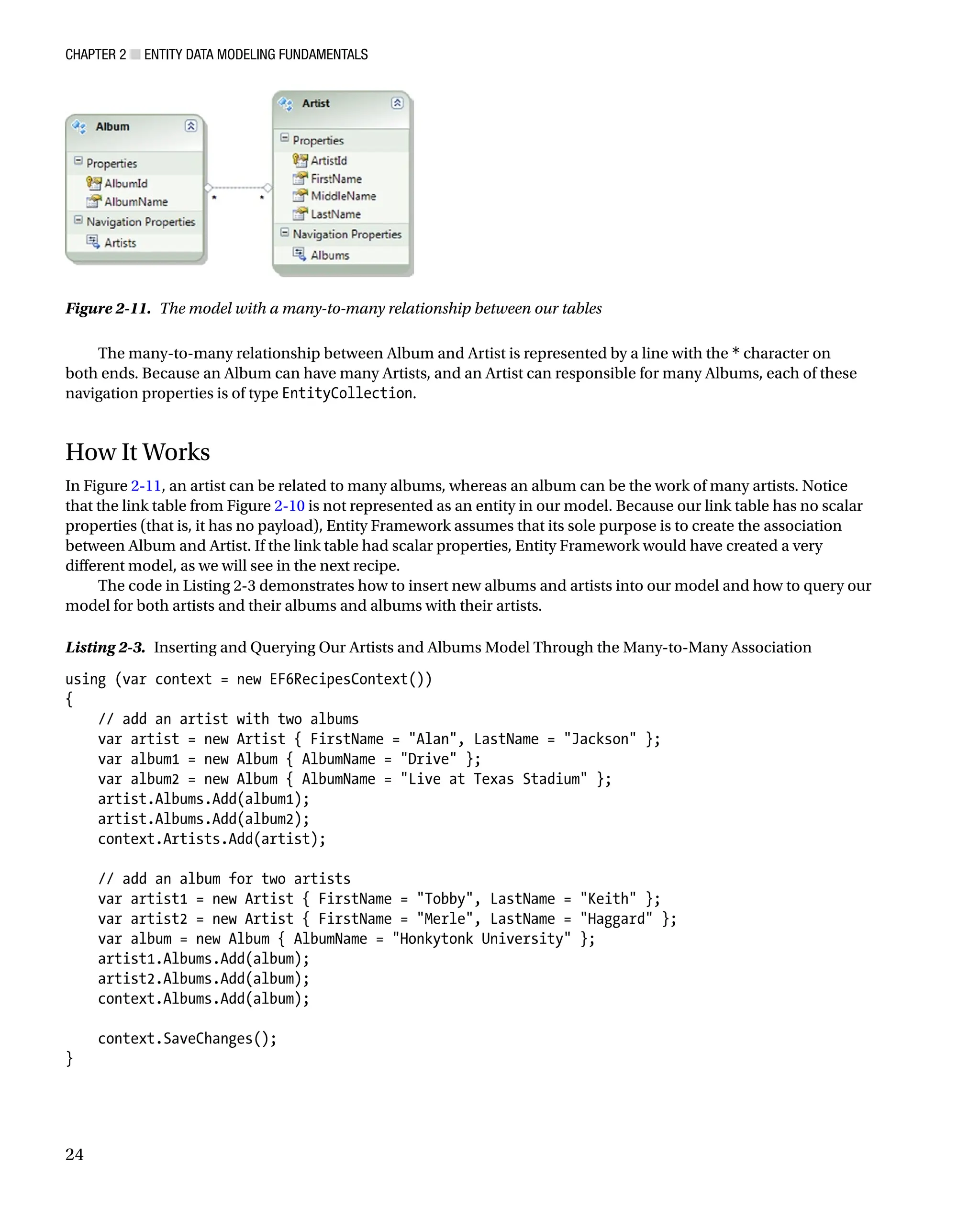
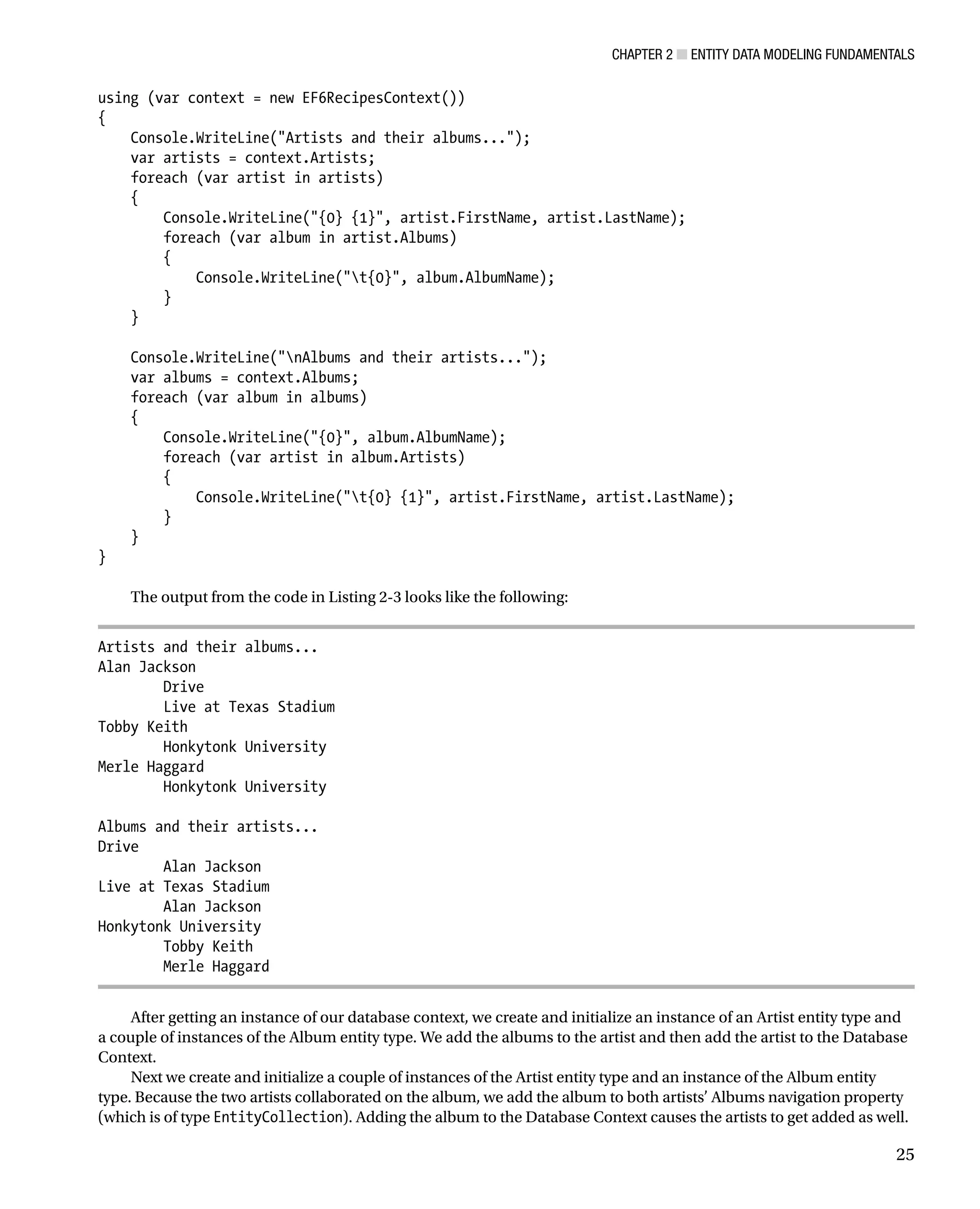

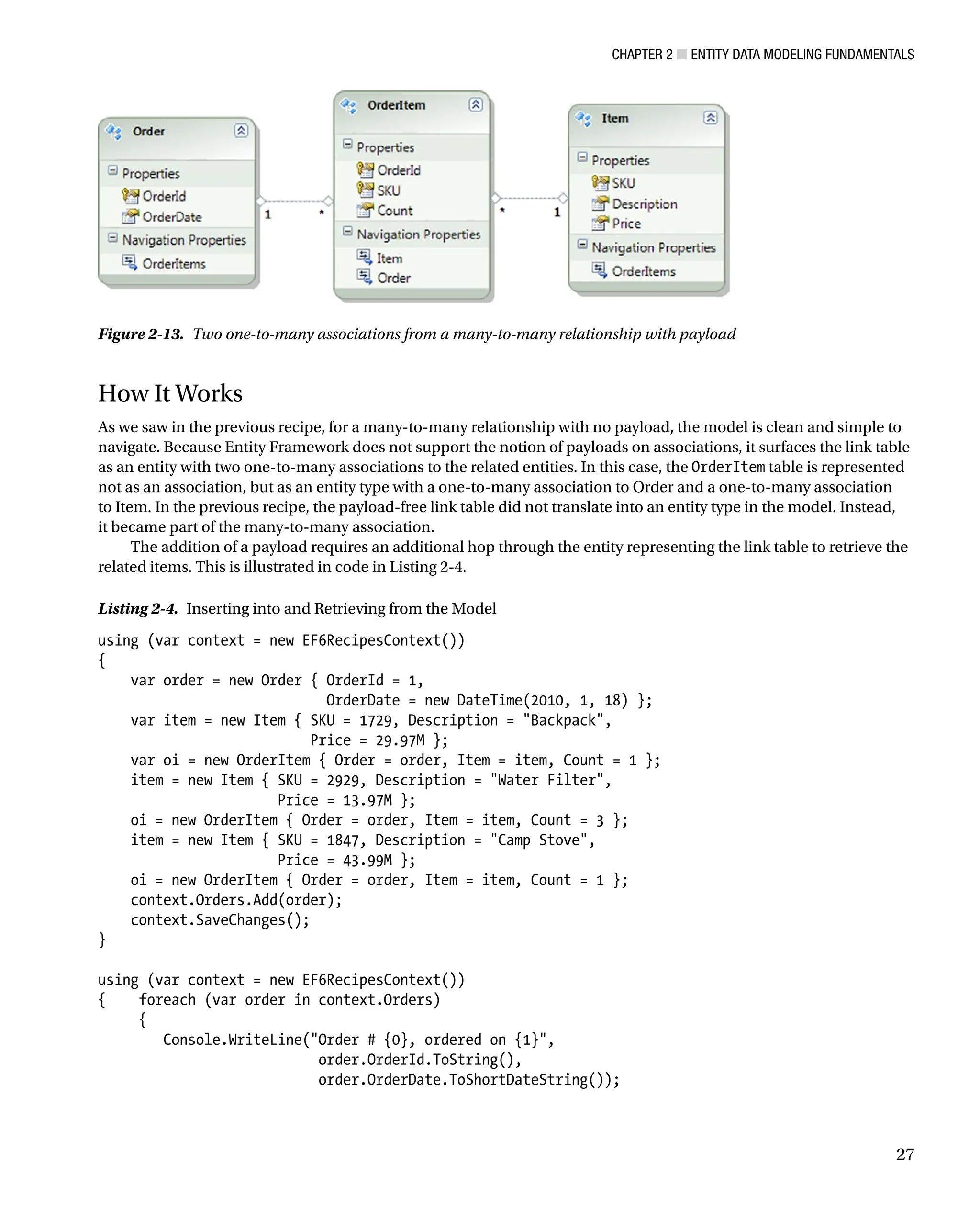
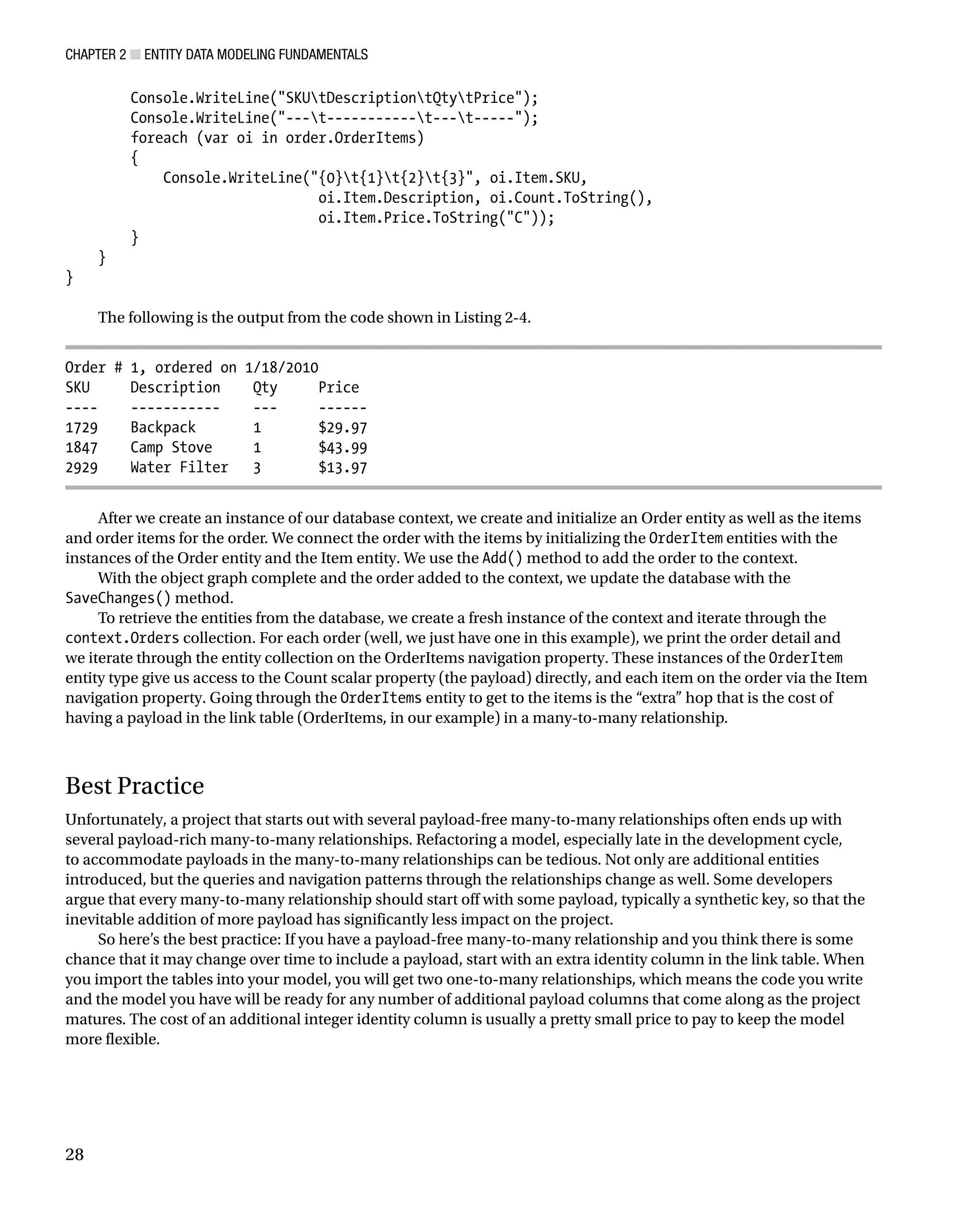
![Chapter 2 ■ Entity Data Modeling Fundamentals
29
2-5. Modeling a Self-Referencing Relationship with
a Code-First Approach
Problem
You have a table that references itself, and you want to model this as an entity with a self-referencing association using
a Code-First approach.
Solution
Let’s say that you have a self-referencing table that’s like the one shown in the database diagram in Figure 2-14.
To create a model and import this table and the self-referencing relationship into the model, do the following:
1. Create a new class that inherits from DbContext in your project.
2. Use the code in Listing 2-5 to create the PictureCategory POCO entity.
Listing 2-5. Creating the PictureCategory POCO Entity
public class PictureCategory
{
[Key]
[DatabaseGenerated(DatabaseGeneratedOption.Identity)]
public int CategoryId { get; private set; }
public string Name { get; set; }
public int? ParentCategoryId { get; private set; }
[ForeignKey(ParentCategoryId)]
public PictureCategory ParentCategory { get; set; }
public ListPictureCategory Subcategories { get; set; }
public PictureCategory()
{
Subcategories = new ListPictureCategory();
}
}
Figure 2-14. A self-referencing table](https://image.slidesharecdn.com/16284-250708101752-3fe9a192/75/Entity-Framework-6-Recipes-2nd-Edition-Brian-Driscoll-36-2048.jpg)

![Chapter 2 ■ Entity Data Modeling Fundamentals
33
Listing 2-8. Creating the Product POCO Entity
public class Product
{
[Key]
[DatabaseGenerated(DatabaseGeneratedOption.None)]
public int SKU { get; set; }
public string Description { get; set; }
public decimal Price { get; set; }
public string ImageURL { get; set; }
}
3. Add an auto-property of type DbSetProduct to your DbContext subclass.
4. Override the OnModelCreating() method of DbContext with the code in Listing 2-9.
Listing 2-9. Overriding OnModelCreating in the DbContext Subclass
public class EF6RecipesContext : DbContext
{
public DbSetProduct Products { get; set; }
public ProductContext() : base(name=EF6CodeFirstRecipesContext)
{
}
protected override void OnModelCreating(DbModelBuilder modelBuilder)
{
base.OnModelCreating(modelBuilder);
modelBuilder.EntityProduct()
.Map(m =
{
m.Properties(p = new {p.SKU, p.Description, p.Price});
m.ToTable(Product, Chapter2);
})
.Map(m =
{
m.Properties(p = new {p.SKU, p.ImageURL});
m.ToTable(ProductWebInfo, Chapter2);
});
}
}
How It Works
It seems all too common in legacy systems to find “extra” information for each row in one table tucked away in
another table. Often this happens over time as a database evolves, and no one is willing to break existing code by
adding columns to some critical table. The answer is to “graft on” a new table to hold the additional columns.
By merging two or more tables into a single entity or, as it is usually perceived, splitting a single entity across two
or more tables, we can treat all of the parts as one logical entity. This process is often referred to as vertical splitting.](https://image.slidesharecdn.com/16284-250708101752-3fe9a192/75/Entity-Framework-6-Recipes-2nd-Edition-Brian-Driscoll-40-2048.jpg)
![Chapter 2 ■ Entity Data Modeling Fundamentals
34
The downside of vertical splitting is that retrieving each instance of our entity now requires an additional join for
each additional table that makes up the entity type. This extra join is shown in Listing 2-10.
Listing 2-10. Additional Join Required by Vertical Splitting
SELECT
[Extent1].[SKU] AS [SKU],
[Extent2].[Description] AS [Description],
[Extent2].[Price] AS [Price],
[Extent1].[ImageURL] AS [ImageURL]
FROM [dbo].[ProductWebInfo] AS [Extent1]
INNER JOIN [dbo].[Product] AS [Extent2] ON [Extent1].[SKU] = [Extent2].[SKU]
Nothing special is required to insert into or retrieve from the Product entity. Listing 2-11 demonstrates working
with the vertically split Product entity type.
Listing 2-11. Inserting into and Retrieving from Our Model with the Product Entity Type
using (var context = new EF6RecipesContext())
{
var product = new Product { SKU = 147,
Description = Expandable Hydration Pack,
Price = 19.97M, ImageURL = /pack147.jpg };
context.Products.Add(product);
product = new Product { SKU = 178,
Description = Rugged Ranger Duffel Bag,
Price = 39.97M, ImageURL = /pack178.jpg };
context.Products.Add(product);
product = new Product { SKU = 186,
Description = Range Field Pack,
Price = 98.97M, ImageURL = /noimage.jp };
context.Products.Add(product);
product = new Product { SKU = 202,
Description = Small Deployment Back Pack,
Price = 29.97M, ImageURL = /pack202.jpg };
context.Products.Add(product);
context.SaveChanges();
}
using (var context = new EF6RecipesContext())
{
foreach (var p in context.Products)
{
Console.WriteLine({0} {1} {2} {3}, p.SKU, p.Description,
p.Price.ToString(C), p.ImageURL);
}
}](https://image.slidesharecdn.com/16284-250708101752-3fe9a192/75/Entity-Framework-6-Recipes-2nd-Edition-Brian-Driscoll-41-2048.jpg)

![Chapter 2 ■ Entity Data Modeling Fundamentals
36
Listing 2-12. Creating the Photograph POCO Entity
public class Photograph
{
[Key]
[DatabaseGenerated(DatabaseGeneratedOption.Identity)]
public int PhotoId { get; set; }
public string Title { get; set; }
public byte[] ThumbnailBits { get; set; }
[ForeignKey(PhotoId)]
public virtual PhotographFullImage PhotographFullImage { get; set; }
}
3. Create a PhotographFullImage POCO entity class using the code in Listing 2-13.
Listing 2-13. Creating the PhotographFullImage POCO Entity
public class PhotographFullImage
{
[Key]
public int PhotoId { get; set; }
public byte[] HighResolutionBits { get; set; }
[ForeignKey(PhotoId)]
public virtual Photograph Photograph { get; set; }
}
4. Add an auto-property of type DbSetPhotograph to your DbContext subclass.
5. Add another auto-property type of DbSetPhotographFullImage to your DbContext
subclass.
6. Override the OnModelCreating() method of the DbContext class, as shown in Listing 2-14.
Listing 2-14. Overriding the OnModelCreating Method of DbContext
protected override void OnModelCreating(DbModelBuilder modelBuilder)
{
base.OnModelCreating(modelBuilder);
modelBuilder.EntityPhotograph()
.HasRequired(p = p.PhotographFullImage)
.WithRequiredPrincipal(p = p.Photograph);
modelBuilder.EntityPhotograph().ToTable(Photograph, Chapter2);
modelBuilder.EntityPhotographFullImage().ToTable(Photograph, Chapter2);
}](https://image.slidesharecdn.com/16284-250708101752-3fe9a192/75/Entity-Framework-6-Recipes-2nd-Edition-Brian-Driscoll-43-2048.jpg)
![Chapter 2 ■ Entity Data Modeling Fundamentals
37
How It Works
Entity Framework does not directly support the notion of lazy loading of individual entity properties. To get the effect
of lazy loading expensive properties, we exploit Entity Framework’s support for lazy loading of associated entities.
We created a new entity type to hold the expensive full image property and created a one-to-one association between
our Photograph entity type and the new PhotographFullImage entity type. We added a referential constraint on the
conceptual layer that, much like a database referential constraint, tells Entity Framework that a PhotographFullImage
can’t exist without a Photograph.
Due to the referential constraint, there are a couple of things to note about our model. If we have a newly created
PhotographFullImage, an instance of Photograph must exist in the object context or the data source prior to calling
SaveChanges(). Also, if we delete a photograph, the associated PhotographFullImage is also deleted. This is just like
cascading deletes in database referential constraints.
The code in Listing 2-15 demonstrates inserting and retrieving from our model.
Listing 2-15. Inserting into and Lazy Loading Expensive Fields
byte[] thumbBits = new byte[100];
byte[] fullBits = new byte[2000];
using (var context = new EF6RecipesContext())
{
var photo = new Photograph { Title = My Dog,
ThumbnailBits = thumbBits };
var fullImage = new PhotographFullImage { HighResolutionBits = fullBits };
photo.PhotographFullImage = fullImage;
context.Photographs.Add(photo);
context.SaveChanges();
}
using (var context = new EF6RecipesContext())
{
foreach (var photo in context.Photographs)
{
Console.WriteLine(Photo: {0}, ThumbnailSize {1} bytes,
photo.Title, photo.ThumbnailBits.Length);
// explicitly load the expensive entity,
PhotographFullImagecontext.Entry(photo).Reference(p = p.PhotographFullImage).Load();
Console.WriteLine(Full Image Size: {0} bytes,
photo.PhotographFullImage.HighResolutionBits.Length);
}
}
The output from Listing 2-15 is as follows:
Photo: My Dog, Thumbnail Size: 100 bytes
Full Image Size: 2000 bytes
The code in Listing 2-15 creates and initializes instances of the Photograph and PhotographFullImage entities,
adds them to the object context, and calls SaveChanges().](https://image.slidesharecdn.com/16284-250708101752-3fe9a192/75/Entity-Framework-6-Recipes-2nd-Edition-Brian-Driscoll-44-2048.jpg)
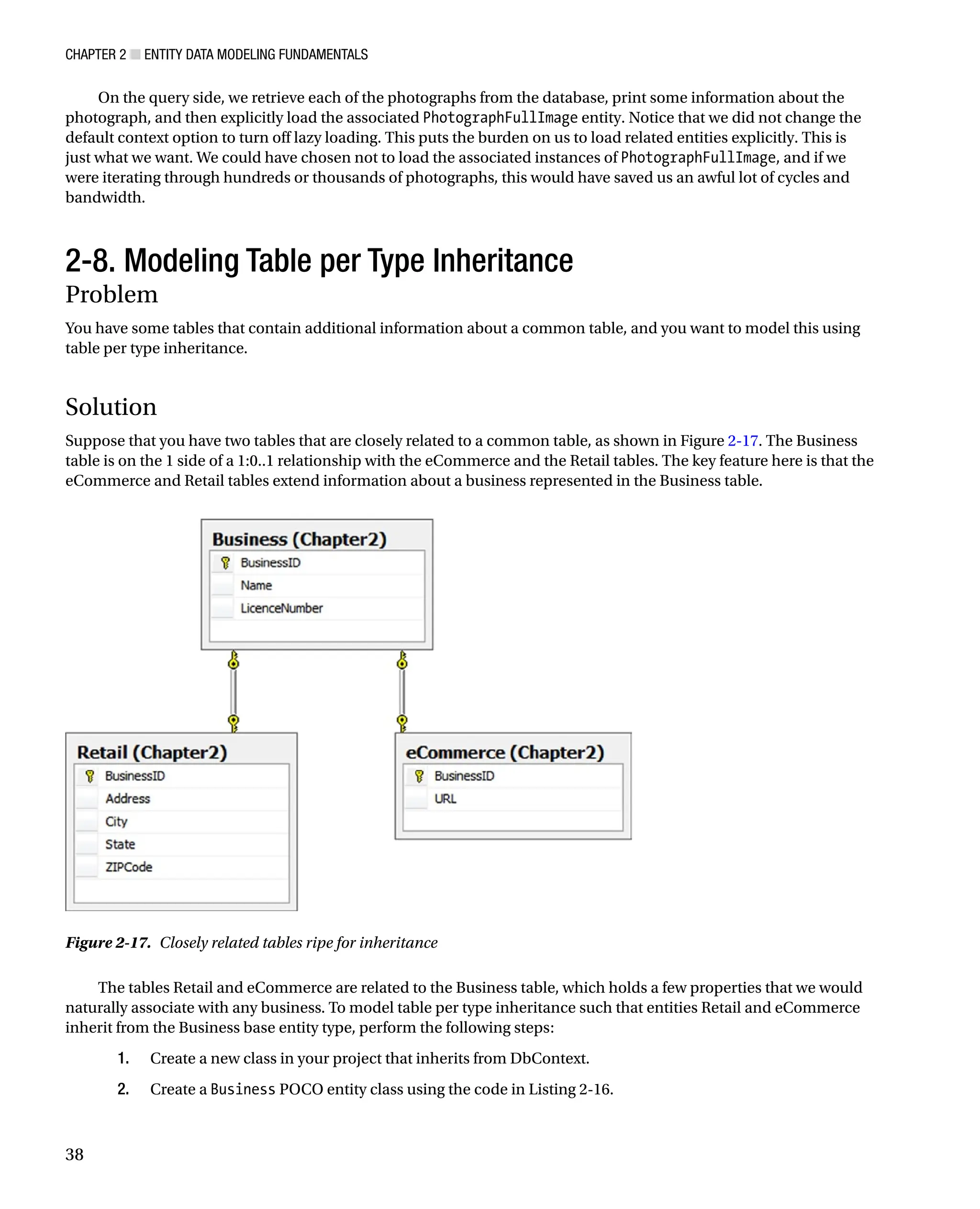
![Chapter 2 ■ Entity Data Modeling Fundamentals
39
Listing 2-16. Creating the Business POCO Entity Class
[Table(Business, Schema = Chapter2)]
public class Business
{
[Key]
[DatabaseGenerated(DatabaseGeneratedOption.Identity)]
public int BusinessId { get; protected set; }
public string Name { get; set; }
public string LicenseNumber { get; set; }
}
3. Create an eCommerce POCO entity class that inherits from the Business class using the
code in Listing 2-17.
Listing 2-17. Creating the eCommerce POCO Entity Class
[Table(eCommerce, Schema = Chapter2)]
public class eCommerce : Business
{
public string URL { get; set; }
}
4. Create a Retail POCO entity class that inherits from the Business class using the code
in Listing 2-18.
Listing 2-18. Creating the Retail POCO Entity Class
[Table(Retail, Schema = Chapter2)]
public class Retail : Business
{
public string Address { get; set; }
public string City { get; set; }
public string State { get; set; }
public string ZIPCode { get; set; }
}
5. Add an auto-property of type DbSetBusiness to your DbContext subclass.
How It Works
Both the Retail and the eCommerce tables are on the 0..1 side of a 1:0..1 relationship with the Business table.
This means that we could have a business with no additional information or a business with additional Retail or
eCommerce information. In object-oriented programming terms, we have a base type, Business, with two derived
types, Retail and eCommerce.
Because of the 1:0..1 relationship, we cannot have a row in the Retail or eCommerce tables without a
corresponding row in the Business table. In object-oriented terms, an instance of a derived type has the properties
of the base type. This concept of a derived type extending the properties of a base type is a key feature of inheritance.
In table per type (often abbreviated TPT) inheritance, each of the derived types is represented in separate tables.](https://image.slidesharecdn.com/16284-250708101752-3fe9a192/75/Entity-Framework-6-Recipes-2nd-Edition-Brian-Driscoll-46-2048.jpg)