Enterprise Risk Management : Hollow Tree Giant Redwood.ppt
1.
Enterprise Risk Management:
HollowTree or Giant Redwood?
Midwestern Actuarial Forum
Chicago
March 7, 2008
Rick Gorvett, FCAS, MAAA, ARM, FRM, PhD
Director, Actuarial Science Program
State Farm Companies Foundation Scholar in Act. Sci.
University of Illinois at Urbana-Champaign
MAF
2.
Regarding the titleof this talk
I certainly have nothing against
hollow trees…
Agenda
• ERM ingeneral
• Observations from the CAS ERM Online
Course
• Issues in advancing ERM
– ERM as complex systems analysis
– ERM as an evolutionary process
– ERM as subject to behavioral patterns
• Conclusion
9.
“Who am I?Why am I here?”
- Admiral Stockdale, 1992
• Currently
– Director, Actuarial Science Program
– State Farm Companies Foundation Scholar in Actuarial
Science
– Professor, Depts. of Mathematics, Statistics & Finance
– University of Illinois at Urbana-Champaign
• Prior
– Senior Vice President
– Director of Internal Audit & Risk Management
• Internal Audit
• Corporate Investigations
• Risk Management
• Enterprise Risk Management
• Business Continuity
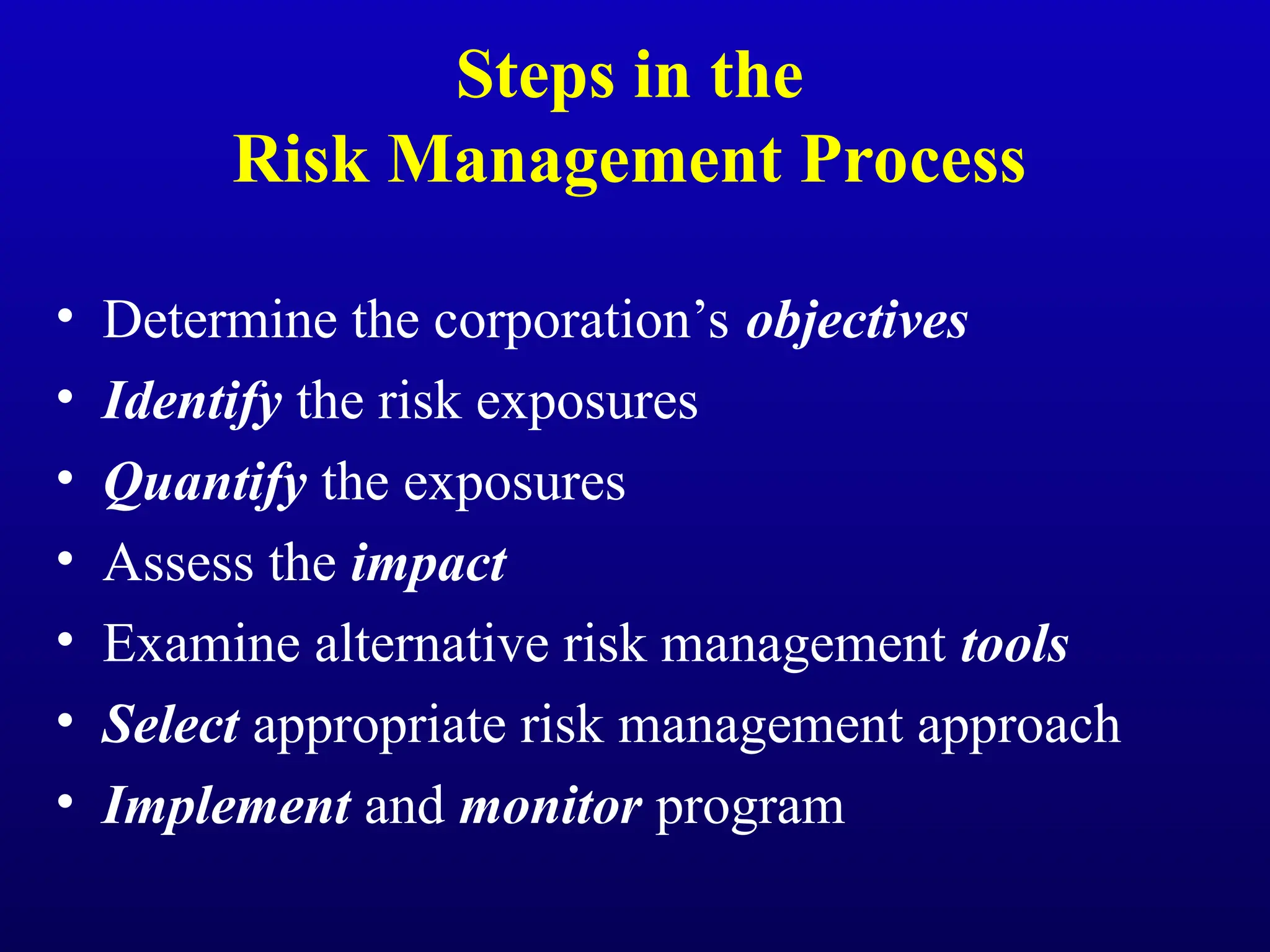
Steps in the
RiskManagement Process
• Determine the corporation’s objectives
• Identify the risk exposures
• Quantify the exposures
• Assess the impact
• Examine alternative risk management tools
• Select appropriate risk management approach
• Implement and monitor program
12.
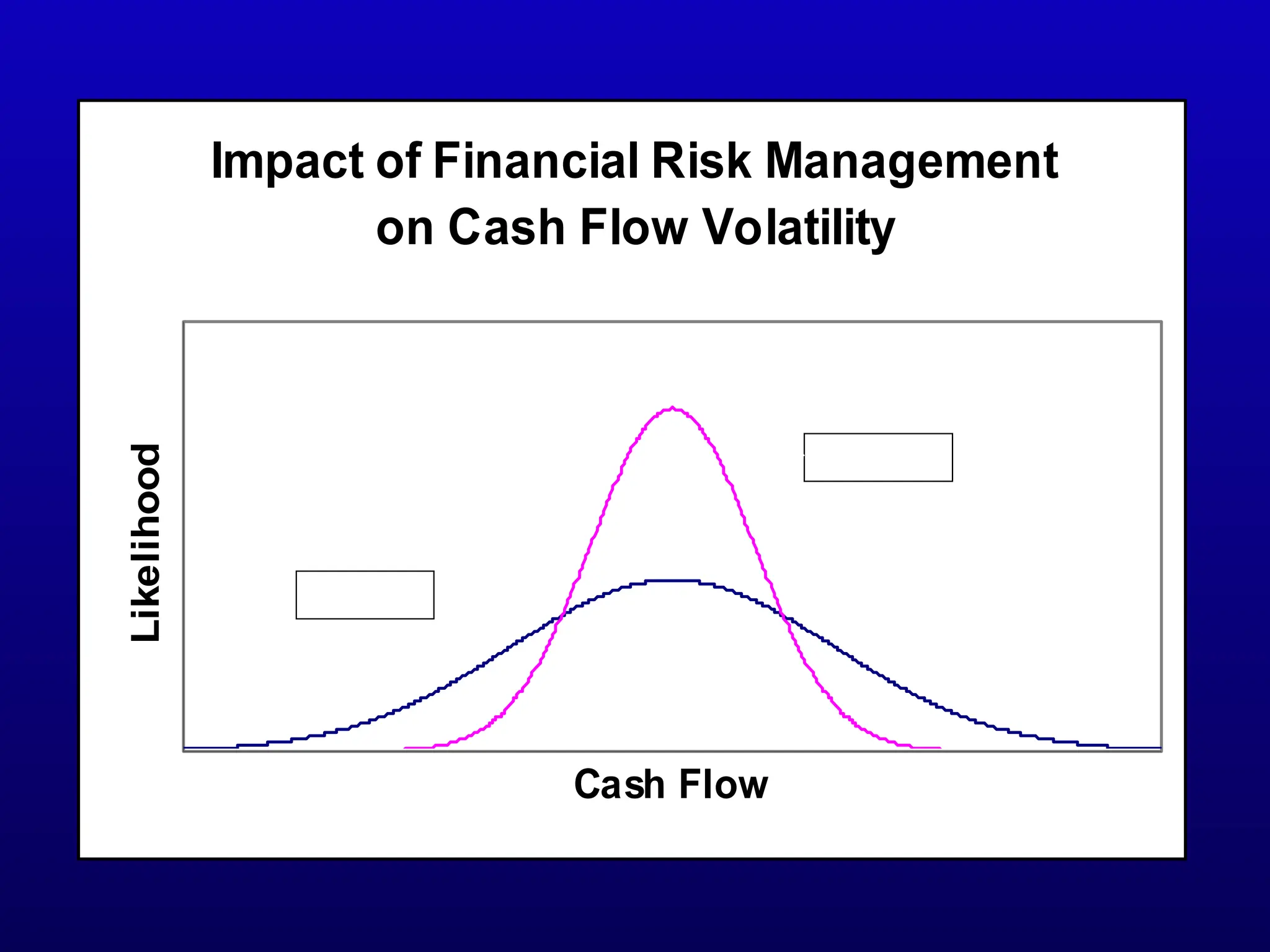
Impact of FinancialRisk Management
on Cash Flow Volatility
Cash Flow
Likelihood
Pre-FRM
Post-FRM
13.
An Initial ERMComment
• You don’t become a famous writer by…
– Reading a book
– Reading about other authors
– Watching someone else write
• Similarly, you don’t become an “Enterprise
Risk Manager” by…
– Reading a book
– Taking a course
– Listening to a presentation
14.
Rather, ERM is…
Acomplex process…
… involving broad-based and in-depth
knowledge and understanding…
… requiring an appropriate corporate culture,…
… and creativity…
… born of a variety of experiences…
… and insatiable curiosity.
15.
Enterprise Risk Management
•Or “Enterprise Risk and Assurance
Management” or…
• What is ERM?
– Concerned with a broad financial and operating
perspective
– Recognizes interdependencies among corporate,
financial, and environmental factors
– Strives to determine and implement an optimal
strategy to achieve the primary objective:
maximize the value of the firm
16.
Other Possible Goalsof ERM
• Create and increase company value
• Ensure business continuity
• Stabilize earnings
• Enhance opportunities for the company to
achieve its objectives
• Make risk management more cost-efficient
17.
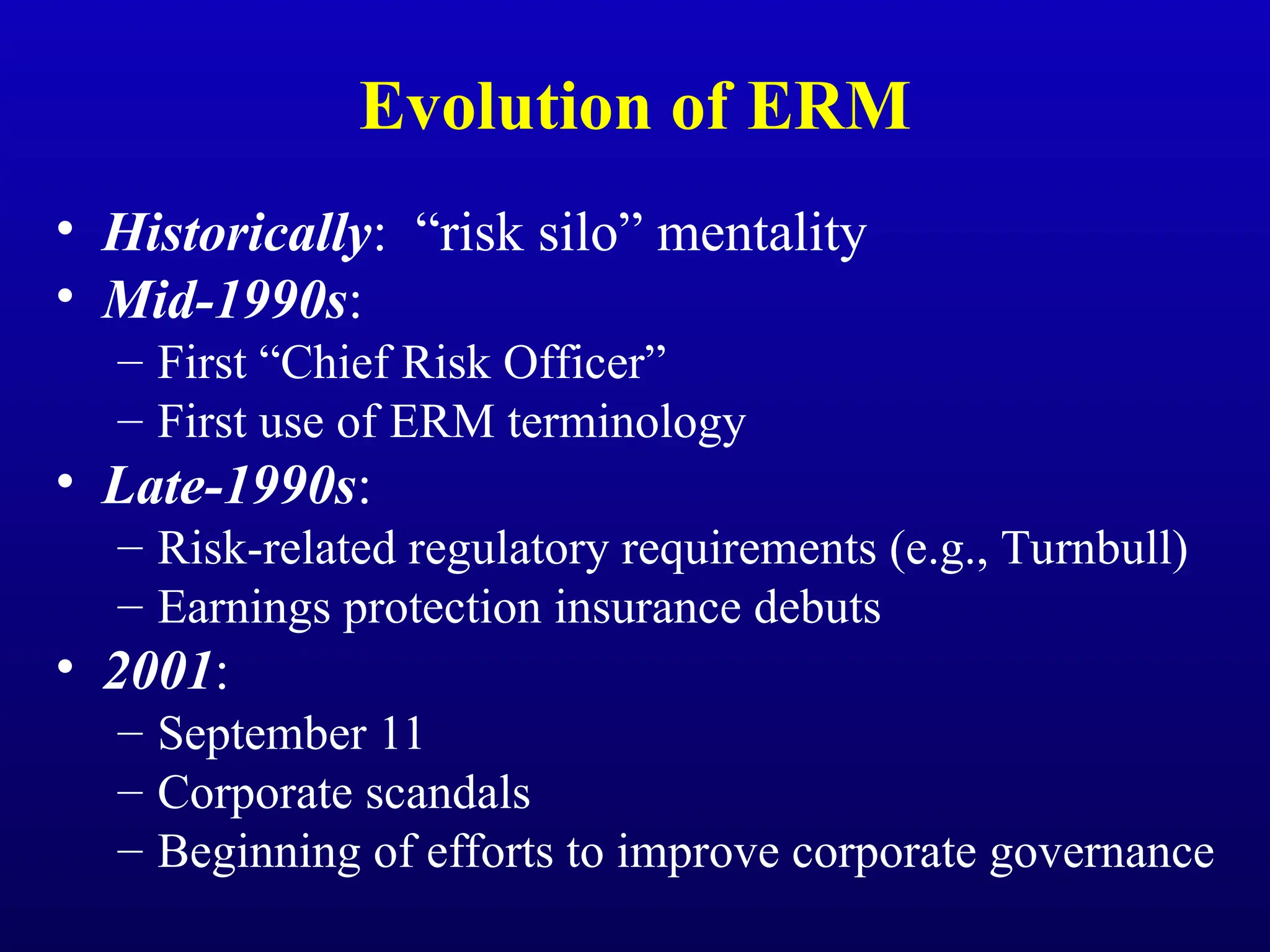
Evolution of ERM
•Historically: “risk silo” mentality
• Mid-1990s:
– First “Chief Risk Officer”
– First use of ERM terminology
• Late-1990s:
– Risk-related regulatory requirements (e.g., Turnbull)
– Earnings protection insurance debuts
• 2001:
– September 11
– Corporate scandals
– Beginning of efforts to improve corporate governance
18.
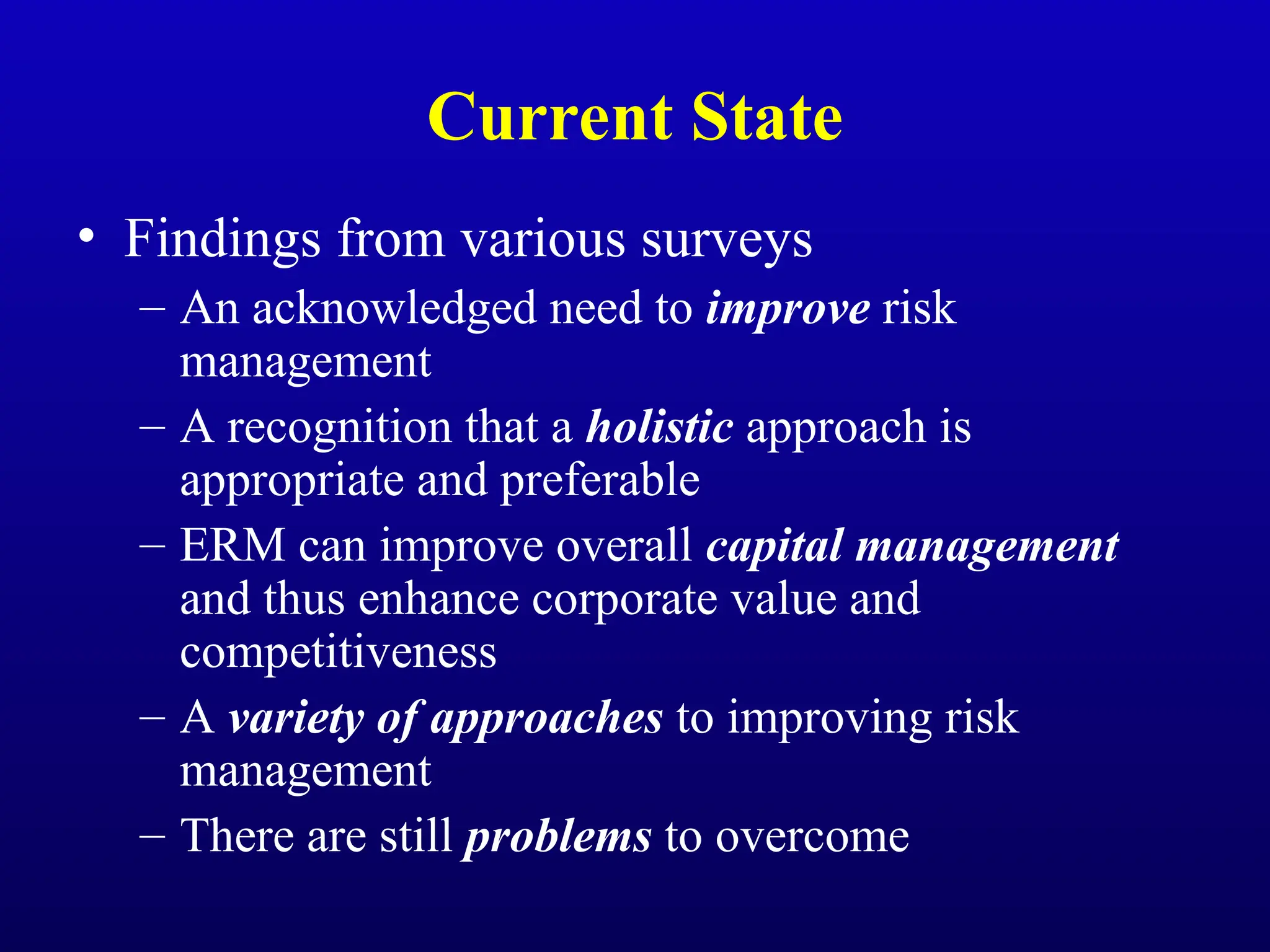
Current State
• Findingsfrom various surveys
– An acknowledged need to improve risk
management
– A recognition that a holistic approach is
appropriate and preferable
– ERM can improve overall capital management
and thus enhance corporate value and
competitiveness
– A variety of approaches to improving risk
management
– There are still problems to overcome
19.
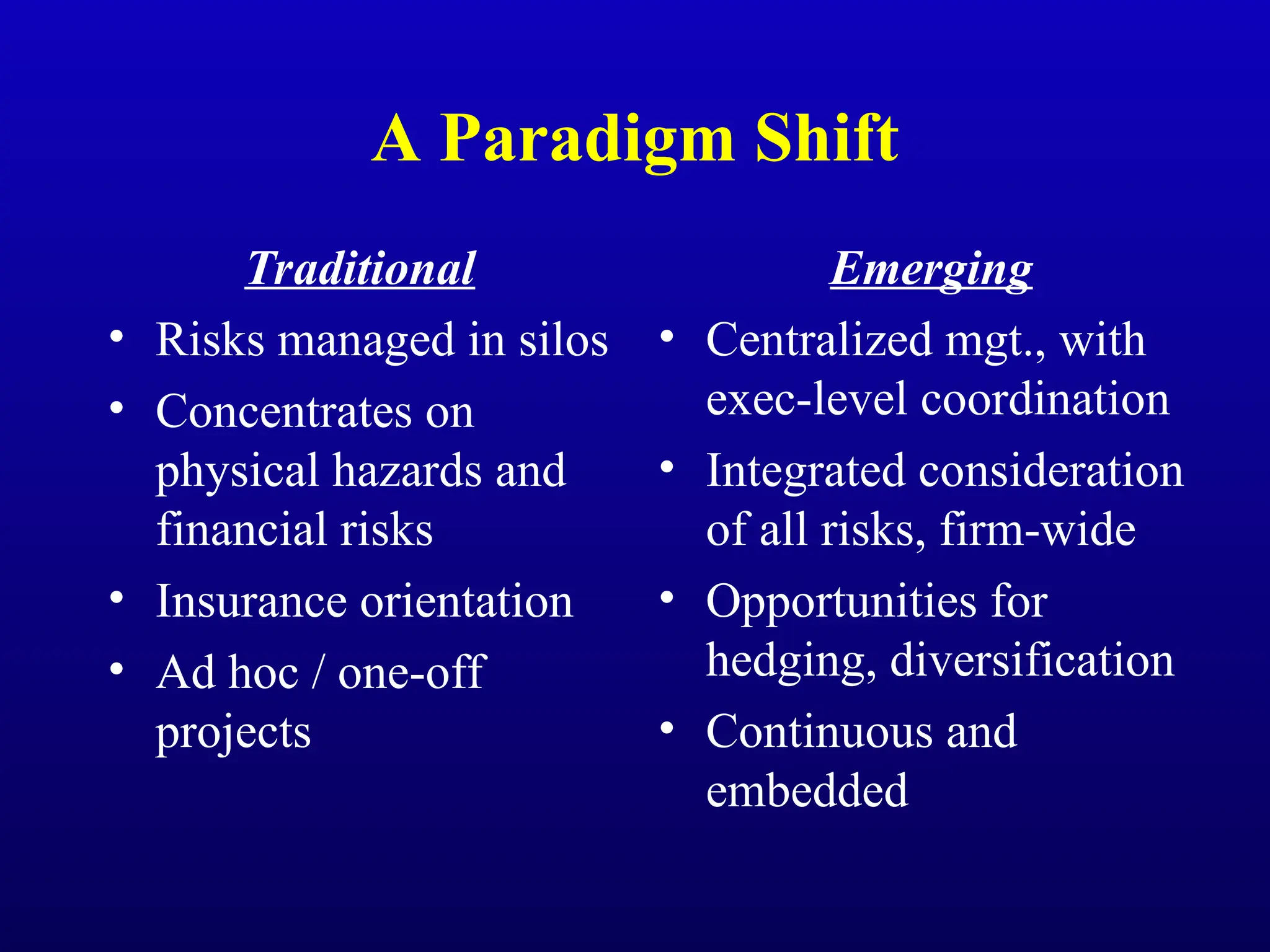
A Paradigm Shift
Traditional
•Risks managed in silos
• Concentrates on
physical hazards and
financial risks
• Insurance orientation
• Ad hoc / one-off
projects
Emerging
• Centralized mgt., with
exec-level coordination
• Integrated consideration
of all risks, firm-wide
• Opportunities for
hedging, diversification
• Continuous and
embedded
20.
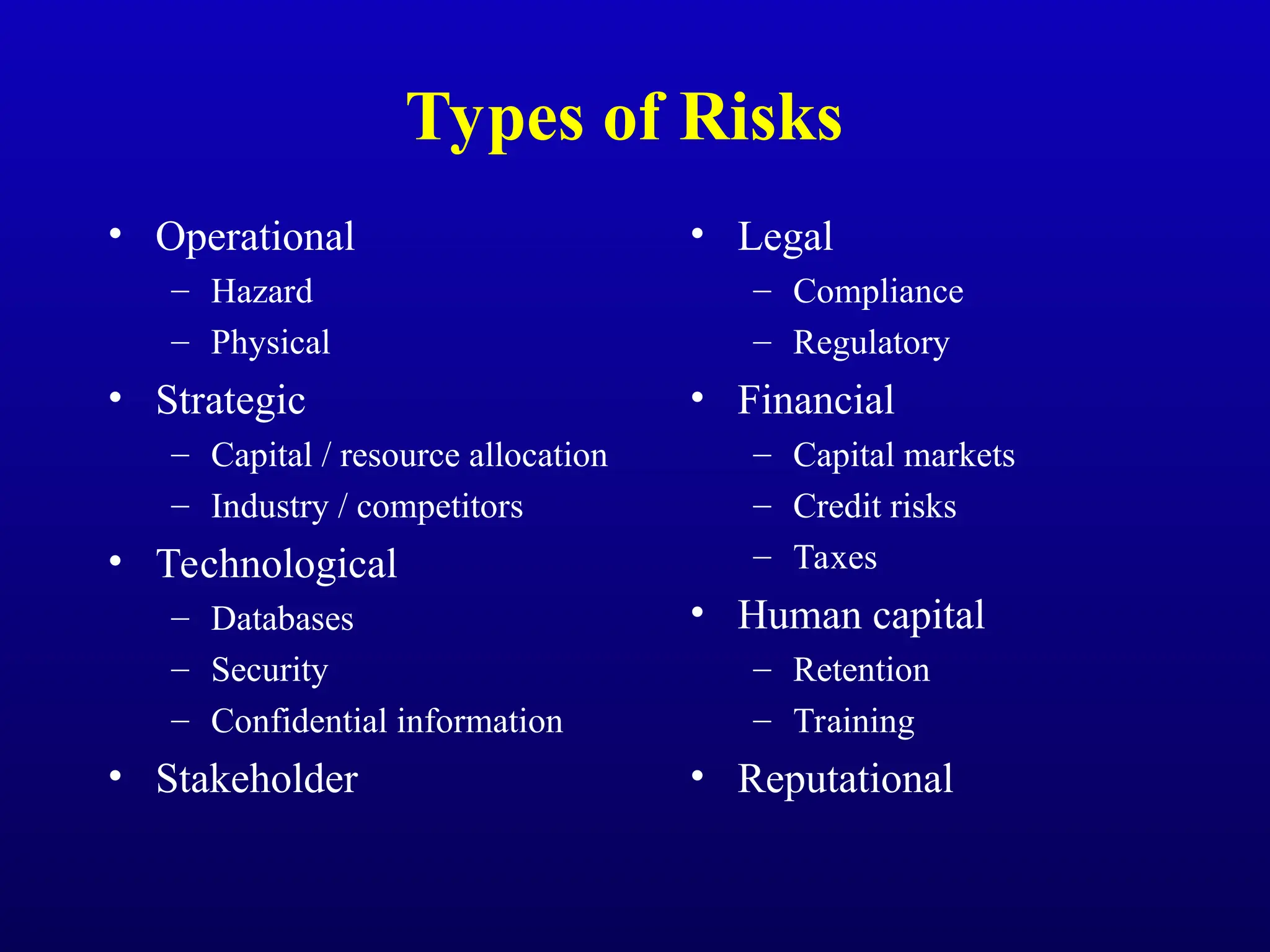
Types of Risks
•Operational
– Hazard
– Physical
• Strategic
– Capital / resource allocation
– Industry / competitors
• Technological
– Databases
– Security
– Confidential information
• Stakeholder
• Legal
– Compliance
– Regulatory
• Financial
– Capital markets
– Credit risks
– Taxes
• Human capital
– Retention
– Training
• Reputational
21.
Issues in ERMImplementation
• Different corporate cultures require different
ERM approaches
• Who is going to be the ERM champion within
the company
– Among senior executives
– Among departments / functions
• How to embed a risk management culture and
responsibilities throughout the firm
22.
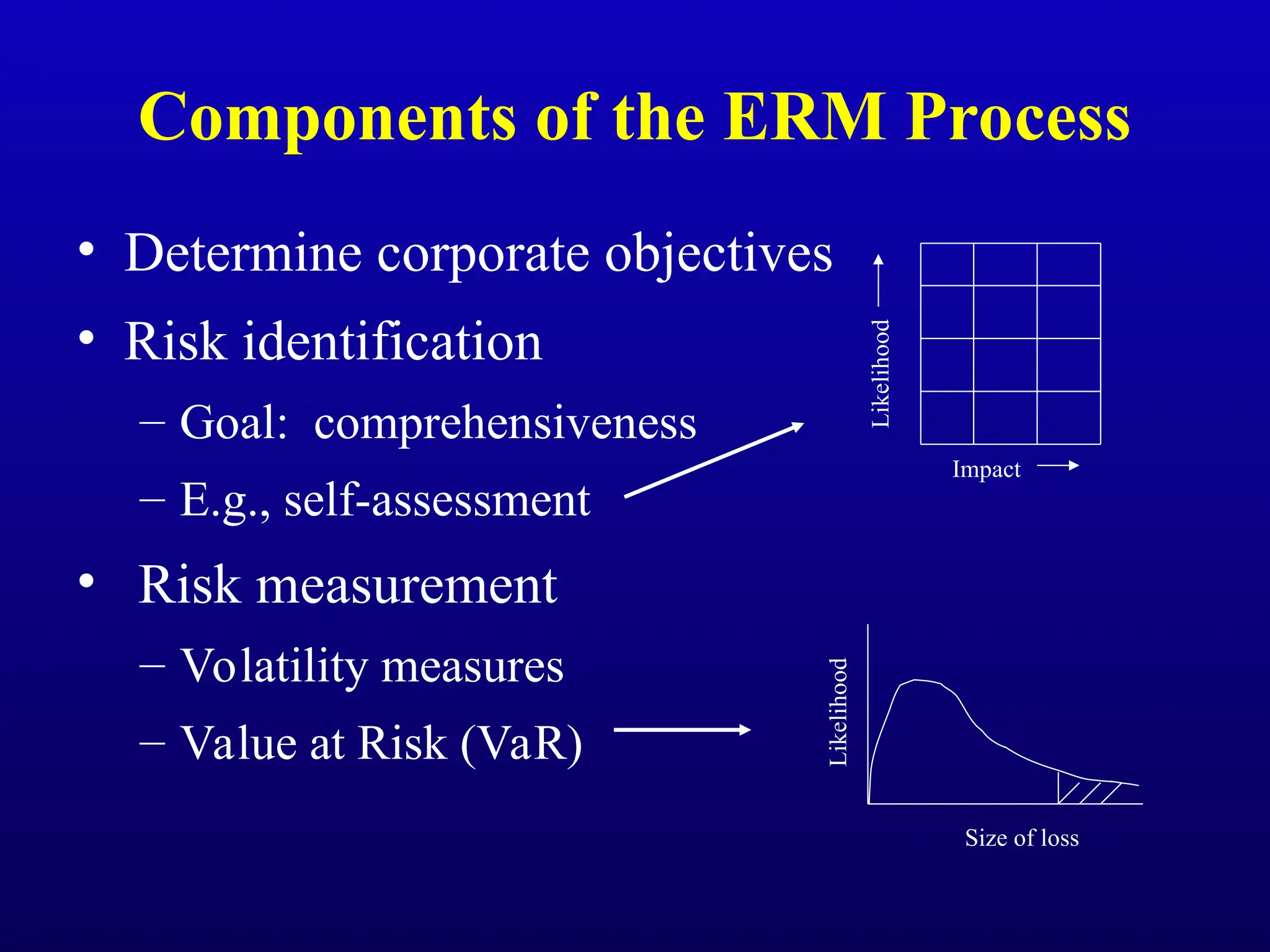
Components of theERM Process
• Determine corporate objectives
• Risk identification
– Goal: comprehensiveness
– E.g., self-assessment
• Risk measurement
– Volatility measures
– Value at Risk (VaR)
Impact
Likelihood
Size of loss
Likelihood
23.
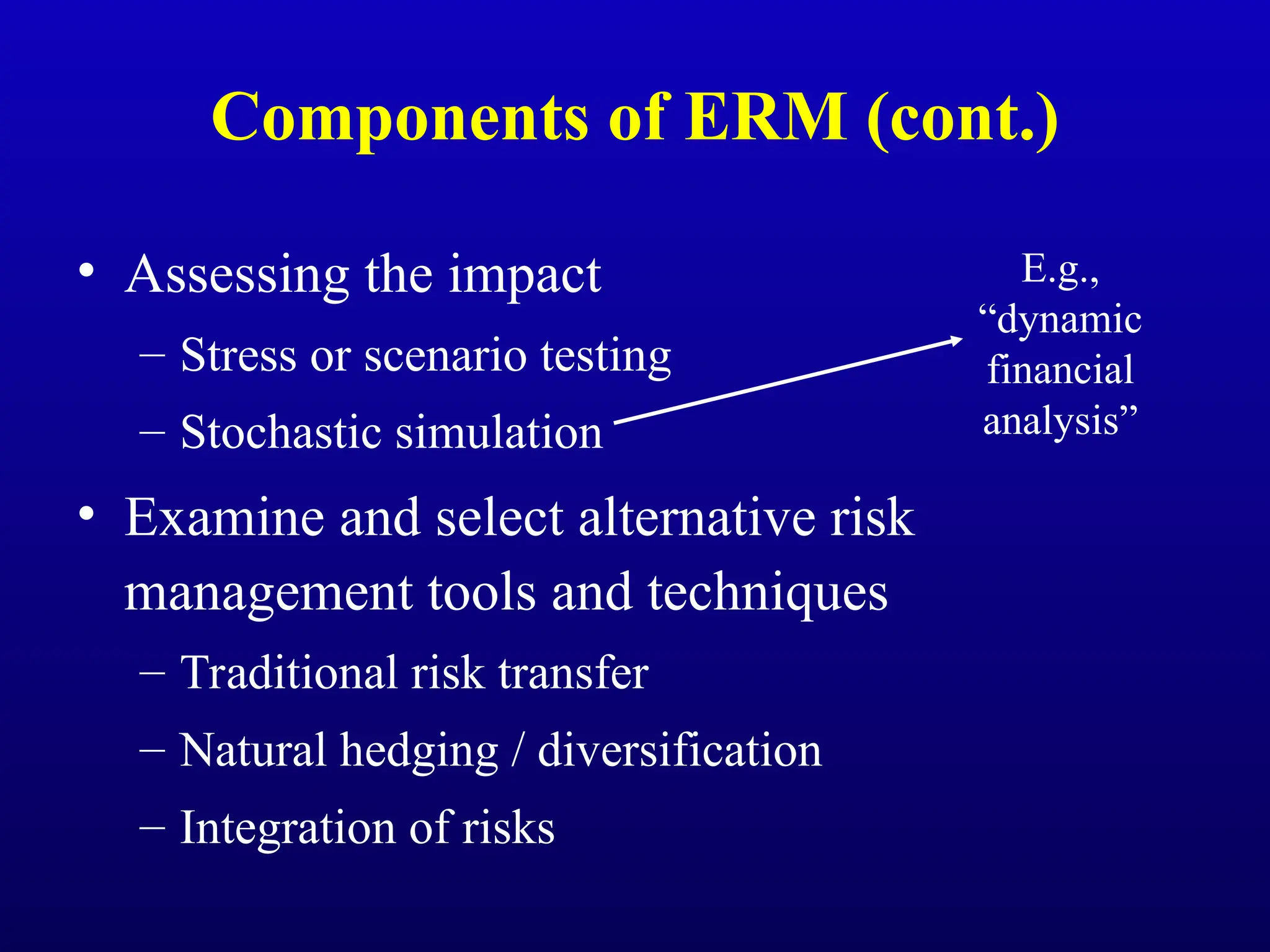
Components of ERM(cont.)
• Assessing the impact
– Stress or scenario testing
– Stochastic simulation
• Examine and select alternative risk
management tools and techniques
– Traditional risk transfer
– Natural hedging / diversification
– Integration of risks
E.g.,
“dynamic
financial
analysis”
24.
Keys to Successin ERM
• Senior management commitment and
sponsorship
• Embed a “risk management culture” in the
corporation at the operational level
• Provide for accountability, both specific
and widespread
• Clearly defined responsibilities for
coordination and maintenance
• Adequate communication
25.
ERM Tries toAvoid…
“A failure of imagination.”
- Frank Borman, in testimony to Congress,
responding to a question regarding the real
cause of the Apollo 1 fire and the resulting
three astronaut deaths, as dramatized in
HBO’s series From the Earth to the Moon
CAS Online Courses
•Originally, four modules in a Financial
Risk Management series
• Newest course: “Intro to ERM”
– First offering: October 2006
– Fourth offering: January 2008
• Course components:
– 12 lectures (PPT with voiceovers)
– Readings, and case studies
– Discussion forum
– “Final exam”
28.
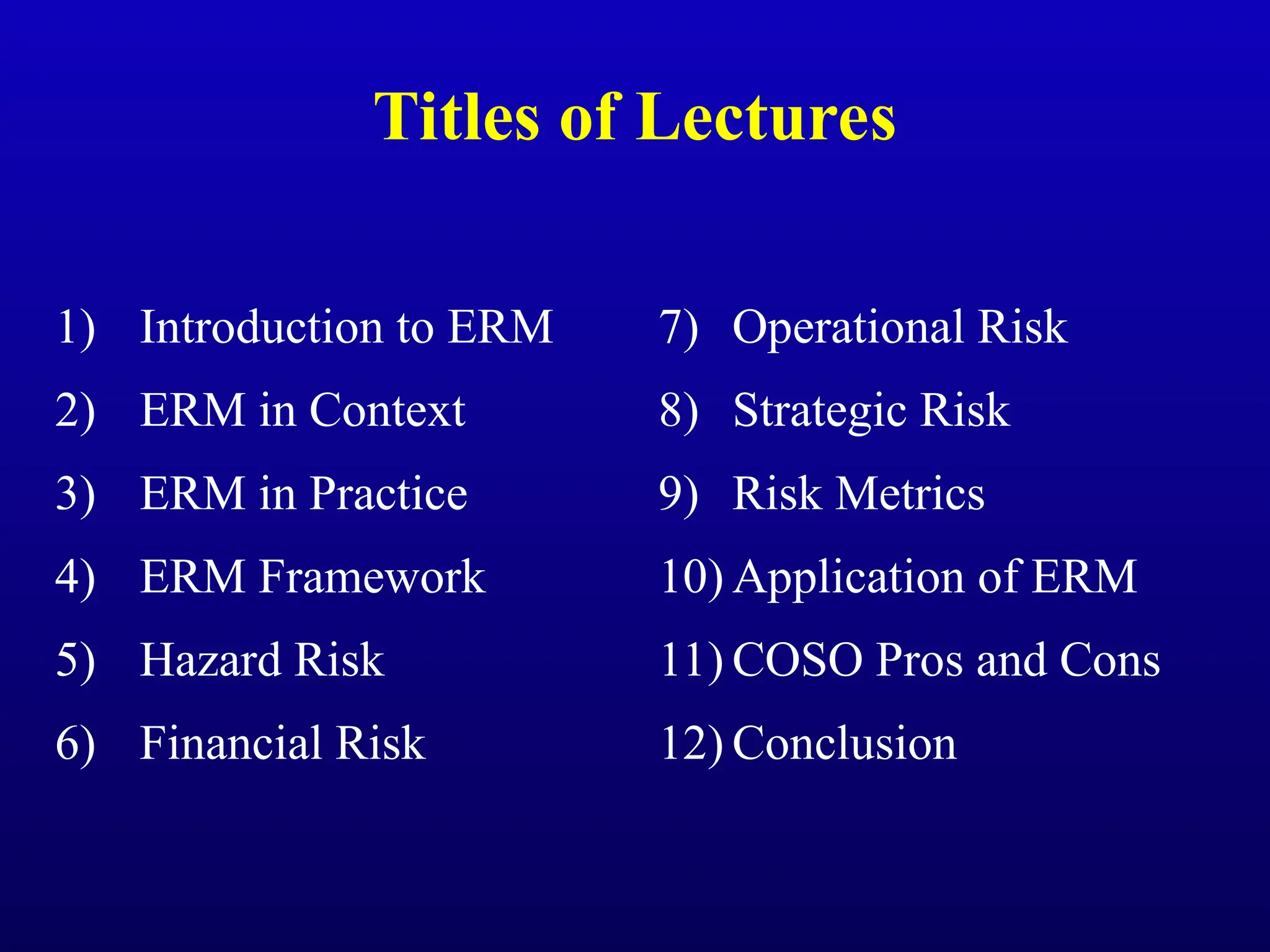
Titles of Lectures
1)Introduction to ERM
2) ERM in Context
3) ERM in Practice
4) ERM Framework
5) Hazard Risk
6) Financial Risk
7) Operational Risk
8) Strategic Risk
9) Risk Metrics
10) Application of ERM
11) COSO Pros and Cons
12) Conclusion
29.
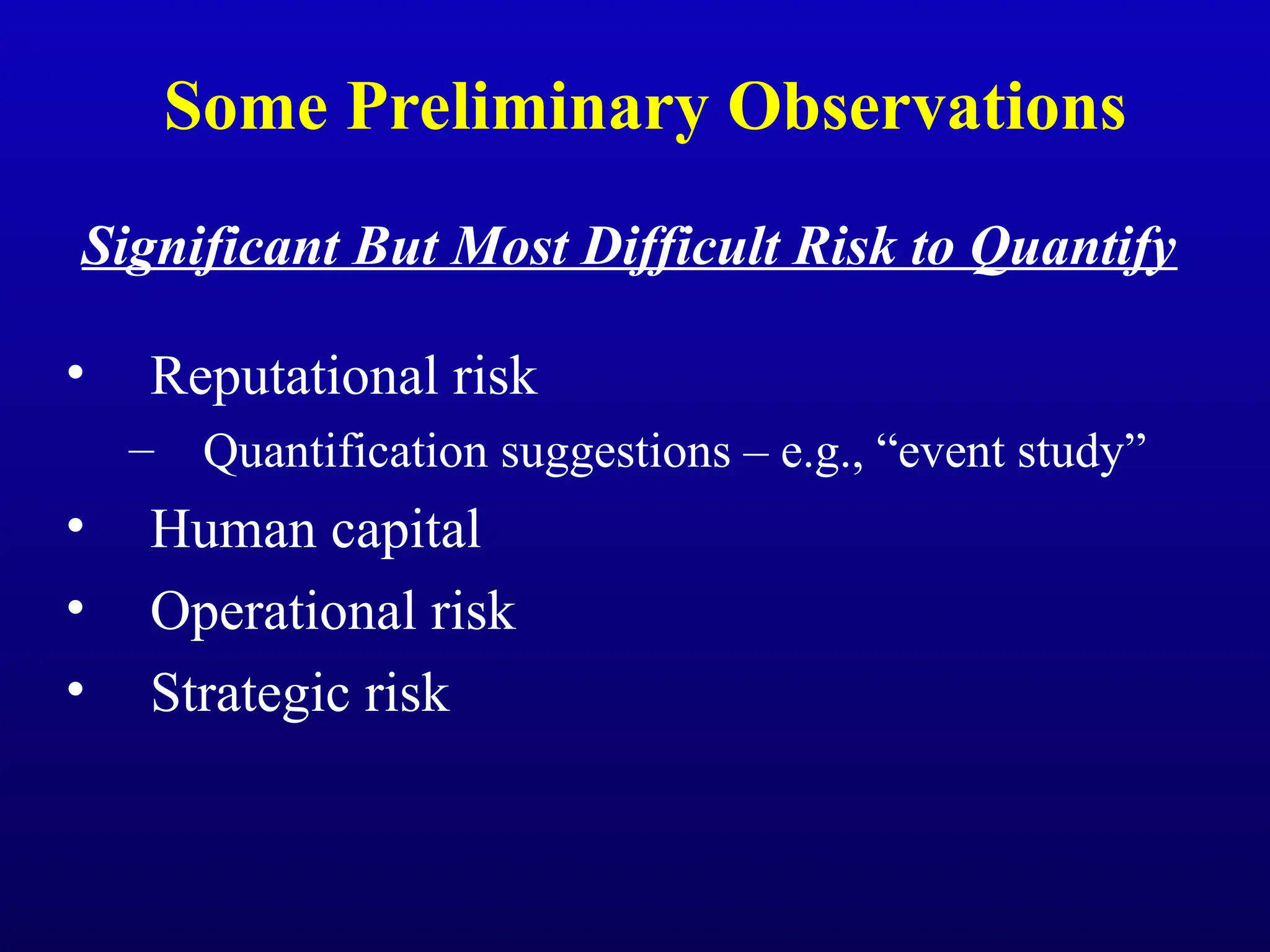
Some Preliminary Observations
SignificantBut Most Difficult Risk to Quantify
• Reputational risk
– Quantification suggestions – e.g., “event study”
• Human capital
• Operational risk
• Strategic risk
30.
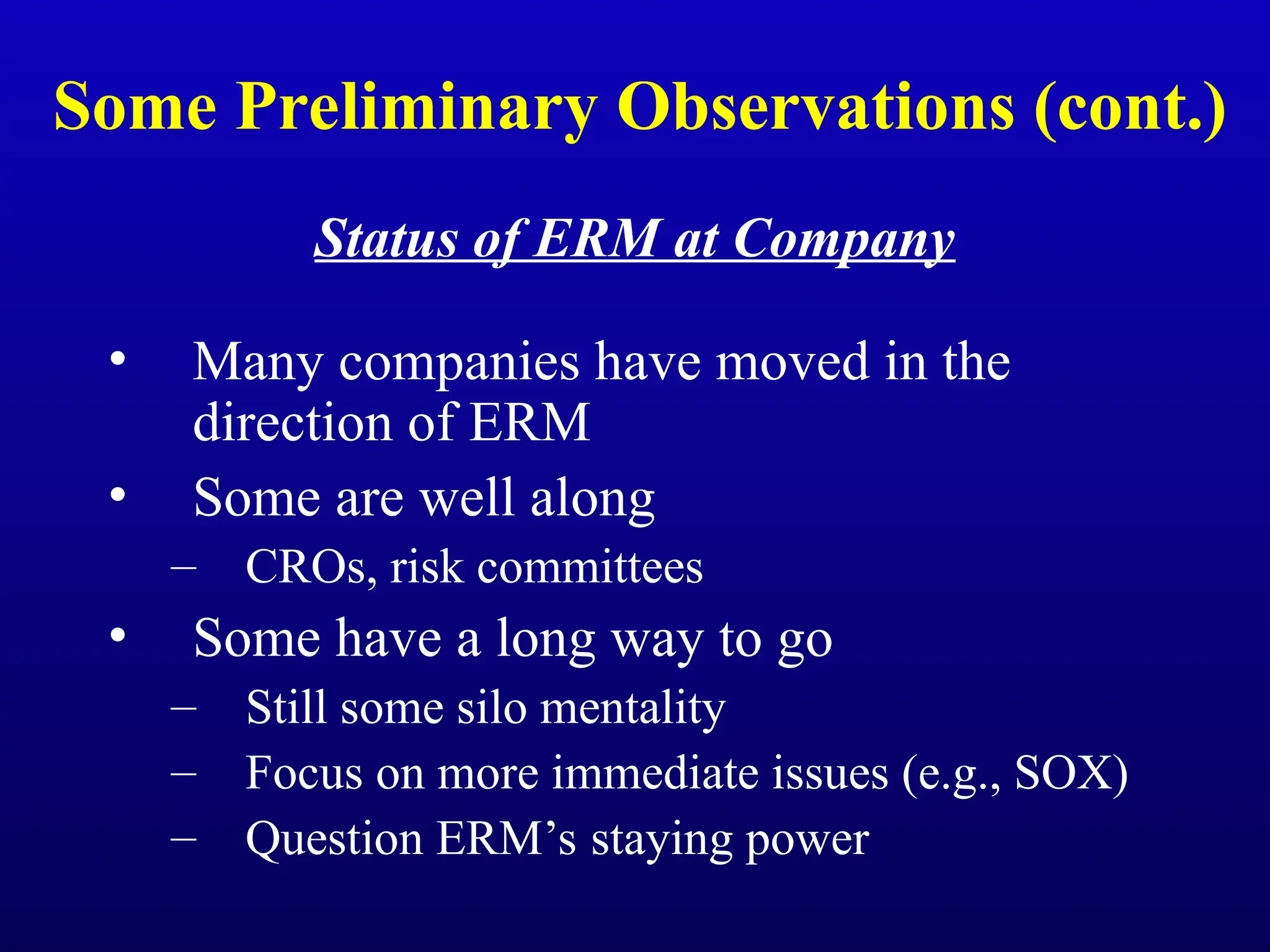
Some Preliminary Observations(cont.)
Status of ERM at Company
• Many companies have moved in the
direction of ERM
• Some are well along
– CROs, risk committees
• Some have a long way to go
– Still some silo mentality
– Focus on more immediate issues (e.g., SOX)
– Question ERM’s staying power
31.
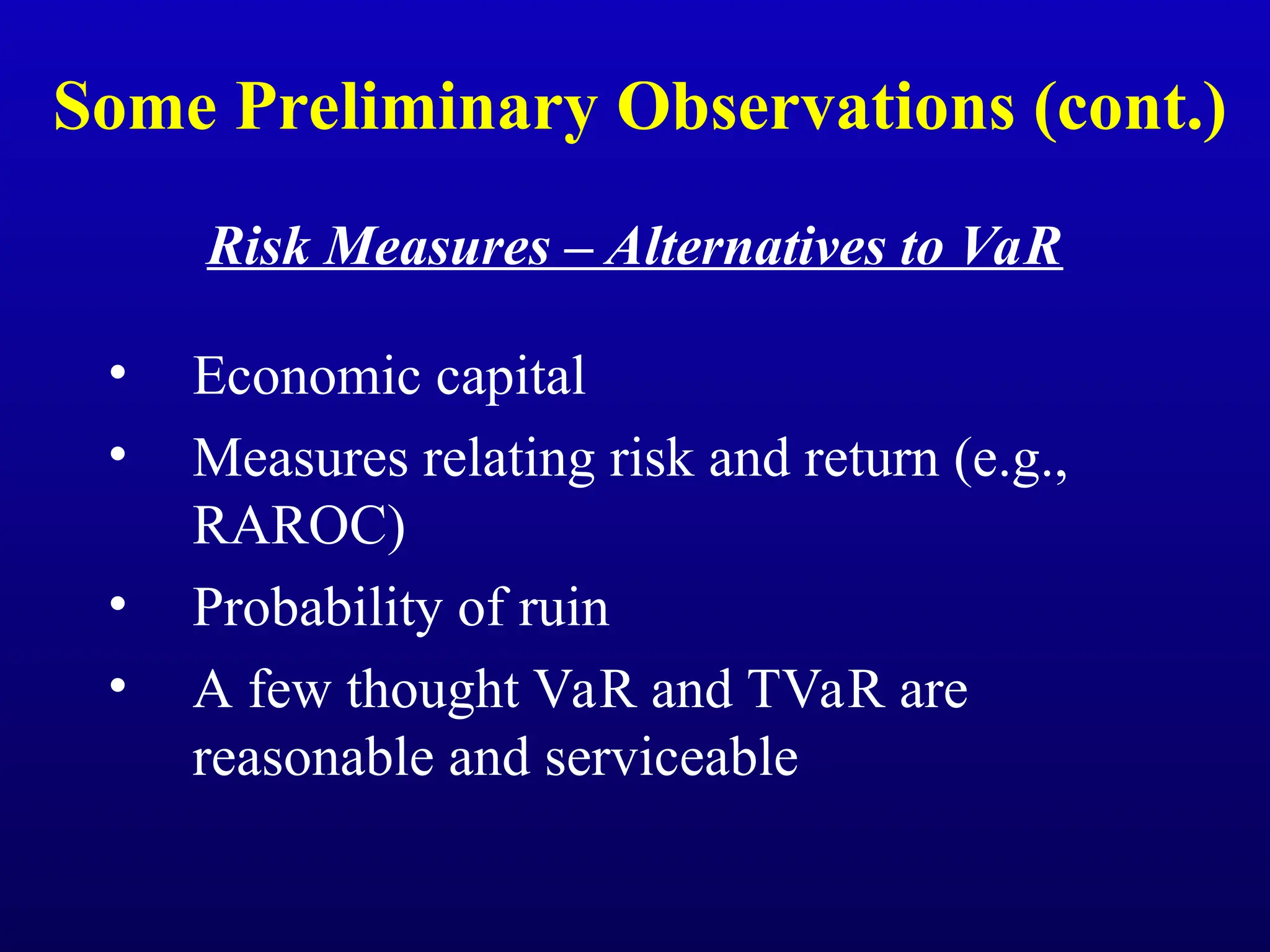
Some Preliminary Observations(cont.)
Risk Measures – Alternatives to VaR
• Economic capital
• Measures relating risk and return (e.g.,
RAROC)
• Probability of ruin
• A few thought VaR and TVaR are
reasonable and serviceable
(1) Complex AdaptiveSystem
• A system of individual “agents” which interact
and adapt / evolve to changing conditions
• Characteristics
– Not reducible
– Self-organized emergence, exhibiting nonlinearities
– Bottom-up rather than top-down
• Some examples
– Economies
– Ecologies
– Consciousness
– Organizations
35.
Complex Social Systems
“Onemust study the laws of human action
and social cooperation as the physicist
studies the laws of nature.”
- Human Action, Ludwig von Mises, 1949
36.
Historical Recognition
“He intendsonly his own gain, and he is in
this, as in many other cases, led by an
invisible hand to promote an end which was
no part of his intention.”
- An Inquiry into the Nature and Causes of
the Wealth of Nations, Adam Smith, 1776
37.
(2) Evolutionary Process
•There are several important parallels between
economic systems and biological evolutionary
theory
– Complex systems
– Self-organized agents / individuals
– Adaptation / natural selection
– Emergence of “order”
– Understanding the historical process helps to
explain behavior
38.
Biology and Economics
“Theprecise mathematical relationship which
describes the link between the frequency and
size of the extinction of companies, for
example, is virtually identical to that which
describes the extinction of biological species in
the fossil record. Only the timescales differ.”
- Why Most Things Fail: Evolution, Extinction &
Economics, Paul Ormerod, 2005
39.
(3) Behavioral Concerns
•Various well-documented “fallacies” can
cause inaccurate or biased estimates of values,
probabilities, etc. E.g.,
– Anchoring fallacy: bias toward an initial value
– Inattentional blindness: concentrating in one area
can induce blindness to other events
– Availability fallacy: immediately-available
examples have a perhaps undue influence on our
estimates
40.
Evaluating Probabilities
“The informationprovided by advocacy groups is blunt.
“Y-Me states that breast cancer is ‘the overall leading cause of death in
women between the ages of 40 and 55.’ It adds: ‘In the United States, 1
in 8 women will develop breast cancer in her lifetime. This year, breast
cancer will be newly diagnosed every three minutes and a woman will
die of breast cancer every 13 minutes.’
“CapCure, the organization founded by Michael Milken to fight prostate
cancer, states similar statistics: ‘In 2002, an estimated 189,000 men will
be diagnosed with prostate cancer. This represents one new case every
three minutes.’
“While the figures are accurate, some medical researchers are concerned
by the messages they convey. Such statements, they say, may lead
people to exaggerate their chances of getting and dying from a
fearsome disease.”
- “Experts Strive to Put Diseases in Proper Perspective,” by Gina Kolata, New York Times, 7/2/02
41.
Evaluating Probabilities (cont.)
“Evenconcerns about real dangers, when blown out of proportion, do
demonstrable harm. Take the fear of cancer. Many Americans
overestimate the prevalence of the disease, underestimate the odds of
surviving it, and put themselves at greater risk as a result. Women in
their forties believe they have a 1 in 10 chance of dying from breast
cancer, a Dartmouth study found. Their real lifetime odds are more like
1 in 250. Women’s heightened perception of risk, rather than
motivating them to get checkups or seek treatment, can have the
opposite effect. A study of daughters of women with breast cancer
found an inverse correlation between fear and prevention: the greater a
daughter’s fear of the disease the less frequent her breast self-
examination. Studies of the general population-both men and women-
find that large numbers of people who believe they have symptoms of
cancer delay going to a doctor, often for several months. When asked
why, they report they are terrified about the pain and financial ruin
cancer can cause as well as poor prospects for a cure….”
- The Culture of Fear: Why Americans are Afraid of the Wrong Things, Barry Glassner,
2000, Basic Books
42.
Research
• New undergraduateresearch initiative at
the University of Illinois
• Current research projects
– Agent-based modeling
– Predator – prey models
– Power laws and their applications
– Neuroeconomics and behavioral economics
ERM Predictions –Lam*
1. ERM will become an industry standard
2. CRO position will be prevalent
3. Audit committees will become risk committees
4. Economic capital will replace VaR
5. Enterprise-level transfer of risk
6. Impact of advanced technology
7. Measurement standard for operational risk
8. Mark-to-market accounting
9. Risk education will grow
10. Salary gap between risk professionals will widen
*Enterprise Risk Management: From Incentives to Controls, James Lam, 2003
45.
Personal Conclusions
• ERMis a giant redwood
• However, let’s not underestimate how big
a challenge it is
– Even in a “frictionless” world, quantifying
and codifying a holistic approach to risk
management is an enormous task
– Real-world realities make it even more
difficult
• But it’s worth the effort
46.
Concluding Quotation
“The revolutionaryidea that defines the
boundary between modern times and the past
is the mastery of risk”
- Peter Bernstein, Against the Gods