1/13
August 12, 2024
Enterprise AI- Applications, Benefits, Challenges & More
successive.tech/blog/enterprise-ai-applications-benefits-challenges/
Businesses have started embracing the advanced versions of AI, investing significant time
and resources to understand its capabilities. However, some are skeptical about it, and some
are in the experimental phase—trying multiple ways without a strategic plan. Imagine having
vast amounts of unstructured data, enabling slow decision-making, and consequently failing
to upgrade and survive in the competitive space. It doesn’t look good, right? — Analyzing
vast amounts of data produced by enterprises is complex.
Enter the inclusion of AI for enterprise—a change that can transform your business
operations. With AI enterprise solutions, businesses can integrate machine learning, deep
learning, predictive analytics, natural language processing systems, and robotic process
automation capabilities into their day-to-day operations. Enterprise AI enables advanced
integrations, automates mundane tasks, eradicates inefficiencies, and allows responsive
decision-making.
Executives and entrepreneurs looking to build a resilient and advanced enterprise must
integrate AI into their existing businesses. This article will help you understand how
businesses can transform with Enterprise AI in an increasingly digital and data-driven world.
What is Enterprise AI?
Enterprise artificial intelligence (AI) is an advanced approach of integrating AI-based
technologies to address business difficulties within an enterprise. It uses machine learning,
deep learning, natural language processing (NLP), and other AI approaches to automate
processes, improve decision-making, and develop new products and services.
Enterprise AI solutions extends beyond automation. It applies AI to complicated commercial
challenges requiring human-like intelligence, such as comprehending customer behavior,
improving logistics, or identifying fraud. By analyzing massive datasets and powerful
algorithms, Enterprise AI can help with accurate insights, streamline processes, and drive
innovation across multiple departments and activities.
How is AI crucial for Enterprises?
The rise of big data, rising customer expectations, and the requirement for agility and
innovation all demand enterprises adopt new technology to stay ahead of the competition.
2/13
The sheer volume and complexity of data generated by modern enterprises make it crucial
for businesses to examine and evaluate their existing approaches. Enterprise AI solutions
enable tools to extract valuable insights from this data, uncovering hidden patterns, trends,
and opportunities that could remain undetected otherwise.
Furthermore, AI-powered systems may automate complicated decision-making processes,
allowing businesses to adapt to market shifts quickly and accurately. This adaptability can
help organizations manage volatile market dynamics, optimize processes, and achieve a
competitive advantage.
Enterprise AI is not just about adopting a single technology but involves creating a
comprehensive AI strategy that aligns with the organization’s goals, ensuring scalability,
security, and ethical considerations. This holistic adoption can transform traditional business
models, enabling enterprises to respond more swiftly to market changes and emerging
opportunities.
Read this blog- Gen AI in CX, to understand how AI is transforming customer
experience.
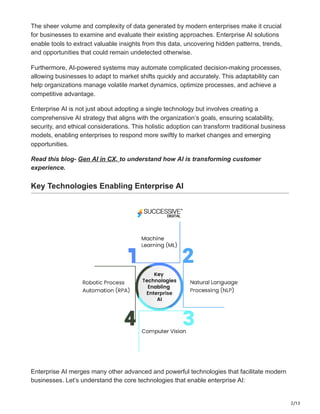
Key Technologies Enabling Enterprise AI
Enterprise AI merges many other advanced and powerful technologies that facilitate modern
businesses. Let’s understand the core technologies that enable enterprise AI:
3/13
Machine Learning
Many businesses utilize machine learning as the foundational technology for artificial
intelligence applications because it allows them to learn from data and discover trends with
as little human intervention as possible. It is a subset of artificial intelligence that seeks to
emulate intelligent human behavior to execute complicated tasks such as human problem-
solving.
Photos, statistics, and text are examples of data that serve as the foundation for machine
learning. Data is collected and kept to serve as training data for the machine learning model.
The more data you have, the more influential the program. When the data is ready,
programmers select a machine-learning model to feed it into, and the model will train itself to
recognize patterns or make predictions. The programmer can adjust the model’s parameters
over time, allowing it to produce more accurate results. Thus, machine learning capabilities
can help businesses respond quickly and efficiently to customer needs.
Natural Language Processing
NLP teaches computers to comprehend, interpret, and respond to human language. It is
utilized in various enterprise domains, including customer service automation, increased
communication efficiency, and extracting information from unstructured data such as emails
and social media posts. NLP integrates computational linguistics’ rule-based modeling of
human language with statistical, machine learning, and deep learning techniques. These
technologies enable computers to process and understand human-generated text and voice
data.
It is a collection of computer programs capable of quickly translating text from one language
to another, responding to spoken requests, and summarizing vast amounts of text in real-
time. You’ve probably used NLP with voice-activated GPS devices or digital assistants. NLP
is also essential to AI enterprise applications, which expedite business operations, increase
staff productivity, and simplify mission-critical business processes.
Computer Vision
Enterprises utilize computer vision to assist machines in seeing images or videos and
making decisions. One of the most prominent examples of enterprise AI is the use of facial
recognition to improve security within institutions’ premises. Computer Vision is possible with
two technologies: deep learning and a convolutional neural network (CNN). These multilayer
neural networks enable computers to learn from visual data. With enough data, the computer
can learn to distinguish between different images.
The computer uses a CNN to “look at” the visual data as it passes through the model. CNN
assists a machine learning/deep learning model in comprehending images by breaking them
down into pixels. These pixels are then labeled to train specific characteristics (image
4/13
annotation). The AI model utilizes labels to produce predictions and convolutions based on
what it “sees.” It then iteratively checks the accuracy of its forecasts to ensure they satisfy
expectations. Two types of algorithm families are utilized for object detection: single-stage
algorithms ( Retina Net & SSD) and multi-stage algorithms ( Fast RCNN, Mask RCNN).
Enterprise AI platforms
Robotic Process Automation
It deploys robots, or “bots,” to automate repetitive and rule-based processes across various
enterprise applications. These bots simulate human interactions with digital systems,
performing activities like data entry, transaction processing, and report preparation with great
precision and speed. RPA begins with process identification and mapping, which involves
thoroughly documenting workflows that can be automated. This includes describing the
process’s specific processes, decision points, and exceptions.
Once recognized, bots are configured to repeat these actions with RPA technologies. Bots
interact with applications via the user interface, extracting and inputting data using screen
scraping and optical character recognition (OCR) techniques. Bots operate in both attended
and unattended modes. Attended bots work alongside human employees, assisting with
tasks in real-time, while unattended bots execute processes independently based on
predefined schedules or triggers, controlled and monitored through centralized panels.
Want to know more about the potential of AI for your specific business use case –
Contact us today!
Practical Applications of Enterprise AI
Now you know about the key technologies that enable enterprise AI, let’s further understand
the practical applications of enterprise AI:
Customer Relationship Management (CRM):
AI can be integrated into CRM systems with advanced machine learning models and NLP
capabilities. It starts with collecting and preparing extensive consumer data, such as
interaction histories, purchase trends, and demographic information. These datasets train
generative AI models, such as transformer-based architectures like GPT (Generative Pre-
trained Transformer), which generates human-like language.
Once trained, these models are integrated into the CRM platform using APIs and machine
learning frameworks, allowing for smooth interaction with other CRM features. Generative AI
then supports various aspects, including automatic email and message drafting, in which the
AI creates personalized content based on evaluated client data. In customer service
applications, generative AI-driven chatbots answer real-time requests, relying on natural
language processing to understand and respond appropriately.
5/13
Furthermore, Predictive analytics anticipate customer needs, allowing proactive engagement
and significantly reducing churn. For example, tools like Salesforce Einstein and HubSpot’s
AI features automate data entry, accurately segment customers, and tailor marketing
campaigns and product recommendations.
Additionally, natural language processing (NLP) enhances these systems’ ability to
understand and respond to customer communications instantly, improving response times
and overall satisfaction. Through these capabilities, AI-driven CRMs evolve into intelligent
systems that foster stronger, more personalized relationships, driving substantial business
growth and customer loyalty for enterprises.
Supply Chain Management:
AI for supply chain and logistics enterprises helps optimize inventory management demand
forecasting, which can reduce costs and promote growth with improved efficiency. The
implementation starts with collecting data from various sources, including IoT sensors,
enterprise resource planning (ERP) systems, and logistics networks.
It is consolidated into centralized data lakes or cloud storage options. The data is then
cleaned and normalized before being analyzed. This data is used to train machine learning
models, which include predictive analytics and optimization algorithms, to find patterns and
create forecasts, such as demand predictions and inventory optimization.
Then, the models are integrated into supply chain management systems using APIs and
middleware to provide seamless communication and data flow across various components.
AI-powered solutions such as robotic process automation (RPA) and self-driving vehicles
automate repetitive processes in warehousing and transportation, hence increasing
productivity.
For example, predictive analytics can forecast potential disruptions and suggest alternative
routes or suppliers, ensuring smooth operations. Additionally, AI-driven automation in
warehouse management systems enhances order fulfillment processes, reducing errors and
speeding up delivery times.
Read this blog to learn about the: The Impact of AI and Machine Learning on
Transportation and Logistics
Human Resources :
Incorporating AI into human resource operations revolutionizes talent acquisition, employee
performance management, and workforce planning. AI in human resource operations
includes numerous critical components and procedures that improve efficiency and decision-
making.
6/13
Data integration and preparation are crucial to integrating AI into human resource operations.
HR data from many sources, such as applicant tracking systems (ATS), employee
databases, and performance management tools, are collected and consolidated. This data is
cleansed, standardized, and formatted to ensure correctness and consistency before being
fed into AI systems.
Then, the models are trained using the processed data to accomplish tasks such as resume
screening, candidate matching, and employee sentiment analysis. For example, natural
language processing (NLP) algorithms assess and rank resumes based on predetermined
criteria, decreasing the time and effort required for initial candidate evaluations.
AI-powered interviews are becoming popular. These interviews use natural language
processing (NLP) and computer vision technologies to conduct and assess candidate
interactions. They can also include structured evaluations and cognitive tests, which
automate the assessment of technical capabilities and problem-solving ability. This
information is connected to the more extensive HR system via APIs, resulting in a
comprehensive view of each candidate’s qualifications and potential.
Finance and Accounting:
Enterprise AI is automating financial operations. It enables real-time fraud detection and risk
management, increasing financial services’ efficiency and relevancy. LLMs can analyze
transaction data to detect anomalies and fraud, securing businesses from financial loss. AI-
driven automation also streamlines financial reporting and compliance by processing large
volumes of data accurately, reducing the chances of errors and ensuring regulatory
compliance.
Techniques such as anomaly detection, clustering, and classification are employed to detect
unusual patterns and behaviors. Real-time data streams from financial transactions are fed
into these models through secure APIs, allowing the system to flag suspicious activities
promptly. For credit scoring, decision trees and gradient boosting machines analyze diverse
data sources, including financial history, transaction behavior, and alternative data like social
media activity.
For example, AI tools can automate routine accounting tasks such as invoice processing,
expense management, and reconciliation, letting finance professionals focus on more
strategic activities. AI’s ability to predict market trends and financial risks further improves
risk management, enabling businesses to make informed decisions and mitigate potential
threats effectively.
Benefits of Implementing AI in Enterprises
Artificial intelligence is here to stay; it’s high time to adapt and leverage it wisely. We have
outlined the benefits of integrating AI into your enterprise.
7/13
Improved Decision Making
Artificial intelligence (AI) reveals details humans may overlook by investigating complex
topics with precision and awareness. Accurate insights from AI’s analysis help better
decision-making in various business disciplines, including risk management, resource
allocation, and sales forecasting.
Personalized Customer Service Delivery
AI analyzes and learns from data to generate highly personalized and tailored experiences
and services. Streaming services like Netflix and retailers use intelligent systems to study
buying patterns, individual consumer data, and extensive data sets to determine customers’
preferences based on their style, interests, and needs.
Improved Talent Acquisition and Retention
Using tools based on intelligent enterprise AI strategy substantially improves the recruiting
process because they can assess the best candidate fit based on criteria specified in the job
role description and assist organizations in predicting whether an employee will depart after
a certain period of time after hiring them.
Improved Research and Development
AI-powered systems can accelerate R&D and uncover new product prospects by evaluating
large datasets and identifying patterns. Such rapid innovation allows businesses to introduce
new products while swiftly maintaining competitiveness.
Operational Cost Optimization
AI can result in significant savings because it automates routine activities. One example of
enterprise AI is finance teams that use AI-led automation to minimize human involvement in
invoice processing, expense management, and financial reporting.
Challenges and Considerations in Enterprise AI Adoption
Every new approach has its set of challenges; let’s understand the possible challenges of
enterprise AI:
Data Privacy and Security:
When businesses integrate AI, they must prioritize data privacy and security. AI systems
frequently access large amounts of sensitive data, raising concerns about data breaches and
misuse. Robust encryption, secure data storage, and strict access controls protect this data.
Compliance with global data protection rules, such as GDPR in Europe and the CCPA in
California, is essential.
8/13
To secure data integrity and customer trust, enterprises must implement privacy-by-design
principles, undertake frequent security audits, and stay current on regulatory changes.
Furthermore, anonymization techniques and safe multi-party computation can improve data
privacy, allowing AI models to function securely.
System Integration:
Integrating AI into current IT infrastructures provides several issues, especially when dealing
with older systems. Successful integration necessitates a solid understanding of AI
technology and the IT landscape. Best practices for seamless AI adoption include:
-completing a thorough review of the current infrastructure,
-finding suitable interaction points and
-assuring compatibility with legacy systems.
Middleware solutions can improve interoperability by serving as a link between AI
applications and existing systems. Furthermore, taking a modular approach to system
integration and adding AI components sequentially can reduce disruptions and facilitate
troubleshooting and optimization.
Skill and Expertise Development:
The increasing need for skilled AI professionals emphasizes the importance of developing AI
knowledge within enterprises. To meet this demand, it is necessary to upskill existing people
and hire fresh talent. Enterprises can use training programs, workshops, and certification
courses to prepare their employees with AI skills and the correct set of knowledge.
Furthermore, partnerships with academic institutions and participation in industrial consortia
can also help firms stay ahead of AI breakthroughs. Furthermore, cultivating a culture of
continuous learning and encouraging cross-functional cooperation will help guarantee that AI
knowledge is appropriately integrated throughout the business, boosting innovation and
improving overall AI adoption.
Ethical and Bias Concerns:
Enterprises must prioritize reducing biases in AI systems and assuring ethical AI operations.
Bias in AI can result in unfair outcomes and harm an organization’s reputation. To overcome
this issue, businesses should implement frameworks and rules for ethical AI implementation,
such as those provided by AI ethics boards and industry standards.
It is critical to use bias detection and mitigation approaches throughout the development and
deployment of AI models. Regular audits and transparency in AI procedures can ensure that
ethical norms are followed. Furthermore, incorporating diverse teams into the AI
9/13
development process can provide multiple viewpoints, lowering the danger of biased
conclusions and encouraging fairness in enterprise AI systems.
How Succesive Digital helped a leading business to utilize
Generative AI?
Stride, Inc., a leader in educational technology, sought to revolutionize K-12 education by
integrating a Generative AI-based Conversational Tutor into their platform. Faced with the
challenge of managing a high volume of student inquiries and overcoming availability
constraints, Stride partnered with Successive Digital to create a solution that would enhance
student engagement and learning outcomes.
Utilizing our Generative AI Center of Excellence (COE), we developed AI Tutor on AWS
infrastructure, leveraging GPT-4 and advanced large language models (LLMs). This AI Tutor
offers dynamic, personalized tutoring by incorporating historical data and literary characters,
thus transforming the learning experience. It engages students with activities that promote
critical thinking and provides on-demand support through a subscription-based model.
The AI Tutor also assists in managing human tutoring sessions, generating progress reports,
and explaining complex concepts with detailed feedback. Seamlessly integrated with Stride’s
Taxonomy and Curriculum Library, the AI Tutor features smart tutor-matching,
comprehensive progress tracking, and an efficient scheduling system. With adaptive learning
paths and multilingual support, this solution not only enhances educational inclusivity but
also sets a new standard for interactive and effective learning.
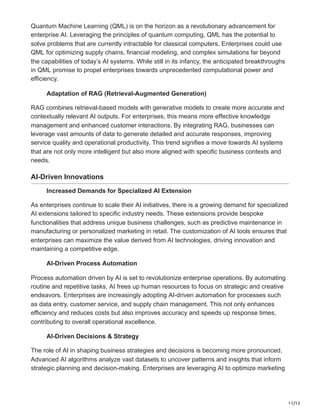
Future Enterprise AI Trends
AI is going to be the future, and you cannot take the risk of overlooking it. Let’s uncover the
future trends of enterprise AI that you must not miss:
10/13
Emerging Technologies
Explainable AI
Explainable AI (XAI) is rapidly getting popular for enterprise businesses, as it addresses the
critical need for transparency and accountability in AI decision-making processes. XAI
techniques enable enterprises to understand and interpret the complex models behind AI
predictions, fostering trust and compliance with regulatory standards. By providing insights
into how AI systems derive their conclusions, XAI enhances the collaboration between
human experts and AI, leading to better-informed and more reliable business decisions.
Multimodality
The integration of multimodal AI systems is transforming how enterprises utilize AI. These
systems can process and analyze multiple types of data, such as text, images, and audio,
simultaneously, leading to richer and more nuanced insights. For example, in customer
service, a multimodal AI can analyze voice tone and facial expressions along with text to
better understand customer sentiment. This holistic approach allows for a deeper
understanding of complex scenarios, thereby enhancing decision-making and operational
efficiency.
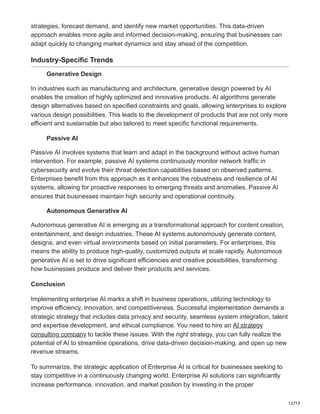
Quantum Machine Learning
11/13
Quantum Machine Learning (QML) is on the horizon as a revolutionary advancement for
enterprise AI. Leveraging the principles of quantum computing, QML has the potential to
solve problems that are currently intractable for classical computers. Enterprises could use
QML for optimizing supply chains, financial modeling, and complex simulations far beyond
the capabilities of today’s AI systems. While still in its infancy, the anticipated breakthroughs
in QML promise to propel enterprises towards unprecedented computational power and
efficiency.
Adaptation of RAG (Retrieval-Augmented Generation)
RAG combines retrieval-based models with generative models to create more accurate and
contextually relevant AI outputs. For enterprises, this means more effective knowledge
management and enhanced customer interactions. By integrating RAG, businesses can
leverage vast amounts of data to generate detailed and accurate responses, improving
service quality and operational productivity. This trend signifies a move towards AI systems
that are not only more intelligent but also more aligned with specific business contexts and
needs.
AI-Driven Innovations
Increased Demands for Specialized AI Extension
As enterprises continue to scale their AI initiatives, there is a growing demand for specialized
AI extensions tailored to specific industry needs. These extensions provide bespoke
functionalities that address unique business challenges, such as predictive maintenance in
manufacturing or personalized marketing in retail. The customization of AI tools ensures that
enterprises can maximize the value derived from AI technologies, driving innovation and
maintaining a competitive edge.
AI-Driven Process Automation
Process automation driven by AI is set to revolutionize enterprise operations. By automating
routine and repetitive tasks, AI frees up human resources to focus on strategic and creative
endeavors. Enterprises are increasingly adopting AI-driven automation for processes such
as data entry, customer service, and supply chain management. This not only enhances
efficiency and reduces costs but also improves accuracy and speeds up response times,
contributing to overall operational excellence.
AI-Driven Decisions & Strategy
The role of AI in shaping business strategies and decisions is becoming more pronounced.
Advanced AI algorithms analyze vast datasets to uncover patterns and insights that inform
strategic planning and decision-making. Enterprises are leveraging AI to optimize marketing
12/13
strategies, forecast demand, and identify new market opportunities. This data-driven
approach enables more agile and informed decision-making, ensuring that businesses can
adapt quickly to changing market dynamics and stay ahead of the competition.
Industry-Specific Trends
Generative Design
In industries such as manufacturing and architecture, generative design powered by AI
enables the creation of highly optimized and innovative products. AI algorithms generate
design alternatives based on specified constraints and goals, allowing enterprises to explore
various design possibilities. This leads to the development of products that are not only more
efficient and sustainable but also tailored to meet specific functional requirements.
Passive AI
Passive AI involves systems that learn and adapt in the background without active human
intervention. For example, passive AI systems continuously monitor network traffic in
cybersecurity and evolve their threat detection capabilities based on observed patterns.
Enterprises benefit from this approach as it enhances the robustness and resilience of AI
systems, allowing for proactive responses to emerging threats and anomalies. Passive AI
ensures that businesses maintain high security and operational continuity.
Autonomous Generative AI
Autonomous generative AI is emerging as a transformational approach for content creation,
entertainment, and design industries. These AI systems autonomously generate content,
designs, and even virtual environments based on initial parameters. For enterprises, this
means the ability to produce high-quality, customized outputs at scale rapidly. Autonomous
generative AI is set to drive significant efficiencies and creative possibilities, transforming
how businesses produce and deliver their products and services.
Conclusion
Implementing enterprise AI marks a shift in business operations, utilizing technology to
improve efficiency, innovation, and competitiveness. Successful implementation demands a
strategic strategy that includes data privacy and security, seamless system integration, talent
and expertise development, and ethical compliance. You need to hire an AI strategy
consulting company to tackle these issues. With the right strategy, you can fully realize the
potential of AI to streamline operations, drive data-driven decision-making, and open up new
revenue streams.
To summarize, the strategic application of Enterprise AI is critical for businesses seeking to
stay competitive in a continuously changing world. Enterprise AI solutions can significantly
increase performance, innovation, and market position by investing in the proper
13/13
technologies, developing AI competence, and prioritizing ethical standards. As AI technology
progresses, its role in creating the future of business will become more critical, fueling long-
term growth and success.

Enterprise AI- Applications Benefits Challenges More

  • 1.
    1/13 August 12, 2024 EnterpriseAI- Applications, Benefits, Challenges & More successive.tech/blog/enterprise-ai-applications-benefits-challenges/ Businesses have started embracing the advanced versions of AI, investing significant time and resources to understand its capabilities. However, some are skeptical about it, and some are in the experimental phase—trying multiple ways without a strategic plan. Imagine having vast amounts of unstructured data, enabling slow decision-making, and consequently failing to upgrade and survive in the competitive space. It doesn’t look good, right? — Analyzing vast amounts of data produced by enterprises is complex. Enter the inclusion of AI for enterprise—a change that can transform your business operations. With AI enterprise solutions, businesses can integrate machine learning, deep learning, predictive analytics, natural language processing systems, and robotic process automation capabilities into their day-to-day operations. Enterprise AI enables advanced integrations, automates mundane tasks, eradicates inefficiencies, and allows responsive decision-making. Executives and entrepreneurs looking to build a resilient and advanced enterprise must integrate AI into their existing businesses. This article will help you understand how businesses can transform with Enterprise AI in an increasingly digital and data-driven world. What is Enterprise AI? Enterprise artificial intelligence (AI) is an advanced approach of integrating AI-based technologies to address business difficulties within an enterprise. It uses machine learning, deep learning, natural language processing (NLP), and other AI approaches to automate processes, improve decision-making, and develop new products and services. Enterprise AI solutions extends beyond automation. It applies AI to complicated commercial challenges requiring human-like intelligence, such as comprehending customer behavior, improving logistics, or identifying fraud. By analyzing massive datasets and powerful algorithms, Enterprise AI can help with accurate insights, streamline processes, and drive innovation across multiple departments and activities. How is AI crucial for Enterprises? The rise of big data, rising customer expectations, and the requirement for agility and innovation all demand enterprises adopt new technology to stay ahead of the competition.
  • 2.
    2/13 The sheer volumeand complexity of data generated by modern enterprises make it crucial for businesses to examine and evaluate their existing approaches. Enterprise AI solutions enable tools to extract valuable insights from this data, uncovering hidden patterns, trends, and opportunities that could remain undetected otherwise. Furthermore, AI-powered systems may automate complicated decision-making processes, allowing businesses to adapt to market shifts quickly and accurately. This adaptability can help organizations manage volatile market dynamics, optimize processes, and achieve a competitive advantage. Enterprise AI is not just about adopting a single technology but involves creating a comprehensive AI strategy that aligns with the organization’s goals, ensuring scalability, security, and ethical considerations. This holistic adoption can transform traditional business models, enabling enterprises to respond more swiftly to market changes and emerging opportunities. Read this blog- Gen AI in CX, to understand how AI is transforming customer experience. Key Technologies Enabling Enterprise AI Enterprise AI merges many other advanced and powerful technologies that facilitate modern businesses. Let’s understand the core technologies that enable enterprise AI:
  • 3.
    3/13 Machine Learning Many businessesutilize machine learning as the foundational technology for artificial intelligence applications because it allows them to learn from data and discover trends with as little human intervention as possible. It is a subset of artificial intelligence that seeks to emulate intelligent human behavior to execute complicated tasks such as human problem- solving. Photos, statistics, and text are examples of data that serve as the foundation for machine learning. Data is collected and kept to serve as training data for the machine learning model. The more data you have, the more influential the program. When the data is ready, programmers select a machine-learning model to feed it into, and the model will train itself to recognize patterns or make predictions. The programmer can adjust the model’s parameters over time, allowing it to produce more accurate results. Thus, machine learning capabilities can help businesses respond quickly and efficiently to customer needs. Natural Language Processing NLP teaches computers to comprehend, interpret, and respond to human language. It is utilized in various enterprise domains, including customer service automation, increased communication efficiency, and extracting information from unstructured data such as emails and social media posts. NLP integrates computational linguistics’ rule-based modeling of human language with statistical, machine learning, and deep learning techniques. These technologies enable computers to process and understand human-generated text and voice data. It is a collection of computer programs capable of quickly translating text from one language to another, responding to spoken requests, and summarizing vast amounts of text in real- time. You’ve probably used NLP with voice-activated GPS devices or digital assistants. NLP is also essential to AI enterprise applications, which expedite business operations, increase staff productivity, and simplify mission-critical business processes. Computer Vision Enterprises utilize computer vision to assist machines in seeing images or videos and making decisions. One of the most prominent examples of enterprise AI is the use of facial recognition to improve security within institutions’ premises. Computer Vision is possible with two technologies: deep learning and a convolutional neural network (CNN). These multilayer neural networks enable computers to learn from visual data. With enough data, the computer can learn to distinguish between different images. The computer uses a CNN to “look at” the visual data as it passes through the model. CNN assists a machine learning/deep learning model in comprehending images by breaking them down into pixels. These pixels are then labeled to train specific characteristics (image
  • 4.
    4/13 annotation). The AImodel utilizes labels to produce predictions and convolutions based on what it “sees.” It then iteratively checks the accuracy of its forecasts to ensure they satisfy expectations. Two types of algorithm families are utilized for object detection: single-stage algorithms ( Retina Net & SSD) and multi-stage algorithms ( Fast RCNN, Mask RCNN). Enterprise AI platforms Robotic Process Automation It deploys robots, or “bots,” to automate repetitive and rule-based processes across various enterprise applications. These bots simulate human interactions with digital systems, performing activities like data entry, transaction processing, and report preparation with great precision and speed. RPA begins with process identification and mapping, which involves thoroughly documenting workflows that can be automated. This includes describing the process’s specific processes, decision points, and exceptions. Once recognized, bots are configured to repeat these actions with RPA technologies. Bots interact with applications via the user interface, extracting and inputting data using screen scraping and optical character recognition (OCR) techniques. Bots operate in both attended and unattended modes. Attended bots work alongside human employees, assisting with tasks in real-time, while unattended bots execute processes independently based on predefined schedules or triggers, controlled and monitored through centralized panels. Want to know more about the potential of AI for your specific business use case – Contact us today! Practical Applications of Enterprise AI Now you know about the key technologies that enable enterprise AI, let’s further understand the practical applications of enterprise AI: Customer Relationship Management (CRM): AI can be integrated into CRM systems with advanced machine learning models and NLP capabilities. It starts with collecting and preparing extensive consumer data, such as interaction histories, purchase trends, and demographic information. These datasets train generative AI models, such as transformer-based architectures like GPT (Generative Pre- trained Transformer), which generates human-like language. Once trained, these models are integrated into the CRM platform using APIs and machine learning frameworks, allowing for smooth interaction with other CRM features. Generative AI then supports various aspects, including automatic email and message drafting, in which the AI creates personalized content based on evaluated client data. In customer service applications, generative AI-driven chatbots answer real-time requests, relying on natural language processing to understand and respond appropriately.
  • 5.
    5/13 Furthermore, Predictive analyticsanticipate customer needs, allowing proactive engagement and significantly reducing churn. For example, tools like Salesforce Einstein and HubSpot’s AI features automate data entry, accurately segment customers, and tailor marketing campaigns and product recommendations. Additionally, natural language processing (NLP) enhances these systems’ ability to understand and respond to customer communications instantly, improving response times and overall satisfaction. Through these capabilities, AI-driven CRMs evolve into intelligent systems that foster stronger, more personalized relationships, driving substantial business growth and customer loyalty for enterprises. Supply Chain Management: AI for supply chain and logistics enterprises helps optimize inventory management demand forecasting, which can reduce costs and promote growth with improved efficiency. The implementation starts with collecting data from various sources, including IoT sensors, enterprise resource planning (ERP) systems, and logistics networks. It is consolidated into centralized data lakes or cloud storage options. The data is then cleaned and normalized before being analyzed. This data is used to train machine learning models, which include predictive analytics and optimization algorithms, to find patterns and create forecasts, such as demand predictions and inventory optimization. Then, the models are integrated into supply chain management systems using APIs and middleware to provide seamless communication and data flow across various components. AI-powered solutions such as robotic process automation (RPA) and self-driving vehicles automate repetitive processes in warehousing and transportation, hence increasing productivity. For example, predictive analytics can forecast potential disruptions and suggest alternative routes or suppliers, ensuring smooth operations. Additionally, AI-driven automation in warehouse management systems enhances order fulfillment processes, reducing errors and speeding up delivery times. Read this blog to learn about the: The Impact of AI and Machine Learning on Transportation and Logistics Human Resources : Incorporating AI into human resource operations revolutionizes talent acquisition, employee performance management, and workforce planning. AI in human resource operations includes numerous critical components and procedures that improve efficiency and decision- making.
  • 6.
    6/13 Data integration andpreparation are crucial to integrating AI into human resource operations. HR data from many sources, such as applicant tracking systems (ATS), employee databases, and performance management tools, are collected and consolidated. This data is cleansed, standardized, and formatted to ensure correctness and consistency before being fed into AI systems. Then, the models are trained using the processed data to accomplish tasks such as resume screening, candidate matching, and employee sentiment analysis. For example, natural language processing (NLP) algorithms assess and rank resumes based on predetermined criteria, decreasing the time and effort required for initial candidate evaluations. AI-powered interviews are becoming popular. These interviews use natural language processing (NLP) and computer vision technologies to conduct and assess candidate interactions. They can also include structured evaluations and cognitive tests, which automate the assessment of technical capabilities and problem-solving ability. This information is connected to the more extensive HR system via APIs, resulting in a comprehensive view of each candidate’s qualifications and potential. Finance and Accounting: Enterprise AI is automating financial operations. It enables real-time fraud detection and risk management, increasing financial services’ efficiency and relevancy. LLMs can analyze transaction data to detect anomalies and fraud, securing businesses from financial loss. AI- driven automation also streamlines financial reporting and compliance by processing large volumes of data accurately, reducing the chances of errors and ensuring regulatory compliance. Techniques such as anomaly detection, clustering, and classification are employed to detect unusual patterns and behaviors. Real-time data streams from financial transactions are fed into these models through secure APIs, allowing the system to flag suspicious activities promptly. For credit scoring, decision trees and gradient boosting machines analyze diverse data sources, including financial history, transaction behavior, and alternative data like social media activity. For example, AI tools can automate routine accounting tasks such as invoice processing, expense management, and reconciliation, letting finance professionals focus on more strategic activities. AI’s ability to predict market trends and financial risks further improves risk management, enabling businesses to make informed decisions and mitigate potential threats effectively. Benefits of Implementing AI in Enterprises Artificial intelligence is here to stay; it’s high time to adapt and leverage it wisely. We have outlined the benefits of integrating AI into your enterprise.
  • 7.
    7/13 Improved Decision Making Artificialintelligence (AI) reveals details humans may overlook by investigating complex topics with precision and awareness. Accurate insights from AI’s analysis help better decision-making in various business disciplines, including risk management, resource allocation, and sales forecasting. Personalized Customer Service Delivery AI analyzes and learns from data to generate highly personalized and tailored experiences and services. Streaming services like Netflix and retailers use intelligent systems to study buying patterns, individual consumer data, and extensive data sets to determine customers’ preferences based on their style, interests, and needs. Improved Talent Acquisition and Retention Using tools based on intelligent enterprise AI strategy substantially improves the recruiting process because they can assess the best candidate fit based on criteria specified in the job role description and assist organizations in predicting whether an employee will depart after a certain period of time after hiring them. Improved Research and Development AI-powered systems can accelerate R&D and uncover new product prospects by evaluating large datasets and identifying patterns. Such rapid innovation allows businesses to introduce new products while swiftly maintaining competitiveness. Operational Cost Optimization AI can result in significant savings because it automates routine activities. One example of enterprise AI is finance teams that use AI-led automation to minimize human involvement in invoice processing, expense management, and financial reporting. Challenges and Considerations in Enterprise AI Adoption Every new approach has its set of challenges; let’s understand the possible challenges of enterprise AI: Data Privacy and Security: When businesses integrate AI, they must prioritize data privacy and security. AI systems frequently access large amounts of sensitive data, raising concerns about data breaches and misuse. Robust encryption, secure data storage, and strict access controls protect this data. Compliance with global data protection rules, such as GDPR in Europe and the CCPA in California, is essential.
  • 8.
    8/13 To secure dataintegrity and customer trust, enterprises must implement privacy-by-design principles, undertake frequent security audits, and stay current on regulatory changes. Furthermore, anonymization techniques and safe multi-party computation can improve data privacy, allowing AI models to function securely. System Integration: Integrating AI into current IT infrastructures provides several issues, especially when dealing with older systems. Successful integration necessitates a solid understanding of AI technology and the IT landscape. Best practices for seamless AI adoption include: -completing a thorough review of the current infrastructure, -finding suitable interaction points and -assuring compatibility with legacy systems. Middleware solutions can improve interoperability by serving as a link between AI applications and existing systems. Furthermore, taking a modular approach to system integration and adding AI components sequentially can reduce disruptions and facilitate troubleshooting and optimization. Skill and Expertise Development: The increasing need for skilled AI professionals emphasizes the importance of developing AI knowledge within enterprises. To meet this demand, it is necessary to upskill existing people and hire fresh talent. Enterprises can use training programs, workshops, and certification courses to prepare their employees with AI skills and the correct set of knowledge. Furthermore, partnerships with academic institutions and participation in industrial consortia can also help firms stay ahead of AI breakthroughs. Furthermore, cultivating a culture of continuous learning and encouraging cross-functional cooperation will help guarantee that AI knowledge is appropriately integrated throughout the business, boosting innovation and improving overall AI adoption. Ethical and Bias Concerns: Enterprises must prioritize reducing biases in AI systems and assuring ethical AI operations. Bias in AI can result in unfair outcomes and harm an organization’s reputation. To overcome this issue, businesses should implement frameworks and rules for ethical AI implementation, such as those provided by AI ethics boards and industry standards. It is critical to use bias detection and mitigation approaches throughout the development and deployment of AI models. Regular audits and transparency in AI procedures can ensure that ethical norms are followed. Furthermore, incorporating diverse teams into the AI
  • 9.
    9/13 development process canprovide multiple viewpoints, lowering the danger of biased conclusions and encouraging fairness in enterprise AI systems. How Succesive Digital helped a leading business to utilize Generative AI? Stride, Inc., a leader in educational technology, sought to revolutionize K-12 education by integrating a Generative AI-based Conversational Tutor into their platform. Faced with the challenge of managing a high volume of student inquiries and overcoming availability constraints, Stride partnered with Successive Digital to create a solution that would enhance student engagement and learning outcomes. Utilizing our Generative AI Center of Excellence (COE), we developed AI Tutor on AWS infrastructure, leveraging GPT-4 and advanced large language models (LLMs). This AI Tutor offers dynamic, personalized tutoring by incorporating historical data and literary characters, thus transforming the learning experience. It engages students with activities that promote critical thinking and provides on-demand support through a subscription-based model. The AI Tutor also assists in managing human tutoring sessions, generating progress reports, and explaining complex concepts with detailed feedback. Seamlessly integrated with Stride’s Taxonomy and Curriculum Library, the AI Tutor features smart tutor-matching, comprehensive progress tracking, and an efficient scheduling system. With adaptive learning paths and multilingual support, this solution not only enhances educational inclusivity but also sets a new standard for interactive and effective learning. Future Enterprise AI Trends AI is going to be the future, and you cannot take the risk of overlooking it. Let’s uncover the future trends of enterprise AI that you must not miss:
  • 10.
    10/13 Emerging Technologies Explainable AI ExplainableAI (XAI) is rapidly getting popular for enterprise businesses, as it addresses the critical need for transparency and accountability in AI decision-making processes. XAI techniques enable enterprises to understand and interpret the complex models behind AI predictions, fostering trust and compliance with regulatory standards. By providing insights into how AI systems derive their conclusions, XAI enhances the collaboration between human experts and AI, leading to better-informed and more reliable business decisions. Multimodality The integration of multimodal AI systems is transforming how enterprises utilize AI. These systems can process and analyze multiple types of data, such as text, images, and audio, simultaneously, leading to richer and more nuanced insights. For example, in customer service, a multimodal AI can analyze voice tone and facial expressions along with text to better understand customer sentiment. This holistic approach allows for a deeper understanding of complex scenarios, thereby enhancing decision-making and operational efficiency. Quantum Machine Learning
  • 11.
    11/13 Quantum Machine Learning(QML) is on the horizon as a revolutionary advancement for enterprise AI. Leveraging the principles of quantum computing, QML has the potential to solve problems that are currently intractable for classical computers. Enterprises could use QML for optimizing supply chains, financial modeling, and complex simulations far beyond the capabilities of today’s AI systems. While still in its infancy, the anticipated breakthroughs in QML promise to propel enterprises towards unprecedented computational power and efficiency. Adaptation of RAG (Retrieval-Augmented Generation) RAG combines retrieval-based models with generative models to create more accurate and contextually relevant AI outputs. For enterprises, this means more effective knowledge management and enhanced customer interactions. By integrating RAG, businesses can leverage vast amounts of data to generate detailed and accurate responses, improving service quality and operational productivity. This trend signifies a move towards AI systems that are not only more intelligent but also more aligned with specific business contexts and needs. AI-Driven Innovations Increased Demands for Specialized AI Extension As enterprises continue to scale their AI initiatives, there is a growing demand for specialized AI extensions tailored to specific industry needs. These extensions provide bespoke functionalities that address unique business challenges, such as predictive maintenance in manufacturing or personalized marketing in retail. The customization of AI tools ensures that enterprises can maximize the value derived from AI technologies, driving innovation and maintaining a competitive edge. AI-Driven Process Automation Process automation driven by AI is set to revolutionize enterprise operations. By automating routine and repetitive tasks, AI frees up human resources to focus on strategic and creative endeavors. Enterprises are increasingly adopting AI-driven automation for processes such as data entry, customer service, and supply chain management. This not only enhances efficiency and reduces costs but also improves accuracy and speeds up response times, contributing to overall operational excellence. AI-Driven Decisions & Strategy The role of AI in shaping business strategies and decisions is becoming more pronounced. Advanced AI algorithms analyze vast datasets to uncover patterns and insights that inform strategic planning and decision-making. Enterprises are leveraging AI to optimize marketing
  • 12.
    12/13 strategies, forecast demand,and identify new market opportunities. This data-driven approach enables more agile and informed decision-making, ensuring that businesses can adapt quickly to changing market dynamics and stay ahead of the competition. Industry-Specific Trends Generative Design In industries such as manufacturing and architecture, generative design powered by AI enables the creation of highly optimized and innovative products. AI algorithms generate design alternatives based on specified constraints and goals, allowing enterprises to explore various design possibilities. This leads to the development of products that are not only more efficient and sustainable but also tailored to meet specific functional requirements. Passive AI Passive AI involves systems that learn and adapt in the background without active human intervention. For example, passive AI systems continuously monitor network traffic in cybersecurity and evolve their threat detection capabilities based on observed patterns. Enterprises benefit from this approach as it enhances the robustness and resilience of AI systems, allowing for proactive responses to emerging threats and anomalies. Passive AI ensures that businesses maintain high security and operational continuity. Autonomous Generative AI Autonomous generative AI is emerging as a transformational approach for content creation, entertainment, and design industries. These AI systems autonomously generate content, designs, and even virtual environments based on initial parameters. For enterprises, this means the ability to produce high-quality, customized outputs at scale rapidly. Autonomous generative AI is set to drive significant efficiencies and creative possibilities, transforming how businesses produce and deliver their products and services. Conclusion Implementing enterprise AI marks a shift in business operations, utilizing technology to improve efficiency, innovation, and competitiveness. Successful implementation demands a strategic strategy that includes data privacy and security, seamless system integration, talent and expertise development, and ethical compliance. You need to hire an AI strategy consulting company to tackle these issues. With the right strategy, you can fully realize the potential of AI to streamline operations, drive data-driven decision-making, and open up new revenue streams. To summarize, the strategic application of Enterprise AI is critical for businesses seeking to stay competitive in a continuously changing world. Enterprise AI solutions can significantly increase performance, innovation, and market position by investing in the proper
  • 13.
    13/13 technologies, developing AIcompetence, and prioritizing ethical standards. As AI technology progresses, its role in creating the future of business will become more critical, fueling long- term growth and success.