LEARNERS OUTCOMES:
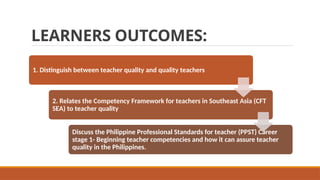
1. Distinguishbetween teacher quality and quality teachers
2. Relates the Competency Framework for teachers in Southeast Asia (CFT
SEA) to teacher quality
Discuss the Philippine Professional Standards for teacher (PPST) Career
stage 1- Beginning teacher competencies and how it can assure teacher
quality in the Philippines.
A. Quality Teacherand Teacher
Quality Defined
•Global awareness
•Financial, Economic, Business and Entrepneurial
literacy
•Civic Literacy
•Health Literacy, also included are knowledge and
values
5.
THE 21ST CENTURYSKILLS FRAMEWORK
ARE CLUSTERED INTO THREE
1.Learning and Innovation skills framework include critical
thinking and problem solving, creativity and innovation
and communication and collaboration and technology
skills.
2.Information, Media and Technology Skills framework
include Information Literacy, Media Literacy, ICT and
Technology Literacy.
3.Life and Career skills framework
6.
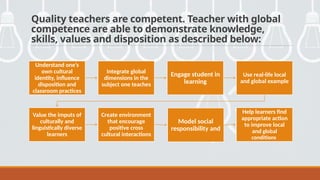
Quality teachers arecompetent. Teacher with global
competence are able to demonstrate knowledge,
skills, values and disposition as described below:
Understand one’s
own cultural
identity, influence
disposition and
classroom practices
Integrate global
dimensions in the
subject one teaches
Engage student in
learning
Use real-life local
and global example
Value the imputs of
culturally and
linguistically diverse
learners
Create environment
that encourage
positive cross
cultural interactions
Model social
responsibility and
Help learners find
appropriate action
to improve local
and global
conditions
7.
Teacher quality isa bit difficult to define. For
some countries like in the US, it has shifted
it’s definition of teacher quality from the
profession of a credential or certification to
what students know and are able to do
what they were taught by their teachers.
(Teacher Quality 2013)
8.
• Planning andPreparation: including
knowledge of content and pedagogy
knowledge of students, coherent
instructional plans, and knowledge on
how to assess student learning;
• Professional responsibilities:
includingreflecting on teaching,
communicating with families,
contributing to the school and
community and developing
professionally.
(Teacher Quality 2013)
12.
B. The
Competency
Framework for
Teachersin
Southeast Asia
(CFT SEA)
In collaboration with the Thailand’s teacher
Education Council, SEAMEO Secretariat
(SEAMES) and the SEAMEO Regional Center
for Educational Innovation and Technology
(INNOTECH) initiated the Competency
Framework for Teachers in Southeast Asia
which was developed in 2017.
1. Knowing andunderstanding
what to teach. It is the ability of
teachers to deepen and broaden
their knowledge on what to teach,
understand trends, policies and
curricula and updated on local,
national. Regional, and global
developments.
15.
2. Helping studentsto learn.
It is the ability to know
students, use the most
effective teaching and
learning strategies, assess
and give feedback on how
student learn.
16.
3. Engaging thecommunity.
It is the ability to partner with
parents and caregivers,
involve the community to
help students learn, and
encourage respect the
diversity.
17.
4.Becoming a betterteacher
everyday. Thus is the ability
to know oneself and others,
practice human goodness
and then master the teaching
practice.
As part ofthe ASEAN convergence and in the
light of globalization each country in the
ASEAN, the Philippines adopts national
standards and levels for outcomes in
education. This called Philippine Qualification
Framework (PQF) which is provided by law.
20.
(RA 10968, s2018). Based on the level of
education as PQF level 6, the PQF describes
the career path for baccalaureate degree
programs including teacher education
degrees, All graduate from the baccalaureate
degrees are expected to exhibit outcomes.
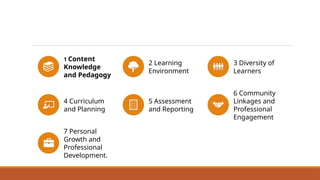
1 Content
Knowledge
and Pedagogy
2Learning
Environment
3 Diversity of
Learners
4 Curriculum
and Planning
5 Assessment
and Reporting
6 Community
Linkages and
Professional
Engagement
7 Personal
Growth and
Professional
Development.
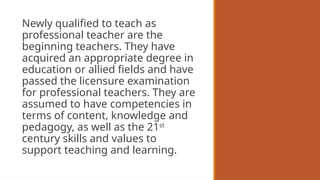
Newly qualified toteach as
professional teacher are the
beginning teachers. They have
acquired an appropriate degree in
education or allied fields and have
passed the licensure examination
for professional teachers. They are
assumed to have competencies in
terms of content, knowledge and
pedagogy, as well as the 21st
century skills and values to
support teaching and learning.