One of thebiggest challenges of ensuring teacher quality is the
attractiveness of the teaching profession. The teacher profession is
not attractive as the other profession that is why it does not get the
best material. Teachers undergo series of trainings in their filled of
specialization to be qualified in moulding learners on the changing
needs of times to complement with the need for efficient global
workforce. In this video presentation, you will learn and reflect on
how to ensure teacher quality through competency frameworks and
standards in the Philippines and other countries as well.
Introduction
One of the biggest challenges of ensuring teacher quality is
the attractiveness of the teaching profession. The teacher
profession is not attractive as the other profession that is
why it does not get the best material. Teachers undergo
series of trainings in their filled of specialization to be
qualified in moulding learners on the changing needs of
times to complement with the need for efficient global
workforce. In this video presentation, you will learn and
reflect on how to ensure teacher quality through
competency frameworks and standards in the Philippines
and other countries as well.
A quality teachermatters; it is defined by
their attributes and characteristics, while
teacher quality is defined by the
standards set for the profession and is
validated by students learning
outcomes.
A quality teacher matters; it is defined by
their attributes and characteristics, while
teacher quality is defined by the
standards set for the profession and is
validated by students learning
outcomes.
21st Century Frameworksare clustered into three
based on the 21 identified themes that are relevant
to changing times, and these are:
1. Learning and Innovation Skills Framework which
include Critical Thinking and Communication and
Collaboration and Technology Skills
2. Information, Media and Technology Skills Framework
which include Information Literacy, Media Literacy, ICT
(Information, Communication and Technology) Literacy
3. Life and Career Skills Framework
21st Century Frameworks are clustered into three
based on the 21 identified themes that are relevant
to changing times, and these are:
1. Learning and Innovation Skills Framework which
include Critical Thinking and Communication and
Collaboration and Technology Skills
2. Information, Media and Technology Skills Framework
which include Information Literacy, Media Literacy, ICT
(Information, Communication and Technology) Literacy
3. Life and Career Skills Framework
7.
Teachers with globalcompetence is able to demonstrate
knowledge, skills, values and disposition as described below:
Understand one's own cultural identity and its influence on
personal dispositions and classroom practices.
Know and integrate global dimensions in subject one teaches.
Engage student in learning. Use real-life local and global
examples. Value the inputs of culturally and linguistically diverse
learners. Create environment that encourage positive cross-
cultural interactions.
Model social responsibility in local and global context; and Help
learners find appropriate actions to improve local and global
conditions.
Teachers with global competence is able to demonstrate
knowledge, skills, values and disposition as described below:
Understand one's own cultural identity and its influence on
personal dispositions and classroom practices.
Know and integrate global dimensions in subject one teaches.
Engage student in learning. Use real-life local and global
examples. Value the inputs of culturally and linguistically diverse
learners. Create environment that encourage positive cross-
cultural interactions.
Model social responsibility in local and global context; and Help
learners find appropriate actions to improve local and global
conditions.
8.
The Core Elementsof the Teacher-Quality Standards
Planning and Preparation:
including knowledge of content and pedagogy, knowledge
of students, coherent instructional plans, and knowledge on
how to assess student learning; Classroom Environment:
including creating a culture for learning and managing
student behavior; Instruction: including communicating
effectively, using appropriate discussion tecniques,
engaging students and providing responsive feedbacks to
learners; and Professional Responsibilities: including
reflecting on teaching and communicating with families,
contributing to the school and the community and
developing professionally.
The Core Elements of the Teacher-Quality Standards
Planning and Preparation:
including knowledge of content and pedagogy, knowledge
of students, coherent instructional plans, and knowledge on
how to assess student learning; Classroom Environment:
including creating a culture for learning and managing
student behavior; Instruction: including communicating
effectively, using appropriate discussion tecniques,
engaging students and providing responsive feedbacks to
learners; and Professional Responsibilities: including
reflecting on teaching and communicating with families,
contributing to the school and the community and
developing professionally.
9.
There is nouniversal standard
of teacher quality. The
teaching profession needs to
have standards in a way that
other professions have to
advance its status.
There is no universal standard
of teacher quality. The
teaching profession needs to
have standards in a way that
other professions have to
advance its status.
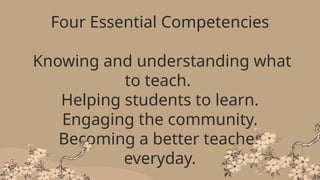
Four Essential Competencies
Knowingand understanding what
to teach.
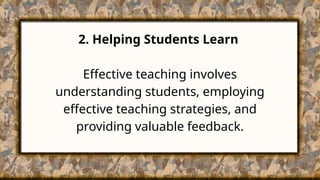
Helping students to learn.
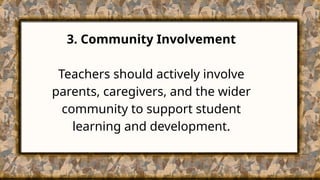
Engaging the community.
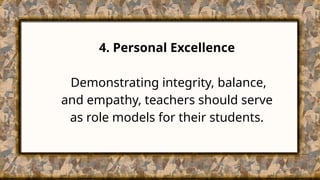
Becoming a better teacher
everyday.
12.
The Southeast AsiaTeachers Competency
Framework (SEA-TCF) serves as a guide that
outlines the essential knowledge, skills, and
attributes that teachers in Southeast Asia need to
be effective. It aims to harmonize teaching
standards across the region, enhance teacher
quality, and promote regional integration
13.
Key Aspects ofthe SEA-TCF
The SEA-TCF is designed to address the diverse
educational needs within the ASEAN region,
promoting 21st-century skills and practices tailored
to specific contexts .
14.
1.Comprehensive Guide
The SEA-TCFprovides a detailed outline of the
minimum requirements for effective teaching,
ensuring that teachers are well-prepared to meet
the challenges of the classroom.
15.
2.Regional Collaboration
Developed throughthe collaboration of eleven
education ministries in Southeast Asia, the
framework reflects a unified approach to teacher
education and professional standards.
16.
3.Core Competencies
The frameworkidentifies essential competencies,
ensuring teachers have the necessary tools to
address specific educational needs in their
communities.
17.
4.Holistic Perspective
The SEA-TCFencourages teachers to focus on
knowing oneself, practicing human goodness, and
mastering their teaching practice, promoting a
well-rounded approach to education.
18.
Benefits of theSEA-TCF
Implementing the SEA-TCF can lead to
several benefits for teachers,
educational systems, and communities
in Southeast Asia.
19.
Professional Development
It guidesteacher
professional development,
promoting 21st-century skills
and practices that align with
global standards .
20.
Regional Integration
By establishingcommon standards,
the framework supports ASEAN
community and regional
integration, facilitating teacher
exchange and mobility.
21.
Professional Development
It guidesteacher
professional development,
promoting 21st-century skills
and practices that align with
global standards .
Universally Applicable Tools
The SEA-TCF ensures teachers
have access to tools applicable
to specific educational needs in
the region.
22.
Clear and Accessible
TheSEA-TCF is designed to be easily
understood and applied by teachers,
ensuring its concepts are clear and
accessible .
23.
Core Competencies withinthe Framework
The SEA-TCF is structured around four core
competencies that are crucial for effective
teaching .
24.
1. Knowing andUnderstanding What to
Teach
Teachers must possess a deep
understanding of their subjects, stay
updated on educational trends and policies,
and be aware of local, national, regional,
and global developments .
What is PQF?
ThePhilippine Qualifications Framework describes the
levels of educational qualifications and sets the standards
for qualification outcomes. It is a quality assured national
system for the development, recognition and award of
qualifications based on standards of knowledge, skills and
values acquired in different ways and methods by learners
and workers of the country.
30.
What is thepurpose of Philippine Qualifications
Framework?
The Philippine Qualifications Framework aligns the
international qualifications for full recognition of tge value
of Philippine Qualifications. The PQF will also be used as the
basis for accrediting certificates and licenses recognized by
the government.
What is PPST?
ThePhilippines Professional Standards for Teachers defines
teacher quality in the Philippines. The standards describe the
expectations of teachers' increasing levels of knowledge, practice
and professional engagement. At the same time, the standards
allow for teachers' growing understanding, applied with increasing
sophistication across a broader and more complex range of
teaching and learning situations. In the middle of the professional
lifelong cycle, are the professional teacher standards, known before
as Competency Based Teacher Standards and now know the
Philippines Professional Standards for Teachers and both are
frameworks for teacher quality.
1. Beginning Teachers(Career Stage 1)
These are new teachers who have met the
requirements for entering the teaching
profession. They focus on developing their
foundational skills in teaching and learning with
the support of mentors and experienced
colleagues, and they are expected to advance to
Career Stage 2 within two to three years.
35.
2. Proficient Teachers(Career Stage
2)
These teachers demonstrate independence in
applying their knowledge and skills essential for
effective teaching and learning. They can
independently design lessons and assessments
aligned with the curriculum and are expected to
meet the standards for all teachers within the
first two or three years of their career.
36.
3. Highly ProficientTeachers (Career Stage
3)
Teachers at this stage consistently demonstrate
high-quality instruction and possess a deep
understanding of teaching and learning. They
serve as mentors and role models, contributing
to improving teaching practices within their
schools.
37.
4. Distinguished Teachers(Career Stage
4)
These teachers represent the highest standards
of teaching excellence and are recognized as
leaders in education. They make significant
contributions to the profession through
mentorship, research, and policy development,
embodying best practices and inspiring other
educators.
38.
Why are CareerStages important?
The main purpose of determining the professional
development stages of teachers is to identify the
problems encountered in professional development, to
guide them to overcome these difficulties, and
ultimately to increase the performance of teachers in
the classroom and the quality of education.
1. Content Knowledgeand Pedagogy
Enters on teachers' expertise in their subject
matter and their capacity to teach it effectively.
This includes a comprehensive understanding of
the curriculum, practical application of concepts,
and the use of technology to improve learning.
41.
2. Learning Environment
Focuseson creating a classroom atmosphere
that is positive, encouraging, and safe, which
promotes student participation and success.
This involves setting clear expectations, good
behavior management, and encouraging
teamwork and a sense of community.
42.
3. Diversity ofLearner
Stresses the significance of understanding and
responding to the varied needs of all students,
which includes different learning preferences,
skills, backgrounds, and cultural experiences.
Teachers use inclusive teaching strategies to
ensure fair opportunities for all students.
43.
4. Curriculum andPlanning
Deals with the teacher's ability to plan, design,
and implement the curriculum effectively. This
includes selecting suitable learning materials,
arranging learning activities logically, aligning
instruction with learning objectives and
standards, and modifying plans based on
student feedback and needs.
44.
5. Assessment andReporting
Focuses on using different methods of
assessment to track student progress and share
this information with students, parents, and
other relevant parties. Effective assessment
practices enhance instruction and promote
ongoing improvement.
45.
6. Community Linkagesand Professional
Engagement
Highlights the value of building connections
with the community and participating in
professional development activities. Working
with parents, community members, and other
professionals enriches the learning experience.
46.
7. Personal Growthand Professional
Development
Stresses the importance of continuous learning
and development for teachers. This involves
seeking professional development
opportunities, reflecting on teaching methods,
and striving for continuous improvement.