Enquiry based planning
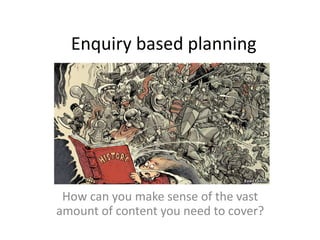
How can you make sense of the vast
amount of content you need to cover?
Why a focus on enquiries?
• The wording of an enquiry frames the learning for
a number of lessons – moving away from the
‘tyranny of the lesson’
• The strongest are those based on a clear second
order concept
• This is NOT about ‘skills’ but about knitting
together learning
• Allows for constant revisiting of knowledge and
addition of new knowledge – this means more
demanding content can be absorbed
How would you formulate an enquiry
question for each of these concepts
using the content proposed?
• Cause and Consequence
• Similarity and Diversity
• Change and Continuity
• Historical Significance
• Evidence
• Interpretations
Do some planning for a year group
• Worksheet – how might you begin to break up
this curriculum?
• Make it relevant to your students?
• Continue to focus on conceptually driven
enquiries?
– Cause and Consequence, Similarity and Diversity,
Change and Continuity, Historical Significance,
Evidence, Interpretations
Some ideas to play with...
• ‘Why do opinions of Victoria’s Empire keep changing?’ -
Interpretations
• ‘Who wanted to make Victorian children go to school?’ – Similarity
and Difference
• ‘Why is it hard to decide whether Edwardian Britain was a Golden
Age?’ -Evidence
• ‘Who fought on the Western Front?’ - Similarity and Difference
• Why do we still remember the Peace talks of 1919? - Significance
• ‘What generalisations about the Holocaust can we make?’-
Similarity and Difference
• ‘What kind of change did fighting a Cold War bring?’ – Change and
Continuty
Interpretations
• Should we be proud of the British Empire?
• Why do opinions of Victoria’s Empire keep
changing?
Similarity and Difference
• Who fought on the Western Front?
• How different were the attitudes of the rulers
and the ruled in the British Empire?
Causes and Consequences
• Why was universal suffrage introduced?
• Why did Britain’s role in the world change
after the Second World War?
Change and Continuity
• Which reform has done the most to change
life in Britain in the 20th century?
• How close was Britain to revolution between
1789 and 1832?
Significance
• Why do we still remember the Peace talks of
1919?
• How should Winston Churchill be
remembered?
Evidence
• Why is it hard to decide whether Edwardian
Britain was a Golden Age?
• What can the Great Exhibition of 1851 tell us
about Victorian Britain?

Enquiry based planning

  • 1.
    Enquiry based planning Howcan you make sense of the vast amount of content you need to cover?
  • 2.
    Why a focuson enquiries? • The wording of an enquiry frames the learning for a number of lessons – moving away from the ‘tyranny of the lesson’ • The strongest are those based on a clear second order concept • This is NOT about ‘skills’ but about knitting together learning • Allows for constant revisiting of knowledge and addition of new knowledge – this means more demanding content can be absorbed
  • 3.
    How would youformulate an enquiry question for each of these concepts using the content proposed? • Cause and Consequence • Similarity and Diversity • Change and Continuity • Historical Significance • Evidence • Interpretations
  • 4.
    Do some planningfor a year group • Worksheet – how might you begin to break up this curriculum? • Make it relevant to your students? • Continue to focus on conceptually driven enquiries? – Cause and Consequence, Similarity and Diversity, Change and Continuity, Historical Significance, Evidence, Interpretations
  • 5.
    Some ideas toplay with... • ‘Why do opinions of Victoria’s Empire keep changing?’ - Interpretations • ‘Who wanted to make Victorian children go to school?’ – Similarity and Difference • ‘Why is it hard to decide whether Edwardian Britain was a Golden Age?’ -Evidence • ‘Who fought on the Western Front?’ - Similarity and Difference • Why do we still remember the Peace talks of 1919? - Significance • ‘What generalisations about the Holocaust can we make?’- Similarity and Difference • ‘What kind of change did fighting a Cold War bring?’ – Change and Continuty
  • 6.
    Interpretations • Should webe proud of the British Empire? • Why do opinions of Victoria’s Empire keep changing?
  • 7.
    Similarity and Difference •Who fought on the Western Front? • How different were the attitudes of the rulers and the ruled in the British Empire?
  • 8.
    Causes and Consequences •Why was universal suffrage introduced? • Why did Britain’s role in the world change after the Second World War?
  • 9.
    Change and Continuity •Which reform has done the most to change life in Britain in the 20th century? • How close was Britain to revolution between 1789 and 1832?
  • 10.
    Significance • Why dowe still remember the Peace talks of 1919? • How should Winston Churchill be remembered?
  • 11.
    Evidence • Why isit hard to decide whether Edwardian Britain was a Golden Age? • What can the Great Exhibition of 1851 tell us about Victorian Britain?