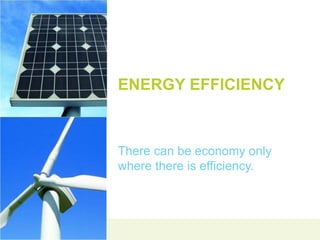
ENERGY EFFICIENCY
There can be economy only
where there is efficiency.
Slide Name Slide No
1 ENERGY? 3
2 HISTORY OF ENERGY 4
3 FORMS OF ENERGY 6
4 ENERGY EFFICIENCY 7
5 EFFICIENT ENERGY USE 9
6 THANK YOU 18
Table of Contents
ENERGY?
What is Energy?
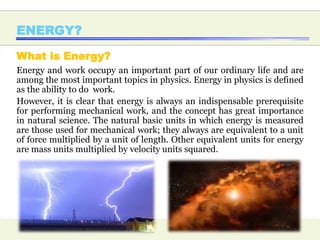
Energy and work occupy an important part of our ordinary life and are
among the most important topics in physics. Energy in physics is defined
as the ability to do work.
However, it is clear that energy is always an indispensable prerequisite
for performing mechanical work, and the concept has great importance
in natural science. The natural basic units in which energy is measured
are those used for mechanical work; they always are equivalent to a unit
of force multiplied by a unit of length. Other equivalent units for energy
are mass units multiplied by velocity units squared.
HISTORY OF ENERGY
The word energy derives from the Greek word energeia, which possibly appears for the
first time in the work of Aristotle in the 4th century BCE.
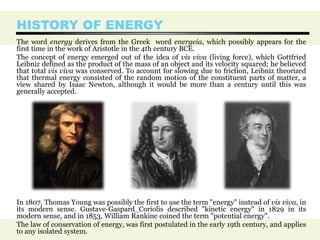
The concept of energy emerged out of the idea of vis viva (living force), which Gottfried
Leibniz defined as the product of the mass of an object and its velocity squared; he believed
that total vis viva was conserved. To account for slowing due to friction, Leibniz theorized
that thermal energy consisted of the random motion of the constituent parts of matter, a
view shared by Isaac Newton, although it would be more than a century until this was
generally accepted.
In 1807, Thomas Young was possibly the first to use the term "energy" instead of vis viva, in
its modern sense. Gustave-Gaspard Coriolis described "kinetic energy" in 1829 in its
modern sense, and in 1853, William Rankine coined the term "potential energy".
The law of conservation of energy, was first postulated in the early 19th century, and applies
to any isolated system.
According to Noether's theorem, the conservation of energy is a consequence of the fact
that the laws of physics do not change over time. Since 1918 it has been known that the law
of conservation of energy is the direct mathematical consequence of the translational
symmetry of the quantity conjugate to energy, namely time.
It was argued for some years whether energy was a substance (the caloric) or merely a
physical quantity, such as momentum. In 1845 James Prescott Joule discovered the link
between mechanical work and the generation of heat. This led to the theory of conservation
of energy, and development of the first law of thermodynamics.
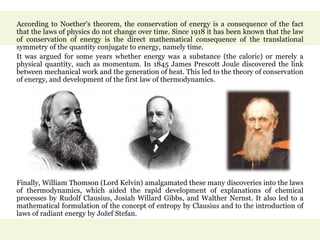
Finally, William Thomson (Lord Kelvin) amalgamated these many discoveries into the laws
of thermodynamics, which aided the rapid development of explanations of chemical
processes by Rudolf Clausius, Josiah Willard Gibbs, and Walther Nernst. It also led to a
mathematical formulation of the concept of entropy by Clausius and to the introduction of
laws of radiant energy by Jožef Stefan.
FORMS OF ENERGY
KINETIC ENERGYPOTENTIAL ENERGYRADIANT ENERGYMASS ENERGYELECTRIC ENERGYGRAVITATIONAL ENERGYHEAT ENERGYMAGNETIC ENERGYMECHANICAL ENERGYNUCLEAR ENERGY
ENERGY EFFICIENCY
Energy efficiency is "using less energy to provide the same
service".
There are other definitions, but this is a good operational
one.
The best way to understand this idea is through examples:
When you replace a single pane window in your house with
an energy-efficient one, the new window prevents heat
from escaping in the winter, so you save energy by using
your furnace or electric heater less while still staying
comfortable. In the summer, efficient windows keep the
heat out, so the air conditioner does not run as often and
you save electricity.When you replace an appliance, such
as a refrigerator or clothes washer, or office equipment,
such as a computer or printer, with a more energy-efficient
model, the new equipment provides the same service, but
uses less energy. This saves you money on your energy bill,
and reduces the amount of greenhouse gases going into the
atmosphere.Energy efficiency is not energy conservation.
Energy conservation is reducing or going without a service
to save energy.
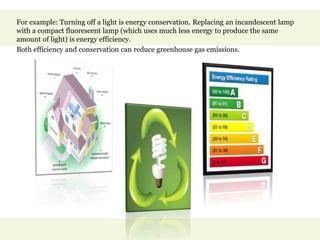
For example: Turning off a light is energy conservation. Replacing an incandescent lamp
with a compact fluorescent lamp (which uses much less energy to produce the same
amount of light) is energy efficiency.
Both efficiency and conservation can reduce greenhouse gas emissions.
EFFICIENT ENERGY USE
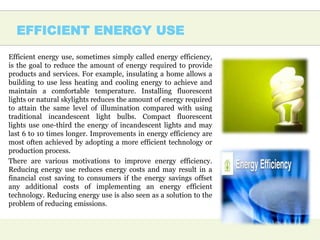
Efficient energy use, sometimes simply called energy efficiency,
is the goal to reduce the amount of energy required to provide
products and services. For example, insulating a home allows a
building to use less heating and cooling energy to achieve and
maintain a comfortable temperature. Installing fluorescent
lights or natural skylights reduces the amount of energy required
to attain the same level of illumination compared with using
traditional incandescent light bulbs. Compact fluorescent
lights use one-third the energy of incandescent lights and may
last 6 to 10 times longer. Improvements in energy efficiency are
most often achieved by adopting a more efficient technology or
production process.
There are various motivations to improve energy efficiency.
Reducing energy use reduces energy costs and may result in a
financial cost saving to consumers if the energy savings offset
any additional costs of implementing an energy efficient
technology. Reducing energy use is also seen as a solution to the
problem of reducing emissions.
According to the International Energy Agency, improved
energy efficiency in buildings, industrial processes
and transportation could reduce the world's energy
needs in 2050 by one third, and help control global
emissions of greenhouse gases.
Energy efficiency and renewable energy are said to be
the twin pillars of sustainable energy policy and are high
priorities in the sustainable energy hierarchy. In many
countries energy efficiency is also seen to have a national
security benefit because it can be used to reduce the level
of energy imports from foreign countries and may slow
down the rate at which domestic energy resources are
depleted.
Energy efficiency has proved to be a cost-effective
strategy for building economies without necessarily
increasing energy consumption. For example, the state
of California began implementing energy-efficiency
measures in the mid-1970s, including building code and
appliance standards with strict efficiency requirements.
During the following years, California's energy
consumption has remained approximately flat on a per
capita basis while national U.S. consumption doubled. As
part of its strategy,
California implemented a "loading order" for new energy resources that puts energy
efficiency first, renewable electricity supplies second, and new fossil-fired power plants
last.
Lovins' Rocky Mountain Institute points out that in industrial settings, "there are
abundant opportunities to save 70% to 90% of the energy and cost for lighting, fan, and
pump systems; 50% for electric motors; and 60% in areas such as heating, cooling, office
equipment, and appliances. In general, up to 75% of the electricity used in the U.S. today
could be saved with efficiency measures that cost less than the electricity itself. The same
holds true for home-owners, leaky ducts have remained an invisible energy culprit for
years. In fact, researchers at the US Department of Energy and their consortium,
Residential Energy Efficient Distribution Systems (REEDS) have found that duct
efficiency may be as low as 50-70%. The US Department of Energy has stated that there is
potential for energy saving in the magnitude of 90 Billion kWh by increasing home energy
efficiency.
Other studies have emphasized this. A report published in 2006 by the McKinsey Global
Institute, asserted that "there are sufficient economically viable opportunities for energy-
productivity improvements that could keep global energy-demand growth at less than 1
percent per annum"—less than half of the 2.2 percent average growth anticipated through
2020 in a business-as-usual scenario.
Energy productivity, which measures the output and quality of goods and services per unit
of energy input, can come from either reducing the amount of energy required to produce
something, or from increasing the quantity or quality of goods and services from the same
amount of energy.
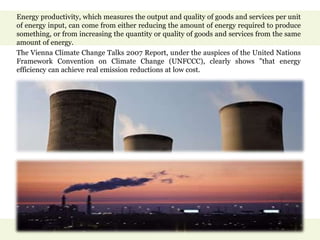
The Vienna Climate Change Talks 2007 Report, under the auspices of the United Nations
Framework Convention on Climate Change (UNFCCC), clearly shows "that energy
efficiency can achieve real emission reductions at low cost.
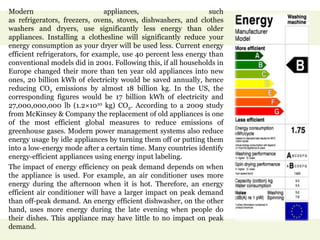
Modern appliances, such
as refrigerators, freezers, ovens, stoves, dishwashers, and clothes
washers and dryers, use significantly less energy than older
appliances. Installing a clothesline will significantly reduce your
energy consumption as your dryer will be used less. Current energy
efficient refrigerators, for example, use 40 percent less energy than
conventional models did in 2001. Following this, if all households in
Europe changed their more than ten year old appliances into new
ones, 20 billion kWh of electricity would be saved annually, hence
reducing CO2 emissions by almost 18 billion kg. In the US, the
corresponding figures would be 17 billion kWh of electricity and
27,000,000,000 lb (1.2×10¹⁰ kg) CO2. According to a 2009 study
from McKinsey & Company the replacement of old appliances is one
of the most efficient global measures to reduce emissions of
greenhouse gases. Modern power management systems also reduce
energy usage by idle appliances by turning them off or putting them
into a low-energy mode after a certain time. Many countries identify
energy-efficient appliances using energy input labeling.
The impact of energy efficiency on peak demand depends on when
the appliance is used. For example, an air conditioner uses more
energy during the afternoon when it is hot. Therefore, an energy
efficient air conditioner will have a larger impact on peak demand
than off-peak demand. An energy efficient dishwasher, on the other
hand, uses more energy during the late evening when people do
their dishes. This appliance may have little to no impact on peak
demand.
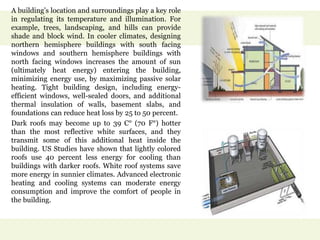
A building’s location and surroundings play a key role
in regulating its temperature and illumination. For
example, trees, landscaping, and hills can provide
shade and block wind. In cooler climates, designing
northern hemisphere buildings with south facing
windows and southern hemisphere buildings with
north facing windows increases the amount of sun
(ultimately heat energy) entering the building,
minimizing energy use, by maximizing passive solar
heating. Tight building design, including energy-
efficient windows, well-sealed doors, and additional
thermal insulation of walls, basement slabs, and
foundations can reduce heat loss by 25 to 50 percent.
Dark roofs may become up to 39 C° (70 F°) hotter
than the most reflective white surfaces, and they
transmit some of this additional heat inside the
building. US Studies have shown that lightly colored
roofs use 40 percent less energy for cooling than
buildings with darker roofs. White roof systems save
more energy in sunnier climates. Advanced electronic
heating and cooling systems can moderate energy
consumption and improve the comfort of people in
the building.
Proper placement of windows and skylights as well as the use
of architectural features that reflect light into a building can
reduce the need for artificial lighting. Increased use of natural
and task lighting has been shown by one study to increase
productivity in schools and offices. Compact fluorescent
lights use two-thirds less energy and may last 6 to 10 times
longer than incandescent light bulbs. Newer fluorescent lights
produce a natural light, and in most applications they are cost
effective, despite their higher initial cost, with payback
periods as low as a few months.
Effective energy-efficient building design can include the use
of low cost Passive Infra Reds (PIRs) to switch-off lighting
when areas are unnoccupied such as toilets, corridors or even
office areas out-of-hours. In addition, lux levels can be
monitored using daylight sensors linked to the building's
lighting scheme to switch on/off or dim the lighting to pre-
defined levels to take into account the natural light and thus
reduce consumption. Building Management Systems (BMS)
link all of this together in one centralised computer to control
the whole building's lighting and power requirements. The
choice of which space heating or cooling technology to use in
buildings can have a significant impact on energy use and
efficiency. For example, replacing an older 50%
efficient natural gas furnace with a new 95% efficient one will
dramatically reduce energy use, carbon emissions, and winter
natural gas bills.
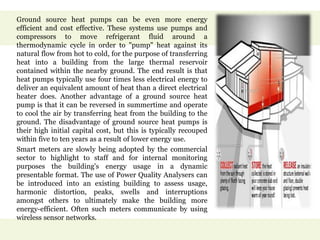
Ground source heat pumps can be even more energy
efficient and cost effective. These systems use pumps and
compressors to move refrigerant fluid around a
thermodynamic cycle in order to "pump" heat against its
natural flow from hot to cold, for the purpose of transferring
heat into a building from the large thermal reservoir
contained within the nearby ground. The end result is that
heat pumps typically use four times less electrical energy to
deliver an equivalent amount of heat than a direct electrical
heater does. Another advantage of a ground source heat
pump is that it can be reversed in summertime and operate
to cool the air by transferring heat from the building to the
ground. The disadvantage of ground source heat pumps is
their high initial capital cost, but this is typically recouped
within five to ten years as a result of lower energy use.
Smart meters are slowly being adopted by the commercial
sector to highlight to staff and for internal monitoring
purposes the building's energy usage in a dynamic
presentable format. The use of Power Quality Analysers can
be introduced into an existing building to assess usage,
harmonic distortion, peaks, swells and interruptions
amongst others to ultimately make the building more
energy-efficient. Often such meters communicate by using
wireless sensor networks.
Green Building XML (GBXML) is an emerging schema, a subset of the Building
Information Modeling efforts, focused on green building design and operation. gbXMaL is
used as input in several energy simulation engines. But with the development of modern
computer technology, a large number of building energy simulation tools are available on
the market. When choosing which simulation tool to use in a project, the user must
consider the tool's accuracy and reliability, considering the building information they have
at hand, which will serve as input for the tool. Yezioro, Dong and Leite developed an
artificial intelligence approach towards assessing building performance simulation results
and found that more detailed simulation tools have the best simulation performance in
terms of heating and cooling electricity consumption within 3% of mean absolute error.
A deep energy retrofit is a whole-building analysis and construction process that uses to
achieve much larger energy savings than conventional energy retrofits. Deep energy
retrofits can be applied to both residential and non-residential (“commercial”) buildings.
A deep energy retrofit typically results in energy savings of 30 percent or more, perhaps
spread over several years, and may significantly improve the building value. The Empire
State Building is undergoing a deep energy retrofit process that is projected to be
completed in 2013. Upon completion, the project team, consisting of representatives
from Johnson Controls, Rocky Mountain Institute, Clinton Climate Initiative, and Jones
Lang LaSalle will have achieved an annual energy use reduction of 38% and $4.4
million. The Indianapolis City-County Building recently underwent a deep energy retrofit
process, which has achieved an annual energy reduction of 46% and $750,000 annual
energy savings.
A presentation by-
DIVYANSH KHARE

English project on energy efficiency

  • 1.
    ENERGY EFFICIENCY There canbe economy only where there is efficiency.
  • 2.
    Slide Name SlideNo 1 ENERGY? 3 2 HISTORY OF ENERGY 4 3 FORMS OF ENERGY 6 4 ENERGY EFFICIENCY 7 5 EFFICIENT ENERGY USE 9 6 THANK YOU 18 Table of Contents
  • 3.
    ENERGY? What is Energy? Energyand work occupy an important part of our ordinary life and are among the most important topics in physics. Energy in physics is defined as the ability to do work. However, it is clear that energy is always an indispensable prerequisite for performing mechanical work, and the concept has great importance in natural science. The natural basic units in which energy is measured are those used for mechanical work; they always are equivalent to a unit of force multiplied by a unit of length. Other equivalent units for energy are mass units multiplied by velocity units squared.
  • 4.
    HISTORY OF ENERGY Theword energy derives from the Greek word energeia, which possibly appears for the first time in the work of Aristotle in the 4th century BCE. The concept of energy emerged out of the idea of vis viva (living force), which Gottfried Leibniz defined as the product of the mass of an object and its velocity squared; he believed that total vis viva was conserved. To account for slowing due to friction, Leibniz theorized that thermal energy consisted of the random motion of the constituent parts of matter, a view shared by Isaac Newton, although it would be more than a century until this was generally accepted. In 1807, Thomas Young was possibly the first to use the term "energy" instead of vis viva, in its modern sense. Gustave-Gaspard Coriolis described "kinetic energy" in 1829 in its modern sense, and in 1853, William Rankine coined the term "potential energy". The law of conservation of energy, was first postulated in the early 19th century, and applies to any isolated system.
  • 5.
    According to Noether'stheorem, the conservation of energy is a consequence of the fact that the laws of physics do not change over time. Since 1918 it has been known that the law of conservation of energy is the direct mathematical consequence of the translational symmetry of the quantity conjugate to energy, namely time. It was argued for some years whether energy was a substance (the caloric) or merely a physical quantity, such as momentum. In 1845 James Prescott Joule discovered the link between mechanical work and the generation of heat. This led to the theory of conservation of energy, and development of the first law of thermodynamics. Finally, William Thomson (Lord Kelvin) amalgamated these many discoveries into the laws of thermodynamics, which aided the rapid development of explanations of chemical processes by Rudolf Clausius, Josiah Willard Gibbs, and Walther Nernst. It also led to a mathematical formulation of the concept of entropy by Clausius and to the introduction of laws of radiant energy by Jožef Stefan.
  • 6.
    FORMS OF ENERGY KINETICENERGYPOTENTIAL ENERGYRADIANT ENERGYMASS ENERGYELECTRIC ENERGYGRAVITATIONAL ENERGYHEAT ENERGYMAGNETIC ENERGYMECHANICAL ENERGYNUCLEAR ENERGY
  • 7.
    ENERGY EFFICIENCY Energy efficiencyis "using less energy to provide the same service". There are other definitions, but this is a good operational one. The best way to understand this idea is through examples: When you replace a single pane window in your house with an energy-efficient one, the new window prevents heat from escaping in the winter, so you save energy by using your furnace or electric heater less while still staying comfortable. In the summer, efficient windows keep the heat out, so the air conditioner does not run as often and you save electricity.When you replace an appliance, such as a refrigerator or clothes washer, or office equipment, such as a computer or printer, with a more energy-efficient model, the new equipment provides the same service, but uses less energy. This saves you money on your energy bill, and reduces the amount of greenhouse gases going into the atmosphere.Energy efficiency is not energy conservation. Energy conservation is reducing or going without a service to save energy.
  • 8.
    For example: Turningoff a light is energy conservation. Replacing an incandescent lamp with a compact fluorescent lamp (which uses much less energy to produce the same amount of light) is energy efficiency. Both efficiency and conservation can reduce greenhouse gas emissions.
  • 9.
    EFFICIENT ENERGY USE Efficientenergy use, sometimes simply called energy efficiency, is the goal to reduce the amount of energy required to provide products and services. For example, insulating a home allows a building to use less heating and cooling energy to achieve and maintain a comfortable temperature. Installing fluorescent lights or natural skylights reduces the amount of energy required to attain the same level of illumination compared with using traditional incandescent light bulbs. Compact fluorescent lights use one-third the energy of incandescent lights and may last 6 to 10 times longer. Improvements in energy efficiency are most often achieved by adopting a more efficient technology or production process. There are various motivations to improve energy efficiency. Reducing energy use reduces energy costs and may result in a financial cost saving to consumers if the energy savings offset any additional costs of implementing an energy efficient technology. Reducing energy use is also seen as a solution to the problem of reducing emissions.
  • 10.
    According to theInternational Energy Agency, improved energy efficiency in buildings, industrial processes and transportation could reduce the world's energy needs in 2050 by one third, and help control global emissions of greenhouse gases. Energy efficiency and renewable energy are said to be the twin pillars of sustainable energy policy and are high priorities in the sustainable energy hierarchy. In many countries energy efficiency is also seen to have a national security benefit because it can be used to reduce the level of energy imports from foreign countries and may slow down the rate at which domestic energy resources are depleted. Energy efficiency has proved to be a cost-effective strategy for building economies without necessarily increasing energy consumption. For example, the state of California began implementing energy-efficiency measures in the mid-1970s, including building code and appliance standards with strict efficiency requirements. During the following years, California's energy consumption has remained approximately flat on a per capita basis while national U.S. consumption doubled. As part of its strategy,
  • 11.
    California implemented a"loading order" for new energy resources that puts energy efficiency first, renewable electricity supplies second, and new fossil-fired power plants last. Lovins' Rocky Mountain Institute points out that in industrial settings, "there are abundant opportunities to save 70% to 90% of the energy and cost for lighting, fan, and pump systems; 50% for electric motors; and 60% in areas such as heating, cooling, office equipment, and appliances. In general, up to 75% of the electricity used in the U.S. today could be saved with efficiency measures that cost less than the electricity itself. The same holds true for home-owners, leaky ducts have remained an invisible energy culprit for years. In fact, researchers at the US Department of Energy and their consortium, Residential Energy Efficient Distribution Systems (REEDS) have found that duct efficiency may be as low as 50-70%. The US Department of Energy has stated that there is potential for energy saving in the magnitude of 90 Billion kWh by increasing home energy efficiency. Other studies have emphasized this. A report published in 2006 by the McKinsey Global Institute, asserted that "there are sufficient economically viable opportunities for energy- productivity improvements that could keep global energy-demand growth at less than 1 percent per annum"—less than half of the 2.2 percent average growth anticipated through 2020 in a business-as-usual scenario.
  • 12.
    Energy productivity, whichmeasures the output and quality of goods and services per unit of energy input, can come from either reducing the amount of energy required to produce something, or from increasing the quantity or quality of goods and services from the same amount of energy. The Vienna Climate Change Talks 2007 Report, under the auspices of the United Nations Framework Convention on Climate Change (UNFCCC), clearly shows "that energy efficiency can achieve real emission reductions at low cost.
  • 13.
    Modern appliances, such asrefrigerators, freezers, ovens, stoves, dishwashers, and clothes washers and dryers, use significantly less energy than older appliances. Installing a clothesline will significantly reduce your energy consumption as your dryer will be used less. Current energy efficient refrigerators, for example, use 40 percent less energy than conventional models did in 2001. Following this, if all households in Europe changed their more than ten year old appliances into new ones, 20 billion kWh of electricity would be saved annually, hence reducing CO2 emissions by almost 18 billion kg. In the US, the corresponding figures would be 17 billion kWh of electricity and 27,000,000,000 lb (1.2×10¹⁰ kg) CO2. According to a 2009 study from McKinsey & Company the replacement of old appliances is one of the most efficient global measures to reduce emissions of greenhouse gases. Modern power management systems also reduce energy usage by idle appliances by turning them off or putting them into a low-energy mode after a certain time. Many countries identify energy-efficient appliances using energy input labeling. The impact of energy efficiency on peak demand depends on when the appliance is used. For example, an air conditioner uses more energy during the afternoon when it is hot. Therefore, an energy efficient air conditioner will have a larger impact on peak demand than off-peak demand. An energy efficient dishwasher, on the other hand, uses more energy during the late evening when people do their dishes. This appliance may have little to no impact on peak demand.
  • 14.
    A building’s locationand surroundings play a key role in regulating its temperature and illumination. For example, trees, landscaping, and hills can provide shade and block wind. In cooler climates, designing northern hemisphere buildings with south facing windows and southern hemisphere buildings with north facing windows increases the amount of sun (ultimately heat energy) entering the building, minimizing energy use, by maximizing passive solar heating. Tight building design, including energy- efficient windows, well-sealed doors, and additional thermal insulation of walls, basement slabs, and foundations can reduce heat loss by 25 to 50 percent. Dark roofs may become up to 39 C° (70 F°) hotter than the most reflective white surfaces, and they transmit some of this additional heat inside the building. US Studies have shown that lightly colored roofs use 40 percent less energy for cooling than buildings with darker roofs. White roof systems save more energy in sunnier climates. Advanced electronic heating and cooling systems can moderate energy consumption and improve the comfort of people in the building.
  • 15.
    Proper placement ofwindows and skylights as well as the use of architectural features that reflect light into a building can reduce the need for artificial lighting. Increased use of natural and task lighting has been shown by one study to increase productivity in schools and offices. Compact fluorescent lights use two-thirds less energy and may last 6 to 10 times longer than incandescent light bulbs. Newer fluorescent lights produce a natural light, and in most applications they are cost effective, despite their higher initial cost, with payback periods as low as a few months. Effective energy-efficient building design can include the use of low cost Passive Infra Reds (PIRs) to switch-off lighting when areas are unnoccupied such as toilets, corridors or even office areas out-of-hours. In addition, lux levels can be monitored using daylight sensors linked to the building's lighting scheme to switch on/off or dim the lighting to pre- defined levels to take into account the natural light and thus reduce consumption. Building Management Systems (BMS) link all of this together in one centralised computer to control the whole building's lighting and power requirements. The choice of which space heating or cooling technology to use in buildings can have a significant impact on energy use and efficiency. For example, replacing an older 50% efficient natural gas furnace with a new 95% efficient one will dramatically reduce energy use, carbon emissions, and winter natural gas bills.
  • 16.
    Ground source heatpumps can be even more energy efficient and cost effective. These systems use pumps and compressors to move refrigerant fluid around a thermodynamic cycle in order to "pump" heat against its natural flow from hot to cold, for the purpose of transferring heat into a building from the large thermal reservoir contained within the nearby ground. The end result is that heat pumps typically use four times less electrical energy to deliver an equivalent amount of heat than a direct electrical heater does. Another advantage of a ground source heat pump is that it can be reversed in summertime and operate to cool the air by transferring heat from the building to the ground. The disadvantage of ground source heat pumps is their high initial capital cost, but this is typically recouped within five to ten years as a result of lower energy use. Smart meters are slowly being adopted by the commercial sector to highlight to staff and for internal monitoring purposes the building's energy usage in a dynamic presentable format. The use of Power Quality Analysers can be introduced into an existing building to assess usage, harmonic distortion, peaks, swells and interruptions amongst others to ultimately make the building more energy-efficient. Often such meters communicate by using wireless sensor networks.
  • 17.
    Green Building XML(GBXML) is an emerging schema, a subset of the Building Information Modeling efforts, focused on green building design and operation. gbXMaL is used as input in several energy simulation engines. But with the development of modern computer technology, a large number of building energy simulation tools are available on the market. When choosing which simulation tool to use in a project, the user must consider the tool's accuracy and reliability, considering the building information they have at hand, which will serve as input for the tool. Yezioro, Dong and Leite developed an artificial intelligence approach towards assessing building performance simulation results and found that more detailed simulation tools have the best simulation performance in terms of heating and cooling electricity consumption within 3% of mean absolute error. A deep energy retrofit is a whole-building analysis and construction process that uses to achieve much larger energy savings than conventional energy retrofits. Deep energy retrofits can be applied to both residential and non-residential (“commercial”) buildings. A deep energy retrofit typically results in energy savings of 30 percent or more, perhaps spread over several years, and may significantly improve the building value. The Empire State Building is undergoing a deep energy retrofit process that is projected to be completed in 2013. Upon completion, the project team, consisting of representatives from Johnson Controls, Rocky Mountain Institute, Clinton Climate Initiative, and Jones Lang LaSalle will have achieved an annual energy use reduction of 38% and $4.4 million. The Indianapolis City-County Building recently underwent a deep energy retrofit process, which has achieved an annual energy reduction of 46% and $750,000 annual energy savings.
  • 18.