English Channel
Name :








The name English Channel has been widely used since the
early 18th century, possibly originating from the
designation Engelse Kanaal in Dutch sea maps from the 16th
century onwards.
In modern Dutch however, it is known as Het Kanaal .
Historically, it has also been known as the British Channel.
The French name la Manche has been in use since at least the
17th century.
The name is usually said to refer to the Channel's sleeve shape.
Introduction








The English
Channel (French: la
Manche, 
Breton: Mor Breizh, Cornish: Mor Bretannek), 
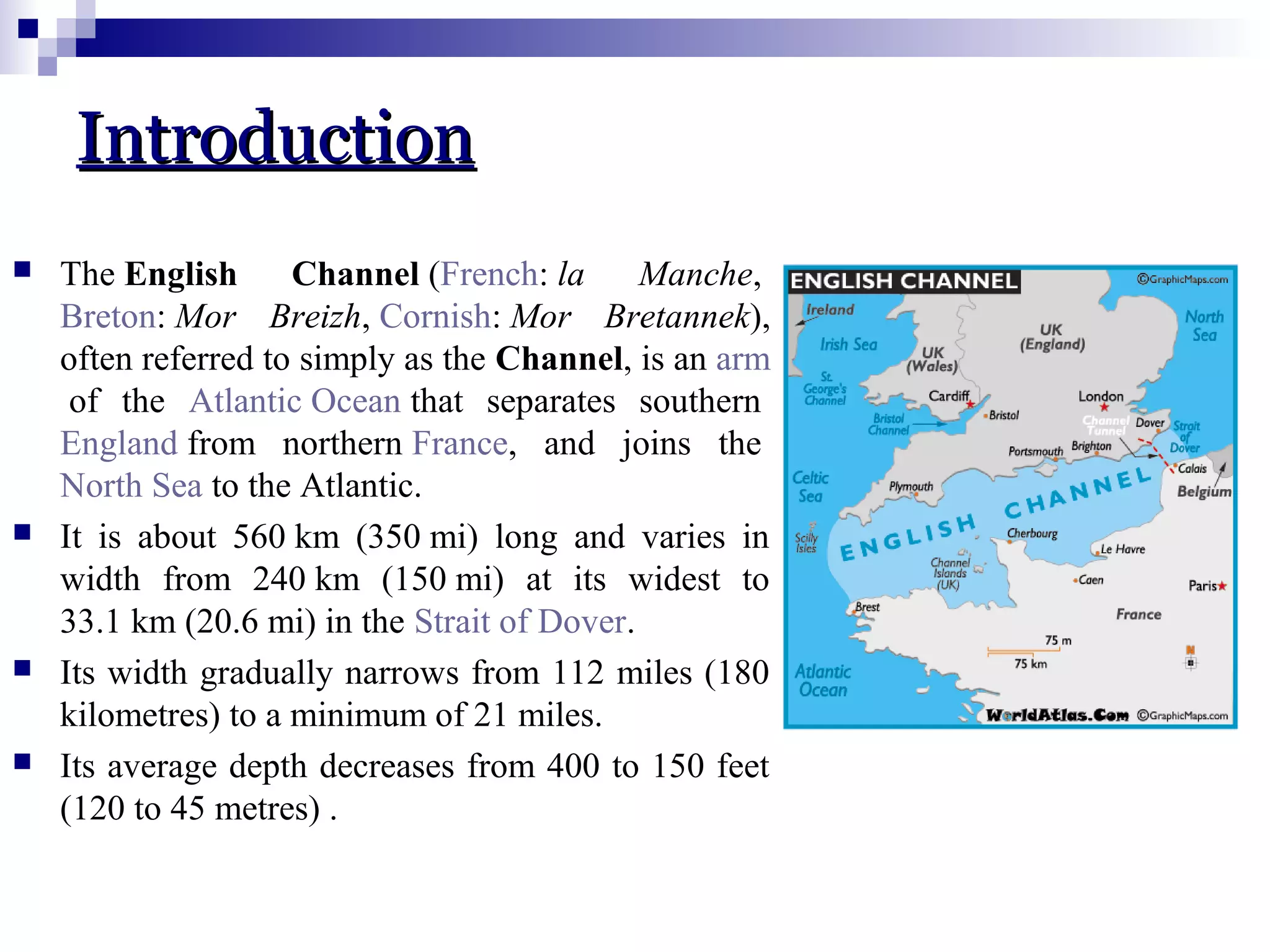
often referred to simply as the Channel, is an arm
 of  the  Atlantic Ocean that  separates  southern 
England from  northern France,  and  joins  the 
North Sea to the Atlantic. 
It  is  about  560 km  (350 mi)  long  and  varies  in 
width  from  240 km  (150 mi)  at  its  widest  to 
33.1 km (20.6 mi) in the Strait of Dover. 
Its width gradually narrows from 112 miles (180 
kilometres) to a minimum of 21 miles.
Its average depth decreases from 400 to 150 feet 
(120 to 45 metres) .
History:








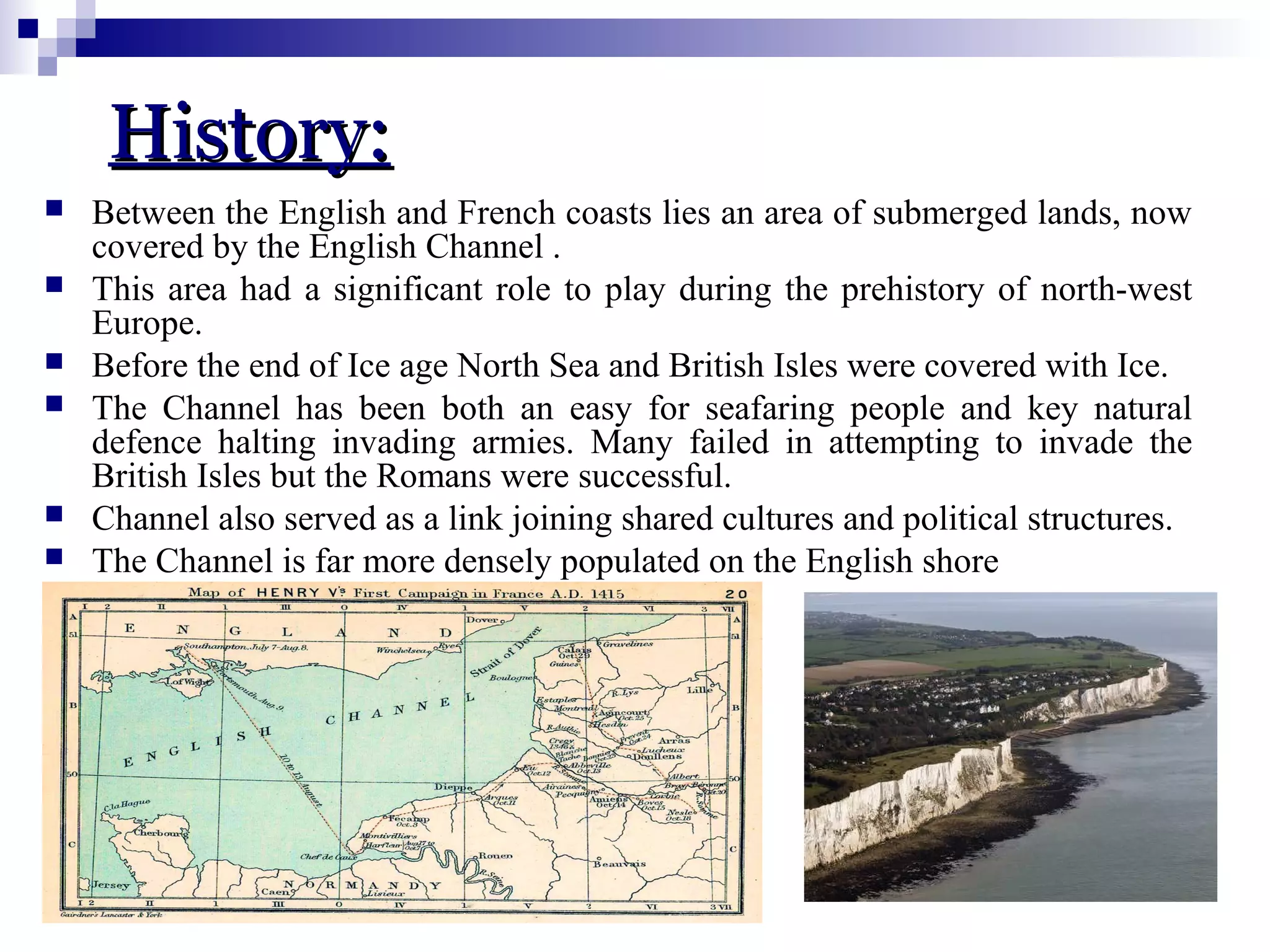
Between the English and French coasts lies an area of submerged lands, now 
covered by the English Channel .
This  area  had  a  significant  role  to  play  during  the  prehistory  of  north-west 
Europe.
Before the end of Ice age North Sea and British Isles were covered with Ice.
The  Channel  has  been  both  an  easy  for  seafaring  people  and  key  natural 
defence  halting  invading  armies.  Many  failed  in  attempting  to  invade  the 
British Isles but the Romans were successful.
Channel also served as a link joining shared cultures and political structures.
The Channel is far more densely populated on the English shore 
Shipping:








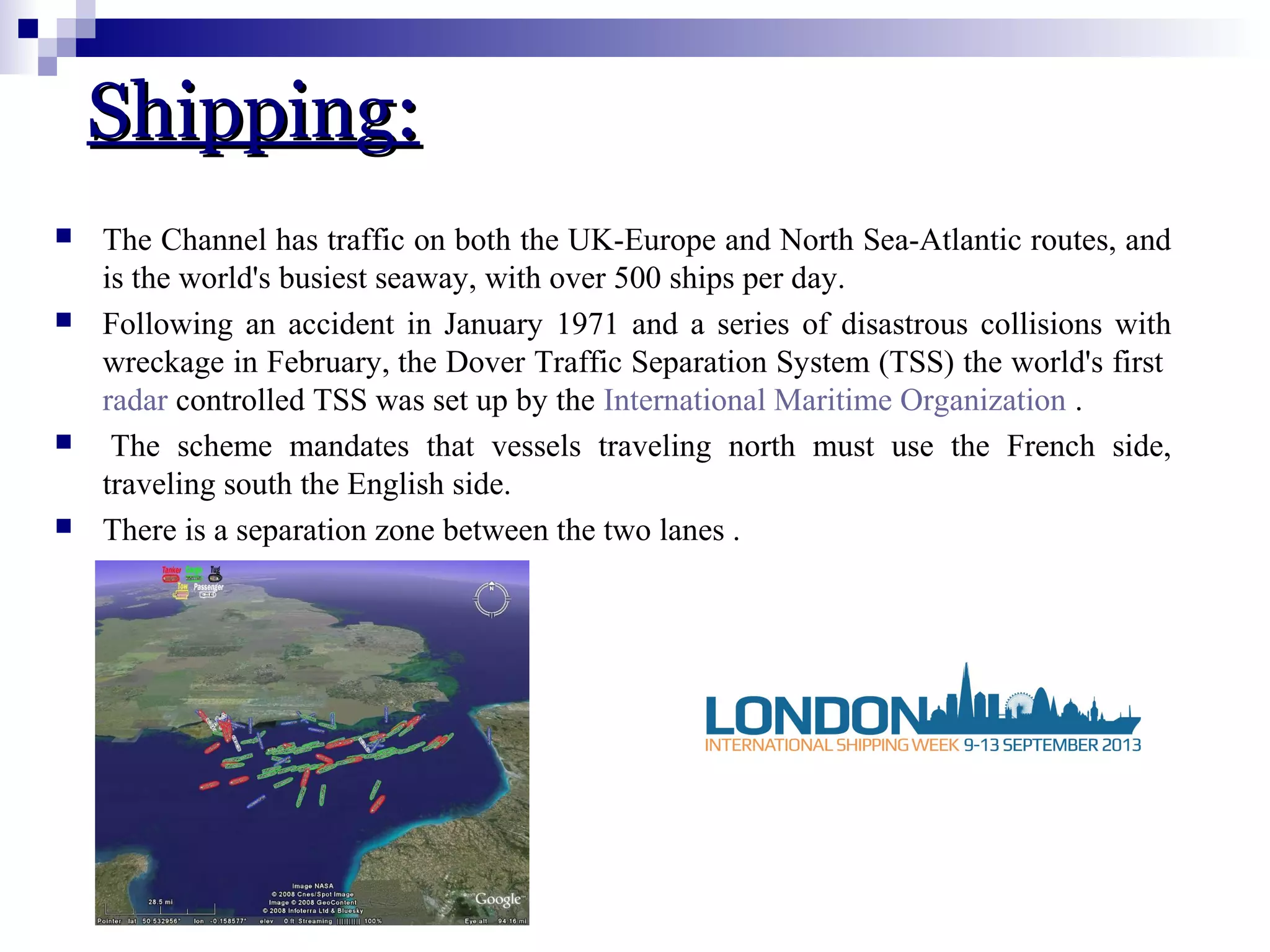
The Channel has traffic on both the UK-Europe and North Sea-Atlantic routes, and
is the world's busiest seaway, with over 500 ships per day.
Following an accident in January 1971 and a series of disastrous collisions with
wreckage in February, the Dover Traffic Separation System (TSS) the world's first
radar controlled TSS was set up by the International Maritime Organization .
The scheme mandates that vessels traveling north must use the French side,
traveling south the English side.
There is a separation zone between the two lanes .
Transportation:






There are 13 Ferry routes between the Channel.
Many travelers cross beneath the Channel using the Channel Tunnel .
The Channel Tunnel is a 50.5 km undersea rail tunnel linking Kent in U.K to
Coquelles in France.
The tunnel carries high-speed Eurostar passenger trains, Eurotunnel Shuttle rollon/roll-off vehicle transport—the largest in the world—and international rail freight
trains.
Interesting Facts:






As one of the narrowest but most famous
international waterways lacking dangerous
currents, the Channel has been the first
objective of numerous innovative sea, air,
and human powered crossing technologies.
First Person known to cross English
Channel was Matthew Webb on 25 August
1875 in 21 hrs, 45 min.
By the end of 2005, 811 people had
completed 1,185 verified crossings.
THANK YOU

English channel

  • 1.
  • 2.
    Name :      The nameEnglish Channel has been widely used since the early 18th century, possibly originating from the designation Engelse Kanaal in Dutch sea maps from the 16th century onwards. In modern Dutch however, it is known as Het Kanaal . Historically, it has also been known as the British Channel. The French name la Manche has been in use since at least the 17th century. The name is usually said to refer to the Channel's sleeve shape.
  • 3.
    Introduction     The English Channel (French: la Manche,  Breton: Mor Breizh, Cornish: Mor Bretannek),  often referred to simply as the Channel, is an arm  of the  Atlantic Ocean that  separates  southern  England from  northern France,  and  joins  the  North Sea to the Atlantic.  It  is  about  560 km  (350 mi)  long  and  varies  in  width  from  240 km  (150 mi)  at  its  widest  to  33.1 km (20.6 mi) in the Strait of Dover.  Its width gradually narrows from 112 miles (180  kilometres) to a minimum of 21 miles. Its average depth decreases from 400 to 150 feet  (120 to 45 metres) .
  • 4.
    History:       Between the English and French coasts lies an area of submerged lands, now  covered by the English Channel . This  area  had a  significant  role  to  play  during  the  prehistory  of  north-west  Europe. Before the end of Ice age North Sea and British Isles were covered with Ice. The  Channel  has  been  both  an  easy  for  seafaring  people  and  key  natural  defence  halting  invading  armies.  Many  failed  in  attempting  to  invade  the  British Isles but the Romans were successful. Channel also served as a link joining shared cultures and political structures. The Channel is far more densely populated on the English shore 
  • 5.
    Shipping:     The Channel hastraffic on both the UK-Europe and North Sea-Atlantic routes, and is the world's busiest seaway, with over 500 ships per day. Following an accident in January 1971 and a series of disastrous collisions with wreckage in February, the Dover Traffic Separation System (TSS) the world's first radar controlled TSS was set up by the International Maritime Organization . The scheme mandates that vessels traveling north must use the French side, traveling south the English side. There is a separation zone between the two lanes .
  • 6.
    Transportation:     There are 13Ferry routes between the Channel. Many travelers cross beneath the Channel using the Channel Tunnel . The Channel Tunnel is a 50.5 km undersea rail tunnel linking Kent in U.K to Coquelles in France. The tunnel carries high-speed Eurostar passenger trains, Eurotunnel Shuttle rollon/roll-off vehicle transport—the largest in the world—and international rail freight trains.
  • 7.
    Interesting Facts:    As oneof the narrowest but most famous international waterways lacking dangerous currents, the Channel has been the first objective of numerous innovative sea, air, and human powered crossing technologies. First Person known to cross English Channel was Matthew Webb on 25 August 1875 in 21 hrs, 45 min. By the end of 2005, 811 people had completed 1,185 verified crossings.
  • 8.