Page 1 of 11
Faculty of Engineering
2020
D
DE
EP
PA
AR
RT
TM
ME
EN
NT
T O
OF
F M
ME
EC
CH
HA
AN
NI
IC
CA
AL
L
E
EN
NG
GI
IN
NE
EE
ER
RI
IN
NG
G
R
Re
ev
vi
is
si
io
on
n H
Hi
is
st
to
or
ry
y
R
Re
ev
vi
is
si
io
on
n:
: 0
00
0
A
Ap
pp
pr
ro
ov
ve
ed
d
D
Da
at
te
e:
:
A
Ap
pp
pr
ro
ov
ve
ed
d B
By
y
P
Pr
ro
og
gr
ra
am
mm
me
e C
Co
oo
or
rd
di
in
na
at
to
or
r:
:
S
Si
ig
gn
na
at
tu
ur
re
e
S
SU
UB
BJ
JE
EC
CT
T G
GU
UI
ID
DE
E –
–
E
En
ng
gi
in
ne
ee
er
ri
in
ng
g D
De
es
si
ig
gn
n P
Pr
ro
oj
je
ec
ct
t 4
4
E
ED
DP
P4
47
71
1S
S
H
HO
OD
D:
:
S
Si
ig
gn
na
at
tu
ur
re
e
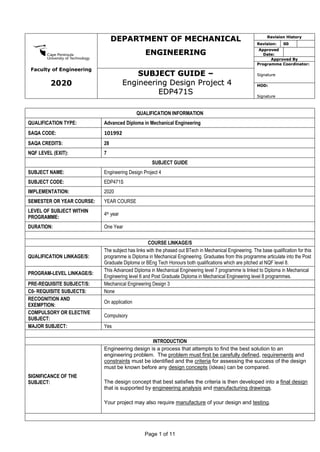
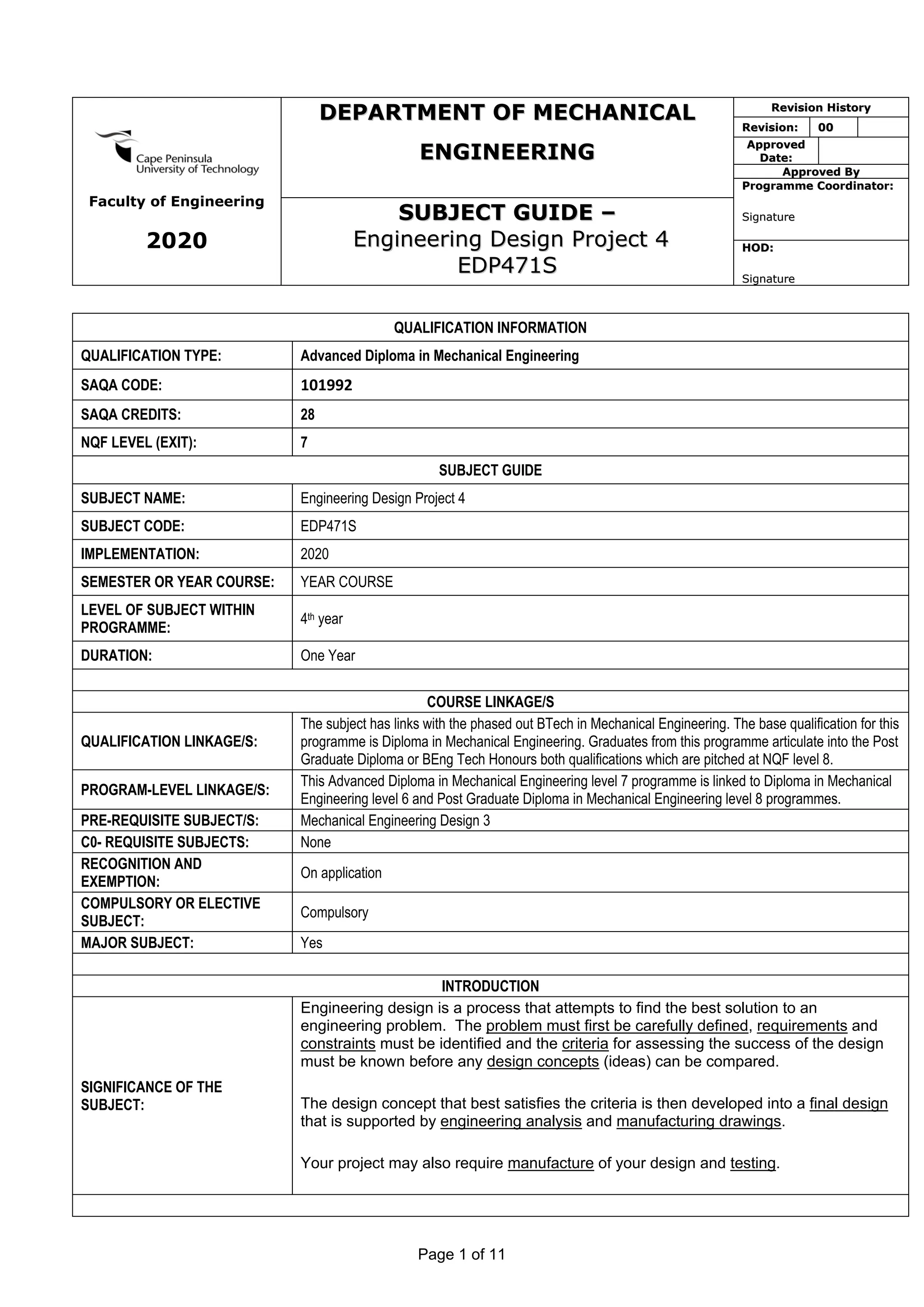
QUALIFICATION INFORMATION
QUALIFICATION TYPE: Advanced Diploma in Mechanical Engineering
SAQA CODE: 101992
SAQA CREDITS: 28
NQF LEVEL (EXIT): 7
SUBJECT GUIDE
SUBJECT NAME: Engineering Design Project 4
SUBJECT CODE: EDP471S
IMPLEMENTATION: 2020
SEMESTER OR YEAR COURSE: YEAR COURSE
LEVEL OF SUBJECT WITHIN
PROGRAMME:
4th year
DURATION: One Year
COURSE LINKAGE/S
QUALIFICATION LINKAGE/S:
The subject has links with the phased out BTech in Mechanical Engineering. The base qualification for this
programme is Diploma in Mechanical Engineering. Graduates from this programme articulate into the Post
Graduate Diploma or BEng Tech Honours both qualifications which are pitched at NQF level 8.
PROGRAM-LEVEL LINKAGE/S:
This Advanced Diploma in Mechanical Engineering level 7 programme is linked to Diploma in Mechanical
Engineering level 6 and Post Graduate Diploma in Mechanical Engineering level 8 programmes.
PRE-REQUISITE SUBJECT/S: Mechanical Engineering Design 3
C0- REQUISITE SUBJECTS: None
RECOGNITION AND
EXEMPTION:
On application
COMPULSORY OR ELECTIVE
SUBJECT:
Compulsory
MAJOR SUBJECT: Yes
INTRODUCTION
SIGNIFICANCE OF THE
SUBJECT:
Engineering design is a process that attempts to find the best solution to an
engineering problem. The problem must first be carefully defined, requirements and
constraints must be identified and the criteria for assessing the success of the design
must be known before any design concepts (ideas) can be compared.
The design concept that best satisfies the criteria is then developed into a final design
that is supported by engineering analysis and manufacturing drawings.
Your project may also require manufacture of your design and testing.
Page 2 of 11
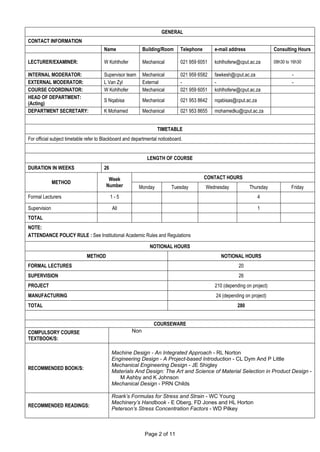
GENERAL
CONTACT INFORMATION
Name Building/Room Telephone e-mail address Consulting Hours
LECTURER/EXAMINER: W Kohlhofer Mechanical 021 959 6051 kohlhoferw@cput.ac.za 08h30 to 16h30
INTERNAL MODERATOR: Supervisor team Mechanical 021 959 6582 fawkesh@cput.ac.za -
EXTERNAL MODERATOR: L Van Zyl External - - -
COURSE COORDINATOR: W Kohlhofer Mechanical 021 959 6051 kohlhoferw@cput.ac.za
HEAD OF DEPARTMENT:
(Acting)
S Nqabisa Mechanical 021 953 8642 nqabisas@cput.ac.za
DEPARTMENT SECRETARY: K Mohamed Mechanical 021 953 8655 mohamedku@cput.ac.za
TIMETABLE
For official subject timetable refer to Blackboard and departmental noticeboard.
LENGTH OF COURSE
DURATION IN WEEKS 26
METHOD
Week
Number
CONTACT HOURS
Monday Tuesday Wednesday Thursday Friday
Formal Lecturers 1 - 5 4
Supervision All 1
TOTAL
NOTE:
ATTENDANCE POLICY RULE : See Institutional Academic Rules and Regulations
NOTIONAL HOURS
METHOD NOTIONAL HOURS
FORMAL LECTURES 20
SUPERVISION 26
PROJECT 210 (depending on project)
MANUFACTURING 24 (depending on project)
TOTAL 280
COURSEWARE
COMPULSORY COURSE
TEXTBOOK/S:
Non
RECOMMENDED BOOK/S:
Machine Design - An Integrated Approach - RL Norton
Engineering Design - A Project-based Introduction - CL Dym And P Little
Mechanical Engineering Design - JE Shigley
Materials And Design: The Art and Science of Material Selection in Product Design -
M Ashby and K Johnson
Mechanical Design - PRN Childs
RECOMMENDED READINGS:
Roark’s Formulas for Stress and Strain - WC Young
Machinery’s Handbook - E Oberg, FD Jones and HL Horton
Peterson’s Stress Concentration Factors - WD Pilkey
Page 3 of 11
LEARNER MANAGEMENT SYSTEM:
All documents and videos for this course are published on Blackboard. A Google
Group is used for email communication.
OTHER MATERIALS: -
SUBJECT NOTICE BOARD
LOCATION:
The Blackboard and Google Group will be used for subject notifications.
STUDY COMPONENT
SUBJECT OBJECTIVES
The aims of this subject are:
 To expose students to the environment of research and design (R&D) of components, machines and
engineering systems that are typically found in industry.
 To simulate a workplace environment.
 To guide the student to acquire the knowledge and skills necessary for successful completion of a mechanical
engineering design and/or research project.
 To develop problem solving abilities, and especially skills in observation, analysis and drawing of logical
conclusions.
 To develop innovative thinking.
 To encourage own initiative.
 To develop confidence in the application of engineering skills.
 To encourage a multi-disciplinary approach to problem solving.
 To report a design solution in an acceptable written and oral format and, where possible to be involved with the
manufacture, testing and commissioning thereof.
 For the student to function individually and as a member of a design team.
 To develop enhanced self-reliance and therefore the ability to make progress on their projects without
continuous supervision, but also …
 For students to recognize when they need guidance and feedback, as well as to make successful use of the
supervision provided.
Primary learning objective: Successful completion of a mechanical engineering design project.
.
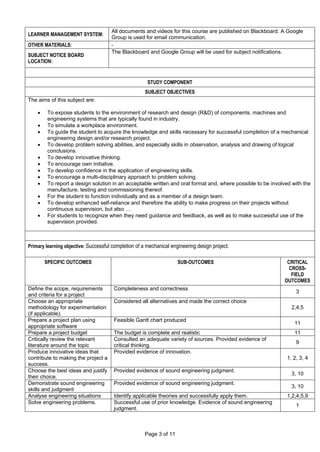
SPECIFIC OUTCOMES SUB-OUTCOMES CRITICAL
CROSS-
FIELD
OUTCOMES
Define the scope, requirements
and criteria for a project
Completeness and correctness
3
Choose an appropriate
methodology for experimentation
(if applicable).
Considered all alternatives and made the correct choice
2,4,5
Prepare a project plan using
appropriate software
Feasible Gantt chart produced
11
Prepare a project budget The budget is complete and realistic 11
Critically review the relevant
literature around the topic
Consulted an adequate variety of sources. Provided evidence of
critical thinking.
9
Produce innovative ideas that
contribute to making the project a
success.
Provided evidence of innovation.
1, 2, 3, 4
Choose the best ideas and justify
their choice.
Provided evidence of sound engineering judgment.
3, 10
Demonstrate sound engineering
skills and judgment
Provided evidence of sound engineering judgment.
3, 10
Analyse engineering situations Identify applicable theories and successfully apply them. 1,2,4,5,9
Solve engineering problems. Successful use of prior knowledge. Evidence of sound engineering
judgment.
1
Page 4 of 11
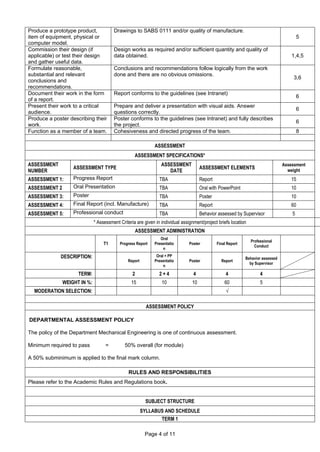
Produce a prototype product,
item of equipment, physical or
computer model.
Drawings to SABS 0111 and/or quality of manufacture.
5
Commission their design (if
applicable) or test their design
and gather useful data.
Design works as required and/or sufficient quantity and quality of
data obtained. 1,4,5
Formulate reasonable,
substantial and relevant
conclusions and
recommendations.
Conclusions and recommendations follow logically from the work
done and there are no obvious omissions.
3,6
Document their work in the form
of a report.
Report conforms to the guidelines (see Intranet)
6
Present their work to a critical
audience.
Prepare and deliver a presentation with visual aids. Answer
questions correctly.
6
Produce a poster describing their
work.
Poster conforms to the guidelines (see Intranet) and fully describes
the project.
6
Function as a member of a team. Cohesiveness and directed progress of the team. 8
ASSESSMENT
ASSESSMENT SPECIFICATIONS*
ASSESSMENT
NUMBER
ASSESSMENT TYPE
ASSESSMENT
DATE
ASSESSMENT ELEMENTS
Assessment
weight
ASSESSMENT 1: Progress Report TBA Report 15
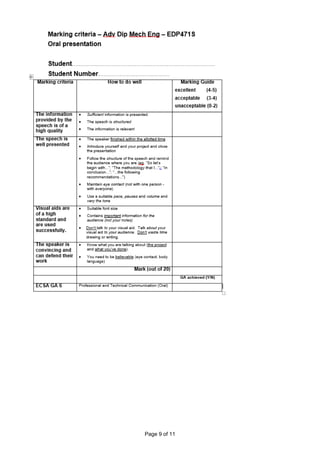
ASSESSMENT 2 Oral Presentation TBA Oral with PowerPoint 10
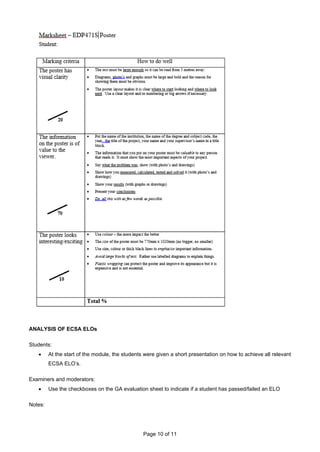
ASSESSMENT 3: Poster TBA Poster 10
ASSESSMENT 4: Final Report (incl. Manufacture) TBA Report 60
ASSESSMENT 5: Professional conduct TBA Behavior assessed by Supervisor 5
* Assessment Criteria are given in individual assignment/project briefs location
ASSESSMENT ADMINISTRATION
T1 Progress Report
Oral
Presentatio
n
Poster Final Report
Professional
Conduct
DESCRIPTION:
Report
Oral + PP
Presentatio
n
Poster Report
Behavior assessed
by Supervisor
TERM: 2 2 + 4 4 4 4
WEIGHT IN %: 15 10 10 60 5
MODERATION SELECTION: √
ASSESSMENT POLICY
DEPARTMENTAL ASSESSMENT POLICY
The policy of the Department Mechanical Engineering is one of continuous assessment.
Minimum required to pass = 50% overall (for module)
A 50% subminimum is applied to the final mark column.
RULES AND RESPONSIBILITIES
Please refer to the Academic Rules and Regulations book.
SUBJECT STRUCTURE
SYLLABUS AND SCHEDULE
TERM 1
Page 5 of 11
[1 Feb – 31 March]
WEEKS REFERENCE TOPIC DATE
1 Lecture (H Fawkes) Introduction to Engineering Design Project 4 TBA
1 Lecture (Librarian) Information Literacy TBA
1 Lecture (H Fawkes) Referencing and Plagiarism TBA
1 Lecture (H Fawkes) The Design Process TBA
1 Lecture (Guest) Engineering Professionalism TBA
TERMS 2 - 4
[13 April-15 Dec]
25 Ongoing supervision TBA
WORK INTEGRATED LEARNING
PROBLEM-BASED LEARNING No – Self-directed learning
PROJECT-BASED LEARNING Yes
WORKPLACE LEARNING It is a fourth year subject which does not require WPBL
GRADUATE ATTRIBUTES
1. Problem Solving
2. Application of Scientific and Engineering Knowledge
3. Engineering Design
4. Investigation
5. Engineering Methods, skills, Tools, including Information Technology
6. Professional and Technical Communication
7. Impact of Engineering Activity
8. Individual and Teamwork
9. Independent Learning
10. Engineering Professionalism
11. Engineering Management
STUDENT SUPPORT
Academically, Students with difficulties are supported through Supervision.
Social difficulties: Students are encouraged to attend counselling sessions.
Financial difficulties: Students are encouraged to apply for financial assistance from the Financial aid unit.
Page 6 of 11
ECSA GA ASSESSMENT
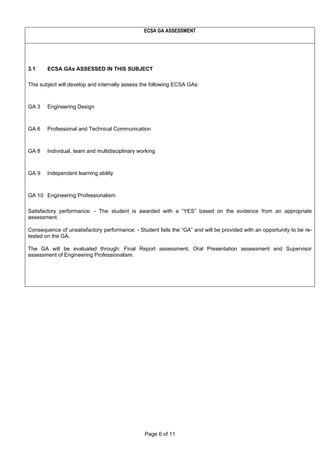
3.1 ECSA GAs ASSESSED IN THIS SUBJECT
This subject will develop and internally assess the following ECSA GAs:
GA 3 Engineering Design
GA 6 Professional and Technical Communication
GA 8 Individual, team and multidisciplinary working
GA 9 Independent learning ability
GA 10 Engineering Professionalism
Satisfactory performance: - The student is awarded with a “YES” based on the evidence from an appropriate
assessment.
Consequence of unsatisfactory performance: - Student fails the “GA” and will be provided with an opportunity to be re-
tested on the GA.
The GA will be evaluated through: Final Report assessment, Oral Presentation assessment and Supervisor
assessment of Engineering Professionalism.
Page 7 of 11
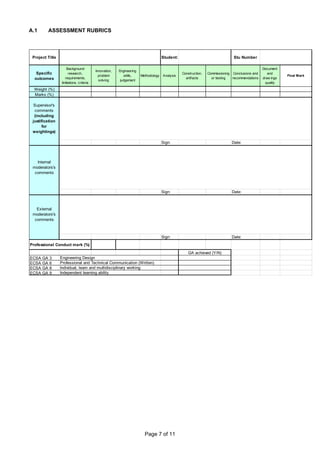
A.1 ASSESSMENT RUBRICS
Project Title Student: Stu Number
Weight (%)
Marks (%)
Sign: Date:
Sign: Date:
Sign: Date:
Professional Conduct mark (%)
ECSA GA 3
ECSA GA 6
ECSA GA 8
ECSA GA 9
Engineering Design
Professional and Technical Communication (Written)
Individual, team and multidisciplinary working
Independent learning ability
GA achieved (Y/N)
Analysis
Innovation,
problem
solving
Engineering
skills,
judgement
Methodology
Construction,
artifacts
Commissioning
or testing
Background
research,
requirements,
limitations, criteria
Document
and
draw ings
quality
Final Mark
Conclusions and
recommendations
External
moderators's
comments
Supervisor's
comments
(including
justification
for
weightings)
Internal
moderators's
comments
Specific
outcomes
Page 8 of 11
Page 9 of 11
Page 10 of 11
ANALYSIS OF ECSA ELOs
Students:
 At the start of the module, the students were given a short presentation on how to achieve all relevant
ECSA ELO’s.
Examiners and moderators:
 Use the checkboxes on the GA evaluation sheet to indicate if a student has passed/failed an ELO
Notes:
Page 11 of 11
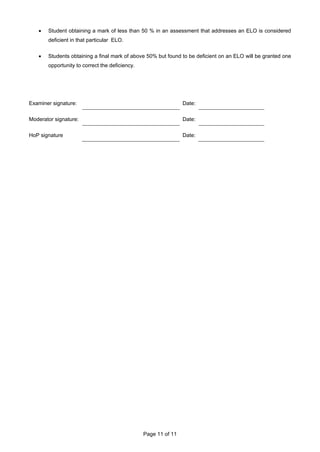
 Student obtaining a mark of less than 50 % in an assessment that addresses an ELO is considered
deficient in that particular ELO.
 Students obtaining a final mark of above 50% but found to be deficient on an ELO will be granted one
opportunity to correct the deficiency.
Examiner signature: Date:
Moderator signature: Date:
HoP signature Date:

Engineering Project Design Project 4 (1).pdf

  • 1.
    Page 1 of11 Faculty of Engineering 2020 D DE EP PA AR RT TM ME EN NT T O OF F M ME EC CH HA AN NI IC CA AL L E EN NG GI IN NE EE ER RI IN NG G R Re ev vi is si io on n H Hi is st to or ry y R Re ev vi is si io on n: : 0 00 0 A Ap pp pr ro ov ve ed d D Da at te e: : A Ap pp pr ro ov ve ed d B By y P Pr ro og gr ra am mm me e C Co oo or rd di in na at to or r: : S Si ig gn na at tu ur re e S SU UB BJ JE EC CT T G GU UI ID DE E – – E En ng gi in ne ee er ri in ng g D De es si ig gn n P Pr ro oj je ec ct t 4 4 E ED DP P4 47 71 1S S H HO OD D: : S Si ig gn na at tu ur re e QUALIFICATION INFORMATION QUALIFICATION TYPE: Advanced Diploma in Mechanical Engineering SAQA CODE: 101992 SAQA CREDITS: 28 NQF LEVEL (EXIT): 7 SUBJECT GUIDE SUBJECT NAME: Engineering Design Project 4 SUBJECT CODE: EDP471S IMPLEMENTATION: 2020 SEMESTER OR YEAR COURSE: YEAR COURSE LEVEL OF SUBJECT WITHIN PROGRAMME: 4th year DURATION: One Year COURSE LINKAGE/S QUALIFICATION LINKAGE/S: The subject has links with the phased out BTech in Mechanical Engineering. The base qualification for this programme is Diploma in Mechanical Engineering. Graduates from this programme articulate into the Post Graduate Diploma or BEng Tech Honours both qualifications which are pitched at NQF level 8. PROGRAM-LEVEL LINKAGE/S: This Advanced Diploma in Mechanical Engineering level 7 programme is linked to Diploma in Mechanical Engineering level 6 and Post Graduate Diploma in Mechanical Engineering level 8 programmes. PRE-REQUISITE SUBJECT/S: Mechanical Engineering Design 3 C0- REQUISITE SUBJECTS: None RECOGNITION AND EXEMPTION: On application COMPULSORY OR ELECTIVE SUBJECT: Compulsory MAJOR SUBJECT: Yes INTRODUCTION SIGNIFICANCE OF THE SUBJECT: Engineering design is a process that attempts to find the best solution to an engineering problem. The problem must first be carefully defined, requirements and constraints must be identified and the criteria for assessing the success of the design must be known before any design concepts (ideas) can be compared. The design concept that best satisfies the criteria is then developed into a final design that is supported by engineering analysis and manufacturing drawings. Your project may also require manufacture of your design and testing.
  • 2.
    Page 2 of11 GENERAL CONTACT INFORMATION Name Building/Room Telephone e-mail address Consulting Hours LECTURER/EXAMINER: W Kohlhofer Mechanical 021 959 6051 kohlhoferw@cput.ac.za 08h30 to 16h30 INTERNAL MODERATOR: Supervisor team Mechanical 021 959 6582 fawkesh@cput.ac.za - EXTERNAL MODERATOR: L Van Zyl External - - - COURSE COORDINATOR: W Kohlhofer Mechanical 021 959 6051 kohlhoferw@cput.ac.za HEAD OF DEPARTMENT: (Acting) S Nqabisa Mechanical 021 953 8642 nqabisas@cput.ac.za DEPARTMENT SECRETARY: K Mohamed Mechanical 021 953 8655 mohamedku@cput.ac.za TIMETABLE For official subject timetable refer to Blackboard and departmental noticeboard. LENGTH OF COURSE DURATION IN WEEKS 26 METHOD Week Number CONTACT HOURS Monday Tuesday Wednesday Thursday Friday Formal Lecturers 1 - 5 4 Supervision All 1 TOTAL NOTE: ATTENDANCE POLICY RULE : See Institutional Academic Rules and Regulations NOTIONAL HOURS METHOD NOTIONAL HOURS FORMAL LECTURES 20 SUPERVISION 26 PROJECT 210 (depending on project) MANUFACTURING 24 (depending on project) TOTAL 280 COURSEWARE COMPULSORY COURSE TEXTBOOK/S: Non RECOMMENDED BOOK/S: Machine Design - An Integrated Approach - RL Norton Engineering Design - A Project-based Introduction - CL Dym And P Little Mechanical Engineering Design - JE Shigley Materials And Design: The Art and Science of Material Selection in Product Design - M Ashby and K Johnson Mechanical Design - PRN Childs RECOMMENDED READINGS: Roark’s Formulas for Stress and Strain - WC Young Machinery’s Handbook - E Oberg, FD Jones and HL Horton Peterson’s Stress Concentration Factors - WD Pilkey
  • 3.
    Page 3 of11 LEARNER MANAGEMENT SYSTEM: All documents and videos for this course are published on Blackboard. A Google Group is used for email communication. OTHER MATERIALS: - SUBJECT NOTICE BOARD LOCATION: The Blackboard and Google Group will be used for subject notifications. STUDY COMPONENT SUBJECT OBJECTIVES The aims of this subject are:  To expose students to the environment of research and design (R&D) of components, machines and engineering systems that are typically found in industry.  To simulate a workplace environment.  To guide the student to acquire the knowledge and skills necessary for successful completion of a mechanical engineering design and/or research project.  To develop problem solving abilities, and especially skills in observation, analysis and drawing of logical conclusions.  To develop innovative thinking.  To encourage own initiative.  To develop confidence in the application of engineering skills.  To encourage a multi-disciplinary approach to problem solving.  To report a design solution in an acceptable written and oral format and, where possible to be involved with the manufacture, testing and commissioning thereof.  For the student to function individually and as a member of a design team.  To develop enhanced self-reliance and therefore the ability to make progress on their projects without continuous supervision, but also …  For students to recognize when they need guidance and feedback, as well as to make successful use of the supervision provided. Primary learning objective: Successful completion of a mechanical engineering design project. . SPECIFIC OUTCOMES SUB-OUTCOMES CRITICAL CROSS- FIELD OUTCOMES Define the scope, requirements and criteria for a project Completeness and correctness 3 Choose an appropriate methodology for experimentation (if applicable). Considered all alternatives and made the correct choice 2,4,5 Prepare a project plan using appropriate software Feasible Gantt chart produced 11 Prepare a project budget The budget is complete and realistic 11 Critically review the relevant literature around the topic Consulted an adequate variety of sources. Provided evidence of critical thinking. 9 Produce innovative ideas that contribute to making the project a success. Provided evidence of innovation. 1, 2, 3, 4 Choose the best ideas and justify their choice. Provided evidence of sound engineering judgment. 3, 10 Demonstrate sound engineering skills and judgment Provided evidence of sound engineering judgment. 3, 10 Analyse engineering situations Identify applicable theories and successfully apply them. 1,2,4,5,9 Solve engineering problems. Successful use of prior knowledge. Evidence of sound engineering judgment. 1
  • 4.
    Page 4 of11 Produce a prototype product, item of equipment, physical or computer model. Drawings to SABS 0111 and/or quality of manufacture. 5 Commission their design (if applicable) or test their design and gather useful data. Design works as required and/or sufficient quantity and quality of data obtained. 1,4,5 Formulate reasonable, substantial and relevant conclusions and recommendations. Conclusions and recommendations follow logically from the work done and there are no obvious omissions. 3,6 Document their work in the form of a report. Report conforms to the guidelines (see Intranet) 6 Present their work to a critical audience. Prepare and deliver a presentation with visual aids. Answer questions correctly. 6 Produce a poster describing their work. Poster conforms to the guidelines (see Intranet) and fully describes the project. 6 Function as a member of a team. Cohesiveness and directed progress of the team. 8 ASSESSMENT ASSESSMENT SPECIFICATIONS* ASSESSMENT NUMBER ASSESSMENT TYPE ASSESSMENT DATE ASSESSMENT ELEMENTS Assessment weight ASSESSMENT 1: Progress Report TBA Report 15 ASSESSMENT 2 Oral Presentation TBA Oral with PowerPoint 10 ASSESSMENT 3: Poster TBA Poster 10 ASSESSMENT 4: Final Report (incl. Manufacture) TBA Report 60 ASSESSMENT 5: Professional conduct TBA Behavior assessed by Supervisor 5 * Assessment Criteria are given in individual assignment/project briefs location ASSESSMENT ADMINISTRATION T1 Progress Report Oral Presentatio n Poster Final Report Professional Conduct DESCRIPTION: Report Oral + PP Presentatio n Poster Report Behavior assessed by Supervisor TERM: 2 2 + 4 4 4 4 WEIGHT IN %: 15 10 10 60 5 MODERATION SELECTION: √ ASSESSMENT POLICY DEPARTMENTAL ASSESSMENT POLICY The policy of the Department Mechanical Engineering is one of continuous assessment. Minimum required to pass = 50% overall (for module) A 50% subminimum is applied to the final mark column. RULES AND RESPONSIBILITIES Please refer to the Academic Rules and Regulations book. SUBJECT STRUCTURE SYLLABUS AND SCHEDULE TERM 1
  • 5.
    Page 5 of11 [1 Feb – 31 March] WEEKS REFERENCE TOPIC DATE 1 Lecture (H Fawkes) Introduction to Engineering Design Project 4 TBA 1 Lecture (Librarian) Information Literacy TBA 1 Lecture (H Fawkes) Referencing and Plagiarism TBA 1 Lecture (H Fawkes) The Design Process TBA 1 Lecture (Guest) Engineering Professionalism TBA TERMS 2 - 4 [13 April-15 Dec] 25 Ongoing supervision TBA WORK INTEGRATED LEARNING PROBLEM-BASED LEARNING No – Self-directed learning PROJECT-BASED LEARNING Yes WORKPLACE LEARNING It is a fourth year subject which does not require WPBL GRADUATE ATTRIBUTES 1. Problem Solving 2. Application of Scientific and Engineering Knowledge 3. Engineering Design 4. Investigation 5. Engineering Methods, skills, Tools, including Information Technology 6. Professional and Technical Communication 7. Impact of Engineering Activity 8. Individual and Teamwork 9. Independent Learning 10. Engineering Professionalism 11. Engineering Management STUDENT SUPPORT Academically, Students with difficulties are supported through Supervision. Social difficulties: Students are encouraged to attend counselling sessions. Financial difficulties: Students are encouraged to apply for financial assistance from the Financial aid unit.
  • 6.
    Page 6 of11 ECSA GA ASSESSMENT 3.1 ECSA GAs ASSESSED IN THIS SUBJECT This subject will develop and internally assess the following ECSA GAs: GA 3 Engineering Design GA 6 Professional and Technical Communication GA 8 Individual, team and multidisciplinary working GA 9 Independent learning ability GA 10 Engineering Professionalism Satisfactory performance: - The student is awarded with a “YES” based on the evidence from an appropriate assessment. Consequence of unsatisfactory performance: - Student fails the “GA” and will be provided with an opportunity to be re- tested on the GA. The GA will be evaluated through: Final Report assessment, Oral Presentation assessment and Supervisor assessment of Engineering Professionalism.
  • 7.
    Page 7 of11 A.1 ASSESSMENT RUBRICS Project Title Student: Stu Number Weight (%) Marks (%) Sign: Date: Sign: Date: Sign: Date: Professional Conduct mark (%) ECSA GA 3 ECSA GA 6 ECSA GA 8 ECSA GA 9 Engineering Design Professional and Technical Communication (Written) Individual, team and multidisciplinary working Independent learning ability GA achieved (Y/N) Analysis Innovation, problem solving Engineering skills, judgement Methodology Construction, artifacts Commissioning or testing Background research, requirements, limitations, criteria Document and draw ings quality Final Mark Conclusions and recommendations External moderators's comments Supervisor's comments (including justification for weightings) Internal moderators's comments Specific outcomes
  • 8.
  • 9.
  • 10.
    Page 10 of11 ANALYSIS OF ECSA ELOs Students:  At the start of the module, the students were given a short presentation on how to achieve all relevant ECSA ELO’s. Examiners and moderators:  Use the checkboxes on the GA evaluation sheet to indicate if a student has passed/failed an ELO Notes:
  • 11.
    Page 11 of11  Student obtaining a mark of less than 50 % in an assessment that addresses an ELO is considered deficient in that particular ELO.  Students obtaining a final mark of above 50% but found to be deficient on an ELO will be granted one opportunity to correct the deficiency. Examiner signature: Date: Moderator signature: Date: HoP signature Date: