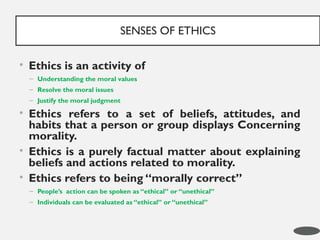
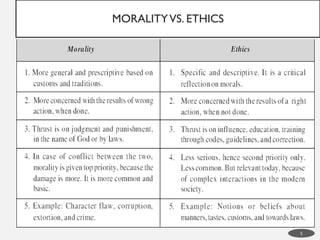
• Ethics isan activity of
– Understanding the moral values
– Resolve the moral issues
– Justify the moral judgment
• Ethics refers to a set of beliefs, attitudes, and
habits that a person or group displays Concerning
morality.
• Ethics is a purely factual matter about explaining
beliefs and actions related to morality.
• Ethics refers to being “morally correct”
– People’s action can be spoken as “ethical” or “unethical”
– Individuals can be evaluated as “ethical” or “unethical”
SENSES OF ETHICS
2
3.
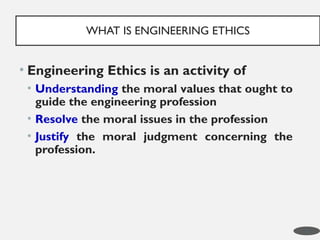
• Engineering Ethicsis an activity of
• Understanding the moral values that ought to
guide the engineering profession
• Resolve the moral issues in the profession
• Justify the moral judgment concerning the
profession.
WHAT IS ENGINEERING ETHICS
3
4.
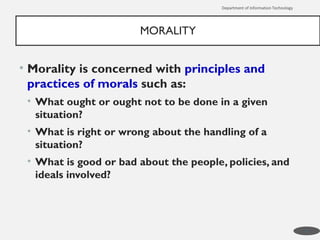
• Morality isconcerned with principles and
practices of morals such as:
• What ought or ought not to be done in a given
situation?
• What is right or wrong about the handling of a
situation?
• What is good or bad about the people, policies, and
ideals involved?
MORALITY
4
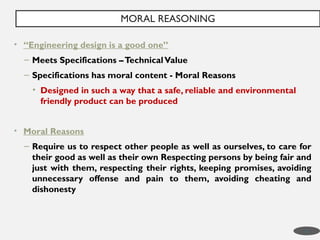
• “Engineering designis a good one”
– Meets Specifications –TechnicalValue
– Specifications has moral content - Moral Reasons
• Designed in such a way that a safe, reliable and environmental
friendly product can be produced
• Moral Reasons
– Require us to respect other people as well as ourselves, to care for
their good as well as their own Respecting persons by being fair and
just with them, respecting their rights, keeping promises, avoiding
unnecessary offense and pain to them, avoiding cheating and
dishonesty
MORAL REASONING
6
7.
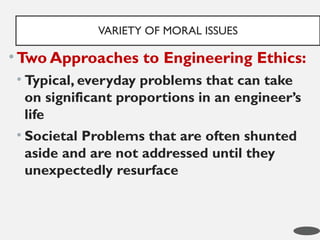
•Two Approaches toEngineering Ethics:
• Typical, everyday problems that can take
on significant proportions in an engineer’s
life
• Societal Problems that are often shunted
aside and are not addressed until they
unexpectedly resurface
VARIETY OF MORAL ISSUES
7
8.
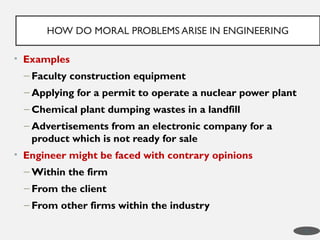
• Examples
– Facultyconstruction equipment
– Applying for a permit to operate a nuclear power plant
– Chemical plant dumping wastes in a landfill
– Advertisements from an electronic company for a
product which is not ready for sale
• Engineer might be faced with contrary opinions
– Within the firm
– From the client
– From other firms within the industry
HOW DO MORAL PROBLEMS ARISE IN ENGINEERING
8
9.
To what extentcan a supervisor be an
authoritative guide to engineer’s conduct ?
What does one do when there are differences of
judgement ?
Should one always follow the law to the letter?
Is an engineer to do no more than what the
specifications say, even if there are problems more
serious than those initially anticipated?
How far does an engineer’s responsibility extend
into the realm of influencing the social impact of
the projects he or she participates in?
CHALLENGES ON HANDLING MORAL ISSUES
9
10.
•The three typesof inquiries, in
solving ethical problems are:
• Normative inquiry
• Conceptual inquiry
• Factual or descriptive inquiry
TYPES OF INQUIRIES
10
11.
•It seeks toidentify and justify the
morally-desirable norms or
standards that should guide
individuals and groups.
•It also has the theoretical goal of
justifying particular moral
judgments.
NORMATIVE INQUIRY
11
12.
NORMATIVE INQUIRY
12
Example:
How fardoes the obligation of engineers to protect public safety
extend in any given situation?
When, if ever, should engineers be expected to blow whistle on
dangerous practices of their employers?
Whose values ought to be primary in making judgment about
acceptable risks in design for a public transport system or a
nuclear plant? Is it of management, senior engineers,
government, voters or all of them?
When and why is the government justified in interfering with the
organizations?
What are the reasons on which the engineers show their
obligations to their employees or clients or the public?
13.
• It isdirected to clarify the meaning of concepts or ideas or principles that
are expressed by words or by questions and statements.
• Examples:
– What is meant by safety?
– How is it related to risk?
– What is a bribe?
– What is a profession?
• When moral concepts are discussed,
normative and conceptual issues are
closely interconnected.
CONCEPTUAL INQUIRY
13
14.
• It isaimed to obtain facts needed for understanding and
resolving value issues.
• Researchers conduct factual inquiries using mathematical
or statistical techniques.
• The inquiry provide important information on business
realities, engineering practice, and the effectiveness of
professional societies in fostering moral conduct, the
procedures used in risk assessment, and psychological
profiles of engineers.
FACTUAL OR DESCRIPTIVE INQUIRY
14
15.
FACTUAL OR DESCRIPTIVEINQUIRY
15
• The facts provide not only the reasons for moral
problems but also enable us to develop alternative
ways of resolving moral problems.
• Example
1. How were the benefits assessed?
2. What are the procedures followed in risk
assessment?
3. What are short-term and long-term
effects of drinking water being polluted?
4. Who conducted the tests on materials?
16.
• Dilemmas aresituations in which
– Moral reasons come into conflict
– The application of moral values are problems, and one is not clear
of the immediate choice or solution of the problems.
– Moral reasons could be rights, duties, goods or obligations.
– These situations do not mean that things had gone wrong, but they
only indicate the presence of moral complexity. This makes the
decision making complex.
MORAL DILEMMA
16
17.
The three complexsituations leading to
moral dilemmas are:
The problem of vagueness
• One is unable to distinguish between good and bad
(right or wrong) principle. Good means an action
that is obligatory. For example, code of ethic
specifies that one should obey the laws and follow
standards. Refuse bribe or accept the gift, and
maintain confidentiality
SITUATIONS LEADING TO MORAL DILEMMA
17
18.
SITUATIONS LEADING TOMORAL DILEMMA
18
The problem of conflicting reasons
• One is unable to choose between two good moral
solutions. One has to fix priority, through knowledge
or value system.
The problem of disagreement
• There may be two or more solutions and none of
them mandatory. These solutions may be better or
worse in some respects but not in all aspects. One
has to interpret, apply different morally reasons, and
analyze and rank the decisions. Select the best
suitable, under the existing and the most probable
conditions.
19.
• Identification ofthe moral factors and reasons.
• Collection of all information, data, and facts
• Rank the moral options
• Generate alternate courses of action to resolve
the dilemma
• Discuss with colleagues and obtain their
perspectives, priorities, and suggestions on
various alternatives
• Decide upon a final course of action, based on
priority fixed or assumed
STEPS TO SOLVE DILEMMA
19
20.
• Moral autonomyis defined as, decisions and actions exercised on the basis of
moral concern for other people and recognition of good moral reasons.
• Alternatively, moral autonomy means ‘self determinant or independent’.
• The autonomous people hold moral beliefs and attitudes based on their
critical reflection rather than on passive adoption of the conventions of the
society or profession.
• Moral autonomy may also be defined as a skill and habit of thinking rationally
about the ethical issues, on the basis of moral concern.
MORAL AUTONOMY
20
21.
• If managementviews profitability is more important than consistent
quality and retention of the customers that discourage the moral
autonomy, engineers are compelled to seek the support from their
professional societies and outside organizations for moral support.
MORAL AUTONOMY
21
22.
• Kohlberg suggestedthere are three
levels of moral development, based on
the type of reasoning and motivation
of the individuals in response to moral
questions
• Pre-conventional
• Conventional
• Post-conventional
KOHLBERG THEORY
22
23.
Pre-Conventional
Pre-Conventional
– Right conductfor an individual is regarded as whatever directly benefits
Right conduct for an individual is regarded as whatever directly benefits
oneself.
oneself.
– At this level, individuals are motivated by obedience or the desire to avoid
At this level, individuals are motivated by obedience or the desire to avoid
punishment or to satisfy their own needs
punishment or to satisfy their own needs
– All young children exhibit this tendency
All young children exhibit this tendency.
.
Conventional
Conventional
– People respect the law and authority
People respect the law and authority
Post Conventional
Post Conventional
– People begin to account for the differing values, opinions and beliefs of other
People begin to account for the differing values, opinions and beliefs of other
people.
people.
23
24.
• The followingis one example of the dilemmas Kohlberg
The following is one example of the dilemmas Kohlberg
presented.
presented.
"Heinz Steals the Drug”
"Heinz Steals the Drug”
In Europe, a woman was near death from a
In Europe, a woman was near death from a
special kind of cancer.There was one drug that
special kind of cancer.There was one drug that
the doctors thought might save her. It was a
the doctors thought might save her. It was a
form of radium that a druggist in the same
form of radium that a druggist in the same
town had recently discovered. The drug was
town had recently discovered. The drug was
expensive to make, but the druggist was
expensive to make, but the druggist was
charging ten times what the drug cost him to
charging ten times what the drug cost him to
make. He paid $200 for the radium and charged
make. He paid $200 for the radium and charged
$2,000 for a small dose of the drug.
$2,000 for a small dose of the drug.
KOHLBERGTHEORY
KOHLBERGTHEORY
24
25.
KOHLBERGTHEORY
KOHLBERGTHEORY
The sick woman'shusband, Heinz, went to
The sick woman's husband, Heinz, went to
everyone he knew to borrow the money, but he
everyone he knew to borrow the money, but he
could only get together about $ 1,000 which is
could only get together about $ 1,000 which is
half of what it cost. He told the druggist that
half of what it cost. He told the druggist that
his wife was dying and asked him to sell it
his wife was dying and asked him to sell it
cheaper or let him pay later. But the druggist
cheaper or let him pay later. But the druggist
said: "No, I discovered the drug and I'm going
said: "No, I discovered the drug and I'm going
to make money from it." So Heinz got
to make money from it." So Heinz got
desperate and broke into the man's store to
desperate and broke into the man's store to
steal the drug-for his wife. Should the husband
steal the drug-for his wife. Should the husband
have done that?
have done that?
• Kohlberg was not interested so much in the answer to
Kohlberg was not interested so much in the answer to
the question of whether Heinz was wrong or right, but in
the question of whether Heinz was wrong or right, but in
the
the reasoning
reasoning for each participant's decision. The
for each participant's decision. The
responses were then classified into various stages of
responses were then classified into various stages of
reasoning in his theory of moral development.
reasoning in his theory of moral development.
26.
• Level 1.Preconventional Morality
Stage 1 - Obedience and Punishment
Stage 1 - Obedience and Punishment
The earliest stage of moral development is especially
The earliest stage of moral development is especially
common in young children, but adults are also capable of
common in young children, but adults are also capable of
expressing this type of reasoning.At this stage, children see
expressing this type of reasoning.At this stage, children see
rules as fixed and absolute. Obeying the rules is important
rules as fixed and absolute. Obeying the rules is important
because it is a means to avoid punishment.
because it is a means to avoid punishment.
Stage 2 - Individualism and Exchange
Stage 2 - Individualism and Exchange
At this stage of moral development, children account for
At this stage of moral development, children account for
individual points of view and judge actions based on how
individual points of view and judge actions based on how
they serve individual needs. In the Heinz dilemma, children
they serve individual needs. In the Heinz dilemma, children
argued that the best course of action was the choice that
argued that the best course of action was the choice that
best-served Heinz’s needs. Reciprocity is possible, but only if
best-served Heinz’s needs. Reciprocity is possible, but only if
it serves one's own interests.
it serves one's own interests.
KOHLBERGTHEORY
KOHLBERGTHEORY
26
27.
KOHLBERGTHEORY
KOHLBERGTHEORY
Department of InformationTechnology 27
• Level 2. Conventional Morality
Level 2. Conventional Morality
Stage 3 - Interpersonal Relationships
Stage 3 - Interpersonal Relationships
often referred to as the "good boy-good girl"
often referred to as the "good boy-good girl"
orientation, this stage of moral development is focused
orientation, this stage of moral development is focused
on living up to social expectations and roles. There is an
on living up to social expectations and roles. There is an
emphasis on conformity, being "nice," and
emphasis on conformity, being "nice," and
consideration of how choices influence relationships.
consideration of how choices influence relationships.
Stage 4 - Maintaining Social Order
Stage 4 - Maintaining Social Order
At this stage of moral development, people begin to
At this stage of moral development, people begin to
consider society as a whole when making judgments.
consider society as a whole when making judgments.
The focus is on maintaining law and order by following
The focus is on maintaining law and order by following
the rules, doing one’s duty and respecting authority.
the rules, doing one’s duty and respecting authority.
28.
• Level 3.Post conventional Morality
Stage 5 - Social Contract and Individual Rights
Stage 5 - Social Contract and Individual Rights
At this stage, people begin to account for the
At this stage, people begin to account for the
differing values, opinions and beliefs of other
differing values, opinions and beliefs of other
people. Rules of law are important for
people. Rules of law are important for
maintaining a society, but members of the
maintaining a society, but members of the
society should agree upon these standards.
society should agree upon these standards.
Stage 6 - Universal Principles
Stage 6 - Universal Principles
Kolhberg’s final level of moral reasoning is
Kolhberg’s final level of moral reasoning is
based upon universal ethical principles and
based upon universal ethical principles and
abstract reasoning.At this stage, people follow
abstract reasoning.At this stage, people follow
these internalized principles of justice, even if
these internalized principles of justice, even if
they conflict with laws and rules.
they conflict with laws and rules.
28
29.
• Actions areconsidered right
Actions are considered right
if they support good
if they support good
character traits (virtues) and
character traits (virtues) and
wrong if they support bad
wrong if they support bad
character traits (vices)
character traits (vices)
• Closely tied to personal
Closely tied to personal
honor
honor
VIRTUE ETHICS
VIRTUE ETHICS
29
30.
• Aristotle:Virtue andthe Golden Mean
Aristotle:Virtue and the Golden Mean
• Aristotle, the most influential of all virtue ethicist, defined
Aristotle, the most influential of all virtue ethicist, defined
the virtues as acquired habits that enable us to engage
the virtues as acquired habits that enable us to engage
effectively in rational activities.
effectively in rational activities.
• Moral virtues are tendencies, acquired thro’ habit
Moral virtues are tendencies, acquired thro’ habit
formation, to reach a proper balance between extremes in
formation, to reach a proper balance between extremes in
conduct, emotion, desire and attitude.
conduct, emotion, desire and attitude.
• Virtues are tendencies to find “The Golden Mean” between
Virtues are tendencies to find “The Golden Mean” between
the extremes of too much and too little.
the extremes of too much and too little.
• E.g.Truthfulness is the mean between revealing all information in violation of tact and
E.g.Truthfulness is the mean between revealing all information in violation of tact and
confidentiality and being secretive.
confidentiality and being secretive.
THEORIES ABOUTVIRTUES
THEORIES ABOUTVIRTUES
30
31.
Macintyre:Virtues and Practices
Macintyre:Virtuesand Practices
Macintyre is a contemporary ethicist who has stimulated a
Macintyre is a contemporary ethicist who has stimulated a
renewed interest in virtue ethics and applied it to thinking
renewed interest in virtue ethics and applied it to thinking
about professional ethics.
about professional ethics.
Macintyre begins with the idea of social practices.
Macintyre begins with the idea of social practices.
Cooperative activities aimed toward achieving public goods
Cooperative activities aimed toward achieving public goods
that could not otherwise be achieved, at least not to the same
that could not otherwise be achieved, at least not to the same
degree.
degree.
These goods are internal to the practices in that they define
These goods are internal to the practices in that they define
what the practices are all about.
what the practices are all about.
They differ from external goods.
They differ from external goods.
E.g.The primary internal good of medicine is the
E.g.The primary internal good of medicine is the
promotion of health.
promotion of health.
THEORIES ABOUTVIRTUES
THEORIES ABOUTVIRTUES
31
32.
• is beingmorally responsible as a professional.
is being morally responsible as a professional.
• is an umbrella virtue that encompasses a wide
is an umbrella virtue that encompasses a wide
variety of more specific virtues that acquire
variety of more specific virtues that acquire
importance in particular situations
importance in particular situations
• Many of the virtues can be grouped into four
Many of the virtues can be grouped into four
categories
categories
• Self-direction virtues
Self-direction virtues
• Public-spirited virtues
Public-spirited virtues
• Team-work virtues
Team-work virtues
• Proficiency virtues
Proficiency virtues
PROFESSIONAL RESPONSIBILITY
PROFESSIONAL RESPONSIBILITY
32
33.
• is theunity of character on the basis of moral
is the unity of character on the basis of moral
concern, and especially on the basis of honesty.
concern, and especially on the basis of honesty.
• The unity is consistency among our attitudes,
The unity is consistency among our attitudes,
emotions and conduct in relation to justified moral
emotions and conduct in relation to justified moral
values.
values.
• Integrity makes possible the virtues of self-respect
Integrity makes possible the virtues of self-respect
and pride in one’s work.
and pride in one’s work.
INTEGRITY
INTEGRITY
33
34.
• Honesty hastwo aspects:
Honesty has two aspects:
• Truthfulness
Truthfulness
• Meeting responsibilities concerning truth-telling
Meeting responsibilities concerning truth-telling
• Trustworthiness
Trustworthiness
• Meeting responsibilities concerning trust.
Meeting responsibilities concerning trust.
• List of specific virtues that truthfulness and
List of specific virtues that truthfulness and
trustworthiness imply:
trustworthiness imply:
• Honesty in acts
Honesty in acts
• Honesty in speech
Honesty in speech
• Honesty in beliefs
Honesty in beliefs
• discretion
discretion
HONESTY
HONESTY
34
35.
is valuingoneself in morally appropriate ways.
is valuing oneself in morally appropriate ways.
takes two forms:
takes two forms:
Recognition self-respect
Recognition self-respect
Appraisal self-respect
Appraisal self-respect
Specific virtues for self respect
Specific virtues for self respect
A sense of honor
A sense of honor
Self-control
Self-control
Courage
Courage
Good judgment
Good judgment
SELF RESPECT
SELF RESPECT
35
36.
• Characteristic quality
Characteristicquality
• Obligations
Obligations
• General moral capacity
General moral capacity
• Liability and
Liability and
accountability
accountability
SENSES OF RESPONSIBILITY
SENSES OF RESPONSIBILITY
36
37.
• Moral responsibility
Moralresponsibility
• Obligations
Obligations
• Accountability
Accountability
• Praiseworthy/Blameworthy
Praiseworthy/Blameworthy
• Casual responsibility
Casual responsibility
• Legal responsibility
Legal responsibility
TYPES OF RESPONSIBILITY
TYPES OF RESPONSIBILITY
37
• Considers abalance of good & bad consequences for everyone affected
Considers a balance of good & bad consequences for everyone affected
(society)
(society)
• Actions are good that serve to promote human well-being
Actions are good that serve to promote human well-being
• Cost-Benefit analysis is an application
Cost-Benefit analysis is an application
• Consideration of most benefit to the most people outweighs needs of a few
Consideration of most benefit to the most people outweighs needs of a few
individuals
individuals
UTILITARIANISM
UTILITARIANISM JOHN STUART MILL (1806-1873)
JOHN STUART MILL (1806-1873)
39
40.
• There areduties that
There are duties that
should be performed (e.g..
should be performed (e.g..
Duty to treat others fairly
Duty to treat others fairly
or not to injure others)
or not to injure others)
regardless of whether these
regardless of whether these
acts do the most good or
acts do the most good or
not.
not.
DUTY ETHICS
DUTY ETHICS IMMANUEL KANT (1724-1804)
IMMANUEL KANT (1724-1804)
40
41.
•People have
People have
fundamentalrights
fundamental rights
(like life, liberty, &
(like life, liberty, &
property) that others
property) that others
have a duty to respect.
have a duty to respect.
RIGHTS ETHICS
RIGHTS ETHICS JOHN LOCKE (1632-1704)
JOHN LOCKE (1632-1704)
41
42.
• Five widelyused tests for evaluating ethical theories:
Five widely used tests for evaluating ethical theories:
• The theory must be clear
The theory must be clear
• It must be consistent
It must be consistent
• Neither the theory nor its defense can rely upon false information
Neither the theory nor its defense can rely upon false information
• It must be sufficiently comprehensive to provide guidance in specific situations of
It must be sufficiently comprehensive to provide guidance in specific situations of
interest to us.
interest to us.
• It must be compatible with our most carefully considered moral convictions about
It must be compatible with our most carefully considered moral convictions about
concrete situations
concrete situations.
TESTING ETHICALTHEORIES
TESTING ETHICALTHEORIES
42
43.
• is beinggood and acceptable to oneself.
is being good and acceptable to oneself.
• It is pursuing what is good for oneself.
It is pursuing what is good for oneself.
• It is very ethical to possess self-interest.
It is very ethical to possess self-interest.
• A view that tries to reduce morality to the
A view that tries to reduce morality to the
pursuit of self-interest is called ethical egoism.
pursuit of self-interest is called ethical egoism.
• “
“Ethical “ because it is a theory about morality
Ethical “ because it is a theory about morality
and “egoism” because it says that the sole duty of
and “egoism” because it says that the sole duty of
each of us is to maximize his or her own good
each of us is to maximize his or her own good.
SELF-INTEREST AND ETHICAL EGOISM
SELF-INTEREST AND ETHICAL EGOISM
43
44.
• Various culturein our pluralistic society lead to tolerance
Various culture in our pluralistic society lead to tolerance
for various customs, beliefs and outlooks.
for various customs, beliefs and outlooks.
• Ethical pluralism is the view that there may be alternative
Ethical pluralism is the view that there may be alternative
perspectives that are reasonable, but no one of which
perspectives that are reasonable, but no one of which
must be accepted completely by all rational and morally
must be accepted completely by all rational and morally
concerned persons.
concerned persons.
• Ethical relativism says that actions are morally right when
Ethical relativism says that actions are morally right when
they are approved by law or custom; they are wrong when
they are approved by law or custom; they are wrong when
they violate laws or customs.
they violate laws or customs.
• Moral rationalism is the view that moral judgments should
Moral rationalism is the view that moral judgments should
be made in relation to factors that may vary from case to
be made in relation to factors that may vary from case to
case.
case.
CUSTOMS AND ETHICAL RELATIVISM
CUSTOMS AND ETHICAL RELATIVISM
44
45.
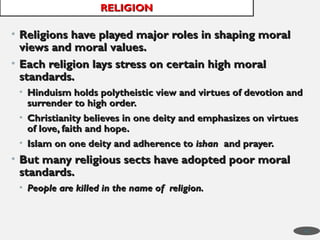
• Religions haveplayed major roles in shaping moral
Religions have played major roles in shaping moral
views and moral values.
views and moral values.
• Each religion lays stress on certain high moral
Each religion lays stress on certain high moral
standards.
standards.
• Hinduism holds polytheistic view and virtues of devotion and
Hinduism holds polytheistic view and virtues of devotion and
surrender to high order.
surrender to high order.
• Christianity believes in one deity and emphasizes on virtues
Christianity believes in one deity and emphasizes on virtues
of love, faith and hope.
of love, faith and hope.
• Islam on one deity and adherence to
Islam on one deity and adherence to ishan
ishan and prayer.
and prayer.
• But many religious sects have adopted poor moral
But many religious sects have adopted poor moral
standards.
standards.
• People are killed in the name of religion.
People are killed in the name of religion.
RELIGION
RELIGION
45
46.
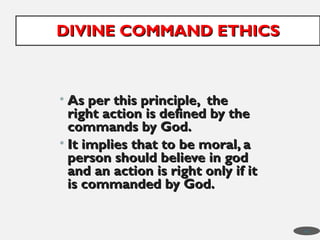
• As perthis principle, the
As per this principle, the
right action is defined by the
right action is defined by the
commands by God.
commands by God.
• It implies that to be moral, a
It implies that to be moral, a
person should believe in god
person should believe in god
and an action is right only if it
and an action is right only if it
is commanded by God.
is commanded by God.
DIVINE COMMAND ETHICS
DIVINE COMMAND ETHICS
46
47.
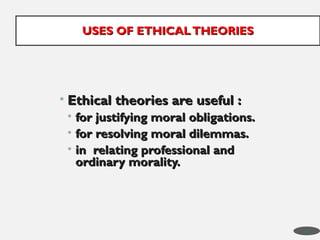
• Ethical theoriesare useful :
Ethical theories are useful :
• for justifying moral obligations.
for justifying moral obligations.
• for resolving moral dilemmas.
for resolving moral dilemmas.
• in relating professional and
in relating professional and
ordinary morality.
ordinary morality.
USES OF ETHICALTHEORIES
USES OF ETHICALTHEORIES
47
48.
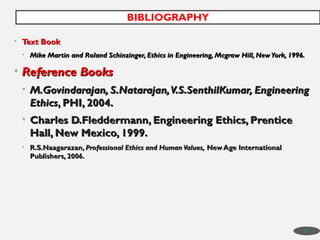
• Text Book
TextBook
• Mike Martin and Roland Schinzinger, Ethics in Engineering, Mcgraw Hill, NewYork, 1996.
Mike Martin and Roland Schinzinger, Ethics in Engineering, Mcgraw Hill, NewYork, 1996.
• Reference Books
Reference Books
• M.Govindarajan, S.Natarajan,V.S.SenthilKumar, Engineering
M.Govindarajan, S.Natarajan,V.S.SenthilKumar, Engineering
Ethics
Ethics, PHI, 2004.
, PHI, 2004.
• Charles D.Fleddermann, Engineering Ethics, Prentice
Charles D.Fleddermann, Engineering Ethics, Prentice
Hall, New Mexico, 1999.
Hall, New Mexico, 1999.
• R.S.Naagarazan,
R.S.Naagarazan, Professional Ethics and Human Values,
Professional Ethics and Human Values, New Age International
New Age International
Publishers, 2006.
Publishers, 2006.
BIBLIOGRAPHY
48
49.
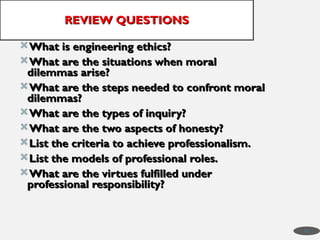
What is engineeringethics?
What is engineering ethics?
What are the situations when moral
What are the situations when moral
dilemmas arise?
dilemmas arise?
What are the steps needed to confront moral
What are the steps needed to confront moral
dilemmas?
dilemmas?
What are the types of inquiry?
What are the types of inquiry?
What are the two aspects of honesty?
What are the two aspects of honesty?
List the criteria to achieve professionalism.
List the criteria to achieve professionalism.
List the models of professional roles.
List the models of professional roles.
What are the virtues fulfilled under
What are the virtues fulfilled under
professional responsibility?
professional responsibility?
REVIEW QUESTIONS
REVIEW QUESTIONS
49