Engineering Biomaterials For Neural Applications Elisa Lpezdolado
1.
Engineering Biomaterials ForNeural Applications
Elisa Lpezdolado download
https://ebookbell.com/product/engineering-biomaterials-for-
neural-applications-elisa-lpezdolado-42311130
Explore and download more ebooks at ebookbell.com
2.
Here are somerecommended products that we believe you will be
interested in. You can click the link to download.
Engineering Biomaterials For Regenerative Medicine Novel Technologies
For Clinical Applications 1st Edition Srinivas D Narasipura
https://ebookbell.com/product/engineering-biomaterials-for-
regenerative-medicine-novel-technologies-for-clinical-
applications-1st-edition-srinivas-d-narasipura-2614492
Engineering Of Biomaterials For Drug Delivery Systems Beyond
Polyethylene Glycol 1st Edition Anilkumar Parambath
https://ebookbell.com/product/engineering-of-biomaterials-for-drug-
delivery-systems-beyond-polyethylene-glycol-1st-edition-anilkumar-
parambath-6846378
Silk Biomaterials For Tissue Engineering And Regenerative Medicine
Subhas Kundu
https://ebookbell.com/product/silk-biomaterials-for-tissue-
engineering-and-regenerative-medicine-subhas-kundu-4660634
Biomaterials For Tissue Engineering And Regeneration Ressler A
https://ebookbell.com/product/biomaterials-for-tissue-engineering-and-
regeneration-ressler-a-48949304
3.
Biomaterials For TissueEngineering Applications A Review Of The Past
And Future Trends 1st Edition Jason A Burdick
https://ebookbell.com/product/biomaterials-for-tissue-engineering-
applications-a-review-of-the-past-and-future-trends-1st-edition-jason-
a-burdick-4194818
Biomaterials For Bone Tissue Engineering 2020 Nora Bloise Lorenzo
Fassina
https://ebookbell.com/product/biomaterials-for-bone-tissue-
engineering-2020-nora-bloise-lorenzo-fassina-54700884
Biomaterials For Bone Tissue Engineering Jos Antonio Sanz
https://ebookbell.com/product/biomaterials-for-bone-tissue-
engineering-jos-antonio-sanz-54701192
Biomaterials For Tissue Engineering And Regeneration Antonia Ressler
https://ebookbell.com/product/biomaterials-for-tissue-engineering-and-
regeneration-antonia-ressler-55247884
Biomaterials For Tissue Engineering 1st Ed Kanika Chawla
https://ebookbell.com/product/biomaterials-for-tissue-engineering-1st-
ed-kanika-chawla-7146812
5.
Elisa López-Dolado
María ConcepciónSerrano Editors
Engineering
Biomaterials
for Neural
Applications
TargetingTraumatic Brain and Spinal
Cord Injuries
Scientific and technologicalresearch, from
molecular to behavioural levels, has been
carried out in many different places but they
have not been developed in a really
interdisciplinary way. Research should be
based on the convergence of different
interconnected scientific sectors, not in
isolation, as was the case in the past.
Rita Levi-Montalcini
That is exactly what it is all about, meeting
people who see things that you do not see.
People who teach you to look with different
eyes.
Mario Benedetti
10.
Foreword
Our central nervoussystem defines how we function and perceive the world. When
the brain or spine is injured, the consequences can be devastating to the individual
and to society at large due to increased morbidity, productivity loss, and healthcare
costs. Therefore, the restoration of cognitive and motor functions after damage to
the central nervous system remains a major scientific, engineering, and medical
challenge. In the quest to successfully address this challenge, it is now recognized
that the development and implementation of engineered biomaterials will be an
important part of the technological solution. The field of biomaterials science
and engineering has significantly evolved within the past decade due to advances
in the fields of cell and molecular biology, nanotechnology, materials science,
and chemistry, which when in convergence can provide innovative solutions to
medical problems. In Engineering Biomaterials for Neural Applications: Targeting
Traumatic Brain and Spinal Cord Injuries, the editors and contributing authors
do a thorough job at highlighting fundamental information on the anatomy and
physiology of the nervous system, describing the consequences of trauma and
disease on this system, and demonstrating how biomaterials can alter or monitor
the course of disease. As a result, the reader will gain significant insight and
appreciation for how biomaterials can be used to address clinical challenges due
to trauma to nerves. The authors describe the biomaterial microenvironment and
how the components and dynamics of that microenvironment are influenced by
trauma or disease conditions. Throughout the book, they methodically review and
highlight the importance of device and biomaterial biocompatibility, mechanical
compliance, architecture, biodegradability, electrical activity, and form factor, all
in the context of regenerating neural structures and restoring tissue functions. This
thematic organization, which is consistent throughout the book, will help readers at
all levels understand key topics and apply the learned material in their own research.
Advances in nanoscience and nanotechnology have been at the foundation of
emerging areas of research and new fields such as regenerative engineering and
synthetic biology. Similarly, nanotechnology has had a major impact in biomaterials
research. In this regard, several chapters in this book demonstrate how nanomate-
rials, nanostructures, and nanoscale properties can be leveraged to promote neural
vii
11.
viii Foreword
regeneration andelectrostimulation and discuss safety issues that must be addressed.
Given the increase in cerebrovascular disease and brain injuries, the discussion of
biomaterial- and cell-based therapeutic strategies that target stroke and traumatic
brain injury is timely. The authors describe the role of devices and robotics in
rehabilitation protocols for managing the consequences of traumatic brain injury
as well as implantable devices for neurosurgery. Throughout the book, the authors
emphasize function recovery and describe the role of biomaterials and devices in
the process. Also appealing is the balance between regenerative/therapeutic and
diagnostic strategies, giving the reader a great introduction into these exciting areas
of biomaterials research. This book will be an excellent resource for graduate
students and senior scientists pursuing research in biomaterials, neural prosthetics,
artificial organs, and regenerative engineering as well as for medical students
and professionals that are interested in applying biomaterials research to neural
applications.
Professor Guillermo A. Ameer
Daniel Hale Williams Professor of Biomedical Engineering and Surgery
Director of the Center for Advanced Regenerative Engineering
Northwestern University
12.
Preface
The nervous systemis, undoubtedly, the most complex system within our body.
Besides integrating all the information coming from the outside and inside media,
it orchestrates individual and collective responses of cells, tissues, and organs.
The enormous anatomical and structural complexity of this system, along with the
superior functions that it dictates, has hidden this body component behind a mist
of darkness and mystery for many centuries. Since breakthrough discoveries at
the beginning of the twentieth century by neuroscientists such as Ramón y Cajal
and Golgi, Nobel laureates in 1906 for their contribution to the understanding
of the nervous tissue structure, neuroscience, neurology, and neurosurgery have
remarkably advanced the knowledge on the physiopathology of this system.
Traumatic brain injury (TBI) and spinal cord injury (SCI) remain a challenge
for scientists and clinicians at all stages, from their basic pathophysiology and
evolution over time to their response to eventual therapeutics and consequences.
Indeed, it has been generally accepted that, due to the complexity and heterogeneity
of these pathologies among individuals, TBI and SCI can be divided in groups of
subpathologies. Thus, it would be more appropriate to refer to them in plural rather
than as singular and uniform diseases. Patients suffering from TBI and SCI have
been largely benefitting from progress in the medical practice, although advances in
their cure are dramatically limited to date. In this scenario, novel and more advanced
biomaterials are emerging as a savior table, with enhanced biocompatibility features
and promising versatility for addressing patients’ heterogeneity, in line with the
modern era of personalized medicine. The expectation is such that clinicians
continue to invest efforts in clinical trials with biomaterial-based strategies.
Inspired by the enormous potential that this field is demonstrating, we compile
in this book a selection of state-of-the-art topics related to engineered biomaterials
primarily envisioned for the treatment of TBIs and SCIs. Chapters will first cover
general aspects of the nervous system and their major traumatic pathological
conditions. Specific advances in the use of biomaterials in this context, at both the
nano- and macroscales, will be then presented. Final progress on novel orthotic
and robotic therapies and implantable neural devices, as well as some auspicious
ix
13.
x Preface
diagnostic toolsfor the assessment of their morphological and functional effects,
will be finally exposed and discussed.
There are five major features that differentiate this book from others previously
published. First, its main focus is placed on relevant neural pathologies with
unfortunately increasing incidence and prevalence worldwide. Second, it provides a
new interdisciplinary perspective by experts in topics highly diverse but all related
to neural applications. Third, it complementarily integrates clinical information on
TBIs and SCIs with knowledge derived from basic and translational approaches.
Fourth, it aims to generate a broad discussion with applicability in other neural
diseases that could be, or are already being, targeted by similar material-based
approaches. And fifth, this book is a short and concise compilation of the enormous
progress that the field is experiencing in the last years.
Based on its multidisciplinary focus, this book is envisioned to reach a wide
audience of readers, from basic scientists attracted by the need of therapeutics for
neural repair to clinicians working routinely with patients suffering from neural
diseases, as well as experts with more diverse backgrounds such as physicists,
mathematicians, and computer bio-scientists, who are increasingly involved and
imbricated in neuroscience research at all levels. Future professionals at a training
stage of their careers can also benefit from the content of this book and, hopefully,
find inspiration from it.
Also, we do wish this book serves patients affected by TBIs and SCIs, for
whom the effort to compose it has been mainly placed, providing them an updated
compilation of the scientific and clinical progress carried out by interdisciplinary
experts all around the world in an attempt to comprehend these neural pathologies
and approach their effective cure.
Every published book is the fruit of a considerable collective effort. And
this book, without exception, certainly is. Without the contribution of a large
number of experts, it could not have been written. We should not end these lines
without expressing our most sincere gratitude to each particular co-author that has
contributed to the elaboration of this book for their time and knowledge reflected
in the final piece of their chapter. We also acknowledge the publisher’s team, who
conceived the idea of the book and accompanied us along the path of its elaboration.
Also, to all those anonymous supporters, even when not expressively named in the
final book, for their advice, silent contribution, and inspiration during the writing
process. Finally, to you, the reader, the origin and goal of all editorial adventures,
we thank you for having decided to take part in it.
A book is like a painting or a symphony. It is not only the colors or the notes that
matter, but how they interact. What we see and hear, what we read, is the result of
that engagement. We deeply hope that the content of each chapter will reach its full
value at the end of the reading and that the messages resting on the pages will be a
source of knowledge and inspiration.
14.
Preface xi
To AndréEspinha, this book would not have been possible without his selfless
and devoted assistance. To my parents, who have guided me with love to where I
am now (M. C. Serrano). To my husband, my best support. To my nephews and
siblings, my best motivation (E. López-Dolado).
Madrid, Spain María Concepción Serrano
Toledo, Spain Elisa López-Dolado
March 2021
15.
Contents
1 General Aspectsof Traumatic Neural Diseases and
Requirements of Central Nervous System Implantable
Biomaterials as Diagnostic and Therapeutic Tools ..................... 1
Ana Domínguez-Bajo, Ankor González-Mayorga, Elisa
López-Dolado, and M. Concepción Serrano
2 Characteristics of the Spinal Cord Injured Patient as a Host
of Central Nervous System Implanted Biomaterials ................... 33
Daniel García-Ovejero, Ángel Arévalo-Martín, David Díaz, and
Melchor Álvarez-Mon
3 Tailoring 3D Biomaterials for Spinal Cord Injury Repair ............. 57
André F. Girão, Joana Sousa, Mónica Cicuéndez, María Concepción
Serrano, María Teresa Portolés, and Paula A. A. P. Marques
4 Nanostructures to Potentiate Axon Navigation and Regrowth
in the Damaged Central Nervous Tissue ................................. 79
Sadaf Usmani and Laura Ballerini
5 Nanostructured Electroactive Materials with Large
Charge Capacity: Direct Field Electrostimulation Through
Connected and Non-connected Electrodes............................... 99
Ann M. Rajnicek, Cristina Suñol, and Nieves Casañ-Pastor
6 Magnetoelasticity and Magnetostriction for Implementing
Biomedical Sensors ......................................................... 127
Jesús María González
7 Nanoparticles for Neural Applications ................................... 149
Jesús García Ovejero, Edina Wang, Sabino Veintemillas-Verdaguer,
María del Puerto Morales, and Anabel Sorolla
xiii
16.
xiv Contents
8 TherapeuticApproaches for Stroke: A Biomaterials Perspective..... 185
Artur Filipe Rodrigues, Catarina Rebelo, Tiago Reis, João André
Sousa, Sónia L. C. Pinho, João Sargento-Freitas, João Peça, and Lino
Ferreira
9 Orthotic and Robotic Substitution Devices for Central
Nervous System Rehabilitation and Beyond............................. 219
Raquel Madroñero-Mariscal, Ana de los Reyes Guzmán, Joana
Mestre Veiga, Alejandro Babin Contreras, Ángel Gil-Agudo, and
Elisa López-Dolado
10 Robotics and Virtual Reality Exer-Games for the
Neurorehabilitation of Children and Adults with Traumatic
Brain Injury: The IS-BRAIN Model ..................................... 243
Pedro A. Serrano, Teresa Criado, Virginia Aranda, Nayra
Fernández-Pinedo, Andrea Riendas, Miriam M. Sevilla, Cristina
Zafra, Ana Calvo-Vera, and Ignacio Calvo-Arenillas
11 Current Implantable Devices in Human Neurological Surgery ....... 277
Raquel Madroñero-Mariscal, Ana de los Reyes Guzmán, Fernando
García-García, Antonio García Peris, José Luis Polo, Ángel
Rodríguez de Lope, and Elisa López-Dolado
Glossary ........................................................................... 299
Index............................................................................... 307
17.
Contributors
Melchor Álvarez-Mon Diseasesof Immune System and Oncology Department,
Hospital Universitario Príncipe de Asturias, Madrid, Spain
School of Medicine, Medicine and Medical Specialties Department, Universidad de
Alcalá (UAH), Madrid, Spain
Instituto Ramón y Cajal de Investigación Sanitaria (IRYCIS), Carretera Colmenar
Viejo, Madrid, Spain
Virginia Aranda Brain Damage Unit, Hospital Beata María, Madrid, Spain
Ángel Arévalo-Martín Laboratory of Neuroinflammation, Hospital Nacional de
Parapléjicos, SESCAM, Toledo, Spain
Alejandro Babin Contreras Center for Prosthetics & Orthotics PRIM, Madrid,
Spain
Laura Ballerini International School for Advanced Studies (SISSA/ISAS), Tri-
este, Italy
Ignacio Calvo-Arenillas Facultad de Fisioterapia y Enfermería, Universidad de
Salamanca, Salamanca, Spain
Ana Calvo-Vera Facultad de Fisioterapia y Enfermería, Universidad de Sala-
manca, Salamanca, Spain
Nieves Casañ-Pastor Institut de Ciencia de Materials de Barcelona (ICMAB),
Consejo Superior de Investigaciones Científicas (CSIC), Barcelona, Spain
Mónica Cicuéndez Departamento de Bioquímica y Biología Molecular, Facultad
de Ciencias Químicas, Universidad Complutense de Madrid, Instituto de Inves-
tigación Sanitaria del Hospital Clínico San Carlos and CIBER de Bioingeniería,
Biomateriales y Nanomedicina, CIBER-BBN Madrid, Spain
Teresa Criado Brain Damage Unit, Hospital Beata María Ana, Madrid, Spain
xv
18.
xvi Contributors
David DíazDiseases of Immune System and Oncology Department, Hospital
Universitario Príncipe de Asturias, Madrid, Spain
School of Medicine, Medicine and Medical Specialties Department, Universidad de
Alcalá (UAH), Madrid, Spain
Ana Domínguez-Bajo Instituto de Ciencia de Materiales de Madrid (ICMM),
Consejo Superior de Investigaciones Científicas (CSIC), Madrid, Spain
Nayra Fernández-Pinedo Children Rehabilitation Unit, Hospital Beata María
Ana, Madrid, Spain
Lino Ferreira Center for Neuroscience and Cell Biology (CNC), University of
Coimbra, Coimbra, Portugal
Faculty of Medicine, University of Coimbra, Coimbra, Portugal
Fernando García-García Department of Radiology, Hospital Nacional de Para-
pléjicos, SESCAM, Toledo, Spain
Daniel García-Ovejero Laboratory of Neuroinflammation, Hospital Nacional de
Parapléjicos SESCAM, Toledo, Spain
Jesús García Ovejero Instituto de Ciencia de Materiales de Madrid (ICMM),
Consejo Superior de Investigaciones Científicas (CSIC), Madrid, Spain
Antonio García Peris Department of Radiology, Hospital Nacional de Parapléji-
cos, SESCAM, Toledo, Spain
Ángel Gil-Agudo Biomechanics and Technical Aids Laboratory, Hospital
Nacional de Parapléjicos, SESCAM, Toledo, Spain
Rehabilitation Department, Hospital Nacional de Parapléjicos, SESCAM, Toledo,
Spain
Department of Medicine and Medical Specialities, School of Medicine, Universidad
de Alcalá, Madrid, Spain
André F. Girão TEMA, Department of Mechanical Engineering, University of
Aveiro, Aveiro, Portugal
Instituto de Ciencia de Materiales de Madrid (ICMM), Consejo Superior de
Investigaciones Científicas (CSIC), Madrid, Spain
Jesús María González Instituto de Ciencia de Materiales de Madrid (ICMM),
Consejo Superior de Investigaciones Científicas (CSIC), Madrid, Spain
Ankor González-Mayorga Laboratory of Interfaces for Neural Repair, Hospital
Nacional de Parapléjicos, SESCAM, Toledo, Spain
Elisa López-Dolado Laboratory of Interfaces for Neural Repair, Hospital Nacional
de Parapléjicos, SESCAM, Toledo, Spain
19.
Contributors xvii
Rehabilitation Department,Hospital Nacional de Parapléjicos, SESCAM, Toledo,
Spain
Research Unit of “Design and development of biomaterials for neural regeneration”,
Hospital Nacional de Parapléjicos, Joint Research Unit with CSIC, Toledo, Spain
Raquel Madroñero-Mariscal Fundación del Lesionado Medular, Madrid, Spain
Hospital Universitario Infanta Leonor, SERMAS, Madrid, Spain
Laboratory of Interfaces for Neural Repair, Hospital Nacional de Parapléjicos,
SESCAM, Toledo, Spain
Paula A. A. P. Marques TEMA, Department of Mechanical Engineering, Univer-
sity of Aveiro, Aveiro, Portugal
Joana Mestre Veiga Center for Prosthetics & Orthotics PRIM, Madrid, Spain
María del Puerto Morales Instituto de Ciencia de Materiales de Madrid (ICMM),
Consejo Superior de Investigaciones Científicas (CSIC), Madrid, Spain
João Peça Center for Neuroscience and Cell Biology (CNC), University of
Coimbra, Coimbra, Portugal
Faculty of Medicine, University of Coimbra, Coimbra, Portugal
Sónia L. C. Pinho Center for Neuroscience and Cell Biology (CNC), University
of Coimbra, Coimbra, Portugal
José Luis Polo Department of Electrical Engineering, Escuela de Ingeniería
Industrial y Aeroespacial, Universidad de Castilla-La Mancha, Toledo, Spain
María Teresa Portolés Departamento de Bioquímica y Biología Molecular, Fac-
ultad de Ciencias Químicas, Universidad Complutense de Madrid, Instituto de
Investigación Sanitaria del Hospital Clínico San Carlos and CIBER de Bioinge-
niería, Biomateriales y Nanomedicina, CIBER-BBN Madrid, Spain
Ann M. Rajnicek School of Medicine, Medical Sciences and Nutrition, University
of Aberdeen, Scotland, UK
Catarina Rebelo Center for Neuroscience and Cell Biology (CNC), University of
Coimbra, Coimbra, Portugal
Faculty of Medicine, University of Coimbra, Coimbra, Portugal
Tiago Reis Center for Neuroscience and Cell Biology (CNC), University of
Coimbra, Coimbra, Portugal
Faculty of Medicine, University of Coimbra, Coimbra, Portugal
Ana de los Reyes Guzmán Biomechanics and Technical Aids Laboratory, Hospi-
tal Nacional de Parapléjicos, SESCAM, Toledo, Spain
Andrea Riendas Brain Damage Unit, Hospital Beata María Ana, Madrid, Spain
20.
xviii Contributors
Artur FilipeRodrigues Center for Neuroscience and Cell Biology (CNC), Uni-
versity of Coimbra, Coimbra, Portugal
Ángel Rodríguez de Lope Department of Neurosurgery, Complejo Hospitalario
de Toledo, SESCAM, Toledo, Spain
João Sargento-Freitas Faculty of Medicine, University of Coimbra, Coimbra,
Portugal
Department of Neurology, Centro Hospitalar e Universitário de Coimbra, Coimbra,
Portugal
María Concepción Serrano Instituto de Ciencia de Materiales de Madrid
(ICMM), Consejo Superior de Investigaciones Científicas (CSIC), Madrid, Spain
Pedro A. Serrano Brain Damage Unit, Hospital Beata María Ana, Madrid, Spain
Occupational Therapy Deparment, Faculty of Health Sciences, Centro Superior de
Estudios Universitarios La Salle, Universidad Autónoma de Madrid, Madrid, Spain
Occupational Thinks Research Group, Institute of Neuroscience and Sciences of
the Movement (INCIMOV), Centro Superior de Estudios Universitarios La Salle,
Universidad Autónoma de Madrid, Madrid, Spain
Universidad de Castilla La Mancha, Talavera de la Reina, Toledo, Spain
Facultad de Fisioterapia y Enfermería, Universidad de Salamanca, Salamanca, Spain
Miriam M. Sevilla Brain Damage Unit, Hospital Beata María Ana, Madrid, Spain
Anabel Sorolla Harry Perkins Institute of Medical Research, QEII Medical Centre,
Nedlands
Centre for Medical Research, The University of Western Australia, Perth, WA,
Australia
Joana Sousa TEMA, Department of Mechanical Engineering, University of
Aveiro, Aveiro, Portugal
João André Sousa Faculty of Medicine, University of Coimbra, Coimbra, Portugal
Department of Neurology, Centro Hospitalar e Universitário de Coimbra, Coimbra,
Portugal
Cristina Suñol Institut de Investigacions Biomédiques de Barcelona (IIBB), Con-
sejo Superior de Investigaciones Científicas (CSIC), Barcelona, Spain
Institut d’Investigacions Biomèdiques August Pi i Sunyer (IDIBAPS), Barcelona,
Spain
Sadaf Usmani International School for Advanced Studies (SISSA/ISAS), Trieste,
Italy
21.
Contributors xix
Sabino Veintemillas-VerdaguerInstituto de Ciencia de Materiales de Madrid
(ICMM), Consejo Superior de Investigaciones Científicas (CSIC), Madrid, Spain
Edina Wang Harry Perkins Institute of Medical Research, QEII Medical Centre,
Nedlands
Centre for Medical Research, The University of Western Australia, Perth, WA,
Australia
Cristina Zafra Universidad de Castilla La Mancha, Talavera de la Reina, Spain
22.
Acronyms
2D Bi-dimensional (two-dimension)
3DTri-dimensional (three-dimension)
ABD Acquired brain damage
AC Alternating current
ADL Activities of daily living
AFM Atomic force microscopy
AIS American Spinal Injury Association Impairment Scale
AON Antisense oligonucleotide
APP β-amyloid precursor protein
ASA Anterior spinal artery
ATH Atherosclerosis
BBB Blood-brain barrier
BCI Brain-computer interface
BDNF Brain-derived neurotrophic factor
BDU Brain damage unit at the HBMA
BOLD Blood-oxygen-level dependent imaging
BSCB Blood-spinal cord barrier
CAR Chimeric antigenic receptor
Cas9 Caspasa 9
CDNF Ciliary-derived neurotrophic factor
ChR Channelrhodopsin
CIMT Healthy side constrained-induced restriction movement therapy
CNS Central nervous system
CNT Carbon nanotube
Covid-19 Coronavirus disease 2019
CPG Central pattern generator
CPPS Cervical proprio-spinal premotoneuronal system
CRISPR Clustered regularly interspaced short palindromic repeats
CSC Charge storage capacity
CSF Cerebrospinal fluid
CT Computed axial tomography (see also “computerized tomography”)
xxi
23.
xxii Acronyms
CTAB Cetyltrimethylammoniumbromide
DAPI 4,6-diamidino-2-phenylindole
DBS Deep brain stimulation
DC Direct current
DCX Doublecortin
dECM Decellularized extracellular matrix
DEFO Dynamic Elastomeric Fabric Orthosis
DH Dorsal horn
DNA Deoxyribonucleic acid
DOC Disorder of consciousness
DPI Days post-injury
DR Dorsal root
DRG Dorsal root ganglion
DTI Diffusion tensor imaging
DWI Diffusion-weighted imaging
ECG Electrocardiogram
ECM Extracellular matrix
EDX Energy dispersive X-ray spectroscopy
EEC Electrical equivalent circuit
EEG Electroencephalography
EES Epidural electrical stimulation
EF Electric field
EGF Epidermal growth factor
EGFR Epidermal growth factor receptor
EIT Electrical impedance tomography
EMA European Medicines Agency
EMG Electromyogram
EPC Endothelial progenitor cell
EPR Enhanced permeability and retention effect
ES Electrical stimulation
ETI Electrode-tissue interface
EV Extracellular vesicle
FDA Food and Drug Administration of the United States of America
FAST Face drooping, arm/leg weakness, and speech difficulties triad
FES Functional electrical stimulation
FGF-2 Fibroblast growth factor 2
FPGA Field programmable gates array
FU Forced use technique
GAP43 Growth-associated protein 43
GBT Gut barrier translocation
GDNF Glial-derived neurotrophic factor
GFAP Glial fibrillary acidic protein
GFP Green fluorescent protein
GM Grey matter
GO Graphene oxide
24.
Acronyms xxiii
HA Hyaluronicacid
Hb Hemoglobin
HBMA Hospital Beata María Ana
HbO2 Oxygenated hemoglobin
HbR Deoxygenated hemoglobin
hDI Human dental stem cell
HDL High-density lipoprotein
HER2 Human epidermal growth factor receptor 2
HFT Human figure test
HI Head injury
HIV Human immunodeficiency virus
hMI Human bone marrow-derived stem cell
hNuA Human nucleus antigen
I-FABP Intestinal fatty acid-binding protein
IgG Immunoglobulin protein isotype G
IGF-1 Insulin-like growth factor 1
IgM Immunoglobulin protein isotype M
IL-1 Interleukin 1
IL-1β Interleukin 1β
IL-6 Interleukin 6
IP Interphalangeal
IrOx Iridium oxide
IS-BRAIN Interventional synergistic model based on exer-gamed robotics to
augment intensity in neurorehabilitation
ITO Indium tin oxide
LBP Lipopolysaccharide-binding protein
LDL Low-density lipoprotein
LDLR Low-density lipoprotein receptor
LFP Local field potential
LL Lower limb
LMV Large multilamellar vesicle
LPS Lipopolysaccharide
LRP-1 Low-density lipoprotein-related protein-1
MBP Myelin basic protein
MCP Metacarpophalangeal
MEMRI Manganese enhanced magnetic resonance imaging
mGluR5 Metabotropic glutamate receptor 5
MF Microfiber
MP Methylprednisolone
MPC Methacryloyloxyethyl phosphorylcholine
MPZ Myelin protein zero
MRI Magnetic resonance imaging
mRNA Messenger ribonucleic acid
MSC Mesenchymal stem cell
MWCNT Multiwalled carbon nanotube
Acronyms xxv
PTA Post-traumaticamnesia
PTFE Poly(tetrafluoroethylene)
PVC Polyvinylchloride
PVDF Polyvinylidene fluoride
Q Electric charge
RAT Robotics-assisted therapy
RGD Arginine-glycine-aspartic acid (Arg-Gly-Asp) tripeptide adhesive
sequence
rGO Reduced graphene oxide
ROS Reactive oxygen species
RTV Room-temperature-vulcanizing (for silicones)
RVG Rabies virus glycoprotein
SH-SY5Y Human neuroblastoma cell line
SCI Spinal cord injury
SCIP Spinal cord injured patient
SEA Series elastic actuator
SEM Scanning electron microscopy
sEMG Surface electromyography
SiNW Silicon nanowire
siRNA Small interfering ribonucleic acid
SMART Sensory modality assessment and rehabilitation technique
SMI-32 Neurofilament H
soCoChR Soma-targeted opsin
SVZ Subventricular zone
TBI Traumatic brain injury
tDCS Transcranial direct current stimulation
TE Tissue engineering
TEM Transmission electron microscopy
TGF-β Transforming growth factor β
Ti Titanium
TiO2 Titanium oxide
Tf Transferrin receptor
TLR Toll-like receptor
TNF-α Tumor necrosis factor α
TMS Transcranial magnetic stimulation
TOPO Trioctylphosphine oxide
TOMR Task-oriented motor re-learning
tPA Tissue plasminogen activator
TUNEL Terminal deoxynucleotidyl transferase dUTP nick end labeling
UCNP Up-conversion nanoparticle
UL Upper limb
UV Ultraviolet
VEGF Vascular endothelial growth factor
VH Ventral horn
VMF Ventral medial fissure
27.
xxvi Acronyms
VR Virtualreality
VSA Variable stiffness actuator
WD Wallerian degeneration
WDO Wrist-driven orthosis
WHO World Health Organization
WM White matter
2 A. Domínguez-Bajoet al.
Keywords Biocompatibility · Biodegradability · Biomaterials · Central nervous
system · Mechanical compliance · Requirement · Tissue engineering · Traumatic
neural diseases
1.1 Introduction to the Central Nervous System
As living organisms, we have the ability to detect and respond to a wide range of
stimuli arising from our environment for adaptation and survival purposes. The key
element responsible for orchestrating these functions is the nervous system, com-
posed of peripheral and central components acting together in a highly coordinated
manner. Specifically, the nervous system is a complex set of specialized structures
whose mission is to control and regulate the function of all the components of our
body, coordinating their actions and the relation of the whole organism with the
external ambient. Indeed, it is organized to detect changes in both the internal and
external environments, evaluate such information and respond through variations
in our whole body behaviour, including changes in movement, organs’ activity and
hormone levels. The nervous system is divided into two major components: the
peripheral nervous system (PNS) and the central nervous system (CNS). The PNS
is composed of all the nerves starting at the CNS and extending throughout the body.
Nerves are bundles of peripheral nerve fibres that form pathways from the CNS to
the rest of the body and vice versa. On its turn, the CNS is formed by the brain and
the spinal cord [1]. The brain is protected by the skull and refers to the cerebrum,
the cerebellum and the brainstem. The spinal cord is the part of the CNS located
inside the vertebral canal and connects to the brain through the occipital hole of the
skull (Fig. 1.1).
The CNS receives, integrates and correlates different types of sensory and motor
information. After integrating such information, an adequate response is executed
[1]. In what follows, major components of the CNS will be described.
1.1.1 The Brain
The brain is constituted by three main regions: the cerebrum, the cerebellum and
the brainstem. The cerebrum has multiple functions, but, generally speaking, it is
responsible for processing the information that comes from the senses, as well as
controlling movement, emotions, memory, cognition and learning. Additionally,
it is the centre of intellectual functions [1]. Anatomically, the cerebrum can be
divided into two different parts: the telencephalon and the diencephalon. The
telencephalon corresponds to the two cerebral hemispheres (right and left), which
are communicated by nerve fibres on the corpus callosum (callosal commissure).
Brain neural components can be divided into white and grey matter areas. While the
white matter (mainly composed of neuronal axons) transmits information between
30.
1 General Aspectsof Traumatic Neural Diseases and Biomaterials 3
Fig. 1.1 Overview of the central nervous system anatomy [2]. (a) Scheme of its major components
and regions. (b) Scheme of the spinal cord surrounded by the meninges and protected by
a backbone vertebra. (c) Spinal nerve scheme. Adapted from Ana Domínguez-Bajo’s PhD
dissertation 2020 [2]
the brain and the rest of the body, the function of the grey matter (which contains
neural cell bodies) is related to the processing of the information. Regarding
functioning, the left hemisphere is responsible for movement and sensory perception
from the right part of the body, logical reasoning, linguistic intelligence and
mathematical ability. On its turn, the right hemisphere is responsible for movements
and perception of the left side, vision in three dimensions, creativity and imagination
[1]. Four lobes are identified in the cortex of each hemisphere: Frontal, occipital,
temporal and parietal. The frontal lobe controls voluntary movements and it is
related to the ability of planning, intelligence and personality. The occipital lobe
integrates visual information. The temporal lobe deals with auditory information,
memory and emotions. Finally, the parietal lobe integrates tactile information of the
whole body and intervenes in balance [3].
The diencephalon is composed of the following different anatomical parts: Tha-
lamus, hypothalamus and epithalamus. The thalamus receives sensations collected
by other parts of the CNS and distributes them to diverse regions in the cerebral
cortex. The main function of the hypothalamus is to regulate the balance of the
body and the basic needs such as the intake of food and drink and the instinct of
reproduction, also controlling the endocrine system [1]. The epithalamus belongs to
the limbic system, thus related to emotions and intuition. It also contains the pineal
gland, which regulates the states of sleep and wakefulness.
31.
4 A. Domínguez-Bajoet al.
The cerebellum is attached to the brainstem by means of three pairs of fibre
bundles or cerebellar peduncles [1]. In its upper or lower part, the cerebellum
is shaped like a butterfly, the “wings” being the cerebellar hemispheres and the
“body”, the vermis. Each cerebellar hemisphere consists of lobes, separated by
fissures. The cerebellum has an outer layer of grey matter, named as the cerebellar
cortex, and grey matter nuclei located deep in the white matter. Its main function
is the coordination of movements. Specifically, the cerebellum evaluates how the
movements that initiate the motor areas of the brain are executed. In case they are not
performed harmoniously and smoothly, the cerebellum detects it and sends feedback
impulses to the motor areas so that they correct the error and modify the movements.
In addition, the cerebellum participates in the regulation of posture and balance.
The brainstem consists of three parts: midbrain, pons and medulla oblongata. Ten
of the twelve cranial nerves, which are responsible for the innervation of structures
located in the head, leave the brainstem. They are the equivalent to the spinal
nerves in the spinal cord. The midbrain is the upper structure of the brainstem
and connects the pons and the cerebellum with the diencephalon. It consists of
the cerebral peduncles, which are fibre systems that conduct impulses to and from
the cerebral cortex. The pons is located between the medulla oblongata and the
midbrain, inferior to the cerebellum. It is divided into a ventral part and a dorsal,
tegmental, part separated at most levels by the medial lemniscus. The ventral pons
consists of the precerebellar pontine nuclei and the brachium pontis (formed by
efferent fibres of the pontine nuclei). The pontine tegmentum contains cranial nerve
nuclei and several subnuclei of the reticular formation, including the parabrachial
nuclei, caudal parts of the pedunculopontine tegmental nucleus, the laterodorsal
tegmental nucleus, the locus coeruleus complex and the raphe nuclei [4]. The middle
cerebellar peduncles are an intricate fibre system connecting the medulla oblongata
to the cerebral hemispheres. The medulla oblongata, located between the spinal cord
and the pons, is actually a pyramid-shaped extension of the spinal cord. The origin
of the reticular formation, an important network of nerve cells, is a fundamental part
of this structure. The impulses between the spinal cord and the brain are conducted
through the medulla oblongata by major pathways of both ascending and descending
nerve fibres. Control centres for heart, vasoconstrictor, and respiratory functions are
also located here, as well as other reflex activities, including vomiting. Their survival
relevance is such that injuries to these structures cause immediate death [5].
1.1.2 The Spinal Cord
The spinal cord is the part of the CNS located inside the vertebral foramen.
It contains 31 spinal segments, which are the origin of the spinal nerves that
communicate the spinal cord with the different parts of the organism. It has two
fundamental functions: (1) To control many reflex acts and (2) to communicate the
body with the brain through sensory ascending and motor descending pathways.
32.
1 General Aspectsof Traumatic Neural Diseases and Biomaterials 5
Like the rest of the CNS, the spinal cord is constituted by grey matter, in this case
located in the central area, and white matter, located in the outermost area [1].
Grey matter neurons have variable characteristics regarding length and size of the
dendrite and axon distribution. For instance, they can be multipolar and classified
as Golgi I and II neurons. These neurons have either long or short axons. Those
with long ones either exit the spinal cord through the ventral spinal roots to form
ventral fascicles or connect long distances within this organ (for example the
cervical part with the lumbar part). On the other hand, neurons with short axons
make connections with cells located nearby at the grey matter. Some neurons are
intrasegmental, distributed within a single segment; others extend through several
segments, so they have an intersegmental distribution. Commonly, neuronal somas
are clustered together, often in large numbers, responding to a common function.
Sometimes, these groups can be subdivided into smaller ones, which would imply
a particular function. Depending on their relative location in the spinal cord,
there are anterior, posterior and lateral nuclei. The anterior horns mainly contain
voluntary motor neurons in its upper part and visceral motor neurons in the base.
In the posterior horns, exteroceptive sensitivity is found in the head, proprioceptive
sensitivity in the medial part and visceral sensitivity at the base.
Bror Rexed identified that dorsal horn neurons were arranged in flattened sheets
(i.e. laminae) parallel to the longitudinal axis of the spinal cord. Each plate can
be distinguished from another by the neuronal morphology and the density of its
junction, as also occurs in the architecture of the cortex. Then, each Rexed lamina
contains neurons with different anatomical connections and functions. In the grey
commissure or intermediate region and the posterior horn, the Rexed laminae are
more similar to columns than flattened sheets. In any spinal segment, there are ten
Rexed laminae, some of them corresponding to the nuclei of the spinal cord.
The white matter of the spinal cord is formed by the axons of sensory and
motor neurons, the descending axons coming from supraspinal centres (brain and
brainstem) and the central fibres of the sensory neurons of the spinal ganglion
surrounding the grey matter. The millions of axons and fibres that form it are
grouped into tracts and fascicles, which are named according to their origin and
termination sites to easily identify the path and the direction of travelling of its
information. Through the ascending tracts, information from the PNS and the spinal
function itself is transmitted to the brain, while through the descending ones, the
brain transmits its orders to the spinal cord. Regarding the distribution of the tracts,
the long tracts are located peripherally and the short ones closer to the grey matter.
These tracts and fascicles form three columns of white matter on either side of
the midline of the spinal cord: dorsal, lateral, and ventral white columns. The
dorsal white column contains somatic afferent fibres from the spinal nerves that
are grouped into the graceful or thin and the cuneate or wedge-shaped fascicles,
which ascend through the spinal cord without synapse until reaching the medulla
oblongata. The lateral and ventral white columns are formed by ascending tracts
that originate in the spinal cord itself and descending tracts that originate in different
structures of the brain [5].
33.
6 A. Domínguez-Bajoet al.
In addition, the spinal cord has an internal neural network formed by the
propriospinal tracts, which connect the different spinal segments among them [6, 7].
The neural fibres that form these tracts follow a very rigorous organization: axons
which travel through a specific area of the white matter project to a specific
area contained in the grey matter. For example, fibres located at the dorsolateral
part of the white matter project to the dorsolateral portion of the intermediate
grey matter and to the motoneurons which innervate the distal limb muscles.
Conversely, fibres located at the ventromedial area of the white matter project to
the medial portion of lamina VII and the motoneurons which innervate the proximal
muscles at the grey matter. Alongside, there are long propriospinal neurons able
to communicate the cervical enlargement with the lumbar one through descending
and ascending pathways. While descending cervico-lumbar projections are usually
bilateral (ipsilateral and contralateral), ascending lumbo-cervical ones are, typically,
only contralateral.
There are two neuronal circuits involved in the control of locomotion and
forelimb motility: the cervical proprio-spinal premotoneuronal system (CPPS) and
the central pattern generator (CPG). The somas of the neurons that form the CPPS
are located mainly in C3 and C4 spinal segments and their axons project to the
motoneurons of C7 and C8, as well as to the lateral reticular nucleus of the brain-
stem. Several studies in humans and different animal models have demonstrated
that the CPPS receives excitatory inputs from corticospinal, rubrospinal, tectospinal
and reticulospinal tracts [8–10], along with sensory inputs from muscles, joints,
and skin [11], and inhibitory connections from intraspinal interneurons. Thanks to
this, the CPPS could act as a relay between the tracts coming from supraspinal
centres (e.g. cortical and subcortical tracts) and the motor nuclei of the spinal
cord, thus modulating and updating the information from supraspinal centres before
transmitting it to the motoneurons. Additionally, the CPPS sends a copy of the
signals produced by the spinal motoneurons to the cerebellum through collaterals
to the lateral reticular nucleus [12]. On its turn, the CPG, located in the lumbar
enlargement, controls the flexion and extension patterns of the different joints during
locomotion [13, 14]. It receives instructions from the sub-thalamic, midbrain and
cerebellar locomotion regions [15] and information from the cerebral cortex, basal
ganglia, brainstem and sensory systems.
1.1.3 The Meninges
The entire CNS is surrounded by three layers of connective tissue called meninges.
The outmost and strongest membrane is the dura mater, formed by dense irregular
connective tissue attached to the bone and receiving an intense blood supply. To
follow, the arachnoid membrane is placed below the dura. It is formed by non-
vascular connective tissue rich in collagen and elastic fibres forming a mesh. The
subdural space is located between these two meningeal membranes. Finally, the pia
mater is a very thin and transparent layer of connective tissue that is intimately
34.
1 General Aspectsof Traumatic Neural Diseases and Biomaterials 7
adhered to the CNS that it covers. The subarachnoid space localizes between the
arachnoid membrane and the pia mater and contains the cerebrospinal fluid (CSF)
[16]. The meninges have three main functions: (1) to protect the underlying brain
and spinal cord; (2) to support the vascular tree; and (3) to create a fluid-filled
cavity, the subarachnoid space, vital for the proper function and survival of the CNS.
The subarachnoid space is a widely used location for the placement of different
implantable devices in human clinical practice (see Chap. 11) [17].
1.1.4 The Cerebrospinal Fluid and the Choroid Plexuses
The CSF is clear and colourless. It protects the brain and the spinal cord against
chemical and physical injuries, besides transporting oxygen, glucose and other
necessary chemicals from the blood to neurons and neuroglia. This fluid is produced
in vascular structures located in the walls of the ventricles called choroid plexuses,
which are capillary networks covered with ependymal cells that produce the CSF
from the filtration of blood plasma. The CSF circulates continuously through the
ventricular system, ependyma and subarachnoid space. Its production is an active
process that requires energy expenditure by the choroid cells. Moreover, the CSF
provides mechanical protection to the CNS by preventing the brain and the spinal
cord to hit against the skull and the backbone [18]. Any situation involving an
accumulation of CSF—either excessive production or obstructed drainage—can
lead to serious neurological deficits, often requiring the surgical placement of
valvular bypass devices [17].
1.1.5 Components at the Microscale: Neurons and Neuroglia
Early studies by the renowned neuroscientist Ramón y Cajal already identified
neurons as discrete neural elements responsible for the functioning of our nervous
system [19]. His work defined the origin of the so-called neuron doctrine, which
marked the beginning of modern Neuroscience. Neural tissue consists of two main
types of cells: neurons and neuroglia. Neurons are excitable cells that drive the
electrical impulses that make all the functions of the nervous system possible,
thus representing the basic functional and structural unit of the nervous system.
It is estimated that the human brain contains over 86 ± 8 billion neurons [20].
Although with different shapes and sizes, all neurons have a basic and constant
structure composed of soma, dendrites, axon initial segment and axon. Neurons are
supported by neuroglia, a group of cells that are, in general, smaller than neurons
and exceed them 5–10 times in number. The main glial cell types are astrocytes,
oligodendrocytes, ependymal cells, Schwann cells and satellite cells [21]. Most
CNS cells are of glial lineage, which explains the pathophysiological role played
by the dysfunction of one or more of the glial cell types in diseases such as multiple
sclerosis and CNS tumours.
35.
8 A. Domínguez-Bajoet al.
1.2 Traumatic Neural Diseases: Traumatic Brain and Spinal
Cord Injuries
The CNS, as a highly specialized system, can be disrupted by external and/or
internal conditions leading to pathology. Disorders of the nervous system are
important causes of death and disability around the world. As much as 1 in every 9
individuals dies of a disorder of the nervous system [22]. As the world population
ages, the relative effects of disorders affecting this system are increasing. Within the
most prevalent and dramatic CNS disorders, we could mention Alzheimer’s disease
and other dementias, epilepsy, Parkinson’s disease, amyotrophic lateral sclerosis,
multiple sclerosis, stroke and brain and spinal tumours, to cite a few. All these
pathologies cause high burdens for the National Health Care systems, involving not
only patients but also their relatives and society as a whole. At present, neurological
disorders constitute 6.3% of the global burden of disease around the world. The
World Health Organization (WHO), in their global public health project “Global
Initiative on Neurology and Public Health” has defined all these neurological
disorders as a public health challenge, predicting a 12% of the world population
dying of neurological diseases by 2030 [23].
From the physio-pathological point of view, both traumatic brain injury (TBI)
and spinal cord injury (SCI) can be classified as either penetrating or no penetrating
injuries, compromising meninges and neural tissue integrity in a more severe
way in the former. In TBI, the worst outcome primarily depends on whether the
lesion was originated in either one or both sides of the brain (i.e. being the larger
bilateral lesions those with the worst consequences). Conversely, in SCI, the upper
located is the affected spinal segment, the worst are the consequences. In both
TBI and SCI, events happening after the trauma can be classified as primary and
secondary damage. Primary damage starts with the formation of hematomas, the
disruption of blood vessels (blood–brain/spinal cord barriers), the initial activation
of the immune response (at this point, mainly due to microglia activation), and the
affectation and death of neural cells that comprise both brain and spinal tissue,
including axonal shearing. Secondary damage appears after these initial events in
a variable time frame. In TBI, one of the most studied consequences of cell damage
is the subsequent cytotoxicity caused by an exaggerated release of the glutamate
neurotransmitter. This causes additional impairments in information transmission in
cells located around the lesion epicentre, even leading to the apparition of seizures
in patients. In SCI, the ischemic injury due to major vessels deterioration has
devastating consequences, such as severe haemorrhages and spinal cord swelling.
These events lead to mechanical compression of the cord and worsening of the
injury, causing the affectation of other spinal segments due to the extension of
the damage (for a more meticulous explanation, see Chap. 2). In both TBI and
SCI pathologies, cell membrane damage will drive to the release of different
molecules. This will cause an imbalance in the normal ionic properties of the
tissue, the liberation of more neurotransmitters and reactive oxygen species, and
the augmentation of cell death, which will boost even more molecules release. Cells
36.
1 General Aspectsof Traumatic Neural Diseases and Biomaterials 9
of the immune system such as macrophages, neutrophils and lymphocytes will be
then attracted to the injury site, liberating immune mediators such as cytokines and
driving to oedema formation (and, in the case of TBI, the increase of intracranial
pressure). All these events, along with astrocyte recruitment and fibrous cells and
proteins infiltration for the formation of the fibro-glial scar at the lesion site, leave
a hostile scenario for neural regeneration. Afterwards, once the attenuation of the
inflammatory response takes place, the injured tissue stabilizes, even with attempts
of neural circuits remodelling. Both initial and secondary damages have different
durations and consequences depending on the severity of the lesion. For further
details on the physiopathology and clinical features of TBI [24–26] and traumatic
SCI [27, 28], readers are referred elsewhere.
The therapeutic options for TBI are still limited. Specifically, TBI therapeutics
under investigation include approaches to regulate neuroinflammation, aedema,
and blood–brain barrier disintegration through pharmacotherapy and stem cell
transplants [29]. As TBI pathology entails a progression from the primary injury
to inflammation-mediated secondary cell death, limiting this inflammation to
ameliorate a greater symptomology has emerged as an attractive treatment prospect.
Reported studies to date have yielded some positive results, but superior outcomes
are expected from combined therapies. At the clinical arena, the use of robotic-based
rehabilitation strategies is extensively applied for functional recovery (for further
details, see Chaps. 9 and 10). More recently, electrical stimulation is attracting
much effort and proving therapeutic potential. At the moment, there are two
active clinical trials where brain stimulation by using implanted electrodes is being
tested to ameliorate and reverse cognitive deficits after TBI by inducing plastic
changes in neural circuits (NCT02881151 [30], recruiting, phase not applicable;
NCT03382626 [31], recruiting, phase not applicable).
Major advances and failures in the fields of neurosurgery, robotics, computational
neuroscience and neuroengineering have populated SCI medicine with a multitude
of wearable and implantable neurotechnologies to enable and augment function
[32]. These treatments have historically been divided into restoration therapies,
replacement strategies and rehabilitation procedures (Fig. 1.2). Within neuroengi-
neering approaches, biomaterials are bringing so much promise that the first clinical
trials have been initiated. At present, there is an on-going clinical trial on the
safety and feasibility of a neural spinal scaffold made of poly(lactic-co-glycolic
acid)-b-poly(L-lysine) for the treatment of subjects with American Spinal Injury
Association Impairment Scale (AIS) grade A traumatic SCI at neurological level
of injury of T2-T12 (NCT02138110) [33]. As early as 2016 and related to this
clinical trial, a pioneer publication referring to the first human implantation of a
bioresorbable polymer scaffold (InVivo Therapeutics) [34] for acute SCI came out
(Fig. 1.3) [35]. Specifically, a 25-year-old man with a T11-12 fracture dislocation
sustained in a motocross accident (AIS grade A) was treated with acute surgical
decompression, spinal fixation with fusion and implantation of a 2 × 10 mm
bioresorbable scaffold in the spinal cord parenchyma at T12. By 3 months, the
37.
10 A. Domínguez-Bajoet al.
Fig. 1.2 Engineering strategies to enable immediate and long-term recovery of motor func-
tions. After a severe but incomplete SCI, the sensorimotor circuits producing motor activity
are spared, but they lack the essential source of modulation and excitation to be functional.
Descending pathways are partly spared, but fail to activate these circuits for muscle contraction.
The delivery of chemical and/or electrical neuromodulation therapies to the spinal cord below
the injury immediately enables spinal sensorimotor circuits to respond to task-specific sensory
and residual supraspinal inputs in order to produce functional movements. In conjunction
12 A. Domínguez-Bajoet al.
chronic SCI. In parallel, collagen scaffolds are being explored in another clinical
trial (NCT02510365 [38]), along with comprehensive rehabilitation, in individuals
with acute (≤21 days) complete SCI (C5-T12).
1.3 Introducing Biomaterials as Diagnostic and/or
Therapeutic Tools
Generally speaking, biomaterials are defined as natural or synthetic substances that
can be used either alone or combined with other materials, cells, or molecules
to induce a regenerative desired response in any damaged organ or tissue of a
living organism [39]. Depending on the biomedical goal, biomaterials could stay
at the lesion site during the entire patient life (such as a hip prosthesis made of
titanium) [40] or for a specific period (such as synthetic skin substitutes which
will degrade with time to let the patient’s own skin to regrow after a burn) [41].
Importantly, once implanted, the material–tissue interface will have a pivotal role
in the proper integration and functioning of the biomaterial, as it is dynamic (i.e. it
will be changing its features over biomaterial lifetime). Many types of biomaterials
of natural and synthetic origin have been explored so far to offer alternative and/or
complementary therapeutic approaches to patients with organ failure. For example,
collagen [42, 43] and hyaluronic acid (HA) [44], two abundant biomolecules present
in the extracellular matrix (ECM) of many tissues in the body, have been frequently
used for the fabrication of biomedical implants. Even the biological structure that
remains after the decellularization of a specific organ or tissue can be processed and
used as a biomaterial in biomedical research (Fig. 1.4) [45, 46]. Natural biomaterials
can be of animal source, such as chitosan, which is isolated from the cell walls
of crustaceans, fungi and bacilli [47, 48]. Alternatively, examples of commonly
used lab-made biomaterials for medical purposes are polycaprolactone (PCL) [42],
polyethylene glycol [49] and polylactic acid [42].
The use of biomaterials for medical purposes can be framed within the inter-
disciplinary field known as tissue engineering [50]. Concretely, scientists and
physicians working in this field combine and apply the principles of basic biol-
ogy, medicine, chemistry, material science, nanotechnology and bioengineering to
construct biological substitutes for organs with different tissue complexity, such
as the skin, trachea and spinal cord [51]. The definition of tissue engineering and
regenerative medicine can be considered virtually the same, but it is also correct
to say that tissue engineering is included within regenerative medicine [52]. Organ
reparation by using the combination of biomaterials, cells and molecules is one of
the most significant milestones in translational science in the last century, eventually
improving the quality of life of millions of patients worldwide [53].
14 A. Domínguez-Bajoet al.
basis of the first materials generation employed for the fabrication of prosthesis
that were placed at the lesion site. However, strictly speaking, these materials acted
as physical substitutes, without inducing any change in the spared tissue [57, 58].
Following, these first materials were improved to prompt an initial regenerative
response in the organism. For example, this resulted in new dental prostheses
which were able to form an active interface with the native tissue, thus facilitating
material integration. Another important advance was the creation of resorbable
screws and sutures used in orthopaedic surgeries [58]. In the next period of
biomaterials development (third generation), researchers realized that manipulating
physicochemical features of biomaterials, such as giving to their surface some
degree of roughness, modelling their architecture (from 2D to 3D), varying their
degree of hardness and modifying surface chemical composition, materials could
be able to elicit more diverse and beneficial effects once implanted. Importantly,
the evoked responses were due to cellular and genetic adjustments that prompted
both structural and functional changes to assist organ restoration [58, 59]. Finally,
fourth-generation biomaterials are those that, once placed at the injured site, allow
for additional functional properties such as the use of electrical stimulation to
obtain desired tissue responses. In this last case, electrical impulses can regulate
the activity of ion channels and pumps present in the cell membrane. Indeed, these
materials differ from previous generation ones in providing real-time monitoring
and recording of the cell responses generated. In this group, we could include
electronic devices developed by nanotechnology tools to interface human tissues in
vivo, such as cardiac pacemakers, cochlear implants and electrodes for deep brain
stimulation [59, 60]. Biomaterials are also part of devices that do not substitute
any tissue/organ but are implanted within our body for different specific purposes
(Fig. 1.5) [61]. These devices allow researchers and clinicians to deliver drugs
and molecules either spontaneously or in a controlled way, to act as sensors of
relevant clinical parameters such as arterial, intraocular and intracranial pressures,
and to maintain the normal position of an organ which underwent surgery, such as
biocompatible meshes for hernia repair, among others.
Focused on neuroscience, neural tissue engineering (or neuroengineering) has
emerged as a subfield of tissue engineering [62, 63]. As extensively explained above,
the nervous system has an overly complex anatomical and functional structure. The
information among its components is mainly transmitted through electric pulses
(action potentials) and chemical signals (neurotransmitters). Moreover, information
exchange with the nervous system occurs at different levels. For example, infor-
mation from the brain and spinal cord is transported by peripheral nerves, and
ultimately received and processed back to the CNS by a muscle, an organ or a gland.
Thus, neural stimulation and recording could be done either at the muscle/organ
level, at the beginning of the peripheral nerve, or directly at the CNS components
[64]. Taking this into account and the fact that damage in the nervous system will
comprise the loss of cellular and tissue components and then, the impairment of
electric and chemical transmission, biomaterials used in nervous system diseases
attempt to both regenerate nervous tissue and recover its functionality [65]. In
the particular case of CNS injuries, several thousands of stimulators, including
16 A. Domínguez-Bajoet al.
1.4 Requirements for CNS Implantable Biomaterials
Research along the last decades has proved that efforts to understand and tackle
TBI and SCI have to be interdisciplinary due to the complexity of these pathologies.
In words of the renowned neurologist Rita Levi-Montalcini, Nobel laureate for the
discovery of the nerve growth factor in 1986:
Scientific and technological research, from molecular to behavioural levels, has been carried
out in many different places but they have not been developed in a really interdisciplinary
way. Research should be based on the convergence of different interconnected scientific
sectors, not in isolation, as was the case in the past.
The use of biomaterials and tissue engineering as therapeutic strategies to
approach the repair of injured neural tissues is receiving expanding attention
[70, 71]. Since early work in the 1970s by authors such as Hench and Ethridge
[72], a big amount of articles has been published on the topic of biomaterials
for neural applications, concurring with the emergence of the fourth generation of
biomaterials, the so-called smart/biomimetic materials [73], previously mentioned.
Within these materials, hydrogels represent an attractive option because they are
structurally similar to the ECM of many tissues, can often be processed under
relatively mild conditions and delivered in a minimally invasive manner (e.g.
injection without tissue removal) [74], as well as fabricated by using 3D printing
technologies to more precisely reproduce neural tissues architecture [75]. Additional
advantages include soft mechanical properties, hydrophilic nature, biodegradability,
biocompatibility and versatility to achieve high loads of bioactive molecules
[76, 77]. Hydrogels were first placed into the CNS in the mid-1990s when poly-
(2-hydroxyethyl methacrylate) (PHEMA) hydrogels containing Schwann cells were
implanted into lesioned optic tracts in rats, with two-thirds of the scaffolds showing
penetrating axons [78]. In a different study, collagen IV was combined with
PHEMA and Schwann cells and implanted into lesioned optic tracts, resulting in
increased neuron penetration [79]. More recently, amorphous non-fibrous hydrogels
composed of HA have proved to promote angiogenesis and vascular remodelling,
followed by subsequent neurite growth, in the brain after stroke [67]. Besides these
exemplary strategies, multidisciplinary efforts including the use of biomaterials are
providing encouraging results for restoring functions after SCI [80–82] and, more
discretely, also TBI [83].
Knowledge from tissue engineering advances clearly indicates that successful
approaches to repair damaged tissues and organs must achieve an optimal matching
of their physicochemical and biological properties [84]. Implantable biomaterials
for neural applications can be divided into three main groups: (1) Diagnostic
devices to be shortly in contact with the tissue (i.e. commonly applied externally,
so just minimal requirements are expected to be fulfilled), (2) Therapeutic neural
interfaces including electrical sensors and stimulators aimed to be implanted for
either short or long periods of time and (3) Therapeutic devices that are thought
to integrate neural tissues chronically and somehow prompt inherent regenerative
responses for neural repair. Major requirements for all these CNS implantable
44.
1 General Aspectsof Traumatic Neural Diseases and Biomaterials 17
Fig. 1.6 Schematics of major requirements that neurotechnologies should fulfil to maximize
performance after CNS implantation
biomaterials intend to guarantee a seamless interface with neural tissues and long-
lasting performances. Although these implantable devices must comply with most
of these requirements, prioritizing them depending on the final aim, biomaterial
selection becomes stricter if the substrate need to be present for long periods of time,
such as in chronic patients. In what follows, the most pivotal characteristics that
implantable biomaterials and interfaces for neural repair must fulfil are described in
more detail (Fig. 1.6).
45.
18 A. Domínguez-Bajoet al.
1.4.1 Biocompatibility
As largely discussed above, the most critical feature for any element to be implanted
in vivo, also applicable to those for neural applications, is biocompatibility. Besides
general aspects, biomaterials interfacing neural tissues should be able to elicit
biological compatibility with neural components including their peculiar ECM, as
well as induce neural tissue remodelling and regeneration if pursued. In this sense, as
many elements of neurons, neuroglia and neural ECM have nanoscale dimensions,
the incorporation of components at the nanoscale in the biomaterial to be implanted
offers a great promise to seamlessly integrate with neural tissues by simulating
native features and functions [85]. Moreover, efforts to achieve biocompatible
interfaces are mandatory to diminish local inflammation and posterior foreign body
responses, major contributors to the failure of neural implants. To this goal, all
chemical, physical and biological properties of implantable devices are vital factors
for suppressing chronic tissue encapsulation [86, 87]. Biocompatibility features also
include the absence of toxicity from degradation by-products that could eventually,
or desirably if biodegradability is pursued, emerge from the biomaterial over time,
as well as potential harmful residues and leachables that could remain in the
biomaterial from its fabrication process.
There are diverse strategies to boost the biocompatibility of implantable devices
for neural applications. One of the most extensively explored is the incorporation
of adhesive moieties to prompt adhesion of selective cell types at the first stages
of implantation. For instance, the fibronectin-derived Arginine–Glycine–Aspartic
acid (RGD) peptide sequence has been shown to improve cell viability and
migration in hydrogels [88, 89]. Importantly, neural stem cell adhesion and neurite
outgrowth seems directly dependent on RGD sequence density in the hydrogel [90].
Alternatively, biocompatible polymers (e.g. silicone, poly(dimethylsiloxane)), some
of them already available in medical grade, can be used to coat the implantable
device and thus provide enhanced biocompatibility responses.
Another important approach to this regard is the functionalization with neural
modulators, which could also add therapeutic features to the substrate. In this sense,
a wide palette of neuroactive molecules ranging from proteins to nucleic acids
and lipids has been identified. Particularly, neurotrophins are markedly relevant as
they regulate development, maintenance and function of vertebrate nervous systems
[91, 92]. Specifically, they are involved in the regulation of cell fate decisions, axon
growth and dendrite pruning and outgrowth, the patterning of innervation, and the
expression of proteins crucial for normal neuronal function, such as neurotransmit-
ters and ion channels. In the mature nervous system, they control synaptic function
and synaptic plasticity, while modulating neuronal survival. Precisely, neurotrophin
3 (NT-3) has been widely demonstrated as a beneficial growth factor in the injured
spinal cord [93, 94]. In a more complex approach, Courtine and colleagues described
a cocktail of growth facilitators boosting axon regeneration in complete rat and
mouse SCI lesions (Fig. 1.7) [95, 96]. Factors investigated included: osteopontin,
insulin-like growth factor 1 (IGF-1), ciliary-derived neurotrophic factor (CDNF),
20 A. Domínguez-Bajoet al.
a growth factors cocktail to support graft survival [98]. This therapeutic biomaterial
was tested in a T3 complete transection and a C4 corticospinal tract lesion. Further
details on biomaterials for local and controlled drug delivery in SCI models can be
found elsewhere [99].
1.4.2 Mechanical Compliance
Another pivotal requirement of implantable devices, and to date largely underes-
timated, is mechanical compliance with native and diseased neural tissues, which
are naturally soft. For instance, mouse brain tissue characterizes by values as low
as 200 Pa [100]. Atomic force microscopy (AFM) has recently evolved as a more
precise technique than conventional rheology and mechanically testing instruments
capable of providing precise mechanical measurements at the nano- and microscales
of cells and tissues. For instance, AFM studies have demonstrated that the somata of
pyramidal neurons in the cerebral cortex display elastic modulus between 480 Pa at
30 Hz and 970 Pa at 200 Hz, while values in astrocytes, even though being softer,
reach 300 Pa and 520 Pa [101], respectively, and the somata of retinal neurons
reach values as high as 1590 Pa at 200 Hz. Contrarily, fibroblasts from connective
tissue have an elastic storage value dramatically higher (∼5 kPa) [102]. More
importantly, neural stem cells fate can be directed by the stiffness of the substrate
(e.g. preferentially differentiating into neurons in stiffer substrates) [103]. Neurites
of dorsal root ganglion cells grow longer on stiffer substrates [104], while spinal
cord astrocytes adapt their morphology to the mechanical properties of the substrate
[105].
When damaged, the mechanical properties of neural tissues significantly vary.
Specifically, and contrary to scars in other tissues, the CNS tissue significantly
softens after injury, both at the neocortex and the spinal cord, as demonstrated by
AFM [106]. For instance, fresh spinal cord tissues have been reported to display
Young’s modulus values of 97 ± 69 Pa, for white matter regions, and 275 ± 99 Pa,
for grey matter ones [107], in range with those previously reported for the spinal
cord (177 and 420 Pa, respectively) and the rat cortical tissue (50–500 Pa) by other
authors [106]. AFM stiffness maps of scar regions at the rat neocortex revealed
a drastic drop in tissue elasticity by more than three-fold at 9 days after injury
and a two-fold drop by day 22, with respect to the contralateral hemisphere [106].
Importantly, tissue softening was measured up to 1 mm away from the lesion site,
with significant drops of 15% and 13% at 9 and 22 days, respectively, after injury.
In the case of the spinal cord, although boundaries of the lesions are more irregular
and diffuse than in the cortex, the stiffness of the lesioned spinal cord grey matter
was also significantly lower than in control tissue. This effect was also significant
outside the visible lesion. These neural scars are mainly composed of glial cells (e.g.
astrocytes and NG2-glia) accompanied by some non-neural cells such as pericytes
and meningeal cells [108], along with collagen and other ECM components. As
the mechanical properties of the environment play a pivotal role in cell and tissue
48.
1 General Aspectsof Traumatic Neural Diseases and Biomaterials 21
responses, it seems reasonable to hypothesize that the reduced ability of neurons to
regrow in CNS injuries could be partially associated with changes in the mechanical
properties at the lesion site.
Unfortunately, biomaterials described to date for neural applications are still
far from matching the mechanical properties of native neural tissues. Materials
such as methacrylate hydrogels (2.9 kPa perpendicular to pores and 6.7 kPa along
pores) [109], cholesterol-modified methacrylate hydrogels (10.1 kPa) [110], protein-
functionalized methacrylate scaffolds (263 kPa) [111] and PCL/gellan gum blends
(79.7 kPa) [112] are some of the biomaterials reported for neural applications with
softer mechanical properties. Alternatively, electrically active nanomaterials have
been hybridized with hydrogels to decrease the mechanical mismatch between
stiff electrodes and soft neural tissues [113, 114]. Even when reporting favourable
regenerative responses such as axon growth, no data exist on the potential distress
caused by their mechanical mismatch with neural tissues.
1.4.3 3D Architecture
All tissues and organs in the body display a tridimensional (3D) structure, so the
brain and the spinal cord also encompass this characteristic. It seems reasonable
then that engineered materials for neural repair are designed to reproduce the native
ECM of native neural tissues, including their 3D architectural features. Moreover, it
has been extensively proved that cells behave differently in 2D and 3D environments
[115, 116], stressing the need of satisfying this requirement. Specifically, cells seem
to behave more similarly to their native fate when cultured in 3D vs. 2D substrates.
In the past decade, 3D printing and bioprinting have emerged as useful, cus-
tomizable and versatile techniques for the design and fabrication of a variety of
biomaterials in a 3D configuration [117, 118]. They have been used to produce
medical devices with patient-specific shapes, engineered tissues for in vivo regen-
eration, and in vitro tissue models for screening therapeutics. In the particular
case of neural engineering, Koffler et al. recently reported the utility of a 3D-
printed biomimetic hydrogel for SCI (Fig. 1.8) [75]. The authors used a microscale
continuous projection printing method (μCPP) to create a complex CNS structure.
μCPP can print scaffolds tailored to the dimensions of the rodent spinal cord in 1.6 s,
and it is scalable to human spinal cord lesions. These μCPP 3D-printed scaffolds
loaded with NPCs demonstrated ability to support axon regeneration and form new
neural relays across sites of complete SCI in rodents.
Alternatively, fibre-like biomaterials, either in a 2D or 3D configuration, are
being under investigation providing anisotropic guidance cues and then triggering
white matter tract regeneration. Initial approaches in this sense were focused on
materials such as agarose and PLGA. A pioneer study by Tuszynski and colleagues
described the implantation of multi-channel agarose conduits containing bone
marrow stromal cells engineered to release BDNF. In a rat cervical microaspiration
49.
22 A. Domínguez-Bajoet al.
Fig. 1.8 (a) 3D-printer setup: an ultraviolet light source (365 nm wavelength); a computer for
sliced image-flow generation and system synchronization; a digital micromirror device (DMD)
for optical pattern generation; a set of projection optics; a stage for sample position control;
24 A. Domínguez-Bajoet al.
1.4.4 Biodegradability
Among optional characteristics of implantable biomaterials and interfaces for neural
regeneration, biodegradability can be cited as one of special interest. For those
particular applications that mainly rely on tissue reparative features, the temporal
presence of the biomaterial might be sufficient and, moreover, desirable as chronic
implants could drive to secondary fibrotic responses due to suboptimal physico-
chemical properties. Ideal biomaterial degradation profiles in vivo would be those
matching the kinetics of the tissue repair induced so, by the end of the regeneration
process, the biomaterial is no longer there. On their turn, biomaterials serving to
diagnostic purposes are typically required only for a concrete period of time, so
superior stability over time rather than biodegradability might be aimed instead.
This feature is closely related to biocompatibility, as biodegradable biomaterials are
obligated to assure that degradation by-products are also biocompatible. For further
details on this requirement, please refer to previous sections.
To this regard, biodegradable polymers and hydrogels are particularly attractive
as they typically contain liable bonds that can be cleaved and result in smaller
chemical groups able to be cleared from the implant site. For instance, degradation
can occur through the hydrolytic and enzymatic cleavage of bonds made during
polymerization, the incorporation of degradable monomeric units with bonds
cleaved by water and the spontaneous hydrolysis of ester bonds [76]. Hydrogels
can be customized with enzyme specific cleavage sites for driving degradation by
tissue specific enzymes.
In general terms, degradation can mainly occur via surface or bulk erosion [120,
121], being the process dependent on the amount of degradable units, crosslinking
degree and access of water and/or enzymes to the inner degradable parts of the
biomaterial, among other factors. Typically, surface degradation occurs when water
and enzymes cannot penetrate the interior areas, thus forcing the surface or exterior
bonds to cleave first. Conversely, bulk erosion is characterized by degradation that
occurs homogeneously throughout the biomaterial, with interior and exterior bonds
being cleaved simultaneously. Hydrogels predominantly experience bulk erosion
due to their higher water content and fast diffusion of liquids.
1.4.5 Electrical Activity
In the recent decades, electrical conductivity and activity have been identified as
eventual pivotal features of interest for implantable technologies in neural tissues
based on their inherent electrical activity. Signalling in the CNS relies on the ability
of nerve cells to respond to very small stimuli with rapid and large changes in
the electrical potential difference across the cell membrane [122]. Importantly, this
rapid signalling depends on ion channels, a class of integral membrane proteins opti-
mally tuned to respond to physical and chemical signals. They recognize and select
52.
1 General Aspectsof Traumatic Neural Diseases and Biomaterials 25
specific ions, open and close in response to specific electrical, mechanical and chem-
ical signals, and conduct ions across the cell membrane. Ion transporters/pumps,
although also present in nerve cells, do not participate in rapid signalling but in
the establishment and maintenance of concentration gradients of physiologically
relevant ions. Today, we know that information is carried within neurons and from
neurons to their target cells by means of electrical and chemical signals. This
information can travel long distances by the generation and propagation of action
potentials, arising from sequential changes in the membrane permeability to K+ and
Na+ ions and for which voltage-gated ion channels play a relevant role.
Progress in the understanding of the electrical functioning of the CNS has
permitted the exploration of electrical stimulation (ES) as a promising therapy
for SCI patients [123], being extensively used as a therapy to relapse cardiac
arrhythmias or seizures, to alleviate pain and to improve strength of paralysed
muscles. The application of ES by means of conductive materials to promote and/or
facilitate neural regeneration continues to be a rarely explored, and hardly under-
stood, therapy for neural repair, especially in the injured spinal cord. Approaches
involving the use of this type of materials are being the focus of a significant
amount of publications [124–126], although in most of the cases the therapy
is exclusively explored in vitro. For instance, the application of a potential of
100 mV mm−1 for 2 h induced neural differentiation in PC-12 cells cultured on
biodegradable citrate-based polymers doped with aniline tetramers to gain electrical
conductivity [127]. In a different work, Casañ-Pastor and colleagues explored a
palette of diverse materials including poly(3,4-ethylenedioxythiophene) (PEDOT)
and iridium-titanium oxide for promoting nerve growth in amphibian neurons [128].
Specifically, neurites on substrates containing iridium oxide grew faster and in
random directions. ITO substrates, with and without PCL/PLGA, were also able to
promote neuronal differentiation and neurite growth in neural stem/progenitor cells
under ES (80 mV) [129]. More recently, Blesch and colleagues have proved that
ES has a time-dependent influence on the regenerative capacity of sensory neurons
and might enhance axonal regeneration in combinatorial approaches for SCI [130].
Specifically, in vivo ES protocols (20 Hz, 2× motor threshold, 0.2 ms, 1 h) applied
on the intact sciatic nerve in adult rats induced a 2-fold increase in neurite length of
sensory neurons in vitro 1 week later. Longer (7 h) and repeated (7 days, 1 h/each)
ES protocols increased growth by 56–67% at 7 days. A deeper discussion on the
application of electric fields to conductive materials and neural cultures and eventual
harmful events (e.g. faradaic reactions) is covered in Chap. 5.
1.4.6 Processability and Surgical Requirements
Those biomaterials and interfaces envisioned to be implanted in the brain and the
spinal cord for clinical use should be easily processed in a scalable, reproducible
and cost-effective manner, so the resulting therapy becomes available for a majority,
if not the totality, of the affected population in a short period of time. Moreover,
53.
26 A. Domínguez-Bajoet al.
surgical needs must be also taken into consideration, including the capacity to
fabricate the engineered material in a diversity of sizes and shapes to accommodate
individual patient needs. If suturing is needed, biomaterials have to sustain it without
breaking or tearing. However, given the softness of neural tissues, the use of sutures
might be rarely needed for their CNS implantation. Finally, these neurotechnologies
should be stable during storage at adequate conditions before implantation and
easily handable at the surgery room by clinicians and healthcare personnel.
1.4.7 Other Particular Requirements for Functioning
Besides general characteristics described above, certain biomaterials for neural
applications might have additional requirements related to their functioning and per-
formance. For instance, implantable neuroelectrodes should include communication
with as many individual neurons as possible and a high degree of signal-to-noise
ratio for either short (days and months) or chronic (years) implantation times [126].
On their turn, biomaterials envisioned for drug delivery should be able to sustain
a therapeutic drug release according to the physiopathology phases of traumatic
neural tissue damage.
1.5 Final Considerations
In this chapter, we have presented an overview of the CNS, major physio-
pathological features of traumatic brain and spinal cord injuries and a general
description of engineered materials for neural applications, both biomaterials and
interfaces in the context of their specific biological target. Major requirements for
implantable biomaterials aimed at neural regeneration are also summarized, from
mandatory biocompatibility and mechanical compliance to optional biodegradation
and electrical conductivity. The aspects covered by this introductory chapter are
thought to assist the reader on the understanding of more specific topics enclosed
in the following chapters. In what follows, diverse current subjects related to
this main axis will be described and discussed, from biomaterials and conductive
nanomaterials to sensors and robotic-based rehabilitation strategies for TBI and SCI.
An exposition of current neuro-engineered technologies applied to date in the clinics
will be finally provided.
Acknowledgements This work was funded by the Agencia Estatal de Investigación de España
and the Fondo Europeo de Desarrollo Regional (Grant MAT2016-78857-R, AEI/FEDER, UE).
54.
1 General Aspectsof Traumatic Neural Diseases and Biomaterials 27
References
1. Kandel ER, Schwartz JH, Jessell TM et al. (2012) Principles of neural science, 5th edn.
Appleton Lange: McGraw Hill, p 338–343
2. PhD Dissertation, Ana Domínguez Bajo, Design and development of biomaterials for spinal
cord injury repair, 21st December 2020, Universidad Complutense de Madrid, Spain
3. Rosdahl CB, Kowalski MT (2008) Textbook of basic nursing, 9th edn. Lippincott Williams
Wilkins, p 189
4. Haines DE, Mihailoff GA (2018) Fundamental neuroscience for basic and clinical applica-
tions 5th edn, Chapter 12—The Pons and Cerebellum. Elsevier, Amsterdam, p 172–182
5. Afifi AK, Bergman RA (2005) Functional neuroanatomy: text and atlas, 2nd edn. McGraw-
Hill, New York
6. Chung K, Coggeshall RE (1983) Propriospinal fibers in the rat. J Comp Neurol 217:47–53
7. Chung K, Langford LA, Coggeshall RE (1987) Primary afferent and propriospinal fibers in
the rat dorsal and dorsolateral funiculi. J Comp Neurol 263:68–75
8. Alstermark B, Sasaki S (1986) Integration in descending motor pathways controlling the
forelimb in the cat. 15. Comparison of the projection from excitatory C3–C4 propriospinal
neurons to different species of forelimb motoneurons. Exp Brain Res 63:543–556
9. Lundberg A (1999) Descending control of forelimb movements in the cat. Brain Res Bull
50:323–324
10. Pauvert V, Pierrot-Deseilligny E, Rothwell JC (1998) Role of spinal premotoneurones in
mediating corticospinal input to forearm motoneurones in man. J Physiol 508:301–312
11. Baldissera F, Cavallari P, Fournier E et al. (1987) Evidence for mutual inhibition of opposite
Ia interneurones in the human upper limb. Exp Brain Res 66:106–114
12. Alstermark B, Lundberg A, Norrsell U et al. (1981) Integration in descending motor pathways
controlling the forelimb in the cat. 9. Differential behavioural defects after spinal cord lesions
interrupting defined pathways from higher centres to motoneurones. Exp Brain Res 42:299–
318
13. Brown TG (1911) The intrinsic factors in the act of progression in the mammal. Proc Roy Soc
B 84:308–319
14. Grillner S, Zangger P (1984) The effect of dorsal root transection on the efferent motor pattern
in the cat’s hindlimb during locomotion. Acta Physiol Scand 120:393–405
15. Eidelberg E, Walden JG, Nguyen LH (1981) Locomotor control in macaque monkeys. Brain
104:647–663
16. Drake RL, Vogl W, Mitchell AWM (2010) Gray’s Anatomy for students, 2nd edn. Churchill
Livingstone, Elsevier, p 830–833
17. Haines DE (2013) Fundamental neuroscience for basic and clinical applications, 4th edn.
Saunders, Elsevier
18. Shoykhet M, Clark RSB (2011) Structure, function, and development of the nervous system.
In: Pediatric critical care, 4th edn. Mosby, Elsevier, p 783–804
19. Ramón y Cajal S (1904) Textura del sistema nervioso del hombre y los vertebrados. Imprenta
y Librería de Nicolás Moya, Madrid
20. Azevedo FA, Carvalho LR, Grinberg LT et al. (2009) Equal numbers of neuronal and non-
neuronal cells make the human brain an isometrically scaled-up primate brain. J Comparative
Neurol 513:532–541
21. Mtui E, Gruener G, Fitzgerald MJT (2011) Clinical neuroanatomy and neuroscience, 6th edn.
Saunders, Elsevier, p 38
22. Bergen DC, Silberberg D (2002) Nervous system disorders: a global epidemic. Arch Neurol
59:1194–1196
23. World Health Organization (2006) Neurological disorders, public health challenges.
https://www.who.int/mental_health/neurology/neurological_disorders_report_web.pdf. Cited
27 Sep 2021
and the majorityof his guests at an evening party did not generally
know him by sight. His face was one stamped with the quality of
obliviality; to see him once was to insure forgetting him at least
twice. But at the Gee-gee parties he was made tidy, which he
usually was not, and put in prominent places. He had been very
prominent this evening, and correspondingly unhappy. He had taken
a parrot-hued Duchess into dinner, and spilt a glass of wine over her
new dress, and as her Grace's temper was as high as the bridge of
her nose, the evening had been unusually bitter.
The Grundy dinner-party was succeeded by a vast Grundy At
Home, to which flocked all the solid people in London, including
those who bridle when a very smart set is mentioned, and flock
thirstily to their houses, like camels to a desert well, whenever they
are asked. It was the usual thing. There had been a little first-rate
music—during which everyone talked their loudest—and a great
many pink and china-blue hydrangeas on the stairs, a positive
coruscation of stars and orders and garters—for two royal princes
had been included among the Gee-gees—and about midnight Lady
Haslemere was yawning dismally behind her fan, and wondering
when people would begin to go away. In the intervals of her yawns,
which she concealed most admirably, she spoke excellent and
vivacious French to the Hungarian Ambassador, an old bald-headed
little man, who only wanted a stick to make him into a monkey on
one, and laughed riotously at his stuffy little monkey-house jokes, all
of which she had frequently heard before. In consequence, he
considered her an extremely agreeable woman, as indeed she was.
Kit and her husband were not at the dinner, both having refused
point-blank to go, on the ground that they had done their duty to
Grundy already; but they turned up, having dined quietly at home,
at about half-past eleven, with Mr. Alington in tow. He was not
known to many people present, but Lady Haslemere instantly left
her Ambassador, having received instructions from Kit, and led him
about like a dancing bear. She introduced him to royalty, which
asked him graciously whether he enjoyed England, or preferred
Australia, and other questions of a highly original and penetrating
57.
kind; she presentedhim to stars and orders and garters, and to all
the finest Gee-gees present, as if he had been the guest of the
evening. Kit's eye was on her all the time, though she was talking to
two thousand people, and saw that she did her duty.
The rooms were as pretty as decorated boxes can be, and hotter
than one would have thought any boxes could possibly get. People
stood packed together like sardines in a tin, cheek to jowl, and
appeared to enjoy it. Anæmic men dropped inaudible questions to
robust females, and ethereal-looking débutantes screamed replies to
elderly Conservatives. Nobody sat down—indeed, there was not
room to sit down—and the happiest of all the crowd, excepting
those who had dined there, were the enviable mortals who had
come on from one house, and were able to announce that they were
going on to another. Three small drawing-rooms opened out the one
from the other, and the doorways were inflamed and congested.
Whoever took up most room seemed to stand there, and whoever
took up most room seemed to be dressed in red. Altogether, one
could not imagine a more successful evening. Politicians considered
it a political party, those who were not quite so smart as Lady
Haslemere's set considered it the smartest party of the year, and
everybody who was nobody considered that everybody was there,
and looked forward to buying the next issue of Smart Society, in
order to see what Belle or Amy thought of it all.
The noise of two or three hundred people all talking at once in small
rooms causes a roar extraordinarily strident, and, as in the case of
rooms full of tobacco-smoke, intolerable unless one contributes to it
oneself. Mr. Alington had to raise his small, precise voice till it
sounded as if he was intoning, and the effort was considerable. This
particular way of passing a pleasant evening in the heat of the
summer was hitherto unknown to him, and he looked about him in
mild wonder. He felt himself reminded of those crates of ducks and
fowls which are to be seen on the decks of ocean-going steamers,
the occupants of which are so cruelly overcrowded, and of whom the
most fortunate only can thrust their beaks through the wicker of
their prison-house, and quack desolately to the breeze of the sea.
58.
Lady Haslemere's roomsseemed to him to resemble these bird-
crates, the only difference being that people sought this suffocating
imprisonment of their own free will, because they liked it, the birds
because the passengers had to be fed. One or two very tall men had
their heads free, a few others stood by windows, and could breathe;
but the majority could neither breathe nor hear, nor see further than
their immediate neighbours. They could only quack. And they
quacked.
By degrees the party thinned; an unwilling lane was cut through the
crowd for the exit of the princes, and the great full-blown flowers in
the hedges, so to speak, bobbed down in turn as they passed, like a
field of poppies blown on by a passing wind. After them those lucky
folk who were going on to another house, where they would stand
shoulder to shoulder again with a slightly different crowd, and
express extreme wonder that their neighbours had not been at Lady
Haslemere's (I thought everyone was there!), made haste to
follow. Outside all down the street from Berkeley Square at one end
to Piccadilly at the other stretched the lines of carriage-lamps,
looking like some gigantic double necklace. The congestion in the
drawing-room developed into a really alarming inflammation in the
cloak-room and the hall, and everyone wanted her carriage and was
waiting for it, except the one unfortunate lady whose carriage
stopped the whole of the way, as a stentorian policeman studiously
informed her, but who could only find attached to her ticket a small
opera hat instead of the cloak which should have covered her.
People trod on each other's toes and heels, and entangled
themselves in other folks' jewels and lace. Rain had begun to fall
heavily, the red carpet from the door to the curbstone was moist and
muddy, contemptuous footmen escorted elderly ladies under
carriage umbrellas to their broughams, and large drops of rain fell
chill on the elderly ladies' backs. Loungers of the streets criticised
the outgoers with point and cockney laughter, but still the well-
dressed crowd jostled and quacked and talked, and said how
remarkably pleasant it had been, and how doubly delightful it was to
59.
have come herefrom somewhere else, and to go on somewhere else
from here.
Half an hour after the departure of the princes, Lady Haslemere,
who was fast ceasing to yawn, manœuvred the two or three dozen
people who still could not manage to tear themselves away, into the
outermost of the three drawing-rooms, and nodded to a footman
who lingered in the doorway, and had obvious orders to catch her
eye. Upon this he and another impassive giant glided into the
innermost room, and took two green-baize-covered tables from
where they had been folded against the wall, setting them in the
middle of the room, and placed a dozen chairs round them; then,
making use of a back staircase, so that they should not be seen by
the remaining Grundys, they brought up and laid out a cold supper,
consisting chiefly of jelly and frills and froth and glass and bottles
and quails and cigarettes, put cards, counters, and candles on the
green-baize tables, and withdrew. Ten minutes later the last of the
Grundys withdrew also, and the rest, some dozen people who had
stood about in attitudes of the deepest dejection for the last half-
hour, while a Bishop played the man of the world to Kit, heaved a
heartfelt sigh of relief, and brightened up considerably.
Automatically, or as if by the action of a current of air or a tide, they
drifted into the inner room, and chalk lines were neatly drawn on the
green-baize cloth.
Baccarat is a game admirably suited to people who have had a long
day, and is believed to be a specific antidote to the gloom induced
by huge Grundy parties. It is an effort and a strain on the mind to
talk to very solid people who are interested in great questions and
delight in discussion; but at baccarat the mind, so to speak, lights a
cigarette, throws itself into an armchair, and puts on its slippers.
Baccarat requires no judgment, no calculation, no previous
knowledge of anything, and though it is full of pleasing excitement,
it makes no demands whatever on the strongest or feeblest intellect.
The players have only to put themselves blindly, as ladies dressing
for dinner surrender themselves to a skilful maid, into the hands of
Luck, and the austere elemental forces which manage the winds and
60.
waves, and decreein what order nines and other cards are dealt
from packs, do the rest. You buy your counters, and when they are
all gone you buy some more. If, on the other hand, they behave as
counters should, and increase and multiply like rabbits, you have the
pleasure of presenting them to your host at the end of the evening
or the beginning of the morning, as the case may be, and he very
kindly gives you shining sterling gold and rich crackling bank-notes in
exchange.
Tom Abbotsworthy, since he had been staying with his sister, always
took the place of host when this soothing game was being played at
Berkeley Street; for Lord Haslemere, if he were not in bed, was by
this time busily practising nursery cannons on the billiard-table.
Occasionally he looked in, with his fidgety manner, and trifled with
the froth and frills, and if there was anyone present whose greatness
demanded his attendance, he took a hesitating hand. But to-night
he was spared; there was only a small, intimate party, who would
have found him a bore. He was slow at cards, displayed an
inordinate greed for his stake, and had been known at baccarat to
consider whether he should have another. This, as already stated, is
unnecessary. With certain numbers you must; with all the others you
must not, and consideration delays the game.
The hours passed much more pleasantly and briskly than during the
period of the Grundy party. It was a warm, still night, the windows
were flung wide, and the candles burned unwaveringly. Round the
table were a dozen eager, attentive faces. Luck, like some Pied Piper,
was fluting to the nobility and gentry, and the nobility and gentry
followed her like the children of Hamelin. Now and then one of them
would rise and consult the side-table to the diminishment of frills
and froth, or the crisp-smelling smoke of a cigarette would hold the
room for a few minutes. Most of those present had been idle all day,
now they were employed and serious. Outside the rain had ceased,
and for a couple of hours the never-ending symphony of wheels
sank to a pianissimo. Occasionally, with a sharp-cut noise of hoofs
and the jingle of a bell, a hansom would trot briskly past, and at
intervals an iron-shod van made thunder in the street. But the siesta
61.
of noise wasshort, for time to the most is precious; barely had the
world got home from its parties of the night, when those whose
business it is to rise when their masters are going to bed, in order
that the breakfast-table may not lack its flowers and fruits, began to
get to the morning's work, and the loaded, fragrant vans went
eastward. The candles had once burned down, and had been
replaced by one of the impassive giants, when the hint of dawn, the
same dawn that in the country illuminated with tremulous light the
dewy hollows of untrodden ways, was whispered in the world. Here
it but changed the blank, dark faces of the houses opposite into a
more visible gray; it sucked the fire from the candles, was strangely
unbecoming to Lady Haslemere, who was calculated for artificial
light, and out of the darkness was born day.
There was no longer any need for the carriage-lamps to be lit when
Kit and her husband got into their brougham. A very pale-blue sky,
smokeless and clear, was over the city, and the breath of the
morning was deliciously chill. Kit, whether from superior art or mere
nature, did not look in the least out of keeping with the morning.
She was a little flushed, but her flush was that of a child just
awakened from a long night's rest more than that of a woman of
twenty-five, excited by baccarat and sufficient—in no degree more
than sufficient—champagne. Her constant harmony with her
surroundings was her most extraordinary characteristic; it seemed to
be an instinct, acting automatically, just as the chameleon takes its
colour from its surroundings. Set her in a well-dressed mob of the
world, she was the best dressed and most worldly woman there;
among rosy-faced children she would look at the most a pupil
teacher. Just now in Lady Haslemere's drawing-room you would have
called her gambler to her finger-tips; but as she stood for a moment
on the pavement outside waiting for her carriage-door to be opened,
she was a child of morning.
She drew her cloak, lined with the plucked breast feathers that grow
on the mother only in breeding-time, more closely about her, and
drew the window half up.
62.
You were inluck as well as I, were you not, Jack? she said. I
suppose I am mercenary, but I must confess I like winning other
people's money. I feel as if I was earning something.
Yes, we were both on the win to-night, said Jack.
Then he stopped, but as if he had something more to say, and to Kit
as well as to him the silence was awkward.
You noticed something? she asked.
Yes; Alington.
So did I. So did Alice, I think. What a bore it is! What is to be
done?
Jack fidgeted on his seat, lit a cigarette, took two whiffs at it, and
threw it away.
Perhaps we are wrong, he said. Perhaps he didn't cheat.
Kit did not find it worth while to reply to so half-hearted a
suggestion.
It's damned awkward, he continued, abandoning this himself. I
don't know what to do. You see, Kit, what an awful position I am in.
In any case, do let us have no scandal; that sort of thing has been
tried once, and I don't know that it did any good to anybody.
Of course we will have no scandal, said Kit quickly. If there was a
scandal, you would have to break with him, and pop go the gold
mines as far as we are concerned.
Jack started. His thoughts had been so absolutely identical with
what his wife said, that it was as if he had heard a sudden echo. And
though the thoughts had been his own, and Kit had merely stated
them, yet when she did so, so unreasonable is man, he felt inclined
to repudiate what she said. The thing sounded crude when put like
that. Kit saw him start, divined the cause with intuitive accuracy, and
felt a sudden impatient anger at him. She hated hypocritical
cowardice of this kind, for, having plenty of immoral courage herself,
she had no sympathy with those who were defective in it. Jack, she
63.
knew very well,had no intention of breaking with Alington, because
the latter had cheated at baccarat. Then, in Heaven's name, even if
you are too squeamish to be frank yourself, try to make an effort not
to wince when somebody else is.
That is what a man calls his honour, she thought to herself with
amused annoyance. It is unlike Jack, though.
Meantime her quick brain was spinning threads like a spider.
Look here, Jack, she said in a moment. Leave the thing entirely to
me. It was stupid of me to mention it. You saw nothing: I saw
nothing. You know nothing about it. There was no baccarat, no
cheating, no nothing. Come.
What are you going to do? asked Jack doubtfully.
He had great confidence in Kit, but this matter required
consideration.
Oh, Jack, I am not a fool, said Kit. I only want you, officially, so to
speak, to know nothing about this, just in case of accidents; but
there will be no accidents if you let me manage it. If you want to
know what I shall do, it is this: I shall go to Alice to-morrow—to-day,
rather—and tell her what I saw. I am sure she saw it herself, or I
should say nothing to her. I shall also add how lucky it was that only
she and I noticed it. Then the whole thing shall be hushed up,
though I dare say we shall watch Alington play once more to be
certain about it, and if we see him cheat again, make him promise to
play no more. Trust us for not letting it come out. I am in your galley
about the mines, you see.
She is to understand that I saw nothing? asked Jack.
Of course, of course, said Kit. That is the whole point of it. What
is your scruple? I am really unable to understand. I know it is not
nice to deal with a person who cheats at cards. You have always to
be on the watch. You'll have to keep your eyes open in this business
of the mines, but that is your own affair. Clearly it is much better
that Alice should imagine you know nothing about the cheating. She
64.
might think youought to break with the man; people are so queer
and unexpected.
What about Tom? asked he.
They had arrived at Park Lane, and Kit stepped out.
Jack, will you or will you not leave the whole matter in my hands—
the whole matter, you understand—without interference?
He paused for a moment, still irresolute.
Yes, he said at last; but be careful.
Kit hardly heard this injunction; as soon as he had said Yes she
turned quickly from him, and went into the house.
It was already after four, and the tops of the trees in the Park had
caught the first level rays of the eastern sun. The splendid, sordid
town still lay asleep, and the road was glistening from the rain which
had fallen earlier in the night, and empty of passengers. But the
birds, those fit companions of the dawn, were awake, and the
twittered morning hymn of sparrows pricked the air. Kit went straight
to her bedroom, where the rose-coloured blinds, drawn down over
the wide-open windows, filled the room with soft, subdued light, and
rang the bell which communicated with her maid's room. When she
was likely to be out very late she always let her maid go to bed, and
rang for her when she was wanted. Often she even made an effort
to get to bed without her help, but this morning she was
preoccupied, and rang before she could determine whether she
needed her. Kit herself was one of those happily-constituted people
who can do with very little sleep, though they can manage a great
deal, and in these London months four or five hours during the night
and a possible half-hour before dinner was sufficient to make her not
only just awake, but excessively so at other times. In the country, it
is true, she made up for unnatural hours by really bucolic behaviour.
She took vigorous exercise every day in any weather, ate largely of
wholesome things, hardly drank any wine, and slept her eight hours
like a child. In this she was wiser than the majority of her world,
65.
who, in orderto correct their errors in London, spend a month of
digestive retirement at Carlsbad.
Live wholesomely six months of the year, said Kit once, and you
will repair your damages. Why should I listen to German bands and
drink salt water?
Instead, she fished all August and September, cut down her
cigarettes, and lived, as she said, like a milkmaid. It would have
been rather a queer sort of milkmaid, but people knew what she
meant.
Before her maid came (Kit's arrangement that she might go to bed
was partly the result of kindness, partly of her disinclination to be
waited on by a very sleepy attendant) she had taken off her jewels,
and put them into her safe. There also she placed the very
considerable sum of money which she had just won at baccarat, to
join the rainy-day fund. Jack did not know about the rainy-day fund
—it was of Kit's very private possessions; but it is only fair to her to
say that if he had been in a financial impasse it would have been at
his disposal. No number of outstanding bills, however, constituted an
impasse till you were absolutely sued for debt; the simplest way of
discharging them, a way naturally popular, was to continue ordering
things at the same shops.
Kit and her husband did not meet at breakfast, but took that
plebeian meal in their own rooms. And she, having told Hortense to
open the windows still wider, and bring her breakfast at half-past
ten, put the key of her jewel-safe under her pillow, and lay down to
sleep for five hours. She would want her victoria at twelve, and she
scribbled a note to Lady Haslemere saying that she would be with
her at a quarter past.
Outside the day grew ever brighter, and rivulets of traffic began to
flow down Park Lane. The hour of the starting of the omnibuses
brought a great accession of sound, but Kit fell asleep as soon as
she got into bed, and, the sleep of the just and the healthy being
sound, she heard them not. She dreamed in a vague way that she
66.
had won amillion pounds, but that as she was winning the last of
them, which would mean eternal happiness, she cheated some
undefined shadow of a penny, which, in the misty, unexplained
fashion of dreams, took away the whole of her winnings. Then the
smell of tea and bacon and a sudden influx of light scattered these
vain and inauspicious imaginings, and she woke to another day of
her worthless, selfish, aimless life.
67.
CHAPTER IV
KIT'S LITTLEPLAN
To many people the events of the day before, and the anticipations
of the day to come, give with the most pedantic exactness an
automatic colour to the waking moments. The first pulse of
conscious consciousness, without apparent cause, is happy,
unhappy, or indifferent. Then comes a backward train of thought,
the brain gropes for the reason of its pleasure or chagrin, something
has happened, something is going to happen, and the instinct of the
first moment is justified. The thing lay in the brain; it gave the colour
of itself to the moment when reasoned thought was yet dormant.
Bacon and tea were the first savours of an outer world to Kit when
she awoke, for she had slept soundly, but simultaneously, and not
referring to these excellent things, her brain said to her, Not nice!
Now, this was odd: she shared with her husband his opinion of the
paramount importance of money, and the night before she had
locked up in her safe enough to pay for six gowns at least, and a
year's dentist bills, for her teeth were very good. Indeed, it was
generally supposed that they were false, and though Kit always
laughed with an open mouth, she had been more than once asked
who her dentist was. Herein she showed less than her ordinary
wisdom when she replied that she had not got one, for the malignity
of the world, how incomparable she should have known, felt itself
justified.
Yet in spite of that delightful round sum in her jewel-safe, the smell
of bacon woke her to no sense of bliss beyond bacon. For a moment
she challenged her instinct, and told herself that she was going to
have tea with the Carburys, and that Coquelin was coming; that she
was dining with the Arbuthnots, where they were going to play a
68.
little French farceso screaming and curious that the Censor would
certainly have had a fit if he had known that such a piece had been
performed within the bounds of his paternal care. All this was as it
should be, yet as the river of thought began to flow more fully, she
was even less pleased with the colour of the day. Something
unpleasant had happened; something unpleasant was still in the air
—ah! that was it, and she sat up in bed and wondered exactly how
she should put it to Lady Haslemere. Anyhow she had carte blanche
from Jack, and if between half-past ten and a quarter past twelve
she could not think of something simple and sufficient, she was a
fool, and that she knew she certainly was not.
With her breakfast came the post. There were half a dozen cards of
invitation to concerts and dinners and garden-parties; an autograph
note from a very great personage about her guests at the banquet
next week; a number of bills making a surprising but uninteresting
total; another note, which she read with interest twice, and then
tore into very small pieces; and a few lines from Jack, scribbled on a
half-sheet of paper.
Do the best you can, Kit, he said; I am off to the City to see A. I
shall behave as if I knew nothing.
Kit tore up this also, but not into small pieces, with a little sigh of
relief. Sense cometh in the morning, she said to herself, and ate
her breakfast with a very good appetite.
Whatever she had been doing, however unwisely she had supped,
Kit always wanted her breakfast, and as she took it the affair of
the night before seemed to her to assume a somewhat different
complexion. In her heart of hearts she began to be not very sorry
for the lapse in social morality of which Mr. Alington had been guilty
on the previous night. It seemed to her on post-prandial
consideration that it might not be altogether a bad thing that she
should have some little check upon him. It might even be called a
blessing, with hardly any disguise at all, and she put the position to
herself thus. When you went careering about in unexplored
goldfields with the owner, a comparative stranger, harnessed to your
69.
cart, it wasjust as well to have some sort of a break ready to your
hand. Very likely it would be unnecessary to use it; indeed, she did
not want to have to use it at all, but it was certainly preferable to
know that it was there, and that if the comparative stranger took it
into his head to bolt, he would find it suddenly clapped on. The only
drawback was that Alice knew about it too; at least, Kit was morally
certain that she had noticed Mr. Alington's surreptitious pushing
forward of his stake after the declaration of his card, which was very
clumsily done, and she would have preferred, had it been possible,
that only Jack and she should have known, for a secret has only one
value, and the more it is shared the less valuable does each share
become, on the simple arithmetical postulate that if you divide a unit
into pieces, each piece is less than the original unit.
Indeed, the more she thought of it, the more convenient did it
appear that Mr. Alington should have made this little mistake, and
that she should have noticed it. And, after all, perhaps it would save
trouble that Alice should have noticed it too, for in all probability it
would be necessary to make Alington play again and watch him. For
this she must have some accomplice, and as Jack was not to come
into the affair at all, there really was no better accomplice to have
than Alice. To lay this trap for the bland financier did not seem to Kit
to be in any way a discreditable proceeding. She put it to herself
that, if a man cheated, he ought not to be allowed to play cards and
win his friends' money, and that it was in justice to him that it was
necessary to verify the suspicion. But that it was a low and
loathsome thing to ask a man as a friend to play cards in order to
see whether he cheated or not did not present itself to her. Her mind
—after all, it is a question of taste—was not constructed in such a
way as to be able to understand this point of view, and she was not
hide-bound or pedantic in her idea of the obligation entailed by
hospitality. To cheat at cards was an impossible habit, it would not
do in the least; for a rich man to cheat at cards was inexplicable.
Indeed, it would not be too much to say that Kit was really shocked
at the latter.
70.
In the courseof an hour came an answer from Lady Haslemere. She
was unavoidably out till two, but if Kit would come to lunch then she
would be at home. Haslemere and Tom were both out, and they
could be alone.
Kit always found Alice Haslemere excellent company, and during
lunch they blackened the reputations of their more intimate friends
with all the mastery of custom, and a firm though gentle touch. Like
some deductive detective of unreadable fiction, Kit could most
plausibly argue guilt from cigarette ashes, muddy boots, cups of tea
—anything, in fact, wholly innocent in itself. But luckier than he, she
had not got to wrest verdicts from reluctant juries, but only to
convince Lady Haslemere, which was a far lighter task, as she could
without the slightest effort believe anything bad of anybody. Kit,
moreover, was a perfect genius at innuendo; it was one of the
greatest charms of her conversation.
After lunch they sat in the card-room and smoked gold-tipped,
opium-tainted cigarettes, and when the servants had brought coffee
and left them, Kit went straight to the point, and asked Alice
whether she had seen anything irregular as they played baccarat the
night before.
Lady Haslemere took a sip of coffee and lit another cigarette; she
intended to enjoy herself very much.
You mean the Australian, she said. Well, I had suspicions; that is
to say, last night I felt certain. It is so easy to feel certain about that
sort of thing when one is losing.
Kit laughed a sympathetic laugh.
It is a bore, losing, she said. If there is one thing I dislike more
than winning other people's money, it is losing my own. And the
certainty of last night is still a suspicion to-day?
Ye-es. But you know a man may mean to stake, and yet not put the
counters quite clear of that dear little chalk line. I am sure, in any
case, that Tom saw nothing, because I threw a hint at him this
morning, which he would have understood if he had seen anything.
71.
Oh, Tom neversees anything, said Kit; he is like Jack.
Lady Haslemere's natural conclusion was that Jack had not seen
anything either, and for the moment Kit was saved from a more
direct misstatement. Not that she had any prudish horror of
misstatements, but it was idle to make one unless it was necessary;
it is silly to earn a reputation for habitual prevarication. Lies are like
drugs or stimulants, the more frequent use you make of them, the
less effect they have, both on yourself and on other people.
Well, then, Kit, continued Lady Haslemere, we have not yet got
much to go on. You, Tom, Jack, and I are the only four people who
could really have seen: Jack and I because we were sitting directly
opposite Mr. Alington, you and Tom because you were sitting one on
each side of him. And of us four, you alone really think that this—this
unfortunate moral collapse, I think you called it, happened. And Jack
is so sharp. I don't at all agree that he never sees anything; there is
nothing, rather, that he does not see. I attach as much weight to his
seeing nothing as to anybody else seeing anything. You and I see
things very quick, you know, dear, she added with unusual candour.
Perhaps Jack was lighting a cigarette or something, said Kit.
Indeed, now I come to think of it, I believe he was.
Jack can see through cigarette smoke as well as most people,
remarked Alice. But on the whole I agree with you, Kit; we cannot
leave it as it is. I believe the recognised thing to do is to get him to
play again and watch him.
I believe so, said Kit, with studied unconcern.
Here she made a mistake; the unconcern was a little overdone, and
it caused Lady Haslemere to look up quickly. At that moment it
occurred to her for the first time that Kit was not being quite
ingenuous.
But I don't like doing that sort of thing, she went on, throwing out
a feeler.
72.
But what elseare we to do? asked Kit, who since breakfast had
evolved from her inner consciousness several admirable platitudes.
It is really not fair to Alington himself to leave it like this; to have
lurking in one's mind—one can't help it—a suspicion against the man
which may be quite erroneous. On the other hand, supposing it is
not erroneous, supposing he did cheat, it is not fair on other people
that he should be allowed to go on playing. He either did cheat or
else he did not.
There was no gainsaying the common-sense of this, and Lady
Haslemere was silent a moment.
Tell Jack, she suggested at length, after racking her brains for
something rather awkward to say.
As a rule she and Kit were excellent friends, and treated each other
with immense frankness; but Lady Haslemere this morning had a
very distinct impression that Kit was keeping something back, which
annoyed her. Doubtless it was something quite trivial and
unimportant, but she herself did not relish being kept in the dark
about anything by anybody. But Kit replied immediately.
I don't see why we should tell anybody, Alice, she said; and poor
dear Jack would pull his moustache off in his perplexity, if he were to
know, she added, with a fine touch of local colour. In any case, the
last thing we want is a scandal, for it never looks well to see in the
papers that the 'Marchioness of Conybeare, while entertaining a
large baccarat party last night, detected one of her guests cheating.
Her ladyship now lies in a precarious state.' You know the sort of
thing. Then follow the names of the guests. I hate the public press!
she observed with dignity.
Yes; it is like X rays, observed Lady Haslemere; and enables the
curious public to see one's bones. And however charming one may
be, one's bones are not fit for public inspection. Also the papers
would put the name of one of the guests with dashes for vowels,
and the excited reader would draw his conclusions. Really, the upper
class is terribly ill-used. It is the whipping-boy of the nation.
73.
Supposing Smith andJones had a baccarat-party, and Smith
cheated, no one would care, not even Robinson.
Kit laughed.
That is just why I don't want to tell anybody, she said. If three
people are in a secret, the chances of it getting out are enormously
greater than if only two are. Not that anyone tells it exactly; but the
atmosphere gets impregnated with it. You know what happened
before. One has to keep the windows open, so to speak, and let in
plenty of fresh air, politics, and so on. Other people breathe the
secret.
We can't tackle the man alone, said Alice.
Why not? A man always hates a scene, because a man is never any
good at a scene; and, personally, I rather like them. I am at my best
in a scene, dear; I really am ripping.
Again Lady Haslemere had a quite distinct sensation that Kit was
keeping something back. She seemed to wish to prove her case
against Alington, yet she did not want anybody else to know. It was
puzzling why she desired a private handle against the man. Perhaps
—Lady Haslemere thought she had an inkling of the truth, and
decided to take a shot at it.
Of course it would be awkward for Jack, she observed negligently,
to be connected in business with this man, if it became known that
he knew that Alington had cheated at baccarat.
Kit was off her guard.
That is just what he feels—what I feel, she said.
She made this barefaced correction with the most silken coolness;
she neither hurried nor hesitated, but Lady Haslemere burst out
laughing.
My dear Kit! she said.
Kit sat silent a moment, and then perfectly naturally she laughed
too.
74.
Oh, Alice, shesaid, how sharp you are! Really, dear, if I had been
a man and had married you, we should have been King and Queen
of England before you could say 'knife.' Indeed, it was very quick of
you, because I didn't correct myself at all badly. I was thinking I had
carried my point, and so I got careless. Now I'll apologize, dear, and
I promise never to try to take you in again, partly because it's no
use, and partly because you owe me one. Jack does know, and he,
at my request, left me to deal with it as if he didn't. It would be very
awkward for him if he knew, so to speak, officially. At present, you
see, he has only his suspicions. He could not be certain any more
than you or I. As you so sensibly said, dear, we have only suspicions.
But now, Alice, let us leave Jack out of it. Don't let him know that
you know that he knows. Dear me, how complicated! You see, he
would have to break with Alington if he knew.
Lady Haslemere laughed.
I suppose middle-class people would think us wicked? she
observed.
Probably; and it would be so middle-class of them, said Kit. That
is the convenient thing about the middle class; they are never
anything else. Now, there is no counting on the upper and lower
class; at one time we both belong to the criminal class, at another
we are both honest labourers. But the middle class preserves a
perpetual monopoly of being shocked and thinking us wicked. And
then it puts us in pillories and throws dirt. Such fun it must be, too,
because it thinks we mind. So don't let us have a scandal.
Lady Haslemere pursed her pretty mouth up, and blew an excellent
smoke-ring. She was a good-humoured woman, and her detection of
Kit took the sting out of the other's attempted deception. She was
quite pleased with herself.
Very well, I won't tell him, she said.
That's a dear! said Kit cordially; and you must see that it would
do no good to tell anybody else. Jack would have to break with him
if it got about, and when a reduced marquis is really wanting to earn
75.
his livelihood itis cruel to discourage him. So let's get Alington to
play again, and watch him, you and I, like two cats. Then if we see
him cheat again, we'll ask him to lunch and tell him so, and make
him sign a paper, and stamp it and seal it and swear it, to say he'll
never play again, amen.
Lady Haslemere rose.
The two conspirators swear silence, then, she said. But how
awkward it will be, Kit, if anyone else notices it on this second
occasion!
Bluff it out! said Kit. You and I will deny seeing anything at all,
and say the thing is absurd. Then we'll tell this Alington that we
know all about it, but that unless he misbehaves or plays again the
incident will be clo-o-o-sed!
I should be sorry to trust my money to that man, said Alice.
Oh, there you make a mistake, said Kit. You are cautious in the
wrong place, and I shouldn't wonder if you joined us Carmelites
before long. For some reason he thinks that Conybeare's name is
worth having on his 'front page,' as he calls it, and I am convinced
he will give him his money's worth. He may even give him more,
especially as Jack hasn't got any. He thinks Jack is very sharp, and
he is quite right. You are very sharp, too, Alice, and so am I. How
pleasant for us all, and how right we are to be friends! Dear me! if
you, Jack, and I were enemies, we should soon make London too
hot to hold any of us. As it is, the temperature is perfectly
charming.
And is this bounder going to make you and Jack very rich? asked
Lady Haslemere.
The bounder is going to do his best, laughed Kit; at least, Jack
thinks so. But it would need a very persevering sort of bounder to
make us rich for long together. Money is so restless; it is always
flying about, and it so seldom flies in my direction.
It has caught the habit from the world, perhaps, said Alice.
76.
I dare say.Certainly we are always flying about, and it is so
tiresome having to pay ready money at booking-offices. Jack quite
forgot the other day when we were going to Sandown, and he told
the booking-office man to put it down to him, which he barbarously
refused to do.
How unreasonable, dear!
Wasn't it? I'd give a lot to be able to run up a bill with railway
companies. Dear me, it's after three! I must fly. There's a bazaar for
the prevention of something or the propagation of something at
Knightsbridge, and I am going to support Princess Frederick, who is
going to open it, and eat a large tea. How they eat, those people!
We are always propagating or preventing, and one can't cancel them
against each other, because one wants to propagate exactly those
things one wants not to prevent.
What are you going to propagate to-day?
I forget. I believe it is the anti-propagation of prevention in general.
Do you go to the Hungarian ball to-night? Yes? We shall meet then.
Au revoir!
You are so full of good works, Kit, said Lady Haslemere, with no
touch of regret in her tone.
Kit laughed loudly.
Yes, isn't it sweet of me? she said. Really, bazaars are an excellent
policy, as good as honesty. And they tell so much more. If you have
been to a bazaar it is put in the papers, whereas they don't put it in
the papers if you have been honest. I often have. Bazaars are soon
over, too, and you feel afterwards as if you'd earned your ball, just
as you feel you've earned your dinner after bicycling.
Kit rustled pleasantly downstairs, leaving Alice in the card-room
where they had talked. That lady had as keen a scent for money as
Kit herself, and evidently if Kit denied herself the pleasure of causing
a scandal over this cheating at baccarat (a piquant subject), she
must have a strong reason for doing so. She wanted, so Lady
77.
Haslemere reasoned, tohave Alington under her very private thumb,
not, so she concluded, to get anything definite out of him, for
blackmail was not in Kit's line, but as a precautionary measure. She
followed her train of thought with admirable lucidity, and came to
the very sensible conclusion that the interest that the Conybeares
had in Alington was large. Indeed, taking into consideration the utter
want of cash in the Conybeare establishment, it must be immense;
for neither of them would have considered anything less than a fair
settled income or a very large sum of money worth trying for. This
being the case, she wished to have a hand in it, too.
Tom, she knew, had been approached by Mr. Alington and Jack on
the subject of his becoming a director, and she determined to
persuade him to do so. At present he had not decided. Anyhow, to
win money out of mines was fully as respectable as to lose it at
cards, and much more profitable. Besides, the daily papers might
become interesting if it was a personal matter whether Bonanzas
were up or Rands down. Tom had a large interest as it was in
Robinsons—whatever they were, and they sounded vulgar but rich—
and she had occasionally read the reports of the money market from
his financial paper, as an idle person may spell out words in some
unknown language. The ursine operators, bulls, flatness,
tightness, realizations—how interesting all these terms would
become if they applied to one's own money! She had often noticed
that the political outlook affected the money market, and during the
Fashoda time Tom had been like a bear with a sore head. To know
something about politics, to have, as she had, a Conservative leader
ready to whisper to her things that were not officially supposed to
be whispered, would evidently be an advantage if you had an
interest in prices. And the demon of speculation made his
introductory bow to her.
It is difficult for those who dwell on the level lands of sanity to
understand the peaks and valleys of mania. To fully estimate the
intolerable depression which ensues on the conviction that you have
a glass leg, or the secret majesty which accompanies the belief that
one is Charles I., is impossible to anyone who does not know the
78.
heights and depthsto which such creeds conduct the holder. But the
mania for speculation—as surely a madness as either of these—is
easier of comprehension. Only common-sense of the crudest kind is
required; if it is supposed that your country is on the verge of war,
and you happen to know for certain that reassuring events will be
made public to-morrow, it is a corollary to invest all you can lay
hands on in the sunken consols in the certainty of a rise to-morrow.
This is as simple as A B C, and your gains are only limited by the
amount that you can invest. A step further and you have before you
the enchanting plan of not paying for what you buy at all. Buy
merely. Consols (of this you must be sure) will rise before next
settling-day, and before next settling-day sell. And thus the secret of
not taking up shares is yours.
But consols are a slow gamble. They may conceivably rise two points
in a day. Instead of your hundred pounds you will have a hundred
and two (minus brokerage), an inglorious spoil for so many shining
sovereigns to lead home. But for the sake of those who desire to
experience this fascinating form of excitement in less staid a manner
there are other means supplied, and the chiefest and choicest is
mines. A single mining share which, judiciously bought, cost a
sterling sovereign may under advantageous circumstances be worth
three or four in a week or two. How much more stirring an
adventure! When we estimate this in hundreds and thousands, the
prospect will be found to dazzle comparatively sober eyes.
Now, of the people concerned at present in this story, no less than
five, as Kit drove to her bazaar, were pondering these simple things.
Alington was always pondering them and acting on them; Jack had
been pondering them for a full week, Kit for the same period, and
Tom Abbotsworthy was on the point of consenting to become a
director. And Lady Haslemere, thinking over her interview with Kit,
said to herself, with her admirable common-sense, that if there was
a cake going, she might as well have a slice. She had immense
confidence in the power of both Kit and Jack to take care of
themselves, and knew well that neither would have stirred a finger
for Mr. Alington, if they had not quite clearly considered it to be
79.
worth their while.And Kit was stirring all her fingers; she was taking
Alington about as constantly as she took her pocket-handkerchief;
she took him not merely to big parties and large Grundy dinners, but
to the intimate gatherings of the brightest and best. For she was a
good wife to Jack, and she at any rate believed that there was a
cake going.
80.
CHAPTER V
TOBY
Lord EvelynRonald Anstruther D'Eyncourt Massingbird was not
usually known as all or any of this, but as Toby. It would have been
a difficult matter, requiring a faith of the most preposterous sort, to
have stood in front of him and seriously said, I believe you to be
Lord Evelyn Ronald Anstruther D'Eyncourt Massingbird, and the
results of so doing might have been quite disconcerting. But having
been told he was Toby, it would have been impossible to forget or to
doubt it. The most vivid imagination could not conceive a more
obvious Toby; the identity might almost have been guessed by a
total stranger or an intelligent foreigner. He was about twenty-four
years old (the usual age of Tobys), and he had a pleasantly ugly
face, with a snub nose, slightly freckled. Blue eyes, in no way
beautiful, but very white as to the white and blue as to the blue,
looked honestly out from under a typically unintellectual forehead,
above which was a shock head of sandy hair, which stood up like a
terrier's coat or a doormat, and on which no brush yet invented had
been known to exert a flattening tendency. He was about five foot
ten in height, and broad for that. His hat had a tendency to tilt
towards the back of his head, and he had big, firm hands, callous on
their insides with the constant use of weapons made for the violent
propulsion of balls. He always looked comfortable in his clothes, and
whether he was adorning the streets of London, immaculately
dressed and hot and large, or trudging through heather in
homespun, he was never anything but Toby.
A further incredible fact about him, in addition to his impossible
baptismal name, was that he was Jack Conybeare's younger brother,
and Kit's brother-in-law. Nature, that exquisite humorist who turns
81.
so many dissimilarlittle figures out of the same moulds, had never
shown herself a more imaginative artist than when she ordained that
Jack and Toby should have the same father and mother. The more
you considered their relationship, the stranger that relationship
appeared. Jack, slim, aquiline, dark, with his fine, taper-fingered
hands and the unmistakable marks of breeding in face and form,
was sufficiently remote to all appearance from Toby—fair, snub-
nosed, squat, with his big gloves and his big boots, and his chair-
filling build; but in character they were, considered as brothers,
perfectly irreconcilable. The elder had what we may call a spider-
mind. It wove a thread invisible almost to the eye, but strong
enough to bear the weight of what it was meant to bear. Obvious
issues, the natural consequences of things, Jack passed by in the
manner of an express rushing through a wayside station, and before
Toby, to continue the metaphor, had drawn up, flushed and panting,
at the platform, and read the name on the station board, Jack would
be a gray streamer of smoke on the horizon. But Toby's grasp of the
obvious was as sure as Jack's keen appreciation of subtleties, and
though he made no dragon-fly dartings through the air, nor vanished
unaware on horizon points, he went very steadily along, right in the
middle of the road, and was never in any danger of falling into
obvious ditches, or colliding with anyone who did not unquestionably
get in his way, or where he might be expected to go.
Toby was a person who got continually slapped on the back—a
lovable habit, but one which no amount of diplomacy or thread-
spinning will produce. To slap Jack on the back, for instance, must
always, from his earliest years, have been an impossibility. This was
lucky, for he would have resented it. That nobody ever quarrelled
with either of them appears at first sight a point in common; in
reality it illustrates their dissimilarity. It was dangerous to quarrel
with Jack; it was blankly impossible to quarrel with Toby. You dare
not try it with the one; it was useless to try it with the other.
At the present moment his sister-in-law was trying her utmost to do
so, and failing pitiably. Kit was not accustomed to fail or to be
pitiable, and it irritated her.
82.
You have nosense, Toby, she was saying. You cannot see, or you
will not, where your interest lies—yes, and your duty, too.
Now, when Kit talked about duty Toby always smiled. When he
smiled his eyes wrinkled up till they closed, and he showed a row of
strong, clean, useful teeth. Strength, cleanliness, and utility, in fact,
were his most salient features.
Kit leaned back in her chair, waiting for his answer, for Toby got
confused unless you gave him time. They were sitting in the tented
balcony of the Hungarian Embassy, and from within came the
rhythm of dance music and a delicious murmur of voices. It was the
evening of the day of the bazaar, and Kit felt that she had earned
her ball. The night was hot, and as she attempted the hopeless task
of quarrelling with Toby she fanned herself, partly, no doubt, for the
sake of the current of air, but to a psychologist, judging by her face,
not without the intention of fanning the embers of her wrath. She
had sat out this dance with him on purpose, and she was beginning
to think that she was wasting her time.
Toby's smile broadened.
When did you last do your duty, Kit? he asked.
My duty? said Kit sharply. We are talking about yours.
And my duty is——
Not to go to that vulgar, stupid music-hall to-morrow night with that
loutish friend of yours from Oxford, but to dine with us, and meet
Miss Murchison. You seem to forget that Jack is your elder brother.
My duty towards Jack—— began Toby irreverently.
Don't be profane. You are Jack's only brother, and I tell you plainly
that it is no fun being Lord Conybeare unless you have something to
be Lord Conybeare with. Putting money into the estate, said Kit
rather unwisely, is like throwing it down a well.
Toby became thoughtful, and his eyes opened again. His mind
worked slowly, but it soon occurred to him that he had never heard
83.
that his brotherwas famed for putting money into the estate.
And taking money out of the estate is like taking it out of a well,
he remarked at length, with an air of a person who is sure of his
facts, but does not mean to draw inferences of any kind whatever.
Kit stared at him a moment. It had happened once or twice before
that she had suspected Toby of dark sayings, and this sounded
remarkably like another of them. He was so sensible that sometimes
he was not at all stupid. She made a mental note of how admirable
a thing is a perfectly impenetrable manner if you wish to make an
innuendo; there was nothing so telling.
Well? she said at length.
Toby's face expressed nothing whatever. He took off a large eight
and lit a cigarette.
That's all, he said—nothing more.
Kit decided to pass on.
It's all very well for you now, she said, for you have six or seven
hundred a year, and you happen to like nothing so much as hitting
round balls with pieces of wood and iron. It is an inexpensive taste,
and you are lucky to find it amusing. In your position at present you
have no calls upon you and no barrack of a house to keep up. But
when you are Lord Conybeare you will find how different it is.
Besides, you must marry some time, and when you marry you must
marry money. Old bachelors are more absurd, if possible, than old
spinsters. And goodness knows how ridiculous they are!
My sister-in-law is a mercenary woman, remarked Toby. And
aren't we getting on rather quick?
Quick! screamed Kit. I am painfully trying to drag you a few steps
forward, and you say we are getting on quick! Now, Toby, you are
twenty-five——
Four, said Toby.
84.
Welcome to ourwebsite – the perfect destination for book lovers and
knowledge seekers. We believe that every book holds a new world,
offering opportunities for learning, discovery, and personal growth.
That’s why we are dedicated to bringing you a diverse collection of
books, ranging from classic literature and specialized publications to
self-development guides and children's books.
More than just a book-buying platform, we strive to be a bridge
connecting you with timeless cultural and intellectual values. With an
elegant, user-friendly interface and a smart search system, you can
quickly find the books that best suit your interests. Additionally,
our special promotions and home delivery services help you save time
and fully enjoy the joy of reading.
Join us on a journey of knowledge exploration, passion nurturing, and
personal growth every day!
ebookbell.com














![2 A. Domínguez-Bajo et al.
Keywords Biocompatibility · Biodegradability · Biomaterials · Central nervous
system · Mechanical compliance · Requirement · Tissue engineering · Traumatic
neural diseases
1.1 Introduction to the Central Nervous System
As living organisms, we have the ability to detect and respond to a wide range of
stimuli arising from our environment for adaptation and survival purposes. The key
element responsible for orchestrating these functions is the nervous system, com-
posed of peripheral and central components acting together in a highly coordinated
manner. Specifically, the nervous system is a complex set of specialized structures
whose mission is to control and regulate the function of all the components of our
body, coordinating their actions and the relation of the whole organism with the
external ambient. Indeed, it is organized to detect changes in both the internal and
external environments, evaluate such information and respond through variations
in our whole body behaviour, including changes in movement, organs’ activity and
hormone levels. The nervous system is divided into two major components: the
peripheral nervous system (PNS) and the central nervous system (CNS). The PNS
is composed of all the nerves starting at the CNS and extending throughout the body.
Nerves are bundles of peripheral nerve fibres that form pathways from the CNS to
the rest of the body and vice versa. On its turn, the CNS is formed by the brain and
the spinal cord [1]. The brain is protected by the skull and refers to the cerebrum,
the cerebellum and the brainstem. The spinal cord is the part of the CNS located
inside the vertebral canal and connects to the brain through the occipital hole of the
skull (Fig. 1.1).
The CNS receives, integrates and correlates different types of sensory and motor
information. After integrating such information, an adequate response is executed
[1]. In what follows, major components of the CNS will be described.
1.1.1 The Brain
The brain is constituted by three main regions: the cerebrum, the cerebellum and
the brainstem. The cerebrum has multiple functions, but, generally speaking, it is
responsible for processing the information that comes from the senses, as well as
controlling movement, emotions, memory, cognition and learning. Additionally,
it is the centre of intellectual functions [1]. Anatomically, the cerebrum can be
divided into two different parts: the telencephalon and the diencephalon. The
telencephalon corresponds to the two cerebral hemispheres (right and left), which
are communicated by nerve fibres on the corpus callosum (callosal commissure).
Brain neural components can be divided into white and grey matter areas. While the
white matter (mainly composed of neuronal axons) transmits information between](https://image.slidesharecdn.com/21155565-250518164236-51ba2d21/75/Engineering-Biomaterials-For-Neural-Applications-Elisa-Lpezdolado-29-2048.jpg)
![1 General Aspects of Traumatic Neural Diseases and Biomaterials 3
Fig. 1.1 Overview of the central nervous system anatomy [2]. (a) Scheme of its major components
and regions. (b) Scheme of the spinal cord surrounded by the meninges and protected by
a backbone vertebra. (c) Spinal nerve scheme. Adapted from Ana Domínguez-Bajo’s PhD
dissertation 2020 [2]
the brain and the rest of the body, the function of the grey matter (which contains
neural cell bodies) is related to the processing of the information. Regarding
functioning, the left hemisphere is responsible for movement and sensory perception
from the right part of the body, logical reasoning, linguistic intelligence and
mathematical ability. On its turn, the right hemisphere is responsible for movements
and perception of the left side, vision in three dimensions, creativity and imagination
[1]. Four lobes are identified in the cortex of each hemisphere: Frontal, occipital,
temporal and parietal. The frontal lobe controls voluntary movements and it is
related to the ability of planning, intelligence and personality. The occipital lobe
integrates visual information. The temporal lobe deals with auditory information,
memory and emotions. Finally, the parietal lobe integrates tactile information of the
whole body and intervenes in balance [3].
The diencephalon is composed of the following different anatomical parts: Tha-
lamus, hypothalamus and epithalamus. The thalamus receives sensations collected
by other parts of the CNS and distributes them to diverse regions in the cerebral
cortex. The main function of the hypothalamus is to regulate the balance of the
body and the basic needs such as the intake of food and drink and the instinct of
reproduction, also controlling the endocrine system [1]. The epithalamus belongs to
the limbic system, thus related to emotions and intuition. It also contains the pineal
gland, which regulates the states of sleep and wakefulness.](https://image.slidesharecdn.com/21155565-250518164236-51ba2d21/75/Engineering-Biomaterials-For-Neural-Applications-Elisa-Lpezdolado-30-2048.jpg)
![4 A. Domínguez-Bajo et al.
The cerebellum is attached to the brainstem by means of three pairs of fibre
bundles or cerebellar peduncles [1]. In its upper or lower part, the cerebellum
is shaped like a butterfly, the “wings” being the cerebellar hemispheres and the
“body”, the vermis. Each cerebellar hemisphere consists of lobes, separated by
fissures. The cerebellum has an outer layer of grey matter, named as the cerebellar
cortex, and grey matter nuclei located deep in the white matter. Its main function
is the coordination of movements. Specifically, the cerebellum evaluates how the
movements that initiate the motor areas of the brain are executed. In case they are not
performed harmoniously and smoothly, the cerebellum detects it and sends feedback
impulses to the motor areas so that they correct the error and modify the movements.
In addition, the cerebellum participates in the regulation of posture and balance.
The brainstem consists of three parts: midbrain, pons and medulla oblongata. Ten
of the twelve cranial nerves, which are responsible for the innervation of structures
located in the head, leave the brainstem. They are the equivalent to the spinal
nerves in the spinal cord. The midbrain is the upper structure of the brainstem
and connects the pons and the cerebellum with the diencephalon. It consists of
the cerebral peduncles, which are fibre systems that conduct impulses to and from
the cerebral cortex. The pons is located between the medulla oblongata and the
midbrain, inferior to the cerebellum. It is divided into a ventral part and a dorsal,
tegmental, part separated at most levels by the medial lemniscus. The ventral pons
consists of the precerebellar pontine nuclei and the brachium pontis (formed by
efferent fibres of the pontine nuclei). The pontine tegmentum contains cranial nerve
nuclei and several subnuclei of the reticular formation, including the parabrachial
nuclei, caudal parts of the pedunculopontine tegmental nucleus, the laterodorsal
tegmental nucleus, the locus coeruleus complex and the raphe nuclei [4]. The middle
cerebellar peduncles are an intricate fibre system connecting the medulla oblongata
to the cerebral hemispheres. The medulla oblongata, located between the spinal cord
and the pons, is actually a pyramid-shaped extension of the spinal cord. The origin
of the reticular formation, an important network of nerve cells, is a fundamental part
of this structure. The impulses between the spinal cord and the brain are conducted
through the medulla oblongata by major pathways of both ascending and descending
nerve fibres. Control centres for heart, vasoconstrictor, and respiratory functions are
also located here, as well as other reflex activities, including vomiting. Their survival
relevance is such that injuries to these structures cause immediate death [5].
1.1.2 The Spinal Cord
The spinal cord is the part of the CNS located inside the vertebral foramen.
It contains 31 spinal segments, which are the origin of the spinal nerves that
communicate the spinal cord with the different parts of the organism. It has two
fundamental functions: (1) To control many reflex acts and (2) to communicate the
body with the brain through sensory ascending and motor descending pathways.](https://image.slidesharecdn.com/21155565-250518164236-51ba2d21/75/Engineering-Biomaterials-For-Neural-Applications-Elisa-Lpezdolado-31-2048.jpg)
![1 General Aspects of Traumatic Neural Diseases and Biomaterials 5
Like the rest of the CNS, the spinal cord is constituted by grey matter, in this case
located in the central area, and white matter, located in the outermost area [1].
Grey matter neurons have variable characteristics regarding length and size of the
dendrite and axon distribution. For instance, they can be multipolar and classified
as Golgi I and II neurons. These neurons have either long or short axons. Those
with long ones either exit the spinal cord through the ventral spinal roots to form
ventral fascicles or connect long distances within this organ (for example the
cervical part with the lumbar part). On the other hand, neurons with short axons
make connections with cells located nearby at the grey matter. Some neurons are
intrasegmental, distributed within a single segment; others extend through several
segments, so they have an intersegmental distribution. Commonly, neuronal somas
are clustered together, often in large numbers, responding to a common function.
Sometimes, these groups can be subdivided into smaller ones, which would imply
a particular function. Depending on their relative location in the spinal cord,
there are anterior, posterior and lateral nuclei. The anterior horns mainly contain
voluntary motor neurons in its upper part and visceral motor neurons in the base.
In the posterior horns, exteroceptive sensitivity is found in the head, proprioceptive
sensitivity in the medial part and visceral sensitivity at the base.
Bror Rexed identified that dorsal horn neurons were arranged in flattened sheets
(i.e. laminae) parallel to the longitudinal axis of the spinal cord. Each plate can
be distinguished from another by the neuronal morphology and the density of its
junction, as also occurs in the architecture of the cortex. Then, each Rexed lamina
contains neurons with different anatomical connections and functions. In the grey
commissure or intermediate region and the posterior horn, the Rexed laminae are
more similar to columns than flattened sheets. In any spinal segment, there are ten
Rexed laminae, some of them corresponding to the nuclei of the spinal cord.
The white matter of the spinal cord is formed by the axons of sensory and
motor neurons, the descending axons coming from supraspinal centres (brain and
brainstem) and the central fibres of the sensory neurons of the spinal ganglion
surrounding the grey matter. The millions of axons and fibres that form it are
grouped into tracts and fascicles, which are named according to their origin and
termination sites to easily identify the path and the direction of travelling of its
information. Through the ascending tracts, information from the PNS and the spinal
function itself is transmitted to the brain, while through the descending ones, the
brain transmits its orders to the spinal cord. Regarding the distribution of the tracts,
the long tracts are located peripherally and the short ones closer to the grey matter.
These tracts and fascicles form three columns of white matter on either side of
the midline of the spinal cord: dorsal, lateral, and ventral white columns. The
dorsal white column contains somatic afferent fibres from the spinal nerves that
are grouped into the graceful or thin and the cuneate or wedge-shaped fascicles,
which ascend through the spinal cord without synapse until reaching the medulla
oblongata. The lateral and ventral white columns are formed by ascending tracts
that originate in the spinal cord itself and descending tracts that originate in different
structures of the brain [5].](https://image.slidesharecdn.com/21155565-250518164236-51ba2d21/75/Engineering-Biomaterials-For-Neural-Applications-Elisa-Lpezdolado-32-2048.jpg)
![6 A. Domínguez-Bajo et al.
In addition, the spinal cord has an internal neural network formed by the
propriospinal tracts, which connect the different spinal segments among them [6, 7].
The neural fibres that form these tracts follow a very rigorous organization: axons
which travel through a specific area of the white matter project to a specific
area contained in the grey matter. For example, fibres located at the dorsolateral
part of the white matter project to the dorsolateral portion of the intermediate
grey matter and to the motoneurons which innervate the distal limb muscles.
Conversely, fibres located at the ventromedial area of the white matter project to
the medial portion of lamina VII and the motoneurons which innervate the proximal
muscles at the grey matter. Alongside, there are long propriospinal neurons able
to communicate the cervical enlargement with the lumbar one through descending
and ascending pathways. While descending cervico-lumbar projections are usually
bilateral (ipsilateral and contralateral), ascending lumbo-cervical ones are, typically,
only contralateral.
There are two neuronal circuits involved in the control of locomotion and
forelimb motility: the cervical proprio-spinal premotoneuronal system (CPPS) and
the central pattern generator (CPG). The somas of the neurons that form the CPPS
are located mainly in C3 and C4 spinal segments and their axons project to the
motoneurons of C7 and C8, as well as to the lateral reticular nucleus of the brain-
stem. Several studies in humans and different animal models have demonstrated
that the CPPS receives excitatory inputs from corticospinal, rubrospinal, tectospinal
and reticulospinal tracts [8–10], along with sensory inputs from muscles, joints,
and skin [11], and inhibitory connections from intraspinal interneurons. Thanks to
this, the CPPS could act as a relay between the tracts coming from supraspinal
centres (e.g. cortical and subcortical tracts) and the motor nuclei of the spinal
cord, thus modulating and updating the information from supraspinal centres before
transmitting it to the motoneurons. Additionally, the CPPS sends a copy of the
signals produced by the spinal motoneurons to the cerebellum through collaterals
to the lateral reticular nucleus [12]. On its turn, the CPG, located in the lumbar
enlargement, controls the flexion and extension patterns of the different joints during
locomotion [13, 14]. It receives instructions from the sub-thalamic, midbrain and
cerebellar locomotion regions [15] and information from the cerebral cortex, basal
ganglia, brainstem and sensory systems.
1.1.3 The Meninges
The entire CNS is surrounded by three layers of connective tissue called meninges.
The outmost and strongest membrane is the dura mater, formed by dense irregular
connective tissue attached to the bone and receiving an intense blood supply. To
follow, the arachnoid membrane is placed below the dura. It is formed by non-
vascular connective tissue rich in collagen and elastic fibres forming a mesh. The
subdural space is located between these two meningeal membranes. Finally, the pia
mater is a very thin and transparent layer of connective tissue that is intimately](https://image.slidesharecdn.com/21155565-250518164236-51ba2d21/75/Engineering-Biomaterials-For-Neural-Applications-Elisa-Lpezdolado-33-2048.jpg)
![1 General Aspects of Traumatic Neural Diseases and Biomaterials 7
adhered to the CNS that it covers. The subarachnoid space localizes between the
arachnoid membrane and the pia mater and contains the cerebrospinal fluid (CSF)
[16]. The meninges have three main functions: (1) to protect the underlying brain
and spinal cord; (2) to support the vascular tree; and (3) to create a fluid-filled
cavity, the subarachnoid space, vital for the proper function and survival of the CNS.
The subarachnoid space is a widely used location for the placement of different
implantable devices in human clinical practice (see Chap. 11) [17].
1.1.4 The Cerebrospinal Fluid and the Choroid Plexuses
The CSF is clear and colourless. It protects the brain and the spinal cord against
chemical and physical injuries, besides transporting oxygen, glucose and other
necessary chemicals from the blood to neurons and neuroglia. This fluid is produced
in vascular structures located in the walls of the ventricles called choroid plexuses,
which are capillary networks covered with ependymal cells that produce the CSF
from the filtration of blood plasma. The CSF circulates continuously through the
ventricular system, ependyma and subarachnoid space. Its production is an active
process that requires energy expenditure by the choroid cells. Moreover, the CSF
provides mechanical protection to the CNS by preventing the brain and the spinal
cord to hit against the skull and the backbone [18]. Any situation involving an
accumulation of CSF—either excessive production or obstructed drainage—can
lead to serious neurological deficits, often requiring the surgical placement of
valvular bypass devices [17].
1.1.5 Components at the Microscale: Neurons and Neuroglia
Early studies by the renowned neuroscientist Ramón y Cajal already identified
neurons as discrete neural elements responsible for the functioning of our nervous
system [19]. His work defined the origin of the so-called neuron doctrine, which
marked the beginning of modern Neuroscience. Neural tissue consists of two main
types of cells: neurons and neuroglia. Neurons are excitable cells that drive the
electrical impulses that make all the functions of the nervous system possible,
thus representing the basic functional and structural unit of the nervous system.
It is estimated that the human brain contains over 86 ± 8 billion neurons [20].
Although with different shapes and sizes, all neurons have a basic and constant
structure composed of soma, dendrites, axon initial segment and axon. Neurons are
supported by neuroglia, a group of cells that are, in general, smaller than neurons
and exceed them 5–10 times in number. The main glial cell types are astrocytes,
oligodendrocytes, ependymal cells, Schwann cells and satellite cells [21]. Most
CNS cells are of glial lineage, which explains the pathophysiological role played
by the dysfunction of one or more of the glial cell types in diseases such as multiple
sclerosis and CNS tumours.](https://image.slidesharecdn.com/21155565-250518164236-51ba2d21/75/Engineering-Biomaterials-For-Neural-Applications-Elisa-Lpezdolado-34-2048.jpg)
![8 A. Domínguez-Bajo et al.
1.2 Traumatic Neural Diseases: Traumatic Brain and Spinal
Cord Injuries
The CNS, as a highly specialized system, can be disrupted by external and/or
internal conditions leading to pathology. Disorders of the nervous system are
important causes of death and disability around the world. As much as 1 in every 9
individuals dies of a disorder of the nervous system [22]. As the world population
ages, the relative effects of disorders affecting this system are increasing. Within the
most prevalent and dramatic CNS disorders, we could mention Alzheimer’s disease
and other dementias, epilepsy, Parkinson’s disease, amyotrophic lateral sclerosis,
multiple sclerosis, stroke and brain and spinal tumours, to cite a few. All these
pathologies cause high burdens for the National Health Care systems, involving not
only patients but also their relatives and society as a whole. At present, neurological
disorders constitute 6.3% of the global burden of disease around the world. The
World Health Organization (WHO), in their global public health project “Global
Initiative on Neurology and Public Health” has defined all these neurological
disorders as a public health challenge, predicting a 12% of the world population
dying of neurological diseases by 2030 [23].
From the physio-pathological point of view, both traumatic brain injury (TBI)
and spinal cord injury (SCI) can be classified as either penetrating or no penetrating
injuries, compromising meninges and neural tissue integrity in a more severe
way in the former. In TBI, the worst outcome primarily depends on whether the
lesion was originated in either one or both sides of the brain (i.e. being the larger
bilateral lesions those with the worst consequences). Conversely, in SCI, the upper
located is the affected spinal segment, the worst are the consequences. In both
TBI and SCI, events happening after the trauma can be classified as primary and
secondary damage. Primary damage starts with the formation of hematomas, the
disruption of blood vessels (blood–brain/spinal cord barriers), the initial activation
of the immune response (at this point, mainly due to microglia activation), and the
affectation and death of neural cells that comprise both brain and spinal tissue,
including axonal shearing. Secondary damage appears after these initial events in
a variable time frame. In TBI, one of the most studied consequences of cell damage
is the subsequent cytotoxicity caused by an exaggerated release of the glutamate
neurotransmitter. This causes additional impairments in information transmission in
cells located around the lesion epicentre, even leading to the apparition of seizures
in patients. In SCI, the ischemic injury due to major vessels deterioration has
devastating consequences, such as severe haemorrhages and spinal cord swelling.
These events lead to mechanical compression of the cord and worsening of the
injury, causing the affectation of other spinal segments due to the extension of
the damage (for a more meticulous explanation, see Chap. 2). In both TBI and
SCI pathologies, cell membrane damage will drive to the release of different
molecules. This will cause an imbalance in the normal ionic properties of the
tissue, the liberation of more neurotransmitters and reactive oxygen species, and
the augmentation of cell death, which will boost even more molecules release. Cells](https://image.slidesharecdn.com/21155565-250518164236-51ba2d21/75/Engineering-Biomaterials-For-Neural-Applications-Elisa-Lpezdolado-35-2048.jpg)
![1 General Aspects of Traumatic Neural Diseases and Biomaterials 9
of the immune system such as macrophages, neutrophils and lymphocytes will be
then attracted to the injury site, liberating immune mediators such as cytokines and
driving to oedema formation (and, in the case of TBI, the increase of intracranial
pressure). All these events, along with astrocyte recruitment and fibrous cells and
proteins infiltration for the formation of the fibro-glial scar at the lesion site, leave
a hostile scenario for neural regeneration. Afterwards, once the attenuation of the
inflammatory response takes place, the injured tissue stabilizes, even with attempts
of neural circuits remodelling. Both initial and secondary damages have different
durations and consequences depending on the severity of the lesion. For further
details on the physiopathology and clinical features of TBI [24–26] and traumatic
SCI [27, 28], readers are referred elsewhere.
The therapeutic options for TBI are still limited. Specifically, TBI therapeutics
under investigation include approaches to regulate neuroinflammation, aedema,
and blood–brain barrier disintegration through pharmacotherapy and stem cell
transplants [29]. As TBI pathology entails a progression from the primary injury
to inflammation-mediated secondary cell death, limiting this inflammation to
ameliorate a greater symptomology has emerged as an attractive treatment prospect.
Reported studies to date have yielded some positive results, but superior outcomes
are expected from combined therapies. At the clinical arena, the use of robotic-based
rehabilitation strategies is extensively applied for functional recovery (for further
details, see Chaps. 9 and 10). More recently, electrical stimulation is attracting
much effort and proving therapeutic potential. At the moment, there are two
active clinical trials where brain stimulation by using implanted electrodes is being
tested to ameliorate and reverse cognitive deficits after TBI by inducing plastic
changes in neural circuits (NCT02881151 [30], recruiting, phase not applicable;
NCT03382626 [31], recruiting, phase not applicable).
Major advances and failures in the fields of neurosurgery, robotics, computational
neuroscience and neuroengineering have populated SCI medicine with a multitude
of wearable and implantable neurotechnologies to enable and augment function
[32]. These treatments have historically been divided into restoration therapies,
replacement strategies and rehabilitation procedures (Fig. 1.2). Within neuroengi-
neering approaches, biomaterials are bringing so much promise that the first clinical
trials have been initiated. At present, there is an on-going clinical trial on the
safety and feasibility of a neural spinal scaffold made of poly(lactic-co-glycolic
acid)-b-poly(L-lysine) for the treatment of subjects with American Spinal Injury
Association Impairment Scale (AIS) grade A traumatic SCI at neurological level
of injury of T2-T12 (NCT02138110) [33]. As early as 2016 and related to this
clinical trial, a pioneer publication referring to the first human implantation of a
bioresorbable polymer scaffold (InVivo Therapeutics) [34] for acute SCI came out
(Fig. 1.3) [35]. Specifically, a 25-year-old man with a T11-12 fracture dislocation
sustained in a motocross accident (AIS grade A) was treated with acute surgical
decompression, spinal fixation with fusion and implantation of a 2 × 10 mm
bioresorbable scaffold in the spinal cord parenchyma at T12. By 3 months, the](https://image.slidesharecdn.com/21155565-250518164236-51ba2d21/75/Engineering-Biomaterials-For-Neural-Applications-Elisa-Lpezdolado-36-2048.jpg)

![1 General Aspects of Traumatic Neural Diseases and Biomaterials 11
Fig. 1.3 Preoperative (a) and 3-month postoperative (b) score sheets adapted from the American
Spinal Injury Association Impairment Scale (AIS): International Standards for Neurological
Classification of Spinal Cord Injury (revised 2013; updated 2015) demonstrated improvement in
the sensory examination of the patient. Preoperatively, he had no deep anal pressure sensation
or voluntary anal contraction and a T11 sensory level with no motor function below that level,
indicating a T11 AIS grade A complete SCI. At 3-month follow-up, he regained deep anal pressure
sensation and voluntary anal contraction. In addition, he recovered normal sensation down through
the L1 dermatomes bilaterally and some strength in the hip flexors and knee extensors, indicating
conversion to an L1 AIS grade C incomplete injury. Orange indicates areas with no sensation,
yellow indicates areas with diminished sensation and green indicates areas with normal sensation.
Adapted from [35]
neurological examination of the patient improved to an L1 AIS grade C incomplete
injury. At 6-month postoperative follow-up, there were neither procedural compli-
cations nor apparent safety issues related to the scaffold implantation. In China, the
NeuroRegen Scaffold™, mainly composed of collagen and accompanied by either
mesenchymal stem cells (NCT02688049 [36]) or bone marrow mononuclear cells
(NCT02688062 [37]) transplantation, is being investigated for human patients with
Fig. 1.2 (continued) with neurorehabilitation, this intervention promotes an extensive reorgani-
zation of spared circuits and residual connections in the brainstem and spinal cord that mediates
functional recovery. After training, motor control occurs without the need of the electrochemical
neuromodulation therapies. Reprinted by permission from Springer Nature Customer Service
Centre GmbH: Springer Nature, Nature Medicine [32], Copyright© (2019)](https://image.slidesharecdn.com/21155565-250518164236-51ba2d21/75/Engineering-Biomaterials-For-Neural-Applications-Elisa-Lpezdolado-38-2048.jpg)
![12 A. Domínguez-Bajo et al.
chronic SCI. In parallel, collagen scaffolds are being explored in another clinical
trial (NCT02510365 [38]), along with comprehensive rehabilitation, in individuals
with acute (≤21 days) complete SCI (C5-T12).
1.3 Introducing Biomaterials as Diagnostic and/or
Therapeutic Tools
Generally speaking, biomaterials are defined as natural or synthetic substances that
can be used either alone or combined with other materials, cells, or molecules
to induce a regenerative desired response in any damaged organ or tissue of a
living organism [39]. Depending on the biomedical goal, biomaterials could stay
at the lesion site during the entire patient life (such as a hip prosthesis made of
titanium) [40] or for a specific period (such as synthetic skin substitutes which
will degrade with time to let the patient’s own skin to regrow after a burn) [41].
Importantly, once implanted, the material–tissue interface will have a pivotal role
in the proper integration and functioning of the biomaterial, as it is dynamic (i.e. it
will be changing its features over biomaterial lifetime). Many types of biomaterials
of natural and synthetic origin have been explored so far to offer alternative and/or
complementary therapeutic approaches to patients with organ failure. For example,
collagen [42, 43] and hyaluronic acid (HA) [44], two abundant biomolecules present
in the extracellular matrix (ECM) of many tissues in the body, have been frequently
used for the fabrication of biomedical implants. Even the biological structure that
remains after the decellularization of a specific organ or tissue can be processed and
used as a biomaterial in biomedical research (Fig. 1.4) [45, 46]. Natural biomaterials
can be of animal source, such as chitosan, which is isolated from the cell walls
of crustaceans, fungi and bacilli [47, 48]. Alternatively, examples of commonly
used lab-made biomaterials for medical purposes are polycaprolactone (PCL) [42],
polyethylene glycol [49] and polylactic acid [42].
The use of biomaterials for medical purposes can be framed within the inter-
disciplinary field known as tissue engineering [50]. Concretely, scientists and
physicians working in this field combine and apply the principles of basic biol-
ogy, medicine, chemistry, material science, nanotechnology and bioengineering to
construct biological substitutes for organs with different tissue complexity, such
as the skin, trachea and spinal cord [51]. The definition of tissue engineering and
regenerative medicine can be considered virtually the same, but it is also correct
to say that tissue engineering is included within regenerative medicine [52]. Organ
reparation by using the combination of biomaterials, cells and molecules is one of
the most significant milestones in translational science in the last century, eventually
improving the quality of life of millions of patients worldwide [53].](https://image.slidesharecdn.com/21155565-250518164236-51ba2d21/75/Engineering-Biomaterials-For-Neural-Applications-Elisa-Lpezdolado-39-2048.jpg)
![1 General Aspects of Traumatic Neural Diseases and Biomaterials 13
Fig. 1.4 3D bioprinting with decellularized extracellular matrix (dECM) bioinks of different
tissue constructs. (a) dECM materials are obtained from various tissues via a multi-step decellular-
ization process that combines physical, chemical and enzymatic treatments. The collected soluble
dECM materials are mixed with stem cells and used as bioinks in a layer-by-layer bioprinting
approach to fabricate tissue analogues. (b) Native tissues and bioprinted dECM constructs of
the corresponding tissues show similar morphological and histological appearance. Reprinted
by permission from Springer Nature Customer Service Centre GmbH: Springer Nature, Nature
Communications [54], Copyright© (2014)
Although it is difficult to set the origin of tissue engineering, among its major
early achievements, we can cite the first time that researchers were able to grow
and maintain cells in culture in the laboratory [55] and the first complete organ
transplant, a liver, between relative and non-relative subjects [56]. In the 1960–
1970s decade, materials and cell biology approaches started to be combined in
medical therapies, but it was during 1990s when Langer and Vacanti named this
new field [50]. Regarding biomaterials use, metals, rubber and ceramics were the](https://image.slidesharecdn.com/21155565-250518164236-51ba2d21/75/Engineering-Biomaterials-For-Neural-Applications-Elisa-Lpezdolado-40-2048.jpg)
![14 A. Domínguez-Bajo et al.
basis of the first materials generation employed for the fabrication of prosthesis
that were placed at the lesion site. However, strictly speaking, these materials acted
as physical substitutes, without inducing any change in the spared tissue [57, 58].
Following, these first materials were improved to prompt an initial regenerative
response in the organism. For example, this resulted in new dental prostheses
which were able to form an active interface with the native tissue, thus facilitating
material integration. Another important advance was the creation of resorbable
screws and sutures used in orthopaedic surgeries [58]. In the next period of
biomaterials development (third generation), researchers realized that manipulating
physicochemical features of biomaterials, such as giving to their surface some
degree of roughness, modelling their architecture (from 2D to 3D), varying their
degree of hardness and modifying surface chemical composition, materials could
be able to elicit more diverse and beneficial effects once implanted. Importantly,
the evoked responses were due to cellular and genetic adjustments that prompted
both structural and functional changes to assist organ restoration [58, 59]. Finally,
fourth-generation biomaterials are those that, once placed at the injured site, allow
for additional functional properties such as the use of electrical stimulation to
obtain desired tissue responses. In this last case, electrical impulses can regulate
the activity of ion channels and pumps present in the cell membrane. Indeed, these
materials differ from previous generation ones in providing real-time monitoring
and recording of the cell responses generated. In this group, we could include
electronic devices developed by nanotechnology tools to interface human tissues in
vivo, such as cardiac pacemakers, cochlear implants and electrodes for deep brain
stimulation [59, 60]. Biomaterials are also part of devices that do not substitute
any tissue/organ but are implanted within our body for different specific purposes
(Fig. 1.5) [61]. These devices allow researchers and clinicians to deliver drugs
and molecules either spontaneously or in a controlled way, to act as sensors of
relevant clinical parameters such as arterial, intraocular and intracranial pressures,
and to maintain the normal position of an organ which underwent surgery, such as
biocompatible meshes for hernia repair, among others.
Focused on neuroscience, neural tissue engineering (or neuroengineering) has
emerged as a subfield of tissue engineering [62, 63]. As extensively explained above,
the nervous system has an overly complex anatomical and functional structure. The
information among its components is mainly transmitted through electric pulses
(action potentials) and chemical signals (neurotransmitters). Moreover, information
exchange with the nervous system occurs at different levels. For example, infor-
mation from the brain and spinal cord is transported by peripheral nerves, and
ultimately received and processed back to the CNS by a muscle, an organ or a gland.
Thus, neural stimulation and recording could be done either at the muscle/organ
level, at the beginning of the peripheral nerve, or directly at the CNS components
[64]. Taking this into account and the fact that damage in the nervous system will
comprise the loss of cellular and tissue components and then, the impairment of
electric and chemical transmission, biomaterials used in nervous system diseases
attempt to both regenerate nervous tissue and recover its functionality [65]. In
the particular case of CNS injuries, several thousands of stimulators, including](https://image.slidesharecdn.com/21155565-250518164236-51ba2d21/75/Engineering-Biomaterials-For-Neural-Applications-Elisa-Lpezdolado-41-2048.jpg)
![1 General Aspects of Traumatic Neural Diseases and Biomaterials 15
Fig. 1.5 Exemplary sites of implantation for US Food and Drug Administration (FDA)-approved
implants and devices in clinical trials. Reprinted by permission from Springer Nature Customer
Service Centre GmbH: Springer Nature, Biomedical Microdevices [61], Copyright© (2019)
deep brain and epidural stimulators, among others, have been implanted in TBI
and SCI patients suffering pain, spasticity, loss of mobility and sensation in the
extremities, and loss of bladder control, among others, since the 1960s. The most
implanted neural interface is the above-mentioned cochlear implant, which have
restored hearing of thousands of deaf patients for many years, followed by spinal
cord stimulators [66]. Further details on these neuroimplants of current use in
the clinics are provided in Chap. 11. Up-to-date research is also focused on the
improvement of the physicochemical characteristics of biomaterials, from refining
biomaterial selection to a better processing and biofunctionalization for improved
anchorage of molecules (e.g. growth factors, drugs) and/or cells (e.g. stem cells,
neural progenitor cells, Schwann cells) in order to get the most appropriate features
for inducing neural tissue regeneration and functional recovery [65, 67–69]. Specific
requirements for biomaterials with neural application are explained in the following
section. An extensive revision on the state-of-the-art of biomaterials for neural repair
in the context of TBI and SCI will be provided in the following chapters.](https://image.slidesharecdn.com/21155565-250518164236-51ba2d21/75/Engineering-Biomaterials-For-Neural-Applications-Elisa-Lpezdolado-42-2048.jpg)
![16 A. Domínguez-Bajo et al.
1.4 Requirements for CNS Implantable Biomaterials
Research along the last decades has proved that efforts to understand and tackle
TBI and SCI have to be interdisciplinary due to the complexity of these pathologies.
In words of the renowned neurologist Rita Levi-Montalcini, Nobel laureate for the
discovery of the nerve growth factor in 1986:
Scientific and technological research, from molecular to behavioural levels, has been carried
out in many different places but they have not been developed in a really interdisciplinary
way. Research should be based on the convergence of different interconnected scientific
sectors, not in isolation, as was the case in the past.
The use of biomaterials and tissue engineering as therapeutic strategies to
approach the repair of injured neural tissues is receiving expanding attention
[70, 71]. Since early work in the 1970s by authors such as Hench and Ethridge
[72], a big amount of articles has been published on the topic of biomaterials
for neural applications, concurring with the emergence of the fourth generation of
biomaterials, the so-called smart/biomimetic materials [73], previously mentioned.
Within these materials, hydrogels represent an attractive option because they are
structurally similar to the ECM of many tissues, can often be processed under
relatively mild conditions and delivered in a minimally invasive manner (e.g.
injection without tissue removal) [74], as well as fabricated by using 3D printing
technologies to more precisely reproduce neural tissues architecture [75]. Additional
advantages include soft mechanical properties, hydrophilic nature, biodegradability,
biocompatibility and versatility to achieve high loads of bioactive molecules
[76, 77]. Hydrogels were first placed into the CNS in the mid-1990s when poly-
(2-hydroxyethyl methacrylate) (PHEMA) hydrogels containing Schwann cells were
implanted into lesioned optic tracts in rats, with two-thirds of the scaffolds showing
penetrating axons [78]. In a different study, collagen IV was combined with
PHEMA and Schwann cells and implanted into lesioned optic tracts, resulting in
increased neuron penetration [79]. More recently, amorphous non-fibrous hydrogels
composed of HA have proved to promote angiogenesis and vascular remodelling,
followed by subsequent neurite growth, in the brain after stroke [67]. Besides these
exemplary strategies, multidisciplinary efforts including the use of biomaterials are
providing encouraging results for restoring functions after SCI [80–82] and, more
discretely, also TBI [83].
Knowledge from tissue engineering advances clearly indicates that successful
approaches to repair damaged tissues and organs must achieve an optimal matching
of their physicochemical and biological properties [84]. Implantable biomaterials
for neural applications can be divided into three main groups: (1) Diagnostic
devices to be shortly in contact with the tissue (i.e. commonly applied externally,
so just minimal requirements are expected to be fulfilled), (2) Therapeutic neural
interfaces including electrical sensors and stimulators aimed to be implanted for
either short or long periods of time and (3) Therapeutic devices that are thought
to integrate neural tissues chronically and somehow prompt inherent regenerative
responses for neural repair. Major requirements for all these CNS implantable](https://image.slidesharecdn.com/21155565-250518164236-51ba2d21/75/Engineering-Biomaterials-For-Neural-Applications-Elisa-Lpezdolado-43-2048.jpg)

![18 A. Domínguez-Bajo et al.
1.4.1 Biocompatibility
As largely discussed above, the most critical feature for any element to be implanted
in vivo, also applicable to those for neural applications, is biocompatibility. Besides
general aspects, biomaterials interfacing neural tissues should be able to elicit
biological compatibility with neural components including their peculiar ECM, as
well as induce neural tissue remodelling and regeneration if pursued. In this sense, as
many elements of neurons, neuroglia and neural ECM have nanoscale dimensions,
the incorporation of components at the nanoscale in the biomaterial to be implanted
offers a great promise to seamlessly integrate with neural tissues by simulating
native features and functions [85]. Moreover, efforts to achieve biocompatible
interfaces are mandatory to diminish local inflammation and posterior foreign body
responses, major contributors to the failure of neural implants. To this goal, all
chemical, physical and biological properties of implantable devices are vital factors
for suppressing chronic tissue encapsulation [86, 87]. Biocompatibility features also
include the absence of toxicity from degradation by-products that could eventually,
or desirably if biodegradability is pursued, emerge from the biomaterial over time,
as well as potential harmful residues and leachables that could remain in the
biomaterial from its fabrication process.
There are diverse strategies to boost the biocompatibility of implantable devices
for neural applications. One of the most extensively explored is the incorporation
of adhesive moieties to prompt adhesion of selective cell types at the first stages
of implantation. For instance, the fibronectin-derived Arginine–Glycine–Aspartic
acid (RGD) peptide sequence has been shown to improve cell viability and
migration in hydrogels [88, 89]. Importantly, neural stem cell adhesion and neurite
outgrowth seems directly dependent on RGD sequence density in the hydrogel [90].
Alternatively, biocompatible polymers (e.g. silicone, poly(dimethylsiloxane)), some
of them already available in medical grade, can be used to coat the implantable
device and thus provide enhanced biocompatibility responses.
Another important approach to this regard is the functionalization with neural
modulators, which could also add therapeutic features to the substrate. In this sense,
a wide palette of neuroactive molecules ranging from proteins to nucleic acids
and lipids has been identified. Particularly, neurotrophins are markedly relevant as
they regulate development, maintenance and function of vertebrate nervous systems
[91, 92]. Specifically, they are involved in the regulation of cell fate decisions, axon
growth and dendrite pruning and outgrowth, the patterning of innervation, and the
expression of proteins crucial for normal neuronal function, such as neurotransmit-
ters and ion channels. In the mature nervous system, they control synaptic function
and synaptic plasticity, while modulating neuronal survival. Precisely, neurotrophin
3 (NT-3) has been widely demonstrated as a beneficial growth factor in the injured
spinal cord [93, 94]. In a more complex approach, Courtine and colleagues described
a cocktail of growth facilitators boosting axon regeneration in complete rat and
mouse SCI lesions (Fig. 1.7) [95, 96]. Factors investigated included: osteopontin,
insulin-like growth factor 1 (IGF-1), ciliary-derived neurotrophic factor (CDNF),](https://image.slidesharecdn.com/21155565-250518164236-51ba2d21/75/Engineering-Biomaterials-For-Neural-Applications-Elisa-Lpezdolado-45-2048.jpg)
![1 General Aspects of Traumatic Neural Diseases and Biomaterials 19
Fig. 1.7 Stimulated and chemoattracted proprio-spinal axon regrows robustly and conducts
electrophysiological signals across anatomically complete SCI lesions in rats after combined
delivery of AAV-OIC plus FGF, EGF and GDNF in two sequentially placed hydrogel depots.
(a) RFP-labelled axons in composite tiled scans of horizontal sections. Dotted lines demarcate
astrocyte proximal and distal borders around lesion core. Dashed line demarcates lesion centre
(Cn). (b) Left, axon intercepts at specific distances past lesion centres (colour coding and n as
in bar graph). Right, areas under axon intercept curves. *P 0.01 versus all other groups,
P 0.0001 versus all other groups, one-way ANOVA with Bonferroni. (c) Detail images from
the region indicated with an asterisk in (a). Left, RFP-labelled axons among NeuN+ neurons in
spared grey matter 2000 µm past the lesion centre. Top right, 3D detail of the outlined area in
the left panel shows synapse-like contact of BDA-labelled terminal with the post-synaptic marker,
homer, on a neuron. Bottom right, RFP-labelled terminal co-labelled with the presynaptic marker,
synaptophysin (Syn) in synapse-like contact with the post-synaptic marker, homer. (d) Left, spinal
cord stimulation and recording sites. Middle, representative individual electrophysiological traces
after spinal cord stimulation. Right, peak-to-peak amplitude of the evoked potential at 2 and 5 mm
below lesions relative to the potential above the lesion in SCI only or SCI + treatment (SCI +
AAV-OIC + FGF + EGF + GDNF) or the equivalent distance in uninjured controls. **P 0.005,
***P 0.0001, one-way ANOVA with Bonferroni. For all bar graphs, data are mean ± standard
error of the mean and dots shown mice per group. Reprinted by permission from Springer Nature
Customer Service Centre GmbH: Springer Nature, Nature [96], Copyright© (2018)
fibroblast growth factor 2 (FGF-2), epidermal growth factor (EGF) and glial-derived
neurotrophic factor (GDNF), delivered through the use of a diblock copolypeptide
hydrogel with storage modulus between 75 and 100 Pa. Each of these factors was
identified to play a particular role in the regeneration of the injured spinal tissue. In
a different approach, a HA hydrogel modified with an anti-Nogo receptor antibody
and loaded with poly(lactic-co-glycolic acid) (PLGA) microspheres containing
brain-derived neurotrophic factor (BDNF) and vascular endothelial growth factor
(VEGF) induced the formation of new blood vessels and regenerated nerve fibres
at the injured T9-10 spinal cord [97]. Differently, Kadoya et al. described the
effectiveness of the implantation of a fibrin matrix (25 mg/ml fibrinogen and
25 U/ml thrombin) loaded with rat multipotent neural progenitor cells (NPCs) and](https://image.slidesharecdn.com/21155565-250518164236-51ba2d21/75/Engineering-Biomaterials-For-Neural-Applications-Elisa-Lpezdolado-46-2048.jpg)
![20 A. Domínguez-Bajo et al.
a growth factors cocktail to support graft survival [98]. This therapeutic biomaterial
was tested in a T3 complete transection and a C4 corticospinal tract lesion. Further
details on biomaterials for local and controlled drug delivery in SCI models can be
found elsewhere [99].
1.4.2 Mechanical Compliance
Another pivotal requirement of implantable devices, and to date largely underes-
timated, is mechanical compliance with native and diseased neural tissues, which
are naturally soft. For instance, mouse brain tissue characterizes by values as low
as 200 Pa [100]. Atomic force microscopy (AFM) has recently evolved as a more
precise technique than conventional rheology and mechanically testing instruments
capable of providing precise mechanical measurements at the nano- and microscales
of cells and tissues. For instance, AFM studies have demonstrated that the somata of
pyramidal neurons in the cerebral cortex display elastic modulus between 480 Pa at
30 Hz and 970 Pa at 200 Hz, while values in astrocytes, even though being softer,
reach 300 Pa and 520 Pa [101], respectively, and the somata of retinal neurons
reach values as high as 1590 Pa at 200 Hz. Contrarily, fibroblasts from connective
tissue have an elastic storage value dramatically higher (∼5 kPa) [102]. More
importantly, neural stem cells fate can be directed by the stiffness of the substrate
(e.g. preferentially differentiating into neurons in stiffer substrates) [103]. Neurites
of dorsal root ganglion cells grow longer on stiffer substrates [104], while spinal
cord astrocytes adapt their morphology to the mechanical properties of the substrate
[105].
When damaged, the mechanical properties of neural tissues significantly vary.
Specifically, and contrary to scars in other tissues, the CNS tissue significantly
softens after injury, both at the neocortex and the spinal cord, as demonstrated by
AFM [106]. For instance, fresh spinal cord tissues have been reported to display
Young’s modulus values of 97 ± 69 Pa, for white matter regions, and 275 ± 99 Pa,
for grey matter ones [107], in range with those previously reported for the spinal
cord (177 and 420 Pa, respectively) and the rat cortical tissue (50–500 Pa) by other
authors [106]. AFM stiffness maps of scar regions at the rat neocortex revealed
a drastic drop in tissue elasticity by more than three-fold at 9 days after injury
and a two-fold drop by day 22, with respect to the contralateral hemisphere [106].
Importantly, tissue softening was measured up to 1 mm away from the lesion site,
with significant drops of 15% and 13% at 9 and 22 days, respectively, after injury.
In the case of the spinal cord, although boundaries of the lesions are more irregular
and diffuse than in the cortex, the stiffness of the lesioned spinal cord grey matter
was also significantly lower than in control tissue. This effect was also significant
outside the visible lesion. These neural scars are mainly composed of glial cells (e.g.
astrocytes and NG2-glia) accompanied by some non-neural cells such as pericytes
and meningeal cells [108], along with collagen and other ECM components. As
the mechanical properties of the environment play a pivotal role in cell and tissue](https://image.slidesharecdn.com/21155565-250518164236-51ba2d21/75/Engineering-Biomaterials-For-Neural-Applications-Elisa-Lpezdolado-47-2048.jpg)
![1 General Aspects of Traumatic Neural Diseases and Biomaterials 21
responses, it seems reasonable to hypothesize that the reduced ability of neurons to
regrow in CNS injuries could be partially associated with changes in the mechanical
properties at the lesion site.
Unfortunately, biomaterials described to date for neural applications are still
far from matching the mechanical properties of native neural tissues. Materials
such as methacrylate hydrogels (2.9 kPa perpendicular to pores and 6.7 kPa along
pores) [109], cholesterol-modified methacrylate hydrogels (10.1 kPa) [110], protein-
functionalized methacrylate scaffolds (263 kPa) [111] and PCL/gellan gum blends
(79.7 kPa) [112] are some of the biomaterials reported for neural applications with
softer mechanical properties. Alternatively, electrically active nanomaterials have
been hybridized with hydrogels to decrease the mechanical mismatch between
stiff electrodes and soft neural tissues [113, 114]. Even when reporting favourable
regenerative responses such as axon growth, no data exist on the potential distress
caused by their mechanical mismatch with neural tissues.
1.4.3 3D Architecture
All tissues and organs in the body display a tridimensional (3D) structure, so the
brain and the spinal cord also encompass this characteristic. It seems reasonable
then that engineered materials for neural repair are designed to reproduce the native
ECM of native neural tissues, including their 3D architectural features. Moreover, it
has been extensively proved that cells behave differently in 2D and 3D environments
[115, 116], stressing the need of satisfying this requirement. Specifically, cells seem
to behave more similarly to their native fate when cultured in 3D vs. 2D substrates.
In the past decade, 3D printing and bioprinting have emerged as useful, cus-
tomizable and versatile techniques for the design and fabrication of a variety of
biomaterials in a 3D configuration [117, 118]. They have been used to produce
medical devices with patient-specific shapes, engineered tissues for in vivo regen-
eration, and in vitro tissue models for screening therapeutics. In the particular
case of neural engineering, Koffler et al. recently reported the utility of a 3D-
printed biomimetic hydrogel for SCI (Fig. 1.8) [75]. The authors used a microscale
continuous projection printing method (μCPP) to create a complex CNS structure.
μCPP can print scaffolds tailored to the dimensions of the rodent spinal cord in 1.6 s,
and it is scalable to human spinal cord lesions. These μCPP 3D-printed scaffolds
loaded with NPCs demonstrated ability to support axon regeneration and form new
neural relays across sites of complete SCI in rodents.
Alternatively, fibre-like biomaterials, either in a 2D or 3D configuration, are
being under investigation providing anisotropic guidance cues and then triggering
white matter tract regeneration. Initial approaches in this sense were focused on
materials such as agarose and PLGA. A pioneer study by Tuszynski and colleagues
described the implantation of multi-channel agarose conduits containing bone
marrow stromal cells engineered to release BDNF. In a rat cervical microaspiration](https://image.slidesharecdn.com/21155565-250518164236-51ba2d21/75/Engineering-Biomaterials-For-Neural-Applications-Elisa-Lpezdolado-48-2048.jpg)
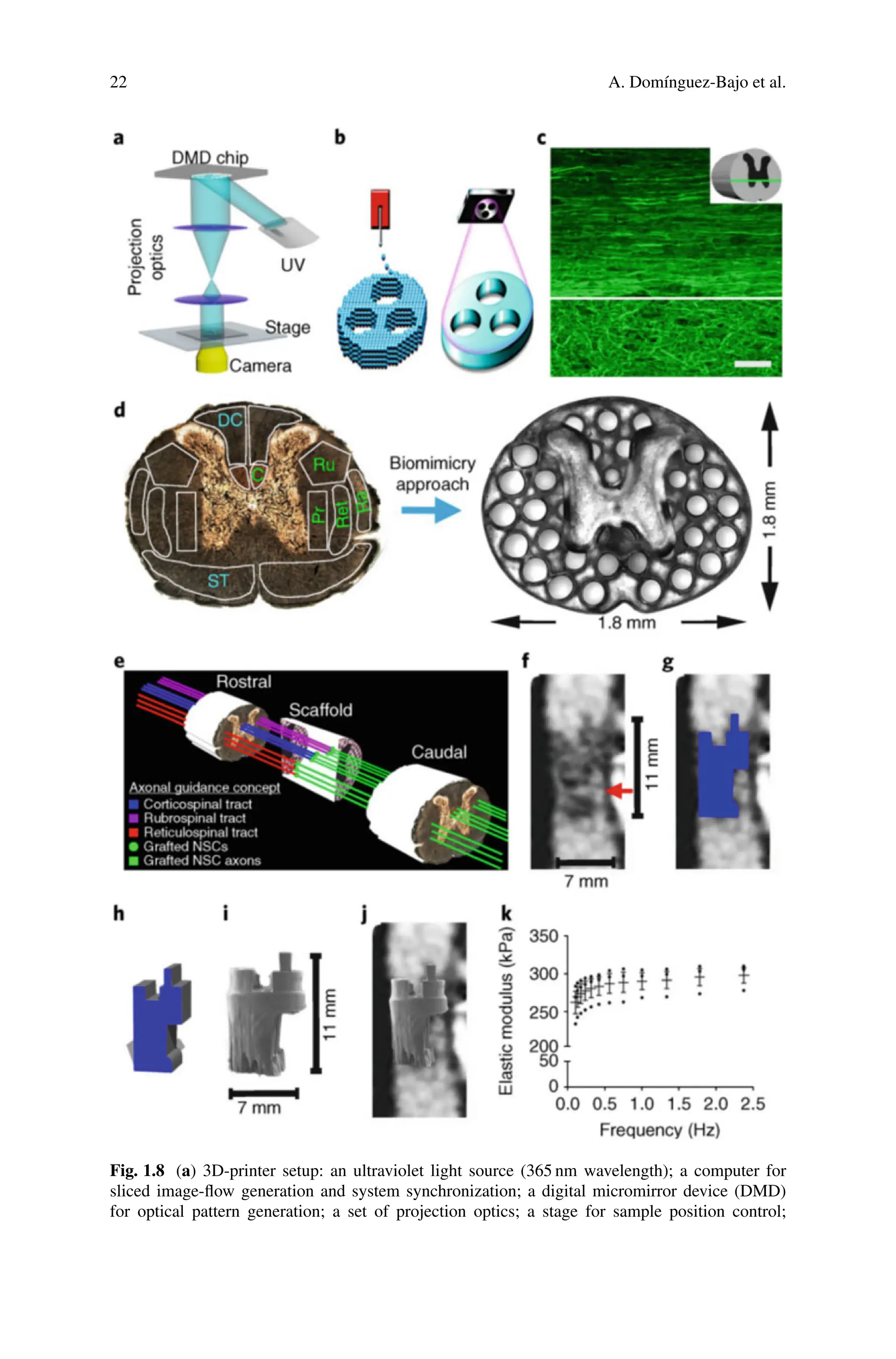
![1 General Aspects of Traumatic Neural Diseases and Biomaterials 23
injury model, the combination of BDNF release and guidance conduits enabled
neurite outgrowth in an organized, anisotropic manner [119].
At the microscale, architecture parameters governing the movement of cells and
the diffusion of molecules (from large proteins such as growth factors to small
molecules such as oxygen) become critical. Specifically, implantable biomaterials
for neural regeneration must be able to serve as supportive and guidance structures
that allow cell and ECM protein infiltration, as well as exchange of nutrients
and waste products. In hydrogels, size at the microscale is defined by the mesh
size, known as the distance between crosslinking points typically measured in
angstroms (Å). Diffusion mechanisms are then significantly affected by the mesh
size and, on its turn, largely influence degradation of the biomaterial. Once initiated,
degradation will also start controlling diffusion of cells and molecules inside the
biomaterial.
Fig. 1.8 (continued) and a CCD (charge-coupled device) imaging system for on-line monitoring
of the fabrication process. (b) μCPP layerless 3D printing creates structures without discrete layers.
In extrusion-based 3D-printing approaches (left), as the stage moves in the z axis and material is
extruded, layers are created between the drops. μCPP printing (right) creates a structure with one
continuous layer. (c) Heavy chain neurofilament (NF200) labelling of axons in intact T3 rat spinal
cord. Rostral is to the left, and caudal is to the right of the image. The axons in the white matter (top
of the panel) are highly organized into parallel arrays travelling from rostral to caudal. The axons
in the grey matter (bottom of the panel) are not linear. The white line demarcates the interface
between the white and grey matter. The inset schematic diagram indicates the orientation of the
horizontal section. (d) Axonal projections in the spinal cord are linearly organized into regions
(fascicles) containing axons of related function. Motor systems are shown in green and sensory
systems are shown in blue. C, corticospinal tract; Ru, rubrospinal tract; Ra, raphespinal tract; Ret,
reticulospinal tract; Pr, proprio-spinal tract; ST, spinothalamic tract; DC, dorsal column sensory
axons. The scaffold mimics the linear organization of white matter. Channels are precisely printed
in 3D space. (e) A schematic diagram explaining the axonal alignment and guidance hypothesis.
A lesioned host axon (for example, a corticospinal tract (CST), rubrospinal or reticulospinal axon)
regenerates into the scaffold and forms a synapse onto a NPC-derived axon inside a channel, and
the NPC neuron in turn extends an axon out of the scaffold below the injury site (green lines) into
the same white matter fasciculus below the lesion, guided by a linear microchannel. The scaffold
maintains its 3D coordinates across the lesion, matching the natural host architecture. (f) A sagittal
mid-cervical T1-weighted magnetic resonance image of a human clinically complete AIS A SCI.
A sliver of spared host white matter is evident on the anterior aspect (right side) of the lesion
(arrow). The size of the lesion is noted next to the image. (g) The traced outline of the cystic
lesion cavity from (f). (h) A computer-aided design (CAD) 3D model of the scaffold to be 3D-
printed, corresponding to the precise lesion shape. (i) The printed scaffold matches the size shown
in (f). (j) A hypothetical fit of the printed 3D scaffold in a human contusion cavity. (k) Mechanical
measurement of the scaffold elastic modulus using dynamic mechanical analysis (n = 3). The data
presented are mean ± standard error of the mean. Scale bar: 50 µm (c). Reprinted by permission
from Springer Nature Customer Service Centre GmbH: Springer Nature, Nature Medicine [75],
Copyright© (2019)](https://image.slidesharecdn.com/21155565-250518164236-51ba2d21/75/Engineering-Biomaterials-For-Neural-Applications-Elisa-Lpezdolado-50-2048.jpg)
![24 A. Domínguez-Bajo et al.
1.4.4 Biodegradability
Among optional characteristics of implantable biomaterials and interfaces for neural
regeneration, biodegradability can be cited as one of special interest. For those
particular applications that mainly rely on tissue reparative features, the temporal
presence of the biomaterial might be sufficient and, moreover, desirable as chronic
implants could drive to secondary fibrotic responses due to suboptimal physico-
chemical properties. Ideal biomaterial degradation profiles in vivo would be those
matching the kinetics of the tissue repair induced so, by the end of the regeneration
process, the biomaterial is no longer there. On their turn, biomaterials serving to
diagnostic purposes are typically required only for a concrete period of time, so
superior stability over time rather than biodegradability might be aimed instead.
This feature is closely related to biocompatibility, as biodegradable biomaterials are
obligated to assure that degradation by-products are also biocompatible. For further
details on this requirement, please refer to previous sections.
To this regard, biodegradable polymers and hydrogels are particularly attractive
as they typically contain liable bonds that can be cleaved and result in smaller
chemical groups able to be cleared from the implant site. For instance, degradation
can occur through the hydrolytic and enzymatic cleavage of bonds made during
polymerization, the incorporation of degradable monomeric units with bonds
cleaved by water and the spontaneous hydrolysis of ester bonds [76]. Hydrogels
can be customized with enzyme specific cleavage sites for driving degradation by
tissue specific enzymes.
In general terms, degradation can mainly occur via surface or bulk erosion [120,
121], being the process dependent on the amount of degradable units, crosslinking
degree and access of water and/or enzymes to the inner degradable parts of the
biomaterial, among other factors. Typically, surface degradation occurs when water
and enzymes cannot penetrate the interior areas, thus forcing the surface or exterior
bonds to cleave first. Conversely, bulk erosion is characterized by degradation that
occurs homogeneously throughout the biomaterial, with interior and exterior bonds
being cleaved simultaneously. Hydrogels predominantly experience bulk erosion
due to their higher water content and fast diffusion of liquids.
1.4.5 Electrical Activity
In the recent decades, electrical conductivity and activity have been identified as
eventual pivotal features of interest for implantable technologies in neural tissues
based on their inherent electrical activity. Signalling in the CNS relies on the ability
of nerve cells to respond to very small stimuli with rapid and large changes in
the electrical potential difference across the cell membrane [122]. Importantly, this
rapid signalling depends on ion channels, a class of integral membrane proteins opti-
mally tuned to respond to physical and chemical signals. They recognize and select](https://image.slidesharecdn.com/21155565-250518164236-51ba2d21/75/Engineering-Biomaterials-For-Neural-Applications-Elisa-Lpezdolado-51-2048.jpg)
![1 General Aspects of Traumatic Neural Diseases and Biomaterials 25
specific ions, open and close in response to specific electrical, mechanical and chem-
ical signals, and conduct ions across the cell membrane. Ion transporters/pumps,
although also present in nerve cells, do not participate in rapid signalling but in
the establishment and maintenance of concentration gradients of physiologically
relevant ions. Today, we know that information is carried within neurons and from
neurons to their target cells by means of electrical and chemical signals. This
information can travel long distances by the generation and propagation of action
potentials, arising from sequential changes in the membrane permeability to K+ and
Na+ ions and for which voltage-gated ion channels play a relevant role.
Progress in the understanding of the electrical functioning of the CNS has
permitted the exploration of electrical stimulation (ES) as a promising therapy
for SCI patients [123], being extensively used as a therapy to relapse cardiac
arrhythmias or seizures, to alleviate pain and to improve strength of paralysed
muscles. The application of ES by means of conductive materials to promote and/or
facilitate neural regeneration continues to be a rarely explored, and hardly under-
stood, therapy for neural repair, especially in the injured spinal cord. Approaches
involving the use of this type of materials are being the focus of a significant
amount of publications [124–126], although in most of the cases the therapy
is exclusively explored in vitro. For instance, the application of a potential of
100 mV mm−1 for 2 h induced neural differentiation in PC-12 cells cultured on
biodegradable citrate-based polymers doped with aniline tetramers to gain electrical
conductivity [127]. In a different work, Casañ-Pastor and colleagues explored a
palette of diverse materials including poly(3,4-ethylenedioxythiophene) (PEDOT)
and iridium-titanium oxide for promoting nerve growth in amphibian neurons [128].
Specifically, neurites on substrates containing iridium oxide grew faster and in
random directions. ITO substrates, with and without PCL/PLGA, were also able to
promote neuronal differentiation and neurite growth in neural stem/progenitor cells
under ES (80 mV) [129]. More recently, Blesch and colleagues have proved that
ES has a time-dependent influence on the regenerative capacity of sensory neurons
and might enhance axonal regeneration in combinatorial approaches for SCI [130].
Specifically, in vivo ES protocols (20 Hz, 2× motor threshold, 0.2 ms, 1 h) applied
on the intact sciatic nerve in adult rats induced a 2-fold increase in neurite length of
sensory neurons in vitro 1 week later. Longer (7 h) and repeated (7 days, 1 h/each)
ES protocols increased growth by 56–67% at 7 days. A deeper discussion on the
application of electric fields to conductive materials and neural cultures and eventual
harmful events (e.g. faradaic reactions) is covered in Chap. 5.
1.4.6 Processability and Surgical Requirements
Those biomaterials and interfaces envisioned to be implanted in the brain and the
spinal cord for clinical use should be easily processed in a scalable, reproducible
and cost-effective manner, so the resulting therapy becomes available for a majority,
if not the totality, of the affected population in a short period of time. Moreover,](https://image.slidesharecdn.com/21155565-250518164236-51ba2d21/75/Engineering-Biomaterials-For-Neural-Applications-Elisa-Lpezdolado-52-2048.jpg)
![26 A. Domínguez-Bajo et al.
surgical needs must be also taken into consideration, including the capacity to
fabricate the engineered material in a diversity of sizes and shapes to accommodate
individual patient needs. If suturing is needed, biomaterials have to sustain it without
breaking or tearing. However, given the softness of neural tissues, the use of sutures
might be rarely needed for their CNS implantation. Finally, these neurotechnologies
should be stable during storage at adequate conditions before implantation and
easily handable at the surgery room by clinicians and healthcare personnel.
1.4.7 Other Particular Requirements for Functioning
Besides general characteristics described above, certain biomaterials for neural
applications might have additional requirements related to their functioning and per-
formance. For instance, implantable neuroelectrodes should include communication
with as many individual neurons as possible and a high degree of signal-to-noise
ratio for either short (days and months) or chronic (years) implantation times [126].
On their turn, biomaterials envisioned for drug delivery should be able to sustain
a therapeutic drug release according to the physiopathology phases of traumatic
neural tissue damage.
1.5 Final Considerations
In this chapter, we have presented an overview of the CNS, major physio-
pathological features of traumatic brain and spinal cord injuries and a general
description of engineered materials for neural applications, both biomaterials and
interfaces in the context of their specific biological target. Major requirements for
implantable biomaterials aimed at neural regeneration are also summarized, from
mandatory biocompatibility and mechanical compliance to optional biodegradation
and electrical conductivity. The aspects covered by this introductory chapter are
thought to assist the reader on the understanding of more specific topics enclosed
in the following chapters. In what follows, diverse current subjects related to
this main axis will be described and discussed, from biomaterials and conductive
nanomaterials to sensors and robotic-based rehabilitation strategies for TBI and SCI.
An exposition of current neuro-engineered technologies applied to date in the clinics
will be finally provided.
Acknowledgements This work was funded by the Agencia Estatal de Investigación de España
and the Fondo Europeo de Desarrollo Regional (Grant MAT2016-78857-R, AEI/FEDER, UE).](https://image.slidesharecdn.com/21155565-250518164236-51ba2d21/75/Engineering-Biomaterials-For-Neural-Applications-Elisa-Lpezdolado-53-2048.jpg)