Endocrinal system
Endocrinal system
Word Hormone is derived from a Greek word
“hormaein” which means
“hormaein” which means to execute or to
to execute or to
arouse.
arouse.
Term introduced by
Term introduced by Starling
Starling in 1905.
in 1905.
To define hormones are secretory
products of the ductless glands, which are
released in catalytic amounts into blood stream
and transported to specific target organs where
they elicit physiologic, morphologic and
biological responses.
Different type of hormones are:
a)
a) Endocrine hormones:
Endocrine hormones:
These include the chemical
messengers whose functions is the
transmission of a molecular signal from a
endocrinal organ through a blood stream
to a distant target organ.
b) Neurocrine hormones :
It involves the release of
chemical messengers from nerve terminals,
which may reach their target cells via one of the
three routes
three routes
1) neurotransmitters release directly into
intercellular space cross the synaptic junction,
and act on postsynaptic cell eg; Ach.
2) Neural signals can be transferred via gap
junctions.
junctions.
3) Neurohormones released from
neurosecretory neuron into blood stream
and then carried to distant target cells.
eg; ADH, Oxytocin.
eg; ADH, Oxytocin.
c) Paracrine hormones
These are chemical messengers which
after getting secreted by a cell are carried
over short distance by diffusion through
interstitial spaces to act on the
neighbouring cells. Eg; somatostatin
secreted by delta cells in islets of
langerhans acts on alpha and beta cells.
4) Autocrine hormones
These refer to those chemical
messengers which are secreted by
specific cells into extracellular fluid
surrounding the cell and which acts upon
very cells that secrete it. Eg; NE secreted
by Adrenal medulla inhibits NE release by
those cells.
those cells.
Classification of hormones
4 general classes;
4 general classes;
1)
1) Proteins and polypeptides
Proteins and polypeptides
Mnemonic- 4P
Mnemonic- 4P
(Ant pit , post pit , pancreas, parathyroid)
eg;
eg; hormones of ant. Pituitary,
hormones of ant. Pituitary, ADH,
ADH,
Oxytocin, insulin, glucagon, PTH
2)
2) Steroids
Steroids
eg; hormones of adrenal cortex (Cortisol
and aldosterone), ovaries(estrogen ,
progesterone), testes( testosterone) and
placenta( estrogen , progesterone).
3) Derivatives of amino acids
eg; hormones of adrenal medulla( epi, NE)
and thyroid.
and thyroid.
4) Fatty acid derivatives- Eicosanoids
Includes:
Includes:
Prostaglandins, prostacyclin, thromboxane
Leukotrines
Leukotrines
Synthesis, storage and release of hormones
1)
1) Amines or Amino acid derivatives
Amines or Amino acid derivatives
a)
a) Synthesis
Synthesis- synthesized in the cell cytoplasm.
- synthesized in the cell cytoplasm.
b)
b) Storage and release
Storage and release –
–
-Catecholamines are stored in secretory
granules, secretion occurs when granules fuse
with the plasma membrane, causing extrusion
of contents in the circulation.
- Thyroid hormones are stored outside the
follicular cells in the form of thyroglobulin.
Secreted in blood by simple diffusion.
- Vit D is stored as a precursor in the skin.
2) Proteins and polypeptides hormones
a) Synthesis-
a) Synthesis-
In the ER of glandular cells.
b
b) Storage and release-
) Storage and release-
Stored in subcellular membrane bound
secretory granules within cytoplasm of
endocrine cell.
endocrine cell.
Released in blood by exocytosis.
3) Steroid hormones
3) Steroid hormones
a) Synthesis-
a) Synthesis-
Synthesized from cholesterol.
Rate limiting step - transport of free
cholesterol from cytoplasm to mitochondria
b) Storage and release-
little storage, Secreted in blood by
simple diffusion.
simple diffusion.
Hormone secretion, Transport and
clearance from the blood
-Some hormones are secreted within
sec after stimulation of the glands, and
their action takes sec. to min. Eg; epi and
NE.
NE.
- some hormones like thyroxine, GH
require months for full effect.
Regulation of hormone
secretion
secretion
 Feed back mechanism- most common
Feed back mechanism- most common
 Neural mechanism
Neural mechanism
 Rhythmic or chronotropic mechanism
Rhythmic or chronotropic mechanism
 Humoral mechanism
Humoral mechanism
Feedback control of hormone secretion
a) Positive feedback
b) Negative feedback
a) Positive feedback
it is less common. It acts to amplify
initial biological effect of hormones.
Eg; LH surge which occurs d/t stimulatory
effect of estrogen on ant. Pituitary before
ovulation. Secreted LH then acts on
ovaries to stimulate secretion of estrogen,
which in turn causes more secretion of LH.
b) Negative feedback-
The influence of blood conc. of
the hormone concerned or its effect is to
inhibit further secretion of the hormones
and is called negative feedback.
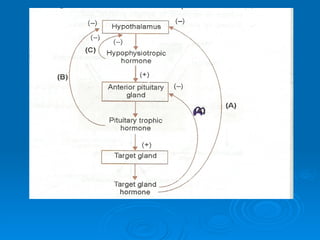
The target organ hormones act either
on the ant. Pit. or on the hypothalamus,
usually by negative feedback control,
which occurs at three levels;
1)
1) Long loop feedback
Long loop feedback
2)
2) Short loop feedback
Short loop feedback
3)
3) Ultra short loop feedback
Ultra short loop feedback
1)
1) Long loop feedback
Long loop feedback
The peripheral gland
hormone eg; thyroid, adrenocortical and
gonads can exert Long loop feedback on
both the hypothalamus and ant. Lobe of
pit. It is usually negative occasionally can
be positive.
be positive.
2) Short loop feedback
The pituitary trophic
hormones decrease the secretion of
hypophysiotropic hormones eg; GHRH,
GHIH, TRH, CRH and GnRH.
3) Ultrashort loop feedback
The hypophysiotropic hormones
may inhibit their own synthesis and
secretion via Ultrashort loop feedback
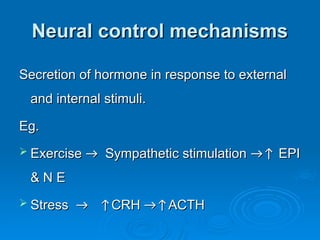
Neural control mechanisms
Secretion of hormone in response to external
and internal stimuli.
Eg.
Eg.
 Exercise
Exercise →
→ Sympathetic stimulation
Sympathetic stimulation →↑
→↑ EPI
EPI
& N E
& N E
 Stress
Stress →
→ ↑
↑CRH
CRH →↑
→↑ACTH
ACTH
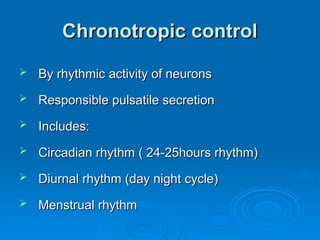
Chronotropic control
 By rhythmic activity of neurons
By rhythmic activity of neurons
 Responsible pulsatile secretion
Responsible pulsatile secretion
 Includes:
Includes:
 Circadian rhythm ( 24-25hours rhythm)
Circadian rhythm ( 24-25hours rhythm)
 Diurnal rhythm (day night cycle)
Diurnal rhythm (day night cycle)
 Menstrual rhythm
Menstrual rhythm
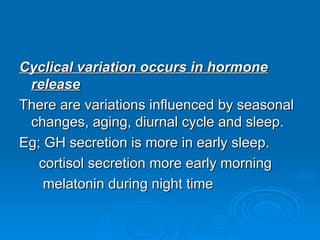
Cyclical variation occurs in hormone
release
release
There are variations influenced by seasonal
changes, aging, diurnal cycle and sleep.
Eg; GH secretion is more in early sleep.
cortisol secretion more early morning
melatonin during night time
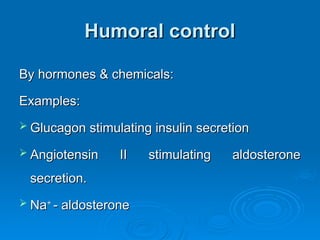
Humoral control
Humoral control
By hormones & chemicals:
Examples:
Examples:
 Glucagon stimulating insulin secretion
Glucagon stimulating insulin secretion
 Angiotensin II stimulating aldosterone
Angiotensin II stimulating aldosterone
secretion.
secretion.
 Na
Na+
+
- aldosterone
- aldosterone
“
“Clearance” of hormones from the blood
Clearance” of hormones from the blood
Metabolic clearance rate refers to
the sum of all the removal processes, ie
target cell uptake and degradation,
metabolic degradation and urinary or
biliary excretion.
biliary excretion.
MCR=Rate of disappearance of hormone
from the plasma/ Conc. of hormone in
each ml of plasma.
each ml of plasma.
Hormone; Receptors and mechanism of
actions
actions
Characterstics of hormone receptors
a)
a) Receptor specifity
Receptor specifity
b)
b) Receptor location ;
Receptor location ;
1) internal receptors:
In the cytoplasm – steroid hormones
In the cell nucleus – thyroid
hormones
hormones
2) external receptors; located in or on
plasma membrane of target cells. Eg;
protein , peptides and catecholamines
c)
c) Receptor number-
Receptor number- It may vary. It is
It may vary. It is
regulated by two mechanisms
1)
1) Down regulation
Down regulation: it refers to
: it refers to
decrease in number of active receptors. It
occurs to regulate hormone sensitivity
when it is present in excess.
it may occur as a result of –
a) inactivation of some receptors
b) inactivation of some of the intracellular
protein signaling molecules
c) Temporary sequestration of receptor to
inside of cell
inside of cell
d) Destruction of receptors by lysozymes
after internalization
e) Decreased production of receptors
2) Upregulation :
2) Upregulation : it refers to increase in number
it refers to increase in number
of active receptors on a cell.
APPLIED –
APPLIED –
In Type 2 diabetes increase in blood sugar
level leads to increase conc of insulin leading
to down regulation of INSULIN receptors on
liver cells, increasing subject’s resistance by
decreasing sensitivity to this hormone.
Upregulation takes place after exercise.
Classification of receptors
A.
A. Cell membrane receptors
Cell membrane receptors
B.
B. Intracellular receptors
Intracellular receptors
Cell membrane receptors
 Ion channel linked receptors
Ion channel linked receptors
 G-protein coupled receptors
G-protein coupled receptors
 Receptor with tyrosine kinase
Receptor with tyrosine kinase
 Receptors linked with tyrosine kinase
Receptors linked with tyrosine kinase
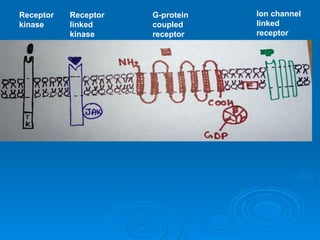
Receptor
kinase
Receptor
linked
kinase
G-protein
coupled
receptor
Ion channel
linked
receptor
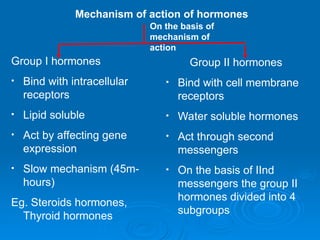
Mechanism of action of hormones
Group I hormones
• Bind with intracellular
receptors
• Lipid soluble
• Act by affecting gene
expression
• Slow mechanism (45m-
hours)
Eg. Steroids hormones,
Thyroid hormones
Group II hormones
• Bind with cell membrane
receptors
• Water soluble hormones
• Act through second
messengers
• On the basis of IInd
messengers the group II
hormones divided into 4
subgroups
On the basis of
mechanism of
action
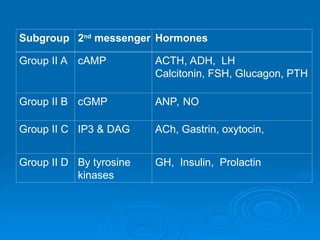
Subgroup 2nd
messenger Hormones
Group II A cAMP ACTH, ADH, LH
Calcitonin, FSH, Glucagon, PTH
Group II B cGMP ANP, NO
Group II C IP3 & DAG ACh, Gastrin, oxytocin,
Group II D By tyrosine
kinases
GH, Insulin, Prolactin
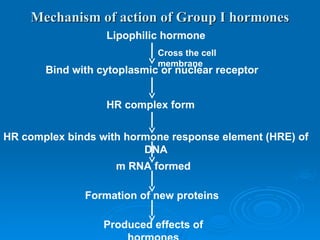
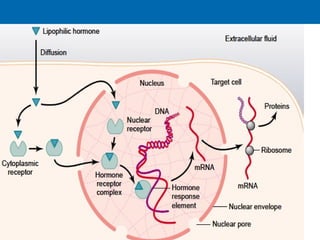
Mechanism of action of Group I hormones
Lipophilic hormone
Bind with cytoplasmic or nuclear receptor
Cross the cell
membrane
HR complex form
HR complex binds with hormone response element (HRE) of
DNA
m RNA formed
Formation of new proteins
Produced effects of
HORMONES acting through gene expression
by binding of hormone with intracellular
receptors -
receptors -
eg - steroid hormones
They increase protein synthesis.
eg ; hormones of testes, ovaries, adrenal
cortex.
cortex.
These proteins then function as enzymes,
transport proteins, or structural proteins, which
in turn provide other functions of the cells.
Mechanism of action of group II hormones
 Hormones are I messenger
Hormones are I messenger
 Effects by second messengers
Effects by second messengers
 Mostly involve activation G protein
Mostly involve activation G protein
Intracellular signaling after hormone receptor
activation
activation
Hormone bind to receptors to form
Hormone- receptor complex. This activates the
receptors and initiates hormone effect.
1)
1) Ion channel-linked receptors
Ion channel-linked receptors
These receptors open or close for particular
ions. Few hormones exert their action through
these Ion channel-linked receptors.
these Ion channel-linked receptors. Eg – NE,
Eg – NE,
ACh
ACh
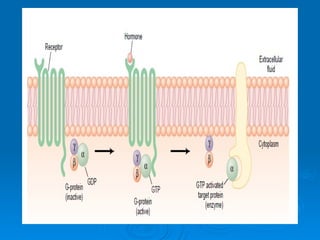
2) G protein linked hormone receptors
Many hormones activate receptors that
indirectly regulate the activity of target
proteins by coupling with heterotrimeric
GTP- binding proteins (G proteins)
G proteins have 3 subunits namely
G proteins have 3 subunits namely α
α,
,β
β,
,γ
γ.
.
MOA
MOA- Hormone bind to receptors that are
- Hormone bind to receptors that are
coupled with G protein leading to conformational
change in receptor.
change in receptor.
- GDP is exchanged for GTP.
-
- α
α subunit dissociate from the complex, and
subunit dissociate from the complex, and
associate with other intracellular signaling
proteins.
proteins.
- These proteins than alter the activity of ion
channels or intracellular enzymes, which alters
cell function.
cell function.
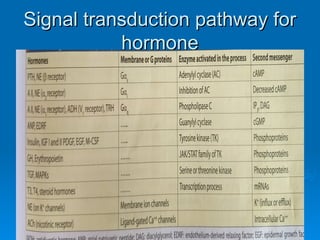
Signal transduction pathway for
hormone
hormone
Second messenger mechanisms for
mediating intracellular Hormonal functions
second messanger systems that are
activated through coupling of hormone-receptor
complexes by G-protein include;
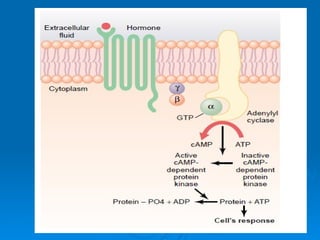
1) Adenylyl cyclase-cAMP System
2) Guanyl cyclase-cGMP System
3) calcium - calmodulin system
4) membrane phospholipase- phospholipid
system
system
Adenylyl cyclase- cAMP second
messenger system.
messenger system.
Eg of few hormones acting through this
system are ;
system are ;
ACTH, CRH, FSH, TSH, PTH, LH,
VASOPRESSIN (V
VASOPRESSIN (V2
2 receptors) etc.
receptors) etc.
Guanyl cyclase-cGMP System-
hormones acting through this system
are nitric oxide and ANP.
Guanylate cyclase produces cGMP from
GTP.
GTP.
cGMP exert its response through protein
kinase G, Which when activated initiates
cascade of enzyme activation leading to
subsequent signaling.
membrane phospholipase-
phospholipid system
phospholipid system
Eg of few hormones acting through this
system are ;
system are ;
GHRH, TRH, OXYTOCIN,
VASOPRESSIN (V
VASOPRESSIN (V1
1receptors), GnRH
receptors), GnRH
- Hormone bind to receptor in the plasma
Hormone bind to receptor in the plasma
membrane
membrane
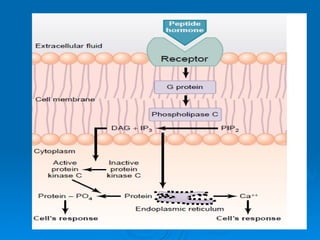
- Hormone-receptor complex via G protein
Hormone-receptor complex via G protein
activates membrane enzyme
phospholipase C.
phospholipase C.
- Activated phospholipase C releases
Activated phospholipase C releases
diacylglycerol(DAG) and inositol
triphosphate(IP
triphosphate(IP3
3)
)
- IP
IP3
3 mobilizes calcium from endoplasmic
mobilizes calcium from endoplasmic
reticulum
reticulum
- Calcium and DAG together activate
protein kinase C
protein kinase C
Activated protein kinase C phosphorylates
proteins and cause specific physiological
action.
action.
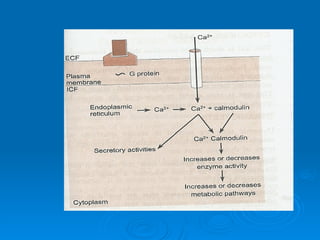
Calcium-Calmodulin second messenger
system
system
-Hormone interact with membrane receptors
and opens calcium channels.
- calcium binds with protein calmodulin which
has 4 binding site for calcium.
- calcium binds to 3 sites, calmodulin changes
its shape and causes activation or inhibition of
protein kinases leading to activation or inhibition
of proteins.
of proteins.
3)
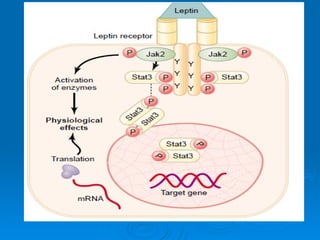
3) Enzyme- linked hormone receptors
Enzyme- linked hormone receptors
Some receptors, when activated act
directly as enzymes or are closely
associated with enzymes that they activate.
These receptors have hormone binding site
on the outside of the membrane and
enzyme binding site inside. Eg; Leptin
receptor, GROWTH hormone etc.
JAK = Janus tyrosine kinases
STAT= signal transducer and activator of
transcription
transcription
Measurements of Hormone conc. in
blood
blood
1) Radioimmunoassay ( RIA )
2) Enzyme-linked immunosorbent
Assay ( ELISA )
Assay ( ELISA )

Endocrinal system -2025. Endocrinal system -2025. Endocrinal system -2025.Endocrinal system -2025. Endocrinal system -2025.

  • 1.
  • 2.
    Word Hormone isderived from a Greek word Word Hormone is derived from a Greek word “hormaein” which means “hormaein” which means to execute or to to execute or to arouse. arouse. Term introduced by Term introduced by Starling Starling in 1905. in 1905. To define hormones are secretory To define hormones are secretory products of the ductless glands, which are products of the ductless glands, which are released in catalytic amounts into blood stream released in catalytic amounts into blood stream and transported to specific target organs where and transported to specific target organs where they elicit physiologic, morphologic and they elicit physiologic, morphologic and biological responses. biological responses.
  • 3.
    Different type ofhormones are: Different type of hormones are: a) a) Endocrine hormones: Endocrine hormones: These include the chemical These include the chemical messengers whose functions is the messengers whose functions is the transmission of a molecular signal from a transmission of a molecular signal from a endocrinal organ through a blood stream endocrinal organ through a blood stream to a distant target organ. to a distant target organ.
  • 4.
    b) Neurocrine hormones: b) Neurocrine hormones : It involves the release of It involves the release of chemical messengers from nerve terminals, chemical messengers from nerve terminals, which may reach their target cells via one of the which may reach their target cells via one of the three routes three routes 1) neurotransmitters release directly into 1) neurotransmitters release directly into intercellular space cross the synaptic junction, intercellular space cross the synaptic junction, and act on postsynaptic cell eg; Ach. and act on postsynaptic cell eg; Ach.
  • 5.
    2) Neural signalscan be transferred via gap 2) Neural signals can be transferred via gap junctions. junctions. 3) Neurohormones released from 3) Neurohormones released from neurosecretory neuron into blood stream neurosecretory neuron into blood stream and then carried to distant target cells. and then carried to distant target cells. eg; ADH, Oxytocin. eg; ADH, Oxytocin.
  • 6.
    c) Paracrine hormones c)Paracrine hormones These are chemical messengers which These are chemical messengers which after getting secreted by a cell are carried after getting secreted by a cell are carried over short distance by diffusion through over short distance by diffusion through interstitial spaces to act on the interstitial spaces to act on the neighbouring cells. Eg; somatostatin neighbouring cells. Eg; somatostatin secreted by delta cells in islets of secreted by delta cells in islets of langerhans acts on alpha and beta cells. langerhans acts on alpha and beta cells.
  • 7.
    4) Autocrine hormones 4)Autocrine hormones These refer to those chemical These refer to those chemical messengers which are secreted by messengers which are secreted by specific cells into extracellular fluid specific cells into extracellular fluid surrounding the cell and which acts upon surrounding the cell and which acts upon very cells that secrete it. Eg; NE secreted very cells that secrete it. Eg; NE secreted by Adrenal medulla inhibits NE release by by Adrenal medulla inhibits NE release by those cells. those cells.
  • 9.
    Classification of hormones Classificationof hormones 4 general classes; 4 general classes; 1) 1) Proteins and polypeptides Proteins and polypeptides Mnemonic- 4P Mnemonic- 4P (Ant pit , post pit , pancreas, parathyroid) (Ant pit , post pit , pancreas, parathyroid) eg; eg; hormones of ant. Pituitary, hormones of ant. Pituitary, ADH, ADH, Oxytocin, insulin, glucagon, PTH Oxytocin, insulin, glucagon, PTH
  • 10.
    2) 2) Steroids Steroids eg; hormonesof adrenal cortex (Cortisol eg; hormones of adrenal cortex (Cortisol and aldosterone), ovaries(estrogen , and aldosterone), ovaries(estrogen , progesterone), testes( testosterone) and progesterone), testes( testosterone) and placenta( estrogen , progesterone). placenta( estrogen , progesterone).
  • 11.
    3) Derivatives ofamino acids 3) Derivatives of amino acids eg; hormones of adrenal medulla( epi, NE) eg; hormones of adrenal medulla( epi, NE) and thyroid. and thyroid. 4) Fatty acid derivatives- Eicosanoids 4) Fatty acid derivatives- Eicosanoids Includes: Includes: Prostaglandins, prostacyclin, thromboxane Prostaglandins, prostacyclin, thromboxane Leukotrines Leukotrines
  • 12.
    Synthesis, storage andrelease of hormones Synthesis, storage and release of hormones 1) 1) Amines or Amino acid derivatives Amines or Amino acid derivatives a) a) Synthesis Synthesis- synthesized in the cell cytoplasm. - synthesized in the cell cytoplasm. b) b) Storage and release Storage and release – – -Catecholamines are stored in secretory -Catecholamines are stored in secretory granules, secretion occurs when granules fuse granules, secretion occurs when granules fuse with the plasma membrane, causing extrusion with the plasma membrane, causing extrusion of contents in the circulation. of contents in the circulation.
  • 13.
    - Thyroid hormonesare stored outside the - Thyroid hormones are stored outside the follicular cells in the form of thyroglobulin. follicular cells in the form of thyroglobulin. Secreted in blood by simple diffusion. Secreted in blood by simple diffusion. - Vit D is stored as a precursor in the skin. - Vit D is stored as a precursor in the skin.
  • 14.
    2) Proteins andpolypeptides hormones 2) Proteins and polypeptides hormones a) Synthesis- a) Synthesis- In the ER of glandular cells. In the ER of glandular cells. b b) Storage and release- ) Storage and release- Stored in subcellular membrane bound Stored in subcellular membrane bound secretory granules within cytoplasm of secretory granules within cytoplasm of endocrine cell. endocrine cell. Released in blood by exocytosis. Released in blood by exocytosis.
  • 15.
    3) Steroid hormones 3)Steroid hormones a) Synthesis- a) Synthesis- Synthesized from cholesterol. Synthesized from cholesterol. Rate limiting step - transport of free Rate limiting step - transport of free cholesterol from cytoplasm to mitochondria cholesterol from cytoplasm to mitochondria b) Storage and release- b) Storage and release- little storage, Secreted in blood by little storage, Secreted in blood by simple diffusion. simple diffusion.
  • 16.
    Hormone secretion, Transportand Hormone secretion, Transport and clearance from the blood clearance from the blood -Some hormones are secreted within -Some hormones are secreted within sec after stimulation of the glands, and sec after stimulation of the glands, and their action takes sec. to min. Eg; epi and their action takes sec. to min. Eg; epi and NE. NE. - some hormones like thyroxine, GH - some hormones like thyroxine, GH require months for full effect. require months for full effect.
  • 17.
    Regulation of hormone Regulationof hormone secretion secretion  Feed back mechanism- most common Feed back mechanism- most common  Neural mechanism Neural mechanism  Rhythmic or chronotropic mechanism Rhythmic or chronotropic mechanism  Humoral mechanism Humoral mechanism
  • 18.
    Feedback control ofhormone secretion Feedback control of hormone secretion a) Positive feedback a) Positive feedback b) Negative feedback b) Negative feedback
  • 19.
    a) Positive feedback a)Positive feedback it is less common. It acts to amplify it is less common. It acts to amplify initial biological effect of hormones. initial biological effect of hormones. Eg; LH surge which occurs d/t stimulatory Eg; LH surge which occurs d/t stimulatory effect of estrogen on ant. Pituitary before effect of estrogen on ant. Pituitary before ovulation. Secreted LH then acts on ovulation. Secreted LH then acts on ovaries to stimulate secretion of estrogen, ovaries to stimulate secretion of estrogen, which in turn causes more secretion of LH. which in turn causes more secretion of LH.
  • 20.
    b) Negative feedback- b)Negative feedback- The influence of blood conc. of The influence of blood conc. of the hormone concerned or its effect is to the hormone concerned or its effect is to inhibit further secretion of the hormones inhibit further secretion of the hormones and is called negative feedback. and is called negative feedback.
  • 21.
    The target organhormones act either The target organ hormones act either on the ant. Pit. or on the hypothalamus, on the ant. Pit. or on the hypothalamus, usually by negative feedback control, usually by negative feedback control, which occurs at three levels; which occurs at three levels; 1) 1) Long loop feedback Long loop feedback 2) 2) Short loop feedback Short loop feedback 3) 3) Ultra short loop feedback Ultra short loop feedback
  • 22.
    1) 1) Long loopfeedback Long loop feedback The peripheral gland The peripheral gland hormone eg; thyroid, adrenocortical and hormone eg; thyroid, adrenocortical and gonads can exert Long loop feedback on gonads can exert Long loop feedback on both the hypothalamus and ant. Lobe of both the hypothalamus and ant. Lobe of pit. It is usually negative occasionally can pit. It is usually negative occasionally can be positive. be positive.
  • 24.
    2) Short loopfeedback 2) Short loop feedback The pituitary trophic The pituitary trophic hormones decrease the secretion of hormones decrease the secretion of hypophysiotropic hormones eg; GHRH, hypophysiotropic hormones eg; GHRH, GHIH, TRH, CRH and GnRH. GHIH, TRH, CRH and GnRH.
  • 25.
    3) Ultrashort loopfeedback 3) Ultrashort loop feedback The hypophysiotropic hormones The hypophysiotropic hormones may inhibit their own synthesis and may inhibit their own synthesis and secretion via Ultrashort loop feedback secretion via Ultrashort loop feedback
  • 26.
    Neural control mechanisms Neuralcontrol mechanisms Secretion of hormone in response to external Secretion of hormone in response to external and internal stimuli. and internal stimuli. Eg. Eg.  Exercise Exercise → → Sympathetic stimulation Sympathetic stimulation →↑ →↑ EPI EPI & N E & N E  Stress Stress → → ↑ ↑CRH CRH →↑ →↑ACTH ACTH
  • 27.
    Chronotropic control Chronotropic control By rhythmic activity of neurons By rhythmic activity of neurons  Responsible pulsatile secretion Responsible pulsatile secretion  Includes: Includes:  Circadian rhythm ( 24-25hours rhythm) Circadian rhythm ( 24-25hours rhythm)  Diurnal rhythm (day night cycle) Diurnal rhythm (day night cycle)  Menstrual rhythm Menstrual rhythm
  • 28.
    Cyclical variation occursin hormone Cyclical variation occurs in hormone release release There are variations influenced by seasonal There are variations influenced by seasonal changes, aging, diurnal cycle and sleep. changes, aging, diurnal cycle and sleep. Eg; GH secretion is more in early sleep. Eg; GH secretion is more in early sleep. cortisol secretion more early morning cortisol secretion more early morning melatonin during night time melatonin during night time
  • 29.
    Humoral control Humoral control Byhormones & chemicals: By hormones & chemicals: Examples: Examples:  Glucagon stimulating insulin secretion Glucagon stimulating insulin secretion  Angiotensin II stimulating aldosterone Angiotensin II stimulating aldosterone secretion. secretion.  Na Na+ + - aldosterone - aldosterone
  • 30.
    “ “Clearance” of hormonesfrom the blood Clearance” of hormones from the blood Metabolic clearance rate refers to Metabolic clearance rate refers to the sum of all the removal processes, ie the sum of all the removal processes, ie target cell uptake and degradation, target cell uptake and degradation, metabolic degradation and urinary or metabolic degradation and urinary or biliary excretion. biliary excretion. MCR=Rate of disappearance of hormone MCR=Rate of disappearance of hormone from the plasma/ Conc. of hormone in from the plasma/ Conc. of hormone in each ml of plasma. each ml of plasma.
  • 31.
    Hormone; Receptors andmechanism of Hormone; Receptors and mechanism of actions actions Characterstics of hormone receptors Characterstics of hormone receptors a) a) Receptor specifity Receptor specifity b) b) Receptor location ; Receptor location ; 1) internal receptors: 1) internal receptors: In the cytoplasm – steroid hormones In the cytoplasm – steroid hormones In the cell nucleus – thyroid In the cell nucleus – thyroid hormones hormones
  • 32.
    2) external receptors;located in or on 2) external receptors; located in or on plasma membrane of target cells. Eg; plasma membrane of target cells. Eg; protein , peptides and catecholamines protein , peptides and catecholamines c) c) Receptor number- Receptor number- It may vary. It is It may vary. It is regulated by two mechanisms regulated by two mechanisms 1) 1) Down regulation Down regulation: it refers to : it refers to decrease in number of active receptors. It decrease in number of active receptors. It occurs to regulate hormone sensitivity occurs to regulate hormone sensitivity when it is present in excess. when it is present in excess.
  • 33.
    it may occuras a result of – it may occur as a result of – a) inactivation of some receptors a) inactivation of some receptors b) inactivation of some of the intracellular b) inactivation of some of the intracellular protein signaling molecules protein signaling molecules c) Temporary sequestration of receptor to c) Temporary sequestration of receptor to inside of cell inside of cell d) Destruction of receptors by lysozymes d) Destruction of receptors by lysozymes after internalization after internalization e) Decreased production of receptors e) Decreased production of receptors
  • 34.
    2) Upregulation : 2)Upregulation : it refers to increase in number it refers to increase in number of active receptors on a cell. of active receptors on a cell. APPLIED – APPLIED – In Type 2 diabetes increase in blood sugar In Type 2 diabetes increase in blood sugar level leads to increase conc of insulin leading level leads to increase conc of insulin leading to down regulation of INSULIN receptors on to down regulation of INSULIN receptors on liver cells, increasing subject’s resistance by liver cells, increasing subject’s resistance by decreasing sensitivity to this hormone. decreasing sensitivity to this hormone. Upregulation takes place after exercise. Upregulation takes place after exercise.
  • 35.
    Classification of receptors Classificationof receptors A. A. Cell membrane receptors Cell membrane receptors B. B. Intracellular receptors Intracellular receptors
  • 36.
    Cell membrane receptors Cellmembrane receptors  Ion channel linked receptors Ion channel linked receptors  G-protein coupled receptors G-protein coupled receptors  Receptor with tyrosine kinase Receptor with tyrosine kinase  Receptors linked with tyrosine kinase Receptors linked with tyrosine kinase
  • 37.
  • 38.
    Mechanism of actionof hormones Group I hormones • Bind with intracellular receptors • Lipid soluble • Act by affecting gene expression • Slow mechanism (45m- hours) Eg. Steroids hormones, Thyroid hormones Group II hormones • Bind with cell membrane receptors • Water soluble hormones • Act through second messengers • On the basis of IInd messengers the group II hormones divided into 4 subgroups On the basis of mechanism of action
  • 39.
    Subgroup 2nd messenger Hormones GroupII A cAMP ACTH, ADH, LH Calcitonin, FSH, Glucagon, PTH Group II B cGMP ANP, NO Group II C IP3 & DAG ACh, Gastrin, oxytocin, Group II D By tyrosine kinases GH, Insulin, Prolactin
  • 40.
    Mechanism of actionof Group I hormones Mechanism of action of Group I hormones Lipophilic hormone Bind with cytoplasmic or nuclear receptor Cross the cell membrane HR complex form HR complex binds with hormone response element (HRE) of DNA m RNA formed Formation of new proteins Produced effects of
  • 41.
    HORMONES acting throughgene expression HORMONES acting through gene expression by binding of hormone with intracellular by binding of hormone with intracellular receptors - receptors - eg - steroid hormones eg - steroid hormones They increase protein synthesis. They increase protein synthesis. eg ; hormones of testes, ovaries, adrenal eg ; hormones of testes, ovaries, adrenal cortex. cortex. These proteins then function as enzymes, These proteins then function as enzymes, transport proteins, or structural proteins, which transport proteins, or structural proteins, which in turn provide other functions of the cells. in turn provide other functions of the cells.
  • 43.
    Mechanism of actionof group II hormones Mechanism of action of group II hormones  Hormones are I messenger Hormones are I messenger  Effects by second messengers Effects by second messengers  Mostly involve activation G protein Mostly involve activation G protein
  • 44.
    Intracellular signaling afterhormone receptor Intracellular signaling after hormone receptor activation activation Hormone bind to receptors to form Hormone bind to receptors to form Hormone- receptor complex. This activates the Hormone- receptor complex. This activates the receptors and initiates hormone effect. receptors and initiates hormone effect. 1) 1) Ion channel-linked receptors Ion channel-linked receptors These receptors open or close for particular These receptors open or close for particular ions. Few hormones exert their action through ions. Few hormones exert their action through these Ion channel-linked receptors. these Ion channel-linked receptors. Eg – NE, Eg – NE, ACh ACh
  • 45.
    2) G proteinlinked hormone receptors 2) G protein linked hormone receptors Many hormones activate receptors that Many hormones activate receptors that indirectly regulate the activity of target indirectly regulate the activity of target proteins by coupling with heterotrimeric proteins by coupling with heterotrimeric GTP- binding proteins (G proteins) GTP- binding proteins (G proteins) G proteins have 3 subunits namely G proteins have 3 subunits namely α α, ,β β, ,γ γ. .
  • 46.
    MOA MOA- Hormone bindto receptors that are - Hormone bind to receptors that are coupled with G protein leading to conformational coupled with G protein leading to conformational change in receptor. change in receptor. - GDP is exchanged for GTP. - GDP is exchanged for GTP. - - α α subunit dissociate from the complex, and subunit dissociate from the complex, and associate with other intracellular signaling associate with other intracellular signaling proteins. proteins. - These proteins than alter the activity of ion - These proteins than alter the activity of ion channels or intracellular enzymes, which alters channels or intracellular enzymes, which alters cell function. cell function.
  • 48.
    Signal transduction pathwayfor Signal transduction pathway for hormone hormone
  • 49.
    Second messenger mechanismsfor Second messenger mechanisms for mediating intracellular Hormonal functions mediating intracellular Hormonal functions second messanger systems that are second messanger systems that are activated through coupling of hormone-receptor activated through coupling of hormone-receptor complexes by G-protein include; complexes by G-protein include; 1) Adenylyl cyclase-cAMP System 1) Adenylyl cyclase-cAMP System 2) Guanyl cyclase-cGMP System 2) Guanyl cyclase-cGMP System 3) calcium - calmodulin system 3) calcium - calmodulin system 4) membrane phospholipase- phospholipid 4) membrane phospholipase- phospholipid system system
  • 50.
    Adenylyl cyclase- cAMPsecond Adenylyl cyclase- cAMP second messenger system. messenger system. Eg of few hormones acting through this Eg of few hormones acting through this system are ; system are ; ACTH, CRH, FSH, TSH, PTH, LH, ACTH, CRH, FSH, TSH, PTH, LH, VASOPRESSIN (V VASOPRESSIN (V2 2 receptors) etc. receptors) etc.
  • 52.
    Guanyl cyclase-cGMP System- Guanylcyclase-cGMP System- hormones acting through this system hormones acting through this system are nitric oxide and ANP. are nitric oxide and ANP. Guanylate cyclase produces cGMP from Guanylate cyclase produces cGMP from GTP. GTP. cGMP exert its response through protein cGMP exert its response through protein kinase G, Which when activated initiates kinase G, Which when activated initiates cascade of enzyme activation leading to cascade of enzyme activation leading to subsequent signaling. subsequent signaling.
  • 53.
    membrane phospholipase- membrane phospholipase- phospholipidsystem phospholipid system Eg of few hormones acting through this Eg of few hormones acting through this system are ; system are ; GHRH, TRH, OXYTOCIN, GHRH, TRH, OXYTOCIN, VASOPRESSIN (V VASOPRESSIN (V1 1receptors), GnRH receptors), GnRH
  • 54.
    - Hormone bindto receptor in the plasma Hormone bind to receptor in the plasma membrane membrane - Hormone-receptor complex via G protein Hormone-receptor complex via G protein activates membrane enzyme activates membrane enzyme phospholipase C. phospholipase C. - Activated phospholipase C releases Activated phospholipase C releases diacylglycerol(DAG) and inositol diacylglycerol(DAG) and inositol triphosphate(IP triphosphate(IP3 3) ) - IP IP3 3 mobilizes calcium from endoplasmic mobilizes calcium from endoplasmic reticulum reticulum
  • 55.
    - Calcium andDAG together activate - Calcium and DAG together activate protein kinase C protein kinase C Activated protein kinase C phosphorylates Activated protein kinase C phosphorylates proteins and cause specific physiological proteins and cause specific physiological action. action.
  • 57.
    Calcium-Calmodulin second messenger Calcium-Calmodulinsecond messenger system system -Hormone interact with membrane receptors -Hormone interact with membrane receptors and opens calcium channels. and opens calcium channels. - calcium binds with protein calmodulin which - calcium binds with protein calmodulin which has 4 binding site for calcium. has 4 binding site for calcium. - calcium binds to 3 sites, calmodulin changes - calcium binds to 3 sites, calmodulin changes its shape and causes activation or inhibition of its shape and causes activation or inhibition of protein kinases leading to activation or inhibition protein kinases leading to activation or inhibition of proteins. of proteins.
  • 59.
    3) 3) Enzyme- linkedhormone receptors Enzyme- linked hormone receptors Some receptors, when activated act Some receptors, when activated act directly as enzymes or are closely directly as enzymes or are closely associated with enzymes that they activate. associated with enzymes that they activate. These receptors have hormone binding site These receptors have hormone binding site on the outside of the membrane and on the outside of the membrane and enzyme binding site inside. Eg; Leptin enzyme binding site inside. Eg; Leptin receptor, GROWTH hormone etc. receptor, GROWTH hormone etc. JAK = Janus tyrosine kinases JAK = Janus tyrosine kinases STAT= signal transducer and activator of STAT= signal transducer and activator of transcription transcription
  • 61.
    Measurements of Hormoneconc. in Measurements of Hormone conc. in blood blood 1) Radioimmunoassay ( RIA ) 1) Radioimmunoassay ( RIA ) 2) Enzyme-linked immunosorbent 2) Enzyme-linked immunosorbent Assay ( ELISA ) Assay ( ELISA )