
End-to-end Test Automation
at Scale
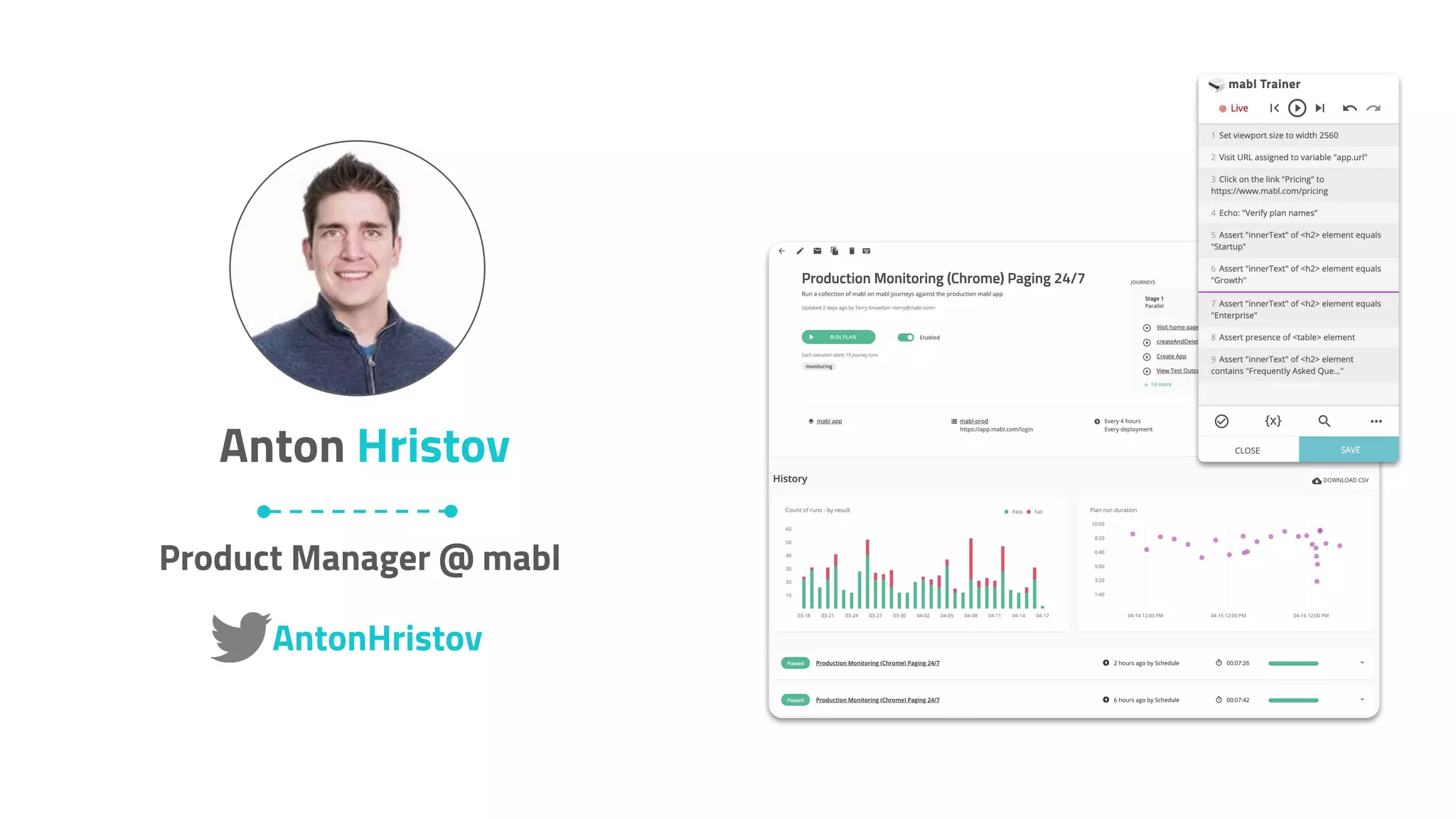
Anton Hristov
Product Manager @ mabl
@AntonHristov
Agenda
● Quality assurance ➡ quality intelligence
● End-to-end test creation & execution
● Reusable modular tests
● Root-cause analysis
● Data-driven (parameterized) testing
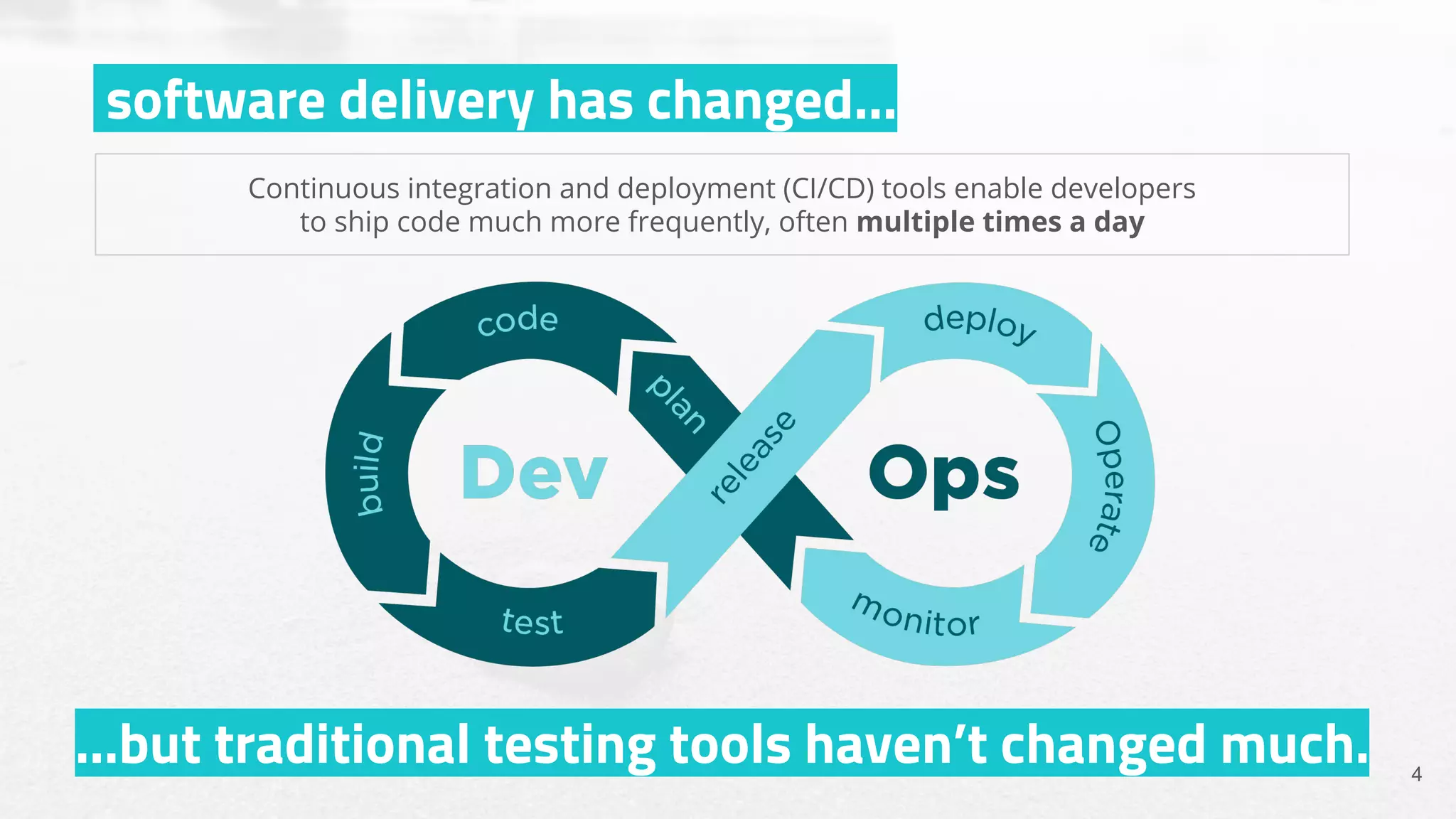
Continuous integration and deployment (CI/CD) tools enable developers
to ship code much more frequently, often multiple times a day
software delivery has changed...
...but traditional testing tools haven’t changed much. 4
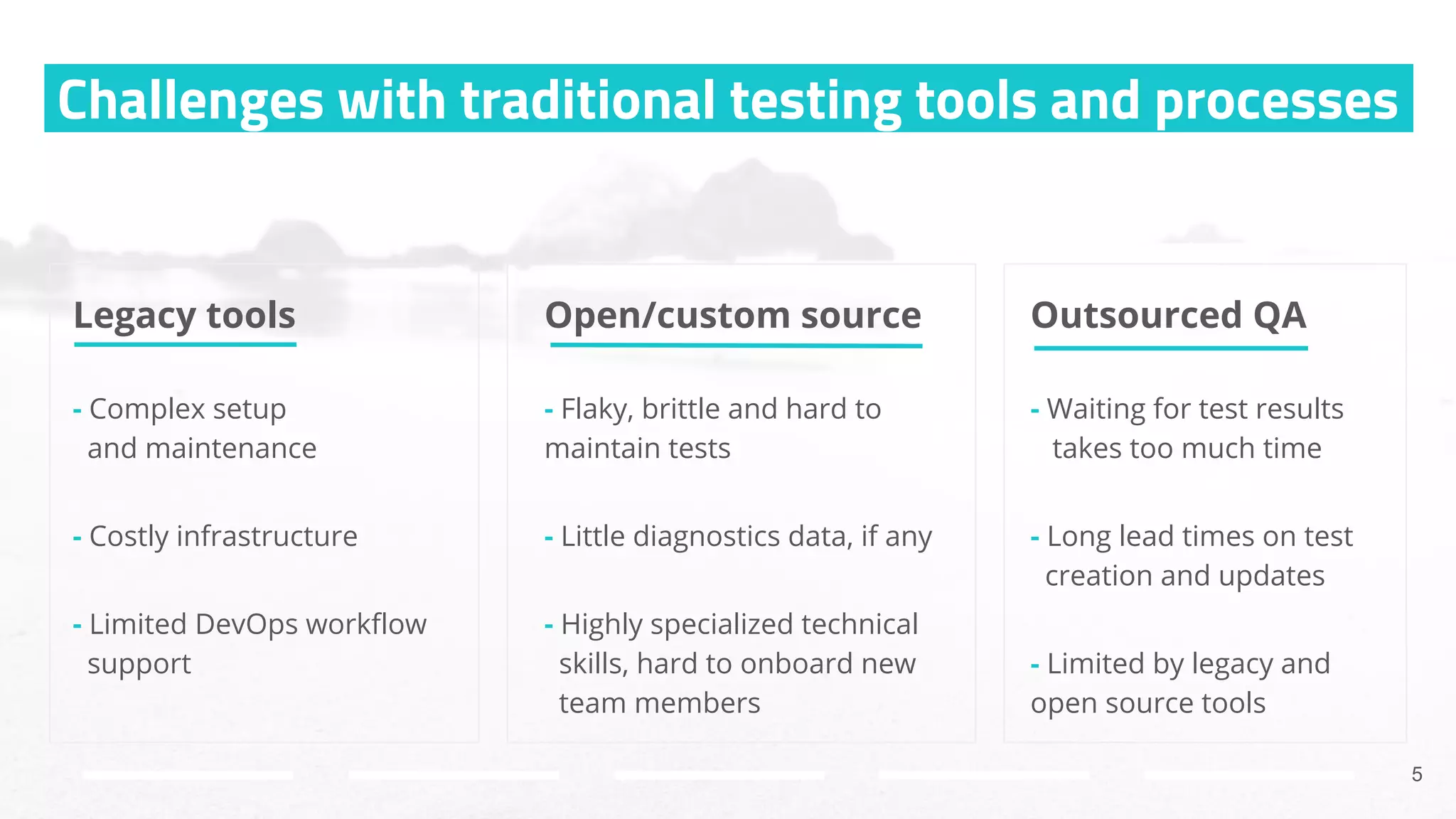
Outsourced QA
- Waiting for test results
takes too much time
- Long lead times on test
creation and updates
- Limited by legacy and
open source tools
Open/custom source
- Flaky, brittle and hard to
maintain tests
- Little diagnostics data, if any
- Highly specialized technical
skills, hard to onboard new
team members
5
Legacy tools
- Complex setup
and maintenance
- Costly infrastructure
- Limited DevOps workflow
support
Challenges with traditional testing tools and processes.
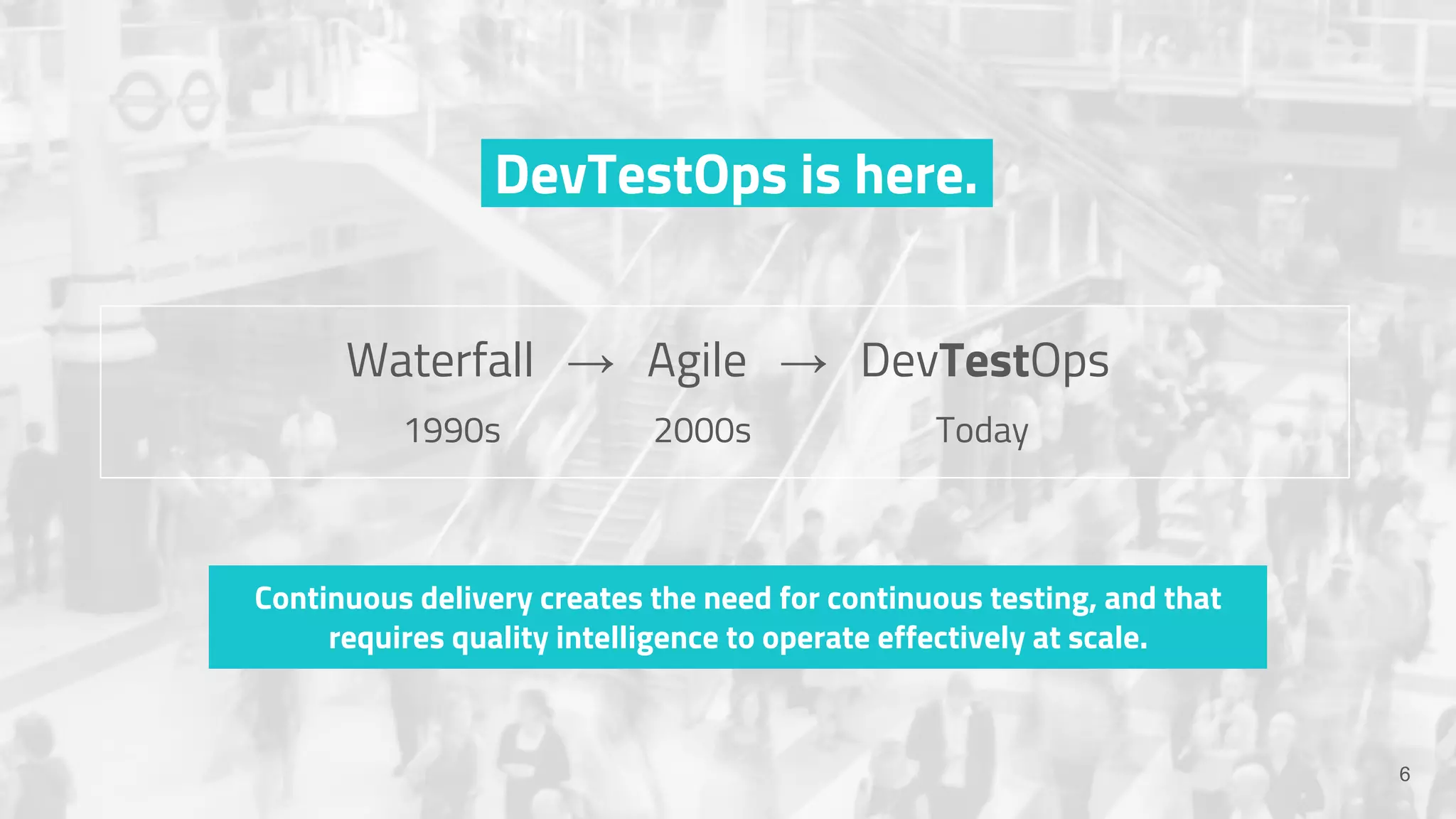
Waterfall → Agile → DevTestOps
1990s 2000s Today
DevTestOps is here..
Continuous delivery creates the need for continuous testing, and that
requires quality intelligence to operate effectively at scale.
6
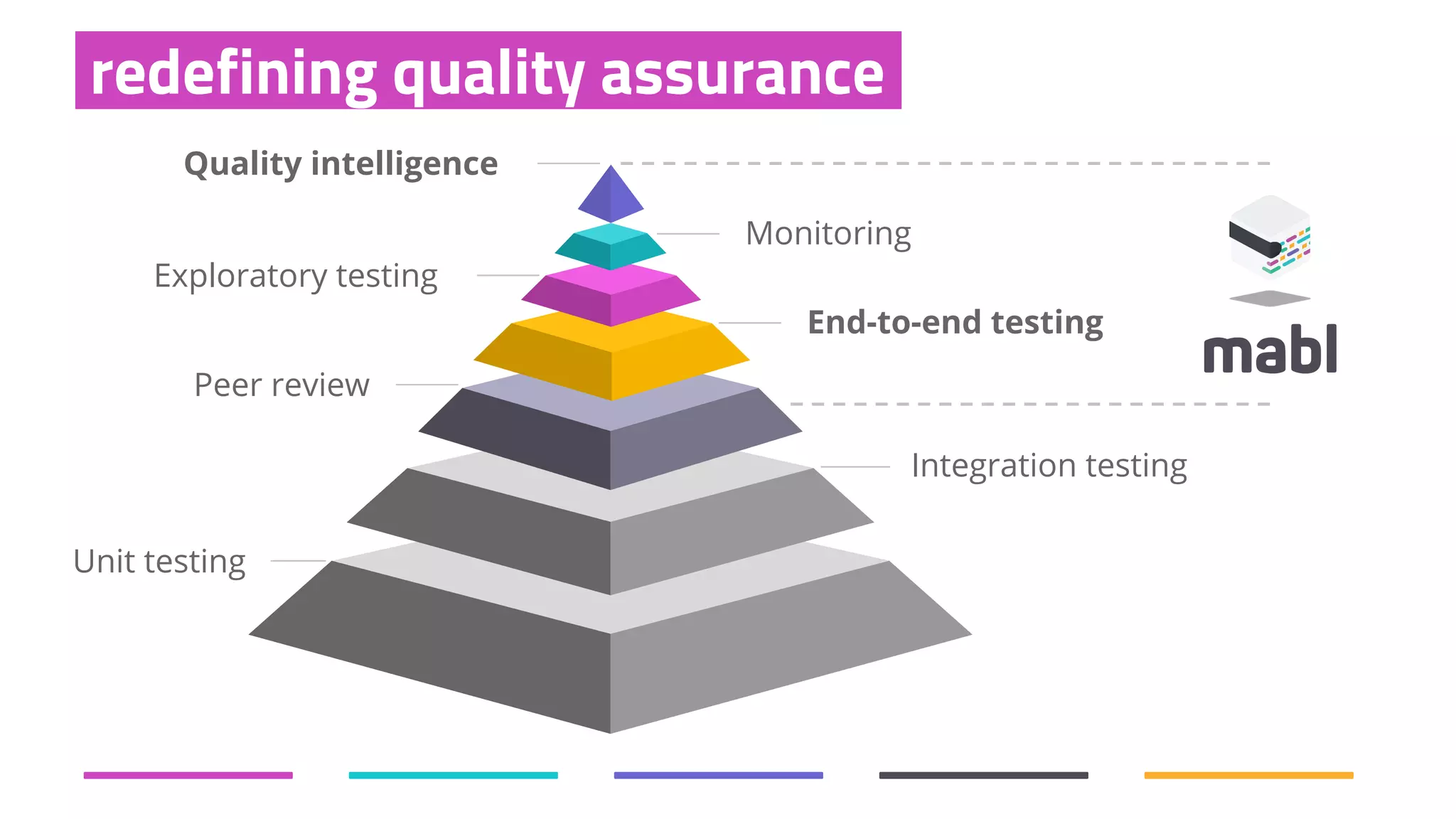
Exploratory testing
Unit testing
Monitoring
Integration testing
Peer review
End-to-end testing
Quality intelligence
redefining quality assurance.
8
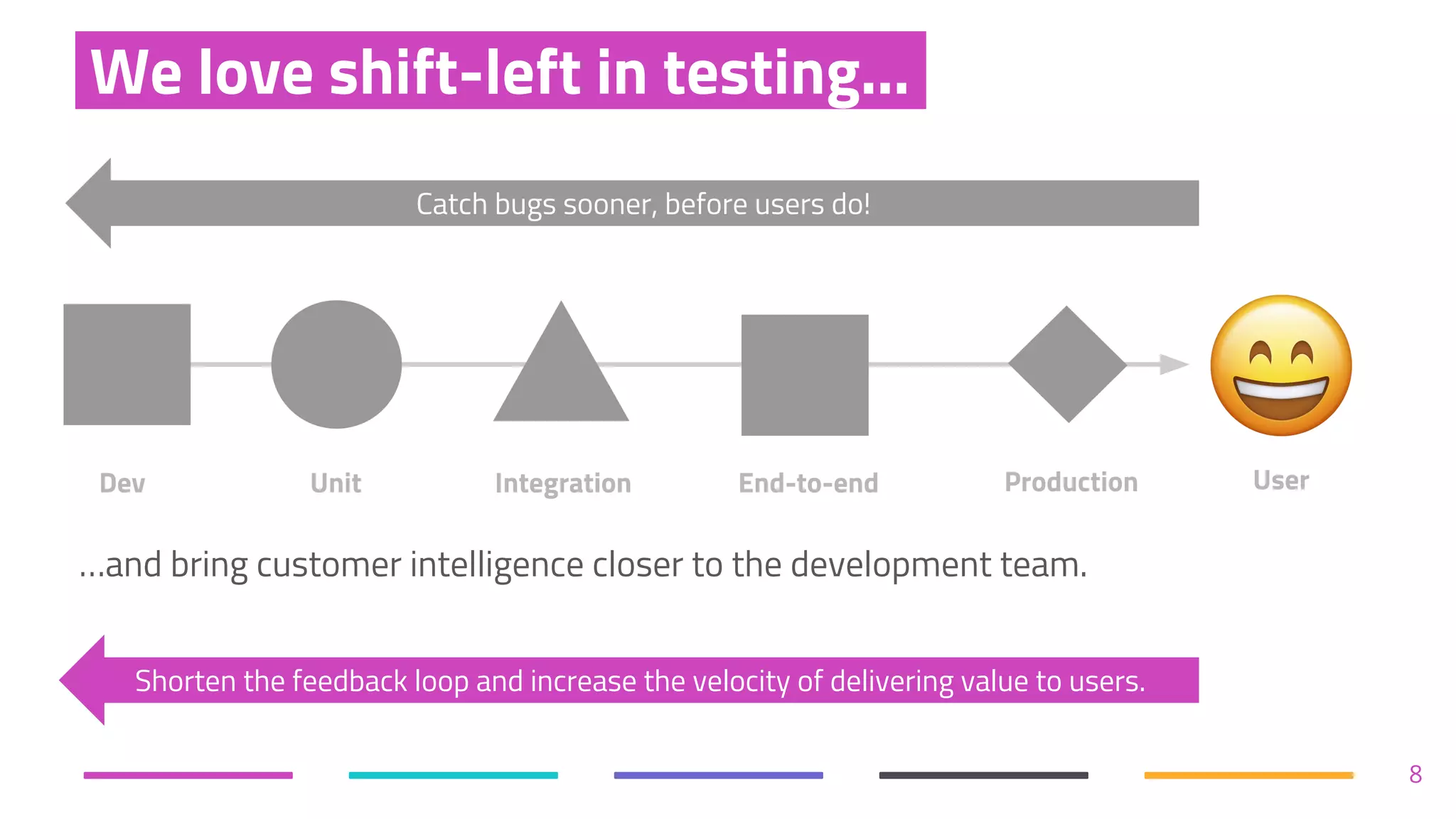
Dev Unit Integration End-to-end Production
Catch bugs sooner, before users do!
…and bring customer intelligence closer to the development team.
User
Shorten the feedback loop and increase the velocity of delivering value to users.
We love shift-left in testing….
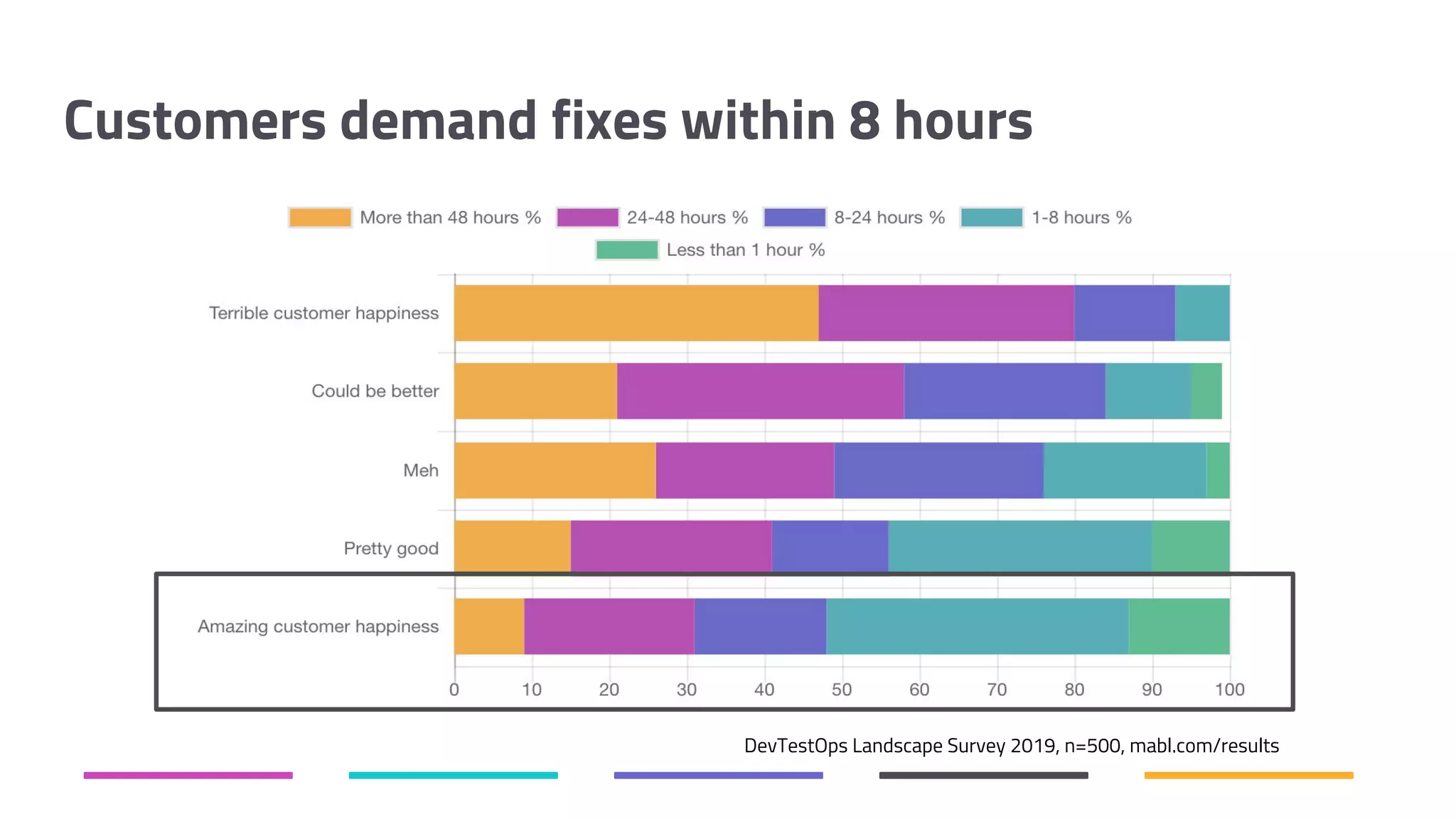
Customers demand fixes within 8 hours
DevTestOps Landscape Survey 2019, n=500, mabl.com/results
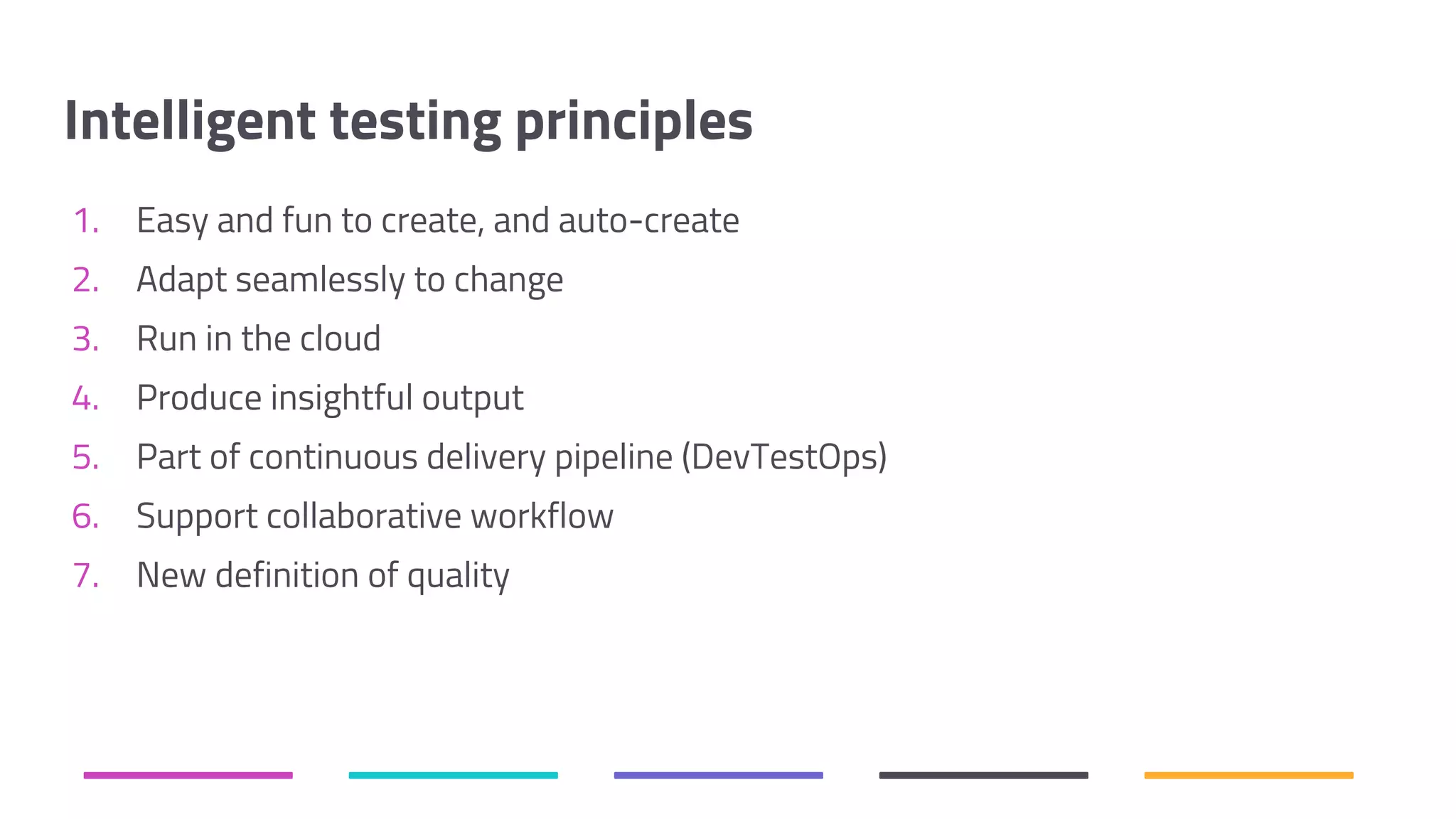
Intelligent testing principles
1. Easy and fun to create, and auto-create
2. Adapt seamlessly to change
3. Run in the cloud
4. Produce insightful output
5. Part of continuous delivery pipeline (DevTestOps)
6. Support collaborative workflow
7. New definition of quality
Agenda
● Quality assurance ➡ quality intelligence
● End-to-end test creation & execution
● Reusable modular tests
● Root-cause analysis
● Data-driven (parameterized) testing
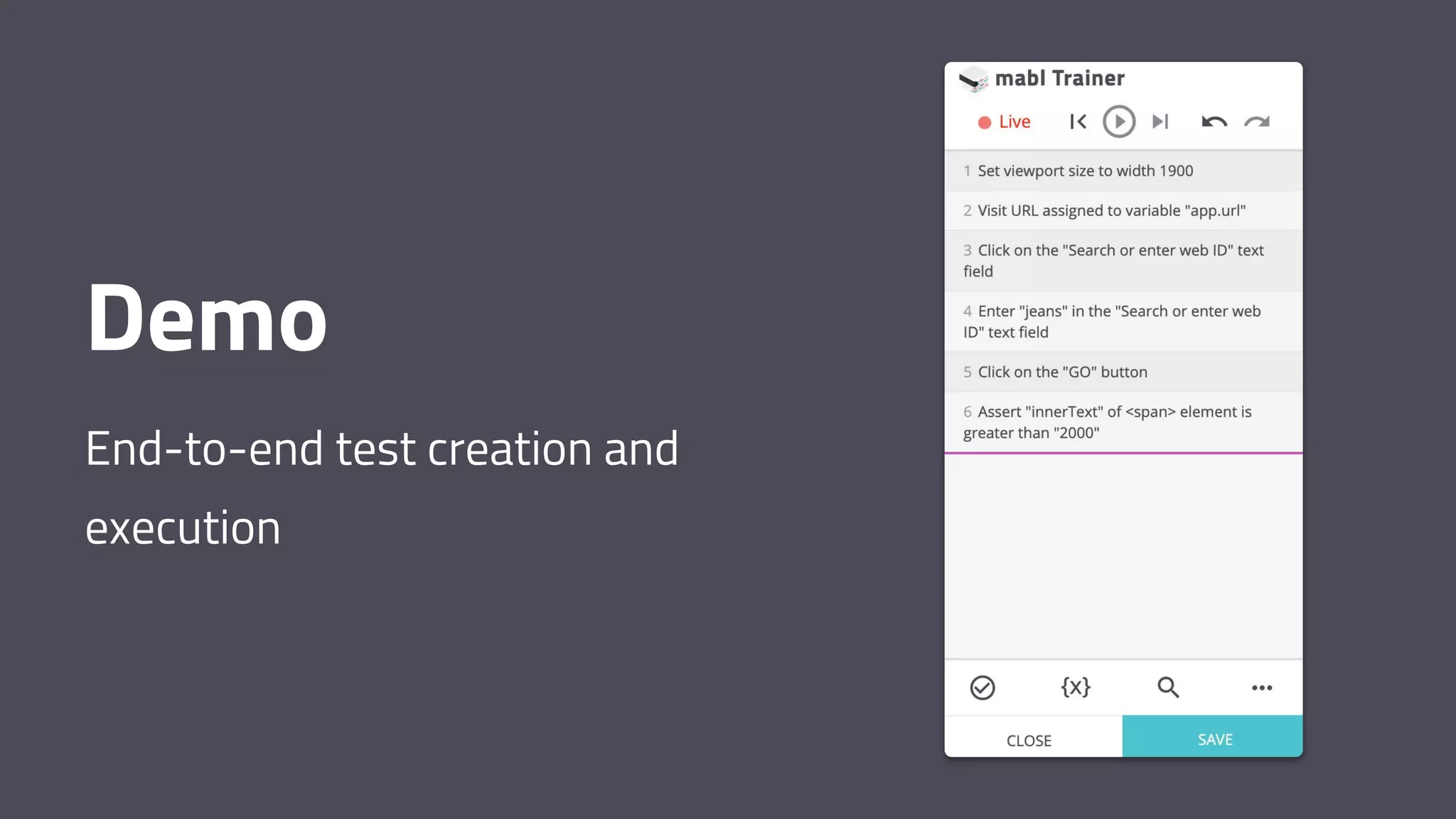
Demo
End-to-end test creation and
execution
Agenda
● Quality assurance ➡ quality intelligence
● End-to-end test creation & execution
● Reusable modular tests
● Root-cause analysis
● Data-driven (parameterized) testing
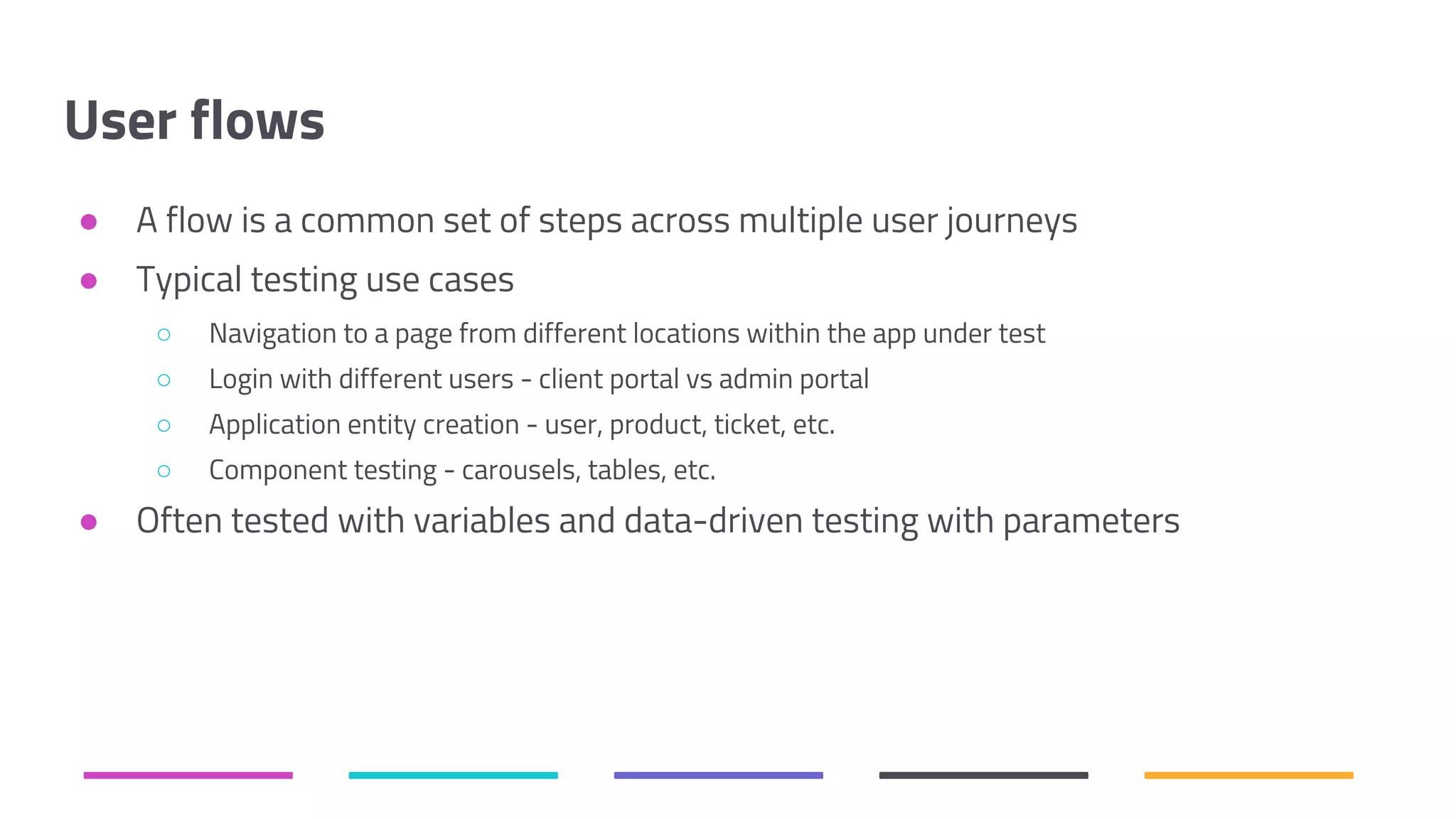
User flows
● A flow is a common set of steps across multiple user journeys
● Typical testing use cases
○ Navigation to a page from different locations within the app under test
○ Login with different users - client portal vs admin portal
○ Application entity creation - user, product, ticket, etc.
○ Component testing - carousels, tables, etc.
● Often tested with variables and data-driven testing with parameters
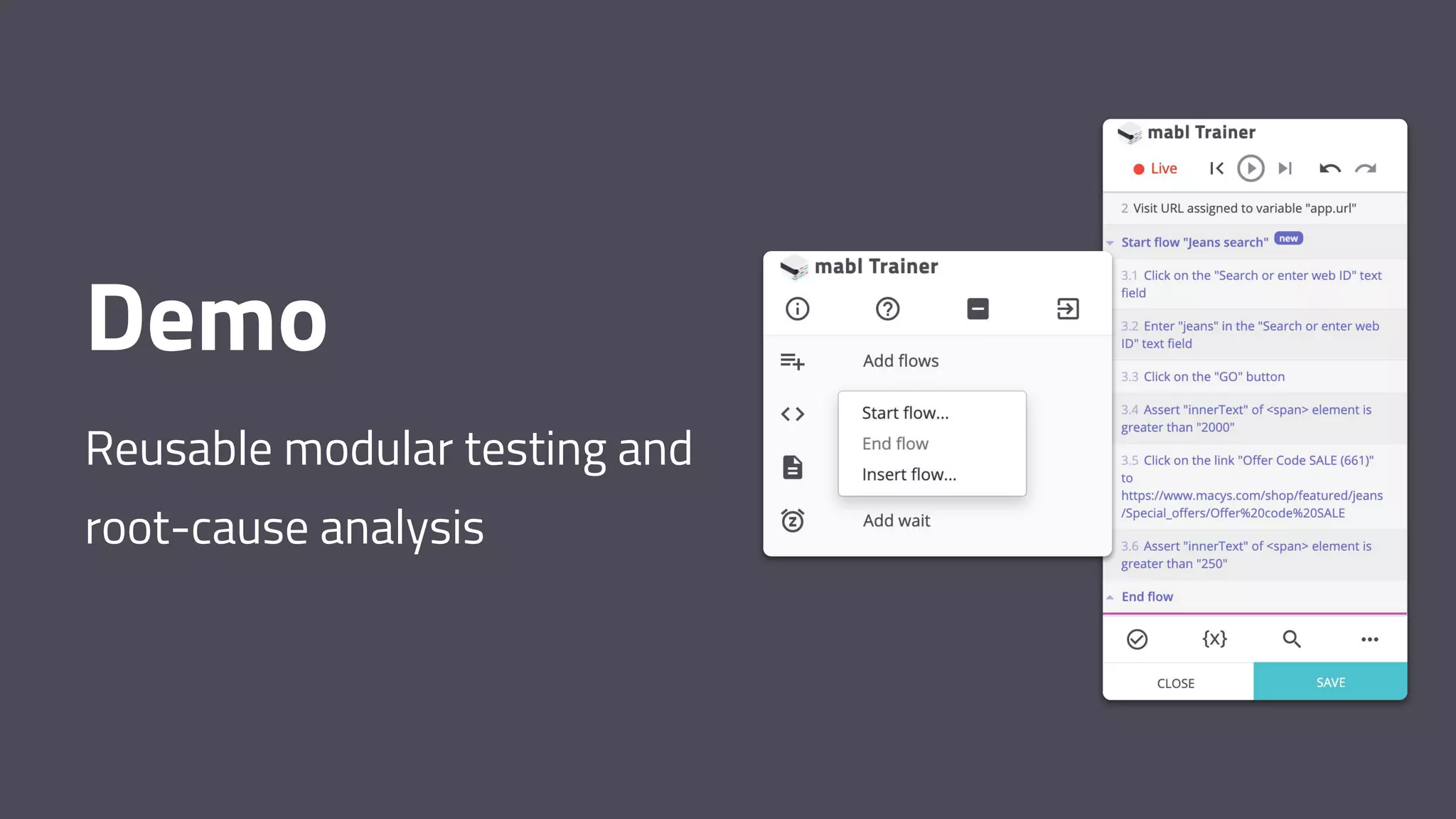
Demo
Reusable modular testing and
root-cause analysis
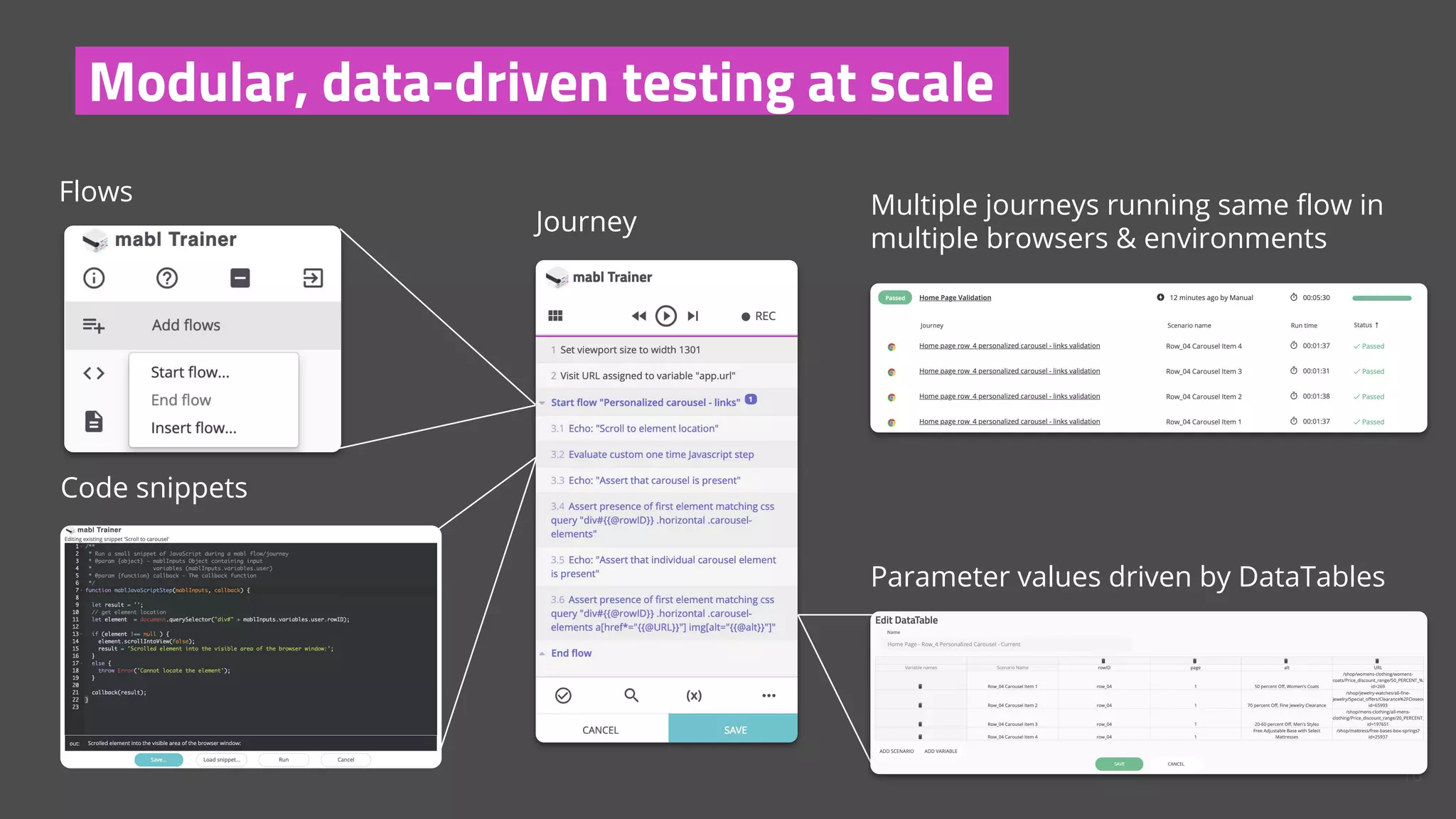
Modular, data-driven testing at scale.
1616
Parameter values driven by DataTables
Multiple journeys running same flow in
multiple browsers & environments
Flows
Code snippets
Journey
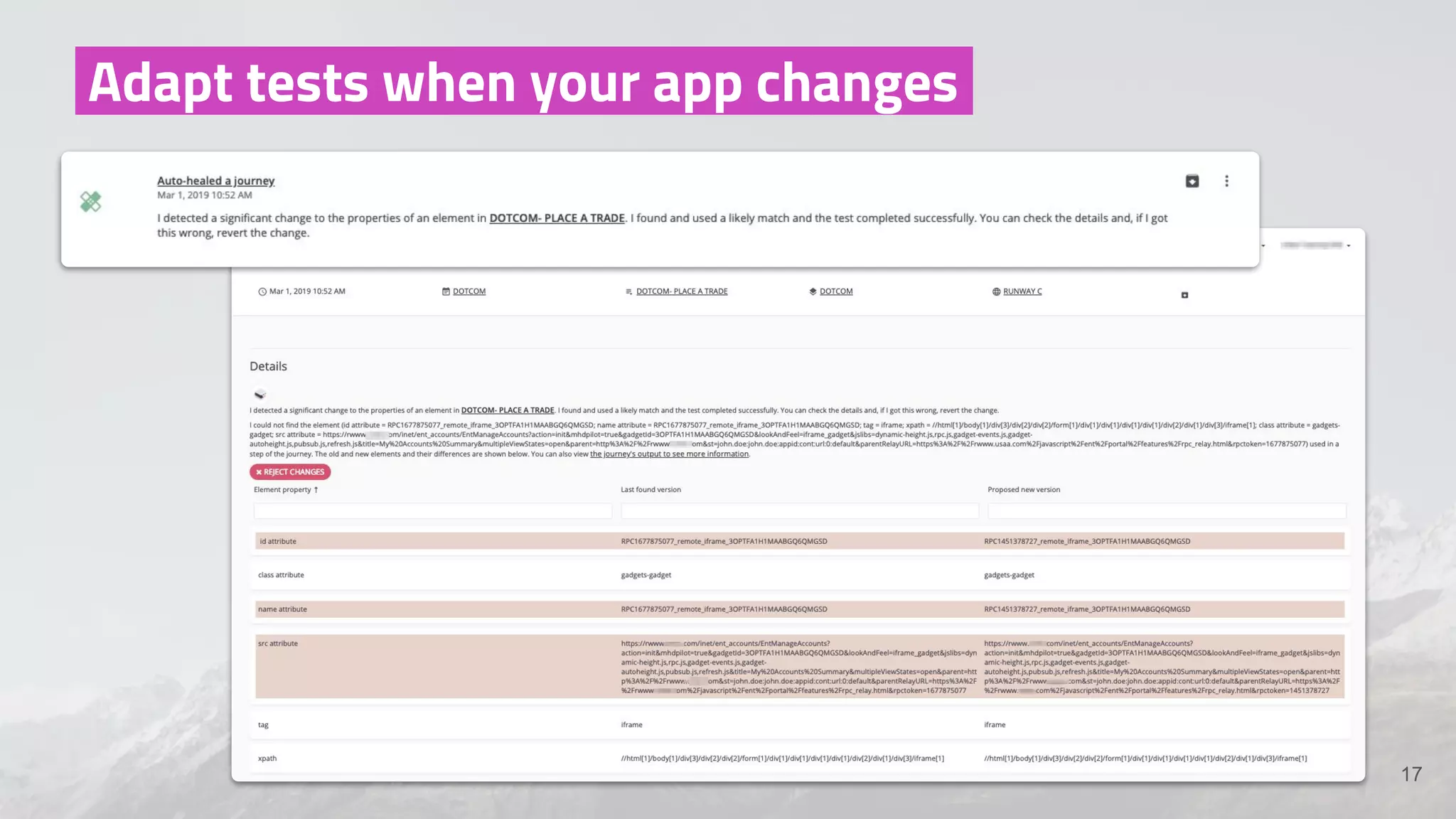
Adapt tests when your app changes.
17
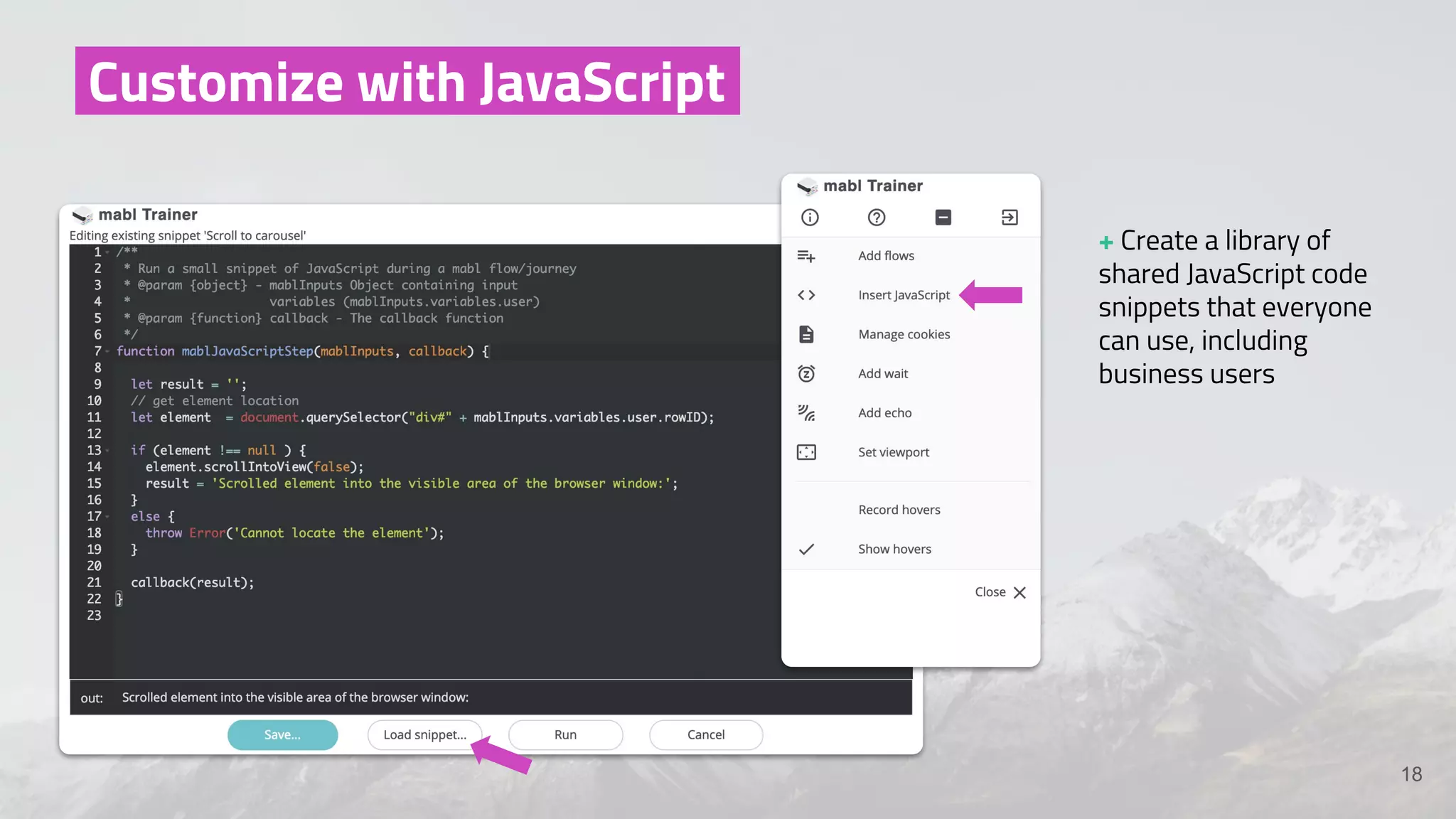
Customize with JavaScript.
18
+ Create a library of
shared JavaScript code
snippets that everyone
can use, including
business users
Agenda
● Quality assurance ➡ quality intelligence
● End-to-end test creation & execution
● Reusable modular tests
● Root-cause analysis
● Data-driven (parameterized) testing
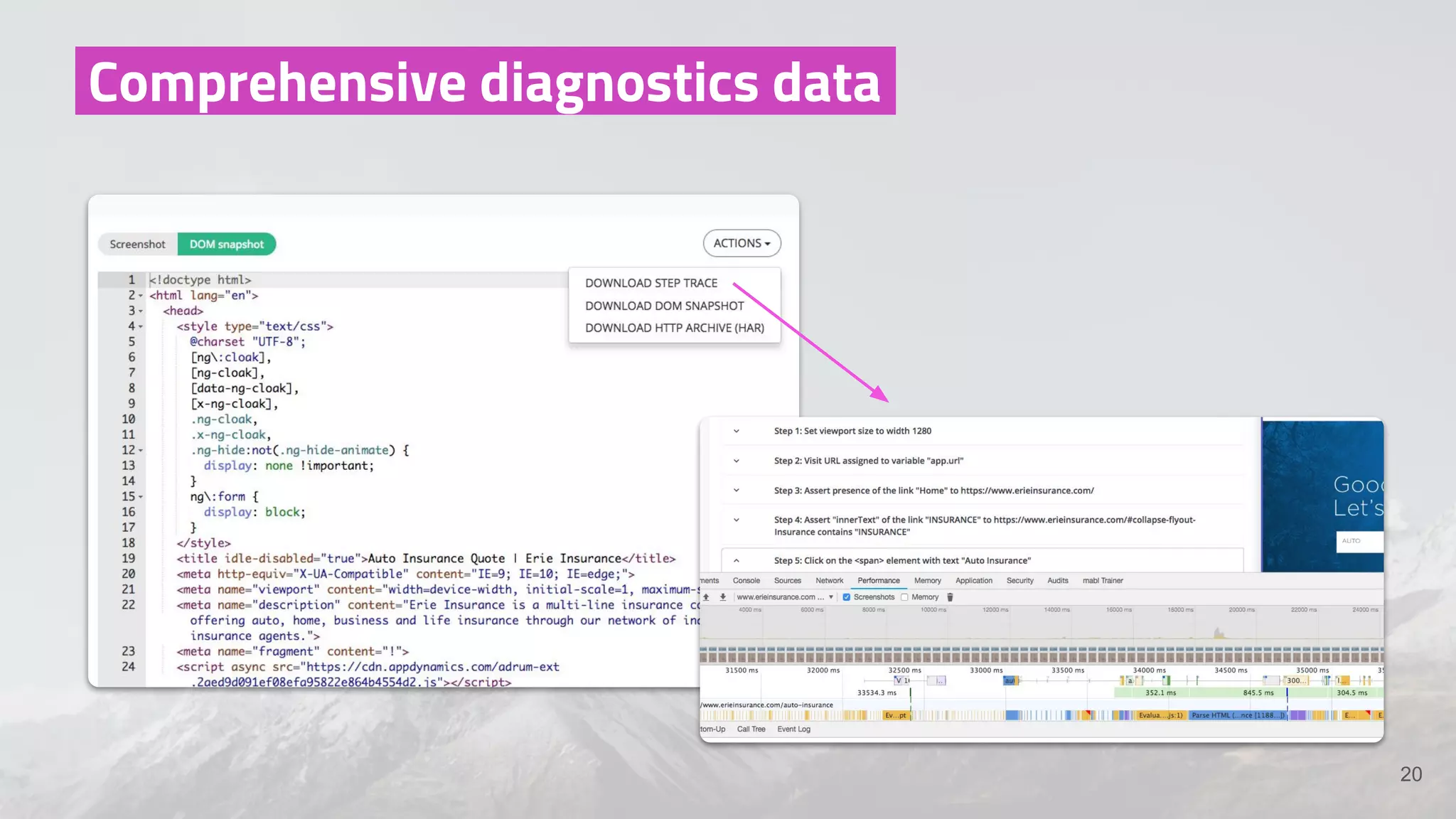
20
Comprehensive diagnostics data.
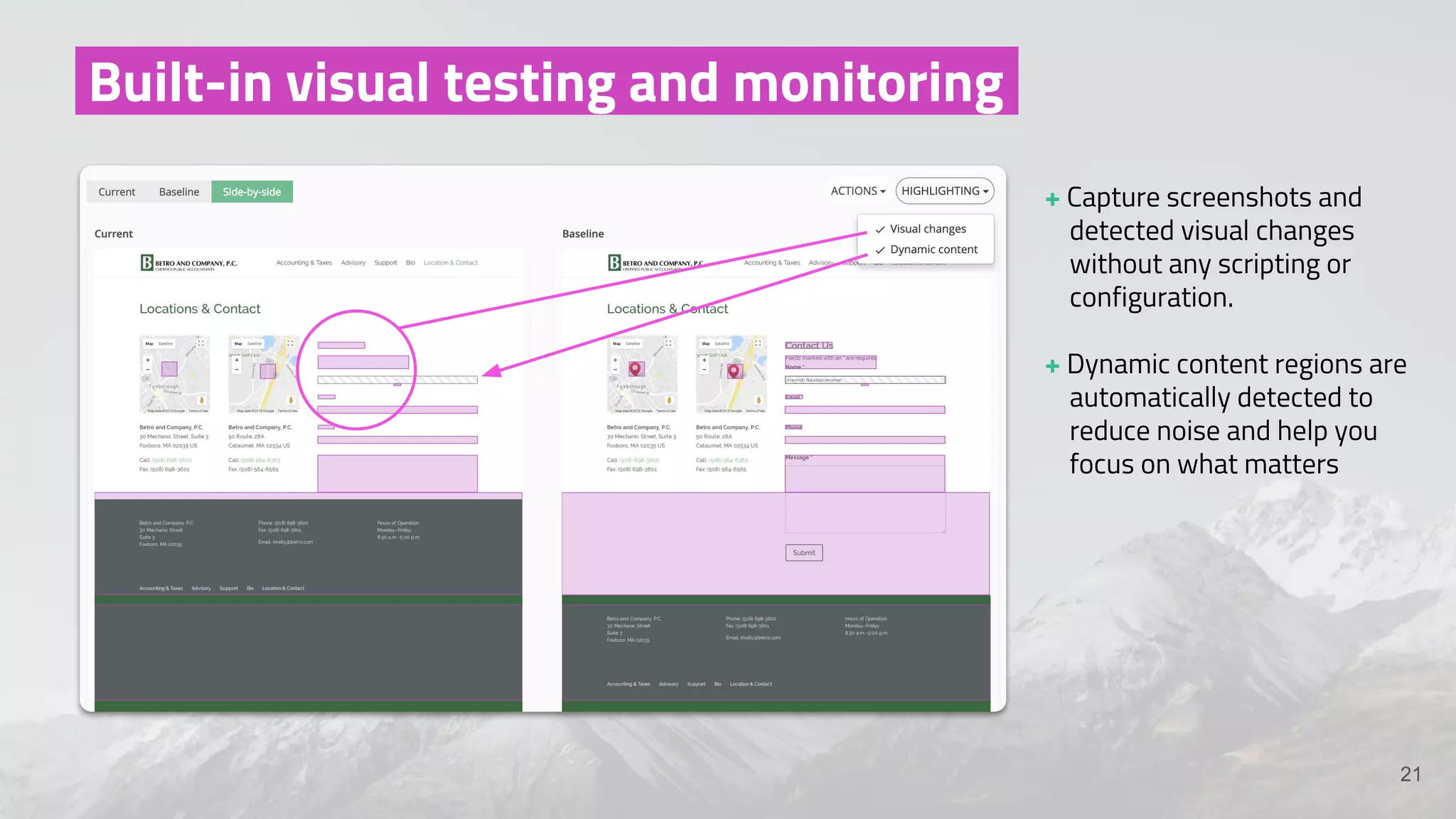
+ Capture screenshots and
detected visual changes
without any scripting or
configuration.
+ Dynamic content regions are
automatically detected to
reduce noise and help you
focus on what matters
Built-in visual testing and monitoring.
2121
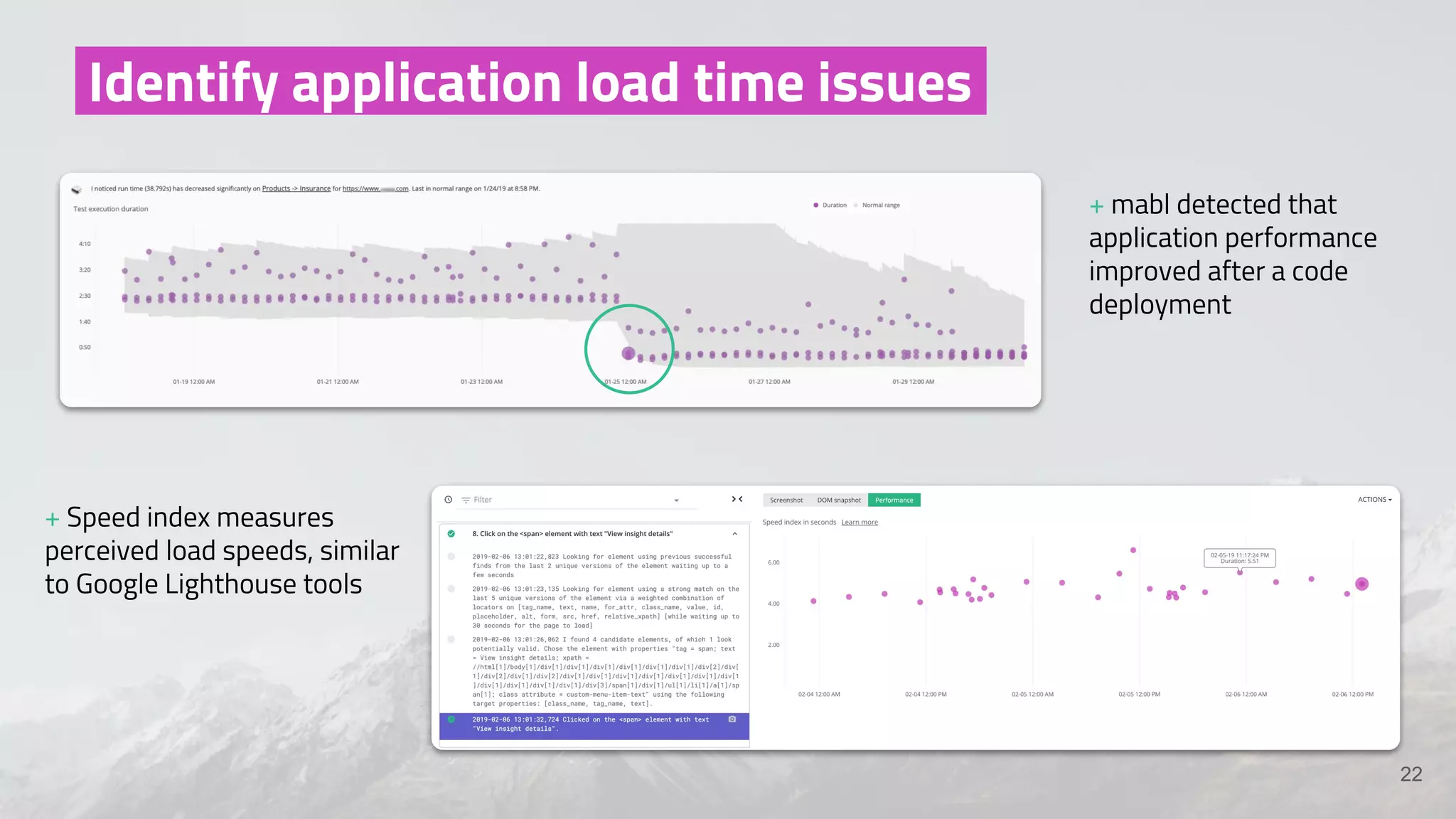
Identify application load time issues.
+ mabl detected that
application performance
improved after a code
deployment
22
+ Speed index measures
perceived load speeds, similar
to Google Lighthouse tools
Agenda
● Quality assurance ➡ quality intelligence
● End-to-end test creation & execution
● Reusable modular tests
● Root-cause analysis
● Data-driven (parameterized) testing
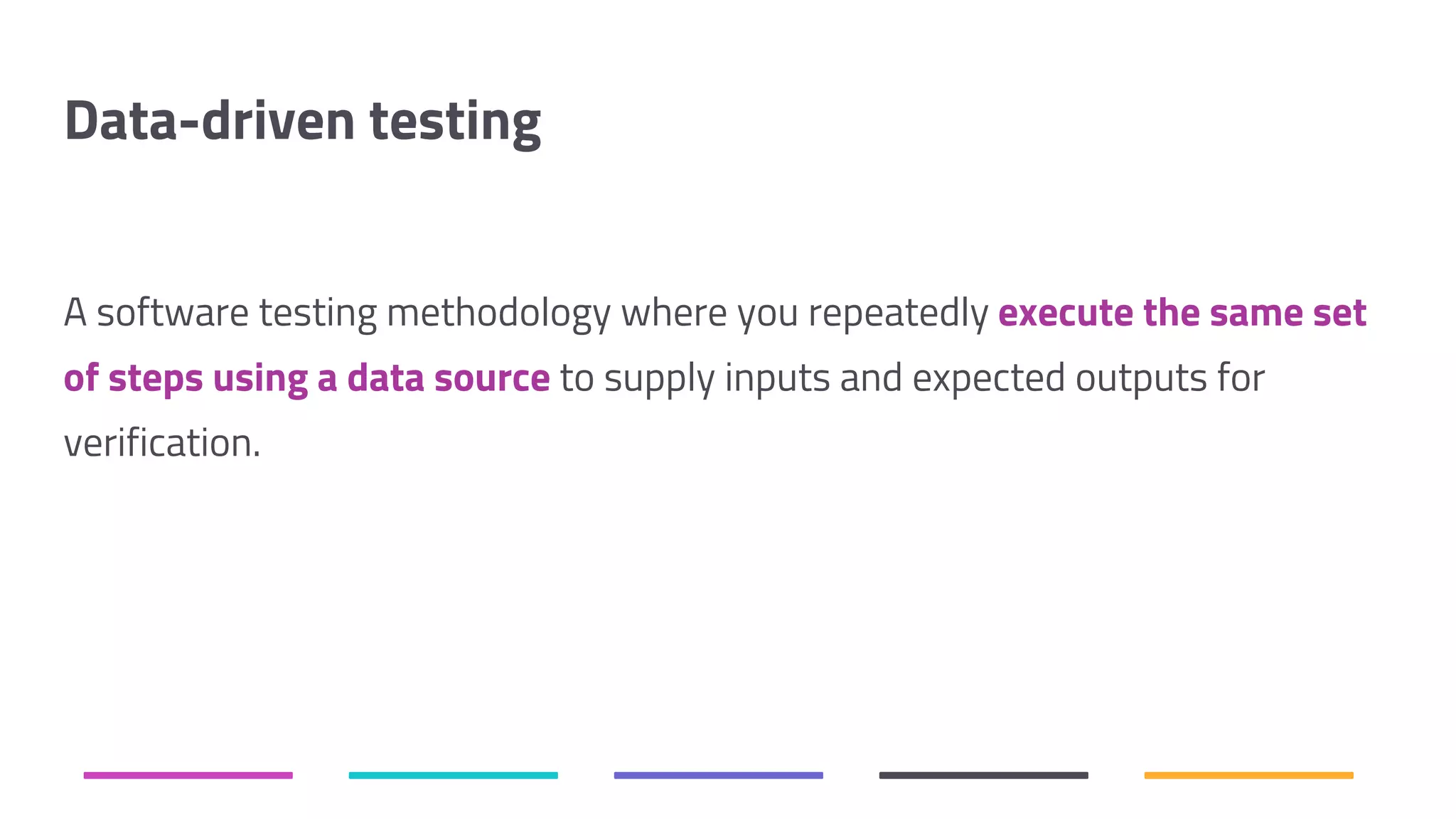
Data-driven testing
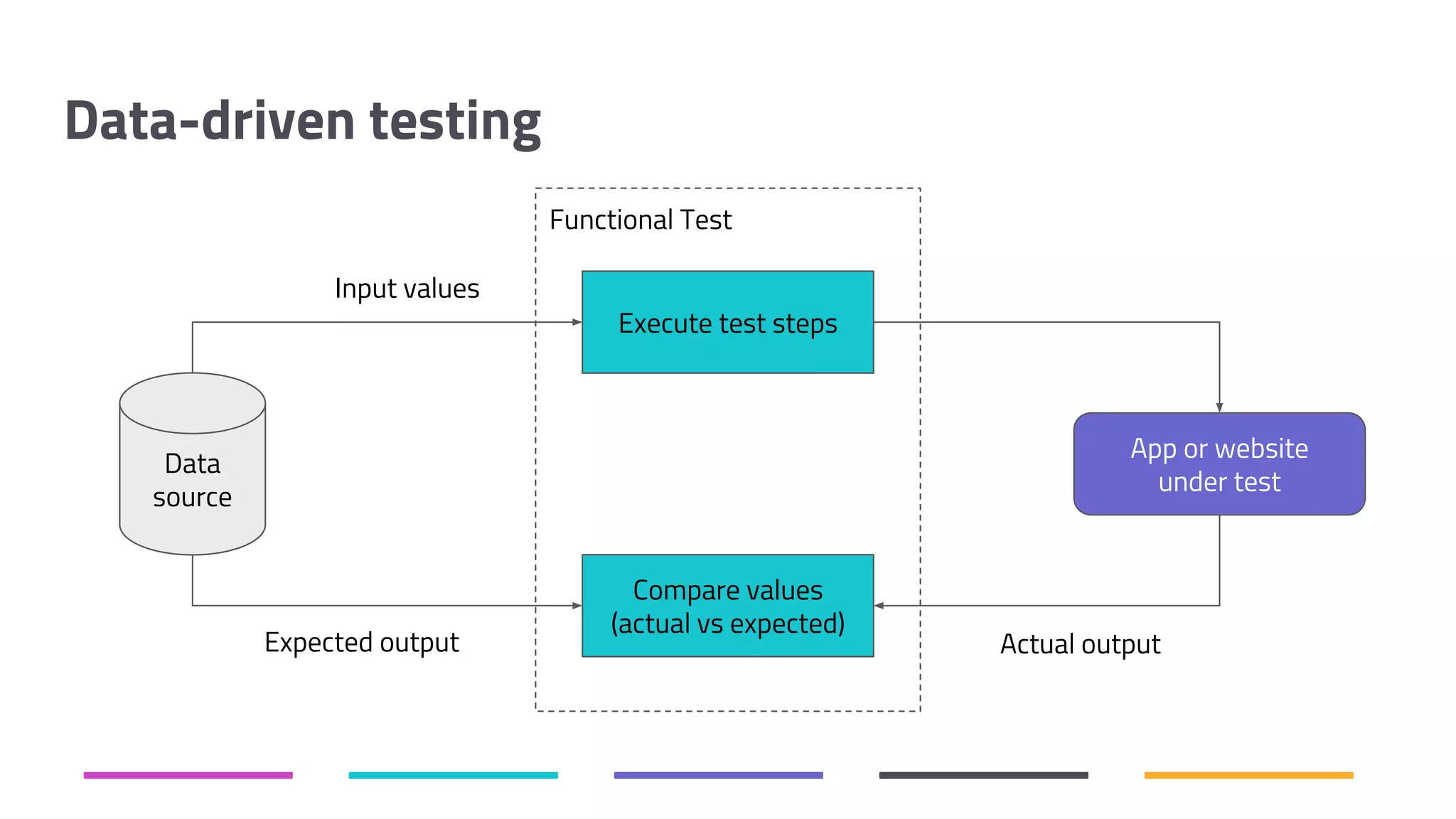
A software testing methodology where you repeatedly execute the same set
of steps using a data source to supply inputs and expected outputs for
verification.
Functional Test
Data-driven testing
Data
source
Execute test steps
App or website
under test
Input values
Compare values
(actual vs expected)
Expected output Actual output
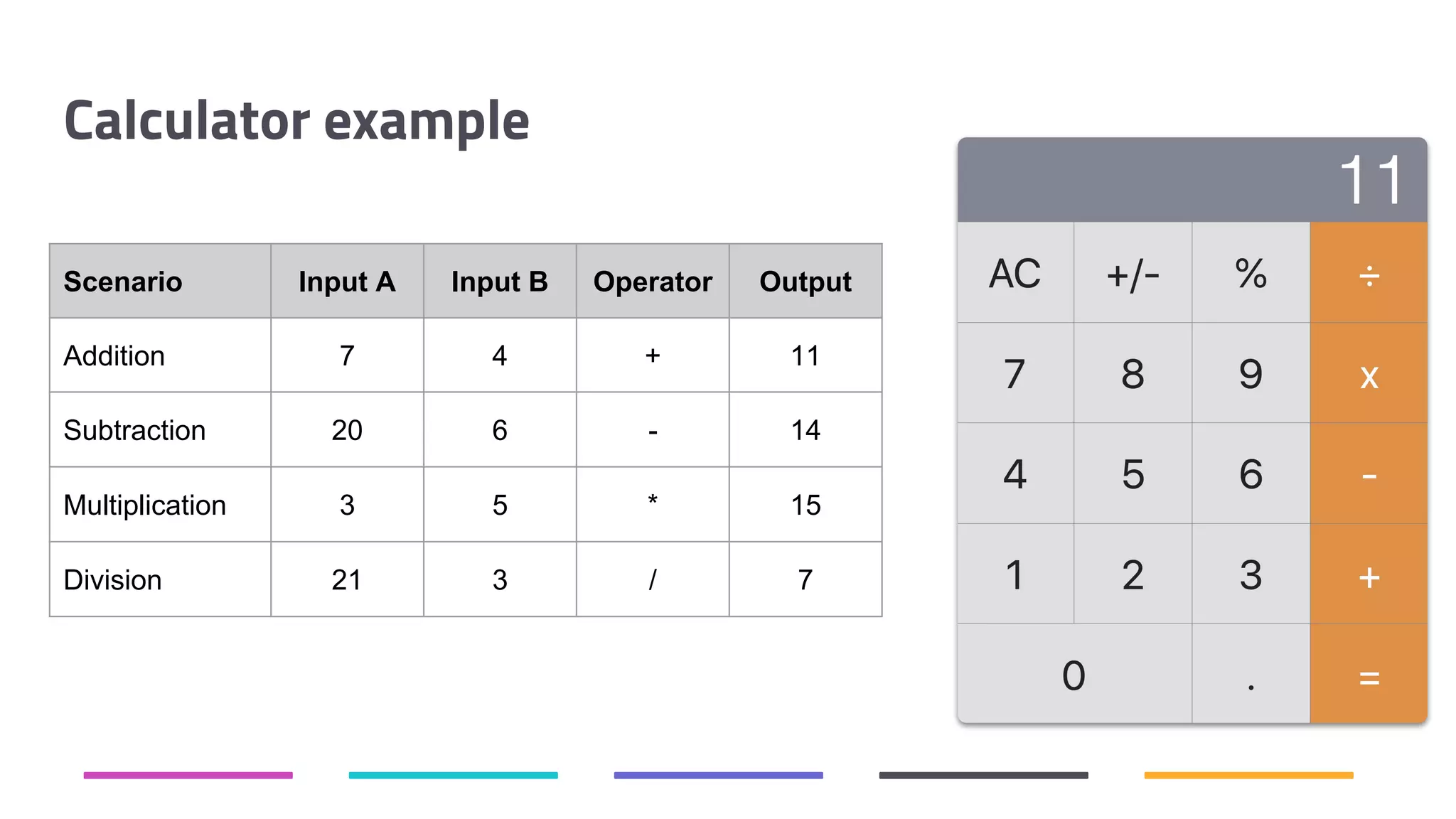
Calculator example
Scenario Input A Input B Operator Output
Addition 7 4 + 11
Subtraction 20 6 - 14
Multiplication 3 5 * 15
Division 21 3 / 7
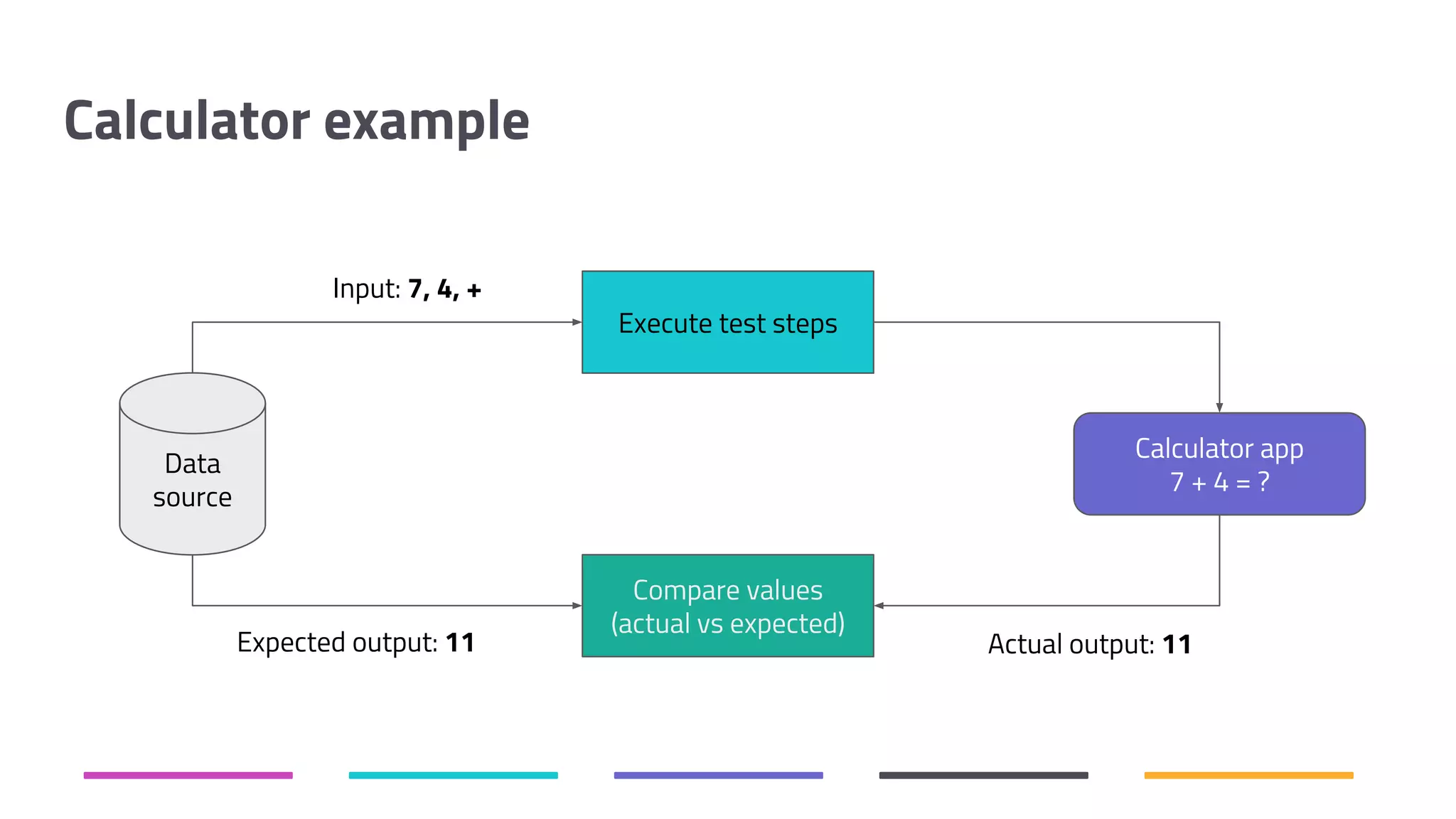
Calculator example
Data
source
Execute test steps
Calculator app
7 + 4 = ?
Input: 7, 4, +
Compare values
(actual vs expected)
Expected output: 11 Actual output: 11
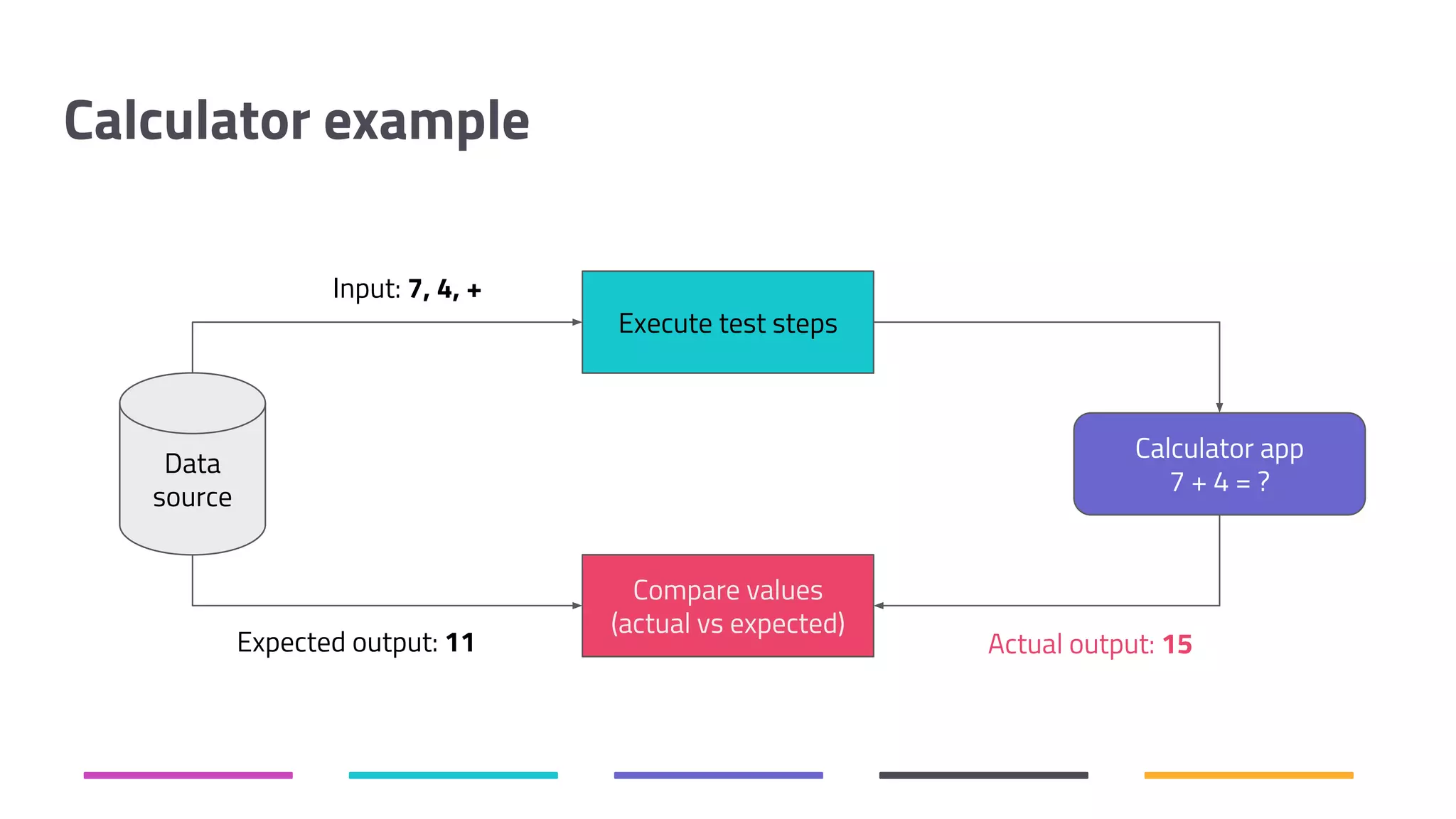
Calculator example
Data
source
Execute test steps
Calculator app
7 + 4 = ?
Input: 7, 4, +
Compare values
(actual vs expected)
Expected output: 11 Actual output: 15
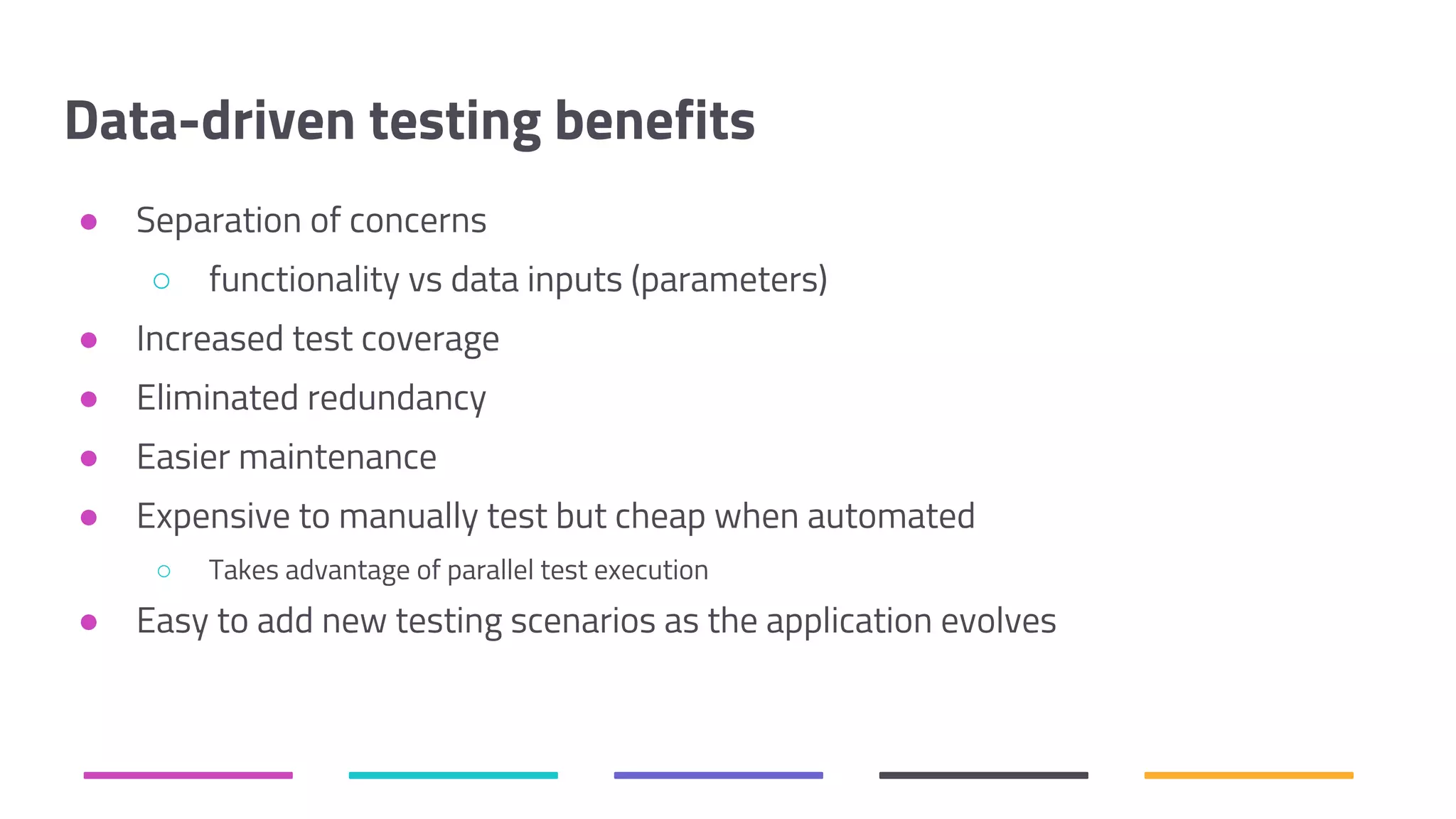
Data-driven testing benefits
● Separation of concerns
○ functionality vs data inputs (parameters)
● Increased test coverage
● Eliminated redundancy
● Easier maintenance
● Expensive to manually test but cheap when automated
○ Takes advantage of parallel test execution
● Easy to add new testing scenarios as the application evolves
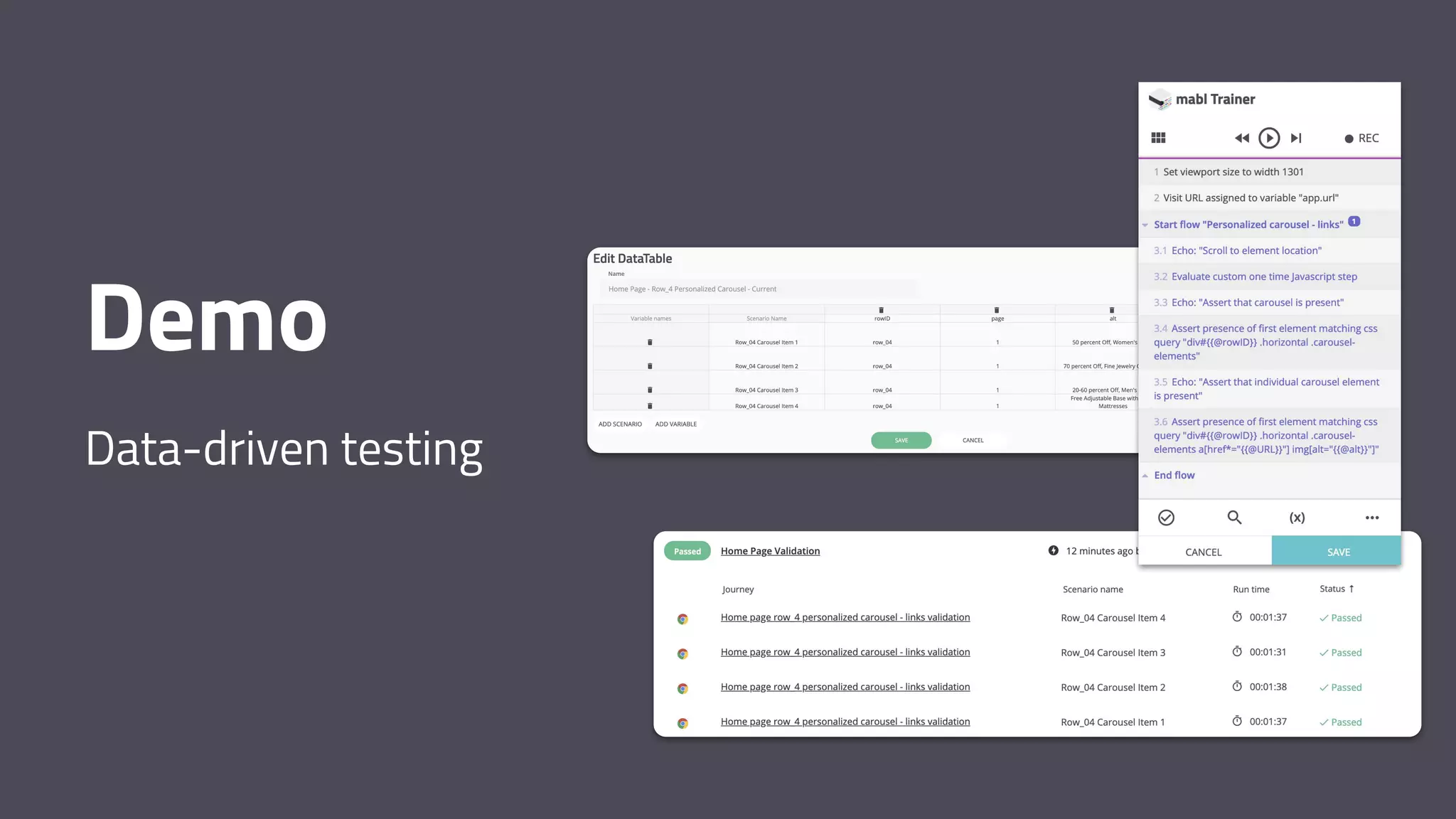
Demo
Data-driven testing
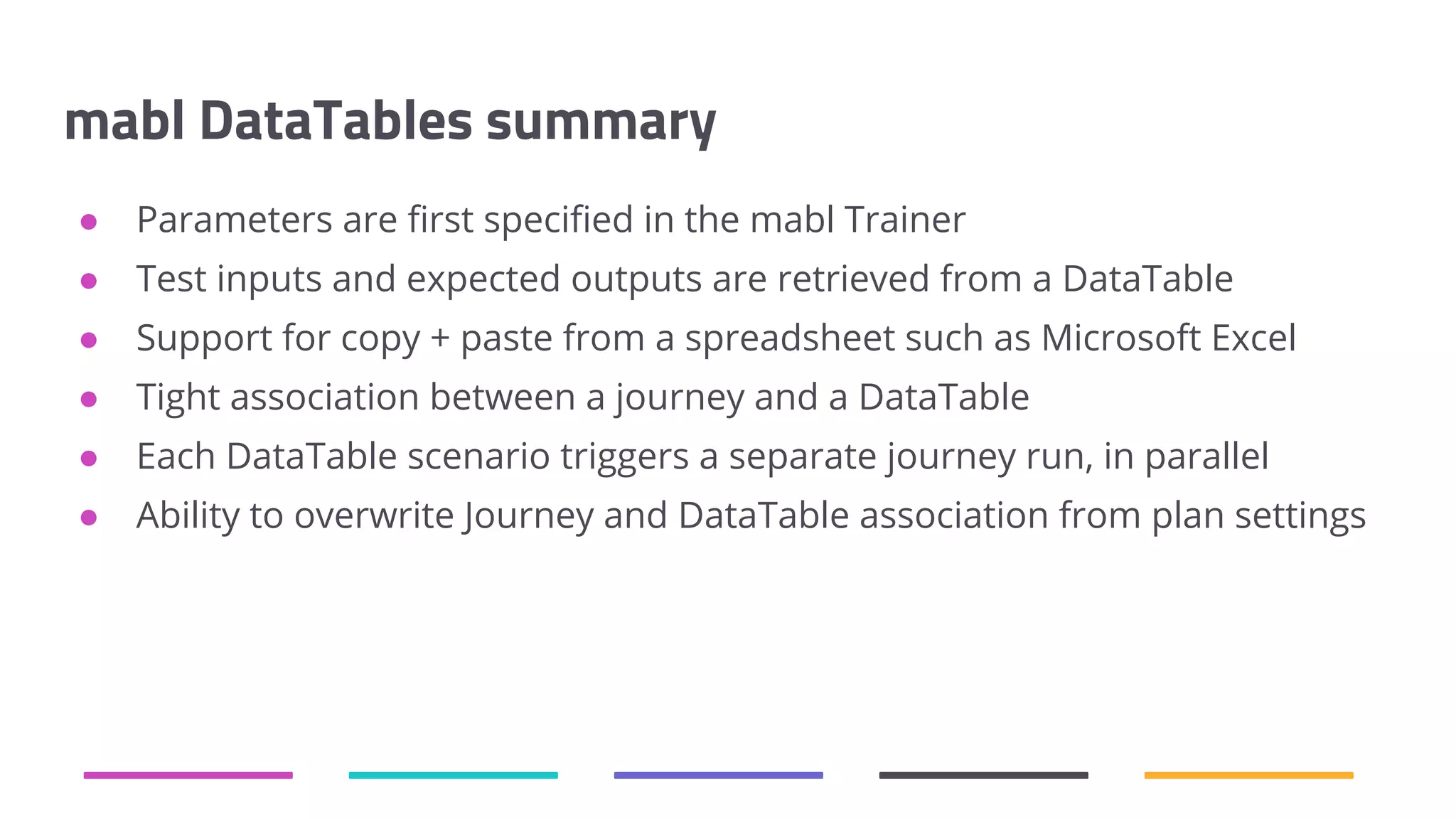
mabl DataTables summary
● Parameters are first specified in the mabl Trainer
● Test inputs and expected outputs are retrieved from a DataTable
● Support for copy + paste from a spreadsheet such as Microsoft Excel
● Tight association between a journey and a DataTable
● Each DataTable scenario triggers a separate journey run, in parallel
● Ability to overwrite Journey and DataTable association from plan settings
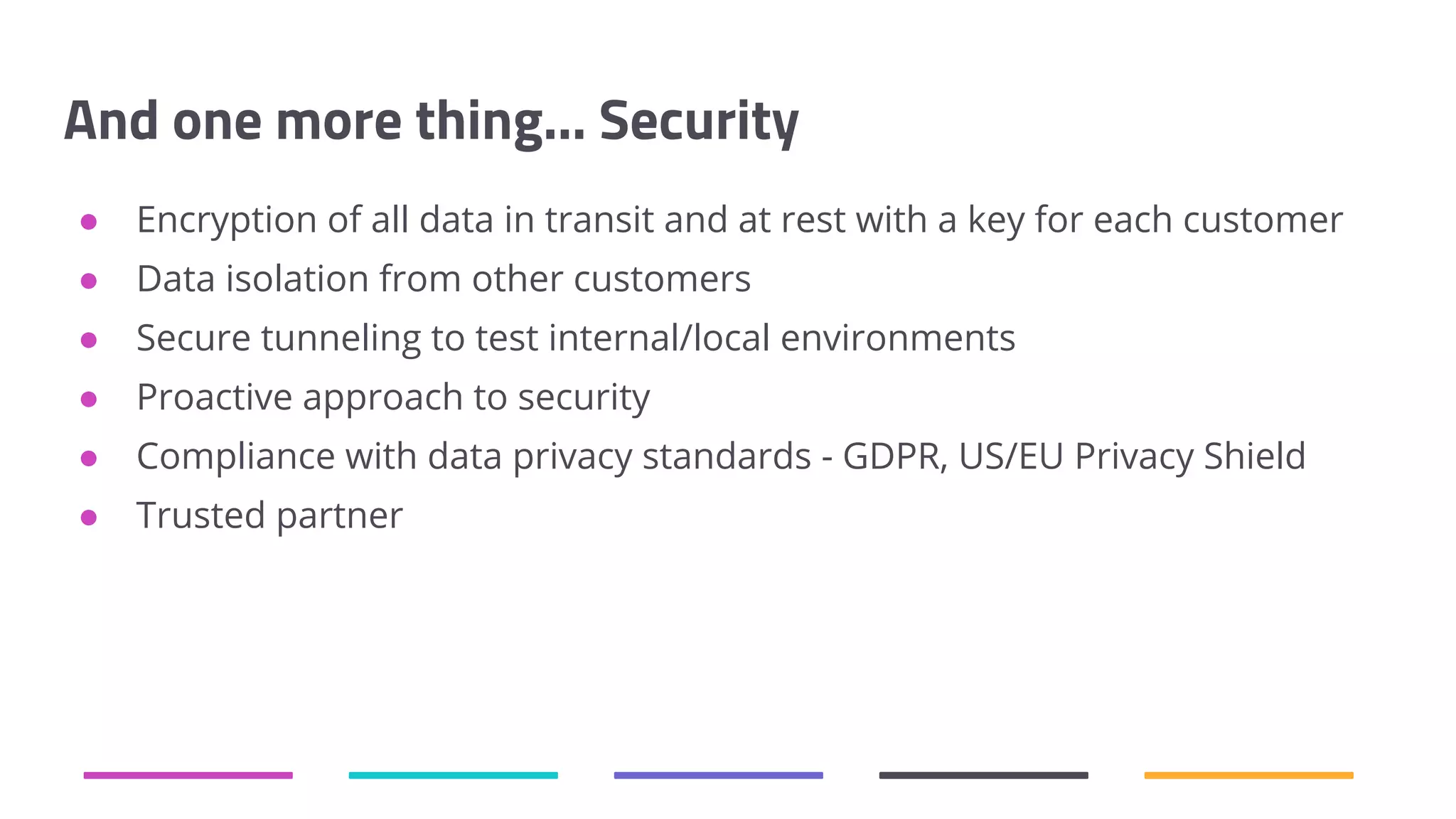
And one more thing… Security
● Encryption of all data in transit and at rest with a key for each customer
● Data isolation from other customers
● Secure tunneling to test internal/local environments
● Proactive approach to security
● Compliance with data privacy standards - GDPR, US/EU Privacy Shield
● Trusted partner
Thank you!
Try mabl for free at app.mabl.com/signup
End to-end test automation at scale

End to-end test automation at scale

  • 1.
  • 2.
    Anton Hristov Product Manager@ mabl @AntonHristov
  • 3.
    Agenda ● Quality assurance➡ quality intelligence ● End-to-end test creation & execution ● Reusable modular tests ● Root-cause analysis ● Data-driven (parameterized) testing
  • 4.
    Continuous integration anddeployment (CI/CD) tools enable developers to ship code much more frequently, often multiple times a day software delivery has changed... ...but traditional testing tools haven’t changed much. 4
  • 5.
    Outsourced QA - Waitingfor test results takes too much time - Long lead times on test creation and updates - Limited by legacy and open source tools Open/custom source - Flaky, brittle and hard to maintain tests - Little diagnostics data, if any - Highly specialized technical skills, hard to onboard new team members 5 Legacy tools - Complex setup and maintenance - Costly infrastructure - Limited DevOps workflow support Challenges with traditional testing tools and processes.
  • 6.
    Waterfall → Agile→ DevTestOps 1990s 2000s Today DevTestOps is here.. Continuous delivery creates the need for continuous testing, and that requires quality intelligence to operate effectively at scale. 6
  • 7.
    Exploratory testing Unit testing Monitoring Integrationtesting Peer review End-to-end testing Quality intelligence redefining quality assurance.
  • 8.
    8 Dev Unit IntegrationEnd-to-end Production Catch bugs sooner, before users do! …and bring customer intelligence closer to the development team. User Shorten the feedback loop and increase the velocity of delivering value to users. We love shift-left in testing….
  • 9.
    Customers demand fixeswithin 8 hours DevTestOps Landscape Survey 2019, n=500, mabl.com/results
  • 10.
    Intelligent testing principles 1.Easy and fun to create, and auto-create 2. Adapt seamlessly to change 3. Run in the cloud 4. Produce insightful output 5. Part of continuous delivery pipeline (DevTestOps) 6. Support collaborative workflow 7. New definition of quality
  • 11.
    Agenda ● Quality assurance➡ quality intelligence ● End-to-end test creation & execution ● Reusable modular tests ● Root-cause analysis ● Data-driven (parameterized) testing
  • 12.
  • 13.
    Agenda ● Quality assurance➡ quality intelligence ● End-to-end test creation & execution ● Reusable modular tests ● Root-cause analysis ● Data-driven (parameterized) testing
  • 14.
    User flows ● Aflow is a common set of steps across multiple user journeys ● Typical testing use cases ○ Navigation to a page from different locations within the app under test ○ Login with different users - client portal vs admin portal ○ Application entity creation - user, product, ticket, etc. ○ Component testing - carousels, tables, etc. ● Often tested with variables and data-driven testing with parameters
  • 15.
    Demo Reusable modular testingand root-cause analysis
  • 16.
    Modular, data-driven testingat scale. 1616 Parameter values driven by DataTables Multiple journeys running same flow in multiple browsers & environments Flows Code snippets Journey
  • 17.
    Adapt tests whenyour app changes. 17
  • 18.
    Customize with JavaScript. 18 +Create a library of shared JavaScript code snippets that everyone can use, including business users
  • 19.
    Agenda ● Quality assurance➡ quality intelligence ● End-to-end test creation & execution ● Reusable modular tests ● Root-cause analysis ● Data-driven (parameterized) testing
  • 20.
  • 21.
    + Capture screenshotsand detected visual changes without any scripting or configuration. + Dynamic content regions are automatically detected to reduce noise and help you focus on what matters Built-in visual testing and monitoring. 2121
  • 22.
    Identify application loadtime issues. + mabl detected that application performance improved after a code deployment 22 + Speed index measures perceived load speeds, similar to Google Lighthouse tools
  • 23.
    Agenda ● Quality assurance➡ quality intelligence ● End-to-end test creation & execution ● Reusable modular tests ● Root-cause analysis ● Data-driven (parameterized) testing
  • 24.
    Data-driven testing A softwaretesting methodology where you repeatedly execute the same set of steps using a data source to supply inputs and expected outputs for verification.
  • 25.
    Functional Test Data-driven testing Data source Executetest steps App or website under test Input values Compare values (actual vs expected) Expected output Actual output
  • 26.
    Calculator example Scenario InputA Input B Operator Output Addition 7 4 + 11 Subtraction 20 6 - 14 Multiplication 3 5 * 15 Division 21 3 / 7
  • 27.
    Calculator example Data source Execute teststeps Calculator app 7 + 4 = ? Input: 7, 4, + Compare values (actual vs expected) Expected output: 11 Actual output: 11
  • 28.
    Calculator example Data source Execute teststeps Calculator app 7 + 4 = ? Input: 7, 4, + Compare values (actual vs expected) Expected output: 11 Actual output: 15
  • 29.
    Data-driven testing benefits ●Separation of concerns ○ functionality vs data inputs (parameters) ● Increased test coverage ● Eliminated redundancy ● Easier maintenance ● Expensive to manually test but cheap when automated ○ Takes advantage of parallel test execution ● Easy to add new testing scenarios as the application evolves
  • 30.
  • 31.
    mabl DataTables summary ●Parameters are first specified in the mabl Trainer ● Test inputs and expected outputs are retrieved from a DataTable ● Support for copy + paste from a spreadsheet such as Microsoft Excel ● Tight association between a journey and a DataTable ● Each DataTable scenario triggers a separate journey run, in parallel ● Ability to overwrite Journey and DataTable association from plan settings
  • 32.
    And one morething… Security ● Encryption of all data in transit and at rest with a key for each customer ● Data isolation from other customers ● Secure tunneling to test internal/local environments ● Proactive approach to security ● Compliance with data privacy standards - GDPR, US/EU Privacy Shield ● Trusted partner
  • 33.
    Thank you! Try mablfor free at app.mabl.com/signup