Encryption
Merey Sovet,
Askar Nurkey,
Shalkar Rashid
Definition
• An algorithm is basically a procedure or a formula for
solving a data snooping problem. An ​encryption
algorithm is a set of mathematical procedure for
performing encryption on data. Through the use of such
an algorithm, information is made in the cipher text and
requires the use of a key to transforming the data into its
original form.
• Encryption​: It is the process of locking up information
using cryptography. Information that has been locked
this way is encrypted.
• A plain text from a user can be encrypted to a cipher text, then
send through a communication channel and no eavesdropper
can interfere with the plain text. When it reaches the receiver
end, the cipher text is decrypted to the original plain text.
Encoding
• Encoding is the process of converting data into a format
required for a number of information processing needs,
including:
Decoding
• Decoding ​is the reverse process of encoding which is to
extract the information from the converted format.
• For example, decoding Binary Coded Decimal requires
some simple calculations in base-2 arithmetic. Decoding
ASCII values is a straightforward process since there is a
one to one mapping between characters and numbers.
The term decoding is also used for digital to analog
conversion. In the filed of communication, decoding is
the process of converting received messages in to a
message written using a specific language
Types of Methods
• In encryption algorithm we have two types .They are
Symmetric Encryption
Asymmetric Encryption
Symmetric Encryption
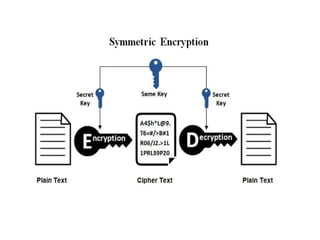
• This is the simplest kind of encryption that involves only
one secret key to cipher and decipher information.
Symmetrical encryption is an old and best-known
technique.
• It uses a secret key that can either be a number, a word
or a string of random letters. It is a blended with the plain
text of a message to change the content in a particular
way. The sender and the recipient should know the
secret key that is used to encrypt and decrypt all the
messages
• .Blowfish, AES, RC4, DES, RC5, and RC6 are examples
of symmetric encryption
Asymmetric Encryption
Definition of Asymmetric
Encryption
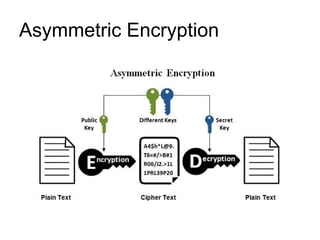
• A message that is encrypted using a public key can only
be decrypted using a private key, while also, a message
encrypted using a private key can be decrypted using a
public key. Security of the public key is not required
because it is publicly available and can be passed over
the internet. Asymmetric key has a far better power in
ensuring the security of information transmitted during
communication.
• Popular asymmetric key encryption algorithm includes
EIGamal, RSA, DSA, Elliptic curve techniques, PKCS.
1. AES(​Advanced Encryption
Standard​)
• AES is an encryption standard chosen by the National
Institute of Standards and Technology(NIST) , USA to
protect classified information. It has been accepted world
wide as a desirable algorithm to encrypt sensitive data.
• It is a block cipher which operates on block size of 128 bits for
both encrypting as well as decrypting
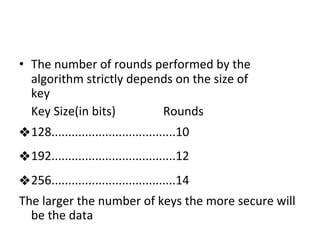
• The number of rounds performed by the
algorithm strictly depends on the size of
key
Key Size(in bits) Rounds
âť–128.....................................10
âť–192.....................................12
âť–256.....................................14
The larger the number of keys the more secure will
be the data
2.DES(​Data Encryption Standard​)
• DES use symmetric system means both sender and
receiver side we used same key for encryption and
decryption
• It used 64 bits of block for encryption and decryption.
Sixteen rounds of transportation and substitution are
performed in order to achieve DES
DES Working
• It is a symmetric block encryption algorithm when 64-bit
blocks of plain text go in , 64-bit blocks of cipher text
come out.
• It uses a 64-bit key:56 bits make up the true key, and 8
bits are used for parity
• When it applied to data, it divides the message in to
blocks and operates on them one at a time .Then the
result is64-bit blocks of cipher text
DES Modes
• In Block ciphers have several modes of
operation. Each mode specifies how a
block cipher will operate
Electronic Code Book
Cipher Block Chaining
Cipher Feedback
Output Feedback
Counter Mode
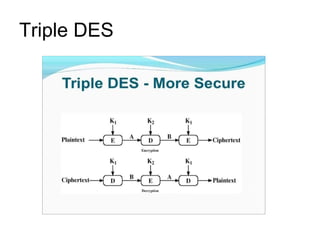
Triple DES
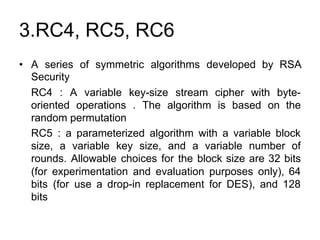
3.RC4, RC5, RC6
• A series of symmetric algorithms developed by RSA
Security
RC4 : A variable key-size stream cipher with byte-
oriented operations . The algorithm is based on the
random permutation
RC5 : a parameterized algorithm with a variable block
size, a variable key size, and a variable number of
rounds. Allowable choices for the block size are 32 bits
(for experimentation and evaluation purposes only), 64
bits (for use a drop-in replacement for DES), and 128
bits
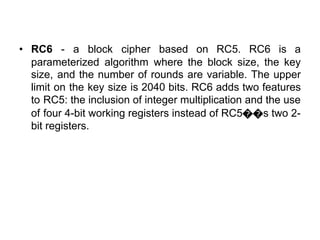
• RC6 ​- a block cipher based on RC5. RC6 is a
parameterized algorithm where the block size, the key
size, and the number of rounds are variable. The upper
limit on the key size is 2040 bits. RC6 adds two features
to RC5: the inclusion of integer multiplication and the use
of four 4-bit working registers instead of RC5​��​s two 2-
bit registers.
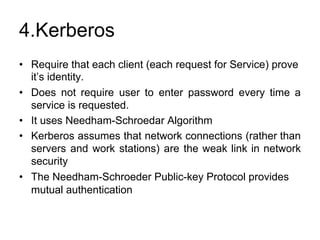
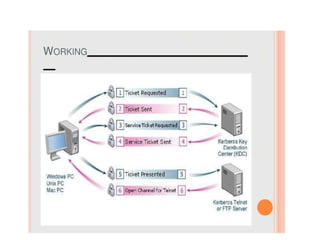
4.Kerberos
• Require that each client (each request for Service) prove
it’s identity.
• Does not require user to enter password every time a
service is requested.
• It uses Needham-Schroedar Algorithm
• Kerberos assumes that network connections (rather than
servers and work stations) are the weak link in network
security
• The Needham-Schroeder Public-key Protocol provides
mutual authentication
5.MD5
• The MD5 hashing algorithm was created in the early
1990’s, and is one of a family of Message-Digest
algorithms. Several of these were developed by Ronald
Rivest
• Ronald Rivest is a cryptographer with significant
contributions to the field. He is a professor at MIT. He’s
also one of the inventors of RSA Algorithm . He’s a giant
in the cryptography world
MD5 Working
• Md5 algorithm first divides the input into blocks of 512
bits each. 64 Bits recording the length of the original
input are inserted at the end of the last block. If the last
block is less than 512 bits, some extra bits are padded to
the end.
• The algorithm consists of a set of buffers and tables to
combine and shift the data through five computational
steps .Four rounds of computation are done to compute
the hash of the input value
• MD5 is quite computationally efficient, compared to other
hashing functions
6. SHA
• SHA Algorithm was developed by NIST along with NSA
• In 1993, SHA was published as a Federal Information
Processing Standard
• This algorithm uses Asymmetric Encryption
• It has following Versions:
SHA-1
SHA-256
SHA-384
SHA-526
7.RSA
• RSA (Rivest–Shamir–Adleman) ​is an algorithm used
by modern computers to encrypt and decrypt messages.
It is an asymmetric cryptographic algorithm. Asymmetric
means that there are two different keys. This is also
called public key cryptography, because one of the keys
can be given to anyone. The other key must be kept
private. The algorithm is based on the fact that finding
the factors of a large composite number is difficult: when
the integers are prime numbers, the problem is called
prime factorization. It is also a key pair (public and
private key) generator.
Thanks for attention!!!

Encryption pres

  • 1.
  • 2.
    Definition • An algorithmis basically a procedure or a formula for solving a data snooping problem. An ​encryption algorithm is a set of mathematical procedure for performing encryption on data. Through the use of such an algorithm, information is made in the cipher text and requires the use of a key to transforming the data into its original form.
  • 3.
    • Encryption​: Itis the process of locking up information using cryptography. Information that has been locked this way is encrypted. • A plain text from a user can be encrypted to a cipher text, then send through a communication channel and no eavesdropper can interfere with the plain text. When it reaches the receiver end, the cipher text is decrypted to the original plain text.
  • 4.
    Encoding • Encoding isthe process of converting data into a format required for a number of information processing needs, including:
  • 5.
    Decoding • Decoding ​isthe reverse process of encoding which is to extract the information from the converted format. • For example, decoding Binary Coded Decimal requires some simple calculations in base-2 arithmetic. Decoding ASCII values is a straightforward process since there is a one to one mapping between characters and numbers. The term decoding is also used for digital to analog conversion. In the filed of communication, decoding is the process of converting received messages in to a message written using a specific language
  • 6.
    Types of Methods •In encryption algorithm we have two types .They are Symmetric Encryption Asymmetric Encryption
  • 7.
    Symmetric Encryption • Thisis the simplest kind of encryption that involves only one secret key to cipher and decipher information. Symmetrical encryption is an old and best-known technique. • It uses a secret key that can either be a number, a word or a string of random letters. It is a blended with the plain text of a message to change the content in a particular way. The sender and the recipient should know the secret key that is used to encrypt and decrypt all the messages • .Blowfish, AES, RC4, DES, RC5, and RC6 are examples of symmetric encryption
  • 9.
  • 10.
    Definition of Asymmetric Encryption •A message that is encrypted using a public key can only be decrypted using a private key, while also, a message encrypted using a private key can be decrypted using a public key. Security of the public key is not required because it is publicly available and can be passed over the internet. Asymmetric key has a far better power in ensuring the security of information transmitted during communication. • Popular asymmetric key encryption algorithm includes EIGamal, RSA, DSA, Elliptic curve techniques, PKCS.
  • 11.
    1. AES(​Advanced Encryption Standard​) •AES is an encryption standard chosen by the National Institute of Standards and Technology(NIST) , USA to protect classified information. It has been accepted world wide as a desirable algorithm to encrypt sensitive data. • It is a block cipher which operates on block size of 128 bits for both encrypting as well as decrypting
  • 12.
    • The numberof rounds performed by the algorithm strictly depends on the size of key Key Size(in bits) Rounds ❖128.....................................10 ❖192.....................................12 ❖256.....................................14 The larger the number of keys the more secure will be the data
  • 13.
    2.DES(​Data Encryption Standard​) •DES use symmetric system means both sender and receiver side we used same key for encryption and decryption • It used 64 bits of block for encryption and decryption. Sixteen rounds of transportation and substitution are performed in order to achieve DES
  • 14.
    DES Working • Itis a symmetric block encryption algorithm when 64-bit blocks of plain text go in , 64-bit blocks of cipher text come out. • It uses a 64-bit key:56 bits make up the true key, and 8 bits are used for parity • When it applied to data, it divides the message in to blocks and operates on them one at a time .Then the result is64-bit blocks of cipher text
  • 15.
    DES Modes • InBlock ciphers have several modes of operation. Each mode specifies how a block cipher will operate Electronic Code Book Cipher Block Chaining Cipher Feedback Output Feedback Counter Mode
  • 16.
  • 17.
    3.RC4, RC5, RC6 •A series of symmetric algorithms developed by RSA Security RC4 : A variable key-size stream cipher with byte- oriented operations . The algorithm is based on the random permutation RC5 : a parameterized algorithm with a variable block size, a variable key size, and a variable number of rounds. Allowable choices for the block size are 32 bits (for experimentation and evaluation purposes only), 64 bits (for use a drop-in replacement for DES), and 128 bits
  • 18.
    • RC6 ​-a block cipher based on RC5. RC6 is a parameterized algorithm where the block size, the key size, and the number of rounds are variable. The upper limit on the key size is 2040 bits. RC6 adds two features to RC5: the inclusion of integer multiplication and the use of four 4-bit working registers instead of RC5​��​s two 2- bit registers.
  • 19.
    4.Kerberos • Require thateach client (each request for Service) prove it’s identity. • Does not require user to enter password every time a service is requested. • It uses Needham-Schroedar Algorithm • Kerberos assumes that network connections (rather than servers and work stations) are the weak link in network security • The Needham-Schroeder Public-key Protocol provides mutual authentication
  • 21.
    5.MD5 • The MD5hashing algorithm was created in the early 1990’s, and is one of a family of Message-Digest algorithms. Several of these were developed by Ronald Rivest • Ronald Rivest is a cryptographer with significant contributions to the field. He is a professor at MIT. He’s also one of the inventors of RSA Algorithm . He’s a giant in the cryptography world
  • 22.
    MD5 Working • Md5algorithm first divides the input into blocks of 512 bits each. 64 Bits recording the length of the original input are inserted at the end of the last block. If the last block is less than 512 bits, some extra bits are padded to the end. • The algorithm consists of a set of buffers and tables to combine and shift the data through five computational steps .Four rounds of computation are done to compute the hash of the input value • MD5 is quite computationally efficient, compared to other hashing functions
  • 23.
    6. SHA • SHAAlgorithm was developed by NIST along with NSA • In 1993, SHA was published as a Federal Information Processing Standard • This algorithm uses Asymmetric Encryption • It has following Versions: SHA-1 SHA-256 SHA-384 SHA-526
  • 25.
    7.RSA • RSA (Rivest–Shamir–Adleman)​is an algorithm used by modern computers to encrypt and decrypt messages. It is an asymmetric cryptographic algorithm. Asymmetric means that there are two different keys. This is also called public key cryptography, because one of the keys can be given to anyone. The other key must be kept private. The algorithm is based on the fact that finding the factors of a large composite number is difficult: when the integers are prime numbers, the problem is called prime factorization. It is also a key pair (public and private key) generator.
  • 26.