Common Teachings:
Christianity and Islam
AWARE Center Presentations
The Basic Question
How do I know what the basic teachings of
Christianity and Islam are?
 Should I ask practitioners?
 Which sect?
 Should I ask leaders and scholars?
 Which school of thought? Whose legal opinions?
 Should I read?
 Which sources?
Conclusion: I must go to the core first and
foremost, and that is the holy books
themselves.
Primary source: an original
information source that was
created at or near the time of the
events studied, by a known author
 The primary sources in Christianity: the
Bible
 The primary sources in Islam: the Quran
and Sunnah
The Bible (OT)
The following books of the Bible are of unknown
authorship:
 Genesis
 Exodus
 Leviticus
 Numbers
 Deuteronomy
 Joshua
The first 4 books are traditionally assumed to have been
written by Moses, though his authorship is not claimed
internally. Since Deuteronomy records the death of
Moses, it seems unlikely that he wrote it. Similarly, the
book of Joshua describes his death at the end, and
includes in the middle an incident the occurred after
Joshua's death. (15:13-19; cf. Judges 1:1, 9-15)
The Bible (OT)
The following books are also of unknown authorship:
 Judges (c. 10th century BC)
 Ruth (c. 10th century BC)
 1-2 Samuel (8th-6th century BC)
 1-2 Kings (6th-5th century BC)
 1-2 Chronicles (400 BC would be the earliest possible
date for composition)
 Esther (5th century BC)
 Job (c. 10th century BC at the earliest)
 Lamentations (traditionally ascribed to Jeremiah, but
there is no evidence to support this belief).
The Bible (OT)
The following books have been written by
more than one author, as indicated by the
texts themselves:
 Psalms (Moses, Ethan, Heman, Solomon,
David, Jeremiah, Hezekia, Ezra & others)
 Proverbs (Solomon, Agur, Lemuel,
Hezekiah’s men and a person or people
called “the wise”)
The Bible (OT)
The following books’ authors are indicated by their titles:
 Isaiah
 Jeremiah
 Ezekiel
 Daniel
 Hosea
 Joel
 Amos
 Obadiah
 Jonah
 Micah
 Nahum
 Haggai
 Zechariah
The Bible (NT)
 Matthew (between AD 55 and 75)
 Mark, attributed to John Mark
(probably before AD 70)
 Luke, (probably before AD 60)
 John (probably between AD 85
and 90)
 Acts (attributed to Luke)
Bible (NT)
The following 14 books are attributed to Paul (50 - 67 AD):
 Romans
 1 Corinthians
 2 Corinthians
 Galatians
 Ephesians
 Philippians
 Colossians
 1 Thessalonians
 2 Thessalonians
 1 Timothy
 2 Timothy
 Titus
 Philemon
 Hebrews
Bible (NT)
The following books’ authors are indicated by their
titles (45-90 AD):
 James
 1 Peter
 2 Peter
 1 John
 2 John
 3 John
 Jude
 Revelation (attributed to John)
The Bible is perhaps the only primary
source of Christian teachings
From which part of the Bible should I extract
the teachings of Christianity?
 The OT (before Christ?) (at least 22
known authors, plus15 books of unknown
authorship, over a time span of at least
1000 years.)
 The NT (at least 9 authors starting 45
years after Jesus’ ascension)
 Which version?
The Quran is the most important
primary source of Islamic teachings
 Revealed 610-633, its historic authenticity is
verified by scholars of many faiths
 Original written Quran is on display in Topkapi
Palace, Turkey
 It is written in first person from the Creator’s point
of view.
 One Arabic version used across the globe
 Various translations, each with merits and faults.
The original Arabic language is the necessary
referent.
The hadith are the only other
primary source Islamic teachings
 Includes the sayings, doings, and tacit approvals
of Prophet Muhammad.
 Observed during his lifetime, transmitted orally
and recorded in writing through rigorous
methodology about 300 years after his death.
 An important source of information and guidance
for Muslims, second only to the Quran.
 The hadith showed how Muhammad interpreted
and practiced the divine revelation, in which he is
said to be an “excellent model” with an “exalted
moral character.” (33:21; 68:4)
Common Teachings
 The Quran and hadith will be used as a basis
for comparison, since the six articles of faith
and the five distinguishing acts of worship are
clearly defined and agreed upon by all
Muslims from all sects.
 For Christian teachings, the New Testament
are referred to as much as possible.
 My question: Are there clearly defined articles
of faith and specific acts of worship in
Christian teachings? Are they widely known?
The six articles of faith in Islam
 Belief in one Deity
 Belief in angels
 Belief in all of God’s prophets
 Belief in all the scriptures sent by God
 Belief in God’s knowledge of and power
over all things
 Belief in the Hereafter, including Paradise
and Hellfire.
God as the only Deity
 Quran 2:255: The God! There is no deity except Him,
the Ever-Living, the Sustainer of all existence…” (2:165)
“There are people who set up equals with God and adore
them with the adoration due to God; they love them as
they should love God. But those who [truly] believe are
stronger in their love for God…(2:165)
 Mark 12:28-30: (A teacher of the Law asked) "Which
commandment is the most important of all?" Jesus
replied, "The most important one is this: "Listen, Israel!
The Lord our God is the only Lord. Love the Lord your
God with all your heart, with all your soul, and with all
your mind, and with all your strength."
Angels
 The Quran describes them as spirits
created by God who carry out duties
assigned by Him with absolute obedience,
such as recording our words and deeds,
guarding us, taking our souls at death,
praising God, asking forgiveness for those
on earth, and conveying messages to
prophets and the Virgin Mary.
 Similar characteristics in OT and NT
Quranic / Biblical verses
 Quran 6:61: …He sends over you
guardian angels until, when death comes
to one of you, Our messengers [angels]
take him…
 Quran 86:4: There is no soul but that it
has over it a protector [angel].
 Exodus 23:20 I am sending an angel
ahead of you to guard you along the way
and to bring you to the place I have
prepared.
 Quran 42:5: …The angels exalt [God] with
praise of their Lord and ask forgiveness for
those on earth…
 Revelations 7: 11: All the angels were
standing around the throne and around the
elders and the four living creatures. They
fell down on their faces before the throne
and worshiped God.
 Luke 15:10: …The angels of God rejoice
over one sinner who repents.
Quranic / Biblical verses
 Quran 3:39: So the angels called him
[Zechariah] while he was standing in prayer in
the chamber, ‘Indeed, God gives you good
tidings of John…’
 Luke 1:11-13: Then an angel of the Lord
appeared to him, standing at the right side of the
altar of incense.… The angel said to him: "Do
not be afraid, Zechariah; your prayer has been
heard. Your wife Elizabeth will bear you a son,
and you are to give him the name John.
 Verses about Mary in Quran and NT are similar.
Quranic / Biblical verses
Prophets
 The Muslim believes in all prophets of God
who were sent at different times to their
people to lead them to the path of God. The
Quran says, "We sent no messenger before
you [O Muhammad] without revealing to
him: There is no god but Me so worship
Me." (21:25). The Quran says that the
faithful believe "in God, His angels, His
books and His messengers, [saying], ‘We
make no distinction between any of His
messengers…’” (2:285)
The Names of Prophets Common
between the Quran and Bible
 Adam
 Enoch (Idris)
 Noah (Nuh)
 Salih
 Abraham (Ibrahim)
 Ismail (Ishmael)
 Issac (Ishaq)
 Lot (Lut)
 Jacob (Yacub)
 Joseph (Yusuf)
 Job (Ayub)
 Moses (Musa)
 Ezekiel (Thul-kifl)
 David (Dawud)
 Solomon (Sulaiman)
 Elias
 Elisha (Al-Yasa)
 Jonah (Yunus)
 Zachariah
 John (Yahya)
 [Jesus] (Esa) *
 [Muhammad] *
*Jesus is rejected by Jews; Muhammad is rejected by Christians and Jews.
Scripture or books revealed by God
(as indicated by Quranic verses)
The scripture of Abraham (4:54, 87:19)
● The Torah – revealed to Moses (11:110, 48:29)
●Genesis, Exodus, Leviticus, Numbers, Deuteronomy (?)
●The Psalms of David (which parts are his?) (17:55)
●The Gospel – revealed to Jesus (57:27)
The Quran – revealed to Muhammad (12:2)
 Quran 57:22: “Nothing occurs, either in the
earth or in yourselves, without it being in a
Book before We make it happen. That is
something easy for God.”
 John 1:3 Through Him all things were made;
without Him nothing was made that has been
made.
 1Corinthians 7: So neither he who plants nor
he who waters is anything, but only God, who
makes things grow.
God’s knowledge and power
Accountability before God
 Quran 21:47: Not a soul will be dealt with unjustly in the
least. And if there be (no more than) the weight of a
mustard seed We will bring it (to account).
 Mathew 12:33: And you can be sure than on the
Judgment Day everyone will have to give account of
every useless word he has ever spoken. Your words will
be used to judge you – to declare you either innocent or
guilty.
 Mark 5:28-29: …All who are in their graves will hear his
voice and come out--those who have done good will rise
to live, and those who have done evil will rise to be
condemned.
 Revelations 21:8 But the cowardly, the unbelieving, the
vile, the murderers, the sexually immoral, those who
practice magic arts, the idolaters and all liars--their place
will be in the fiery lake of burning sulfur.
Belief in the Hereafter
 “Every soul will taste death, and you will be given your
compensation on the Day of Resurrection. So he who
escapes the Fire and is admitted to Paradise has achieved
[a great achievement]. And what is the life of this world
except the enjoyment of illusion?” (3:185 + many)
 Matthew 13: 41-43: This is how it will be at the end of the
age. The angels will come and separate the wicked from
the righteous and throw them into the fiery furnace, where
there will be weeping and gnashing of teeth.
 Mathew 5:12 Rejoice and be glad, because great is your
reward in heaven …. 6:20 But store up for yourselves
treasures in heaven, where moth and rust do not
destroy…
All divinely revealed faiths promote
kindness
modesty
compassion
justice
generosity
honesty
love
brotherhood.
But there are specific acts of worship
that God expects from Muslims:
Main Acts of Worship in Islam
 The testimony of faith is a pledge and a
commitment to God to submit to His will.
 Prayer is worship with the body, mind,
voice and heart at regular intervals.
 Fasting is an annual month-long course in
self-discipline, compassion and gratitude.
 Zakat is compulsory charity that trains us
to share with the disadvantaged.
 Pilgrimage is an answer to God’s eternal
call to the first house of worship.
Prayer
 Quran 20:14: I am God! There is no god but
Me, so worship Me and perform prayer to
remember Me.
 Mathew 26:36 Then Jesus went with his
disciples to a place called Gethsemane, and he
said to them, "Sit here while I go over there and
pray." 39 Going a little farther, he fell with his
face to the ground and prayed…
 Mark 1:35 Very early in the morning, while it was
still dark, Jesus got up, left the house and went
off to a solitary place, where he prayed.
Fasting
 Quran 2:183: Fasting has been prescribed for
you as it was prescribed for those before you so
that you may learn God-consciousness.
 Mathew 9:14 Then John's disciples came and
asked him, "How is it that we and the Pharisees
fast, but your disciples do not fast?"
 Luke 2:37 (about a prophetess who) was a
widow until she was eighty-four. She never left
the temple but worshiped night and day, fasting
and praying.
Alms
 Quran 9:60: Zakat is for the poor and needy, freeing
slaves, those in debt, travelers, etc. “a legal obligation
from God.”
 Quran 2:219: They ask what they should spend in charity.
Say, "The excess (ie, what is beyond your needs)”.
 1Timothy 5:8: If anyone does not provide for his relatives,
and especially for his immediate family, he has denied the
faith and is worse than an unbeliever.
 Luke 3:11: John answered, "The man with two tunics
should share with him who has none, and the one who
has food should do the same."
 Acts 10:2: He and all his family were devout and God-
fearing; he gave generously to those in need and prayed
to God regularly.
Conclusion 1
 The New Testament shows many
similarities to Islam’s major beliefs:
 God is one, Creator of everything, knowing all
things and having power over all things.
 Prophets and scripture
 Angels
 Accountability
 Hereafter (Paradise and Hell)
Conclusion 2
The New Testament shows similarities to
acts of worship in Islam:
 Prayer
 Fasting
 Alms
The minimum amount that a believer should
observe is specified in the Quran and
hadith, whereas it is not in the Bible.
A final comparison
Quran 19:29-32:
Jesus said, “Indeed, I am the servant of
God. He has given me the Scripture and
made me a prophet. And he has made
me blessed wherever I am and has
enjoined upon me prayer and alms as long
as I remain alive. And he made me dutiful
to my mother…”
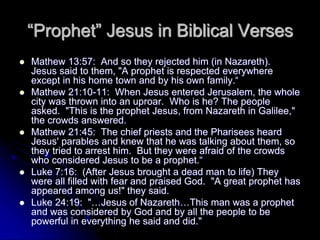
“Prophet” Jesus in Biblical Verses
 Mathew 13:57: And so they rejected him (in Nazareth).
Jesus said to them, "A prophet is respected everywhere
except in his home town and by his own family.“
 Mathew 21:10-11: When Jesus entered Jerusalem, the whole
city was thrown into an uproar. Who is he? The people
asked. "This is the prophet Jesus, from Nazareth in Galilee,"
the crowds answered.
 Mathew 21:45: The chief priests and the Pharisees heard
Jesus' parables and knew that he was talking about them, so
they tried to arrest him. But they were afraid of the crowds
who considered Jesus to be a prophet.“
 Luke 7:16: (After Jesus brought a dead man to life) They
were all filled with fear and praised God. "A great prophet has
appeared among us!" they said.
 Luke 24:19: "…Jesus of Nazareth…This man was a prophet
and was considered by God and by all the people to be
powerful in everything he said and did."
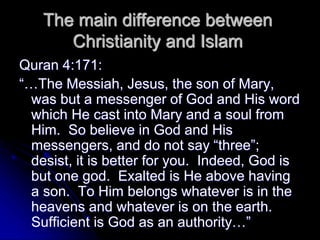
The main difference between
Christianity and Islam
Quran 4:171:
“…The Messiah, Jesus, the son of Mary,
was but a messenger of God and His word
which He cast into Mary and a soul from
Him. So believe in God and His
messengers, and do not say “three”;
desist, it is better for you. Indeed, God is
but one god. Exalted is He above having
a son. To Him belongs whatever is in the
heavens and whatever is on the earth.
Sufficient is God as an authority…”
Common Teachings:
Christianity and Islam
AWARE Center Presentations
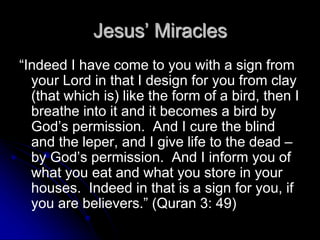
Jesus’ Miracles
“Indeed I have come to you with a sign from
your Lord in that I design for you from clay
(that which is) like the form of a bird, then I
breathe into it and it becomes a bird by
God’s permission. And I cure the blind
and the leper, and I give life to the dead –
by God’s permission. And I inform you of
what you eat and what you store in your
houses. Indeed in that is a sign for you, if
you are believers.” (Quran 3: 49)
Prophetic traditions about Jesus
 In more than 50 hadith, Muhammad is
recorded as indicating that Jesus will
return to Earth, rule the people
according to the Qur'an, fight and kill
the Antichrist, and usher in an era of
peace and abundance for the whole
world. He will live on earth for 40
years. Muslims will pray for him at his
funeral.

en_Common_teachings_between_Islam_and_Christianity.ppt

  • 1.
    Common Teachings: Christianity andIslam AWARE Center Presentations
  • 2.
    The Basic Question Howdo I know what the basic teachings of Christianity and Islam are?  Should I ask practitioners?  Which sect?  Should I ask leaders and scholars?  Which school of thought? Whose legal opinions?  Should I read?  Which sources? Conclusion: I must go to the core first and foremost, and that is the holy books themselves.
  • 3.
    Primary source: anoriginal information source that was created at or near the time of the events studied, by a known author  The primary sources in Christianity: the Bible  The primary sources in Islam: the Quran and Sunnah
  • 4.
    The Bible (OT) Thefollowing books of the Bible are of unknown authorship:  Genesis  Exodus  Leviticus  Numbers  Deuteronomy  Joshua The first 4 books are traditionally assumed to have been written by Moses, though his authorship is not claimed internally. Since Deuteronomy records the death of Moses, it seems unlikely that he wrote it. Similarly, the book of Joshua describes his death at the end, and includes in the middle an incident the occurred after Joshua's death. (15:13-19; cf. Judges 1:1, 9-15)
  • 5.
    The Bible (OT) Thefollowing books are also of unknown authorship:  Judges (c. 10th century BC)  Ruth (c. 10th century BC)  1-2 Samuel (8th-6th century BC)  1-2 Kings (6th-5th century BC)  1-2 Chronicles (400 BC would be the earliest possible date for composition)  Esther (5th century BC)  Job (c. 10th century BC at the earliest)  Lamentations (traditionally ascribed to Jeremiah, but there is no evidence to support this belief).
  • 6.
    The Bible (OT) Thefollowing books have been written by more than one author, as indicated by the texts themselves:  Psalms (Moses, Ethan, Heman, Solomon, David, Jeremiah, Hezekia, Ezra & others)  Proverbs (Solomon, Agur, Lemuel, Hezekiah’s men and a person or people called “the wise”)
  • 7.
    The Bible (OT) Thefollowing books’ authors are indicated by their titles:  Isaiah  Jeremiah  Ezekiel  Daniel  Hosea  Joel  Amos  Obadiah  Jonah  Micah  Nahum  Haggai  Zechariah
  • 8.
    The Bible (NT) Matthew (between AD 55 and 75)  Mark, attributed to John Mark (probably before AD 70)  Luke, (probably before AD 60)  John (probably between AD 85 and 90)  Acts (attributed to Luke)
  • 9.
    Bible (NT) The following14 books are attributed to Paul (50 - 67 AD):  Romans  1 Corinthians  2 Corinthians  Galatians  Ephesians  Philippians  Colossians  1 Thessalonians  2 Thessalonians  1 Timothy  2 Timothy  Titus  Philemon  Hebrews
  • 10.
    Bible (NT) The followingbooks’ authors are indicated by their titles (45-90 AD):  James  1 Peter  2 Peter  1 John  2 John  3 John  Jude  Revelation (attributed to John)
  • 11.
    The Bible isperhaps the only primary source of Christian teachings From which part of the Bible should I extract the teachings of Christianity?  The OT (before Christ?) (at least 22 known authors, plus15 books of unknown authorship, over a time span of at least 1000 years.)  The NT (at least 9 authors starting 45 years after Jesus’ ascension)  Which version?
  • 12.
    The Quran isthe most important primary source of Islamic teachings  Revealed 610-633, its historic authenticity is verified by scholars of many faiths  Original written Quran is on display in Topkapi Palace, Turkey  It is written in first person from the Creator’s point of view.  One Arabic version used across the globe  Various translations, each with merits and faults. The original Arabic language is the necessary referent.
  • 13.
    The hadith arethe only other primary source Islamic teachings  Includes the sayings, doings, and tacit approvals of Prophet Muhammad.  Observed during his lifetime, transmitted orally and recorded in writing through rigorous methodology about 300 years after his death.  An important source of information and guidance for Muslims, second only to the Quran.  The hadith showed how Muhammad interpreted and practiced the divine revelation, in which he is said to be an “excellent model” with an “exalted moral character.” (33:21; 68:4)
  • 14.
    Common Teachings  TheQuran and hadith will be used as a basis for comparison, since the six articles of faith and the five distinguishing acts of worship are clearly defined and agreed upon by all Muslims from all sects.  For Christian teachings, the New Testament are referred to as much as possible.  My question: Are there clearly defined articles of faith and specific acts of worship in Christian teachings? Are they widely known?
  • 15.
    The six articlesof faith in Islam  Belief in one Deity  Belief in angels  Belief in all of God’s prophets  Belief in all the scriptures sent by God  Belief in God’s knowledge of and power over all things  Belief in the Hereafter, including Paradise and Hellfire.
  • 16.
    God as theonly Deity  Quran 2:255: The God! There is no deity except Him, the Ever-Living, the Sustainer of all existence…” (2:165) “There are people who set up equals with God and adore them with the adoration due to God; they love them as they should love God. But those who [truly] believe are stronger in their love for God…(2:165)  Mark 12:28-30: (A teacher of the Law asked) "Which commandment is the most important of all?" Jesus replied, "The most important one is this: "Listen, Israel! The Lord our God is the only Lord. Love the Lord your God with all your heart, with all your soul, and with all your mind, and with all your strength."
  • 17.
    Angels  The Qurandescribes them as spirits created by God who carry out duties assigned by Him with absolute obedience, such as recording our words and deeds, guarding us, taking our souls at death, praising God, asking forgiveness for those on earth, and conveying messages to prophets and the Virgin Mary.  Similar characteristics in OT and NT
  • 18.
    Quranic / Biblicalverses  Quran 6:61: …He sends over you guardian angels until, when death comes to one of you, Our messengers [angels] take him…  Quran 86:4: There is no soul but that it has over it a protector [angel].  Exodus 23:20 I am sending an angel ahead of you to guard you along the way and to bring you to the place I have prepared.
  • 19.
     Quran 42:5:…The angels exalt [God] with praise of their Lord and ask forgiveness for those on earth…  Revelations 7: 11: All the angels were standing around the throne and around the elders and the four living creatures. They fell down on their faces before the throne and worshiped God.  Luke 15:10: …The angels of God rejoice over one sinner who repents. Quranic / Biblical verses
  • 20.
     Quran 3:39:So the angels called him [Zechariah] while he was standing in prayer in the chamber, ‘Indeed, God gives you good tidings of John…’  Luke 1:11-13: Then an angel of the Lord appeared to him, standing at the right side of the altar of incense.… The angel said to him: "Do not be afraid, Zechariah; your prayer has been heard. Your wife Elizabeth will bear you a son, and you are to give him the name John.  Verses about Mary in Quran and NT are similar. Quranic / Biblical verses
  • 21.
    Prophets  The Muslimbelieves in all prophets of God who were sent at different times to their people to lead them to the path of God. The Quran says, "We sent no messenger before you [O Muhammad] without revealing to him: There is no god but Me so worship Me." (21:25). The Quran says that the faithful believe "in God, His angels, His books and His messengers, [saying], ‘We make no distinction between any of His messengers…’” (2:285)
  • 22.
    The Names ofProphets Common between the Quran and Bible  Adam  Enoch (Idris)  Noah (Nuh)  Salih  Abraham (Ibrahim)  Ismail (Ishmael)  Issac (Ishaq)  Lot (Lut)  Jacob (Yacub)  Joseph (Yusuf)  Job (Ayub)  Moses (Musa)  Ezekiel (Thul-kifl)  David (Dawud)  Solomon (Sulaiman)  Elias  Elisha (Al-Yasa)  Jonah (Yunus)  Zachariah  John (Yahya)  [Jesus] (Esa) *  [Muhammad] * *Jesus is rejected by Jews; Muhammad is rejected by Christians and Jews.
  • 23.
    Scripture or booksrevealed by God (as indicated by Quranic verses) The scripture of Abraham (4:54, 87:19) ● The Torah – revealed to Moses (11:110, 48:29) ●Genesis, Exodus, Leviticus, Numbers, Deuteronomy (?) ●The Psalms of David (which parts are his?) (17:55) ●The Gospel – revealed to Jesus (57:27) The Quran – revealed to Muhammad (12:2)
  • 24.
     Quran 57:22:“Nothing occurs, either in the earth or in yourselves, without it being in a Book before We make it happen. That is something easy for God.”  John 1:3 Through Him all things were made; without Him nothing was made that has been made.  1Corinthians 7: So neither he who plants nor he who waters is anything, but only God, who makes things grow. God’s knowledge and power
  • 25.
    Accountability before God Quran 21:47: Not a soul will be dealt with unjustly in the least. And if there be (no more than) the weight of a mustard seed We will bring it (to account).  Mathew 12:33: And you can be sure than on the Judgment Day everyone will have to give account of every useless word he has ever spoken. Your words will be used to judge you – to declare you either innocent or guilty.  Mark 5:28-29: …All who are in their graves will hear his voice and come out--those who have done good will rise to live, and those who have done evil will rise to be condemned.  Revelations 21:8 But the cowardly, the unbelieving, the vile, the murderers, the sexually immoral, those who practice magic arts, the idolaters and all liars--their place will be in the fiery lake of burning sulfur.
  • 26.
    Belief in theHereafter  “Every soul will taste death, and you will be given your compensation on the Day of Resurrection. So he who escapes the Fire and is admitted to Paradise has achieved [a great achievement]. And what is the life of this world except the enjoyment of illusion?” (3:185 + many)  Matthew 13: 41-43: This is how it will be at the end of the age. The angels will come and separate the wicked from the righteous and throw them into the fiery furnace, where there will be weeping and gnashing of teeth.  Mathew 5:12 Rejoice and be glad, because great is your reward in heaven …. 6:20 But store up for yourselves treasures in heaven, where moth and rust do not destroy…
  • 27.
    All divinely revealedfaiths promote kindness modesty compassion justice generosity honesty love brotherhood. But there are specific acts of worship that God expects from Muslims:
  • 28.
    Main Acts ofWorship in Islam  The testimony of faith is a pledge and a commitment to God to submit to His will.  Prayer is worship with the body, mind, voice and heart at regular intervals.  Fasting is an annual month-long course in self-discipline, compassion and gratitude.  Zakat is compulsory charity that trains us to share with the disadvantaged.  Pilgrimage is an answer to God’s eternal call to the first house of worship.
  • 29.
    Prayer  Quran 20:14:I am God! There is no god but Me, so worship Me and perform prayer to remember Me.  Mathew 26:36 Then Jesus went with his disciples to a place called Gethsemane, and he said to them, "Sit here while I go over there and pray." 39 Going a little farther, he fell with his face to the ground and prayed…  Mark 1:35 Very early in the morning, while it was still dark, Jesus got up, left the house and went off to a solitary place, where he prayed.
  • 30.
    Fasting  Quran 2:183:Fasting has been prescribed for you as it was prescribed for those before you so that you may learn God-consciousness.  Mathew 9:14 Then John's disciples came and asked him, "How is it that we and the Pharisees fast, but your disciples do not fast?"  Luke 2:37 (about a prophetess who) was a widow until she was eighty-four. She never left the temple but worshiped night and day, fasting and praying.
  • 31.
    Alms  Quran 9:60:Zakat is for the poor and needy, freeing slaves, those in debt, travelers, etc. “a legal obligation from God.”  Quran 2:219: They ask what they should spend in charity. Say, "The excess (ie, what is beyond your needs)”.  1Timothy 5:8: If anyone does not provide for his relatives, and especially for his immediate family, he has denied the faith and is worse than an unbeliever.  Luke 3:11: John answered, "The man with two tunics should share with him who has none, and the one who has food should do the same."  Acts 10:2: He and all his family were devout and God- fearing; he gave generously to those in need and prayed to God regularly.
  • 32.
    Conclusion 1  TheNew Testament shows many similarities to Islam’s major beliefs:  God is one, Creator of everything, knowing all things and having power over all things.  Prophets and scripture  Angels  Accountability  Hereafter (Paradise and Hell)
  • 33.
    Conclusion 2 The NewTestament shows similarities to acts of worship in Islam:  Prayer  Fasting  Alms The minimum amount that a believer should observe is specified in the Quran and hadith, whereas it is not in the Bible.
  • 34.
    A final comparison Quran19:29-32: Jesus said, “Indeed, I am the servant of God. He has given me the Scripture and made me a prophet. And he has made me blessed wherever I am and has enjoined upon me prayer and alms as long as I remain alive. And he made me dutiful to my mother…”
  • 35.
    “Prophet” Jesus inBiblical Verses  Mathew 13:57: And so they rejected him (in Nazareth). Jesus said to them, "A prophet is respected everywhere except in his home town and by his own family.“  Mathew 21:10-11: When Jesus entered Jerusalem, the whole city was thrown into an uproar. Who is he? The people asked. "This is the prophet Jesus, from Nazareth in Galilee," the crowds answered.  Mathew 21:45: The chief priests and the Pharisees heard Jesus' parables and knew that he was talking about them, so they tried to arrest him. But they were afraid of the crowds who considered Jesus to be a prophet.“  Luke 7:16: (After Jesus brought a dead man to life) They were all filled with fear and praised God. "A great prophet has appeared among us!" they said.  Luke 24:19: "…Jesus of Nazareth…This man was a prophet and was considered by God and by all the people to be powerful in everything he said and did."
  • 36.
    The main differencebetween Christianity and Islam Quran 4:171: “…The Messiah, Jesus, the son of Mary, was but a messenger of God and His word which He cast into Mary and a soul from Him. So believe in God and His messengers, and do not say “three”; desist, it is better for you. Indeed, God is but one god. Exalted is He above having a son. To Him belongs whatever is in the heavens and whatever is on the earth. Sufficient is God as an authority…”
  • 37.
    Common Teachings: Christianity andIslam AWARE Center Presentations
  • 38.
    Jesus’ Miracles “Indeed Ihave come to you with a sign from your Lord in that I design for you from clay (that which is) like the form of a bird, then I breathe into it and it becomes a bird by God’s permission. And I cure the blind and the leper, and I give life to the dead – by God’s permission. And I inform you of what you eat and what you store in your houses. Indeed in that is a sign for you, if you are believers.” (Quran 3: 49)
  • 39.
    Prophetic traditions aboutJesus  In more than 50 hadith, Muhammad is recorded as indicating that Jesus will return to Earth, rule the people according to the Qur'an, fight and kill the Antichrist, and usher in an era of peace and abundance for the whole world. He will live on earth for 40 years. Muslims will pray for him at his funeral.