Hamlet Group Presentation
Nedim Ahmic (1), Spencer Glantz (3), Jenny Stinfil (2), Ricky Thors (4)
Flower Symbolism
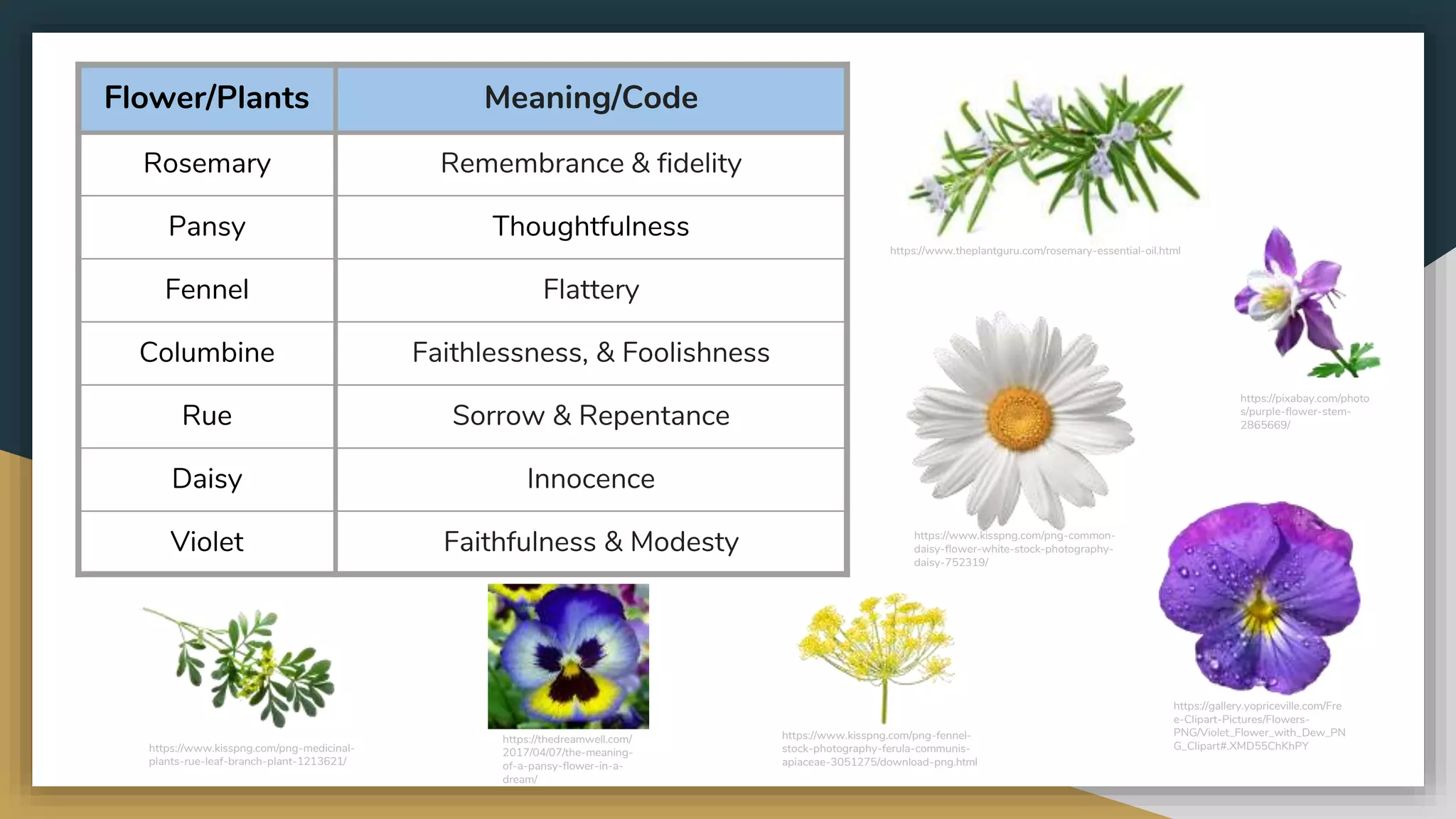
Flower/Plants Meaning/Code
Rosemary Remembrance & fidelity
Pansy Thoughtfulness
Fennel Flattery
Columbine Faithlessness, & Foolishness
Rue Sorrow & Repentance
Daisy Innocence
Violet Faithfulness & Modesty
https://www.theplantguru.com/rosemary-essential-oil.html
https://thedreamwell.com/
2017/04/07/the-meaning-
of-a-pansy-flower-in-a-
dream/
https://www.kisspng.com/png-fennel-
stock-photography-ferula-communis-
apiaceae-3051275/download-png.html
https://pixabay.com/photo
s/purple-flower-stem-
2865669/
https://www.kisspng.com/png-common-
daisy-flower-white-stock-photography-
daisy-752319/
https://gallery.yopriceville.com/Fre
e-Clipart-Pictures/Flowers-
PNG/Violet_Flower_with_Dew_PN
G_Clipart#.XMD55ChKhPYhttps://www.kisspng.com/png-medicinal-
plants-rue-leaf-branch-plant-1213621/
In Act IV, scene V, Ophelia
walks into the room where
the Claudius, the Queen
and others are gathered
with a bunch of plants with
her. She begins to pass out
different flowers/plants to
people based on there
meaning and what each
one symbolizes after she
learns that her father,
Polonius, has been killed.
Ophelia thought at first
when she was handing out
the flowers that the king
had a hand in killing her
father, but she was wrong.
She first gives Rosemary and Pansies to
her brother, Laertes, in response to her
father's death. She uses what the plant
symbolizes to tell everyone in that room to
remember what happened to her father as
well as encouraging her brother to do
something about it.
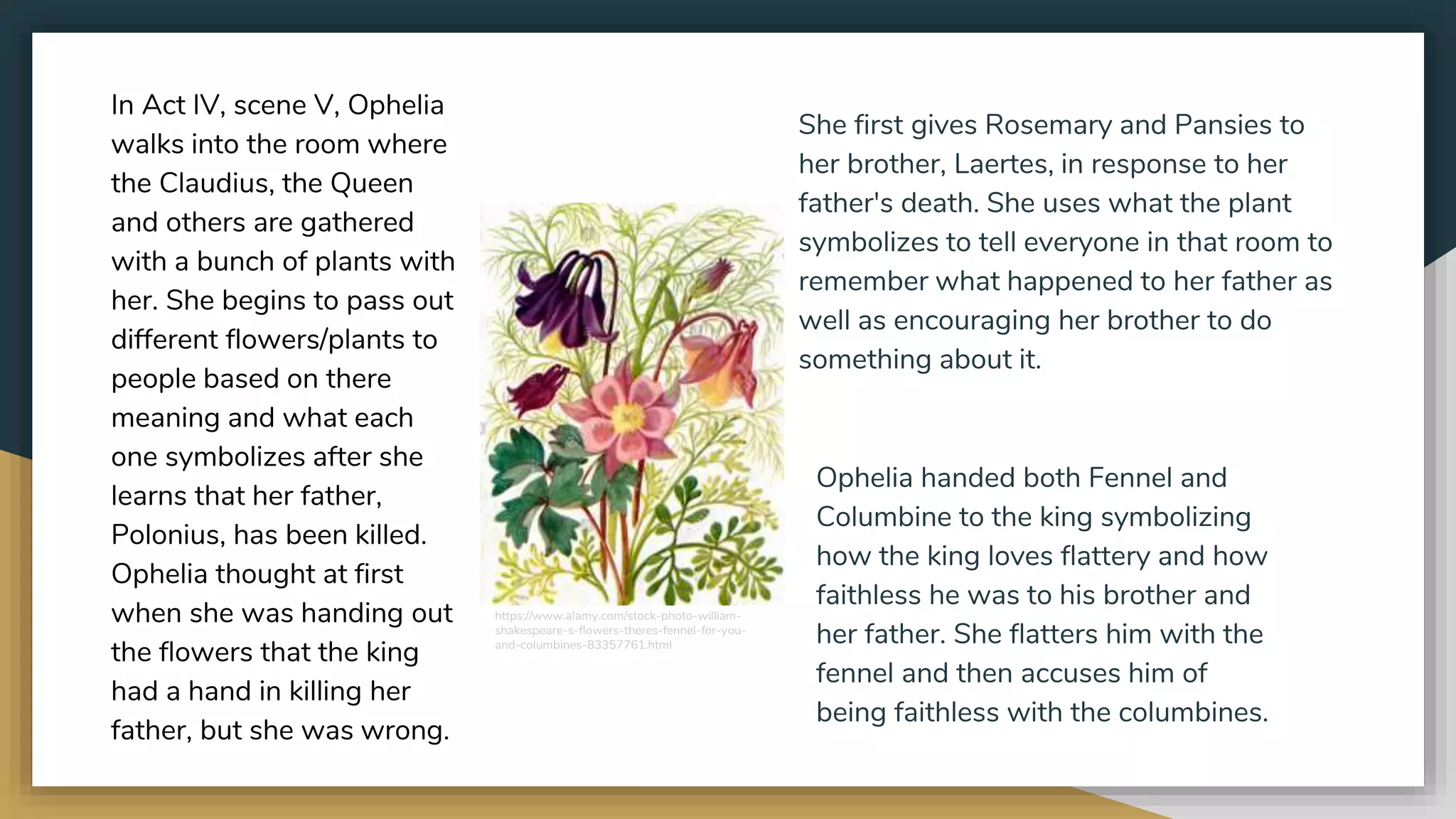
Ophelia handed both Fennel and
Columbine to the king symbolizing
how the king loves flattery and how
faithless he was to his brother and
her father. She flatters him with the
fennel and then accuses him of
being faithless with the columbines.
https://www.alamy.com/stock-photo-william-
shakespeare-s-flowers-theres-fennel-for-you-
and-columbines-83357761.html
http://www.bbc.co.uk/hamlet/plot/act4.shtml
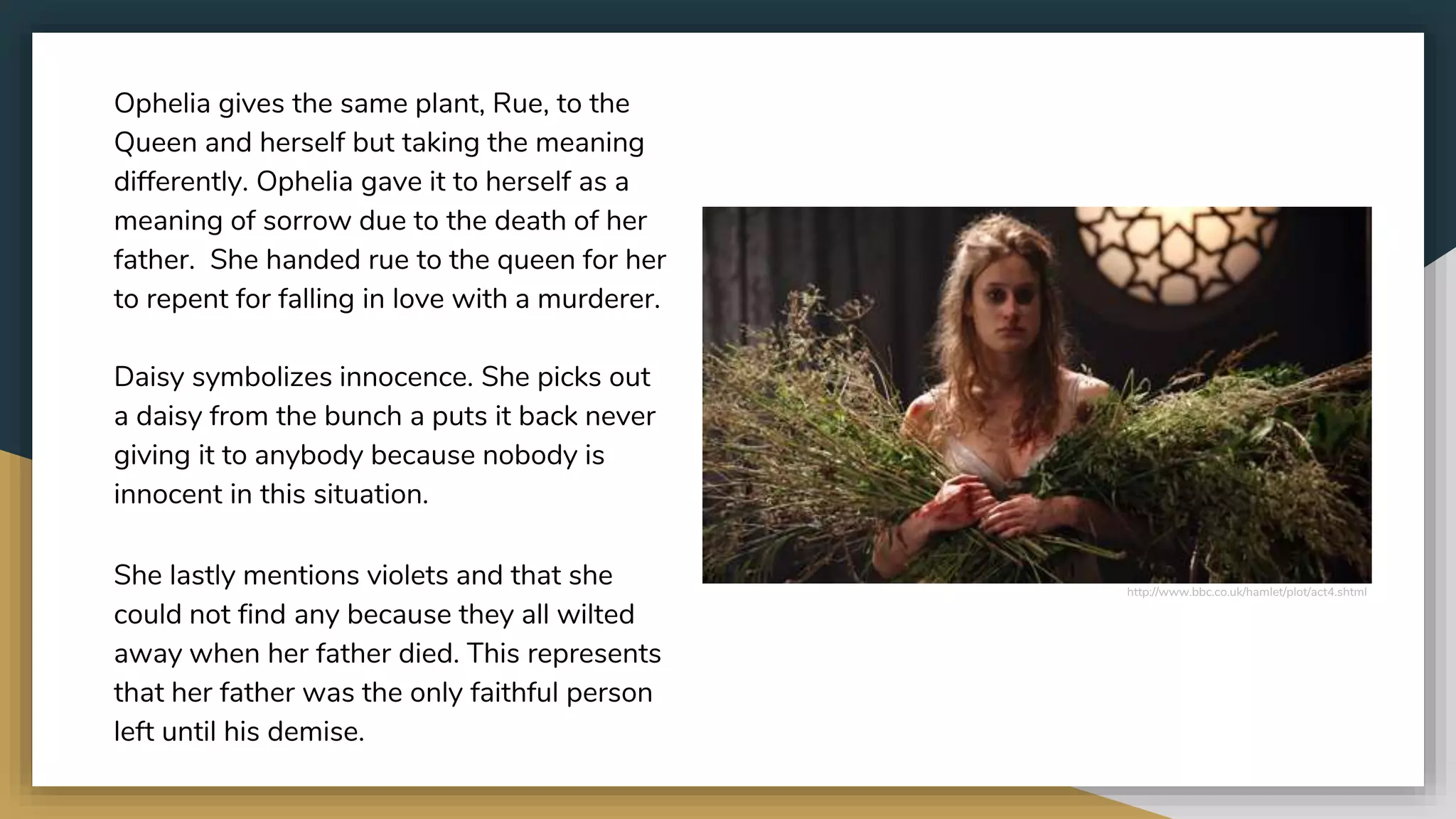
Ophelia gives the same plant, Rue, to the
Queen and herself but taking the meaning
differently. Ophelia gave it to herself as a
meaning of sorrow due to the death of her
father. She handed rue to the queen for her
to repent for falling in love with a murderer.
Daisy symbolizes innocence. She picks out
a daisy from the bunch a puts it back never
giving it to anybody because nobody is
innocent in this situation.
She lastly mentions violets and that she
could not find any because they all wilted
away when her father died. This represents
that her father was the only faithful person
left until his demise.
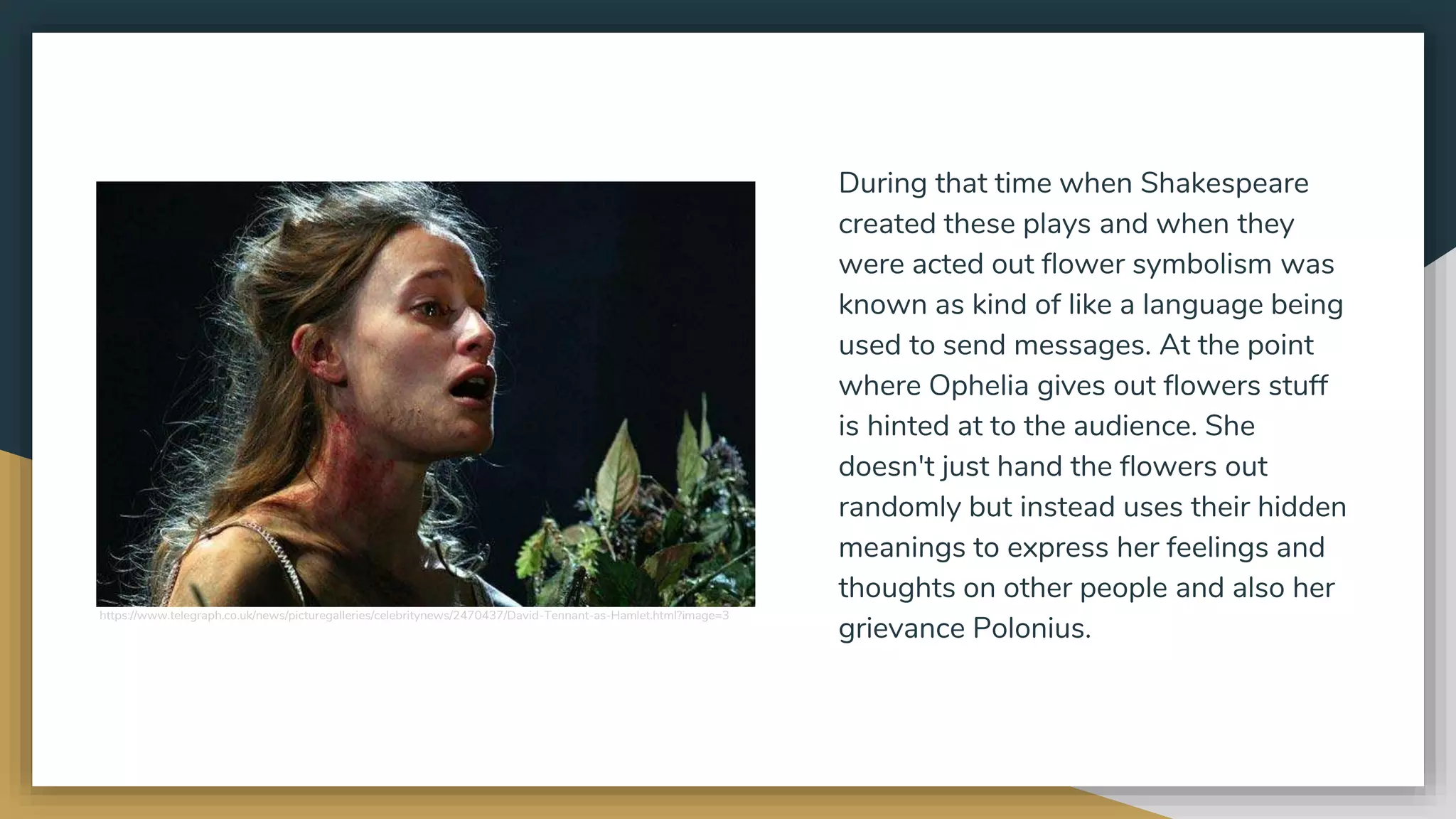
During that time when Shakespeare
created these plays and when they
were acted out flower symbolism was
known as kind of like a language being
used to send messages. At the point
where Ophelia gives out flowers stuff
is hinted at to the audience. She
doesn't just hand the flowers out
randomly but instead uses their hidden
meanings to express her feelings and
thoughts on other people and also her
grievance Polonius.
https://www.telegraph.co.uk/news/picturegalleries/celebritynews/2470437/David-Tennant-as-Hamlet.html?image=3
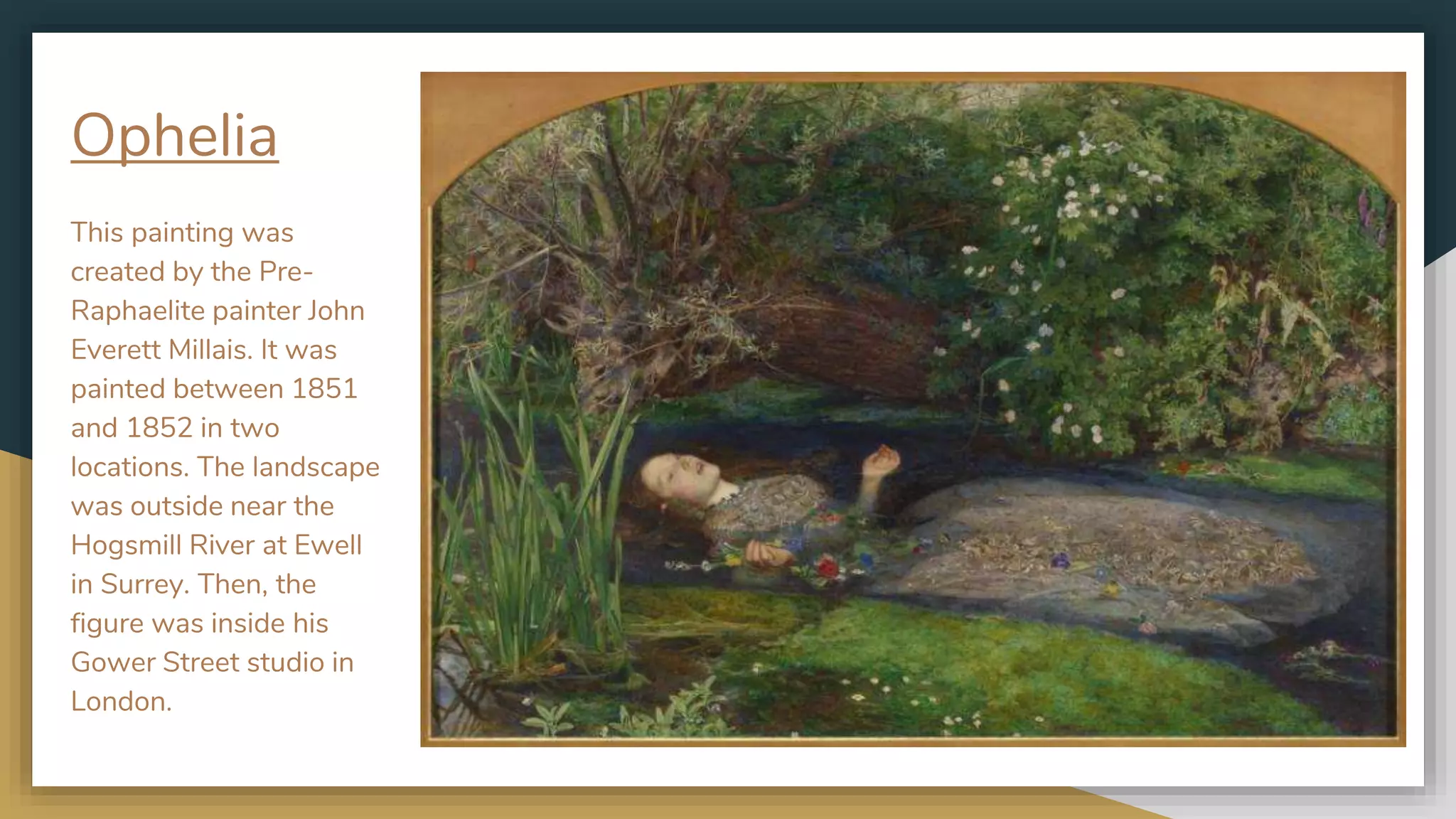
Ophelia Painting
Ophelia
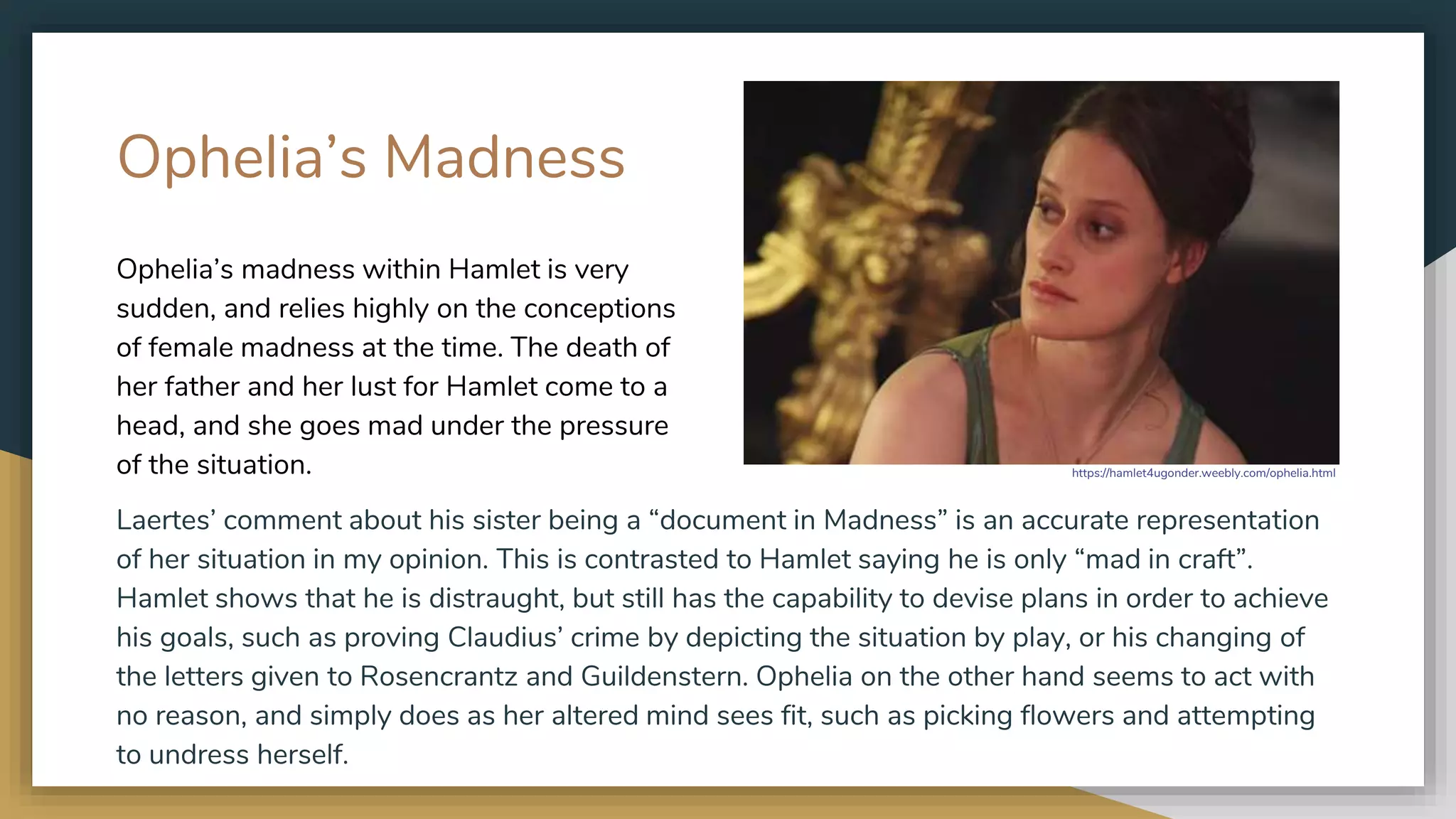
This painting was
created by the Pre-
Raphaelite painter John
Everett Millais. It was
painted between 1851
and 1852 in two
locations. The landscape
was outside near the
Hogsmill River at Ewell
in Surrey. Then, the
figure was inside his
Gower Street studio in
London.
Work that went into the painting
During that time period the landscape was usually the least important aspect of a painting.
For Millais though, he spent the majority of his time working on the landscape and did it out
in the open air, which was also uncommon.
The landscape of painting includes flowers that are both symbolic or were mentioned in the
play Hamlet. The river scene in the photo took five months to create, so it features flowers
that bloom at different times during the year and they happen to appear next to each other.
A professor teaching botany used his painting to study the different flowers because Millais
payed attention to detail in the painting.
Work that went into the painting
The model that was used for Ophelia was a nineteen year old woman named Elizabeth
Siddall. To show Ophelia drowning in a water, Millais had her pose in a bath full of water.
While she posed, she wore a “fine silver embroidered dress bought by Millais from a
second-hand shop for four pounds.”
He sketched her very briefly because the landscape was the thing that required greater
attention. He had used two canvas that he bought for 15 shillings. He used one canvas to
paint on, while the other was used to cover the back of the painting in order to protect it. It's
said that every day he would mark out the area that he needed to paint that day in white. He
used colors that were only just coming out because of modern chemistry. His work included
pigments that came from minerals, precious stones, rocks, vegetables, insects, and plants.
How was the painting
perceived?
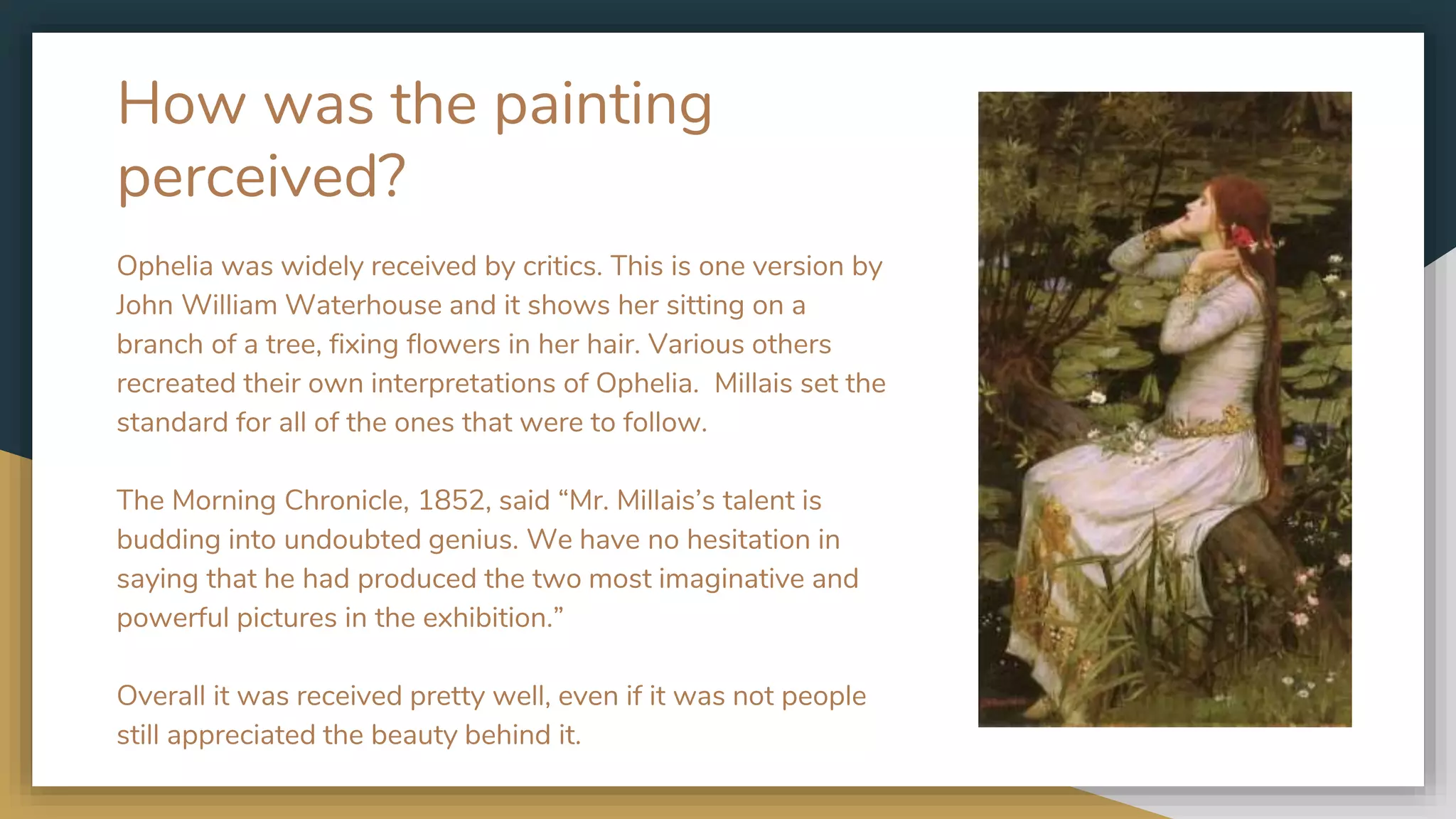
Ophelia was widely received by critics. This is one version by
John William Waterhouse and it shows her sitting on a
branch of a tree, fixing flowers in her hair. Various others
recreated their own interpretations of Ophelia. Millais set the
standard for all of the ones that were to follow.
The Morning Chronicle, 1852, said “Mr. Millais’s talent is
budding into undoubted genius. We have no hesitation in
saying that he had produced the two most imaginative and
powerful pictures in the exhibition.”
Overall it was received pretty well, even if it was not people
still appreciated the beauty behind it.
Female Madness
Elizabethan Views on Madness
Unlike in modern times, many views on people’s actions and experiences were viewed to be
tied to their gender in the Elizabethan era. The example of madness between males from
that time between males and females shows this point excellently. For the times, male
madness was more often associated with intellectual aspects, as shown by Shakespeare in
the character of Hamlet. Ophelia was portrayed to have a different kind of madness based
on the view of the times. Shakespeare uses the character of Ophelia to show how madness
in women was portrayed as being rooted in love and alike emotions. The perceived causes
for female madness in the Elizabethan era were love, lust, and the loss of someone close to
the character. Shakespeare uses these perceptions in the characters in the plays of Hamlet,
Romeo and Juliet, and Macbeth.
Gertrude’s Madness
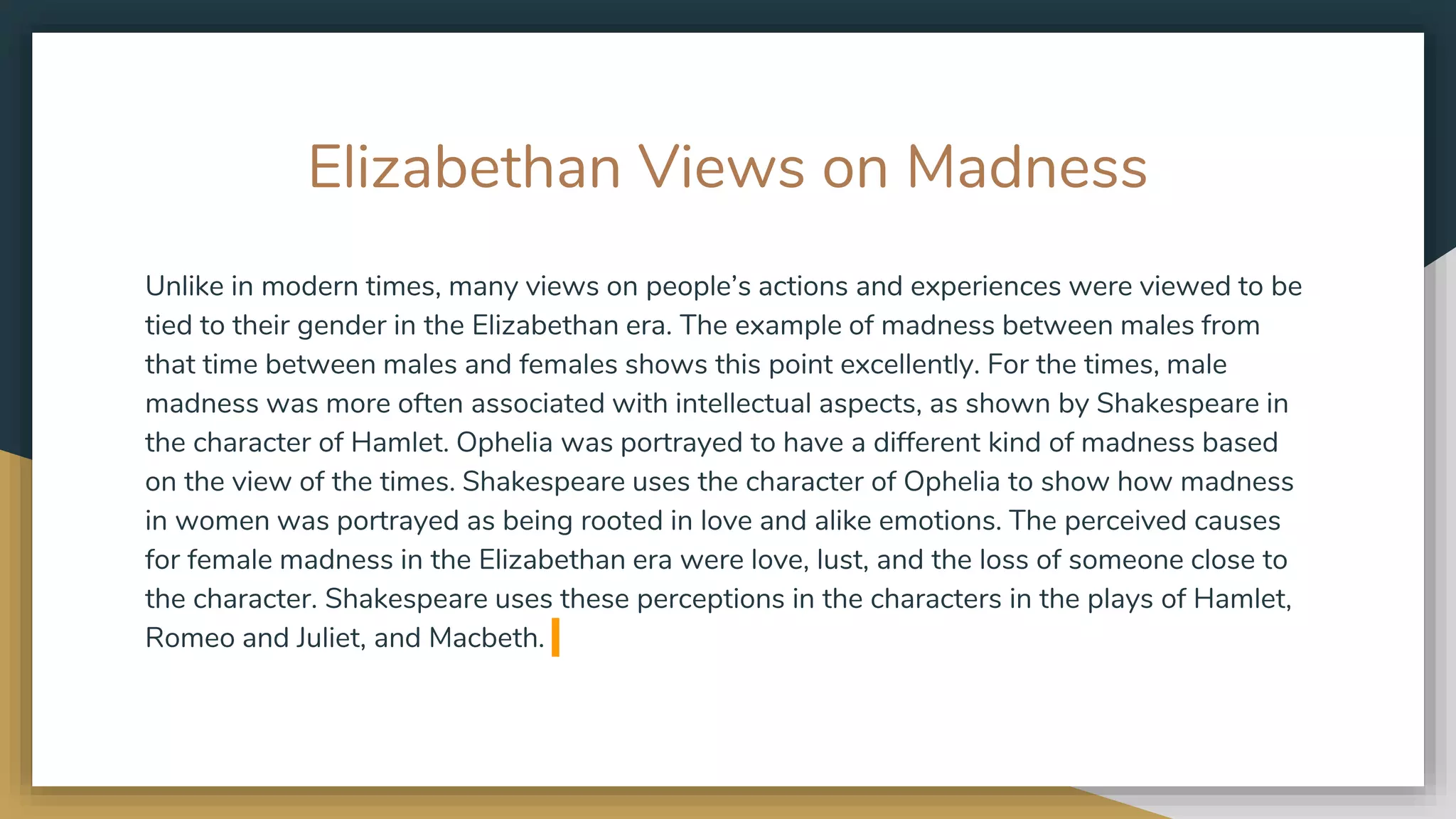
When looking at the character of Queen Gertrude, it
seems that as the story progresses, she realized the
err of her ways, and goes mad because of it. She
starts of seeming content with her husband’s death,
and sees no issue with her quick marriage to
Claudius. The Elizabethan interpretation of female
madness plays out after act III scene IV, and Hamlet
sets the foundation for her love of Hamlet’s father to
shine through again. She is driven mad because of
her love and mistake, and takes her own life for it.
https://hamlet-behind-the-deaths-in-denmark.fandom.com/wiki/Queen_Gertrude
Ophelia’s Madness
Laertes’ comment about his sister being a “document in Madness” is an accurate representation
of her situation in my opinion. This is contrasted to Hamlet saying he is only “mad in craft”.
Hamlet shows that he is distraught, but still has the capability to devise plans in order to achieve
his goals, such as proving Claudius’ crime by depicting the situation by play, or his changing of
the letters given to Rosencrantz and Guildenstern. Ophelia on the other hand seems to act with
no reason, and simply does as her altered mind sees fit, such as picking flowers and attempting
to undress herself.
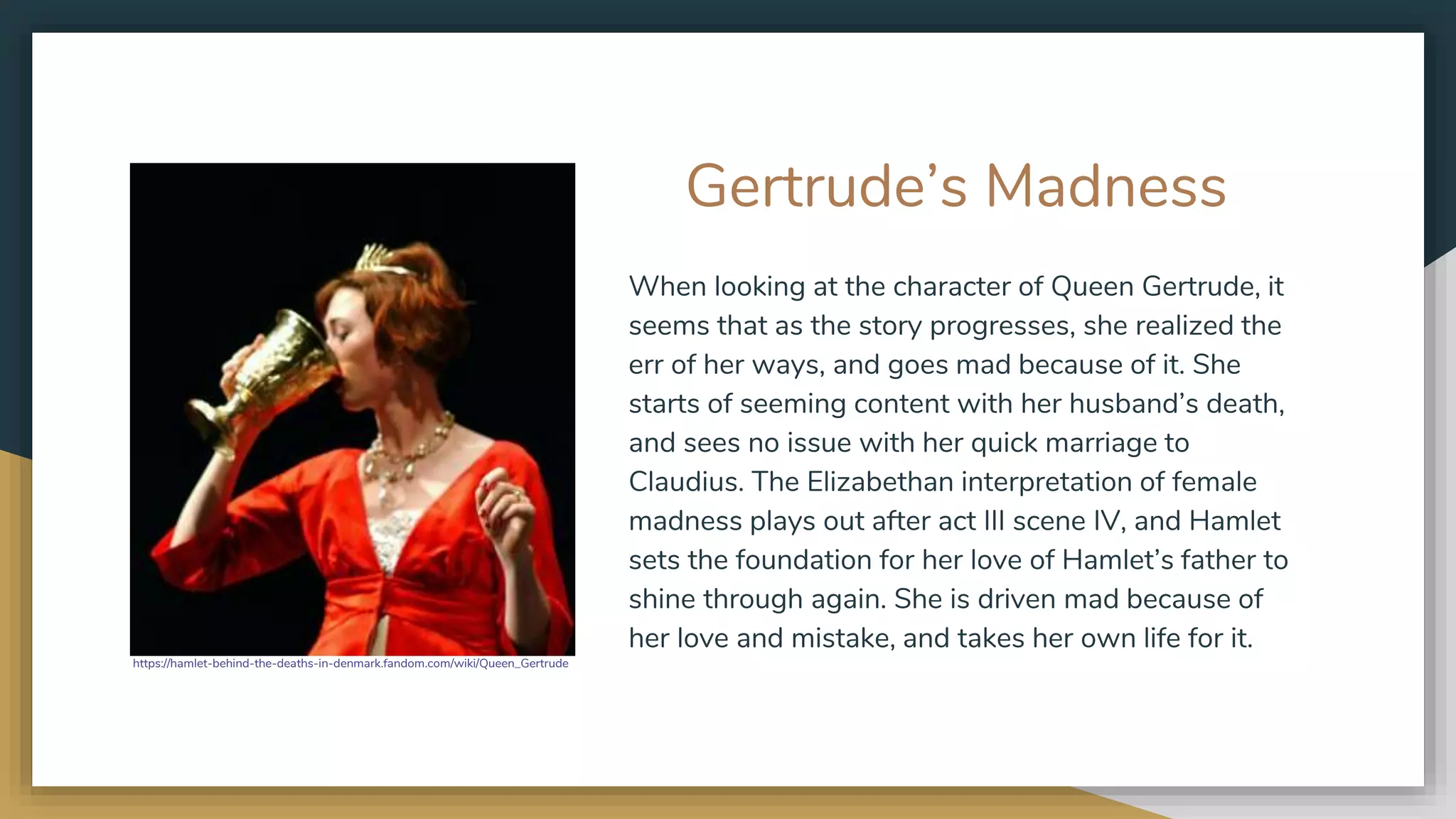
Ophelia’s madness within Hamlet is very
sudden, and relies highly on the conceptions
of female madness at the time. The death of
her father and her lust for Hamlet come to a
head, and she goes mad under the pressure
of the situation. https://hamlet4ugonder.weebly.com/ophelia.html
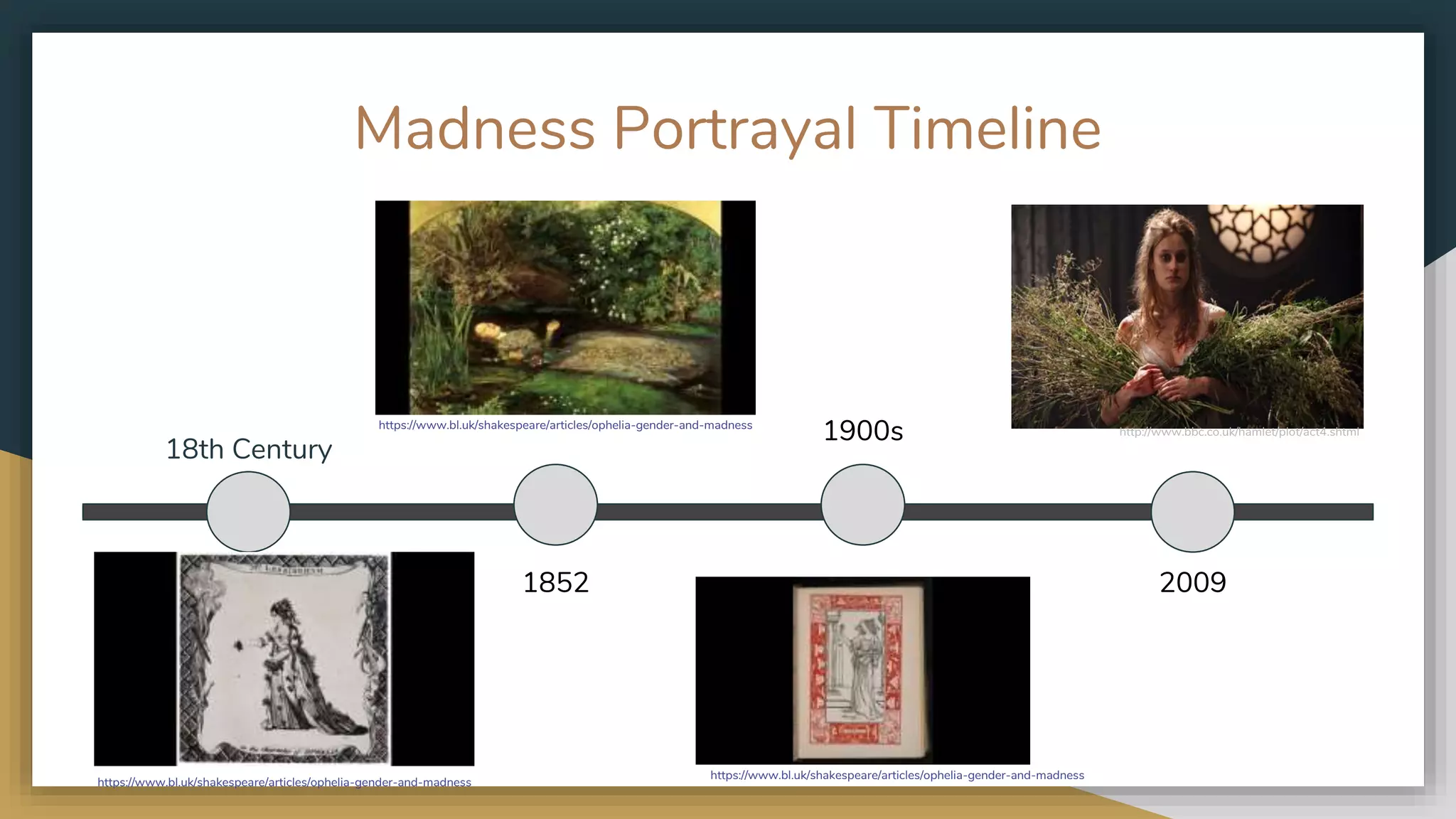
Madness Portrayal Timeline
18th Century
http://www.bbc.co.uk/hamlet/plot/act4.shtml
1852
1900s
2009
https://www.bl.uk/shakespeare/articles/ophelia-gender-and-madness
Male Madness
Hamlet's Madness
Hamlet began to "put an antic disposition" in full control. After being stressed
and confused he began to tear his own mind and drove him closer and closer
to insanity. He finally snapped once he killed Polonius. ​
However, after that event, Hamlet turned back to normal and regained his
sanity. Overall, he showed no signs of insanity except for the brief moment
with his mother and the ghost.
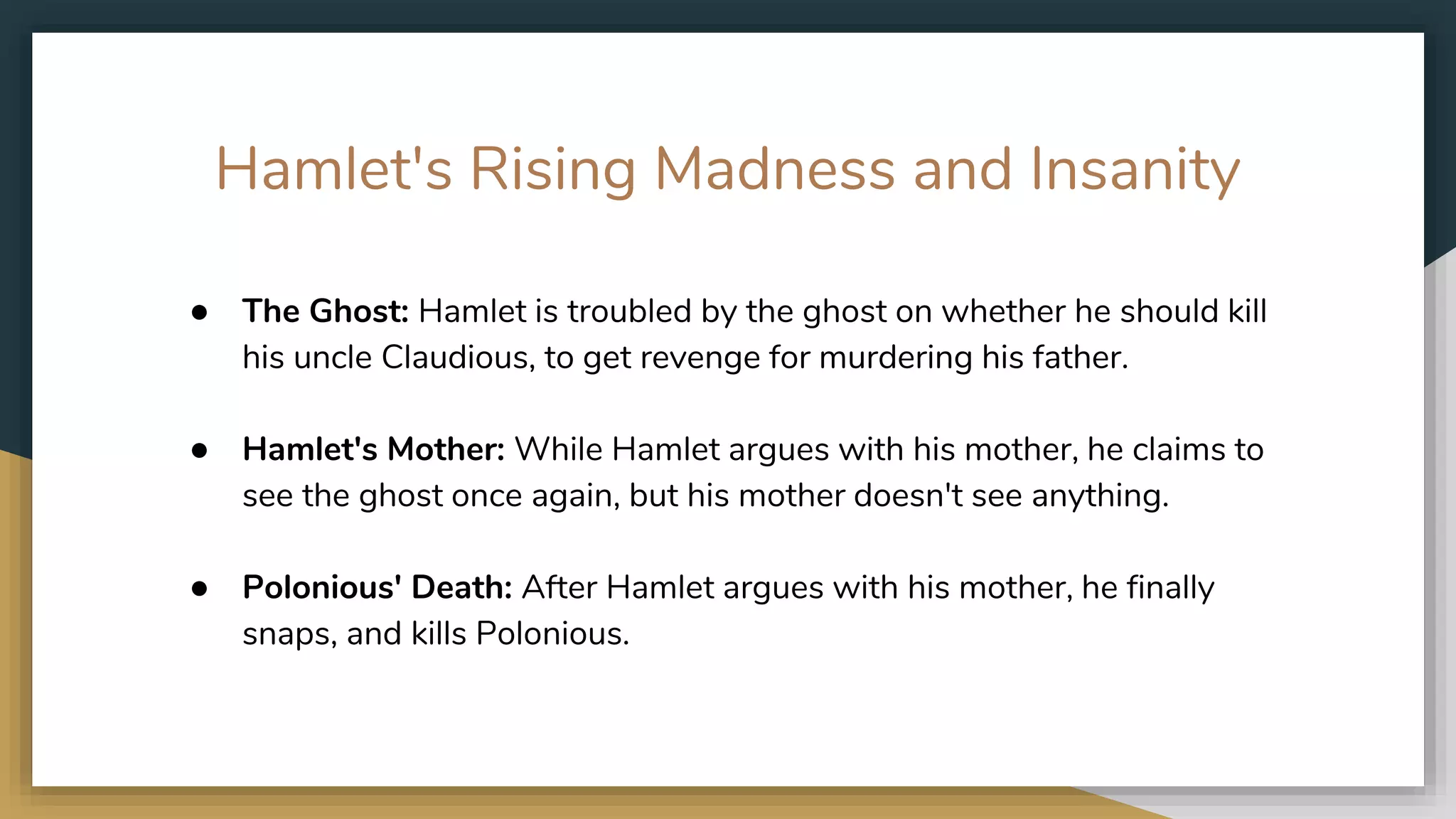
Hamlet's Rising Madness and Insanity
● The Ghost: Hamlet is troubled by the ghost on whether he should kill
his uncle Claudious, to get revenge for murdering his father. ​
● Hamlet's Mother: While Hamlet argues with his mother, he claims to
see the ghost once again, but his mother doesn't see anything. ​
● Polonious' Death: After Hamlet argues with his mother, he finally
snaps, and kills Polonious.
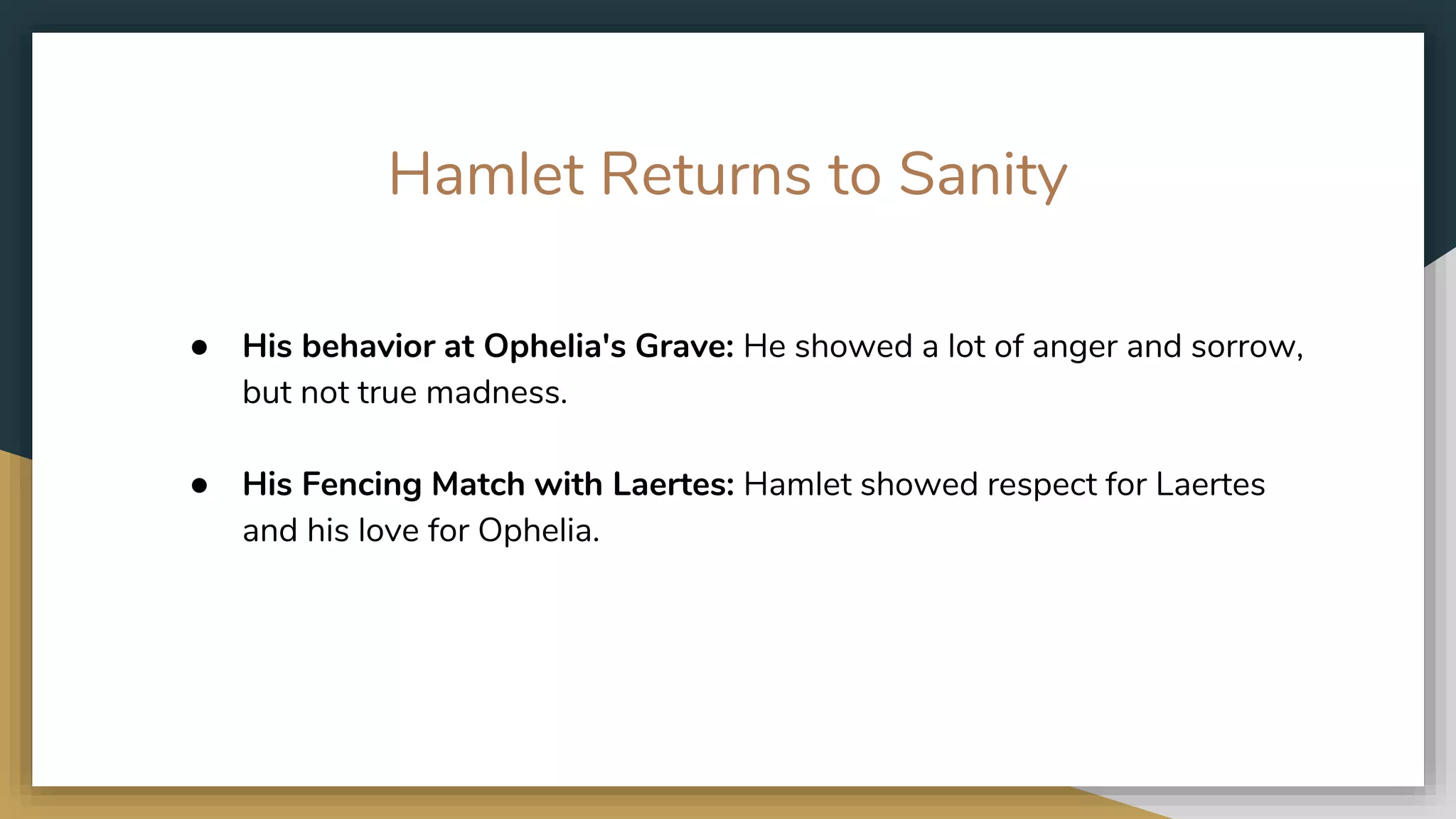
Hamlet Returns to Sanity
● His behavior at Ophelia's Grave: He showed a lot of anger and sorrow,
but not true madness. ​
● His Fencing Match with Laertes: Hamlet showed respect for Laertes
and his love for Ophelia.
Works Cited
#1
https://www.tate.org.uk/art/artworks/millais-
ophelia-n01506/story-ophelia
https://shakespeareandbeyond.folger.edu/2016/05/
31/elizabethan-garden-plants-shakespeare/
https://symbolicmeaningofflowers.weebly.com/use
-of-flowers-in-hamlet.html
#2
https://www.tate.org.uk/art/artworks/millais-
ophelia-n01506/story-ophelia
http://elsinore.ucsc.edu/women/womenPre-
Raphaelite.html
#3
https://www.bl.uk/shakespeare/articles/ophelia-
gender-and-madness
https://www.bl.uk/shakespeare/articles/shakespear
e-and-madness
https://owlcation.com/humanities/The-Madness-of-
Hamlet-and-Ophelia-Mental-Illness-in-
Shakespeare
#4
https://www.bl.uk/shakespeare/articles/ophelia-
gender-and-madness
https://www.bl.uk/shakespeare/articles/shakespear
e-and-madness

ENC1102 Group Project

  • 1.
    Hamlet Group Presentation NedimAhmic (1), Spencer Glantz (3), Jenny Stinfil (2), Ricky Thors (4)
  • 2.
  • 3.
    Flower/Plants Meaning/Code Rosemary Remembrance& fidelity Pansy Thoughtfulness Fennel Flattery Columbine Faithlessness, & Foolishness Rue Sorrow & Repentance Daisy Innocence Violet Faithfulness & Modesty https://www.theplantguru.com/rosemary-essential-oil.html https://thedreamwell.com/ 2017/04/07/the-meaning- of-a-pansy-flower-in-a- dream/ https://www.kisspng.com/png-fennel- stock-photography-ferula-communis- apiaceae-3051275/download-png.html https://pixabay.com/photo s/purple-flower-stem- 2865669/ https://www.kisspng.com/png-common- daisy-flower-white-stock-photography- daisy-752319/ https://gallery.yopriceville.com/Fre e-Clipart-Pictures/Flowers- PNG/Violet_Flower_with_Dew_PN G_Clipart#.XMD55ChKhPYhttps://www.kisspng.com/png-medicinal- plants-rue-leaf-branch-plant-1213621/
  • 4.
    In Act IV,scene V, Ophelia walks into the room where the Claudius, the Queen and others are gathered with a bunch of plants with her. She begins to pass out different flowers/plants to people based on there meaning and what each one symbolizes after she learns that her father, Polonius, has been killed. Ophelia thought at first when she was handing out the flowers that the king had a hand in killing her father, but she was wrong. She first gives Rosemary and Pansies to her brother, Laertes, in response to her father's death. She uses what the plant symbolizes to tell everyone in that room to remember what happened to her father as well as encouraging her brother to do something about it. Ophelia handed both Fennel and Columbine to the king symbolizing how the king loves flattery and how faithless he was to his brother and her father. She flatters him with the fennel and then accuses him of being faithless with the columbines. https://www.alamy.com/stock-photo-william- shakespeare-s-flowers-theres-fennel-for-you- and-columbines-83357761.html
  • 5.
    http://www.bbc.co.uk/hamlet/plot/act4.shtml Ophelia gives thesame plant, Rue, to the Queen and herself but taking the meaning differently. Ophelia gave it to herself as a meaning of sorrow due to the death of her father. She handed rue to the queen for her to repent for falling in love with a murderer. Daisy symbolizes innocence. She picks out a daisy from the bunch a puts it back never giving it to anybody because nobody is innocent in this situation. She lastly mentions violets and that she could not find any because they all wilted away when her father died. This represents that her father was the only faithful person left until his demise.
  • 6.
    During that timewhen Shakespeare created these plays and when they were acted out flower symbolism was known as kind of like a language being used to send messages. At the point where Ophelia gives out flowers stuff is hinted at to the audience. She doesn't just hand the flowers out randomly but instead uses their hidden meanings to express her feelings and thoughts on other people and also her grievance Polonius. https://www.telegraph.co.uk/news/picturegalleries/celebritynews/2470437/David-Tennant-as-Hamlet.html?image=3
  • 7.
  • 8.
    Ophelia This painting was createdby the Pre- Raphaelite painter John Everett Millais. It was painted between 1851 and 1852 in two locations. The landscape was outside near the Hogsmill River at Ewell in Surrey. Then, the figure was inside his Gower Street studio in London.
  • 9.
    Work that wentinto the painting During that time period the landscape was usually the least important aspect of a painting. For Millais though, he spent the majority of his time working on the landscape and did it out in the open air, which was also uncommon. The landscape of painting includes flowers that are both symbolic or were mentioned in the play Hamlet. The river scene in the photo took five months to create, so it features flowers that bloom at different times during the year and they happen to appear next to each other. A professor teaching botany used his painting to study the different flowers because Millais payed attention to detail in the painting.
  • 10.
    Work that wentinto the painting The model that was used for Ophelia was a nineteen year old woman named Elizabeth Siddall. To show Ophelia drowning in a water, Millais had her pose in a bath full of water. While she posed, she wore a “fine silver embroidered dress bought by Millais from a second-hand shop for four pounds.” He sketched her very briefly because the landscape was the thing that required greater attention. He had used two canvas that he bought for 15 shillings. He used one canvas to paint on, while the other was used to cover the back of the painting in order to protect it. It's said that every day he would mark out the area that he needed to paint that day in white. He used colors that were only just coming out because of modern chemistry. His work included pigments that came from minerals, precious stones, rocks, vegetables, insects, and plants.
  • 11.
    How was thepainting perceived? Ophelia was widely received by critics. This is one version by John William Waterhouse and it shows her sitting on a branch of a tree, fixing flowers in her hair. Various others recreated their own interpretations of Ophelia. Millais set the standard for all of the ones that were to follow. The Morning Chronicle, 1852, said “Mr. Millais’s talent is budding into undoubted genius. We have no hesitation in saying that he had produced the two most imaginative and powerful pictures in the exhibition.” Overall it was received pretty well, even if it was not people still appreciated the beauty behind it.
  • 12.
  • 13.
    Elizabethan Views onMadness Unlike in modern times, many views on people’s actions and experiences were viewed to be tied to their gender in the Elizabethan era. The example of madness between males from that time between males and females shows this point excellently. For the times, male madness was more often associated with intellectual aspects, as shown by Shakespeare in the character of Hamlet. Ophelia was portrayed to have a different kind of madness based on the view of the times. Shakespeare uses the character of Ophelia to show how madness in women was portrayed as being rooted in love and alike emotions. The perceived causes for female madness in the Elizabethan era were love, lust, and the loss of someone close to the character. Shakespeare uses these perceptions in the characters in the plays of Hamlet, Romeo and Juliet, and Macbeth.
  • 14.
    Gertrude’s Madness When lookingat the character of Queen Gertrude, it seems that as the story progresses, she realized the err of her ways, and goes mad because of it. She starts of seeming content with her husband’s death, and sees no issue with her quick marriage to Claudius. The Elizabethan interpretation of female madness plays out after act III scene IV, and Hamlet sets the foundation for her love of Hamlet’s father to shine through again. She is driven mad because of her love and mistake, and takes her own life for it. https://hamlet-behind-the-deaths-in-denmark.fandom.com/wiki/Queen_Gertrude
  • 15.
    Ophelia’s Madness Laertes’ commentabout his sister being a “document in Madness” is an accurate representation of her situation in my opinion. This is contrasted to Hamlet saying he is only “mad in craft”. Hamlet shows that he is distraught, but still has the capability to devise plans in order to achieve his goals, such as proving Claudius’ crime by depicting the situation by play, or his changing of the letters given to Rosencrantz and Guildenstern. Ophelia on the other hand seems to act with no reason, and simply does as her altered mind sees fit, such as picking flowers and attempting to undress herself. Ophelia’s madness within Hamlet is very sudden, and relies highly on the conceptions of female madness at the time. The death of her father and her lust for Hamlet come to a head, and she goes mad under the pressure of the situation. https://hamlet4ugonder.weebly.com/ophelia.html
  • 16.
    Madness Portrayal Timeline 18thCentury http://www.bbc.co.uk/hamlet/plot/act4.shtml 1852 1900s 2009 https://www.bl.uk/shakespeare/articles/ophelia-gender-and-madness https://www.bl.uk/shakespeare/articles/ophelia-gender-and-madness https://www.bl.uk/shakespeare/articles/ophelia-gender-and-madness
  • 17.
  • 18.
    Hamlet's Madness Hamlet beganto "put an antic disposition" in full control. After being stressed and confused he began to tear his own mind and drove him closer and closer to insanity. He finally snapped once he killed Polonius. ​ However, after that event, Hamlet turned back to normal and regained his sanity. Overall, he showed no signs of insanity except for the brief moment with his mother and the ghost.
  • 19.
    Hamlet's Rising Madnessand Insanity ● The Ghost: Hamlet is troubled by the ghost on whether he should kill his uncle Claudious, to get revenge for murdering his father. ​ ● Hamlet's Mother: While Hamlet argues with his mother, he claims to see the ghost once again, but his mother doesn't see anything. ​ ● Polonious' Death: After Hamlet argues with his mother, he finally snaps, and kills Polonious.
  • 20.
    Hamlet Returns toSanity ● His behavior at Ophelia's Grave: He showed a lot of anger and sorrow, but not true madness. ​ ● His Fencing Match with Laertes: Hamlet showed respect for Laertes and his love for Ophelia.
  • 21.