IAES International Journal of Artificial Intelligence (IJ-AI)
Vol. 14, No. 3, June 2025, pp. 2479~2489
ISSN: 2252-8938, DOI: 10.11591/ijai.v14.i3.pp2479-2489  2479
Journal homepage: http://ijai.iaescore.com
Empowering SDN with DDoS attack detection: leveraging
hybrid machine learning based IDPS controller for robust
security
Florance G.1
, R. J. Anandhi2
1
Department of Computer Science and Engineering, New Horizon College of Engineering, Affiliated to Visvesvaraya Technological
University, Bangalore, India
2
Department of Information Science and Engineering, New Horizon College of Engineering, Affiliated to Visvesvaraya Technological
University, Bangalore, India
Article Info ABSTRACT
Article history:
Received Sep 3, 2024
Revised Feb 26, 2025
Accepted Mar 15, 2025
Software-defined network (SDN) is an innovative networking framework
where a centralized controller manages networking administration and sorts
out network traffic issues. It becomes difficult for the controller to identify
the malicious user who is sending a large number of spoofed packets, such
as in a distributed denial of service (DDoS) attack. To prevent DDoS attacks
from damaging legitimate users, it is important to take steps to prevent them.
The issue of preventing DDoS attacks in SDN remains unresolved despite
many algorithms proposed. Methods presented in this paper employ
bandwidth threshold estimation, which triggers the intrusion detection and
prevention system (IDPS) controller if the threshold is exceeded. Whenever
the threshold is exceeded due to network congestion, transferred packets are
filtered at the server level by identifying the utilization of bandwidth in
OpenDaylight (ODL) and POX. K-nearest neighbor (K-NN) and support
vector machine (SVM) are used by the IDPS controller to detect and thwart
DDoS attacks. Using Mininet, two SDN centralized controllers are simulated
to improve performance significantly. Based on SVM in the ODL controller,
this work has provided mitigation techniques for preventing DDoS attacks
with an accuracy of 96.75% compared to previously published accuracy.
Keywords:
DDoS attack
IDPS controller
OpenDaylight controller
POX controller
Software defined network
This is an open access article under the CC BY-SA license.
Corresponding Author:
Florance G.
Department of Computer Science and Engineering, New Horizon College of Engineering
Affiliated to Visvesvaraya Technological University
Bangalore, India
Email: vijiflorance59@gmail.com
1. INTRODUCTION
The enormous change in network migrations and the increase in many distributed applications on
the internet has become more complex in configuration and management. The conventional network
infrastructure and other related evolving technologies manage the enormous amount of data. It is difficult
when the user needs to change the requirements and dynamic configuration of the network infrastructure.
When it is necessary to implement a new protocol, updating rules and policies for all networking devices
becomes costly and time-consuming. To address these, software software-defined network (SDN) is
preferable. SDN provides simplified management, a central controller, programmability, automated, and
dynamic management [1].
SDN is a more popular innovative network paradigm that provides efficient management by
uncoupling the data and control planes where the centralized controller is placed [2]. The data transfer
 ISSN: 2252-8938
Int J Artif Intell, Vol. 14, No. 3, June 2025: 2479-2489
2480
between the forwarding devices and controller by a standard protocol called OpenFlow (OF), which
segregates the packets based on OF instructions. In SDN, if any updating of policies is needed, then the
modification happens in the controller, like minimizing the time consumption and cost of the entire process.
During data transfer, SDN switches store the incoming packets in the flow table (FT) [3]. Each entry in the
FT consists of three fields: action, rule, and counter. Based on FT information, packets are getting dropped
[4], [5]. The data security provided by the SDN network's controller monitors malicious traffic. SDN
enhances network infrastructure management and addresses challenges in terms of security, programmability
and load balancing. SDN security is a significant challenge than denying network service due to malicious
traffic [6], [7]. Distributed denial of service (DDoS) attacks are service-denying attacks that exhaust the
benefits of the entire network and saturate the bandwidth, which stops servicing legitimate user requests. Due
to many spoofed packages, the entire network gets flooded, resulting in bandwidth depletion. This flooding
leads to degrading the system's performance [8], [9].
Machine learning (ML) is an application that classifies packets using intrusion detection and
prevention system (IDPS) controllers in SDN [10], [11]. Techniques such as k-nearest neighbor (K-NN),
naive Bayes, k-means, and support vector machine (SVM) are employed to detect anomalous packets in
IDPS. Anomaly-based IDPS systems use the concept of network behavior. ML algorithms assist set of
traffics generated by the Waikato environment for knowledge analysis (WEKA) tool and provide predictions
for training data derived from traffic patterns [12], [13]. Consequently, ML-based detection techniques are
used to identify spoofed packets based on abnormal changes in the network, and their performance depends
on characteristics considered for training [14]–[16].
Jawahar et al. [17] proposed ML models that use the Ethereum blockchain to list malicious IP
addresses. Jebril et al. [18] presented a convolutional neural network-bidirectional long short-term memory
(CNN-BiLSTM) model, using three deep-learning algorithms. The performance of this model is evaluated by
performance criteria. Songa and Karri [19] introduced, features selection is combined as a cluster to analyze
the traffic. Zhao and Yang [20] demonstrated the unfortunate flooding that spoils the network that are taken
care by the adaptive resilient control design. Zhao et al. [21] focused on resilient event-driven dynamic
feedback control systems, that is used for the impact of DDoS attack and regulate the required anticipated data
transmission. Revathi and Devi [22] focused on hybrid intrusion detection method using the novel deep
learning method modified hybrid deep belief network with weights (MHDBN‑W). Rajan and Aravindhar [23]
proposed CNN-LSTM techniques showing their superiority in spotting malicious. Mansoor et al. [24]
proposed an approach that uses, data preprocessing by transformation, feature selection by chi-square, and
detecting attacks using recurrent neural networks (RNNs) model. Yao et al. [25] focused on deception attacks
on switched Takagi-Sugeno (T-S) fuzzy systems.
Zhou et al. [26] proposed a framework to handle multi-type DDoS attacks using a feature-based
method. Krishnan et al. [27] focused on a more predictable, secured, and reliable network using the SDN,
network function virtualization, and machine learning. Musumeci et al. [28] designed for DDoS attack
detection framework with ML assistance by automatically retrieving packet information. Swati et al. [29]
described the capability-based architecture of a transient effect ring oscillator PUF.
Ye et al. [30] proposed an SVM model to detect DDoS attacks by determining flow status
information periodically and it extracted from the switch FT. Sumathi et al. [11] discussed hybrid ML
techniques used to design the intrusion detection system (IDS). Bharot et al. [31] describe the Hellinger
distance function that is used to compare the incoming and baseline traffic with probability. DDoS attack
detection is based on finding entropy and standard deviation for monitoring incoming packets with two levels
of the threshold value in [32].
The main contribution of this paper is to address the challenge of detecting and preventing DDoS
attacks within SDN. In SDN, a centralized controller manages network administration and traffic, which
makes it difficult to identify malicious users, particularly in the case of DDoS attacks involving large
volumes of spoofed packets. To mitigate this issue, the paper proposes a solution that uses bandwidth
threshold estimation in conjunction with an IDPS controller. The IDPS controller, in turn extracts feature and
classifies packets as normal or malicious using SVM and K-NN classification algorithms.
Section 2 illustrates the proposed skeleton for mitigating DDoS attack detection strategies. Section 3
presents the simulation and performance assessment of the DDoS attack detection framework. Section 4
concludes the paper and discusses the related future enhancement of the research scope.
2. RESEARCH METHOD
2.1. Determination of bandwidth threshold
The bandwidth threshold estimation filters the traffic when the traffic occupies the bandwidth that
exceeds a certain limit. This estimation uses the total bandwidth C, the bandwidth ratio is B0, the amount of
Int J Artif Intell ISSN: 2252-8938 
Empowering SDN with DDoS attack detection: leveraging hybrid machine learning based … (Florance G.)
2481
traffic for legitimate and malicious packets, and evaluates the performance in terms of congestion when there
is a fluctuation of the current bandwidth ratio B0. Firstly, the amount of traffic calculated using (1).
𝑇𝑟𝑎𝑓(𝑇, 𝑡) = ∑
𝐵𝑅𝑖
𝐵0
𝑁
𝑖=1 (1)
The average link delay is denoted in (2),
𝐴𝑣𝑔𝑑𝑖 =
𝐷
𝑃
=
(Pktrectime−pktsenttime)
transmission_speed
(2)
where, Pktrectime is packet receive time and Pktsenttime is packet sent time. The probability of delay is
denoted as, yi.
𝑦𝑖 = 𝑝𝑟𝑜𝑏(𝐷 > 𝑇𝑖)
The main goal is to define the bandwidth threshold, which is 75% of the assigned bandwidth. By
fine-tuning C and B0, performance is increased. Now there are two cases as, L is the set of completely
successful requests (legitimate packets) and M is the set of requests that are not completely successful
(malicious packets). Consider, the network which is not congested with a set of requests, and changing
current bandwidth ratio in (3) and (4).
∆𝐵𝐿 = + (
∑ 𝐵𝑖
𝑖∈𝐿
𝐵0
) (3)
The network which is congested with requests and changing current bandwidth ratio.
∆𝐵𝑀 = − (
∑ 𝐵𝑖
𝑖∈𝑀
𝐵0
) (4)
The number of packets received per source IP address is defined using entropy calculation in (5).
𝐻(𝐵𝑆𝐼𝑃) = ∑ 𝑃(𝐵𝑆𝐼𝑃𝑖
) log2(𝐵𝑆𝐼𝑃𝑖
)
𝑛
𝑖=1 (5)
𝑃(𝐵𝑆𝐼𝑃𝑖
) = 𝑃(𝐵𝑆𝐼𝑃1
) + 𝑃(𝐵𝑆𝐼𝑃2
) + ⋯ + 𝑃(𝐵𝑆𝐼𝑃𝑛
)
The supporting value of bandwidth for each source IP address is found in (6).
𝑆(𝐵_𝑆𝐼𝑃) =
𝐻(𝐵_𝑆𝐼𝑃)
∆𝐵𝐿+ ∆𝐵𝑀
(6)
The utility function in the bandwidth threshold value of 75% for bandwidth of each source IP is defined in (7).
𝑈𝐹(𝐵_𝑆𝐼𝑃) = 𝑆(𝐵_𝑆𝐼𝑃) ∗ ∑ 𝐵𝑖
𝑖=1 𝑡𝑜 𝑛 (7)
𝑈𝐹(𝐵𝑆𝐼𝑃) = ∆𝐵𝐿,
0.01 <= 𝑈𝐹(𝐵_𝑆𝐼𝑃) >= 0.75
𝑈𝐹(𝐵_𝑆𝐼𝑃) = ∆𝐵𝑀, 𝑈𝐹(𝐵_𝑆𝐼𝑃) >= 0.76
The average utility of each source IP address [16] is defined in (8).
𝐴𝑈𝑆 =
𝑈𝐹(𝐵_𝑆𝐼𝑃)
|𝑁|
(8)
The minimum bandwidth threshold is found in (9).
𝑀𝑖𝑛𝐵𝑇 = 𝐴𝑈𝑆 =
𝑈𝐹(𝐵_𝑆𝐼𝑃)
|𝑁|
(9)
If the bandwidth ratio of malicious requests increases, it will consume more bandwidth of packets received
from each source IP address; hence, the restriction of malicious packets is done using threshold bandwidth.
 ISSN: 2252-8938
Int J Artif Intell, Vol. 14, No. 3, June 2025: 2479-2489
2482
The notation used in the proposed bandwidth threshold estimation is shown in Table 1. Algorithms 1 to 4
depict the pseudocode of the proposed workflow.
Table 1. Notations used in the proposed derivation of bandwidth threshold estimation
Notation Description
𝑇𝑟𝑎𝑓(𝑇, 𝑡) Amount of traffic
N Number of requests
BRi Bandwidth resource of ith
request
B0 Current bandwidth ratio
𝐴𝑣𝑔𝑑𝑖 Average delay
D Link distance
P Processing delay
yi Probability of delay
Ti Delay threshold
C Total bandwidth
∆BL Bandwidth ratio for legitimate request
Bi Bandwidth of ith
request
∆BM Bandwidth ratio for malicious request
𝐻(𝐵_𝑆𝐼𝑃) Entropy value of bandwidth of packets
𝑃(𝐵_𝑆𝐼𝑃𝑖) Probability of bandwidth utilized by the IP address
𝑈𝐹(𝐵_𝑆𝐼𝑃) Utility function defined in bandwidth threshold
𝐴𝑈𝑆 Average utility of each source IP address
𝑀𝑖𝑛_𝐵𝑇 Minimum bandwidth threshold
Algorithm 1. Bandwidth threshold estimation
Est_band_thres ()
1: Initially set 𝑇𝑟𝑎𝑓(𝑇, 𝑡) = ∑
𝐵𝑅𝑖
𝐵0
𝑁
𝑖=1
2: Calculate ∆𝐵𝐿, ∆𝐵𝑀, 𝐻(𝐵𝑆𝐼𝑃), 𝑆(𝐵_𝑆𝐼𝑃) using (3), (4), (5) and (6)
3: Find 𝑈𝐹(𝐵_𝑆𝐼𝑃) = 𝑆(𝐵_𝑆𝐼𝑃) ∗ ∑ 𝐵𝑖
𝑖=1 𝑡𝑜 𝑛
4: If (0.01 ≤ 𝑈_𝐹 (𝐵_𝑆𝐼𝑃) ≥ 0.75) then 𝑈𝐹(𝐵_𝑆𝐼𝑃) = ∆𝐵𝐿
5: Else if (100≥ 𝑈𝐹(𝐵_𝑆𝐼𝑃) ≥ 0.76) then 𝑈𝐹(𝐵_𝑆𝐼𝑃) = ∆𝐵𝑀
6: Determine 𝐴𝑈𝑆 =
𝑈𝐹(𝐵_𝑆𝐼𝑃)
|𝑁|
7: Return 𝑀𝑖𝑛𝐵𝑇 = 𝐴𝑈𝑆 =
𝑈𝐹(𝐵_𝑆𝐼𝑃)
|𝑁|
8: Monitoring the server that exceeded the bandwidth threshold i.e.,
If (100≥ 𝑈𝐹(𝐵_𝑆𝐼𝑃) ≥ 0.76) then invoke Algorithm 2
9: Exit
Algorithm 2. IDPS controller
IDPS_controller ()
1: Generated traffic using Tor’s hammer tool and it’s captured by the Wireshark tool is
depicted in Table 2.
2: Select the features by calculating the variables 𝑁𝑆𝐼𝑃𝐴, 𝑁𝑆𝑃, 𝑆𝐷𝑅, 𝐸𝐹𝑃, 𝐸𝐹𝐵 𝑎𝑛𝑑 𝐹𝑀𝑅 shown in
Table 3
3: Invoke the Algorithm 3
4: Exit
Algorithm 3. Classification algorithms
Classify Algo ()
1: SVM ()
Construct the hyperplane by 𝑃1:𝜔𝑇
. 𝑥 + 𝑏 = +1 and 𝑃2: 𝜔𝑇
. 𝑥 + 𝑏 = −1 then read the dataset
mentioned in Table 3. Invoke Perform_metrics ();
2: K-NN ()
- Read the dataset and define K value.
- Obtained Euclidian distance ED=√(𝑥2 − 𝑥1)2 + (𝑦2 − 𝑦1)2 from the dataset.
- Decide the most frequently matching with the least K value.
3: Invoke Algorithm 4
4: Exit
Algorithm 4. Performance metrics
Perform_metrics ()
1: Calculate Accuracy, FAR, Recall, Precision, and F-measure.
2: Exit.
2.2. Packet filtration using hybrid machine learning model in server
The proposed IDPS controller is an application that originated to investigate malicious behaviors. It
is installed in a server that describes the functions to detect DDoS attacks.
Int J Artif Intell ISSN: 2252-8938 
Empowering SDN with DDoS attack detection: leveraging hybrid machine learning based … (Florance G.)
2483
2.2.1. Traffic origination and packet capturing
In the SDN environment, the foremost step to detect a DDoS attack is to generate network traffic
using Tor’s hammer network tool as shown in Figure 1. It can cause huge traffic in network flow, making
service unavailable to the legitimate user. One of the most popular tools used to capture the traffic in the
network is the Wireshark tool. This tool monitors and captures network traffic in the FT via the server. When
the estimated bandwidth threshold reaches a specific percentage of bandwidth, it starts maintaining the traffic
logs for future analysis. This log extracts the source and destination IP address, source and destination port,
protocol, time, TTL value, and information collected from packet headers like SYN, FIN, ACK, Seq, and
Len.
Figure 1. Proposed IDPS controller in SDN
Table 2. Generated dataset
server src dst pkt count byte count duration dur_nsec tot_dur flows pktrate protocol port_no tx_bytes rx_bytes
1 10.0.1.1 10.0.0.15 54702 56474171 100 643200000 1.07E+11 2 278 OF 1 3619 941
2 10.0.7.1 10.0.4.13 117234 139136078 250 739000000 3.01E+11 4 591 OF 3 4871 4257
1 10.0.5.2 10.0.3.25 85734 89194991 100 689000000 1.71E+11 5 342 OF 5 3614 1521
3 10.0.9.2 10.0.0.15 92341 954131294 180 712000000 1.99E+11 2 695 OF 3 4015 1027
Table 3. Six-tuple characteristic values with its description
Parameter Formula Description
Number of source IP addresses
(NSIPA) 𝑁𝑆𝐼𝑃𝐴 =
𝑇𝑜𝑡_𝑆𝑟𝑐𝐼𝑃
𝑇
The total number of source IP addresses per sampling interval is
denoted in time.
Number of source port (NSP)
𝑁𝑆𝑃 =
𝑇𝑜𝑡_𝑆𝑟𝑐𝑝𝑜𝑟𝑡
𝑇
The total number of ports sending packets per sampling interval is
denoted in time.
Speed of data rate (SDR)
𝑆𝐷𝑅 =
𝑇𝑜𝑡_𝑝𝑘𝑡
𝑇
The number of packets transferred per second unit.
Entropy value of flow packets
(EFP)
𝐸𝐹𝑃
= ∑
𝑃(𝑁𝑃𝐹𝑖) log2(𝑁𝑃𝐹𝑖)
𝐹𝑁
𝐹𝑁
𝑖=1
The size of packets entering to FT is estimated by the total number
of packets in a flow (NPF) per flow number (FN).
Entropy value of flow bytes
(EFB)
𝐸𝐹𝐵
= ∑
𝑃(𝑁𝐵𝐹𝑖) log2(𝑁𝐵𝐹𝑖)
𝐹𝑁
𝐹𝑁
𝑖=1
The size of bytes entering to FT is estimated by the total number
of bytes in a flow per flow number (FN).
FT matching ratio (FMR)
𝐹𝑀𝑅 =
𝑀𝑎𝑡𝑐ℎ𝑒𝑑_𝐹𝑙𝑜𝑤
𝑁𝐹𝐸
The number of flows is getting matched with the switch FT entry.
2.2.2. Selection of characteristic values
Once network traffic is captured and pre-processing is done, the next is to extract features and create a
dataset. The ML model converts the necessary fields from the packet header into a readable CSV format. This
paper compares with the existing analysis [12] of characteristic values needed for classifying legitimate and
 ISSN: 2252-8938
Int J Artif Intell, Vol. 14, No. 3, June 2025: 2479-2489
2484
malicious traffic. For this purpose, six distinct tuple values are taken to detect DDoS attacks. SVM and K-NN
use the features mentioned in Table 3 obtained from the network traffic to classify normal and abnormal traffic.
2.2.3. Classification of network traffic
This section illustrates two classification algorithms used to classify legitimate and malicious traffic:
SVM and K-NN. These two algorithms will classify the network traffic using 6 tuples characteristic values.
‒ Support vector machine: SVM is the most popular classification technique. It collects FT entries in the
switch via a server at intervals and determines the six tuple characteristics value to make a sample set Z.
The sample set Z=(P, Q), where P denotes the value obtained for six tuple characteristics called feature
vectors of flow entry, and Q denotes the label marker. Q=0 denotes a legitimate state, and Q=1 denotes
a malicious state. The SVM technique uses hyperplane construction to classify the traffic. The training
data set D={(x1, y1), (x2, y2), …, (xn, yn)} where Xi represents the input vector and Yi represents the
label, such as 𝑌𝑖 ∈ (+1, −1). The hyperplane is constructed by using the equation, 𝜔. 𝑥 + 𝑏 = 0, where
𝜔 ∈ 𝑅𝑛
, 𝑏 ∈ 𝑅 and two planes run parallel to the hyperplane as, 𝑃1: 𝜔𝑇
. 𝑥 + 𝑏 = +1 and
𝑃2: 𝜔𝑇
. 𝑥 + 𝑏 = −1. The maximum distance between P1 and P2 is
2
‖𝑊‖
. To maximize the distance of the
hyperplane, need to minimize the ‖𝑊‖ by using
1
2
‖𝜔‖2
. Any trained dataset falling beyond P1 and P2
that minimizes the equation
1
2
‖𝜔‖2
which satisfies the condition, 𝑦𝑖 (𝜔𝑇
. 𝑥𝑖 + 𝑏) ≥ 1 ∀𝑖 = 1, 2, … . 𝑁.
‒ K-nearest neighbor: K-NN algorithm uses the characteristics value similar to the given data query with
the training dataset to evaluate classification models. It describes the following steps, i) the model reads
the input as a training and testing dataset; ii) defines the K value, which represents the number of
nearest points that are in scope; iii) Euclidian distance is calculated by ED=√(𝑥2 − 𝑥1)2 + (𝑦2 − 𝑦1)2
based on datasets; iv) once the Euclidian distance is calculated, the least K point is set; and v) a final
decision is obtained based on the nearest K point.
Using SVM and K-NN algorithms, a hybrid ML classification algorithm was made to collect the
characteristic's value from the server to train the data and classify the normal and abnormal traffic, then use
the test data to check whether the designed model is classifying properly or not.
3. RESULTS AND DISCUSSION
The SDN network simulation using Mininet with two SDN controllers is, ODL and POX controllers
are installed on the 64-bit Ubuntu 14.04 operating system and determine the performance of the two
controllers separately. The SDN network topology is created with 15 switches and 16 nodes, shown in
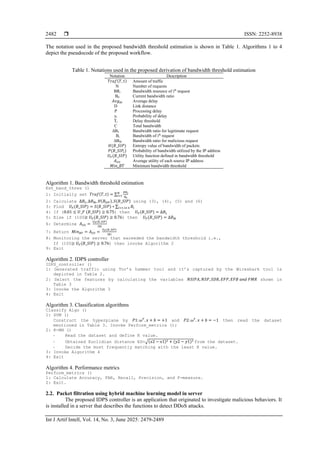
Figure 2. ODL controller uses the ODL user experience (DLUX) application interface. This interface enables
DLUX karaf features and port 8181 is linked with the local system IP address, then install l2-switch features
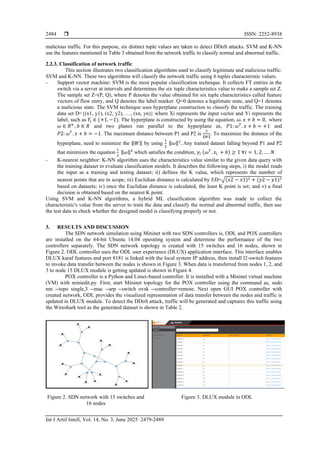
to invoke data transfer between the nodes is shown in Figure 3. When data is transferred from nodes 1, 2, and
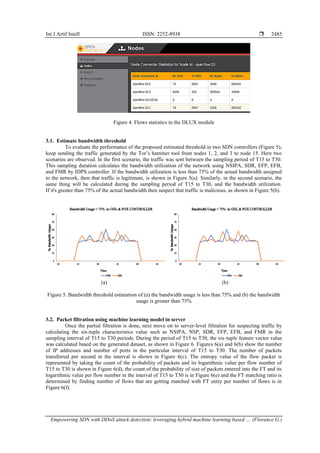
3 to node 15 DLUX module is getting updated is shown in Figure 4.
POX controller is a Python and Linux-based controller. It is installed with a Mininet virtual machine
(VM) with miniedit.py. First, start Mininet topology for the POX controller using the command as, sudo
mn --topo single,3 --mac --arp --switch ovsk --controller=remote. Next open GUI POX controller with
created network, ODL provides the visualized representation of data transfer between the nodes and traffic is
updated in DLUX module. To detect the DDoS attack, traffic will be generated and captures this traffic using
the Wireshark tool as the generated dataset is shown in Table 2.
Figure 2. SDN network with 15 switches and
16 nodes
Figure 3. DLUX module in ODL
Int J Artif Intell ISSN: 2252-8938 
Empowering SDN with DDoS attack detection: leveraging hybrid machine learning based … (Florance G.)
2485
Figure 4. Flows statistics in the DLUX module
3.1. Estimate bandwidth threshold
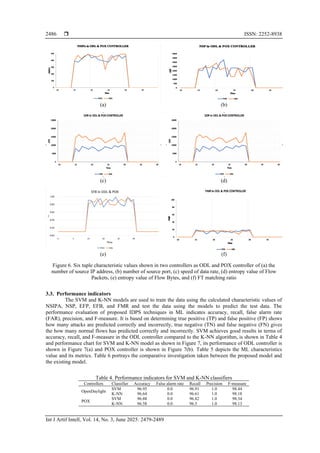
To evaluate the performance of the proposed estimated threshold in two SDN controllers (Figure 5),
keep sending the traffic generated by the Tor’s hammer tool from nodes 1, 2, and 3 to node 15. Here two
scenarios are observed. In the first scenario, the traffic was sent between the sampling period of T15 to T30.
This sampling duration calculates the bandwidth utilization of the network using NSIPA, SDR, EFP, EFB,
and FMR by IDPS controller. If the bandwidth utilization is less than 75% of the actual bandwidth assigned
to the network, then that traffic is legitimate, is shown in Figure 5(a). Similarly, in the second scenario, the
same thing will be calculated during the sampling period of T15 to T30, and the bandwidth utilization.
If it's greater than 75% of the actual bandwidth then suspect that traffic is malicious, as shown in Figure 5(b).
(a) (b)
Figure 5. Bandwidth threshold estimation of (a) the bandwidth usage is less than 75% and (b) the bandwidth
usage is greater than 75%
3.2. Packet filtration using machine learning model in server
Once the partial filtration is done, next move on to server-level filtration for suspecting traffic by
calculating the six-tuple characteristics value such as NSIPA, NSP, SDR, EFP, EFB, and FMR in the
sampling interval of T15 to T30 periods. During the period of T15 to T30, the six-tuple feature vector value
was calculated based on the generated dataset, as shown in Figure 6. Figures 6(a) and 6(b) show the number
of IP addresses and number of ports in the particular interval of T15 to T30. The number of packets
transferred per second in the interval is shown in Figure 6(c). The entropy value of the flow packet is
represented by taking the count of the probability of packets and its logarithmic value per flow number of
T15 to T30 is shown in Figure 6(d), the count of the probability of size of packets entered into the FT and its
logarithmic value per flow number in the interval of T15 to T30 is in Figure 6(e) and the FT matching ratio is
determined by finding number of flows that are getting matched with FT entry per number of flows is in
Figure 6(f).
 ISSN: 2252-8938
Int J Artif Intell, Vol. 14, No. 3, June 2025: 2479-2489
2486
(a) (b)
(c) (d)
(e) (f)
Figure 6. Six tuple characteristic values shown in two controllers as ODL and POX controller of (a) the
number of source IP address, (b) number of source port, (c) speed of data rate, (d) entropy value of Flow
Packets, (e) entropy value of Flow Bytes, and (f) FT matching ratio
3.3. Performance indicators
The SVM and K-NN models are used to train the data using the calculated characteristic values of
NSIPA, NSP, EFP, EFB, and FMR and test the data using the models to predict the test data. The
performance evaluation of proposed IDPS techniques in ML indicates accuracy, recall, false alarm rate
(FAR), precision, and F-measure. It is based on determining true positive (TP) and false positive (FP) shows
how many attacks are predicted correctly and incorrectly, true negative (TN) and false negative (FN) gives
the how many normal flows has predicted correctly and incorrectly. SVM achieves good results in terms of
accuracy, recall, and F-measure in the ODL controller compared to the K-NN algorithm, is shown in Table 4
and performance chart for SVM and K-NN model as shown in Figure 7, its performance of ODL controller is
shown in Figure 7(a) and POX controller is shown in Figure 7(b). Table 5 depicts the ML characteristics
value and its metrics. Table 6 portrays the comparative investigation taken between the proposed model and
the existing model.
Table 4. Performance indicators for SVM and K-NN classifiers
Controllers Classifier Accuracy False alarm rate Recall Precision F-measure
OpenDaylight
SVM 96.95 0.0 96.91 1.0 98.44
K-NN 96.64 0.0 96.61 1.0 98.18
POX
SVM 96.88 0.0 96.82 1.0 98.34
K-NN 96.58 0.0 96.5 1.0 98.13
Int J Artif Intell ISSN: 2252-8938 
Empowering SDN with DDoS attack detection: leveraging hybrid machine learning based … (Florance G.)
2487
(a) (b)
Figure 7. Performance chart for SVM and K-NN model in (a) ODL controller and (b) POX controller
Table 5. ML characteristics values and metrics
Controllers Algorithm TP FP TN FN Accuracy Recall Precision F-measure
ODL
SVM 461 15 412 18 0.9695 0.9691 0.949 0.9844
KNN 458 17 411 16 0.9664 0.9661 0.943 0.9818
POX
SVM 459 15 415 18 0.9688 0.9682 0.949 0.9834
KNN 451 17 409 14 0.9658 0.965 0.943 0.9813
Table 6. Comparative analysis of the proposed model with the existing model
Model/ framework Parameter used Simulation/datasets Accuracy (%)
SNORT IDS and trained ML IDS
[17]
ip.length, ip.flags.df, tcp.windows_size,
tcp.length, ip.frag.offset
IoT device with Ryu controller
and UNSW-NB15
94
Artificial neural network (ANN),
Random forest [18]
Pkt Len Max, Fwd Pkt Len Max, Pkt Len
Min, Fwd Seg Size Min, Fwd Pkt Len Std
Mininet with POX controller
and CICDDoS2019
72.49
Modified hybrid deep belief
network with weights [23]
Available bandwidth, CPU utilization,
PacketIn and PacketOut
CICIDS2018 96.62
Deep learning-RNN [25] Pktcount, pktrate, tx_bytes, packetins,
pktperflow and protocol
Mininet with Ryu controller
and DDOS attack SDN Dataset
94.98
Proposed model (IDPS_controller
in POX and ODL controller)
NSIPA, NSP, SDR, EFP, EFB and FMR Mininet with POX Controller
and ODL controller -Generated
data set
96.75
4. CONCLUSION
This paper analyses mitigation techniques for the prevention of DDoS attacks using six-tuple
characteristic values related to DDoS attacks. The accuracy of finding malicious packets is 96.75% in this
study. To achieve a better accuracy bandwidth threshold estimation is derived. The traffic is segregated by
using the threshold level of 75% bandwidth by the ODL and POX controllers. After defining the threshold,
traffic is generated using Tor’s hammed network tool and analyzed using the Wireshark capturing tool in the
server, subsequently, the dataset is created. From the dataset, six-tuple feature vectors value is calculated
during the sampling interval of T15 to T30 and classified the legitimate traffic and malicious traffic using
SVM and K-NN algorithms in ODL and POX controllers. Among these calculated values, NISPA, NSP,
EFP, and FMR were used for classifying attacks. In comparing the two controllers, the accuracy rate of SVM
is relatively high accuracy in the ODL controller compared to the POX controller and achieving a 96.75%
accuracy in detecting malicious packets. In the future, multiple IDPS controllers will be proposed virtually to
execute DDoS attacks in multiple places to improve the performance of various classifiers in the SDN
network. The dynamic threshold estimation will be embedded in the real-time scenario. Exploring the
intelligence of collaborative approach to leverage the network in real-time.
FUNDING INFORMATION
This work is not funded by any agency or institute
AUTHOR CONTRIBUTIONS STATEMENT
This journal uses the Contributor Roles Taxonomy (CRediT) to recognize individual author
contributions, reduce authorship disputes, and facilitate collaboration.
 ISSN: 2252-8938
Int J Artif Intell, Vol. 14, No. 3, June 2025: 2479-2489
2488
Name of Author C M So Va Fo I R D O E Vi Su P Fu
Florance G. ✓ ✓ ✓ ✓ ✓ ✓ ✓ ✓ ✓ ✓
R. J. Anandhi ✓ ✓ ✓ ✓ ✓ ✓ ✓
C : Conceptualization
M : Methodology
So : Software
Va : Validation
Fo : Formal analysis
I : Investigation
R : Resources
D : Data Curation
O : Writing - Original Draft
E : Writing - Review & Editing
Vi : Visualization
Su : Supervision
P : Project administration
Fu : Funding acquisition
CONFLICT OF INTEREST STATEMENT
The authors state no conflict of interest.
DATA AVAILABILITY
The data that support the findings of this study are available from the corresponding author, [FG],
upon reasonable request.
REFERENCES
[1] P. Kaur, M. Kumar, and A. Bhandari, “A review of detection approaches for distributed denial of service attacks,” Systems
Science & Control Engineering, vol. 5, no. 1, pp. 301–320, Jan. 2017, doi: 10.1080/21642583.2017.1331768.
[2] B. Isyaku, M. S. Mohd Zahid, M. Bte Kamat, K. Abu Bakar, and F. A. Ghaleb, “Software defined networking flow table
management of OpenFlow switches performance and security challenges: a survey,” Future Internet, vol. 12, no. 9, Aug. 2020,
doi: 10.3390/fi12090147.
[3] Y. Guo, F. Miao, L. Zhang, and Y. Wang, “CATH: an effective method for detecting denial-of-service attacks in software defined
networks,” Science China Information Sciences, vol. 62, no. 3, p. 32106, Mar. 2019, doi: 10.1007/s11432-017-9439-7.
[4] C. S. Khin, A. T. Kyaw, M. M. Maw, and M. Z. Oo, “Reducing packet-in messages in OpenFlow networks,” ECTI Transactions
on Electrical Engineering, Electronics, and Communications, vol. 20, no. 1, pp. 1–9, Feb. 2022, doi: 10.37936/ecti-
eec.2022201.244944.
[5] P. Ohri, A. Daniel, S. G. Neogi, and S. K. Muttoo, “Blockchain-based security framework for mitigating network attacks in multi-
SDN controller environment,” International Journal of Information Technology, Jun. 2024, doi: 10.1007/s41870-024-01933-8.
[6] R. Swami, M. Dave, and V. Ranga, “Detection and analysis of TCP-SYN DDoS attack in software-defined networking,” Wireless
Personal Communications, vol. 118, no. 4, pp. 2295–2317, Jun. 2021, doi: 10.1007/s11277-021-08127-6.
[7] D. Kim, B. Kim, I. Kim, J. Kim, and H. Cho, “Endpoint mitigation of DDoS attacks based on dynamic thresholding,” Information
and Communications Security, pp. 381–391, 2012, doi: 10.1007/978-3-642-34129-8_36.
[8] H. A. Alamri and V. Thayananthan, “Bandwidth control mechanism and extreme gradient boosting algorithm for protecting
software-defined networks against DDoS attacks,” IEEE Access, vol. 8, pp. 194269–194288, 2020, doi:
10.1109/ACCESS.2020.3033942.
[9] E. R. Jimson, K. Nisar, and M. H. bin Ahmad Hijazi, “Bandwidth management using software defined network and comparison of
the throughput performance with traditional network,” in 2017 International Conference on Computer and Drone Applications
(IConDA), Nov. 2017, pp. 71–76, doi: 10.1109/ICONDA.2017.8270402.
[10] C.-H. Lin, J.-C. Liu, H.-C. Huang, and T.-C. Yang, “Using adaptive bandwidth allocation approach to defend DDoS attacks,” in
2008 International Conference on Multimedia and Ubiquitous Engineering (mue 2008), 2008, pp. 176–181, doi:
10.1109/MUE.2008.23.
[11] S. Sumathi, R. Rajesh, and K. Nagarajan, “DDoS attack detection using hybrid machine learning based IDS models,” Journal of
Scientific & Industrial Research, vol. 81, no. 03, Mar. 2022, doi: 10.56042/jsir.v81i03.58451.
[12] K. Alemerien, S. Al-suhemat, and M. Almahadin, “Towards optimized machine-learning-driven intrusion detection for internet of
things applications,” International Journal of Information Technology, vol. 16, no. 8, pp. 4981–4994, Dec. 2024, doi:
10.1007/s41870-024-01852-8.
[13] W. Park, J. Lee, and D. Sung, “Bandwidth optimization algorithm based on bandwidth ratio adjustment in generalized processor
sharing servers,” in 2006 IEEE International Conference on Communications, 2006, pp. 699–703, doi:
10.1109/ICC.2006.254789.
[14] E. Hikmawati, N. U. Maulidevi, and K. Surendro, “Minimum threshold determination method based on dataset characteristics in
association rule mining,” Journal of Big Data, vol. 8, no. 1, p. 146, Dec. 2021, doi: 10.1186/s40537-021-00538-3.
[15] A. Talukder, S. F. Abedin, M. S. Munir, and C. S. Hong, “Dual threshold load balancing in SDN environment using process
migration,” in 2018 International Conference on Information Networking (ICOIN), Jan. 2018, pp. 791–796, doi:
10.1109/ICOIN.2018.8343226.
[16] U. H. Garba, A. N. Toosi, M. F. Pasha, and S. Khan, “SDN-based detection and mitigation of DDoS attacks on smart homes,”
Computer Communications, vol. 221, pp. 29–41, May 2024, doi: 10.1016/j.comcom.2024.04.001.
[17] A. Jawahar et al., “DDoS mitigation using blockchain and machine learning techniques,” Multimedia Tools and Applications,
vol. 83, no. 21, pp. 60265–60278, Jan. 2024, doi: 10.1007/s11042-023-18028-4.
[18] I. Jebril et al., “Deep learning based DDoS attack detection in internet of things: an optimized CNN-BiLSTM architecture with
transfer learning and regularization techniques,” Infocommunications journal, vol. 16, no. 1, pp. 2–11, 2024, doi:
10.36244/ICJ.2024.1.1.
[19] A. V. Songa and G. R. Karri, “An integrated SDN framework for early detection of DDoS attacks in cloud computing,” Journal of
Cloud Computing, vol. 13, no. 1, Mar. 2024, doi: 10.1186/s13677-024-00625-9.
Int J Artif Intell ISSN: 2252-8938 
Empowering SDN with DDoS attack detection: leveraging hybrid machine learning based … (Florance G.)
2489
[20] J. Zhao and G.-H. Yang, “An observer-based resilient control method against intermittent DoS attacks for nonstrict-feedback
nonlinear cyberphysical systems with tracking errors constraint,” International Journal of Fuzzy Systems, vol. 26, no. 2,
pp. 596–612, Mar. 2024, doi: 10.1007/s40815-023-01619-6.
[21] N. Zhao, H. Sun, H. Zhang, and K. Mathiyalagan, “Resilient event-triggered dynamic output feedback control for networked
Takagi–Sugeno fuzzy systems under denial-of-service attacks,” International Journal of Fuzzy Systems, vol. 26, no. 1,
pp. 357–367, Feb. 2024, doi: 10.1007/s40815-023-01592-0.
[22] M. Revathi and S. K. Devi, “Hybrid architecture for mitigating DDoS and other intrusions in SDN-IoT using MHDBN-W deep
learning model,” International Journal of Machine Learning and Cybernetics, May 2024, doi: 10.1007/s13042-024-02147-x.
[23] D. M. Rajan and D. D. J. Aravindhar, “Detection and mitigation of DDOS attack in SDN environment using hybrid CNN-
LSTM,” Migration Letters, vol. 20, no. S13, pp. 407–419, Dec. 2023, doi: 10.59670/ml.v20iS13.6472.
[24] A. Mansoor, M. Anbar, A. Bahashwan, B. Alabsi, and S. Rihan, “Deep learning-based approach for detecting DDoS attack on
software-defined networking controller,” Systems, vol. 11, no. 6, Jun. 2023, doi: 10.3390/systems11060296.
[25] Z. Yao, Y. Tang, S. Yuan, and Y. Qi, “Filtering for PDT switched T–S fuzzy systems with attacks and disorders: a TCSI engine fault
detection,” International Journal of Fuzzy Systems, vol. 25, no. 4, pp. 1429–1443, Jun. 2023, doi: 10.1007/s40815-022-01443-4.
[26] L. Zhou, Y. Zhu, Y. Xiang, and T. Zong, “A novel feature-based framework enabling multi-type DDoS attacks detection,” World
Wide Web, vol. 26, no. 1, pp. 163–185, Jan. 2023, doi: 10.1007/s11280-022-01040-3.
[27] P. Krishnan, K. Jain, A. Aldweesh, P. Prabu, and R. Buyya, “OpenStackDP: a scalable network security framework for SDN-based
OpenStack cloud infrastructure,” Journal of Cloud Computing, vol. 12, no. 1, Feb. 2023, doi: 10.1186/s13677-023-00406-w.
[28] F. Musumeci, A. C. Fidanci, F. Paolucci, F. Cugini, and M. Tornatore, “Machine-learning-enabled DDoS attacks detection in P4
programmable networks,” Journal of Network and Systems Management, vol. 30, no. 1, Jan. 2022, doi: 10.1007/s10922-021-09633-5.
[29] S. Swati, S. Roy, J. Singh, and J. Mathew, “Design and analysis of DDoS mitigating network architecture,” International Journal
of Information Security, vol. 22, no. 2, pp. 333–345, Apr. 2023, doi: 10.1007/s10207-022-00635-1.
[30] J. Ye, X. Cheng, J. Zhu, L. Feng, and L. Song, “A DDoS attack detection method based on SVM in software defined network,”
Security and Communication Networks, vol. 2018, pp. 1–8, 2018, doi: 10.1155/2018/9804061.
[31] N. Bharot, P. Verma, S. Sharma, and V. Suraparaju, “Distributed denial-of-service attack detection and mitigation using feature
selection and intensive care request processing unit,” Arabian Journal for Science and Engineering, vol. 43, no. 2, pp. 959–967,
Feb. 2018, doi: 10.1007/s13369-017-2844-0.
[32] F. G. and R. J. Anandhi, “Enhancing SDN resilience against DDoS attacks through dynamic virtual controller deployment and
attack level detection algorithm,” International Journal of Information Technology, vol. 16, no. 7, pp. 4701–4712, Oct. 2024, doi:
10.1007/s41870-024-02064-w.
BIOGRAPHIES OF AUTHORS
Florance G. is a Ph.D. Research Scholar at the Department of Information
Science and Engineering, New Horizon College of Engineering, Bangalore, Karnataka, India.
She received her B.E. degree in computer science and engineering from Anna University,
Chennai, India in 2006, and her M.E. degree in computer science and engineering from Anna
University, Chennai, India in 2008. Her current areas of interest include cybersecurity,
security issues in software-defined networking, and DDoS attacks. She can be contacted at
email: vijiflorance59@gmail.com.
Dr. R. J. Anandhi received her B.E. degree from Bharathiar University,
Coimbatore, India, in 1991, her M.Tech. degree from Pondicherry Central University in 1995,
and her Ph.D. degree from Dr. M.G.R. University, India, in 2011. She is currently a Professor
and Dean at New Horizon College of Engineering, Bangalore, India, with over 28 years of
experience in teaching and research. She has published approximately 59 research papers in
various international/national journals and conferences. She has also coordinated several
research and development projects within the department and the institute. She has guided ten
Ph.D. and is currently supervising several more. Her research interests include spatial data
mining, cybersecurity, cloud computing, software-defined networking, among others. She
actively serves as a reviewer for many reputed journals published by IEEE, Springer, Elsevier,
Taylor & Francis, and Wiley. She can be contacted at email: rjanandhi@hotmail.com.

Empowering SDN with DDoS attack detection: leveraging hybrid machine learning based IDPS controller for robust security

  • 1.
    IAES International Journalof Artificial Intelligence (IJ-AI) Vol. 14, No. 3, June 2025, pp. 2479~2489 ISSN: 2252-8938, DOI: 10.11591/ijai.v14.i3.pp2479-2489  2479 Journal homepage: http://ijai.iaescore.com Empowering SDN with DDoS attack detection: leveraging hybrid machine learning based IDPS controller for robust security Florance G.1 , R. J. Anandhi2 1 Department of Computer Science and Engineering, New Horizon College of Engineering, Affiliated to Visvesvaraya Technological University, Bangalore, India 2 Department of Information Science and Engineering, New Horizon College of Engineering, Affiliated to Visvesvaraya Technological University, Bangalore, India Article Info ABSTRACT Article history: Received Sep 3, 2024 Revised Feb 26, 2025 Accepted Mar 15, 2025 Software-defined network (SDN) is an innovative networking framework where a centralized controller manages networking administration and sorts out network traffic issues. It becomes difficult for the controller to identify the malicious user who is sending a large number of spoofed packets, such as in a distributed denial of service (DDoS) attack. To prevent DDoS attacks from damaging legitimate users, it is important to take steps to prevent them. The issue of preventing DDoS attacks in SDN remains unresolved despite many algorithms proposed. Methods presented in this paper employ bandwidth threshold estimation, which triggers the intrusion detection and prevention system (IDPS) controller if the threshold is exceeded. Whenever the threshold is exceeded due to network congestion, transferred packets are filtered at the server level by identifying the utilization of bandwidth in OpenDaylight (ODL) and POX. K-nearest neighbor (K-NN) and support vector machine (SVM) are used by the IDPS controller to detect and thwart DDoS attacks. Using Mininet, two SDN centralized controllers are simulated to improve performance significantly. Based on SVM in the ODL controller, this work has provided mitigation techniques for preventing DDoS attacks with an accuracy of 96.75% compared to previously published accuracy. Keywords: DDoS attack IDPS controller OpenDaylight controller POX controller Software defined network This is an open access article under the CC BY-SA license. Corresponding Author: Florance G. Department of Computer Science and Engineering, New Horizon College of Engineering Affiliated to Visvesvaraya Technological University Bangalore, India Email: vijiflorance59@gmail.com 1. INTRODUCTION The enormous change in network migrations and the increase in many distributed applications on the internet has become more complex in configuration and management. The conventional network infrastructure and other related evolving technologies manage the enormous amount of data. It is difficult when the user needs to change the requirements and dynamic configuration of the network infrastructure. When it is necessary to implement a new protocol, updating rules and policies for all networking devices becomes costly and time-consuming. To address these, software software-defined network (SDN) is preferable. SDN provides simplified management, a central controller, programmability, automated, and dynamic management [1]. SDN is a more popular innovative network paradigm that provides efficient management by uncoupling the data and control planes where the centralized controller is placed [2]. The data transfer
  • 2.
     ISSN: 2252-8938 IntJ Artif Intell, Vol. 14, No. 3, June 2025: 2479-2489 2480 between the forwarding devices and controller by a standard protocol called OpenFlow (OF), which segregates the packets based on OF instructions. In SDN, if any updating of policies is needed, then the modification happens in the controller, like minimizing the time consumption and cost of the entire process. During data transfer, SDN switches store the incoming packets in the flow table (FT) [3]. Each entry in the FT consists of three fields: action, rule, and counter. Based on FT information, packets are getting dropped [4], [5]. The data security provided by the SDN network's controller monitors malicious traffic. SDN enhances network infrastructure management and addresses challenges in terms of security, programmability and load balancing. SDN security is a significant challenge than denying network service due to malicious traffic [6], [7]. Distributed denial of service (DDoS) attacks are service-denying attacks that exhaust the benefits of the entire network and saturate the bandwidth, which stops servicing legitimate user requests. Due to many spoofed packages, the entire network gets flooded, resulting in bandwidth depletion. This flooding leads to degrading the system's performance [8], [9]. Machine learning (ML) is an application that classifies packets using intrusion detection and prevention system (IDPS) controllers in SDN [10], [11]. Techniques such as k-nearest neighbor (K-NN), naive Bayes, k-means, and support vector machine (SVM) are employed to detect anomalous packets in IDPS. Anomaly-based IDPS systems use the concept of network behavior. ML algorithms assist set of traffics generated by the Waikato environment for knowledge analysis (WEKA) tool and provide predictions for training data derived from traffic patterns [12], [13]. Consequently, ML-based detection techniques are used to identify spoofed packets based on abnormal changes in the network, and their performance depends on characteristics considered for training [14]–[16]. Jawahar et al. [17] proposed ML models that use the Ethereum blockchain to list malicious IP addresses. Jebril et al. [18] presented a convolutional neural network-bidirectional long short-term memory (CNN-BiLSTM) model, using three deep-learning algorithms. The performance of this model is evaluated by performance criteria. Songa and Karri [19] introduced, features selection is combined as a cluster to analyze the traffic. Zhao and Yang [20] demonstrated the unfortunate flooding that spoils the network that are taken care by the adaptive resilient control design. Zhao et al. [21] focused on resilient event-driven dynamic feedback control systems, that is used for the impact of DDoS attack and regulate the required anticipated data transmission. Revathi and Devi [22] focused on hybrid intrusion detection method using the novel deep learning method modified hybrid deep belief network with weights (MHDBN‑W). Rajan and Aravindhar [23] proposed CNN-LSTM techniques showing their superiority in spotting malicious. Mansoor et al. [24] proposed an approach that uses, data preprocessing by transformation, feature selection by chi-square, and detecting attacks using recurrent neural networks (RNNs) model. Yao et al. [25] focused on deception attacks on switched Takagi-Sugeno (T-S) fuzzy systems. Zhou et al. [26] proposed a framework to handle multi-type DDoS attacks using a feature-based method. Krishnan et al. [27] focused on a more predictable, secured, and reliable network using the SDN, network function virtualization, and machine learning. Musumeci et al. [28] designed for DDoS attack detection framework with ML assistance by automatically retrieving packet information. Swati et al. [29] described the capability-based architecture of a transient effect ring oscillator PUF. Ye et al. [30] proposed an SVM model to detect DDoS attacks by determining flow status information periodically and it extracted from the switch FT. Sumathi et al. [11] discussed hybrid ML techniques used to design the intrusion detection system (IDS). Bharot et al. [31] describe the Hellinger distance function that is used to compare the incoming and baseline traffic with probability. DDoS attack detection is based on finding entropy and standard deviation for monitoring incoming packets with two levels of the threshold value in [32]. The main contribution of this paper is to address the challenge of detecting and preventing DDoS attacks within SDN. In SDN, a centralized controller manages network administration and traffic, which makes it difficult to identify malicious users, particularly in the case of DDoS attacks involving large volumes of spoofed packets. To mitigate this issue, the paper proposes a solution that uses bandwidth threshold estimation in conjunction with an IDPS controller. The IDPS controller, in turn extracts feature and classifies packets as normal or malicious using SVM and K-NN classification algorithms. Section 2 illustrates the proposed skeleton for mitigating DDoS attack detection strategies. Section 3 presents the simulation and performance assessment of the DDoS attack detection framework. Section 4 concludes the paper and discusses the related future enhancement of the research scope. 2. RESEARCH METHOD 2.1. Determination of bandwidth threshold The bandwidth threshold estimation filters the traffic when the traffic occupies the bandwidth that exceeds a certain limit. This estimation uses the total bandwidth C, the bandwidth ratio is B0, the amount of
  • 3.
    Int J ArtifIntell ISSN: 2252-8938  Empowering SDN with DDoS attack detection: leveraging hybrid machine learning based … (Florance G.) 2481 traffic for legitimate and malicious packets, and evaluates the performance in terms of congestion when there is a fluctuation of the current bandwidth ratio B0. Firstly, the amount of traffic calculated using (1). 𝑇𝑟𝑎𝑓(𝑇, 𝑡) = ∑ 𝐵𝑅𝑖 𝐵0 𝑁 𝑖=1 (1) The average link delay is denoted in (2), 𝐴𝑣𝑔𝑑𝑖 = 𝐷 𝑃 = (Pktrectime−pktsenttime) transmission_speed (2) where, Pktrectime is packet receive time and Pktsenttime is packet sent time. The probability of delay is denoted as, yi. 𝑦𝑖 = 𝑝𝑟𝑜𝑏(𝐷 > 𝑇𝑖) The main goal is to define the bandwidth threshold, which is 75% of the assigned bandwidth. By fine-tuning C and B0, performance is increased. Now there are two cases as, L is the set of completely successful requests (legitimate packets) and M is the set of requests that are not completely successful (malicious packets). Consider, the network which is not congested with a set of requests, and changing current bandwidth ratio in (3) and (4). ∆𝐵𝐿 = + ( ∑ 𝐵𝑖 𝑖∈𝐿 𝐵0 ) (3) The network which is congested with requests and changing current bandwidth ratio. ∆𝐵𝑀 = − ( ∑ 𝐵𝑖 𝑖∈𝑀 𝐵0 ) (4) The number of packets received per source IP address is defined using entropy calculation in (5). 𝐻(𝐵𝑆𝐼𝑃) = ∑ 𝑃(𝐵𝑆𝐼𝑃𝑖 ) log2(𝐵𝑆𝐼𝑃𝑖 ) 𝑛 𝑖=1 (5) 𝑃(𝐵𝑆𝐼𝑃𝑖 ) = 𝑃(𝐵𝑆𝐼𝑃1 ) + 𝑃(𝐵𝑆𝐼𝑃2 ) + ⋯ + 𝑃(𝐵𝑆𝐼𝑃𝑛 ) The supporting value of bandwidth for each source IP address is found in (6). 𝑆(𝐵_𝑆𝐼𝑃) = 𝐻(𝐵_𝑆𝐼𝑃) ∆𝐵𝐿+ ∆𝐵𝑀 (6) The utility function in the bandwidth threshold value of 75% for bandwidth of each source IP is defined in (7). 𝑈𝐹(𝐵_𝑆𝐼𝑃) = 𝑆(𝐵_𝑆𝐼𝑃) ∗ ∑ 𝐵𝑖 𝑖=1 𝑡𝑜 𝑛 (7) 𝑈𝐹(𝐵𝑆𝐼𝑃) = ∆𝐵𝐿, 0.01 <= 𝑈𝐹(𝐵_𝑆𝐼𝑃) >= 0.75 𝑈𝐹(𝐵_𝑆𝐼𝑃) = ∆𝐵𝑀, 𝑈𝐹(𝐵_𝑆𝐼𝑃) >= 0.76 The average utility of each source IP address [16] is defined in (8). 𝐴𝑈𝑆 = 𝑈𝐹(𝐵_𝑆𝐼𝑃) |𝑁| (8) The minimum bandwidth threshold is found in (9). 𝑀𝑖𝑛𝐵𝑇 = 𝐴𝑈𝑆 = 𝑈𝐹(𝐵_𝑆𝐼𝑃) |𝑁| (9) If the bandwidth ratio of malicious requests increases, it will consume more bandwidth of packets received from each source IP address; hence, the restriction of malicious packets is done using threshold bandwidth.
  • 4.
     ISSN: 2252-8938 IntJ Artif Intell, Vol. 14, No. 3, June 2025: 2479-2489 2482 The notation used in the proposed bandwidth threshold estimation is shown in Table 1. Algorithms 1 to 4 depict the pseudocode of the proposed workflow. Table 1. Notations used in the proposed derivation of bandwidth threshold estimation Notation Description 𝑇𝑟𝑎𝑓(𝑇, 𝑡) Amount of traffic N Number of requests BRi Bandwidth resource of ith request B0 Current bandwidth ratio 𝐴𝑣𝑔𝑑𝑖 Average delay D Link distance P Processing delay yi Probability of delay Ti Delay threshold C Total bandwidth ∆BL Bandwidth ratio for legitimate request Bi Bandwidth of ith request ∆BM Bandwidth ratio for malicious request 𝐻(𝐵_𝑆𝐼𝑃) Entropy value of bandwidth of packets 𝑃(𝐵_𝑆𝐼𝑃𝑖) Probability of bandwidth utilized by the IP address 𝑈𝐹(𝐵_𝑆𝐼𝑃) Utility function defined in bandwidth threshold 𝐴𝑈𝑆 Average utility of each source IP address 𝑀𝑖𝑛_𝐵𝑇 Minimum bandwidth threshold Algorithm 1. Bandwidth threshold estimation Est_band_thres () 1: Initially set 𝑇𝑟𝑎𝑓(𝑇, 𝑡) = ∑ 𝐵𝑅𝑖 𝐵0 𝑁 𝑖=1 2: Calculate ∆𝐵𝐿, ∆𝐵𝑀, 𝐻(𝐵𝑆𝐼𝑃), 𝑆(𝐵_𝑆𝐼𝑃) using (3), (4), (5) and (6) 3: Find 𝑈𝐹(𝐵_𝑆𝐼𝑃) = 𝑆(𝐵_𝑆𝐼𝑃) ∗ ∑ 𝐵𝑖 𝑖=1 𝑡𝑜 𝑛 4: If (0.01 ≤ 𝑈_𝐹 (𝐵_𝑆𝐼𝑃) ≥ 0.75) then 𝑈𝐹(𝐵_𝑆𝐼𝑃) = ∆𝐵𝐿 5: Else if (100≥ 𝑈𝐹(𝐵_𝑆𝐼𝑃) ≥ 0.76) then 𝑈𝐹(𝐵_𝑆𝐼𝑃) = ∆𝐵𝑀 6: Determine 𝐴𝑈𝑆 = 𝑈𝐹(𝐵_𝑆𝐼𝑃) |𝑁| 7: Return 𝑀𝑖𝑛𝐵𝑇 = 𝐴𝑈𝑆 = 𝑈𝐹(𝐵_𝑆𝐼𝑃) |𝑁| 8: Monitoring the server that exceeded the bandwidth threshold i.e., If (100≥ 𝑈𝐹(𝐵_𝑆𝐼𝑃) ≥ 0.76) then invoke Algorithm 2 9: Exit Algorithm 2. IDPS controller IDPS_controller () 1: Generated traffic using Tor’s hammer tool and it’s captured by the Wireshark tool is depicted in Table 2. 2: Select the features by calculating the variables 𝑁𝑆𝐼𝑃𝐴, 𝑁𝑆𝑃, 𝑆𝐷𝑅, 𝐸𝐹𝑃, 𝐸𝐹𝐵 𝑎𝑛𝑑 𝐹𝑀𝑅 shown in Table 3 3: Invoke the Algorithm 3 4: Exit Algorithm 3. Classification algorithms Classify Algo () 1: SVM () Construct the hyperplane by 𝑃1:𝜔𝑇 . 𝑥 + 𝑏 = +1 and 𝑃2: 𝜔𝑇 . 𝑥 + 𝑏 = −1 then read the dataset mentioned in Table 3. Invoke Perform_metrics (); 2: K-NN () - Read the dataset and define K value. - Obtained Euclidian distance ED=√(𝑥2 − 𝑥1)2 + (𝑦2 − 𝑦1)2 from the dataset. - Decide the most frequently matching with the least K value. 3: Invoke Algorithm 4 4: Exit Algorithm 4. Performance metrics Perform_metrics () 1: Calculate Accuracy, FAR, Recall, Precision, and F-measure. 2: Exit. 2.2. Packet filtration using hybrid machine learning model in server The proposed IDPS controller is an application that originated to investigate malicious behaviors. It is installed in a server that describes the functions to detect DDoS attacks.
  • 5.
    Int J ArtifIntell ISSN: 2252-8938  Empowering SDN with DDoS attack detection: leveraging hybrid machine learning based … (Florance G.) 2483 2.2.1. Traffic origination and packet capturing In the SDN environment, the foremost step to detect a DDoS attack is to generate network traffic using Tor’s hammer network tool as shown in Figure 1. It can cause huge traffic in network flow, making service unavailable to the legitimate user. One of the most popular tools used to capture the traffic in the network is the Wireshark tool. This tool monitors and captures network traffic in the FT via the server. When the estimated bandwidth threshold reaches a specific percentage of bandwidth, it starts maintaining the traffic logs for future analysis. This log extracts the source and destination IP address, source and destination port, protocol, time, TTL value, and information collected from packet headers like SYN, FIN, ACK, Seq, and Len. Figure 1. Proposed IDPS controller in SDN Table 2. Generated dataset server src dst pkt count byte count duration dur_nsec tot_dur flows pktrate protocol port_no tx_bytes rx_bytes 1 10.0.1.1 10.0.0.15 54702 56474171 100 643200000 1.07E+11 2 278 OF 1 3619 941 2 10.0.7.1 10.0.4.13 117234 139136078 250 739000000 3.01E+11 4 591 OF 3 4871 4257 1 10.0.5.2 10.0.3.25 85734 89194991 100 689000000 1.71E+11 5 342 OF 5 3614 1521 3 10.0.9.2 10.0.0.15 92341 954131294 180 712000000 1.99E+11 2 695 OF 3 4015 1027 Table 3. Six-tuple characteristic values with its description Parameter Formula Description Number of source IP addresses (NSIPA) 𝑁𝑆𝐼𝑃𝐴 = 𝑇𝑜𝑡_𝑆𝑟𝑐𝐼𝑃 𝑇 The total number of source IP addresses per sampling interval is denoted in time. Number of source port (NSP) 𝑁𝑆𝑃 = 𝑇𝑜𝑡_𝑆𝑟𝑐𝑝𝑜𝑟𝑡 𝑇 The total number of ports sending packets per sampling interval is denoted in time. Speed of data rate (SDR) 𝑆𝐷𝑅 = 𝑇𝑜𝑡_𝑝𝑘𝑡 𝑇 The number of packets transferred per second unit. Entropy value of flow packets (EFP) 𝐸𝐹𝑃 = ∑ 𝑃(𝑁𝑃𝐹𝑖) log2(𝑁𝑃𝐹𝑖) 𝐹𝑁 𝐹𝑁 𝑖=1 The size of packets entering to FT is estimated by the total number of packets in a flow (NPF) per flow number (FN). Entropy value of flow bytes (EFB) 𝐸𝐹𝐵 = ∑ 𝑃(𝑁𝐵𝐹𝑖) log2(𝑁𝐵𝐹𝑖) 𝐹𝑁 𝐹𝑁 𝑖=1 The size of bytes entering to FT is estimated by the total number of bytes in a flow per flow number (FN). FT matching ratio (FMR) 𝐹𝑀𝑅 = 𝑀𝑎𝑡𝑐ℎ𝑒𝑑_𝐹𝑙𝑜𝑤 𝑁𝐹𝐸 The number of flows is getting matched with the switch FT entry. 2.2.2. Selection of characteristic values Once network traffic is captured and pre-processing is done, the next is to extract features and create a dataset. The ML model converts the necessary fields from the packet header into a readable CSV format. This paper compares with the existing analysis [12] of characteristic values needed for classifying legitimate and
  • 6.
     ISSN: 2252-8938 IntJ Artif Intell, Vol. 14, No. 3, June 2025: 2479-2489 2484 malicious traffic. For this purpose, six distinct tuple values are taken to detect DDoS attacks. SVM and K-NN use the features mentioned in Table 3 obtained from the network traffic to classify normal and abnormal traffic. 2.2.3. Classification of network traffic This section illustrates two classification algorithms used to classify legitimate and malicious traffic: SVM and K-NN. These two algorithms will classify the network traffic using 6 tuples characteristic values. ‒ Support vector machine: SVM is the most popular classification technique. It collects FT entries in the switch via a server at intervals and determines the six tuple characteristics value to make a sample set Z. The sample set Z=(P, Q), where P denotes the value obtained for six tuple characteristics called feature vectors of flow entry, and Q denotes the label marker. Q=0 denotes a legitimate state, and Q=1 denotes a malicious state. The SVM technique uses hyperplane construction to classify the traffic. The training data set D={(x1, y1), (x2, y2), …, (xn, yn)} where Xi represents the input vector and Yi represents the label, such as 𝑌𝑖 ∈ (+1, −1). The hyperplane is constructed by using the equation, 𝜔. 𝑥 + 𝑏 = 0, where 𝜔 ∈ 𝑅𝑛 , 𝑏 ∈ 𝑅 and two planes run parallel to the hyperplane as, 𝑃1: 𝜔𝑇 . 𝑥 + 𝑏 = +1 and 𝑃2: 𝜔𝑇 . 𝑥 + 𝑏 = −1. The maximum distance between P1 and P2 is 2 ‖𝑊‖ . To maximize the distance of the hyperplane, need to minimize the ‖𝑊‖ by using 1 2 ‖𝜔‖2 . Any trained dataset falling beyond P1 and P2 that minimizes the equation 1 2 ‖𝜔‖2 which satisfies the condition, 𝑦𝑖 (𝜔𝑇 . 𝑥𝑖 + 𝑏) ≥ 1 ∀𝑖 = 1, 2, … . 𝑁. ‒ K-nearest neighbor: K-NN algorithm uses the characteristics value similar to the given data query with the training dataset to evaluate classification models. It describes the following steps, i) the model reads the input as a training and testing dataset; ii) defines the K value, which represents the number of nearest points that are in scope; iii) Euclidian distance is calculated by ED=√(𝑥2 − 𝑥1)2 + (𝑦2 − 𝑦1)2 based on datasets; iv) once the Euclidian distance is calculated, the least K point is set; and v) a final decision is obtained based on the nearest K point. Using SVM and K-NN algorithms, a hybrid ML classification algorithm was made to collect the characteristic's value from the server to train the data and classify the normal and abnormal traffic, then use the test data to check whether the designed model is classifying properly or not. 3. RESULTS AND DISCUSSION The SDN network simulation using Mininet with two SDN controllers is, ODL and POX controllers are installed on the 64-bit Ubuntu 14.04 operating system and determine the performance of the two controllers separately. The SDN network topology is created with 15 switches and 16 nodes, shown in Figure 2. ODL controller uses the ODL user experience (DLUX) application interface. This interface enables DLUX karaf features and port 8181 is linked with the local system IP address, then install l2-switch features to invoke data transfer between the nodes is shown in Figure 3. When data is transferred from nodes 1, 2, and 3 to node 15 DLUX module is getting updated is shown in Figure 4. POX controller is a Python and Linux-based controller. It is installed with a Mininet virtual machine (VM) with miniedit.py. First, start Mininet topology for the POX controller using the command as, sudo mn --topo single,3 --mac --arp --switch ovsk --controller=remote. Next open GUI POX controller with created network, ODL provides the visualized representation of data transfer between the nodes and traffic is updated in DLUX module. To detect the DDoS attack, traffic will be generated and captures this traffic using the Wireshark tool as the generated dataset is shown in Table 2. Figure 2. SDN network with 15 switches and 16 nodes Figure 3. DLUX module in ODL
  • 7.
    Int J ArtifIntell ISSN: 2252-8938  Empowering SDN with DDoS attack detection: leveraging hybrid machine learning based … (Florance G.) 2485 Figure 4. Flows statistics in the DLUX module 3.1. Estimate bandwidth threshold To evaluate the performance of the proposed estimated threshold in two SDN controllers (Figure 5), keep sending the traffic generated by the Tor’s hammer tool from nodes 1, 2, and 3 to node 15. Here two scenarios are observed. In the first scenario, the traffic was sent between the sampling period of T15 to T30. This sampling duration calculates the bandwidth utilization of the network using NSIPA, SDR, EFP, EFB, and FMR by IDPS controller. If the bandwidth utilization is less than 75% of the actual bandwidth assigned to the network, then that traffic is legitimate, is shown in Figure 5(a). Similarly, in the second scenario, the same thing will be calculated during the sampling period of T15 to T30, and the bandwidth utilization. If it's greater than 75% of the actual bandwidth then suspect that traffic is malicious, as shown in Figure 5(b). (a) (b) Figure 5. Bandwidth threshold estimation of (a) the bandwidth usage is less than 75% and (b) the bandwidth usage is greater than 75% 3.2. Packet filtration using machine learning model in server Once the partial filtration is done, next move on to server-level filtration for suspecting traffic by calculating the six-tuple characteristics value such as NSIPA, NSP, SDR, EFP, EFB, and FMR in the sampling interval of T15 to T30 periods. During the period of T15 to T30, the six-tuple feature vector value was calculated based on the generated dataset, as shown in Figure 6. Figures 6(a) and 6(b) show the number of IP addresses and number of ports in the particular interval of T15 to T30. The number of packets transferred per second in the interval is shown in Figure 6(c). The entropy value of the flow packet is represented by taking the count of the probability of packets and its logarithmic value per flow number of T15 to T30 is shown in Figure 6(d), the count of the probability of size of packets entered into the FT and its logarithmic value per flow number in the interval of T15 to T30 is in Figure 6(e) and the FT matching ratio is determined by finding number of flows that are getting matched with FT entry per number of flows is in Figure 6(f).
  • 8.
     ISSN: 2252-8938 IntJ Artif Intell, Vol. 14, No. 3, June 2025: 2479-2489 2486 (a) (b) (c) (d) (e) (f) Figure 6. Six tuple characteristic values shown in two controllers as ODL and POX controller of (a) the number of source IP address, (b) number of source port, (c) speed of data rate, (d) entropy value of Flow Packets, (e) entropy value of Flow Bytes, and (f) FT matching ratio 3.3. Performance indicators The SVM and K-NN models are used to train the data using the calculated characteristic values of NSIPA, NSP, EFP, EFB, and FMR and test the data using the models to predict the test data. The performance evaluation of proposed IDPS techniques in ML indicates accuracy, recall, false alarm rate (FAR), precision, and F-measure. It is based on determining true positive (TP) and false positive (FP) shows how many attacks are predicted correctly and incorrectly, true negative (TN) and false negative (FN) gives the how many normal flows has predicted correctly and incorrectly. SVM achieves good results in terms of accuracy, recall, and F-measure in the ODL controller compared to the K-NN algorithm, is shown in Table 4 and performance chart for SVM and K-NN model as shown in Figure 7, its performance of ODL controller is shown in Figure 7(a) and POX controller is shown in Figure 7(b). Table 5 depicts the ML characteristics value and its metrics. Table 6 portrays the comparative investigation taken between the proposed model and the existing model. Table 4. Performance indicators for SVM and K-NN classifiers Controllers Classifier Accuracy False alarm rate Recall Precision F-measure OpenDaylight SVM 96.95 0.0 96.91 1.0 98.44 K-NN 96.64 0.0 96.61 1.0 98.18 POX SVM 96.88 0.0 96.82 1.0 98.34 K-NN 96.58 0.0 96.5 1.0 98.13
  • 9.
    Int J ArtifIntell ISSN: 2252-8938  Empowering SDN with DDoS attack detection: leveraging hybrid machine learning based … (Florance G.) 2487 (a) (b) Figure 7. Performance chart for SVM and K-NN model in (a) ODL controller and (b) POX controller Table 5. ML characteristics values and metrics Controllers Algorithm TP FP TN FN Accuracy Recall Precision F-measure ODL SVM 461 15 412 18 0.9695 0.9691 0.949 0.9844 KNN 458 17 411 16 0.9664 0.9661 0.943 0.9818 POX SVM 459 15 415 18 0.9688 0.9682 0.949 0.9834 KNN 451 17 409 14 0.9658 0.965 0.943 0.9813 Table 6. Comparative analysis of the proposed model with the existing model Model/ framework Parameter used Simulation/datasets Accuracy (%) SNORT IDS and trained ML IDS [17] ip.length, ip.flags.df, tcp.windows_size, tcp.length, ip.frag.offset IoT device with Ryu controller and UNSW-NB15 94 Artificial neural network (ANN), Random forest [18] Pkt Len Max, Fwd Pkt Len Max, Pkt Len Min, Fwd Seg Size Min, Fwd Pkt Len Std Mininet with POX controller and CICDDoS2019 72.49 Modified hybrid deep belief network with weights [23] Available bandwidth, CPU utilization, PacketIn and PacketOut CICIDS2018 96.62 Deep learning-RNN [25] Pktcount, pktrate, tx_bytes, packetins, pktperflow and protocol Mininet with Ryu controller and DDOS attack SDN Dataset 94.98 Proposed model (IDPS_controller in POX and ODL controller) NSIPA, NSP, SDR, EFP, EFB and FMR Mininet with POX Controller and ODL controller -Generated data set 96.75 4. CONCLUSION This paper analyses mitigation techniques for the prevention of DDoS attacks using six-tuple characteristic values related to DDoS attacks. The accuracy of finding malicious packets is 96.75% in this study. To achieve a better accuracy bandwidth threshold estimation is derived. The traffic is segregated by using the threshold level of 75% bandwidth by the ODL and POX controllers. After defining the threshold, traffic is generated using Tor’s hammed network tool and analyzed using the Wireshark capturing tool in the server, subsequently, the dataset is created. From the dataset, six-tuple feature vectors value is calculated during the sampling interval of T15 to T30 and classified the legitimate traffic and malicious traffic using SVM and K-NN algorithms in ODL and POX controllers. Among these calculated values, NISPA, NSP, EFP, and FMR were used for classifying attacks. In comparing the two controllers, the accuracy rate of SVM is relatively high accuracy in the ODL controller compared to the POX controller and achieving a 96.75% accuracy in detecting malicious packets. In the future, multiple IDPS controllers will be proposed virtually to execute DDoS attacks in multiple places to improve the performance of various classifiers in the SDN network. The dynamic threshold estimation will be embedded in the real-time scenario. Exploring the intelligence of collaborative approach to leverage the network in real-time. FUNDING INFORMATION This work is not funded by any agency or institute AUTHOR CONTRIBUTIONS STATEMENT This journal uses the Contributor Roles Taxonomy (CRediT) to recognize individual author contributions, reduce authorship disputes, and facilitate collaboration.
  • 10.
     ISSN: 2252-8938 IntJ Artif Intell, Vol. 14, No. 3, June 2025: 2479-2489 2488 Name of Author C M So Va Fo I R D O E Vi Su P Fu Florance G. ✓ ✓ ✓ ✓ ✓ ✓ ✓ ✓ ✓ ✓ R. J. Anandhi ✓ ✓ ✓ ✓ ✓ ✓ ✓ C : Conceptualization M : Methodology So : Software Va : Validation Fo : Formal analysis I : Investigation R : Resources D : Data Curation O : Writing - Original Draft E : Writing - Review & Editing Vi : Visualization Su : Supervision P : Project administration Fu : Funding acquisition CONFLICT OF INTEREST STATEMENT The authors state no conflict of interest. DATA AVAILABILITY The data that support the findings of this study are available from the corresponding author, [FG], upon reasonable request. REFERENCES [1] P. Kaur, M. Kumar, and A. Bhandari, “A review of detection approaches for distributed denial of service attacks,” Systems Science & Control Engineering, vol. 5, no. 1, pp. 301–320, Jan. 2017, doi: 10.1080/21642583.2017.1331768. [2] B. Isyaku, M. S. Mohd Zahid, M. Bte Kamat, K. Abu Bakar, and F. A. Ghaleb, “Software defined networking flow table management of OpenFlow switches performance and security challenges: a survey,” Future Internet, vol. 12, no. 9, Aug. 2020, doi: 10.3390/fi12090147. [3] Y. Guo, F. Miao, L. Zhang, and Y. Wang, “CATH: an effective method for detecting denial-of-service attacks in software defined networks,” Science China Information Sciences, vol. 62, no. 3, p. 32106, Mar. 2019, doi: 10.1007/s11432-017-9439-7. [4] C. S. Khin, A. T. Kyaw, M. M. Maw, and M. Z. Oo, “Reducing packet-in messages in OpenFlow networks,” ECTI Transactions on Electrical Engineering, Electronics, and Communications, vol. 20, no. 1, pp. 1–9, Feb. 2022, doi: 10.37936/ecti- eec.2022201.244944. [5] P. Ohri, A. Daniel, S. G. Neogi, and S. K. Muttoo, “Blockchain-based security framework for mitigating network attacks in multi- SDN controller environment,” International Journal of Information Technology, Jun. 2024, doi: 10.1007/s41870-024-01933-8. [6] R. Swami, M. Dave, and V. Ranga, “Detection and analysis of TCP-SYN DDoS attack in software-defined networking,” Wireless Personal Communications, vol. 118, no. 4, pp. 2295–2317, Jun. 2021, doi: 10.1007/s11277-021-08127-6. [7] D. Kim, B. Kim, I. Kim, J. Kim, and H. Cho, “Endpoint mitigation of DDoS attacks based on dynamic thresholding,” Information and Communications Security, pp. 381–391, 2012, doi: 10.1007/978-3-642-34129-8_36. [8] H. A. Alamri and V. Thayananthan, “Bandwidth control mechanism and extreme gradient boosting algorithm for protecting software-defined networks against DDoS attacks,” IEEE Access, vol. 8, pp. 194269–194288, 2020, doi: 10.1109/ACCESS.2020.3033942. [9] E. R. Jimson, K. Nisar, and M. H. bin Ahmad Hijazi, “Bandwidth management using software defined network and comparison of the throughput performance with traditional network,” in 2017 International Conference on Computer and Drone Applications (IConDA), Nov. 2017, pp. 71–76, doi: 10.1109/ICONDA.2017.8270402. [10] C.-H. Lin, J.-C. Liu, H.-C. Huang, and T.-C. Yang, “Using adaptive bandwidth allocation approach to defend DDoS attacks,” in 2008 International Conference on Multimedia and Ubiquitous Engineering (mue 2008), 2008, pp. 176–181, doi: 10.1109/MUE.2008.23. [11] S. Sumathi, R. Rajesh, and K. Nagarajan, “DDoS attack detection using hybrid machine learning based IDS models,” Journal of Scientific & Industrial Research, vol. 81, no. 03, Mar. 2022, doi: 10.56042/jsir.v81i03.58451. [12] K. Alemerien, S. Al-suhemat, and M. Almahadin, “Towards optimized machine-learning-driven intrusion detection for internet of things applications,” International Journal of Information Technology, vol. 16, no. 8, pp. 4981–4994, Dec. 2024, doi: 10.1007/s41870-024-01852-8. [13] W. Park, J. Lee, and D. Sung, “Bandwidth optimization algorithm based on bandwidth ratio adjustment in generalized processor sharing servers,” in 2006 IEEE International Conference on Communications, 2006, pp. 699–703, doi: 10.1109/ICC.2006.254789. [14] E. Hikmawati, N. U. Maulidevi, and K. Surendro, “Minimum threshold determination method based on dataset characteristics in association rule mining,” Journal of Big Data, vol. 8, no. 1, p. 146, Dec. 2021, doi: 10.1186/s40537-021-00538-3. [15] A. Talukder, S. F. Abedin, M. S. Munir, and C. S. Hong, “Dual threshold load balancing in SDN environment using process migration,” in 2018 International Conference on Information Networking (ICOIN), Jan. 2018, pp. 791–796, doi: 10.1109/ICOIN.2018.8343226. [16] U. H. Garba, A. N. Toosi, M. F. Pasha, and S. Khan, “SDN-based detection and mitigation of DDoS attacks on smart homes,” Computer Communications, vol. 221, pp. 29–41, May 2024, doi: 10.1016/j.comcom.2024.04.001. [17] A. Jawahar et al., “DDoS mitigation using blockchain and machine learning techniques,” Multimedia Tools and Applications, vol. 83, no. 21, pp. 60265–60278, Jan. 2024, doi: 10.1007/s11042-023-18028-4. [18] I. Jebril et al., “Deep learning based DDoS attack detection in internet of things: an optimized CNN-BiLSTM architecture with transfer learning and regularization techniques,” Infocommunications journal, vol. 16, no. 1, pp. 2–11, 2024, doi: 10.36244/ICJ.2024.1.1. [19] A. V. Songa and G. R. Karri, “An integrated SDN framework for early detection of DDoS attacks in cloud computing,” Journal of Cloud Computing, vol. 13, no. 1, Mar. 2024, doi: 10.1186/s13677-024-00625-9.
  • 11.
    Int J ArtifIntell ISSN: 2252-8938  Empowering SDN with DDoS attack detection: leveraging hybrid machine learning based … (Florance G.) 2489 [20] J. Zhao and G.-H. Yang, “An observer-based resilient control method against intermittent DoS attacks for nonstrict-feedback nonlinear cyberphysical systems with tracking errors constraint,” International Journal of Fuzzy Systems, vol. 26, no. 2, pp. 596–612, Mar. 2024, doi: 10.1007/s40815-023-01619-6. [21] N. Zhao, H. Sun, H. Zhang, and K. Mathiyalagan, “Resilient event-triggered dynamic output feedback control for networked Takagi–Sugeno fuzzy systems under denial-of-service attacks,” International Journal of Fuzzy Systems, vol. 26, no. 1, pp. 357–367, Feb. 2024, doi: 10.1007/s40815-023-01592-0. [22] M. Revathi and S. K. Devi, “Hybrid architecture for mitigating DDoS and other intrusions in SDN-IoT using MHDBN-W deep learning model,” International Journal of Machine Learning and Cybernetics, May 2024, doi: 10.1007/s13042-024-02147-x. [23] D. M. Rajan and D. D. J. Aravindhar, “Detection and mitigation of DDOS attack in SDN environment using hybrid CNN- LSTM,” Migration Letters, vol. 20, no. S13, pp. 407–419, Dec. 2023, doi: 10.59670/ml.v20iS13.6472. [24] A. Mansoor, M. Anbar, A. Bahashwan, B. Alabsi, and S. Rihan, “Deep learning-based approach for detecting DDoS attack on software-defined networking controller,” Systems, vol. 11, no. 6, Jun. 2023, doi: 10.3390/systems11060296. [25] Z. Yao, Y. Tang, S. Yuan, and Y. Qi, “Filtering for PDT switched T–S fuzzy systems with attacks and disorders: a TCSI engine fault detection,” International Journal of Fuzzy Systems, vol. 25, no. 4, pp. 1429–1443, Jun. 2023, doi: 10.1007/s40815-022-01443-4. [26] L. Zhou, Y. Zhu, Y. Xiang, and T. Zong, “A novel feature-based framework enabling multi-type DDoS attacks detection,” World Wide Web, vol. 26, no. 1, pp. 163–185, Jan. 2023, doi: 10.1007/s11280-022-01040-3. [27] P. Krishnan, K. Jain, A. Aldweesh, P. Prabu, and R. Buyya, “OpenStackDP: a scalable network security framework for SDN-based OpenStack cloud infrastructure,” Journal of Cloud Computing, vol. 12, no. 1, Feb. 2023, doi: 10.1186/s13677-023-00406-w. [28] F. Musumeci, A. C. Fidanci, F. Paolucci, F. Cugini, and M. Tornatore, “Machine-learning-enabled DDoS attacks detection in P4 programmable networks,” Journal of Network and Systems Management, vol. 30, no. 1, Jan. 2022, doi: 10.1007/s10922-021-09633-5. [29] S. Swati, S. Roy, J. Singh, and J. Mathew, “Design and analysis of DDoS mitigating network architecture,” International Journal of Information Security, vol. 22, no. 2, pp. 333–345, Apr. 2023, doi: 10.1007/s10207-022-00635-1. [30] J. Ye, X. Cheng, J. Zhu, L. Feng, and L. Song, “A DDoS attack detection method based on SVM in software defined network,” Security and Communication Networks, vol. 2018, pp. 1–8, 2018, doi: 10.1155/2018/9804061. [31] N. Bharot, P. Verma, S. Sharma, and V. Suraparaju, “Distributed denial-of-service attack detection and mitigation using feature selection and intensive care request processing unit,” Arabian Journal for Science and Engineering, vol. 43, no. 2, pp. 959–967, Feb. 2018, doi: 10.1007/s13369-017-2844-0. [32] F. G. and R. J. Anandhi, “Enhancing SDN resilience against DDoS attacks through dynamic virtual controller deployment and attack level detection algorithm,” International Journal of Information Technology, vol. 16, no. 7, pp. 4701–4712, Oct. 2024, doi: 10.1007/s41870-024-02064-w. BIOGRAPHIES OF AUTHORS Florance G. is a Ph.D. Research Scholar at the Department of Information Science and Engineering, New Horizon College of Engineering, Bangalore, Karnataka, India. She received her B.E. degree in computer science and engineering from Anna University, Chennai, India in 2006, and her M.E. degree in computer science and engineering from Anna University, Chennai, India in 2008. Her current areas of interest include cybersecurity, security issues in software-defined networking, and DDoS attacks. She can be contacted at email: vijiflorance59@gmail.com. Dr. R. J. Anandhi received her B.E. degree from Bharathiar University, Coimbatore, India, in 1991, her M.Tech. degree from Pondicherry Central University in 1995, and her Ph.D. degree from Dr. M.G.R. University, India, in 2011. She is currently a Professor and Dean at New Horizon College of Engineering, Bangalore, India, with over 28 years of experience in teaching and research. She has published approximately 59 research papers in various international/national journals and conferences. She has also coordinated several research and development projects within the department and the institute. She has guided ten Ph.D. and is currently supervising several more. Her research interests include spatial data mining, cybersecurity, cloud computing, software-defined networking, among others. She actively serves as a reviewer for many reputed journals published by IEEE, Springer, Elsevier, Taylor & Francis, and Wiley. She can be contacted at email: rjanandhi@hotmail.com.