What is ERC?
A Complete Guide ToEmployee Retention Credit
Demystifying ERC/ERTC: How it Benefits Your Business
I - What Is The Employee Retention Credit (ERC)?
There is no questioning that the COVID-19 pandemic has had a detrimental effect on most
small to medium-sized businesses. This is not only the case during the pandemic but has a
lasting impact on businesses now and in the years to come. The good news is there are
certain programs in place to help stimulate the economy and get eligible businesses the
money back that they deserve.
Due to the nationwide financial crisis, Congress passed the Coronavirus Aid, Relief, and
Economic Security Act (CARES) to help get businesses back on their feet. Within this
sizable document, a special section dedicated to the implementation of the Employee
Retention Credit was born. This program was added specifically to help businesses like
yours. This government program goes by a few different names which include the
Employee Retention Credit (ERC), and the Employee Retention Tax Credit (ERTC).
According to the IRS website, an employer is eligible for the ERC if it:
1. Sustained a full or partial suspension of operations limiting commerce, travel, or group
meetings due to COVID-19 and orders from an appropriate governmental authority.
2. Experienced a significant decline in gross receipts during 2020 or a decline in gross
receipts during the first three quarters of 2021
3. Qualified in the third or fourth quarters of 2021 as a recovery startup business.
What is Employee Retention Credit Page 02
written by PAUL KOHN
I
I
The Employee Retention Credit is a fully refundable tax credit for employers that qualify to
amend a claim against certain employment taxes. The best part of this is that it is not a loan
and does not have to be paid back. For most business taxpayers, the refundable credit is in
excess of the payroll taxes paid in a quarterly tax credit generating period.
The Employee Retention Credit is a refundable tax credit for businesses that continued to
pay employees while shut down due to the COVID-19 pandemic or had significant declines
in gross receipts from any quarter from March 13, 2020, to Dec. 31, 2021. For a time
between those dates, eligible employers may claim the ERC on an original or amended
employment tax return.
For the entirety of 2020, eligible businesses might receive a refund of up to $5,000 per
employee, and for the first three quarters of 2021, up to $7,000 for each employee who was
maintained on the payroll. For a recovery startup business, this goes until the end of 2021.
Up to $26,000 could be refunded in total for each W-2 employee that was on your payroll.
Nevertheless, the program is only valid during the times already mentioned. The statute of
limitations for the 2020 ERC and the 2021 ERC do not expire until April 15, 2024, and April
15, 2025, respectively.
A business must now submit a revised Form 941X (Quarterly Federal Payroll Tax Return) for
each quarter that it was an eligible employer in order to be considered for the ERC.
What is Employee Retention Credit Page 03
written by PAUL KOHN
I
I
II - ERC Eligibility Requirements Overview
What is Employee Retention Credit Page 04
written by PAUL KOHN
I
I
Also, if you weren’t in business in 2019, the corresponding quarters from 2020 can be used.
However, it also depends on the period you wish to claim the Employee Retention Credit:
1. 2020 quarters: If you had more than 100 full-time employees in 2019, you can only claim
the wages of employees you retained but were not working. If you have fewer than 100
employees, you can claim everyone, whether they were working or not.
2. 2021 quarters: The threshold was raised to having 500 full-time employees, giving
employers a lot more leeway as to who they can claim for the credit. Any wages that are
subject to FICA taxes qualify, and you can include qualified health expenses when calculating
the tax credit.
Some businesses, especially those that received a Paycheck Protection Program loan (PPP) in
2020, mistakenly believed they didn’t qualify for the ERC. These stipulations have been
dropped, and many more businesses are now eligible.
If you’ve already filed your tax returns and now realize you are eligible for the ERC, you can
retroactively apply by filling out the Adjusted Employer’s Quarterly Federal Tax Return (941-
X).
The ERC is governed by over 200 pages of the IRS tax code, making it complicated for
business owners and even CPAs not specialized in ERC to figure it out. That's where a
qualified ERC specialist steps in.
For the 2020 ERC, most companies are qualifying as an eligible employer under the
Government Mandate Test. For the 2021 ERCs, most companies are qualifying as an eligible
employer under the Gross Receipts Test. So what are some of these qualifications?
If your business was ordered to fully or partially shut down due to pandemic restrictions or
your gross receipts dropped under 50% for the same quarter in 2019 (for 2020) and below
80% (for 2021) you can qualify for the ERC.
The following information will give you detailed information on our process to get your
business qualified and receive the most money you are entitled to. We do this by following
strict IRS guidelines to help keep your business safe with the least likely possibility of an IRS
audit. We back our work and stay with you all the way through!
What is Employee Retention Credit Page 05
written by PAUL KOHN
I
I
If you would like a complimentary pre-qualification check or have any questions please click
here to get in touch with us There is a no-obligation form with a few unintrusive questions.
We would love to see how we could serve you.
The following are just a few examples of the 60,000+ businesses which received over seven
billion dollars in Employment Retention Credits using our highly specialized ERC program.
What is Employee Retention Credit Page 06
written by PAUL KOHN
I
I
III - Complimentary Pre-Qualification Form
The first part of the process to see if your business is eligible for the Employee Retention
Credit is the pre-qualification short form. This ERC qualification form is where we gather
some non-sensitive information about your business which includes name and basic contact
information.
If at any time you would like us to assist you in completing this form, please feel free to
contact us (this is our general contact form). In fact, we prefer to help you through the
process.
The following form is the next step on your journey. Here we collect some basic company
information to help move you through to what your estimated refund check could look like.
Your Business Estimated ERC Calculation
The second section is where you enter the W-2 employee count for full-time employees for
2020 and 2021. Part-time employees are also eligible and can substantially increase your
eligibility. This part gets a little more complicated so for now we are just looking at an
overhead view for this early stage of the process.
As you enter the numbers, there will be a green dollar amount estimate located at the
bottom right of the page. This estimate is based on averages and metrics we calculated on
over 60,000 separate company filings.
What is Employee Retention Credit Page 07
written by PAUL KOHN
I
I
The number is based on all 6 quarters of ERC eligibility, and not all businesses will qualify for
all quarters.
Remember, there are a lot of variables to determine your tax credit so your actual return
could be much higher. This estimated number does not represent a guarantee of credit or
that you will be assured of qualifying for ERC. Your tax credit amount will be based on the
actual documents submitted and the quarters your business qualifies for.
Don’t be concerned with the document collection right now. This is why we like to start with
an estimate to see right away if your business is even potentially eligible for the Employee
Retention Credits. This way we don’t have to waste your time with the rest of the process
and find your business doesn’t qualify.
The document collection process comes later, but rest assured we keep this part as simple as
we can for you and will assist you through it all.
What is Employee Retention Credit Page 08
written by PAUL KOHN
I
I
IV - Welcome Call
After the pre-qualifying form is filled out, and haven’t spoken already, we like to set up a
brief call at your convenience to help walk you through the next steps.
With most of our clients, the welcome call and the pre-qualification check are part of the
same conversation.
We pride ourselves in our White Glove Services where we demystify the complicated
process and get you a better understanding of what is taking place.
Our goal is to help put you at ease and develop a relationship to find out how we can best
fulfill your needs
1. Number of W-2s
This is a good place to start because if a business doesn’t have W-2 employees, they will not
qualify for the credit. There are a total of six eligible quarters available to qualify for ERTC,
seven quarters if you are a recovery startup business.
These include Q2-Q4 for 2020 and Q1-Q3 for 2021. This can be extended for Q4 of 2021 if
your business is a recovery start-up business, but the business had to generate under $1
million dollars in revenue.
For 2020, eligible employers must have between 1 – 100 W2 employees (excluding the
owners or majority shareholders). For 2021, eligible employers must have between 1 – 500
W2 employees (excluding the owners and majority shareholders).
The owner, or possibly some family members do not count towards these numbers. So if you
are the only employee in your business, then you would most likely not qualify for the
program.
Remember, your business will be qualifying for each of the quarters available. You could
qualify for all, some, or none of the applicable quarters.
Once the business passes the W-2 test, we go deeper into the qualification process.
What is Employee Retention Credit Page 09
written by PAUL KOHN
I
I
V - Factors That Affect ERTC Qualification
2. Did You Pay Wages in 2020 or 2021 -
The ERC tax credit is calculated based on the percentage of W-2 wages paid. 1099 wages do
not count as employees and can’t be included in applying to the program.
It is important to note that the wages of majority owners (those having over 50% ownership)
and their immediate relatives, even if paid W2, do not qualify for the ERC program. So if two
siblings own a business 50% equally then, because of their relationship, constructive
ownership rule applies, and they are both considered majority owners, so neither one
qualifies. Outside of that, wages from all other W2 employees would still qualify for ERC.
On a side note, Federal, state, and local governments and their instrumentalities are not
eligible for the ERTC program. However, nonprofit organizations and tribal government
entities can benefit from the Employee Retention Credit.
3. When Did You Start Your Business
If you were in business before February 15th, 2020 then all the standard rules apply.
However, if the business started after this date, then you would fall under the recovery start-
up business which would give you some additional advantages. Remember, as previously
discussed, , the business would only be eligible if it generated under $1 million dollars in
revenue.
4. Full-Time vs. Part-Time Employees
A full-time employee is classified as someone that worked at least 30 hours per
week, or 130 hours per month in 2019. Remember, this question is based on the
average amount of employees in 2019.
What is Employee Retention Credit Page 10
written by PAUL KOHN
I
I
What is Employee Retention Credit Page 11
written by PAUL KOHN
I
I
Part-time employees' wages can be counted towards the calculation of the ERC.
They are not included in the 100 or 500 full-time employee limit for the years 2020 or 2021
respectively.
5. IRS Aggregate Rules for ERC
This factor comes into play when an owner has multiple businesses. This can be very
beneficial if multiple businesses are controlled by the common owner. This allows for all of
the businesses to be deemed as a single employer and grouped together for ERC purposes.
Some applicable criteria this can be applied to include:
a. calculation of qualified wages.
b. number of average employees
c. a significant decline in gross receipts
Ex. An entity has 2 businesses. The first business has 60 full-time employees and the
second has 50 full-time employees. In many cases this can be advantageous, but in this
situation that would put them over 100 employees making the business ineligible for the tax
credit in 2020 because the program was capped at 100 employees to be eligible for that
year.
Remember the count changes for 2021 where the number goes up to 500 employees. The
exception to this would be actual wages paid to employees that did not work due to a
government shutdown.
6. Ways to Qualify for ERC Tax Credits
There are three main ways to qualify for Employee Retention Credit:
a. Revenue Reduction
The numbers that determine revenue reduction are different for 2020 and 2021. The
following criteria apply to the associated year:
2020 - There was a 50% reduction in gross receipts for the 2020 quarter directly compared
to the same quarter in 2019. If the revenue reduction in 2020 gets back to 80% of the 2019
level, then the qualification does not apply.
2021 - There was a 20% reduction in gross receipts for the 2021 quarter directly compared
to the same quarter in 2020. This allows for a much greater chance of qualifying for the
quarters in this year. This is good news because 2021 allows for up to $7000 back per
employee per quarter.
b. Supply Disruption
Supply chain disruption issues tend to be the most common qualification for businesses that
rely on vendors and suppliers for their business to function properly. It comes from
circumstances that resulted in the supplier not being able to deliver essential goods
What is Employee Retention Credit Page 11
written by PAUL KOHN
I
I
What is Employee Retention Credit Page 13
written by PAUL KOHN
I
I
These issues qualify a company regardless of revenue gain or loss. If using this as a
method of qualifying, please make sure you can supply the IRS with proper
documentation. There are two ways to qualify for supply chain disruption:
i. Nominal Impact Method - Disruption must have resulted in a more than 10% impact on
your business. This can be a result of the reduction of sales, the inability to get the supply
item, or from the impact not being able to procure the item had on your business.
ii. No Other Reasonable Supplier - The business must not have been able to find a
reasonable replacement supplier for the goods or products.
c. Full or Partial Suspension
This applies only to businesses that were affected by government shutdown orders or
limitations. The explanation has to declare the government-mandated shutdown, the
applicable time window, and how it affected the business.
This is based on a suspension test to demonstrate that the business's operations were
partially or fully suspended due to a pandemic government order.
Remember a government restriction may have had a direct impact on your operations even
though that shutdown order wasn't given to you directly.
This restriction usually applies only to 2020 operations due to the fact that very few
businesses were given the order to shut down in 2021.
What is Employee Retention Credit Page 14
written by PAUL KOHN
I
I
Many businesses fall into this area and fall under more than nominal impact - A partial
suspension that comes from a government order must have had a more than nominal impact,
which means it affected more than 10% of business operations.
This can come from a reduction in business hours of greater than 10% or a suspension of
your business operations that represented 10% or more of gross receipts compared to 2019.
A final note on suspensions is if the business was able to effectively convert to a remote
work environment and it had little impact on the business then that business does not qualify
for the suspension qualification.
For more details on this topic, refer to the IRS Notices
Notice 2021-23, Notice 2021-33 & Notice 2021-49
All of these factors will be evaluated during the initial qualification process. If all goes well
your business should get a rough estimate of the money coming back. This will bring us to
the next step of getting the right information together.
VI - Document Gathering Process
This next stage is critical for getting the numbers right and receiving your refund. We want
to ensure everything is done properly. Not only to get the most money your business is
eligible for but also to comply with all IRS regulations to help eliminate your chance of an
audit.
It is also very important to get the documentation process done as quickly as possible. Many
businesses drag their feet and take too long to get this done. It is also usually the same
businesses that are upset why the process takes so long.
We urge you to take the time and get the documents together and then leave the rest to the
ERC processors. This is the only part the business has to actively partake in so it's imperative
to get it off your plate.
Luckily there are only a few documents necessary to get the amended return filed. Most of
these documents can be found on your business computer, payroll manager, or your
business CPA. These inclu
What is Employee Retention Credit Page 15
written by PAUL KOHN
I
I
1. Payroll Documents / Payroll Journal
A detailed payroll report outlines all payments, deductions, contributions, and taxes for each
employee for each paycheck during your ERC eligibility period. We use this information to
maximize the ERC funds we are able to claim. This will include the employee's name, the date
of the check, and gross wages.
2. 941 Forms
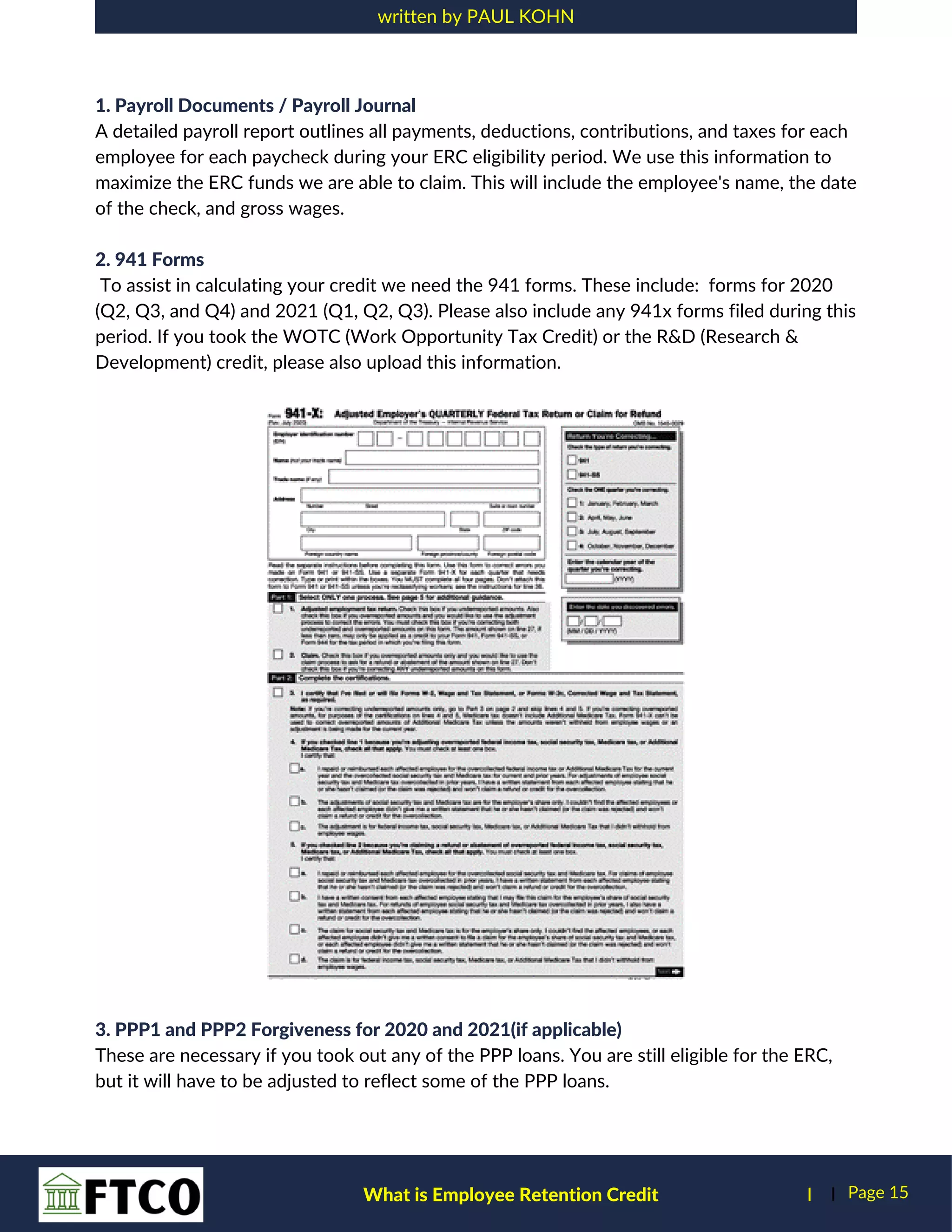
To assist in calculating your credit we need the 941 forms. These include: forms for 2020
(Q2, Q3, and Q4) and 2021 (Q1, Q2, Q3). Please also include any 941x forms filed during this
period. If you took the WOTC (Work Opportunity Tax Credit) or the R&D (Research &
Development) credit, please also upload this information.
3. PPP1 and PPP2 Forgiveness for 2020 and 2021(if applicable)
These are necessary if you took out any of the PPP loans. You are still eligible for the ERC,
but it will have to be adjusted to reflect some of the PPP loans.
What is Employee Retention Credit Page 16
written by PAUL KOHN
I
I
VII - Submit to ERC CPA Expert
During this stage, the ERC specialist is able to thoroughly go through the business’s
documents which leads to the final stages of the process. This is the most critical stage
because it is imperative to follow IRS guidelines. This can also speed up the process. The
workflow includes:
1. Document Validation
There is a secondary check or quality control audit to make sure all the documents are in
place, and they are properly formatted. The CPA makes sure everything is in place, and there
are no gaps.
4. W-3 for 2019
This is a tax form used by employers to report combined employee income. Employers who send
out more than one Form W-2 to employees must complete and send this form to summarize
their total salary payment and withholding amounts. This will assist in figuring out your W-2
comparisons for 2020 and 2021.
This could seem like a lot, but the documents should be pretty accessible with the right person
collecting them. Once these documents are submitted on a secure portal, the business package
can be forwarded to the ERC CPA Specialist.
2. Document Revision
CPA sends documents back to the ERC specialist so the owner can make any necessary
corrections. This part isn't as frequent due to the nature of the document collection
process.
3. CPA Final Calculation / Review
Once all the documents are back and in order the CPA is able to put together the numbers
which help put together the 941X forms. Once all the documents have been filled out and
revised, the Doc package is ready for customer approval. This is where the client will know
the final numbers and if they are eligible for the ERC tax credits.
4. Tax Doc Package Sent and Signed
The Tax Docs are then sent back to the ERC specialist that consults with the business to
get final acceptance as well as the agreement to payment terms for services rendered.
VIII - IRS Paperwork and Getting Your Check
Part of the white glove service includes the CPA firm
filing the paperwork for you. We make sure it's done
right and expeditiously. Once filed with the IRS we
are able to monitor the progress of the filing and will
keep you updated with the process.
The IRS will then show the filing processed and then
you will expect a check from them in 1-2 weeks. We
don’t get paid until you receive your check.
if you are interested in our services, take the first step
and fill out the complimentary pre-qualification check
and begin your journey to getting back the money
your business deserves.
Hope you found our ERC Guide useful and helped
demystify the confusion around the Employee
Retention Credit program. We know you will be
happy with our services and would love to maintain a
relationship with you and your business. Anything
else you need, please let us know.
What is Employee Retention Credit Page 17
written by PAUL KOHN
I
I
Remember, up to this point the business has not had to pay anything or be placed under
contract. This is the part where the business signs the agreement to pay for services, but no
payment is due until the business gets its check from the IRS.

Employee Retention Credit For Dummies.pdf

  • 2.
    What is ERC? AComplete Guide ToEmployee Retention Credit Demystifying ERC/ERTC: How it Benefits Your Business I - What Is The Employee Retention Credit (ERC)? There is no questioning that the COVID-19 pandemic has had a detrimental effect on most small to medium-sized businesses. This is not only the case during the pandemic but has a lasting impact on businesses now and in the years to come. The good news is there are certain programs in place to help stimulate the economy and get eligible businesses the money back that they deserve. Due to the nationwide financial crisis, Congress passed the Coronavirus Aid, Relief, and Economic Security Act (CARES) to help get businesses back on their feet. Within this sizable document, a special section dedicated to the implementation of the Employee Retention Credit was born. This program was added specifically to help businesses like yours. This government program goes by a few different names which include the Employee Retention Credit (ERC), and the Employee Retention Tax Credit (ERTC). According to the IRS website, an employer is eligible for the ERC if it: 1. Sustained a full or partial suspension of operations limiting commerce, travel, or group meetings due to COVID-19 and orders from an appropriate governmental authority. 2. Experienced a significant decline in gross receipts during 2020 or a decline in gross receipts during the first three quarters of 2021 3. Qualified in the third or fourth quarters of 2021 as a recovery startup business. What is Employee Retention Credit Page 02 written by PAUL KOHN I I The Employee Retention Credit is a fully refundable tax credit for employers that qualify to amend a claim against certain employment taxes. The best part of this is that it is not a loan and does not have to be paid back. For most business taxpayers, the refundable credit is in excess of the payroll taxes paid in a quarterly tax credit generating period.
  • 3.
    The Employee RetentionCredit is a refundable tax credit for businesses that continued to pay employees while shut down due to the COVID-19 pandemic or had significant declines in gross receipts from any quarter from March 13, 2020, to Dec. 31, 2021. For a time between those dates, eligible employers may claim the ERC on an original or amended employment tax return. For the entirety of 2020, eligible businesses might receive a refund of up to $5,000 per employee, and for the first three quarters of 2021, up to $7,000 for each employee who was maintained on the payroll. For a recovery startup business, this goes until the end of 2021. Up to $26,000 could be refunded in total for each W-2 employee that was on your payroll. Nevertheless, the program is only valid during the times already mentioned. The statute of limitations for the 2020 ERC and the 2021 ERC do not expire until April 15, 2024, and April 15, 2025, respectively. A business must now submit a revised Form 941X (Quarterly Federal Payroll Tax Return) for each quarter that it was an eligible employer in order to be considered for the ERC. What is Employee Retention Credit Page 03 written by PAUL KOHN I I II - ERC Eligibility Requirements Overview
  • 4.
    What is EmployeeRetention Credit Page 04 written by PAUL KOHN I I Also, if you weren’t in business in 2019, the corresponding quarters from 2020 can be used. However, it also depends on the period you wish to claim the Employee Retention Credit: 1. 2020 quarters: If you had more than 100 full-time employees in 2019, you can only claim the wages of employees you retained but were not working. If you have fewer than 100 employees, you can claim everyone, whether they were working or not. 2. 2021 quarters: The threshold was raised to having 500 full-time employees, giving employers a lot more leeway as to who they can claim for the credit. Any wages that are subject to FICA taxes qualify, and you can include qualified health expenses when calculating the tax credit. Some businesses, especially those that received a Paycheck Protection Program loan (PPP) in 2020, mistakenly believed they didn’t qualify for the ERC. These stipulations have been dropped, and many more businesses are now eligible. If you’ve already filed your tax returns and now realize you are eligible for the ERC, you can retroactively apply by filling out the Adjusted Employer’s Quarterly Federal Tax Return (941- X). The ERC is governed by over 200 pages of the IRS tax code, making it complicated for business owners and even CPAs not specialized in ERC to figure it out. That's where a qualified ERC specialist steps in. For the 2020 ERC, most companies are qualifying as an eligible employer under the Government Mandate Test. For the 2021 ERCs, most companies are qualifying as an eligible employer under the Gross Receipts Test. So what are some of these qualifications? If your business was ordered to fully or partially shut down due to pandemic restrictions or your gross receipts dropped under 50% for the same quarter in 2019 (for 2020) and below 80% (for 2021) you can qualify for the ERC. The following information will give you detailed information on our process to get your business qualified and receive the most money you are entitled to. We do this by following strict IRS guidelines to help keep your business safe with the least likely possibility of an IRS audit. We back our work and stay with you all the way through!
  • 5.
    What is EmployeeRetention Credit Page 05 written by PAUL KOHN I I If you would like a complimentary pre-qualification check or have any questions please click here to get in touch with us There is a no-obligation form with a few unintrusive questions. We would love to see how we could serve you. The following are just a few examples of the 60,000+ businesses which received over seven billion dollars in Employment Retention Credits using our highly specialized ERC program.
  • 6.
    What is EmployeeRetention Credit Page 06 written by PAUL KOHN I I III - Complimentary Pre-Qualification Form The first part of the process to see if your business is eligible for the Employee Retention Credit is the pre-qualification short form. This ERC qualification form is where we gather some non-sensitive information about your business which includes name and basic contact information. If at any time you would like us to assist you in completing this form, please feel free to contact us (this is our general contact form). In fact, we prefer to help you through the process. The following form is the next step on your journey. Here we collect some basic company information to help move you through to what your estimated refund check could look like. Your Business Estimated ERC Calculation The second section is where you enter the W-2 employee count for full-time employees for 2020 and 2021. Part-time employees are also eligible and can substantially increase your eligibility. This part gets a little more complicated so for now we are just looking at an overhead view for this early stage of the process. As you enter the numbers, there will be a green dollar amount estimate located at the bottom right of the page. This estimate is based on averages and metrics we calculated on over 60,000 separate company filings.
  • 7.
    What is EmployeeRetention Credit Page 07 written by PAUL KOHN I I The number is based on all 6 quarters of ERC eligibility, and not all businesses will qualify for all quarters. Remember, there are a lot of variables to determine your tax credit so your actual return could be much higher. This estimated number does not represent a guarantee of credit or that you will be assured of qualifying for ERC. Your tax credit amount will be based on the actual documents submitted and the quarters your business qualifies for. Don’t be concerned with the document collection right now. This is why we like to start with an estimate to see right away if your business is even potentially eligible for the Employee Retention Credits. This way we don’t have to waste your time with the rest of the process and find your business doesn’t qualify. The document collection process comes later, but rest assured we keep this part as simple as we can for you and will assist you through it all.
  • 8.
    What is EmployeeRetention Credit Page 08 written by PAUL KOHN I I IV - Welcome Call After the pre-qualifying form is filled out, and haven’t spoken already, we like to set up a brief call at your convenience to help walk you through the next steps. With most of our clients, the welcome call and the pre-qualification check are part of the same conversation. We pride ourselves in our White Glove Services where we demystify the complicated process and get you a better understanding of what is taking place. Our goal is to help put you at ease and develop a relationship to find out how we can best fulfill your needs
  • 9.
    1. Number ofW-2s This is a good place to start because if a business doesn’t have W-2 employees, they will not qualify for the credit. There are a total of six eligible quarters available to qualify for ERTC, seven quarters if you are a recovery startup business. These include Q2-Q4 for 2020 and Q1-Q3 for 2021. This can be extended for Q4 of 2021 if your business is a recovery start-up business, but the business had to generate under $1 million dollars in revenue. For 2020, eligible employers must have between 1 – 100 W2 employees (excluding the owners or majority shareholders). For 2021, eligible employers must have between 1 – 500 W2 employees (excluding the owners and majority shareholders). The owner, or possibly some family members do not count towards these numbers. So if you are the only employee in your business, then you would most likely not qualify for the program. Remember, your business will be qualifying for each of the quarters available. You could qualify for all, some, or none of the applicable quarters. Once the business passes the W-2 test, we go deeper into the qualification process. What is Employee Retention Credit Page 09 written by PAUL KOHN I I V - Factors That Affect ERTC Qualification
  • 10.
    2. Did YouPay Wages in 2020 or 2021 - The ERC tax credit is calculated based on the percentage of W-2 wages paid. 1099 wages do not count as employees and can’t be included in applying to the program. It is important to note that the wages of majority owners (those having over 50% ownership) and their immediate relatives, even if paid W2, do not qualify for the ERC program. So if two siblings own a business 50% equally then, because of their relationship, constructive ownership rule applies, and they are both considered majority owners, so neither one qualifies. Outside of that, wages from all other W2 employees would still qualify for ERC. On a side note, Federal, state, and local governments and their instrumentalities are not eligible for the ERTC program. However, nonprofit organizations and tribal government entities can benefit from the Employee Retention Credit. 3. When Did You Start Your Business If you were in business before February 15th, 2020 then all the standard rules apply. However, if the business started after this date, then you would fall under the recovery start- up business which would give you some additional advantages. Remember, as previously discussed, , the business would only be eligible if it generated under $1 million dollars in revenue. 4. Full-Time vs. Part-Time Employees A full-time employee is classified as someone that worked at least 30 hours per week, or 130 hours per month in 2019. Remember, this question is based on the average amount of employees in 2019. What is Employee Retention Credit Page 10 written by PAUL KOHN I I
  • 11.
    What is EmployeeRetention Credit Page 11 written by PAUL KOHN I I Part-time employees' wages can be counted towards the calculation of the ERC. They are not included in the 100 or 500 full-time employee limit for the years 2020 or 2021 respectively. 5. IRS Aggregate Rules for ERC This factor comes into play when an owner has multiple businesses. This can be very beneficial if multiple businesses are controlled by the common owner. This allows for all of the businesses to be deemed as a single employer and grouped together for ERC purposes. Some applicable criteria this can be applied to include: a. calculation of qualified wages. b. number of average employees c. a significant decline in gross receipts Ex. An entity has 2 businesses. The first business has 60 full-time employees and the second has 50 full-time employees. In many cases this can be advantageous, but in this situation that would put them over 100 employees making the business ineligible for the tax credit in 2020 because the program was capped at 100 employees to be eligible for that year. Remember the count changes for 2021 where the number goes up to 500 employees. The exception to this would be actual wages paid to employees that did not work due to a government shutdown.
  • 12.
    6. Ways toQualify for ERC Tax Credits There are three main ways to qualify for Employee Retention Credit: a. Revenue Reduction The numbers that determine revenue reduction are different for 2020 and 2021. The following criteria apply to the associated year: 2020 - There was a 50% reduction in gross receipts for the 2020 quarter directly compared to the same quarter in 2019. If the revenue reduction in 2020 gets back to 80% of the 2019 level, then the qualification does not apply. 2021 - There was a 20% reduction in gross receipts for the 2021 quarter directly compared to the same quarter in 2020. This allows for a much greater chance of qualifying for the quarters in this year. This is good news because 2021 allows for up to $7000 back per employee per quarter. b. Supply Disruption Supply chain disruption issues tend to be the most common qualification for businesses that rely on vendors and suppliers for their business to function properly. It comes from circumstances that resulted in the supplier not being able to deliver essential goods What is Employee Retention Credit Page 11 written by PAUL KOHN I I
  • 13.
    What is EmployeeRetention Credit Page 13 written by PAUL KOHN I I These issues qualify a company regardless of revenue gain or loss. If using this as a method of qualifying, please make sure you can supply the IRS with proper documentation. There are two ways to qualify for supply chain disruption: i. Nominal Impact Method - Disruption must have resulted in a more than 10% impact on your business. This can be a result of the reduction of sales, the inability to get the supply item, or from the impact not being able to procure the item had on your business. ii. No Other Reasonable Supplier - The business must not have been able to find a reasonable replacement supplier for the goods or products. c. Full or Partial Suspension This applies only to businesses that were affected by government shutdown orders or limitations. The explanation has to declare the government-mandated shutdown, the applicable time window, and how it affected the business. This is based on a suspension test to demonstrate that the business's operations were partially or fully suspended due to a pandemic government order. Remember a government restriction may have had a direct impact on your operations even though that shutdown order wasn't given to you directly. This restriction usually applies only to 2020 operations due to the fact that very few businesses were given the order to shut down in 2021.
  • 14.
    What is EmployeeRetention Credit Page 14 written by PAUL KOHN I I Many businesses fall into this area and fall under more than nominal impact - A partial suspension that comes from a government order must have had a more than nominal impact, which means it affected more than 10% of business operations. This can come from a reduction in business hours of greater than 10% or a suspension of your business operations that represented 10% or more of gross receipts compared to 2019. A final note on suspensions is if the business was able to effectively convert to a remote work environment and it had little impact on the business then that business does not qualify for the suspension qualification. For more details on this topic, refer to the IRS Notices Notice 2021-23, Notice 2021-33 & Notice 2021-49 All of these factors will be evaluated during the initial qualification process. If all goes well your business should get a rough estimate of the money coming back. This will bring us to the next step of getting the right information together. VI - Document Gathering Process This next stage is critical for getting the numbers right and receiving your refund. We want to ensure everything is done properly. Not only to get the most money your business is eligible for but also to comply with all IRS regulations to help eliminate your chance of an audit. It is also very important to get the documentation process done as quickly as possible. Many businesses drag their feet and take too long to get this done. It is also usually the same businesses that are upset why the process takes so long. We urge you to take the time and get the documents together and then leave the rest to the ERC processors. This is the only part the business has to actively partake in so it's imperative to get it off your plate. Luckily there are only a few documents necessary to get the amended return filed. Most of these documents can be found on your business computer, payroll manager, or your business CPA. These inclu
  • 15.
    What is EmployeeRetention Credit Page 15 written by PAUL KOHN I I 1. Payroll Documents / Payroll Journal A detailed payroll report outlines all payments, deductions, contributions, and taxes for each employee for each paycheck during your ERC eligibility period. We use this information to maximize the ERC funds we are able to claim. This will include the employee's name, the date of the check, and gross wages. 2. 941 Forms To assist in calculating your credit we need the 941 forms. These include: forms for 2020 (Q2, Q3, and Q4) and 2021 (Q1, Q2, Q3). Please also include any 941x forms filed during this period. If you took the WOTC (Work Opportunity Tax Credit) or the R&D (Research & Development) credit, please also upload this information. 3. PPP1 and PPP2 Forgiveness for 2020 and 2021(if applicable) These are necessary if you took out any of the PPP loans. You are still eligible for the ERC, but it will have to be adjusted to reflect some of the PPP loans.
  • 16.
    What is EmployeeRetention Credit Page 16 written by PAUL KOHN I I VII - Submit to ERC CPA Expert During this stage, the ERC specialist is able to thoroughly go through the business’s documents which leads to the final stages of the process. This is the most critical stage because it is imperative to follow IRS guidelines. This can also speed up the process. The workflow includes: 1. Document Validation There is a secondary check or quality control audit to make sure all the documents are in place, and they are properly formatted. The CPA makes sure everything is in place, and there are no gaps. 4. W-3 for 2019 This is a tax form used by employers to report combined employee income. Employers who send out more than one Form W-2 to employees must complete and send this form to summarize their total salary payment and withholding amounts. This will assist in figuring out your W-2 comparisons for 2020 and 2021. This could seem like a lot, but the documents should be pretty accessible with the right person collecting them. Once these documents are submitted on a secure portal, the business package can be forwarded to the ERC CPA Specialist. 2. Document Revision CPA sends documents back to the ERC specialist so the owner can make any necessary corrections. This part isn't as frequent due to the nature of the document collection process. 3. CPA Final Calculation / Review Once all the documents are back and in order the CPA is able to put together the numbers which help put together the 941X forms. Once all the documents have been filled out and revised, the Doc package is ready for customer approval. This is where the client will know the final numbers and if they are eligible for the ERC tax credits. 4. Tax Doc Package Sent and Signed The Tax Docs are then sent back to the ERC specialist that consults with the business to get final acceptance as well as the agreement to payment terms for services rendered.
  • 17.
    VIII - IRSPaperwork and Getting Your Check Part of the white glove service includes the CPA firm filing the paperwork for you. We make sure it's done right and expeditiously. Once filed with the IRS we are able to monitor the progress of the filing and will keep you updated with the process. The IRS will then show the filing processed and then you will expect a check from them in 1-2 weeks. We don’t get paid until you receive your check. if you are interested in our services, take the first step and fill out the complimentary pre-qualification check and begin your journey to getting back the money your business deserves. Hope you found our ERC Guide useful and helped demystify the confusion around the Employee Retention Credit program. We know you will be happy with our services and would love to maintain a relationship with you and your business. Anything else you need, please let us know. What is Employee Retention Credit Page 17 written by PAUL KOHN I I Remember, up to this point the business has not had to pay anything or be placed under contract. This is the part where the business signs the agreement to pay for services, but no payment is due until the business gets its check from the IRS.