Exploring Emotivism in
Descriptive Ethics
BY: Group 1
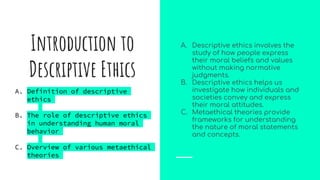
Introduction to
Descriptive Ethics
A. Definition of descriptive
ethics
B. The role of descriptive ethics
in understanding human moral
behavior
C. Overview of various metaethical
theories
A. Descriptive ethics involves the
study of how people express
their moral beliefs and values
without making normative
judgments.
B. Descriptive ethics helps us
investigate how individuals and
societies convey and express
their moral attitudes.
C. Metaethical theories provide
frameworks for understanding
the nature of moral statements
and concepts.
Emotivism
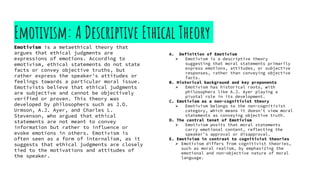
Emotivism: A Descriptive Ethical Theory
Emotivism is a metaethical theory that
argues that ethical judgments are
expressions of emotions. According to
emotivism, ethical statements do not state
facts or convey objective truths, but
rather express the speaker's attitudes or
feelings towards a particular moral issue.
Emotivists believe that ethical judgments
are subjective and cannot be objectively
verified or proven. This theory was
developed by philosophers such as J.O.
Urmson, A.J. Ayer, and Charles L.
Stevenson, who argued that ethical
statements are not meant to convey
information but rather to influence or
evoke emotions in others. Emotivism is
often seen as a form of internalism, as it
suggests that ethical judgments are closely
tied to the motivations and attitudes of
the speaker.
A. Definition of Emotivism
 Emotivism is a descriptive theory
suggesting that moral statements primarily
express emotions, attitudes, or subjective
responses, rather than conveying objective
facts.
B. Historical background and key proponents
 Emotivism has historical roots, with
philosophers like A.J. Ayer playing a
pivotal role in its development.
C. Emotivism as a non-cognitivist theory
 Emotivism belongs to the non-cognitivist
category, which means it doesn't view moral
statements as conveying objective truth.
D. The central tenet of Emotivism
 Emotivism posits that moral statements
carry emotional content, reflecting the
speaker's approval or disapproval.
E. Emotivism in contrast to cognitivist theories
 Emotivism differs from cognitivist theories,
such as moral realism, by emphasizing the
emotional and non-objective nature of moral
language.
The Implications of
Emotivism
A. Emotivism’s challenge to Moral
Objectivity
- Emotivism questions the
existence of objective moral
truths and emphasizes the
subjectivity of moral judgments.
B. The subjectivity of moral
judgements.
- Emotivism highlights that moral
judgments are subjective and
rooted in personal emotions and
attitudes.
C. Moral disagreement and the
emotivist perspective
- Emotivism offers insights into
the sources of moral
disagreement, which often stem
from differences in emotional
responses.
D. The Emotivist approach to
resolving moral conflicts
- Emotivism suggests that
understanding the emotional
nature of moral judgments can
aid in resolving moral conflicts.
Emotivism's View on Moral Statements
A. The emotional content of moral statements
- Emotivism asserts that moral statements are expressions of emotions and
attitudes, emphasizing the speaker's emotional response to moral issues.
B. Distinguishing between descriptive and prescriptive language
- Emotivism draws a distinction between descriptive language (conveying
facts) and prescriptive language (expressing attitudes).
C. The "boo-hurrah" theory: Understanding moral expressions as emotional outbursts
- The "boo-hurrah" theory characterizes moral statements as emotional
outbursts, reflecting approval (hurrah) or disapproval (boo).
D. Examples illustrating the emotive component of moral language
- Examples can vividly illustrate how moral statements often express emotions
and attitudes rather than objective facts.
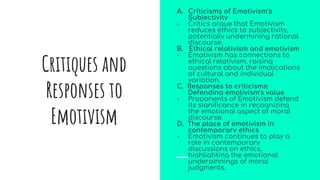
A. Criticisms of Emotivism’s
Subjectivity
- Critics argue that Emotivism
reduces ethics to subjectivity,
potentially undermining rational
discourse.
B. Ethical relativism and emotivism
- Emotivism has connections to
ethical relativism, raising
questions about the implications
of cultural and individual
variation.
C. Responses to criticisms:
Defending emotivism's value
- Proponents of Emotivism defend
its significance in recognizing
the emotional aspect of moral
discourse.
D. The place of emotivism in
contemporary ethics
- Emotivism continues to play a
role in contemporary
discussions on ethics,
highlighting the emotional
underpinnings of moral
judgments.
Critiques and
Responses to
Emotivism
Critiques of Emotivism:
- Lack of truth conditions: Emotivism faces criticism for
claiming that moral sentences lack truth conditions. Critics
argue that this undermines the possibility of meaningful
moral discourse and debate.
- Problem of explanation: Some argue that emotivism
fails to adequately explain why moral sentences appear to
have truth conditions. Critics claim that this undermines the
coherence and plausibility of the theory.
- Different interpretations: There are different
interpretations of emotivism, particularly regarding its
semantic and pragmatic parts. Critics argue that these
interpretations can lead to confusion and inconsistency
within the theory.
Responses to Critiques:
- Deflationary truth conditions: Emotivists can respond
to the critique of lacking truth conditions by asserting that
moral sentences do have truth conditions, but in a
deflationary sense. They argue that moral sentences can still
possess truth conditions without conforming to traditional
inflationary conceptions of truth.
- Explanation through pragmatics: Emotivists can
argue that the appearance of truth conditions in moral
sentences can be explained by the pragmatic part of
emotivism. They claim that moral sentences are asserted to
Critiques and
Responses to
Emotivism
A. The influence of emotivism on moral discourse and public debate
- Emotivism's emphasis on emotions has a tangible impact on how moral issues
are discussed in public and private contexts.
A. Case Studies exploring Emotivism’s applicability to real-world issues
- Examining real-world cases helps illustrate how emotivism can be used to
analyze complex moral dilemmas.
A. COmparing Emotivism to other ethical theories in analysing moral dilemmas
- Contrasting emotivism with other ethical theories can shed light on the
strengths and limitations of this approach.
A. Examples illustrating the emotive component of moral language
- Examples can vividly illustrate how moral statements often express emotions
and attitudes rather than objective facts.
Emotivism in Practical Ethics
Conclusion
● Bernardino, Daniela Ross
● Campita, Trixie Joy
● Garcia, John Reiben
● Quinito, Justin
Members (BSEE 2B):
REferences:
● Stoljar, D. (1993). Emotivism and Truth Conditions. Philosophical Studies: An
International Journal for Philosophy in the Analytic Tradition, 70(1), 81–101.
http://www.jstor.org/stable/4320397
● Miller, A. (1998). Emotivism and the Verification Principle. Proceedings of the
Aristotelian Society, 98, 103–124. http://www.jstor.org/stable/4545277
● Mahon, James. (2013). MacIntyre and the Emotivists.
● Satris, S. A. (1982). The Theory of Value and the Rise of Ethical Emotivism.
Journal of the History of Ideas, 43(1), 109–128. https://doi.org/10.2307/2709163
● Garvin, L. (1958). Emotivism, Expression, and Symbolic Meaning. The Journal of
Philosophy, 55(3), 111–118. https://doi.org/10.2307/2022253
● Moore, A. (1958). Emotivism: Theory and Practice. The Journal of Philosophy,
55(9), 375–382. https://doi.org/10.2307/2022769
● Blackstone, W. T. (1958). Objective Emotivism. The Journal of Philosophy,
55(24), 1054–1062. https://doi.org/10.2307/2021941
● Waller, B. N. (1986). The Virtues of Contemporary Emotivism. Erkenntnis (1975-),
25(1), 61–75. http://www.jstor.org/stable/20012031

Emotivism Unveiled: Descriptive Ethics Dive

  • 1.
  • 2.
    Introduction to Descriptive Ethics A.Definition of descriptive ethics B. The role of descriptive ethics in understanding human moral behavior C. Overview of various metaethical theories A. Descriptive ethics involves the study of how people express their moral beliefs and values without making normative judgments. B. Descriptive ethics helps us investigate how individuals and societies convey and express their moral attitudes. C. Metaethical theories provide frameworks for understanding the nature of moral statements and concepts.
  • 3.
  • 4.
    Emotivism: A DescriptiveEthical Theory Emotivism is a metaethical theory that argues that ethical judgments are expressions of emotions. According to emotivism, ethical statements do not state facts or convey objective truths, but rather express the speaker's attitudes or feelings towards a particular moral issue. Emotivists believe that ethical judgments are subjective and cannot be objectively verified or proven. This theory was developed by philosophers such as J.O. Urmson, A.J. Ayer, and Charles L. Stevenson, who argued that ethical statements are not meant to convey information but rather to influence or evoke emotions in others. Emotivism is often seen as a form of internalism, as it suggests that ethical judgments are closely tied to the motivations and attitudes of the speaker. A. Definition of Emotivism  Emotivism is a descriptive theory suggesting that moral statements primarily express emotions, attitudes, or subjective responses, rather than conveying objective facts. B. Historical background and key proponents  Emotivism has historical roots, with philosophers like A.J. Ayer playing a pivotal role in its development. C. Emotivism as a non-cognitivist theory  Emotivism belongs to the non-cognitivist category, which means it doesn't view moral statements as conveying objective truth. D. The central tenet of Emotivism  Emotivism posits that moral statements carry emotional content, reflecting the speaker's approval or disapproval. E. Emotivism in contrast to cognitivist theories  Emotivism differs from cognitivist theories, such as moral realism, by emphasizing the emotional and non-objective nature of moral language.
  • 5.
    The Implications of Emotivism A.Emotivism’s challenge to Moral Objectivity - Emotivism questions the existence of objective moral truths and emphasizes the subjectivity of moral judgments. B. The subjectivity of moral judgements. - Emotivism highlights that moral judgments are subjective and rooted in personal emotions and attitudes. C. Moral disagreement and the emotivist perspective - Emotivism offers insights into the sources of moral disagreement, which often stem from differences in emotional responses. D. The Emotivist approach to resolving moral conflicts - Emotivism suggests that understanding the emotional nature of moral judgments can aid in resolving moral conflicts.
  • 6.
    Emotivism's View onMoral Statements A. The emotional content of moral statements - Emotivism asserts that moral statements are expressions of emotions and attitudes, emphasizing the speaker's emotional response to moral issues. B. Distinguishing between descriptive and prescriptive language - Emotivism draws a distinction between descriptive language (conveying facts) and prescriptive language (expressing attitudes). C. The "boo-hurrah" theory: Understanding moral expressions as emotional outbursts - The "boo-hurrah" theory characterizes moral statements as emotional outbursts, reflecting approval (hurrah) or disapproval (boo). D. Examples illustrating the emotive component of moral language - Examples can vividly illustrate how moral statements often express emotions and attitudes rather than objective facts.
  • 7.
    A. Criticisms ofEmotivism’s Subjectivity - Critics argue that Emotivism reduces ethics to subjectivity, potentially undermining rational discourse. B. Ethical relativism and emotivism - Emotivism has connections to ethical relativism, raising questions about the implications of cultural and individual variation. C. Responses to criticisms: Defending emotivism's value - Proponents of Emotivism defend its significance in recognizing the emotional aspect of moral discourse. D. The place of emotivism in contemporary ethics - Emotivism continues to play a role in contemporary discussions on ethics, highlighting the emotional underpinnings of moral judgments. Critiques and Responses to Emotivism
  • 8.
    Critiques of Emotivism: -Lack of truth conditions: Emotivism faces criticism for claiming that moral sentences lack truth conditions. Critics argue that this undermines the possibility of meaningful moral discourse and debate. - Problem of explanation: Some argue that emotivism fails to adequately explain why moral sentences appear to have truth conditions. Critics claim that this undermines the coherence and plausibility of the theory. - Different interpretations: There are different interpretations of emotivism, particularly regarding its semantic and pragmatic parts. Critics argue that these interpretations can lead to confusion and inconsistency within the theory. Responses to Critiques: - Deflationary truth conditions: Emotivists can respond to the critique of lacking truth conditions by asserting that moral sentences do have truth conditions, but in a deflationary sense. They argue that moral sentences can still possess truth conditions without conforming to traditional inflationary conceptions of truth. - Explanation through pragmatics: Emotivists can argue that the appearance of truth conditions in moral sentences can be explained by the pragmatic part of emotivism. They claim that moral sentences are asserted to Critiques and Responses to Emotivism
  • 9.
    A. The influenceof emotivism on moral discourse and public debate - Emotivism's emphasis on emotions has a tangible impact on how moral issues are discussed in public and private contexts. A. Case Studies exploring Emotivism’s applicability to real-world issues - Examining real-world cases helps illustrate how emotivism can be used to analyze complex moral dilemmas. A. COmparing Emotivism to other ethical theories in analysing moral dilemmas - Contrasting emotivism with other ethical theories can shed light on the strengths and limitations of this approach. A. Examples illustrating the emotive component of moral language - Examples can vividly illustrate how moral statements often express emotions and attitudes rather than objective facts. Emotivism in Practical Ethics
  • 10.
  • 11.
    ● Bernardino, DanielaRoss ● Campita, Trixie Joy ● Garcia, John Reiben ● Quinito, Justin Members (BSEE 2B):
  • 12.
    REferences: ● Stoljar, D.(1993). Emotivism and Truth Conditions. Philosophical Studies: An International Journal for Philosophy in the Analytic Tradition, 70(1), 81–101. http://www.jstor.org/stable/4320397 ● Miller, A. (1998). Emotivism and the Verification Principle. Proceedings of the Aristotelian Society, 98, 103–124. http://www.jstor.org/stable/4545277 ● Mahon, James. (2013). MacIntyre and the Emotivists. ● Satris, S. A. (1982). The Theory of Value and the Rise of Ethical Emotivism. Journal of the History of Ideas, 43(1), 109–128. https://doi.org/10.2307/2709163 ● Garvin, L. (1958). Emotivism, Expression, and Symbolic Meaning. The Journal of Philosophy, 55(3), 111–118. https://doi.org/10.2307/2022253 ● Moore, A. (1958). Emotivism: Theory and Practice. The Journal of Philosophy, 55(9), 375–382. https://doi.org/10.2307/2022769 ● Blackstone, W. T. (1958). Objective Emotivism. The Journal of Philosophy, 55(24), 1054–1062. https://doi.org/10.2307/2021941 ● Waller, B. N. (1986). The Virtues of Contemporary Emotivism. Erkenntnis (1975-), 25(1), 61–75. http://www.jstor.org/stable/20012031