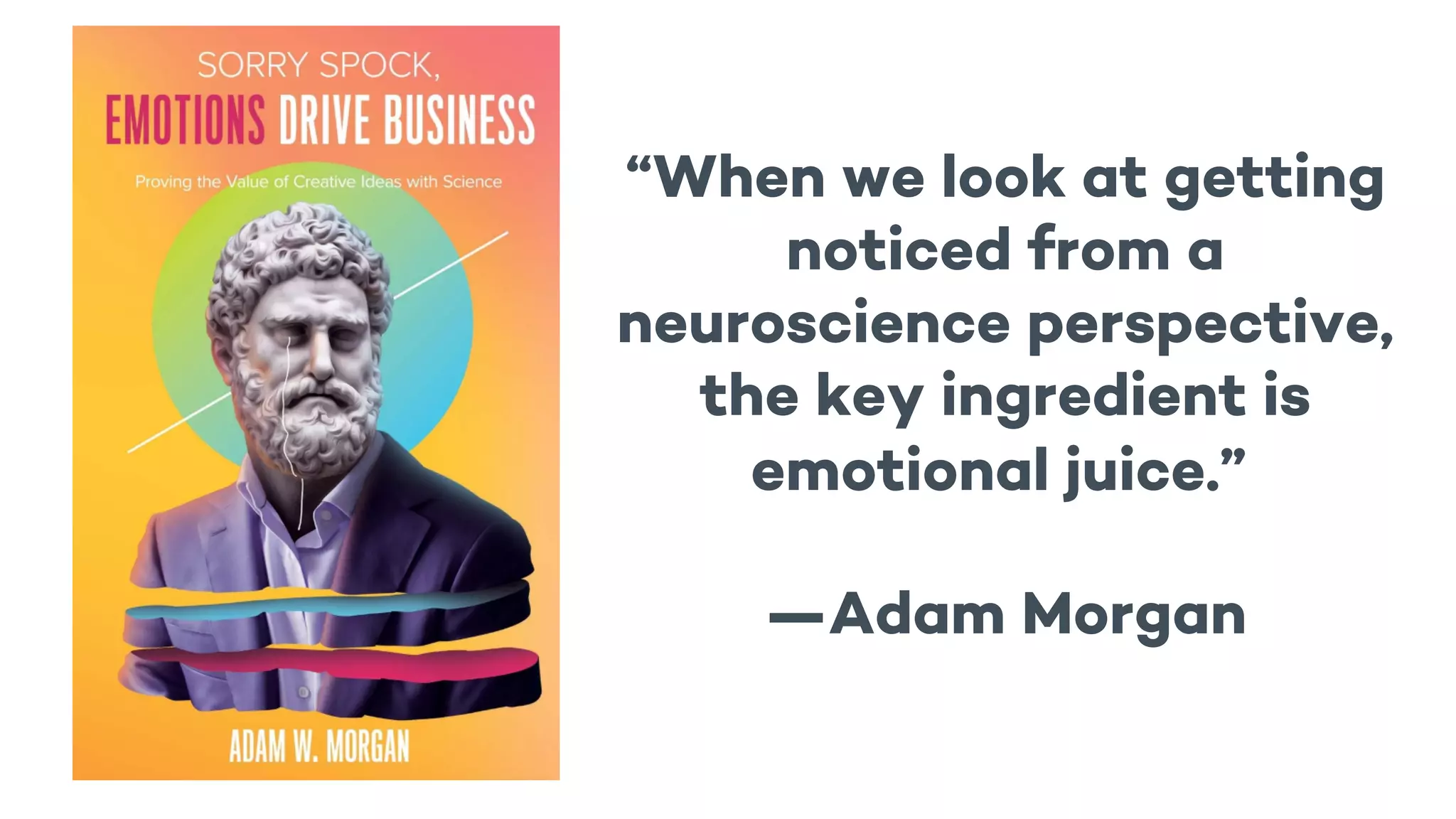
“When we look at getting
noticed from a
neuroscience perspective,
the key ingredient is
emotional juice.”
—Adam Morgan
“Only when something doesn’t
match our predicted reality
does the conscious brain kick
in. Only then do we become
aware and notice the element
that’s different”
—Dr. Scott Steffensen, BYU
On anomaly detection.
Our brains are designed to detect
anomalies. Something new or different.
Your message needs to be emotional so
that it lights up your customer’s entire
brain. The key to making an idea get
noticed is emotion.
“We’re so busy
measuring public
opinion we forget we
can create it.”
—Bill Bernbach
Critics of creativity need to understand
the superpower that lies within being
customer centric and emotionally driven.
Once that’s established, it’s up to creative
leaders to put this superpower into action.
Logic vs. creativity.
When presenting creative ideas
to logical clients, it’s often
necessary to prep your audience.
Before diving into the creative,
help them understand the impact
and upside of the creative
approach.
The tone hierarchy.
There are times when a more emotional and
creative message is critical. But there is
also a time and place for a more logical
message.
Both sides win when you know the right
moment to use the right tone.
While the tone hierarchy
progresses from emotional to
rational, tone shifts in messaging
don’t have to follow a linear
progression. Some content
formats, like long form, can use
subheads to infuse an emotional
tone throughout.
Context words and headlines.
The economy of words can create a huge
emotional response, but effective headlines
shouldn’t be about length or number of
words.
It’s about focusing on the emotional
content, including context words and ideas
that engage audiences.
“There are a specific set of
context words you’re more
likely to stop and pay a little
more attention to. These words
trigger micro-attention which
earn you a little millisecond of
customer engagement.”
—Dan Greenberg, Sharethrough
The final say.
Don’t let logic edge out creativity.
In fact, it’s the ultimate power of left plus
right brain, strategy plus imagination,
sense plus emotion, that yields the biggest
results.
To see how the Write On
team puts Adam’s wisdom
into practice, check out
our work for Adobe and
others at:
writeonnetwork.com

Key findings from Sorry Spock, Emotions Drive Business.

  • 1.
    “When we lookat getting noticed from a neuroscience perspective, the key ingredient is emotional juice.” —Adam Morgan
  • 2.
    “Only when somethingdoesn’t match our predicted reality does the conscious brain kick in. Only then do we become aware and notice the element that’s different” —Dr. Scott Steffensen, BYU
  • 3.
    On anomaly detection. Ourbrains are designed to detect anomalies. Something new or different. Your message needs to be emotional so that it lights up your customer’s entire brain. The key to making an idea get noticed is emotion.
  • 4.
    “We’re so busy measuringpublic opinion we forget we can create it.” —Bill Bernbach
  • 5.
    Critics of creativityneed to understand the superpower that lies within being customer centric and emotionally driven. Once that’s established, it’s up to creative leaders to put this superpower into action. Logic vs. creativity.
  • 6.
    When presenting creativeideas to logical clients, it’s often necessary to prep your audience. Before diving into the creative, help them understand the impact and upside of the creative approach.
  • 7.
    The tone hierarchy. Thereare times when a more emotional and creative message is critical. But there is also a time and place for a more logical message. Both sides win when you know the right moment to use the right tone.
  • 8.
    While the tonehierarchy progresses from emotional to rational, tone shifts in messaging don’t have to follow a linear progression. Some content formats, like long form, can use subheads to infuse an emotional tone throughout.
  • 9.
    Context words andheadlines. The economy of words can create a huge emotional response, but effective headlines shouldn’t be about length or number of words. It’s about focusing on the emotional content, including context words and ideas that engage audiences.
  • 10.
    “There are aspecific set of context words you’re more likely to stop and pay a little more attention to. These words trigger micro-attention which earn you a little millisecond of customer engagement.” —Dan Greenberg, Sharethrough
  • 11.
    The final say. Don’tlet logic edge out creativity. In fact, it’s the ultimate power of left plus right brain, strategy plus imagination, sense plus emotion, that yields the biggest results.
  • 12.
    To see howthe Write On team puts Adam’s wisdom into practice, check out our work for Adobe and others at: writeonnetwork.com