Emotionally Durable Design Objects Experiences And Empathy Jonathan Chapman
Emotionally Durable Design Objects Experiences And Empathy Jonathan Chapman
Emotionally Durable Design Objects Experiences And Empathy Jonathan Chapman
Emotionally Durable Design Objects Experiences And Empathy Jonathan Chapman
Emotionally Durable Design Objects Experiences And Empathy Jonathan Chapman
1.
Emotionally Durable DesignObjects Experiences
And Empathy Jonathan Chapman download
https://ebookbell.com/product/emotionally-durable-design-objects-
experiences-and-empathy-jonathan-chapman-1779424
Explore and download more ebooks at ebookbell.com
2.
Here are somerecommended products that we believe you will be
interested in. You can click the link to download.
Emotionally Intelligent Leadership A Guide For College Students 1st
Marcy Levy Shankman Scott J Allen Paige Habercurran
https://ebookbell.com/product/emotionally-intelligent-leadership-a-
guide-for-college-students-1st-marcy-levy-shankman-scott-j-allen-
paige-habercurran-47781030
Emotionally Intelligent Design 1st Edition Pamela Pavliscak
https://ebookbell.com/product/emotionally-intelligent-design-1st-
edition-pamela-pavliscak-49183994
Emotionally Disturbed A History Of Caring For Americas Troubled
Children Deborah Blythe Doroshow
https://ebookbell.com/product/emotionally-disturbed-a-history-of-
caring-for-americas-troubled-children-deborah-blythe-doroshow-51762970
Emotionally Healthy Discipleship Peter Scazzero
https://ebookbell.com/product/emotionally-healthy-discipleship-peter-
scazzero-34022026
3.
Emotionally Healthy RelationshipsWorkbook Peter Scazzero Geri
Scazzero
https://ebookbell.com/product/emotionally-healthy-relationships-
workbook-peter-scazzero-geri-scazzero-34076186
Emotionally Healthy Relationships Day By Day Peter Scazzero
https://ebookbell.com/product/emotionally-healthy-relationships-day-
by-day-peter-scazzero-34076188
Emotionally Focused Family Therapy Restoring Connection And Promoting
Resilience 1st Edition James L Furrow
https://ebookbell.com/product/emotionally-focused-family-therapy-
restoring-connection-and-promoting-resilience-1st-edition-james-l-
furrow-37327848
Emotionally Focused Family Therapy Restoring Connection And Promoting
Resilience 1st Edition James L Furrow
https://ebookbell.com/product/emotionally-focused-family-therapy-
restoring-connection-and-promoting-resilience-1st-edition-james-l-
furrow-37329332
Emotionally Intelligent Ninja A Childrens Book About Developing
Emotional Intelligence Eq Ninja Life Hacks 35 Mary Nhin
https://ebookbell.com/product/emotionally-intelligent-ninja-a-
childrens-book-about-developing-emotional-intelligence-eq-ninja-life-
hacks-35-mary-nhin-42811534
V
THE PROGRESS ILLUSION
contents
Listof figures ix
List of acronyms and abbreviations x
Acknowledgements xi
Chapter one: The progress illusion 1
Ecological awakenings 1
Pressure on resources 3
Design for sustainability? 5
Consumption and waste 7
Sustainable design is symptom focused 9
Tweaking typologies 10
The myth of individuality 11
Jamming creativity 12
How to guarantee disappointment 16
Chasing unattainable destinies 17
Emotionally durable design 18
Meaningful embraces with objects 18
Waste is symptomatic of failed relationships 20
Anthropocentrism 21
About-face 24
Chapter summary 25
A toolbox of ideas 27
Chapter two: Consumer motivation 29
Consumption is natural 29
The material you possess is the destiny you chase 30
The dark side 32
Statistics impose a paralysing vastness 33
11.
EMOTIONALLY DURABLE DESIGN
VI
Thetuberculosis analogy 34
Conceptualizing the act 35
When aren’t we consuming? 36
Need 37
Meaning 39
Having and being 40
Mapping need 42
Maslow’s hierarchy of needs 43
The crisis of individual evolution 43
Flocking behaviour 45
Beating down the wilderness 46
Obsolescence 47
The deflowering gaze of familiarity 48
The mirror stage 49
Ego 50
Empathy has a lifespan 51
Metaphysical versus physical 52
Chapter summary 53
A toolbox of ideas 55
Chapter three : Attachments with objects 57
The dawn of material culture 57
The cultural big bang 59
Towards individualism and materialism 60
Desire and disappointment 61
The honeymoon period 63
From honeymoon to the daily grind 66
Growing together 67
Love 68
A streamlined world 70
Designing dependency 71
Tamagotchi 72
Alterity 74
Cherishability 75
Feed-forward and inherent feedback 76
Fuzzy interaction 77
CONTENTS
12.
VII
THE PROGRESS ILLUSION
Pace78
Chapter summary 80
A toolbox of ideas 82
Chapter four: Authors of experience 83
User experience 83
Naughty, naughty 86
More is less 90
Experience design 92
Experience and emotion 96
Immersive experience 102
Chapter summary 107
A toolbox of ideas 109
Chapter five: Sustaining narrative 111
A metaphysical rendering of newness 111
Durable narrative experience 112
Just noticeable difference 112
Creator and creature 113
Leaving space for the user 117
The teddy bear factor 118
To cut a short story long 120
Storytelling 120
Domestic robotics 122
Layers of narrative 126
Smooth morphic shifts 128
Growing old gracefully 128
Ageing material surfaces 131
Against the ‘box-fresh’ ideal 132
Chapter summary 134
A toolbox of ideas 136
Chapter six: De-fictioning utopia 137
The problem with utopia 137
Design is utopian 138
Fiction 139
The need for fiction 142
Consumption is a process of de-fictioning 142
CONTENTS
13.
EMOTIONALLY DURABLE DESIGN
VIII
Deflowering143
Sustaining fiction 144
Consciousness 145
Through an individually polished looking glass 148
Phantile drives 150
The G4 Cube 152
Omnipresent phantile drives 153
Space 156
Foreignments, placebo realities and jolts 156
Chapter summary 159
A toolbox of ideas 161
Chapter seven: Real world feasibility 163
The vision 163
The real world 164
An outdated model 166
Sustainable design is unresolved 170
The cost of environmental unawareness 174
Producer and consumer 180
Chapter summary 184
A toolbox of ideas 185
Endnotes 187
References 197
Index 207
CONTENTS
14.
IX
THE PROGRESS ILLUSION
Listof figures
1.1 Desktop PCs and peripherals still portray the 13
semantic of oversized calculators
1.2 The notion of choice is somewhat limited when 15
interacting with the offerings of contemporary material
culture
2.1 Consumption is about far more than just the 31
acquisition of new and shiny things
3.1 Orphaned products are brutally cast aside to make 64
way for the next
4.1 Dysfunctional products can evoke potent emotional 87
responses
5.1 Denim jeans have engendered evolving narrative 115
experiences for decades
5.2 Teddies transcend obsolescence by accumulating 119
meaning through time
6.1 Handles on the corners of Macs cast a fictitious 141
caricature of nomadic urban mobility
6.2 Unwanted appliances spend a year or so of conscience 151
time in a cupboard prior to being chucked
7.1 Waste could be seen as a symptom of a failed 169
relationship
LIST OF FIGURES
15.
EMOTIONALLY DURABLE DESIGN
X
Listof acronyms and abbreviations
ABS Acrylonitrile Butadiene Styrene
AIGA American Institute of Graphic Arts
C Celsius
CD compact disc
CO2
carbon dioxide
DfX Design for X
HCI human–computer interaction
JND just noticeable difference
LCD Liquid Crystal Display
LED light emitting diode
MD mini disc
MP3 a computer file format that stores a large amount of
information in a small amount of space – usually music
NASA National Aeronautics and Space Administration
NRI Nomura Research Institute
OECD Organisation for Economic Co-operation and
Development
PC personal computer
PD phantile drive
PDA Personal Digital Assistant
PR public relations
TB tuberculosis
VR virtual reality
VW Volkswagen
LIST OF ACRONYMS AND ABBREVIATIONS
16.
XI
THE PROGRESS ILLUSION
Acknowledgements
Iwould like to thank the following individuals for their kind support,
contributions and comments during the creation of this book:
Ian Lee, John Wood, Nigel Ordish, Beatrice Otto, Sue Anne Lee,Yu-Heng Lu,
Rob West and Dr Christian De Groot.
Special thanks are due to the Harold Hyam Wingate Foundation,
whose generous scholarship helped to make this project possible, and to
photographer Katherine Anne Rose for creating the images featured within
this book.
ACKNOWLEDGEMENTS
17.
1
THE PROGRESS ILLUSION
chapter
one
the
progress
illusion
Ecologicalawakenings
In 1966 the National Aeronautics and Space Administration (NASA)
delivered to the world the first photographic images of our planet from
outer space, and for the first time in human history we experienced Earth
as a holistic and self-supporting organism peacefully suspended in the
dark silence of space.We witnessed with our own eyes Earth’s protective
atmosphere, and were jolted by the evident fragility of this blue gaseous
membrane proportionally similar in depth to ‘a coat of paint around a
football’.1
The social shockwave that resulted from this uncomplicated
revelation gave birth to a new and socially accessible appreciation of
the natural environment.The world’s largest environmental organization
– Friends of the Earth – was founded three years later closely followed by
Greenpeace in 1971. From the early 1970s, the output of legislation and
transnational environmental policies also grew, placing increasing pressure
on designers and manufacturers to improve their standards.Today, public
consciousness of the human destruction on the natural world is almost
18.
EMOTIONALLY DURABLE DESIGN
2
tacit,and few would negate that a dramatic reappraisal of developed
world production and consumption methods is imperative:‘proving that
the Earth’s climate is changing from human actions … is like statistically
“proving” the pavement exists after you have jumped out of a 30-storey
building.After each floor your analysis would say “so far – so good” and
then, at the pavement, all uncertainty is removed.’2
Some might refer to the space mission in 1966 as having provided
the greatest ecological awakening in modern history. Undoubtedly, it
assisted significantly in the societal comprehension of new ecological
models and theories, one of these being the Gaia hypothesis – so named
after the Greek goddess of Earth, Gaia – which provides an inclusive glance
at life on Earth. In Gaia, environmental scientist James Lovelock puts forward
the theory that the Earth is a ‘tightly coupled process from which the self-
regulation of the environment emerges’.3
His theory, made public in 1968 at
a conference regarding the origins of life on Earth, might well be viewed as
a logical continuation of Charles Darwin’s theories of evolution by natural
selection, except that Lovelock classifies animals and inanimate entities
within a single category. It also appears to make perfect sense to even the
least informed ecologist, making it the popular choice for many. Gaia theory
embeds itself within the correlations between all matter on Earth, and in
this respect resembles ancient Celtic and other holistic, animistic depictions
of human situatedness within nature, quite unlike contemporary ecology
with its somewhat anthropocentric tendency to focus chiefly on human-
centred endeavours and their environmental impact(s).
Other approaches differ greatly in sentiment to Gaia, such as that
of French-born American microbiologist, environmentalist and author Rene
Dubos and that of Garret Hardin. Dubos powerfully expresses the concept
of humans as stewards to life on Earth: in governmental symbiosis with it like
supreme gardeners for the entire world. Hardin, on the other hand, a highly
trained ecologist and microbiologist, sees humankind as acting out a great
tragedy which may not only lead to their own destruction but to that of the
whole world. In 1968 he described this theory with great detail in an essay
entitled ‘The tragedy of the commons’4
in which he draws comparison
between planet Earth and the village common.This analogy is founded on
the basis that they are both ecosystems, each of which must live within
19.
3
THE PROGRESS ILLUSION
certainlimits – the tragedy being that each villager who uses the common
sees only their own impact and never the overall spatial effects of the village
population as a whole.
Pressure on resources
Many practitioners claim that our destructive and unsustainable harvesting
of this planet’s limited reserve of natural resources is due to an escalating
human population, founded on the simple premise that more people
essentially need more materials to support their existence.This is not
actually the case:‘over the last 50 years the world’s population has
increased by 50 per cent; but our resource utilization has increased by
1000 per cent for the same period’.5
These statistics demonstrate that
increased population is not necessarily exponential with increased resource
consumption, as is often assumed. It would be more accurate to say that
although an increase in human population will bring an obvious increase
in resource consumption, the mess we are in today is more likely to be a
result of unsustainable developments in the way we design, manufacture
and consume objects in the modern world. It is therefore short sighted to
blame the demise of natural resources simply on a rise in population, when
it is so evidently not the case.
Pressure and competition for space upon Earth is in constant
flux; an ebb and flow of populations, animal, vegetable and mineral wash
in and out of space the moment an opportunity arises.The rules of
spatial pressure operate in this way by placing ‘uneven pressure’6
on the
immediate environment, which forces vast tides of biomass to surge and
boil in reaction to the consequent disharmony.As discussed earlier in Gaia,
this eternal struggle has always been in progress and always will be. French
librarian and writer Georges Bataille, when speaking of pressure, states
that any life form will always expand in number or size to fill the space
that it has, and only when critical mass has been accomplished will growth
level off. He illustrates this theory with the micro-organism duckweed:‘It
has a drive to cover any pond with a green film, after which it remains in
equilibrium.’7
The only change likely to occur will happen when an outside
factor becomes visible to the equation, such as a tree falling into the pond,
or heavy rainfall that doubles the pond’s surface area. Life is opportunist
20.
EMOTIONALLY DURABLE DESIGN
4
andmay proliferate under the most obscure circumstances; in the words of
Bataille,‘life occupies all available space’.8
Owing to the broad range of extreme conditions that can be
found on this small planet, most humans – with the obvious exception of
hardy scientific researchers – do not actually occupy all available space.
Vast expanses of the globe are currently uninhabited due to inhospitable
conditions, such as the altitudinal excesses found in the upper Himalayan
regions of Nepal or, perhaps, the geological instability of the sulphurous laval
plains of the Reykjanes Peninsula in Iceland. However, even in places that
are considered to be so inhospitable, there are usually a few well-dressed
scientific researchers to be found. For exampleVostok,Antarctica, is the
home of some of the coldest temperatures recorded on Earth, sometimes
reaching a bitter –89° Celsius (C); there is an inhabited Russian research
base there, where it is reported that the temperature regularly dips below
–60°C. Bataille was right; life is opportunist and endeavours to occupy all
available space.
‘Human population currently stands at 6.13 billion persons and is
growing at 1.33 per cent per year, or an annual net addition of 78 million
people.’9
It is further projected that world population will reach a staggering
‘8.9 billion in 2050’.10
According to US Census Bureau estimates:
World population hit the 6 billion mark in June 1999.This figure is over 3.5
times the size of the Earth’s population at the beginning of the 20th century
and roughly double its size in 1960.The time required for global population to
grow from 5 to 6 billion – 12 years – was shorter than the interval between
any of the previous billions.11
These statistics demonstrate that the human species is not only growing,
but also gathering considerable speed along the way. In a study that Rem
Koolhaas – hailed by many as the architect for the new millennium – is
conducting with students at Harvard University, it was discovered that
the city of Shenzhen near Hong Kong is growing at a rate of 2 square
kilometres per year: at ‘this pace an architect can afford only two days
to design an entire skyscraper’.12
Although, as Bataille states, population
growth alone is not a problem for planet Earth, there are vast expanses
21.
5
THE PROGRESS ILLUSION
ofuninhabited land that excess population could spread to. However, the
growth of a species whose presence has negative impacts on all other life
must be seen as a potential ecological crisis. Excess pressure on resources is
one of the lamentable side effects of overpopulation.
We lead a resource-hungry existence, taking out a great deal
more from the Earth than we put back in:
Even bearing in mind a very loose definition of development, the
anthropocentric bias of the statement [sustainability] springs to mind; it is not
the preservation of nature’s dignity which is on the international agenda, but to
extend human-centred utilitarianism to posterity.13
Resources – as we like to call matter for which we have a commercial use –
are being transformed at a speed far beyond the natural self-renewing rate
of the biosphere. Consequently, reserves of useful matter are running low
and many will soon have vanished.‘The human race was fortunate enough
to inherit a 3.8 billion-year-old reserve of natural capital.’14
At present rates
of consumption, it is predicted as unlikely that there will be much of it left
by the end of this century.‘Since the mid 18th century, more of nature has
been destroyed than in all prior history.’15
During the past 50 years alone,
the human race has stripped the world of a quarter of its topsoil and a
third of its forest cover.‘In total, one third of all the planet’s resources have
been consumed within the past four decades.’16
Design for sustainability?
The designing of new lifestyles running in tighter synchrony with natural
systems was first credibly proposed as far back as the 13th century.
German theologian Meister Eckhart frequently conceptualized Earth as a
fragile and sensitive resource affected by human endeavour; so concern for
the natural environment is anything but a contemporary malaise. During the
early 1800s, upper-class lovers of the great outdoors were amongst the first
to balk at the timber industry’s brutal harvesting of ancient woodlands; yet
their cries were motivated by aesthetic values rather than a threat to local
biodiversity or the loss of natural air filtration.
22.
EMOTIONALLY DURABLE DESIGN
6
Inlate 19th-century Britain, at the dawn of the decadent Arts and Crafts
period, early connections between emergent cultures of superfluous
materialism and environmental decay were acknowledged.The extravagant
modes of consumption spawned by the prolific pace of post-industrial
revolution manufacturing were steadily corrupting the biosphere, causing
growing concern for the more enlightened industrialists. In time, these
sentiments began to percolate into the creative practice of design
luminaries such as Charles Eames, Frank Lloyd Wright and Richard
Buckminster Fuller.The works of these and a handful of other early
revolutionaries, including William Morris and Marcel Breuer, provide living
testimony to the design industry’s first tentative steps toward a
sustainable future.
During the last 40 years, countless strategic approaches to
sustainable design from the bizarre to the banal have circulated the more
progressive creative ponds.The sheer diversity of strategies within the
sustainable designer’s toolbox illustrates both the multifaceted nature of
the environmental paradigm and the vast range of approaches taken by
designers today. Many of these approaches focus purely on specific stages
of the product life cycle; these are generically referred to as Design for X
(DfX) strategies. DfX strategies, including design for disassembly, design
for recycling and design for re-use, are increasingly deployed by the white
goods, electronics and automotive sectors where legislative demand for
waste minimization is mounting fast.
Other popular strategies include alternative energies, from solar
to human power; sourcing local materials and processes; collapsible objects
to conserve landfill space; supply chain management; zero emissions;
compostable products; and a growing left-field interest in edible packaging,
to name but a small handful.Today’s sustainable design creative also has
access to an extensive palette of low-impact materials from recycled
polymers such as polythene and polypropylene, to metals such as steel,
aluminium and brass. Other materials include textiles made from sustainably
harvested plant fibres, energy-efficient structural cardboard for architectural
applications, high-performance biodegradable plastics made from vegetable
starch, and a host of other strangely seductive compounds to shape the
future.Aided further by a rich resource of seminal texts by such key
23.
7
THE PROGRESS ILLUSION
thinkersasVictor Papanek, Nigel Whiteley, Ed van Hinte, Fritz Schumacher
and Ezio Manzini, a new wave of designers with potent environmental
agendas is in emergence – designers who realize the potential they
possess to slow down environmental decay through elegant, efficient and
responsible solutions.
Consumer markets are becoming increasingly aware of the social,
environmental and personal implications of their purchasing decisions.
Research carried out by ES Magazine in 2000 shows that a massive 75 per
cent of consumers claim to favour products with tangible environmental
advantages over competitive products.‘Three-quarters of the people
polled in the UK say that they would make a choice of products on a
green or ethical basis, and 28 per cent say that they actually have chosen
or boycotted a product or company for ethical reasons over the past 12
months.’17
This indicates that the future survival of many large brands will
become increasingly dependent upon both the delivery and perceptibility of
eco-conscious practices and products. ES Magazine then goes on to state
that 86 per cent of British consumers say that they have a more positive
image of a company if they see it doing something to make the world a
better place.
Sustainable design is no longer regarded by the wider creative
industry as a whimsical mutation of design proper, and environmental
factors such as design for disassembly and the specification of low-impact
materials are increasingly integrated to conventional design practice without
ceremony and to reasonably lucrative ends. In addition, we now know
that sustainability is compatible with economic growth, and should begin
to push this notion forward with far greater confidence. In 1999 the Dow
Jones Sustainability Group Index was set up to track shareholder value in
companies that integrate both environmental and economic factors.The
pilot analysis suggested that ‘efforts to promote environmental sustainability
do not have to come at the expense of competitiveness’.18
Consumption and waste
The rampant consumption and waste of natural resources so prevalent
in the developed world is a legacy of modern times, born largely from
the inappropriate marriage of excessive material durability with fleeting
24.
EMOTIONALLY DURABLE DESIGN
8
product-usecareers.‘Some products are discarded before they are
physically worn out or are technically superseded because their design is
out of fashion or inappropriate to changed circumstances.’19
In other words,
the injection-moulded styrene shell that houses the electronic components
for a mini disc (MD) player will take about 500 years to degrade fully
before slowly returning back to the Earth’s energy cycles.Yet, we are all
aware that even a four-year use career might be considered a triumph in
the case of such a format dependent product. Like its jilted cassette-playing
predecessors, the MD player is likely to touch landfill only five or six years
after leaving the production line – a short life, indeed, for such a
durable object.
Over 90 per cent of the resources taken out of the ground today
become waste within only three months: waste consisting of plastics, metals
and other synthetic compounds no longer recognizable to the microbial
decomposers that degrade substances back to their basic nutritional
building blocks.Within this development lies a potential problem: waste.
An apt example of this manner of natural resource transformation
is oil. Oil is a substance that will degrade in its original state, but becomes
an unstable biohazard once turned into plastic, which has been projected
to take as long as 4000 years, in some cases, to degrade fully. Even
biodegradable waste such as paper, wood and other vegetable-based
compounds escape decomposition as overloaded landfills lack the correct
mix of water, oxygen and light for nature’s microbial banquet to occur.‘In
anthropological studies of the Fresh Kills Landfill Site in NewYork, hotdogs,
corncobs and newspapers that were 25 years’ old were still in recognizable
form, and the newspapers were readable.’20
It therefore appears clear that
biodegradability – although a theoretically bright idea – rarely functions in
the mass quantities that we expect it to.
Although the profitability of consumer durables has been a source
of great commercial fascination for decades, commercial:
… interest in the life span of consumer durables started in the late 1950s
whenVance Packard, in his book The Waste Makers, coined the phrase
‘planned obsolescence’.There was great interest at that time in the deliberate
shortening of life spans by manufacturers.Throughout the 1960s, many people
25.
9
THE PROGRESS ILLUSION
expressedconcern at this trend, but not much happened in response. In 1982
the Organisation for Economic Co-operation and Development (OECD)
produced its report Product Durability and Product Life Extension; but again little
practical action followed.21
The prevailing industrial model of the time prescribed the transient and
grossly inefficient system of consumption that we fumble through today;
consumers of the 1900s were not born wasteful, they were trained to be
so by the sales-hungry teachings of a handful of industries bent on market
domination. It is tragic to note that the effects of these 20th-century
teachings live on today through our wastefully short-term engagements
with the made world.
Sustainable design is symptom focused
Despite diversity, in their current guise sustainable design methodologies
lack philosophical depth, adopting a symptom-focused approach
comparable with that of Western medicine. Many healthcare professionals
candidly admit that Western medical practice is frequently more concerned
with the suppression of undesirable symptoms than with the actual
restoration of health per se. If a patient has a headache, for example, a
Western doctor will most likely prescribe drugs to mask the pain with
little regard to what may be causing the discomfort. Experienced Chinese
medical practitioners state that over 50 per cent of headaches are caused
by the body’s inability to detoxify as a result of mild dehydration, and is
thus curable by simply drinking a large glass of water. However, it would be
inaccurate to adopt a pro-Oriental stance when it comes to environmental
conduct, as the common practice of burying mountains of post-consumer
waste out of sight and out of mind is equally prolific in the developed East.
For decades, the developed world consumer machine has raged forth
practically unchanged, leaving designers to attend the periphery, healing
mere symptoms of what is, in essence, a fundamentally flawed system.
Amidst the frantic scramble to comply with growing legislative
demands, the root causes of the ecological crisis that we face are frequently
overlooked. Meanwhile, consumers continue wastefully on, but do so, now,
with recycled materials instead of virgin ones.Although advantageous
26.
EMOTIONALLY DURABLE DESIGN
10
ina number of scenarios, recycling alone is not a one-stop solution to
sustainable production and consumption; it represents only a small part
of a far wider picture. Many researchers are beginning to suspect that
recycling actually provides an ethical ‘get out of jail free card’, which liberates
consumer conscience and, in so doing, generates even more waste.
Eco-design limits itself to an environmental technological approach and
recycling is sometimes even an excuse for more rapid discarding.22
Sustainable design has developed a tendency to focus on the symptoms of
the ecological crisis rather than the actual causes. In consequence, deeper
strategic possibilities are overlooked, which if developed might build further
value into existing creative methodologies. By failing to understand the
actual drivers underpinning the human consumption and waste of goods,
sustainable design resigns itself to a peripheral activity, rather than the
central pioneer of positive social change that it potentially could be.
Tweaking typologies
Through a wide-eyed affection for all things new, mainstream industrial
design has become technocentric, incorporating contemporary
technologies within archaic product typologies – a skin deep discipline
devoid of rich content that packages culture into slick consumable bytes,
streamlined with synthetic polymers and metals:
We do amazing things with technology, and we’re filling the world with amazing
systems and devices; but we find it hard to explain what this new stuff is for, or
what value it adds to our lives. I don’t think we can evade these questions any
longer... Do all these chips make for better products? Or a better life? Let me
tell you a strange thing. Hardly anyone is asking that question.When it comes
to innovation, we are looking down the wrong end of the telescope: away
from people, toward technology. Industry suffers from a kind of global autism.
Autism, as you may know, is a psychological disorder that is characterized by
detachment from other human beings.23
Like moths around a flame, we are hopelessly seduced by the incandescent
glow of all things modern, be it a flatter screen or a smarter plastic, while
27.
11
THE PROGRESS ILLUSION
remaininglargely oblivious to the astonishing potential lurking within deeper,
poetic, semantic and interactive product developments.Technological
innovation is a vital element of the developmental design process yet, in
recent years, it has taken centre stage at the expense of other less tangible,
though equally potent, creative considerations. In so doing, technocentric
design has inadvertently authored a grossly transient culture of wasteful
consumerism burdened with the unattainable task of sustaining closeness to
the state of the art:
Because everything moves so fast, and we cannot stop it, we have to create
some islands of slowness. Design, in all its history, but especially in more recent
years, has been an agent of acceleration. Is it possible to conceive of solutions
combining real-time interactions with the possibility of taking time for thinking
and contemplation?24
Designers are not solely responsible for today’s restless culture of
continually tweaking product typologies; consumers also possess ardent
interest in technological artefacts, not only for their utilitarian capabilities,
but also for their rendering of human creativity made perceivable and
experienceable. Products provide a tangible means for us to engage with
the world on this abstract level, and the motivators underpinning the drive
to consume are powerfully influenced by emotional and psychological
factors such as these. Since the first person dissected one smooth stone
into two sharp-edged cutting tools, we have been mesmerized by objects
that signify characteristics of human brilliance, affording elevated social
status to individuals in possession of such artefacts.
The myth of individuality
During the latter stages of the 19th century, Swiss linguist Ferdinand de
Saussure worked through the concept of the sign, developed from Plato’s
idea – from Cratylus – of the signifier to the signified. He argued that
relationships between the signifier and signified are arbitrary and that signs
are only meaningful in relation to one another – for example, light and
dark, hot and cold, or mutton and lamb.As defined most simply in the Toa
28.
EMOTIONALLY DURABLE DESIGN
12
TeChing,‘from dark emerges light, which in its own nature gives birth to
darkness once more’.25
In 1982, French philosopher Jacques Derrida, in his analysis of
difference, emphasizes this point once more in propounding the theory
that meaning cannot be found within the signifier itself, but that it can
only exist in a matrix and, therefore, in relation to other things. Signifiers
form meaningful networks to which we have very little conscious access,
but which affect our lives completely; they organize our world as we
unconsciously organize and manipulate them.With the idea of singularity
and separatism in question, Derrida further claims that there can be no
absolute identity:‘nothing that is itself by virtue of its being’.26
Nothing
stands outside the system of differences, and we must be co-dependent
with the other in order to experience the self.There can, therefore, be no
such reality as an individual as separate from society, just as there cannot
be a societal mass without the presence of individuals. Society provides a
mirror through which each individual person may assess his or her own
hierarchical position; such comparisons within one’s immediate societal
group are a fundamental survival tool.
Today, material possessions are increasingly deployed as signifiers
of status, casting us within socially desirable roles and stimulating an edgy
culture of habitual comparing that is also prevalent in many other herding
species. For example, a gazelle’s survival is based almost exclusively upon
relative stealth within the herd. Predators inexhaustibly pursue the group in
search of stragglers, and so the key to success on the gazelle highway is not
about being the fastest but avoiding being the slowest. Capitalist societies
aspire to a different brand of success measured predominantly by wealth,
and though the props differ radically from that of the societal gazelle,
individual pressure to keep up with the group is equally acute.
Jamming creativity
Aesthetic fallout from technocentric design includes the stagnation
of product typologies.Although an object’s functional array may be
incrementally tweaked with finite technological developments, the nature
and complexity of the relationships most products hold with users remain
unchanged. In their 30-year existence, desktop personal computers (PCs)
EMOTIONALLY DURABLE DESIGN
14
haveevolved little despite significant developments in their productive
capabilities. Even after the developed world market’s quantum shift from
office to home use during the late 1990s, computers continue to portray
the semantic of oversized calculators.This wrongfully presupposes that all
consumer side issues have already been adequately defined, and the needs
of the computer user are the same today as they were back in 1970.
In 1998,Apple utilized this barren aesthetic as a backdrop for
their first litter of multicoloured ‘must haves’. Market share was won
and the societal gains afforded by the iMac, and later the iBook, came as
timely reappraisal of our relationship with digital technology, challenging
convention by introducing alternative and fresh futures. Stagnant portrayals
of reality, such as the desktop PC, deliver consumers a stream of serial
disappointments by failing to maintain currency with the ever evolving
values and needs of the user, streaming material life into one socially
approved yet flagrantly outdated version. Interestingly, it often takes the
introduction of a radical concept – or simply the introduction of an
unfamiliar way to undertake familiar tasks – for users to actually stand back
and recognize the sheer banality of the objects with which they have been
mindlessly interacting up to that point: like listening to some really dire
music, you often are not aware of how terrible it is until it stops.This is why
it is so crucial that users are presented with a variety of objects, with each
approaching a similar task in a different and wholly unique way – some
rational and task focused, others bizarre and richly experiential, and so on.
Needless to say, the current model of industrial design does not follow
this route; perhaps due to the pressures of commercialism, the industry
collectively gangs together and hits users with a somewhat monotonous
stream of very similar objects.
Although most design concepts exit the cranium as fairly eccentric
manifestations, like rocks on a riverbed they are inadvertently streamlined
over time until more socially comprehensive scenarios are realized. Pared
down to their simplest form, object types from toasters to televisions are
recognizable at a glance due to a handful of prominent visual signatures,
providing semiotic signage to clearly inform consumers of an object’s
assigned role and purpose.Through aesthetic discourse between creative
designers and researchers, consumers and marketing specialists, consensus
EMOTIONALLY DURABLE DESIGN
16
isreached regarding the way things should look; a mug is a ceramic cylinder
with one semicircular handle, and laptops are like plastic books with keys
and a screen. In a world of constantly evolving social values, static design
languages such as these are obscure, to say the least. Problems increasingly
occur when contemporary design scenarios cannot be easily pigeonholed
into any one predefined type, jamming both creative freedom and real
opportunities for change.
How to guarantee disappointment
Rigid product typologies set the aesthetic parameters within which
conventional design may freely function; any ventures beyond these
guidelines plunge us into fuzzy, uncomfortable territory where genres blur
and meanings cross-pollinate. In some instances, universally understood
design languages are necessary, particularly in the case of safety equipment
or highway signage where information must be instantly cognized without
error. However, in its current state, industrial design prefers to safely
dwell within the superficial security of these parameters, channelling its
innovative energy solely toward the incorporation of new technologies
into predefined product types.‘Interacting with this technocratic and de-
personalized environment fuels a reactionary mind set that hankers after
meaningful content, mystery and emotion.’27
Both the range and intensity
of emotional experiences delivered by products born of this mindset are
incredibly limited and offer very little to the consumer.‘Yet, even though
industrial design plays a part in the design of extreme pain (e.g. weapons)
and pleasure (e.g. sex aids), the range of emotions offered through most
electronic products is pathetically narrow.’28
Industrial design has become
a subordinate packager of contemporary technologies, housing intangible
hardware within intelligible synthetic membranes whose purpose is to
enable consumers to easily interact without altercation or thought.
Cosmetic approaches to design engender wasteful cycles of desire
and frustration within consumers by delivering only short-lived glimpses of
progress. Placing technological currency as the sole product value-indicator
ensures loss of meaning the moment a newer model hits the shelves. In a
marketplace of relentless product obsolescence, the notion of consumer
satisfaction will continue to remain a tantalizing utopia until product values
33.
17
THE PROGRESS ILLUSION
diversifyto incorporate factors beyond technical modernity – enabling
consumers to transcend the temporal urgency of technocentric design
and engage with their possessions over greater periods of time, and on a
diversity of emotional and experiential levels.
The volume of waste produced by this cyclic pattern of short-
term desire and disappointment is a major problem, not just in terms
of space and where to put it, but, perhaps more notably, for its toxic
corruption of the biosphere.The majority of today’s post-consumer waste
is currently disposed of via landfill sites, which leak heavy metals and other
toxic contaminants over time, such as arsenic, cadmium, copper, lead,
manganese and zinc.These toxic elements find their way into soil and
groundwater, threatening local biodiversity. Landfills are also known to
produce large volumes of methane, a principal greenhouse gas contributing
to global warming.A smaller percentage of waste is burned using vast
incinerators that produce ash laden with toxic elements such as cadmium,
lead, mercury, chromium, tin and zinc, while also releasing acidic gases such
as sulphur dioxide and nitrous oxides into the atmosphere. Even the much
acclaimed recycling of waste consumes large quantities of energy, while the
chemicals involved during treatment and sorting often find their way back
into the ecosystem, causing further damage.
Chasing unattainable destinies
As the human population continues to multiply and the quantities of natural
resources available per person plummet, a dramatic reappraisal of our
wasteful consumption and production is urgently required.Technocentric
design is certainly here to stay and will always be one of a number of
creative genres to circulate the made world; yet its popularity will surely
fade as consumers tire of chasing unattainable destinies.This will give way
to new specialist genres of design and consumption fuelled by darker, and
more meaningful, user experiences. New product genres will emerge,
offering alternatives to the wasteful mode of technocentric design and
consumption, expanding our experience of daily life, rather than stifling it
through endless cycles of desire and disappointment.
34.
EMOTIONALLY DURABLE DESIGN
18
Emotionallydurable design
Far beyond the ephemeral world of technocentric design lurks a rich
and interactive domain founded on a profound human need: the need
for empathy.A sustainable realm where natural resources need not be
ravaged to satisfy every fleeting human whim and the very notion of waste
is obsolete. In this utopian futurescape, users and products flourish within
long-lasting empathic partnerships, blissfully oblivious to the relentless
taunts of the capitalist machine. Radical new commercial environments are
pioneered in which objects provide conversation pieces that link consumers
with manufacturers, facilitating upgrade, servicing and repair.
Non-technocentric object genres must emerge motivated by
deeper factors than simply the habitual acquisition of newer, shinier things
delivering profound and sophisticated user experiences that penetrate
the psyche over time.This designable future, so devoid of obsolescence,
waste and serial dissatisfactions, is filled only with attachment, evolution and
mutual growth.A revolutionary consumer reality is born, catalysed by new
and provocative genres of emotionally durable objects and experiences that
are designed for empathy.
Meaningful embraces with objects
The 20th century witnessed a steady societal migration away from deep
communal values toward a fast-food culture of nomadic individualism
and excessive materialism. During recent years, there has been a move
away from interpersonal relationships toward a newer and faster mode
of relations; a significant shift occurred from inter-human relationships
toward a contemporary mode of individuality fragmented over countless
relationships with designed experiences.This epoch-making societal
transition has cast us within an abstract version of reality in which empathy
and meaning are sought from toasters, mobile phones and other fabricated
experiences.Today, empathy is consumed not so much from each other, but
through fleeting embraces with designed objects:
The shift, away from immateriality and anonymous experience towards
reflexive encounters, is seemingly only the crest of a larger cultural wave which
35.
19
THE PROGRESS ILLUSION
israpidly imparting greater understanding into the way we perceive, condition
and create the world in which we live.29
This has fostered a mind shift within the development of both object- and
human-centred relationships, driving a steady societal shift away from deep
communal mutuality toward a fast culture of individualism and superfluous
materialism.As experience-hungry users, we are constantly topping up
these relationships with newer, and ever more diverse, things.
This behavioural pattern begins to explain the current exudation
of waste. Furthermore, in a world of unceasing technological miniaturization,
demands will emerge for objects with potent sensory and emotional
resonance.We are already beginning to see early signs of a rising consumer
desire for products embodying traits of consciousness, eccentricity and an
increased responsiveness to emotional input.Autonomous characteristics
such as these will be increasingly required to compensate the lack of
physical presence resulting from product miniaturization.
Each of us shares, to varying degrees, the need for a material
world: a world of tangible things to enhance the experiential quality of daily
life, such as a faster car, a largerTV or a softer sofa. However, along with
these enhancements to the experiential fabric of daily life, these physical
objects serve a deeper and altogether more profound purpose that is
frequently overlooked; consumable objects and experiences provide a
means for us of engaging with the world on both rational and emotional
levels. In the instance of a new laptop, for example, what we see and what
we experience are two remarkably different things. In one sense, we see
a slick plastic chassis and assume that inside is a battery, a disk drive of
some sort and extensive complex circuitry that we will most likely never
actually see, but can confidently assume it is in there somewhere.What we
experience, on the other hand, might include intense sensations of freedom,
independence, control, individuality, efficiency, precision, organization and
status.These experiences portray consumable utopias perceived from
within the products semantic – utopias that are boldly promised, yet
seldom realized, depositing unrealistic expectations within consumers.
36.
EMOTIONALLY DURABLE DESIGN
20
Wasteis symptomatic of failed relationships
Developed world consumer desires relentlessly grow and flex, while
material possessions remain hopelessly frozen in time.This incapacity for
mutual evolution renders most products incapable of sustaining a durable
relationship with users.The mountain of waste this single inconsistency
generates is apocalyptic, coming at increasing cost to legislation-swamped
manufacturers and the natural world. Landfills around the globe swell with
fully functional appliances – freezers that still freeze and toasters that still
toast – their only crime being a failure to sustain empathy with their users.
Research has shown that, during recent years,‘25 per cent of vacuum
cleaners, 60 per cent of stereos and even 90 per cent of computers still
function when people get rid of them.’30
For centuries, the art world has been implicitly aware of the need
for mutual evolution between the consumer and the consumed.Artistic
expressions from traditional oil paintings to avant-garde installations are
conceived as contemplative works, rarely surrendering all their meaning at
a single glance.This is enabled by the presence not simply of meaning, but
of layers of meaning that continually tantalize the onlooker to provide a
lifetime of incremental revelations. In 1912, German psychologistTheodor
Lipps propounded the theory that the appreciation of a work of art
depended upon the capacity of the spectator to project his personality into
the object of contemplation. Lipps claimed that ‘one had to feel oneself
into it’.31
He named this cybernetic process Einfuhlung, which translates as
‘empathy’. In their current guise, consumer products lack the sophistication
and layered complexity for this degree of long-term empathy to incubate.
Most consumer products relinquish their tenuous meaning to a single
fleeting glance, while rarely delivering any of the life-altering rewards
they so confidently promise. In this respect, waste is nothing more than
symptomatic of a failed user/object relationship, where insufficient empathy
led to the perfunctory dumping of one by the other.
In terms of sustainability, it appears rational to assume that
extending product lifetimes will have a wholly positive outcome; yet, as
with most things, all is not as simple as it may first appear. In the instance
of energy consumption and the energy efficiency of consumer appliances,
for example, the product life debate widens further still. Objects such as
37.
21
THE PROGRESS ILLUSION
walkingsticks and door handles that consume little or no energy through
use can, and should, theoretically go on living forever, whereas products
such as vacuum cleaners and ovens that require greater amounts of
energy to function may require a closer look.Take the humble refrigerator,
for example; being the largest consumers of electricity in the average
household, refrigerators receive a large share of annual research and
development budgets. Consequently, incremental improvements in energy
efficiency are in abundance. It therefore follows that to run an energy-
hungry yet cherished 1950s classic may not be the smart move in terms
of energy consumption, and it would be worthy of speculation whether
the energy consumed by such a product in a two- to three-year period
might actually be more than that required to process the materials and
manufacture an entirely new and more efficient one. Despite this analysis,
research into the elongation of product life must still surge forth. Perhaps
the inefficient motor in the 1950s fridge simply needs replacing with a
newer and more efficient one which, like a heart transplant, might afford
the old fridge a new lease of life.
Anthropocentrism
Since the closing stages of the 20th century, sustainability – as a term of
reference – has found its way to the very forefront of modern culture
to the point that the word has now become a vital addition to our
daily vocabulary. Despite the growing popularity of this term, it must
be questioned as to whether we actually understand it, what it signifies;
and what it proposes we do as a solution-focused society.Though
well intentioned, sustainability in itself could be described as a deeply
anthropocentric premise:
… people like to preserve these things not because they perform some
important function in their own right, but, rather, because they wish to ensure
that people will be serviced in the future in exactly the same way they are
currently.32
Even the word ‘ecology’ is taken from the Greek oikos, meaning house or
household: the immediate human environment.
38.
EMOTIONALLY DURABLE DESIGN
22
Anthropocentricthinking is commonplace in the growing
knowledge field of environmental sustainability, and frequently serves to
place our species at the forefront of all significant disasters on the Earth.
We see ourselves as being so powerful and magnificent that our abilities
have outgrown this fragile planet’s ability to support us.This self-elevating
arrogance is surprisingly evident within a large percentage of ecological
thinking, and we must move beyond this counterproductive rendering of
self if we are to benefit the wider environmental cause.The way in which
we perceive our own supremacy as a species can be further demonstrated
via the common assumption that if aliens came to this planet, they would,
of course, want to make contact with and study humans.Would they really?
They may actually be far more interested in sand, turnips or
grasshopper wings.
Take global warming, for example; it is beyond dispute that the
greenhouse effect is, indeed, a real and potentially deadly threat and that
global warming is going to cause immeasurable problems. But let us not get
ahead of ourselves.The Earth’s climate has always been unstable, and sea
levels have been rising and falling since the very dawn of time. It could be
said that like everything else on this unstable planet, transience is one of
our climate’s key characteristics, and it is important that we remain mindful
of this.After all, the ice age was surely not triggered by our lack of polluting
at that time or, perhaps, insufficient burning of fossil fuels.A continually
fluctuating global climate is a natural condition of the planet, and though
we obviously contribute in a major way to global warming, the enormity of
climate change suggests that greater forces are at work, and that it may not
be entirely down to us.
Many well-respected practitioners within the sustainable arena
believe that ‘the definition of sustainability is neither vague nor abstract; it
is very specific and is tied to measurable criteria describing how resources
are used and distributed.’33
In addition to this, many ardent supporters
of sustainability will refuse to even consider the possibility of objection,
believing that a unanimous consensus must be reached in which everyone
agrees with the moral principles laid down by the ethical ideologies of
sustainability. Nevertheless:
39.
23
THE PROGRESS ILLUSION
Sustainableplanning policy in Europe rests on an extreme degree of consensus,
that sustainability is right.There is no ethical basis for this.An extreme
consensus can in itself be unethical. In its most abstract form, sustainability
has no inherent value.The standard argument for recent sustainability policy
– transgenerational responsibility – has no inherent ethical status either.
In practice, sustainable planning continues standard practice, and this
offers the best explanation for its success. Sustainability is an ideology used to
justify existing policy (and social order).34
Despite the positive motives underlying most people’s engagement with
sustainability, it must be noted that the very term sustainable is actually
quite unhelpful. It defines the concept in such broad terms that it may be
applied to almost any endeavour that loosely shares its vague ideologies;
what are we sustaining, and for how long should we sustain it?The term has
become so overused that most of its desired impact has been lost, and like
most popular slogans it is beginning to wear rather thin:
The word sustainable has been slapped onto everything from sustainable
forestry to sustainable agriculture, sustainable economic growth, sustainable
development, sustainable communities and sustainable energy production.The
widespread use of the term indicates that many people conclude that the
dominant industrial models of production are unsustainable.35
Despite this analysis, many still argue in favour of the term, stating that ‘we
don’t need a theory of sustainability.We already know what it is and even
if we don’t know, it is a motivating slogan for social change.’36
Participating
in the sustainability debate through such means as buying local, consuming
alternative energy or, perhaps, being proactive in a neighbourhood recycling
initiative provides many with an enormous sense of well-being.And there
is nothing wrong with that.The same may be said of other ethically aware
practices, such as buying organic. Research from the UK supermarket
Sainsbury’s revealed that a large number of their customers chose organic
produce because it gave them a sense of well-being, rather than any
particular concern for the environment or, perhaps, their health.Although
those of us who ride our bikes to the bottle banks while nibbling on an
40.
EMOTIONALLY DURABLE DESIGN
24
organiccarrot might deny that we get a huge kick out of doing our bit for
the environment, it is essentially of little consequence.The important thing
is that we are engaging in acts of positive social and ecological change,
whatever our motives might be.
About-face
Einstein once stated that a problem could not be solved from within the
mindset that created it. Indeed, fresh thinking is imperative if we are to
successfully transcend current working methods and stride forth into
unprecedented commercial territories. Emotionally Durable Design reframes
the environmental paradigm, increasing resource productivity and reducing
waste by elongating the lifespan of products.
This book proposes a radical design about-face in order to reduce
the impact of modern consumption without compromising commercial
or creative edge – empowering alternative modes of consumption
through provocative genres of objects that expand our experience of
daily life, rather than closing it down through endless cycles of desire and
disappointment.This book does not propose a sweeping overhaul of the
entire designed world. Instead, it espouses the emergence of a specialist
design genre that caters for deeper, more profound and poetic human
needs, taking users beyond the ephemeral world of technocentric design
toward a rich, interactive domain of emotionally durable objects and
experiences.‘It is time for a new generation of products that can age slowly
and in a dignified way … [to] become our partners in life and support our
memories.’37
Emotionally Durable Design is an exploration into product lifetimes;
belonging to the growing knowledge field of sustainable design, this book
essentially embarks upon an investigation into why users dispose of
products that still work, while providing designers from a range of creative
disciplines with a toolbox of inspiring strategies to extend product life,
interlaced with insightful critiques of the motivational drivers that underpin
the human consumption and waste of goods. Emotionally Durable Design
is not a moralizing tale, nor does it claim to present any singular universal
truth. Rather, like a much needed food parcel strategically dropped into a
defined region of growing concern, this research delivers timely reappraisal
41.
25
THE PROGRESS ILLUSION
ofboth economic and environmental sustainability in a destructive age of
transient design, consumption and grossly misplaced sustainable agendas.
Chapter summary
Environmental concern is nothing new; recorded awareness of human
impact on the biosphere dates as far back as the 13th century.
.................................................
Connections between emergent cultures of superfluous materialism and
environmental decay were acknowledged in late 19th-century Britain at the
dawn of the decadent Arts and Crafts period.
.................................................
Population growth alone is not a problem for planet Earth; the growth of a
species whose presence has negative impacts on all other life must be seen
as a potential ecological crisis.
.................................................
The rampant consumption and waste of natural resources so prevalent
in the developed world is a legacy of modern times, born largely from
the inappropriate marriage of excessive material durability with fleeting
product-use careers.
.................................................
In their current guise, sustainable design methodologies lack philosophical
depth, adopting a symptom-focused approach comparable to that of
Western medicine.
.................................................
Despite the efforts of sustainable design, today’s consumers continue
wastefully on, but now with recycled materials instead of virgin ones.
.................................................
Many researchers are beginning to suspect that recycling actually provides
an ethical ‘get out of jail free’ card, liberating consumer conscience and
generating even more waste.
.................................................
The future survival of many large brands will become increasingly
dependent upon both the delivery and perceptibility of eco-conscious
practices and products.
.................................................
Mainstream industrial design has become technocentric, incorporating
contemporary technologies within archaic product typologies.
.................................................
42.
EMOTIONALLY DURABLE DESIGN
26
Duringrecent years, technological innovation has taken centre stage
at the expense of other less tangible, though equally potent, creative
considerations.
.................................................
Material possessions are deployed as signifiers of status, casting us within
socially desirable roles, stimulating edgy cultures of habitual comparing.
.................................................
Both the range and intensity of emotional experiences delivered by
products born of a technocentric mindset are incredibly limited and offer
very little to users.
.................................................
Placing technological contemporaneousness as the sole product value-
indicator ensures loss of meaning the moment a newer model hits the
shelves.
.................................................
Technocentric design will fade as consumers tire of chasing unattainable
utopias, giving way to new specialist genres of design and consumption
fuelled by more profound and poetic user experiences that penetrate the
psyche over time.
.................................................
The 20th century witnessed a steady societal migration away from deep
communal values toward a fast-food culture of nomadic individualism and
excessive materialism; today, empathy is consumed not so much from each
other, but through fleeting embraces with objects.
.................................................
Developed world consumer desires relentlessly grow and flex, while
material possessions remain hopelessly frozen in time.The mountain of
waste this single inconsistency generates is apocalyptic, coming at increasing
cost to legislation-swamped manufacturers and the natural world.
.................................................
Landfills around the word swell with fully functional appliances – freezers
that still freeze and toasters that still toast – their only crime being a failure
to sustain empathy with their users.
.................................................
Emotionally Durable Design will transport users beyond the ephemeral
world of technocentric design toward a rich, interactive domain of
emotionally durable objects and experiences.
.................................................
43.
27
THE PROGRESS ILLUSION
Atoolbox of ideas
Environment as user: when attempting to engage with sustainability, think
of the environment as just another end user – a user with specific needs,
demands and limitations. It follows that good design, therefore, will aim to
accommodate the requirements of all potential users: corporate, consumer
and environment.
.................................................
Material life: when planning product lifespan, consider the lifespan of
the materials from which the product is made. For example, renewable
materials from the biosphere, including compostable plant-based
composites and biopolymers, all offer designers a short-lived and low-
impact alternative to the recyclable, but all too durable, plastics, elastomers
and resins that are so widely used today; immune to the glare of biological
decay, these materials grossly outlive our desire for them.
.................................................
Causes not symptoms: adopt the philosophy of ancient Chinese medicine;
focus on the causes of our environmental destruction, not just on how to
clean up or minimize the obvious after-effects. Rather than solely addressing
waste, target and design for the motivations underpinning it; this is where
the fundamental changes lurk.
.................................................
Poetic potential: think beyond technological modernity by exploring the
potential for other, more poetic, experiential and interactive forms of
product evolution and innovation – embedding less transient, enduring
values within products that may be sustained through the slow passing
of time.
44.
29
THE PROGRESS ILLUSION
chapter
two
consumer
motivation
Consumptionis natural
Ask a developed world human to stop consuming and you might as well
ask a vampire not to suck blood.Although the urge can be temporarily
suppressed to varying degrees of success, over-compensatory surges
inevitably follow, providing an aftermath of even greater intensity;
consumption is not just a way of life, it is life. It provides an invaluable
vehicle for processing and interacting with an evolving world, facilitating
both learning and social interaction through the continual intake of new,
fresh experiences.As natural as drawing breath, the urge to consume
is merely symptomatic of a stimulus-hungry species dwelling in a
homogenized and over-streamlined world where the prevailing mode of
existence comes with the majority of problems already solved.This reduces
the once life-threatening natural world down to a whimsical pastime now
experienced in 30-minute bytes through televised portals such asThe
Discovery Channel,Wildlife on One and Animal Planet.
Indeed, as our tools have improved, we suddenly find ourselves
with large amounts of spare time that need filling; complex and often highly
specialized tasks that once may have taken hours to accomplish can now
45.
EMOTIONALLY DURABLE DESIGN
30
besolved by all in a matter of seconds. Crippled by its own brilliance, the
under-stimulated human brain must now search elsewhere for stimulation
of a more synthetic, designed nature.The modern consumer is born and
shall, henceforth, mine the glossy veneers of material culture in the hopeless
pursuit of qualitative stimulation.
The material you possess is the destiny you chase
Like an itch that can never be scratched, the covetous search for the
ultimate expression of self as mediated through manufactured objects
appears to be endless:
The people I know who used to sit in the bathroom with pornography,
now they sit in the bathroom with their IKEA furniture catalogue…You buy
furniture.You tell yourself, this is the last sofa I will ever need in my life. Buy
the sofa, then for a couple of years you’re satisfied that no matter what goes
wrong, at least you’ve got your sofa issue handled.Then the right set of dishes.
Then the perfect bed.The drapes.The rug.1
This customary behavioural process of continual aspiration and self-
improvement is relentless and, as most of us have experienced first hand,
seldom arrives at the utopian destination that it so desperately strives
to reach.
Material consumption is driven by complex motivations and is
about far more than just the acquisition of newer, shinier things. It is an
endless personal journey toward the ideal or desired self that by its very
nature becomes a process of incremental destruction; this take-up and
subsequent displacement of matter enables the consumer to perceive their
individual evolution and development as it occurs ontologically:
Modern consumption conveys an approach of selecting unique products
that meet specific values and lifestyles, and is manifested in the desire to
buy products that satisfy perceived lifestyle preferences … it represents a
consumption pattern that is designed to pursue a unique way of life and which
differs from that of other people.2
EMOTIONALLY DURABLE DESIGN
32
Designedobjects and experiences provide a tangible means for us to
engage with the world on this existential level, and the potency of objects
in symbolically designating our particular being cannot be overstated.
Despite the environmentally conscious whitewash of negativity
that comes hand in hand with the process of consumption, it must not
simply be cast off as a fruitless sequence of material destruction; far greater
things are taking place which, if examined, may provide further insight into
the gross inefficiencies of contemporary material culture. Contrary to
popular wisdom, the process of consumption occurs constantly – even
now through the intake of the meanings that these printed words signify;
therefore, metaphysically, we are continually engaged within this process.
While doctors may claim we are consumers of oxygen, water and sunlight
from the moment of conception, a philosopher might speak of existence
as the opportunity to consume knowledge and experience.The majority
view, however, is still grossly misguided in assuming that consumption only
occurs when credit cards are taken out. It has become commonplace
throughout all media, from ecological journals and corporate websites to
popular television and the tabloid press, to be cautioned on the rampant
consumption of goods and the over-consumption of natural resources.
Today, the word consumption comes overloaded with negativity, which
renders it a blurred and deeply distorted phenomenon, frequently
obstructing the lucid comprehension of what is actually a fundamental
human behaviour.
The dark side
In ecological circles consumption is spoken of with a practically universal
disdain, and not without just cause.Within the last 50 years alone, the
world has lost over a quarter of its ancient rain forests, posing a large
threat not only to biodiversity but also to the planet’s air quality. In addition,
both carbon dioxide (CO2
) emissions and the consumption of fossil fuels
themselves have increased almost 400 per cent within the same period,
catalysing further irreversible devastation to the biosphere.‘US consumers
and industry dispose of enough aluminium to rebuild the commercial air
fleet every three months [and] enough iron and steel to continuously
supply all automakers.’3
Global climate is already showing signs of mutation,
48.
33
THE PROGRESS ILLUSION
CONSUMERMOTIVATION
with current projections indicating an average global temperature increase
of up 6° Celsius (C) over the next few hundred years.‘For the first time in
the history of the world, every human being is now subjected to contact
with dangerous chemicals, from the moment of conception until death.’4
Add to this the mounting problems of waste, acidification of soil and
groundwater, deforestation, air pollution, diminishing natural resources,
ozone depletion and global warming, then the picture does start to appear
somewhat bleak, no matter what your ethical stance may be.
Statistics impose a paralysing vastness
Macpherson states that ‘it is certainly a shallow philosophy that would
make human welfare synonymous with the indiscriminate production
and consumption of material goods’.5
However, launching into a diatribe
of doom and gloom statistics merely labours the already comprehensive
axiom: production and consumption in their current guises are both
inequitable, and without future.A well-intentioned snowstorm of
environmental data may attempt to argue the case for immediate action;
yet, in reality, we – as a consumer society – are already aware that our lavish
existence is ravaging the Earth. If anything, environmental statistics of this
nature actually hinder progress as they adorn the ecological crisis with a
paralysing vastness that simply intimidates us as individuals. Such apocalyptic
data are counterproductive in most scenarios, and are often the precursor
to the murmuring of ‘what difference can I possibly make?’The streams
of environmental doom and gloom that have been emerging over the
past decade contribute enormously to the current problem, where most
consumers feel disengaged, lacking in motivation and emotionally numbed
by the sheer vastness of our looming ecological crisis.
In reaction to this, in 1990 Greenpeace artfully personified the
Exxon Valdez disaster by claiming that ‘it wasn’t the Exxon Valdez captain’s
driving that caused the Alaskan oil spill. It was yours.’6
In doing so each
individual consumer was able to perceive their own personal contribution
to what was a vast global crisis, demonstrating that small perceptual shifts
will reframe situations in powerfully beneficial ways. Passive consumer
attitudes to the ecological crisis we face are enforced further by the
misguided preconception that comfort must be sacrificed in order to make
49.
EMOTIONALLY DURABLE DESIGN
34
positivechange, and ‘the changes in living that would be required are so
drastic that people prefer the future catastrophe to the sacrifice they would
have to make now’.7
Warped notions of ascetic lifestyles abounding with
non-enjoyment invade the consumer psyche, rendering the prospect of a
greener existence an undesirable alternative; thus, the inefficient consumer
machine continues to thrust wastefully forth. Feel-good after measures
such as recycling bear grave similarity to ‘someone who quits smoking on
his deathbed’,8
and in some instances possess an equally negligible efficacy.
The emergent culture of ecological procrastination that we see today
could also be likened to the common experience of delaying a visit to the
dentist.Though perfectly aware that each day brings further discomfort, the
decaying tooth goes unattended, ensuring that the inevitable operation will
be far more dreadful when it does eventually arrive.
The tuberculosis analogy
The parasitic mode of resource destruction so prevalent within the human
species could be likened in structure to that of Mycobacterium tuberculosis,
the bacillus causing tuberculosis (TB). Mycobacterium tuberculosis is an
opportunist life form with a prolific growth rate. However, like the human
species,TB’s continually growing populace ensures that its consumption
process gathers momentum by the hour. If left untreated, this hostile
epidemic will wipe out all absorbable resources until there are simply no
more hosts for the virus to migrate to. In other words,TB consumes itself
to death. LikeTB, we, too, are a race of perpetually dissatisfied consumers
‘who never know the worth of water till the well is dry’.9
Meanwhile the
planet’s natural reserves deteriorate by the hour, drawing the prospect of a
barren, spent world ever nearer.
In the 1999 science fiction epic The Matrix – written and directed
by Larry and Andy Wachowski – the analogy is taken a step further.A
ruthless yet philosophical simulation known as Agent Smith (played by
Hugo Weaving) reveals:
I’d like to share a revelation I had during my time here. It came to me when I
tried to classify your species. I realized that you’re not actually mammals. Every
mammal on this planet instinctively develops a natural equilibrium with the
surrounding environment; but you humans do not.You move to an area and
50.
35
THE PROGRESS ILLUSION
CONSUMERMOTIVATION
you multiply until every natural resource is consumed.The only way you can
survive is to spread to another area.There is another organism on this planet
that follows the same pattern. Do you know what it is? A virus. Human beings
are a disease, a cancer of this planet.You are a plague, and we are the cure.10
Conceptualizing the act
The devastating environmental impacts of material consumption – such as
the diminishing natural resources, air and water pollution, waste and global
warming – could be seen as legacies of modern times, catalysed quite
simply by the enhanced production capabilities of the 20th century.
A growing awareness of this has led the more enlightened of
industrialists to initiate exploration into the possibilities of what they
refer to as sustainable consumption.At first glance, the term sustainable
consumption may appear profoundly oxymoronic: the coupling of two
seemingly opposed words. However, on closer inspection it becomes
apparent that the actual concept of sustainable consumption is quite
possible, though it appears that the meaning of the word consumption
needs clarifying before any real progress can be made here.
Though the verb consume can be traced back to the 14th century,
consumer emerged much later in 1746, followed later still by consumerism in
1944.The verb consume derives from the Latin word consumere, meaning
to use up, eat or waste.An etymological deconstruction thus follows:
Consume – c1380, from L. consumere,‘to use up, eat, waste’, from com-
intensive prefix + sumere ‘to take’, from sub- ‘under’ + emere ‘to buy, take’.
Economic sense of consumer (opposite of producer) first recorded 1746.
Consumerism is from 1944 in the sense of ‘protection of the consumer’s
interest’; modern sense of ‘consumption as an economic policy’ is from 1960.11
In the instance of consuming food, it is easy to conceptualize the
exchange of both physical and metaphysical property between subject
and object.Take an apple, for example: the apple signifies nourishment,
vitamins, minerals and an afterglow of vitality to be experienced post-
consumption, yet anticipated pre-consumption.To the hungry it represents
the potential satisfaction of needs and desires. In the manufactured
CONSUMER MOTIVATION
51.
EMOTIONALLY DURABLE DESIGN
36
worldthe anticipatory exchange of meanings and rewards is similar to
that of the apple.The image of a laptop in T3 Magazine will speak to the
potential consumer of its own intelligence, speed, wit, style and overall
ability to project the future user into a contemporary and nomadic world.
These perceivable meanings must not be underestimated, as they are
feverishly potent to the onlooker.The desire-driven act of consuming the
laptop becomes a simple process of embodiment through association
and knowledge. Like the apple, nourishment resulting from this type of
consumption has a limited lifespan and is largely metaphysical. In the case
of manufactured products, the term consume can be misleading. Landfills
around the globe are swollen full of dishwashers, televisions, hairdryers,
computers, mobile phones, answer machines, bicycles, food processors and
much more, most of which have spent a year or so of conscience time in
the garage prior to being dumped. Many of these products – in a utilitarian
sense – still function perfectly and most definitely have not been consumed
or used up at all. So what have these apparently indispensable life-changing
products ceased to do in order to be granted a 4000-year death sentence
of slow biodegradation?
When aren’t we consuming?
The motivational drivers underpinning the act of consumption represent
a way of being, of interacting with the world. Consumption is far from
straightforward and, if anything, the question should be ‘when aren’t we
consuming?’Whether the stimulus is speed, brands, individuality, or anything
else for that matter, we are endlessly internalizing external stimuli and will
always be engaged within this process.We are consumers of meaning
and not matter; it could be argued that material objects simply provide a
tangible means through which these connotations may be signified to the
user.We transfer resources into products that – in a sense – provide us
with existential mirrors, allowing us to view and experience our dreams and
desires in real time.These reflections help us to construct an identity that
we feel is individual, while also being indicative of our individual aspirations
and dreams. In this respect, objects are meaningful in that they illustrate
– both to society and the self – our personal life journeys.The process of
consumption also appears to possess a quality of avoidance: by continually
52.
37
THE PROGRESS ILLUSION
CONSUMERMOTIVATION
busying ourselves within a world of goods and services, we cunningly side
step sensations of emptiness through sheer distraction – consumption gives
us a sense of purpose.
Material consumption operates on a variety of experiential layers,
from the rational and the tangible to the profound and the numinous.
Consumers mine these layers, unearthing meaningful content as they
steadily excavate deeper into the semiotic core of an object. If any one
of these layers should fail to stimulate, the relationship between user
and object immediately falls under threat. In marketing circles this is
referred to as extinction or, more descriptively, as the disappearance of
a response due to lack of reinforcement.This is a hazardous stage in the
subject–object relationship: hitting rock bottom is frequently the precursor
to product replacement.At present, most objects are designed without this
understanding, leading to a wasteful culture built on the fragile foundation
of anonymous interactions with fairly meaningless objects. In contrast, it may
be said that consumers will continue to mine the experiential layers of an
object just as long as there are further layers to be mined. It is therefore
imperative that designers endeavour to weave greater degrees of intricacy
amongst the layers of products to ensure the sustainability of their meaning.
Need
Gandhi once said that ‘Earth provides enough to satisfy every man’s
need, but not every man’s greed’.12
Yet, human need is also insatiable and
may quite possibly be situated beyond the reach of complete and total
satisfaction.This is because new needs emerge the moment old needs
are met, thus nurturing the infinite sequence of desire and destruction
so characteristic of the modern world.This continual raising of the bar
has brought our society to where it is today both in terms of social and
technological evolution. In contrast, our eternal dissatisfaction has also
nurtured a grossly transient consumer culture responsible for the crafting of
ecological devastation on a global scale.Though well intentioned, attempts
to suppress the human need to consume are somewhat futile; swimming
against the stream in this way is generally counterproductive. Deeper
approaches that are similar in philosophy to the Japanese art of Aikido,
which aims to both understand and embrace the ensuing problem, may
53.
EMOTIONALLY DURABLE DESIGN
38
befar more productive. In Aikido – meaning way of integrating the spirit
– an opponent’s strength is first understood and then artfully manipulated
to gain their control. By understanding more about the very nature of
human need, we can begin to manipulate and gain control over it. Only
then can we set out to create design solutions to better meet today’s ever
intensifying levels of consumption.
Need could be described as the very core from which the
majority of human motivations are born; continually at work, needs exist
as potent psychological features that chastise us into action the moment a
lack is experienced. Sociologist Robert Bocock defines the very ideology
of consumerism as a vital socio-cultural process, emerging primarily from
a sense of lack.‘Consumption is founded on a lack – a desire always for
something not there. Modern/post-modern consumers, therefore, will
never be satisfied.The more they consume, the more they will desire to
consume.’13
Bocock claims that consumer motivation – or the awakening
of human need – is catalysed by a sense of imbalance or lack that steadily
cultivates a restless state of being.This restlessness is interpreted by
consumers as discontentment, and frequently motivates goal-oriented
behaviours such as shopping, discarding or other modifications to the
material fabric of one’s life. Needs are therefore motivated when a real-
time imbalance is experienced between an actual and a desired mode
of existence.
Material artefacts are indicative of an individual’s aspirations, and
serve to outline their desired life direction:
At the most superficial level, an object can be seen by the user to resonate
with and be symbolic of the self.Thus, perceiving oneself as rich and powerful
might lead to conspicuous consumption, such as owning a luxurious car or
wearing designer apparel.At a more profound psychodynamic level, having and
utilizing an object can compensate for an unconsciously felt inadequacy.14
The advertising industry has been capitalizing on this phenomenon for
the last few decades, ensuring that we, as consumers, are exposed to a
continual stream of more desirable futures to ensure that a sense of lack
is never far away.‘Advertising has us chasing cars and clothes, working jobs
54.
39
THE PROGRESS ILLUSION
CONSUMERMOTIVATION
we hate so we can buy shit we don’t need.’15
In so doing, consumerism is
sustained through the antagonistic nurture of social dissatisfaction that has
become so commonplace in modern times that it continues unattended
and largely unnoticed. New Zealand’s Buy Nothing Day Organization
reinforces the notion that a primary endeavour of advertising has been
the nurturing of dissatisfaction within consumers; the organization
‘believe that advertising abets over-consumption by causing people to feel
unfulfilled with what they have, and playing with many personal insecurities,
manipulating people into buying more’.16
Since the dawn of official consumerism during the 1940s,
countless theories have been pioneered that attempt to generate coherent
understanding of human need. Many of these attend to the socio-
psychological dimensions of the consumer psyche, such as personality
differences, status and desire. Other approaches address more peripheral
issues such as spending, saving habits and general product preferences.‘As a
consequence, only a few consumer researchers have even discussed, much
less studied, meaning.’17
It therefore appears that in research terms, object
meaning is a relatively untouched issue and, as a result, exposes a gaping
hole in the knowledge field of consumer psychology.
Meaning
The notion of meaning is perhaps the most complex of all: it is influenced
by the consumer’s previous experiences, while also being highly context
specific. For example, the meaning of a rat in a pet shop differs greatly
to that of the same rat in a restaurant kitchen. In this respect it is easy to
envisage how product meaning can be loosely directed by designers but
never fully controlled:
Object meaning incorporates three essential characteristics:
1. polysemy;
2. contextual sensitivity; and
3. consensus.
Polysemy refers to the fact that a given object can mean many things – baking
soda, for example, can be a refrigerator deodorizer, a dentifrice or an antacid.
Contextual sensitivity suggests that the meaning of a turkey on aThanksgiving
dedicated; but Ifeel that here there must be some one who is able
to grant us that which we pray for."
She sank down among the kneeling people, who were so many that
they covered the floor from the altar to the door. All the while that
she herself was praying, she heard around her sighs and sobs. All
this grief went to her heart and filled it with greater and greater
compassion. "Oh, my God, let me do something to save the old
man!" she prayed. "In the first place, I ought to help my children,
and then all the other people."
Every once in a while a thin little monk stole in among the praying
and whispered something in their ears. The one to whom he was
speaking instantly stood up and followed him into the sacristy.
Signora Concenza soon apprehended what there was in question.
"They are of the kind who give pledges for the Pope's recovery,"
thought she.
The next time the little monk made his rounds, she rose up and
went with him. It was a perfectly involuntary action. She fancied that
she was being impelled to do this by the power which ruled in the
old church.
As soon as she came into the sacristy, which was even more archaic
and more mystical than the church itself, she regretted it. "What
have I to do in here?" she asked herself. "What have I to give away?
I own nothing but a couple of cartloads of garden truck. I certainly
can't present the saints with a few baskets of artichokes!"
At one side of the room there was a long table at which a priest
stood recording in a register all that was pledged to the saints.
Concenza heard how one promised to present the old church with a
sum of money, while a second promised to give his gold watch, and
a third her pearl earrings.
Concenza stood all the while down by the door. Her last poor copper
had been spent to procure a few delicacies for her son. She saw a
57.
number of personswho appeared to be no richer than herself buying
wax candles and silver hearts. She turned her skirt pocket inside out,
but she could not afford even that much.
She stood and waited so long that finally she was the only stranger
in the sacristy. The priests walking about in there looked at her a
little astonished. Then she took a step or two forward. She seemed
at the start uncertain and embarrassed, but after the first move she
walked lightly and briskly up to the table. "Your Reverence!" she said
to the priest, "write that Concenza Zamponi, who was sixty last year,
on Saint John the Baptist's Day, gives all her remaining years to the
Pope, that the thread of his life may be lengthened!"
The priest had already begun writing. He was probably very tired
after having worked at this register the whole night, and thought no
more about the sort of things he was recording. But now he stopped
short in the middle of a word and looked quizzically at Signora
Concenza. She met his glance very calmly.
"I am strong and well, your Reverence," said she. "I should probably
have lived out my allotted seventy years. It is at least ten years that
I am giving to the Holy Father."
The priest marked her zeal and reverence and offered no objections.
"She is a poor woman," thought he. "She has nothing else to give."
"It is written, my daughter," he said.
When old Concenza came out from the church, it was so late that
the commotion had ceased and the streets were absolutely
deserted. She found herself in a remote part of the city, where the
gas lamps were so far apart that they dispelled only a very little of
the darkness. All the same, she walked on briskly. She felt very
solemn within and was certain that she had done something which
would make many people happy.
As she walked up the street, she suddenly got the impression that a
live being circled above her head. In the darkness, between the tall
58.
houses, she thoughtshe could distinguish a pair of large wings, and
she even fancied she heard the sound of their beating.
"What is this?" said she. "Surely it can't be a bird! It is much too big
for that." All at once she thought she saw a face which was so white
that it illuminated the darkness. Then an unspeakable terror seized
her. "It is the Angel of Death hovering over me," thought she. "Ah,
what have I done? I have placed myself in the dreaded one's
power!"
She started to run, but she could hear the rustle of the strong wings
and was convinced that Death was pursuing her.
She fled with breathless haste through several streets, thinking all
the while that Death was coming nearer and nearer her. She already
felt his wings brushing against her shoulder.
Suddenly she heard a whizzing in the air, and something heavy and
sharp struck her head. Death's two-edged sword had reached her.
She sank to her knees. She knew that she must lose her life.
A few hours later, old Concenza was found on the street by two
workmen. She lay there unconscious, stricken with apoplexy. The
poor woman was immediately removed to a hospital, where they
succeeded in bringing her to, but it was apparent that she could not
live very long.
There was time, at all events, to send for her children. When, in a
state of despair, they reached her sick-bed, they found her very calm
and happy. She couldn't speak many words to them, but she lay and
caressed their hands. "You must be happy," said she, "happy,
happy!" Evidently she did not like their crying. She also bade the
nurses smile and show their joy. "Cheerful and happy," said she;
"now you must be cheerful and happy!" She lay there with hunger in
her eyes, waiting to see a little joy in their faces.
She grew more and more impatient with her children's tears and
with the solemn faces of the nurses. She began to utter things which
59.
no one couldcomprehend. She said that in case they were not glad
she might just as well have lived. Those who heard her thought she
was raving.
Suddenly the doors opened, and a young physician came into the
sick-room. He was waving a newspaper and calling in a loud voice:
"The Pope is better. He will live. A change has taken place in the
night."
The nurses silenced him, so that he shouldn't disturb the dying
woman, but Signora Concenza had already heard him.
She had also marked a spark of joy—a gleam of happiness which
could not be concealed—pass through those who stood around her
bed.
There she lay looking about her, with something far-seeing in her
gaze. It was as though she were looking out over Rome, where the
people were now thronging up and down the streets and greeting
one another with the joyful news.
She raised her head as high as she could and said: "So am I—I am
very happy. God has allowed me to die that he may live. I don't
mind dying when I have made so many people happy."
She lay down again, and a few seconds later she was dead.
But they say in Rome that, after his recovery, the Holy Father
entertained himself one day by looking through the church records
of pious pledges which had been offered for his recovery.
Smilingly he read the long lists of little gifts until he came to the
record where Concenza Zamponi had presented him with her
remaining years of life. Instantly he became very serious and
thoughtful.
60.
He made inquiriesabout Concenza Zamponi and learned that she
had died on the night of his recovery. He then bade them call to him
her son, Dominico, and questioned him minutely as to her last
moments.
"My son," said the Pope to him when he had spoken, "your mother
has not saved my life, as she believed in her last hour; but I am
deeply moved by her love and self-sacrifice."
He let Dominico kiss his hand, whereupon he dismissed him.
But the Romans assure you that, although the Pope would not admit
that his span of years had been lengthened by the poor woman's
gift, he was nevertheless certain of it. "Why else should Father
Zamponi have had such a meteoric career?" asked the Romans. "He
is already a bishop and it is whispered that he will soon be a
Cardinal."
And in Rome they never feared after that that the Pope would die,
not even when he was mortally ill. They were prepared to have him
live longer than other people. His life had of course been lengthened
by all the years that poor Concenza had given him.
61.
The Story ofa Story
Once there was a story that wanted to be told and sent out in the
world. This was very natural, inasmuch as it knew that it was already
as good as finished. Many, through remarkable deeds and strange
events, had helped create it; others had added their straws in it by
again and again relating these things. What it lacked was merely a
matter of being joined together, so that it could travel comfortably
through the country. As yet it was only a confused jumble of stories
—a big, formless cloud of adventures rushing hither and thither like
a swarm of stray bees on a summer's day, not knowing where they
will find some one who can gather them into a hive.
The story that wanted to be told had sprung up in Vermland, and
you may be sure that it circled over many mills and manors, over
many parsonages and many homes of military officers, in the
beautiful province, peering through the windows and begging to be
cared for. But it was forced to make many futile attempts, for
everywhere it was turned away. Anything else was hardly to be
expected. People had many things of much more importance to
think of.
Finally the story came to an old place called Mårbacka. It was a little
homestead, with low buildings overshadowed by giant trees. At one
time it had been a parsonage, and it was as if this had set a certain
stamp upon the place which it could not lose. They seemed to have
a greater love for books and reading there than elsewhere, and a
certain air of restfulness and peace always pervaded it. There
rushing with duties and bickering with servants were never met with,
nor was hatred or dissension given house room, either. One who
happened to be a guest there was not allowed to take life too
seriously, but had to feel that his first duty was to be light-hearted
62.
and believe thatfor one and all who lived on this estate our Lord
managed everything for the best.
As I think of the matter now, I apprehend that the story of which I
am speaking must have lingered thereabouts a great many years
during its vain longing to be told. It seems to me as though it must
have enwrapped the place, as a mist shrouds a mountain summit,
now and then letting one of the adventures of which it consisted rain
down upon it.
They came in the form of strange ghost stories about the
superintendent of the foundries, who always had black bulls hitched
to his wagon when he drove home at night from a revel. And in his
home the Evil One himself used to sit in the rocker and rock while
the wife sat at the piano and played. They came as true stories from
the neighboring homestead, where crows had persecuted the
mistress until she didn't dare venture outside the door; from the
Captain's house, where they were so poor that everything had to be
borrowed; from the little cottage down by the church, where there
lived a lot of young and old girls who had all fallen in love with the
handsome organ builder.
Sometimes the dear adventures came to the homestead in an even
more tangible form. Aged and poverty-stricken army officers would
drive up to the doorstep behind rickety old horses and in rickety
carryalls. They would stop and visit for weeks, and in the evenings,
when the toddy had put courage into them, they would talk of the
time when they had danced in stockingless shoes, so that their feet
would look small, of how they had curled their hair and dyed their
mustaches. One of them told how he had tried to take a pretty
young girl back to her sweetheart and how he had been hunted by
wolves on the way; another had been at the Christmas feast where
an angered guest had flung all the hazel-hens at the wall because
some one had made him believe they were crows; a third had seen
the old gentleman who used to sit at a plain board table and play
Beethoven.
63.
But the storycould reveal its presence in still another way. In the
attic hung the portrait of a lady with powdered hair, and when any
one walked past it he was reminded that it was a portrait of the
beautiful daughter of the Count, who had loved her brother's young
tutor, and had called to see him once when she was an old gray-
haired lady and he an old married man. In the lumber room were
heaped up bundles of documents containing deeds of purchase and
leases signed by the great lady, who once ruled over seven foundries
which had been willed to her by her lover. If one entered the church,
one saw in a dusty little cabinet under the pulpit the chest filled with
infidel manuscripts, which was not to be opened until the beginning
of the new century. And not very far from the church is the river, at
the bottom of which rests a pile of sacred images that were not
allowed to remain in the pulpit and chancel they once had
ornamented.
It must have been because so many legends and traditions hovered
around the farm that one of the children growing up there longed to
become a narrator. It was not one of the boys. They were not at
home very much, for they were away at their schools almost the
whole year; so the story did not get much of a hold upon them. But
it was one of the girls—one who was delicate and could not romp
and play like other children, but found her greatest enjoyment in
reading and hearing stories about all the great and wonderful things
which had happened in the world.
However, at the start it was not the girl's intention to write about the
stories and legends surrounding her. She hadn't the remotest idea
that a book could be made of these adventures, which she had so
often heard related that to her they seemed the most commonplace
things in the world. When she tried to write, she chose material from
her books, and with fresh courage she strung together stories of the
Sultans in "Thousand and One Nights," Walter Scott's heroes, and
Snorre Sturleson's "Kings of Romance."
Surely it is needless to state that what she wrote was the least
original and the crudest that has ever been put upon paper. But this
64.
very naturally sheherself did not see. She went about at home on
the quiet farm, filling every scrap of paper she could lay her hands
on with verse and prose, with plays and romances. When she wasn't
writing, she sat and waited for success. And success was to consist
in this: Some stranger who was very learned and influential, through
some rare freak of fortune, was to come and discover what she had
written and find it worth printing. After that, all the rest would come
of itself.
Meanwhile nothing of the sort happened. And when the girl had
passed her twentieth year, she began to grow impatient. She
wondered why success did not come her way. Perhaps she lacked
knowledge. She probably needed to see a little more of the world
than the homestead in Vermland. And seeing that it would be a long
time before she could earn her livelihood as an author, it was
necessary for her to learn something—find some work in life—that
she might have bread while she waited for herself. Or maybe it was
simply this—that the story had lost patience with her. Perhaps it
thought thus: "Since this blind person does not see that which lies
nearest her eyes, let her be forced to go away. Let her tramp upon
gray stone streets; let her live in cramped city rooms with no other
outlook than gray stone walls; let her live among people who hide
everything that is unusual in them and who appear to be all alike. It
may perchance teach her to see that which is waiting outside the
gate of her home—all that lives and moves between the stretch of
blue hills which she has every day before her eyes."
And so, one autumn, when she was two-and-twenty, she travelled
up to Stockholm to begin preparing herself for the vocation of
teacher.
The girl soon became absorbed in her work. She wrote no more, but
went in for studies and lectures. It actually looked as though the
story would lose her altogether.
Then something extraordinary happened. This same autumn, after
she had been living a couple of months amidst gray streets and
65.
house walls, shewas walking one day up Malmskillnad Street with a
bundle of books under her arm. She had just come from a lecture on
the history of literature. The lecture must have been about Bellman
and Runeberg, because she was thinking of them and of the
characters that live in their verses. She said to herself that
Runeberg's jolly warriors and Bellman's happy-go-lucky roisterers
were the very best material a writer could have to work with. And
suddenly this thought flashed upon her: Vermland, the world in
which you have been living, is not less remarkable than that of
Fredman or Fänrik Stål. If you can only learn how to handle it, you
will find that your material is quite as good as theirs.
This is how it happened that she caught her first glimpse of the
story. And the instant she saw it, the ground under her seemed to
sway. The whole long Malmskillnad Street from Hamn Street Hill to
the fire-house rose toward the skies and sank again—rose and sank.
She stood still a long while, until the street had settled itself. She
gazed with astonishment at the passers-by, who walked calmly
along, apparently oblivious to the miracle that had taken place.
At that moment the girl determined that she would write the story of
Vermland's Cavaliers, and never for an instant did she relinquish the
thought of it; but many and long years elapsed before the
determination was carried out.
In the first place she had entered upon a new field of labor, and she
lacked the time needful for the carrying out of a great literary work.
In the second place she had failed utterly in her first attempts to
write the story.
During these years many things were constantly happening which
helped mould it. One morning, on a school holiday, she was sitting
at the breakfast-table with her father, and the two of them talked of
old times. Then he began telling of an acquaintance of his youth,
whom he described as the most fascinating of men. This man
brought joy and cheer with him wherever he went. He could sing; he
composed music; he improvised verse. If he struck up a dance, it
66.
was not alonethe young folk who danced, but old men and old
women, high and low. If he made a speech, one had to laugh or cry,
whichever he wished. If he drank himself full, he could play and talk
better than when he was sober, and when he fell in love with a
woman, it was impossible for her to resist him. If he did foolish
things, one forgave him; if he was sad at times, one wanted to do
anything and everything to see him glad again. But any great
success in life he had never had, despite his wealth of talents. He
had lived mostly at the foundries in Vermland as private tutor. Finally
he was ordained as a minister. This was the highest that he had
attained.
After this conversation she could see the hero of her story better
than heretofore, and with this a little life and action came into it.
One fine day a name was given to the hero and he was called Gösta
Berling. Whence he got the name she never knew. It was as if he
had named himself.
Another time, she came home to spend the Christmas holidays. One
evening the whole family went off to a Christmas party a good
distance from home in a terrible blizzard. It turned out to be a
longer drive than one would have thought. The horse ploughed his
way ahead at a walking pace. For several hours she sat there in the
sleigh in the blinding snowstorm and thought of the story. When
they arrived finally, she had thought out her first chapter. It was the
one about the Christmas night at the smithy.
What a chapter! It was her first and for many years her only one. It
was first written in verse, for the original plan was that it should be a
romance cycle, like "Fänrik Stål's Sagas." But by degrees this was
changed, and for a time the idea was that it should be written as
drama. Then the Christmas night was worked over to go in as the
first act. But this attempt did not succeed, either; at last she decided
to write the story as a novel. Then the chapter was written in prose.
It grew enormously long, covering forty written pages. The last time
it was rewritten it took up only nine.
67.
After a fewmore years came a second chapter. It was the story of
the Ball at Borg and of the wolves that hunted Gösta Berling and
Anna Stjernhök.
In the beginning this chapter was not written with the thought that
it could come into the story, but as a sort of chance composition to
be read at a small social gathering. The reading, however, was
postponed, and the novelette was sent to Dagny. After a time the
story was returned as unavailable for the magazine. It was in reality
not available anywhere. As yet it was altogether lacking in artistic
smoothness.
Meanwhile the author wondered to what purpose this unluckily born
novelette could be turned. Should she put it into the story? To be
sure, it was an adventure by itself—and ended. It would look odd
among the rest, which were better connected. Perhaps it wouldn't
be such a bad idea, she thought then, if all the chapters of the story
were like this one—almost finished adventures? This would be
difficult to carry out, but it might possibly be done. There would
doubtless be gaps in the continuity here and there, but that should
give to the book great strength and variety.
Now two important matters were settled: The story was to be a
novel, and each chapter should be complete in itself. But nothing
much had been gained hereby. She who had been fired with the idea
of writing the story of Vermland's Cavaliers when she was two-and-
twenty, at this stage was nearing the thirties and had not been able
to write more than two chapters. Where had the years gone? She
had been graduated from the Teachers' College and for several years
past had been a teacher at Landskrona. She had become interested
in much and had been occupied with many things, but the story was
just as unwritten. A mass of material had certainly been collected,
but why was it so hard for her to write it down? Why did the
inspiration never come to her? Why did the pen glide so slowly over
the paper? She certainly had her dark moments at that time! She
began to think that she never would finish her novel. She was that
servant who buried his talent in the ground and never tried to use it.
68.
As a matterof fact, all this occurred during the eighties, when stern
Realism was at its height. She admired the great masters of that
time, never thinking that one could use any other style in writing
than the one they employed. For her own part, she liked the
Romanticists better, but Romanticism was dead, and she was hardly
the one to think of reviving its form and expression! Although her
brain was filled to overflowing with stories of ghosts and mad love,
of wondrously beautiful women and adventure-loving cavaliers, she
tried to write about it in calm, realistic prose. She was not very clear-
visioned. Another would have seen that the impossible was
impossible.
Once she wrote a couple of chapters in another style. One was a
scene from Svartsjö churchyard; the other was about the old
philosopher, Uncle Eberhard, and his infidel manuscripts. She
scribbled them mostly in fun, with many ohs and ahs in the prose,
which made it almost rhythmical. She perceived that in this vein she
could write. There was inspiration in this—she could feel it. But
when the two short chapters were finished, she laid them aside.
They were only written in fun. One could not write a whole book in
that vein.
But now the story had been waiting long enough. It thought, no
doubt, as it did at the time when it sent her out in the world: "Again
I must send this blinded person a great longing which will open her
eyes."
The longing came over her in this manner: The homestead where
she had grown up was sold. She journeyed to the home of her
childhood to see it once again before strangers should occupy it.
The evening before she left there, perhaps nevermore to see the
dear old place, she concluded in all meekness and humility to write
the book in her own way and according to her own poor abilities. It
was not going to be any great masterwork, as she had hoped. It
might be a book at which people would laugh, but anyway she
would write it—write it for herself, to save for herself what she could
69.
still save ofthe home—the dear old stories, the sweet peace of the
care-free days, and the beautiful landscape with the long lakes and
the many-hued blue hills.
But for her, who had hoped that she might yet learn to write a book
people would care to read, it seemed as though she had
relinquished the very thing in life she had been most eager to win. It
was the hardest sacrifice she had made thus far.
A few weeks later, she was again at her home in Landskrona, seated
at her writing-desk. She began writing—she didn't know exactly
what it was to be—but she was not going to be afraid of the strong
words, the exclamations, the interrogations, nor would she be afraid
to give herself with all her childishness and all her dreams! After she
had come to this decision, the pen began to move almost by itself.
This made her quite delirious. She was carried away with
enthusiasm. Ah, this was writing! Unfamiliar thoughts and things, or,
rather, things she never had surmised were stored away in her brain,
crowded down upon the paper. The pages were filled with a haste of
which she had never dreamed. What had hitherto required months—
no, years—to work out, was now accomplished in a couple of hours.
That evening she wrote the story of the young countess' tramp over
the ice on River Löven, and the flood at Ekeby.
The following afternoon she wrote the scene in which the gouty
ensign, Rutger von Örneclou, tries to raise himself in bed to dance
the Cachuca, and the evening of the next day appeared the story of
the old Mamsell who went off to visit the parsimonious Broby
clergyman.
Now she knew for certain that in this style she could write the book;
but she was just as certain that no one would have the patience to
read it through.
However, not many chapters let themselves be written like this—in
one breath. Most of them required long and arduous labor, and there
were only little snatches of time in the afternoons which she could
70.
devote to authorship.When she had been writing about half a year,
reckoning from the day when she had gone in for romanticism with
a vengeance, about a dozen chapters were written. At this rate the
book would be finished in three or four years.
It was in the spring of this year, 1890, that Idun invited prize
competitors to send in short novelettes of about one hundred
printed pages. This was an outlet for a story that wanted to be told
and sent into the world. It must have been the story itself that
prompted her sister to suggest to her that she make use of this
opportunity. Here, at last, was a way of finding out if her story was
so hopelessly bad! If it received the prize, much would be gained; if
it didn't, she simply stood in exactly the same position as before.
She had nothing against the idea, but she had so little faith in
herself that she couldn't come to any conclusion.
Finally, just eight days before the time for submitting manuscripts
had expired, she decided to take from the novel five chapters which
were sufficiently well connected to pass for a novelette, and chance
it with these. But the chapters were far from ready. Three of them
were loosely written, but of the remaining two there was barely an
outline. Then the whole thing must be legibly copied, of course. To
add to this, she was not at home just then, but was visiting her
sister and brother-in-law, who still lived in Vermland. And one who
has come to visit with dear friends for a short time cannot spend the
days at a writing-desk. She wrote therefore at night, sitting up the
whole week until four in the mornings.
Finally there were only twenty-four hours of the precious time left,
and there were still twenty pages to be written.
On this the last day they were invited out. The whole family were
going on a little journey to be gone for the night. Naturally, she had
to accompany the rest. When the party was over and the guests
dispersed, she sat up all night writing in the strange place.
71.
At times shefelt very queer. The place where she was visiting was
the very estate on which the wicked Sintram had lived. Fate, in a
singular way, had brought her there on the very night when she
must write about him who sat in the rocker and rocked.
Now and then she looked up from her work and listened in the
direction of the drawing-room for the possible sound of a pair of
rockers in motion. But nothing was heard. When the clock struck six
the next morning, the five chapters were finished.
Along in the forenoon they travelled home on a little freight steamer.
There her sister did up the parcel, sealed it with sealing-wax, which
had been brought from home for this purpose, wrote the address,
and sent off the novelette.
This happened on one of the last days in July. Toward the end of
August Idun contained a notice to the effect that something over
twenty manuscripts had been received by the editors, but that one
or two among them were so confusedly written they could not be
counted in.
Then she gave up waiting for results. She knew, of course, which
novelette was so confusedly written that it could not be counted in.
One afternoon in November she received a curious telegram. It
contained simply the words "Hearty Congratulations," and was
signed by three of her college classmates.
For her it was a terribly long wait until dinner-time of the following
day, when the Stockholm papers were distributed. When the paper
was in her hands, she had to search long without finding anything.
Finally, on the last page she found a little notice in fine print which
told that the prize had been awarded to her.
To another it might not have meant so much, perhaps, but for her it
meant that she could devote herself to the calling which all her life
she had longed to follow.
72.
There is butlittle to add to this: The story that wanted to be told
and sent out in the world was now fairly near its destination. Now it
was to be written, at least, even though it might take a few years
more before it was finished.
She who was writing it had gone up to Stockholm around Christmas
time, after she had received the prize.
The editor of Idun volunteered to print the book as soon as it was
finished.
If she could ever find time to write it!
The evening before she was to return to Landskrona, she spent with
her loyal friend, Baroness Adlersparre[1], to whom she read a few
chapters aloud.
"Esselde" listened, as only she could listen, and she became
interested. After the reading she sat silently and pondered. "How
long will it be before all of it is ready?" she asked finally.
"Three or four years."
Then they parted.
The next morning, two hours before she was to leave Stockholm, a
message came from Esselde bidding her come to her before the
departure.
The old Baroness was in her most positive and determined mood.
"Now you must take a leave of absence for a year and finish the
book. I shall procure the money."
Fifteen minutes later the girl was on her way to the Principal of the
Teachers' College to ask her assistance in securing a substitute.
At one o'clock she was happily seated in the railway carriage. But
now she was going no farther than Sörmland, where she had good
friends who lived in a charming villa.
73.
And so they—OttoGumaelius and his wife—gave her the freedom of
their home—freedom to work, and peace, and the best of care for
nearly a year, until the book was finished.
Now, at last, she could write from morning till night. It was the
happiest time of her life.
But when the story was finished at the close of the summer, it
looked queer. It was wild and disordered, and the connecting
threads were so loose that all the parts seemed bent upon following
their old inclination to wander off, each in its own way.
It never became what it should have been. Its misfortune was that it
had been compelled to wait so long to be told. If it was not properly
disciplined and restrained, it was mostly because the author was so
overjoyed in the thought that at last she had been privileged to write
it.
[1] Baroness Adlersparre—pen name, Esselde—was a noted
Swedish writer, publisher, and philanthropist, and a contemporary
of Fredrika Bremer.
74.
Books by theSame Author
JERUSALEM, A Novel
(Trans. from Swedish by Velma Swanston Howard)
CHRIST LEGENDS
(Trans. from Swedish by Velma Swanston Howard)
WONDERFUL ADVENTURES OF NILS
(Trans. from Swedish by Velma Swanston Howard)
FURTHER ADVENTURES OF NILS
(Trans. from Swedish by Velma Swanston Howard)
GIRL FROM THE MARSH CROFT
(Trans. from Swedish by Velma Swanston Howard)
LEGEND OF THE SACRED IMAGE
(Trans. from Swedish by Velma Swanston Howard)
MIRACLES OF ANTICHRIST
(Trans. from Swedish by Pauline Bancroft Flach)
STORY OF GÖSTA BERLING
(Trans. from Swedish by Pauline Bancroft Flach)
FROM A SWEDISH HOMESTEAD
(Trans. from Swedish by Jessie Bröchner)
75.
*** END OFTHE PROJECT GUTENBERG EBOOK THE GIRL FROM
THE MARSH CROFT ***
Updated editions will replace the previous one—the old editions will
be renamed.
Creating the works from print editions not protected by U.S.
copyright law means that no one owns a United States copyright in
these works, so the Foundation (and you!) can copy and distribute it
in the United States without permission and without paying
copyright royalties. Special rules, set forth in the General Terms of
Use part of this license, apply to copying and distributing Project
Gutenberg™ electronic works to protect the PROJECT GUTENBERG™
concept and trademark. Project Gutenberg is a registered trademark,
and may not be used if you charge for an eBook, except by following
the terms of the trademark license, including paying royalties for use
of the Project Gutenberg trademark. If you do not charge anything
for copies of this eBook, complying with the trademark license is
very easy. You may use this eBook for nearly any purpose such as
creation of derivative works, reports, performances and research.
Project Gutenberg eBooks may be modified and printed and given
away—you may do practically ANYTHING in the United States with
eBooks not protected by U.S. copyright law. Redistribution is subject
to the trademark license, especially commercial redistribution.
START: FULL LICENSE
PLEASE READ THISBEFORE YOU DISTRIBUTE OR USE THIS WORK
To protect the Project Gutenberg™ mission of promoting the free
distribution of electronic works, by using or distributing this work (or
any other work associated in any way with the phrase “Project
Gutenberg”), you agree to comply with all the terms of the Full
Project Gutenberg™ License available with this file or online at
www.gutenberg.org/license.
Section 1. General Terms of Use and
Redistributing Project Gutenberg™
electronic works
1.A. By reading or using any part of this Project Gutenberg™
electronic work, you indicate that you have read, understand, agree
to and accept all the terms of this license and intellectual property
(trademark/copyright) agreement. If you do not agree to abide by all
the terms of this agreement, you must cease using and return or
destroy all copies of Project Gutenberg™ electronic works in your
possession. If you paid a fee for obtaining a copy of or access to a
Project Gutenberg™ electronic work and you do not agree to be
bound by the terms of this agreement, you may obtain a refund
from the person or entity to whom you paid the fee as set forth in
paragraph 1.E.8.
1.B. “Project Gutenberg” is a registered trademark. It may only be
used on or associated in any way with an electronic work by people
who agree to be bound by the terms of this agreement. There are a
few things that you can do with most Project Gutenberg™ electronic
works even without complying with the full terms of this agreement.
See paragraph 1.C below. There are a lot of things you can do with
Project Gutenberg™ electronic works if you follow the terms of this
agreement and help preserve free future access to Project
Gutenberg™ electronic works. See paragraph 1.E below.
78.
1.C. The ProjectGutenberg Literary Archive Foundation (“the
Foundation” or PGLAF), owns a compilation copyright in the
collection of Project Gutenberg™ electronic works. Nearly all the
individual works in the collection are in the public domain in the
United States. If an individual work is unprotected by copyright law
in the United States and you are located in the United States, we do
not claim a right to prevent you from copying, distributing,
performing, displaying or creating derivative works based on the
work as long as all references to Project Gutenberg are removed. Of
course, we hope that you will support the Project Gutenberg™
mission of promoting free access to electronic works by freely
sharing Project Gutenberg™ works in compliance with the terms of
this agreement for keeping the Project Gutenberg™ name associated
with the work. You can easily comply with the terms of this
agreement by keeping this work in the same format with its attached
full Project Gutenberg™ License when you share it without charge
with others.
1.D. The copyright laws of the place where you are located also
govern what you can do with this work. Copyright laws in most
countries are in a constant state of change. If you are outside the
United States, check the laws of your country in addition to the
terms of this agreement before downloading, copying, displaying,
performing, distributing or creating derivative works based on this
work or any other Project Gutenberg™ work. The Foundation makes
no representations concerning the copyright status of any work in
any country other than the United States.
1.E. Unless you have removed all references to Project Gutenberg:
1.E.1. The following sentence, with active links to, or other
immediate access to, the full Project Gutenberg™ License must
appear prominently whenever any copy of a Project Gutenberg™
work (any work on which the phrase “Project Gutenberg” appears,
or with which the phrase “Project Gutenberg” is associated) is
accessed, displayed, performed, viewed, copied or distributed:
79.
This eBook isfor the use of anyone anywhere in the United
States and most other parts of the world at no cost and with
almost no restrictions whatsoever. You may copy it, give it away
or re-use it under the terms of the Project Gutenberg License
included with this eBook or online at www.gutenberg.org. If you
are not located in the United States, you will have to check the
laws of the country where you are located before using this
eBook.
1.E.2. If an individual Project Gutenberg™ electronic work is derived
from texts not protected by U.S. copyright law (does not contain a
notice indicating that it is posted with permission of the copyright
holder), the work can be copied and distributed to anyone in the
United States without paying any fees or charges. If you are
redistributing or providing access to a work with the phrase “Project
Gutenberg” associated with or appearing on the work, you must
comply either with the requirements of paragraphs 1.E.1 through
1.E.7 or obtain permission for the use of the work and the Project
Gutenberg™ trademark as set forth in paragraphs 1.E.8 or 1.E.9.
1.E.3. If an individual Project Gutenberg™ electronic work is posted
with the permission of the copyright holder, your use and distribution
must comply with both paragraphs 1.E.1 through 1.E.7 and any
additional terms imposed by the copyright holder. Additional terms
will be linked to the Project Gutenberg™ License for all works posted
with the permission of the copyright holder found at the beginning
of this work.
1.E.4. Do not unlink or detach or remove the full Project
Gutenberg™ License terms from this work, or any files containing a
part of this work or any other work associated with Project
Gutenberg™.
1.E.5. Do not copy, display, perform, distribute or redistribute this
electronic work, or any part of this electronic work, without
prominently displaying the sentence set forth in paragraph 1.E.1
80.
with active linksor immediate access to the full terms of the Project
Gutenberg™ License.
1.E.6. You may convert to and distribute this work in any binary,
compressed, marked up, nonproprietary or proprietary form,
including any word processing or hypertext form. However, if you
provide access to or distribute copies of a Project Gutenberg™ work
in a format other than “Plain Vanilla ASCII” or other format used in
the official version posted on the official Project Gutenberg™ website
(www.gutenberg.org), you must, at no additional cost, fee or
expense to the user, provide a copy, a means of exporting a copy, or
a means of obtaining a copy upon request, of the work in its original
“Plain Vanilla ASCII” or other form. Any alternate format must
include the full Project Gutenberg™ License as specified in
paragraph 1.E.1.
1.E.7. Do not charge a fee for access to, viewing, displaying,
performing, copying or distributing any Project Gutenberg™ works
unless you comply with paragraph 1.E.8 or 1.E.9.
1.E.8. You may charge a reasonable fee for copies of or providing
access to or distributing Project Gutenberg™ electronic works
provided that:
• You pay a royalty fee of 20% of the gross profits you derive
from the use of Project Gutenberg™ works calculated using the
method you already use to calculate your applicable taxes. The
fee is owed to the owner of the Project Gutenberg™ trademark,
but he has agreed to donate royalties under this paragraph to
the Project Gutenberg Literary Archive Foundation. Royalty
payments must be paid within 60 days following each date on
which you prepare (or are legally required to prepare) your
periodic tax returns. Royalty payments should be clearly marked
as such and sent to the Project Gutenberg Literary Archive
Foundation at the address specified in Section 4, “Information
81.
about donations tothe Project Gutenberg Literary Archive
Foundation.”
• You provide a full refund of any money paid by a user who
notifies you in writing (or by e-mail) within 30 days of receipt
that s/he does not agree to the terms of the full Project
Gutenberg™ License. You must require such a user to return or
destroy all copies of the works possessed in a physical medium
and discontinue all use of and all access to other copies of
Project Gutenberg™ works.
• You provide, in accordance with paragraph 1.F.3, a full refund of
any money paid for a work or a replacement copy, if a defect in
the electronic work is discovered and reported to you within 90
days of receipt of the work.
• You comply with all other terms of this agreement for free
distribution of Project Gutenberg™ works.
1.E.9. If you wish to charge a fee or distribute a Project Gutenberg™
electronic work or group of works on different terms than are set
forth in this agreement, you must obtain permission in writing from
the Project Gutenberg Literary Archive Foundation, the manager of
the Project Gutenberg™ trademark. Contact the Foundation as set
forth in Section 3 below.
1.F.
1.F.1. Project Gutenberg volunteers and employees expend
considerable effort to identify, do copyright research on, transcribe
and proofread works not protected by U.S. copyright law in creating
the Project Gutenberg™ collection. Despite these efforts, Project
Gutenberg™ electronic works, and the medium on which they may
be stored, may contain “Defects,” such as, but not limited to,
incomplete, inaccurate or corrupt data, transcription errors, a
copyright or other intellectual property infringement, a defective or
82.
damaged disk orother medium, a computer virus, or computer
codes that damage or cannot be read by your equipment.
1.F.2. LIMITED WARRANTY, DISCLAIMER OF DAMAGES - Except for
the “Right of Replacement or Refund” described in paragraph 1.F.3,
the Project Gutenberg Literary Archive Foundation, the owner of the
Project Gutenberg™ trademark, and any other party distributing a
Project Gutenberg™ electronic work under this agreement, disclaim
all liability to you for damages, costs and expenses, including legal
fees. YOU AGREE THAT YOU HAVE NO REMEDIES FOR
NEGLIGENCE, STRICT LIABILITY, BREACH OF WARRANTY OR
BREACH OF CONTRACT EXCEPT THOSE PROVIDED IN PARAGRAPH
1.F.3. YOU AGREE THAT THE FOUNDATION, THE TRADEMARK
OWNER, AND ANY DISTRIBUTOR UNDER THIS AGREEMENT WILL
NOT BE LIABLE TO YOU FOR ACTUAL, DIRECT, INDIRECT,
CONSEQUENTIAL, PUNITIVE OR INCIDENTAL DAMAGES EVEN IF
YOU GIVE NOTICE OF THE POSSIBILITY OF SUCH DAMAGE.
1.F.3. LIMITED RIGHT OF REPLACEMENT OR REFUND - If you
discover a defect in this electronic work within 90 days of receiving
it, you can receive a refund of the money (if any) you paid for it by
sending a written explanation to the person you received the work
from. If you received the work on a physical medium, you must
return the medium with your written explanation. The person or
entity that provided you with the defective work may elect to provide
a replacement copy in lieu of a refund. If you received the work
electronically, the person or entity providing it to you may choose to
give you a second opportunity to receive the work electronically in
lieu of a refund. If the second copy is also defective, you may
demand a refund in writing without further opportunities to fix the
problem.
1.F.4. Except for the limited right of replacement or refund set forth
in paragraph 1.F.3, this work is provided to you ‘AS-IS’, WITH NO
OTHER WARRANTIES OF ANY KIND, EXPRESS OR IMPLIED,
83.
INCLUDING BUT NOTLIMITED TO WARRANTIES OF
MERCHANTABILITY OR FITNESS FOR ANY PURPOSE.
1.F.5. Some states do not allow disclaimers of certain implied
warranties or the exclusion or limitation of certain types of damages.
If any disclaimer or limitation set forth in this agreement violates the
law of the state applicable to this agreement, the agreement shall be
interpreted to make the maximum disclaimer or limitation permitted
by the applicable state law. The invalidity or unenforceability of any
provision of this agreement shall not void the remaining provisions.
1.F.6. INDEMNITY - You agree to indemnify and hold the Foundation,
the trademark owner, any agent or employee of the Foundation,
anyone providing copies of Project Gutenberg™ electronic works in
accordance with this agreement, and any volunteers associated with
the production, promotion and distribution of Project Gutenberg™
electronic works, harmless from all liability, costs and expenses,
including legal fees, that arise directly or indirectly from any of the
following which you do or cause to occur: (a) distribution of this or
any Project Gutenberg™ work, (b) alteration, modification, or
additions or deletions to any Project Gutenberg™ work, and (c) any
Defect you cause.
Section 2. Information about the Mission
of Project Gutenberg™
Project Gutenberg™ is synonymous with the free distribution of
electronic works in formats readable by the widest variety of
computers including obsolete, old, middle-aged and new computers.
It exists because of the efforts of hundreds of volunteers and
donations from people in all walks of life.
Volunteers and financial support to provide volunteers with the
assistance they need are critical to reaching Project Gutenberg™’s
goals and ensuring that the Project Gutenberg™ collection will
84.
remain freely availablefor generations to come. In 2001, the Project
Gutenberg Literary Archive Foundation was created to provide a
secure and permanent future for Project Gutenberg™ and future
generations. To learn more about the Project Gutenberg Literary
Archive Foundation and how your efforts and donations can help,
see Sections 3 and 4 and the Foundation information page at
www.gutenberg.org.
Section 3. Information about the Project
Gutenberg Literary Archive Foundation
The Project Gutenberg Literary Archive Foundation is a non-profit
501(c)(3) educational corporation organized under the laws of the
state of Mississippi and granted tax exempt status by the Internal
Revenue Service. The Foundation’s EIN or federal tax identification
number is 64-6221541. Contributions to the Project Gutenberg
Literary Archive Foundation are tax deductible to the full extent
permitted by U.S. federal laws and your state’s laws.
The Foundation’s business office is located at 809 North 1500 West,
Salt Lake City, UT 84116, (801) 596-1887. Email contact links and up
to date contact information can be found at the Foundation’s website
and official page at www.gutenberg.org/contact
Section 4. Information about Donations to
the Project Gutenberg Literary Archive
Foundation
Project Gutenberg™ depends upon and cannot survive without
widespread public support and donations to carry out its mission of
increasing the number of public domain and licensed works that can
be freely distributed in machine-readable form accessible by the
widest array of equipment including outdated equipment. Many
85.
Welcome to ourwebsite – the perfect destination for book lovers and
knowledge seekers. We believe that every book holds a new world,
offering opportunities for learning, discovery, and personal growth.
That’s why we are dedicated to bringing you a diverse collection of
books, ranging from classic literature and specialized publications to
self-development guides and children's books.
More than just a book-buying platform, we strive to be a bridge
connecting you with timeless cultural and intellectual values. With an
elegant, user-friendly interface and a smart search system, you can
quickly find the books that best suit your interests. Additionally,
our special promotions and home delivery services help you save time
and fully enjoy the joy of reading.
Join us on a journey of knowledge exploration, passion nurturing, and
personal growth every day!
ebookbell.com




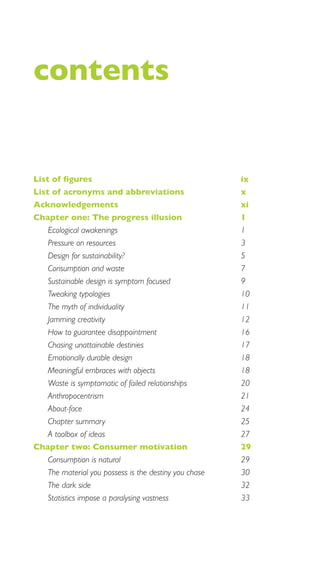
![5
THE PROGRESS ILLUSION
of uninhabited land that excess population could spread to. However, the
growth of a species whose presence has negative impacts on all other life
must be seen as a potential ecological crisis. Excess pressure on resources is
one of the lamentable side effects of overpopulation.
We lead a resource-hungry existence, taking out a great deal
more from the Earth than we put back in:
Even bearing in mind a very loose definition of development, the
anthropocentric bias of the statement [sustainability] springs to mind; it is not
the preservation of nature’s dignity which is on the international agenda, but to
extend human-centred utilitarianism to posterity.13
Resources – as we like to call matter for which we have a commercial use –
are being transformed at a speed far beyond the natural self-renewing rate
of the biosphere. Consequently, reserves of useful matter are running low
and many will soon have vanished.‘The human race was fortunate enough
to inherit a 3.8 billion-year-old reserve of natural capital.’14
At present rates
of consumption, it is predicted as unlikely that there will be much of it left
by the end of this century.‘Since the mid 18th century, more of nature has
been destroyed than in all prior history.’15
During the past 50 years alone,
the human race has stripped the world of a quarter of its topsoil and a
third of its forest cover.‘In total, one third of all the planet’s resources have
been consumed within the past four decades.’16
Design for sustainability?
The designing of new lifestyles running in tighter synchrony with natural
systems was first credibly proposed as far back as the 13th century.
German theologian Meister Eckhart frequently conceptualized Earth as a
fragile and sensitive resource affected by human endeavour; so concern for
the natural environment is anything but a contemporary malaise. During the
early 1800s, upper-class lovers of the great outdoors were amongst the first
to balk at the timber industry’s brutal harvesting of ancient woodlands; yet
their cries were motivated by aesthetic values rather than a threat to local
biodiversity or the loss of natural air filtration.](https://image.slidesharecdn.com/889712-250613083236-155e8035/85/Emotionally-Durable-Design-Objects-Experiences-And-Empathy-Jonathan-Chapman-21-320.jpg)
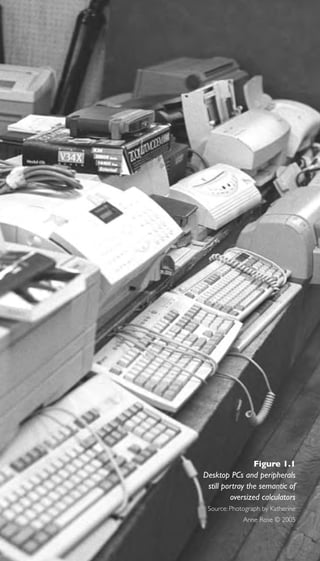
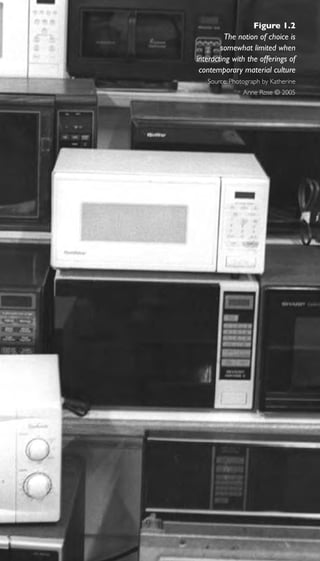
![EMOTIONALLY DURABLE DESIGN
24
organic carrot might deny that we get a huge kick out of doing our bit for
the environment, it is essentially of little consequence.The important thing
is that we are engaging in acts of positive social and ecological change,
whatever our motives might be.
About-face
Einstein once stated that a problem could not be solved from within the
mindset that created it. Indeed, fresh thinking is imperative if we are to
successfully transcend current working methods and stride forth into
unprecedented commercial territories. Emotionally Durable Design reframes
the environmental paradigm, increasing resource productivity and reducing
waste by elongating the lifespan of products.
This book proposes a radical design about-face in order to reduce
the impact of modern consumption without compromising commercial
or creative edge – empowering alternative modes of consumption
through provocative genres of objects that expand our experience of
daily life, rather than closing it down through endless cycles of desire and
disappointment.This book does not propose a sweeping overhaul of the
entire designed world. Instead, it espouses the emergence of a specialist
design genre that caters for deeper, more profound and poetic human
needs, taking users beyond the ephemeral world of technocentric design
toward a rich, interactive domain of emotionally durable objects and
experiences.‘It is time for a new generation of products that can age slowly
and in a dignified way … [to] become our partners in life and support our
memories.’37
Emotionally Durable Design is an exploration into product lifetimes;
belonging to the growing knowledge field of sustainable design, this book
essentially embarks upon an investigation into why users dispose of
products that still work, while providing designers from a range of creative
disciplines with a toolbox of inspiring strategies to extend product life,
interlaced with insightful critiques of the motivational drivers that underpin
the human consumption and waste of goods. Emotionally Durable Design
is not a moralizing tale, nor does it claim to present any singular universal
truth. Rather, like a much needed food parcel strategically dropped into a
defined region of growing concern, this research delivers timely reappraisal](https://image.slidesharecdn.com/889712-250613083236-155e8035/85/Emotionally-Durable-Design-Objects-Experiences-And-Empathy-Jonathan-Chapman-40-320.jpg)
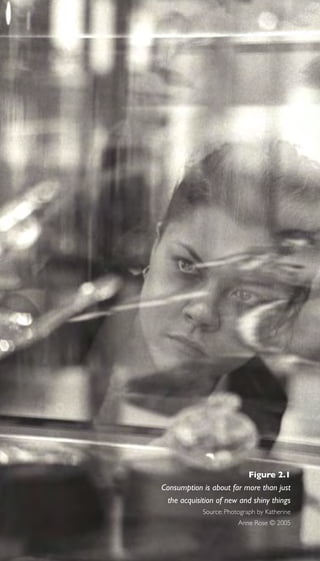
![EMOTIONALLY DURABLE DESIGN
32
Designed objects and experiences provide a tangible means for us to
engage with the world on this existential level, and the potency of objects
in symbolically designating our particular being cannot be overstated.
Despite the environmentally conscious whitewash of negativity
that comes hand in hand with the process of consumption, it must not
simply be cast off as a fruitless sequence of material destruction; far greater
things are taking place which, if examined, may provide further insight into
the gross inefficiencies of contemporary material culture. Contrary to
popular wisdom, the process of consumption occurs constantly – even
now through the intake of the meanings that these printed words signify;
therefore, metaphysically, we are continually engaged within this process.
While doctors may claim we are consumers of oxygen, water and sunlight
from the moment of conception, a philosopher might speak of existence
as the opportunity to consume knowledge and experience.The majority
view, however, is still grossly misguided in assuming that consumption only
occurs when credit cards are taken out. It has become commonplace
throughout all media, from ecological journals and corporate websites to
popular television and the tabloid press, to be cautioned on the rampant
consumption of goods and the over-consumption of natural resources.
Today, the word consumption comes overloaded with negativity, which
renders it a blurred and deeply distorted phenomenon, frequently
obstructing the lucid comprehension of what is actually a fundamental
human behaviour.
The dark side
In ecological circles consumption is spoken of with a practically universal
disdain, and not without just cause.Within the last 50 years alone, the
world has lost over a quarter of its ancient rain forests, posing a large
threat not only to biodiversity but also to the planet’s air quality. In addition,
both carbon dioxide (CO2
) emissions and the consumption of fossil fuels
themselves have increased almost 400 per cent within the same period,
catalysing further irreversible devastation to the biosphere.‘US consumers
and industry dispose of enough aluminium to rebuild the commercial air
fleet every three months [and] enough iron and steel to continuously
supply all automakers.’3
Global climate is already showing signs of mutation,](https://image.slidesharecdn.com/889712-250613083236-155e8035/85/Emotionally-Durable-Design-Objects-Experiences-And-Empathy-Jonathan-Chapman-47-320.jpg)

![There is but little to add to this: The story that wanted to be told
and sent out in the world was now fairly near its destination. Now it
was to be written, at least, even though it might take a few years
more before it was finished.
She who was writing it had gone up to Stockholm around Christmas
time, after she had received the prize.
The editor of Idun volunteered to print the book as soon as it was
finished.
If she could ever find time to write it!
The evening before she was to return to Landskrona, she spent with
her loyal friend, Baroness Adlersparre[1], to whom she read a few
chapters aloud.
"Esselde" listened, as only she could listen, and she became
interested. After the reading she sat silently and pondered. "How
long will it be before all of it is ready?" she asked finally.
"Three or four years."
Then they parted.
The next morning, two hours before she was to leave Stockholm, a
message came from Esselde bidding her come to her before the
departure.
The old Baroness was in her most positive and determined mood.
"Now you must take a leave of absence for a year and finish the
book. I shall procure the money."
Fifteen minutes later the girl was on her way to the Principal of the
Teachers' College to ask her assistance in securing a substitute.
At one o'clock she was happily seated in the railway carriage. But
now she was going no farther than Sörmland, where she had good
friends who lived in a charming villa.](https://image.slidesharecdn.com/889712-250613083236-155e8035/85/Emotionally-Durable-Design-Objects-Experiences-And-Empathy-Jonathan-Chapman-72-320.jpg)
![And so they—Otto Gumaelius and his wife—gave her the freedom of
their home—freedom to work, and peace, and the best of care for
nearly a year, until the book was finished.
Now, at last, she could write from morning till night. It was the
happiest time of her life.
But when the story was finished at the close of the summer, it
looked queer. It was wild and disordered, and the connecting
threads were so loose that all the parts seemed bent upon following
their old inclination to wander off, each in its own way.
It never became what it should have been. Its misfortune was that it
had been compelled to wait so long to be told. If it was not properly
disciplined and restrained, it was mostly because the author was so
overjoyed in the thought that at last she had been privileged to write
it.
[1] Baroness Adlersparre—pen name, Esselde—was a noted
Swedish writer, publisher, and philanthropist, and a contemporary
of Fredrika Bremer.](https://image.slidesharecdn.com/889712-250613083236-155e8035/85/Emotionally-Durable-Design-Objects-Experiences-And-Empathy-Jonathan-Chapman-73-320.jpg)