Chapter Four
IoT
What is IoT?
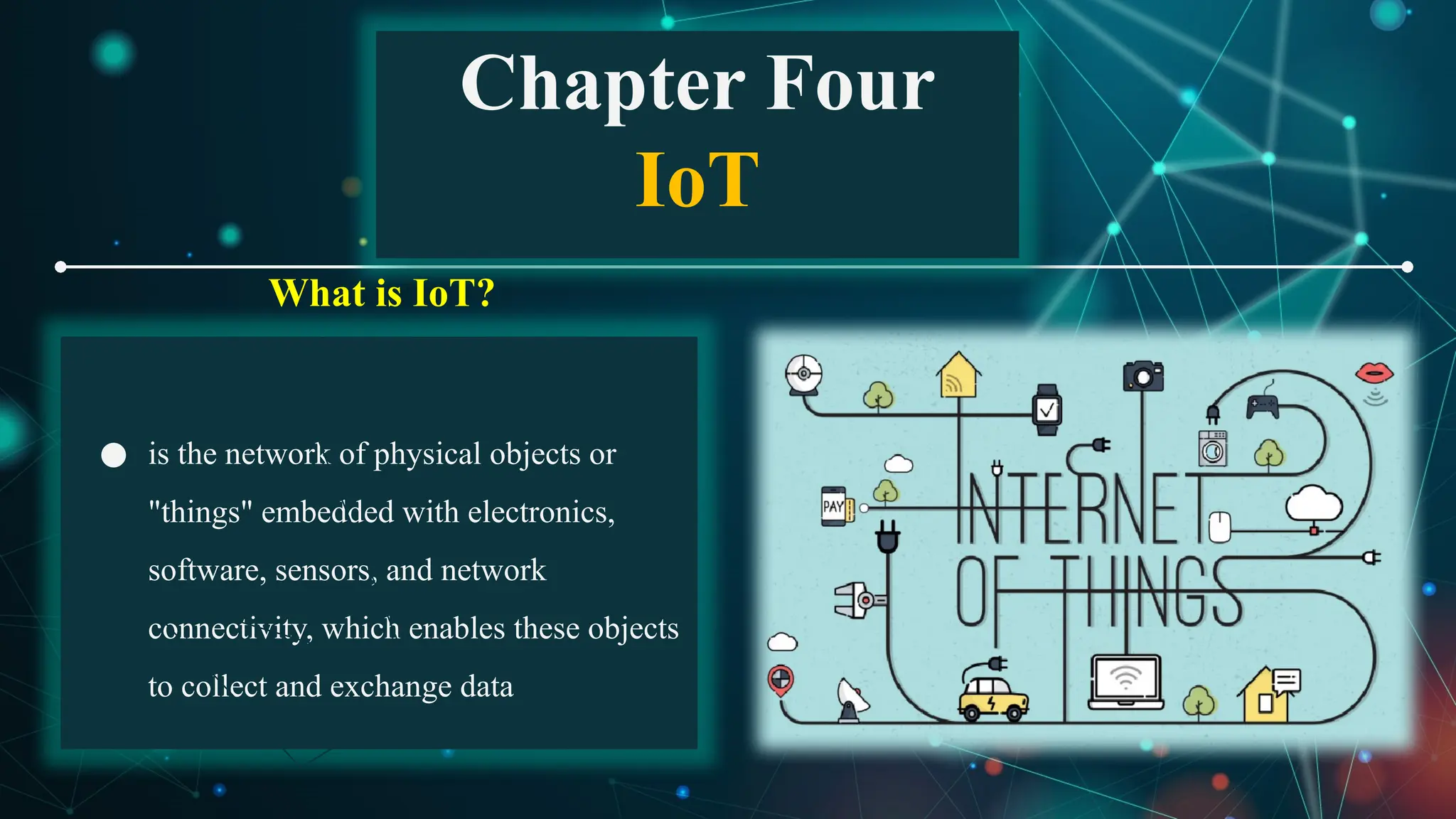
● is the network of physical objects or
"things" embedded with electronics,
software, sensors, and network
connectivity, which enables these objects
to collect and exchange data
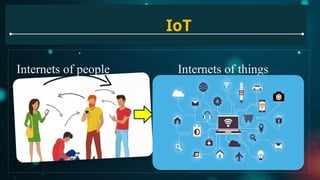
IoT
Internets of people Internets of things
IoT?
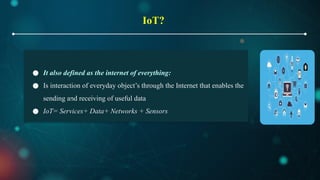
● It also defined as the internet of everything:
● Is interaction of everyday object’s through the Internet that enables the
sending and receiving of useful data
● IoT= Services+ Data+ Networks + Sensors
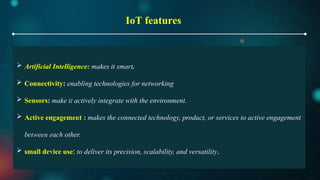
IoT features
 Artificial Intelligence: makes it smart.
 Connectivity: enabling technologies for networking
 Sensors: make it actively integrate with the environment.
 Active engagement : makes the connected technology, product, or services to active engagement
between each other.
 small device use: to deliver its precision, scalability, and versatility.
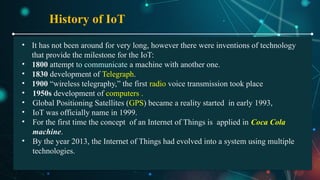
• It has not been around for very long, however there were inventions of technology
that provide the milestone for the IoT:
• 1800 attempt to communicate a machine with another one.
• 1830 development of Telegraph.
• 1900 “wireless telegraphy,” the first radio voice transmission took place
• 1950s development of computers .
• Global Positioning Satellites (GPS) became a reality started in early 1993,
• IoT was officially name in 1999.
• For the first time the concept of an Internet of Things is applied in Coca Cola
machine.
• By the year 2013, the Internet of Things had evolved into a system using multiple
technologies.
History of IoT
6
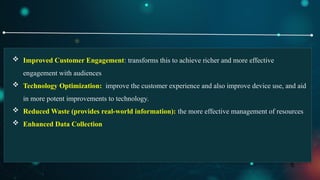
 Improved Customer Engagement: transforms this to achieve richer and more effective
engagement with audiences
 Technology Optimization: improve the customer experience and also improve device use, and aid
in more potent improvements to technology.
 Reduced Waste (provides real-world information): the more effective management of resources
 Enhanced Data Collection
7
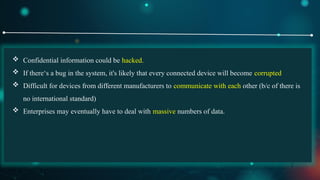
 Confidential information could be hacked.
 If there‘s a bug in the system, it's likely that every connected device will become corrupted
 Difficult for devices from different manufacturers to communicate with each other (b/c of there is
no international standard)
 Enterprises may eventually have to deal with massive numbers of data.
8
● Security: The system offers little control over security.
● Privacy: IoT provides important personal data in extreme detail without the user's active
participation.
● Complexity: In terms of design, deployment, and maintenance
● Flexibility: To integrate d/t IoT system with another is not easy.
● Compliance: Must comply with regulations.
9
9
● IoT Ecosystem consists of web-enabled smart devices that use embedded:
 processors,
 sensors and
 communication hardware
• the sensor data they collect .
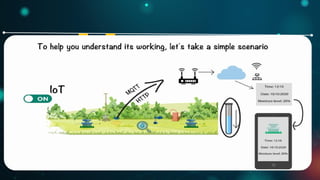
• IoT devices share the sensor data they collect by connecting to an IoT gateway
● data is either sent to the cloud to be analysed or analysed locally.
● The devices do most of the work without human intervention, although people can interact with the
devices
How
does it
10
10
How
does it
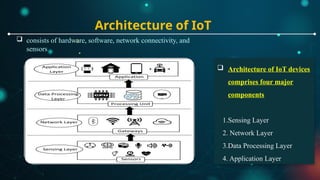
Architecture of IoT
 Architecture of IoT devices
comprises four major
components
1.Sensing Layer
2. Network Layer
3.Data Processing Layer
4. Application Layer
 consists of hardware, software, network connectivity, and
sensors
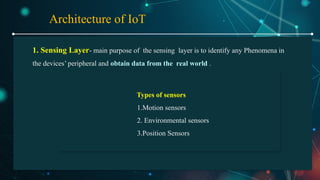
1. Sensing Layer- main purpose of the sensing layer is to identify any Phenomena in
the devices’ peripheral and obtain data from the real world .
Architecture of IoT
Types of sensors
1.Motion sensors
2. Environmental sensors
3.Position Sensors
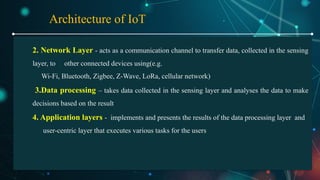
2. Network Layer - acts as a communication channel to transfer data, collected in the sensing
layer, to other connected devices using(e.g.
Wi-Fi, Bluetooth, Zigbee, Z-Wave, LoRa, cellular network)
3.Data processing – takes data collected in the sensing layer and analyses the data to make
decisions based on the result
4. Application layers - implements and presents the results of the data processing layer and
user-centric layer that executes various tasks for the users
Architecture of IoT
14
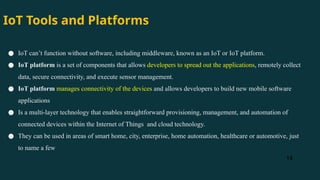
● IoT can’t function without software, including middleware, known as an IoT or IoT platform.
● IoT platform is a set of components that allows developers to spread out the applications, remotely collect
data, secure connectivity, and execute sensor management.
● IoT platform manages connectivity of the devices and allows developers to build new mobile software
applications
● Is a multi-layer technology that enables straightforward provisioning, management, and automation of
connected devices within the Internet of Things and cloud technology.
● They can be used in areas of smart home, city, enterprise, home automation, healthcare or automotive, just
to name a few
IoT Tools and Platforms
15
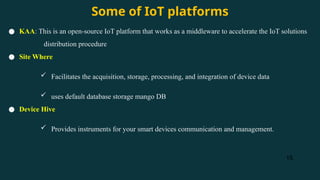
● KAA: This is an open-source IoT platform that works as a middleware to accelerate the IoT solutions
distribution procedure
● Site Where
 Facilitates the acquisition, storage, processing, and integration of device data
 uses default database storage mango DB
● Device Hive
 Provides instruments for your smart devices communication and management.
Some of IoT platforms
16
● Application areas (industries) of IoT
1. Agriculture: Indoor planting(, IoT makes monitoring and management of micro-climate
conditions a reality, which in turn increases production), crop monitoring
2. Consumer Use: Smartphones, smartwatches,
3. Healthcare: (wearable technologies, Telemedicine, Headsets that measure brainwaves)
4. Insurance: (Fire alert, Water Leak Detection, Stolen car trackers)
5. Manufacturing: (Maintenance of equipment)
6. Retail: (automated reports, robot)
7. Transportation: (autonomous cars)
8. Utilities: (monitor environmental conditions such as humidity, temperature)
Applications of IoT
Thanks!
Emerging  Technology Chapter 4 internets of things

Emerging Technology Chapter 4 internets of things

  • 1.
    Chapter Four IoT What isIoT? ● is the network of physical objects or "things" embedded with electronics, software, sensors, and network connectivity, which enables these objects to collect and exchange data
  • 2.
    IoT Internets of peopleInternets of things
  • 3.
    IoT? ● It alsodefined as the internet of everything: ● Is interaction of everyday object’s through the Internet that enables the sending and receiving of useful data ● IoT= Services+ Data+ Networks + Sensors
  • 4.
    IoT features  ArtificialIntelligence: makes it smart.  Connectivity: enabling technologies for networking  Sensors: make it actively integrate with the environment.  Active engagement : makes the connected technology, product, or services to active engagement between each other.  small device use: to deliver its precision, scalability, and versatility.
  • 5.
    • It hasnot been around for very long, however there were inventions of technology that provide the milestone for the IoT: • 1800 attempt to communicate a machine with another one. • 1830 development of Telegraph. • 1900 “wireless telegraphy,” the first radio voice transmission took place • 1950s development of computers . • Global Positioning Satellites (GPS) became a reality started in early 1993, • IoT was officially name in 1999. • For the first time the concept of an Internet of Things is applied in Coca Cola machine. • By the year 2013, the Internet of Things had evolved into a system using multiple technologies. History of IoT
  • 6.
    6  Improved CustomerEngagement: transforms this to achieve richer and more effective engagement with audiences  Technology Optimization: improve the customer experience and also improve device use, and aid in more potent improvements to technology.  Reduced Waste (provides real-world information): the more effective management of resources  Enhanced Data Collection
  • 7.
    7  Confidential informationcould be hacked.  If there‘s a bug in the system, it's likely that every connected device will become corrupted  Difficult for devices from different manufacturers to communicate with each other (b/c of there is no international standard)  Enterprises may eventually have to deal with massive numbers of data.
  • 8.
    8 ● Security: Thesystem offers little control over security. ● Privacy: IoT provides important personal data in extreme detail without the user's active participation. ● Complexity: In terms of design, deployment, and maintenance ● Flexibility: To integrate d/t IoT system with another is not easy. ● Compliance: Must comply with regulations.
  • 9.
    9 9 ● IoT Ecosystemconsists of web-enabled smart devices that use embedded:  processors,  sensors and  communication hardware • the sensor data they collect . • IoT devices share the sensor data they collect by connecting to an IoT gateway ● data is either sent to the cloud to be analysed or analysed locally. ● The devices do most of the work without human intervention, although people can interact with the devices How does it
  • 10.
  • 11.
    Architecture of IoT Architecture of IoT devices comprises four major components 1.Sensing Layer 2. Network Layer 3.Data Processing Layer 4. Application Layer  consists of hardware, software, network connectivity, and sensors
  • 12.
    1. Sensing Layer-main purpose of the sensing layer is to identify any Phenomena in the devices’ peripheral and obtain data from the real world . Architecture of IoT Types of sensors 1.Motion sensors 2. Environmental sensors 3.Position Sensors
  • 13.
    2. Network Layer- acts as a communication channel to transfer data, collected in the sensing layer, to other connected devices using(e.g. Wi-Fi, Bluetooth, Zigbee, Z-Wave, LoRa, cellular network) 3.Data processing – takes data collected in the sensing layer and analyses the data to make decisions based on the result 4. Application layers - implements and presents the results of the data processing layer and user-centric layer that executes various tasks for the users Architecture of IoT
  • 14.
    14 ● IoT can’tfunction without software, including middleware, known as an IoT or IoT platform. ● IoT platform is a set of components that allows developers to spread out the applications, remotely collect data, secure connectivity, and execute sensor management. ● IoT platform manages connectivity of the devices and allows developers to build new mobile software applications ● Is a multi-layer technology that enables straightforward provisioning, management, and automation of connected devices within the Internet of Things and cloud technology. ● They can be used in areas of smart home, city, enterprise, home automation, healthcare or automotive, just to name a few IoT Tools and Platforms
  • 15.
    15 ● KAA: Thisis an open-source IoT platform that works as a middleware to accelerate the IoT solutions distribution procedure ● Site Where  Facilitates the acquisition, storage, processing, and integration of device data  uses default database storage mango DB ● Device Hive  Provides instruments for your smart devices communication and management. Some of IoT platforms
  • 16.
    16 ● Application areas(industries) of IoT 1. Agriculture: Indoor planting(, IoT makes monitoring and management of micro-climate conditions a reality, which in turn increases production), crop monitoring 2. Consumer Use: Smartphones, smartwatches, 3. Healthcare: (wearable technologies, Telemedicine, Headsets that measure brainwaves) 4. Insurance: (Fire alert, Water Leak Detection, Stolen car trackers) 5. Manufacturing: (Maintenance of equipment) 6. Retail: (automated reports, robot) 7. Transportation: (autonomous cars) 8. Utilities: (monitor environmental conditions such as humidity, temperature) Applications of IoT
  • 17.