WELCOME, EMBEERISTS
to the Ember.js Meetup #3 in Brussels
15th of May 2014
Thank you for the venueBetaGroup
is our beer provider tonightHstry
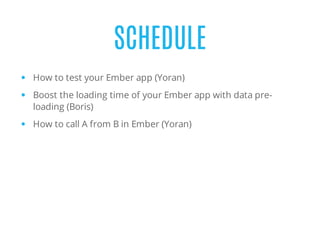
SCHEDULE
How to test your Ember app (Yoran)
Boost the loading time of your Ember app with data pre-
loading (Boris)
How to call A from B in Ember (Yoran)
ABOUT ME
Works at (hiring Ember devs!)Hstry
Blogs on YoranBrondsema.com
Tweets on @YoranBrondsema
ABOUT THIS MEETUP
Looking for organizer(s)!
TESTING AN EMBER.JS APP
From my experiences working on Hstry
Ember.js front-end and Ruby on Rails back-end
Will cover the whole stack
I hope you do tests. And if you
don't, you should.
Prevent regressions
Confidence
Enables methodologies like BDD and TDD
Documentation
3 levels of testing
Unit tests
Controller tests
Integration tests
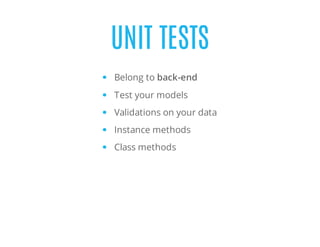
UNIT TESTS
Belong to back-end
Test your models
Validations on your data
Instance methods
Class methods
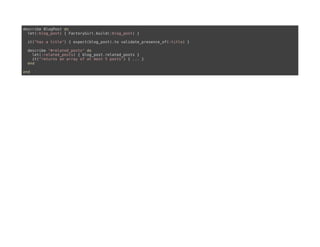
describe BlogPost do
let(:blog_post) { FactoryGirl.build(:blog_post) }
it("has a title") { expect(blog_post).to validate_presence_of(:title) }
describe "#related_posts" do
let(:related_posts) { blog_post.related_posts }
it("returns an array of at most 5 posts") { ... }
end
end
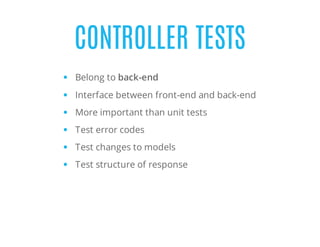
CONTROLLER TESTS
Belong to back-end
Interface between front-end and back-end
More important than unit tests
Test error codes
Test changes to models
Test structure of response
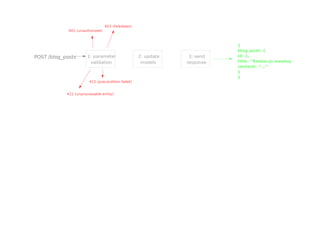
1: parameter
validation
2: update
models
3: send
response
POST /blog_posts
401 (unauthorized)
403 (forbidden)
412 (precondition failed)
422 (unprocessable entity)
{
blog_post: {
id: 1,
title: “Ember.js meetup”,
content: “...”
}
}
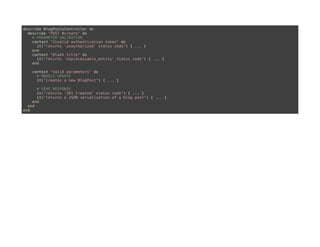
describe BlogPostsController do
describe "POST #create" do
# PARAMETER VALIDATION
context "Invalid authentication token" do
it("returns 'unauthorized' status code") { ... }
end
context "Blank title" do
it("returns 'unprocessable_entity' status code") { ... }
end
context "Valid parameters" do
# MODELS UPDATE
it("creates a new BlogPost") { ... }
# SEND RESPONSE
it("returns '201 Created' status code") { ... }
it("returns a JSON serialization of a blog post") { ... }
end
end
end
INTEGRATION TESTS
Simulates user behavior in browser
Back in "old" days, was driven by back-end (Rails views)
In Rails, tested with RSpec + Capybara
Run on Selenium, PhantomJS, ...
This is how the
application was tested too
Hstry
... but it had problems!
Very slow
Starts a new fresh browser session for each test
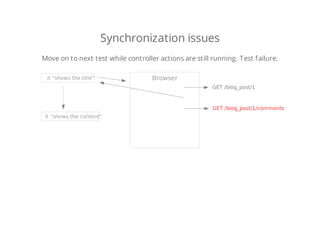
Synchronization issues
Move on to next test while controller actions are still running. Test failure.
it “shows the title” Browser
GET /blog_post/1
GET /blog_post/1/comments
it “shows the content”
Random fails
Do all integration testing in
Ember.js itself
Way faster
Moved from ~25 minutes to ~2 minutes testing time
No more synchronization issues
Promises!
Promotes separation between back-end and front-
end
What to test?
What the user is supposed to see.
Click on this button, should see this.
That calls to API with proper parameters are made.
Click on this "Submit" button, issues POST request to endpoint XXX with parameters
YYY
We know that if parameters are ok, it does what it needs to do
What do you need?
Testing framework: QUnit (default for Ember), Mocha,
Jasmine,...
Test runner: Teaspoon (Rails), Testem (Node.js), Karma
(Node.js)
DEMO
Resources
Ember.js Testing Guide
gemteaspoon
QUnit documentation
ebryn's test helper
pluginjquery-mockjax
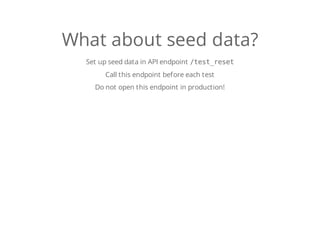
What about seed data?
Set up seed data in API endpoint /test_reset
Call this endpoint before each test
Do not open this endpoint in production!
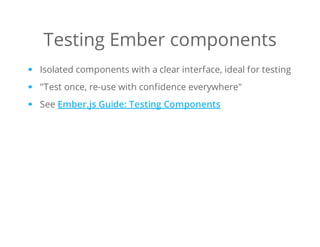
Testing Ember components
Isolated components with a clear interface, ideal for testing
"Test once, re-use with confidence everywhere"
See Ember.js Guide: Testing Components
Short intro to integration testing in Ember.js
Questions?
THANK YOU
Oh, and Hstry is still hiring :-)
HOW TO CALL A FROM B IN
EMBER.JS
* from talk at Boston Ember.js meetup by Ben Donaldson
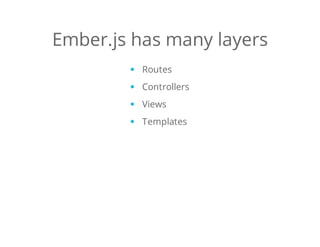
Ember.js has many layers
Routes
Controllers
Views
Templates
How do you call layer X when
you're in layer Y?
We have two models Appleand Orange
Each has its own route, controller, view and template
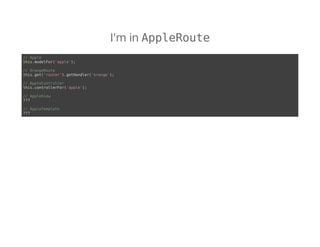
I'm in AppleRoute
// Apple
this.modelFor('apple');
// OrangeRoute
this.get('router').getHandler('orange');
// AppleController
this.controllerFor('apple');
// AppleView
???
// AppleTemplate
???
I'm in AppleController
// Apple
this.get('content');
this.get('model');
// AppleRoute
this.get('target');
// OrangeController
App.AppleController = Ember.Controller.extend({
...,
needs: ['orange'],
...
});
this.get('controllers.orange');
// AppleView
App.AppleView = Ember.View.extend({
_setConnection: function() {
this.get('controller').on('event', this, this.eventHappened);
}.on('init'),
eventHappened: function() { ... }
});
this.trigger('event'); // in AppleController
// AppleTemplate
???
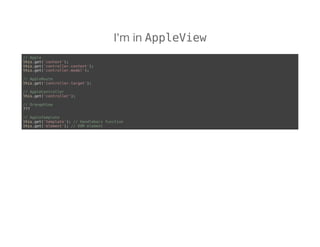
I'm in AppleView
// Apple
this.get('context');
this.get('controller.content');
this.get('controller.model');
// AppleRoute
this.get('controller.target');
// AppleController
this.get('controller');
// OrangeView
???
// AppleTemplate
this.get('template'); // Handlebars function
this.get('element'); // DOM element
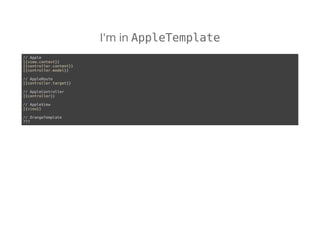
I'm in AppleTemplate
// Apple
{{view.context}}
{{controller.content}}
{{controller.model}}
// AppleRoute
{{controller.target}}
// AppleController
{{controller}}
// AppleView
{{view}}
// OrangeTemplate
???
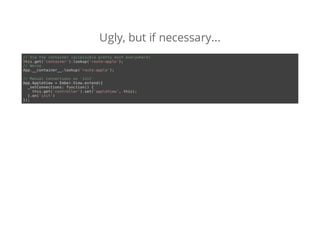
Ugly, but if necessary...
// Via the container (accessible pretty much everywhere)
this.get('container').lookup('route:apple');
// Worse
App.__container__.lookup('route:apple');
// Manual connections on 'init'
App.AppleView = Ember.View.extend({
_setConnections: function() {
this.get('controller').set('appleView', this);
}.on('init')
});
Questions?

Ember.js Brussels Meetup #3 - Testing your Ember.js app

  • 1.
    WELCOME, EMBEERISTS to theEmber.js Meetup #3 in Brussels 15th of May 2014
  • 2.
    Thank you forthe venueBetaGroup is our beer provider tonightHstry
  • 3.
    SCHEDULE How to testyour Ember app (Yoran) Boost the loading time of your Ember app with data pre- loading (Boris) How to call A from B in Ember (Yoran)
  • 4.
    ABOUT ME Works at(hiring Ember devs!)Hstry Blogs on YoranBrondsema.com Tweets on @YoranBrondsema
  • 5.
    ABOUT THIS MEETUP Lookingfor organizer(s)!
  • 6.
    TESTING AN EMBER.JSAPP From my experiences working on Hstry Ember.js front-end and Ruby on Rails back-end Will cover the whole stack
  • 7.
    I hope youdo tests. And if you don't, you should.
  • 8.
  • 9.
  • 10.
  • 11.
  • 12.
    3 levels oftesting
  • 13.
  • 14.
  • 15.
  • 16.
    UNIT TESTS Belong toback-end Test your models Validations on your data Instance methods Class methods
  • 17.
    describe BlogPost do let(:blog_post){ FactoryGirl.build(:blog_post) } it("has a title") { expect(blog_post).to validate_presence_of(:title) } describe "#related_posts" do let(:related_posts) { blog_post.related_posts } it("returns an array of at most 5 posts") { ... } end end
  • 18.
    CONTROLLER TESTS Belong toback-end Interface between front-end and back-end More important than unit tests Test error codes Test changes to models Test structure of response
  • 19.
    1: parameter validation 2: update models 3:send response POST /blog_posts 401 (unauthorized) 403 (forbidden) 412 (precondition failed) 422 (unprocessable entity) { blog_post: { id: 1, title: “Ember.js meetup”, content: “...” } }
  • 20.
    describe BlogPostsController do describe"POST #create" do # PARAMETER VALIDATION context "Invalid authentication token" do it("returns 'unauthorized' status code") { ... } end context "Blank title" do it("returns 'unprocessable_entity' status code") { ... } end context "Valid parameters" do # MODELS UPDATE it("creates a new BlogPost") { ... } # SEND RESPONSE it("returns '201 Created' status code") { ... } it("returns a JSON serialization of a blog post") { ... } end end end
  • 21.
    INTEGRATION TESTS Simulates userbehavior in browser Back in "old" days, was driven by back-end (Rails views) In Rails, tested with RSpec + Capybara Run on Selenium, PhantomJS, ...
  • 22.
    This is howthe application was tested too Hstry
  • 23.
    ... but ithad problems!
  • 24.
    Very slow Starts anew fresh browser session for each test
  • 25.
    Synchronization issues Move onto next test while controller actions are still running. Test failure. it “shows the title” Browser GET /blog_post/1 GET /blog_post/1/comments it “shows the content”
  • 26.
  • 27.
    Do all integrationtesting in Ember.js itself
  • 28.
    Way faster Moved from~25 minutes to ~2 minutes testing time
  • 29.
    No more synchronizationissues Promises!
  • 30.
    Promotes separation betweenback-end and front- end
  • 31.
  • 32.
    What the useris supposed to see. Click on this button, should see this.
  • 33.
    That calls toAPI with proper parameters are made. Click on this "Submit" button, issues POST request to endpoint XXX with parameters YYY We know that if parameters are ok, it does what it needs to do
  • 34.
    What do youneed? Testing framework: QUnit (default for Ember), Mocha, Jasmine,... Test runner: Teaspoon (Rails), Testem (Node.js), Karma (Node.js)
  • 35.
  • 36.
    Resources Ember.js Testing Guide gemteaspoon QUnitdocumentation ebryn's test helper pluginjquery-mockjax
  • 37.
    What about seeddata? Set up seed data in API endpoint /test_reset Call this endpoint before each test Do not open this endpoint in production!
  • 38.
    Testing Ember components Isolatedcomponents with a clear interface, ideal for testing "Test once, re-use with confidence everywhere" See Ember.js Guide: Testing Components
  • 39.
    Short intro tointegration testing in Ember.js Questions?
  • 40.
    THANK YOU Oh, andHstry is still hiring :-)
  • 41.
    HOW TO CALLA FROM B IN EMBER.JS * from talk at Boston Ember.js meetup by Ben Donaldson
  • 42.
    Ember.js has manylayers Routes Controllers Views Templates
  • 43.
    How do youcall layer X when you're in layer Y?
  • 44.
    We have twomodels Appleand Orange Each has its own route, controller, view and template
  • 45.
    I'm in AppleRoute //Apple this.modelFor('apple'); // OrangeRoute this.get('router').getHandler('orange'); // AppleController this.controllerFor('apple'); // AppleView ??? // AppleTemplate ???
  • 46.
    I'm in AppleController //Apple this.get('content'); this.get('model'); // AppleRoute this.get('target'); // OrangeController App.AppleController = Ember.Controller.extend({ ..., needs: ['orange'], ... }); this.get('controllers.orange'); // AppleView App.AppleView = Ember.View.extend({ _setConnection: function() { this.get('controller').on('event', this, this.eventHappened); }.on('init'), eventHappened: function() { ... } }); this.trigger('event'); // in AppleController // AppleTemplate ???
  • 47.
    I'm in AppleView //Apple this.get('context'); this.get('controller.content'); this.get('controller.model'); // AppleRoute this.get('controller.target'); // AppleController this.get('controller'); // OrangeView ??? // AppleTemplate this.get('template'); // Handlebars function this.get('element'); // DOM element
  • 48.
    I'm in AppleTemplate //Apple {{view.context}} {{controller.content}} {{controller.model}} // AppleRoute {{controller.target}} // AppleController {{controller}} // AppleView {{view}} // OrangeTemplate ???
  • 49.
    Ugly, but ifnecessary... // Via the container (accessible pretty much everywhere) this.get('container').lookup('route:apple'); // Worse App.__container__.lookup('route:apple'); // Manual connections on 'init' App.AppleView = Ember.View.extend({ _setConnections: function() { this.get('controller').set('appleView', this); }.on('init') });
  • 50.