Università degli
Studi di Genova
Admission criteria
Students must hold a first university degree with
180 ECTS credits in the European system, after at least
three years studies (at the level of Bachelor of Science)
in a field related to robotics such as: Electrical
Engineering, Mechanical Engineering, System Engineering,
Applied Mathematics and Computer Science.
The applicants have to be fluent in English, both in writing
and speaking.
An Applicant whose native language is not English is
required to pass a recognized international English test
such as TOEFL, Cambridge Advanced English Test, IELTS
or other equivalent test.
Language
The language of instruction and examinations is English.
Students will take local language and culture courses as
a part of the masters programme.
Grants
Non-EU students: Attractive Erasmus Mundus scholar-
ships are available for non-EU students with excellent
academic result. Each student will receive a grant of
€21,000 per year.
EU students: can apply for an Erasmus grant.
Tuition fees
European Union students: €2,000 per year
Non-European Union students: €6,000 per year
Application process and deadlines
For non-EU students applying for Erasmus Mundus
Grants: January 31, 2008
For non-EU students not applying for Erasmus Mundus
Grants: May 15, 2008
For EU students: June 30, 2008
Contact: emaro@irccyn.ec-nantes.fr
Ecole Centrale de Nantes:
Prof. Wisama Khalil
Warsaw University of Technology:
Prof. Teresa Zielinska
University of Genova:
Prof. Renato Zaccaria
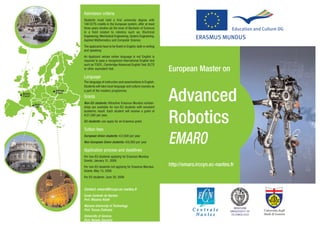
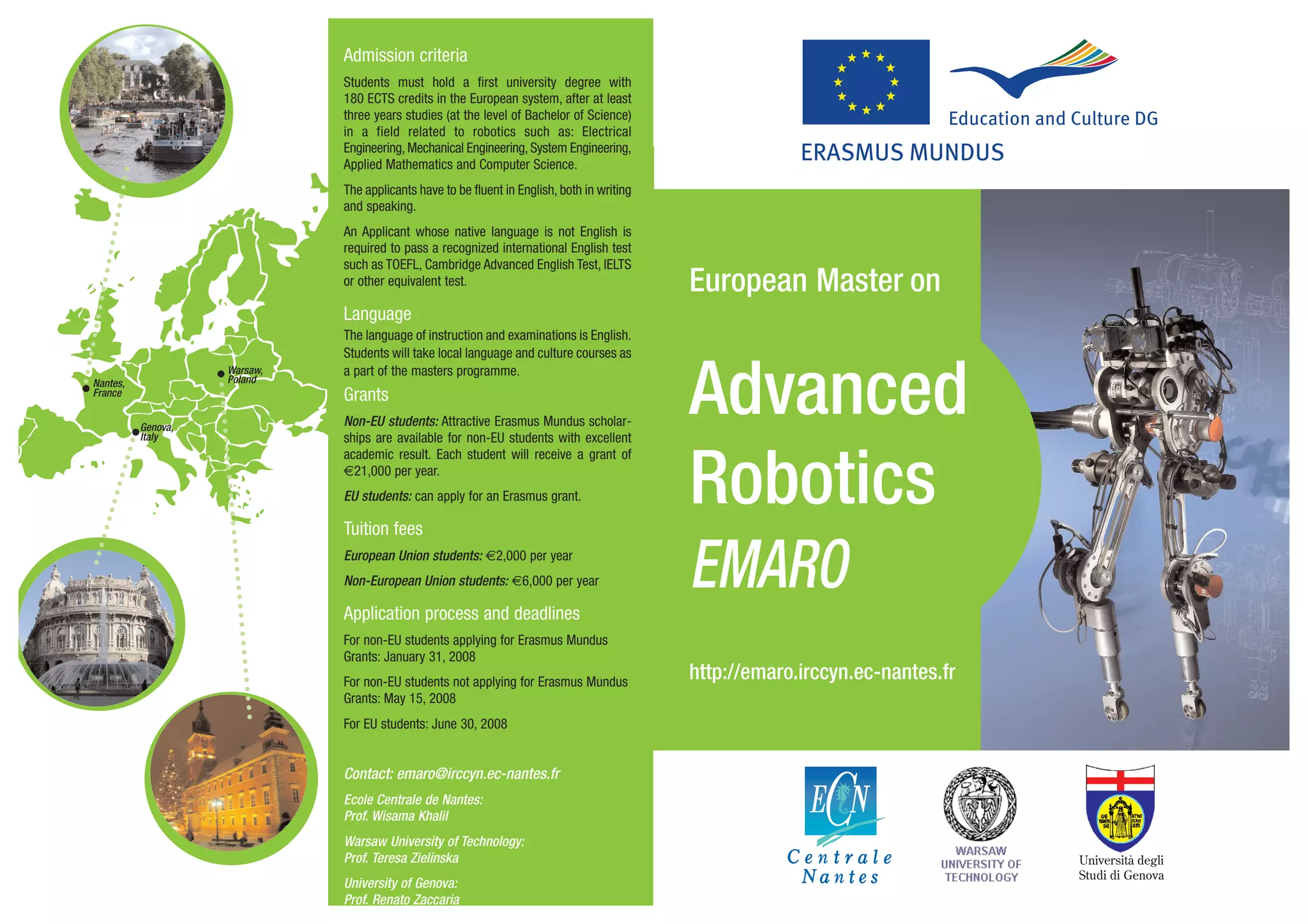
European Master on
Advanced
Robotics
EMARO
http://emaro.irccyn.ec-nantes.fr
CentraleNantes-October2007
Nantes,
France
Genova,
Italy
Warsaw,
Poland
Presentation of EMARO
The Masters course EMARO has been designed and
accepted in the framework of the European Union
programme Erasmus Mundus. The aim of the
course is to promote a high-quality educational offer
in the area of advanced and intelligent robotics.
After graduation the students will have mastered
the different areas of robotics (Mathematical
modeling, Control Engineering, Computer
Engineering, Mechanical design) in order to be
able to deal with Robotics systems as a whole
rather than just to concentrate on one particular
area. Students will obtain two masters degrees
from the institutions where they studied.
Students may take the master as a professional ter-
minal degree, or join PhD programmes afterwards.
Consortium
The consortium is composed of three leading
European institutions from France, Poland and Italy.
The three institutions have a long standing tradi-
tion in the field of robotics, with the highest stan-
dards both in research and teaching:
Ecole Centrale de Nantes
(France)
http://www.ec-nantes.fr
Warsaw University of Technology
(Poland)
http://www.pw.edu.pl
University of Genova (Italy)
http://www.informatica.ingegne-
ria.unige.it/
Study programme
The duration of the EMARO Masters course is two academic years (120 ECTS credits). Each year is split
into two semesters with 30 ECTS credits for each. The student will stay the first year in one institution and
the second year in another institution.
The first year (60 ECTS credits)
The aim of the first year semester is to provide the students with a solid interdisciplinary background
across the main areas of robotics (cognition, action and perception). It has the same programme at all the
institutions.
1st semester (September-January) 2d semester (February-June)
Modules ECTS Modules ECTS
Local language (compulsory) 4 Group Project (compulsory) 5
Modeling and control of manipulators (compulsory) 6 Mechanical design methods in robotics (compulsory) 5
Control of linear multivariable systems 5 Robot programming methods* (compulsory) 4
Real-time systems 5 Mobile robots 4
Signal processing 5 Artificial intelligence 4
Neural networks for classification and identification 5 Optimisation techniques 4
Computer vision 5 Nonlinear control theory 4
Computer security 5 Human computer interaction 4
Ambient intelligence 4
The second year (60 ECTS credits)
In the third semester, more specialised courses are proposed. The programme of this semester is based
on the specific research strengths of the partners' institutions (thus varying from partner to partner).
3rd semester (September – January) 30 ECTS
CENTRALE NANTES WARSAW UNIVERSITY UNIVERSITY OF GENOVA
Modules ECTS Modules ECTS Modules ECTS
Local language (compulsory) 4 Local language (compulsory) 4 Local language (compulsory) 4
Research planning (compulsory) 6 Research planning (compulsory) 6 Research planning (compulsory) 6
Advanced modeling of robots 4 Biomechanics (compulsory) 5 Concurrent and distributed
programming (compulsory) 4
Identification and control of robots 4 Bio-robotics (compulsory) 5 Advanced Data Bases (compulsory) 4
Humanoid and walking Robots 4 Dynamics of multi-body systems 5 Software Engineering (compulsory) 4
Optimal kinematic design of robots 4 Motion synthesis in robotics 5 Service Robotics 4
Biologically inspired robots 4 Walking robots 5 Flexible Automation 4
Group theory and its application in robotics 4 Advanced mechanical design 5 MEMS (micro-robotics) 4
Embedded systems 4 Production scheduling 5 Computer graphics 4
Parallel and distributed processing 5
Embedded systems 5
4th semester (February-July) – 30 ECTS
Master thesis.
Erasmus Mundus
The Erasmus Mundus programme is a coopera-
tion and mobility programme of the European
Union in the field of higher education which pro-
motes the European Union as a center of excel-
lence in learning around the world.
It aims to enhance quality in European higher edu-
cation and to promote intercultural understanding
through co-operation with third-countries.
This programme supports high-quality European
Masters Courses, by providing attractive grants for
students and visiting scholars from around the
world to engage in postgraduate study at
European universities.
More information about Erasmus-Mundus pro-
gramme:
http://ec.europa.eu/education/programmes/
mundus/index_en.html

EMARO flyer

  • 1.
    Università degli Studi diGenova Admission criteria Students must hold a first university degree with 180 ECTS credits in the European system, after at least three years studies (at the level of Bachelor of Science) in a field related to robotics such as: Electrical Engineering, Mechanical Engineering, System Engineering, Applied Mathematics and Computer Science. The applicants have to be fluent in English, both in writing and speaking. An Applicant whose native language is not English is required to pass a recognized international English test such as TOEFL, Cambridge Advanced English Test, IELTS or other equivalent test. Language The language of instruction and examinations is English. Students will take local language and culture courses as a part of the masters programme. Grants Non-EU students: Attractive Erasmus Mundus scholar- ships are available for non-EU students with excellent academic result. Each student will receive a grant of €21,000 per year. EU students: can apply for an Erasmus grant. Tuition fees European Union students: €2,000 per year Non-European Union students: €6,000 per year Application process and deadlines For non-EU students applying for Erasmus Mundus Grants: January 31, 2008 For non-EU students not applying for Erasmus Mundus Grants: May 15, 2008 For EU students: June 30, 2008 Contact: emaro@irccyn.ec-nantes.fr Ecole Centrale de Nantes: Prof. Wisama Khalil Warsaw University of Technology: Prof. Teresa Zielinska University of Genova: Prof. Renato Zaccaria European Master on Advanced Robotics EMARO http://emaro.irccyn.ec-nantes.fr CentraleNantes-October2007 Nantes, France Genova, Italy Warsaw, Poland
  • 2.
    Presentation of EMARO TheMasters course EMARO has been designed and accepted in the framework of the European Union programme Erasmus Mundus. The aim of the course is to promote a high-quality educational offer in the area of advanced and intelligent robotics. After graduation the students will have mastered the different areas of robotics (Mathematical modeling, Control Engineering, Computer Engineering, Mechanical design) in order to be able to deal with Robotics systems as a whole rather than just to concentrate on one particular area. Students will obtain two masters degrees from the institutions where they studied. Students may take the master as a professional ter- minal degree, or join PhD programmes afterwards. Consortium The consortium is composed of three leading European institutions from France, Poland and Italy. The three institutions have a long standing tradi- tion in the field of robotics, with the highest stan- dards both in research and teaching: Ecole Centrale de Nantes (France) http://www.ec-nantes.fr Warsaw University of Technology (Poland) http://www.pw.edu.pl University of Genova (Italy) http://www.informatica.ingegne- ria.unige.it/ Study programme The duration of the EMARO Masters course is two academic years (120 ECTS credits). Each year is split into two semesters with 30 ECTS credits for each. The student will stay the first year in one institution and the second year in another institution. The first year (60 ECTS credits) The aim of the first year semester is to provide the students with a solid interdisciplinary background across the main areas of robotics (cognition, action and perception). It has the same programme at all the institutions. 1st semester (September-January) 2d semester (February-June) Modules ECTS Modules ECTS Local language (compulsory) 4 Group Project (compulsory) 5 Modeling and control of manipulators (compulsory) 6 Mechanical design methods in robotics (compulsory) 5 Control of linear multivariable systems 5 Robot programming methods* (compulsory) 4 Real-time systems 5 Mobile robots 4 Signal processing 5 Artificial intelligence 4 Neural networks for classification and identification 5 Optimisation techniques 4 Computer vision 5 Nonlinear control theory 4 Computer security 5 Human computer interaction 4 Ambient intelligence 4 The second year (60 ECTS credits) In the third semester, more specialised courses are proposed. The programme of this semester is based on the specific research strengths of the partners' institutions (thus varying from partner to partner). 3rd semester (September – January) 30 ECTS CENTRALE NANTES WARSAW UNIVERSITY UNIVERSITY OF GENOVA Modules ECTS Modules ECTS Modules ECTS Local language (compulsory) 4 Local language (compulsory) 4 Local language (compulsory) 4 Research planning (compulsory) 6 Research planning (compulsory) 6 Research planning (compulsory) 6 Advanced modeling of robots 4 Biomechanics (compulsory) 5 Concurrent and distributed programming (compulsory) 4 Identification and control of robots 4 Bio-robotics (compulsory) 5 Advanced Data Bases (compulsory) 4 Humanoid and walking Robots 4 Dynamics of multi-body systems 5 Software Engineering (compulsory) 4 Optimal kinematic design of robots 4 Motion synthesis in robotics 5 Service Robotics 4 Biologically inspired robots 4 Walking robots 5 Flexible Automation 4 Group theory and its application in robotics 4 Advanced mechanical design 5 MEMS (micro-robotics) 4 Embedded systems 4 Production scheduling 5 Computer graphics 4 Parallel and distributed processing 5 Embedded systems 5 4th semester (February-July) – 30 ECTS Master thesis. Erasmus Mundus The Erasmus Mundus programme is a coopera- tion and mobility programme of the European Union in the field of higher education which pro- motes the European Union as a center of excel- lence in learning around the world. It aims to enhance quality in European higher edu- cation and to promote intercultural understanding through co-operation with third-countries. This programme supports high-quality European Masters Courses, by providing attractive grants for students and visiting scholars from around the world to engage in postgraduate study at European universities. More information about Erasmus-Mundus pro- gramme: http://ec.europa.eu/education/programmes/ mundus/index_en.html