Eliminating Flow–Instabilities and Reducing Pressure Drop
in a Pipe Section of a Power Unit
using ANSYS Discovery Live
Dimitris Sofialidis, PhD
Chief Technology Officer
Agenda
• Description of the CFD Project.
• Appearance of the problem.
• Need for a quick optimization.
• ANSYS Discovery Live "took the job".
• Demo.
• ANSYS Fluent Validation.
• Conclusions.
Description of the CFD Project
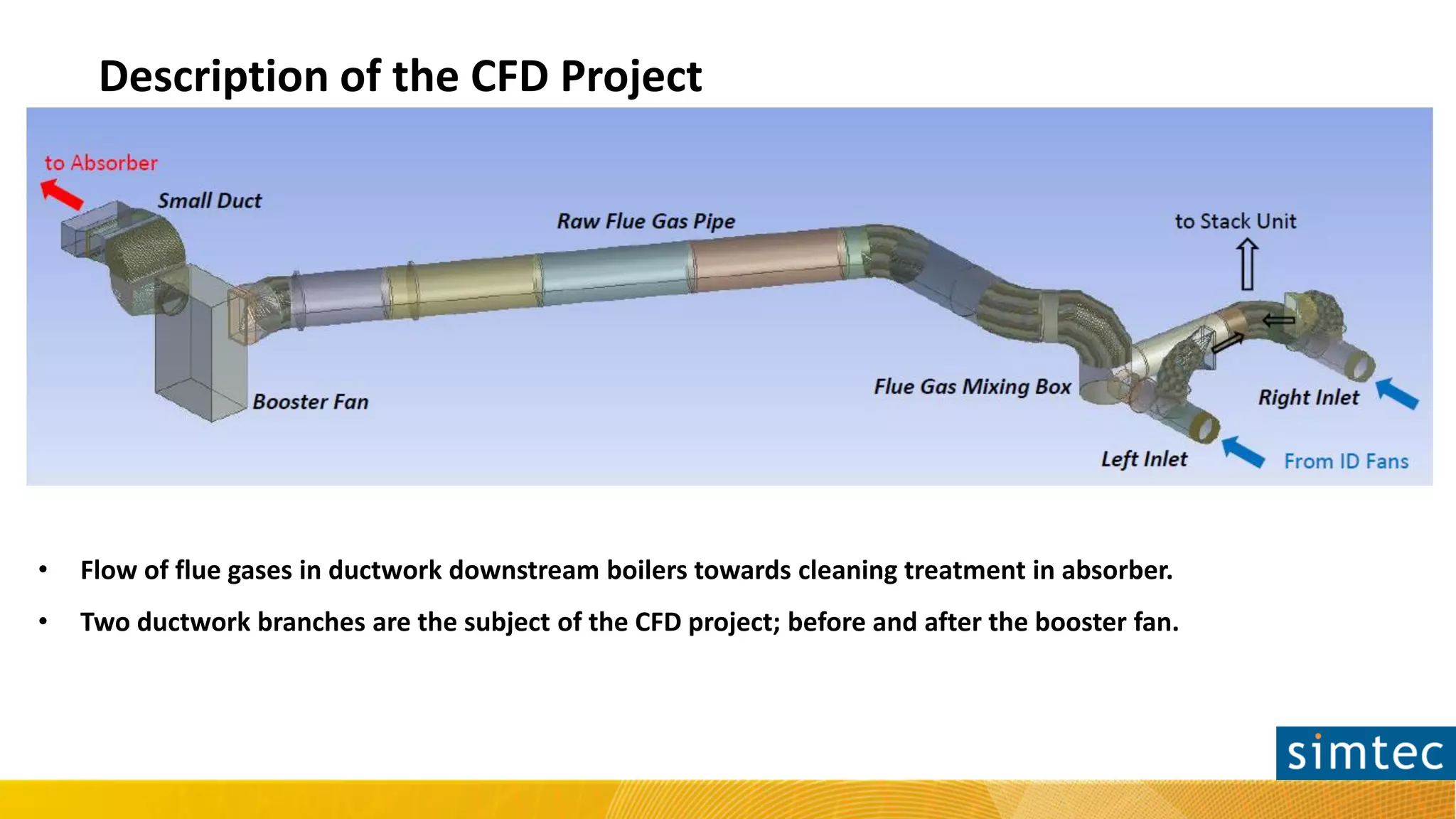
• Flow of flue gases in ductwork downstream boilers towards cleaning treatment in absorber.
• Two ductwork branches are the subject of the CFD project; before and after the booster fan.
Appearance of the Problem
• The "small duct" section is prone to Flow–Induced Vibrations (FIV), due to highly unstable and recirculating flow.
• The simulation was run in transient solver due to flow instabilities.
• Pressure drop (including dynamic head) was calculated to 406 [Pa].
10
30
50
70
90
110
130
150
170
40 41 42 43 44 45 46 47
Pst,in[Pa]
Time [s]
Mean=81.33 [Pa]
Need for a Quick Optimization
• The standard solution for unstable flows in bends and turns is to use Guiding Vanes.
• The GVs achieve in both:
(a) reduce the space available for the vortices and
(b) straighten the flow,
therefore provide a means to:
(a) reduce flow–induced vibrations and
(b) reduce pressure losses due to recirculations.
• The (small) drawback is that they increase the friction losses (additional surface area).
• The questions are:
− How many GVs to use?
− Put both at inlet and outlet bend?
− where exactly to position them?
• If we only had a tool that can answer these questions on–the–fly…
• Well, we have it! It’s ANSYS Discovery Live.
ANSYS Discovery Live "took the job".
Demo
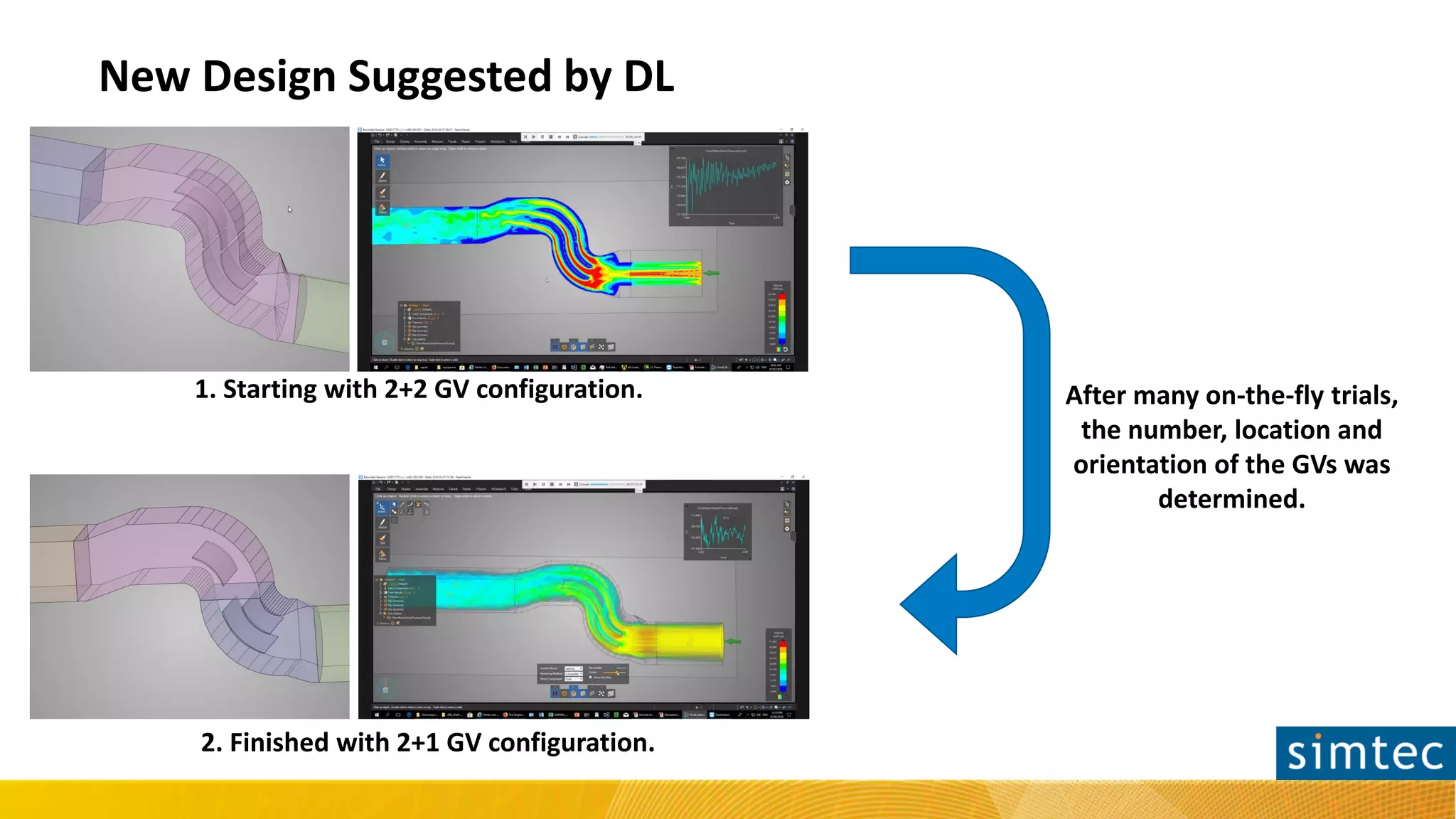
New Design Suggested by DL
1. Starting with 2+2 GV configuration.
2. Finished with 2+1 GV configuration.
After many on-the-fly trials,
the number, location and
orientation of the GVs was
determined.
10
30
50
70
90
110
130
150
170
40 41 42 43 44 45 46 47
Pst,in[Pa]
Time [s]
Validation with ANSYS Fluent
• The instabilities dissappeared and simulation was successfully run in steady–state mode.
• Pressure drop (including dynamic head) was reduced to 225 [Pa].
STEADY STATE achieved!
Conclusions
• A design/optimization question was raised during a real project in a new power station
under construction.
• A quick decision was necessary to resolve a possible FIV issue in the ductwork.
• New product ANSYS Discovery Live was employed and provided on–the–fly insight and
qualitative optimization trends in a few hours.
• The improved design was validated in ANSYS Fluent and was confirmed that eliminates
flow instabilities but also reduces booster fan power by 2 [mbars], translated into
savings for customer (investment and operation cost) of thousands EUROS.

Eliminating Flow-Instabilities and Reducing Pressure Drop in a Pipe Section of a Power Unit

  • 1.
    Eliminating Flow–Instabilities andReducing Pressure Drop in a Pipe Section of a Power Unit using ANSYS Discovery Live Dimitris Sofialidis, PhD Chief Technology Officer
  • 2.
    Agenda • Description ofthe CFD Project. • Appearance of the problem. • Need for a quick optimization. • ANSYS Discovery Live "took the job". • Demo. • ANSYS Fluent Validation. • Conclusions.
  • 3.
    Description of theCFD Project • Flow of flue gases in ductwork downstream boilers towards cleaning treatment in absorber. • Two ductwork branches are the subject of the CFD project; before and after the booster fan.
  • 4.
    Appearance of theProblem • The "small duct" section is prone to Flow–Induced Vibrations (FIV), due to highly unstable and recirculating flow. • The simulation was run in transient solver due to flow instabilities. • Pressure drop (including dynamic head) was calculated to 406 [Pa]. 10 30 50 70 90 110 130 150 170 40 41 42 43 44 45 46 47 Pst,in[Pa] Time [s] Mean=81.33 [Pa]
  • 5.
    Need for aQuick Optimization • The standard solution for unstable flows in bends and turns is to use Guiding Vanes. • The GVs achieve in both: (a) reduce the space available for the vortices and (b) straighten the flow, therefore provide a means to: (a) reduce flow–induced vibrations and (b) reduce pressure losses due to recirculations. • The (small) drawback is that they increase the friction losses (additional surface area). • The questions are: − How many GVs to use? − Put both at inlet and outlet bend? − where exactly to position them? • If we only had a tool that can answer these questions on–the–fly… • Well, we have it! It’s ANSYS Discovery Live.
  • 6.
    ANSYS Discovery Live"took the job".
  • 7.
  • 8.
    New Design Suggestedby DL 1. Starting with 2+2 GV configuration. 2. Finished with 2+1 GV configuration. After many on-the-fly trials, the number, location and orientation of the GVs was determined.
  • 9.
    10 30 50 70 90 110 130 150 170 40 41 4243 44 45 46 47 Pst,in[Pa] Time [s] Validation with ANSYS Fluent • The instabilities dissappeared and simulation was successfully run in steady–state mode. • Pressure drop (including dynamic head) was reduced to 225 [Pa]. STEADY STATE achieved!
  • 10.
    Conclusions • A design/optimizationquestion was raised during a real project in a new power station under construction. • A quick decision was necessary to resolve a possible FIV issue in the ductwork. • New product ANSYS Discovery Live was employed and provided on–the–fly insight and qualitative optimization trends in a few hours. • The improved design was validated in ANSYS Fluent and was confirmed that eliminates flow instabilities but also reduces booster fan power by 2 [mbars], translated into savings for customer (investment and operation cost) of thousands EUROS.