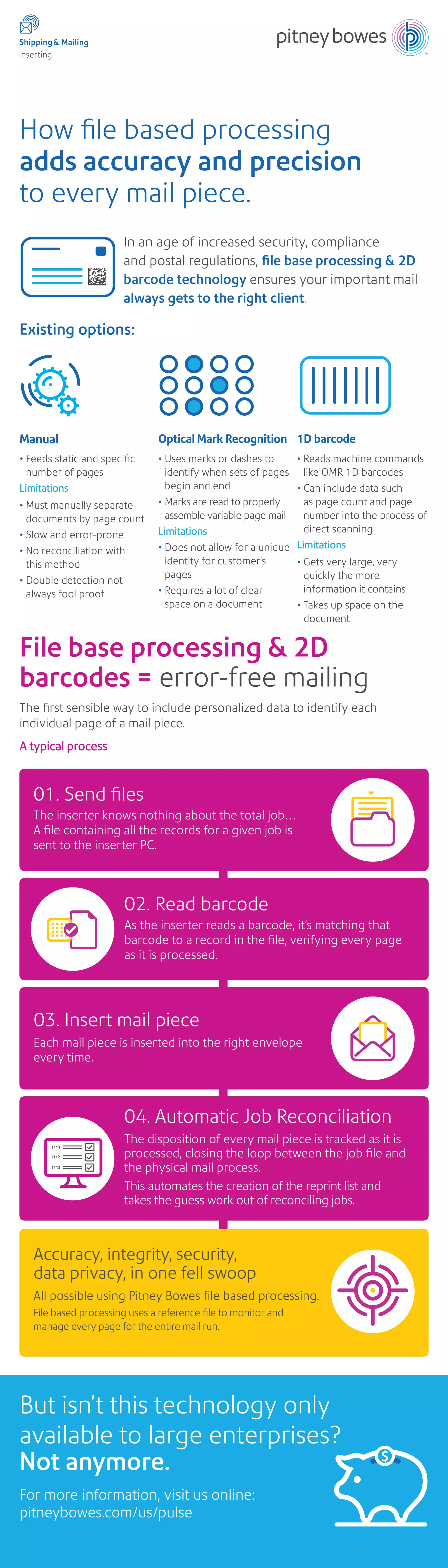
In an age of increased security, compliance
and postal regulations, file base processing & 2D
barcode technology ensures your important mail
always gets to the right client.
• Feeds static and specific
number of pages
Limitations
• Must manually separate
documents by page count
• Slow and error-prone
• No reconciliation with
this method
• Double detection not
always fool proof
• Uses marks or dashes to
identify when sets of pages
begin and end
• Marks are read to properly
assemble variable page mail
Limitations
• Does not allow for a unique
identity for customer’s
pages
• Requires a lot of clear
space on a document
• Reads machine commands
like OMR 1D barcodes
• Can include data such
as page count and page
number into the process of
direct scanning
Limitations
• Gets very large, very
quickly the more
information it contains
• Takes up space on the
document
Existing options:
How file based processing
adds accuracy and precision
to every mail piece.
File base processing  2D
barcodes = error-free mailing
02. Read barcode
04. Automatic Job Reconciliation
The first sensible way to include personalized data to identify each
individual page of a mail piece.
A typical process
As the inserter reads a barcode, it’s matching that
barcode to a record in the file, verifying every page
as it is processed.
01. Send files
The inserter knows nothing about the total job…
A file containing all the records for a given job is
sent to the inserter PC.
03. Insert mail piece
Each mail piece is inserted into the right envelope
every time.
Accuracy, integrity, security,
data privacy, in one fell swoop
All possible using Pitney Bowes file based processing.
File based processing uses a reference file to monitor and
manage every page for the entire mail run.
Manual Optical Mark Recognition 1D barcode
1111
=
1112
1113
The disposition of every mail piece is tracked as it is
processed, closing the loop between the job file and
the physical mail process.
This automates the creation of the reprint list and
takes the guess work out of reconciling jobs.
But isn’t this technology only
available to large enterprises?
Not anymore. $
For more information, visit us online:
pitneybowes.com/us/pulse
Inserting

Eliminate errors from your mail with 2D barcodes

  • 1.
    In an ageof increased security, compliance and postal regulations, file base processing & 2D barcode technology ensures your important mail always gets to the right client. • Feeds static and specific number of pages Limitations • Must manually separate documents by page count • Slow and error-prone • No reconciliation with this method • Double detection not always fool proof • Uses marks or dashes to identify when sets of pages begin and end • Marks are read to properly assemble variable page mail Limitations • Does not allow for a unique identity for customer’s pages • Requires a lot of clear space on a document • Reads machine commands like OMR 1D barcodes • Can include data such as page count and page number into the process of direct scanning Limitations • Gets very large, very quickly the more information it contains • Takes up space on the document Existing options: How file based processing adds accuracy and precision to every mail piece. File base processing 2D barcodes = error-free mailing 02. Read barcode 04. Automatic Job Reconciliation The first sensible way to include personalized data to identify each individual page of a mail piece. A typical process As the inserter reads a barcode, it’s matching that barcode to a record in the file, verifying every page as it is processed. 01. Send files The inserter knows nothing about the total job… A file containing all the records for a given job is sent to the inserter PC. 03. Insert mail piece Each mail piece is inserted into the right envelope every time. Accuracy, integrity, security, data privacy, in one fell swoop All possible using Pitney Bowes file based processing. File based processing uses a reference file to monitor and manage every page for the entire mail run. Manual Optical Mark Recognition 1D barcode 1111 = 1112 1113 The disposition of every mail piece is tracked as it is processed, closing the loop between the job file and the physical mail process. This automates the creation of the reprint list and takes the guess work out of reconciling jobs. But isn’t this technology only available to large enterprises? Not anymore. $ For more information, visit us online: pitneybowes.com/us/pulse Inserting