ELEMENTS OF AUDITING
AUDIT AND INVESTIGATION
Definition
AUDIT
- Is the formal examination, correction, and official endorsing of financial account,
especially those of a business undertaken annually by an accountant
- Inspection and verification of the accuracy of financial records and statements. Also involves
systematic check or assessment especially efficient or effectiveness of an organization
AUDITING
- Is the examination of certain statement covering the transaction over certain period
and financial position of an organization
- Is the examination financial statement covering over a period and ascertaining the
financial position of organization on a certain date
AUDITOR
Is the an independent person appointed by company or an enterprise to
examine its books of account
QUALITIES OF AN AUDITOR
I. Accounting knowledge.
An auditor should necessary have an academic qualification in accounting. This enable
him to make evaluation and passing judgment of the financial records
II. Business knowledge.
An auditor should acquire a reasonable good knowledge in
business e.g. world economic trend importing and exporting procedures
business transaction marketing technique etc.
III. Independent to give out his opinion.
An auditor should act an independently he should not be subjected to
the management supervision .
IV. Tactful.
An auditor should maximize maximum care and skills in his/her daily activities
V. Common sense.
An auditor should have a good common sense and experience to conduct his/her work
efficiently
OBJECTIVE OF AUDITING
Can categorized into two groups;
I. Primary objective.
II. Secondary objective.
I. Primary objective
 To review/examine the financial statement of the business and form an “independent
opinion” as to whether they show true and fair view of the business.
 They are prepared according to the G.A.A.P and the auditor express his opinion by
issuing what is called an audit report.
 To report if their any materials inconsistency between direct report and financial
statement.
II. Secondary objective
1. Detection of errors and frauds
2. Prevention of errors and frauds
3. Reporting on the strength and/or weakness of the internal control system of the firm.
4. Providing constructive advice to the management for instance on how to handle and
discharge various accounting responsibilities
TYPES OF AUDIT
1. CONTINUOUS AUDIT
Is the kind of an audit which involves details examination of the books of accounts at interval
during the financial year. The auditor visits his client at regular or irregular intervals of the year
and at the end of the year, he checks only profit and loss account and balance sheet
2. FINAL AUDIT/COMPLETED AUDIT
Is the kind of audit which is conducted at the end of the financial or trading period when all the
account have been balanced and the trading and profit and loss account and balance sheet have
been prepared.
3.INTERIM AUDIT
Is the kind of an audit which is conducted at the particular date within the accounting period to
ascertain the profit or loss as to enable the company is declared an interim dividend.
4.PROCEDURAL AUDIT
Is the type of audit which involves examining and reviewing the procedures used to process and
record transactions in an organization. It also include the examination of the records from which
financial statement were prepared. It help in revealing whether or not the procedure as prescribed
by the management are being followed.
5.MANAGEMENT AUDIT
Is the comprehensive examination of an organization structure of a firm of its division, plans
and objectives, its means of operation and its uses of human and non-human resources.
management audit can reveal the strength and weakness of the management
6.STANDARD AUDIT
Is the types of audit which is conducted to ascertain whether the clients account system complies
with the requirement /required level of standard set by the professional bodies.
7.BALANCE SHEET AUDIT
It refer to the verification of the value of an asset, liabilities, the balance of reserve and provision
and the amount profit earned or loss incurred by a firm during a financial year by an auditor.
8.VOUCHING AUDIT
It refer to the kind audit where the auditor checks each and every transaction right from the
origin in the books of prime entry till they are posted
9.INTERNAL AUDIT
This is describe as a review of operation and records sometimes
continuous undertaken within a business by assigned staff.
 The person who perform this type of audit is known as internal auditor
10.EXTERNAL AUDIT
 This is an independent person appointed by the shareholders (owner) outside the
organization whose object is only to give a report about account prepared by
directors or managers
 This is carried out by independent auditor(external auditor)
11.PRIVATE AUDIT
Under this type of audit the auditor will conduct an agreed limit of work
12.STATUTORY AUDIT
This is carried out under the provision of the law of the country i.e. all
limited company are required to get their account audited
Example cooperative societies, banks , insurance, companies are required to
get their account according to requirement of companies act.
13.INTERNAL CONTROL
- The whole system of control financial and otherwise established by
the management in order to carry on the business of the enterprise in orderly manner.
this cover not only financial and accounting checks but even those control designed to
improve operational efficiency ensure adherence to company policies.
- Is the system established by the management within the company to check the
movement of activities in the company of are going accordingly.
ELEMENT OF INTERNAL CONTROL
Is the system under which the work relating to
carrying out and recording of transaction of transactions s allocated amongst
various persons in such a manner that the
work of one person is automatically checked by another and thus possibilities of
fraud or errors or irregularity are minimized, if not completed eliminated.
It is an important tool of internal control it means the checks on day to
day transactions which operate continuously as part of the routine system whereby the
work of one person is checked by another employee.
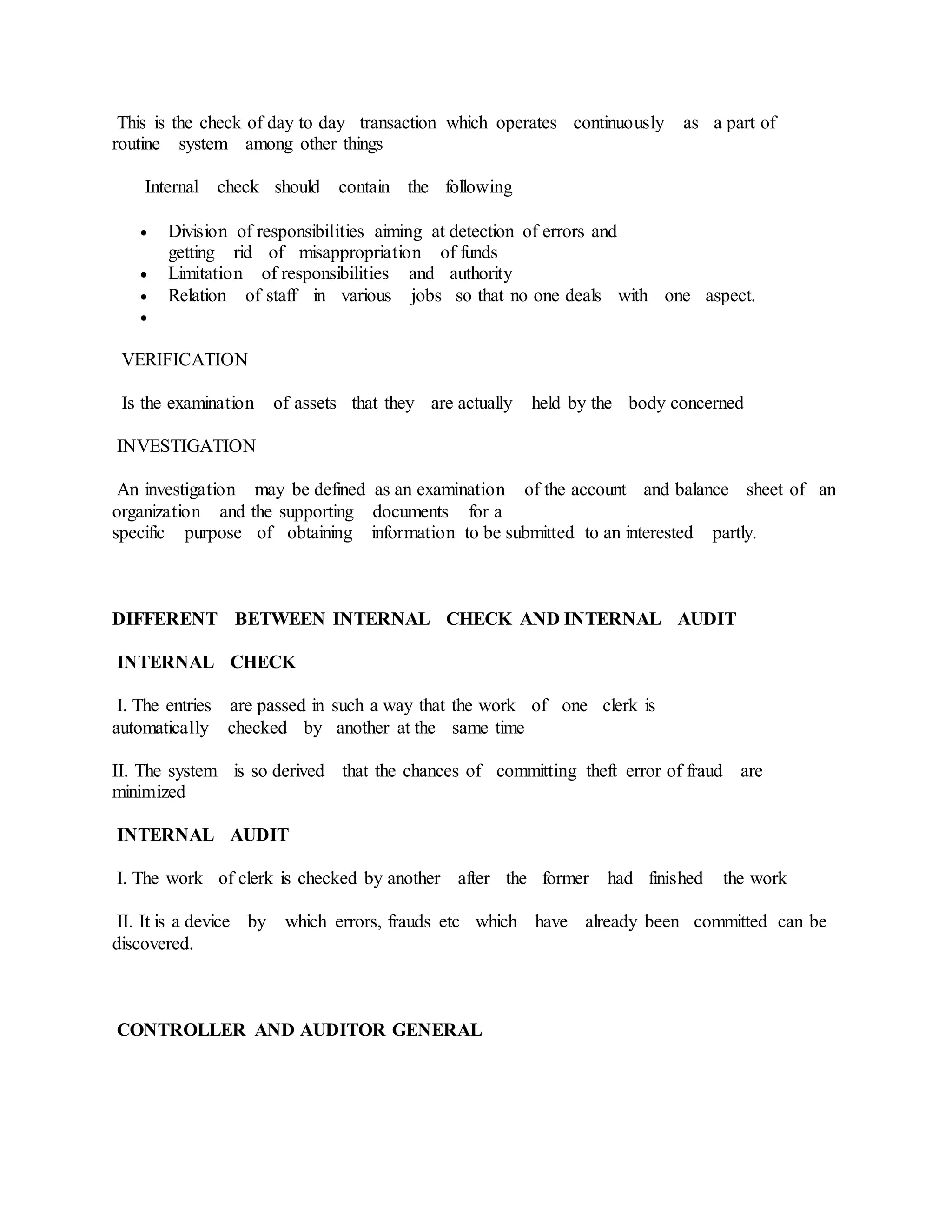
INTERNAL CHECK
This is the check of day to day transaction which operates continuously as a part of
routine system among other things
Internal check should contain the following
 Division of responsibilities aiming at detection of errors and
getting rid of misappropriation of funds
 Limitation of responsibilities and authority
 Relation of staff in various jobs so that no one deals with one aspect.

VERIFICATION
Is the examination of assets that they are actually held by the body concerned
INVESTIGATION
An investigation may be defined as an examination of the account and balance sheet of an
organization and the supporting documents for a
specific purpose of obtaining information to be submitted to an interested partly.
DIFFERENT BETWEEN INTERNAL CHECK AND INTERNAL AUDIT
INTERNAL CHECK
I. The entries are passed in such a way that the work of one clerk is
automatically checked by another at the same time
II. The system is so derived that the chances of committing theft error of fraud are
minimized
INTERNAL AUDIT
I. The work of clerk is checked by another after the former had finished the work
II. It is a device by which errors, frauds etc which have already been committed can be
discovered.
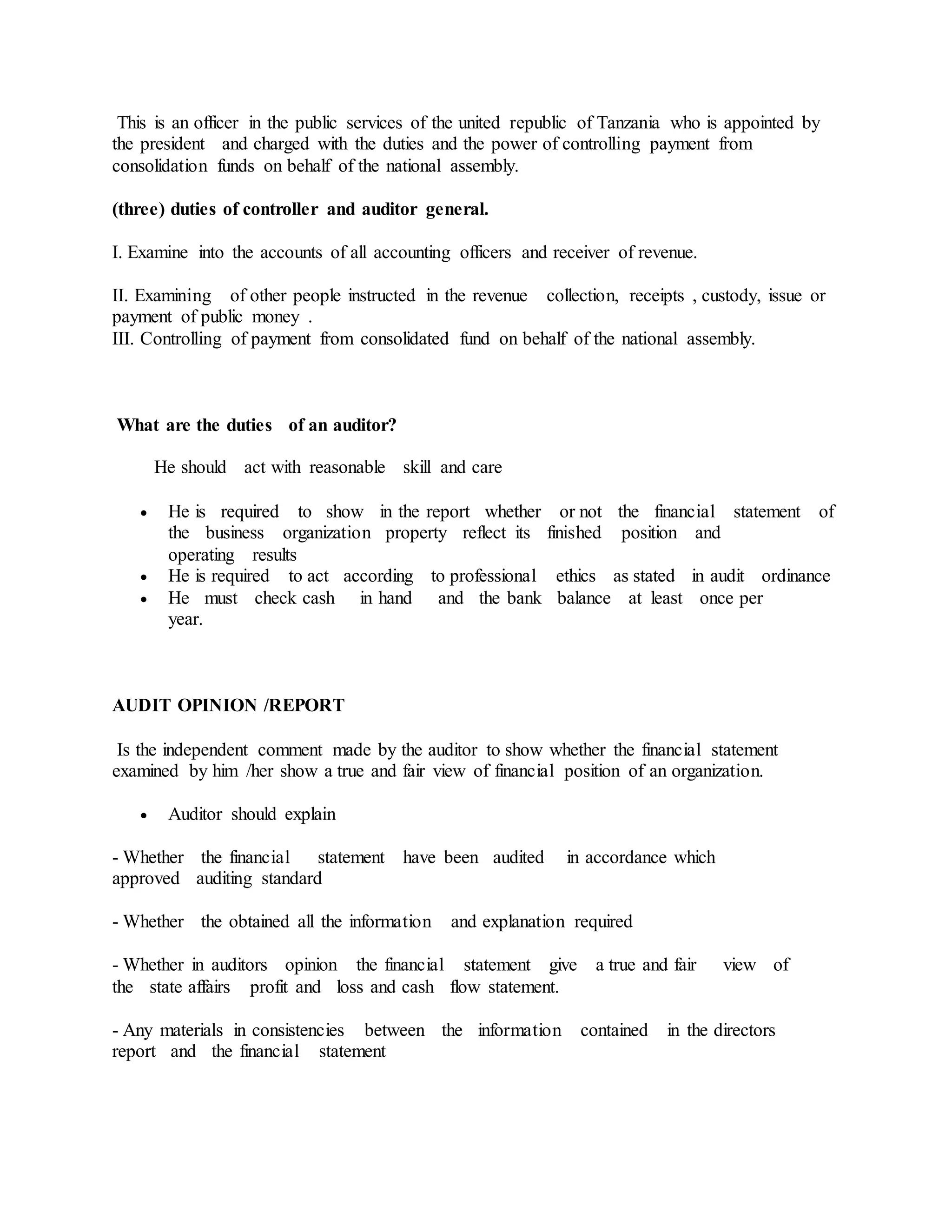
CONTROLLER AND AUDITOR GENERAL
This is an officer in the public services of the united republic of Tanzania who is appointed by
the president and charged with the duties and the power of controlling payment from
consolidation funds on behalf of the national assembly.
(three) duties of controller and auditor general.
I. Examine into the accounts of all accounting officers and receiver of revenue.
II. Examining of other people instructed in the revenue collection, receipts , custody, issue or
payment of public money .
III. Controlling of payment from consolidated fund on behalf of the national assembly.
What are the duties of an auditor?
He should act with reasonable skill and care
 He is required to show in the report whether or not the financial statement of
the business organization property reflect its finished position and
operating results
 He is required to act according to professional ethics as stated in audit ordinance
 He must check cash in hand and the bank balance at least once per
year.
AUDIT OPINION /REPORT
Is the independent comment made by the auditor to show whether the financial statement
examined by him /her show a true and fair view of financial position of an organization.
 Auditor should explain
- Whether the financial statement have been audited in accordance which
approved auditing standard
- Whether the obtained all the information and explanation required
- Whether in auditors opinion the financial statement give a true and fair view of
the state affairs profit and loss and cash flow statement.
- Any materials in consistencies between the information contained in the directors
report and the financial statement
TYPES OF AUDIT REPORT /OPINION
types of audit report/opinion that auditor may express in his opinion.
I. Unqualified audit report /clean report
Is the report presented by auditor after auditing financial account of the firm to the
management that every thing is alright in books of accounts.
II. Qualified audit report
When the auditor is unable to satisfy himself that the financial statements give a
true and fair of the state of affairs and its profit and loss and cash flow statement he
should quality the report by referring to all materials matters on which the auditor as
reservation.
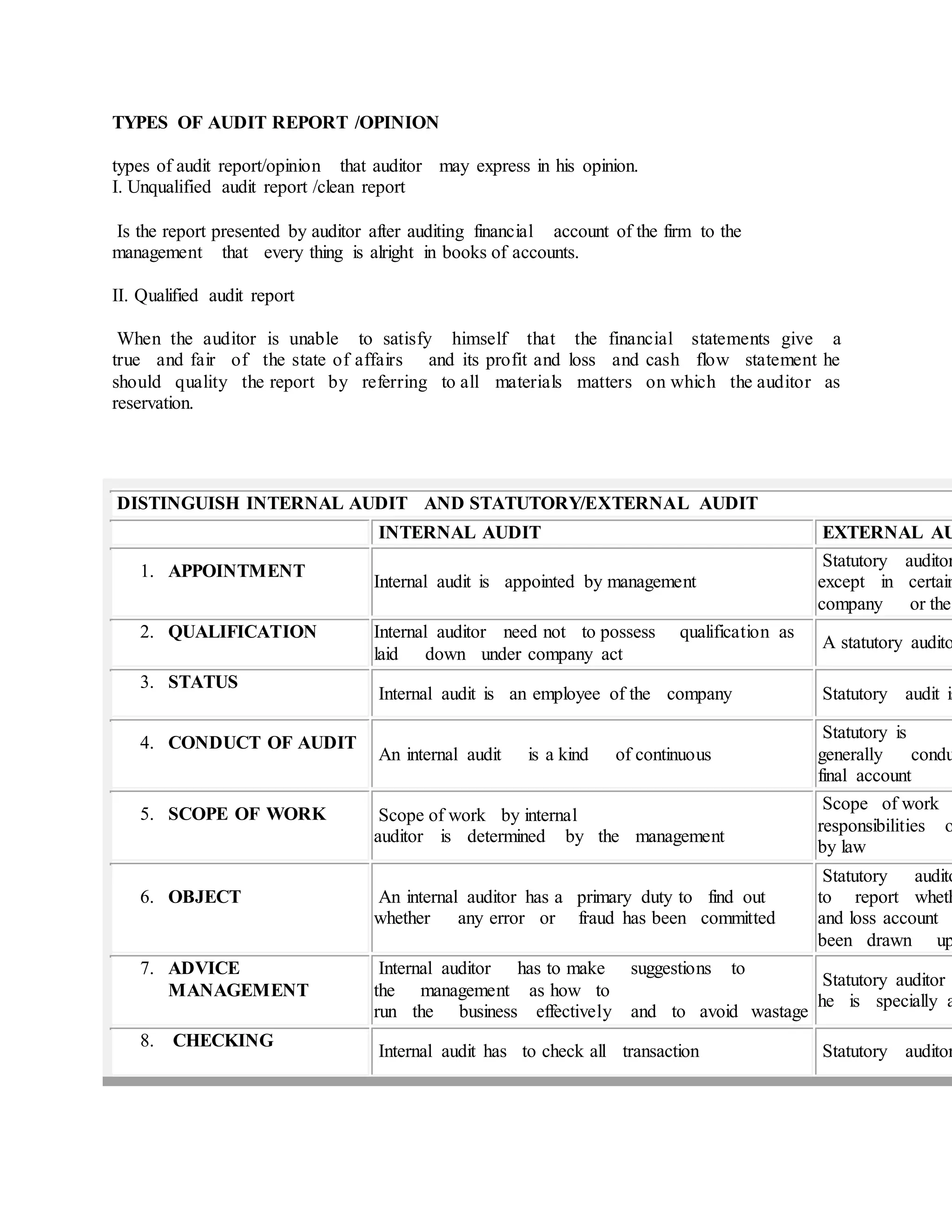
DISTINGUISH INTERNAL AUDIT AND STATUTORY/EXTERNAL AUDIT
INTERNAL AUDIT EXTERNAL AU
1. APPOINTMENT
Internal audit is appointed by management
Statutory auditor
except in certain
company or the
2. QUALIFICATION Internal auditor need not to possess qualification as
laid down under company act
A statutory audito
3. STATUS
Internal audit is an employee of the company Statutory audit is
4. CONDUCT OF AUDIT
An internal audit is a kind of continuous
Statutory is
generally condu
final account
5. SCOPE OF WORK Scope of work by internal
auditor is determined by the management
Scope of work
responsibilities o
by law
6. OBJECT An internal auditor has a primary duty to find out
whether any error or fraud has been committed
Statutory audito
to report wheth
and loss account
been drawn up
7. ADVICE
MANAGEMENT
Internal auditor has to make suggestions to
the management as how to
run the business effectively and to avoid wastage
Statutory auditor
he is specially a
8. CHECKING
Internal audit has to check all transaction Statutory auditor
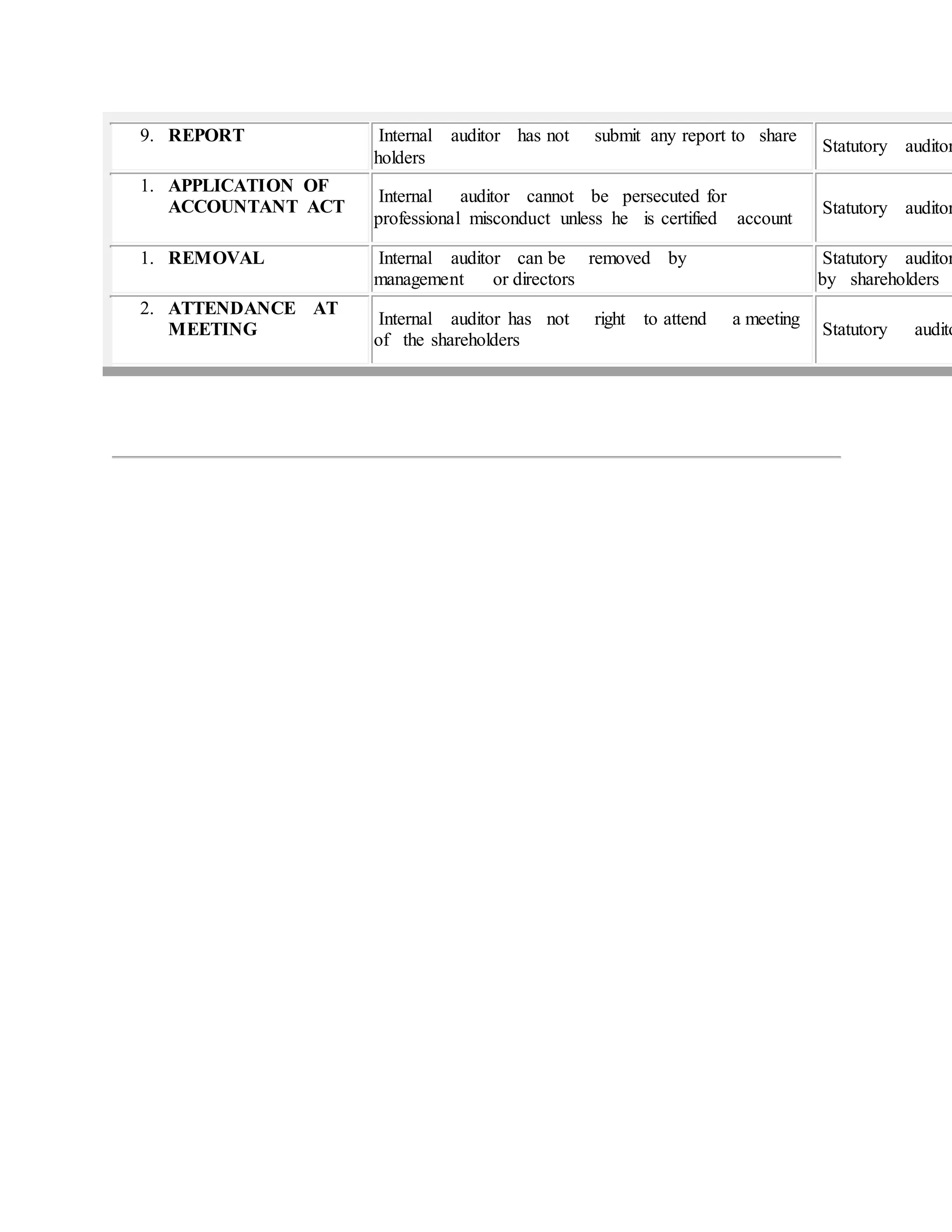
9. REPORT Internal auditor has not submit any report to share
holders
Statutory auditor
1. APPLICATION OF
ACCOUNTANT ACT
Internal auditor cannot be persecuted for
professional misconduct unless he is certified account
Statutory auditor
1. REMOVAL Internal auditor can be removed by
management or directors
Statutory auditor
by shareholders
2. ATTENDANCE AT
MEETING
Internal auditor has not right to attend a meeting
of the shareholders
Statutory audito

Elements of auditing

  • 1.
    ELEMENTS OF AUDITING AUDITAND INVESTIGATION Definition AUDIT - Is the formal examination, correction, and official endorsing of financial account, especially those of a business undertaken annually by an accountant - Inspection and verification of the accuracy of financial records and statements. Also involves systematic check or assessment especially efficient or effectiveness of an organization AUDITING - Is the examination of certain statement covering the transaction over certain period and financial position of an organization - Is the examination financial statement covering over a period and ascertaining the financial position of organization on a certain date AUDITOR Is the an independent person appointed by company or an enterprise to examine its books of account QUALITIES OF AN AUDITOR I. Accounting knowledge. An auditor should necessary have an academic qualification in accounting. This enable him to make evaluation and passing judgment of the financial records II. Business knowledge. An auditor should acquire a reasonable good knowledge in business e.g. world economic trend importing and exporting procedures business transaction marketing technique etc. III. Independent to give out his opinion. An auditor should act an independently he should not be subjected to the management supervision .
  • 2.
    IV. Tactful. An auditorshould maximize maximum care and skills in his/her daily activities V. Common sense. An auditor should have a good common sense and experience to conduct his/her work efficiently OBJECTIVE OF AUDITING Can categorized into two groups; I. Primary objective. II. Secondary objective. I. Primary objective  To review/examine the financial statement of the business and form an “independent opinion” as to whether they show true and fair view of the business.  They are prepared according to the G.A.A.P and the auditor express his opinion by issuing what is called an audit report.  To report if their any materials inconsistency between direct report and financial statement. II. Secondary objective 1. Detection of errors and frauds 2. Prevention of errors and frauds 3. Reporting on the strength and/or weakness of the internal control system of the firm. 4. Providing constructive advice to the management for instance on how to handle and discharge various accounting responsibilities TYPES OF AUDIT 1. CONTINUOUS AUDIT Is the kind of an audit which involves details examination of the books of accounts at interval during the financial year. The auditor visits his client at regular or irregular intervals of the year and at the end of the year, he checks only profit and loss account and balance sheet 2. FINAL AUDIT/COMPLETED AUDIT
  • 3.
    Is the kindof audit which is conducted at the end of the financial or trading period when all the account have been balanced and the trading and profit and loss account and balance sheet have been prepared. 3.INTERIM AUDIT Is the kind of an audit which is conducted at the particular date within the accounting period to ascertain the profit or loss as to enable the company is declared an interim dividend. 4.PROCEDURAL AUDIT Is the type of audit which involves examining and reviewing the procedures used to process and record transactions in an organization. It also include the examination of the records from which financial statement were prepared. It help in revealing whether or not the procedure as prescribed by the management are being followed. 5.MANAGEMENT AUDIT Is the comprehensive examination of an organization structure of a firm of its division, plans and objectives, its means of operation and its uses of human and non-human resources. management audit can reveal the strength and weakness of the management 6.STANDARD AUDIT Is the types of audit which is conducted to ascertain whether the clients account system complies with the requirement /required level of standard set by the professional bodies. 7.BALANCE SHEET AUDIT It refer to the verification of the value of an asset, liabilities, the balance of reserve and provision and the amount profit earned or loss incurred by a firm during a financial year by an auditor. 8.VOUCHING AUDIT It refer to the kind audit where the auditor checks each and every transaction right from the origin in the books of prime entry till they are posted 9.INTERNAL AUDIT This is describe as a review of operation and records sometimes continuous undertaken within a business by assigned staff.  The person who perform this type of audit is known as internal auditor
  • 4.
    10.EXTERNAL AUDIT  Thisis an independent person appointed by the shareholders (owner) outside the organization whose object is only to give a report about account prepared by directors or managers  This is carried out by independent auditor(external auditor) 11.PRIVATE AUDIT Under this type of audit the auditor will conduct an agreed limit of work 12.STATUTORY AUDIT This is carried out under the provision of the law of the country i.e. all limited company are required to get their account audited Example cooperative societies, banks , insurance, companies are required to get their account according to requirement of companies act. 13.INTERNAL CONTROL - The whole system of control financial and otherwise established by the management in order to carry on the business of the enterprise in orderly manner. this cover not only financial and accounting checks but even those control designed to improve operational efficiency ensure adherence to company policies. - Is the system established by the management within the company to check the movement of activities in the company of are going accordingly. ELEMENT OF INTERNAL CONTROL Is the system under which the work relating to carrying out and recording of transaction of transactions s allocated amongst various persons in such a manner that the work of one person is automatically checked by another and thus possibilities of fraud or errors or irregularity are minimized, if not completed eliminated. It is an important tool of internal control it means the checks on day to day transactions which operate continuously as part of the routine system whereby the work of one person is checked by another employee. INTERNAL CHECK
  • 5.
    This is thecheck of day to day transaction which operates continuously as a part of routine system among other things Internal check should contain the following  Division of responsibilities aiming at detection of errors and getting rid of misappropriation of funds  Limitation of responsibilities and authority  Relation of staff in various jobs so that no one deals with one aspect.  VERIFICATION Is the examination of assets that they are actually held by the body concerned INVESTIGATION An investigation may be defined as an examination of the account and balance sheet of an organization and the supporting documents for a specific purpose of obtaining information to be submitted to an interested partly. DIFFERENT BETWEEN INTERNAL CHECK AND INTERNAL AUDIT INTERNAL CHECK I. The entries are passed in such a way that the work of one clerk is automatically checked by another at the same time II. The system is so derived that the chances of committing theft error of fraud are minimized INTERNAL AUDIT I. The work of clerk is checked by another after the former had finished the work II. It is a device by which errors, frauds etc which have already been committed can be discovered. CONTROLLER AND AUDITOR GENERAL
  • 6.
    This is anofficer in the public services of the united republic of Tanzania who is appointed by the president and charged with the duties and the power of controlling payment from consolidation funds on behalf of the national assembly. (three) duties of controller and auditor general. I. Examine into the accounts of all accounting officers and receiver of revenue. II. Examining of other people instructed in the revenue collection, receipts , custody, issue or payment of public money . III. Controlling of payment from consolidated fund on behalf of the national assembly. What are the duties of an auditor? He should act with reasonable skill and care  He is required to show in the report whether or not the financial statement of the business organization property reflect its finished position and operating results  He is required to act according to professional ethics as stated in audit ordinance  He must check cash in hand and the bank balance at least once per year. AUDIT OPINION /REPORT Is the independent comment made by the auditor to show whether the financial statement examined by him /her show a true and fair view of financial position of an organization.  Auditor should explain - Whether the financial statement have been audited in accordance which approved auditing standard - Whether the obtained all the information and explanation required - Whether in auditors opinion the financial statement give a true and fair view of the state affairs profit and loss and cash flow statement. - Any materials in consistencies between the information contained in the directors report and the financial statement
  • 7.
    TYPES OF AUDITREPORT /OPINION types of audit report/opinion that auditor may express in his opinion. I. Unqualified audit report /clean report Is the report presented by auditor after auditing financial account of the firm to the management that every thing is alright in books of accounts. II. Qualified audit report When the auditor is unable to satisfy himself that the financial statements give a true and fair of the state of affairs and its profit and loss and cash flow statement he should quality the report by referring to all materials matters on which the auditor as reservation. DISTINGUISH INTERNAL AUDIT AND STATUTORY/EXTERNAL AUDIT INTERNAL AUDIT EXTERNAL AU 1. APPOINTMENT Internal audit is appointed by management Statutory auditor except in certain company or the 2. QUALIFICATION Internal auditor need not to possess qualification as laid down under company act A statutory audito 3. STATUS Internal audit is an employee of the company Statutory audit is 4. CONDUCT OF AUDIT An internal audit is a kind of continuous Statutory is generally condu final account 5. SCOPE OF WORK Scope of work by internal auditor is determined by the management Scope of work responsibilities o by law 6. OBJECT An internal auditor has a primary duty to find out whether any error or fraud has been committed Statutory audito to report wheth and loss account been drawn up 7. ADVICE MANAGEMENT Internal auditor has to make suggestions to the management as how to run the business effectively and to avoid wastage Statutory auditor he is specially a 8. CHECKING Internal audit has to check all transaction Statutory auditor
  • 8.
    9. REPORT Internalauditor has not submit any report to share holders Statutory auditor 1. APPLICATION OF ACCOUNTANT ACT Internal auditor cannot be persecuted for professional misconduct unless he is certified account Statutory auditor 1. REMOVAL Internal auditor can be removed by management or directors Statutory auditor by shareholders 2. ATTENDANCE AT MEETING Internal auditor has not right to attend a meeting of the shareholders Statutory audito