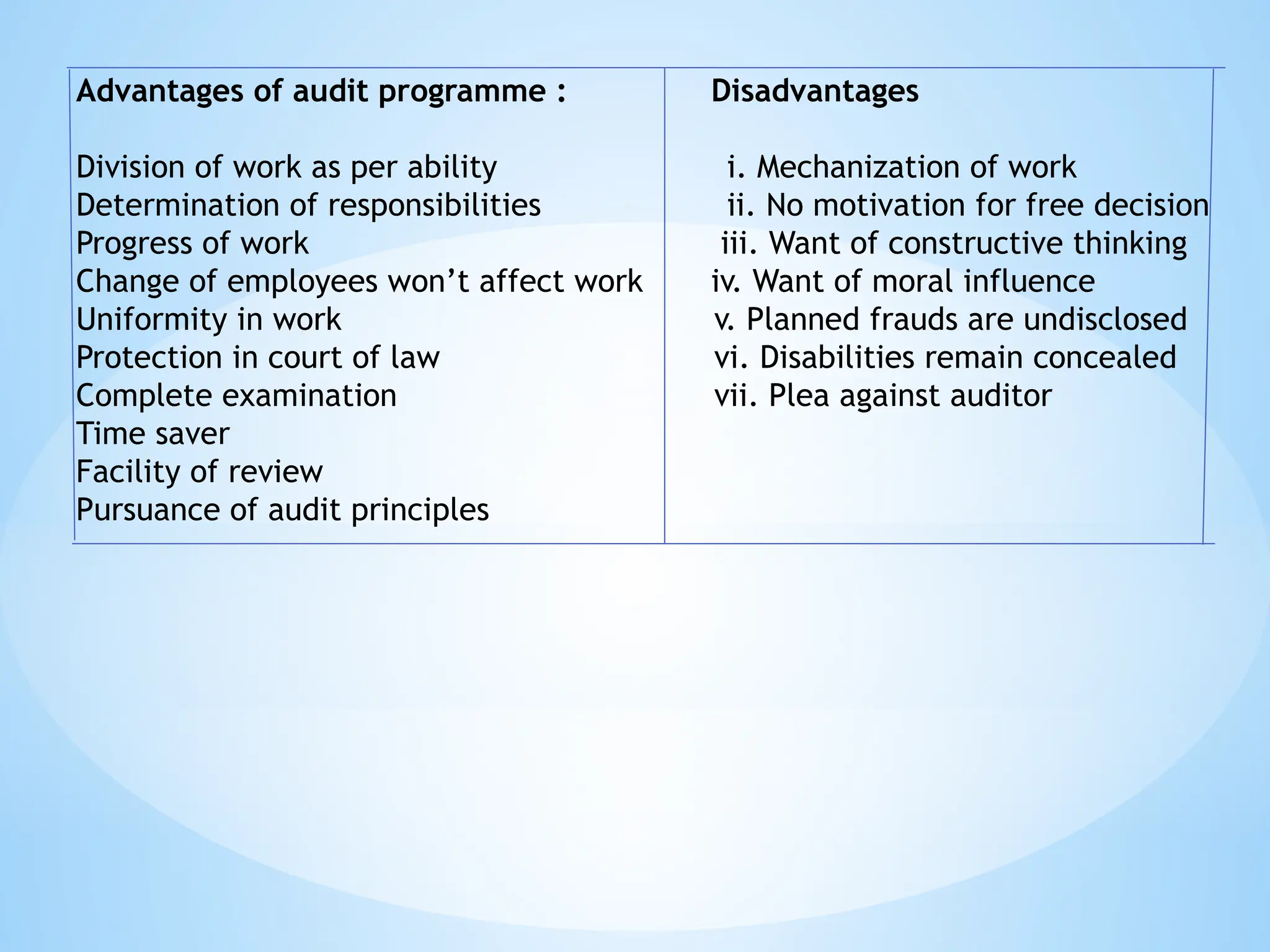
AUDITING
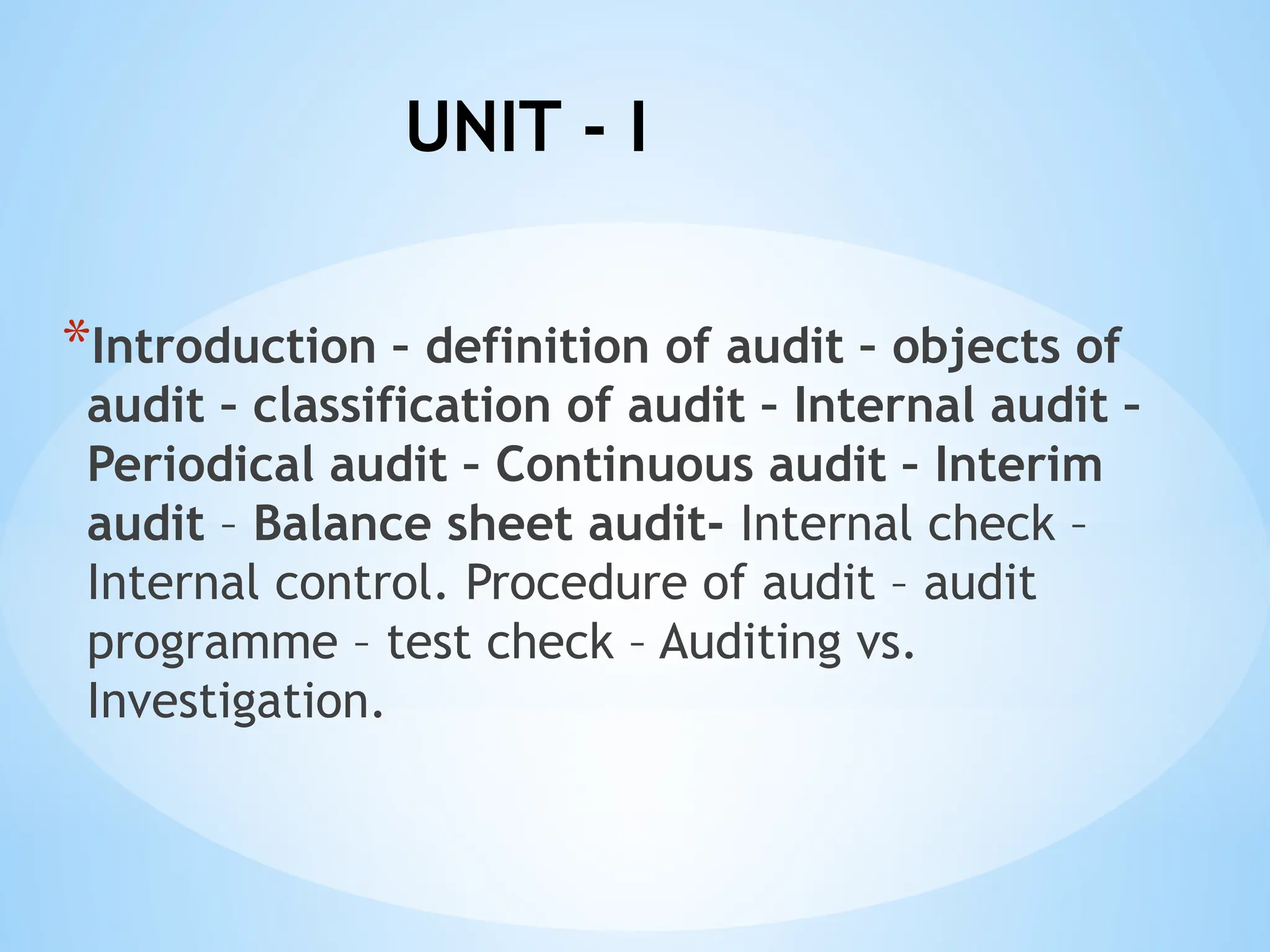
UNIT - I
*Introduction – definition of audit – objects of
audit – classification of audit – Internal audit –
Periodical audit – Continuous audit – Interim
audit – Balance sheet audit- Internal check –
Internal control. Procedure of audit – audit
programme – test check – Auditing vs.
Investigation.
*AUDITING -MEANING
*The word Audit is derived from Latin word “Audire”
which means ‘to hear’. Auditing is the verification of
financial position as disclosed by the financial
statements.
*According to AAS-1 “An audit is an independent
examination of financial information, of any entity,
whether profit oriented or not, and irrespective of its
size or legal form, when such an examination is
conducted with a view to, expressing an opinion
thereon.
*AUDITING -DEFINITION
*“Auditing is an examination of accounting records
undertaken with a view to establishment whether they
correctly and completely reflect the transactions to which
they purport to relate.”-L.R.Dicksee
*“Auditing is the systematic examination of financial
statements, records and related operations to determine
adherence to generally accepted accounting principles,
management policies and stated requirement.” -
R.E.Schlosser
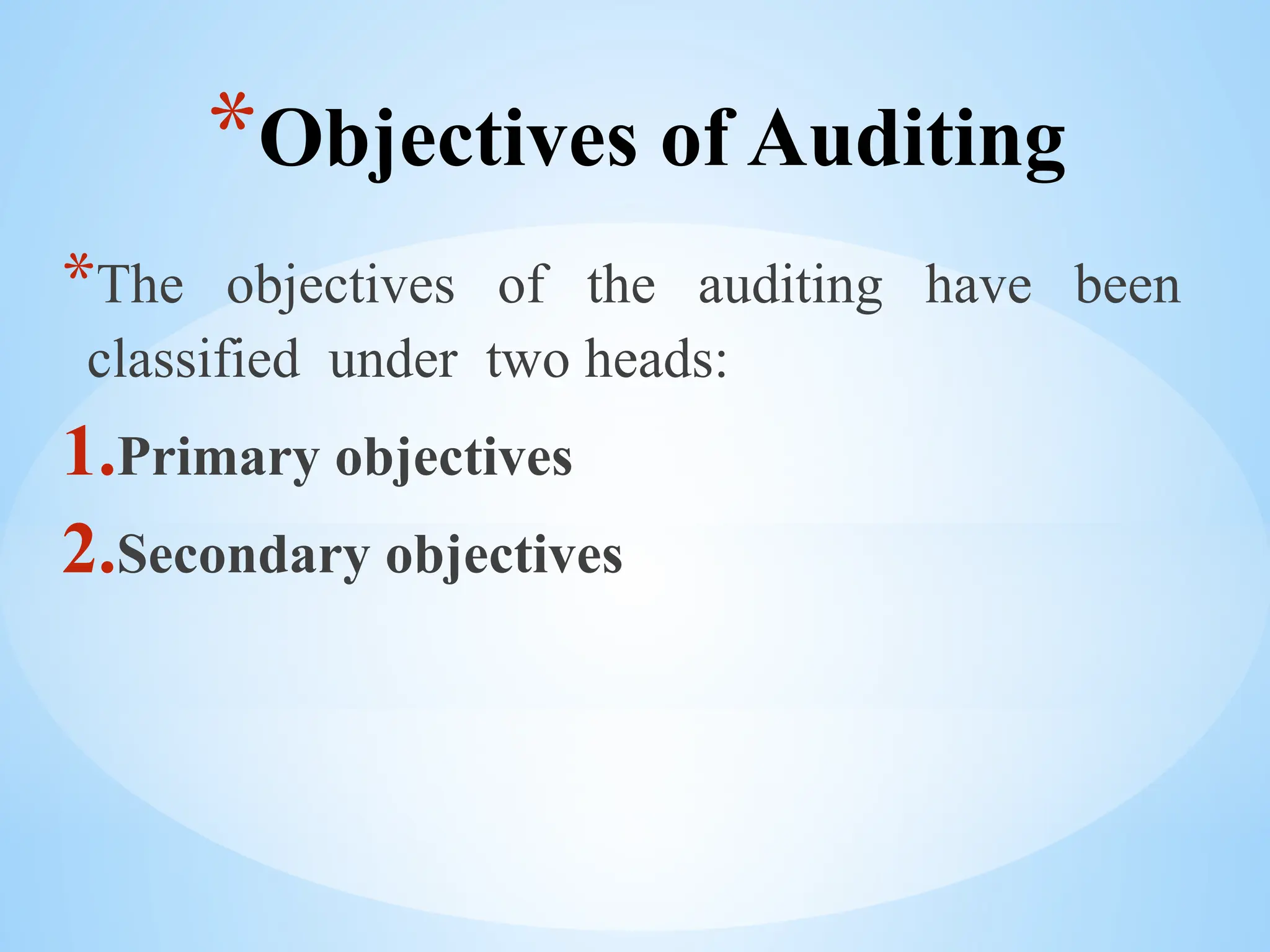
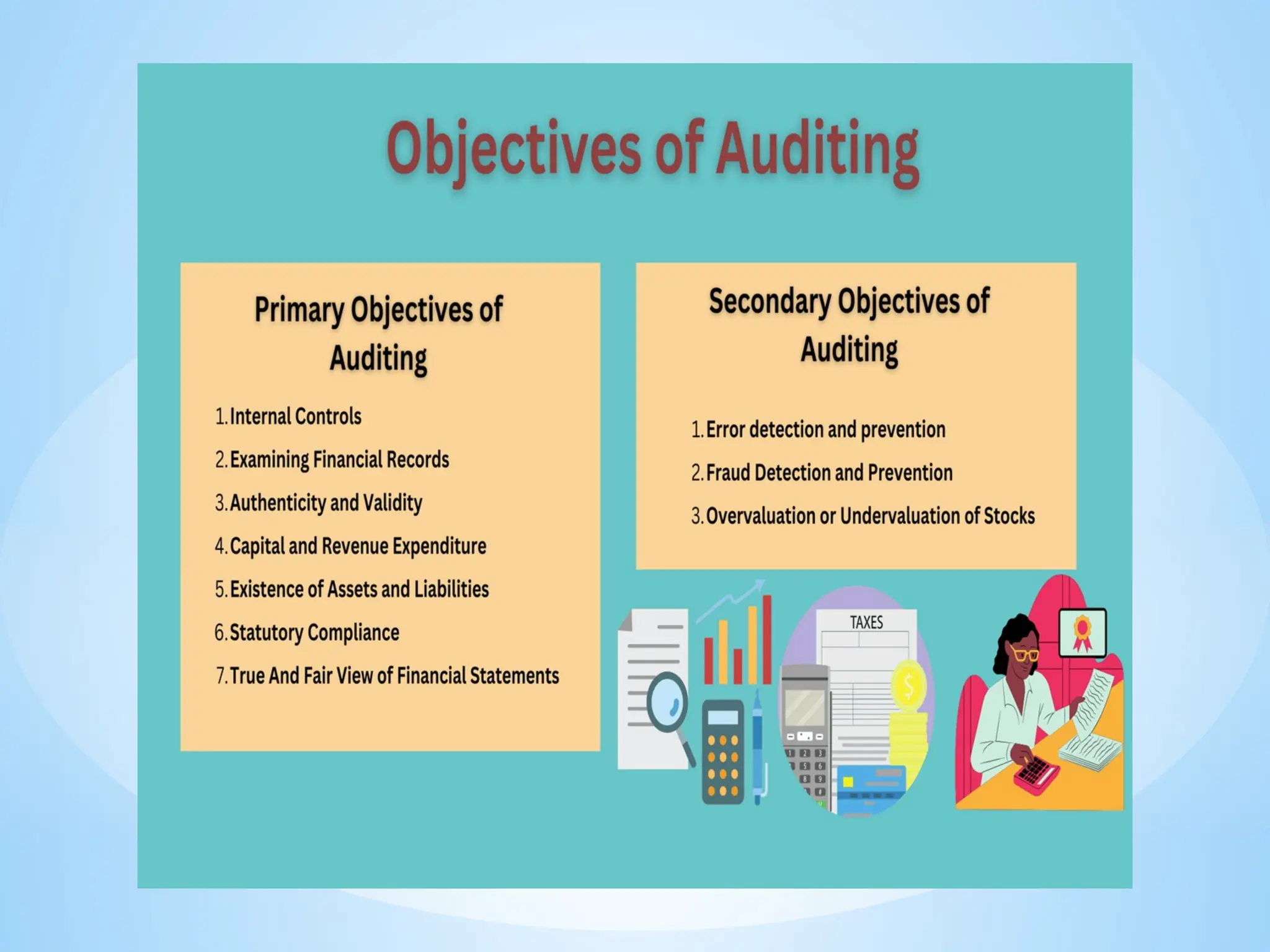
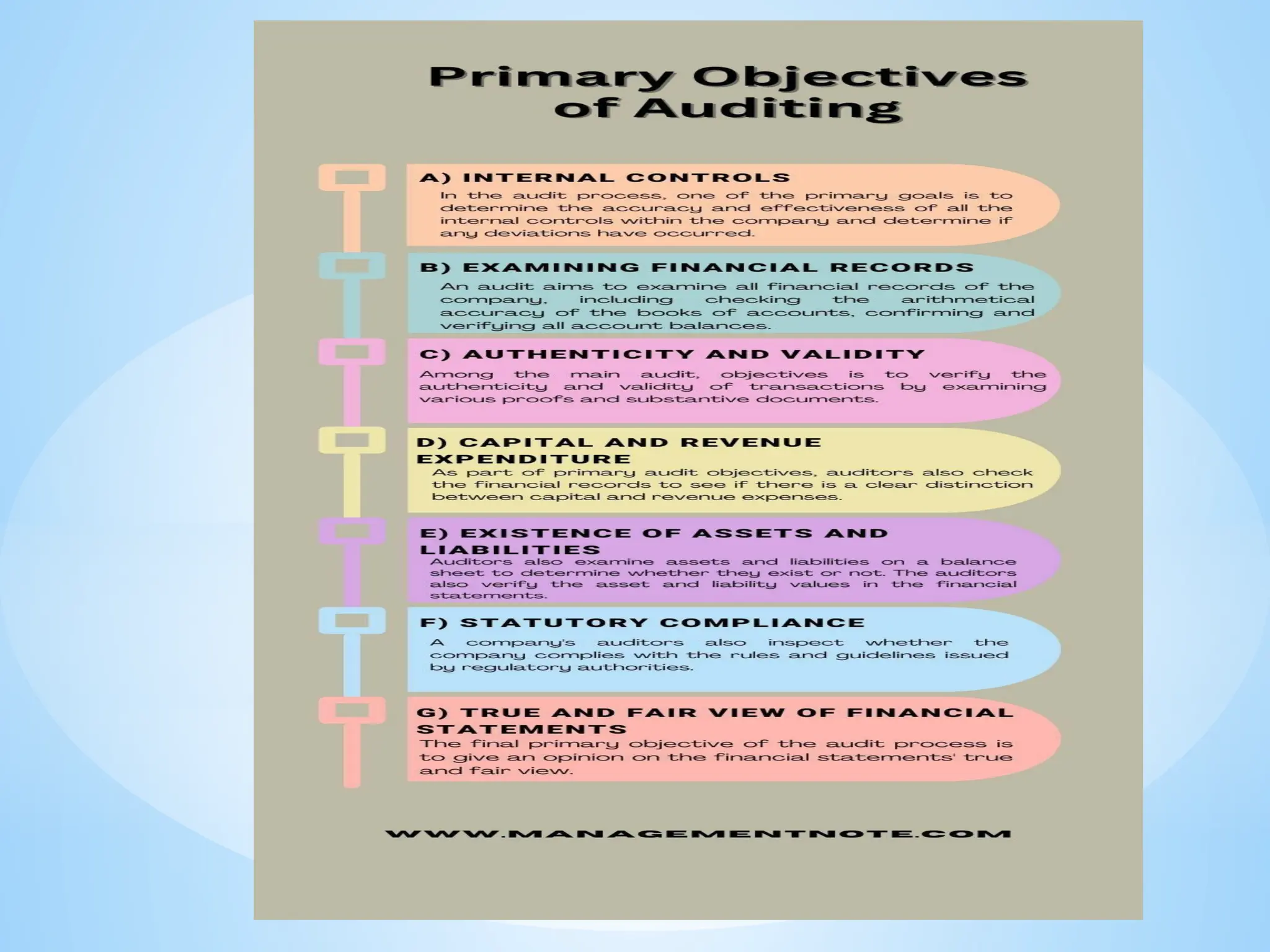
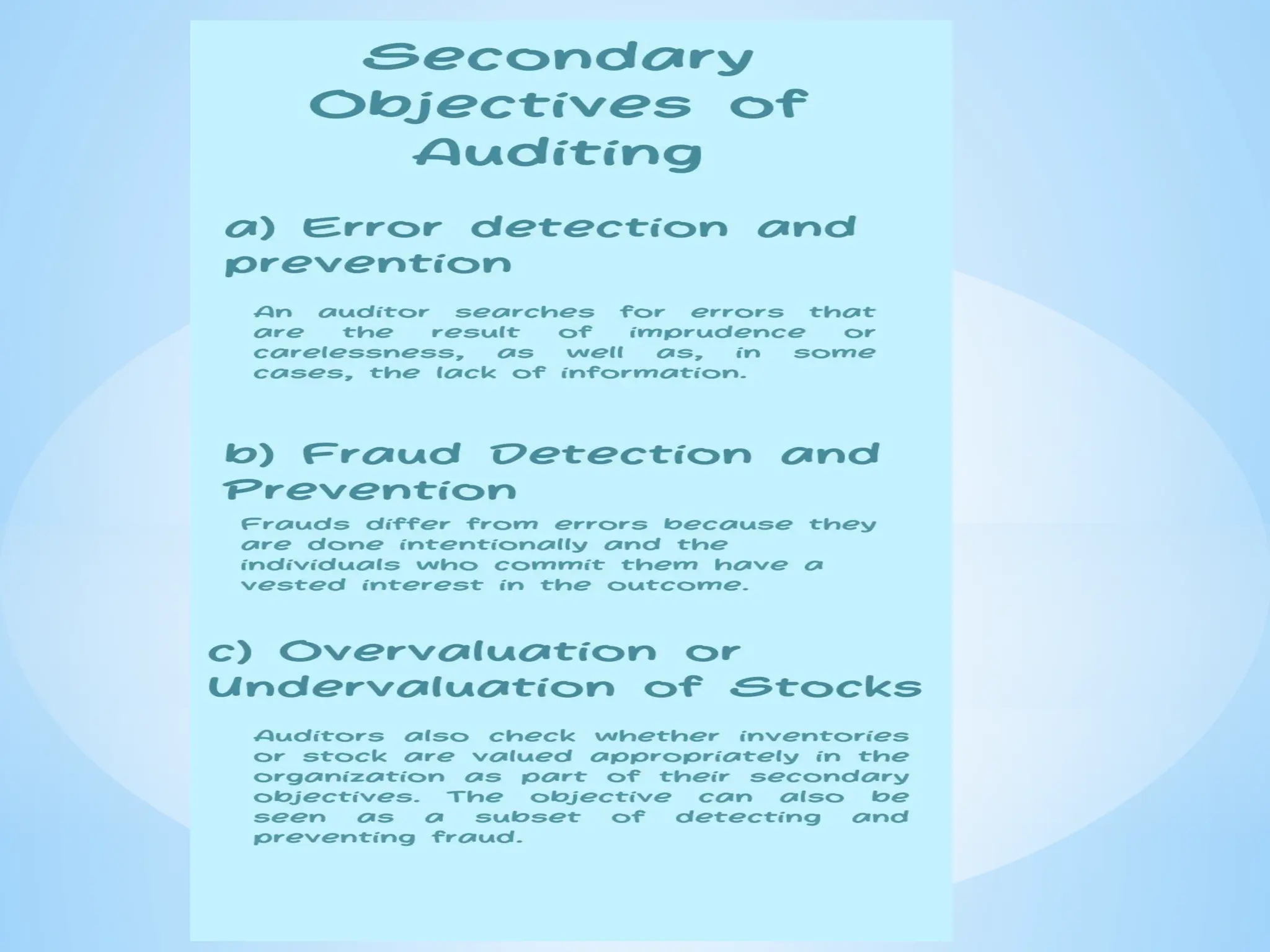
*Objectives of Auditing
*The objectives of the auditing have been
classified under two heads:
1.Primary objectives
2.Secondary objectives
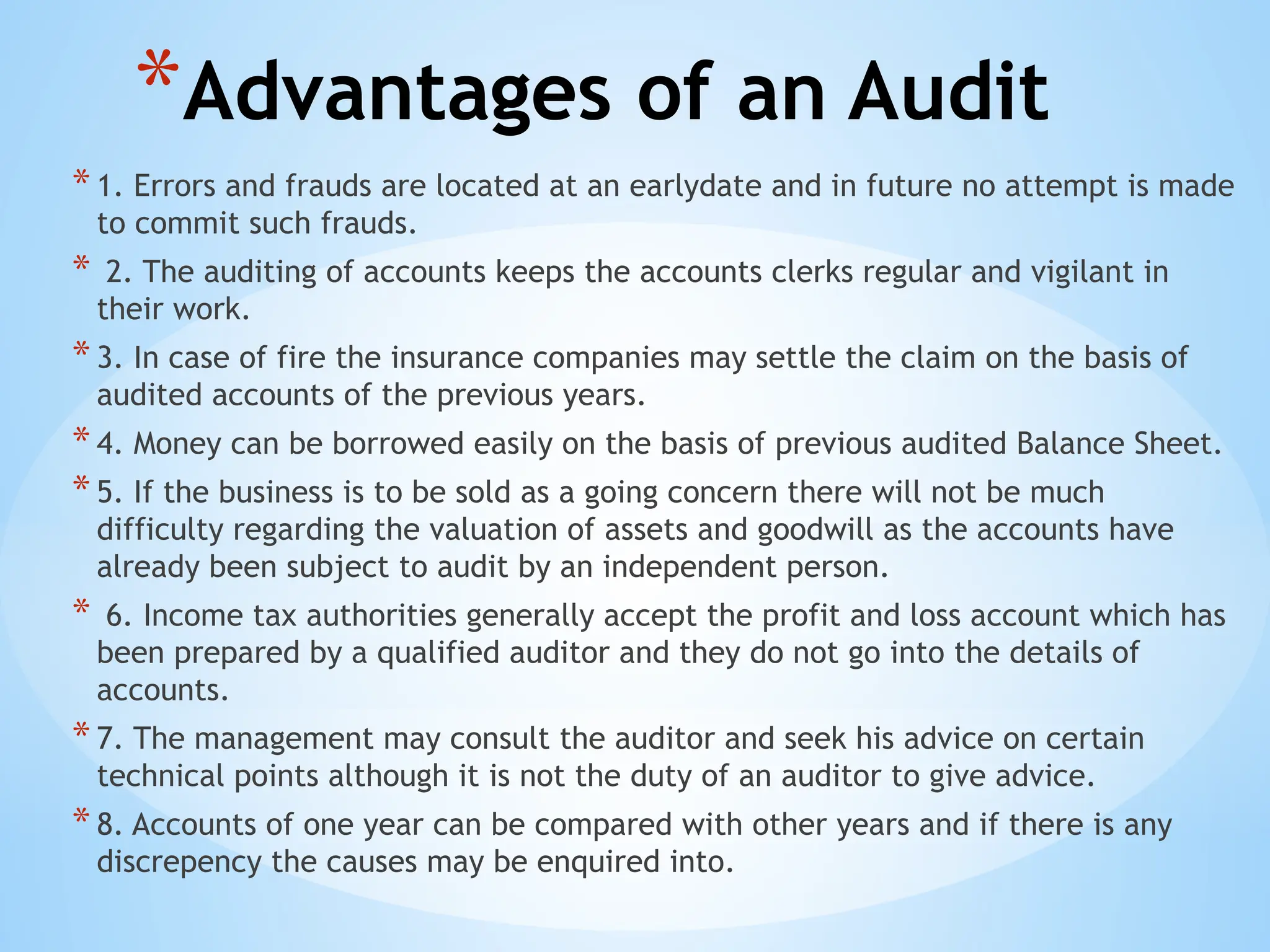
*Advantages of an Audit
*1. Errors and frauds are located at an earlydate and in future no attempt is made
to commit such frauds.
* 2. The auditing of accounts keeps the accounts clerks regular and vigilant in
their work.
*3. In case of fire the insurance companies may settle the claim on the basis of
audited accounts of the previous years.
*4. Money can be borrowed easily on the basis of previous audited Balance Sheet.
*5. If the business is to be sold as a going concern there will not be much
difficulty regarding the valuation of assets and goodwill as the accounts have
already been subject to audit by an independent person.
* 6. Income tax authorities generally accept the profit and loss account which has
been prepared by a qualified auditor and they do not go into the details of
accounts.
*7. The management may consult the auditor and seek his advice on certain
technical points although it is not the duty of an auditor to give advice.
*8. Accounts of one year can be compared with other years and if there is any
discrepency the causes may be enquired into.
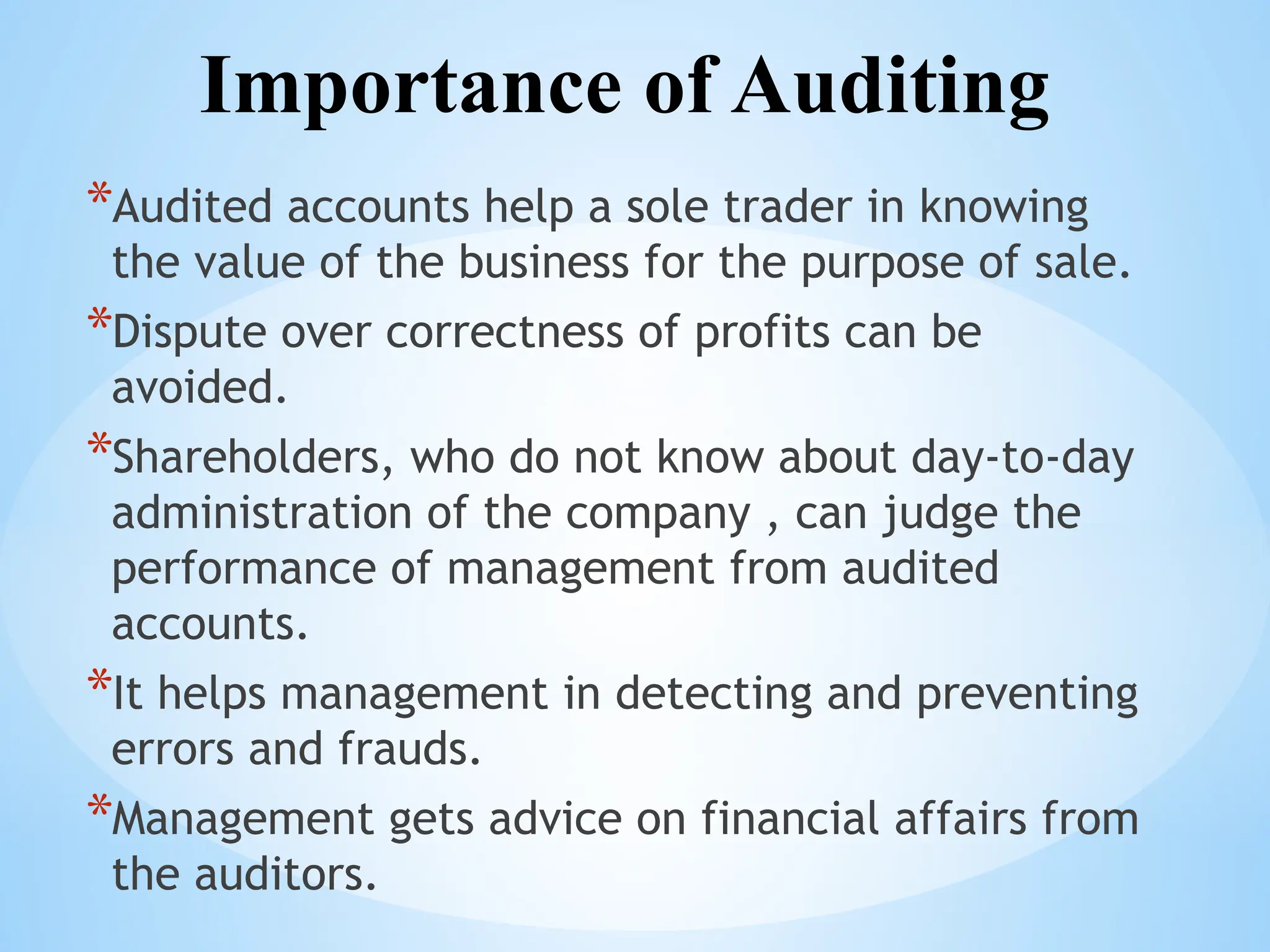
Importance of Auditing
*Audited accounts help a sole trader in knowing
the value of the business for the purpose of sale.
*Dispute over correctness of profits can be
avoided.
*Shareholders, who do not know about day-to-day
administration of the company , can judge the
performance of management from audited
accounts.
*It helps management in detecting and preventing
errors and frauds.
*Management gets advice on financial affairs from
the auditors.
Importance of Auditing
*Long and short term creditors depend on audited
financial statements while taking decision to grant
credit to business houses.
*Taxation authorities depend on audited statements
in assessing the income tax, sales tax and wealth
tax liability of the business.
*Audited accounts are useful for the government
while granting subsidies etc.
*It can be used by insurance companies to settle the
claims arising on account of loss by fire.
*Audited accounts serve as a basis for calculating
purchase consideration in case of amalgamation
and absorption.
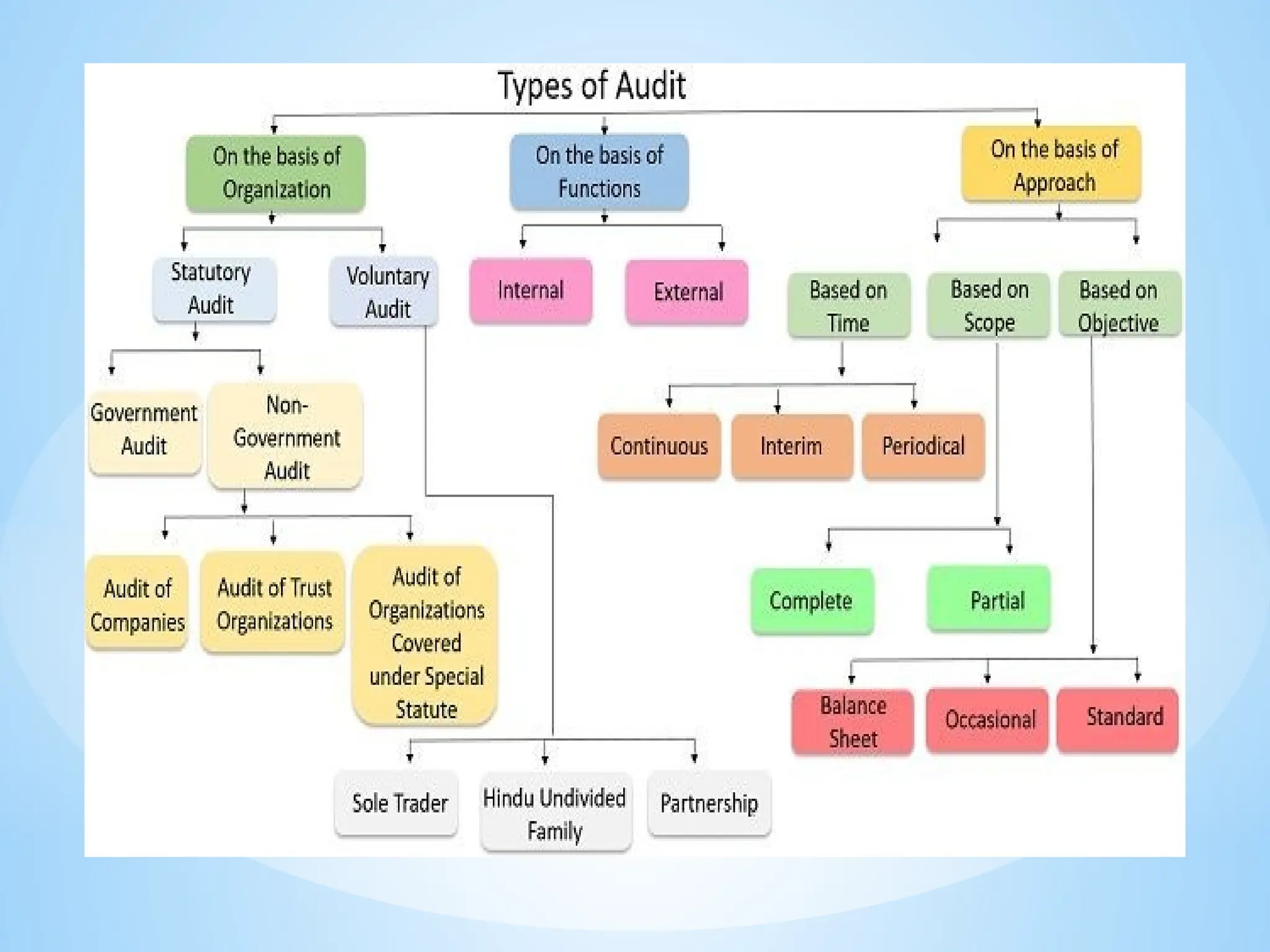
TYPES OF AUDIT
(1) On the basis of need of audit
a. External Need
*The auditor appointed to satisfy the External Needs of the
organization is known as EXTERNAL AUDITOR.
*If external need is a statutory need the same external auditor is
known as STATUTORY AUDITOR.
b. Internal Need
1. The auditor appointed to satisfy the internal or managerial
needs of the organization is known as INTERNAL AUDITOR.
2. According to AAS-7 The internal audit function constitutes a
separate component of internal control established with the
objective of determining whether other internal controls are well
designed and properly operated.
(2) ON THE BASIS OF PERIOD OF AUDIT
(a)Continuous Audit
(b)(b) Interim Audit
(c)(c) Final/Annual Audit
*Continuous Audit:
The Continuous Audit is conducted throughout the year
or at the regular short intervals of time.
“A continuous audit involves a detailed examination of all the
transactions by the auditor attending at regular intervals say
weekly, fortnightly or monthly, during the whole period of
trading.”
- T.R. Batliboi
Advantages of continuous Audit
a. Complete checking of all the records: Since the audit is
carried out throughout the year, sufficient time is available for
detailed checking. Any enquiry and doubt arising in the course
of audit can be tackled in a better way.
b. Proper planning: Auditor can plan his audit work in a
systematic manner. He can evenly spread his work throughout
the year. It will improve efficiency of auditor.
c. Early detection of frauds and errors: The work of auditor
becomes easier for detecting frauds and errors, otherwise it
will involve more time.
d. Up-to-date accounts: The efficiency of account staff will
increase and their work will be up-to-date and accurate.
e. Valuable suggestions: Continuous audit will help the auditor
to understand the technicalities of business. This will help the
auditor to make suggestions for the improvement of business.
DISADVANTAGES OF CONTINUOUS AUDIT:
*a. Expensive: It is an expensive system as it may
not suit the budget of small organizations.
*b. Dislocation of routine work: Frequent visits by
auditor may dislocate the smooth flow of office
work.
* c. Alteration of Figures: after the accounts have
been audited, the figures may be fraudulently
altered by the staff.
*d. Losing link in the audit work: As the work is
not completed continuously, the auditor may lose
continuity and certain questions and inquires may
be left unanswered.
ANNUAL AUDIT
Annual audit is one which is carried out only at the end of
an accounting period.
It as an audit which is not commenced until after end of
the financial period and is then carried on until completed.
Annual audit is also called periodical, final or completed
audit.
*Characteristics:
*It is done at the close of the financial year books of account have
been closed and final accounts drawn by the management of the
entity.
*The audit work is completed at a stretch i.e. in a single
continuous session.
*Generally this type of audit suitable to small organizations.
INTERIM AUDIT
*An audit conducted between two annual audits is called
interim audit.
*More commonly it is known in case of banks as half yearly
review.
*Interim audit helps management to take timely and
appropriate decisions for example declaration of interim
dividend or valuation of shares to decide swap ratio in case
of a merger.
*Interim audit is gaining statutory status now a days various
regulating authorities like SEBI and RBI requires periodic
audited financial statements in between the two annual
audited financial statements.
*However, it is generally carried out by professionally
qualified auditors.
*Final Audit
*Final Audit means when the audit work is conducted after
the close of financial year. A final audit is commonly
understood to be an audit which is not commenced until
after end of the financial period and is then carried on until
completed.
Balance Sheet Audit
1. Balance Sheet Audit relates to the verification of
various items of balance sheet such as assets, liabilities,
reserves and surplus, provisions and profit and loss balance.
2. The procedure under this audit is to follow a
backward process. First the item is located in balance sheet,
and then it is located in original record for the purpose of
verification.
*Final Audit
*Final Audit means when the audit work is conducted after
the close of financial year. A final audit is commonly
understood to be an audit which is not commenced until
after end of the financial period and is then carried on until
completed.
Balance Sheet Audit
1. Balance Sheet Audit relates to the verification of
various items of balance sheet such as assets, liabilities,
reserves and surplus, provisions and profit and loss balance.
2. The procedure under this audit is to follow a
backward process. First the item is located in balance sheet,
and then it is located in original record for the purpose of
verification.
INTERNAL CHECK
*Definition :
F.R.M. De Paula defines it as "Internal check means
practically a continuous internal audit carried on by the staff
itself, by means of which the work of each individual is
independently, checked by other members of the staff".
Objects of Internal Check :
1) To prevent the commission of any error or fraud by a clerk.
2) To prevent the misappropriation of cash or goods by any
clerk by keeping a check on the receipts and payments of cash
and receipts and delivery of the goods.
3) To throw responsibility on a particular clerk when the fraud
or mistake is detected.
4) To detect a fraud or an error quickly and easily. 5) To have
an accurate record of all business transactions.
INTERNAL CONTROL
Control is a wider term and will include all types of
management controls.
It is a means of assisting modern business management in
discharging its function.
The term internal control has been defined as "the whole
system of controls, financial or otherwise established by the
management in order to carry on the business of the company
in an orderly manner safe guard its assets and secure as far as
possible the accuracy and reliability of its record.
" According to this definition, internal control means
a/. accounting control
b/. operation controls i.e.; quality control, budgetary control,
internal checks and internal audit etc.
TEST CHECK
In those business houses where a satisfactory and
effective system of internal check is in operation, it is not
necessary for the auditor to do detailed checking.
The usual practice is that a certain number of entries of each
class is selected and checked and if they are found correct,
the remaining entries are also taken to be correct.
This is known as "Test checking".
The selection of items and the extent of test checking would
mainly depend upon the auditor's judgement and assessment
of a particular situation
Preparation of Audit Programme
Audit programme is a description, memorandum or
outline of the work to be done in an audit and often of
the time allotted and personnel assignments, prepared
by an auditor for the guidance and control of
assistants. It is the auditors plan of action, specifying
the procedures to be followed.
Objects of audit programme :
• To obtain informations regarding the accounting system,
policies and control techniques of the client.
• To ascertain the extent to which internal control techniques
can be banked upon.
• To lay down the nature, time and extent of audit
techniques to be adopted.
• To co-ordinate the total works.
Advantages of audit programme : Disadvantages
Division of work as per ability i. Mechanization of work
Determination of responsibilities ii. No motivation for free decision
Progress of work iii. Want of constructive thinking
Change of employees won’t affect work iv. Want of moral influence
Uniformity in work v. Planned frauds are undisclosed
Protection in court of law vi. Disabilities remain concealed
Complete examination vii. Plea against auditor
Time saver
Facility of review
Pursuance of audit principles
AUDITING UNIT 1 notes for b.com students

  • 1.
  • 2.
    UNIT - I *Introduction– definition of audit – objects of audit – classification of audit – Internal audit – Periodical audit – Continuous audit – Interim audit – Balance sheet audit- Internal check – Internal control. Procedure of audit – audit programme – test check – Auditing vs. Investigation.
  • 3.
    *AUDITING -MEANING *The wordAudit is derived from Latin word “Audire” which means ‘to hear’. Auditing is the verification of financial position as disclosed by the financial statements. *According to AAS-1 “An audit is an independent examination of financial information, of any entity, whether profit oriented or not, and irrespective of its size or legal form, when such an examination is conducted with a view to, expressing an opinion thereon.
  • 4.
    *AUDITING -DEFINITION *“Auditing isan examination of accounting records undertaken with a view to establishment whether they correctly and completely reflect the transactions to which they purport to relate.”-L.R.Dicksee *“Auditing is the systematic examination of financial statements, records and related operations to determine adherence to generally accepted accounting principles, management policies and stated requirement.” - R.E.Schlosser
  • 5.
    *Objectives of Auditing *Theobjectives of the auditing have been classified under two heads: 1.Primary objectives 2.Secondary objectives
  • 9.
    *Advantages of anAudit *1. Errors and frauds are located at an earlydate and in future no attempt is made to commit such frauds. * 2. The auditing of accounts keeps the accounts clerks regular and vigilant in their work. *3. In case of fire the insurance companies may settle the claim on the basis of audited accounts of the previous years. *4. Money can be borrowed easily on the basis of previous audited Balance Sheet. *5. If the business is to be sold as a going concern there will not be much difficulty regarding the valuation of assets and goodwill as the accounts have already been subject to audit by an independent person. * 6. Income tax authorities generally accept the profit and loss account which has been prepared by a qualified auditor and they do not go into the details of accounts. *7. The management may consult the auditor and seek his advice on certain technical points although it is not the duty of an auditor to give advice. *8. Accounts of one year can be compared with other years and if there is any discrepency the causes may be enquired into.
  • 10.
    Importance of Auditing *Auditedaccounts help a sole trader in knowing the value of the business for the purpose of sale. *Dispute over correctness of profits can be avoided. *Shareholders, who do not know about day-to-day administration of the company , can judge the performance of management from audited accounts. *It helps management in detecting and preventing errors and frauds. *Management gets advice on financial affairs from the auditors.
  • 11.
    Importance of Auditing *Longand short term creditors depend on audited financial statements while taking decision to grant credit to business houses. *Taxation authorities depend on audited statements in assessing the income tax, sales tax and wealth tax liability of the business. *Audited accounts are useful for the government while granting subsidies etc. *It can be used by insurance companies to settle the claims arising on account of loss by fire. *Audited accounts serve as a basis for calculating purchase consideration in case of amalgamation and absorption.
  • 13.
    TYPES OF AUDIT (1)On the basis of need of audit a. External Need *The auditor appointed to satisfy the External Needs of the organization is known as EXTERNAL AUDITOR. *If external need is a statutory need the same external auditor is known as STATUTORY AUDITOR. b. Internal Need 1. The auditor appointed to satisfy the internal or managerial needs of the organization is known as INTERNAL AUDITOR. 2. According to AAS-7 The internal audit function constitutes a separate component of internal control established with the objective of determining whether other internal controls are well designed and properly operated.
  • 14.
    (2) ON THEBASIS OF PERIOD OF AUDIT (a)Continuous Audit (b)(b) Interim Audit (c)(c) Final/Annual Audit *Continuous Audit: The Continuous Audit is conducted throughout the year or at the regular short intervals of time. “A continuous audit involves a detailed examination of all the transactions by the auditor attending at regular intervals say weekly, fortnightly or monthly, during the whole period of trading.” - T.R. Batliboi
  • 15.
    Advantages of continuousAudit a. Complete checking of all the records: Since the audit is carried out throughout the year, sufficient time is available for detailed checking. Any enquiry and doubt arising in the course of audit can be tackled in a better way. b. Proper planning: Auditor can plan his audit work in a systematic manner. He can evenly spread his work throughout the year. It will improve efficiency of auditor. c. Early detection of frauds and errors: The work of auditor becomes easier for detecting frauds and errors, otherwise it will involve more time. d. Up-to-date accounts: The efficiency of account staff will increase and their work will be up-to-date and accurate. e. Valuable suggestions: Continuous audit will help the auditor to understand the technicalities of business. This will help the auditor to make suggestions for the improvement of business.
  • 16.
    DISADVANTAGES OF CONTINUOUSAUDIT: *a. Expensive: It is an expensive system as it may not suit the budget of small organizations. *b. Dislocation of routine work: Frequent visits by auditor may dislocate the smooth flow of office work. * c. Alteration of Figures: after the accounts have been audited, the figures may be fraudulently altered by the staff. *d. Losing link in the audit work: As the work is not completed continuously, the auditor may lose continuity and certain questions and inquires may be left unanswered.
  • 17.
    ANNUAL AUDIT Annual auditis one which is carried out only at the end of an accounting period. It as an audit which is not commenced until after end of the financial period and is then carried on until completed. Annual audit is also called periodical, final or completed audit. *Characteristics: *It is done at the close of the financial year books of account have been closed and final accounts drawn by the management of the entity. *The audit work is completed at a stretch i.e. in a single continuous session. *Generally this type of audit suitable to small organizations.
  • 18.
    INTERIM AUDIT *An auditconducted between two annual audits is called interim audit. *More commonly it is known in case of banks as half yearly review. *Interim audit helps management to take timely and appropriate decisions for example declaration of interim dividend or valuation of shares to decide swap ratio in case of a merger. *Interim audit is gaining statutory status now a days various regulating authorities like SEBI and RBI requires periodic audited financial statements in between the two annual audited financial statements. *However, it is generally carried out by professionally qualified auditors.
  • 19.
    *Final Audit *Final Auditmeans when the audit work is conducted after the close of financial year. A final audit is commonly understood to be an audit which is not commenced until after end of the financial period and is then carried on until completed. Balance Sheet Audit 1. Balance Sheet Audit relates to the verification of various items of balance sheet such as assets, liabilities, reserves and surplus, provisions and profit and loss balance. 2. The procedure under this audit is to follow a backward process. First the item is located in balance sheet, and then it is located in original record for the purpose of verification.
  • 20.
    *Final Audit *Final Auditmeans when the audit work is conducted after the close of financial year. A final audit is commonly understood to be an audit which is not commenced until after end of the financial period and is then carried on until completed. Balance Sheet Audit 1. Balance Sheet Audit relates to the verification of various items of balance sheet such as assets, liabilities, reserves and surplus, provisions and profit and loss balance. 2. The procedure under this audit is to follow a backward process. First the item is located in balance sheet, and then it is located in original record for the purpose of verification.
  • 21.
    INTERNAL CHECK *Definition : F.R.M.De Paula defines it as "Internal check means practically a continuous internal audit carried on by the staff itself, by means of which the work of each individual is independently, checked by other members of the staff". Objects of Internal Check : 1) To prevent the commission of any error or fraud by a clerk. 2) To prevent the misappropriation of cash or goods by any clerk by keeping a check on the receipts and payments of cash and receipts and delivery of the goods. 3) To throw responsibility on a particular clerk when the fraud or mistake is detected. 4) To detect a fraud or an error quickly and easily. 5) To have an accurate record of all business transactions.
  • 22.
    INTERNAL CONTROL Control isa wider term and will include all types of management controls. It is a means of assisting modern business management in discharging its function. The term internal control has been defined as "the whole system of controls, financial or otherwise established by the management in order to carry on the business of the company in an orderly manner safe guard its assets and secure as far as possible the accuracy and reliability of its record. " According to this definition, internal control means a/. accounting control b/. operation controls i.e.; quality control, budgetary control, internal checks and internal audit etc.
  • 23.
    TEST CHECK In thosebusiness houses where a satisfactory and effective system of internal check is in operation, it is not necessary for the auditor to do detailed checking. The usual practice is that a certain number of entries of each class is selected and checked and if they are found correct, the remaining entries are also taken to be correct. This is known as "Test checking". The selection of items and the extent of test checking would mainly depend upon the auditor's judgement and assessment of a particular situation
  • 24.
    Preparation of AuditProgramme Audit programme is a description, memorandum or outline of the work to be done in an audit and often of the time allotted and personnel assignments, prepared by an auditor for the guidance and control of assistants. It is the auditors plan of action, specifying the procedures to be followed. Objects of audit programme : • To obtain informations regarding the accounting system, policies and control techniques of the client. • To ascertain the extent to which internal control techniques can be banked upon. • To lay down the nature, time and extent of audit techniques to be adopted. • To co-ordinate the total works.
  • 25.
    Advantages of auditprogramme : Disadvantages Division of work as per ability i. Mechanization of work Determination of responsibilities ii. No motivation for free decision Progress of work iii. Want of constructive thinking Change of employees won’t affect work iv. Want of moral influence Uniformity in work v. Planned frauds are undisclosed Protection in court of law vi. Disabilities remain concealed Complete examination vii. Plea against auditor Time saver Facility of review Pursuance of audit principles