Presented by:
Kristie Ladegard M.D.
Scot McKay M.D.
 Kristie Ladegard, MD, Denver Health Child Psychiatrist
• At 7 School Based Health Centers (SBHC) in Denver
• Family Crisis Center (FCC)
• Substance Abuse Treatment Education & Prevention
program (STEP)
• Scot McKay, MD, Denver Health Child Psychiatrist
• At 6 School Based Health Centers (SBHC) in Denver
• Family Crisis Center (FCC)
• Outpatient Behavioral Health
 Disclosures: Grant Support from the American Academy of
Child and Adolescent Psychiatry
Learning Objectives:
 List protective and risk factors in youth suicide
 Describe warning signs of suicide both in teens
and in younger youth.
 Explain steps to take when approaching suicidal
youth
Why Should Schools Care About Suicide?
 A student’s mental health can affect their academic
performance.
 Maintaining a safe environment is part of a school’s
overall mission
 A student suicide can significantly impact other
students and the entire school community.
 95% of American youth are enrolled in schools, they
provide an optimal environment for identifying, and
reaching out to youth at risk for suicide.
Why Should Schools Care About Suicide Cont.
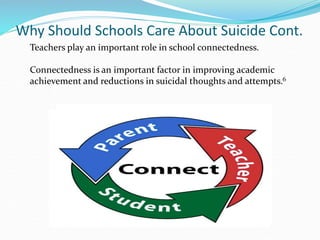
Teachers play an important role in school connectedness.
Connectedness is an important factor in improving academic
achievement and reductions in suicidal thoughts and attempts.6
Suicide Statistics
 Suicide is the 3rd leading cause of death among all children
and adolescents in the United States, including ages 10 to
19 years 1
 Girls are more likely to attempt suicide but male youth die
by suicide 5 times more frequently than females.2
 1 in 5 U.S. high school students have suicidal thoughts each
year, and 1 in 10 attempt suicide.3
 Although the incidence of suicide is low prior to
adolescence, suicide still ranks as the 11th leading cause of
death in children aged 5 to 11 years, with devastating
consequences for families.5
Suicide is a Leading Cause of
Death in Colorado
 Colorado is known to have one of the highest suicide
rates in the nation, and it ranks in the top 10 coming in
at #5 in 2014.2
 Between 2008 and 2012 suicide was the 2nd leading
cause of death in youth ages 10-19 only behind
unintentional injuries in Colorado. 4
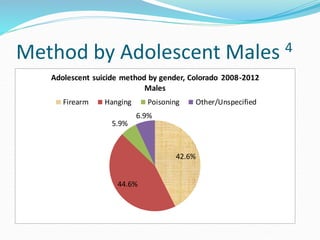
Method by Adolescent Males 4
42.6%
44.6%
5.9%
6.9%
Adolescent suicide method by gender, Colorado 2008-2012
Males
Firearm Hanging Poisoning Other/Unspecified
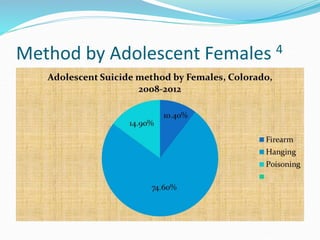
Method by Adolescent Females 4
12.10
6.95 6.32
17.72
5.46
11.01
0
2
4
6
8
10
12
14
16
18
20
Suicide Rate by Race ages 15-24, 2011
Series 1
Suicide Demographics 2
Risk Factors
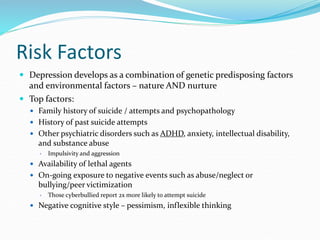
 Depression develops as a combination of genetic predisposing factors
and environmental factors – nature AND nurture
 Top factors:
 Family history of suicide / attempts and psychopathology
 History of past suicide attempts
 Other psychiatric disorders such as ADHD, anxiety, intellectual disability,
and substance abuse
 Impulsivity and aggression
 Availability of lethal agents
 On-going exposure to negative events such as abuse/neglect or
bullying/peer victimization
 Those cyberbullied report 2x more likely to attempt suicide
 Negative cognitive style – pessimism, inflexible thinking
Risk factors
 Gender
 Males have higher rates of suicide and females have
higher rates of unsuccessful attempts
 60% higher rate of depression in prepubertal boys than
girls
 LGBTQ youth have more likely to experience SI and
make attempts
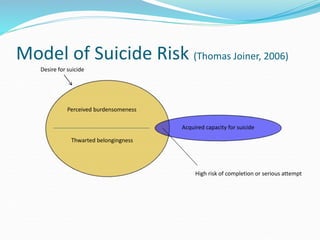
Model of Suicide Risk (Thomas Joiner, 2006)
Desire for suicide
Perceived burdensomeness
Thwarted belongingness
Acquired capacity for suicide
High risk of completion or serious attempt
Protective Factors
 Strong family and friend supports
 Connection to community – school, organizations,etc.
 Religious/Spiritual belief system
 Positive self-esteem
 Positive cognitive style – optimistic, good problem
solving
 Means restriction
RECESS or SHORT BREAK
 Name one risk factor for youth suicide
 Name one protective factor for youth suicide
Warning Signs
Warning Signs in Youth:
 Being preoccupied with death in conversation, writing,
or drawing.
 Making suicidal statements.
 Giving away belongings.
 Withdrawing from friends and family.
 Having aggressive or hostile behavior.
 Neglecting personal appearance.
 Running away from home.
 Risk-taking behavior, such as reckless driving or being
sexually promiscuous.
 A change in personality (such as from upbeat to quiet).
Problems that may Trigger a Suicide
Attempt in Youth:
 INTERNAL
 Drug or alcohol use problems.
 Stress caused by physical changes related to
puberty, chronic illness, and/or sexually transmitted
diseases.
 Withdrawing from others and keeping thoughts to
themselves.
 Uncertainty surrounding sexual orientation (such as
bisexuality or homosexuality).
Problems that may trigger a Suicide
Attempt in Youth
 EXTERNAL
 Possession or purchase of weapon, pills, or other
means of inflicting self-harm.
 Legal or discipline problems.
 Witnessing the suicide of a family member.
 Troubles at school, such as falling grades, disruptive
behavior, or frequent absences.
 Loss of a parent or close family member through
death or divorce.
Suicide in Elementary School
 Although the incidence of suicide is low prior to
adolescence, suicide still ranks as the 11th leading
cause of death in children aged 5 to 11 years, with
devastating consequences for families.5
 Suicide is a leading cause of death among school-aged
children younger than 12 years old, and the suicide rate
has increased significantly in black children in this age
group.3
 Suicidal ideation: highest rates in middle school
 Suicidal attempts and death by suicide: increases
in high school and beyond
Risk Factors for Younger Students
 Multiple losses in the family: death, suicide, illness of
family members
 Major disruptions in the family: i.e. divorce
 Suffered abuse and neglect
 Exposure to violence: Tragic public events; school
 shootings, etc. - repeated TV coverage of tragedies
 Witnessing/experiencing family abuse
 Family moving, single family structure
 Learning Difficulties
 Chronic medical illness
Protective Factors in Younger
Students • School Climate
• Strong sense of self-worth or self-
esteem
 Pets – responsibilities/duties to
others
 Reasonably safe and stable
environment
 Connectedness
 Family
 Peers
 School
 Trusted Adults
 Community
What do Children Understand About
Suicide?
 3 concepts children should understand about death:
 Irreversible, it is final, it is not a trip from which they
will return
 Brings about non-functionality- the body functions stop
the person is not asleep
 Inevitable-everyone will die sometime
Most children understand these concepts by age 9 y/o
If there has been a death in the family, children may
understand these concepts earlier.
Usually by the 5th grade more than 90% understand
suicide.
Warning Signs in Younger
Students
Internal Signs
 Excessive somatic complaints (head - body aches)
 Anxiety or worry. sleep problems or nightmares
 Suicidal Thoughts or ideation
 External Signs
 Hyperkinesis; fidgeting, constant movement
 Suicidal threats
 Attempt to harm self i.e.: cutting skin or rubbing objects
(pencil eraser) on their body to break the skin
 Children often express their pain in writing – artwork
 Anger, frustration, frequent temper tantrums
Warning Signs in Younger
Students Cont.
 Specific to Schools:
 Poor school performance, marked decline in work
 Absenteeism, not wanting to go to school
 Bullying or being bullied
What does Prevention Look
Like?
 Less talking about suicide
 More about helping kids:
 To learn how to recognize and cope with difficult
emotions
 Feel and show empathy for others
 Build and maintain healthy social relationships
 Know where to turn and get help
Programs that accomplish this:
PATHS, The Good Behavior Game,
“What do I do?”
 ASK— “Are you having thoughts of suicide?” Have you
tried to kill yourself before? How did you try/would
you do it?
 LISTEN— “Tell me what’s been going on for you.”
 TAKE ACTION. DO a suicide risk assessment-
Connect to supportive services
 Don’t underestimate impulsivity in youth
 Don’t underestimate if the suicidal plan or thoughts
seem far-flung or improbable
Colorado Crisis Services
 Statewide crisis line
 1-844-493-TALK (8255)
 24/7/365
 Connects to resources or crisis services in the city or
state
Safe2Tell
 YOUNG people can report any threatening behaviors
or activities endangering themselves or someone they
know,
 Safe and anonymous
 Call 1-877-542-7233
 Submitting a tip at http://safe2tell.org/
National Suicide Prevention Hotline
 1-800-273-8255
 24 hour hotline
 Spanish and English
Facts for Families
 Online resource for families with information about
mental illness and treatment options
 www.aacap.org “Families and Youth” “Facts for
Families”
Half of Us
 Halfofus.com
 Support line
 Provides information about mental health issues
 Videos of celebrities and regular people (teens, adults)
who struggle with mental illness or have been affected
by mental illness
 Partnership between mtvU and Jed Foundation
Trevor Project
 The Trevor Project offers accredited life-saving, life-
affirming programs and services to LGBTQ youth that
create safe, accepting and inclusive environments over
the phone, online and through text.
 Operates the nation’s only 24-hour toll-free suicide
prevention helpline for LGBTQQ youth
 1.866.4.U.TREVOR
 www.thetrevorproject.org
Denver Health School Based Health
Centers
 1987-Denver Health received a grant to open the first
School Based Health Center at Abraham Lincoln, in
Denver, CO.
 As of 2016 we have 17 SBHCs in the City and County of
Denver, CO
 Every student enrolled in the Denver Public School system
has access to either their community school clinic or 3
regional clinics.
 Collaborative effort within the community including
Denver Health, Denver Public Schools, Mental Health
Center of Denver, and Jewish Family Services
Questions?
 Emails
 Kristie.ladegard@dhha.org
 Scot.McKay@dhha.org
References
 1 Suicidal behavior in children and adolescents: Epidemiology and risk factors
www.uptodate.com ©2016 UpToDate®
 2American Association of Suicidology. (2011). Youth suicidal behavior fact sheet. Accessed at
www.suicidology.org/web/guest/stats-and-tools/fact-sheets
 3 Peterson J, Freedenthal S, Coles A, (2010), Adolescents who self-harm: How to protect them
from themselves. Current Psychiatry Aug ;9(8)1-8
 4 Colorado Health and Environmental Data. Colorado Health Information Dataset (CoHID)
Colorado Death Dataset Query. http://www.cdh.dphe.state.co.us/cohid/Default.aspx
 5 Centers for Disease Control and Prevention. WISQARS Leading Causes of Death Reports,
National and Regional, 1999-2012. National Center for Health Statistics, National Vital
Statistics System. http://webappa.cdc.gov/sasweb/ncipc/leadcaus10_us.html. Accessed
November 14, 2014
 6 Blum, R. W., McNeely, C., & Rinehart, P. M. (2002). Improving the odds: The untapped
power of schools to improve the health of teens. Minneapolis: Center for Adolescent
Health and Development, University of Minnesota. Retrieved from http://casel.org/wp-
content/uploads/blum.pdf
 7 Bridge, J, Asti Lindsey et.al. (2015) Suicide Trends Among Elementary School-Aged
Children in the United States from 1993 to 2012. Journal of American Medical Association
Pediatrics 169(7): 673-677
References
 8 Suicide Prevention Awareness A Toolkit for Maine School Personnel
The National Alliance on Mental Illness (NAMI): Maine, Maine
Department of Education, and the Maine Center for Disease Control
and Prevention accessed at
http://c.ymcdn.com/sites/www.namimaine.org/resource/resmgr/Suicide-
Toolkit/Suicide_Prevention_Awareness.pdf

elementary school suicide prevention training powerpoint.ppt

  • 1.
    Presented by: Kristie LadegardM.D. Scot McKay M.D.
  • 2.
     Kristie Ladegard,MD, Denver Health Child Psychiatrist • At 7 School Based Health Centers (SBHC) in Denver • Family Crisis Center (FCC) • Substance Abuse Treatment Education & Prevention program (STEP) • Scot McKay, MD, Denver Health Child Psychiatrist • At 6 School Based Health Centers (SBHC) in Denver • Family Crisis Center (FCC) • Outpatient Behavioral Health  Disclosures: Grant Support from the American Academy of Child and Adolescent Psychiatry
  • 3.
    Learning Objectives:  Listprotective and risk factors in youth suicide  Describe warning signs of suicide both in teens and in younger youth.  Explain steps to take when approaching suicidal youth
  • 4.
    Why Should SchoolsCare About Suicide?  A student’s mental health can affect their academic performance.  Maintaining a safe environment is part of a school’s overall mission  A student suicide can significantly impact other students and the entire school community.  95% of American youth are enrolled in schools, they provide an optimal environment for identifying, and reaching out to youth at risk for suicide.
  • 5.
    Why Should SchoolsCare About Suicide Cont. Teachers play an important role in school connectedness. Connectedness is an important factor in improving academic achievement and reductions in suicidal thoughts and attempts.6
  • 6.
    Suicide Statistics  Suicideis the 3rd leading cause of death among all children and adolescents in the United States, including ages 10 to 19 years 1  Girls are more likely to attempt suicide but male youth die by suicide 5 times more frequently than females.2  1 in 5 U.S. high school students have suicidal thoughts each year, and 1 in 10 attempt suicide.3  Although the incidence of suicide is low prior to adolescence, suicide still ranks as the 11th leading cause of death in children aged 5 to 11 years, with devastating consequences for families.5
  • 7.
    Suicide is aLeading Cause of Death in Colorado  Colorado is known to have one of the highest suicide rates in the nation, and it ranks in the top 10 coming in at #5 in 2014.2  Between 2008 and 2012 suicide was the 2nd leading cause of death in youth ages 10-19 only behind unintentional injuries in Colorado. 4
  • 8.
    Method by AdolescentMales 4 42.6% 44.6% 5.9% 6.9% Adolescent suicide method by gender, Colorado 2008-2012 Males Firearm Hanging Poisoning Other/Unspecified
  • 9.
  • 10.
    12.10 6.95 6.32 17.72 5.46 11.01 0 2 4 6 8 10 12 14 16 18 20 Suicide Rateby Race ages 15-24, 2011 Series 1 Suicide Demographics 2
  • 12.
    Risk Factors  Depressiondevelops as a combination of genetic predisposing factors and environmental factors – nature AND nurture  Top factors:  Family history of suicide / attempts and psychopathology  History of past suicide attempts  Other psychiatric disorders such as ADHD, anxiety, intellectual disability, and substance abuse  Impulsivity and aggression  Availability of lethal agents  On-going exposure to negative events such as abuse/neglect or bullying/peer victimization  Those cyberbullied report 2x more likely to attempt suicide  Negative cognitive style – pessimism, inflexible thinking
  • 13.
    Risk factors  Gender Males have higher rates of suicide and females have higher rates of unsuccessful attempts  60% higher rate of depression in prepubertal boys than girls  LGBTQ youth have more likely to experience SI and make attempts
  • 14.
    Model of SuicideRisk (Thomas Joiner, 2006) Desire for suicide Perceived burdensomeness Thwarted belongingness Acquired capacity for suicide High risk of completion or serious attempt
  • 15.
    Protective Factors  Strongfamily and friend supports  Connection to community – school, organizations,etc.  Religious/Spiritual belief system  Positive self-esteem  Positive cognitive style – optimistic, good problem solving  Means restriction
  • 16.
    RECESS or SHORTBREAK  Name one risk factor for youth suicide  Name one protective factor for youth suicide
  • 17.
  • 18.
    Warning Signs inYouth:  Being preoccupied with death in conversation, writing, or drawing.  Making suicidal statements.  Giving away belongings.  Withdrawing from friends and family.  Having aggressive or hostile behavior.  Neglecting personal appearance.  Running away from home.  Risk-taking behavior, such as reckless driving or being sexually promiscuous.  A change in personality (such as from upbeat to quiet).
  • 19.
    Problems that mayTrigger a Suicide Attempt in Youth:  INTERNAL  Drug or alcohol use problems.  Stress caused by physical changes related to puberty, chronic illness, and/or sexually transmitted diseases.  Withdrawing from others and keeping thoughts to themselves.  Uncertainty surrounding sexual orientation (such as bisexuality or homosexuality).
  • 20.
    Problems that maytrigger a Suicide Attempt in Youth  EXTERNAL  Possession or purchase of weapon, pills, or other means of inflicting self-harm.  Legal or discipline problems.  Witnessing the suicide of a family member.  Troubles at school, such as falling grades, disruptive behavior, or frequent absences.  Loss of a parent or close family member through death or divorce.
  • 21.
    Suicide in ElementarySchool  Although the incidence of suicide is low prior to adolescence, suicide still ranks as the 11th leading cause of death in children aged 5 to 11 years, with devastating consequences for families.5  Suicide is a leading cause of death among school-aged children younger than 12 years old, and the suicide rate has increased significantly in black children in this age group.3  Suicidal ideation: highest rates in middle school  Suicidal attempts and death by suicide: increases in high school and beyond
  • 22.
    Risk Factors forYounger Students  Multiple losses in the family: death, suicide, illness of family members  Major disruptions in the family: i.e. divorce  Suffered abuse and neglect  Exposure to violence: Tragic public events; school  shootings, etc. - repeated TV coverage of tragedies  Witnessing/experiencing family abuse  Family moving, single family structure  Learning Difficulties  Chronic medical illness
  • 23.
    Protective Factors inYounger Students • School Climate • Strong sense of self-worth or self- esteem  Pets – responsibilities/duties to others  Reasonably safe and stable environment  Connectedness  Family  Peers  School  Trusted Adults  Community
  • 24.
    What do ChildrenUnderstand About Suicide?  3 concepts children should understand about death:  Irreversible, it is final, it is not a trip from which they will return  Brings about non-functionality- the body functions stop the person is not asleep  Inevitable-everyone will die sometime Most children understand these concepts by age 9 y/o If there has been a death in the family, children may understand these concepts earlier. Usually by the 5th grade more than 90% understand suicide.
  • 25.
    Warning Signs inYounger Students Internal Signs  Excessive somatic complaints (head - body aches)  Anxiety or worry. sleep problems or nightmares  Suicidal Thoughts or ideation  External Signs  Hyperkinesis; fidgeting, constant movement  Suicidal threats  Attempt to harm self i.e.: cutting skin or rubbing objects (pencil eraser) on their body to break the skin  Children often express their pain in writing – artwork  Anger, frustration, frequent temper tantrums
  • 26.
    Warning Signs inYounger Students Cont.  Specific to Schools:  Poor school performance, marked decline in work  Absenteeism, not wanting to go to school  Bullying or being bullied
  • 27.
    What does PreventionLook Like?  Less talking about suicide  More about helping kids:  To learn how to recognize and cope with difficult emotions  Feel and show empathy for others  Build and maintain healthy social relationships  Know where to turn and get help Programs that accomplish this: PATHS, The Good Behavior Game,
  • 28.
    “What do Ido?”  ASK— “Are you having thoughts of suicide?” Have you tried to kill yourself before? How did you try/would you do it?  LISTEN— “Tell me what’s been going on for you.”  TAKE ACTION. DO a suicide risk assessment- Connect to supportive services  Don’t underestimate impulsivity in youth  Don’t underestimate if the suicidal plan or thoughts seem far-flung or improbable
  • 29.
    Colorado Crisis Services Statewide crisis line  1-844-493-TALK (8255)  24/7/365  Connects to resources or crisis services in the city or state
  • 30.
    Safe2Tell  YOUNG peoplecan report any threatening behaviors or activities endangering themselves or someone they know,  Safe and anonymous  Call 1-877-542-7233  Submitting a tip at http://safe2tell.org/
  • 31.
    National Suicide PreventionHotline  1-800-273-8255  24 hour hotline  Spanish and English
  • 32.
    Facts for Families Online resource for families with information about mental illness and treatment options  www.aacap.org “Families and Youth” “Facts for Families”
  • 33.
    Half of Us Halfofus.com  Support line  Provides information about mental health issues  Videos of celebrities and regular people (teens, adults) who struggle with mental illness or have been affected by mental illness  Partnership between mtvU and Jed Foundation
  • 34.
    Trevor Project  TheTrevor Project offers accredited life-saving, life- affirming programs and services to LGBTQ youth that create safe, accepting and inclusive environments over the phone, online and through text.  Operates the nation’s only 24-hour toll-free suicide prevention helpline for LGBTQQ youth  1.866.4.U.TREVOR  www.thetrevorproject.org
  • 35.
    Denver Health SchoolBased Health Centers  1987-Denver Health received a grant to open the first School Based Health Center at Abraham Lincoln, in Denver, CO.  As of 2016 we have 17 SBHCs in the City and County of Denver, CO  Every student enrolled in the Denver Public School system has access to either their community school clinic or 3 regional clinics.  Collaborative effort within the community including Denver Health, Denver Public Schools, Mental Health Center of Denver, and Jewish Family Services
  • 37.
  • 38.
    References  1 Suicidalbehavior in children and adolescents: Epidemiology and risk factors www.uptodate.com ©2016 UpToDate®  2American Association of Suicidology. (2011). Youth suicidal behavior fact sheet. Accessed at www.suicidology.org/web/guest/stats-and-tools/fact-sheets  3 Peterson J, Freedenthal S, Coles A, (2010), Adolescents who self-harm: How to protect them from themselves. Current Psychiatry Aug ;9(8)1-8  4 Colorado Health and Environmental Data. Colorado Health Information Dataset (CoHID) Colorado Death Dataset Query. http://www.cdh.dphe.state.co.us/cohid/Default.aspx  5 Centers for Disease Control and Prevention. WISQARS Leading Causes of Death Reports, National and Regional, 1999-2012. National Center for Health Statistics, National Vital Statistics System. http://webappa.cdc.gov/sasweb/ncipc/leadcaus10_us.html. Accessed November 14, 2014  6 Blum, R. W., McNeely, C., & Rinehart, P. M. (2002). Improving the odds: The untapped power of schools to improve the health of teens. Minneapolis: Center for Adolescent Health and Development, University of Minnesota. Retrieved from http://casel.org/wp- content/uploads/blum.pdf  7 Bridge, J, Asti Lindsey et.al. (2015) Suicide Trends Among Elementary School-Aged Children in the United States from 1993 to 2012. Journal of American Medical Association Pediatrics 169(7): 673-677
  • 39.
    References  8 SuicidePrevention Awareness A Toolkit for Maine School Personnel The National Alliance on Mental Illness (NAMI): Maine, Maine Department of Education, and the Maine Center for Disease Control and Prevention accessed at http://c.ymcdn.com/sites/www.namimaine.org/resource/resmgr/Suicide- Toolkit/Suicide_Prevention_Awareness.pdf

Editor's Notes

  • #5 Depression and other brain conditions can interfere with the ability to learn
  • #9 44.6% males by hanging 42.6 % males by firearm 6.9% males other 5.9% males by poisoning
  • #10 74.6% females by hanging 14.9% females by poisoning 10.4% females by firearm
  • #17 Will ask a question of the audience and throw candy to them.
  • #24 This is from Maine Suicide Prevention Toolkit
  • #28 A follow-up study of students who had the GBG in first and second grade found an almost 50% reduction in suicide attempts at age 20. Suicide Prevention Resource Center (Kellam et al., 2011). The Good Behavior Game rewards positive group, as opposed to individual, behavior. The teacher initially divides her class into three heterogeneous teams, and reads the Game’s rules to the class. Teams receive check marks on a posted chart when one of their members exhibits a disruptive behavior (e.g., talking out of turn, fighting). Any team with four or fewer check marks at the end of a specified time – ranging from 10 minutes at the start of the year to a full day later on – is rewarded. Tangible rewards are used early in the year (e.g., stickers, activity books). As the year progresses, intangible rewards (e.g., designing a bulletin board), delay in reward delivery, and fading of rewards are used to generalize behaviors. The Game is supplemented by weekly teacher-led class meetings designed to build children’s skills in social problem solving. PATHS- Promoting Alternative Thinking Strategies Is a comprehensive program for promoting emotional and social competencies and reducing aggression and behavior problems in elementary school-aged children while simultaneously enhancing the educational process in the classroom. This innovative curriculum is designed to be used by educators and counselors in a multi-year, universal prevention model. Wellness is more than an absence of disease. It involves complete general, mental and social well-being. And mental health is an essential component of overall health and well-being. The fact is our overall well-being is tied to the balance that exists between our emotional, physical, spiritual and mental health. Whatever our situation, we are all at risk of stress given the demands of daily life and the challenges it brings-at home, at work and in life. Steps that build and maintain well-being and help us all achieve wellness involve a balanced diet, regular exercise, enough sleep, a sense of self-worth, development of coping skills that promote resiliency, emotional awareness, and connections to family, friends and community.