1
Electronics, Communication and Information Engineering (MTQP05)
)
Syllabus
for
Electronics, Communication and
Information Engineering
(MTQP05)
2
Electronics, Communication and Information Engineering (MTQP05)
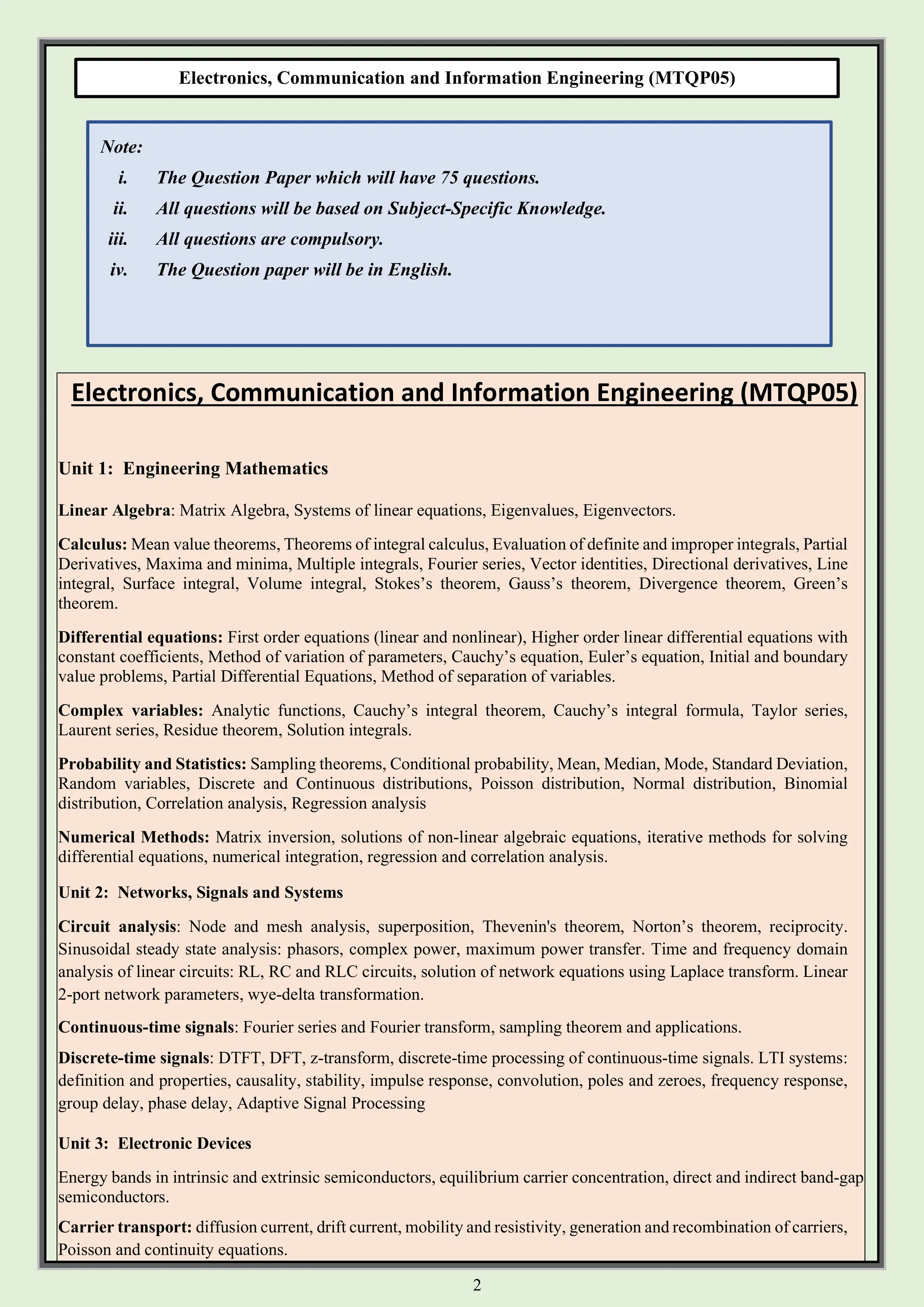
Unit 1: Engineering Mathematics
Linear Algebra: Matrix Algebra, Systems of linear equations, Eigenvalues, Eigenvectors.
Calculus: Mean value theorems, Theorems of integral calculus, Evaluation of definite and improper integrals, Partial
Derivatives, Maxima and minima, Multiple integrals, Fourier series, Vector identities, Directional derivatives, Line
integral, Surface integral, Volume integral, Stokes’s theorem, Gauss’s theorem, Divergence theorem, Green’s
theorem.
Differential equations: First order equations (linear and nonlinear), Higher order linear differential equations with
constant coefficients, Method of variation of parameters, Cauchy’s equation, Euler’s equation, Initial and boundary
value problems, Partial Differential Equations, Method of separation of variables.
Complex variables: Analytic functions, Cauchy’s integral theorem, Cauchy’s integral formula, Taylor series,
Laurent series, Residue theorem, Solution integrals.
Probability and Statistics: Sampling theorems, Conditional probability, Mean, Median, Mode, Standard Deviation,
Random variables, Discrete and Continuous distributions, Poisson distribution, Normal distribution, Binomial
distribution, Correlation analysis, Regression analysis
Numerical Methods: Matrix inversion, solutions of non-linear algebraic equations, iterative methods for solving
differential equations, numerical integration, regression and correlation analysis.
Unit 2: Networks, Signals and Systems
Circuit analysis: Node and mesh analysis, superposition, Thevenin's theorem, Norton’s theorem, reciprocity.
Sinusoidal steady state analysis: phasors, complex power, maximum power transfer. Time and frequency domain
analysis of linear circuits: RL, RC and RLC circuits, solution of network equations using Laplace transform. Linear
2-port network parameters, wye-delta transformation.
Continuous-time signals: Fourier series and Fourier transform, sampling theorem and applications.
Discrete-time signals: DTFT, DFT, z-transform, discrete-time processing of continuous-time signals. LTI systems:
definition and properties, causality, stability, impulse response, convolution, poles and zeroes, frequency response,
group delay, phase delay, Adaptive Signal Processing
Unit 3: Electronic Devices
Energy bands in intrinsic and extrinsic semiconductors, equilibrium carrier concentration, direct and indirect band-gap
semiconductors.
Carrier transport: diffusion current, drift current, mobility and resistivity, generation and recombination of carriers,
Poisson and continuity equations.
Note:
i. The Question Paper which will have 75 questions.
ii. All questions will be based on Subject-Specific Knowledge.
iii. All questions are compulsory.
iv. The Question paper will be in English.
3
Electronics, Communication and Information Engineering (MTQP05)
)
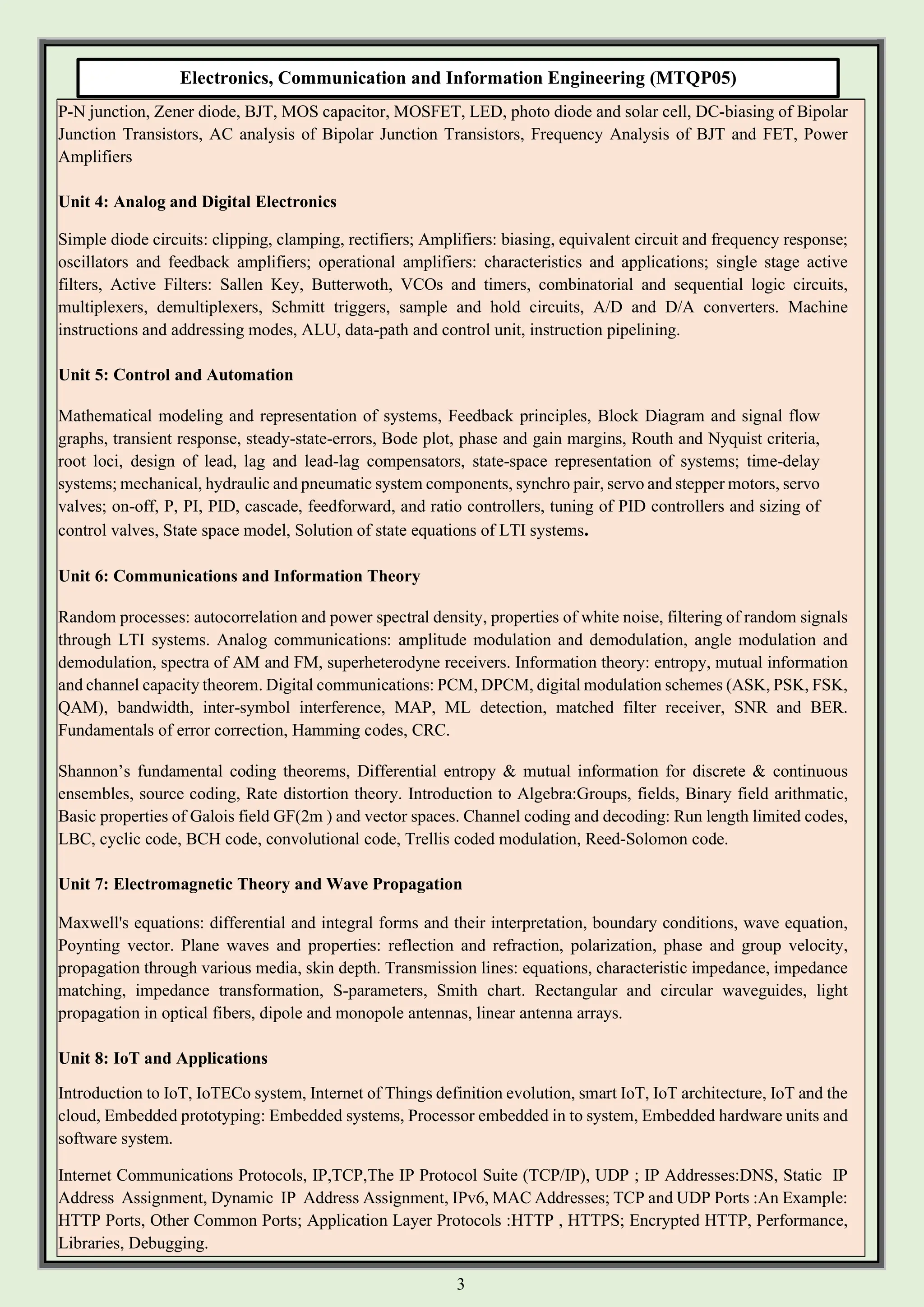
P-N junction, Zener diode, BJT, MOS capacitor, MOSFET, LED, photo diode and solar cell, DC-biasing of Bipolar
Junction Transistors, AC analysis of Bipolar Junction Transistors, Frequency Analysis of BJT and FET, Power
Amplifiers
Unit 4: Analog and Digital Electronics
Simple diode circuits: clipping, clamping, rectifiers; Amplifiers: biasing, equivalent circuit and frequency response;
oscillators and feedback amplifiers; operational amplifiers: characteristics and applications; single stage active
filters, Active Filters: Sallen Key, Butterwoth, VCOs and timers, combinatorial and sequential logic circuits,
multiplexers, demultiplexers, Schmitt triggers, sample and hold circuits, A/D and D/A converters. Machine
instructions and addressing modes, ALU, data-path and control unit, instruction pipelining.
Unit 5: Control and Automation
Mathematical modeling and representation of systems, Feedback principles, Block Diagram and signal flow
graphs, transient response, steady-state-errors, Bode plot, phase and gain margins, Routh and Nyquist criteria,
root loci, design of lead, lag and lead-lag compensators, state-space representation of systems; time-delay
systems; mechanical, hydraulic and pneumatic system components, synchro pair, servo and stepper motors, servo
valves; on-off, P, PI, PID, cascade, feedforward, and ratio controllers, tuning of PID controllers and sizing of
control valves, State space model, Solution of state equations of LTI systems.
Unit 6: Communications and Information Theory
Random processes: autocorrelation and power spectral density, properties of white noise, filtering of random signals
through LTI systems. Analog communications: amplitude modulation and demodulation, angle modulation and
demodulation, spectra of AM and FM, superheterodyne receivers. Information theory: entropy, mutual information
and channel capacity theorem. Digital communications: PCM, DPCM, digital modulation schemes (ASK, PSK, FSK,
QAM), bandwidth, inter-symbol interference, MAP, ML detection, matched filter receiver, SNR and BER.
Fundamentals of error correction, Hamming codes, CRC.
Shannon’s fundamental coding theorems, Differential entropy & mutual information for discrete & continuous
ensembles, source coding, Rate distortion theory. Introduction to Algebra:Groups, fields, Binary field arithmatic,
Basic properties of Galois field GF(2m ) and vector spaces. Channel coding and decoding: Run length limited codes,
LBC, cyclic code, BCH code, convolutional code, Trellis coded modulation, Reed-Solomon code.
Unit 7: Electromagnetic Theory and Wave Propagation
Maxwell's equations: differential and integral forms and their interpretation, boundary conditions, wave equation,
Poynting vector. Plane waves and properties: reflection and refraction, polarization, phase and group velocity,
propagation through various media, skin depth. Transmission lines: equations, characteristic impedance, impedance
matching, impedance transformation, S-parameters, Smith chart. Rectangular and circular waveguides, light
propagation in optical fibers, dipole and monopole antennas, linear antenna arrays.
Unit 8: IoT and Applications
Introduction to IoT, IoTECo system, Internet of Things definition evolution, smart IoT, IoT architecture, IoT and the
cloud, Embedded prototyping: Embedded systems, Processor embedded in to system, Embedded hardware units and
software system.
Internet Communications Protocols, IP,TCP,The IP Protocol Suite (TCP/IP), UDP ; IP Addresses:DNS, Static IP
Address Assignment, Dynamic IP Address Assignment, IPv6, MAC Addresses; TCP and UDP Ports :An Example:
HTTP Ports, Other Common Ports; Application Layer Protocols :HTTP , HTTPS; Encrypted HTTP, Performance,
Libraries, Debugging.
2
Electronics, Communication and Information Engineering (MTQP05)
***

Electronics, Communication and Information Engineering (MTQP05) (1).pdf

  • 1.
    1 Electronics, Communication andInformation Engineering (MTQP05) ) Syllabus for Electronics, Communication and Information Engineering (MTQP05)
  • 2.
    2 Electronics, Communication andInformation Engineering (MTQP05) Electronics, Communication and Information Engineering (MTQP05) Unit 1: Engineering Mathematics Linear Algebra: Matrix Algebra, Systems of linear equations, Eigenvalues, Eigenvectors. Calculus: Mean value theorems, Theorems of integral calculus, Evaluation of definite and improper integrals, Partial Derivatives, Maxima and minima, Multiple integrals, Fourier series, Vector identities, Directional derivatives, Line integral, Surface integral, Volume integral, Stokes’s theorem, Gauss’s theorem, Divergence theorem, Green’s theorem. Differential equations: First order equations (linear and nonlinear), Higher order linear differential equations with constant coefficients, Method of variation of parameters, Cauchy’s equation, Euler’s equation, Initial and boundary value problems, Partial Differential Equations, Method of separation of variables. Complex variables: Analytic functions, Cauchy’s integral theorem, Cauchy’s integral formula, Taylor series, Laurent series, Residue theorem, Solution integrals. Probability and Statistics: Sampling theorems, Conditional probability, Mean, Median, Mode, Standard Deviation, Random variables, Discrete and Continuous distributions, Poisson distribution, Normal distribution, Binomial distribution, Correlation analysis, Regression analysis Numerical Methods: Matrix inversion, solutions of non-linear algebraic equations, iterative methods for solving differential equations, numerical integration, regression and correlation analysis. Unit 2: Networks, Signals and Systems Circuit analysis: Node and mesh analysis, superposition, Thevenin's theorem, Norton’s theorem, reciprocity. Sinusoidal steady state analysis: phasors, complex power, maximum power transfer. Time and frequency domain analysis of linear circuits: RL, RC and RLC circuits, solution of network equations using Laplace transform. Linear 2-port network parameters, wye-delta transformation. Continuous-time signals: Fourier series and Fourier transform, sampling theorem and applications. Discrete-time signals: DTFT, DFT, z-transform, discrete-time processing of continuous-time signals. LTI systems: definition and properties, causality, stability, impulse response, convolution, poles and zeroes, frequency response, group delay, phase delay, Adaptive Signal Processing Unit 3: Electronic Devices Energy bands in intrinsic and extrinsic semiconductors, equilibrium carrier concentration, direct and indirect band-gap semiconductors. Carrier transport: diffusion current, drift current, mobility and resistivity, generation and recombination of carriers, Poisson and continuity equations. Note: i. The Question Paper which will have 75 questions. ii. All questions will be based on Subject-Specific Knowledge. iii. All questions are compulsory. iv. The Question paper will be in English.
  • 3.
    3 Electronics, Communication andInformation Engineering (MTQP05) ) P-N junction, Zener diode, BJT, MOS capacitor, MOSFET, LED, photo diode and solar cell, DC-biasing of Bipolar Junction Transistors, AC analysis of Bipolar Junction Transistors, Frequency Analysis of BJT and FET, Power Amplifiers Unit 4: Analog and Digital Electronics Simple diode circuits: clipping, clamping, rectifiers; Amplifiers: biasing, equivalent circuit and frequency response; oscillators and feedback amplifiers; operational amplifiers: characteristics and applications; single stage active filters, Active Filters: Sallen Key, Butterwoth, VCOs and timers, combinatorial and sequential logic circuits, multiplexers, demultiplexers, Schmitt triggers, sample and hold circuits, A/D and D/A converters. Machine instructions and addressing modes, ALU, data-path and control unit, instruction pipelining. Unit 5: Control and Automation Mathematical modeling and representation of systems, Feedback principles, Block Diagram and signal flow graphs, transient response, steady-state-errors, Bode plot, phase and gain margins, Routh and Nyquist criteria, root loci, design of lead, lag and lead-lag compensators, state-space representation of systems; time-delay systems; mechanical, hydraulic and pneumatic system components, synchro pair, servo and stepper motors, servo valves; on-off, P, PI, PID, cascade, feedforward, and ratio controllers, tuning of PID controllers and sizing of control valves, State space model, Solution of state equations of LTI systems. Unit 6: Communications and Information Theory Random processes: autocorrelation and power spectral density, properties of white noise, filtering of random signals through LTI systems. Analog communications: amplitude modulation and demodulation, angle modulation and demodulation, spectra of AM and FM, superheterodyne receivers. Information theory: entropy, mutual information and channel capacity theorem. Digital communications: PCM, DPCM, digital modulation schemes (ASK, PSK, FSK, QAM), bandwidth, inter-symbol interference, MAP, ML detection, matched filter receiver, SNR and BER. Fundamentals of error correction, Hamming codes, CRC. Shannon’s fundamental coding theorems, Differential entropy & mutual information for discrete & continuous ensembles, source coding, Rate distortion theory. Introduction to Algebra:Groups, fields, Binary field arithmatic, Basic properties of Galois field GF(2m ) and vector spaces. Channel coding and decoding: Run length limited codes, LBC, cyclic code, BCH code, convolutional code, Trellis coded modulation, Reed-Solomon code. Unit 7: Electromagnetic Theory and Wave Propagation Maxwell's equations: differential and integral forms and their interpretation, boundary conditions, wave equation, Poynting vector. Plane waves and properties: reflection and refraction, polarization, phase and group velocity, propagation through various media, skin depth. Transmission lines: equations, characteristic impedance, impedance matching, impedance transformation, S-parameters, Smith chart. Rectangular and circular waveguides, light propagation in optical fibers, dipole and monopole antennas, linear antenna arrays. Unit 8: IoT and Applications Introduction to IoT, IoTECo system, Internet of Things definition evolution, smart IoT, IoT architecture, IoT and the cloud, Embedded prototyping: Embedded systems, Processor embedded in to system, Embedded hardware units and software system. Internet Communications Protocols, IP,TCP,The IP Protocol Suite (TCP/IP), UDP ; IP Addresses:DNS, Static IP Address Assignment, Dynamic IP Address Assignment, IPv6, MAC Addresses; TCP and UDP Ports :An Example: HTTP Ports, Other Common Ports; Application Layer Protocols :HTTP , HTTPS; Encrypted HTTP, Performance, Libraries, Debugging.
  • 4.
    2 Electronics, Communication andInformation Engineering (MTQP05) ***