uy & divinosa
LEARN ALL ABOUT:
fet biasing:
self-bias
configuration
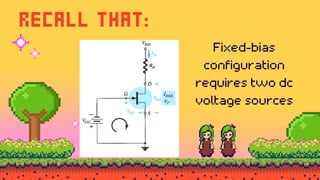
recall that:
Fixed-bias
configuration
requires two dc
voltage sources
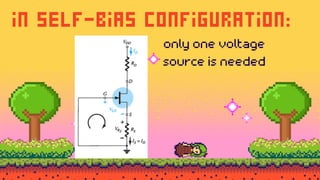
in self-bias configuration:
only one voltage
source is needed
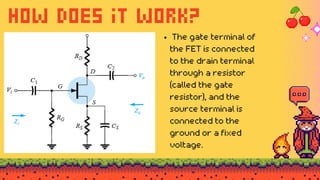
The gate terminal of
the FET is connected
to the drain terminal
through a resistor
(called the gate
resistor), and the
source terminal is
connected to the
ground or a fixed
voltage.
how does it work?
how does it work?
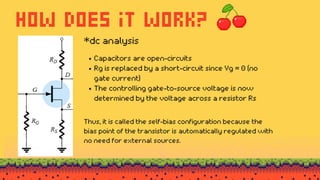
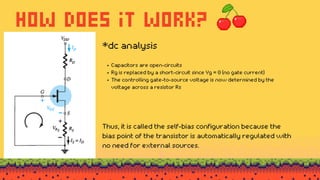
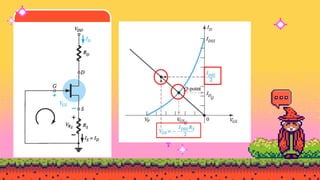
Capacitors are open-circuits
Rg is replaced by a short-circuit since Vg = 0 (no
gate current)
The controlling gate-to-source voltage is now
determined by the voltage across a resistor Rs
*dc analysis
Thus, it is called the self-bias configuration because the
bias point of the transistor is automatically regulated with
no need for external sources.
how does it work?
Capacitors are open-circuits
Rg is replaced by a short-circuit since Vg = 0 (no gate current)
The controlling gate-to-source voltage is now determined by the
voltage across a resistor Rs
*dc analysis
Thus, it is called the self-bias configuration because the
bias point of the transistor is automatically regulated with
no need for external sources.
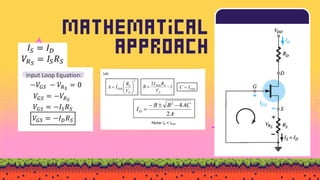
mathematical
approach
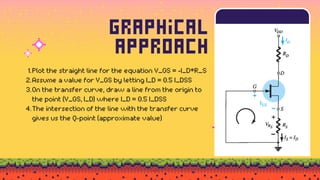
graphical
approach
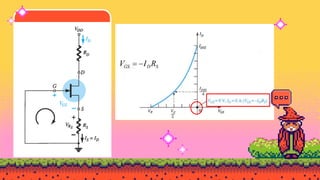
Plot the straight line for the equation V_GS = -I_D*R_S
1.
Assume a value for V_GS by letting I_D = 0.5 I_DSS
2.
On the transfer curve, draw a line from the origin to
the point (V_GS, I_D) where I_D = 0.5 I_DSS
3.
The intersection of the line with the transfer curve
gives us the Q-point (approximate value)
4.
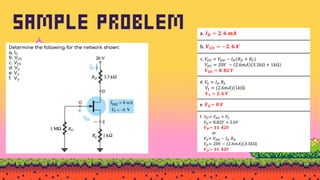
sample problem
sample problem
sample problem
sample problem
sample problem
sample problem
sample problem
sample problem
sample problem
sample problem
References
Electronic Devices and Circuit Theory by Boylestad and Nashelsky
1.
https://madpcb.com/glossary/fet-biasing/
2.
https://www.quora.com/What-is-a-self-bias-circuit
3.
ASOJDNASOJDASDASAKDASJ

Electronic Devices and Circuits FET Self-bias