UCSD Physics 10
Spring 2008 1
Electromagnetism
• Electricity and magnetism are different facets of
electromagnetism
– a moving electric charge produces magnetic fields
– changing magnetic fields move electric charges
• This connection first elucidated by Faraday, Maxwell
• Einstein saw electricity and magnetism as frame-
dependent facets of unified electromagnetic force
UCSD Physics 10
Spring 2008 2
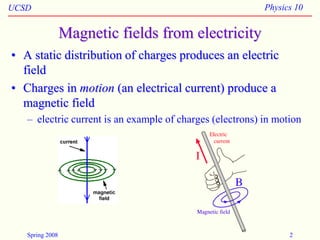
Magnetic fields from electricity
• A static distribution of charges produces an electric
field
• Charges in motion (an electrical current) produce a
magnetic field
– electric current is an example of charges (electrons) in motion
UCSD Physics 10
Spring 2008 3
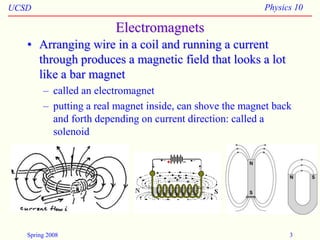
Electromagnets
• Arranging wire in a coil and running a current
through produces a magnetic field that looks a lot
like a bar magnet
– called an electromagnet
– putting a real magnet inside, can shove the magnet back
and forth depending on current direction: called a
solenoid
UCSD Physics 10
Spring 2008 4
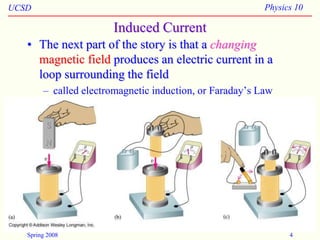
Induced Current
• The next part of the story is that a changing
magnetic field produces an electric current in a
loop surrounding the field
– called electromagnetic induction, or Faraday’s Law
UCSD Physics 10
Spring 2008 5
The Electromagnetic Connection
• A changing magnetic field produces an electric field, and a
changing electric field produces a magnetic field.
• Electric and Magnetic fields can produce forces on charges
• An accelerating charge produces electromagnetic waves
(radiation)
• Both electric and magnetic fields can transport energy
– Electric field energy used in electrical circuits, e.g., released in
lightning
– Magnetic field carries energy through transformer, for example
UCSD Physics 10
Spring 2008 6
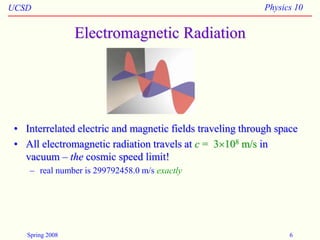
Electromagnetic Radiation
• Interrelated electric and magnetic fields traveling through space
• All electromagnetic radiation travels at c = 3108 m/s in
vacuum – the cosmic speed limit!
– real number is 299792458.0 m/s exactly
UCSD Physics 10
Spring 2008 7
What’s “Waving” in EM waves?
• What medium transports sound waves?
– Can there be sound waves in the vacuum of outer space?
• What medium transports water waves?
• What medium transports radio waves?
• A topic of considerable debate in the late 1800’s and early
1900’s
• Led to the concept of the “luminiferous ether” – an invisible
“jello” that was thought to vibrate electromagnetically
• Experiments that sought this ether didn’t find it!
• This was quite a surprise
Electromagnetic waves travel through empty space!
UCSD Physics 10
Spring 2008 8
What’s “Waving” in EM waves?
• What medium transports sound waves? Air
– Can there be sound waves in the vacuum of outer space? No
• What medium transports water waves? Water (fluids)
• What medium transports radio waves? Air
• A topic of considerable debate in the late 1800’s and early
1900’s
• Led to the concept of the “luminiferous ether” – an invisible
“jello” that was thought to vibrate electromagnetically
• Experiments that sought this ether didn’t find it!
• This was quite a surprise
Electromagnetic waves travel through empty space!
No medium required!
UCSD Physics 10
Spring 2008 9
Examples of Electromagnetic Radiation
• AM and FM radio waves (including TV signals)
– Cell phone communication links
• Microwaves
• Infrared radiation
• Light
• Ultra-violet rays
• X-rays
• Gamma rays
• Frequency distinguishes these from one another.
UCSD Physics 10
Spring 2008 10
Uses of Electromagnetic Waves
• Communication systems (radio)
– One-way and two-way
– Radar
• Cooking (microwaves)
• “Night Vision” or heat (infrared)
• Sun tanning (Ultra-violet)
• Medical Imaging (X rays)
• Astronomy (radio, wave, IR, visible light, UV, gamma)
All that we experience through our eyes is conveyed by
electromagnetic radiation…
UCSD Physics 10
Spring 2008 11
The Electromagnetic Spectrum
• Relationship between frequency, speed and
wavelength
f ·l = c
f is frequency, l is wavelength, c is speed of light
• Different frequencies of electromagnetic radiation
are better suited to different purposes
• The frequency of a radio wave determines its
propagation characteristics through various media
UCSD Physics 10
Spring 2008 12
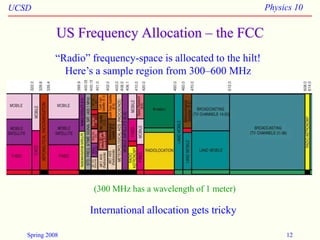
US Frequency Allocation – the FCC
(300 MHz has a wavelength of 1 meter)
“Radio” frequency-space is allocated to the hilt!
Here’s a sample region from 300–600 MHz
International allocation gets tricky
UCSD Physics 10
Spring 2008 13
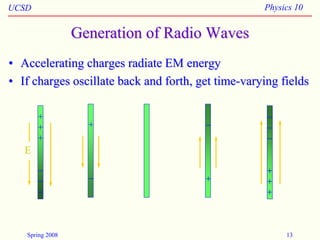
Generation of Radio Waves
• Accelerating charges radiate EM energy
• If charges oscillate back and forth, get time-varying fields
E
+
+
+
-
-
-
+
-
-
+
-
-
-
+
+
+
UCSD Physics 10
Spring 2008 14
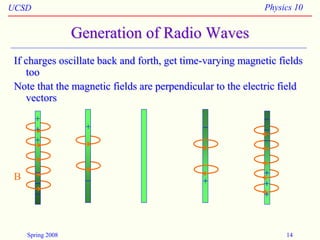
Generation of Radio Waves
If charges oscillate back and forth, get time-varying magnetic fields
too
Note that the magnetic fields are perpendicular to the electric field
vectors
B
+
+
+
-
-
-
+
-
-
+
-
-
-
+
+
+
UCSD Physics 10
Spring 2008 15
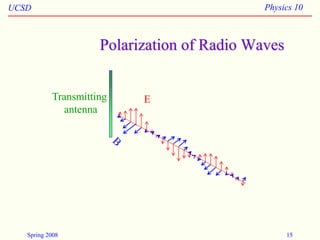
Polarization of Radio Waves
E
Transmitting
antenna
UCSD Physics 10
Spring 2008 16
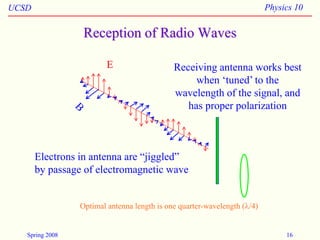
Reception of Radio Waves
Receiving antenna works best
when ‘tuned’ to the
wavelength of the signal, and
has proper polarization
Electrons in antenna are “jiggled”
by passage of electromagnetic wave
E
Optimal antenna length is one quarter-wavelength (l/4)

electromagnetism.ppt

  • 1.
    UCSD Physics 10 Spring2008 1 Electromagnetism • Electricity and magnetism are different facets of electromagnetism – a moving electric charge produces magnetic fields – changing magnetic fields move electric charges • This connection first elucidated by Faraday, Maxwell • Einstein saw electricity and magnetism as frame- dependent facets of unified electromagnetic force
  • 2.
    UCSD Physics 10 Spring2008 2 Magnetic fields from electricity • A static distribution of charges produces an electric field • Charges in motion (an electrical current) produce a magnetic field – electric current is an example of charges (electrons) in motion
  • 3.
    UCSD Physics 10 Spring2008 3 Electromagnets • Arranging wire in a coil and running a current through produces a magnetic field that looks a lot like a bar magnet – called an electromagnet – putting a real magnet inside, can shove the magnet back and forth depending on current direction: called a solenoid
  • 4.
    UCSD Physics 10 Spring2008 4 Induced Current • The next part of the story is that a changing magnetic field produces an electric current in a loop surrounding the field – called electromagnetic induction, or Faraday’s Law
  • 5.
    UCSD Physics 10 Spring2008 5 The Electromagnetic Connection • A changing magnetic field produces an electric field, and a changing electric field produces a magnetic field. • Electric and Magnetic fields can produce forces on charges • An accelerating charge produces electromagnetic waves (radiation) • Both electric and magnetic fields can transport energy – Electric field energy used in electrical circuits, e.g., released in lightning – Magnetic field carries energy through transformer, for example
  • 6.
    UCSD Physics 10 Spring2008 6 Electromagnetic Radiation • Interrelated electric and magnetic fields traveling through space • All electromagnetic radiation travels at c = 3108 m/s in vacuum – the cosmic speed limit! – real number is 299792458.0 m/s exactly
  • 7.
    UCSD Physics 10 Spring2008 7 What’s “Waving” in EM waves? • What medium transports sound waves? – Can there be sound waves in the vacuum of outer space? • What medium transports water waves? • What medium transports radio waves? • A topic of considerable debate in the late 1800’s and early 1900’s • Led to the concept of the “luminiferous ether” – an invisible “jello” that was thought to vibrate electromagnetically • Experiments that sought this ether didn’t find it! • This was quite a surprise Electromagnetic waves travel through empty space!
  • 8.
    UCSD Physics 10 Spring2008 8 What’s “Waving” in EM waves? • What medium transports sound waves? Air – Can there be sound waves in the vacuum of outer space? No • What medium transports water waves? Water (fluids) • What medium transports radio waves? Air • A topic of considerable debate in the late 1800’s and early 1900’s • Led to the concept of the “luminiferous ether” – an invisible “jello” that was thought to vibrate electromagnetically • Experiments that sought this ether didn’t find it! • This was quite a surprise Electromagnetic waves travel through empty space! No medium required!
  • 9.
    UCSD Physics 10 Spring2008 9 Examples of Electromagnetic Radiation • AM and FM radio waves (including TV signals) – Cell phone communication links • Microwaves • Infrared radiation • Light • Ultra-violet rays • X-rays • Gamma rays • Frequency distinguishes these from one another.
  • 10.
    UCSD Physics 10 Spring2008 10 Uses of Electromagnetic Waves • Communication systems (radio) – One-way and two-way – Radar • Cooking (microwaves) • “Night Vision” or heat (infrared) • Sun tanning (Ultra-violet) • Medical Imaging (X rays) • Astronomy (radio, wave, IR, visible light, UV, gamma) All that we experience through our eyes is conveyed by electromagnetic radiation…
  • 11.
    UCSD Physics 10 Spring2008 11 The Electromagnetic Spectrum • Relationship between frequency, speed and wavelength f ·l = c f is frequency, l is wavelength, c is speed of light • Different frequencies of electromagnetic radiation are better suited to different purposes • The frequency of a radio wave determines its propagation characteristics through various media
  • 12.
    UCSD Physics 10 Spring2008 12 US Frequency Allocation – the FCC (300 MHz has a wavelength of 1 meter) “Radio” frequency-space is allocated to the hilt! Here’s a sample region from 300–600 MHz International allocation gets tricky
  • 13.
    UCSD Physics 10 Spring2008 13 Generation of Radio Waves • Accelerating charges radiate EM energy • If charges oscillate back and forth, get time-varying fields E + + + - - - + - - + - - - + + +
  • 14.
    UCSD Physics 10 Spring2008 14 Generation of Radio Waves If charges oscillate back and forth, get time-varying magnetic fields too Note that the magnetic fields are perpendicular to the electric field vectors B + + + - - - + - - + - - - + + +
  • 15.
    UCSD Physics 10 Spring2008 15 Polarization of Radio Waves E Transmitting antenna
  • 16.
    UCSD Physics 10 Spring2008 16 Reception of Radio Waves Receiving antenna works best when ‘tuned’ to the wavelength of the signal, and has proper polarization Electrons in antenna are “jiggled” by passage of electromagnetic wave E Optimal antenna length is one quarter-wavelength (l/4)

Editor's Notes