SUALEHA IQBAL
REDOX REACTIONS:
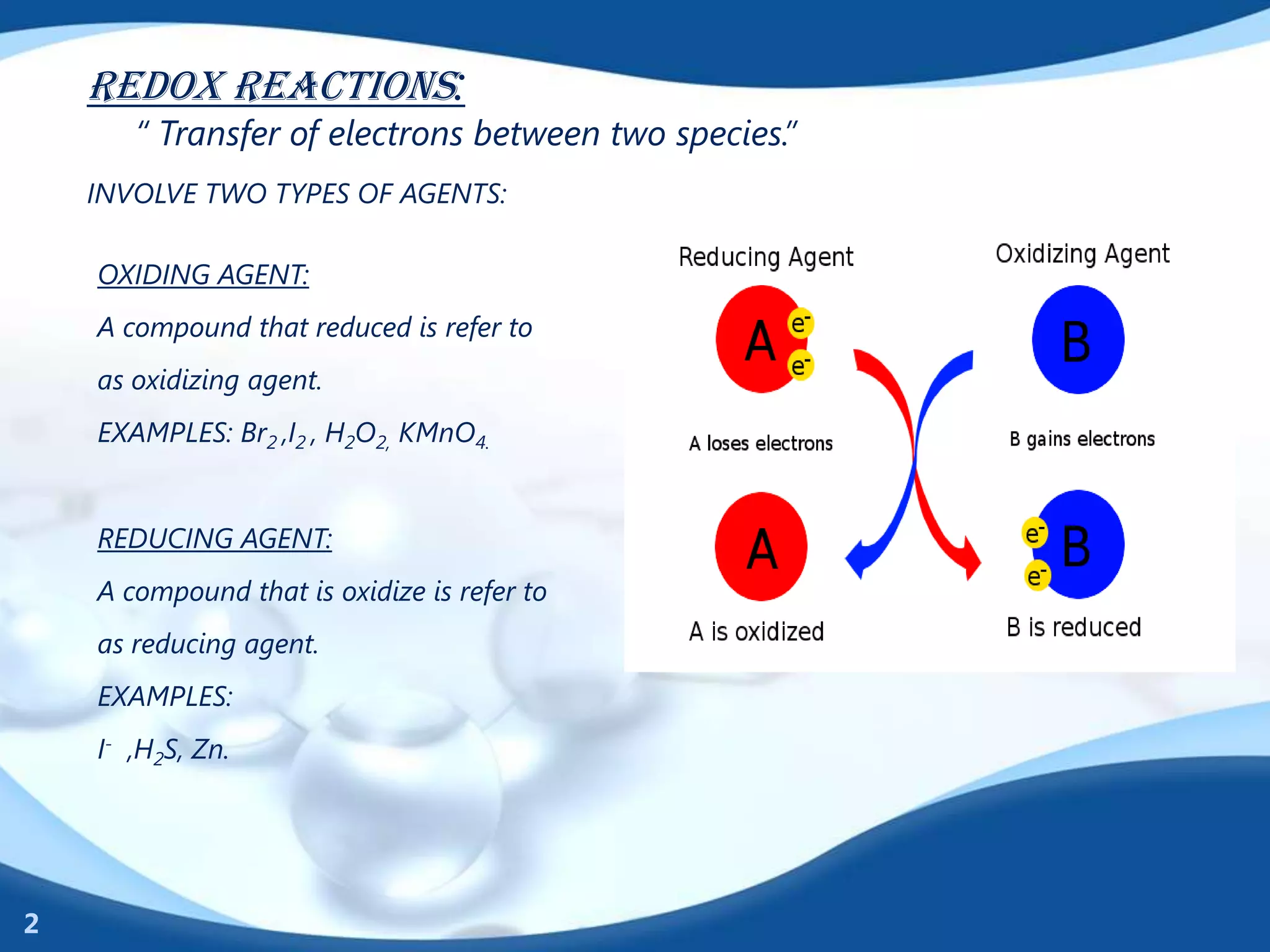
       “ Transfer of electrons between two species.”
    INVOLVE TWO TYPES OF AGENTS:

    OXIDING AGENT:
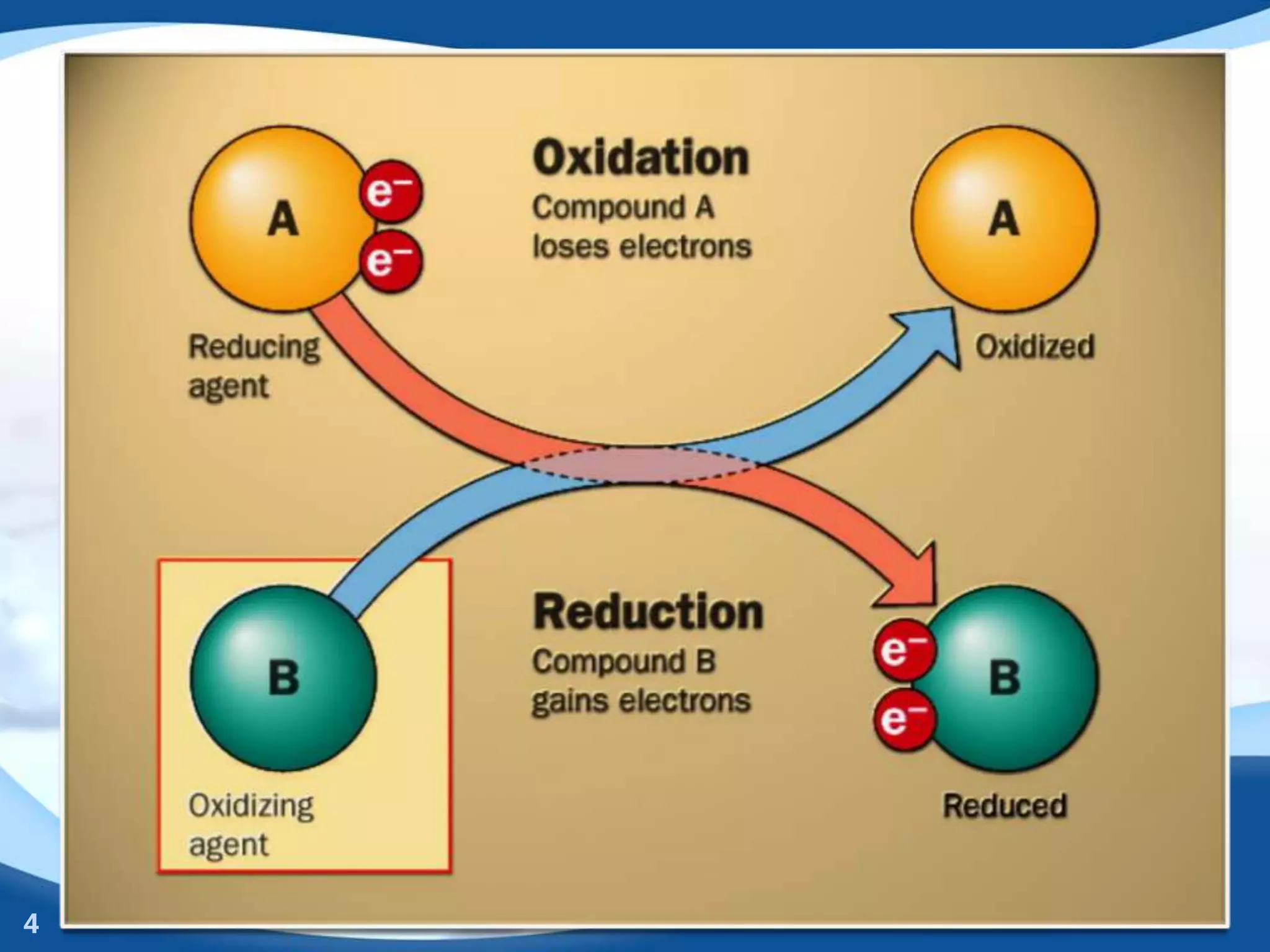
    A compound that reduced is refer to
    as oxidizing agent.
    EXAMPLES: Br2 ,I2 , H2O2, KMnO4.


    REDUCING AGENT:
    A compound that is oxidize is refer to
    as reducing agent.
    EXAMPLES:
    I- ,H2S, Zn.


2
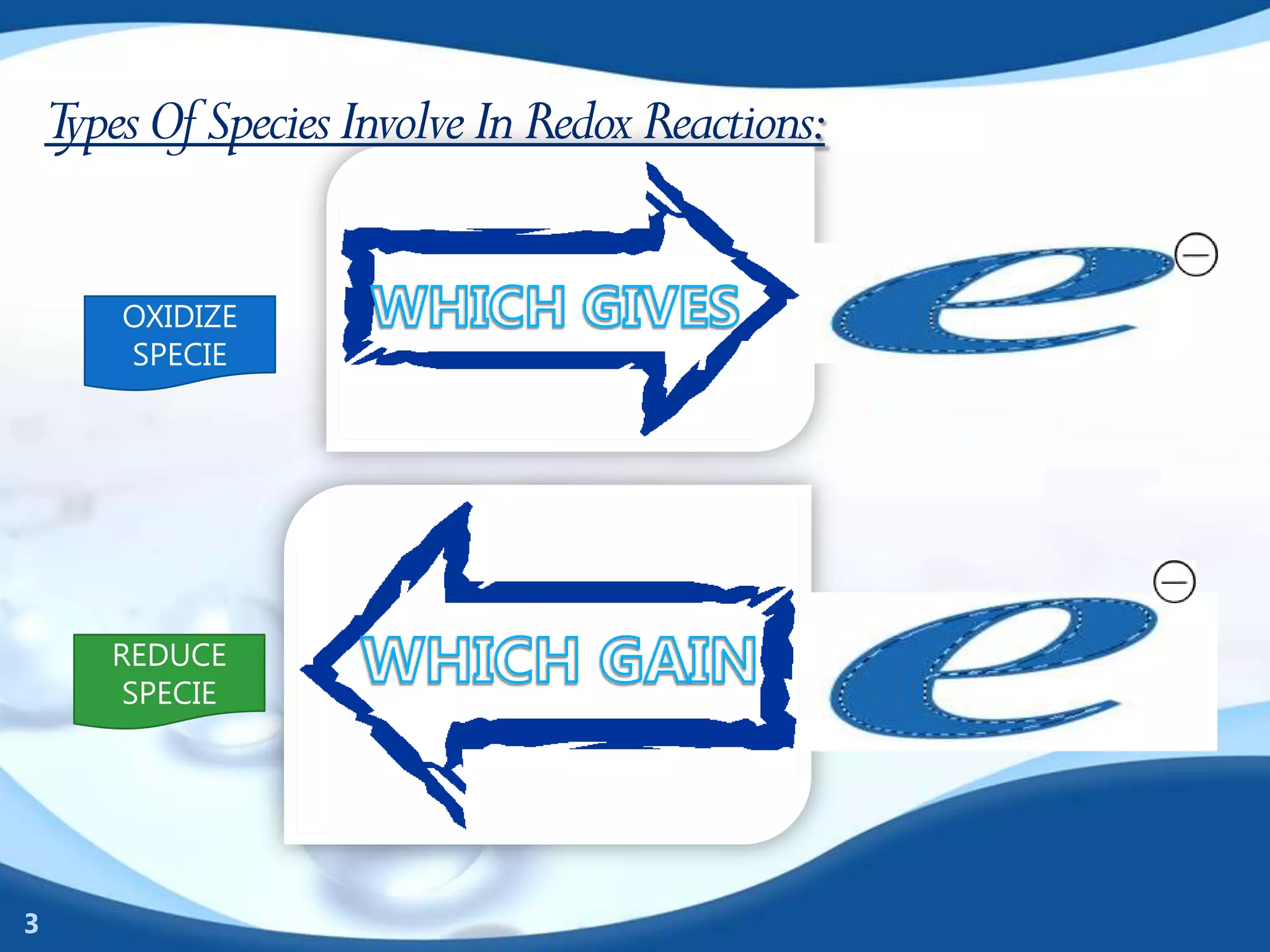
Types Of Species Involve In Redox Reactions:

        OXIDIZE
        SPECIE


       REDUCE
        SPECIE


3
4
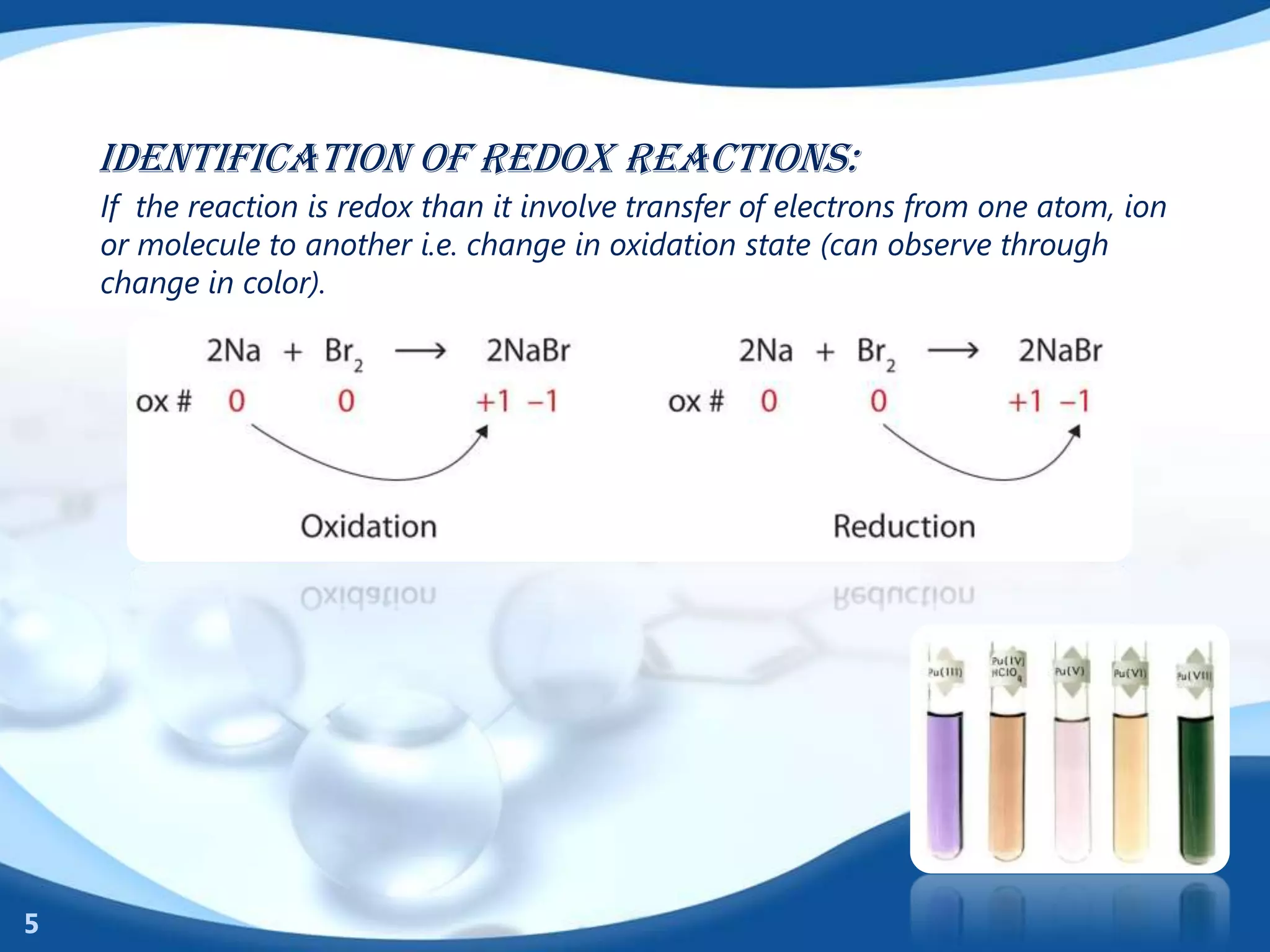
IDENTIFICATION OF REDOX REACTIONS:
    If the reaction is redox than it involve transfer of electrons from one atom, ion
    or molecule to another i.e. change in oxidation state (can observe through
    change in color).


5
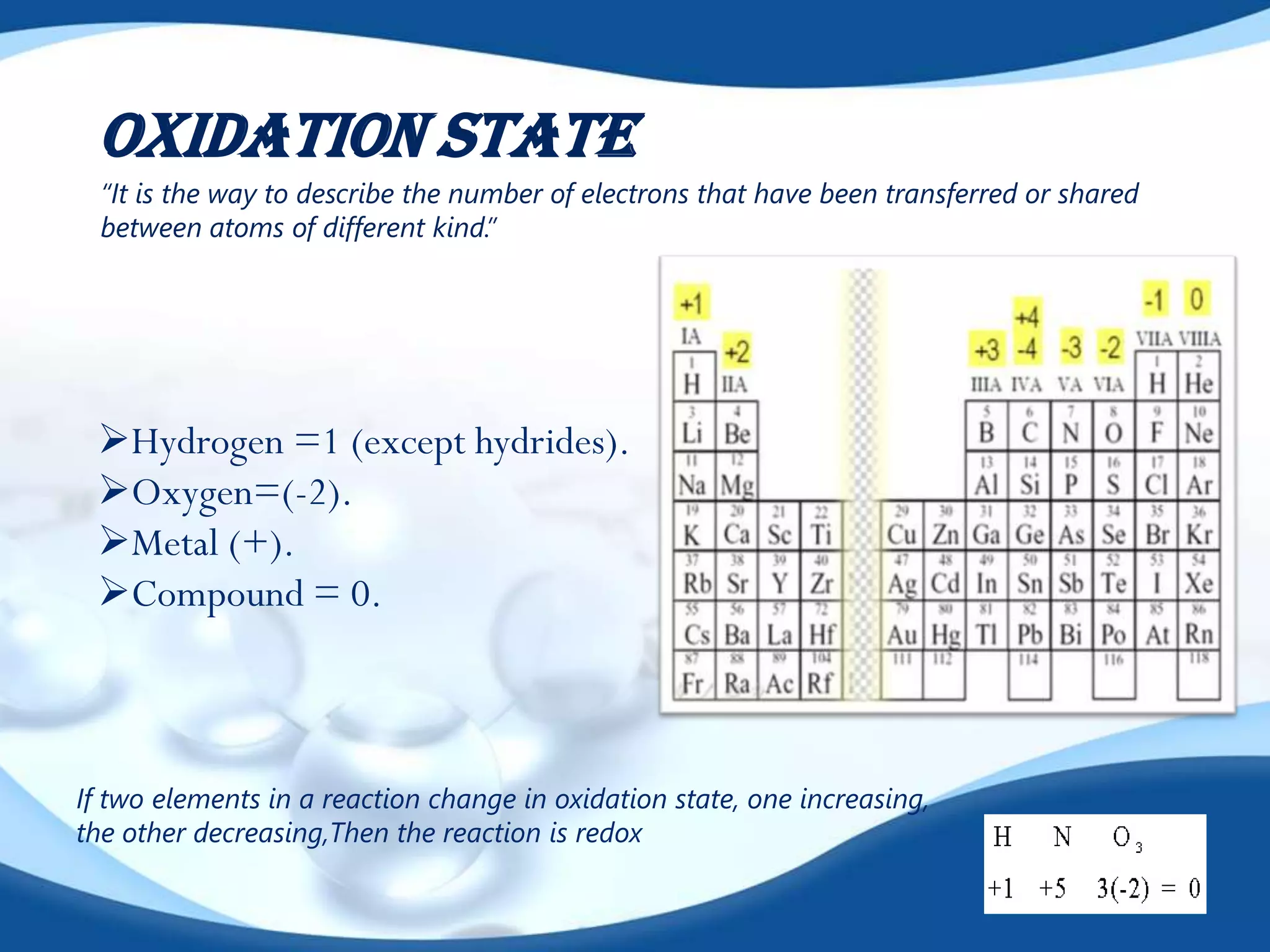
OXIDATION STATE
  “It is the way to describe the number of electrons that have been transferred or shared
  between atoms of different kind.”


 Hydrogen =1 (except hydrides).
 Oxygen=(-2).
 Metal (+).
 Compound = 0.


If two elements in a reaction change in oxidation state, one increasing,
the other decreasing,Then the reaction is redox
BALANCING REDOX REACTIONS:
     From ion electron method:
        For example
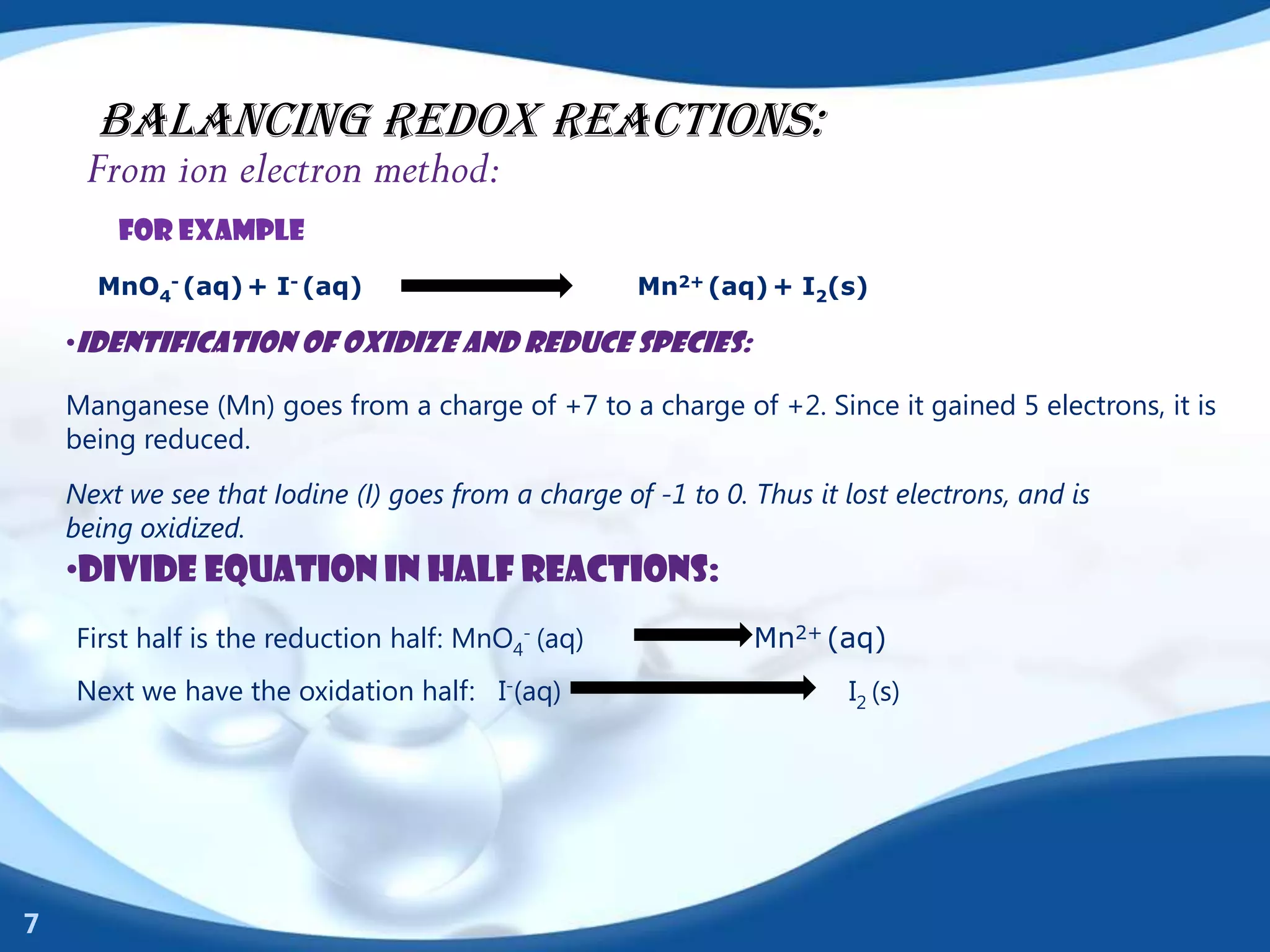
      MnO4- (aq) + I- (aq)                           Mn2+ (aq) + I2(s)

    •Identification of oxidize and reduce species:

    Manganese (Mn) goes from a charge of +7 to a charge of +2. Since it gained 5 electrons, it is
    being reduced.
    Next we see that Iodine (I) goes from a charge of -1 to 0. Thus it lost electrons, and is
    being oxidized.
    •Divide equation in half reactions:
    First half is the reduction half: MnO4- (aq)               Mn2+ (aq)
    Next we have the oxidation half: I-(aq)                             I2 (s)


7
BALANCING PART:

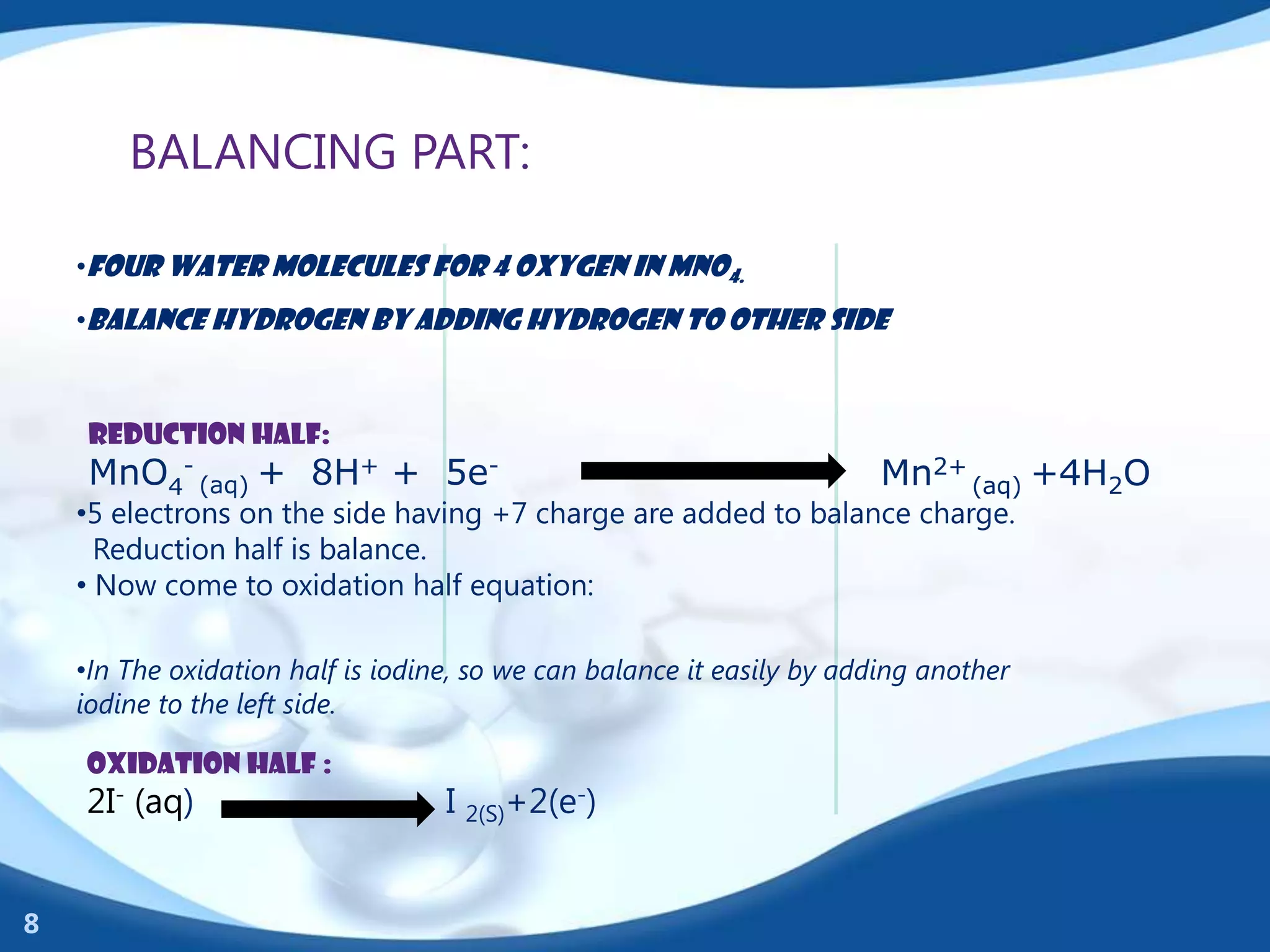
    •Four water molecules for 4 oxygen in MnO4.
    •Balance hydrogen by adding hydrogen to other side


     Reduction half:
     MnO4- (aq) + 8H+ + 5e-                                             Mn2+ (aq) +4H2O
    •5 electrons on the side having +7 charge are added to balance charge.
      Reduction half is balance.
    • Now come to oxidation half equation:

    •In The oxidation half is iodine, so we can balance it easily by adding another
    iodine to the left side.

    OXIDATION HALF :
    2I- (aq)                       I 2(S)+2(e-)


8
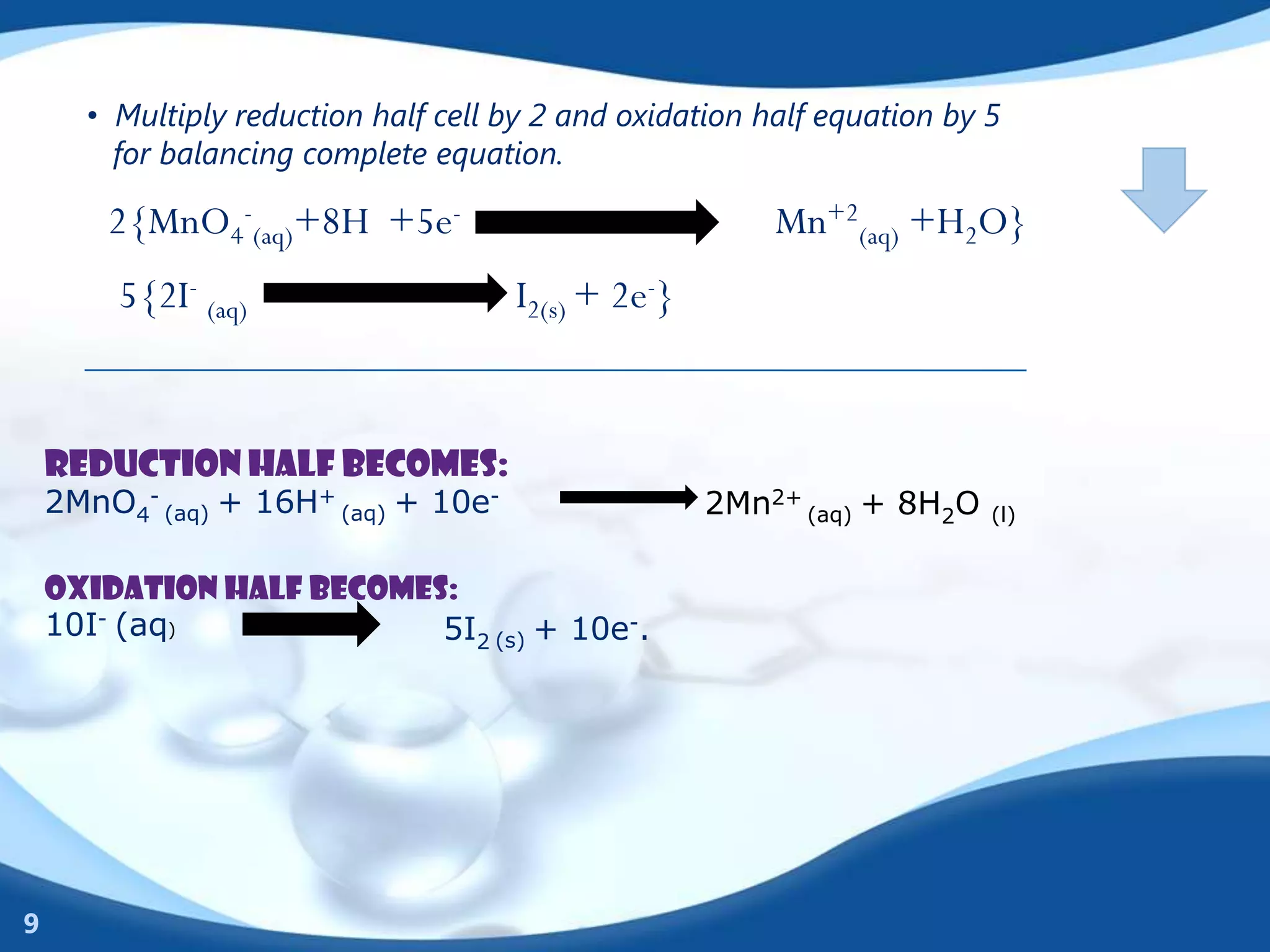
• Multiply reduction half cell by 2 and oxidation half equation by 5
        for balancing complete equation.

        2{MnO4-(aq)+8H +5e-                              Mn+2(aq) +H2O}
        5{2I- (aq)                   I2(s) + 2e-}


    Reduction half becomes:
    2MnO4- (aq) + 16H+ (aq) + 10e-                  2Mn2+ (aq) + 8H2O    (l)


    Oxidation half becomes:
    10I- (aq)             5I2 (s) + 10e-.


9
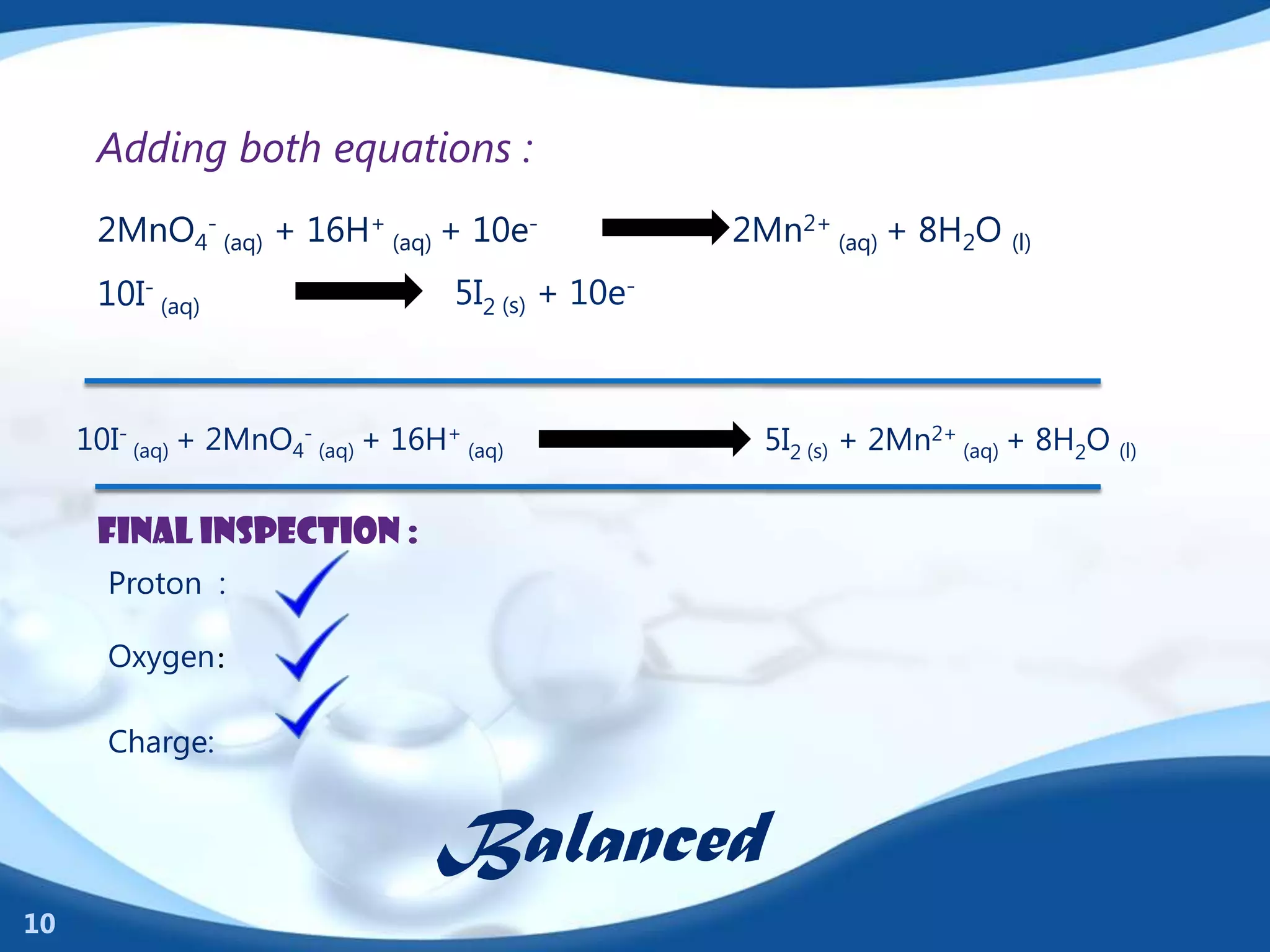
Adding both equations :
      2MnO4- (aq) + 16H+ (aq) + 10e-                2Mn2+ (aq) + 8H2O (l)
      10I- (aq)                    5I2 (s) + 10e-


     10I- (aq) + 2MnO4- (aq) + 16H+ (aq)              5I2 (s) + 2Mn2+ (aq) + 8H2O (l)

      Final inspection :
       Proton :

       Oxygen:

       Charge:


                                  Balanced
10
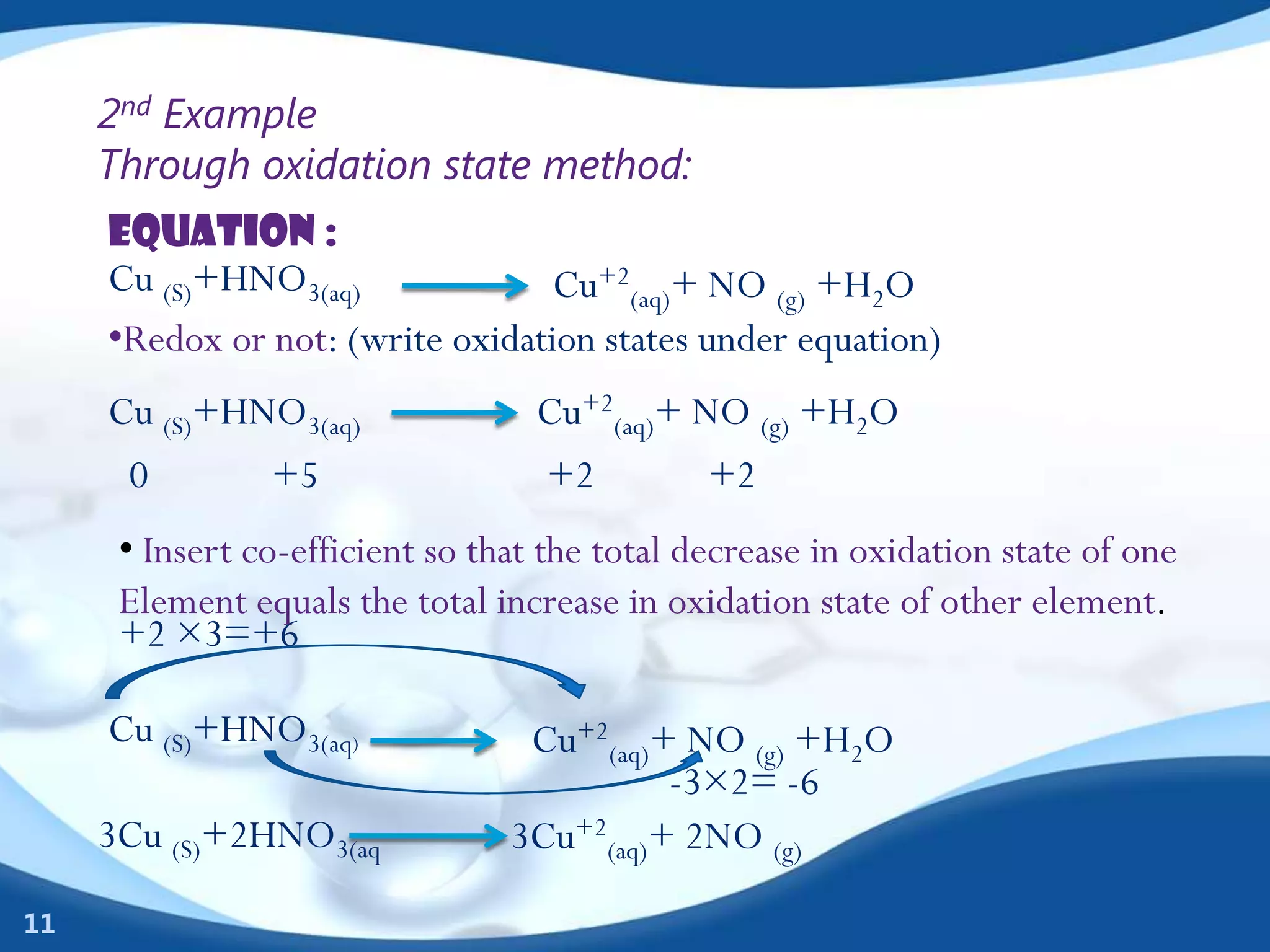
2nd Example
     Through oxidation state method:
     EQUATION :
     Cu (S)+HNO3(aq)              Cu+2(aq)+ NO (g) +H2O
     •Redox or not: (write oxidation states under equation)
     Cu (S)+HNO3(aq)               Cu+2(aq)+ NO (g) +H2O
      0       +5                   +2         +2
      • Insert co-efficient so that the total decrease in oxidation state of one
      Element equals the total increase in oxidation state of other element.
      +2 ×3=+6

     Cu (S)+HNO3(aq)              Cu+2(aq)+ NO (g) +H2O
                                           -3×2= -6
     3Cu (S)+2HNO3(aq            3Cu+2(aq)+ 2NO (g)

11
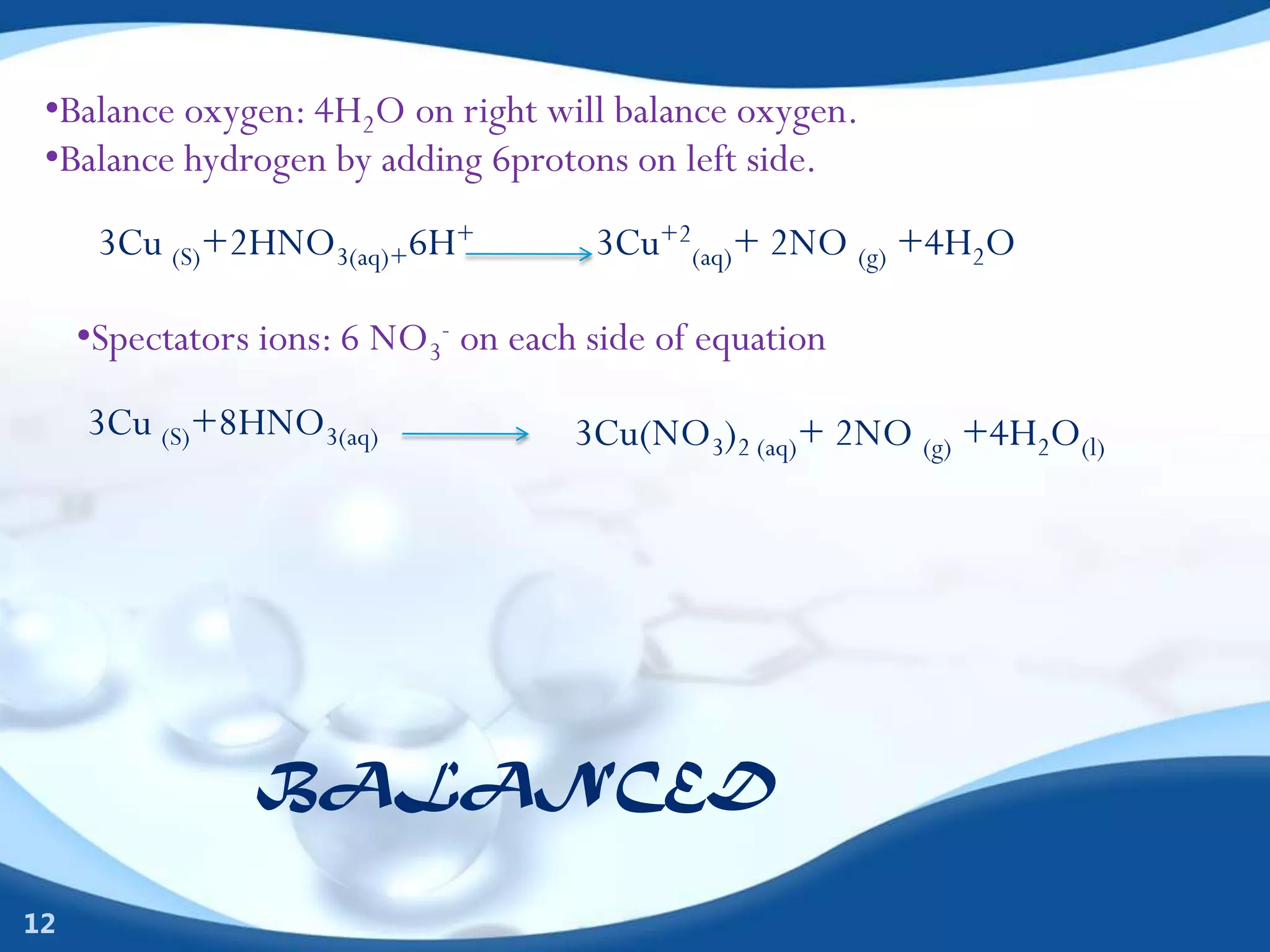
•Balance oxygen: 4H2O on right will balance oxygen.
 •Balance hydrogen by adding 6protons on left side.
      3Cu (S)+2HNO3(aq)+6H+           3Cu+2(aq)+ 2NO (g) +4H2O

     •Spectators ions: 6 NO3- on each side of equation
     3Cu (S)+8HNO3(aq)               3Cu(NO3)2 (aq)+ 2NO (g) +4H2O(l)


                BALANCED

12
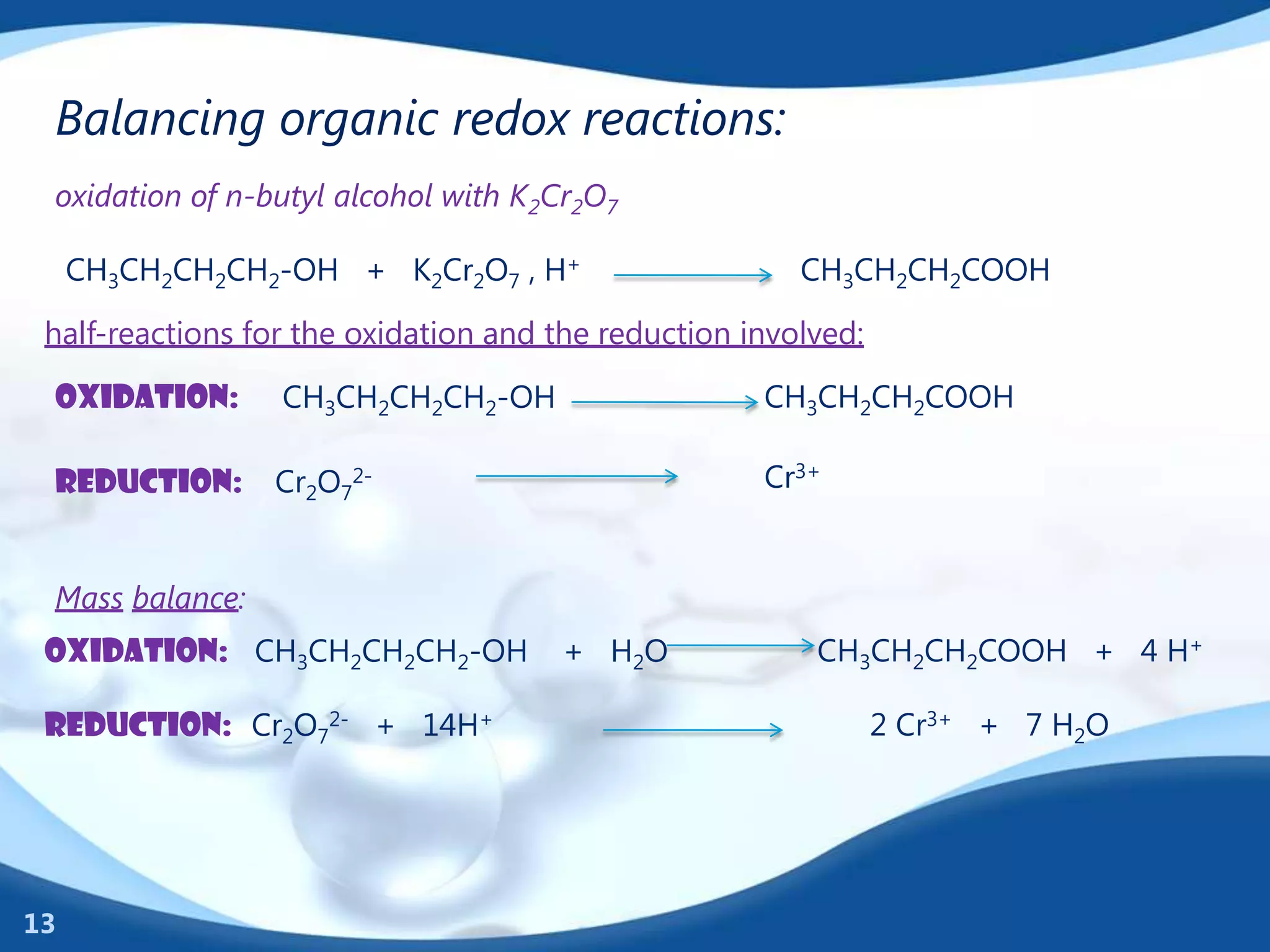
Balancing organic redox reactions:
 oxidation of n-butyl alcohol with K2Cr2O7

     CH3CH2CH2CH2-OH + K2Cr2O7 , H+                     CH3CH2CH2COOH

 half-reactions for the oxidation and the reduction involved:

 oxidation:       CH3CH2CH2CH2-OH                    CH3CH2CH2COOH

 reduction:      Cr2O72-                             Cr3+


 Mass balance:
 oxidation: CH3CH2CH2CH2-OH           + H2O              CH3CH2CH2COOH + 4 H+

 reduction: Cr2O72- + 14H+                                      2 Cr3+ + 7 H2O


13
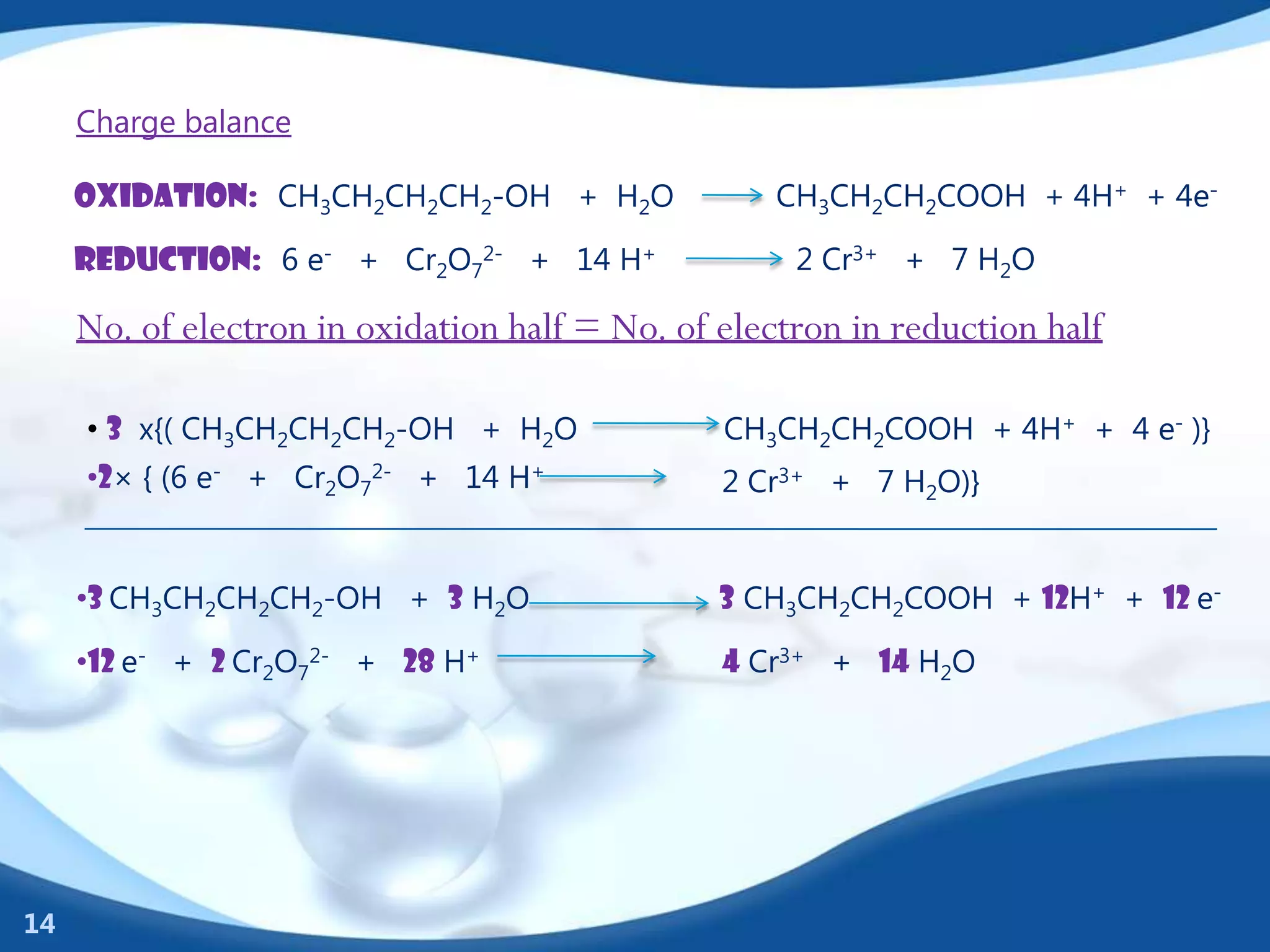
Charge balance

     oxidation: CH3CH2CH2CH2-OH + H2O               CH3CH2CH2COOH + 4H+ + 4e-

     reduction: 6 e- + Cr2O72- + 14 H+               2 Cr3+ + 7 H2O

     No. of electron in oxidation half = No. of electron in reduction half

     • 3 x{( CH3CH2CH2CH2-OH + H2O              CH3CH2CH2COOH + 4H+ + 4 e- )}
     •2× { (6 e- + Cr2O72- + 14 H+              2 Cr3+ + 7 H2O)}


     •3 CH3CH2CH2CH2-OH + 3 H2O                 3 CH3CH2CH2COOH + 12H+ + 12 e-

     •12 e- + 2 Cr2O72- + 28 H+                 4 Cr3+ + 14 H2O


14
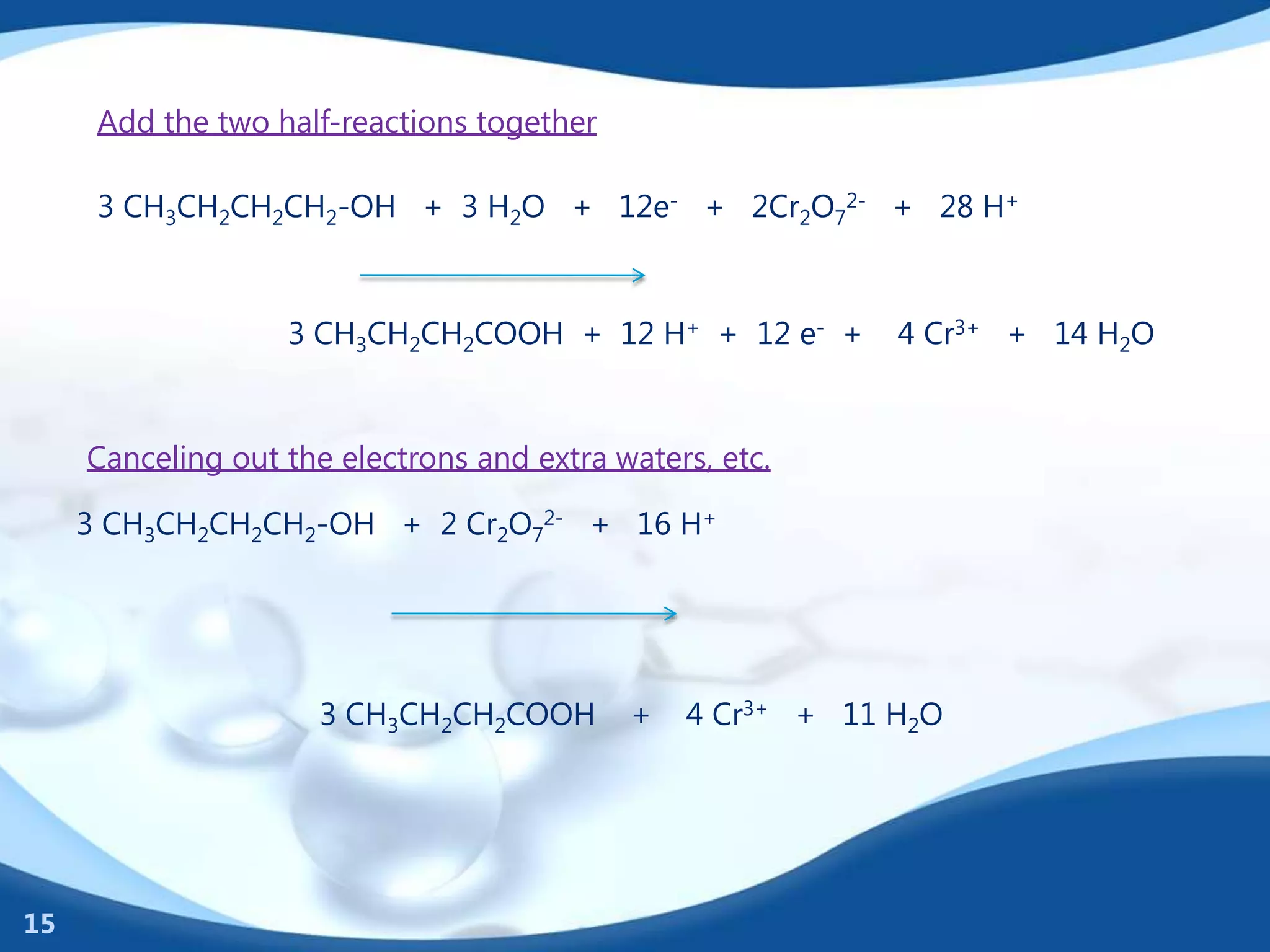
Add the two half-reactions together

      3 CH3CH2CH2CH2-OH + 3 H2O + 12e- + 2Cr2O72- + 28 H+


                   3 CH3CH2CH2COOH + 12 H+ + 12 e- +        4 Cr3+ + 14 H2O


     Canceling out the electrons and extra waters, etc.

     3 CH3CH2CH2CH2-OH + 2 Cr2O72- + 16 H+


                      3 CH3CH2CH2COOH       +   4 Cr3+ + 11 H2O


15
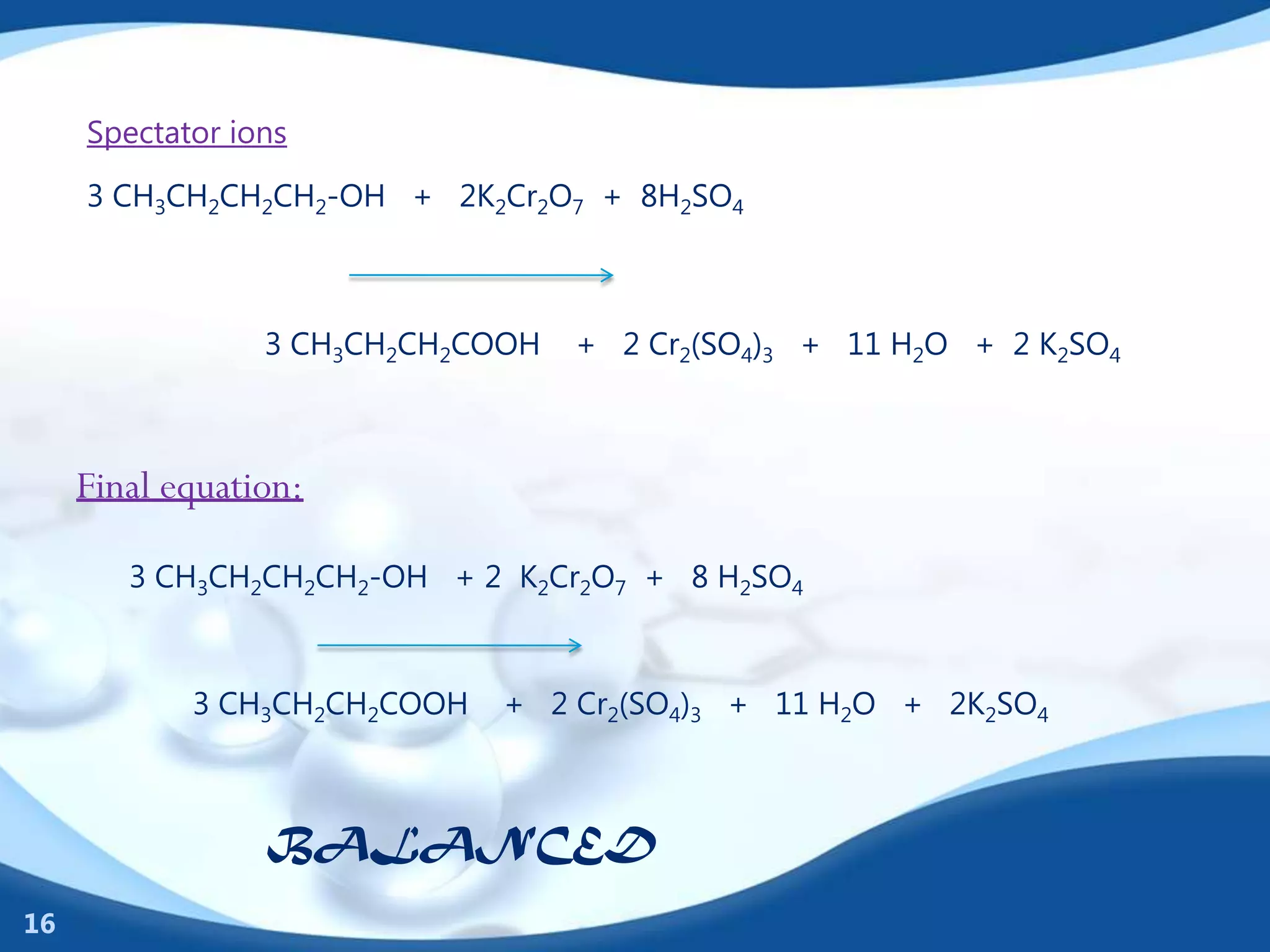
Spectator ions

     3 CH3CH2CH2CH2-OH + 2K2Cr2O7 + 8H2SO4


                 3 CH3CH2CH2COOH   + 2 Cr2(SO4)3 + 11 H2O + 2 K2SO4


     Final equation:

        3 CH3CH2CH2CH2-OH + 2 K2Cr2O7 + 8 H2SO4


            3 CH3CH2CH2COOH   + 2 Cr2(SO4)3 + 11 H2O + 2K2SO4


                 BALANCED
16
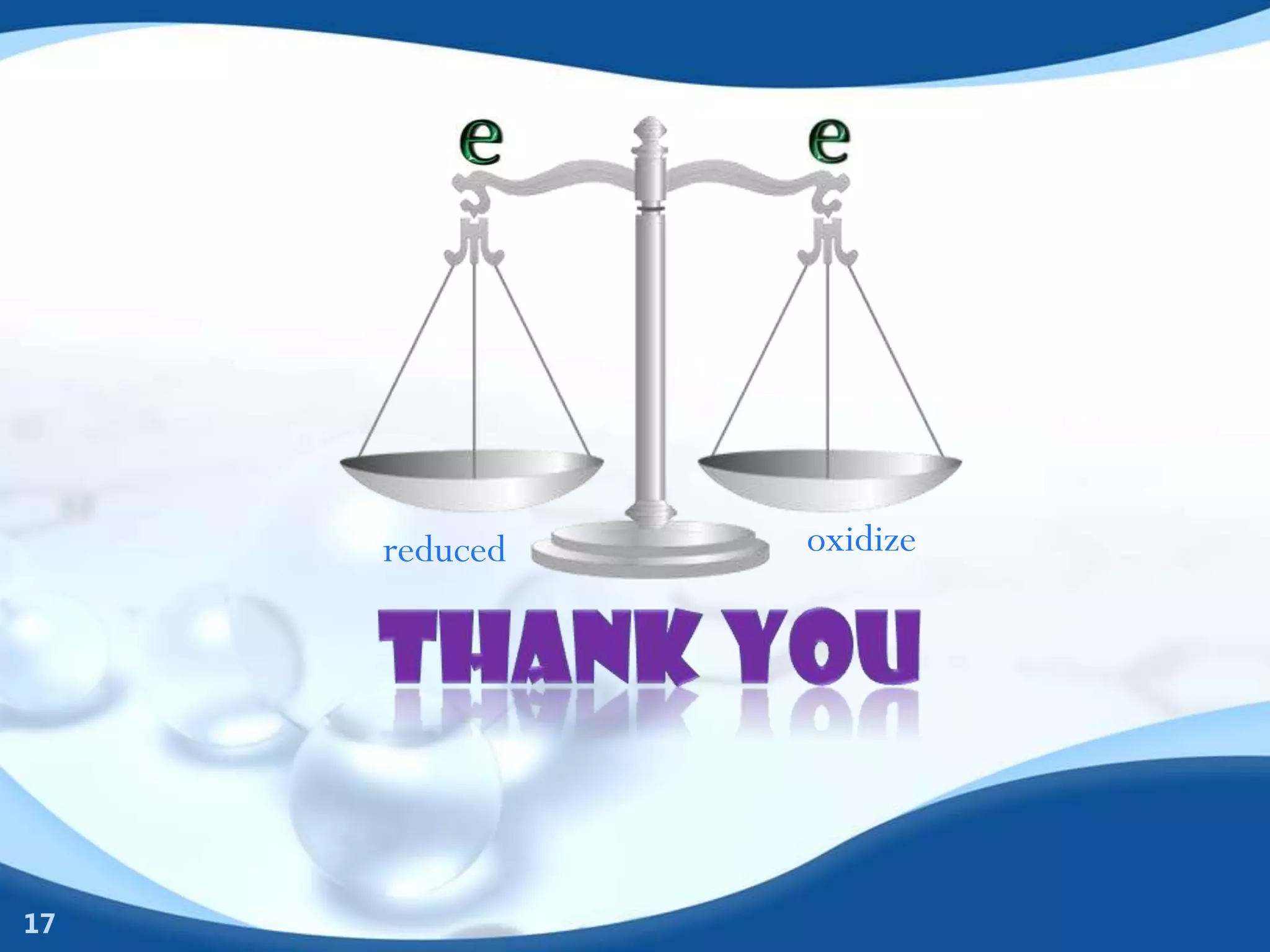
reduced   oxidize


17
SUALEHA IQBAL..


18

Balancing redox reactions

  • 1.
  • 2.
    REDOX REACTIONS: “ Transfer of electrons between two species.” INVOLVE TWO TYPES OF AGENTS: OXIDING AGENT: A compound that reduced is refer to as oxidizing agent. EXAMPLES: Br2 ,I2 , H2O2, KMnO4. REDUCING AGENT: A compound that is oxidize is refer to as reducing agent. EXAMPLES: I- ,H2S, Zn. 2
  • 3.
    Types Of SpeciesInvolve In Redox Reactions: OXIDIZE SPECIE REDUCE SPECIE 3
  • 4.
  • 5.
    IDENTIFICATION OF REDOXREACTIONS: If the reaction is redox than it involve transfer of electrons from one atom, ion or molecule to another i.e. change in oxidation state (can observe through change in color). 5
  • 6.
    OXIDATION STATE “It is the way to describe the number of electrons that have been transferred or shared between atoms of different kind.” Hydrogen =1 (except hydrides). Oxygen=(-2). Metal (+). Compound = 0. If two elements in a reaction change in oxidation state, one increasing, the other decreasing,Then the reaction is redox
  • 7.
    BALANCING REDOX REACTIONS: From ion electron method: For example MnO4- (aq) + I- (aq) Mn2+ (aq) + I2(s) •Identification of oxidize and reduce species: Manganese (Mn) goes from a charge of +7 to a charge of +2. Since it gained 5 electrons, it is being reduced. Next we see that Iodine (I) goes from a charge of -1 to 0. Thus it lost electrons, and is being oxidized. •Divide equation in half reactions: First half is the reduction half: MnO4- (aq) Mn2+ (aq) Next we have the oxidation half: I-(aq) I2 (s) 7
  • 8.
    BALANCING PART: •Four water molecules for 4 oxygen in MnO4. •Balance hydrogen by adding hydrogen to other side Reduction half: MnO4- (aq) + 8H+ + 5e- Mn2+ (aq) +4H2O •5 electrons on the side having +7 charge are added to balance charge. Reduction half is balance. • Now come to oxidation half equation: •In The oxidation half is iodine, so we can balance it easily by adding another iodine to the left side. OXIDATION HALF : 2I- (aq) I 2(S)+2(e-) 8
  • 9.
    • Multiply reductionhalf cell by 2 and oxidation half equation by 5 for balancing complete equation. 2{MnO4-(aq)+8H +5e- Mn+2(aq) +H2O} 5{2I- (aq) I2(s) + 2e-} Reduction half becomes: 2MnO4- (aq) + 16H+ (aq) + 10e- 2Mn2+ (aq) + 8H2O (l) Oxidation half becomes: 10I- (aq) 5I2 (s) + 10e-. 9
  • 10.
    Adding both equations: 2MnO4- (aq) + 16H+ (aq) + 10e- 2Mn2+ (aq) + 8H2O (l) 10I- (aq) 5I2 (s) + 10e- 10I- (aq) + 2MnO4- (aq) + 16H+ (aq) 5I2 (s) + 2Mn2+ (aq) + 8H2O (l) Final inspection : Proton : Oxygen: Charge: Balanced 10
  • 11.
    2nd Example Through oxidation state method: EQUATION : Cu (S)+HNO3(aq) Cu+2(aq)+ NO (g) +H2O •Redox or not: (write oxidation states under equation) Cu (S)+HNO3(aq) Cu+2(aq)+ NO (g) +H2O 0 +5 +2 +2 • Insert co-efficient so that the total decrease in oxidation state of one Element equals the total increase in oxidation state of other element. +2 ×3=+6 Cu (S)+HNO3(aq) Cu+2(aq)+ NO (g) +H2O -3×2= -6 3Cu (S)+2HNO3(aq 3Cu+2(aq)+ 2NO (g) 11
  • 12.
    •Balance oxygen: 4H2Oon right will balance oxygen. •Balance hydrogen by adding 6protons on left side. 3Cu (S)+2HNO3(aq)+6H+ 3Cu+2(aq)+ 2NO (g) +4H2O •Spectators ions: 6 NO3- on each side of equation 3Cu (S)+8HNO3(aq) 3Cu(NO3)2 (aq)+ 2NO (g) +4H2O(l) BALANCED 12
  • 13.
    Balancing organic redoxreactions: oxidation of n-butyl alcohol with K2Cr2O7 CH3CH2CH2CH2-OH + K2Cr2O7 , H+ CH3CH2CH2COOH half-reactions for the oxidation and the reduction involved: oxidation: CH3CH2CH2CH2-OH CH3CH2CH2COOH reduction: Cr2O72- Cr3+ Mass balance: oxidation: CH3CH2CH2CH2-OH + H2O CH3CH2CH2COOH + 4 H+ reduction: Cr2O72- + 14H+ 2 Cr3+ + 7 H2O 13
  • 14.
    Charge balance oxidation: CH3CH2CH2CH2-OH + H2O CH3CH2CH2COOH + 4H+ + 4e- reduction: 6 e- + Cr2O72- + 14 H+ 2 Cr3+ + 7 H2O No. of electron in oxidation half = No. of electron in reduction half • 3 x{( CH3CH2CH2CH2-OH + H2O CH3CH2CH2COOH + 4H+ + 4 e- )} •2× { (6 e- + Cr2O72- + 14 H+ 2 Cr3+ + 7 H2O)} •3 CH3CH2CH2CH2-OH + 3 H2O 3 CH3CH2CH2COOH + 12H+ + 12 e- •12 e- + 2 Cr2O72- + 28 H+ 4 Cr3+ + 14 H2O 14
  • 15.
    Add the twohalf-reactions together 3 CH3CH2CH2CH2-OH + 3 H2O + 12e- + 2Cr2O72- + 28 H+ 3 CH3CH2CH2COOH + 12 H+ + 12 e- + 4 Cr3+ + 14 H2O Canceling out the electrons and extra waters, etc. 3 CH3CH2CH2CH2-OH + 2 Cr2O72- + 16 H+ 3 CH3CH2CH2COOH + 4 Cr3+ + 11 H2O 15
  • 16.
    Spectator ions 3 CH3CH2CH2CH2-OH + 2K2Cr2O7 + 8H2SO4 3 CH3CH2CH2COOH + 2 Cr2(SO4)3 + 11 H2O + 2 K2SO4 Final equation: 3 CH3CH2CH2CH2-OH + 2 K2Cr2O7 + 8 H2SO4 3 CH3CH2CH2COOH + 2 Cr2(SO4)3 + 11 H2O + 2K2SO4 BALANCED 16
  • 17.
    reduced oxidize 17
  • 18.