Electrochemical
Techniques_Intro
OVERVIEW OF ELECTROCHEMICAL
TECHNIQUES
Thesimplest division of electrochemical
techniques is between bulk techniques, in which a
property of the solution in the electrochemical cell
is measured, and interfacial techniques, in
which the potential, charge, or current depends
on the species present at the interface between
an electrode and the solution in which it sits.
3.
Electrochemical
Techniques_Intro
OVERVIEW CONT’D
•The measurementof a solution’s conductivity,
which is proportional to the total concentration of
dissolved ions, is one example of a bulk
electrochemical technique.
•A determination of pH using a pH electrode is an
example of an interfacial electrochemical
technique.
4.
Electrochemical
Techniques_Intro
ELECTROCHEMICAL TECHNIQUES
•Analytical techniquesthat are based on the
measurement of potential, charge, or current to
determine an analyte’s concentration or
to characterize an analyte’s chemical reactivity.
•It involves the study of the movement of
electrons in an oxidation–reduction reaction.
Electrochemical
Techniques_Intro
AN INTRODUCTION TOREDOX
EQUILIBRIAAND ELECTRODE
POTENTIALS
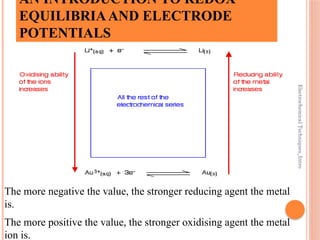
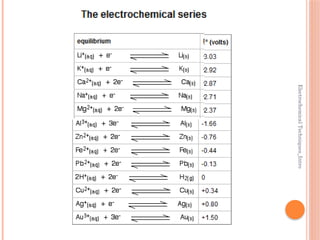
The more negative the value, the stronger reducing agent the metal
is.
The more positive the value, the stronger oxidising agent the metal
ion is.
Electrochemical
Techniques_Intro
REDOX POTENTIALS FORNON-
METAL AND OTHER SYSTEMS
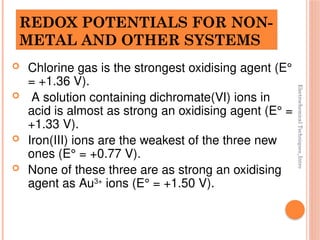
Chlorine gas is the strongest oxidising agent (E°
= +1.36 V).
A solution containing dichromate(VI) ions in
acid is almost as strong an oxidising agent (E° =
+1.33 V).
Iron(III) ions are the weakest of the three new
ones (E° = +0.77 V).
None of these three are as strong an oxidising
agent as Au3+
ions (E° = +1.50 V).
10.
Electrochemical
Techniques_Intro
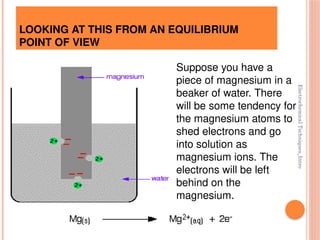
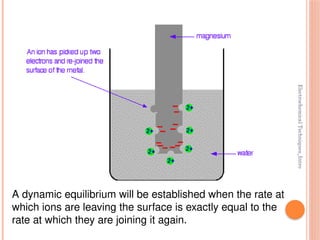
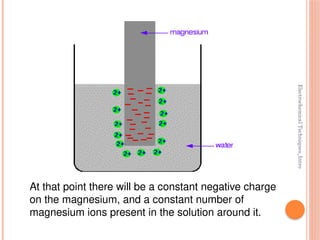
LOOKING AT THISFROM AN EQUILIBRIUM
POINT OF VIEW
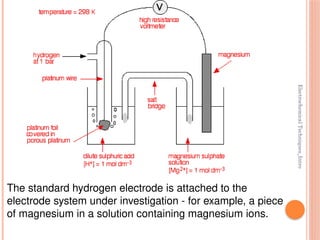
Suppose you have a
piece of magnesium in a
beaker of water. There
will be some tendency for
the magnesium atoms to
shed electrons and go
into solution as
magnesium ions. The
electrons will be left
behind on the
magnesium.
Electrochemical
Techniques_Intro
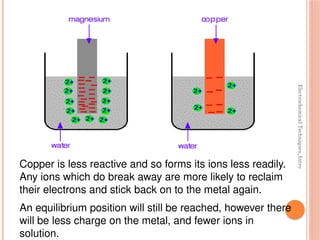
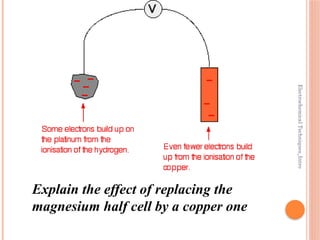
Copper is lessreactive and so forms its ions less readily.
Any ions which do break away are more likely to reclaim
their electrons and stick back on to the metal again.
An equilibrium position will still be reached, however there
will be less charge on the metal, and fewer ions in
solution.
Electrochemical
Techniques_Intro
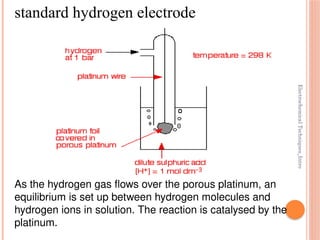
As the hydrogengas flows over the porous platinum, an
equilibrium is set up between hydrogen molecules and
hydrogen ions in solution. The reaction is catalysed by the
platinum.
standard hydrogen electrode
Electrochemical
Techniques_Intro
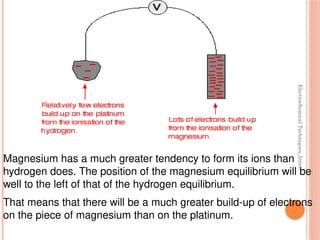
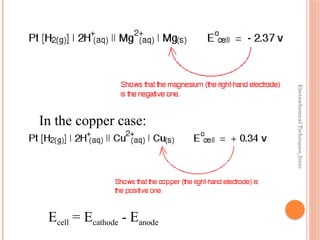
Magnesium has amuch greater tendency to form its ions than
hydrogen does. The position of the magnesium equilibrium will be
well to the left of that of the hydrogen equilibrium.
That means that there will be a much greater build-up of electrons
on the piece of magnesium than on the platinum.
Electrochemical
Techniques_Intro
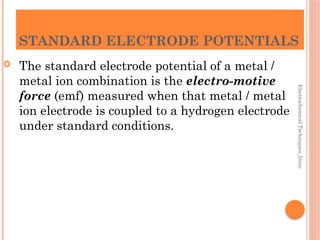
STANDARD ELECTRODE POTENTIALS
The standard electrode potential of a metal /
metal ion combination is the electro-motive
force (emf) measured when that metal / metal
ion electrode is coupled to a hydrogen electrode
under standard conditions.
Electrochemical
Techniques_Intro
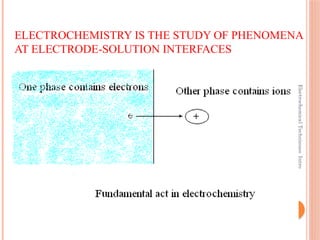
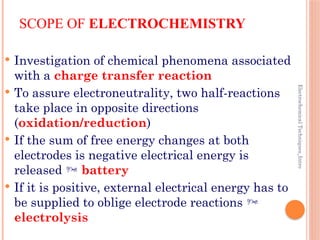
SCOPE OF ELECTROCHEMISTRY
Investigation of chemical phenomena associated
with a charge transfer reaction
To assure electroneutrality, two half-reactions
take place in opposite directions
(oxidation/reduction)
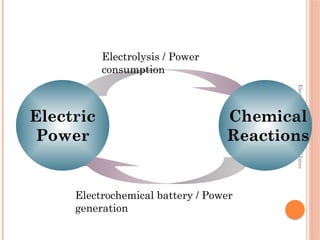
If the sum of free energy changes at both
electrodes is negative electrical energy is
released battery
If it is positive, external electrical energy has to
be supplied to oblige electrode reactions
electrolysis
22.
Electrochemical
Techniques_Intro
REACTIONS AND ELECTRODES
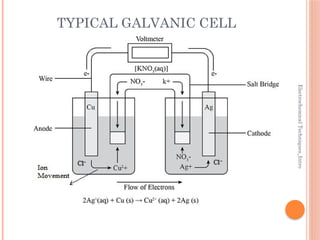
Theoverall chemical reaction taking place in a cell is
made up of two independent half-reactions, which
describe the real chemical changes at the two
electrodes.
Most of the time one is interested in only one of these
reactions, and the electrode at which it occurs is
called the working (or indicator) electrode, coupled
with an electrode that approaches an ideal
nonpolarizable electrode of known potential, called
the reference electrode.
23.
The E.m.fof a metal immersed in a solution of its own
ions may be obtained from the Nerst equation as
follows; E = Eo + 0.0592/n * log C
Where Eo is the standard potential of the metal, n is
valency of the ions and c is the ionic concentration
e.g Calculate the emf of the galvanic cell Fe|
Fe2+
(0.200M)‖Ag+
(0.100M)|Ag
e.g The emf of the galvanic cell
Cu|Cu2+
(1.8x10⁻³
M)‖Ag+
(xM)|Ag is + 0.362. What is
the [Ag+
] in the silver half-cell?
24.
THEORY OF EM F & PH DETERMINATIONS
pH = -log [H+
]= log 1/[H+
]
Similarly, pOH = -log [-
OH] = log 1/ [-
OH]
Purified water ionizes in solution as follows;
2H2O H3O+
+ -
OH
The above equation may be simplified as;
H2O H+
+ -
OH
Applying the law of Mass Action;
[H+
] [-
OH] / [H2O] = Constant
Where [H+],[-OH] and [H2O] represent their concentrations
respectively
25.
PH OF ASOLUTION
Thus in pure water or neutral solution where [H+
] = [-
OH] =√Kw
= 10-7
gram ions per litre (25o
)
Also [H+
] [-
OH] = Kw = 10-14
Hence, pH + pOH = pKw = 14
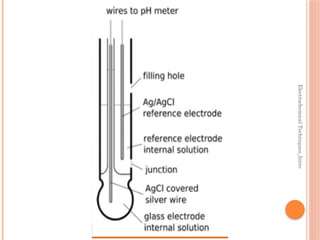
One of the electrodes is referred to as the Indicator Electrode,
and the other as Reference Electrode.
The former must respond to pH changes whilst the other must
give a constant potential. Each forms a half cell.
Hydrogen electrode where n = 1,
E = Eo + 0.0592 * log [H+
]
Alternatively, E = EHo - 0.0592 * pH
But EHo is normally taken as zero, thus the above equation
becomes; E = - 0.0592 * pH
26.
Electrochemical
Techniques_Intro
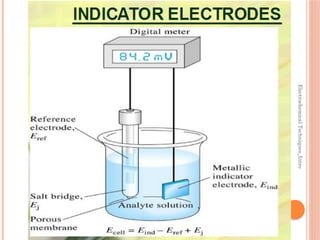
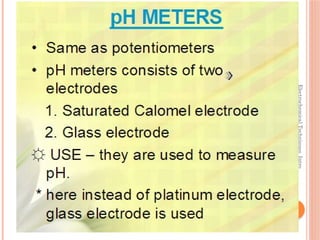
REFERENCE ELECTRODE:
Areference electrode is used in measuring
the working electrode potential of an
electrochemical cell.
The reference electrode acts as a reference
point for the redox couple.
The internationally accepted primary reference is the
standard hydrogen electrode (SHE) or normal
hydrogen electrode (NHE), which is
Pt/H2(a=1)/H+
(a=1,aqueous)
27.
Electrochemical
Techniques_Intro
REFERENCE ELECTRODE
By farthe most common reference is the
saturated calomel electrode (SCE) and the
Silver/Silver Chloride (Ag/AgCl) electrodes.
SCE is Hg/Hg2Cl2/KCl (sat’d in water). Its
potential is 0.242 V vs. NHE.
28.
Electrochemical
Techniques_Intro
WORKING ELECTRODE
•A fixedpotential difference is applied between
the working electrode and the reference
electrode. This potential drives the
electrochemical reaction at the working
electrode's surface.
•The current produced from the electrochemical
reaction at the working electrode is balanced by
a current flowing in the opposite direction at
the counter electrode.
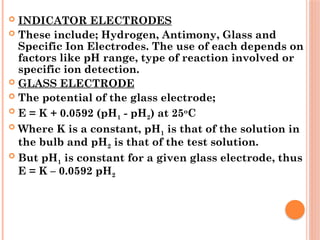
INDICATOR ELECTRODES
These include; Hydrogen, Antimony, Glass and
Specific Ion Electrodes. The use of each depends on
factors like pH range, type of reaction involved or
specific ion detection.
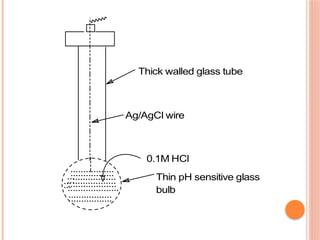
GLASS ELECTRODE
The potential of the glass electrode;
E = K + 0.0592 (pH1 - pH2) at 25o
C
Where K is a constant, pH1 is that of the solution in
the bulb and pH2 is that of the test solution.
But pH1 is constant for a given glass electrode, thus
E = K – 0.0592 pH2
Electrochemical
Techniques_Intro
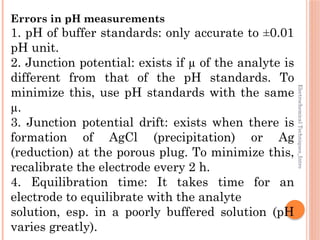
Errors in pHmeasurements
1. pH of buffer standards: only accurate to ±0.01
pH unit.
2. Junction potential: exists if µ of the analyte is
different from that of the pH standards. To
minimize this, use pH standards with the same
µ.
3. Junction potential drift: exists when there is
formation of AgCl (precipitation) or Ag
(reduction) at the porous plug. To minimize this,
recalibrate the electrode every 2 h.
4. Equilibration time: It takes time for an
electrode to equilibrate with the analyte
solution, esp. in a poorly buffered solution (pH
varies greatly).
33.
Electrochemical
Techniques_Intro
5. Dehydration ofglass membrane: If the
membrane has dried out, recondition it in water
for several hours before use.
6. Temperature: A pH meter should be calibrated
at the temperature at which pH measurements
will be made.
7. Na or alkaline error: when [H+
] is very low &
[Na+
] is high, the pH electrode responds to Na+
as if it were H+. So the apparent [H+
] is higher,
or apparent pH is lower.
8. Acid error: In strong acid, perhaps the glass
surface is saturated with H+
, so the apparent [H+
]
is lower & the apparent pH is higher,
34.
REJUVENATION OF GLASSELECTRODES
Symptoms of a faulty Glass
Electrode;
Slow electrode response
Undue sensitivity of the pH reading to
physical movement of electrode.
Failure of the electrode to check against
a pair of buffer solutions.
Inability to standardize in the range of
the meter’s asymmetric potential.
35.
REJUVENATION;
A faultyglass electrode may be rejuvenated by
momentarily immersing the bulb in 0.1M HCl or by
cycling the bulb between acid and alkaline solution to
reduce residual Sodium ion effects.
Explain how residual sodium ion is accumulated
When that fails, then the bulb must be immersed in 20%
NH4F solution for 3 min or 10% HF for 15sec. After this it
must be thoroughly rinsed in a stream of tap water then
dipped momentarily in 5M HCl to remove Fluoride
impurities. Finally the bulb is rinsed in purified water
and the electrode stored in 0.1M HCl.
36.
EMF VRS. PHMEASUREMENTS.
At a given temperature, there is a linear relationship
between pH of a solution and the Emf of a cell containing a
reference and a suitable indicator electrode.
Since E = K- 0.0592 pH at 25o
C,
Then ∆E/∆pH = -0.0592
Thus a meter calibrated in mV may be converted to pH units
by dividing with 0.0592
37.
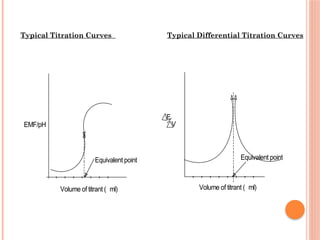
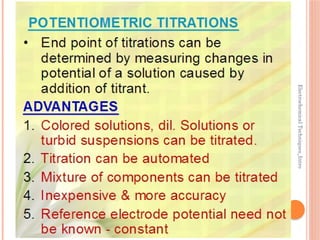
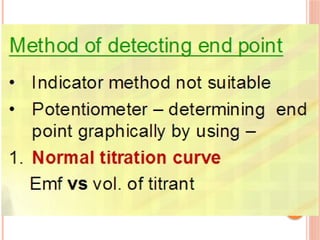
POTENTIOMETRIC TITRATION:
Visualindicators have been used to detect the end point of
most titrimetric analysis but the method may be inaccurate
in very dilute or coloured solutions.
Under such conditions, potentiometric detection of end point
yields very accurate results.
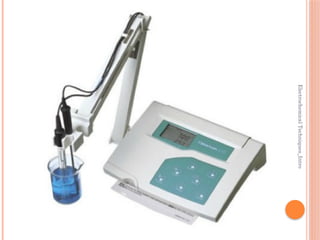
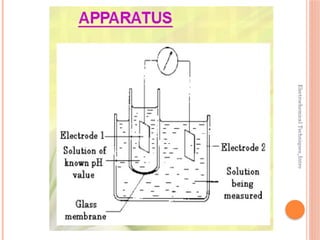
The apparatus requires a potentiometer/pH meter with
suitable indicator and reference electrodes, burette, a beaker
and magnetic stirrer.
Any reference electrode may be used provided it gives a
constant potential.
The indicator electrode must be appropriate for the type of
titration ie, glass electrode for acid-base titration and
Platinum electrode for redox titrations.
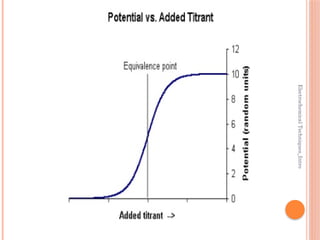
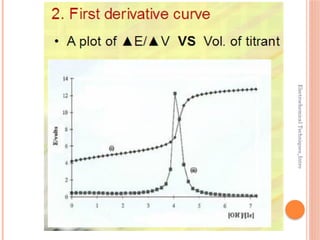
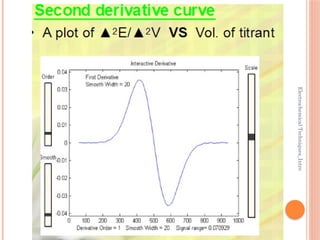
38.
Typical Titration CurvesTypical Differential Titration Curves
EMF/pH
' ' ' ' ' ' '
Volume of titrant ( ml)
' ' ' ' ' ' ' '
Equivalent point
Volume of titrant ( ml)
Equivalent point
E
V
39.
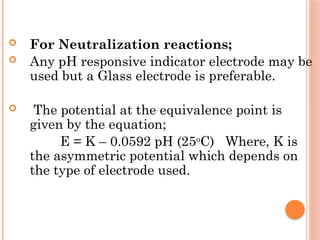
For Neutralizationreactions;
Any pH responsive indicator electrode may be
used but a Glass electrode is preferable.
The potential at the equivalence point is
given by the equation;
E = K – 0.0592 pH (25o
C) Where, K is
the asymmetric potential which depends on
the type of electrode used.
40.
Electrochemical
Techniques_Intro
For Redox Reaction;
Theindicator electrode appropriate is the
Platinum wire or foil.
The potential of the electrode is a function of
the ratio [Ox]/ [Red] forms of the ion. For
the general reaction.
The potential is given as;
E = Eo
+ 0.0592/n log. [Ox]/ [Red] at 25o
Where, Eo
is the standard oxidation
potential of the system
41.
For Precipitation Reactions;
Theindicator electrode must readily come into equilibrium
with one of the ions in solution.
Thus Silver electrode is used for titration involving Halides
with Silver Nitrate.
The potential of the electrode is given as;
E = Eo + 0.0592/n log. [Mn+] at 25°C
Where, Mn+ is the ionic conc. present during titration and in
equilibrium with the slightly soluble precipitate


![ The E.m.f of a metal immersed in a solution of its own
ions may be obtained from the Nerst equation as
follows; E = Eo + 0.0592/n * log C
Where Eo is the standard potential of the metal, n is
valency of the ions and c is the ionic concentration
e.g Calculate the emf of the galvanic cell Fe|
Fe2+
(0.200M)‖Ag+
(0.100M)|Ag
e.g The emf of the galvanic cell
Cu|Cu2+
(1.8x10⁻³
M)‖Ag+
(xM)|Ag is + 0.362. What is
the [Ag+
] in the silver half-cell?](https://image.slidesharecdn.com/electrochemicaltechniquesintroduction-250426192615-ddcf2265/85/Electrochemical-techniques_-Introduction-pptx-23-320.jpg)
![THEORY OF E M F & PH DETERMINATIONS
pH = -log [H+
]= log 1/[H+
]
Similarly, pOH = -log [-
OH] = log 1/ [-
OH]
Purified water ionizes in solution as follows;
2H2O H3O+
+ -
OH
The above equation may be simplified as;
H2O H+
+ -
OH
Applying the law of Mass Action;
[H+
] [-
OH] / [H2O] = Constant
Where [H+],[-OH] and [H2O] represent their concentrations
respectively](https://image.slidesharecdn.com/electrochemicaltechniquesintroduction-250426192615-ddcf2265/85/Electrochemical-techniques_-Introduction-pptx-24-320.jpg)
![PH OF A SOLUTION
Thus in pure water or neutral solution where [H+
] = [-
OH] =√Kw
= 10-7
gram ions per litre (25o
)
Also [H+
] [-
OH] = Kw = 10-14
Hence, pH + pOH = pKw = 14
One of the electrodes is referred to as the Indicator Electrode,
and the other as Reference Electrode.
The former must respond to pH changes whilst the other must
give a constant potential. Each forms a half cell.
Hydrogen electrode where n = 1,
E = Eo + 0.0592 * log [H+
]
Alternatively, E = EHo - 0.0592 * pH
But EHo is normally taken as zero, thus the above equation
becomes; E = - 0.0592 * pH](https://image.slidesharecdn.com/electrochemicaltechniquesintroduction-250426192615-ddcf2265/85/Electrochemical-techniques_-Introduction-pptx-25-320.jpg)
![Electrochemical
Techniques_Intro
5. Dehydration of glass membrane: If the
membrane has dried out, recondition it in water
for several hours before use.
6. Temperature: A pH meter should be calibrated
at the temperature at which pH measurements
will be made.
7. Na or alkaline error: when [H+
] is very low &
[Na+
] is high, the pH electrode responds to Na+
as if it were H+. So the apparent [H+
] is higher,
or apparent pH is lower.
8. Acid error: In strong acid, perhaps the glass
surface is saturated with H+
, so the apparent [H+
]
is lower & the apparent pH is higher,](https://image.slidesharecdn.com/electrochemicaltechniquesintroduction-250426192615-ddcf2265/85/Electrochemical-techniques_-Introduction-pptx-33-320.jpg)
![Electrochemical
Techniques_Intro
For Redox Reaction;
The indicator electrode appropriate is the
Platinum wire or foil.
The potential of the electrode is a function of
the ratio [Ox]/ [Red] forms of the ion. For
the general reaction.
The potential is given as;
E = Eo
+ 0.0592/n log. [Ox]/ [Red] at 25o
Where, Eo
is the standard oxidation
potential of the system](https://image.slidesharecdn.com/electrochemicaltechniquesintroduction-250426192615-ddcf2265/85/Electrochemical-techniques_-Introduction-pptx-40-320.jpg)
![For Precipitation Reactions;
The indicator electrode must readily come into equilibrium
with one of the ions in solution.
Thus Silver electrode is used for titration involving Halides
with Silver Nitrate.
The potential of the electrode is given as;
E = Eo + 0.0592/n log. [Mn+] at 25°C
Where, Mn+ is the ionic conc. present during titration and in
equilibrium with the slightly soluble precipitate](https://image.slidesharecdn.com/electrochemicaltechniquesintroduction-250426192615-ddcf2265/85/Electrochemical-techniques_-Introduction-pptx-41-320.jpg)




![Electrochemistry CE [Repaired]11111.pptx](https://cdn.slidesharecdn.com/ss_thumbnails/electrochemistrycerepaired-250930194342-440b1228-thumbnail.jpg?width=640&height=640&fit=bounds)


