PART I
Basic Concepts
1
C01.qxd 10/29/2005 11:55 AM Page 1
1
Electric Currents in Ionic Conductors
1.1 VARIOUS TYPES OF CONDUCTORS
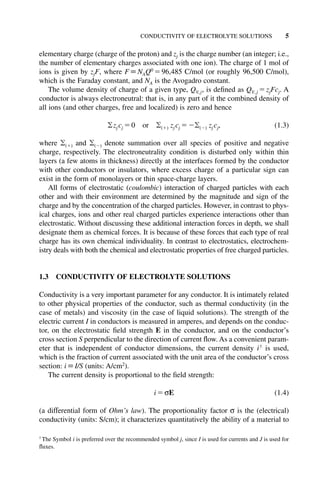
By the nature of conduction and values of conductivity, materials can be classified
as conductors, semiconductors, or insulators (dielectrics). It is a special attribute of
conductors that free electric charges are present in them. The migration of these free
charges in an applied electric field manifests itself as electric current.
Real charge is always associated with well-defined physical carriers such as
electrons and ions; this is not so for the idealized “physical” charge considered in
electrostatics. Each conductor can be characterized by stating the nature and con-
centration of the free charges. In the present section we consider free charged parti-
cles of atomic (or molecular) size, not larger, aggregated entities, such as colloidal
particles.
Conduction of electric current in conductors can be electronic or ionic, depend-
ing on the type of charge involved. Substances exist where conduction is mixed (i.e.,
where both ions and electrons are moving). Electronic conduction is found in all
metals and also in certain other substances: carbon materials (graphite, carbon
black), some oxides and other inorganic compounds (e.g., tungsten carbide), and a
number of organic substances. Ionic conductors (conductors of the second kind) are
also known as electrolytes. This term is used not only in the sense of an ionic con-
ductor (e.g., in expressions such as “solid electrolytes,” but also in a second sense,
in speaking of substances that ordinarily are not conducting but produce ionic con-
duction after being dissolved in water or in another solvent (e.g., in terms such as
“electrolyte solution” and “weak electrolyte”).
The main topic of electrochemistry is investigation of the properties of ionic con-
ductors and of electric circuits containing ionic conductors, and investigation of phe-
nomena occurring during passage of an electric current through such circuits.
Aqueous solutions of acids, bases, and salts are the ionic conductors used most
widely and studied most thoroughly. The importance of other types of ionic con-
ductors has increased in recent times, but aqueous solutions are still preeminent.
Their significance goes far beyond electrochemistry as such; they can be found in
practically all spheres of human activity. They are of exceptional importance in the
3
Fundamentals of Electrochemistry, Second Edition, By V. S. Bagotsky
Copyright © 2006 John Wiley & Sons, Inc.
C01.qxd 10/29/2005 11:55 AM Page 3
form of intracellular fluids in the biological and physiological processes of all living
beings. They are of equal importance in the form of natural waters in the oceans,
rivers, and underground for geomorphologic processes.
1.2 IONS IN ELECTROLYTE SOLUTIONS
Acids, bases, and salts (i.e., electrolytes in the second sense of the word) dissociate
into ions when dissolved in water (or in other solvents). This dissociation can be
complete or partial. The fraction of the original molecules that have dissociated is
known as the degree of dissociation, α. Substances that exhibit a low degree of dis-
sociation in solution are called weak electrolytes, whereas when the value of α
comes close to unity we speak of strong electrolytes.
In general, we can write the dissociation equation
Mτ⫹
Aτ⫺
τ⫹Mz⫹ ⫹τ⫺Az⫺. (1.1)
It is evident that z⫹τ⫹ ⫽z⫺τ⫺ ⫽zk, where zk is the electrolyte’s charge number (the
number of elementary charges of each sign appearing on dissociation of one mole-
cule of the electrolyte).
Let ck be the original concentration of substance k (e.g., of the compound
Mτ⫹Aτ⫺) without dissociation. Then the concentrations c⫹ and c⫺ of the ions, the
concentration cn of the undissociated molecules, and the total concentration cσ of all
species dissolved in the solution can be written as
c⫹ ⫽ατ⫹ ck, c⫺ ⫽ατ⫺ck, cn ⫽(1⫺α)ck, cσ ⫽[1⫹α(τk ⫺1)]ck, (1.2)
where τk ⫽τ⫹ ⫹τ⫺ is the total number of ions into which one original molecule dis-
sociates. In the limit of α⫽1, we have cσ ⫽τkck. Thus, electrolyte solutions contain
several types of particles, but their concentrations are interrelated and only one of the
concentration values is independent [e.g., that of the original compound k (which is
ck)]. A subscript k is used instead of j to point out, in the following, that this inde-
pendent component is considered rather than its dissociation products. A substance
such as ZnSO4 where z⫹ ⫽z⫺ (τ⫹ ⫽τ⫺) is called a symmetrical or z:z electrolyte; a
particular case of the z:z electrolytes are the 1:1 electrolytes, of which KCl is an
example.
Binary electrolyte solutions contain just one solute in addition to the solvent (i.e.,
two independent components in all). Multicomponent solutions contain several orig-
inal solutes and the corresponding number of ions. Sometimes in multicomponent
solutions the behavior of just one of the components is of interest; in this case the
term base electrolyte is used for the set of remaining solution components. Often, a
base electrolyte is actually added to the solutions to raise their conductivity.
The concentration of ions of type j in the solution can be stated in terms of the
number of moles nj of these ions per unit of the volume V: cj ⫽nj /V. The electric
charge Qj of an ion can be described as Qj ⫽Q0
zj, where Q0
⫽1.62⫻10⫺19
C is the
4 ELECTRIC CURRENTS IN IONIC CONDUCTORS
C01.qxd 10/29/2005 11:55 AM Page 4
elementary charge (charge of the proton) and zj is the charge number (an integer; i.e.,
the number of elementary charges associated with one ion). The charge of 1 mol of
ions is given by zjF, where F⬅NAQ0
⫽96,485 C/mol (or roughly 96,500 C/mol),
which is the Faraday constant, and NA is the Avogadro constant.
The volume density of charge of a given type, QV, j, is defined as QV, j ⫽zjFcj. A
conductor is always electroneutral: that is, in any part of it the combined density of
all ions (and other charges, free and localized) is zero and hence
兺zj cj ⫽0 or 兺(⫹) zj cj ⫽⫺兺(⫺) zj cj, (1.3)
where 兺(⫹) and 兺(⫺) denote summation over all species of positive and negative
charge, respectively. The electroneutrality condition is disturbed only within thin
layers (a few atoms in thickness) directly at the interfaces formed by the conductor
with other conductors or insulators, where excess charge of a particular sign can
exist in the form of monolayers or thin space-charge layers.
All forms of electrostatic (coulombic) interaction of charged particles with each
other and with their environment are determined by the magnitude and sign of the
charge and by the concentration of the charged particles. However, in contrast to phys-
ical charges, ions and other real charged particles experience interactions other than
electrostatic. Without discussing these additional interaction forces in depth, we shall
designate them as chemical forces. It is because of these forces that each type of real
charge has its own chemical individuality. In contrast to electrostatics, electrochem-
istry deals with both the chemical and electrostatic properties of free charged particles.
1.3 CONDUCTIVITY OF ELECTROLYTE SOLUTIONS
Conductivity is a very important parameter for any conductor. It is intimately related
to other physical properties of the conductor, such as thermal conductivity (in the
case of metals) and viscosity (in the case of liquid solutions). The strength of the
electric current I in conductors is measured in amperes, and depends on the conduc-
tor, on the electrostatic field strength E in the conductor, and on the conductor’s
cross section S perpendicular to the direction of current flow. As a convenient param-
eter that is independent of conductor dimensions, the current density i†
is used,
which is the fraction of current associated with the unit area of the conductor’s cross
section: i⬅I/S (units: A/cm2
).
The current density is proportional to the field strength:
i⫽σE (1.4)
(a differential form of Ohm’s law). The proportionality factor σ is the (electrical)
conductivity (units: S/cm); it characterizes quantitatively the ability of a material to
CONDUCTIVITY OF ELECTROLYTE SOLUTIONS 5
†
The Symbol i is preferred over the recommended symbol j, since I is used for currents and J is used for
fluxes.
C01.qxd 10/29/2005 11:55 AM Page 5
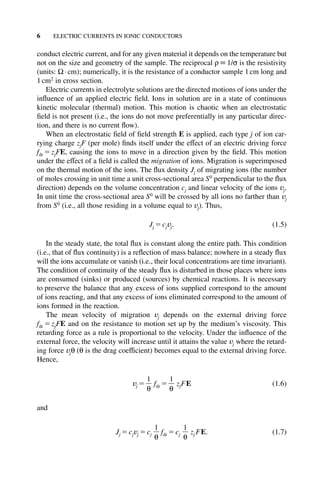
conduct electric current, and for any given material it depends on the temperature but
not on the size and geometry of the sample. The reciprocal ρ⬅1/σ is the resistivity
(units: Ω·cm); numerically, it is the resistance of a conductor sample 1cm long and
1cm2
in cross section.
Electric currents in electrolyte solutions are the directed motions of ions under the
influence of an applied electric field. Ions in solution are in a state of continuous
kinetic molecular (thermal) motion. This motion is chaotic when an electrostatic
field is not present (i.e., the ions do not move preferentially in any particular direc-
tion, and there is no current flow).
When an electrostatic field of field strength E is applied, each type j of ion car-
rying charge zjF (per mole) finds itself under the effect of an electric driving force
fdr ⫽zjFE, causing the ions to move in a direction given by the field. This motion
under the effect of a field is called the migration of ions. Migration is superimposed
on the thermal motion of the ions. The flux density Jj of migrating ions (the number
of moles crossing in unit time a unit cross-sectional area S0
perpendicular to the flux
direction) depends on the volume concentration cj and linear velocity of the ions j.
In unit time the cross-sectional area S0
will be crossed by all ions no farther than j
from S0
(i.e., all those residing in a volume equal to j). Thus,
Jj ⫽cjj. (1.5)
In the steady state, the total flux is constant along the entire path. This condition
(i.e., that of flux continuity) is a reflection of mass balance; nowhere in a steady flux
will the ions accumulate or vanish (i.e., their local concentrations are time invariant).
The condition of continuity of the steady flux is disturbed in those places where ions
are consumed (sinks) or produced (sources) by chemical reactions. It is necessary
to preserve the balance that any excess of ions supplied correspond to the amount
of ions reacting, and that any excess of ions eliminated correspond to the amount of
ions formed in the reaction.
The mean velocity of migration j depends on the external driving force
fdr ⫽ zjFE and on the resistance to motion set up by the medium’s viscosity. This
retarding force as a rule is proportional to the velocity. Under the influence of the
external force, the velocity will increase until it attains the value j where the retard-
ing force jθ (θ is the drag coefficient) becomes equal to the external driving force.
Hence,
j ⫽ᎏ
θ
1
ᎏ fdr ⫽ᎏ
θ
1
ᎏ zjFE (1.6)
and
Jj ⫽cjj ⫽cj ᎏ
θ
1
ᎏ fdr ⫽cj ᎏ
θ
1
ᎏ zj FE. (1.7)
6 ELECTRIC CURRENTS IN IONIC CONDUCTORS
C01.qxd 10/29/2005 11:55 AM Page 6
The velocity of migration corresponding to unit field strength (1V/cm) is called
the mobility of the ions uj:
uj ⬅ᎏ
E
j
ᎏ⫽ᎏ
θ
1
ᎏ zj F. (1.8)
The expression for the migration flux density becomes
Jj ⫽cjujE. (1.9)
By definition the partial current density ij is the number of charges that in unit
time cross the unit cross-sectional area due to the migration of ions j; that is,
ij ⫽zj FJj ⫽zjFcjujE. (1.10)
In electrolyte solutions the positively and negatively charged ions will move in
opposite directions when an electric field is applied. Therefore, outwardly the effect
of motion of positive ions is exactly the same as that of the motion of negative ions,
and the total current density is the sum of the partial currents due to transport of each
type of ion:
i⫽兺ij ⫽FE 兺zjcjuj. (1.11)
We can see when comparing Eqs. (1.4) and (1.11) that a conductor’s conductiv-
ity depends on the concentrations and the mobilities of all types of ions:
σ⫽F兺 zjcjuj. (1.12)
The fraction of current transported by ions of a given type is called the transport
number tj of these ions:
tj ⫽ᎏ
i
i
j
ᎏ⫽ᎏ
兺
z
z
jc
jc
ju
ju
j
j
ᎏ. (1.13)
It is obvious that 0 ⱕtj ⱕ1 and 兺 tj ⫽1. For conductors with a single type of ion, the
transport number of these ions is unity. For conductors with different types of ions,
the individual transport number of a given ion depends on the concentrations and
mobilities of all ions.
For the conductivity of a binary electrolyte solution with the degree of dissocia-
tion α, we have, according to Eq. (1.12),
σ⫽αzkckF(u⫹u⫺). (1.14)
CONDUCTIVITY OF ELECTROLYTE SOLUTIONS 7
C01.qxd 10/29/2005 11:55 AM Page 7
For binary electrolytes Eq. (1.13) for transport numbers becomes
tj ⫽ᎏ
u⫹⫹
uj
u⫺
ᎏ. (1.15)
The mobilities uj of ions in solutions are concentration dependent. They are highest
in dilute solutions (the limiting mobilities uj
0
) and decrease gradually with increasing
concentration. Hence in dilute binary solutions of strong electrolytes (α⫽1), the
conductivity is proportional to the total concentration ck. Because of decreasing
mobility, the conductivity rise becomes slower as the concentration increases. In
solutions of weak electrolytes, this slowdown is more pronounced since the degree
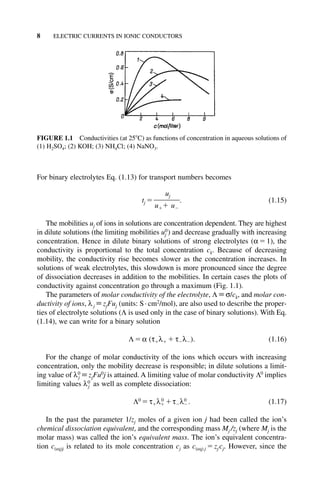
of dissociation decreases in addition to the mobilities. In certain cases the plots of
conductivity against concentration go through a maximum (Fig. 1.1).
The parameters of molar conductivity of the electrolyte, Λ⬅σ/ck, and molar con-
ductivity of ions, λj ⬅zjFuj (units: S·cm2
/mol), are also used to describe the proper-
ties of electrolyte solutions (Λ is used only in the case of binary solutions). With Eq.
(1.14), we can write for a binary solution
Λ⫽α (τ⫹λ⫹ ⫹τ⫺λ⫺). (1.16)
For the change of molar conductivity of the ions which occurs with increasing
concentration, only the mobility decrease is responsible; in dilute solutions a limit-
ing value of λj
0
⬅zjFu0
j is attained. A limiting value of molar conductivity Λ0
implies
limiting values λj
0
as well as complete dissociation:
Λ0
⫽τ⫹λ⫹
0
⫹τ⫺λ⫺
0
. (1.17)
In the past the parameter 1/zj moles of a given ion j had been called the ion’s
chemical dissociation equivalent, and the corresponding mass Mj /zj (where Mj is the
molar mass) was called the ion’s equivalent mass. The ion’s equivalent concentra-
tion c(eq)j is related to its mole concentration cj as c(eq) j ⫽zj cj. However, since the
8 ELECTRIC CURRENTS IN IONIC CONDUCTORS
FIGURE 1.1 Conductivities (at 25⬚C) as functions of concentration in aqueous solutions of
(1) H2SO4; (2) KOH; (3) NH4Cl; (4) NaNO3.
C01.qxd 10/29/2005 11:55 AM Page 8
chemical equivalent of any given substance in dissociation reactions may differ from
the equivalents relevant in electrochemical reactions (see Section 1.6), this term
should be used with caution. These equivalent concentrations had often been used as
a basis for the values of Λ and λj. In this case the equivalent conductance was defined
as Λeq ⬅σ/ceq, and the ionic equivalent conductance (or equivalent mobility) was
defined as λ(eq) j ⬅Fuj; in this notation,
Λeq ⫽α[λ(eq)⫹ ⫹λ(eq)⫺] and Λeq
0
⫽λ(eq)⫹
0
⫹⫽λ(eq)⫺
0
. (1.18)
These terms are no longer recommended. Instead, we consider the molar con-
ductivities of electrolytes and ions as defined above and where necessary indicate the
electrolyte units to which the concentrations refer: for example, Λ(MgCl2) or
Λ(ᎏ
1
2
ᎏMgCl2), λ(Ca2⫹
) or λ(ᎏ
1
2
ᎏCa2⫹
). We evidently have Λ(ᎏ
1
2
ᎏMgCl2)⫽ᎏ
1
2
ᎏΛ(MgCl2).
It is a typical feature of aqueous electrolyte solutions that one can, within wide
limits, change the solute concentrations and hence the conductivities themselves. Pure
water has a very low value of σ; it is about 5 µS/m at room temperature after careful
purification of the water. In the most highly conducting solutions (i.e., concentrated
solutions of acids and bases), values of 80S/m can be attained at the same tempera-
ture: values seven orders of magnitude higher than those found for pure water.
1.4 CIRCUITS INVOLVING IONIC CONDUCTORS. ELECTRODES
As a rule, electric circuits consist not of a single conductor but of several conductors
connected, forming a sequence of conductors. This circuit can be closed or open. An
open circuit is properly open when terminating at both ends with the same type of
conductor.
In electrical engineering and electronics, circuits are employed that consist of elec-
tronic conductors exclusively. Circuits that in addition include at least one ionic con-
ductor are called galvanic circuits. The technical realization of a galvanic circuit is
also called a galvanic cell (or electrochemical cell or electrolysis cell). Galvanic cir-
cuits have a number of characteristic features not present in purely electronic circuits.
It is one of the more important tasks of electrochemistry to consider these features.
The sequence of conductors constituting a properly open galvanic circuit can be
described schematically, for example, as
Cu兩Zn兩ZnCl2, aq兩graphite兩Cu (1.19)
(ZnCl2, aq denotes an aqueous solution of ZnCl2). Vertical lines in the scheme
denote the areas of contact (interfaces) between two adjacent conductors.
Other galvanic circuits contain two or more ionic conductors, which may be in
direct contact with each other or may alternate with electronic conductors. An exam-
ple of the former case is that of the circuit
Cu 兩Zn兩ZnSO4, aq ¦ CuSO4, aq兩Cu. (1.20)
CIRCUITS INVOLVING IONIC CONDUCTORS. ELECTRODES 9
C01.qxd 10/29/2005 11:55 AM Page 9
The broken vertical line denotes an area of contact between any two ionic conductors,
particularly between liquid ionic conductors (electrolyte–electrolyte interface or liquid
junction). Ions can transfer between phases by diffusion across such a boundary; hence,
circuits containing such an interface are often called circuits or cells with transference.
In a galvanic circuit, electronic conductors are in contact with ionic conductors in at
least two places. An electronic conductor in contact with an ionic conductor is called
an electrode. When an electric current is made to flow in a galvanic cell, the current will
pass from electrode to electrolyte (“enter” the electrolyte) at one of the electrodes, and
it will pass from electrolyte to electrode (“leave” the electrolyte) at the other electrode.
The first of these electrodes has been named the anode (from Greek ανα, “up”), the
second has been named the cathode (from Greek κατα, “down”). It follows from this
definition that the designations “anode” and “cathode” depend on the direction of cur-
rent flow in the galvanic cell. An anode becomes a cathode, and vice versa, when the
direction of current flow is inverted. Within the electrolyte, the current flow is always
from the anode to the cathode. Therefore, the positively charged electrolyte ions
migrating toward the cathode have been named cations, and the negatively charged ions
migrating toward the anode have been named anions. In the external parts of the closed
circuit (“external” relative to the electrolyte), the current flow is from cathode to anode.
1.5 PASSAGE OF CURRENT THROUGH ELECTRODES.
ELECTRODE REACTIONS
The area of contact between two different types of conductors is a special place in
any circuit. The character of current flow in this region depends on the phases in con-
tact. The simplest case is that of contact between two metals. In both conductors the
conduction is due to the same species (i.e., electrons). When current crosses the
interface, the flow of electrons is not arrested; all electrons, which come from one of
the phases freely, cross over to the other phase on their arrival at the interface. No
accumulation or depletion of electrons is observed. In addition, current flow at such
a junction will not produce any chemical change.
More complex phenomena occur when current crosses interfaces between semi-
conductors. The most typical example is the rectification produced at interfaces
between p- and n-type semiconductors. Electric current freely flows from the former
into the latter semiconductor, but an electric field “repelling” the free carriers from the
junction arises when the attempt is made to pass current in the opposite direction:
Holes are sent back into the p-phase, and electrons are sent back into the n-phase. As
a result, the layers adjoining the interface are depleted of free charges, their conduc-
tivities drop drastically, and current flow ceases (“blocking” the interface).
When the current is carried by different species in the two adjacent phases, the
continuous flow of carriers is interrupted. Charges of one type come up to (or depart
from) the area of contact on one side, and carriers of a different type come up to (or
depart from) this area on the other side. To sustain steady current flow, one needs a
steady sink for the particles arriving, and a steady source for those departing.
In galvanic cells the carriers are ions and electrons. In this case, chemical reac-
tions occurring at the interface—at the electrode surface—and involving carriers
10 ELECTRIC CURRENTS IN IONIC CONDUCTORS
C01.qxd 10/29/2005 11:55 AM Page 10
from both phases (including electrons) are the sink and source for the corresponding
particles. Chemical reactions involving electrons are called electrochemical or elec-
trode reactions. Reactions at anodes are also called anodic, and reactions at cathodes
are called cathodic. At an anode, electrons go away from the junction into the metal;
hence, an anodic reaction must generate electrons. Similarly, at a cathode, electrons
supplied by the circuit must react (and thus are eliminated from the reaction zone).
For instance, when current flow is from the right to the left in galvanic cell (1.19),
the zinc electrode will be the cathode, and its surface is the site of the cathodic reac-
tion involving the deposition of zinc by discharge of zinc ions from the solution:
Zn2⫹
⫹2e⫺
→Zn. (1.21)
This reaction satisfies the requirements listed above; the zinc ions and electrons
arriving at the surface from different sides disappear from the reaction zone. The
anodic reaction
2Cl⫺
→Cl2⫹2e⫺
(1.22)
occurs at the surface of the graphite electrode (the anode); it generates electrons
while Cl⫺
ions disappear.
Electron withdrawal from a material is equivalent to its oxidation, while electron
addition is equivalent to its reduction. In the anodic reaction, electrons are generated
and a reactant (in our example, the chloride ions) is oxidized. In the cathodic reac-
tion the reactant (the zinc ions) is reduced. Thus, anodic reactions are always oxida-
tion reactions, and cathodic reactions are reduction reactions for the initial reactants.
In all cases the electrode reaction secures continuity of current flow across the inter-
face, a “relay” type of transfer of charges (current) from the carriers in one phase to
the carriers in the other phase. In the reaction, the interface as a rule is crossed by
species of one type: electrons [e.g., in reaction (1.22)] or ions [e.g., in reaction (1.21)].
In complete galvanic cells, electrochemical reactions occur simultaneously at the
anode and cathode. Since the current is of equal strength at the two electrodes, the
corresponding electrode reactions are interrelated, in that the number of electrons set
free in unit time at the anode is equal to the number of electrons reacting during the
same time at the cathode. Electrode reactions subject to such a condition are called
coupled reactions.
Current flow in cells is attended by an overall chemical reaction, more particularly
a current-producing (or current-consuming) reaction in which electrons do not appear
explicitly. In the example reported above, decomposition of dissolved zinc chloride,
ZnCl2 (Zn2⫹
⫹2Cl⫺
)→Zn⫹Cl2 (1.23)
is the reaction that results when the cathodic and anodic reaction are combined.
In symmetrical galvanic cells, cells consisting of two identical electrodes (e.g.,
zinc electrodes), current flow does not produce a net chemical reaction in the cell as
a whole; only a transfer of individual components occurs in the cell (in our example,
metallic zinc is transferred from the anode to the cathode).
PASSAGE OF CURRENT THROUGH ELECTRODES. ELECTRODE REACTIONS 11
C01.qxd 10/29/2005 11:55 AM Page 11
1.6 CLASSIFICATION OF ELECTRODES AND
ELECTRODE REACTIONS
The type of electrode reaction that will occur depends on the electrode and elec-
trolyte and also on external conditions: the temperature, impurities that may be pres-
ent, and so on. Possible reactants and products in these reactions are (1) the electrode
material, (2) components of the electrolyte, and (3) other substances (gases, liquids,
or solids) which are not themselves component parts of an electrode or the elec-
trolyte but can reach or leave the electrode surface. Therefore, when discussing the
properties or behavior of any electrode, we must indicate not merely the electrode
material but the full electrode system comprising electrode and electrolyte as well
as additional substances that may be involved in the reaction: for example, ZnCl2,
aq | (Cl2), graphite [the right-hand electrode in (1.19)].
Among all the substances that may be involved in an electrode reaction, substances
for which the oxidation state does not change (such as complexing agents) must be dis-
tinguished from the principal reactants and products, for which there is a change in
oxidation state in the reaction. Using specific examples, we shall consider different
types of electrodes and electrode reactions. The examples are cases involving aqueous
solutions, but the features pointed out are found as well in other electrolytes. In the
examples we first indicate the electrode system, then the reaction equation (cathodic
reactions follow these equations from the left to the right and the corresponding anodic
reactions follow the same equations in the opposite direction). Special features of
anodic reactions are stated in square brackets in the text that follows.
Unfortunately, a unique terminology for the various types of electrodes and reac-
tions has not yet been established. Electrodes can be classified according to different
distinguishing features:
Reacting and Nonconsumable Electrodes
AgNO3, aq兩Ag Ag⫹
⫹e⫺
Ag, (1.24)
FeCl2,FeCl3, aq兩Pt Fe3⫹
⫹e⫺
Fe2⫹
, (1.25)
HClO3,HCl, aq兩Pt ClO3
⫺
⫹6H⫹
⫹6e⫺
Cl⫺
⫹3H2O, (1.26)
H2SO4, aq兩(H2), Pt 2H⫹
⫹2e⫺
H2. (1.27)
In the first of the four examples, the electrode material (metallic silver) is chemically
involved in the electrode reaction; hence it becomes more [less] as a function of
time. Such electrodes are called reacting [or consumable] electrodes.
In the other examples, the electrode materials are not involved in the reactions
chemically, but constitute the source [sink] of electrons. Such electrodes are called
nonconsumable. The term inert electrodes sometimes used is unfortunate insofar as the
electrode itself is by no means inert; rather, it has a strong catalytic effect on the elec-
trode reaction. For reactions occurring at such electrodes, the terms oxidation– reduction
12 ELECTRIC CURRENTS IN IONIC CONDUCTORS
C01.qxd 10/29/2005 11:55 AM Page 12
reaction and redox reaction are widely used, but even these terms are not very for-
tunate, since reactions occurring at reacting electrodes are also reducing and oxidiz-
ing in character. Reactions of type (1.25), where just a single electron is transferred
(or more rarely, two electrons at the same time), will in the following be called sim-
ple redox reactions; reactions of type (1.26), where other solution components also
are involved, will be called complex (demanding) redox reactions.
Electrodes at which gases are evolved or consumed [e.g., by reaction (1.27)] can
be called gas electrodes. In the conventional formulation of the electrode system, the
reacting gas is indicated in parentheses.
Specific types of consumable electrode are designated in terms of the constituent
material (e.g., as a “silver electrode”). Nonconsumable electrodes are designated
either in terms of the electrode material or in terms of the chief component in the
electrode reaction; for instance, the terms platinum electrode and hydrogen electrode
are used for electrode (1.27). Neither of these names completely describes the spe-
cial features of this electrode.
Reacting Electrodes with Soluble and Insoluble Reaction Products (Reactants)
KCl, aq兩Ag AgCl⫹e⫺
Ag⫹Cl⫺
(1.28)
Depending on electrolyte composition, the metal will either dissolve in the anodic
reaction, that is, form solution ions [reaction (1.24)], or will form insoluble or poorly
soluble salts or oxides precipitating as a new solid phase next to the electrode sur-
face [reaction (1.28)]. Reacting metal electrodes forming soluble products are also
known as electrodes of the first kind, and those forming solid products are known as
electrodes of the second kind.
Electrodes with Invertible and Noninvertible Electrode Reactions Most electrode
reactions are invertible‡
in the sense that they will occur in the opposite direction
when the direction of current is inverted. Two types of reactions exist that are non-
invertible in this sense.
1. Reactions noninvertible on principle or, more probably, reactions for which no
conditions have been found so far under which they will proceed in the oppo-
site direction. An example of such a reaction is the cathodic reduction of
hydrogen peroxide:
H2O2 ⫹2H⫹
⫹2e⫺
→2H2O. (1.29)
The formation of hydrogen peroxide by anodic oxidation of water has so far
not been realized.
CLASSIFICATION OF ELECTRODES AND ELECTRODE REACTIONS 13
‡
The concepts of invertibility and reversibility must be distinguished. Invertibility is the term proposed to
be used for reactions that can be made to occur in both directions, regardless of the departure from ther-
modynamic equilibrium that is necessary to achieve this. Reversibility of a reaction means that it occurs
with a minimum departure from the thermodynamic equilibrium state.
C01.qxd 10/29/2005 11:55 AM Page 13
2. Reactions which under existing conditions cannot be inverted because of lack of
reactants. Thus, metallic zinc readily dissolves anodically in sulfuric acid solution
[reaction (1.21) from the right to the left], but when this solution contains no zinc
salt, the reverse reaction in which zinc is deposited cathodically cannot occur.
Monofunctional and Polyfunctional Electrodes At monofunctional electrodes,
one sole electrode reaction occurs under the conditions specified when current
flows. At polyfunctional electrodes, two or more reactions occur simultaneously; an
example is the zinc electrode in acidic zinc sulfate solution. When the current is
cathodic, metallic zinc is deposited at the electrode [reaction (1.21)] and at the same
time, hydrogen is evolved [reaction (1.27)]. The relative strengths of the partial cur-
rents corresponding to these two reactions depend on the conditions (e.g., the tem-
perature, pH, solution purity). Conditions may change so that a monofunctional
electrode becomes polyfunctional, and vice versa. In the case of polyfunctional
electrodes secondary (or side) reactions are distinguished from the principal (for the
given purpose) reaction (e.g., zinc deposition). In the electrolytic production of sub-
stances and in other practical applications, one usually tries to suppress all side
reactions so that the principal (desired) reaction will occur with the highest possi-
ble efficiency.
Current-Carrying and Indicator Electrodes According to their functions in gal-
vanic cells used in laboratory practice and in industry, indicator and current-carrying
electrodes are distinguished. The latter are intended for productive use of an elec-
trode reaction [i.e., for producing certain substances (in electrolyzers) or electrical
energy (in batteries)]. The current-carrying electrodes in electrolyzers include the
working electrodes at which the desired products are formed, and auxiliary elec-
trodes, which serve merely to pass current through the working electrode.
Indicator electrodes are used both for analytical purposes (in determining the con-
centrations of different substances from values of the open-circuit potential or from
characteristic features of the polarization curves) and for the detection and quan-
titative characterization of various phenomena and processes (as electrochemical
sensors or signal transducers). One variety of indicator electrode are the reference
electrodes, which have stable and reproducible values of potential and thus can be
used to measure the potentials of other electrodes.
General Form of the Reaction Equations Equations for electrode reactions can
generally be written as
兺ox νjXj ⫹ne⫺
兺red νjXj, (1.30)
where Xj are the species involved in the reaction and νj are their stoichiometric
coefficients. The summation index “ox” implies that the sum is taken over the oxi-
dized form of the principal reaction component and the substances reacting together
with it; the index “red” implies that the sum is taken over the reactant’s reduced form
and substances associated with it.
14 ELECTRIC CURRENTS IN IONIC CONDUCTORS
C01.qxd 10/29/2005 11:55 AM Page 14
Sometimes a general conventional formulation,
Ox⫹ne⫺
Red, (1.31)
can be used for relatively simple redox reactions; here Ox and Red are the oxidized
and reduced form of the principal reaction component.
When writing an equation for an electrode reaction we must observe the balance
of the products, reactants, and electronic charges:
兺ox νjzj ⫺兺red νjzj ⫽n. (1.32)
The overall current-producing reaction can be obtained by combining the cathodic
reaction occurring at one electrode (index “1”) with the anodic reaction occurring
at the other electrode (index “2”), while the equations for these reactions must be
written so that the values of n in these equations are identical (the reactions must
be coupled):
兺1,ox νjXj ⫹兺2,red νjXj 兺1,red νjXj ⫹兺2,ox νjXj. (1.33)
The parameter νj /n mol, which can be written for each component of the elec-
trode reaction, is sometimes called the chemical equivalent of the component in the
reaction named, and the value of (νj /n)Mj is called the equivalent mass (see the dis-
cussion of chemical equivalent in Section 1.3).
1.7 FARADAY’S LAWS
The number of reactant molecules involved in an electrode reaction is related stoi-
chiometrically to the number of charges (electrons) flowing in the circuit. This is the
basic argument of the laws formulated by Michael Faraday in 1832–1833.
Faraday’s first law reads: In electrolysis, the quantities of substances involved in
the chemical change are proportional to the quantity of electricity which passes
through the electrolyte. Faraday’s second law reads: The masses of different sub-
stances set free or dissolved by a given amount of electricity are proportional to
their chemical equivalents.
In honor of the discoverer of these laws, the amount of charge, which corresponds
to the conversion of one chemical equivalent of substance, has been named the
Faraday constant. An amount of charge nF/νj is required to convert 1 mol of sub-
stance j. When an amount of charge Q has been consumed at the electrode, the num-
ber of moles ∆nj of substance that have formed or reacted is given by
∆nj ⫽ᎏ
ν
n
j
F
Q
ᎏ. (1.34)
This formula unites the two laws of Faraday.
FARADAY’S LAWS 15
C01.qxd 10/29/2005 11:55 AM Page 15
Since the total amount of substance being converted is proportional to the amount
of charge, the specific reaction rate j, which is the amount of substance j converted
in unit time per unit surface area of the electrode, is proportional to the current
density i:
j ⬅ᎏ
1
S
ᎏᎏ
d
d
n
t
j
ᎏ⫽νj ᎏ
n
i
F
ᎏ. (1.35)
For this reason the specific rates of electrode reactions are often stated in the elec-
trical units of current density.
Faraday’s laws are absolutely rigorous for steady currents. They are the basis for
a highly accurate method of measuring the amount of charge: in terms of the mass
or volume of substance reacting or set free (coulometry). Faraday’s laws have served
in the past for defining the unit of electric current: The international ampere was that
strength of invariant current which when sent through aqueous silver nitrate solution
would deposit 1.111800mg of silver per second at the cathode (another definition is
now provided for the ampere as an SI unit).
Deviations from Faraday’s laws can be observed in the case of transient currents,
when charge, aside from being involved in the electrode reactions, accumulates in
certain parts of the circuit (near interfaces). Such transient currents are also known
as nonfaradaic. An apparent departure from the laws of Faraday can be observed at
polyfunctional electrodes when the set of reactions taking place is not fully
accounted for.
1.8 EQUATIONS FOR MASS BALANCE
When a current flows in a galvanic cell, balance should exist not only with respect
to the charges but also with respect to the reactants. Hence, these materials should be
16 ELECTRIC CURRENTS IN IONIC CONDUCTORS
Michael Faraday (1791–1867).
C01.qxd 10/29/2005 11:55 AM Page 16
brought up to (or carried away from) the electrode surface at the rates with which
they are consumed (or produced) by the reaction.
Allowing for Eq. (1.35), we can write the condition for mass balance of the react-
ing component j as
Jj ⫽ᎏ
n
ν
F
j
ᎏi. (1.36)
The value of Jj defined by this equation is the flux density of the substance j in the
electrolyte stoichiometrically required when the electrode reaction proceeds under
steady-state conditions.
With Eqs. (1.10) and (1.13) we can at the same time write the migration flux den-
sity as
Jm, j ⫽ᎏ
zj
t
F
j
ᎏi. (1.37)
The values of the fluxes that can be calculated from these two equations differ sub-
stantially. Therefore, an apparent contradiction exists between the balance require-
ments with respect to charges and substances. This contradiction is particularly
obvious in two cases:
1. According to Eq. (1.36), ions not involved in the reaction need not be trans-
ported, since νj ⫽0, while according to Eq. (1.37), they are transported.
2. Reacting neutral molecules should be transported according to Eq. (1.36), but
they are not, according to Eq. (1.37), since for them tj /zj ⫽0.
Under realistic conditions a balance is secured during current flow because of
additional mechanisms of mass transport in the electrolyte: diffusion and convection.
The initial inbalance between the rates of migration and reaction brings about a
change in component concentrations next to the electrode surfaces, and thus gives
rise to concentration gradients. As a result, a diffusion flux Jd,j develops for each
component. Moreover, in liquid electrolytes, hydrodynamic flows bringing about
convective fluxes Jkv, j of the dissolved reaction components will almost always arise.
Uncharged reaction components are transported by diffusion and convection,
even though their migration fluxes are zero. The total flux density Jj of species j is
the algebraic (vector) sum of densities of all flux types, and the overall equation for
mass balance must be written not as Eq. (4.1) but as
ᎏ
n
ν
F
ji
ᎏ⫽Jj ⫽Jm, j ⫹Jd, j ⫹Jkv, j. (1.38)
The contradiction mentioned above is an apparent one since the overall flux den-
sity is relevant for the stoichiometrically required flux contained in Eq. (1.36),
EQUATIONS FOR A MASS BALANCE 17
C01.qxd 10/29/2005 11:55 AM Page 17
whereas only the migrational component is contained in Eq. (1.37). In the steady
state, the diffusion and convection fluxes are always set up in such a way as to secure
mass balance.
These questions are considered in more detail in Chapter 4. Any description of
current flow in galvanic cells is incomplete if these additional phenomena are dis-
regarded.
1.9 SIGN CONVENTION FOR CURRENT AND FLUXES
A difficulty arises when the total flux is calculated via Eq. (1.38), since the different
types of flux can have different directions. The migration flux of cations is always
toward the cathode, and that of anions is always toward the anode, but the total flux
of any reactant is always in the direction of the corresponding electrode, and the
product fluxes are always away from the electrode surface. To allow for this situa-
tion, a particular sign system is sometimes used in electrochemistry. According to a
recommendation by IUPAC, the anodic current (and current density) is regarded as
positive and the cathodic current is regarded as negative (note that in the bulk of any
conductor the current is always regarded as positive). This sign convention implies
that if for the cathode a flux of cations toward the electrode surface is regarded as
positive, that of the anions away from the surface must be regarded as negative.
However, it must be noted that using this convention, equations for similar phe-
nomena containing current densities must always be written in two different ways:
for anodic currents with the symbol i and for cathodic currents with the symbol | i |.
For this reason, a mixed system is used in the following chapters: All current densi-
ties (anodic as well as cathodic) are regarded as positive and denoted by the same
symbol, i. In this way the same equations containing current densities can be used
for all types of reactions. For the ion fluxes near the surface of electrodes, the afore-
mentioned signs are preserved (see Chapter 4).
REFERENCE
Faraday, M., Philos. Trans., 125, 163 (1832); Philos. Mag., 3, 161, 214, 353 (1833).
18 ELECTRIC CURRENTS IN IONIC CONDUCTORS
C01.qxd 10/29/2005 11:55 AM Page 18

electric-currents-in-ionic-conductors-2005.pdf

  • 1.
    PART I Basic Concepts 1 C01.qxd10/29/2005 11:55 AM Page 1
  • 2.
    1 Electric Currents inIonic Conductors 1.1 VARIOUS TYPES OF CONDUCTORS By the nature of conduction and values of conductivity, materials can be classified as conductors, semiconductors, or insulators (dielectrics). It is a special attribute of conductors that free electric charges are present in them. The migration of these free charges in an applied electric field manifests itself as electric current. Real charge is always associated with well-defined physical carriers such as electrons and ions; this is not so for the idealized “physical” charge considered in electrostatics. Each conductor can be characterized by stating the nature and con- centration of the free charges. In the present section we consider free charged parti- cles of atomic (or molecular) size, not larger, aggregated entities, such as colloidal particles. Conduction of electric current in conductors can be electronic or ionic, depend- ing on the type of charge involved. Substances exist where conduction is mixed (i.e., where both ions and electrons are moving). Electronic conduction is found in all metals and also in certain other substances: carbon materials (graphite, carbon black), some oxides and other inorganic compounds (e.g., tungsten carbide), and a number of organic substances. Ionic conductors (conductors of the second kind) are also known as electrolytes. This term is used not only in the sense of an ionic con- ductor (e.g., in expressions such as “solid electrolytes,” but also in a second sense, in speaking of substances that ordinarily are not conducting but produce ionic con- duction after being dissolved in water or in another solvent (e.g., in terms such as “electrolyte solution” and “weak electrolyte”). The main topic of electrochemistry is investigation of the properties of ionic con- ductors and of electric circuits containing ionic conductors, and investigation of phe- nomena occurring during passage of an electric current through such circuits. Aqueous solutions of acids, bases, and salts are the ionic conductors used most widely and studied most thoroughly. The importance of other types of ionic con- ductors has increased in recent times, but aqueous solutions are still preeminent. Their significance goes far beyond electrochemistry as such; they can be found in practically all spheres of human activity. They are of exceptional importance in the 3 Fundamentals of Electrochemistry, Second Edition, By V. S. Bagotsky Copyright © 2006 John Wiley & Sons, Inc. C01.qxd 10/29/2005 11:55 AM Page 3
  • 3.
    form of intracellularfluids in the biological and physiological processes of all living beings. They are of equal importance in the form of natural waters in the oceans, rivers, and underground for geomorphologic processes. 1.2 IONS IN ELECTROLYTE SOLUTIONS Acids, bases, and salts (i.e., electrolytes in the second sense of the word) dissociate into ions when dissolved in water (or in other solvents). This dissociation can be complete or partial. The fraction of the original molecules that have dissociated is known as the degree of dissociation, α. Substances that exhibit a low degree of dis- sociation in solution are called weak electrolytes, whereas when the value of α comes close to unity we speak of strong electrolytes. In general, we can write the dissociation equation Mτ⫹ Aτ⫺ τ⫹Mz⫹ ⫹τ⫺Az⫺. (1.1) It is evident that z⫹τ⫹ ⫽z⫺τ⫺ ⫽zk, where zk is the electrolyte’s charge number (the number of elementary charges of each sign appearing on dissociation of one mole- cule of the electrolyte). Let ck be the original concentration of substance k (e.g., of the compound Mτ⫹Aτ⫺) without dissociation. Then the concentrations c⫹ and c⫺ of the ions, the concentration cn of the undissociated molecules, and the total concentration cσ of all species dissolved in the solution can be written as c⫹ ⫽ατ⫹ ck, c⫺ ⫽ατ⫺ck, cn ⫽(1⫺α)ck, cσ ⫽[1⫹α(τk ⫺1)]ck, (1.2) where τk ⫽τ⫹ ⫹τ⫺ is the total number of ions into which one original molecule dis- sociates. In the limit of α⫽1, we have cσ ⫽τkck. Thus, electrolyte solutions contain several types of particles, but their concentrations are interrelated and only one of the concentration values is independent [e.g., that of the original compound k (which is ck)]. A subscript k is used instead of j to point out, in the following, that this inde- pendent component is considered rather than its dissociation products. A substance such as ZnSO4 where z⫹ ⫽z⫺ (τ⫹ ⫽τ⫺) is called a symmetrical or z:z electrolyte; a particular case of the z:z electrolytes are the 1:1 electrolytes, of which KCl is an example. Binary electrolyte solutions contain just one solute in addition to the solvent (i.e., two independent components in all). Multicomponent solutions contain several orig- inal solutes and the corresponding number of ions. Sometimes in multicomponent solutions the behavior of just one of the components is of interest; in this case the term base electrolyte is used for the set of remaining solution components. Often, a base electrolyte is actually added to the solutions to raise their conductivity. The concentration of ions of type j in the solution can be stated in terms of the number of moles nj of these ions per unit of the volume V: cj ⫽nj /V. The electric charge Qj of an ion can be described as Qj ⫽Q0 zj, where Q0 ⫽1.62⫻10⫺19 C is the 4 ELECTRIC CURRENTS IN IONIC CONDUCTORS C01.qxd 10/29/2005 11:55 AM Page 4
  • 4.
    elementary charge (chargeof the proton) and zj is the charge number (an integer; i.e., the number of elementary charges associated with one ion). The charge of 1 mol of ions is given by zjF, where F⬅NAQ0 ⫽96,485 C/mol (or roughly 96,500 C/mol), which is the Faraday constant, and NA is the Avogadro constant. The volume density of charge of a given type, QV, j, is defined as QV, j ⫽zjFcj. A conductor is always electroneutral: that is, in any part of it the combined density of all ions (and other charges, free and localized) is zero and hence 兺zj cj ⫽0 or 兺(⫹) zj cj ⫽⫺兺(⫺) zj cj, (1.3) where 兺(⫹) and 兺(⫺) denote summation over all species of positive and negative charge, respectively. The electroneutrality condition is disturbed only within thin layers (a few atoms in thickness) directly at the interfaces formed by the conductor with other conductors or insulators, where excess charge of a particular sign can exist in the form of monolayers or thin space-charge layers. All forms of electrostatic (coulombic) interaction of charged particles with each other and with their environment are determined by the magnitude and sign of the charge and by the concentration of the charged particles. However, in contrast to phys- ical charges, ions and other real charged particles experience interactions other than electrostatic. Without discussing these additional interaction forces in depth, we shall designate them as chemical forces. It is because of these forces that each type of real charge has its own chemical individuality. In contrast to electrostatics, electrochem- istry deals with both the chemical and electrostatic properties of free charged particles. 1.3 CONDUCTIVITY OF ELECTROLYTE SOLUTIONS Conductivity is a very important parameter for any conductor. It is intimately related to other physical properties of the conductor, such as thermal conductivity (in the case of metals) and viscosity (in the case of liquid solutions). The strength of the electric current I in conductors is measured in amperes, and depends on the conduc- tor, on the electrostatic field strength E in the conductor, and on the conductor’s cross section S perpendicular to the direction of current flow. As a convenient param- eter that is independent of conductor dimensions, the current density i† is used, which is the fraction of current associated with the unit area of the conductor’s cross section: i⬅I/S (units: A/cm2 ). The current density is proportional to the field strength: i⫽σE (1.4) (a differential form of Ohm’s law). The proportionality factor σ is the (electrical) conductivity (units: S/cm); it characterizes quantitatively the ability of a material to CONDUCTIVITY OF ELECTROLYTE SOLUTIONS 5 † The Symbol i is preferred over the recommended symbol j, since I is used for currents and J is used for fluxes. C01.qxd 10/29/2005 11:55 AM Page 5
  • 5.
    conduct electric current,and for any given material it depends on the temperature but not on the size and geometry of the sample. The reciprocal ρ⬅1/σ is the resistivity (units: Ω·cm); numerically, it is the resistance of a conductor sample 1cm long and 1cm2 in cross section. Electric currents in electrolyte solutions are the directed motions of ions under the influence of an applied electric field. Ions in solution are in a state of continuous kinetic molecular (thermal) motion. This motion is chaotic when an electrostatic field is not present (i.e., the ions do not move preferentially in any particular direc- tion, and there is no current flow). When an electrostatic field of field strength E is applied, each type j of ion car- rying charge zjF (per mole) finds itself under the effect of an electric driving force fdr ⫽zjFE, causing the ions to move in a direction given by the field. This motion under the effect of a field is called the migration of ions. Migration is superimposed on the thermal motion of the ions. The flux density Jj of migrating ions (the number of moles crossing in unit time a unit cross-sectional area S0 perpendicular to the flux direction) depends on the volume concentration cj and linear velocity of the ions j. In unit time the cross-sectional area S0 will be crossed by all ions no farther than j from S0 (i.e., all those residing in a volume equal to j). Thus, Jj ⫽cjj. (1.5) In the steady state, the total flux is constant along the entire path. This condition (i.e., that of flux continuity) is a reflection of mass balance; nowhere in a steady flux will the ions accumulate or vanish (i.e., their local concentrations are time invariant). The condition of continuity of the steady flux is disturbed in those places where ions are consumed (sinks) or produced (sources) by chemical reactions. It is necessary to preserve the balance that any excess of ions supplied correspond to the amount of ions reacting, and that any excess of ions eliminated correspond to the amount of ions formed in the reaction. The mean velocity of migration j depends on the external driving force fdr ⫽ zjFE and on the resistance to motion set up by the medium’s viscosity. This retarding force as a rule is proportional to the velocity. Under the influence of the external force, the velocity will increase until it attains the value j where the retard- ing force jθ (θ is the drag coefficient) becomes equal to the external driving force. Hence, j ⫽ᎏ θ 1 ᎏ fdr ⫽ᎏ θ 1 ᎏ zjFE (1.6) and Jj ⫽cjj ⫽cj ᎏ θ 1 ᎏ fdr ⫽cj ᎏ θ 1 ᎏ zj FE. (1.7) 6 ELECTRIC CURRENTS IN IONIC CONDUCTORS C01.qxd 10/29/2005 11:55 AM Page 6
  • 6.
    The velocity ofmigration corresponding to unit field strength (1V/cm) is called the mobility of the ions uj: uj ⬅ᎏ E j ᎏ⫽ᎏ θ 1 ᎏ zj F. (1.8) The expression for the migration flux density becomes Jj ⫽cjujE. (1.9) By definition the partial current density ij is the number of charges that in unit time cross the unit cross-sectional area due to the migration of ions j; that is, ij ⫽zj FJj ⫽zjFcjujE. (1.10) In electrolyte solutions the positively and negatively charged ions will move in opposite directions when an electric field is applied. Therefore, outwardly the effect of motion of positive ions is exactly the same as that of the motion of negative ions, and the total current density is the sum of the partial currents due to transport of each type of ion: i⫽兺ij ⫽FE 兺zjcjuj. (1.11) We can see when comparing Eqs. (1.4) and (1.11) that a conductor’s conductiv- ity depends on the concentrations and the mobilities of all types of ions: σ⫽F兺 zjcjuj. (1.12) The fraction of current transported by ions of a given type is called the transport number tj of these ions: tj ⫽ᎏ i i j ᎏ⫽ᎏ 兺 z z jc jc ju ju j j ᎏ. (1.13) It is obvious that 0 ⱕtj ⱕ1 and 兺 tj ⫽1. For conductors with a single type of ion, the transport number of these ions is unity. For conductors with different types of ions, the individual transport number of a given ion depends on the concentrations and mobilities of all ions. For the conductivity of a binary electrolyte solution with the degree of dissocia- tion α, we have, according to Eq. (1.12), σ⫽αzkckF(u⫹u⫺). (1.14) CONDUCTIVITY OF ELECTROLYTE SOLUTIONS 7 C01.qxd 10/29/2005 11:55 AM Page 7
  • 7.
    For binary electrolytesEq. (1.13) for transport numbers becomes tj ⫽ᎏ u⫹⫹ uj u⫺ ᎏ. (1.15) The mobilities uj of ions in solutions are concentration dependent. They are highest in dilute solutions (the limiting mobilities uj 0 ) and decrease gradually with increasing concentration. Hence in dilute binary solutions of strong electrolytes (α⫽1), the conductivity is proportional to the total concentration ck. Because of decreasing mobility, the conductivity rise becomes slower as the concentration increases. In solutions of weak electrolytes, this slowdown is more pronounced since the degree of dissociation decreases in addition to the mobilities. In certain cases the plots of conductivity against concentration go through a maximum (Fig. 1.1). The parameters of molar conductivity of the electrolyte, Λ⬅σ/ck, and molar con- ductivity of ions, λj ⬅zjFuj (units: S·cm2 /mol), are also used to describe the proper- ties of electrolyte solutions (Λ is used only in the case of binary solutions). With Eq. (1.14), we can write for a binary solution Λ⫽α (τ⫹λ⫹ ⫹τ⫺λ⫺). (1.16) For the change of molar conductivity of the ions which occurs with increasing concentration, only the mobility decrease is responsible; in dilute solutions a limit- ing value of λj 0 ⬅zjFu0 j is attained. A limiting value of molar conductivity Λ0 implies limiting values λj 0 as well as complete dissociation: Λ0 ⫽τ⫹λ⫹ 0 ⫹τ⫺λ⫺ 0 . (1.17) In the past the parameter 1/zj moles of a given ion j had been called the ion’s chemical dissociation equivalent, and the corresponding mass Mj /zj (where Mj is the molar mass) was called the ion’s equivalent mass. The ion’s equivalent concentra- tion c(eq)j is related to its mole concentration cj as c(eq) j ⫽zj cj. However, since the 8 ELECTRIC CURRENTS IN IONIC CONDUCTORS FIGURE 1.1 Conductivities (at 25⬚C) as functions of concentration in aqueous solutions of (1) H2SO4; (2) KOH; (3) NH4Cl; (4) NaNO3. C01.qxd 10/29/2005 11:55 AM Page 8
  • 8.
    chemical equivalent ofany given substance in dissociation reactions may differ from the equivalents relevant in electrochemical reactions (see Section 1.6), this term should be used with caution. These equivalent concentrations had often been used as a basis for the values of Λ and λj. In this case the equivalent conductance was defined as Λeq ⬅σ/ceq, and the ionic equivalent conductance (or equivalent mobility) was defined as λ(eq) j ⬅Fuj; in this notation, Λeq ⫽α[λ(eq)⫹ ⫹λ(eq)⫺] and Λeq 0 ⫽λ(eq)⫹ 0 ⫹⫽λ(eq)⫺ 0 . (1.18) These terms are no longer recommended. Instead, we consider the molar con- ductivities of electrolytes and ions as defined above and where necessary indicate the electrolyte units to which the concentrations refer: for example, Λ(MgCl2) or Λ(ᎏ 1 2 ᎏMgCl2), λ(Ca2⫹ ) or λ(ᎏ 1 2 ᎏCa2⫹ ). We evidently have Λ(ᎏ 1 2 ᎏMgCl2)⫽ᎏ 1 2 ᎏΛ(MgCl2). It is a typical feature of aqueous electrolyte solutions that one can, within wide limits, change the solute concentrations and hence the conductivities themselves. Pure water has a very low value of σ; it is about 5 µS/m at room temperature after careful purification of the water. In the most highly conducting solutions (i.e., concentrated solutions of acids and bases), values of 80S/m can be attained at the same tempera- ture: values seven orders of magnitude higher than those found for pure water. 1.4 CIRCUITS INVOLVING IONIC CONDUCTORS. ELECTRODES As a rule, electric circuits consist not of a single conductor but of several conductors connected, forming a sequence of conductors. This circuit can be closed or open. An open circuit is properly open when terminating at both ends with the same type of conductor. In electrical engineering and electronics, circuits are employed that consist of elec- tronic conductors exclusively. Circuits that in addition include at least one ionic con- ductor are called galvanic circuits. The technical realization of a galvanic circuit is also called a galvanic cell (or electrochemical cell or electrolysis cell). Galvanic cir- cuits have a number of characteristic features not present in purely electronic circuits. It is one of the more important tasks of electrochemistry to consider these features. The sequence of conductors constituting a properly open galvanic circuit can be described schematically, for example, as Cu兩Zn兩ZnCl2, aq兩graphite兩Cu (1.19) (ZnCl2, aq denotes an aqueous solution of ZnCl2). Vertical lines in the scheme denote the areas of contact (interfaces) between two adjacent conductors. Other galvanic circuits contain two or more ionic conductors, which may be in direct contact with each other or may alternate with electronic conductors. An exam- ple of the former case is that of the circuit Cu 兩Zn兩ZnSO4, aq ¦ CuSO4, aq兩Cu. (1.20) CIRCUITS INVOLVING IONIC CONDUCTORS. ELECTRODES 9 C01.qxd 10/29/2005 11:55 AM Page 9
  • 9.
    The broken verticalline denotes an area of contact between any two ionic conductors, particularly between liquid ionic conductors (electrolyte–electrolyte interface or liquid junction). Ions can transfer between phases by diffusion across such a boundary; hence, circuits containing such an interface are often called circuits or cells with transference. In a galvanic circuit, electronic conductors are in contact with ionic conductors in at least two places. An electronic conductor in contact with an ionic conductor is called an electrode. When an electric current is made to flow in a galvanic cell, the current will pass from electrode to electrolyte (“enter” the electrolyte) at one of the electrodes, and it will pass from electrolyte to electrode (“leave” the electrolyte) at the other electrode. The first of these electrodes has been named the anode (from Greek ανα, “up”), the second has been named the cathode (from Greek κατα, “down”). It follows from this definition that the designations “anode” and “cathode” depend on the direction of cur- rent flow in the galvanic cell. An anode becomes a cathode, and vice versa, when the direction of current flow is inverted. Within the electrolyte, the current flow is always from the anode to the cathode. Therefore, the positively charged electrolyte ions migrating toward the cathode have been named cations, and the negatively charged ions migrating toward the anode have been named anions. In the external parts of the closed circuit (“external” relative to the electrolyte), the current flow is from cathode to anode. 1.5 PASSAGE OF CURRENT THROUGH ELECTRODES. ELECTRODE REACTIONS The area of contact between two different types of conductors is a special place in any circuit. The character of current flow in this region depends on the phases in con- tact. The simplest case is that of contact between two metals. In both conductors the conduction is due to the same species (i.e., electrons). When current crosses the interface, the flow of electrons is not arrested; all electrons, which come from one of the phases freely, cross over to the other phase on their arrival at the interface. No accumulation or depletion of electrons is observed. In addition, current flow at such a junction will not produce any chemical change. More complex phenomena occur when current crosses interfaces between semi- conductors. The most typical example is the rectification produced at interfaces between p- and n-type semiconductors. Electric current freely flows from the former into the latter semiconductor, but an electric field “repelling” the free carriers from the junction arises when the attempt is made to pass current in the opposite direction: Holes are sent back into the p-phase, and electrons are sent back into the n-phase. As a result, the layers adjoining the interface are depleted of free charges, their conduc- tivities drop drastically, and current flow ceases (“blocking” the interface). When the current is carried by different species in the two adjacent phases, the continuous flow of carriers is interrupted. Charges of one type come up to (or depart from) the area of contact on one side, and carriers of a different type come up to (or depart from) this area on the other side. To sustain steady current flow, one needs a steady sink for the particles arriving, and a steady source for those departing. In galvanic cells the carriers are ions and electrons. In this case, chemical reac- tions occurring at the interface—at the electrode surface—and involving carriers 10 ELECTRIC CURRENTS IN IONIC CONDUCTORS C01.qxd 10/29/2005 11:55 AM Page 10
  • 10.
    from both phases(including electrons) are the sink and source for the corresponding particles. Chemical reactions involving electrons are called electrochemical or elec- trode reactions. Reactions at anodes are also called anodic, and reactions at cathodes are called cathodic. At an anode, electrons go away from the junction into the metal; hence, an anodic reaction must generate electrons. Similarly, at a cathode, electrons supplied by the circuit must react (and thus are eliminated from the reaction zone). For instance, when current flow is from the right to the left in galvanic cell (1.19), the zinc electrode will be the cathode, and its surface is the site of the cathodic reac- tion involving the deposition of zinc by discharge of zinc ions from the solution: Zn2⫹ ⫹2e⫺ →Zn. (1.21) This reaction satisfies the requirements listed above; the zinc ions and electrons arriving at the surface from different sides disappear from the reaction zone. The anodic reaction 2Cl⫺ →Cl2⫹2e⫺ (1.22) occurs at the surface of the graphite electrode (the anode); it generates electrons while Cl⫺ ions disappear. Electron withdrawal from a material is equivalent to its oxidation, while electron addition is equivalent to its reduction. In the anodic reaction, electrons are generated and a reactant (in our example, the chloride ions) is oxidized. In the cathodic reac- tion the reactant (the zinc ions) is reduced. Thus, anodic reactions are always oxida- tion reactions, and cathodic reactions are reduction reactions for the initial reactants. In all cases the electrode reaction secures continuity of current flow across the inter- face, a “relay” type of transfer of charges (current) from the carriers in one phase to the carriers in the other phase. In the reaction, the interface as a rule is crossed by species of one type: electrons [e.g., in reaction (1.22)] or ions [e.g., in reaction (1.21)]. In complete galvanic cells, electrochemical reactions occur simultaneously at the anode and cathode. Since the current is of equal strength at the two electrodes, the corresponding electrode reactions are interrelated, in that the number of electrons set free in unit time at the anode is equal to the number of electrons reacting during the same time at the cathode. Electrode reactions subject to such a condition are called coupled reactions. Current flow in cells is attended by an overall chemical reaction, more particularly a current-producing (or current-consuming) reaction in which electrons do not appear explicitly. In the example reported above, decomposition of dissolved zinc chloride, ZnCl2 (Zn2⫹ ⫹2Cl⫺ )→Zn⫹Cl2 (1.23) is the reaction that results when the cathodic and anodic reaction are combined. In symmetrical galvanic cells, cells consisting of two identical electrodes (e.g., zinc electrodes), current flow does not produce a net chemical reaction in the cell as a whole; only a transfer of individual components occurs in the cell (in our example, metallic zinc is transferred from the anode to the cathode). PASSAGE OF CURRENT THROUGH ELECTRODES. ELECTRODE REACTIONS 11 C01.qxd 10/29/2005 11:55 AM Page 11
  • 11.
    1.6 CLASSIFICATION OFELECTRODES AND ELECTRODE REACTIONS The type of electrode reaction that will occur depends on the electrode and elec- trolyte and also on external conditions: the temperature, impurities that may be pres- ent, and so on. Possible reactants and products in these reactions are (1) the electrode material, (2) components of the electrolyte, and (3) other substances (gases, liquids, or solids) which are not themselves component parts of an electrode or the elec- trolyte but can reach or leave the electrode surface. Therefore, when discussing the properties or behavior of any electrode, we must indicate not merely the electrode material but the full electrode system comprising electrode and electrolyte as well as additional substances that may be involved in the reaction: for example, ZnCl2, aq | (Cl2), graphite [the right-hand electrode in (1.19)]. Among all the substances that may be involved in an electrode reaction, substances for which the oxidation state does not change (such as complexing agents) must be dis- tinguished from the principal reactants and products, for which there is a change in oxidation state in the reaction. Using specific examples, we shall consider different types of electrodes and electrode reactions. The examples are cases involving aqueous solutions, but the features pointed out are found as well in other electrolytes. In the examples we first indicate the electrode system, then the reaction equation (cathodic reactions follow these equations from the left to the right and the corresponding anodic reactions follow the same equations in the opposite direction). Special features of anodic reactions are stated in square brackets in the text that follows. Unfortunately, a unique terminology for the various types of electrodes and reac- tions has not yet been established. Electrodes can be classified according to different distinguishing features: Reacting and Nonconsumable Electrodes AgNO3, aq兩Ag Ag⫹ ⫹e⫺ Ag, (1.24) FeCl2,FeCl3, aq兩Pt Fe3⫹ ⫹e⫺ Fe2⫹ , (1.25) HClO3,HCl, aq兩Pt ClO3 ⫺ ⫹6H⫹ ⫹6e⫺ Cl⫺ ⫹3H2O, (1.26) H2SO4, aq兩(H2), Pt 2H⫹ ⫹2e⫺ H2. (1.27) In the first of the four examples, the electrode material (metallic silver) is chemically involved in the electrode reaction; hence it becomes more [less] as a function of time. Such electrodes are called reacting [or consumable] electrodes. In the other examples, the electrode materials are not involved in the reactions chemically, but constitute the source [sink] of electrons. Such electrodes are called nonconsumable. The term inert electrodes sometimes used is unfortunate insofar as the electrode itself is by no means inert; rather, it has a strong catalytic effect on the elec- trode reaction. For reactions occurring at such electrodes, the terms oxidation– reduction 12 ELECTRIC CURRENTS IN IONIC CONDUCTORS C01.qxd 10/29/2005 11:55 AM Page 12
  • 12.
    reaction and redoxreaction are widely used, but even these terms are not very for- tunate, since reactions occurring at reacting electrodes are also reducing and oxidiz- ing in character. Reactions of type (1.25), where just a single electron is transferred (or more rarely, two electrons at the same time), will in the following be called sim- ple redox reactions; reactions of type (1.26), where other solution components also are involved, will be called complex (demanding) redox reactions. Electrodes at which gases are evolved or consumed [e.g., by reaction (1.27)] can be called gas electrodes. In the conventional formulation of the electrode system, the reacting gas is indicated in parentheses. Specific types of consumable electrode are designated in terms of the constituent material (e.g., as a “silver electrode”). Nonconsumable electrodes are designated either in terms of the electrode material or in terms of the chief component in the electrode reaction; for instance, the terms platinum electrode and hydrogen electrode are used for electrode (1.27). Neither of these names completely describes the spe- cial features of this electrode. Reacting Electrodes with Soluble and Insoluble Reaction Products (Reactants) KCl, aq兩Ag AgCl⫹e⫺ Ag⫹Cl⫺ (1.28) Depending on electrolyte composition, the metal will either dissolve in the anodic reaction, that is, form solution ions [reaction (1.24)], or will form insoluble or poorly soluble salts or oxides precipitating as a new solid phase next to the electrode sur- face [reaction (1.28)]. Reacting metal electrodes forming soluble products are also known as electrodes of the first kind, and those forming solid products are known as electrodes of the second kind. Electrodes with Invertible and Noninvertible Electrode Reactions Most electrode reactions are invertible‡ in the sense that they will occur in the opposite direction when the direction of current is inverted. Two types of reactions exist that are non- invertible in this sense. 1. Reactions noninvertible on principle or, more probably, reactions for which no conditions have been found so far under which they will proceed in the oppo- site direction. An example of such a reaction is the cathodic reduction of hydrogen peroxide: H2O2 ⫹2H⫹ ⫹2e⫺ →2H2O. (1.29) The formation of hydrogen peroxide by anodic oxidation of water has so far not been realized. CLASSIFICATION OF ELECTRODES AND ELECTRODE REACTIONS 13 ‡ The concepts of invertibility and reversibility must be distinguished. Invertibility is the term proposed to be used for reactions that can be made to occur in both directions, regardless of the departure from ther- modynamic equilibrium that is necessary to achieve this. Reversibility of a reaction means that it occurs with a minimum departure from the thermodynamic equilibrium state. C01.qxd 10/29/2005 11:55 AM Page 13
  • 13.
    2. Reactions whichunder existing conditions cannot be inverted because of lack of reactants. Thus, metallic zinc readily dissolves anodically in sulfuric acid solution [reaction (1.21) from the right to the left], but when this solution contains no zinc salt, the reverse reaction in which zinc is deposited cathodically cannot occur. Monofunctional and Polyfunctional Electrodes At monofunctional electrodes, one sole electrode reaction occurs under the conditions specified when current flows. At polyfunctional electrodes, two or more reactions occur simultaneously; an example is the zinc electrode in acidic zinc sulfate solution. When the current is cathodic, metallic zinc is deposited at the electrode [reaction (1.21)] and at the same time, hydrogen is evolved [reaction (1.27)]. The relative strengths of the partial cur- rents corresponding to these two reactions depend on the conditions (e.g., the tem- perature, pH, solution purity). Conditions may change so that a monofunctional electrode becomes polyfunctional, and vice versa. In the case of polyfunctional electrodes secondary (or side) reactions are distinguished from the principal (for the given purpose) reaction (e.g., zinc deposition). In the electrolytic production of sub- stances and in other practical applications, one usually tries to suppress all side reactions so that the principal (desired) reaction will occur with the highest possi- ble efficiency. Current-Carrying and Indicator Electrodes According to their functions in gal- vanic cells used in laboratory practice and in industry, indicator and current-carrying electrodes are distinguished. The latter are intended for productive use of an elec- trode reaction [i.e., for producing certain substances (in electrolyzers) or electrical energy (in batteries)]. The current-carrying electrodes in electrolyzers include the working electrodes at which the desired products are formed, and auxiliary elec- trodes, which serve merely to pass current through the working electrode. Indicator electrodes are used both for analytical purposes (in determining the con- centrations of different substances from values of the open-circuit potential or from characteristic features of the polarization curves) and for the detection and quan- titative characterization of various phenomena and processes (as electrochemical sensors or signal transducers). One variety of indicator electrode are the reference electrodes, which have stable and reproducible values of potential and thus can be used to measure the potentials of other electrodes. General Form of the Reaction Equations Equations for electrode reactions can generally be written as 兺ox νjXj ⫹ne⫺ 兺red νjXj, (1.30) where Xj are the species involved in the reaction and νj are their stoichiometric coefficients. The summation index “ox” implies that the sum is taken over the oxi- dized form of the principal reaction component and the substances reacting together with it; the index “red” implies that the sum is taken over the reactant’s reduced form and substances associated with it. 14 ELECTRIC CURRENTS IN IONIC CONDUCTORS C01.qxd 10/29/2005 11:55 AM Page 14
  • 14.
    Sometimes a generalconventional formulation, Ox⫹ne⫺ Red, (1.31) can be used for relatively simple redox reactions; here Ox and Red are the oxidized and reduced form of the principal reaction component. When writing an equation for an electrode reaction we must observe the balance of the products, reactants, and electronic charges: 兺ox νjzj ⫺兺red νjzj ⫽n. (1.32) The overall current-producing reaction can be obtained by combining the cathodic reaction occurring at one electrode (index “1”) with the anodic reaction occurring at the other electrode (index “2”), while the equations for these reactions must be written so that the values of n in these equations are identical (the reactions must be coupled): 兺1,ox νjXj ⫹兺2,red νjXj 兺1,red νjXj ⫹兺2,ox νjXj. (1.33) The parameter νj /n mol, which can be written for each component of the elec- trode reaction, is sometimes called the chemical equivalent of the component in the reaction named, and the value of (νj /n)Mj is called the equivalent mass (see the dis- cussion of chemical equivalent in Section 1.3). 1.7 FARADAY’S LAWS The number of reactant molecules involved in an electrode reaction is related stoi- chiometrically to the number of charges (electrons) flowing in the circuit. This is the basic argument of the laws formulated by Michael Faraday in 1832–1833. Faraday’s first law reads: In electrolysis, the quantities of substances involved in the chemical change are proportional to the quantity of electricity which passes through the electrolyte. Faraday’s second law reads: The masses of different sub- stances set free or dissolved by a given amount of electricity are proportional to their chemical equivalents. In honor of the discoverer of these laws, the amount of charge, which corresponds to the conversion of one chemical equivalent of substance, has been named the Faraday constant. An amount of charge nF/νj is required to convert 1 mol of sub- stance j. When an amount of charge Q has been consumed at the electrode, the num- ber of moles ∆nj of substance that have formed or reacted is given by ∆nj ⫽ᎏ ν n j F Q ᎏ. (1.34) This formula unites the two laws of Faraday. FARADAY’S LAWS 15 C01.qxd 10/29/2005 11:55 AM Page 15
  • 15.
    Since the totalamount of substance being converted is proportional to the amount of charge, the specific reaction rate j, which is the amount of substance j converted in unit time per unit surface area of the electrode, is proportional to the current density i: j ⬅ᎏ 1 S ᎏᎏ d d n t j ᎏ⫽νj ᎏ n i F ᎏ. (1.35) For this reason the specific rates of electrode reactions are often stated in the elec- trical units of current density. Faraday’s laws are absolutely rigorous for steady currents. They are the basis for a highly accurate method of measuring the amount of charge: in terms of the mass or volume of substance reacting or set free (coulometry). Faraday’s laws have served in the past for defining the unit of electric current: The international ampere was that strength of invariant current which when sent through aqueous silver nitrate solution would deposit 1.111800mg of silver per second at the cathode (another definition is now provided for the ampere as an SI unit). Deviations from Faraday’s laws can be observed in the case of transient currents, when charge, aside from being involved in the electrode reactions, accumulates in certain parts of the circuit (near interfaces). Such transient currents are also known as nonfaradaic. An apparent departure from the laws of Faraday can be observed at polyfunctional electrodes when the set of reactions taking place is not fully accounted for. 1.8 EQUATIONS FOR MASS BALANCE When a current flows in a galvanic cell, balance should exist not only with respect to the charges but also with respect to the reactants. Hence, these materials should be 16 ELECTRIC CURRENTS IN IONIC CONDUCTORS Michael Faraday (1791–1867). C01.qxd 10/29/2005 11:55 AM Page 16
  • 16.
    brought up to(or carried away from) the electrode surface at the rates with which they are consumed (or produced) by the reaction. Allowing for Eq. (1.35), we can write the condition for mass balance of the react- ing component j as Jj ⫽ᎏ n ν F j ᎏi. (1.36) The value of Jj defined by this equation is the flux density of the substance j in the electrolyte stoichiometrically required when the electrode reaction proceeds under steady-state conditions. With Eqs. (1.10) and (1.13) we can at the same time write the migration flux den- sity as Jm, j ⫽ᎏ zj t F j ᎏi. (1.37) The values of the fluxes that can be calculated from these two equations differ sub- stantially. Therefore, an apparent contradiction exists between the balance require- ments with respect to charges and substances. This contradiction is particularly obvious in two cases: 1. According to Eq. (1.36), ions not involved in the reaction need not be trans- ported, since νj ⫽0, while according to Eq. (1.37), they are transported. 2. Reacting neutral molecules should be transported according to Eq. (1.36), but they are not, according to Eq. (1.37), since for them tj /zj ⫽0. Under realistic conditions a balance is secured during current flow because of additional mechanisms of mass transport in the electrolyte: diffusion and convection. The initial inbalance between the rates of migration and reaction brings about a change in component concentrations next to the electrode surfaces, and thus gives rise to concentration gradients. As a result, a diffusion flux Jd,j develops for each component. Moreover, in liquid electrolytes, hydrodynamic flows bringing about convective fluxes Jkv, j of the dissolved reaction components will almost always arise. Uncharged reaction components are transported by diffusion and convection, even though their migration fluxes are zero. The total flux density Jj of species j is the algebraic (vector) sum of densities of all flux types, and the overall equation for mass balance must be written not as Eq. (4.1) but as ᎏ n ν F ji ᎏ⫽Jj ⫽Jm, j ⫹Jd, j ⫹Jkv, j. (1.38) The contradiction mentioned above is an apparent one since the overall flux den- sity is relevant for the stoichiometrically required flux contained in Eq. (1.36), EQUATIONS FOR A MASS BALANCE 17 C01.qxd 10/29/2005 11:55 AM Page 17
  • 17.
    whereas only themigrational component is contained in Eq. (1.37). In the steady state, the diffusion and convection fluxes are always set up in such a way as to secure mass balance. These questions are considered in more detail in Chapter 4. Any description of current flow in galvanic cells is incomplete if these additional phenomena are dis- regarded. 1.9 SIGN CONVENTION FOR CURRENT AND FLUXES A difficulty arises when the total flux is calculated via Eq. (1.38), since the different types of flux can have different directions. The migration flux of cations is always toward the cathode, and that of anions is always toward the anode, but the total flux of any reactant is always in the direction of the corresponding electrode, and the product fluxes are always away from the electrode surface. To allow for this situa- tion, a particular sign system is sometimes used in electrochemistry. According to a recommendation by IUPAC, the anodic current (and current density) is regarded as positive and the cathodic current is regarded as negative (note that in the bulk of any conductor the current is always regarded as positive). This sign convention implies that if for the cathode a flux of cations toward the electrode surface is regarded as positive, that of the anions away from the surface must be regarded as negative. However, it must be noted that using this convention, equations for similar phe- nomena containing current densities must always be written in two different ways: for anodic currents with the symbol i and for cathodic currents with the symbol | i |. For this reason, a mixed system is used in the following chapters: All current densi- ties (anodic as well as cathodic) are regarded as positive and denoted by the same symbol, i. In this way the same equations containing current densities can be used for all types of reactions. For the ion fluxes near the surface of electrodes, the afore- mentioned signs are preserved (see Chapter 4). REFERENCE Faraday, M., Philos. Trans., 125, 163 (1832); Philos. Mag., 3, 161, 214, 353 (1833). 18 ELECTRIC CURRENTS IN IONIC CONDUCTORS C01.qxd 10/29/2005 11:55 AM Page 18